CHEM-TEXTS – Page 2

Page 237

CHEM-TEXTS

Page 2


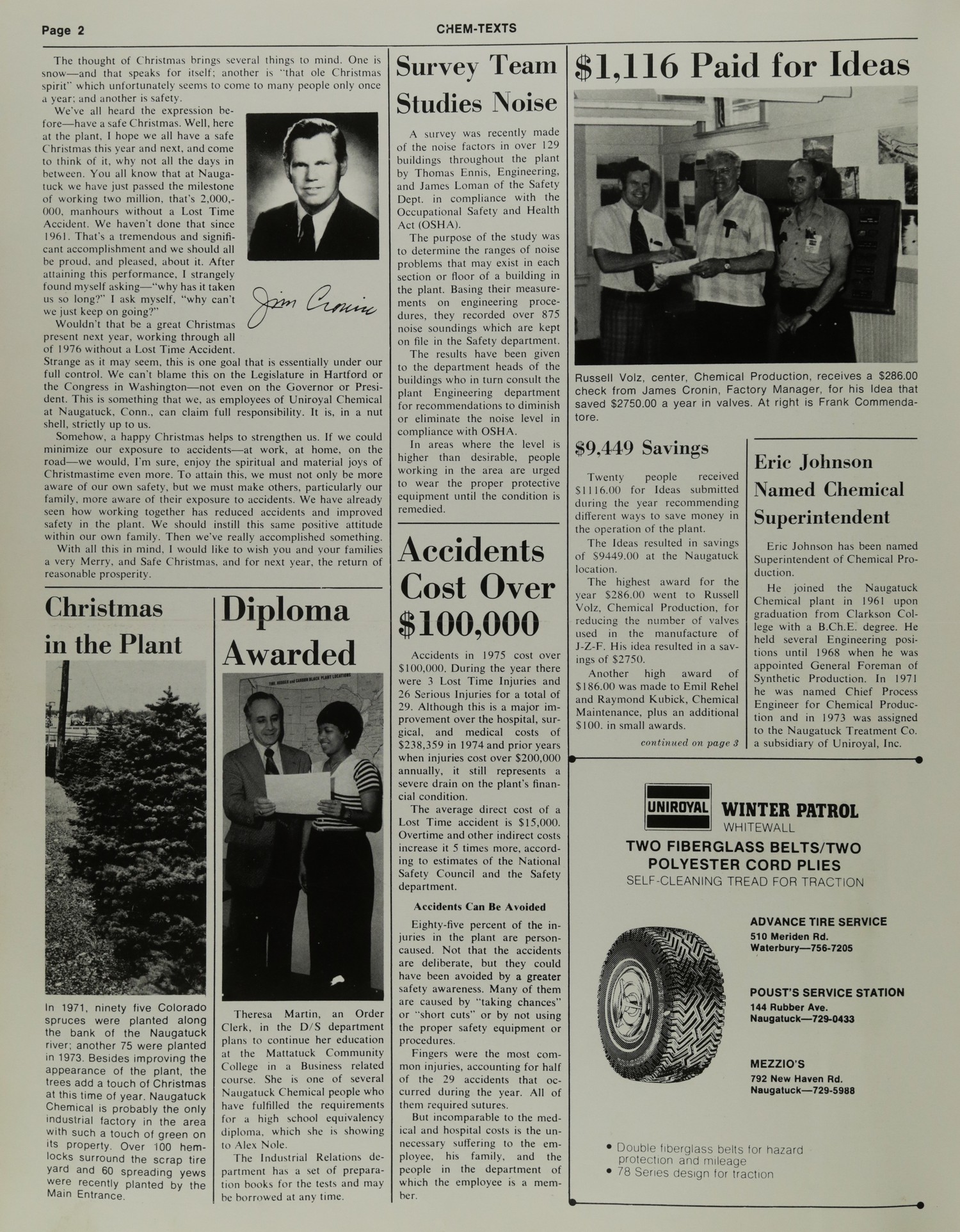
The thought of Christmas brings several things to mind. One is snow—and that speaks for itself; another is “that ole Christmas spirit” which unfortunately seems to come to many people only once a year; and another is safety.

We’ve all heard the expression before—have a safe Christmas. Well, here at the plant, I hope we all have a safe Christmas this year and next, and come to think of it, why not all the days in between. You all know that at Naugatuck we have just passed the milestone of working two million, that’s 2,000,000, manhours without a Lost Time Accident. We haven’t done that since 1961. That’s a tremendous and significant accomplishment and we should all be proud, and pleased, about it. After attaining this performance, I strangely found myself asking—”why has it taken us so long?” I ask myself, “why can’t we just keep on going?”

Jim Cronin [signature]

Wouldn’t that be a great Christmas present next year, working through all of 1976 without a Lost Time Accident. Strange as it may seem, this is one goal that is essentially under our full control. We can’t blame this on the Legislature in Hartford or the Congress in Washington—not even on the Governor or President. This is something that we, as employees of Uniroyal Chemical at Naugatuck, Conn., can claim full responsibility. It is, in a nut shell, strictly up to us.

Somehow, a happy Christmas helps to strengthen us. If we could minimize our exposure to accidents—at work, at home, on the road—we would, I’m sure, enjoy the spiritual and material joys of Christmastime even more. To attain this, we must not only be more aware of our own safety, but we must make others, particularly our family, more aware of their exposure to accidents. We have already seen how working together has reduced accidents and improved safety in the plant. We should instill this same positive attitude within our own family. Then we’ve really accomplished something.

With all this in mind, I would like to wish you and your families a very Merry, and Safe Christmas, and for next year, the return of reasonable prosperity.


Christmas in the Plant

[IMAGE: Photo of trees/spruces near a building]

In 1971, ninety five Colorado spruces were planted along the bank of the Naugatuck river; another 75 were planted in 1973. Besides improving the appearance of the plant, the trees add a touch of Christmas at this time of year. Naugatuck Chemical is probably the only industrial factory in the area with such a touch of green on its property. Over 100 hemlocks surround the scrap tire yard and 60 spreading yews were recently planted by the Main Entrance.


Diploma Awarded

[IMAGE: Photo of woman and man looking at documents]

Theresa Martin, an Order Clerk, in the D/S department plans to continue her education at the Mattatuck Community College in a Business related course. She is one of several Naugatuck Chemical people who have fulfilled the requirements for a high school equivalency diploma, which she is showing to Alex Nole.

The Industrial Relations department has a set of preparation books for the tests and may be borrowed at any time.


Survey Team Studies Noise

A survey was recently made of the noise factors in over 129 buildings throughout the plant by Thomas Ennis, Engineering, and James Loman of the Safety Dept. in compliance with the Occupational Safety and Health Act (OSHA).

The purpose of the study was to determine the range of noise problems that may exist in each section or floor of a building in the plant. Basing their measurements on engineering procedures, they recorded over 875 noise soundings which are kept on file in the Safety department.

The results have been given to the department heads of the buildings who in turn consult the plant Engineering department for recommendations to diminish or eliminate the noise level in compliance with OSHA.

In areas where the level is higher than desirable, people working in the area are urged to wear the proper protective equipment until the condition is remedied.


Accidents Cost Over $100,000

Accidents in 1975 cost over $100,000. During the year there were 3 Lost Time Injuries and 26 Serious Injuries for a total of 29. Although this is a major improvement over the hospital, surgical, and medical costs of $238,359 in 1974 and prior years when injuries cost over $200,000 annually, it still represents a severe drain on the plant’s financial condition.

The average direct cost of a Lost Time accident is $15,000. Overtime and other indirect costs increase it 5 times more, according to estimates of the National Safety Council and the Safety department.

Accidents Can Be Avoided

Eighty-five percent of the injuries in the plant are person-caused. Not that the accidents are deliberate, but they could have been avoided by a greater safety awareness. Many of them are caused by “taking chances” or “short cuts” or by not using the proper safety equipment or procedures.

Fingers were the most common injuries, accounting for half of the 29 accidents that occurred during the year. All of them required sutures.

But incomparable to the medical and hospital costs is the unnecessary suffering to the employee, his family, and the people in the department of which the employee is a member.


$1,116 Paid for Ideas

[IMAGE: Photo of three men, one receiving a check]

Russell Volz, center, Chemical Production, receives a $286.00 check from James Cronin, Factory Manager, for his Idea that saved $2750.00 a year in valves. At right is Frank Commendatore.


$9,449 Savings

Twenty people received $1116.00 for Ideas submitted during the year recommending different ways to save money in the operation of the plant.

The Ideas resulted in savings of $9449.00 at the Naugatuck location.

The highest award for the year $286.00 went to Russell Volz, Chemical Production, for reducing the number of valves used in the manufacture of J-Z-F. His idea resulted in a savings of $2750.

Another high award of $186.00 was made to Emil Rehel and Raymond Kubick, Chemical Maintenance, plus an additional $100. in small awards.

continued on page 3


Eric Johnson Named Chemical Superintendent

Eric Johnson has been named Superintendent of Chemical Production.

He joined the Naugatuck Chemical plant in 1961 upon graduation from Clarkson College with a B.Ch.E. degree. He held several Engineering positions until 1968 when he was appointed General Foreman of Synthetic Production. In 1971 he was named Chief Process Engineer for Chemical Production and in 1973 was assigned to the Naugatuck Treatment Co. a subsidiary of Uniroyal, Inc.


[ADVERTISEMENT]

UNIROYAL WINTER PATROL
WHITEWALL

TWO FIBERGLASS BELTS/TWO POLYESTER CORD PLIES
SELF-CLEANING TREAD FOR TRACTION

[IMAGE: Tire illustration]

ADVANCE TIRE SERVICE
510 Meriden Rd.
Waterbury—756-7205

POUST’S SERVICE STATION
144 Rubber Ave.
Naugatuck—729-0433

MEZZIO’S
792 New Haven Rd.
Naugatuck—729-5988

• Double fiberglass belts for hazard protection and mileage
• 78 Series design for traction
Meeting Called By Mediators

Meeting Called By Mediators

6-21-67 [handwritten]

NAUGATUCK—Small negotiating teams from each of the five major rubber companies and the United Rubber Workers Union have been called for a special group meeting Thursday by the Federal Mediation and Conciliation Service.

The federal government has evidently decided that a 62-day-old strike involving over 51,000 people constitutes a problem requiring high-level action.

The meeting, scheduled to be held at 6 p.m. in Pittsburgh, Pa., will include teams of three management negotiators and three union negotiators from each of the five companies.

Although the full compliment of Uniroyal teams could not be learned Tuesday night, it was known that chief Uniroyal management negotiator will be Eugene Worchester and the chief Uniroyal union negotiator will be Herbert Dawson.

A URW local negotiator, contacted Tuesday, said that the union groups will choose the two

(Cont’d On Page 2—Uniroyal)

Uniroval

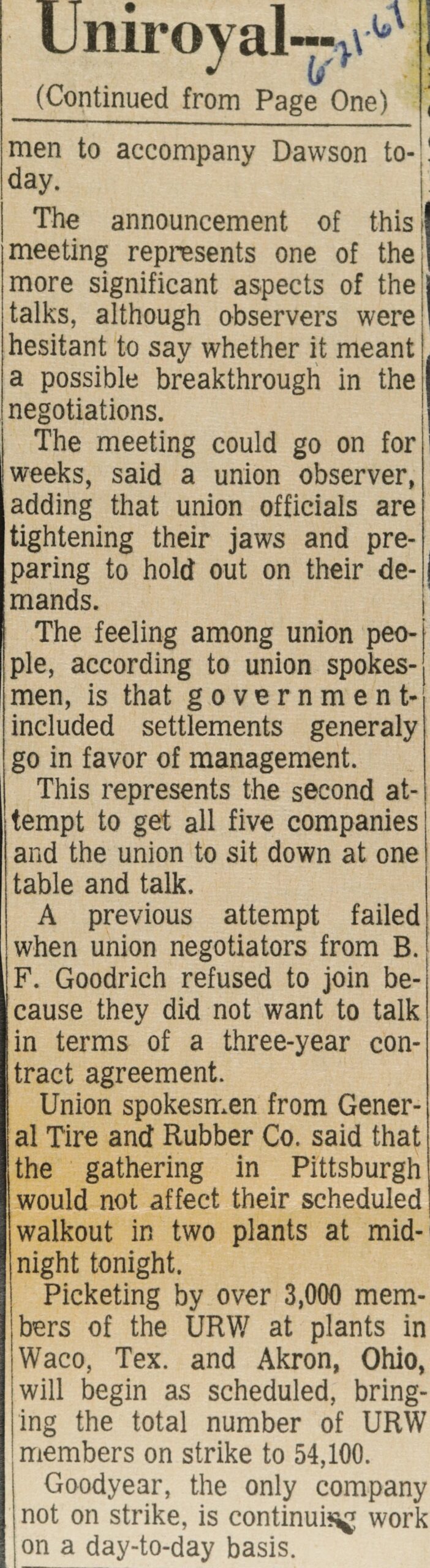
Uniroyal– 6-21-67

(Continued from Page One)

men to accompany Dawson today.

The announcement of this meeting represents one of the more significant aspects of the talks, although observers were hesitant to say whether it meant a possible breakthrough in the negotiations.

The meeting could go on for weeks, said a union observer, adding that union officials are tightening their jaws and preparing to hold out on their demands.

The feeling among union people, according to union spokesmen, is that government-included settlements generaly go in favor of management.

This represents the second attempt to get all five companies and the union to sit down at one table and talk.

A previous attempt failed when union negotiators from B. F. Goodrich refused to join because they did not want to talk in terms of a three-year contract agreement.

Union spokesmen from General Tire and Rubber Co. said that the gathering in Pittsburgh would not affect their scheduled walkout in two plants at midnight tonight.

Picketing by over 3,000 members of the URW at plants in Waco, Tex. and Akron, Ohio, will begin as scheduled, bringing the total number of URW members on strike to 54,100.

Goodyear, the only company not on strike, is continuing work on a day-to-day basis.

Uniroyal

Uniroyal 6-28-61

(Continued from Page One)

Uniroyal counsel J. Kenneth Bradley questioned Mengacci at some length about flare-ups at the gates early in May when pickets attempted to keep office personnel from entering the plant.

71 Arrests

The three days of clashes between pickets and police resulted in arrests of 71 strikers and a warning from Judge Gaffney that he would issue an injunction against the union if the violence didn’t stop.

The judge Tuesday gave some hint as to how he will accept such a defense, when he interrupted Bradley during questioning about a meeting between union officials and John Smith, plant manager.

Mengacci quoted Smith as saying at that meeting that in his opinion, no agreement existed because of the picket line troubles.

Judge Gaffney declared, “I’m not concerned with what some Mr. Smith thought about whether the agreement was null and void—it does not substitute for my judgment.”

At another point, while Bradley cross-examined Mengacci about alleged offers by the company to have union members perform certain jobs at the plant, the judge chided the lawyer to “come to the issue here, whether or not there’s been a violation of this contract.”

Mengacci also claimed that the company had announced at a May 8 meeting that “it needed to get samples out and they (company officials) intended to start production on samples with supervisory help.”

The union official said that after union protests, Smith told Local 45 leaders at a meeting a week later that the company “would honor the agreement” not to go into production and plans to start work on the samples would be dropped.

Mengacci said the company announced at that time that it wanted to produce 400 to 500 pairs of shoes a day.

Joseph DeCarlo, a member of the union negotiating committee, and Walter Beckwith, a picket captain, also voiced the opinion that violence would break out in the picket lines if production is allowed to begin.

Uniroyal cites Continued from Page 1

UniRoyal Cites

Continued From Page 1

plant during the evening hours
set off the mass picketing and
violence in the borough.

The union attorney then asked Smith how many shoes were
normally produced in the plant
a day, to which Smith answered
120,000. Baker then asked if,
after the strike is settled,
couldn’t the company in two
days, by using all its facilities, produce the necessary
number of sample shoes, which
was said to be 45,000 pairs.
Smith said, “Emphatically No”,
adding this would not be practical.

Ronald Hadley, model sales
manager, was called to the stand
to testify to the need for the
sample shoes.

Judge Gaffney stated that he
recognizes the fact that if the
strike is prolonged everybody
will be hurt. The union members and families are already
hurt.

The Judge said that he wants
to stop violence and is not interested in who is going to suffer
the most, union or company.

Nelligan was again called to
the stand to be questioned by
the union attorney as to the oral
agreement that no one enter
the plant after 6 p.m.

Nelligan said that he didn’t
expect anyone would enter the
plant after the normal working
hours. Under questioning he
said that approximately 30 or
40 persons had been brought into the plant the evening before
the first violence when the union
said it would not permit shipment.

Nelligan said, however, no
work was started before 8 a.m.
the following day. He said that
he believed that there was
around-the-clock picketing in
the earlier days of the strike
before he had had an informal
conversation with Mengacci.
Then picketing was only conducted between the hours of 6
a.m. and 6 p.m.

Mengacci was returned to the
stand on the request of the union
attorney to testify on whether
Smith stated at the May 15th
meeting that he would “honor the
agreement.” Mengacci said that
Smith had not made such a statement.

Judge Gaffney asked again
yesterday if a written notice had
been given the union that
the company did not consider
the agreement no longer in effect. He was told, no, that it was
merely an oral announcement.

Approximately a dozen Local
45 members were in court as
spectators to the afternoon session yesterday. They thought
possibly a ruling on the injunction would be announced at the
close of the hearing and were
disappointed that it will be
another week before the decision is reached.

Judge Gaffney reminded the
company and assured the union
that no production would be allowed at the footwear plant until
an announcement of the decision
on the restraining injunction
was made.

He said that he was anxious
to receive the briefs as soon
as possible in order to expedite the matter. The decision
is expected sometime near the
end of next week.

However, Judge Gaffney said
that he would not be hurt to find
the strike was settled first


Handwritten notation in top right corner: 6-29-68

Reuther Calls Rubber Offer “Miserly”

Reuther Calls Rubber Offer "Miserly"

Reuther Calls Rubber Offer “Miserly”

7-1

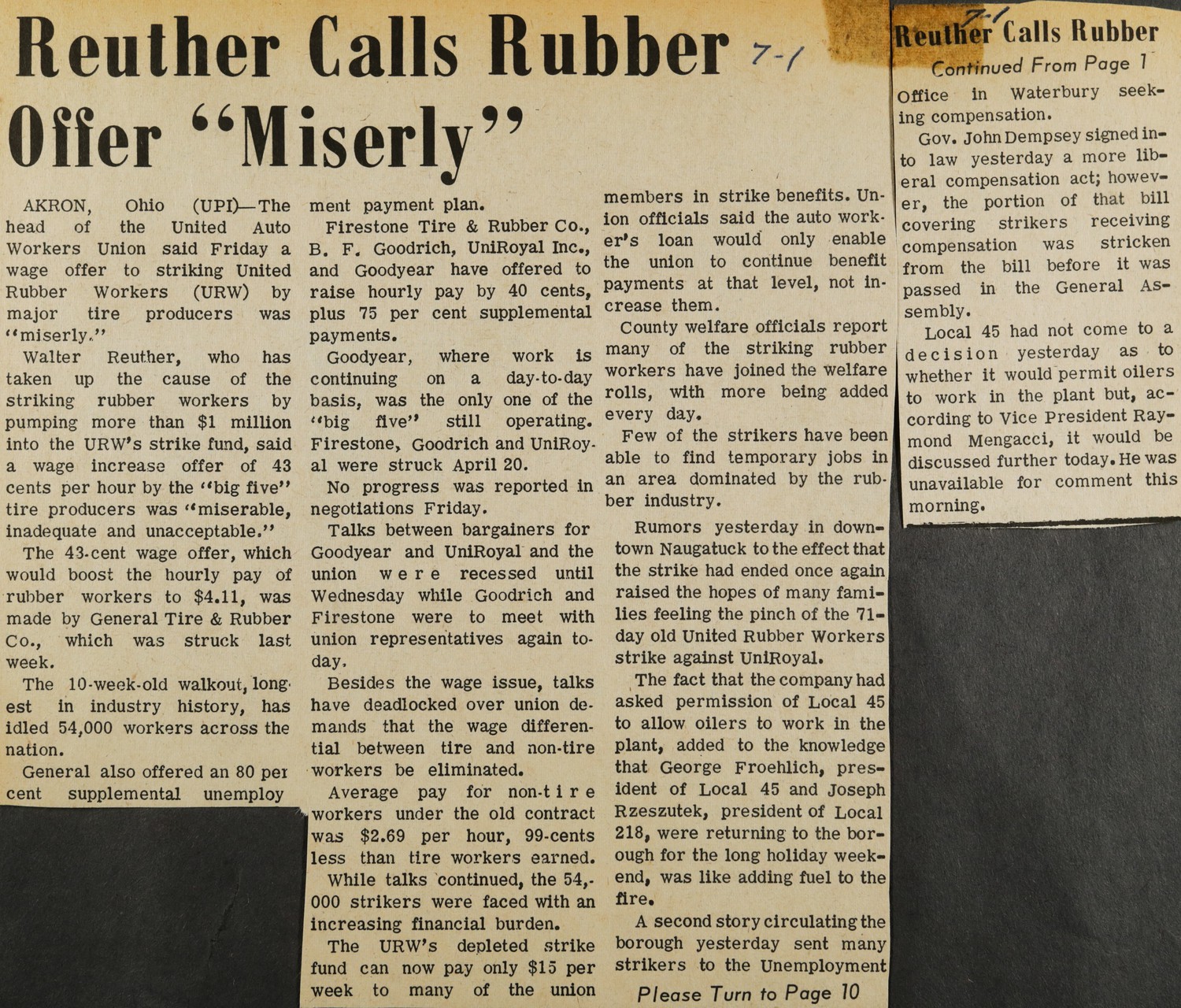
AKRON, Ohio (UPI)—The head of the United Auto Workers Union said Friday a wage offer to striking United Rubber Workers (URW) by major tire producers was “miserly.”

Walter Reuther, who has taken up the cause of the striking rubber workers by pumping more than $1 million into the URW’s strike fund, said a wage increase offer of 43 cents per hour by the “big five” tire producers was “miserable, inadequate and unacceptable.”

The 43-cent wage offer, which would boost the hourly pay of rubber workers to $4.11, was made by General Tire & Rubber Co., which was struck last week.

The 10-week-old walkout, longest in industry history, has idled 54,000 workers across the nation.

General also offered an 80 per cent supplemental unemployment payment plan.

Firestone Tire & Rubber Co., B. F. Goodrich, UniRoyal Inc., and Goodyear have offered to raise hourly pay by 40 cents, plus 75 per cent supplemental payments.

Goodyear, where work is continuing on a day-to-day basis, was the only one of the “big five” still operating. Firestone, Goodrich and UniRoyal were struck April 20.

No progress was reported in negotiations Friday.

Talks between bargainers for Goodyear and UniRoyal and the union were recessed until Wednesday while Goodrich and Firestone were to meet with union representatives again today.

Besides the wage issue, talks have deadlocked over union demands that the wage differential between tire and non-tire workers be eliminated.

Average pay for non-tire workers under the old contract was $2.69 per hour, 99-cents less than tire workers earned.

While talks continued, the 54,000 strikers were faced with an increasing financial burden.

The URW’s depleted strike fund can now pay only $15 per week to many of the union members in strike benefits. Union officials said the auto worker’s loan would only enable the union to continue benefit payments at that level, not increase them.

County welfare officials report many of the striking rubber workers have joined the welfare rolls, with more being added every day.

Few of the strikers have been able to find temporary jobs in an area dominated by the rubber industry.

Rumors yesterday in downtown Naugatuck to the effect that the strike had ended once again raised the hopes of many families feeling the pinch of the 71-day old United Rubber Workers strike against UniRoyal.

The fact that the company had asked permission of Local 45 to allow oilers to work in the plant, added to the knowledge that George Froehlich, president of Local 45 and Joseph Rzeszutek, president of Local 218, were returning to the borough for the long holiday weekend, was like adding fuel to the fire.

A second story circulating the borough yesterday sent many strikers to the Unemployment

Please Turn to Page 10


Reuther Calls Rubber
Continued From Page 1

7-1

Office in Waterbury seeking compensation.

Gov. John Dempsey signed into law yesterday a more liberal compensation act; however, the portion of that bill covering strikers receiving compensation was stricken from the bill before it was passed in the General Assembly.

Local 45 had not come to a decision yesterday as to whether it would permit oilers to work in the plant but, according to Vice President Raymond Mengacci, it would be discussed further today. He was unavailable for comment this morning.

GOODRICH

GOODRICH 7-16-67

(Continued from Page 1)
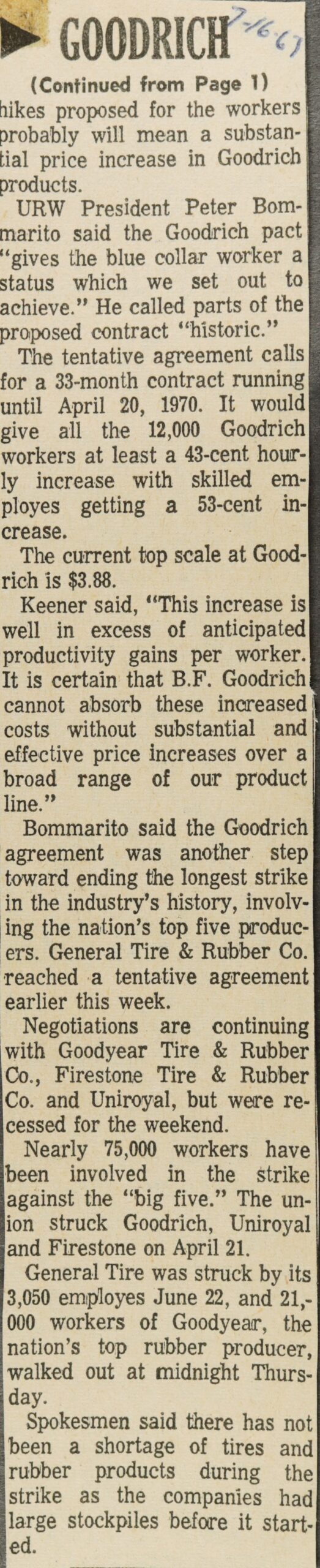
hikes proposed for the workers
probably will mean a substan-
tial price increase in Goodrich
products.

URW President Peter Bom-
marito said the Goodrich pact
“gives the blue collar worker a
status which we set out to
achieve.” He called parts of the
proposed contract “historic.”

The tentative agreement calls
for a 33-month contract running
until April 20, 1970. It would
give all the 12,000 Goodrich
workers at least a 43-cent hour-
ly increase with skilled em-
ployes getting a 53-cent in-
crease.

The current top scale at Good-
rich is $3.88.

Keener said, “This increase is
well in excess of anticipated
productivity gains per worker.
It is certain that B.F. Goodrich
cannot absorb these increased
costs without substantial and
effective price increases over a
broad range of our product
line.”

Bommarito said the Goodrich
agreement was another step
toward ending the longest strike
in the industry’s history, involv-
ing the nation’s top five produc-
ers. General Tire & Rubber Co.
reached a tentative agreement
earlier this week.

Negotiations are continuing
with Goodyear Tire & Rubber
Co., Firestone Tire & Rubber
Co. and Uniroyal, but were re-
cessed for the weekend.

Nearly 75,000 workers have
been involved in the strike
against the “big five.” The un-
ion struck Goodrich, Uniroyal
and Firestone on April 21.

General Tire was struck by its
3,050 employes June 22, and 21,-
000 workers of Goodyear, the
nation’s top rubber producer,
walked out at midnight Thurs-
day.

Spokesmen said there has not
been a shortage of tires and
rubber products during the
strike as the companies had
large stockpiles before it start-
ed.

Strikers Give

Strikers Give

Strikers Give

3-31 [handwritten]

Continued From Page 1

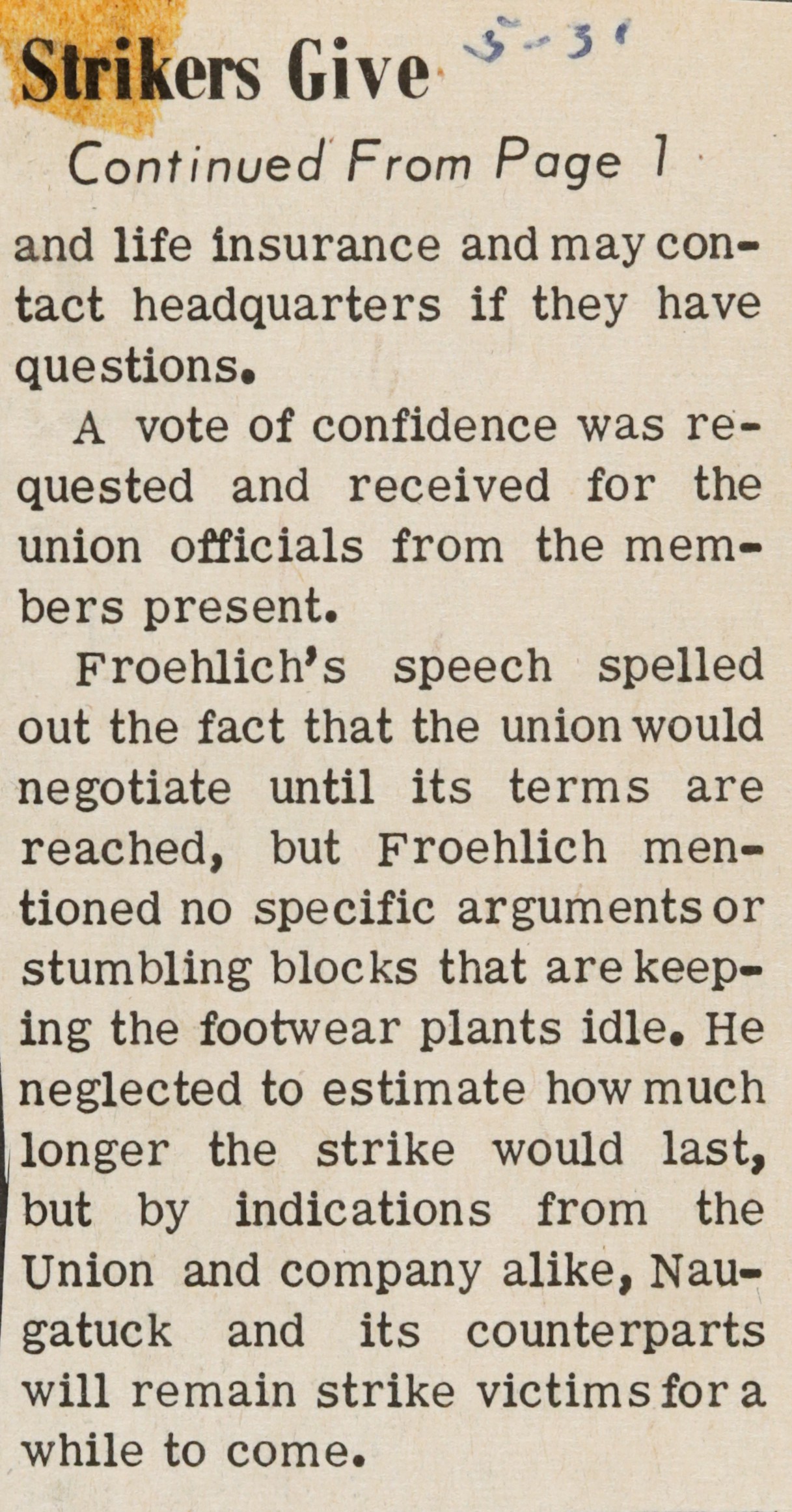
and life insurance and may contact headquarters if they have questions.

A vote of confidence was requested and received for the union officials from the members present.

Froehlich’s speech spelled out the fact that the union would negotiate until its terms are reached, but Froehlich mentioned no specific arguments or stumbling blocks that are keeping the footwear plants idle. He neglected to estimate how much longer the strike would last, but by indications from the Union and company alike, Naugatuck and its counterparts will remain strike victims for a while to come.

Arrest 4

Arrest 4

Continued From Page 1

only to realize that they all hadn’t been arrested. Much time was spent trying to figure out who the four were that they had arrested. Some pickets rode to the station in police cars but hadn’t been arrested. They all wanted to be booked. One picket, when asked why he was in the cruiser, said he wanted a ride to the station.

The following four persons were booked on breach of peace charges, released on $100 no cash bonds for appearance in Waterbury Circuit Court June 8, the same day that the pickets from the footwear plant and the Chemical plant are scheduled to appear.

John A. Painter, 38, Morris Rd., Prospect; Paul Laurenzi, 41, 30 Seery Rd., Wolcott, Jesse J. Silva, 23, 143 Cherry St., and Anthony Gambardella, 53 Birchwood Rd., Seymour.

Alves intends to stay in the borough only long enough to straighten out this matter and hopes to fly to Cincinnati to continue taking part in the negotiating sessions. A session is scheduled for 2 p.m. today but he doubts he will be there. Another session is scheduled for 10 a.m. tomorrow.

The show cause hearing between Local 218, chemical plant and UniRoyal is scheduled for tomorrow in Waterbury Superior Court. Judge Leo Gaffney set the date to allow the union officials time to show why a restraining injunction should not be imposed upon them.

No incidents have taken place at the Chemical Company since last week. Supervisory personnel has been allowed to enter the plant without incident. Production on a limited scale is being carried on at the plant.

Local 45 is also conducting peaceful picketing at the footwear plants. An injunction has been postponed as long as no violence is recorded.


Handwritten note at top right: 5-31

Rubber Negotiations Off Until Wednesday

Rubber Negotiations Off Until Wednesday

4-24-67 [handwritten date in top right corner]

Picketing has been resumed today at all UniRoyal plants in the borough following a weekend respite.

A token team of pickets is being maintained at all gates and no incidents have been reported.

Executives of the three borough Locals are being briefed at meetings today on the contract negotiating sessions held last week in Cincinnati.

The three local presidents, George Froehlich, Local 45; Joseph Rzeszutek, Local 218; and Edward Alves, Local 308, along with three additional policymaking session to be held in Cincinnati tomorrow evening.

The next negotiation session is called for Wednesday morning. Both management and labor representatives have said privately they see little chance of an early settlement.

Union demands for higher wages and a guaranteed minimum wage have been the most difficult issues to resolve. The Union seeks payments to laid off workers totaling 93 per cent of their regular wage.