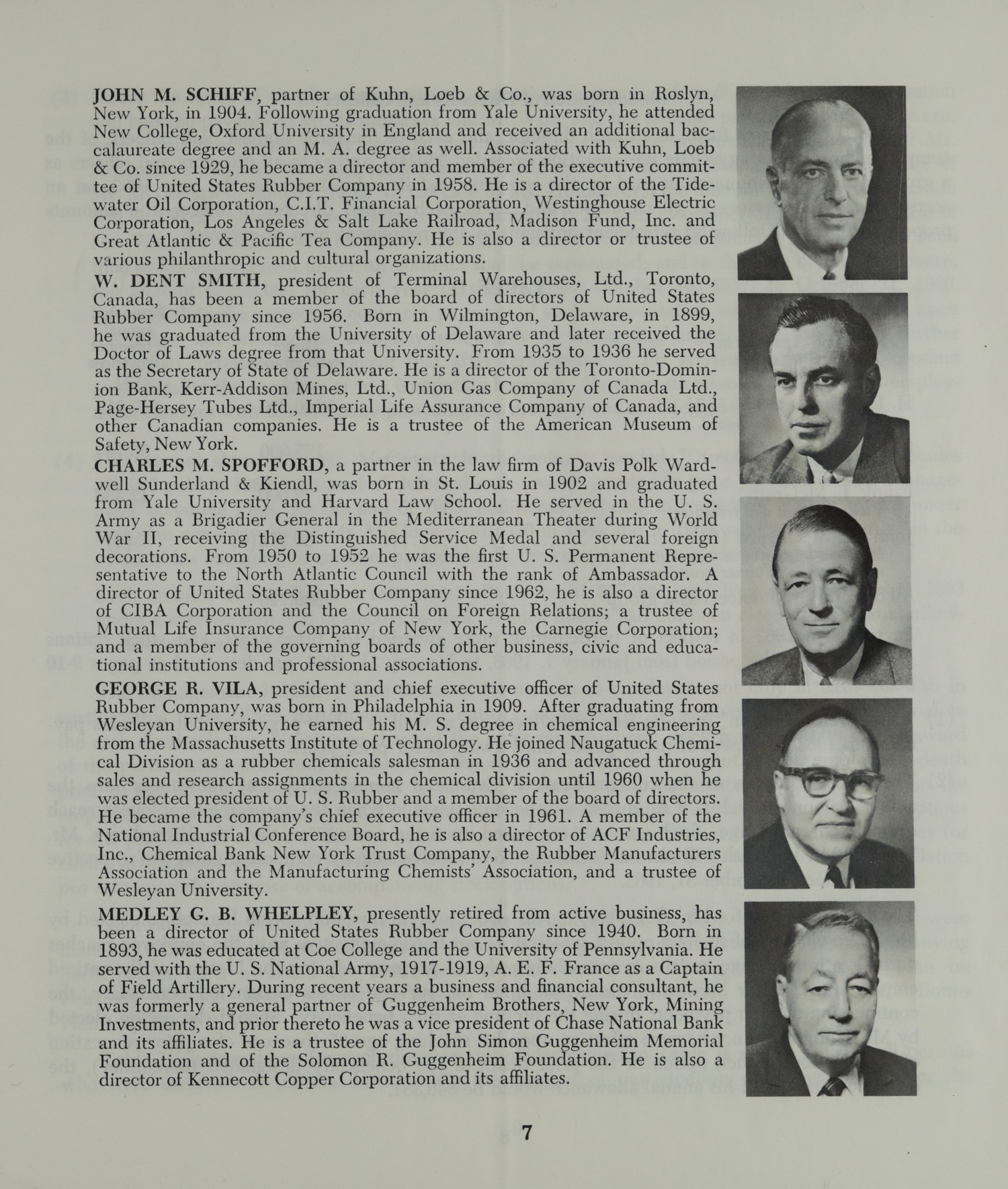
US Rubber Proxy Statement – Page 7
Page 007

JOHN M. SCHIFF, partner of Kuhn, Loeb & Co., was born in Roslyn, New York, in 1904. Following graduation from Yale University, he attended New College, Oxford University in England and received an additional bac-
calaurcatc degree and an M.A. degree as well. Associated with Kuhn, Loeb
& Co. since 1929, he became a director and member of the executive commit-
tee of United States Rubber Company in 1958. He is a director of the Tide-
water Oil Corporation, C.I.T. Financial Corporation, Westinghouse Electric
Corporation, Los Angeles & Salt Lake Railroad, Madison Fund, Inc. and
Great Atlantic & Pacific Tea Company. He is also a director or trustee of
various philanthropic and cultural organizations.
W. DENT SMITH, president of Terminal Warehouses, Ltd., Toronto,
Canada, has been a member of the board of directors of United States
Rubber Company since 1956. Born in Wilmington, Delaware, in 1899,
he was graduated from the University of Delaware and later received the
Doctor of Laws degree from that University. From 1935 to 1936 he served
as the Secretary of State of Delaware. He is a director of the Toronto-Domin-
ion Bank, Kerr-Addison Mines, Ltd., Union Gas Company of Canada Ltd.,
Page-Hersey Tubes Ltd., Imperial Life Assurance Company of Canada, and
other Canadian companies. He is a trustee of the American Museum of
Safety, New York.
CHARLES M. SPOFFORD, a partner in the law firm of Davis Polk Ward-
well Sunderland & Kiendl, was born in St. Louis in 1902 and graduated
from Yale University and Harvard Law School. He served in the U. S.
Army as a Brigadier General in the Mediterranean Theater during World
War II, receiving the Distinguished Service Medal and several foreign
decorations. From 1950 to 1952 he was the first U. S Permanent Repre-
sentative to the North Atlantic Council with the rank of Ambassador. A
director of United States Rubber Company since 1962, he is also a director
of CIBÄ Corporation and the Council on Foreign Relations; a trustee of
Mutual Life Insurance Company of New York, the Carnegie Corporation;
and a member of the governing boards of other business, civic and educa-
tional institutions and professional associations.
GEORGE R. VILA, president and chief executive officer of United States
Rubber Company, was born in Philadelphia in 1909. After graduating from
Wesleyan University, he earned his M. S. degree in chemical engineering
from the Massachusetts Institute of Technology. He joined Naugatuck Chemi-
cal Division as a rubber chemicals salesman in 1936 and advanced through
sales and research assignments in the chemical division until 1960 when he
was elected president of U. S. Rubber and a member of the board of directors.
He became the company’s chief executive officer in 1961. A member of the
National Industrial Conference Board, he is also a director of ACF Industries,
Inc., Chemical Bank New York Trust Company, the Rubber Manufacturers
Association and the Manufacturing Chemists Association, and a trustee of
Wesleyan University.
MEDLEY G. B. WHELPLEY, presently retired from active business, has
been a director of United States Rubber Company since 1940. Born in
1893, he was educated at Coe College and the University of Pennsylvania. He
served with the U. S. National Army, 1917-1919, A. E. F. France as a Captain
of Field Artillery. During recent years a business and financial consultant, he
was formerly a general partner of Guggenheim Brothers, New York, Mining
Investments, and prior thereto he was a vice president of Chase National Bank
and its affiliates. He is a trustee of the John Simon Guggenheim Memorial
Foundation and of the Solomon R. Guggenheim Foundation. He is also a
director of Kennecott Copper Corporation and its affiliates.

US Rubber Proxy Statement – Page 6

Page 006

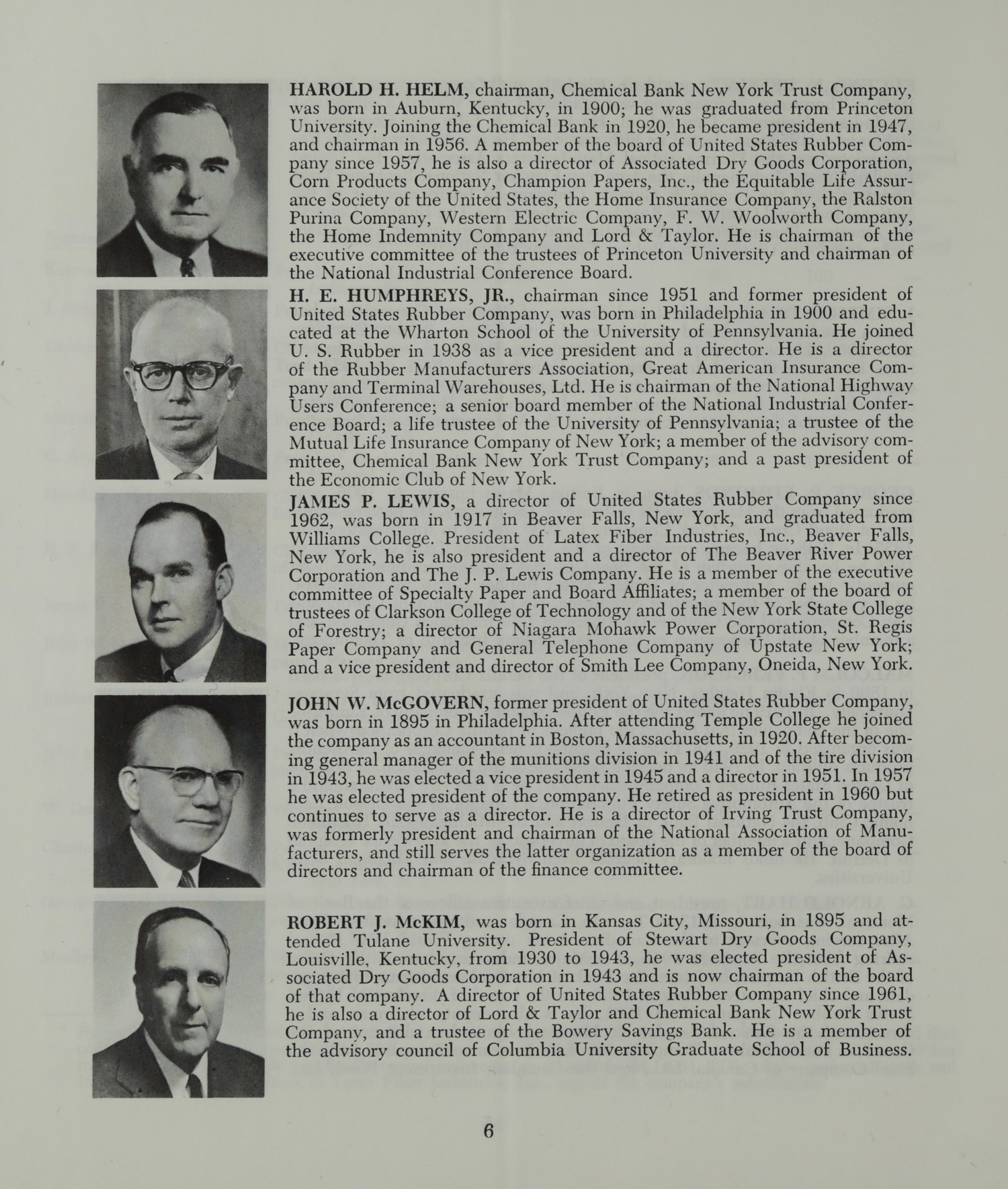
HAROLD H. HELM, chairman, Chemical Bank New York Trust Company, was born in Auburn, Kentucky, in 1900; he was graduated from Princeton University. Joining the Chemical Bank in 1920, he became president in 1947, and chairman in 1956. A member of the board of United States Rubber Company since 1957, he is also a director of Associated Dry Goods Corporation, Champion Papers, Inc., the Equitable Life Assurance Society of the United States, the Home Insurance Company, the Ralston Purina Company, Western Electric Company, F. W. Woolworth Company, the Home Indemnity Company and Lord & Taylor. He is chairman of the executive committee of the trustees of Princeton University and chairman of the National Industrial Conference Board.

H. E. HUMPHREYS, JR., chairman since 1951 and former president of United States Rubber Company, was born in Philadelphia in 1900 and educated at the Wharton School of the University of Pennsylvania. He joined U. S. Rubber in 1935 as a vice president and a director. He is a director of the Rubber Manufacturers Association, Great American Insurance Company and Terminal Warehouses, Ltd. He is chairman of the National Highway Users Conference; a senior board member of the National Industrial Conference Board; a life trustee of the University of Pennsylvania; a trustee of the Mutual Life Insurance Company of New York; a member of the advisory committee, Chemical Bank New York Trust Company; and a past president of the Economic Club of New York.

JAMES P. LEWIS, a director of United States Rubber Company since 1962, was born in 1917 in Beaver Falls, New York, and graduated from Williams College. President of Latex Fiber Industries, Inc., Beaver Falls, New York, he is also president and a director of The Beaver River Power Corporation and The J. P. Lewis Company. He is a member of the executive committee of Specialty Paper and Board Affiliates; a member of the board of trustees of Clarkson College of Technology and of Forestry; a director of Niagara Mohawk Power Corporation, St. Regis Paper Company and General Telephone Company of Upstate New York; and a vice president and director of Smith Lee Company, Oneida, New York.

JOHN W. McGOVERN, former president of United States Rubber Company, was born in 1895 in Philadelphia. After attending Temple College he joined the company as an accountant in Boston, Massachusetts, in 1920. After becoming general manager of the munitions division in 1941 and of the tire division in 1943, he was elected a vice president in 1945 and a director in 1951. In 1957 he was elected president of the company. He retired as president in 1960 but continues to serve as a director. He is a director of Irving Trust Company, was formerly president and chairman of the National Association of Manufacturers, and still serves the latter organization as a member of the board of directors and chairman of the finance committee.

ROBERT J. McKIM, was born in Kansas City, Missouri, in 1895 and attended Tulane University. President of Stewart Dry Goods Company, Louisville, Kentucky, from 1930 to 1943, he was elected president of Associated Dry Goods Corporation in 1943 and is now chairman of the board of that company. A director of United States Rubber Company since 1961, he is also a director of Lord & Taylor and Chemical Bank New York Trust Company, and a trustee of the Savings Bank. He is a member of the advisory council of the Columbia University Graduate School of Business.

US Rubber Proxy Statement – Page 5

Page 005

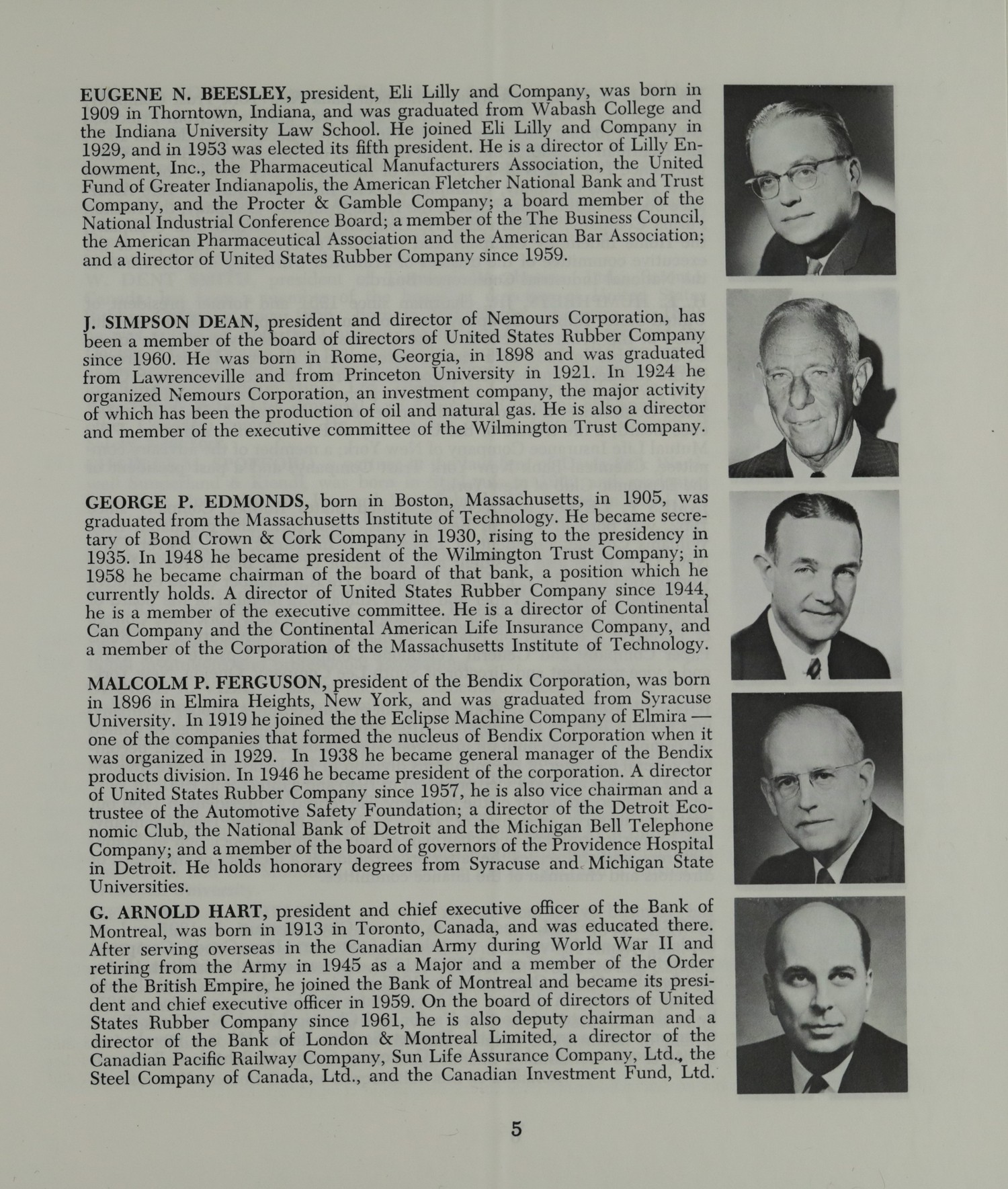
EUGENE N. BEESLEY, president, Eli Lilly and Company, was born in 1909 in Thorntown, Indiana, and was graduated from Wabash College and the Indiana University Law School. He joined Eli Lilly and Company in 1929, and in 1953 was elected its fifth president. He is a director of Lilly Endowment, Inc., the Pharmaceutical Manufacturers Association, the United Fund of Greater Indianapolis, the American Fletcher National Bank and Trust Company, and the Procter & Gamble Company; a board member of the National Industrial Conference Board; a member of the Business Council, the American Pharmaceutical Association; and a director of United States Rubber Company since 1959.

J. SIMPSON DEAN, president and director of Nemours Corporation, has been a member of the board of directors of United States Rubber Company since 1960. He was born in Rome, Georgia, in 1898 and was graduated from Lawrenceville and from Princeton University in 1921. In 1924 he organized Nemours Corporation, an investment company, the major activity of which has been the production of oil and natural gas. He is also a director and member of the executive committee of the Wilmington Trust Company.

GEORGE P. EDMONDS, born in Boston, Massachusetts, in 1905, was graduated from the Massachusetts Institute of Technology. He became secretary of Bond Crow & Cork Company in 1930, rising to the presidency in 1935. In 1948 he became president of the Wilmington Trust Company; in 1953 he became chairman of the board of that bank, a position which he currently holds. A director of United States Rubber Company since 1944, he is a member of the executive committee. He is a director of Continental Can Company and the Continental American Life Insurance Company, and a member of the Corporation of the Massachusetts Institute of Technology.

MALCOLM P. FERGUSON, president of the Bendix Corporation, was born in 1896 in Elmira Heights, New York, and was graduated from Syracuse University. In 1919 he joined the Eclipse Machine Company of Elmira — one of the companies that formed the nucleus of Bendix Corporation when it was organized in 1929. In 1938 he became general manager of the Bendix products division. In 1946 he became president of the corporation. A director of United States Rubber Company since 1957, he is also vice chairman and a trustee of the Automotive Safety Foundation; a director of the National Bank of Detroit and the Michigan Bell Telephone Company; and a member of the board of governors of the Providence Hospital in Detroit. He holds honorary degrees from Syracuse and Michigan State Universities.

G. ARNOLD HART, president and chief executive officer of the Bank of Montreal, was born in 1913 in Toronto, Canada, and was educated there. After serving overseas in the Canadian Army during World War II and retiring from the Army in 1945 as a Major and a member of the Order of the British Empire, he joined the Bank of Montreal and became its president and chief executive officer in 1959. On the board of directors of United States Rubber Company since 1961, he is also deputy chairman and a director of the Bank of London & Montreal Limited, a director of the Canadian Pacific Railway Company, Sun Life Assurance Company, Ltd., the Steel Company of Canada, Ltd., and the Canadian Investment Fund, Ltd.

US Rubber Proxy Statement – Page 4

Page 004

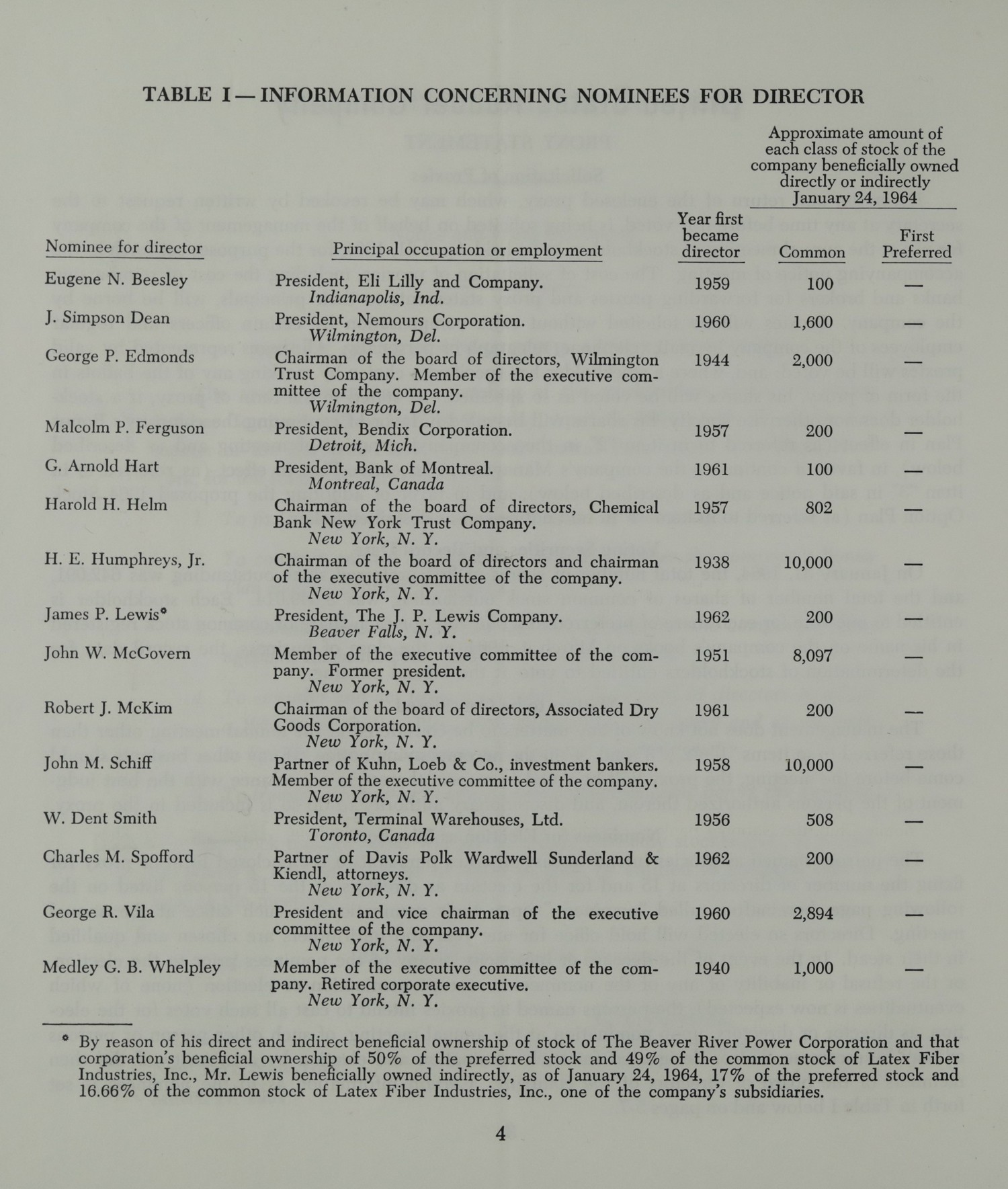
TABLE I — INFORMATION CONCERNING NOMINEES FOR DIRECTOR

Approximate amount of
each class of stock of the
company beneficially owned
directly or indirectly
January 24, 1964

Nominee for director Principal occupation or employment Year first Common First
became Preferred
director
Eugene N. Beesley President, Eli Lilly and Company, 1959 100 —
Indianapolis, Ind.
J. Simpson Dean President, Nemours Corporation. 1960 1,600 —
Wilmington, Del.
George P. Edmonds Chairman of the board of directors, Wilmington 1944 2,000 —
Trust Company. Member of the executive com-
mittee of the company.
Wilmington, Del.
Malcolm P. Ferguson President, Bendix Corporation. 1957 200 —
Detroit, Mich.
G. Arnold Hart President, Bank of Montreal. 1961 100 —
Montreal, Canada
Harold H. Helm Chairman of the board of directors, Chemical 1957 802 —
Bank New York Trust Company.
New York, N. Y.
H. E. Humphreys, Jr. Chairman of the board of directors and chairman 1938 10,000 —
of the executive committee of the company.
New York, N. Y.
James P. Lewis* President, The J. P. Lewis Company, 1962 200 —
Beaver Falls, N. Y.
John W. McGovern Member of the executive committee of the com- 1951 8,097 —
pany. Former president.
New York, N. Y.
Robert J. McKim Chairman of the board of directors, Associated Dry 1961 200 —
Goods Corporation.
New York, N. Y.
John M. Schiff Partner of Kuhn, Loeb & Co., investment bankers. 1958 10,000 —
Member of the executive committee of the company.
New York, N. Y.
W. Dent Smith President, Terminal Warehouses, Ltd. 1956 508 —
Toronto, Canada
Charles M. Spofford Partner of Davis Polk Wardwell Sunderland & 1962 200 —
Kiendl, attorneys.
New York, N. Y.
George R. Vila President and vice chairman of the executive 1960 2,894 —
committee of the company.
New York, N. Y.
Medley G. B. Whelpley Member of the executive committee of the com- 1940 1,000 —
pany. Retired corporate executive.
New York, N. Y.

  • By reason of his direct and indirect beneficial ownership of stock of The Beaver River Power Corporation and that corporation’s beneficial ownership of 50% of the preferred stock and 49% of the common stock of Latex Fiber Industries, Inc., Mr. Lewis beneficially owned indirectly, as of January 24, 1964, 17% of the preferred stock and 16.66% of the common stock of Latex Fiber Industries, Inc., one of the company’s subsidiaries.

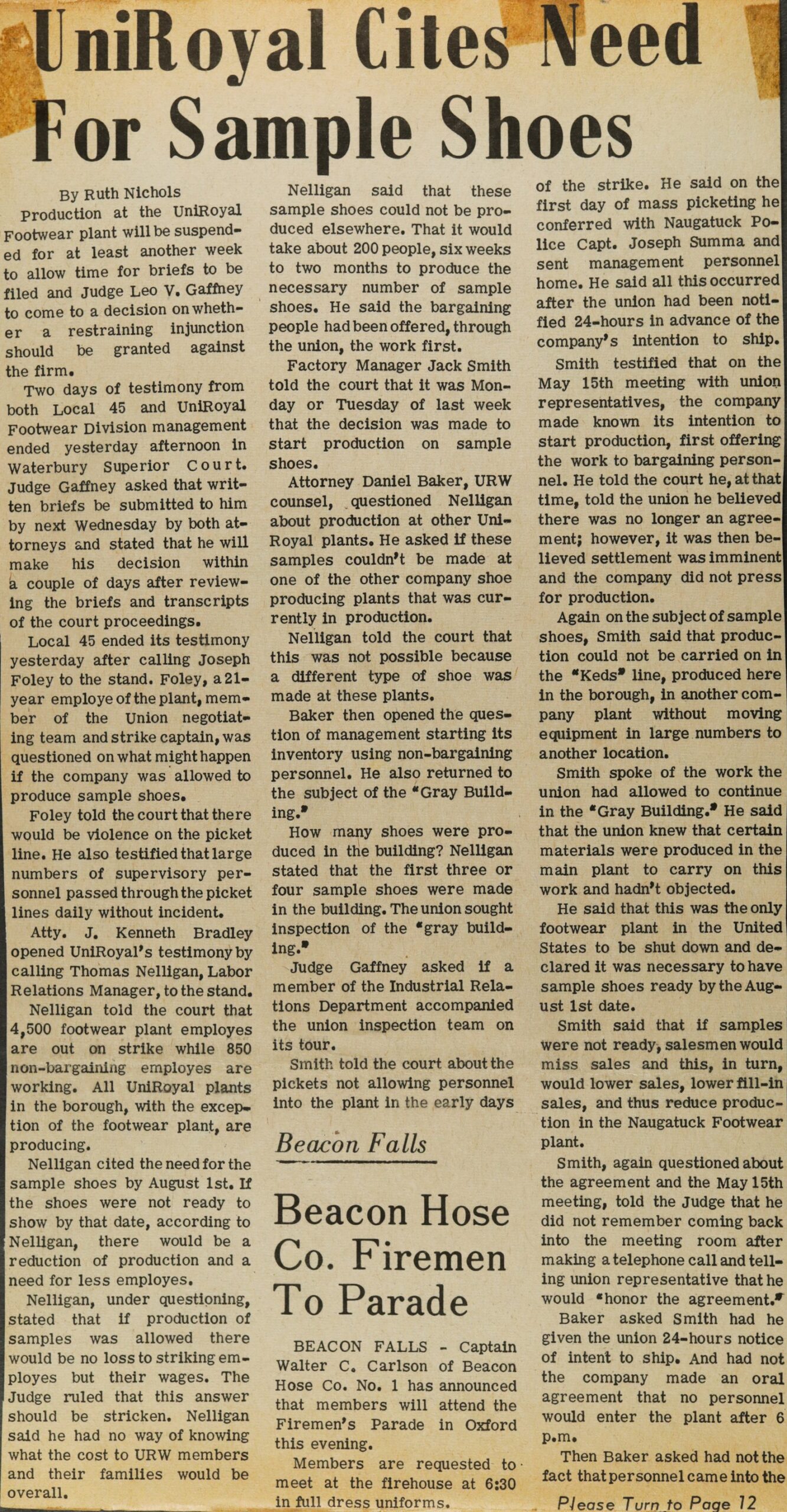
UniRoyal Cites Need For Sample Shoes

UniRoyal Cites Need For Sample Shoes

By Ruth Nichols

Production at the UniRoyal Footwear plant will be suspended for at least another week to allow time for briefs to be filed and Judge Leo V. Gaffney to come to a decision on whether a restraining injunction should be granted against the firm.

Two days of testimony from both Local 45 and UniRoyal Footwear Division management ended yesterday afternoon in Waterbury Superior Court. Judge Gaffney asked that written briefs be submitted to him by next Wednesday by both attorneys and stated that he will make his decision within a couple of days after reviewing the briefs and transcripts of the court proceedings.

Local 45 ended its testimony yesterday after calling Joseph Foley to the stand. Foley, a 21-year employe of the plant, member of the Union negotiating team and strike captain, was questioned on what might happen if the company was allowed to produce sample shoes.

Foley told the court that there would be violence on the picket line. He also testified that large numbers of supervisory personnel passed through the picket lines daily without incident.

Atty. J. Kenneth Bradley opened UniRoyal’s testimony by calling Thomas Nelligan, Labor Relations Manager, to the stand.

Nelligan told the court that 4,500 footwear plant employes are out on strike while 850 non-bargaining employes are working. All UniRoyal plants in the borough, with the exception of the footwear plant, are producing.

Nelligan cited the need for the sample shoes by August 1st. If the shoes were not ready to show by that date, according to Nelligan, there would be a reduction of production and a need for less employes.

Nelligan, under questioning, stated that if production of samples was allowed there would be no loss to striking employes but their wages. The Judge ruled that this answer should be stricken. Nelligan said he had no way of knowing what the cost to URW members and their families would be overall.

Nelligan said that these sample shoes could not be produced elsewhere. That it would take about 200 people, six weeks to two months to produce the necessary number of sample shoes. He said the bargaining people had been offered, through the union, the work first.

Factory Manager Jack Smith told the court that it was Monday or Tuesday of last week that the decision was made to start production on sample shoes.

Attorney Daniel Baker, URW counsel, questioned Nelligan about production at other UniRoyal plants. He asked if these samples couldn’t be made at one of the other company shoe producing plants that was currently in production.

Nelligan told the court that this was not possible because a different type of shoe was made at these plants.

Baker then opened the question of management starting its inventory using non-bargaining personnel. He also returned to the subject of the “Gray Building.”

How many shoes were produced in the building? Nelligan stated that the first three or four sample shoes were made in the building. The union sought inspection of the “gray building.”

Judge Gaffney asked if a member of the Industrial Relations Department accompanied the union inspection team on its tour.

Smith told the court about the pickets not allowing personnel into the plant in the early days of the strike. He said on the first day of mass picketing he conferred with Naugatuck Police Capt. Joseph Summa and sent management personnel home. He said all this occurred after the union had been notified 24-hours in advance of the company’s intention to ship.

Smith testified that on the May 15th meeting with union representatives, the company made known its intention to start production, first offering the work to bargaining personnel. He told the court he, at that time, told the union he believed there was no longer an agreement; however, it was then believed settlement was imminent and the company did not press for production.

Again on the subject of sample shoes, Smith said that production could not be carried on in the “Keds” line, produced here in the borough, in another company plant without moving equipment in large numbers to another location.

Smith spoke of the work the union had allowed to continue in the “Gray Building.” He said that the union knew that certain materials were produced in the main plant to carry on this work and hadn’t objected.

He said that this was the only footwear plant in the United States to be shut down and declared it was necessary to have sample shoes ready by the August 1st date.

Smith said that if samples were not ready, salesmen would miss sales and this, in turn, would lower sales, lower fill-in sales, and thus reduce production in the Naugatuck Footwear plant.

Smith, again questioned about the agreement and the May 15th meeting, told the Judge that he did not remember coming back into the meeting room after making a telephone call and telling union representative that he would “honor the agreement.”

Baker asked Smith had he given the union 24-hours notice of intent to ship. And had not the company made an oral agreement that no personnel would enter the plant after 6 p.m.

Then Baker asked had not the fact that personnel came into the

Please Turn to Page 12


Beacon Falls

Beacon Hose Co. Firemen To Parade

BEACON FALLS – Captain Walter C. Carlson of Beacon Hose Co. No. 1 has announced that members will attend the Firemen’s Parade in Oxford this evening.

Members are requested to meet at the firehouse at 6:30 in full dress uniforms.

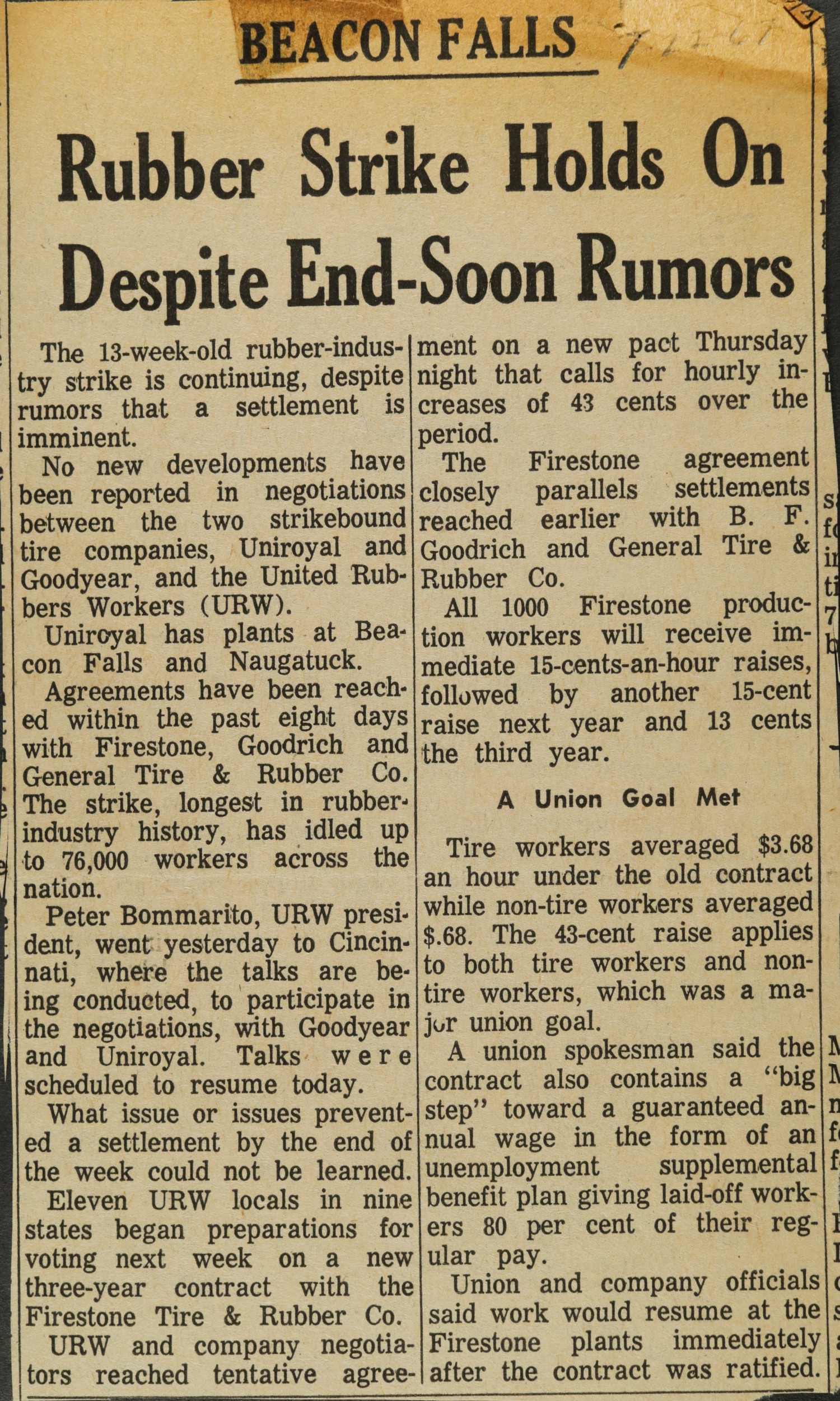
Rubber Strike Holds On Despite End-Soon Rumors

Rubber Strike Holds On Despite End-Soon Rumors

BEACON FALLS

7/12/67 [handwritten date in top right corner]

Rubber Strike Holds On Despite End-Soon Rumors

The 13-week-old rubber-industry strike is continuing, despite rumors that a settlement is imminent.

No new developments have been reported in negotiations between the two strikebound tire companies, Uniroyal and Goodyear, and the United Rubbers Workers (URW).

Uniroyal has plants at Beacon Falls and Naugatuck.

Agreements have been reached within the past eight days with Firestone, Goodrich and General Tire & Rubber Co. The strike, longest in rubber-industry history, has idled up to 76,000 workers across the nation.

Peter Bommarito, URW president, went yesterday to Cincinnati, where the talks are being conducted, to participate in the negotiations, with Goodyear and Uniroyal. Talks were scheduled to resume today.

What issue or issues prevented a settlement by the end of the week could not be learned.

Eleven URW locals in nine states began preparations for voting next week on a new three-year contract with the Firestone Tire & Rubber Co.

URW and company negotiators reached tentative agreement on a new pact Thursday night that calls for hourly increases of 43 cents over the period.

The Firestone agreement closely parallels settlements reached earlier with B. F. Goodrich and General Tire & Rubber Co.

All 1000 Firestone production workers will receive immediate 15-cents-an-hour raises, followed by another 15-cent raise next year and 13 cents the third year.

A Union Goal Met

Tire workers averaged $3.68 an hour under the old contract while non-tire workers averaged $.68. The 43-cent raise applies to both tire workers and non-tire workers, which was a major union goal.

A union spokesman said the contract also contains a “big step” toward a guaranteed annual wage in the form of an unemployment supplemental benefit plan giving laid-off workers 80 per cent of their regular pay.

Union and company officials said work would resume at the Firestone plants immediately after the contract was ratified.

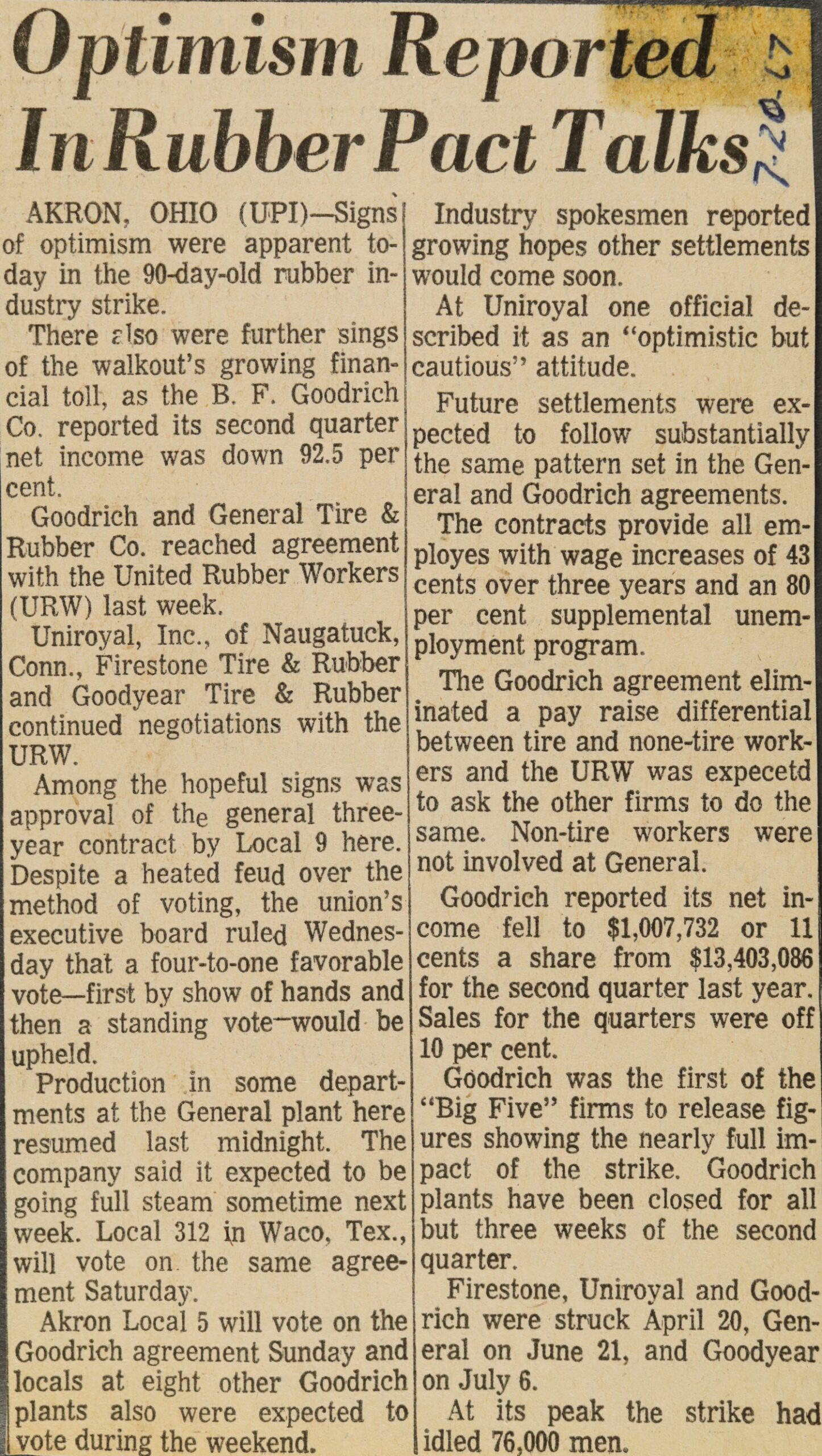
Optimism Reported In Rubber Pact Talks

Optimism Reported In Rubber Pact Talks

7-20-67 [handwritten notation]

AKRON, OHIO (UPI)—Signs of optimism were apparent today in the 90-day-old rubber industry strike.

There also were further sings of the walkout’s growing financial toll, as the B. F. Goodrich Co. reported its second quarter net income was down 92.5 per cent.

Goodrich and General Tire & Rubber Co. reached agreement with the United Rubber Workers (URW) last week.

Uniroyal, Inc., of Naugatuck, Conn., Firestone Tire & Rubber and Goodyear Tire & Rubber continued negotiations with the URW.

Among the hopeful signs was approval of the general three-year contract by Local 9 here. Despite a heated feud over the method of voting, the union’s executive board ruled Wednesday that a four-to-one favorable vote—first by show of hands and then a standing vote—would be upheld.

Production in some departments at the General plant here resumed last midnight. The company said it expected to be going full steam sometime next week. Local 312 in Waco, Tex., will vote on the same agreement Saturday.

Akron Local 5 will vote on the Goodrich agreement Sunday and locals at eight other Goodrich plants also were expected to vote during the weekend.

Industry spokesmen reported growing hopes other settlements would come soon.

At Uniroyal one official described it as an “optimistic but cautious” attitude.

Future settlements were expected to follow substantially the same pattern set in the General and Goodrich agreements.

The contracts provide all employes with wage increases of 43 cents over three years and an 80 per cent supplemental unemployment program.

The Goodrich agreement eliminated a pay raise differential between tire and none-tire workers and the URW was expecetd to ask the other firms to do the same. Non-tire workers were not involved at General.

Goodrich reported its net income fell to $1,007,732 or 11 cents a share from $13,403,086 for the second quarter last year. Sales for the quarters were off 10 per cent.

Goodrich was the first of the “Big Five” firms to release figures showing the nearly full impact of the strike. Goodrich plants have been closed for all but three weeks of the second quarter.

Firestone, Uniroyal and Goodrich were struck April 20, General on June 21, and Goodyear on July 6.

At its peak the strike had idled 76,000 men.

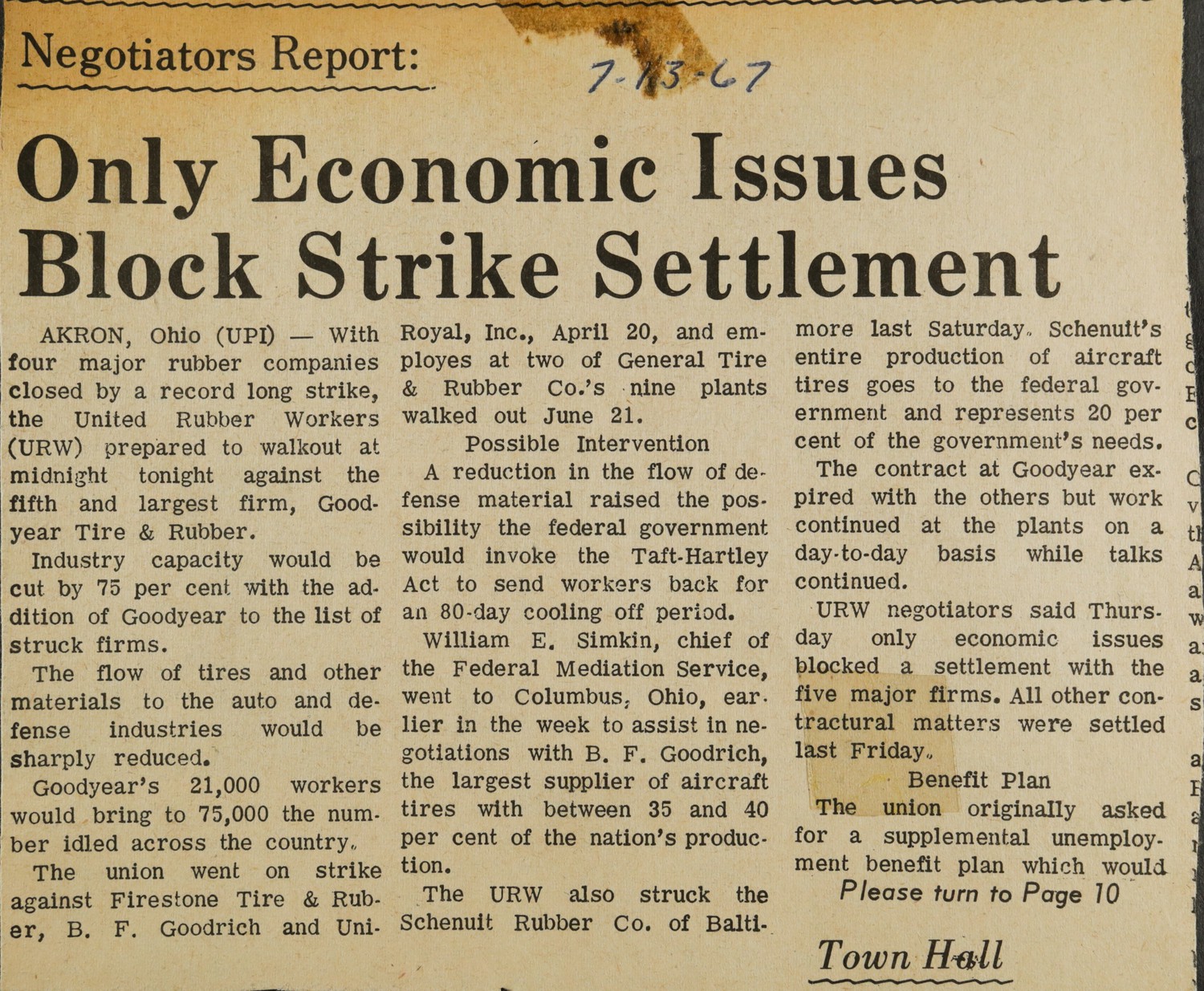
Untitled Clipping

Negotiators Report:

7-13-67 [handwritten]

Only Economic Issues Block Strike Settlement

AKRON, Ohio (UPI) — With four major rubber companies closed by a record long strike, the United Rubber Workers (URW) prepared to walkout at midnight tonight against the fifth and largest firm, Goodyear Tire & Rubber.

Industry capacity would be cut by 75 per cent with the addition of Goodyear to the list of struck firms.

The flow of tires and other materials to the auto and defense industries would be sharply reduced.

Goodyear’s 21,000 workers would bring to 75,000 the number idled across the country.

The union went on strike against Firestone Tire & Rubber, B. F. Goodrich and Uni-

Royal, Inc., April 20, and employes at two of General Tire & Rubber Co.’s nine plants walked out June 21.

Possible Intervention

A reduction in the flow of defense material raised the possibility the federal government would invoke the Taft-Hartley Act to send workers back for an 80-day cooling off period.

William E. Simkin, chief of the Federal Mediation Service, went to Columbus, Ohio, earlier in the week to assist in negotiations with B. F. Goodrich, the largest supplier of aircraft tires with between 35 and 40 per cent of the nation’s production.

The URW also struck the Schenuit Rubber Co. of Balti-

more last Saturday. Schenuit’s entire production of aircraft tires goes to the federal government and represents 20 per cent of the government’s needs.

The contract at Goodyear expired with the others but work continued at the plants on a day-to-day basis while talks continued.

URW negotiators said Thursday only economic issues blocked a settlement with the five major firms. All other contractural matters were settled last Friday.

Benefit Plan

The union originally asked for a supplemental unemployment benefit plan which would

Please turn to Page 10


Town Hall

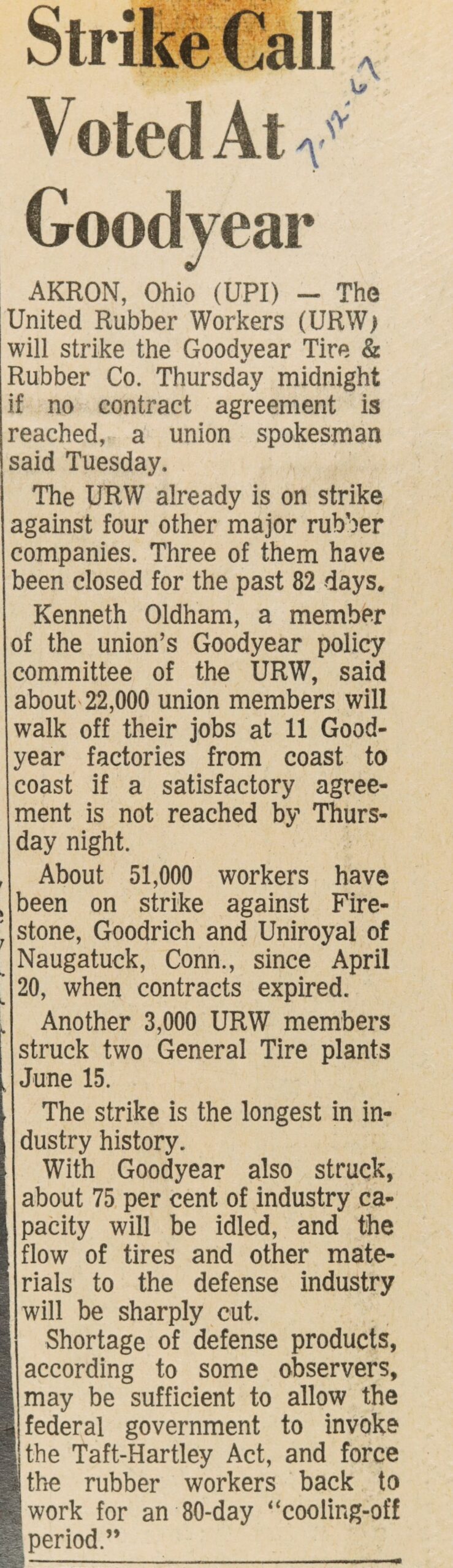
Strike Call Voted At Goodyear

Strike Call Voted At Goodyear

7-12-67

AKRON, Ohio (UPI) — The United Rubber Workers (URW) will strike the Goodyear Tire & Rubber Co. Thursday midnight if no contract agreement is reached, a union spokesman said Tuesday.

The URW already is on strike against four other major rubber companies. Three of them have been closed for the past 82 days.

Kenneth Oldham, a member of the union’s Goodyear policy committee of the URW, said about 22,000 union members will walk off their jobs at 11 Goodyear factories from coast to coast if a satisfactory agreement is not reached by Thursday night.

About 51,000 workers have been on strike against Firestone, Goodrich and Uniroyal of Naugatuck, Conn., since April 20, when contracts expired.

Another 3,000 URW members struck two General Tire plants June 15.

The strike is the longest in industry history.

With Goodyear also struck, about 75 per cent of industry capacity will be idled, and the flow of tires and other materials to the defense industry will be sharply cut.

Shortage of defense products, according to some observers, may be sufficient to allow the federal government to invoke the Taft-Hartley Act, and force the rubber workers back to work for an 80-day “cooling-off period.”

GAINS REPORTED IN RUBBER TALKS

THE NEW YORK TIMES,
7-11-67

GAINS REPORTED
IN RUBBER TALKS

Chief U.S. Mediator Moves
Back Into Negotiations

By DAVID R. JONES
Special to The New York Times

WASHINGTON, July 10—The
Government’s top labor medi-
ator moved back into the rub-
ber industry, labor negotiations
today, amid reports of prog-
ress in settling the industry’s
81-day-old strike.

William E. Simkin, director
of the Federal Mediation and
Conciliation Service, went to
Columbus, Ohio, to keep an
eye on bargaining there be-
tween the B. F. Goodrich Com-
pany and the striking United
Rubber Workers.

A union official said that
“real progress is being made”
in the talks with Goodrich.
Ward Keener, Goodrich presi-
dent, also said progress was
being made.

Meanwhile, the union set a
strike deadline of 12:01 A.M.
Thursday against the Goodyear
Tire and Rubber Company.
Goodyear, which employs 21,-
000, has been operating on a
day-to-day basis while ne-
gotiating on a new contract
to replace one that expired
April 20.

The union struck Goodrich,
the Firestone Tire and Rub-
ber Company and Uniroyal,
Inc., on that date and shut
down the General Tire and
Rubber Company several weeks
later. About 54,000 workers
have been made idle by the
strike.

Signs of Optimism

The precise reason for Mr.
Simkin’s trip to Columbus was
not disclosed, but there were
signs of some optimism that
a break might be near with
Goodrich. Mr. Simkin called
the union and the five com-
panies together a few weeks
ago in Pittsburgh in a bid for
agreement, but that failed.

Informed sources said Good-
rich and the union had re-
solved most of the important
noneconomic contract items and
were returning to the money
issues. The two sides bargained
throughout the weekend while
other negotiations, carried on
individually with each com-
pany, recessed yesterday.

All the companies except
General were last reported to
have offered the union a wage
increase of 40 cents an hour,
plus a supplemental unemploy-
ment benefit of 75 per cent of
straight-time hourly wages for
those laid off. General offered
43 cents an hour and an 80
per cent layoff benefit.

The union’s tire workers now
average $3.68 an hour, while
nontire workers average $2.69.
A key union demand has been
to raise the layoff benefit from
the present 65 per cent of
wages to between 92.5 and 95
per cent.

The negotiations have been
complicated by the presence of
a new union president, Peter
Bonmarito, who was elected
this year on a militant plat-
form and has been under pres-
sure to achieve big gains.

Untitled Clipping

7-11-67

Page 10 – NAUGATUCK NEWS (Conn.) Tues., July 11, 1967


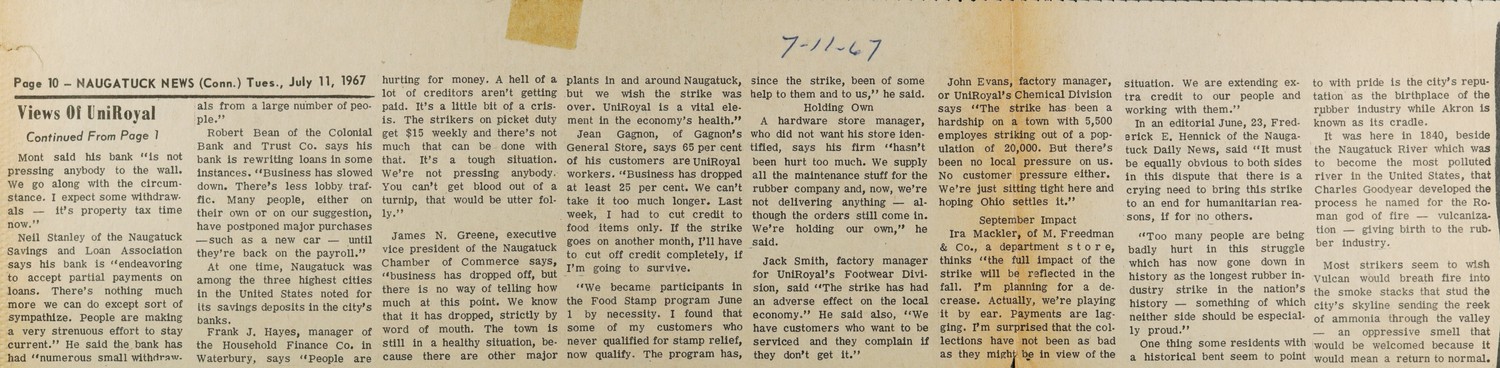
Views Of UniRoyal

Continued From Page 1

Mont said his bank “is not pressing anybody to the wall. We go along with the circumstance. I expect some withdrawals — it’s property tax time now.”

Neil Stanley of the Naugatuck Savings and Loan Association says his bank is “endeavoring to accept partial payments on loans. There’s nothing much more we can do except sort of sympathize. People are making a very strenuous effort to stay current.” He said the bank has had “numerous small withdrawals from a large number of people.”

At one time, Naugatuck was among the three highest cities in the United States noted for its savings deposits in the city’s banks.

Frank J. Hayes, manager of the Household Finance Co. in Waterbury, says “People are hurting for money. A hell of a lot of creditors aren’t getting paid. It’s a little bit of a crisis. The strikers on picket duty get $15 weekly and there’s not much that can be done with that. It’s a tough situation. We’re not pressing anybody. You can’t get blood out of a turnip, that would be utter folly.”

James N. Greene, executive vice president of the Naugatuck Chamber of Commerce says, “business has dropped off, but there is no way of telling how much at this point. We know that it has dropped, strictly by word of mouth. The town is still in a healthy situation, because there are other major plants in and around Naugatuck, but we wish the strike was over. UniRoyal is a vital element in the economy’s health.”

Jean Gagnon, of Gagnon’s General Store, says 65 per cent of his customers are UniRoyal workers. “Business has dropped at least 25 per cent. We can’t take it too much longer. Last week, I had to cut credit to food items only. If the strike goes on another month, I’ll have to cut off credit completely, if I’m going to survive.

“We became participants in the Food Stamp program June 1 by necessity. I found that some of my customers who never qualified for stamp relief, now qualify. The program has, since the strike, been of some help to them and to us,” he said.

Holding Own

A hardware store manager, who did not want his store identified, says his firm “hasn’t been hurt too much. We supply all the maintenance stuff for the rubber company and, now, we’re not delivering anything — although the orders still come in. We’re holding our own,” he said.

Jack Smith, factory manager for UniRoyal’s Footwear Division, said “The strike has had an adverse effect on the local economy.” He said also, “We have customers who want to be serviced and they complain if they don’t get it.”

John Evans, factory manager, or UniRoyal’s Chemical Division says “The strike has been a hardship on a town with 5,500 employes striking out of a population of 20,000. But there’s been no local pressure either. We’re just sitting tight here and hoping Ohio settles it.”

September Impact

Ira Mackler, of M. Freedman & Co., a department store, thinks “the full impact of the strike will be reflected in the fall. I’m planning for a decrease. Actually, we’re playing it by ear. Payments are lagging. I’m surprised that the collections have not been as bad as they might be in view of the situation. We are extending extra credit to our people and working with them.”

In an editorial June 23, Frederick E. Hennick of the Naugatuck Daily News, said “It must be equally obvious to both sides in this dispute that there is a crying need to bring this strike to an end for humanitarian reasons, if for no others.

“Too many people are being badly hurt in this struggle which has now gone down in history as the longest rubber industry strike in the nation’s history — something of which neither side should be especially proud.”

One thing some residents with a historical bent seem to point to with pride is the city’s reputation as the birthplace of the rubber industry while Akron is known as its cradle.

It was here in 1840, beside the Naugatuck River which was to become the most polluted river in the United States, that Charles Goodyear developed the process he named for the Roman god of fire — vulcanization — giving birth to the rubber industry.

Most strikers seem to wish Vulcan would breath fire into the smoke stacks that stud the city’s skyline sending the reek of ammonia through the valley — an oppressive smell that would be welcomed because it would mean a return to normal.

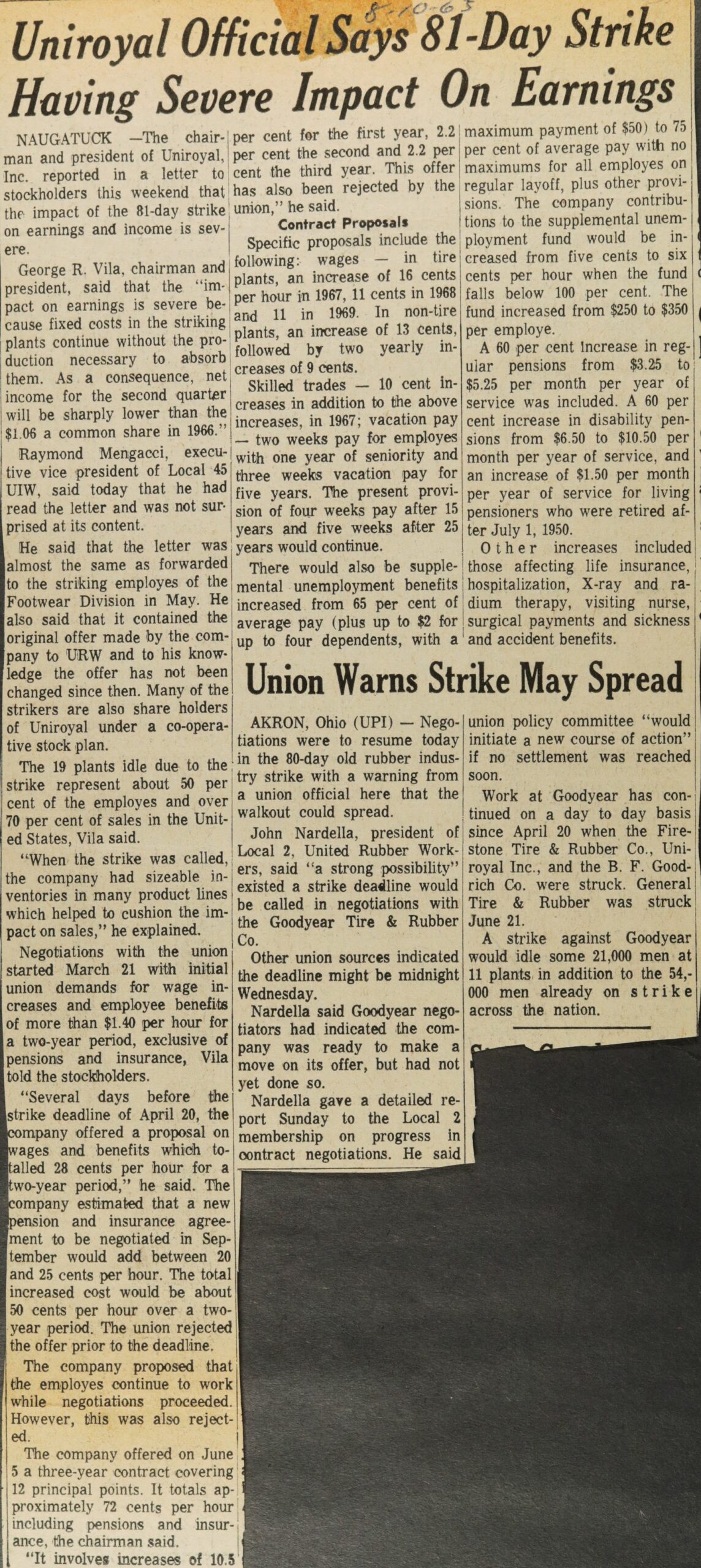
Uniroyal Official Says 81-Day Strike Having Severe Impact On Earnings

Uniroyal Official Says 81-Day Strike Having Severe Impact On Earnings

8-10-63 [handwritten]

NAUGATUCK —The chairman and president of Uniroyal, Inc. reported in a letter to stockholders this weekend that the impact of the 81-day strike on earnings and income is severe.

George R. Vila, chairman and president, said that the “impact on earnings is severe because fixed costs in the striking plants continue without the production necessary to absorb them. As a consequence, net income for the second quarter will be sharply lower than the $1.06 a common share in 1966.”

Raymond Mengacci, executive vice president of Local 45 UIW, said today that he had read the letter and was not surprised at its content.

He said that the letter was almost the same as forwarded to the striking employes of the Footwear Division in May. He also said that it contained the original offer made by the company to URW and to his knowledge the offer has not been changed since then. Many of the strikers are also share holders of Uniroyal under a co-operative stock plan.

The 19 plants idle due to the strike represent about 50 per cent of the employes and over 70 per cent of sales in the United States, Vila said.

“When the strike was called, the company had sizeable inventories in many product lines which helped to cushion the impact on sales,” he explained.

Negotiations with the union started March 21 with initial union demands for wage increases and employee benefits of more than $1.40 per hour for a two-year period, exclusive of pensions and insurance, Vila told the stockholders.

“Several days before the strike deadline of April 20, the company offered a proposal on wages and benefits which totalled 28 cents per hour for a two-year period,” he said. The company estimated that a new pension and insurance agreement to be negotiated in September would add between 20 and 25 cents per hour. The total increased cost would be about 50 cents per hour over a two-year period. The union rejected the offer prior to the deadline.

The company proposed that the employes continue to work while negotiations proceeded. However, this was also rejected.

The company offered on June 5 a three-year contract covering 12 principal points. It totals approximately 72 cents per hour including pensions and insurance, the chairman said.

“It involves increases of 10.5 per cent for the first year, 2.2 per cent the second and 2.2 per cent the third year. This offer has also been rejected by the union,” he said.

Contract Proposals

Specific proposals include the following: wages — in tire plants, an increase of 16 cents per hour in 1967, 11 cents in 1968 and 11 in 1969. In non-tire plants, an increase of 13 cents, followed by two yearly increases of 9 cents.

Skilled trades — 10 cent increases in addition to the above increases, in 1967; vacation pay — two weeks pay for employes with one year of seniority and three weeks vacation pay for five years. The present provision of four weeks pay after 15 years and five weeks after 25 years would continue.

There would also be supplemental unemployment benefits increased from 65 per cent of average pay (plus up to $2 for up to four dependents, with a maximum payment of $50) to 75 per cent of average pay with no maximums for all employes on regular layoff, plus other provisions. The company contributions to the supplemental unemployment fund would be increased from five cents to six cents per hour when the fund falls below 100 per cent. The fund increased from $250 to $350 per employe.

A 60 per cent increase in regular pensions from $3.25 to $5.25 per month per year of service was included. A 60 per cent increase in disability pensions from $6.50 to $10.50 per month per year of service, and an increase of $1.50 per month per year of service for living pensioners who were retired after July 1, 1950.

Other increases included those affecting life insurance, hospitalization, X-ray and radium therapy, visiting nurse, surgical payments and sickness and accident benefits.


Union Warns Strike May Spread

AKRON, Ohio (UPI) — Negotiations were to resume today in the 80-day old rubber industry strike with a warning from a union official here that the walkout could spread.

John Nardella, president of Local 2, United Rubber Workers, said “a strong possibility” existed a strike deadline would be called in negotiations with the Goodyear Tire & Rubber Co.

Other union sources indicated the deadline might be midnight Wednesday.

Nardella said Goodyear negotiators had indicated the company was ready to make a move on its offer, but had not yet done so.

Nardella gave a detailed report Sunday to the Local 2 membership on progress in contract negotiations. He said union policy committee “would initiate a new course of action” if no settlement was reached soon.

Work at Goodyear has continued on a day to day basis since April 20 when the Firestone Tire & Rubber Co., Uniroyal Inc., and the B. F. Goodrich Co. were struck. General Tire & Rubber was struck June 21.

A strike against Goodyear would idle some 21,000 men at 11 plants in addition to the 54,000 men already on strike across the nation.

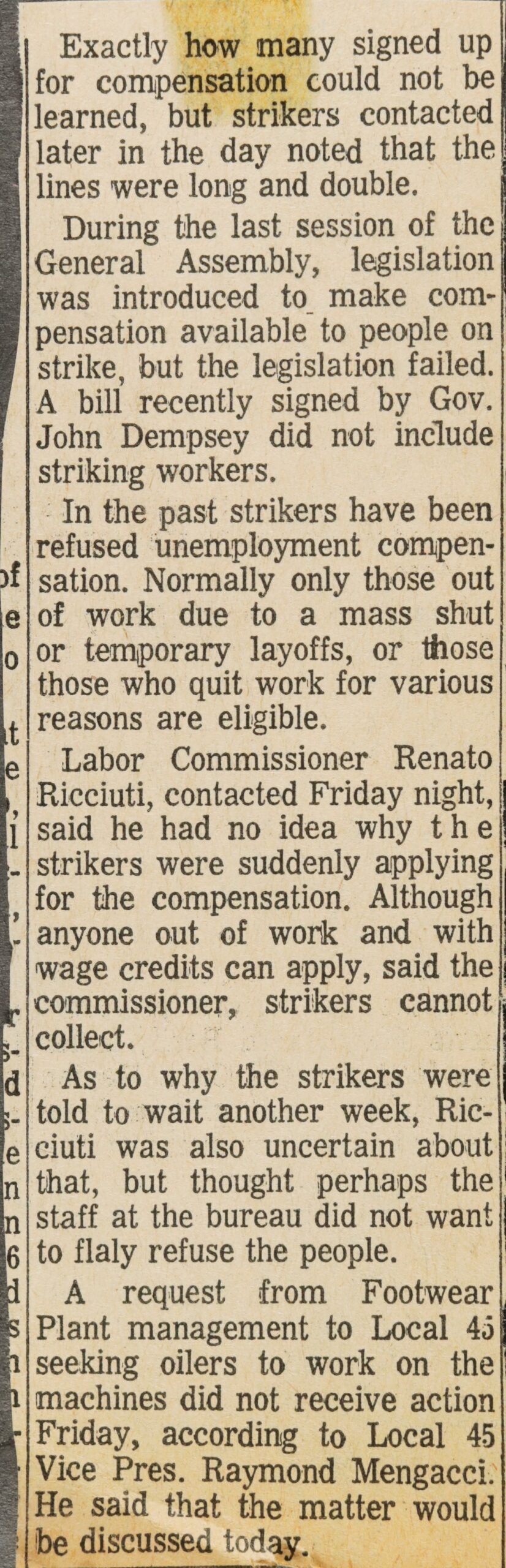
Exactly how many signed up for compensation could not be learned, but strikers contacted later in the day noted that the lines were long and double.

Exactly how many signed up
for compensation could not be
learned, but strikers contacted
later in the day noted that the
lines were long and double.

During the last session of the
General Assembly, legislation
was introduced to make com-
pensation available to people on
strike, but the legislation failed.
A bill recently signed by Gov.
John Dempsey did not include
striking workers.

In the past strikers have been
refused unemployment compen-
sation. Normally only those out
of work due to a mass shut
or temporary layoffs, or those
those who quit work for various
reasons are eligible.

Labor Commissioner Renato
Ricciuti, contacted Friday night,
said he had no idea why the
strikers were suddenly applying
for the compensation. Although
anyone out of work and with
wage credits can apply, said the
commissioner, strikers cannot
collect.

As to why the strikers were
told to wait another week, Ric-
ciuti was also uncertain about
that, but thought perhaps the
staff at the bureau did not want
to flaly refuse the people.

A request from Footwear
Plant management to Local 45
seeking oilers to work on the
machines did not receive action
Friday, according to Local 45
Vice Pres. Raymond Mengacci.
He said that the matter would
be discussed today.

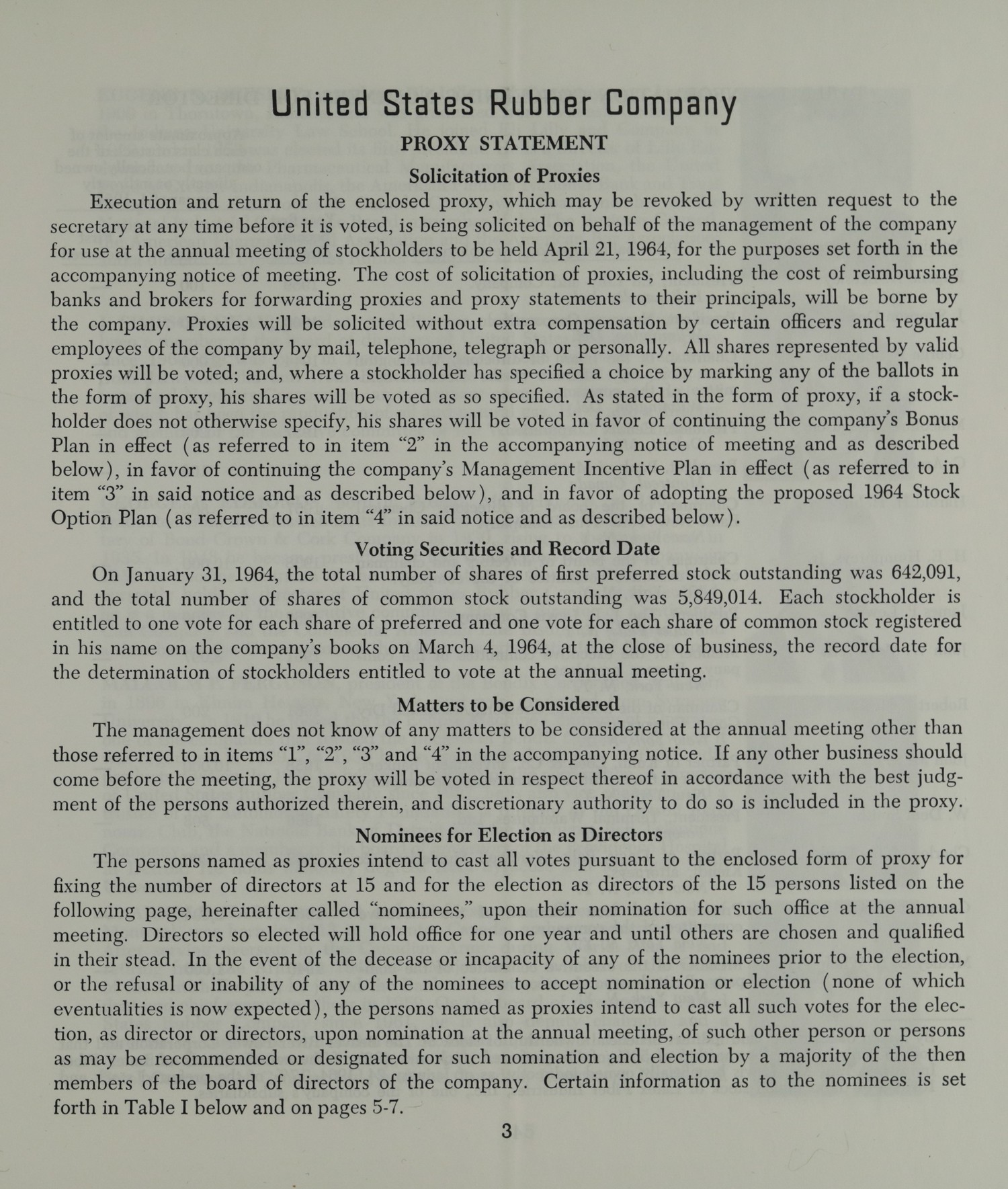
US Rubber Proxy Statement – Page 3

Page 003

United States Rubber Company
PROXY STATEMENT
Solicitation of Proxies
Execution and return of the enclosed proxy, which may be revoked by written request to the secretary at any time before it is voted, is being solicited on behalf of the management of the company for use at the annual meeting of stockholders to be held April 21, 1964, for the purposes set forth in the accompanying notice of meeting. The cost of solicitation of proxies, including the cost of reimbursing banks and brokers for forwarding proxies and proxy statements to their principals, will be borne by the company. Proxies will be solicited without extra compensation by certain officers and regular employees of the company by mail, telephone, telegraph or personally. All shares represented by valid proxies will be voted; and, where a stockholder has specified a choice by marking any of the ballots in the form of proxy, his shares will be voted as so specified. As stated in the form of proxy, if a stockholder does not otherwise specify, his shares will be voted in favor of continuing the company’s Bonus Plan in effect (as referred to in item “2” in the accompanying notice of meeting and as described below), in favor of continuing the company’s Management Incentive Plan in effect (as referred to in item “3” in said notice and as described below), and in favor of adopting the proposed 1964 Stock Option Plan (as referred to in item “4” in said notice and as described below).

Voting Securities and Record Date
On January 31, 1964, the total number of shares of first preferred stock outstanding was 642,091, and the total number of shares of common stock outstanding was 5,549,014. Each stockholder is entitled to one vote for each share of preferred and one vote for each share of common stock registered in his name on the company’s books on March 4, 1964, at the close of business, the record date for the determination of stockholders entitled to vote at the annual meeting.

Matters to be Considered
The management does not know of any matters to be considered at the annual meeting other than those referred to in items “1”, “2”, “3” and “4” in the accompanying notice. If any other business should come before the meeting, the proxy will be voted in respect therein, and discretionary authority to do so is included in the proxy.

Nominees for Election as Directors
The persons named as proxies intend to cast all votes pursuant to the enclosed form of proxy for fixing the number of directors at 15 and for the election as directors of the 15 persons listed on the following page, hereinafter called “nominees,” upon their nomination for such office at the annual meeting. Directors so elected will hold office for one year and until others are chosen and qualified in their stead. In the event of the decease or incapacity of any of the nominees prior to the election, or the refusal or inability of any of the nominees to accept nomination or election (none of which eventualities is now expected), the persons named as proxies intend to cast all such votes for the election, as director or directors, upon nomination at the annual meeting, of such other person or persons as may be recommended or designated for such nomination and election by a majority of the then members of the board of directors of the company. Certain information as to the nominees is set forth in Table I below and on pages 5-7.

Uniroyal Cites Loss Potential

Uniroyal Cites Loss Potential

6-28-67 [handwritten]

Uniroyal, Inc. will suffer a very severe financial loss “forcing a reduction in production” at its Naugatuck Footwear plant if it is not permitted to produce samples of its new designs, a company official said today.

Thomas J. Nelligan, labor relations manager, testified at a Superior Court hearing this morning that failure of the company to have samples to show its customers in August will mean a very large drop in the amount of production needed for the coming year and “in turn less employes.”

Nelligan was the first company representative to testify at a hearing to consider United Rubber Workers Union application for an injunction against the company production.

He said samples for next summer’s market would normally have been produced between April and July of this year.

He said salesmen would have been scheduled to take the samples into the field beginning Aug. 1.

Without the samples, he said the company will have no way of proving “to its buyers that its line is better than its competitors.”

At the opening of the session Tuesday before Judge Leo V. Gaffney, a Local 45 official predicted “there would be bloodshed in Naugatuck if the company is permitted to resume production with non-union members.”

The union filed its application for an injunction against Uniroyal last Thursday after the company began production of samples of new footwear designs. The company agreed at that time to halt production until after a court hearing.

April 18 Agreement

At the core of the controversy is a written agreement signed by both parties April 18, three days before the nation-wide rubber workers strike began.

The agreement provides for orderly shutdown and maintenance of the borough Footwear Plant during the strike.

It includes a clause stipulating that “the company agrees that for the duration of any strike there will be no work performed by non-bargaining unit employes that is normally performed by bargaining unit personnel.”

Local 45 claims Thursday’s production violates that agreement.

While not clearly stating what its defense would be, the company Tuesday indicated it will argue that the April 18 agreement was rendered void when the union allegedly violated a provision intended to insure unimpeded entrance and exit to the plant through certain gates.

(Cont’d on Page 2—UNIROYAL)

Hearing to Resume on Plea Of Union for Uniroyal Stay

Hearing to Resume on Plea Of Union for Uniroyal Stay

Hearing to Resume on Plea Of Union for Uniroyal Stay

A hearing was to resume this morning in Waterbury Superior Court on an application by the United Rubber Workers for an injunction against Uniroyal, Inc., which has plants in Beacon Falls and Naugatuck.

The union filed its application last Thursday, after the company began production of samples of new footwear designs.

The company agreed at that time to halt production until after a court hearing.

The hearing opened Tuesday before Judge Leo V. Gaffney. Three hours of testimony was taken in the afternoon from three union members.

At the center of the controversy is a written agreement, signed April 18 by both parties, three days before the nationwide rubber workers’ strike began.

The agreement provides for the orderly shutdown and maintenance of the Naugatuck Footwear plant during the strike.

It includes a clause stipulating that “the company agrees that for the duration of the strike there will be no work performed by nonbargaining unit employes that is normally performed by bargaining unit personnel.”

Local 45 of the URW maintains last Thursday’s production violates the agreement.

Company Defense

While not clearly stating what its defense would be, the company yesterday indicated it would argue the April 18 agreement was voided when the union allegedly violated a provision intended to insure unimpeded entrance and exit to the plant through specified gates.

Three days of clashes between union members and police early in May, when pickets attempted to keep office personnel from entering the plant, resulted in the arrest of 71 union members and a warning from Judge Gaffney that he would issue an injunction against the union if the violence was not stopped.

In testimony yesterday, Raymond Mengacci, vice president of Local 45, said he had “no doubt” violence would erupt at the plant unless the court issues an order restraining the company from producing sample shoes with nonunion supervisory personnel.

“We will have some very bad violence. You can expect bloodshed in Naugatuck,” Mengacci said.


Service—Use Sentinel Want Ads

Uniroyal Strike Talks To Resume

Uniroyal

Strike Talks

To Resume

NAUGATUCK — Talks on a master contract between the United Rubber Workers and Uniroyal are scheduled to resume today. There were no talks between company and union negotiators Monday.

In Detroit, striking Uniroyal workers, discouraged by the lack of progress in the talks, prevented management personnel from entering the plant.

An estimated 1,300 strikers took part in a demonstration which included egg throwing. Police were at the scene, but no arrests were made, although some of the policemen were reportedly hit by the eggs.

Uniroyal management in the borough is scheduled to appear in court today in Waterbury to show cause why an injunction against the Naugatuck plants should not be issued.


Handwritten notation in top right corner: 6-27-67

Federal Mediation

Federal Mediation

area.

Federal Mediation 6-22

Continued From Page 1

for fear it would obligate him
to UAW leader Walter Reuther
who is at odds with AFL-CIO
leaders.

Simkin has told the press that
he wants the negotiations in
Pittsburgh to be more than ex-
ploratory. He is hoping for a
settlement.

Local 45 Vice-President
Raymond Mengacci reported
yesterday that more than $100,-
000 has been contributed to the
strike benefit fund by union
people still working.

Union Seeking

ucts.

Union Seeking 6-72

Continued From Page 1

Local, the firm’s lawyers attempted to reach higher-up management either in Cincinnati or New York City, but were unsuccessful.

The management personnel then relayed to Judge Gaffney, Mengacci said, that they couldn’t tell the judge what the plant planned to do today.

The judge then informed lawyers for the union they should draw up a restraining order against UniRoyal and he would sign it this morning if there was any evidence the firm violated the agreement.

The judge indicated he would issue an injunction against UniRoyal if there was a violation of the restraining order, Mengacci said.

This situation puts the company and the union on virtually the same ground, if it comes to pass later today.

Mengacci said he thought court action would be held at about 2 p.m. today.

A few weeks ago a restraining order against the Union was issued in Superior Court following some minor clashes in the borough on picket lines and the arrest of about 50 pickets in two or three days of strife.

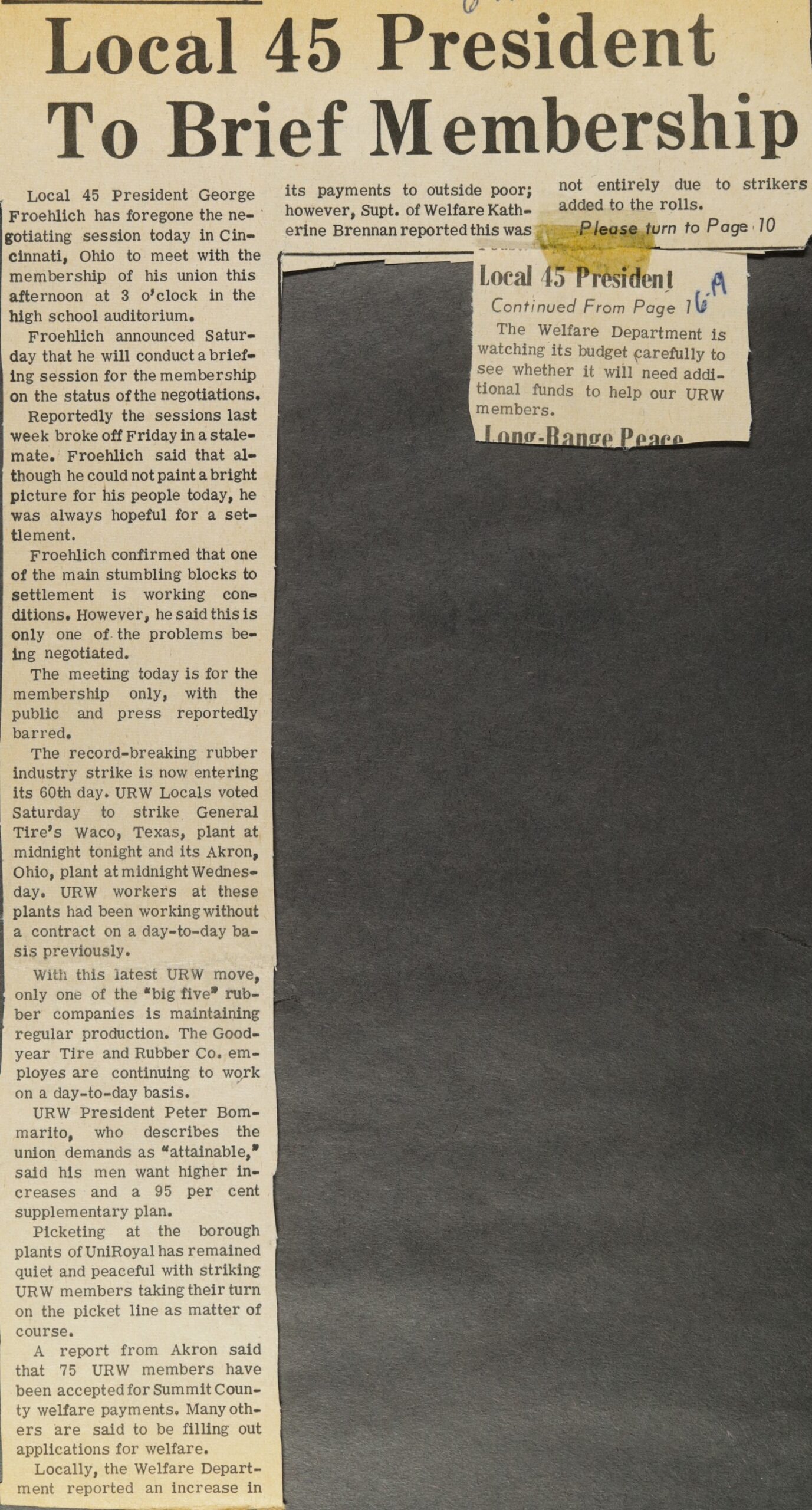
Local 45 President To Brief Membership

Local 45 President To Brief Membership

Local 45 President George Froehlich has foregone the negotiating session today in Cincinnati, Ohio to meet with the membership of his union this afternoon at 3 o’clock in the high school auditorium.

Froehlich announced Saturday that he will conduct a briefing session for the membership on the status of the negotiations.

Reportedly the sessions last week broke off Friday in a stalemate. Froehlich said that although he could not paint a bright picture for his people today, he was always hopeful for a settlement.

Froehlich confirmed that one of the main stumbling blocks to settlement is working conditions. However, he said this is only one of the problems being negotiated.

The meeting today is for the membership only, with the public and press reportedly barred.

The record-breaking rubber industry strike is now entering its 60th day. URW Locals voted Saturday to strike General Tire’s Waco, Texas, plant at midnight tonight and its Akron, Ohio, plant at midnight Wednesday. URW workers at these plants had been working without a contract on a day-to-day basis previously.

With this latest URW move, only one of the “big five” rubber companies is maintaining regular production. The Goodyear Tire and Rubber Co. employes are continuing to work on a day-to-day basis.

URW President Peter Bommarito, who describes the union demands as “attainable,” said his men want higher increases and a 95 per cent supplementary plan.

Picketing at the borough plants of UniRoyal has remained quiet and peaceful with striking URW members taking their turn on the picket line as matter of course.

A report from Akron said that 75 URW members have been accepted for Summit County welfare payments. Many others are said to be filling out applications for welfare.

Locally, the Welfare Department reported an increase in

its payments to outside poor; however, Supt. of Welfare Katherine Brennan reported this was

not entirely due to strikers added to the rolls.

Please turn to Page 10


Local 45 President

Continued From Page 1 6-A

The Welfare Department is watching its budget carefully to see whether it will need additional funds to help our URW members.

Long-Range Peace

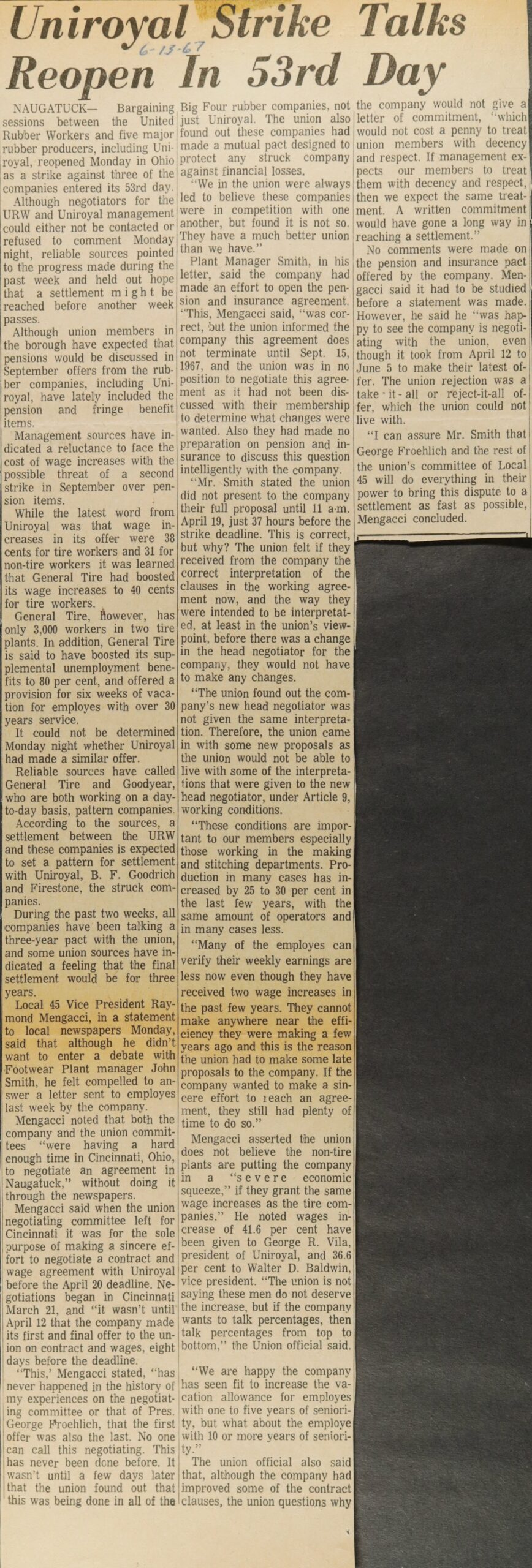
Uniroyal Strike Talks Reopen In 53rd Day

Uniroyal Strike Talks Reopen In 53rd Day

6-13-67

NAUGATUCK— Bargaining sessions between the United Rubber Workers and five major rubber producers, including Uniroyal, reopened Monday in Ohio as a strike against three of the companies entered its 53rd day.

Although negotiators for the URW and Uniroyal management could either not be contacted or refused to comment Monday night, reliable sources pointed to the progress made during the past week and held out hope that a settlement might be reached before another week passes.

Although union members in the borough have expected that pensions would be discussed in September offers from the rubber companies, including Uniroyal, have lately included the pension and fringe benefit items.

Management sources have indicated a reluctance to face the cost of wage increases with the possible threat of a second strike in September over pension items.

While the latest word from Uniroyal was that wage increases in its offer were 38 cents for tire workers and 31 for non-tire workers it was learned that General Tire had boosted its wage increases to 40 cents for tire workers.

General Tire, however, has only 3,000 workers in two tire plants. In addition, General Tire is said to have boosted its supplemental unemployment benefits to 80 per cent, and offered a provision for six weeks of vacation for employes with over 30 years service.

It could not be determined Monday night whether Uniroyal had made a similar offer.

Reliable sources have called General Tire and Goodyear, who are both working on a day-to-day basis, pattern companies.

According to the sources, a settlement between the URW and these companies is expected to set a pattern for settlement with Uniroyal, B. F. Goodrich and Firestone, the struck companies.

During the past two weeks, all companies have been talking a three-year pact with the union, and some union sources have indicated a feeling that the final settlement would be for three years.

Local 45 Vice President Raymond Mengacci, in a statement to local newspapers Monday, said that although he didn’t want to enter a debate with Footwear Plant manager John Smith, he felt compelled to answer a letter sent to employes last week by the company.

Mengacci noted that both the company and the union committees “were having a hard enough time in Cincinnati, Ohio, to negotiate an agreement in Naugatuck,” without doing it through the newspapers.

Mengacci said when the union negotiating committee left for Cincinnati it was for the sole purpose of making a sincere effort to negotiate a contract and wage agreement with Uniroyal before the April 20 deadline. Negotiations began in Cincinnati March 21, and “it wasn’t until April 12 that the company made its first and final offer to the union on contract and wages, eight days before the deadline.

“This,” Mengacci stated, “has never happened in the history of my experiences on the negotiating committee or that of Pres. George Froehlich, that the first offer was also the last. No one can call this negotiating. This has never been done before. It wasn’t until a few days later that the union found out that this was being done in all of the Big Four rubber companies, not just Uniroyal. The union also found out these companies had made a mutual pact designed to protect any struck company against financial losses.

“We in the union were always led to believe these companies were in competition with one another, but found it is not so. They have a much better union than we have.”

Plant Manager Smith, in his letter, said the company had made an effort to open the pension and insurance agreement. “This, Mengacci said, “was correct, but the union informed the company this agreement does not terminate until Sept. 15, 1967, and the union was in no position to negotiate this agreement as it had not been discussed with their membership to determine what changes were wanted. Also they had made no preparation on pension and insurance to discuss this question intelligently with the company.

“Mr. Smith stated the union did not present to the company their full proposal until 11 a.m. April 19, just 37 hours before the strike deadline. This is correct, but why? The union felt if they received from the company the correct interpretation of the clauses in the working agreement now, and the way they were intended to be interpreted, at least in the union’s viewpoint, before there was a change in the head negotiator for the company, they would not have to make any changes.

“The union found out the company’s new head negotiator was not given the same interpretation. Therefore, the union came in with some new proposals as the union would not be able to live with some of the interpretations that were given to the new head negotiator, under Article 9, working conditions.

“These conditions are important to our members especially those working in the making and stitching departments. Production in many cases has increased by 25 to 30 per cent in the last few years, with the same amount of operators and in many cases less.

“Many of the employes can verify their weekly earnings are less now even though they have received two wage increases in the past few years. They cannot make anywhere near the efficiency they were making a few years ago and this is the reason the union had to make some late proposals to the company. If the company wanted to make a sincere effort to reach an agreement, they still had plenty of time to do so.”

Mengacci asserted the union does not believe the non-tire plants are putting the company in a “severe economic squeeze,” if they grant the same wage increases as the tire companies.” He noted wages increase of 41.6 per cent have been given to George R. Vila, president of Uniroyal, and 36.6 per cent to Walter D. Baldwin, vice president. “The union is not saying these men do not deserve the increase, but if the company wants to talk percentages, then talk percentages from top to bottom,” the Union official said.

“We are happy the company has seen fit to increase the vacation allowance for employes with one to five years of seniority, but what about the employe with 10 or more years of seniority.”

The union official also said that, although the company had improved some of the contract clauses, the union questions why the company would not give a letter of commitment, “which would not cost a penny to treat union members with decency and respect. If management expects our members to treat them with decency and respect, then we expect the same treatment. A written commitment would have gone a long way in reaching a settlement.”

No comments were made on the pension and insurance pact offered by the company. Mengacci said it had to be studied before a statement was made. However, he said he “was happy to see the company is negotiating with the union, even though it took from April 12 to June 5 to make their latest offer. The union rejection was a take-it-all or reject-it-all offer, which the union could not live with.

“I can assure Mr. Smith that George Froehlich and the rest of the union’s committee of Local 45 will do everything in their power to bring this dispute to a settlement as fast as possible,” Mengacci concluded.

The above increases in wages and benefits togal about 70¢ per hour over a three year period.

The above increases in wages
and benefits togal about 70¢
per hour over a three year
period. This is approximately
a 5% yearly increase in wages
and benefits for employees over
the entire three years. It is the
equivalent of the settlement ne-
gotiated in other industries
which have been referred to
by the Union as necessary to
resolve these negotiations. It
was the most substantial and
costly offer ever made by this
Company to the Union.

This proposal was rejected
by the Union late in the after-
noon of June 6. The Union, in
rejecting the above Company of-
fer, made a counter proposal
which excluded any considera-
tion of pensions and insurances
and held to a number of costly
demands which were made be-
fore the strike started.

Sincerely,
Jack M. Smith
Factory Manager

The release of the letter,
and articles read in the paper
were the only announcements
of the proposals the union mem-
bership received. No meetings
were called to allow the general
membership to express their
pleasure or displeasure of the
company’s offer.

Local 45 has held only one
membership meeting, since the
members authorized the nego-
tiators to call a strike. Presi-
dent George Froehlich, then
complained that the company
was not bargaining and only
throwing “bits of silver” on the
table. He said that the union

was seeking decent treatment
for the employes and also com-
plained of the differential be-
tween tire workers and non-
tire workers.

Tire workers now average
about $3.69 an hour while other
rubber industry production
workers average $2.68 an hour.

The three-year contract is
also said to be a stumbling
block in settlement.

Vice-president of Local 45,
Raymond Mengacci, told the
NEWS this morning, that he was
aware of the letter, but had not
as yet had time to read and
digest its contents. He said
that he will be prepared to
comment on it after he has
had time to study it.