
UNIROYAL CHEM-TEXTS
Vol. 2 PUBLISHED FOR THE PEOPLE OF UNIROYAL CHEMICAL No. 2.
New Equipment for Reclaim Plant Will Keep Us in Reclaim Rubber Business
Our present reclaimed rubber plant dates back to 1895, after fire destroyed the original plant in 1893. For 75 years, we have played an important role in the rubber industry by supplying high quality stocks.
Several years ago, with combining higher production costs and increased shipping expenses, profitability reached a critical point for us in the reclaimed rubber business. Faced with keen competition, reduced prices and low-cost SBR rubber as an alternate, our business was placed in a difficult position. A decision had to be made either to discontinue the business or make major capital investments to modernize the facilities.
After detailed study of the present operation and various improvements and considering the skills of our people, it was decided that a modernization of the facilities would be practical and increase our ability to successfully compete in the market place. An appropriation request for these plans was drawn up and approved.
The “new” plant, efficiently and effectively operated, will help protect the job security of 100 employees while the alternate of going out of the business would have eliminated 150 employees, many with long seniority. Changes in the millrooms, reduced from 3 to 1, will affect the jobs of about 50 employees.
A project team was formed to work on the problem. The team settled on 5 major changes which would offer the best return on investment at this time: 1. fibre separation; 2. fine grinding; 3. central mix in the mill room; 4. revision in the mill room; 5. Zenith and dryer revisions.
The team in charge of the project working closely with the New York engineering group were R. Gaetz, Engineering Dept., Ted Lainas, Reclaim Development; C. Reich, Production and F. Wintsch, Industrial Engineering. Since his transfer to Industrial Relations, Wintsch has been replaced by B. Daily.
This team was charged with the responsibility of making the project go; by developing the flow sheets and recommending the type of equipment. All the details of engineering is being handled by approximately 12 members of the New York corporate engineering staff.
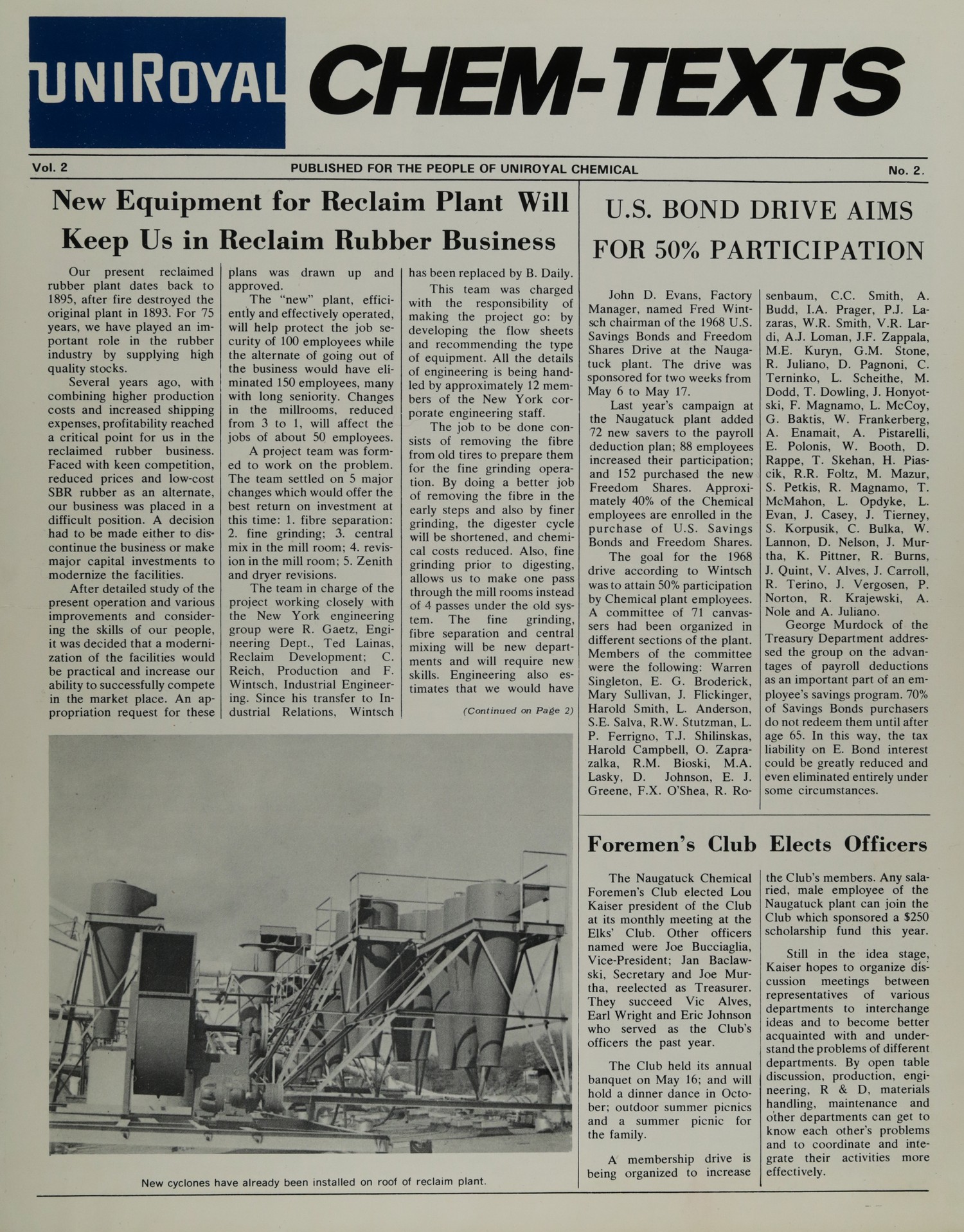
The job to be done consists of removing the fibre from old tires to prepare them for the fine grinding operation. By doing a better job of removing the fibre in the early steps and also by finer grinding, the digester cycle will be shortened, and chemical costs reduced. Also, fine grinding prior to digesting, allows us to make one pass through the mill rooms instead of 4 passes under the old system. The fine grinding, fibre separation and central mixing will be new departments and will require new skills. Engineering also estimates that we would have
(Continued on Page 2)
U.S. BOND DRIVE AIMS FOR 50% PARTICIPATION
John D. Evans, Factory Manager, named Fred Wintsch chairman of the 1968 U.S. Savings Bonds and Freedom Shares Drive at the Naugatuck plant. The drive was sponsored for two weeks from May 6 to May 17.
Last year’s campaign at the Naugatuck plant added 72 new savers to the payroll deduction plan; 88 employees increased their participation; and 152 purchased the new Freedom Shares. Approximately 40% of the Chemical employees are enrolled in the purchase of U.S. Savings Bonds and Freedom Shares.
The goal for the 1968 drive according to Wintsch was to attain 50% participation by Chemical plant employees. A committee of 71 canvassers had been organized in different sections of the plant. Members of the committee were the following: Warren Singleton, E. G. Broderick, Mary Sullivan, J. Flickinger, Harold Smith, L. Anderson, S.E. Salva, R.W. Stutzman, L. P. Ferrigno, T.J. Shilinskas, Harold Campbell, O. Zaprazalka, R.M. Bioski, M.A. Lasky, D. Johnson, E. J. Greene, F.X. O’Shea, R. Rosenbaum, C.C. Smith, A. Budd, I.A. Prager, P.J. Lazaras, W.R. Smith, V.R. Lardi, A.J. Loman, J.F. Zappala, M.E. Kuryn, G.M. Stone, R. Juliano, D. Pagnoni, C. Terniko, L. Scheithe, M. Dodd, T. Dowling, J. Homyetski, F. Magnamo, L. McCoy, G. Baktis, W. Frankerberg, A. Enamait, A. Pistarelli, E. Polonis, W. Booth, D. Rappe, T. Skehan, H. Piascik, R.R. Foltz, M. Mazur, S. Petkis, R. Magnamo, T. McMahon, L. Opdyke, L. Evan, J. Casey, J. Tierney, S. Korpusik, C. Bulka, W. Lannon, D. Nelson, J. Murtha, K. Pittner, R. Burns, J. Quint, V. Alves, J. Carroll, R. Terino, J. Vergosen, P. Norton, R. Krajewski, A. Nole and A. Juliano.
George Murdock of the Treasury Department addressed the group on the advantages of payroll deductions as an important part of an employee’s savings program. 70% of Savings Bonds purchasers do not redeem them until after age 65. In this way, the tax liability on E. Bond interest could be greatly reduced and even eliminated entirely under some circumstances.
[IMAGE: Black and white photograph showing industrial equipment on a rooftop]
New cyclones have already been installed on roof of reclaim plant.
Foremen’s Club Elects Officers
The Naugatuck Chemical Foremen’s Club elected Lou Kaiser president of the Club at its monthly meeting at the Elks’ Club. Other officers named were Joe Bucciaglia, Vice-President; Jan Baclawski, Secretary and Joe Murtha, reelected as Treasurer. They succeed Vic Alves, Earl Wright and Eric Johnson who served as the Club’s officers the past year.
The Club held its annual banquet on May 16; and will hold a dinner dance in October; outdoor summer picnics and a summer picnic for the family.
A membership drive is being organized to increase the Club’s members. Any salaried, male employee of the Naugatuck plant can join the Club which sponsored a $250 scholarship fund this year.
Still in the idea stage, Kaiser hopes to organize discussion meetings between representatives of various departments to interchange ideas and to become better acquainted with and understand the problems of different departments. By open table discussion, production, engineering, R & D, materials handling, maintenance and other departments can get to know each other’s problems and to coordinate and integrate their activities more effectively.