
CHEM TEXTS
Vol. 2 No. 4 — Page 3
Company Breaks Ground Recently For New Complex In Oxford Area
[IMAGE: Aerial view of architectural model]
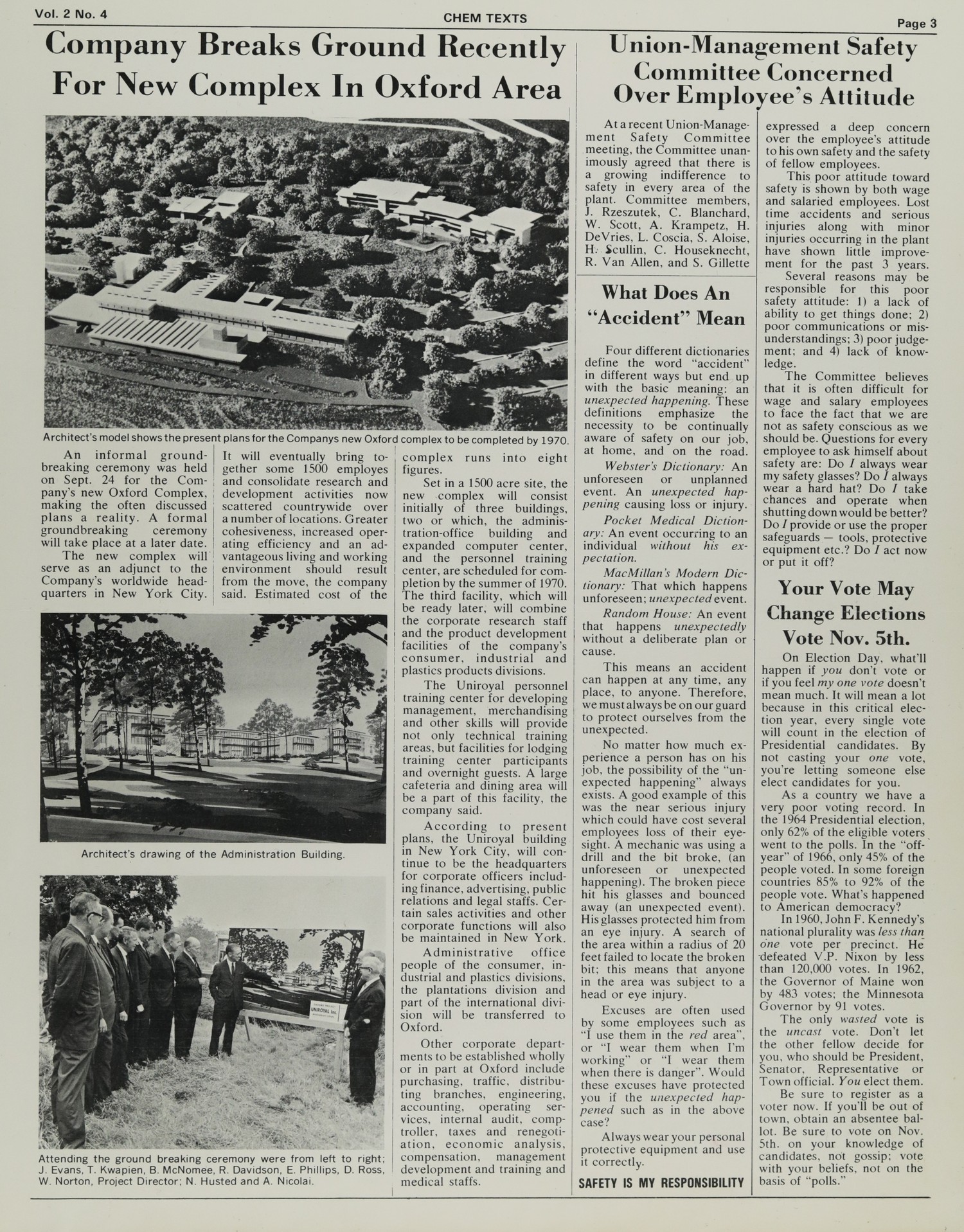
Architect’s model shows the present plans for the Companys new Oxford complex to be completed by 1970.
An informal ground-breaking ceremony was held on Sept. 24 for the Company’s new Oxford Complex, making the often discussed plans a reality. A formal groundbreaking ceremony will take place at a later date.
The new complex will serve as an adjunct to the Company’s worldwide headquarters in New York City.
It will eventually bring together some 1500 employes and consolidate research and development activities now scattered countrywide over a number of locations. Greater cohesiveness, increased operating efficiency and an advantageous living and working environment should result from the move, the company said. Estimated cost of the complex runs into eight figures.
Set in a 1500 acre site, the new complex will consist initially of three buildings, two or which, the administration-office building and expanded computer center, and the personnel training center, are scheduled for completion by the summer of 1970. The third facility, which will be ready later, will combine the corporate research staff and the product development facilities of the company’s consumer, industrial and plastics products divisions.
The Uniroyal personnel training center for developing management, merchandising and other skills will provide not only technical training areas, but facilities for lodging training center participants and overnight guests. A large cafeteria and dining area will be a part of this facility, the company said.
According to present plans, the Uniroyal building in New York City, will continue to be the headquarters for corporate officers including finance, advertising, public relations and legal staffs. Certain sales activities and other corporate functions will also be maintained in New York.
Administrative office people of the consumer, industrial and plastics divisions, the plantations division and part of the international division will be transferred to Oxford.
Other corporate departments to be established wholly or in part at Oxford include purchasing, traffic, distributing branches, engineering, accounting, operating services, internal audit, comptroller, taxes and renegotiation, economic analysis, compensation, management development and training and medical staffs.
[IMAGE: Architect’s drawing of building]
Architect’s drawing of the Administration Building.
[IMAGE: Group photo of people at ceremony]
Attending the ground breaking ceremony were from left to right: J. Evans, T. Kwapien, B. McNomee, R. Davidson, E. Phillips, D. Ross, W. Norton, Project Director; N. Husted and A. Nicolai.
Union-Management Safety Committee Concerned Over Employee’s Attitude
At a recent Union-Management Safety Committee meeting, the Committee unanimously agreed that there is a growing indifference to safety in every area of the plant. Committee members, J. Rzeszutek, C. Blanchard, W. Scott, A. Krampetz, H. DeVries, L. Coscia, S. Aloise, H. Scullin, C. Houseknecht, R. Van Allen, and S. Gillette expressed a deep concern over the employee’s attitude to his own safety and the safety of fellow employees.
This poor attitude toward safety is shown by both wage and salaried employees. Lost time accidents and serious injuries along with minor injuries occurring in the plant have shown little improvement for the past 3 years.
Several reasons may be responsible for this poor safety attitude: 1) a lack of ability to get things done; 2) poor communications or misunderstandings; 3) poor judgement; and 4) lack of knowledge.
The Committee believes that it is often difficult for wage and salary employees to face the fact that we are not as safety conscious as we should be. Questions for every employee to ask himself about safety are: Do I always wear my safety glasses? Do I always wear a hard hat? Do I take chances and operate when shutting down would be better? Do I provide or use the proper safeguards — tools, protective equipment etc.? Do I act now or put it off?
What Does An “Accident” Mean
Four different dictionaries define the word “accident” in different ways but end up with the basic meaning; an unexpected happening. These definitions emphasize the necessity to be continually aware of safety on our job, at home, and on the road.
Webster’s Dictionary: An unforeseen or unplanned event. An unexpected happening causing loss or injury.
Pocket Medical Dictionary: An event occurring to an individual without his expectation.
MacMillan’s Modern Dictionary: That which happens unforeseen; unexpected event.
Random House: An event that happens unexpectedly without a deliberate plan or cause.
This means an accident can happen at any time, any place, to anyone. Therefore, we must always be on our guard to protect ourselves from the unexpected.
No matter how much experience a person has on his job, the possibility of the “unexpected happening” always exists. A good example of this was the near serious injury which could have cost several employees loss of their eyesight. A mechanic was using a drill and the bit broke, (an unforeseen or unexpected happening). The broken piece hit his glasses and bounced away (an unexpected event). His glasses protected him from an eye injury. A search of the area within a radius of 20 feet failed to locate the broken bit; this means that anyone in the area was subject to a head or eye injury.
Excuses are often used by some employees such as “I use them in the red area”, or “I wear them when I’m working” or “I wear them when there is danger”. Would these excuses have protected you if the unexpected happened such as in the above case?
Always wear your personal protective equipment and use it correctly.
SAFETY IS MY RESPONSIBILITY
Your Vote May Change Elections Vote Nov. 5th.
On Election Day, what’ll happen if you don’t vote or if you feel my one vote doesn’t mean much. It will mean a lot because in this critical election year, every single vote will count in the election of Presidential candidates. By not casting your one vote, you’re letting someone else elect candidates for you.
As a country we have a very poor voting record. In the 1964 Presidential election, only 62% of the eligible voters went to the polls. In the “off-year” of 1966, only 45% of the people voted. In some foreign countries 85% to 92% of the people vote. What’s happened to American democracy?
In 1960, John F. Kennedy’s national plurality was less than one vote per precinct. He defeated V.P. Nixon by less than 120,000 votes. In 1962, the Governor of Maine won by 483 votes; the Minnesota Governor by 91 votes.
The only wasted vote is the uncast vote. Don’t let the other fellow decide for you, who should be President, Senator, Representative or Town official. You elect them.
Be sure to register as a voter now. If you’ll be out of town, obtain an absentee ballot. Be sure to vote on Nov. 5th. on your knowledge of candidates, not gossip; vote with your beliefs, not on the basis of “polls.”