
Page 2 CHEM-TEXTS Vol. 4 No. 10
FROM THE FACTORY MANAGER | Oxford Office Close to Completion
DEAR FELLOW EMPLOYEE:
Christmas is the season when everyone of us express more than anything during the year, the spirit of giving and concern for our family, friends, and the people we come in contact with each day of our lives. This spirit is particularly reflected by gifts to our families; visits to friends’ homes, and a sharing with others the many joys of the holidays.
In the plant where all of us work so closely together and depend upon each other so completely, this same spirit of giving and concern is vital.
By giving out fullest effort to, and showing the utmost concern for our responsibilities and the people we work with, each of us can individually infuse into the plant a spirit that will really make it a “good place to work.” The plant is not just a mere collection of buildings which house equipment to help us produce products or provide services, it is us, our efforts and our achievements.
Our work takes up more than eight hours of our day, and is a major part of our life. We can make it challenging; we can make it more secure; we can make it safer; we can make it more enjoyable by the same spirit of giving and concern that we display during the Christmas season.
I sincerely hope that you and your family, will enjoy a most happy Christmas and the fullest joy and happiness during the new Year.
Sincerely
Shel Salzman
S. R. Salzman
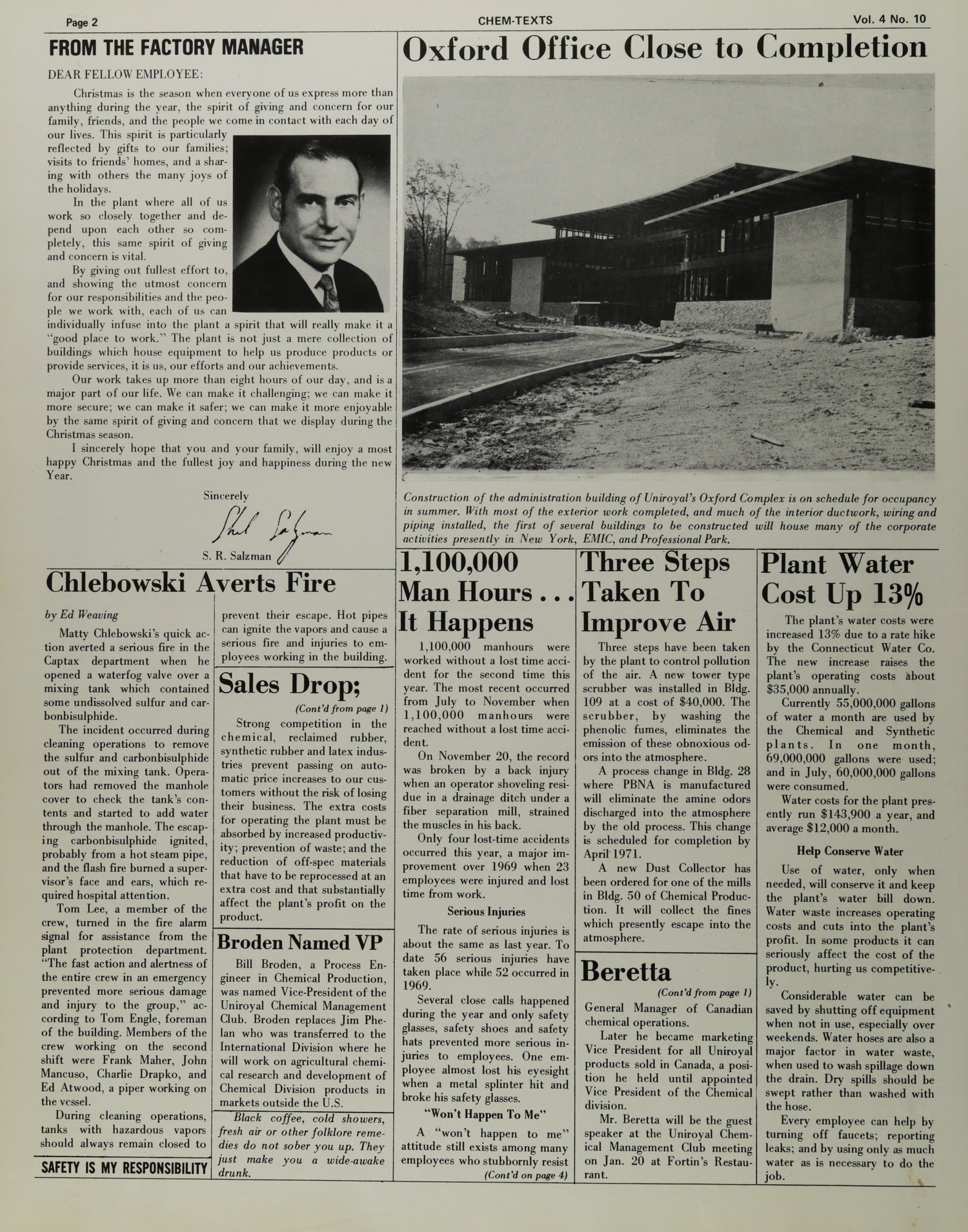
Construction of the administration building of Uniroyal’s Oxford Complex is on schedule for occupancy in summer. With most of the exterior work completed, and much of the interior ductwork, wiring and piping installed, the first of several buildings to be constructed will house many of the corporate activities presently in New York, EMIC, and Professional Park.
Chlebowski Averts Fire
by Ed Weaving
Matty Chlebowski’s quick action averted a serious fire in the Captax department when he opened a waterfog valve over a mixing tank which contained some undissolved sulfur and carbonbisulphide.
The incident occurred during cleaning operations to remove the sulfur and carbonbisulphide out of the mixing tank. Operators had removed the manhole cover to check the tank’s contents and started to add water through the manhole. The escaping carbonbisulphide ignited, probably from a hot steam pipe, and the flash fire burned a supervisor’s face and ears, which required hospital attention.
Tom Lee, a member of the crew, turned in the fire alarm signal for assistance from the plant protection department. “The fast action and alertness of the entire crew in an emergency prevented more serious damage and injury to the group,” according to Tom Engle, foreman of the building. Members of the crew working on the second shift were Frank Maher, John Mancuso, Charlie Drapko, and Ed Atwood, a piper working on the vessel.
During cleaning operations, tanks with hazardous vapors should always remain closed to
SAFETY IS MY RESPONSIBILITY
prevent their escape. Hot pipes can ignite the vapors and cause a serious fire and injuries to employees working in the building.
Sales Drop;
(Cont’d from page 1)
Strong competition in the chemical, reclaimed rubber, synthetic rubber and latex industries prevent passing on automatic price increases to our customers without the risk of losing their business. The extra costs for operating the plant must be absorbed by increased productivity; prevention of waste; and the reduction of off-spec materials that have to be reprocessed at an extra cost and that substantially affect the plant’s profit on the product.
Broden Named VP
Bill Broden, a Process Engineer in Chemical Production, was named Vice-President of the Uniroyal Chemical Management Club. Broden replaces Jim Phelan who was transferred to the International Division where he will work on agricultural chemical research and development of Chemical Division products in markets outside the U.S.
Black coffee, cold showers, fresh air or other folklore remedies do not sober you up. They just make you a wide-awake drunk.
1,100,000 Man Hours… It Happens
1,100,000 manhours were worked without a lost time accident for the second time this year. The most recent occurred from July to November when 1,100,000 manhours were reached without a lost time accident.
On November 20, the record was broken by a back injury when an operator shoveling residue in a drainage ditch under a fiber separation mill, strained the muscles in his back.
Only four lost-time accidents occurred this year, a major improvement over 1969 when 23 employees were injured and lost time from work.
Serious Injuries
The rate of serious injuries is about the same as last year. To date 56 serious injuries have taken place while 52 occurred in 1969.
Several close calls happened during the year and only safety glasses, safety shoes and safety hats prevented more serious injuries to employees. One employee almost lost his eyesight when a metal splinter hit and broke his safety glasses.
“Won’t Happen To Me”
A “won’t happen to me” attitude still exists among many employees who stubbornly resist
(Cont’d on page 4)
Three Steps Taken To Improve Air
Three steps have been taken by the plant to control pollution of the air. A new tower type scrubber was installed in Bldg. 109 at a cost of $40,000. The scrubber, by washing the phenolic fumes, eliminates the emission of these obnoxious odors into the atmosphere.
A process change in Bldg. 28 where PBNA is manufactured will eliminate the amine odors discharged into the atmosphere by the old process. This change is scheduled for completion by April 1971.
A new Dust Collector has been ordered for one of the mills in Bldg. 50 of Chemical Production. It will collect the fines which presently escape into the atmosphere.
Beretta
(Cont’d from page 1)
General Manager of Canadian chemical operations.
Later he became marketing Vice President for all Uniroyal products sold in Canada, a position he held until appointed Vice President of the Chemical division.
Mr. Beretta will be the guest speaker at the Uniroyal Chemical Management Club meeting on Jan. 20 at Fortin’s Restaurant.
Plant Water Cost Up 13%
The plant’s water costs were increased 13% due to a rate hike by the Connecticut Water Co. The new increase raises the plant’s operating costs about $35,000 annually.
Currently 55,000,000 gallons of water a month are used by the Chemical and Synthetic plants. In one month, 69,000,000 gallons were used; and in July, 60,000,000 gallons were consumed.
Water costs for the plant presently run $143,900 a year, and average $12,000 a month.
Help Conserve Water
Use of water, only when needed, will conserve it and keep the plant’s water bill down. Water waste increases operating costs and cuts into the plant’s profit. In some products it can seriously affect the cost of the product, hurting us competitively.
Considerable water can be saved by shutting off equipment when not in use, especially over weekends. Water hoses are also a major factor in water waste, when used to wash spillage down the drain. Dry spills should be swept rather than washed with the hose.
Every employee can help by turning off faucets; reporting leaks; and by using only as much water as is necessary to do the job.