
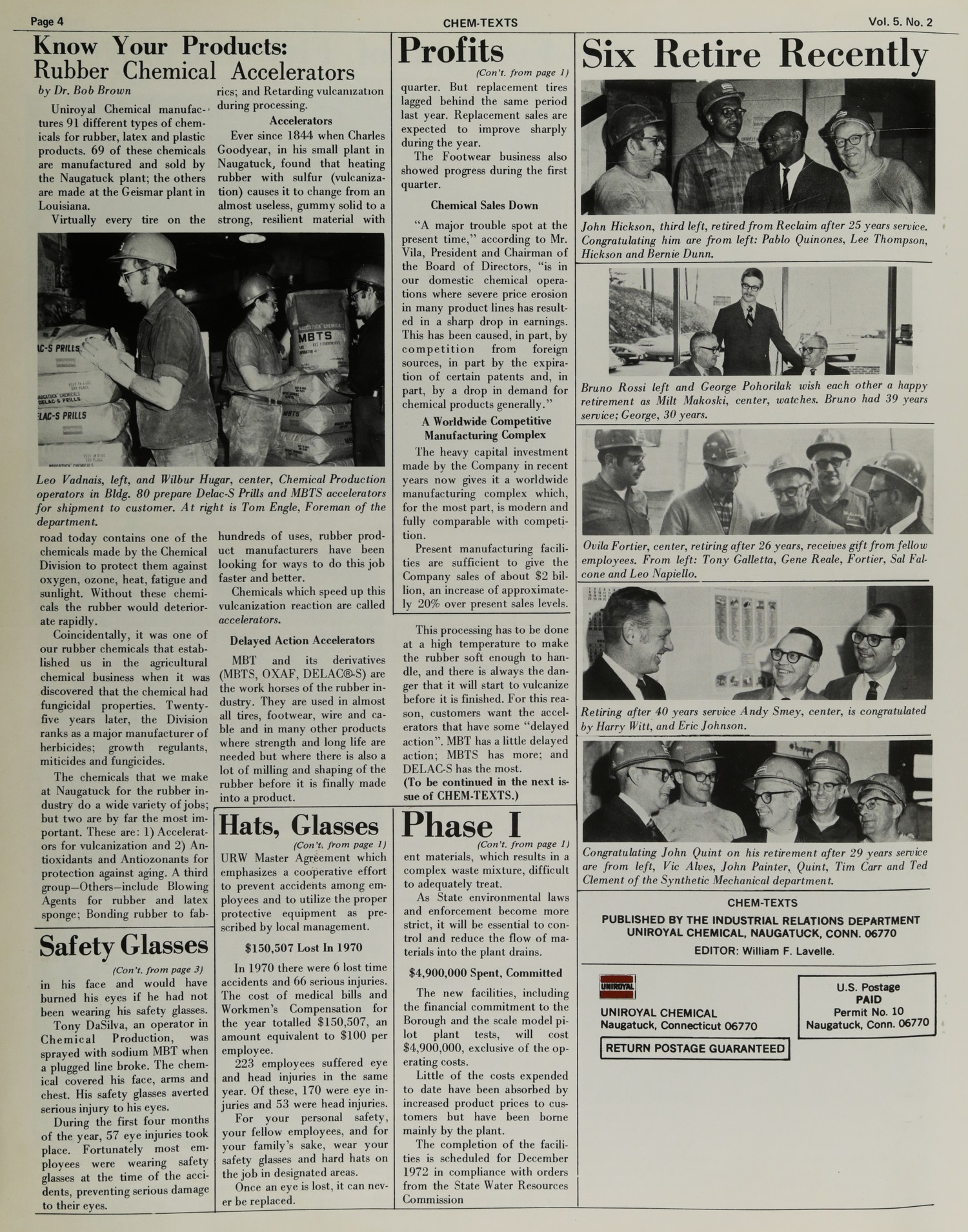
Page 4 | CHEM-TEXTS | Vol. 5. No. 2
Know Your Products: Rubber Chemical Accelerators
by Dr. Bob Brown
Uniroyal Chemical manufactures 91 different types of chemicals for rubber, latex and plastic products. 69 of these chemicals are manufactured and sold by the Naugatuck plant; the others are made at the Geismar plant in Louisiana.
Virtually every tire on the road today contains one of the chemicals made by the Chemical Division to protect them against oxygen, ozone, heat, fatigue and sunlight. Without these chemicals the rubber would deteriorate rapidly.
Coincidentally, it was one of our rubber chemicals that established us in the agricultural chemical business when it was discovered that the chemical had fungicidal properties. Twenty-five years later, the Division ranks as a major manufacturer of herbicides; growth regulants, miticides and fungicides.
The chemicals that we make at Naugatuck for the rubber industry do a wide variety of jobs; but two are by far the most important. These are: 1) Accelerators for vulcanization and 2) Antioxidants and Antiozonants for protection against aging. A third group—Others—include Blowing Agents for rubber and latex sponge; Bonding rubber to fabric; and Retarding vulcanization during processing.
Accelerators
Ever since 1844 when Charles Goodyear, in his small plant in Naugatuck, found that heating rubber with sulfur (vulcanization) causes it to change from an almost useless, gummy solid to a strong, resilient material with hundreds of uses, rubber product manufacturers have been looking for ways to do this job faster and better.
Chemicals which speed up this vulcanization reaction are called accelerators.
Delayed Action Accelerators
MBT and its derivatives (MBTS, OXAF, DELAC®-S) are the work horses of the rubber industry. They are used in almost all tires, footwear, wire and cable and in many other products where strength and long life are needed but where there is also a lot of milling and shaping of the rubber before it is finally made into a product.
[IMAGE: Black and white photograph showing workers]
AC-5 PRILLS
LAC-5 PRILLS
Leo Vadnais, left, and Wilbur Hugar, center, Chemical Production operators in Bldg. 80 prepare Delac-S Prills and MBTS accelerators for shipment to customer. At right is Tom Engle, Foreman of the department.
Safety Glasses
(Con’t. from page 3)
in his face and would have burned his eyes if he had not been wearing his safety glasses.
Tony DaSilva, an operator in Chemical Production, was sprayed with sodium MBT when a plugged line broke. The chemical covered his face, arms and chest. His safety glasses averted serious injury to his eyes.
During the first four months of the year, 57 eye injuries took place. Fortunately most employees were wearing safety glasses at the time of the accidents, preventing serious damage to their eyes.
Hats, Glasses
(Con’t. from page 1)
URW Master Agreement which emphasizes a cooperative effort to prevent accidents among employees and to utilize the proper protective equipment as prescribed by local management.
$150,507 Lost In 1970
In 1970 there were 6 lost time accidents and 66 serious injuries. The cost of medical bills and Workmen’s Compensation for the year totalled $150,507, an amount equivalent to $100 per employee.
223 employees suffered eye and head injuries in the same year. Of these, 170 were eye injuries and 53 were head injuries.
For your personal safety, your fellow employees, and for your family’s sake, wear your safety glasses and hard hats on the job in designated areas.
Once an eye is lost, it can never be replaced.
Profits
(Con’t. from page 1)
quarter. But replacement tires lagged behind the same period last year. Replacement sales are expected to improve sharply during the year.
The Footwear business also showed progress during the first quarter.
Chemical Sales Down
“A major trouble spot at the present time,” according to Mr. Vila, President and Chairman of the Board of Directors, “is in our domestic chemical operations where severe price erosion in many product lines has resulted in a sharp drop in earnings. This has been caused, in part, by competition from foreign sources, in part by the expiration of certain patents and, in part, by a drop in demand for chemical products generally.”
A Worldwide Competitive Manufacturing Complex
The heavy capital investment made by the Company in recent years now gives it a worldwide manufacturing complex which, for the most part, is modern and fully comparable with competition.
Present manufacturing facilities are sufficient to give the Company sales of about $2 billion, an increase of approximately 20% over present sales levels.
This processing has to be done at a high temperature to make the rubber soft enough to handle, and there is always the danger that it will start to vulcanize before it is finished. For this reason, customers want the accelerators that have some “delayed action”. MBT has a little delayed action; MBTS has more; and DELAC-S has the most.
(To be continued in the next issue of CHEM-TEXTS.)
Phase I
(Con’t. from page 1)
ent materials, which results in a complex waste mixture, difficult to adequately treat.
As State environmental laws and enforcement become more strict, it will be essential to control and reduce the flow of materials into the plant drains.
$4,900,000 Spent, Committed
The new facilities, including the financial commitment to the Borough and the scale model pilot plant tests, will cost $4,900,000, exclusive of the operating costs.
Little of the costs expended to date have been absorbed by increased product prices to customers but have been borne mainly by the plant.
The completion of the facilities is scheduled for December 1972 in compliance with orders from the State Water Resources Commission
Six Retire Recently
[IMAGE: Photograph of three men]
John Hickson, third left, retired from Reclaim after 25 years service. Congratulating him are from left: Pablo Quinones, Lee Thompson, Hickson and Bernie Dunn.
[IMAGE: Photograph of two men]
Bruno Rossi left and George Pohorilak wish each other a happy retirement as Milt Makoski, center, watches. Bruno had 39 years service; George, 30 years.
[IMAGE: Photograph of group of men]
Ovila Fortier, center, retiring after 26 years, receives gift from fellow employees. From left: Tony Galletta, Gene Reale, Fortier, Sal Falcone and Leo Napiello.
[IMAGE: Photograph of three men]
Retiring after 40 years service Andy Smey, center, is congratulated by Harry Witt, and Eric Johnson.
[IMAGE: Photograph of group of men]
Congratulating John Quint on his retirement after 29 years service are from left, Vic Alves, John Painter, Quint, Tim Carr and Ted Clement of the Synthetic Mechanical department.
CHEM-TEXTS
PUBLISHED BY THE INDUSTRIAL RELATIONS DEPARTMENT
UNIROYAL CHEMICAL, NAUGATUCK, CONN. 06770
EDITOR: William F. Lavelle.
[LOGO: UNIROYAL]
UNIROYAL CHEMICAL
Naugatuck, Connecticut 06770
RETURN POSTAGE GUARANTEED
U.S. Postage
PAID
Permit No. 10
Naugatuck, Conn. 06770