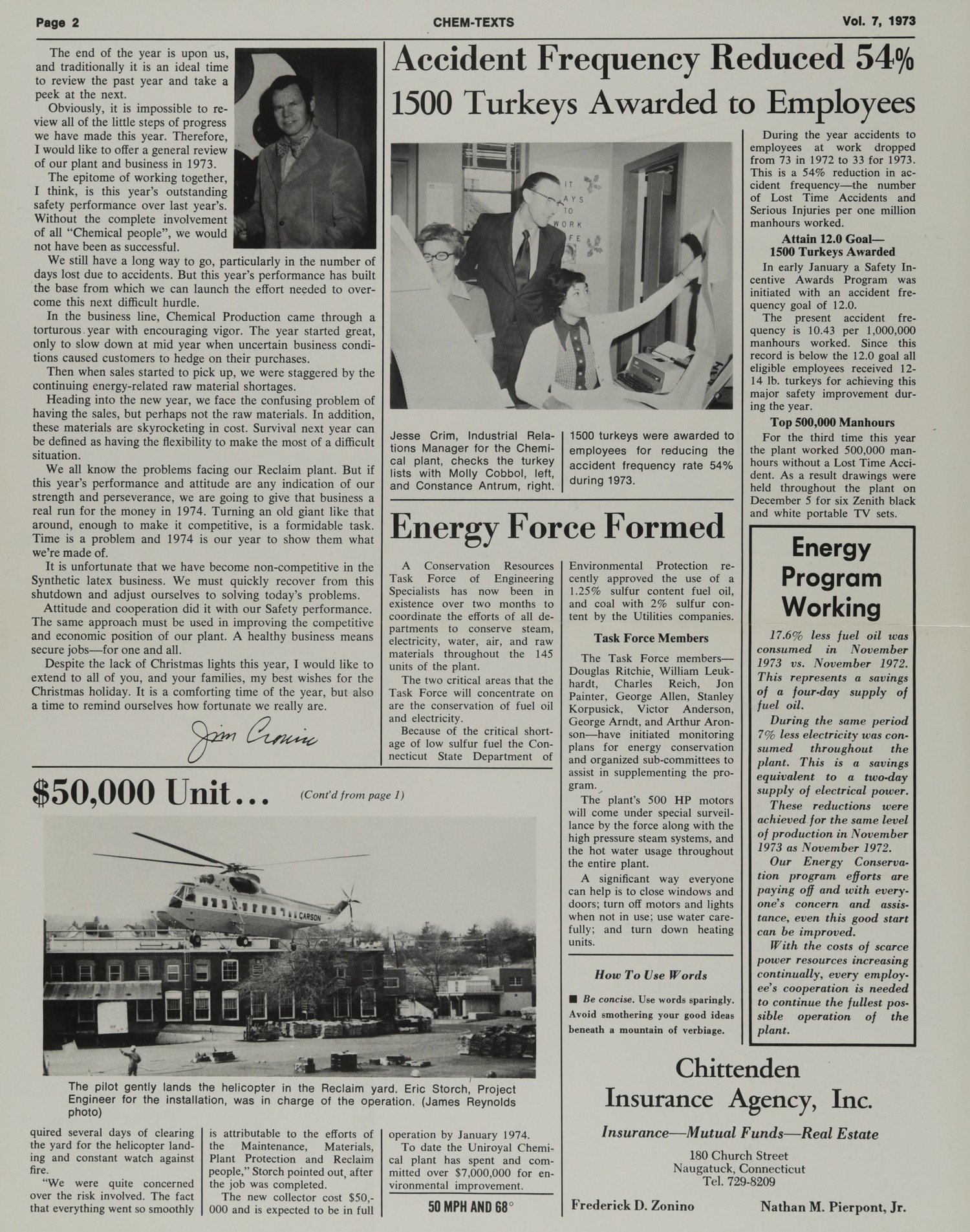
Las Vegas – 1973-s211

Page 211

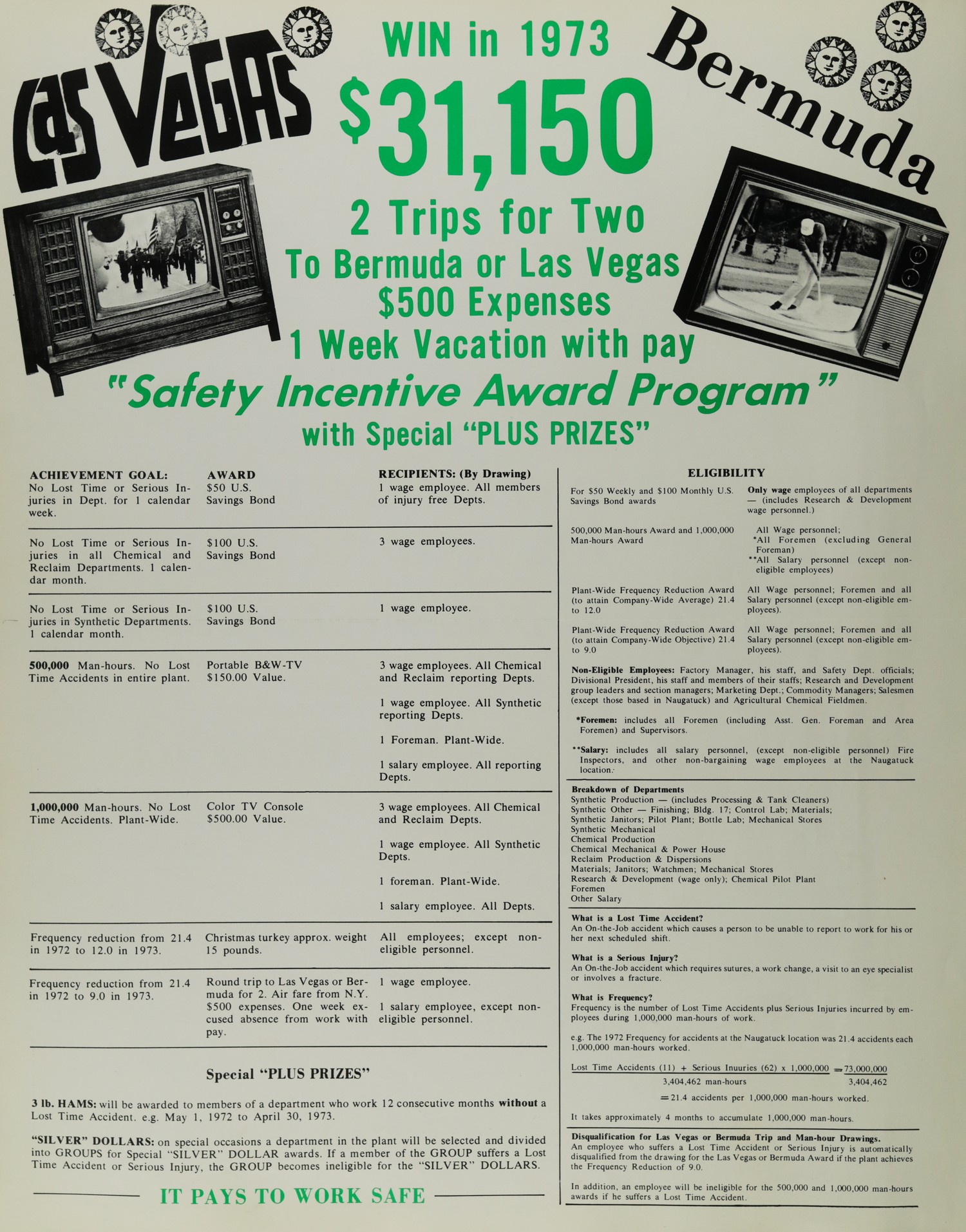
WIN in 1973

$31,150

2 Trips for Two

To Bermuda or Las Vegas

$500 Expenses

1 Week Vacation with pay

“Safety Incentive Award Program”

with Special “PLUS PRIZES”


ACHIEVEMENT GOAL:

No Lost Time or Serious Injuries in Dept. for 1 calendar week.

AWARD
$50 U.S. Savings Bond

RECIPIENTS: (By Drawing)
1 wage employee. All members of injury free Depts.


No Lost Time or Serious Injuries in all Chemical and Reclaim Departments. 1 calendar month.

AWARD
$100 U.S. Savings Bond

RECIPIENTS:
3 wage employees.


No Lost Time or Serious Injuries in Synthetic Departments. 1 calendar month.

AWARD
$100 U.S. Savings Bond

RECIPIENTS:
1 wage employee.


500,000 Man-hours. No Lost Time Accidents in entire plant.

AWARD
Portable B&W-TV $150.00 Value.

RECIPIENTS:
3 wage employees. All Chemical and Reclaim reporting Depts.

1 wage employee. All Synthetic reporting Depts.

1 Foreman. Plant-Wide.

1 salary employee. All reporting Depts.


1,000,000 Man-hours. No Lost Time Accidents. Plant-Wide.

AWARD
Color TV Console $500.00 Value.

RECIPIENTS:
3 wage employees. All Chemical and Reclaim Depts.

1 wage employee. All Synthetic Depts.

1 foreman. Plant-Wide.

1 salary employee. All Depts.


Frequency reduction from 21.4 in 1972 to 12.0 in 1973.

AWARD
Christmas turkey approx. weight 15 pounds.

RECIPIENTS:
All employees; except non-eligible personnel.


Frequency reduction from 21.4 in 1972 to 9.0 in 1973.

AWARD
Round trip to Las Vegas or Bermuda for 2. Air fare from N.Y. $500 expenses. One week excused absence from work with pay.

RECIPIENTS:
1 wage employee.

1 salary employee, except non-eligible personnel.


Special “PLUS PRIZES”

3 lb. HAMS: will be awarded to members of a department who work 12 consecutive months without a Lost Time Accident. e.g. May 1, 1972 to April 30, 1973.

“SILVER” DOLLARS: on special occasions a department in the plant will be selected and divided into GROUPS for Special “SILVER” DOLLAR awards. If a member of the GROUP suffers a Lost Time Accident or Serious Injury, the GROUP becomes ineligible for the “SILVER” DOLLARS.


IT PAYS TO WORK SAFE


ELIGIBILITY

For $50 Weekly and $100 Monthly U.S. Savings Bond awards

Only wage employees of all departments — (includes Research & Development wage personnel.)


500,000 Man-hours Award and 1,000,000 Man-hours Award

All Wage personnel;
All Foremen (excluding General Foreman)
*All Salary personnel (except non-eligible employees)


Plant-Wide Frequency Reduction Award (to attain Company-Wide Average) 21.4 to 12.0

All Wage personnel; Foremen and all Salary personnel (except non-eligible employees).


Plant-Wide Frequency Reduction Award (to attain Company-Wide Objective) 21.4 to 9.0

All Wage personnel; Foremen and all Salary personnel (except non-eligible employees).


Non-Eligible Employees: Factory Manager, his staff, and Safety Dept. officials; Divisional President, his staff and members of their staffs; Research and Development group leaders and section managers; Marketing Dept.; Commodity Managers; Salesmen (except those based in Naugatuck) and Agricultural Chemical Fieldmen.

*Foremen: includes all Foremen (including Asst. Gen. Foreman and Area Foremen) and Supervisors.

**Salary: includes all salary personnel, (except non-eligible personnel) Fire Inspectors, and other non-bargaining wage employees at the Naugatuck location.


Breakdown of Departments

Synthetic Production — (includes Processing & Tank Cleaners)
Synthetic Other — Finishing; Bldg. 17; Control Lab; Materials;
Synthetic Janitors; Pilot Plant; Bottle Lab; Mechanical Stores
Synthetic Mechanical
Chemical Production
Chemical Mechanical & Power House
Reclaim Production & Dispersions
Materials; Janitors; Watchmen; Mechanical Stores
Research & Development (wage only); Chemical Pilot Plant
Foremen
Other Salary


What is a Lost Time Accident?
An On-the-Job accident which causes a person to be unable to report to work for his or her next scheduled shift.

What is a Serious Injury?
An On-the-Job accident which requires sutures, a work change, a visit to an eye specialist or involves a fracture.

What is Frequency?
Frequency is the number of Lost Time Accidents plus Serious Injuries incurred by employees during 1,000,000 man-hours of work.

e.g. The 1972 Frequency for accidents at the Naugatuck location was 21.4 accidents each 1,000,000 man-hours worked.

Lost Time Accidents (11) + Serious Inuuries (62) x 1,000,000 = 73,000,000
3,404,462 man-hours 3,404,462

= 21.4 accidents per 1,000,000 man-hours worked.

It takes approximately 4 months to accumulate 1,000,000 man-hours.


Disqualification for Las Vegas or Bermuda Trip and Man-hour Drawings.
An employee who suffers a Lost Time Accident or Serious Injury is automatically disqualified from the drawing for the Las Vegas or Bermuda Award if the plant achieves the Frequency Reduction of 9.0.

In addition, an employee will be ineligible for the 500,000 and 1,000,000 man-hours awards if he suffers a Lost Time Accident.
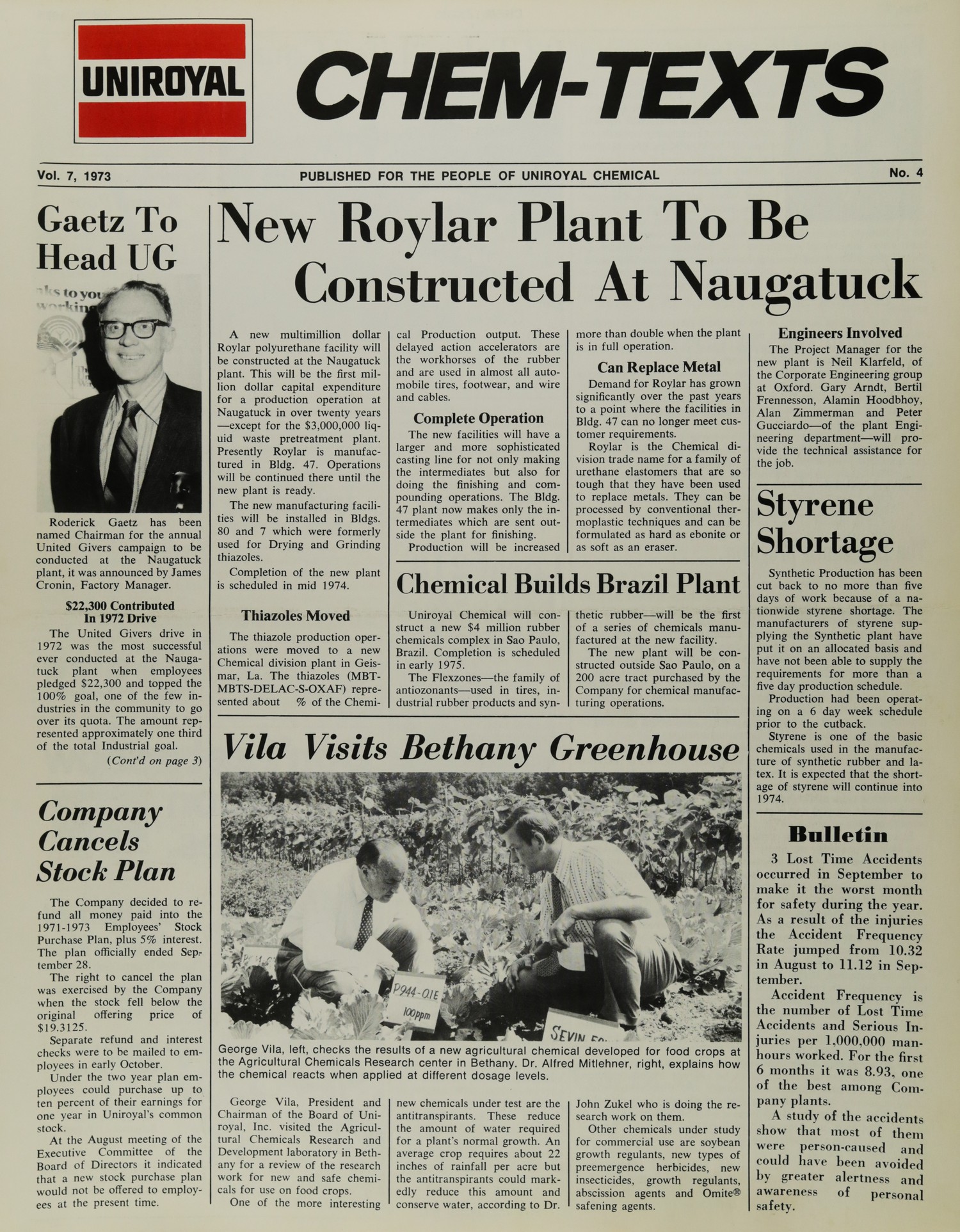
CHEM-TEXTS – 1973-v07-i04-s214

Page 214

UNIROYAL CHEM-TEXTS

Vol. 7, 1973 PUBLISHED FOR THE PEOPLE OF UNIROYAL CHEMICAL No. 4


Gaetz To Head UG

[IMAGE: Photo of Roderick Gaetz wearing glasses]

Roderick Gaetz has been named Chairman for the annual United Givers campaign to be conducted at the Naugatuck plant, it was announced by James Cronin, Factory Manager.

$22,300 Contributed In 1972 Drive

The United Givers drive in 1972 was the most successful ever conducted at the Naugatuck plant when employees pledged $22,300 and topped the 100% goal, one of the few industries in the community to go over its quota. The amount represented approximately one third of the total Industrial goal.

(Cont’d on page 3)


Company Cancels Stock Plan

The Company decided to refund all money paid into the 1971-1973 Employees’ Stock Purchase Plan, plus 5% interest. The plan officially ended September 28.

The right to cancel the plan was exercised by the Company when the stock fell below the original offering price of $19.3125.

Separate refund and interest checks were to be mailed to employees in early October.

Under the two year plan employees could purchase up to ten percent of their earnings for one year in Uniroyal’s common stock.

At the August meeting of the Executive Committee of the Board of Directors it indicated that a new stock purchase plan would not be offered to employees at the present time.


New Roylar Plant To Be Constructed At Naugatuck

A new multimillion dollar Roylar polyurethane facility will be constructed at the Naugatuck plant. This will be the first million dollar capital expenditure for a production operation at Naugatuck in over twenty years —except for the $3,000,000 liquid waste pretreatment plant. Presently Roylar is manufactured in Bldg. 47. Operations will be continued there until the new plant is ready.

The new manufacturing facilities will be installed in Bldgs. 80 and 7 which were formerly used for Drying and Grinding thiazoles.

Completion of the new plant is scheduled in mid 1974.

Thiazoles Moved

The thiazole production operations were moved to a new Chemical division plant in Geismar, La. The thiazoles (MBT-MBTS-DELAC-S-OXAF) represented about % of the Chemical Production output. These delayed action accelerators are the workhorses of the rubber and are used in almost all automobile tires, footwear, and wire and cables.

Complete Operation

The new facilities will have a larger and more sophisticated casting line for not only making the intermediates but also for doing the finishing and compounding operations. The Bldg. 47 plant now makes only the intermediates which are sent outside the plant for finishing.

Production will be increased more than double when the plant is in full operation.

Can Replace Metal

Demand for Roylar has grown significantly over the past years to a point where the facilities in Bldg. 47 can no longer meet customer requirements.

Roylar is the Chemical division trade name for a family of urethane elastomers that are so tough that they have been used to replace metals. They can be processed by conventional thermoplastic techniques and can be formulated as hard as ebonite or as soft as an eraser.

Engineers Involved

The Project Manager for the new plant is Neil Klarfeld, of the Corporate Engineering group at Oxford. Gary Arndt, Bertil Frennesson, Alamin Hoodbhoy, Alan Zimmerman and Peter Gucciardo—of the plant Engineering department—will provide the technical assistance for the job.


Chemical Builds Brazil Plant

Uniroyal Chemical will construct a new $4 million rubber chemicals complex in Sao Paulo, Brazil. Completion is scheduled in early 1975.

The Flexzones—the family of antiozonants—used in tires, industrial rubber products and synthetic rubber—will be the first of a series of chemicals manufactured at the new facility.

The new plant will be constructed outside Sao Paulo, on a 200 acre tract purchased by the Company for chemical manufacturing operations.


Styrene Shortage

Synthetic Production has been cut back to no more than five days of work because of a nationwide styrene shortage. The manufacturers of styrene supplying the Synthetic plant have put it on an allocated basis and have not been able to supply the requirements for more than a five day production schedule.

Production had been operating on a 6 day week schedule prior to the cutback.

Styrene is one of the basic chemicals used in the manufacture of synthetic rubber and latex. It is expected that the shortage of styrene will continue into 1974.


Vila Visits Bethany Greenhouse

[IMAGE: Photo showing George Vila and Dr. Alfred Mitlehner examining plants in a greenhouse, with signs visible reading “P944-01E”, “100ppm”, and “SEVIN Ex.”]

George Vila, left, checks the results of a new agricultural chemical developed for food crops at the Agricultural Chemicals Research center in Bethany. Dr. Alfred Mitlehner, right, explains how the chemical reacts when applied at different dosage levels.

George Vila, President and Chairman of the Board of Uniroyal, Inc. visited the Agricultural Chemicals Research and Development laboratory in Bethany for a review of the research work for new and safe chemicals for use on food crops.

One of the more interesting new chemicals under test are the antitranspirants. These reduce the amount of water required for a plant’s normal growth. An average crop requires about 22 inches of rainfall per acre but the antitranspirants could markedly reduce this amount and conserve water, according to Dr. John Zukel who is doing the research work on them.

Other chemicals under study for commercial use are soybean growth regulants, new types of preemergence herbicides, new insecticides, growth regulants, abscission agents and Omite® safening agents.


Bulletin

3 Lost Time Accidents occurred in September to make it the worst month for safety during the year. As a result of the injuries the Accident Frequency Rate jumped from 10.32 in August to 11.12 in September.

Accident Frequency is the number of Lost Time Accidents and Serious Injuries per 1,000,000 man-hours worked. For the first 6 months it was 8.93, one of the best among Company plants.

A study of the accidents show that most of them were person-caused and could have been avoided by greater alertness and awareness of personal safety.

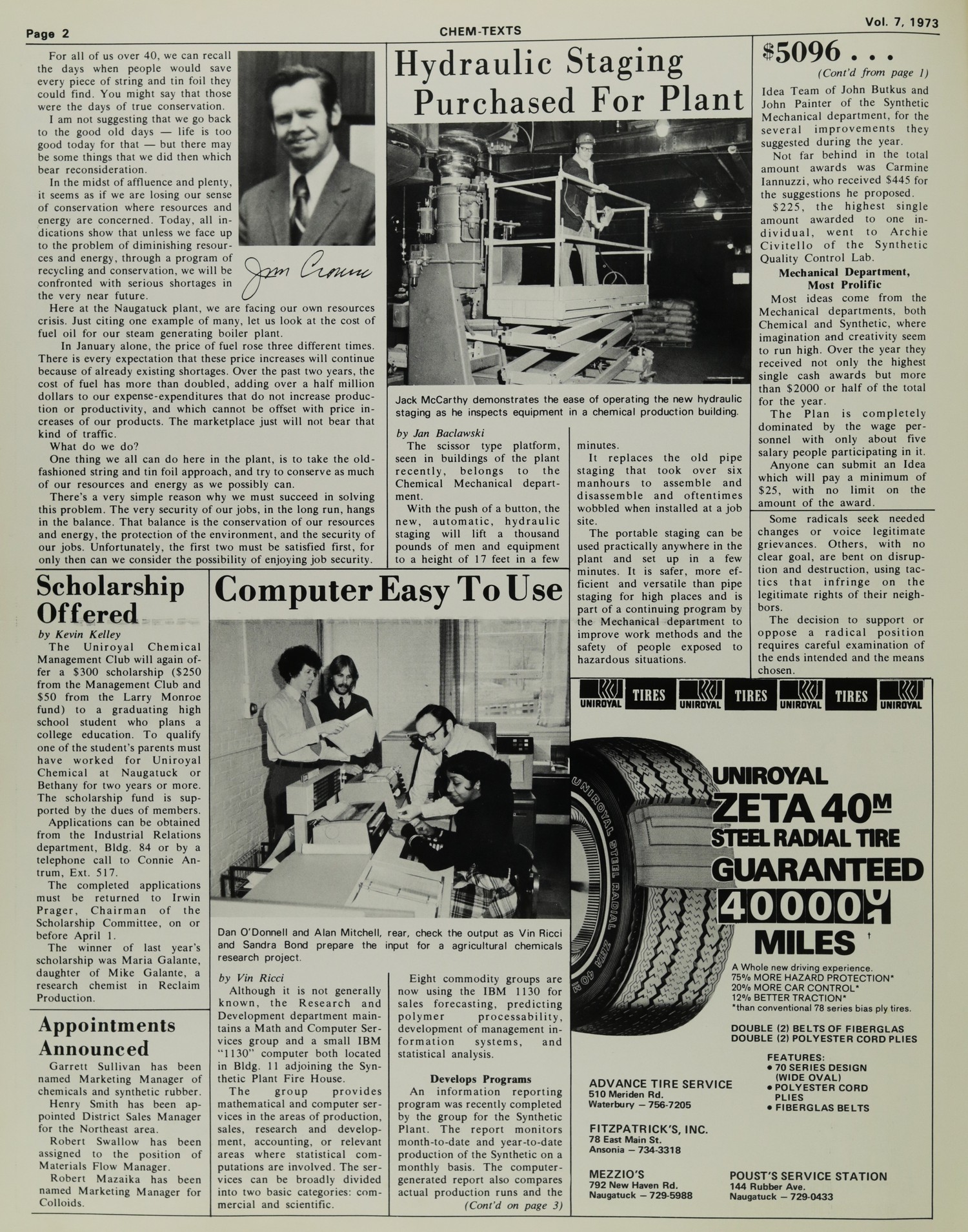
CHEM-TEXTS – Vol. 7 – Page 2

Page 002

CHEM-TEXTS

Page 2 | Vol. 7, 1973


For all of us over 40, we can recall the days when people would save every piece of string and tin foil they could find. You might say that those were the days of true conservation.

I am not suggesting that we go back to the good old days — life is too good today for that — but there may be some things that we did then which bear reconsideration.

In the midst of affluence and plenty, it seems as if we are losing our sense of conservation where resources and energy are concerned. Today, all indications show that unless we face up to the problem of diminishing resources and energy, through a program of recycling and conservation, we will be confronted with serious shortages in the very near future.

Jim Crane [Signature]

Here at the Naugatuck plant, we are facing our own resources crisis. Just citing one example of many, let us look at the cost of fuel oil for our steam generating boiler plant.

In January alone, the price of fuel rose three different times. There is every expectation that these price increases will continue because of already existing shortages. Over the past two years, the cost of fuel has more than doubled, adding over a half million dollars to our expense-expenditures that do not increase production or productivity, and which cannot be offset with price increases of our products. The marketplace just will not bear that kind of traffic.

What do we do?

One thing we all can do here in the plant, is to take the old-fashioned string and tin foil approach, and try to conserve as much of our resources and energy as we possibly can.

There’s a very simple reason why we must succeed in solving this problem. The very security of our jobs, in the long run, hangs in the balance. That balance is the conservation of our resources and energy, the protection of the environment, and the security of our jobs. Unfortunately, the first two must be satisfied first, for only then can we consider the possibility of enjoying job security.


Hydraulic Staging Purchased For Plant

[IMAGE: Jack McCarthy demonstrates the ease of operating the new hydraulic staging as he inspects equipment in a chemical production building.]

by Jan Baclawski

The scissor type platform, seen in buildings of the plant recently, belongs to the Chemical Mechanical department.

With the push of a button, the new, automatic, hydraulic staging will lift a thousand pounds of men and equipment to a height of 17 feet in a few minutes.

It replaces the old pipe staging that took over six manhours to assemble and disassemble and oftentimes wobbled when installed at a job site.

The portable staging can be used practically anywhere in the plant and set up in a few minutes. It is safer, more efficient and versatile than pipe staging for high places and is part of a continuing program by the Mechanical department to improve work methods and the safety of people exposed to hazardous situations.


Scholarship Offered

by Kevin Kelley

The Uniroyal Chemical Management Club will again offer a $300 scholarship ($250 from the Management Club and $50 from the Larry Monroe fund) to a graduating high school student who plans a college education. To qualify one of the student’s parents must have worked for Uniroyal Chemical at Naugatuck or Bethany for two years or more. The scholarship fund is supported by the dues of members.

Applications can be obtained from the Industrial Relations department, Bldg. 84 or by a telephone call to Connie Antrum, Ext. 517.

The completed applications must be returned to Irwin Prager, Chairman of the Scholarship Committee, on or before April 1.

The winner of last year’s scholarship was Maria Galante, daughter of Mike Galante, a research chemist in Reclaim Production.


Appointments Announced

Garrett Sullivan has been named Marketing Manager of chemicals and synthetic rubber.

Henry Smith has been appointed District Sales Manager for the Northeast area.

Robert Swallow has been assigned to the position of Materials Flow Manager.

Robert Mazaika has been named Marketing Manager for Colloids.


Computer Easy To Use

[IMAGE: Dan O’Donnell and Alan Mitchell, rear, check the output as Vin Ricci and Sandra Bond prepare the input for a agricultural chemicals research project.]

by Vin Ricci

Although it is not generally known, the Research and Development department maintains a Math and Computer Services group and a small IBM “1130” computer both located in Bldg. 11 adjoining the Synthetic Plant Fire House.

The group provides mathematical and computer services in the areas of production, sales, research and development, accounting, or relevant areas where statistical computations are involved. The services can be broadly divided into two basic categories: commercial and scientific.

Eight commodity groups are now using the IBM 1130 for sales forecasting, predicting polymer processability, development of management information systems, and statistical analysis.

Develops Programs

An information reporting program was recently completed by the group for the Synthetic Plant. The report monitors month-to-date and year-to-date production of the Synthetic on a monthly basis. The computer-generated report also compares actual production runs and the

(Cont’d on page 3)


$5096…

(Cont’d from page 1)

Idea Team of John Butkus and John Painter of the Synthetic Mechanical department, for the several improvements they suggested during the year.

Not far behind in the total amount awards was Carmine Iannuzzi, who received $445 for the suggestions he proposed.

$225, the highest single amount awarded to one individual, went to Archie Civitello of the Synthetic Quality Control Lab.

Mechanical Department, Most Prolific

Most ideas come from the Mechanical departments, both Chemical and Synthetic, where imagination and creativity seem to run high. Over the year they received not only the highest single cash awards but more than $2000 or half of the total for the year.

The Plan is completely dominated by the wage personnel with only about five salary people participating in it.

Anyone can submit an Idea which will pay a minimum of $25, with no limit on the amount of the award.

Some radicals seek needed changes or voice legitimate grievances. Others, with no clear goal, are bent on disruption and destruction, using tactics that infringe on the legitimate rights of their neighbors.

The decision to support or oppose a radical position requires careful examination of the ends intended and the means chosen.


[ADVERTISEMENT]

TIRES UNIROYAL | TIRES UNIROYAL | TIRES UNIROYAL

UNIROYAL ZETA 40M STEEL RADIAL TIRE GUARANTEED 40000 MILES

A Whole new driving experience.
75% MORE HAZARD PROTECTION
20% MORE CAR CONTROL

12% BETTER TRACTION
than conventional 78 series bias ply tires.

DOUBLE (2) BELTS OF FIBERGLAS
DOUBLE (2) POLYESTER CORD PLIES

FEATURES:
– 70 SERIES DESIGN (WIDE OVAL)
– POLYESTER CORD PLIES
– FIBERGLAS BELTS

ADVANCE TIRE SERVICE
510 Meriden Rd.
Waterbury — 756-7205

FITZPATRICK’S, INC.
78 East Main St.
Ansonia — 734-3318

MEZZIO’S
792 New Haven Rd.
Naugatuck — 729-5988

POUST’S SERVICE STATION
144 Rubber Ave.
Naugatuck — 729-0433

CHEM-TEXTS – 1973-v07-s210

Page 210

Vol. 7, 1973 CHEM-TEXTS Page 3

1972 Safety…

(Cont’d from Page 1)

1971 to 8 in 1972, an increase of 100%.

Accidents to Chemical Production employees rose from 8 to 11.

Over 670 Items Corrected, Repaired or Replaced

To keep the plant in safe condition the Mechanical department has assigned priority to safety jobs and has organized a special section to oversee them.

The Chemical and Synthetic Mechanical departments have corrected, repaired or replaced over 670 items which did not conform to the strict standards of the Occupational Safety and Health Act.


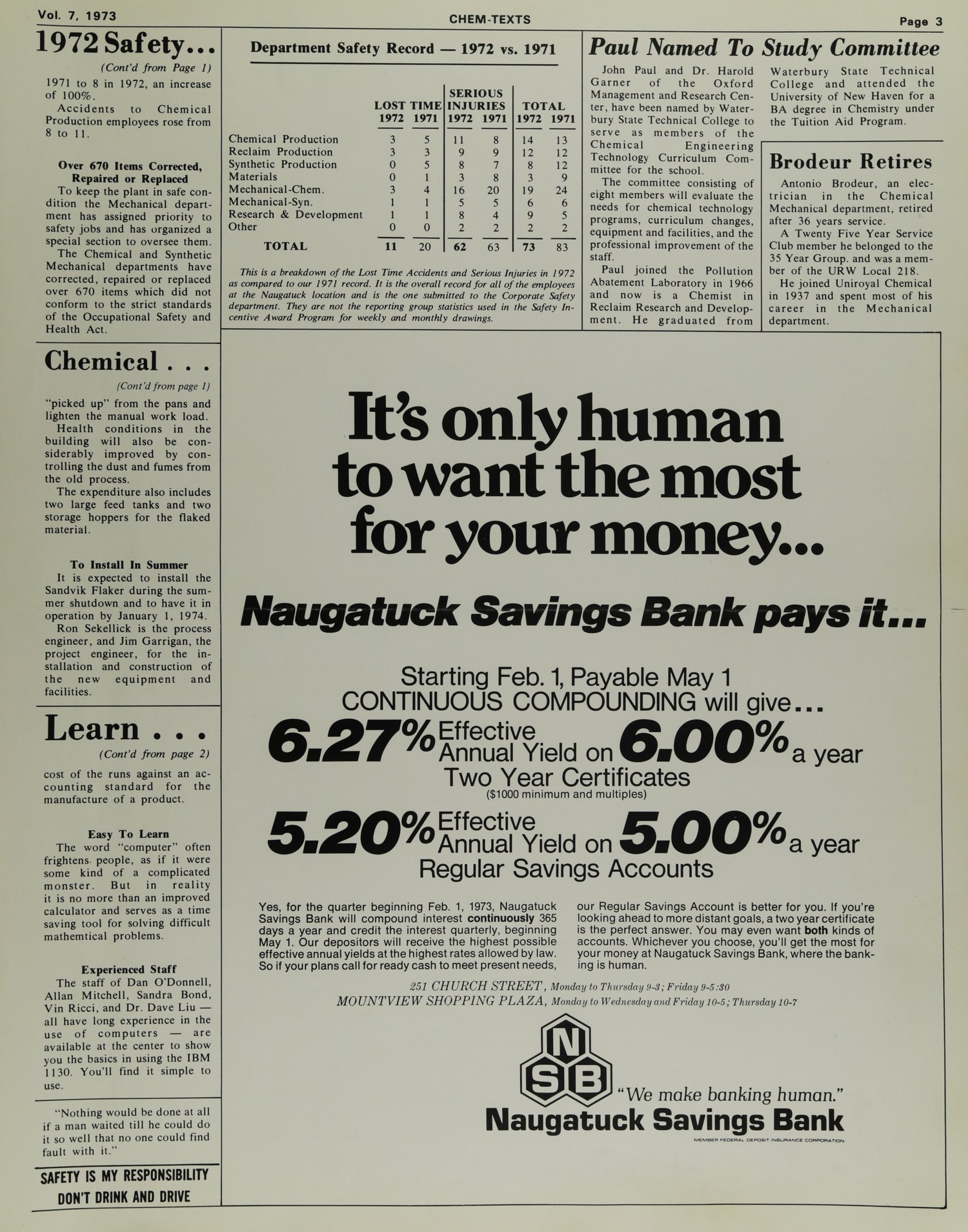
Department Safety Record — 1972 vs. 1971

| | LOST TIME | SERIOUS INJURIES | TOTAL |
| | 1972 | 1971 | 1972 | 1971 | 1972 | 1971 |
|————————–|——|——|——|——|——|——|
| Chemical Production | 3 | 5 | 11 | 8 | 14 | 13 |
| Reclaim Production | 3 | 3 | 9 | 9 | 12 | 12 |
| Synthetic Production | 0 | 5 | 8 | 7 | 8 | 12 |
| Materials | 0 | 1 | 3 | 8 | 3 | 9 |
| Mechanical-Chem. | 3 | 4 | 16 | 20 | 19 | 24 |
| Mechanical-Syn. | 1 | 1 | 5 | 5 | 6 | 6 |
| Research & Development | 1 | 1 | 8 | 4 | 9 | 5 |
| Other | 0 | 0 | 2 | 2 | 2 | 2 |
| TOTAL | 11 | 20 | 62 | 63 | 73 | 83 |

This is a breakdown of the Lost Time Accidents and Serious Injuries in 1972 as compared to our 1971 record. It is the overall record for all of the employees at the Naugatuck location and is the one submitted to the Corporate Safety department. They are not the reporting group statistics used in the Safety Incentive Award Program for weekly and monthly drawings.


Paul Named To Study Committee

John Paul and Dr. Harold Garner of the Oxford Management and Research Center, have been named by Waterbury State Technical College to serve as members of the Chemical Engineering Technology Curriculum Committee for the school.

The committee consisting of eight members will evaluate the needs for chemical technology programs, curriculum changes, equipment and facilities, and the professional improvement of the staff.

Paul joined the Pollution Abatement Laboratory in 1966 and now is a Chemist in Reclaim Research and Development. He graduated from Waterbury State Technical College and attended the University of New Haven for a BA degree in Chemistry under the Tuition Aid Program.


Brodeur Retires

Antonio Brodeur, an electrician in the Chemical Mechanical department, retired after 36 years service.

A Twenty Five Year Service Club member he belonged to the 35 Year Group, and was a member of the URW Local 218.

He joined Uniroyal Chemical in 1937 and spent most of his career in the Mechanical department.


Chemical . . .

(Cont’d from page 1)

“picked up” from the pans and lighten the manual work load.

Health conditions in the building will also be considerably improved by controlling the dust and fumes from the old process.

The expenditure also includes two large feed tanks and two storage hoppers for the flaked material.

To Install In Summer

It is expected to install the Sandvik Flaker during the summer shutdown and to have it in operation by January 1, 1974.

Ron Sekellick is the process engineer, and Jim Garrigan, the project engineer, for the installation and construction of the new equipment and facilities.


Learn . . .

(Cont’d from page 2)

cost of the runs against an accounting standard for the manufacture of a product.

Easy To Learn

The word “computer” often frightens people, as if it were some kind of a complicated monster. But in reality it is no more than an improved calculator and serves as a time saving tool for solving difficult mathematical problems.

Experienced Staff

The staff of Dan O’Donnell, Allan Mitchell, Sandra Bond, Vin Ricci, and Dr. Dave Liu — all have long experience in the use of computers — are available at the center to show you the basics in using the IBM 1130. You’ll find it simple to use.

“Nothing would be done at all if a man waited till he could do it so well that no one could find fault with it.”


SAFETY IS MY RESPONSIBILITY

DON’T DRINK AND DRIVE


It’s only human to want the most for your money…

Naugatuck Savings Bank pays it…

Starting Feb. 1, Payable May 1
CONTINUOUS COMPOUNDING will give…

6.27% Effective Annual Yield on 6.00% a year

Two Year Certificates
($1000 minimum and multiples)

5.20% Effective Annual Yield on 5.00% a year

Regular Savings Accounts

Yes, for the quarter beginning Feb. 1, 1973, Naugatuck Savings Bank will compound interest continuously 365 days a year and credit the interest quarterly, beginning May 1. Our depositors will receive the highest possible effective annual yields at the highest rates allowed by law. So if your plans call for ready cash to meet present needs,

our Regular Savings Account is better for you. If you’re looking ahead to more distant goals, a two year certificate is the perfect answer. You may even want both kinds of accounts. Whichever you choose, you’ll get the most for your money at Naugatuck Savings Bank, where the banking is human.

251 CHURCH STREET, Monday to Thursday 9-3; Friday 9-5:30
MOUNTVIEW SHOPPING PLAZA, Monday to Wednesday and Friday 10-5; Thursday 10-7

[NSB Logo]

“We make banking human.”

Naugatuck Savings Bank

MEMBER FEDERAL DEPOSIT INSURANCE CORPORATION

CHEM-TEXTS – 1973-v07-s212

Page 212

Vol. 7, 1973 CHEM-TEXTS Page 5


Salesmen Set ’73 Goal | Free X-Ray | CHEM-PROD JOTTINGS

Offered Employees

by 7 BUILDING CREW

These jottings on what is going on in Chemical Production is an attempt to get more information to the people in the department.

Hopefully, with the ideas and suggestions of the Chemical Production Operators, we will get information on what the people in the plant want to know. So, next time you see the “7 Building Crew” give them your suggestions to improve this column.


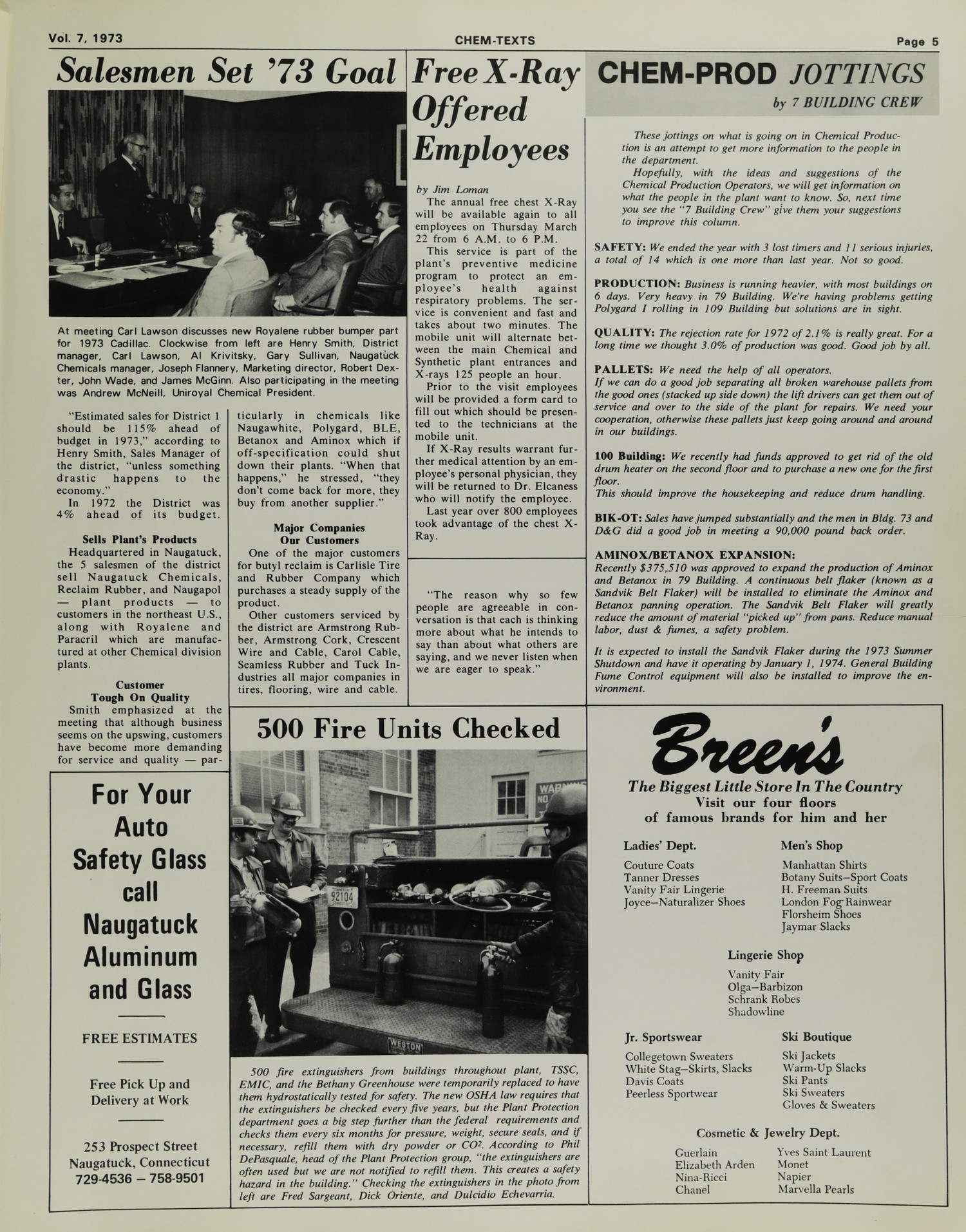
[IMAGE: Photo of men at meeting with car]

At meeting Carl Lawson discusses new Royalene rubber bumper part for 1973 Cadillac. Clockwise from left are Henry Smith, District manager, Carl Lawson, Al Krivitsky, Gary Sullivan, Naugatuck Chemicals manager, Joseph Flannery, Marketing director, Robert Dexter, John Wade, and James McGinn. Also participating in the meeting was Andrew McNeill, Uniroyal Chemical President.

“Estimated sales for District 1 should be 115% ahead of budget in 1973,” according to Henry Smith, Sales Manager of the district, “unless something drastic happens to the economy.”

In 1972 the District was 4% ahead of its budget.

Sells Plant’s Products

Headquartered in Naugatuck, the 5 salesmen of the district sell Naugatuck Chemicals, Reclaim Rubber, and Naugapol — plant products — to customers in the northeast U.S., along with Royalene and Paracril which are manufactured at other Chemical division plants.

Customer Tough On Quality

Smith emphasized at the meeting that although business seems on the upswing, customers have become more demanding for service and quality — par-

ticularly in chemicals like Naugawhite, Polygard, BLE, Betanox and Aminox which if off-specification could shut down their plants. “When that happens,” he stressed, “they don’t come back for more, they buy from another supplier.”

Major Companies Our Customers

One of the major customers for butyl reclaim is Carlisle Tire and Rubber Company which purchases a steady supply of the product.

Other customers serviced by the district are Armstrong Rubber, Armstrong Cork, Crescent Wire and Cable, Carol Cable, Seamless Rubber and Tuck Industries all major companies in tires, flooring, wire and cable.


by Jim Loman

The annual free chest X-Ray will be available again to all employees on Thursday March 22 from 6 A.M. to 6 P.M.

This service is part of the plant’s preventive medicine program to protect an employee’s health against respiratory problems. The service is convenient and fast and takes about two minutes. The mobile unit will alternate between the main Chemical and Synthetic plant entrances and X-rays 125 people an hour.

Prior to the visit employees will be provided a form card to fill out which should be presented to the technicians at the mobile unit.

If X-Ray results warrant further medical attention by an employee’s personal physician, they will be returned to Dr. Elcaness who will notify the employee.

Last year over 800 employees took advantage of the chest X-Ray.


“The reason why so few people are agreeable in conversation is that each is thinking more about what he intends to say than about what others are saying, and we never listen when we are eager to speak.”


SAFETY: We ended the year with 3 lost timers and 11 serious injuries, a total of 14 which is one more than last year. Not so good.

PRODUCTION: Business is running heavier, with most buildings on 6 days. Very heavy in 79 Building. We’re having problems getting Polygard 1 rolling in 109 Building but solutions are in sight.

QUALITY: The rejection rate for 1972 of 2.1% is really great. For a long time we thought 3.0% of production was good. Good job by all.

PALLETS: We need the help of all operators. If we can do a good job separating all broken warehouse pallets from the good ones (stacked up side down) the lift drivers can get them out of service and over to the side of the plant for repairs. We need your cooperation, otherwise these pallets just keep going around and around in our buildings.

100 Building: We recently had funds approved to get rid of the old drum heater on the second floor and to purchase a new one for the first floor.

This should improve the housekeeping and reduce drum handling.

BIK-OT: Sales have jumped substantially and the men in Bldg. 73 and D&G did a good job in meeting a 90,000 pound back order.

AMINOX/BETANOX EXPANSION:

Recently $375,510 was approved to expand the production of Aminox and Betanox in 79 Building. A continuous belt flaker (known as a Sandvik Belt Flaker) will be installed to eliminate the Aminox and Betanox panning operation. The Sandvik Belt Flaker will greatly reduce the amount of material “picked up” from pans. Reduce manual labor, dust & fumes, a safety problem.

It is expected to install the Sandvik Flaker during the 1973 Summer Shutdown and have it operating by January 1, 1974. General Building Fume Control equipment will also be installed to improve the environment.


500 Fire Units Checked

[IMAGE: Photo of workers checking fire extinguishers]

500 fire extinguishers from buildings throughout plant, TSSC, EMIC, and the Bethany Greenhouse were temporarily replaced to have them hydrostatically tested for safety. The new OSHA law requires that the extinguishers be checked every five years, but the Plant Protection department goes a big step further than the federal requirements and checks them every six months for pressure, weight, secure seals, and if necessary, refill them with dry powder or CO². According to Phil DePasquale, head of the Plant Protection group, “the extinguishers are often used but we are not notified to refill them. This creates a safety hazard in the building.” Checking the extinguishers in the photo from left are Fred Sargeant, Dick Oriente, and Dulcidio Echevarria.


For Your Auto Safety Glass call

Naugatuck Aluminum and Glass


FREE ESTIMATES


Free Pick Up and Delivery at Work


253 Prospect Street
Naugatuck, Connecticut
729-4536 — 758-9501


Breen’s

The Biggest Little Store In The Country

Visit our four floors of famous brands for him and her

Ladies’ Dept.
Couture Coats
Tanner Dresses
Vanity Fair Lingerie
Joyce–Naturalizer Shoes

Men’s Shop
Manhattan Shirts
Botany Suits–Sport Coats
H. Freeman Suits
London Fog Rainwear
Florsheim Shoes
Jaymar Slacks

Lingerie Shop
Vanity Fair
Olga–Barbizon
Schrank Robes
Shadowline

Jr. Sportswear
Collegetown Sweaters
White Stag–Skirts, Slacks
Davis Coats
Peerless Sportwear

Ski Boutique
Ski Jackets
Warm-Up Slacks
Ski Pants
Ski Sweaters
Gloves & Sweaters

Cosmetic & Jewelry Dept.

Guerlain Yves Saint Laurent
Elizabeth Arden Monet
Nina-Ricci Napier
Chanel Marvella Pearls

CHEM-TEXTS – 1973-v07-s217

Page 217

Page 4 CHEM-TEXTS Vol. 7, 1973


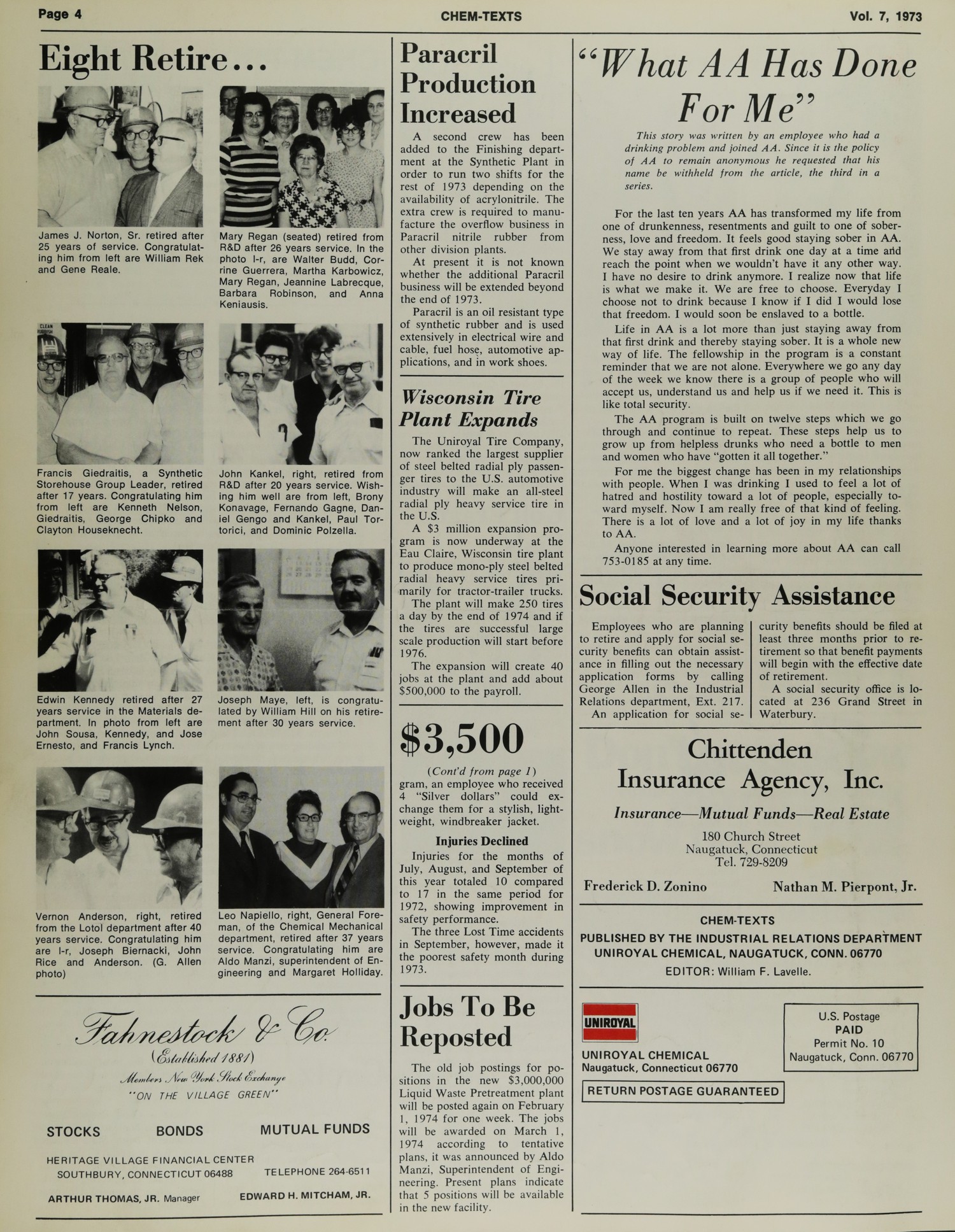
Eight Retire…

[PHOTO]

James J. Norton, Sr. retired after 25 years of service. Congratulating him from left are William Rek and Gene Reale.

[PHOTO]

Mary Regan (seated) retired from R&D after 26 years service. In the photo l-r, are Walter Budd, Corrine Guerrera, Martha Karbowicz, Mary Regan, Jeannine Labrecque, Barbara Robinson, and Anna Keniausis.

[PHOTO]

Francis Giedraitis, a Synthetic Storehouse Group Leader, retired after 17 years. Congratulating him from left are Kenneth Nelson, Giedraitis, George Chipko and Clayton Houseknecht.

[PHOTO]

John Kankel, right, retired from R&D after 20 years service. Wishing him well are from left, Brony Konavage, Fernando Gagne, Daniel Gengo and Kankel, Paul Tortorici, and Dominic Polzella.

[PHOTO]

Edwin Kennedy retired after 27 years service in the Materials department. In photo from left are John Sousa, Kennedy, and Jose Ernesto, and Francis Lynch.

[PHOTO]

Joseph Maye, left, is congratulated by William Hill on his retirement after 30 years service.

[PHOTO]

Vernon Anderson, right, retired from the Lotol department after 40 years service. Congratulating him are l-r, Joseph Biernacki, John Rice and Anderson. (G. Allen photo)

[PHOTO]

Leo Napiello, right, General Foreman, of the Chemical Mechanical department, retired after 37 years service. Congratulating him are Aldo Manzi, superintendent of Engineering and Margaret Holliday.


Paracril Production Increased

A second crew has been added to the Finishing department at the Synthetic Plant in order to run two shifts for the rest of 1973 depending on the availability of acrylonitrile. The extra crew is required to manufacture the overflow business in Paracril nitrile rubber from other division plants.

At present it is not known whether the additional Paracril business will be extended beyond the end of 1973.

Paracril is an oil resistant type of synthetic rubber and is used extensively in electrical wire and cable, fuel hose, automotive applications, and in work shoes.


Wisconsin Tire Plant Expands

The Uniroyal Tire Company, now ranked the largest supplier of steel belted radial ply passenger tires to the U.S. automotive industry will make an all-steel radial ply heavy service tire in the U.S.

A $3 million expansion program is now underway at the Eau Claire, Wisconsin tire plant to produce mono-ply steel belted radial heavy service tires primarily for tractor-trailer trucks. The plant will make 250 tires a day by the end of 1974 and if the tires are successful large scale production will start before 1976.

The expansion will create 40 jobs at the plant and add about $500,000 to the payroll.


$3,500

(Cont’d from page 1)

gram, an employee who received 4 “Silver dollars” could exchange them for a stylish, lightweight, windbreaker jacket.

Injuries Declined

Injuries for the months of July, August, and September of this year totaled 10 compared to 17 in the same period for 1972, showing improvement in safety performance.

The three Lost Time accidents in September, however, made it the poorest safety month during 1973.


Jobs To Be Reposted

The old job postings for positions in the new $3,000,000 Liquid Waste Pretreatment plant will be posted again on February 1, 1974 for one week. The jobs will be awarded on March 1, 1974 according to tentative plans, it was announced by Aldo Manzi, Superintendent of Engineering. Present plans indicate that 5 positions will be available in the new facility.


“What AA Has Done For Me”

This story was written by an employee who had a drinking problem and joined AA. Since it is the policy of AA to remain anonymous he requested that his name be withheld from the article, the third in a series.

For the last ten years AA has transformed my life from one of drunkenness, resentments and guilt to one of soberness, love and freedom. It feels good staying sober in AA. We stay away from that first drink one day at a time and reach the point when we wouldn’t have it any other way. I have no desire to drink anymore. I realize now that life is what we make it. We are free to choose. Everyday I choose not to drink because I know if I did I would lose that freedom. I would soon be enslaved to a bottle.

Life in AA is a lot more than just staying away from that first drink and thereby staying sober. It is a whole new way of life. The fellowship in the program is a constant reminder that we are not alone. Everywhere we go any day of the week we know there is a group of people who will accept us, understand us and help us if we need it. This is like total security.

The AA program is built on twelve steps which we go through and continue to repeat. These steps help us to grow up from helpless drunks who need a bottle to men and women who have “gotten it all together.”

For me the biggest change has been in my relationships with people. When I was drinking I used to feel a lot of hatred and hostility toward a lot of people, especially toward myself. Now I am really free of that kind of feeling. There is a lot of love and a lot of joy in my life thanks to AA.

Anyone interested in learning more about AA can call 753-0185 at any time.


Social Security Assistance

Employees who are planning to retire and apply for social security benefits can obtain assistance in filling out the necessary application forms by calling George Allen in the Industrial Relations department, Ext. 217.

An application for social security benefits should be filed at least three months prior to retirement so that benefit payments will begin with the effective date of retirement.

A social security office is located at 236 Grand Street in Waterbury.


Chittenden Insurance Agency, Inc.

Insurance—Mutual Funds—Real Estate

180 Church Street
Naugatuck, Connecticut
Tel. 729-8209

Frederick D. Zonino | Nathan M. Pierpont, Jr.


CHEM-TEXTS
PUBLISHED BY THE INDUSTRIAL RELATIONS DEPARTMENT
UNIROYAL CHEMICAL, NAUGATUCK, CONN. 06770
EDITOR: William F. Lavelle.


Fahnestock & Co.
(Established 1881)

Members New York Stock Exchange
“ON THE VILLAGE GREEN”

STOCKS | BONDS | MUTUAL FUNDS

HERITAGE VILLAGE FINANCIAL CENTER
SOUTHBURY, CONNECTICUT 06488 | TELEPHONE 264-6511

ARTHUR THOMAS, JR. Manager | EDWARD H. MITCHAM, JR.


[UNIROYAL LOGO]

UNIROYAL CHEMICAL
Naugatuck, Connecticut 06770

RETURN POSTAGE GUARANTEED

U.S. Postage
PAID
Permit No. 10
Naugatuck, Conn. 06770

CHEM-TEXTS – 1973-v07-s219

Page 219

Page 2 CHEM-TEXTS Vol. 7, 1973


Running the plant is not much different than running your own home.

Most of us own a house; have a family; and have an awful lot of bills to pay: a mortgage every month; income taxes and property taxes; clothing; food; college; electric; fuel oil; water; car installments; gasoline; doctor and dentist bills; house repairs; appliances; insurance; contributions; recreation; and many others.

We all know that often our pay check doesn’t cover the expenses that we have incurred. For instance if our pay check is $150 and our bills are $175, we soon look for ways to reduce our expenses: 1) we can buy on credit; 2) borrow money from a bank; or 3) cut them down by doing away with the frills, buying wisely, and saving on fuel oil, water, and electricity, and other things.

The same money problems exist in the plant. Instead of $20 or $100 costs, our bills run $500,000 or $1,000,000. For example our utility bill for one year in this plant—fuel oil, electricity, and city water—is about $3,000,000. About two years ago this combined bill was about $2,000,000.

If it costs the plant $1,000,000 to make a product and we receive $750,000 for it, something has to give. We are losing $250,000 each time we make it. It’s the same situation as running your home.

It’s obvious that you can’t continue to do business this way. The alternatives are: to 1) to increase prices; 2) eliminate major items; 3) close down the production unit; 4) or to control our expenses, reduce waste, and to improve our productivity to get our costs down.

In the chemical industry selling prices have not been going up very fast so that approach is limited. Alternative 4)—controlling expenses—is the road we want to take but our success depends on everyone’s determination to resolve the problems.

At the present time the costs of operating some of our production units are higher than the financial return for their products. As you know—just from running your own home and paying your own bills—something has to be done to improve the situation. If it continues it could put these two units so deep in the red that it would affect all production units and manufacturing services. Each one of us has a stake in this plant. It sinks or swims depending on the efforts of each one of us.

I am asking everyone to reveal the same personal interest in the plant that you would if it were your own home, so that we can help resolve the problems and improve the financial situations of all of its units.

Jan Crane [signature]


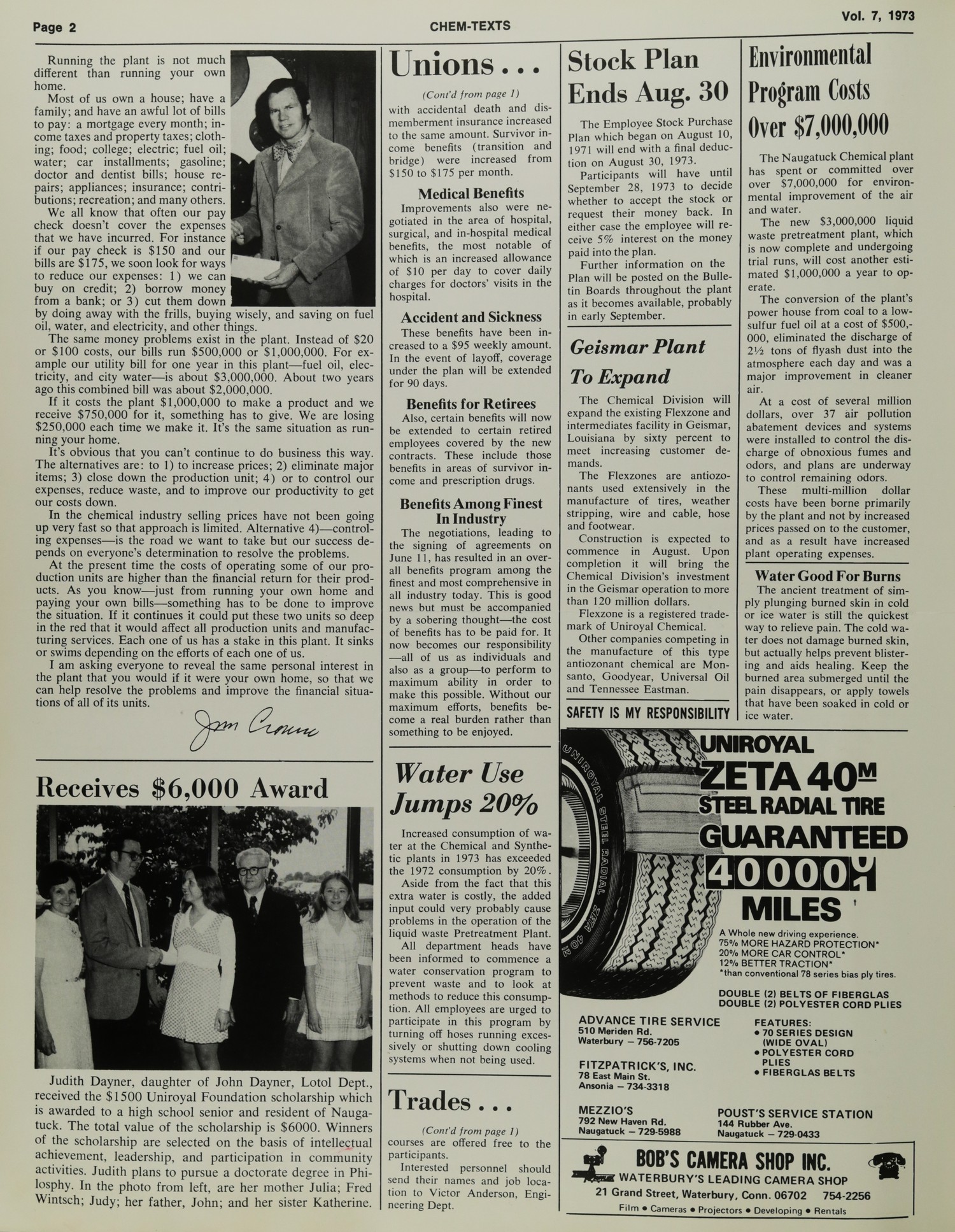
Receives $6,000 Award

[PHOTO: Group photo of four people]

Judith Dayner, daughter of John Dayner, Lotol Dept., received the $1500 Uniroyal Foundation scholarship which is awarded to a high school senior and resident of Naugatuck. The total value of the scholarship is $6000. Winners of the scholarship are selected on the basis of intellectual achievement, leadership, and participation in community activities. Judith plans to pursue a doctorate degree in Philosophy. In the photo from left, are her mother Julia; Fred Wintsch; Judy; her father, John; and her sister Katherine.


Unions…

(Cont’d from page 1)

with accidental death and dismemberment insurance increased to the same amount. Survivor income benefits (transition and bridge) were increased from $150 to $175 per month.

Medical Benefits

Improvements also were negotiated in the area of hospital, surgical, and in-hospital medical benefits, the most notable of which is an increased allowance of $10 per day to cover daily charges for doctors’ visits in the hospital.

Accident and Sickness

These benefits have been increased to a $95 weekly amount. In the event of layoff, coverage under the plan will be extended for 90 days.

Benefits for Retirees

Also, certain benefits will now be extended to certain retired employees covered by the new contracts. These include those benefits in areas of survivor income and prescription drugs.

Benefits Among Finest In Industry

The negotiations, leading to the signing of agreements on June 11, has resulted in an overall benefits program among the finest and most comprehensive in all industry today. This is good news but must be accompanied by a sobering thought—the cost of benefits has to be paid for. It now becomes our responsibility —all of us as individuals and also as a group—to perform to maximum ability in order to make this possible. Without our maximum efforts, benefits become a real burden rather than something to be enjoyed.


Water Use Jumps 20%

Increased consumption of water at the Chemical and Synthetic plants in 1973 has exceeded the 1972 consumption by 20%.

Aside from the fact that this extra water is costly, the added input could very probably cause problems in the operation of the liquid waste Pretreatment Plant.

All department heads have been informed to commence a water conservation program to prevent waste and to look at methods to reduce this consumption. All employees are urged to participate in this program by turning off hoses running excessively or shutting down cooling systems when not being used.

[PHOTO: Person near water/equipment]


Trades…

(Cont’d from page 1)

courses are offered free to the participants.

Interested personnel should send their names and job location to Victor Anderson, Engineering Dept.


Stock Plan Ends Aug. 30

The Employee Stock Purchase Plan which began on August 10, 1971 will end with a final deduction on August 30, 1973.

Participants will have until September 28, 1973 to decide whether to accept the stock or request their money back. In either case the employee will receive 5% interest on the money paid into the plan.

Further information on the Plan will be posted on the Bulletin Boards throughout the plant as it becomes available, probably in early September.


Geismar Plant To Expand

The Chemical Division will expand the existing Flexzone and intermediates facility in Geismar, Louisiana by sixty percent to meet increasing customer demands.

The Flexzones are antiozonants used extensively in the manufacture of tires, weather stripping, wire and cable, hose and footwear.

Construction is expected to commence in August. Upon completion it will bring the Chemical Division’s investment in the Geismar operation to more than 120 million dollars.

Flexzone is a registered trademark of Uniroyal Chemical.

Other companies competing in the manufacture of this type antiozonant chemical are Monsanto, Goodyear, Universal Oil and Tennessee Eastman.


SAFETY IS MY RESPONSIBILITY


Environmental Program Costs Over $7,000,000

The Naugatuck Chemical plant has spent or committed over $7,000,000 for environmental improvement of the air and water.

The new $3,000,000 liquid waste pretreatment plant, which is now complete and undergoing trial runs, will cost another estimated $1,000,000 a year to operate.

The conversion of the plant’s power house from coal to a low-sulfur fuel oil at a cost of $500,000, eliminated the discharge of 2½ tons of flyash dust into the atmosphere each day and was a major improvement in cleaner air.

At a cost of several million dollars, over 37 air pollution abatement devices and systems were installed to control the discharge of obnoxious fumes and odors, and plans are underway to control remaining odors.

These multi-million dollar costs have been borne primarily by the plant and not by increased prices passed on to the customer, and as a result have increased plant operating expenses.

Water Good For Burns

The ancient treatment of simply plunging burned skin in cold or ice water is still the quickest way to relieve pain. The cold water does not damage burned skin, but actually helps prevent blistering and aids healing. Keep the burned area submerged until the pain disappears, or apply towels that have been soaked in cold or ice water.


[ADVERTISEMENT]

UNIROYAL

ZETA 40M

STEEL RADIAL TIRE

GUARANTEED

40000

MILES

A Whole new driving experience.
75% MORE HAZARD PROTECTION
20% MORE CAR CONTROL

12% BETTER TRACTION
than conventional 78 series bias ply tires.

DOUBLE (2) BELTS OF FIBERGLAS
DOUBLE (2) POLYESTER CORD PLIES

ADVANCE TIRE SERVICE
510 Meriden Rd.
Waterbury — 756-7205

FEATURES:
• 70 SERIES DESIGN (WIDE OVAL)
• POLYESTER CORD PLIES
• FIBERGLAS BELTS

FITZPATRICK’S, INC.
78 East Main St.
Ansonia — 734-3318

MEZZIO’S
792 New Haven Rd.
Naugatuck — 729-5988

POUST’S SERVICE STATION
144 Rubber Ave.
Naugatuck — 729-0433


BOB’S CAMERA SHOP INC.
WATERBURY’S LEADING CAMERA SHOP
21 Grand Street, Waterbury, Conn. 06702 754-2256
Film • Cameras • Projectors • Developing • Rentals

CHEM-TEXTS – 1973-v07-s220

Page 220

CHEM-TEXTS

Vol. 7, 1973 | Page 3


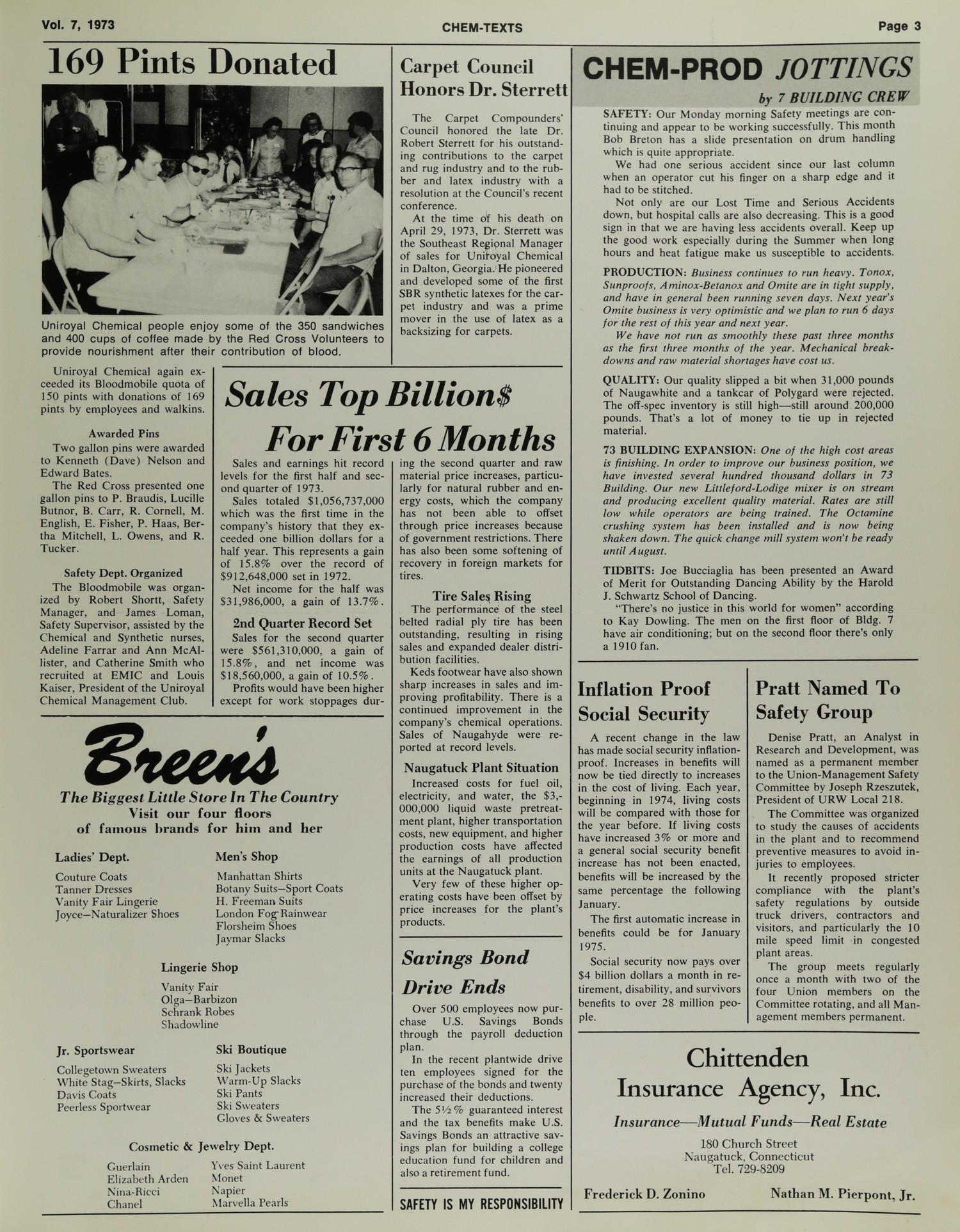
169 Pints Donated

[IMAGE: Black and white photograph showing people at what appears to be a food service counter]

Uniroyal Chemical people enjoy some of the 350 sandwiches and 400 cups of coffee made by the Red Cross Volunteers to provide nourishment after their contribution of blood.

Uniroyal Chemical again exceeded its Bloodmobile quota of 150 pints with donations of 169 pints by employees and walkins.

Awarded Pins

Two gallon pins were awarded to Kenneth (Dave) Nelson and Edward Bates.

The Red Cross presented one gallon pins to P. Braudis, Lucille Butnor, B. Carr, R. Cornell, M. English, E. Fisher, P. Haas, Bertha Mitchell, L. Owens, and R. Tucker.

Safety Dept. Organized

The Bloodmobile was organized by Robert Shortt, Safety Manager, and James Loman, Safety Supervisor, assisted by the Chemical and Synthetic nurses, Adeline Farrar and Ann McAllister, and Catherine Smith who recruited at EMIC and Louis Kaiser, President of the Uniroyal Chemical Management Club.


Breen’s

The Biggest Little Store In The Country
Visit our four floors
of famous brands for him and her

Ladies’ Dept. Men’s Shop
Couture Coats Manhattan Shirts
Tanner Dresses Botany Suits—Sport Coats
Vanity Fair Lingerie H. Freeman Suits
Joyce—Naturalizer Shoes London Fog Rainwear
Florsheim Shoes
Jaymar Slacks

Lingerie Shop
Vanity Fair
Olga—Barbizon
Schrank Robes
Shadowline

Jr. Sportswear Ski Boutique
Collegetown Sweaters Ski Jackets
White Stag—Skirts, Slacks Warm-Up Slacks
Davis Coats Ski Pants
Peerless Sportwear Ski Sweaters
Gloves & Sweaters

Cosmetic & Jewelry Dept.

Guerlain Yves Saint Laurent
Elizabeth Arden Monet
Nina-Ricci Napier
Chanel Marvella Pearls

Carpet Council Honors Dr. Sterrett

The Carpet Compounders’ Council honored the late Dr. Robert Sterrett for his outstanding contributions to the carpet and rug industry and to the rubber and latex industry with a resolution at the Council’s recent conference.

At the time of his death on April 29, 1973, Dr. Sterrett was the Southeast Regional Manager of sales for Uniroyal Chemical in Dalton, Georgia. He pioneered and developed some of the first SBR synthetic latexes for the carpet industry and was a prime mover in the use of latex as a backsizing for carpets.


Sales Top Billion$ For First 6 Months

Sales and earnings hit record levels for the first half and second quarter of 1973.

Sales totaled $1,056,737,000 which was the first time in the company’s history that they exceeded one billion dollars for a half year. This represents a gain of 15.8% over the record of $912,648,000 set in 1972.

Net income for the half was $31,986,000, a gain of 13.7%.

2nd Quarter Record Set

Sales for the second quarter were $561,310,000, a gain of 15.8%, and net income was $18,560,000, a gain of 10.5%.

Profits would have been higher except for work stoppages during the second quarter and raw material price increases, particularly for natural rubber and energy costs, which the company has not been able to offset through price increases because of government restrictions. There has also been some softening of recovery in foreign markets for tires.

Tire Sales Rising

The performance of the steel belted radial ply tire has been outstanding, resulting in rising sales and expanded dealer distribution facilities.

Keds footwear have also shown sharp increases in sales and improving profitability. There is a continued improvement in the company’s chemical operations. Sales of Naugahyde were reported at record levels.

Naugatuck Plant Situation

Increased costs for fuel oil, electricity, and water, the $3,000,000 liquid waste pretreatment plant, higher transportation costs, new equipment, and higher production costs have affected the earnings of all production units at the Naugatuck plant.

Very few of these higher operating costs have been offset by price increases for the plant’s products.


Savings Bond Drive Ends

Over 500 employees now purchase U.S. Savings Bonds through the payroll deduction plan.

In the recent plantwide drive ten employees signed for the purchase of the bonds and twenty increased their deductions.

The 5½% guaranteed interest and the tax benefits make U.S. Savings Bonds an attractive savings plan for building a college education fund for children and also a retirement fund.

SAFETY IS MY RESPONSIBILITY


CHEM-PROD JOTTINGS

by 7 BUILDING CREW

SAFETY: Our Monday morning Safety meetings are continuing and appear to be working successfully. This month Bob Breton has a slide presentation on drum handling which is quite appropriate.

We had one serious accident since our last column when an operator cut his finger on a sharp edge and it had to be stitched.

Not only are our Lost Time and Serious Accidents down, but hospital calls are also decreasing. This is a good sign in that we are having less accidents overall. Keep up the good work especially during the Summer when long hours and heat fatigue make us susceptible to accidents.

PRODUCTION: Business continues to run heavy. Tonox, Sunproofs, Aminox-Betanox and Omite are in tight supply, and have in general been running seven days. Next year’s Omite business is very optimistic and we plan to run 6 days for the rest of this year and next year.

We have not run as smoothly these past three months as the first three months of the year. Mechanical breakdowns and raw material shortages have cost us.

QUALITY: Our quality slipped a bit when 31,000 pounds of Naugawhite and a tankcar of Polygard were rejected. The off-spec inventory is still high—still around 200,000 pounds. That’s a lot of money to tie up in rejected material.

73 BUILDING EXPANSION: One of the high cost areas is finishing. In order to improve our business position, we have invested several hundred thousand dollars in 73 Building. Our new Littleford-Lodige mixer is on stream and producing excellent quality material. Rates are still low while operators are being trained. The Octamine crushing system has been installed and is now being shaken down. The quick change mill system won’t be ready until August.

TIDBITS: Joe Bucciaglia has been presented an Award of Merit for Outstanding Dancing Ability by the Harold J. Schwartz School of Dancing.

“There’s no justice in this world for women” according to Kay Dowling. The men on the first floor of Bldg. 7 have air conditioning; but on the second floor there’s only a 1910 fan.


Inflation Proof Social Security

A recent change in the law has made social security inflation-proof. Increases in benefits will now be tied directly to increases in the cost of living. Each year, beginning in 1974, living costs will be compared with those for the year before. If living costs have increased 3% or more and a general social security benefit increase has not been enacted, benefits will be increased by the same percentage the following January.

The first automatic increase in benefits could be for January 1975.

Social security now pays over $4 billion dollars a month in retirement, disability, and survivors benefits to over 28 million people.


Pratt Named To Safety Group

Denise Pratt, an Analyst in Research and Development, was named as a permanent member to the Union-Management Safety Committee by Joseph Rzeszutek, President of URW Local 218.

The Committee was organized to study the causes of accidents in the plant and to recommend preventive measures to avoid injuries to employees.

It recently proposed stricter compliance with the plant’s safety regulations by outside truck drivers, contractors and visitors, and particularly the 10 mile speed limit in congested plant areas.

The group meets regularly once a month with two of the four Union members on the Committee rotating, and all Management members permanent.


Chittenden Insurance Agency, Inc.

Insurance—Mutual Funds—Real Estate

180 Church Street
Naugatuck, Connecticut
Tel. 729-8209

Frederick D. Zonino | Nathan M. Pierpont, Jr.

CHEM-TEXTS – 1973 – Page 2

Page 002

CHEM-TEXTS

Page 2 | Vol. 7, 1973


What happened in September?….

[IMAGE: Headshot photo of a man in business attire]

Was it a letdown after the long, hot summer? Was it a relaxation of attitude because of our improved performance over last year? Was it a little anticipation of attaining rewards for goals that have not quite been reached, but were close?

What happened in September? Three lost time accidents in the month —our worst performance this year. Where did we go wrong?

The answer to that question lies not in history, but in the future. What’s done is done, but let us learn from this recent experience and firm up our attitudes on Safety. We must strengthen our resolve to think safe and anticipate the unexpected. And follow rules, procedures, and good common sense to even further levels of accomplishment. We must work closer together, and help each other to solve the accident problem.

The real goal, of course, is not numbers on a board or dollars on a cost report. It is the well being of all our employees. It hurts to have an accident. It hurts in many ways, but the worst hurt of all is that most accidents could have been avoided.

Of course we must not forget that substantial progress has been made this year. We are all proud of this performance. But we have seen in years past a good record take a disastrous turn overnight. A good performance means only that more hard work is needed to keep it that way.

The year is not over yet. I urge all, wage and salary, factory and office, inside and outside, to rebound from our September problems and take on the rest of 1973 in the safest possible manner.

Our 1973 goals are still attainable if we point our eyes and noses in the right direction.


The free lunch program…

The average American is familiar with the expression— “There’s no such things as a free lunch.” Because we are so familiar with the saying, perhaps the full understanding of the thought gets lost and we forget the humbling impact of its true meaning.

Put simply, it means you never get anything for nothing. Even though it may appear that there are free handouts, or that someone has beaten the system, in the long run and when all things are considered, everything has its price.

One of the most flagrant free lunch programs is some of the money Uncle Sam hands out like free lollypops. However, the intelligent home owner, tax payer and average consumer knows, particularly now, that the bill for these goodies comes back to haunt us in the form of higher taxes, and increasing inflation.

The other free lunch program we must be very aware of is our own job situation. Everything our Company provides for us must be paid for by somebody, somewhere. Part of it comes back, when we pay more for the things we have to buy, and part of it comes back when a plant somewhere—anywhere—is shut down because it can no longer support the burden imposed upon it by today’s economic situation.

In order to maintain the comforting benefits provided, the main beneficiaries, namely us, must contribute. Under our product-industrial oriented system, the most reasonable way is to improve productivity. This is by far the best way to generate wealth which subsequently supports our standard of living.

The Company has a commitment to this end by providing the money and management to purchase and properly utilize equipment and facilities. The employees—you and I—have an obligation to properly and fully convert this equipment into products in the most efficient and reasonable manner possible. This is how we pay for our “free lunches.” If wealth is not generated in this way, a deficit is generated. If this deficit is allowed to grow unchecked, it will eventually—to borrow a Russian term—bury our system. Once this occurs, a major adjustment must be made to pay that “due bill” or write it off. In either case the adjustment is painful. The history of man is full of such adjustments and no intelligent man wants to live through such a period. No one wants his children to endure such hardships, either.

We all want reasonable improvements in our standard of living. We also want the improvements to be enjoyed by our children. Therefore, we must balance our benefits and their costs—somewhere, somehow. But we all know where the burden ends up—right on us. If we understand this and know what we are doing, we can better adjust to it and keep our livelihood in a good, healthy balance. We can then honestly say that the “free lunch” has been earned and paid for.

Jim Cronin [signature]


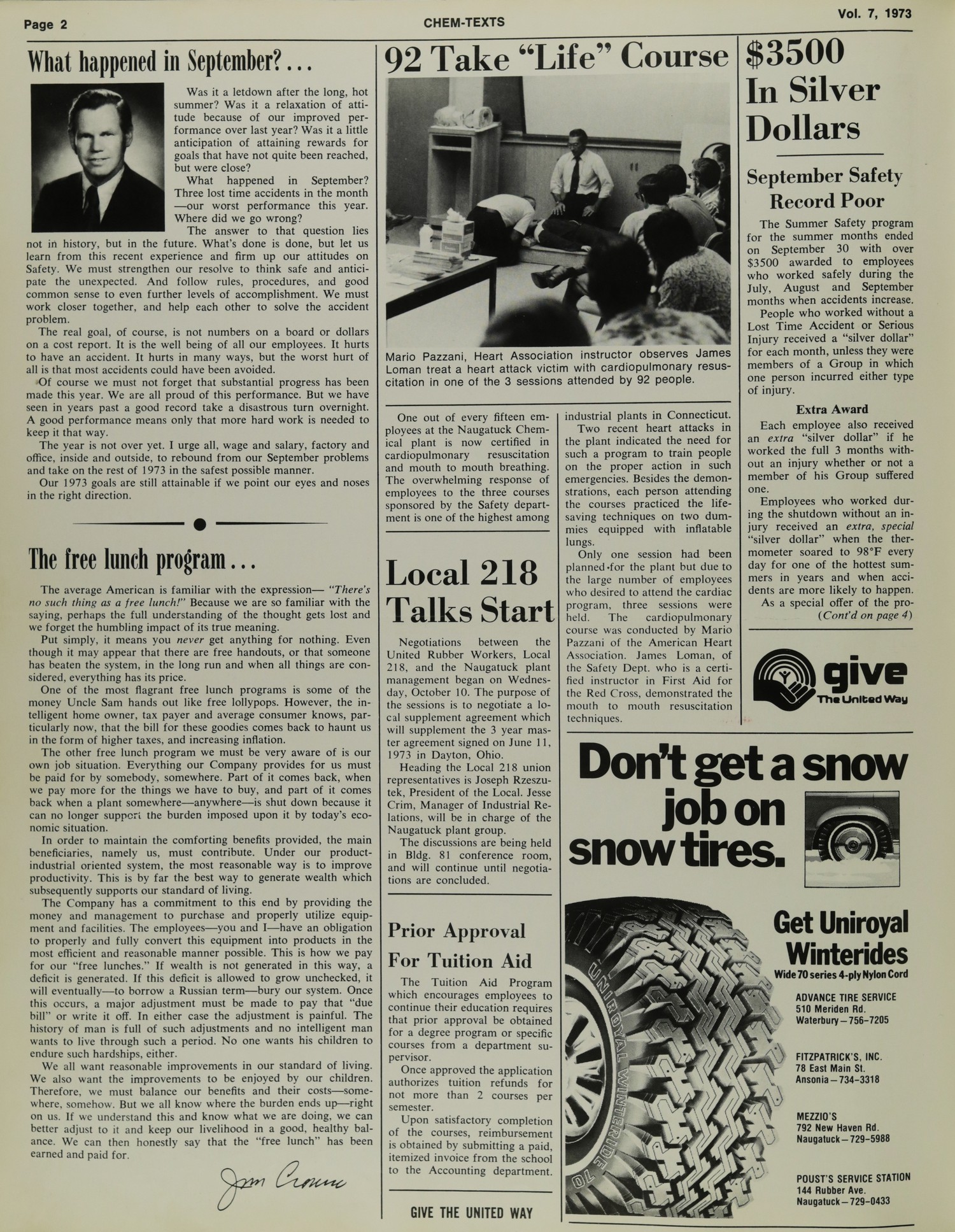
92 Take “Life” Course

[IMAGE: Photo showing people in what appears to be a training session with someone lying down, presumably during CPR training]

Mario Pazzani, Heart Association instructor observes James Loman treat a heart attack victim with cardiopulmonary resuscitation in one of the 3 sessions attended by 92 people.

One out of every fifteen employees at the Naugatuck Chemical plant is now certified in cardiopulmonary resuscitation and mouth to mouth breathing. The overwhelming response of employees to the three courses sponsored by the Safety department is one of the highest among industrial plants in Connecticut.

Two recent heart attacks in the plant indicated the need for such a program to train people on the proper action in such emergencies. Besides the demonstrations, each person attending the courses practiced the life-saving techniques on two dummies equipped with inflatable lungs.

Only one session had been planned for the plant but due to the large number of employees who desired to attend the cardiac program, three sessions were held. The cardiopulmonary course was conducted by Mario Pazzani of the American Heart Association. James Loman, of the Safety Dept. who is a certified instructor in First Aid for the Red Cross, demonstrated the mouth to mouth resuscitation techniques.


Local 218 Talks Start

Negotiations between the United Rubber Workers, Local 218, and the Naugatuck plant management began on Wednesday, October 10. The purpose of the sessions is to negotiate a local supplement agreement which will supplement the 3 year master agreement signed on June 11, 1973 in Dayton, Ohio.

Heading the Local 218 union representatives is Joseph Rzeszutek, President of the Local. Jesse Crim, Manager of Industrial Relations, will be in charge of the Naugatuck plant group.

The discussions are being held in Bldg. 81 conference room, and will continue until negotiations are concluded.


Prior Approval For Tuition Aid

The Tuition Aid Program which encourages employees to continue their education requires that prior approval be obtained for a degree program or specific courses from a department supervisor.

Once approved the application authorizes tuition refunds for not more than 2 courses per semester.

Upon satisfactory completion of the courses, reimbursement is obtained by submitting a paid, itemized invoice from the school to the Accounting department.


GIVE THE UNITED WAY


$3500 In Silver Dollars

September Safety Record Poor

The Summer Safety program for the summer months ended on September 30 with over $3500 awarded to employees who worked safely during the July, August and September months when accidents increase.

People who worked without a Lost Time Accident or Serious Injury received a “silver dollar” for each month, unless they were members of a Group in which one person incurred either type of injury.

Extra Award

Each employee also received an extra “silver dollar” if he worked the full 3 months without an injury whether or not a member of his Group suffered one.

Employees who worked during the shutdown without an injury received an extra, special “silver dollar” when the thermometer soared to 98°F every day for one of the hottest summers in years and when accidents are more likely to happen.

As a special offer of the pro-

(Cont’d on page 4)


[LOGO: “give The United Way” with stylized hand design]


Don’t get a snow job on snow tires.

[IMAGE: Large snow tire]

Get Uniroyal Winterides

Wide 70 series 4-ply Nylon Cord

ADVANCE TIRE SERVICE
510 Meriden Rd.
Waterbury – 756-7205

FITZPATRICK’S, INC.
78 East Main St.
Ansonia – 734-3318

MEZZIO’S
792 New Haven Rd.
Naugatuck – 729-5988

POUST’S SERVICE STATION
144 Rubber Ave.
Naugatuck – 729-0433

CHEM-TEXTS – 1973 – Page 3

Page 003

Vol. 7, 1973 CHEM-TEXTS Page 3


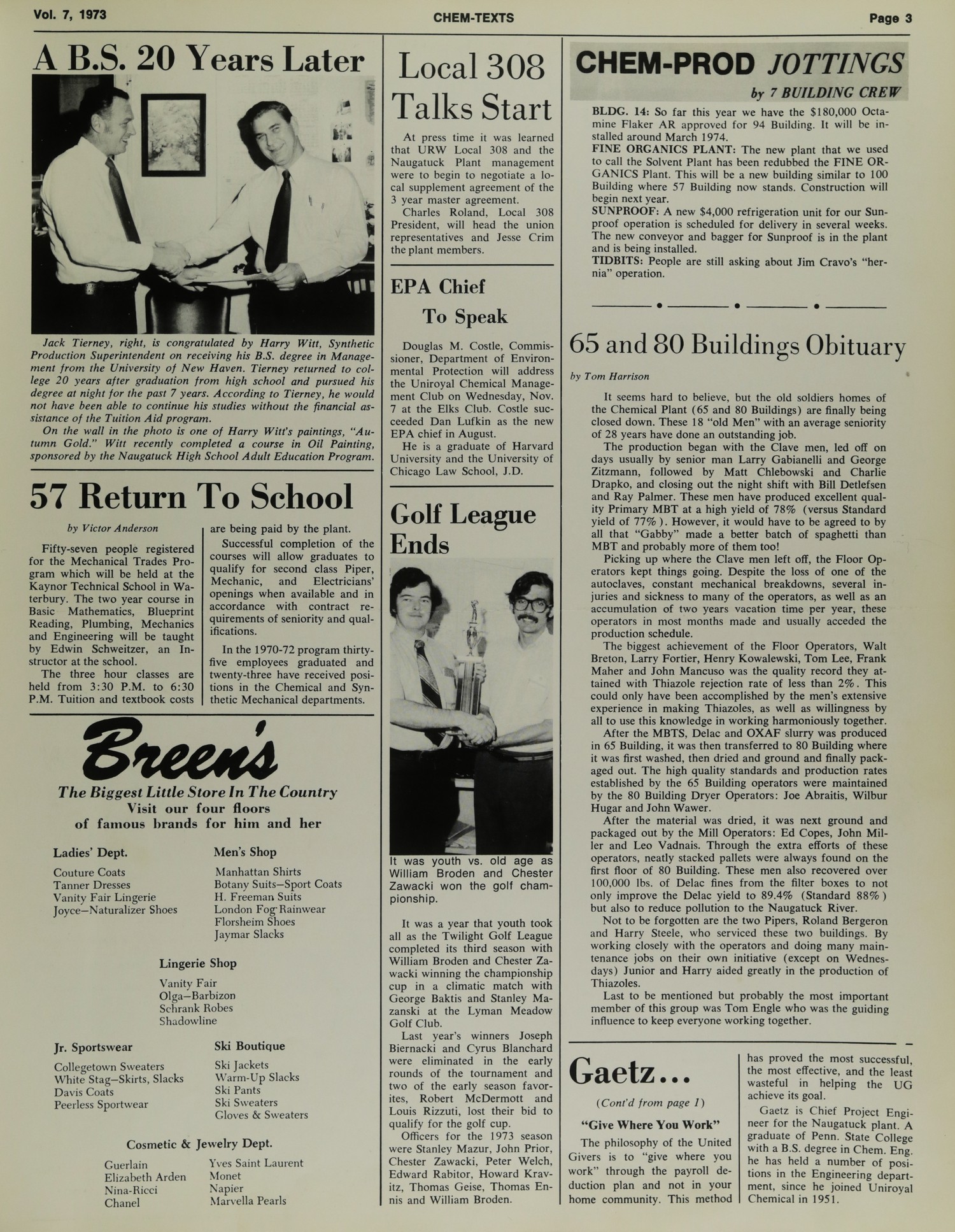
A B.S. 20 Years Later

[IMAGE: Two men standing together, one appears to be congratulating the other, with a framed picture on the wall behind them]

Jack Tierney, right, is congratulated by Harry Witt, Synthetic Production Superintendent on receiving his B.S. degree in Management from the University of New Haven. Tierney returned to college 20 years after graduation from high school and pursued his degree at night for the past 7 years. According to Tierney, he would not have been able to continue his studies without the financial assistance of the Tuition Aid program.

On the wall in the photo is one of Harry Witt’s paintings, “Autumn Gold.” Witt recently completed a course in Oil Painting, sponsored by the Naugatuck High School Adult Education Program.


57 Return To School

by Victor Anderson

Fifty-seven people registered for the Mechanical Trades Program which will be held at the Kaynor Technical School in Waterbury. The two year course in Basic Mathematics, Blueprint Reading, Plumbing, Mechanics and Engineering will be taught by Edwin Schweitzer, an Instructor at the school.

The three hour classes are held from 3:30 P.M. to 6:30 P.M. Tuition and textbook costs are being paid by the plant.

Successful completion of the courses will allow graduates to qualify for second class Piper, Mechanic, and Electricians’ openings when available and in accordance with contract requirements of seniority and qualifications.

In the 1970-72 program thirty-five employees graduated and twenty-three have received positions in the Chemical and Synthetic Mechanical departments.


Local 308 Talks Start

At press time it was learned that URW Local 308 and the Naugatuck Plant management were to begin to negotiate a local supplement agreement of the 3 year master agreement.

Charles Roland, Local 308 President, will head the union representatives and Jesse Crim the plant members.


EPA Chief To Speak

Douglas M. Costle, Commissioner, Department of Environmental Protection will address the Uniroyal Chemical Management Club on Wednesday, Nov. 7 at the Elks Club. Costle succeeded Dan Lufkin as the new EPA chief in August.

He is a graduate of Harvard University and the University of Chicago Law School, J.D.


Golf League Ends

It was youth vs. old age as William Broden and Chester Zawacki won the golf championship.

It was a year that youth took all as the Twilight Golf League completed its third season with William Broden and Chester Zawacki winning the championship cup in a climatic match with George Baktis and Stanley Mazanski at the Lyman Meadow Golf Club.

Last year’s winners Joseph Biernacki and Cyrus Blanchard were eliminated in the early rounds of the tournament and two of the early season favorites, Robert McDermott and Louis Rizzuti, lost their bid to qualify for the golf cup.

Officers for the 1973 season were Stanley Mazur, John Prior, Chester Zawacki, Peter Welch, Edward Rabitor, Howard Kravitz, Thomas Geise, Thomas Ennis and William Broden.


Breen’s

The Biggest Little Store In The Country

Visit our four floors of famous brands for him and her

Ladies’ Dept. Men’s Shop
Couture Coats Manhattan Shirts
Tanner Dresses Botany Suits—Sport Coats
Vanity Fair Lingerie H. Freeman Suits
Joyce—Naturalizer Shoes London Fog Rainwear
Florsheim Shoes
Jaymar Slacks

Lingerie Shop

Vanity Fair
Olga—Barbizon
Schrank Robes
Shadowline

Jr. Sportswear Ski Boutique
Collegetown Sweaters Ski Jackets
White Stag—Skirts, Slacks Warm-Up Slacks
Davis Coats Ski Pants
Peerless Sportwear Ski Sweaters
Gloves & Sweaters

Cosmetic & Jewelry Dept.

Guerlain Yves Saint Laurent
Elizabeth Arden Monet
Nina-Ricci Napier
Chanel Marvella Pearls

CHEM-PROD JOTTINGS

by 7 BUILDING CREW

BLDG. 14: So far this year we have the $180,000 Octamine Flaker AR approved for 94 Building. It will be installed around March 1974.

FINE ORGANICS PLANT: The new plant that we used to call the Solvent Plant has been redubbed the FINE ORGANICS Plant. This will be a new building similar to 100 Building where 57 Building now stands. Construction will begin next year.

SUNPROOF: A new $4,000 refrigeration unit for our Sunproof operation is scheduled for delivery in several weeks. The new conveyor and bagger for Sunproof is in the plant and is being installed.

TIDBITS: People are still asking about Jim Cravo’s “hernia” operation.


65 and 80 Buildings Obituary

by Tom Harrison

It seems hard to believe, but the old soldiers homes of the Chemical Plant (65 and 80 Buildings) are finally being closed down. These 18 “old Men” with an average seniority of 28 years have done an outstanding job.

The production began with the Clave men, led off on days usually by senior man Larry Gabianelli and George Zitzmann, followed by Matt Chlebowski and Charlie Drapko, and closing out the night shift with Bill Detlefsen and Ray Palmer. These men have produced excellent quality Primary MBT at a high yield of 78% (versus Standard yield of 77%). However, it would have to be agreed to by all that “Gabby” made a better batch of spaghetti than MBT and probably more of them too!

Picking up where the Clave men left off, the Floor Operators kept things going. Despite the loss of one of the autoclaves, constant mechanical breakdowns, several injuries and sickness to many of the operators, as well as an accumulation of two years vacation time per year, these operators in most months made and usually acceded the production schedule.

The biggest achievement of the Floor Operators, Walt Breton, Larry Fortier, Henry Kowalewski, Tom Lee, Frank Maher and John Mancuso was the quality record they attained with Thiazole rejection rate of less than 2%. This could only have been accomplished by the men’s extensive experience in making Thiazoles, as well as willingness by all to use this knowledge in working harmoniously together.

After the MBTS, Delac and OXAF slurry was produced in 65 Building, it was then transferred to 80 Building where it was first washed, then dried and ground and finally packaged out. The high quality standards and production rates established by the 65 Building operators were maintained by the 80 Building Dryer Operators: Joe Abraitis, Wilbur Hugar and John Wawer.

After the material was dried, it was next ground and packaged out by the Mill Operators: Ed Copes, John Miller and Leo Vadnais. Through the extra efforts of these operators, neatly stacked pallets were always found on the first floor of 80 Building. These men also recovered over 100,000 lbs. of Delac fines from the filter boxes to not only improve the Delac yield to 89.4% (Standard 88%) but also to reduce pollution to the Naugatuck River.

Not to be forgotten are the two Pipers, Roland Bergeron and Harry Steele, who serviced these two buildings. By working closely with the operators and doing many maintenance jobs on their own initiative (except on Wednesdays) Junior and Harry aided greatly in the production of Thiazoles.

Last to be mentioned but probably the most important member of this group was Tom Engle who was the guiding influence to keep everyone working together.


Gaetz…

(Cont’d from page 1)

“Give Where You Work”

The philosophy of the United Givers is to “give where you work” through the payroll deduction plan and not in your home community. This method has proved the most successful, the most effective, and the least wasteful in helping the UG achieve its goal.

Gaetz is Chief Project Engineer for the Naugatuck plant. A graduate of Penn. State College with a B.S. degree in Chem. Eng. he has held a number of positions in the Engineering department, since he joined Uniroyal Chemical in 1951.

CHEM-TEXTS – 1973 – Page 4

Page 004

Page 4 | CHEM-TEXTS | Vol. 7, 1973


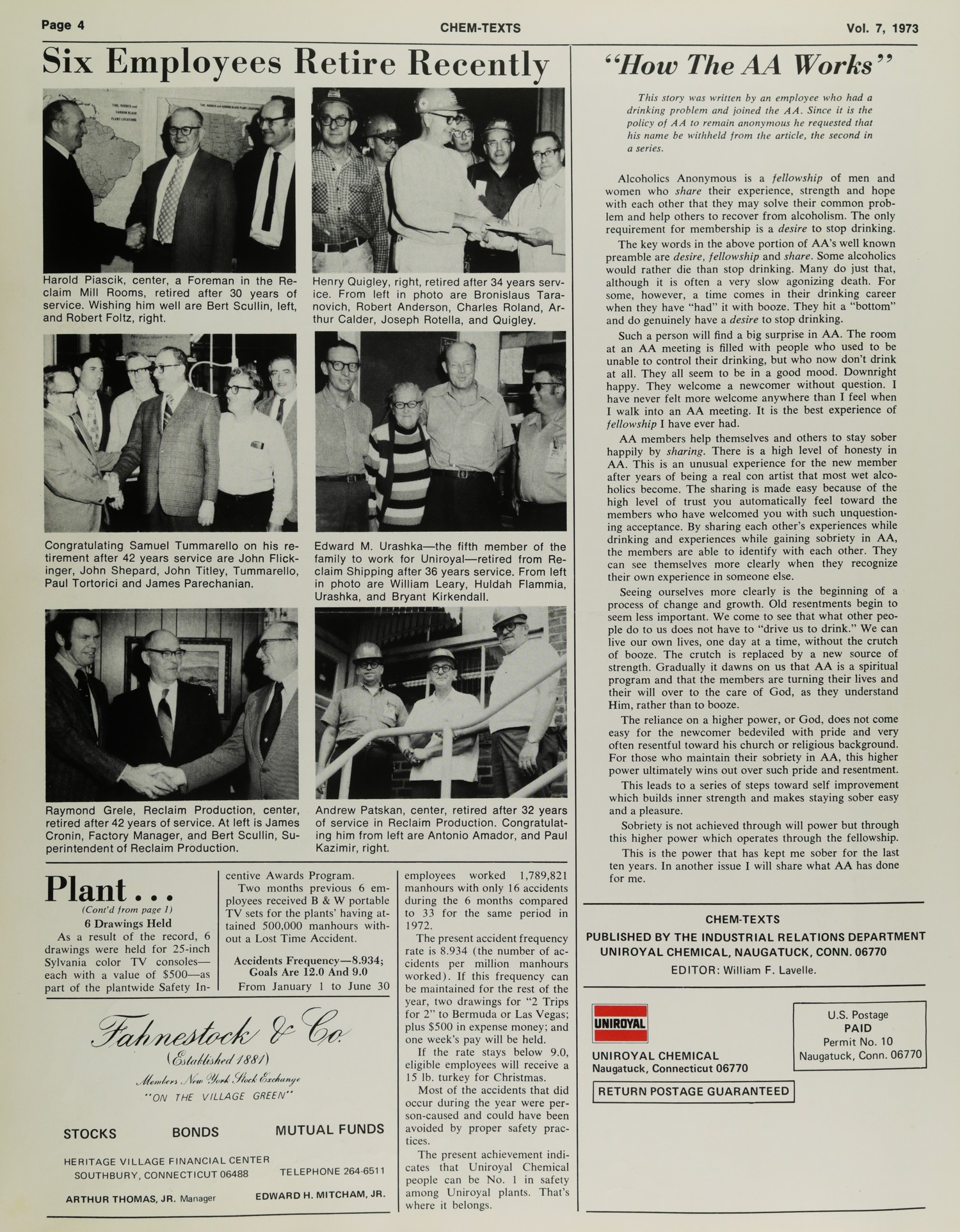
Six Employees Retire Recently

[PHOTO 1]
Harold Piascik, center, a Foreman in the Reclaim Mill Rooms, retired after 30 years of service. Wishing him well are Bert Scullin, left, and Robert Foltz, right.

[PHOTO 2]
Henry Quigley, right, retired after 34 years service. From left in photo are Bronislaus Taranovich, Robert Anderson, Charles Roland, Arthur Calder, Joseph Rotella, and Quigley.

[PHOTO 3]
Congratulating Samuel Tummarello on his retirement after 42 years service are John Flickinger, John Shepard, John Titley, Tummarello, Paul Tortorici and James Parechanian.

[PHOTO 4]
Edward M. Urashka—the fifth member of the family to work for Uniroyal—retired from Reclaim Shipping after 36 years service. From left in photo are William Leary, Huldah Flammia, Urashka, and Bryant Kirkendall.

[PHOTO 5]
Raymond Grele, Reclaim Production, center, retired after 42 years of service. At left is James Cronin, Factory Manager, and Bert Scullin, Superintendent of Reclaim Production.

[PHOTO 6]
Andrew Patskan, center, retired after 32 years of service in Reclaim Production. Congratulating him from left are Antonio Amador, and Paul Kazimir, right.


Plant…

(Cont’d from page 1)

6 Drawings Held

As a result of the record, 6 drawings were held for 25-inch Sylvania color TV consoles—each with a value of $500—as part of the plantwide Safety Incentive Awards Program.

Two months previous 6 employees received B & W portable TV sets for the plants’ having attained 500,000 manhours without a Lost Time Accident.

Accidents Frequency—8.934;
Goals Are 12.0 And 9.0

From January 1 to June 30 employees worked 1,789,821 manhours with only 16 accidents during the 6 months compared to 33 for the same period in 1972.

The present accident frequency rate is 8.934 (the number of accidents per million manhours worked). If this frequency can be maintained for the rest of the year, two drawings for “2 Trips for 2” to Bermuda or Las Vegas; plus $500 in expense money; and one week’s pay will be held.

If the rate stays below 9.0, eligible employees will receive a 15 lb. turkey for Christmas.

Most of the accidents that did occur during the year were person-caused and could have been avoided by proper safety practices.

The present achievement indicates that Uniroyal Chemical people can be No. 1 in safety among Uniroyal plants. That’s where it belongs.


Fahnestock & Co.
(Established 1881)
Members New York Stock Exchange
“ON THE VILLAGE GREEN”

STOCKS | BONDS | MUTUAL FUNDS

HERITAGE VILLAGE FINANCIAL CENTER
SOUTHBURY, CONNECTICUT 06488 | TELEPHONE 264-6511

ARTHUR THOMAS, JR. Manager | EDWARD H. MITCHAM, JR.


“How The AA Works”

This story was written by an employee who had a drinking problem and joined the AA. Since it is the policy of AA to remain anonymous he requested that his name be withheld from the article, the second in a series.

Alcoholics Anonymous is a fellowship of men and women who share their experience, strength and hope with each other that they may solve their common problem and help others to recover from alcoholism. The only requirement for membership is a desire to stop drinking.

The key words in the above portion of AA’s well known preamble are desire, fellowship and share. Some alcoholics would rather die than stop drinking. Many do just that, although it is often a very slow agonizing death. For some, however, a time comes in their drinking career when they have “had” it with booze. They hit a “bottom” and do genuinely have a desire to stop drinking.

Such a person will find a big surprise in AA. The room at an AA meeting is filled with people who used to be unable to control their drinking, but who now don’t drink at all. They all seem to be in a good mood. Downright happy. They welcome a newcomer without question. I have never felt more welcome anywhere than I feel when I walk into an AA meeting. It is the best experience of fellowship I have ever had.

AA members help themselves and others to stay sober happily by sharing. There is a high level of honesty in AA. This is an unusual experience for the new member after years of being a real con artist that most wet alcoholics become. The sharing is made easy because of the high level of trust you automatically feel toward the members who have welcomed you with such unquestioning acceptance. By sharing each other’s experiences while drinking and experiences while gaining sobriety in AA, the members are able to identify with each other. They can see themselves more clearly when they recognize their own experience in someone else.

Seeing ourselves more clearly is the beginning of a process of change and growth. Old resentments begin to seem less important. We come to see that what other people do to us does not have to “drive us to drink.” We can live our own lives, one day at a time, without the crutch of booze. The crutch is replaced by a new source of strength. Gradually it dawns on us that AA is a spiritual program and that the members are turning their lives and their will over to the care of God, as they understand Him, rather than to booze.

The reliance on a higher power, or God, does not come easy for the newcomer bedeviled with pride and very often resentful toward his church or religious background. For those who maintain their sobriety in AA, this higher power ultimately wins out over such pride and resentment.

This leads to a series of steps toward self improvement which builds inner strength and makes staying sober easy and a pleasure.

Sobriety is not achieved through will power but through this higher power which operates through the fellowship.

This is the power that has kept me sober for the last ten years. In another issue I will share what AA has done for me.


CHEM-TEXTS
PUBLISHED BY THE INDUSTRIAL RELATIONS DEPARTMENT
UNIROYAL CHEMICAL, NAUGATUCK, CONN. 06770
EDITOR: William F. Lavelle.

[UNIROYAL LOGO]

UNIROYAL CHEMICAL
Naugatuck, Connecticut 06770

U.S. Postage
PAID
Permit No. 10
Naugatuck, Conn. 06770

RETURN POSTAGE GUARANTEED

CHEM-TEXTS – 1973 – Page 6

Page 006

Page 6 | CHEM-TEXTS | Vol. 7, 1973


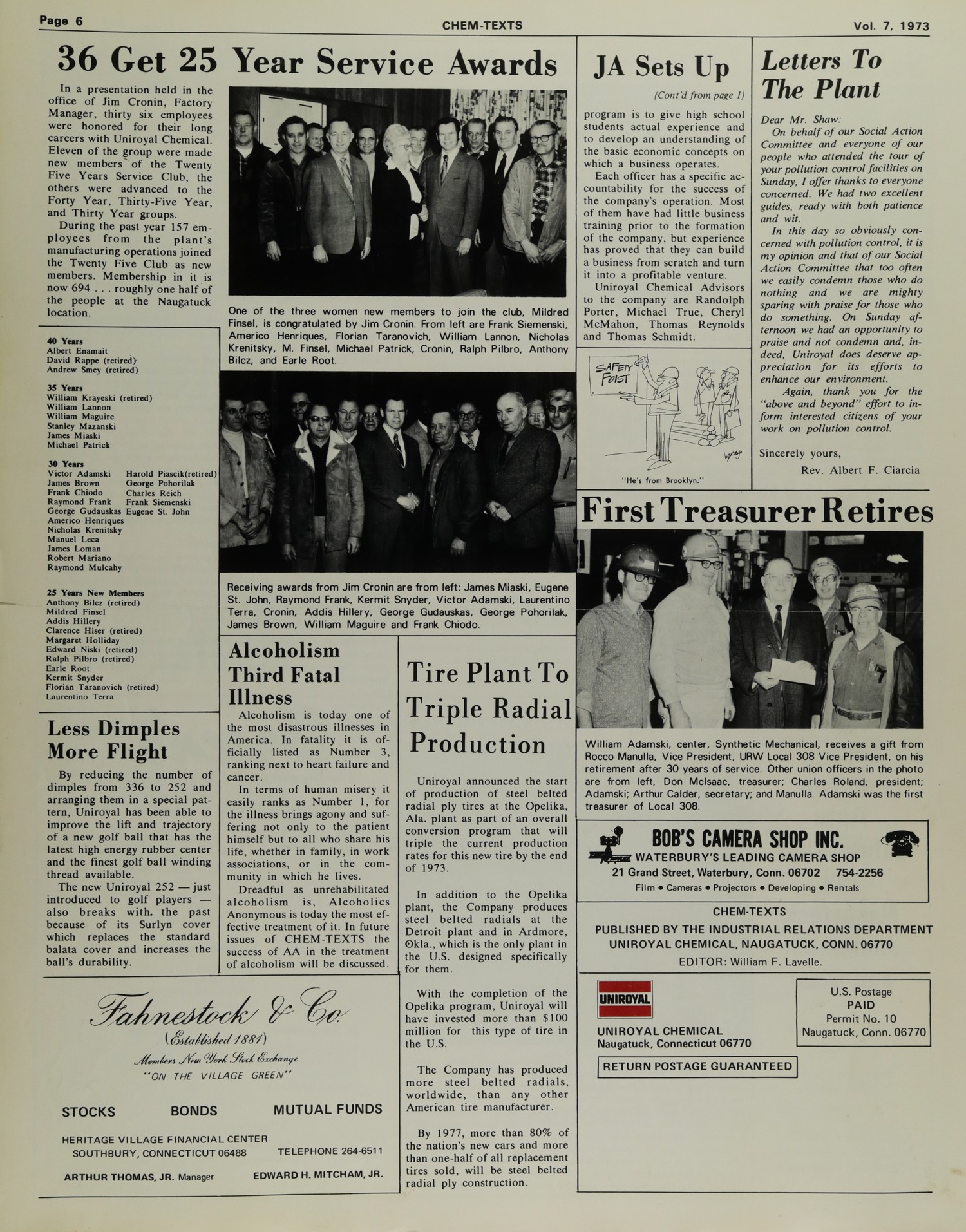
36 Get 25 Year Service Awards

In a presentation held in the office of Jim Cronin, Factory Manager, thirty six employees were honored for their long careers with Uniroyal Chemical. Eleven of the group were made new members of the Twenty Five Years Service Club, the others were advanced to the Forty Year, Thirty-Five Year, and Thirty Year groups.

During the past year 157 employees from the plant’s manufacturing operations joined the Twenty Five Club as new members. Membership in it is now 694 . . . roughly one half of the people at the Naugatuck location.

40 Years
Albert Enamait
David Rappe (retired)
Andrew Smey (retired)

35 Years
William Krayeski (retired)
William Lannon
William Maguire
Stanley Mazanski
James Miaski
Michael Patrick

30 Years
Victor Adamski Harold Piascik(retired)
James Brown George Pohorilak
Frank Chiodo Charles Reich
Raymond Frank Frank Siemenski
George Gudauskas Eugene St. John
Americo Henriques
Nicholas Krenitsky
Manuel Leca
James Loman
Robert Mariano
Raymond Mulcahy

25 Years New Members
Anthony Bilcz (retired)
Mildred Finsel
Addis Hillery
Clarence Hiser (retired)
Margaret Holliday
Edward Niski (retired)
Ralph Pilbro (retired)
Earle Root
Kermit Snyder
Florian Taranovich (retired)
Laurentino Terra


One of the three women new members to join the club, Mildred Finsel, is congratulated by Jim Cronin. From left are Frank Siemenski, Americo Henriques, Florian Taranovich, William Lannon, Nicholas Krenitsky, M. Finsel, Michael Patrick, Cronin, Ralph Pilbro, Anthony Bilcz, and Earle Root.

[PHOTO]

Receiving awards from Jim Cronin are from left: James Miaski, Eugene St. John, Raymond Frank, Kermit Snyder, Victor Adamski, Laurentino Terra, Cronin, Addis Hillery, George Gudauskas, George Pohorilak, James Brown, William Maguire and Frank Chiodo.


Less Dimples More Flight

By reducing the number of dimples from 336 to 252 and arranging them in a special pattern, Uniroyal has been able to improve the lift and trajectory of a new golf ball that has the latest high energy rubber center and the finest golf ball winding thread available.

The new Uniroyal 252 — just introduced to golf players — also breaks with. the past because of its Surlyn cover which replaces the standard balata cover and increases the ball’s durability.


Alcoholism Third Fatal Illness

Alcoholism is today one of the most disastrous illnesses in America. In fatality it is officially listed as Number 3, ranking next to heart failure and cancer.

In terms of human misery it easily ranks as Number 1, for the illness brings agony and suffering not only to the patient himself but to all who share his life, whether in family, in work associations, or in the community in which he lives.

Dreadful as unrehabilitated alcoholism is, Alcoholics Anonymous is today the most effective treatment of it. In future issues of CHEM-TEXTS the success of AA in the treatment of alcoholism will be discussed.


Tire Plant To Triple Radial Production

Uniroyal announced the start of production of steel belted radial ply tires at the Opelika, Ala. plant as part of an overall conversion program that will triple the current production rates for this new tire by the end of 1973.

In addition to the Opelika plant, the Company produces steel belted radials at the Detroit plant and in Ardmore, Okla., which is the only plant in the U.S. designed specifically for them.

With the completion of the Opelika program, Uniroyal will have invested more than $100 million for this type of tire in the U.S.

The Company has produced more steel belted radials, worldwide, than any other American tire manufacturer.

By 1977, more than 80% of the nation’s new cars and more than one-half of all replacement tires sold, will be steel belted radial ply construction.


JA Sets Up

(Cont’d from page 1)

program is to give high school students actual experience and to develop an understanding of the basic economic concepts on which a business operates.

Each officer has a specific accountability for the success of the company’s operation. Most of them have had little business training prior to the formation of the company, but experience has proved that they can build a business from scratch and turn it into a profitable venture.

Uniroyal Chemical Advisors to the company are Randolph Porter, Michael True, Cheryl McMahon, Thomas Reynolds and Thomas Schmidt.

[CARTOON: SAFETY FIRST with cartoon figure]

“He’s from Brooklyn.”


Letters To The Plant

Dear Mr. Shaw:

On behalf of our Social Action Committee and everyone of our people who attended the tour of your pollution control facilities on Sunday, I offer thanks to everyone concerned. We had two excellent guides, ready with both patience and wit.

In this day so obviously concerned with pollution control, it is my opinion and that of our Social Action Committee that too often we easily condemn those who do nothing and we are mighty sparing with praise for those who do something. On Sunday afternoon we had an opportunity to praise and not condemn and, indeed, Uniroyal does deserve appreciation for its efforts to enhance our environment.

Again, thank you for the “above and beyond” effort to inform interested citizens of your work on pollution control.

Sincerely yours,

Rev. Albert F. Ciarcia


First Treasurer Retires

[PHOTO]

William Adamski, center, Synthetic Mechanical, receives a gift from Rocco Manulla, Vice President, URW Local 308 Vice President, on his retirement after 30 years of service. Other union officers in the photo are from left, Don McIsaac, treasurer; Charles Roland, president; Adamski; Arthur Calder, secretary; and Manulla. Adamski was the first treasurer of Local 308.


BOB’S CAMERA SHOP INC.
WATERBURY’S LEADING CAMERA SHOP
21 Grand Street, Waterbury, Conn. 06702 754-2256
Film ● Cameras ● Projectors ● Developing ● Rentals


Fahnestock & Co
(Established 1881)
Members New York Stock Exchange
“ON THE VILLAGE GREEN”

STOCKS BONDS MUTUAL FUNDS

HERITAGE VILLAGE FINANCIAL CENTER
SOUTHBURY, CONNECTICUT 06488 TELEPHONE 264-6511

ARTHUR THOMAS, JR. Manager EDWARD H. MITCHAM, JR.


CHEM-TEXTS
PUBLISHED BY THE INDUSTRIAL RELATIONS DEPARTMENT
UNIROYAL CHEMICAL, NAUGATUCK, CONN. 06770
EDITOR: William F. Lavelle.

[UNIROYAL LOGO]

U.S. Postage
PAID
Permit No. 10
Naugatuck, Conn. 06770

UNIROYAL CHEMICAL
Naugatuck, Connecticut 06770

RETURN POSTAGE GUARANTEED

CHEM-TEXTS – 1973 – Page No. 1

Page unknown

UNIROYAL CHEM-TEXTS

Vol. 7, 1973 PUBLISHED FOR THE PEOPLE OF UNIROYAL CHEMICAL No. 1


Chemical AR Approved

$375,510 was recently approved to expand the production facilities of Aminox and Betanox in Bldg. 79. The two, old-line amine antioxidants are widely used in heavy duty rubber compounds where heat resistance is required.

A growing use for the chemicals in the stabilization of Nylon 6 in tire cord is one of the major reasons for approval of the request to improve production facilities.

Reduces Dust, Fumes; Makes Work Safer

A new continuous belt flaker (known as a Sandvik Belt Flaker) will be installed to eliminate the panning operation. The equipment will greatly reduce the amount of material (Cont’d on page 3)


$5096 Paid For Ideas

by Jerry Tortorelli

$5096 was paid out to employees in 1972 in awards for their ideas on improvements in various phases of the plant’s operations. Their recommendations resulted in savings of $17,699.

During the year 318 Ideas were submitted and processed, of which 118 were approved for cash payments. 79 employees received Letters of Commendation. Participation in the plantwide plan which is open to all employees increased by 130 over 1971.

$360 Highest Single Award

The highest single award for the year, $360, was made to Natale Vescera and William Balchunas, of the Materials department.

$475, the largest total amount, was awarded to the (Cont’d on page 2)


1972 Safety Improves

But Still Short Of Plant Goal For Year

The plant’s safety record showed a reduction during 1972 over 1971 especially in Lost Time Accidents experiencing 11 compared to 20 for the prior year.

In 1972 there were 62 Serious Injuries vs 63 for 1971, a small drop in an area that is portentous of future occurrences.

Although a total of 73 injuries to employees in 12 months — an average of 6 per month — is not a real significant improvement, it is an encouraging sign, since it was one of the better records for the plant since 1966 — except for the year 1970 when it had a total of 72 injuries.

Frequency, Per 1,000,000 Manhours Decreased

For every 1,000,000 manhours worked — approximately 4 months — 21.3 employees incurred an injury compared to 25.3 in 1971. This was a 15% improvement over 1971 but did not come close to the frequency reduction of 12.0 and 9.0 which were set as the goals for the Safety Incentive Award program.

Inattention Major Cause of Accidents

Ironically people were the major cause of accidents with inattention the primary factor underlying them. For example many of the accidents were fractures caused by hammer blows; fingers crushed by drums; burns from hot material; and falls.

Few accidents were the result of defective equipment, mechanical failures, or hazardous work conditions.

Materials Department Had Best Record

Members of the Materials department had the best safety record for 1972 with no Lost Time Accidents. The department had 3 Serious Injuries compared to 8 in 1971, a reduction of over 50% in frequency.

Synthetic Production also worked the entire year without a Lost Time Accident but its Serious Injuries jumped from 7 to 8.

By the nature of its work the Mechanical department is more exposed to hazards than other departments but the Chemical Mechanical group reduced both Lost Time Accidents and Serious Injuries for the year.

Injuries In R&D Increase 100%

Serious Injuries in the Research and Development department increased from 4 in

(Cont’d on page 3)


Quarterly Dividend Declared

The board of directors of Uniroyal, Inc. declared a quarterly dividend of 17-1/2 cents a share on the company’s common stock payable March 24 to stockholders of record February 26.

The directors also declared two dividends of $2 each on the company’s preferred stock, one to be paid March 24 to stockholders of record February 26 and the other payable June 25 to stockholders of record May 21.

In 1972 Uniroyal paid a total dividend of 70 cents on the common stock and a total of $8 dollars on the preferred stock.

The current price of the common stock ranges in the area of 13-5/8 a share.


JA Sets Up Juniroyal Company

[PHOTOGRAPH OF GROUP]

Officers of Juniroyal, Inc. hold a public offering of their stock in the office of Factory Manager James Cronin. From left are Joseph LaRose, President; Dianne Holmes, Vice President of Sales; Paul Hammer, Treasurer; Randolph Porter, Advisor, James Cronin; Charles Roland, URW Local 308 President; Elaine Bellemare, Vice President of Personnel; Michael True and Thomas Reynolds. Absent at time of photo were Joseph Rzeszutek, URW Local 218 President, and Cheryl McMahon, Advisor.

by Randy Porter

Juniroyal, Inc., the name of the new Junior Achievement company sponsored by Uniroyal Chemical started the year with a sellout of its first offer of stock.

Last year’s company, Pingyanco, returned a 10% profit to stockholders who invested their money in the firm of young Naugatuck High School students.

Goal To Top 10%

The goal of Juniroyal is to top the 10% profit margin and according to Joseph LaRose, president of the company, “the unique product line we manufacture, will help us attain it.” The company which meets Mondays in Bldg. 1 will produce decoupages, decorative candles, and ornamental trays.

Purpose of JA

The basic purpose of the JA (Cont’d on page 6)


Plant Receives UG Award

[PHOTOGRAPH OF TWO MEN WITH PLAQUE]

Jim Cronin, Factory Manager, left, presents Lou Coscia Chairman for the United Givers, a plaque awarded to Uniroyal Chemical for topping its goal with $22,300 in contributions, almost half of the Industrial Division’s total.

CHEM-TEXTS – 1973 – Page No. 3

Page unknown

UNIROYAL CHEM-TEXTS

Vol. 7, 1973 | PUBLISHED FOR THE PEOPLE OF UNIROYAL CHEMICAL | No. 3


Equality Policy Affirmed

Uniroyal Chemical has a firm commitment to offer equal opportunity to all employees. It is the policy of the plant’s management to support and implement this commitment continually.

The policy requires that all recruiting, hiring, transfers, promotions, compensation, benefits, and Company-sponsored training, education and tuition assistance, as well as social, recreational and health programs and lay-off and recall practices are followed and carried out without regard to race, color, religion, sex, national origin or age.

Jesse Crim, Industrial Relations Manager, is Compliance Officer and has the responsibility for implementing this policy; monitoring the Uniroyal Chemical Affirmative Action Compliance Program; and reporting to management the program’s progress.

Responsibility for the improvement of the program and positive results rests with each manager and supervisor as an integral part of his job.


Trades Courses Offered

A new Trades Program will be offered in cooperation with the Kaynor Technical School in Waterbury. The two year program, scheduled in the fall, is voluntary and open to all Naugatuck Chemical employees.

Courses offered will consist of Basic Mathematics, Blueprint Reading, Plumbing, Mechanics and Electricity and will be held one night a week for three hours for 33 sessions.

Successful completion of the program, as judged by the Kaynor Tech instructors, will allow graduates to qualify for second class Piper, Mechanic, and Electrician’s openings when available and in accordance with contractual requirements of seniority and qualifications.

No Cost To Employee

Tuition and textbook costs will be paid by the plant. The (Cont’d on page 2)


Unions Ratify 3 Year Contract

The master labor agreement and other agreements covering wages, pensions, insurance, severance pay, and supplemental unemployment benefits, negotiated by Uniroyal and the United Rubber Workers, have been subsequently ratified by the Union. All improved agreements are now in effect with the exception of the master labor agreement which will become effective when local supplemental agreements are negotiated and signed.

The new agreements, covering a 3 year period, were signed on June 11, 1973 after three months of negotiations in Dayton, Ohio.

The contracts provide for wage increases over the 3 year period and improvements in pensions, life insurance, sickness and accident insurance, medical insurance, and supplemental unemployment insurance.

They also include improvements in certain of these areas as they apply to retired employees.

Improvements in the general wage scale were effective on July 2, 1973.

Monthly Pension Increases

The monthly pension allowance was improved. The improvements are progressive over the 3 year period. By 1975, the monthly amount will be computed on the basis of $10.00 per month for every year of service. Disability pensions will be on a double monthly allowance, increasing to $20.00 per month per year of service by 1975.

Early Retirement

The new pension plan provides that an employee with 30 years’ service at and after age 55 can retire at his own option on an unreduced pension amount. For those employees exercising this option in 1974 and thereafter, the plan provides a supplemental allowance until age 65.

SUB Benefits

The supplemental unemployment benefits plan was modified. The company will increase its contribution to the SUB fund. By 1975, contributions will be at $0.10 per hour worked level and maximum funding will be at $750 per employee covered by the plan.

Life Insurance

Life insurance has been increased from $8500 to $9500
(Cont’d on page 2)


[PHOTO CAPTION]
Joseph Rzeszutek, URW Local 218 President; Jesse Crim, Industrial Relations Manager; and Charles Roland, URW Local 308 President attended the 3 months’ negotiations in Dayton, Ohio.


Plant Tops 1,000,000 Manhours Without A Lost-Time Accident

[PHOTO CAPTION]
Winners of the color TV consoles—each worth $500.00—pose with plant safety personnel and Factory Manager on the occasion of working 1,000,000 manhours without a lost time accident. From left are James Loman, Safety Supervisor; Gene Reale, Foremen’s winner; Manuel Moniz, Chemical Production; Roman Brzozowski, Reclaim Production; Silvio Spalvieri, Synthetic Materials; Walter Scott, Union-Management Safety Committee; Daniel Volpe, Salary winner; Robert Shortt, Safety Manager; and James Cronin, Factory Manager. Absent from the photo is Henrique Marques, Chemical Production.


Frequency Rate Is 8.93 For 6 Months

It started on March 11 and was reached on June 26, one million manhours worked without a lost time accident. This achievement reflects a greatly improved safety performance over 1972 and has resulted in a 50% reduction in accidents in the plant.

Lost Time Accidents Serious Injuries Total
1972 6 27 33
1973 5 11 16

(Cont’d on page 4)


Dividend Declared

Uniroyal, Inc. declared a dividend of 17½ cents a share on the common stock. The dividend is payable September 25 to stockholders of record August 20.

A dividend of $2 a share on the 8 per cent first preferred stock was also declared and is payable September 25 to stockholders of record August 20.

Company Announces Tentative Closing Of Reclaim Rubber Operations

UNIROYAL CHEM-TEXTS

Vol. 9, 1975 | PUBLISHED FOR THE PEOPLE OF UNIROYAL CHEMICAL | No. 3


Company Announces Tentative Closing Of Reclaim Rubber Operations

200 Employees Affected

For years the rumor has persisted that the Reclaim Rubber Plant would close down because of competition from synthetic rubber, the marketing of radial tires, and annual losses due to lower demand.

It seems that the 80 year era may now be at an end when the plant management announced the tentative plans to close it down in a statement to the officers of the URW Local 218 on May 21.

Constant Efforts Made to Keep Operating

Over the past years the plant’s management and the union’s officers have analyzed ways to reduce costs and improve the output of the operation but the efforts have not been able to change the financial status of it.

The Company felt, after investigating all possibilities that it was necessary to announce a tentative decision to close it down.

New Markets Do Not Materialize

The Sales department attempted to increase prices and generate new markets but the efforts were not successful. Research and Development has been working with the State of Connecticut on the use of it in roads but the progress has been slow and no substantial results seem to be in the offing.

continued on page 2


[IMAGE CAPTION:]
The Reclaim Rubber plant dates back to 1892 and is the oldest production unit at the Naugatuck Chemical location. It recycles about 1,500,000 scrap tires a year.


27 Receive Diplomas

[IMAGE CAPTION:]
Factory Manager James Cronin hands out diplomas to people who graduated from the Techniques of Supervision Course. From left are Irene Broderick, K. Donald Nelson, Rocco Magnanimo, Angenette Grant, Cronin, Frederick Gould, the Instructor, and George Allen, who set up the educational program.

After ten weeks of lectures on the Techniques of Supervision twenty seven foremen and supervisors graduated in a ceremony in Bldg. 81 conference room. Factory Manager James Cronin presented the certificates, bringing the total number of graduates of the course to 61.

Frederick Gould, an assistant professor on the Connecticut State Technical Colleges staff, conducted the sessions. Having been a Foreman at the American Brass Co. mill operations in

continued on page 4


U.S. Issues 34 Patents; One-Third of Uniroyal Total

[IMAGE CAPTION:]
Dr. Stephen Cantor, left, who received 5 patent awards, discusses a new chemical with Dr. Byron Hunter who received his 38th., the highest in the Chemical division.

1974 was a banner year for the Chemical Division when 34 patents were issued to it by the U.S. Patent Office. This is the largest number in the division’s history except for the year 1966 and represents one third of the total awarded to the Company by the U.S. The Company—as a whole—received 109 U.S. patents.

In addition, it received 109 patents in foreign countries, exclusive of Canada.

Some of the significant patents included those issued to Leland Dannals for the Polywet® K products, which are used as emulsifiers in the production of latex; William Fischer (retired) for thermoplastic rubbers; Rob-

continued on page 4


Fuel Use Down; But Costs Go Up

The Energy Conservation Task Force, organized in 1973 to conserve energy in the plant, was able to achieve a reduction of 22.9% in fuel oil consumption in 1974 over 1973. The decrease amounted to an average saving in oil equivalent to a 65 day supply.

The drop in the use of steam resulted from the repair of steam leaks; improved techniques in power use; cooperation by employees to close windows and doors in buildings; improved pipe insulation and good climatic conditions during the winter.

Although Use Is Down Costs Almost Double

Under normal conditions the 22.9% reduction in oil would have shown a substantial savings in fuel costs. But because of the

continued on page 2


Dividend Declared

The company declared a dividend of 17½ cents a share on the common stock, which is payable June 25 to stockholders of record on May 27.

A dividend of $2 a share on the 8% first preferred stock, was declared by the Board of Directors on February 12, and is payable June 25 to stockholders of record on May 27.

Accident Frequency Reduced 54% 1500 Turkevs Awarded to Employees

Page 2 | CHEM-TEXTS | Vol. 7, 1973


The end of the year is upon us, and traditionally it is an ideal time to review the past year and take a peek at the next.

Obviously, it is impossible to review all of the little steps of progress we have made this year. Therefore, I would like to offer a general review of our plant and business in 1973.

The epitome of working together, I think, is this year’s outstanding safety performance over last year’s. Without the complete involvement of all “Chemical people”, we would not have been as successful.

We still have a long way to go, particularly in the number of days lost due to accidents. But this year’s performance has built the base from which we can launch the effort needed to overcome this next difficult hurdle.

In the business line, Chemical Production came through a torturous year with encouraging vigor. The year started great, only to slow down at mid year when uncertain business conditions caused customers to hedge on their purchases.

Then when sales started to pick up, we were staggered by the continuing energy-related raw material shortages.

Heading into the new year, we face the confusing problem of having the sales, but perhaps not the raw materials. In addition, these materials are skyrocketing in cost. Survival next year can be defined as having the flexibility to make the most of a difficult situation.

We all know the problems facing our Reclaim plant. But if this year’s performance and attitude are any indication of our strength and perseverance, we are going to give that business a real run for the money in 1974. Turning an old giant like that around, enough to make it competitive, is a formidable task. Time is a problem and 1974 is our year to show them what we’re made of.

It is unfortunate that we have become non-competitive in the Synthetic latex business. We must quickly recover from this shutdown and adjust ourselves to solving today’s problems.

Attitude and cooperation did it with our Safety performance. The same approach must be used in improving the competitive and economic position of our plant. A healthy business means secure jobs—for one and all.

Despite the lack of Christmas lights this year, I would like to extend to all of you, and your families, my best wishes for the Christmas holiday. It is a comforting time of the year, but also a time to remind ourselves how fortunate we really are.

Jim Crim


Accident Frequency Reduced 54%

1500 Turkeys Awarded to Employees

[IMAGE: Photo showing three people examining documents]

Jesse Crim, Industrial Relations Manager for the Chemical plant, checks the turkey lists with Molly Cobbol, left, and Constance Antrum, right.

1500 turkeys were awarded to employees for reducing the accident frequency rate 54% during 1973.

During the year accidents to employees at work dropped from 73 in 1972 to 33 for 1973. This is a 54% reduction in accident frequency—the number of Lost Time Accidents and Serious Injuries per one million manhours worked.

Attain 12.0 Goal—1500 Turkeys Awarded

In early January a Safety Incentive Awards Program was initiated with an accident frequency goal of 12.0.

The present accident frequency is 10.43 per 1,000,000 manhours worked. Since this record is below the 12.0 goal all eligible employees received 12-14 lb. turkeys for achieving this major safety improvement during the year.

Top 500,000 Manhours

For the third time this year the plant worked 500,000 manhours without a Lost Time Accident. As a result drawings were held throughout the plant on December 5 for six Zenith black and white portable TV sets.


Energy Force Formed

A Conservation Resources Task Force of Engineering Specialists has now been in existence over two months to coordinate the efforts of all departments to conserve steam, electricity, water, air, and raw materials throughout the 145 units of the plant.

The two critical areas that the Task Force will concentrate on are the conservation of fuel oil and electricity.

Because of the critical shortage of low sulfur fuel the Connecticut State Department of Environmental Protection recently approved the use of a 1.25% sulfur content fuel oil, and coal with 2% sulfur content by the Utilities companies.

Task Force Members

The Task Force members—Douglas Ritchie, William Leukhardt, Charles Reich, Jon Painter, George Allen, Stanley Korpusick, Victor Anderson, George Arndt, and Arthur Aronson—have initiated monitoring plans for energy conservation and organized sub-committees to assist in supplementing the program.

The plant’s 500 HP motors will come under special surveillance by the force along with the high pressure steam systems, and the hot water usage throughout the entire plant.

A significant way everyone can help is to close windows and doors; turn off motors and lights when not in use; use water carefully; and turn down heating units.


How To Use Words

Be concise. Use words sparingly. Avoid smothering your good ideas beneath a mountain of verbiage.


Energy Program Working

17.6% less fuel oil was consumed in November 1973 vs. November 1972. This represents a savings of a four-day supply of fuel oil.

During the same period 7% less electricity was consumed throughout the plant. This is a savings equivalent to a two-day supply of electrical power.

These reductions were achieved for the same level of production in November 1973 as November 1972.

Our Energy Conservation program efforts are paying off and with everyone’s concern and assistance, even this good start can be improved.

With the costs of scarce power resources increasing continually, every employee’s cooperation is needed to continue the fullest possible operation of the plant.


$50,000 Unit… (Cont’d from page 1)

[IMAGE: Photo of helicopter landing in yard with buildings in background, marked “CARSON”]

The pilot gently lands the helicopter in the Reclaim yard. Eric Storch, Project Engineer for the installation, was in charge of the operation. (James Reynolds photo)

quired several days of clearing the yard for the helicopter landing and constant watch against fire.

“We were quite concerned over the risk involved. The fact that everything went so smoothly is attributable to the efforts of the Maintenance, Materials, Plant Protection and Reclaim people,” Storch pointed out after the job was completed.

The new collector cost $50,000 and is expected to be in operation by January 1974.

To date the Uniroyal Chemical plant has spent and committed over $7,000,000 for environmental improvement.

50 MPH AND 68°


Chittenden Insurance Agency, Inc.

Insurance—Mutual Funds—Real Estate

180 Church Street
Naugatuck, Connecticut
Tel. 729-8209

Frederick D. Zonino | Nathan M. Pierpont, Jr.