
CHEM-TEXTS
Page 2 | Vol. 13, 1979
1978 was a Good Year . . .
You and I know our Company is starting to generate an upward momentum as illustrated by the outstanding performance of the Naugatuck Plant and the Chemical Company in 1978. The Chemical Company profits exceeded all expectations last year and our Plant’s gross operating profit increased 58%.
This outstanding achievement is the result of your efforts whether you are in Manufacturing, Research and Development, Accounting, D&S, the Service Departments, or Marketing.
Our plant’s goal is to have a 30% plant operating profit that would result in a 9% return on sales. This year our objective is to increase the return on sales from 3 to 4.5%.
How do we expect to achieve our profitability objective? The answer to this question is reflected in the achievements of last year.
In the Maintenance Department an outstanding job was performed in reducing equipment downtime from 8.9 to 7.5%. Their 1979 goal is 6% and January was an excellent start with downtime averaging 4.5%.
Manufacturing set productivity records in the production of Rubber Chemicals, Agricultural Chemicals, and Thermoplastics. Omite, LVBI, Tonox, and TPR productivities increased between 20 and 30% while PANA and Naugard 445 improved by 66%. Also a reduction in Roylar changeovers was achieved through better coordination and communications. In addition, Comite, Octamine P, Celogen RA, and Polygard I were successfully produced in the Plant. All these achievements resulted in increasing our plant’s profit by 1.6 million dollars.
Our Industrial Relations Department was reorganized and is more effective in serving our needs. Safety Goals were far exceeded with 1.2 incidence rate and Workmen’s Compensation costs were reduced by $165,000. A new performance appraisal system was initiated and a training session held to help managers conduct performance appraisals with their people.
A Controllers Department was established to perform financial reporting, budgeting, forecasting, and economic analysis; to expedite approvals of Appropriation Requests; and to identify areas of profit improvement.
The Technical Department now includes all engineering functions: process, project, environmental, and industrial engineering. 2.3 million dollars of profit improvement was realized through developing a team effort with the plant, R & D, and marketing. This year a similar amount is expected through Project Enterprise, the name of our 1979 Profit Improvement Program. Over $300,000 was saved through the work of the Plant’s Energy Committee. Other contributions by the Technical Department included the productivity records set in Rubber Chemicals and Omite as well as the successful production of Comite, Octamine P, Celogen RA, and Polygard I.
In the Material Flow Department transportation credits exceeded budget by $13,000. An additional $532,000 was saved through improved transportation of our finished goods. Shipping and receiving increased productivity by 7% and improved the services on export shipments. The Purchasing Department and Control Center reduced our inventory levels thereby increasing our return on assets. Purchasing savings and cost avoidance programs exceeded expectations by $400,000 dollars.
A major objective is to improve the utilization of our plant by introducing new products in our existing facilities or attracting new manufacturing facilities because our resources are underutilized. For example, we are using only 50% of our steam generation and waste water treatment capacities while Rubber Chemicals is budgeted to operate only between 60-65% of capacity this year. If Rubber Chemical production operated at 90% of capacity, our plant’s operating profit would increase to approximately 27%. On some recent data it appears that a 10% selling price increase would have the same impact as a 30% cost reduction.
1978 was a year of change and accomplishment. We have the reputation of managing our business. Naugatuck seeks change. We are determined to overcome our geographical raw material disadvantage through PROFESSIONAL EXCELLENCE in every assignment and job that is performed.
In 1979 Naugatuck will be a Better Place To Be and soon the Best Place To Be.
Eric Johnson
Factory Manager
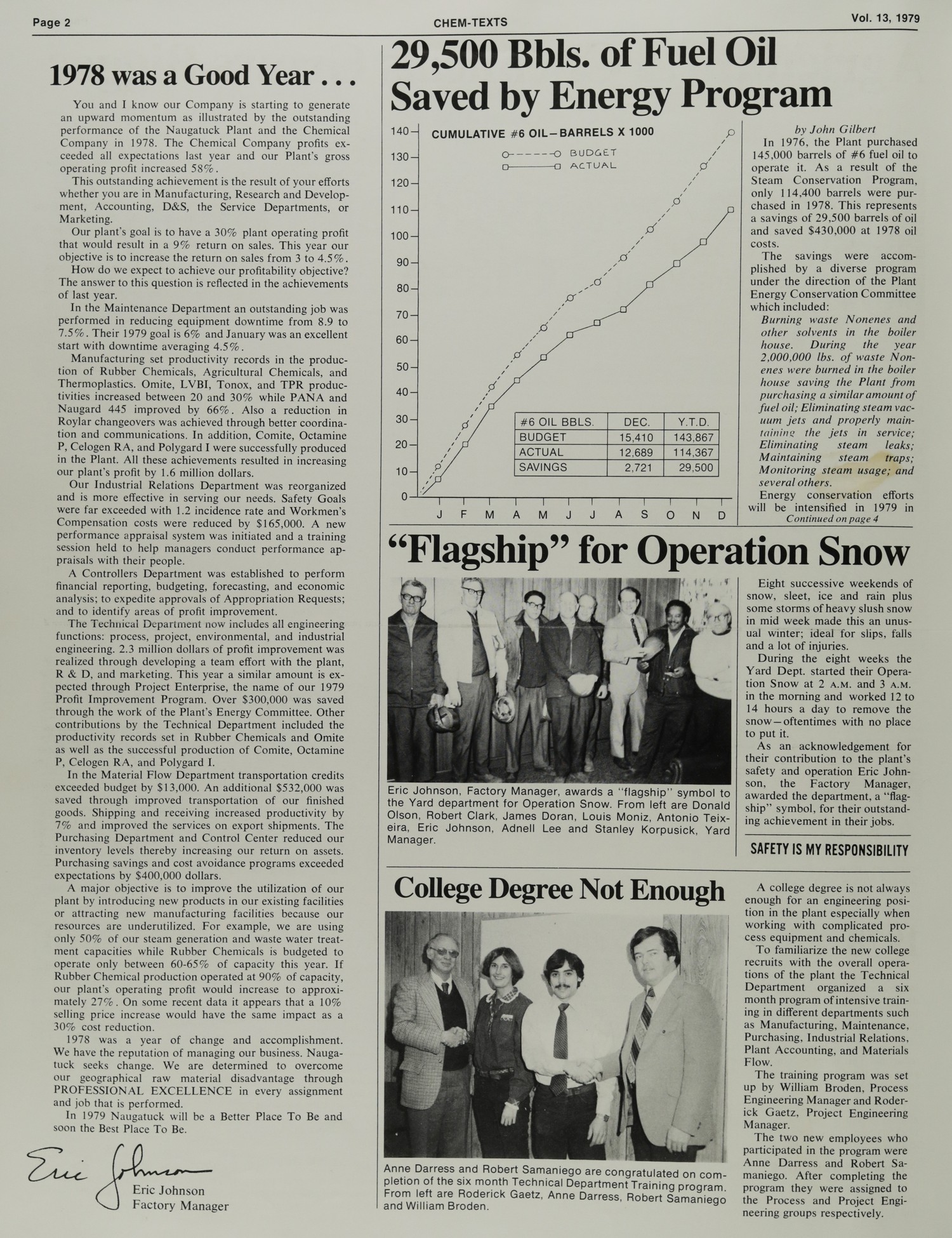
29,500 Bbls. of Fuel Oil Saved by Energy Program
CUMULATIVE #6 OIL—BARRELS X 1000
[CHART showing declining oil usage from January through December, with lines for BUDGET and ACTUAL usage, ranging from approximately 140 to 0]
| #6 OIL BBLS. | DEC. | Y.T.D. |
|---|---|---|
| BUDGET | 15,410 | 143,867 |
| ACTUAL | 12,689 | 114,367 |
| SAVINGS | 2,721 | 29,500 |
by John Gilbert
In 1976, the Plant purchased 145,000 barrels of #6 fuel oil to operate it. As a result of the Steam Conservation Program, only 114,400 barrels were purchased in 1978. This represents a savings of 29,500 barrels of oil and saved $430,000 at 1978 oil costs.
The savings were accomplished by a diverse program under the direction of the Plant Energy Conservation Committee which included:
Burning waste Nonenes and other solvents in the boiler house. During the year 2,000,000 lbs. of waste Nonenes were burned in the boiler house saving the Plant from purchasing a similar amount of fuel oil; Eliminating steam vacuum jets and properly maintaining the jets in service; Eliminating steam leaks; Maintaining steam traps; Monitoring steam usage; and several others.
Energy conservation efforts will be intensified in 1979 in Continued on page 4
“Flagship” for Operation Snow
[PHOTOGRAPH of seven men in business attire standing together]
Eric Johnson, Factory Manager, awards a “flagship” symbol to the Yard department for Operation Snow. From left are Donald Olson, Robert Clark, James Doran, Louis Moniz, Antonio Teixeira, Eric Johnson, Adnell Lee and Stanley Korpusick, Yard Manager.
Eight successive weekends of snow, sleet, ice and rain plus some storms of heavy slush snow in mid week made this an unusual winter; ideal for slips, falls and a lot of injuries.
During the eight weeks the Yard Dept. started their Operation Snow at 2 A.M. and 3 A.M. in the morning and worked 12 to 14 hours a day to remove the snow—oftentimes with no place to put it.
As an acknowledgement for their contribution to the plant’s safety and operation Eric Johnson, the Factory Manager, awarded the department, a “flagship” symbol, for their outstanding achievement in their jobs.
SAFETY IS MY RESPONSIBILITY
College Degree Not Enough
[PHOTOGRAPH of four people, three men and one woman, standing together]
Anne Darress and Robert Samaniego are congratulated on completion of the six month Technical Department Training program. From left are Roderick Gaetz, Anne Darress, Robert Samaniego and William Broden.
A college degree is not always enough for an engineering position in the plant especially when working with complicated process equipment and chemicals.
To familiarize the new college recruits with the overall operations of the plant the Technical Department organized a six month program of intensive training in different departments such as Manufacturing, Maintenance, Purchasing, Industrial Relations, Plant Accounting, and Materials Flow.
The training program was set up by William Broden, Process Engineering Manager and Roderick Gaetz, Project Engineering Manager.
The two new employees who participated in the program were Anne Darress and Robert Samaniego. After completing the program they were assigned to the Process and Project Engineering groups respectively.