
CHEMWORLD
WINTER/SPRING 1995
Responsible Care® Implementation On Track
As Uniroyal Chemical’s Responsible Care® Coordinator, Joseph V. Bucciaglia is in the process of visiting Uniroyal Chemical locations to help implement the company’s Responsible Care program. In 1995, Bucciaglia’s goal is to oversee worldwide implementation of “Management Practice In Place,” which provides standards against which to measure performance. Management Practice In Place Standards must be developed and documented for each of the Responsible Care® program codes. Standards have been finalized for all of the codes, except Product Stewardship, and Uniroyal Chemical plans to have the Pollution Prevention, Process Safety, Distribution and CAER (Community Awareness/Emergency Response) codes implemented by November 1995. The remaining codes are slated for implementation by April 1997.
The CAER Code relates directly to one of Uniroyal Chemical’s corporate goals “Build Strong Community Partnerships”. One aim of the code is to establish a dialogue between the company and the public. The other codes help to support another Uniroyal Chemical goal, “Zero Damage to People and the Environment.” These codes help to improve performance and ensure that industry operations will work towards improving the health and safety of the public, workers and the environment.
Once each of the seven codes have been implemented, the CMA will conduct a validation of the program. The validation process will require that detailed records of all related programs are kept. Bucciaglia would like to see that documentation compiled in a format similar to what is currently being used for ISO certification. In addition, each reporting site will also be required to complete a self-evaluation of its program.
Uniroyal Chemical was not the first company to begin implementation of a Responsible Care program, but Bucciaglia sees a benefit in not being a front-runner. “We’ve been able to do a better job by avoiding the pitfalls other companies fall into. We’ve definitely taken advantage of other’s experiences – both good and bad.” ■
Contributing Writer: Todd Volpe, Middlebury, CT.
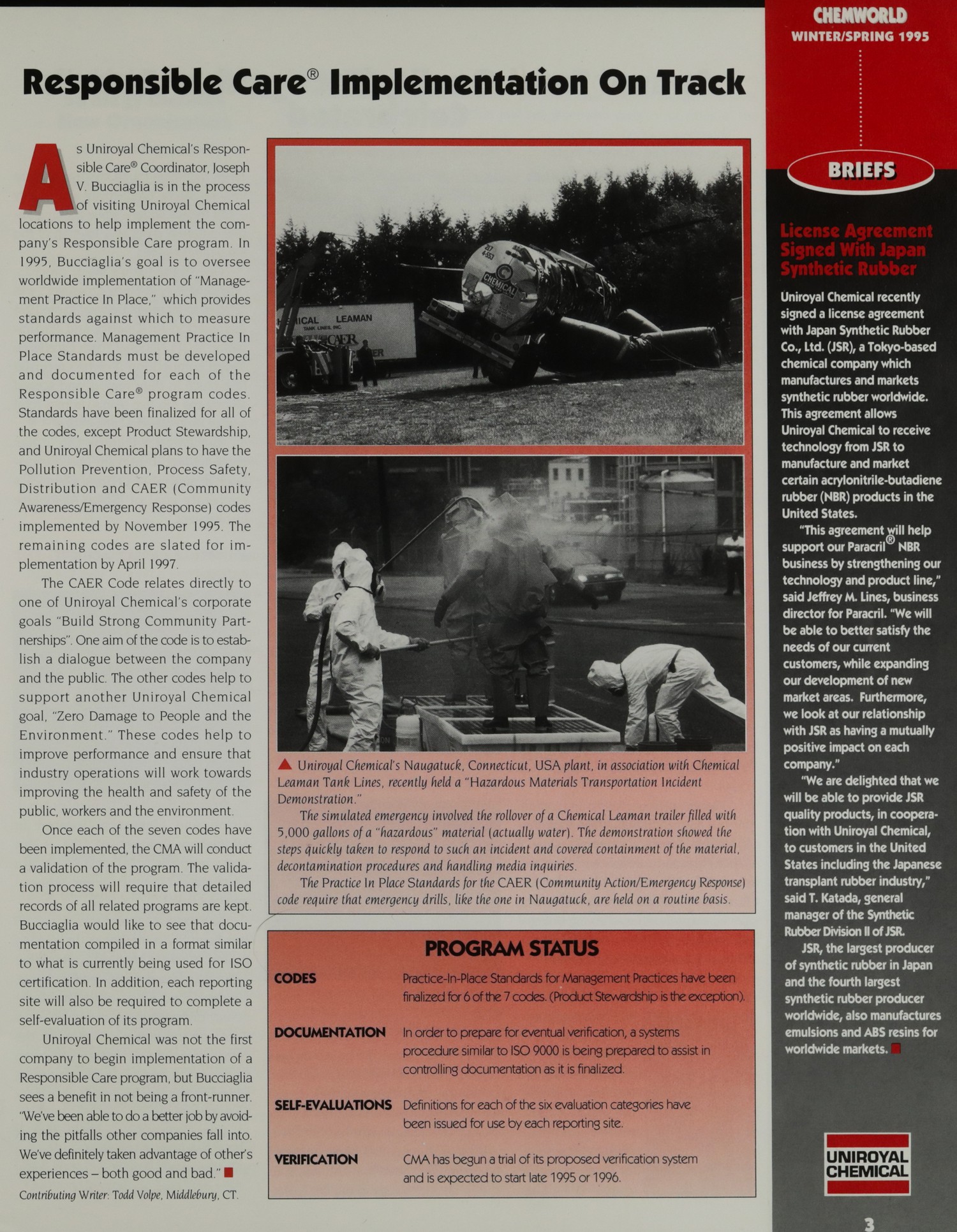
▲ Uniroyal Chemical’s Naugatuck, Connecticut, USA plant, in association with Chemical Leaman Tank Lines, recently held a “Hazardous Materials Transportation Incident Demonstration.”
The simulated emergency involved the rollover of a Chemical Leaman trailer filled with 5,000 gallons of a “hazardous” material (actually water). The demonstration showed the steps quickly taken to respond to such an incident and covered containment of the material, decontamination procedures and handling media inquiries.
The Practice In Place Standards for the CAER (Community Action/Emergency Response) code require that emergency drills, like the one in Naugatuck, are held on a routine basis.
PROGRAM STATUS
| CODES | Practice-In-Place Standards for Management Practices have been finalized for 6 of the 7 codes. (Product Stewardship is the exception). |
|---|---|
| DOCUMENTATION | In order to prepare for eventual verification, a systems procedure similar to ISO 9000 is being prepared to assist in controlling documentation as it is finalized. |
| SELF-EVALUATIONS | Definitions for each of the six evaluation categories have been issued for use by each reporting site. |
| VERIFICATION | CMA has begun a trial of its proposed verification system and is expected to start late 1995 or 1996. |
BRIEFS
License Agreement Signed With Japan Synthetic Rubber
Uniroyal Chemical recently signed a license agreement with Japan Synthetic Rubber Co., Ltd. (JSR), a Tokyo-based chemical company which manufactures and markets synthetic rubber worldwide. This agreement allows Uniroyal Chemical to receive technology from JSR to manufacture and market certain acrylonitrile-butadiene rubber (NBR) products in the United States.
“This agreement will help support our Paracril® NBR business by strengthening our technology and product line,” said Jeffrey M. Lines, business director for Paracril. “We will be able to better satisfy the needs of our current customers, while expanding our development of new market areas. Furthermore, we look at our relationship with JSR as having a mutually positive impact on each company.”
“We are delighted that we will be able to provide JSR quality products, in cooperation with Uniroyal Chemical, to customers in the United States including the Japanese transplant rubber industry,” said T. Katada, general manager of the Synthetic Rubber Division II of JSR.
JSR, the largest producer of synthetic rubber in Japan and the fourth largest synthetic rubber producer worldwide, also manufactures emulsions and ABS resins for worldwide markets. ■
UNIROYAL CHEMICAL
3