
UNIROYAL
CHEM-TEXTS
Vol. 2 PUBLISHED FOR THE PEOPLE OF UNIROYAL CHEMICAL No. 5
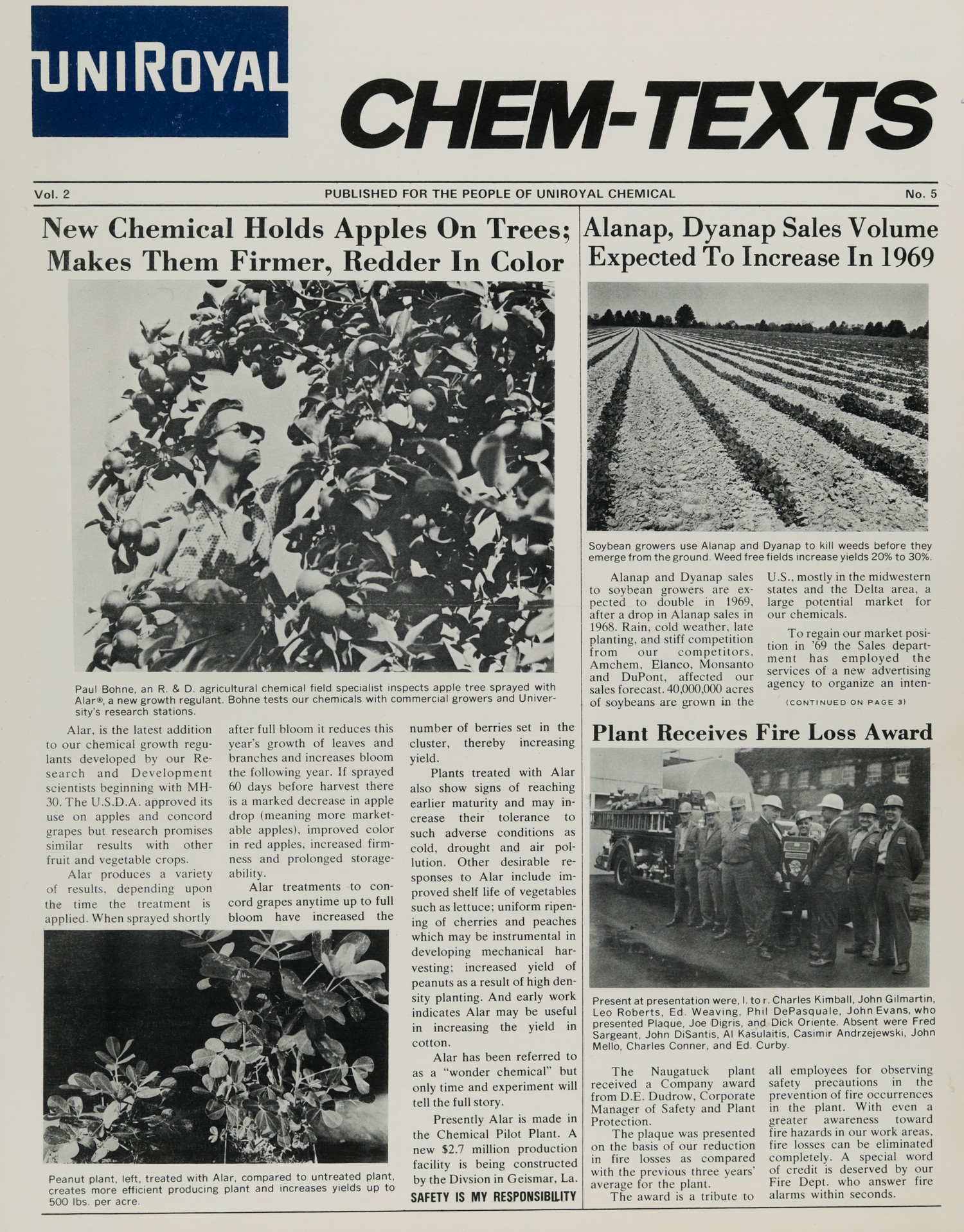
New Chemical Holds Apples On Trees; Makes Them Firmer, Redder In Color
[IMAGE: Paul Bohne, an R. & D. agricultural chemical field specialist inspects apple tree sprayed with Alar®, a new growth regulant. Bohne tests our chemicals with commercial growers and University’s research stations.]
Alar, is the latest addition to our chemical growth regulants developed by our Research and Development scientists beginning with MH-30. The U.S.D.A. approved its use on apples and concord grapes but research promises similar results with other fruit and vegetable crops.
Alar produces a variety of results, depending upon the time the treatment is applied. When sprayed shortly after full bloom it reduces this year’s growth of leaves and branches and increases bloom the following year. If sprayed 60 days before harvest there is a marked decrease in apple drop (meaning more marketable apples), improved color in red apples, increased firmness and prolonged storageability.
Alar treatments to concord grapes anytime up to full bloom have increased the number of berries set in the cluster, thereby increasing yield.
Plants treated with Alar also show signs of reaching earlier maturity and may increase their tolerance to such adverse conditions as cold, drought and air pollution. Other desirable responses to Alar include improved shelf life of vegetables such as lettuce; uniform ripening of cherries and peaches which may be instrumental in developing mechanical harvesting; increased yield of peanuts as a result of high density planting. And early work indicates Alar may be useful in increasing the yield in cotton.
Alar has been referred to as a “wonder chemical” but only time and experiment will tell the full story.
Presently Alar is made in the Chemical Pilot Plant. A new $2.7 million production facility is being constructed by the Divsion in Geismar, La.
SAFETY IS MY RESPONSIBILITY
[IMAGE: Peanut plant, left, treated with Alar, compared to untreated plant, creates more efficient producing plant and increases yields up to 500 lbs. per acre.]
Alanap, Dyanap Sales Volume Expected To Increase In 1969
[IMAGE: Soybean growers use Alanap and Dyanap to kill weeds before they emerge from the ground. Weed free fields increase yields 20% to 30%.]
Alanap and Dyanap sales to soybean growers are expected to double in 1969, after a drop in Alanap sales in 1968. Rain, cold weather, late planting, and stiff competition from our competitors, Amchem, Elanco, Monsanto and DuPont, affected our sales forecast. 40,000,000 acres of soybeans are grown in the U.S., mostly in the midwestern states and the Delta area, a large potential market for our chemicals.
To regain our market position in ’69 the Sales department has employed the services of a new advertising agency to organize an inten-
(CONTINUED ON PAGE 3)
Plant Receives Fire Loss Award
[IMAGE: Present at presentation were, l. to r. Charles Kimball, John Gilmartin, Leo Roberts, Ed. Weaving, Phil DePasquale, John Evans, who presented Plaque, Joe Digris, and Dick Oriente. Absent were Fred Sargeant, John DiSantis, Al Kaslutas, Casimir Andrzejewski, John Mello, Charles Conner, and Ed. Curby.]
The Naugatuck plant received a Company award from D.E. Dudrow, Corporate Manager of Safety and Plant Protection.
The plaque was presented on the basis of our reduction in fire losses as compared with the previous three years’ average for the plant.
The award is a tribute to all employees for observing safety precautions in the prevention of fire occurrences in the plant. With even a greater awareness toward fire hazards in our work areas, fire losses can be eliminated completely. A special word of credit is deserved by our Fire Dept. who answer fire alarms within seconds.