
CHEM-TEXTS
Page 2 | Vol. 2 No. 6
FROM THE FACTORY MANAGER
Dear Fellow Employee:
Again the joys of the holiday season are upon us renewing the eternal promise of peace and goodwill among all men. A constant promise to a changing world — a world that must change if it is to fulfill that promise.
As we pause to reflect upon our accomplishments of the past year, let us face the challenges of the new year with resolution. A resolve that we will each strive for creative change with the goal of better understanding one another as well as our common purpose.
Please accept my most sincere wishes for you and your family; a Most Joyous Christmas and the Best of Health and Happiness throughout the New Year.
John D. Evans
Uniroyal Will Match Your Donation To A College
Today more than ever, colleges and universities need money to build more classrooms, libraries, laboratories and other facilities along with improving and increasing their teaching staffs.
As the demands for a college education continues to grow colleges and universities will need greater help than ever before to not only improve but expand their facilities to meet these demands. This help will have to come from companies, foundations and individual donations, or else many deserving students will be turned away for lack of space.
To encourage our donations for education Uniroyal will match our contribution of more than $25.00 to a college or university. This program applies to active employees on regular, full-time jobs or on authorized leave of absence from such job after they have completed a year of service. The maximum total which the Company will match is $1,000 a year per employee.
Uniroyal will match only gifts made directly to the school or to an agency of the school, such as an alumni fund, which turns over all donations to the school. The college or university must grant degrees and be accredited or actively seeking such accreditation.
Application forms for the “Employee Matching Gift” program may be obtained from the Industrial Relations. department.
The matching of contributions will be made only after the Uniroyal “Employee Matching Gift” application forms have been filled out by the employee; approved and signed by the financial officer of the educational institution and returned to the Uniroyal Foundation.
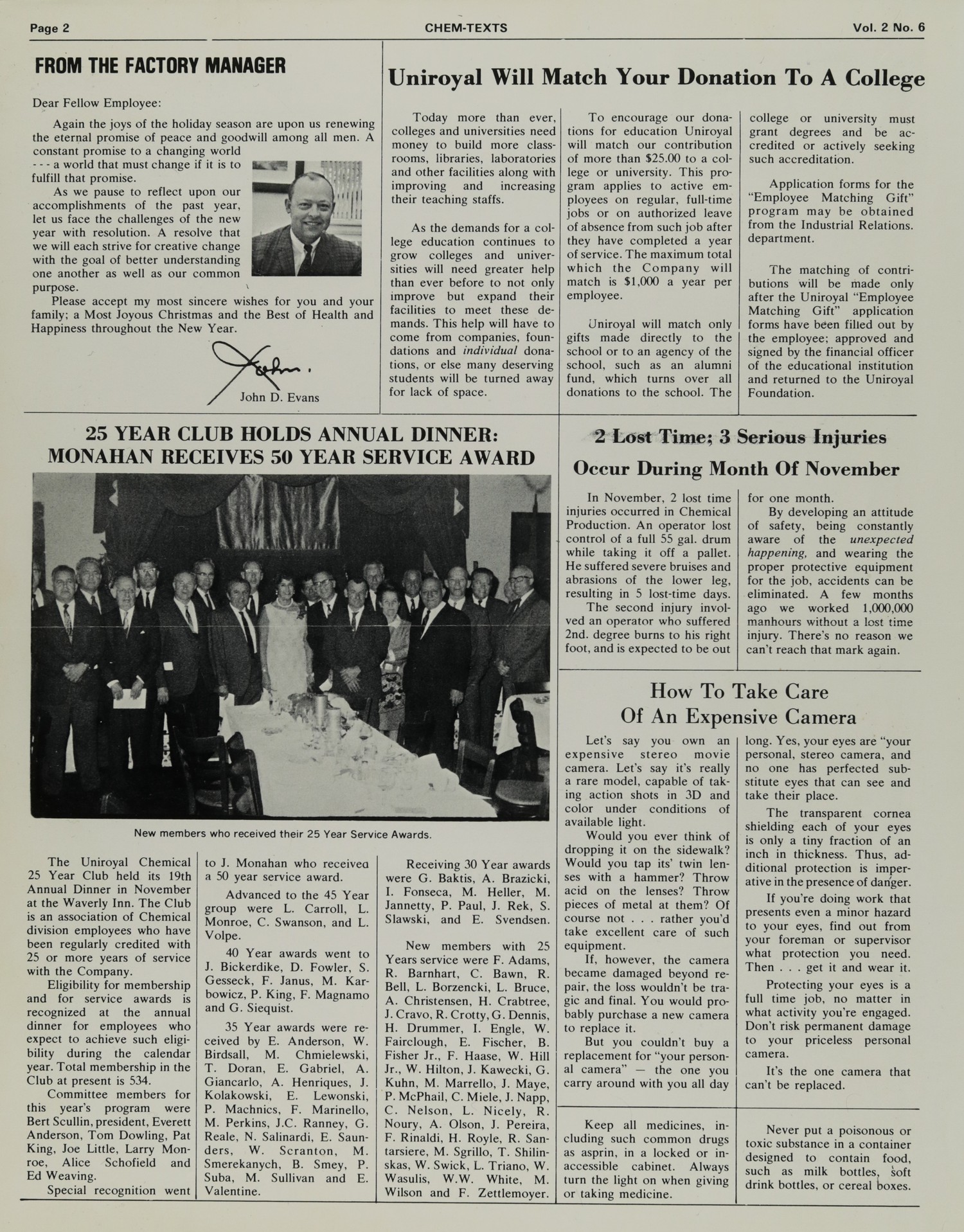
25 YEAR CLUB HOLDS ANNUAL DINNER: MONAHAN RECEIVES 50 YEAR SERVICE AWARD
[PHOTO: Group photo of men in suits]
New members who received their 25 Year Service Awards.
The Uniroyal Chemical 25 Year Club held its 19th Annual Dinner in November at the Waverly Inn. The Club is an association of Chemical division employees who have been regularly credited with 25 or more years of service with the Company.
Eligibility for membership and for service awards is recognized at the annual dinner for employees who expect to achieve such eligibility during the calendar year. Total membership in the Club at present is 534.
Committee members for this year’s program were Bert Scullin, president, Everett Anderson, Tom Dowling, Pat King, Joe Little, Larry Monroe, Alice Schofield and Ed Weaving.
Special recognition went to J. Monahan who received a 50 year service award.
Advanced to the 45 Year group were L. Carroll, L. Monroe, C. Swanson, and L. Volpe.
40 Year awards went to J. Bickerdike, D. Fowler, S. Gesseck, F. Janus, M. Karbowicz, P. King, F. Magnamo and G. Siequist.
35 Year awards were received by E. Anderson, W. Birdsall, M. Chmielewski, T. Doran, E. Gabriel, A. Giancarlo, A. Henriques, J. Kolakowski, E. Lewonski, P. Machnics, F. Marinello, M. Perkins, J.C. Ranney, G. Reale, N. Salinardi, E. Saunders, W. Scranton, M. Smerekanych, B. Smey, P. Suba, M. Sullivan and E. Valentine.
Receiving 30 Year awards were G. Baktis, A. Brazicki, I. Fonseca, M. Heller, M. Jannetty, P. Paul, J. Rek, S. Slawski, and E. Svendsen.
New members with 25 Years service were F. Adams, R. Barnhart, C. Bawn, R. Bell, L. Borzencki, L. Bruce, A. Christensen, H. Crabtree, J. Cravo, R. Crotty, G. Dennis, H. Drummer, I. Engle, W. Fairclough, E. Fischer, B. Fisher Jr., F. Haase, W. Hill Jr., W. Hilton, J. Kawecki, G. Kuhn, M. Marrello, J. Maye, P. McPhail, C. Miele, J. Napp, C. Nelson, L. Nicely, R. Noury, A. Olson, J. Pereira, F. Rinaldi, H. Royle, R. Santarsiere, M. Sgrillo, T. Shilinskas, W. Swick, L. Triano, W. Wasulis, W.W. White, M. Wilson and F. Zettlemoyer.
2 Lost Time; 3 Serious Injuries Occur During Month Of November
In November, 2 lost time injuries occurred in Chemical Production. An operator lost control of a full 55 gal. drum while taking it off a pallet. He suffered severe bruises and abrasions of the lower leg, resulting in 5 lost-time days.
The second injury involved an operator who suffered 2nd. degree burns to his right foot, and is expected to be out for one month.
By developing an attitude of safety, being constantly aware of the unexpected happening, and wearing the proper protective equipment for the job, accidents can be eliminated. A few months ago we worked 1,000,000 manhours without a lost time injury. There’s no reason we can’t reach that mark again.
How To Take Care Of An Expensive Camera
Let’s say you own an expensive stereo movie camera. Let’s say it’s really a rare model, capable of taking action shots in 3D and color under conditions of available light.
Would you ever think of dropping it on the sidewalk? Would you tap its’ twin lenses with a hammer? Throw acid on the lenses? Throw pieces of metal at them? Of course not . . . rather you’d take excellent care of such equipment.
If, however, the camera became damaged beyond repair, the loss wouldn’t be tragic and final. You would probably purchase a new camera to replace it.
But you couldn’t buy a replacement for “your personal camera” — the one you carry around with you all day long. Yes, your eyes are “your personal, stereo camera, and no one has perfected substitute eyes that can see and take their place.
The transparent cornea shielding each of your eyes is only a tiny fraction of an inch in thickness. Thus, additional protection is imperative in the presence of danger.
If you’re doing work that presents even a minor hazard to your eyes, find out from your foreman or supervisor what protection you need. Then . . . get it and wear it.
Protecting your eyes is a full time job, no matter in what activity you’re engaged. Don’t risk permanent damage to your priceless personal camera.
It’s the one camera that can’t be replaced.
Keep all medicines, including such common drugs as asprin, in a locked or inaccessible cabinet. Always turn the light on when giving or taking medicine.
Never put a poisonous or toxic substance in a container designed to contain food, such as milk bottles, soft drink bottles, or cereal boxes.