
CHEM-TEXTS
Page 2 | Vol. 3 No. 4
FROM THE FACTORY MANAGER
DEAR FELLOW EMPLOYEE:
All of us are aware of the importance of producing quality products in an efficient and safe manner. We are also aware of the importance of providing service to our customers, for only through the sale of the results of our effort can we be paid for this effort. I am convinced that each of us tries to do his job in the best way.
But how do we see our jobs? Is our particular job over, when we feel that somebody other than ourselves can be blamed for poor performance?
For example, is it justifiable to blame our injury on someone else if, indeed, it was an unsafe act on our part? Or, is it reasonable to blame lost production on the shortage of raw materials if we didn’t do something about it? Maybe we are all too quick to place the blame on someone else, before we accept all of our own responsibilities.
Together, we operate a very complex operation where each employee bears a great deal of responsibility for his personal efforts, and if we are fully successful a great deal of responsibility for the efforts of others.
Sincerely,
[Signature]
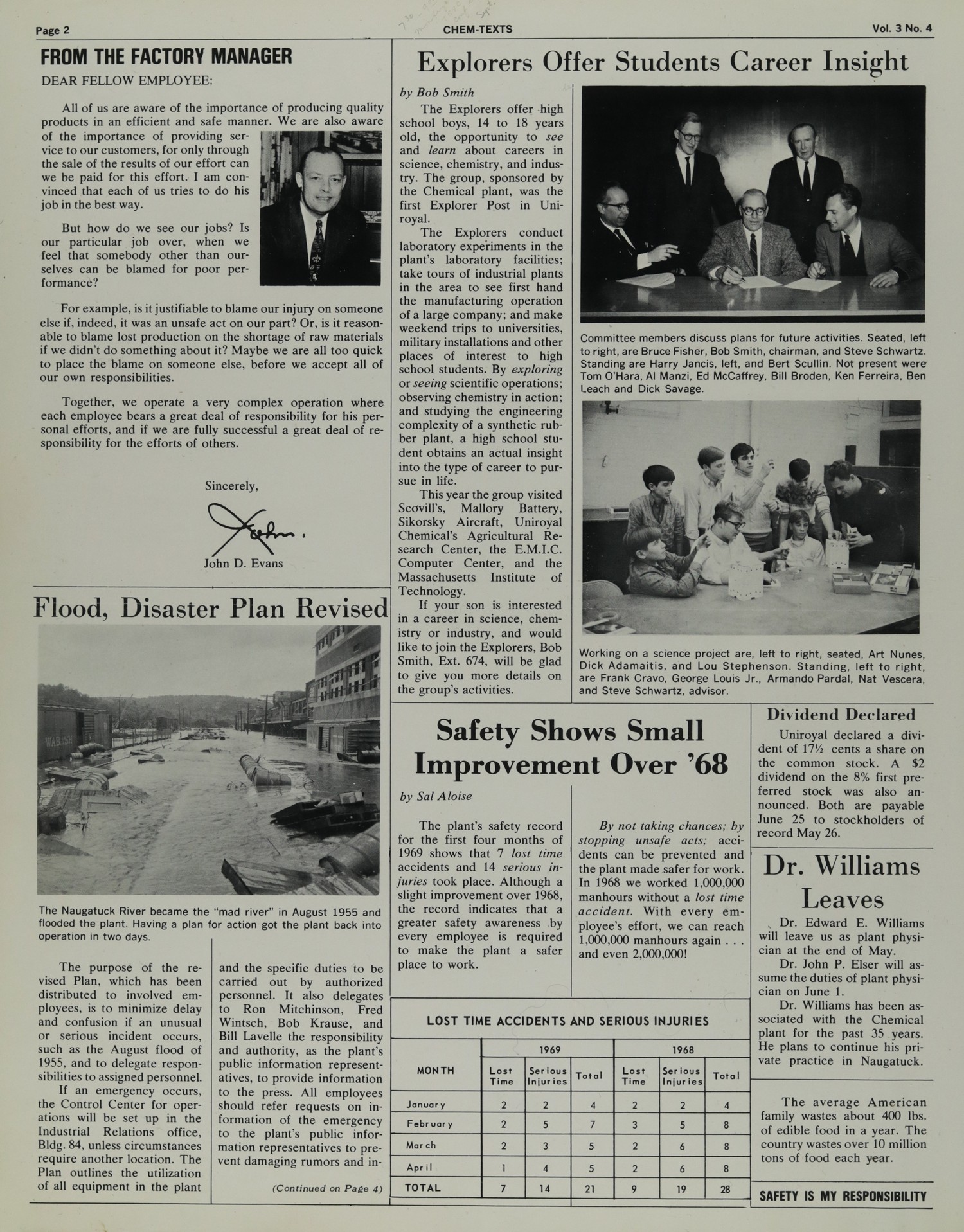
Flood, Disaster Plan Revised
[IMAGE: Black and white photograph showing flooded area with building]
The Naugatuck River became the “mad river” in August 1955 and flooded the plant. Having a plan for action got the plant back into operation in two days.
The purpose of the revised Plan, which has been distributed to involved employees, is to minimize delay and confusion if an unusual or serious incident occurs, such as the August flood of 1955, and to delegate responsibilities to assigned personnel.
If an emergency occurs, the Control Center for operations will be set up in the Industrial Relations office, Bldg. 84, unless circumstances require another location. The Plan outlines the utilization of all equipment in the plant and the specific duties to be carried out by authorized personnel. It also delegates to Ron Mitchinson, Fred Wintsch, Bob Krause, and Bill Lavelle the responsibility and authority, as the plant’s public information representatives, to provide information to the press. All employees should refer requests on information of the emergency to the plant’s public information representatives to prevent damaging rumors and in-
(Continued on Page 4)
Explorers Offer Students Career Insight
by Bob Smith
The Explorers offer high school boys, 14 to 18 years old, the opportunity to see and learn about careers in science, chemistry, and industry. The group, sponsored by the Chemical plant, was the first Explorer Post in Uniroyal.
The Explorers conduct laboratory experiments in the plant’s laboratory facilities; take tours of industrial plants in the area to see first hand the manufacturing operation of a large company; and make weekend trips to universities, military installations and other places of interest to high school students. By exploring or seeing scientific operations; observing chemistry in action; and studying the engineering complexity of a synthetic rubber plant, a high school student obtains an actual insight into the type of career to pursue in life.
This year the group visited Scovill’s, Mallory Battery, Sikorsky Aircraft, Uniroyal Chemical’s Agricultural Research Center, the E.M.I.C. Computer Center, and the Massachusetts Institute of Technology.
If your son is interested in a career in science, chemistry or industry, and would like to join the Explorers, Bob Smith, Ext. 674, will be glad to give you more details on the group’s activities.
[IMAGE: Group photograph of committee members]
Committee members discuss plans for future activities. Seated, left to right, are Bruce Fisher, Bob Smith, chairman, and Steve Schwartz. Standing are Harry Jancis, left, and Bert Scullin. Not present were Tom O’Hara, Al Manzi, Ed McCaffrey, Bill Broden, Ken Ferreira, Ben Leach and Dick Savage.
[IMAGE: Group working on science project]
Working on a science project are, left to right, seated, Art Nunes, Dick Adamaitis, and Lou Stephenson. Standing, left to right, are Frank Cravo, George Louis Jr., Armando Pardal, Nat Vescera, and Steve Schwartz, advisor.
Safety Shows Small Improvement Over ’68
by Sal Aloise
The plant’s safety record for the first four months of 1969 shows that 7 lost time accidents and 14 serious injuries took place. Although a slight improvement over 1968, the record indicates that a greater safety awareness by every employee is required to make the plant a safer place to work.
By not taking chances; by stopping unsafe acts; accidents can be prevented and the plant made safer for work. In 1968 we worked 1,000,000 manhours without a lost time accident. With every employee’s effort, we can reach 1,000,000 manhours again . . . and even 2,000,000!
LOST TIME ACCIDENTS AND SERIOUS INJURIES
| MONTH | 1969 Lost Time | Serious Injuries | Total | 1968 Lost Time | Serious Injuries | Total |
|---|---|---|---|---|---|---|
| January | 2 | 2 | 4 | 2 | 2 | 4 |
| February | 2 | 5 | 7 | 3 | 5 | 8 |
| March | 2 | 3 | 5 | 2 | 6 | 8 |
| April | 1 | 4 | 5 | 2 | 6 | 8 |
| TOTAL | 7 | 14 | 21 | 9 | 19 | 28 |
Dividend Declared
Uniroyal declared a dividend of 17½ cents a share on the common stock. A $2 dividend on the 8% first preferred stock was also announced. Both are payable June 25 to stockholders of record May 26.
Dr. Williams Leaves
Dr. Edward E. Williams will leave us as plant physician at the end of May.
Dr. John P. Elser will assume the duties of plant physician on June 1.
Dr. Williams has been associated with the Chemical plant for the past 35 years. He plans to continue his private practice in Naugatuck.
The average American family wastes about 400 lbs. of edible food in a year. The country wastes over 10 million tons of food each year.
SAFETY IS MY RESPONSIBILITY