
CHEM-TEXTS
Vol. 4 No. 2 | Page 3
HOPKINS PREDICTS A TOUGH, CHALLENGING 1970
[IMAGE: Black and white photograph of two men in suits having a discussion]
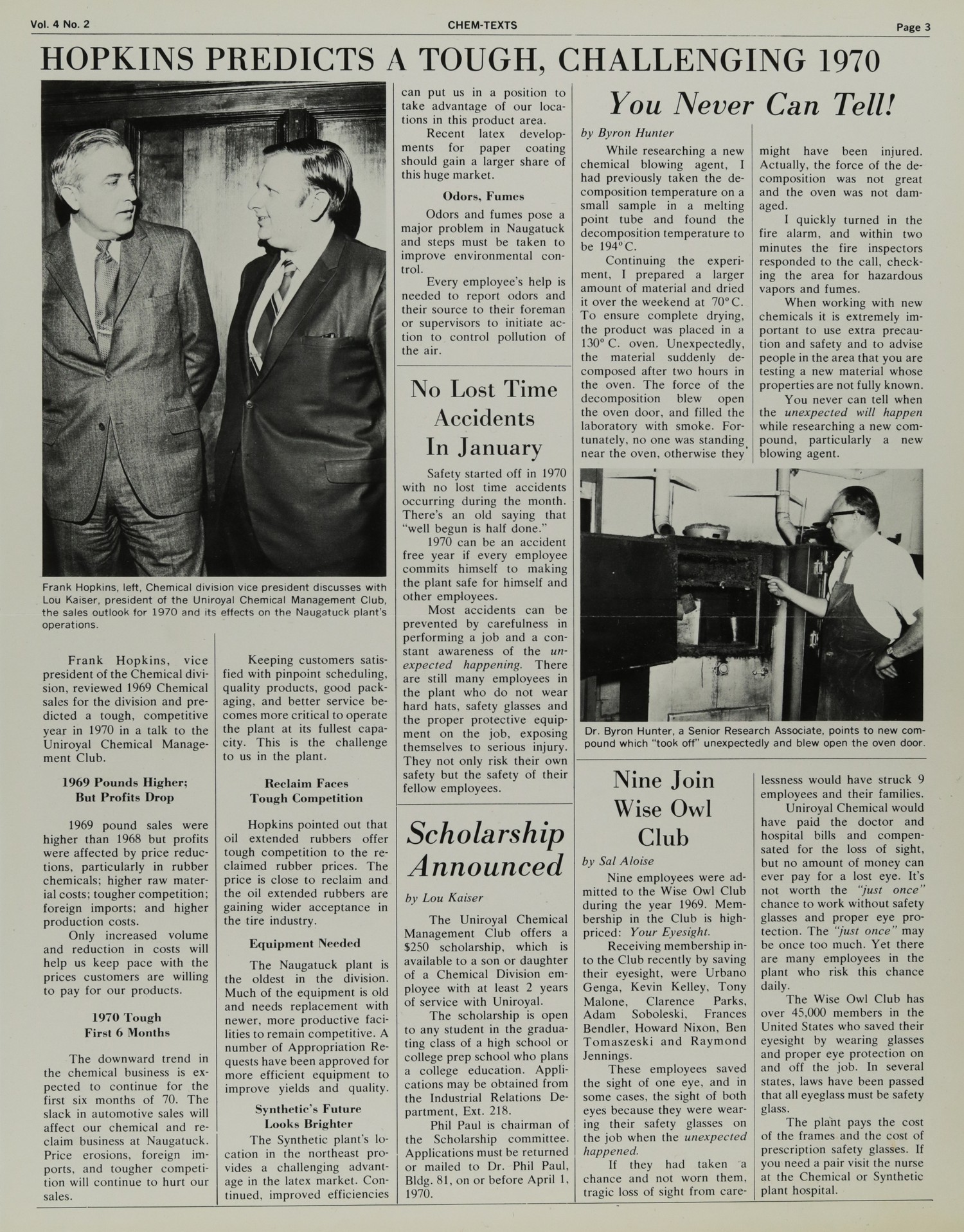
Frank Hopkins, left, Chemical division vice president discusses with Lou Kaiser, president of the Uniroyal Chemical Management Club, the sales outlook for 1970 and its effects on the Naugatuck plant’s operations.
Frank Hopkins, vice president of the Chemical division, reviewed 1969 Chemical sales for the division and predicted a tough, competitive year in 1970 in a talk to the Uniroyal Chemical Management Club.
1969 Pounds Higher;
But Profits Drop
1969 pound sales were higher than 1968 but profits were affected by price reductions, particularly in rubber chemicals; higher raw material costs; tougher competition; foreign imports; and higher production costs.
Only increased volume and reduction in costs will help us keep pace with the prices customers are willing to pay for our products.
1970 Tough
First 6 Months
The downward trend in the chemical business is expected to continue for the first six months of 70. The slack in automotive sales will affect our chemical and reclaim business at Naugatuck. Price erosions, foreign imports, and tougher competition will continue to hurt our sales.
Keeping customers satisfied with pinpoint scheduling, quality products, good packaging, and better service becomes more critical to operate the plant at its fullest capacity. This is the challenge to us in the plant.
Reclaim Faces
Tough Competition
Hopkins pointed out that oil extended rubbers offer tough competition to the reclaimed rubber prices. The price is close to reclaim and the oil extended rubbers are gaining wider acceptance in the tire industry.
Equipment Needed
The Naugatuck plant is the oldest in the division. Much of the equipment is old and needs replacement with newer, more productive facilities to remain competitive. A number of Appropriation Requests have been approved for more efficient equipment to improve yields and quality.
Synthetic’s Future
Looks Brighter
The Synthetic plant’s location in the northeast provides a challenging advantage in the latex market. Continued, improved efficiencies
can put us in a position to take advantage of our locations in this product area.
Recent latex developments for paper coating should gain a larger share of this huge market.
Odors, Fumes
Odors and fumes pose a major problem in Naugatuck and steps must be taken to improve environmental control.
Every employee’s help is needed to report odors and their source to their foreman or supervisors to initiate action to control pollution of the air.
No Lost Time Accidents In January
Safety started off in 1970 with no lost time accidents occurring during the month. There’s an old saying that “well begun is half done.”
1970 can be an accident free year if every employee commits himself to making the plant safe for himself and other employees.
Most accidents can be prevented by carefulness in performing a job and a constant awareness of the unexpected happening. There are still many employees in the plant who do not wear hard hats, safety glasses and the proper protective equipment on the job, exposing themselves to serious injury. They not only risk their own safety but the safety of their fellow employees.
Scholarship Announced
by Lou Kaiser
The Uniroyal Chemical Management Club offers a $250 scholarship, which is available to a son or daughter of a Chemical Division employee with at least 2 years of service with Uniroyal.
The scholarship is open to any student in the graduating class of a high school or college prep school who plans a college education. Applications may be obtained from the Industrial Relations Department, Ext. 218.
Phil Paul is chairman of the Scholarship committee. Applications must be returned or mailed to Dr. Phil Paul, Bldg. 81, on or before April 1, 1970.
You Never Can Tell!
by Byron Hunter
While researching a new chemical blowing agent, I had previously taken the decomposition temperature on a small sample in a melting point tube and found the decomposition temperature to be 194° C.
Continuing the experiment, I prepared a larger amount of material and dried it over the weekend at 70° C. To ensure complete drying, the product was placed in a 130° C. oven. Unexpectedly, the material suddenly decomposed after two hours in the oven. The force of the decomposition blew open the oven door, and filled the laboratory with smoke. Fortunately, no one was standing near the oven, otherwise they
might have been injured. Actually, the force of the decomposition was not great and the oven was not damaged.
I quickly turned in the fire alarm, and within two minutes the fire inspectors responded to the call, checking the area for hazardous vapors and fumes.
When working with new chemicals it is extremely important to use extra precaution and safety and to advise people in the area that you are testing a new material whose properties are not fully known.
You never can tell when the unexpected will happen while researching a new compound, particularly a new blowing agent.
[IMAGE: Black and white photograph of a man in a lab coat pointing at laboratory equipment]
Dr. Byron Hunter, a Senior Research Associate, points to new compound which “took off” unexpectedly and blew open the oven door.
Nine Join Wise Owl Club
by Sal Aloise
Nine employees were admitted to the Wise Owl Club during the year 1969. Membership in the Club is highpriced: Your Eyesight.
Receiving membership into the Club recently by saving their eyesight, were Urbano Genga, Kevin Kelley, Tony Malone, Clarence Parks, Adam Soboleski, Frances Bendler, Howard Nixon, Ben Tomaszeski and Raymond Jennings.
These employees saved the sight of one eye, and in some cases, the sight of both eyes because they were wearing their safety glasses on the job when the unexpected happened.
If they had taken a chance and not worn them, tragic loss of sight from care-
lessness would have struck 9 employees and their families.
Uniroyal Chemical would have paid the doctor and hospital bills and compensated for the loss of sight, but no amount of money can ever pay for a lost eye. It’s not worth the “just once” chance to work without safety glasses and proper eye protection. The “just once” may be once too much. Yet there are many employees in the plant who risk this chance daily.
The Wise Owl Club has over 45,000 members in the United States who saved their eyesight by wearing glasses and proper eye protection on and off the job. In several states, laws have been passed that all eyeglass must be safety glass.
The plant pays the cost of the frames and the cost of prescription safety glasses. If you need a pair visit the nurse at the Chemical or Synthetic plant hospital.