
UNIROYAL CHEM-TEXTS
Vol. 4, 1970 | PUBLISHED FOR THE PEOPLE OF UNIROYAL CHEMICAL | No. 6
Plans For Staffing Oxford Underway
by C. Durbin
Uniroyal’s program for creating a new administrative center has been carefully developed to insure that all is ready for the move to Oxford in mid-1971.
People are always the most important part of any program. When present employees in New York City were asked, quite a number told their managers that they do not plan to transfer to Connecticut. The gap between the number needed and the number moving must be filled by local people.
Promotion Policy
Whenever possible, promotion from within is a policy that Uniroyal applies everywhere. In the Oxford case it means that an interested salaried employee, presently in a Chemical Division office position, who is qualified for a position at Oxford that is in a higher skill classification than is available in the Naugatuck offices, will be given consideration for transfer. Other Uniroyal people in this area will have the same opportunity.
Survey By Questionnaire
During the month of July local Chemical Division salaried female office employees are being surveyed by questionnaires to determine those who believe they have skills above the requirements of their present assignments and might be interested in transfer to the Oxford offices.
Replies will be reviewed by responsible managers who will consider work history and skill qualifications to determine who should receive further consideration under the promotion policy.
A similar procedure will be followed later when other salaried position requirements are developed for positions which specify advanced knowledge, skill and considerable experience in specialized functions.
New Food Service For The Plant
by Fred Wintsch
Servomation, Inc. recently assumed operation of plant food services at the Chemical Canteen, Synthetic Cafeteria, EMIC and the vending machines in all buildings.
With headquarters in New Haven, Servomation offers improved food services, fresh foods, more efficient maintenance of the food machines, a better menu with a wider selection of hot meals with an eye on the nutritional value for weight conscious employees.
The Chemical plant was one of the last major firms in the Valley to retain the 10¢ coffee but increased wholesale food prices have forced an increase to 15¢.
Servomation is one of the leading food service organizations in Connecticut serving many firms and schools in the State with their main facilities only an hour from the plant. There should be considerable improvement in food services on all shifts and weekends as a result of the change.
SAFETY IS MY RESPONSIBILITY
[IMAGE: Photo of workers in hard hats]
John Honyotski, area foreman, congratulates chemical operators Ivan Aubin and Bill Gaievage of Bldg. 73 for excellent job in getting Dyanap to customers on time. At left is Jim Cravo, Bldg. 73 foreman. On another shift at time of photo were operators Jim Lynch and Frank Guzzardi.
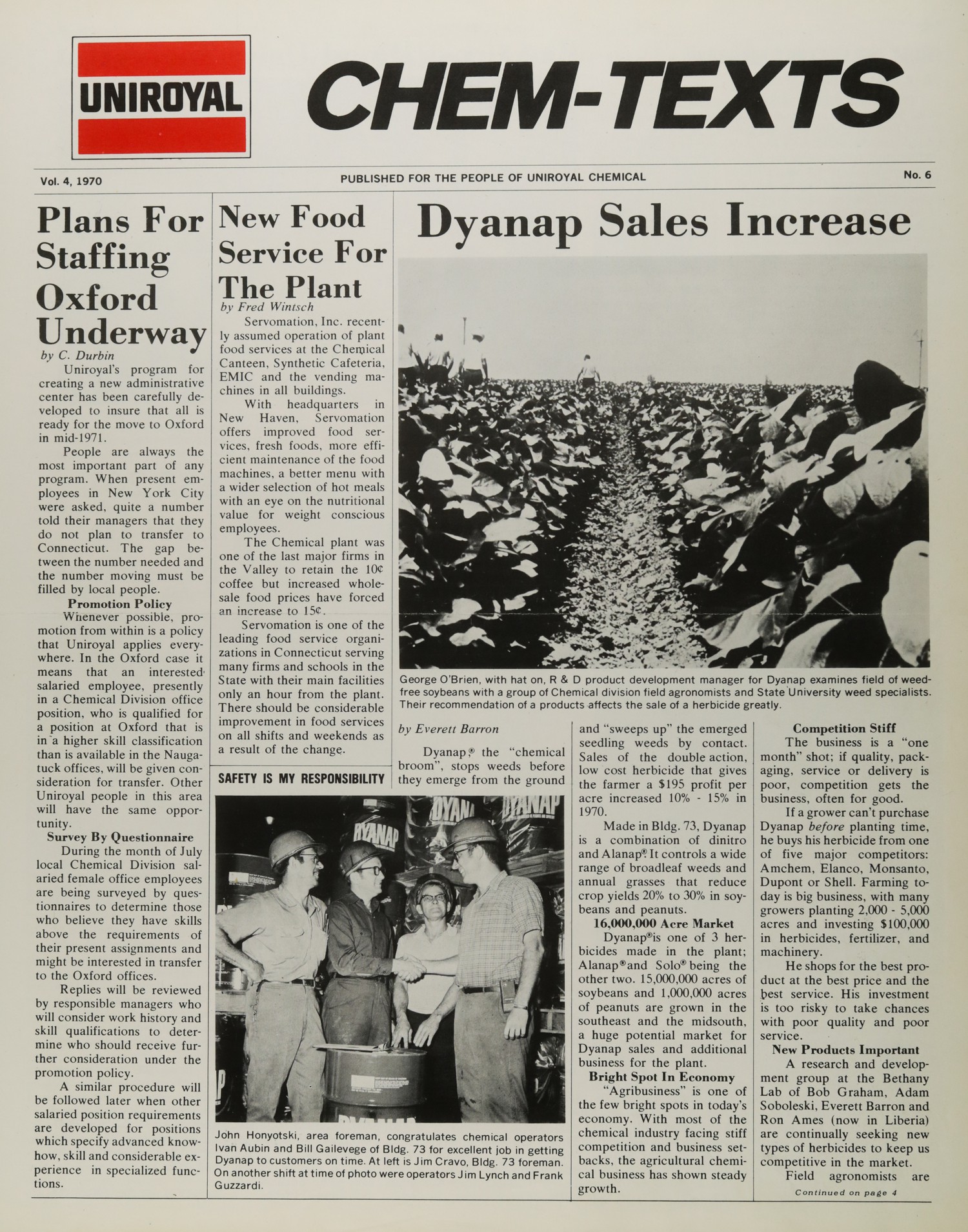
Dyanap Sales Increase
[IMAGE: Photo of men examining soybean field]
George O’Brien, with hat on, R & D product development manager for Dyanap examines field of weed-free soybeans with a group of Chemical division field agronomists and State University weed specialists. Their recommendation of a products affects the sale of a herbicide greatly.
by Everett Barron
Dyanap® the “chemical broom”, stops weeds before they emerge from the ground and “sweeps up” the emerged seedling weeds by contact. Sales of the double action, low cost herbicide that gives the farmer a $195 profit per acre increased 10% – 15% in 1970.
Made in Bldg. 73, Dyanap is a combination of dinitro and Alanap® It controls a wide range of broadleaf weeds and annual grasses that reduce crop yields 20% to 30% in soybeans and peanuts.
16,000,000 Acre Market
Dyanap®is one of 3 herbicides made in the plant; Alanap® and Solo® being the other two. 15,000,000 acres of soybeans and 1,000,000 acres of peanuts are grown in the southeast and the midsouth, a huge potential market for Dyanap sales and additional business for the plant.
Bright Spot In Economy
“Agribusiness” is one of the few bright spots in today’s economy. With most of the chemical industry facing stiff competition and business setbacks, the agricultural chemical business has shown steady growth.
Competition Stiff
The business is a “one month” shot; if quality, packaging, service or delivery is poor, competition gets the business, often for good.
If a grower can’t purchase Dyanap before planting time, he buys his herbicide from one of five major competitors: Amchem, Elanco, Monsanto, Dupont or Shell. Farming today is big business, with many growers planting 2,000 – 5,000 acres and investing $100,000 in herbicides, fertilizer, and machinery.
He shops for the best product at the best price and the best service. His investment is too risky to take chances with poor quality and poor service.
New Products Important
A research and development group at the Bethany Lab of Bob Graham, Adam Soboleski, Everett Barron and Ron Ames (now in Liberia) are continually seeking new types of herbicides to keep us competitive in the market.
Field agronomists are
Continued on page 4