
ChemWorld | 5 | January 1990
Crop Division’s New Vice President Plans Growth Strategy For Business
Newly-appointed Vice President and General Manager of Uniroyal Chemical’s Crop Protection division, Alfred F. Ingulli, discussed with CHEMWORLD future strategies and areas of potential growth for the company’s crop protection business. The following is a summary of this conversation:
Q. What new plans or strategies do you intend to pursue for the Crop Protection business?
A. My objective for the Crop Protection business is to have its earnings as a percent of sales equal to 17%, which is the company average for return on sales. We plan to accomplish this through a combination of volume growth of existing and new products, aggressive pricing in the marketplace, and a prudent management of costs.
Q. Crop Protection turned in a fine performance on an international level in Fiscal Year 1989. Do you anticipate continued growth internationally?
A. I believe we have done a good job positioning our products where they belong. From a pricing and end-use standpoint, I feel there is still plenty of untapped opportunity, particularly in developing countries like China, Poland and the USSR, to duplicate what we’ve done in the U.S. In particular, I see opportunities for Omite® and Vitavax®, the seed treatment area in general, and for Harvade® specifically in Europe.
Q. Are there currently any new product technologies under development, or plans for a new product introduction in the near future?
A. We have a number of exciting new products in market development or in the R&D pipeline. Harvade and Dimilin® are two examples of new products that are in the introductory stage with sales taking off and growing substantially. We also have two exciting herbicides in the R&D pipeline, with plans to begin selling one this year in the off-shore market. We anticipate a very bright future for both of these products when we fully commercialize them.
Q. Given the fact that the overall agricultural chemical industry is currently under a great deal of fire from environmentalists, do
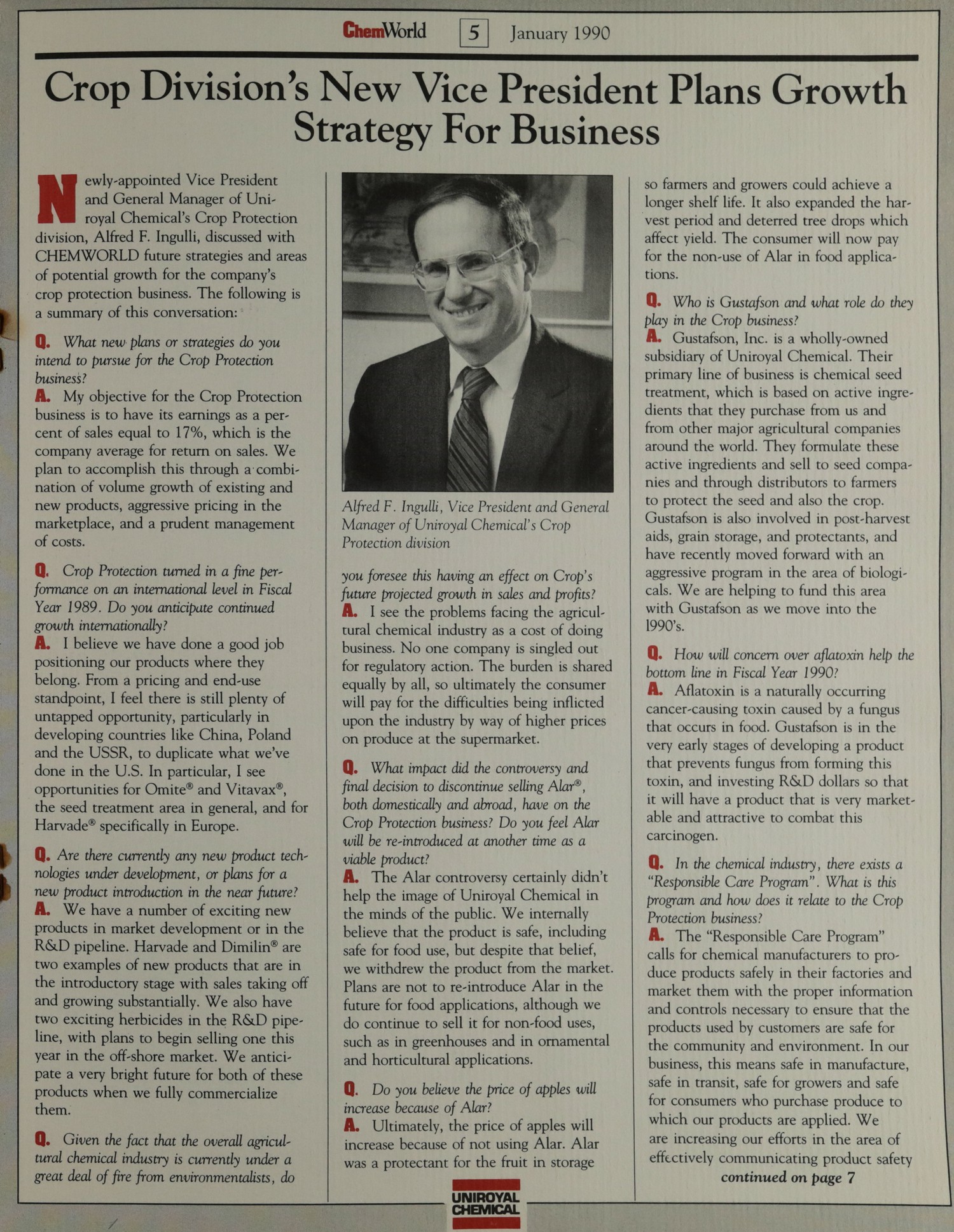
[PHOTO: Black and white portrait photograph of a man in glasses wearing a suit]
Alfred F. Ingulli, Vice President and General Manager of Uniroyal Chemical’s Crop Protection division
you foresee this having an effect on Crop’s future projected growth in sales and profits?
A. I see the problems facing the agricultural chemical industry as a cost of doing business. No one company is singled out for regulatory action. The burden is shared equally by all, so ultimately the consumer will pay for the difficulties being inflicted upon the industry by way of higher prices on produce at the supermarket.
Q. What impact did the controversy and final decision to discontinue selling Alar®, both domestically and abroad, have on the Crop Protection business? Do you feel Alar will be re-introduced at another time as a viable product?
A. The Alar controversy certainly didn’t help the image of Uniroyal Chemical in the minds of the public. We internally believe that the product is safe, including safe for food use, but despite that belief, we withdrew the product from the market. Plans are not to re-introduce Alar in the future for food applications, although we do continue to sell it for non-food uses, such as in greenhouses and in ornamental and horticultural applications.
Q. Do you believe the price of apples will increase because of Alar?
A. Ultimately, the price of apples will increase because of not using Alar. Alar was a protectant for the fruit in storage
so farmers and growers could achieve a longer shelf life. It also expanded the harvest period and deterred tree drops which affect yield. The consumer will now pay for the non-use of Alar in food applications.
Q. Who is Gustafson and what role do they play in the Crop business?
A. Gustafson, Inc. is a wholly-owned subsidiary of Uniroyal Chemical. Their primary line of business is chemical seed treatment, which is based on active ingredients that they purchase from us and from other major agricultural companies around the world. They formulate these active ingredients and sell to seed companies and through distributors to farmers to protect the seed and also the crop. Gustafson is also involved in post-harvest aids, grain storage, and protectants, and have recently moved forward with an aggressive program in the area of biologicals. We are helping to fund this area with Gustafson as we move into the 1990’s.
Q. How will concern over aflatoxin help the bottom line in Fiscal Year 1990?
A. Aflatoxin is a naturally occurring cancer-causing toxin caused by a fungus that occurs in food. Gustafson is in the very early stages of developing a product that prevents fungus from forming this toxin, and investing R&D dollars so that it will have a product that is very marketable and attractive to combat this carcinogen.
Q. In the chemical industry, there exists a “Responsible Care Program”. What is this program and how does it relate to the Crop Protection business?
A. The “Responsible Care Program” calls for chemical manufacturers to produce products safely in their factories and market them with the proper information and controls necessary to ensure that the products used by customers are safe for the community and environment. In our business, this means safe in manufacture, safe in transit, safe for growers and safe for consumers who purchase produce to which our products are applied. We are increasing our efforts in the area of effectively communicating product safety
continued on page 7
UNIROYAL CHEMICAL