
ChemWorld | 3 | January 1991
New Product Technologies And Global Expansion Drive Chemicals And Polymers Division
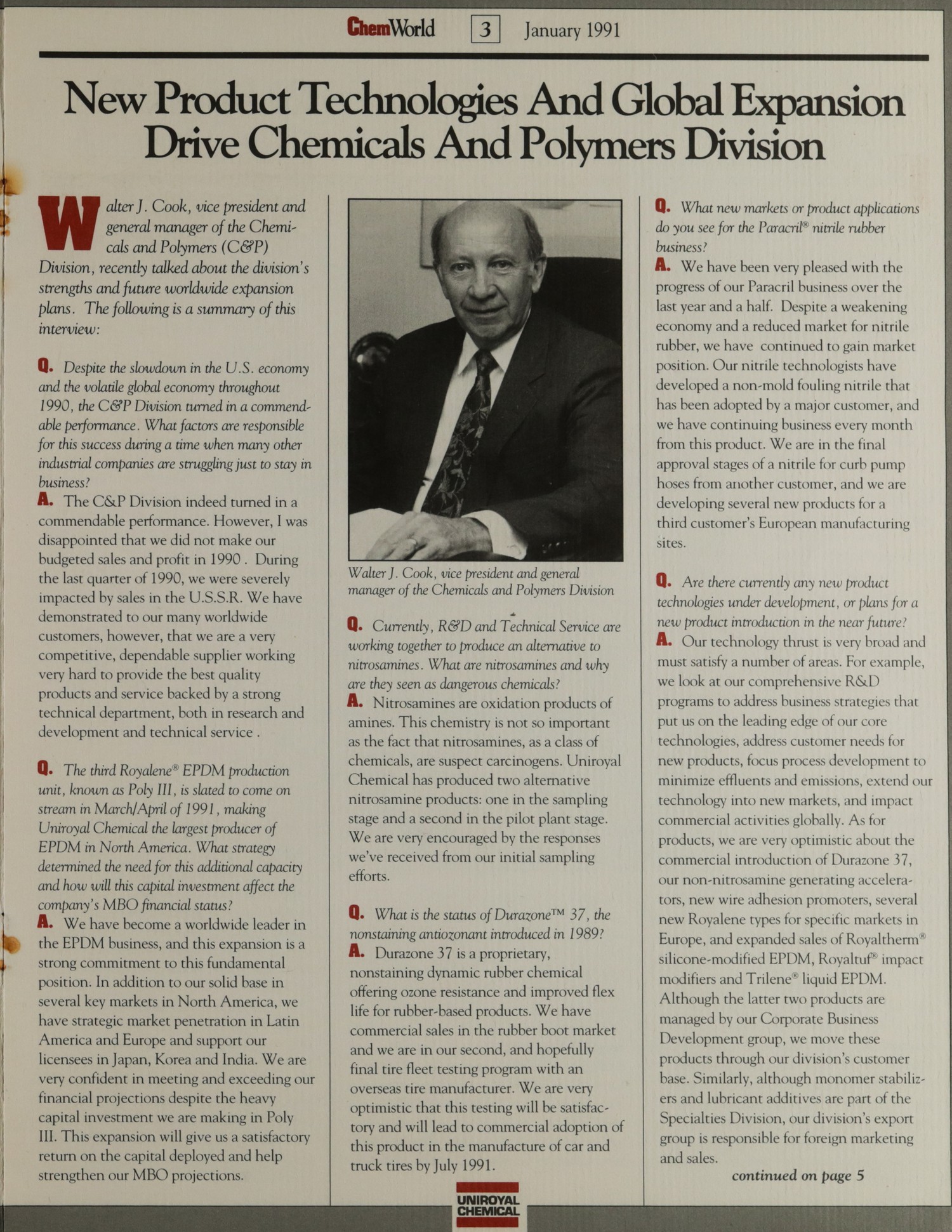
Walter J. Cook, vice president and general manager of the Chemicals and Polymers (C&P) Division, recently talked about the division’s strengths and future worldwide expansion plans. The following is a summary of this interview:
Q. Despite the slowdown in the U.S. economy and the volatile global economy throughout 1990, the C&P Division turned in a commendable performance. What factors are responsible for this success during a time when many other industrial companies are struggling just to stay in business?
A. The C&P Division indeed turned in a commendable performance. However, I was disappointed that we did not make our budgeted sales and profit in 1990. During the last quarter of 1990, we were severely impacted by sales in the U.S.S.R. We have demonstrated to our many worldwide customers, however, that we are a very competitive, dependable supplier working very hard to provide the best quality products and service backed by a strong technical department, both in research and development and technical service.
Q. The third Royalene® EPDM production unit, known as Poly III, is slated to come on stream in March/April of 1991, making Uniroyal Chemical the largest producer of EPDM in North America. What strategy determined the need for this additional capacity and how will this capital investment affect the company’s MBO financial status?
A. We have become a worldwide leader in the EPDM business, and this expansion is a strong commitment to this fundamental position. In addition to our solid base in several key markets in North America, we have strategic market penetration in Latin America and Europe and support our licensees in Japan, Korea and India. We are very confident in meeting and exceeding our financial projections despite the heavy capital investment we are making in Poly III. This expansion will give us a satisfactory return on the capital deployed and help strengthen our MBO projections.
Walter J. Cook, vice president and general manager of the Chemicals and Polymers Division
Q. Currently, R&D and Technical Service are working together to produce an alternative to nitrosamines. What are nitrosamines and why are they seen as dangerous chemicals?
A. Nitrosamines are oxidation products of amines. This chemistry is not so important as the fact that nitrosamines, as a class of chemicals, are suspect carcinogens. Uniroyal Chemical has produced two alternative nitrosamine products: one in the sampling stage and a second in the pilot plant stage. We are very encouraged by the responses we’ve received from our initial sampling efforts.
Q. What is the status of Durazone™ 37, the nonstaining antiozonant introduced in 1989?
A. Durazone 37 is a proprietary, nonstaining dynamic rubber chemical offering ozone resistance and improved flex life for rubber-based products. We have commercial sales in the rubber boot market and we are in our second, and hopefully final tire fleet testing program with an overseas tire manufacturer. We are very optimistic that this testing will be satisfactory and will lead to commercial adoption of this product in the manufacture of car and truck tires by July 1991.
Q. What new markets or product applications do you see for the Paracril® nitrile rubber business?
A. We have been very pleased with the progress of our Paracril business over the last year and a half. Despite a weakening economy and a reduced market for nitrile rubber, we have continued to gain market position. Our nitrile technologists have developed a non-mold fouling nitrile that has been adopted by a major customer, and we have continuing business every month from this product. We are in the final approval stages of a nitrile for curb pump hoses from another customer, and we are developing several new products for a third customer’s European manufacturing sites.
Q. Are there currently any new product technologies under development, or plans for a new product introduction in the near future?
A. Our technology thrust is very broad and must satisfy a number of areas. For example, we look at our comprehensive R&D programs to address business strategies that put us on the leading edge of our core technologies, address customer needs for new products, focus process development to minimize effluents and emissions, extend our technology into new markets, and impact commercial activities globally. As for products, we are very optimistic about the commercial introduction of Durazone 37, our non-nitrosamine generating accelerators, new wire adhesion promoters, several new Royalene types for specific markets in Europe, and expanded sales of Royaltherm® silicone-modified EPDM, Royaltuf® impact modifiers and Trilene® liquid EPDM. Although the latter two products are managed by our Corporate Business Development group, we move these products through our division’s customer base. Similarly, although monomer stabilizers and lubricant additives are part of the Specialties Division, our division’s export group is responsible for foreign marketing and sales.
continued on page 5
UNIROYAL CHEMICAL