
Page 2 | CHEM-TEXTS | Vol. 7, 1973
The end of the year is upon us, and traditionally it is an ideal time to review the past year and take a peek at the next.
Obviously, it is impossible to review all of the little steps of progress we have made this year. Therefore, I would like to offer a general review of our plant and business in 1973.
The epitome of working together, I think, is this year’s outstanding safety performance over last year’s. Without the complete involvement of all “Chemical people”, we would not have been as successful.
We still have a long way to go, particularly in the number of days lost due to accidents. But this year’s performance has built the base from which we can launch the effort needed to overcome this next difficult hurdle.
In the business line, Chemical Production came through a torturous year with encouraging vigor. The year started great, only to slow down at mid year when uncertain business conditions caused customers to hedge on their purchases.
Then when sales started to pick up, we were staggered by the continuing energy-related raw material shortages.
Heading into the new year, we face the confusing problem of having the sales, but perhaps not the raw materials. In addition, these materials are skyrocketing in cost. Survival next year can be defined as having the flexibility to make the most of a difficult situation.
We all know the problems facing our Reclaim plant. But if this year’s performance and attitude are any indication of our strength and perseverance, we are going to give that business a real run for the money in 1974. Turning an old giant like that around, enough to make it competitive, is a formidable task. Time is a problem and 1974 is our year to show them what we’re made of.
It is unfortunate that we have become non-competitive in the Synthetic latex business. We must quickly recover from this shutdown and adjust ourselves to solving today’s problems.
Attitude and cooperation did it with our Safety performance. The same approach must be used in improving the competitive and economic position of our plant. A healthy business means secure jobs—for one and all.
Despite the lack of Christmas lights this year, I would like to extend to all of you, and your families, my best wishes for the Christmas holiday. It is a comforting time of the year, but also a time to remind ourselves how fortunate we really are.
Jim Crim
Accident Frequency Reduced 54%
1500 Turkeys Awarded to Employees
[IMAGE: Photo showing three people examining documents]
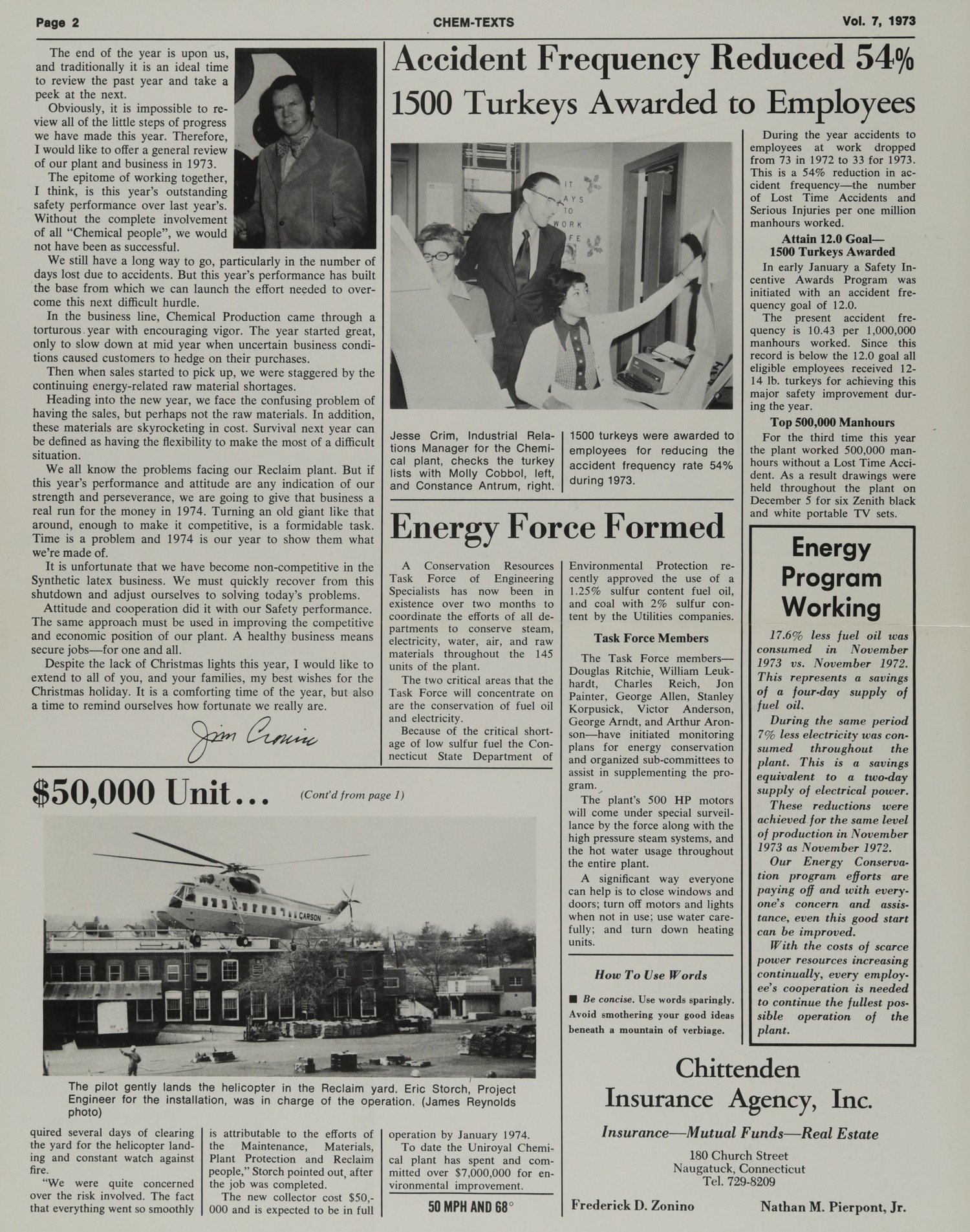
Jesse Crim, Industrial Relations Manager for the Chemical plant, checks the turkey lists with Molly Cobbol, left, and Constance Antrum, right.
1500 turkeys were awarded to employees for reducing the accident frequency rate 54% during 1973.
During the year accidents to employees at work dropped from 73 in 1972 to 33 for 1973. This is a 54% reduction in accident frequency—the number of Lost Time Accidents and Serious Injuries per one million manhours worked.
Attain 12.0 Goal—1500 Turkeys Awarded
In early January a Safety Incentive Awards Program was initiated with an accident frequency goal of 12.0.
The present accident frequency is 10.43 per 1,000,000 manhours worked. Since this record is below the 12.0 goal all eligible employees received 12-14 lb. turkeys for achieving this major safety improvement during the year.
Top 500,000 Manhours
For the third time this year the plant worked 500,000 manhours without a Lost Time Accident. As a result drawings were held throughout the plant on December 5 for six Zenith black and white portable TV sets.
Energy Force Formed
A Conservation Resources Task Force of Engineering Specialists has now been in existence over two months to coordinate the efforts of all departments to conserve steam, electricity, water, air, and raw materials throughout the 145 units of the plant.
The two critical areas that the Task Force will concentrate on are the conservation of fuel oil and electricity.
Because of the critical shortage of low sulfur fuel the Connecticut State Department of Environmental Protection recently approved the use of a 1.25% sulfur content fuel oil, and coal with 2% sulfur content by the Utilities companies.
Task Force Members
The Task Force members—Douglas Ritchie, William Leukhardt, Charles Reich, Jon Painter, George Allen, Stanley Korpusick, Victor Anderson, George Arndt, and Arthur Aronson—have initiated monitoring plans for energy conservation and organized sub-committees to assist in supplementing the program.
The plant’s 500 HP motors will come under special surveillance by the force along with the high pressure steam systems, and the hot water usage throughout the entire plant.
A significant way everyone can help is to close windows and doors; turn off motors and lights when not in use; use water carefully; and turn down heating units.
How To Use Words
■ Be concise. Use words sparingly. Avoid smothering your good ideas beneath a mountain of verbiage.
Energy Program Working
17.6% less fuel oil was consumed in November 1973 vs. November 1972. This represents a savings of a four-day supply of fuel oil.
During the same period 7% less electricity was consumed throughout the plant. This is a savings equivalent to a two-day supply of electrical power.
These reductions were achieved for the same level of production in November 1973 as November 1972.
Our Energy Conservation program efforts are paying off and with everyone’s concern and assistance, even this good start can be improved.
With the costs of scarce power resources increasing continually, every employee’s cooperation is needed to continue the fullest possible operation of the plant.
$50,000 Unit… (Cont’d from page 1)
[IMAGE: Photo of helicopter landing in yard with buildings in background, marked “CARSON”]
The pilot gently lands the helicopter in the Reclaim yard. Eric Storch, Project Engineer for the installation, was in charge of the operation. (James Reynolds photo)
quired several days of clearing the yard for the helicopter landing and constant watch against fire.
“We were quite concerned over the risk involved. The fact that everything went so smoothly is attributable to the efforts of the Maintenance, Materials, Plant Protection and Reclaim people,” Storch pointed out after the job was completed.
The new collector cost $50,000 and is expected to be in operation by January 1974.
To date the Uniroyal Chemical plant has spent and committed over $7,000,000 for environmental improvement.
50 MPH AND 68°
Chittenden Insurance Agency, Inc.
Insurance—Mutual Funds—Real Estate
180 Church Street
Naugatuck, Connecticut
Tel. 729-8209
Frederick D. Zonino | Nathan M. Pierpont, Jr.