
## Page 001
CHEM-TEXTS
Vol. 4, 1970 PUBLISHED FOR THE PEOPLE OF UNIROYAL CHEMICAL No. 4
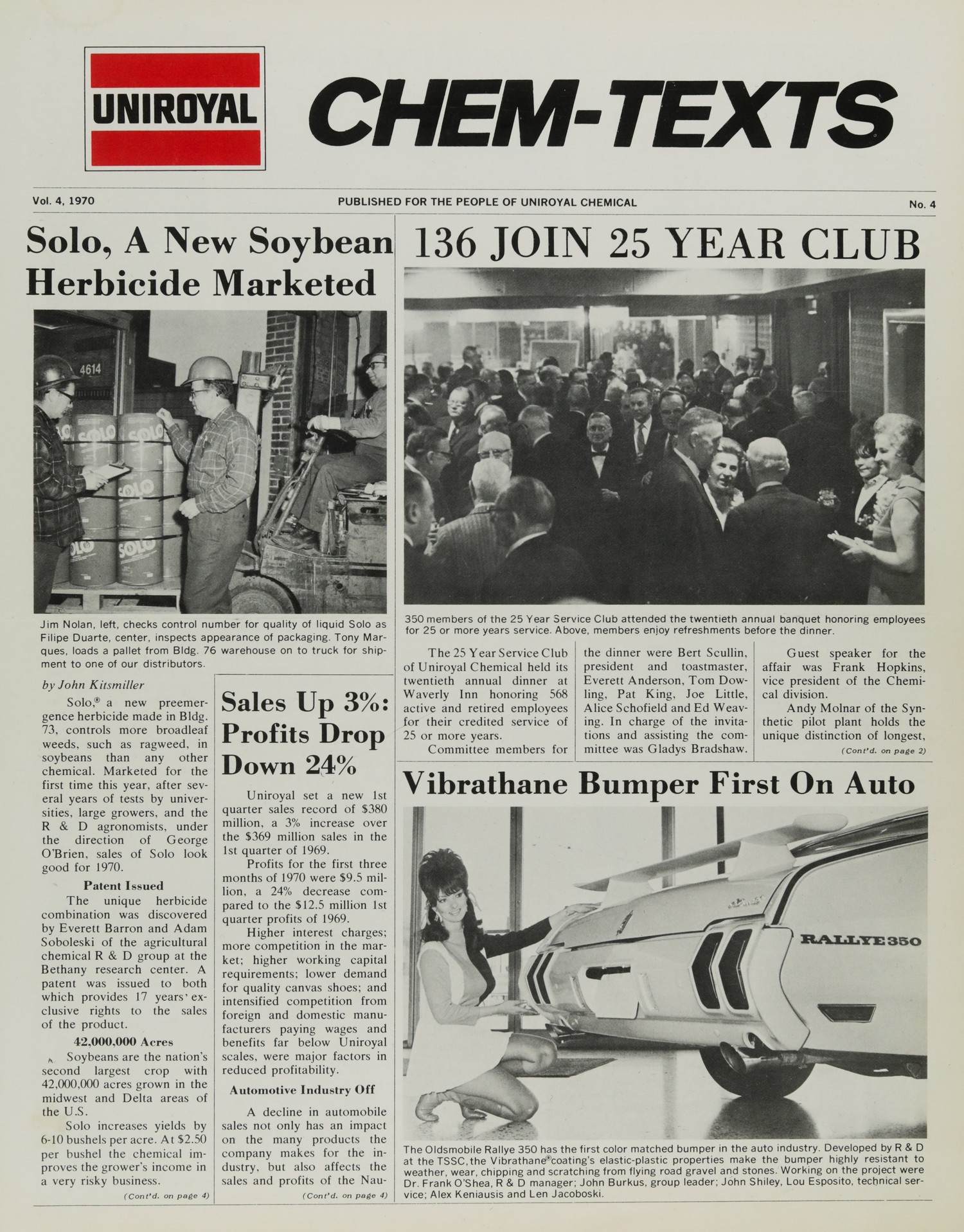
Solo, A New Soybean Herbicide Marketed
Jim Nolan, left, checks control number for quality of liquid Solo as
Filloe Duarte, center, inspects packaging. Tony Mar-ques, loads a pallet from Bldg. 76 warehouse on to truck for ship-
ment to one of our distributors.
Solo*, a new preemer-gence herbicide made in Bldg. 73, controls more broadleaf weeds, such as ragweed, in soybeans than any other chemical marketed for the first time this year, after sev-eral years of tests by univer-sities, large growers, and the R & D agronomists, under the direction of George O’Brien. Sales of Solo look good for 1970.
The unique herbicide combination was discovered by Everett Barron and Adam Soboleski of the agricultural chemical R & D group at the Bethany research center. A patent was issued to both which provides 17 years’ ex-clusive rights to the sales of the product.
42,000,000 Acres
A Soybeans are the nation’s second largest crop with 42,000,000 acres grown in the midwest and Delta areas of the U.S.
Solo increases yields by 6-10 bushels per acre. At $2.50 per bushel the chemical im-proves the grower’s income, a very risky business.
136 JOIN 25 YEAR CLUB
350 members of the 25 Year Service Club attended the twentieth annual banquet honoring employees for 25 or more years service. Above, members enjoy refreshments before the dinner.
The 25 Year Service Club of Uniroyal Chemical held its twentieth annual dinner at Waverly Inn honoring 358 active and retired employees for their credited service of 25 or more years.
Commentate members for
this occasion were Gladys Bradshaw.
Guest speaker for the affair was Frank Hopkins, vice president of the Chem-
ical division.
Andy Molnar of the Synthet-
tic pilot plant holds the unique distinction of longest, continous service.
Urethane Bumper First On Auto
The Oldsmobile Rallye 350 has the first color matched bumper in the auto industry. Developed by R & D as part of the new GSX engine package, the bumper resistant to weather, wear, chipping and scratching from flying road gravel and stones. Working on the project were Dr. Frank O’Shea, R & D manager: John Burgus, group leader; John Shirley, Lou Esposito, technical ser-
vice; Alex Kamaras and Jean Jacocks.
Sales Up 3%; Profits Drop Down 24%
Uniroyal set a new 1st quarter sales record of $350 million, a 3% increase over the $339 million sales in the 1st quarter of 1969. Profits for the first three months of 1970 were $9.5 million, a 24% decrease compared to the $12.5 million 1st quarter profits of 1969.
Higher interest charges; more competition in the mar-ket; higher working capital requirements; lower demand for quality canvas shoes; and intensified competition from foreign and domestic manu-facturers paying wages and benefits far below Uniroyal scales, were major factors in reduced profitability.
Automotive Industry Off
A decline in automobile sales not only has an impact on the many products the company makes for the in-dustry, but also affects the sales and profits of the Nau-
tical Division.
—
## Page 002
Page 2
Vol. 4, No. 4
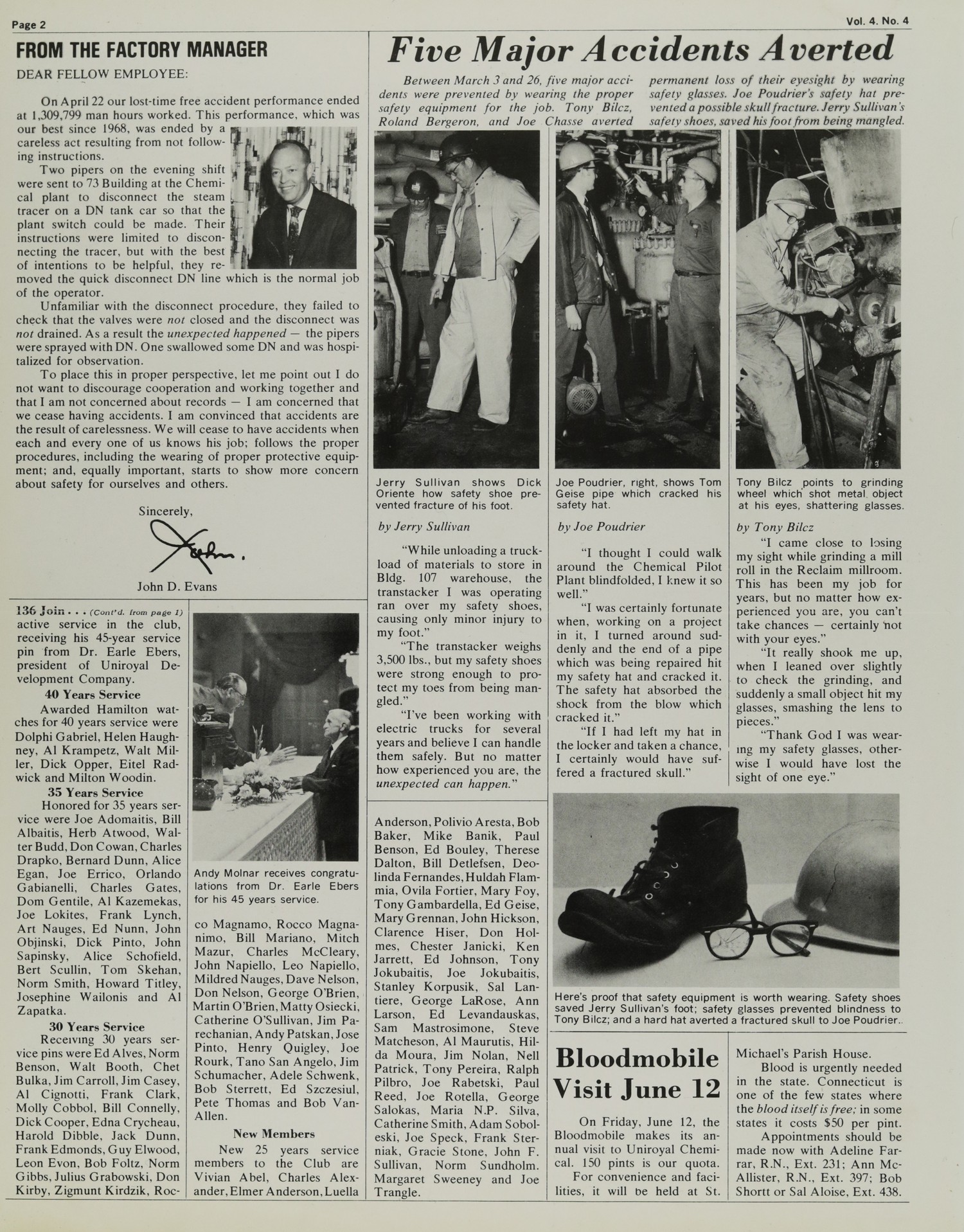
FROM THE FACTORY MANAGER
DEAR FELLOW EMPLOYEE:
On April 22 our lost-time-free accident performance ended with 1,309,709 man hours worked. This performance, which was our best since 1968, was ended by a careless act resulting from not following instructions.
Two pipers on the evening shift were sent to 7-3 Building at the Chemical plant to disconnect the steam tracer on a DN tank car so that the plant switch could be made. Their instructions were limited to disconnecting the tracer, but with the best of intentions to be helpful, they removed the quick disconnect DN line which is the normal job of the operator.
Unfamiliar with the disconnect procedure, they failed to check that the valves were not closed and the disconnect was not drained. As a result the unexpected happened – the pipers were sprayed with DN. One swallowed some DN and was hospitalized.
I do not wish to discourage cooperation and working together and that I am not concerned about records – I am concerned that we cease having accidents. I am convinced that accidents are the result of carelessness. We will cease to have accidents when each and every one of us knows his job; follows the proper procedures, including the wearing of proper protective equipment; and, equally important, starts to show more concern about safety for ourselves and others.
Sincerely,
John D. Evans
136 Join… (Cont’d, from pg. 1) active service in the club, receiving his 45-year service pin from Dr. Earle Ebers, president of Universal Development Company.
40 Years Service Awarded Hamilton watches for 40 years service were Delphi Gabriel, Helen Haughney, Al Krampetz, Walt Meuller, Dick Opper, Elide Radwick and Milton Woodin.
35 Years Service Honored for 35 years service were Joe Adomaitis, Bill Athanas, Herb Atwood, Walter Budd, Don Cowan, Charles Drapko, Bernard Dunn, Alice Egan, Joe Errico, Orlando Gabilgnall, Charles Gates, Dom Gentile, Al Kazemekas, Joe Kuckie, Frank Lynch, Art Nauges, Ed Nunn, John Oblinski, Dick Pinto, John Sapinsky, Alice Schofield, Bert Scullin, Tom Skehan, Norm Smith, Howard Titley, Josephine Walkins and Al Zapaska.
30 Years Service Receiving 30 years service pins were Lester Benson, Walt Booth, Chet Briggs, Jim Carroll, Jim Casey, Al Clendulf, Frank Clark, Molly Cobol, Bill Connelly, Dick Cooper, Ervin Creighton, Harold Dibble, Jack Dion, Fred Edmonds, Guy Eylwood, Leon Evon, Bob Davis, Norm Gibbs, Julius Grabowski, Don Kirby, Zygmunt Kridek, Robert Taisey.
New Members New 25 years service members to the club are Vivian Abel, Charles Alexander, Elmer Anderson, Lucelia Crump, Edna Kundrat, Margaret Sweeney and Joe Trangele.
Five Major Accidents Averted
Between March 22 and 26 five major accidents were prevented by wearing the proper safety equipment for the job. Tony Bilcz, Roland Bergeron, and Joe Chasse averted a possible skull fracture; Jerry Sullivan’s safety hat prevented a possible loss of his eyesight by averting a hard nail from striking his eyes. Joe Poudrier’s safety hat prevented a possible skull fracture.
Jerry Sullivan shows Dick Oriente how safety shoe prevented a fracture of his foot.
by Jerry Sullivan
“While unloading a truck-
load of materials to store in
Bldg. 107 warehouse, the
transracker I was operating
tipped over on my safety shoes,
causing only minor injury to
my foot.”
The transracker weighs
3,500 lbs., but my safety shoes
were strong enough to protect my toes from being mangled.”
“I’ve been working with
electric trucks for several
years and believe I can handle
them safely. But no matter
how experienced you are, the
unexpected can happen.”
Joe Poudrier, right, shows Tom
Close pipe which cracked his
safety hat.
by Joe Poudrier
“I thought I could walk
around the Chemical Pilot
Plant blindfolded, I knew it so
well.”
“I was certainly fortunate
when, working on a project
in it, I turned around suddenly and the end of a pipe
which was being repaired hit
my safety hat and cracked it.
The safety hat absorbed the
shock from the blow which
cracked it.”
“If I had left my hat in
the locker and taken a chance,
I certainly would have suffered a fractured skull.”
Tony Bilcz points to grinding
wheel which shot metal objects
at his eyes, shattering glasses.
by Tony Bilcz
“I came close to losing
my sight while grinding a mill
roll in the Reclaim millroom,
several years ago when, no
matter how experienced you
are, you can take chances – certainly not with your eyes.”
“It really shook me up,
when I leaned over slightly
to check the grinding, and
suddenly a small object hit my
glasses, smashing the lens to
pieces.”
“Thank God I was wearing my safety glasses, otherwise I would have lost the
sight of one eye.”
Anderson, Polivio Aresta, Bob
Baker, Mike Bank, Paul
Benson, Ed Boulley, Therese
Dalton, Bill Dedeklen, Dorinda Fernandes, Huldah Flammia, Ovilia Fortier, Mary Fox,
Tony Gambardella, Ed Geise,
Mary Greman, John Hickson,
Clarence Hiser, Don Holmes, Chester Janicki, Ken
Jarrett, Ed Johnson, Tony
Jokubaitis, Joe Korpusik, Stanley Korpusik, Sal Lanstrom, George LeRose, Al
Larson, Ed Levandauskas,
Steve Masterson, Steve
Matcheson, Al Mauritis, Hildia Moran, Jim Nolan, Neil
Patrick, Tony Pereira, Ralph
Pillow, Joe Rabbetts, Paul
Reed, Joe Rotella, George
Saloka, Dunia N.P. Silva, Catherine Smith, Adam Sobolewski, Joe Speck, Frank Sternik, Gracie Stone, John F. Sullivan, Norm Sunholm,
Margaret Sweeney and Joe
Trangele.
Here’s proof that safety equipment is worth wearing. Safety shoes
saved Jerry Sullivan’s foot; safety glasses prevented blindness to
Tony Bilcz, whose eyes had avoided a fractured skull by Joe Poudrier.
Bloodmobile
Visit June 12
On Friday, June 12, the Bloodmobile makes its annual visit to Uniroyal Chemical. 1:50 pints is our quota.
For convenience and facilities, it will be held at St. Michael’s Parish House.
Blood is urgently needed
in the state. Connecticut is
one of the few states where
the blood rate/per capita in
states it costs $50 per pint.
Appointments should be
made now with Adeline Farrar, R.N., Ext. 231; Aris McAllister, R.N., Ext. 397; Bob
Shortt or Sal Aloise, Ext. 438.
—
## Page 003
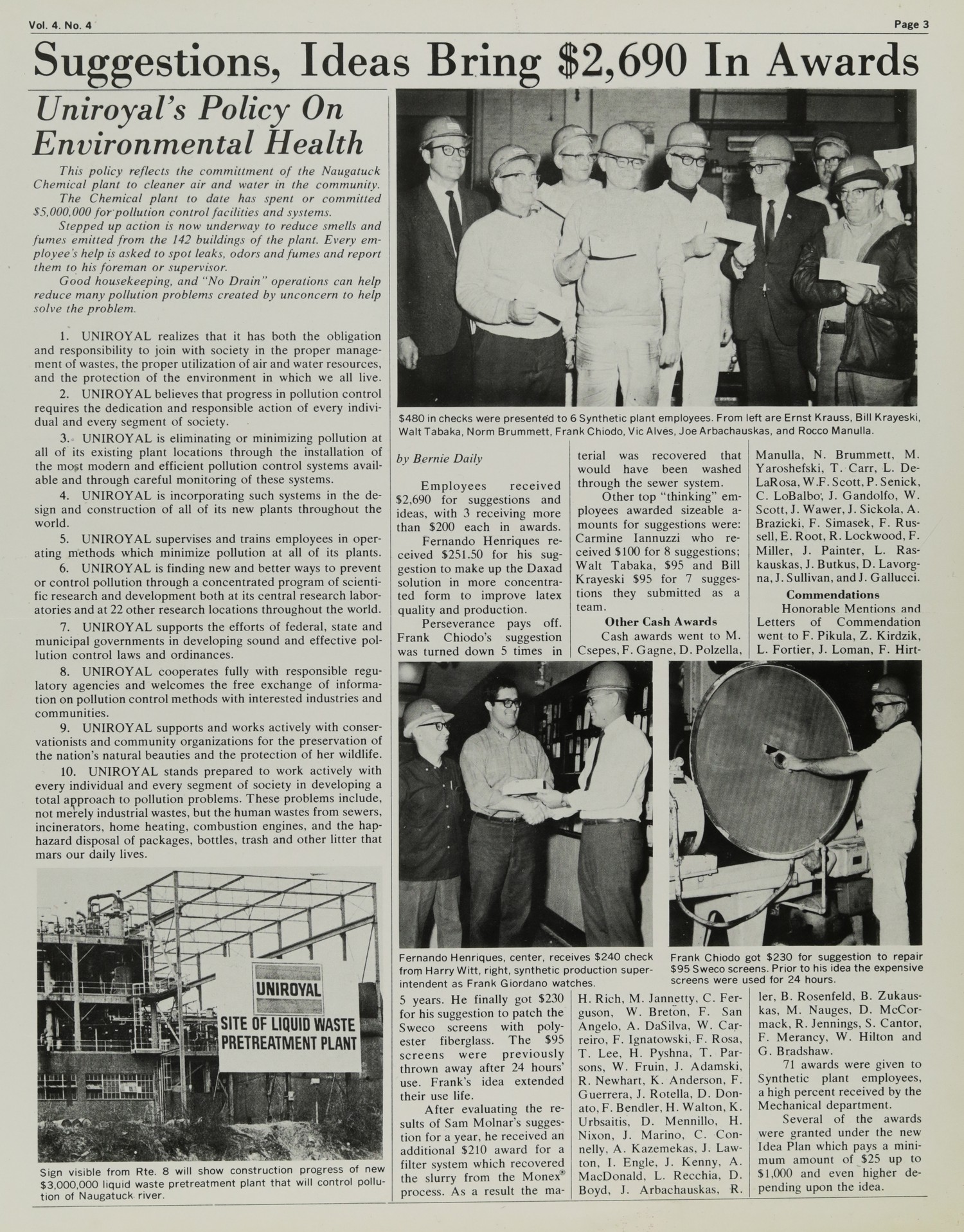
Suggestions, Ideas Bring $2,690 In Awards
Uniroyal’s Policy On Environmental Health
This policy reflects the commitment of the Naugatuck
Chemical plant to cleaner air and water in the community.
The Chemical plant to date has spent $5,000,000 for pollution control facilities and systems.
Stepped up action is now underway to reduce smells and
fumes emitted from the 42 buildings of the plant. Every em-
ployee’s help is asked to spot leaks, odors and fumes and report
them to his foreman or supervisor.
Good housekeeping, and “No Drain” operations can help
reduce many pollution problems created by uncon-
cern to help
solve the problem.
1. UNIROYAL realizes that it has both the obligation
and responsibility to join with society in the proper manage-
ment of wastes, the proper utilization of air and water resources,
and the protection of the environment in which we all live.
2. UNIROYAL believes that progress in pollution control
requires the dedication and responsible action of every individ-
ual and every segment of society.
3. UNIROYAL is eliminating and minimizing pollution at
all of its existing plant locations through the installation of
the most modern and efficient pollution control systems avail-
able and through careful monitoring of these systems.
4. UNIROYAL is incorporating such systems in the de-
sign and construction of all of its new plants throughout the
world.
5. UNIROYAL supervises and trains employees in operat-
ing methods which minimize pollution as one of its plants.
6. UNIROYAL is finding new and better ways to prevent
or control pollution through a concentrated program of scien-
tific research and development both at its central research labor-
atories and at 22 other research locations throughout the world.
7. UNIROYAL supports the efforts of federal, state and
municipal governments in developing sound and effective pol-
lution control laws and ordinances.
8. UNIROYAL cooperates fully with responsible reg-
ulatory agencies and welcomes the free exchange of informa-
tion on pollution control methods with interested industries and
communities.
9. UNIROYAL supports and works actively with conser-
vation-ists and community organizations for the preservation of
the nation’s natural beauties and the protection of her wildlife.
10. UNIROYAL stands prepared to work actively with
every individual and every segment of society in developing a
total approach to pollution problems. These problems include,
not merely industrial wastes, but the human wastes from sew-
ers, incinerators, home heating, combustion engines, and the haz-
ard disposal of packages, bottles, trash and other litter that
mars our daily lives.
Sign visible from Rte. 8 will show construction progress of new
$3,000,000 liquid waste pretreatment plant that will control pollu-
tion of Naugatuck river.
$480 in checks were presented to 6 Synthetic plant employees. From left are Ernest Krauss, Bill Krayeski, Walt Tabaka, Norm Drumm, Frank Chiodo, Joe Arbuthnot, and Rocco Manulla.
The material was recovered that would have been washed through the sewer system after giving rise to the “thinking” em-
ployees awarded sizable a-mounts for their suggestions were:
Carmine Iannuzzi who re-ceived $240 for 8 suggestions; Walt Tabaka, $95 and Bill Kraveski $95 for 7 suggestions they submitted as a team.
Other Cash Awards
Cash awards went to M. Cespes, F. Gagne, D. Polzella, F. Pitula, Z. Kinlek, E. Fortier, J. Loman, F. Hirt, P. Pitula, Z. Kinlek.
Fernando Henriques, center, receives $240 check
from Harry Will, right, synthetic production super-
intendent as Frank Giordano watches.
He finally got $230 for his suggestion to patch the
Sweco screens with poly-ester fiberglass. The $95
screens were previously thrown away after 24 hours
use. Frank’s idea extended their use life.
After evaluating the re-sults of Sam Molnar’s sugges-
tion for a year, he received an additional $210 award for a
filter system which recovered the slurry from the Money-
process. As a result the ma-
Frank Chiodo got $230 for suggestion to repair
395 Sweco screens. Prior to his idea the expensive
screens were used for 24 hours.
11 awards were given to Synthetic plant employees.
a high percent received by the Mechanical department.
Several of the awards were granted along the line
of the Idea Plan which pays a min-imum amount of $25 up to
$1,100 and even higher de-pending upon the idea.
—
## Page 004
Page 4
CHEM-TEXTS
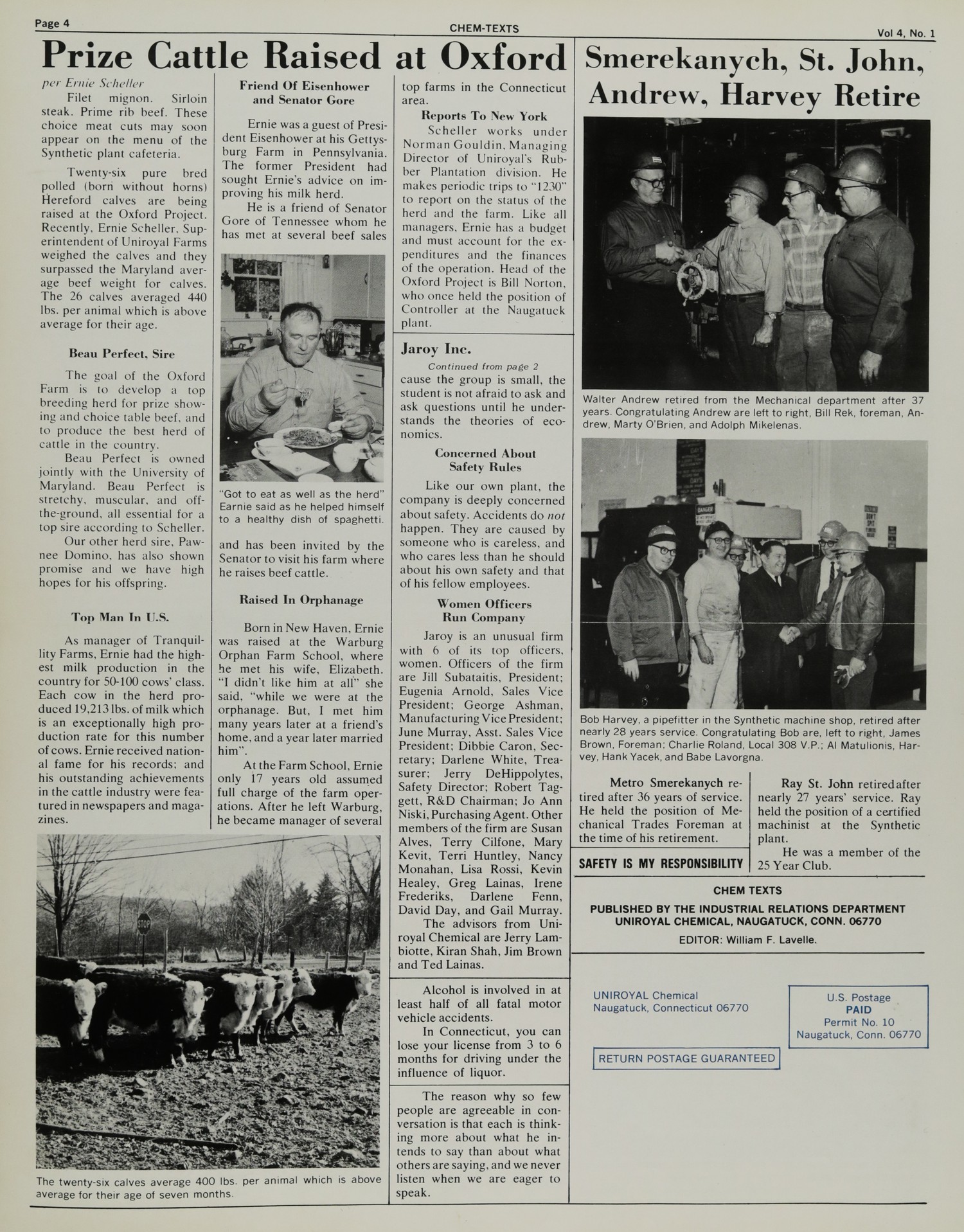
Prize Cattle Raised at Oxford
per Ernie Scheller
Flat – minion, Sirloin
steak. Prime rib beef. These
choice meat cuts may soon
appear on the menu of the
Symbolic Club cafeteria.
Twenty-six pure bred
polled Hereford heifer s)
Hereford calves are being
raised at the Oxford Project.
Recently, Ernie Scheller, Superintendent of Uniroyal Farms
weighed the calves and they
surprised the Maryland averagerate beef weight for calves.
The 26 calves averaged 440
lbs. per animal which is above
average for their age.
Vol 4, No. 1
Smerekanych, St. John,
Andrew, Harvey Retire
Friend of Eisenhower
and Senator Gore
Ernie was a guest of President Eisenhower at his Gettysburg Farm in Pennsylvania.
The former President had
sought Ernie’s advice on improving his milk herd.
He is a friend of Senator
Gore of Tennessee whom he
has met at several beef sales.
Beau Perfect, Sire
The goal of the Oxford
Farm is to develop a top
breeding herd for public showing and the production
to produce the best breed of
cattle in the country.
Beau Perfect is owned
jointly with the University of
Maryland. Beau Perfect is
streely, muscular, and offground, all essential for a
top sire according to Scheller.
Our other herd sire, Pawnmonium, has also shown
promise and we have high
hopes for his offspring.
Top Man In U.S.
As manager of Tranquility Farms, Ernie had the highest milk production in the
country for 50-100 cows’ class.
Each cow in the herd produced 19,213 lbs. of milk which
is an exceptionally high production rate for this number
of cows. Ernie received national fame for his records; and
his outstanding achievements
in the cattle industry were featured in newspapers and magazines.
Jaroy Inc.
Continued from page 2 causes the group is small, the
student is not afraid to ask and
ask questions until he understands the theories of economics.
“Got to eat as well as the herd”
Ernie said as he helped himself
to a healthy dish of spaghetti
and has been invited by the
Senator to visit his farm where
he raises blue cattle.
Raised In Orphanage
Born in New Haven, Ernie
was raised at the Warburg
Orphan Farm School, where
his mother, the late Elizabeth
“I didn’t like him at all” she
said, “while growing up in the
orphanage. But, I met the
many years later in a friend’s
home, and a year later married
him”.
At the Farm School, Ernie
only 17 years old assumed
full charge of the farm operations. After he left Warburg,
he became manager of several
Concerned About
Safety Rules
Like our own plant, the
company is deeply concerned
about safety. Accidents do not
happen. They are caused by
someone who is careless, and
does not take precautions
about his own safety and that
of his fellow employees.
Women Officers
Run Company
Jaroy is an unusual firm
with 6 of its top officers,
women. Officers of the firm
are Jill Sulatisits, President;
Eugenia Arnold, Sales Vice
President; George Ashman,
Manufacturing Vice President;
June Murray, Asst. Sales Vice
President; Dibble Garon, Secretary; Darlene Weiss, Treasurer; Jerry DeHilippolyts,
Safety Director; Robert Taggart, R&D Chairman. Jo Ann
Nikki, Purchasing Agent. Other
members of the firm are Susan
Alves, Terry Cilflone, Mary
Kevin, Terri Huntley, Nancy
Monahan, Lisa Rossi, Kevin
Healey, Greg Latinas, Irene
Frederiks, Darlene Fenn,
David Day, and Gail Murray.
The advisors from Uniroyal Chemical are Jerry Lambiolotte, Kiran Shah, Jim Brown
and Ted Lamas.
Walter Andrew retired from the Mechanical department after 37
years.Congratulating Andrew are left to right: Bill Ries, forman, Andrew, Marty O’Brien, and Adolph Mikelennas.
Bob Harvey, a pipefitter in the Synthetic machine shop, retired after
nearly 28 years service. Congratulating Bob are, left to right: James
Zaccaro, Foreman; Charlie Roland, Local 251 F. of M.,Mathieson; Harvey, Hank Vacek, and Babe Lovergio.
Ray St. John retired after
nearly 27 years service. He
held the position of a certified
mechinist at the Synthetic
plant.
Ray was a member of the
Safety Club.
Alcohol is involved in at
least half of all fatal motor
vehicle accidents.
In Connecticut, you can
lose your license from 3 to 6
months for driving under the
influence of liquor.
The reason why so few
people are agreeable in conversation is that each is thinking more about what he intends to say than about what
others are saying, and we never
listen when we are eager to
speak.
CHEM-TEXTS
PUBLISHED BY THE INDUSTRIAL RELATIONS DEPARTMENT
UNIROYAL CHEMICAL, NAUGATUCK, CONN. 06770
EDITOR: William F. Lavelle
UNIROYAL Chemical
Naugatuck, Connecticut 06770
U.S Postage
PAID
Permit No. 10
Naugatuck, Conn. 06770
RETURN POSTAGE GUARANTEED
—