
## Page 001
UNIROYAL CHEM-TEXTS
Vol. 4, 1970 No. 7
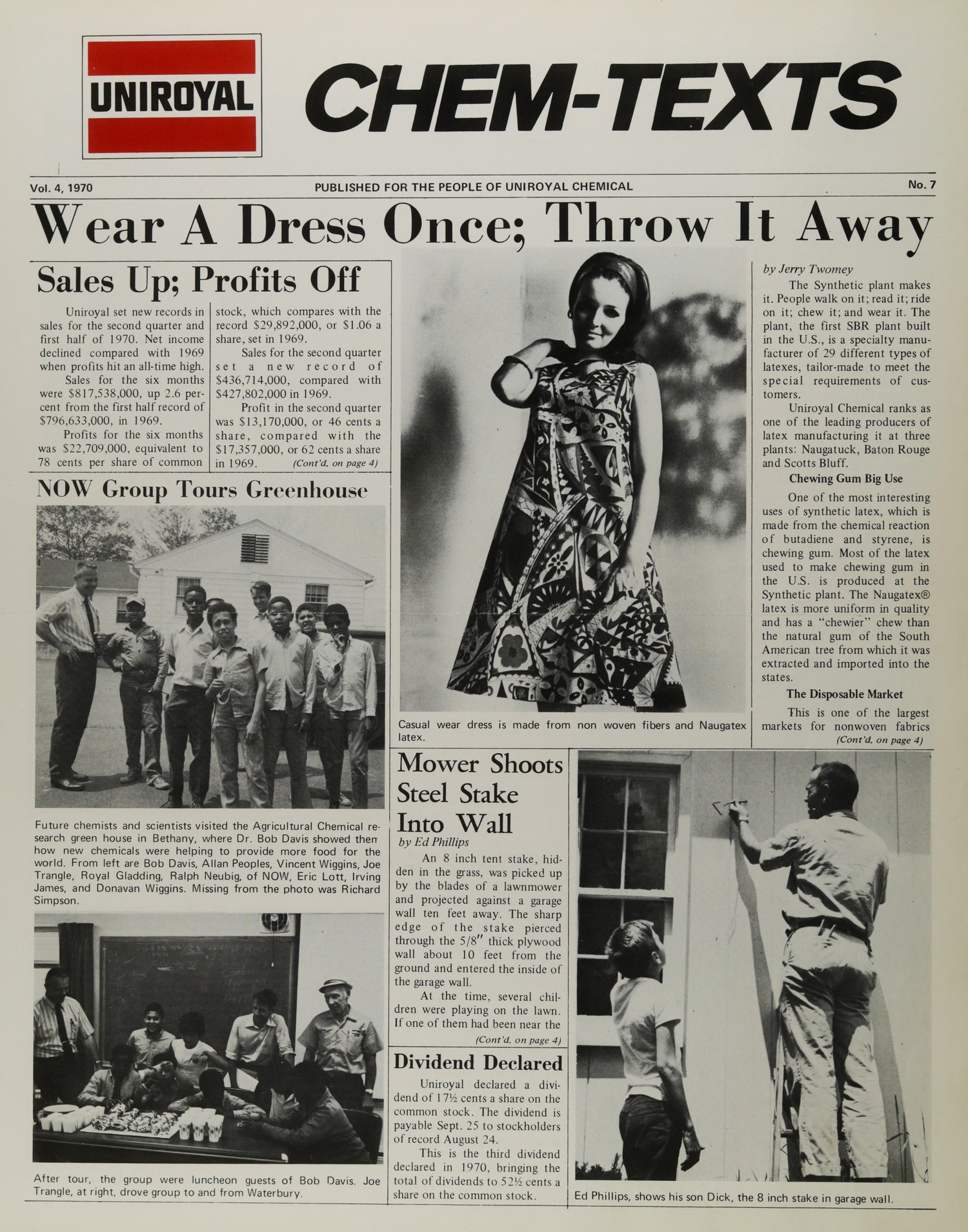
Wear A Dress Once; Throw It Away
Sales Up; Profits Off
Uniroyal set new records in sales for the second quarter and first half of 1970. Net income declined compared with 1969 when profits hit an all-time high.
Sales for the six months were $157,588,000, up 2.5 percent from the first half record of $796,653,000, in 1969.
Profits for the six months was $22,709,000, equivalent to 78 cents per share of common stock, which compares with the record $29,892,000, or $1.06 a share, set in 1969.
Sales for the second quarter set a new record of $86,714,000, compared with $27,802,000 in 1969.
Profit in the second quarter was $13,170,000, or 46 cents a share, compared with the $17,357,000, or 62 cents a share in 1969.
NOW Group Tours Greenhouse
Future chemists and scientists visited the Agricultural Chemical research green house in Bethany, where Dr. Bob Davis showed them how new chemicals were helping to provide more food for the world. The group included: Walter Peoples, Vincent Wallace, Triangle, Royal Gladding, Ralph Neudig, of NOW, Eric Lott, Irving James, and Donovan Wiggins. Missing from the photo was Richard Simpson.
After tour, the group were luncheon guests of Bob Davis, Joe Triangle, at right, drove group to and from Waterbury.
Mower Shoots Steel Stake
Into Wall
An 8 inch tent stake, hidden in the grass, was picked up by the blades of a lawnmower and projected against a garage wall ten feet away. The sharp edge of the stake pierced through the 5/8 inch plywood wall about 10 feet from the ground and entered the inside of the garage wall.
At the time, several children were playing on the lawn. If one of them had been near the wall, he could have been seriously injured.
Ed Phillips, shows his son Dick, the 8 inch stake in garage wall.
Casual wear dress is made from non-woven fibers and Naugatex latex.
Dividend Declared
Uniroyal declared a dividend of 17¢ cents a share on the common stock. The dividend is payable Sept. 25 to stockholders of record August 24.
This is the third dividend declared in 1970, bringing the total of dividends to 52¢ cents a share on the common stock.
The Disposable Market
This is one of the largest markets for nonwoven fabrics.
Chewing Gum Big Use
One of the most interesting uses of synthetic latex, which is made from the chemical reaction of butadiene and styrene, is chewing gum. Most of the latex used to make chewing gum in the U.S. is produced at the Synthetic plant. The Naugatex® latex is more uniform in quality and has a “chewier” chew than the natural gum of the South American tree from which it was extracted and imported into the states.
The Synthetic plant makes Naugatex latex. People walk on it; read on it; wear it. The plant, the first SBR plant in the U.S., is a specialty manufacturer of 29 different types of latexes, tailor-made to meet the special requirements of its customers. Uniroyal Chemical ranks as one of the leading producers of latex manufacturing in at three plants: Naugatuck, Baton Rouge and Scotts Bluff.
—
## Page 003
Here is the text extracted from the document image:
KNOW YOUR BENEFITS:
Some Questions And Answers On
Uniroyal’s Tuition Aid Program
by Marion Hutt
About seventy-three Uniroyal Chemical employees improved
their education and their opportunities for advancement in their jobs
by taking job related courses during the 1968-69 academic year with
the help of Uniroyal’s Tuition Aid Program. (1969-70 figures were
unavailable for this issue).
For those of you who are not familiar with the plan, here is
some helpful information on the program which is available to all
employees.
Q. What Is It?
A. To encourage self-develop-
ment and education of all em-
ployees, Uniroyal will reimburse
you for the full tuition cost and
lab fees necessary in any course
taken which is related to your
current job or will be of value, as
determined by the Company, in
future promotional areas.
All Employees Eligible
Q. Is the program available to
wage and salary personnel?
A. Yes, it is available to all full-
time employees.
Q. Do I have to notify the Com-
pany of the course I wish to
take?
A. Only fully accredited institu-
tions or professionally recog-
nized associations are approved.
Q. What schools qualify in the
area?
A. University of Connecticut
(Waterbury Branch), Fairfield
University, University of Hart-
ford, University of Bridgeport,
Sacred Heart University, Trinity
College, Mattatuck Community
College, West Connecticut State
College, Central Connecticut
State College, Southern Con-
necticut State College, KPI
(Hartford Branch), Waterbury
State Technical College, Kaynor
Three Story Glass Tube
Reduces Water Pollution
Unions
Ratify
Contracts
URW Local 218 which repurcent wage employees in the
Chemical plant and URW Local
208, which represents wage em-
ployees in the Synthetic plant,
ratified the 3 year contract be-
tween Uniroyal and the United
Rubber Workers.
The new contract repre-
sents a wage and benefit pack-
age of 25 cents an hour, over the
3 year period.
Participating in the 4
mator negotiations in New
York City plant were Ron
Mitchinson, Industrial Relations
Manager; Joe Walker, Presi-
dent, Local 218; and Leon Ras-
kauskas, President, Local 208.
Other features of the new
contract are five weeks vacation
after 20 years; one additional
holiday decided on a local basis,
and improved pension and insur-
ance benefits.
Longer
Weekends
In 1971
Last year Congress passed
the Monday Holidays Law,
which assigns certain holidays to
specified Mondays instead of
being celebrated on calendar
dates. For example, Memorial
Day which has traditionally been
celebrated on May 30 will now
be celebrated on the last Mon-
day in May.
At the plant two holidays
will be gained in 1971 on
Mondays: Memorial Day, the
last Monday in May for chemical
and reclaim; and Columbus Day,
the 2nd Monday in October for
the Synthetic plant.
The basic idea behind the
longer weekend is to give “short
vacations” – provide more time
home; and planned recreation
activities with the family. Per-
haps it means more work around
the house, fixing and repairing
the long list of things to be
done.
Long weekends have one
some aspect. Experience has
shown that the death rate from
accidents on highways and at
home hit a high mark of
500-600 deaths. Hopefully, sta-
tistics will prove otherwise and
more safety will be observed on
the roads and at home.
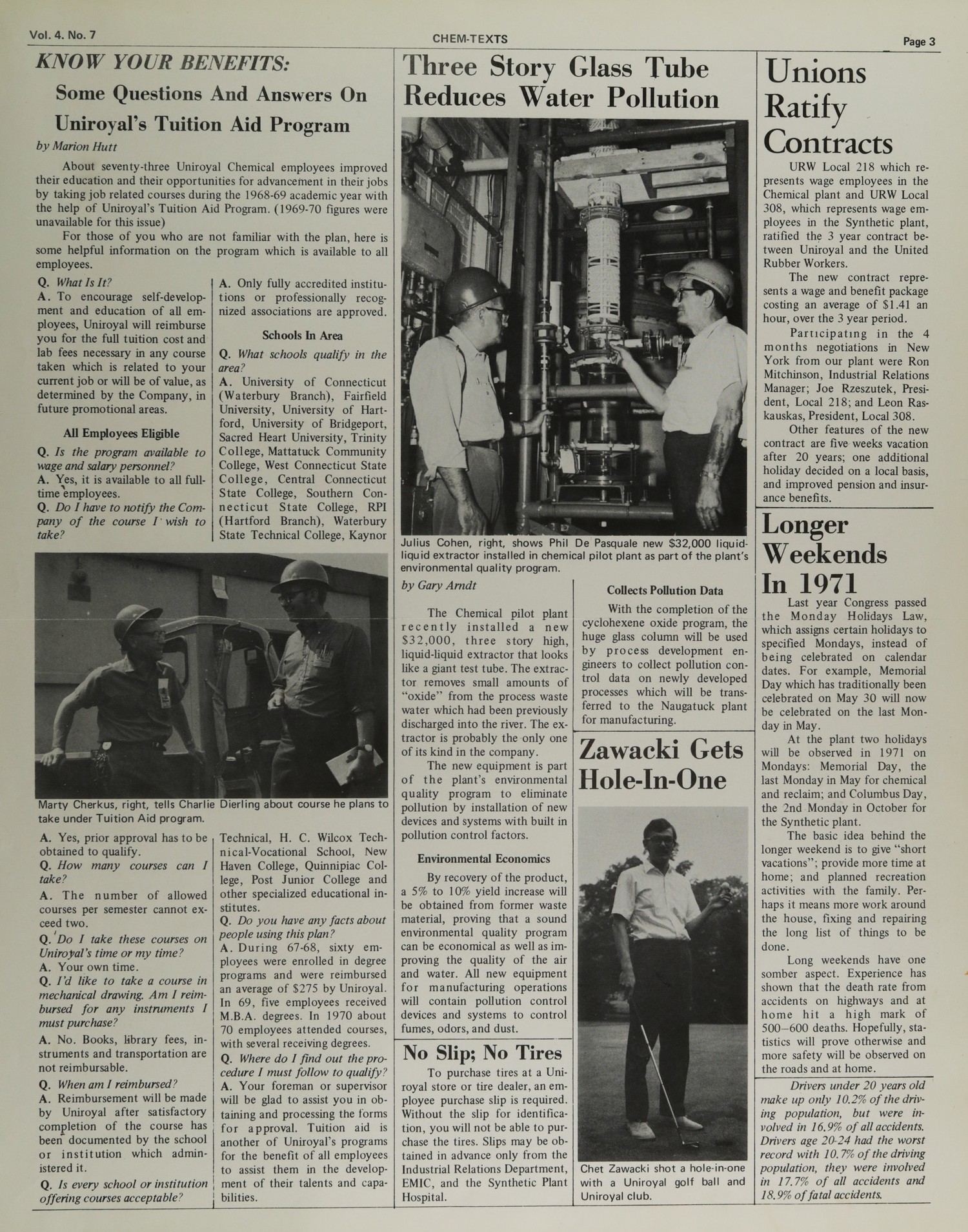
Julius Cohen, right, shows Phil De Pasquale new $32,000 liquid-
liquid extractor installed in chemical pilot plant as part of the plant’s
environmental quality program.
by Gary Arndt
The chemical pilot plant
recently installed a new
$32,000 liquid-liquid extractor
looks like a giant test tube.
The device removes small amounts of
“oxide” from the process stream
of water which had been previously
discharged into the river. The ex-
tractor is probably the only one
of its kind in the company.
The new equipment is part
of the plant’s environmental
quality program to eliminate
pollution by installation of new
devices and systems with built in
pollution control factors.
Environmental Economics
By recovery of the product,
a 5% to 10% yield increase will
be obtained from former waste
material, proving that a sound
environmental quality program
can be economical as well as im-
proving the quality of the air
and water. All new equipment
for manufacturing operations
will contain pollution control
devices and systems to control
fumes, odors, and dust.
No Slip; No Tires
To purchase tires at a Uni-
royal store or tire dealer, an em-
ployee purchase slip is required.
Without the slip for identifica-
tion, you will not be able to pur-
chase the tires. Slips may be ob-
tained in advance only from the
Industrial Relations Department,
the EMIC, and the Synthetic Plant
Hospital.
Zawacki Gets
Hole-In-One
With the completion of the
cyclohexene oxide program, the
huge glass column will be used
by process development en-
gineers to collect pollution con-
trol data on newly developed
processes which will be trans-
ferred to the Naugatuck plant
for manufacturing.
Drivers under 20 years old
make up only 10.7% of the driv-
ing population, but were in-
volved in 16.8% of all accidents.
Drivers age 20-24 had the worst
record with 10.7% of the driving
population, they were involved
in 17.7% of all accidents and
18.9% of fatal accidents.
—
## Page 004
Here is the text extracted from the document image, preserving the layout and structure as much as possible:
Safety Goal Stops At 650,000 Hours
The safety goal of 1,000,000 manhours was stopped at 650,000 manhours. A chemical production operator lost a small portion of his right finger when it was caught under the belt of the drive on a crusher machine. Quick action by him prevented a more serious loss to his other fingers and hand.
The accident was the first lost time one in almost 3 months. It was another case of the unexpected happening. As a result of it, the man suffered an unnecessary loss of a finger.
Lost Time Accidents Drop
This was the third lost time accident for six months of 1970, a significant improvement over 1969 when 12 lost time accidents occurred. This improved concern for the safety of ourselves and other people makes the plant a better, safer place to work.
Serious Injuries Up
Although lost time accidents dropped, serious injuries increased from 28 in 1969 to 33 for the six months of 1970. In June there were 4 serious injuries: 2 lacerations, 1 bruised elbow, and a pulled muscle. These injuries could have been lost time accidents but luck helped, and the employees involved escaped greater injury. Serious in-juries can be stopped by not taking chances on the job and by checking work conditions care-fully.
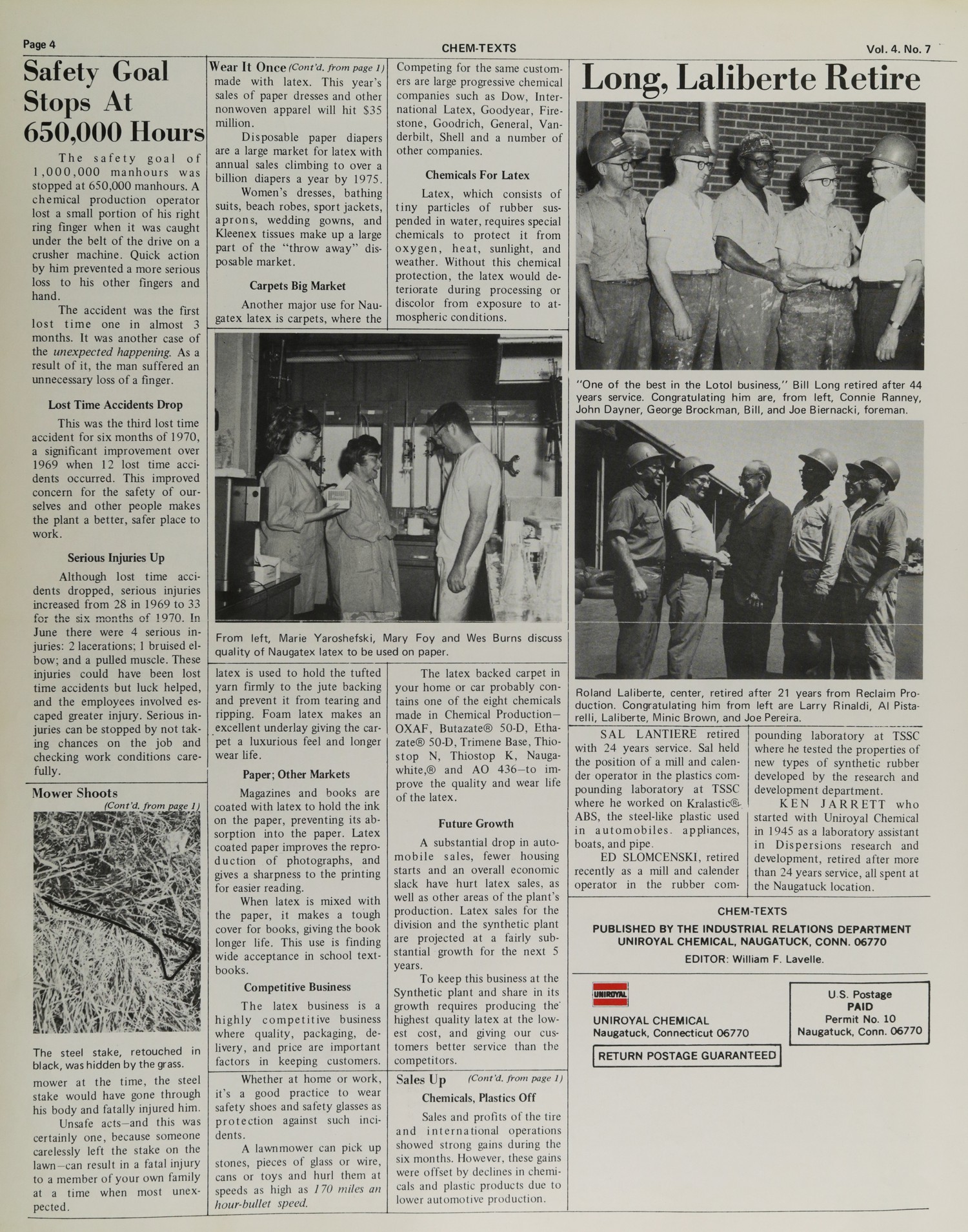
Mower Shoots
The steel stake, retouched in black, was hidden by the grass. As the time, the stake would have gone through his body and fatally injured him. Unsafe acts–and this was certainly one–because someone carelessly left the stake on the lawn–can result in a fatal injury to a member of your own family at a time when most unexpected.
Wear It Once (Cont’d. from page 1)
made with latex. This year’s sales of paper dresses and other nonwoven apparel will be $35 million.
Disposable paper diapers are a large market for latex with annual sales climbing to over a billion diapers a year by 1975.
Women’s dress shields and Kleenex tissues make up a large part of the “throw away” dis-posable market.
Carpets Big Market
Another major use for Nau-gapex latex is carpets, where the latex backed carpet in your home or car probably contains one of the eight chemicals made by a Chemical Pro-duction. OXAF, Butazate® 30-DD, Ethazate® SOD, Trimene Base Thio-stop N, Thioxtrop K, Naugapex 9 and A0 430–to im-prove the quality and wear life of the latex.
Paper, Other Markets
Magazines and books are coated with latex to hold the ink on the paper, preventing its ab-sorption onto the paper. Latex coated paper improves the repro-duction of photographs, and gives a sharpness to the printing for easier reading.
When latex is mixed with the paper, it makes a tough cover for books, giving the book longer life. This use is finding wide acceptance in school text-books.
Competitive Business
The latex business is a highly competitive business where quality, packaging, de-livery, and price are important factors in keeping customers.
Whether at home or work, it’s a good practice to wear safety shoes and safety glasses as protection against such inci-dents.
A lawnmower can pick up stones, pieces of glass or wire, cans or toys and hurl them at speeds as high as 170 miles an hour-faster.
Competing for the same cus-tomers are large progressive chemical companies such as Dow, Goodyear, Fire-stone, Goodrich, General, Van-derbilt, Shell and a number of other companies.
Chemicals For Latex
Latex, which consists of small particles of rubber sus-pended in water, requires special chemicals to protect it from weather. Without this chemical protection, the latex would de-teriorate during processing or discolor from exposure to at-mospheric conditions.
Long, Laliberte Retire
“One of the best in the Latex business,” Bill Long retired after 44 years service. Congratulating him are, from left: John Dayner, George Brockman, Bill, and Joe Biernacki, foreman.
Roland Laliberte, center, retired after 21 years from Reclaim Pro-duction. Congratulating him from left are Larry Rinaldi, Al Pitta-luga, Lailbert Tate, Brown, and Joe Biernacki.
SAL LANTIERE retired with 24 years service. Sal held the position of a mill and calender operator in the plastics com-pounding laboratory at TSSC where he worked on Kralastic ABS, the steel-like plastic used in automobiles – appliances, boats, and pipe.
ED SLOMCENSKI, retired recently as a mill and calender operator in the rubber com-pounding laboratory at TSSC where he tested the properties and developed new types of synthetic rubber developed by the research and development department.
KEN JARRETT who started with Uniroyal Chemical in 1945 as a laboratory assistant in Dispersions research and development, retired after more than 24 years service, all spent at the Naugatuck location.
PUBLISHED BY THE INDUSTRIAL RELATIONS DEPARTMENT
UNIROYAL CHEMICAL, NAUGATUCK, CONN. 06770
EDITOR: William F. Lavelle.
U.S. Postage
PAID
Permit No. 10
Naugatuck, Conn. 06770
RETURN POSTAGE GUARANTEED
Sales Up (Cont’d. from page 1)
Chemicals, Plastics Off
Sales and profits of the tire and industrial operations showed strong gains during the six months. However, the gains were offset by declines in chemicals and plastic products due to lower automotive production.
—