
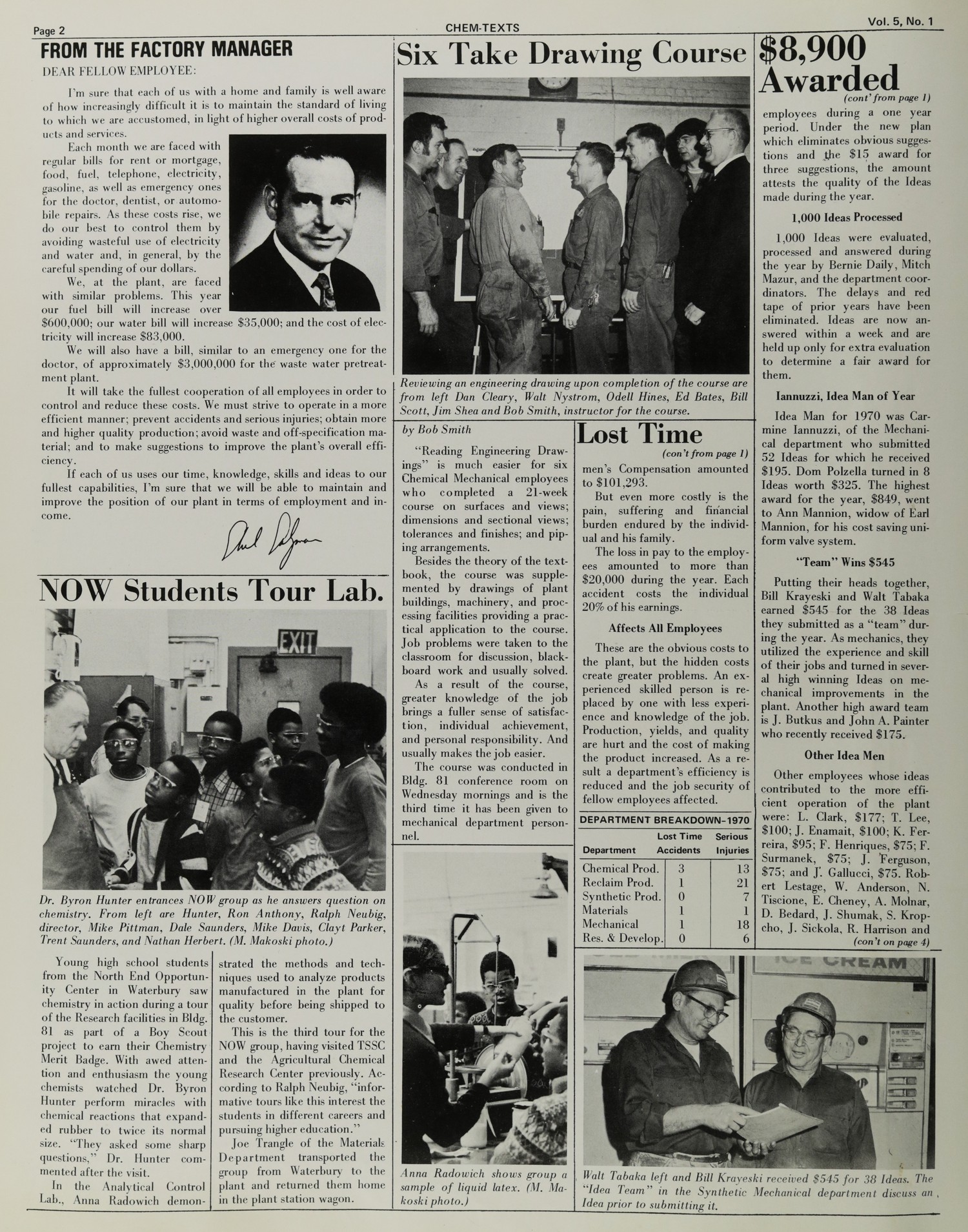
## Page 002
FROM THE FACTORY MANAGER
DEAR FELLOW EMPLOYEE:
I’m sure that each of us with a home and family is well aware of how increasingly difficult it is to maintain the standard of living to which we are accustomed, in light of higher overall costs of products and services.
Each month we are faced with regular bills for rent or mortgage; food, fuel, telephone, electricity, gasoline, as well as emergency ones for the doctor, dentist, or automobile repairs. As these costs rise, we do our best to control them by avoiding wasteful use of electricity and water and, in general, by the careful spending of our dollars.
We, at the plant, are faced with similar problems. This year our fuel bill will increase over $600,000; and the cost of electricity will increase $33,000.
We will also have a bill similar to an emergency one for the doctor, of approximately $3,000,000 for the waste water treatment plant.
It will take the fullest cooperation of all employees in order to control and reduce these costs. We must strive to operate in a more efficient manner; prevent accidents and serious injuries; obtain more efficient quality production; avoid waste and off-specification material; and to make suggestions to improve the plant’s overall efficiency.
If each of us gives our time, knowledge, skills and ideas to our fullest capabilities. I’m sure that we will be able to maintain and improve the position of our plant in terms of employment and income.
NOW STUDENTS TOUR LAB.
[Image of students touring a lab facility]
Young high school students from the North End Opportunity Center in Waterbury saw demonstrations in action during a visit of the Research facilities in Bldg. 81, as part of a Boy Scout project to earn their Chemistry Merit Badge. With saved attention and enthusiasm the young chemists watched Dr. Byron Hunter perform miracles with chemical reactions that expanded rubber to twice its normal size. “They asked some sharp questions,” Dr. Hunter commented.
In the Analytical Control Lab, Anna Radovich demonstrated instruments and methods used to analyze products manufactured in the plant for quality to assure the customer.
Anna Radowich shows a group a sample of liquid asphalt. (AI. McBoski photo.)
SIX TAKE DRAWING COURSE
Reviewing an engineering drawing upon completion of the course are from left Dan Cleary, Walt Nystrom, Odell Lines, Ed Bates, Bill Stahl, Jim Shona and Bob Wartha, instructors.
Lost Time
“Reading Engineering Drawings” is the much easier said than done course for Chemical and Mechanical employees who completed a 21-week course on surfaces and views; dimensions and sections; tolerances and finishes; and piping arrangements.
Besides the theory of the textbook, the course was supplemented by drawings of plant buildings, machinery, and processing facilities providing a practical application to the course.
Job problems were taken to the classroom for discussion, blackboard work and usually solved.
As a result of the course, greater knowledge of the job brings a fuller sense of satisfaction, individual achievement, and personal responsibility. And usually makes the job easier.
Bill Kreyeski, who conducts the Wednesday morning class, says the third time it is given, the mechanical department personnel did extremely well.
$8,900 AWARDED
(cont’d from page 1)
employees during a one year period. Under the new plan
which eliminates obvious suggestions and the $15 award for
three suggestions, the amount attests the quality of the ideas
made during the year.
1,000 Ideas were evaluated, processed and answered during
the year by Bernie Daily, Mich Mazur, and the department coordinators. The delays and red tape of prior years have been eliminated. Ideas are now answered within a week and are held up only for extra evaluation and calculation to determine a fair award for them.
Ianuzzi, Idea Man of Year
Idea Man for 1970 was Carmine Ianuzzi, of the Mechanical department who submitted 52 Ideas for which he received $195. The highest award for the year, $849, went to Ann Manning, widow of Earl Manning, for her cost-saving uniform valve system.
“Team” Wins $545
Putting their heads together,
Bill Krayeski and Walt Talaska
earned $545 for the 38 ideas
they submitted as a “team” during the year. As mechanics, they utilized the experience and skill
of their jobs and turned in several high winning Ideas on mechanical improvements in the
plant. Another high award team
is J. Butkus and John A. Patnter
who recently received $175.
Other Idea Men
Other employees whose ideas
contributed to the more efficient operation of the plant
were: L. Clark, $177; T. Lee,
$100; J. Emanuel, $100; K. Ferrara, $95; F. Henriques, $75; F.
Surmanek, $75; J. Ferguson,
$75; and J. Gallacci, $75. Roberta Carlston, W. Anderson, N.
Tisclone, E. Cheney, A. Molnar,
D. Bedard, J. Shimovic, S. Tagliareni, J. Sikora, H. Harrison and
(cont’d on page 4)
DEPARTMENT BREAKDOWN-1970
Lost Time Serious
Department Accidents Injuries
Chemical Prod. 3 13
Reclaim Prod. 1 21
Synthetic Prod. 0 1
Materials 1 18
Mechanical 1 6
Bldg. & Develop. 0 6
Walt Talaska left and Bill Krayeski received $545 for 38 Ideas. The
“Team” won the Synthetic Mechanical Department contest on an
Idea prior to submitting it.
—
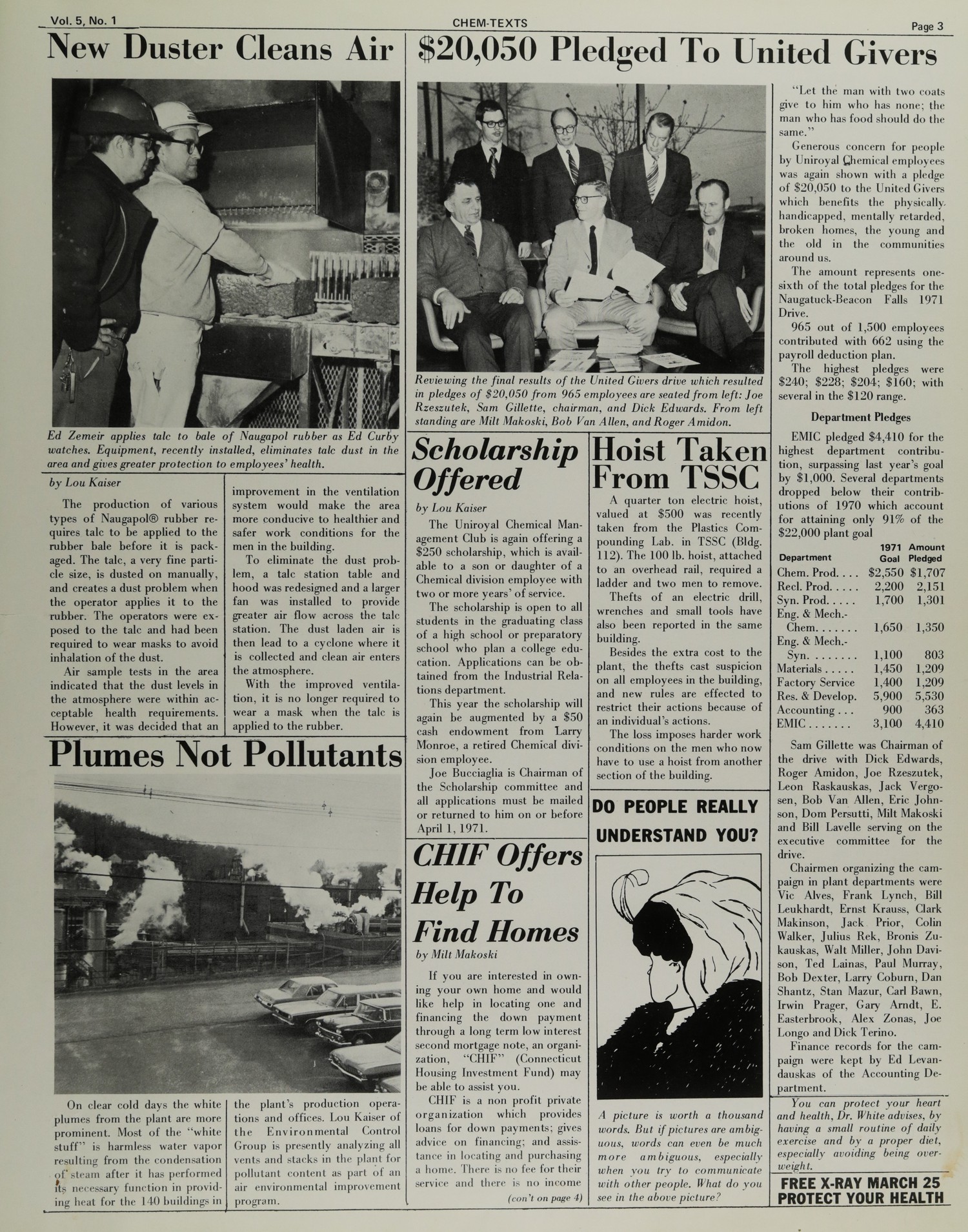
## Page 003
Here is the extracted text from the document image, preserving the layout and structure as much as possible:
New Duster Cleans Air $20,050 Pledged To United Givers
Reviewing the final results of the United Givers drive which resulted in pledges of $20,050 from 965 employees are seated from left: Joe Rozeski, Sam Gillette, chairman, and Dick Edwards. From left standing are Mill Makoski, Bob Van Allen, and Roger Amidon.
Scholarship Offered
by Lou Kaiser
The Universal Chemical Management Club is again offering a $250 scholarship, which is available to a son or daughter of a Chemical division employee with two or more years of service.
The scholarship is open to students in the graduating class of a high school or preparatory school who plan a college education. Application can be obtained from the Industrial Relations department.
This year the scholarship will again be augmented by a $50 cash endowment from Larry Monroe, a retired Chemical division employee.
Joe Boccaglio is Chairman of the Scholarship committee and all applications must be mailed or returned to him on or before April 1, 1971.
Plumes Not Pollutants
On clear cold days the white plumes from the plant’s production operations are more prominent. Most of the “white stuff” is harmless water vapor resulting from the condensation of steam after it has performed its necessary function in providing the heat for the buildings.
Ed Leiner applies tale to bale of Naugatoll rubber as Ed Curly watches. Equipment, recently installed, eliminates the dust in the area and provides protection to employees’ health, according to Lou Kaiser.
The production of various types of Naugatoll rubber re-quires tale to be applied to the rubber bale before it is packaged. To eliminate the dust problem, a tale station was redesigned and a larger hood was installed to provide greater air flow across the tale station. The dust laden air then lead to a cyclone where it is collected and clean air returns to the atmosphere.
With the improved ventilation, it is no longer required to wear a mask when the tale is applied to the rubber. However, it was decided that an improved mask was still applied to the rubber.
Hoist Taken From TSSC
A quarter-ton electric hoist valued at $500 was recently taken from the Plastics Compounding Lab in TSSC (Bldg. 112). The hoist, attached to an overhead rail, required a ladder and two men to remove.
Thefts of electric drills, wrenches and small tools have also been reported in the same building.
Besides the extra cost to the plant, the thefts cast suspicion on all employees in the building, and new rules are effected to restrict their actions because of the individual’s actions.
The loss imposes harder work conditions on the men who now have to use a hoist from another section of the building.
DO PEOPLE REALLY UNDERSTAND YOU?
On clear cold days the white plumes from the plant are more prominent. Most of the “white stuff” is harmless water vapor resulting from the condensation of steam after it has performed its necessary function in providing the heat for the buildings.
“Let the man with two coats give to him who has none; the man who has food should do the same.”
Generous concern for people by Universal Chemical employees was again shown with a pledge of $20,050 to the United Givers which benefits the physically handicapped, mentally retarded, broken homes, the young and the old in the communities around us.
The amount represents one-sixth of the total pledges for the Naugatuck-Beacon Falls 1971 Drive. 965 out of 1,500 employees contributed with 662 using the payroll deduction plan.
The highest pledges were $240: $225: $105: with several in the $120 range.
Department Pledges
EMC pledged $4,140 for the highest department contributions last year’s goal was $1,000. Several departments dropped below their contributions of 1970 which accounted for attaining only 93% of the $22,000 plant goal.
1971 Amount
Dept. Pledged Dept. Pledged
Chem. Prod… . 3,325 3,707
Syn. Prod. . . . 2,200 2,151
Engr. . . . . . . 1,700 1,801
Lab., & Mech.
Chem. . . . . . . 1,550 1,350
Traffic . . . . .1,100 803
Sales . . . . . . 1,450 1,209
Factors Service. 1,400 1,209
Rec & Develop . 5,000 5,530
Accounting . . . 900 363
EMC. . . . . . . 3,100 4,410
Sam Gillette was Chairman of the drive with Dick Edwards, Roger Amidon, Joe Raskauskas, Jack Vergosen, Bob Van Allen, Eric Johnson, Don Pesaratti, Mill Makoski and Bill Lavelle serving on the executive committee for the drive.
Chairmen organizing the campaign in plant departments were Vic Alves, Frank Lynch, Bill Lundhart, Ernest Krause, Clark Makison, Jack Prior, Colin Walker, Julius Reb, Benis Zukaitis, Walt Miller, John Davidson, Rod Lanius, Paul Murray, Bob Dexter, Larry Gallurn, Dan Shaughnessy, Stan Mann, Carl Byers, Gene Peagles, and Alex Zonas.
Finance records for the campaign were kept by Ed Levanduskas of the Accounting Department.
You can protect your heart and health. Flu vaccines, by having a small routine of daily exercise and by proper diet, especially avoiding being over-weight.
FREE X-RAY MARCH 25 PROTECT YOUR HEALTH
—
## Page 004
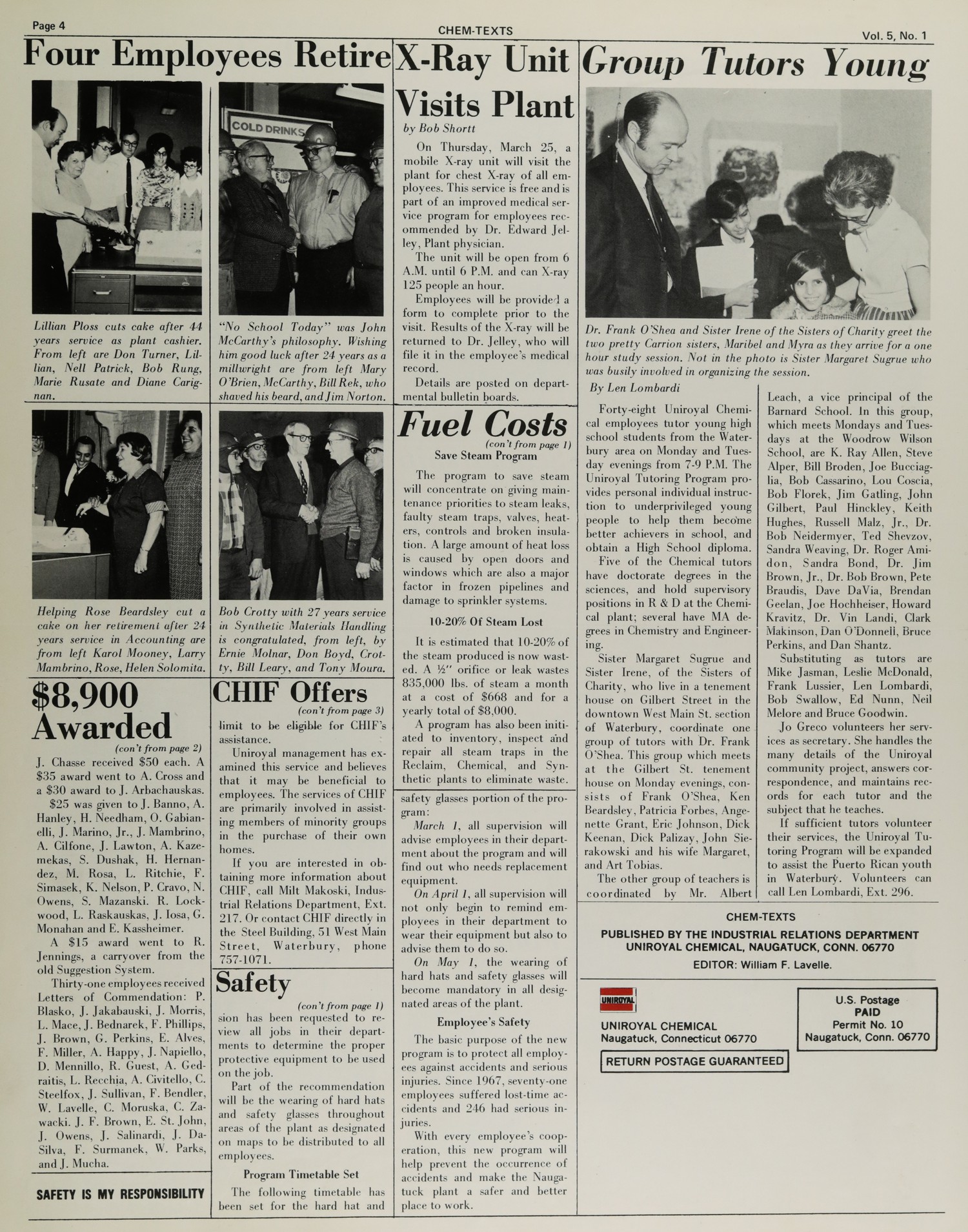
Four Employees Retire
X-Ray Unit Group Tutors Young
Visits Plant
by Bob Shortt
On Thursday, March 25, a
mobile X-ray unit will visit the
plant for chest X-rays of all employees. This service is free and is
part of an improved medical service program for employees recommended by Dr. Edward Jelley, plant physician.
The unit will be open from 6
A.M. until 6 P.M. and can X-ray
125 people an hour.
Employees will be provided a
form to complete prior to the
visit. Results of the X-ray will be
returned to Dr. Jelley, who will
file it in the employee’s medical
record.
Details are posted on departmental bulletin boards.
Fuel Costs
Save Steam Program
The program to save steam
will concentrate on giving maintenance priorities to steam leaks,
faulty steam traps, valves, heaters, controls and broken insulation. A large amount of heat loss
is caused by open doors and
windows which are also a major
factor in frozen pipelines and
damage to equipment.
10-20% Of Steam Lost
It is estimated that 10-20% of
the steam produced is being wasted through leaks, open doors, and
windows, or by excessive use.
$35,000 is spent a month
for an average of 18,000 lbs.
of steam, and for a
total yearly cost of $8,000.
CHIF Offers
(con’t from page 3)
limit to be eligible for CHIF assistance.
It must be a minority employee, or one who believes to be,
and who is actively participating.
The services of CHIF
are primarily involved in assisting members of minority groups
in the purchase of their own
homes.
If you are interested in obtaining more information about
CHIF, call Bill Makoski, Industrial Relations Department, Ext.
217, or contact CHIF directly in
the Steel Building, 51 West Main
Street, Waterbury – phone
754-1071.
Safety
(con’t from page 1)
son has been instructed to require all employees to wear new
hardhats in designated areas in
the plant.
Part of the recommendation
will be the wearing of hard hats
and safety glasses throughout
areas of the plant as designated
on maps to be distributed to all
employees.
Program Timetable Set
The following timetable has
been set for the hard hat and
“No School Today” was John
McCarthy’s philosophy. Wishing
him good luck after 21 years as a
millwright are from left Mary
O’Brien, McCarthy, Bill Rock, who
shared his beard, and Jim Norton.
Helping Rose Deardsley cut a
cake on her retirement after 24
years service in Accounting are
left to right Earl Mooney, Larry
Montembault, Rose Deardsley.
$8,900
Awarded
(con’t from page 2)
J. Chase received $500 each. A
$25 award went to A. Cross and
a $30 award to J. Ardahaskas.
$25 was given to J. Ramos, J.
Hanley, H. Needham, O. Grabinski, J. Martino, Jr., J. Shalrnan,
A. Gaffney, J. Lawton, J. Kazemkas, S. Diebilis, H. Hernandez, M. Rosa, I. Ritchie, F.
Simonds, K. Nelson, E. Casey, N.
Owens, S. Mazarski, R. Lockwood, L. Raskauskis, J. Iori, G.
Monahan and F. Kasheimer.
A $15 award went to R.
Jennings, a carryover from the
old Suggestion System.
Thirty-two employees received
letters of Commendation: P.
Blako, J. Jakabaska, J. Morris,
L. Marl, J. Dobrindt, F. Phillips,
J. Brown, G. Perkins, E. Ates,
F. Miller, A. Hapey, J. Napello,
D. Menillo, R. Guest, A. Gedrites, L. Roocha, A. Gridello, C.
Stefflo. J. Sullivan, F. Bender,
W. Lavelle, C. Moniska, C. Zawacki, J. F. Brown, E. St. John,
J. Owens, J. Salitorski, J. DeSilva, F. Surmanek, W. Parks,
and J. Musho.
SAFETY IS MY RESPONSIBILITY
Dr. Frank O’Shea and Sister Irene of the Sisters of Charity greet the
two pretty Carron sisters, Maribel and Myra as they arrive for a onehour busy session. Not in the photo is Sister Margaret Sprague, who
was busy involved in organizing the session.
Leach, a vice principal of the
Forty-eight Uniroyal Chemical employees tutor young high
Bernard School. In this group,
school students from the Waterwhich meets Mondays and Tuesford Parochial School. They are
days at the Woodrow Wilson
R. Bay Allen, Steve
R. Alger, Bill Brodin, Joe Buczak,
School, are
Bob Cassarino, Lou Costa,
ing, Bob Cassarino,
Bob Flores, Jim Gulling, John
Gilbert, Paul Hinckley, Keith
Hughes, Russell Mazur, Jr., Dr.
Bob Niedermeyer, Fred Sheclov,
Sandra Wearing, Dr. Roger Anderson, Sandra Bond, Dr. Jim
Brown, Jr., Dr. Bob Broun, Dr.
Breaults, Dave DaVia, Brendan
Kerrins, Dr. Van Land, Clark
Kellison, John O’Donnell, Evere
Perkins, and Dan Shantz.
The tutors are
Mike Jusman, Lindo McDonald,
Ernest Lussier, Bob Lombardi,
Bob Swallow, Ed Dunn, Neil
Moore and Peter Bosnyak.
Go Greco volunteers for service.
CHEM-TEXTS
PUBLISHED BY THE INDUSTRIAL RELATIONS DEPARTMENT
UNIROYAL CHEMICAL, NAUGATUCK, CONN. 06770
EDITOR: William F. Lavelle.
U.S. Postage
PAID
Permit No. 15
Naugatuck, Conn. 06770
RETURN POSTAGE GUARANTEED
safety glasses throughout
areas of the plant as designated
on maps to be distributed to all
employees.
UNIROYAL CHEMICAL
Naugatuck, Connecticut 06770
Employee’s Safety
The basic purpose of the new
program is to protect employees against accidents and serious
injuries. Since 1967, seventy-one
employees suffered lost-time accidents and 246 had serious injuries.
With every employee’s cooperation, this new program will
help prevent the occurrence of
accidents and make the Naugatuck plant a safer and better
place to work.
SAFETY IS MY RESPONSIBILITY
—
## Page 183
CHEM-TEXTS
Vol. 5, 1971 PUBLISHED FOR THE PEOPLE OF UNIROYAL CHEMICAL No. 1
$8,900 Awarded For Ideas
Fuel Costs Safety
Doubled Equipments Program
For 1971
Save Steam Plan
Started In Plant
by Al Matza
Total fuel costs for 1971 will
be approximately double over
1970. $555,000 has been
budgeted to operate the plant
during the year against actual
costs of $638,000 for last year.
The $555,000 increased cost
of fuel is primarily due to escalation residual oil prices which
are a result of the Mid-East
crisis, rather shortages and pol-
lution abatement conversions to
oil. As added cost is the pre-
mium we will pay for low sulfur
oil after Sept. 1, 1971.
Profits Off
$4,100,000
Uniroyal showed a $4,100,000
loss for the 4th quarter of 1970
compared to a profit of
$8,400,000 in 1969.
Sales for the same quarter
were $371,000,000, a decrease
of $17,000,000 from the same
period last year.
1970 sales of the company
were $1.551 billion, almost the
exact amount as the prior year.
Earnings in 1970 were only
$23,800,000 compared to a net
income of $46,600,000 in the
year of 1969.
The decrease in 1970 profits
was said to be attributed to the
GM strike, the general softness
in the economy, high interest
charges, sharply higher employ-
ment costs, higher transporta-
tion charges and other costs not
fully absorbed by price increases
or productivity improvements.
Plant Business Down
During the year production of
reclaimed rubber, lates and rub-
ber chemicals was affected by
the dislocation in the automotive
industry, home construction and
the shutdown of several Uni-
royal tire plants.
The plant’s business shows
scarcely any improvement
according to the present sales fore-
casts for the first quarter of
1971.
Every effort needs to be made
at this critical time in our econ-
omy to prevent off grade pro-
duction, improve productivity
and quality, and to keep cus-
tomers satisfied.
Dividend Declared
Uniroyal declared a quarterly
dividend of 17¢ cents a share on
the company’s common stock.
The dividend is payable March
25 to shareholders of record on
Feb. 24.
The Company also declared
a quarterly dividend of 32¢ each on
Uniroyal’s preferred stock. One
will be paid March 20 to stock-
holders of record February 22,
and the other payable June 22
to stockholders of record
May 24.
Lost Time
Accidents
Drop To 6
By Sol Morse
The incidence of lost time
accidents showed a major im-
provement in 1970. The plant
had only 6 compared to the 23
in 1969. Two of the accidents
occurred in an odd
situation.
An employee fell on ice and
fractured two ribs. A few days
later he visited Dr. Jelley at the
Chemical plant hospital prior to
his return to work. After his
checkup, Tom Doran, a plant
driver, drove him home. When
Doran stopped for a stop sign, a
trailer truck skidded into the
station wagon, injuring Doran
who suffered a severe neck
strain. One of the safest, most
experienced drivers in the plant,
Tom lost a month of work when
the “unexpected” happened.
Accidents Cost $150,507
The 6 lost time accidents and
66 serious injuries cost the plant
$150,507 in 1970. The outside
medical bills for hospitalization,
X-rays, specialists, medicines and
doctors’ visits were $49,214.
The money paid out for Work-
(con’t on page 2)
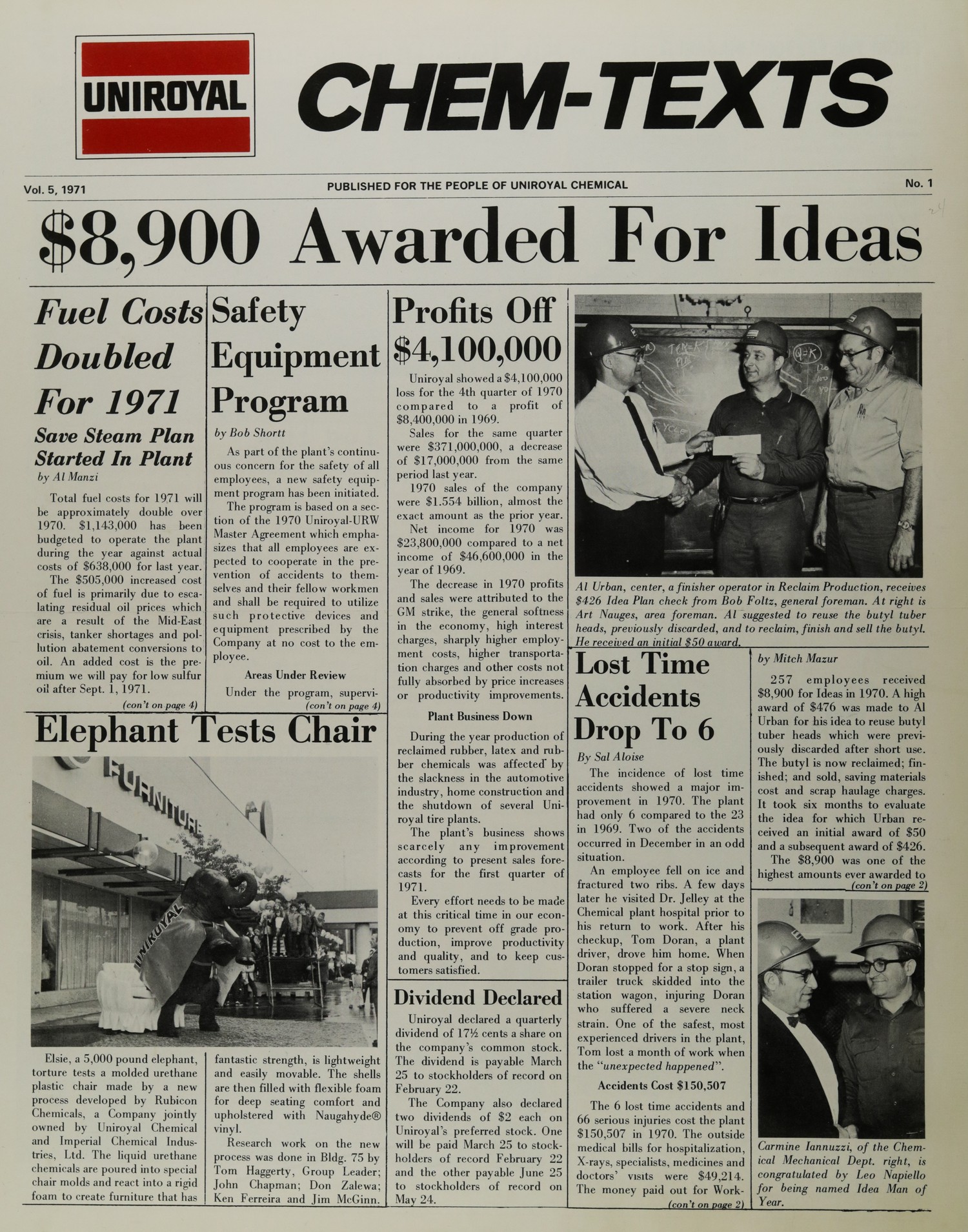
Elephant Tests Chair
Elsie, a 5,000 pound elephant,
torture tests a molded urethane
plastic chair made by a new
process developed by Rohcon
Chemical Company and owned
by Uniroyal Chemical and Imperi-
al Chemical Indus-
tries, Ltd. The liquid urethane
chemicals were poured into special
chair molds and react into a rigid
foam to create furniture that has
fantastic strength, is lightweight
and easily movable. The chairs
are then filled with flexible foams
for deep seating comfort and
upholstered with “Naugahyde”
vinyl.
Research work on the new
process was done in Bldg. 75 by
John Haggerty, Group Leader,
John Chapman, Don Zalewa-
ski, Ken Ferriere and Jim McGinn.
Al Urban, center, a fixture operator in Reclaim Production, receives
a $50 Award for his suggestion to the Safety Profit Program. At right,
Art Neugass, area foreman, recommended the safety ideas, previously
discussed, and is all in favor of such incentive plans.
Lost Time
Accidents
Drop To 6
(con’t from page 1)
men’s Compensation and other
costs and scrap haulag e charges.
It took six months to evaluate
the idea for which Urban re-
ceived an initial award of $50
and a subsequent award of $426.
The $8,900 was one of the
highest amounts ever awarded to
(con’t on page 2)
257 employees received
$8,900 for ideas in 1970. A higher
award of $426 was made to Al
Urban for his idea to reuse bayl
tuber heads which were previ-
ously discarded after short use.
The bayl is now reclaimed; fin-
ished; and sold, saving materials
cost and scrap haulag e charges.
It took six months to evaluate
the idea for which Urban re-
ceived an initial award of $50
and a subsequent award of $426.
The $8,900 was one of the
highest amounts ever awarded to
—