
## Page 002
Here is the extracted text from the document image, preserving the layout and structure as much as possible:
FROM THE FACTORY MANAGER
DEAR FELLOW EMPLOYEE:
Once again the United Givers of Naugatuck-Beacon
Falls is starting its Fall drive to raise funds for the oncom-
ing year.
As you know, these funds sup-
ply finances to a great many very
worthwhile activities carried out in
Naugatuck, Waterbury and sur-
rounding towns in which we live.
Each year the Factory has con-
tributed collectively a substantial
sum of money to help these worth-
while activities.
This year the drive will be con-
ducted with Jim Carroll as Chair-
man. Jim has formed his Committee and his canvassers will
be approaching you shortly for your contribution.
Uniroyal Chemical people have always shown a splendid
generosity in their pledges to support the work of these
Agencies. Last year, more than two thirds of the Chemical
people contributed $20,066. For an average contribution
of $20.
Our goal is $21,000. We can achieve this if we give
“where you work” and pledge through the payroll deduc-
tion plan.
If each person would contribute a minimum one hour’s
pay per month, we will readily raise the necessary money
to help continue these activities which in some way benefit
virtually every employee or some member of his family.
/s/ Del Dayo
3 Women Officers Named
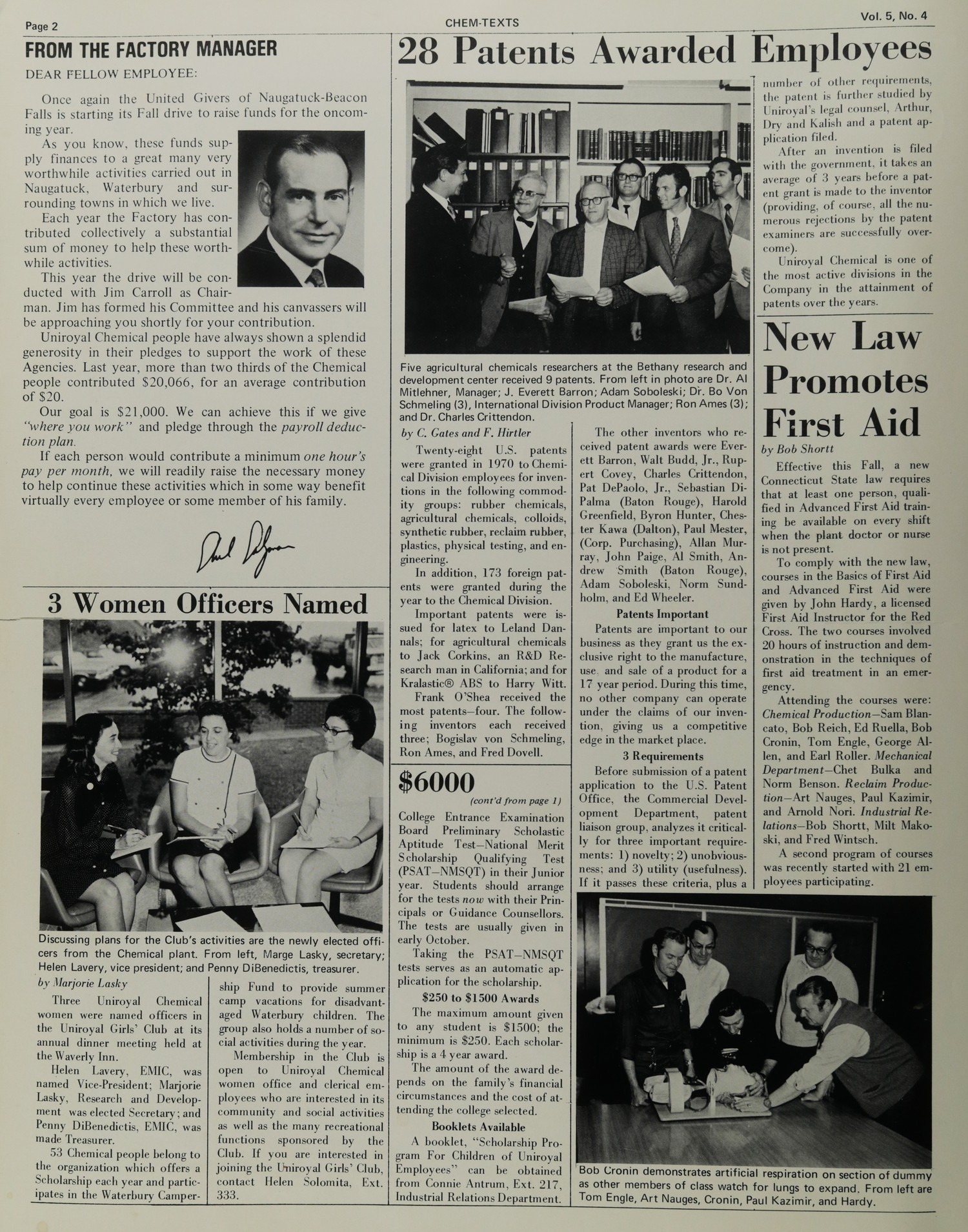
Discussing plans for the Club’s activities are the newly elected offi-
cers from the Chemical Plant. From left, Marge Lasky, secretary;
Helen Lavery, vice-president; and Penny DiBenadictis, treasurer.
These Uniroyal Chemical
women were named officers in
the Uniroyal Girls’ Club at its
annual dinner meeting held at
the Waverly Inn.
Helen Lavery, EMIC, was
named Vice-President; Marge
Lasky, Research and Develop-
ment, was elected Secretary; and
Penny DiBenedictis, EMIC, was
made Treasurer.
53 Chemical people belong to
the organization which offers a
Scholarship each year and parti-
cipates in many community ac-
tivities.
28 Patents Awarded Employees
Five agricultural chemicals researchers at the Bethany research and
development center received 9 patents. From left to right are Dr. Al
Mittlehner, Manager, J. Everett Barron, Adam Soboleski, Dr. Ira Von
Schneibing (J.), International Division Product Manager, Ron Ames (J.)
and Dr. Charles Garrison.
In C. Colvin and F. Handy,
Twenty-eight U.S. patents
were granted in 1970 to Chemi-
cal Division employees for inven-
tions in the following common-
ly groups: rubber chemicals,
agricultural chemicals, antidock-
ing agents, tire cord, synthetic
rubber, reclaim rubber,
plastics, physical testing, and en-
gineering.
In addition, 173 foreign pat-
ents were granted during the
year to the Chemical Division.
Important patents were is-
sued for Lites to Roland Dan-
nals, for agricultural chemicals
to Jack Gosline, an R&D Re-
search man in California, and for
Krakatox ABS to Harry Vin-
Frank O’Shea received the
most patents-four. The follow-
ing employees also received mul-
tiple patents: Bogelian von Schle-
ckenrider, Hal Fried Doehl,
and Fred Duvall.
$6000
(cont’d from page 1)
College Entrance Examination
Board Preliminary Scholastic
Aptitude Test National Merit
Scholarship Qualifying Test
(PSAT-NMSQT) in their Junior
year. Students should arrange
for the tests now with their Prin-
cipals or Guidance Counselors.
The tests are usually given in
early October.
Taking the PSAT-NMSQT
tests serves as an automatic ap-
plication for the scholarship.
$250 to $1500 Awards
The maximum amount given
to any student is $1500; the
minimum is $250. Each scholar-
ship is a 4-year award.
The amount of the award de-
pends on the family’s financial
circumstances and the cost of at-
tending the college selected.
Booklets Available
A booklet, “Scholarship Pro-
gram for Children of Uniroyal
Employees” can be obtained
from Connie Antrum, Ext. 217,
Industrial Relations Department.
number of other equipment.
the patents is further qualified by
Uniroyal’s legal counsel, Chief Pat-
ents and Trademark Attorney.
After an invention is filed
with the Patent Office, it takes an
average of 3 years before a pat-
ent is granted. (It is during this waiting period, of course, all the num-
erous corrections by the patent
examiners are successfully over-
come.)
Uniroyal Chemical is one of
the most active divisions in the
Company in the attainment of
patents over the years.
New Law
Promotes
First Aid
by Bob Shortt
Effective this Fall, a new
Connecticut State law requires
that at least one person, quali-
fied in Advanced First Aid train-
ing be available on every shift
when the plant doctor or nurse
is not present.
To comply with the new law,
courses in the Basics of First Aid
and Advanced First Aid were
given by John Hardy, a licensed
First Aid Instructor for the Red
Cross. The two courses involved
20 hours of instruction and dem-
onstration in the techniques of
first aid and treatment in an emer-
gency.
Attending the courses were:
Chemical Production – Sam Bia-
lato, Bob Reitch, Ed Reidla, Bob
Groom, Tom Eagan, George At-
toun, and Earl Roller. Mechanical
Department – Chet Bulka and
Norm Benson. Reclaim Produc-
tion – Art Nunes, Paul Kazimir,
and Arnold Dziadik. Industrial Re-
lations – Bob Shortt, Milt Mako-
ski, and Fred Winsch.
A second program of courses
was recently started with 21 em-
ployees participating.
Bob Cronin demonstrates artificial respiration on section of dummy
as other members of class watch for proper form. From left are
Tom Eagan, Art Nunes, Cronin, Paul Kazimir, and Hardy.
—
## Page 003
Here is the text extracted from the document image:
New Research Laboratory Studies Pollution Causes
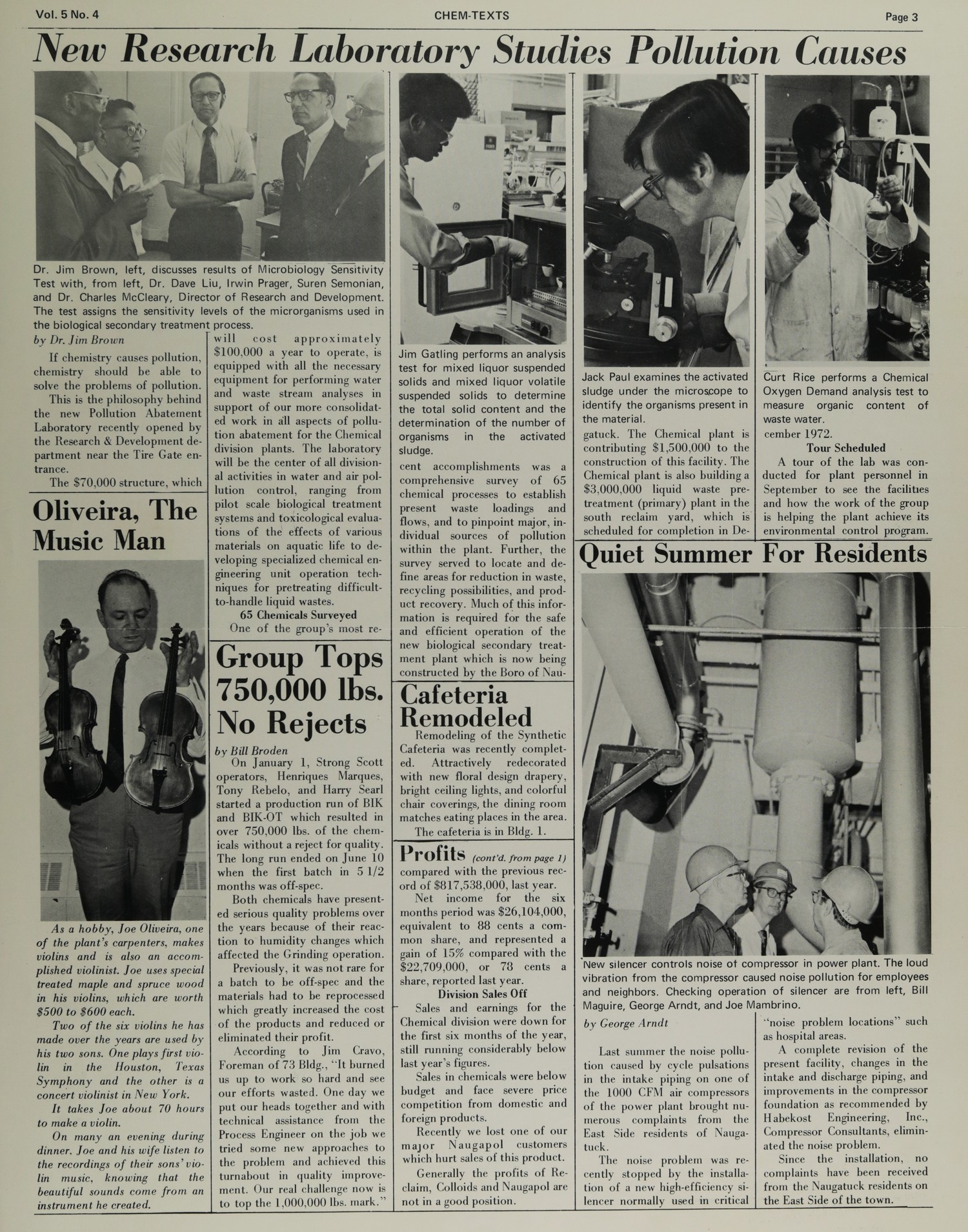
Dr. Jim Brown, left, discusses results of Microbiology Sensitivity Test with, from left, Dr. Dave Liu, Irwin Prager, Suren Semonian, and Dr. Charles MacCleary, Director of Research and Development.
The test assigns the sensitivity levels of the microorganisms used in the biological secondary treatment process.
If chemistry can cause pollution, the chemical industry should be able to solve the problems of pollution. This is the philosophy behind the new Pollution Abatement Laboratory recently opened by the Research & Development department near the Tire Gate entrance.
The $70,000 structure, which will cost approximately $100,000 a year to operate, is equipped with all the necessary equipment for performing water and waste stream analyses in support of our more concentrated work in all aspects of pollution abatement for the Chemical Division plants. The laboratory will be the center of all division activities in water and air pollution control, ranging from pilot scale biological treatment systems and toxicological evaluations of the effects of various materials on aquatic life to developing specialized chemical engineering unit operations techniques for pretreating difficult-to-handle liquid wastes.
Oliveira, The Music Man
As a hobby, Joe Oliveira, one of the plant’s carpenters, makes violins and is also an accomplished musician. Joe uses spruce wood which are worth $500 to $600 each.
Two of the violins he has made over the years are used by his twin sons, One plays in the Houston, Texas Symphony and the other is a concert violinist in New York.
It takes Joe about 10 hours to make a violin.
Group Tops 750,000 lbs. No Rejects
On January 1, Strong Scott operators, Henriques Marques, Tony Rebelo, and Harry Searl started a production run of BIK and BIK-OT which resulted in over 750,000 lbs. of the chemicals without a reject for quality. The long run ended on June 10 when the first batch in 5 1/2 months was off-spec.
Both chemicals have presented serious quality problems over the years because of their reaction to humidity changes which affected the grinding operation. Previously, it was not rare for a batch to be off-spec and the chemicals had to be reprocessed which greatly increased the cost of the products and reduced or eliminated their profit.
According to Jim Gravo, Foreman of T3 Bldg., it turned up to 10 hours per man and our efforts wasted. One day we lost our leader together and he called in technical assistance from the Process Engineers on the job we could not lick, and they were able to come up with new approaches to the problem and advised us on new turnabout in quality improvement. Our goal challenge now is to top the 1,000,000 mark.
Profits (cont’d from page 1) compared with the previous record of $817,538,000, last year.
Net income for the six month period was $26,100,000, equivalent to 88 cents a common share, and represented a gain of 15% compared with the $22,700,000, or 73 cents a share, reported last year.
Division Sales Off
Sales and earnings for the Chemical division were down for the first six months of the year, still materially below last year’s figures.
Sales in chemicals were below budget and face severe price competition from domestic and foreign products.
Recently we lost one of our major customers which took this product, generally the profits of this unit. Cellulose and Naugahyde are not in a good position.
Quiet Summer For Residents
A new silencer controls noise of compressor in power plant. The loud vibration from the compressor caused noise pollution for employees and neighbors. Checking operation of silencer at power plant from N-Gugure, George Aradi, and Jose Marine.
“noise problem locations” such as hospital areas.
A complete revision of the present facility, changes in the building and discharge piping, and improvements in the compressor installation is recommended Engineering, Inc.
Since the installation, no complaints from the Naugatuck residents on the East Side of the town.
Jim Gatling performs an analysis test for mixed liquor suspended solids and mixed liquor volatile suspended solids to determine the total solid content and the determination of the number of organisms in the sludge.
Jack Paul examines the activated sludge under the microscope to identify the microorganisms present in the material.
The Chemical plant is contributing $1,500,000 to the construction of this facility. The Chemical plant is also building a $3,000,000 liquid waste pre-treatment (primary) plant in the south reclaim yard, which is scheduled for completion in December 1972.
Cafeteria Remodeled
Remodeling of the Synthetic Cafeteria was recently completed. Attractively redecorated with new floral design drapery, bright ceiling lights, and colorful chair coverings, the dining room matches eating places in the area.
The cafeteria is in Bldg. 1.
—
## Page 004
Page 4
Know Your Products:
Naugatuck® Chemical Antioxidants
by Dr. Ralph Brown
(This is the third in a series of
articles on the chemicals manufactured in Chemical Production
as sold by the Chemical Division.)
If we didn’t have antioxidants
and antiozonants, rubber products would fall apart, before we
could wear them out.
In fact, most kinds of synthetic rubber can’t even be manufactured without some type of
a protective chemical to get
them through the drying and
storage stages.
Polyguard®, for example, is
used extensively by the synthetic rubber plants as a stabilizer
(or antioxidant) during processing and manufacture. It is not
only an excellent antioxidant
but it does not discolor or stain
the rubber, therefore it can be
used for white and light colored
rubber articles.
If the rubber is to be manufactured into a black or dark
colored product (tires, etc.) then
the customer may prefer to use
Poly-Gard which discolors the rubber, but also carries the protection over into the finished
product to a greater extent than
Polyguard.
New Chemicals Developed
For Synthetic Rubbers
The newer types of synthetic
rubber required new types of antioxidants to protect them
against oxygen and heat deterioration.
Antioxidant 451 was especially
Plant Safety
(continued from page 1)
and is still in the Intensive Care
unit of St. Mary’s Hospital.
Disaster Plan Operates
A few minutes after the explosion members of the Disaster
Plan arrived at the plant and assumed their responsibilities during the emergency. One evidence
of the Plan’s effectiveness was
the swift medical attention provided the injured employee-he
was receiving medical care by a
team of specialists at St. Mary’s
Hospital ten minutes after the
accident.
The cause of the explosion is
still under investigation.
Other Accidents In Period
Other injuries during the 8
week period were: one employee
suffered partial loss of a finger;
an employee cut his hand with a
knife requiring ten stitches; another employee dropped a valve
on his foot and broke a toe; and
an employee injured his eye when
a flying chip struck his eyeball;
two employees suffered severe
burns from steaming hot water
and a steam hose; and another
employee broke an ankle when a
ladder slipped and he fell off it
backwards.
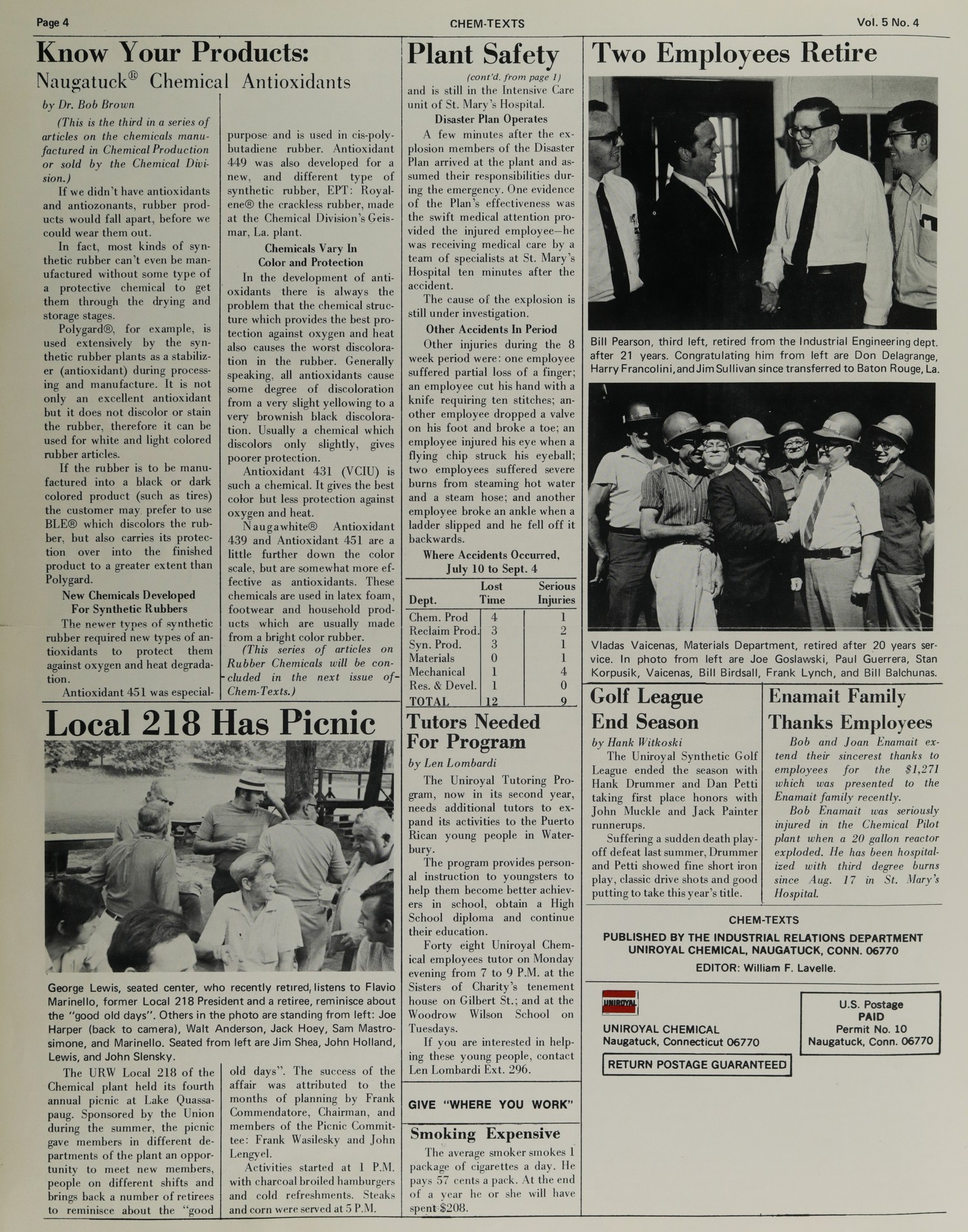
Where Accidents Occurred,
July 10 to Sept. 4
Dept.
Lost
Serious
Time
Injuries
Chem. Prod.
4
1
Reclaim. Prod. 3
2
Syn. Prod.
3
1
Materials
0
1
Mechanical
1
0
Res. & Devel.
1
0
TOTAL
12
9
Tutors Needed
For Program
Two Employees Retire
Bill Pearson, third left, retired from the Industrial Engineering dept.
after 21 years. Congratulating him from left are Don DeSalange,
Harry Francolini, and Jim Sullivan were transferred to Baton Rouge, La.
Vladas Vaicainis, Materials Department, retired after 20 years service. In photo from left are Joe Cozanski, Paul Guerra, Sam
Korpusik, Vaicainis, Bud Biddall, Frank Lynch, and Bill Bachunas.
Golf League
End Season
Vol. 5 No. 4
Ennami Family
Thanks Employees
by Hank Butkoski
The Uniroyal Synthetic Golf
League ended the season with
Hank Drummer and Dan Petru
taking first place honors with
John Mocke and Jack Painter
runners-up.
Suffering a sudden death playoff last summer, Drununer
and Petru showed fine short iron
play, classic drive shots and good
putting to take this year’s title.
Bob and Jean Ennami extend their sincere thanks to
employees for the $1,271
which was presented to the
Ennami family recently.
Bob Ennami was seriously
injured in the Chemical Pilot
plant when a 20 gallon reactor
exploded. He has been hospitalized with third degree burns
since Aug. 17 at St. Mary’s
Hospital.
by Len Lombardi
The Uniroyal Tutoring Program, now in its second year,
needs additional tutors to expand its activities to the Puerto
Rican young people in Waterbury.
The program provides personal instruction to youngsters to
help them become better achievers in school, obtain a High
School diploma and continue
their education.
Every eight Uniroyal Chemical employees tutor on Monday
evening from 7 to 9 P.M. at the
Sisters of Charity’s tenant
house on Gilbert St.; and at the
Woodrow Wilson School on
Tuesdays.
If you are interested in helping these young people, contact
Len Lombardi Ext. 296.
CHEM-TEXTS
PUBLISHED BY THE INDUSTRIAL RELATIONS DEPARTMENT
UNIROYAL CHEMICAL, NAUGATUCK, CONN. 06770
EDITOR: William F. Lavelle.
GIVE “WHERE YOU WORK”
Smoking Expensive
The average smoker smokes 1
package of cigarettes a day. He
pays 37 cents a pack. At the end
of a year he or she will have
spent $208.
U.S. Postage
PAID
Permit No. 10
Naugatuck, Conn. 06770
RETURN POSTAGE GUARANTEED
UNIROYAL CHEMICAL
Naugatuck, Connecticut 06770
George Lewis, seated center, who recently retired, listens to Flavio
Martinello, former Local 218 President and a retiree, reminiscing about
the “good old days”. Others in the photo are standing from left: Joe
Harper (vice general), Walt Anderson, Jack Hoey, Sam Massaro, Joe
Simone, and Mario Inello. Seated from left are Jim Shea, John Holland,
Lewis, and John Siensky.
The URW Local 218 of the
Chemical plant held its fourth
annual picnic at Lake Quassapaug, sponsored by the Union
during the summer. The picnic
gave members in different departments of the plant an opportunity to meet new members,
people on different shifts and
brings back a number of retirees
to reminisce about the “good
old days”. The success of the
affair was attributed to the
months of planning by Frank
Conommelle, Chairman, and
members of the Picnic Committee: Frank Wasilewski and John
Lengvel.
Activities started at 1 P.M.
with charcoal-broiled hamburgers
and cold refreshments. Steaks
and corn were served at 5 P.M.
—
## Page 195
UNIROYAL CHEM-TEXTS
Vol. 5, 1971 PUBLISHED FOR THE PEOPLE OF UNIROYAL CHEMICAL No. 4
$6000 Awards Offered
10 Uniroyal scholarships will be awarded to children of employees with five or more years of service – who attain the highest finalist qualification in the annual scholarship competition conducted by the National Merit Scholarship Corporation. Scholars are chosen on the basis of scholastic aptitude, leadership and good citizenship. The Company plays no part in the selection of the scholars.
No Application Required
Eligible high school students must take the new combined PSAT/NMSQT test (see page 2)
Profits; Sales Up
Chemical Sales for the quarter increased 18.1% for the second quarter of 1971 compared with the second quarter of 1970.
Sales for the quarter set a new record of $104,101,000, a gain of 6.3% compared with the previous record of $97,714,000 set last year.
Net income for the Company increased 18.1% for the second quarter of 1971 compared with the second quarter of 1970.
Plant Safety Record Marred By Injuries
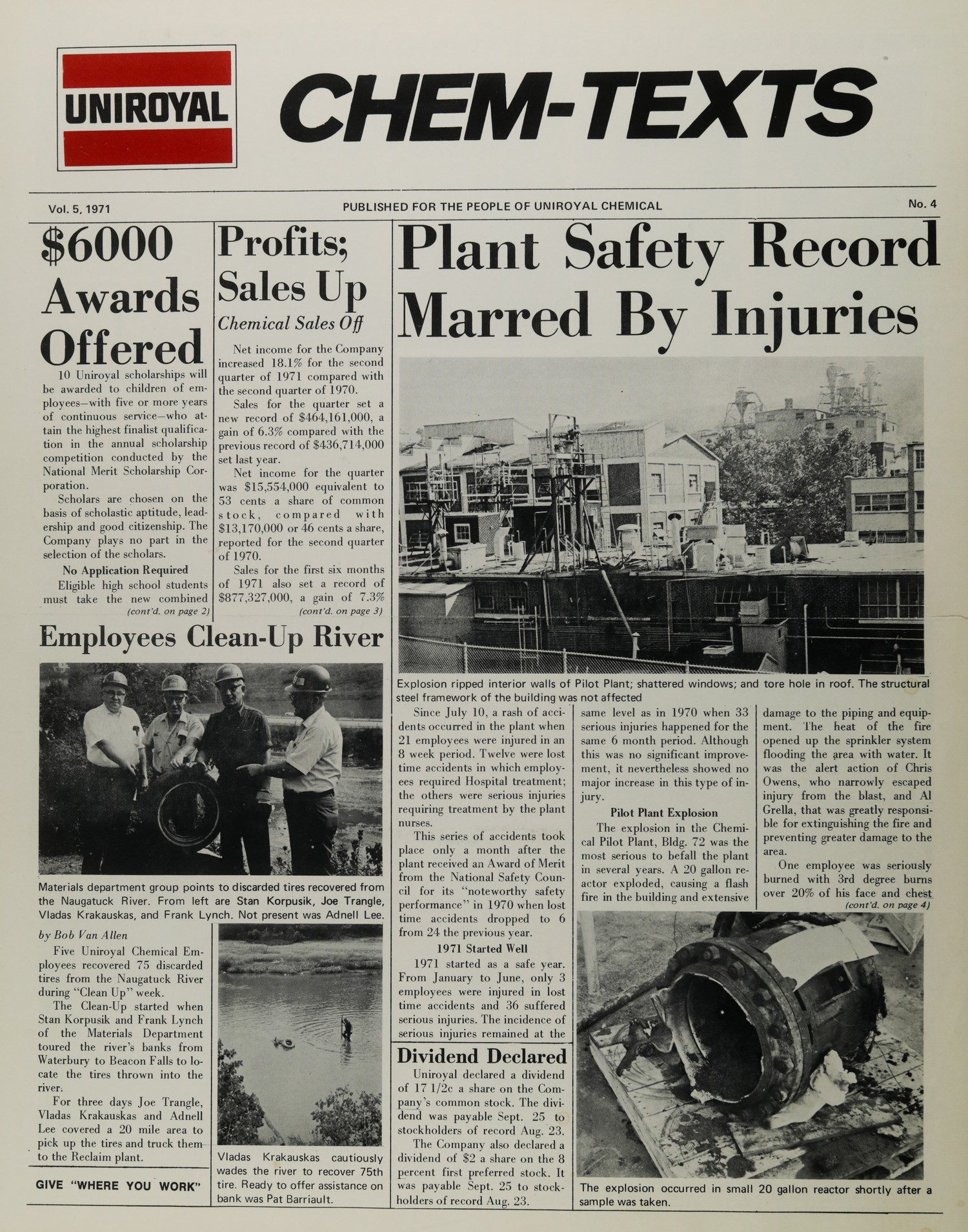
Explosion ripped interior walls of Pilot Plant; shattered windows; and tore hole in roof. The structural steel framework of the building was not affected.
Since July 10, 6 accidents occurred in the plant when 21 employees were injured in an 8 week period. Twelve were lost time accidents in which employees required hospital treatment; the others were serious injuries requiring treatment by the plant nurses.
The explosion of the Chemical Pilot Plant, Aug. 22, was the most significant accident for the Company in several years. A 20 gallon explosion causing a flash fire in the building and extensive damage to the piping and equipment.
The heat of the fire spread up the sprinkler system flooding the area with water. It was the alert action of Chris Owens, who narrowly escaped injury from the blast, and Al Grella, that was greatly responsible for extinguishing the fire and preventing greater damage to the area.
The employees of the Chemical Department were seriously burned with the explosion. The incident caused over 20% of his face and chest to be burned.
Dividend Declared
Uniroyal declared a dividend of 17 1/2¢ a share on the Company’s common stock. The dividend was payable Sept. 25 to stockholders of record Aug. 25.
The Company also declared a dividend of $2 a share on the 8 percent first preferred stock. It was payable Sept. 25 to holders of record Aug. 25.
Employees Clean-Up River
Materials department group points to discarded tires recovered from the Naugatuck River. From left are Stan Korpsuk, Joe Trangle, Vladas Krakauskas, and Frank Lynch. Not present was Adolf Lee.
By Bob Van Allen
Five Uniroyal Chemical Employees recovered 75 discarded tires from the Naugatuck River during “Clean Up” week.
The Clean-Up started when Stan Korpsuk and Frank Lynch of the Materials Department toured the river’s banks from Beacon Falls to locate the tires thrown into the river.
For three days Joe Trangle, Vladas Krakauskas and Adolf Lee covered a 20 mile area to pick up the tires and truck them to the Reclaim plant.
GIVE “WHERE YOU WORK”
—