
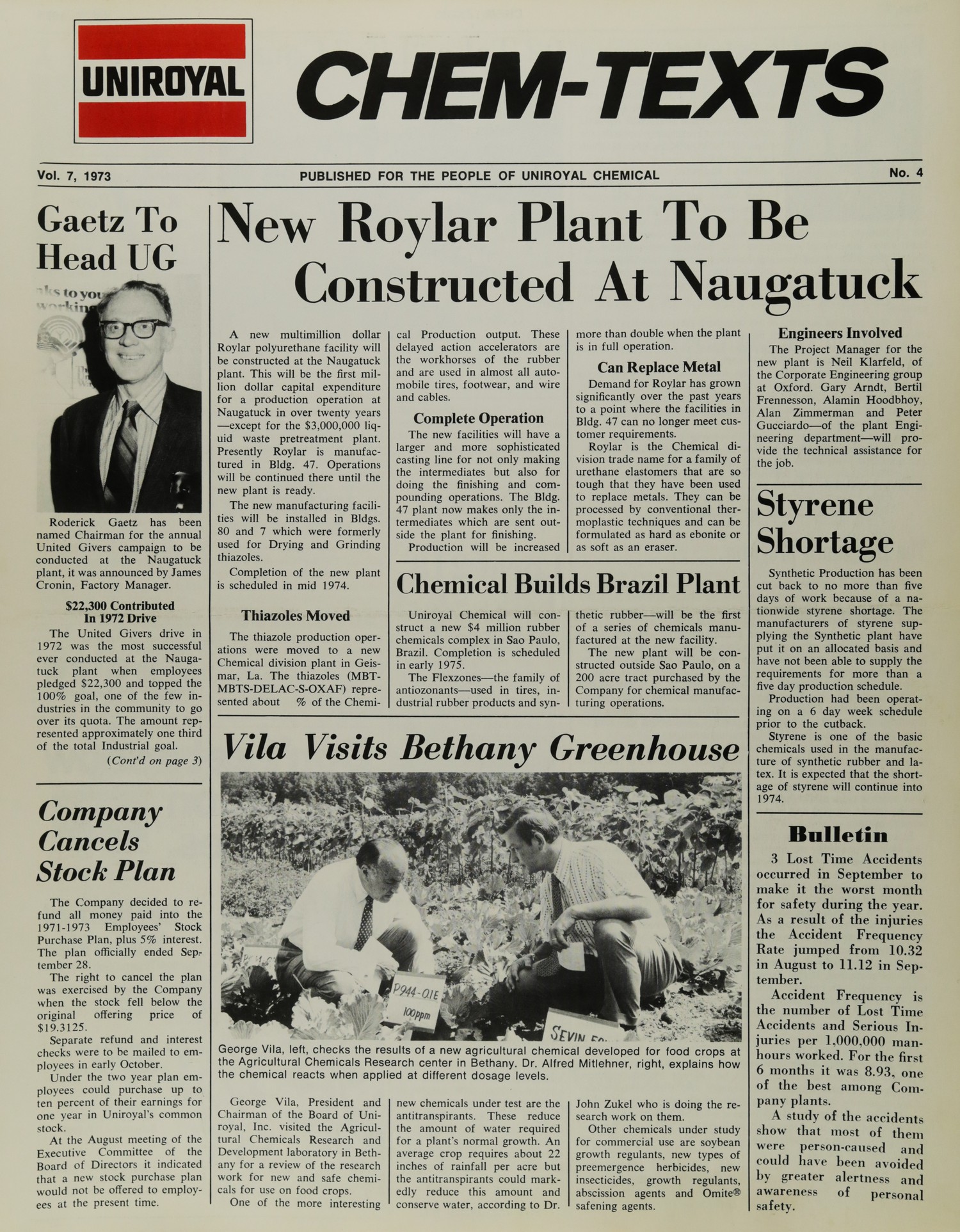
## Page 214
CHEM-TEXTS
Vol. 7, 1973 PUBLISHED FOR THE PEOPLE OF UNIROYAL CHEMICAL No. 4
Gaetz To Head UG
Roderick Gaetz has been named Chairman for the annual
United Givers campaign to be
conducted at the Naugatuck
plant, it was announced by James
Cronin, Factory Manager.
$22,300 Contributed
In 1972 Drive
The United Givers drive in
1972 was the most successful
ever conducted at the Naugatuck plant when employees
pledged $22,300 and topped the
previous high by over $1,000. In
dustries in the community to go
over its quota. The amount represented approximately one-third
of the total Industrial goal.
New Roylar Plant To Be
Constructed At Naugatuck
A new multimillion dollar
Roylar polychloroprene facility will be constructed at the Naugatuck plant. This will be the first million dollar capital expansion
for a production operation at
Naugatuck in over twenty years
–except for the $3,000,000 liquid waste pretreatment plant.
Presently Roylar is manufactured in Bldg. 47. Operations
will be continued there until the
new plant is ready.
The new manufacturing facilities will be installed in Bldg.
50 and 7 which are formerly
used for Drying and Grinding.
Engineers Involved
The Project Manager for the
new plant is Neil Kirkfield, of
the Corporate Engineering group.
Others are Maurice Jarlert,
Frennesson, Alamin Hoodhboy,
Alan Zimmerman and Peter
Gustavcidc—of the plant Engineering department—who provide the technical assistance for
the job.
Styrene
Shortage
Synthetic Production has been
cut back to no more than five
days of work because of the industry’s inability to obtain sufficient supplies of styrene. Several
manufacturers of styrene supplying the Synthetic plant have
put it on an allocated basis and
have been able to supply the
requirements for more than a
five day production schedule.
Production had been operating on a 6 day week schedule
prior to the allocation.
Styrene is one of the basic
chemicals used in the manufacture of synthetic rubber and latex. It is expected that the shortage of styrene will continue into
1974.
Chemical Production output. These
delayed accelerations are at
Geon and Naugatuck, which
and are used in almost all automobile tires, however, not in Roylar
cables.
Complete Operation
The new facilities will have a
larger and more sophisticated
casting line for not only making
Roylar, but producing items that
are doing the finishing and compounding operations. The Bldg.
47 plant now makes only the intermediates which are sent outside the plant for finishing.
Production will be increased
several times double when the plant
is in full operation.
Chemical Builds Brazil Plant
Uniroyal Chemical will construct a new $8 million rubber
compounding facility in Sao Paulo, Brazil. Completion is scheduled
in early 1975.
The Flexzones—the family of
antiozonants—used in tires, industrial rubber products and synthetic rubber–will be the first
of a series of chemicals manufactured at this new facility.
The new plant will be constructed outside Sao Paulo, on a
200 acre tract purchased by the
Company for chemical manufacturing operations.
Vila Visits Bethany Greenhouse
George Villa, left, checks the results of a new agricultural chemical developed for food crops at
the Agricultural Chemicals Research center in Bethany, Dr. Alfred Miehener, right, explains how
the chemical reacts when applied at different dosage levels.
George Villa, President of their
Chairman of the Board of Uniroyal, Inc. visited the Agricultural Chemicals Research and
Development laboratory in Bethany for a review of the research
work for new and safe chemicals for use on food crops.
One of the more interesting
new chemicals under test are the
antitranspirants. These reduce
the amount of water required
for a plant’s normal growth. An
average crop requires about 22
inches of rainfall per acre but
the antitranspirants could markedly reduce this amount and
conserve water, according to Dr.
John Zukel who is doing the research work on them.
Other chemicals under study
for commercial use are: soybean
growth regulants, new types of
insecticides, herbicides, new
fungicides, growth regulants,
defoliation agents and Omite—
an insect regulating agent.
Bulletin
3 Lost Time Accidents
occurred in September to
make it the worst month
for safety during the year.
As a result of the injuries,
the Accident Frequency
Rate jumped from 10.32
in August to 11.12 in September.
Accident Frequency is
the number of Lost Time
Accidents and Serious Injuries per 1,000,000 manhours worked. For the first
6 months it was 8.93, one
of the best rates in the
company plants.
A study of the accidents
show that most of them
were person-caused and
could have been avoided
by greater alertness and
awareness of personal
safety.
Company
Cancels
Stock Plan
The Company decided to refund all money paid into the
1971-1973 Employees Stock
Purchase Plan, plus 5% interest.
The plan officially ended September 28.
The reason for ending the plan
was the low price experienced by the Company
who sold all stock below the
original offering price of
$19.375.
Separate refund and interest
checks were to be mailed to employees in early October.
Under the two-year plan, employees could purchase up to
one percent of their previous
year’s earnings in Uniroyal
stock.
At the August meeting of the
Executive Committee of the
Board of Directors it indicated
that a new stock purchase plan
would not be offered to employees at the present time.
—