
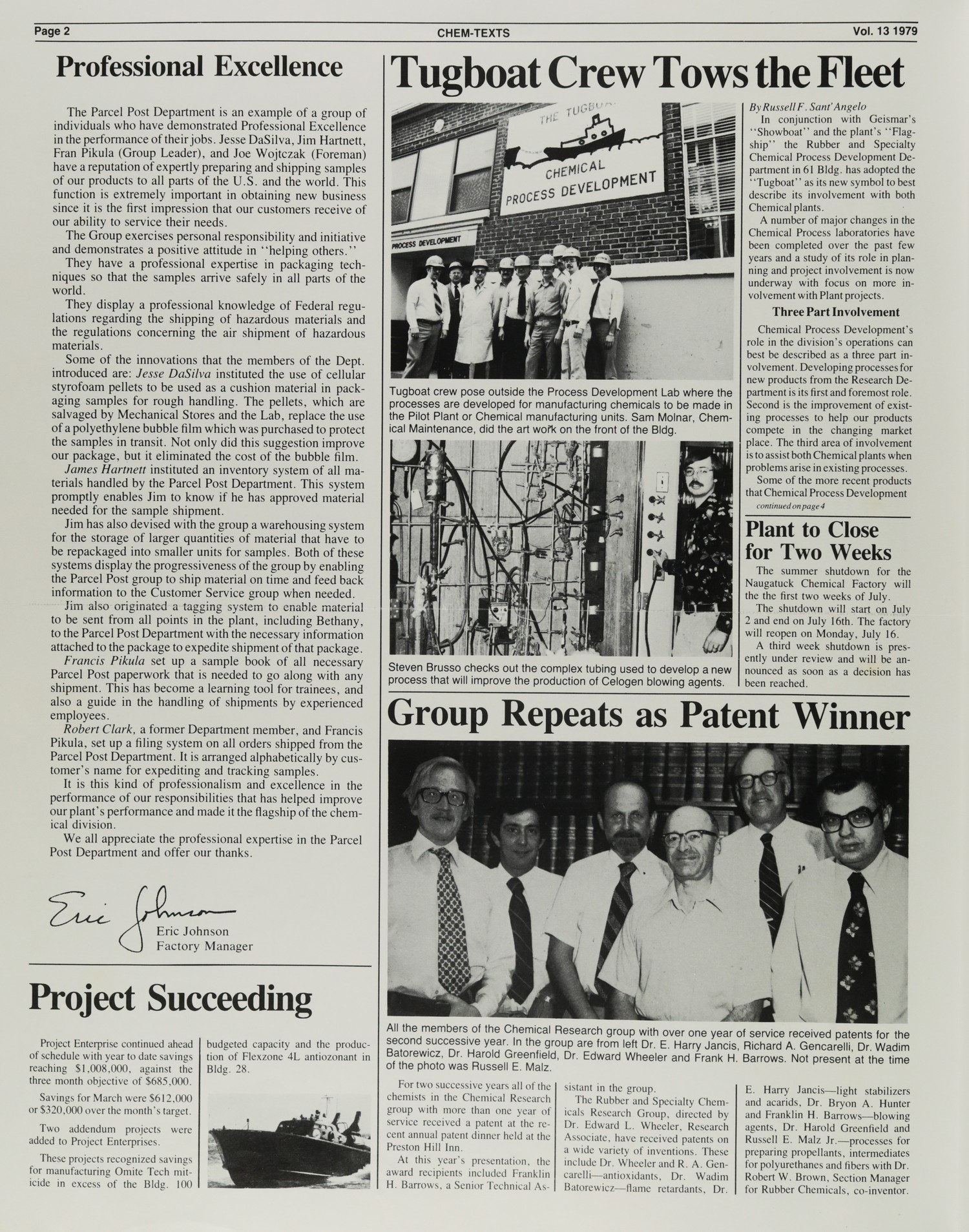
## Page 002
Page 2
CHEM-TEXTS Vol. 13 1979
Professional Excellence
The Parcel Post Department is an example of a group of individuals who have demonstrated Professional Excellence in the performance of their jobs. Jessie DaSilva, Jim Harnett, Frank Rubia (Group Leader), and Joe Wojczak (Foreman) have a reputation of expertly preparing and shipping samples of our products to all parts of the U.S. and the world. This function is extremely important in obtaining new business since it is the first impression that our customers receive of our ability to service their needs.
The Group exercises responsibility and initiative and demonstrates a positive attitude in “helping others.” They have a professional expertise in packaging techniques that are unequaled.
They display a professional knowledge of Federal regulations regarding the shipping of hazardous materials and the regulations concerning the air shipment of hazardous materials.
Some of the innovations that the members of the Department introduced were: Jessie DaSilva instituted the use of cellular polyfoam pellets to be used as a cushion material in packaging samples for rough handling. The pellets, which are produced by Mechanical Stores, are made here at the Lab, replace the use of a polyethylene bubble film which was purchased to protect the samples in transit. Not only did this suggestion improve our package, but it eliminated the cost of the bubble film.
James Harnett instituted an inventory system of all materials handled by the Parcel Post Department. This system promptly enables him to know if he has approved material needed for the sample shipment.
Jim has also devised with the group a warehousing system for the storage of larger quantities of material that have to be replenished into smaller units for samples. Both of these systems display the progressiveness of the group by enabling the Parcel Post group to ship material on time and feed back information to the Customer Service group when needed.
Jim has also organized a tagging system to enable material to be sent from all points in the plant, including Bethany, to the Parcel Post Department with the necessary information attached to the package to expedite shipment of that package.
Francis P. Rubia set up a sample book of all necessary Parcel Post paperwork that is needed to go along with any shipment. This has become a learning tool for trainees, and also a guide in the handling of shipments by experienced employees.
Robert Clark, a former Department member, and Francis Rubia, set up a filing system on all orders shipped from the Parcel Post Department. It is arranged alphabetically by customer’s name for expediting and tracking samples.
It is this kind of professionalism and excellence in the performance of our responsibilities that has helped improve our plant’s performance and made it the flagship of the chemical division.
We all appreciate the professional expertise the Parcel Post Department and offer our thanks.
Tugboat Crew Tows the Fleet
In conjunction with Gesmar’s “Tugboat” and the plant’s “Fire ship” the Rubber and Specialty Chemicals Process Development Department on Bldg 28, has adopted the “Tugboat” as its new symbol to best describe its involvement with both Chemical Plants.
Three Part Involvement
The Chemical Process Development’s role in the division’s operations can best be described as a three part involvement. Developing processes for new products from the Research Development Department is its first and foremost role. Second is the improvement of existing processes to compete in the changing market place. The third area of involvement is to assist both Chemical plants when problems arise in existing processes.
Some of the more recent products that Chemical Process Development has completed over the past few years and a study of its role in planning and project involvement is now underway with focus on more involvement with Plant projects.
Plant to Close for Two Weeks
The summer shutdown for the Niagara Chemical Factory will be the first two weeks of July. The shutdown will start on July 2 and end on July 16th. The Factory will reopen on Monday, July 16.
A third week shutdown is presently under review and will be announced as soon as a decision has been reached.
Group Repeats as Patent Winner
All the members of the Chemical Research group with over one year of service received patents for the second successive year. In the group are from left: Dr. E. Harry Jancis, Richard A. Gerraraidi, Dr. Wadim Raltkowich, Dr. Harold Greenfield, Dr. Edward L. Wheeler, Research Associates, have received patents on a wide variety of inventions. These include Dr. Wheeler and R. A. Gerraraidi–antioxidants, Dr. Wadim Raltkowich–flame retardants, Dr. Edward L. Wheeler, process for preparing propellants, intermediates for polyurethanes and others, with Robert W. Brown, Section Manager for Rubber Chemicals, co-inventor.
—
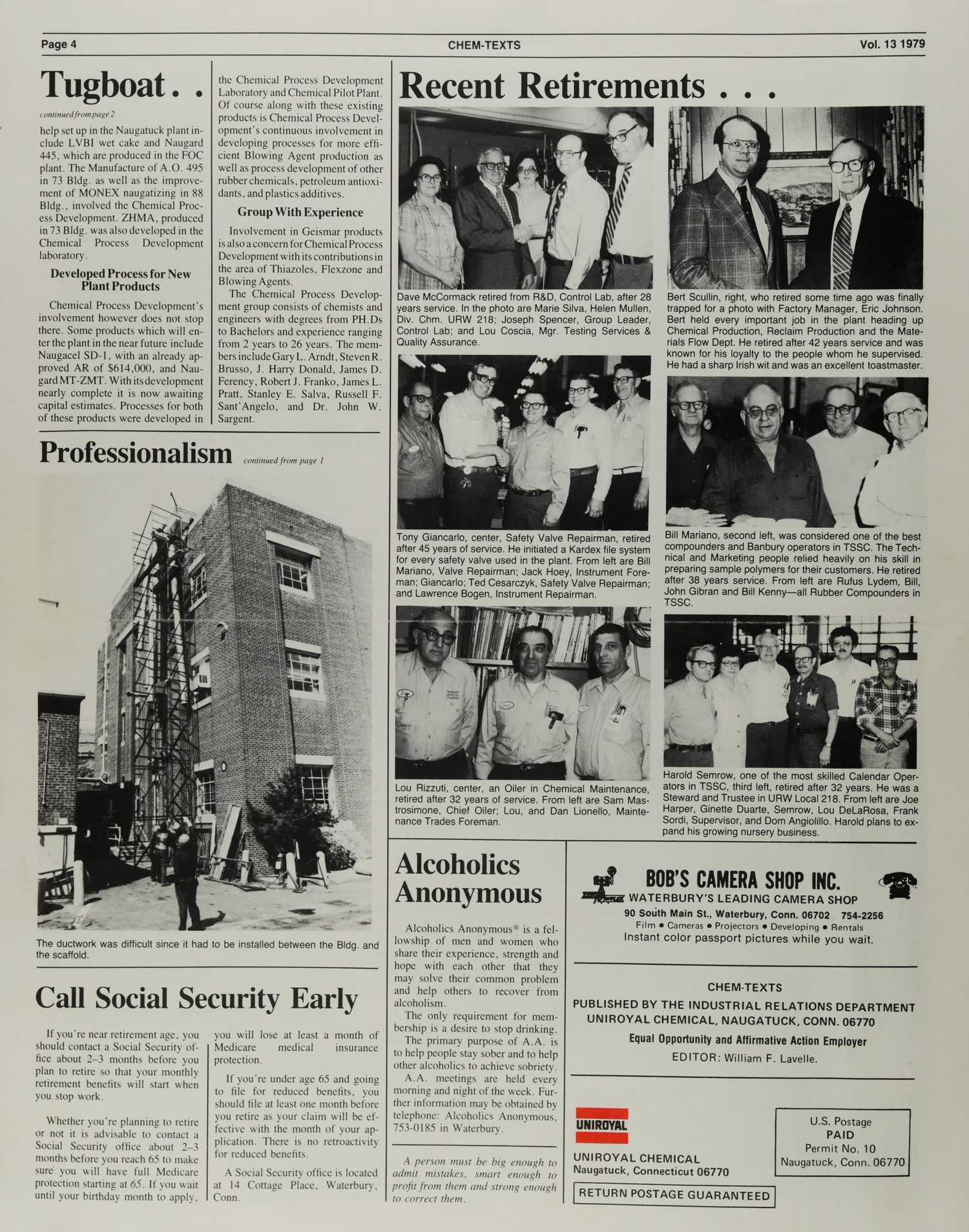
## Page 004
Tugboat . . .
the Chemical Process Development Laboratory and Chemical Pilot Plant. Of course, along with these existing products is Chemical Process Development’s continuous involvement in developing processes for more efficient Blowing Agent production as well as process development of other rubber chemicals, petroleum additives, and plastics additives.
Group With Experience
Involvement in Gessmar products is also a concern for Chemical Process Development with its contributions in the area of Thiazoles, Flexzone and Blowing Agents.
Developed Process for New Plant Products
Chemical Process Development’s involvement however does not stop there. Some notable projects for the plant in the near future include Naugatuck SH-1, with an already approved AW of $614,000, and Naugatuck MT-2MT with development nearly complete is now awaiting capital estimates. Processes for both of these products were developed in the Chemical Process Development laboratory.
Professionalism (continued from page 1)
The clockwork was difficult since it had to be installed between the Bldg. and the scaffold.
Call Social Security Early
If you’re near retirement age, you should contact a Social Security office about 2-3 months before your birthday to discuss your plan to retire so that your monthly retirement benefits will start when you stop work.
Whether you’re planning to retire or not it is advisable to contact a Social Security office about 2-3 months before your 65th birthday. Medicaid protection is also starting at 65. If you wait until your birthday month to apply, there is no guarantee your Medicaid protection will start then.
Recent Retirements . . .
Dave McCormack retired from R&D, Control Lab, after 28 years service. In the photo are Marie Sailo, Helen Mullen, Dr. Chin, LSOV 215, Joseph Sosnicki, Group Leader, Factory, Quality Assurance.
Tony Giancarlo, center, Safety Valve Repairman, retired after 35 years of service. He initiated a Kardex file system for every safety valve used in the plant. From left are Bill Marino, Valve Repairman; Jack Hoey, Instrument Foreman; and Lawrence Bogen, Instrument Repairman.
Lou Rizzuti, center, an Oiler in Chemical Maintenance, retired after 32 years of service. From left are Sam Mastroianni, Operator; Chief Oiler Lou; and Dan Lionello, Maintenance Trade Foreman.
Alcoholics Anonymous
Alcoholics Anonymous* is a fellowship of men and women who share their experience, strength and hope with each other that they may solve their common problem and help others to recover from alcoholism.
The only requirement for membership is a desire to stop drinking.
The primary purpose of A.A. is to help problem drinkers sober and to help other alcoholics to achieve sobriety. A.A. meetings are held every morning and night of the week. For information you can telephone: Alcoholics Anonymous, 753-0185, in Waterbury.
A person must be sober enough to attend meetings, smart enough to profit from them and strong enough to contribute to the group.
BOB’S CAMERA SHOP INC.
WATERBURY’S LEADING CAMERA SHOP
60 South Main St., Waterbury, Conn. 06702 754-2256
Film • Cameras • Projectors • Developing • Rentals
Instant color passport pictures while you wait.
PUBLISHED BY THE INDUSTRIAL RELATIONS DEPARTMENT
UNIROYAL CHEMICAL, NAUGATUCK, CONN. 06770
Equal Opportunity and Affirmative Action Employer
EDITOR: William E. Lavelle
U.S. Postage
PAID
Naugatuck, Conn. 06770
Permit No. 10
UNIROYAL CHEMICAL
NAUGATUCK, CONNECTICUT 06770
RETURN POSTAGE GUARANTEED
—
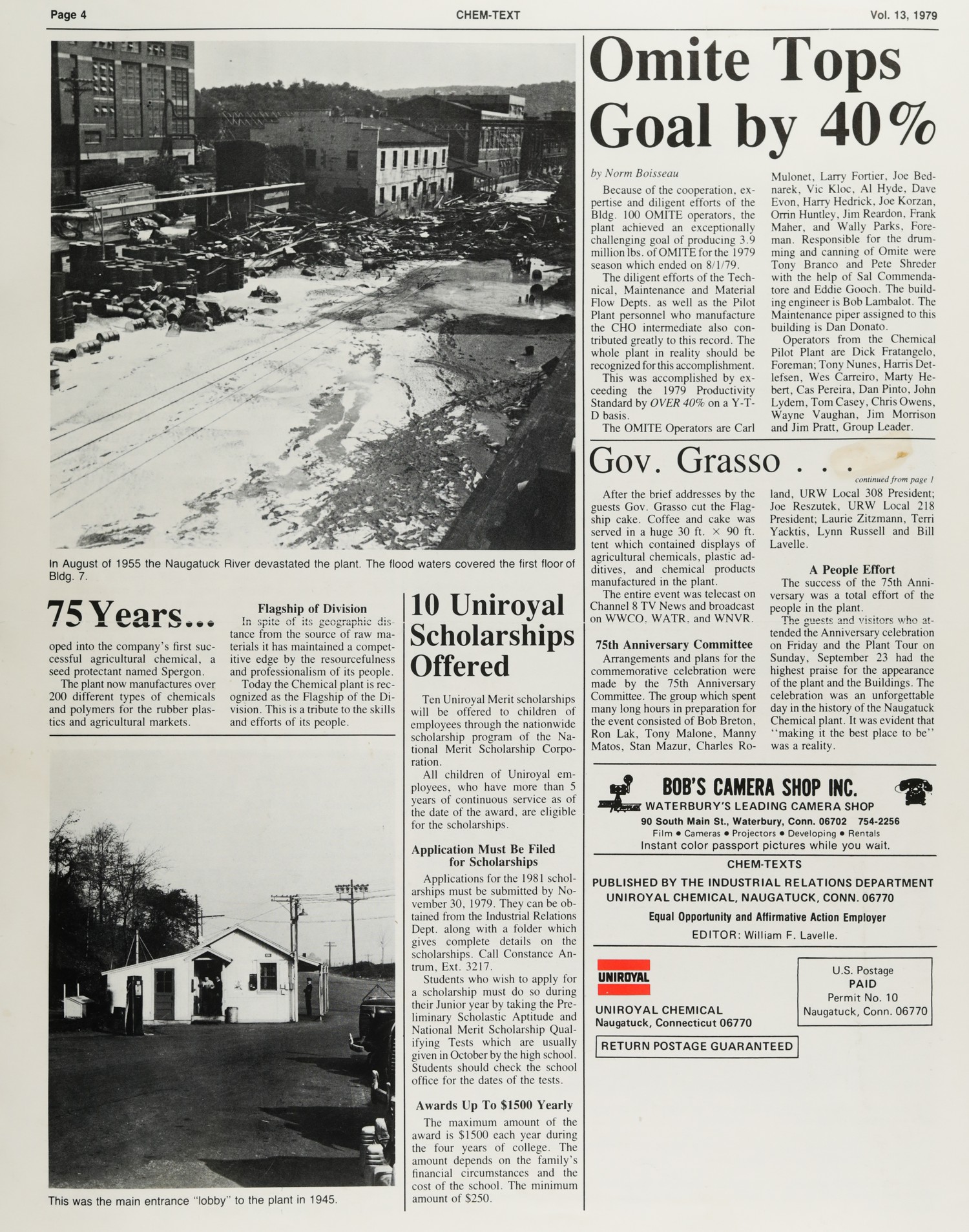
## Page 013
Omite Tops Goal by 40%
by Norm Boisseau
Because of the cooperation, expertise and diligent efforts of the Bldg. 100 OMITE operators, the plant achieved an exceptionally challenging goal of producing 3.9 million lbs. of OMITE for the 1979 season which ended on 8.1.79.
The diligent efforts of the Technical, Maintenance and Material Handling personnel who manufacture the CMO intermediate also contributed greatly to this record. The whole plant in reality should be recognized for this accomplishment.
This was accomplished by exceeding the 1979 Productivity Standard by OVER 40% on a Y-T-D basis.
Gov. Grasso . . .
After the brief addresses by the guests Gov. Grasso cut the Flag-ship case. Coffec and cake was served in a huge 30 ft. x 90 ft. tent which contained displays of directives, and chemical products manufactured in the plant.
The entire event was telcast on Channel 13 TV News and broadcast on WCCO, WATR, and WNVR.
75 Years…
In August of 1955 the Naugatuck River devastated the plant. The flood waters covered the first floor of Bldg. 7.
Flagship of Division
In spite of its geographic distance from the source of raw materials it has maintained a competitive edge by the resourcefulness and professionalism of its people. Today the Chemical plant is recognized as the flagship of the Naugatuck Division. This is a tribute to the skills and efforts of its people.
10 Uniroyal Scholarships Offered
Ten Uniroyal Merit Scholarships will be offered to children of Uniroyal employees who have more than 5 years of continuous service as of the date of the award. All children of Uniroyal employees, who have more than 5 years of continuous service as of the date of the award, are eligible for the scholarships.
Application Must Be Filed for Scholarships
Applications for the 1981 scholarships must be submitted by November 30, 1979. They can be obtained from the Industrial Relations Dept. along with a folder which gives complete details on the scholarships. Call Constance Antman, Ext. 3217.
Students who wish to apply for a scholarship must do so during a senior high school year by taking the Preliminary Scholastic Aptitude and National Merit Scholarship Qualifying Tests which are usually given in October by the high school. Students should check the school office for the dates of the tests.
Awards Up To $1500 Yearly
The maximum amount of the award is $1500 each year during the four years of college. The amount depends on the family’s financial circumstances and the cost of the school. The minimum amount of $250.
This was the main entrance “lobby” to the plant in 1945.
—
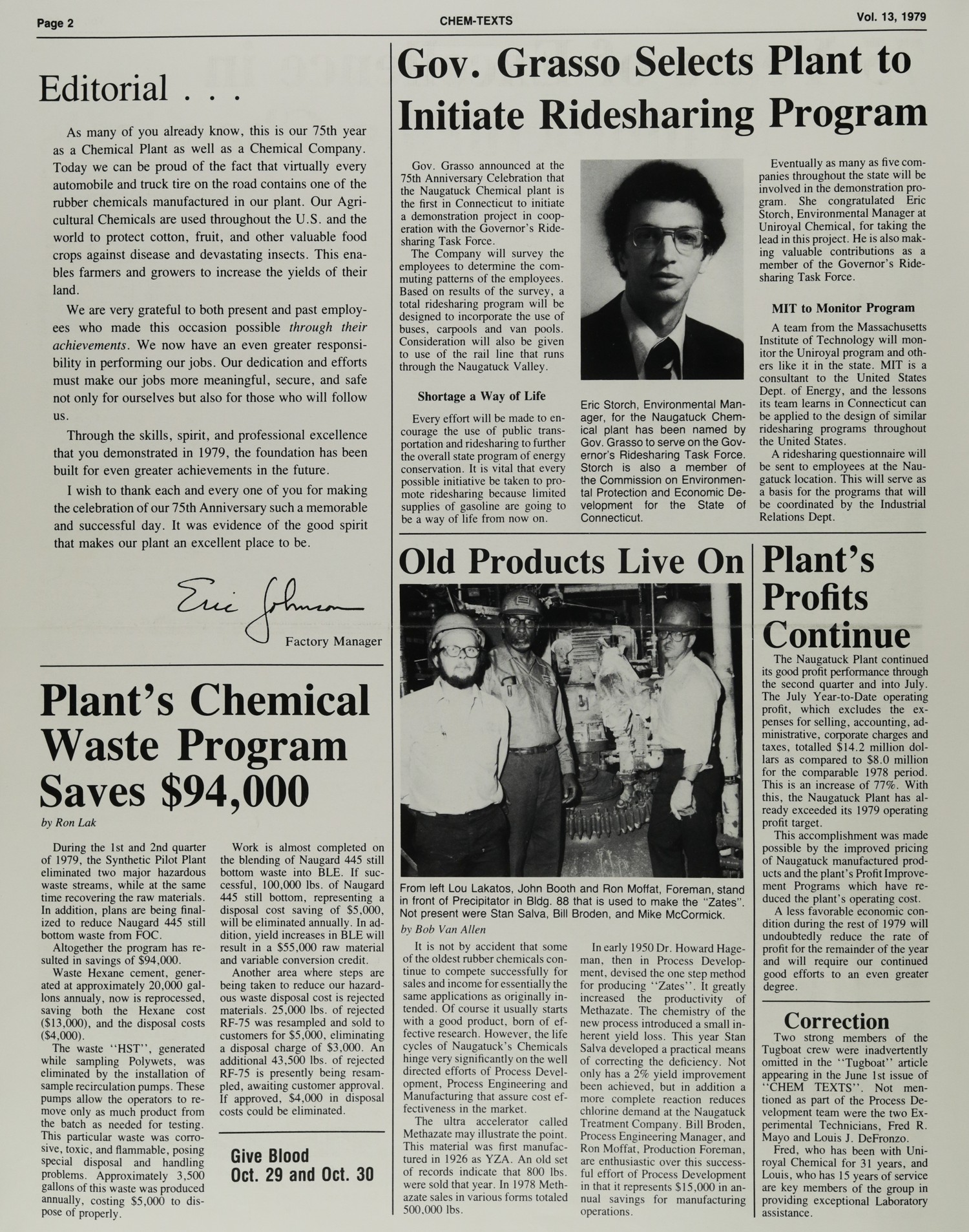
## Page 273
Here is the text extracted from the document image, preserving the layout and structure as much as possible:
Editorial . . .
As many of you already know, this is our 75th year as a Chemical Plant as well as a Chemical Company. Today we can be proud of the fact that virtually every automobile and truck tire on the road contains one of the rubber chemicals manufactured in our plant. Our Agricultural Chemicals are used throughout the U.S. and the world to protect cotton, fruit, and other valuable food crops against disease and devastating insects. This enables farmers and growers to increase the yields of their land.
We are very grateful to both present and past employees who made this occasion possible through their achievements. We now have an even greater responsibility in performing our jobs. Your dedication and efforts must make our jobs more meaningful, secure, and safe not only for ourselves but also for those who will follow us.
Through the skills, spirit, and professional excellence that you demonstrated in 1979, the foundation has been built for even greater achievements in the future.
I wish to thank each and every one of you for making the celebration of our 75th Anniversary such a memorable and successful day. It was evidence of the good spirit that makes our plant an excellent place to be.
Eric Johnson
Factory Manager
Gov. Grasso Selects Plant to Initiate Ridesharing Program
Gov. Grasso announced at the 75th Anniversary Celebration that the Naugatuck Chemical Plant is to be the first in Connecticut to initiate a demonstration project in cooperation with the Governor’s Ridesharing Task Force.
The Company will survey the employees to determine the commuting patterns of the employees. Based on results of the survey, a system will be designed to incorporate the use of buses, carpools and van pools. Consideration will also be given to use of the rail line that runs through the Naugatuck Valley.
Shortage a Way of Life
Every effort will be made to encourage the use of public transportation. This is vital that every possible initiative be taken to promote ridesharing because limited supplies of gasoline are going to be a way of life from now on.
Old Products Live On Plant’s
Profits Continue
The Naugatuck Plant continued its good profit performance through the second quarter and into July. Profit for the quarter was $4.2 million, excluding the expenses for selling, accounting, administrative, corporate charges and taxes, totaled $14.2 million dollars as compared to $8.0 million for the comparable 1978 period.
This is an increase of 77%. With this, the Naugatuck Plant has already exceeded its 1979 operating profit targets. These profits were made possible by the improved pricing of Naugatuck manufactured products and the plant’s Profit Improvement Programs which have reduced the plant’s operating cost.
A less favorable economic condition during the rest of 1979 will undoubtedly reduce the profit trend, but improved operating efficiencies and cost control will continue to some degree.
Plant’s Chemical
Waste Program
Saves $94,000
by Ron Lak
During the 1st and 2nd quarter of 1979, the Synthetic Pilot Plant eliminated two major hazardous waste streams, while at the same time recovering the raw materials.
In addition, plans are being finalized to reduce Naugatuck 445 still bottom waste from BLE to $35,000 annually. This will be eliminated annually. In addition, yield increases in BLE will reduce the 515,000 lbs. of hazardous and variable conversion credit.
Another major steps are being taken to reduce our hazardous waste disposal cost is expected to materials. 25,000 lbs. of rejected R-75 are reconditioned and sold to customers for $5,000, eliminating the disposal of $3,000. An additional 15,000 lbs. of R-75 is presently being reclaimed, awaiting customer approval. If approved, $4,000 in disposal costs could be eliminated.
The work so far, “HST”, generated an estimated Polyelene recovery, has eliminated 25% of the original samples tests. These pumps allow the operators to recover only as much product from the batch as needed for testing.
This particular waste was corrosive, toxic, and flammable, posing special disposal and handling problems. Approximately 3,500 gallons of this waste was produced annually at a disposal cost of $3,000 to dispose of properly.
Give Blood
Oct. 29 and Oct. 30
Plant to
Initiate Ridesharing Program
Eric Slorch, Environmental Manager, for the Naugatuck Chemical Plant, has been named by the Governor to serve on the Governor’s Ridesharing Task Force.
Slorch is also a member of the Commission on Environmental Protection and Economic De-velopment for the State of Connecticut.
A team from the Massachusetts Institute of Technology will monitor the Naugatuck Plant to determine the feasibility and cost effectiveness of ridesharing programs throughout the United States.
A ridesharing questionnaire will be sent to employees at the Naugatuck location. This will serve as a basis for the programs that will be coordinated by the Industrial Relations Dept.
Correction
Two strong members of the Upkeep crew were inadvertently omitted from the “Upkeep” article appearing in the June 14 issue of Chem-Texts. Fred R. Mayo and Louis J. DeFranco, Fred, who has been with Uniroyal Chemical for 15 years, and Louis, who has 15 years of service in the group, also made exceptional contributions as Experimental Technicians. Fred R. Mayo and Louis J. DeFranco provided outstanding assistance.
—
## Page 278
75 Years of Excellence in Manufacturing Chemicals
From one small building, Bldg. 1, and one simple product—sulfuric acid—the Naugatuck Chemical Co. has grown to become one of the world’s leading manufacturers of rubber chemicals. Today, virtually every automobile tire on the road contains one of the chemicals manufactured by the people in the Chemical Manufacturing unit.
The plant is also a major producer of agricultural chemicals and other industrial chemicals. Oxine, a herbicide used in every part of the world to control mite damage on cotton, fruit, and other valuable food crops.
In 75 years the plant has grown to cover 100 buildings that occupy 69 acres of land along the Naugatuck river. Besides the plant itself, the 69 acres also houses the world headquarters for the Chemical division.
Roots Traced to Goodyear
Uniroyal Chemical traces its roots to Charles Goodyear and his patent for vulcanizing rubber onto cloth for coats, shoes and gloves. He issued a license in Naugatuck, founded two companies there, Goodyear India Rubber Glove Co. and Goodyear Metallic Rubber Shoe Co., and issued licenses for his vulcanization method to a number of New England manufacturers, who each produced a single vulcanized product.
In 1892, the Rubber Regenerating Co., was formed in Naugatuck to reclaim the scrap rubber from the many footwear and clothing plants in the New England area.
Naugatuck Chemical Co. Formed
The Rubber Regenerating Co. was buying its sulfuric acid from a plant in New Jersey, until 1904 when a group of Naugatuck investors formed the Naugatuck Chemical Co. to produce sulfuric acid for the rubber firm.
The two Naugatuck plants, Rubber Regenerating Co. and Naugatuck Chemical Co. were acquired by United States Rubber company in 1910 and 1913, each operating as a separate division. Later, the two were brought under single management as the Naugatuck Chemical Division of the United States Rubber Co.
Aniline Made
During World War I, aniline, used more and more as an agent to speed the vulcanization process, was in short supply, since most of it was produced overseas. When the Naugatuck Chemical Co. began to make its own aniline, the first organic chemical manufactured by the Chemical division.
Aniline was the first of many specialized rubber chemicals developed and manufactured at Naugatuck.
In World War II, the country found itself without its sources of raw rubber. The Government and a number of companies, including U.S. Rubber joined forces to develop a synthetic rubber needed for the tires to keep our military moving.
Agricultural Chemicals Originated
After World War II, Naugatuck Chemical began the production of agricultural chemicals, which today is a major factor in the division. But that new use of chemicals was based on the old, for it was a rubber chemical which was developed.
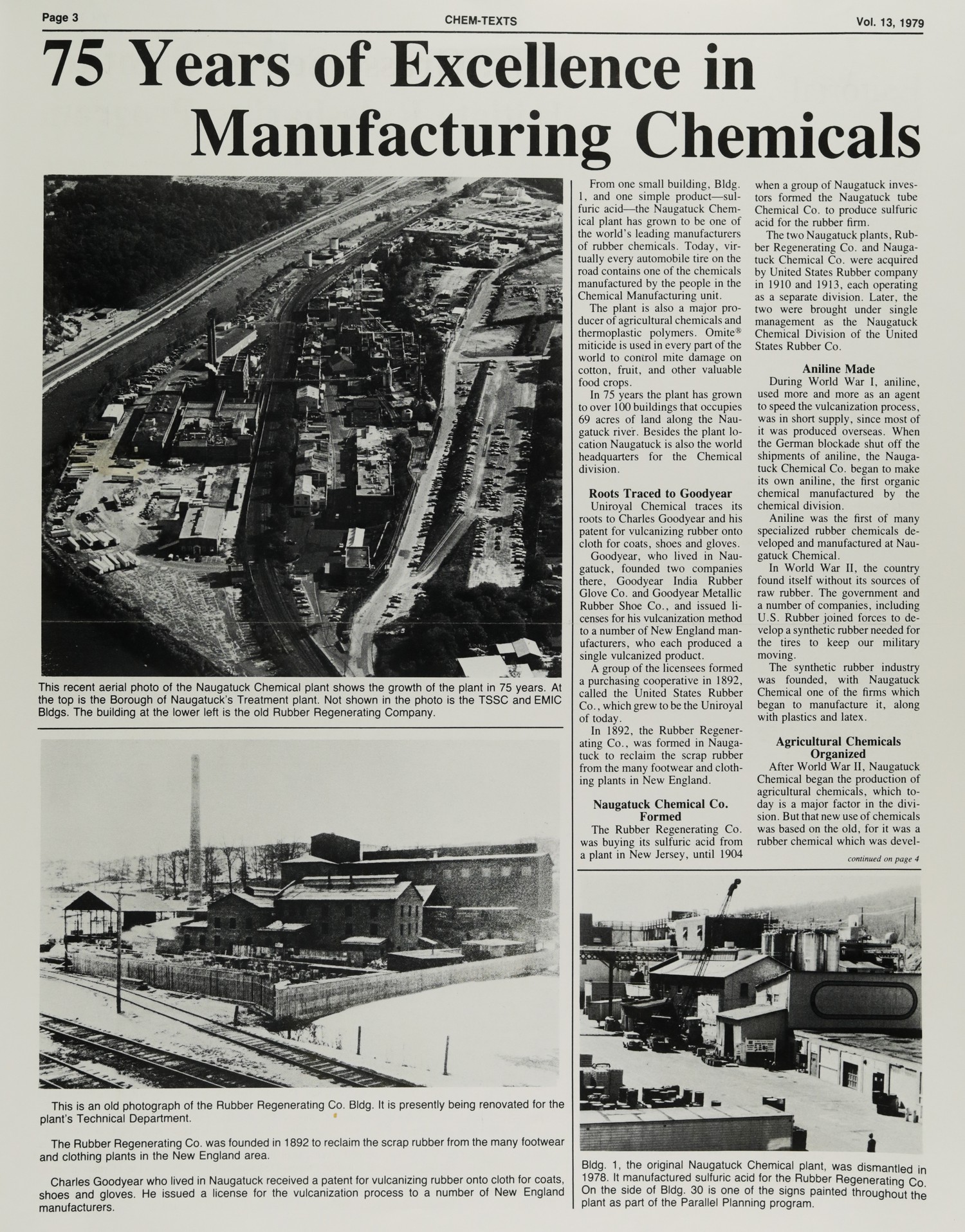
This recent aerial photo of the Naugatuck Chemical plant shows the growth of the plant in 75 years. At the top is the Borough of Naugatuck’s Treatment plant. Not shown in the photo is the TSSC and EMIC Bldg. The building at the lower left is the old Rubber Regenerating Company.
This is an old photograph of the Rubber Regenerating Co. Bldg. It is presently being renovated for the plant’s Technical Department.
The Rubber Regenerating Co. was founded in 1892 to reclaim the scrap rubber from the many footwear and clothing plants in the New England area.
Charles Goodyear who lived in Naugatuck received a patent for vulcanizing rubber onto cloth for coats, shoes and gloves. He issued a license for the vulcanization process to a number of New England manufacturers, who each produced a single vulcanized product.
Bldg. 1, the original Naugatuck Chemical plant, was dismantled in 1978. It manufactured sulfuric acid for the Rubber Regenerating Co. On the side of Bldg. 30 is one of the signs painted throughout the plant as part of the Parallel Planning program.
—
## Page 282
Vol. 13, 1979
CHEM-TEXTS
Page 3
46 Employees Honored for Service
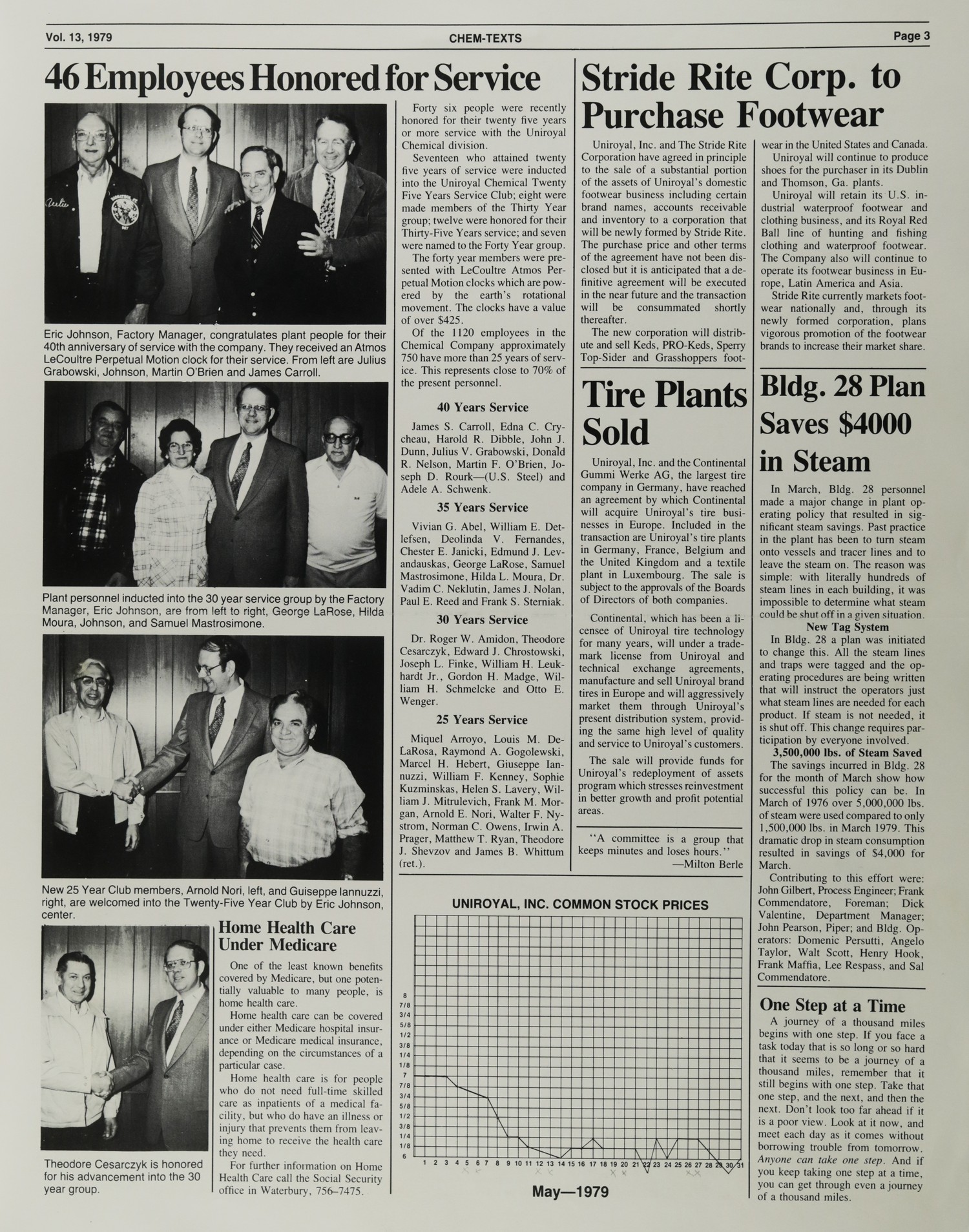
Forty six people were recently honored for their twenty five years or more service with the Uniroyal Chemical division. Seventeen who attained twenty five years of service were inducted into the Uniroyal Chemical Twenty Five Years Service Club, eight were made members of the Thirty Year Service Club, and seven were named to the Forty Year group.
The forty year members were presented with Grandfather Atmos Perpetual Motion clocks which are powered by the earth’s rotational movement. The clocks have a value of over $425.
Uniroyal Chemical Company’s 46 employees honored in the Chemical division represent close to 70% of the present personnel.
40 Years Service
James S. Carroll, Edna C. Cryderman, Harold R. Dibble, John J. Dunn, Julius V. Grabowski, Donald R. Nelson, Martin F. O’Brien, Joseph D. Rourk–(U.S. Steel) and Adele A. Schwenk.
35 Years Service
Vivian G. Abel, William E. Delfsen, Deolinda V. Fernandes, Chester E. Janicki, Edmund J. Levandauskas, George LaRosa, Samuel Mastoropoulos, Hilda L. Munn, Dr. Valdo C. McClarin, James J. Nolan, Paul E. Reed and Frank S. Seninka.
30 Years Service
Dr. Roger W. Amidon, Theodore Cesarczyk, Edward J. Chrostowski, Joseph L. Frlke, William H. Lenkhard Jr., Gordon H. Madge, William H. Schneickle and Otto E. Wenger.
25 Years Service
Miquel Aroyo, Louis M. DeLaRosa, Edward A. Gundlach, Marcel H. Hebert, Giuseppe Iannuzzi, Victor J. Kennedy, Sophie Kuzminskas, Helen S. Lavery, William J. Milevich, Frank M. Morgan, Arnold E. Neri, Walter F. Nystrom, Norman C. Ovens, Irwin A. Prager, Matthew T. Ryan, Theodore J. Shary and James B. Whitten.
New 25 Year Club members, Arnold Neri, left, and Guiseppe Iannuzzi, right, are welcomed into the Twenty-Five Year Club by Eric Johnson, center.
Home Health Care
Under Medicare
One of the least known benefits covered by Medicare, but one potentially available to many people, is home health care.
Home health care can be covered under either Medicare hospital insurance or Medicare medical insurance, depending on the circumstances of a particular case.
Home health care is for people who do not need full-time skilled care as inpatients of a medical facility, but rather who do have an illness or injury that prevents them from leaving home to receive the health care they need.
For further information on Home Health Care call the Social Security office in Waterbury, 756-475.
Theodore Cesarczyk is honored for his advancement into the 30 year group.
Stride Rite Corp. to
Purchase Footwear
Uniroyal, Inc. and The Stride Rite
Corporation have agreed in principle
to the sale of a substantial portion
of the assets of Uniroyal’s domestic
footwear business including certain
brand names, accounts receivable,
manufacturing facilities and goodwill
which will be newly formed by Stride Rite.
The purchase price and other terms
of the agreement have not been disclosed but it is anticipated that a definitive agreement will be executed
in the near future and the transaction
will be consummated shortly
thereafter.
Uniroyal will continue to produce
shoes for the purchaser in Dublin
and Thomson, Ga. plants.
Uniroyal will retain its U.S. industrial waterproof footwear and
clothing business at its Ball Maine
Ball line of hunting and fishing
clothing and waterproof footwear.
The Company also will continue to
operate its footwear businesses in Europe, Latin America and Asia.
Stride Rite currently markets footwear nationally and, through its
newly formed organization, plans
vigorous promotion of the footwear
brands to increase their market share.
Tire Plants Bldg. 28 Plan
Sold Saves $4000
in Steam
Uniroyal, Inc. and the Continental
Gummi Werke AG, the largest tire
company in Germany, have reached
agreement in which Continental
will acquire Uniroyal’s tire businesses in Europe. Included in the
transaction are Uniroyal’s tire plants
in Germany, France, Belgium and
the United Kingdom and a textile
plant in Luxembourg. The sale is
subject to the approvals of the Boards
of Directors of both companies.
In March, Bldg. 28 personnel
made a major change in plant operating policy that resulted in significant energy and cost savings.
The change in the plant has been to turn steam
onto vessels and tracer lines and to
leave the steam on. The reason was
simple: with literally hundreds of
steam lines in each building, it was
impossible to determine what steam
could be shut off in any given situation.
Continental, which has been a licensee of Uniroyal tire technology
for many years, will under a trademark license from Uniroyal and
Continental continue to produce,
manufacture and sell Uniroyal brand
tires in Europe and will aggressively
market them through Uniroyal’s
present distribution system, providing the same high level of quality
and service to Uniroyal’s customers.
In Bldg. 28, the decision was made
to change this. All the steam lines
and traps were tagged and the operating procedures are being written
that will instruct the operators just
what steam lines are needed for each
product. If steam is not needed, it
is shut off. This change requires participation by everyone involved.
The sale will provide funds for
Uniroyal’s redeployment of assets
program which increases reinvestment
in better growth and profit potential
areas.
The savings incurred in Bldg. 28
for the month of March show how
successful this policy can be. In
March of 1976 over 5,000,000 lbs.
of steam were used compared to only
1,500,000 lbs. in March 1979. This
dramatic drop in steam consumption
resulted in savings of $4,000 for
that month.
“A committee is a group that
keeps minutes and loses hours.”
– Milton Berle
Contributing to this effort were:
John Gilbert, Process Engineer; Frank
Commodaro, Foreman; Dick
Valentine; Department Manager,
John Pearson, Pipex; and Bldg. Operators: Dominic Perutti, Angelo
Taylor, Walt Scott, Henry Hook,
Frank Miller, Lee Repass, and Sal
Commodaro.
One Step at a Time
A journey of a thousand miles
begins with one step. If you face a
task today that is so long or so hard
that it seems overwhelming, remember that it
still begins with one step. Take that
one step, and the next, and then the
next. Don’t look too far ahead if it
is a poor view. Look at it now, and
meet only day as it comes; without
borrowing trouble from tomorrow.
Remember, the journey of a thousand
miles will be completed, one step at a time,
you keep taking one step at a time,
you can get through even a journey
of a thousand miles.
UNIROYAL, INC. COMMON STOCK PRICES
May–1979
—
## Page 285
Here is the text extracted from the document image, preserving the layout and structure as much as possible:
Page 2
CHEM-TEXTS
1978 was a Good Year…
You and I know our Company is starting to generate
an upward momentum as illustrated by the outstanding
performance of the Naugatuck Plant and the Chemical
Company in 1978. The Chemical Company profits exceeded all expectations last year and our Plant’s 1978
operating profit increased 58%.
This outstanding achievement is the result of your efforts
whether you are in Manufacturing, Research and Development, Accounting, D&S, the Service Departments, or
elsewhere.
Our plant’s goal is to have a 30% plant operating profit
that would result in a 9% return on sales. This year our
objective is to increase the return on sales from 3 to 4.5%.
How do we expect to achieve our profitability objective?
The answer to this question is reflected in the achievements
of last year.
In the Maintenance Department an outstanding job was
performed in reducing equipment downtime from 8.9 to
6.2%. Our year-end goal is 6% and January was an excellent
start with downtime averaging 4.5%.
Manufacturing productivity records in the production of Rubber Chemicals, Agricultural Chemicals, and
Thermoplastics. Omite, LVBI, Tenox, and TPR productivities increased between 20 and 30% while PANA and
Naugatuck 445 improved by 66%. Also a reduction in
Keylar changeovers was achieved through better coordination and communications. In addition, Corden, Harris,
P. Colden RA, and Polyard I. were successfully produced
in the Plant. All these achievements resulted in increasing
our Plant’s profitability by 58%.
Our Industrial Relations Department was reorganized
and is more effective in serving our needs. Safety Goals
were far exceeded with 1.2 incidence rate and Workmen’s
Compensation costs were reduced by $165,000. A new
performance appraisal system was initiated and a training
session held to help managers conduct performance ap-
praisals with their people.
A Controllers Department was established to perform
financial reporting, budgeting, forecasting, and economic
analysis; to conduct approvals of Appropriation Requests;
and to identify opportunities for cost improvement.
The Technical Department now includes all engineering
functions: process, project, environmental, and industrial
engineering. 2.3 million dollars of profit improvement was
realized through developing a team effort with the plant,
R & D, and marketing. This year a similar amount is expected through Project Enterprise, the name of our 1979
Profit Improvement Program. Over $300,000 was saved
through the work of the Plant’s Energy Committee. Other
savings were realized by the Environmental Department
in productivity records in Rubber Chemicals and Omite
as well as the successful production of Comtic, Octamine
P. Colden RA, and Polyard I.
In the Material Flow Department transportation credits
exceeded budget by $13,000. An additional $532,000 was
saved through improved transportation of our finished
goods. Shipping and receiving increased productivity by
7% and improved the service on export shipments. The
Purchasing Department and Control Center reduced our
inventory levels thereby increasing our return on assets.
In cost saving measures, our energy conservation programs
exceeded our expectations by $400,000 dollars.
A major objective is to improve the utilization of our
plant by introducing new products in our existing facilities
or attracting new manufacturing facilities because our
resources are underutilized. For example, we are using
only 50% of our steam generation and waste water treatment capacities while Rubber Chemicals is budgeted to
operate only between 60-65% of capacity this year. If
our plant’s operating profit would increase to approximately 27%. On some recent data it appears that a 10%
selling price increase would have the same impact as a
30% cost reduction.
1978 was a year of change and accomplishment.
We have the reputation of managing our business. Naugatuck seeks change. We are determined to overcome
our geographical raw material disadvantage through
PROFESSIONAL EXCELLENCE in every assignment
and job that is performed.
In 1979 Naugatuck seeks a Better Place To Be and
soon the Best Place To Be.
Eric Johnson
Factory Manager
Vol. 13, 1979
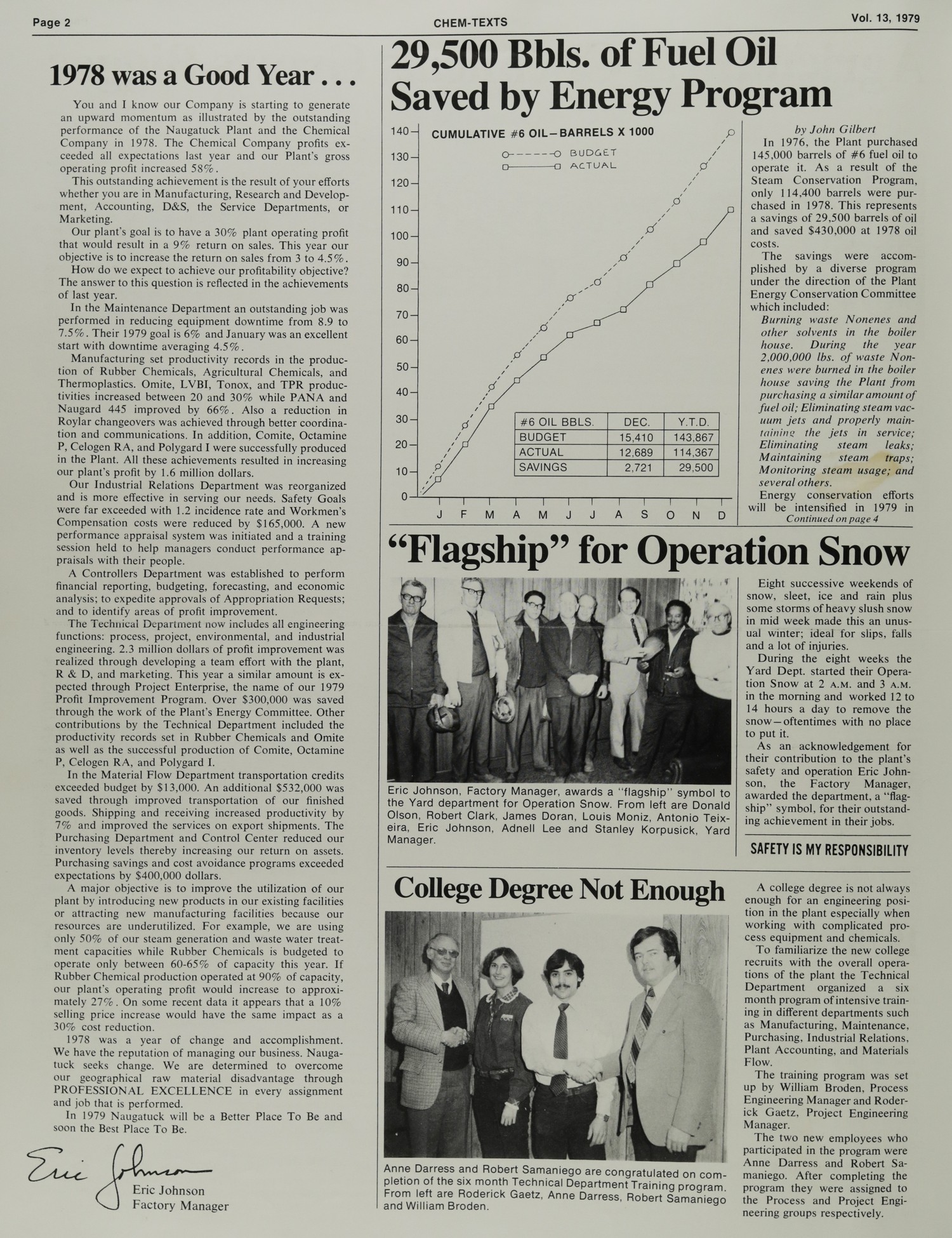
29,500 Bbls. of Fuel Oil
Saved by Energy Program
CUMULATIVE # OIL-BARRELS X 1000
BUDGET
ACTUAL
SAVINGS
6 OIL BBLS
BUDGET
ACTUAL
SAVINGS
DEC
15,110
12,689
2,721
Y.T.D.
143,867
114,367
29,500
“Flagship” for Operation Snow
Eric Johnson, Factory Manager, awards a “flagship” symbol to
the Yard department for Operation Snow. From left are Donald
Olson, Robert Clark, James Doran, Louis Moniz, Antonio Teixeira, Eric Johnson, Ardell Lee and Stanley Korpusicek, Yard
Manager.
College Degree Not Enough
Anne Darress and Robert Samaniego are congratulated on completion of the six month Technical Department Training program.
From left are Roderick Gaetz, Anne Darress, Robert Samaniego
and William Broden.
Eight successive weekends of
snow, sleet, ice and rain plus
some storms of heavy slush snow
in mid week made this an unusual winter; ideal for slips, falls
and a lot of injuries.
During the eight weeks the
Yard Dept. started their Operation Snow at 2 A.M. and 3 A.M.
and continuously worked up to
14 hours a day to remove the
snow—sometimes with no place
to put it.
As an acknowledgement for
their contribution to the plant’s
safety and operation, Eric Johnson, the Factory Manager,
awarded the department a “flagship” symbol for their outstanding achievement in their jobs.
SAFETY IS MY RESPONSIBILITY
A college degree is not always
enough for an engineering position in the plant especially when
working with complicated process equipment and chemicals.
To familiarize the new college
recruits with the overall operations of the Technical
Department, a six
month program of intensive train-
ing in different departments such
as Manufacturing, Maintenance,
Purchasing, Industrial Relations,
Plant Accounting, and Materials
Flow.
The training program was set
up the William Broden, Process
Engineering Manager and Roderick Gaetz, Project Engineering
Manager.
The two new employees who
participated in the program were
Anne Darress and Robert Samaniego. After completing the
program they were assigned to
the Process Engineering groups respectively.
—