
**Date:** 6-12-67
**Source:** Unknown
—
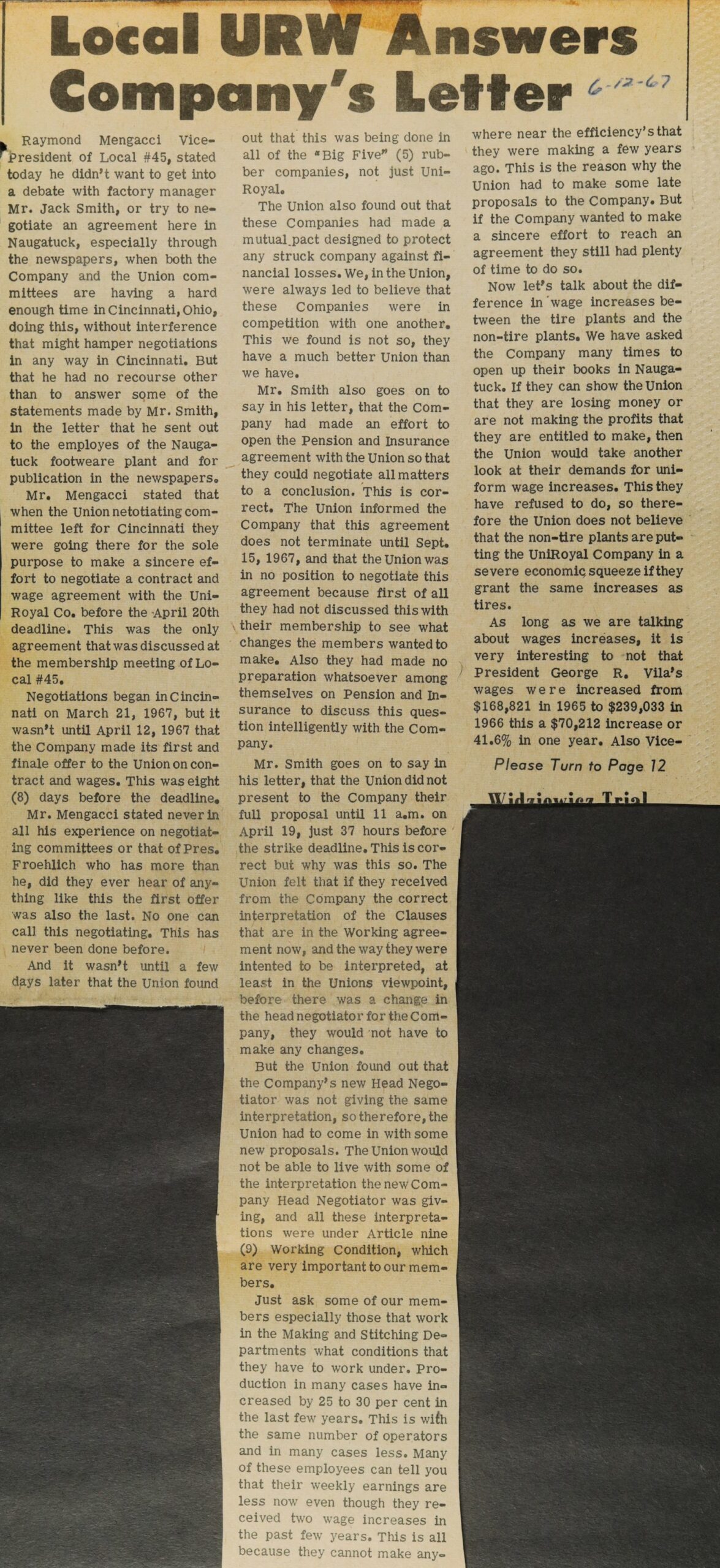
Raymond Mengacci Vice-President of Local 445, stated today he didn’t want to get into a debate with factory manager Mr. Jack Smith, or try to negotiate an agreement here in Naugattuck, especially through the newspapers, when both the Company and the Union committees are having a hard enough time in Cincinnati,Ohio, doing this, without interference that might hamper negotiations in any way in Cincinnati. But that he had no recourse other than to answer some of the statements made by Mr.Smith, in the letter that he sent out to the employees of the Naugattuck plant and for publication in the newspapers.
Mr. Mengacci stated that when the Union negotiating committee left for Cincinnati they were going there for the sole purpose to make a sincere effort to negotiate a contract and wage agreement with the Union Royal Co. before the April 20th deadline. This was the only agreement that was discussed at the membership meeting of Local 445.
Negotiations began in Cincinnati on March 21, 1967, but it wasn’t until April 12, 1967 that the Company made its first and finale offer to the Union on contract and wages. This was eight (8) days before the deadline. Mr. Mengacci stated he never in all his experience on negotiating committees or that of President Proechlich who has more than 25 years ever heard of anything like this the first offer was also the last. No one can call this negotiating. This has never been done before.
And it wasn’t until a few days later that the Union found out that this was being done in all of the Allied Flyer (5) rubber companies, not just Union Local 445.
The Union also found out that these Companies had made a mutual pact designed to protect any struck company against financial losses. We, in the Union, were always led to believe that these Companies were in competition with one another. This we found is not so, they have a much better Union than we have.
Mr. Smith also goes on to say in his letter, that the Union Company had made an effort to open the Pension and Insurance agreement with the Union so that they could negotiate all matters to a conclusion. This is correct. The Union informed the Company that this agreement does not terminate until Sept. 15, 1967, and that the Union was in no position to negotiate this agreement because first of all they had not discussed this with their membership to see what changes the members wanted to make. Also they had made no preparation whatsoever among themselves to Pension and Insurance to discuss this question intelligently with the Company.
Mr. Smith goes on to say in his letter, that the Union did not present to the Company their full proposal until 11 a.m. on April 19, just 37 hours before the strike deadline. This is correct, but why was this so? The Union felt that if they received from the Company the correct interpretation of the Clauses that are in the Working agreement now, and the way they were intended to be interpreted, at least in the Unions viewpoint, before there was a change in the head negotiator for the Company, they would not have to make any changes.
But the Union found out that the Company’s new Head Negotiator was not giving the same interpretation, so therefore, the Union had to come in with some new proposals. The Union would not be able to live with some of the interpretation the new Company Head Negotiator was giving, and all these interpretations were under Article nine (9) Working Condition, which are very important to our members.
Just ask some of our members especially those that work in the Making and Stitching Departments what conditions that they have to work under. Production in many cases have increased by 25 to 30 per cent in the last few years. This is with the same number of operators and in many cases less. Many of these employees can tell you that their weekly earnings are less now even though they received two wage increases in the past few years. This is all because they cannot make any production to offset the increases in the cost of living.