
**Date:** 6-29-67
**Source:** In Uniroyal Case
—
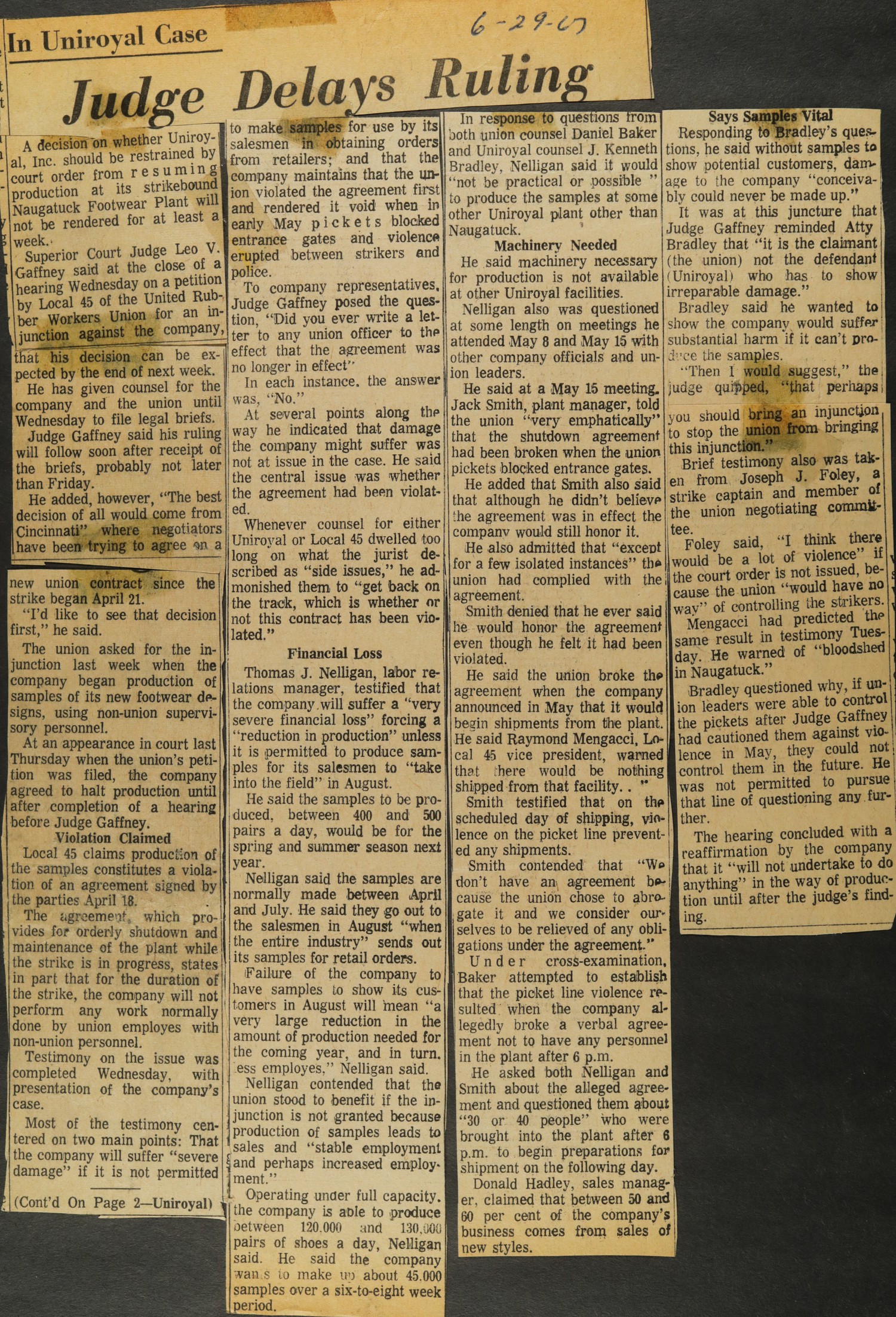
A decision on whether Uniroyal Inc. should be restrained by court order from resuming production at its Naugatuck Footwear Plant will not be rendered for at least a week. Superior Court Judge Leo V. Gaffney said at the close of a hearing Wednesday on a petition by Local 45 of the United Rubber Workers Union for an injunction against that decision, that this decision can be expected by the ends of next week. The judge gave counsel for the company and the union until Wednesday to file legal briefs. Judge Gaffney said his ruling will follow soon after receipt of the briefs, probably not later than Friday. He added, however, “The best decision of all would come from Cincinnati” where negotiators have been trying to reach an agreement on a new union contract since the strike began April 21. To the question, “Did you ever write a letter to any union officer to the effect that the agreement was no longer in effect?” the answer, was, “No.” He said several points along the way he indicated that damage the company might suffer was not at issue in the case. He said the central issue was whether the agreement had been violated. Whenever counsel for either Uniroyal or Local 45 dwelled too long on what the issues side-issues, he admonished them to “get back on the track, which is what this contract has been violated.” Financial Loss Thomas J. Nelligan, labor relations manager, testified that the company will suffer a “very severe financial loss” forcing a “reduction in production” unless it is permitted to take samples for its salesmen to “take to the field” in August. He said the samples to be produced, between 400 and 500 pairs a day, would be for the spring and summer season next year. Nelligan said the samples are normally made between April and July, He said they go out to the salesmen in August “when the entire industry” sends out its samples for retail orders. Failure of the company to have samples to show its customers in August will mean “a very large reduction in the amount of production needed for the coming year, and in turn ess employes,” Nelligan said. Nelligan contended that the union stood to benefit if the injunction is not granted because production of samples leads to sales and “stable employment” and perhaps increased employment.” Operating under full capacity, the company is able to produce between 120,000 and 130,000 pairs of shoes a day, Nelligan said. He said the company plans to make up about 45,000 samples over a six-to-eight week period. In response to questions from Uniroyal counsel J. Kenneth Bradley, Nelligan said it would not be practical or possible to produce the samples at some other Uniroyal plant other than Naugatuck. Machinery Needed He said machinery necessary for production is not available at other Uniroyal facilities. Nelligan also was questioned at length on managing the attendance May 8 and May 15 with the company officials and union leaders. He said at a May 15 meeting, Jack Smith, plant manager, told the union “very emphatically” that the shutdown agreement had been broken when the union pickets blocked entrance gates. He added that Smith also said that although he didn’t believe the agreement was in effect, the company would still honor it. He also admitted that “except for a few isolated instances” the union had complied with the agreement. Smith denied that he ever said he would honor the agreement even though he felt it had been violated. He said the union broke that agreement when the company announced in May that it would resume shipping from the plant. He said Raymond Mengacci, Local 45 vice president, warned that there would be trouble if the company shipped from that facility. Smith testified that on the scheduled day of shipping, violence on the picket line prevented any shipments. Under cross-examination, Baker attempted to establish that the picket line violence resulted when the company allegedly broke a verbal agreement not to have any personnel in the plant after 6 p.m. He asked both Nelligan and Smith about the alleged agreement and questioned them about “30 or 40 people” who were brought into the plant after 6 p.m. to begin preparations for shipment on the following day. Donald Hadley, sales manager, claimed that between 50 and 60 per cent of the company’s business comes from sales of new styles.