**Date:** 1967-07-11
**Source:** THE WORKER
—
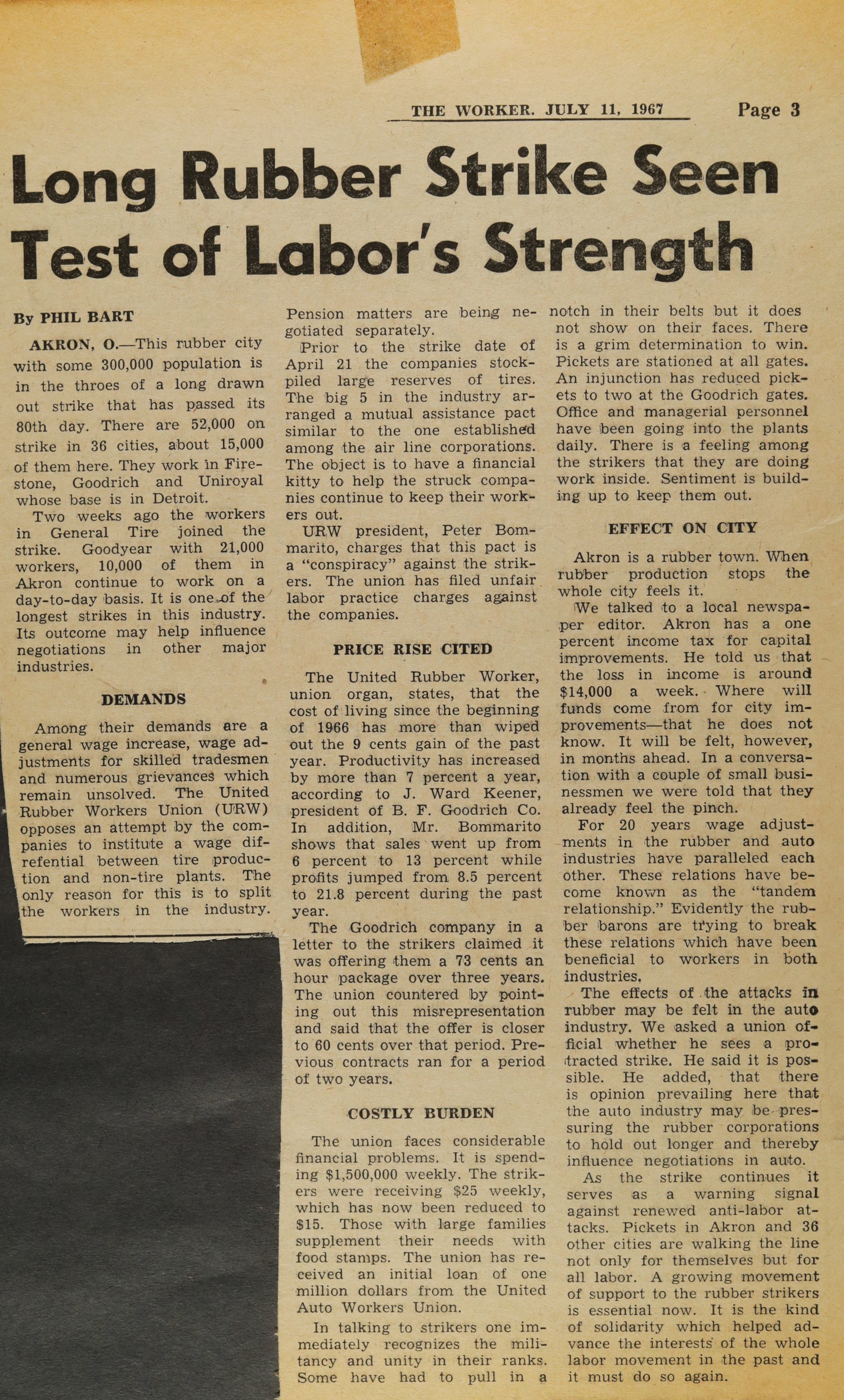
AKRON, O.–This rubber city with some 300,000 population is in the throes of a long drawn out strike that has passed its 80th day. There are 52,000 on strike in 36 cities, about 15,000 of them here. The key work in Firestone, Goodrich and Uniroyal whose base is in Detroit.
Two weeks ago the workers in General Tire joined the strike. Goodrich with 21,000 workers, 10,000 of them in Akron continue to work on a day-to-day basis. It is one of the longest strikes in this industry. Its outcome may help influence negotiations in other major industries.
DEMANDS
Among their demands are a general wage increase, wage adjustments for skilled tradesmen and numerous grievances which remain unresolved. The United Rubber Workers Union (URW) opposes an attempt by the companies to institute a wage differential between production and non-tire plants. The only reason for this is to split the workers in the industry.
PENSION MATTERS
Pension matters are being negotiated separately. Prior to the strike date of April 21 the companies stockpiled large reserves of The big 5 in the industry arranged a mutual assistance pact similar to the one established among the tire corporations. The object is to have a financial kitty to help the struck companies continue to keep their workers out.
URW president, Peter Bommarito, charges that this pact is a “conspiracy” against the strikers. The union has filed unfair labor practice charges against the companies.
PRICE RISE CITED
The United Rubber Worker, union organ, states that the cost of living since the beginning of 1966 has more than wiped out the 9 cents gain of a year. Productivity has increased by more than 7 percent a year, according to J. Ward Keener, president of B.F. Goodrich Co.
In addition, Mr. Bommarito shows that sales went up from 6 percent to 13 percent while profits jumped from 8.5 percent to 21.8 percent during the past year.
The Goodrich company in a letter to the strikers claimed it was offering them a 73 cents an hour package over three years. The union countered by pointing out this misrepresentation and said that the offer is closer to 60 cents over that period. Previous contracts ran for a period of two years.
COSTLY BURDEN
The union faces considerable financial problems. It is spending $1,500,000 weekly. The strikers were receiving $25 weekly, which has now been reduced to $15. Those with large families supplement their needs with food stamps. The union has received an initial loan of one million dollars from the United Auto Workers Union.
In talking to strikers one immediately recognizes the militance and unity in their ranks. Some have had to pull in a notch in their belts but it does not show on their faces. There is a grim determination to win. Pickets are stationed at all gates. An injunction has reduced pickets to two at the Goodrich gates. Office and managerial personnel have been going into the plants daily. There is a feeling among the strikers that they are doing the right thing. Sentiment is building up to keep them out.
EFFECT ON CITY
Akron is a rubber town. When rubber production stops the whole city feels it. We talked to a local newspaper editor. Akron has a one percent income tax for capital improvements. He told us that the loss in income is around $14,000 a week. Where will funds come from for city improvements–that he does not know. It will be felt, however, in months ahead. In a conversation with a couple of small businessmen we were told that they already feel the pinch.
For 20 years wage adjustments in the rubber and auto industries have paralleled each other. These relations have become known as the “tandem relationship.” Evidently the rubber barons are trying to break these relations which have been beneficial to workers in both industries.
The effects of the attacks in rubber may be felt in the auto industry. We asked a union official whether he sees a projected strike. He said it is possible. He added, that there is opinion prevailing here that the auto industry may be pressuring the rubber corporations to hold out longer and thereby influence negotiations in auto.