Strike 4 Weeks Old; No Signs Of Settlement

Strike 4 Weeks Old; No Signs Of Settlement

5-12-67 [handwritten]

No news is available as to how the negotiations between the United Rubber Workers Union and the “Big Five” Rubber Companies is progressing in Cincinnati.

The strike, now in its fourth week, is beginning to affect the economy of the borough as the striking workers have faced their second payless payday.

Strong rumors circulated the borough yesterday that B.F. Goodrich Rubber Co., one of the “Big Five” was close to a settlement with the union on the master contract. The consensus of opinion is that if one of the companies involved in the negotiations settles, the others will follow suit.

However, on the other hand, rumors are to the effect that the strike will be a long drawn-out process. Which rumor is right is anyone’s guess, since no statements have been issued from either side.

A rumor was circulating the borough this morning that members of management and non-union UniRoyal personnel would begin making shoes in the Footwear Division Monday.

John Smith, factory manager, said this morning he would not confirm the story.

Picketing at the UniRoyal gates in the borough remained quiet. Small teams of pickets have been maintained in spite of the rain for the past few days.

Local officials of the union, operating with the threat of an injunction over their heads, have been careful to maintain all conditions of picketing imposed upon them. They have been checking all points of picketing periodically, to insure tempers are kept in hand by the now “edgy” strikers.

Four Retire in Month All Top 30 Years Service

Page 4 CHEM-TEXTS Vol. 7, 1973


Four Retire in Month All Top 30 Years Service

[IMAGE: Woman in photo]

After 40 years service Beatrice Smey, Research & Development, retired. In photo she is congratulated by Louis Coscia.

[IMAGE: Man cutting cake]

Eugene St. John cuts cake honoring his 31 years service while Jacqueline Davino holds it.

[IMAGE: Woman in photo]

Florence Kelsey, retired after 37 years service. Congratulating her is Michael Banik.

[IMAGE: Two men in photo]

Philip McPhail, retired after 30 years service. Congratulating him is Bert Scullin, right.


Letter to the Editor

In the last CHEM-TEXTS a reference was made to youth— Bill Broden and Chet Zawacki— winning over old age in the Twilight Golf Tournament finals. The statement was misleading.
Although George Baktis and I are 55 year old men, and in the twilight of our golf careers, we had to give the two youngsters 14 strokes for 9 holes.

When we were young fellows, we gave the strokes to the old men.

Stanley Mazanski


Don’t get a snow job on snow tires.

[IMAGE: Snow tire]

Get Uniroyal Winterides

[IMAGE: Woman with tire]

ADVANCE TIRE SERVICE
510 Meriden Rd.
Waterbury – 756–7205

FITZPATRICK’S, INC.
78 East Main St.
Ansonia – 734–3318

MEZZIO’S
792 New Haven Rd.
Naugatuck – 729–5988

POUST’S SERVICE STATION
144 Rubber Ave.
Naugatuck – 729–0433


Synthetic…

(Cont’d from page 1)

the first part of 1974 and is expected to be completed about the end of March 1974.

Eligible Employees To Receive Benefits

Affected eligible employees will receive termination or pension benefits in accordance with the existing Company employee benefits programs.

There are 205 people employed at the plant, 175 of whom are members of URW Local 308. An estimated 40-45 of the Local 308 people will be retained to continue the operations in Bldg. 17 and the Synthetic Pilot Plant.

The plans do not affect the Chemical and Reclaim operations.

First Synthetic Rubber Plant in U.S.

The Synthetic Rubber plant in Naugatuck was the first to be built in the U.S. to manufacture synthetic rubber. It was constructed in 1942 during W.W. II and operated for the U.S. government to manufacture the man-made material.


Top UG…

(Cont’d from page 1)

pledged the highest total amount of $6125. EMIC not only had the highest single pledge of $500 but also the highest individual average, $38.

The Chemical Pilot Plant was the only group with 100% participation by employees.

Committee Members

Committee members and canvassers were Constance Antrum, R. Barnes, W. Broden, Katherine Dowling, R. Foltz, R. Frank, W. Lavelle, P. Murray, C. Roland, J. Rzeszutek, D. Shantz, R. Shaw, J. Tarara, and J. Vergosen. R. Gaetz was chairman for the drive.


URW Local 218 Names Officers

Frederick R. Mayo has been named Secretary of URW Local 218 to fill the unexpired term of Michael Rosa who resigned to take a position in Distribution and Scheduling. Mayo presently works in the Process Development laboratory. He started with Uniroyal Chemical in 1948.

David R. Cornetski has been appointed to fill the post of Treasurer, replacing Walter Scott. Cornetski joined Uniroyal Chemical in 1968 and is a member of the Rubber Compounding laboratory, TSSC.


SAFETY IS MY RESPONSIBILITY

DON’T DRINK AND DRIVE


The Twelve Steps of AA

The twelve steps of AA were written by the founder of it, Bill W. and several of the original members about one year after they had achieved sobriety. They grouped together and asked themselves, how had they conquered their drinking problem.

They realized, as they thought about it, that they had in fact gone through these twelve steps. The steps today are the foundation of the AA program.

Some AA meetings are strictly for the purpose of discussing the steps and sharing experiences about them. The steps are a way of life for the recovered alcoholic. They are the guidelines for getting sober in the first place, and for mantaining sobriety. The steps keep members of AA free of resentments and away from that “first” drink.

WE . . . admitted we were powerless over alcohol—that our lives had become unmanageable.

2—Came to believe that a Power greater than ourselves could restore us to sanity.

3—Made a decision to turn our will and our lives over to the care of God as we understood Him.

4—Made a searching and fearless moral inventory of ourselves.

5—Admitted to God, to ourselves and to another human being the exact nature of our wrongs.

6—Were entirely ready to have God remove all these defects of character.

7—Humbly asked Him to remove our shortcomings.

8—Made a list of all persons we had harmed, and became willing to make amends to them all.

9—Made direct amends to such people wherever possible, except when to do so would injure them or others.

10—Continued to take personal inventory and when we were wrong promptly admitted it.

11—Sought through prayer and meditation to improve our conscious contact with God as we understood Him, praying only for knowledge of His will for us and the power to carry that out.

12—Having had a spiritual awakening as the result of these steps, we tried to carry this message to alcoholics and to practice these principles in all our affairs.


Crim…

(Cont’d from page 1)

Crim who joined Uniroyal in 1947, is a graduate of Purdue University’s School of Engineering.

BOB’S CAMERA SHOP INC.
WATERBURY’S LEADING CAMERA SHOP
21 Grand Street, Waterbury, Conn. 06702 754-2256
Film ● Cameras ● Projectors ● Developing ● Rentals


CHEM-TEXTS
PUBLISHED BY THE INDUSTRIAL RELATIONS DEPARTMENT
UNIROYAL CHEMICAL, NAUGATUCK, CONN. 06770
EDITOR: William F. Lavelle.


[UNIROYAL LOGO]

UNIROYAL CHEMICAL
Naugatuck, Connecticut 06770

U.S. Postage
PAID
Permit No. 10
Naugatuck, Conn. 06770

RETURN POSTAGE GUARANTEED

Company Announces Tentative Closing Of Reclaim Rubber Operations

UNIROYAL CHEM-TEXTS

Vol. 9, 1975 | PUBLISHED FOR THE PEOPLE OF UNIROYAL CHEMICAL | No. 3


Company Announces Tentative Closing Of Reclaim Rubber Operations

200 Employees Affected

For years the rumor has persisted that the Reclaim Rubber Plant would close down because of competition from synthetic rubber, the marketing of radial tires, and annual losses due to lower demand.

It seems that the 80 year era may now be at an end when the plant management announced the tentative plans to close it down in a statement to the officers of the URW Local 218 on May 21.

Constant Efforts Made to Keep Operating

Over the past years the plant’s management and the union’s officers have analyzed ways to reduce costs and improve the output of the operation but the efforts have not been able to change the financial status of it.

The Company felt, after investigating all possibilities that it was necessary to announce a tentative decision to close it down.

New Markets Do Not Materialize

The Sales department attempted to increase prices and generate new markets but the efforts were not successful. Research and Development has been working with the State of Connecticut on the use of it in roads but the progress has been slow and no substantial results seem to be in the offing.
continued on page 2


[IMAGE CAPTION:]
The Reclaim Rubber plant dates back to 1892 and is the oldest production unit at the Naugatuck Chemical location. It recycles about 1,500,000 scrap tires a year.

27 Receive Diplomas

[IMAGE CAPTION:]
Factory Manager James Cronin hands out diplomas to people who graduated from the Techniques of Supervision Course. From left are Irene Broderick, K. Donald Nelson, Rocco Magnanimo, Angenette Grant, Cronin, Frederick Gould, the Instructor, and George Allen, who set up the educational program.

After ten weeks of lectures on the Techniques of Supervision twenty seven foremen and supervisors graduated in a ceremony in Bldg. 81 conference room. Factory Manager James Cronin presented the certificates, bringing the total number of graduates of the course to 61.

Frederick Gould, an assistant professor on the Connecticut State Technical Colleges staff, conducted the sessions. Having been a Foreman at the American Brass Co. mill operations in

continued on page 4


U.S. Issues 34 Patents; One-Third of Uniroyal Total

[IMAGE CAPTION:]
Dr. Stephen Cantor, left, who received 5 patent awards, discusses a new chemical with Dr. Byron Hunter who received his 38th., the highest in the Chemical division.

1974 was a banner year for the Chemical Division when 34 patents were issued to it by the U.S. Patent Office. This is the largest number in the division’s history except for the year 1966 and represents one third of the total awarded to the Company by the U.S. The Company—as a whole—received 109 U.S. patents.

In addition, it received 109 patents in foreign countries, exclusive of Canada.

Some of the significant patents included those issued to Leland Dannals for the Polywet® K products, which are used as emulsifiers in the production of latex; William Fischer (retired) for thermoplastic rubbers; Rob-

continued on page 4


Fuel Use Down; But Costs Go Up

The Energy Conservation Task Force, organized in 1973 to conserve energy in the plant, was able to achieve a reduction of 22.9% in fuel oil consumption in 1974 over 1973. The decrease amounted to an average saving in oil equivalent to a 65 day supply.

The drop in the use of steam resulted from the repair of steam leaks; improved techniques in power use; cooperation by employees to close windows and doors in buildings; improved pipe insulation and good climatic conditions during the winter.

Although Use Is Down Costs Almost Double

Under normal conditions the 22.9% reduction in oil would have shown a substantial savings in fuel costs. But because of the

continued on page 2


Dividend Declared

The company declared a dividend of 17½ cents a share on the common stock, which is payable June 25 to stockholders of record on May 27.

A dividend of $2 a share on the 8% first preferred stock, was declared by the Board of Directors on February 12, and is payable June 25 to stockholders of record on May 27.

Accident Frequency Reduced 54% 1500 Turkevs Awarded to Employees

Page 2 | CHEM-TEXTS | Vol. 7, 1973


The end of the year is upon us, and traditionally it is an ideal time to review the past year and take a peek at the next.

Obviously, it is impossible to review all of the little steps of progress we have made this year. Therefore, I would like to offer a general review of our plant and business in 1973.

The epitome of working together, I think, is this year’s outstanding safety performance over last year’s. Without the complete involvement of all “Chemical people”, we would not have been as successful.

We still have a long way to go, particularly in the number of days lost due to accidents. But this year’s performance has built the base from which we can launch the effort needed to overcome this next difficult hurdle.

In the business line, Chemical Production came through a torturous year with encouraging vigor. The year started great, only to slow down at mid year when uncertain business conditions caused customers to hedge on their purchases.

Then when sales started to pick up, we were staggered by the continuing energy-related raw material shortages.

Heading into the new year, we face the confusing problem of having the sales, but perhaps not the raw materials. In addition, these materials are skyrocketing in cost. Survival next year can be defined as having the flexibility to make the most of a difficult situation.

We all know the problems facing our Reclaim plant. But if this year’s performance and attitude are any indication of our strength and perseverance, we are going to give that business a real run for the money in 1974. Turning an old giant like that around, enough to make it competitive, is a formidable task. Time is a problem and 1974 is our year to show them what we’re made of.

It is unfortunate that we have become non-competitive in the Synthetic latex business. We must quickly recover from this shutdown and adjust ourselves to solving today’s problems.

Attitude and cooperation did it with our Safety performance. The same approach must be used in improving the competitive and economic position of our plant. A healthy business means secure jobs—for one and all.

Despite the lack of Christmas lights this year, I would like to extend to all of you, and your families, my best wishes for the Christmas holiday. It is a comforting time of the year, but also a time to remind ourselves how fortunate we really are.

Jim Crim


Accident Frequency Reduced 54%

1500 Turkeys Awarded to Employees

[IMAGE: Photo showing three people examining documents]

Jesse Crim, Industrial Relations Manager for the Chemical plant, checks the turkey lists with Molly Cobbol, left, and Constance Antrum, right.

1500 turkeys were awarded to employees for reducing the accident frequency rate 54% during 1973.

During the year accidents to employees at work dropped from 73 in 1972 to 33 for 1973. This is a 54% reduction in accident frequency—the number of Lost Time Accidents and Serious Injuries per one million manhours worked.

Attain 12.0 Goal—1500 Turkeys Awarded

In early January a Safety Incentive Awards Program was initiated with an accident frequency goal of 12.0.

The present accident frequency is 10.43 per 1,000,000 manhours worked. Since this record is below the 12.0 goal all eligible employees received 12-14 lb. turkeys for achieving this major safety improvement during the year.

Top 500,000 Manhours

For the third time this year the plant worked 500,000 manhours without a Lost Time Accident. As a result drawings were held throughout the plant on December 5 for six Zenith black and white portable TV sets.


Energy Force Formed

A Conservation Resources Task Force of Engineering Specialists has now been in existence over two months to coordinate the efforts of all departments to conserve steam, electricity, water, air, and raw materials throughout the 145 units of the plant.

The two critical areas that the Task Force will concentrate on are the conservation of fuel oil and electricity.

Because of the critical shortage of low sulfur fuel the Connecticut State Department of Environmental Protection recently approved the use of a 1.25% sulfur content fuel oil, and coal with 2% sulfur content by the Utilities companies.

Task Force Members

The Task Force members—Douglas Ritchie, William Leukhardt, Charles Reich, Jon Painter, George Allen, Stanley Korpusick, Victor Anderson, George Arndt, and Arthur Aronson—have initiated monitoring plans for energy conservation and organized sub-committees to assist in supplementing the program.

The plant’s 500 HP motors will come under special surveillance by the force along with the high pressure steam systems, and the hot water usage throughout the entire plant.

A significant way everyone can help is to close windows and doors; turn off motors and lights when not in use; use water carefully; and turn down heating units.


How To Use Words

Be concise. Use words sparingly. Avoid smothering your good ideas beneath a mountain of verbiage.


Energy Program Working

17.6% less fuel oil was consumed in November 1973 vs. November 1972. This represents a savings of a four-day supply of fuel oil.

During the same period 7% less electricity was consumed throughout the plant. This is a savings equivalent to a two-day supply of electrical power.

These reductions were achieved for the same level of production in November 1973 as November 1972.

Our Energy Conservation program efforts are paying off and with everyone’s concern and assistance, even this good start can be improved.

With the costs of scarce power resources increasing continually, every employee’s cooperation is needed to continue the fullest possible operation of the plant.


$50,000 Unit… (Cont’d from page 1)

[IMAGE: Photo of helicopter landing in yard with buildings in background, marked “CARSON”]

The pilot gently lands the helicopter in the Reclaim yard. Eric Storch, Project Engineer for the installation, was in charge of the operation. (James Reynolds photo)

quired several days of clearing the yard for the helicopter landing and constant watch against fire.

“We were quite concerned over the risk involved. The fact that everything went so smoothly is attributable to the efforts of the Maintenance, Materials, Plant Protection and Reclaim people,” Storch pointed out after the job was completed.

The new collector cost $50,000 and is expected to be in operation by January 1974.

To date the Uniroyal Chemical plant has spent and committed over $7,000,000 for environmental improvement.

50 MPH AND 68°


Chittenden Insurance Agency, Inc.

Insurance—Mutual Funds—Real Estate

180 Church Street
Naugatuck, Connecticut
Tel. 729-8209

Frederick D. Zonino | Nathan M. Pierpont, Jr.

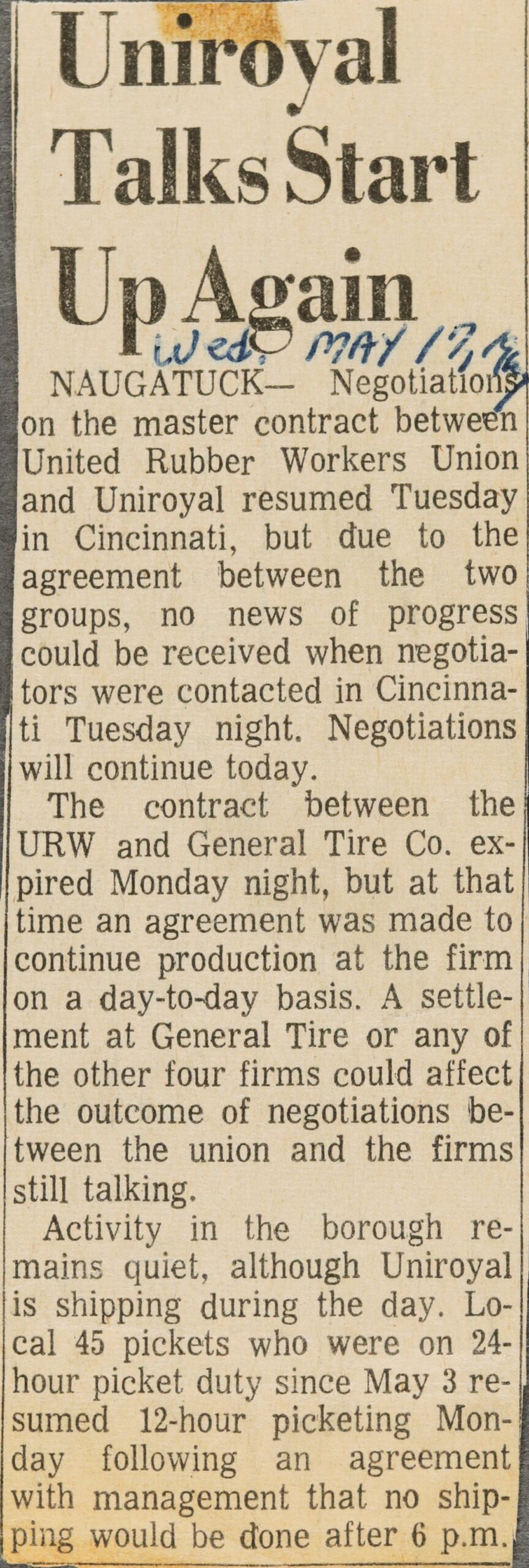
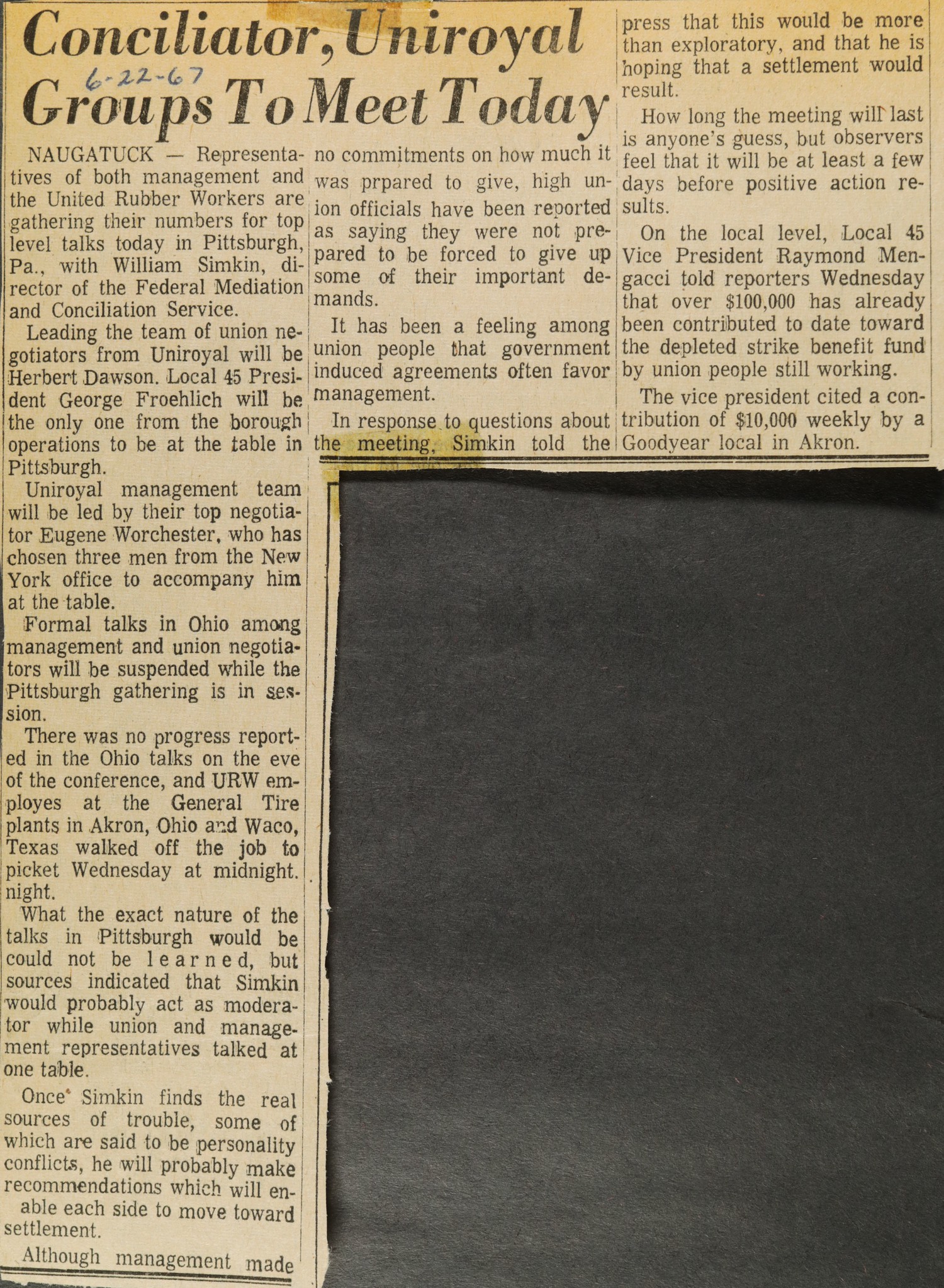
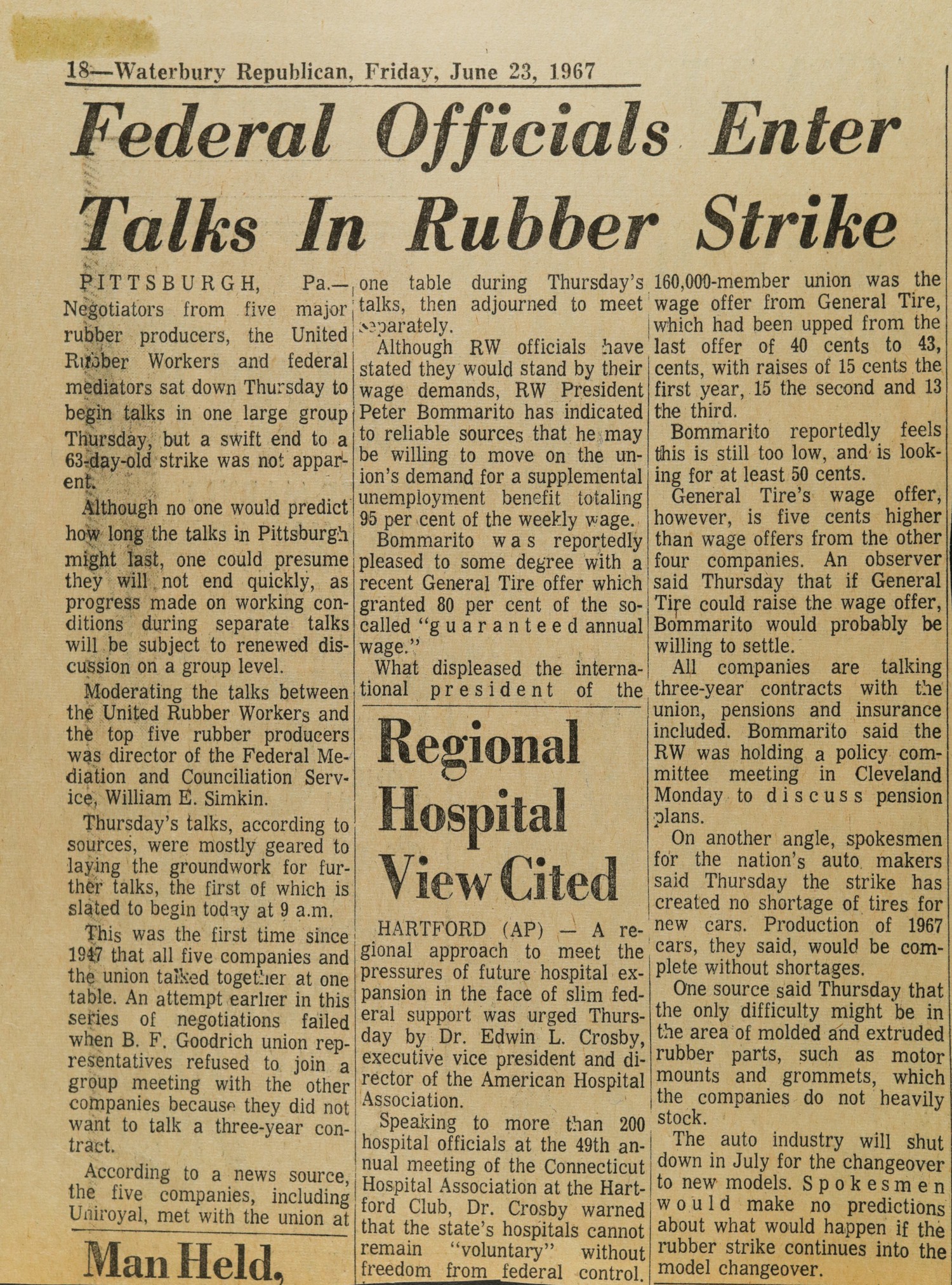
Uniroyal Talks Start Up Again

Uniroyal Talks Start Up Again

Wed, MAY 17, 76

NAUGATUCK— Negotiations on the master contract between United Rubber Workers Union and Uniroyal resumed Tuesday in Cincinnati, but due to the agreement between the two groups, no news of progress could be received when negotiators were contacted in Cincinnati Tuesday night. Negotiations will continue today.

The contract between the URW and General Tire Co. expired Monday night, but at that time an agreement was made to continue production at the firm on a day-to-day basis. A settlement at General Tire or any of the other four firms could affect the outcome of negotiations between the union and the firms still talking.

Activity in the borough remains quiet, although Uniroyal is shipping during the day. Local 45 pickets who were on 24-hour picket duty since May 3 resumed 12-hour picketing Monday following an agreement with management that no shipping would be done after 6 p.m.

13 Receive 40 Years Service Awards

Vol. 7, 1973 | CHEM-TEXTS | Page 3


13 Receive 40 Years Service Awards

[PHOTO: Group photo of people]

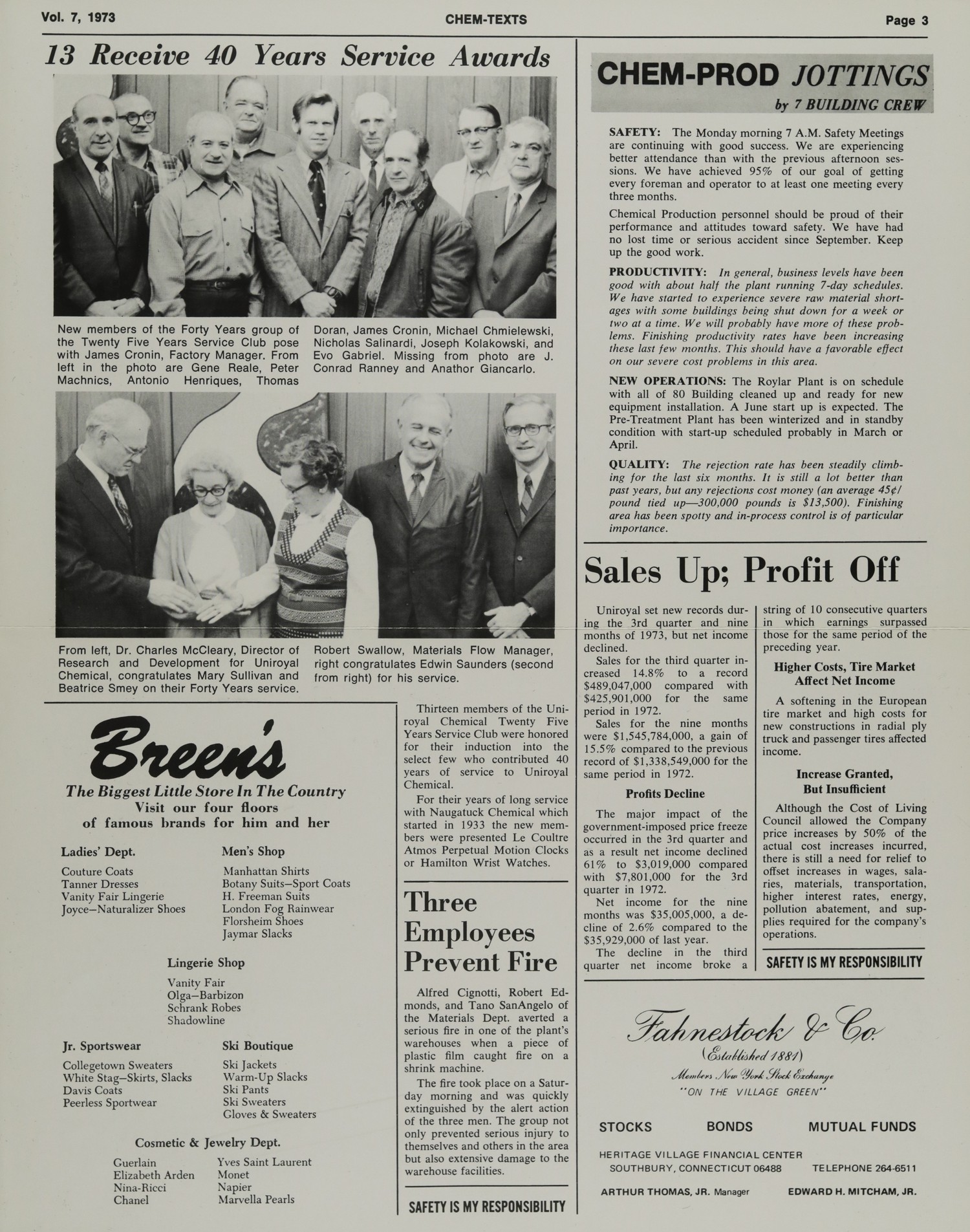
New members of the Forty Years group of the Twenty Five Years Service Club pose with James Cronin, Factory Manager. From left in the photo are Gene Reale, Peter Machnics, Antonio Henriques, Thomas Doran, James Cronin, Michael Chmielewski, Nicholas Salinardi, Joseph Kolakowski, and Evo Gabriel. Missing from photo are J. Conrad Ranney and Anathor Giancarlo.

[PHOTO: Group photo of people in formal setting]

From left, Dr. Charles McCleary, Director of Research and Development for Uniroyal Chemical, congratulates Mary Sullivan and Beatrice Smey on their Forty Years service.

Robert Swallow, Materials Flow Manager, right congratulates Edwin Saunders (second from right) for his service.


Breen’s

The Biggest Little Store In The Country
Visit our four floors
of famous brands for him and her

Ladies’ Dept.
Couture Coats
Tanner Dresses
Vanity Fair Lingerie
Joyce—Naturalizer Shoes

Men’s Shop
Manhattan Shirts
Botany Suits—Sport Coats
H. Freeman Suits
London Fog Rainwear
Florsheim Shoes
Jaymar Slacks

Lingerie Shop
Vanity Fair
Olga—Barbizon
Schrank Robes
Shadowline

Jr. Sportswear
Collegetown Sweaters
White Stag—Skirts, Slacks
Davis Coats
Peerless Sportswear

Ski Boutique
Ski Jackets
Warm-Up Slacks
Ski Pants
Ski Sweaters
Gloves & Sweaters

Cosmetic & Jewelry Dept.
Guerlain | Yves Saint Laurent
Elizabeth Arden | Monet
Nina-Ricci | Napier
Chanel | Marvella Pearls


CHEM-PROD JOTTINGS

by 7 BUILDING CREW

SAFETY: The Monday morning 7 A.M. Safety Meetings are continuing with good success. We are experiencing better attendance than with the previous afternoon sessions. We have achieved 95% of our goal of getting every foreman and operator to at least one meeting every three months.

Chemical Production personnel should be proud of their performance and attitudes toward safety. We have had no lost time or serious accident since September. Keep up the good work.

PRODUCTIVITY: In general, business levels have been good with about half the plant running 7-day schedules. We have started to experience severe raw material shortages with some buildings being shut down for a week or two at a time. We will probably have more of these problems. Finishing productivity rates have been increasing these last few months. This should have a favorable effect on our severe cost problems in this area.

NEW OPERATIONS: The Roylar Plant is on schedule with all of 80 Building cleaned up and ready for new equipment installation. A June start up is expected. The Pre-Treatment Plant has been winterized and in standby condition with start-up scheduled probably in March or April.

QUALITY: The rejection rate has been steadily climbing for the last six months. It is still a lot better than past years, but any rejections cost money (an average 45¢/ pound tied up—300,000 pounds is $13,500). Finishing area has been spotty and in-process control is of particular importance.


Sales Up; Profit Off

Uniroyal set new records during the 3rd quarter and nine months of 1973, but net income declined.

Sales for the third quarter increased 14.8% to a record $489,047,000 compared with $425,901,000 for the same period in 1972.

Sales for the nine months were $1,545,784,000, a gain of 15.5% compared to the previous record of $1,338,549,000 for the same period in 1972.

Profits Decline

The major impact of the government-imposed price freeze occurred in the 3rd quarter and as a result net income declined 61% to $3,019,000 compared with $7,801,000 for the 3rd quarter in 1972.

Net income for the nine months was $35,005,000, a decline of 2.6% compared to the $35,929,000 of last year.

The decline in the third quarter net income broke a string of 10 consecutive quarters in which earnings surpassed those for the same period of the preceding year.

Higher Costs, Tire Market Affect Net Income

A softening in the European tire market and high costs for new constructions in radial ply truck and passenger tires affected income.

Increase Granted, But Insufficient

Although the Cost of Living Council allowed the Company price increases by 50% of the actual cost increases incurred, there is still a need for relief to offset increases in wages, salaries, materials, transportation, higher interest rates, energy, pollution abatement, and supplies required for the company’s operations.

SAFETY IS MY RESPONSIBILITY


Thirteen members of the Uniroyal Chemical Twenty Five Years Service Club were honored for their induction into the select few who contributed 40 years of service to Uniroyal Chemical.

For their years of long service with Naugatuck Chemical which started in 1933 the new members were presented Le Coultre Atmos Perpetual Motion Clocks or Hamilton Wrist Watches.


Three Employees Prevent Fire

Alfred Cignotti, Robert Edmonds, and Tano SanAngelo of the Materials Dept. averted a serious fire in one of the plant’s warehouses when a piece of plastic film caught fire on a shrink machine.

The fire took place on a Saturday morning and was quickly extinguished by the alert action of the three men. The group not only prevented serious injury to themselves and others in the area but also extensive damage to the warehouse facilities.

SAFETY IS MY RESPONSIBILITY


Fahnestock & Co.
(Established 1881)
Members New York Stock Exchange
“ON THE VILLAGE GREEN”

STOCKS | BONDS | MUTUAL FUNDS

HERITAGE VILLAGE FINANCIAL CENTER
SOUTHBURY, CONNECTICUT 06488 | TELEPHONE 264-6511

ARTHUR THOMAS, JR. Manager | EDWARD H. MITCHAM, JR.

Synthetic Rubber Plant To Close

UNIROYAL CHEM-TEXTS

Vol. 7, 1973 | PUBLISHED FOR THE PEOPLE OF UNIROYAL CHEMICAL | No. 5


Synthetic Rubber Plant To Close


Top UG Goal With $22,010

Third Successive Year

Uniroyal Chemical people again topped the United Fund goal. This year’s goal was $21,000. Pledges and contributions amounted to $22,010.

944 employees—or 65% of the people at the Naugatuck location—participated in the annual drive to raise funds for the work of the 16 charitable and social organizations in the Fund.

4 Departments Exceed Goals

Four departments — Reclaim Production, Chemical Engineering and Mechanical, Research & Development and EMIC exceeded their goals with EMIC going over its goal by $1146.

Research and Development

(Cont’d on page 4)


[CENTER IMAGE CAPTION:]
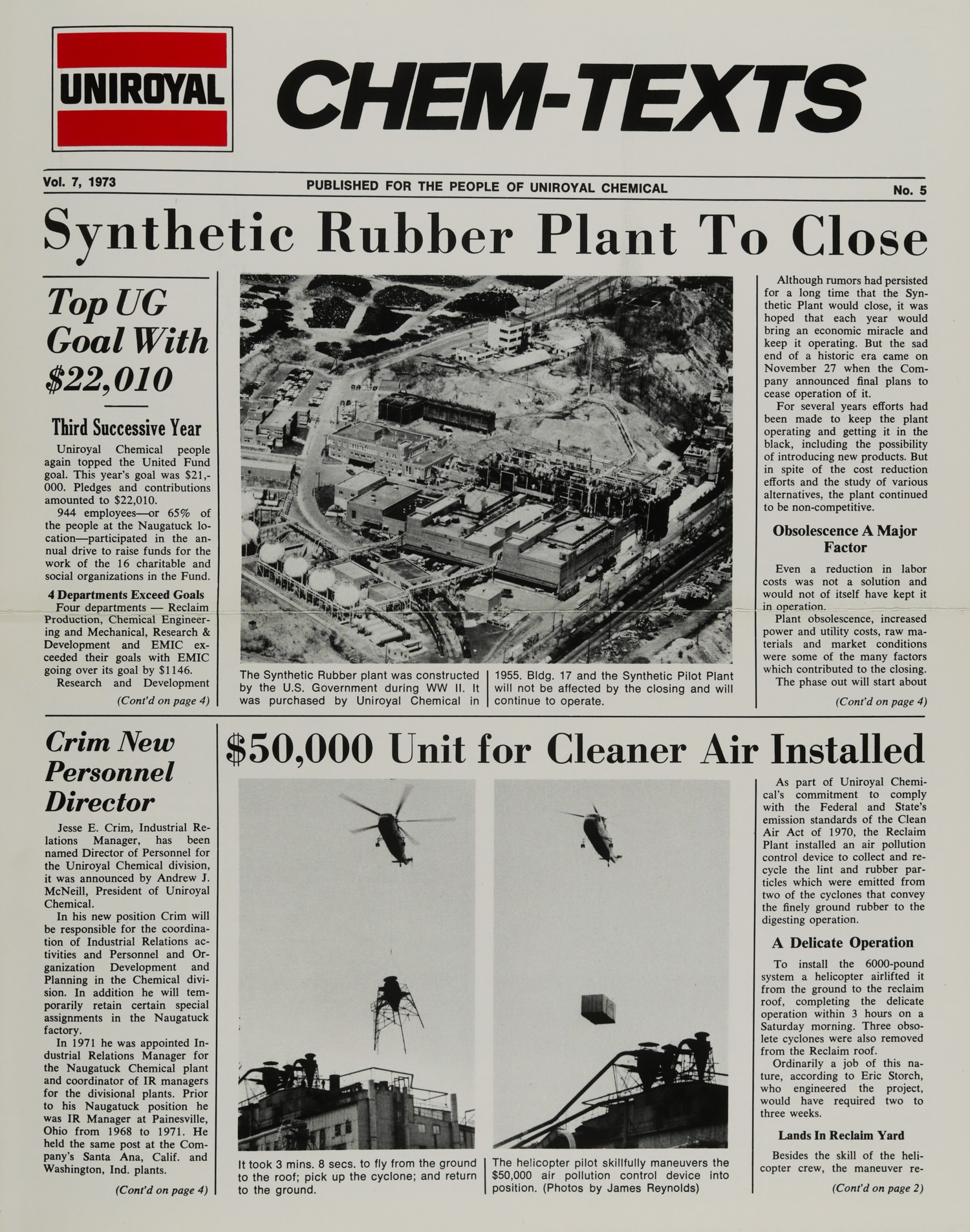
The Synthetic Rubber plant was constructed by the U.S. Government during WW II. It was purchased by Uniroyal Chemical in 1955. Bldg. 17 and the Synthetic Pilot Plant will not be affected by the closing and will continue to operate.


Although rumors had persisted for a long time that the Synthetic Plant would close, it was hoped that each year would bring an economic miracle and keep it operating. But the sad end of a historic era came on November 27 when the Company announced final plans to cease operation of it.

For several years efforts had been made to keep the plant operating and getting it in the black, including the possibility of introducing new products. But in spite of the cost reduction efforts and the study of various alternatives, the plant continued to be non-competitive.

Obsolescence A Major Factor

Even a reduction in labor costs was not a solution and would not of itself have kept it in operation.

Plant obsolescence, increased power and utility costs, raw materials and market conditions were some of the many factors which contributed to the closing.

The phase out will start about

(Cont’d on page 4)


Crim New Personnel Director

Jesse E. Crim, Industrial Relations Manager, has been named Director of Personnel for the Uniroyal Chemical division, it was announced by Andrew J. McNeill, President of Uniroyal Chemical.

In his new position Crim will be responsible for the coordination of Industrial Relations activities and Personnel and Organization Development and Planning in the Chemical division. In addition he will temporarily retain certain special assignments in the Naugatuck factory.

In 1971 he was appointed Industrial Relations Manager for the Naugatuck Chemical plant and coordinator of IR managers for the divisional plants. Prior to his Naugatuck position he was IR Manager at Painesville, Ohio from 1968 to 1971. He held the same post at the Company’s Santa Ana, Calif. and Washington, Ind. plants.

(Cont’d on page 4)


$50,000 Unit for Cleaner Air Installed

[LEFT IMAGE CAPTION:]
It took 3 mins. 8 secs. to fly from the ground to the roof; pick up the cyclone; and return to the ground.

[RIGHT IMAGE CAPTION:]
The helicopter pilot skillfully maneuvers the $50,000 air pollution control device into position. (Photos by James Reynolds)


As part of Uniroyal Chemical’s commitment to comply with the Federal and State’s emission standards of the Clean Air Act of 1970, the Reclaim Plant installed an air pollution control device to collect and recycle the lint and rubber particles which were emitted from two of the cyclones that convey the finely ground rubber to the digesting operation.

A Delicate Operation

To install the 6000-pound system a helicopter airlifted it from the ground to the reclaim roof, completing the delicate operation within 3 hours on a Saturday morning. Three obsolete cyclones were also removed from the Reclaim roof.

Ordinarily a job of this nature, according to Eric Storch, who engineered the project, would have required two to three weeks.

Lands In Reclaim Yard

Besides the skill of the helicopter crew, the maneuver re-

(Cont’d on page 2)

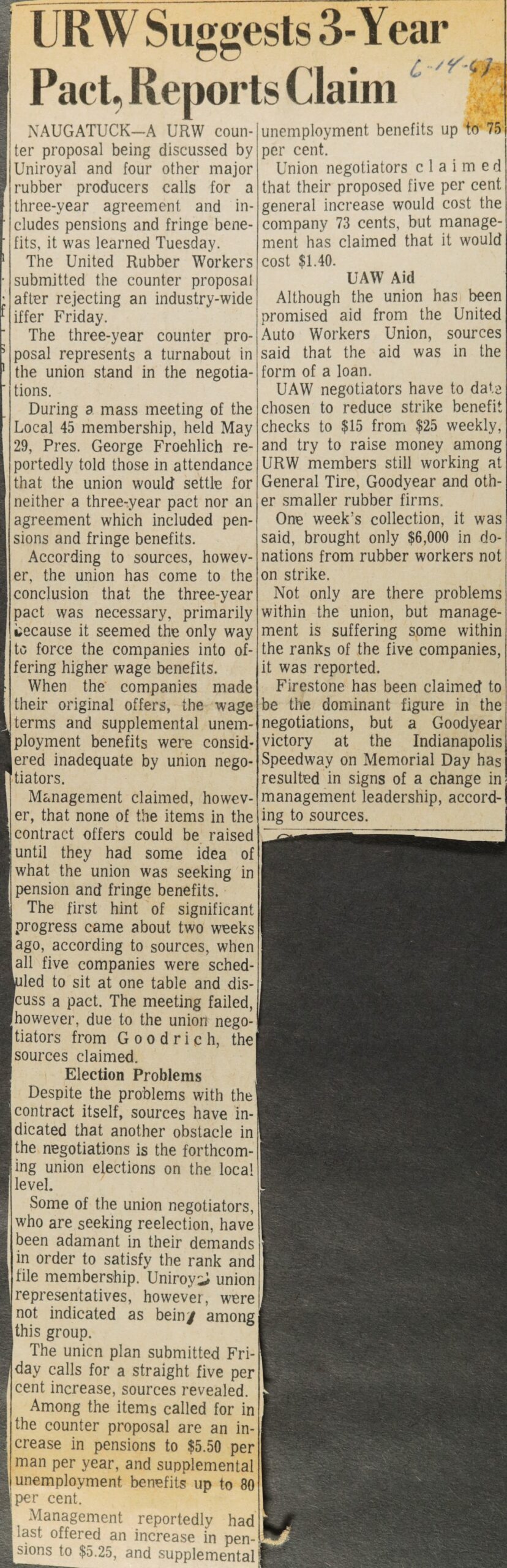
URW Suggests 3-Year Pact, Reports Claim

URW Suggests 3-Year Pact, Reports Claim

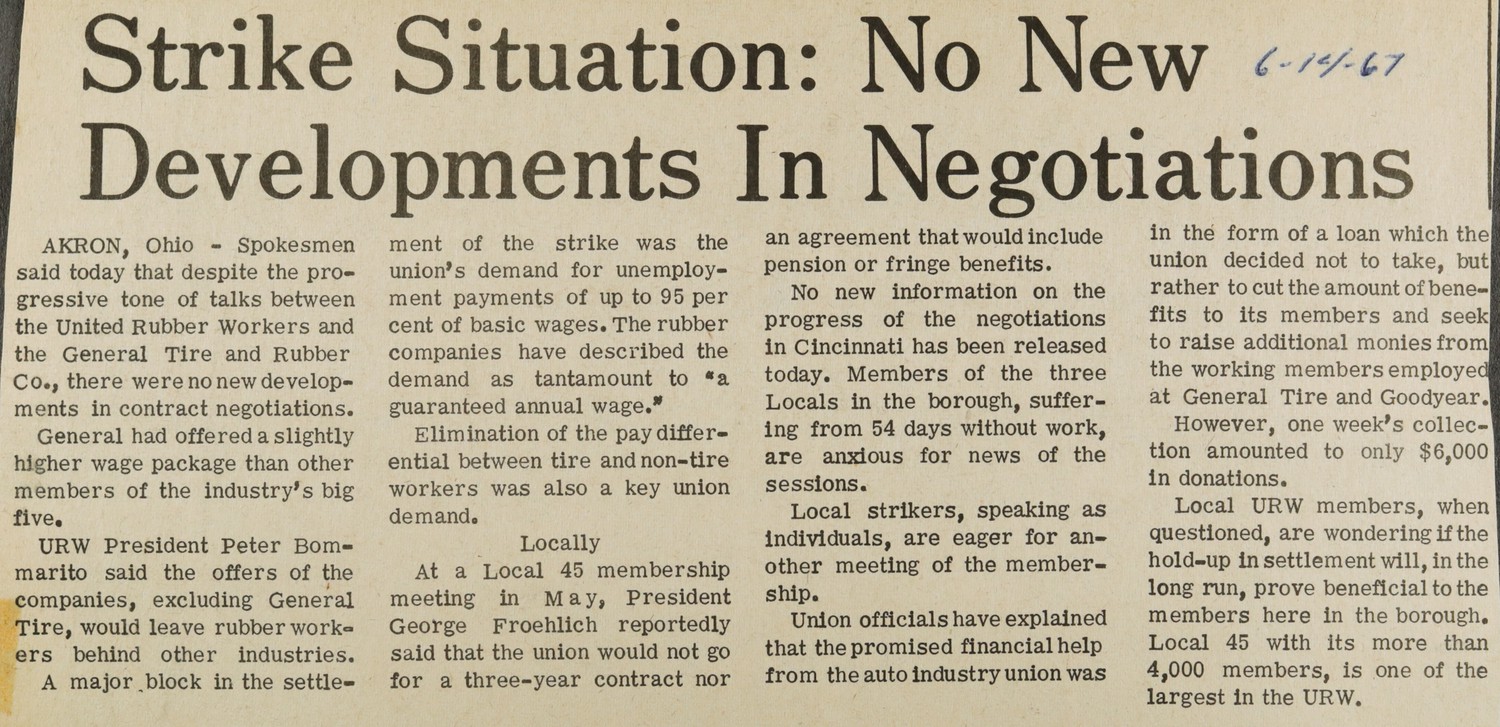
6-14-67 [handwritten date]

NAUGATUCK—A URW counter proposal being discussed by Uniroyal and four other major rubber producers calls for a three-year agreement and includes pensions and fringe benefits, it was learned Tuesday.

The United Rubber Workers submitted the counter proposal after rejecting an industry-wide offer Friday.

The three-year counter proposal represents a turnabout in the union stand in the negotiations.

During a mass meeting of the Local 45 membership, held May 29, Pres. George Froehlich reportedly told those in attendance that the union would settle for neither a three-year pact nor an agreement which included pensions and fringe benefits.

According to sources, however, the union has come to the conclusion that the three-year pact was necessary, primarily because it seemed the only way to force the companies into offering higher wage benefits.

When the companies made their original offers, the wage terms and supplemental unemployment benefits were considered inadequate by union negotiators.

Management claimed, however, that none of the items in the contract offers could be raised until they had some idea of what the union was seeking in pension and fringe benefits.

The first hint of significant progress came about two weeks ago, according to sources, when all five companies were scheduled to sit at one table and discuss a pact. The meeting failed, however, due to the union negotiators from Goodrich, the sources claimed.

Election Problems

Despite the problems with the contract itself, sources have indicated that another obstacle in the negotiations is the forthcoming union elections on the local level.

Some of the union negotiators, who are seeking reelection, have been adamant in their demands in order to satisfy the rank and file membership. Uniroyal union representatives, however, were not indicated as being among this group.

The union plan submitted Friday calls for a straight five per cent increase, sources revealed.

Among the items called for in the counter proposal are an increase in pensions to $5.50 per man per year, and supplemental unemployment benefits up to 80 per cent.

Management reportedly had last offered an increase in pensions to $5.25, and supplemental unemployment benefits up to 75 per cent.

Union negotiators claimed that their proposed five per cent general increase would cost the company 73 cents, but management has claimed that it would cost $1.40.

UAW Aid

Although the union has been promised aid from the United Auto Workers Union, sources said that the aid was in the form of a loan.

UAW negotiators have to date chosen to reduce strike benefit checks to $15 from $25 weekly, and try to raise money among URW members still working at General Tire, Goodyear and other smaller rubber firms.

One week’s collection, it was said, brought only $6,000 in donations from rubber workers not on strike.

Not only are there problems within the union, but management is suffering some within the ranks of the five companies, it was reported.

Firestone has been claimed to be the dominant figure in the negotiations, but a Goodyear victory at the Indianapolis Speedway on Memorial Day has resulted in signs of a change in management leadership, according to sources.

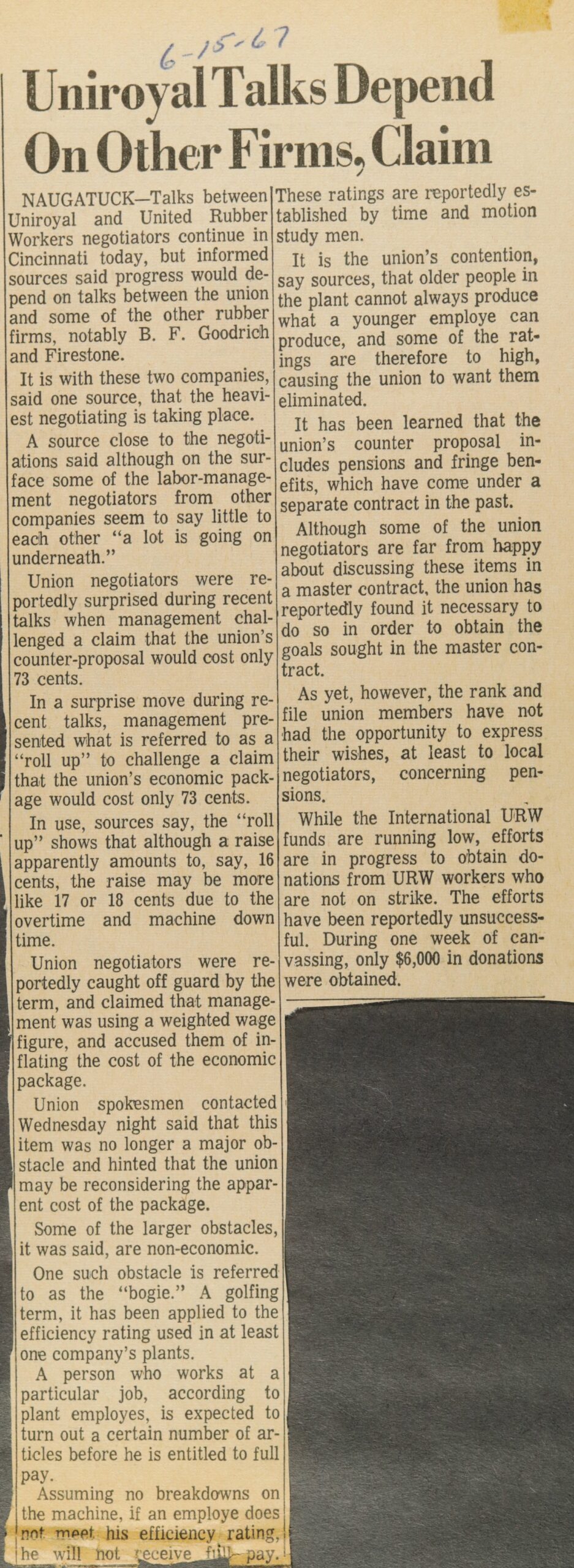
Uniroyal Talks Depend On Other Firms, Claim

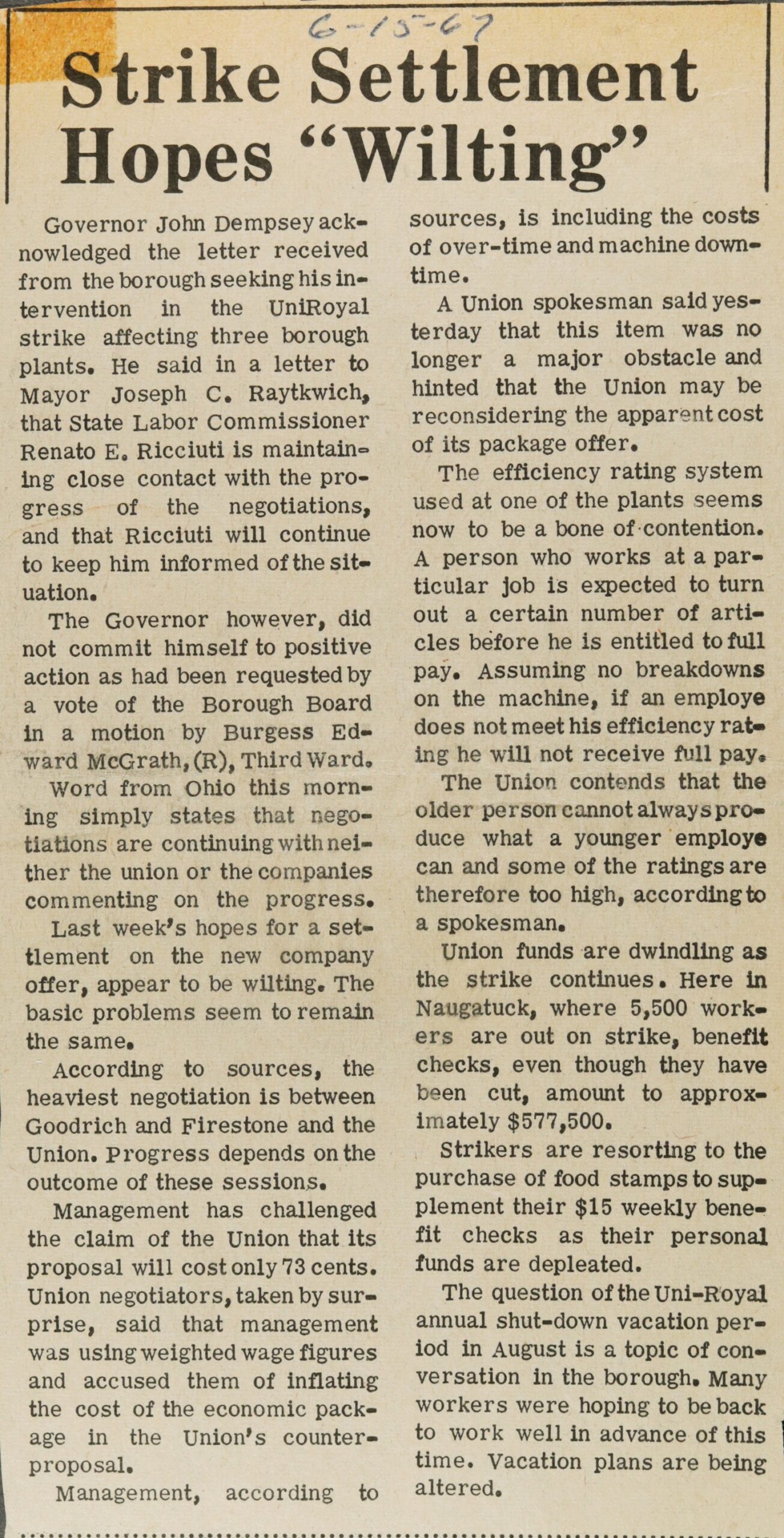
6-15-67

Uniroyal Talks Depend On Other Firms, Claim

NAUGATUCK—Talks between Uniroyal and United Rubber Workers negotiators continue in Cincinnati today, but informed sources said progress would depend on talks between the union and some of the other rubber firms, notably B. F. Goodrich and Firestone.

It is with these two companies, said one source, that the heaviest negotiating is taking place.

A source close to the negotiations said although on the surface some of the labor-management negotiators from other companies seem to say little to each other “a lot is going on underneath.”

Union negotiators were reportedly surprised during recent talks when management challenged a claim that the union’s counter-proposal would cost only 73 cents.

In a surprise move during recent talks, management presented what is referred to as a “roll up” to challenge a claim that the union’s economic package would cost only 73 cents.

In use, sources say, the “roll up” shows that although a raise apparently amounts to, say, 16 cents, the raise may be more like 17 or 18 cents due to the overtime and machine down time.

Union negotiators were reportedly caught off guard by the term, and claimed that management was using a weighted wage figure, and accused them of inflating the cost of the economic package.

Union spokesmen contacted Wednesday night said that this item was no longer a major obstacle and hinted that the union may be reconsidering the apparent cost of the package.

Some of the larger obstacles, it was said, are non-economic.

One such obstacle is referred to as the “bogie.” A golfing term, it has been applied to the efficiency rating used in at least one company’s plants.

A person who works at a particular job, according to plant employes, is expected to turn out a certain number of articles before he is entitled to full pay.

Assuming no breakdowns on the machine, if an employe does not meet his efficiency rating, he will not receive full pay.

These ratings are reportedly established by time and motion study men.

It is the union’s contention, say sources, that older people in the plant cannot always produce what a younger employe can produce, and some of the ratings are therefore to high, causing the union to want them eliminated.

It has been learned that the union’s counter proposal includes pensions and fringe benefits, which have come under a separate contract in the past.

Although some of the union negotiators are far from happy about discussing these items in a master contract, the union has reportedly found it necessary to do so in order to obtain the goals sought in the master contract.

As yet, however, the rank and file union members have not had the opportunity to express their wishes, at least to local negotiators, concerning pensions.

While the International URW funds are running low, efforts are in progress to obtain donations from URW workers who are not on strike. The efforts have been reportedly unsuccessful. During one week of canvassing, only $6,000 in donations were obtained.

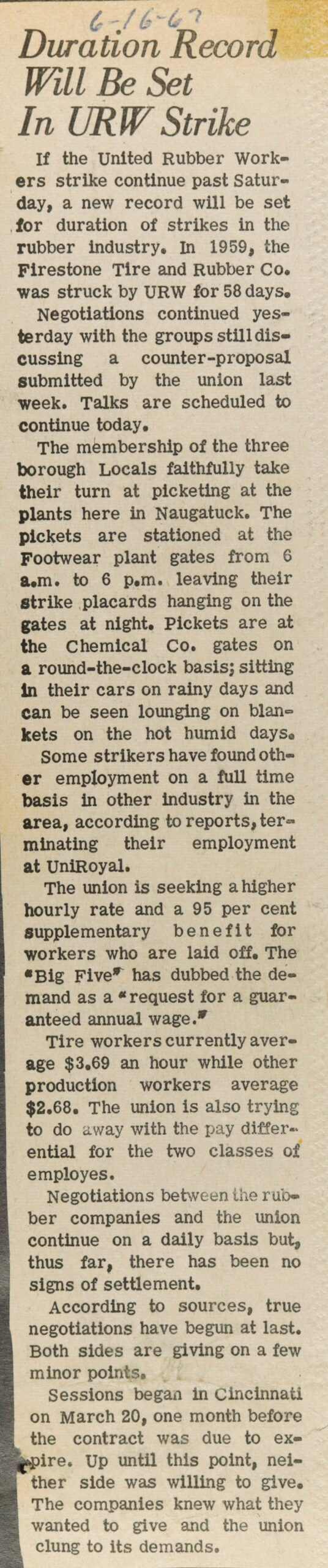
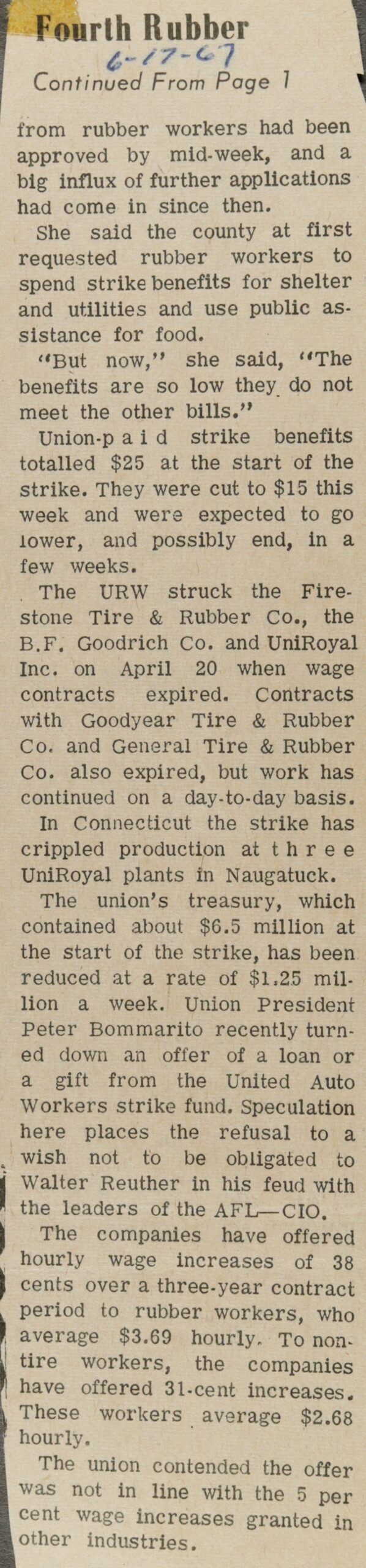
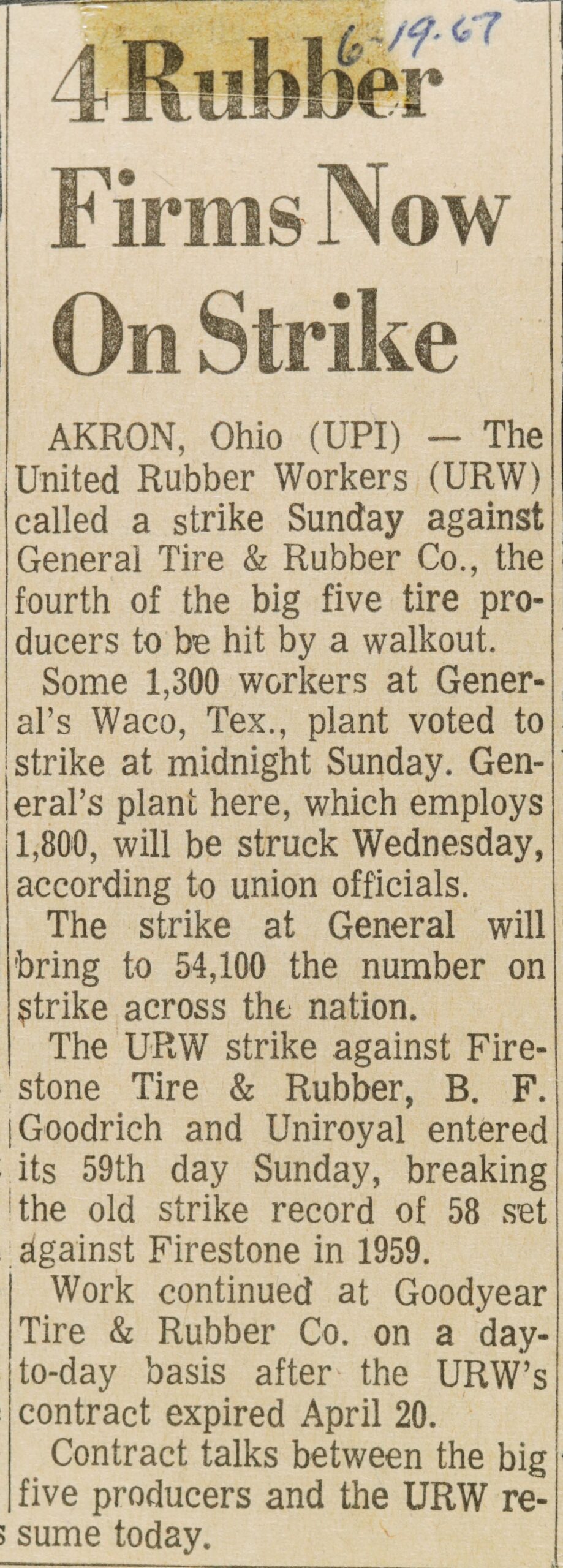
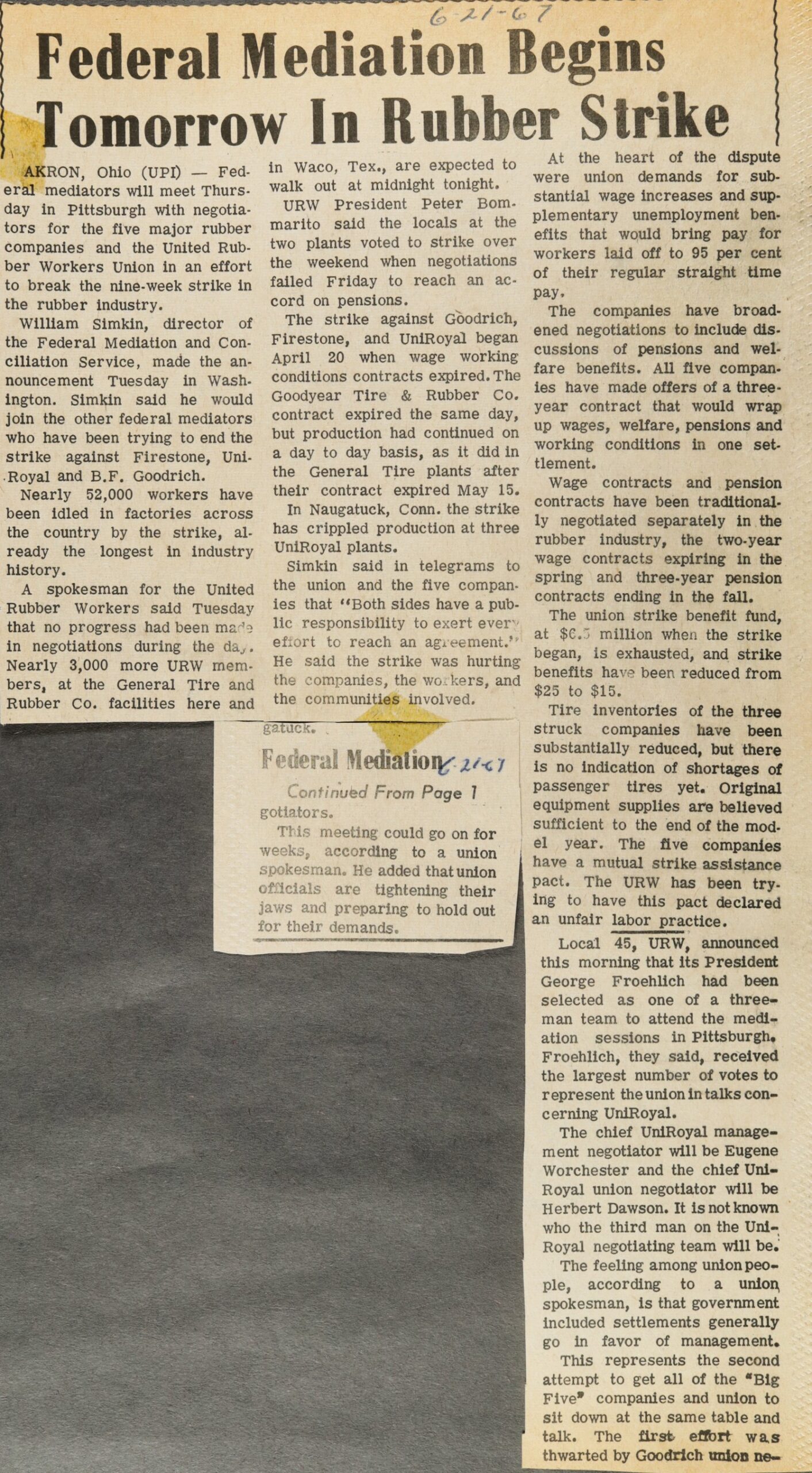
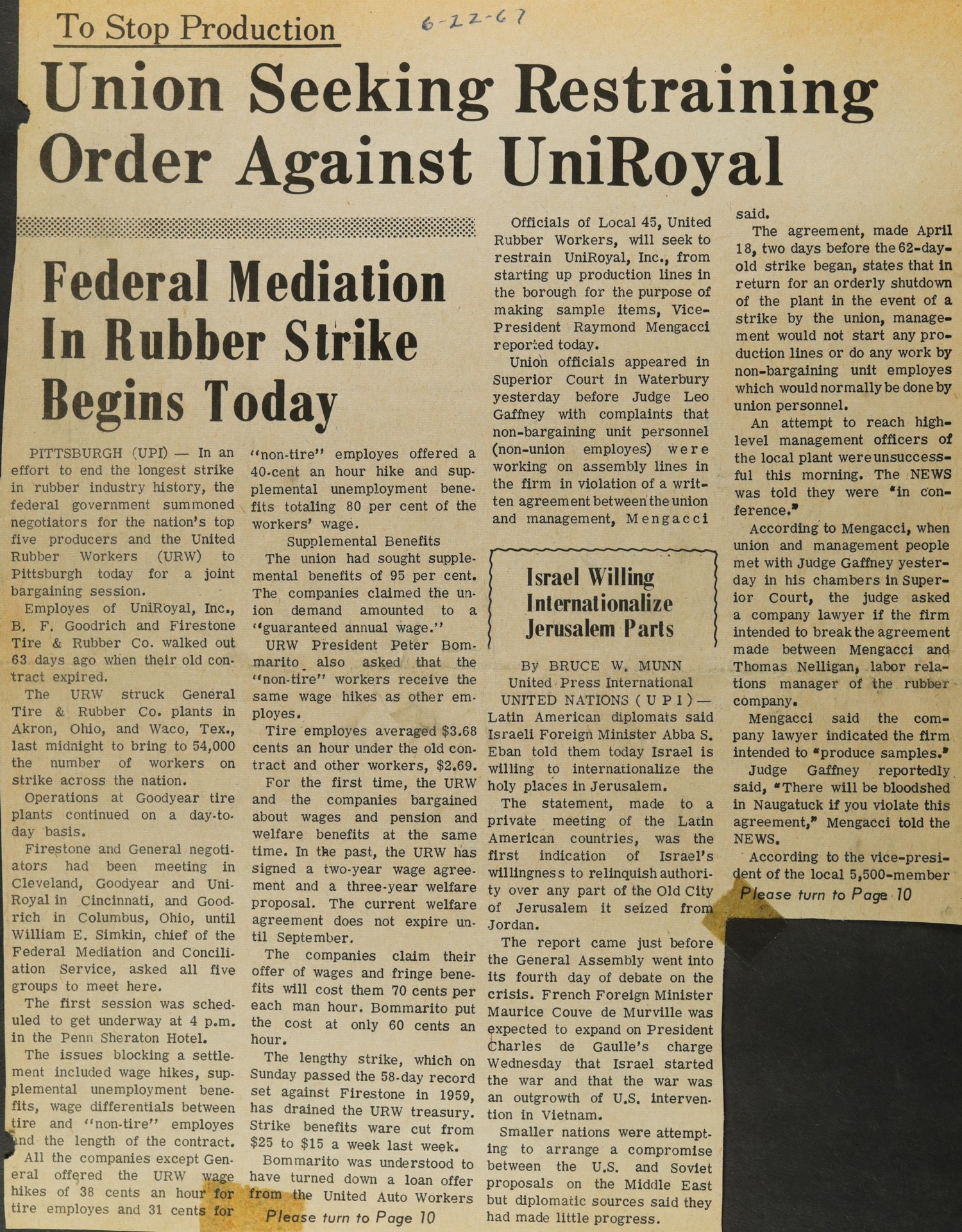
Duration Record Will Be Set In URW Strike

6-16-67

Duration Record Will Be Set In URW Strike

If the United Rubber Workers strike continue past Saturday, a new record will be set for duration of strikes in the rubber industry. In 1959, the Firestone Tire and Rubber Co. was struck by URW for 58 days.

Negotiations continued yesterday with the groups still discussing a counter-proposal submitted by the union last week. Talks are scheduled to continue today.

The membership of the three borough Locals faithfully take their turn at picketing at the plants here in Naugatuck. The pickets are stationed at the Footwear plant gates from 6 a.m. to 6 p.m. leaving their strike placards hanging on the gates at night. Pickets are at the Chemical Co. gates on a round-the-clock basis; sitting in their cars on rainy days and can be seen lounging on blankets on the hot humid days.

Some strikers have found other employment on a full time basis in other industry in the area, according to reports, terminating their employment at UniRoyal.

The union is seeking a higher hourly rate and a 95 per cent supplementary benefit for workers who are laid off. The “Big Five” has dubbed the demand as a “request for a guaranteed annual wage.”

Tire workers currently average $3.69 an hour while other production workers average $2.68. The union is also trying to do away with the pay differential for the two classes of employes.

Negotiations between the rubber companies and the union continue on a daily basis but, thus far, there has been no signs of settlement.

According to sources, true negotiations have begun at last. Both sides are giving on a few minor points.

Sessions began in Cincinnati on March 20, one month before the contract was due to expire. Up until this point, neither side was willing to give. The companies knew what they wanted to give and the union clung to its demands.

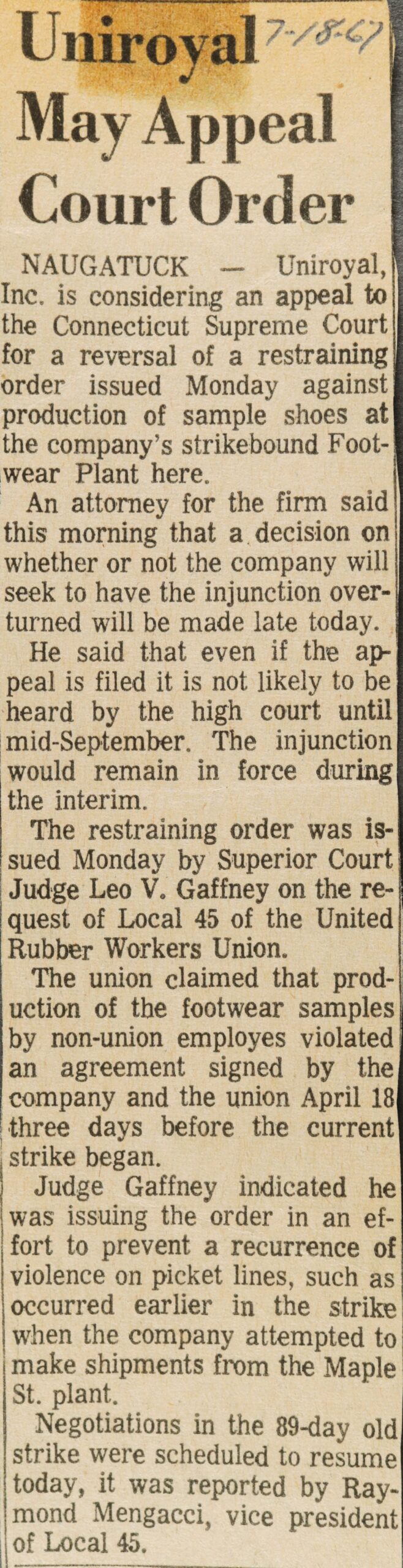
Uniroyal May Appeal Court Order

Uniroyal 7-18-67

May Appeal

Court Order

NAUGATUCK — Uniroyal,
Inc. is considering an appeal to
the Connecticut Supreme Court
for a reversal of a restraining
order issued Monday against
production of sample shoes at
the company’s strikebound Foot-
wear Plant here.

An attorney for the firm said
this morning that a decision on
whether or not the company will
seek to have the injunction over-
turned will be made late today.

He said that even if the ap-
peal is filed it is not likely to be
heard by the high court until
mid-September. The injunction
would remain in force during
the interim.

The restraining order was is-
sued Monday by Superior Court
Judge Leo V. Gaffney on the re-
quest of Local 45 of the United
Rubber Workers Union.

The union claimed that prod-
uction of the footwear samples
by non-union employes violated
an agreement signed by the
company and the union April 18
three days before the current
strike began.

Judge Gaffney indicated he
was issuing the order in an ef-
fort to prevent a recurrence of
violence on picket lines, such as
occurred earlier in the strike
when the company attempted to
make shipments from the Maple
St. plant.

Negotiations in the 89-day old
strike were scheduled to resume
today, it was reported by Ray-
mond Mengacci, vice president
of Local 45.

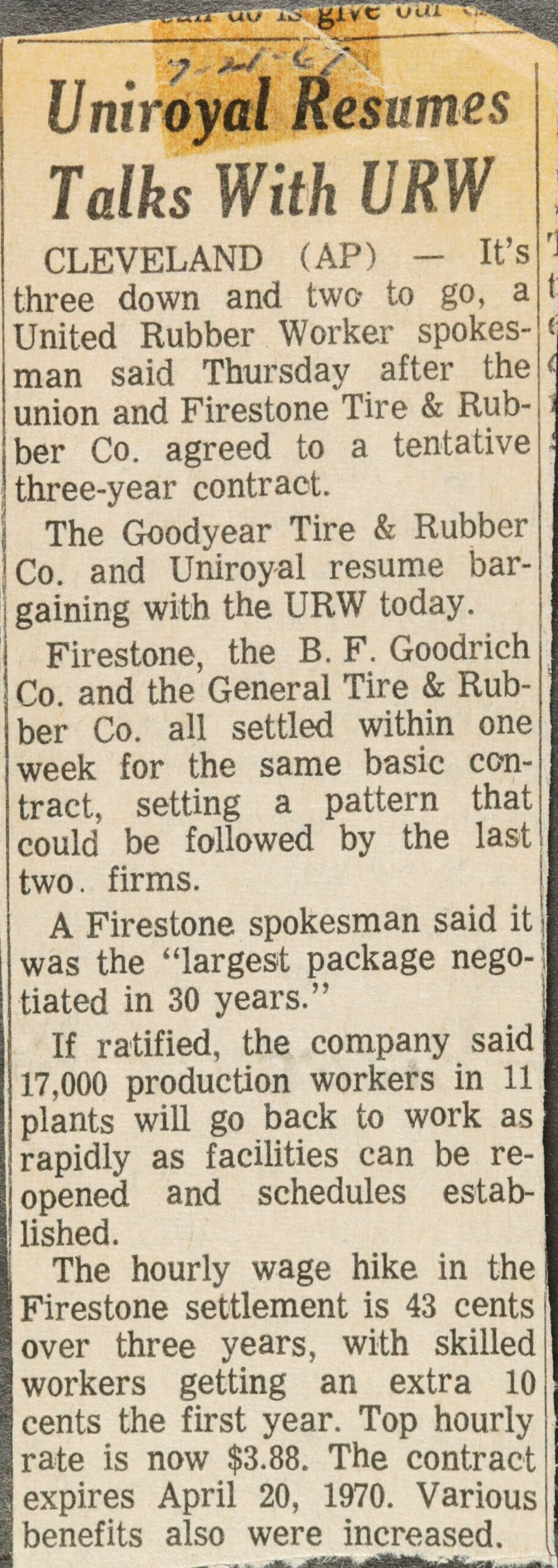
Uniroyal Resumes Talks With URW

7-21-67

Uniroyal Resumes Talks With URW

CLEVELAND (AP) — It’s three down and two to go, a United Rubber Worker spokesman said Thursday after the union and Firestone Tire & Rubber Co. agreed to a tentative three-year contract.

The Goodyear Tire & Rubber Co. and Uniroyal resume bargaining with the URW today.

Firestone, the B. F. Goodrich Co. and the General Tire & Rubber Co. all settled within one week for the same basic contract, setting a pattern that could be followed by the last two. firms.

A Firestone spokesman said it was the “largest package negotiated in 30 years.”

If ratified, the company said 17,000 production workers in 11 plants will go back to work as rapidly as facilities can be reopened and schedules established.

The hourly wage hike in the Firestone settlement is 43 cents over three years, with skilled workers getting an extra 10 cents the first year. Top hourly rate is now $3.88. The contract expires April 20, 1970. Various benefits also were increased.

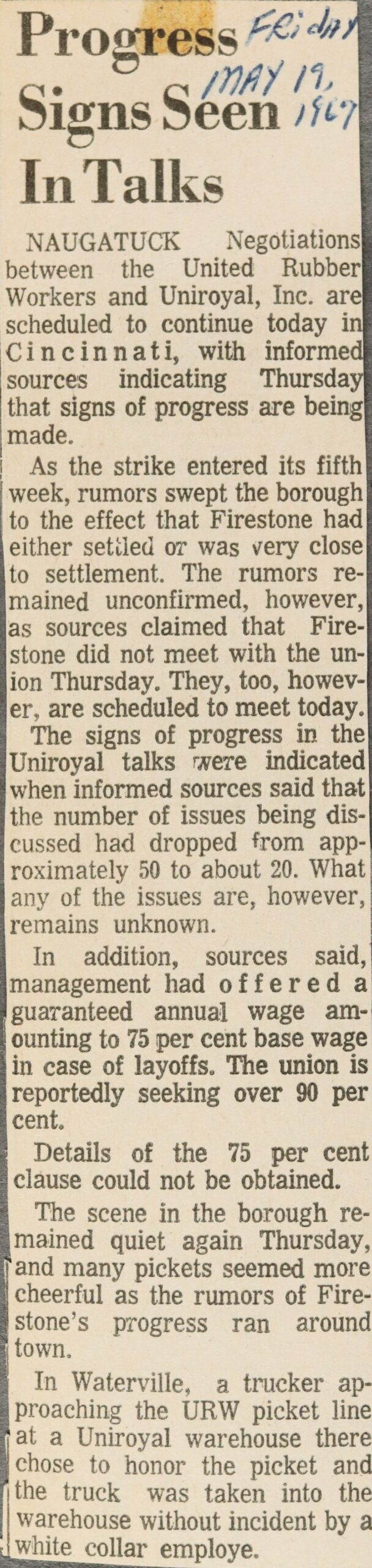
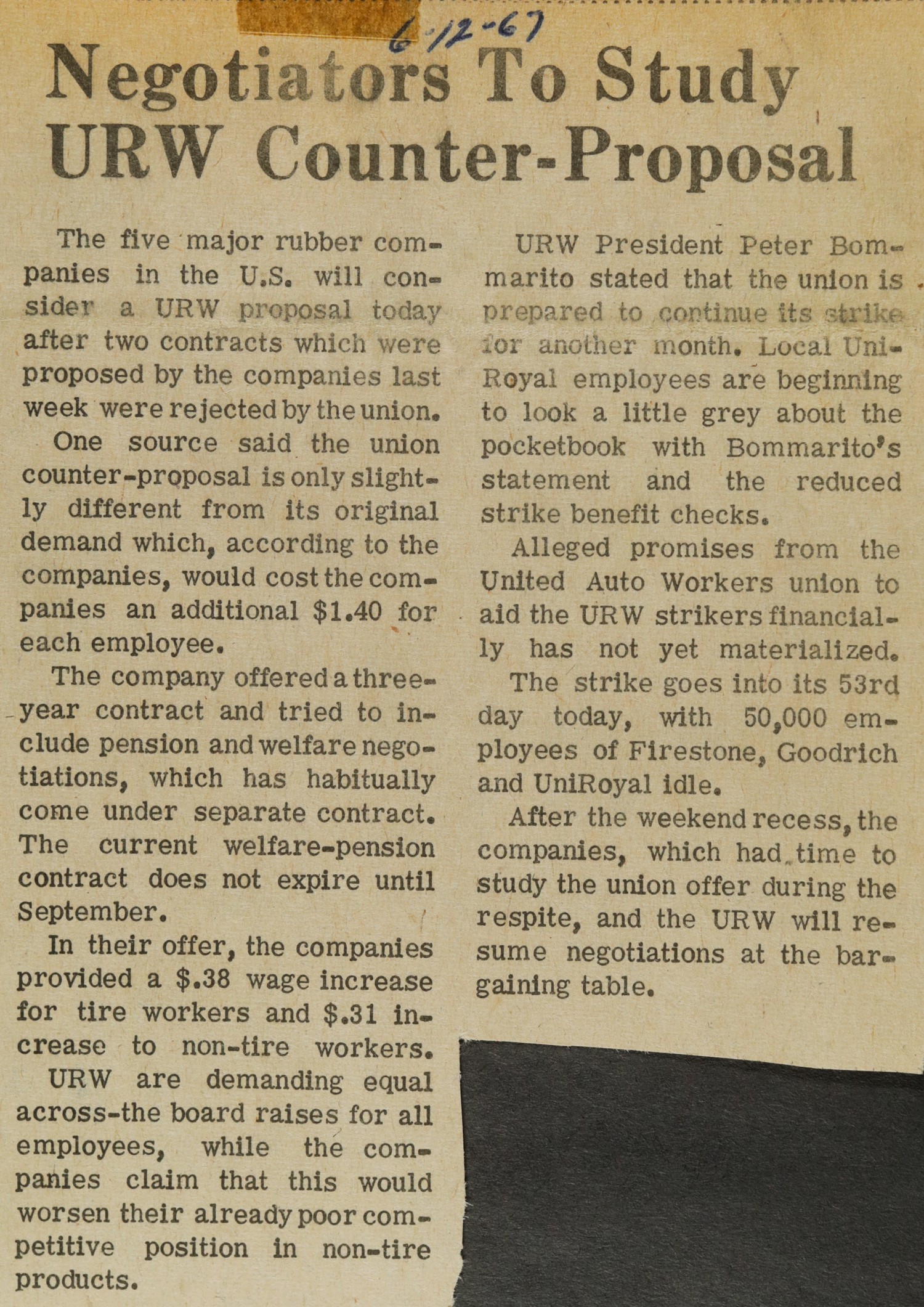
Progress Signs Seen In Talks

Progress Signs Seen In Talks

Friday MAY 19, 1967 [handwritten]

NAUGATUCK Negotiations between the United Rubber Workers and Uniroyal, Inc. are scheduled to continue today in Cincinnati, with informed sources indicating Thursday that signs of progress are being made.

As the strike entered its fifth week, rumors swept the borough to the effect that Firestone had either settled or was very close to settlement. The rumors remained unconfirmed, however, as sources claimed that Firestone did not meet with the union Thursday. They, too, however, are scheduled to meet today.

The signs of progress in the Uniroyal talks were indicated when informed sources said that the number of issues being discussed had dropped from approximately 50 to about 20. What any of the issues are, however, remains unknown.

In addition, sources said, management had offered a guaranteed annual wage amounting to 75 per cent base wage in case of layoffs. The union is reportedly seeking over 90 per cent.

Details of the 75 per cent clause could not be obtained.

The scene in the borough remained quiet again Thursday, and many pickets seemed more cheerful as the rumors of Firestone’s progress ran around town.

In Waterville, a trucker approaching the URW picket line at a Uniroyal warehouse there chose to honor the picket and the truck was taken into the warehouse without incident by a white collar employe.

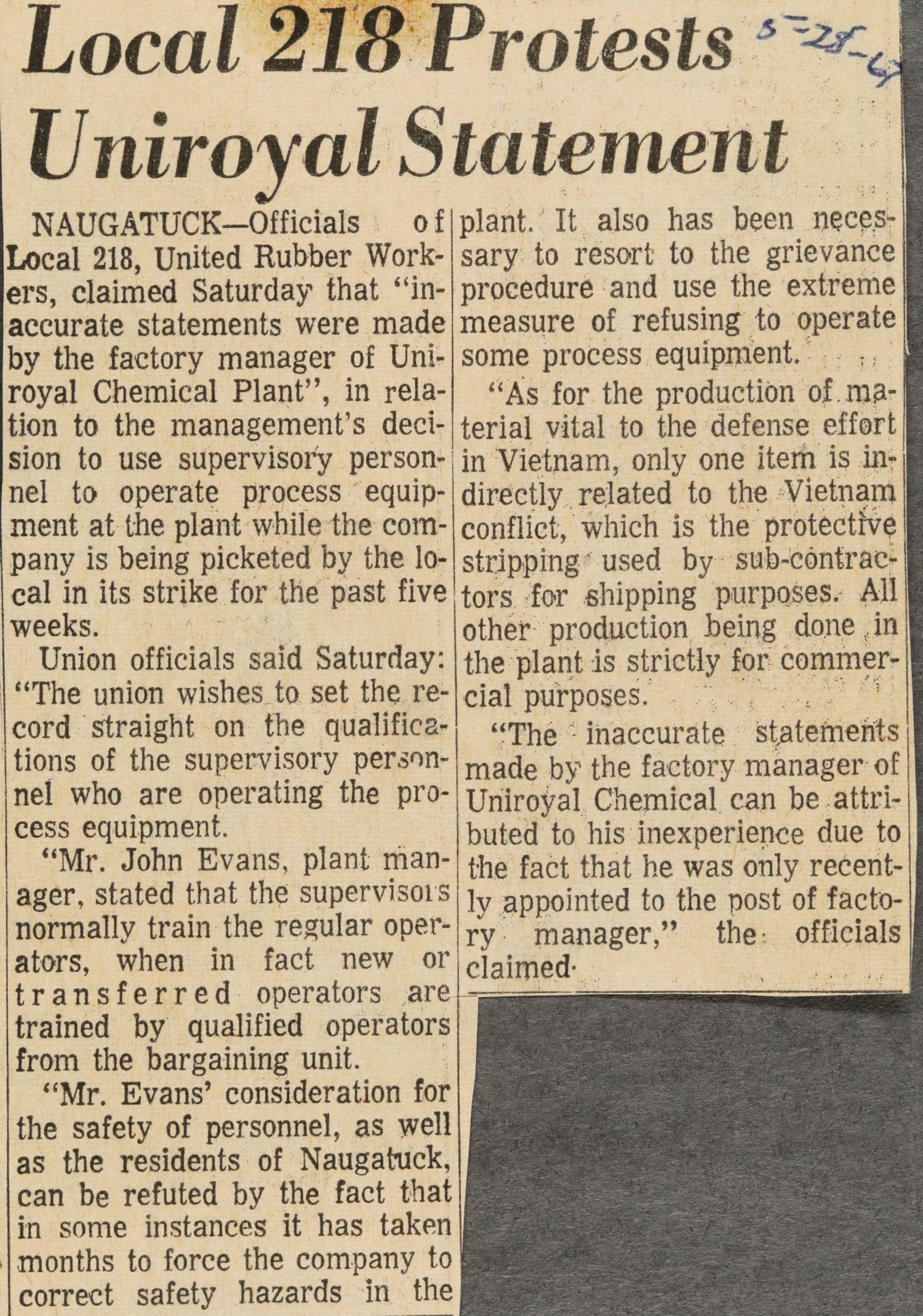
Local 218 Protests Uniroyal Statement

Local 218 Protests Uniroyal Statement

Local 218 Protests Uniroyal Statement

5-28-67 [handwritten date in top right corner]

NAUGATUCK—Officials of Local 218, United Rubber Workers, claimed Saturday that “inaccurate statements were made by the factory manager of Uniroyal Chemical Plant”, in relation to the management’s decision to use supervisory personnel to operate process equipment at the plant while the company is being picketed by the local in its strike for the past five weeks.

Union officials said Saturday: “The union wishes to set the record straight on the qualifications of the supervisory personnel who are operating the process equipment.

“Mr. John Evans, plant manager, stated that the supervisors normally train the regular operators, when in fact new or transferred operators are trained by qualified operators from the bargaining unit.

“Mr. Evans’ consideration for the safety of personnel, as well as the residents of Naugatuck, can be refuted by the fact that in some instances it has taken months to force the company to correct safety hazards in the plant. It also has been necessary to resort to the grievance procedure and use the extreme measure of refusing to operate some process equipment.

“As for the production of material vital to the defense effort in Vietnam, only one item is indirectly related to the Vietnam conflict, which is the protective stripping used by sub-contractors for shipping purposes. All other production being done in the plant is strictly for commercial purposes.

“The inaccurate statements made by the factory manager of Uniroyal Chemical can be attributed to his inexperience due to the fact that he was only recently appointed to the post of factory manager,” the officials claimed.

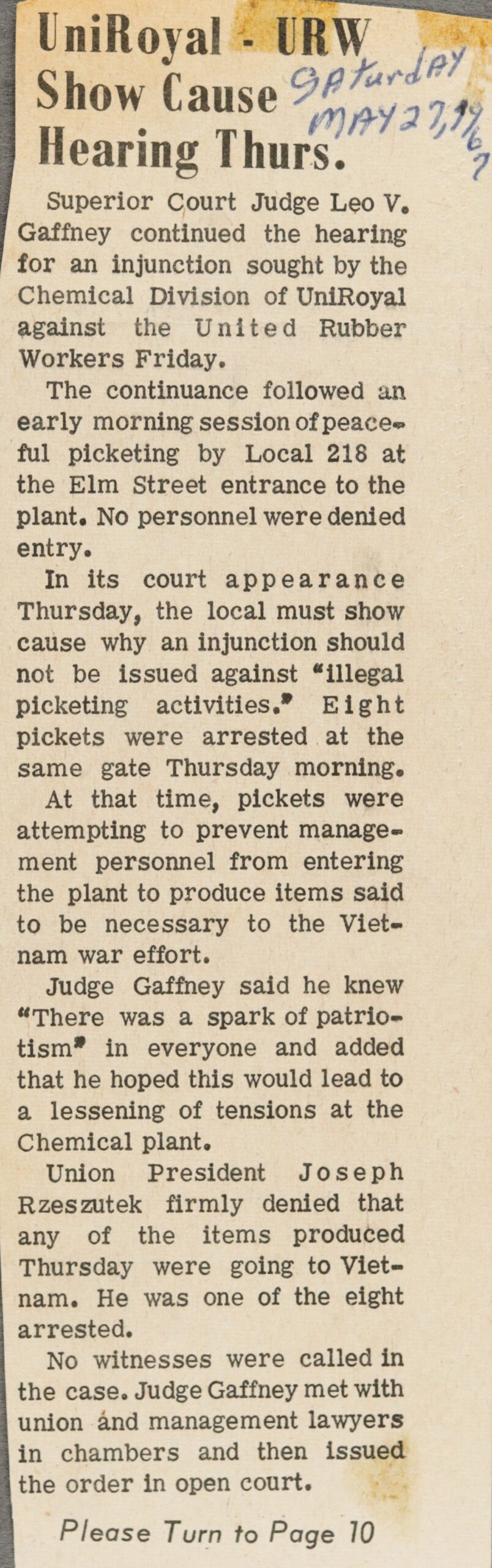
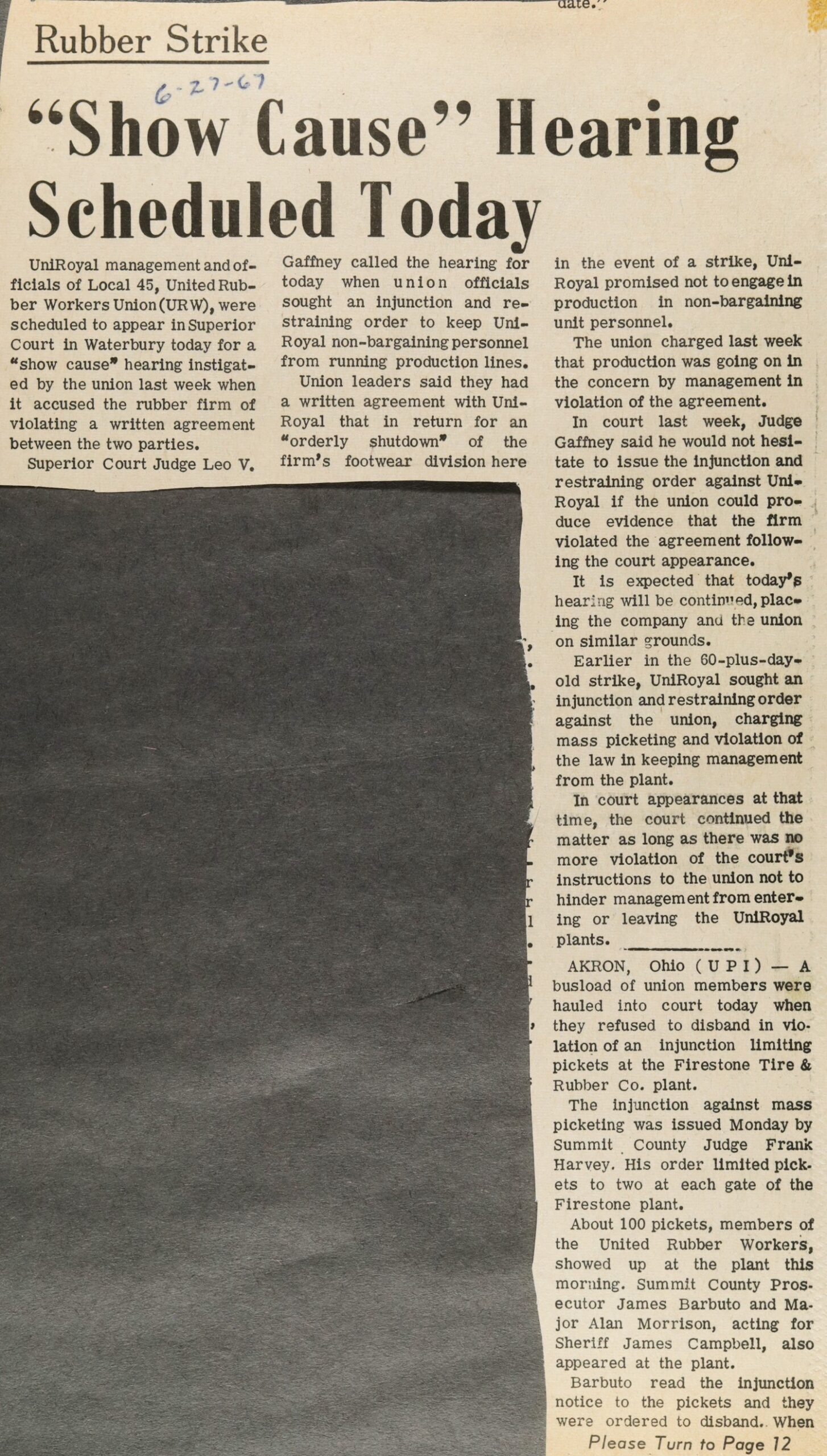
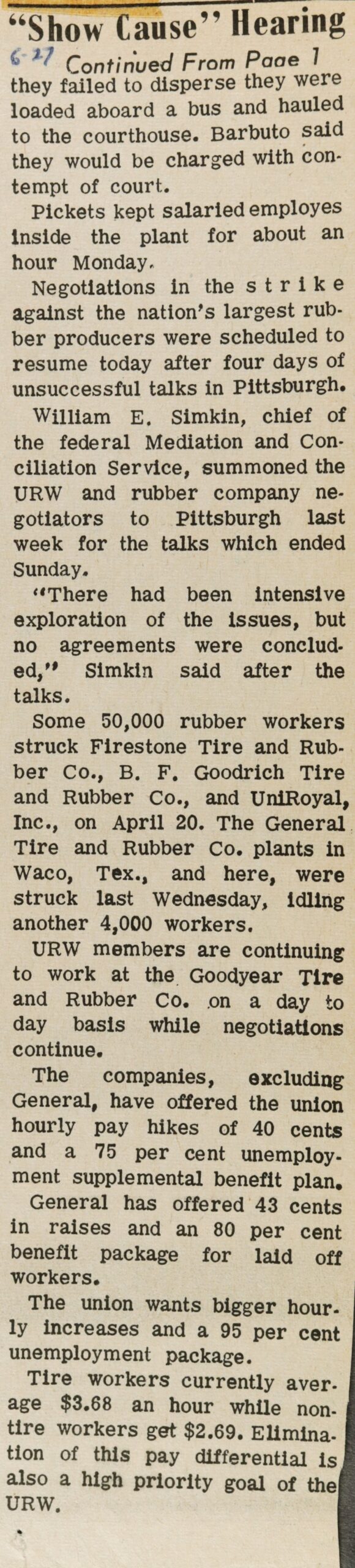
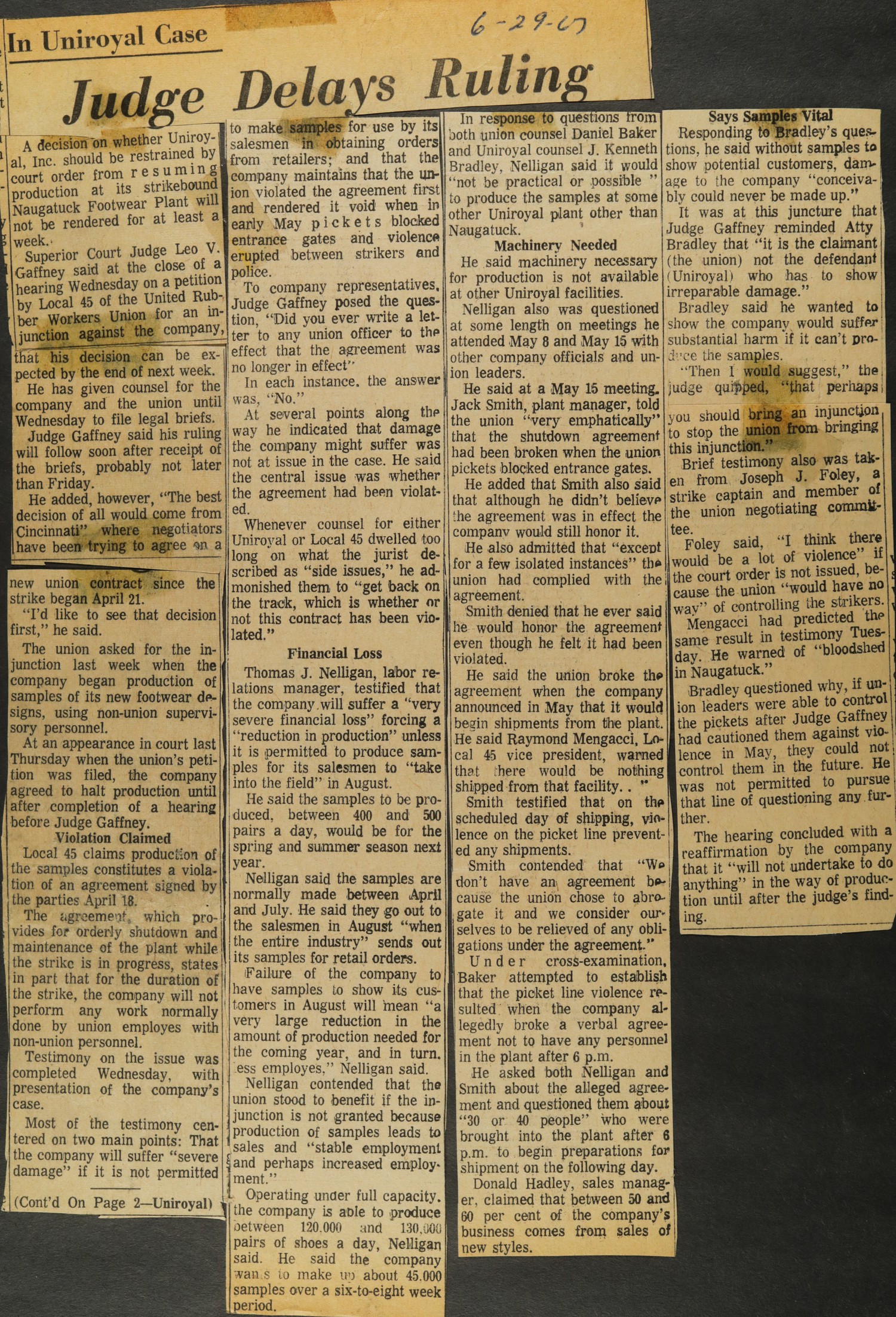
UniRoyal – URW Show Cause Hearing Thurs.

UniRoyal – URW
Show Cause Saturday
Hearing Thurs. MAY 27, 1967

Superior Court Judge Leo V.
Gaffney continued the hearing
for an injunction sought by the
Chemical Division of UniRoyal
against the United Rubber
Workers Friday.

The continuance followed an
early morning session of peace-
ful picketing by Local 218 at
the Elm Street entrance to the
plant. No personnel were denied
entry.

In its court appearance
Thursday, the local must show
cause why an injunction should
not be issued against “illegal
picketing activities.” Eight
pickets were arrested at the
same gate Thursday morning.

At that time, pickets were
attempting to prevent manage-
ment personnel from entering
the plant to produce items said
to be necessary to the Viet-
nam war effort.

Judge Gaffney said he knew
“There was a spark of patrio-
tism” in everyone and added
that he hoped this would lead to
a lessening of tensions at the
Chemical plant.

Union President Joseph
Rzeszutek firmly denied that
any of the items produced
Thursday were going to Viet-
nam. He was one of the eight
arrested.

No witnesses were called in
the case. Judge Gaffney met with
union and management lawyers
in chambers and then issued
the order in open court.

Please Turn to Page 10

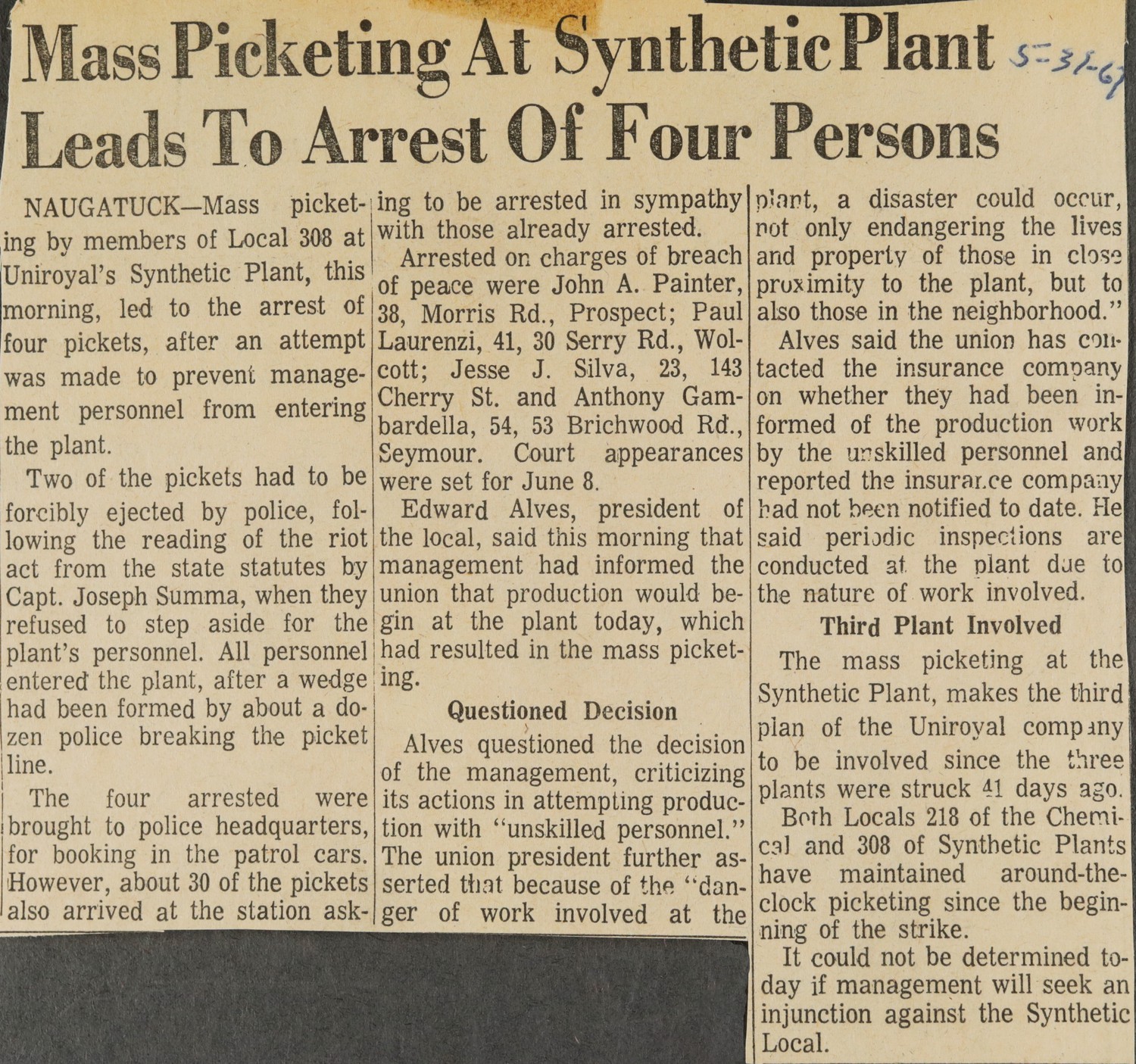
Mass Picketing At Synthetic Plant Leads To Arrest Of Four Persons

Mass Picketing At Synthetic Plant Leads To Arrest Of Four Persons

Mass Picketing At Synthetic Plant Leads To Arrest Of Four Persons

5-31-67 [handwritten notation]

NAUGATUCK—Mass picketing by members of Local 308 at Uniroyal’s Synthetic Plant, this morning, led to the arrest of four pickets, after an attempt was made to prevent management personnel from entering the plant.

Two of the pickets had to be forcibly ejected by police, following the reading of the riot act from the state statutes by Capt. Joseph Summa, when they refused to step aside for the plant’s personnel. All personnel entered the plant, after a wedge had been formed by about a dozen police breaking the picket line.

The four arrested were brought to police headquarters, for booking in the patrol cars. However, about 30 of the pickets also arrived at the station asking to be arrested in sympathy with those already arrested.

Arrested on charges of breach of peace were John A. Painter, 38, Morris Rd., Prospect; Paul Laurenzi, 41, 30 Serry Rd., Wolcott; Jesse J. Silva, 23, 143 Cherry St. and Anthony Gambardella, 54, 53 Brichwood Rd., Seymour. Court appearances were set for June 8.

Edward Alves, president of the local, said this morning that management had informed the union that production would begin at the plant today, which had resulted in the mass picketing.

Questioned Decision

Alves questioned the decision of the management, criticizing its actions in attempting production with “unskilled personnel.” The union president further asserted that because of the “danger of work involved at the plant, a disaster could occur, not only endangering the lives and property of those in close proximity to the plant, but to also those in the neighborhood.”

Alves said the union has contacted the insurance company on whether they had been informed of the production work by the unskilled personnel and reported the insurance company had not been notified to date. He said periodic inspections are conducted at the plant due to the nature of work involved.

Third Plant Involved

The mass picketing at the Synthetic Plant, makes the third plan of the Uniroyal company to be involved since the three plants were struck 41 days ago.

Both Locals 218 of the Chemical and 308 of Synthetic Plants have maintained around-the-clock picketing since the beginning of the strike.

It could not be determined today if management will seek an injunction against the Synthetic Local.

UniRoyal Struck As Talks In Ohio Come To Stop

UniRoyal Struck As Talks In Ohio Come To Stop

4-21-67 [handwritten notation]


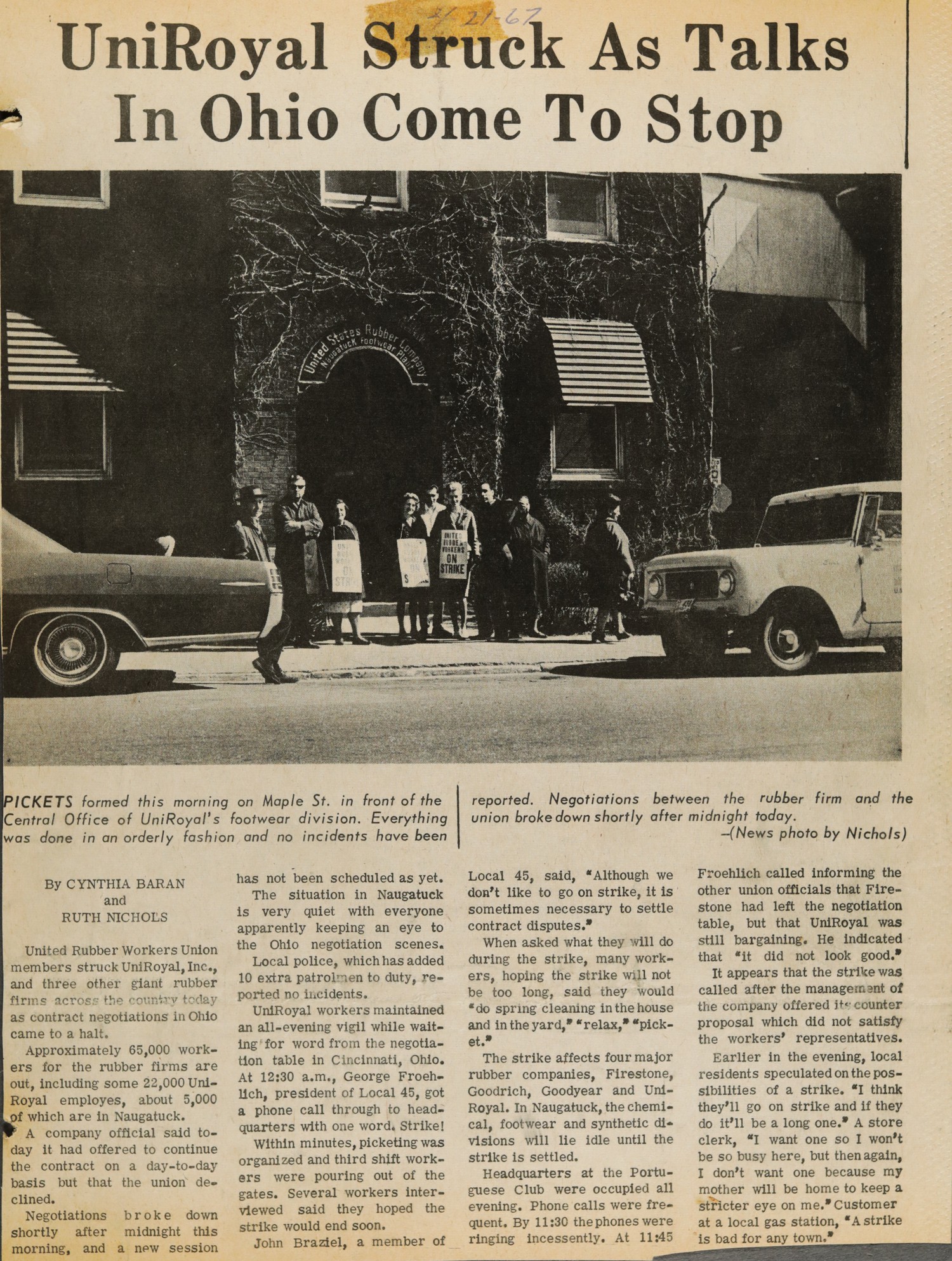
PICKETS formed this morning on Maple St. in front of the Central Office of UniRoyal’s footwear division. Everything was done in an orderly fashion and no incidents have been reported. Negotiations between the rubber firm and the union broke down shortly after midnight today.

—(News photo by Nichols)


By CYNTHIA BARAN
and
RUTH NICHOLS

United Rubber Workers Union members struck UniRoyal, Inc., and three other giant rubber firms across the country today as contract negotiations in Ohio came to a halt.

Approximately 65,000 workers for the rubber firms are out, including some 22,000 UniRoyal employes, about 5,000 of which are in Naugatuck.

A company official said today it had offered to continue the contract on a day-to-day basis but that the union declined.

Negotiations broke down shortly after midnight this morning, and a new session has not been scheduled as yet.

The situation in Naugatuck is very quiet with everyone apparently keeping an eye to the Ohio negotiation scenes.

Local police, which has added 10 extra patrolmen to duty, reported no incidents.

UniRoyal workers maintained an all-evening vigil while waiting for word from the negotiation table in Cincinnati, Ohio. At 12:30 a.m., George Froehlich, president of Local 45, got a phone call through to headquarters with one word: Strike!

Within minutes, picketing was organized and third shift workers were pouring out of the gates. Several workers interviewed said they hoped the strike would end soon.

John Braziel, a member of Local 45, said, “Although we don’t like to go on strike, it is sometimes necessary to settle contract disputes.”

When asked what they will do during the strike, many workers, hoping the strike will not be too long, said they would “do spring cleaning in the house and in the yard,” “relax,” “picket.”

The strike affects four major rubber companies, Firestone, Goodrich, Goodyear and UniRoyal. In Naugatuck, the chemical, footwear and synthetic divisions will lie idle until the strike is settled.

Headquarters at the Portuguese Club were occupied all evening. Phone calls were frequent. By 11:30 the phones were ringing incessantly. At 11:45 Froehlich called informing the other union officials that Firestone had left the negotiation table, but that UniRoyal was still bargaining. He indicated that “it did not look good.”

It appears that the strike was called after the management of the company offered its counter proposal which did not satisfy the workers’ representatives.

Earlier in the evening, local residents speculated on the possibilities of a strike. “I think they’ll go on strike and if they do it’ll be a long one.” A store clerk, “I want one so I won’t be so busy here, but then again, I don’t want one because my mother will be home to keep a stricter eye on me.” Customer at a local gas station, “A strike is bad for any town.”

Froehlich Returns From Ohio Parleys

Froehlich Returns From Ohio Parleys

4/25/67 [handwritten]

NAUGATUCK—Union members of Locals 45 and 218 of United Rubber workers were informed on the progress of negotiations in Cincinnati although union officials declined to say what specifically had been discussed at the meetings Monday.

The presidents of the three locals, George Froehlich from Local 45, Joseph Rzeszutek from Local 218 and Edward Alves from Local 308, returned from Cincinnati over the weekend for a breather and a chance to talk to the union members.

Whether the meetings held were for information only or for policy review was not learned, although Froehlich siad he had “met with the executive board” Monday morning. He will return to Cincinnati today to resume negotiations Wednesday.

Although picketing remains quiet at the borough operations, with no official report of difficulties, officials of the Chemical Division, Local 218, report that members of the local will picket the plant “24 hours a day, seven days a week.”

In addition, it was reported, members will picket in three-hour shifts. Local 218 began a buildup of picketing Friday when some members decided to picket throughout the night and most of Saturday.

Local 45, Footwear Plant, continue to picket in two-hour shifts from 6 a.m. to 6 p.m. The same procedure is being used by Local 308.

The Associated Press reported that pickets from a rebel Chicago local paraded Monday at facilities of the Goodyear Tire and Rubber Co. — the only one of the industry’s “Big Four” not hit by a URW strike.

Work continued on a day-by-day basis at Goodyear under a contract extension after the contract ran out Thursday.

Although talks are reportedly still in progress between Goodyear and the URW, some 500 members of Local 532 walked out at Goodyear’s industrial hose plant in North Chicago. Local leaders said they would try to urge other Goodyear locals to follow suit.

A score of pickets at the plant carried signs saying,”Must we stand alone?” and “Local 532 on strike.”

Besides the approximately 5,000 workers at the borough Uniroyal plants, some 16,000 other Uniroyal employes connected with the URW are on strike, as are 17,585 at Firestone and 10,930 at B. F. Goodrich.

2 Union Vice-Presidents Included In Arrests; All Charged Breach/Peace

2 Union Vice-Presidents Included In Arrests; All Charged Breach/Peace

Sep 67 [handwritten notation in top right]

By Ruth Nichols

Forty-three UniRoyal strikers were arrested this morning including Raymond Mengacci, vice-president of Local 45 and Cy Blanchard, vice-president of Local 218, as police attempted to restore order to the picket lines on Maple St.

In the midst of the scuffle, which began early this morning, one man, Nunzio Finateri, about 51, was taken to St. Mary’s Hospital with a possible heart attack.

Both policemen and pickets received minor injuries as management attempted to cross the lines to enter the UniRoyal buildings.

Maple Street was closed to traffic about 7:30 this morning for an hour, until order was restored. By 8 a.m. all office workers were allowed through the line without incident.

Several groups of women gathered together on Church St. and waited for their male supervisor before attempting to enter the offices.

The first group of strikers arrested were brought forcibly to police headquarters; later however, the mood changed and the arrested strikers came in on their own to be booked. All strikers were charged with breach of peace and bond set at $150.


It was noted however, that although Local 45 is 80 per cent women, only men were booked this morning. Three police officers were at the desk, one in the file room and one in the detective’s room, booking the men as fast as possible to clear out the station.

When the bookings first began, the main room of headquarters was so full that those arrested were lined down the hallway.

Capt. Joseph Summa, in charge of the special force on strike duty, ordered a crowd dispersed outside the station where a retired employe of UniRoyal was attempting to incite pickets and stop the white collar workers from entering the buildings.

No personnel were entering the buildings through the warehouse, but rather coming through the Maple St. gate and then crossing over into the warehouse area.

Both policemen and strikers were bruised in the melee. Some women were on the outer edge of the picket line with others in the center.


women on the outside left the line and the women in the center had to wait their opportunity to leave.

Officer Jerry Sirica was the officer in charge of the policemen on duty at the Maple St. gates under the supervision of Capt. Summa.

Policemen received twisted arms, kicks in the shins, feet stepped on, and in one case, a hand bitten as they struggled with the pickets.

The pickets were ordered to keep moving in an orderly fashion once the scuffling was over until calm was insured.

Rumors are strong that a restraining injunction will be served upon the URW Unions before the day is out, but no confirmation has been received.

A report of police brutality was threatened following an incident last night when attorneys were trying to leave the plant and the picketers were not going to permit them through.

To add to the general confusion this morning, crowds of people were going home from St. Francis Church, adding to the already heavy traffic flow.


than 24 hours that UniRoyal would attempt to move some materials out of the warehouse on Rubber Ave. early this morning.

By noon today, however, no activity was attempted in this direction. Orderly picketing was going on by a large group of strikers on Elm St., next to the warehouse.

Union leaders were dividing their times between the Maple St. gates, the Rubber Ave. warehouse and another warehouse in Beacon Falls. Some picketers were picked up from the Rubber ave. facility and driven to Beacon Falls to add to those already there.

Rumors about the activity in the two towns ran rampant this morning. Word that more than 100 people had been arrested was heard being passed from picket to picket.

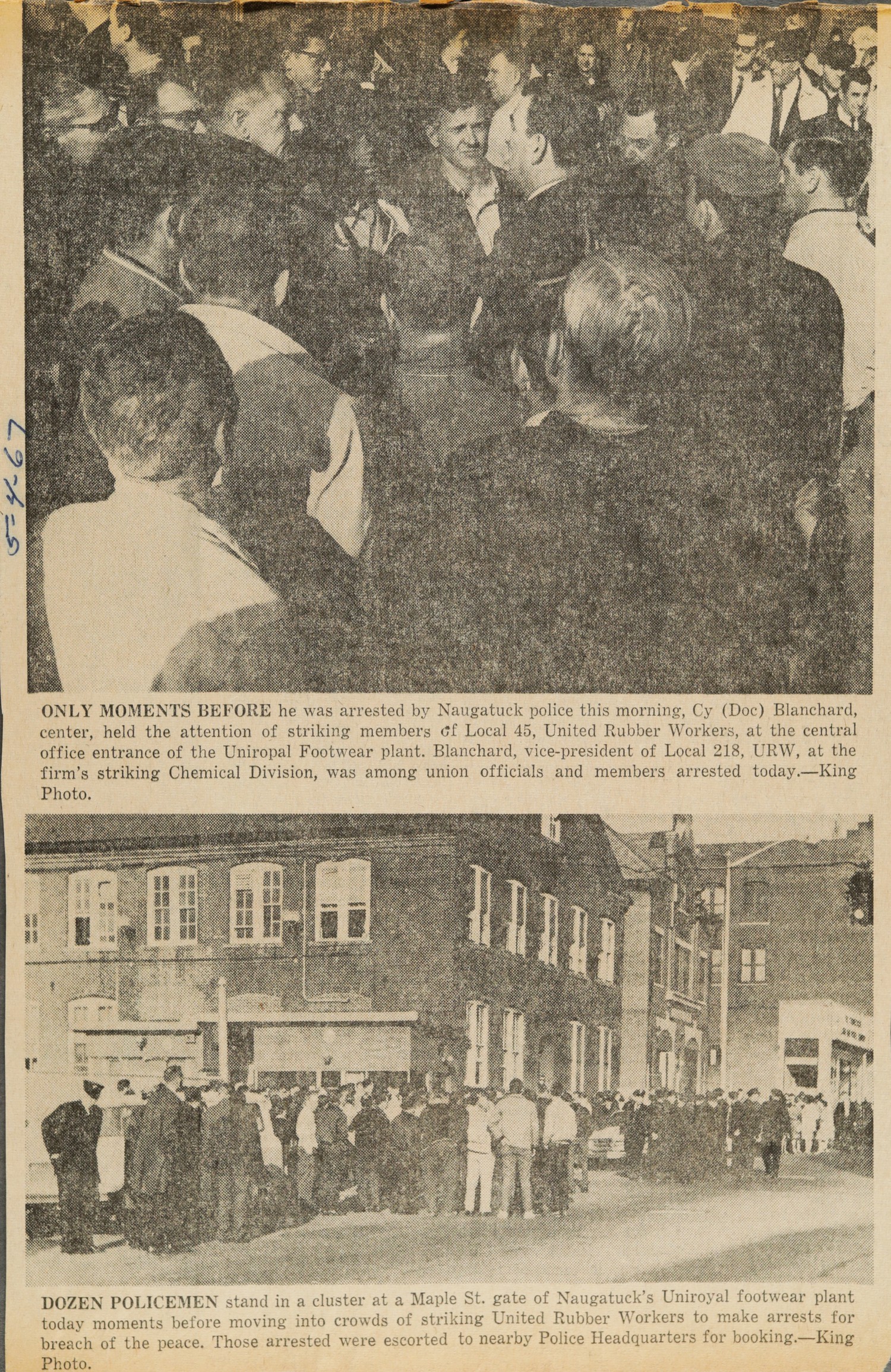
ONLY MOMENTS BEFORE he was arrested by Naugatuck police this morning, Cy (Doc) Blanchard, center, held the attention of striking members of Local 45, United Rubber Workers, at the central office entrance of the Uniroyal Footwear plant. Blanchard, vice-president of Local 218, URW, at the firm’s striking Chemical Division, was among union officials and members arrested today.—King Photo.

5-4-67

ONLY MOMENTS BEFORE he was arrested by Naugatuck police this morning, Cy (Doc) Blanchard, center, held the attention of striking members of Local 45, United Rubber Workers, at the central office entrance of the Uniroyal Footwear plant. Blanchard, vice-president of Local 218, URW, at the firm’s striking Chemical Division, was among union officials and members arrested today.—King Photo.

DOZEN POLICEMEN stand in a cluster at a Maple St. gate of Naugatuck’s Uniroyal footwear plant today moments before moving into crowds of striking United Rubber Workers to make arrests for breach of the peace. Those arrested were escorted to nearby Police Headquarters for booking.—King Photo.

Uniroyal Quiet After Flareup

Uniroyal Quiet After Flareup

5-5-67

NAUGATUCK — After a Thursday morning flareup between police and pickets at the Uniroyal Footwear Division plant, in which 50 people were arrested on charges of breach of peace, the scene became quiet for the remainder of the day, even to the point that pickets permitted a postal shipment to leave the main warehouse.

Negotiations between top management and labor representatives continued during the day in Cincinnati without settlement, and at the end of the day, the rumored injunction being sought by management had not been received.

Police Chief Frank J. Mariano said Thursday night that he attributed the calm which prevailed after the clash to the “excellent cooperation” among those arrested, particularly to two high ranking local officials.

Chief Mariano said that he felt that the police force, under the leadership of Capt. Joseph Summa, had done “an excellent job” quieting things down, but that the job might have been more difficult ha d Local 45 Vice President Raymond Mengacci and Local 218 Vice President Cyrus Blanchard not cooperated as they did.

The actions of Mengacci and Blanchard, said Chief Mariano, “averted possible rougher incidents.” When the two vice presidents were arrested, he added, the peaceful attitude which they exhibited set the tone for the remaining pickets, who went quietly to the police headquarters.

At about 5 p.m., according to Local 45 Secretary Rita Ruggiero, a postal shipment was permitted by pickets to leave the main warehouse. Rumors that a shipment would be made by helicopter remained rumors, and no such shipment was made.

The scuffle in the early hours of Thursday morning brought out the entire police force, some of whom had had only a few hours rest before the call to return to duty.

In addition to the regular force, supernumerary policemen were called out to force their way through the 100-man picket line at the Maple St. gate, and provide a passage way for office and supervisory personnel. The office personnel eventually made their way in.

The first group, arrested about 6:45, had to be physically forced to the police station, across the street from the trouble spot. Only after Police Capt. Joseph Summa read the riot act in the state statutes over a bullhorn to the unruly crowd did the commotions begin to settle.

Women in the picket line and in the group trying to get into the plant began to cry as the tension mounted, and the evidence of possible physical violence rose. Police blocked off Maple St. to all traffic during the height of the scuffle.

Although police did not use clubs or other devices to restrain the picketers, several minor injuries were reported. One striker, Nunzio Finateri, 52, Union City Rd., was taken to St. Mary’s Hospital, Waterbury, where he was X-rayed, treated the scuffle, and complained of pains in his chest.

Several policemen and picketers were bruised in the clash, although there were no reports of medical treatment other than Finateri’s

At 7:45 a.m., when workers for the 8 o’clock shift began to arrive, a second outbreak flared up, but was quickly squelched by police.

Those arrested during the second outbreak did not resist being taken to the police station, as the first group had.

As to what would happen Friday, when office workers and supervisory personnel are to return to work again, Mengacci said, “We haven’t got the slightest idea. We have been conferring with our attorneys, and we expect to play it by ear as we go along. We have heard that we will be served with an injunction, but have not received any word to date.”

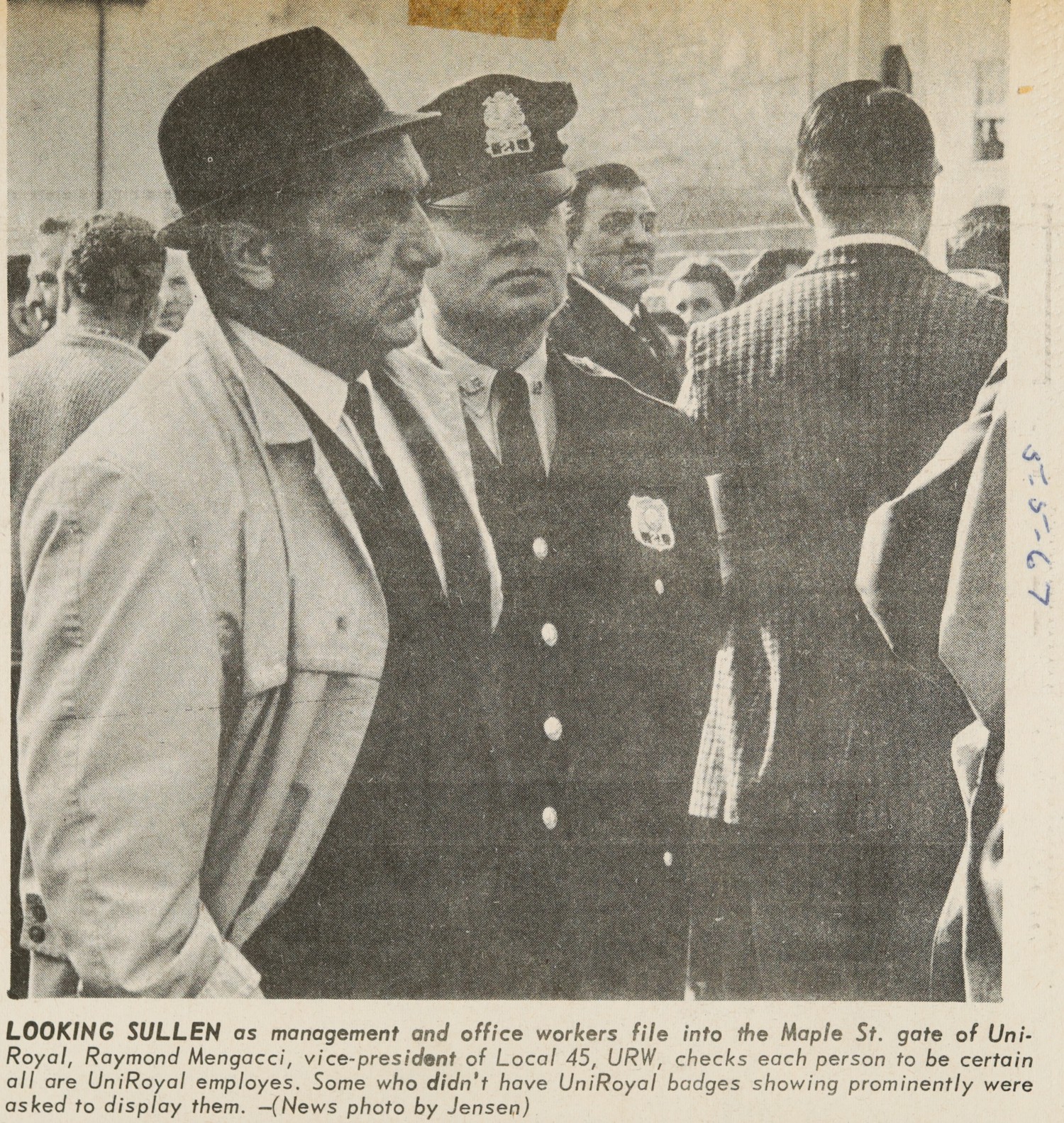
LOOKING SULLEN as management and office workers file into the Maple St. gate of UniRoyal Raymond Memorial, vice-president of Local 45, URW, checks each person to be certain all are UniRoyal employees. Some who didn’t have UniRoyal badges shown prominently were asked to display them.

LOOKING SULLEN as management and office workers file into the Maple St. gate of Uni-Royal, Raymond Mengacci, vice-president of Local 45, URW, checks each person to be certain all are UniRoyal employes. Some who didn’t have UniRoyal badges showing prominently were asked to display them. —(News photo by Jensen)


[Handwritten note on right margin:]
8-5-67

Court Restrains Uniroyal Pickets

Court Restrains Uniroyal Pickets

5-6-67 [handwritten]

By PATRICK KEATING
Register Staff Reporter

NAUGATUCK — Management of the Footwear Division, Uniroyal, was granted an injunction against Local 45, United Rubber Workers, Friday afternoon at Waterbury Superior Court which will restrict the overall picketing by the union of the plant, effective immediately.

See PHOTO Page 25

The injunction, which had been sought by Uniroyal, will limit the manner of picketing and also restrain the union from stopping management personnel, company trucks, and independent carriers from entering and leaving the Footwear premises.

Management had requested the court action to curb in the future any near-rioting that was prevalent Thursday and Friday as pickets clashed with management personnel and police.

Seventy-one union members were arrested for a breach of peace and several hospitalized during the two-day outbreak.

Local 45 had challenged the entry of office help and supervisors, and also sought to prevent the company from shipping merchandise to its customers.

Friday afternoon, the company was able to have the New Haven Railroad switch five freight cars into its central warehouse. These cars are being loaded by male supervisory help and will be shipped as early as possible.

Pickets were unsuccessful in their efforts to prevent the freight cars from entering the warehouse on its spur line. The switching engine was manned by railroad officials as the regular crew, members of the Brotherhood, recognized the strikers by refusing to cross the picket line.

Two of the pickets were injured slightly by contact with the moving freight train which forced the strikers to jump to

See UNIROYAL Page 2

Five Hurt When Train Won’t Stop

Five Hurt When Train Won’t Stop

5-7-68 [handwritten]

NAUGATUCK—An attempt to push five railroad freight cars into a Uniroyal warehouse on Elm St. Friday afternoon resulted in injuries to at least five men as police officers tried to move picketing United Rubber Workers out of the way of the constantly moving train.

According to reports from some of those involved in the incident, a locomotive and five cars approached the gate leading to the warehouse at about 1 p.m.

Policemen at the scene said they expected the train would stop to allow them time to clear the track and gate of circulating pickets. They added that the train did not stop, but continued toward the warehouse at an estimated 10 mph. They had reportedly received a call claiming that the train would not stop.

Pickets held their position in front of the gate while police, some of whom were unaware that the train was still coming, trid to haul the pickets out of the path of the train.

Both police and pickets suffered injuries as the cars continued into the gate. Men from both sides were occasionally shoved against the moving cars.

Two pickets, Robert Sequenzia, 440 South Main St., and Mario Carniero, 18 Bridge St., were taken to St. Mary’s Hospital where they were treated and released.

One patrolman, Ronald Pruchnicki, received bruises and was treated at the hospital, returning to work for the 11 p.m. to 7 a.m. shift.

Police Lt. Richard Payne received a groin injury, but was not taken to the hospital.

Strike Scene Quiet Following Judge’s Warning To URW Union

Strike Scene Quiet Following Judge’s Warning To URW Union

5-6-67 [handwritten notation in top right]

NAUGATUCK—Picketing at all three Uniroyal plants here was quiet today, following two days of scuffles by police and striking members of the United Rubber Workers union. Small clusters of pickets, mostly women, were on duty early today at the footwear plant where near-violence erupted both Thursday and Friday mornings.

It is not known if today’s peaceful picketing is the result of normal weekend inactivity at the plant or the result of a stern warning issued to strikers Friday by Superior Court Judge Leo V. Gaffney.

The judge warned the union to refrain from violence and any interference with operations of the Uniroyal plant, pending Tuesday’s court hearing on an injunction petition to halt mass picketing during the strike.

The rubberworkers struck the nationwide chain of Uniroyal plants two weeks ago. In the two days of clashes between union members and police, 64 strikers were arrested on breach of peace charges. The clashes occurred as police attempted to aid management personnel enter the Central Office of the footwear plant on Maple St. and were the basis for the firm’s action is seeking a court injunction to end mass picketing.

Only hours after the injunction hearing, a group consisting of Mayor Joseph C. Raytkwich, Chief of Police Frank J. Mariano, Police Commissioners Henry Marlor and William Simmons and representatives of the union gathered in the mayor’s office.

Following the session, which lasted almost two hours, during which loud voices could be heard from behind the closed doors, no statements were issued and no comments were made.

Local 45 representatives said that they would leave the question of a statement to the discretion of Mayor Raytkwich, whose only comment was that the group had held “a round robin discussion.”

At about 1 p.m., only an hour before the hearing in Waterbury, police became involved in an incident with pickets who were trying to stop the passage of five railroad cars into a warehouse on Elm St. Several pickets and police were injured in the incident, and three were taken to St. Mary’s Hospital for treatment.

When the session during which pickets were warned against mass picketing had ended, an injunction hearing was set for 11 a.m. Tuesday.

During the injunction hearing, the union must show cause why an order restraining it from engaging in mass picketing should not be issued.

In the meantime the strikers have been cautioned against any incidents which would interfere with the company’s business, and against any type of violence.

“In the event there is any interference with the operations of this plaintiff’s (Uniroyal’s) business or any violence of any sort or nature between now and such time as the court rules on the conjunction application,” Judge Gaffney said, “then upon a showing of the facts, a temporary restraining order will be issued forthwith.”

In its petition for the injunction, Uniroyal claims union members have “engaged in mass picketing . . . intercepted and blocked persons who approached the plant and plant premises by foot and by vehicle, pushing and shoving such persons, kicking them, stepping on their feet, calling them names in loud and menacing manner…”

The strikers “have congregated in large and unruly masses,” the action says, in attempts to block entrance to or exit from the plant “by threat of force or violence” and have “obstructed the police in the performance of their duties and made the employment of force and large numbers of police officers necessary, resulting in breaches of the peace and creating an atmosphere of fear and tension…”

By reason of such “unlawful acts and threats,” the company claims, it “has been and will continue to be unable to perform functions vital to its operations . . . and will continue to be unable to handle contracts with its customers, among which is the Defense Department of the United States Government for items needed in national defense…”

The company wants the court to issue an order restraining the pickets from engaging in mass picketing, from blocking entrances and exits to and from the plant and “from in any way injuring, damaging or destroying its plant, machines, equipment or stock of materials on hand.”

No property damage was reported throughout the three days of mass picketing, and the object of pickets was to prevent white collar employes from entering the plant.

Despite pleadings and warnings from officials of Local 45, pushing, shoving and subsequent arrests punctuated the early hours of Thursday and Friday. Forty-three pickets were arrested after clashes with police Thursday, and another 21 were arrested Friday.

Union officials charged that the early morning incident Friday was deliberately provoked by the company, which had been taking pictures at the scene to bolster efforts to get the court injunction against mass picketing.

Quietness Reigns In Strike Here

Quietness Reigns In Strike Here

The three Locals of the United Rubber Workers in the borough maintained their teams of picketers at the gates of the struck UniRoyal plants today.

Picketing is being conducted in a quite orderly fashion with no incidents reported. White collar workers of UniRoyal continue to pass in and out of the gates across the lines, maintaining their regular work schedules.

Trucks have been permitted in and out of the Elm St. gate to the Warehouse. Some Teamster Union truck drivers, however, have refused to cross the lines. It has been noted that several of the trucks coming to the warehouse are driven by officials of the trucking concerns doing business with UniRoyal.


Surprise Move

CHATTANOOGA, Tenn., (UPI) – Teamsters boss James


[Handwritten text at top right of image:]
BAR LIBRARY
SUPERIOR COURT STENOGRAPHER
LADIES ROOM


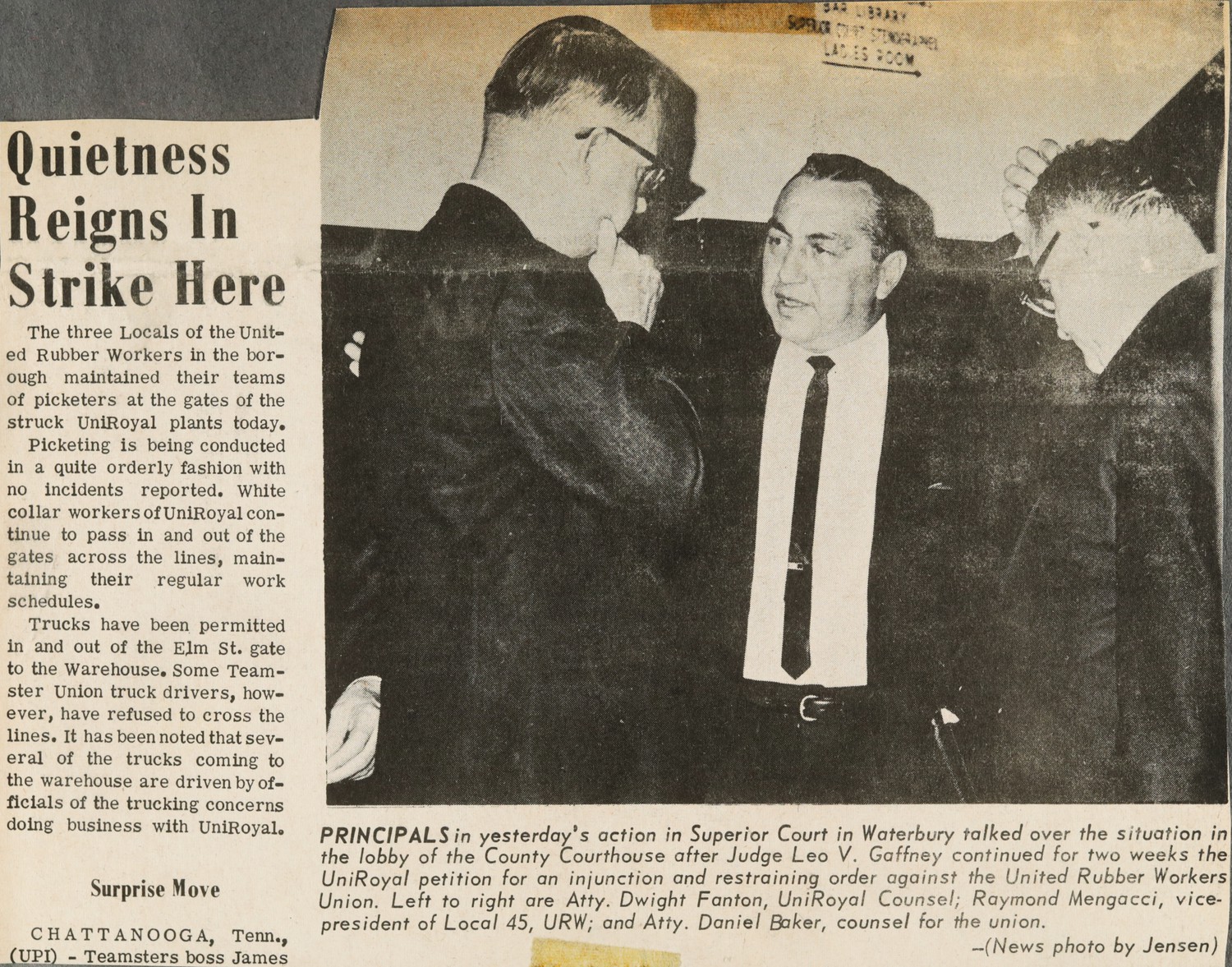
PRINCIPALS in yesterday’s action in Superior Court in Waterbury talked over the situation in the lobby of the County Courthouse after Judge Leo V. Gaffney continued for two weeks the UniRoyal petition for an injunction and restraining order against the United Rubber Workers Union. Left to right are Atty. Dwight Fanton, UniRoyal Counsel; Raymond Mengacci, vice-president of Local 45, URW; and Atty. Daniel Baker, counsel for the union.

-(News photo by Jensen)

21 Held In New Uniroyal Row Company Asks Picketing Curbs

5-5-67

Register Photo by Stuart Langer

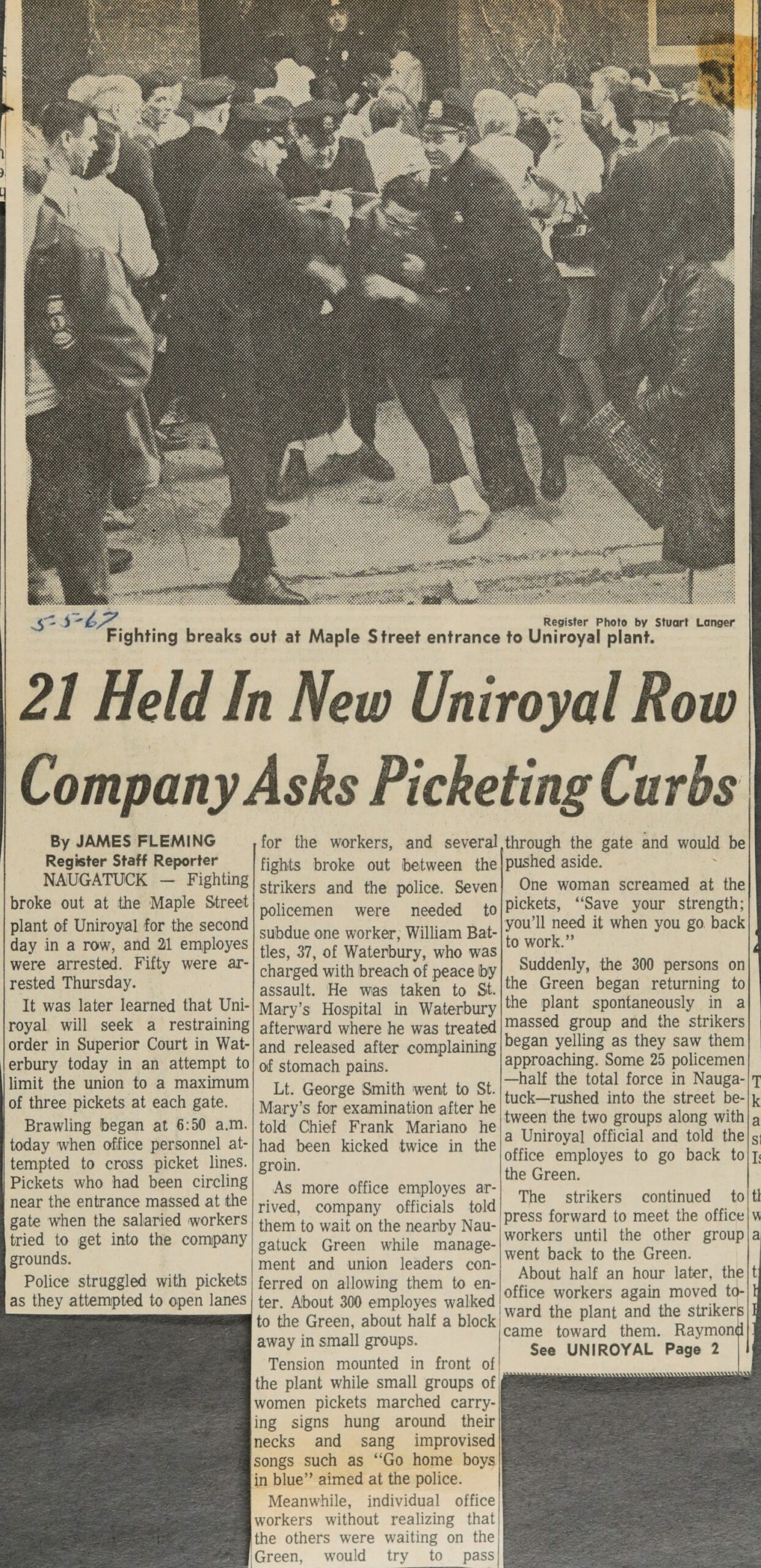
Fighting breaks out at Maple Street entrance to Uniroyal plant.

21 Held In New Uniroyal Row Company Asks Picketing Curbs

By JAMES FLEMING
Register Staff Reporter

NAUGATUCK — Fighting broke out at the Maple Street plant of Uniroyal for the second day in a row, and 21 employes were arrested. Fifty were arrested Thursday.

It was later learned that Uniroyal will seek a restraining order in Superior Court in Waterbury today in an attempt to limit the union to a maximum of three pickets at each gate.

Brawling began at 6:50 a.m. today when office personnel attempted to cross picket lines. Pickets who had been circling near the entrance massed at the gate when the salaried workers tried to get into the company grounds.

Police struggled with pickets as they attempted to open lanes for the workers, and several fights broke out between the strikers and the police. Seven policemen were needed to subdue one worker, William Battles, 37, of Waterbury, who was charged with breach of peace by assault. He was taken to St. Mary’s Hospital in Waterbury afterward where he was treated and released after complaining of stomach pains.

Lt. George Smith went to St. Mary’s for examination after he told Chief Frank Mariano he had been kicked twice in the groin.

As more office employes arrived, company officials told them to wait on the nearby Naugatuck Green while management and union leaders conferred on allowing them to enter. About 300 employes walked to the Green, about half a block away in small groups.

Tension mounted in front of the plant while small groups of women pickets marched carrying signs hung around their necks and sang improvised songs such as “Go home boys in blue” aimed at the police.

Meanwhile, individual office workers without realizing that the others were waiting on the Green, would try to pass through the gate and would be pushed aside.

One woman screamed at the pickets, “Save your strength; you’ll need it when you go back to work.”

Suddenly, the 300 persons on the Green began returning to the plant spontaneously in a massed group and the strikers began yelling as they saw them approaching. Some 25 policemen —half the total force in Naugatuck—rushed into the street between the two groups along with a Uniroyal official and told the office employes to go back to the Green.

The strikers continued to press forward to meet the office workers until the other group went back to the Green.

About half an hour later, the office workers again moved toward the plant and the strikers came toward them. Raymond

See UNIROYAL Page 2

URW Rejects

6-9-67

URW Rejects

Continued From Page 1

  1. Supplemental Unemployment Benefits – Regular benefits increased from 65% of average pay (plus $2 for up to four dependents, with a maximum payment of $50) to 75% of average pay with no maximums. Short work week benefits increased in all cases to 75% of average pay. Company contributions increased from 5¢ per hour to 6¢ per hour when the sub fund falls below 100%. Sub fund increased from $250 to $350 per employee.
  2. Miscellaneous Contract Clauses – These include up to 40 hours pay, depending upon the size of the plant for union time study men, increased pay for union grievance meetings and arbitration hearings, a greatly improved safety committee clause and a number of other contract proposals and clarifying letters of commitment.
  3. Pensions – A 60% increase in regular pensions from $3.25 to $5.25 per month per year of service. A 60% increase in disability pensions from $6.50 to $10.50 per month per year of service. An increase of $1.50 per month per year of service for living pensioners who were retired after July 1, 1950.
  4. Life Insurance – An increase in Company paid insurance from $6,500 to $7,500 for active employees.
  5. Hospitalization – An increase in the coverage for the maximum stay in the hospital from 365 to 730 days.
  6. X-Ray and Radium Therapy – An increase in the aggregate maximum payment from $200 to $300.
  7. Visiting Nurse – An increase in the maximum daily payment from $6 to $7.
  8. Surgical – Provide for full payment of the reasonable and customary fees prevailing in the area for the surgical procedures.
  9. Sickness and Accident Benefits – An increase in benefits according to the employees average earnings with a minimum of $50 per week and a maximum of $80 per week. (Average coverage to be $70.) Eliminate present 7 day waiting period and provide sick benefits from first day of hospital confinement as a registered bed patient.

Union Demands, Logical Attainable – Bommarito

Union Demands, Logical Attainable - Bommarito

Union Demands, Logical Attainable – Bommarito

6-10-67 [handwritten notation at top]

United Rubber Worker President Peter Bommarito said the union’s demands are “logical, justifiable and attainable.”

According to a UniRoyal spokesman yesterday, the URW’s demands would cost at least $1.40 an hour. The companies value their offers at more than 70 cents an hour.

Bommarito said there are a number of issues involving working conditions that must be settled before a contract can be reached.

He was pessimistic about prospects of a quick settlement, but other ranking union officials said the new offers should at least provide a basis for agreement.

The URW membership of the borough Locals learned yesterday for the first time, exactly what the companies were offering. UniRoyal mailed to all employees, a letter stating what the offer comprised. The union rejected the offer late Tuesday afternoon.

The 50-day old strike is taking its toll financially from everyone concerned, the membership, the union and the company as well as business in town.

The union, at the onset of the strike, had been promised financial help from the auto industry union, but were forced to announce that strike benefit checks were being cut from $25 to $15 beginning with this week’s check.

Hopes ran high this week, locally, that the strike would end soon. However, yesterday’s announcement ended this hope.

Only three of the “big five” rubber companies are struck. Workers at UniRoyal, Firestone and Goodrich are out while employes of Goodyear and General Tire are working on a day-to-day basis.

Negotiating session were recessed for the weekend and are scheduled to be resumed Monday.

Negotiators To Study URW Counter-Proposal

Negotiators To Study URW Counter-Proposal

6/12-67

Negotiators To Study URW Counter-Proposal

The five major rubber companies in the U.S. will consider a URW proposal today after two contracts which were proposed by the companies last week were rejected by the union.

One source said the union counter-proposal is only slightly different from its original demand which, according to the companies, would cost the companies an additional $1.40 for each employee.

The company offered a three-year contract and tried to include pension and welfare negotiations, which has habitually come under separate contract. The current welfare-pension contract does not expire until September.

In their offer, the companies provided a $.38 wage increase for tire workers and $.31 increase to non-tire workers.

URW are demanding equal across-the board raises for all employees, while the companies claim that this would worsen their already poor competitive position in non-tire products.

URW President Peter Bommarito stated that the union is prepared to continue its strike for another month. Local UniRoyal employees are beginning to look a little grey about the pocketbook with Bommarito’s statement and the reduced strike benefit checks.

Alleged promises from the United Auto Workers union to aid the URW strikers financially has not yet materialized.

The strike goes into its 53rd day today, with 50,000 employees of Firestone, Goodrich and UniRoyal idle.

After the weekend recess, the companies, which had time to study the union offer during the respite, and the URW will resume negotiations at the bargaining table.

Local URW Answers Company’s Letter

Local URW Answers Company’s Letter

6-12-67

Raymond Mengacci Vice-President of Local #45, stated today he didn’t want to get into a debate with factory manager Mr. Jack Smith, or try to negotiate an agreement here in Naugatuck, especially through the newspapers, when both the Company and the Union committees are having a hard enough time in Cincinnati, Ohio, doing this, without interference that might hamper negotiations in any way in Cincinnati. But that he had no recourse other than to answer some of the statements made by Mr. Smith, in the letter that he sent out to the employes of the Naugatuck footwear plant and for publication in the newspapers.

Mr. Mengacci stated that when the Union netotiating committee left for Cincinnati they were going there for the sole purpose to make a sincere effort to negotiate a contract and wage agreement with the Uni-Royal Co. before the April 20th deadline. This was the only agreement that was discussed at the membership meeting of Local #45.

Negotiations began in Cincinnati on March 21, 1967, but it wasn’t until April 12, 1967 that the Company made its first and finale offer to the Union on contract and wages. This was eight (8) days before the deadline.

Mr. Mengacci stated never in all his experience on negotiating committees or that of Pres. Froehlich who has more than he, did they ever hear of anything like this the first offer was also the last. No one can call this negotiating. This has never been done before.

And it wasn’t until a few days later that the Union found out that this was being done in all of the “Big Five” (5) rubber companies, not just Uni-Royal.

The Union also found out that these Companies had made a mutual pact designed to protect any struck company against financial losses. We, in the Union, were always led to believe that these Companies were in competition with one another. This we found is not so, they have a much better Union than we have.

Mr. Smith also goes on to say in his letter, that the Company had made an effort to open the Pension and Insurance agreement with the Union so that they could negotiate all matters to a conclusion. This is correct. The Union informed the Company that this agreement does not terminate until Sept. 15, 1967, and that the Union was in no position to negotiate this agreement because first of all they had not discussed this with their membership to see what changes the members wanted to make. Also they had made no preparation whatsoever among themselves on Pension and Insurance to discuss this question intelligently with the Company.

Mr. Smith goes on to say in his letter, that the Union did not present to the Company their full proposal until 11 a.m. on April 19, just 37 hours before the strike deadline. This is correct but why was this so. The Union felt that if they received from the Company the correct interpretation of the Clauses that are in the Working agreement now, and the way they were intented to be interpreted, at least in the Unions viewpoint, before there was a change in the head negotiator for the Company, they would not have to make any changes.

But the Union found out that the Company’s new Head Negotiator was not giving the same interpretation, so therefore, the Union had to come in with some new proposals. The Union would not be able to live with some of the interpretation the new Company Head Negotiator was giving, and all these interpretations were under Article nine (9) Working Condition, which are very important to our members.

Just ask some of our members especially those that work in the Making and Stitching Departments what conditions that they have to work under. Production in many cases have increased by 25 to 30 per cent in the last few years. This is with the same number of operators and in many cases less. Many of these employees can tell you that their weekly earnings are less now even though they received two wage increases in the past few years. This is all because they cannot make any-

where near the efficiency’s that they were making a few years ago. This is the reason why the Union had to make some late proposals to the Company. But if the Company wanted to make a sincere effort to reach an agreement they still had plenty of time to do so.

Now let’s talk about the difference in wage increases between the tire plants and the non-tire plants. We have asked the Company many times to open up their books in Naugatuck. If they can show the Union that they are losing money or are not making the profits that they are entitled to make, then the Union would take another look at their demands for uniform wage increases. This they have refused to do, so therefore the Union does not believe that the non-tire plants are putting the UniRoyal Company in a severe economic squeeze if they grant the same increases as tires.

As long as we are talking about wages increases, it is very interesting to not that President George R. Vila‘s wages were increased from $168,821 in 1965 to $239,033 in 1966 this a $70,212 increase or 41.6% in one year. Also Vice-

Please Turn to Page 12


Widzionjez Trial

Local URW

Local URW 6-12-67

Continued From Page 1

President Walter D. Baldwin’s
wages were increased from
$83,025 in 1965 to $113,395 in
1966 an increase of $30,370 or
36.6% in one year.

The union is not saying that
these men do not deserve this
increase they probably deserve
more for the job that they are
doing, but if the Company wants
to talk percentages, then let’s
talk percentages from top to
bottom.

We are happy that the Com-
pany has seen fit to increase
the vacation allowance for em-
ployes that have one to five
years of seniority. What about
the employe with ten or more
years of seniority. The Com-
pany has not seen fit to do any-
thing for these employes. Why?

Miscellaneous Contract
Clauses – We admit that the
Company has improved some of
these clauses and also given the
Union some clarifying letter of
commitment. Yet can Mr. Smith
tell the Union why is it that
when the Union asked the Com-
pany to give them a letter of
commitment, which would not
cost the Company one penny,
and that they treat our mem-
bers that work for UniRoyal
Inc. with decency and respect,
the Company refused. If mem-
bers of management expect our
members to treat them with de-
cency and respect, then we ex-
pect the same from manage-
ment. A written commitment
that this would be done would
go a long way in reaching a
settlement.

I would also like Mr. Smith
to explain to his employes that
belong to our Union, why is it
that when the Union ask the
UniRoyal Company to grant our
people seven (7) paid sick days
a year, the Company said that
this was too costly, yet every
person that works for manage-
ment gets ten (10) paid sick
days a year. The only thing
our members get if they take
10 days off in one year is an
unfavorable notation on their
personal cards. This is very
hard to digest.

The Company has not seen fit
to do anything for our hourly
rated employe and also a night
shift bonus, even though we have
one of the lowest night shift
bonuses in the area.

I do not want to elaborate on
the Pension & Insurance part

Rubber-Labor Pact Is Possible This Week; General Tire Increases Its Offer to Union

6-12-67

Rubber-Labor Pact Is Possible This Week; General Tire Increases Its Offer to Union

By a WALL STREET JOURNAL Staff Reporter

AKRON—After a week of marked progress in negotiations, the United Rubber Workers union and five major rubber companies will reopen bargaining sessions at 10 a.m. today with some expectation of reaching a single-package settlement covering wages, pensions and welfare benefits before another week passes.

A settlement would end the strike against three of the major concerns—Firestone Tire & Rubber Co., Uniroyal, Inc. and B. F. Goodrich Co.—which has idled 51,000 workers for 53 days since former contracts expired April 20. It would also conclude negotiations with Goodyear Tire & Rubber Co. and General Tire & Rubber Co., where production has continued on a day-to-day basis despite similar contract expirations.

Separate bargaining sessions with the five companies began making headway last week. Management offered wage boosts totaling 38 cents an hour for tire workers and 31 cents for other production workers over three years, plus pension-and-welfare-contract improvements. The package was technically rejected by the union as inadequate, but it opened the door to several counter proposals presumably being studied by the companies.

Differentials an Obstacle

At the weekend, General Tire was said to have sweetened its offer on several points, boosting the pay proposal for tire workers to 40 cents an hour over three years and offering further pension, vacation and supplemental unemployment benefit payments. General’s contract negotiations, however, cover only 3,000 workers in two tire plants, in Akron and Waco, Texas, while those of the four other concerns cover other production workers as well. The proposed differentials between tire workers and other production employes could still be a difficult obstacle in this week’s talks.

General’s wage offer for tire workers would break down to 15 cents in 1967, 13 cents in 1968 and 12 cents in 1969. The 38-cent offer of the other concerns comprises 16 cents this year and 11 cents in each of the next two years.

Peter Bommarito, URW international president, termed the offers of the four companies, other than General, as representing a gain of less than 4.5% compared with what he said has been a 5.8% raise granted in other manufacturing industries. He also called for the naming of an independent fact-finding board to determine the “fairness” of the union’s demands.

Uniroyal, in a letter to employes, put the gain in wage and other improvements at “about 5%” and said its offer would cost the company about 70 cents an hour, the largest proposal it had ever made to the union. Firestone and Goodrich also sent letters to employes discussing the negotiations, with Goodrich also putting its offer as “in line with the 5% pattern” set in other industries.

Another improvement in General’s weekend offer, which Mr. Bommarito yesterday called “attractive” as a basis for a settlement, was an improvement in supplemental unemployment benefits payments providing for 80% of average straight-time pay for laid-off workers or for those on short workweeks; this total would include unemployment compensation. Offers of the other companies had provided for up to 75% of straight-time pay. The previous contract called for up to 65% plus $2 for each dependent up to four.

The union has demanded as a “full employment” plan, or guaranteed annual wage, payments of up to 95% of regular straight-time pay for laid-off workers, including unemployment compensation. The union has put the company cost for this at 7 cents an hour per worker, up from the present 5 cents. The companies’ offer has been about 6 cents.

General’s offer also included a provision for six weeks’ vacation after 30 years’ service and two weeks after one year’s, along with existing intermediate vacations. The other companies made no provision for six weeks’ vacation but offered three weeks after five years’ service, along with other existing vacation allowances.

The pension-payment propsosal by General also was a bit higher than the increase to $5.25 per month from $3.25 for each year of service proposed by the others. Though the General amount wasn’t specified, it was understood to be close to $5.50 per month for each year of service.

Mr. Bommarito also disputed the companies’ claims that their “total-package” offers represented employment-cost increases of 70 cents an hour. He estimated them at about 64 cents for General’s package and 60 cents for the others.

Other Benefits

All the offers also included improvements in life insurance, hospitalization, sickness and accident insurance, an additional increase of 10 cents an hour for skilled tradesmen and improvements in grievance-pay allowances.

Should a settlement be achieved on a “single-package” basis, it would be the first time in the rubber industry. Pension and welfare matters have previously been reserved to a separate contract, the existing one due to expire next Sept. 15. Previously, however, the wage contract and pension agreements have expired on at least alternate years. The proximity of the pension-contract expiration this year to the wage contract’s conclusion was held to be an obstacle to an earlier settlement on wages.

The companies acknowledged they were reluctant to “expose” themselves to a substantial wage-cost increase only to be faced in a few months with another strike threat over pension and other welfare matters. Until two weeks ago, however, the union apparently had been adamant about keeping the two contracts separate.

General Tire Offers “Attractive Package”

General Tire Offers "Attractive Package"

Rubber Strike

6-13-67

General Tire Offers “Attractive Package”

AKRON, Ohio (UPI) — Negotiators in the national rubber strike today prepared for another long session over the problems of wages, contract length, the elimination of differentials in wage hikes, employes and job security.

Three of the nation’s five largest rubber companies have been on strike for 54 days, with about 55,000 employes idled around the country.

In Connecticut, some 5,500 workers at three UniRoyal plants in Naugatuck are affected by the walkout. There are no other unionized rubber industry plants in the state.

Wage contracts expired April 20 between the United Rubber Workers (URW) and the Firestone Tire and Rubber Co., Uniroyal Inc., and B. F. Goodrich Co.

Day-to-Day

Goodyear Tire & Rubber Co., whose contract expired the same day, and General, whose contract expired May 15, continued production on a day-to-day basis.

A break seemed most likely to occur in talks with General Tire & Rubber, which has proposed a slightly higher package than the other four companies.

General boosted its pay proposal for tire workers from 38 to 40 cents per hour over three years, and offered increased fringe benefits, particularly in the crucial area of supplementary unemployment benefits.

Spokesmen for the other four companies would not say if their negotiators were following suit.

Wages Behind

URW President Peter Bommarito said the wage offers of the four companies, including General, would leave the rubber workers behind other industries. He said the rubber companies are offering 4.5 per cent increases, as opposed to the 5.8 per cent national pattern.

In letters to their employes, the three struck companies set the percentage of their offer at 5 per cent, its cost at 70 cents per hour, and its size as the largest in industry history.

The companies said the fringe benefits are substantial and an increase in supplementary unemployment benefits from 65 per cent of straight time pay to 75 per cent will cost them six cents per hour alone.

The union has demanded unemployment payments of up to 95 per cent of basic wages. Bommarito calls this request “a full-employment plant.”

“Attractive” Basis

General had raised its offer on supplementary unemployment benefits to 80 per cent. This proposal won Bommarito’s approval as an “attractive” basis for settlement. General also increased vacation and pension benefits.

The tire workers now average $3.69 per hour. Company employes in other divisions make an average of $2.68. The last two settlements have increased the differential. Bommarito insists the next settlement grant equal raises to both types of production workers.

The request does not affect General, which is negotiating for only 3,000 tire workers in Akron and Waco, Tex. But the other four companies maintain they can only offer 31 per cent wage increases to non-tire workers.

Please Turn to Page 12


Local Strike

General Tire

(Conn.) Tues., June 13, 1967

General Tire

Continued From Page 1

For the first time, the negotiators, at management’s request, were grappling with wages and all fringe benefits in one package. Traditionally, three-year welfare pension contracts and two-year wage contracts are negotiated separately. The welfare pension contracts do not expire until fall.

Another improvement in General’s weekend offer, which Bommarito called “attractive” as a basis for settlement, was an improvement in supplemental unemployment benefit payments providing for 80 per cent of average straight-time pay for laid-off workers or for those on short work-weeks.

This total would include unemployment compensation. Offers of the other companies provided for 75 per cent of straight pay.

General’s offer includes a provision for six weeks vacation after 30 year’s service and two weeks after one year’s service along with existing intermediate vacations.

It is understood that the General proposal for pensions has been upped close to $5.50 per month for each month of service.

Should a settlement be achieved on a “single package” basis, it would be the first time in the rubber industry. Pensions and welfare matters have previously been reserved to a separate contract, the existing one due to expire next Sept. 15.

Previously however, the wage contract and pension agreements have expired on at least alternate years. The proximity of the pension – contract’s conclusion was held to be an obstacle to an earlier settlement of wages.

The companies acknowledged they were reluctant to expose themselves to a substantial wage-cost increase, only to be faced in a few months with another strike over pensions and other welfare matters. Until two weeks ago, however, the union apparently had been adamant about keeping the two contracts separate.

Strike Settlement Hopes “Wilting”

Strike Settlement Hopes “Wilting”

6-15-67

Governor John Dempsey acknowledged the letter received from the borough seeking his intervention in the UniRoyal strike affecting three borough plants. He said in a letter to Mayor Joseph C. Raytkwich, that State Labor Commissioner Renato E. Ricciuti is maintaining close contact with the progress of the negotiations, and that Ricciuti will continue to keep him informed of the situation.

The Governor however, did not commit himself to positive action as had been requested by a vote of the Borough Board in a motion by Burgess Edward McGrath, (R), Third Ward.

Word from Ohio this morning simply states that negotiations are continuing with neither the union or the companies commenting on the progress.

Last week’s hopes for a settlement on the new company offer, appear to be wilting. The basic problems seem to remain the same.

According to sources, the heaviest negotiation is between Goodrich and Firestone and the Union. Progress depends on the outcome of these sessions.

Management has challenged the claim of the Union that its proposal will cost only 73 cents. Union negotiators, taken by surprise, said that management was using weighted wage figures and accused them of inflating the cost of the economic package in the Union’s counterproposal.

Management, according to sources, is including the costs of over-time and machine downtime.

A Union spokesman said yesterday that this item was no longer a major obstacle and hinted that the Union may be reconsidering the apparent cost of its package offer.

The efficiency rating system used at one of the plants seems now to be a bone of contention. A person who works at a particular job is expected to turn out a certain number of articles before he is entitled to full pay. Assuming no breakdowns on the machine, if an employe does not meet his efficiency rating he will not receive full pay.

The Union contends that the older person cannot always produce what a younger employe can and some of the ratings are therefore too high, according to a spokesman.

Union funds are dwindling as the strike continues. Here in Naugatuck, where 5,500 workers are out on strike, benefit checks, even though they have been cut, amount to approximately $577,500.

Strikers are resorting to the purchase of food stamps to supplement their $15 weekly benefit checks as their personal funds are depleated.

The question of the Uni-Royal annual shut-down vacation period in August is a topic of conversation in the borough. Many workers were hoping to be back to work well in advance of this time. Vacation plans are being altered.

Strike Situation: No New Developments In Negotiations

Strike Situation: No New Developments In Negotiations

Strike Situation: No New Developments In Negotiations

6-14-67

AKRON, Ohio – Spokesmen said today that despite the progressive tone of talks between the United Rubber Workers and the General Tire and Rubber Co., there were no new developments in contract negotiations.

General had offered a slightly higher wage package than other members of the industry’s big five.

URW President Peter Bommarito said the offers of the companies, excluding General Tire, would leave rubber workers behind other industries.

A major block in the settlement of the strike was the union’s demand for unemployment payments of up to 95 per cent of basic wages. The rubber companies have described the demand as tantamount to “a guaranteed annual wage.”

Elimination of the pay differential between tire and non-tire workers was also a key union demand.

Locally

At a Local 45 membership meeting in May, President George Froehlich reportedly said that the union would not go for a three-year contract nor an agreement that would include pension or fringe benefits.

No new information on the progress of the negotiations in Cincinnati has been released today. Members of the three Locals in the borough, suffering from 54 days without work, are anxious for news of the sessions.

Local strikers, speaking as individuals, are eager for another meeting of the membership.

Union officials have explained that the promised financial help from the auto industry union was in the form of a loan which the union decided not to take, but rather to cut the amount of benefits to its members and seek to raise additional monies from the working members employed at General Tire and Goodyear.

However, one week’s collection amounted to only $6,000 in donations.

Local URW members, when questioned, are wondering if the hold-up in settlement will, in the long run, prove beneficial to the members here in the borough. Local 45 with its more than 4,000 members, is one of the largest in the URW.

URW To Expand Strike

General Tire Added

6-17-67

URW To Expand Strike

AKRON, Ohio—Another rubber company was added to the three already on strike Friday when the executive board of the United Rubber Workers Union voted to send out General Tire and Rubber Co. workers.

More than 3,000 employes in two plants, Akron and Waco, Texas, will be directly affected by the walkout.

Top sources indicated that the picketing would begin sometime during the coming week, possibly Monday or Tuesday.

This is the only major change in the picture, and Uniroyal negotiations were reported as making no progress Friday.

The fact that General Tire’s URW members will be on strike is expected to put pressure on Goodyear, the only company of the so called “big five” not on strike.

General Tire executives were informed of the executive board’s decision Friday evening.

The picketing will also porbably put pressure on the union’s strike fund, already seriously depleted. What financial action the union plans to take to alleviate pressure was not learned Friday.

Although the United Auto Workers union had promised financial aid to the striking union in the form of a loan, the URW has been hesitant to accept the loan and has tried, instead, to raise money through donations from URW members still working.

These efforts have been reportedly unsuccessful, and the original strike fund of $6.5 million has been drained at a rate of $1.25 million a week.

Unfair labor practice charges filed by International Union Pres. Peter Bommarito are presently being investigated by the National Labor Relations Board.

Bommarito charged that the strike pact agreed upon by the companies involved in the negotiations was hindering progress.

The pact reportedly states that companies affected by a strike will be given financial aid by those which are not struck.

Obstacles preventing a settlement at the present time were reported Friday as being mainly economic.

The union feels that the value of the economic offers being made by the companies is not high enough yet.

Sources also indicated that the supplemental unemployment benefits are not high enough, and may well end up as the number one obstacle to a settlement.

According to those close to the negotiations, the companies have a “philosophical objection” to paying people for not working.

In addition it is possible that the auto manufacturers are putting pressure on the rubber firms not to grant the so-called guaranteed annual wage because the car companies will be facing the same request when the United Auto Workers begin talks in July.

The union’s counter proposal, submitted over a week ago, is still being discussed. Talks recessed for the weekend Friday and are scheduled to resume Monday.

Fourth Rubber Co. Struck By URW

Fourth Rubber Co. Struck By URW

6-17-67

The Executive Board of the United Rubber Workers union has voted to call its members out from another of the “Big Five” rubber companies.

More than 3,000 employes in two plants of General Tire and Rubber Co., located in Akron, Ohio, and Waco, Texas, will be involved.

According to sources, picketing at these plants will begin either Monday or Tuesday.

With this new move, union


Local 45 URW has called a mass meeting of its membership for Monday, June 19, at 3 p.m. in the auditorium of the Naugatuck High School.

President of Local 45, home from negotiations sessions in Cincinnati, will address the members and bring them up to date on the progress of the negotiations.


workers in four of the five rubber companies will be out. The fact that General Tire’s URW members will be on strike is expected to put pressure on Goodyear, the only working company.

General Tire executives were informed of the executive board’s decision Friday evening.

The picketing will also probably put pressure on the union’s strike fund, already seriously depleted. What financial action the union plans to take to alleviate pressure was not learned Friday.

Although the United Auto Workers union had promised financial aid to the striking union in the form of a loan, the URW has been hesitant to accept the loan and has tried, instead, to raise money through donations from URW members still

working.

Obstacles preventing a settlement at the present time were reported Friday as being mainly economic.

The union feels that the value of the economic offers being made by the companies is not high enough yet.

Sources also indicated that the supplemental unemployment benefits are not high enough, and may well end up as the number one obstacle to a settlement.

According to those close to the negotiations, the companies have a “philosophical objection” to paying people for not working.

In addition it is possible that the auto manufacturers are putting pressure on the rubber firms not to grant the so-called guaranteed annual wage because the car companies will be facing the same request when the United Auto Workers begin talks in July.

The union’s counter proposal submitted over a week ago, is still being discussed. Talks recessed for the weekend Friday and are scheduled to resume Monday.

AKRON, Ohio (UPI) — The impasse over negotiations in the national rubber strike remained unbroken today with increasing signs the 52,000 striking employes and the United Rubber Workers Union were feeling the pinch.

Rubber workers here—where nearly 10,000 have been on strike for 59 days—were applying for welfare benefits in increasing numbers.

Mrs. Joyce N. Artis, Summit County welfare department representative, said 78 applications

Please turn to Page 10

Fourth Rubber

Fourth Rubber

6-17-67

Continued From Page 1

from rubber workers had been approved by mid-week, and a big influx of further applications had come in since then.

She said the county at first requested rubber workers to spend strike benefits for shelter and utilities and use public assistance for food.

“But now,” she said, “The benefits are so low they do not meet the other bills.”

Union-paid strike benefits totalled $25 at the start of the strike. They were cut to $15 this week and were expected to go lower, and possibly end, in a few weeks.

The URW struck the Firestone Tire & Rubber Co., the B.F. Goodrich Co. and UniRoyal Inc. on April 20 when wage contracts expired. Contracts with Goodyear Tire & Rubber Co. and General Tire & Rubber Co. also expired, but work has continued on a day-to-day basis.

In Connecticut the strike has crippled production at three UniRoyal plants in Naugatuck.

The union’s treasury, which contained about $6.5 million at the start of the strike, has been reduced at a rate of $1.25 million a week. Union President Peter Bommarito recently turned down an offer of a loan or a gift from the United Auto Workers strike fund. Speculation here places the refusal to a wish not to be obligated to Walter Reuther in his feud with the leaders of the AFL—CIO.

The companies have offered hourly wage increases of 38 cents over a three-year contract period to rubber workers, who average $3.69 hourly. To non-tire workers, the companies have offered 31-cent increases. These workers average $2.68 hourly.

The union contended the offer was not in line with the 5 per cent wage increases granted in other industries.

4 Rubber Firms Now On Strike

6-19-67

4 Rubber Firms Now On Strike

AKRON, Ohio (UPI) — The United Rubber Workers (URW) called a strike Sunday against General Tire & Rubber Co., the fourth of the big five tire producers to be hit by a walkout.

Some 1,300 workers at General’s Waco, Tex., plant voted to strike at midnight Sunday. General’s plant here, which employs 1,800, will be struck Wednesday, according to union officials.

The strike at General will bring to 54,100 the number on strike across the nation.

The URW strike against Firestone Tire & Rubber, B. F. Goodrich and Uniroyal entered its 59th day Sunday, breaking the old strike record of 58 set against Firestone in 1959.

Work continued at Goodyear Tire & Rubber Co. on a day-to-day basis after the URW’s contract expired April 20.

Contract talks between the big five producers and the URW resume today.

Federal Mediation Begins Tomorrow In Rubber Strike

Federal Mediation Begins Tomorrow In Rubber Strike

6-21-67 [handwritten]

AKRON, Ohio (UPI) — Federal mediators will meet Thursday in Pittsburgh with negotiators for the five major rubber companies and the United Rubber Workers Union in an effort to break the nine-week strike in the rubber industry.

William Simkin, director of the Federal Mediation and Conciliation Service, made the announcement Tuesday in Washington. Simkin said he would join the other federal mediators who have been trying to end the strike against Firestone, Uni-Royal and B.F. Goodrich.

Nearly 52,000 workers have been idled in factories across the country by the strike, already the longest in industry history.

A spokesman for the United Rubber Workers said Tuesday that no progress had been made in negotiations during the day. Nearly 3,000 more URW members, at the General Tire and Rubber Co. facilities here and in Waco, Tex., are expected to walk out at midnight tonight.

URW President Peter Bommarito said the locals at the two plants voted to strike over the weekend when negotiations failed Friday to reach an accord on pensions.

The strike against Goodrich, Firestone, and UniRoyal began April 20 when wage working conditions contracts expired. The Goodyear Tire & Rubber Co. contract expired the same day, but production had continued on a day to day basis, as it did in the General Tire plants after their contract expired May 15.

In Naugatuck, Conn. the strike has crippled production at three UniRoyal plants.

Simkin said in telegrams to the union and the five companies that “Both sides have a public responsibility to exert every effort to reach an agreement.” He said the strike was hurting the companies, the workers, and the communities involved.


Federal Mediation 6-21-67 [handwritten]

Continued From Page 1

gotiators.

This meeting could go on for weeks, according to a union spokesman. He added that union officials are tightening their jaws and preparing to hold out for their demands.


At the heart of the dispute were union demands for substantial wage increases and supplementary unemployment benefits that would bring pay for workers laid off to 95 per cent of their regular straight time pay.

The companies have broadened negotiations to include discussions of pensions and welfare benefits. All five companies have made offers of a three-year contract that would wrap up wages, welfare, pensions and working conditions in one settlement.

Wage contracts and pension contracts have been traditionally negotiated separately in the rubber industry, the two-year wage contracts expiring in the spring and three-year pension contracts ending in the fall.

The union strike benefit fund, at $6.5 million when the strike began, is exhausted, and strike benefits have been reduced from $25 to $15.

Tire inventories of the three struck companies have been substantially reduced, but there is no indication of shortages of passenger tires yet. Original equipment supplies are believed sufficient to the end of the model year. The five companies have a mutual strike assistance pact. The URW has been trying to have this pact declared an unfair labor practice.

Local 45, URW, announced this morning that its President George Froehlich had been selected as one of a three-man team to attend the mediation sessions in Pittsburgh. Froehlich, they said, received the largest number of votes to represent the union in talks concerning UniRoyal.

The chief UniRoyal management negotiator will be Eugene Worchester and the chief UniRoyal union negotiator will be Herbert Dawson. It is not known who the third man on the UniRoyal negotiating team will be.

The feeling among union people, according to a union spokesman, is that government included settlements generally go in favor of management.

This represents the second attempt to get all of the “Big Five” companies and union to sit down at the same table and talk. The first effort was thwarted by Goodrich union ne-

Union Seeking Restraining Order Against UniRoyal

Union Seeking Restraining Order Against UniRoyal

To Stop Production

6-22-67

Union Seeking Restraining Order Against UniRoyal

Federal Mediation In Rubber Strike Begins Today

PITTSBURGH (UPI) — In an effort to end the longest strike in rubber industry history, the federal government summoned negotiators for the nation’s top five producers and the United Rubber Workers (URW) to Pittsburgh today for a joint bargaining session.

Employes of UniRoyal, Inc., B. F. Goodrich and Firestone Tire & Rubber Co. walked out 63 days ago when their old contract expired.

The URW struck General Tire & Rubber Co. plants in Akron, Ohio, and Waco, Tex., last midnight to bring to 54,000 the number of workers on strike across the nation.

Operations at Goodyear tire plants continued on a day-to-day basis.

Firestone and General negotiators had been meeting in Cleveland, Goodyear and UniRoyal in Cincinnati, and Goodrich in Columbus, Ohio, until William E. Simkin, chief of the Federal Mediation and Conciliation Service, asked all five groups to meet here.

The first session was scheduled to get underway at 4 p.m. in the Penn Sheraton Hotel.

The issues blocking a settlement included wage hikes, supplemental unemployment benefits, wage differentials between tire and “non-tire” employes and the length of the contract.

All the companies except General offered the URW wage hikes of 38 cents an hour for tire employes and 31 cents for “non-tire” employes offered a 40-cent an hour hike and supplemental unemployment benefits totaling 80 per cent of the workers’ wage.

Supplemental Benefits

The union had sought supplemental benefits of 95 per cent. The companies claimed the union demand amounted to a “guaranteed annual wage.”

URW President Peter Bommarito also asked that the “non-tire” workers receive the same wage hikes as other employes.

Tire employes averaged $3.68 cents an hour under the old contract and other workers, $2.69.

For the first time, the URW and the companies bargained about wages and pension and welfare benefits at the same time. In the past, the URW has signed a two-year wage agreement and a three-year welfare proposal. The current welfare agreement does not expire until September.

The companies claim their offer of wages and fringe benefits will cost them 70 cents per each man hour. Bommarito put the cost at only 60 cents an hour.

The lengthy strike, which on Sunday passed the 58-day record set against Firestone in 1959, has drained the URW treasury. Strike benefits ware cut from $25 to $15 a week last week.

Bommarito was understood to have turned down a loan offer from the United Auto Workers

Please turn to Page 10


Officials of Local 45, United Rubber Workers, will seek to restrain UniRoyal, Inc., from starting up production lines in the borough for the purpose of making sample items, Vice-President Raymond Mengacci reported today.

Union officials appeared in Superior Court in Waterbury yesterday before Judge Leo Gaffney with complaints that non-bargaining unit personnel (non-union employes) were working on assembly lines in the firm in violation of a written agreement between the union and management, Mengacci


Israel Willing Internationalize Jerusalem Parts

By BRUCE W. MUNN
United Press International

UNITED NATIONS (UPI)— Latin American diplomats said Israeli Foreign Minister Abba S. Eban told them today Israel is willing to internationalize the holy places in Jerusalem.

The statement, made to a private meeting of the Latin American countries, was the first indication of Israel’s willingness to relinquish authority over any part of the Old City of Jerusalem it seized from Jordan.

The report came just before the General Assembly went into its fourth day of debate on the crisis. French Foreign Minister Maurice Couve de Murville was expected to expand on President Charles de Gaulle’s charge Wednesday that Israel started the war and that the war was an outgrowth of U.S. intervention in Vietnam.

Smaller nations were attempting to arrange a compromise between the U.S. and Soviet proposals on the Middle East but diplomatic sources said they had made little progress.


said.

The agreement, made April 18, two days before the 62-day-old strike began, states that in return for an orderly shutdown of the plant in the event of a strike by the union, management would not start any production lines or do any work by non-bargaining unit employes which would normally be done by union personnel.

An attempt to reach high-level management officers of the local plant were unsuccessful this morning. The NEWS was told they were “in conference.”

According to Mengacci, when union and management people met with Judge Gaffney yesterday in his chambers in Superior Court, the judge asked a company lawyer if the firm intended to break the agreement made between Mengacci and Thomas Nelligan, labor relations manager of the rubber company.

Mengacci said the company lawyer indicated the firm intended to “produce samples.”

Judge Gaffney reportedly said, “There will be bloodshed in Naugatuck if you violate this agreement,” Mengacci told the NEWS.

According to the vice-president of the local 5,500-member

Please turn to Page 10

Conciliator, Uniroyal Groups To Meet Today

Conciliator, Uniroyal Groups To Meet Today

Conciliator, Uniroyal Groups To Meet Today

6-22-67

NAUGATUCK — Representatives of both management and the United Rubber Workers are gathering their numbers for top level talks today in Pittsburgh, Pa., with William Simkin, director of the Federal Mediation and Conciliation Service.

Leading the team of union negotiators from Uniroyal will be Herbert Dawson. Local 45 President George Froehlich will be the only one from the borough operations to be at the table in Pittsburgh.

Uniroyal management team will be led by their top negotiator Eugene Worchester, who has chosen three men from the New York office to accompany him at the table.

Formal talks in Ohio among management and union negotiators will be suspended while the Pittsburgh gathering is in session.

There was no progress reported in the Ohio talks on the eve of the conference, and URW employes at the General Tire plants in Akron, Ohio and Waco, Texas walked off the job to picket Wednesday at midnight. night.

What the exact nature of the talks in Pittsburgh would be could not be learned, but sources indicated that Simkin would probably act as moderator while union and management representatives talked at one table.

Once Simkin finds the real sources of trouble, some of which are said to be personality conflicts, he will probably make recommendations which will enable each side to move toward settlement.

Although management made no commitments on how much it was prpared to give, high union officials have been reported as saying they were not prepared to be forced to give up some of their important demands.

It has been a feeling among union people that government induced agreements often favor management.

In response to questions about the meeting, Simkin told the press that this would be more than exploratory, and that he is hoping that a settlement would result.

How long the meeting will last is anyone’s guess, but observers feel that it will be at least a few days before positive action results.

On the local level, Local 45 Vice President Raymond Mengacci told reporters Wednesday that over $100,000 has already been contributed to date toward the depleted strike benefit fund by union people still working.

The vice president cited a contribution of $10,000 weekly by a Goodyear local in Akron.

Federal Officials Enter Talks In Rubber Strike

Federal Officials Enter Talks In Rubber Strike

18—Waterbury Republican, Friday, June 23, 1967

Federal Officials Enter Talks In Rubber Strike

PITTSBURGH, Pa.— Negotiators from five major rubber producers, the United Rubber Workers and federal mediators sat down Thursday to begin talks in one large group Thursday, but a swift end to a 63-day-old strike was not apparent.

Although no one would predict how long the talks in Pittsburgh might last, one could presume they will not end quickly, as progress made on working conditions during separate talks will be subject to renewed discussion on a group level.

Moderating the talks between the United Rubber Workers and the top five rubber producers was director of the Federal Mediation and Counciliation Service, William E. Simkin.

Thursday’s talks, according to sources, were mostly geared to laying the groundwork for further talks, the first of which is slated to begin today at 9 a.m.

This was the first time since 1947 that all five companies and the union talked together at one table. An attempt earlier in this series of negotiations failed when B. F. Goodrich union representatives refused to join a group meeting with the other companies because they did not want to talk a three-year contract.

According to a news source, the five companies, including Uniroyal, met with the union at one table during Thursday’s talks, then adjourned to meet separately.

Although RW officials have stated they would stand by their wage demands, RW President Peter Bommarito has indicated to reliable sources that he may be willing to move on the union’s demand for a supplemental unemployment benefit totaling 95 per cent of the weekly wage.

Bommarito was reportedly pleased to some degree with a recent General Tire offer which granted 80 per cent of the so-called “guaranteed annual wage.”

What displeased the international president of the


Regional Hospital View Cited

HARTFORD (AP) — A regional approach to meet the pressures of future hospital expansion in the face of slim federal support was urged Thursday by Dr. Edwin L. Crosby, executive vice president and director of the American Hospital Association.

Speaking to more than 200 hospital officials at the 49th annual meeting of the Connecticut Hospital Association at the Hartford Club, Dr. Crosby warned that the state’s hospitals cannot remain “voluntary” without freedom from federal control.


160,000-member union was the wage offer from General Tire, which had been upped from the last offer of 40 cents to 43, cents, with raises of 15 cents the first year, 15 the second and 13 the third.

Bommarito reportedly feels this is still too low, and is looking for at least 50 cents.

General Tire’s wage offer, however, is five cents higher than wage offers from the other four companies. An observer said Thursday that if General Tire could raise the wage offer, Bommarito would probably be willing to settle.

All companies are talking three-year contracts with the union, pensions and insurance included. Bommarito said the RW was holding a policy committee meeting in Cleveland Monday to discuss pension plans.

On another angle, spokesmen for the nation’s auto makers said Thursday the strike has created no shortage of tires for new cars. Production of 1967 cars, they said, would be complete without shortages.

One source said Thursday that the only difficulty might be in the area of molded and extruded rubber parts, such as motor mounts and grommets, which the companies do not heavily stock.

The auto industry will shut down in July for the changeover to new models. Spokesmen would make no predictions about what would happen if the rubber strike continues into the model changeover.


Man Held,

An Open Letter

Editorial…. 6-23-67

An Open Letter

To Messrs. Peter Bommarito and George Vila and all others concerned:

As representatives of the union and management, respectively, in the current stalemate involving the rubber industry in the United States, you are the logical ones to whom any missive such as this must be addressed.

It may be that there are others whose attention should be called to what we have to say and which we feel must be said. That we shall leave to your individual judgment.

As this is written, 62 days have passed since some 5,500 employes of UniRoyal in the Naugatuck area laid aside their tools and turned to the picket lines instead. At first, the strike was perhaps regarded by many a something of a lark, a change of pace, a vacation of sorts. We will be willing to gamble there is no one today who regards the strike in any such light. No one.

Today there are all sorts of rumors rampant — that the strike will last at least until after the July 4th holiday; that it will last at least another month; that it will last until after Labor Day.

There are as many reasons for these rumors as there are rumors — perhaps more. And this is inevitable in a situation such as presently exists in Naugatuck — for men’s tempers are on edge and their reason highly susceptible to extraneous and not always logical influences.

It must be obvious to all right now, except those who will not see, that the strike has passed the point of no return, so to speak. No one is going to “win” this strike now. It has gone far beyond that.

The losses in wages and salaries to Naugatuck area people right now cannot possibly be recouped for years, if then, and even if the most favorable terms are granted in the final agreement.

Equally, UniRoyal has jeopardized its image with thousands of customers and lost millions of dollars worth of business to competing companies which have not been strike-bound.

It must be equally obvious to both sides in this dispute that there is a crying need to bring this strike to an end, for humanitarian reasons if for no other. Too many people are being badly hurt in this struggle which has now gone down in history as the longest rubber industry strike in the nation’s history, something of which neither side should be especially proud.

It seems to us that reasonable men of good intentions should be able to reach agreement on such issues as the length of the contract, pension and insurance clauses and working conditions. It should not have taken this long, and there can no longer be any justification for continuing the battle along present lines.

It is hard for the objective viewer of this increasingly difficult situation to believe that there is no room for compromise, no possibility of a meeting of minds.

We believe you gentlemen, more than any other individuals, are in a position to remedy this situation through a willingness to seek an answer rather than adopting an unrelenting stance.

We urge that you do just that, if you share any slight concern for the thousands who presently stand by uncomfortably awaiting a decision that will put them back to work.

UniRoyal Summoned To Show Cause Hearing Tuesday

Union Seeks Injunction

6-23-67

UniRoyal Summoned To Show Cause Hearing Tuesday

By Ruth Nichols

UniRoyal agreed yesterday in Waterbury Superior Court to stop production on footwear until a hearing is held next Tuesday at 11 a.m.

Judge Leo V. Gaffney signed an application submitted by Local 45 URW seeking a restraining injunction against UniRoyal yesterday afternoon.

Local 45 sought the injunction on the grounds that the company had violated an agreement signed by management on April 18 to the effect that no supervisory personnel would perform jobs normally done by bargaining personnel.

The company had notified the union that it intended to resume production yesterday morning.

Judge Gaffney said that if the company did not agree to stop production and return to the status of 6 p.m. June 21, he would take evidence yesterday afternoon and issue an injunction immediately, because the “exigencies of this situation are so grave.”

He also assured the union, through its counsel Daniel Baker, that he would be available all weekend, if the company failed to keep the agreement not to produce and it should be called to his attention.

The agreement that the union was using as a basis for its complaint had been signed three days prior to the strike. In it the union agreed to an orderly shut down of the plant in case of a strike.

A union official said yesterday that the union had lived up to this by keeping 185 men in the plant after the strike was called at midnight April 20 to see that the machinery was shut down in an orderly fashion.

Since the onset of the strike, the union has permitted electricians and maintenance men to work to maintain the plant.

The hearing yesterday afternoon was preceded by a lengthy consultation between the attorn-

Please Turn to Page 12


Alanskas. 6-23-67

UniRoyal Summoned

Continued From Page 1

ey representing UniRoyal, J. Kenneth Bradley, of the Bridgeport firm of Pullman, Conley, Bradley and Reeves, the union attorney Baker and Judge Gaffney.

Raymond Mengacci, vice-president of Local 45, and Joseph DeCarlo and Anthony Mascola of the union’s negotiating team were in court yesterday. George Froehlich, president of the local, is in Pittsburgh attending the Federal mediation sessions.

T. Rex Behrman, industrial relations manager, and Thomas Nelligan, labor relations manager for the footwear plant, were in court to represent the company.

The Local has been conducting its picketing under the threat of a restraining injunction since the first part of May. After two days of turmoil, when union members sought to keep management from entering the plant, the company applied to Superior Court for an injunction.

Since that period the local has been conducting its picketing in an orderly fashion, allowing supervisory personnel

“Show Cause” Hearing Scheduled Today

Rubber Strike

6-27-67 (handwritten)

“Show Cause” Hearing Scheduled Today

UniRoyal management and officials of Local 45, United Rubber Workers Union (URW), were scheduled to appear in Superior Court in Waterbury today for a “show cause” hearing instigated by the union last week when it accused the rubber firm of violating a written agreement between the two parties.

Superior Court Judge Leo V. Gaffney called the hearing for today when union officials sought an injunction and restraining order to keep UniRoyal non-bargaining personnel from running production lines.

Union leaders said they had a written agreement with UniRoyal that in return for an “orderly shutdown” of the firm’s footwear division here in the event of a strike, UniRoyal promised not to engage in production in non-bargaining unit personnel.

The union charged last week that production was going on in the concern by management in violation of the agreement.

In court last week, Judge Gaffney said he would not hesitate to issue the injunction and restraining order against UniRoyal if the union could produce evidence that the firm violated the agreement following the court appearance.

It is expected that today’s hearing will be continued, placing the company and the union on similar grounds.

Earlier in the 60-plus-day-old strike, UniRoyal sought an injunction and restraining order against the union, charging mass picketing and violation of the law in keeping management from the plant.

In court appearances at that time, the court continued the matter as long as there was no more violation of the court’s instructions to the union not to hinder management from entering or leaving the UniRoyal plants.


AKRON, Ohio (UPI) — A busload of union members were hauled into court today when they refused to disband in violation of an injunction limiting pickets at the Firestone Tire & Rubber Co. plant.

The injunction against mass picketing was issued Monday by Summit County Judge Frank Harvey. His order limited pickets to two at each gate of the Firestone plant.

About 100 pickets, members of the United Rubber Workers, showed up at the plant this morning. Summit County Prosecutor James Barbuto and Major Alan Morrison, acting for Sheriff James Campbell, also appeared at the plant.

Barbuto read the injunction notice to the pickets and they were ordered to disband. When

Please Turn to Page 12

“Show Cause” Hearing

“Show Cause” Hearing

6-27 Continued From Page 1

they failed to disperse they were loaded aboard a bus and hauled to the courthouse. Barbuto said they would be charged with contempt of court.

Pickets kept salaried employes inside the plant for about an hour Monday.

Negotiations in the strike against the nation’s largest rubber producers were scheduled to resume today after four days of unsuccessful talks in Pittsburgh.

William E. Simkin, chief of the federal Mediation and Conciliation Service, summoned the URW and rubber company negotiators to Pittsburgh last week for the talks which ended Sunday.

“There had been intensive exploration of the issues, but no agreements were concluded,” Simkin said after the talks.

Some 50,000 rubber workers struck Firestone Tire and Rubber Co., B. F. Goodrich Tire and Rubber Co., and UniRoyal, Inc., on April 20. The General Tire and Rubber Co. plants in Waco, Tex., and here, were struck last Wednesday, idling another 4,000 workers.

URW members are continuing to work at the Goodyear Tire and Rubber Co. on a day to day basis while negotiations continue.

The companies, excluding General, have offered the union hourly pay hikes of 40 cents and a 75 per cent unemployment supplemental benefit plan.

General has offered 43 cents in raises and an 80 per cent benefit package for laid off workers.

The union wants bigger hourly increases and a 95 per cent unemployment package.

Tire workers currently average $3.68 an hour while non-tire workers get $2.69. Elimination of this pay differential is also a high priority goal of the URW.

Judge Delays Ruling

Judge Delays Ruling

In Uniroyal Case

Judge Delays Ruling

6-29-67 (handwritten)

A decision on whether Uniroyal, Inc. should be restrained by court order from resuming production at its strikebound Naugatuck Footwear Plant will not be rendered for at least a week.

Superior Court Judge Leo V. Gaffney said at the close of a hearing Wednesday on a petition by Local 45 of the United Rubber Workers Union for an injunction against the company, that his decision can be expected by the end of next week.

He has given counsel for the company and the union until Wednesday to file legal briefs.

Judge Gaffney said his ruling will follow soon after receipt of the briefs, probably not later than Friday.

He added, however, “The best decision of all would come from Cincinnati” where negotiators have been trying to agree on a new union contract since the strike began April 21.

“I’d like to see that decision first,” he said.

The union asked for the injunction last week when the company began production of samples of its new footwear designs, using non-union supervisory personnel.

At an appearance in court last Thursday when the union’s petition was filed, the company agreed to halt production until after completion of a hearing before Judge Gaffney.

Violation Claimed

Local 45 claims production of the samples constitutes a violation of an agreement signed by the parties April 18.

The agreement, which provides for orderly shutdown and maintenance of the plant while the strike is in progress, states in part that for the duration of the strike, the company will not perform any work normally done by union employes with non-union personnel.

Testimony on the issue was completed Wednesday, with presentation of the company’s case.

Most of the testimony centered on two main points: That the company will suffer “severe damage” if it is not permitted

(Cont’d On Page 2—Uniroyal)


to make samples for use by its salesmen in obtaining orders from retailers; and that the company maintains that the union violated the agreement first and rendered it void when in early May pickets blocked entrance gates and violence erupted between strikers and police.

To company representatives, Judge Gaffney posed the question, “Did you ever write a letter to any union officer to the effect that the agreement was no longer in effect”

In each instance, the answer was, “No.”

At several points along the way he indicated that damage the company might suffer was not at issue in the case. He said the central issue was whether the agreement had been violated.

Whenever counsel for either Uniroyal or Local 45 dwelled too long on what the jurist described as “side issues,” he admonished them to “get back on the track, which is whether or not this contract has been violated.”

Financial Loss

Thomas J. Nelligan, labor relations manager, testified that the company will suffer a “very severe financial loss” forcing a “reduction in production” unless it is permitted to produce samples for its salesmen to “take into the field” in August.

He said the samples to be produced, between 400 and 500 pairs a day, would be for the spring and summer season next year.

Nelligan said the samples are normally made between April and July. He said they go out to the salesmen in August “when the entire industry” sends out its samples for retail orders.

Failure of the company to have samples to show its customers in August will mean “a very large reduction in the amount of production needed for the coming year, and in turn, ess employes,” Nelligan said.

Nelligan contended that the union stood to benefit if the injunction is not granted because production of samples leads to sales and “stable employment and perhaps increased employment.”

Operating under full capacity, the company is able to produce between 120,000 and 130,000 pairs of shoes a day, Nelligan said. He said the company wants to make up about 45,000 samples over a six-to-eight week period.


In response to questions from both union counsel Daniel Baker and Uniroyal counsel J. Kenneth Bradley, Nelligan said it would “not be practical or possible ” to produce the samples at some other Uniroyal plant other than Naugatuck.

Machinery Needed

He said machinery necessary for production is not available at other Uniroyal facilities.

Nelligan also was questioned at some length on meetings he attended May 8 and May 15 with other company officials and union leaders.

He said at a May 15 meeting, Jack Smith, plant manager, told the union “very emphatically” that the shutdown agreement had been broken when the union pickets blocked entrance gates.

He added that Smith also said that although he didn’t believe the agreement was in effect the company would still honor it.

He also admitted that “except for a few isolated instances” the union had complied with the agreement.

Smith denied that he ever said he would honor the agreement even though he felt it had been violated.

He said the union broke the agreement when the company announced in May that it would begin shipments from the plant. He said Raymond Mengacci, Local 45 vice president, warned that there would be nothing shipped from that facility. . ”

Smith testified that on the scheduled day of shipping, violence on the picket line prevented any shipments.

Smith contended that “We don’t have an agreement because the union chose to abrogate it and we consider ourselves to be relieved of any obligations under the agreement.”

Under cross-examination, Baker attempted to establish that the picket line violence resulted when the company allegedly broke a verbal agreement not to have any personnel in the plant after 6 p.m.

He asked both Nelligan and Smith about the alleged agreement and questioned them about “30 or 40 people” who were brought into the plant after 6 p.m. to begin preparations for shipment on the following day.

Donald Hadley, sales manager, claimed that between 50 and 60 per cent of the company’s business comes from sales of new styles.


Says Samples Vital

Responding to Bradley’s questions, he said without samples to show potential customers, damage to the company “conceivably could never be made up.”

It was at this juncture that Judge Gaffney reminded Atty Bradley that “it is the claimant (the union) not the defendant (Uniroyal) who has to show irreparable damage.”

Bradley said he wanted to show the company would suffer substantial harm if it can’t produce the samples.

“Then I would suggest,” the judge quipped, “that perhaps you should bring an injunction to stop the union from bringing this injunction.”

Brief testimony also was taken from Joseph J. Foley, a strike captain and member of the union negotiating committee.

Foley said, “I think there would be a lot of violence” if the court order is not issued, because the union “would have no way” of controlling the strikers.

Mengacci had predicted the same result in testimony Tuesday. He warned of “bloodshed in Naugatuck.”

Bradley questioned why, if union leaders were able to control the pickets after Judge Gaffney had cautioned them against violence in May, they could not control them in the future. He was not permitted to pursue that line of questioning any further.

The hearing concluded with a reaffirmation by the company that it “will not undertake to do anything” in the way of production until after the judge’s finding.