
## Page 001
Here is the text extracted from the document image:
UNIPOYAL CHEM-TEXTS
Vol. 3, 1969 PUBLISHED FOR THE PEOPLE OF UNIPOYAL CHEMICAL No. 5
Good Housekeeping Prevents Plant Fires; Improves Safety, Morale, Product Quality
by Ed Weaving
What does good housekeeping mean? The words lead to thoughts about your home or apartment. Every person prefers a clean, orderly, attractive and safe home for himself and family.
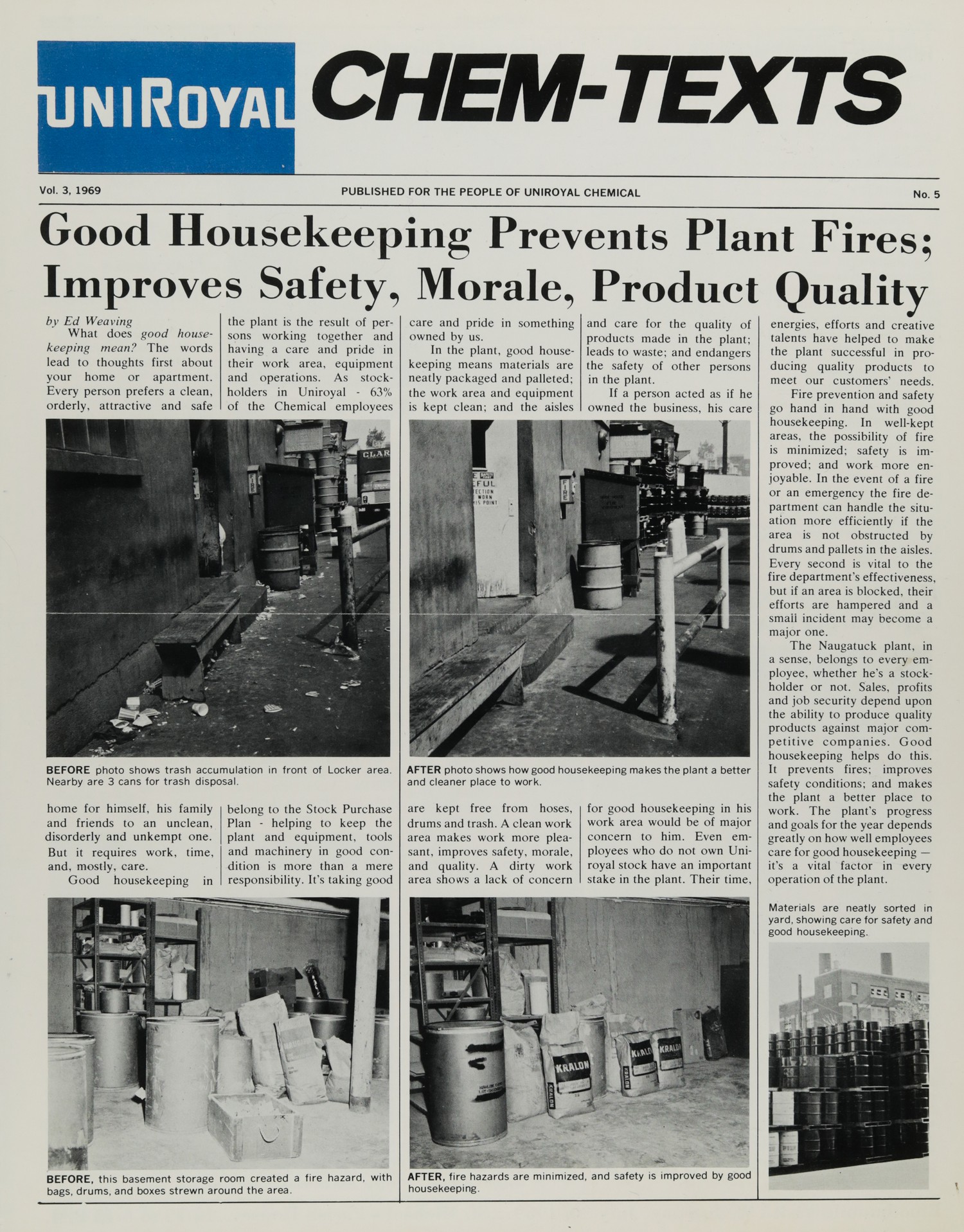
BEFORE photo shows trash accumulation in front of Locker area. Nearly are 3 cans for trash disposal.
home for himself and family. That applies to the plant as well. The result of persons working together and having a care and pride in their work area, equipment and operations. As stockholders in Unipoyal – 65% of the Chemical employees have a sense of care and pride in something owned by us.
AFTER photo shows how good housekeeping makes the plant a better and cleaner place to work.
In the plant, good housekeeping means materials are neatly packaged and palletized; the work area and equipment is kept clean; and aisles are clear. This leads to waste disposal, safety, morale, and quality. A dirty work area shows a lack of concern for the plant, its products, and care for the quality of products made in the plant.
Materials are neatly sorted in yard; showing care for safety and good housekeeping.
Good housekeeping in the plant is the result of persons working together and having a care and pride in their work area, equipment and operations. As stockholders in Unipoyal – 65% of the Chemical employees have a sense of care and pride in something owned by us.
In the plant, good housekeeping means materials are neatly packaged and palletized; the work area and equipment is kept clean; and aisles are clear. This leads to waste disposal, safety, morale, and quality. A dirty work area shows a lack of concern for the plant, its products, and care for the quality of products made in the plant.
If a person acted as if he owned the business, his care and pride in something would lead to waste and endangers the safety of other persons in the plant.
The Naugatuck plant, in a sense, belongs to every employee, whether he’s a stockholder or not. Sales, profits and job security depend upon the ability to produce quality products against major competitive companies. Good housekeeping helps do this. It prevents fires, improves safety conditions, and makes the plant a better place to work.
The plant’s progress and quality are greatly affected by how well employees care for good housekeeping. It’s a vital factor in every operation of the plant.
Materials are neatly sorted in yard; showing care for safety and good housekeeping.
BEFORE, this basement storage room created a fire hazard, with bags, drums, and boxes strewn around the area.
AFTER, fire hazards are minimized, and safety is improved by good housekeeping.
—
## Page 002
FROM THE FACTORY MANAGER
Dear Fellow Employee:
During our nation’s space program RELIABILITY has become a common everyday word. Individual parts, in fact entire systems human as well as mechanical, are tested and retested to make certain that there are no failures at critical times. This, then, is the essence of RELIABILITY — no failures at critical times.
While each of us appreciates the importance of RELIABILITY in space, we often lose sight of its equal importance right here in our plant. Each and every one of us is a key man or woman. Everyone must function with complete RELIABILITY to get the job done properly.
Let’s check our own RELIABILITY right now. Each of us should ask ourself what is my RELIABILITY on:
1. Job Performance
2. Safety Performance
3. Housekeeping Performance
4. Attendance Performance
What’s your RELIABILITY? Each of us can improve. Each of us must improve.
Sincerely,
John D. Evans
Hugh Garahan’s Eyesight Saved By Wearing His Safety Glasses
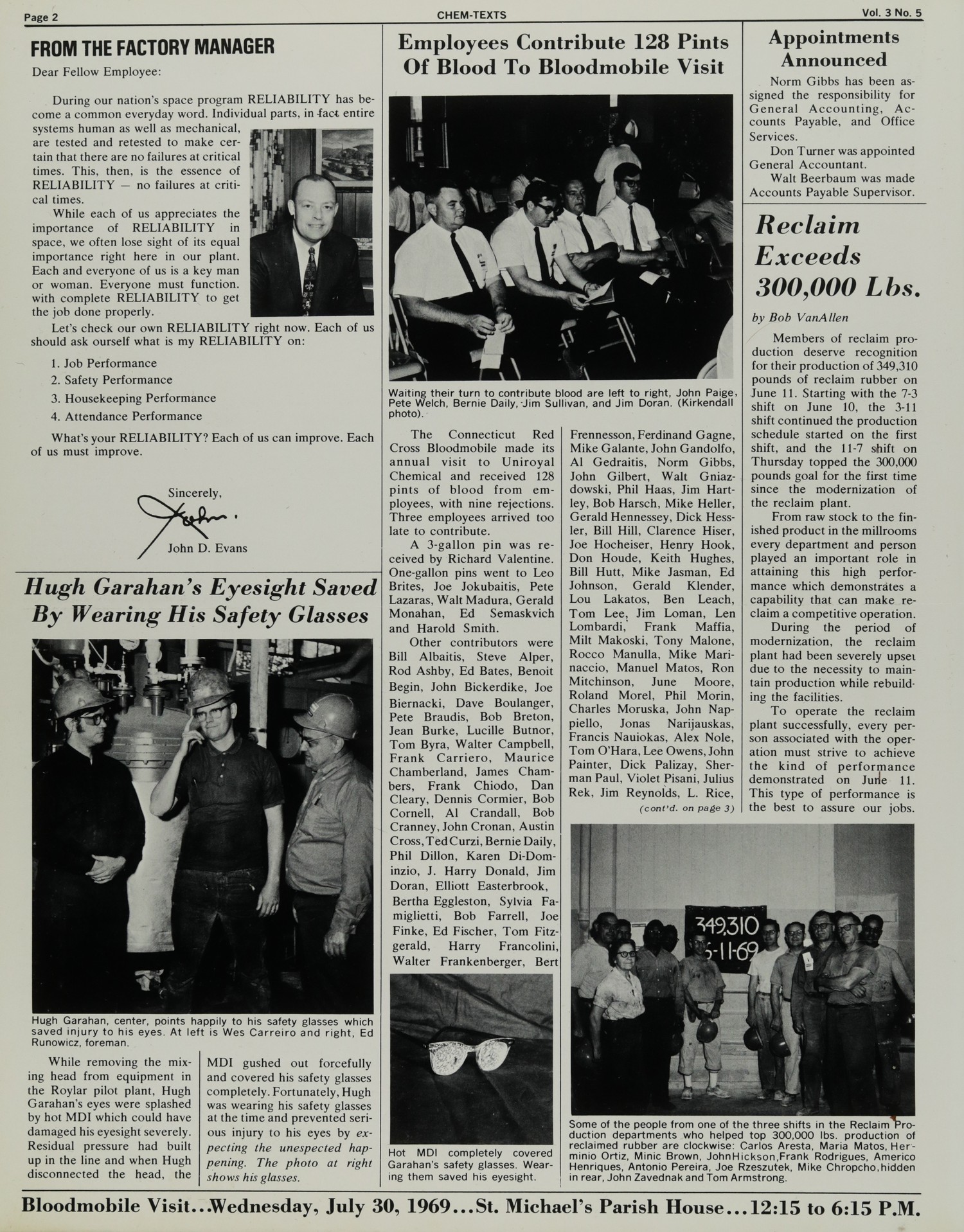
[Image caption: Hugh Garahan, center, points happily to his safety glasses which saved injury to his eyes. At left is Wes Carreiro and right, Ed Runowicz, foreman.]
While removing the mixing head from equipment in the Roylar pilot plant, Hugh Garahan’s eyes were splashed by hot MDI which could have damaged his eyesight severely. Residual pressure had built up in the line and when Hugh disconnected the head, the MDI completely covered his safety glasses. Wearing the safety glasses at the time and prevented serious injury to his eyes by preventing the unexpected happening. The photo at right shows his glasses.
Employees Contribute 128 Pints Of Blood To Bloodmobile Visit
[Image caption: Waiting their turn to contribute blood are left to right, Pete Welch, Bernie Dolan, Jim Sullivan, and Jim Doran (Kennitall).]
The Connecticut Red Cross Bloodmobile made its annual visit to Universal Chemical and received 128 pints of blood from employees, with nine rejections. Three employees arrived too late to contribute.
A 9-gallon pin was received by Richard Valentine. One gallon pins went to Leo Briggs, Pete Lazarme, Bill McKaduara, Gerald Monahan, Ed Semonski, and Harry Smith.
Other contributors were Bill Althaus, Steve Alper, Rod Ashby, Ed Bates, Benoit Begin, John Berkeride, Joe Biernacki, Dave Boulanger, Pete Brandis, Bob Breton, Jean Burke, Lucille Burnor, Tom Byra, Walter Campbell, Frank Carriero, Maurice Chamberlain, James Chambers, Frank Chiodo, Dan Cleary, Dennis Cormier, Bob Cornell, Al Crandall, Bob Cramey, John Cronin, Austin Cross, Ted Curzi, Bernie Daily, Phil Dillon, Karen Di-Dominzio, J. Harry Donald, Jim Doran, Elliott Easterbrook, Bertha Eggleston, Sylvia Famiglietti, Bob Farrell, Joe Finke, Ed Fischer, Tom Fitzgerald, Harry Francellini, Walter Frankenberger, Bert Frenneson, Ferdinand Gagne, Mike Galante, John Gandolfo, Al Grabinis, Norm Gibbs, John Gilbert, Walt Gniazdowski, Phil Hartley, Bob Harsch, Mike Heller, Gerald Hennessee, Dick Hessler, Bill Hill, Clarence Hiser, Joe Hochstetler, Henry Hook, Don Howde, Keith Hughes, Bill Hunt, Mike Jasmin, Ed Johnson, Gerald Klender, Lou Kootz, Ben Leach, Tom Lee, Jim Loman, Len Lombardi, Frank Maffia, Rocco Manullo, Mike Marinaccio, Manuel Matos, Ron Mitchinson, June Moore, Roland Morel, Phil Morin, Charles Moruska, John Napolitano, Jonas Mariauskas, Francis Nauiokas, Alex Nole, Tom O’Hara, Lee Owens, John Painter, Dick Palizay, Sherman Paul, Violet Pearson, Julius Rek, Jim Reynolds, L. Rice, Jim Salerno, Paul Santariello, Tom Sherry, Dan Sheveiko, Kenneth Smith.
Appointments Announced
Norm Gibbs has been appointed the responsibility for General Accounting, Accounts Payable, and Office Services.
Don Turner was appointed General Accountant.
Walt Beernaum was made Accounts Payable Supervisor.
Reclaim Exceeds 300,000 Lbs.
by Bob VanAllen
Members of reclaim production deserve recognition for their production of 349,310 pounds of reclaim under the 73-74 shift on June 10. The 73-74 shift continued the production schedule started on the first shift, and the 11-7 shift on Thursday topped the 300,000 pounds goal for the first time since the modernization of the reclaim plant.
From raw stock to the finished product in the mill rooms every department and person played an important role in attaining this high performance which demonstrates a capability that can make reclaim a competitive operation.
During the period of modernization, the reclaim plant had been severely upset due to the necessity to maintain production while rebuilding facilities.
To operate the reclaim plant successfully, every person associated with the operation must be keenly aware of the kind of performance demonstrated on June 10. This type of performance is the best to assure our jobs.
—
## Page 003
KNOW YOUR BENEFITS: by W. Kirkendall
Some Questions and Answers on Supplemental Unemployment Benefits (SUB)
This is a continuation of the SUB article which appeared in the last issue of Chem-Texts. The examples show how to estimate your SUB benefits based upon your earnings for a 40 hour week. The benefits are payable to an eligible wage employee from a trust fund established by the Company and is financed by the Company’s contribution of 6 cents per hour for each hour an employee receives pay from the Company.
Q. What are some examples of SUB payments?
A. REGULAR BENEFIT:
If an employee’s average straight time hourly earnings are $3.75, his weekly straight time earnings would be $150.00. 80% of his weekly earnings are $120.00. Less the State U.C. check of $11.00, the employee’s regular benefit is $109.00.
EXAMPLES:
SPECIAL SHORT WEEK BENEFIT:
1. Employee’s normal work week…………..40 hours
2. Total compensated and hours available……24 hours
3. Total short hours………………….16 hours
4. Total wages paid…………………..$104.50
5. Employee’s ESSEL……………………$104.50
Special Benefit
80% x $3.65 x 16 = $46.72
Less State U.C. check…………………..11.00
Outside earnings:………………………0
Special benefit:……………………….35.72
Regular Benefit
80% of gross $146.80…………………$116.80
Less State U.C…………………………11.00
Company earnings……………………….87.00
Regular Benefit………………………..$18.20
In this case the employee receives the larger amount of the special or regular benefit which in this example would be $35.72.
AUTOMATIC SHORT WEEK BENEFIT:
Employee’s Estimated State System Earning Limit (ESSEL) is $104.50 for a normal work week of 40 hours. His earnings for the week are $120. The number of compensated and available hours are 32. his short hours are 8.
Calculation: 80% x $3.75 x 32 Hrs. = $96.00
Employee would receive $24.00.
Employees Contribute
(cont’d. from page 2)
Jim Rinehart, Frank Rodriguez, Joe Rotella, Mike Sansvero, Dominicos Santos, Art Sauvageau, Steve Schwartz, Walt Scott, Ken Searles, Jim Shea, Alice Sherman, Dick Simeoneaux, Norman Smith, W. Stephenson, Frank Sterniak,
FOUR RECEIVE $931 FOR THEIR IDEAS. SUGGESTION AWARDS TOTAL $2263.
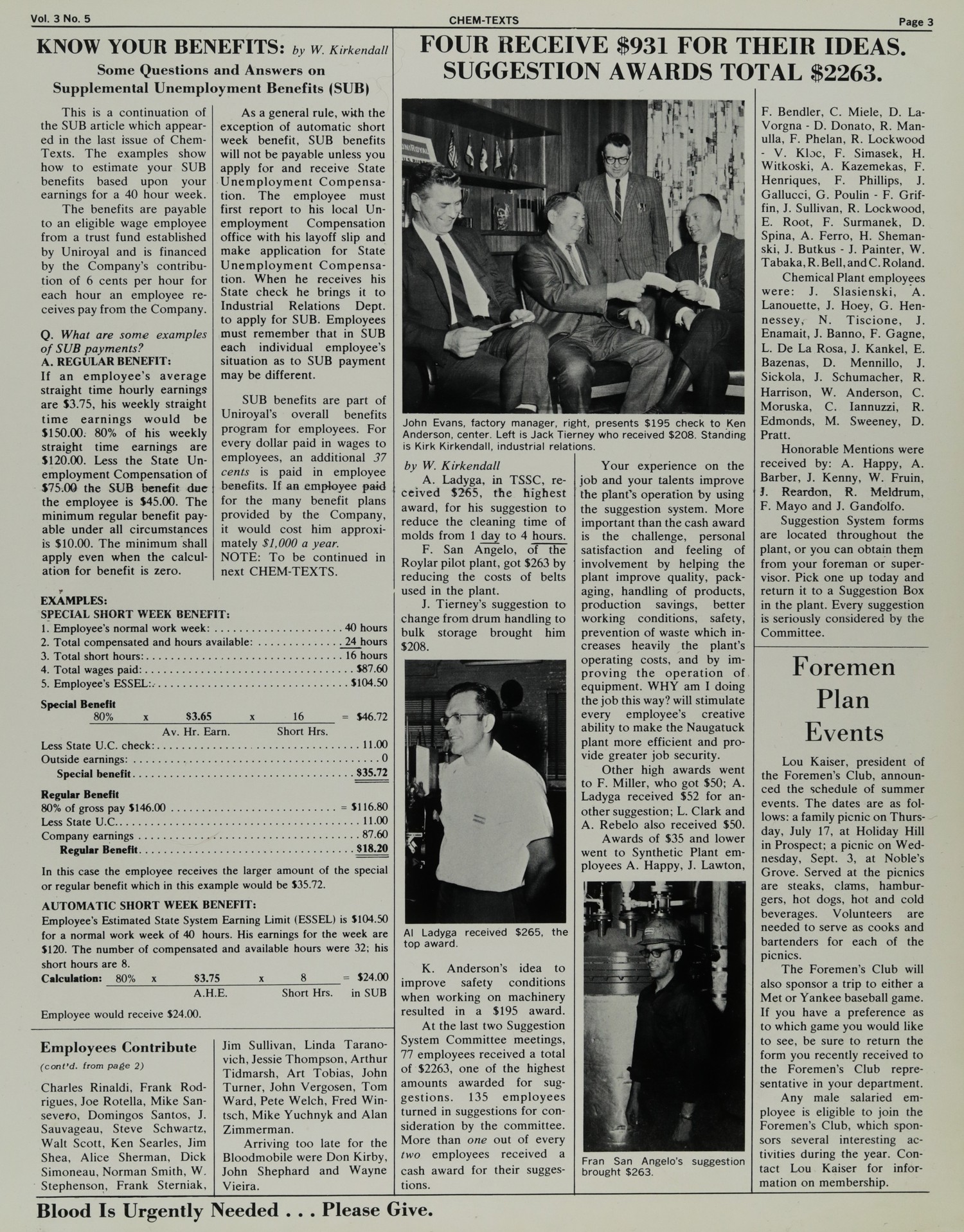
John Evans, factory manager, right, presents $195 check to Ken Karas, whose suggestion saved $208. Standing left is Jack Kirkendall, industrial relations.
By W. Kirkendall
A. Ladyga, in TSSC, received $265, the highest award, for his suggestion to reduce cleaning time of molds from 1 day to 4 hours.
E. San Angelo, of the Roylar pilot plant, got $263 by reducing the costs of bets used in the plant.
A. Theroux’s suggestion to change from drum handling to bulk storage brought him $208.
Other big awards went to F. Miller, who got $50, A. Ladyga received $52 for another suggestion; L. Clark and A. Rebelo also received $35 and lower awards of $35 went to Symbiotic Plant employees A. Happy, J. Lawton.
Al Ladyga received $265, the top award.
K. Anderson’s idea to improve safety conditions when working on machinery resulted in a $195 award.
At the last two Suggestion System Committee meetings, 77 employees received a total of $2263, one of the highest amounts awarded for suggestions. 135 employees turned in suggestions for consideration by the committee. More than one out of every two employees received a cash award for their suggestions.
Blood Is Urgently Needed . . . Please Give.
Foremen Plan Events
Lou Kaiser, president of the Foremen’s Club, announced the schedule of summer events. The dates are as follows: a family picnic on Thursday, July 17, at Holiday Hill in Prospect; a picnic on Wednesday, Sept. 3, at Noble’s Grove. Served at the picnics are steaks, clams, hamburgers, hot dogs, and cold beverages. Volunteers are needed to serve as cooks and bartenders for each of the picnics.
The Foremen’s Club will also sponsor a trip to either a Mets or Yankee baseball game.
If you have a preference as to which game you would like to see, be sure to return the form you recently received to the Foremen’s Club representative in your department.
Any male salaried employee is eligible to join the Foremen’s Club, which sponsors several interesting activities during the year. Contact Lou Kaiser for information on membership.
—
## Page 004
Technical Team Wins Bowling League
by Shirley Sandora
The Uniroyal Chemical Handicap Bowling League ended its season with the Technical team, first half winner, defeating the Auxies, second half winner, to take first place. Eight teams, consisting of the National Dupkin Bowling Congress, made up the league: Engineering, Auxies, Technical, Synthetic, EMIC, Process Development, Distribution/Scheduling and Accounting.
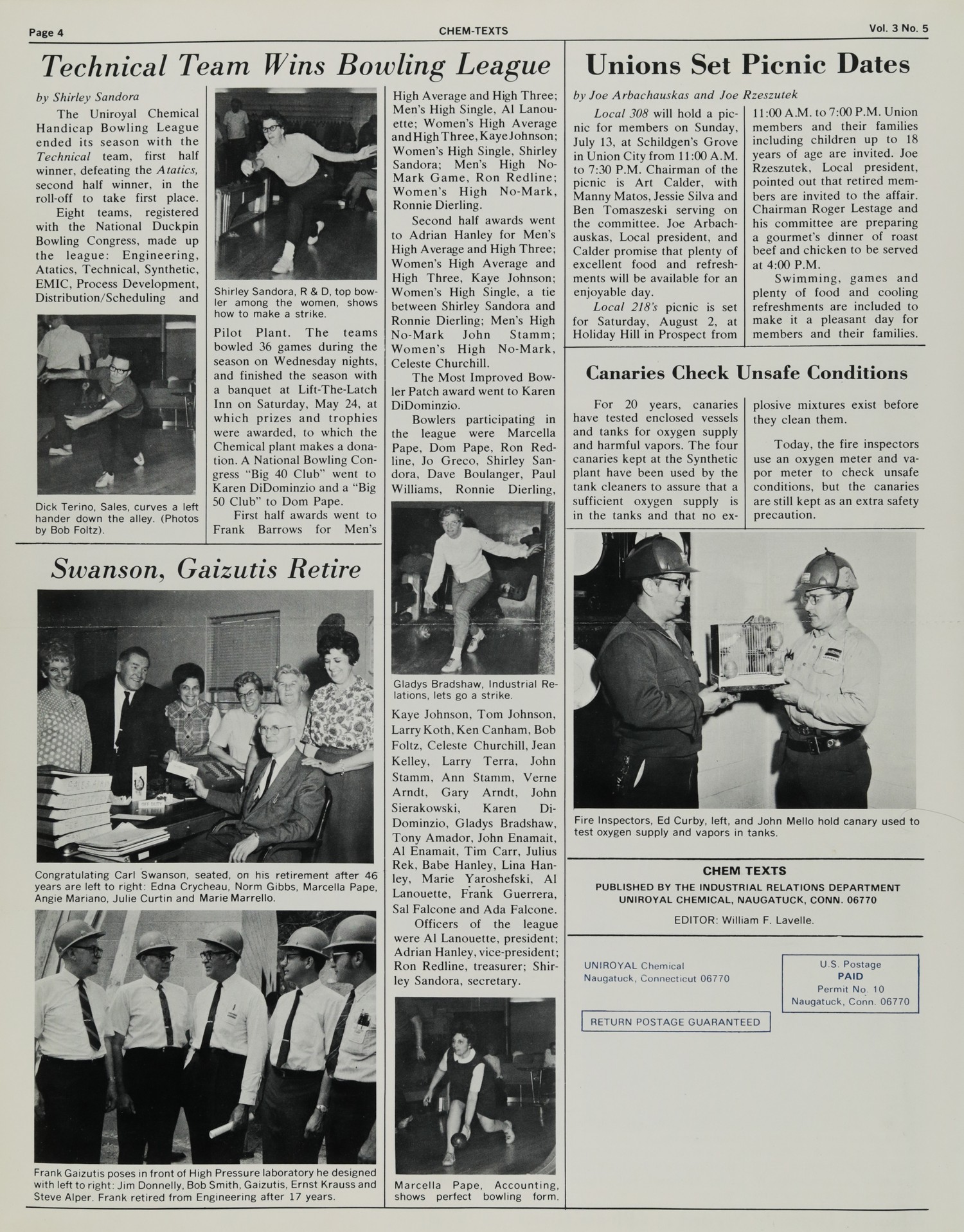
Shirley Sandora, R & D, top bowler among the women, shows how to make a strike.
Philo Plant. The teams bowled 16 games during the season on Wednesday nights, and finished the season with a banquet at Lift-The-Latch Inn on Saturday, May 24, at which prizes and trophies were awarded, to which the Chemical plant makes a donation. A National Bowling Congress “Big 50 Club” went to Karen DiDomizio and a “Big 50 Club” to Don Pape.
Dick Terno, Sales, curves a left hander down the alley. (Photo by Bob Fotz)
Swanson, Gaizutis Retire
Congratulating Carl Swanson, seated, on his retirement after 46 years are left to right: Edna Cryechau, Norm Cryechau, Marcelle Pape, Angie Mariano, Julie Curtin and Marie Marello.
Frank Gaizutis poses in front of High Pressure laboratory he designed with left to right: Jim Donnelly, Bob Smith, Gaizutis, Ernst Krauss and Steve Alper. Frank retired from Engineering after 37 years.
Unions Set Picnic Dates
by Joe Arbacauskas and Joe Reeszuck
Local 308 will hold a picnic for members on Sunday, July 13, at Schildgren’s Grove in Union City from 11:00 A.M. to 7:30 P.M. Chairman of the Picnic is Art Calder, with Manny Matos, Jessie Silva and Ben Tomaszczuk serving on the committee. Joe Arbacauskas, Local president, and Calder promise that plenty of food and refreshments will be available for an enjoyable day.
Local 213’s picnic is set for Saturday, August 2, at Holiday Hill in Prospect from 11:00 A.M. to 7:00 P.M. Union members and their families including children up to 18 years of age are invited. Joe Reeszuck, Local president, pointed out that retired members are invited to the affair. Chairman Roger Lescage and his committee are preparing a gourmet’s dinner of roast beef and chicken to be served at 4:00 P.M.
Swimming, games and plenty of food and cooling refreshments are included to make it a pleasant day for members and their families.
Canaries Check Unsafe Conditions
For 20 years, canaries have tested enclosed vessels and tanks for oxygen supply and harmful vapors. The four canaries kept at the Synthetic Plant act as the first line of defense, their cries alerting plant personnel to unsafe conditions before explosive mixtures exist before they clean them.
Today, the fire inspectors use an oxygen meter and vapor meter to check unsafe conditions, but the canaries are still kept as an extra safety precaution.
Fire Inspectors, Ed Curby, left, and John Mello hold canary used to test oxygen supply and vapors in tanks.
PUBLISHED BY THE INDUSTRIAL RELATIONS DEPARTMENT UNIROYAL CHEMICAL, NAUGATUCK, CONN. 06770
EDITOR: William F. Lavelle
High Average and High Three:
Men’s High Single, Al LarouccieWomen’s High Average, Shirley Sandora: High Three, Kaye Johnson; Women’s High Single, a tie between Shirley Sandora and Ronnie Derling; Men’s High No-Mark, John Stamm; Women’s High No-Mark, Celeste Churchill.
The Most Improved Bowler Forward went to Karen DiDominio.
Bowlers participating in the league were Marcella Pape, Dom Pape, Ron Redline, Jo Greco, Shirley Sandora, Dave Boulanger, Paul Williams, Ronnie Derling.
First half awards went to Adrian Hanley for Men’s High Average and High Three: Women’s High Average and High Three, Kaye Johnson: Women’s High Single, a tie between Shirley Sandora and Ronnie Derling. Men’s High No-Mark, John Stamm; Women’s High No-Mark, Celeste Churchill.
—