**Date:** 4/11/67
**Source:** Wall Street Journal
—
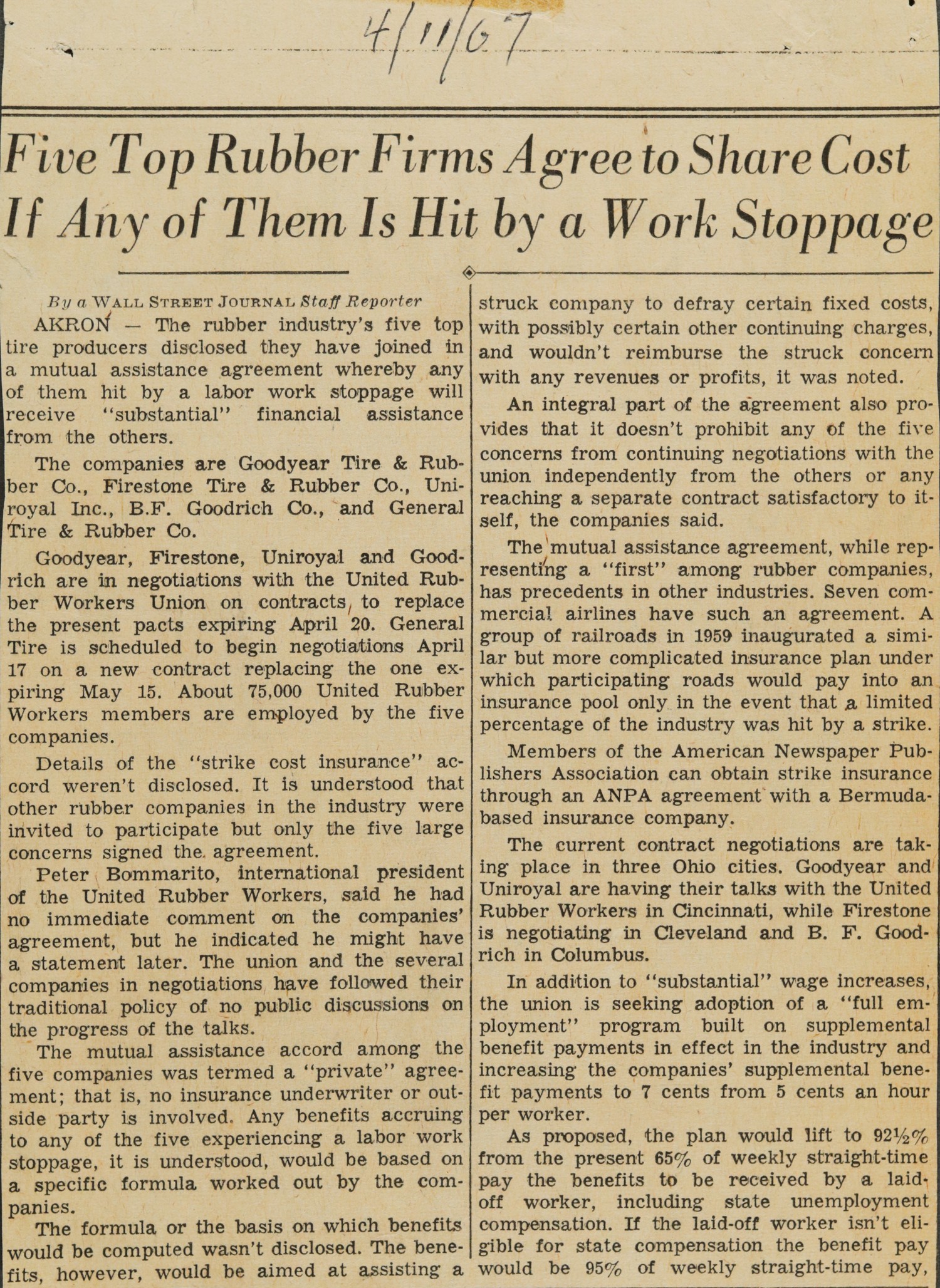
The rubber industry’s five top tire producers disclosed they have joined in a mutual assistance agreement whereby any of them hit by a labor work stoppage will receive “substantial” financial assistance from the others.
The companies are Goodyear Tire & Rubber Co., Firestone Tire & Rubber Co., Uniroyal Inc., B.F. Goodrich Co., and General Tire & Rubber Co.
Goodyear, Firestone, Uniroyal and Goodrich are in negotiations with the United Rubber Workers Union on contracts to replace the present pacts expiring April 20. General Tire is scheduled to begin negotiations April 17 on a new contract replacing the one expiring May 15. About 75,000 United Rubber Workers members are employed by the five companies.
Details of the “strike cost insurance” accord weren’t disclosed. It is understood that other rubber companies in the industry were invited to participate but only the five large concerns signed the agreement.
Peter Bommarito, international president of the United Rubber Workers, said he had no immediate comment on the companies’ agreement, but he indicated he might have a statement later. The union and the several companies in negotiations have followed their traditional policy of no public discussions on the progress of the talks.
The mutual assistance accord among the five companies was termed a “private” agreement; that is, no insurance underwriter or outside party is involved. Any benefits accruing to any of the five experiencing a labor work stoppage, it is understood, would be based on a specific formula worked out by the companies.
The formula or the basis on which benefits would be computed wasn’t disclosed. The benefits, however, would be aimed at assisting a struck company to defray certain fixed costs with possibly certain other continuing charges, and wouldn’t reimburse the struck concern with any revenues or profits, it was noted.
An integral part of the agreement also provides that it doesn’t prohibit any of the five concerns from continuing negotiations with the union independently from the others or any reaching a separate contract satisfactory to itself, the companies said.
The mutual assistance agreement, while representing a “first” among rubber companies, has precedents in other industries. Seven commercial airlines have such an agreement. A similar but more complicated insurance plan under which participating roads would pay into an insurance pool only in the event that a limited percentage of the industry was hit by a strike. Members of the American Newspaper Publishers Association can obtain strike insurance through an ANPA agreement with a Bermuda-based insurance company.
The current contract negotiations are taking place in three Ohio cities. Goodyear and Uniroyal are having their talks with the United Rubber Workers in Cincinnati, while Firestone is negotiating in Cleveland and B. F. Goodrich in Columbus.
In addition to “substantial” wage increases, the union is seeking adoption of a “full employment” program built on supplemental benefit payments in effect in the industry and increasing the companies’ supplemental benefit payments to 7 cents from 5 cents an hour per worker.
As proposed, the plan would lift to 92%% from the present 65% of weekly straight-time pay the benefits to be received by a laid-off worker, including state unemployment compensation. If the laid-off worker isn’t eligible for state compensation, the benefit pay would be 95% of weekly straight-time pay.