J. Rzeszutek

Mentioned in 10 documents | Years active: 1968-1979


Source Documents

This profile was generated from 10 archive documents. The following are available on this site:

Victor Anderson

Mentioned in 10 documents | Years active: 1968-1977


Source Documents

This profile was generated from 10 archive documents. The following are available on this site:

Ed Weaving

Mentioned in 10 documents | Years active: 1967-1980


Source Documents

This profile was generated from 10 archive documents. The following are available on this site:

Frank Mariano

Mentioned in 11 documents | Years active: 1964


Source Documents

This profile was generated from 11 archive documents. The following are available on this site:

Richard Shaw

Mentioned in 11 documents | Years active: 1966-1974


Source Documents

This profile was generated from 11 archive documents. The following are available on this site:

Ron Mitchinson

Mentioned in 12 documents | Years active: 1968-1971


Source Documents

This profile was generated from 12 archive documents. The following are available on this site:

Leon Raskauskas

Mentioned in 13 documents | Years active: 1967-1971


Source Documents

This profile was generated from 13 archive documents. The following are available on this site:

Frederick Wintsch

Mentioned in 13 documents | Years active: 1967-1977


Source Documents

This profile was generated from 13 archive documents. The following are available on this site:

Thomas Dowling

Mentioned in 13 documents | Years active: 1968-1978


Source Documents

This profile was generated from 13 archive documents. The following are available on this site:

Frank Commendatore

Mentioned in 13 documents | Years active: 1961-1979


Source Documents

This profile was generated from 13 archive documents. The following are available on this site:

Edward Alves

Mentioned in 16 documents | Years active: 1961-1969


Source Documents

This profile was generated from 16 archive documents. The following are available on this site:

Louis Kaiser

Mentioned in 17 documents | Years active: 1968-1973


Source Documents

This profile was generated from 17 archive documents. The following are available on this site:

George R. Vila

Mentioned in 17 documents | Years active: 1963-1969


Source Documents

This profile was generated from 17 archive documents. The following are available on this site:

George Allen

Mentioned in 17 documents | Years active: 1968-1980


Source Documents

This profile was generated from 17 archive documents. The following are available on this site:

John Evans

Mentioned in 18 documents | Years active: 1964-1978


Source Documents

This profile was generated from 18 archive documents. The following are available on this site:

John D. Evans

Mentioned in 20 documents | Years active: 1964-1971


Source Documents

This profile was generated from 20 archive documents. The following are available on this site:

Sal Aloise

Mentioned in 20 documents | Years active: 1968-1975


Source Documents

This profile was generated from 20 archive documents. The following are available on this site:

James Cronin

Mentioned in 21 documents | Years active: 1961-1976


Source Documents

This profile was generated from 21 archive documents. The following are available on this site:

Cyrus Blanchard

Mentioned in 23 documents | Years active: 1964-1974


Source Documents

This profile was generated from 23 archive documents. The following are available on this site:

William F. Lavelle

Mentioned in 37 documents | Years active: 1968-1980


Source Documents

This profile was generated from 37 archive documents. The following are available on this site:

Eric Johnson

Mentioned in 38 documents | Years active: 1961-1980


Source Documents

This profile was generated from 38 archive documents. The following are available on this site:

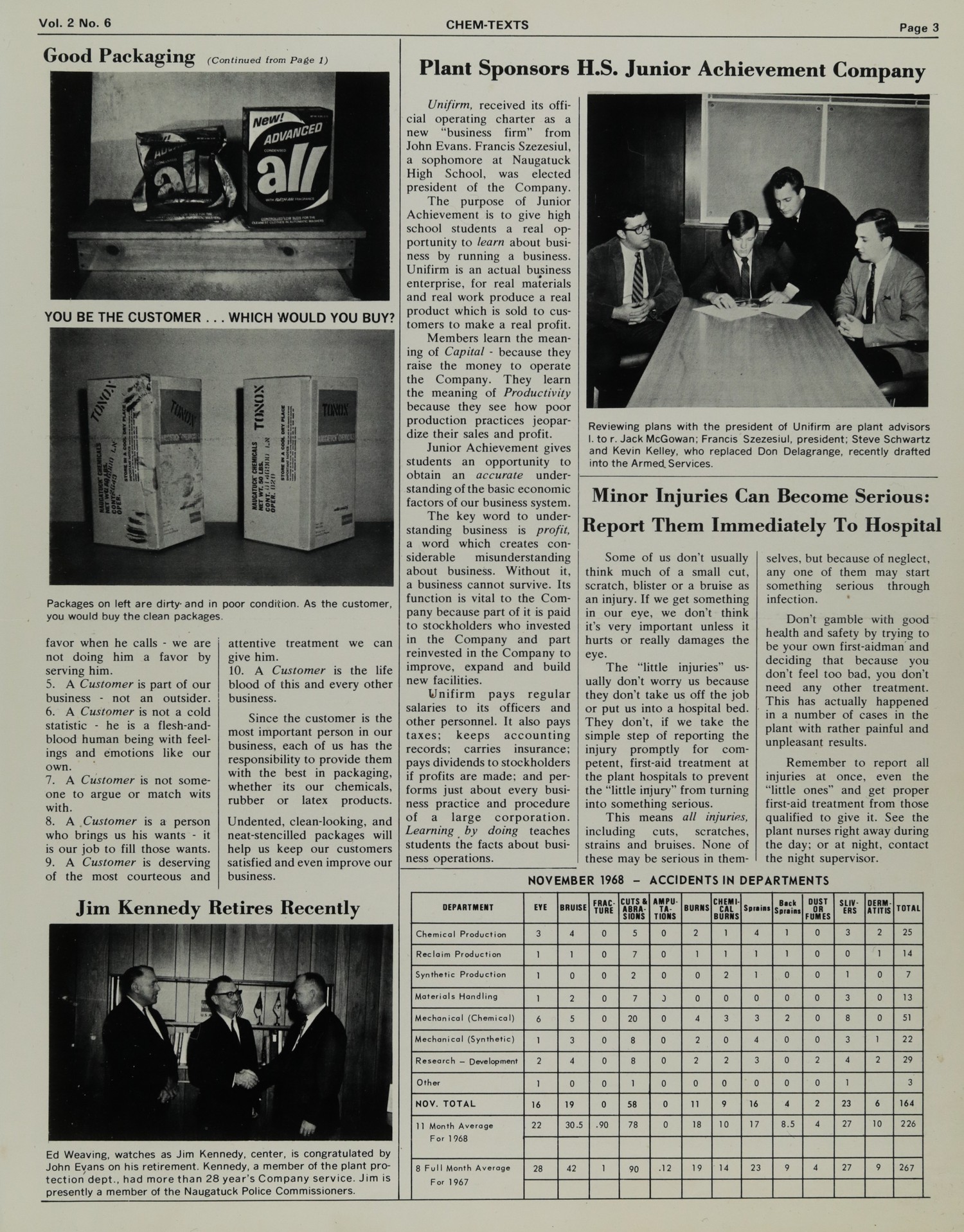
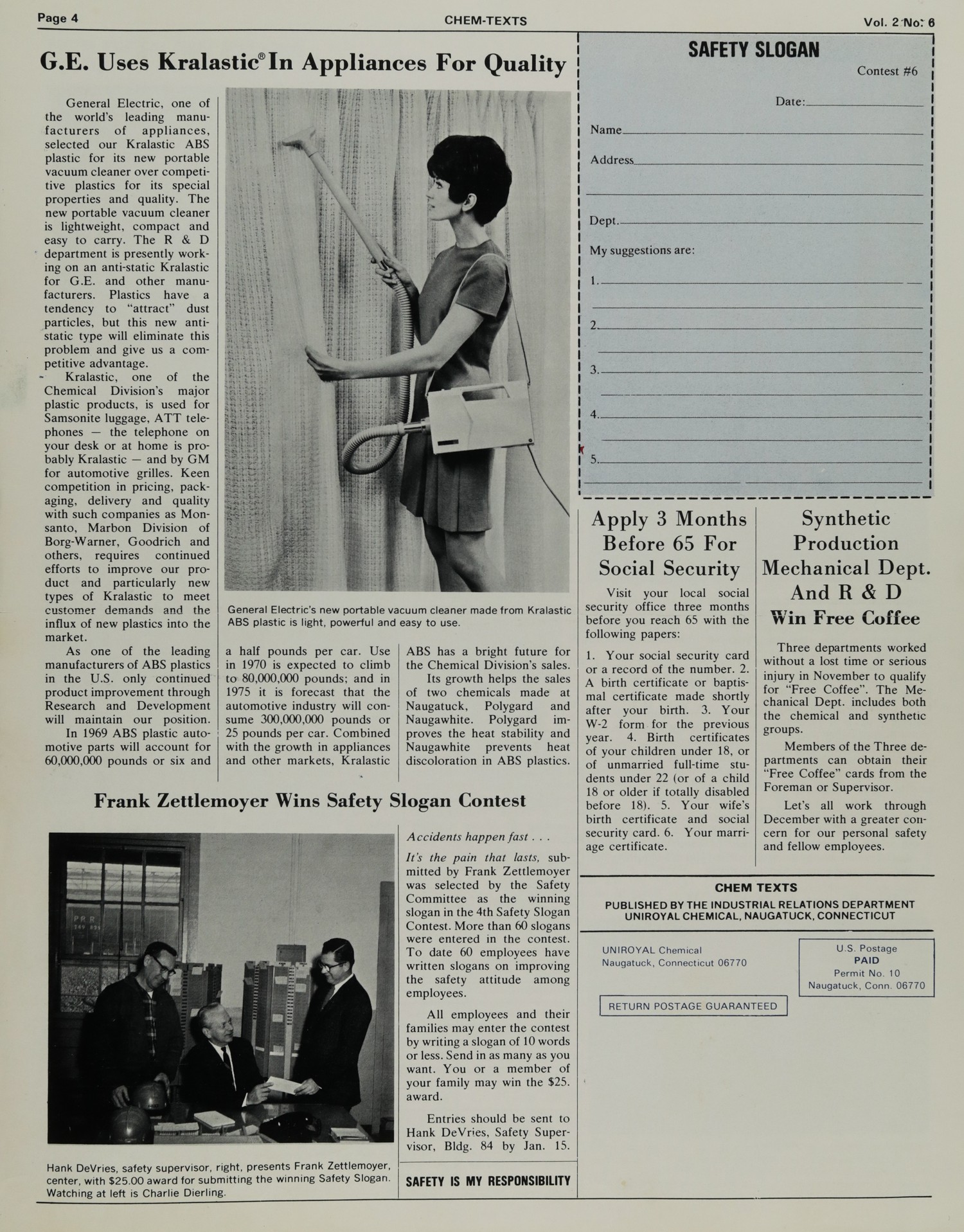
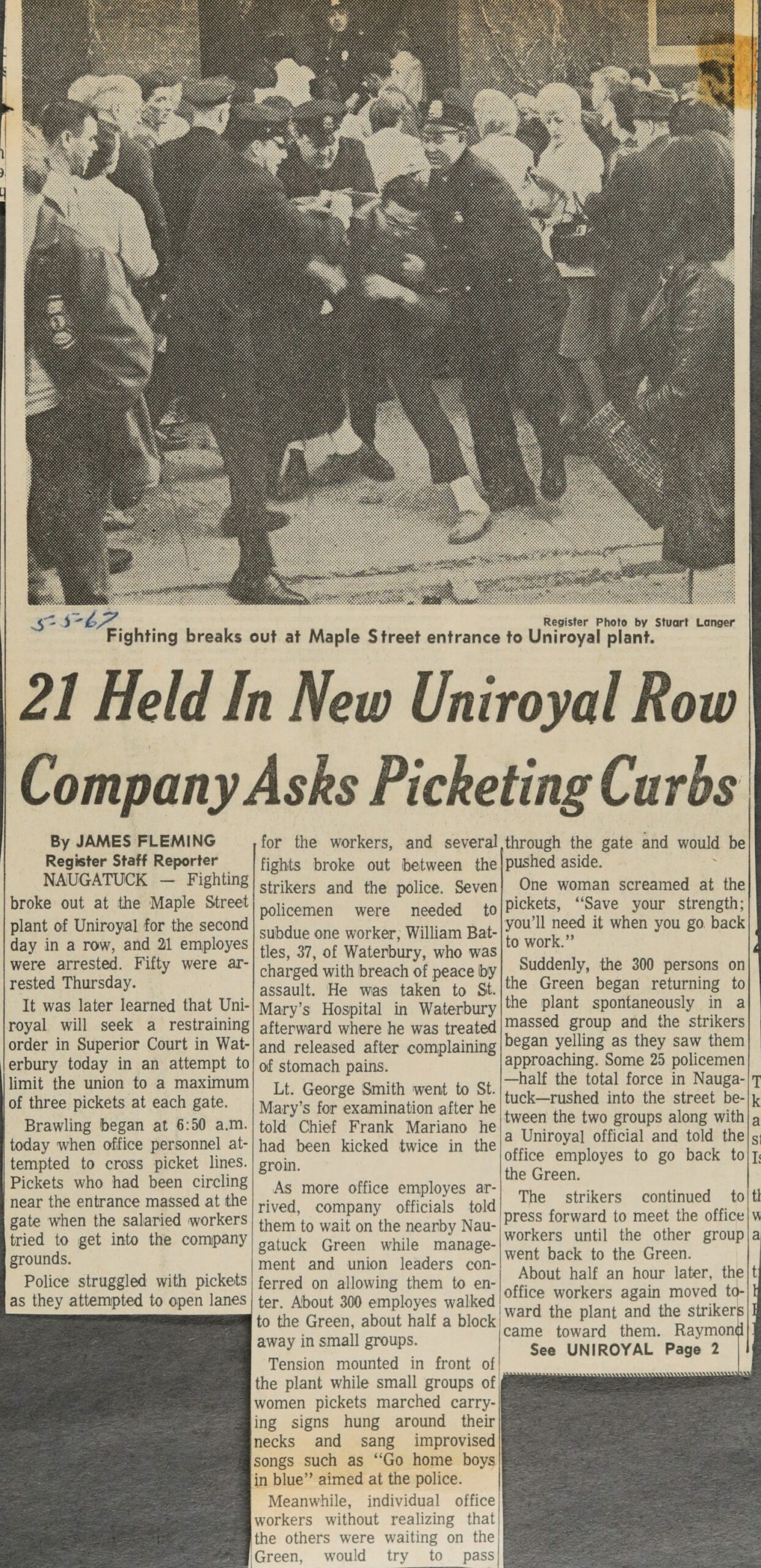
Joseph Rzeszutek

Mentioned in 44 documents | Years active: 1961-1980


Source Documents

This profile was generated from 44 archive documents. The following are available on this site:

CHEM-TEXTS – Vol. 2 No. 2 – Page 2

Page 002

Page 2 CHEM TEXTS Vol. 2 No. 2

FROM THE FACTORY MANAGER

Dear Fellow Employees:

Those of us involved in the “STOP” safety training program are repeatedly asked the question, “Who is responsible for safety in my area?” Each of us recognizes there is only one correct answer – “I am.” However, there will only be an effective safety program in our plant if every employee is responsible for his own activities.

Mr. Vila has clearly stated the UNIROYAL philosophy on accident prevention. I would like to quote the following portions of this statement:

. . “Managers at all levels, have, as a primary responsibility, the safety and well being of all persons who report to or are assigned to them.”

“Each employee has an important place in the accident prevention effort and he must accept the responsibility for full cooperation in the measures taken for safety.”

I have underlined RESPONSIBILITY – a key factor in the jobs of all of us. Let’s all work together in a responsible manner to prevent personal injuries.

[Signature]

John D. Evans


LOST TIME ACCIDENTS UP IN FEBRUARY, DROP IN MARCH

Lost time accidents jumped from 2 in January to 3 in February. But dropped from 3 to 2 in March. However the record for serious injuries jumped from 2 in January to a total of 6 in March.

For the first 3 months of the year there were a total of 7 lost time injuries; and for the same period a total of 12 serious injuries.

Severe bruises and sprains accounted mostly for the lost time accidents; with two fractures occurring, one of a kneecap and one wrist fracture. Oftentimes there’s only a hairline difference between these accidents and more serious ones. A “stop, look and listen” attitude toward personal safety would eliminate these incidents that not only affect the employee, but his family as well.

The rising increase of serious injuries is of major concern as these could easily have resulted in more serious accidents. Out of the 12 serious injuries 7 involved the eyes. Blindness is a heavy penalty to pay for you, your family and all of us for not wearing proper protective equipment on the job.


678 Minor Injuries Occur In January, February and March

In the first 3 months of the year, 678 minor injuries occurred, requiring visits to the plant hospitals. If this rate continues for the next 9 months, approximately 2712 minor accidents will take place. The plant presently employs about 1680 people; at this rate every employee will make 1 1/2 visits to the plant nurses for treatment.

Most injuries incurred, are from cuts and abrasions; bruises and slivers. Although the injuries are not serious, they could be prevented by wearing the proper protective equipment on the job and by checking tools; lifting and carrying heavy objects properly. Many times there’s a tendency to think “an accident won’t happen to me.” But accidents become accidents because safety is not always in mind while performing the job.

TOTAL MINOR ACCIDENTS BY DEPARTMENTS FOR JANUARY, FEBRUARY AND MARCH

DEPARTMENT EYE BRUISE FRAC-TURE CUTS & ABRA-SIONS AMPU-TA-TIONS BURNS CHEMI-CAL BURNS Sprains Back Sprains DUST OR FUMES SLIV-ERS DERM-ATITIS TOTAL
Chemical Production 17 13 1 16 0 4 8 11 5 4 3 8 90
Reclaim Production 4 10 0 42 0 2 0 8 5 0 5 4 80
Synthetic Production 0 8 0 11 0 6 0 7 1 0 4 0 37
Materials Handling 8 7 0 34 0 0 0 5 4 1 11 0 70
Mechanical (Chemical) 5 30 1 75 0 8 3 10 3 0 38 7 180
Mechanical (Synthetic) 13 12 0 38 0 10 4 6 4 0 14 3 104
Research & Development 8 11 2 33 0 10 9 5 3 5 7 8 101
Other 2 2 0 6 0 0 0 3 1 1 1 0 16
3 Months Total 57 93 4 255 0 40 24 55 26 11 83 30 678

New Equipment

(Continued from Page 1)

to make major replacements in our digesters had we continued under the old system.

For the most part, the job of installation for fibre separation and fine grinding is complete and the system is undergoing trial runs to work out the “bugs”. It is hoped that central mixing and the mill room changes will be complete by the end of 1968.

Fibre separation produces two streams: one predominatingly rubber; the other predominantly fibre. Fibre sepation and fine grinding will be operated by one control panel. The “start-up” and “shut-down” of the equipment is important. The control panel makes it possible for the operator to do this safely and easily.

Unfortunately, delays in the delivery of certain key pieces of equipment have delayed the project for some four months. These delays have made the operations particularly difficult during the dismantling, installation and start-up of new equipment and processes. It has also limited production at a time when our customer’s needs are at an all-time high. Only the greatest added effort of all employees has and can continue to minimize our financial losses during this critical year.


Auto Belt Survey Shows Fewer Drivers Using Them

More automobiles are equipped with seat belts than ever before, but fewer people proportionately are wearing them, according to a nationwide survey reported by the Auto Industries Highway Safety Committee in 1967.

Nearly two-thirds–65 per cent–of the more than one million cars checked were equipped with seat belts. Yet barely more than half the drivers questioned said they always use them on long trips, or 5 per cent less than a year earlier. Only 38 per cent reported they always use belts in local travel.

In 1963, before seat belts were standard equipment in all American cars, only 9 percent of the cars surveyed were so equipped, but nearly three out of every four drivers responding answered “always” to the “use on long trips” question. The percentage of persons stating “never wear” seat belts even on long trips increased to 17 per cent, compared with 10 per cent in 1966.

The Seventh Annual Seat Belt Installation and Use Survey was made during this year’s National Vehicle Safety-Check, a voluntary community program sponsored by the Committee, in which more than 4,700 communities participated. Cars were checked and drivers interviewed in both urban and rural areas from coast to coast, in communities with a population range from under one thousand to over one million.


Vila, Chairman of U.S. Savings Bonds Drive

[PHOTO: George R. Vila, chairman and president of Uniroyal, Inc. recently appointed 1968 rubber industry chairman for the U.S. Savings Bonds Campaign chats with Mrs. Dorie Damuth, Mrs. U.S. Savings Bonds of 1968.]

George R. Vila, chairman and president, Uniroyal, Inc. has been named to the Treasury Department’s U.S. Industrial Payroll Savings Committee by Secretary of the Treasury Henry H. Fowler.

Mr. Vila will serve as chairman for the rubber industry in the 1968 U.S. Savings Bonds Campaign. He will be responsible for planning and leading the campaign.

At Uniroyal plants, the campaign will be run during the month of May. The major promotional efforts were concentrated in the weeks of May 6th and May 15th.

At the Naugatuck plant Fred Wintsch of Industrial Relations was in charge of the campaign to promote the Saving Bond and Freedom Share drive.

CHEM-TEXTS – Vol. 2, No. 1 – Page 1

Page 001

UNIROYAL CHEM-TEXTS

Vol. 2 PUBLISHED FOR THE PEOPLE OF UNIROYAL CHEMICAL No. 3


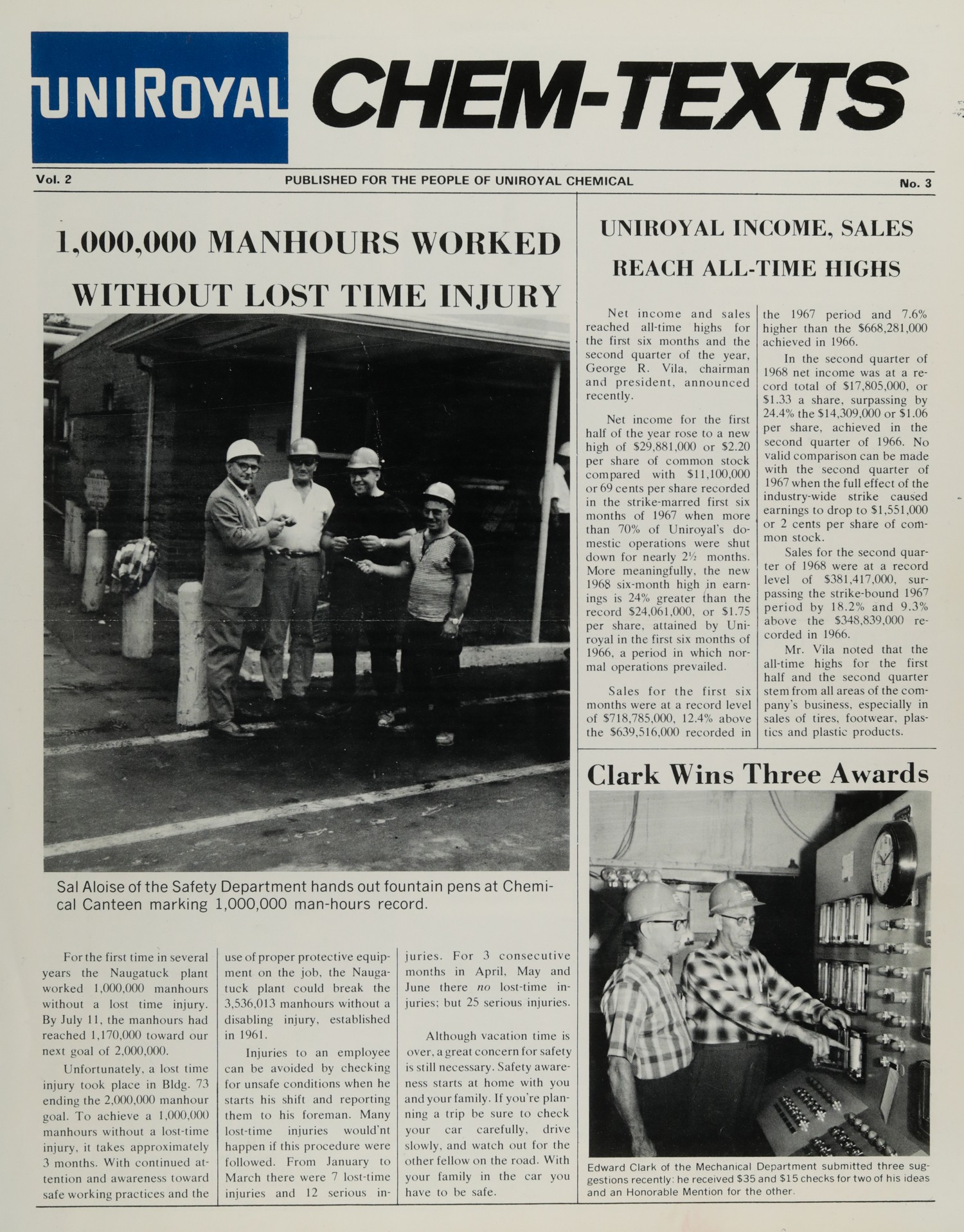
1,000,000 MANHOURS WORKED WITHOUT LOST TIME INJURY

[IMAGE: Black and white photograph showing workers at Chemical Canteen]

Sal Aloise of the Safety Department hands out fountain pens at Chemical Canteen marking 1,000,000 man-hours record.

For the first time in several years the Naugatuck plant worked 1,000,000 manhours without a lost time injury. By July 11, the manhours had reached 1,170,000 toward our next goal of 2,000,000.

Unfortunately, a lost time injury took place in Bldg. 73 ending the 2,000,000 manhour goal. To achieve a 1,000,000 manhours without a lost-time injury, it takes approximately 3 months. With continued attention and awareness toward safe working practices and the use of proper protective equipment on the job, the Naugatuck plant could break the 3,536,013 manhours without a disabling injury, established in 1961.

Injuries to an employee can be avoided by checking for unsafe conditions when he starts his shift and reporting them to his foreman. Many lost-time injuries would’nt happen if this procedure were followed. From January to March there were 7 lost-time injuries and 12 serious injuries. For 3 consecutive months in April, May and June there were no lost-time injuries; but 25 serious injuries.

Although vacation time is over, a great concern for safety is still necessary. Safety awareness starts at home with you and your family. If you’re planning a trip be sure to check your car carefully, drive slowly, and watch out for the other fellow on the road. With your family in the car you have to be safe.


UNIROYAL INCOME, SALES REACH ALL-TIME HIGHS

Net income and sales reached all-time highs for the first six months and the second quarter of the year, George R. Vila, chairman and president, announced recently.

Net income for the first half of the year rose to a new high of $29,881,000 or $2.20 per share of common stock compared with $11,100,000 or 69 cents per share recorded in the strike-marred first six months of 1967 when more than 70% of Uniroyal’s domestic operations were shut down for nearly 2½ months. More meaningfully, the new 1968 six-month high in earnings is 24% greater than the record $24,061,000, or $1.75 per share, attained by Uniroyal in the first six months of 1966, a period in which normal operations prevailed.

Sales for the first six months were at a record level of $718,785,000, 12.4% above the $639,516,000 recorded in the 1967 period and 7.6% higher than the $668,281,000 achieved in 1966.

In the second quarter of 1968 net income was at a record total of $17,805,000, or $1.33 a share, surpassing by 24.4% the $14,309,000 or $1.06 per share, achieved in the second quarter of 1966. No valid comparison can be made with the second quarter of 1967 when the full effect of the industry-wide strike caused earnings to drop to $1,551,000 or 2 cents per share of common stock.

Sales for the second quarter of 1968 were at a record level of $381,417,000, surpassing the strike-bound 1967 period by 18.2% and 9.3% above the $348,839,000 recorded in 1966.

Mr. Vila noted that the all-time highs for the first half and the second quarter stem from all areas of the company’s business, especially in sales of tires, footwear, plastics and plastic products.


Clark Wins Three Awards

[IMAGE: Black and white photograph showing Edward Clark at mechanical equipment]

Edward Clark of the Mechanical Department submitted three suggestions recently: he received $35 and $15 checks for two of his ideas and an Honorable Mention for the other.

CHEM-TEXTS – Vol. 2 No. 2 – Page 3

Page 003

CHEM TEXTS

Vol. 2 No. 2 Page 3


Reclaim Quality To Improve With New Modern Equipment

Water Pollution Will Be Reduced

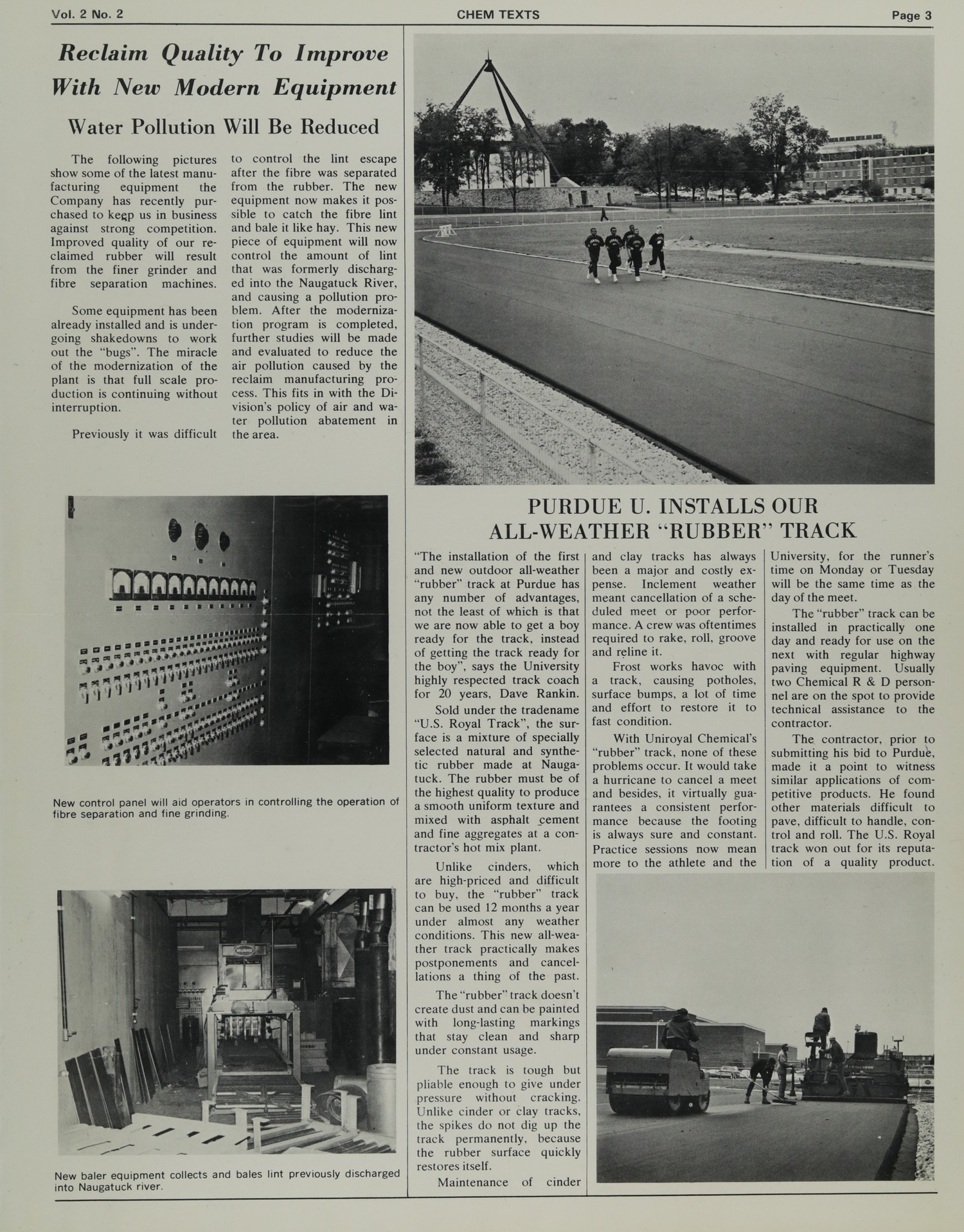
The following pictures show some of the latest manufacturing equipment the Company has recently purchased to keep us in business against strong competition. Improved quality of our reclaimed rubber will result from the finer grinder and fibre separation machines.

Some equipment has been already installed and is undergoing shakedowns to work out the “bugs”. The miracle of the modernization of the plant is that full scale production is continuing without interruption.

Previously it was difficult to control the lint escape after the fibre was separated from the rubber. The new equipment now makes it possible to catch the fibre lint and bale it like hay. This new piece of equipment will now control the amount of lint that was formerly discharged into the Naugatuck River, and causing a pollution problem. After the modernization program is completed, further studies will be made and evaluated to reduce the air pollution caused by the reclaim manufacturing process. This fits in with the Division’s policy of air and water pollution abatement in the area.


[IMAGE: Industrial building exterior with equipment]


[IMAGE: Control panel with lights and switches]

New control panel will aid operators in controlling the operation of fibre separation and fine grinding.


[IMAGE: Industrial baler equipment]

New baler equipment collects and bales lint previously discharged into Naugatuck river.


PURDUE U. INSTALLS OUR ALL-WEATHER “RUBBER” TRACK

“The installation of the first and new outdoor all-weather “rubber” track at Purdue has any number of advantages, not the least of which is that we are now able to get a boy ready for the track, instead of getting the track ready for the boy”, says the University highly respected track coach for 20 years, Dave Rankin.

Sold under the tradename “U.S. Royal Track”, the surface is a mixture of specially selected natural and synthetic rubber made at Naugatuck. The rubber must be of the highest quality to produce a smooth uniform texture and mixed with asphalt cement and fine aggregates at a contractor’s hot mix plant.

Unlike cinders, which are high-priced and difficult to buy, the “rubber” track can be used 12 months a year under almost any weather conditions. This new all-weather track practically makes postponements and cancellations a thing of the past.

The “rubber” track doesn’t create dust and can be painted with long-lasting markings that stay clean and sharp under constant usage.

The track is tough but pliable enough to give under pressure without cracking. Unlike cinder or clay tracks, the spikes do not dig up the track permanently, because the rubber surface quickly restores itself.

Maintenance of cinder and clay tracks has always been a major and costly expense. Inclement weather meant cancellation of a scheduled meet or poor performance. A crew was oftentimes required to rake, roll, groove and reline it.

Frost works havoc with a track, causing potholes, surface bumps, a lot of time and effort to restore it to fast condition.

With Uniroyal Chemical’s “rubber” track, none of these problems occur. It would take a hurricane to cancel a meet and besides, it virtually guarantees a consistent performance because the footing is always sure and constant. Practice sessions now mean more to the athlete and the University, for the runner’s time on Monday or Tuesday will be the same time as the day of the meet.

The “rubber” track can be installed in practically one day and ready for use on the next with regular highway paving equipment. Usually two Chemical R & D personnel are on the spot to provide technical assistance to the contractor.

The contractor, prior to submitting his bid to Purdue, made it a point to witness similar applications of competitive products. He found other materials difficult to pave, difficult to handle, control and roll. The U.S. Royal track won out for its reputation of a quality product.


[IMAGE: Construction equipment on track]

[IMAGE: Workers installing track surface]

CHEM-TEXTS – Vol. 2 No. 2 – Page 4

Page 004

Page 4 | CHEM TEXTS | Vol. 2 No. 2


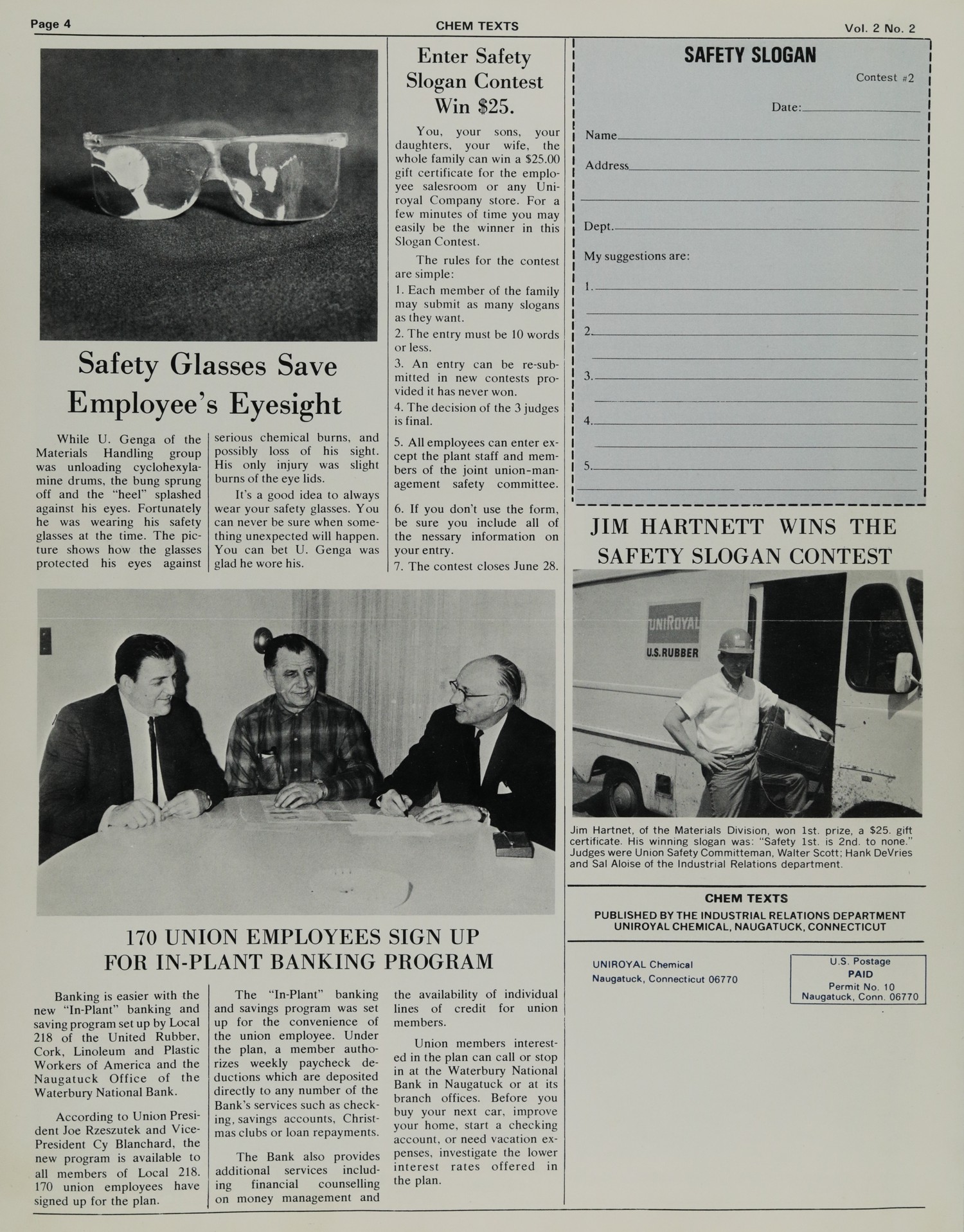
[IMAGE: Safety glasses with visible damage/marks]

Safety Glasses Save Employee’s Eyesight

While U. Genga of the Materials Handling group was unloading cyclohexylamine drums, the bung sprung off and the “heel” splashed against his eyes. Fortunately he was wearing his safety glasses at the time. The picture shows how the glasses protected his eyes against serious chemical burns, and possibly loss of his sight. His only injury was slight burns of the eye lids.

It’s a good idea to always wear your safety glasses. You can never be sure when something unexpected will happen. You can bet U. Genga was glad he wore his.


Enter Safety Slogan Contest Win $25.

You, your sons, your daughters, your wife, the whole family can win a $25.00 gift certificate for the employee salesroom or any Uniroyal Company store. For a few minutes of time you may easily be the winner in this Slogan Contest.

The rules for the contest are simple:

  1. Each member of the family may submit as many slogans as they want.
  2. The entry must be 10 words or less.
  3. An entry can be re-submitted in new contests provided it has never won.
  4. The decision of the 3 judges is final.
  5. All employees can enter except the plant staff and members of the joint union-management safety committee.
  6. If you don’t use the form, be sure you include all of the nessary information on your entry.
  7. The contest closes June 28.

SAFETY SLOGAN

Contest #2

Date:___

Name___

Address___


Dept.___

My suggestions are:

1.___

2.___

3.___

4.___

5.___


JIM HARTNETT WINS THE SAFETY SLOGAN CONTEST

[IMAGE: Man standing next to Uniroyal U.S. Rubber truck]

Jim Hartnet, of the Materials Division, won 1st. prize, a $25. gift certificate. His winning slogan was: “Safety 1st. is 2nd. to none.” Judges were Union Safety Committeeman, Walter Scott; Hank DeVries and Sal Aloise of the Industrial Relations department.


[IMAGE: Three men at table signing documents]

170 UNION EMPLOYEES SIGN UP FOR IN-PLANT BANKING PROGRAM

Banking is easier with the new “In-Plant” banking and saving program set up by Local 218 of the United Rubber, Cork, Linoleum and Plastic Workers of America and the Naugatuck Office of the Waterbury National Bank.

According to Union President Joe Rzeszutek and Vice-President Cy Blanchard, the new program is available to all members of Local 218. 170 union employees have signed up for the plan.

The “In-Plant” banking and savings program was set up for the convenience of the union employee. Under the plan, a member authorizes weekly paycheck deductions which are deposited directly to any number of the Bank’s services such as checking, savings accounts, Christmas clubs or loan repayments.

The Bank also provides additional services including financial counselling on money management and the availability of individual lines of credit for union members.

Union members interested in the plan can call or stop in at the Waterbury National Bank in Naugatuck or at its branch offices. Before you buy your next car, improve your home, start a checking account, or need vacation expenses, investigate the lower interest rates offered in the plan.


CHEM TEXTS

PUBLISHED BY THE INDUSTRIAL RELATIONS DEPARTMENT
UNIROYAL CHEMICAL, NAUGATUCK, CONNECTICUT

UNIROYAL Chemical
Naugatuck, Connecticut 06770

U.S. Postage
PAID
Permit No. 10
Naugatuck, Conn. 06770

CHEM-TEXTS – Vol. 2 No. 3 – Page 2

Page 002

Page 2 | CHEM-TEXT | Vol. 2 No. 3


FROM THE FACTORY MANAGER

Dear Fellow Employee:

I’m sure you will be interested to know that after the recent sign up for the 1968 UNIROYAL Employee Stock Option Plan over 62% of us, in our plant, are participating in the new plan. This increase over the 56.2% participation in 1966, no doubt, reflects our interest in recent increases in the selling price of UNIROYAL stock.

In this connection, I am often asked what has caused our stock to go up. Very frankly, beyond general economic considerations, there is only one factor that causes stock to go up or down, and that is the value the buyer – the public – places on the profitability of the Company. Profitability is the measure of how good a job a Company does in meeting the needs of it customers. Very simply, it indicates how well each of us and the thousands of other UNIROYAL employees are doing our jobs.

As owners of the Company’s stock, it is in our best interests to see that we, as employees, do our jobs in the most effective and efficient manner. This has been, and will continue to be the spirit of the Naugatuck Plant.

[Signature]

John D. Evans


Louis Triano Heads Elks

Louis Triano, a 35 year member of the Naugatuck Elks Lodge, was elected president of the Connecticut Elks Association at their 39th. annual convention. This is the highest state office attainable by an Elks Club member.

Triano served the local lodge as Exalted Ruler in 1942-43 and again in 1950-51. He is a certified National Ritualistic Judge, judging contests throughout New England.

Lou has been in Marvinol® vinyl R & D as a laboratory technician for the past 18 years, working on Marvinol plastisol and organosol formulations. Our vinyl resins are used in the manufacture of Naugahyde® upholstery fabric, footwear and rainwear.


Semaskvich Compares Uniroyal With Other Companies

Ed Semaskvich of the Mechanical Dept. worked around the world in the U.S. Navy, as a construction and iron worker, and for automotive and brass companies. He joined Uniroyal 18 years ago.

When asked his views by the editor of Uniroyal World on how Uniroyal compared with other companies that he worked for, Semaskvich expressed these opini “I

particularly like the improved safety program, the excellent fringe benefits, and the good management and employee relationship that is constantly improving, at the Naugatuck Plant.”

“The Company seemed a little on the conservative side when I first came, but in the past few years a new, progressive outlook has taken place. For instance, I can suggest

new ideas to my superintendent, foreman or even the factory manager, and if they think they’re good, they take action.” According to Ed, “no company is pertect, but Naugatuck beats the rest, otherwise I would’nt have stayed around for 18 years.

Ed has taken an active interest in the Naugatuck Swim Club for young children for many years and is a member of the V.F.W.


SUGGESTION PLAN WINNERS RECEIVE $630 FOR IDEAS

At the last Suggestion Award Committee meeting held recently, a total of $630 was awarded to employees for suggestions on safety, improved working conditions, and changes in equipment.

Any employee may submit a suggestion and win an award by using a little imagination. Your idea may win you as much as $500 for just a few moments of your time. Look around your department, there are hundreds of opportunities staring right at you.

The award winners were:
L. Fortier, Chem, Prod. – $15; J. Schumacher, Mech. Dept. $15; L. Respass, Reclaim – $15; M. Janetty, Mech. Dept. – $15; E. Clark, Mech. Dept. – $15; H. Vogt, Engineering – $35; E. Clark, Mech. Dept. – $35 E. Clark, Mech. Dept. – Hon. Men. R. Ruginis, Mech. Stores – $15; T. Turner, Chem. Prod. – $15; L. Fortier, Chem. Prod. – $15; J. Slasienski, Chem. Prod. – $15; J. Sickola,

Chem. Rec. – $15; J. Slasienski, Chem. Prod. – $15; K. Ferreira, Lab. – Hon. Men.; E. Smith, Pilot Plant – $30; C. Hiser, Mech. Dept. – $15; F. Rosa, Mech. Dept. – $15; J. Enamait, Mech. Dept. – $15; A. Brodeur, Mech. Dept. – $15; A. Picoli, Mech. Dept. – $15.

Also R. Tucker, Mech. Dept. – $15; R. Tucker, Mech Dept. – $15; E. Koslowski, Chem. Prod. – $15; J. Lynch, Chem. Prod. – $15; D. Persutti, Chem. Prod. – $15; C. Ferguson, Mech. Dept. – $15; P. Hardt, Chem. Prod. – Hon. Men.; S. Molnar, Chem. Prod. – $25; S. Molnar, Chem. Prod. – Hon. Men.; J. Gandolf, Mech. Dept. – $15; J. Gandolf, Mech. Dept. – $15; J. Lynch, Chem. Prod. – $15; C. Iannuzzi, Mech. Dept. – $15; F. Gagne, Lab. – $15; R. Pakalnis, Lab. – $25; G. Mitchell, Chem. Prod. – $15; W. Breton, Chem. Prod. – $15; J. Kerski, Materials – Hon. Men.; J. DiSantis, Dispersions – $25; G. Reale, Mech. – $50.


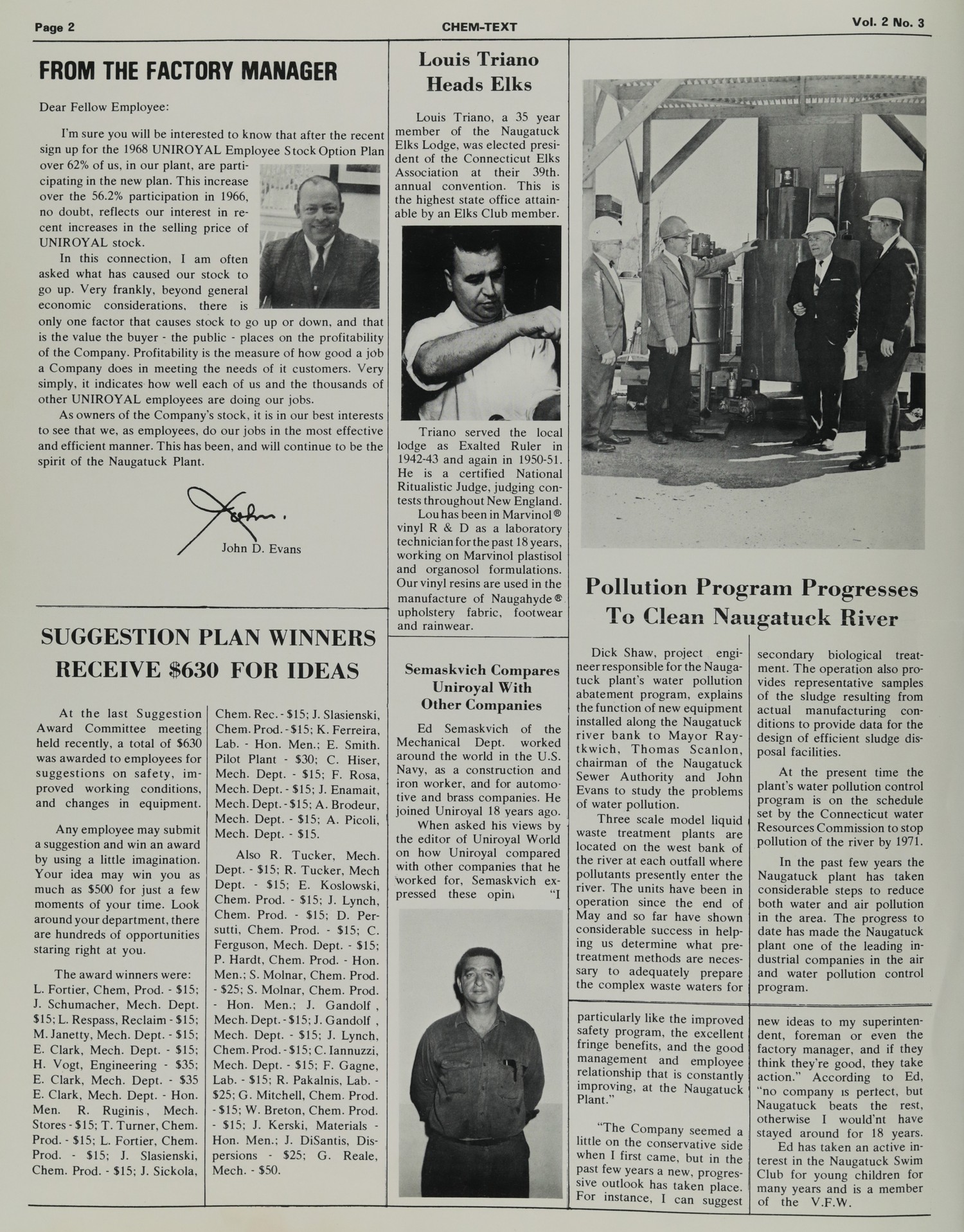
Pollution Program Progresses To Clean Naugatuck River

Dick Shaw, project engineer responsible for the Naugatuck plant’s water pollution abatement program, explains the function of new equipment installed along the Naugatuck river bank to Mayor Raytkwich, Thomas Scanlon, chairman of the Naugatuck Sewer Authority and John Evans to study the problems of water pollution.

Three scale model liquid waste treatment plants are located on the west bank of the river at each outfall where pollutants presently enter the river. The units have been in operation since the end of May and so far have shown considerable success in helping us determine what pretreatment methods are necessary to adequately prepare the complex waste waters for

secondary biological treatment. The operation also provides representative samples of the sludge resulting from actual manufacturing conditions to provide data for the design of efficient sludge disposal facilities.

At the present time the plant’s water pollution control program is on the schedule set by the Connecticut Water Resources Commission to stop pollution of the river by 1971.

In the past few years the Naugatuck plant has taken considerable steps to reduce both water and air pollution in the area. The progress to date has made the Naugatuck plant one of the leading industrial companies in the air and water pollution control program.

CHEM-TEXTS – Vol. 2 No. 3 – Page 3

Page 003

CHEM-TEXTS

Page 3 | Vol. 2 No. 3


HOUSEKEEPING IMPRESSES G. VILA ON PLANT VISIT

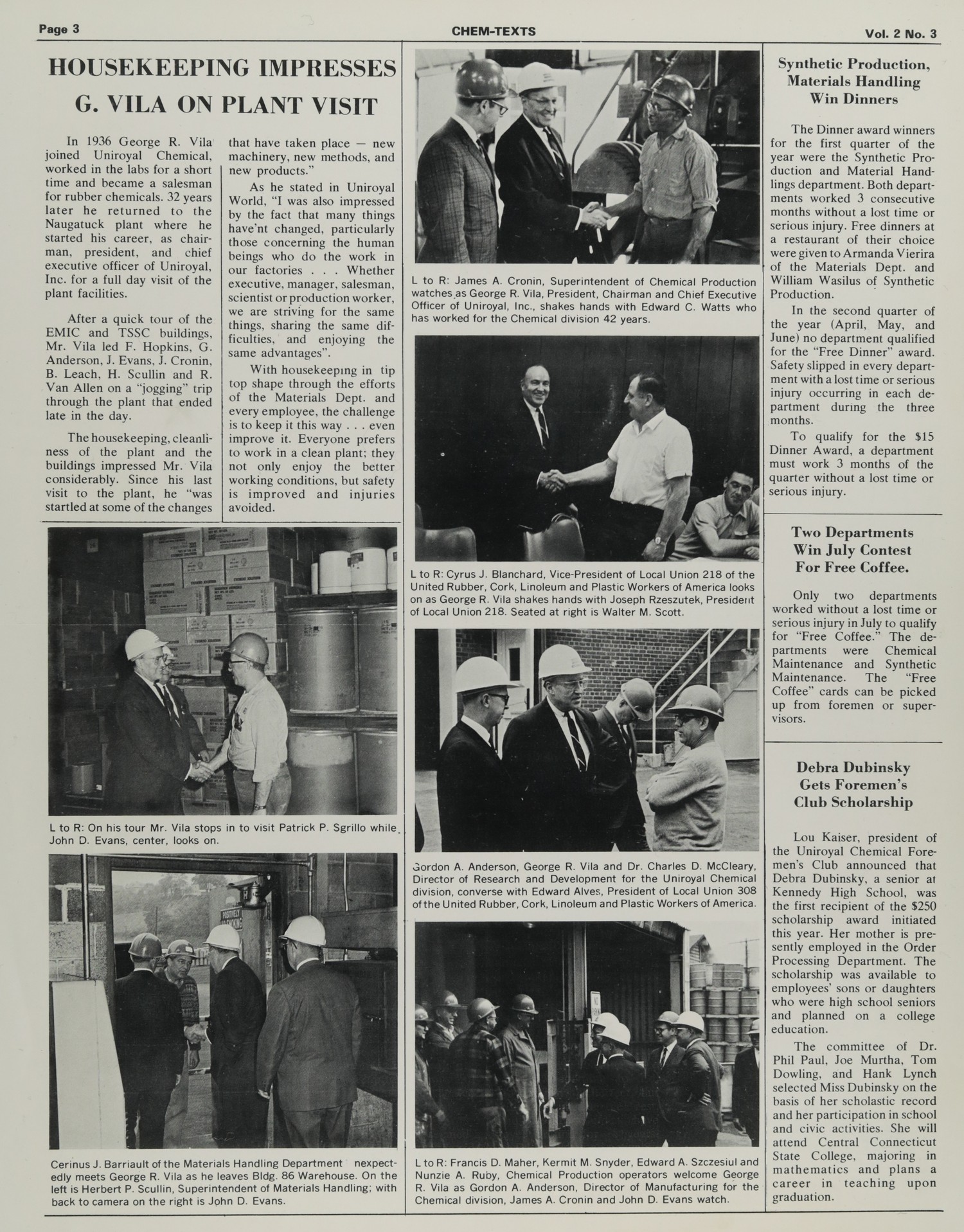
In 1936 George R. Vila joined Uniroyal Chemical, worked in the labs for a short time and became a salesman for rubber chemicals. 32 years later he returned to the Naugatuck plant where he started his career, as chairman, president, and chief executive officer of Uniroyal, Inc. for a full day visit of the plant facilities.

After a quick tour of the EMIC and TSSC buildings, Mr. Vila led F. Hopkins, G. Anderson, J. Evans, J. Cronin, B. Leach, H. Scullin and R. Van Allen on a “jogging” trip through the plant that ended late in the day.

The housekeeping, cleanliness of the plant and the buildings impressed Mr. Vila considerably. Since his last visit to the plant, he “was startled at some of the changes that have taken place — new machinery, new methods, and new products.”

As he stated in Uniroyal World, “I was also impressed by the fact that many things have’nt changed, particularly those concerning the human beings who do the work in our factories . . . Whether executive, manager, salesman, scientist or production worker, we are striving for the same things, sharing the same difficulties, and enjoying the same advantages”.

With housekeeping in tip top shape through the efforts of the Materials Dept. and every employee, the challenge is to keep it this way . . . even improve it. Everyone prefers to work in a clean plant; they not only enjoy the better working conditions, but safety is improved and injuries avoided.


L to R: James A. Cronin, Superintendent of Chemical Production watches as George R. Vila, President, Chairman and Chief Executive Officer of Uniroyal, Inc., shakes hands with Edward C. Watts who has worked for the Chemical division 42 years.


L to R: On his tour Mr. Vila stops in to visit Patrick P. Sgrillo while John D. Evans, center, looks on.


Cerinus J. Barriault of the Materials Handling Department unexpectedly meets George R. Vila as he leaves Bldg. 86 Warehouse. On the left is Herbert P. Scullin, Superintendent of Materials Handling; with back to camera on the right is John D. Evans.


L to R: Cyrus J. Blanchard, Vice-President of Local Union 218 of the United Rubber, Cork, Linoleum and Plastic Workers of America looks on as George R. Vila shakes hands with Joseph Rzeszutek, President of Local Union 218. Seated at right is Walter M. Scott.


Gordon A. Anderson, George R. Vila and Dr. Charles D. McCleary, Director of Research and Development for the Uniroyal Chemical division, converse with Edward Alves, President of Local Union 308 of the United Rubber, Cork, Linoleum and Plastic Workers of America.


L to R: Francis D. Maher, Kermit M. Snyder, Edward A. Szczesiul and Nunzie A. Ruby, Chemical Production operators welcome George R. Vila as Gordon A. Anderson, Director of Manufacturing for the Chemical division, James A. Cronin and John D. Evans watch.


Synthetic Production, Materials Handling Win Dinners

The Dinner award winners for the first quarter of the year were the Synthetic Production and Material Handlings department. Both departments worked 3 consecutive months without a lost time or serious injury. Free dinners at a restaurant of their choice were given to Armanda Vierira of the Materials Dept. and William Wasilus of Synthetic Production.

In the second quarter of the year (April, May, and June) no department qualified for the “Free Dinner” award. Safety slipped in every department with a lost time or serious injury occurring in each department during the three months.

To qualify for the $15 Dinner Award, a department must work 3 months of the quarter without a lost time or serious injury.


Two Departments Win July Contest For Free Coffee.

Only two departments worked without a lost time or serious injury in July to qualify for “Free Coffee.” The departments were Chemical Maintenance and Synthetic Maintenance. The “Free Coffee” cards can be picked up from foremen or supervisors.


Debra Dubinsky Gets Foremen’s Club Scholarship

Lou Kaiser, president of the Uniroyal Chemical Foremen’s Club announced that Debra Dubinsky, a senior at Kennedy High School, was the first recipient of the $250 scholarship award initiated this year. Her mother is presently employed in the Order Processing Department. The scholarship was available to employees’ sons or daughters who were high school seniors and planned on a college education.

The committee of Dr. Phil Paul, Joe Murtha, Tom Dowling, and Hank Lynch selected Miss Dubinsky on the basis of her scholastic record and her participation in school and civic activities. She will attend Central Connecticut State College, majoring in mathematics and plans a career in teaching upon graduation.

CHEM-TEXTS – Vol. 2 No. 3 – Page 4

Page 004

Page 4 | CHEM-TEXTS | Vol. 2 No. 3


DEPARTMENTS TO SCHEDULE SAFETY MEETINGS FOR GROUPS

During the third and fourth quarters of the year each department will hold scheduled meetings on different topics of safety. The meetings are conducted by the foremen with the members of their departments. Discussions center on the problems of safety in the departments, personal protective equipment on the job, housekeeping, eye protection, and ways to improve our safety record and prevent the occurrence of serious and lost time injuries.

At the present this is the schedule, topics and places where the meetings are being held.

RECLAIM PRODUCTION: The 3rd. quarter safety meeting discussed Personal Protective Equipment and were held in each department, except for Millrooms A and C which were held in the Foremen’s Room. A. Enamait met twice on July 15 with the Raw Stock and Tube Sorting group. A. Pistarelli and Cracking met 8/5 and will meet again on 9/9. F. Polonis and Digesting on 8/6, 8/13 and 8/20. W. Booth and Devulcanizing on 8/5, 8/12 and 8/19. D. Rappe met with Millroom A on 8/17, 8/14 and 8/21. H. Piasick and Millroom C will meet 9/3, 9/10 and 9/17. M. Mazur and Dispersions on 9/4.

Procedures and Orderlines will be the topic for 4th. quarter Safety meetings. A. Enamait, Raw Stock and Tube Sorting, will hold 2 meetings on 11/12. A. Pistarelli, Cracking, on 10/7, 11/4, and 12/2. F. Polonis, Digesting, on 11/5, 11/12, and 11/19. W. Booth, Devulcanizing, on 10/7, 10/14, 10/21. D. Rappe, Millroom A. on 10/9, 10/16, 10/23. H. Piasick, Millroom C on 11/16, 11/18, and 11/20. M. Mazur, Dispersions, on 11/27.

PURCHASING: A. Carriero will discuss Housekeeping on Sept. 16 at 9 A.M. with the Mechanical Stores group in the Chemical Mechanical Storeroom. The 4th quarter meeting will center on Personal Protective Equipment and Proper Use of Equipment and is scheduled for Nov. 11, 9 A.M. in the Chemical Mechanical Storeroom.

ENGINEERING: An organized program featuring films and slides on Safety is now being worked out for monthly departmental meetings during the 3rd. and 4th. quarters. A schedule of the foremen, departments, topics, dates, time and place is now being prepared.

SYNTHETIC PRODUCTION: During Sept. each member of the Production Department will attend a scheduled meeting on Eye Protection. Meetings will be held at 3 P.M. in the Synthetic Cafeteria. Specific dates will be determined shortly.

In November, Personal Protective Equipment, (Other than eye and head) will be the Safety topic. Meetings will be scheduled for all members of the Production department in the Synthetic cafeteria at 3 P.M.

MATERIALS HANDLING: Department meetings on Safety are now being arranged for the 3rd. and 4th. quarters for all members of the group. When topics have been selected, members will be notified of the date, time, place and foremen in charge of the meeting.

CHEMICAL PRODUCTION: Safety meetings in Chemical Production have been held for the past 3 months on a regular weekly basis under G. Allen with members of chemical production buildings. Topics have focused on the particular safety problems in each building.


SAFETY SLOGAN

Contest #3

Date:____

Name____

Address____

Dept.____

My suggestions are:

1.____

2.____

3.____

4.____

5.____


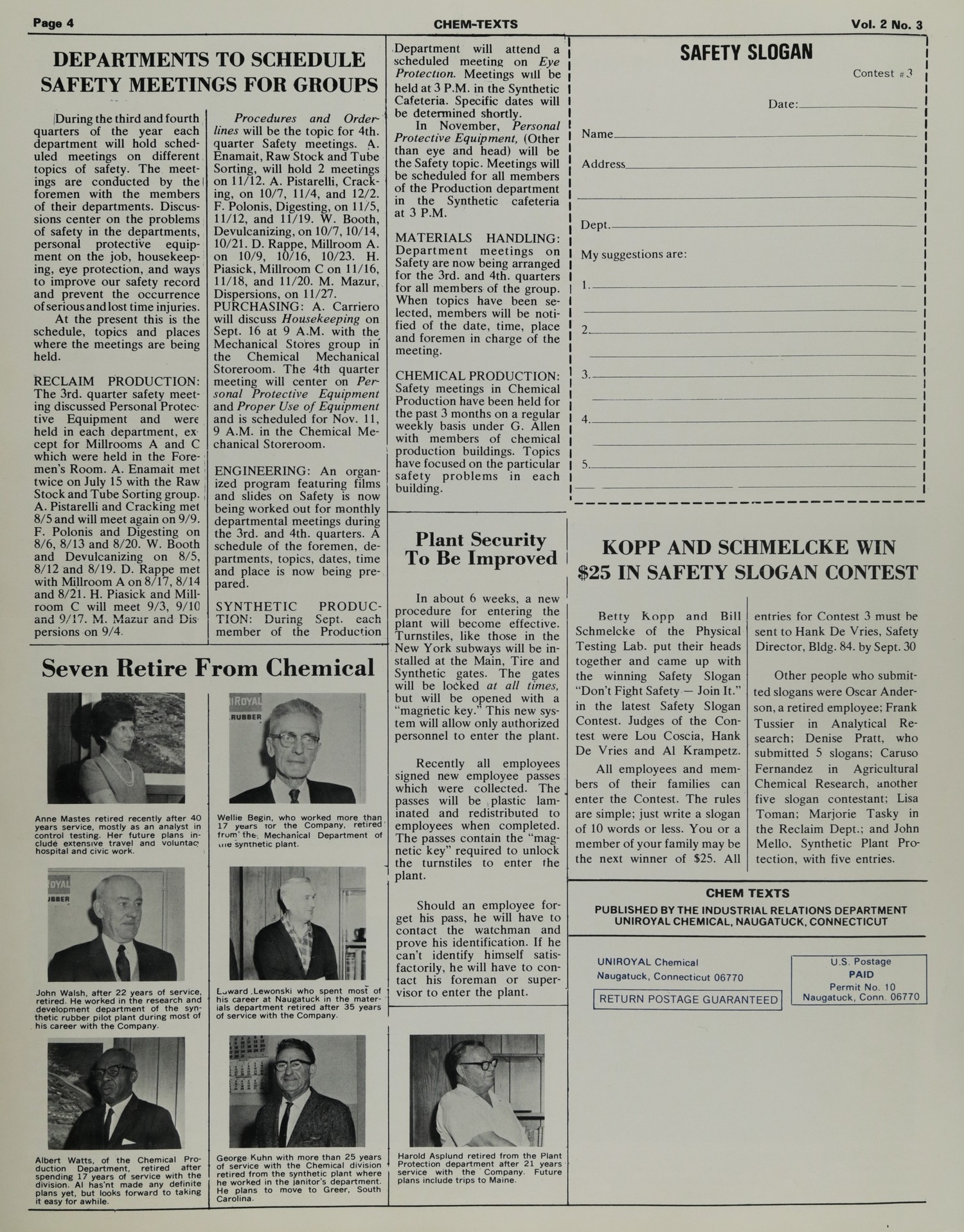
Seven Retire From Chemical

[IMAGE: Photo of Anne Mastes with ROYAL RUBBER logo]
Anne Mastes retired recently after 40 years service, mostly as an analyst in control testing. Her future plans include extensive travel and volunteer hospital and civic work.

[IMAGE: Photo of Wellie Begin with ROYAL RUBBER logo]
Wellie Begin, who worked more than 17 years for the Company, retired from the Mechanical Department of the synthetic plant.

[IMAGE: Photo of John Walsh with ROYAL RUBBER logo]
John Walsh, after 22 years of service, retired. He worked in the research and development department of the synthetic rubber pilot plant during most of his career with the Company.

[IMAGE: Photo of Luward Lewonski]
Luward Lewonski who spent most of his career at Naugatuck in the materials department retired after 35 years of service with the Company.

[IMAGE: Photo of Albert Watts]
Albert Watts, of the Chemical Production Department retired after spending 17 years of service with the division. Al hasn’t made any definite plans yet, but looks forward to taking it easy for awhile.

[IMAGE: Photo of George Kuhn]
George Kuhn with more than 25 years of service with the Chemical division retired from the synthetic plant where he worked in the janitor’s department. He plans to move to Greer, South Carolina.

[IMAGE: Photo of Harold Asplund]
Harold Asplund retired from the Plant Protection department after 21 years service with the Company. Future plans include trips to Maine.


Plant Security To Be Improved

In about 6 weeks, a new procedure for entering the plant will become effective. Turnstiles, like those in the New York subways will be installed at the Main, Tire and Synthetic gates. The gates will be locked at all times, but will be opened with a “magnetic key.” This new system will allow only authorized personnel to enter the plant.

Recently all employees signed new employee passes which were collected. The passes will be plastic laminated and redistributed to employees when completed. The passes contain the “magnetic key” required to unlock the turnstiles to enter the plant.

Should an employee forget his pass, he will have to contact the watchman and prove his identification. If he can’t identify himself satisfactorily, he will have to contact his foreman or supervisor to enter the plant.


KOPP AND SCHMELCKE WIN $25 IN SAFETY SLOGAN CONTEST

Betty Kopp and Bill Schmelcke of the Physical Testing Lab. put their heads together and came up with the winning Safety Slogan “Don’t Fight Safety — Join It.” in the latest Safety Slogan Contest. Judges of the Contest were Lou Coscia, Hank De Vries and Al Krampetz.

All employees and members of their families can enter the Contest. The rules are simple; just write a slogan of 10 words or less. You or a member of your family may be the next winner of $25. All entries for Contest 3 must be sent to Hank De Vries, Safety Director, Bldg. 84. by Sept. 30

Other people who submitted slogans were Oscar Anderson, a retired employee; Frank Tussier in Analytical Research; Denise Pratt, who submitted 5 slogans; Caruso Fernandez in Agricultural Chemical Research, another five slogan contestant; Lisa Toman; Marjorie Tasky in the Reclaim Dept.; and John Mello. Synthetic Plant Protection, with five entries.


CHEM TEXTS
PUBLISHED BY THE INDUSTRIAL RELATIONS DEPARTMENT
UNIROYAL CHEMICAL, NAUGATUCK, CONNECTICUT

UNIROYAL Chemical
Naugatuck, Connecticut 06770

U.S. Postage
PAID
Permit No. 10
Naugatuck, Conn. 06770

RETURN POSTAGE GUARANTEED

CHEM-TEXTS – Vol. 2, No. 4 – Page 1

Page 001

UNIROYAL CHEM-TEXTS

Vol. 2 PUBLISHED FOR THE PEOPLE OF UNIROYAL CHEMICAL No. 4


United Givers Goal, $20,000 “Give Where You Work” Urged

Ron Mitchinson, Chairman of the United Givers Campaign to be conducted in the plant during October, urges 100% employee participation and “Give Where You Work” to support the 16 worthwhile Agencies in the Fund. Many of these Agencies serve not only Naugatuck and Beacon Falls, but most of the surrounding towns in the area. Some like the U.S.O., Salvation Army, United Cerebral Palsy and Red Cross are national in their service.

Most plant employees and their families have been served by one or more of these organizations. Their need for money this year is greater than ever to continue their good work. By giving “where you work” and contributing through the payroll deduction plan at least one hour’s pay monthly for wage employees or 1% of annual income for salary employees, the plant goal of $20,000 can be easily reached.

In the 1967 Campaign 67% of Chemical employees contributed $17,775. About 560 employees did not contribute. On the Pledge card every employee will find at least one Agency which he or his family wants to help support.

The Campaign Committee is E. Alves, S. Gillette, E. Johnson, W. Tavelle, L. Lombardi, D. Miller, J. Rzeszutek, and R. Van Allen. Close to 100 Co-Captains will contact every employee during the Campaign.

Co-Captains are B. Sullivan, E. Evans, L. Taranowich, L. Soares, M. Rosa, H. Steele, N. Krenitsky, J. Valinho, P. Tortorici, M. Chmielewski, J. McKee, G. Browning, E. Jancis, B. Perkins, C. Fernandes, P. Braudis, A. Ferro, W. Jones, T. Brett, R. Mastromatteo, R. Cote, C. Buckley, R. Harsch, P. Hinckley, D. Malloy, W. Parks, J. McGinn, I. Prager, R. Farrell, W. Smith, J. Phelan, W. Singleton, R. Amidon, W. Budd, G. Arndt, P. Murray, L. Flynn, F. Adams, E. Cheney, R. Lestage, G. Birch, H. Hook, F. Rodrigues, W. Campbell, H. Francolini, D. Poehailos, H. Lynch, R. Ames, C. Reich, L. Terra, A. Pistarelli, M. Paiva, D. Rappe, A. Nauges, T. Skehan, R. Foltz, B. Dunn, J. Rice, J. Bucciaglia, K. Dowling, R. Magnamino, F. Magnamo, E. Ruella, R. Breton, J. Bielak, J. Honyotski, D. Cowan, R. Valentine, D. Gabriel, R. Kaiser, J. Charkow, C. Roland, R. Manulla, J. Wojtczak, W. Bieleski, R. Magnamo, F. Enamait, S. Perkus, J. Sullivan, T. McMahon, W. Leukhardt, J. Quint, L. Nappiello, D. George, Geo. Arndt, H. Scullin, F. Lynch, J. Murtha, A. Juliano, J. Vergosen, R. Terino, E. Weaving, S. Aloise, F. Sabia, and J. Tierney.


One gift works many wonders

[IMAGE: Young child’s face]

GIVE THE UNITED WAY


[IMAGE: Industrial facility with storage tank and buildings]

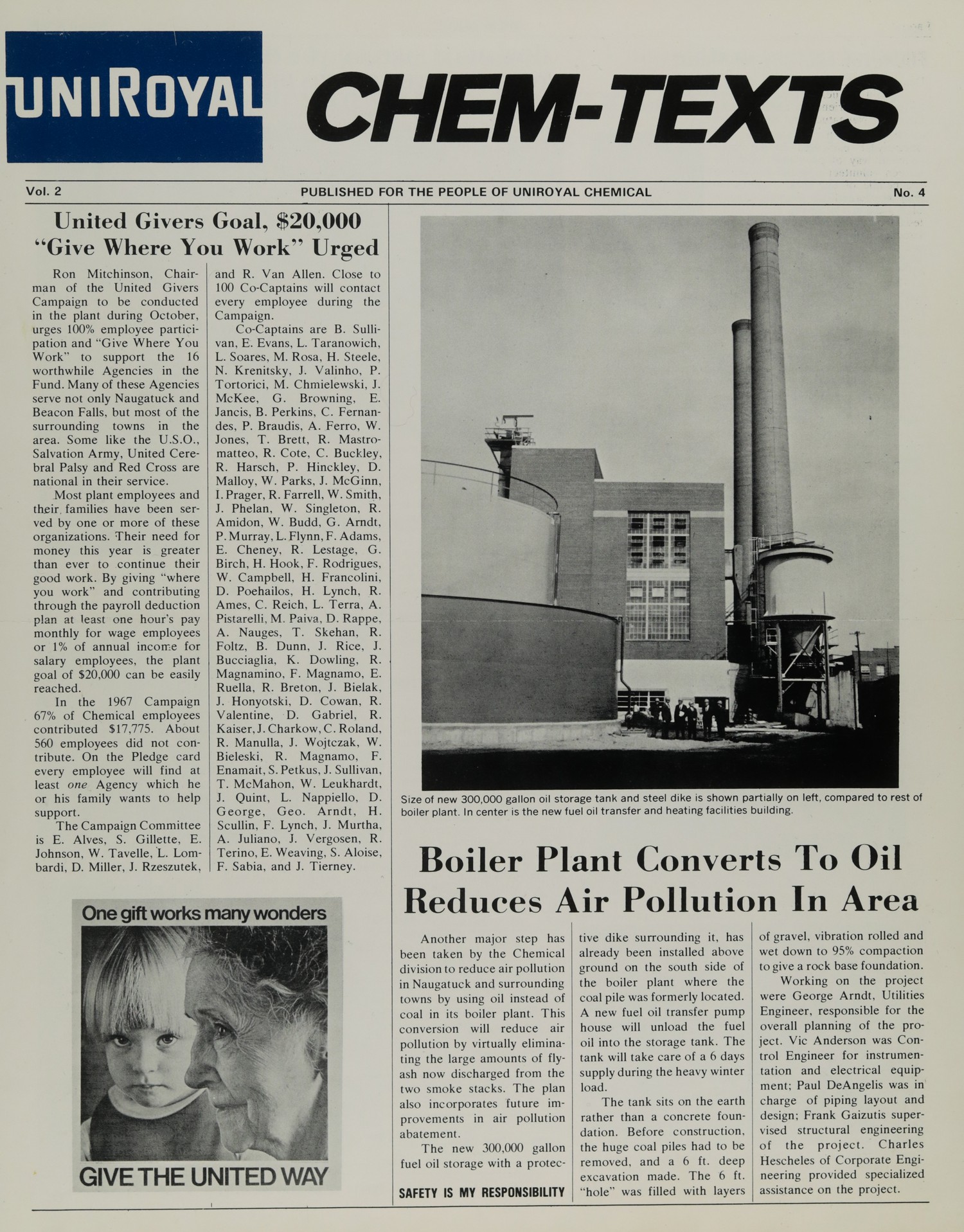
Size of new 300,000 gallon oil storage tank and steel dike is shown partially on left, compared to rest of boiler plant. In center is the new fuel oil transfer and heating facilities building.


Boiler Plant Converts To Oil Reduces Air Pollution In Area

Another major step has been taken by the Chemical division to reduce air pollution in Naugatuck and surrounding towns by using oil instead of coal in its boiler plant. This conversion will reduce air pollution by virtually eliminating the large amounts of fly-ash now discharged from the two smoke stacks. The plan also incorporates future improvements in air pollution abatement.

The new 300,000 gallon fuel oil storage with a protective dike surrounding it, has already been installed above ground on the south side of the boiler plant where the coal pile was formerly located. A new fuel oil transfer pump house will unload the fuel oil into the storage tank. The tank will take care of a 6 days supply during the heavy winter load.

The tank sits on the earth rather than a concrete foundation. Before construction, the huge coal piles had to be removed, and a 6 ft. deep excavation made. The 6 ft. “hole” was filled with layers of gravel, vibration rolled and wet down to 95% compaction to give a rock base foundation.

Working on the project were George Arndt, Utilities Engineer, responsible for the overall planning of the project. Vic Anderson was Control Engineer for instrumentation and electrical equipment; Paul DeAngelis was in charge of piping layout and design; Frank Gaizutis supervised structural engineering of the project. Charles Hescheles of Corporate Engineering provided specialized assistance on the project.


SAFETY IS MY RESPONSIBILITY

CHEM-TEXTS – Vol. 2 No. 4 – Page 2

Page 002

CHEM TEXTS

Page 2 | Vol. 2 No. 4


FROM THE FACTORY MANAGER

Dear Fellow Employee:

Within the next several weeks we will each be contacted by one of our friends to make our annual pledge to the United Givers of Naugatuck and Beacon Falls.

Experience has proven that this once-a-year campaign is the most efficient way of providing funds for sixteen volunteer agencies that serve the people of our area. I am, however, concerned that the convenience of this method of giving may tend to lessen our generosity as givers. May I suggest that we each use the following guidelines in making out our pledges?

1) Review carefully the agencies presented on our pledge card and the details of their needs and services as described in the United Givers folder.

2) Consider the services that we, our family, our friends and neighbors receive from these agencies. Note that many of the agencies serve an area broader than the campaign towns. Some are even national.

3) Use the Work Sheet on this page of CHEM-TEXTS to work out our pledge on the payroll deduction plan. This method makes it convenient to give our share on a year-around basis.

4) PLEDGE! Before filling in our card – ask ourselves one question – “Have I given until it feels good?

[Signature]

John D. Evans


HOW MUCH SHOULD YOU GIVE TO THE UNITED GIVERS DRIVE

A few years ago, somebody knocked on your door almost once a week for a contribution to a worthy cause. You probably contributed $30 to $50 to these organizations.

Through the United Givers Fund your continued generous support of most of these organizations can now be done on a once-a-year basis through the Company’s payroll deduction plan.

To determine your contribution for 1969, this work sheet, listing the 16 participating agencies, will help you decide the amount of your gift.

Agency Gift amt. if contacted separately
American Red Cross $_____
Child Guidance Clinic $_____
Children’s Center $_____
Conn. Trails Council,
Girl Scouts of America $_____
Catholic Family Serv. $_____

Family Serv. Assoc. $__
Mattatuck Council,
Boy Scouts of America $
____

Naugatuck Jr.
Athletic Leagues $__
Salvation Army $
_
United Cerebral Palsy $

U.S.O. $

Waterbury Assoc. for
Retarded Children $

Y.M.C.A. – Naugatuck $

Total Amount $
___

By dividing the number of payroll deductions into your total amount, you obtain the amount you should pledge. For salary employees, payroll deductions will be made monthly; and for wage employees, deductions will be weekly.

The Naugatuck plant always contributed generously in the past to these worthwhile agencies. Because of their increased services and expenses they depend more on us for 1969.


New Assignments Made in Plant

Fred Wintsch has been appointed Labor Relations Manager for the Naugatuck plant. He will be responsible for employee relations, reporting to Ron Mitchinson, Industrial Relations Manager.

[PHOTO]

Sam Gillette, formerly General Foreman at the Synthetic rubber plant, moved to the Chemical production as General Foreman reporting to Jim Cronin, Superintendent.

[PHOTO]

Eric Johnson, named General Foreman of the Synthetic rubber plant, will supervise production of synthetic latexes. He reports to Ben Leach, plant Superintendent.


[PHOTO]

The new 300,000 gallon oil storage tank and steel dike dwarfs members of the Engineering department as they inspect the 29 ft. high structure, south of the boiler plant.


[PHOTO]

Plant personnel involved in the boiler plant conversion project are left to right: Vic Anderson, Paul DeAngelis, Bill Maguire, Joe Mambrino, Frank Gaizutis and George Arndt, shown checking fuel oil connections.


Special Winter Tire Sale

A special two month winter tire sale for active and retired employees will run from October 1 to November 30, 1968.

The sale is on winter patrol snow tires only and offers considerable savings below existing employee prices.

Lists of the special low prices can be obtained from the Industrial Relation’s Department or Employee Salesroom Managers.


August Injuries Continue High

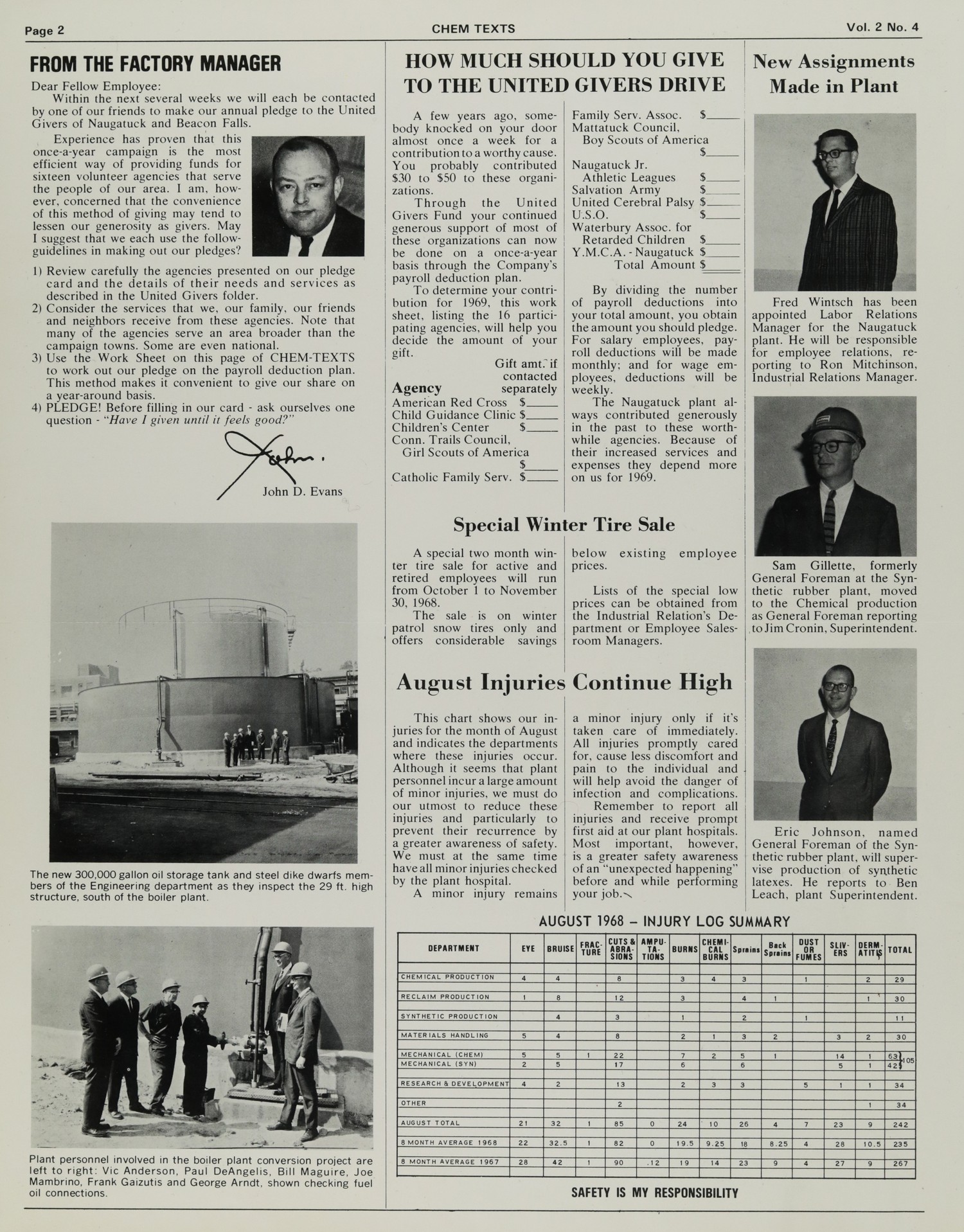
This chart shows our injuries for the month of August and indicates the departments where these injuries occur. Although it seems that plant personnel incur a large amount of minor injuries, we must do our utmost to reduce these injuries and particularly to prevent their recurrence by a greater awareness of safety. We must at the same time have all minor injuries checked by the plant hospital.

A minor injury remains a minor injury only if it’s taken care of immediately. All injuries promptly cared for, cause less discomfort and pain to the individual and will help avoid the danger of infection and complications.

Remember to report all injuries and receive prompt first aid at our plant hospitals. Most important, however, is a greater safety awareness of an “unexpected happening” before and while performing your job.


AUGUST 1968 – INJURY LOG SUMMARY

DEPARTMENT EYE BRUISE FRACTURE CUTS & ABRASIONS AMPUTATIONS BURNS CHEMICAL BURNS Sprains Back Sprains DUST OR FUMES SLIVERS DERMATITIS TOTAL
CHEMICAL PRODUCTION 4 4 8 3 4 3 1 2 29
RECLAIM PRODUCTION 1 8 12 3 4 1 1 30
SYNTHETIC PRODUCTION 4 3 1 2 1 11
MATERIALS HANDLING 5 4 8 2 1 3 2 3 2 30
MECHANICAL (CHEM) 5 5 1 22 7 2 5 1 14 1 63
MECHANICAL (SYN) 2 5 17 6 6 5 1 42
RESEARCH & DEVELOPMENT 4 2 13 2 3 3 5 1 1 34
OTHER 2 1 34
AUGUST TOTAL 21 32 1 85 0 24 10 26 4 7 23 9 242
8 MONTH AVERAGE 1968 22 32.5 1 82 0 19.5 9.25 18 8.25 4 28 10.5 235
8 MONTH AVERAGE 1967 28 42 1 90 12 19 14 23 9 4 27 9 267

SAFETY IS MY RESPONSIBILITY

CHEM-TEXTS – Vol. 2 No. 4 – Page 3

Page 003

CHEM TEXTS

Vol. 2 No. 4Page 3


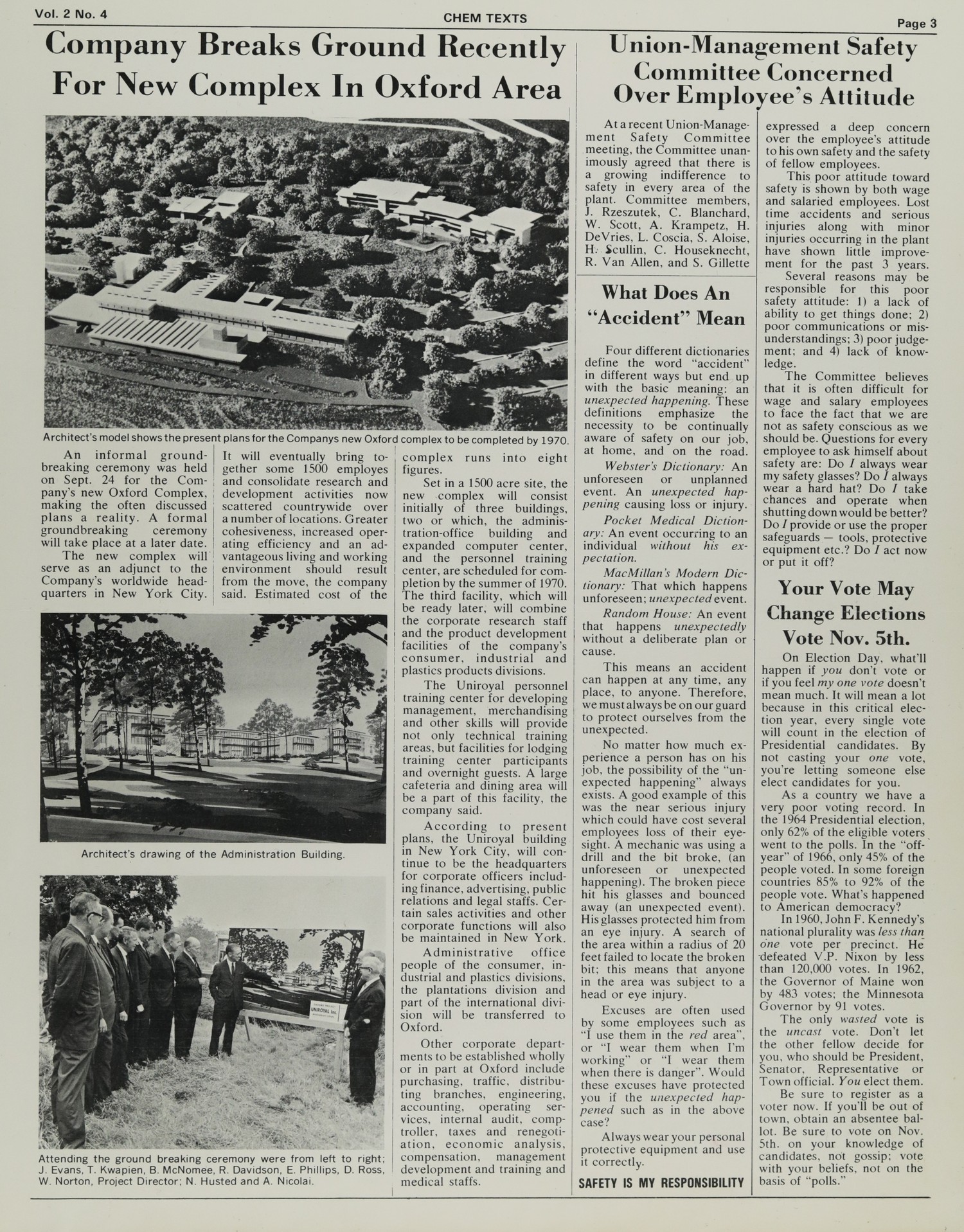
Company Breaks Ground Recently For New Complex In Oxford Area

[IMAGE: Aerial view of architectural model]

Architect’s model shows the present plans for the Companys new Oxford complex to be completed by 1970.

An informal ground-breaking ceremony was held on Sept. 24 for the Company’s new Oxford Complex, making the often discussed plans a reality. A formal groundbreaking ceremony will take place at a later date.

The new complex will serve as an adjunct to the Company’s worldwide headquarters in New York City.

It will eventually bring together some 1500 employes and consolidate research and development activities now scattered countrywide over a number of locations. Greater cohesiveness, increased operating efficiency and an advantageous living and working environment should result from the move, the company said. Estimated cost of the complex runs into eight figures.

Set in a 1500 acre site, the new complex will consist initially of three buildings, two or which, the administration-office building and expanded computer center, and the personnel training center, are scheduled for completion by the summer of 1970. The third facility, which will be ready later, will combine the corporate research staff and the product development facilities of the company’s consumer, industrial and plastics products divisions.

The Uniroyal personnel training center for developing management, merchandising and other skills will provide not only technical training areas, but facilities for lodging training center participants and overnight guests. A large cafeteria and dining area will be a part of this facility, the company said.

According to present plans, the Uniroyal building in New York City, will continue to be the headquarters for corporate officers including finance, advertising, public relations and legal staffs. Certain sales activities and other corporate functions will also be maintained in New York.

Administrative office people of the consumer, industrial and plastics divisions, the plantations division and part of the international division will be transferred to Oxford.

Other corporate departments to be established wholly or in part at Oxford include purchasing, traffic, distributing branches, engineering, accounting, operating services, internal audit, comptroller, taxes and renegotiation, economic analysis, compensation, management development and training and medical staffs.

[IMAGE: Architect’s drawing of building]

Architect’s drawing of the Administration Building.

[IMAGE: Group photo of people at ceremony]

Attending the ground breaking ceremony were from left to right: J. Evans, T. Kwapien, B. McNomee, R. Davidson, E. Phillips, D. Ross, W. Norton, Project Director; N. Husted and A. Nicolai.


Union-Management Safety Committee Concerned Over Employee’s Attitude

At a recent Union-Management Safety Committee meeting, the Committee unanimously agreed that there is a growing indifference to safety in every area of the plant. Committee members, J. Rzeszutek, C. Blanchard, W. Scott, A. Krampetz, H. DeVries, L. Coscia, S. Aloise, H. Scullin, C. Houseknecht, R. Van Allen, and S. Gillette expressed a deep concern over the employee’s attitude to his own safety and the safety of fellow employees.

This poor attitude toward safety is shown by both wage and salaried employees. Lost time accidents and serious injuries along with minor injuries occurring in the plant have shown little improvement for the past 3 years.

Several reasons may be responsible for this poor safety attitude: 1) a lack of ability to get things done; 2) poor communications or misunderstandings; 3) poor judgement; and 4) lack of knowledge.

The Committee believes that it is often difficult for wage and salary employees to face the fact that we are not as safety conscious as we should be. Questions for every employee to ask himself about safety are: Do I always wear my safety glasses? Do I always wear a hard hat? Do I take chances and operate when shutting down would be better? Do I provide or use the proper safeguards — tools, protective equipment etc.? Do I act now or put it off?


What Does An “Accident” Mean

Four different dictionaries define the word “accident” in different ways but end up with the basic meaning; an unexpected happening. These definitions emphasize the necessity to be continually aware of safety on our job, at home, and on the road.

Webster’s Dictionary: An unforeseen or unplanned event. An unexpected happening causing loss or injury.

Pocket Medical Dictionary: An event occurring to an individual without his expectation.

MacMillan’s Modern Dictionary: That which happens unforeseen; unexpected event.

Random House: An event that happens unexpectedly without a deliberate plan or cause.

This means an accident can happen at any time, any place, to anyone. Therefore, we must always be on our guard to protect ourselves from the unexpected.

No matter how much experience a person has on his job, the possibility of the “unexpected happening” always exists. A good example of this was the near serious injury which could have cost several employees loss of their eyesight. A mechanic was using a drill and the bit broke, (an unforeseen or unexpected happening). The broken piece hit his glasses and bounced away (an unexpected event). His glasses protected him from an eye injury. A search of the area within a radius of 20 feet failed to locate the broken bit; this means that anyone in the area was subject to a head or eye injury.

Excuses are often used by some employees such as “I use them in the red area”, or “I wear them when I’m working” or “I wear them when there is danger”. Would these excuses have protected you if the unexpected happened such as in the above case?

Always wear your personal protective equipment and use it correctly.

SAFETY IS MY RESPONSIBILITY


Your Vote May Change Elections Vote Nov. 5th.

On Election Day, what’ll happen if you don’t vote or if you feel my one vote doesn’t mean much. It will mean a lot because in this critical election year, every single vote will count in the election of Presidential candidates. By not casting your one vote, you’re letting someone else elect candidates for you.

As a country we have a very poor voting record. In the 1964 Presidential election, only 62% of the eligible voters went to the polls. In the “off-year” of 1966, only 45% of the people voted. In some foreign countries 85% to 92% of the people vote. What’s happened to American democracy?

In 1960, John F. Kennedy’s national plurality was less than one vote per precinct. He defeated V.P. Nixon by less than 120,000 votes. In 1962, the Governor of Maine won by 483 votes; the Minnesota Governor by 91 votes.

The only wasted vote is the uncast vote. Don’t let the other fellow decide for you, who should be President, Senator, Representative or Town official. You elect them.

Be sure to register as a voter now. If you’ll be out of town, obtain an absentee ballot. Be sure to vote on Nov. 5th. on your knowledge of candidates, not gossip; vote with your beliefs, not on the basis of “polls.”

CHEM-TEXTS – Vol. 2 No. 4 – Page 4

Page 004

Page 4 | CHEM TEXTS | Vol. 2 No. 4


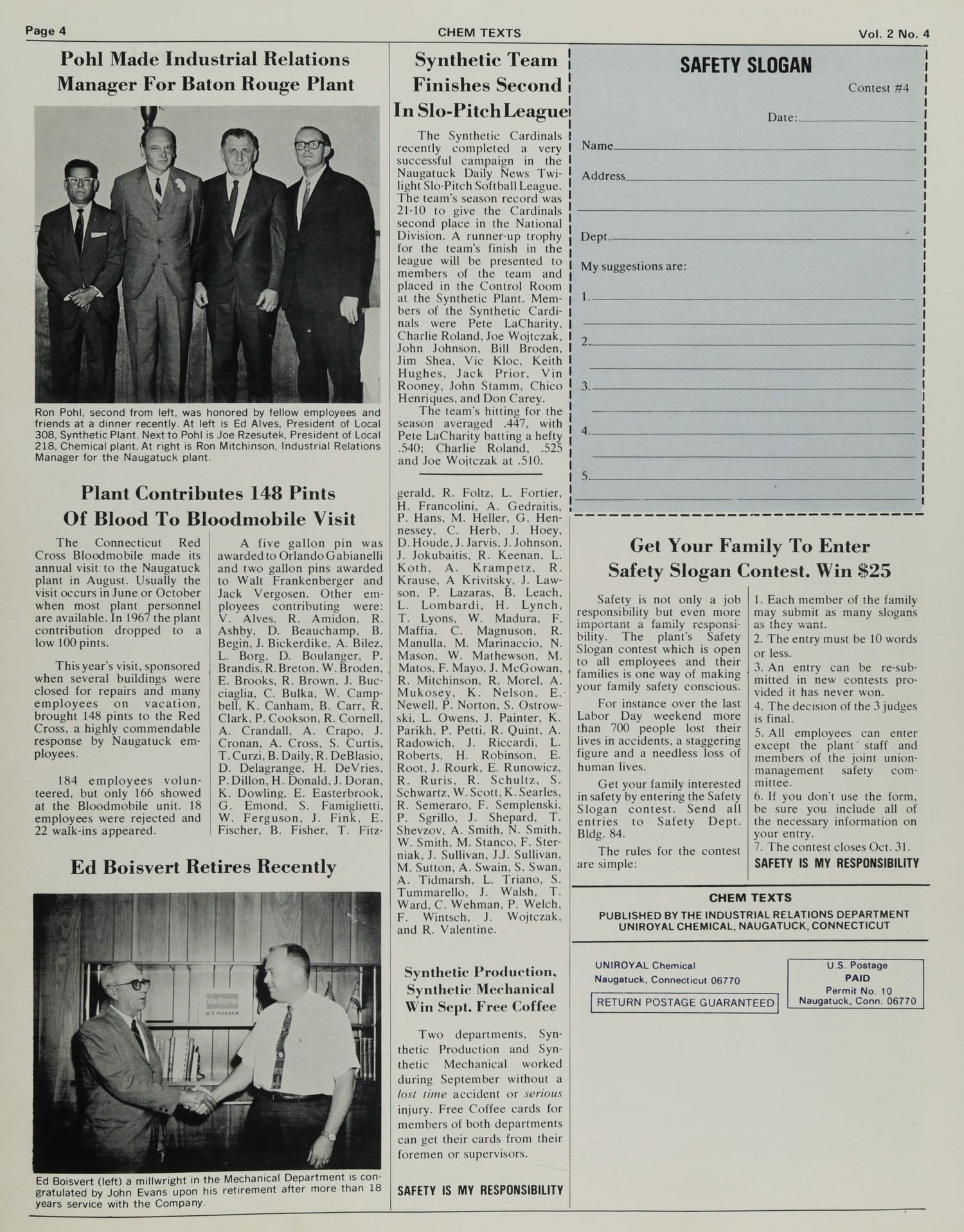
Pohl Made Industrial Relations Manager For Baton Rouge Plant

[PHOTO: Group of four men in suits]

Ron Pohl, second from left, was honored by fellow employees and friends at a dinner recently. At left is Ed Alves, President of Local 308, Synthetic Plant. Next to Pohl is Joe Rzesutek, President of Local 218, Chemical plant. At right is Ron Mitchinson, Industrial Relations Manager for the Naugatuck plant.


Plant Contributes 148 Pints Of Blood To Bloodmobile Visit

The Connecticut Red Cross Bloodmobile made its annual visit to the Naugatuck plant in August. Usually the visit occurs in June or October when most plant personnel are available. In 1967 the plant contribution dropped to a low 100 pints.

This year’s visit, sponsored when several buildings were closed for repairs and many employees on vacation, brought 148 pints to the Red Cross, a highly commendable response by Naugatuck employees.

184 employees volunteered, but only 166 showed at the Bloodmobile unit. 18 employees were rejected and 22 walk-ins appeared.

A five gallon pin was awarded to Orlando Gabianelli and two gallon pins awarded to Walt Frankenberger and Jack Vergosen. Other employees contributing were: V. Alves, R. Amidon, R. Ashby, D. Beauchamp, B. Begin, J. Bickerdike, A. Bilez, L. Borg, D. Boulanger, P. Brandis, R. Breton, W. Broden, E. Brooks, R. Brown, J. Bucciaglia, C. Bulka, W. Campbell, K. Canham, B. Carr, R. Clark, P. Cookson, R. Cornell, A. Crandall, A. Crapo, J. Cronan, A. Cross, S. Curtis, T. Curzi, B. Daily, R. DeBlasio, D. Delagrange, H. DeVries, P. Dillon, H. Donald, J. Doran, K. Dowling, E. Easterbrook, G. Emond, S. Famiglietti, W. Ferguson, J. Fink, E. Fischer, B. Fisher, T. Fitzgerald, R. Foltz, L. Fortier, H. Francolini, A. Gedraitis, P. Hans, M. Heller, G. Hennessey, C. Herb, J. Hoey, D. Houde, J. Jarvis, J. Johnson, J. Jokubaitis, R. Keenan, L. Koth, A. Krampetz, R. Krause, A. Krivitsky, J. Lawson, P. Lazaras, B. Leach, L. Lombardi, H. Lynch, T. Lyons, W. Madura, F. Maffia, C. Magnuson, R. Manulla, M. Marmaccio, N. Mason, W. Mathewson, M. Matos, F. Mayo, J. McGowan, R. Mitchinson, R. Morel, A. Mukosey, K. Nelson, E. Newell, P. Norton, S. Ostrowski, L. Owens, J. Painter, K. Parikh, P. Petti, R. Quint, A. Radowich, J. Riccardi, L. Roberts, H. Robinson, E. Root, J. Rourk, E. Runowicz, R. Ruris, R. Schultz, S. Schwartz, W. Scott, K. Searles, R. Semeraro, F. Semplenski, P. Sgrillo, J. Shepard, T. Shevzov, A. Smith, N. Smith, W. Smith, M. Stanco, F. Sterniak, J. Sullivan, J.J. Sullivan, M. Sutton, A. Swaan, S. Swan, A. Tidmarsh, L. Triano, S. Tummarello, J. Walsh, T. Ward, C. Wehman, P. Welch, F. Wintsch, J. Wojtczak, and R. Valentine.


Ed Boisvert Retires Recently

[PHOTO: Two men shaking hands]

Ed Boisvert (left) a millwright in the Mechanical Department is congratulated by John Evans upon his retirement after more than 18 years service with the Company.


Synthetic Team Finishes Second In Slo-Pitch League

The Synthetic Cardinals recently completed a very successful campaign in the Naugatuck Daily News Twilight Slo-Pitch Softball League. The team’s season record was 21-10 to give the Cardinals second place in the National Division. A runner-up trophy for the team’s finish in the league will be presented to members of the team and placed in the Control Room at the Synthetic Plant. Members of the Synthetic Cardinals were Pete LaCharity, Charlie Roland, Joe Wojtczak, John Johnson, Bill Broden, Jim Shea, Vic Kloc, Keith Hughes, Jack Prior, Vin Rooney, John Stamm, Chico Henriques, and Don Carey.

The team’s hitting for the season averaged .447, with Pete LaCharity batting a hefty .540; Charlie Roland, .525 and Joe Wojtczak at .510.


Synthetic Production, Synthetic Mechanical Win Sept. Free Coffee

Two departments, Synthetic Production and Synthetic Mechanical worked during September without a lost time accident or serious injury. Free Coffee cards for members of both departments can get their cards from their foremen or supervisors.

SAFETY IS MY RESPONSIBILITY


SAFETY SLOGAN

Contest #4

Date:___

Name___

Address___


Dept.___

My suggestions are:

1.___


2.___


3.___


4.___


5.___


Get Your Family To Enter Safety Slogan Contest. Win $25

Safety is not only a job responsibility but even more important a family responsibility. The plant’s Safety Slogan contest which is open to all employees and their families is one way of making your family safety conscious.

For instance over the last Labor Day weekend more than 700 people lost their lives in accidents, a staggering figure and a needless loss of human lives.

Get your family interested in safety by entering the Safety Slogan contest. Send all entries to Safety Dept. Bldg. 84.

The rules for the contest are simple:

  1. Each member of the family may submit as many slogans as they want.
  2. The entry must be 10 words or less.
  3. An entry can be re-submitted in new contests provided it has never won.
  4. The decision of the 3 judges is final.
  5. All employees can enter except the plant staff and members of the joint union-management safety committee.
  6. If you don’t use the form, be sure you include all of the necessary information on your entry.
  7. The contest closes Oct. 31.

SAFETY IS MY RESPONSIBILITY


CHEM TEXTS

PUBLISHED BY THE INDUSTRIAL RELATIONS DEPARTMENT
UNIROYAL CHEMICAL, NAUGATUCK, CONNECTICUT

| UNIROYAL Chemical | U.S. Postage |
| Naugatuck, Connecticut 06770 | PAID |
| | Permit No. 10 |
| RETURN POSTAGE GUARANTEED | Naugatuck, Conn. 06770 |

CHEM-TEXTS – Vol. 2, No. 5 – Page 1

Page 001

UNIROYAL

CHEM-TEXTS

Vol. 2 PUBLISHED FOR THE PEOPLE OF UNIROYAL CHEMICAL No. 5


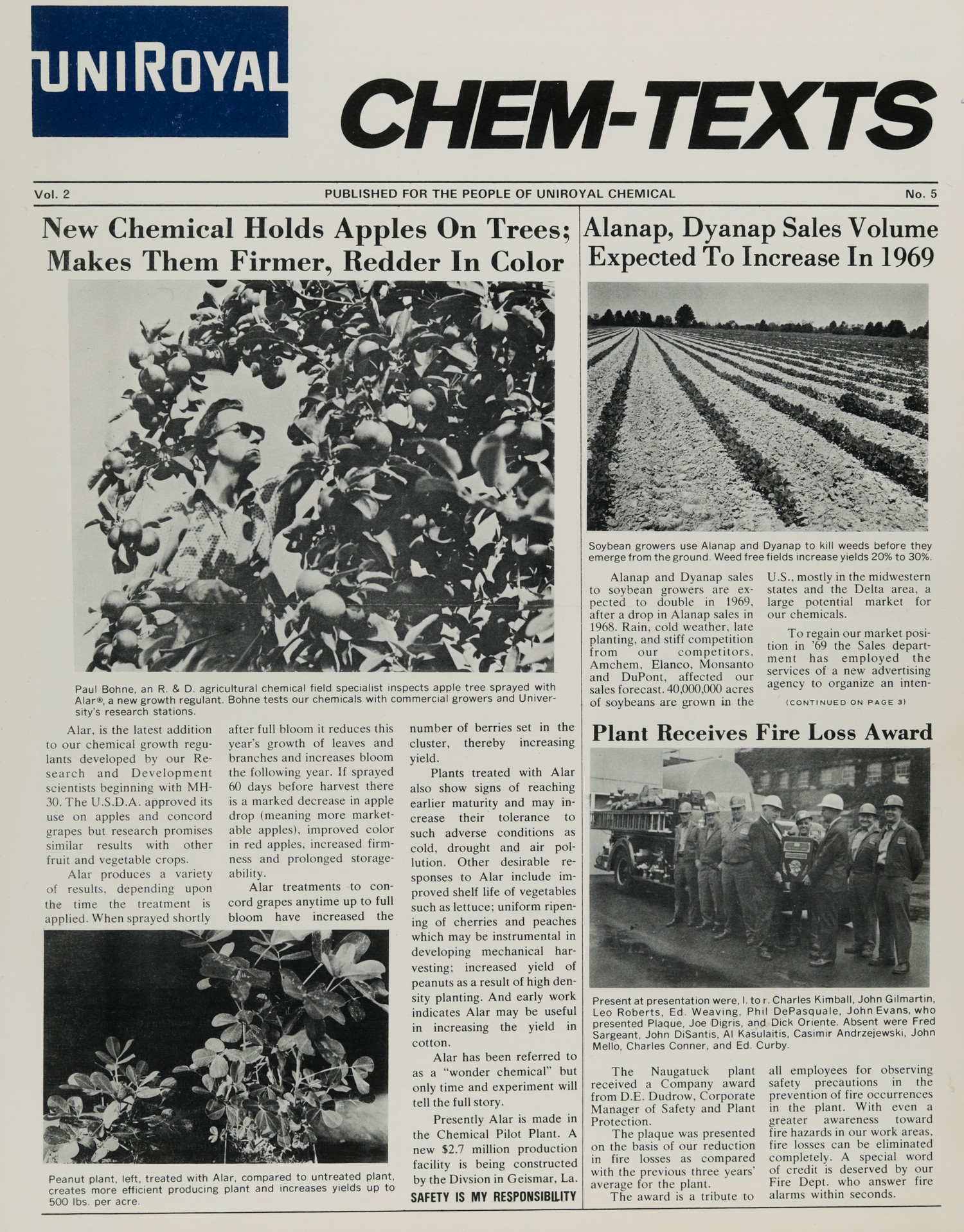
New Chemical Holds Apples On Trees; Makes Them Firmer, Redder In Color

[IMAGE: Paul Bohne, an R. & D. agricultural chemical field specialist inspects apple tree sprayed with Alar®, a new growth regulant. Bohne tests our chemicals with commercial growers and University’s research stations.]

Alar, is the latest addition to our chemical growth regulants developed by our Research and Development scientists beginning with MH-30. The U.S.D.A. approved its use on apples and concord grapes but research promises similar results with other fruit and vegetable crops.

Alar produces a variety of results, depending upon the time the treatment is applied. When sprayed shortly after full bloom it reduces this year’s growth of leaves and branches and increases bloom the following year. If sprayed 60 days before harvest there is a marked decrease in apple drop (meaning more marketable apples), improved color in red apples, increased firmness and prolonged storageability.

Alar treatments to concord grapes anytime up to full bloom have increased the number of berries set in the cluster, thereby increasing yield.

Plants treated with Alar also show signs of reaching earlier maturity and may increase their tolerance to such adverse conditions as cold, drought and air pollution. Other desirable responses to Alar include improved shelf life of vegetables such as lettuce; uniform ripening of cherries and peaches which may be instrumental in developing mechanical harvesting; increased yield of peanuts as a result of high density planting. And early work indicates Alar may be useful in increasing the yield in cotton.

Alar has been referred to as a “wonder chemical” but only time and experiment will tell the full story.

Presently Alar is made in the Chemical Pilot Plant. A new $2.7 million production facility is being constructed by the Divsion in Geismar, La.

SAFETY IS MY RESPONSIBILITY

[IMAGE: Peanut plant, left, treated with Alar, compared to untreated plant, creates more efficient producing plant and increases yields up to 500 lbs. per acre.]


Alanap, Dyanap Sales Volume Expected To Increase In 1969

[IMAGE: Soybean growers use Alanap and Dyanap to kill weeds before they emerge from the ground. Weed free fields increase yields 20% to 30%.]

Alanap and Dyanap sales to soybean growers are expected to double in 1969, after a drop in Alanap sales in 1968. Rain, cold weather, late planting, and stiff competition from our competitors, Amchem, Elanco, Monsanto and DuPont, affected our sales forecast. 40,000,000 acres of soybeans are grown in the U.S., mostly in the midwestern states and the Delta area, a large potential market for our chemicals.

To regain our market position in ’69 the Sales department has employed the services of a new advertising agency to organize an inten-

(CONTINUED ON PAGE 3)


Plant Receives Fire Loss Award

[IMAGE: Present at presentation were, l. to r. Charles Kimball, John Gilmartin, Leo Roberts, Ed. Weaving, Phil DePasquale, John Evans, who presented Plaque, Joe Digris, and Dick Oriente. Absent were Fred Sargeant, John DiSantis, Al Kaslutas, Casimir Andrzejewski, John Mello, Charles Conner, and Ed. Curby.]

The Naugatuck plant received a Company award from D.E. Dudrow, Corporate Manager of Safety and Plant Protection.

The plaque was presented on the basis of our reduction in fire losses as compared with the previous three years’ average for the plant.

The award is a tribute to all employees for observing safety precautions in the prevention of fire occurrences in the plant. With even a greater awareness toward fire hazards in our work areas, fire losses can be eliminated completely. A special word of credit is deserved by our Fire Dept. who answer fire alarms within seconds.

CHEM-TEXTS – Vol. 2 No. 5 – Page 2

Page 002

Page 2 CHEM TEXTS Vol. 2 No. 5


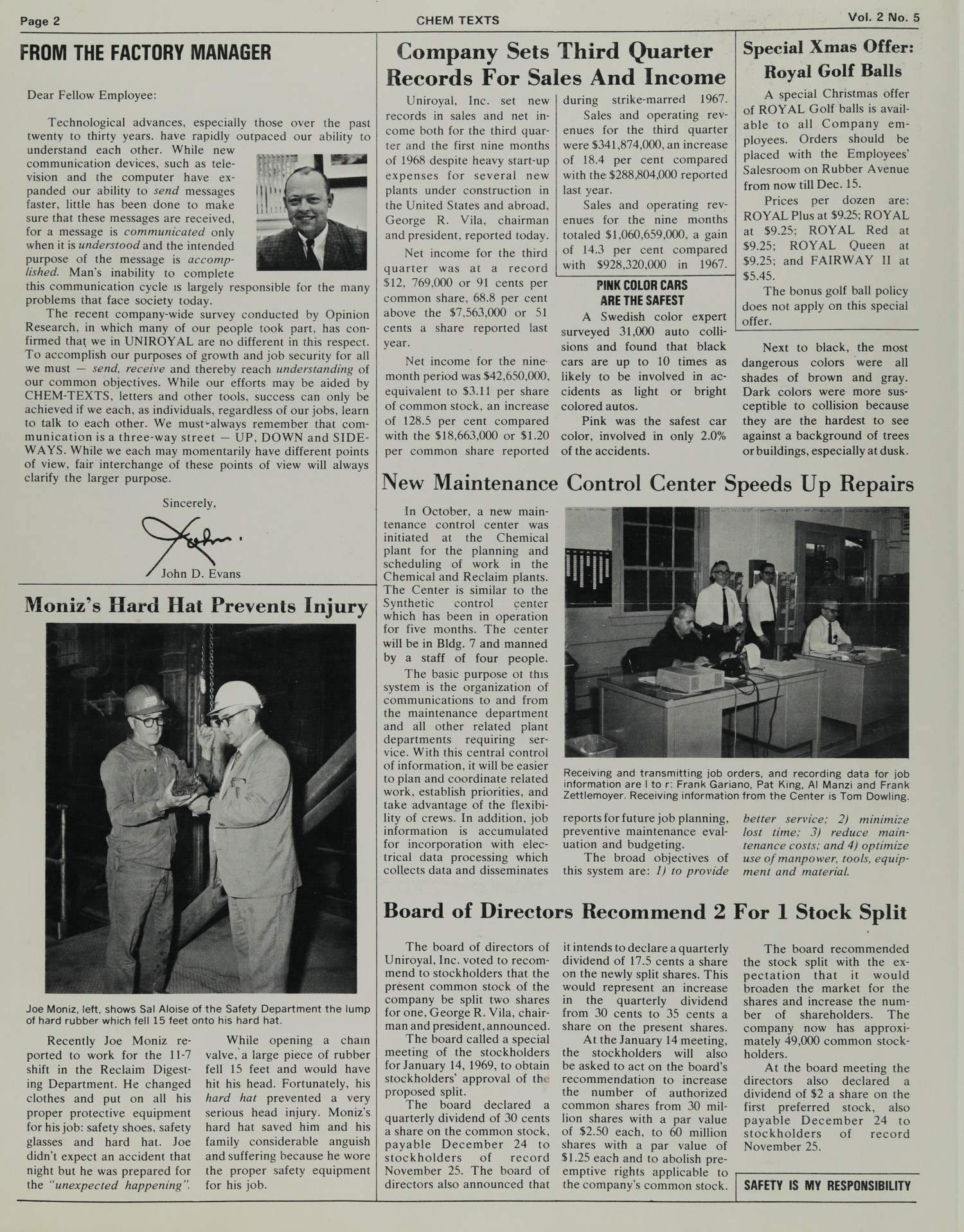
FROM THE FACTORY MANAGER

Dear Fellow Employee:

Technological advances, especially those over the past twenty to thirty years, have rapidly outpaced our ability to understand each other. While new communication devices, such as television and the computer have expanded our ability to send messages faster, little has been done to make sure that these messages are received, for a message is communicated only when it is understood and the intended purpose of the message is accomplished. Man’s inability to complete this communication cycle is largely responsible for the many problems that face society today.

The recent company-wide survey conducted by Opinion Research, in which many of our people took part, has confirmed that we in UNIROYAL are no different in this respect. To accomplish our purposes of growth and job security for all we must — send, receive and thereby reach understanding of our common objectives. While our efforts may be aided by CHEM-TEXTS, letters and other tools, success can only be achieved if we each, as individuals, regardless of our jobs, learn to talk to each other. We must-always remember that communication is a three-way street — UP, DOWN and SIDE-WAYS. While we each may momentarily have different points of view, fair interchange of these points of view will always clarify the larger purpose.

Sincerely,

John D. Evans


Moniz’s Hard Hat Prevents Injury

[IMAGE: Photo of Joe Moniz showing hard hat to Sal Aloise]

Joe Moniz, left, shows Sal Aloise of the Safety Department the lump of hard rubber which fell 15 feet onto his hard hat.

Recently Joe Moniz reported to work for the 11-7 shift in the Reclaim Digesting Department. He changed clothes and put on all his proper protective equipment for his job: safety shoes, safety glasses and hard hat. Joe didn’t expect an accident that night but he was prepared for the “unexpected happening”.

While opening a chain valve, a large piece of rubber fell 15 feet and would have hit his head. Fortunately, his hard hat prevented a very serious head injury. Moniz’s hard hat saved him and his family considerable anguish and suffering because he wore the proper safety equipment for his job.


Company Sets Third Quarter Records For Sales And Income

Uniroyal, Inc. set new records in sales and net income both for the third quarter and the first nine months of 1968 despite heavy start-up expenses for several new plants under construction in the United States and abroad, George R. Vila, chairman and president, reported today.

Net income for the third quarter was at a record $12, 769,000 or 91 cents per common share, 68.8 per cent above the $7,563,000 or 51 cents a share reported last year.

Net income for the nine-month period was $42,650,000, equivalent to $3.11 per share of common stock, an increase of 128.5 per cent compared with the $18,663,000 or $1.20 per common share reported during strike-marred 1967.

Sales and operating revenues for the third quarter were $341,874,000, an increase of 18.4 per cent compared with the $288,804,000 reported last year.

Sales and operating revenues for the nine months totaled $1,060,659,000, a gain of 14.3 per cent compared with $928,320,000 in 1967.


PINK COLOR CARS ARE THE SAFEST

A Swedish color expert surveyed 31,000 auto collisions and found that black cars are up to 10 times as likely to be involved in accidents as light or bright colored autos.

Pink was the safest car color, involved in only 2.0% of the accidents.


Special Xmas Offer: Royal Golf Balls

A special Christmas offer of ROYAL Golf balls is available to all Company employees. Orders should be placed with the Employees’ Salesroom on Rubber Avenue from now till Dec. 15.

Prices per dozen are: ROYAL Plus at $9.25; ROYAL at $9.25; ROYAL Red at $9.25; ROYAL Queen at $9.25; and FAIRWAY II at $5.45.

The bonus golf ball policy does not apply on this special offer.

Next to black, the most dangerous colors were all shades of brown and gray. Dark colors were more susceptible to collision because they are the hardest to see against a background of trees or buildings, especially at dusk.


New Maintenance Control Center Speeds Up Repairs

In October, a new maintenance control center was initiated at the Chemical plant for the planning and scheduling of work in the Chemical and Reclaim plants. The Center is similar to the Synthetic control center which has been in operation for five months. The center will be in Bldg. 7 and manned by a staff of four people.

The basic purpose of this system is the organization of communications to and from the maintenance department and all other related plant departments requiring service. With this central control of information, it will be easier to plan and coordinate related work, establish priorities, and take advantage of the flexibility of crews. In addition, job information is accumulated for incorporation with electrical data processing which collects data and disseminates

[IMAGE: Photo of four men at control center]

Receiving and transmitting job orders, and recording data for job information are l to r: Frank Gariano, Pat King, Al Manzi and Frank Zettlemoyer. Receiving information from the Center is Tom Dowling.

reports for future job planning, preventive maintenance evaluation and budgeting.

The broad objectives of this system are: 1) to provide

better service; 2) minimize lost time; 3) reduce maintenance costs; and 4) optimize use of manpower, tools, equipment and material.


Board of Directors Recommend 2 For 1 Stock Split

The board of directors of Uniroyal, Inc. voted to recommend to stockholders that the present common stock of the company be split two shares for one, George R. Vila, chairman and president, announced.

The board called a special meeting of the stockholders for January 14, 1969, to obtain stockholders’ approval of the proposed split.

The board declared a quarterly dividend of 30 cents a share on the common stock, payable December 24 to stockholders of record November 25. The board of directors also announced that

it intends to declare a quarterly dividend of 17.5 cents a share on the newly split shares. This would represent an increase in the quarterly dividend from 30 cents to 35 cents a share on the present shares.

At the January 14 meeting, the stockholders will also be asked to act on the board’s recommendation to increase the number of authorized common shares from 30 million shares with a par value of $2.50 each, to 60 million shares with a par value of $1.25 each and to abolish preemptive rights applicable to the company’s common stock.

The board recommended the stock split with the expectation that it would broaden the market for the shares and increase the number of shareholders. The company now has approximately 49,000 common stockholders.

At the board meeting the directors also declared a dividend of $2 a share on the first preferred stock, also payable December 24 to stockholders of record November 25.


SAFETY IS MY RESPONSIBILITY

CHEM-TEXTS – Vol. 2 No. 5 – Page 3

Page 003

CHEM TEXTS

Page 3 | Vol. 2 No. 5


Harry Witt Heads Synthetic Production

Harry Witt has been named Synthetic Production Superintendent, effective Dec. 1. Ben Leach becomes Manager of Colloidal products in the Research and Development Dept.


How You Can Obtain A Pair Of Safety Prescription Glasses

Fred Mayo of the Process Development Lab. selects frames for safety prescription glasses from Adeline Farrar R.N., Chemical Hospital nurse.

The Naugatuck plant has a program which is operated by the Safety Department to enable all Chemical division employees to obtain prescription safety glasses at no cost to the employee, except for the examination and fitting fee.

The procedure is simple. An employee may go to either the Chemical or Synthetic hospital and obtain a prescription safety glass form from the nurse. He takes the form to his own eye doctor and has an examination. The employee pays for the cost of the examination and returns the completed form to the plant nurse. At this time he may also select the frame he prefers from samples in the hospital. The Company then sends the prescription to the Wilkie Optical Company and purchases the glasses.

Effective January 1, 1969, all prescription glasses will be returned to the doctor or optician of your choice for proper checking and fitting. In some cases an additional fitting charge may be made, depending upon the agreement you have made.

Here are other facts you should know: 1. You may buy an extra pair of glasses for yourself, if you wish and take advantage of our Company discount, provided the prescription is less than one year old. 2. You may also purchase prescription sun glasses at the same discount. 3. You may obtain a free pair of glasses whenever you require a new prescription. 4. Lenses or frames damaged as the result of an accident in the plant are replaced free of charge.


[PHOTO CAPTION:]
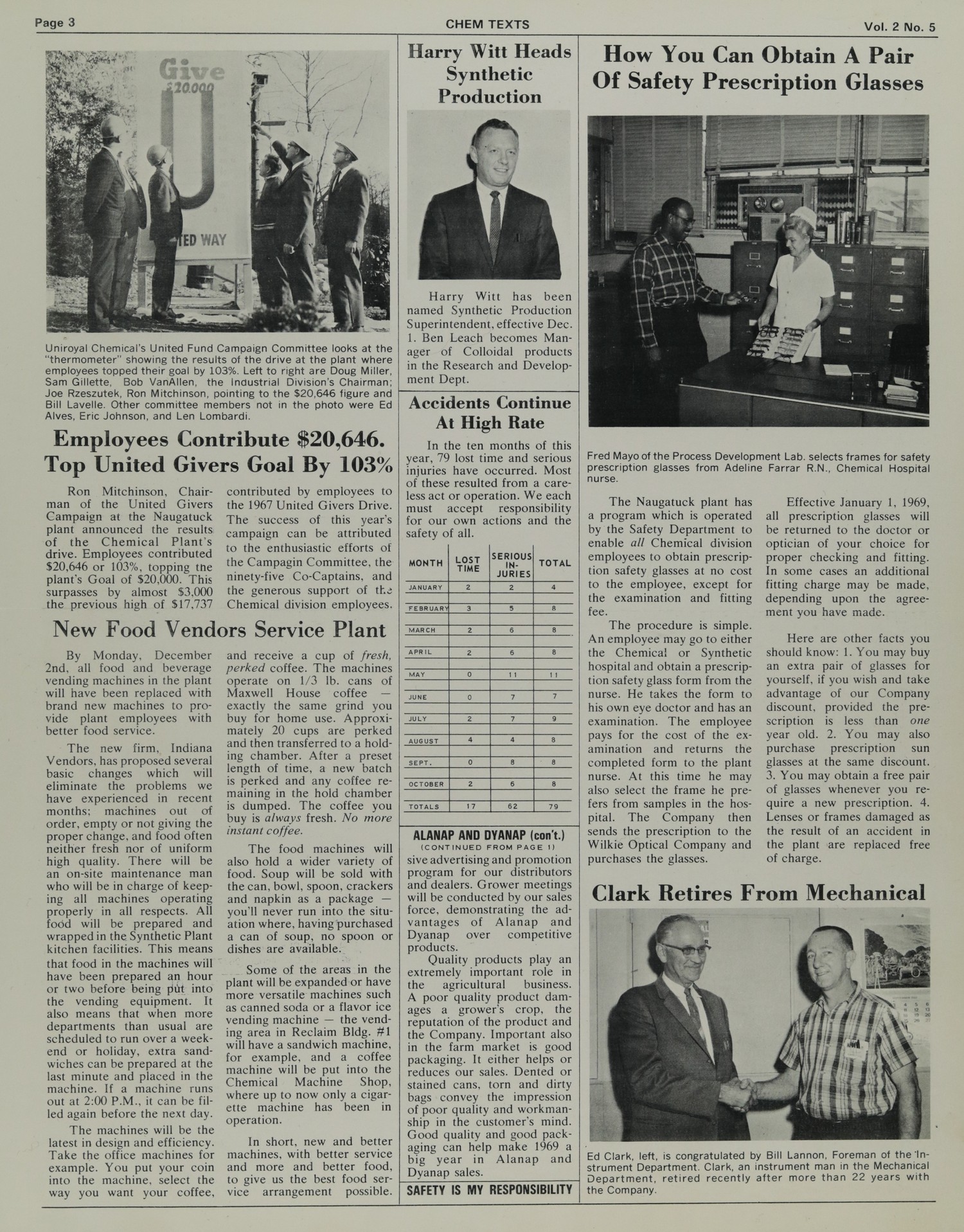
Uniroyal Chemical’s United Fund Campaign Committee looks at the “thermometer” showing the results of the drive at the plant where employees topped their goal by 103%. Left to right are Doug Miller, Sam Gillette, Bob VanAllen, the Industrial Division’s Chairman; Joe Kresziutek, Ron Mitchinson, pointing to the $20,646 figure and Bill Lavelle. Other committee members not in the photo were Ed Alves, Eric Johnson, and Len Lombardi.


Employees Contribute $20,646. Top United Givers Goal By 103%

Ron Mitchinson, Chairman of the United Givers Campaign at the Naugatuck plant announced the results of the Chemical Plant’s drive. Employees contributed $20,646 or 103%, topping the plant’s Goal of $20,000. This surpasses by almost $3,000 the previous high of $17,737 contributed by employees to the 1967 United Givers Drive. The success of this year’s campaign can be attributed to the enthusiastic efforts of the Campagin Committee, the ninety-five Co-Captains, and the generous support of the Chemical division employees.


Accidents Continue At High Rate

In the ten months of this year, 79 lost time and serious injuries have occurred. Most of these resulted from a careless act or operation. We each must accept responsibility for our own actions and the safety of all.

MONTH LOST TIME SERIOUS IN-JURIES TOTAL
JANUARY 2 2 4
FEBRUARY 3 5 8
MARCH 2 6 8
APRIL 2 6 8
MAY 0 11 11
JUNE 0 7 7
JULY 2 7 9
AUGUST 4 4 8
SEPT. 0 8 8
OCTOBER 2 6 8
TOTALS 17 62 79

New Food Vendors Service Plant

By Monday, December 2nd, all food and beverage vending machines in the plant will have been replaced with brand new machines to provide plant employees with better food service.

The new firm, Indiana Vendors, has proposed several basic changes which will eliminate the problems we have experienced in recent months; machines out of order, empty or not giving the proper change, and food often neither fresh nor of uniform high quality. There will be an on-site maintenance man who will be in charge of keeping all machines operating properly in all respects. All food will be prepared and wrapped in the Synthetic Plant kitchen facilities. This means that food in the machines will have been prepared an hour or two before being put into the vending equipment. It also means that when more departments than usual are scheduled to run over a weekend or holiday, extra sandwiches can be prepared at the last minute and placed in the machine. If a machine runs out at 2:00 P.M., it can be filled again before the next day.

The machines will be the latest in design and efficiency. Take the office machines for example. You put your coin into the machine, select the way you want your coffee, and receive a cup of fresh, perked coffee. The machines operate on 1/3 lb. cans of Maxwell House coffee — exactly the same grind you buy for home use. Approximately 20 cups are perked and then transferred to a holding chamber. After a preset length of time, a new batch is perked and any coffee remaining in the hold chamber is dumped. The coffee you buy is always fresh. No more instant coffee.

The food machines will also hold a wider variety of food. Soup will be sold with the can, bowl, spoon, crackers and napkin as a package — you’ll never run into the situation where, having purchased a can of soup, no spoon or dishes are available.

Some of the areas in the plant will be expanded or have more versatile machines such as canned soda or a flavor ice vending machine — the vending area in Reclaim Bldg. #1 will have a sandwich machine, for example, and a coffee machine will be put into the Chemical Machine Shop, where up to now only a cigarette machine has been in operation.

In short, new and better machines, with better service and more and better food, to give us the best food service arrangement possible.


ALANAP AND DYANAP (con’t.)

(CONTINUED FROM PAGE 1)

sive advertising and promotion program for our distributors and dealers. Grower meetings will be conducted by our sales force, demonstrating the advantages of Alanap and Dyanap over competitive products.

Quality products play an extremely important role in the agricultural business. A poor quality product damages a grower’s crop, the reputation of the product and the Company. Important also in the farm market is good packaging. It either helps or reduces our sales. Dented or stained cans, torn and dirty bags convey the impression of poor quality and workmanship in the customer’s mind. Good quality and good packaging can help make 1969 a big year in Alanap and Dyanap sales.

SAFETY IS MY RESPONSIBILITY


Clark Retires From Mechanical

Ed Clark, left, is congratulated by Bill Lannon, Foreman of the Instrument Department. Clark, an instrument man in the Mechanical Department, retired recently after more than 22 years with the Company.

CHEM-TEXTS – Vol. 2 No. 5 – Page 4

Page 004

Page 4 | CHEM TEXTS | Vol. 2 No. 5


Employees Receive $1,453. In Awards For Recent Suggestions

Dom Persutti Submits Nine Suggestion Winners

Eighty-two suggestions received cash awards or honorable mentions in the last three months, amounting to a total of $1,453.00.

The highest award of $170.00 went to L. Schiller; with F. Raymond receiving $100.00; and K. Anderson and K. Nelson splitting another $100.00 award for their suggestion.

D. Persutti was the top idea man submitting 9 suggestions, receiving $75.00 in awards and 4 honorable mentions. J. Sullivan and W. Campbell each submitted 4 suggestions and were awarded $45.00 and 1 honorable mention for their ideas.

Other employees who received high awards for their suggestions were J. DiSantis, $53.00; W. Adamski, $50.00 and Mary Marques, $30.00.

$25.00 awards went to W. Breton, F. Henriques, D. Bedard, F. Chiodo, A. Calder, E. Root, E. Bazenas, and A. Patskan.

$15.00 awards were given to R. Shipman, F. Carriero, G. Ravenscroft (3 awards), R. Harrison, C. Iannuzzi (3 awards), W. Fruin, S. Molnar, J. Grosso, T. Lee, T. Turner, A. Gedraitis, F. Commendatore, D. Pratt (2 awards), B. Torrey, J. Dayner, L. Fortier, W. Stenson, A. Civitello, L. Raskauskas, A. Kazemekas, F. Sordi, E. Root, C. Miele, F. Surmanck, F. Bendler (2 awards), R. Ruginis, J. Mahoney, E. Bazenas, E. Johnson, G. Monahan, B. Pranulis, R. Harrison, J. Hoey, and A. Silva.


[PHOTO CAPTION]
Lou Schiller of R. & D. received $170.00 for his suggestion that Teflon bearings be used on Mooney machines to reduce costs.


[PHOTO CAPTION]
Ken Anderson, left, and Ken Nelson of the Synthetic Mechanical Dept. received $50. each for suggesting that the hydraulic jet pump’s speed be reduced by one-third to reduce maintenance costs.


[PHOTO CAPTION]
George Ravenscroft who works in the Instrument Dept. was awarded $30.00 for a safety and maintenance suggestion.


[PHOTO CAPTION]
Ed Bazenas of the Mechanical Dept. received two awards for suggestions on equipment improvement in Bldgs. 80 and 109.


Honorable Mentions were received by L. Bissonnette, J. Grosso (2), J. Ferguson, C. Iannuzzi, J. Rek, D. Donato, E. Rott (2), L. Anderson, E. Bazenas, P. Masone, W. Fruin and G. Monahan.

Any employee can participate in the Company — wide Suggestion System plan. The suggestion should be original and represent thinking beyond that expected on the job.

Your ideas can cover such areas as new or better products, improved quality, better packaging, savings of production time, better working conditions, safety conditions, scrap reductions, material savings, simplified working procedures, and many other possibilities.

Suggestion System forms are located conveniently throughout the plant.

SAFETY IS MY RESPONSIBILITY


SAFETY SLOGAN

Contest #5

Date:___

Name ___________

Address _________


Dept.____________

My suggestions are:

1._________


2._________


3._________


4._________


5._________


Ray Pekock Wins $25. For Safety Slogan: Contest Open To All Members Of Family

“Safety First, Make It Last” was the winning safety slogan submitted by Ray Pekock. Other employees entering the contest with interesting slogans were Lynda Harris, Marjorie Lasky, James Hartnett, who won the contest previously, Lynda Nappiello, Cynthia Haggerty, Bill Schmelke, another contest winner, Richard Fratangelo, Tom Basile, and Barbara Gabriel.

More and more interest has grown in the contest with more than a 100 safety slogans submitted. Many of the slogans have come from members of employees’ families. Any member of an employee’s family is eligible to win the $25. award.

The rules for the contest are simple. All slogans should be sent to the Safety Dept., Bldg. 84 where they will be judged by three members of the plant’s Safety Committee.

  1. Each member of the family may submit as many slogans as they want.
  2. The entry must be 10 words or less.
  3. An entry can be re-submitted in new contests provided it has never won.
  4. The decision of the 3 judges is final.
  5. All employees can enter except the plant staff and members of the joint union-management safety committee.
  6. If you don’t use the form, be sure you include all of the necessary information on your entry.
  7. The contest closes Dec. 20.

CHEM TEXTS

PUBLISHED BY THE INDUSTRIAL RELATIONS DEPARTMENT
UNIROYAL CHEMICAL, NAUGATUCK, CONNECTICUT

UNIROYAL Chemical
Naugatuck, Connecticut 06770

RETURN POSTAGE GUARANTEED

U.S. Postage
PAID
Permit No. 10
Naugatuck, Conn. 06770

CHEM-TEXTS – Vol. 2, No. 6 – Page 1

Page 001

UNIROYAL

Merry Christmas – Happy New Year

CHEM-TEXTS

Vol. 2 PUBLISHED FOR THE PEOPLE OF UNIROYAL CHEMICAL No. 6


Good Packaging Keeps Customers; Helps Sales

[IMAGE: Two Campbell’s Tomato Soup cans – one dented, one in perfect condition]

WHICH ONE WOULD YOU BUY?

[IMAGE: Two damaged/dented cans]

As the customer you would naturally pass up the dented cans on the left and select the neat looking cans on the right.

As a customer you make the decision when selecting a product to purchase for yourself. Surely you would have no difficulty deciding which one of these packages you would buy.

The people who buy our products are just like us. We may or may not be impressed by what a salesman or an advertisement claims the product will do . . . but our decision to buy or not to buy the product is definitely influenced by how the product looks.

Now, suppose for a moment that you are our customer, and that you are going to purchase products from the Naugatuck plant of Uniroyal Chemical. What kind

of packages would you expect to receive? As the customer you would certainly expect the best.

As our customer what kind of cans or packages would you accept?

The important role that the customer plays in our business is expressed in These Ten Commandments of Good Business.

  1. A Customer is the most important person in any business.
  2. A Customer is not dependent on us – we are dependent on him.
  3. A Customer is not an interruption of our work – he is the purpose of it.
  4. A Customer does us a

(Continued on Page 3)


New Front To Building 84 Progresses: Plant Protection And New Reception Room To Be Located In Building

[IMAGE: Architect’s rendering showing new front to building and location of the two turnstiles]

Architect’s rendering shows new front to building and location of the two turnstiles.

Construction is well underway on the new addition to Building 84 scheduled for completion early in 1969.

The guard station now located in Building 75 will be moved to this building becoming the control center for the television monitor and intercom systems for the other plant entrances, as well as for the telephone relays and fire alarm systems. A guard will be on duty at the Main gate on a 24-hour a day basis to monitor all vehicle and pedestrian traffic and to check visitors entering the plant.

The building will be constructed to permit maximum visibility by the guard of both

traffic entering the plant and passing under the railroad underpass.

A new, enlarged reception room is also included in the new addition as a visitors’ waiting room. Visitors will contact plant employees from the reception room and will be escorted into the plant by the employee.

Two turnstiles will be located at the Main gate. To enter the plant, an employee will insert a “magnetized pass” for the turnstile to operate and allow him to enter. To reduce congestion

during shift changes, the second turnstile will operate in the “exit” direction only. Other turnstiles will be located at the Tire gate and Synthetic plant entrances.

The new passes will be issued to all employees when the turnstiles are installed. Should an employee forget his pass, he will have to contact the watchman and prove his identification before admittance into the plant.

Karl Pittner of the Engineering department is the project engineer for the new addition.


Equal Opportunity A Uniroyal Policy

This statement by G.R. Vila, Chairman and President of Uniroyal, affirms one of Uniroyal’s basic policies on Equal Opportunity. “We believe in equality of opportunity for all people and will not discriminate because of race, religion, color, age, sex, national origin or ancestry. The next Chem-Texts will print the full text of Uniroyal’s policy.

[IMAGE: Drawing shows how new front connects with present Building 84]

Drawing shows how new front connects with present Building 84.

CHEM-TEXTS – Vol. 2 No. 6 – Page 2

Page 002

CHEM-TEXTS

Page 2 | Vol. 2 No. 6


FROM THE FACTORY MANAGER

Dear Fellow Employee:

Again the joys of the holiday season are upon us renewing the eternal promise of peace and goodwill among all men. A constant promise to a changing world — a world that must change if it is to fulfill that promise.

As we pause to reflect upon our accomplishments of the past year, let us face the challenges of the new year with resolution. A resolve that we will each strive for creative change with the goal of better understanding one another as well as our common purpose.

Please accept my most sincere wishes for you and your family; a Most Joyous Christmas and the Best of Health and Happiness throughout the New Year.

John D. Evans


Uniroyal Will Match Your Donation To A College

Today more than ever, colleges and universities need money to build more classrooms, libraries, laboratories and other facilities along with improving and increasing their teaching staffs.

As the demands for a college education continues to grow colleges and universities will need greater help than ever before to not only improve but expand their facilities to meet these demands. This help will have to come from companies, foundations and individual donations, or else many deserving students will be turned away for lack of space.

To encourage our donations for education Uniroyal will match our contribution of more than $25.00 to a college or university. This program applies to active employees on regular, full-time jobs or on authorized leave of absence from such job after they have completed a year of service. The maximum total which the Company will match is $1,000 a year per employee.

Uniroyal will match only gifts made directly to the school or to an agency of the school, such as an alumni fund, which turns over all donations to the school. The college or university must grant degrees and be accredited or actively seeking such accreditation.

Application forms for the “Employee Matching Gift” program may be obtained from the Industrial Relations. department.

The matching of contributions will be made only after the Uniroyal “Employee Matching Gift” application forms have been filled out by the employee; approved and signed by the financial officer of the educational institution and returned to the Uniroyal Foundation.


25 YEAR CLUB HOLDS ANNUAL DINNER: MONAHAN RECEIVES 50 YEAR SERVICE AWARD

[PHOTO: Group photo of men in suits]

New members who received their 25 Year Service Awards.

The Uniroyal Chemical 25 Year Club held its 19th Annual Dinner in November at the Waverly Inn. The Club is an association of Chemical division employees who have been regularly credited with 25 or more years of service with the Company.

Eligibility for membership and for service awards is recognized at the annual dinner for employees who expect to achieve such eligibility during the calendar year. Total membership in the Club at present is 534.

Committee members for this year’s program were Bert Scullin, president, Everett Anderson, Tom Dowling, Pat King, Joe Little, Larry Monroe, Alice Schofield and Ed Weaving.

Special recognition went to J. Monahan who received a 50 year service award.

Advanced to the 45 Year group were L. Carroll, L. Monroe, C. Swanson, and L. Volpe.

40 Year awards went to J. Bickerdike, D. Fowler, S. Gesseck, F. Janus, M. Karbowicz, P. King, F. Magnamo and G. Siequist.

35 Year awards were received by E. Anderson, W. Birdsall, M. Chmielewski, T. Doran, E. Gabriel, A. Giancarlo, A. Henriques, J. Kolakowski, E. Lewonski, P. Machnics, F. Marinello, M. Perkins, J.C. Ranney, G. Reale, N. Salinardi, E. Saunders, W. Scranton, M. Smerekanych, B. Smey, P. Suba, M. Sullivan and E. Valentine.

Receiving 30 Year awards were G. Baktis, A. Brazicki, I. Fonseca, M. Heller, M. Jannetty, P. Paul, J. Rek, S. Slawski, and E. Svendsen.

New members with 25 Years service were F. Adams, R. Barnhart, C. Bawn, R. Bell, L. Borzencki, L. Bruce, A. Christensen, H. Crabtree, J. Cravo, R. Crotty, G. Dennis, H. Drummer, I. Engle, W. Fairclough, E. Fischer, B. Fisher Jr., F. Haase, W. Hill Jr., W. Hilton, J. Kawecki, G. Kuhn, M. Marrello, J. Maye, P. McPhail, C. Miele, J. Napp, C. Nelson, L. Nicely, R. Noury, A. Olson, J. Pereira, F. Rinaldi, H. Royle, R. Santarsiere, M. Sgrillo, T. Shilinskas, W. Swick, L. Triano, W. Wasulis, W.W. White, M. Wilson and F. Zettlemoyer.


2 Lost Time; 3 Serious Injuries Occur During Month Of November

In November, 2 lost time injuries occurred in Chemical Production. An operator lost control of a full 55 gal. drum while taking it off a pallet. He suffered severe bruises and abrasions of the lower leg, resulting in 5 lost-time days.

The second injury involved an operator who suffered 2nd. degree burns to his right foot, and is expected to be out for one month.

By developing an attitude of safety, being constantly aware of the unexpected happening, and wearing the proper protective equipment for the job, accidents can be eliminated. A few months ago we worked 1,000,000 manhours without a lost time injury. There’s no reason we can’t reach that mark again.


How To Take Care Of An Expensive Camera

Let’s say you own an expensive stereo movie camera. Let’s say it’s really a rare model, capable of taking action shots in 3D and color under conditions of available light.

Would you ever think of dropping it on the sidewalk? Would you tap its’ twin lenses with a hammer? Throw acid on the lenses? Throw pieces of metal at them? Of course not . . . rather you’d take excellent care of such equipment.

If, however, the camera became damaged beyond repair, the loss wouldn’t be tragic and final. You would probably purchase a new camera to replace it.

But you couldn’t buy a replacement for “your personal camera” — the one you carry around with you all day long. Yes, your eyes are “your personal, stereo camera, and no one has perfected substitute eyes that can see and take their place.

The transparent cornea shielding each of your eyes is only a tiny fraction of an inch in thickness. Thus, additional protection is imperative in the presence of danger.

If you’re doing work that presents even a minor hazard to your eyes, find out from your foreman or supervisor what protection you need. Then . . . get it and wear it.

Protecting your eyes is a full time job, no matter in what activity you’re engaged. Don’t risk permanent damage to your priceless personal camera.

It’s the one camera that can’t be replaced.


Keep all medicines, including such common drugs as asprin, in a locked or inaccessible cabinet. Always turn the light on when giving or taking medicine.


Never put a poisonous or toxic substance in a container designed to contain food, such as milk bottles, soft drink bottles, or cereal boxes.

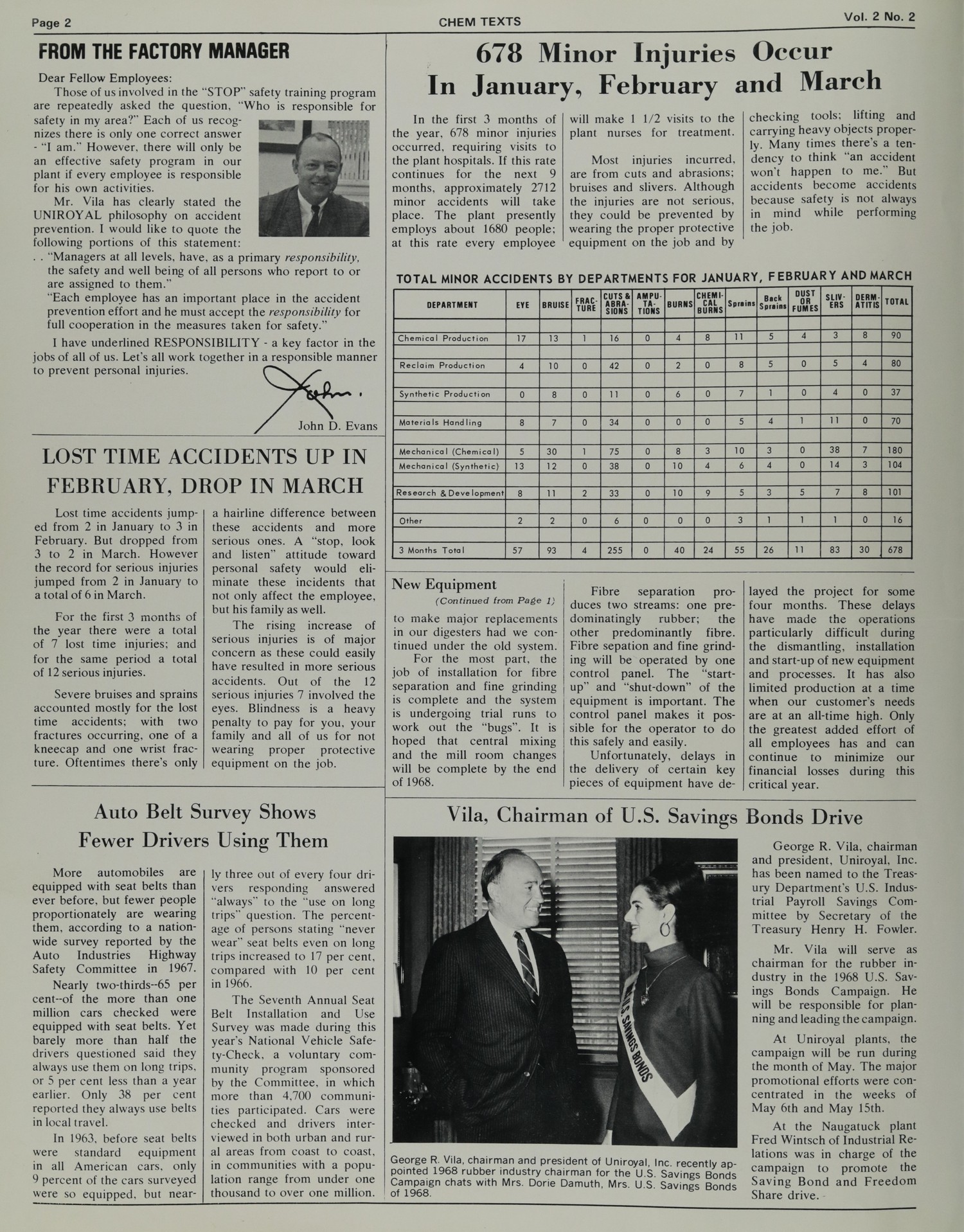
CHEM-TEXTS – Vol. 2 No. 6 – Page 3

Page 003

CHEM-TEXTS

Vol. 2 No. 6 Page 3


Good Packaging (Continued from Page 1)

[IMAGE: Box of “New! ADVANCED all” detergent]

[IMAGE: Packages of “THNX” products stacked]

YOU BE THE CUSTOMER . . . WHICH WOULD YOU BUY?

Packages on left are dirty and in poor condition. As the customer, you would buy the clean packages.

favor when he calls – we are not doing him a favor by serving him.

  1. A Customer is part of our business – not an outsider.
  2. A Customer is not a cold statistic – he is a flesh-and-blood human being with feelings and emotions like our own.
  3. A Customer is not someone to argue or match wits with.
  4. A Customer is a person who brings us his wants – it is our job to fill those wants.
  5. A Customer is deserving of the most courteous and attentive treatment we can give him.
  6. A Customer is the life blood of this and every other business.

Since the customer is the most important person in our business, each of us has the responsibility to provide them with the best in packaging, whether its our chemicals, rubber or latex products. Undented, clean-looking, and neat-stencilled packages will help us keep our customers satisfied and even improve our business.


Jim Kennedy Retires Recently

[IMAGE: Three men in suits, one shaking hands with another]

Ed Weaving, watches as Jim Kennedy, center, is congratulated by John Evans on his retirement. Kennedy, a member of the plant protection dept., had more than 28 year’s Company service. Jim is presently a member of the Naugatuck Police Commissioners.


Plant Sponsors H.S. Junior Achievement Company

Unifirm, received its official operating charter as a new “business firm” from John Evans. Francis Szezesiul, a sophomore at Naugatuck High School, was elected president of the Company.

The purpose of Junior Achievement is to give high school students a real opportunity to learn about business by running a business. Unifirm is an actual business enterprise, for real materials and real work produce a real product which is sold to customers to make a real profit.

Members learn the meaning of Capital – because they raise the money to operate the Company. They learn the meaning of Productivity because they see how poor production practices jeopardize their sales and profit.

Junior Achievement gives students an opportunity to obtain an accurate understanding of the basic economic factors of our business system.

The key word to understanding business is profit, a word which creates considerable misunderstanding about business. Without it, a business cannot survive. Its function is vital to the Company because part of it is paid to stockholders who invested in the Company and part reinvested in the Company to improve, expand and build new facilities.

Unifirm pays regular salaries to its officers and other personnel. It also pays taxes; keeps accounting records; carries insurance; pays dividends to stockholders if profits are made; and performs just about every business practice and procedure of a large corporation. Learning by doing teaches students the facts about business operations.

[IMAGE: Group of men reviewing documents at a table]

Reviewing plans with the president of Unifirm are plant advisors l. to r. Jack McGowan; Francis Szezesiul, president; Steve Schwartz and Kevin Kelley, who replaced Don Delagrange, recently drafted into the Armed Services.


Minor Injuries Can Become Serious: Report Them Immediately To Hospital

Some of us don’t usually think much of a small cut, scratch, blister or a bruise as an injury. If we get something in our eye, we don’t think it’s very important unless it hurts or really damages the eye.

The “little injuries” usually don’t worry us because they don’t take us off the job or put us into a hospital bed. They don’t, if we take the simple step of reporting the injury promptly for competent, first-aid treatment at the plant hospitals to prevent the “little injury” from turning into something serious.

This means all injuries, including cuts, scratches, strains and bruises. None of these may be serious in themselves, but because of neglect, any one of them may start something serious through infection.

Don’t gamble with good health and safety by trying to be your own first-aidman and deciding that because you don’t feel too bad, you don’t need any other treatment. This has actually happened in a number of cases in the plant with rather painful and unpleasant results.

Remember to report all injuries at once, even the “little ones” and get proper first-aid treatment from those qualified to give it. See the plant nurses right away during the day; or at night, contact the night supervisor.


NOVEMBER 1968 — ACCIDENTS IN DEPARTMENTS

DEPARTMENT EYE BRUISE FRAC-TURE CUTS & ABRA-SIONS AMPU-TA-TIONS BURNS CHEMI-CAL BURNS Sprains Back Sprains DUST OR FUMES SLIV-ERS DERM-ATITIS TOTAL
Chemical Production 3 4 0 5 0 2 1 4 1 0 3 2 25
Reclaim Production 1 1 0 7 0 1 1 1 1 0 0 1 14
Synthetic Production 1 0 0 2 0 0 2 1 0 0 1 0 7
Materials Handling 1 2 0 7 0 0 0 0 0 0 3 0 13
Mechanical (Chemical) 6 5 0 20 0 4 3 3 2 0 8 0 51
Mechanical (Synthetic) 1 3 0 8 0 2 0 4 0 0 3 1 22
Research — Development 2 4 0 8 0 2 2 3 0 2 4 2 29
Other 1 0 0 1 0 0 0 0 0 0 1 3
NOV. TOTAL 16 19 0 58 0 11 9 16 4 2 23 6 164
11 Month Average For 1968 22 30.5 .90 78 0 18 10 17 8.5 4 27 10 226
8 Full Month Average For 1967 28 42 1 90 .12 19 14 23 9 4 27 9 267

CHEM-TEXTS – Vol. 2 No. 6 – Page 4

Page 004

Page 4 | CHEM-TEXTS | Vol. 2 No. 6


G.E. Uses Kralastic® In Appliances For Quality

General Electric, one of the world’s leading manufacturers of appliances, selected our Kralastic ABS plastic for its new portable vacuum cleaner over competitive plastics for its special properties and quality. The new portable vacuum cleaner is lightweight, compact and easy to carry. The R & D department is presently working on an anti-static Kralastic for G.E. and other manufacturers. Plastics have a tendency to “attract” dust particles, but this new anti-static type will eliminate this problem and give us a competitive advantage.

Kralastic, one of the Chemical Division’s major plastic products, is used for Samsonite luggage, ATT telephones — the telephone on your desk or at home is probably Kralastic — and by GM for automotive grilles. Keen competition in pricing, packaging, delivery and quality with such companies as Monsanto, Marbon Division of Borg-Warner, Goodrich and others, requires continued efforts to improve our product and particularly new types of Kralastic to meet customer demands and the influx of new plastics into the market.

As one of the leading manufacturers of ABS plastics in the U.S. only continued product improvement through Research and Development will maintain our position.

In 1969 ABS plastic automotive parts will account for 60,000,000 pounds or six and a half pounds per car. Use in 1970 is expected to climb to 80,000,000 pounds; and in 1975 it is forecast that the automotive industry will consume 300,000,000 pounds or 25 pounds per car. Combined with the growth in appliances and other markets, Kralastic ABS has a bright future for the Chemical Division’s sales.

Its growth helps the sales of two chemicals made at Naugatuck, Polygard and Naugawhite. Polygard improves the heat stability and Naugawhite prevents heat discoloration in ABS plastics.

[IMAGE CAPTION: General Electric’s new portable vacuum cleaner made from Kralastic ABS plastic is light, powerful and easy to use.]


SAFETY SLOGAN

Contest #6

Date:______

Name______

Address______


Dept.______

My suggestions are:

1.______

2.______

3.______

4.______

5.______


Apply 3 Months Before 65 For Social Security

Visit your local social security office three months before you reach 65 with the following papers:

  1. Your social security card or a record of the number. 2. A birth certificate or baptismal certificate made shortly after your birth. 3. Your W-2 form for the previous year. 4. Birth certificates of your children under 18, or of unmarried full-time students under 22 (or of a child 18 or older if totally disabled before 18). 5. Your wife’s birth certificate and social security card. 6. Your marriage certificate.

Synthetic Production Mechanical Dept. And R & D Win Free Coffee

Three departments worked without a lost time or serious injury in November to qualify for “Free Coffee”. The Mechanical Dept. includes both the chemical and synthetic groups.

Members of the Three departments can obtain their “Free Coffee” cards from the Foreman or Supervisor.

Let’s all work through December with a greater concern for our personal safety and fellow employees.


Frank Zettlemoyer Wins Safety Slogan Contest

[IMAGE CAPTION: Hank DeVries, safety supervisor, right, presents Frank Zettlemoyer, center, with $25.00 award for submitting the winning Safety Slogan. Watching at left is Charlie Dierling.]

Accidents happen fast . . .

It’s the pain that lasts, submitted by Frank Zettlemoyer was selected by the Safety Committee as the winning slogan in the 4th Safety Slogan Contest. More than 60 slogans were entered in the contest. To date 60 employees have written slogans on improving the safety attitude among employees.

All employees and their families may enter the contest by writing a slogan of 10 words or less. Send in as many as you want. You or a member of your family may win the $25. award.

Entries should be sent to Hank DeVries, Safety Supervisor, Bldg. 84 by Jan. 15.

SAFETY IS MY RESPONSIBILITY


CHEM TEXTS

PUBLISHED BY THE INDUSTRIAL RELATIONS DEPARTMENT
UNIROYAL CHEMICAL, NAUGATUCK, CONNECTICUT

UNIROYAL Chemical
Naugatuck, Connecticut 06770

U.S. Postage
PAID
Permit No. 10
Naugatuck, Conn. 06770

RETURN POSTAGE GUARANTEED

21 Held In New Uniroyal Row Company Asks Picketing Curbs

5-5-67

Register Photo by Stuart Langer

Fighting breaks out at Maple Street entrance to Uniroyal plant.

21 Held In New Uniroyal Row Company Asks Picketing Curbs

By JAMES FLEMING
Register Staff Reporter

NAUGATUCK — Fighting broke out at the Maple Street plant of Uniroyal for the second day in a row, and 21 employes were arrested. Fifty were arrested Thursday.

It was later learned that Uniroyal will seek a restraining order in Superior Court in Waterbury today in an attempt to limit the union to a maximum of three pickets at each gate.

Brawling began at 6:50 a.m. today when office personnel attempted to cross picket lines. Pickets who had been circling near the entrance massed at the gate when the salaried workers tried to get into the company grounds.

Police struggled with pickets as they attempted to open lanes for the workers, and several fights broke out between the strikers and the police. Seven policemen were needed to subdue one worker, William Battles, 37, of Waterbury, who was charged with breach of peace by assault. He was taken to St. Mary’s Hospital in Waterbury afterward where he was treated and released after complaining of stomach pains.

Lt. George Smith went to St. Mary’s for examination after he told Chief Frank Mariano he had been kicked twice in the groin.

As more office employes arrived, company officials told them to wait on the nearby Naugatuck Green while management and union leaders conferred on allowing them to enter. About 300 employes walked to the Green, about half a block away in small groups.

Tension mounted in front of the plant while small groups of women pickets marched carrying signs hung around their necks and sang improvised songs such as “Go home boys in blue” aimed at the police.

Meanwhile, individual office workers without realizing that the others were waiting on the Green, would try to pass through the gate and would be pushed aside.

One woman screamed at the pickets, “Save your strength; you’ll need it when you go back to work.”

Suddenly, the 300 persons on the Green began returning to the plant spontaneously in a massed group and the strikers began yelling as they saw them approaching. Some 25 policemen —half the total force in Naugatuck—rushed into the street between the two groups along with a Uniroyal official and told the office employes to go back to the Green.

The strikers continued to press forward to meet the office workers until the other group went back to the Green.

About half an hour later, the office workers again moved toward the plant and the strikers came toward them. Raymond

See UNIROYAL Page 2