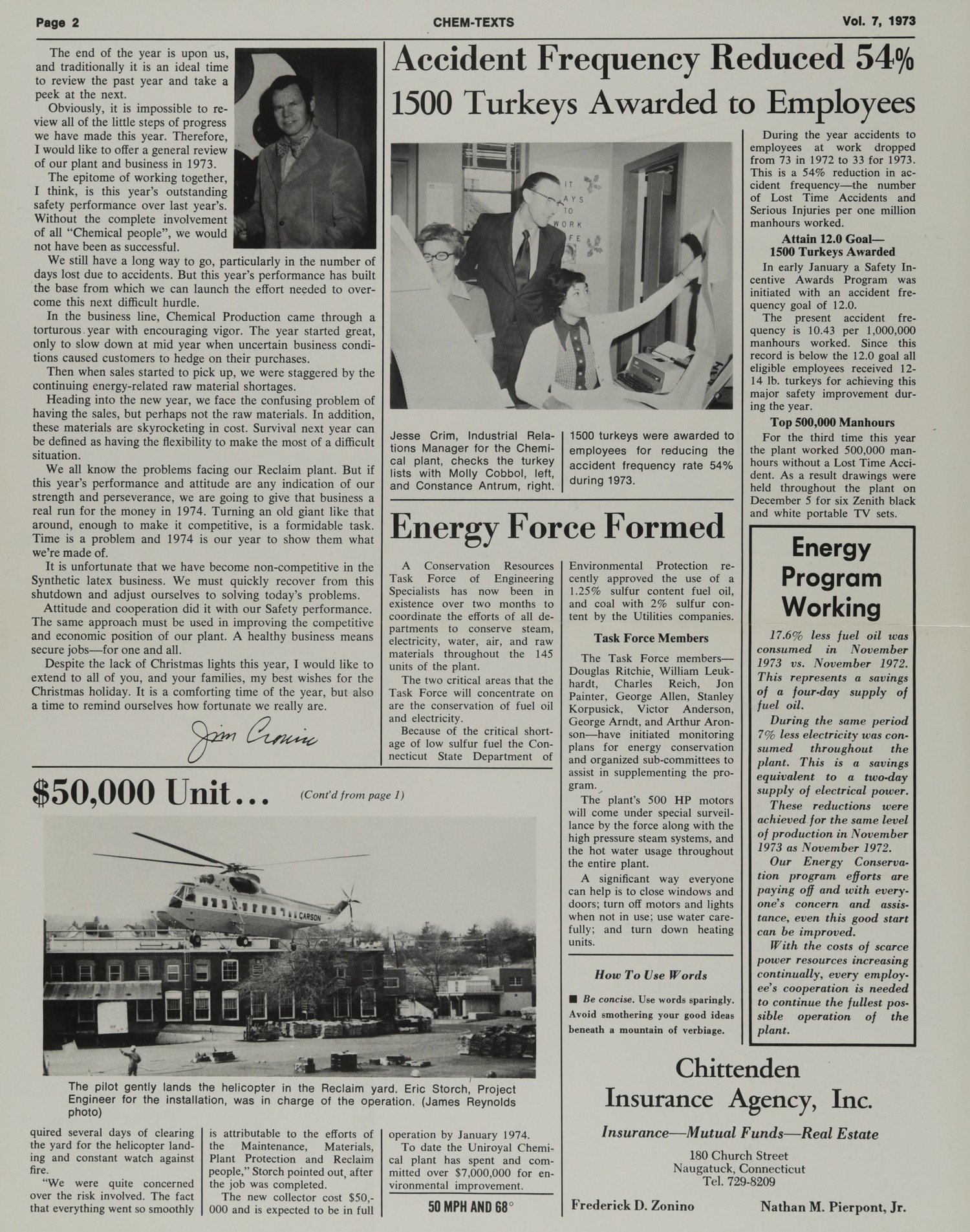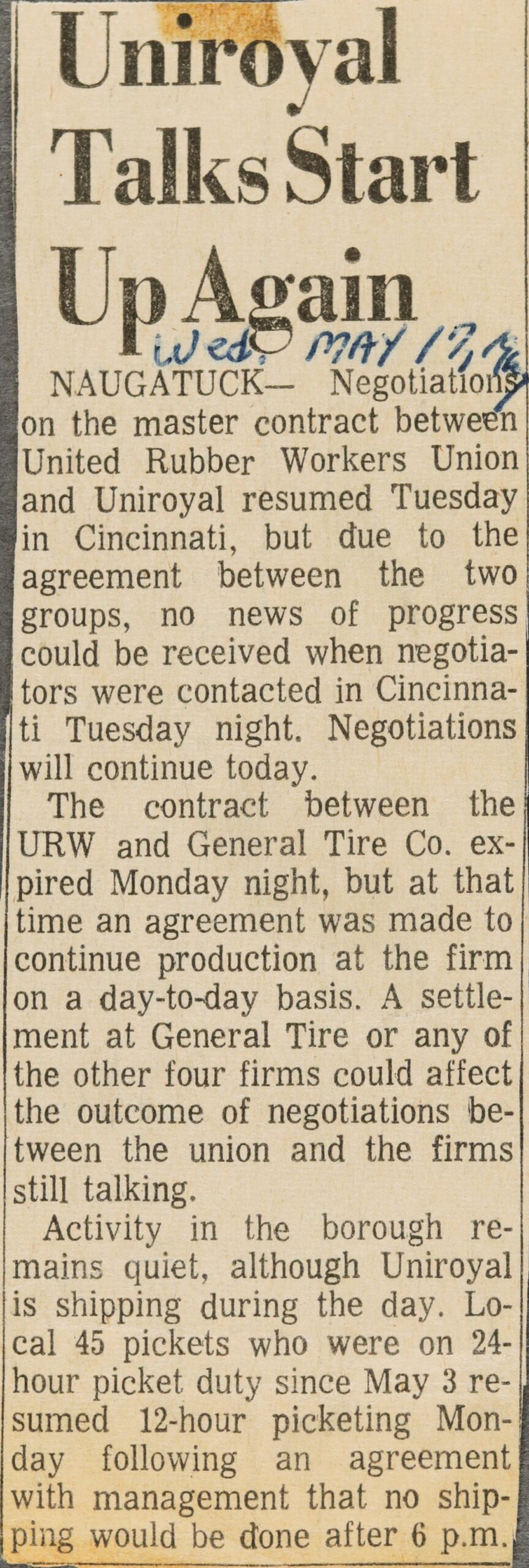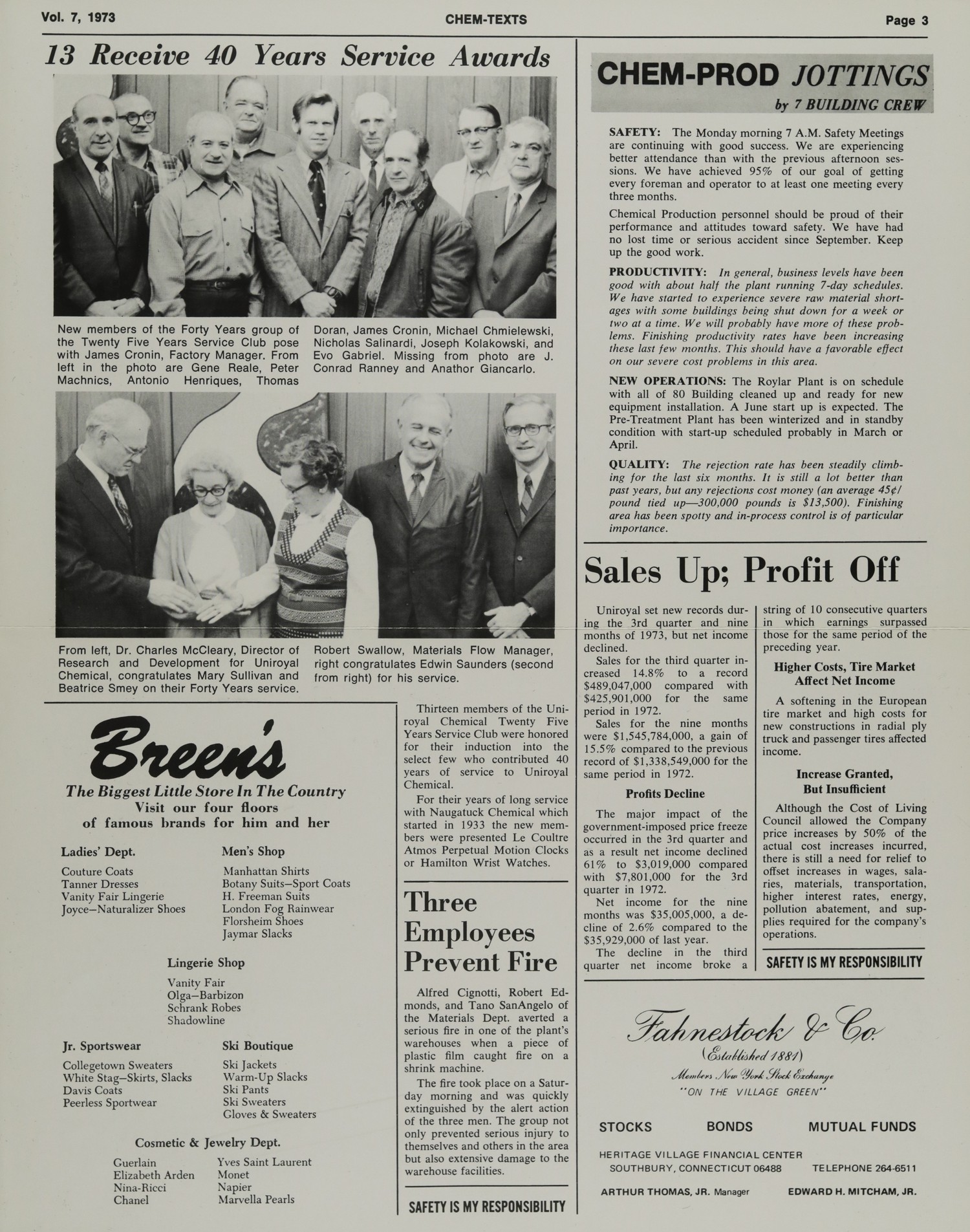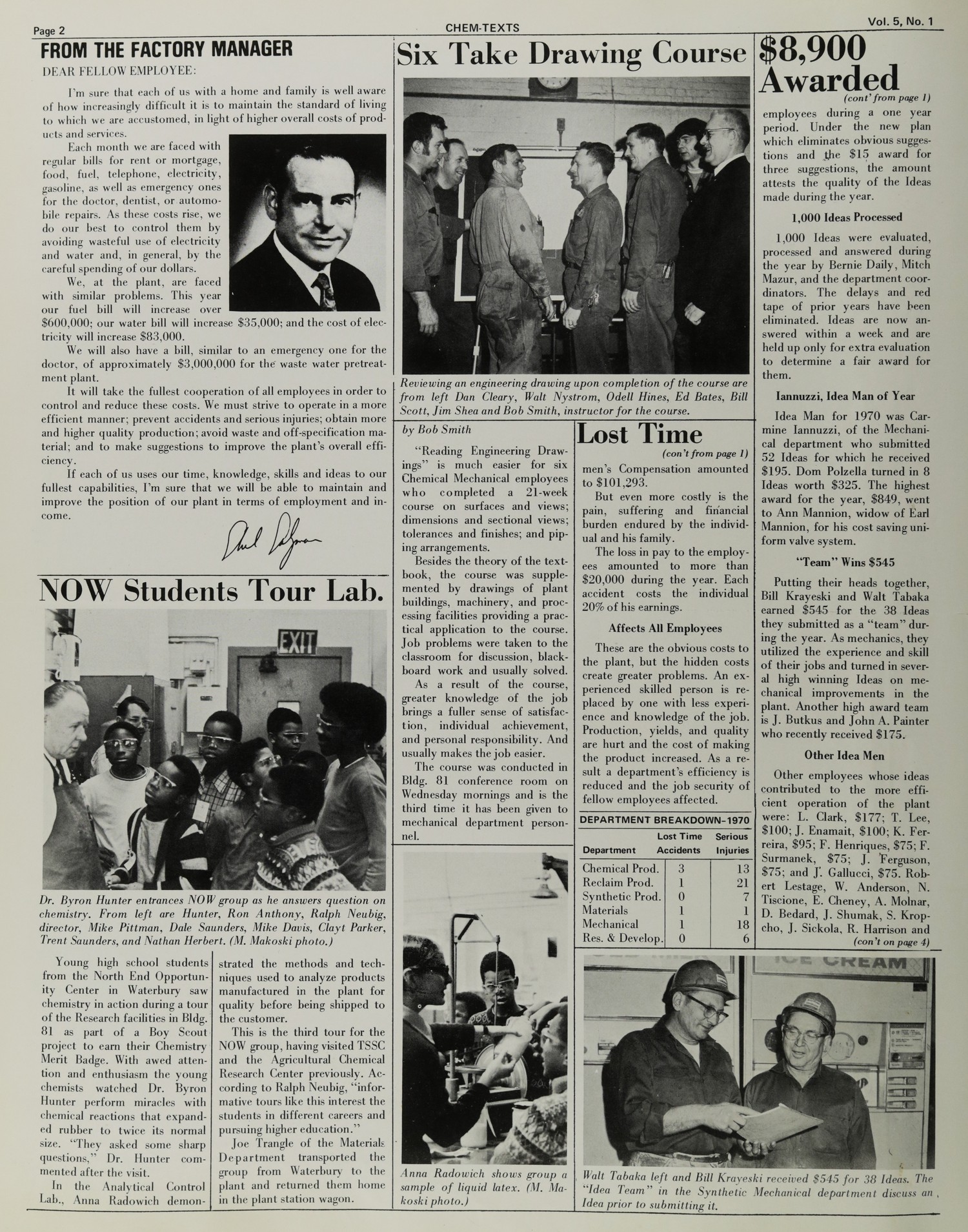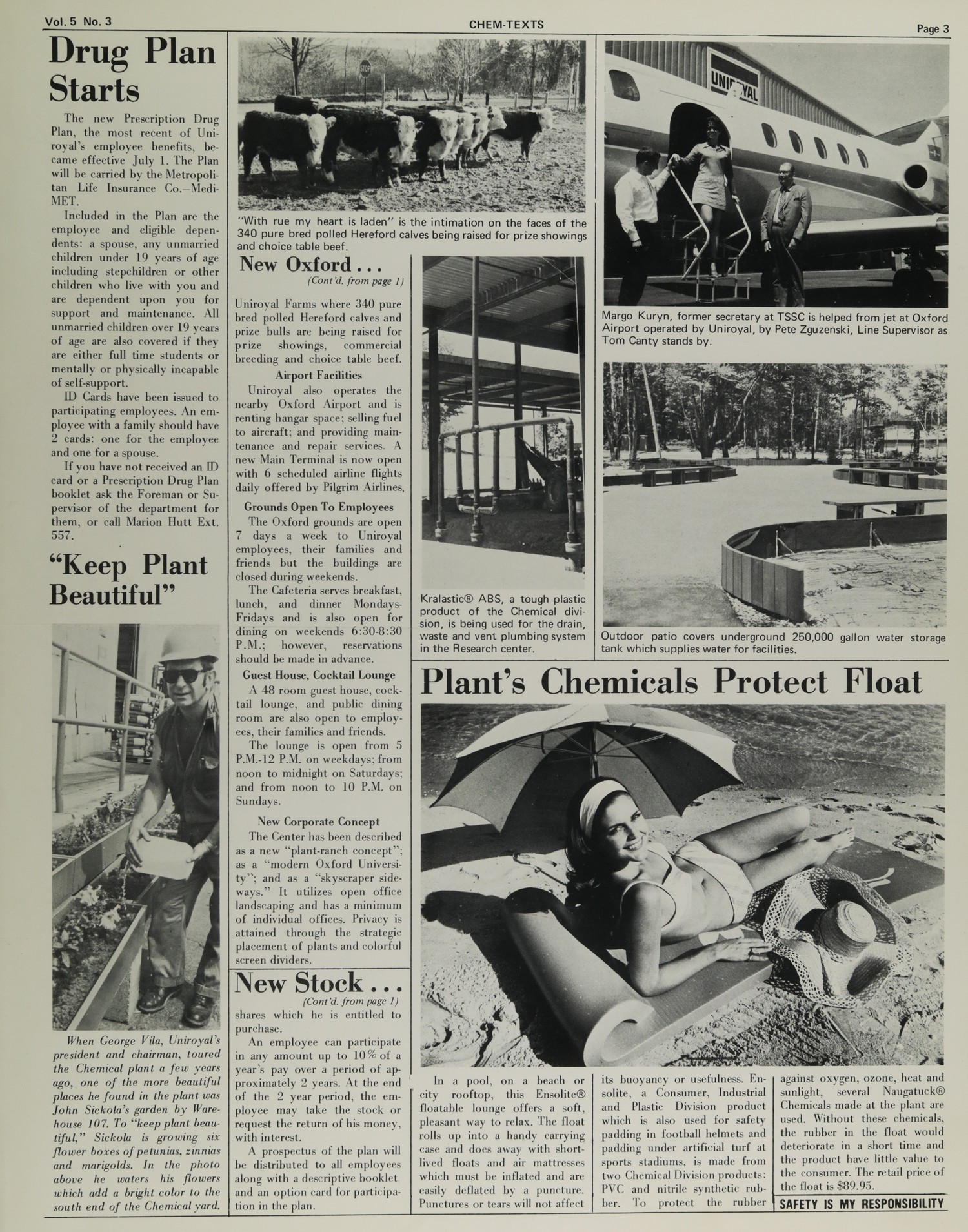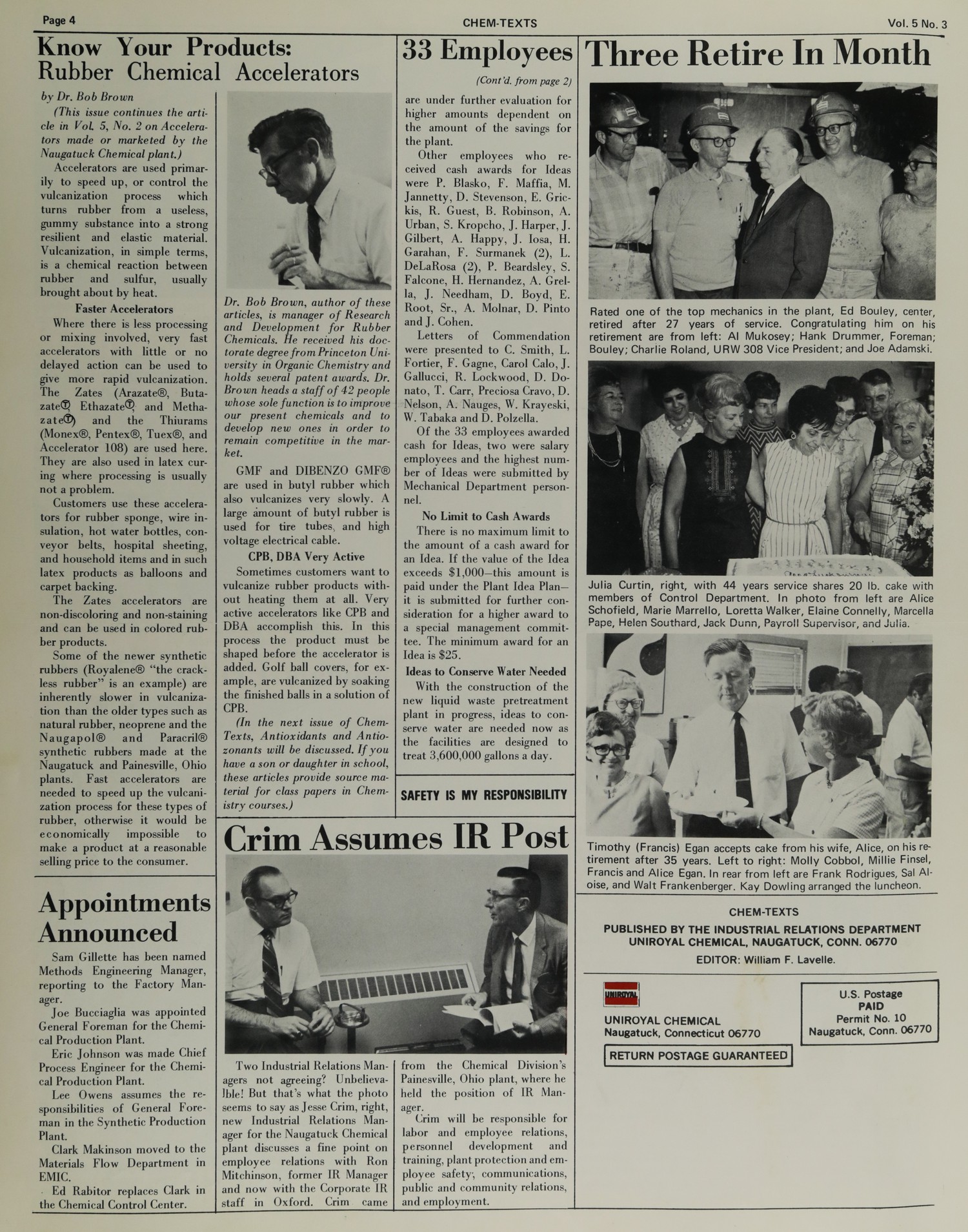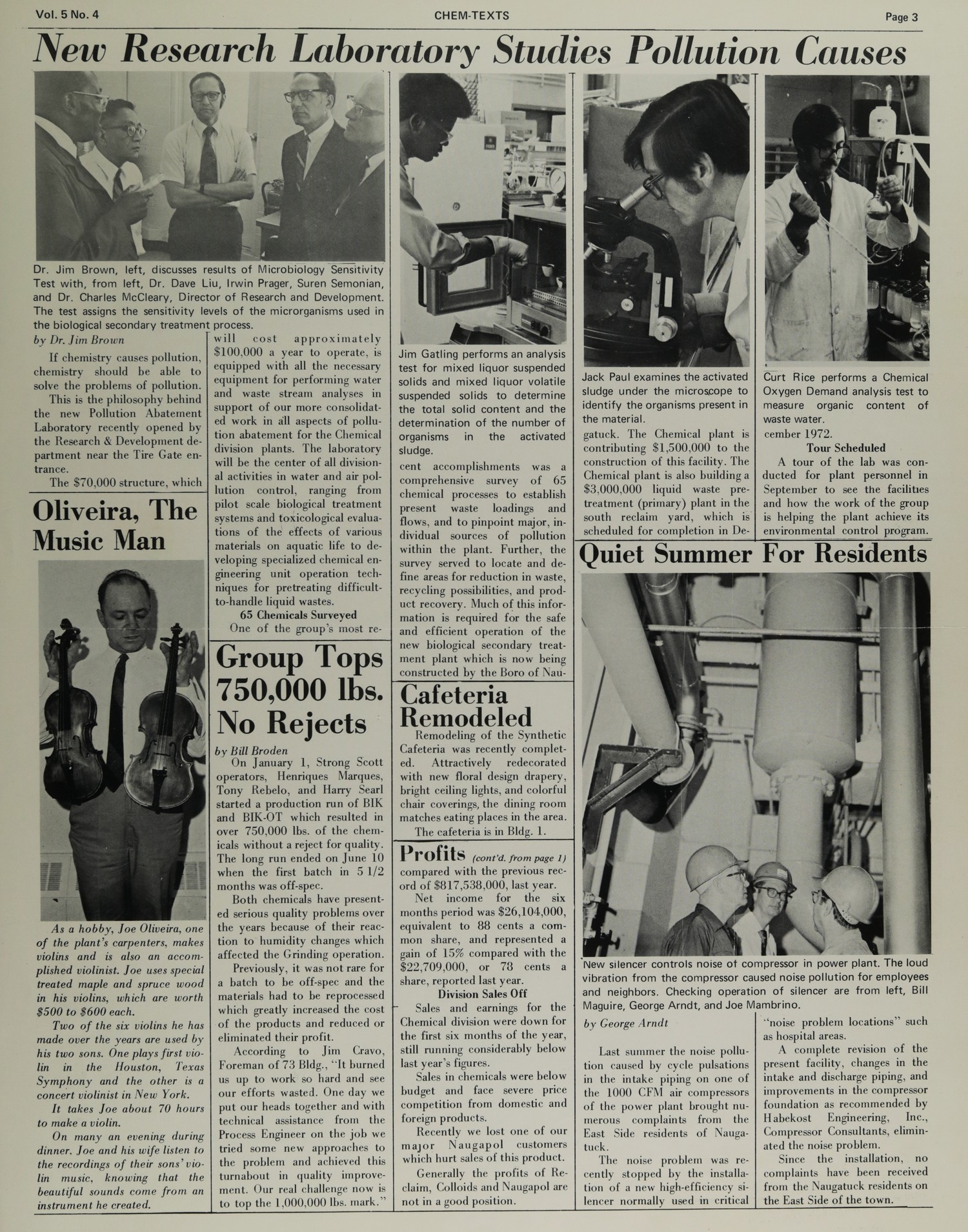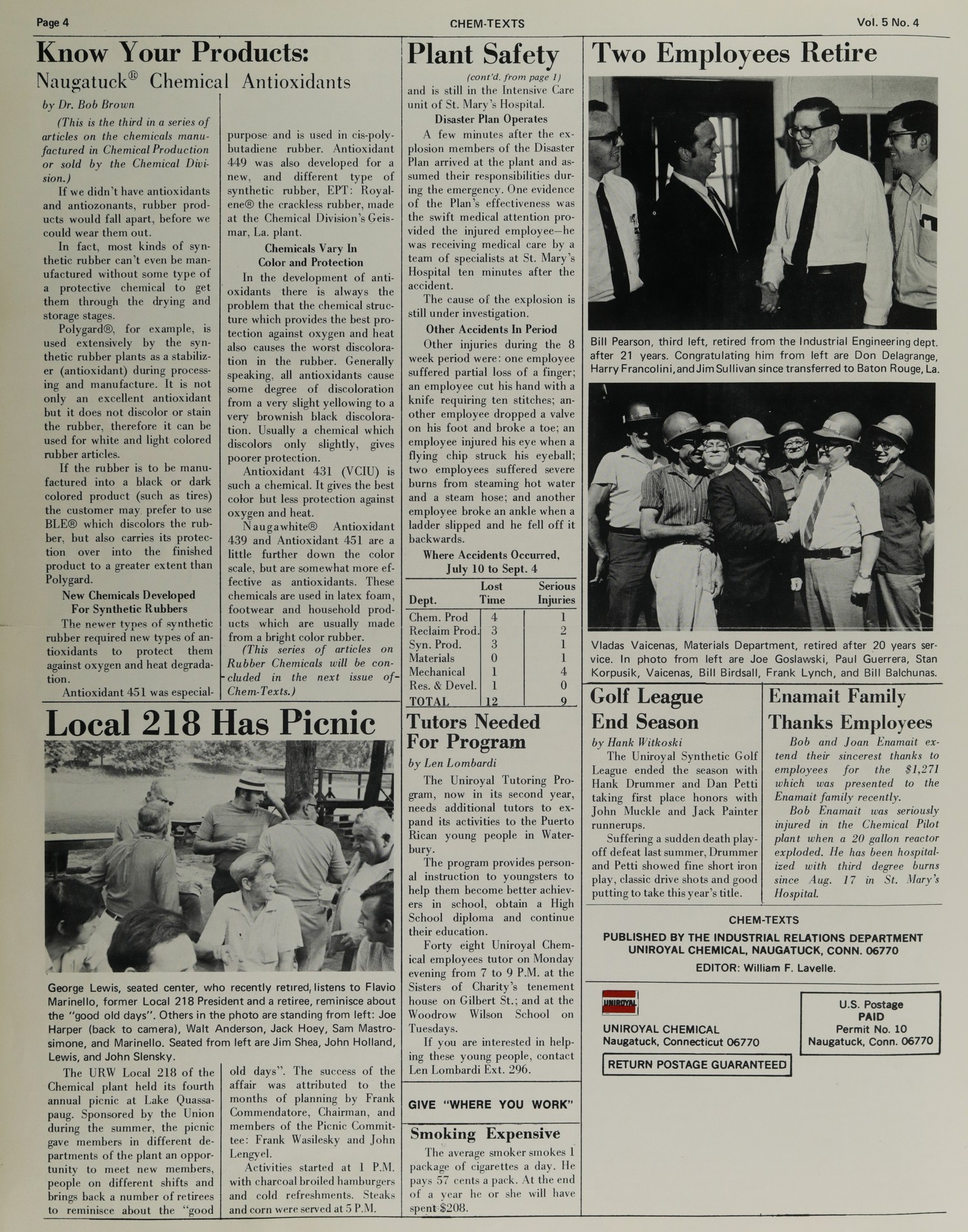
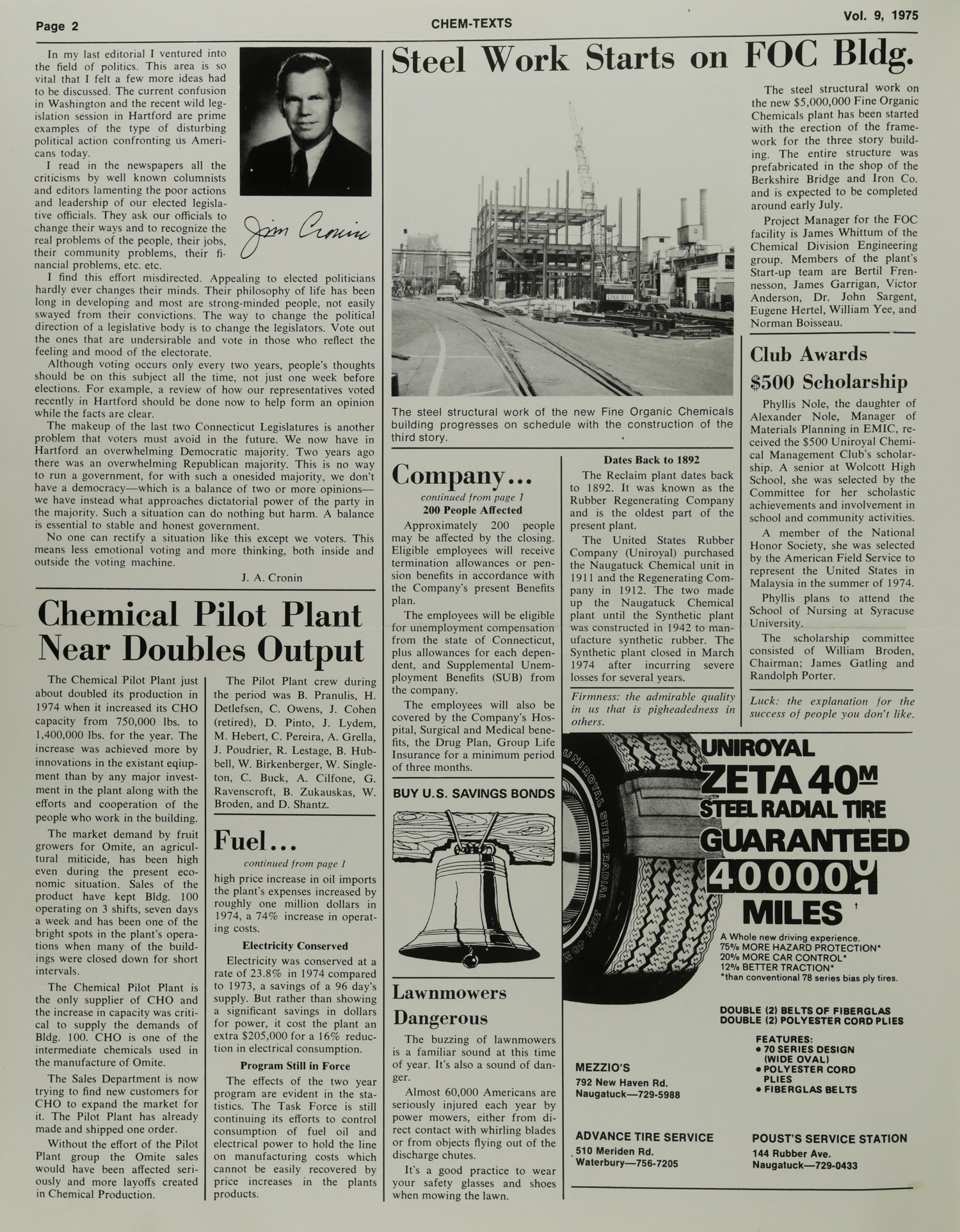
CHEM-TEXTS – 1975 – Page 2

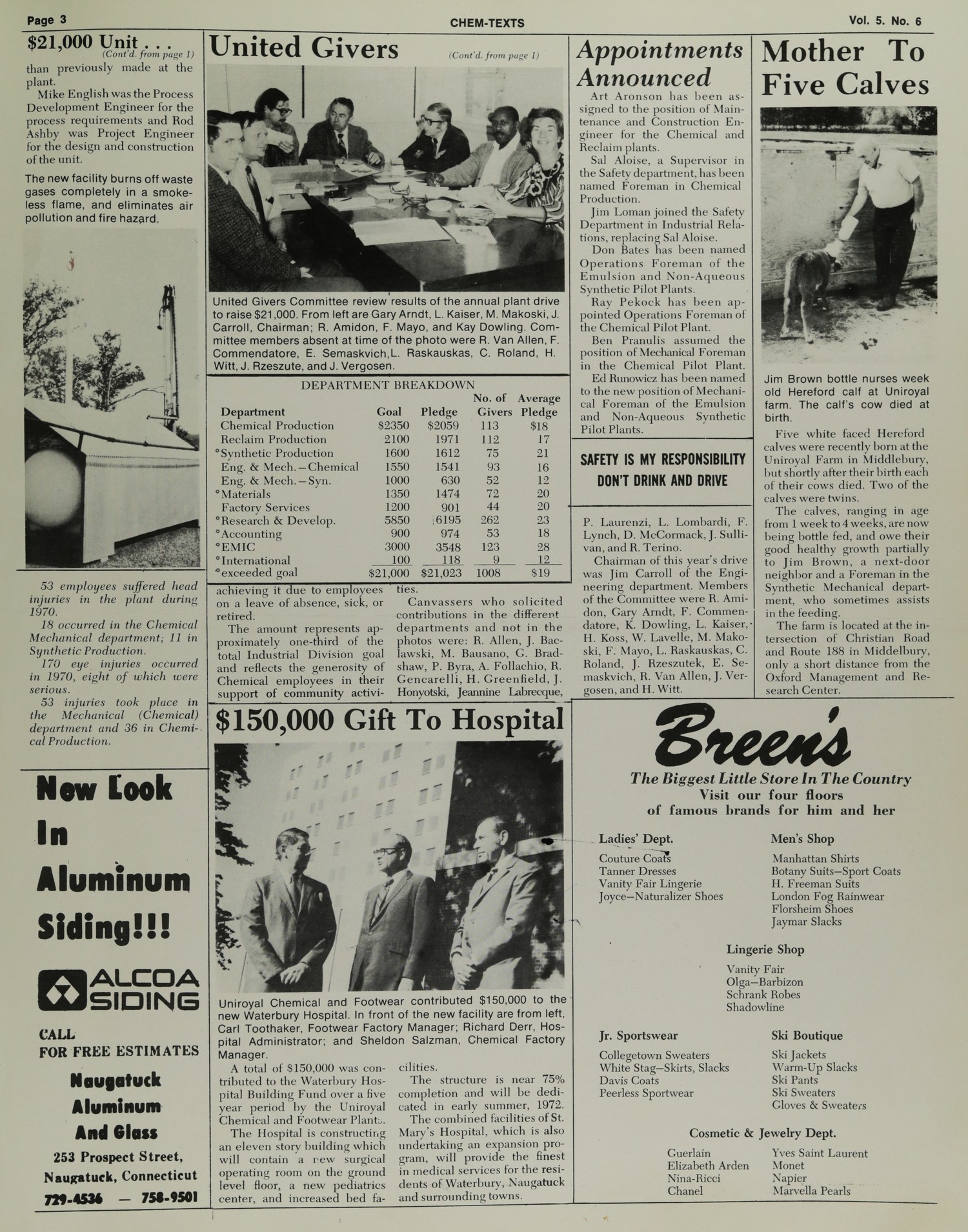
Page 002

CHEM-TEXTS

Page 2 | Vol. 9, 1975


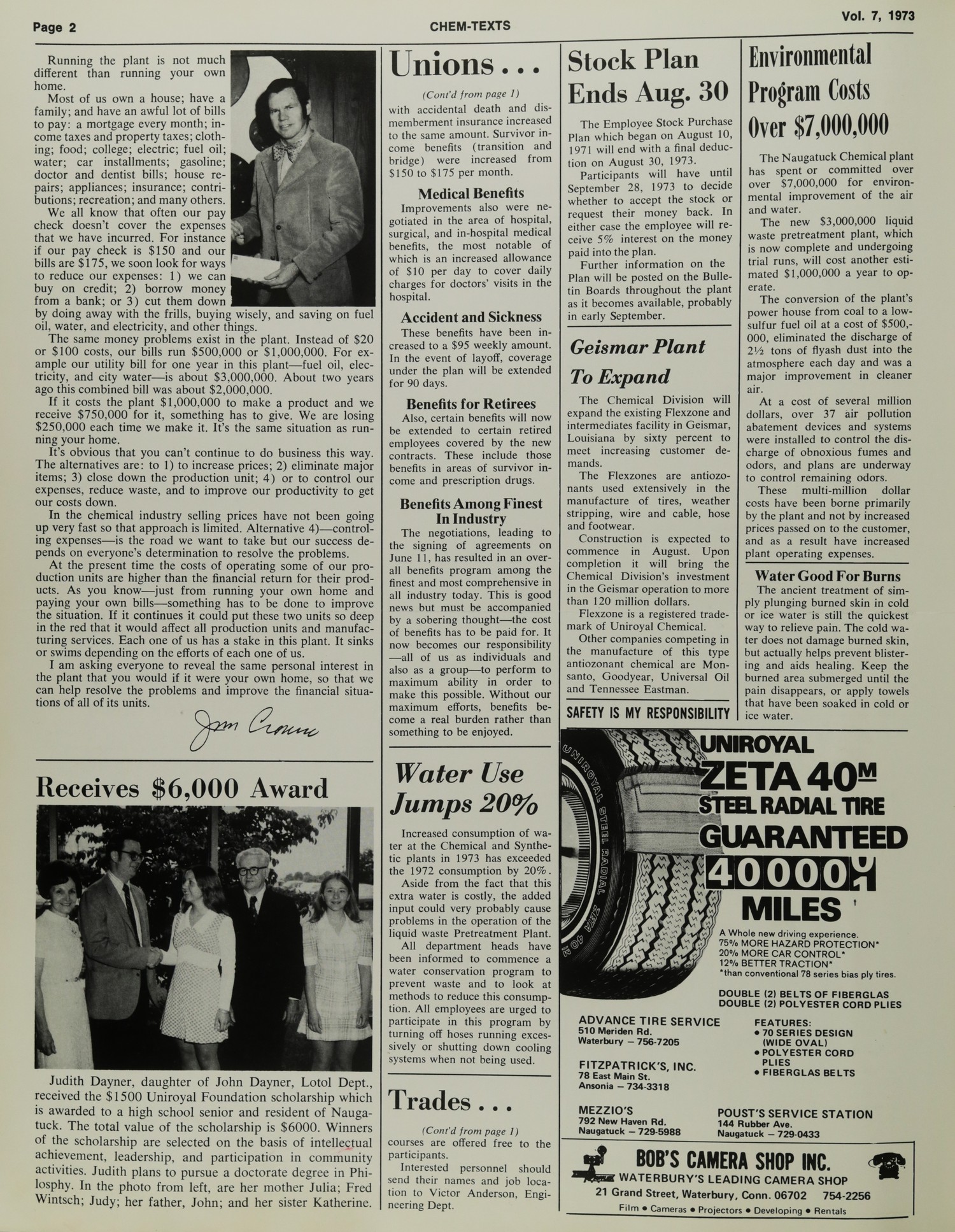
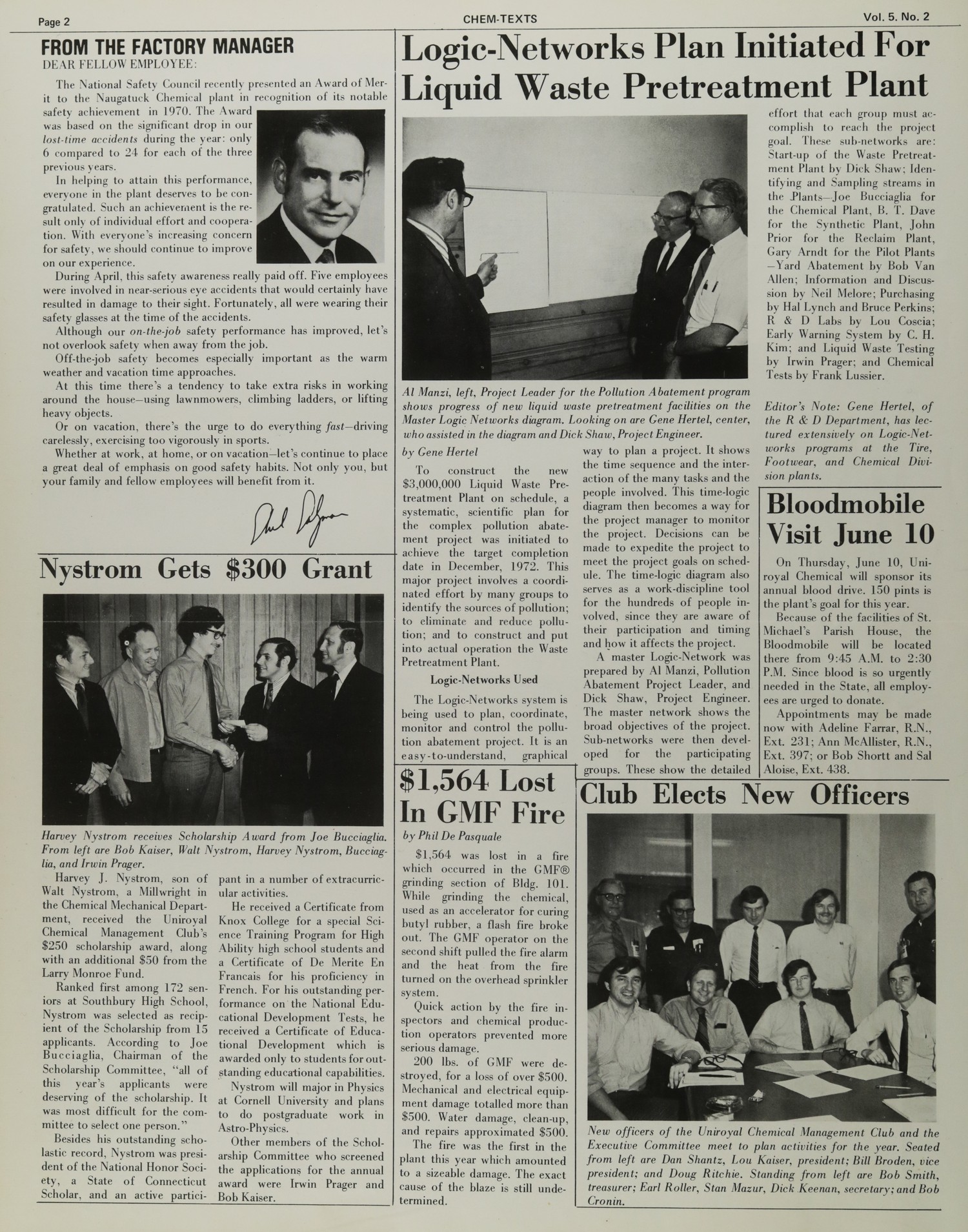
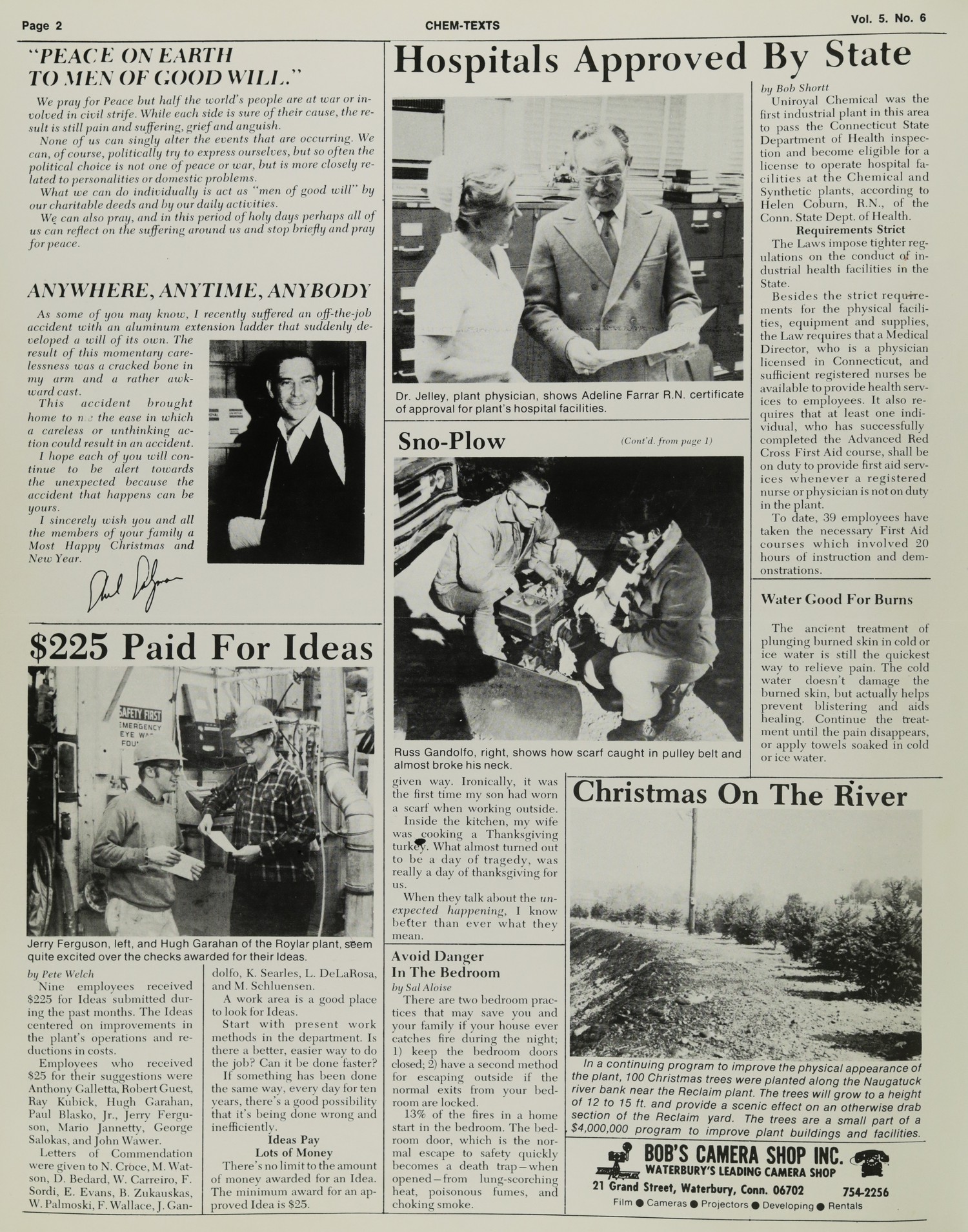
In my last editorial I ventured into the field of politics. This area is so vital that I felt a few more ideas had to be discussed. The current confusion in Washington and the recent wild legislation session in Hartford are prime examples of the type of disturbing political action confronting us Americans today.

I read in the newspapers all the criticisms by well known columnists and editors lamenting the poor actions and leadership of our elected legislative officials. They ask our officials to change their ways and to recognize the real problems of the people, their jobs, their community problems, their financial problems, etc. etc.

I find this effort misdirected. Appealing to elected politicians hardly ever changes their minds. Their philosophy of life has been long in developing and most are strong-minded people, not easily swayed from their convictions. The way to change the political direction of a legislative body is to change the legislators. Vote out the ones that are undersirable and vote in those who reflect the feeling and mood of the electorate.

Although voting occurs only every two years, people’s thoughts should be on this subject all the time, not just one week before elections. For example, a review of how our representatives voted recently in Hartford should be done now to help form an opinion while the facts are clear.

The makeup of the last two Connecticut Legislatures is another problem that voters must avoid in the future. We now have in Hartford an overwhelming Democratic majority. Two years ago there was an overwhelming Republican majority. This is no way to run a government, for with such a onesided majority, we don’t have a democracy—which is a balance of two or more opinions— we have instead what approaches dictatorial power of the party in the majority. Such a situation can do nothing but harm. A balance is essential to stable and honest government.

No one can rectify a situation like this except we voters. This means less emotional voting and more thinking, both inside and outside the voting machine.

J. A. Cronin

Jim Cronin [signature]

[PHOTO: Headshot of a man in suit]


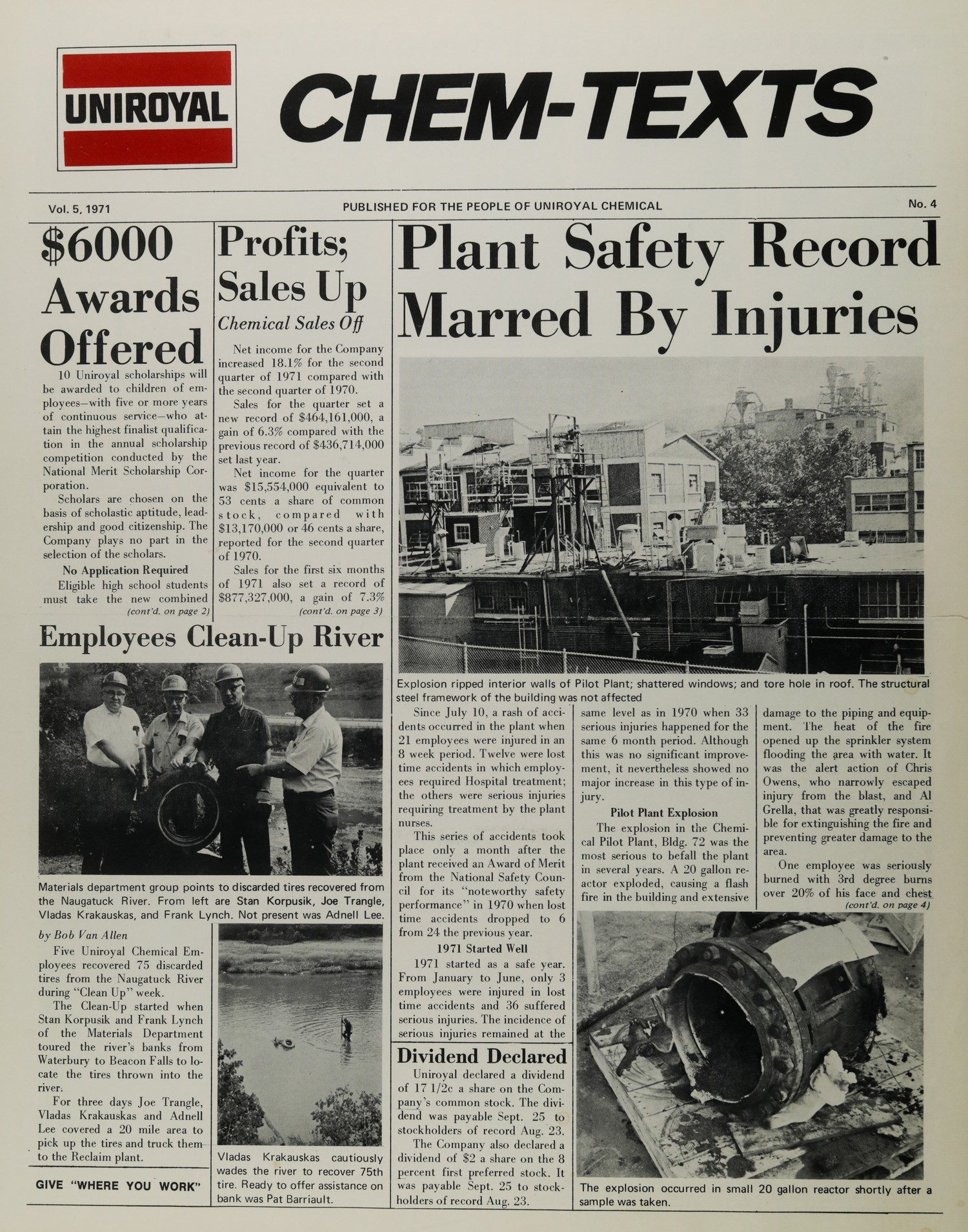
Steel Work Starts on FOC Bldg.

[PHOTO: Construction site showing steel framework of a building]

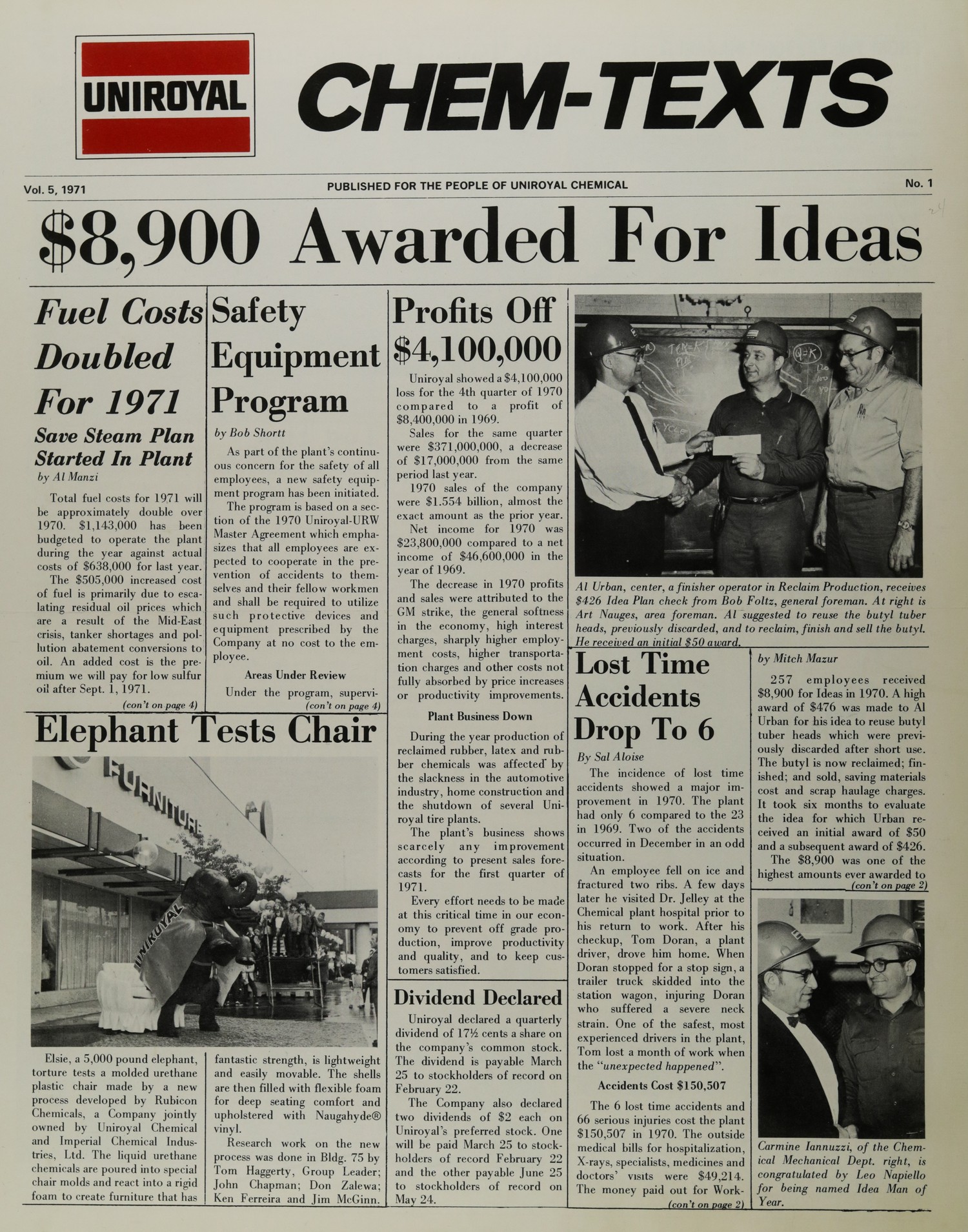
The steel structural work on the new $5,000,000 Fine Organic Chemicals plant has been started with the erection of the framework for the three story building. The entire structure was prefabricated in the shop of the Berkshire Bridge and Iron Co. and is expected to be completed around early July.

Project Manager for the FOC facility is James Whittum of the Chemical Division Engineering group. Members of the plant’s Start-up team are Bertil Frennesson, James Garrigan, Victor Anderson, Dr. John Sargent, Eugene Hertel, William Yee, and Norman Boisseau.

The steel structural work of the new Fine Organic Chemicals building progresses on schedule with the construction of the third story.


Chemical Pilot Plant Near Doubles Output

The Chemical Pilot Plant just about doubled its production in 1974 when it increased its CHO capacity from 750,000 lbs. to 1,400,000 lbs. for the year. The increase was achieved more by innovations in the existant equipment than by any major investment in the plant along with the efforts and cooperation of the people who work in the building.

The market demand by fruit growers for Omite, an agricultural miticide, has been high even during the present economic situation. Sales of the product have kept Bldg. 100 operating on 3 shifts, seven days a week and has been one of the bright spots in the plant’s operations when many of the buildings were closed down for short intervals.

The Chemical Pilot Plant is the only supplier of CHO and the increase in capacity was critical to supply the demands of Bldg. 100. CHO is one of the intermediate chemicals used in the manufacture of Omite.

The Sales Department is now trying to find new customers for CHO to expand the market for it. The Pilot Plant has already made and shipped one order.

Without the effort of the Pilot Plant group the Omite sales would have been affected seriously and more layoffs created in Chemical Production.

The Pilot Plant crew during the period was B. Pranulis, H. Detlefsen, C. Owens, J. Cohen (retired), D. Pinto, J. Lydem, M. Hebert, C. Pereira, A. Grella, J. Poudrier, R. Lestage, B. Hubbell, W. Birkenberger, W. Singleton, C. Buck, A. Cilfone, G. Ravenscroft, B. Zukauskas, W. Broden, and D. Shantz.


Company…

continued from page 1

200 People Affected

Approximately 200 people may be affected by the closing. Eligible employees will receive termination allowances or pension benefits in accordance with the Company’s present Benefits plan.

The employees will be eligible for unemployment compensation from the state of Connecticut, plus allowances for each dependent, and Supplemental Unemployment Benefits (SUB) from the company.

The employees will also be covered by the Company’s Hospital, Surgical and Medical benefits, the Drug Plan, Group Life Insurance for a minimum period of three months.

BUY U.S. SAVINGS BONDS


Dates Back to 1892

The Reclaim plant dates back to 1892. It was known as the Rubber Regenerating Company and is the oldest part of the present plant.

The United States Rubber Company (Uniroyal) purchased the Naugatuck Chemical unit in 1911 and the Regenerating Company in 1912. The two made up the Naugatuck Chemical plant until the Synthetic plant was constructed in 1942 to manufacture synthetic rubber. The Synthetic plant closed in March 1974 after incurring severe losses for several years.

Firmness: the admirable quality in us that is pigheadedness in others.


Fuel…

continued from page 1

high price increase in oil imports the plant’s expenses increased by roughly one million dollars in 1974, a 74% increase in operating costs.

Electricity Conserved

Electricity was conserved at a rate of 23.8% in 1974 compared to 1973, a savings of a 96 day’s supply. But rather than showing a significant savings in dollars for power, it cost the plant an extra $205,000 for a 16% reduction in electrical consumption.

Program Still in Force

The effects of the two year program are evident in the statistics. The Task Force is still continuing its efforts to control consumption of fuel oil and electrical power to hold the line on manufacturing costs which cannot be easily recovered by price increases in the plants products.


Club Awards $500 Scholarship

Phyllis Nole, the daughter of Alexander Nole, Manager of Materials Planning in EMIC, received the $500 Uniroyal Chemical Management Club’s scholarship. A senior at Wolcott High School, she was selected by the Committee for her scholastic achievements and involvement in school and community activities.

A member of the National Honor Society, she was selected by the American Field Service to represent the United States in Malaysia in the summer of 1974.

Phyllis plans to attend the School of Nursing at Syracuse University.

The scholarship committee consisted of William Broden, Chairman; James Gatling and Randolph Porter.

Luck: the explanation for the success of people you don’t like.


Lawnmowers Dangerous

[IMAGE: Drawing of a Liberty Bell]

The buzzing of lawnmowers is a familiar sound at this time of year. It’s also a sound of danger.

Almost 60,000 Americans are seriously injured each year by power mowers, either from direct contact with whirling blades or from objects flying out of the discharge chutes.

It’s a good practice to wear your safety glasses and shoes when mowing the lawn.


MEZZIO’S
792 New Haven Rd.
Naugatuck—729-5988

ADVANCE TIRE SERVICE
510 Meriden Rd.
Waterbury—756-7205

POUST’S SERVICE STATION
144 Rubber Ave.
Naugatuck—729-0433


[ADVERTISEMENT]

UNIROYAL

ZETA 40M

STEEL RADIAL TIRE

GUARANTEED

40000

MILES

A Whole new driving experience.
75% MORE HAZARD PROTECTION
20% MORE CAR CONTROL

12% BETTER TRACTION
than conventional 78 series bias ply tires.

DOUBLE (2) BELTS OF FIBERGLAS
DOUBLE (2) POLYESTER CORD PLIES

FEATURES:
– 70 SERIES DESIGN (WIDE OVAL)
– POLYESTER CORD PLIES
– FIBERGLAS BELTS
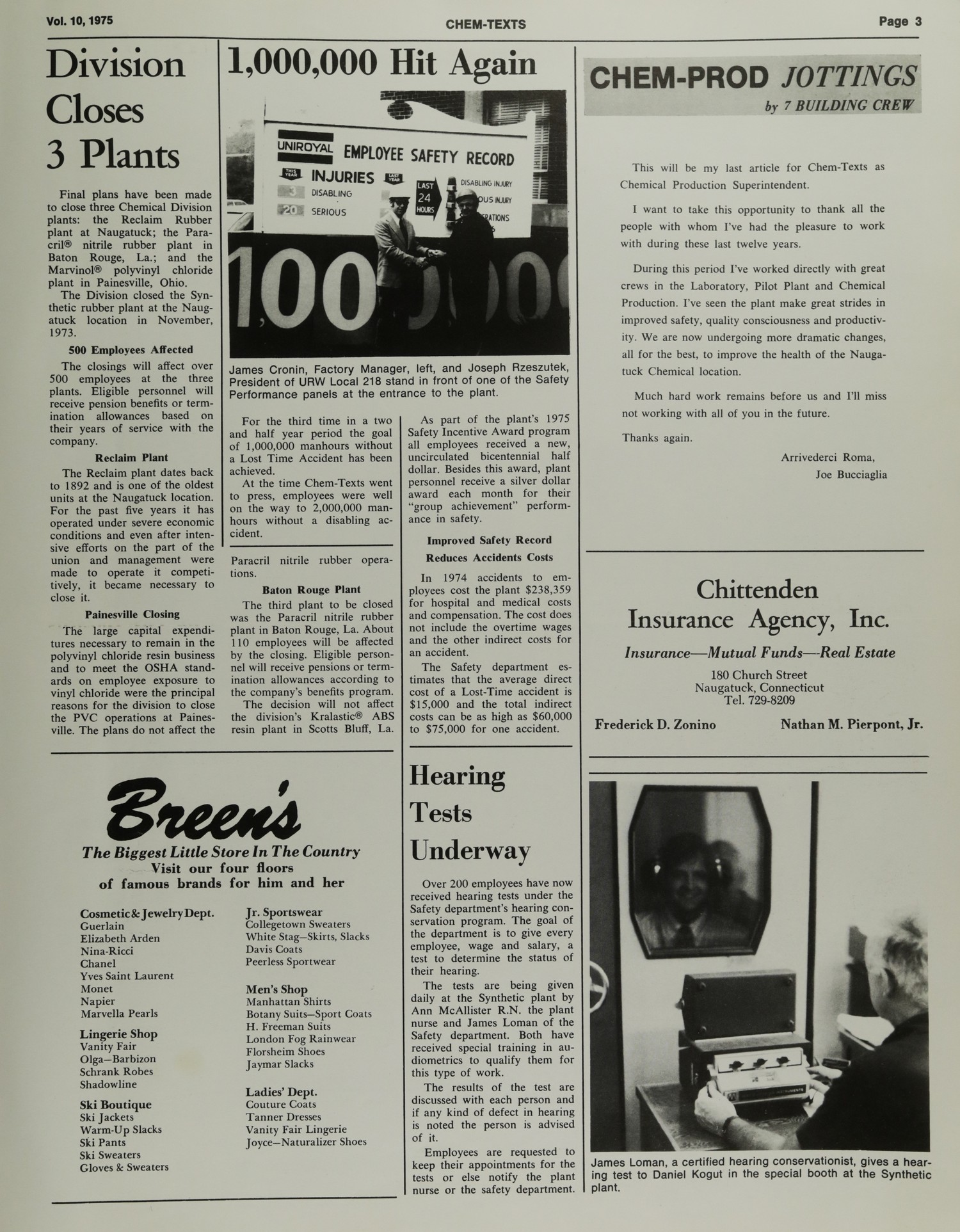
CHEM-TEXTS – 1975 – Page 3

Page 003

CHEM-TEXTS

Vol. 10, 1975 | Page 3


Division Closes 3 Plants

Final plans have been made to close three Chemical Division plants: the Reclaim Rubber plant at Naugatuck; the Paracril® nitrile rubber plant in Baton Rouge, La.; and the Marvinol® polyvinyl chloride plant in Painesville, Ohio.

The Division closed the Synthetic rubber plant at the Naugatuck location in November, 1973.

500 Employees Affected

The closings will affect over 500 employees at the three plants. Eligible personnel will receive pension benefits or termination allowances based on their years of service with the company.

Reclaim Plant

The Reclaim plant dates back to 1892 and is one of the oldest units at the Naugatuck location. For the past five years it has operated under severe economic conditions and even after intensive efforts on the part of the union and management were made to operate it competitively, it became necessary to close it.

Painesville Closing

The large capital expenditures necessary to remain in the polyvinyl chloride resin business and to meet the OSHA standards on employee exposure to vinyl chloride were the principal reasons for the division to close the PVC operations at Painesville. The plans do not affect the


1,000,000 Hit Again

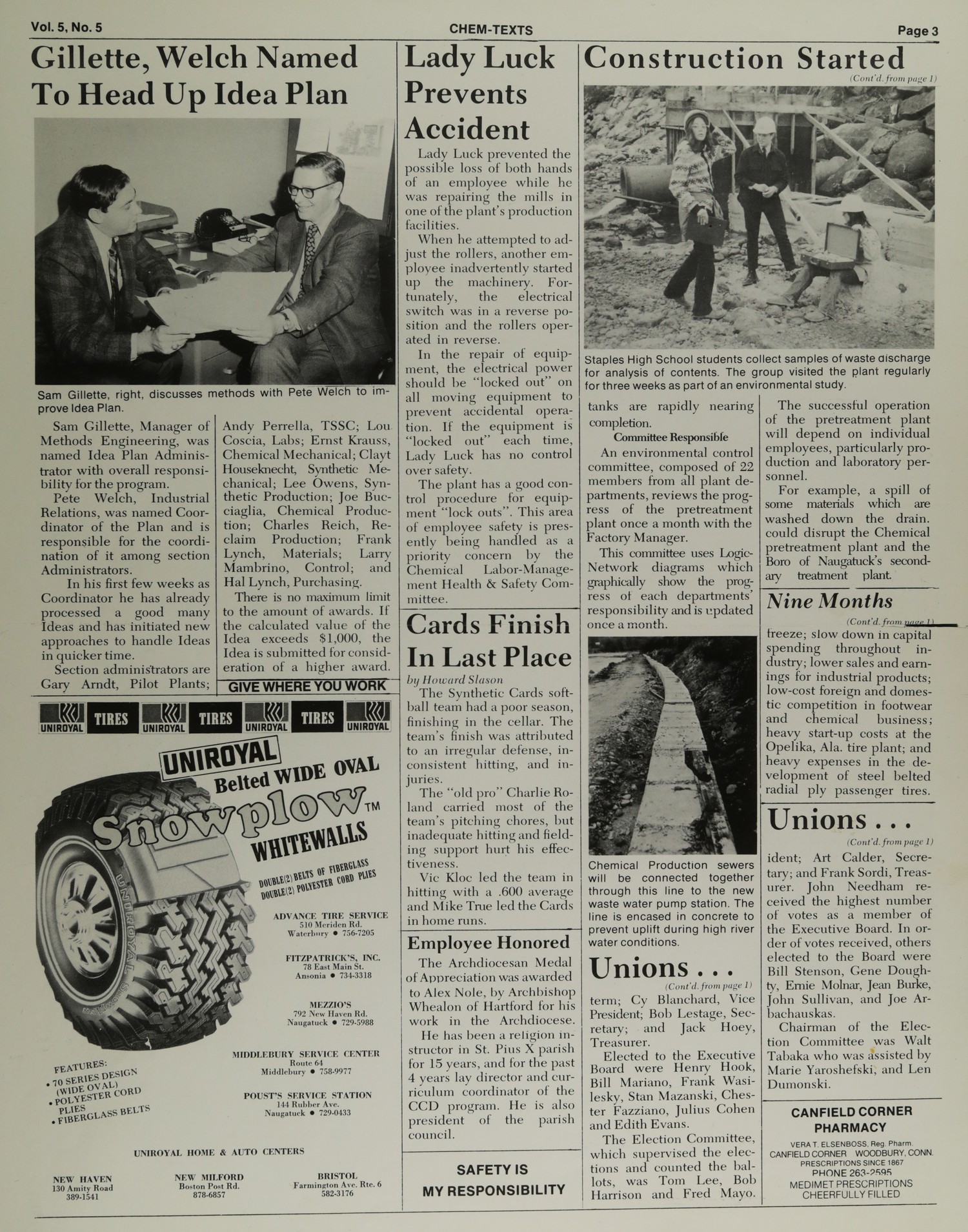
[IMAGE: UNIROYAL EMPLOYEE SAFETY RECORD sign showing INJURIES – DISABLING and SERIOUS counts, with “LAST 24” and “DISABLING INJURY” / “OUS INJURY” / “ATIONS” visible, with “100” displayed]

James Cronin, Factory Manager, left, and Joseph Rzeszutek, President of URW Local 218 stand in front of one of the Safety Performance panels at the entrance to the plant.

For the third time in a two and half year period the goal of 1,000,000 manhours without a Lost Time Accident has been achieved.

At the time Chem-Texts went to press, employees were well on the way to 2,000,000 manhours without a disabling accident.

Paracril nitrile rubber operations.

Baton Rouge Plant

The third plant to be closed was the Paracril nitrile rubber plant in Baton Rouge, La. About 110 employees will be affected by the closing. Eligible personnel will receive pensions or termination allowances according to the company’s benefits program.

The decision will not affect the division’s Kralastic® ABS resin plant in Scotts Bluff, La.

As part of the plant’s 1975 Safety Incentive Award program all employees received a new, uncirculated bicentennial half dollar. Besides this award, plant personnel receive a silver dollar award each month for their “group achievement” performance in safety.

Improved Safety Record Reduces Accidents Costs

In 1974 accidents to employees cost the plant $238,359 for hospital and medical costs and compensation. The cost does not include the overtime wages and the other indirect costs for an accident.

The Safety department estimates that the average direct cost of a Lost-Time accident is $15,000 and the total indirect costs can be as high as $60,000 to $75,000 for one accident.


CHEM-PROD JOTTINGS

by 7 BUILDING CREW

This will be my last article for Chem-Texts as Chemical Production Superintendent.

I want to take this opportunity to thank all the people with whom I’ve had the pleasure to work with during these last twelve years.

During this period I’ve worked directly with great crews in the Laboratory, Pilot Plant and Chemical Production. I’ve seen the plant make great strides in improved safety, quality consciousness and productivity. We are now undergoing more dramatic changes, all for the best, to improve the health of the Naugatuck Chemical location.

Much hard work remains before us and I’ll miss not working with all of you in the future.

Thanks again.

Arrivederci Roma,
Joe Bucciaglia


Chittenden Insurance Agency, Inc.

Insurance—Mutual Funds—Real Estate

180 Church Street
Naugatuck, Connecticut
Tel. 729-8209

Frederick D. Zonino | Nathan M. Pierpont, Jr.


Breen’s

The Biggest Little Store In The Country
Visit our four floors of famous brands for him and her

Cosmetic & Jewelry Dept.
Guerlain
Elizabeth Arden
Nina-Ricci
Chanel
Yves Saint Laurent
Monet
Napier
Marvella Pearls

Lingerie Shop
Vanity Fair
Olga—Barbizon
Schrank Robes
Shadowline

Ski Boutique
Ski Jackets
Warm-Up Slacks
Ski Pants
Ski Sweaters
Gloves & Sweaters

Jr. Sportswear
Collegetown Sweaters
White Stag—Skirts, Slacks
Davis Coats
Peerless Sportwear

Men’s Shop
Manhattan Shirts
Botany Suits—Sport Coats
H. Freeman Suits
London Fog Rainwear
Florsheim Shoes
Jaymar Slacks

Ladies’ Dept.
Couture Coats
Tanner Dresses
Vanity Fair Lingerie
Joyce—Naturalizer Shoes


Hearing Tests Underway

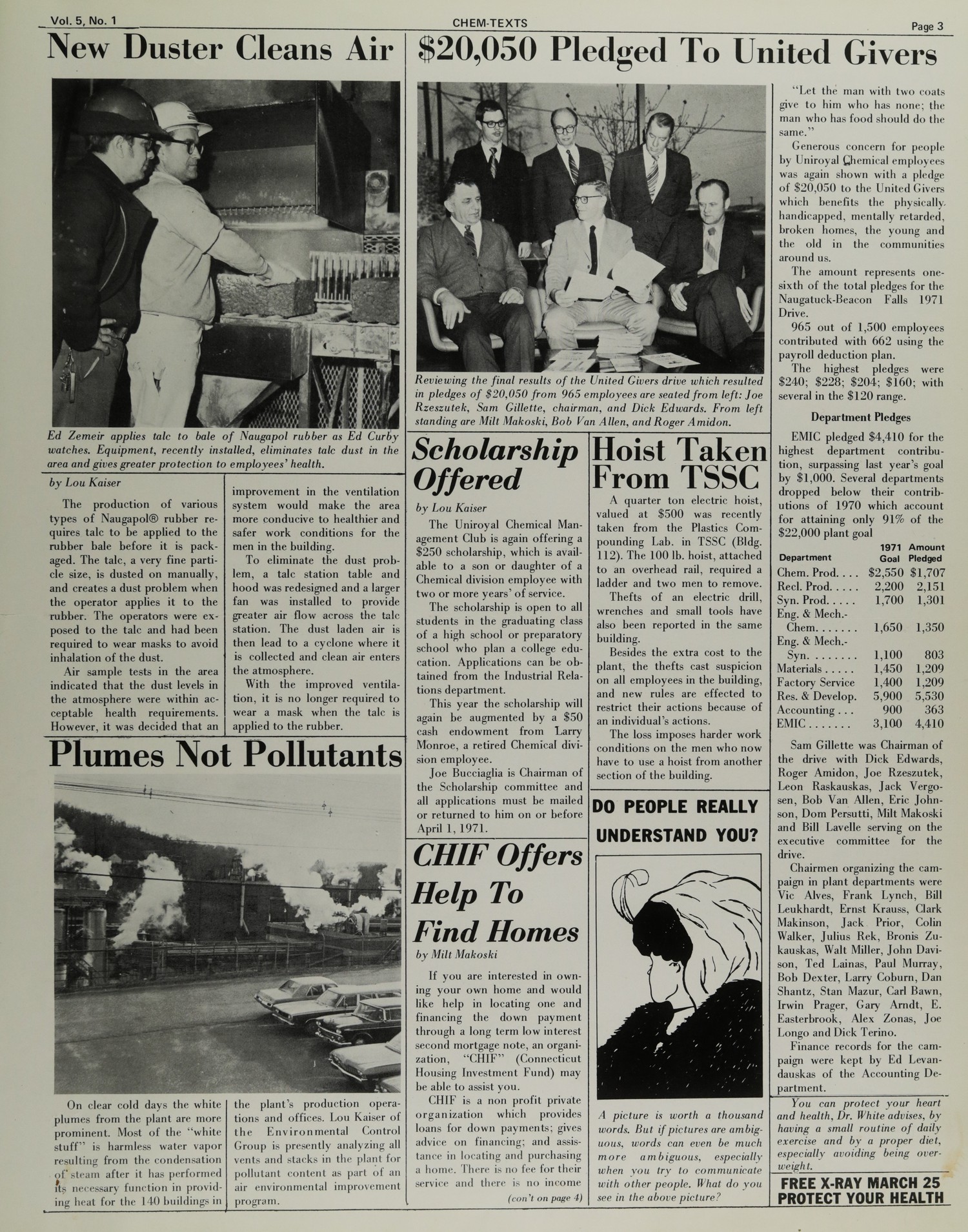
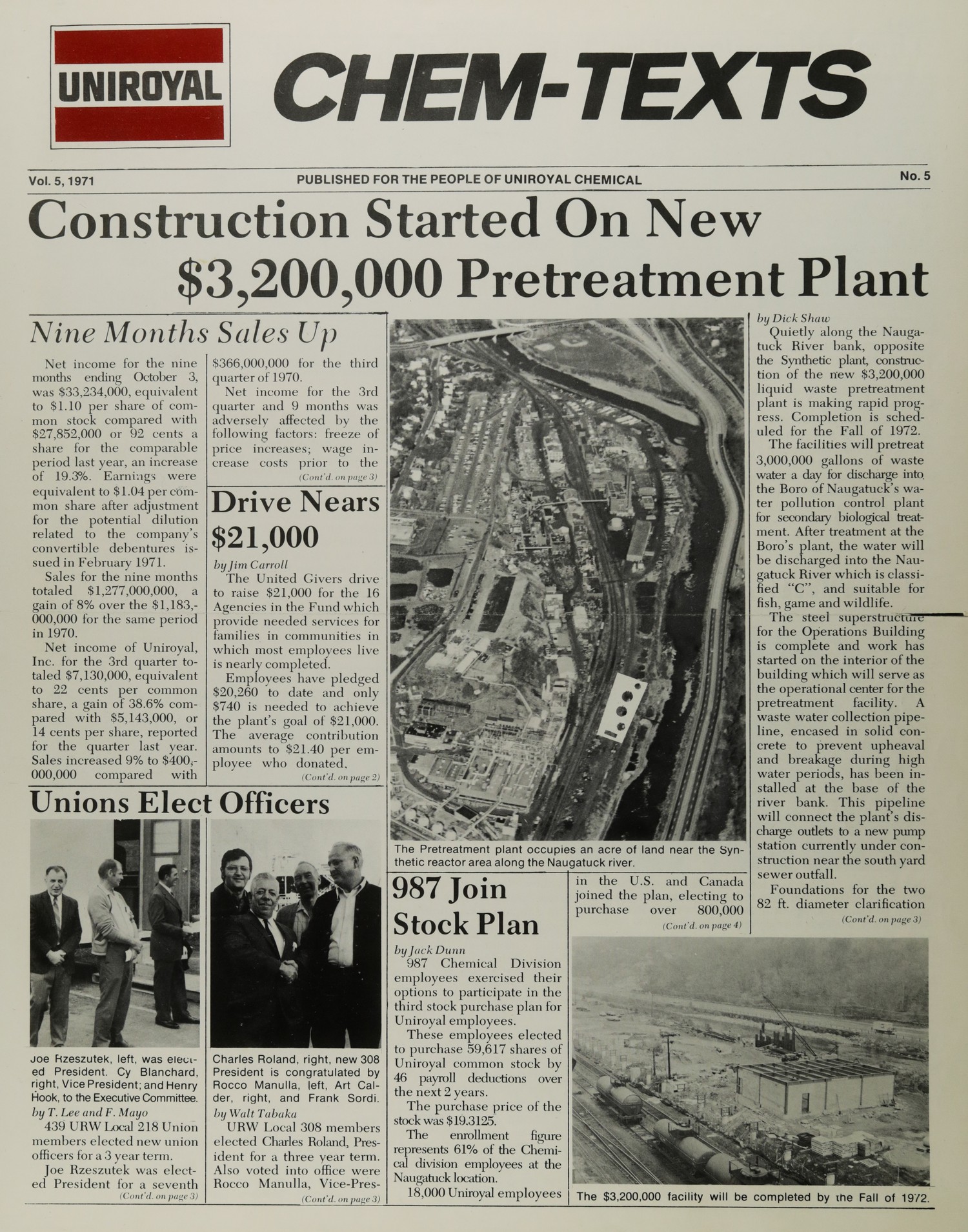
Over 200 employees have now received hearing tests under the Safety department’s hearing conservation program. The goal of the department is to give every employee, wage and salary, a test to determine the status of their hearing.

The tests are being given daily at the Synthetic plant by Ann McAllister R.N. the plant nurse and James Loman of the Safety department. Both have received special training in audiometrics to qualify them for this type of work.

The results of the test are discussed with each person and if any kind of defect in hearing is noted the person is advised of it.

Employees are requested to keep their appointments for the tests or else notify the plant nurse or the safety department.

[IMAGE: Photo of hearing test being administered]

James Loman, a certified hearing conservationist, gives a hearing test to Daniel Kogut in the special booth at the Synthetic plant.

CHEM-TEXTS – 1975 – Page 4

Page 004

Page 4 CHEM-TEXTS Vol. 9, 1975


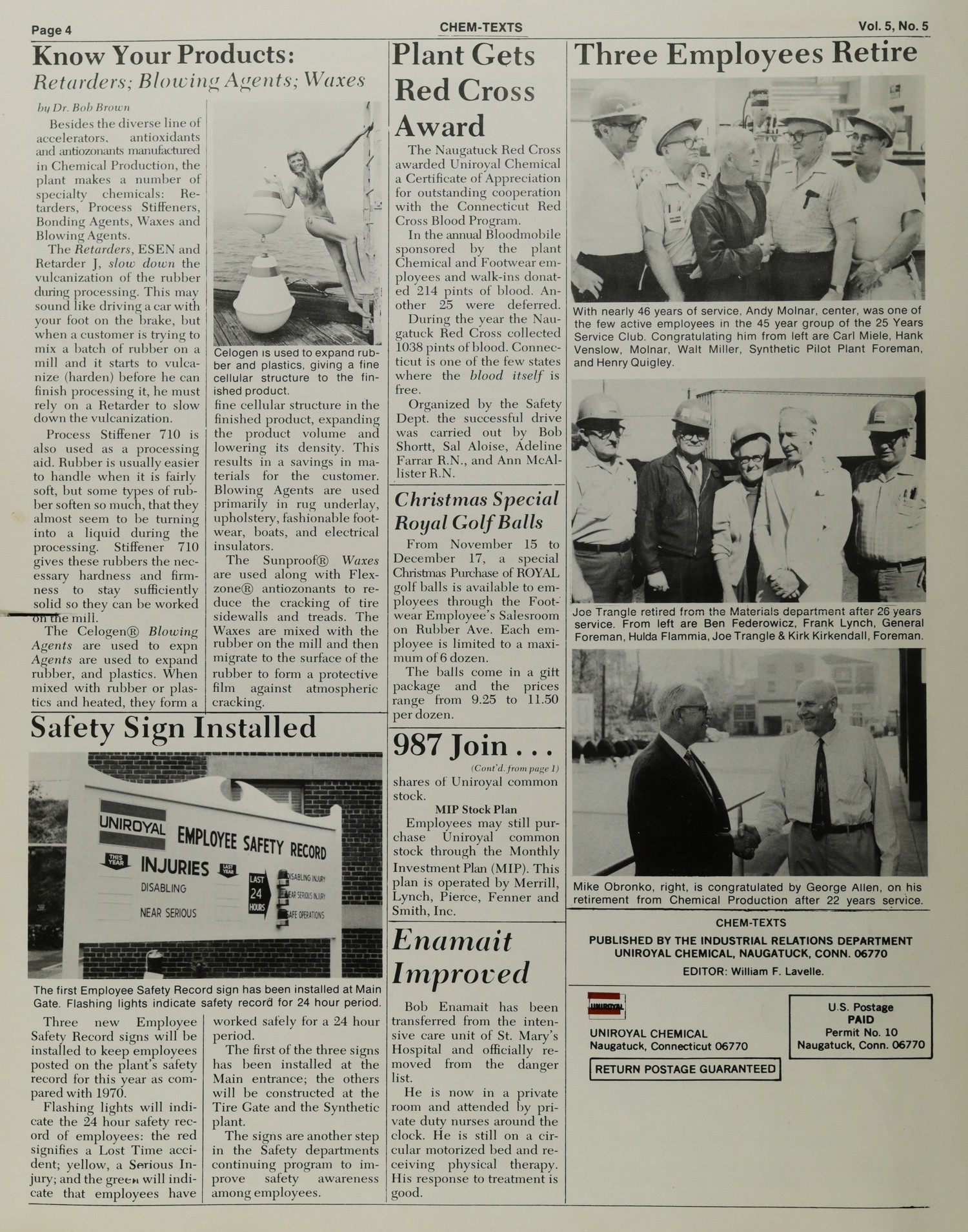
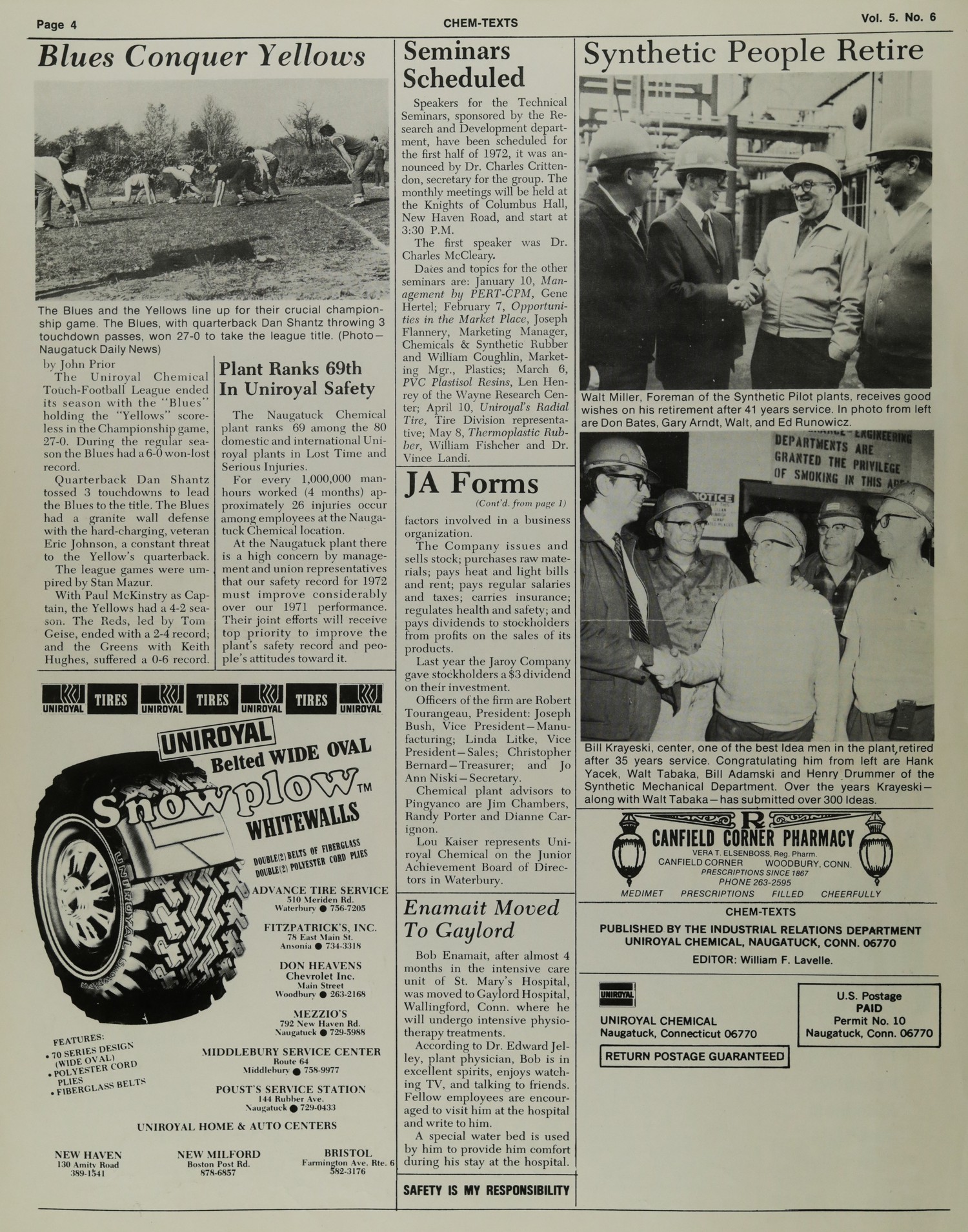
Four Retire Recently

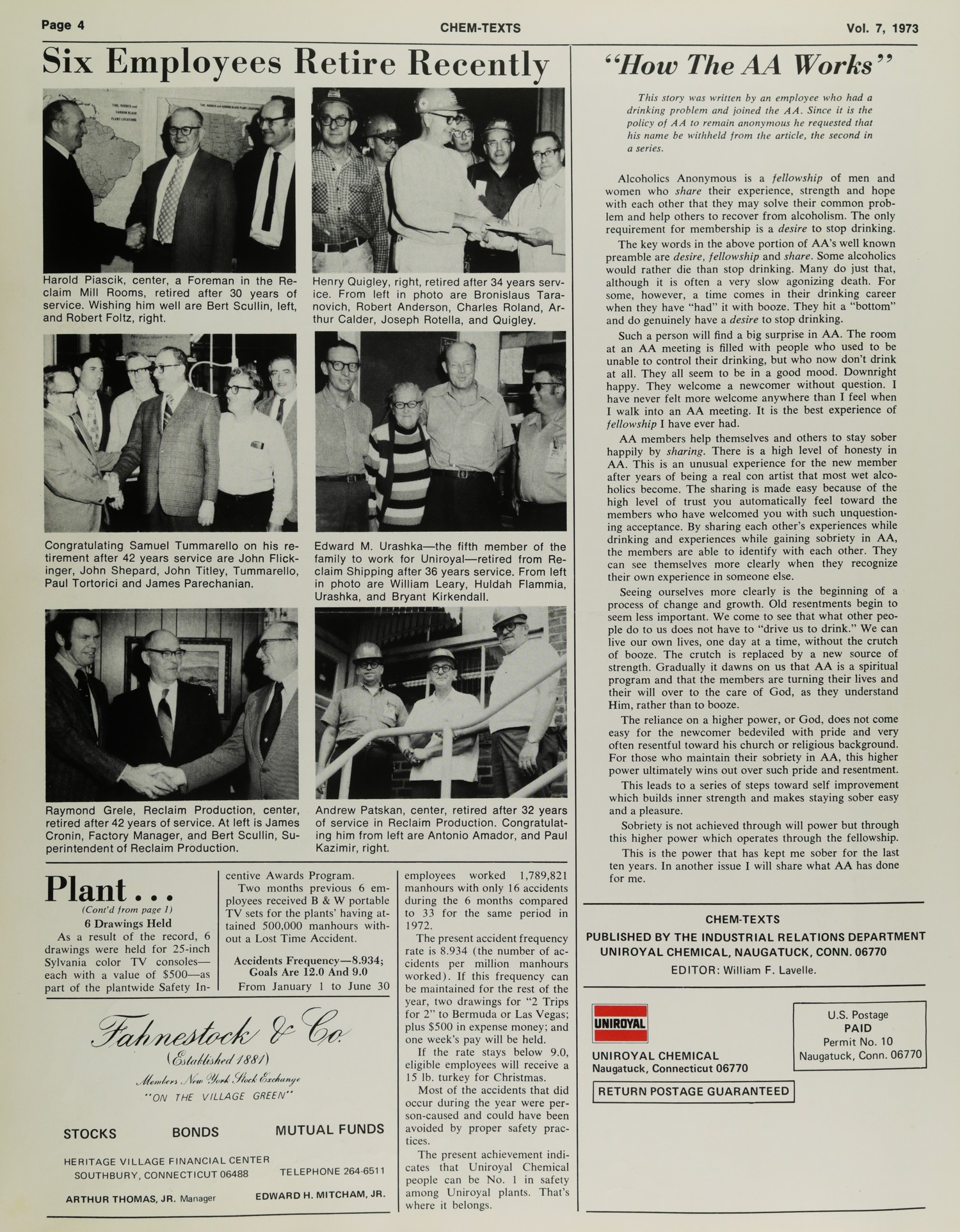
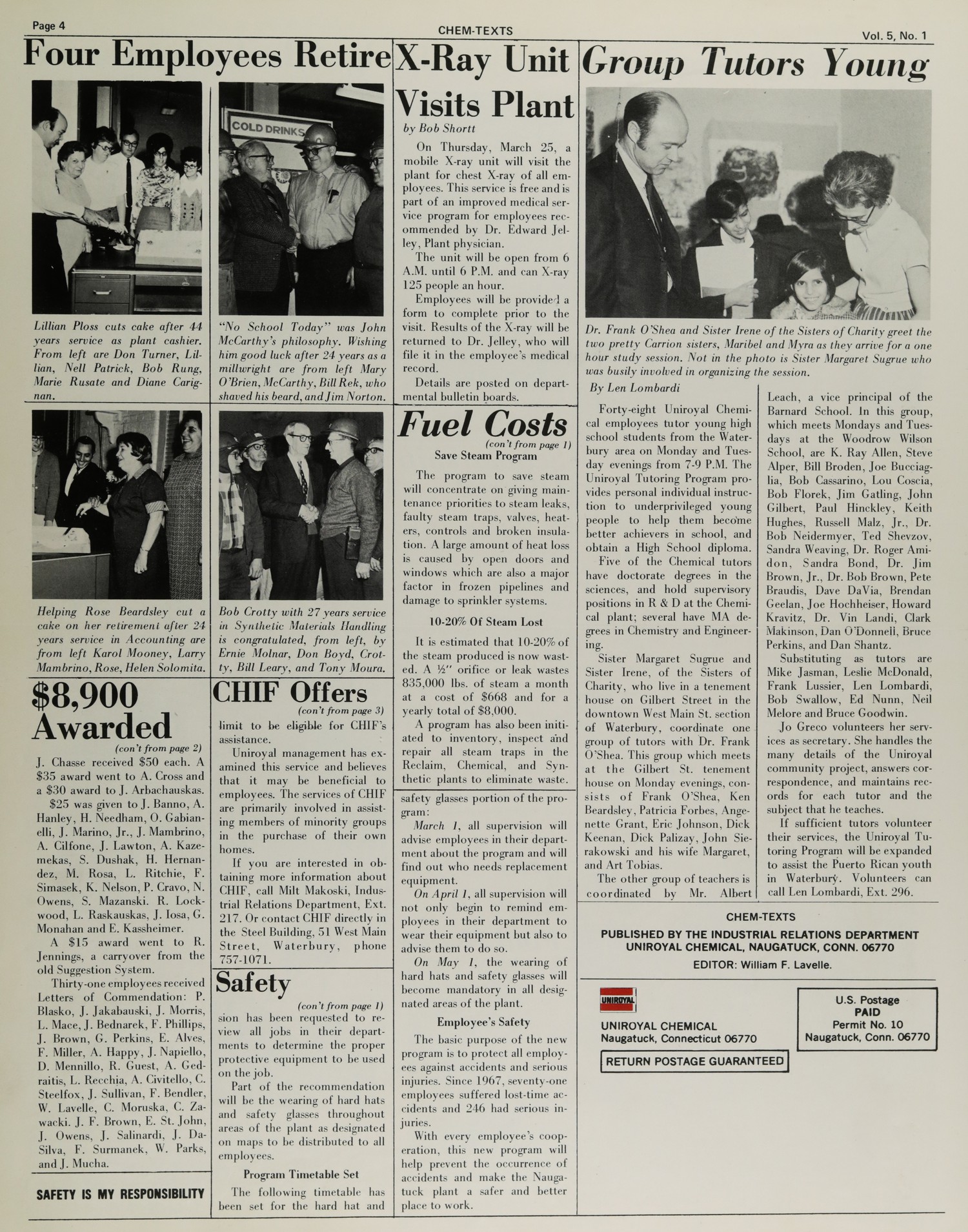
Martha Karbowicz, right, retired from R&D after 46 years. From left are Walter Budd, Josephine Wailonis, and Martha.

George Aspell, third left, cuts cake on his retirement from R&D. Observing at left is Francis Sordi, Aspell, and Richard Tweedie.

Thomas Lee, right, is congratulated by Joseph Bucciaglia, Superintendent of Chemical Production, on his retirement after 33 years service.

Julius Cohen, left, retired after 24 years service. Congratulating him are Daniel Shantz, right, and William Borden, left.


U.S….

continued from page 1

ert Kindle, Robert Barnhart and Dr. Phillip T. Paul (retired) for a Vulklor®—Bonding Agent R-6™ which improves the adhesion of rubber to steel tire cord; Dr. Francis O’Shea for weathering resistant grafted Royalene® for use in Kralastic® ABS; and Dr. Zaven Ariyan for pharmaceutical anti-inflamatory agents who has since resigned from the company.

28 inventors received one or more of the 34 patents. Dr. Stephen Cantor received 5 while William Fischer (retired), Leland Dannals and Dr. Howard Hageman received two each.

Dr. Byron A. Hunter was awarded the thirty-eighth patent of his career—the highest number for any person in the Chemical Division.

Other Chemical Division inventors who received U.S. patents were R. Ames, J. Barron, Dr. W. Batorewicz, Dr. T. Brett, Jr., W. Budd, J. Chin, K. Hughes, M. Kleinfeld, R. Quint, Dr. A. Smith, A. Soboleski, Dr. B. VonSchmeling, J. Corkins, J. Hartley, A. Heinrichs, Dr. E. Kontos, W. McIntire, and R. Stark.

Conference: a meeting where people talk about what they should already be doing.


Al-Anon Helps the Families of Alcoholics

If you are concerned about someone in your family with a drinking problem, the Al-Anon program can help you.

Al-Anon is an established resource for the families of alcoholics. It provides important information and help for the family whether or not the alcoholic member seeks help or even recognizes his or her drinking problem.

Al-Anon is an outgrowth of Alcoholics Anonymous, with the same basic 12 step structure of AA and is a completely separate organization. The only requirement for Al-Anon membership is that the person either has been or is being affected by someone else’s drinking problem.

Alcoholism directly affects the individual who is its victim, but it is in every sense a family and social disease. The magnitude of the problem may be seen . . . in family tragedies, industrial costs, highway and other accidents, crime and delinquency, and countless other human problems.

Al-Anon offers a constructive approach to this family and social illness. It assists in the recovery of those persons already damaged, and helps prevent some of the tragedies that occur as a result of the destructive impact of alcoholism on the lives of those involved with someone else’s drinking problem.

Al-Anon publishes over 60 pamphlets on alcoholism and how families should treat this problem, a monthly publication, and a cartoon booklet.

Further information on Al-Anon may be obtained by contacting: Connecticut Al-Anon, Public Information, P.O. Box 888, New Haven, Conn. 06504. Tel: 787-0115.


94 Honored…

continued from page 3

Advanced to the 35 Year Group: Dr. McCleary presents 35 year pins to Catherine Sullivan and George O’Brien.

Advanced to the 30 Year Group were Gracie Stone, Mary Foy, and Edward Newell.

E. Semaskvich, W. Schlesinger, H. Smith, F. Tabone, L. Thompson, F. Tigeleiro, K. Urbsaitis, H. Vagt, H. Venslow, and R. Volz.

30 Years Service

E. Anderson, L. Anderson, R. Baker, M. Banik, P. Benson, T. Dalton, M. Foy, S. Korpusik, R. Olson, N. Patrick, J. Rabetsky, J. Rotella, M. N. P. Silva, J. Speck, and G. Stone.

35 Years Service

N. Benson, F. Clark, M. Cob-

bol, N. Gibbs, Z. Kirdzik, R. Magnanimo, W. Mariano, Dr. C. McCleary, K. D. Nelson, G. O’Brien, C. O’Sullivan, T. San Angelo, J. Schumacher, E. Szesziul, and R. VanAllen.

40 Years Service

W. Budd, D. Cowan, C. Drapko, C. Gates, F. Lynch, A. Nauges, H. Scullin, and A. Zapatka.

45 Years Service

Eitel Radwick


Family Picnic Planned

The Uniroyal Chemical Management Club will hold the annual family picnic for its members on Tuesday, August 12, at Lake Quassapaug in Middlebury. The entire family is invited to the picnic which starts at 5 P.M. and will feature a wide variety of menu specialties. The park offers amusement rides and swimming facilities.

Other summer activities scheduled by the club are a night baseball game at Shea Stadium

in New York on Friday August 29 to see the N.Y. Yankees play the Kansas City Royals.

The final summer picnic will be held on Thursday, September 4, at Lake Quassapaug.


Appointments Announced

John Tierney has been named Assistant General Foreman for the Materials Department.

Arnold Nori has been named Second Shift Production Foreman for 80 Bldg. Roylar operations.


SAFETY IS MY RESPONSIBILITY


27 Receive…

continued from page 1

Waterbury, Gould applied the theories of supervision to the practical aspects of daily situations that occur in an industrial plant.

Prior to the new program, many of the people promoted to supervisory positions did not have an extensive background in the managerial responsibilities of their new assignments.

Participants in the second class were A. Piooli, S. Aloise, M. Banik, W. Budd, C. Bulka, H. Campbell, W. Connelly, D. Cowan, F. Rodrigues, A. Soares, G. Baktis, J. Burke, W. Rek, R. Clark, G. Bachinsky, I. Broderick, C. German, F. Giordano, S. Korpusik, J. Mambrino, P. Murray, T. Engle, A. Grant, W. Kirkendall, R. Magnanimo, K. D. Nelson, and R. Valentine.

A new course, the Techniques of Management, is now being planned and will be given in the Fall of this year.


BUY U.S. SAVINGS BONDS


Fahnestock & Co.

(Established 1881)

Members New York Stock Exchange

“ON THE VILLAGE GREEN”

STOCKS BONDS MUTUAL FUNDS

HERITAGE VILLAGE FINANCIAL CENTER
SOUTHBURY, CONNECTICUT 06488 TELEPHONE 264-6511

ARTHUR THOMAS, JR. Manager EDWARD H. MITCHAM, JR.


BOB’S CAMERA SHOP INC.

🎥 WATERBURY’S LEADING CAMERA SHOP

90 South Main St., Waterbury, Conn. 06702 754-2256

Film ● Cameras ● Projectors ● Developing ● Rentals


CHEM-TEXTS

PUBLISHED BY THE INDUSTRIAL RELATIONS DEPARTMENT

UNIROYAL CHEMICAL, NAUGATUCK, CONN. 06770

Equal Opportunity Employer

EDITOR: William F. Lavelle.


UNIROYAL

UNIROYAL CHEMICAL
Naugatuck, Connecticut 06770

U.S. Postage
PAID
Permit No. 10
Naugatuck, Conn. 06770

RETURN POSTAGE GUARANTEED

CHEM-TEXTS – 1974-v08-i01-s222

Page 222

UNIROYAL CHEM-TEXTS

Vol. 8, 1974 | PUBLISHED FOR THE PEOPLE OF UNIROYAL CHEMICAL | No. 1


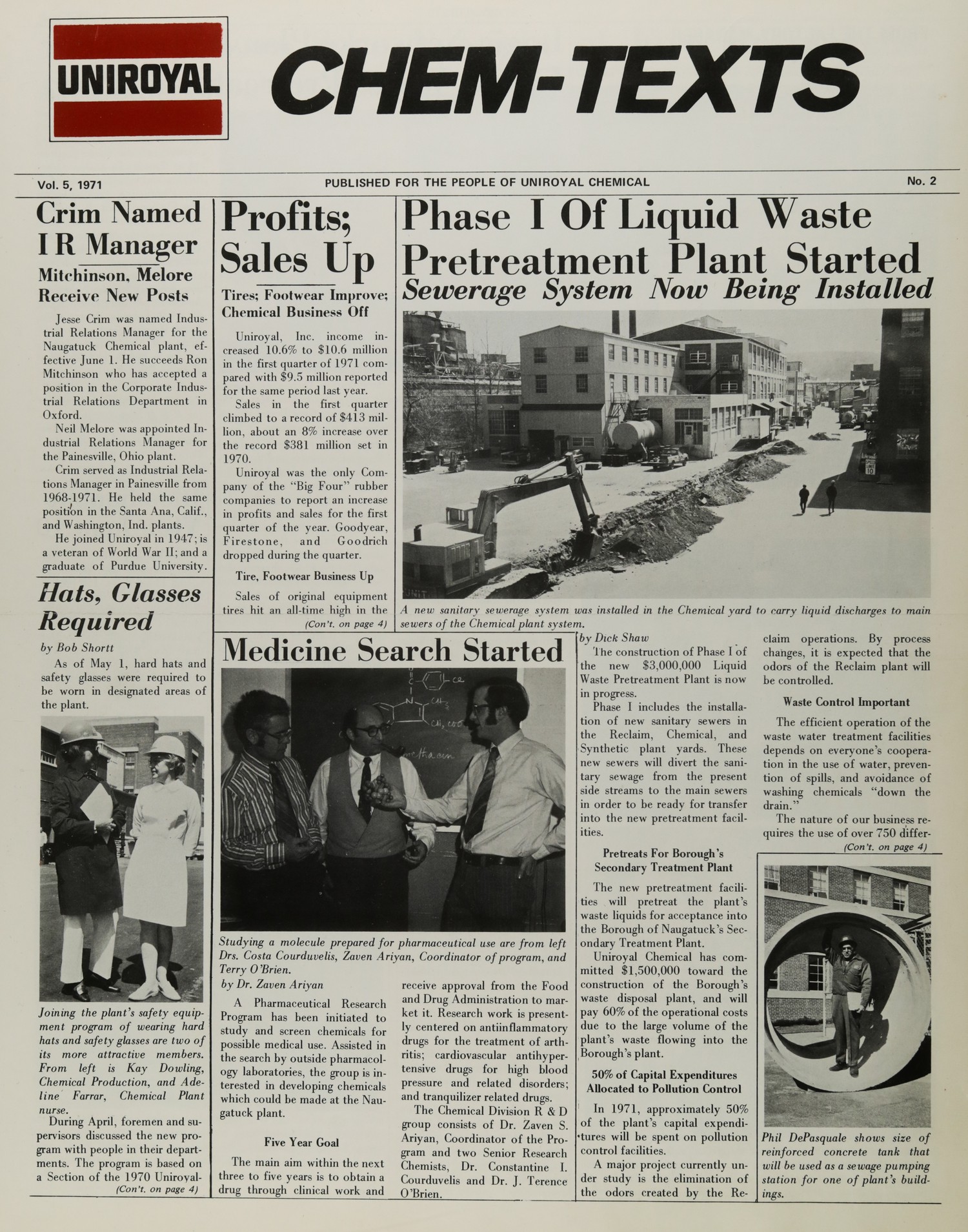
Wintsch Named IR Manager

[PHOTO: Portrait of H. Frederick Wintsch]

H. Frederick Wintsch has been named Industrial Relations Manager for the Naugatuck plant of Uniroyal Chemical, it was announced by James Cronin, Factory Manager. He succeeds Jesse Crim, who was appointed Director of Personnel Management and Training for the Chemical division.

Prior to his new assignment he served as Labor Relations Manager since 1968. Wintsch joined the Naugatuck Chemical plant in 1963 as a member of the

(Cont’d on page 4)


Plant Tops 1,000,000 Manhours Without a Lost Time Accident for Second Time in 1973

[PHOTO: Group of employees standing in front of sign reading “UNIROYAL EMPLOYEE SAFETY RECORD NO INJURIES 1,000,000”]

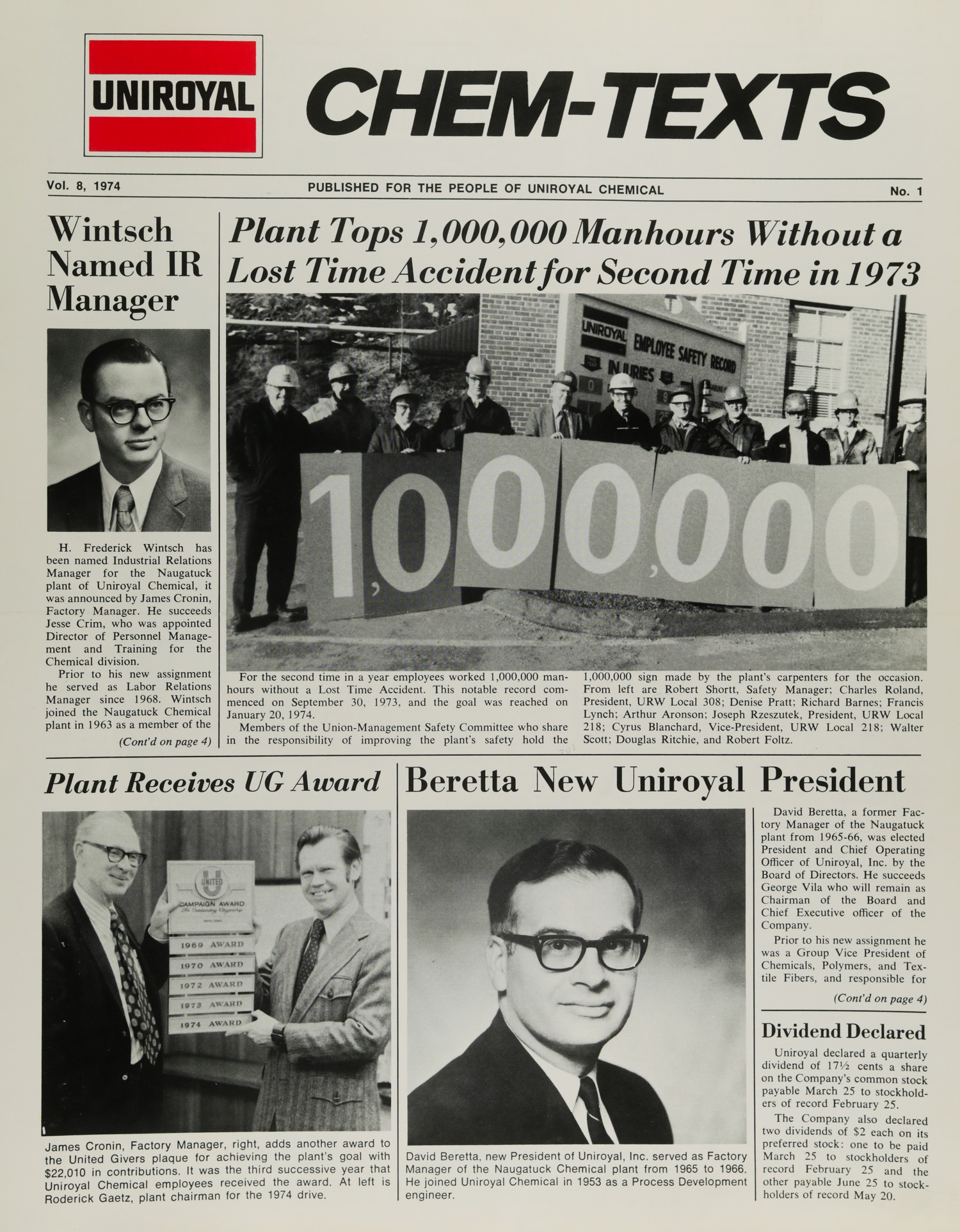
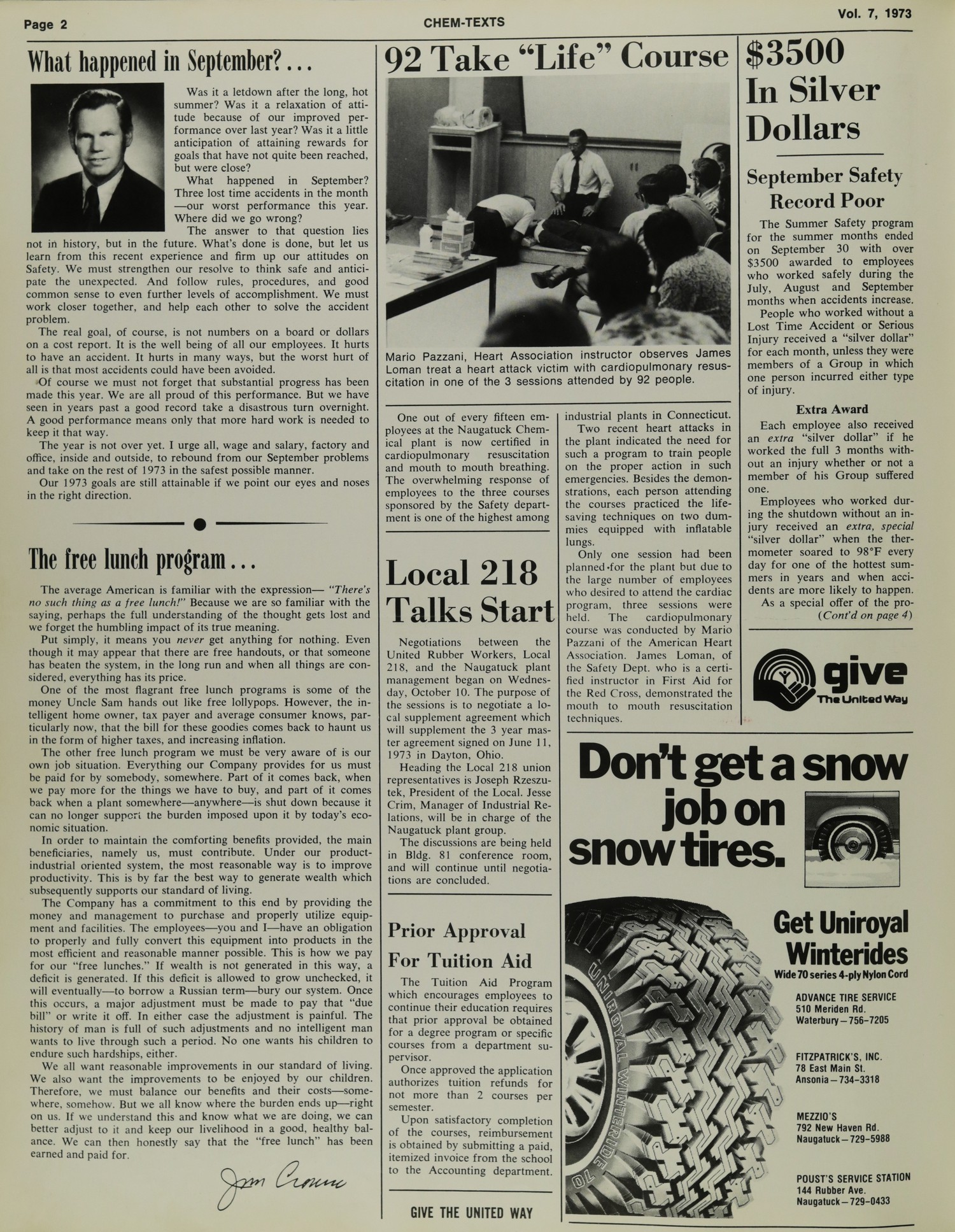
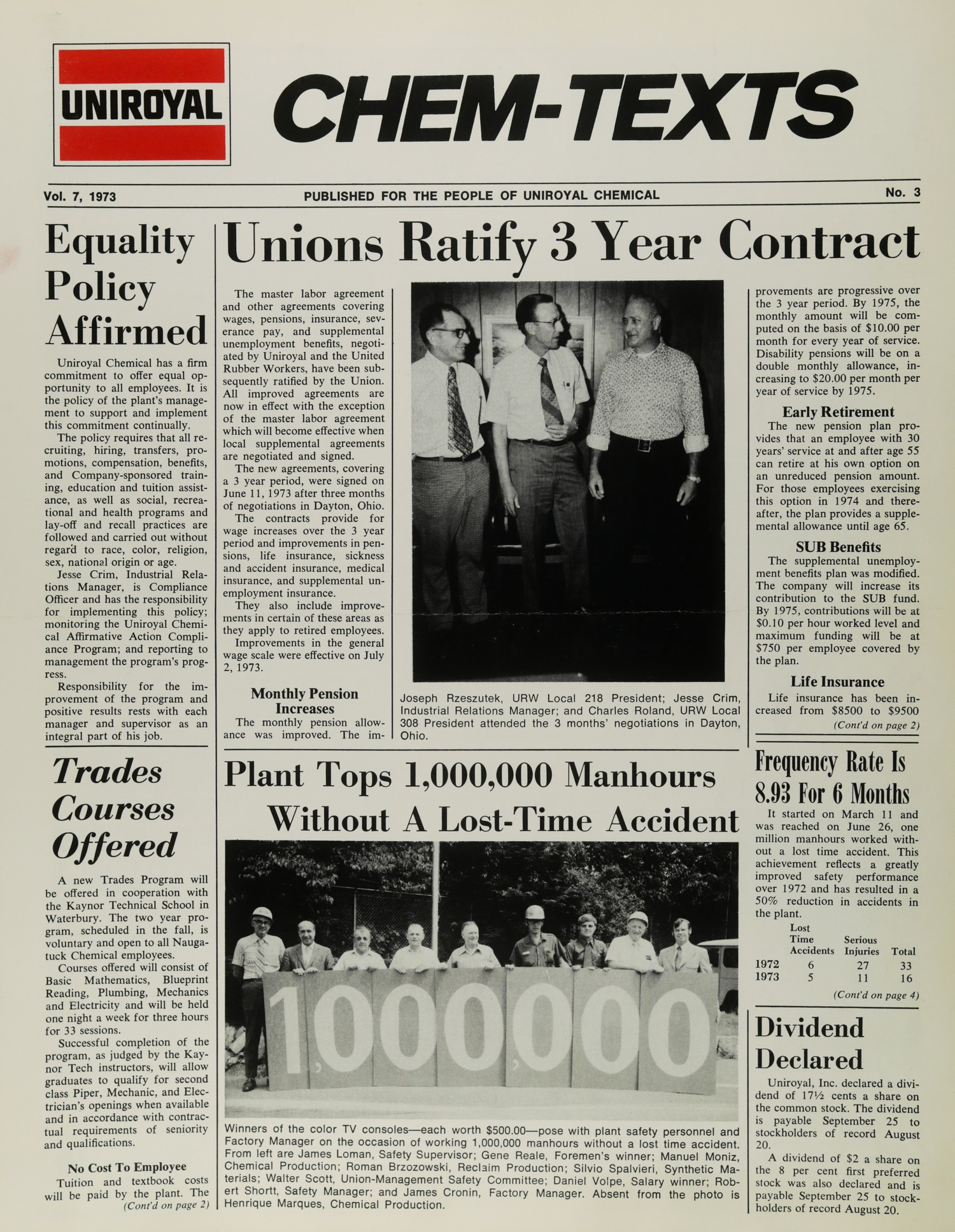
For the second time in a year employees worked 1,000,000 man-hours without a Lost Time Accident. This notable record commenced on September 30, 1973, and the goal was reached on January 20, 1974.

Members of the Union-Management Safety Committee who share in the responsibility of improving the plant’s safety hold the 1,000,000 sign made by the plant’s carpenters for the occasion. From left are Robert Shortt, Safety Manager; Charles Roland, President, URW Local 308; Denise Pratt; Richard Barnes; Francis Lynch; Arthur Aronson; Joseph Rzeszutek, President, URW Local 218; Cyrus Blanchard, Vice-President, URW Local 218; Walter Scott; Douglas Ritchie, and Robert Foltz.


Plant Receives UG Award

[PHOTO: Two men with United Givers award plaque showing awards from 1969, 1970, 1972, 1973, 1974]

James Cronin, Factory Manager, right, adds another award to the United Givers plaque for achieving the plant’s goal with $22,010 in contributions. It was the third successive year that Uniroyal Chemical employees received the award. At left is Roderick Gaetz, plant chairman for the 1974 drive.


Beretta New Uniroyal President

[PHOTO: Portrait of David Beretta wearing glasses]

David Beretta, a former Factory Manager of the Naugatuck plant from 1965-66, was elected President and Chief Operating Officer of Uniroyal, Inc. by the Board of Directors. He succeeds George Vila who will remain as Chairman of the Board and Chief Executive officer of the Company.

Prior to his new assignment he was a Group Vice President of Chemicals, Polymers, and Textile Fibers, and responsible for

(Cont’d on page 4)

David Beretta, new President of Uniroyal, Inc. served as Factory Manager of the Naugatuck Chemical plant from 1965 to 1966. He joined Uniroyal Chemical in 1953 as a Process Development engineer.


Dividend Declared

Uniroyal declared a quarterly dividend of 17½ cents a share on the Company’s common stock payable March 25 to stockholders of record February 25.

The Company also declared two dividends of $2 each on its preferred stock: one to be paid March 25 to stockholders of record February 25 and the other payable June 25 to stockholders of record May 20.

CHEM-TEXTS – Vol. 8 – Page 4

Page 004

Page 4 | CHEM-TEXTS | Vol. 8, 1974


Six Retire Recently

[PHOTO CAPTION]
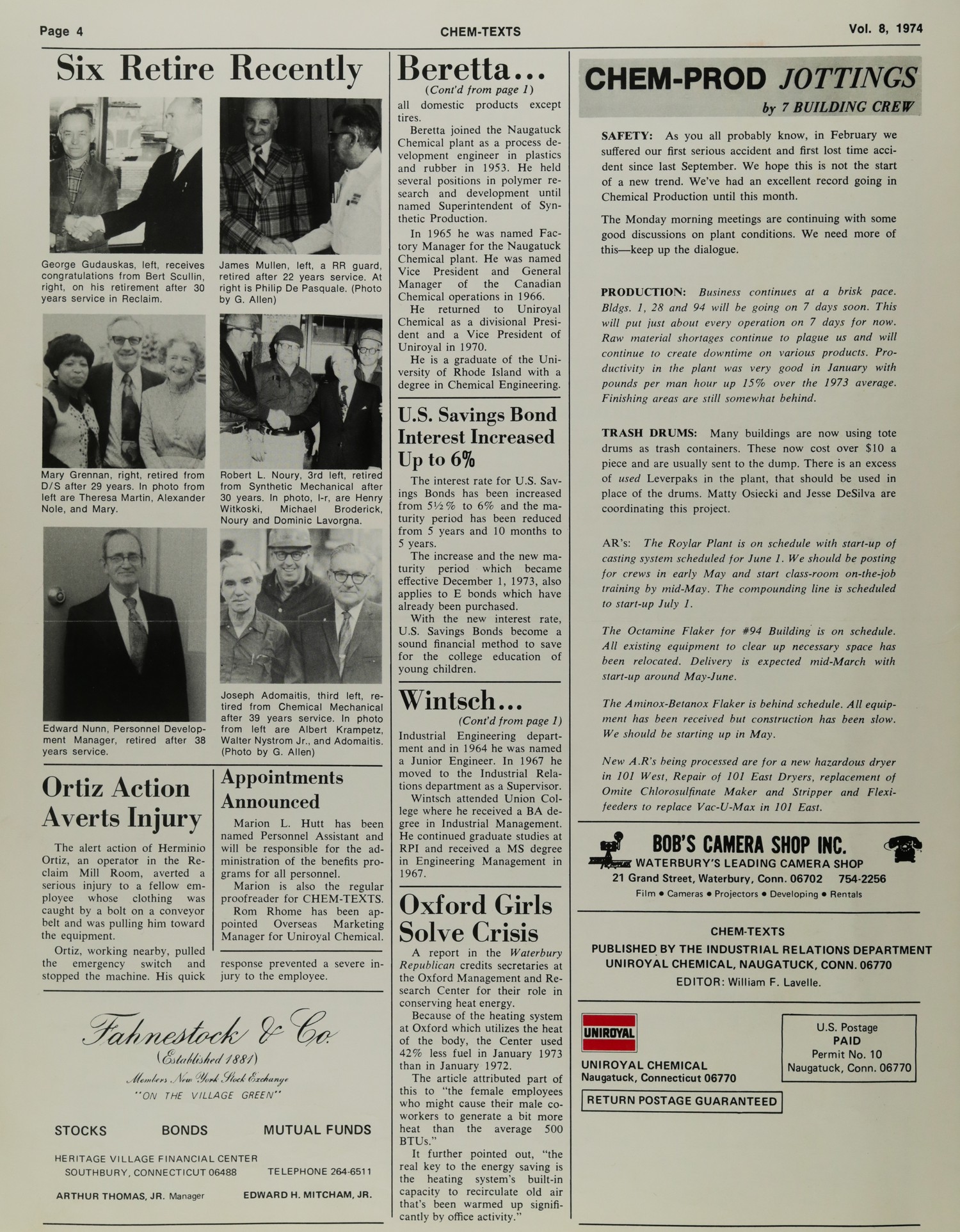
George Gudauskas, left, receives congratulations from Bert Scullin, right, on his retirement after 30 years service in Reclaim.

[PHOTO CAPTION]
James Mullen, left, a RR guard, retired after 22 years service. At right is Philip De Pasquale. (Photo by G. Allen)

[PHOTO CAPTION]
Mary Grennan, right, retired from D/S after 29 years. In photo from left are Theresa Martin, Alexander Nole, and Mary.

[PHOTO CAPTION]
Robert L. Noury, 3rd left, retired from Synthetic Mechanical after 30 years. In photo, l-r, are Henry Witkoski, Michael Broderick, Noury and Dominic Lavorgna.

[PHOTO CAPTION]
Edward Nunn, Personnel Development Manager, retired after 38 years service.

[PHOTO CAPTION]
Joseph Adomaitis, third left, retired from Chemical Mechanical after 39 years service. In photo from left are Albert Krampetz, Walter Nystrom Jr., and Adomaitis. (Photo by G. Allen)


Ortiz Action Averts Injury

The alert action of Herminio Ortiz, an operator in the Reclaim Mill Room, averted a serious injury to a fellow employee whose clothing was caught by a bolt on a conveyor belt and was pulling him toward the equipment.

Ortiz, working nearby, pulled the emergency switch and stopped the machine. His quick response prevented a severe injury to the employee.


Appointments Announced

Marion L. Hutt has been named Personnel Assistant and will be responsible for the administration of the benefits programs for all personnel.

Marion is also the regular proofreader for CHEM-TEXTS.

Rom Rhome has been appointed Overseas Marketing Manager for Uniroyal Chemical.


Beretta…

(Cont’d from page 1)

all domestic products except tires.

Beretta joined the Naugatuck Chemical plant as a process development engineer in plastics and rubber in 1953. He held several positions in polymer research and development until named Superintendent of Synthetic Production.

In 1965 he was named Factory Manager for the Naugatuck Chemical plant. He was named Vice President and General Manager of the Canadian Chemical operations in 1966.

He returned to Uniroyal Chemical as a divisional President and a Vice President of Uniroyal in 1970.

He is a graduate of the University of Rhode Island with a degree in Chemical Engineering.


U.S. Savings Bond Interest Increased Up to 6%

The interest rate for U.S. Savings Bonds has been increased from 5½% to 6% and the maturity period has been reduced from 5 years and 10 months to 5 years.

The increase and the new maturity period which became effective December 1, 1973, also applies to E bonds which have already been purchased.

With the new interest rate, U.S. Savings Bonds become a sound financial method to save for the college education of young children.


Wintsch…

(Cont’d from page 1)

Industrial Engineering department and in 1964 he was named a Junior Engineer. In 1967 he moved to the Industrial Relations department as a Supervisor.

Wintsch attended Union College where he received a BA degree in Industrial Management. He continued graduate studies at RPI and received a MS degree in Engineering Management in 1967.


Oxford Girls Solve Crisis

A report in the Waterbury Republican credits secretaries at the Oxford Management and Research Center for their role in conserving heat energy.

Because of the heating system at Oxford which utilizes the heat of the body, the Center used 42% less fuel in January 1973 than in January 1972.

The article attributed part of this to “the female employees who might cause their male coworkers to generate a bit more heat than the average 500 BTUs.”

It further pointed out, “the real key to the energy saving is the heating system’s built-in capacity to recirculate old air that’s been warmed up significantly by office activity.”


CHEM-PROD JOTTINGS

by 7 BUILDING CREW

SAFETY: As you all probably know, in February we suffered our first serious accident and first lost time accident since last September. We hope this is not the start of a new trend. We’ve had an excellent record going in Chemical Production until this month.

The Monday morning meetings are continuing with some good discussions on plant conditions. We need more of this—keep up the dialogue.

PRODUCTION: Business continues at a brisk pace. Bldgs. 1, 28 and 94 will be going on 7 days soon. This will put just about every operation on 7 days for now. Raw material shortages continue to plague us and will continue to create downtime on various products. Productivity in the plant was very good in January with pounds per man hour up 15% over the 1973 average. Finishing areas are still somewhat behind.

TRASH DRUMS: Many buildings are now using tote drums as trash containers. These now cost over $10 a piece and are usually sent to the dump. There is an excess of used Leverpaks in the plant, that should be used in place of the drums. Matty Osiecki and Jesse DeSilva are coordinating this project.

AR’s: The Roylar Plant is on schedule with start-up of casting system scheduled for June 1. We should be posting for crews in early May and start class-room on-the-job training by mid-May. The compounding line is scheduled to start-up July 1.

The Octamine Flaker for #94 Building is on schedule. All existing equipment to clear up necessary space has been relocated. Delivery is expected mid-March with start-up around May-June.

The Aminox-Betanox Flaker is behind schedule. All equipment has been received but construction has been slow. We should be starting up in May.

New A.R’s being processed are for a new hazardous dryer in 101 West, Repair of 101 East Dryers, replacement of Omite Chlorosulfinate Maker and Stripper and Flexifeeders to replace Vac-U-Max in 101 East.


BOB’S CAMERA SHOP INC.
WATERBURY’S LEADING CAMERA SHOP
21 Grand Street, Waterbury, Conn. 06702 754-2256
Film • Cameras • Projectors • Developing • Rentals


Fahnestock & Co.
(Established 1881)
Members New York Stock Exchange
“ON THE VILLAGE GREEN”

| STOCKS | BONDS | MUTUAL FUNDS |

HERITAGE VILLAGE FINANCIAL CENTER
SOUTHBURY, CONNECTICUT 06488 TELEPHONE 264-6511

ARTHUR THOMAS, JR. Manager | EDWARD H. MITCHAM, JR.


CHEM-TEXTS
PUBLISHED BY THE INDUSTRIAL RELATIONS DEPARTMENT
UNIROYAL CHEMICAL, NAUGATUCK, CONN. 06770
EDITOR: William F. Lavelle.

UNIROYAL

UNIROYAL CHEMICAL
Naugatuck, Connecticut 06770

RETURN POSTAGE GUARANTEED

U.S. Postage
PAID
Permit No. 10
Naugatuck, Conn. 06770

CHEM-TEXTS – Vol. 8 – Page 6

Page 006

Page 6 CHEM-TEXTS Vol. 8, 1974


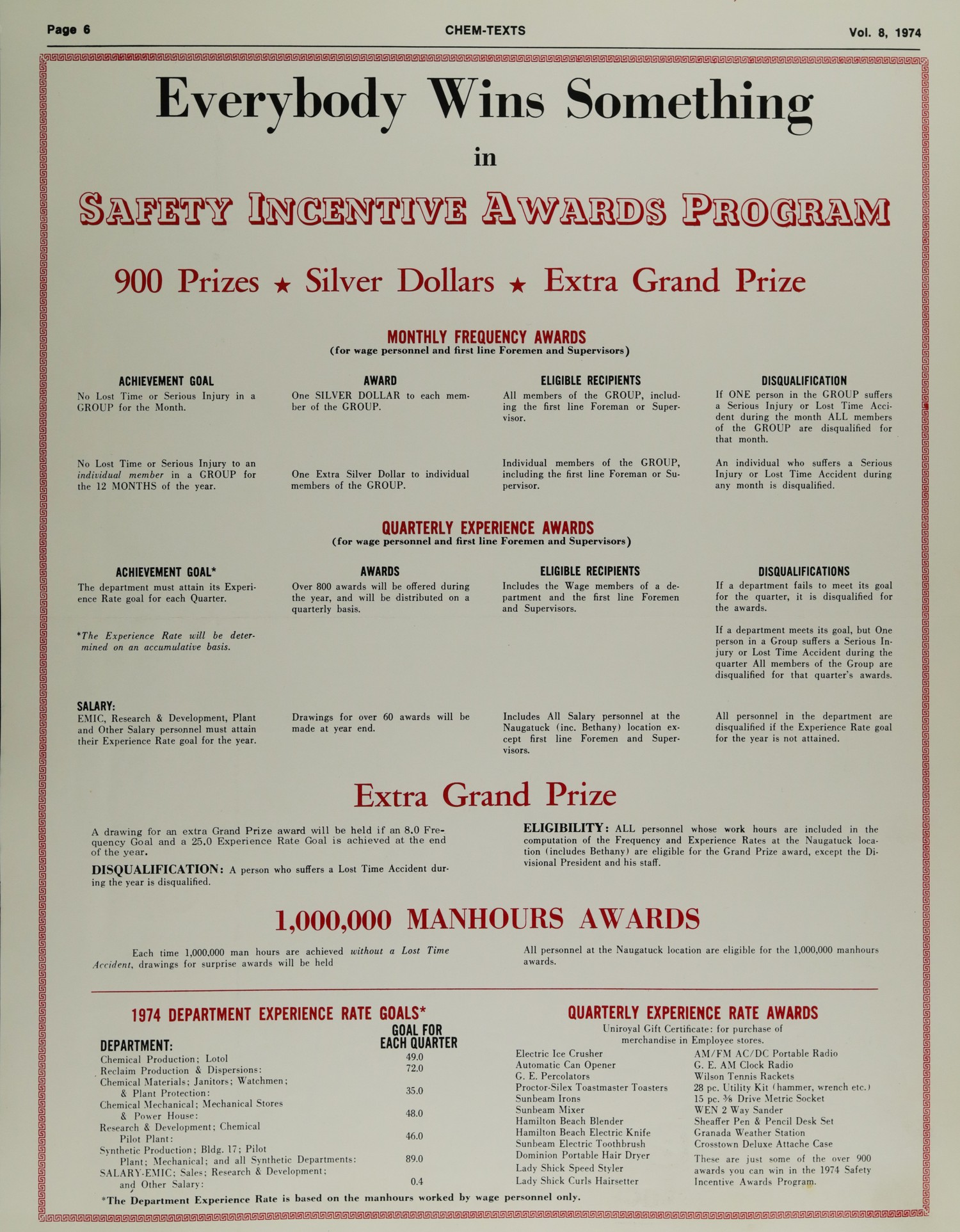
Everybody Wins Something

in

SAFETY INCENTIVE AWARDS PROGRAM

900 Prizes ★ Silver Dollars ★ Extra Grand Prize


MONTHLY FREQUENCY AWARDS

(for wage personnel and first line Foremen and Supervisors)

ACHIEVEMENT GOAL
No Lost Time or Serious Injury in a GROUP for the Month.

AWARD
One SILVER DOLLAR to each member of the GROUP.

ELIGIBLE RECIPIENTS
All members of the GROUP, including the first line Foreman or Supervisor.

DISQUALIFICATION
If ONE person in the GROUP suffers a Serious Injury or Lost Time Accident during the month ALL members of the GROUP are disqualified for that month.


No Lost Time or Serious Injury to an individual member in a GROUP for the 12 MONTHS of the year.

One Extra Silver Dollar to individual members of the GROUP.

Individual members of the GROUP, including the first line Foreman or Supervisor.

An individual who suffers a Serious Injury or Lost Time Accident during any month is disqualified.


QUARTERLY EXPERIENCE AWARDS

(for wage personnel and first line Foremen and Supervisors)

ACHIEVEMENT GOAL*
The department must attain its Experience Rate goal for each Quarter.

AWARDS
Over 800 awards will be offered during the year, and will be distributed on a quarterly basis.

ELIGIBLE RECIPIENTS
Includes the Wage members of a department and the first line Foremen and Supervisors.

DISQUALIFICATIONS
If a department fails to meet its goal for the quarter, it is disqualified for the awards.

*The Experience Rate will be determined on an accumulative basis.

If a department meets its goal, but One person in a Group suffers a Serious Injury or Lost Time Accident during the quarter All members of the Group are disqualified for that quarter’s awards.


SALARY:
EMIC, Research & Development, Plant and Other Salary personnel must attain their Experience Rate goal for the year.

Drawings for over 60 awards will be made at year end.

Includes All Salary personnel at the Naugatuck (inc. Bethany) location except first line Foremen and Supervisors.

All personnel in the department are disqualified if the Experience Rate goal for the year is not attained.


Extra Grand Prize

A drawing for an extra Grand Prize award will be held if an 8.0 Frequency Goal and a 25.0 Experience Rate Goal is achieved at the end of the year.

DISQUALIFICATION: A person who suffers a Lost Time Accident during the year is disqualified.

ELIGIBILITY: ALL personnel whose work hours are included in the computation of the Frequency and Experience Rates at the Naugatuck location (includes Bethany) are eligible for the Grand Prize award, except the Divisional President and his staff.


1,000,000 MANHOURS AWARDS

Each time 1,000,000 man hours are achieved without a Lost Time Accident, drawings for surprise awards will be held

All personnel at the Naugatuck location are eligible for the 1,000,000 manhours awards.


1974 DEPARTMENT EXPERIENCE RATE GOALS*

DEPARTMENT: GOAL FOR EACH QUARTER
Chemical Production; Lotel 49.0
Reclaim Production & Dispersions: 72.0
Chemical Materials; Janitors; Watchmen;
& Plant Protection: 35.0
Chemical Mechanical; Mechanical Stores
& Power House: 48.0
Research & Development; Chemical
Pilot Plant: 46.0
Synthetic Production; Bldg. 17; Pilot
Plant; Mechanical; and all Synthetic Departments: 89.0
SALARY-EMIC; Sales; Research & Development;
and Other Salary: 0.4

*The Department Experience Rate is based on the manhours worked by wage personnel only.


QUARTERLY EXPERIENCE RATE AWARDS

Uniroyal Gift Certificate: for purchase of merchandise in Employee stores.

Electric Ice Crusher
Automatic Can Opener
G. E. Percolators
Proctor-Silex Toastmaster Toasters
Sunbeam Irons
Sunbeam Mixer
Hamilton Beach Blender
Hamilton Beach Electric Knife
Sunbeam Electric Toothbrush
Dominion Portable Hair Dryer
Lady Shick Speed Styler
Lady Shick Curls Hairsetter

AM/FM AC/DC Portable Radio
G. E. AM Clock Radio
Wilson Tennis Rackets
28 pc. Utility Kit (hammer, wrench etc.)
15 pc. ⅜ Drive Metric Socket
WEN 2 Way Sander
Sheaffer Pen & Pencil Desk Set
Granada Weather Station
Crosstown Deluxe Attache Case

These are just some of the over 900 awards you can win in the 1974 Safety Incentive Awards Program.

CHEM-TEXTS – 1974 – Page 2

Page 002

CHEM-TEXTS

Page 2 | Vol. 8, 1974


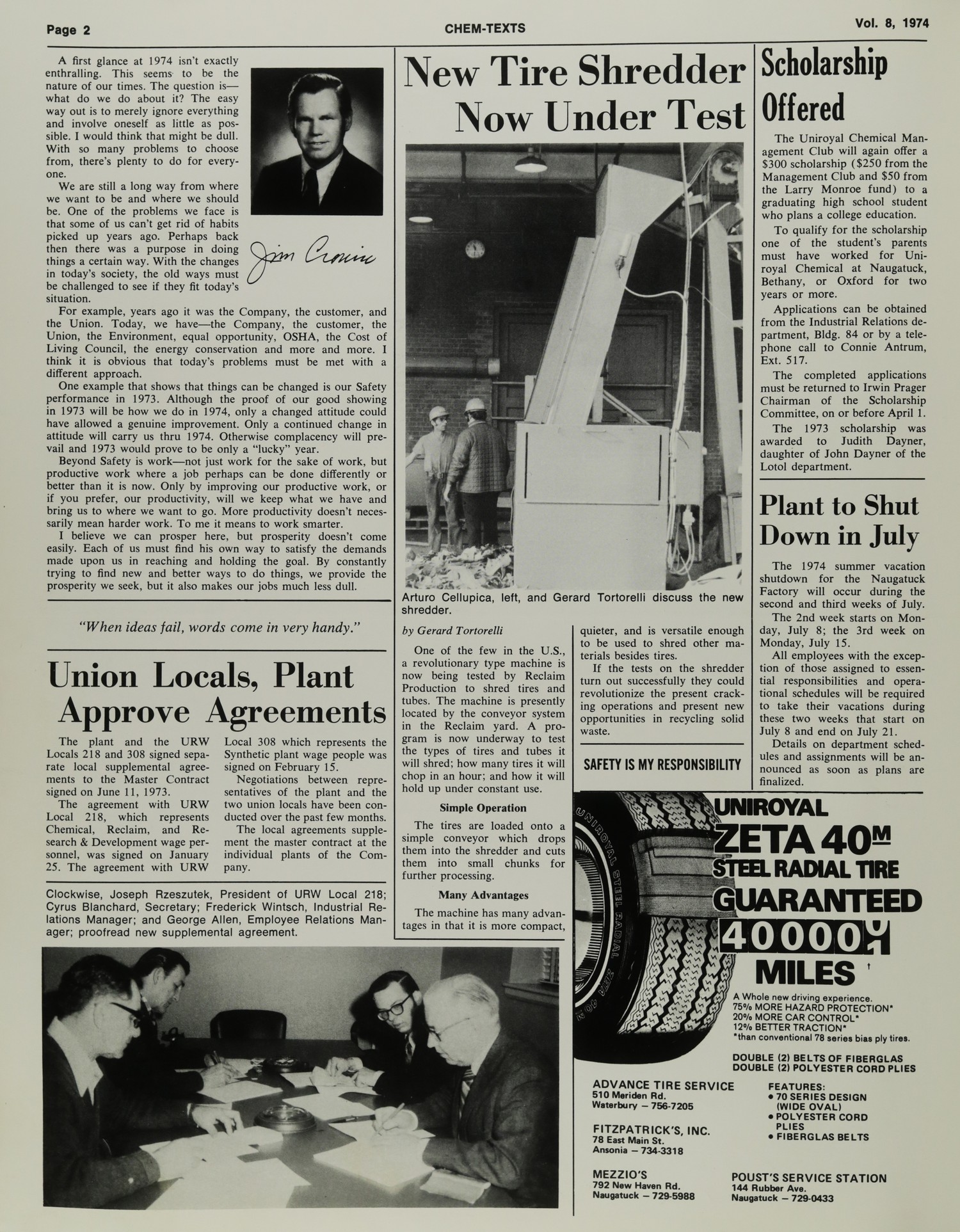
A first glance at 1974 isn’t exactly enthralling. This seems to be the nature of our times. The question is— what do we do about it? The easy way out is to merely ignore everything and involve oneself as little as possible. I would think that might be dull. With so many problems to choose from, there’s plenty to do for everyone.

We are still a long way from where we want to be and where we should be. One of the problems we face is that some of us can’t get rid of habits picked up years ago. Perhaps back then there was a purpose in doing things a certain way. With the changes in today’s society, the old ways must be challenged to see if they fit today’s situation.

For example, years ago it was the Company, and the Union. Today, we have—the Company, the customer, the Union, the Environment, equal opportunity, OSHA, the Cost of Living Council, the energy conservation and more and more. I think it is obvious that today’s problems must be met with a different approach.

One example that shows that things can be changed is our Safety performance in 1973. Although the proof of our good showing in 1973 will be how we do in 1974, only a changed attitude could have allowed a genuine improvement. Only a continued change in attitude will carry us thru 1974. Otherwise complacency will prevail and 1973 would prove to be only a “lucky” year.

Beyond Safety is work—not just work for the sake of work, but productive work where a job perhaps can be done differently or better than it is now. Only by improving our productive work, or if you prefer, our productivity, will we keep what we have and bring us to where we want to go. More productivity doesn’t necessarily mean harder work. To me it means to work smarter.

I believe we can prosper here, but prosperity doesn’t come easily. Each of us must find his own way to satisfy the demands made upon us in reaching and holding the goal. By constantly trying to find new and better ways to do things, we provide the prosperity we seek, but it also makes our jobs much less dull.

Jim Cronin


“When ideas fail, words come in very handy.”


Union Locals, Plant Approve Agreements

The plant and the URW Locals 218 and 308 signed separate local supplemental agreements to the Master Contract signed on June 11, 1973.

The agreement with URW Local 218, which represents Chemical, Reclaim, and Research & Development wage personnel, was signed on January 25. The agreement with URW Local 308 which represents the Synthetic plant wage people was signed on February 15.

Negotiations between representatives of the plant and the two union locals have been conducted over the past few months.

The local agreements supplement the master contract at the individual plants of the Company.

Clockwise, Joseph Rzeszutek, President of URW Local 218; Cyrus Blanchard, Secretary; Frederick Wintsch, Industrial Relations Manager; and George Allen, Employee Relations Manager; proofread new supplemental agreement.


New Tire Shredder Now Under Test

Arturo Cellupica, left, and Gerard Tortorelli discuss the new shredder.

by Gerard Tortorelli

One of the few in the U.S., a revolutionary type machine is now being tested by Reclaim Production to shred tires and tubes. The machine is presently located by the conveyor system in the Reclaim yard. A program is now underway to test the types of tires and tubes it will shred; how many tires it will chop in an hour; and how it will hold up under constant use.

Simple Operation

The tires are loaded onto a simple conveyor which drops them into the shredder and cuts them into small chunks for further processing.

Many Advantages

The machine has many advantages in that it is more compact, quieter, and is versatile enough to be used to shred other materials besides tires.

If the tests on the shredder turn out successfully they could revolutionize the present cracking operations and present new opportunities in recycling solid waste.


SAFETY IS MY RESPONSIBILITY


Scholarship Offered

The Uniroyal Chemical Management Club will again offer a $300 scholarship ($250 from the Management Club and $50 from the Larry Monroe fund) to a graduating high school student who plans a college education.

To qualify for the scholarship one of the student’s parents must have worked for Uniroyal Chemical at Naugatuck, Bethany, or Oxford for two years or more.

Applications can be obtained from the Industrial Relations department, Bldg. 84 or by a telephone call to Connie Antrum, Ext. 517.

The completed applications must be returned to Irwin Prager Chairman of the Scholarship Committee, on or before April 1.

The 1973 scholarship was awarded to Judith Dayner, daughter of John Dayner of the Lotol department.


Plant to Shut Down in July

The 1974 summer vacation shutdown for the Naugatuck Factory will occur during the second and third weeks of July.

The 2nd week starts on Monday, July 8, the 3rd week on Monday, July 15.

All employees with the exception of those assigned to essential responsibilities and operational schedules will be required to take their vacations during these two weeks that start on July 8 and end on July 21.

Details on department schedules and assignments will be announced as soon as plans are finalized.


UNIROYAL ZETA 40M STEEL RADIAL TIRE GUARANTEED 40000 MILES

A Whole new driving experience.
75% MORE HAZARD PROTECTION
20% MORE CAR CONTROL

12% BETTER TRACTION
than conventional 78 series bias ply tires.

DOUBLE (2) BELTS OF FIBERGLAS
DOUBLE (2) POLYESTER CORD PLIES

ADVANCE TIRE SERVICE
510 Meriden Rd.
Waterbury — 756-7205

FITZPATRICK’S, INC.
78 East Main St.
Ansonia — 734-3318

MEZZIO’S
792 New Haven Rd.
Naugatuck — 729-5988

POUST’S SERVICE STATION
144 Rubber Ave.
Naugatuck — 729-0433

FEATURES:
• 70 SERIES DESIGN (WIDE OVAL)
• POLYESTER CORD PLIES
• FIBERGLAS BELTS

CHEM-TEXTS – 1974 – Page 3

Page 003

CHEM-TEXTS

Vol. 8, 1974 | Page 3


’73 Sales Set Record; Profits Up Slightly

Sales in 1973 set a new record and net income was slightly higher than the previous year.

Sales exceeded 2 billion dollars ($2,082,691,000) an increase of 15.8% over 1972 and the highest in Uniroyal’s history. Profit was $47,094,000, a 1% increase over 1972. Earnings a share of common stock were $1.58 in 1973, compared with $1.55 in 1972.

4th Quarter Sales and Profits Up

In the 4th quarter of 1973, sales were $537 million, for an increase of 16.6% over the same period in 1972.

Profit in the quarter was $12.1 million, compared with $10.7 million the previous year.

Profit in 1973 was affected chiefly by the price freeze on tires and delays by the Cost of Living Council in granting price relief to cover sharp cost increases in raw materials and

other areas. These factors cost Uniroyal about $10 million in Profit and prevented setting a new profit record in line with sales increases.

Many Lines Improve

The Company’s business improved in many lines in 1973. Among them were radial tires, footwear, Naugahyde, TPR Thermoplastic rubber and rubber chemicals.

New records were set by the Fiber and Textile division and by USCO Services and Computeristics.


Club Sponsors Campership

The Uniroyal Girls Club is sponsoring a 2-3 week Campership summer vacation for a handicapped child with all expenses paid.

Transportation must be supplied by the child’s parents or guardians.

If you know a handicapped child who would be interested, contact Rose Juliano, Ext. 565.


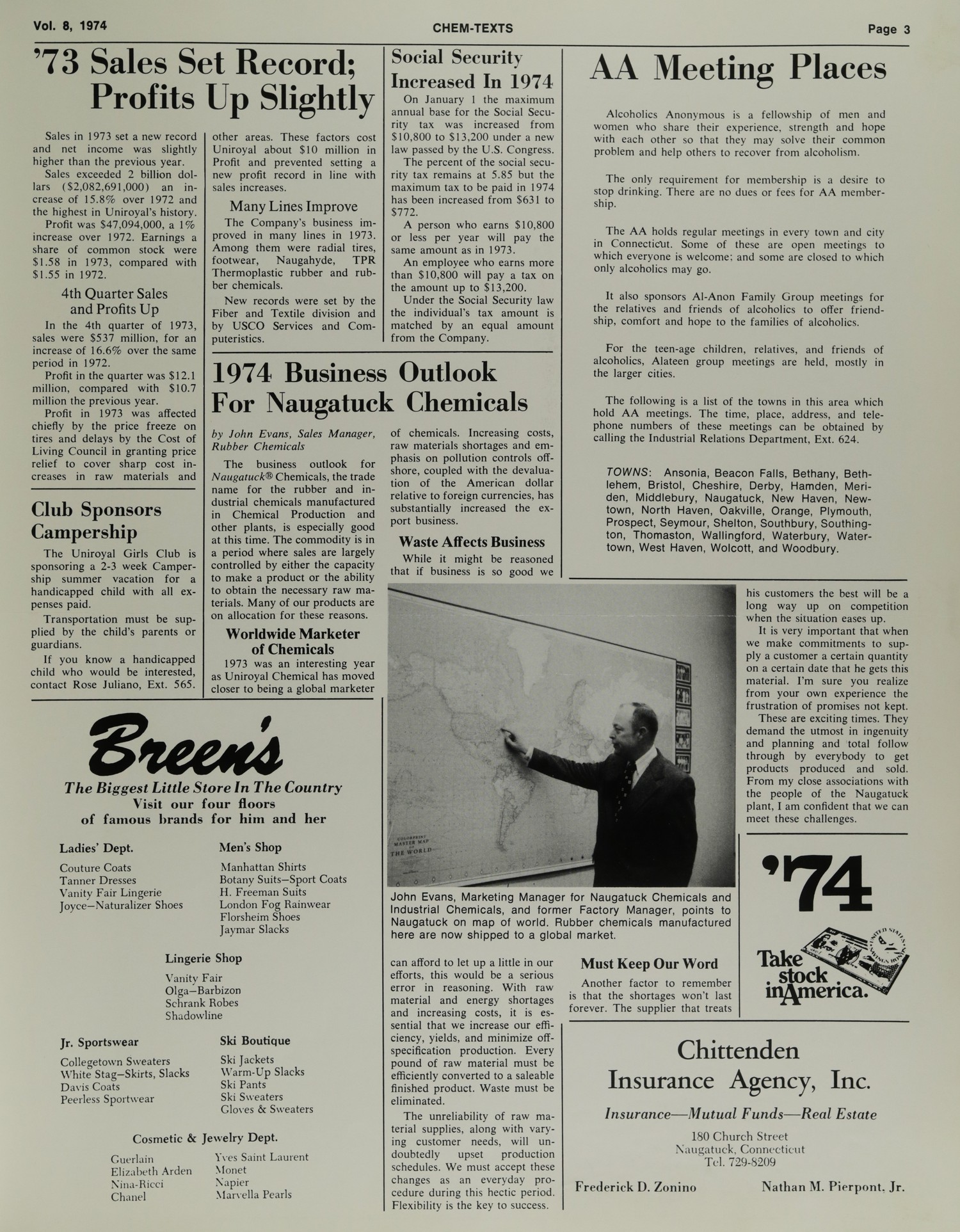
1974 Business Outlook For Naugatuck Chemicals

by John Evans, Sales Manager, Rubber Chemicals

The business outlook for Naugatuck® Chemicals, the trade name for the rubber and industrial chemicals manufactured in Chemical Production and other plants, is especially good at this time. The commodity is in a period where sales are largely controlled by either the capacity to make a product or the ability to obtain the necessary raw materials. Many of our products are on allocation for these reasons.

Worldwide Marketer of Chemicals

1973 was an interesting year as Uniroyal Chemical has moved closer to being a global marketer

of chemicals. Increasing costs, raw materials shortages and emphasis on pollution controls offshore, coupled with the devaluation of the American dollar relative to foreign currencies, has substantially increased the export business.

Waste Affects Business

While it might be reasoned that if business is so good we


Social Security Increased In 1974

On January 1 the maximum annual base for the Social Security tax was increased from $10,800 to $13,200 under a new law passed by the U.S. Congress.

The percent of the social security tax remains at 5.85 but the maximum tax to be paid in 1974 has been increased from $631 to $772.

A person who earns $10,800 or less per year will pay the same amount as in 1973.

An employee who earns more than $10,800 will pay a tax on the amount up to $13,200.

Under the Social Security law the individual’s tax amount is matched by an equal amount from the Company.


AA Meeting Places

Alcoholics Anonymous is a fellowship of men and women who share their experience, strength and hope with each other so that they may solve their common problem and help others to recover from alcoholism.

The only requirement for membership is a desire to stop drinking. There are no dues or fees for AA membership.

The AA holds regular meetings in every town and city in Connecticut. Some of these are open meetings to which everyone is welcome; and some are closed to which only alcoholics may go.

It also sponsors Al-Anon Family Group meetings for the relatives and friends of alcoholics to offer friendship, comfort and hope to the families of alcoholics.

For the teen-age children, relatives, and friends of alcoholics, Alateen group meetings are held, mostly in the larger cities.

The following is a list of the towns in this area which hold AA meetings. The time, place, address, and telephone numbers of these meetings can be obtained by calling the Industrial Relations Department, Ext. 624.

TOWNS: Ansonia, Beacon Falls, Bethany, Bethlehem, Bristol, Cheshire, Derby, Hamden, Meriden, Middlebury, Naugatuck, New Haven, Newtown, North Haven, Oakville, Orange, Plymouth, Prospect, Seymour, Shelton, Southbury, Southington, Thomaston, Wallingford, Waterbury, Watertown, West Haven, Wolcott, and Woodbury.


Breen’s

The Biggest Little Store In The Country

Visit our four floors of famous brands for him and her

Ladies’ Dept.
Couture Coats
Tanner Dresses
Vanity Fair Lingerie
Joyce—Naturalizer Shoes

Men’s Shop
Manhattan Shirts
Botany Suits—Sport Coats
H. Freeman Suits
London Fog Rainwear
Florsheim Shoes
Jaymar Slacks

Lingerie Shop
Vanity Fair
Olga—Barbizon
Schrank Robes
Shadowline

Jr. Sportswear
Collegetown Sweaters
White Stag—Skirts, Slacks
Davis Coats
Peerless Sportwear

Ski Boutique
Ski Jackets
Warm-Up Slacks
Ski Pants
Ski Sweaters
Gloves & Sweaters

Cosmetic & Jewelry Dept.
Guerlain — Yves Saint Laurent
Elizabeth Arden — Monet
Nina-Ricci — Napier
Chanel — Marvella Pearls


[PHOTO CAPTION:]
John Evans, Marketing Manager for Naugatuck Chemicals and Industrial Chemicals, and former Factory Manager, points to Naugatuck on map of world. Rubber chemicals manufactured here are now shipped to a global market.


can afford to let up a little in our efforts, this would be a serious error in reasoning. With raw material and energy shortages and increasing costs, it is essential that we increase our efficiency, yields, and minimize off-specification production. Every pound of raw material must be efficiently converted to a saleable finished product. Waste must be eliminated.

The unreliability of raw material supplies, along with varying customer needs, will undoubtedly upset production schedules. We must accept these changes as an everyday procedure during this hectic period. Flexibility is the key to success.

his customers the best will be a long way up on competition when the situation eases up.

It is very important that when we make commitments to supply a customer a certain quantity on a certain date that he gets this material. I’m sure you realize from your own experience the frustration of promises not kept.

These are exciting times. They demand the utmost in ingenuity and planning and total follow through by everybody to get products produced and sold. From my close associations with the people of the Naugatuck plant, I am confident that we can meet these challenges.

Must Keep Our Word

Another factor to remember is that the shortages won’t last forever. The supplier that treats


’74

Take stock in America.


Chittenden Insurance Agency, Inc.

Insurance—Mutual Funds—Real Estate

180 Church Street
Naugatuck, Connecticut
Tel. 729-8209

Frederick D. Zonino | Nathan M. Pierpont, Jr.

CHEM-TEXTS – 1974 – Page 5

Page 005

CHEM-TEXTS

Vol. 8, 1974 | Page 5


Power Plant Personnel Praised

Fred Taff, Vice President of Engineering for Uniroyal, Inc. recently visited the power plant operations and commended the Boiler House staff for its excellent performance in efficiency as compared to other Uniroyal plants.

These excerpts from his letter summarize his impressions of the tour.

“I think the Plant Engineering group including George Arndt and the operating force in the Boiler plant headed up by Bill Maguire, together with the people who are responsible for maintenance of that operation, should be complimented for the fine performance they are turning in.

The high efficiencies are not accidental; they are the result of hard work, careful planning, attention to detail and a very high Esprit De Corps. The housekeeping was outstanding and I can honestly say I did not detect a single steam leak during the entire walking tour of the Boiler plant from the top to the bottom floor.”

The people who work in the power plant and are responsible for this report are: A. Verrier, A. Gualtieri, F. Warchol, I. Fonseca, J. Mambrino, W. Ireland, W. Hancock, M. Ciarlo, R. Boulanger, J. Litherland and G. Troy.


50 MPH AND 68°


Iron Post Stops Trucks

The cement filled iron post outside Bldg. 84 was straight when it was installed several years ago with the construction of the new main entrance to the plant.

Several trucks have since collided with it when their brakes failed.

The post has served its purpose well and after one or two more collisions, new moorings will be needed.


Win Uniroyal Photo Contest

Two Uniroyal Chemical people received top awards in the worldwide Uniroyal photo contest. Over ninety contestants submitted photos from all parts of the world.

Alan Mitchell, Engineering Development, received second prize and a $50 U.S. Savings Bond for his photo of a child in motion.

William Kenny, Rubber Compounding, who was a winner last year, tied for third place and received a $25 bond for his photo of a shipboard sunset.

First prize went to Neil Zobler, a Tire Division Sales Coordinator in Colombia.


SAFEguard

your money and your future at Naugatuck Savings Bank

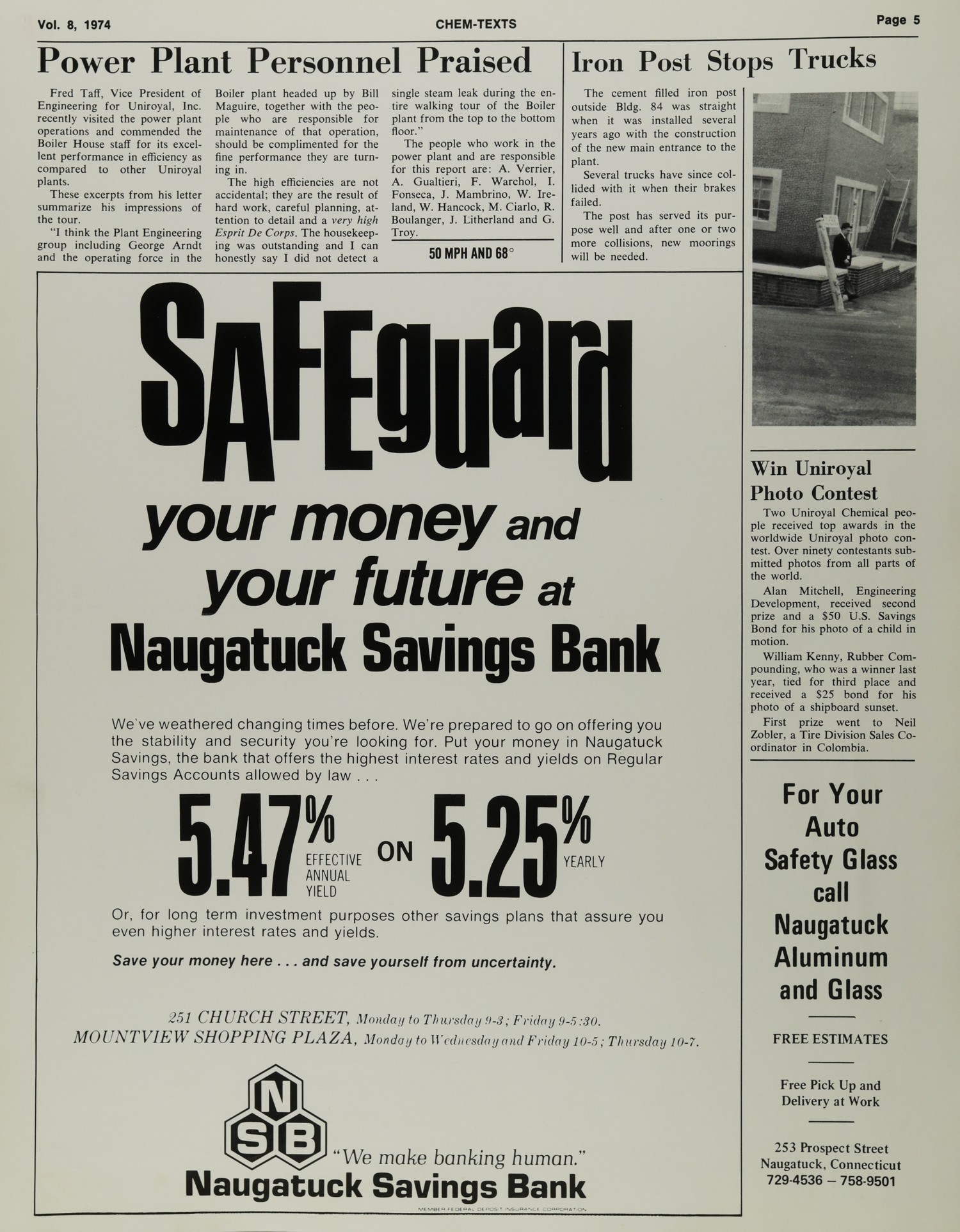
We’ve weathered changing times before. We’re prepared to go on offering you the stability and security you’re looking for. Put your money in Naugatuck Savings, the bank that offers the highest interest rates and yields on Regular Savings Accounts allowed by law . . .

5.47% EFFECTIVE ANNUAL YIELD ON 5.25% YEARLY

Or, for long term investment purposes other savings plans that assure you even higher interest rates and yields.

Save your money here . . . and save yourself from uncertainty.

251 CHURCH STREET, Monday to Thursday 9-3; Friday 9-5:30.
MOUNTVIEW SHOPPING PLAZA, Monday to Wednesday and Friday 10-5; Thursday 10-7.

NSB
“We make banking human.”
Naugatuck Savings Bank

MEMBER FEDERAL DEPOSIT INSURANCE CORPORATION


For Your Auto Safety Glass call Naugatuck Aluminum and Glass


FREE ESTIMATES

Free Pick Up and Delivery at Work


253 Prospect Street
Naugatuck, Connecticut
729-4536 — 758-9501

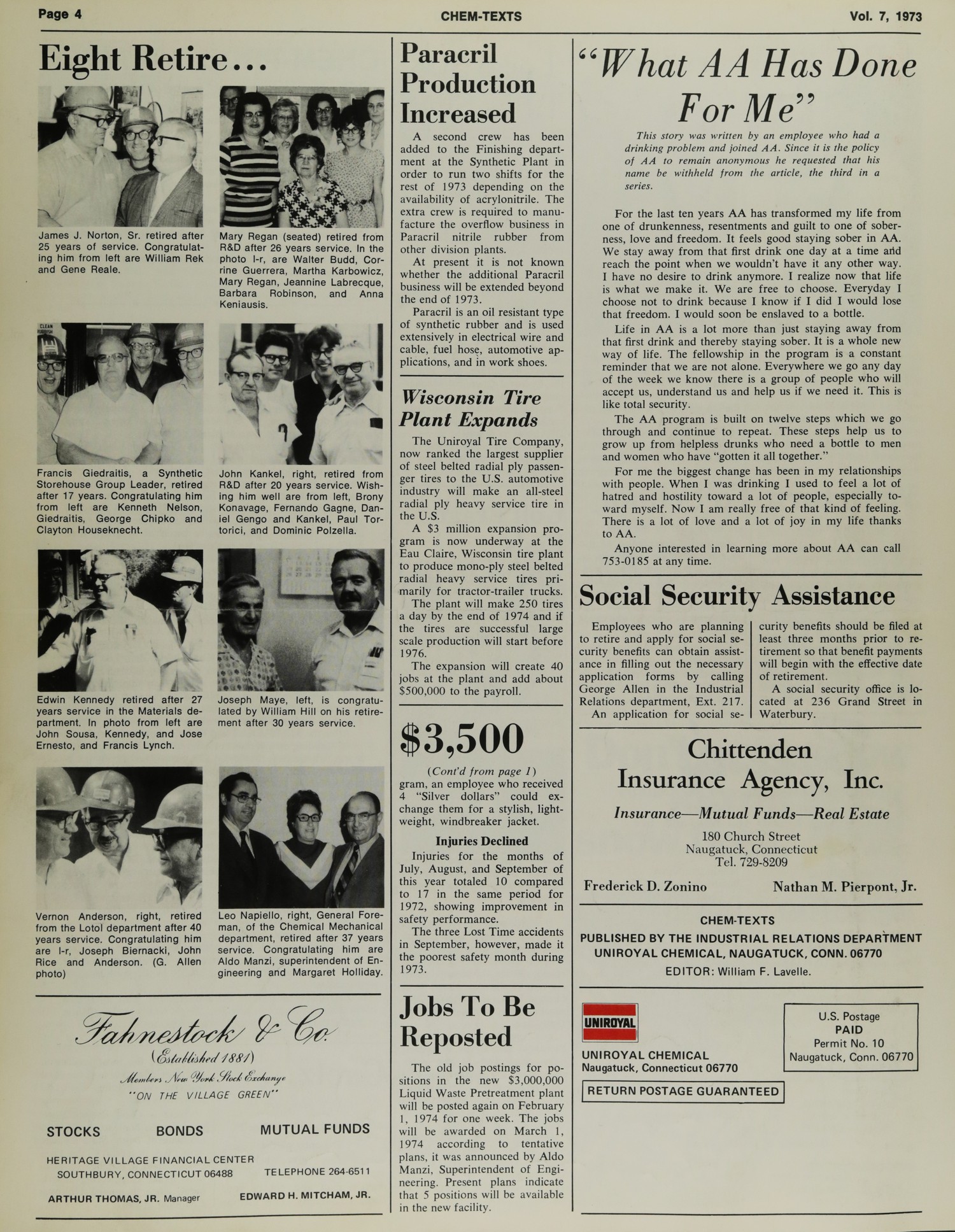
Four Retire in Month All Top 30 Years Service

Page 4 CHEM-TEXTS Vol. 7, 1973


Four Retire in Month All Top 30 Years Service

[IMAGE: Woman in photo]

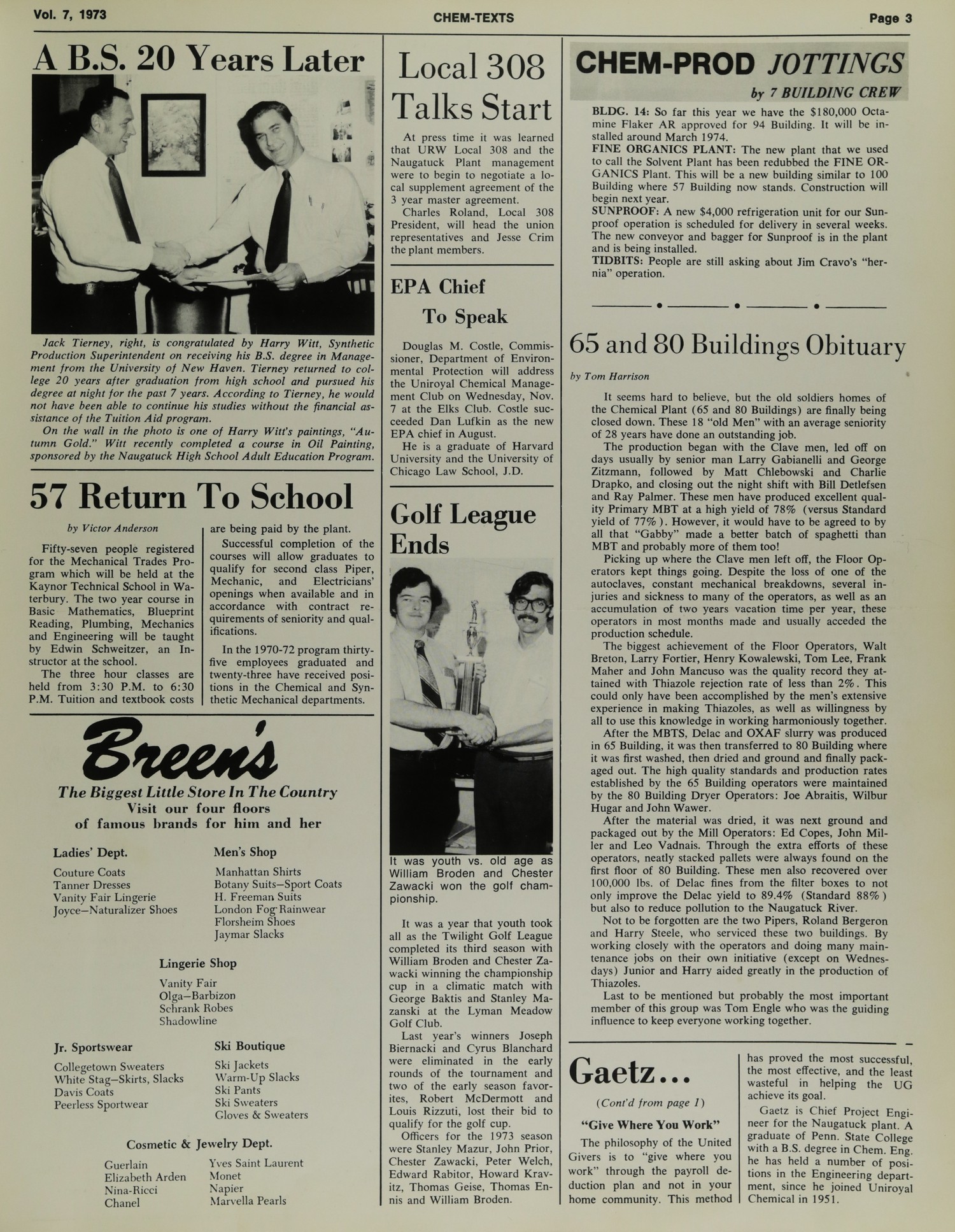
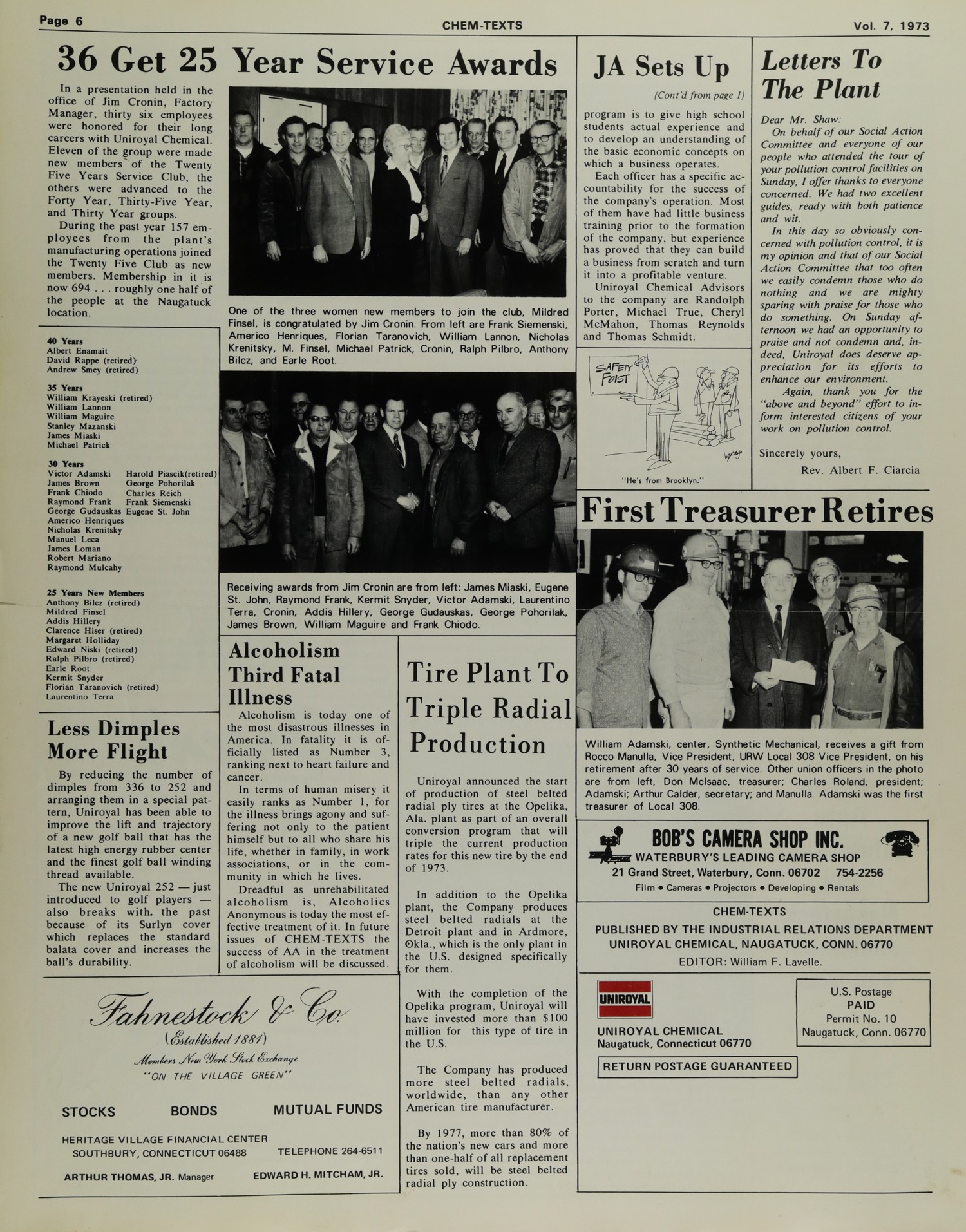
After 40 years service Beatrice Smey, Research & Development, retired. In photo she is congratulated by Louis Coscia.

[IMAGE: Man cutting cake]

Eugene St. John cuts cake honoring his 31 years service while Jacqueline Davino holds it.

[IMAGE: Woman in photo]

Florence Kelsey, retired after 37 years service. Congratulating her is Michael Banik.

[IMAGE: Two men in photo]

Philip McPhail, retired after 30 years service. Congratulating him is Bert Scullin, right.


Letter to the Editor

In the last CHEM-TEXTS a reference was made to youth— Bill Broden and Chet Zawacki— winning over old age in the Twilight Golf Tournament finals. The statement was misleading.

Although George Baktis and I are 55 year old men, and in the twilight of our golf careers, we had to give the two youngsters 14 strokes for 9 holes.

When we were young fellows, we gave the strokes to the old men.

Stanley Mazanski


Don’t get a snow job on snow tires.

[IMAGE: Snow tire]

Get Uniroyal Winterides

[IMAGE: Woman with tire]

ADVANCE TIRE SERVICE
510 Meriden Rd.
Waterbury – 756–7205

FITZPATRICK’S, INC.
78 East Main St.
Ansonia – 734–3318

MEZZIO’S
792 New Haven Rd.
Naugatuck – 729–5988

POUST’S SERVICE STATION
144 Rubber Ave.
Naugatuck – 729–0433


Synthetic…

(Cont’d from page 1)

the first part of 1974 and is expected to be completed about the end of March 1974.

Eligible Employees To Receive Benefits

Affected eligible employees will receive termination or pension benefits in accordance with the existing Company employee benefits programs.

There are 205 people employed at the plant, 175 of whom are members of URW Local 308. An estimated 40-45 of the Local 308 people will be retained to continue the operations in Bldg. 17 and the Synthetic Pilot Plant.

The plans do not affect the Chemical and Reclaim operations.

First Synthetic Rubber Plant in U.S.

The Synthetic Rubber plant in Naugatuck was the first to be built in the U.S. to manufacture synthetic rubber. It was constructed in 1942 during W.W. II and operated for the U.S. government to manufacture the man-made material.


Top UG…

(Cont’d from page 1)

pledged the highest total amount of $6125. EMIC not only had the highest single pledge of $500 but also the highest individual average, $38.

The Chemical Pilot Plant was the only group with 100% participation by employees.

Committee Members

Committee members and canvassers were Constance Antrum, R. Barnes, W. Broden, Katherine Dowling, R. Foltz, R. Frank, W. Lavelle, P. Murray, C. Roland, J. Rzeszutek, D. Shantz, R. Shaw, J. Tarara, and J. Vergosen. R. Gaetz was chairman for the drive.


URW Local 218 Names Officers

Frederick R. Mayo has been named Secretary of URW Local 218 to fill the unexpired term of Michael Rosa who resigned to take a position in Distribution and Scheduling. Mayo presently works in the Process Development laboratory. He started with Uniroyal Chemical in 1948.

David R. Cornetski has been appointed to fill the post of Treasurer, replacing Walter Scott. Cornetski joined Uniroyal Chemical in 1968 and is a member of the Rubber Compounding laboratory, TSSC.


SAFETY IS MY RESPONSIBILITY

DON’T DRINK AND DRIVE


The Twelve Steps of AA

The twelve steps of AA were written by the founder of it, Bill W. and several of the original members about one year after they had achieved sobriety. They grouped together and asked themselves, how had they conquered their drinking problem.

They realized, as they thought about it, that they had in fact gone through these twelve steps. The steps today are the foundation of the AA program.

Some AA meetings are strictly for the purpose of discussing the steps and sharing experiences about them. The steps are a way of life for the recovered alcoholic. They are the guidelines for getting sober in the first place, and for mantaining sobriety. The steps keep members of AA free of resentments and away from that “first” drink.

WE . . . admitted we were powerless over alcohol—that our lives had become unmanageable.

2—Came to believe that a Power greater than ourselves could restore us to sanity.

3—Made a decision to turn our will and our lives over to the care of God as we understood Him.

4—Made a searching and fearless moral inventory of ourselves.

5—Admitted to God, to ourselves and to another human being the exact nature of our wrongs.

6—Were entirely ready to have God remove all these defects of character.

7—Humbly asked Him to remove our shortcomings.

8—Made a list of all persons we had harmed, and became willing to make amends to them all.

9—Made direct amends to such people wherever possible, except when to do so would injure them or others.

10—Continued to take personal inventory and when we were wrong promptly admitted it.

11—Sought through prayer and meditation to improve our conscious contact with God as we understood Him, praying only for knowledge of His will for us and the power to carry that out.

12—Having had a spiritual awakening as the result of these steps, we tried to carry this message to alcoholics and to practice these principles in all our affairs.


Crim…

(Cont’d from page 1)

Crim who joined Uniroyal in 1947, is a graduate of Purdue University’s School of Engineering.


BOB’S CAMERA SHOP INC.
WATERBURY’S LEADING CAMERA SHOP
21 Grand Street, Waterbury, Conn. 06702 754-2256
Film ● Cameras ● Projectors ● Developing ● Rentals


CHEM-TEXTS
PUBLISHED BY THE INDUSTRIAL RELATIONS DEPARTMENT
UNIROYAL CHEMICAL, NAUGATUCK, CONN. 06770
EDITOR: William F. Lavelle.


[UNIROYAL LOGO]

UNIROYAL CHEMICAL
Naugatuck, Connecticut 06770

U.S. Postage
PAID
Permit No. 10
Naugatuck, Conn. 06770

RETURN POSTAGE GUARANTEED

Las Vegas – 1973-s211

Page 211

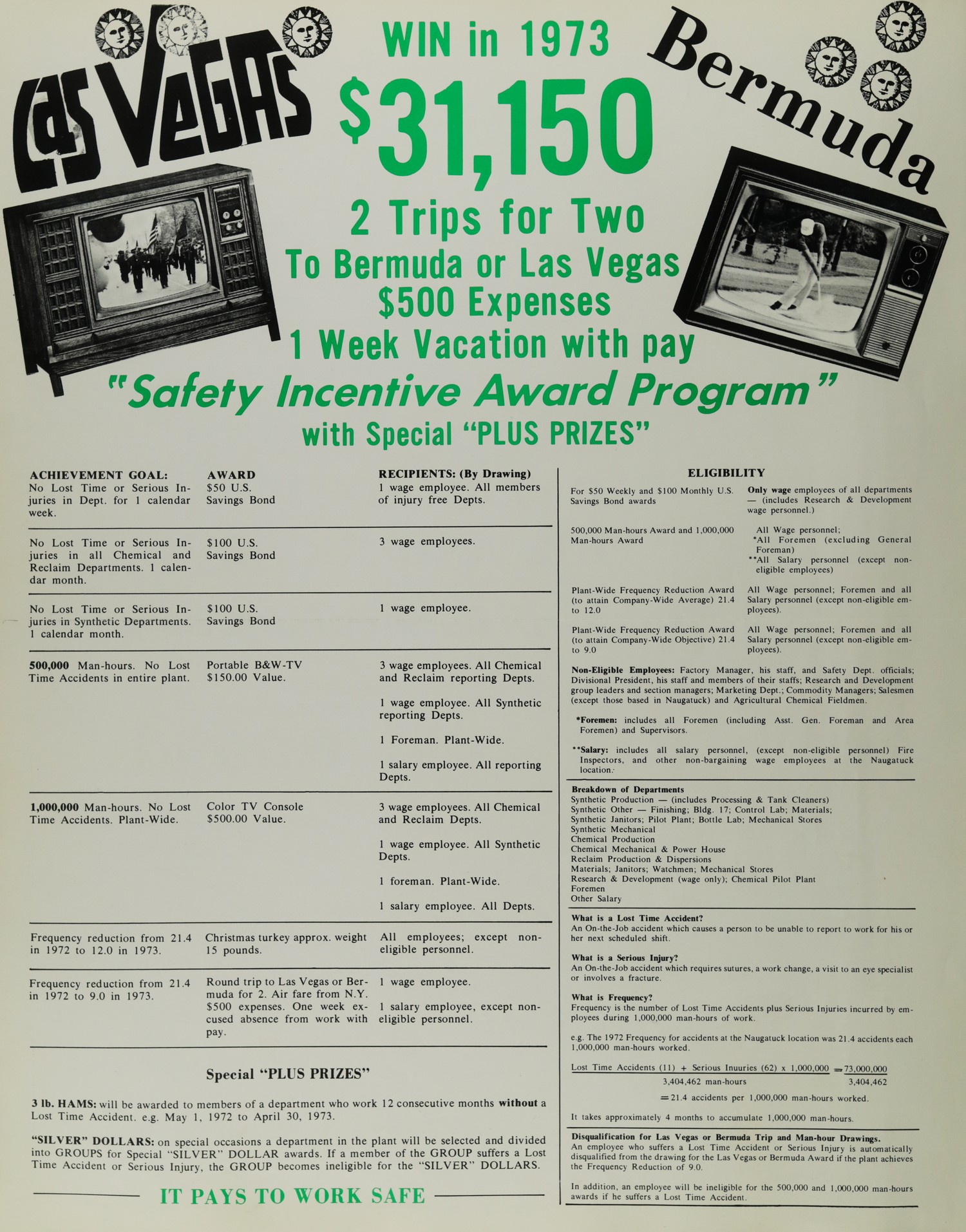
WIN in 1973

$31,150

2 Trips for Two

To Bermuda or Las Vegas

$500 Expenses

1 Week Vacation with pay

“Safety Incentive Award Program”

with Special “PLUS PRIZES”


ACHIEVEMENT GOAL:

No Lost Time or Serious Injuries in Dept. for 1 calendar week.

AWARD
$50 U.S. Savings Bond

RECIPIENTS: (By Drawing)
1 wage employee. All members of injury free Depts.


No Lost Time or Serious Injuries in all Chemical and Reclaim Departments. 1 calendar month.

AWARD
$100 U.S. Savings Bond

RECIPIENTS:
3 wage employees.


No Lost Time or Serious Injuries in Synthetic Departments. 1 calendar month.

AWARD
$100 U.S. Savings Bond

RECIPIENTS:
1 wage employee.


500,000 Man-hours. No Lost Time Accidents in entire plant.

AWARD
Portable B&W-TV $150.00 Value.

RECIPIENTS:
3 wage employees. All Chemical and Reclaim reporting Depts.

1 wage employee. All Synthetic reporting Depts.

1 Foreman. Plant-Wide.

1 salary employee. All reporting Depts.


1,000,000 Man-hours. No Lost Time Accidents. Plant-Wide.

AWARD
Color TV Console $500.00 Value.

RECIPIENTS:
3 wage employees. All Chemical and Reclaim Depts.

1 wage employee. All Synthetic Depts.

1 foreman. Plant-Wide.

1 salary employee. All Depts.


Frequency reduction from 21.4 in 1972 to 12.0 in 1973.

AWARD
Christmas turkey approx. weight 15 pounds.

RECIPIENTS:
All employees; except non-eligible personnel.


Frequency reduction from 21.4 in 1972 to 9.0 in 1973.

AWARD
Round trip to Las Vegas or Bermuda for 2. Air fare from N.Y. $500 expenses. One week excused absence from work with pay.

RECIPIENTS:
1 wage employee.

1 salary employee, except non-eligible personnel.


Special “PLUS PRIZES”

3 lb. HAMS: will be awarded to members of a department who work 12 consecutive months without a Lost Time Accident. e.g. May 1, 1972 to April 30, 1973.

“SILVER” DOLLARS: on special occasions a department in the plant will be selected and divided into GROUPS for Special “SILVER” DOLLAR awards. If a member of the GROUP suffers a Lost Time Accident or Serious Injury, the GROUP becomes ineligible for the “SILVER” DOLLARS.


IT PAYS TO WORK SAFE


ELIGIBILITY

For $50 Weekly and $100 Monthly U.S. Savings Bond awards

Only wage employees of all departments — (includes Research & Development wage personnel.)


500,000 Man-hours Award and 1,000,000 Man-hours Award

All Wage personnel;
All Foremen (excluding General Foreman)
*All Salary personnel (except non-eligible employees)


Plant-Wide Frequency Reduction Award (to attain Company-Wide Average) 21.4 to 12.0

All Wage personnel; Foremen and all Salary personnel (except non-eligible employees).


Plant-Wide Frequency Reduction Award (to attain Company-Wide Objective) 21.4 to 9.0

All Wage personnel; Foremen and all Salary personnel (except non-eligible employees).


Non-Eligible Employees: Factory Manager, his staff, and Safety Dept. officials; Divisional President, his staff and members of their staffs; Research and Development group leaders and section managers; Marketing Dept.; Commodity Managers; Salesmen (except those based in Naugatuck) and Agricultural Chemical Fieldmen.

*Foremen: includes all Foremen (including Asst. Gen. Foreman and Area Foremen) and Supervisors.

**Salary: includes all salary personnel, (except non-eligible personnel) Fire Inspectors, and other non-bargaining wage employees at the Naugatuck location.


Breakdown of Departments

Synthetic Production — (includes Processing & Tank Cleaners)
Synthetic Other — Finishing; Bldg. 17; Control Lab; Materials;
Synthetic Janitors; Pilot Plant; Bottle Lab; Mechanical Stores
Synthetic Mechanical
Chemical Production
Chemical Mechanical & Power House
Reclaim Production & Dispersions
Materials; Janitors; Watchmen; Mechanical Stores
Research & Development (wage only); Chemical Pilot Plant
Foremen
Other Salary


What is a Lost Time Accident?
An On-the-Job accident which causes a person to be unable to report to work for his or her next scheduled shift.

What is a Serious Injury?
An On-the-Job accident which requires sutures, a work change, a visit to an eye specialist or involves a fracture.

What is Frequency?
Frequency is the number of Lost Time Accidents plus Serious Injuries incurred by employees during 1,000,000 man-hours of work.

e.g. The 1972 Frequency for accidents at the Naugatuck location was 21.4 accidents each 1,000,000 man-hours worked.

Lost Time Accidents (11) + Serious Inuuries (62) x 1,000,000 = 73,000,000
3,404,462 man-hours 3,404,462

= 21.4 accidents per 1,000,000 man-hours worked.

It takes approximately 4 months to accumulate 1,000,000 man-hours.


Disqualification for Las Vegas or Bermuda Trip and Man-hour Drawings.
An employee who suffers a Lost Time Accident or Serious Injury is automatically disqualified from the drawing for the Las Vegas or Bermuda Award if the plant achieves the Frequency Reduction of 9.0.

In addition, an employee will be ineligible for the 500,000 and 1,000,000 man-hours awards if he suffers a Lost Time Accident.

CHEM-TEXTS – 1973-v07-i04-s214

Page 214

UNIROYAL CHEM-TEXTS

Vol. 7, 1973 PUBLISHED FOR THE PEOPLE OF UNIROYAL CHEMICAL No. 4


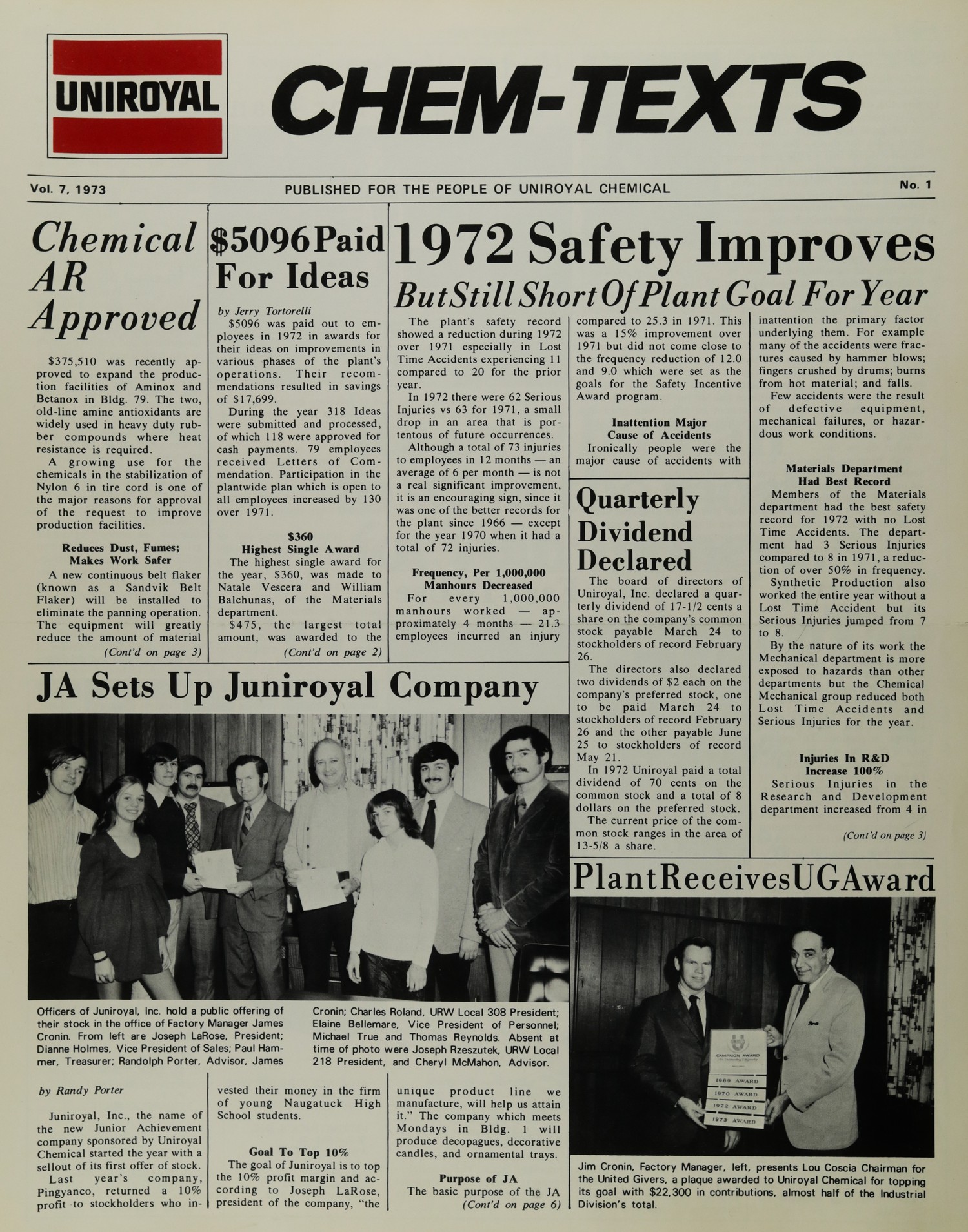
Gaetz To Head UG

[IMAGE: Photo of Roderick Gaetz wearing glasses]

Roderick Gaetz has been named Chairman for the annual United Givers campaign to be conducted at the Naugatuck plant, it was announced by James Cronin, Factory Manager.

$22,300 Contributed In 1972 Drive

The United Givers drive in 1972 was the most successful ever conducted at the Naugatuck plant when employees pledged $22,300 and topped the 100% goal, one of the few industries in the community to go over its quota. The amount represented approximately one third of the total Industrial goal.

(Cont’d on page 3)


Company Cancels Stock Plan

The Company decided to refund all money paid into the 1971-1973 Employees’ Stock Purchase Plan, plus 5% interest. The plan officially ended September 28.

The right to cancel the plan was exercised by the Company when the stock fell below the original offering price of $19.3125.

Separate refund and interest checks were to be mailed to employees in early October.

Under the two year plan employees could purchase up to ten percent of their earnings for one year in Uniroyal’s common stock.

At the August meeting of the Executive Committee of the Board of Directors it indicated that a new stock purchase plan would not be offered to employees at the present time.


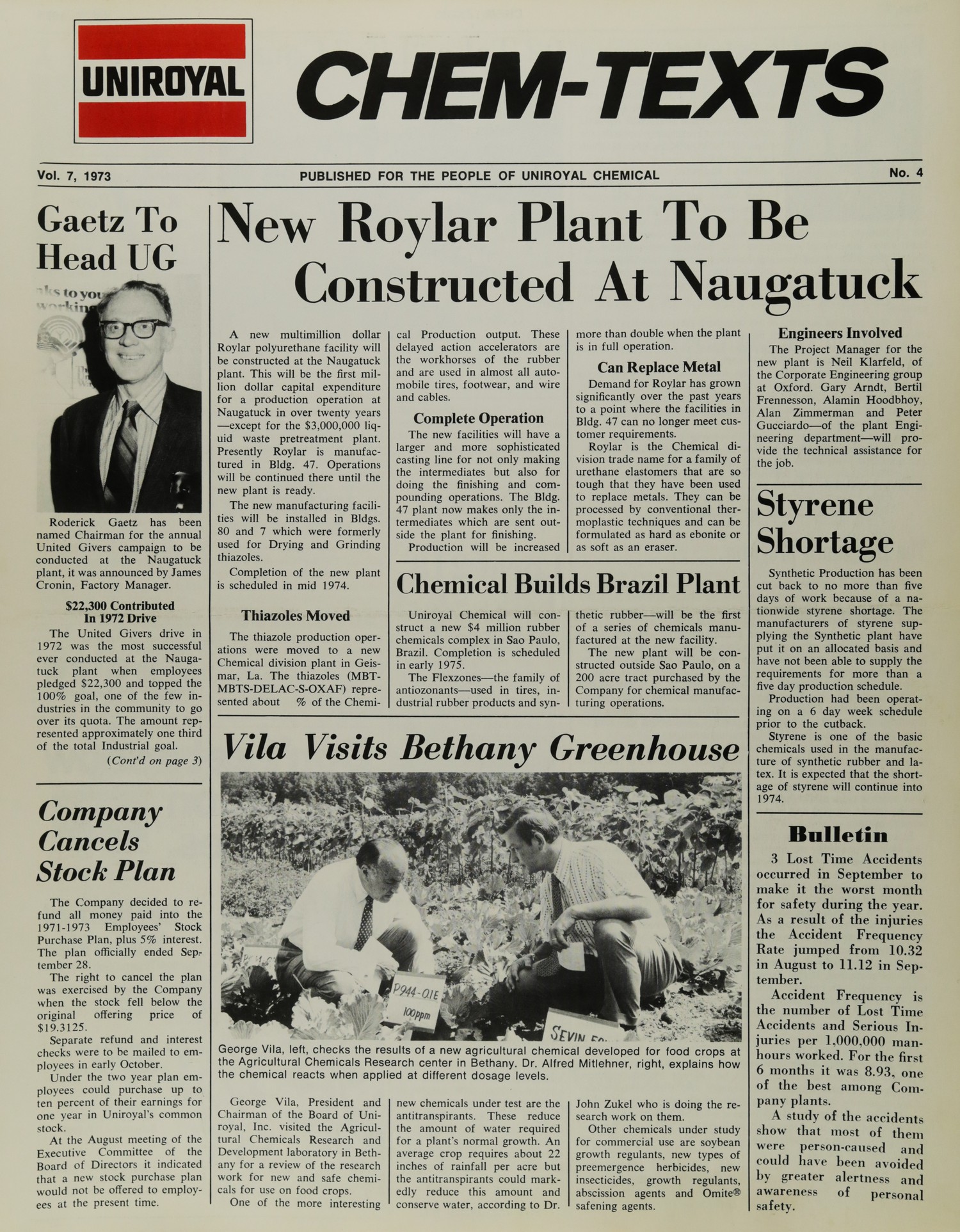
New Roylar Plant To Be Constructed At Naugatuck

A new multimillion dollar Roylar polyurethane facility will be constructed at the Naugatuck plant. This will be the first million dollar capital expenditure for a production operation at Naugatuck in over twenty years —except for the $3,000,000 liquid waste pretreatment plant. Presently Roylar is manufactured in Bldg. 47. Operations will be continued there until the new plant is ready.

The new manufacturing facilities will be installed in Bldgs. 80 and 7 which were formerly used for Drying and Grinding thiazoles.

Completion of the new plant is scheduled in mid 1974.

Thiazoles Moved

The thiazole production operations were moved to a new Chemical division plant in Geismar, La. The thiazoles (MBT-MBTS-DELAC-S-OXAF) represented about % of the Chemical Production output. These delayed action accelerators are the workhorses of the rubber and are used in almost all automobile tires, footwear, and wire and cables.

Complete Operation

The new facilities will have a larger and more sophisticated casting line for not only making the intermediates but also for doing the finishing and compounding operations. The Bldg. 47 plant now makes only the intermediates which are sent outside the plant for finishing.

Production will be increased more than double when the plant is in full operation.

Can Replace Metal

Demand for Roylar has grown significantly over the past years to a point where the facilities in Bldg. 47 can no longer meet customer requirements.

Roylar is the Chemical division trade name for a family of urethane elastomers that are so tough that they have been used to replace metals. They can be processed by conventional thermoplastic techniques and can be formulated as hard as ebonite or as soft as an eraser.

Engineers Involved

The Project Manager for the new plant is Neil Klarfeld, of the Corporate Engineering group at Oxford. Gary Arndt, Bertil Frennesson, Alamin Hoodbhoy, Alan Zimmerman and Peter Gucciardo—of the plant Engineering department—will provide the technical assistance for the job.


Chemical Builds Brazil Plant

Uniroyal Chemical will construct a new $4 million rubber chemicals complex in Sao Paulo, Brazil. Completion is scheduled in early 1975.

The Flexzones—the family of antiozonants—used in tires, industrial rubber products and synthetic rubber—will be the first of a series of chemicals manufactured at the new facility.

The new plant will be constructed outside Sao Paulo, on a 200 acre tract purchased by the Company for chemical manufacturing operations.


Styrene Shortage

Synthetic Production has been cut back to no more than five days of work because of a nationwide styrene shortage. The manufacturers of styrene supplying the Synthetic plant have put it on an allocated basis and have not been able to supply the requirements for more than a five day production schedule.

Production had been operating on a 6 day week schedule prior to the cutback.

Styrene is one of the basic chemicals used in the manufacture of synthetic rubber and latex. It is expected that the shortage of styrene will continue into 1974.


Vila Visits Bethany Greenhouse

[IMAGE: Photo showing George Vila and Dr. Alfred Mitlehner examining plants in a greenhouse, with signs visible reading “P944-01E”, “100ppm”, and “SEVIN Ex.”]

George Vila, left, checks the results of a new agricultural chemical developed for food crops at the Agricultural Chemicals Research center in Bethany. Dr. Alfred Mitlehner, right, explains how the chemical reacts when applied at different dosage levels.

George Vila, President and Chairman of the Board of Uniroyal, Inc. visited the Agricultural Chemicals Research and Development laboratory in Bethany for a review of the research work for new and safe chemicals for use on food crops.

One of the more interesting new chemicals under test are the antitranspirants. These reduce the amount of water required for a plant’s normal growth. An average crop requires about 22 inches of rainfall per acre but the antitranspirants could markedly reduce this amount and conserve water, according to Dr. John Zukel who is doing the research work on them.

Other chemicals under study for commercial use are soybean growth regulants, new types of preemergence herbicides, new insecticides, growth regulants, abscission agents and Omite® safening agents.


Bulletin

3 Lost Time Accidents occurred in September to make it the worst month for safety during the year. As a result of the injuries the Accident Frequency Rate jumped from 10.32 in August to 11.12 in September.

Accident Frequency is the number of Lost Time Accidents and Serious Injuries per 1,000,000 man-hours worked. For the first 6 months it was 8.93, one of the best among Company plants.

A study of the accidents show that most of them were person-caused and could have been avoided by greater alertness and awareness of personal safety.

CHEM-TEXTS – Vol. 7 – Page 2

Page 002

CHEM-TEXTS

Page 2 | Vol. 7, 1973


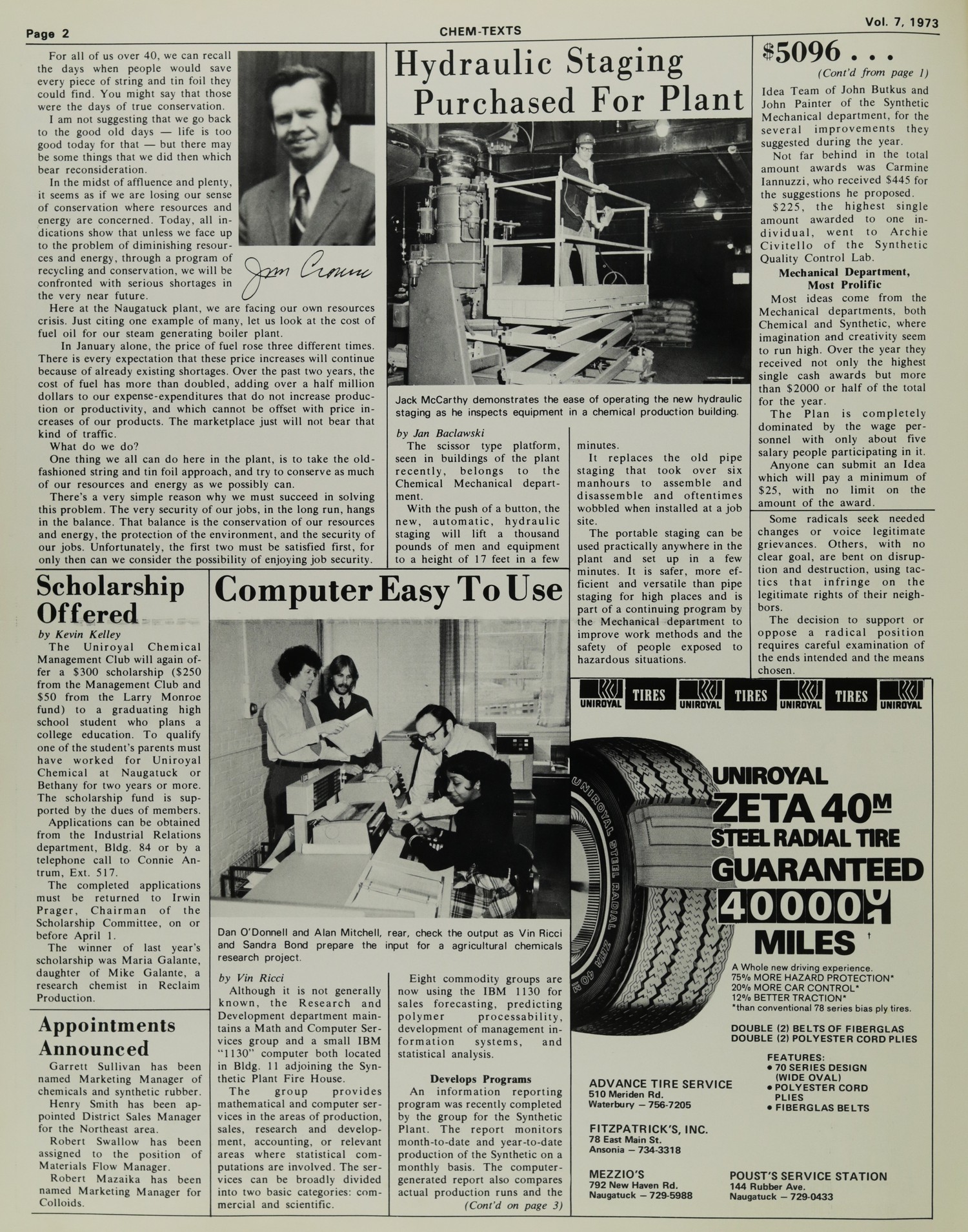
For all of us over 40, we can recall the days when people would save every piece of string and tin foil they could find. You might say that those were the days of true conservation.

I am not suggesting that we go back to the good old days — life is too good today for that — but there may be some things that we did then which bear reconsideration.

In the midst of affluence and plenty, it seems as if we are losing our sense of conservation where resources and energy are concerned. Today, all indications show that unless we face up to the problem of diminishing resources and energy, through a program of recycling and conservation, we will be confronted with serious shortages in the very near future.

Jim Crane [Signature]

Here at the Naugatuck plant, we are facing our own resources crisis. Just citing one example of many, let us look at the cost of fuel oil for our steam generating boiler plant.

In January alone, the price of fuel rose three different times. There is every expectation that these price increases will continue because of already existing shortages. Over the past two years, the cost of fuel has more than doubled, adding over a half million dollars to our expense-expenditures that do not increase production or productivity, and which cannot be offset with price increases of our products. The marketplace just will not bear that kind of traffic.

What do we do?

One thing we all can do here in the plant, is to take the old-fashioned string and tin foil approach, and try to conserve as much of our resources and energy as we possibly can.

There’s a very simple reason why we must succeed in solving this problem. The very security of our jobs, in the long run, hangs in the balance. That balance is the conservation of our resources and energy, the protection of the environment, and the security of our jobs. Unfortunately, the first two must be satisfied first, for only then can we consider the possibility of enjoying job security.


Hydraulic Staging Purchased For Plant

[IMAGE: Jack McCarthy demonstrates the ease of operating the new hydraulic staging as he inspects equipment in a chemical production building.]

by Jan Baclawski

The scissor type platform, seen in buildings of the plant recently, belongs to the Chemical Mechanical department.

With the push of a button, the new, automatic, hydraulic staging will lift a thousand pounds of men and equipment to a height of 17 feet in a few minutes.

It replaces the old pipe staging that took over six manhours to assemble and disassemble and oftentimes wobbled when installed at a job site.

The portable staging can be used practically anywhere in the plant and set up in a few minutes. It is safer, more efficient and versatile than pipe staging for high places and is part of a continuing program by the Mechanical department to improve work methods and the safety of people exposed to hazardous situations.


Scholarship Offered

by Kevin Kelley

The Uniroyal Chemical Management Club will again offer a $300 scholarship ($250 from the Management Club and $50 from the Larry Monroe fund) to a graduating high school student who plans a college education. To qualify one of the student’s parents must have worked for Uniroyal Chemical at Naugatuck or Bethany for two years or more. The scholarship fund is supported by the dues of members.

Applications can be obtained from the Industrial Relations department, Bldg. 84 or by a telephone call to Connie Antrum, Ext. 517.

The completed applications must be returned to Irwin Prager, Chairman of the Scholarship Committee, on or before April 1.

The winner of last year’s scholarship was Maria Galante, daughter of Mike Galante, a research chemist in Reclaim Production.


Appointments Announced

Garrett Sullivan has been named Marketing Manager of chemicals and synthetic rubber.

Henry Smith has been appointed District Sales Manager for the Northeast area.

Robert Swallow has been assigned to the position of Materials Flow Manager.

Robert Mazaika has been named Marketing Manager for Colloids.


Computer Easy To Use

[IMAGE: Dan O’Donnell and Alan Mitchell, rear, check the output as Vin Ricci and Sandra Bond prepare the input for a agricultural chemicals research project.]

by Vin Ricci

Although it is not generally known, the Research and Development department maintains a Math and Computer Services group and a small IBM “1130” computer both located in Bldg. 11 adjoining the Synthetic Plant Fire House.

The group provides mathematical and computer services in the areas of production, sales, research and development, accounting, or relevant areas where statistical computations are involved. The services can be broadly divided into two basic categories: commercial and scientific.

Eight commodity groups are now using the IBM 1130 for sales forecasting, predicting polymer processability, development of management information systems, and statistical analysis.

Develops Programs

An information reporting program was recently completed by the group for the Synthetic Plant. The report monitors month-to-date and year-to-date production of the Synthetic on a monthly basis. The computer-generated report also compares actual production runs and the

(Cont’d on page 3)


$5096…

(Cont’d from page 1)

Idea Team of John Butkus and John Painter of the Synthetic Mechanical department, for the several improvements they suggested during the year.

Not far behind in the total amount awards was Carmine Iannuzzi, who received $445 for the suggestions he proposed.

$225, the highest single amount awarded to one individual, went to Archie Civitello of the Synthetic Quality Control Lab.

Mechanical Department, Most Prolific

Most ideas come from the Mechanical departments, both Chemical and Synthetic, where imagination and creativity seem to run high. Over the year they received not only the highest single cash awards but more than $2000 or half of the total for the year.

The Plan is completely dominated by the wage personnel with only about five salary people participating in it.

Anyone can submit an Idea which will pay a minimum of $25, with no limit on the amount of the award.

Some radicals seek needed changes or voice legitimate grievances. Others, with no clear goal, are bent on disruption and destruction, using tactics that infringe on the legitimate rights of their neighbors.

The decision to support or oppose a radical position requires careful examination of the ends intended and the means chosen.


[ADVERTISEMENT]

TIRES UNIROYAL | TIRES UNIROYAL | TIRES UNIROYAL

UNIROYAL ZETA 40M STEEL RADIAL TIRE GUARANTEED 40000 MILES

A Whole new driving experience.
75% MORE HAZARD PROTECTION
20% MORE CAR CONTROL

12% BETTER TRACTION
than conventional 78 series bias ply tires.

DOUBLE (2) BELTS OF FIBERGLAS
DOUBLE (2) POLYESTER CORD PLIES

FEATURES:
– 70 SERIES DESIGN (WIDE OVAL)
– POLYESTER CORD PLIES
– FIBERGLAS BELTS
ADVANCE TIRE SERVICE
510 Meriden Rd.
Waterbury — 756-7205

FITZPATRICK’S, INC.
78 East Main St.
Ansonia — 734-3318

MEZZIO’S
792 New Haven Rd.
Naugatuck — 729-5988

POUST’S SERVICE STATION
144 Rubber Ave.
Naugatuck — 729-0433

CHEM-TEXTS – 1973-v07-s210

Page 210

Vol. 7, 1973 CHEM-TEXTS Page 3

1972 Safety…

(Cont’d from Page 1)

1971 to 8 in 1972, an increase of 100%.

Accidents to Chemical Production employees rose from 8 to 11.

Over 670 Items Corrected, Repaired or Replaced

To keep the plant in safe condition the Mechanical department has assigned priority to safety jobs and has organized a special section to oversee them.

The Chemical and Synthetic Mechanical departments have corrected, repaired or replaced over 670 items which did not conform to the strict standards of the Occupational Safety and Health Act.


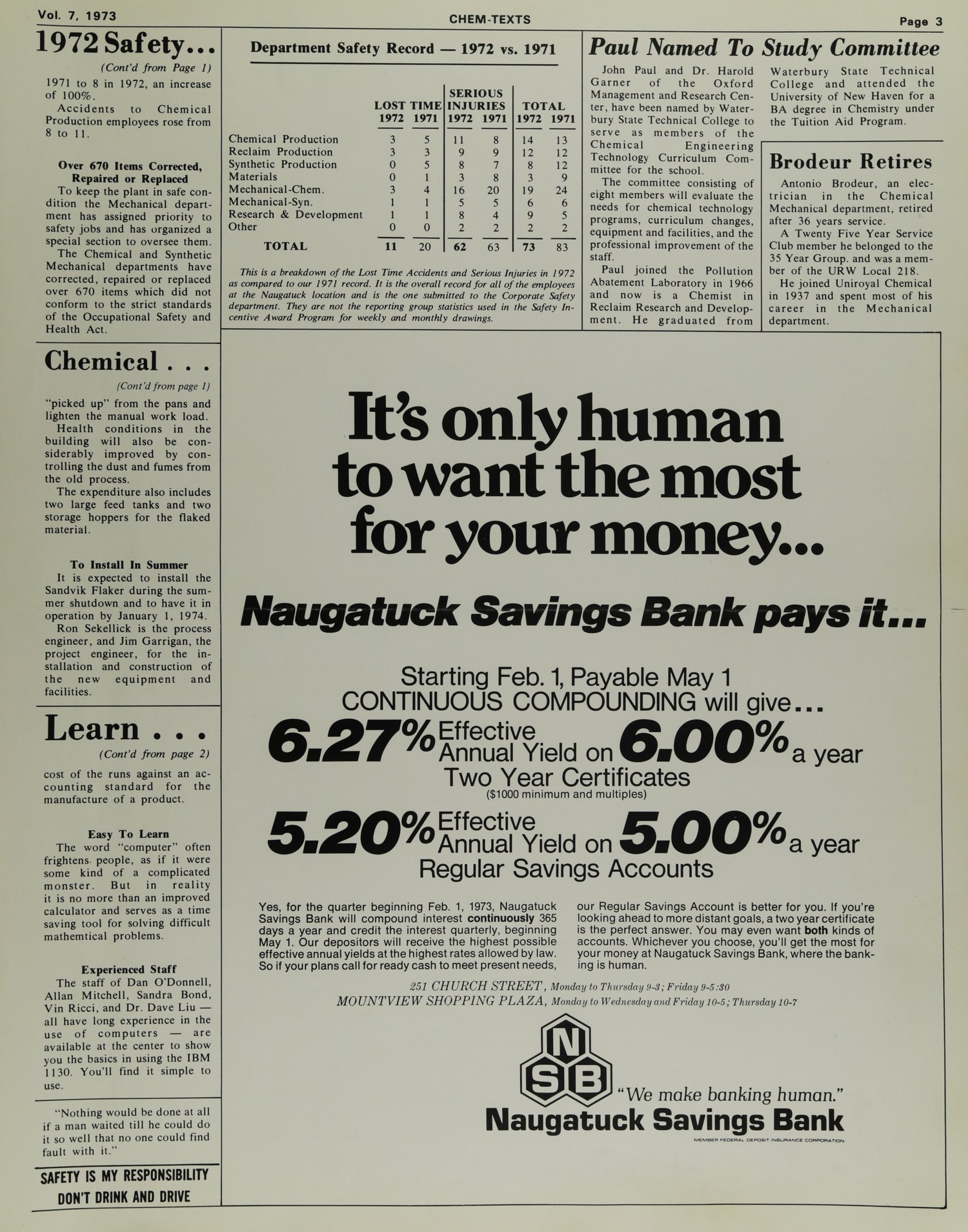
Department Safety Record — 1972 vs. 1971

| | LOST TIME | SERIOUS INJURIES | TOTAL |
| | 1972 | 1971 | 1972 | 1971 | 1972 | 1971 |
|————————–|——|——|——|——|——|——|
| Chemical Production | 3 | 5 | 11 | 8 | 14 | 13 |
| Reclaim Production | 3 | 3 | 9 | 9 | 12 | 12 |
| Synthetic Production | 0 | 5 | 8 | 7 | 8 | 12 |
| Materials | 0 | 1 | 3 | 8 | 3 | 9 |
| Mechanical-Chem. | 3 | 4 | 16 | 20 | 19 | 24 |
| Mechanical-Syn. | 1 | 1 | 5 | 5 | 6 | 6 |
| Research & Development | 1 | 1 | 8 | 4 | 9 | 5 |
| Other | 0 | 0 | 2 | 2 | 2 | 2 |
| TOTAL | 11 | 20 | 62 | 63 | 73 | 83 |

This is a breakdown of the Lost Time Accidents and Serious Injuries in 1972 as compared to our 1971 record. It is the overall record for all of the employees at the Naugatuck location and is the one submitted to the Corporate Safety department. They are not the reporting group statistics used in the Safety Incentive Award Program for weekly and monthly drawings.


Paul Named To Study Committee

John Paul and Dr. Harold Garner of the Oxford Management and Research Center, have been named by Waterbury State Technical College to serve as members of the Chemical Engineering Technology Curriculum Committee for the school.

The committee consisting of eight members will evaluate the needs for chemical technology programs, curriculum changes, equipment and facilities, and the professional improvement of the staff.

Paul joined the Pollution Abatement Laboratory in 1966 and now is a Chemist in Reclaim Research and Development. He graduated from Waterbury State Technical College and attended the University of New Haven for a BA degree in Chemistry under the Tuition Aid Program.


Brodeur Retires

Antonio Brodeur, an electrician in the Chemical Mechanical department, retired after 36 years service.

A Twenty Five Year Service Club member he belonged to the 35 Year Group, and was a member of the URW Local 218.

He joined Uniroyal Chemical in 1937 and spent most of his career in the Mechanical department.


Chemical . . .

(Cont’d from page 1)

“picked up” from the pans and lighten the manual work load.

Health conditions in the building will also be considerably improved by controlling the dust and fumes from the old process.

The expenditure also includes two large feed tanks and two storage hoppers for the flaked material.

To Install In Summer

It is expected to install the Sandvik Flaker during the summer shutdown and to have it in operation by January 1, 1974.

Ron Sekellick is the process engineer, and Jim Garrigan, the project engineer, for the installation and construction of the new equipment and facilities.


Learn . . .

(Cont’d from page 2)

cost of the runs against an accounting standard for the manufacture of a product.

Easy To Learn

The word “computer” often frightens people, as if it were some kind of a complicated monster. But in reality it is no more than an improved calculator and serves as a time saving tool for solving difficult mathematical problems.

Experienced Staff

The staff of Dan O’Donnell, Allan Mitchell, Sandra Bond, Vin Ricci, and Dr. Dave Liu — all have long experience in the use of computers — are available at the center to show you the basics in using the IBM 1130. You’ll find it simple to use.

“Nothing would be done at all if a man waited till he could do it so well that no one could find fault with it.”


SAFETY IS MY RESPONSIBILITY

DON’T DRINK AND DRIVE


It’s only human to want the most for your money…

Naugatuck Savings Bank pays it…

Starting Feb. 1, Payable May 1
CONTINUOUS COMPOUNDING will give…

6.27% Effective Annual Yield on 6.00% a year

Two Year Certificates
($1000 minimum and multiples)

5.20% Effective Annual Yield on 5.00% a year

Regular Savings Accounts

Yes, for the quarter beginning Feb. 1, 1973, Naugatuck Savings Bank will compound interest continuously 365 days a year and credit the interest quarterly, beginning May 1. Our depositors will receive the highest possible effective annual yields at the highest rates allowed by law. So if your plans call for ready cash to meet present needs,

our Regular Savings Account is better for you. If you’re looking ahead to more distant goals, a two year certificate is the perfect answer. You may even want both kinds of accounts. Whichever you choose, you’ll get the most for your money at Naugatuck Savings Bank, where the banking is human.

251 CHURCH STREET, Monday to Thursday 9-3; Friday 9-5:30
MOUNTVIEW SHOPPING PLAZA, Monday to Wednesday and Friday 10-5; Thursday 10-7

[NSB Logo]

“We make banking human.”

Naugatuck Savings Bank

MEMBER FEDERAL DEPOSIT INSURANCE CORPORATION

CHEM-TEXTS – 1973-v07-s212

Page 212

Vol. 7, 1973 CHEM-TEXTS Page 5


Salesmen Set ’73 Goal | Free X-Ray | CHEM-PROD JOTTINGS

Offered Employees

by 7 BUILDING CREW

These jottings on what is going on in Chemical Production is an attempt to get more information to the people in the department.

Hopefully, with the ideas and suggestions of the Chemical Production Operators, we will get information on what the people in the plant want to know. So, next time you see the “7 Building Crew” give them your suggestions to improve this column.


[IMAGE: Photo of men at meeting with car]

At meeting Carl Lawson discusses new Royalene rubber bumper part for 1973 Cadillac. Clockwise from left are Henry Smith, District manager, Carl Lawson, Al Krivitsky, Gary Sullivan, Naugatuck Chemicals manager, Joseph Flannery, Marketing director, Robert Dexter, John Wade, and James McGinn. Also participating in the meeting was Andrew McNeill, Uniroyal Chemical President.

“Estimated sales for District 1 should be 115% ahead of budget in 1973,” according to Henry Smith, Sales Manager of the district, “unless something drastic happens to the economy.”

In 1972 the District was 4% ahead of its budget.

Sells Plant’s Products

Headquartered in Naugatuck, the 5 salesmen of the district sell Naugatuck Chemicals, Reclaim Rubber, and Naugapol — plant products — to customers in the northeast U.S., along with Royalene and Paracril which are manufactured at other Chemical division plants.

Customer Tough On Quality

Smith emphasized at the meeting that although business seems on the upswing, customers have become more demanding for service and quality — par-

ticularly in chemicals like Naugawhite, Polygard, BLE, Betanox and Aminox which if off-specification could shut down their plants. “When that happens,” he stressed, “they don’t come back for more, they buy from another supplier.”

Major Companies Our Customers

One of the major customers for butyl reclaim is Carlisle Tire and Rubber Company which purchases a steady supply of the product.

Other customers serviced by the district are Armstrong Rubber, Armstrong Cork, Crescent Wire and Cable, Carol Cable, Seamless Rubber and Tuck Industries all major companies in tires, flooring, wire and cable.


by Jim Loman

The annual free chest X-Ray will be available again to all employees on Thursday March 22 from 6 A.M. to 6 P.M.

This service is part of the plant’s preventive medicine program to protect an employee’s health against respiratory problems. The service is convenient and fast and takes about two minutes. The mobile unit will alternate between the main Chemical and Synthetic plant entrances and X-rays 125 people an hour.

Prior to the visit employees will be provided a form card to fill out which should be presented to the technicians at the mobile unit.

If X-Ray results warrant further medical attention by an employee’s personal physician, they will be returned to Dr. Elcaness who will notify the employee.

Last year over 800 employees took advantage of the chest X-Ray.


“The reason why so few people are agreeable in conversation is that each is thinking more about what he intends to say than about what others are saying, and we never listen when we are eager to speak.”


SAFETY: We ended the year with 3 lost timers and 11 serious injuries, a total of 14 which is one more than last year. Not so good.

PRODUCTION: Business is running heavier, with most buildings on 6 days. Very heavy in 79 Building. We’re having problems getting Polygard 1 rolling in 109 Building but solutions are in sight.

QUALITY: The rejection rate for 1972 of 2.1% is really great. For a long time we thought 3.0% of production was good. Good job by all.

PALLETS: We need the help of all operators. If we can do a good job separating all broken warehouse pallets from the good ones (stacked up side down) the lift drivers can get them out of service and over to the side of the plant for repairs. We need your cooperation, otherwise these pallets just keep going around and around in our buildings.

100 Building: We recently had funds approved to get rid of the old drum heater on the second floor and to purchase a new one for the first floor.

This should improve the housekeeping and reduce drum handling.

BIK-OT: Sales have jumped substantially and the men in Bldg. 73 and D&G did a good job in meeting a 90,000 pound back order.

AMINOX/BETANOX EXPANSION:

Recently $375,510 was approved to expand the production of Aminox and Betanox in 79 Building. A continuous belt flaker (known as a Sandvik Belt Flaker) will be installed to eliminate the Aminox and Betanox panning operation. The Sandvik Belt Flaker will greatly reduce the amount of material “picked up” from pans. Reduce manual labor, dust & fumes, a safety problem.

It is expected to install the Sandvik Flaker during the 1973 Summer Shutdown and have it operating by January 1, 1974. General Building Fume Control equipment will also be installed to improve the environment.


500 Fire Units Checked

[IMAGE: Photo of workers checking fire extinguishers]

500 fire extinguishers from buildings throughout plant, TSSC, EMIC, and the Bethany Greenhouse were temporarily replaced to have them hydrostatically tested for safety. The new OSHA law requires that the extinguishers be checked every five years, but the Plant Protection department goes a big step further than the federal requirements and checks them every six months for pressure, weight, secure seals, and if necessary, refill them with dry powder or CO². According to Phil DePasquale, head of the Plant Protection group, “the extinguishers are often used but we are not notified to refill them. This creates a safety hazard in the building.” Checking the extinguishers in the photo from left are Fred Sargeant, Dick Oriente, and Dulcidio Echevarria.


For Your Auto Safety Glass call

Naugatuck Aluminum and Glass


FREE ESTIMATES


Free Pick Up and Delivery at Work


253 Prospect Street
Naugatuck, Connecticut
729-4536 — 758-9501


Breen’s

The Biggest Little Store In The Country

Visit our four floors of famous brands for him and her

Ladies’ Dept.
Couture Coats
Tanner Dresses
Vanity Fair Lingerie
Joyce–Naturalizer Shoes

Men’s Shop
Manhattan Shirts
Botany Suits–Sport Coats
H. Freeman Suits
London Fog Rainwear
Florsheim Shoes
Jaymar Slacks

Lingerie Shop
Vanity Fair
Olga–Barbizon
Schrank Robes
Shadowline

Jr. Sportswear
Collegetown Sweaters
White Stag–Skirts, Slacks
Davis Coats
Peerless Sportwear

Ski Boutique
Ski Jackets
Warm-Up Slacks
Ski Pants
Ski Sweaters
Gloves & Sweaters

Cosmetic & Jewelry Dept.

Guerlain Yves Saint Laurent
Elizabeth Arden Monet
Nina-Ricci Napier
Chanel Marvella Pearls

CHEM-TEXTS – 1973-v07-s217

Page 217

Page 4 CHEM-TEXTS Vol. 7, 1973


Eight Retire…

[PHOTO]

James J. Norton, Sr. retired after 25 years of service. Congratulating him from left are William Rek and Gene Reale.

[PHOTO]

Mary Regan (seated) retired from R&D after 26 years service. In the photo l-r, are Walter Budd, Corrine Guerrera, Martha Karbowicz, Mary Regan, Jeannine Labrecque, Barbara Robinson, and Anna Keniausis.

[PHOTO]

Francis Giedraitis, a Synthetic Storehouse Group Leader, retired after 17 years. Congratulating him from left are Kenneth Nelson, Giedraitis, George Chipko and Clayton Houseknecht.

[PHOTO]

John Kankel, right, retired from R&D after 20 years service. Wishing him well are from left, Brony Konavage, Fernando Gagne, Daniel Gengo and Kankel, Paul Tortorici, and Dominic Polzella.

[PHOTO]

Edwin Kennedy retired after 27 years service in the Materials department. In photo from left are John Sousa, Kennedy, and Jose Ernesto, and Francis Lynch.

[PHOTO]

Joseph Maye, left, is congratulated by William Hill on his retirement after 30 years service.

[PHOTO]

Vernon Anderson, right, retired from the Lotol department after 40 years service. Congratulating him are l-r, Joseph Biernacki, John Rice and Anderson. (G. Allen photo)

[PHOTO]

Leo Napiello, right, General Foreman, of the Chemical Mechanical department, retired after 37 years service. Congratulating him are Aldo Manzi, superintendent of Engineering and Margaret Holliday.


Paracril Production Increased

A second crew has been added to the Finishing department at the Synthetic Plant in order to run two shifts for the rest of 1973 depending on the availability of acrylonitrile. The extra crew is required to manufacture the overflow business in Paracril nitrile rubber from other division plants.

At present it is not known whether the additional Paracril business will be extended beyond the end of 1973.

Paracril is an oil resistant type of synthetic rubber and is used extensively in electrical wire and cable, fuel hose, automotive applications, and in work shoes.


Wisconsin Tire Plant Expands

The Uniroyal Tire Company, now ranked the largest supplier of steel belted radial ply passenger tires to the U.S. automotive industry will make an all-steel radial ply heavy service tire in the U.S.

A $3 million expansion program is now underway at the Eau Claire, Wisconsin tire plant to produce mono-ply steel belted radial heavy service tires primarily for tractor-trailer trucks. The plant will make 250 tires a day by the end of 1974 and if the tires are successful large scale production will start before 1976.

The expansion will create 40 jobs at the plant and add about $500,000 to the payroll.


$3,500

(Cont’d from page 1)

gram, an employee who received 4 “Silver dollars” could exchange them for a stylish, lightweight, windbreaker jacket.

Injuries Declined

Injuries for the months of July, August, and September of this year totaled 10 compared to 17 in the same period for 1972, showing improvement in safety performance.

The three Lost Time accidents in September, however, made it the poorest safety month during 1973.


Jobs To Be Reposted

The old job postings for positions in the new $3,000,000 Liquid Waste Pretreatment plant will be posted again on February 1, 1974 for one week. The jobs will be awarded on March 1, 1974 according to tentative plans, it was announced by Aldo Manzi, Superintendent of Engineering. Present plans indicate that 5 positions will be available in the new facility.


“What AA Has Done For Me”

This story was written by an employee who had a drinking problem and joined AA. Since it is the policy of AA to remain anonymous he requested that his name be withheld from the article, the third in a series.

For the last ten years AA has transformed my life from one of drunkenness, resentments and guilt to one of soberness, love and freedom. It feels good staying sober in AA. We stay away from that first drink one day at a time and reach the point when we wouldn’t have it any other way. I have no desire to drink anymore. I realize now that life is what we make it. We are free to choose. Everyday I choose not to drink because I know if I did I would lose that freedom. I would soon be enslaved to a bottle.

Life in AA is a lot more than just staying away from that first drink and thereby staying sober. It is a whole new way of life. The fellowship in the program is a constant reminder that we are not alone. Everywhere we go any day of the week we know there is a group of people who will accept us, understand us and help us if we need it. This is like total security.

The AA program is built on twelve steps which we go through and continue to repeat. These steps help us to grow up from helpless drunks who need a bottle to men and women who have “gotten it all together.”

For me the biggest change has been in my relationships with people. When I was drinking I used to feel a lot of hatred and hostility toward a lot of people, especially toward myself. Now I am really free of that kind of feeling. There is a lot of love and a lot of joy in my life thanks to AA.

Anyone interested in learning more about AA can call 753-0185 at any time.


Social Security Assistance

Employees who are planning to retire and apply for social security benefits can obtain assistance in filling out the necessary application forms by calling George Allen in the Industrial Relations department, Ext. 217.

An application for social security benefits should be filed at least three months prior to retirement so that benefit payments will begin with the effective date of retirement.

A social security office is located at 236 Grand Street in Waterbury.


Chittenden Insurance Agency, Inc.

Insurance—Mutual Funds—Real Estate

180 Church Street
Naugatuck, Connecticut
Tel. 729-8209

Frederick D. Zonino | Nathan M. Pierpont, Jr.


CHEM-TEXTS
PUBLISHED BY THE INDUSTRIAL RELATIONS DEPARTMENT
UNIROYAL CHEMICAL, NAUGATUCK, CONN. 06770
EDITOR: William F. Lavelle.


Fahnestock & Co.
(Established 1881)

Members New York Stock Exchange
“ON THE VILLAGE GREEN”

STOCKS | BONDS | MUTUAL FUNDS

HERITAGE VILLAGE FINANCIAL CENTER
SOUTHBURY, CONNECTICUT 06488 | TELEPHONE 264-6511

ARTHUR THOMAS, JR. Manager | EDWARD H. MITCHAM, JR.


[UNIROYAL LOGO]

UNIROYAL CHEMICAL
Naugatuck, Connecticut 06770

RETURN POSTAGE GUARANTEED

U.S. Postage
PAID
Permit No. 10
Naugatuck, Conn. 06770

CHEM-TEXTS – 1973-v07-s219

Page 219

Page 2 CHEM-TEXTS Vol. 7, 1973


Running the plant is not much different than running your own home.

Most of us own a house; have a family; and have an awful lot of bills to pay: a mortgage every month; income taxes and property taxes; clothing; food; college; electric; fuel oil; water; car installments; gasoline; doctor and dentist bills; house repairs; appliances; insurance; contributions; recreation; and many others.

We all know that often our pay check doesn’t cover the expenses that we have incurred. For instance if our pay check is $150 and our bills are $175, we soon look for ways to reduce our expenses: 1) we can buy on credit; 2) borrow money from a bank; or 3) cut them down by doing away with the frills, buying wisely, and saving on fuel oil, water, and electricity, and other things.

The same money problems exist in the plant. Instead of $20 or $100 costs, our bills run $500,000 or $1,000,000. For example our utility bill for one year in this plant—fuel oil, electricity, and city water—is about $3,000,000. About two years ago this combined bill was about $2,000,000.

If it costs the plant $1,000,000 to make a product and we receive $750,000 for it, something has to give. We are losing $250,000 each time we make it. It’s the same situation as running your home.

It’s obvious that you can’t continue to do business this way. The alternatives are: to 1) to increase prices; 2) eliminate major items; 3) close down the production unit; 4) or to control our expenses, reduce waste, and to improve our productivity to get our costs down.

In the chemical industry selling prices have not been going up very fast so that approach is limited. Alternative 4)—controlling expenses—is the road we want to take but our success depends on everyone’s determination to resolve the problems.

At the present time the costs of operating some of our production units are higher than the financial return for their products. As you know—just from running your own home and paying your own bills—something has to be done to improve the situation. If it continues it could put these two units so deep in the red that it would affect all production units and manufacturing services. Each one of us has a stake in this plant. It sinks or swims depending on the efforts of each one of us.

I am asking everyone to reveal the same personal interest in the plant that you would if it were your own home, so that we can help resolve the problems and improve the financial situations of all of its units.

Jan Crane [signature]


Receives $6,000 Award

[PHOTO: Group photo of four people]

Judith Dayner, daughter of John Dayner, Lotol Dept., received the $1500 Uniroyal Foundation scholarship which is awarded to a high school senior and resident of Naugatuck. The total value of the scholarship is $6000. Winners of the scholarship are selected on the basis of intellectual achievement, leadership, and participation in community activities. Judith plans to pursue a doctorate degree in Philosophy. In the photo from left, are her mother Julia; Fred Wintsch; Judy; her father, John; and her sister Katherine.


Unions…

(Cont’d from page 1)

with accidental death and dismemberment insurance increased to the same amount. Survivor income benefits (transition and bridge) were increased from $150 to $175 per month.

Medical Benefits

Improvements also were negotiated in the area of hospital, surgical, and in-hospital medical benefits, the most notable of which is an increased allowance of $10 per day to cover daily charges for doctors’ visits in the hospital.

Accident and Sickness

These benefits have been increased to a $95 weekly amount. In the event of layoff, coverage under the plan will be extended for 90 days.

Benefits for Retirees

Also, certain benefits will now be extended to certain retired employees covered by the new contracts. These include those benefits in areas of survivor income and prescription drugs.

Benefits Among Finest In Industry

The negotiations, leading to the signing of agreements on June 11, has resulted in an overall benefits program among the finest and most comprehensive in all industry today. This is good news but must be accompanied by a sobering thought—the cost of benefits has to be paid for. It now becomes our responsibility —all of us as individuals and also as a group—to perform to maximum ability in order to make this possible. Without our maximum efforts, benefits become a real burden rather than something to be enjoyed.


Water Use Jumps 20%

Increased consumption of water at the Chemical and Synthetic plants in 1973 has exceeded the 1972 consumption by 20%.

Aside from the fact that this extra water is costly, the added input could very probably cause problems in the operation of the liquid waste Pretreatment Plant.

All department heads have been informed to commence a water conservation program to prevent waste and to look at methods to reduce this consumption. All employees are urged to participate in this program by turning off hoses running excessively or shutting down cooling systems when not being used.

[PHOTO: Person near water/equipment]


Trades…

(Cont’d from page 1)

courses are offered free to the participants.

Interested personnel should send their names and job location to Victor Anderson, Engineering Dept.


Stock Plan Ends Aug. 30

The Employee Stock Purchase Plan which began on August 10, 1971 will end with a final deduction on August 30, 1973.

Participants will have until September 28, 1973 to decide whether to accept the stock or request their money back. In either case the employee will receive 5% interest on the money paid into the plan.

Further information on the Plan will be posted on the Bulletin Boards throughout the plant as it becomes available, probably in early September.


Geismar Plant To Expand

The Chemical Division will expand the existing Flexzone and intermediates facility in Geismar, Louisiana by sixty percent to meet increasing customer demands.

The Flexzones are antiozonants used extensively in the manufacture of tires, weather stripping, wire and cable, hose and footwear.

Construction is expected to commence in August. Upon completion it will bring the Chemical Division’s investment in the Geismar operation to more than 120 million dollars.

Flexzone is a registered trademark of Uniroyal Chemical.

Other companies competing in the manufacture of this type antiozonant chemical are Monsanto, Goodyear, Universal Oil and Tennessee Eastman.


SAFETY IS MY RESPONSIBILITY


Environmental Program Costs Over $7,000,000

The Naugatuck Chemical plant has spent or committed over $7,000,000 for environmental improvement of the air and water.

The new $3,000,000 liquid waste pretreatment plant, which is now complete and undergoing trial runs, will cost another estimated $1,000,000 a year to operate.

The conversion of the plant’s power house from coal to a low-sulfur fuel oil at a cost of $500,000, eliminated the discharge of 2½ tons of flyash dust into the atmosphere each day and was a major improvement in cleaner air.

At a cost of several million dollars, over 37 air pollution abatement devices and systems were installed to control the discharge of obnoxious fumes and odors, and plans are underway to control remaining odors.

These multi-million dollar costs have been borne primarily by the plant and not by increased prices passed on to the customer, and as a result have increased plant operating expenses.

Water Good For Burns

The ancient treatment of simply plunging burned skin in cold or ice water is still the quickest way to relieve pain. The cold water does not damage burned skin, but actually helps prevent blistering and aids healing. Keep the burned area submerged until the pain disappears, or apply towels that have been soaked in cold or ice water.


[ADVERTISEMENT]

UNIROYAL

ZETA 40M

STEEL RADIAL TIRE

GUARANTEED

40000

MILES

A Whole new driving experience.
75% MORE HAZARD PROTECTION
20% MORE CAR CONTROL

12% BETTER TRACTION
than conventional 78 series bias ply tires.

DOUBLE (2) BELTS OF FIBERGLAS
DOUBLE (2) POLYESTER CORD PLIES

ADVANCE TIRE SERVICE
510 Meriden Rd.
Waterbury — 756-7205

FEATURES:
• 70 SERIES DESIGN (WIDE OVAL)
• POLYESTER CORD PLIES
• FIBERGLAS BELTS
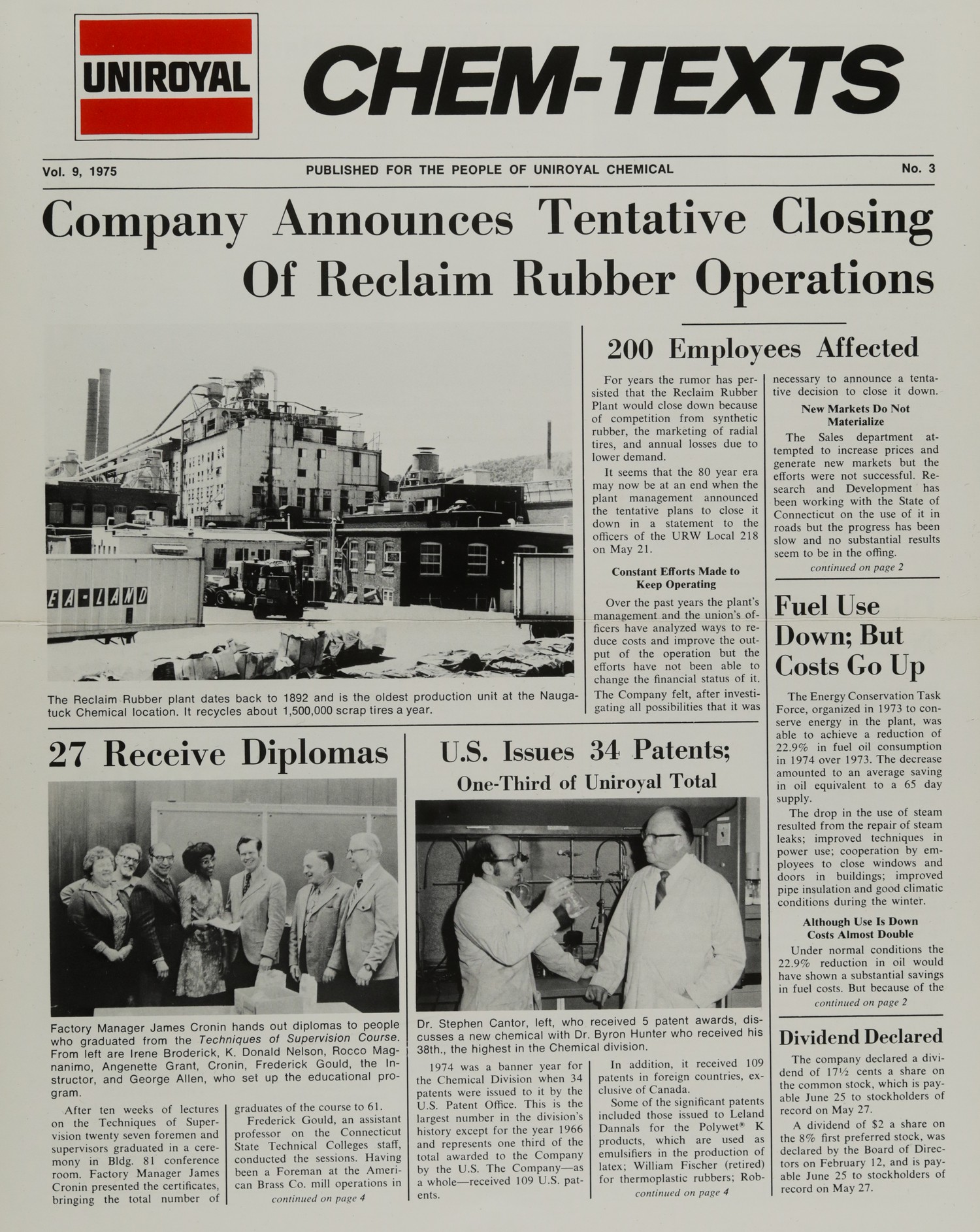
FITZPATRICK’S, INC.
78 East Main St.
Ansonia — 734-3318

MEZZIO’S
792 New Haven Rd.
Naugatuck — 729-5988

POUST’S SERVICE STATION
144 Rubber Ave.
Naugatuck — 729-0433


BOB’S CAMERA SHOP INC.
WATERBURY’S LEADING CAMERA SHOP
21 Grand Street, Waterbury, Conn. 06702 754-2256
Film • Cameras • Projectors • Developing • Rentals

CHEM-TEXTS – 1973-v07-s220

Page 220

CHEM-TEXTS

Vol. 7, 1973 | Page 3


169 Pints Donated

[IMAGE: Black and white photograph showing people at what appears to be a food service counter]

Uniroyal Chemical people enjoy some of the 350 sandwiches and 400 cups of coffee made by the Red Cross Volunteers to provide nourishment after their contribution of blood.

Uniroyal Chemical again exceeded its Bloodmobile quota of 150 pints with donations of 169 pints by employees and walkins.

Awarded Pins

Two gallon pins were awarded to Kenneth (Dave) Nelson and Edward Bates.

The Red Cross presented one gallon pins to P. Braudis, Lucille Butnor, B. Carr, R. Cornell, M. English, E. Fisher, P. Haas, Bertha Mitchell, L. Owens, and R. Tucker.

Safety Dept. Organized

The Bloodmobile was organized by Robert Shortt, Safety Manager, and James Loman, Safety Supervisor, assisted by the Chemical and Synthetic nurses, Adeline Farrar and Ann McAllister, and Catherine Smith who recruited at EMIC and Louis Kaiser, President of the Uniroyal Chemical Management Club.


Breen’s

The Biggest Little Store In The Country
Visit our four floors
of famous brands for him and her

Ladies’ Dept. Men’s Shop
Couture Coats Manhattan Shirts
Tanner Dresses Botany Suits—Sport Coats
Vanity Fair Lingerie H. Freeman Suits
Joyce—Naturalizer Shoes London Fog Rainwear
Florsheim Shoes
Jaymar Slacks

Lingerie Shop
Vanity Fair
Olga—Barbizon
Schrank Robes
Shadowline

Jr. Sportswear Ski Boutique
Collegetown Sweaters Ski Jackets
White Stag—Skirts, Slacks Warm-Up Slacks
Davis Coats Ski Pants
Peerless Sportwear Ski Sweaters
Gloves & Sweaters

Cosmetic & Jewelry Dept.

Guerlain Yves Saint Laurent
Elizabeth Arden Monet
Nina-Ricci Napier
Chanel Marvella Pearls

Carpet Council Honors Dr. Sterrett

The Carpet Compounders’ Council honored the late Dr. Robert Sterrett for his outstanding contributions to the carpet and rug industry and to the rubber and latex industry with a resolution at the Council’s recent conference.

At the time of his death on April 29, 1973, Dr. Sterrett was the Southeast Regional Manager of sales for Uniroyal Chemical in Dalton, Georgia. He pioneered and developed some of the first SBR synthetic latexes for the carpet industry and was a prime mover in the use of latex as a backsizing for carpets.


Sales Top Billion$ For First 6 Months

Sales and earnings hit record levels for the first half and second quarter of 1973.

Sales totaled $1,056,737,000 which was the first time in the company’s history that they exceeded one billion dollars for a half year. This represents a gain of 15.8% over the record of $912,648,000 set in 1972.

Net income for the half was $31,986,000, a gain of 13.7%.

2nd Quarter Record Set

Sales for the second quarter were $561,310,000, a gain of 15.8%, and net income was $18,560,000, a gain of 10.5%.

Profits would have been higher except for work stoppages during the second quarter and raw material price increases, particularly for natural rubber and energy costs, which the company has not been able to offset through price increases because of government restrictions. There has also been some softening of recovery in foreign markets for tires.

Tire Sales Rising

The performance of the steel belted radial ply tire has been outstanding, resulting in rising sales and expanded dealer distribution facilities.

Keds footwear have also shown sharp increases in sales and improving profitability. There is a continued improvement in the company’s chemical operations. Sales of Naugahyde were reported at record levels.

Naugatuck Plant Situation

Increased costs for fuel oil, electricity, and water, the $3,000,000 liquid waste pretreatment plant, higher transportation costs, new equipment, and higher production costs have affected the earnings of all production units at the Naugatuck plant.

Very few of these higher operating costs have been offset by price increases for the plant’s products.


Savings Bond Drive Ends

Over 500 employees now purchase U.S. Savings Bonds through the payroll deduction plan.

In the recent plantwide drive ten employees signed for the purchase of the bonds and twenty increased their deductions.

The 5½% guaranteed interest and the tax benefits make U.S. Savings Bonds an attractive savings plan for building a college education fund for children and also a retirement fund.

SAFETY IS MY RESPONSIBILITY


CHEM-PROD JOTTINGS

by 7 BUILDING CREW

SAFETY: Our Monday morning Safety meetings are continuing and appear to be working successfully. This month Bob Breton has a slide presentation on drum handling which is quite appropriate.

We had one serious accident since our last column when an operator cut his finger on a sharp edge and it had to be stitched.

Not only are our Lost Time and Serious Accidents down, but hospital calls are also decreasing. This is a good sign in that we are having less accidents overall. Keep up the good work especially during the Summer when long hours and heat fatigue make us susceptible to accidents.

PRODUCTION: Business continues to run heavy. Tonox, Sunproofs, Aminox-Betanox and Omite are in tight supply, and have in general been running seven days. Next year’s Omite business is very optimistic and we plan to run 6 days for the rest of this year and next year.

We have not run as smoothly these past three months as the first three months of the year. Mechanical breakdowns and raw material shortages have cost us.

QUALITY: Our quality slipped a bit when 31,000 pounds of Naugawhite and a tankcar of Polygard were rejected. The off-spec inventory is still high—still around 200,000 pounds. That’s a lot of money to tie up in rejected material.

73 BUILDING EXPANSION: One of the high cost areas is finishing. In order to improve our business position, we have invested several hundred thousand dollars in 73 Building. Our new Littleford-Lodige mixer is on stream and producing excellent quality material. Rates are still low while operators are being trained. The Octamine crushing system has been installed and is now being shaken down. The quick change mill system won’t be ready until August.

TIDBITS: Joe Bucciaglia has been presented an Award of Merit for Outstanding Dancing Ability by the Harold J. Schwartz School of Dancing.

“There’s no justice in this world for women” according to Kay Dowling. The men on the first floor of Bldg. 7 have air conditioning; but on the second floor there’s only a 1910 fan.


Inflation Proof Social Security

A recent change in the law has made social security inflation-proof. Increases in benefits will now be tied directly to increases in the cost of living. Each year, beginning in 1974, living costs will be compared with those for the year before. If living costs have increased 3% or more and a general social security benefit increase has not been enacted, benefits will be increased by the same percentage the following January.

The first automatic increase in benefits could be for January 1975.

Social security now pays over $4 billion dollars a month in retirement, disability, and survivors benefits to over 28 million people.


Pratt Named To Safety Group

Denise Pratt, an Analyst in Research and Development, was named as a permanent member to the Union-Management Safety Committee by Joseph Rzeszutek, President of URW Local 218.

The Committee was organized to study the causes of accidents in the plant and to recommend preventive measures to avoid injuries to employees.

It recently proposed stricter compliance with the plant’s safety regulations by outside truck drivers, contractors and visitors, and particularly the 10 mile speed limit in congested plant areas.

The group meets regularly once a month with two of the four Union members on the Committee rotating, and all Management members permanent.


Chittenden Insurance Agency, Inc.

Insurance—Mutual Funds—Real Estate

180 Church Street
Naugatuck, Connecticut
Tel. 729-8209

Frederick D. Zonino | Nathan M. Pierpont, Jr.

CHEM-TEXTS – 1973 – Page 2

Page 002

CHEM-TEXTS

Page 2 | Vol. 7, 1973


What happened in September?….

[IMAGE: Headshot photo of a man in business attire]

Was it a letdown after the long, hot summer? Was it a relaxation of attitude because of our improved performance over last year? Was it a little anticipation of attaining rewards for goals that have not quite been reached, but were close?

What happened in September? Three lost time accidents in the month —our worst performance this year. Where did we go wrong?

The answer to that question lies not in history, but in the future. What’s done is done, but let us learn from this recent experience and firm up our attitudes on Safety. We must strengthen our resolve to think safe and anticipate the unexpected. And follow rules, procedures, and good common sense to even further levels of accomplishment. We must work closer together, and help each other to solve the accident problem.

The real goal, of course, is not numbers on a board or dollars on a cost report. It is the well being of all our employees. It hurts to have an accident. It hurts in many ways, but the worst hurt of all is that most accidents could have been avoided.

Of course we must not forget that substantial progress has been made this year. We are all proud of this performance. But we have seen in years past a good record take a disastrous turn overnight. A good performance means only that more hard work is needed to keep it that way.

The year is not over yet. I urge all, wage and salary, factory and office, inside and outside, to rebound from our September problems and take on the rest of 1973 in the safest possible manner.

Our 1973 goals are still attainable if we point our eyes and noses in the right direction.


The free lunch program…

The average American is familiar with the expression— “There’s no such things as a free lunch.” Because we are so familiar with the saying, perhaps the full understanding of the thought gets lost and we forget the humbling impact of its true meaning.

Put simply, it means you never get anything for nothing. Even though it may appear that there are free handouts, or that someone has beaten the system, in the long run and when all things are considered, everything has its price.

One of the most flagrant free lunch programs is some of the money Uncle Sam hands out like free lollypops. However, the intelligent home owner, tax payer and average consumer knows, particularly now, that the bill for these goodies comes back to haunt us in the form of higher taxes, and increasing inflation.

The other free lunch program we must be very aware of is our own job situation. Everything our Company provides for us must be paid for by somebody, somewhere. Part of it comes back, when we pay more for the things we have to buy, and part of it comes back when a plant somewhere—anywhere—is shut down because it can no longer support the burden imposed upon it by today’s economic situation.

In order to maintain the comforting benefits provided, the main beneficiaries, namely us, must contribute. Under our product-industrial oriented system, the most reasonable way is to improve productivity. This is by far the best way to generate wealth which subsequently supports our standard of living.

The Company has a commitment to this end by providing the money and management to purchase and properly utilize equipment and facilities. The employees—you and I—have an obligation to properly and fully convert this equipment into products in the most efficient and reasonable manner possible. This is how we pay for our “free lunches.” If wealth is not generated in this way, a deficit is generated. If this deficit is allowed to grow unchecked, it will eventually—to borrow a Russian term—bury our system. Once this occurs, a major adjustment must be made to pay that “due bill” or write it off. In either case the adjustment is painful. The history of man is full of such adjustments and no intelligent man wants to live through such a period. No one wants his children to endure such hardships, either.

We all want reasonable improvements in our standard of living. We also want the improvements to be enjoyed by our children. Therefore, we must balance our benefits and their costs—somewhere, somehow. But we all know where the burden ends up—right on us. If we understand this and know what we are doing, we can better adjust to it and keep our livelihood in a good, healthy balance. We can then honestly say that the “free lunch” has been earned and paid for.

Jim Cronin [signature]


92 Take “Life” Course

[IMAGE: Photo showing people in what appears to be a training session with someone lying down, presumably during CPR training]

Mario Pazzani, Heart Association instructor observes James Loman treat a heart attack victim with cardiopulmonary resuscitation in one of the 3 sessions attended by 92 people.

One out of every fifteen employees at the Naugatuck Chemical plant is now certified in cardiopulmonary resuscitation and mouth to mouth breathing. The overwhelming response of employees to the three courses sponsored by the Safety department is one of the highest among industrial plants in Connecticut.

Two recent heart attacks in the plant indicated the need for such a program to train people on the proper action in such emergencies. Besides the demonstrations, each person attending the courses practiced the life-saving techniques on two dummies equipped with inflatable lungs.

Only one session had been planned for the plant but due to the large number of employees who desired to attend the cardiac program, three sessions were held. The cardiopulmonary course was conducted by Mario Pazzani of the American Heart Association. James Loman, of the Safety Dept. who is a certified instructor in First Aid for the Red Cross, demonstrated the mouth to mouth resuscitation techniques.


Local 218 Talks Start

Negotiations between the United Rubber Workers, Local 218, and the Naugatuck plant management began on Wednesday, October 10. The purpose of the sessions is to negotiate a local supplement agreement which will supplement the 3 year master agreement signed on June 11, 1973 in Dayton, Ohio.

Heading the Local 218 union representatives is Joseph Rzeszutek, President of the Local. Jesse Crim, Manager of Industrial Relations, will be in charge of the Naugatuck plant group.

The discussions are being held in Bldg. 81 conference room, and will continue until negotiations are concluded.


Prior Approval For Tuition Aid

The Tuition Aid Program which encourages employees to continue their education requires that prior approval be obtained for a degree program or specific courses from a department supervisor.

Once approved the application authorizes tuition refunds for not more than 2 courses per semester.

Upon satisfactory completion of the courses, reimbursement is obtained by submitting a paid, itemized invoice from the school to the Accounting department.


GIVE THE UNITED WAY


$3500 In Silver Dollars

September Safety Record Poor

The Summer Safety program for the summer months ended on September 30 with over $3500 awarded to employees who worked safely during the July, August and September months when accidents increase.

People who worked without a Lost Time Accident or Serious Injury received a “silver dollar” for each month, unless they were members of a Group in which one person incurred either type of injury.

Extra Award

Each employee also received an extra “silver dollar” if he worked the full 3 months without an injury whether or not a member of his Group suffered one.

Employees who worked during the shutdown without an injury received an extra, special “silver dollar” when the thermometer soared to 98°F every day for one of the hottest summers in years and when accidents are more likely to happen.

As a special offer of the pro-

(Cont’d on page 4)


[LOGO: “give The United Way” with stylized hand design]


Don’t get a snow job on snow tires.

[IMAGE: Large snow tire]

Get Uniroyal Winterides

Wide 70 series 4-ply Nylon Cord

ADVANCE TIRE SERVICE
510 Meriden Rd.
Waterbury – 756-7205

FITZPATRICK’S, INC.
78 East Main St.
Ansonia – 734-3318

MEZZIO’S
792 New Haven Rd.
Naugatuck – 729-5988

POUST’S SERVICE STATION
144 Rubber Ave.
Naugatuck – 729-0433

CHEM-TEXTS – 1973 – Page 3

Page 003

Vol. 7, 1973 CHEM-TEXTS Page 3


A B.S. 20 Years Later

[IMAGE: Two men standing together, one appears to be congratulating the other, with a framed picture on the wall behind them]

Jack Tierney, right, is congratulated by Harry Witt, Synthetic Production Superintendent on receiving his B.S. degree in Management from the University of New Haven. Tierney returned to college 20 years after graduation from high school and pursued his degree at night for the past 7 years. According to Tierney, he would not have been able to continue his studies without the financial assistance of the Tuition Aid program.

On the wall in the photo is one of Harry Witt’s paintings, “Autumn Gold.” Witt recently completed a course in Oil Painting, sponsored by the Naugatuck High School Adult Education Program.


57 Return To School

by Victor Anderson

Fifty-seven people registered for the Mechanical Trades Program which will be held at the Kaynor Technical School in Waterbury. The two year course in Basic Mathematics, Blueprint Reading, Plumbing, Mechanics and Engineering will be taught by Edwin Schweitzer, an Instructor at the school.

The three hour classes are held from 3:30 P.M. to 6:30 P.M. Tuition and textbook costs are being paid by the plant.

Successful completion of the courses will allow graduates to qualify for second class Piper, Mechanic, and Electricians’ openings when available and in accordance with contract requirements of seniority and qualifications.

In the 1970-72 program thirty-five employees graduated and twenty-three have received positions in the Chemical and Synthetic Mechanical departments.


Local 308 Talks Start

At press time it was learned that URW Local 308 and the Naugatuck Plant management were to begin to negotiate a local supplement agreement of the 3 year master agreement.

Charles Roland, Local 308 President, will head the union representatives and Jesse Crim the plant members.


EPA Chief To Speak

Douglas M. Costle, Commissioner, Department of Environmental Protection will address the Uniroyal Chemical Management Club on Wednesday, Nov. 7 at the Elks Club. Costle succeeded Dan Lufkin as the new EPA chief in August.

He is a graduate of Harvard University and the University of Chicago Law School, J.D.


Golf League Ends

It was youth vs. old age as William Broden and Chester Zawacki won the golf championship.

It was a year that youth took all as the Twilight Golf League completed its third season with William Broden and Chester Zawacki winning the championship cup in a climatic match with George Baktis and Stanley Mazanski at the Lyman Meadow Golf Club.

Last year’s winners Joseph Biernacki and Cyrus Blanchard were eliminated in the early rounds of the tournament and two of the early season favorites, Robert McDermott and Louis Rizzuti, lost their bid to qualify for the golf cup.

Officers for the 1973 season were Stanley Mazur, John Prior, Chester Zawacki, Peter Welch, Edward Rabitor, Howard Kravitz, Thomas Geise, Thomas Ennis and William Broden.


Breen’s

The Biggest Little Store In The Country

Visit our four floors of famous brands for him and her

Ladies’ Dept. Men’s Shop
Couture Coats Manhattan Shirts
Tanner Dresses Botany Suits—Sport Coats
Vanity Fair Lingerie H. Freeman Suits
Joyce—Naturalizer Shoes London Fog Rainwear
Florsheim Shoes
Jaymar Slacks

Lingerie Shop

Vanity Fair
Olga—Barbizon
Schrank Robes
Shadowline

Jr. Sportswear Ski Boutique
Collegetown Sweaters Ski Jackets
White Stag—Skirts, Slacks Warm-Up Slacks
Davis Coats Ski Pants
Peerless Sportwear Ski Sweaters
Gloves & Sweaters

Cosmetic & Jewelry Dept.

Guerlain Yves Saint Laurent
Elizabeth Arden Monet
Nina-Ricci Napier
Chanel Marvella Pearls

CHEM-PROD JOTTINGS

by 7 BUILDING CREW

BLDG. 14: So far this year we have the $180,000 Octamine Flaker AR approved for 94 Building. It will be installed around March 1974.

FINE ORGANICS PLANT: The new plant that we used to call the Solvent Plant has been redubbed the FINE ORGANICS Plant. This will be a new building similar to 100 Building where 57 Building now stands. Construction will begin next year.

SUNPROOF: A new $4,000 refrigeration unit for our Sunproof operation is scheduled for delivery in several weeks. The new conveyor and bagger for Sunproof is in the plant and is being installed.

TIDBITS: People are still asking about Jim Cravo’s “hernia” operation.


65 and 80 Buildings Obituary

by Tom Harrison

It seems hard to believe, but the old soldiers homes of the Chemical Plant (65 and 80 Buildings) are finally being closed down. These 18 “old Men” with an average seniority of 28 years have done an outstanding job.

The production began with the Clave men, led off on days usually by senior man Larry Gabianelli and George Zitzmann, followed by Matt Chlebowski and Charlie Drapko, and closing out the night shift with Bill Detlefsen and Ray Palmer. These men have produced excellent quality Primary MBT at a high yield of 78% (versus Standard yield of 77%). However, it would have to be agreed to by all that “Gabby” made a better batch of spaghetti than MBT and probably more of them too!

Picking up where the Clave men left off, the Floor Operators kept things going. Despite the loss of one of the autoclaves, constant mechanical breakdowns, several injuries and sickness to many of the operators, as well as an accumulation of two years vacation time per year, these operators in most months made and usually acceded the production schedule.

The biggest achievement of the Floor Operators, Walt Breton, Larry Fortier, Henry Kowalewski, Tom Lee, Frank Maher and John Mancuso was the quality record they attained with Thiazole rejection rate of less than 2%. This could only have been accomplished by the men’s extensive experience in making Thiazoles, as well as willingness by all to use this knowledge in working harmoniously together.

After the MBTS, Delac and OXAF slurry was produced in 65 Building, it was then transferred to 80 Building where it was first washed, then dried and ground and finally packaged out. The high quality standards and production rates established by the 65 Building operators were maintained by the 80 Building Dryer Operators: Joe Abraitis, Wilbur Hugar and John Wawer.

After the material was dried, it was next ground and packaged out by the Mill Operators: Ed Copes, John Miller and Leo Vadnais. Through the extra efforts of these operators, neatly stacked pallets were always found on the first floor of 80 Building. These men also recovered over 100,000 lbs. of Delac fines from the filter boxes to not only improve the Delac yield to 89.4% (Standard 88%) but also to reduce pollution to the Naugatuck River.

Not to be forgotten are the two Pipers, Roland Bergeron and Harry Steele, who serviced these two buildings. By working closely with the operators and doing many maintenance jobs on their own initiative (except on Wednesdays) Junior and Harry aided greatly in the production of Thiazoles.

Last to be mentioned but probably the most important member of this group was Tom Engle who was the guiding influence to keep everyone working together.


Gaetz…

(Cont’d from page 1)

“Give Where You Work”

The philosophy of the United Givers is to “give where you work” through the payroll deduction plan and not in your home community. This method has proved the most successful, the most effective, and the least wasteful in helping the UG achieve its goal.

Gaetz is Chief Project Engineer for the Naugatuck plant. A graduate of Penn. State College with a B.S. degree in Chem. Eng. he has held a number of positions in the Engineering department, since he joined Uniroyal Chemical in 1951.

CHEM-TEXTS – 1973 – Page 4

Page 004

Page 4 | CHEM-TEXTS | Vol. 7, 1973


Six Employees Retire Recently

[PHOTO 1]
Harold Piascik, center, a Foreman in the Reclaim Mill Rooms, retired after 30 years of service. Wishing him well are Bert Scullin, left, and Robert Foltz, right.

[PHOTO 2]
Henry Quigley, right, retired after 34 years service. From left in photo are Bronislaus Taranovich, Robert Anderson, Charles Roland, Arthur Calder, Joseph Rotella, and Quigley.

[PHOTO 3]
Congratulating Samuel Tummarello on his retirement after 42 years service are John Flickinger, John Shepard, John Titley, Tummarello, Paul Tortorici and James Parechanian.

[PHOTO 4]
Edward M. Urashka—the fifth member of the family to work for Uniroyal—retired from Reclaim Shipping after 36 years service. From left in photo are William Leary, Huldah Flammia, Urashka, and Bryant Kirkendall.

[PHOTO 5]
Raymond Grele, Reclaim Production, center, retired after 42 years of service. At left is James Cronin, Factory Manager, and Bert Scullin, Superintendent of Reclaim Production.

[PHOTO 6]
Andrew Patskan, center, retired after 32 years of service in Reclaim Production. Congratulating him from left are Antonio Amador, and Paul Kazimir, right.


Plant…

(Cont’d from page 1)

6 Drawings Held

As a result of the record, 6 drawings were held for 25-inch Sylvania color TV consoles—each with a value of $500—as part of the plantwide Safety Incentive Awards Program.

Two months previous 6 employees received B & W portable TV sets for the plants’ having attained 500,000 manhours without a Lost Time Accident.

Accidents Frequency—8.934;
Goals Are 12.0 And 9.0

From January 1 to June 30 employees worked 1,789,821 manhours with only 16 accidents during the 6 months compared to 33 for the same period in 1972.

The present accident frequency rate is 8.934 (the number of accidents per million manhours worked). If this frequency can be maintained for the rest of the year, two drawings for “2 Trips for 2” to Bermuda or Las Vegas; plus $500 in expense money; and one week’s pay will be held.

If the rate stays below 9.0, eligible employees will receive a 15 lb. turkey for Christmas.

Most of the accidents that did occur during the year were person-caused and could have been avoided by proper safety practices.

The present achievement indicates that Uniroyal Chemical people can be No. 1 in safety among Uniroyal plants. That’s where it belongs.


Fahnestock & Co.
(Established 1881)
Members New York Stock Exchange
“ON THE VILLAGE GREEN”

STOCKS | BONDS | MUTUAL FUNDS

HERITAGE VILLAGE FINANCIAL CENTER
SOUTHBURY, CONNECTICUT 06488 | TELEPHONE 264-6511

ARTHUR THOMAS, JR. Manager | EDWARD H. MITCHAM, JR.


“How The AA Works”

This story was written by an employee who had a drinking problem and joined the AA. Since it is the policy of AA to remain anonymous he requested that his name be withheld from the article, the second in a series.

Alcoholics Anonymous is a fellowship of men and women who share their experience, strength and hope with each other that they may solve their common problem and help others to recover from alcoholism. The only requirement for membership is a desire to stop drinking.

The key words in the above portion of AA’s well known preamble are desire, fellowship and share. Some alcoholics would rather die than stop drinking. Many do just that, although it is often a very slow agonizing death. For some, however, a time comes in their drinking career when they have “had” it with booze. They hit a “bottom” and do genuinely have a desire to stop drinking.

Such a person will find a big surprise in AA. The room at an AA meeting is filled with people who used to be unable to control their drinking, but who now don’t drink at all. They all seem to be in a good mood. Downright happy. They welcome a newcomer without question. I have never felt more welcome anywhere than I feel when I walk into an AA meeting. It is the best experience of fellowship I have ever had.

AA members help themselves and others to stay sober happily by sharing. There is a high level of honesty in AA. This is an unusual experience for the new member after years of being a real con artist that most wet alcoholics become. The sharing is made easy because of the high level of trust you automatically feel toward the members who have welcomed you with such unquestioning acceptance. By sharing each other’s experiences while drinking and experiences while gaining sobriety in AA, the members are able to identify with each other. They can see themselves more clearly when they recognize their own experience in someone else.

Seeing ourselves more clearly is the beginning of a process of change and growth. Old resentments begin to seem less important. We come to see that what other people do to us does not have to “drive us to drink.” We can live our own lives, one day at a time, without the crutch of booze. The crutch is replaced by a new source of strength. Gradually it dawns on us that AA is a spiritual program and that the members are turning their lives and their will over to the care of God, as they understand Him, rather than to booze.

The reliance on a higher power, or God, does not come easy for the newcomer bedeviled with pride and very often resentful toward his church or religious background. For those who maintain their sobriety in AA, this higher power ultimately wins out over such pride and resentment.

This leads to a series of steps toward self improvement which builds inner strength and makes staying sober easy and a pleasure.

Sobriety is not achieved through will power but through this higher power which operates through the fellowship.

This is the power that has kept me sober for the last ten years. In another issue I will share what AA has done for me.


CHEM-TEXTS
PUBLISHED BY THE INDUSTRIAL RELATIONS DEPARTMENT
UNIROYAL CHEMICAL, NAUGATUCK, CONN. 06770
EDITOR: William F. Lavelle.

[UNIROYAL LOGO]

UNIROYAL CHEMICAL
Naugatuck, Connecticut 06770

U.S. Postage
PAID
Permit No. 10
Naugatuck, Conn. 06770

RETURN POSTAGE GUARANTEED

CHEM-TEXTS – 1973 – Page 6

Page 006

Page 6 | CHEM-TEXTS | Vol. 7, 1973


36 Get 25 Year Service Awards

In a presentation held in the office of Jim Cronin, Factory Manager, thirty six employees were honored for their long careers with Uniroyal Chemical. Eleven of the group were made new members of the Twenty Five Years Service Club, the others were advanced to the Forty Year, Thirty-Five Year, and Thirty Year groups.

During the past year 157 employees from the plant’s manufacturing operations joined the Twenty Five Club as new members. Membership in it is now 694 . . . roughly one half of the people at the Naugatuck location.

40 Years
Albert Enamait
David Rappe (retired)
Andrew Smey (retired)

35 Years
William Krayeski (retired)
William Lannon
William Maguire
Stanley Mazanski
James Miaski
Michael Patrick

30 Years
Victor Adamski Harold Piascik(retired)
James Brown George Pohorilak
Frank Chiodo Charles Reich
Raymond Frank Frank Siemenski
George Gudauskas Eugene St. John
Americo Henriques
Nicholas Krenitsky
Manuel Leca
James Loman
Robert Mariano
Raymond Mulcahy

25 Years New Members
Anthony Bilcz (retired)
Mildred Finsel
Addis Hillery
Clarence Hiser (retired)
Margaret Holliday
Edward Niski (retired)
Ralph Pilbro (retired)
Earle Root
Kermit Snyder
Florian Taranovich (retired)
Laurentino Terra


One of the three women new members to join the club, Mildred Finsel, is congratulated by Jim Cronin. From left are Frank Siemenski, Americo Henriques, Florian Taranovich, William Lannon, Nicholas Krenitsky, M. Finsel, Michael Patrick, Cronin, Ralph Pilbro, Anthony Bilcz, and Earle Root.

[PHOTO]

Receiving awards from Jim Cronin are from left: James Miaski, Eugene St. John, Raymond Frank, Kermit Snyder, Victor Adamski, Laurentino Terra, Cronin, Addis Hillery, George Gudauskas, George Pohorilak, James Brown, William Maguire and Frank Chiodo.


Less Dimples More Flight

By reducing the number of dimples from 336 to 252 and arranging them in a special pattern, Uniroyal has been able to improve the lift and trajectory of a new golf ball that has the latest high energy rubber center and the finest golf ball winding thread available.

The new Uniroyal 252 — just introduced to golf players — also breaks with. the past because of its Surlyn cover which replaces the standard balata cover and increases the ball’s durability.


Alcoholism Third Fatal Illness

Alcoholism is today one of the most disastrous illnesses in America. In fatality it is officially listed as Number 3, ranking next to heart failure and cancer.

In terms of human misery it easily ranks as Number 1, for the illness brings agony and suffering not only to the patient himself but to all who share his life, whether in family, in work associations, or in the community in which he lives.

Dreadful as unrehabilitated alcoholism is, Alcoholics Anonymous is today the most effective treatment of it. In future issues of CHEM-TEXTS the success of AA in the treatment of alcoholism will be discussed.


Tire Plant To Triple Radial Production

Uniroyal announced the start of production of steel belted radial ply tires at the Opelika, Ala. plant as part of an overall conversion program that will triple the current production rates for this new tire by the end of 1973.

In addition to the Opelika plant, the Company produces steel belted radials at the Detroit plant and in Ardmore, Okla., which is the only plant in the U.S. designed specifically for them.

With the completion of the Opelika program, Uniroyal will have invested more than $100 million for this type of tire in the U.S.

The Company has produced more steel belted radials, worldwide, than any other American tire manufacturer.

By 1977, more than 80% of the nation’s new cars and more than one-half of all replacement tires sold, will be steel belted radial ply construction.


JA Sets Up

(Cont’d from page 1)

program is to give high school students actual experience and to develop an understanding of the basic economic concepts on which a business operates.

Each officer has a specific accountability for the success of the company’s operation. Most of them have had little business training prior to the formation of the company, but experience has proved that they can build a business from scratch and turn it into a profitable venture.

Uniroyal Chemical Advisors to the company are Randolph Porter, Michael True, Cheryl McMahon, Thomas Reynolds and Thomas Schmidt.

[CARTOON: SAFETY FIRST with cartoon figure]

“He’s from Brooklyn.”


Letters To The Plant

Dear Mr. Shaw:

On behalf of our Social Action Committee and everyone of our people who attended the tour of your pollution control facilities on Sunday, I offer thanks to everyone concerned. We had two excellent guides, ready with both patience and wit.

In this day so obviously concerned with pollution control, it is my opinion and that of our Social Action Committee that too often we easily condemn those who do nothing and we are mighty sparing with praise for those who do something. On Sunday afternoon we had an opportunity to praise and not condemn and, indeed, Uniroyal does deserve appreciation for its efforts to enhance our environment.

Again, thank you for the “above and beyond” effort to inform interested citizens of your work on pollution control.

Sincerely yours,

Rev. Albert F. Ciarcia


First Treasurer Retires

[PHOTO]

William Adamski, center, Synthetic Mechanical, receives a gift from Rocco Manulla, Vice President, URW Local 308 Vice President, on his retirement after 30 years of service. Other union officers in the photo are from left, Don McIsaac, treasurer; Charles Roland, president; Adamski; Arthur Calder, secretary; and Manulla. Adamski was the first treasurer of Local 308.


BOB’S CAMERA SHOP INC.
WATERBURY’S LEADING CAMERA SHOP
21 Grand Street, Waterbury, Conn. 06702 754-2256
Film ● Cameras ● Projectors ● Developing ● Rentals


Fahnestock & Co
(Established 1881)
Members New York Stock Exchange
“ON THE VILLAGE GREEN”

STOCKS BONDS MUTUAL FUNDS

HERITAGE VILLAGE FINANCIAL CENTER
SOUTHBURY, CONNECTICUT 06488 TELEPHONE 264-6511

ARTHUR THOMAS, JR. Manager EDWARD H. MITCHAM, JR.


CHEM-TEXTS
PUBLISHED BY THE INDUSTRIAL RELATIONS DEPARTMENT
UNIROYAL CHEMICAL, NAUGATUCK, CONN. 06770
EDITOR: William F. Lavelle.

[UNIROYAL LOGO]

U.S. Postage
PAID
Permit No. 10
Naugatuck, Conn. 06770

UNIROYAL CHEMICAL
Naugatuck, Connecticut 06770

RETURN POSTAGE GUARANTEED

CHEM-TEXTS – 1973 – Page No. 1

Page unknown

UNIROYAL CHEM-TEXTS

Vol. 7, 1973 PUBLISHED FOR THE PEOPLE OF UNIROYAL CHEMICAL No. 1


Chemical AR Approved

$375,510 was recently approved to expand the production facilities of Aminox and Betanox in Bldg. 79. The two, old-line amine antioxidants are widely used in heavy duty rubber compounds where heat resistance is required.

A growing use for the chemicals in the stabilization of Nylon 6 in tire cord is one of the major reasons for approval of the request to improve production facilities.

Reduces Dust, Fumes; Makes Work Safer

A new continuous belt flaker (known as a Sandvik Belt Flaker) will be installed to eliminate the panning operation. The equipment will greatly reduce the amount of material (Cont’d on page 3)


$5096 Paid For Ideas

by Jerry Tortorelli

$5096 was paid out to employees in 1972 in awards for their ideas on improvements in various phases of the plant’s operations. Their recommendations resulted in savings of $17,699.

During the year 318 Ideas were submitted and processed, of which 118 were approved for cash payments. 79 employees received Letters of Commendation. Participation in the plantwide plan which is open to all employees increased by 130 over 1971.

$360 Highest Single Award

The highest single award for the year, $360, was made to Natale Vescera and William Balchunas, of the Materials department.

$475, the largest total amount, was awarded to the (Cont’d on page 2)


1972 Safety Improves

But Still Short Of Plant Goal For Year

The plant’s safety record showed a reduction during 1972 over 1971 especially in Lost Time Accidents experiencing 11 compared to 20 for the prior year.

In 1972 there were 62 Serious Injuries vs 63 for 1971, a small drop in an area that is portentous of future occurrences.

Although a total of 73 injuries to employees in 12 months — an average of 6 per month — is not a real significant improvement, it is an encouraging sign, since it was one of the better records for the plant since 1966 — except for the year 1970 when it had a total of 72 injuries.

Frequency, Per 1,000,000 Manhours Decreased

For every 1,000,000 manhours worked — approximately 4 months — 21.3 employees incurred an injury compared to 25.3 in 1971. This was a 15% improvement over 1971 but did not come close to the frequency reduction of 12.0 and 9.0 which were set as the goals for the Safety Incentive Award program.

Inattention Major Cause of Accidents

Ironically people were the major cause of accidents with inattention the primary factor underlying them. For example many of the accidents were fractures caused by hammer blows; fingers crushed by drums; burns from hot material; and falls.

Few accidents were the result of defective equipment, mechanical failures, or hazardous work conditions.

Materials Department Had Best Record

Members of the Materials department had the best safety record for 1972 with no Lost Time Accidents. The department had 3 Serious Injuries compared to 8 in 1971, a reduction of over 50% in frequency.

Synthetic Production also worked the entire year without a Lost Time Accident but its Serious Injuries jumped from 7 to 8.

By the nature of its work the Mechanical department is more exposed to hazards than other departments but the Chemical Mechanical group reduced both Lost Time Accidents and Serious Injuries for the year.

Injuries In R&D Increase 100%

Serious Injuries in the Research and Development department increased from 4 in

(Cont’d on page 3)


Quarterly Dividend Declared

The board of directors of Uniroyal, Inc. declared a quarterly dividend of 17-1/2 cents a share on the company’s common stock payable March 24 to stockholders of record February 26.

The directors also declared two dividends of $2 each on the company’s preferred stock, one to be paid March 24 to stockholders of record February 26 and the other payable June 25 to stockholders of record May 21.

In 1972 Uniroyal paid a total dividend of 70 cents on the common stock and a total of $8 dollars on the preferred stock.

The current price of the common stock ranges in the area of 13-5/8 a share.


JA Sets Up Juniroyal Company

[PHOTOGRAPH OF GROUP]

Officers of Juniroyal, Inc. hold a public offering of their stock in the office of Factory Manager James Cronin. From left are Joseph LaRose, President; Dianne Holmes, Vice President of Sales; Paul Hammer, Treasurer; Randolph Porter, Advisor, James Cronin; Charles Roland, URW Local 308 President; Elaine Bellemare, Vice President of Personnel; Michael True and Thomas Reynolds. Absent at time of photo were Joseph Rzeszutek, URW Local 218 President, and Cheryl McMahon, Advisor.

by Randy Porter

Juniroyal, Inc., the name of the new Junior Achievement company sponsored by Uniroyal Chemical started the year with a sellout of its first offer of stock.

Last year’s company, Pingyanco, returned a 10% profit to stockholders who invested their money in the firm of young Naugatuck High School students.

Goal To Top 10%

The goal of Juniroyal is to top the 10% profit margin and according to Joseph LaRose, president of the company, “the unique product line we manufacture, will help us attain it.” The company which meets Mondays in Bldg. 1 will produce decoupages, decorative candles, and ornamental trays.

Purpose of JA

The basic purpose of the JA (Cont’d on page 6)


Plant Receives UG Award

[PHOTOGRAPH OF TWO MEN WITH PLAQUE]

Jim Cronin, Factory Manager, left, presents Lou Coscia Chairman for the United Givers, a plaque awarded to Uniroyal Chemical for topping its goal with $22,300 in contributions, almost half of the Industrial Division’s total.

CHEM-TEXTS – 1973 – Page No. 3

Page unknown

UNIROYAL CHEM-TEXTS

Vol. 7, 1973 | PUBLISHED FOR THE PEOPLE OF UNIROYAL CHEMICAL | No. 3


Equality Policy Affirmed

Uniroyal Chemical has a firm commitment to offer equal opportunity to all employees. It is the policy of the plant’s management to support and implement this commitment continually.

The policy requires that all recruiting, hiring, transfers, promotions, compensation, benefits, and Company-sponsored training, education and tuition assistance, as well as social, recreational and health programs and lay-off and recall practices are followed and carried out without regard to race, color, religion, sex, national origin or age.

Jesse Crim, Industrial Relations Manager, is Compliance Officer and has the responsibility for implementing this policy; monitoring the Uniroyal Chemical Affirmative Action Compliance Program; and reporting to management the program’s progress.

Responsibility for the improvement of the program and positive results rests with each manager and supervisor as an integral part of his job.


Trades Courses Offered

A new Trades Program will be offered in cooperation with the Kaynor Technical School in Waterbury. The two year program, scheduled in the fall, is voluntary and open to all Naugatuck Chemical employees.

Courses offered will consist of Basic Mathematics, Blueprint Reading, Plumbing, Mechanics and Electricity and will be held one night a week for three hours for 33 sessions.

Successful completion of the program, as judged by the Kaynor Tech instructors, will allow graduates to qualify for second class Piper, Mechanic, and Electrician’s openings when available and in accordance with contractual requirements of seniority and qualifications.

No Cost To Employee

Tuition and textbook costs will be paid by the plant. The (Cont’d on page 2)


Unions Ratify 3 Year Contract

The master labor agreement and other agreements covering wages, pensions, insurance, severance pay, and supplemental unemployment benefits, negotiated by Uniroyal and the United Rubber Workers, have been subsequently ratified by the Union. All improved agreements are now in effect with the exception of the master labor agreement which will become effective when local supplemental agreements are negotiated and signed.

The new agreements, covering a 3 year period, were signed on June 11, 1973 after three months of negotiations in Dayton, Ohio.

The contracts provide for wage increases over the 3 year period and improvements in pensions, life insurance, sickness and accident insurance, medical insurance, and supplemental unemployment insurance.

They also include improvements in certain of these areas as they apply to retired employees.

Improvements in the general wage scale were effective on July 2, 1973.

Monthly Pension Increases

The monthly pension allowance was improved. The improvements are progressive over the 3 year period. By 1975, the monthly amount will be computed on the basis of $10.00 per month for every year of service. Disability pensions will be on a double monthly allowance, increasing to $20.00 per month per year of service by 1975.

Early Retirement

The new pension plan provides that an employee with 30 years’ service at and after age 55 can retire at his own option on an unreduced pension amount. For those employees exercising this option in 1974 and thereafter, the plan provides a supplemental allowance until age 65.

SUB Benefits

The supplemental unemployment benefits plan was modified. The company will increase its contribution to the SUB fund. By 1975, contributions will be at $0.10 per hour worked level and maximum funding will be at $750 per employee covered by the plan.

Life Insurance

Life insurance has been increased from $8500 to $9500
(Cont’d on page 2)


[PHOTO CAPTION]
Joseph Rzeszutek, URW Local 218 President; Jesse Crim, Industrial Relations Manager; and Charles Roland, URW Local 308 President attended the 3 months’ negotiations in Dayton, Ohio.


Plant Tops 1,000,000 Manhours Without A Lost-Time Accident

[PHOTO CAPTION]
Winners of the color TV consoles—each worth $500.00—pose with plant safety personnel and Factory Manager on the occasion of working 1,000,000 manhours without a lost time accident. From left are James Loman, Safety Supervisor; Gene Reale, Foremen’s winner; Manuel Moniz, Chemical Production; Roman Brzozowski, Reclaim Production; Silvio Spalvieri, Synthetic Materials; Walter Scott, Union-Management Safety Committee; Daniel Volpe, Salary winner; Robert Shortt, Safety Manager; and James Cronin, Factory Manager. Absent from the photo is Henrique Marques, Chemical Production.


Frequency Rate Is 8.93 For 6 Months

It started on March 11 and was reached on June 26, one million manhours worked without a lost time accident. This achievement reflects a greatly improved safety performance over 1972 and has resulted in a 50% reduction in accidents in the plant.

Lost Time Accidents Serious Injuries Total
1972 6 27 33
1973 5 11 16

(Cont’d on page 4)


Dividend Declared

Uniroyal, Inc. declared a dividend of 17½ cents a share on the common stock. The dividend is payable September 25 to stockholders of record August 20.

A dividend of $2 a share on the 8 per cent first preferred stock was also declared and is payable September 25 to stockholders of record August 20.

Company Announces Tentative Closing Of Reclaim Rubber Operations

UNIROYAL CHEM-TEXTS

Vol. 9, 1975 | PUBLISHED FOR THE PEOPLE OF UNIROYAL CHEMICAL | No. 3


Company Announces Tentative Closing Of Reclaim Rubber Operations

200 Employees Affected

For years the rumor has persisted that the Reclaim Rubber Plant would close down because of competition from synthetic rubber, the marketing of radial tires, and annual losses due to lower demand.

It seems that the 80 year era may now be at an end when the plant management announced the tentative plans to close it down in a statement to the officers of the URW Local 218 on May 21.

Constant Efforts Made to Keep Operating

Over the past years the plant’s management and the union’s officers have analyzed ways to reduce costs and improve the output of the operation but the efforts have not been able to change the financial status of it.

The Company felt, after investigating all possibilities that it was necessary to announce a tentative decision to close it down.

New Markets Do Not Materialize

The Sales department attempted to increase prices and generate new markets but the efforts were not successful. Research and Development has been working with the State of Connecticut on the use of it in roads but the progress has been slow and no substantial results seem to be in the offing.

continued on page 2


[IMAGE CAPTION:]
The Reclaim Rubber plant dates back to 1892 and is the oldest production unit at the Naugatuck Chemical location. It recycles about 1,500,000 scrap tires a year.


27 Receive Diplomas

[IMAGE CAPTION:]
Factory Manager James Cronin hands out diplomas to people who graduated from the Techniques of Supervision Course. From left are Irene Broderick, K. Donald Nelson, Rocco Magnanimo, Angenette Grant, Cronin, Frederick Gould, the Instructor, and George Allen, who set up the educational program.

After ten weeks of lectures on the Techniques of Supervision twenty seven foremen and supervisors graduated in a ceremony in Bldg. 81 conference room. Factory Manager James Cronin presented the certificates, bringing the total number of graduates of the course to 61.

Frederick Gould, an assistant professor on the Connecticut State Technical Colleges staff, conducted the sessions. Having been a Foreman at the American Brass Co. mill operations in

continued on page 4


U.S. Issues 34 Patents; One-Third of Uniroyal Total

[IMAGE CAPTION:]
Dr. Stephen Cantor, left, who received 5 patent awards, discusses a new chemical with Dr. Byron Hunter who received his 38th., the highest in the Chemical division.

1974 was a banner year for the Chemical Division when 34 patents were issued to it by the U.S. Patent Office. This is the largest number in the division’s history except for the year 1966 and represents one third of the total awarded to the Company by the U.S. The Company—as a whole—received 109 U.S. patents.

In addition, it received 109 patents in foreign countries, exclusive of Canada.

Some of the significant patents included those issued to Leland Dannals for the Polywet® K products, which are used as emulsifiers in the production of latex; William Fischer (retired) for thermoplastic rubbers; Rob-

continued on page 4


Fuel Use Down; But Costs Go Up

The Energy Conservation Task Force, organized in 1973 to conserve energy in the plant, was able to achieve a reduction of 22.9% in fuel oil consumption in 1974 over 1973. The decrease amounted to an average saving in oil equivalent to a 65 day supply.

The drop in the use of steam resulted from the repair of steam leaks; improved techniques in power use; cooperation by employees to close windows and doors in buildings; improved pipe insulation and good climatic conditions during the winter.

Although Use Is Down Costs Almost Double

Under normal conditions the 22.9% reduction in oil would have shown a substantial savings in fuel costs. But because of the

continued on page 2


Dividend Declared

The company declared a dividend of 17½ cents a share on the common stock, which is payable June 25 to stockholders of record on May 27.

A dividend of $2 a share on the 8% first preferred stock, was declared by the Board of Directors on February 12, and is payable June 25 to stockholders of record on May 27.

Accident Frequency Reduced 54% 1500 Turkevs Awarded to Employees

Page 2 | CHEM-TEXTS | Vol. 7, 1973


The end of the year is upon us, and traditionally it is an ideal time to review the past year and take a peek at the next.

Obviously, it is impossible to review all of the little steps of progress we have made this year. Therefore, I would like to offer a general review of our plant and business in 1973.

The epitome of working together, I think, is this year’s outstanding safety performance over last year’s. Without the complete involvement of all “Chemical people”, we would not have been as successful.

We still have a long way to go, particularly in the number of days lost due to accidents. But this year’s performance has built the base from which we can launch the effort needed to overcome this next difficult hurdle.

In the business line, Chemical Production came through a torturous year with encouraging vigor. The year started great, only to slow down at mid year when uncertain business conditions caused customers to hedge on their purchases.

Then when sales started to pick up, we were staggered by the continuing energy-related raw material shortages.

Heading into the new year, we face the confusing problem of having the sales, but perhaps not the raw materials. In addition, these materials are skyrocketing in cost. Survival next year can be defined as having the flexibility to make the most of a difficult situation.

We all know the problems facing our Reclaim plant. But if this year’s performance and attitude are any indication of our strength and perseverance, we are going to give that business a real run for the money in 1974. Turning an old giant like that around, enough to make it competitive, is a formidable task. Time is a problem and 1974 is our year to show them what we’re made of.

It is unfortunate that we have become non-competitive in the Synthetic latex business. We must quickly recover from this shutdown and adjust ourselves to solving today’s problems.

Attitude and cooperation did it with our Safety performance. The same approach must be used in improving the competitive and economic position of our plant. A healthy business means secure jobs—for one and all.

Despite the lack of Christmas lights this year, I would like to extend to all of you, and your families, my best wishes for the Christmas holiday. It is a comforting time of the year, but also a time to remind ourselves how fortunate we really are.

Jim Crim


Accident Frequency Reduced 54%

1500 Turkeys Awarded to Employees

[IMAGE: Photo showing three people examining documents]

Jesse Crim, Industrial Relations Manager for the Chemical plant, checks the turkey lists with Molly Cobbol, left, and Constance Antrum, right.

1500 turkeys were awarded to employees for reducing the accident frequency rate 54% during 1973.

During the year accidents to employees at work dropped from 73 in 1972 to 33 for 1973. This is a 54% reduction in accident frequency—the number of Lost Time Accidents and Serious Injuries per one million manhours worked.

Attain 12.0 Goal—1500 Turkeys Awarded

In early January a Safety Incentive Awards Program was initiated with an accident frequency goal of 12.0.

The present accident frequency is 10.43 per 1,000,000 manhours worked. Since this record is below the 12.0 goal all eligible employees received 12-14 lb. turkeys for achieving this major safety improvement during the year.

Top 500,000 Manhours

For the third time this year the plant worked 500,000 manhours without a Lost Time Accident. As a result drawings were held throughout the plant on December 5 for six Zenith black and white portable TV sets.


Energy Force Formed

A Conservation Resources Task Force of Engineering Specialists has now been in existence over two months to coordinate the efforts of all departments to conserve steam, electricity, water, air, and raw materials throughout the 145 units of the plant.

The two critical areas that the Task Force will concentrate on are the conservation of fuel oil and electricity.

Because of the critical shortage of low sulfur fuel the Connecticut State Department of Environmental Protection recently approved the use of a 1.25% sulfur content fuel oil, and coal with 2% sulfur content by the Utilities companies.

Task Force Members

The Task Force members—Douglas Ritchie, William Leukhardt, Charles Reich, Jon Painter, George Allen, Stanley Korpusick, Victor Anderson, George Arndt, and Arthur Aronson—have initiated monitoring plans for energy conservation and organized sub-committees to assist in supplementing the program.

The plant’s 500 HP motors will come under special surveillance by the force along with the high pressure steam systems, and the hot water usage throughout the entire plant.

A significant way everyone can help is to close windows and doors; turn off motors and lights when not in use; use water carefully; and turn down heating units.


How To Use Words

Be concise. Use words sparingly. Avoid smothering your good ideas beneath a mountain of verbiage.


Energy Program Working

17.6% less fuel oil was consumed in November 1973 vs. November 1972. This represents a savings of a four-day supply of fuel oil.

During the same period 7% less electricity was consumed throughout the plant. This is a savings equivalent to a two-day supply of electrical power.

These reductions were achieved for the same level of production in November 1973 as November 1972.

Our Energy Conservation program efforts are paying off and with everyone’s concern and assistance, even this good start can be improved.

With the costs of scarce power resources increasing continually, every employee’s cooperation is needed to continue the fullest possible operation of the plant.


$50,000 Unit… (Cont’d from page 1)

[IMAGE: Photo of helicopter landing in yard with buildings in background, marked “CARSON”]

The pilot gently lands the helicopter in the Reclaim yard. Eric Storch, Project Engineer for the installation, was in charge of the operation. (James Reynolds photo)

quired several days of clearing the yard for the helicopter landing and constant watch against fire.

“We were quite concerned over the risk involved. The fact that everything went so smoothly is attributable to the efforts of the Maintenance, Materials, Plant Protection and Reclaim people,” Storch pointed out after the job was completed.

The new collector cost $50,000 and is expected to be in operation by January 1974.

To date the Uniroyal Chemical plant has spent and committed over $7,000,000 for environmental improvement.

50 MPH AND 68°


Chittenden Insurance Agency, Inc.

Insurance—Mutual Funds—Real Estate

180 Church Street
Naugatuck, Connecticut
Tel. 729-8209

Frederick D. Zonino | Nathan M. Pierpont, Jr.

Uniroyal Talks Start Up Again

Uniroyal Talks Start Up Again

Wed, MAY 17, 76

NAUGATUCK— Negotiations on the master contract between United Rubber Workers Union and Uniroyal resumed Tuesday in Cincinnati, but due to the agreement between the two groups, no news of progress could be received when negotiators were contacted in Cincinnati Tuesday night. Negotiations will continue today.

The contract between the URW and General Tire Co. expired Monday night, but at that time an agreement was made to continue production at the firm on a day-to-day basis. A settlement at General Tire or any of the other four firms could affect the outcome of negotiations between the union and the firms still talking.

Activity in the borough remains quiet, although Uniroyal is shipping during the day. Local 45 pickets who were on 24-hour picket duty since May 3 resumed 12-hour picketing Monday following an agreement with management that no shipping would be done after 6 p.m.

13 Receive 40 Years Service Awards

Vol. 7, 1973 | CHEM-TEXTS | Page 3


13 Receive 40 Years Service Awards

[PHOTO: Group photo of people]

New members of the Forty Years group of the Twenty Five Years Service Club pose with James Cronin, Factory Manager. From left in the photo are Gene Reale, Peter Machnics, Antonio Henriques, Thomas Doran, James Cronin, Michael Chmielewski, Nicholas Salinardi, Joseph Kolakowski, and Evo Gabriel. Missing from photo are J. Conrad Ranney and Anathor Giancarlo.

[PHOTO: Group photo of people in formal setting]

From left, Dr. Charles McCleary, Director of Research and Development for Uniroyal Chemical, congratulates Mary Sullivan and Beatrice Smey on their Forty Years service.

Robert Swallow, Materials Flow Manager, right congratulates Edwin Saunders (second from right) for his service.


Breen’s

The Biggest Little Store In The Country
Visit our four floors
of famous brands for him and her

Ladies’ Dept.
Couture Coats
Tanner Dresses
Vanity Fair Lingerie
Joyce—Naturalizer Shoes

Men’s Shop
Manhattan Shirts
Botany Suits—Sport Coats
H. Freeman Suits
London Fog Rainwear
Florsheim Shoes
Jaymar Slacks

Lingerie Shop
Vanity Fair
Olga—Barbizon
Schrank Robes
Shadowline

Jr. Sportswear
Collegetown Sweaters
White Stag—Skirts, Slacks
Davis Coats
Peerless Sportswear

Ski Boutique
Ski Jackets
Warm-Up Slacks
Ski Pants
Ski Sweaters
Gloves & Sweaters

Cosmetic & Jewelry Dept.
Guerlain | Yves Saint Laurent
Elizabeth Arden | Monet
Nina-Ricci | Napier
Chanel | Marvella Pearls


CHEM-PROD JOTTINGS

by 7 BUILDING CREW

SAFETY: The Monday morning 7 A.M. Safety Meetings are continuing with good success. We are experiencing better attendance than with the previous afternoon sessions. We have achieved 95% of our goal of getting every foreman and operator to at least one meeting every three months.

Chemical Production personnel should be proud of their performance and attitudes toward safety. We have had no lost time or serious accident since September. Keep up the good work.

PRODUCTIVITY: In general, business levels have been good with about half the plant running 7-day schedules. We have started to experience severe raw material shortages with some buildings being shut down for a week or two at a time. We will probably have more of these problems. Finishing productivity rates have been increasing these last few months. This should have a favorable effect on our severe cost problems in this area.

NEW OPERATIONS: The Roylar Plant is on schedule with all of 80 Building cleaned up and ready for new equipment installation. A June start up is expected. The Pre-Treatment Plant has been winterized and in standby condition with start-up scheduled probably in March or April.

QUALITY: The rejection rate has been steadily climbing for the last six months. It is still a lot better than past years, but any rejections cost money (an average 45¢/ pound tied up—300,000 pounds is $13,500). Finishing area has been spotty and in-process control is of particular importance.


Sales Up; Profit Off

Uniroyal set new records during the 3rd quarter and nine months of 1973, but net income declined.

Sales for the third quarter increased 14.8% to a record $489,047,000 compared with $425,901,000 for the same period in 1972.

Sales for the nine months were $1,545,784,000, a gain of 15.5% compared to the previous record of $1,338,549,000 for the same period in 1972.

Profits Decline

The major impact of the government-imposed price freeze occurred in the 3rd quarter and as a result net income declined 61% to $3,019,000 compared with $7,801,000 for the 3rd quarter in 1972.

Net income for the nine months was $35,005,000, a decline of 2.6% compared to the $35,929,000 of last year.

The decline in the third quarter net income broke a string of 10 consecutive quarters in which earnings surpassed those for the same period of the preceding year.

Higher Costs, Tire Market Affect Net Income

A softening in the European tire market and high costs for new constructions in radial ply truck and passenger tires affected income.

Increase Granted, But Insufficient

Although the Cost of Living Council allowed the Company price increases by 50% of the actual cost increases incurred, there is still a need for relief to offset increases in wages, salaries, materials, transportation, higher interest rates, energy, pollution abatement, and supplies required for the company’s operations.

SAFETY IS MY RESPONSIBILITY


Thirteen members of the Uniroyal Chemical Twenty Five Years Service Club were honored for their induction into the select few who contributed 40 years of service to Uniroyal Chemical.

For their years of long service with Naugatuck Chemical which started in 1933 the new members were presented Le Coultre Atmos Perpetual Motion Clocks or Hamilton Wrist Watches.


Three Employees Prevent Fire

Alfred Cignotti, Robert Edmonds, and Tano SanAngelo of the Materials Dept. averted a serious fire in one of the plant’s warehouses when a piece of plastic film caught fire on a shrink machine.

The fire took place on a Saturday morning and was quickly extinguished by the alert action of the three men. The group not only prevented serious injury to themselves and others in the area but also extensive damage to the warehouse facilities.

SAFETY IS MY RESPONSIBILITY


Fahnestock & Co.
(Established 1881)
Members New York Stock Exchange
“ON THE VILLAGE GREEN”

STOCKS | BONDS | MUTUAL FUNDS

HERITAGE VILLAGE FINANCIAL CENTER
SOUTHBURY, CONNECTICUT 06488 | TELEPHONE 264-6511

ARTHUR THOMAS, JR. Manager | EDWARD H. MITCHAM, JR.

CHEM-TEXTS – Vol. 5, No. 1 – Page 2

Page 002

CHEM-TEXTS

Page 2 | Vol. 5, No. 1


FROM THE FACTORY MANAGER

DEAR FELLOW EMPLOYEE:

I’m sure that each of us with a home and family is well aware of how increasingly difficult it is to maintain the standard of living to which we are accustomed, in light of higher overall costs of products and services.

Each month we are faced with regular bills for rent or mortgage, food, fuel, telephone, electricity, gasoline, as well as emergency ones for the doctor, dentist, or automobile repairs. As these costs rise, we do our best to control them by avoiding wasteful use of electricity and water and, in general, by the careful spending of our dollars.

We, at the plant, are faced with similar problems. This year our fuel bill will increase over $600,000; our water bill will increase $35,000; and the cost of electricity will increase $83,000.

We will also have a bill, similar to an emergency one for the doctor, of approximately $3,000,000 for the waste water pretreatment plant.

It will take the fullest cooperation of all employees in order to control and reduce these costs. We must strive to operate in a more efficient manner; prevent accidents and serious injuries; obtain more and higher quality production; avoid waste and off-specification material; and to make suggestions to improve the plant’s overall efficiency.

If each of us uses our time, knowledge, skills and ideas to our fullest capabilities, I’m sure that we will be able to maintain and improve the position of our plant in terms of employment and income.

[Signature: Paul Lyson]


NOW Students Tour Lab.

Dr. Byron Hunter entrances NOW group as he answers question on chemistry. From left are Hunter, Ron Anthony, Ralph Neubig, director, Mike Pittman, Dale Saunders, Mike Davis, Clayt Parker, Trent Saunders, and Nathan Herbert. (M. Makoski photo.)

Young high school students from the North End Opportunity Center in Waterbury saw chemistry in action during a tour of the Research facilities in Bldg. 81 as part of a Boy Scout project to earn their Chemistry Merit Badge. With awed attention and enthusiasm the young chemists watched Dr. Byron Hunter perform miracles with chemical reactions that expanded rubber to twice its normal size. “They asked some sharp questions,” Dr. Hunter commented after the visit.

In the Analytical Control Lab., Anna Radowich demonstrated the methods and techniques used to analyze products manufactured in the plant for quality before being shipped to the customer.

This is the third tour for the NOW group, having visited TSSC and the Agricultural Chemical Research Center previously. According to Ralph Neubig, “informative tours like this interest the students in different careers and pursuing higher education.”

Joe Trangle of the Materials Department transported the group from Waterbury to the plant and returned them home in the plant station wagon.


Six Take Drawing Course

Reviewing an engineering drawing upon completion of the course are from left Dan Cleary, Walt Nystrom, Odell Hines, Ed Bates, Bill Scott, Jim Shea and Bob Smith, instructor for the course.

by Bob Smith

“Reading Engineering Drawings” is much easier for six Chemical Mechanical employees who completed a 21-week course on surfaces and views; dimensions and sectional views; tolerances and finishes; and piping arrangements.

Besides the theory of the textbook, the course was supplemented by drawings of plant buildings, machinery, and processing facilities providing a practical application to the course. Job problems were taken to the classroom for discussion, blackboard work and usually solved.

As a result of the course, greater knowledge of the job brings a fuller sense of satisfaction, individual achievement, and personal responsibility. And usually makes the job easier.

The course was conducted in Bldg. 81 conference room on Wednesday mornings and is the third time it has been given to mechanical department personnel.


$8,900 Awarded

(cont’ from page 1)

employees during a one year period. Under the new plan which eliminates obvious suggestions and the $15 award for three suggestions, the amount attests the quality of the Ideas made during the year.

1,000 Ideas Processed

1,000 Ideas were evaluated, processed and answered during the year by Bernie Daily, Mitch Mazur, and the department coordinators. The delays and red tape of prior years have been eliminated. Ideas are now answered within a week and are held up only for extra evaluation to determine a fair award for them.

Iannuzzi, Idea Man of Year

Idea Man for 1970 was Carmine Iannuzzi, of the Mechanical department who submitted 52 Ideas for which he received $195. Dom Polzella turned in 8 Ideas worth $325. The highest award for the year, $849, went to Ann Mannion, widow of Earl Mannion, for his cost saving uniform valve system.

“Team” Wins $545

Putting their heads together, Bill Krayeski and Walt Tabaka earned $545 for the 38 Ideas they submitted as a “team” during the year. As mechanics, they utilized the experience and skill of their jobs and turned in several high winning Ideas on mechanical improvements in the plant. Another high award team is J. Butkus and John A. Painter who recently received $175.

Other Idea Men

Other employees whose ideas contributed to the more efficient operation of the plant were: L. Clark, $177; T. Lee, $100; J. Enamait, $100; K. Ferreira, $95; F. Henriques, $75; F. Surmanek, $75; J. Ferguson, $75; and J. Gallucci, $75. Robert Lestage, W. Anderson, N. Tiscione, E. Cheney, A. Molnar, D. Bedard, J. Shumak, S. Kropcho, J. Sickola, R. Harrison and (con’t on page 4)


Lost Time

(con’t from page 1)

men’s Compensation amounted to $101,293.

But even more costly is the pain, suffering and financial burden endured by the individual and his family.

The loss in pay to the employees amounted to more than $20,000 during the year. Each accident costs the individual 20% of his earnings.

Affects All Employees

These are the obvious costs to the plant, but the hidden costs create greater problems. An experienced skilled person is replaced by one with less experience and knowledge of the job. Production, yields, and quality are hurt and the cost of making the product increased. As a result a department’s efficiency is reduced and the job security of fellow employees affected.

DEPARTMENT BREAKDOWN—1970

Department Lost Time Accidents Serious Injuries
Chemical Prod. 3 13
Reclaim Prod. 1 21
Synthetic Prod. 0 7
Materials 1 1
Mechanical 1 18
Res. & Develop. 0 6

Anna Radowich shows group a sample of liquid latex. (M. Makoski photo.)

Walt Tabaka left and Bill Krayeski received $545 for 38 Ideas. The “Idea Team” in the Synthetic Mechanical department discuss an Idea prior to submitting it.

CHEM-TEXTS – Vol. 5, No. 1 – Page 3

Page 003

CHEM-TEXTS

Vol. 5, No. 1 | Page 3


New Duster Cleans Air

Ed Zemeir applies talc to bale of Naugapol rubber as Ed Curby watches. Equipment, recently installed, eliminates talc dust in the area and gives greater protection to employees’ health.

by Lou Kaiser

The production of various types of Naugapol® rubber requires talc to be applied to the rubber bale before it is packaged. The talc, a very fine particle size, is dusted on manually, and creates a dust problem when the operator applies it to the rubber. The operators were exposed to the talc and had been required to wear masks to avoid inhalation of the dust.

Air sample tests in the area indicated that the dust levels in the atmosphere were within acceptable health requirements. However, it was decided that an improvement in the ventilation system would make the area more conducive to healthier and safer work conditions for the men in the building.

To eliminate the dust problem, a talc station table and hood was redesigned and a larger fan was installed to provide greater air flow across the talc station. The dust laden air is then lead to a cyclone where it is collected and clean air enters the atmosphere.

With the improved ventilation, it is no longer required to wear a mask when the talc is applied to the rubber.


Plumes Not Pollutants

On clear cold days the white plumes from the plant are more prominent. Most of the “white stuff” is harmless water vapor resulting from the condensation of steam after it has performed its necessary function in providing heat for the 140 buildings in the plant’s production operations and offices. Lou Kaiser of the Environmental Control Group is presently analyzing all vents and stacks in the plant for pollutant content as part of an air environmental improvement program.


$20,050 Pledged To United Givers

Reviewing the final results of the United Givers drive which resulted in pledges of $20,050 from 965 employees are seated from left: Joe Rzeszutek, Sam Gillette, chairman, and Dick Edwards. From left standing are Milt Makoski, Bob Van Allen, and Roger Amidon.

“Let the man with two coats give to him who has none; the man who has food should do the same.”

Generous concern for people by Uniroyal Chemical employees was again shown with a pledge of $20,050 to the United Givers which benefits the physically handicapped, mentally retarded, broken homes, the young and the old in the communities around us.

The amount represents one-sixth of the total pledges for the Naugatuck-Beacon Falls 1971 Drive.

965 out of 1,500 employees contributed with 662 using the payroll deduction plan.

The highest pledges were $240; $228; $204; $160; with several in the $120 range.

Department Pledges

EMIC pledged $4,410 for the highest department contribution, surpassing last year’s goal by $1,000. Several departments dropped below their contributions of 1970 which account for attaining only 91% of the $22,000 plant goal

Department 1971 Goal Amount Pledged
Chem. Prod…. $2,550 $1,707
Recl. Prod….. 2,200 2,151
Syn. Prod…… 1,700 1,301
Eng. & Mech.- Chem……. 1,650 1,350
Eng. & Mech.- Syn……. 1,100 803
Materials….. 1,450 1,209
Factory Service 1,400 1,209
Res. & Develop. 5,900 5,530
Accounting… 900 363
EMIC…….. 3,100 4,410

Sam Gillette was Chairman of the drive with Dick Edwards, Roger Amidon, Joe Rzeszutek, Leon Raskauskas, Jack Vergosen, Bob Van Allen, Eric Johnson, Dom Persutti, Milt Makoski and Bill Lavelle serving on the executive committee for the drive.

Chairmen organizing the campaign in plant departments were Vic Alves, Frank Lynch, Bill Leukhardt, Ernst Krauss, Clark Makinson, Jack Prior, Colin Walker, Julius Rek, Bronis Zukauskas, Walt Miller, John Davison, Ted Lainas, Paul Murray, Bob Dexter, Larry Coburn, Dan Shantz, Stan Mazur, Carl Bawn, Irwin Prager, Gary Arndt, E. Easterbrook, Alex Zonas, Joe Longo and Dick Terino.

Finance records for the campaign were kept by Ed Levandauskas of the Accounting Department.


Scholarship Offered

by Lou Kaiser

The Uniroyal Chemical Management Club is again offering a $250 scholarship, which is available to a son or daughter of a Chemical division employee with two or more years’ of service.

The scholarship is open to all students in the graduating class of a high school or preparatory school who plan a college education. Applications can be obtained from the Industrial Relations department.

This year the scholarship will again be augmented by a $50 cash endowment from Larry Monroe, a retired Chemical division employee.

Joe Bucciaglia is Chairman of the Scholarship committee and all applications must be mailed or returned to him on or before April 1, 1971.


Hoist Taken From TSSC

A quarter ton electric hoist, valued at $500 was recently taken from the Plastics Compounding Lab. in TSSC (Bldg. 112). The 100 lb. hoist, attached to an overhead rail, required a ladder and two men to remove.

Thefts of an electric drill, wrenches and small tools have also been reported in the same building.

Besides the extra cost to the plant, the thefts cast suspicion on all employees in the building, and new rules are effected to restrict their actions because of an individual’s actions.

The loss imposes harder work conditions on the men who now have to use a hoist from another section of the building.


CHIF Offers Help To Find Homes

by Milt Makoski

If you are interested in owning your own home and would like help in locating one and financing the down payment through a long term low interest second mortgage note, an organization, “CHIF” (Connecticut Housing Investment Fund) may be able to assist you.

CHIF is a non profit private organization which provides loans for down payments; gives advice on financing; and assistance in locating and purchasing a home. There is no fee for their service and there is no income

(con’t on page 4)


DO PEOPLE REALLY UNDERSTAND YOU?

A picture is worth a thousand words. But if pictures are ambiguous, words can even be much more ambiguous, especially when you try to communicate with other people. What do you see in the above picture?


You can protect your heart and health, Dr. White advises, by having a small routine of daily exercise and by a proper diet, especially avoiding being overweight.

FREE X-RAY MARCH 25
PROTECT YOUR HEALTH

CHEM-TEXTS – Vol. 5, No. 1 – Page 4

Page 004

CHEM-TEXTS

Page 4 | Vol. 5, No. 1


Four Employees Retire

[IMAGE: Four people standing together, with “COLD DRINKS” sign visible]

Lillian Ploss cuts cake after 44 years service as plant cashier. From left are Don Turner, Lillian, Nell Patrick, Bob Rung, Marie Rusate and Diane Carignan.


[IMAGE: Group of people, one person cutting cake]

Helping Rose Beardsley cut a cake on her retirement after 24 years service in Accounting are from left Karol Mooney, Larry Mambrino, Rose, Helen Solomita.


“No School Today” was John McCarthy’s philosophy. Wishing him good luck after 24 years as a millwright are from left Mary O’Brien, McCarthy, Bill Rek, who shaved his beard, and Jim Norton.


[IMAGE: Group photo of workers]

Bob Crotty with 27 years service in Synthetic Materials Handling is congratulated, from left, by Ernie Molnar, Don Boyd, Crotty, Bill Leary, and Tony Moura.


$8,900 Awarded

(con’t from page 2)

J. Chasse received $50 each. A $35 award went to A. Cross and a $30 award to J. Arbachauskas.

$25 was given to J. Banno, A. Hanley, H. Needham, O. Gabianelli, J. Marino, Jr., J. Mambrino, A. Gilfone, J. Lawton, A. Kazemekas, S. Dushak, H. Hernandez, M. Rosa, L. Ritchie, F. Simasek, K. Nelson, P. Cravo, N. Owens, S. Mazanski. R. Lockwood, L. Raskauskas, J. Iosa, G. Monahan and E. Kassheimer.

A $15 award went to R. Jennings, a carryover from the old Suggestion System.

Thirty-one employees received Letters of Commendation: P. Blasko, J. Jakabauski, J. Morris, L. Mace, J. Bednarek, F. Phillips, J. Brown, G. Perkins, E. Alves, F. Miller, A. Happy, J. Napiello, D. Mennillo, R. Guest, A. Gedraitis, L. Recchia, A. Civitello, C. Steelfox, J. Sullivan, F. Bendler, W. Lavelle, C. Moruska, C. Zawacki, J. F. Brown, E. St. John, J. Owens, J. Salinardi, J. DaSilva, F. Surmanek, W. Parks, and J. Mucha.

SAFETY IS MY RESPONSIBILITY


X-Ray Unit Visits Plant

by Bob Shortt

On Thursday, March 25, a mobile X-ray unit will visit the plant for chest X-ray of all employees. This service is free and is part of an improved medical service program for employees recommended by Dr. Edward Jelley, Plant physician.

The unit will be open from 6 A.M. until 6 P.M. and can X-ray 125 people an hour.

Employees will be provided a form to complete prior to the visit. Results of the X-ray will be returned to Dr. Jelley, who will file it in the employee’s medical record.

Details are posted on departmental bulletin boards.


Fuel Costs

(con’t from page 1)

Save Steam Program

The program to save steam will concentrate on giving maintenance priorities to steam leaks, faulty steam traps, valves, heaters, controls and broken insulation. A large amount of heat loss is caused by open doors and windows which are also a major factor in frozen pipelines and damage to sprinkler systems.

10-20% Of Steam Lost

It is estimated that 10-20% of the steam produced is now wasted. A ½” orifice or leak wastes 835,000 lbs. of steam a month at a cost of $668 and for a yearly total of $8,000.

A program has also been initiated to inventory, inspect and repair all steam traps in the Reclaim, Chemical, and Synthetic plants to eliminate waste.


CHIF Offers

(con’t from page 3)

limit to be eligible for CHIF’s assistance.

Uniroyal management has examined this service and believes that it may be beneficial to employees. The services of CHIF are primarily involved in assisting members of minority groups in the purchase of their own homes.

If you are interested in obtaining more information about CHIF, call Milt Makoski, Industrial Relations Department, Ext. 217. Or contact CHIF directly in the Steel Building, 51 West Main Street, Waterbury, phone 757-1071.


Safety

(con’t from page 1)

sion has been requested to review all jobs in their departments to determine the proper protective equipment to be used on the job.

Part of the recommendation will be the wearing of hard hats and safety glasses throughout areas of the plant as designated on maps to be distributed to all employees.

Program Timetable Set

The following timetable has been set for the hard hat and safety glasses portion of the program:

March 1, all supervision will advise employees in their department about the program and will find out who needs replacement equipment.

On April 1, all supervision will not only begin to remind employees in their department to wear their equipment but also to advise them to do so.

On May 1, the wearing of hard hats and safety glasses will become mandatory in all designated areas of the plant.

Employee’s Safety

The basic purpose of the new program is to protect all employees against accidents and serious injuries. Since 1967, seventy-one employees suffered lost-time accidents and 246 had serious injuries.

With every employee’s cooperation, this new program will help prevent the occurrence of accidents and make the Naugatuck plant a safer and better place to work.


Group Tutors Young

[IMAGE: Group of people in formal attire greeting each other]

Dr. Frank O’Shea and Sister Irene of the Sisters of Charity greet the two pretty Carrion sisters, Maribel and Myra as they arrive for a one hour study session. Not in the photo is Sister Margaret Sugrue who was busily involved in organizing the session.

By Len Lombardi

Forty-eight Uniroyal Chemical employees tutor young high school students from the Waterbury area on Monday and Tuesday evenings from 7-9 P.M. The Uniroyal Tutoring Program provides personal individual instruction to underprivileged young people to help them become better achievers in school, and obtain a High School diploma.

Five of the Chemical tutors have doctorate degrees in the sciences, and hold supervisory positions in R & D at the Chemical plant; several have MA degrees in Chemistry and Engineering.

Sister Margaret Sugrue and Sister Irene, of the Sisters of Charity, who live in a tenement house on Gilbert Street in the downtown West Main St. section of Waterbury, coordinate one group of tutors with Dr. Frank O’Shea. This group which meets at the Gilbert St. tenement house on Monday evenings, consists of Frank O’Shea, Ken Beardsley, Patricia Forbes, Angenette Grant, Eric Johnson, Dick Keenan, Dick Palizay, John Sierakowski and his wife Margaret, and Art Tobias.

The other group of teachers is coordinated by Mr. Albert Leach, a vice principal of the Barnard School. In this group, which meets Mondays and Tuesdays at the Woodrow Wilson School, are K. Ray Allen, Steve Alper, Bill Broden, Joe Bucciaglia, Bob Cassarino, Lou Coscia, Bob Florek, Jim Gatling, John Gilbert, Paul Hinckley, Keith Hughes, Russell Malz, Jr., Dr. Bob Neidermyer, Ted Shevzov, Sandra Weaving, Dr. Roger Amidon, Sandra Bond, Dr. Jim Brown, Jr., Dr. Bob Brown, Pete Braudis, Dave DaVia, Brendan Geelan, Joe Hochheiser, Howard Kravitz, Dr. Vin Landi, Clark Makinson, Dan O’Donnell, Bruce Perkins, and Dan Shantz.

Substituting as tutors are Mike Jasman, Leslie McDonald, Frank Lassiter, Len Lombardi, Bob Swallow, Ed Nunn, Neil Melore and Bruce Goodwin.

Jo Greco volunteers her services as secretary. She handles the many details of the Uniroyal community project, answers correspondence, and maintains records for each tutor and the subject that he teaches.

If sufficient tutors volunteer their services, the Uniroyal Tutoring Program will be expanded to assist the Puerto Rican youth in Waterbury. Volunteers can call Len Lombardi, Ext. 296.


CHEM-TEXTS

PUBLISHED BY THE INDUSTRIAL RELATIONS DEPARTMENT
UNIROYAL CHEMICAL, NAUGATUCK, CONN. 06770

EDITOR: William F. Lavelle.


[LOGO: UNIROYAL]

UNIROYAL CHEMICAL
Naugatuck, Connecticut 06770

RETURN POSTAGE GUARANTEED

U.S. Postage
PAID
Permit No. 10
Naugatuck, Conn. 06770

CHEM-TEXTS – 1971-v05-i01-s183

Page 183

UNIROYAL CHEM-TEXTS

Vol. 5, 1971 | PUBLISHED FOR THE PEOPLE OF UNIROYAL CHEMICAL | No. 1


$8,900 Awarded For Ideas


Fuel Costs Doubled For 1971

Save Steam Plan Started In Plant

by Al Manzi

Total fuel costs for 1971 will be approximately double over 1970. $1,143,000 has been budgeted to operate the plant during the year against actual costs of $638,000 for last year.

The $505,000 increased cost of fuel is primarily due to escalating residual oil prices which are a result of the Mid-East crisis, tanker shortages and pollution abatement conversions to oil. An added cost is the premium we will pay for low sulfur oil after Sept. 1, 1971.

(con’t on page 4)


Safety Equipment Program

by Bob Shortt

As part of the plant’s continuous concern for the safety of all employees, a new safety equipment program has been initiated.

The program is based on a section of the 1970 Uniroyal-URW Master Agreement which emphasizes that all employees are expected to cooperate in the prevention of accidents to themselves and their fellow workmen and shall be required to utilize such protective devices and equipment prescribed by the Company at no cost to the employee.

Areas Under Review

Under the program, supervi-

(con’t on page 4)


Profits Off $4,100,000

Uniroyal showed a $4,100,000 loss for the 4th quarter of 1970 compared to a profit of $8,400,000 in 1969.

Sales for the same quarter were $371,000,000, a decrease of $17,000,000 from the same period last year.

1970 sales of the company were $1.554 billion, almost the exact amount as the prior year. Net income for 1970 was $23,800,000 compared to a net income of $46,600,000 in the year of 1969.

The decrease in 1970 profits and sales were attributed to the GM strike, the general softness in the economy, high interest charges, sharply higher employment costs, higher transportation charges and other costs not fully absorbed by price increases or productivity improvements.

Plant Business Down

During the year production of reclaimed rubber, latex and rubber chemicals was affected by the slackness in the automotive industry, home construction and the shutdown of several Uniroyal tire plants.

The plant’s business shows scarcely any improvement according to present sales forecasts for the first quarter of 1971.

Every effort needs to be made at this critical time in our economy to prevent off grade production, improve productivity and quality, and to keep customers satisfied.


Dividend Declared

Uniroyal declared a quarterly dividend of 17½ cents a share on the company’s common stock. The dividend is payable March 25 to stockholders of record on February 22.

The Company also declared two dividends of $2 each on Uniroyal’s preferred stock. One will be paid March 25 to stockholders of record February 22 and the other payable June 25 to stockholders of record on May 24.


Elephant Tests Chair

[IMAGE: Photo of an elephant named Elsie testing a plastic chair]

Elsie, a 5,000 pound elephant, torture tests a molded urethane plastic chair made by a new process developed by Rubicon Chemicals, a Company jointly owned by Uniroyal Chemical and Imperial Chemical Industries, Ltd. The liquid urethane chemicals are poured into special chair molds and react into a rigid foam to create furniture that has fantastic strength, is lightweight and easily movable. The shells are then filled with flexible foam for deep seating comfort and upholstered with Naugahyde® vinyl.

Research work on the new process was done in Bldg. 75 by Tom Haggerty, Group Leader; John Chapman; Don Zalewa; Ken Ferreira and Jim McGinn.


[IMAGE: Photo of Al Urban receiving award from Bob Foltz with Art Nauges]

Al Urban, center, a finisher operator in Reclaim Production, receives $426 Idea Plan check from Bob Foltz, general foreman. At right is Art Nauges, area foreman. Al suggested to reuse the butyl tuber heads, previously discarded, and to reclaim, finish and sell the butyl. He received an initial $50 award.


Lost Time Accidents Drop To 6

By Sal Aloise

The incidence of lost time accidents showed a major improvement in 1970. The plant had only 6 compared to the 23 in 1969. Two of the accidents occurred in December in an odd situation.

An employee fell on ice and fractured two ribs. A few days later he visited Dr. Jelley at the Chemical plant hospital prior to his return to work. After his checkup, Tom Doran, a plant driver, drove him home. When Doran stopped for a stop sign, a trailer truck skidded into the station wagon, injuring Doran who suffered a severe neck strain. One of the safest, most experienced drivers in the plant, Tom lost a month of work when the “unexpected happened“.

Accidents Cost $150,507

The 6 lost time accidents and 66 serious injuries cost the plant $150,507 in 1970. The outside medical bills for hospitalization, X-rays, specialists, medicines and doctors’ visits were $49,214. The money paid out for Work-

(con’t on page 2)


by Mitch Mazur

257 employees received $8,900 for Ideas in 1970. A high award of $476 was made to Al Urban for his idea to reuse butyl tuber heads which were previously discarded after short use. The butyl is now reclaimed; finished; and sold, saving materials cost and scrap haulage charges. It took six months to evaluate the idea for which Urban received an initial award of $50 and a subsequent award of $426.

The $8,900 was one of the highest amounts ever awarded to

(con’t on page 2)


[IMAGE: Photo of Carmine Iannuzzi being congratulated]

Carmine Iannuzzi, of the Chemical Mechanical Dept. right, is congratulated by Leo Napiello for being named Idea Man of Year.

CHEM-TEXTS – Vol. 5, No. 2 – Page 2

Page 002

CHEM-TEXTS

Page 2 | Vol. 5, No. 2


FROM THE FACTORY MANAGER

DEAR FELLOW EMPLOYEE:

The National Safety Council recently presented an Award of Merit to the Naugatuck Chemical plant in recognition of its notable safety achievement in 1970. The Award was based on the significant drop in our lost-time accidents during the year: only 6 compared to 24 for each of the three previous years.

In helping to attain this performance, everyone in the plant deserves to be congratulated. Such an achievement is the result only of individual effort and cooperation. With everyone’s increasing concern for safety, we should continue to improve on our experience.

During April, this safety awareness really paid off. Five employees were involved in near-serious eye accidents that would certainly have resulted in damage to their sight. Fortunately, all were wearing their safety glasses at the time of the accidents.

Although our on-the-job safety performance has improved, let’s not overlook safety when away from the job.

Off-the-job safety becomes especially important as the warm weather and vacation time approaches.

At this time there’s a tendency to take extra risks in working around the house—using lawnmowers, climbing ladders, or lifting heavy objects.

Or on vacation, there’s the urge to do everything fast—driving carelessly, exercising too vigorously in sports.

Whether at work, at home, or on vacation—let’s continue to place a great deal of emphasis on good safety habits. Not only you, but your family and fellow employees will benefit from it.

[Signature]


Nystrom Gets $300 Grant

Harvey Nystrom receives Scholarship Award from Joe Bucciaglia. From left are Bob Kaiser, Walt Nystrom, Harvey Nystrom, Bucciaglia, and Irwin Prager.

Harvey J. Nystrom, son of Walt Nystrom, a Millwright in the Chemical Mechanical Department, received the Uniroyal Chemical Management Club’s $250 scholarship award, along with an additional $50 from the Larry Monroe Fund.

Ranked first among 172 seniors at Southbury High School, Nystrom was selected as recipient of the Scholarship from 15 applicants. According to Joe Bucciaglia, Chairman of the Scholarship Committee, “all of this year’s applicants were deserving of the scholarship. It was most difficult for the committee to select one person.”

Besides his outstanding scholastic record, Nystrom was president of the National Honor Society, a State of Connecticut Scholar, and an active participant in a number of extracurricular activities.

He received a Certificate from Knox College for a special Science Training Program for High Ability high school students and a Certificate of De Merite En Francais for his proficiency in French. For his outstanding performance on the National Educational Development Tests, he received a Certificate of Educational Development which is awarded only to students for outstanding educational capabilities.

Nystrom will major in Physics at Cornell University and plans to do postgraduate work in Astro-Physics.

Other members of the Scholarship Committee who screened the applications for the annual award were Irwin Prager and Bob Kaiser.


Logic-Networks Plan Initiated For Liquid Waste Pretreatment Plant

Al Manzi, left, Project Leader for the Pollution Abatement program shows progress of new liquid waste pretreatment facilities on the Master Logic Networks diagram. Looking on are Gene Hertel, center, who assisted in the diagram and Dick Shaw, Project Engineer.

by Gene Hertel

To construct the new $3,000,000 Liquid Waste Pretreatment Plant on schedule, a systematic, scientific plan for the complex pollution abatement project was initiated to achieve the target completion date in December, 1972. This major project involves a coordinated effort by many groups to identify the sources of pollution; to eliminate and reduce pollution; and to construct and put into actual operation the Waste Pretreatment Plant.

Logic-Networks Used

The Logic-Networks system is being used to plan, coordinate, monitor and control the pollution abatement project. It is an easy-to-understand, graphical way to plan a project. It shows the time sequence and the interaction of the many tasks and the people involved. This time-logic diagram then becomes a way for the project manager to monitor the project. Decisions can be made to expedite the project to meet the project goals on schedule. The time-logic diagram also serves as a work-discipline tool for the hundreds of people involved, since they are aware of their participation and timing and how it affects the project.

A master Logic-Network was prepared by Al Manzi, Pollution Abatement Project Leader, and Dick Shaw, Project Engineer. The master network shows the broad objectives of the project. Sub-networks were then developed for the participating groups. These show the detailed effort that each group must accomplish to reach the project goal. These sub-networks are: Start-up of the Waste Pretreatment Plant by Dick Shaw; Identifying and Sampling streams in the Plants—Joe Bucciaglia for the Chemical Plant, B. T. Dave for the Synthetic Plant, John Prior for the Reclaim Plant, Gary Arndt for the Pilot Plants – Yard Abatement by Bob Van Allen; Information and Discussion by Neil Melore; Purchasing by Hal Lynch and Bruce Perkins; R & D Labs by Lou Coscia; Early Warning System by C. H. Kim; and Liquid Waste Testing by Irwin Prager; and Chemical Tests by Frank Lussier.

Editor’s Note: Gene Hertel, of the R & D Department, has lectured extensively on Logic-Networks programs at the Tire, Footwear, and Chemical Division plants.


Bloodmobile Visit June 10

On Thursday, June 10, Uniroyal Chemical will sponsor its annual blood drive. 150 pints is the plant’s goal for this year.

Because of the facilities of St. Michael’s Parish House, the Bloodmobile will be located there from 9:45 A.M. to 2:30 P.M. Since blood is so urgently needed in the State, all employees are urged to donate.

Appointments may be made now with Adeline Farrar, R.N., Ext. 231; Ann McAllister, R.N., Ext. 397; or Bob Shortt and Sal Aloise, Ext. 438.


$1,564 Lost In GMF Fire

by Phil De Pasquale

$1,564 was lost in a fire which occurred in the GMF® grinding section of Bldg. 101. While grinding the chemical, used as an accelerator for curing butyl rubber, a flash fire broke out. The GMF operator on the second shift pulled the fire alarm and the heat from the fire turned on the overhead sprinkler system.

Quick action by the fire inspectors and chemical production operators prevented more serious damage.

200 lbs. of GMF were destroyed, for a loss of over $500. Mechanical and electrical equipment damage totalled more than $500. Water damage, clean-up, and repairs approximated $500.

The fire was the first in the plant this year which amounted to a sizeable damage. The exact cause of the blaze is still undetermined.


Club Elects New Officers

New officers of the Uniroyal Chemical Management Club and the Executive Committee meet to plan activities for the year. Seated from left are Dan Shantz, Lou Kaiser, president; Bill Broden, vice president; and Doug Ritchie. Standing from left are Bob Smith, treasurer; Earl Roller, Stan Mazur, Dick Keenan, secretary; and Bob Cronin.

CHEM-TEXTS – Vol. 5, No. 2 – Page 3

Page 003

CHEM-TEXTS

Vol. 5. No. 2 Page 3


Safety Glasses Save Eyesight of Five Employees

Set Goals; Show Results

The Management By Objective program at the Chemical plant uses results as the major measurement criterion. The purpose of the program is to provide the challenge of individual responsibility; a sense of accomplishment; and personal involvement in the successful operation of the plant during the year.

In the program supervisory personnel and members of their departments mutually define specific goals, individual areas of responsibility, and the results that can be expected on the job. The objectives for each department must fit into the overall objectives of the plant so that each group in the plant works as a unity toward the plant’s and Company’s objectives.

Emphasizes Results

Results, rather than activity, is the measurement by which each person is appraised. Since the individual helps set his own goals, he is accountable for his own achievements.

To be measurable, the objectives are set up as specific as possible in dollars, amounts, times, percentage, quality and other categories.

Four standards are used in the measurement guide which are reviewed quarterly and revised, or new standards and targets set as necessary: 1) Result Areas; 2) Measurements; 3) Commitments; and 4) Supportive Action.

When properly carried out the program provides the individual the incentive to achieve results which he helped set for himself by organizing his time and activities in a logical, systematic method.


Savings Bond Drive Starts

On May 25 a U.S. Savings Bond drive was initiated in the plant to offer all employees an opportunity to purchase Savings Bonds.

In view of the new higher interest rate of 5 1/2%, more people are taking a new look at Savings Bonds as a safe, systematic investment.

For convenience, the Bonds can be purchased by regular payroll deductions.

Presently 35% of the plant’s employees are buying U.S. Savings Bonds through the Payroll Savings Plan.

Application forms for enrollment can be obtained from the Bond Drive Committee members, Foremen, Supervisors or from Gladys Bradshaw, Industrial Relations Department, ext. 517.

Completed forms should be returned to W. Lavelle, Industrial Relations Department.


Don’t drive after taking certain pills, such as tranquilizers or antihistamines. They may have side effects that affect judgment, cause dizziness, sleepiness, and confusion.


SAFETY IS MY RESPONSIBILITY


Safety Award Received

An Award of Merit was presented to the Naugatuck Chemical plant for its “noteworthy safety performance” in 1970. The plant’s lost time accidents dropped from 24 to 6 accidents in 1970. Pictured in the Award presentation are from left, Sheldon Salzman, Factory Manager; Leon Raskauskas, Local 308 President; Joe Rzeszutek, Local 218 President; Bob Shortt, Safety Manager; and Sal Aloise, Safety Supervisor.


Tony Galletta shows Gene Reate how chisel punctured aerosol paint can which exploded in his face.

Without warning, the reaction vessel exploded, and covered the entire area with glass.


During April, safety glasses saved the eyesight of five employees when accidents occurred in different areas of the plant. In each case it was almost certain that the eyesight would have been damaged permanently if safety glasses had not been worn at the time of the accident.

By Tony Galletta

“While I was chiselling slag off an iron flange, the chisel slipped and punctured a hole in an aerosol paint can on the work bench. The can exploded and the tiny particles of aluminum paint covered my face and safety glasses. For a minute I thought I had been blinded.”

“The inside pressure in the can shot the paint 20 feet across the floor and covered the ceiling lights.”

“John Gandolfo said, ‘It’s one of those things that happens once in a million years.’

“With your eyes, that’s all you need . . . just one time. Thank God I was wearing my safety glasses, otherwise I would possibly have been blinded for life.”


by Joe Longo

“I had set up the equipment to run a reaction in the safety cabinet in the Synthetic rubber research lab.”

“The reaction seemed somewhat peculiar, and I asked Dr. Steve Cantor to come over and observe the experiment.

“Without warning, the reaction vessel exploded and a flying object shattered the right lens of my safety glasses. Two overhead fluorescent light fixtures were broken and the entire laboratory area was covered with glass particles.

“It is almost certain that both of us would have suffered severe eye damage or possible loss of sight without our safety glasses.”

A few days prior to the accident, Dr. Tom Brett had held a


Glasses were covered with metallic particles from punctured can.

A glass stopper shattered the right lens of safety glasses.

safety meeting with his group emphasizing the new plant regulations on wearing safety glasses.

Tom Lee of Chemical Production experienced a close call when he was cleaning a 55-gallon baffle drum of sodium MBT. A small amount of the chemical in the bottom of the drum splashed

(Con’t. on page 4)


Fashions In The Plant

Paris, Rome, or London may be the fashion centers of the world but the Naugatuck plant has some style setting fashions of its own. Modelling the styles from left are Ann McAllister R.N., Marge Maye, Steve Arbuckle, Doug Klima, Cynthia Marinaro, and Sandy Bond.

CHEM-TEXTS – Vol. 5, No. 2 – Page 4

Page 004

Page 4 | CHEM-TEXTS | Vol. 5. No. 2


Know Your Products: Rubber Chemical Accelerators

by Dr. Bob Brown

Uniroyal Chemical manufactures 91 different types of chemicals for rubber, latex and plastic products. 69 of these chemicals are manufactured and sold by the Naugatuck plant; the others are made at the Geismar plant in Louisiana.

Virtually every tire on the road today contains one of the chemicals made by the Chemical Division to protect them against oxygen, ozone, heat, fatigue and sunlight. Without these chemicals the rubber would deteriorate rapidly.

Coincidentally, it was one of our rubber chemicals that established us in the agricultural chemical business when it was discovered that the chemical had fungicidal properties. Twenty-five years later, the Division ranks as a major manufacturer of herbicides; growth regulants, miticides and fungicides.

The chemicals that we make at Naugatuck for the rubber industry do a wide variety of jobs; but two are by far the most important. These are: 1) Accelerators for vulcanization and 2) Antioxidants and Antiozonants for protection against aging. A third group—Others—include Blowing Agents for rubber and latex sponge; Bonding rubber to fabric; and Retarding vulcanization during processing.

Accelerators

Ever since 1844 when Charles Goodyear, in his small plant in Naugatuck, found that heating rubber with sulfur (vulcanization) causes it to change from an almost useless, gummy solid to a strong, resilient material with hundreds of uses, rubber product manufacturers have been looking for ways to do this job faster and better.

Chemicals which speed up this vulcanization reaction are called accelerators.

Delayed Action Accelerators

MBT and its derivatives (MBTS, OXAF, DELAC®-S) are the work horses of the rubber industry. They are used in almost all tires, footwear, wire and cable and in many other products where strength and long life are needed but where there is also a lot of milling and shaping of the rubber before it is finally made into a product.


[IMAGE: Black and white photograph showing workers]

AC-5 PRILLS

LAC-5 PRILLS

Leo Vadnais, left, and Wilbur Hugar, center, Chemical Production operators in Bldg. 80 prepare Delac-S Prills and MBTS accelerators for shipment to customer. At right is Tom Engle, Foreman of the department.


Safety Glasses

(Con’t. from page 3)

in his face and would have burned his eyes if he had not been wearing his safety glasses.

Tony DaSilva, an operator in Chemical Production, was sprayed with sodium MBT when a plugged line broke. The chemical covered his face, arms and chest. His safety glasses averted serious injury to his eyes.

During the first four months of the year, 57 eye injuries took place. Fortunately most employees were wearing safety glasses at the time of the accidents, preventing serious damage to their eyes.


Hats, Glasses

(Con’t. from page 1)

URW Master Agreement which emphasizes a cooperative effort to prevent accidents among employees and to utilize the proper protective equipment as prescribed by local management.

$150,507 Lost In 1970

In 1970 there were 6 lost time accidents and 66 serious injuries. The cost of medical bills and Workmen’s Compensation for the year totalled $150,507, an amount equivalent to $100 per employee.

223 employees suffered eye and head injuries in the same year. Of these, 170 were eye injuries and 53 were head injuries.

For your personal safety, your fellow employees, and for your family’s sake, wear your safety glasses and hard hats on the job in designated areas.

Once an eye is lost, it can never be replaced.


Profits

(Con’t. from page 1)

quarter. But replacement tires lagged behind the same period last year. Replacement sales are expected to improve sharply during the year.

The Footwear business also showed progress during the first quarter.

Chemical Sales Down

“A major trouble spot at the present time,” according to Mr. Vila, President and Chairman of the Board of Directors, “is in our domestic chemical operations where severe price erosion in many product lines has resulted in a sharp drop in earnings. This has been caused, in part, by competition from foreign sources, in part by the expiration of certain patents and, in part, by a drop in demand for chemical products generally.”

A Worldwide Competitive Manufacturing Complex

The heavy capital investment made by the Company in recent years now gives it a worldwide manufacturing complex which, for the most part, is modern and fully comparable with competition.

Present manufacturing facilities are sufficient to give the Company sales of about $2 billion, an increase of approximately 20% over present sales levels.

This processing has to be done at a high temperature to make the rubber soft enough to handle, and there is always the danger that it will start to vulcanize before it is finished. For this reason, customers want the accelerators that have some “delayed action”. MBT has a little delayed action; MBTS has more; and DELAC-S has the most.

(To be continued in the next issue of CHEM-TEXTS.)


Phase I

(Con’t. from page 1)

ent materials, which results in a complex waste mixture, difficult to adequately treat.

As State environmental laws and enforcement become more strict, it will be essential to control and reduce the flow of materials into the plant drains.

$4,900,000 Spent, Committed

The new facilities, including the financial commitment to the Borough and the scale model pilot plant tests, will cost $4,900,000, exclusive of the operating costs.

Little of the costs expended to date have been absorbed by increased product prices to customers but have been borne mainly by the plant.

The completion of the facilities is scheduled for December 1972 in compliance with orders from the State Water Resources Commission


Six Retire Recently

[IMAGE: Photograph of three men]

John Hickson, third left, retired from Reclaim after 25 years service. Congratulating him are from left: Pablo Quinones, Lee Thompson, Hickson and Bernie Dunn.


[IMAGE: Photograph of two men]

Bruno Rossi left and George Pohorilak wish each other a happy retirement as Milt Makoski, center, watches. Bruno had 39 years service; George, 30 years.


[IMAGE: Photograph of group of men]

Ovila Fortier, center, retiring after 26 years, receives gift from fellow employees. From left: Tony Galletta, Gene Reale, Fortier, Sal Falcone and Leo Napiello.


[IMAGE: Photograph of three men]

Retiring after 40 years service Andy Smey, center, is congratulated by Harry Witt, and Eric Johnson.


[IMAGE: Photograph of group of men]

Congratulating John Quint on his retirement after 29 years service are from left, Vic Alves, John Painter, Quint, Tim Carr and Ted Clement of the Synthetic Mechanical department.


CHEM-TEXTS

PUBLISHED BY THE INDUSTRIAL RELATIONS DEPARTMENT

UNIROYAL CHEMICAL, NAUGATUCK, CONN. 06770

EDITOR: William F. Lavelle.


[LOGO: UNIROYAL]

UNIROYAL CHEMICAL
Naugatuck, Connecticut 06770

RETURN POSTAGE GUARANTEED

U.S. Postage
PAID
Permit No. 10
Naugatuck, Conn. 06770

CHEM-TEXTS – Vol. 5 No. 3 – Page 2

Page 002

CHEM-TEXTS

Page 2 | Vol. 5 No. 3


FROM THE FACTORY MANAGER

DEAR FELLOW EMPLOYEE:

The miracle of the twenty five years of continual growth in the U.S. economy since World War II is something all Americans can be proud of. It has enabled us to become leaders in the world’s markets and to raise our standard of living to the point where we are better off than any people in history.

This miracle didn’t just happen. It was brought about by the tremendous productivity of the people of this country. For twenty years every time wages increased, productivity also increased and our standard of living went up.

In the last five years, however, we have seen a change in this pattern. While wages have increased, productivity has not kept pace with them. This has helped cause inflation and has helped drive the cost of our products up.

In turn, foreign manufacturers have maintained their productivity and are now able to sell their goods in our markets at prices lower than ours. We can see this in Japanese electronics; German and Japanese automobiles; and textile and footwear products from all over the world.

On a smaller scale the same thing is happening at our factory. We are in competition with both foreign and domestic producers. They are competing with us for the same customers and markets, oftentimes at lower prices. Besides this our markets are moving away from the northeast and the increasing cost of rail and truck transportation adds to our problem of doing business competitively.

All of us must realize this and remember that the chemicals we produce are in competition with these domestic and foreign manufacturers. We can only sell what we can produce economically. We can only produce economically with your help and cooperation. Every job in the plant is important. Every person counts in this effort. We all must chip in.

Phil LaJoie


33 Employees Receive $1355

Mechanical Department Submits Most Ideas

Leo Clark, Mechanical dept. received highest single award, $100.

Ed Bazenas received $140 for 2 Ideas.

Gerry Ferguson points to Idea that reduced product loss.

Thirty-three employees received $1355 for Ideas submitted on plant improvements, more efficient equipment operation and cost saving suggestions.

The highest single award, $100, went to Leo Clark for his Idea to install guide rods on the Reclaim tire chute to prevent blockups which affected production.

Ed Bazenas received the highest total amount, $140, for two Ideas. One of his Ideas recommended the redesign of the bag compressor in Bldg. 52 which resulted in improved operations and lower maintenance costs.

Mike Marro’s Idea to machine down discarded teflon seats and reuse them as spacers in ball valves reduced material costs and netted him $50.

Idea man for the January-April period was Jerry Ferguson of the Roylar® plant who turned in 4 Ideas which rewarded him with $135.

For 2 Ideas Charlie LoBalbo received $75.

Four employees—Stanley Dushak, Leo Clark, Natale Vescera and Charlie LoBalbo—received initial awards of $25. Their Ideas
(Cont’d. on page 4)


Blood Drive Big Success

239 people offered to donate blood to the annual Bloodmobile sponsored by Uniroyal Chemical on June 10.

During the 5-hour visit at St. Michael’s Parish House, 214 pints were collected and 25 people were deferred. The Bloodmobile exceeded its goal of 150 by 64 pints, making it a “big success” according to the Naugatuck Red Cross Chapter.

137 Chemical employees, retirees, college students and “walk-ins” and 77 Footwear donors donated blood.

Pin Awards

A 3-gallon pin was awarded to Bob Breton, of Chemical Production, for his 24th contribution of blood.

Bob Cranney, R&D; Walt Gniazdowski, R&D; and Phil Norton, EMIC Sales, received 2-gallon pins.

One gallon pins were presented to Mike Galante, R&D; Henry Hook and Walt Scott, Chemical Production; and Earle Root, Synthetic Production.

In-Plant Organizers

Organizers for the In-Plant canvass were Bob Shortt, Sal Aloise, Adeline Farrar, R.N. and Ann McAllister, R.N. of the Industrial Relations Department.

Uniroyal Chemical employees enjoy sandwiches and coffee after donating blood. Seated from left are John Napiello, Sr., David Boulanger, Walter Campbell, Al Zimmerman, Don Poehailos and Gene Lantieri. Standing from left are Chet Bulka, Walt Scott, Carol Gilbert R.N., and Ted Ciarello. The Red Cross Volunteers served 325 sandwiches and 300 cups of coffee during the 5 hour visit.

Bob Breton, a Chemical Production foreman displays 3 gal. pin he received from Red Cross.

They were assisted by R. Frank, F. Lynch, J. Tierney, G. Allen, S. Gillette, T. Dowling, E. Johnson, L. Coscia, A. Perrella, M. Jasman, D. Poehailos, A. Amador, R. Foltz, B. Daily, J. Callahan, Gary Arndt, J. F. Brown, E. Krauss, E. Philips, A. Nole, and J. Wade.


Plant Joins JOBS ’70

By Milt Makoski

The Chemical plant recently joined the JOBS ’70 consortium organized by the Greater Waterbury Chamber of Commerce. The consortium, or group of businesses, has 15 member industries and a goal of 180 job slots to be filled this year. The Chamber organized the group under a grant from the National Alliance of Businessmen and the Federal Department of Labor.

The JOBS program is aimed at training area people for meaningful employment. The trainees are given work orientation, counseling, total image development, job related education and on-the-job training.

The program participants are grouped into clusters according to the type of training to be received. One cluster of 15 girls, who learned to be clerk-typists and transcriptionists, have already been placed in Uniroyal facilities. Four of the girls are now working at the Chemical plant; and 11 at the Oxford Administrative and Research Center.

In charge of the Chamber’s portion of the program is Gus Maultsby. The Chemical plants’ representative with JOBS ’70 is Milt Makoski and the Uniroyal Corporate representative, Rita Garramone.

Constance Antrum, seated, now working in the Industrial Relations department reviews procedure with Gladys Bradshaw on typing a departmental report.


Local 308 Picnic Set

by Art Calder

URW Local 308 will hold its 4th Annual Picnic for Union members on Sunday, August 8, at Schildgen’s Grove on East Waterbury Road in Union City. The picnic starts at 10 A.M. and ends at 6 P.M.

Chairman for this year’s event is Art Calder, assisted by Committee members Walt Bieleski, Nunzio Pastore, Wes Burns and Jack Muckle. A $2.00 charge will be assessed members for food and refreshments, which includes steaks, hamburgers, clams and corp.

CHEM-TEXTS – Vol. 5 No. 3 – Page 3

Page 003

CHEM-TEXTS

Vol. 5 No. 3 | Page 3


Drug Plan Starts

The new Prescription Drug Plan, the most recent of Uniroyal’s employee benefits, became effective July 1. The Plan will be carried by the Metropolitan Life Insurance Co.—Medi-MET.

Included in the Plan are the employee and eligible dependents: a spouse, any unmarried children under 19 years of age including stepchildren or other children who live with you and are dependent upon you for support and maintenance. All unmarried children over 19 years of age are also covered if they are either full time students or mentally or physically incapable of self-support.

ID Cards have been issued to participating employees. An employee with a family should have 2 cards: one for the employee and one for a spouse.

If you have not received an ID card or a Prescription Drug Plan booklet ask the Foreman or Supervisor of the department for them, or call Marion Hutt Ext. 557.


“Keep Plant Beautiful”

[IMAGE: Photo of a man watering flowers]

When George Vila, Uniroyal’s president and chairman, toured the Chemical plant a few years ago, one of the more beautiful places he found in the plant was John Sickola’s garden by Warehouse 107. To “keep plant beautiful,” Sickola is growing six flower boxes of petunias, zinnias and marigolds. In the photo above he waters his flowers which add a bright color to the south end of the Chemical yard.


[IMAGE: Photo of cattle in a barn]

“With rue my heart is laden” is the intimation on the faces of the 340 pure bred polled Hereford calves being raised for prize showings and choice table beef.

New Oxford…

(Cont’d. from page 1)

Uniroyal Farms where 340 pure bred polled Hereford calves and prize bulls are being raised for prize showings, commercial breeding and choice table beef.

Airport Facilities

Uniroyal also operates the nearby Oxford Airport and is renting hangar space; selling fuel to aircraft; and providing maintenance and repair services. A new Main Terminal is now open with 6 scheduled airline flights daily offered by Pilgrim Airlines.

Grounds Open To Employees

The Oxford grounds are open 7 days a week to Uniroyal employees, their families and friends but the buildings are closed during weekends.

The Cafeteria serves breakfast, lunch, and dinner Mondays-Fridays and is also open for dining on weekends 6:30-8:30 P.M.; however, reservations should be made in advance.

Guest House, Cocktail Lounge

A 48 room guest house, cocktail lounge, and public dining room are also open to employees, their families and friends.

The lounge is open from 5 P.M.-12 P.M. on weekdays; from noon to midnight on Saturdays; and from noon to 10 P.M. on Sundays.

New Corporate Concept

The Center has been described as a new “plant-ranch concept”; as a “modern Oxford University”; and as a “skyscraper sideways.” It utilizes open office landscaping and has a minimum of individual offices. Privacy is attained through the strategic placement of plants and colorful screen dividers.


New Stock…

(Cont’d. from page 1)

shares which he is entitled to purchase.

An employee can participate in any amount up to 10% of a year’s pay over a period of approximately 2 years. At the end of the 2 year period, the employee may take the stock or request the return of his money, with interest.

A prospectus of the plan will be distributed to all employees along with a descriptive booklet and an option card for participation in the plan.


[IMAGE: Photo of woman being helped from jet]

Margo Kuryn, former secretary at TSSC is helped from jet at Oxford Airport operated by Uniroyal, by Pete Zguzenski, Line Supervisor as Tom Canty stands by.


[IMAGE: Photo of outdoor patio area]

Outdoor patio covers underground 250,000 gallon water storage tank which supplies water for facilities.


[IMAGE: Photo of plumbing system]

Kralastic® ABS, a tough plastic product of the Chemical division, is being used for the drain, waste and vent plumbing system in the Research center.


Plant’s Chemicals Protect Float

[IMAGE: Photo of people on inflatable float in pool]

In a pool, on a beach or city rooftop, this Ensolite® floatable lounge offers a soft, pleasant way to relax. The float rolls up into a handy carrying case and does away with short-lived floats and air mattresses which must be inflated and are easily deflated by a puncture. Punctures or tears will not affect its buoyancy or usefulness. Ensolite, a Consumer, Industrial and Plastic Division product which is also used for safety padding in football helmets and padding under artificial turf at sports stadiums, is made from two Chemical Division products: PVC and nitrile synthetic rubber. To protect the rubber against oxygen, ozone, heat and sunlight, several Naugatuck® Chemicals made at the plant are used. Without these chemicals, the rubber in the float would deteriorate in a short time and the product have little value to the consumer. The retail price of the float is $89.95.


SAFETY IS MY RESPONSIBILITY

CHEM-TEXTS – Vol. 5 No. 3 – Page 4

Page 004

Page 4 CHEM-TEXTS Vol. 5 No. 3


Know Your Products: Rubber Chemical Accelerators

by Dr. Bob Brown

(This issue continues the article in Vol. 5, No. 2 on Accelerators made or marketed by the Naugatuck Chemical plant.)

Accelerators are used primarily to speed up, or control the vulcanization process which turns rubber from a useless, gummy substance into a strong resilient and elastic material. Vulcanization, in simple terms, is a chemical reaction between rubber and sulfur, usually brought about by heat.

Faster Accelerators

Where there is less processing or mixing involved, very fast accelerators with little or no delayed action can be used to give more rapid vulcanization. The Zates (Arazate®, Butazate®, Ethazate® and Methazate®) and the Thiurams (Monex®, Pentex®, Tuex®, and Accelerator 108) are used here. They are also used in latex curing where processing is usually not a problem.

Customers use these accelerators for rubber sponge, wire insulation, hot water bottles, conveyor belts, hospital sheeting, and household items and in such latex products as balloons and carpet backing.

The Zates accelerators are non-discoloring and non-staining and can be used in colored rubber products.

Some of the newer synthetic rubbers (Royalene® “the crackless rubber” is an example) are inherently slower in vulcanization than the older types such as natural rubber, neoprene and the Naugapol® and Paracril® synthetic rubbers made at the Naugatuck and Painesville, Ohio plants. Fast accelerators are needed to speed up the vulcanization process for these types of rubber, otherwise it would be economically impossible to make a product at a reasonable selling price to the consumer.

Dr. Bob Brown, author of these articles, is manager of Research and Development for Rubber Chemicals. He received his doctorate degree from Princeton University in Organic Chemistry and holds several patent awards. Dr. Brown heads a staff of 42 people whose sole function is to improve our present chemicals and to develop new ones in order to remain competitive in the market.

GMF and DIBENZO GMF® are used in butyl rubber which also vulcanizes very slowly. A large amount of butyl rubber is used for tire tubes, and high voltage electrical cable.

CPB, DBA Very Active

Sometimes customers want to vulcanize rubber products without heating them at all. Very active accelerators like CPB and DBA accomplish this. In this process the product must be shaped before the accelerator is added. Golf ball covers, for example, are vulcanized by soaking the finished balls in a solution of CPB.

(In the next issue of Chem-Texts, Antioxidants and Antiozonants will be discussed. If you have a son or daughter in school, these articles provide source material for class papers in Chemistry courses.)


33 Employees

(Cont’d. from page 2)

are under further evaluation for higher amounts dependent on the amount of the savings for the plant.

Other employees who received cash awards for Ideas were P. Blasko, F. Maffia, M. Jannetty, D. Stevenson, E. Grickis, R. Guest, B. Robinson, A. Urban, S. Kropcho, J. Harper, J. Gilbert, A. Happy, J. Iosa, H. Garahan, F. Surmanek (2), L. DeLaRosa (2), P. Beardsley, S. Falcone, H. Hernandez, A. Grella, J. Needham, D. Boyd, E. Root, Sr., A. Molnar, D. Pinto and J. Cohen.

Letters of Commendation were presented to C. Smith, L. Fortier, F. Gagne, Carol Calo, J. Gallucci, R. Lockwood, D. Donato, T. Carr, Preciosa Cravo, D. Nelson, A. Nauges, W. Krayeski, W. Tabaka and D. Polzella.

Of the 33 employees awarded cash for Ideas, two were salary employees and the highest number of Ideas were submitted by Mechanical Department personnel.

No Limit to Cash Awards

There is no maximum limit to the amount of a cash award for an Idea. If the value of the Idea exceeds $1,000—this amount is paid under the Plant Idea Plan—it is submitted for further consideration for a higher award to a special management committee. The minimum award for an Idea is $25.

Ideas to Conserve Water Needed

With the construction of the new liquid waste pretreatment plant in progress, ideas to conserve water are needed now as the facilities are designed to treat 3,600,000 gallons a day.


SAFETY IS MY RESPONSIBILITY


Crim Assumes IR Post

Two Industrial Relations Managers not agreeing? Unbelievable! But that’s what the photo seems to say as Jesse Crim, right, new Industrial Relations Manager for the Naugatuck Chemical plant discusses a fine point on employee relations with Ron Mitchinson, former IR Manager and now with the Corporate IR staff in Oxford. Crim came from the Chemical Division’s Painesville, Ohio plant, where he held the position of IR Manager.

Crim will be responsible for labor and employee relations, personnel development and training, plant protection and employee safety, communications, public and community relations, and employment.


Appointments Announced

Sam Gillette has been named Methods Engineering Manager, reporting to the Factory Manager.

Joe Bucciaglia was appointed General Foreman for the Chemical Production Plant.

Eric Johnson was made Chief Process Engineer for the Chemical Production Plant.

Lee Owens assumes the responsibilities of General Foreman in the Synthetic Production Plant.

Clark Makinson moved to the Materials Flow Department in EMIC.

Ed Rabitor replaces Clark in the Chemical Control Center.


Three Retire In Month

Rated one of the top mechanics in the plant, Ed Bouley, center, retired after 27 years of service. Congratulating him on his retirement are from left: Al Mukosey; Hank Drummer, Foreman; Bouley; Charlie Roland, URW 308 Vice President; and Joe Adamski.


Julia Curtin, right, with 44 years service shares 20 lb. cake with members of Control Department. In photo from left are Alice Schofield, Marie Marrello, Loretta Walker, Elaine Connelly, Marcella Pape, Helen Southard, Jack Dunn, Payroll Supervisor, and Julia.


Timothy (Francis) Egan accepts cake from his wife, Alice, on his retirement after 35 years. Left to right: Molly Cobbol, Millie Finsel, Francis and Alice Egan. In rear from left are Frank Rodrigues, Sal Aloise, and Walt Frankenberger. Kay Dowling arranged the luncheon.


CHEM-TEXTS

PUBLISHED BY THE INDUSTRIAL RELATIONS DEPARTMENT
UNIROYAL CHEMICAL, NAUGATUCK, CONN. 06770

EDITOR: William F. Lavelle.


UNIROYAL CHEMICAL
Naugatuck, Connecticut 06770

RETURN POSTAGE GUARANTEED

U.S. Postage
PAID
Permit No. 10
Naugatuck, Conn. 06770

CHEM-TEXTS – 1971-v05-i03-s191

Page 191

UNIROYAL CHEM-TEXTS

Vol. 5, 1971 | PUBLISHED FOR THE PEOPLE OF UNIROYAL CHEMICAL | No. 3


New Oxford Center Opens

New Stock Plan Offer

A new Stock Purchase Plan will be offered to all employees about August 10.

The offering will be similar in most respects to the 1966 and 1968 Stock Purchase Plans. Approximately 65% of the Naugatuck Chemical employees participated in the ’68 Plan.

The option price will be the median market price of Uniroyal common stock on August 10, 1971.

No later than Sept. 8, 1971, an eligible employee may elect to purchase all or part of the (Cont’d. on page 3)

35 Enroll; 22 Increase Bonds

35 additional employees enrolled and 22 increased their participation in the purchase of U.S. Savings Bonds during the campaign recently conducted at the Chemical plant. 504 of 1500 employees, or 33%, now purchase E Bonds through the payroll deduction plan. The E Bonds pay a guaranteed 5½% interest rate if held to maturity, 5 years and 10 months.

Bond purchases can be made any time through the payroll savings plan by contacting Molly Cobbol, Ext. 218.


Facilities Open To Employees

Uniroyal’s new Management and Research Center officially opened on July 12 after nearly 3 years of construction.

Some 400 people moved into the granite and bronze tinted glass structure that is fully carpeted, air conditioned, soundproof, and set scenically on 118 acres of woodlands and farmland


[IMAGE: Sign reading “Polled Herefords THE BIG BOLD BREED” with UNIROYAL, INC. below]

Not far from the Center are the two Uniroyal Farms where polled herefords are raised for prize showings and prime table stock.


[IMAGE: Modern glass and granite building – Administrative Center]

The Administrative Center, a glass and granite structure set in scenic woodlands, is one of industry’s most modern corporate headquarters. It houses a vast computer system and most corporate functions.

acquired by the Company in Middlebury.

The Center is easily accessible from Interstate 84 (Exit 16) and routes 188 and 64.

Two Centers Opened

Recently opened was the Administrative and Computer Center which houses all of the Corporate functions except the advertising, finance, public relations, legal, and certain sales and other corporate departments. These groups will continue to operate from “1230” in New York City. The other facility is the combined Cafeteria, Guest House and Corporate Conference Center.

The Research Center, the largest of the buildings will open about June 1972 and will consolidate the Corporate Research staff in Wayne, N.J. and the

Research and Development facilities of the Consumer, Industrial, and Plastics Products division. The laboratories will have the most modern equipment and finest instrumentation available in the industry.

Ultimately 1500 employees will be located at the Complex.

Uniroyal Farms

Near the site are the two (Cont’d. on page 3)


[IMAGE: Construction site of Research Center]

The Research Center, which will be completed in 1972, will consolidate Corporate, Consumer, Industrial, and Plastic products research and development.

[IMAGE: Corporate Conference Center building]

Training sessions for employees will be conducted at the Corporate Conference Center. It features a cafeteria, guest house, cocktail lounge and dining facilities which are open to employees and their families.

CHEM-TEXTS – Vol. 5, No. 4 – Page 2

Page 002

Page 2 | CHEM-TEXTS | Vol. 5, No. 4


FROM THE FACTORY MANAGER

DEAR FELLOW EMPLOYEE:

Once again the United Givers of Naugatuck-Beacon Falls is starting its Fall drive to raise funds for the oncoming year.

As you know, these funds supply finances to a great many very worthwhile activities carried out in Naugatuck, Waterbury and surrounding towns in which we live.

Each year the Factory has contributed collectively a substantial sum of money to help these worthwhile activities.

This year the drive will be conducted with Jim Carroll as Chairman. Jim has formed his Committee and his canvassers will be approaching you shortly for your contribution.

Uniroyal Chemical people have always shown a splendid generosity in their pledges to support the work of these Agencies. Last year, more than two thirds of the Chemical people contributed $20,066, for an average contribution of $20.

Our goal is $21,000. We can achieve this if we give “where you work” and pledge through the payroll deduction plan.

If each person would contribute a minimum one hour’s pay per month, we will readily raise the necessary money to help continue these activities which in some way benefit virtually every employee or some member of his family.

[Signature]


3 Women Officers Named

[IMAGE: Photo of three women]

Discussing plans for the Club’s activities are the newly elected officers from the Chemical plant. From left, Marge Lasky, secretary; Helen Lavery, vice president; and Penny DiBenedictis, treasurer.

by Marjorie Lasky

Three Uniroyal Chemical women were named officers in the Uniroyal Girls’ Club at its annual dinner meeting held at the Waverly Inn.

Helen Lavery, EMIC, was named Vice-President; Marjorie Lasky, Research and Development was elected Secretary; and Penny DiBenedictis, EMIC, was made Treasurer.

53 Chemical people belong to the organization which offers a Scholarship each year and participates in the Waterbury Campership Fund to provide summer camp vacations for disadvantaged Waterbury children. The group also holds a number of social activities during the year.

Membership in the Club is open to Uniroyal Chemical women office and clerical employees who are interested in its community and social activities as well as the many recreational functions sponsored by the Club. If you are interested in joining the Uniroyal Girls’ Club, contact Helen Solomita, Ext. 333.


28 Patents Awarded Employees

[IMAGE: Group photo of five men in front of bookshelves]

Five agricultural chemicals researchers at the Bethany research and development center received 9 patents. From left in photo are Dr. Al Mittlehner, Manager; J. Everett Barron; Adam Soboleski; Dr. Bo Von Schmeling (3), International Division Product Manager; Ron Ames (3); and Dr. Charles Crittendon.

by C. Gates and F. Hirtler

Twenty-eight U.S. patents were granted in 1970 to Chemical Division employees for inventions in the following commodity groups: rubber chemicals, agricultural chemicals, colloids, synthetic rubber, reclaim rubber, plastics, physical testing, and engineering.

In addition, 173 foreign patents were granted during the year to the Chemical Division.

Important patents were issued for latex to Leland Dannals; for agricultural chemicals to Jack Corkins, an R&D Research man in California; and for Kralastic® ABS to Harry Witt.

Frank O’Shea received the most patents—four. The following inventors each received three; Bogislav von Schmeling, Ron Ames, and Fred Dovell.


$6000

(cont’d from page 1)

College Entrance Examination Board Preliminary Scholastic Aptitude Test—National Merit Scholarship Qualifying Test (PSAT—NMSQT) in their Junior year. Students should arrange for the tests now with their Principals or Guidance Counsellors. The tests are usually given in early October.

Taking the PSAT—NMSQT tests serves as an automatic application for the scholarship.

$250 to $1500 Awards

The maximum amount given to any student is $1500; the minimum is $250. Each scholarship is a 4 year award.

The amount of the award depends on the family’s financial circumstances and the cost of attending the college selected.

Booklets Available

A booklet, “Scholarship Program For Children of Uniroyal Employees” can be obtained from Connie Antrum, Ext. 217, Industrial Relations Department.


The other inventors who received patent awards were Everett Barron, Walt Budd, Jr., Rupert Covey, Charles Crittendon, Pat DePaolo, Jr., Sebastian Di-Palma (Baton Rouge), Harold Greenfield, Byron Hunter, Chester Kawa (Dalton), Paul Mester, (Corp. Purchasing), Allan Murray, John Paige, Al Smith, Andrew Smith (Baton Rouge), Adam Soboleski, Norm Sundholm, and Ed Wheeler.

Patents Important

Patents are important to our business as they grant us the exclusive right to the manufacture, use and sale of a product for a 17 year period. During this time, no other company can operate under the claims of our invention, giving us a competitive edge in the market place.

3 Requirements

Before submission of a patent application to the U.S. Patent Office, the Commercial Development Department, patent liaison group, analyzes it critically for three important requirements: 1) novelty; 2) unobviousness; and 3) utility (usefulness). If it passes these criteria, plus a

number of other requirements, the patent is further studied by Uniroyal’s legal counsel, Arthur, Dry and Kalish and a patent application filed.

After an invention is filed with the government, it takes an average of 3 years before a patent grant is made to the inventor (providing, of course, all the numerous rejections by the patent examiners are successfully overcome).

Uniroyal Chemical is one of the most active divisions in the Company in the attainment of patents over the years.


New Law Promotes First Aid

by Bob Shortt

Effective this Fall, a new Connecticut State law requires that at least one person, qualified in Advanced First Aid training be available on every shift when the plant doctor or nurse is not present.

To comply with the new law, courses in the Basics of First Aid and Advanced First Aid were given by John Hardy, a licensed First Aid Instructor for the Red Cross. The two courses involved 20 hours of instruction and demonstration in the techniques of first aid treatment in an emergency.

Attending the courses were: Chemical Production—Sam Blancato, Bob Reich, Ed Ruella, Bob Cronin, Tom Engle, George Allen, and Earl Roller. Mechanical Department—Chet Bulka and Norm Benson. Reclaim Production—Art Nauges, Paul Kazimir, and Arnold Nori. Industrial RelationsBob Shortt, Milt Makoski, and Fred Wintsch.

A second program of courses was recently started with 21 employees participating.

[IMAGE: Photo of First Aid training demonstration]

Bob Cronin demonstrates artificial respiration on section of dummy as other members of class watch for lungs to expand. From left are Tom Engle, Art Nauges, Cronin, Paul Kazimir, and Hardy.

CHEM-TEXTS – Vol. 5 No. 4 – Page 3

Page 003

CHEM-TEXTS

Vol. 5 No. 4 | Page 3


New Research Laboratory Studies Pollution Causes

Dr. Jim Brown, left, discusses results of Microbiology Sensitivity Test with, from left, Dr. Dave Liu, Irwin Prager, Suren Semonian, and Dr. Charles McCleary, Director of Research and Development. The test assigns the sensitivity levels of the microrganisms used in the biological secondary treatment process.

by Dr. Jim Brown

If chemistry causes pollution, chemistry should be able to solve the problems of pollution.

This is the philosophy behind the new Pollution Abatement Laboratory recently opened by the Research & Development department near the Tire Gate entrance.

The $70,000 structure, which


Oliveira, The Music Man

As a hobby, Joe Oliveira, one of the plant’s carpenters, makes violins and is also an accomplished violinist. Joe uses special treated maple and spruce wood in his violins, which are worth $500 to $600 each.

Two of the six violins he has made over the years are used by his two sons. One plays first violin in the Houston, Texas Symphony and the other is a concert violinist in New York.

It takes Joe about 70 hours to make a violin.

On many an evening during dinner, Joe and his wife listen to the recordings of their sons’ violin music, knowing that the beautiful sounds come from an instrument he created.


will cost approximately $100,000 a year to operate, is equipped with all the necessary equipment for performing water and waste stream analyses in support of our more consolidated work in all aspects of pollution abatement for the Chemical division plants. The laboratory will be the center of all divisional activities in water and air pollution control, ranging from pilot scale biological treatment systems and toxicological evaluations of the effects of various materials on aquatic life to developing specialized chemical engineering unit operation techniques for pretreating difficult-to-handle liquid wastes.

65 Chemicals Surveyed

One of the group’s most re-


Group Tops 750,000 lbs. No Rejects

by Bill Broden

On January 1, Strong Scott operators, Henriques Marques, Tony Rebelo, and Harry Searl started a production run of BIK and BIK-OT which resulted in over 750,000 lbs. of the chemicals without a reject for quality. The long run ended on June 10 when the first batch in 5 1/2 months was off-spec.

Both chemicals have presented serious quality problems over the years because of their reaction to humidity changes which affected the Grinding operation.

Previously, it was not rare for a batch to be off-spec and the materials had to be reprocessed which greatly increased the cost of the products and reduced or eliminated their profit.

According to Jim Cravo, Foreman of 73 Bldg., “It burned us up to work so hard and see our efforts wasted. One day we put our heads together and with technical assistance from the Process Engineer on the job we tried some new approaches to the problem and achieved this turnaround in quality improvement. Our real challenge now is to top the 1,000,000 lbs. mark.”


Jim Gatling performs an analysis test for mixed liquor suspended solids and mixed liquor volatile suspended solids to determine the total solid content and the determination of the number of organisms in the activated sludge.

cent accomplishments was a comprehensive survey of 65 chemical processes to establish present waste loadings and flows, and to pinpoint major, individual sources of pollution within the plant. Further, the survey served to locate and define areas for reduction in waste, recycling possibilities, and product recovery. Much of this information is required for the safe and efficient operation of the new biological secondary treatment plant which is now being constructed by the Boro of Nau-


Cafeteria Remodeled

Remodeling of the Synthetic Cafeteria was recently completed. Attractively redecorated with new floral design drapery, bright ceiling lights, and colorful chair coverings, the dining room matches eating places in the area.

The cafeteria is in Bldg. 1.


Profits (cont’d. from page 1)

compared with the previous record of $817,538,000, last year.

Net income for the six months period was $26,104,000, equivalent to 88 cents a common share, and represented a gain of 15% compared with the $22,709,000, or 78 cents a share, reported last year.

Division Sales Off

Sales and earnings for the Chemical division were down for the first six months of the year, still running considerably below last year’s figures.

Sales in chemicals were below budget and face severe price competition from domestic and foreign products.

Recently we lost one of our major Naugapol customers which hurt sales of this product.

Generally the profits of Reclaim, Colloids and Naugapol are not in a good position.


Jack Paul examines the activated sludge under the microscope to identify the organisms present in the material.

gatuck. The Chemical plant is contributing $1,500,000 to the construction of this facility. The Chemical plant is also building a $3,000,000 liquid waste pretreatment (primary) plant in the south reclaim yard, which is scheduled for completion in De-


Curt Rice performs a Chemical Oxygen Demand analysis test to measure organic content of waste water.

cember 1972.

Tour Scheduled

A tour of the lab was conducted for plant personnel in September to see the facilities and how the work of the group is helping the plant achieve its environmental control program.


Quiet Summer For Residents

New silencer controls noise of compressor in power plant. The loud vibration from the compressor caused noise pollution for employees and neighbors. Checking operation of silencer are from left, Bill Maguire, George Arndt, and Joe Mambrino.

by George Arndt

Last summer the noise pollution caused by cycle pulsations in the intake piping on one of the 1000 CFM air compressors of the power plant brought numerous complaints from the East Side residents of Naugatuck.

The noise problem was recently stopped by the installation of a new high-efficiency silencer normally used in critical

“noise problem locations” such as hospital areas.

A complete revision of the present facility, changes in the intake and discharge piping, and improvements in the compressor foundation as recommended by Habekost Engineering, Inc., Compressor Consultants, eliminated the noise problem.

Since the installation, no complaints have been received from the Naugatuck residents on the East Side of the town.

CHEM-TEXTS – Vol. 5 No. 4 – Page 4

Page 004

Page 4 | CHEM-TEXTS | Vol. 5 No. 4


Know Your Products:

Naugatuck® Chemical Antioxidants

by Dr. Bob Brown

(This is the third in a series of articles on the chemicals manufactured in Chemical Production or sold by the Chemical Division.)

If we didn’t have antioxidants and antiozonants, rubber products would fall apart, before we could wear them out.

In fact, most kinds of synthetic rubber can’t even be manufactured without some type of a protective chemical to get them through the drying and storage stages.

Polygard®, for example, is used extensively by the synthetic rubber plants as a stabilizer (antioxidant) during processing and manufacture. It is not only an excellent antioxidant but it does not discolor or stain the rubber, therefore it can be used for white and light colored rubber articles.

If the rubber is to be manufactured into a black or dark colored product (such as tires) the customer may prefer to use BLE® which discolors the rubber, but also carries its protection over into the finished product to a greater extent than Polygard.

New Chemicals Developed For Synthetic Rubbers

The newer types of synthetic rubber required new types of antioxidants to protect them against oxygen and heat degradation.

Antioxidant 451 was especial-

purpose and is used in cis-polybutadiene rubber. Antioxidant 449 was also developed for a new, and different type of synthetic rubber, EPT: Royalene® the crackless rubber, made at the Chemical Division’s Geismar, La. plant.

Chemicals Vary In Color and Protection

In the development of antioxidants there is always the problem that the chemical structure which provides the best protection against oxygen and heat also causes the worst discoloration in the rubber. Generally speaking, all antioxidants cause some degree of discoloration from a very slight yellowing to a very brownish black discoloration. Usually a chemical which discolors only slightly, gives poorer protection.

Antioxidant 431 (VCIU) is such a chemical. It gives the best color but less protection against oxygen and heat.

Naugawhite® Antioxidant 439 and Antioxidant 451 are a little further down the color scale, but are somewhat more effective as antioxidants. These chemicals are used in latex foam, footwear and household products which are usually made from a bright color rubber.

(This series of articles on Rubber Chemicals will be concluded in the next issue of Chem-Texts.)


Plant Safety

(cont’d. from page 1)

and is still in the Intensive Care unit of St. Mary’s Hospital.

Disaster Plan Operates

A few minutes after the explosion members of the Disaster Plan arrived at the plant and assumed their responsibilities during the emergency. One evidence of the Plan’s effectiveness was the swift medical attention provided the injured employee—he was receiving medical care by a team of specialists at St. Mary’s Hospital ten minutes after the accident.

The cause of the explosion is still under investigation.

Other Accidents In Period

Other injuries during the 8 week period were: one employee suffered partial loss of a finger; an employee cut his hand with a knife requiring ten stitches; another employee dropped a valve on his foot and broke a toe; an employee injured his eye when a flying chip struck his eyeball; two employees suffered severe burns from steaming hot water and a steam hose; and another employee broke an ankle when a ladder slipped and he fell off it backwards.

Where Accidents Occurred, July 10 to Sept. 4

Dept. Lost Time Serious Injuries
Chem. Prod 4 1
Reclaim Prod. 3 2
Syn. Prod. 3 1
Materials 0 1
Mechanical 1 4
Res. & Devel. 1 0
TOTAL 12 9

Two Employees Retire

Bill Pearson, third left, retired from the Industrial Engineering dept. after 21 years. Congratulating him from left are Don Delagrange, Harry Francolini, and Jim Sullivan since transferred to Baton Rouge, La.

Vladas Vaicenas, Materials Department, retired after 20 years service. In photo from left are Joe Goslawski, Paul Guerrera, Stan Korpusik, Vaicenas, Bill Birdsall, Frank Lynch, and Bill Balchunas.


Local 218 Has Picnic

George Lewis, seated center, who recently retired, listens to Flavio Marinello, former Local 218 President and a retiree, reminisce about the “good old days”. Others in the photo are standing from left: Joe Harper (back to camera), Walt Anderson, Jack Hoey, Sam Mastrosimone, and Marinello. Seated from left are Jim Shea, John Holland, Lewis, and John Slensky.

The URW Local 218 of the Chemical plant held its fourth annual picnic at Lake Quassapaug. Sponsored by the Union during the summer, the picnic gave members in different departments of the plant an opportunity to meet new members, people on different shifts and brings back a number of retirees to reminisce about the “good old days”. The success of the affair was attributed to the months of planning by Frank Commendatore, Chairman, and members of the Picnic Committee: Frank Wasilesky and John Lengyel.

Activities started at 1 P.M. with charcoal broiled hamburgers and cold refreshments. Steaks and corn were served at 5 P.M.


Tutors Needed For Program

by Len Lombardi

The Uniroyal Tutoring Program, now in its second year, needs additional tutors to expand its activities to the Puerto Rican young people in Waterbury.

The program provides personal instruction to youngsters to help them become better achievers in school, obtain a High School diploma and continue their education.

Forty eight Uniroyal Chemical employees tutor on Monday evening from 7 to 9 P.M. at the Sisters of Charity’s tenement house on Gilbert St.; and at the Woodrow Wilson School on Tuesdays.

If you are interested in helping these young people, contact Len Lombardi Ext. 296.


GIVE “WHERE YOU WORK”


Smoking Expensive

The average smoker smokes 1 package of cigarettes a day. He pays 57 cents a pack. At the end of a year he or she will have spent $208.


Golf League End Season

by Hank Witkoski

The Uniroyal Synthetic Golf League ended the season with Hank Drummer and Dan Petti taking first place honors with John Muckle and Jack Painter runnerups.

Suffering a sudden death playoff defeat last summer, Drummer and Petti showed fine short iron play, classic drive shots and good putting to take this year’s title.


Enamait Family Thanks Employees

Bob and Joan Enamait extend their sincerest thanks to employees for the $1,271 which was presented to the Enamait family recently.

Bob Enamait was seriously injured in the Chemical Pilot plant when a 20 gallon reactor exploded. He has been hospitalized with third degree burns since Aug. 17 in St. Mary’s Hospital.


CHEM-TEXTS

PUBLISHED BY THE INDUSTRIAL RELATIONS DEPARTMENT
UNIROYAL CHEMICAL, NAUGATUCK, CONN. 06770

EDITOR: William F. Lavelle.


UNIROYAL

UNIROYAL CHEMICAL
Naugatuck, Connecticut 06770

RETURN POSTAGE GUARANTEED

U.S. Postage
PAID
Permit No. 10
Naugatuck, Conn. 06770

CHEM-TEXTS – 1971-v05-i04-s195

Page 195

UNIROYAL CHEM-TEXTS

Vol. 5, 1971 | PUBLISHED FOR THE PEOPLE OF UNIROYAL CHEMICAL | No. 4


$6000 Awards Offered

10 Uniroyal scholarships will be awarded to children of employees—with five or more years of continuous service—who attain the highest finalist qualification in the annual scholarship competition conducted by the National Merit Scholarship Corporation.

Scholars are chosen on the basis of scholastic aptitude, leadership and good citizenship. The Company plays no part in the selection of the scholars.

No Application Required

Eligible high school students must take the new combined
(cont’d. on page 2)


Profits; Sales Up

Chemical Sales Off

Net income for the Company increased 18.1% for the second quarter of 1971 compared with the second quarter of 1970.

Sales for the quarter set a new record of $464,161,000, a gain of 6.3% compared with the previous record of $436,714,000 set last year.

Net income for the quarter was $15,554,000 equivalent to 53 cents a share of common stock, compared with $13,170,000 or 46 cents a share, reported for the second quarter of 1970.

Sales for the first six months of 1971 also set a record of $877,327,000, a gain of 7.3%
(cont’d. on page 3)


Plant Safety Record Marred By Injuries

Since July 10, a rash of accidents occurred in the plant when 21 employees were injured in an 8 week period. Twelve were lost time accidents in which employees required Hospital treatment; the others were serious injuries requiring treatment by the plant nurses.

This series of accidents took place only a month after the plant received an Award of Merit from the National Safety Council for its “noteworthy safety performance” in 1970 when lost time accidents dropped to 6 from 24 the previous year.

1971 Started Well

1971 started as a safe year. From January to June, only 3 employees were injured in lost time accidents and 36 suffered serious injuries. The incidence of serious injuries remained at the same level as in 1970 when 33 serious injuries happened for the same 6 month period. Although this was no significant improvement, it nevertheless showed no major increase in this type of injury.

Pilot Plant Explosion

The explosion in the Chemical Pilot Plant, Bldg. 72 was the most serious to befall the plant in several years. A 20 gallon reactor exploded, causing a flash fire in the building and extensive damage to the piping and equipment. The heat of the fire opened up the sprinkler system flooding the area with water. It was the alert action of Chris Owens, who narrowly escaped injury from the blast, and Al Grella, that was greatly responsible for extinguishing the fire and preventing greater damage to the area.

One employee was seriously burned with 3rd degree burns over 20% of his face and chest
(cont’d. on page 4)

Explosion ripped interior walls of Pilot Plant; shattered windows; and tore hole in roof. The structural steel framework of the building was not affected

The explosion occurred in small 20 gallon reactor shortly after a sample was taken.


Employees Clean-Up River

by Bob Van Allen

Five Uniroyal Chemical Employees recovered 75 discarded tires from the Naugatuck River during “Clean Up” week.

The Clean-Up started when Stan Korpusik and Frank Lynch of the Materials Department toured the river’s banks from Waterbury to Beacon Falls to locate the tires thrown into the river.

For three days Joe Trangle, Vladas Krakauskas and Adnell Lee covered a 20 mile area to pick up the tires and truck them to the Reclaim plant.

GIVE “WHERE YOU WORK”

Materials department group points to discarded tires recovered from the Naugatuck River. From left are Stan Korpusik, Joe Trangle, Vladas Krakauskas, and Frank Lynch. Not present was Adnell Lee.

Vladas Krakauskas cautiously wades the river to recover 75th tire. Ready to offer assistance on bank was Pat Barriault.


Dividend Declared

Uniroyal declared a dividend of 17 1/2c a share on the Company’s common stock. The dividend was payable Sept. 25 to stockholders of record Aug. 23.

The Company also declared a dividend of $2 a share on the 8 percent first preferred stock. It was payable Sept. 25 to stockholders of record Aug. 23.

CHEM-TEXTS – Vol. 5, No. 5 – Page 3

Page 003

CHEM-TEXTS

Vol. 5, No. 5 Page 3


Gillette, Welch Named To Head Up Idea Plan

[IMAGE: Sam Gillette, right, discusses methods with Pete Welch to improve Idea Plan.]

Sam Gillette, Manager of Methods Engineering, was named Idea Plan Administrator with overall responsibility for the program.

Pete Welch, Industrial Relations, was named Coordinator of the Plan and is responsible for the coordination of it among section Administrators.

In his first few weeks as Coordinator he has already processed a good many Ideas and has initiated new approaches to handle Ideas in quicker time.

Section administrators are Gary Arndt, Pilot Plants; Andy Perrella, TSSC; Lou Coscia, Labs; Ernst Krauss, Chemical Mechanical; Clayt Houseknecht, Synthetic Mechanical; Lee Owens, Synthetic Production; Joe Bucciaglia, Chemical Production; Charles Reich, Reclaim Production; Frank Lynch, Materials; Larry Mambrino, Control; and Hal Lynch, Purchasing.

There is no maximum limit to the amount of awards. If the calculated value of the Idea exceeds $1,000, the Idea is submitted for consideration of a higher award.

GIVE WHERE YOU WORK


Lady Luck Prevents Accident

Lady Luck prevented the possible loss of both hands of an employee while he was repairing the mills in one of the plant’s production facilities.

When he attempted to adjust the rollers, another employee inadvertently started up the machinery. Fortunately, the electrical switch was in a reverse position and the rollers operated in reverse.

In the repair of equipment, the electrical power should be “locked out” on all moving equipment to prevent accidental operation. If the equipment is “locked out” each time, Lady Luck has no control over safety.

The plant has a good control procedure for equipment “lock outs”. This area of employee safety is presently being handled as a priority concern by the Chemical Labor-Management Health & Safety Committee.


Cards Finish In Last Place

by Howard Slason

The Synthetic Cards softball team had a poor season, finishing in the cellar. The team’s finish was attributed to an irregular defense, inconsistent hitting, and injuries.

The “old pro” Charlie Roland carried most of the team’s pitching chores, but inadequate hitting and fielding support hurt his effectiveness.

Vic Kloc led the team in hitting with a .600 average and Mike True led the Cards in home runs.


Employee Honored

The Archdiocesan Medal of Appreciation was awarded to Alex Nole, by Archbishop Whealon of Hartford for his work in the Archdiocese.

He has been a religion instructor in St. Pius X parish for 15 years, and for the past 4 years lay director and curriculum coordinator of the CCD program. He is also president of the parish council.


SAFETY IS MY RESPONSIBILITY


Construction Started

(Cont’d. from page 1)

[IMAGE: Staples High School students collect samples of waste discharge for analysis of contents. The group visited the plant regularly for three weeks as part of an environmental study.]

tanks are rapidly nearing completion.

Committee Responsible

An environmental control committee, composed of 22 members from all plant departments, reviews the progress of the pretreatment plant once a month with the Factory Manager.

This committee uses Logic-Network diagrams which graphically show the progress of each departments’ responsibility and is updated once a month.

The successful operation of the pretreatment plant will depend on individual employees, particularly production and laboratory personnel.

For example, a spill of some materials which are washed down the drain, could disrupt the Chemical pretreatment plant and the Boro of Naugatuck’s secondary treatment plant.


Nine Months

(Cont’d. from page 1)

freeze; slow down in capital spending throughout industry; lower sales and earnings for industrial products; low-cost foreign and domestic competition in footwear and chemical business; heavy start-up costs at the Opelika, Ala. tire plant; and heavy expenses in the development of steel belted radial ply passenger tires.


Unions…

(Cont’d. from page 1)

Chemical Production sewers will be connected together through this line to the new waste water pump station. The line is encased in concrete to prevent uplift during high river water conditions.

Unions…

(Cont’d. from page 1)

term; Cy Blanchard, Vice President; Bob Lestage, Secretary; and Jack Hoey, Treasurer.

Elected to the Executive Board were Henry Hook, Bill Mariano, Frank Wasilesky, Stan Mazanski, Chester Fazziano, Julius Cohen and Edith Evans.

The Election Committee, which supervised the elections and counted the ballots, was Tom Lee, Bob Harrison and Fred Mayo.

ident; Art Calder, Secretary; and Frank Sordi, Treasurer. John Needham received the highest number of votes as a member of the Executive Board. In order of votes received, others elected to the Board were Bill Stenson, Gene Doughty, Ernie Molnar, Jean Burke, John Sullivan, and Joe Arbachauskas.

Chairman of the Election Committee was Walt Tabaka who was assisted by Marie Yaroshefski, and Len Dumonski.


ADVERTISEMENTS

UNIROYAL TIRES

UNIROYAL Belted WIDE OVAL

Snowplow™ WHITEWALLS

DOUBLE/2 BELTS OF FIBERGLASS
DOUBLE/2 POLYESTER CORD PLIES

ADVANCE TIRE SERVICE
510 Meriden Rd.
Waterbury ● 756-2205

FITZPATRICK’S, INC.
78 East Main St.
Ansonia ● 734-5318

MEZZIO’S
792 New Haven Rd.
Naugatuck ● 729-3988

MIDDLEBURY SERVICE CENTER
Route 64
Middlebury ● 758-9977

POUST’S SERVICE STATION
144 Rubber Ave.
Naugatuck ● 729-0433

FEATURES:
– 70 SERIES DESIGN (WIDE OVAL)
– POLYESTER CORD PLIES
– FIBERGLASS BELTS
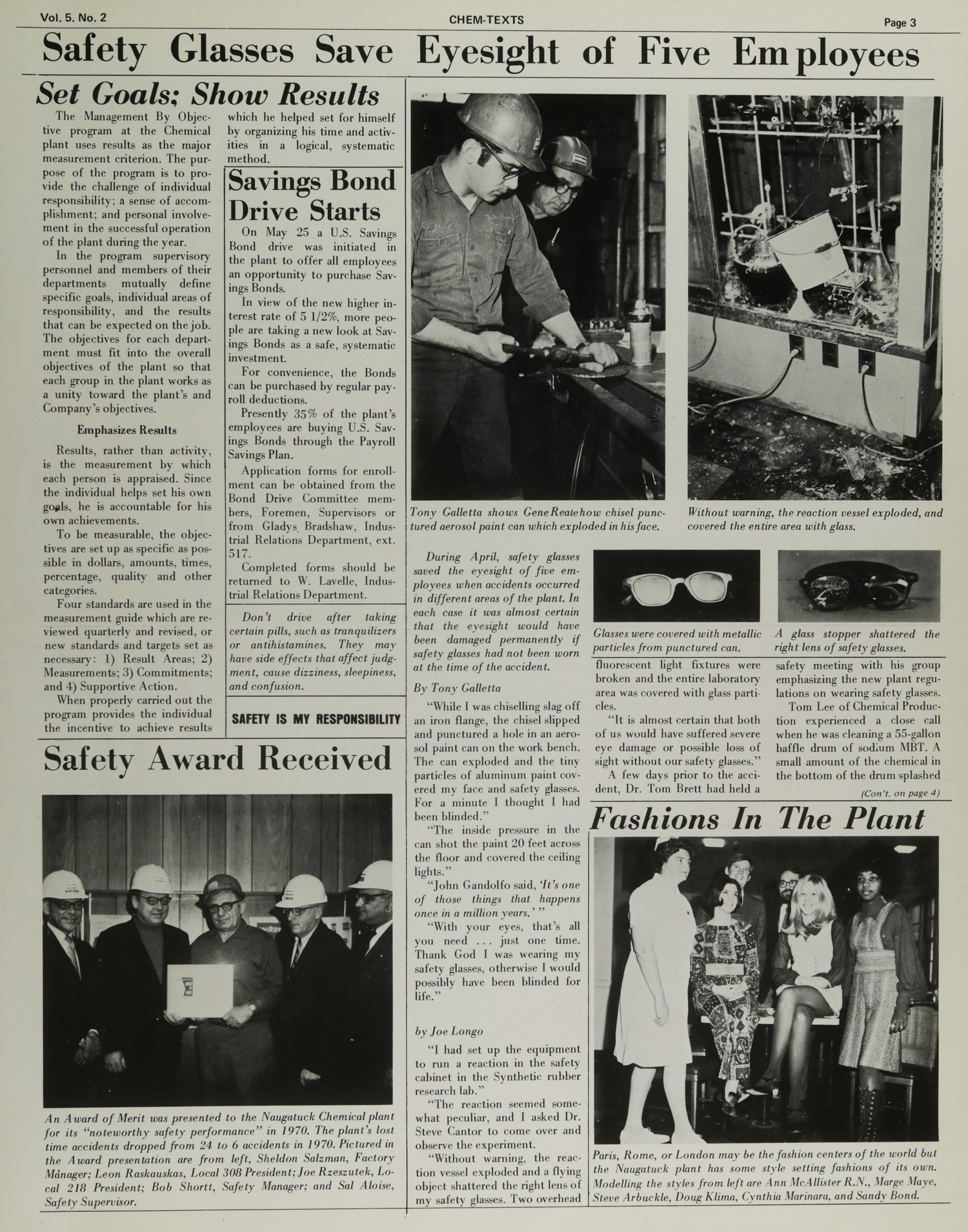
UNIROYAL HOME & AUTO CENTERS

NEW HAVEN NEW MILFORD BRISTOL
130 Amity Road Boston Post Rd. Farmington Ave. Rte. 6
389-1541 878-6857 582-3176

CANFIELD CORNER PHARMACY

VERA T. ELSENBOSS, Reg. Pharm.
CANFIELD CORNER WOODBURY, CONN
PRESCRIPTIONS SINCE 1907
PHONE 263-2595
MEDIMET PRESCRIPTIONS
CHEERFULLY FILLED

CHEM-TEXTS – 1971-v05-i05-s200

Page 200

UNIROYAL CHEM-TEXTS

Vol. 5, 1971 | PUBLISHED FOR THE PEOPLE OF UNIROYAL CHEMICAL | No. 5


Construction Started On New $3,200,000 Pretreatment Plant


Nine Months Sales Up

Net income for the nine months ending October 3, was $33,234,000, equivalent to $1.10 per share of common stock compared with $27,852,000 or 92 cents a share for the comparable period last year, an increase of 19.3%. Earnings were equivalent to $1.04 per common share after adjustment for the potential dilution related to the company’s convertible debentures issued in February 1971.

Sales for the nine months totaled $1,277,000,000, a gain of 8% over the $1,183,-000,000 for the same period in 1970.

Net income of Uniroyal, Inc. for the 3rd quarter totaled $7,130,000, equivalent to 22 cents per common share, a gain of 38.6% compared with $5,143,000, or 14 cents per share, reported for the quarter last year. Sales increased 9% to $400,-000,000 compared with

$366,000,000 for the third quarter of 1970.

Net income for the 3rd quarter and 9 months was adversely affected by the following factors: freeze of price increases; wage increase costs prior to the

(Cont’d. on page 3)


Drive Nears $21,000

by Jim Carroll

The United Givers drive to raise $21,000 for the 16 Agencies in the Fund which provide needed services for families in communities in which most employees live is nearly completed.

Employees have pledged $20,260 to date and only $740 is needed to achieve the plant’s goal of $21,000. The average contribution amounts to $21.40 per employee who donated.

(Cont’d. on page 2)


Unions Elect Officers

[PHOTO: Two images showing union officers]

Joe Rzeszutek, left, was elected President. Cy Blanchard, right, Vice President; and Henry Hook, to the Executive Committee.

by T. Lee and F. Mayo

439 URW Local 218 Union members elected new union officers for a 3 year term.

Joe Rzeszutek was elected President for a seventh

(Cont’d. on page 3)

Charles Roland, right, new 308 President is congratulated by Rocco Manulla, left, Art Calder, right, and Frank Sordi.

by Walt Tabaka

URW Local 308 members elected Charles Roland, President for a three year term. Also voted into office were Rocco Manulla, Vice-Pres-

(Cont’d. on page 3)


by Dick Shaw

Quietly along the Naugatuck River bank, opposite the Synthetic plant, construction of the new $3,200,000 liquid waste pretreatment plant is making rapid progress. Completion is scheduled for the Fall of 1972.

The facilities will pretreat 3,000,000 gallons of waste water a day for discharge into the Boro of Naugatuck’s water pollution control plant for secondary biological treatment. After treatment at the Boro’s plant, the water will be discharged into the Naugatuck River which is classified “C”, and suitable for fish, game and wildlife.

The steel superstructure for the Operations Building is complete and work has started on the interior of the building which will serve as the operational center for the pretreatment facility. A waste water collection pipeline, encased in solid concrete to prevent upheaval and breakage during high water periods, has been installed at the base of the river bank. This pipeline will connect the plant’s discharge outlets to a new pump station currently under construction near the south yard sewer outfall.

Foundations for the two 82 ft. diameter clarification

(Cont’d. on page 3)


[AERIAL PHOTO: Shows pretreatment plant construction site]

The Pretreatment plant occupies an acre of land near the Synthetic reactor area along the Naugatuck river.


987 Join Stock Plan

by Jack Dunn

987 Chemical Division employees exercised their options to participate in the third stock purchase plan for Uniroyal employees.

These employees elected to purchase 59,617 shares of Uniroyal common stock by 46 payroll deductions over the next 2 years.

The purchase price of the stock was $19.3125.

The enrollment figure represents 61% of the Chemical division employees at the Naugatuck location.

18,000 Uniroyal employees

in the U.S. and Canada joined the plan, electing to purchase over 800,000

(Cont’d. on page 4)


[PHOTO: Construction site view]

The $3,200,000 facility will be completed by the Fall of 1972.

CHEM-TEXTS – 1971-v05-i05-s203

Page 203

Page 4 — CHEM-TEXTS — Vol. 5, No. 5


Know Your Products:

Retarders; Blowing Agents; Waxes

by Dr. Bob Brown

Besides the diverse line of accelerators, antioxidants and antiozontants manufactured in Chemical Production, the plant makes a number of specialty chemicals: Retarders, Process Stiffeners, Bonding Agents, Waxes and Blowing Agents.

The Retarders, ESEN and Retarder J, slow down the vulcanization of the rubber during processing. This may sound like driving a car with your foot on the brake, but when a customer is trying to mix a batch of rubber on a mill and it starts to vulcanize (harden) before he can finish processing it, he must rely on a Retarder to slow down the vulcanization.

Process Stiffener 710 is also used as a processing aid. Rubber is usually easier to handle when it is fairly soft, but some types of rubber soften so much, that they almost seem to be turning into a liquid during the processing. Stiffener 710 gives these rubbers the necessary hardness and firmness to stay sufficiently solid so they can be worked on the mill.

The Celogen® Blowing Agents are used to expn Agents are used to expand rubber, and plastics. When mixed with rubber or plastics and heated, they form a

Celogen is used to expand rubber and plastics, giving a fine cellular structure to the finished product.

fine cellular structure in the finished product, expanding the product volume and lowering its density. This results in a savings in materials for the customer. Blowing Agents are used primarily in rug underlay, upholstery, fashionable footwear, boats, and electrical insulators.

The Sunproof® Waxes are used along with Flexzone® antiozontants to reduce the cracking of tire sidewalls and treads. The Waxes are mixed with the rubber on the mill and then migrate to the surface of the rubber to form a protective film against atmospheric cracking.


Plant Gets Red Cross Award

The Naugatuck Red Cross awarded Uniroyal Chemical a Certificate of Appreciation for outstanding cooperation with the Connecticut Red Cross Blood Program.

In the annual Bloodmobile sponsored by the plant Chemical and Footwear employees and walk-ins donated 214 pints of blood. Another 25 were deferred.

During the year the Naugatuck Red Cross collected 1038 pints of blood. Connecticut is one of the few states where the blood itself is free.

Organized by the Safety Dept. the successful drive was carried out by Bob Shortt, Sal Aloise, Adeline Farrar R.N., and Ann McAllister R.N.


Christmas Special Royal Golf Balls

From November 15 to December 17, a special Christmas Purchase of ROYAL golf balls is available to employees through the Footwear Employee’s Salesroom on Rubber Ave. Each employee is limited to a maximum of 6 dozen.

The balls come in a gift package and the prices range from 9.25 to 11.50 per dozen.


987 Join . . .

(Cont’d. from page 1)

shares of Uniroyal common stock.

MIP Stock Plan

Employees may still purchase Uniroyal common stock through the Monthly Investment Plan (MIP). This plan is operated by Merrill, Lynch, Pierce, Fenner and Smith, Inc.


Enamait Improved

Bob Enamait has been transferred from the intensive care unit of St. Mary’s Hospital and officially removed from the danger list.

He is now in a private room and attended by private duty nurses around the clock. He is still on a circular motorized bed and receiving physical therapy. His response to treatment is good.


Safety Sign Installed

[IMAGE: UNIROYAL EMPLOYEE SAFETY RECORD sign showing INJURIES with DISABLING and NEAR SERIOUS categories, showing “24” and “LAST” indicators]

The first Employee Safety Record sign has been installed at Main Gate. Flashing lights indicate safety record for 24 hour period.

Three new Employee Safety Record signs will be installed to keep employees posted on the plant’s safety record for this year as compared with 1970.

Flashing lights will indicate the 24 hour safety record of employees: the red signifies a Lost Time accident; yellow, a Serious Injury; and the green will indicate that employees have worked safely for a 24 hour period.

The first of the three signs has been installed at the Main entrance; the others will be constructed at the Tire Gate and the Synthetic plant.

The signs are another step in the Safety departments continuing program to improve safety awareness among employees.


Three Employees Retire

[IMAGE: Group photo of employees]

With nearly 46 years of service, Andy Molnar, center, was one of the few active employees in the 45 year group of the 25 Years Service Club. Congratulating him from left are Carl Miele, Hank Venslow, Molnar, Walt Miller, Synthetic Pilot Plant Foreman, and Henry Quigley.

[IMAGE: Group photo of employees in hard hats]

Joe Trangle retired from the Materials department after 26 years service. From left are Ben Federowicz, Frank Lynch, General Foreman, Hulda Flammia, Joe Trangle & Kirk Kirkendall, Foreman.

[IMAGE: Two men, one congratulating the other]

Mike Obronko, right, is congratulated by George Allen, on his retirement from Chemical Production after 22 years service.


CHEM-TEXTS

PUBLISHED BY THE INDUSTRIAL RELATIONS DEPARTMENT
UNIROYAL CHEMICAL, NAUGATUCK, CONN. 06770

EDITOR: William F. Lavelle.


UNIROYAL CHEMICAL
Naugatuck, Connecticut 06770

RETURN POSTAGE GUARANTEED

U.S. Postage
PAID
Permit No. 10
Naugatuck, Conn. 06770

CHEM-TEXTS – Vol. 5, No. 6 – Page 3

Page 003

Page 3 | CHEM-TEXTS | Vol. 5. No. 6


$21,000 Unit…

(Cont’d. from page 1)

than previously made at the plant.

Mike English was the Process Development Engineer for the process requirements and Rod Ashby was Project Engineer for the design and construction of the unit.

The new facility burns off waste gases completely in a smoke-less flame, and eliminates air pollution and fire hazard.

[IMAGE: Industrial facility/equipment]


United Givers

(Cont’d. from page 1)

[IMAGE: Group of people at a table reviewing documents]

United Givers Committee review results of the annual plant drive to raise $21,000. From left are Gary Arndt, L. Kaiser, M. Makoski, J. Carroll, Chairman; R. Amidon, F. Mayo, and Kay Dowling. Committee members absent at time of the photo were R. Van Allen, F. Commendatore, E. Semaskvich, L. Raskauskas, C. Roland, H. Witt, J. Rzeszute, and J. Vergosen.

DEPARTMENT BREAKDOWN

Department Goal Pledge No. of Givers Average Pledge
Chemical Production $2350 $2059 113 $18
Reclaim Production 2100 1971 112 17
*Synthetic Production 1600 1612 75 21
Eng. & Mech.—Chemical 1550 1541 93 16
Eng. & Mech.—Syn. 1000 630 52 12
*Materials 1350 1474 72 20
Factory Services 1200 901 44 20
*Research & Develop. 5850 6195 262 23
*Accounting 900 974 53 18
*EMIC 3000 3548 123 28
*International 100 118 9 12
*exceeded goal $21,000 $21,023 1008 $19

53 employees suffered head injuries in the plant during 1970.

18 occurred in the Chemical Mechanical department; 11 in Synthetic Production.

170 eye injuries occurred in 1970, eight of which were serious.

53 injuries took place in the Mechanical (Chemical) department and 36 in Chemical Production.


achieving it due to employees on a leave of absence, sick, or retired.

The amount represents approximately one-third of the total Industrial Division goal and reflects the generosity of Chemical employees in their support of community activities.

Canvassers who solicited contributions in the different departments and not in the photos were: R. Allen, J. Baclawski, M. Bausano, G. Bradshaw, P. Byra, A. Follachio, R. Gencarelli, H. Greenfield, J. Honyotski, Jeannine Labrecque,


Appointments Announced

Art Aronson has been assigned to the position of Maintenance and Construction Engineer for the Chemical and Reclaim plants.

Sal Aloise, a Supervisor in the Safety department, has been named Foreman in Chemical Production.

Jim Loman joined the Safety Department in Industrial Relations, replacing Sal Aloise.

Don Bates has been named Operations Foreman of the Emulsion and Non-Aqueous Synthetic Pilot Plants.

Ray Pekoek has been appointed Operations Foreman of the Chemical Pilot Plant.

Ben Pranulis assumed the position of Mechanical Foreman in the Chemical Pilot Plant.

Ed Hunwicz has been named to the new position of Mechanical Foreman of the Emulsion and Non-Aqueous Synthetic Pilot Plants.


SAFETY IS MY RESPONSIBILITY

DON’T DRINK AND DRIVE

P. Laurenzi, L. Lombardi, F. Lynch, D. McCormack, J. Sullivan, and R. Terino.

Chairman of this year’s drive was Jim Carroll of the Engineering department. Members of the Committee were R. Amidon, Gary Arndt, F. Commendatore, K. Dowling, L. Kaiser, H. Koss, W. Lavelle, M. Makoski, F. Mayo, L. Raskauskas, C. Roland, J. Rzeszutek, E. Semaskvich, R. Van Allen, J. Vergosen, and H. Witt.


Mother To Five Calves

[IMAGE: Man with calf]

Jim Brown bottle nurses week old Hereford calf at Uniroyal farm. The calf’s cow died at birth.

Five white faced Hereford calves were recently born at the Uniroyal Farm in Middlebury, but shortly after their birth each of their cows died. Two of the calves were twins.

The calves, ranging in age from 1 week to 4 weeks, are now being bottle fed, and owe their good healthy growth partially to Jim Brown, a next-door neighbor and a Foreman in the Synthetic Mechanical department, who sometimes assists in the feeding.

The farm is located at the intersection of Christian Road and Route 188 in Middlebury, only a short distance from the Oxford Management and Research Center.


New Look In Aluminum Siding!!!

ALCOA SIDING

CALL FOR FREE ESTIMATES

Naugatuck Aluminum And Glass

253 Prospect Street,
Naugatuck, Connecticut

729-4534 — 758-9501


$150,000 Gift To Hospital

[IMAGE: Three men in front of building under construction]

Uniroyal Chemical and Footwear contributed $150,000 to the new Waterbury Hospital. In front of the new facility are from left, Carl Toothaker, Footwear Factory Manager; Richard Derr, Hospital Administrator; and Sheldon Salzman, Chemical Factory Manager.

A total of $150,000 was contributed to the Waterbury Hospital Building Fund over a five year period by the Uniroyal Chemical and Footwear Plant.

The Hospital is constructing an eleven story building which will contain a new surgical operating room on the ground level floor, a new pediatrics center, and increased bed facilities.

The structure is near 75% completion and will be dedicated in early summer, 1972.

The combined facilities of St. Mary’s Hospital, which is also undertaking an expansion program, will provide the finest in medical services for the residents of Waterbury, Naugatuck and surrounding towns.


Breen’s

The Biggest Little Store In The Country

Visit our four floors of famous brands for him and her

Ladies’ Dept.
– Couture Coats
– Tanner Dresses
– Vanity Fair Lingerie
– Joyce—Naturalizer Shoes

Men’s Shop
– Manhattan Shirts
– Botany Suits—Sport Coats
– H. Freeman Suits
– London Fog Rainwear
– Florsheim Shoes
– Jaymar Slacks

Lingerie Shop
– Vanity Fair
– Olga—Barbizon
– Schrank Robes
– Shadowline

Jr. Sportswear
– Collegetown Sweaters
– White Stag—Skirts, Slacks
– Davis Coats
– Peerless Sportwear

Ski Boutique
– Ski Jackets
– Warm-Up Slacks
– Ski Pants
– Ski Sweaters
– Gloves & Sweaters

Cosmetic & Jewelry Dept.
– Guerlain
– Elizabeth Arden
– Nina-Ricci
– Chanel
– Yves Saint Laurent
– Monet
– Napier
– Marvella Pearls

CHEM-TEXTS – Vol. 5. No. 6 – Page 4

Page 004

CHEM-TEXTS

Page 4 | Vol. 5. No. 6


Blues Conquer Yellows

[IMAGE: Football team lined up on field]

The Blues and the Yellows line up for their crucial championship game. The Blues, with quarterback Dan Shantz throwing 3 touchdown passes, won 27-0 to take the league title. (Photo— Naugatuck Daily News)

by John Prior

The Uniroyal Chemical Touch-Football League ended its season with the “Blues” holding the “Yellows” scoreless in the Championship game, 27-0. During the regular season the Blues had a 6-0 won-lost record.

Quarterback Dan Shantz tossed 3 touchdowns to lead the Blues to the title. The Blues had a granite wall defense with the hard-charging, veteran Eric Johnson, a constant threat to the Yellow’s quarterback. The league games were umpired by Stan Mazur.

With Paul McKinstry as Captain, the Yellows had a 4-2 season. The Reds, led by Tom Geise, ended with a 2-4 record; and the Greens with Keith Hughes, suffered a 0-6 record.


Plant Ranks 69th In Uniroyal Safety

The Naugatuck Chemical plant ranks 69 among the 80 domestic and international Uniroyal plants in Lost Time and Serious Injuries.

For every 1,000,000 manhours worked (4 months) approximately 26 injuries occur among employees at the Naugatuck Chemical location.

At the Naugatuck plant there is a high concern by management and union representatives that our safety record for 1972 must improve considerably over our 1971 performance. Their joint efforts will receive top priority to improve the plant’s safety record and people’s attitudes toward it.


Seminars Scheduled

Speakers for the Technical Seminars, sponsored by the Research and Development department, have been scheduled for the first half of 1972, it was announced by Dr. Charles Crittendon, secretary for the group. The monthly meetings will be held at the Knights of Columbus Hall, New Haven Road, and start at 3:30 P.M.

The first speaker was Dr. Charles McCleary.

Dates and topics for the other seminars are: January 10, Management by PERT-CPM, Gene Hertel; February 7, Opportunities in the Market Place, Joseph Flannery, Marketing Manager, Chemicals & Synthetic Rubber and William Coughlin, Marketing Mgr., Plastics; March 6, PVC Plastisol Resins, Len Henrey of the Wayne Research Center; April 10, Uniroyal’s Radial Tire, Tire Division representative; May 8, Thermoplastic Rubber, William Fishcher and Dr. Vince Landi.


JA Forms

(Cont’d. from page 1)

factors involved in a business organization.

The Company issues and sells stock; purchases raw materials; pays heat and light bills and rent; pays regular salaries and taxes; carries insurance; regulates health and safety; and pays dividends to stockholders from profits on the sales of its products.

Last year the Jaroy Company gave stockholders a $3 dividend on their investment.

Officers of the firm are Robert Tourrangeau, President: Joseph Bush, Vice President—Manufacturing; Linda Litke, Vice President—Sales; Christopher Bernard—Treasurer; and Jo Ann Niski—Secretary.

Chemical plant advisors to Pingyanco are Jim Chambers, Randy Porter and Dianne Carignon.

Lou Kaiser represents Uniroyal Chemical on the Junior Achievement Board of Directors in Waterbury.


Enamait Moved To Gaylord

Bob Enamait, after almost 4 months in the intensive care unit of St. Mary’s Hospital, was moved to Gaylord Hospital, Wallingford, Conn. where he will undergo intensive physiotherapy treatments.

According to Dr. Edward Jelley, plant physician, Bob is in excellent spirits, enjoys watching TV, and talking to friends. Fellow employees are encouraged to visit him at the hospital and write to him.

A special water bed is used by him to provide him comfort during his stay at the hospital.


Synthetic People Retire

[IMAGE: Group of men, one receiving good wishes]

Walt Miller, Foreman of the Synthetic Pilot plants, receives good wishes on his retirement after 41 years service. In photo from left are Don Bates, Gary Arndt, Walt, and Ed Runowicz.

[IMAGE: Sign reading “DEPARTMENTS ARE GRANTED THE PRIVILEGE OF SMOKING IN THIS AREA” with “ENGINEERING” visible]

[IMAGE: Group of men congratulating someone]

Bill Krayeski, center, one of the best Idea men in the plant, retired after 35 years service. Congratulating him from left are Hank Yacek, Walt Tabaka, Bill Adamski and Henry Drummer of the Synthetic Mechanical Department. Over the years Krayeski— along with Walt Tabaka—has submitted over 300 Ideas.


[ADVERTISEMENT: UNIROYAL TIRES]

UNIROYAL
Belted WIDE OVAL

Snowplow
WHITEWALLS

DOUBLE BELTS OF FIBERGLASS
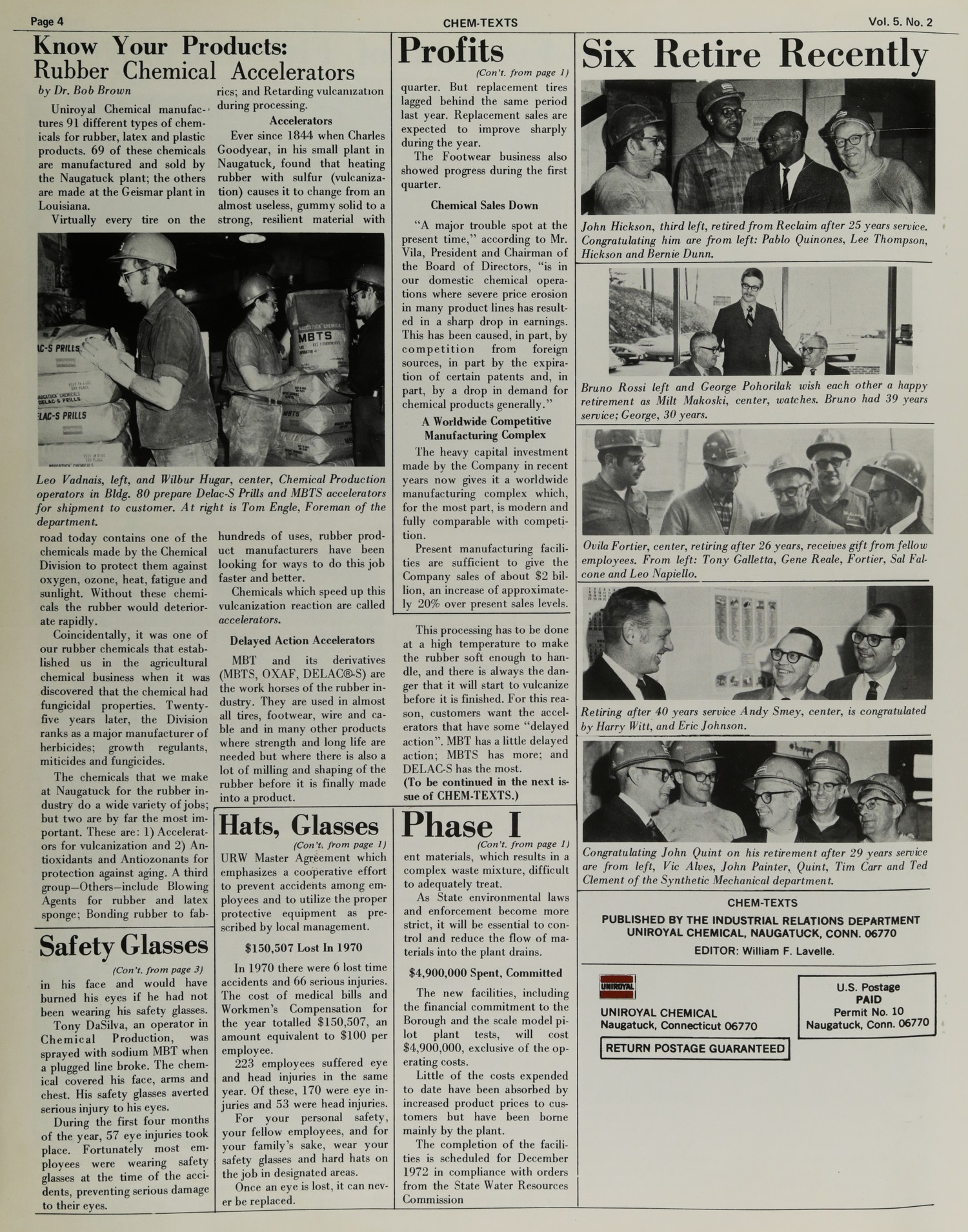
DOUBLE POLYESTER CORD PLIES

ADVANCE TIRE SERVICE
510 Meriden Rd.
Waterbury ● 756-7205

FITZPATRICK’S. INC.
78 East Main St.
Ansonia ● 734-3318

DON HEAVENS
Chevrolet Inc.
Main Street
Woodbury ● 263-2168

MEZZIO’S
792 New Haven Rd.
Naugatuck ● 729-5988

MIDDLEBURY SERVICE CENTER
Route 64
Middlebury ● 758-9977

POUST’S SERVICE STATION
144 Rubber Ave.
Naugatuck ● 729-0433

UNIROYAL HOME & AUTO CENTERS

NEW HAVEN NEW MILFORD BRISTOL
130 Amity Road Boston Post Rd. Farmington Ave. Rte. 6
389-1541 878-0857 582-3176

FEATURES:
– 78 SERIES DESIGN (WIDE OVAL)
– POLYESTER CORD PLIES
– FIBERGLASS BELTS
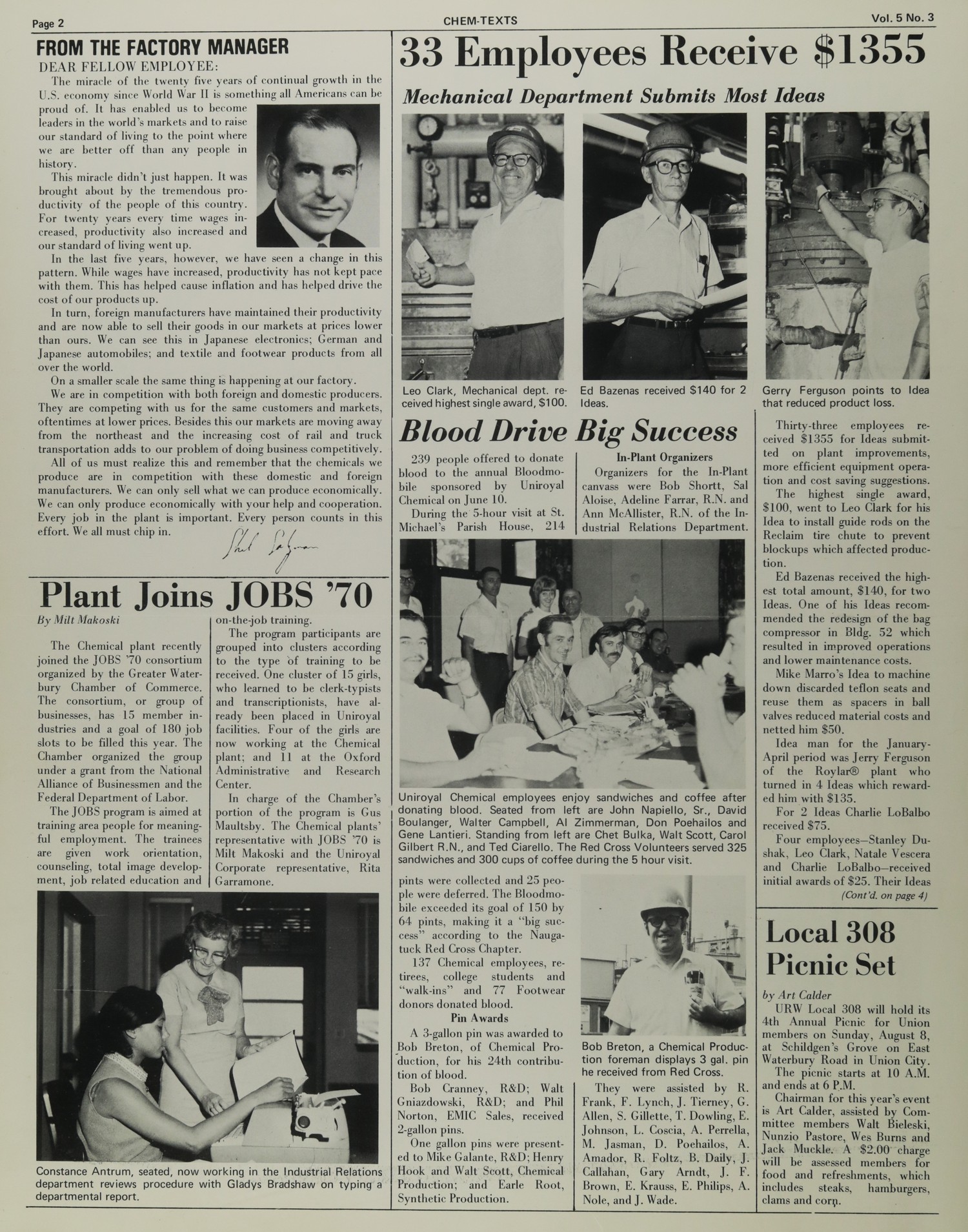

[ADVERTISEMENT: CANFIELD CORNER PHARMACY]

CANFIELD CORNER PHARMACY
VERA T. ELSENBOSS, Reg. Pharm.
CANFIELD CORNER WOODBURY, CONN.
PHONE 263-2595
PRESCRIPTIONS SINCE 1867

MEDIMET | PRESCRIPTIONS FILLED | CHEERFULLY


CHEM-TEXTS
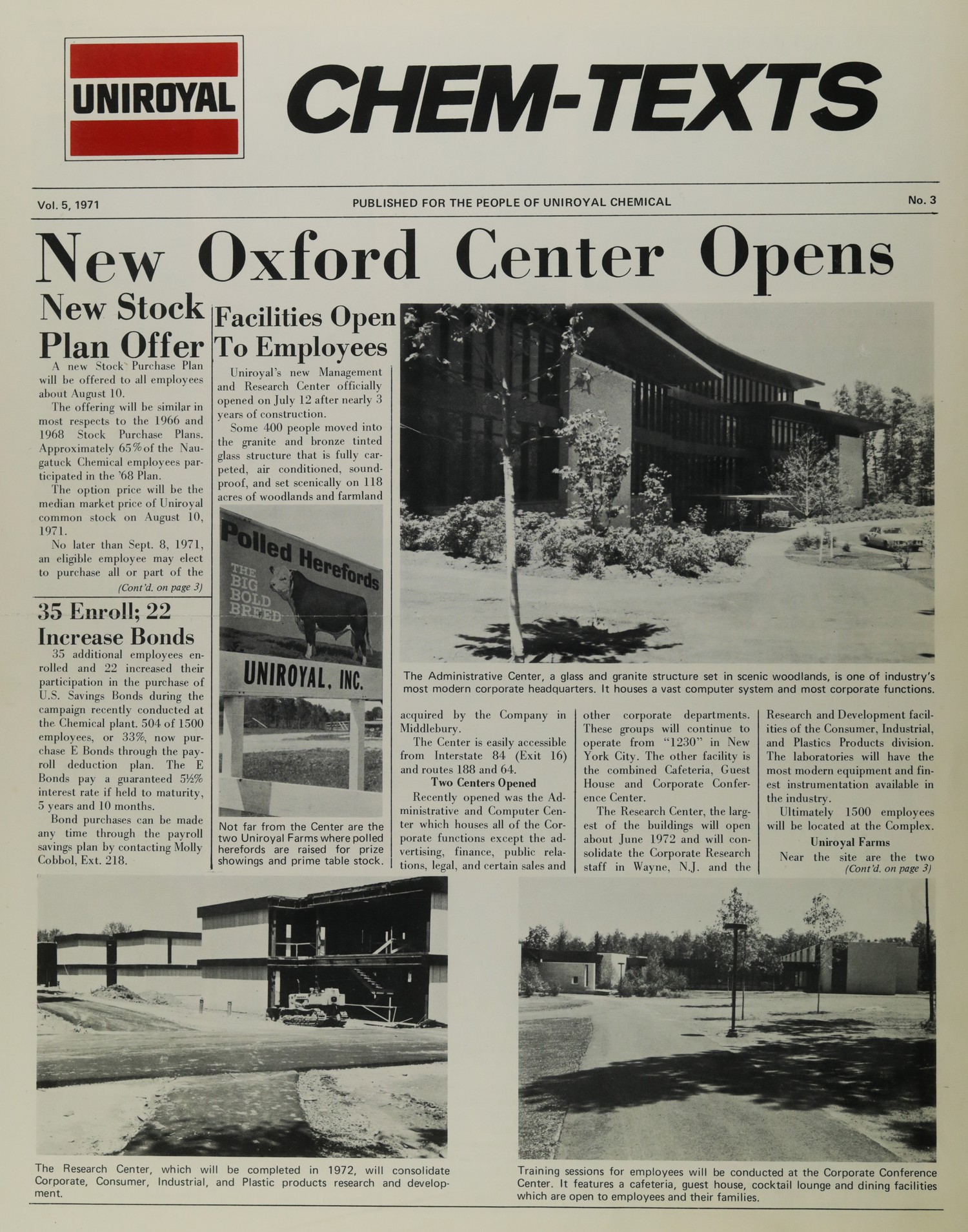
PUBLISHED BY THE INDUSTRIAL RELATIONS DEPARTMENT
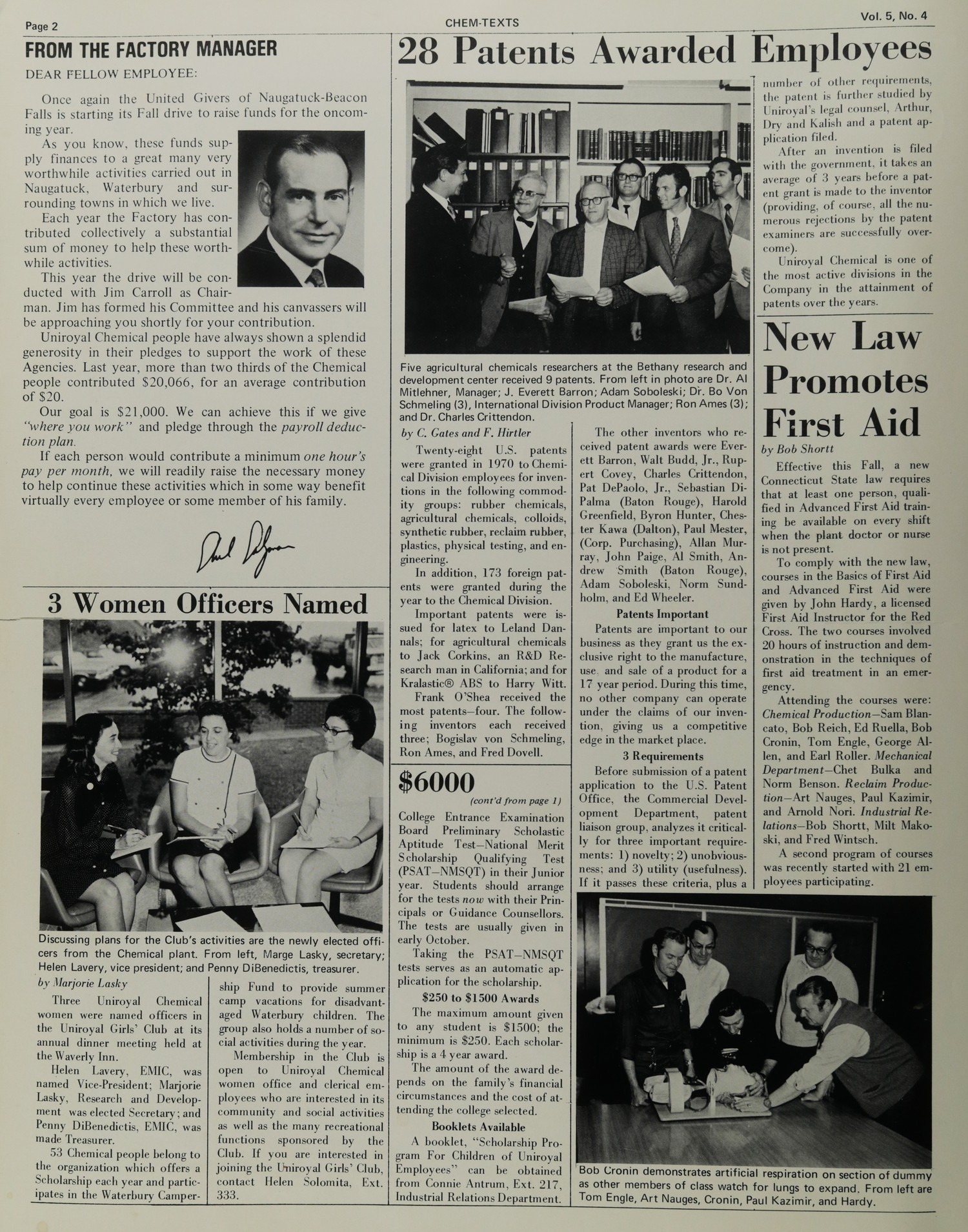
UNIROYAL CHEMICAL, NAUGATUCK, CONN. 06770
EDITOR: William F. Lavelle.

[UNIROYAL LOGO]

UNIROYAL CHEMICAL
Naugatuck, Connecticut 06770

U.S. Postage
PAID
Permit No. 10
Naugatuck, Conn. 06770

RETURN POSTAGE GUARANTEED


SAFETY IS MY RESPONSIBILITY

CHEM-TEXTS – 1971-v05-i06-s205

Page 205

Page 2 | CHEM-TEXTS | Vol. 5, No. 6


“PEACE ON EARTH TO MEN OF GOOD WILL..”

We pray for Peace but half the world’s people are at war or involved in civil strife. While each side is sure of their cause, the result is still pain and suffering, grief and anguish.

None of us can singly alter the events that are occurring. We can, of course, politically try to express ourselves, but so often the political choice is not one of peace or war, but is more closely related to personalities or domestic problems.

What we can do individually is act as “men of good will” by our charitable deeds and by our daily activities.

We can also pray, and in this period of holy days perhaps all of us can reflect on the suffering around us and stop briefly and pray for peace.


ANYWHERE, ANYTIME, ANYBODY

As some of you may know, I recently suffered an off-the-job accident with an aluminum extension ladder that suddenly developed a will of its own. The result of this momentary carelessness was a cracked bone in my arm and a rather awkward cast.

This accident brought home to me the ease in which a careless or unthinking action could result in an accident.

I hope each of you will continue to be alert towards the unexpected because the accident that happens can be yours.

I sincerely wish you and all the members of your family a Most Happy Christmas and New Year.

[Signature]


$225 Paid For Ideas

[IMAGE: Photo showing two men, with “SAFETY FIRST EMERGENCY EYE WASH FOU…” sign visible]

Jerry Ferguson, left, and Hugh Garahan of the Roylar plant, seem quite excited over the checks awarded for their Ideas.

by Pete Welch

Nine employees received $225 for Ideas submitted during the past months. The Ideas centered on improvements in the plant’s operations and reductions in costs.

Employees who received $25 for their suggestions were Anthony Galletta, Robert Guest, Ray Kubick, Hugh Garahan, Paul Blasko, Jr., Jerry Ferguson, Mario Jannetty, George Salokas, and John Wawer.

Letters of Commendation were given to N. Croce, M. Watson, D. Bedard, W. Carreiro, F. Sordi, E. Evans, B. Zukauskas, W. Palmoski, F. Wallace, J. Gandolfo, K. Searles, L. DeLaRosa, and M. Schluensen.

A work area is a good place to look for Ideas.

Start with present work methods in the department. Is there a better, easier way to do the job? Can it be done faster?

If something has been done the same way, every day for ten years, there’s a good possibility that it’s being done wrong and inefficiently.

Ideas Pay Lots of Money

There’s no limit to the amount of money awarded for an Idea. The minimum award for an approved Idea is $25.


Hospitals Approved By State

[IMAGE: Photo showing Dr. Jelley and Adeline Farrar]

Dr. Jelley, plant physician, shows Adeline Farrar R.N. certificate of approval for plant’s hospital facilities.

by Bob Shortt

Uniroyal Chemical was the first industrial plant in this area to pass the Connecticut State Department of Health inspection and become eligible for a license to operate hospital facilities at the Chemical and Synthetic plants, according to Helen Coburn, R.N., of the Conn. State Dept. of Health.

Requirements Strict

The Laws impose tighter regulations upon the conduct of industrial health facilities in the State.

Besides the strict requirements for the physical facilities, equipment and supplies, the Law requires that a Medical Director, who is a physician licensed in Connecticut, and sufficient registered nurses be available to provide health services to employees. It also requires that at least one individual, who has successfully completed the Advanced Red Cross First Aid course, shall be on duty to provide first aid services whenever a registered nurse or physician is not on duty in the plant.

To date, 39 employees have taken the necessary First Aid courses which involved 20 hours of instruction and demonstrations.


Water Good For Burns

The ancient treatment of plunging burned skin in cold or ice water is still the quickest way to relieve pain. The cold water doesn’t damage the burned skin, but actually helps prevent blistering and aids healing. Continue the treatment until the pain disappears, or apply towels soaked in cold or ice water.


Sno-Plow

(Cont’d. from page 1)

[IMAGE: Photo showing Russ Gandolfo demonstrating scarf caught in pulley belt]

Russ Gandolfo, right, shows how scarf caught in pulley belt and almost broke his neck.

given way. Ironically, it was the first time my son had worn a scarf when working outside.

Inside the kitchen, my wife was cooking a Thanksgiving turkey. What almost turned out to be a day of tragedy, was really a day of thanksgiving for us.

When they talk about the unexpected happening, I know better than ever what they mean.


Avoid Danger In The Bedroom

by Sal Aloise

There are two bedroom practices that may save you and your family if your house ever catches fire during the night; 1) keep the bedroom doors closed, 2) have a second method for escaping outside if the normal exits from your bedroom are locked.

13% of the fires in a home start in the bedroom. The bedroom door, which is the normal escape to safety quickly becomes a death trap—when opened—from lung-scorching heat, poisonous fumes, and choking smoke.


Christmas On The River

In a continuing program to improve the physical appearance of the plant, 100 Christmas trees were planted along the Naugatuck river bank near the Reclaim plant. The trees will grow to a height of 12 to 15 ft. and provide a scenic effect on an otherwise drab section of the Reclaim yard. The trees are a small part of a $4,000,000 program to improve plant buildings and facilities.


BOB’S CAMERA SHOP INC. [Logo]
WATERBURY’S LEADING CAMERA SHOP
21 Grand Street, Waterbury, Conn. 06702 | 754-2256
Film ● Cameras ● Projectors ● Developing ● Rentals

CHEM-TEXTS – 1971 – Page No. 2

Page unknown

UNIROYAL CHEM-TEXTS

Vol. 5, 1971 | PUBLISHED FOR THE PEOPLE OF UNIROYAL CHEMICAL | No. 2


Crim Named IR Manager

Mitchinson, Melore Receive New Posts

Jesse Crim was named Industrial Relations Manager for the Naugatuck Chemical plant, effective June 1. He succeeds Ron Mitchinson who has accepted a position in the Corporate Industrial Relations Department in Oxford.

Neil Melore was appointed Industrial Relations Manager for the Painesville, Ohio plant.

Crim served as Industrial Relations Manager in Painesville from 1968-1971. He held the same position in the Santa Ana, Calif., and Washington, Ind. plants.

He joined Uniroyal in 1947; is a veteran of World War II; and a graduate of Purdue University.


Hats, Glasses Required

by Bob Shortt

As of May 1, hard hats and safety glasses were required to be worn in designated areas of the plant.

[IMAGE: Photo showing workers wearing safety equipment]

Joining the plant’s safety equipment program of wearing hard hats and safety glasses are two of its more attractive members. From left is Kay Dowling, Chemical Production, and Adeline Farrar, Chemical Plant nurse.

During April, foremen and supervisors discussed the new program with people in their departments. The program is based on a Section of the 1970 Uniroyal-
(Con’t. on page 4)


Profits; Sales Up

Tires; Footwear Improve; Chemical Business Off

Uniroyal, Inc. income increased 10.6% to $10.6 million in the first quarter of 1971 compared with $9.5 million reported for the same period last year.

Sales in the first quarter climbed to a record of $413 million, about an 8% increase over the record $381 million set in 1970.

Uniroyal was the only Company of the “Big Four” rubber companies to report an increase in profits and sales for the first quarter of the year. Goodyear, Firestone, and Goodrich dropped during the quarter.

Tire, Footwear Business Up

Sales of original equipment tires hit an all-time high in the
(Con’t. on page 4)


Phase I Of Liquid Waste Pretreatment Plant Started

Sewerage System Now Being Installed

[IMAGE: Photo showing industrial buildings and sewerage system installation]

A new sanitary sewerage system was installed in the Chemical yard to carry liquid discharges to main sewers of the Chemical plant system.

by Dick Shaw

The construction of Phase I of the new $3,000,000 Liquid Waste Pretreatment Plant is now in progress.

Phase I includes the installation of new sanitary sewers in the Reclaim, Chemical, and Synthetic plant yards. These new sewers will divert the sanitary sewage from the present side streams to the main sewers in order to be ready for transfer into the new pretreatment facilities.

Pretreats For Borough’s Secondary Treatment Plant

The new pretreatment facilities will pretreat the plant’s waste liquids for acceptance into the Borough of Naugatuck’s Secondary Treatment Plant.

Uniroyal Chemical has committed $1,500,000 toward the construction of the Borough’s waste disposal plant, and will pay 60% of the operational costs due to the large volume of the plant’s waste flowing into the Borough’s plant.

50% of Capital Expenditures Allocated to Pollution Control

In 1971, approximately 50% of the plant’s capital expenditures will be spent on pollution control facilities.

A major project currently under study is the elimination of the odors created by the Reclaim operations. By process changes, it is expected that the odors of the Reclaim plant will be controlled.

Waste Control Important

The efficient operation of the waste water treatment facilities depends on everyone’s cooperation in the use of water, prevention of spills, and avoidance of washing chemicals “down the drain.”

The nature of our business requires the use of over 750 differ-
(Con’t. on page 4)

[IMAGE: Photo of Phil DePasquale with concrete tank]

Phil DePasquale shows size of reinforced concrete tank that will be used as a sewage pumping station for one of plant’s buildings.


Medicine Search Started

[IMAGE: Photo showing three scientists studying a molecule model]

Studying a molecule prepared for pharmaceutical use are from left Drs. Costa Courduvelis, Zaven Ariyan, Coordinator of program, and Terry O’Brien.

by Dr. Zaven Ariyan

A Pharmaceutical Research Program has been initiated to study and screen chemicals for possible medical use. Assisted in the search by outside pharmacology laboratories, the group is interested in developing chemicals which could be made at the Naugatuck plant.

Five Year Goal

The main aim within the next three to five years is to obtain a drug through clinical work and receive approval from the Food and Drug Administration to market it. Research work is presently centered on antiinflammatory drugs for the treatment of arthritis; cardiovascular antihypertensive drugs for high blood pressure and related disorders; and tranquilizer related drugs.

The Chemical Division R & D group consists of Dr. Zaven S. Ariyan, Coordinator of the Program and two Senior Research Chemists, Dr. Constantine I. Courduvelis and Dr. J. Terence O’Brien.