J. Rzeszutek

Mentioned in 10 documents | Years active: 1968-1979


Source Documents

This profile was generated from 10 archive documents. The following are available on this site:

Robert Smith

Mentioned in 10 documents | Years active: 1969-1980


Source Documents

This profile was generated from 10 archive documents. The following are available on this site:

Richard Shaw

Mentioned in 11 documents | Years active: 1966-1974


Source Documents

This profile was generated from 11 archive documents. The following are available on this site:

Ann McAllister

Mentioned in 11 documents | Years active: 1969-1980


Source Documents

This profile was generated from 11 archive documents. The following are available on this site:

Gary Arndt

Mentioned in 11 documents | Years active: 1969-1973


Source Documents

This profile was generated from 11 archive documents. The following are available on this site:

Frank Lynch

Mentioned in 11 documents | Years active: 1967-1971


Source Documents

This profile was generated from 11 archive documents. The following are available on this site:

Robert Breton

Mentioned in 12 documents | Years active: 1970-1979


Source Documents

This profile was generated from 12 archive documents. The following are available on this site:

Ron Mitchinson

Mentioned in 12 documents | Years active: 1968-1971


Source Documents

This profile was generated from 12 archive documents. The following are available on this site:

Daniel Shantz

Mentioned in 13 documents | Years active: 1969-1979


Source Documents

This profile was generated from 13 archive documents. The following are available on this site:

Leon Raskauskas

Mentioned in 13 documents | Years active: 1967-1971


Source Documents

This profile was generated from 13 archive documents. The following are available on this site:

Frederick Wintsch

Mentioned in 13 documents | Years active: 1967-1977


Source Documents

This profile was generated from 13 archive documents. The following are available on this site:

Frank Commendatore

Mentioned in 13 documents | Years active: 1961-1979


Source Documents

This profile was generated from 13 archive documents. The following are available on this site:

Robert Foltz

Mentioned in 14 documents | Years active: 1969-1978


Source Documents

This profile was generated from 14 archive documents. The following are available on this site:

James Loman

Mentioned in 14 documents | Years active: 1961-1980


Source Documents

This profile was generated from 14 archive documents. The following are available on this site:

Milt Makoski

Mentioned in 14 documents | Years active: 1969-1971


Source Documents

This profile was generated from 14 archive documents. The following are available on this site:

Charles Roland

Mentioned in 14 documents | Years active: 1970-1979


Source Documents

This profile was generated from 14 archive documents. The following are available on this site:

Jack Prior

Mentioned in 14 documents | Years active: 1969-1998


Source Documents

This profile was generated from 14 archive documents. The following are available on this site:

Henry Hook

Mentioned in 16 documents | Years active: 1964-1979


Source Documents

This profile was generated from 16 archive documents. The following are available on this site:

Joe Bucciaglia

Mentioned in 16 documents | Years active: 1967-1995


Source Documents

This profile was generated from 16 archive documents. The following are available on this site:

Louis Kaiser

Mentioned in 17 documents | Years active: 1968-1973


Source Documents

This profile was generated from 17 archive documents. The following are available on this site:

George Allen

Mentioned in 17 documents | Years active: 1968-1980


Source Documents

This profile was generated from 17 archive documents. The following are available on this site:

William Broden

Mentioned in 18 documents | Years active: 1969-1979


Source Documents

This profile was generated from 18 archive documents. The following are available on this site:

John D. Evans

Mentioned in 20 documents | Years active: 1964-1971


Source Documents

This profile was generated from 20 archive documents. The following are available on this site:

Sal Aloise

Mentioned in 20 documents | Years active: 1968-1975


Source Documents

This profile was generated from 20 archive documents. The following are available on this site:

Cyrus Blanchard

Mentioned in 23 documents | Years active: 1964-1974


Source Documents

This profile was generated from 23 archive documents. The following are available on this site:

Robert Shortt

Mentioned in 27 documents | Years active: 1969-1978


Source Documents

This profile was generated from 27 archive documents. The following are available on this site:

William F. Lavelle

Mentioned in 37 documents | Years active: 1968-1980


Source Documents

This profile was generated from 37 archive documents. The following are available on this site:

Eric Johnson

Mentioned in 38 documents | Years active: 1961-1980


Source Documents

This profile was generated from 38 archive documents. The following are available on this site:

Joseph Rzeszutek

Mentioned in 44 documents | Years active: 1961-1980


Source Documents

This profile was generated from 44 archive documents. The following are available on this site:

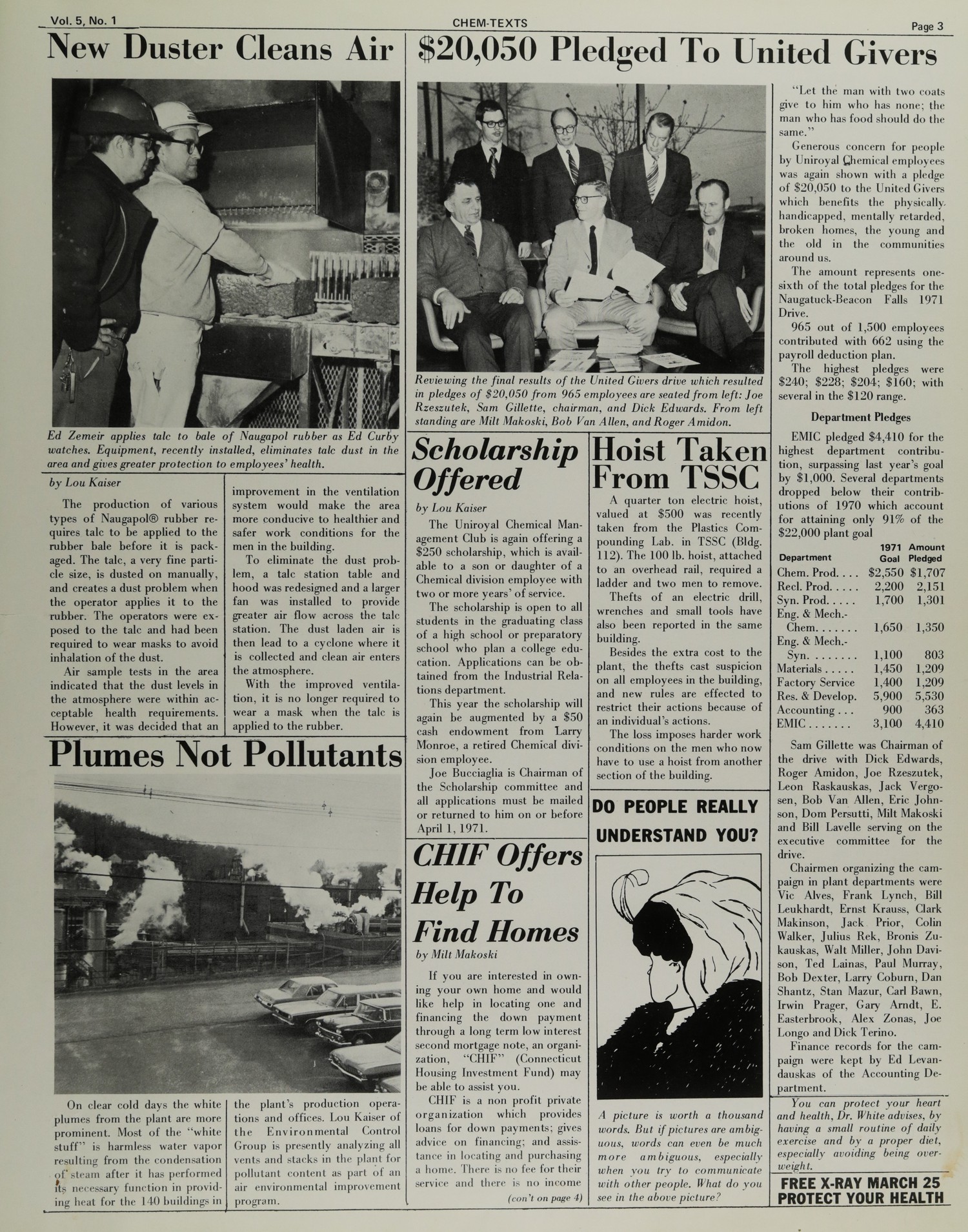
CHEM-TEXTS – Vol. 5, No. 1 – Page 3

Page 003

CHEM-TEXTS

Vol. 5, No. 1 | Page 3


New Duster Cleans Air

Ed Zemeir applies talc to bale of Naugapol rubber as Ed Curby watches. Equipment, recently installed, eliminates talc dust in the area and gives greater protection to employees’ health.

by Lou Kaiser

The production of various types of Naugapol® rubber requires talc to be applied to the rubber bale before it is packaged. The talc, a very fine particle size, is dusted on manually, and creates a dust problem when the operator applies it to the rubber. The operators were exposed to the talc and had been required to wear masks to avoid inhalation of the dust.

Air sample tests in the area indicated that the dust levels in the atmosphere were within acceptable health requirements. However, it was decided that an improvement in the ventilation system would make the area more conducive to healthier and safer work conditions for the men in the building.

To eliminate the dust problem, a talc station table and hood was redesigned and a larger fan was installed to provide greater air flow across the talc station. The dust laden air is then lead to a cyclone where it is collected and clean air enters the atmosphere.

With the improved ventilation, it is no longer required to wear a mask when the talc is applied to the rubber.


Plumes Not Pollutants

On clear cold days the white plumes from the plant are more prominent. Most of the “white stuff” is harmless water vapor resulting from the condensation of steam after it has performed its necessary function in providing heat for the 140 buildings in the plant’s production operations and offices. Lou Kaiser of the Environmental Control Group is presently analyzing all vents and stacks in the plant for pollutant content as part of an air environmental improvement program.


$20,050 Pledged To United Givers

Reviewing the final results of the United Givers drive which resulted in pledges of $20,050 from 965 employees are seated from left: Joe Rzeszutek, Sam Gillette, chairman, and Dick Edwards. From left standing are Milt Makoski, Bob Van Allen, and Roger Amidon.

“Let the man with two coats give to him who has none; the man who has food should do the same.”

Generous concern for people by Uniroyal Chemical employees was again shown with a pledge of $20,050 to the United Givers which benefits the physically handicapped, mentally retarded, broken homes, the young and the old in the communities around us.

The amount represents one-sixth of the total pledges for the Naugatuck-Beacon Falls 1971 Drive.

965 out of 1,500 employees contributed with 662 using the payroll deduction plan.

The highest pledges were $240; $228; $204; $160; with several in the $120 range.

Department Pledges

EMIC pledged $4,410 for the highest department contribution, surpassing last year’s goal by $1,000. Several departments dropped below their contributions of 1970 which account for attaining only 91% of the $22,000 plant goal

Department 1971 Goal Amount Pledged
Chem. Prod…. $2,550 $1,707
Recl. Prod….. 2,200 2,151
Syn. Prod…… 1,700 1,301
Eng. & Mech.- Chem……. 1,650 1,350
Eng. & Mech.- Syn……. 1,100 803
Materials….. 1,450 1,209
Factory Service 1,400 1,209
Res. & Develop. 5,900 5,530
Accounting… 900 363
EMIC…….. 3,100 4,410

Sam Gillette was Chairman of the drive with Dick Edwards, Roger Amidon, Joe Rzeszutek, Leon Raskauskas, Jack Vergosen, Bob Van Allen, Eric Johnson, Dom Persutti, Milt Makoski and Bill Lavelle serving on the executive committee for the drive.

Chairmen organizing the campaign in plant departments were Vic Alves, Frank Lynch, Bill Leukhardt, Ernst Krauss, Clark Makinson, Jack Prior, Colin Walker, Julius Rek, Bronis Zukauskas, Walt Miller, John Davison, Ted Lainas, Paul Murray, Bob Dexter, Larry Coburn, Dan Shantz, Stan Mazur, Carl Bawn, Irwin Prager, Gary Arndt, E. Easterbrook, Alex Zonas, Joe Longo and Dick Terino.

Finance records for the campaign were kept by Ed Levandauskas of the Accounting Department.


Scholarship Offered

by Lou Kaiser

The Uniroyal Chemical Management Club is again offering a $250 scholarship, which is available to a son or daughter of a Chemical division employee with two or more years’ of service.

The scholarship is open to all students in the graduating class of a high school or preparatory school who plan a college education. Applications can be obtained from the Industrial Relations department.

This year the scholarship will again be augmented by a $50 cash endowment from Larry Monroe, a retired Chemical division employee.

Joe Bucciaglia is Chairman of the Scholarship committee and all applications must be mailed or returned to him on or before April 1, 1971.


Hoist Taken From TSSC

A quarter ton electric hoist, valued at $500 was recently taken from the Plastics Compounding Lab. in TSSC (Bldg. 112). The 100 lb. hoist, attached to an overhead rail, required a ladder and two men to remove.

Thefts of an electric drill, wrenches and small tools have also been reported in the same building.

Besides the extra cost to the plant, the thefts cast suspicion on all employees in the building, and new rules are effected to restrict their actions because of an individual’s actions.

The loss imposes harder work conditions on the men who now have to use a hoist from another section of the building.


CHIF Offers Help To Find Homes

by Milt Makoski

If you are interested in owning your own home and would like help in locating one and financing the down payment through a long term low interest second mortgage note, an organization, “CHIF” (Connecticut Housing Investment Fund) may be able to assist you.

CHIF is a non profit private organization which provides loans for down payments; gives advice on financing; and assistance in locating and purchasing a home. There is no fee for their service and there is no income

(con’t on page 4)


DO PEOPLE REALLY UNDERSTAND YOU?

A picture is worth a thousand words. But if pictures are ambiguous, words can even be much more ambiguous, especially when you try to communicate with other people. What do you see in the above picture?


You can protect your heart and health, Dr. White advises, by having a small routine of daily exercise and by a proper diet, especially avoiding being overweight.

FREE X-RAY MARCH 25
PROTECT YOUR HEALTH

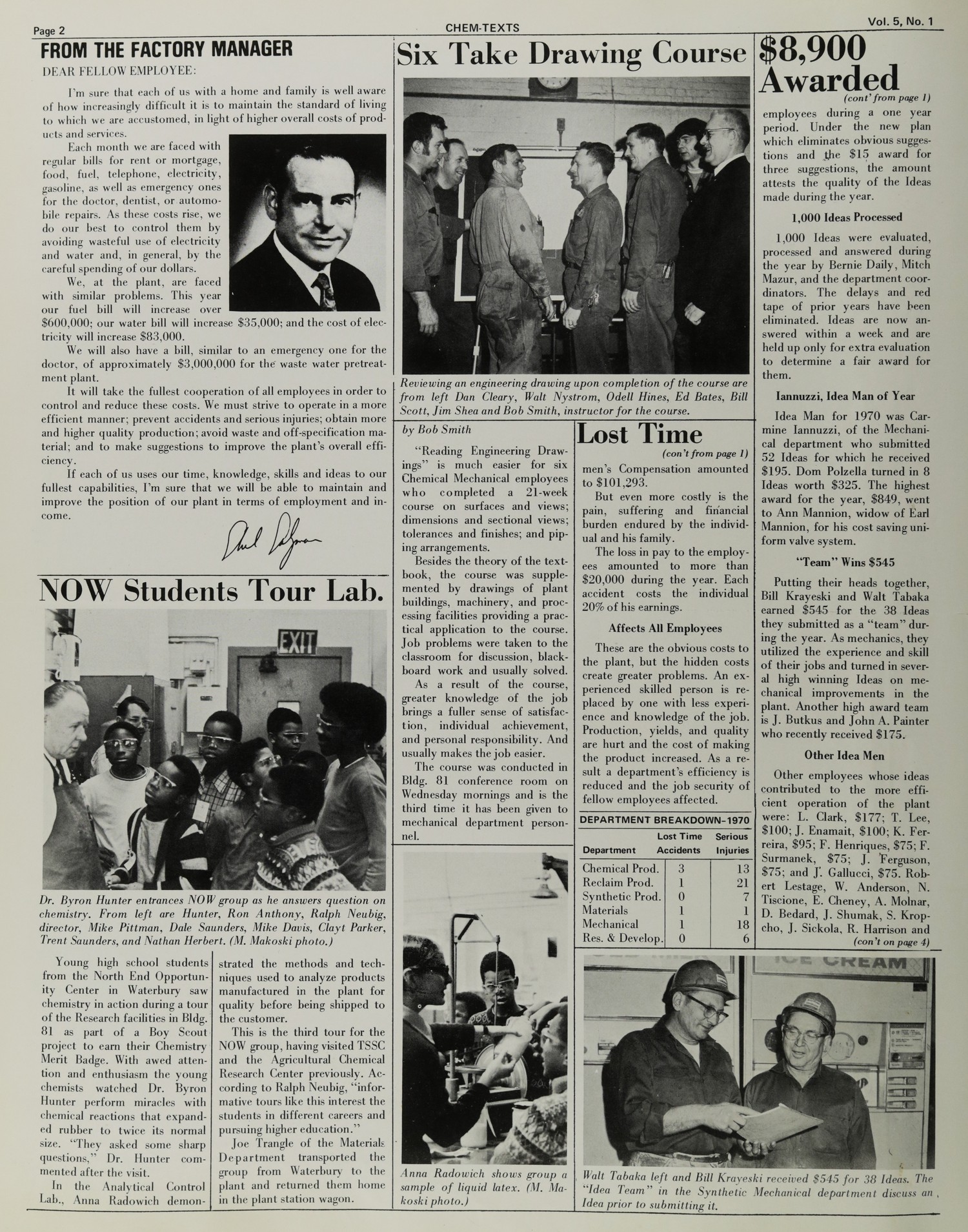
CHEM-TEXTS – Vol. 5, No. 1 – Page 2

Page 002

CHEM-TEXTS

Page 2 | Vol. 5, No. 1


FROM THE FACTORY MANAGER

DEAR FELLOW EMPLOYEE:

I’m sure that each of us with a home and family is well aware of how increasingly difficult it is to maintain the standard of living to which we are accustomed, in light of higher overall costs of products and services.

Each month we are faced with regular bills for rent or mortgage, food, fuel, telephone, electricity, gasoline, as well as emergency ones for the doctor, dentist, or automobile repairs. As these costs rise, we do our best to control them by avoiding wasteful use of electricity and water and, in general, by the careful spending of our dollars.

We, at the plant, are faced with similar problems. This year our fuel bill will increase over $600,000; our water bill will increase $35,000; and the cost of electricity will increase $83,000.

We will also have a bill, similar to an emergency one for the doctor, of approximately $3,000,000 for the waste water pretreatment plant.

It will take the fullest cooperation of all employees in order to control and reduce these costs. We must strive to operate in a more efficient manner; prevent accidents and serious injuries; obtain more and higher quality production; avoid waste and off-specification material; and to make suggestions to improve the plant’s overall efficiency.

If each of us uses our time, knowledge, skills and ideas to our fullest capabilities, I’m sure that we will be able to maintain and improve the position of our plant in terms of employment and income.

[Signature: Paul Lyson]


NOW Students Tour Lab.

Dr. Byron Hunter entrances NOW group as he answers question on chemistry. From left are Hunter, Ron Anthony, Ralph Neubig, director, Mike Pittman, Dale Saunders, Mike Davis, Clayt Parker, Trent Saunders, and Nathan Herbert. (M. Makoski photo.)

Young high school students from the North End Opportunity Center in Waterbury saw chemistry in action during a tour of the Research facilities in Bldg. 81 as part of a Boy Scout project to earn their Chemistry Merit Badge. With awed attention and enthusiasm the young chemists watched Dr. Byron Hunter perform miracles with chemical reactions that expanded rubber to twice its normal size. “They asked some sharp questions,” Dr. Hunter commented after the visit.

In the Analytical Control Lab., Anna Radowich demonstrated the methods and techniques used to analyze products manufactured in the plant for quality before being shipped to the customer.

This is the third tour for the NOW group, having visited TSSC and the Agricultural Chemical Research Center previously. According to Ralph Neubig, “informative tours like this interest the students in different careers and pursuing higher education.”

Joe Trangle of the Materials Department transported the group from Waterbury to the plant and returned them home in the plant station wagon.


Six Take Drawing Course

Reviewing an engineering drawing upon completion of the course are from left Dan Cleary, Walt Nystrom, Odell Hines, Ed Bates, Bill Scott, Jim Shea and Bob Smith, instructor for the course.

by Bob Smith

“Reading Engineering Drawings” is much easier for six Chemical Mechanical employees who completed a 21-week course on surfaces and views; dimensions and sectional views; tolerances and finishes; and piping arrangements.

Besides the theory of the textbook, the course was supplemented by drawings of plant buildings, machinery, and processing facilities providing a practical application to the course. Job problems were taken to the classroom for discussion, blackboard work and usually solved.

As a result of the course, greater knowledge of the job brings a fuller sense of satisfaction, individual achievement, and personal responsibility. And usually makes the job easier.

The course was conducted in Bldg. 81 conference room on Wednesday mornings and is the third time it has been given to mechanical department personnel.


$8,900 Awarded

(cont’ from page 1)

employees during a one year period. Under the new plan which eliminates obvious suggestions and the $15 award for three suggestions, the amount attests the quality of the Ideas made during the year.

1,000 Ideas Processed

1,000 Ideas were evaluated, processed and answered during the year by Bernie Daily, Mitch Mazur, and the department coordinators. The delays and red tape of prior years have been eliminated. Ideas are now answered within a week and are held up only for extra evaluation to determine a fair award for them.

Iannuzzi, Idea Man of Year

Idea Man for 1970 was Carmine Iannuzzi, of the Mechanical department who submitted 52 Ideas for which he received $195. Dom Polzella turned in 8 Ideas worth $325. The highest award for the year, $849, went to Ann Mannion, widow of Earl Mannion, for his cost saving uniform valve system.

“Team” Wins $545

Putting their heads together, Bill Krayeski and Walt Tabaka earned $545 for the 38 Ideas they submitted as a “team” during the year. As mechanics, they utilized the experience and skill of their jobs and turned in several high winning Ideas on mechanical improvements in the plant. Another high award team is J. Butkus and John A. Painter who recently received $175.

Other Idea Men

Other employees whose ideas contributed to the more efficient operation of the plant were: L. Clark, $177; T. Lee, $100; J. Enamait, $100; K. Ferreira, $95; F. Henriques, $75; F. Surmanek, $75; J. Ferguson, $75; and J. Gallucci, $75. Robert Lestage, W. Anderson, N. Tiscione, E. Cheney, A. Molnar, D. Bedard, J. Shumak, S. Kropcho, J. Sickola, R. Harrison and (con’t on page 4)


Lost Time

(con’t from page 1)

men’s Compensation amounted to $101,293.

But even more costly is the pain, suffering and financial burden endured by the individual and his family.

The loss in pay to the employees amounted to more than $20,000 during the year. Each accident costs the individual 20% of his earnings.

Affects All Employees

These are the obvious costs to the plant, but the hidden costs create greater problems. An experienced skilled person is replaced by one with less experience and knowledge of the job. Production, yields, and quality are hurt and the cost of making the product increased. As a result a department’s efficiency is reduced and the job security of fellow employees affected.

DEPARTMENT BREAKDOWN—1970

Department Lost Time Accidents Serious Injuries
Chemical Prod. 3 13
Reclaim Prod. 1 21
Synthetic Prod. 0 7
Materials 1 1
Mechanical 1 18
Res. & Develop. 0 6

Anna Radowich shows group a sample of liquid latex. (M. Makoski photo.)

Walt Tabaka left and Bill Krayeski received $545 for 38 Ideas. The “Idea Team” in the Synthetic Mechanical department discuss an Idea prior to submitting it.

CHEM-TEXTS – Vol. 5, No. 1 – Page 4

Page 004

CHEM-TEXTS

Page 4 | Vol. 5, No. 1


Four Employees Retire

[IMAGE: Four people standing together, with “COLD DRINKS” sign visible]

Lillian Ploss cuts cake after 44 years service as plant cashier. From left are Don Turner, Lillian, Nell Patrick, Bob Rung, Marie Rusate and Diane Carignan.


[IMAGE: Group of people, one person cutting cake]

Helping Rose Beardsley cut a cake on her retirement after 24 years service in Accounting are from left Karol Mooney, Larry Mambrino, Rose, Helen Solomita.


“No School Today” was John McCarthy’s philosophy. Wishing him good luck after 24 years as a millwright are from left Mary O’Brien, McCarthy, Bill Rek, who shaved his beard, and Jim Norton.


[IMAGE: Group photo of workers]

Bob Crotty with 27 years service in Synthetic Materials Handling is congratulated, from left, by Ernie Molnar, Don Boyd, Crotty, Bill Leary, and Tony Moura.


$8,900 Awarded

(con’t from page 2)

J. Chasse received $50 each. A $35 award went to A. Cross and a $30 award to J. Arbachauskas.

$25 was given to J. Banno, A. Hanley, H. Needham, O. Gabianelli, J. Marino, Jr., J. Mambrino, A. Gilfone, J. Lawton, A. Kazemekas, S. Dushak, H. Hernandez, M. Rosa, L. Ritchie, F. Simasek, K. Nelson, P. Cravo, N. Owens, S. Mazanski. R. Lockwood, L. Raskauskas, J. Iosa, G. Monahan and E. Kassheimer.

A $15 award went to R. Jennings, a carryover from the old Suggestion System.

Thirty-one employees received Letters of Commendation: P. Blasko, J. Jakabauski, J. Morris, L. Mace, J. Bednarek, F. Phillips, J. Brown, G. Perkins, E. Alves, F. Miller, A. Happy, J. Napiello, D. Mennillo, R. Guest, A. Gedraitis, L. Recchia, A. Civitello, C. Steelfox, J. Sullivan, F. Bendler, W. Lavelle, C. Moruska, C. Zawacki, J. F. Brown, E. St. John, J. Owens, J. Salinardi, J. DaSilva, F. Surmanek, W. Parks, and J. Mucha.

SAFETY IS MY RESPONSIBILITY


X-Ray Unit Visits Plant

by Bob Shortt

On Thursday, March 25, a mobile X-ray unit will visit the plant for chest X-ray of all employees. This service is free and is part of an improved medical service program for employees recommended by Dr. Edward Jelley, Plant physician.

The unit will be open from 6 A.M. until 6 P.M. and can X-ray 125 people an hour.

Employees will be provided a form to complete prior to the visit. Results of the X-ray will be returned to Dr. Jelley, who will file it in the employee’s medical record.

Details are posted on departmental bulletin boards.


Fuel Costs

(con’t from page 1)

Save Steam Program

The program to save steam will concentrate on giving maintenance priorities to steam leaks, faulty steam traps, valves, heaters, controls and broken insulation. A large amount of heat loss is caused by open doors and windows which are also a major factor in frozen pipelines and damage to sprinkler systems.

10-20% Of Steam Lost

It is estimated that 10-20% of the steam produced is now wasted. A ½” orifice or leak wastes 835,000 lbs. of steam a month at a cost of $668 and for a yearly total of $8,000.

A program has also been initiated to inventory, inspect and repair all steam traps in the Reclaim, Chemical, and Synthetic plants to eliminate waste.


CHIF Offers

(con’t from page 3)

limit to be eligible for CHIF’s assistance.

Uniroyal management has examined this service and believes that it may be beneficial to employees. The services of CHIF are primarily involved in assisting members of minority groups in the purchase of their own homes.

If you are interested in obtaining more information about CHIF, call Milt Makoski, Industrial Relations Department, Ext. 217. Or contact CHIF directly in the Steel Building, 51 West Main Street, Waterbury, phone 757-1071.


Safety

(con’t from page 1)

sion has been requested to review all jobs in their departments to determine the proper protective equipment to be used on the job.

Part of the recommendation will be the wearing of hard hats and safety glasses throughout areas of the plant as designated on maps to be distributed to all employees.

Program Timetable Set

The following timetable has been set for the hard hat and safety glasses portion of the program:

March 1, all supervision will advise employees in their department about the program and will find out who needs replacement equipment.

On April 1, all supervision will not only begin to remind employees in their department to wear their equipment but also to advise them to do so.

On May 1, the wearing of hard hats and safety glasses will become mandatory in all designated areas of the plant.

Employee’s Safety

The basic purpose of the new program is to protect all employees against accidents and serious injuries. Since 1967, seventy-one employees suffered lost-time accidents and 246 had serious injuries.

With every employee’s cooperation, this new program will help prevent the occurrence of accidents and make the Naugatuck plant a safer and better place to work.


Group Tutors Young

[IMAGE: Group of people in formal attire greeting each other]

Dr. Frank O’Shea and Sister Irene of the Sisters of Charity greet the two pretty Carrion sisters, Maribel and Myra as they arrive for a one hour study session. Not in the photo is Sister Margaret Sugrue who was busily involved in organizing the session.

By Len Lombardi

Forty-eight Uniroyal Chemical employees tutor young high school students from the Waterbury area on Monday and Tuesday evenings from 7-9 P.M. The Uniroyal Tutoring Program provides personal individual instruction to underprivileged young people to help them become better achievers in school, and obtain a High School diploma.

Five of the Chemical tutors have doctorate degrees in the sciences, and hold supervisory positions in R & D at the Chemical plant; several have MA degrees in Chemistry and Engineering.

Sister Margaret Sugrue and Sister Irene, of the Sisters of Charity, who live in a tenement house on Gilbert Street in the downtown West Main St. section of Waterbury, coordinate one group of tutors with Dr. Frank O’Shea. This group which meets at the Gilbert St. tenement house on Monday evenings, consists of Frank O’Shea, Ken Beardsley, Patricia Forbes, Angenette Grant, Eric Johnson, Dick Keenan, Dick Palizay, John Sierakowski and his wife Margaret, and Art Tobias.

The other group of teachers is coordinated by Mr. Albert Leach, a vice principal of the Barnard School. In this group, which meets Mondays and Tuesdays at the Woodrow Wilson School, are K. Ray Allen, Steve Alper, Bill Broden, Joe Bucciaglia, Bob Cassarino, Lou Coscia, Bob Florek, Jim Gatling, John Gilbert, Paul Hinckley, Keith Hughes, Russell Malz, Jr., Dr. Bob Neidermyer, Ted Shevzov, Sandra Weaving, Dr. Roger Amidon, Sandra Bond, Dr. Jim Brown, Jr., Dr. Bob Brown, Pete Braudis, Dave DaVia, Brendan Geelan, Joe Hochheiser, Howard Kravitz, Dr. Vin Landi, Clark Makinson, Dan O’Donnell, Bruce Perkins, and Dan Shantz.

Substituting as tutors are Mike Jasman, Leslie McDonald, Frank Lassiter, Len Lombardi, Bob Swallow, Ed Nunn, Neil Melore and Bruce Goodwin.

Jo Greco volunteers her services as secretary. She handles the many details of the Uniroyal community project, answers correspondence, and maintains records for each tutor and the subject that he teaches.

If sufficient tutors volunteer their services, the Uniroyal Tutoring Program will be expanded to assist the Puerto Rican youth in Waterbury. Volunteers can call Len Lombardi, Ext. 296.


CHEM-TEXTS

PUBLISHED BY THE INDUSTRIAL RELATIONS DEPARTMENT
UNIROYAL CHEMICAL, NAUGATUCK, CONN. 06770

EDITOR: William F. Lavelle.


[LOGO: UNIROYAL]

UNIROYAL CHEMICAL
Naugatuck, Connecticut 06770

RETURN POSTAGE GUARANTEED

U.S. Postage
PAID
Permit No. 10
Naugatuck, Conn. 06770

CHEM-TEXTS – 1971-v05-i01-s183

Page 183

UNIROYAL CHEM-TEXTS

Vol. 5, 1971 | PUBLISHED FOR THE PEOPLE OF UNIROYAL CHEMICAL | No. 1


$8,900 Awarded For Ideas


Fuel Costs Doubled For 1971

Save Steam Plan Started In Plant

by Al Manzi

Total fuel costs for 1971 will be approximately double over 1970. $1,143,000 has been budgeted to operate the plant during the year against actual costs of $638,000 for last year.

The $505,000 increased cost of fuel is primarily due to escalating residual oil prices which are a result of the Mid-East crisis, tanker shortages and pollution abatement conversions to oil. An added cost is the premium we will pay for low sulfur oil after Sept. 1, 1971.

(con’t on page 4)


Safety Equipment Program

by Bob Shortt

As part of the plant’s continuous concern for the safety of all employees, a new safety equipment program has been initiated.

The program is based on a section of the 1970 Uniroyal-URW Master Agreement which emphasizes that all employees are expected to cooperate in the prevention of accidents to themselves and their fellow workmen and shall be required to utilize such protective devices and equipment prescribed by the Company at no cost to the employee.

Areas Under Review

Under the program, supervi-

(con’t on page 4)


Profits Off $4,100,000

Uniroyal showed a $4,100,000 loss for the 4th quarter of 1970 compared to a profit of $8,400,000 in 1969.

Sales for the same quarter were $371,000,000, a decrease of $17,000,000 from the same period last year.

1970 sales of the company were $1.554 billion, almost the exact amount as the prior year. Net income for 1970 was $23,800,000 compared to a net income of $46,600,000 in the year of 1969.

The decrease in 1970 profits and sales were attributed to the GM strike, the general softness in the economy, high interest charges, sharply higher employment costs, higher transportation charges and other costs not fully absorbed by price increases or productivity improvements.

Plant Business Down

During the year production of reclaimed rubber, latex and rubber chemicals was affected by the slackness in the automotive industry, home construction and the shutdown of several Uniroyal tire plants.

The plant’s business shows scarcely any improvement according to present sales forecasts for the first quarter of 1971.

Every effort needs to be made at this critical time in our economy to prevent off grade production, improve productivity and quality, and to keep customers satisfied.


Dividend Declared

Uniroyal declared a quarterly dividend of 17½ cents a share on the company’s common stock. The dividend is payable March 25 to stockholders of record on February 22.

The Company also declared two dividends of $2 each on Uniroyal’s preferred stock. One will be paid March 25 to stockholders of record February 22 and the other payable June 25 to stockholders of record on May 24.


Elephant Tests Chair

[IMAGE: Photo of an elephant named Elsie testing a plastic chair]

Elsie, a 5,000 pound elephant, torture tests a molded urethane plastic chair made by a new process developed by Rubicon Chemicals, a Company jointly owned by Uniroyal Chemical and Imperial Chemical Industries, Ltd. The liquid urethane chemicals are poured into special chair molds and react into a rigid foam to create furniture that has fantastic strength, is lightweight and easily movable. The shells are then filled with flexible foam for deep seating comfort and upholstered with Naugahyde® vinyl.

Research work on the new process was done in Bldg. 75 by Tom Haggerty, Group Leader; John Chapman; Don Zalewa; Ken Ferreira and Jim McGinn.


[IMAGE: Photo of Al Urban receiving award from Bob Foltz with Art Nauges]

Al Urban, center, a finisher operator in Reclaim Production, receives $426 Idea Plan check from Bob Foltz, general foreman. At right is Art Nauges, area foreman. Al suggested to reuse the butyl tuber heads, previously discarded, and to reclaim, finish and sell the butyl. He received an initial $50 award.


Lost Time Accidents Drop To 6

By Sal Aloise

The incidence of lost time accidents showed a major improvement in 1970. The plant had only 6 compared to the 23 in 1969. Two of the accidents occurred in December in an odd situation.

An employee fell on ice and fractured two ribs. A few days later he visited Dr. Jelley at the Chemical plant hospital prior to his return to work. After his checkup, Tom Doran, a plant driver, drove him home. When Doran stopped for a stop sign, a trailer truck skidded into the station wagon, injuring Doran who suffered a severe neck strain. One of the safest, most experienced drivers in the plant, Tom lost a month of work when the “unexpected happened“.

Accidents Cost $150,507

The 6 lost time accidents and 66 serious injuries cost the plant $150,507 in 1970. The outside medical bills for hospitalization, X-rays, specialists, medicines and doctors’ visits were $49,214. The money paid out for Work-

(con’t on page 2)


by Mitch Mazur

257 employees received $8,900 for Ideas in 1970. A high award of $476 was made to Al Urban for his idea to reuse butyl tuber heads which were previously discarded after short use. The butyl is now reclaimed; finished; and sold, saving materials cost and scrap haulage charges. It took six months to evaluate the idea for which Urban received an initial award of $50 and a subsequent award of $426.

The $8,900 was one of the highest amounts ever awarded to

(con’t on page 2)


[IMAGE: Photo of Carmine Iannuzzi being congratulated]

Carmine Iannuzzi, of the Chemical Mechanical Dept. right, is congratulated by Leo Napiello for being named Idea Man of Year.

CHEM-TEXTS – Vol. 5, No. 2 – Page 2

Page 002

CHEM-TEXTS

Page 2 | Vol. 5, No. 2


FROM THE FACTORY MANAGER

DEAR FELLOW EMPLOYEE:

The National Safety Council recently presented an Award of Merit to the Naugatuck Chemical plant in recognition of its notable safety achievement in 1970. The Award was based on the significant drop in our lost-time accidents during the year: only 6 compared to 24 for each of the three previous years.

In helping to attain this performance, everyone in the plant deserves to be congratulated. Such an achievement is the result only of individual effort and cooperation. With everyone’s increasing concern for safety, we should continue to improve on our experience.

During April, this safety awareness really paid off. Five employees were involved in near-serious eye accidents that would certainly have resulted in damage to their sight. Fortunately, all were wearing their safety glasses at the time of the accidents.

Although our on-the-job safety performance has improved, let’s not overlook safety when away from the job.

Off-the-job safety becomes especially important as the warm weather and vacation time approaches.

At this time there’s a tendency to take extra risks in working around the house—using lawnmowers, climbing ladders, or lifting heavy objects.

Or on vacation, there’s the urge to do everything fast—driving carelessly, exercising too vigorously in sports.

Whether at work, at home, or on vacation—let’s continue to place a great deal of emphasis on good safety habits. Not only you, but your family and fellow employees will benefit from it.

[Signature]


Nystrom Gets $300 Grant

Harvey Nystrom receives Scholarship Award from Joe Bucciaglia. From left are Bob Kaiser, Walt Nystrom, Harvey Nystrom, Bucciaglia, and Irwin Prager.

Harvey J. Nystrom, son of Walt Nystrom, a Millwright in the Chemical Mechanical Department, received the Uniroyal Chemical Management Club’s $250 scholarship award, along with an additional $50 from the Larry Monroe Fund.

Ranked first among 172 seniors at Southbury High School, Nystrom was selected as recipient of the Scholarship from 15 applicants. According to Joe Bucciaglia, Chairman of the Scholarship Committee, “all of this year’s applicants were deserving of the scholarship. It was most difficult for the committee to select one person.”

Besides his outstanding scholastic record, Nystrom was president of the National Honor Society, a State of Connecticut Scholar, and an active participant in a number of extracurricular activities.

He received a Certificate from Knox College for a special Science Training Program for High Ability high school students and a Certificate of De Merite En Francais for his proficiency in French. For his outstanding performance on the National Educational Development Tests, he received a Certificate of Educational Development which is awarded only to students for outstanding educational capabilities.

Nystrom will major in Physics at Cornell University and plans to do postgraduate work in Astro-Physics.

Other members of the Scholarship Committee who screened the applications for the annual award were Irwin Prager and Bob Kaiser.


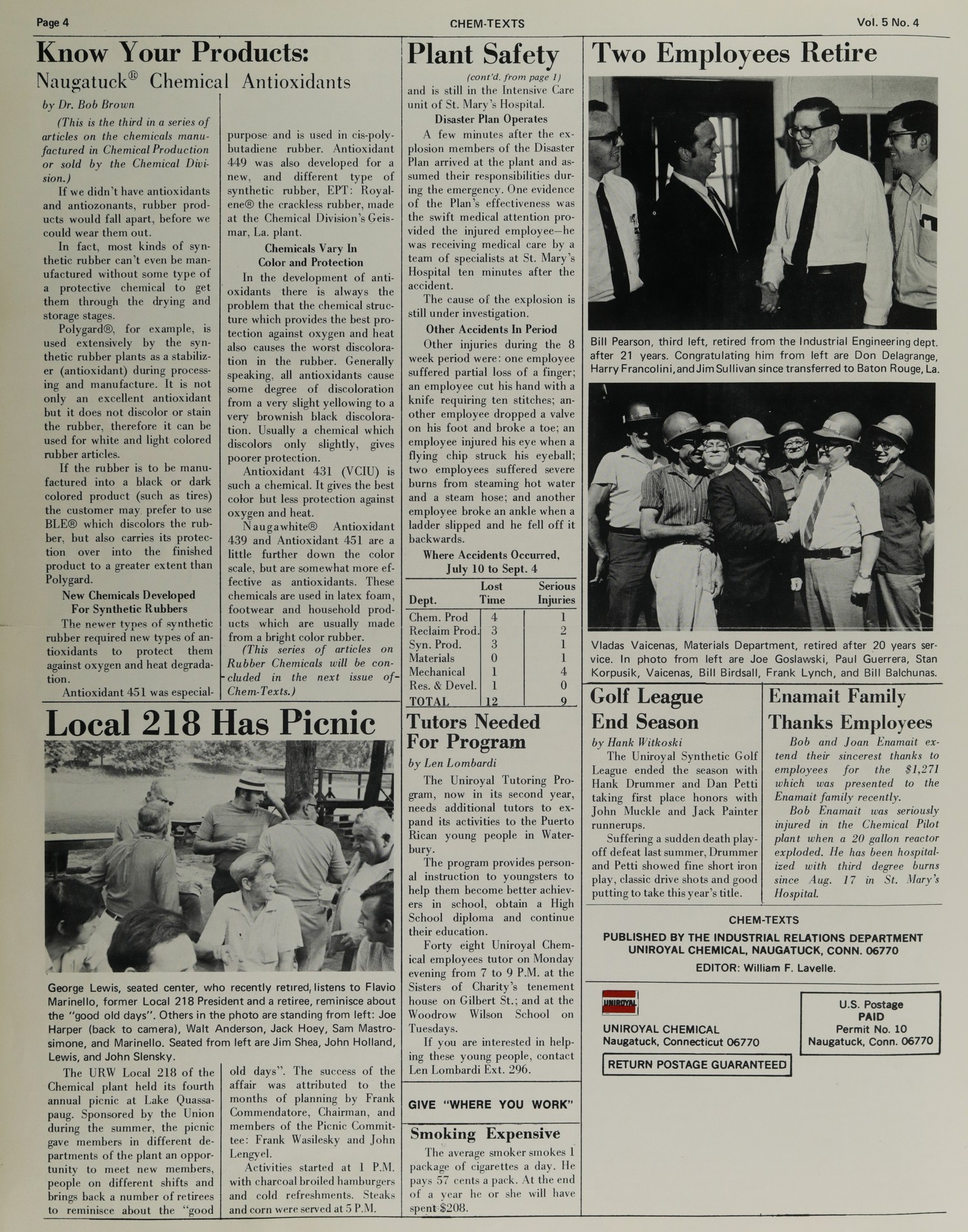
Logic-Networks Plan Initiated For Liquid Waste Pretreatment Plant

Al Manzi, left, Project Leader for the Pollution Abatement program shows progress of new liquid waste pretreatment facilities on the Master Logic Networks diagram. Looking on are Gene Hertel, center, who assisted in the diagram and Dick Shaw, Project Engineer.

by Gene Hertel

To construct the new $3,000,000 Liquid Waste Pretreatment Plant on schedule, a systematic, scientific plan for the complex pollution abatement project was initiated to achieve the target completion date in December, 1972. This major project involves a coordinated effort by many groups to identify the sources of pollution; to eliminate and reduce pollution; and to construct and put into actual operation the Waste Pretreatment Plant.

Logic-Networks Used

The Logic-Networks system is being used to plan, coordinate, monitor and control the pollution abatement project. It is an easy-to-understand, graphical way to plan a project. It shows the time sequence and the interaction of the many tasks and the people involved. This time-logic diagram then becomes a way for the project manager to monitor the project. Decisions can be made to expedite the project to meet the project goals on schedule. The time-logic diagram also serves as a work-discipline tool for the hundreds of people involved, since they are aware of their participation and timing and how it affects the project.

A master Logic-Network was prepared by Al Manzi, Pollution Abatement Project Leader, and Dick Shaw, Project Engineer. The master network shows the broad objectives of the project. Sub-networks were then developed for the participating groups. These show the detailed effort that each group must accomplish to reach the project goal. These sub-networks are: Start-up of the Waste Pretreatment Plant by Dick Shaw; Identifying and Sampling streams in the Plants—Joe Bucciaglia for the Chemical Plant, B. T. Dave for the Synthetic Plant, John Prior for the Reclaim Plant, Gary Arndt for the Pilot Plants – Yard Abatement by Bob Van Allen; Information and Discussion by Neil Melore; Purchasing by Hal Lynch and Bruce Perkins; R & D Labs by Lou Coscia; Early Warning System by C. H. Kim; and Liquid Waste Testing by Irwin Prager; and Chemical Tests by Frank Lussier.

Editor’s Note: Gene Hertel, of the R & D Department, has lectured extensively on Logic-Networks programs at the Tire, Footwear, and Chemical Division plants.


Bloodmobile Visit June 10

On Thursday, June 10, Uniroyal Chemical will sponsor its annual blood drive. 150 pints is the plant’s goal for this year.

Because of the facilities of St. Michael’s Parish House, the Bloodmobile will be located there from 9:45 A.M. to 2:30 P.M. Since blood is so urgently needed in the State, all employees are urged to donate.

Appointments may be made now with Adeline Farrar, R.N., Ext. 231; Ann McAllister, R.N., Ext. 397; or Bob Shortt and Sal Aloise, Ext. 438.


$1,564 Lost In GMF Fire

by Phil De Pasquale

$1,564 was lost in a fire which occurred in the GMF® grinding section of Bldg. 101. While grinding the chemical, used as an accelerator for curing butyl rubber, a flash fire broke out. The GMF operator on the second shift pulled the fire alarm and the heat from the fire turned on the overhead sprinkler system.

Quick action by the fire inspectors and chemical production operators prevented more serious damage.

200 lbs. of GMF were destroyed, for a loss of over $500. Mechanical and electrical equipment damage totalled more than $500. Water damage, clean-up, and repairs approximated $500.

The fire was the first in the plant this year which amounted to a sizeable damage. The exact cause of the blaze is still undetermined.


Club Elects New Officers

New officers of the Uniroyal Chemical Management Club and the Executive Committee meet to plan activities for the year. Seated from left are Dan Shantz, Lou Kaiser, president; Bill Broden, vice president; and Doug Ritchie. Standing from left are Bob Smith, treasurer; Earl Roller, Stan Mazur, Dick Keenan, secretary; and Bob Cronin.

CHEM-TEXTS – Vol. 5, No. 2 – Page 3

Page 003

CHEM-TEXTS

Vol. 5. No. 2 Page 3


Safety Glasses Save Eyesight of Five Employees

Set Goals; Show Results

The Management By Objective program at the Chemical plant uses results as the major measurement criterion. The purpose of the program is to provide the challenge of individual responsibility; a sense of accomplishment; and personal involvement in the successful operation of the plant during the year.

In the program supervisory personnel and members of their departments mutually define specific goals, individual areas of responsibility, and the results that can be expected on the job. The objectives for each department must fit into the overall objectives of the plant so that each group in the plant works as a unity toward the plant’s and Company’s objectives.

Emphasizes Results

Results, rather than activity, is the measurement by which each person is appraised. Since the individual helps set his own goals, he is accountable for his own achievements.

To be measurable, the objectives are set up as specific as possible in dollars, amounts, times, percentage, quality and other categories.

Four standards are used in the measurement guide which are reviewed quarterly and revised, or new standards and targets set as necessary: 1) Result Areas; 2) Measurements; 3) Commitments; and 4) Supportive Action.

When properly carried out the program provides the individual the incentive to achieve results which he helped set for himself by organizing his time and activities in a logical, systematic method.


Savings Bond Drive Starts

On May 25 a U.S. Savings Bond drive was initiated in the plant to offer all employees an opportunity to purchase Savings Bonds.

In view of the new higher interest rate of 5 1/2%, more people are taking a new look at Savings Bonds as a safe, systematic investment.

For convenience, the Bonds can be purchased by regular payroll deductions.

Presently 35% of the plant’s employees are buying U.S. Savings Bonds through the Payroll Savings Plan.

Application forms for enrollment can be obtained from the Bond Drive Committee members, Foremen, Supervisors or from Gladys Bradshaw, Industrial Relations Department, ext. 517.

Completed forms should be returned to W. Lavelle, Industrial Relations Department.


Don’t drive after taking certain pills, such as tranquilizers or antihistamines. They may have side effects that affect judgment, cause dizziness, sleepiness, and confusion.


SAFETY IS MY RESPONSIBILITY


Safety Award Received

An Award of Merit was presented to the Naugatuck Chemical plant for its “noteworthy safety performance” in 1970. The plant’s lost time accidents dropped from 24 to 6 accidents in 1970. Pictured in the Award presentation are from left, Sheldon Salzman, Factory Manager; Leon Raskauskas, Local 308 President; Joe Rzeszutek, Local 218 President; Bob Shortt, Safety Manager; and Sal Aloise, Safety Supervisor.


Tony Galletta shows Gene Reate how chisel punctured aerosol paint can which exploded in his face.

Without warning, the reaction vessel exploded, and covered the entire area with glass.


During April, safety glasses saved the eyesight of five employees when accidents occurred in different areas of the plant. In each case it was almost certain that the eyesight would have been damaged permanently if safety glasses had not been worn at the time of the accident.

By Tony Galletta

“While I was chiselling slag off an iron flange, the chisel slipped and punctured a hole in an aerosol paint can on the work bench. The can exploded and the tiny particles of aluminum paint covered my face and safety glasses. For a minute I thought I had been blinded.”

“The inside pressure in the can shot the paint 20 feet across the floor and covered the ceiling lights.”

“John Gandolfo said, ‘It’s one of those things that happens once in a million years.’

“With your eyes, that’s all you need . . . just one time. Thank God I was wearing my safety glasses, otherwise I would possibly have been blinded for life.”


by Joe Longo

“I had set up the equipment to run a reaction in the safety cabinet in the Synthetic rubber research lab.”

“The reaction seemed somewhat peculiar, and I asked Dr. Steve Cantor to come over and observe the experiment.

“Without warning, the reaction vessel exploded and a flying object shattered the right lens of my safety glasses. Two overhead fluorescent light fixtures were broken and the entire laboratory area was covered with glass particles.

“It is almost certain that both of us would have suffered severe eye damage or possible loss of sight without our safety glasses.”

A few days prior to the accident, Dr. Tom Brett had held a


Glasses were covered with metallic particles from punctured can.

A glass stopper shattered the right lens of safety glasses.

safety meeting with his group emphasizing the new plant regulations on wearing safety glasses.

Tom Lee of Chemical Production experienced a close call when he was cleaning a 55-gallon baffle drum of sodium MBT. A small amount of the chemical in the bottom of the drum splashed

(Con’t. on page 4)


Fashions In The Plant

Paris, Rome, or London may be the fashion centers of the world but the Naugatuck plant has some style setting fashions of its own. Modelling the styles from left are Ann McAllister R.N., Marge Maye, Steve Arbuckle, Doug Klima, Cynthia Marinaro, and Sandy Bond.

CHEM-TEXTS – Vol. 5, No. 2 – Page 4

Page 004

Page 4 | CHEM-TEXTS | Vol. 5. No. 2


Know Your Products: Rubber Chemical Accelerators

by Dr. Bob Brown

Uniroyal Chemical manufactures 91 different types of chemicals for rubber, latex and plastic products. 69 of these chemicals are manufactured and sold by the Naugatuck plant; the others are made at the Geismar plant in Louisiana.

Virtually every tire on the road today contains one of the chemicals made by the Chemical Division to protect them against oxygen, ozone, heat, fatigue and sunlight. Without these chemicals the rubber would deteriorate rapidly.

Coincidentally, it was one of our rubber chemicals that established us in the agricultural chemical business when it was discovered that the chemical had fungicidal properties. Twenty-five years later, the Division ranks as a major manufacturer of herbicides; growth regulants, miticides and fungicides.

The chemicals that we make at Naugatuck for the rubber industry do a wide variety of jobs; but two are by far the most important. These are: 1) Accelerators for vulcanization and 2) Antioxidants and Antiozonants for protection against aging. A third group—Others—include Blowing Agents for rubber and latex sponge; Bonding rubber to fabric; and Retarding vulcanization during processing.

Accelerators

Ever since 1844 when Charles Goodyear, in his small plant in Naugatuck, found that heating rubber with sulfur (vulcanization) causes it to change from an almost useless, gummy solid to a strong, resilient material with hundreds of uses, rubber product manufacturers have been looking for ways to do this job faster and better.

Chemicals which speed up this vulcanization reaction are called accelerators.

Delayed Action Accelerators

MBT and its derivatives (MBTS, OXAF, DELAC®-S) are the work horses of the rubber industry. They are used in almost all tires, footwear, wire and cable and in many other products where strength and long life are needed but where there is also a lot of milling and shaping of the rubber before it is finally made into a product.


[IMAGE: Black and white photograph showing workers]

AC-5 PRILLS

LAC-5 PRILLS

Leo Vadnais, left, and Wilbur Hugar, center, Chemical Production operators in Bldg. 80 prepare Delac-S Prills and MBTS accelerators for shipment to customer. At right is Tom Engle, Foreman of the department.


Safety Glasses

(Con’t. from page 3)

in his face and would have burned his eyes if he had not been wearing his safety glasses.

Tony DaSilva, an operator in Chemical Production, was sprayed with sodium MBT when a plugged line broke. The chemical covered his face, arms and chest. His safety glasses averted serious injury to his eyes.

During the first four months of the year, 57 eye injuries took place. Fortunately most employees were wearing safety glasses at the time of the accidents, preventing serious damage to their eyes.


Hats, Glasses

(Con’t. from page 1)

URW Master Agreement which emphasizes a cooperative effort to prevent accidents among employees and to utilize the proper protective equipment as prescribed by local management.

$150,507 Lost In 1970

In 1970 there were 6 lost time accidents and 66 serious injuries. The cost of medical bills and Workmen’s Compensation for the year totalled $150,507, an amount equivalent to $100 per employee.

223 employees suffered eye and head injuries in the same year. Of these, 170 were eye injuries and 53 were head injuries.

For your personal safety, your fellow employees, and for your family’s sake, wear your safety glasses and hard hats on the job in designated areas.

Once an eye is lost, it can never be replaced.


Profits

(Con’t. from page 1)

quarter. But replacement tires lagged behind the same period last year. Replacement sales are expected to improve sharply during the year.

The Footwear business also showed progress during the first quarter.

Chemical Sales Down

“A major trouble spot at the present time,” according to Mr. Vila, President and Chairman of the Board of Directors, “is in our domestic chemical operations where severe price erosion in many product lines has resulted in a sharp drop in earnings. This has been caused, in part, by competition from foreign sources, in part by the expiration of certain patents and, in part, by a drop in demand for chemical products generally.”

A Worldwide Competitive Manufacturing Complex

The heavy capital investment made by the Company in recent years now gives it a worldwide manufacturing complex which, for the most part, is modern and fully comparable with competition.

Present manufacturing facilities are sufficient to give the Company sales of about $2 billion, an increase of approximately 20% over present sales levels.

This processing has to be done at a high temperature to make the rubber soft enough to handle, and there is always the danger that it will start to vulcanize before it is finished. For this reason, customers want the accelerators that have some “delayed action”. MBT has a little delayed action; MBTS has more; and DELAC-S has the most.

(To be continued in the next issue of CHEM-TEXTS.)


Phase I

(Con’t. from page 1)

ent materials, which results in a complex waste mixture, difficult to adequately treat.

As State environmental laws and enforcement become more strict, it will be essential to control and reduce the flow of materials into the plant drains.

$4,900,000 Spent, Committed

The new facilities, including the financial commitment to the Borough and the scale model pilot plant tests, will cost $4,900,000, exclusive of the operating costs.

Little of the costs expended to date have been absorbed by increased product prices to customers but have been borne mainly by the plant.

The completion of the facilities is scheduled for December 1972 in compliance with orders from the State Water Resources Commission


Six Retire Recently

[IMAGE: Photograph of three men]

John Hickson, third left, retired from Reclaim after 25 years service. Congratulating him are from left: Pablo Quinones, Lee Thompson, Hickson and Bernie Dunn.


[IMAGE: Photograph of two men]

Bruno Rossi left and George Pohorilak wish each other a happy retirement as Milt Makoski, center, watches. Bruno had 39 years service; George, 30 years.


[IMAGE: Photograph of group of men]

Ovila Fortier, center, retiring after 26 years, receives gift from fellow employees. From left: Tony Galletta, Gene Reale, Fortier, Sal Falcone and Leo Napiello.


[IMAGE: Photograph of three men]

Retiring after 40 years service Andy Smey, center, is congratulated by Harry Witt, and Eric Johnson.


[IMAGE: Photograph of group of men]

Congratulating John Quint on his retirement after 29 years service are from left, Vic Alves, John Painter, Quint, Tim Carr and Ted Clement of the Synthetic Mechanical department.


CHEM-TEXTS

PUBLISHED BY THE INDUSTRIAL RELATIONS DEPARTMENT

UNIROYAL CHEMICAL, NAUGATUCK, CONN. 06770

EDITOR: William F. Lavelle.


[LOGO: UNIROYAL]

UNIROYAL CHEMICAL
Naugatuck, Connecticut 06770

RETURN POSTAGE GUARANTEED

U.S. Postage
PAID
Permit No. 10
Naugatuck, Conn. 06770
CHEM-TEXTS – Vol. 5 No. 3 – Page 2

Page 002

CHEM-TEXTS

Page 2 | Vol. 5 No. 3


FROM THE FACTORY MANAGER

DEAR FELLOW EMPLOYEE:

The miracle of the twenty five years of continual growth in the U.S. economy since World War II is something all Americans can be proud of. It has enabled us to become leaders in the world’s markets and to raise our standard of living to the point where we are better off than any people in history.

This miracle didn’t just happen. It was brought about by the tremendous productivity of the people of this country. For twenty years every time wages increased, productivity also increased and our standard of living went up.

In the last five years, however, we have seen a change in this pattern. While wages have increased, productivity has not kept pace with them. This has helped cause inflation and has helped drive the cost of our products up.

In turn, foreign manufacturers have maintained their productivity and are now able to sell their goods in our markets at prices lower than ours. We can see this in Japanese electronics; German and Japanese automobiles; and textile and footwear products from all over the world.

On a smaller scale the same thing is happening at our factory. We are in competition with both foreign and domestic producers. They are competing with us for the same customers and markets, oftentimes at lower prices. Besides this our markets are moving away from the northeast and the increasing cost of rail and truck transportation adds to our problem of doing business competitively.

All of us must realize this and remember that the chemicals we produce are in competition with these domestic and foreign manufacturers. We can only sell what we can produce economically. We can only produce economically with your help and cooperation. Every job in the plant is important. Every person counts in this effort. We all must chip in.

Phil LaJoie


33 Employees Receive $1355

Mechanical Department Submits Most Ideas

Leo Clark, Mechanical dept. received highest single award, $100.

Ed Bazenas received $140 for 2 Ideas.

Gerry Ferguson points to Idea that reduced product loss.

Thirty-three employees received $1355 for Ideas submitted on plant improvements, more efficient equipment operation and cost saving suggestions.

The highest single award, $100, went to Leo Clark for his Idea to install guide rods on the Reclaim tire chute to prevent blockups which affected production.

Ed Bazenas received the highest total amount, $140, for two Ideas. One of his Ideas recommended the redesign of the bag compressor in Bldg. 52 which resulted in improved operations and lower maintenance costs.

Mike Marro’s Idea to machine down discarded teflon seats and reuse them as spacers in ball valves reduced material costs and netted him $50.

Idea man for the January-April period was Jerry Ferguson of the Roylar® plant who turned in 4 Ideas which rewarded him with $135.

For 2 Ideas Charlie LoBalbo received $75.

Four employees—Stanley Dushak, Leo Clark, Natale Vescera and Charlie LoBalbo—received initial awards of $25. Their Ideas
(Cont’d. on page 4)


Blood Drive Big Success

239 people offered to donate blood to the annual Bloodmobile sponsored by Uniroyal Chemical on June 10.

During the 5-hour visit at St. Michael’s Parish House, 214 pints were collected and 25 people were deferred. The Bloodmobile exceeded its goal of 150 by 64 pints, making it a “big success” according to the Naugatuck Red Cross Chapter.

137 Chemical employees, retirees, college students and “walk-ins” and 77 Footwear donors donated blood.

Pin Awards

A 3-gallon pin was awarded to Bob Breton, of Chemical Production, for his 24th contribution of blood.

Bob Cranney, R&D; Walt Gniazdowski, R&D; and Phil Norton, EMIC Sales, received 2-gallon pins.

One gallon pins were presented to Mike Galante, R&D; Henry Hook and Walt Scott, Chemical Production; and Earle Root, Synthetic Production.

In-Plant Organizers

Organizers for the In-Plant canvass were Bob Shortt, Sal Aloise, Adeline Farrar, R.N. and Ann McAllister, R.N. of the Industrial Relations Department.

Uniroyal Chemical employees enjoy sandwiches and coffee after donating blood. Seated from left are John Napiello, Sr., David Boulanger, Walter Campbell, Al Zimmerman, Don Poehailos and Gene Lantieri. Standing from left are Chet Bulka, Walt Scott, Carol Gilbert R.N., and Ted Ciarello. The Red Cross Volunteers served 325 sandwiches and 300 cups of coffee during the 5 hour visit.

Bob Breton, a Chemical Production foreman displays 3 gal. pin he received from Red Cross.

They were assisted by R. Frank, F. Lynch, J. Tierney, G. Allen, S. Gillette, T. Dowling, E. Johnson, L. Coscia, A. Perrella, M. Jasman, D. Poehailos, A. Amador, R. Foltz, B. Daily, J. Callahan, Gary Arndt, J. F. Brown, E. Krauss, E. Philips, A. Nole, and J. Wade.


Plant Joins JOBS ’70

By Milt Makoski

The Chemical plant recently joined the JOBS ’70 consortium organized by the Greater Waterbury Chamber of Commerce. The consortium, or group of businesses, has 15 member industries and a goal of 180 job slots to be filled this year. The Chamber organized the group under a grant from the National Alliance of Businessmen and the Federal Department of Labor.

The JOBS program is aimed at training area people for meaningful employment. The trainees are given work orientation, counseling, total image development, job related education and on-the-job training.

The program participants are grouped into clusters according to the type of training to be received. One cluster of 15 girls, who learned to be clerk-typists and transcriptionists, have already been placed in Uniroyal facilities. Four of the girls are now working at the Chemical plant; and 11 at the Oxford Administrative and Research Center.

In charge of the Chamber’s portion of the program is Gus Maultsby. The Chemical plants’ representative with JOBS ’70 is Milt Makoski and the Uniroyal Corporate representative, Rita Garramone.

Constance Antrum, seated, now working in the Industrial Relations department reviews procedure with Gladys Bradshaw on typing a departmental report.


Local 308 Picnic Set

by Art Calder

URW Local 308 will hold its 4th Annual Picnic for Union members on Sunday, August 8, at Schildgen’s Grove on East Waterbury Road in Union City. The picnic starts at 10 A.M. and ends at 6 P.M.

Chairman for this year’s event is Art Calder, assisted by Committee members Walt Bieleski, Nunzio Pastore, Wes Burns and Jack Muckle. A $2.00 charge will be assessed members for food and refreshments, which includes steaks, hamburgers, clams and corp.

CHEM-TEXTS – Vol. 5 No. 3 – Page 3

Page 003

CHEM-TEXTS

Vol. 5 No. 3 | Page 3


Drug Plan Starts

The new Prescription Drug Plan, the most recent of Uniroyal’s employee benefits, became effective July 1. The Plan will be carried by the Metropolitan Life Insurance Co.—Medi-MET.

Included in the Plan are the employee and eligible dependents: a spouse, any unmarried children under 19 years of age including stepchildren or other children who live with you and are dependent upon you for support and maintenance. All unmarried children over 19 years of age are also covered if they are either full time students or mentally or physically incapable of self-support.

ID Cards have been issued to participating employees. An employee with a family should have 2 cards: one for the employee and one for a spouse.

If you have not received an ID card or a Prescription Drug Plan booklet ask the Foreman or Supervisor of the department for them, or call Marion Hutt Ext. 557.


“Keep Plant Beautiful”

[IMAGE: Photo of a man watering flowers]

When George Vila, Uniroyal’s president and chairman, toured the Chemical plant a few years ago, one of the more beautiful places he found in the plant was John Sickola’s garden by Warehouse 107. To “keep plant beautiful,” Sickola is growing six flower boxes of petunias, zinnias and marigolds. In the photo above he waters his flowers which add a bright color to the south end of the Chemical yard.


[IMAGE: Photo of cattle in a barn]

“With rue my heart is laden” is the intimation on the faces of the 340 pure bred polled Hereford calves being raised for prize showings and choice table beef.

New Oxford…

(Cont’d. from page 1)

Uniroyal Farms where 340 pure bred polled Hereford calves and prize bulls are being raised for prize showings, commercial breeding and choice table beef.

Airport Facilities

Uniroyal also operates the nearby Oxford Airport and is renting hangar space; selling fuel to aircraft; and providing maintenance and repair services. A new Main Terminal is now open with 6 scheduled airline flights daily offered by Pilgrim Airlines.

Grounds Open To Employees

The Oxford grounds are open 7 days a week to Uniroyal employees, their families and friends but the buildings are closed during weekends.

The Cafeteria serves breakfast, lunch, and dinner Mondays-Fridays and is also open for dining on weekends 6:30-8:30 P.M.; however, reservations should be made in advance.

Guest House, Cocktail Lounge

A 48 room guest house, cocktail lounge, and public dining room are also open to employees, their families and friends.

The lounge is open from 5 P.M.-12 P.M. on weekdays; from noon to midnight on Saturdays; and from noon to 10 P.M. on Sundays.

New Corporate Concept

The Center has been described as a new “plant-ranch concept”; as a “modern Oxford University”; and as a “skyscraper sideways.” It utilizes open office landscaping and has a minimum of individual offices. Privacy is attained through the strategic placement of plants and colorful screen dividers.


New Stock…

(Cont’d. from page 1)

shares which he is entitled to purchase.

An employee can participate in any amount up to 10% of a year’s pay over a period of approximately 2 years. At the end of the 2 year period, the employee may take the stock or request the return of his money, with interest.

A prospectus of the plan will be distributed to all employees along with a descriptive booklet and an option card for participation in the plan.


[IMAGE: Photo of woman being helped from jet]

Margo Kuryn, former secretary at TSSC is helped from jet at Oxford Airport operated by Uniroyal, by Pete Zguzenski, Line Supervisor as Tom Canty stands by.


[IMAGE: Photo of outdoor patio area]

Outdoor patio covers underground 250,000 gallon water storage tank which supplies water for facilities.


[IMAGE: Photo of plumbing system]

Kralastic® ABS, a tough plastic product of the Chemical division, is being used for the drain, waste and vent plumbing system in the Research center.


Plant’s Chemicals Protect Float

[IMAGE: Photo of people on inflatable float in pool]

In a pool, on a beach or city rooftop, this Ensolite® floatable lounge offers a soft, pleasant way to relax. The float rolls up into a handy carrying case and does away with short-lived floats and air mattresses which must be inflated and are easily deflated by a puncture. Punctures or tears will not affect its buoyancy or usefulness. Ensolite, a Consumer, Industrial and Plastic Division product which is also used for safety padding in football helmets and padding under artificial turf at sports stadiums, is made from two Chemical Division products: PVC and nitrile synthetic rubber. To protect the rubber against oxygen, ozone, heat and sunlight, several Naugatuck® Chemicals made at the plant are used. Without these chemicals, the rubber in the float would deteriorate in a short time and the product have little value to the consumer. The retail price of the float is $89.95.


SAFETY IS MY RESPONSIBILITY

CHEM-TEXTS – Vol. 5 No. 3 – Page 4

Page 004

Page 4 CHEM-TEXTS Vol. 5 No. 3


Know Your Products: Rubber Chemical Accelerators

by Dr. Bob Brown

(This issue continues the article in Vol. 5, No. 2 on Accelerators made or marketed by the Naugatuck Chemical plant.)

Accelerators are used primarily to speed up, or control the vulcanization process which turns rubber from a useless, gummy substance into a strong resilient and elastic material. Vulcanization, in simple terms, is a chemical reaction between rubber and sulfur, usually brought about by heat.

Faster Accelerators

Where there is less processing or mixing involved, very fast accelerators with little or no delayed action can be used to give more rapid vulcanization. The Zates (Arazate®, Butazate®, Ethazate® and Methazate®) and the Thiurams (Monex®, Pentex®, Tuex®, and Accelerator 108) are used here. They are also used in latex curing where processing is usually not a problem.

Customers use these accelerators for rubber sponge, wire insulation, hot water bottles, conveyor belts, hospital sheeting, and household items and in such latex products as balloons and carpet backing.

The Zates accelerators are non-discoloring and non-staining and can be used in colored rubber products.

Some of the newer synthetic rubbers (Royalene® “the crackless rubber” is an example) are inherently slower in vulcanization than the older types such as natural rubber, neoprene and the Naugapol® and Paracril® synthetic rubbers made at the Naugatuck and Painesville, Ohio plants. Fast accelerators are needed to speed up the vulcanization process for these types of rubber, otherwise it would be economically impossible to make a product at a reasonable selling price to the consumer.

Dr. Bob Brown, author of these articles, is manager of Research and Development for Rubber Chemicals. He received his doctorate degree from Princeton University in Organic Chemistry and holds several patent awards. Dr. Brown heads a staff of 42 people whose sole function is to improve our present chemicals and to develop new ones in order to remain competitive in the market.

GMF and DIBENZO GMF® are used in butyl rubber which also vulcanizes very slowly. A large amount of butyl rubber is used for tire tubes, and high voltage electrical cable.

CPB, DBA Very Active

Sometimes customers want to vulcanize rubber products without heating them at all. Very active accelerators like CPB and DBA accomplish this. In this process the product must be shaped before the accelerator is added. Golf ball covers, for example, are vulcanized by soaking the finished balls in a solution of CPB.

(In the next issue of Chem-Texts, Antioxidants and Antiozonants will be discussed. If you have a son or daughter in school, these articles provide source material for class papers in Chemistry courses.)


33 Employees

(Cont’d. from page 2)

are under further evaluation for higher amounts dependent on the amount of the savings for the plant.

Other employees who received cash awards for Ideas were P. Blasko, F. Maffia, M. Jannetty, D. Stevenson, E. Grickis, R. Guest, B. Robinson, A. Urban, S. Kropcho, J. Harper, J. Gilbert, A. Happy, J. Iosa, H. Garahan, F. Surmanek (2), L. DeLaRosa (2), P. Beardsley, S. Falcone, H. Hernandez, A. Grella, J. Needham, D. Boyd, E. Root, Sr., A. Molnar, D. Pinto and J. Cohen.

Letters of Commendation were presented to C. Smith, L. Fortier, F. Gagne, Carol Calo, J. Gallucci, R. Lockwood, D. Donato, T. Carr, Preciosa Cravo, D. Nelson, A. Nauges, W. Krayeski, W. Tabaka and D. Polzella.

Of the 33 employees awarded cash for Ideas, two were salary employees and the highest number of Ideas were submitted by Mechanical Department personnel.

No Limit to Cash Awards

There is no maximum limit to the amount of a cash award for an Idea. If the value of the Idea exceeds $1,000—this amount is paid under the Plant Idea Plan—it is submitted for further consideration for a higher award to a special management committee. The minimum award for an Idea is $25.

Ideas to Conserve Water Needed

With the construction of the new liquid waste pretreatment plant in progress, ideas to conserve water are needed now as the facilities are designed to treat 3,600,000 gallons a day.


SAFETY IS MY RESPONSIBILITY


Crim Assumes IR Post

Two Industrial Relations Managers not agreeing? Unbelievable! But that’s what the photo seems to say as Jesse Crim, right, new Industrial Relations Manager for the Naugatuck Chemical plant discusses a fine point on employee relations with Ron Mitchinson, former IR Manager and now with the Corporate IR staff in Oxford. Crim came from the Chemical Division’s Painesville, Ohio plant, where he held the position of IR Manager.

Crim will be responsible for labor and employee relations, personnel development and training, plant protection and employee safety, communications, public and community relations, and employment.


Appointments Announced

Sam Gillette has been named Methods Engineering Manager, reporting to the Factory Manager.

Joe Bucciaglia was appointed General Foreman for the Chemical Production Plant.

Eric Johnson was made Chief Process Engineer for the Chemical Production Plant.

Lee Owens assumes the responsibilities of General Foreman in the Synthetic Production Plant.

Clark Makinson moved to the Materials Flow Department in EMIC.

Ed Rabitor replaces Clark in the Chemical Control Center.


Three Retire In Month

Rated one of the top mechanics in the plant, Ed Bouley, center, retired after 27 years of service. Congratulating him on his retirement are from left: Al Mukosey; Hank Drummer, Foreman; Bouley; Charlie Roland, URW 308 Vice President; and Joe Adamski.


Julia Curtin, right, with 44 years service shares 20 lb. cake with members of Control Department. In photo from left are Alice Schofield, Marie Marrello, Loretta Walker, Elaine Connelly, Marcella Pape, Helen Southard, Jack Dunn, Payroll Supervisor, and Julia.


Timothy (Francis) Egan accepts cake from his wife, Alice, on his retirement after 35 years. Left to right: Molly Cobbol, Millie Finsel, Francis and Alice Egan. In rear from left are Frank Rodrigues, Sal Aloise, and Walt Frankenberger. Kay Dowling arranged the luncheon.


CHEM-TEXTS

PUBLISHED BY THE INDUSTRIAL RELATIONS DEPARTMENT
UNIROYAL CHEMICAL, NAUGATUCK, CONN. 06770

EDITOR: William F. Lavelle.


UNIROYAL CHEMICAL
Naugatuck, Connecticut 06770

RETURN POSTAGE GUARANTEED

U.S. Postage
PAID
Permit No. 10
Naugatuck, Conn. 06770
CHEM-TEXTS – 1971-v05-i03-s191

Page 191

UNIROYAL CHEM-TEXTS

Vol. 5, 1971 | PUBLISHED FOR THE PEOPLE OF UNIROYAL CHEMICAL | No. 3


New Oxford Center Opens

New Stock Plan Offer

A new Stock Purchase Plan will be offered to all employees about August 10.

The offering will be similar in most respects to the 1966 and 1968 Stock Purchase Plans. Approximately 65% of the Naugatuck Chemical employees participated in the ’68 Plan.

The option price will be the median market price of Uniroyal common stock on August 10, 1971.

No later than Sept. 8, 1971, an eligible employee may elect to purchase all or part of the (Cont’d. on page 3)

35 Enroll; 22 Increase Bonds

35 additional employees enrolled and 22 increased their participation in the purchase of U.S. Savings Bonds during the campaign recently conducted at the Chemical plant. 504 of 1500 employees, or 33%, now purchase E Bonds through the payroll deduction plan. The E Bonds pay a guaranteed 5½% interest rate if held to maturity, 5 years and 10 months.

Bond purchases can be made any time through the payroll savings plan by contacting Molly Cobbol, Ext. 218.


Facilities Open To Employees

Uniroyal’s new Management and Research Center officially opened on July 12 after nearly 3 years of construction.

Some 400 people moved into the granite and bronze tinted glass structure that is fully carpeted, air conditioned, soundproof, and set scenically on 118 acres of woodlands and farmland


[IMAGE: Sign reading “Polled Herefords THE BIG BOLD BREED” with UNIROYAL, INC. below]

Not far from the Center are the two Uniroyal Farms where polled herefords are raised for prize showings and prime table stock.


[IMAGE: Modern glass and granite building – Administrative Center]

The Administrative Center, a glass and granite structure set in scenic woodlands, is one of industry’s most modern corporate headquarters. It houses a vast computer system and most corporate functions.

acquired by the Company in Middlebury.

The Center is easily accessible from Interstate 84 (Exit 16) and routes 188 and 64.

Two Centers Opened

Recently opened was the Administrative and Computer Center which houses all of the Corporate functions except the advertising, finance, public relations, legal, and certain sales and other corporate departments. These groups will continue to operate from “1230” in New York City. The other facility is the combined Cafeteria, Guest House and Corporate Conference Center.

The Research Center, the largest of the buildings will open about June 1972 and will consolidate the Corporate Research staff in Wayne, N.J. and the

Research and Development facilities of the Consumer, Industrial, and Plastics Products division. The laboratories will have the most modern equipment and finest instrumentation available in the industry.

Ultimately 1500 employees will be located at the Complex.

Uniroyal Farms

Near the site are the two (Cont’d. on page 3)


[IMAGE: Construction site of Research Center]

The Research Center, which will be completed in 1972, will consolidate Corporate, Consumer, Industrial, and Plastic products research and development.

[IMAGE: Corporate Conference Center building]

Training sessions for employees will be conducted at the Corporate Conference Center. It features a cafeteria, guest house, cocktail lounge and dining facilities which are open to employees and their families.

CHEM-TEXTS – Vol. 5, No. 4 – Page 2

Page 002

Page 2 | CHEM-TEXTS | Vol. 5, No. 4


FROM THE FACTORY MANAGER

DEAR FELLOW EMPLOYEE:

Once again the United Givers of Naugatuck-Beacon Falls is starting its Fall drive to raise funds for the oncoming year.

As you know, these funds supply finances to a great many very worthwhile activities carried out in Naugatuck, Waterbury and surrounding towns in which we live.

Each year the Factory has contributed collectively a substantial sum of money to help these worthwhile activities.

This year the drive will be conducted with Jim Carroll as Chairman. Jim has formed his Committee and his canvassers will be approaching you shortly for your contribution.

Uniroyal Chemical people have always shown a splendid generosity in their pledges to support the work of these Agencies. Last year, more than two thirds of the Chemical people contributed $20,066, for an average contribution of $20.

Our goal is $21,000. We can achieve this if we give “where you work” and pledge through the payroll deduction plan.

If each person would contribute a minimum one hour’s pay per month, we will readily raise the necessary money to help continue these activities which in some way benefit virtually every employee or some member of his family.

[Signature]


3 Women Officers Named

[IMAGE: Photo of three women]

Discussing plans for the Club’s activities are the newly elected officers from the Chemical plant. From left, Marge Lasky, secretary; Helen Lavery, vice president; and Penny DiBenedictis, treasurer.

by Marjorie Lasky

Three Uniroyal Chemical women were named officers in the Uniroyal Girls’ Club at its annual dinner meeting held at the Waverly Inn.

Helen Lavery, EMIC, was named Vice-President; Marjorie Lasky, Research and Development was elected Secretary; and Penny DiBenedictis, EMIC, was made Treasurer.

53 Chemical people belong to the organization which offers a Scholarship each year and participates in the Waterbury Campership Fund to provide summer camp vacations for disadvantaged Waterbury children. The group also holds a number of social activities during the year.

Membership in the Club is open to Uniroyal Chemical women office and clerical employees who are interested in its community and social activities as well as the many recreational functions sponsored by the Club. If you are interested in joining the Uniroyal Girls’ Club, contact Helen Solomita, Ext. 333.


28 Patents Awarded Employees

[IMAGE: Group photo of five men in front of bookshelves]

Five agricultural chemicals researchers at the Bethany research and development center received 9 patents. From left in photo are Dr. Al Mittlehner, Manager; J. Everett Barron; Adam Soboleski; Dr. Bo Von Schmeling (3), International Division Product Manager; Ron Ames (3); and Dr. Charles Crittendon.

by C. Gates and F. Hirtler

Twenty-eight U.S. patents were granted in 1970 to Chemical Division employees for inventions in the following commodity groups: rubber chemicals, agricultural chemicals, colloids, synthetic rubber, reclaim rubber, plastics, physical testing, and engineering.

In addition, 173 foreign patents were granted during the year to the Chemical Division.

Important patents were issued for latex to Leland Dannals; for agricultural chemicals to Jack Corkins, an R&D Research man in California; and for Kralastic® ABS to Harry Witt.

Frank O’Shea received the most patents—four. The following inventors each received three; Bogislav von Schmeling, Ron Ames, and Fred Dovell.


$6000

(cont’d from page 1)

College Entrance Examination Board Preliminary Scholastic Aptitude Test—National Merit Scholarship Qualifying Test (PSAT—NMSQT) in their Junior year. Students should arrange for the tests now with their Principals or Guidance Counsellors. The tests are usually given in early October.

Taking the PSAT—NMSQT tests serves as an automatic application for the scholarship.

$250 to $1500 Awards

The maximum amount given to any student is $1500; the minimum is $250. Each scholarship is a 4 year award.

The amount of the award depends on the family’s financial circumstances and the cost of attending the college selected.

Booklets Available

A booklet, “Scholarship Program For Children of Uniroyal Employees” can be obtained from Connie Antrum, Ext. 217, Industrial Relations Department.


The other inventors who received patent awards were Everett Barron, Walt Budd, Jr., Rupert Covey, Charles Crittendon, Pat DePaolo, Jr., Sebastian Di-Palma (Baton Rouge), Harold Greenfield, Byron Hunter, Chester Kawa (Dalton), Paul Mester, (Corp. Purchasing), Allan Murray, John Paige, Al Smith, Andrew Smith (Baton Rouge), Adam Soboleski, Norm Sundholm, and Ed Wheeler.

Patents Important

Patents are important to our business as they grant us the exclusive right to the manufacture, use and sale of a product for a 17 year period. During this time, no other company can operate under the claims of our invention, giving us a competitive edge in the market place.

3 Requirements

Before submission of a patent application to the U.S. Patent Office, the Commercial Development Department, patent liaison group, analyzes it critically for three important requirements: 1) novelty; 2) unobviousness; and 3) utility (usefulness). If it passes these criteria, plus a

number of other requirements, the patent is further studied by Uniroyal’s legal counsel, Arthur, Dry and Kalish and a patent application filed.

After an invention is filed with the government, it takes an average of 3 years before a patent grant is made to the inventor (providing, of course, all the numerous rejections by the patent examiners are successfully overcome).

Uniroyal Chemical is one of the most active divisions in the Company in the attainment of patents over the years.


New Law Promotes First Aid

by Bob Shortt

Effective this Fall, a new Connecticut State law requires that at least one person, qualified in Advanced First Aid training be available on every shift when the plant doctor or nurse is not present.

To comply with the new law, courses in the Basics of First Aid and Advanced First Aid were given by John Hardy, a licensed First Aid Instructor for the Red Cross. The two courses involved 20 hours of instruction and demonstration in the techniques of first aid treatment in an emergency.

Attending the courses were: Chemical Production—Sam Blancato, Bob Reich, Ed Ruella, Bob Cronin, Tom Engle, George Allen, and Earl Roller. Mechanical Department—Chet Bulka and Norm Benson. Reclaim Production—Art Nauges, Paul Kazimir, and Arnold Nori. Industrial RelationsBob Shortt, Milt Makoski, and Fred Wintsch.

A second program of courses was recently started with 21 employees participating.

[IMAGE: Photo of First Aid training demonstration]

Bob Cronin demonstrates artificial respiration on section of dummy as other members of class watch for lungs to expand. From left are Tom Engle, Art Nauges, Cronin, Paul Kazimir, and Hardy.

CHEM-TEXTS – Vol. 5 No. 4 – Page 3

Page 003

CHEM-TEXTS

Vol. 5 No. 4 | Page 3


New Research Laboratory Studies Pollution Causes

Dr. Jim Brown, left, discusses results of Microbiology Sensitivity Test with, from left, Dr. Dave Liu, Irwin Prager, Suren Semonian, and Dr. Charles McCleary, Director of Research and Development. The test assigns the sensitivity levels of the microrganisms used in the biological secondary treatment process.

by Dr. Jim Brown

If chemistry causes pollution, chemistry should be able to solve the problems of pollution.

This is the philosophy behind the new Pollution Abatement Laboratory recently opened by the Research & Development department near the Tire Gate entrance.

The $70,000 structure, which


Oliveira, The Music Man

As a hobby, Joe Oliveira, one of the plant’s carpenters, makes violins and is also an accomplished violinist. Joe uses special treated maple and spruce wood in his violins, which are worth $500 to $600 each.

Two of the six violins he has made over the years are used by his two sons. One plays first violin in the Houston, Texas Symphony and the other is a concert violinist in New York.

It takes Joe about 70 hours to make a violin.

On many an evening during dinner, Joe and his wife listen to the recordings of their sons’ violin music, knowing that the beautiful sounds come from an instrument he created.


will cost approximately $100,000 a year to operate, is equipped with all the necessary equipment for performing water and waste stream analyses in support of our more consolidated work in all aspects of pollution abatement for the Chemical division plants. The laboratory will be the center of all divisional activities in water and air pollution control, ranging from pilot scale biological treatment systems and toxicological evaluations of the effects of various materials on aquatic life to developing specialized chemical engineering unit operation techniques for pretreating difficult-to-handle liquid wastes.

65 Chemicals Surveyed

One of the group’s most re-


Group Tops 750,000 lbs. No Rejects

by Bill Broden

On January 1, Strong Scott operators, Henriques Marques, Tony Rebelo, and Harry Searl started a production run of BIK and BIK-OT which resulted in over 750,000 lbs. of the chemicals without a reject for quality. The long run ended on June 10 when the first batch in 5 1/2 months was off-spec.

Both chemicals have presented serious quality problems over the years because of their reaction to humidity changes which affected the Grinding operation.

Previously, it was not rare for a batch to be off-spec and the materials had to be reprocessed which greatly increased the cost of the products and reduced or eliminated their profit.

According to Jim Cravo, Foreman of 73 Bldg., “It burned us up to work so hard and see our efforts wasted. One day we put our heads together and with technical assistance from the Process Engineer on the job we tried some new approaches to the problem and achieved this turnaround in quality improvement. Our real challenge now is to top the 1,000,000 lbs. mark.”


Jim Gatling performs an analysis test for mixed liquor suspended solids and mixed liquor volatile suspended solids to determine the total solid content and the determination of the number of organisms in the activated sludge.

cent accomplishments was a comprehensive survey of 65 chemical processes to establish present waste loadings and flows, and to pinpoint major, individual sources of pollution within the plant. Further, the survey served to locate and define areas for reduction in waste, recycling possibilities, and product recovery. Much of this information is required for the safe and efficient operation of the new biological secondary treatment plant which is now being constructed by the Boro of Nau-


Cafeteria Remodeled

Remodeling of the Synthetic Cafeteria was recently completed. Attractively redecorated with new floral design drapery, bright ceiling lights, and colorful chair coverings, the dining room matches eating places in the area.

The cafeteria is in Bldg. 1.


Profits (cont’d. from page 1)

compared with the previous record of $817,538,000, last year.

Net income for the six months period was $26,104,000, equivalent to 88 cents a common share, and represented a gain of 15% compared with the $22,709,000, or 78 cents a share, reported last year.

Division Sales Off

Sales and earnings for the Chemical division were down for the first six months of the year, still running considerably below last year’s figures.

Sales in chemicals were below budget and face severe price competition from domestic and foreign products.

Recently we lost one of our major Naugapol customers which hurt sales of this product.

Generally the profits of Reclaim, Colloids and Naugapol are not in a good position.


Jack Paul examines the activated sludge under the microscope to identify the organisms present in the material.

gatuck. The Chemical plant is contributing $1,500,000 to the construction of this facility. The Chemical plant is also building a $3,000,000 liquid waste pretreatment (primary) plant in the south reclaim yard, which is scheduled for completion in De-


Curt Rice performs a Chemical Oxygen Demand analysis test to measure organic content of waste water.

cember 1972.

Tour Scheduled

A tour of the lab was conducted for plant personnel in September to see the facilities and how the work of the group is helping the plant achieve its environmental control program.


Quiet Summer For Residents

New silencer controls noise of compressor in power plant. The loud vibration from the compressor caused noise pollution for employees and neighbors. Checking operation of silencer are from left, Bill Maguire, George Arndt, and Joe Mambrino.

by George Arndt

Last summer the noise pollution caused by cycle pulsations in the intake piping on one of the 1000 CFM air compressors of the power plant brought numerous complaints from the East Side residents of Naugatuck.

The noise problem was recently stopped by the installation of a new high-efficiency silencer normally used in critical

“noise problem locations” such as hospital areas.

A complete revision of the present facility, changes in the intake and discharge piping, and improvements in the compressor foundation as recommended by Habekost Engineering, Inc., Compressor Consultants, eliminated the noise problem.

Since the installation, no complaints have been received from the Naugatuck residents on the East Side of the town.

CHEM-TEXTS – Vol. 5 No. 4 – Page 4

Page 004

Page 4 | CHEM-TEXTS | Vol. 5 No. 4


Know Your Products:

Naugatuck® Chemical Antioxidants

by Dr. Bob Brown

(This is the third in a series of articles on the chemicals manufactured in Chemical Production or sold by the Chemical Division.)

If we didn’t have antioxidants and antiozonants, rubber products would fall apart, before we could wear them out.

In fact, most kinds of synthetic rubber can’t even be manufactured without some type of a protective chemical to get them through the drying and storage stages.

Polygard®, for example, is used extensively by the synthetic rubber plants as a stabilizer (antioxidant) during processing and manufacture. It is not only an excellent antioxidant but it does not discolor or stain the rubber, therefore it can be used for white and light colored rubber articles.

If the rubber is to be manufactured into a black or dark colored product (such as tires) the customer may prefer to use BLE® which discolors the rubber, but also carries its protection over into the finished product to a greater extent than Polygard.

New Chemicals Developed For Synthetic Rubbers

The newer types of synthetic rubber required new types of antioxidants to protect them against oxygen and heat degradation.

Antioxidant 451 was especial-

purpose and is used in cis-polybutadiene rubber. Antioxidant 449 was also developed for a new, and different type of synthetic rubber, EPT: Royalene® the crackless rubber, made at the Chemical Division’s Geismar, La. plant.

Chemicals Vary In Color and Protection

In the development of antioxidants there is always the problem that the chemical structure which provides the best protection against oxygen and heat also causes the worst discoloration in the rubber. Generally speaking, all antioxidants cause some degree of discoloration from a very slight yellowing to a very brownish black discoloration. Usually a chemical which discolors only slightly, gives poorer protection.

Antioxidant 431 (VCIU) is such a chemical. It gives the best color but less protection against oxygen and heat.

Naugawhite® Antioxidant 439 and Antioxidant 451 are a little further down the color scale, but are somewhat more effective as antioxidants. These chemicals are used in latex foam, footwear and household products which are usually made from a bright color rubber.

(This series of articles on Rubber Chemicals will be concluded in the next issue of Chem-Texts.)


Plant Safety

(cont’d. from page 1)

and is still in the Intensive Care unit of St. Mary’s Hospital.

Disaster Plan Operates

A few minutes after the explosion members of the Disaster Plan arrived at the plant and assumed their responsibilities during the emergency. One evidence of the Plan’s effectiveness was the swift medical attention provided the injured employee—he was receiving medical care by a team of specialists at St. Mary’s Hospital ten minutes after the accident.

The cause of the explosion is still under investigation.

Other Accidents In Period

Other injuries during the 8 week period were: one employee suffered partial loss of a finger; an employee cut his hand with a knife requiring ten stitches; another employee dropped a valve on his foot and broke a toe; an employee injured his eye when a flying chip struck his eyeball; two employees suffered severe burns from steaming hot water and a steam hose; and another employee broke an ankle when a ladder slipped and he fell off it backwards.

Where Accidents Occurred, July 10 to Sept. 4

Dept. Lost Time Serious Injuries
Chem. Prod 4 1
Reclaim Prod. 3 2
Syn. Prod. 3 1
Materials 0 1
Mechanical 1 4
Res. & Devel. 1 0
TOTAL 12 9

Two Employees Retire

Bill Pearson, third left, retired from the Industrial Engineering dept. after 21 years. Congratulating him from left are Don Delagrange, Harry Francolini, and Jim Sullivan since transferred to Baton Rouge, La.

Vladas Vaicenas, Materials Department, retired after 20 years service. In photo from left are Joe Goslawski, Paul Guerrera, Stan Korpusik, Vaicenas, Bill Birdsall, Frank Lynch, and Bill Balchunas.


Local 218 Has Picnic

George Lewis, seated center, who recently retired, listens to Flavio Marinello, former Local 218 President and a retiree, reminisce about the “good old days”. Others in the photo are standing from left: Joe Harper (back to camera), Walt Anderson, Jack Hoey, Sam Mastrosimone, and Marinello. Seated from left are Jim Shea, John Holland, Lewis, and John Slensky.

The URW Local 218 of the Chemical plant held its fourth annual picnic at Lake Quassapaug. Sponsored by the Union during the summer, the picnic gave members in different departments of the plant an opportunity to meet new members, people on different shifts and brings back a number of retirees to reminisce about the “good old days”. The success of the affair was attributed to the months of planning by Frank Commendatore, Chairman, and members of the Picnic Committee: Frank Wasilesky and John Lengyel.

Activities started at 1 P.M. with charcoal broiled hamburgers and cold refreshments. Steaks and corn were served at 5 P.M.


Tutors Needed For Program

by Len Lombardi

The Uniroyal Tutoring Program, now in its second year, needs additional tutors to expand its activities to the Puerto Rican young people in Waterbury.

The program provides personal instruction to youngsters to help them become better achievers in school, obtain a High School diploma and continue their education.

Forty eight Uniroyal Chemical employees tutor on Monday evening from 7 to 9 P.M. at the Sisters of Charity’s tenement house on Gilbert St.; and at the Woodrow Wilson School on Tuesdays.

If you are interested in helping these young people, contact Len Lombardi Ext. 296.


GIVE “WHERE YOU WORK”


Smoking Expensive

The average smoker smokes 1 package of cigarettes a day. He pays 57 cents a pack. At the end of a year he or she will have spent $208.


Golf League End Season

by Hank Witkoski

The Uniroyal Synthetic Golf League ended the season with Hank Drummer and Dan Petti taking first place honors with John Muckle and Jack Painter runnerups.

Suffering a sudden death playoff defeat last summer, Drummer and Petti showed fine short iron play, classic drive shots and good putting to take this year’s title.


Enamait Family Thanks Employees

Bob and Joan Enamait extend their sincerest thanks to employees for the $1,271 which was presented to the Enamait family recently.

Bob Enamait was seriously injured in the Chemical Pilot plant when a 20 gallon reactor exploded. He has been hospitalized with third degree burns since Aug. 17 in St. Mary’s Hospital.


CHEM-TEXTS

PUBLISHED BY THE INDUSTRIAL RELATIONS DEPARTMENT
UNIROYAL CHEMICAL, NAUGATUCK, CONN. 06770

EDITOR: William F. Lavelle.


UNIROYAL

UNIROYAL CHEMICAL
Naugatuck, Connecticut 06770

RETURN POSTAGE GUARANTEED

U.S. Postage
PAID
Permit No. 10
Naugatuck, Conn. 06770
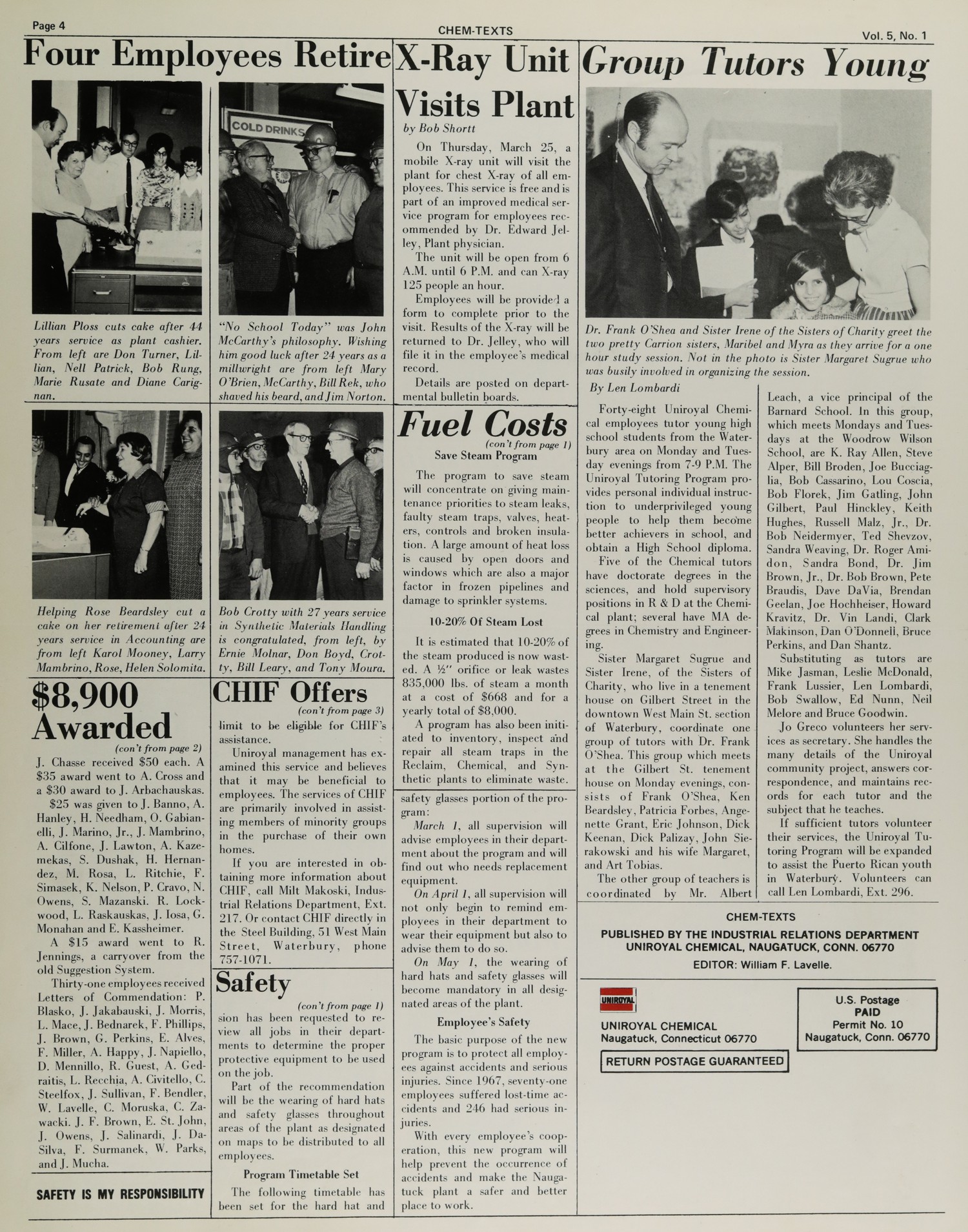
CHEM-TEXTS – 1971-v05-i04-s195

Page 195

UNIROYAL CHEM-TEXTS

Vol. 5, 1971 | PUBLISHED FOR THE PEOPLE OF UNIROYAL CHEMICAL | No. 4


$6000 Awards Offered

10 Uniroyal scholarships will be awarded to children of employees—with five or more years of continuous service—who attain the highest finalist qualification in the annual scholarship competition conducted by the National Merit Scholarship Corporation.

Scholars are chosen on the basis of scholastic aptitude, leadership and good citizenship. The Company plays no part in the selection of the scholars.

No Application Required

Eligible high school students must take the new combined
(cont’d. on page 2)


Profits; Sales Up

Chemical Sales Off

Net income for the Company increased 18.1% for the second quarter of 1971 compared with the second quarter of 1970.

Sales for the quarter set a new record of $464,161,000, a gain of 6.3% compared with the previous record of $436,714,000 set last year.

Net income for the quarter was $15,554,000 equivalent to 53 cents a share of common stock, compared with $13,170,000 or 46 cents a share, reported for the second quarter of 1970.

Sales for the first six months of 1971 also set a record of $877,327,000, a gain of 7.3%
(cont’d. on page 3)


Plant Safety Record Marred By Injuries

Since July 10, a rash of accidents occurred in the plant when 21 employees were injured in an 8 week period. Twelve were lost time accidents in which employees required Hospital treatment; the others were serious injuries requiring treatment by the plant nurses.

This series of accidents took place only a month after the plant received an Award of Merit from the National Safety Council for its “noteworthy safety performance” in 1970 when lost time accidents dropped to 6 from 24 the previous year.

1971 Started Well

1971 started as a safe year. From January to June, only 3 employees were injured in lost time accidents and 36 suffered serious injuries. The incidence of serious injuries remained at the same level as in 1970 when 33 serious injuries happened for the same 6 month period. Although this was no significant improvement, it nevertheless showed no major increase in this type of injury.

Pilot Plant Explosion

The explosion in the Chemical Pilot Plant, Bldg. 72 was the most serious to befall the plant in several years. A 20 gallon reactor exploded, causing a flash fire in the building and extensive damage to the piping and equipment. The heat of the fire opened up the sprinkler system flooding the area with water. It was the alert action of Chris Owens, who narrowly escaped injury from the blast, and Al Grella, that was greatly responsible for extinguishing the fire and preventing greater damage to the area.

One employee was seriously burned with 3rd degree burns over 20% of his face and chest
(cont’d. on page 4)

Explosion ripped interior walls of Pilot Plant; shattered windows; and tore hole in roof. The structural steel framework of the building was not affected

The explosion occurred in small 20 gallon reactor shortly after a sample was taken.


Employees Clean-Up River

by Bob Van Allen

Five Uniroyal Chemical Employees recovered 75 discarded tires from the Naugatuck River during “Clean Up” week.

The Clean-Up started when Stan Korpusik and Frank Lynch of the Materials Department toured the river’s banks from Waterbury to Beacon Falls to locate the tires thrown into the river.

For three days Joe Trangle, Vladas Krakauskas and Adnell Lee covered a 20 mile area to pick up the tires and truck them to the Reclaim plant.

GIVE “WHERE YOU WORK”

Materials department group points to discarded tires recovered from the Naugatuck River. From left are Stan Korpusik, Joe Trangle, Vladas Krakauskas, and Frank Lynch. Not present was Adnell Lee.

Vladas Krakauskas cautiously wades the river to recover 75th tire. Ready to offer assistance on bank was Pat Barriault.


Dividend Declared

Uniroyal declared a dividend of 17 1/2c a share on the Company’s common stock. The dividend was payable Sept. 25 to stockholders of record Aug. 23.

The Company also declared a dividend of $2 a share on the 8 percent first preferred stock. It was payable Sept. 25 to stockholders of record Aug. 23.

CHEM-TEXTS – Vol. 5, No. 5 – Page 3

Page 003

CHEM-TEXTS

Vol. 5, No. 5 Page 3


Gillette, Welch Named To Head Up Idea Plan

[IMAGE: Sam Gillette, right, discusses methods with Pete Welch to improve Idea Plan.]

Sam Gillette, Manager of Methods Engineering, was named Idea Plan Administrator with overall responsibility for the program.

Pete Welch, Industrial Relations, was named Coordinator of the Plan and is responsible for the coordination of it among section Administrators.

In his first few weeks as Coordinator he has already processed a good many Ideas and has initiated new approaches to handle Ideas in quicker time.

Section administrators are Gary Arndt, Pilot Plants; Andy Perrella, TSSC; Lou Coscia, Labs; Ernst Krauss, Chemical Mechanical; Clayt Houseknecht, Synthetic Mechanical; Lee Owens, Synthetic Production; Joe Bucciaglia, Chemical Production; Charles Reich, Reclaim Production; Frank Lynch, Materials; Larry Mambrino, Control; and Hal Lynch, Purchasing.

There is no maximum limit to the amount of awards. If the calculated value of the Idea exceeds $1,000, the Idea is submitted for consideration of a higher award.

GIVE WHERE YOU WORK


Lady Luck Prevents Accident

Lady Luck prevented the possible loss of both hands of an employee while he was repairing the mills in one of the plant’s production facilities.

When he attempted to adjust the rollers, another employee inadvertently started up the machinery. Fortunately, the electrical switch was in a reverse position and the rollers operated in reverse.

In the repair of equipment, the electrical power should be “locked out” on all moving equipment to prevent accidental operation. If the equipment is “locked out” each time, Lady Luck has no control over safety.

The plant has a good control procedure for equipment “lock outs”. This area of employee safety is presently being handled as a priority concern by the Chemical Labor-Management Health & Safety Committee.


Cards Finish In Last Place

by Howard Slason

The Synthetic Cards softball team had a poor season, finishing in the cellar. The team’s finish was attributed to an irregular defense, inconsistent hitting, and injuries.

The “old pro” Charlie Roland carried most of the team’s pitching chores, but inadequate hitting and fielding support hurt his effectiveness.

Vic Kloc led the team in hitting with a .600 average and Mike True led the Cards in home runs.


Employee Honored

The Archdiocesan Medal of Appreciation was awarded to Alex Nole, by Archbishop Whealon of Hartford for his work in the Archdiocese.

He has been a religion instructor in St. Pius X parish for 15 years, and for the past 4 years lay director and curriculum coordinator of the CCD program. He is also president of the parish council.


SAFETY IS MY RESPONSIBILITY


Construction Started

(Cont’d. from page 1)

[IMAGE: Staples High School students collect samples of waste discharge for analysis of contents. The group visited the plant regularly for three weeks as part of an environmental study.]

tanks are rapidly nearing completion.

Committee Responsible

An environmental control committee, composed of 22 members from all plant departments, reviews the progress of the pretreatment plant once a month with the Factory Manager.

This committee uses Logic-Network diagrams which graphically show the progress of each departments’ responsibility and is updated once a month.

The successful operation of the pretreatment plant will depend on individual employees, particularly production and laboratory personnel.

For example, a spill of some materials which are washed down the drain, could disrupt the Chemical pretreatment plant and the Boro of Naugatuck’s secondary treatment plant.


Nine Months

(Cont’d. from page 1)

freeze; slow down in capital spending throughout industry; lower sales and earnings for industrial products; low-cost foreign and domestic competition in footwear and chemical business; heavy start-up costs at the Opelika, Ala. tire plant; and heavy expenses in the development of steel belted radial ply passenger tires.


Unions…

(Cont’d. from page 1)

Chemical Production sewers will be connected together through this line to the new waste water pump station. The line is encased in concrete to prevent uplift during high river water conditions.

Unions…

(Cont’d. from page 1)

term; Cy Blanchard, Vice President; Bob Lestage, Secretary; and Jack Hoey, Treasurer.

Elected to the Executive Board were Henry Hook, Bill Mariano, Frank Wasilesky, Stan Mazanski, Chester Fazziano, Julius Cohen and Edith Evans.

The Election Committee, which supervised the elections and counted the ballots, was Tom Lee, Bob Harrison and Fred Mayo.

ident; Art Calder, Secretary; and Frank Sordi, Treasurer. John Needham received the highest number of votes as a member of the Executive Board. In order of votes received, others elected to the Board were Bill Stenson, Gene Doughty, Ernie Molnar, Jean Burke, John Sullivan, and Joe Arbachauskas.

Chairman of the Election Committee was Walt Tabaka who was assisted by Marie Yaroshefski, and Len Dumonski.


ADVERTISEMENTS

UNIROYAL TIRES

UNIROYAL Belted WIDE OVAL

Snowplow™ WHITEWALLS

DOUBLE/2 BELTS OF FIBERGLASS
DOUBLE/2 POLYESTER CORD PLIES

ADVANCE TIRE SERVICE
510 Meriden Rd.
Waterbury ● 756-2205

FITZPATRICK’S, INC.
78 East Main St.
Ansonia ● 734-5318

MEZZIO’S
792 New Haven Rd.
Naugatuck ● 729-3988

MIDDLEBURY SERVICE CENTER
Route 64
Middlebury ● 758-9977

POUST’S SERVICE STATION
144 Rubber Ave.
Naugatuck ● 729-0433

FEATURES:
– 70 SERIES DESIGN (WIDE OVAL)
– POLYESTER CORD PLIES
– FIBERGLASS BELTS

UNIROYAL HOME & AUTO CENTERS

NEW HAVEN NEW MILFORD BRISTOL
130 Amity Road Boston Post Rd. Farmington Ave. Rte. 6
389-1541 878-6857 582-3176

CANFIELD CORNER PHARMACY

VERA T. ELSENBOSS, Reg. Pharm.
CANFIELD CORNER WOODBURY, CONN
PRESCRIPTIONS SINCE 1907
PHONE 263-2595
MEDIMET PRESCRIPTIONS
CHEERFULLY FILLED

CHEM-TEXTS – 1971-v05-i05-s200

Page 200

UNIROYAL CHEM-TEXTS

Vol. 5, 1971 | PUBLISHED FOR THE PEOPLE OF UNIROYAL CHEMICAL | No. 5


Construction Started On New $3,200,000 Pretreatment Plant


Nine Months Sales Up

Net income for the nine months ending October 3, was $33,234,000, equivalent to $1.10 per share of common stock compared with $27,852,000 or 92 cents a share for the comparable period last year, an increase of 19.3%. Earnings were equivalent to $1.04 per common share after adjustment for the potential dilution related to the company’s convertible debentures issued in February 1971.

Sales for the nine months totaled $1,277,000,000, a gain of 8% over the $1,183,-000,000 for the same period in 1970.

Net income of Uniroyal, Inc. for the 3rd quarter totaled $7,130,000, equivalent to 22 cents per common share, a gain of 38.6% compared with $5,143,000, or 14 cents per share, reported for the quarter last year. Sales increased 9% to $400,-000,000 compared with

$366,000,000 for the third quarter of 1970.

Net income for the 3rd quarter and 9 months was adversely affected by the following factors: freeze of price increases; wage increase costs prior to the

(Cont’d. on page 3)


Drive Nears $21,000

by Jim Carroll

The United Givers drive to raise $21,000 for the 16 Agencies in the Fund which provide needed services for families in communities in which most employees live is nearly completed.

Employees have pledged $20,260 to date and only $740 is needed to achieve the plant’s goal of $21,000. The average contribution amounts to $21.40 per employee who donated.

(Cont’d. on page 2)


Unions Elect Officers

[PHOTO: Two images showing union officers]

Joe Rzeszutek, left, was elected President. Cy Blanchard, right, Vice President; and Henry Hook, to the Executive Committee.

by T. Lee and F. Mayo

439 URW Local 218 Union members elected new union officers for a 3 year term.

Joe Rzeszutek was elected President for a seventh

(Cont’d. on page 3)

Charles Roland, right, new 308 President is congratulated by Rocco Manulla, left, Art Calder, right, and Frank Sordi.

by Walt Tabaka

URW Local 308 members elected Charles Roland, President for a three year term. Also voted into office were Rocco Manulla, Vice-Pres-

(Cont’d. on page 3)


by Dick Shaw

Quietly along the Naugatuck River bank, opposite the Synthetic plant, construction of the new $3,200,000 liquid waste pretreatment plant is making rapid progress. Completion is scheduled for the Fall of 1972.

The facilities will pretreat 3,000,000 gallons of waste water a day for discharge into the Boro of Naugatuck’s water pollution control plant for secondary biological treatment. After treatment at the Boro’s plant, the water will be discharged into the Naugatuck River which is classified “C”, and suitable for fish, game and wildlife.

The steel superstructure for the Operations Building is complete and work has started on the interior of the building which will serve as the operational center for the pretreatment facility. A waste water collection pipeline, encased in solid concrete to prevent upheaval and breakage during high water periods, has been installed at the base of the river bank. This pipeline will connect the plant’s discharge outlets to a new pump station currently under construction near the south yard sewer outfall.

Foundations for the two 82 ft. diameter clarification

(Cont’d. on page 3)


[AERIAL PHOTO: Shows pretreatment plant construction site]

The Pretreatment plant occupies an acre of land near the Synthetic reactor area along the Naugatuck river.


987 Join Stock Plan

by Jack Dunn

987 Chemical Division employees exercised their options to participate in the third stock purchase plan for Uniroyal employees.

These employees elected to purchase 59,617 shares of Uniroyal common stock by 46 payroll deductions over the next 2 years.

The purchase price of the stock was $19.3125.

The enrollment figure represents 61% of the Chemical division employees at the Naugatuck location.

18,000 Uniroyal employees

in the U.S. and Canada joined the plan, electing to purchase over 800,000

(Cont’d. on page 4)


[PHOTO: Construction site view]

The $3,200,000 facility will be completed by the Fall of 1972.

CHEM-TEXTS – 1971-v05-i05-s203

Page 203

Page 4 — CHEM-TEXTS — Vol. 5, No. 5


Know Your Products:

Retarders; Blowing Agents; Waxes

by Dr. Bob Brown

Besides the diverse line of accelerators, antioxidants and antiozontants manufactured in Chemical Production, the plant makes a number of specialty chemicals: Retarders, Process Stiffeners, Bonding Agents, Waxes and Blowing Agents.

The Retarders, ESEN and Retarder J, slow down the vulcanization of the rubber during processing. This may sound like driving a car with your foot on the brake, but when a customer is trying to mix a batch of rubber on a mill and it starts to vulcanize (harden) before he can finish processing it, he must rely on a Retarder to slow down the vulcanization.

Process Stiffener 710 is also used as a processing aid. Rubber is usually easier to handle when it is fairly soft, but some types of rubber soften so much, that they almost seem to be turning into a liquid during the processing. Stiffener 710 gives these rubbers the necessary hardness and firmness to stay sufficiently solid so they can be worked on the mill.

The Celogen® Blowing Agents are used to expn Agents are used to expand rubber, and plastics. When mixed with rubber or plastics and heated, they form a

Celogen is used to expand rubber and plastics, giving a fine cellular structure to the finished product.

fine cellular structure in the finished product, expanding the product volume and lowering its density. This results in a savings in materials for the customer. Blowing Agents are used primarily in rug underlay, upholstery, fashionable footwear, boats, and electrical insulators.

The Sunproof® Waxes are used along with Flexzone® antiozontants to reduce the cracking of tire sidewalls and treads. The Waxes are mixed with the rubber on the mill and then migrate to the surface of the rubber to form a protective film against atmospheric cracking.


Plant Gets Red Cross Award

The Naugatuck Red Cross awarded Uniroyal Chemical a Certificate of Appreciation for outstanding cooperation with the Connecticut Red Cross Blood Program.

In the annual Bloodmobile sponsored by the plant Chemical and Footwear employees and walk-ins donated 214 pints of blood. Another 25 were deferred.

During the year the Naugatuck Red Cross collected 1038 pints of blood. Connecticut is one of the few states where the blood itself is free.

Organized by the Safety Dept. the successful drive was carried out by Bob Shortt, Sal Aloise, Adeline Farrar R.N., and Ann McAllister R.N.


Christmas Special Royal Golf Balls

From November 15 to December 17, a special Christmas Purchase of ROYAL golf balls is available to employees through the Footwear Employee’s Salesroom on Rubber Ave. Each employee is limited to a maximum of 6 dozen.

The balls come in a gift package and the prices range from 9.25 to 11.50 per dozen.


987 Join . . .

(Cont’d. from page 1)

shares of Uniroyal common stock.

MIP Stock Plan

Employees may still purchase Uniroyal common stock through the Monthly Investment Plan (MIP). This plan is operated by Merrill, Lynch, Pierce, Fenner and Smith, Inc.


Enamait Improved

Bob Enamait has been transferred from the intensive care unit of St. Mary’s Hospital and officially removed from the danger list.

He is now in a private room and attended by private duty nurses around the clock. He is still on a circular motorized bed and receiving physical therapy. His response to treatment is good.


Safety Sign Installed

[IMAGE: UNIROYAL EMPLOYEE SAFETY RECORD sign showing INJURIES with DISABLING and NEAR SERIOUS categories, showing “24” and “LAST” indicators]

The first Employee Safety Record sign has been installed at Main Gate. Flashing lights indicate safety record for 24 hour period.

Three new Employee Safety Record signs will be installed to keep employees posted on the plant’s safety record for this year as compared with 1970.

Flashing lights will indicate the 24 hour safety record of employees: the red signifies a Lost Time accident; yellow, a Serious Injury; and the green will indicate that employees have worked safely for a 24 hour period.

The first of the three signs has been installed at the Main entrance; the others will be constructed at the Tire Gate and the Synthetic plant.

The signs are another step in the Safety departments continuing program to improve safety awareness among employees.


Three Employees Retire

[IMAGE: Group photo of employees]

With nearly 46 years of service, Andy Molnar, center, was one of the few active employees in the 45 year group of the 25 Years Service Club. Congratulating him from left are Carl Miele, Hank Venslow, Molnar, Walt Miller, Synthetic Pilot Plant Foreman, and Henry Quigley.

[IMAGE: Group photo of employees in hard hats]

Joe Trangle retired from the Materials department after 26 years service. From left are Ben Federowicz, Frank Lynch, General Foreman, Hulda Flammia, Joe Trangle & Kirk Kirkendall, Foreman.

[IMAGE: Two men, one congratulating the other]

Mike Obronko, right, is congratulated by George Allen, on his retirement from Chemical Production after 22 years service.


CHEM-TEXTS

PUBLISHED BY THE INDUSTRIAL RELATIONS DEPARTMENT
UNIROYAL CHEMICAL, NAUGATUCK, CONN. 06770

EDITOR: William F. Lavelle.


UNIROYAL CHEMICAL
Naugatuck, Connecticut 06770

RETURN POSTAGE GUARANTEED

U.S. Postage
PAID
Permit No. 10
Naugatuck, Conn. 06770
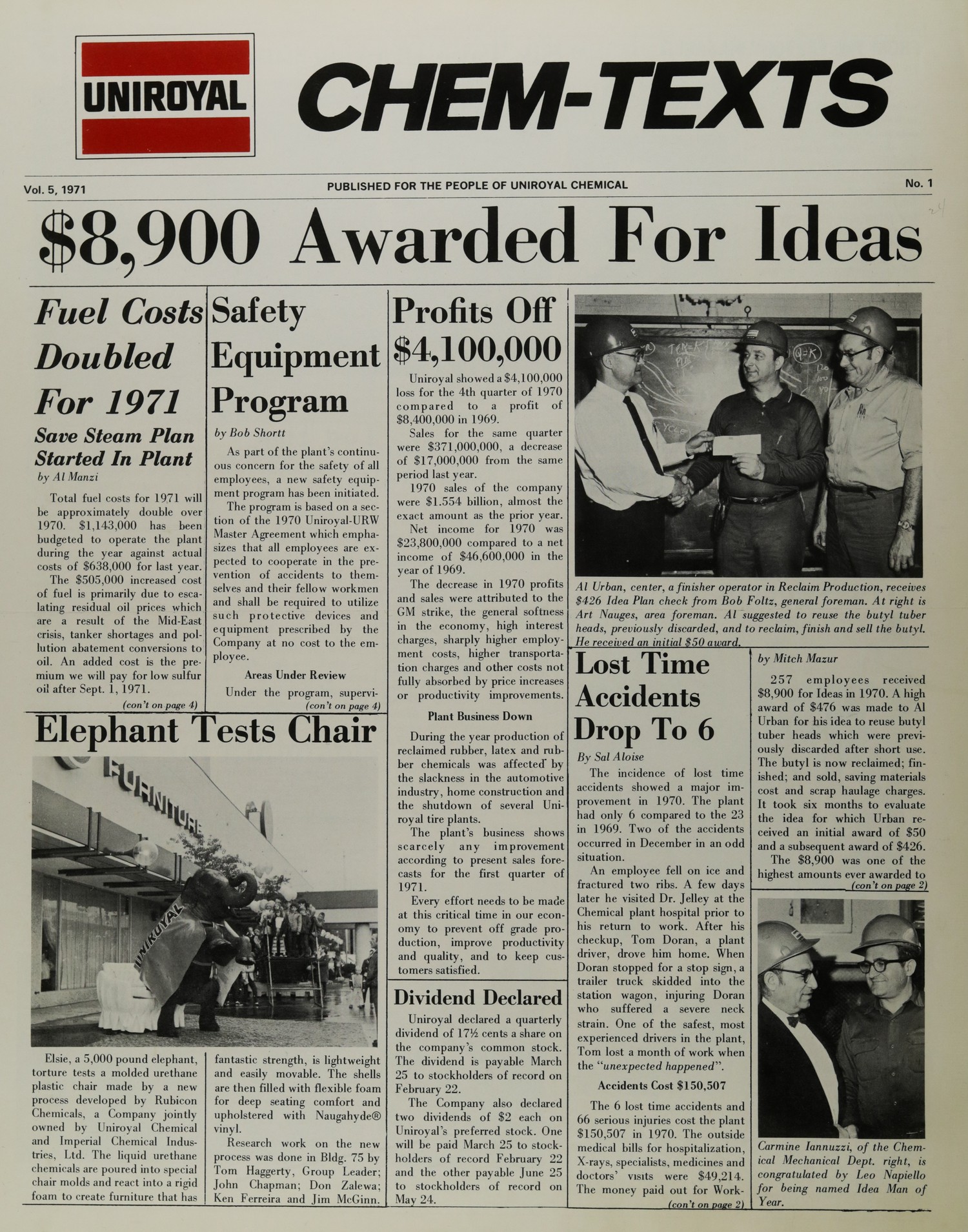
CHEM-TEXTS – Vol. 5, No. 6 – Page 3

Page 003

Page 3 | CHEM-TEXTS | Vol. 5. No. 6


$21,000 Unit…

(Cont’d. from page 1)

than previously made at the plant.

Mike English was the Process Development Engineer for the process requirements and Rod Ashby was Project Engineer for the design and construction of the unit.

The new facility burns off waste gases completely in a smoke-less flame, and eliminates air pollution and fire hazard.

[IMAGE: Industrial facility/equipment]


United Givers

(Cont’d. from page 1)

[IMAGE: Group of people at a table reviewing documents]

United Givers Committee review results of the annual plant drive to raise $21,000. From left are Gary Arndt, L. Kaiser, M. Makoski, J. Carroll, Chairman; R. Amidon, F. Mayo, and Kay Dowling. Committee members absent at time of the photo were R. Van Allen, F. Commendatore, E. Semaskvich, L. Raskauskas, C. Roland, H. Witt, J. Rzeszute, and J. Vergosen.

DEPARTMENT BREAKDOWN

Department Goal Pledge No. of Givers Average Pledge
Chemical Production $2350 $2059 113 $18
Reclaim Production 2100 1971 112 17
*Synthetic Production 1600 1612 75 21
Eng. & Mech.—Chemical 1550 1541 93 16
Eng. & Mech.—Syn. 1000 630 52 12
*Materials 1350 1474 72 20
Factory Services 1200 901 44 20
*Research & Develop. 5850 6195 262 23
*Accounting 900 974 53 18
*EMIC 3000 3548 123 28
*International 100 118 9 12
*exceeded goal $21,000 $21,023 1008 $19

53 employees suffered head injuries in the plant during 1970.

18 occurred in the Chemical Mechanical department; 11 in Synthetic Production.

170 eye injuries occurred in 1970, eight of which were serious.

53 injuries took place in the Mechanical (Chemical) department and 36 in Chemical Production.


achieving it due to employees on a leave of absence, sick, or retired.

The amount represents approximately one-third of the total Industrial Division goal and reflects the generosity of Chemical employees in their support of community activities.

Canvassers who solicited contributions in the different departments and not in the photos were: R. Allen, J. Baclawski, M. Bausano, G. Bradshaw, P. Byra, A. Follachio, R. Gencarelli, H. Greenfield, J. Honyotski, Jeannine Labrecque,


Appointments Announced

Art Aronson has been assigned to the position of Maintenance and Construction Engineer for the Chemical and Reclaim plants.

Sal Aloise, a Supervisor in the Safety department, has been named Foreman in Chemical Production.

Jim Loman joined the Safety Department in Industrial Relations, replacing Sal Aloise.

Don Bates has been named Operations Foreman of the Emulsion and Non-Aqueous Synthetic Pilot Plants.

Ray Pekoek has been appointed Operations Foreman of the Chemical Pilot Plant.

Ben Pranulis assumed the position of Mechanical Foreman in the Chemical Pilot Plant.

Ed Hunwicz has been named to the new position of Mechanical Foreman of the Emulsion and Non-Aqueous Synthetic Pilot Plants.


SAFETY IS MY RESPONSIBILITY

DON’T DRINK AND DRIVE

P. Laurenzi, L. Lombardi, F. Lynch, D. McCormack, J. Sullivan, and R. Terino.

Chairman of this year’s drive was Jim Carroll of the Engineering department. Members of the Committee were R. Amidon, Gary Arndt, F. Commendatore, K. Dowling, L. Kaiser, H. Koss, W. Lavelle, M. Makoski, F. Mayo, L. Raskauskas, C. Roland, J. Rzeszutek, E. Semaskvich, R. Van Allen, J. Vergosen, and H. Witt.


Mother To Five Calves

[IMAGE: Man with calf]

Jim Brown bottle nurses week old Hereford calf at Uniroyal farm. The calf’s cow died at birth.

Five white faced Hereford calves were recently born at the Uniroyal Farm in Middlebury, but shortly after their birth each of their cows died. Two of the calves were twins.

The calves, ranging in age from 1 week to 4 weeks, are now being bottle fed, and owe their good healthy growth partially to Jim Brown, a next-door neighbor and a Foreman in the Synthetic Mechanical department, who sometimes assists in the feeding.

The farm is located at the intersection of Christian Road and Route 188 in Middlebury, only a short distance from the Oxford Management and Research Center.


New Look In Aluminum Siding!!!

ALCOA SIDING

CALL FOR FREE ESTIMATES

Naugatuck Aluminum And Glass

253 Prospect Street,
Naugatuck, Connecticut

729-4534 — 758-9501


$150,000 Gift To Hospital

[IMAGE: Three men in front of building under construction]

Uniroyal Chemical and Footwear contributed $150,000 to the new Waterbury Hospital. In front of the new facility are from left, Carl Toothaker, Footwear Factory Manager; Richard Derr, Hospital Administrator; and Sheldon Salzman, Chemical Factory Manager.

A total of $150,000 was contributed to the Waterbury Hospital Building Fund over a five year period by the Uniroyal Chemical and Footwear Plant.

The Hospital is constructing an eleven story building which will contain a new surgical operating room on the ground level floor, a new pediatrics center, and increased bed facilities.

The structure is near 75% completion and will be dedicated in early summer, 1972.

The combined facilities of St. Mary’s Hospital, which is also undertaking an expansion program, will provide the finest in medical services for the residents of Waterbury, Naugatuck and surrounding towns.


Breen’s

The Biggest Little Store In The Country

Visit our four floors of famous brands for him and her

Ladies’ Dept.
– Couture Coats
– Tanner Dresses
– Vanity Fair Lingerie
– Joyce—Naturalizer Shoes

Men’s Shop
– Manhattan Shirts
– Botany Suits—Sport Coats
– H. Freeman Suits
– London Fog Rainwear
– Florsheim Shoes
– Jaymar Slacks

Lingerie Shop
– Vanity Fair
– Olga—Barbizon
– Schrank Robes
– Shadowline

Jr. Sportswear
– Collegetown Sweaters
– White Stag—Skirts, Slacks
– Davis Coats
– Peerless Sportwear

Ski Boutique
– Ski Jackets
– Warm-Up Slacks
– Ski Pants
– Ski Sweaters
– Gloves & Sweaters

Cosmetic & Jewelry Dept.
– Guerlain
– Elizabeth Arden
– Nina-Ricci
– Chanel
– Yves Saint Laurent
– Monet
– Napier
– Marvella Pearls

CHEM-TEXTS – Vol. 5. No. 6 – Page 4

Page 004

CHEM-TEXTS

Page 4 | Vol. 5. No. 6


Blues Conquer Yellows

[IMAGE: Football team lined up on field]

The Blues and the Yellows line up for their crucial championship game. The Blues, with quarterback Dan Shantz throwing 3 touchdown passes, won 27-0 to take the league title. (Photo— Naugatuck Daily News)

by John Prior

The Uniroyal Chemical Touch-Football League ended its season with the “Blues” holding the “Yellows” scoreless in the Championship game, 27-0. During the regular season the Blues had a 6-0 won-lost record.

Quarterback Dan Shantz tossed 3 touchdowns to lead the Blues to the title. The Blues had a granite wall defense with the hard-charging, veteran Eric Johnson, a constant threat to the Yellow’s quarterback. The league games were umpired by Stan Mazur.

With Paul McKinstry as Captain, the Yellows had a 4-2 season. The Reds, led by Tom Geise, ended with a 2-4 record; and the Greens with Keith Hughes, suffered a 0-6 record.


Plant Ranks 69th In Uniroyal Safety

The Naugatuck Chemical plant ranks 69 among the 80 domestic and international Uniroyal plants in Lost Time and Serious Injuries.

For every 1,000,000 manhours worked (4 months) approximately 26 injuries occur among employees at the Naugatuck Chemical location.

At the Naugatuck plant there is a high concern by management and union representatives that our safety record for 1972 must improve considerably over our 1971 performance. Their joint efforts will receive top priority to improve the plant’s safety record and people’s attitudes toward it.


Seminars Scheduled

Speakers for the Technical Seminars, sponsored by the Research and Development department, have been scheduled for the first half of 1972, it was announced by Dr. Charles Crittendon, secretary for the group. The monthly meetings will be held at the Knights of Columbus Hall, New Haven Road, and start at 3:30 P.M.

The first speaker was Dr. Charles McCleary.

Dates and topics for the other seminars are: January 10, Management by PERT-CPM, Gene Hertel; February 7, Opportunities in the Market Place, Joseph Flannery, Marketing Manager, Chemicals & Synthetic Rubber and William Coughlin, Marketing Mgr., Plastics; March 6, PVC Plastisol Resins, Len Henrey of the Wayne Research Center; April 10, Uniroyal’s Radial Tire, Tire Division representative; May 8, Thermoplastic Rubber, William Fishcher and Dr. Vince Landi.


JA Forms

(Cont’d. from page 1)

factors involved in a business organization.

The Company issues and sells stock; purchases raw materials; pays heat and light bills and rent; pays regular salaries and taxes; carries insurance; regulates health and safety; and pays dividends to stockholders from profits on the sales of its products.

Last year the Jaroy Company gave stockholders a $3 dividend on their investment.

Officers of the firm are Robert Tourrangeau, President: Joseph Bush, Vice President—Manufacturing; Linda Litke, Vice President—Sales; Christopher Bernard—Treasurer; and Jo Ann Niski—Secretary.

Chemical plant advisors to Pingyanco are Jim Chambers, Randy Porter and Dianne Carignon.

Lou Kaiser represents Uniroyal Chemical on the Junior Achievement Board of Directors in Waterbury.


Enamait Moved To Gaylord

Bob Enamait, after almost 4 months in the intensive care unit of St. Mary’s Hospital, was moved to Gaylord Hospital, Wallingford, Conn. where he will undergo intensive physiotherapy treatments.

According to Dr. Edward Jelley, plant physician, Bob is in excellent spirits, enjoys watching TV, and talking to friends. Fellow employees are encouraged to visit him at the hospital and write to him.

A special water bed is used by him to provide him comfort during his stay at the hospital.


Synthetic People Retire

[IMAGE: Group of men, one receiving good wishes]

Walt Miller, Foreman of the Synthetic Pilot plants, receives good wishes on his retirement after 41 years service. In photo from left are Don Bates, Gary Arndt, Walt, and Ed Runowicz.

[IMAGE: Sign reading “DEPARTMENTS ARE GRANTED THE PRIVILEGE OF SMOKING IN THIS AREA” with “ENGINEERING” visible]

[IMAGE: Group of men congratulating someone]

Bill Krayeski, center, one of the best Idea men in the plant, retired after 35 years service. Congratulating him from left are Hank Yacek, Walt Tabaka, Bill Adamski and Henry Drummer of the Synthetic Mechanical Department. Over the years Krayeski— along with Walt Tabaka—has submitted over 300 Ideas.


[ADVERTISEMENT: UNIROYAL TIRES]

UNIROYAL
Belted WIDE OVAL

Snowplow
WHITEWALLS

DOUBLE BELTS OF FIBERGLASS
DOUBLE POLYESTER CORD PLIES

ADVANCE TIRE SERVICE
510 Meriden Rd.
Waterbury ● 756-7205

FITZPATRICK’S. INC.
78 East Main St.
Ansonia ● 734-3318

DON HEAVENS
Chevrolet Inc.
Main Street
Woodbury ● 263-2168

MEZZIO’S
792 New Haven Rd.
Naugatuck ● 729-5988

MIDDLEBURY SERVICE CENTER
Route 64
Middlebury ● 758-9977

POUST’S SERVICE STATION
144 Rubber Ave.
Naugatuck ● 729-0433

UNIROYAL HOME & AUTO CENTERS

NEW HAVEN NEW MILFORD BRISTOL
130 Amity Road Boston Post Rd. Farmington Ave. Rte. 6
389-1541 878-0857 582-3176

FEATURES:
– 78 SERIES DESIGN (WIDE OVAL)
– POLYESTER CORD PLIES
– FIBERGLASS BELTS


[ADVERTISEMENT: CANFIELD CORNER PHARMACY]

CANFIELD CORNER PHARMACY
VERA T. ELSENBOSS, Reg. Pharm.
CANFIELD CORNER WOODBURY, CONN.
PHONE 263-2595
PRESCRIPTIONS SINCE 1867

MEDIMET | PRESCRIPTIONS FILLED | CHEERFULLY


CHEM-TEXTS
PUBLISHED BY THE INDUSTRIAL RELATIONS DEPARTMENT
UNIROYAL CHEMICAL, NAUGATUCK, CONN. 06770
EDITOR: William F. Lavelle.

[UNIROYAL LOGO]

UNIROYAL CHEMICAL
Naugatuck, Connecticut 06770

U.S. Postage
PAID
Permit No. 10
Naugatuck, Conn. 06770
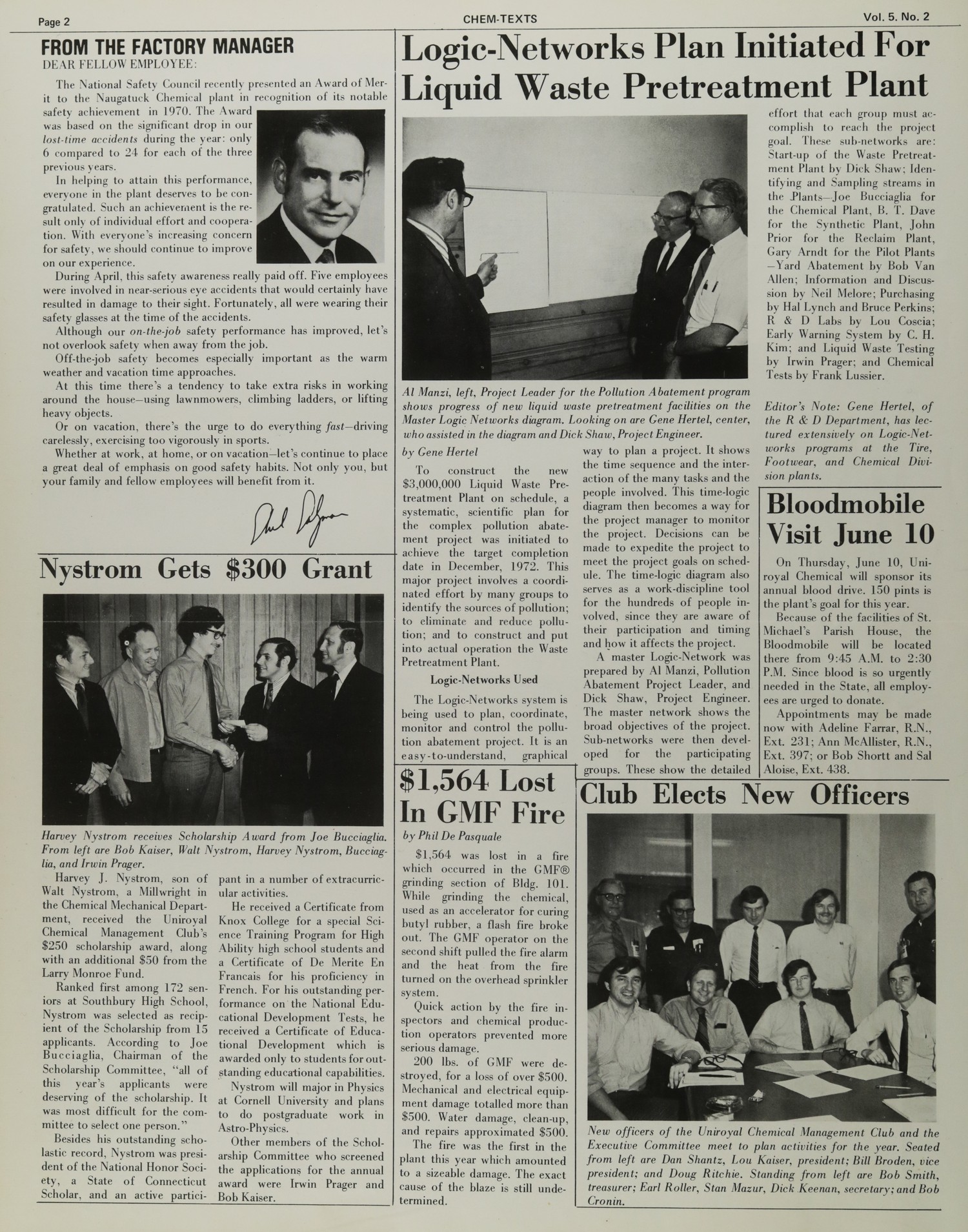
RETURN POSTAGE GUARANTEED


SAFETY IS MY RESPONSIBILITY

CHEM-TEXTS – 1971-v05-i06-s205

Page 205

Page 2 | CHEM-TEXTS | Vol. 5, No. 6


“PEACE ON EARTH TO MEN OF GOOD WILL..”

We pray for Peace but half the world’s people are at war or involved in civil strife. While each side is sure of their cause, the result is still pain and suffering, grief and anguish.

None of us can singly alter the events that are occurring. We can, of course, politically try to express ourselves, but so often the political choice is not one of peace or war, but is more closely related to personalities or domestic problems.

What we can do individually is act as “men of good will” by our charitable deeds and by our daily activities.

We can also pray, and in this period of holy days perhaps all of us can reflect on the suffering around us and stop briefly and pray for peace.


ANYWHERE, ANYTIME, ANYBODY

As some of you may know, I recently suffered an off-the-job accident with an aluminum extension ladder that suddenly developed a will of its own. The result of this momentary carelessness was a cracked bone in my arm and a rather awkward cast.

This accident brought home to me the ease in which a careless or unthinking action could result in an accident.

I hope each of you will continue to be alert towards the unexpected because the accident that happens can be yours.

I sincerely wish you and all the members of your family a Most Happy Christmas and New Year.

[Signature]


$225 Paid For Ideas

[IMAGE: Photo showing two men, with “SAFETY FIRST EMERGENCY EYE WASH FOU…” sign visible]

Jerry Ferguson, left, and Hugh Garahan of the Roylar plant, seem quite excited over the checks awarded for their Ideas.

by Pete Welch

Nine employees received $225 for Ideas submitted during the past months. The Ideas centered on improvements in the plant’s operations and reductions in costs.

Employees who received $25 for their suggestions were Anthony Galletta, Robert Guest, Ray Kubick, Hugh Garahan, Paul Blasko, Jr., Jerry Ferguson, Mario Jannetty, George Salokas, and John Wawer.

Letters of Commendation were given to N. Croce, M. Watson, D. Bedard, W. Carreiro, F. Sordi, E. Evans, B. Zukauskas, W. Palmoski, F. Wallace, J. Gandolfo, K. Searles, L. DeLaRosa, and M. Schluensen.

A work area is a good place to look for Ideas.

Start with present work methods in the department. Is there a better, easier way to do the job? Can it be done faster?

If something has been done the same way, every day for ten years, there’s a good possibility that it’s being done wrong and inefficiently.

Ideas Pay Lots of Money

There’s no limit to the amount of money awarded for an Idea. The minimum award for an approved Idea is $25.


Hospitals Approved By State

[IMAGE: Photo showing Dr. Jelley and Adeline Farrar]

Dr. Jelley, plant physician, shows Adeline Farrar R.N. certificate of approval for plant’s hospital facilities.

by Bob Shortt

Uniroyal Chemical was the first industrial plant in this area to pass the Connecticut State Department of Health inspection and become eligible for a license to operate hospital facilities at the Chemical and Synthetic plants, according to Helen Coburn, R.N., of the Conn. State Dept. of Health.

Requirements Strict

The Laws impose tighter regulations upon the conduct of industrial health facilities in the State.

Besides the strict requirements for the physical facilities, equipment and supplies, the Law requires that a Medical Director, who is a physician licensed in Connecticut, and sufficient registered nurses be available to provide health services to employees. It also requires that at least one individual, who has successfully completed the Advanced Red Cross First Aid course, shall be on duty to provide first aid services whenever a registered nurse or physician is not on duty in the plant.

To date, 39 employees have taken the necessary First Aid courses which involved 20 hours of instruction and demonstrations.


Water Good For Burns

The ancient treatment of plunging burned skin in cold or ice water is still the quickest way to relieve pain. The cold water doesn’t damage the burned skin, but actually helps prevent blistering and aids healing. Continue the treatment until the pain disappears, or apply towels soaked in cold or ice water.


Sno-Plow

(Cont’d. from page 1)

[IMAGE: Photo showing Russ Gandolfo demonstrating scarf caught in pulley belt]

Russ Gandolfo, right, shows how scarf caught in pulley belt and almost broke his neck.

given way. Ironically, it was the first time my son had worn a scarf when working outside.

Inside the kitchen, my wife was cooking a Thanksgiving turkey. What almost turned out to be a day of tragedy, was really a day of thanksgiving for us.

When they talk about the unexpected happening, I know better than ever what they mean.


Avoid Danger In The Bedroom

by Sal Aloise

There are two bedroom practices that may save you and your family if your house ever catches fire during the night; 1) keep the bedroom doors closed, 2) have a second method for escaping outside if the normal exits from your bedroom are locked.

13% of the fires in a home start in the bedroom. The bedroom door, which is the normal escape to safety quickly becomes a death trap—when opened—from lung-scorching heat, poisonous fumes, and choking smoke.


Christmas On The River

In a continuing program to improve the physical appearance of the plant, 100 Christmas trees were planted along the Naugatuck river bank near the Reclaim plant. The trees will grow to a height of 12 to 15 ft. and provide a scenic effect on an otherwise drab section of the Reclaim yard. The trees are a small part of a $4,000,000 program to improve plant buildings and facilities.


BOB’S CAMERA SHOP INC. [Logo]
WATERBURY’S LEADING CAMERA SHOP
21 Grand Street, Waterbury, Conn. 06702 | 754-2256
Film ● Cameras ● Projectors ● Developing ● Rentals