CHEM-TEXTS – 1971 – Page No. 2

Page unknown

UNIROYAL CHEM-TEXTS

Vol. 5, 1971 | PUBLISHED FOR THE PEOPLE OF UNIROYAL CHEMICAL | No. 2


Crim Named IR Manager

Mitchinson, Melore Receive New Posts

Jesse Crim was named Industrial Relations Manager for the Naugatuck Chemical plant, effective June 1. He succeeds Ron Mitchinson who has accepted a position in the Corporate Industrial Relations Department in Oxford.

Neil Melore was appointed Industrial Relations Manager for the Painesville, Ohio plant.

Crim served as Industrial Relations Manager in Painesville from 1968-1971. He held the same position in the Santa Ana, Calif., and Washington, Ind. plants.

He joined Uniroyal in 1947; is a veteran of World War II; and a graduate of Purdue University.


Hats, Glasses Required

by Bob Shortt

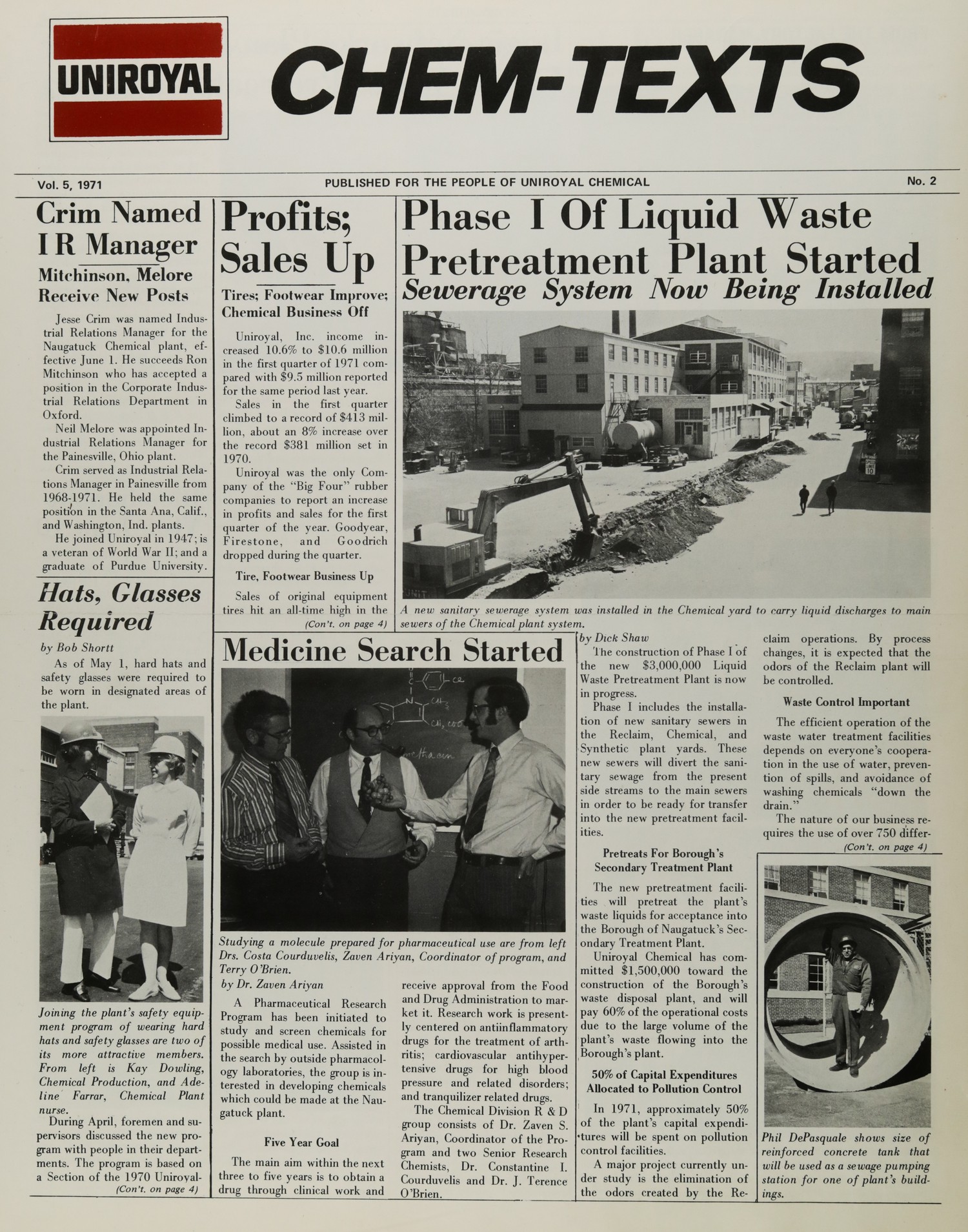
As of May 1, hard hats and safety glasses were required to be worn in designated areas of the plant.

[IMAGE: Photo showing workers wearing safety equipment]

Joining the plant’s safety equipment program of wearing hard hats and safety glasses are two of its more attractive members. From left is Kay Dowling, Chemical Production, and Adeline Farrar, Chemical Plant nurse.

During April, foremen and supervisors discussed the new program with people in their departments. The program is based on a Section of the 1970 Uniroyal-
(Con’t. on page 4)


Profits; Sales Up

Tires; Footwear Improve; Chemical Business Off

Uniroyal, Inc. income increased 10.6% to $10.6 million in the first quarter of 1971 compared with $9.5 million reported for the same period last year.

Sales in the first quarter climbed to a record of $413 million, about an 8% increase over the record $381 million set in 1970.

Uniroyal was the only Company of the “Big Four” rubber companies to report an increase in profits and sales for the first quarter of the year. Goodyear, Firestone, and Goodrich dropped during the quarter.

Tire, Footwear Business Up

Sales of original equipment tires hit an all-time high in the
(Con’t. on page 4)


Phase I Of Liquid Waste Pretreatment Plant Started

Sewerage System Now Being Installed

[IMAGE: Photo showing industrial buildings and sewerage system installation]

A new sanitary sewerage system was installed in the Chemical yard to carry liquid discharges to main sewers of the Chemical plant system.

by Dick Shaw

The construction of Phase I of the new $3,000,000 Liquid Waste Pretreatment Plant is now in progress.

Phase I includes the installation of new sanitary sewers in the Reclaim, Chemical, and Synthetic plant yards. These new sewers will divert the sanitary sewage from the present side streams to the main sewers in order to be ready for transfer into the new pretreatment facilities.

Pretreats For Borough’s Secondary Treatment Plant

The new pretreatment facilities will pretreat the plant’s waste liquids for acceptance into the Borough of Naugatuck’s Secondary Treatment Plant.

Uniroyal Chemical has committed $1,500,000 toward the construction of the Borough’s waste disposal plant, and will pay 60% of the operational costs due to the large volume of the plant’s waste flowing into the Borough’s plant.

50% of Capital Expenditures Allocated to Pollution Control

In 1971, approximately 50% of the plant’s capital expenditures will be spent on pollution control facilities.

A major project currently under study is the elimination of the odors created by the Reclaim operations. By process changes, it is expected that the odors of the Reclaim plant will be controlled.

Waste Control Important

The efficient operation of the waste water treatment facilities depends on everyone’s cooperation in the use of water, prevention of spills, and avoidance of washing chemicals “down the drain.”

The nature of our business requires the use of over 750 differ-
(Con’t. on page 4)

[IMAGE: Photo of Phil DePasquale with concrete tank]

Phil DePasquale shows size of reinforced concrete tank that will be used as a sewage pumping station for one of plant’s buildings.


Medicine Search Started

[IMAGE: Photo showing three scientists studying a molecule model]

Studying a molecule prepared for pharmaceutical use are from left Drs. Costa Courduvelis, Zaven Ariyan, Coordinator of program, and Terry O’Brien.

by Dr. Zaven Ariyan

A Pharmaceutical Research Program has been initiated to study and screen chemicals for possible medical use. Assisted in the search by outside pharmacology laboratories, the group is interested in developing chemicals which could be made at the Naugatuck plant.

Five Year Goal

The main aim within the next three to five years is to obtain a drug through clinical work and receive approval from the Food and Drug Administration to market it. Research work is presently centered on antiinflammatory drugs for the treatment of arthritis; cardiovascular antihypertensive drugs for high blood pressure and related disorders; and tranquilizer related drugs.

The Chemical Division R & D group consists of Dr. Zaven S. Ariyan, Coordinator of the Program and two Senior Research Chemists, Dr. Constantine I. Courduvelis and Dr. J. Terence O’Brien.
CHEM-TEXTS – 1971 – Page No. 6

Page unknown

UNIROYAL

Merry Christmas – Happy New Year

CHEM-TEXTS

Vol. 5, 1971 | PUBLISHED FOR THE PEOPLE OF UNIROYAL CHEMICAL | No. 6


Achieve United Givers Goal With $21,023

Making Xmas Happier

[IMAGE: Group photo of people with toys and dolls]

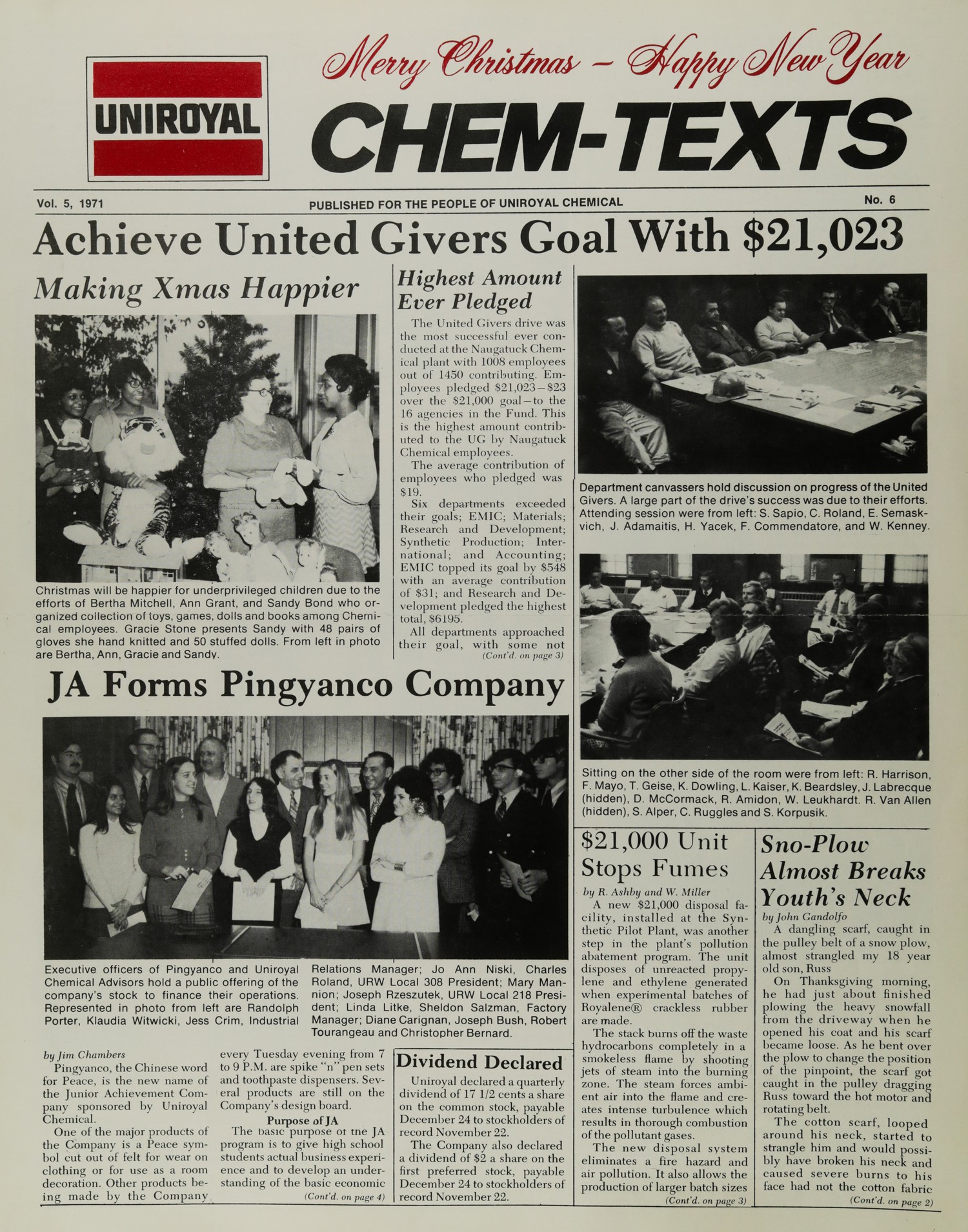
Christmas will be happier for underprivileged children due to the efforts of Bertha Mitchell, Ann Grant, and Sandy Bond who organized collection of toys, games, dolls and books among Chemical employees. Gracie Stone presents Sandy with 48 pairs of gloves she hand knitted and 50 stuffed dolls. From left in photo are Bertha, Ann, Gracie and Sandy.


Highest Amount Ever Pledged

The United Givers drive was the most successful ever conducted at the Naugatuck Chemical plant with 1008 employees out of 1450 contributing. Employees pledged $21,023—$23 over the $21,000 goal—to the 16 agencies in the Fund. This is the highest amount contributed to the UG by Naugatuck Chemical employees.

The average contribution of employees who pledged was $19.

Six departments exceeded their goals; EMIC; Materials; Research and Development; Synthetic Production; International; and Accounting; EMIC topped its goal by $548 with an average contribution of $31; and Research and Development pledged the highest total, $6195.

All departments approached their goal, with some not
(Cont’d. on page 3)


[IMAGE: Group meeting photo]

Department canvassers hold discussion on progress of the United Givers. A large part of the drive’s success was due to their efforts. Attending session were from left: S. Sapio, C. Roland, E. Semaskvich, J. Adamaitis, H. Yacek, F. Commendatore, and W. Kenney.


JA Forms Pingyanco Company

[IMAGE: Group photo of executive officers]

Executive officers of Pingyanco and Uniroyal Chemical Advisors hold a public offering of the company’s stock to finance their operations. Represented in photo from left are Randolph Porter, Klaudia Witwicki, Jess Crim, Industrial Relations Manager; Jo Ann Niski, Charles Roland, URW Local 308 President; Mary Mannion; Joseph Rzeszutek, URW Local 218 President; Linda Litke, Sheldon Salzman, Factory Manager; Diane Carignan, Joseph Bush, Robert Tourangeau and Christopher Bernard.

by Jim Chambers

Pingyanco, the Chinese word for Peace, is the new name of the Junior Achievement Company sponsored by Uniroyal Chemical.

One of the major products of the Company is a Peace symbol cut out of felt for wear on clothing or for use as a room decoration. Other products being made by the Company every Tuesday evening from 7 to 9 P.M. are spike “n” pen sets and toothpaste dispensers. Several products are still on the Company’s design board.

Purpose of JA

The basic purpose of the JA program is to give high school students actual business experience and to develop an understanding of the basic economic
(Cont’d. on page 4)


[IMAGE: Group meeting photo]

Sitting on the other side of the room were from left: R. Harrison, F. Mayo, T. Geise, K. Dowling, L. Kaiser, K. Beardsley, J. Labrecque (hidden), D. McCormack, R. Amidon, W. Leukhardt. R. Van Allen (hidden), S. Alper, C. Ruggles and S. Korpusik.


Dividend Declared

Uniroyal declared a quarterly dividend of 17 1/2 cents a share on the common stock, payable December 24 to stockholders of record November 22.

The Company also declared a dividend of $2 a share on the first preferred stock, payable December 24 to stockholders of record November 22.


$21,000 Unit Stops Fumes

by R. Ashby and W. Miller

A new $21,000 disposal facility, installed at the Synthetic Pilot Plant, was another step in the plant’s pollution abatement program. The unit disposes of unreacted propylene and ethylene generated when experimental batches of Royalene® crackless rubber are made.

The stack burns off the waste hydrocarbons completely in a smokeless flame by shooting jets of steam into the burning zone. The steam forces ambient air into the flame and creates intense turbulence which results in thorough combustion of the pollutant gases.

The new disposal system eliminates a fire hazard and air pollution. It also allows the production of larger batch sizes
(Cont’d on page 3)


Sno-Plow Almost Breaks Youth’s Neck

by John Gandolfo

A dangling scarf, caught in the pulley belt of a snow plow, almost strangled my 18 year old son, Russ

On Thanksgiving morning, he had just about finished plowing the heavy snowfall from the driveway when he opened his coat and his scarf became loose. As he bent over the plow to change the position of the pinpoint, the scarf got caught in the pulley dragging Russ toward the hot motor and rotating belt.

The cotton scarf, looped around his neck, started to strangle him and would possibly have broken his neck and caused severe burns to his face had not the cotton fabric
(Cont’d. on page 2)

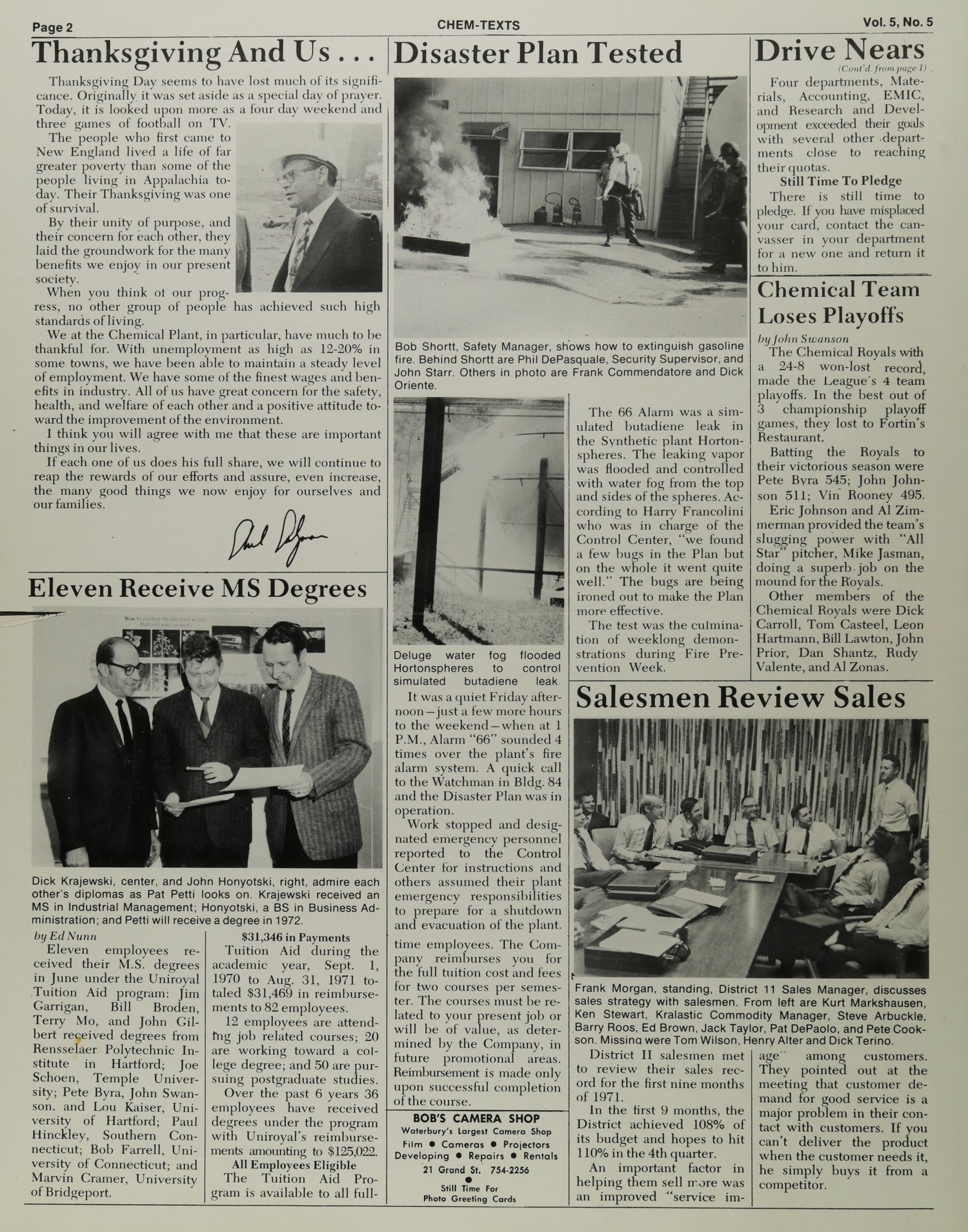
CHEM-TEXTS – unknown-i05-s201

Page 201

CHEM-TEXTS

Page 2 | Vol. 5, No. 5


Thanksgiving And Us…

Thanksgiving Day seems to have lost much of its significance. Originally it was set aside as a special day of prayer. Today, it is looked upon more as a four day weekend and three games of football on TV.

The people who first came to New England lived a life of far greater poverty than some of the people living in Appalachia today. Their Thanksgiving was one of survival.

By their unity of purpose, and their concern for each other, they laid the groundwork for the many benefits we enjoy in our present society.

When you think ot our progress, no other group of people has achieved such high standards of living.

We at the Chemical Plant, in particular, have much to be thankful for. With unemployment as high as 12-20% in some towns, we have been able to maintain a steady level of employment. We have some of the finest wages and benefits in industry. All of us have great concern for the safety, health, and welfare of each other and a positive attitude toward the improvement of the environment.

I think you will agree with me that these are important things in our lives.

If each one of us does his full share, we will continue to reap the rewards of our efforts and assure, even increase, the many good things we now enjoy for ourselves and our families.

[Signature: Paul Lyons]


Eleven Receive MS Degrees

Dick Krajewski, center, and John Honyotski, right, admire each other’s diplomas as Pat Petti looks on. Krajewski received an MS in Industrial Management; Honyotski, a BS in Business Administration; and Petti will receive a degree in 1972.

by Ed Nunn

Eleven employees received their M.S. degrees in June under the Uniroyal Tuition Aid program: Jim Garrigan, Bill Broden, Terry Mo, and John Gilbert received degrees from Rensselaer Polytechnic Institute in Hartford; Joe Schoen, Temple University; Pete Byra, John Swanson, and Lou Kaiser, University of Hartford; Paul Hinckley, Southern Connecticut; Bob Farrell, University of Connecticut; and Marvin Cramer, University of Bridgeport.

$31,346 in Payments

Tuition Aid during the academic year, Sept. 1, 1970 to Aug. 31, 1971 totaled $31,469 in reimbursements to 82 employees.

12 employees are attending job related courses; 20 are working toward a college degree; and 50 are pursuing postgraduate studies.

Over the past 6 years 36 employees have received degrees under the program with Uniroyal’s reimbursements amounting to $125,022.

All Employees Eligible

The Tuition Aid Program is available to all full-time employees. The Company reimburses you for the full tuition cost and fees for two courses per semester. The courses must be related to your present job or will be of value, as determined by the Company, in future promotional areas. Reimbursement is made only upon successful completion of the course.


BOB’S CAMERA SHOP
Waterbury’s Largest Camera Shop
Film ● Cameras ● Projectors
Developing ● Repairs ● Rentals
21 Grand St. 754-2256

Still Time For
Photo Greeting Cards


Disaster Plan Tested

Bob Shortt, Safety Manager, shows how to extinguish gasoline fire. Behind Shortt are Phil DePasquale, Security Supervisor, and John Starr. Others in photo are Frank Commendatore and Dick Oriente.

Deluge water fog flooded Hortonspheres to control simulated butadiene leak

The 66 Alarm was a simulated butadiene leak in the Synthetic plant Hortonspheres. The leaking vapor was flooded and controlled with water fog from the top and sides of the spheres. According to Harry Francolini who was in charge of the Control Center, “we found a few bugs in the Plan but on the whole it went quite well.” The bugs are being ironed out to make the Plan more effective.

The test was the culmination of weeklong demonstrations during Fire Prevention Week.

It was a quiet Friday afternoon—just a few more hours to the weekend—when at 1 P.M., Alarm “66” sounded 4 times over the plant’s fire alarm system. A quick call to the Watchman in Bldg. 84 and the Disaster Plan was in operation.

Work stopped and designated emergency personnel reported to the Control Center for instructions and others assumed their plant emergency responsibilities to prepare for a shutdown and evacuation of the plant.


Drive Nears

(Cont’d. from page 1)

Four departments, Materials, Accounting, EMIC, and Research and Development exceeded their goals with several other departments close to reaching their quotas.

Still Time To Pledge

There is still time to pledge. If you have misplaced your card, contact the canvasser in your department or call any one and return it to him.


Chemical Team Loses Playoffs

by John Swanson

The Chemical Royals with a 24-8 won-lost record, made the League’s 4 team playoffs. In the best out of 3 championship playoff games, they lost to Fortin’s Restaurant.

Batting the Royals to their victorious season were Pete Byra 545; John Johnson 511; Vin Rooney 495.

Eric Johnson and Al Zimmerman provided the team’s slugging power with “All Star” pitcher, Mike Jasman, doing a superb job on the mound for the Royals.

Other members of the Chemical Royals were Dick Carroll, Tom Casteel, Leon Hartmann, Bill Lawton, John Prior, Dan Shantz, Rudy Valente, and Al Zonas.


Salesmen Review Sales

Frank Morgan, standing, District 11 Sales Manager, discusses sales strategy with salesmen. From left are Kurt Markshausen, Ken Stewart, Kralastic Commodity Manager, Steve Arbuckle, Barry Roos, Ed Brown, Jack Taylor, Pat DePaolo, and Pete Cookson. Missing were Tom Wilson, Henry Alter and Dick Terino.

District 11 salesmen met to review their sales record for the first nine months of 1971.

In the first 9 months, the District achieved 108% of its budget and hopes to hit 110% in the 4th quarter.

An important factor in helping them sell more was an improved “service image” among customers. They pointed out at the meeting that customer demand for good service is a major problem in their contact with customers. If you can’t deliver the product when the customer needs it, he simply buys it from a competitor.

CHEM-TEXTS – Vol. No. 7 – Page 2

Page 002

CHEM-TEXTS

Page 2 | Vol. No. 7


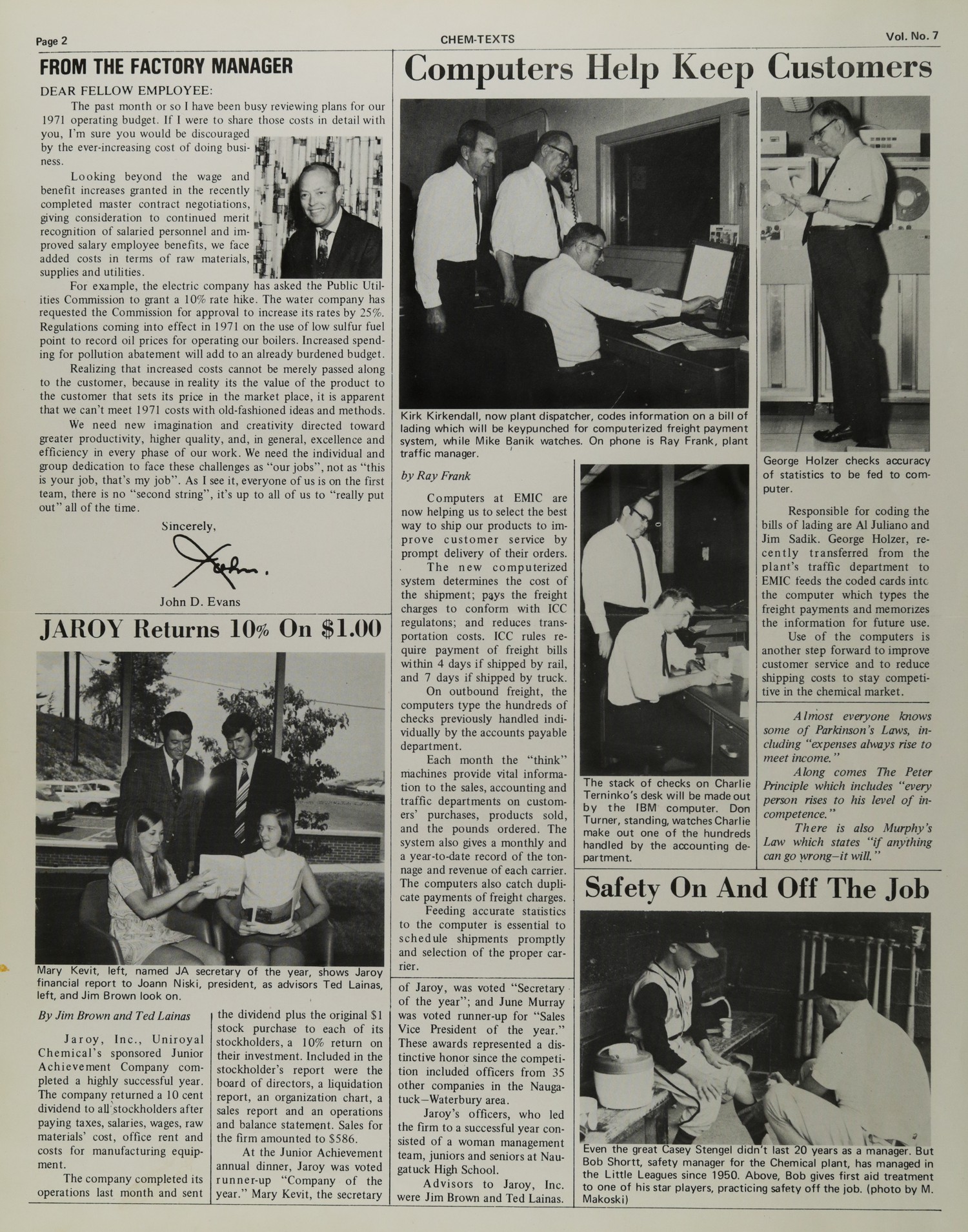
FROM THE FACTORY MANAGER

DEAR FELLOW EMPLOYEE:

The past month or so I have been busy reviewing plans for our 1971 operating budget. If I were to share those costs in detail with you, I’m sure you would be discouraged by the ever-increasing cost of doing business.

Looking beyond the wage and benefit increases granted in the recently completed master contract negotiations, giving consideration to continued merit recognition of salaried personnel and improved salary employee benefits, we face added costs in terms of raw materials, supplies and utilities.

For example, the electric company has asked the Public Utilities Commission to grant a 10% rate hike. The water company has requested the Commission for approval to increase its rates by 25%. Regulations coming into effect in 1971 on the use of low sulfur fuel point to record oil prices for operating our boilers. Increased spending for pollution abatement will add to an already burdened budget.

Realizing that increased costs cannot be merely passed along to the customer, because in reality its the value of the product to the customer that sets its price in the market place, it is apparent that we can’t meet 1971 costs with old-fashioned ideas and methods.

We need new imagination and creativity directed toward greater productivity, higher quality, and, in general, excellence and efficiency in every phase of our work. We need the individual and group dedication to face these challenges as “our jobs”, not as “this is your job, that’s my job”. As I see it, everyone of us is on the first team, there is no “second string”, it’s up to all of us to “really put out” all of the time.

Sincerely,

[Signature]

John D. Evans


JAROY Returns 10% On $1.00

[IMAGE: Photo showing Mary Kevit, left, named JA secretary of the year, shows Jaroy financial report to Joann Niski, president, as advisors Ted Lainas, left, and Jim Brown look on.]

By Jim Brown and Ted Lainas

Jaroy, Inc., Uniroyal Chemical’s sponsored Junior Achievement Company completed a highly successful year. The company returned a 10 cent dividend to all stockholders after paying taxes, salaries, wages, raw materials’ cost, office rent and costs for manufacturing equipment.

The company completed its operations last month and sent the dividend plus the original $1 stock purchase to each of its stockholders, a 10% return on their investment. Included in the stockholder’s report were the board of directors, a liquidation report, an organization chart, a sales report and an operations and balance statement. Sales for the firm amounted to $586.

At the Junior Achievement annual dinner, Jaroy was voted runner-up “Company of the year.” Mary Kevit, the secretary of Jaroy, was voted “Secretary of the year”; and June Murray was voted runner-up for “Sales Vice President of the year.” These awards represented a distinctive honor since the competition included officers from 35 other companies in the Naugatuck–Waterbury area.

Jaroy’s officers, who led the firm to a successful year consisted of a woman management team, juniors and seniors at Naugatuck High School.

Advisors to Jaroy, Inc. were Jim Brown and Ted Lainas.


Computers Help Keep Customers

[IMAGE: Kirk Kirkendall, now plant dispatcher, codes information on a bill of lading which will be keypunched for computerized freight payment system, while Mike Banik watches. On phone is Ray Frank, plant traffic manager.]

by Ray Frank

Computers at EMIC are now helping us to select the best way to ship our products to improve customer service by prompt delivery of their orders.

The new computerized system determines the cost of the shipment; pays the freight charges to conform with ICC regulatons; and reduces transportation costs. ICC rules require payment of freight bills within 4 days if shipped by rail, and 7 days if shipped by truck.

On outbound freight, the computers type the hundreds of checks previously handled individually by the accounts payable department.

Each month the “think” machines provide vital information to the sales, accounting and traffic departments on customers’ purchases, products sold, and the pounds ordered. The system also gives a monthly and a year-to-date record of the tonnage and revenue of each carrier. The computers also catch duplicate payments of freight charges.

Feeding accurate statistics to the computer is essential to schedule shipments promptly and selection of the proper carrier.

[IMAGE: George Holzer checks accuracy of statistics to be fed to computer.]

Responsible for coding the bills of lading are Al Juliano and Jim Sadik. George Holzer, recently transferred from the plant’s traffic department to EMIC feeds the coded cards into the computer which types the freight payments and memorizes the information for future use.

Use of the computers is another step forward to improve customer service and to reduce shipping costs to stay competitive in the chemical market.

[IMAGE: The stack of checks on Charlie Terninko’s desk will be made out by the IBM computer. Don Turner, standing, watches Charlie make out one of the hundreds handled by the accounting department.]

Almost everyone knows some of Parkinson’s Laws, including “expenses always rise to meet income.”

Along comes The Peter Principle which includes “every person rises to his level of incompetence.”

There is also Murphy’s Law which states “if anything can go wrong–it will.”


Safety On And Off The Job

[IMAGE: Even the great Casey Stengel didn’t last 20 years as a manager. But Bob Shortt, safety manager for the Chemical plant, has managed in the Little Leagues since 1950. Above, Bob gives first aid treatment to one of his star players, practicing safety off the job. (photo by M. Makoski)]

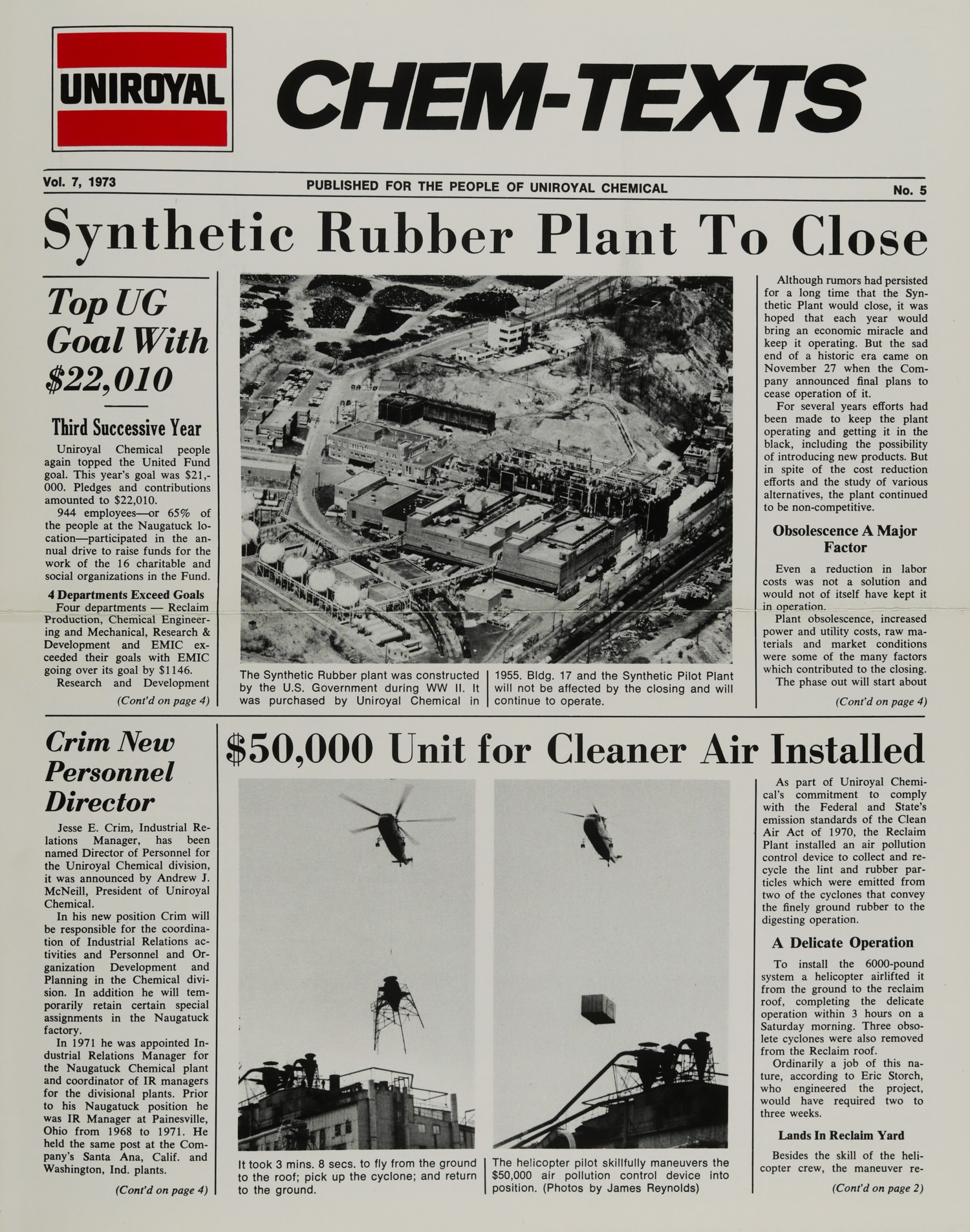
Synthetic Rubber Plant To Close

UNIROYAL CHEM-TEXTS

Vol. 7, 1973 | PUBLISHED FOR THE PEOPLE OF UNIROYAL CHEMICAL | No. 5


Synthetic Rubber Plant To Close


Top UG Goal With $22,010

Third Successive Year

Uniroyal Chemical people again topped the United Fund goal. This year’s goal was $21,000. Pledges and contributions amounted to $22,010.

944 employees—or 65% of the people at the Naugatuck location—participated in the annual drive to raise funds for the work of the 16 charitable and social organizations in the Fund.

4 Departments Exceed Goals

Four departments — Reclaim Production, Chemical Engineering and Mechanical, Research & Development and EMIC exceeded their goals with EMIC going over its goal by $1146.

Research and Development

(Cont’d on page 4)


[CENTER IMAGE CAPTION:]
The Synthetic Rubber plant was constructed by the U.S. Government during WW II. It was purchased by Uniroyal Chemical in 1955. Bldg. 17 and the Synthetic Pilot Plant will not be affected by the closing and will continue to operate.


Although rumors had persisted for a long time that the Synthetic Plant would close, it was hoped that each year would bring an economic miracle and keep it operating. But the sad end of a historic era came on November 27 when the Company announced final plans to cease operation of it.

For several years efforts had been made to keep the plant operating and getting it in the black, including the possibility of introducing new products. But in spite of the cost reduction efforts and the study of various alternatives, the plant continued to be non-competitive.

Obsolescence A Major Factor

Even a reduction in labor costs was not a solution and would not of itself have kept it in operation.

Plant obsolescence, increased power and utility costs, raw materials and market conditions were some of the many factors which contributed to the closing.

The phase out will start about

(Cont’d on page 4)


Crim New Personnel Director

Jesse E. Crim, Industrial Relations Manager, has been named Director of Personnel for the Uniroyal Chemical division, it was announced by Andrew J. McNeill, President of Uniroyal Chemical.

In his new position Crim will be responsible for the coordination of Industrial Relations activities and Personnel and Organization Development and Planning in the Chemical division. In addition he will temporarily retain certain special assignments in the Naugatuck factory.

In 1971 he was appointed Industrial Relations Manager for the Naugatuck Chemical plant and coordinator of IR managers for the divisional plants. Prior to his Naugatuck position he was IR Manager at Painesville, Ohio from 1968 to 1971. He held the same post at the Company’s Santa Ana, Calif. and Washington, Ind. plants.

(Cont’d on page 4)


$50,000 Unit for Cleaner Air Installed

[LEFT IMAGE CAPTION:]
It took 3 mins. 8 secs. to fly from the ground to the roof; pick up the cyclone; and return to the ground.

[RIGHT IMAGE CAPTION:]
The helicopter pilot skillfully maneuvers the $50,000 air pollution control device into position. (Photos by James Reynolds)


As part of Uniroyal Chemical’s commitment to comply with the Federal and State’s emission standards of the Clean Air Act of 1970, the Reclaim Plant installed an air pollution control device to collect and recycle the lint and rubber particles which were emitted from two of the cyclones that convey the finely ground rubber to the digesting operation.

A Delicate Operation

To install the 6000-pound system a helicopter airlifted it from the ground to the reclaim roof, completing the delicate operation within 3 hours on a Saturday morning. Three obsolete cyclones were also removed from the Reclaim roof.

Ordinarily a job of this nature, according to Eric Storch, who engineered the project, would have required two to three weeks.

Lands In Reclaim Yard

Besides the skill of the helicopter crew, the maneuver re-

(Cont’d on page 2)