J. Rzeszutek

Mentioned in 10 documents | Years active: 1968-1979


Source Documents

This profile was generated from 10 archive documents. The following are available on this site:

Bert Scullin

Mentioned in 10 documents | Years active: 1969-1979


Source Documents

This profile was generated from 10 archive documents. The following are available on this site:

David Beretta

Mentioned in 10 documents | Years active: 1970-1979


Source Documents

This profile was generated from 10 archive documents. The following are available on this site:

Robert Breton

Mentioned in 12 documents | Years active: 1970-1979


Source Documents

This profile was generated from 12 archive documents. The following are available on this site:

Daniel Shantz

Mentioned in 13 documents | Years active: 1969-1979


Source Documents

This profile was generated from 13 archive documents. The following are available on this site:

Frank Commendatore

Mentioned in 13 documents | Years active: 1961-1979


Source Documents

This profile was generated from 13 archive documents. The following are available on this site:

Charles Roland

Mentioned in 14 documents | Years active: 1970-1979


Source Documents

This profile was generated from 14 archive documents. The following are available on this site:

Henry Hook

Mentioned in 16 documents | Years active: 1964-1979


Source Documents

This profile was generated from 16 archive documents. The following are available on this site:

Robert Mazaika

Mentioned in 16 documents | Years active: 1973-1980


Source Documents

This profile was generated from 16 archive documents. The following are available on this site:

William Broden

Mentioned in 18 documents | Years active: 1969-1979


Source Documents

This profile was generated from 18 archive documents. The following are available on this site:

William F. Lavelle

Mentioned in 37 documents | Years active: 1968-1980


Source Documents

This profile was generated from 37 archive documents. The following are available on this site:

Eric Johnson

Mentioned in 38 documents | Years active: 1961-1980


Source Documents

This profile was generated from 38 archive documents. The following are available on this site:

CHEM-TEXTS – 1979 – Page No. 2

Page unknown

UNIROYAL CHEM-TEXTS

Vol. 13, 1979 | PUBLISHED FOR THE PEOPLE OF UNIROYAL CHEMICAL | No. 2


Professionalism

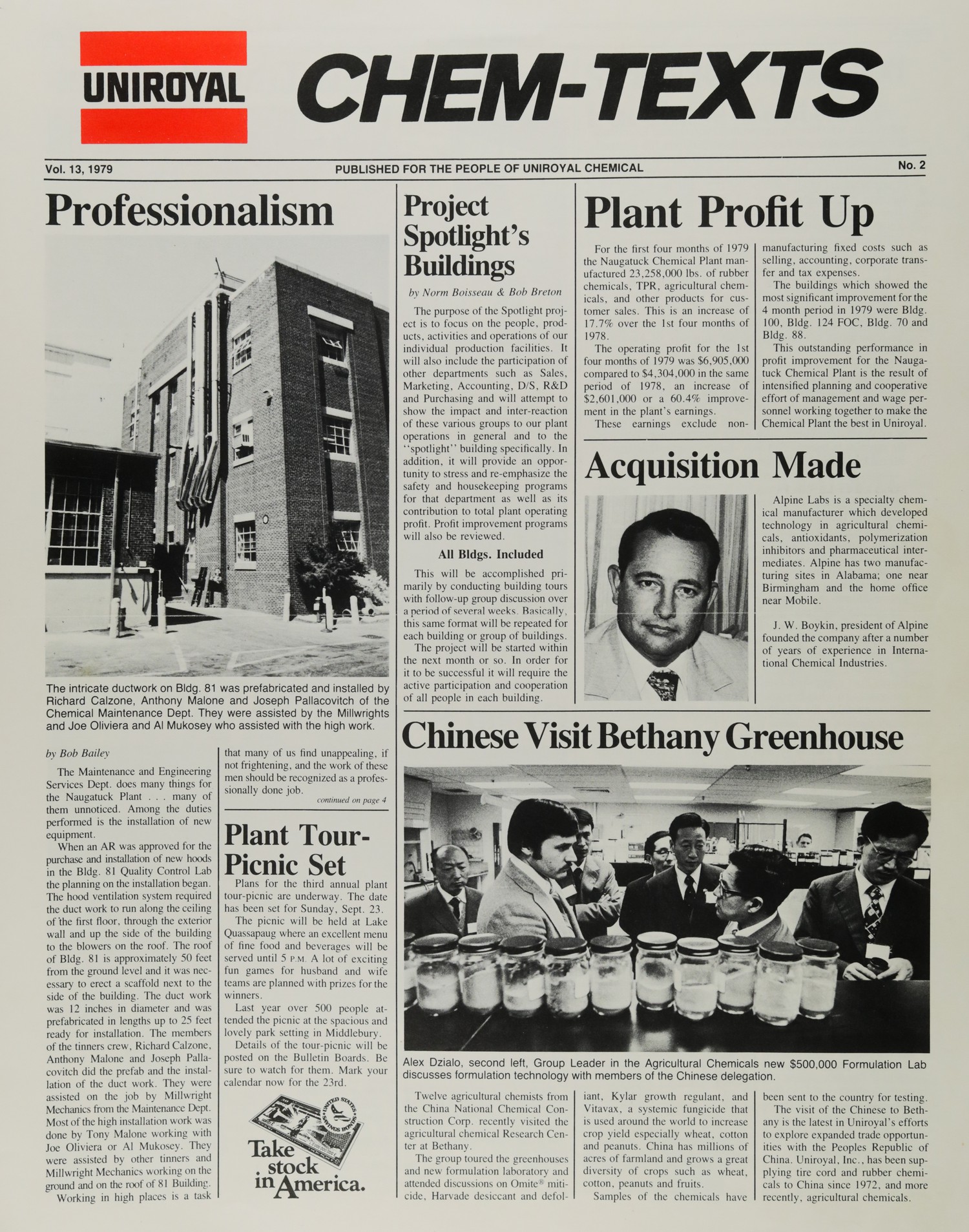
[IMAGE: Black and white photograph of a multi-story building with external ductwork]

The intricate ductwork on Bldg. 81 was prefabricated and installed by Richard Calzone, Anthony Malone and Joseph Pallacovitch of the Chemical Maintenance Dept. They were assisted by the Millwrights and Joe Oliviera and Al Mukosey who assisted with the high work.

by Bob Bailey

The Maintenance and Engineering Services Dept. does many things for the Naugatuck Plant . . . many of them unnoticed. Among the duties performed is the installation of new equipment.

When an AR was approved for the purchase and installation of new hoods in the Bldg. 81 Quality Control Lab the planning on the installation began. The hood ventilation system required the duct work to run along the ceiling of the first floor, through the exterior wall and up the side of the building to the blowers on the roof. The roof of Bldg. 81 is approximately 50 feet from the ground level and it was necessary to erect a scaffold next to the side of the building. The duct work was 12 inches in diameter and was prefabricated in lengths up to 25 feet ready for installation. The members of the tinners crew, Richard Calzone, Anthony Malone and Joseph Pallacovitch did the prefab and the installation of the duct work. They were assisted on the job by Millwright Mechanics from the Maintenance Dept. Most of the high installation work was done by Tony Malone working with Joe Oliviera or Al Mukosey. They were assisted by other tinners and Millwright Mechanics working on the ground and on the roof of 81 Building.

Working in high places is a task that many of us find unappealing, if not frightening, and the work of these men should be recognized as a professionally done job.

continued on page 4


Project Spotlight’s Buildings

by Norm Boisseau & Bob Breton

The purpose of the Spotlight project is to focus on the people, products, activities and operations of our individual production facilities. It will also include the participation of other departments such as Sales, Marketing, Accounting, D/S, R&D and Purchasing and will attempt to show the impact and inter-reaction of these various groups to our plant operations in general and to the “spotlight” building specifically. In addition, it will provide an opportunity to stress and re-emphasize the safety and housekeeping programs for that department as well as its contribution to total plant operating profit. Profit improvement programs will also be reviewed.

All Bldgs. Included

This will be accomplished primarily by conducting building tours with follow-up group discussion over a period of several weeks. Basically, this same format will be repeated for each building or group of buildings.

The project will be started within the next month or so. In order for it to be successful it will require the active participation and cooperation of all people in each building.


Plant Tour-Picnic Set

Plans for the third annual plant tour-picnic are underway. The date has been set for Sunday, Sept. 23.

The picnic will be held at Lake Quassapaug where an excellent menu of fine food and beverages will be served until 5 P.M. A lot of exciting fun games for husband and wife teams are planned with prizes for the winners.

Last year over 500 people attended the picnic at the spacious and lovely park setting in Middlebury.

Details of the tour-picnic will be posted on the Bulletin Boards. Be sure to watch for them. Mark your calendar now for the 23rd.

[IMAGE: Small graphic showing “Take stock in America.”]


Plant Profit Up

For the first four months of 1979 the Naugatuck Chemical Plant manufactured 23,258,000 lbs. of rubber chemicals, TPR, agricultural chemicals, and other products for customer sales. This is an increase of 17.7% over the 1st four months of 1978.

The operating profit for the 1st four months of 1979 was $6,905,000 compared to $4,304,000 in the same period of 1978, an increase of $2,601,000 or a 60.4% improvement in the plant’s earnings.

These earnings exclude non-manufacturing fixed costs such as selling, accounting, corporate transfer and tax expenses.

The buildings which showed the most significant improvement for the 4 month period in 1979 were Bldg. 100, Bldg. 124 FOC, Bldg. 70 and Bldg. 88.

This outstanding performance in profit improvement for the Naugatuck Chemical Plant is the result of intensified planning and cooperative effort of management and wage personnel working together to make the Chemical Plant the best in Uniroyal.


Acquisition Made

[IMAGE: Black and white portrait photograph of a man in business attire]

Alpine Labs is a specialty chemical manufacturer which developed technology in agricultural chemicals, antioxidants, polymerization inhibitors and pharmaceutical intermediates. Alpine has two manufacturing sites in Alabama; one near Birmingham and the home office near Mobile.

J. W. Boykin, president of Alpine founded the company after a number of years of experience in International Chemical Industries.


Chinese Visit Bethany Greenhouse

[IMAGE: Black and white photograph showing several people seated at a table in discussion]

Alex Dzialo, second left, Group Leader in the Agricultural Chemicals new $500,000 Formulation Lab discusses formulation technology with members of the Chinese delegation.

Twelve agricultural chemists from the China National Chemical Construction Corp. recently visited the agricultural chemical Research Center at Bethany.

The group toured the greenhouses and new formulation laboratory and attended discussions on Omite® miticide, Harvade desiccant and defoliant, Kylar growth regulant, and Vitavax, a systemic fungicide that is used around the world to increase crop yield especially wheat, cotton and peanuts. China has millions of acres of farmland and grows a great diversity of crops such as wheat, cotton, peanuts and fruits.

Samples of the chemicals have been sent to the country for testing.

The visit of the Chinese to Bethany is the latest in Uniroyal’s efforts to explore expanded trade opportunities with the Peoples Republic of China. Uniroyal, Inc., has been supplying tire cord and rubber chemicals to China since 1972, and more recently, agricultural chemicals.

CHEM-TEXTS – 1979-v13-i03-s272

Page 272

UNIROYAL CHEM-TEXTS

Vol. 13, 1979 | PUBLISHED FOR THE PEOPLE OF UNIROYAL CHEMICAL | No. 3


Gov. Grasso Attends the 75th Anniversary of Chemical Plant

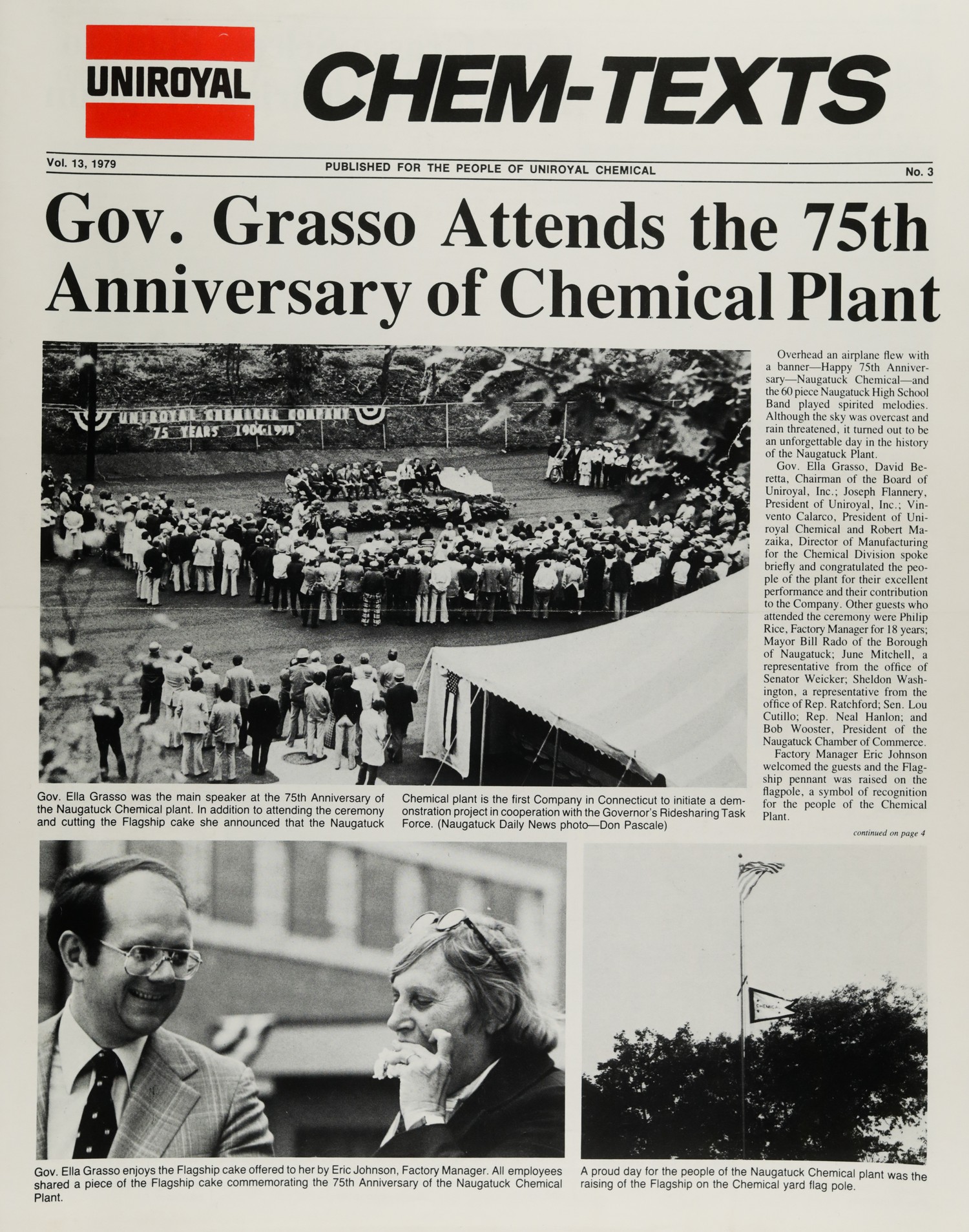
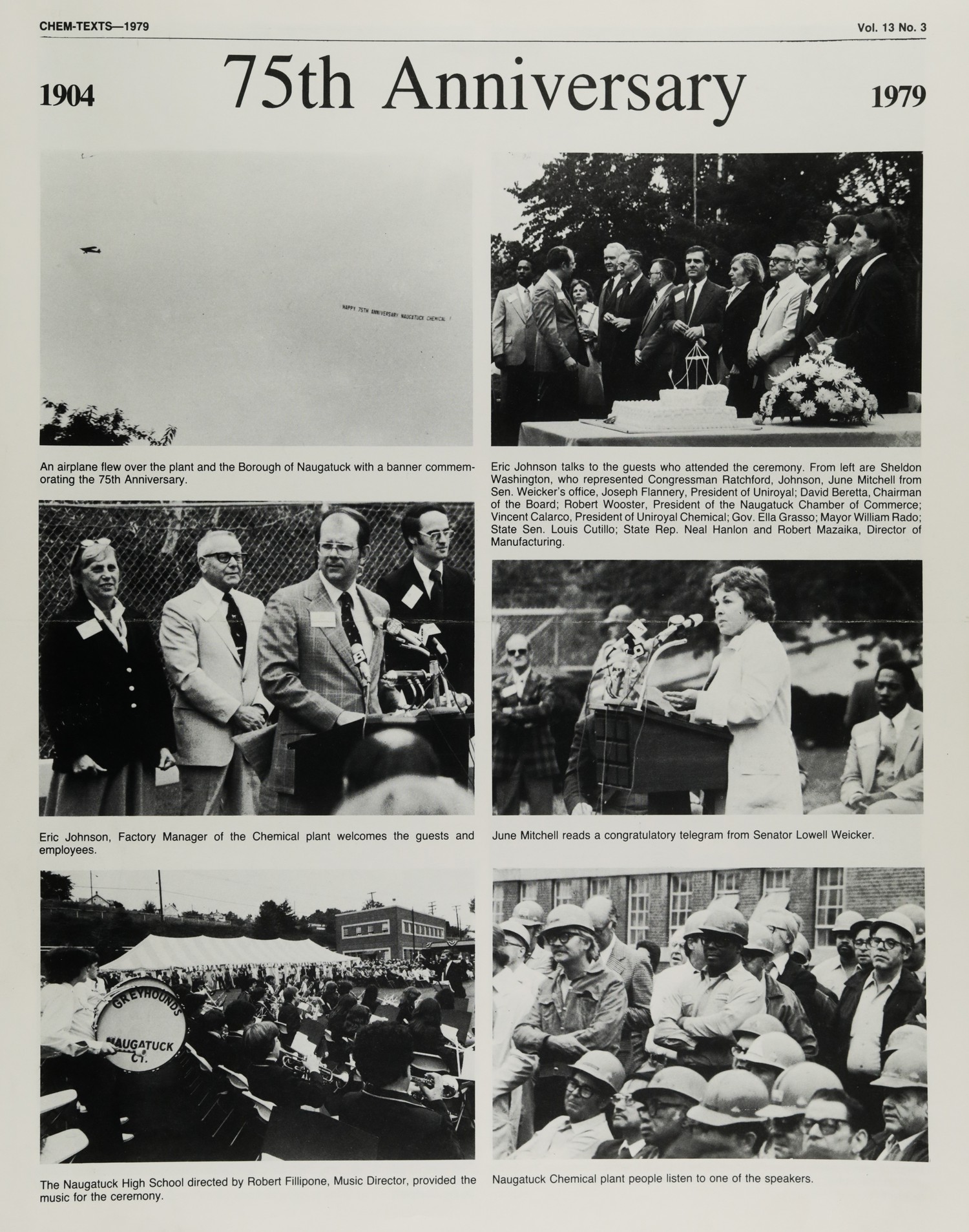
Overhead an airplane flew with a banner—Happy 75th Anniversary—Naugatuck Chemical—and the 60 piece Naugatuck High School Band played spirited melodies. Although the sky was overcast and rain threatened, it turned out to be an unforgettable day in the history of the Naugatuck Plant.

Gov. Ella Grasso, David Beretta, Chairman of the Board of Uniroyal, Inc.; Joseph Flannery, President of Uniroyal, Inc.; Vincento Calarco, President of Uniroyal Chemical and Robert Mazaika, Director of Manufacturing for the Chemical Division spoke briefly and congratulated the people of the plant for their excellent performance and their contribution to the Company. Other guests who attended the ceremony were Philip Rice, Factory Manager for 18 years; Mayor Bill Rado of the Borough of Naugatuck; June Mitchell, a representative from the office of Senator Weicker; Sheldon Washington, a representative from the office of Rep. Ratchford; Sen. Lou Cutillo; Rep. Neal Hanlon; and Bob Wooster, President of the Naugatuck Chamber of Commerce.

Factory Manager Eric Johnson welcomed the guests and the Flagship pennant was raised on the flagpole, a symbol of recognition for the people of the Chemical Plant.

continued on page 4


[MAIN PHOTO CAPTION]
Gov. Ella Grasso was the main speaker at the 75th Anniversary of the Naugatuck Chemical plant. In addition to attending the ceremony and cutting the Flagship cake she announced that the Naugatuck Chemical plant is the first Company in Connecticut to initiate a demonstration project in cooperation with the Governor’s Ridesharing Task Force. (Naugatuck Daily News photo—Don Pascale)


[BOTTOM LEFT PHOTO CAPTION]
Gov. Ella Grasso enjoys the Flagship cake offered to her by Eric Johnson, Factory Manager. All employees shared a piece of the Flagship cake commemorating the 75th Anniversary of the Naugatuck Chemical Plant.


[BOTTOM RIGHT PHOTO CAPTION]
A proud day for the people of the Naugatuck Chemical plant was the raising of the Flagship on the Chemical yard flag pole.

CHEM-TEXTS – 1979 – Page No. 1

Page unknown

UNIROYAL CHEM-TEXTS

Vol. 13, 1979 | PUBLISHED FOR THE PEOPLE OF UNIROYAL CHEMICAL | No. 1


Equality Policy Affirmed

The Uniroyal Chemical plant has a firm commitment to offer equal opportunity to all employees. It is the policy of the plant’s management to support and implement this commitment continually.

This policy requires that all recruiting, hiring, transfers, promotions, compensation, benefits, and company-sponsored training, education and tuition assistance, as well as social, recreational and health programs and lay-off and recall practices are followed and carried out without regard to race, color, creed, religion, sex, national origin, or handicap of any individual person.

J. Robert Douglas, the Industrial Relations Manager for the Naugatuck plant is the Compliance Officer and has the responsibility for implementing this policy; monitoring the Uniroyal Chemical Affirmative Action Compliance Program; and reporting to management the program’s progress.

The responsibility for the improvement of the program and the positive results of it rests with each Manager, Foreman, and Supervisor as an integral part of their job.


$500.00 Scholarship Offered

The Uniroyal Chemical Management Club is again offering a $500 scholarship award. Fifty dollars of the scholarship comes from the Larry Monroe Fund.

The scholarship is available to a graduating high school student who plans a college education. To qualify, one of the student’s parents must have worked for Uniroyal Chemical at Naugatuck or Bethany for two years or more and be an active employee. The fund is supported by the dues of the club’s members.

Applications for the scholarship may be obtained from the Industrial Relations Department or by a telephone call to Constance Antrum, Ext. 3217.

April 20, Final Date

The application must be returned to William Broden, Chair-
Continued on page 4


$614,000 AR Okayed for Plant

A major Appropriations Request (AR) of $614,000 has been approved for equipment additions to Building 124 (FOC) to produce Naugacel SD-1.

The direction of this major project will be the responsibility of the Naugatuck Plant’s Technical Department.

Naugacel SD-1 represents a new product to be manufactured in Chemical Production. It has already been successfully run in both the R. & D. Development Lab and the Chemical Pilot Plant.

Used in Tires

Naugacel SD-1 is a sulfur donor accelerator for use in the vulcanization of natural and synthetic rubber and is utilized primarily in tires and mechanical goods.

Continued on page 4


MAP Plan Saves $27,358

Cuts Time in Half

By Vic Alves

When it was decided that major repairs would be required on the PR-03 vessel in the FOC plant (Bldg. 124), original repair estimates indicated that it would take 17 days of Maintenance Dept. work to complete the necessary repairs.

A Management Action Plan (MAP) was then written to plan the work and coordinate these repairs. As a result of this action plan it was determined that the repairs could be completed in 10 days instead of the estimated 17 days. Through the combined efforts and cooperation of the Maintenance and Manufacturing Departments, the required repairs were made and the work was completed in 8 days.

Naugard Schedule Met

Because of this earlier turnaround, Bldg. 124 was able to finish its scheduled Naugard 445 production; perform a changeover; begin LVBI production on schedule; and meet the production schedule.

$27,358 Saved

Based on conversion costs it is estimated that $27,358 was saved
Continued on page 4


1978 Sales Improve; Chemical Hits High

The Company sales in the 4th quarter of 1978 were $728 million compared with $626 million in the 4th quarter of 1977.

The operating profit was $38 million in 1978 versus $20 million in 1977. Net income was $3.1 million, or 7¢ a common share, compared with a loss of $2.2 million in the 4th quarter of 1977.

Sales for 1978 were $2.74 billion, up from $2.58 billion in 1977. Net income for the year was $5.9 million, or 4 cents a share, compared with 1977 net income of $34.1 million or $1.10 a common share.

Preferred Dividend Paid

The Board of Directors declared $6 in dividends on the preferred stock, applicable to 1978 net income. With the $2 declared and paid in the second half of 1978, this amounted to the full dividend on the preferred stock for 1978.


Tire and Related Products

Sales in the Tire and Related Products were $435 million in the 4th quarter of 1978, compared with $371 million in the 4th quarter of 1977. For the year, sales were $1.575 billion against $1.489 billion in 1977.

Operating profit for 1978 was $55.1 million, compared with $77.1 million in 1977.


Chemical Sets Record

The Chemical, Rubber and Plastic Materials had sales of $106 million in the 4th quarter of 1978, up from $83 million in 1977.

For the year, sales were a record $443 million while 1977 sales were $391 million. Operating profits were a record $71.5 million, up from $57.6 million in 1977.
Continued on page 4


Special Bulletin

The Naugatuck Chemical Plant won a Nationwide Award for Hazardous Waste Control of the 1979 National Environmental Industry Awards Program.

The program is co-sponsored by the President’s Council on Environmental Quality and the Environmental Industry Council.

The Council presented the award on February 28th at the Mayflower Hotel in Washington, D.C.

In two years over $250,000 has been saved by burning the nonenes waste.


Octamine P Now Made in Plant

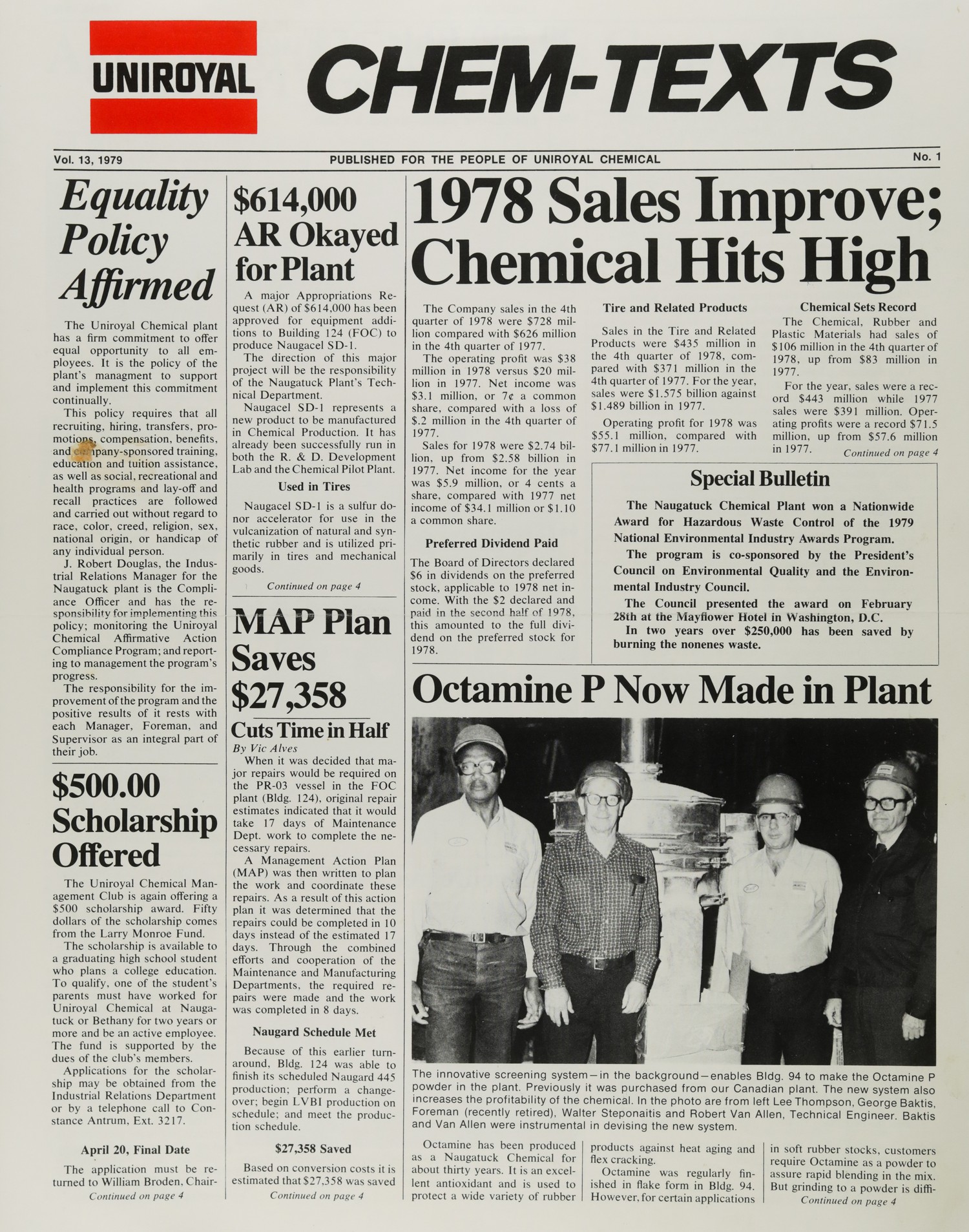
The innovative screening system—in the background—enables Bldg. 94 to make the Octamine P powder in the plant. Previously it was purchased from our Canadian plant. The new system also increases the profitability of the chemical. In the photo are from left Lee Thompson, George Baktis, Foreman (recently retired), Walter Steponaitis and Robert Van Allen, Technical Engineer. Baktis and Van Allen were instrumental in devising the new system.


Octamine has been produced as a Naugatuck Chemical for about thirty years. It is an excellent antioxidant and is used to protect a wide variety of rubber products against heat aging and flex cracking.

Octamine was regularly finished in flake form in Bldg. 94. However, for certain applications in soft rubber stocks, customers require Octamine as a powder to assure rapid blending in the mix. But grinding to a powder is diffi-
Continued on page 4

CHEM-TEXTS – 1979 – Page 4

Page 004

CHEM-TEXTS

Page 4 | Vol. 13, 1979


Recent Retirements

[PHOTO: Group photo of retirees]

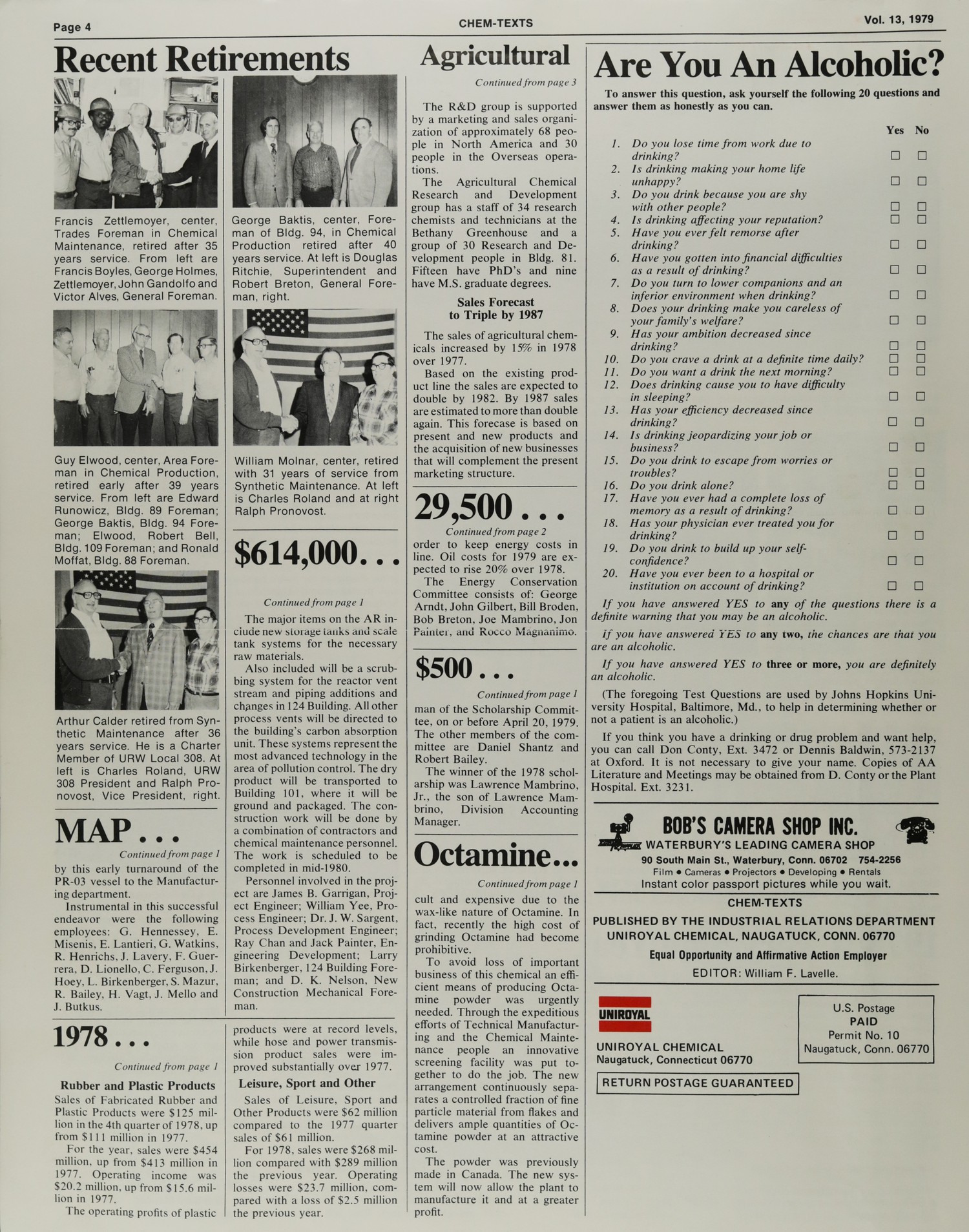
Francis Zettlemoyer, center, Trades Foreman in Chemical Maintenance, retired after 35 years service. From left are Francis Boyles, George Holmes, Zettlemoyer, John Gandolfo and Victor Alves, General Foreman.

[PHOTO: Group photo of retirees]

Guy Elwood, center, Area Foreman in Chemical Production, retired early after 39 years service. From left are Edward Runowicz, Bldg. 89 Foreman; George Baktis, Bldg. 94 Foreman; Elwood, Robert Bell, Bldg. 109 Foreman; and Ronald Moffat, Bldg. 88 Foreman.

[PHOTO: Group photo]

Arthur Calder retired from Synthetic Maintenance after 36 years service. He is a Charter Member of URW Local 308. At left is Charles Roland, URW 308 President and Ralph Pronovost, Vice President, right.


George Baktis, center, Foreman of Bldg. 94, in Chemical Production retired after 40 years service. At left is Douglas Ritchie, Superintendent and Robert Breton, General Foreman, right.

[PHOTO: Group photo]

William Molnar, center, retired with 31 years of service from Synthetic Maintenance. At left is Charles Roland and at right Ralph Pronovost.


MAP…

Continued from page 1

by this early turnaround of the PR-03 vessel to the Manufacturing department.

Instrumental in this successful endeavor were the following employees: G. Hennessey, E. Misenis, E. Lantieri, G. Watkins, R. Henrichs, J. Lavery, F. Guerrera, D. Lionello, C. Ferguson, J. Hoey, L. Birkenberger, S. Mazur, R. Bailey, H. Vagt, J. Mello and J. Butkus.


1978…

Continued from page 1

Rubber and Plastic Products
Sales of Fabricated Rubber and Plastic Products were $125 million in the 4th quarter of 1978, up from $111 million in 1977.

For the year, sales were $454 million, up from $413 million in 1977. Operating income was $20.2 million, up from $15.6 million in 1977.

The operating profits of plastic products were at record levels, while hose and power transmission product sales were improved substantially over 1977.

Leisure, Sport and Other
Sales of Leisure, Sport and Other Products were $62 million compared to the 1977 quarter sales of $61 million.

For 1978, sales were $268 million compared with $289 million the previous year. Operating losses were $23.7 million, compared with a loss of $2.5 million the previous year.


Agricultural

Continued from page 3

The R&D group is supported by a marketing and sales organization of approximately 68 people in North America and 30 people in the Overseas operations.

The Agricultural Chemical Research and Development group has a staff of 34 research chemists and technicians at the Bethany Greenhouse and a group of 30 Research and Development people in Bldg. 81. Fifteen have PhD’s and nine have M.S. graduate degrees.

Sales Forecast to Triple by 1987

The sales of agricultural chemicals increased by 15% in 1978 over 1977.

Based on the existing product line the sales are expected to double by 1982. By 1987 sales are estimated to more than double again. This forecase is based on present and new products and the acquisition of new businesses that will complement the present marketing structure.


29,500…

Continued from page 2

$614,000…

Continued from page 1

The major items on the AR include new storage tanks and scale tank systems for the necessary raw materials.

Also included will be a scrubbing system for the reactor vent stream and piping additions and changes in 124 Building. All other process vents will be directed to the building’s carbon absorption unit. These systems represent the most advanced technology in the area of pollution control. The dry product will be transported to Building 101, where it will be ground and packaged. The construction work will be done by a combination of contractors and chemical maintenance personnel. The work is scheduled to be completed in mid-1980.

Personnel involved in the project are James B. Garrigan, Project Engineer; William Yee, Process Engineer; Dr. J. W. Sargent, Process Development Engineer; Ray Chan and Jack Painter, Engineering Development; Larry Birkenberger, 124 Building Foreman; and D. K. Nelson, New Construction Mechanical Foreman.

order to keep energy costs in line. Oil costs for 1979 are expected to rise 20% over 1978. The Energy Conservation Committee consists of: George Arndt, John Gilbert, Bill Broden, Bob Breton, Joe Mambrino, Jon Painter, and Rocco Magnanimo.


$500…

Continued from page 1

man of the Scholarship Committee, on or before April 20, 1979. The other members of the committee are Daniel Shantz and Robert Bailey.

The winner of the 1978 scholarship was Lawrence Mambrino, Jr., the son of Lawrence Mambrino, Division Accounting Manager.


Octamine…

Continued from page 1

cult and expensive due to the wax-like nature of Octamine. In fact, recently the high cost of grinding Octamine had become prohibitive.

To avoid loss of important business of this chemical an efficient means of producing Octamine powder was urgently needed. Through the expeditious efforts of Technical Manufacturing and the Chemical Maintenance people an innovative screening facility was put together to do the job. The new arrangement continuously separates a controlled fraction of fine particle material from flakes and delivers ample quantities of Octamine powder at an attractive cost.

The powder was previously made in Canada. The new system will now allow the plant to manufacture it and at a greater profit.


Are You An Alcoholic?

To answer this question, ask yourself the following 20 questions and answer them as honestly as you can.

Yes No
1. Do you lose time from work due to drinking?
2. Is drinking making your home life unhappy?
3. Do you drink because you are shy with other people?
4. Is drinking affecting your reputation?
5. Have you ever felt remorse after drinking?
6. Have you gotten into financial difficulties as a result of drinking?
7. Do you turn to lower companions and an inferior environment when drinking?
8. Does your drinking make you careless of your family’s welfare?
9. Has your ambition decreased since drinking?
10. Do you crave a drink at a definite time daily?
11. Do you want a drink the next morning?
12. Does drinking cause you to have difficulty in sleeping?
13. Has your efficiency decreased since drinking?
14. Is drinking jeopardizing your job or business?
15. Do you drink to escape from worries or troubles?
16. Do you drink alone?
17. Have you ever had a complete loss of memory as a result of drinking?
18. Has your physician ever treated you for drinking?
19. Do you drink to build up your self-confidence?
20. Have you ever been to a hospital or institution on account of drinking?

If you have answered YES to any of the questions there is a definite warning that you may be an alcoholic.

if you have answered YES to any two, the chances are that you are an alcoholic.

If you have answered YES to three or more, you are definitely an alcoholic.

(The foregoing Test Questions are used by Johns Hopkins University Hospital, Baltimore, Md., to help in determining whether or not a patient is an alcoholic.)

If you think you have a drinking or drug problem and want help, you can call Don Conty, Ext. 3472 or Dennis Baldwin, 573-2137 at Oxford. It is not necessary to give your name. Copies of AA Literature and Meetings may be obtained from D. Conty or the Plant Hospital. Ext. 3231.


BOB’S CAMERA SHOP INC.

WATERBURY’S LEADING CAMERA SHOP
90 South Main St., Waterbury, Conn. 06702 754-2256
Film • Cameras • Projectors • Developing • Rentals
Instant color passport pictures while you wait.


CHEM-TEXTS
PUBLISHED BY THE INDUSTRIAL RELATIONS DEPARTMENT
UNIROYAL CHEMICAL, NAUGATUCK, CONN. 06770
Equal Opportunity and Affirmative Action Employer
EDITOR: William F. Lavelle.


[MAILING LABEL AREA]

UNIROYAL | U.S. Postage PAID Permit No. 10 Naugatuck, Conn. 06770

UNIROYAL CHEMICAL
Naugatuck, Connecticut 06770

RETURN POSTAGE GUARANTEED

CHEM-TEXTS – 1979 – Page 3

Page 003

CHEM-TEXTS

Vol. 13, 1979 | Page 3


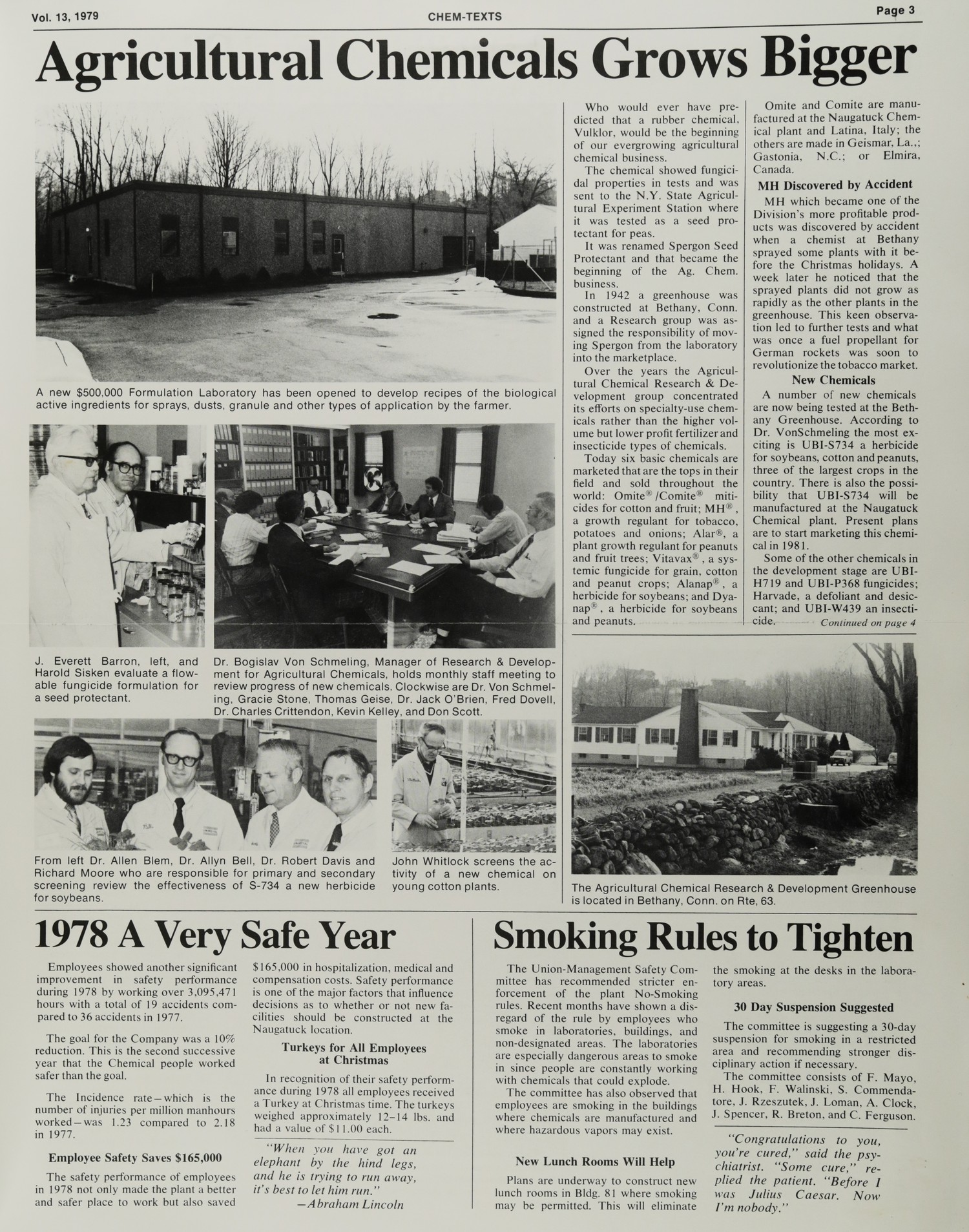
Agricultural Chemicals Grows Bigger

A new $500,000 Formulation Laboratory has been opened to develop recipes of the biological active ingredients for sprays, dusts, granule and other types of application by the farmer.

J. Everett Barron, left, and Harold Sisken evaluate a flowable fungicide formulation for a seed protectant.

Dr. Bogislav Von Schmeling, Manager of Research & Development for Agricultural Chemicals, holds monthly staff meeting to review progress of new chemicals. Clockwise are Dr. Von Schmeling, Gracie Stone, Thomas Geise, Dr. Jack O’Brien, Fred Dovell, Dr. Charles Crittendon, Kevin Kelley, and Don Scott.

From left Dr. Allen Blem, Dr. Allyn Bell, Dr. Robert Davis and Richard Moore who are responsible for primary and secondary screening review the effectiveness of S-734 a new herbicide for soybeans.

John Whitlock screens the activity of a new chemical on young cotton plants.

The Agricultural Chemical Research & Development Greenhouse is located in Bethany, Conn. on Rte. 63.


Who would ever have predicted that a rubber chemical, Vulklor, would be the beginning of our evergrowing agricultural chemical business.

The chemical showed fungicidal properties in tests and was sent to the N.Y. State Agricultural Experiment Station where it was tested as a seed protectant for peas.

It was renamed Spergon Seed Protectant and that became the beginning of the Ag. Chem. business.

In 1942 a greenhouse was constructed at Bethany, Conn. and a Research group was assigned the responsibility of moving Spergon from the laboratory into the marketplace.

Over the years the Agricultural Chemical Research & Development group concentrated its efforts on specialty-use chemicals rather than the higher volume but lower profit fertilizer and insecticide types of chemicals.

Today six basic chemicals are marketed that are the tops in their field and sold throughout the world: Omite® /Comite® miticides for cotton and fruit; MH®, a growth regulant for tobacco, potatoes and onions; Alar®, a plant growth regulant for peanuts and fruit trees; Vitavax®, a systemic fungicide for grain, cotton and peanut crops; Alanap®, a herbicide for soybeans; and Dyanap®, a herbicide for soybeans and peanuts.

Omite and Comite are manufactured at the Naugatuck Chemical plant and Latina, Italy; the others are made in Geismar, La.,; Gastonia, N.C.; or Elmira, Canada.

MH Discovered by Accident

MH which became one of the Division’s more profitable products was discovered by accident when a chemist at Bethany sprayed some plants with it before the Christmas holidays. A week later he noticed that the sprayed plants did not grow as rapidly as the other plants in the greenhouse. This keen observation led to further tests and what was once a fuel propellant for German rockets was soon to revolutionize the tobacco market.

New Chemicals

A number of new chemicals are now being tested at the Bethany Greenhouse. According to Dr. VonSchmeling the most exciting is UBI-S734 a herbicide for soybeans, cotton and peanuts, three of the largest crops in the country. There is also the possibility that UBI-S734 will be manufactured at the Naugatuck Chemical plant. Present plans are to start marketing this chemical in 1981.

Some of the other chemicals in the development stage are UBI-H719 and UBI-P368 fungicides; Harvade, a defoliant and desiccant; and UBI-W439 an insecticide.

Continued on page 4


1978 A Very Safe Year

Employees showed another significant improvement in safety performance during 1978 by working over 3,095,471 hours with a total of 19 accidents compared to 36 accidents in 1977.

The goal for the Company was a 10% reduction. This is the second successive year that the Chemical people worked safer than the goal.

The Incidence rate—which is the number of injuries per million manhours worked—was 1.23 compared to 2.18 in 1977.

Employee Safety Saves $165,000

The safety performance of employees in 1978 not only made the plant a better and safer place to work but also saved $165,000 in hospitalization, medical and compensation costs. Safety performance is one of the major factors that influence decisions as to whether or not new facilities should be constructed at the Naugatuck location.

Turkeys for All Employees at Christmas

In recognition of their safety performance during 1978 all employees received a Turkey at Christmas time. The turkeys weighed approximately 12-14 lbs. and had a value of $11.00 each.

“When you have got an elephant by the hind legs, and he is trying to run away, it’s best to let him run.”
—Abraham Lincoln


Smoking Rules to Tighten

The Union-Management Safety Committee has recommended stricter enforcement of the plant No-Smoking rules. Recent months have shown a disregard of the rule by employees who smoke in laboratories, buildings, and non-designated areas. The laboratories are especially dangerous areas to smoke in since people are constantly working with chemicals that could explode.

The committee has also observed that employees are smoking in the buildings where chemicals are manufactured and where hazardous vapors may exist.

New Lunch Rooms Will Help

Plans are underway to construct new lunch rooms in Bldg. 81 where smoking may be permitted. This will eliminate the smoking at the desks in the laboratory areas.

30 Day Suspension Suggested

The committee is suggesting a 30-day suspension for smoking in a restricted area and recommending stronger disciplinary action if necessary.

The committee consists of F. Mayo, H. Hook, F. Walinski, S. Commendatore, J. Rzeszutek, J. Loman, A. Clock, J. Spencer, R. Breton, and C. Ferguson.

“Congratulations to you, you’re cured,” said the psychiatrist. “Some cure,” replied the patient. “Before I was Julius Caesar. Now I’m nobody.”

CHEM-TEXTS – 1979-v13-s285

Page 285

CHEM-TEXTS

Page 2 | Vol. 13, 1979


1978 was a Good Year . . .

You and I know our Company is starting to generate an upward momentum as illustrated by the outstanding performance of the Naugatuck Plant and the Chemical Company in 1978. The Chemical Company profits exceeded all expectations last year and our Plant’s gross operating profit increased 58%.

This outstanding achievement is the result of your efforts whether you are in Manufacturing, Research and Development, Accounting, D&S, the Service Departments, or Marketing.

Our plant’s goal is to have a 30% plant operating profit that would result in a 9% return on sales. This year our objective is to increase the return on sales from 3 to 4.5%.

How do we expect to achieve our profitability objective? The answer to this question is reflected in the achievements of last year.

In the Maintenance Department an outstanding job was performed in reducing equipment downtime from 8.9 to 7.5%. Their 1979 goal is 6% and January was an excellent start with downtime averaging 4.5%.

Manufacturing set productivity records in the production of Rubber Chemicals, Agricultural Chemicals, and Thermoplastics. Omite, LVBI, Tonox, and TPR productivities increased between 20 and 30% while PANA and Naugard 445 improved by 66%. Also a reduction in Roylar changeovers was achieved through better coordination and communications. In addition, Comite, Octamine P, Celogen RA, and Polygard I were successfully produced in the Plant. All these achievements resulted in increasing our plant’s profit by 1.6 million dollars.

Our Industrial Relations Department was reorganized and is more effective in serving our needs. Safety Goals were far exceeded with 1.2 incidence rate and Workmen’s Compensation costs were reduced by $165,000. A new performance appraisal system was initiated and a training session held to help managers conduct performance appraisals with their people.

A Controllers Department was established to perform financial reporting, budgeting, forecasting, and economic analysis; to expedite approvals of Appropriation Requests; and to identify areas of profit improvement.

The Technical Department now includes all engineering functions: process, project, environmental, and industrial engineering. 2.3 million dollars of profit improvement was realized through developing a team effort with the plant, R & D, and marketing. This year a similar amount is expected through Project Enterprise, the name of our 1979 Profit Improvement Program. Over $300,000 was saved through the work of the Plant’s Energy Committee. Other contributions by the Technical Department included the productivity records set in Rubber Chemicals and Omite as well as the successful production of Comite, Octamine P, Celogen RA, and Polygard I.

In the Material Flow Department transportation credits exceeded budget by $13,000. An additional $532,000 was saved through improved transportation of our finished goods. Shipping and receiving increased productivity by 7% and improved the services on export shipments. The Purchasing Department and Control Center reduced our inventory levels thereby increasing our return on assets. Purchasing savings and cost avoidance programs exceeded expectations by $400,000 dollars.

A major objective is to improve the utilization of our plant by introducing new products in our existing facilities or attracting new manufacturing facilities because our resources are underutilized. For example, we are using only 50% of our steam generation and waste water treatment capacities while Rubber Chemicals is budgeted to operate only between 60-65% of capacity this year. If Rubber Chemical production operated at 90% of capacity, our plant’s operating profit would increase to approximately 27%. On some recent data it appears that a 10% selling price increase would have the same impact as a 30% cost reduction.

1978 was a year of change and accomplishment. We have the reputation of managing our business. Naugatuck seeks change. We are determined to overcome our geographical raw material disadvantage through PROFESSIONAL EXCELLENCE in every assignment and job that is performed.

In 1979 Naugatuck will be a Better Place To Be and soon the Best Place To Be.

Eric Johnson

Eric Johnson
Factory Manager


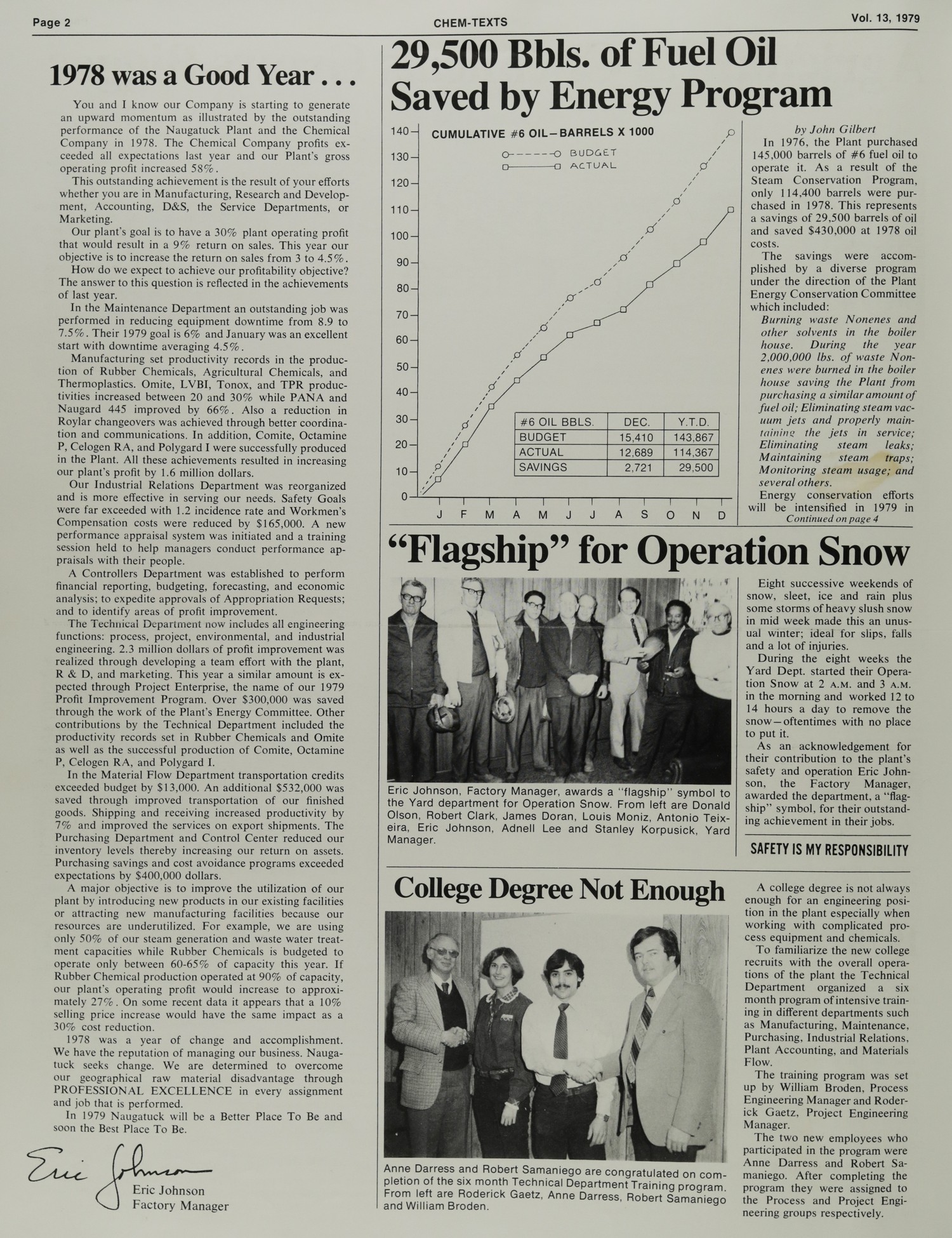
29,500 Bbls. of Fuel Oil Saved by Energy Program

CUMULATIVE #6 OIL—BARRELS X 1000

[CHART showing declining oil usage from January through December, with lines for BUDGET and ACTUAL usage, ranging from approximately 140 to 0]

#6 OIL BBLS. DEC. Y.T.D.
BUDGET 15,410 143,867
ACTUAL 12,689 114,367
SAVINGS 2,721 29,500

by John Gilbert

In 1976, the Plant purchased 145,000 barrels of #6 fuel oil to operate it. As a result of the Steam Conservation Program, only 114,400 barrels were purchased in 1978. This represents a savings of 29,500 barrels of oil and saved $430,000 at 1978 oil costs.

The savings were accomplished by a diverse program under the direction of the Plant Energy Conservation Committee which included:

Burning waste Nonenes and other solvents in the boiler house. During the year 2,000,000 lbs. of waste Nonenes were burned in the boiler house saving the Plant from purchasing a similar amount of fuel oil; Eliminating steam vacuum jets and properly maintaining the jets in service; Eliminating steam leaks; Maintaining steam traps; Monitoring steam usage; and several others.

Energy conservation efforts will be intensified in 1979 in Continued on page 4


“Flagship” for Operation Snow

[PHOTOGRAPH of seven men in business attire standing together]

Eric Johnson, Factory Manager, awards a “flagship” symbol to the Yard department for Operation Snow. From left are Donald Olson, Robert Clark, James Doran, Louis Moniz, Antonio Teixeira, Eric Johnson, Adnell Lee and Stanley Korpusick, Yard Manager.

Eight successive weekends of snow, sleet, ice and rain plus some storms of heavy slush snow in mid week made this an unusual winter; ideal for slips, falls and a lot of injuries.

During the eight weeks the Yard Dept. started their Operation Snow at 2 A.M. and 3 A.M. in the morning and worked 12 to 14 hours a day to remove the snow—oftentimes with no place to put it.

As an acknowledgement for their contribution to the plant’s safety and operation Eric Johnson, the Factory Manager, awarded the department, a “flagship” symbol, for their outstanding achievement in their jobs.


SAFETY IS MY RESPONSIBILITY


College Degree Not Enough

[PHOTOGRAPH of four people, three men and one woman, standing together]

Anne Darress and Robert Samaniego are congratulated on completion of the six month Technical Department Training program. From left are Roderick Gaetz, Anne Darress, Robert Samaniego and William Broden.

A college degree is not always enough for an engineering position in the plant especially when working with complicated process equipment and chemicals.

To familiarize the new college recruits with the overall operations of the plant the Technical Department organized a six month program of intensive training in different departments such as Manufacturing, Maintenance, Purchasing, Industrial Relations, Plant Accounting, and Materials Flow.

The training program was set up by William Broden, Process Engineering Manager and Roderick Gaetz, Project Engineering Manager.

The two new employees who participated in the program were Anne Darress and Robert Samaniego. After completing the program they were assigned to the Process and Project Engineering groups respectively.

CHEM-TEXTS – 1979-v13-s282

Page 282

CHEM-TEXTS

Vol. 13, 1979 | Page 3


46 Employees Honored for Service

[IMAGE: Group photo]

Eric Johnson, Factory Manager, congratulates plant people for their 40th anniversary of service with the company. They received an Atmos LeCoultre Perpetual Motion clock for their service. From left are Julius Grabowski, Johnson, Martin O’Brien and James Carroll.

[IMAGE: Group photo]

Plant personnel inducted into the 30 year service group by the Factory Manager, Eric Johnson, are from left to right, George LaRose, Hilda Moura, Johnson, and Samuel Mastrosimone.

[IMAGE: Group photo]

New 25 Year Club members, Arnold Nori, left, and Guiseppe Iannuzzi, right, are welcomed into the Twenty-Five Year Club by Eric Johnson, center.

[IMAGE: Individual portrait]

Theodore Cesarczyk is honored for his advancement into the 30 year group.


Forty six people were recently honored for their twenty five years or more service with the Uniroyal Chemical division.

Seventeen who attained twenty five years of service were inducted into the Uniroyal Chemical Twenty Five Year Service Club; eight were made members of the Thirty Year group; twelve were honored for their Thirty-Five Years service; and seven were named to the Forty Year group.

The forty year members were presented with LeCoultre Atmos Perpetual Motion clocks which are powered by the earth’s rotational movement. The clocks have a value of over $425.

Of the 1120 employees in the Chemical Company approximately 750 have more than 25 years of service. This represents close to 70% of the present personnel.

40 Years Service

James S. Carroll, Edna C. Crycheau, Harold R. Dibble, John J. Dunn, Julius V. Grabowski, Donald R. Nelson, Martin F. O’Brien, Joseph D. Rourk—(U.S. Steel) and Adele A. Schwenk.

35 Years Service

Vivian G. Abel, William E. Detlefsen, Deolinda V. Fernandes, Chester E. Janicki, Edmund J. Levandauskas, George LaRose, Samuel Mastrosimone, Hilda L. Moura, Dr. Vadim C. Neklutin, James J. Nolan, Paul E. Reed and Frank S. Sterniak.

30 Years Service

Dr. Roger W. Amidon, Theodore Cesarczyk, Edward J. Chrostowski, Joseph L. Finke, William H. Leukhardt Jr., Gordon H. Madge, William H. Schmelcke and Otto E. Wenger.

25 Years Service

Miquel Arroyo, Louis M. DeLaRosa, Raymond A. Gogolewski, Marcel H. Hebert, Giuseppe Iannuzzi, William F. Kenney, Sophie Kuzminskas, Helen S. Lavery, William J. Mitrulevich, Frank M. Morgan, Arnold E. Nori, Walter F. Nystrom, Norman C. Owens, Irwin A. Prager, Matthew T. Ryan, Theodore J. Shevzov and James B. Whittum (ret.).


Home Health Care Under Medicare

One of the least known benefits covered by Medicare, but one potentially valuable to many people, is home health care.

Home health care can be covered under either Medicare hospital insurance or Medicare medical insurance, depending on the circumstances of a particular case.

Home health care is for people who do not need full-time skilled care as inpatients of a medical facility, but who do have an illness or injury that prevents them from leaving home to receive the health care they need.

For further information on Home Health Care call the Social Security office in Waterbury, 756-7475.


Stride Rite Corp. to Purchase Footwear

Uniroyal, Inc. and The Stride Rite Corporation have agreed in principle to the sale of a substantial portion of the assets of Uniroyal’s domestic footwear business including certain brand names, accounts receivable and inventory to a corporation that will be newly formed by Stride Rite. The purchase price and other terms of the agreement have not been disclosed but it is anticipated that a definitive agreement will be executed in the near future and the transaction will be consummated shortly thereafter.

The new corporation will distribute and sell Keds, PRO-Keds, Sperry Top-Sider and Grasshoppers footwear in the United States and Canada.

Uniroyal will continue to produce shoes for the purchaser in its Dublin and Thomson, Ga. plants.

Uniroyal will retain its U.S. industrial waterproof footwear and clothing business, and its Royal Red Ball line of hunting and fishing clothing and waterproof footwear. The Company also will continue to operate its footwear business in Europe, Latin America and Asia.

Stride Rite currently markets footwear nationally and, through its newly formed corporation, plans vigorous promotion of the footwear brands to increase their market share.


Tire Plants Sold

Uniroyal, Inc. and the Continental Gummi Werke AG, the largest tire company in Germany, have reached an agreement by which Continental will acquire Uniroyal’s tire businesses in Europe. Included in the transaction are Uniroyal’s tire plants in Germany, France, Belgium and the United Kingdom and a textile plant in Luxembourg. The sale is subject to the approvals of the Boards of Directors of both companies.

Continental, which has been a licensee of Uniroyal tire technology for many years, will under a trademark license from Uniroyal and technical exchange agreements, manufacture and sell Uniroyal brand tires in Europe and will aggressively market them through Uniroyal’s present distribution system, providing the same high level of quality and service to Uniroyal’s customers.

The sale will provide funds for Uniroyal’s redeployment of assets program which stresses reinvestment in better growth and profit potential areas.


“A committee is a group that keeps minutes and loses hours.”
—Milton Berle


Bldg. 28 Plan Saves $4000 in Steam

In March, Bldg. 28 personnel made a major change in plant operating policy that resulted in significant steam savings. Past practice in the plant has been to turn steam onto vessels and tracer lines and to leave the steam on. The reason was simple: with literally hundreds of steam lines in each building, it was impossible to determine what steam could be shut off in a given situation.

New Tag System

In Bldg. 28 a plan was initiated to change this. All the steam lines and traps were tagged and the operating procedures are being written that will instruct the operators just what steam lines are needed for each product. If steam is not needed, it is shut off. This change requires participation by everyone involved.

3,500,000 lbs. of Steam Saved

The savings incurred in Bldg. 28 for the month of March show how successful this policy can be. In March of 1976 over 5,000,000 lbs. of steam were used compared to only 1,500,000 lbs. in March 1979. This dramatic drop in steam consumption resulted in savings of $4,000 for March.

Contributing to this effort were: John Gilbert, Process Engineer; Frank Commendatore, Foreman; Dick Valentine, Department Manager; John Pearson, Piper; and Bldg. Operators: Domenic Persutti, Angelo Taylor, Walt Scott, Henry Hook, Frank Maffia, Lee Respass, and Sal Commendatore.


One Step at a Time

A journey of a thousand miles begins with one step. If you face a task today that is so long or so hard that it seems to be a journey of a thousand miles, remember that it still begins with one step. Take that one step, and the next, and then the next. Don’t look too far ahead if it is a poor view. Look at it now, and meet each day as it comes without borrowing trouble from tomorrow. Anyone can take one step. And if you keep taking one step at a time, you can get through even a journey of a thousand miles.


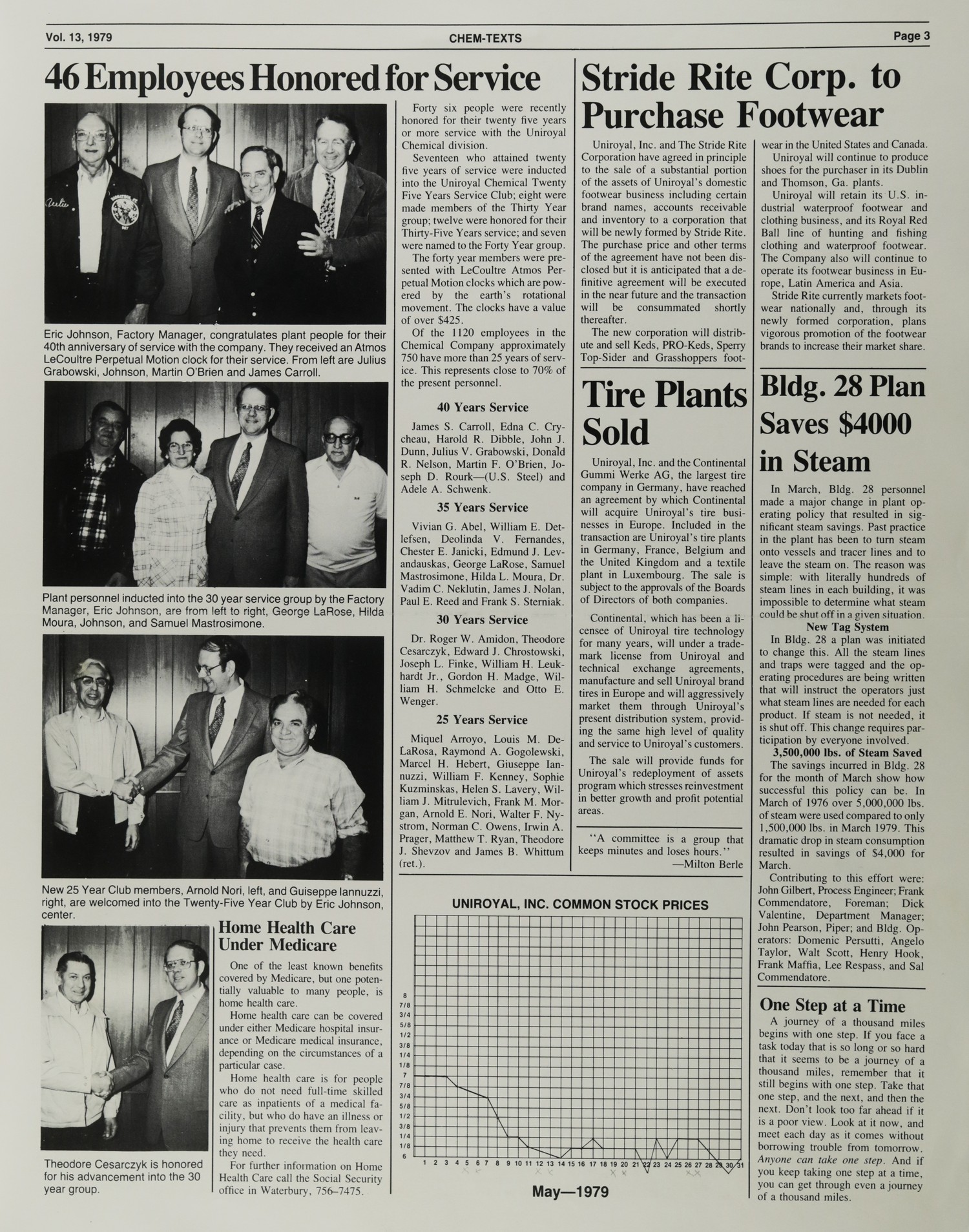
UNIROYAL, INC. COMMON STOCK PRICES

[CHART: Stock price graph showing prices from months 1-31, with price scale showing values from 0 to 8, with markers at 7/8, 3/4, 5/8, 1/2, 3/8, 1/4, 1/8 intervals]

May—1979

CHEM-TEXTS – 1979-v13-s278

Page 278

Page 3 | CHEM-TEXTS | Vol. 13, 1979

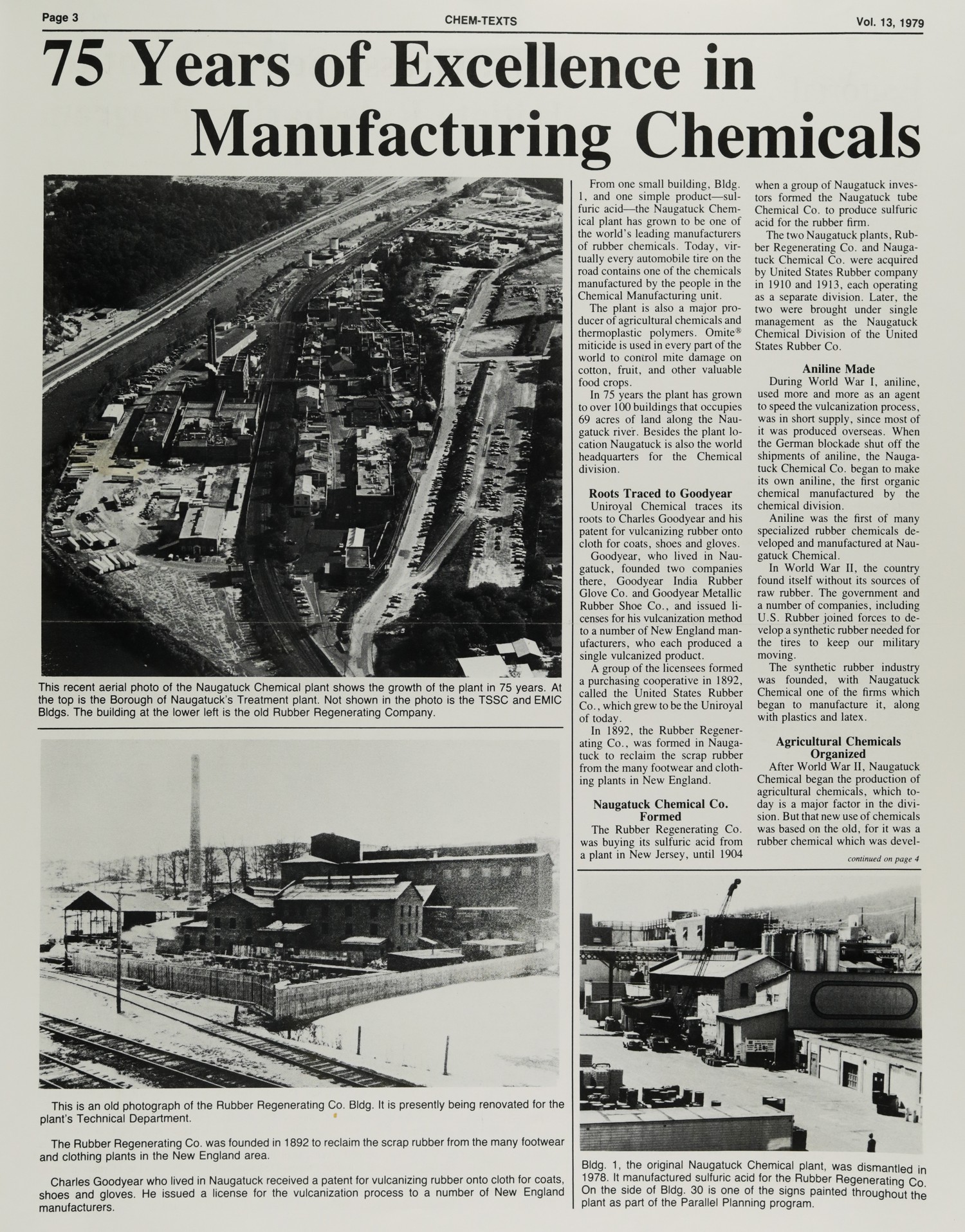
75 Years of Excellence in Manufacturing Chemicals

[AERIAL PHOTOGRAPH OF INDUSTRIAL PLANT]

This recent aerial photo of the Naugatuck Chemical plant shows the growth of the plant in 75 years. At the top is the Borough of Naugatuck’s Treatment plant. Not shown in the photo is the TSSC and EMIC Bldgs. The building at the lower left is the old Rubber Regenerating Company.


From one small building, Bldg. 1, and one simple product—sulfuric acid—the Naugatuck Chemical plant has grown to be one of the world’s leading manufacturers of rubber chemicals. Today, virtually every automobile tire on the road contains one of the chemicals manufactured by the people in the Chemical Manufacturing unit.

The plant is also a major producer of agricultural chemicals and thermoplastic polymers. Omite® miticide is used in every part of the world to control mite damage on cotton, fruit, and other valuable food crops.

In 75 years the plant has grown to over 100 buildings that occupies 69 acres of land along the Naugatuck river. Besides the plant location Naugatuck is also the world headquarters for the Chemical division.

Roots Traced to Goodyear

Uniroyal Chemical traces its roots to Charles Goodyear and his patent for vulcanizing rubber onto cloth for coats, shoes and gloves.

Goodyear, who lived in Naugatuck, founded two companies there, Goodyear India Rubber Glove Co. and Goodyear Metallic Rubber Shoe Co., and issued licenses for his vulcanization method to a number of New England manufacturers, who each produced a single vulcanized product.

A group of the licensees formed a purchasing cooperative in 1892, called the United States Rubber Co., which grew to be the Uniroyal of today.

In 1892, the Rubber Regenerating Co., was formed in Naugatuck to reclaim the scrap rubber from the many footwear and clothing plants in New England.

Naugatuck Chemical Co. Formed

The Rubber Regenerating Co. was buying its sulfuric acid from a plant in New Jersey, until 1904

when a group of Naugatuck investors formed the Naugatuck tube Chemical Co. to produce sulfuric acid for the rubber firm.

The two Naugatuck plants, Rubber Regenerating Co. and Naugatuck Chemical Co. were acquired by United States Rubber company in 1910 and 1913, each operating as a separate division. Later, the two were brought under single management as the Naugatuck Chemical Division of the United States Rubber Co.

Aniline Made

During World War I, aniline, used more and more as an agent to speed the vulcanization process, was in short supply, since most of it was produced overseas. When the German blockade shut off the shipments of aniline, the Naugatuck Chemical Co. began to make its own aniline, the first organic chemical manufactured by the chemical division.

Aniline was the first of many specialized rubber chemicals developed and manufactured at Naugatuck Chemical.

In World War II, the country found itself without its sources of raw rubber. The government and a number of companies, including U.S. Rubber joined forces to develop a synthetic rubber needed for the tires to keep our military moving.

The synthetic rubber industry was founded, with Naugatuck Chemical one of the firms which began to manufacture it, along with plastics and latex.

Agricultural Chemicals Organized

After World War II, Naugatuck Chemical began the production of agricultural chemicals, which today is a major factor in the division. But that new use of chemicals was based on the old, for it was a rubber chemical which was devel-

continued on page 4


[PHOTOGRAPH OF OLD BUILDING]

This is an old photograph of the Rubber Regenerating Co. Bldg. It is presently being renovated for the plant’s Technical Department.

The Rubber Regenerating Co. was founded in 1892 to reclaim the scrap rubber from the many footwear and clothing plants in the New England area.

Charles Goodyear who lived in Naugatuck received a patent for vulcanizing rubber onto cloth for coats, shoes and gloves. He issued a license for the vulcanization process to a number of New England manufacturers.


[PHOTOGRAPH OF INDUSTRIAL BUILDING]

Bldg. 1, the original Naugatuck Chemical plant, was dismantled in 1978. It manufactured sulfuric acid for the Rubber Regenerating Co. On the side of Bldg. 30 is one of the signs painted throughout the plant as part of the Parallel Planning program.

CHEM-TEXTS – 1979-v13-s273

Page 273

CHEM-TEXTS

Page 2 | Vol. 13, 1979


Editorial . . .

As many of you already know, this is our 75th year as a Chemical Plant as well as a Chemical Company. Today we can be proud of the fact that virtually every automobile and truck tire on the road contains one of the rubber chemicals manufactured in our plant. Our Agricultural Chemicals are used throughout the U.S. and the world to protect cotton, fruit, and other valuable food crops against disease and devastating insects. This enables farmers and growers to increase the yields of their land.

We are very grateful to both present and past employees who made this occasion possible through their achievements. We now have an even greater responsibility in performing our jobs. Our dedication and efforts must make our jobs more meaningful, secure, and safe not only for ourselves but also for those who will follow us.

Through the skills, spirit, and professional excellence that you demonstrated in 1979, the foundation has been built for even greater achievements in the future.

I wish to thank each and every one of you for making the celebration of our 75th Anniversary such a memorable and successful day. It was evidence of the good spirit that makes our plant an excellent place to be.

Eric Johnson
Factory Manager


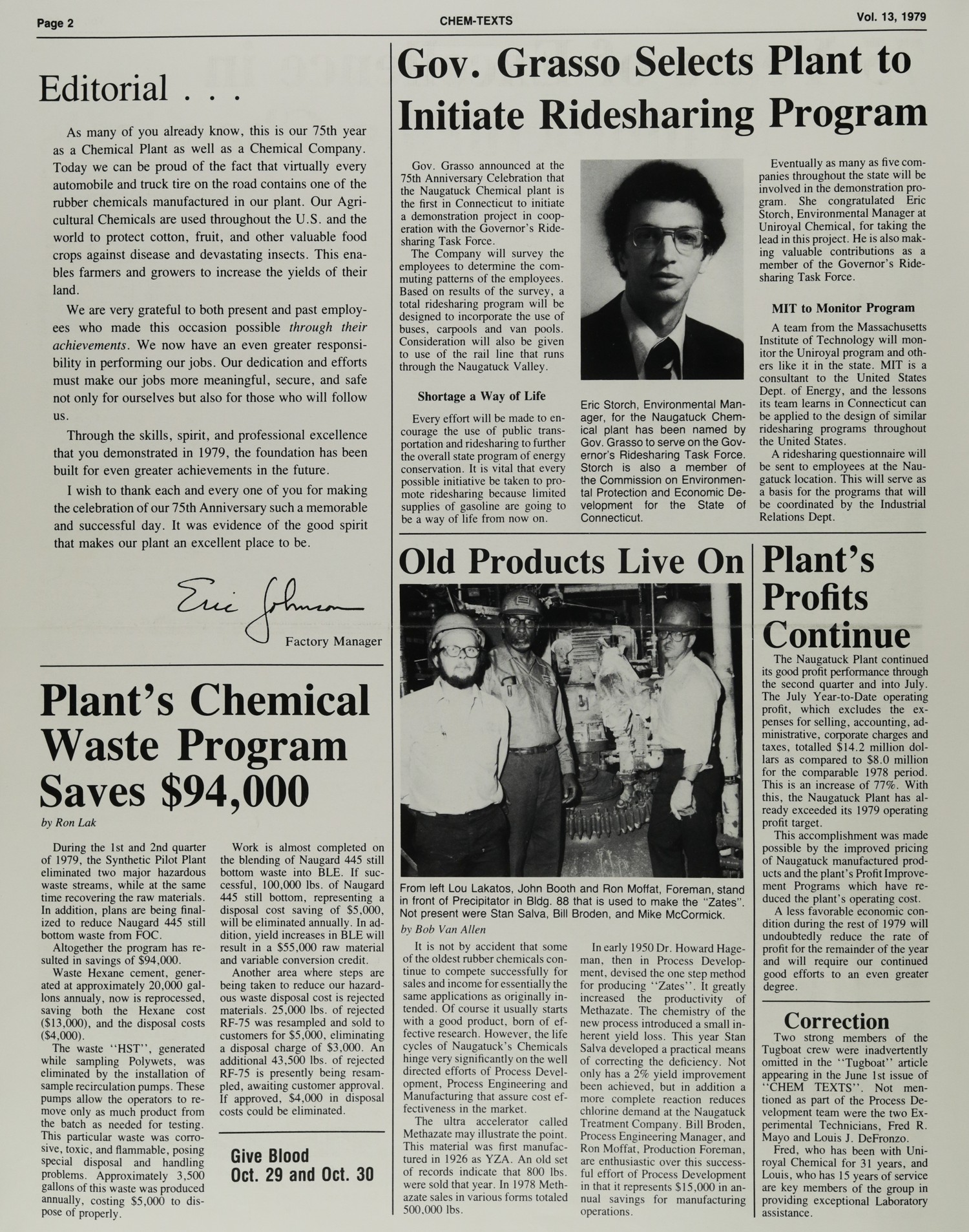
Plant’s Chemical Waste Program Saves $94,000

by Ron Lak

During the 1st and 2nd quarter of 1979, the Synthetic Pilot Plant eliminated two major hazardous waste streams, while at the same time recovering the raw materials. In addition, plans are being finalized to reduce Naugard 445 still bottom waste from FOC.

Altogether the program has resulted in savings of $94,000.

Waste Hexane cement, generated at approximately 20,000 gallons annually, now is reprocessed, saving both the Hexane cost ($13,000), and the disposal costs ($4,000).

The waste “HST”, generated while sampling Polywets, was eliminated by the installation of sample recirculation pumps. These pumps allow the operators to remove only as much product from the batch as needed for testing. This particular waste was corrosive, toxic, and flammable, posing special disposal and handling problems. Approximately 3,500 gallons of this waste was produced annually, costing $5,000 to dispose of properly.

Work is almost completed on the blending of Naugard 445 still bottom waste into BLE. If successful, 100,000 lbs. of Naugard 445 still bottom, representing a disposal cost saving of $5,000, will be eliminated annually. In addition, yield increases in BLE will result in a $55,000 raw material and variable conversion credit.

Another area where steps are being taken to reduce our hazardous waste disposal cost is rejected materials. 25,000 lbs. of rejected RF-75 was resampled and sold to customers for $5,000, eliminating a disposal charge of $3,000. An additional 43,500 lbs. of rejected RF-75 is presently being resampled, awaiting customer approval. If approved, $4,000 in disposal costs could be eliminated.


Give Blood
Oct. 29 and Oct. 30


Gov. Grasso Selects Plant to Initiate Ridesharing Program

Gov. Grasso announced at the 75th Anniversary Celebration that the Naugatuck Chemical plant is the first in Connecticut to initiate a demonstration project in cooperation with the Governor’s Ridesharing Task Force.

The Company will survey the employees to determine the commuting patterns of the employees. Based on results of the survey, a total ridesharing program will be designed to incorporate the use of buses, carpools and van pools. Consideration will also be given to use of the rail line that runs through the Naugatuck Valley.

Shortage a Way of Life

Every effort will be made to encourage the use of public transportation and ridesharing to further the overall state program of energy conservation. It is vital that every possible initiative be taken to promote ridesharing because limited supplies of gasoline are going to be a way of life from now on.

[PHOTO CAPTION:]
Eric Storch, Environmental Manager, for the Naugatuck Chemical plant has been named by Gov. Grasso to serve on the Governor’s Ridesharing Task Force. Storch is also a member of the Commission on Environmental Protection and Economic Development for the State of Connecticut.

Eventually as many as five companies throughout the state will be involved in the demonstration program. She congratulated Eric Storch, Environmental Manager at Uniroyal Chemical, for taking the lead in this project. He is also making valuable contributions as a member of the Governor’s Ridesharing Task Force.

MIT to Monitor Program

A team from the Massachusetts Institute of Technology will monitor the Uniroyal program and others like it in the state. MIT is a consultant to the United States Dept. of Energy, and the lessons its team learns in Connecticut can be applied to the design of similar ridesharing programs throughout the United States.

A ridesharing questionnaire will be sent to employees at the Naugatuck location. This will serve as a basis for the programs that will be coordinated by the Industrial Relations Dept.


Old Products Live On

[PHOTO CAPTION:]
From left Lou Lakatos, John Booth and Ron Moffat, Foreman, stand in front of Precipitator in Bldg. 88 that is used to make the “Zates”. Not present were Stan Salva, Bill Broden, and Mike McCormick.

by Bob Van Allen

It is not by accident that some of the oldest rubber chemicals continue to compete successfully for sales and income for essentially the same applications as originally intended. Of course it usually starts with a good product, born of effective research. However, the life cycles of Naugatuck’s Chemicals hinge very significantly on the well directed efforts of Process Development, Process Engineering and Manufacturing that assure cost effectiveness in the market.

The ultra accelerator called Methazate may illustrate the point. This material was first manufactured in 1926 as YZA. An old set of records indicate that 800 lbs. were sold that year. In 1978 Methazate sales in various forms totaled 500,000 lbs.

In early 1950 Dr. Howard Hageman, then in Process Development, devised the one step method for producing “Zates”. It greatly increased the productivity of Methazate. The chemistry of the new process introduced a small inherent yield loss. This year Stan Salva developed a practical means of correcting the deficiency. Not only has a 2% yield improvement been achieved, but in addition a more complete reaction reduces chlorine demand at the Naugatuck Treatment Company. Bill Broden, Process Engineering Manager, and Ron Moffat, Production Foreman, are enthusiastic over this successful effort of Process Development in that it represents $15,000 in annual savings for manufacturing operations.


Plant’s Profits Continue

The Naugatuck Plant continued its good profit performance through the second quarter and into July. The July Year-to-Date operating profit, which excludes the expenses for selling, accounting, administrative, corporate charges and taxes, totalled $14.2 million dollars as compared to $8.0 million for the comparable 1978 period. This is an increase of 77%. With this, the Naugatuck Plant has already exceeded its 1979 operating profit target.

This accomplishment was made possible by the improved pricing of Naugatuck manufactured products and the plant’s Profit Improvement Programs which have reduced the plant’s operating cost.

A less favorable economic condition during the rest of 1979 will undoubtedly reduce the rate of profit for the remainder of the year and will require our continued good efforts to an even greater degree.


Correction

Two strong members of the Tugboat crew were inadvertently omitted in the “Tugboat” article appearing in the June 1st issue of “CHEM TEXTS”. Not mentioned as part of the Process Development team were the two Experimental Technicians, Fred R. Mayo and Louis J. DeFronzo.

Fred, who has been with Uniroyal Chemical for 31 years, and Louis, who has 15 years of service are key members of the group in providing exceptional Laboratory assistance.

CHEM-TEXTS – Vol. 13 1979 – Page 13

Page 013

Page 4 | CHEM-TEXT | Vol. 13, 1979


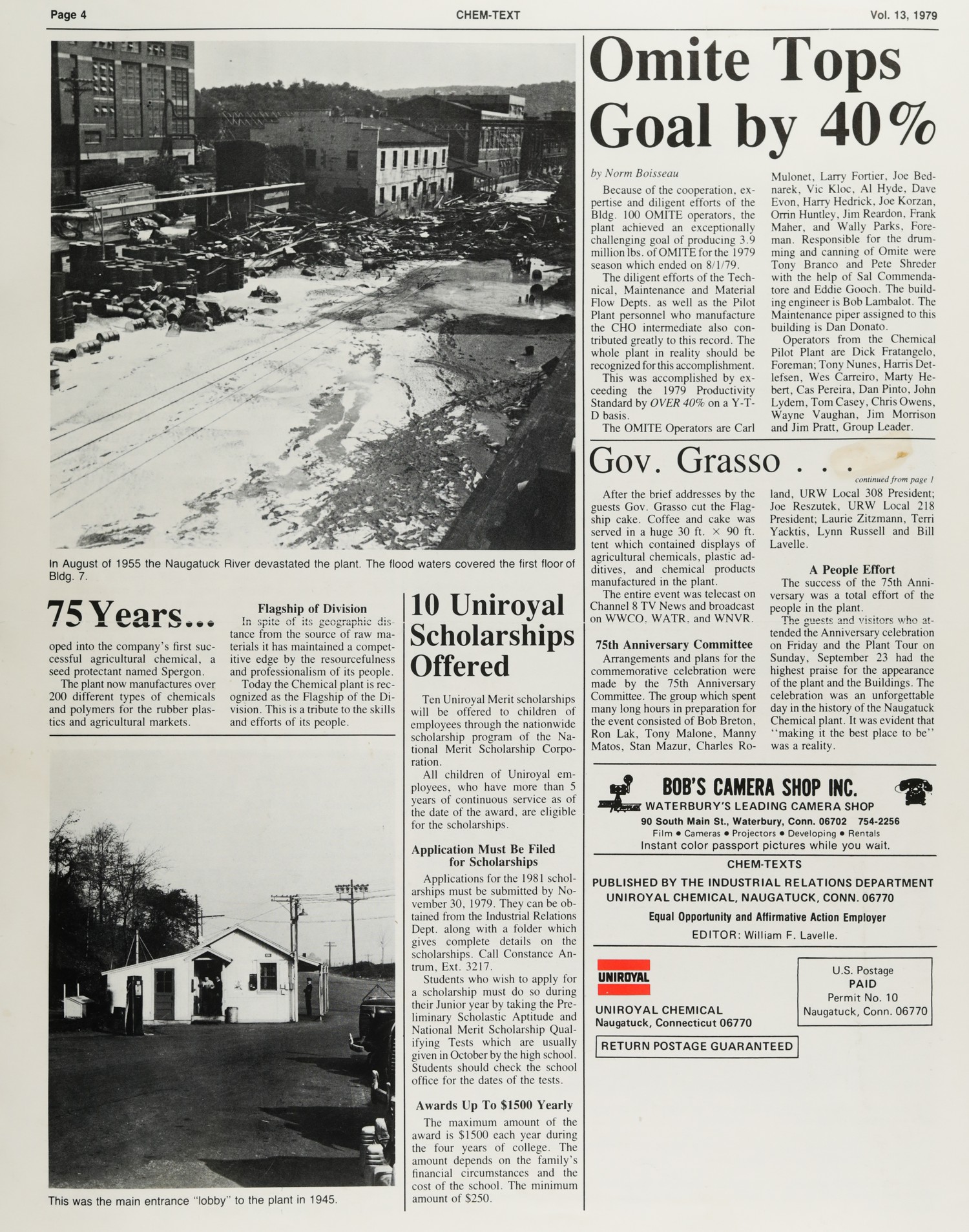
![Flood damage photo]

In August of 1955 the Naugatuck River devastated the plant. The flood waters covered the first floor of Bldg. 7.


75 Years…

oped into the company’s first successful agricultural chemical, a seed protectant named Spergon.

The plant now manufactures over 200 different types of chemicals and polymers for the rubber plastics and agricultural markets.

Flagship of Division

In spite of its geographic distance from the source of raw materials it has maintained a competitive edge by the resourcefulness and professionalism of its people.

Today the Chemical plant is recognized as the Flagship of the Division. This is a tribute to the skills and efforts of its people.


10 Uniroyal Scholarships Offered

Ten Uniroyal Merit scholarships will be offered to children of employees through the nationwide scholarship program of the National Merit Scholarship Corporation.

All children of Uniroyal employees, who have more than 5 years of continuous service as of the date of the award, are eligible for the scholarships.

Application Must Be Filed for Scholarships

Applications for the 1981 scholarships must be submitted by November 30, 1979. They can be obtained from the Industrial Relations Dept. along with a folder which gives complete details on the scholarships. Call Constance Antrum, Ext. 3217.

Students who wish to apply for a scholarship must do so during their Junior year by taking the Preliminary Scholastic Aptitude and National Merit Scholarship Qualifying Tests which are usually given in October by the high school. Students should check the school office for the dates of the tests.

Awards Up To $1500 Yearly

The maximum amount of the award is $1500 each year during the four years of college. The amount depends on the family’s financial circumstances and the cost of the school. The minimum amount of $250.


![Historic building photo]

This was the main entrance “lobby” to the plant in 1945.


Omite Tops Goal by 40%

by Norm Boisseau

Because of the cooperation, expertise and diligent efforts of the Bldg. 100 OMITE operators, the plant achieved an exceptionally challenging goal of producing 3.9 million lbs. of OMITE for the 1979 season which ended on 8/1/79.

The diligent efforts of the Technical, Maintenance and Material Flow Depts. as well as the Pilot Plant personnel who manufacture the CHO intermediate also contributed greatly to this record. The whole plant in reality should be recognized for this accomplishment.

This was accomplished by exceeding the 1979 Productivity Standard by OVER 40% on a Y-T-D basis.

The OMITE Operators are Carl Mulonet, Larry Fortier, Joe Bednarek, Vic Kloc, Al Hyde, Dave Evon, Harry Hedrick, Joe Korzan, Orrin Huntley, Jim Reardon, Frank Maher, and Wally Parks, Foreman. Responsible for the drumming and canning of Omite were Tony Branco and Pete Shreder with the help of Sal Commendatore and Eddie Gooch. The building engineer is Bob Lambalot. The Maintenance piper assigned to this building is Dan Donato.

Operators from the Chemical Pilot Plant are Dick Fratangelo, Foreman, Tony Nunes, Harris Detlefsen, Wes Carreiro, Marty Hebert, Cas Pereira, Dan Pinto, John Lydem, Tom Casey, Chris Owens, Wayne Vaughan, Jim Morrison and Jim Pratt, Group Leader.


Gov. Grasso . . .

continued from page 1

After the brief addresses by the guests Gov. Grasso cut the Flagship cake. Coffee and cake was served in a huge 30 ft. x 90 ft. tent which contained displays of agricultural chemicals, plastic additives, and chemical products manufactured in the plant.

The entire event was telecast on Channel 8 TV News and broadcast on WWCO, WATR, and WNVR.

75th Anniversary Committee

Arrangements and plans for the commemorative celebration were made by the 75th Anniversary Committee. The group which spent many long hours in preparation for the event consisted of Bob Breton, Ron Lak, Tony Malone, Manny Matos, Stan Mazur, Charles Roland, URW Local 308 President; Joe Reszutek, URW Local 218 President; Laurie Zitzmann, Terri Yacktis, Lynn Russell and Bill Lavelle.

A People Effort

The success of the 75th Anniversary was a total effort of the people in the plant.

The guests and visitors who attended the Anniversary celebration on Friday and the Plant Tour on Sunday, September 23 had the highest praise for the appearance of the plant and the Buildings. The celebration was an unforgettable day in the history of the Naugatuck Chemical plant. It was evident that “making it the best place to be” was a reality.


BOB’S CAMERA SHOP INC.
WATERBURY’S LEADING CAMERA SHOP
90 South Main St., Waterbury, Conn. 06702 754-2256
Film ● Cameras ● Projectors ● Developing ● Rentals
Instant color passport pictures while you wait.


CHEM-TEXTS

PUBLISHED BY THE INDUSTRIAL RELATIONS DEPARTMENT
UNIROYAL CHEMICAL, NAUGATUCK, CONN. 06770

Equal Opportunity and Affirmative Action Employer

EDITOR: William F. Lavelle.


UNIROYAL

UNIROYAL CHEMICAL
Naugatuck, Connecticut 06770

RETURN POSTAGE GUARANTEED

U.S. Postage
PAID
Permit No. 10
Naugatuck, Conn. 06770

CHEM-TEXTS – Vol. 13 – Page 4

Page 004

Page 4 | CHEM-TEXTS | Vol. 13 1979


Tugboat . .

continued from page 2

help set up in the Naugatuck plant include LVBI wet cake and Naugard 445, which are produced in the FOC plant. The Manufacture of A.O. 495 in 73 Bldg. as well as the improvement of MONEX naugatizing in 88 Bldg., involved the Chemical Process Development. ZHMA, produced in 73 Bldg. was also developed in the Chemical Process Development laboratory.

Developed Process for New Plant Products

Chemical Process Development’s involvement however does not stop there. Some products which will enter the plant in the near future include Naugacel SD-1, with an already approved AR of $614,000, and Naugard MT-ZMT. With its development nearly complete it is now awaiting capital estimates. Processes for both of these products were developed in

the Chemical Process Development Laboratory and Chemical Pilot Plant. Of course along with these existing products is Chemical Process Development’s continuous involvement in developing processes for more efficient Blowing Agent production as well as process development of other rubber chemicals, petroleum antioxidants, and plastics additives.

Group With Experience

Involvement in Geismar products is also a concern for Chemical Process Development with its contributions in the area of Thiazoles, Flexzone and Blowing Agents.

The Chemical Process Development group consists of chemists and engineers with degrees from PH.Ds to Bachelors and experience ranging from 2 years to 26 years. The members include Gary L. Arndt, Steven R. Brusso, J. Harry Donald, James D. Ferency, Robert J. Franko, James L. Pratt, Stanley E. Salva, Russell F. Sant’Angelo, and Dr. John W. Sargent.


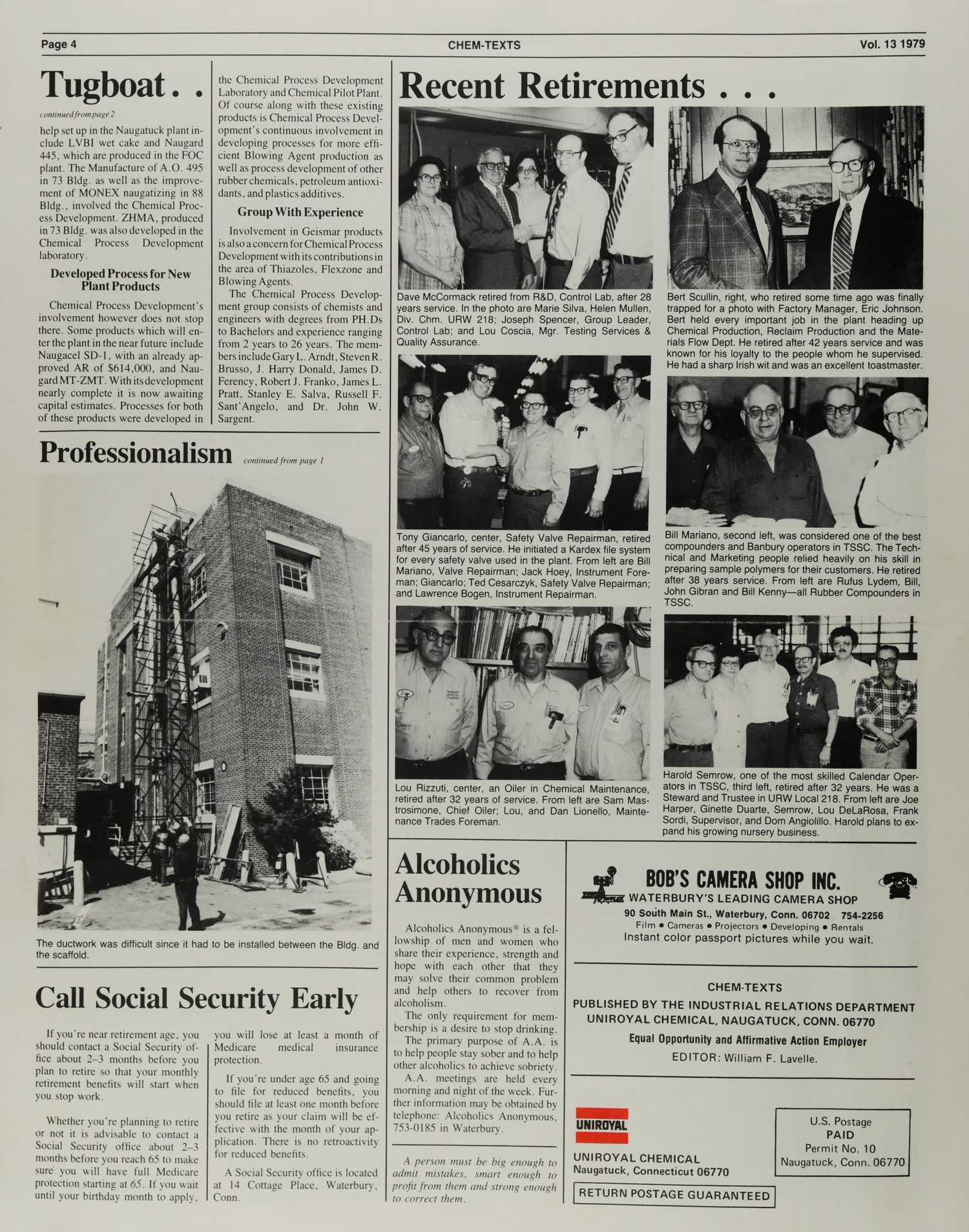
Professionalism

continued from page 1


[IMAGE: Building with ductwork and scaffolding]

The ductwork was difficult since it had to be installed between the Bldg. and the scaffold.


Call Social Security Early

If you’re near retirement age, you should contact a Social Security office about 2-3 months before you plan to retire so that your monthly retirement benefits will start when you stop work.

Whether you’re planning to retire or not it is advisable to contact a Social Security office about 2-3 months before you reach 65 to make sure you will have full Medicare protection starting at 65. If you wait until your birthday month to apply, you will lose at least a month of Medicare medical insurance protection.

If you’re under age 65 and going to file for reduced benefits, you should file at least one month before you retire as your claim will be effective with the month of your application. There is no retroactivity for reduced benefits.

A Social Security office is located at 14 Cottage Place, Waterbury, Conn.


Recent Retirements . . .

[IMAGE: Group photo]

Dave McCormack retired from R&D, Control Lab, after 28 years service. In the photo are Marie Silva, Helen Mullen, Div. Chrn. URW 218; Joseph Spencer, Group Leader, Control Lab; and Lou Coscia, Mgr. Testing Services & Quality Assurance.

[IMAGE: Group photo]

Bert Scullin, right, who retired some time ago was finally trapped for a photo with Factory Manager, Eric Johnson. Bert held every important job in the plant heading up Chemical Production, Reclaim Production and the Materials Flow Dept. He retired after 42 years service and was known for his loyalty to the people whom he supervised. He had a sharp Irish wit and was an excellent toastmaster.

[IMAGE: Group photo]

Tony Giancarlo, center, Safety Valve Repairman, retired after 45 years of service. He initiated a Kardex file system for every safety valve used in the plant. From left are Bill Mariano, Valve Repairman; Jack Hoey, Instrument Foreman; Giancarlo; Ted Cesarczyk, Safety Valve Repairman; and Lawrence Bogen, Instrument Repairman.

[IMAGE: Group photo]

Bill Mariano, second left, was considered one of the best compounders and Banbury operators in TSSC. The Technical and Marketing people relied heavily on his skill in preparing sample polymers for their customers. He retired after 38 years service. From left are Rufus Lydem, Bill, John Gibran and Bill Kenny—all Rubber Compounders in TSSC.

[IMAGE: Group photo]

Lou Rizzuti, center, an Oiler in Chemical Maintenance, retired after 32 years of service. From left are Sam Mastrosimone, Chief Oiler; Lou; and Dan Lionello, Maintenance Trades Foreman.

[IMAGE: Group photo]

Harold Semrow, one of the most skilled Calendar Operators in TSSC, third left, retired after 32 years. He was a Steward and Trustee in URW Local 218. From left are Joe Harper, Ginette Duarte, Semrow, Lou DeLaRosa, Frank Sordi, Supervisor, and Dom Angiolillo. Harold plans to expand his growing nursery business.


Alcoholics Anonymous

Alcoholics Anonymous® is a fellowship of men and women who share their experience, strength and hope with each other that they may solve their common problem and help others to recover from alcoholism.

The only requirement for membership is a desire to stop drinking.

The primary purpose of A.A. is to help people stay sober and to help other alcoholics to achieve sobriety.

A.A. meetings are held every morning and night of the week. Further information may be obtained by telephone: Alcoholics Anonymous, 753-0185 in Waterbury.

A person must be big enough to admit mistakes, smart enough to profit from them and strong enough to correct them.


BOB’S CAMERA SHOP INC.

WATERBURY’S LEADING CAMERA SHOP

90 South Main St., Waterbury, Conn. 06702 754-2256

Film • Cameras • Projectors • Developing • Rentals

Instant color passport pictures while you wait.


CHEM-TEXTS

PUBLISHED BY THE INDUSTRIAL RELATIONS DEPARTMENT
UNIROYAL CHEMICAL, NAUGATUCK, CONN. 06770

Equal Opportunity and Affirmative Action Employer

EDITOR: William F. Lavelle.


UNIROYAL

U.S. Postage
PAID
Permit No. 10
Naugatuck, Conn. 06770

UNIROYAL CHEMICAL
Naugatuck, Connecticut 06770

RETURN POSTAGE GUARANTEED

CHEM-TEXTS – Vol. 13 – Page 2

Page 002

Page 2 | CHEM-TEXTS | Vol. 13 1979


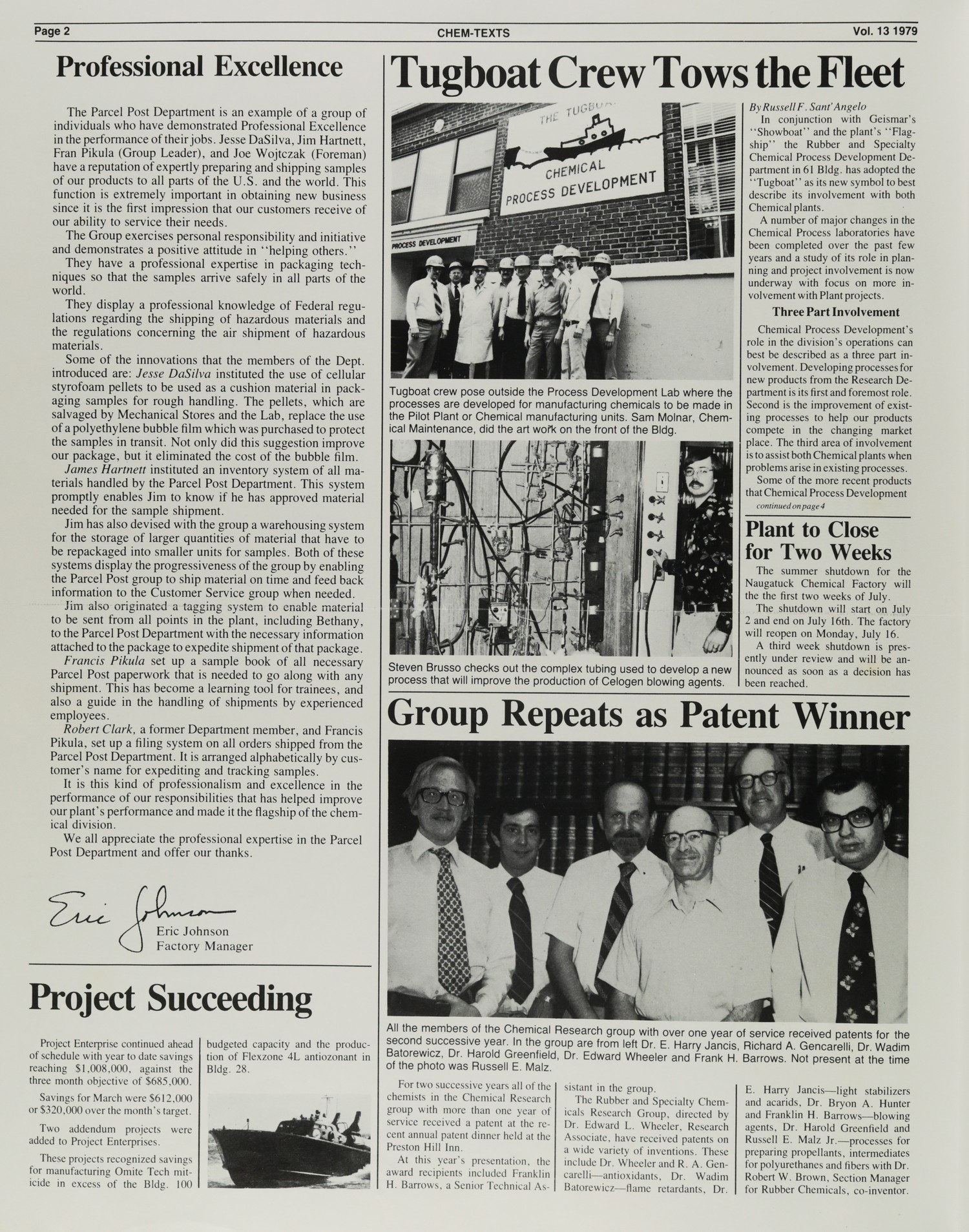
Professional Excellence

The Parcel Post Department is an example of a group of individuals who have demonstrated Professional Excellence in the performance of their jobs. Jesse DaSilva, Jim Hartnett, Fran Pikula (Group Leader), and Joe Wojtczak (Foreman) have a reputation of expertly preparing and shipping samples of our products to all parts of the U.S. and the world. This function is extremely important in obtaining new business since it is the first impression that our customers receive of our ability to service their needs.

The Group exercises personal responsibility and initiative and demonstrates a positive attitude in “helping others.”

They have a professional expertise in packaging techniques so that the samples arrive safely in all parts of the world.

They display a professional knowledge of Federal regulations regarding the shipping of hazardous materials and the regulations concerning the air shipment of hazardous materials.

Some of the innovations that the members of the Dept. introduced are: Jesse DaSilva instituted the use of cellular styrofoam pellets to be used as a cushion material in packaging samples for rough handling. The pellets, which are salvaged by Mechanical Stores and the Lab, replace the use of a polyethylene bubble film which was purchased to protect the samples in transit. Not only did this suggestion improve our package, but it eliminated the cost of the bubble film.

James Hartnett instituted an inventory system of all materials handled by the Parcel Post Department. This system promptly enables Jim to know if he has approved material needed for the sample shipment.

Jim has also devised with the group a warehousing system for the storage of larger quantities of material that have to be repackaged into smaller units for samples. Both of these systems display the progressiveness of the group by enabling the Parcel Post group to ship material on time and feed back information to the Customer Service group when needed.

Jim also originated a tagging system to enable material to be sent from all points in the plant, including Bethany, to the Parcel Post Department with the necessary information attached to the package to expedite shipment of that package.

Francis Pikula set up a sample book of all necessary Parcel Post paperwork that is needed to go along with any shipment. This has become a learning tool for trainees, and also a guide in the handling of shipments by experienced employees.

Robert Clark, a former Department member, and Francis Pikula, set up a filing system on all orders shipped from the Parcel Post Department. It is arranged alphabetically by customer’s name for expediting and tracking samples.

It is this kind of professionalism and excellence in the performance of our responsibilities that has helped improve our plant’s performance and made it the flagship of the chemical division.

We all appreciate the professional expertise in the Parcel Post Department and offer our thanks.

Eric Johnson
Factory Manager


Tugboat Crew Tows the Fleet

By Russell F. Sant’Angelo

In conjunction with Geismar’s “Showboat” and the plant’s “Flagship” the Rubber and Specialty Chemical Process Development Department in 61 Bldg. has adopted the “Tugboat” as its new symbol to best describe its involvement with both Chemical plants.

A number of major changes in the Chemical Process laboratories have been completed over the past few years and a study of its role in planning and project involvement is now underway with focus on more involvement with Plant projects.

Three Part Involvement

Chemical Process Development’s role in the division’s operations can best be described as a three part involvement. Developing processes for new products from the Research Department is its first and foremost role. Second is the improvement of existing processes to help our products compete in the changing market place. The third area of involvement is to assist both Chemical plants when problems arise in existing processes.

Some of the more recent products that Chemical Process Development
continued on page 4


Tugboat crew pose outside the Process Development Lab where the processes are developed for manufacturing chemicals to be made in the Pilot Plant or Chemical manufacturing units. Sam Molnar, Chemical Maintenance, did the art work on the front of the Bldg.


Steven Brusso checks out the complex tubing used to develop a new process that will improve the production of Celogen blowing agents.


Plant to Close for Two Weeks

The summer shutdown for the Naugatuck Chemical Factory will the the first two weeks of July.

The shutdown will start on July 2 and end on July 16th. The factory will reopen on Monday, July 16.

A third week shutdown is presently under review and will be announced as soon as a decision has been reached.


Project Succeeding

Project Enterprise continued ahead of schedule with year to date savings reaching $1,008,000, against the three month objective of $685,000.

Savings for March were $612,000 or $320,000 over the month’s target.

Two addendum projects were added to Project Enterprises.

These projects recognized savings for manufacturing Omite Tech miticide in excess of the Bldg. 100 budgeted capacity and the production of Flexzone 4L antiozonant in Bldg. 28.


Group Repeats as Patent Winner

All the members of the Chemical Research group with over one year of service received patents for the second successive year. In the group are from left Dr. E. Harry Jancis, Richard A. Gencarelli, Dr. Wadim Batorewicz, Dr. Harold Greenfield, Dr. Edward Wheeler and Frank H. Barrows. Not present at the time of the photo was Russell E. Malz.

For two successive years all of the chemists in the Chemical Research group with more than one year of service received a patent at the recent annual patent dinner held at the Preston Hill Inn.

At this year’s presentation, the award recipients included Franklin H. Barrows, a Senior Technical Assistant in the group.

The Rubber and Specialty Chemicals Research Group, directed by Dr. Edward L. Wheeler, Research Associate, have received patents on a wide variety of inventions. These include Dr. Wheeler and R. A. Gencarelli—antioxidants, Dr. Wadim Batorewicz—flame retardants, Dr. E. Harry Jancis—light stabilizers and acarids, Dr. Bryon A. Hunter and Franklin H. Barrows—blowing agents, Dr. Harold Greenfield and Russell E. Malz Jr.—processes for preparing propellants, intermediates for polyurethanes and fibers with Dr. Robert W. Brown, Section Manager for Rubber Chemicals, co-inventor.

CHEM-TEXTS – 1979-v13-i03-s274

Page 274

CHEM-TEXTS—1979

Vol. 13 No. 3

1904 75th Anniversary 1979


An airplane flew over the plant and the Borough of Naugatuck with a banner commemorating the 75th Anniversary.

Eric Johnson talks to the guests who attended the ceremony. From left are Sheldon Washington, who represented Congressman Ratchford, Johnson, June Mitchell from Sen. Weicker’s office, Joseph Flannery, President of Uniroyal; David Beretta, Chairman of the Board; Robert Wooster, President of the Naugatuck Chamber of Commerce; Vincent Calarco, President of Uniroyal Chemical; Gov. Ella Grasso; Mayor William Rado; State Sen. Louis Cutillo; State Rep. Neal Hanlon and Robert Mazaika, Director of Manufacturing.


Eric Johnson, Factory Manager of the Chemical plant welcomes the guests and employees.

June Mitchell reads a congratulatory telegram from Senator Lowell Weicker.


The Naugatuck High School directed by Robert Fillipone, Music Director, provided the music for the ceremony.

Naugatuck Chemical plant people listen to one of the speakers.