Page 2 CHEM-TEXTS Vol. 3 No. 3
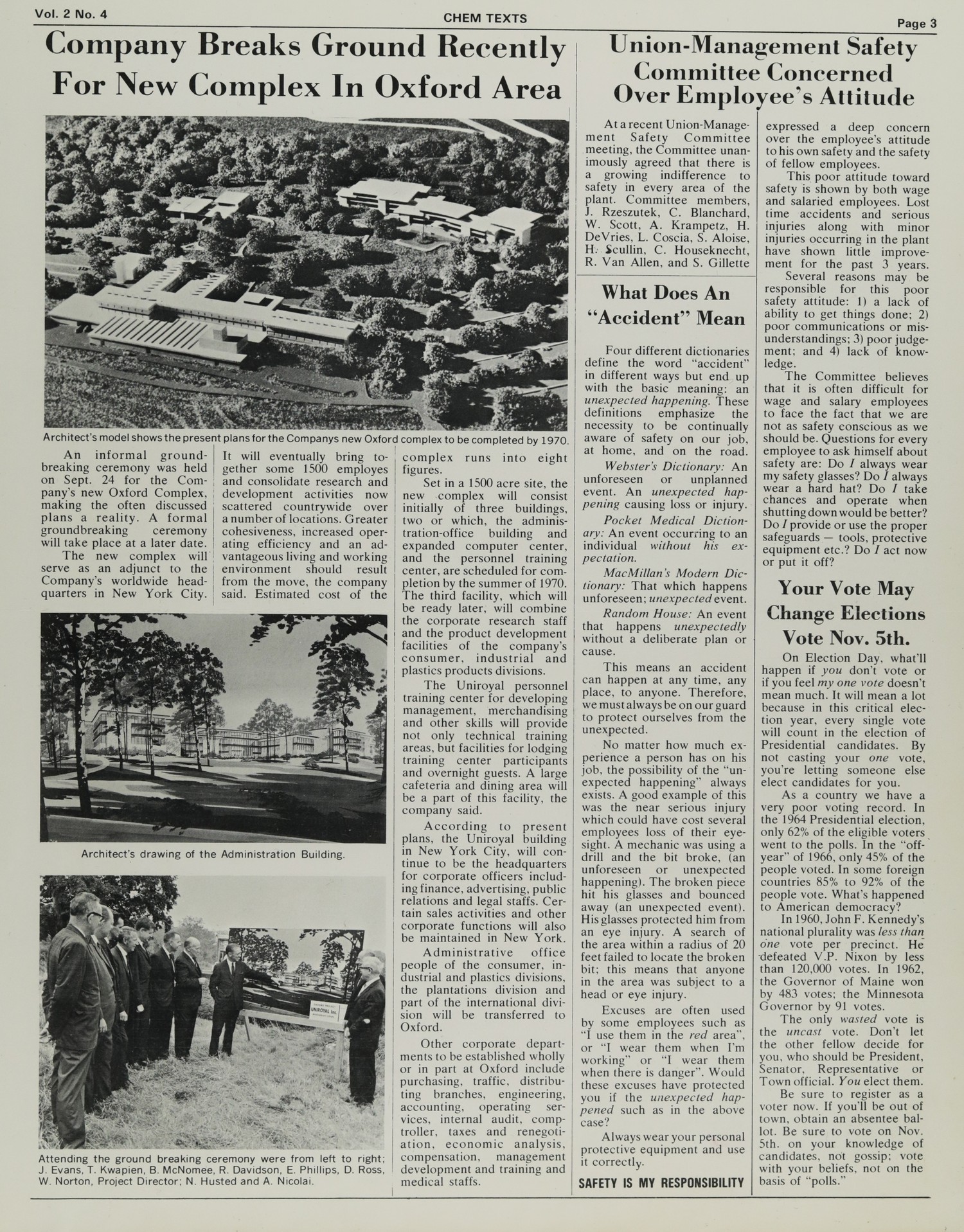
FROM THE FACTORY MANAGER
DEAR FELLOW EMPLOYEE:
Are you a professional? In sports the professional is one whose proficiency and skill enables him to earn his living through his participation. The professional is characterized by his pride in his efforts. In a similar sense, we are professionals earning our living by supplying our customers with chemicals, reclaim, and polymers. But do we always demonstrate the proficiency and skill required in our jobs? Do we have the pride of workmanship characteristic of the professional?
Remember a professional always gives his best and always tries to win. He puts team goals and team effort ahead of his own personal desires. He believes the whole team wins together and he takes pride in realizing that the true recognition for his effort is in the team winning.
The same thing is true in our plant – we all win when we satisfy our customers’ needs in the most efficient manner possible. Anything less than this – we aren’t professionals!
[Signature]
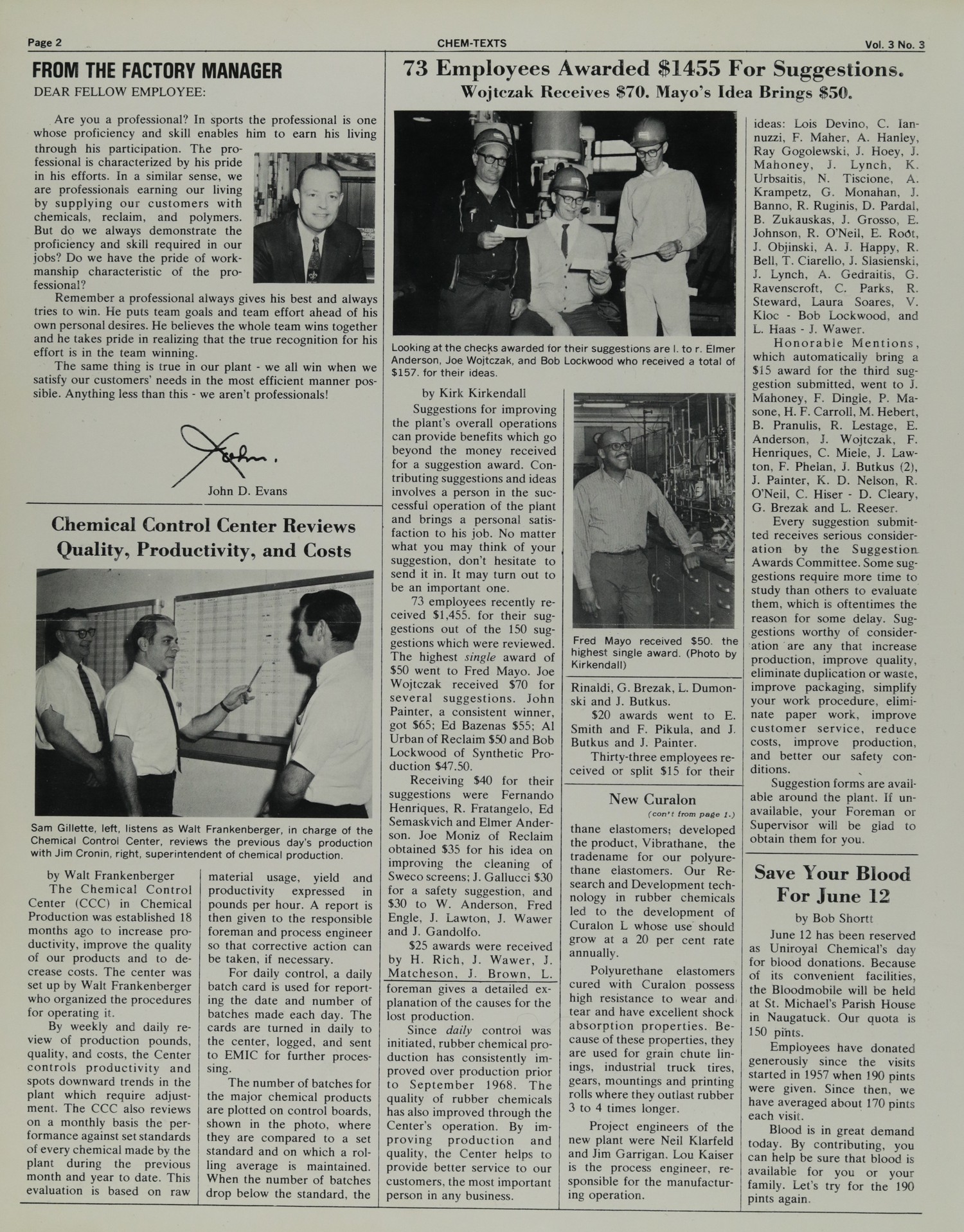
Chemical Control Center Reviews Quality, Productivity, and Costs
[IMAGE: Sam Gillette, left, listens as Walt Frankenberger, in charge of the Chemical Control Center, reviews the previous day’s production with Jim Cronin, right, superintendent of chemical production.]
by Walt Frankenberger
The Chemical Control Center (CCC) in Chemical Production was established 18 months ago to increase productivity, improve the quality of our products and to decrease costs. The center was set up by Walt Frankenberger who organized the procedures for operating it.
By weekly and daily review of production pounds, quality, and costs, the Center controls productivity and spots downward trends in the plant which require adjustment. The CCC also reviews on a monthly basis the performance against set standards of every chemical made by the plant during the previous month and year to date. This evaluation is based on raw material usage, yield and productivity expressed in pounds per hour. A report is then given to the responsible foreman and process engineer so that corrective action can be taken, if necessary.
For daily control, a daily batch card is used for reporting the date and number of batches made each day. The cards are turned in daily to the center, logged, and sent to EMIC for further processing.
The number of batches for the major chemical products are plotted on control boards, shown in the photo, where they are compared to a set standard and on which a rolling average is maintained. When the number of batches drop below the standard, the person in any business.
73 Employees Awarded $1455 For Suggestions.
Wojtczak Receives $70. Mayo’s Idea Brings $50.
[IMAGE: Looking at the checks awarded for their suggestions are l. to r. Elmer Anderson, Joe Wojtczak, and Bob Lockwood who received a total of $157. for their ideas.]
by Kirk Kirkendall
Suggestions for improving the plant’s overall operations can provide benefits which go beyond the money received for a suggestion award. Contributing suggestions and ideas involves a person in the successful operation of the plant and brings a personal satisfaction to his job. No matter what you may think of your suggestion, don’t hesitate to send it in. It may turn out to be an important one.
73 employees recently received $1,455. for their suggestions out of the 150 suggestions which were reviewed. The highest single award of $50 went to Fred Mayo. Joe Wojtczak received $70 for several suggestions. John Painter, a consistent winner, got $65; Ed Bazenas $55; Al Urban of Reclaim $50 and Bob Lockwood of Synthetic Production $47.50.
Receiving $40 for their suggestions were Fernando Henriques, R. Fratangelo, Ed Semaskvich and Elmer Anderson. Joe Moniz of Reclaim obtained $35 for his idea on improving the cleaning of Sweco screens; J. Gallucci $30 for a safety suggestion, and $30 to W. Anderson, Fred Engle, J. Lawton, J. Wawer and J. Gandolfo.
$25 awards were received by H. Rich, J. Wawer, J. Matcheson, J. Brown, L. foreman gives a detailed explanation of the causes for the lost production.
Since daily control was initiated, rubber chemical production has consistently improved over production prior to September 1968. The quality of rubber chemicals has also improved through the Center’s operation. By improving production and quality, the Center helps to provide better service to our customers, the most important person in any business.
[IMAGE: Fred Mayo received $50. the highest single award. (Photo by Kirkendall)]
Rinaldi, G. Brezak, L. Dumonski and J. Butkus.
$20 awards went to E. Smith and F. Pikula, and J. Butkus and J. Painter.
Thirty-three employees received or split $15 for their
New Curalon
(con’t from page 1.)
thane elastomers; developed the product, Vibrathane, the tradename for our polyurethane elastomers. Our Research and Development technology in rubber chemicals led to the development of Curalon L whose use should grow at a 20 per cent rate annually.
Polyurethane elastomers cured with Curalon possess high resistance to wear and tear and have excellent shock absorption properties. Because of these properties, they are used for grain chute linings, industrial truck tires, gears, mountings and printing rolls where they outlast rubber 3 to 4 times longer.
Project engineers of the new plant were Neil Klarfeld and Jim Garrigan. Lou Kaiser is the process engineer, responsible for the manufacturing operation.
ideas: Lois Devino, C. Iannuzzi, F. Maher, A. Hanley, Ray Gogolewski, J. Hoey, J. Mahoney, J. Lynch, K. Urbsaitis, N. Tiscione, A. Krampetz, G. Monahan, J. Banno, R. Ruginis, D. Pardal, B. Zukauskas, J. Grosso, E. Johnson, R. O’Neil, E. Root, J. Objinski, A. J. Happy, R. Bell, T. Ciarello, J. Slasienski, J. Lynch, A. Gedraitis, G. Ravenscroft, C. Parks, R. Steward, Laura Soares, V. Kloc – Bob Lockwood, and L. Haas – J. Wawer.
Honorable Mentions, which automatically bring a $15 award for the third suggestion submitted, went to J. Mahoney, F. Dingle, P. Masone, H. F. Carroll, M. Hebert, B. Pranulis, R. Lestage, E. Anderson, J. Wojtczak, F. Henriques, C. Miele, J. Lawton, F. Phelan, J. Butkus (2), J. Painter, K. D. Nelson, R. O’Neil, C. Hiser – D. Cleary, G. Brezak and L. Reeser.
Every suggestion submitted receives serious consideration by the Suggestion Awards Committee. Some suggestions require more time to study than others to evaluate them, which is oftentimes the reason for some delay. Suggestions worthy of consideration are any that increase production, improve quality, eliminate duplication or waste, improve packaging, simplify your work procedure, eliminate paper work, improve customer service, reduce costs, improve production, and better our safety conditions.
Suggestion forms are available around the plant. If unavailable, your Foreman or Supervisor will be glad to obtain them for you.
Save Your Blood For June 12
by Bob Shortt
June 12 has been reserved as Uniroyal Chemical’s day for blood donations. Because of its convenient facilities, the Bloodmobile will be held at St. Michael’s Parish House in Naugatuck. Our quota is 150 pints.
Employees have donated generously since the visits started in 1957 when 190 pints were given. Since then, we have averaged about 170 pints each visit.
Blood is in great demand today. By contributing, you can help be sure that blood is available for you or your family. Let’s try for the 190 pints again.