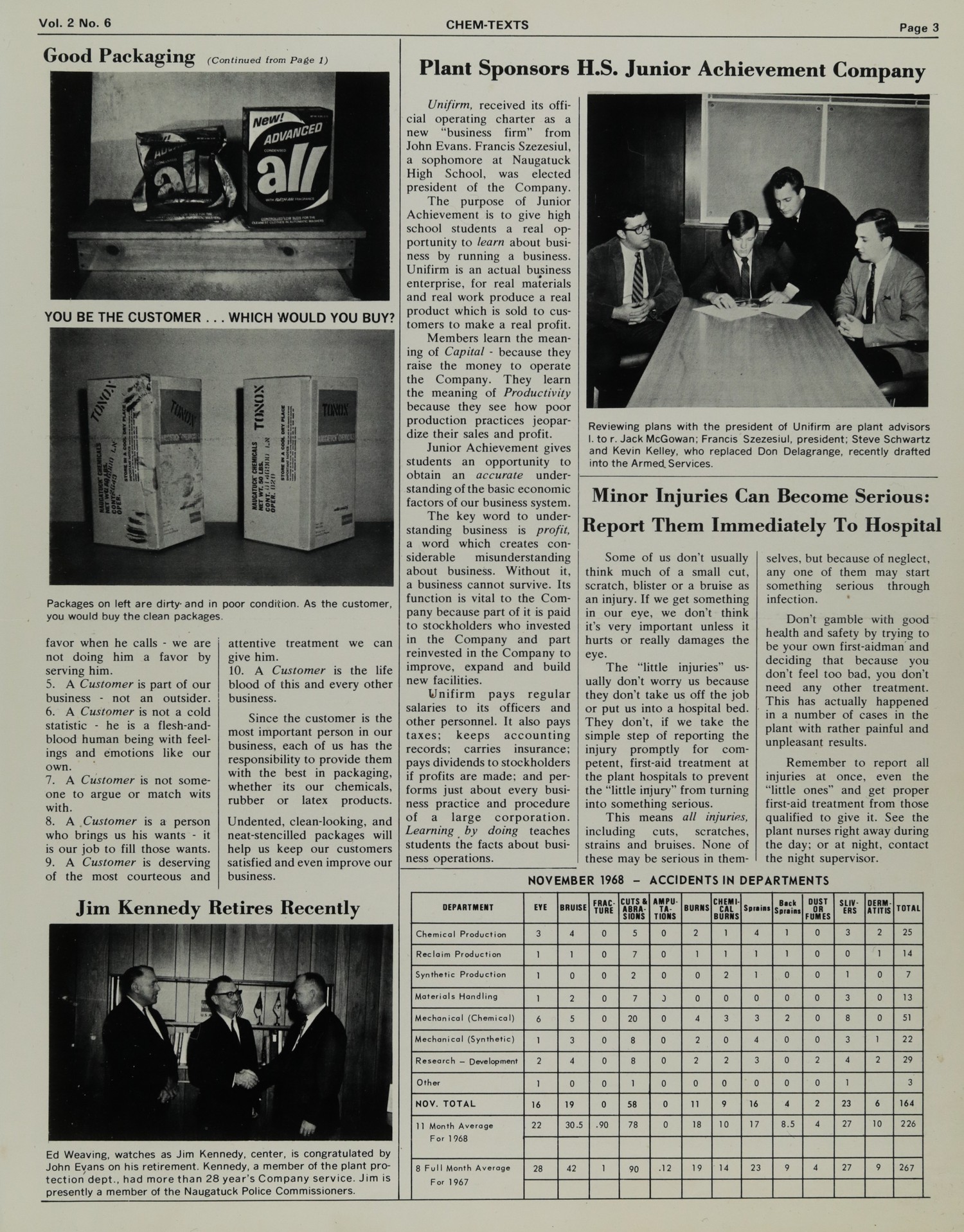
Las Vegas – 1973-s211

Page 211

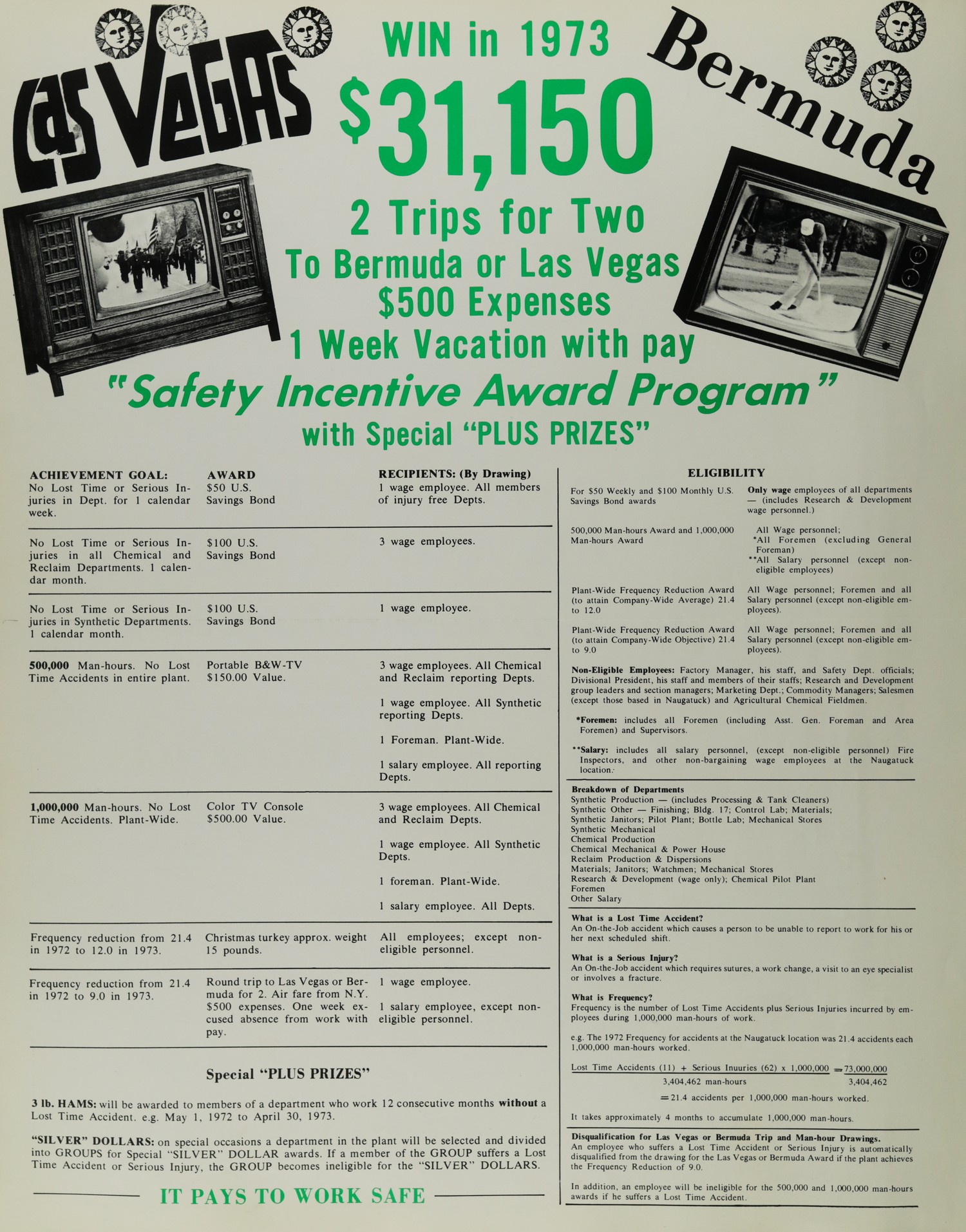
WIN in 1973

$31,150

2 Trips for Two

To Bermuda or Las Vegas

$500 Expenses

1 Week Vacation with pay

“Safety Incentive Award Program”

with Special “PLUS PRIZES”


ACHIEVEMENT GOAL:

No Lost Time or Serious Injuries in Dept. for 1 calendar week.

AWARD
$50 U.S. Savings Bond

RECIPIENTS: (By Drawing)
1 wage employee. All members of injury free Depts.


No Lost Time or Serious Injuries in all Chemical and Reclaim Departments. 1 calendar month.

AWARD
$100 U.S. Savings Bond

RECIPIENTS:
3 wage employees.


No Lost Time or Serious Injuries in Synthetic Departments. 1 calendar month.

AWARD
$100 U.S. Savings Bond

RECIPIENTS:
1 wage employee.


500,000 Man-hours. No Lost Time Accidents in entire plant.

AWARD
Portable B&W-TV $150.00 Value.

RECIPIENTS:
3 wage employees. All Chemical and Reclaim reporting Depts.

1 wage employee. All Synthetic reporting Depts.

1 Foreman. Plant-Wide.

1 salary employee. All reporting Depts.


1,000,000 Man-hours. No Lost Time Accidents. Plant-Wide.

AWARD
Color TV Console $500.00 Value.

RECIPIENTS:
3 wage employees. All Chemical and Reclaim Depts.

1 wage employee. All Synthetic Depts.

1 foreman. Plant-Wide.

1 salary employee. All Depts.


Frequency reduction from 21.4 in 1972 to 12.0 in 1973.

AWARD
Christmas turkey approx. weight 15 pounds.

RECIPIENTS:
All employees; except non-eligible personnel.


Frequency reduction from 21.4 in 1972 to 9.0 in 1973.

AWARD
Round trip to Las Vegas or Bermuda for 2. Air fare from N.Y. $500 expenses. One week excused absence from work with pay.

RECIPIENTS:
1 wage employee.

1 salary employee, except non-eligible personnel.


Special “PLUS PRIZES”

3 lb. HAMS: will be awarded to members of a department who work 12 consecutive months without a Lost Time Accident. e.g. May 1, 1972 to April 30, 1973.

“SILVER” DOLLARS: on special occasions a department in the plant will be selected and divided into GROUPS for Special “SILVER” DOLLAR awards. If a member of the GROUP suffers a Lost Time Accident or Serious Injury, the GROUP becomes ineligible for the “SILVER” DOLLARS.


IT PAYS TO WORK SAFE


ELIGIBILITY

For $50 Weekly and $100 Monthly U.S. Savings Bond awards

Only wage employees of all departments — (includes Research & Development wage personnel.)


500,000 Man-hours Award and 1,000,000 Man-hours Award

All Wage personnel;
All Foremen (excluding General Foreman)
*All Salary personnel (except non-eligible employees)


Plant-Wide Frequency Reduction Award (to attain Company-Wide Average) 21.4 to 12.0

All Wage personnel; Foremen and all Salary personnel (except non-eligible employees).


Plant-Wide Frequency Reduction Award (to attain Company-Wide Objective) 21.4 to 9.0

All Wage personnel; Foremen and all Salary personnel (except non-eligible employees).


Non-Eligible Employees: Factory Manager, his staff, and Safety Dept. officials; Divisional President, his staff and members of their staffs; Research and Development group leaders and section managers; Marketing Dept.; Commodity Managers; Salesmen (except those based in Naugatuck) and Agricultural Chemical Fieldmen.

*Foremen: includes all Foremen (including Asst. Gen. Foreman and Area Foremen) and Supervisors.

**Salary: includes all salary personnel, (except non-eligible personnel) Fire Inspectors, and other non-bargaining wage employees at the Naugatuck location.


Breakdown of Departments

Synthetic Production — (includes Processing & Tank Cleaners)
Synthetic Other — Finishing; Bldg. 17; Control Lab; Materials;
Synthetic Janitors; Pilot Plant; Bottle Lab; Mechanical Stores
Synthetic Mechanical
Chemical Production
Chemical Mechanical & Power House
Reclaim Production & Dispersions
Materials; Janitors; Watchmen; Mechanical Stores
Research & Development (wage only); Chemical Pilot Plant
Foremen
Other Salary


What is a Lost Time Accident?
An On-the-Job accident which causes a person to be unable to report to work for his or her next scheduled shift.

What is a Serious Injury?
An On-the-Job accident which requires sutures, a work change, a visit to an eye specialist or involves a fracture.

What is Frequency?
Frequency is the number of Lost Time Accidents plus Serious Injuries incurred by employees during 1,000,000 man-hours of work.

e.g. The 1972 Frequency for accidents at the Naugatuck location was 21.4 accidents each 1,000,000 man-hours worked.

Lost Time Accidents (11) + Serious Inuuries (62) x 1,000,000 = 73,000,000
3,404,462 man-hours 3,404,462

= 21.4 accidents per 1,000,000 man-hours worked.

It takes approximately 4 months to accumulate 1,000,000 man-hours.


Disqualification for Las Vegas or Bermuda Trip and Man-hour Drawings.
An employee who suffers a Lost Time Accident or Serious Injury is automatically disqualified from the drawing for the Las Vegas or Bermuda Award if the plant achieves the Frequency Reduction of 9.0.

In addition, an employee will be ineligible for the 500,000 and 1,000,000 man-hours awards if he suffers a Lost Time Accident.
CHEM-TEXTS – Vol. 5, No. 2 – Page 3

Page 003

CHEM-TEXTS

Vol. 5. No. 2 Page 3


Safety Glasses Save Eyesight of Five Employees

Set Goals; Show Results

The Management By Objective program at the Chemical plant uses results as the major measurement criterion. The purpose of the program is to provide the challenge of individual responsibility; a sense of accomplishment; and personal involvement in the successful operation of the plant during the year.

In the program supervisory personnel and members of their departments mutually define specific goals, individual areas of responsibility, and the results that can be expected on the job. The objectives for each department must fit into the overall objectives of the plant so that each group in the plant works as a unity toward the plant’s and Company’s objectives.

Emphasizes Results

Results, rather than activity, is the measurement by which each person is appraised. Since the individual helps set his own goals, he is accountable for his own achievements.

To be measurable, the objectives are set up as specific as possible in dollars, amounts, times, percentage, quality and other categories.

Four standards are used in the measurement guide which are reviewed quarterly and revised, or new standards and targets set as necessary: 1) Result Areas; 2) Measurements; 3) Commitments; and 4) Supportive Action.

When properly carried out the program provides the individual the incentive to achieve results which he helped set for himself by organizing his time and activities in a logical, systematic method.


Savings Bond Drive Starts

On May 25 a U.S. Savings Bond drive was initiated in the plant to offer all employees an opportunity to purchase Savings Bonds.

In view of the new higher interest rate of 5 1/2%, more people are taking a new look at Savings Bonds as a safe, systematic investment.

For convenience, the Bonds can be purchased by regular payroll deductions.

Presently 35% of the plant’s employees are buying U.S. Savings Bonds through the Payroll Savings Plan.

Application forms for enrollment can be obtained from the Bond Drive Committee members, Foremen, Supervisors or from Gladys Bradshaw, Industrial Relations Department, ext. 517.

Completed forms should be returned to W. Lavelle, Industrial Relations Department.


Don’t drive after taking certain pills, such as tranquilizers or antihistamines. They may have side effects that affect judgment, cause dizziness, sleepiness, and confusion.


SAFETY IS MY RESPONSIBILITY


Safety Award Received

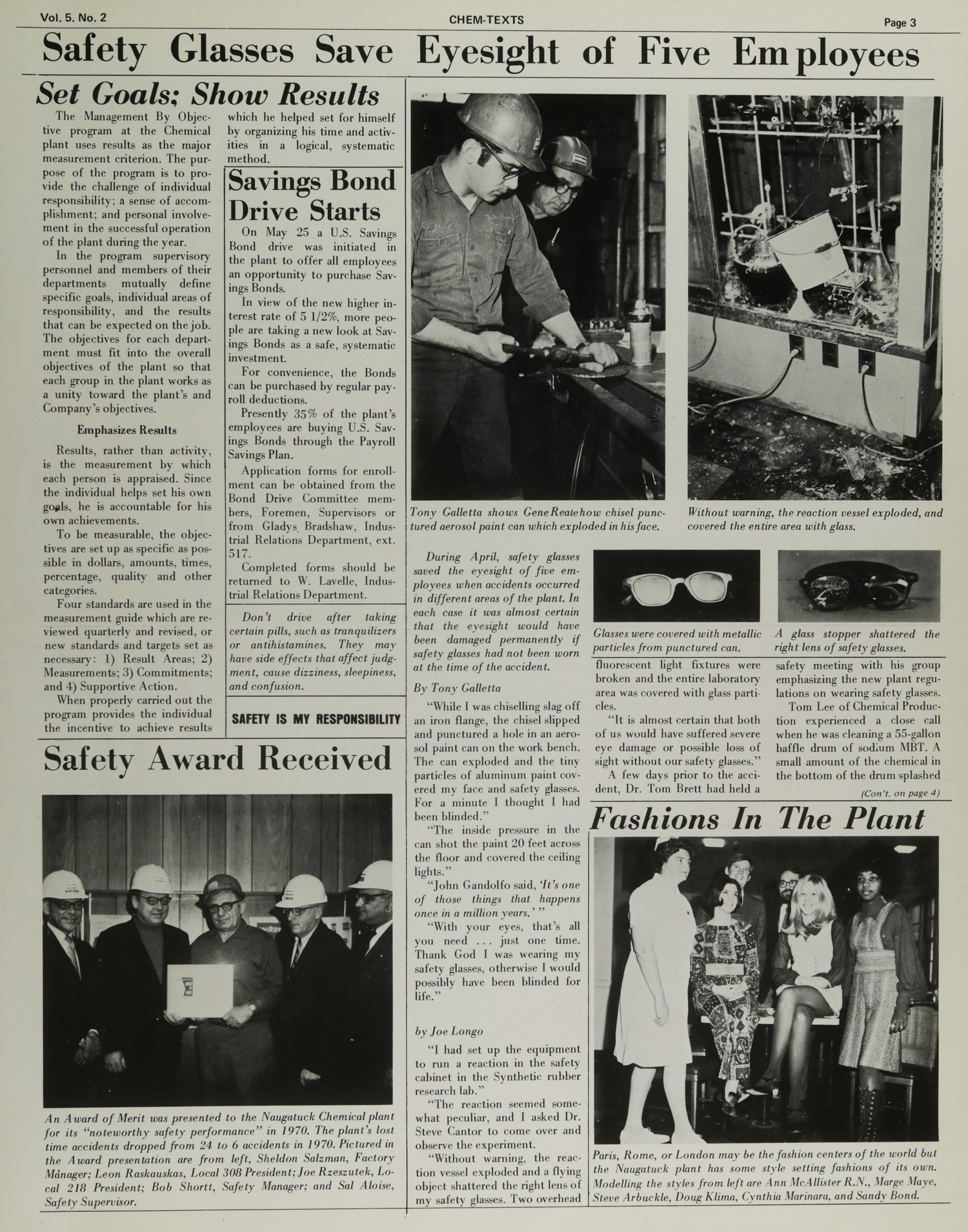
An Award of Merit was presented to the Naugatuck Chemical plant for its “noteworthy safety performance” in 1970. The plant’s lost time accidents dropped from 24 to 6 accidents in 1970. Pictured in the Award presentation are from left, Sheldon Salzman, Factory Manager; Leon Raskauskas, Local 308 President; Joe Rzeszutek, Local 218 President; Bob Shortt, Safety Manager; and Sal Aloise, Safety Supervisor.


Tony Galletta shows Gene Reate how chisel punctured aerosol paint can which exploded in his face.

Without warning, the reaction vessel exploded, and covered the entire area with glass.


During April, safety glasses saved the eyesight of five employees when accidents occurred in different areas of the plant. In each case it was almost certain that the eyesight would have been damaged permanently if safety glasses had not been worn at the time of the accident.

By Tony Galletta

“While I was chiselling slag off an iron flange, the chisel slipped and punctured a hole in an aerosol paint can on the work bench. The can exploded and the tiny particles of aluminum paint covered my face and safety glasses. For a minute I thought I had been blinded.”

“The inside pressure in the can shot the paint 20 feet across the floor and covered the ceiling lights.”

“John Gandolfo said, ‘It’s one of those things that happens once in a million years.’

“With your eyes, that’s all you need . . . just one time. Thank God I was wearing my safety glasses, otherwise I would possibly have been blinded for life.”


by Joe Longo

“I had set up the equipment to run a reaction in the safety cabinet in the Synthetic rubber research lab.”

“The reaction seemed somewhat peculiar, and I asked Dr. Steve Cantor to come over and observe the experiment.

“Without warning, the reaction vessel exploded and a flying object shattered the right lens of my safety glasses. Two overhead fluorescent light fixtures were broken and the entire laboratory area was covered with glass particles.

“It is almost certain that both of us would have suffered severe eye damage or possible loss of sight without our safety glasses.”

A few days prior to the accident, Dr. Tom Brett had held a


Glasses were covered with metallic particles from punctured can.

A glass stopper shattered the right lens of safety glasses.

safety meeting with his group emphasizing the new plant regulations on wearing safety glasses.

Tom Lee of Chemical Production experienced a close call when he was cleaning a 55-gallon baffle drum of sodium MBT. A small amount of the chemical in the bottom of the drum splashed

(Con’t. on page 4)


Fashions In The Plant

Paris, Rome, or London may be the fashion centers of the world but the Naugatuck plant has some style setting fashions of its own. Modelling the styles from left are Ann McAllister R.N., Marge Maye, Steve Arbuckle, Doug Klima, Cynthia Marinaro, and Sandy Bond.

CHEM-TEXTS – Vol. 4, 1970, No. 1 – Page 1

Page 001

UNIROYAL CHEM-TEXTS

Vol. 4, 1970 | PUBLISHED FOR THE PEOPLE OF UNIROYAL CHEMICAL | No. 1


Uniroyal Benefits Help Cover Today’s Staggering Hospital Costs

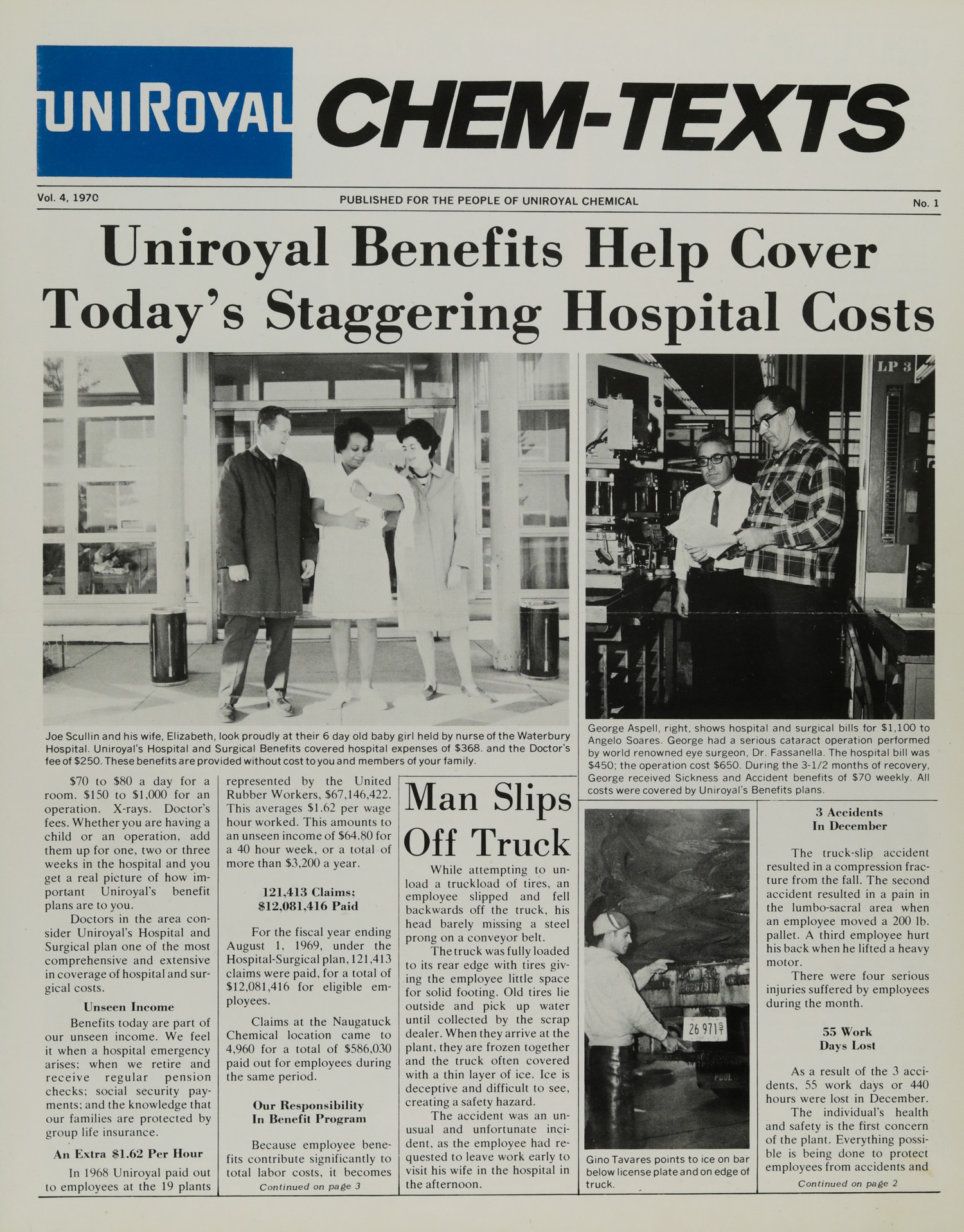
Joe Scullin and his wife, Elizabeth, look proudly at their 6 day old baby girl held by nurse of the Waterbury Hospital. Uniroyal’s Hospital and Surgical Benefits covered hospital expenses of $368. and the Doctor’s fee of $250. These benefits are provided without cost to you and members of your family.


$70 to $80 a day for a room. $150 to $1,000 for an operation. X-rays. Doctor’s fees. Whether you are having a child or an operation, add them up for one, two or three weeks in the hospital and you get a real picture of how important Uniroyal’s benefit plans are to you.

Doctors in the area consider Uniroyal’s Hospital and Surgical plan one of the most comprehensive and extensive in coverage of hospital and surgical costs.

Unseen Income

Benefits today are part of our unseen income. We feel it when a hospital emergency arises; when we retire and receive regular pension checks; social security payments; and the knowledge that our families are protected by group life insurance.

An Extra $1.62 Per Hour

In 1968 Uniroyal paid out to employees at the 19 plants represented by the United Rubber Workers, $67,146,422. This averages $1.62 per wage hour worked. This amounts to an unseen income of $64.80 for a 40 hour week, or a total of more than $3,200 a year.

121,413 Claims: $12,081,416 Paid

For the fiscal year ending August 1, 1969, under the Hospital-Surgical plan, 121,413 claims were paid, for a total of $12,081,416 for eligible employees.

Claims at the Naugatuck Chemical location came to 4,960 for a total of $586,030 paid out for employees during the same period.

Our Responsibility In Benefit Program

Because employee benefits contribute significantly to total labor costs, it becomes

Continued on page 3


Man Slips Off Truck

While attempting to unload a truckload of tires, an employee slipped and fell backwards off the truck, his head barely missing a steel prong on a conveyor belt.

The truck was fully loaded to its rear edge with tires giving the employee little space for solid footing. Old tires lie outside and pick up water until collected by the scrap dealer. When they arrive at the plant, they are frozen together and the truck often covered with a thin layer of ice. Ice is deceptive and difficult to see, creating a safety hazard.

The accident was an unusual and unfortunate incident, as the employee had requested to leave work early to visit his wife in the hospital in the afternoon.


George Aspell, right, shows hospital and surgical bills for $1,100 to Angelo Soares. George had a serious cataract operation performed by world renowned eye surgeon, Dr. Fassanella. The hospital bill was $450; the operation cost $650. During the 3-1/2 months of recovery, George received Sickness and Accident benefits of $70 weekly. All costs were covered by Uniroyal’s Benefits plans.


3 Accidents In December

The truck-slip accident resulted in a compression fracture from the fall. The second accident resulted in a pain in the lumbo-sacral area when an employee moved a 200 lb. pallet. A third employee hurt his back when he lifted a heavy motor.

There were four serious injuries suffered by employees during the month.

55 Work Days Lost

As a result of the 3 accidents, 55 work days or 440 hours were lost in December. The individual’s health and safety is the first concern of the plant. Everything possible is being done to protect employees from accidents and

Continued on page 2


Gino Tavares points to ice on bar below license plate and on edge of truck.

CHEM-TEXTS – Vol. 4 No. 4 – Page 2

Page 002

Page 2

Vol. 4. No. 4

FROM THE FACTORY MANAGER

DEAR FELLOW EMPLOYEE:

On April 22 our lost-time free accident performance ended at 1,309,799 man hours worked. This performance, which was our best since 1968, was ended by a careless act resulting from not following instructions.

Two pipers on the evening shift were sent to 73 Building at the Chemical plant to disconnect the steam tracer on a DN tank car so that the plant switch could be made. Their instructions were limited to disconnecting the tracer, but with the best of intentions to be helpful, they removed the quick disconnect DN line which is the normal job of the operator.

Unfamiliar with the disconnect procedure, they failed to check that the valves were not closed and the disconnect was not drained. As a result the unexpected happened — the pipers were sprayed with DN. One swallowed some DN and was hospitalized for observation.

To place this in proper perspective, let me point out I do not want to discourage cooperation and working together and that I am not concerned about records — I am concerned that we cease having accidents. I am convinced that accidents are the result of carelessness. We will cease to have accidents when each and every one of us knows his job; follows the proper procedures, including the wearing of proper protective equipment; and, equally important, starts to show more concern about safety for ourselves and others.

Sincerely,

John

John D. Evans


136 Join . . . (Cont’d. from page 1)

active service in the club, receiving his 45-year service pin from Dr. Earle Ebers, president of Uniroyal Development Company.

40 Years Service

Awarded Hamilton watches for 40 years service were Dolphi Gabriel, Helen Haughney, Al Krampetz, Walt Miller, Dick Opper, Eitel Radwick and Milton Woodin.

35 Years Service

Honored for 35 years service were Joe Adomaitis, Bill Albaitis, Herb Atwood, Walter Budd, Don Cowan, Charles Drapko, Bernard Dunn, Alice Egan, Joe Errico, Orlando Gabianelli, Charles Gates, Dom Gentile, Al Kazemekas, Joe Lokites, Frank Lynch, Art Nauges, Ed Nunn, John Objinski, Dick Pinto, John Sapinsky, Alice Schofield, Bert Scullin, Tom Skehan, Norm Smith, Howard Titley, Josephine Wailonis and Al Zapatka.

30 Years Service

Receiving 30 years service pins were Ed Alves, Norm Benson, Walt Booth, Chet Bulka, Jim Carroll, Jim Casey, Al Cignotti, Frank Clark, Molly Cobbol, Bill Connelly, Dick Cooper, Edna Crycheau, Harold Dibble, Jack Dunn, Frank Edmonds, Guy Elwood, Leon Evon, Bob Foltz, Norm Gibbs, Julius Grabowski, Don Kirby, Zigmunt Kirdzik, Roc-

[PHOTO CAPTION: Andy Molnar receives congratulations from Dr. Earle Ebers for his 45 years service.]

co Magnamo, Rocco Magnanimo, Bill Mariano, Mitch Mazur, Charles McCleary, John Napiello, Leo Napiello, Mildred Nauges, Dave Nelson, Don Nelson, George O’Brien, Martin O’Brien, Matty Osiecki, Catherine O’Sullivan, Jim Parechanian, Andy Patskan, Jose Pinto, Henry Quigley, Joe Rourk, Tano San Angelo, Jim Schumacher, Adele Schwenk, Bob Sterrett, Ed Szczesiul, Pete Thomas and Bob VanAllen.

New Members

New 25 years service members to the Club are Vivian Abel, Charles Alexander, Elmer Anderson, Luella


Five Major Accidents Averted

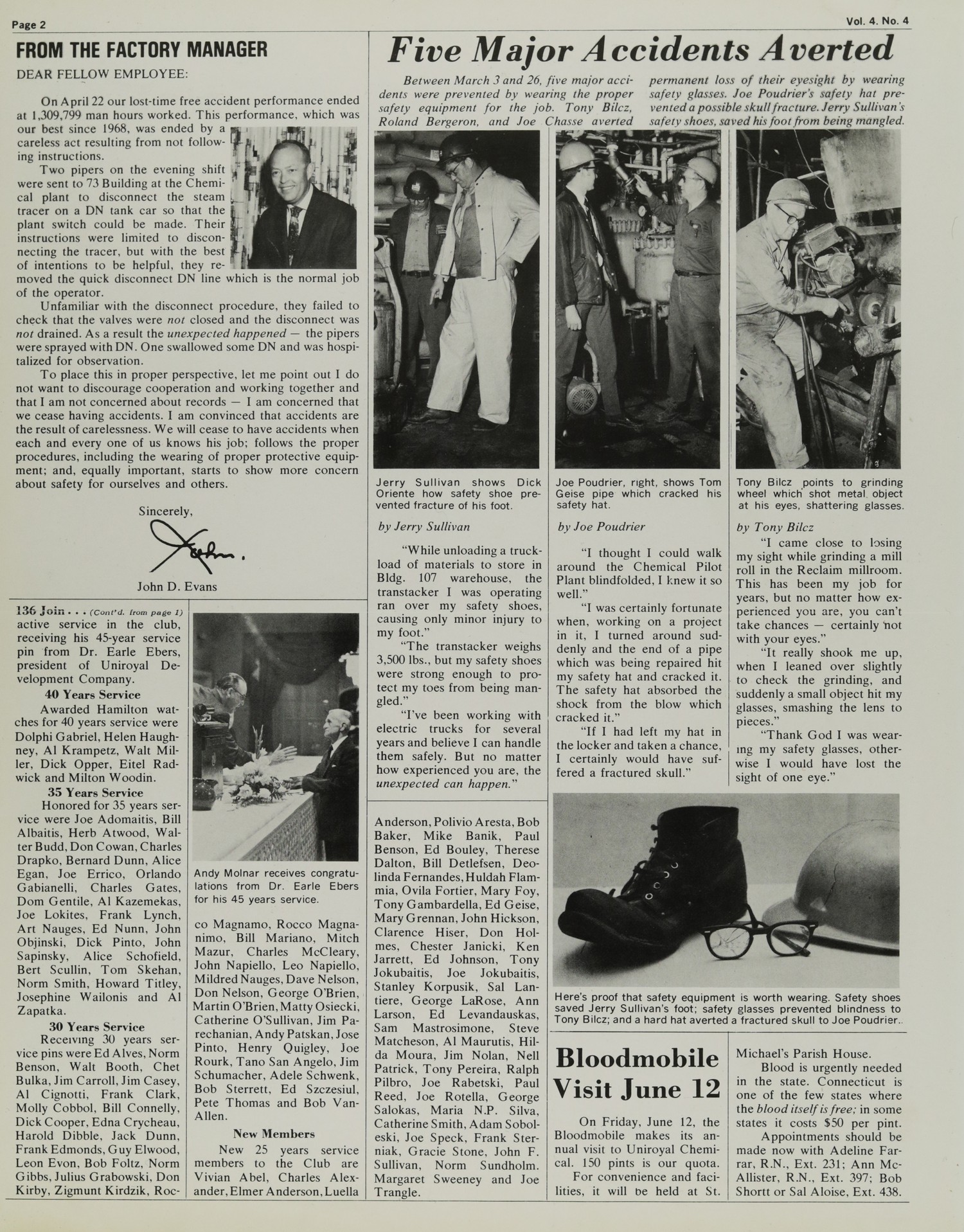
Between March 3 and 26, five major accidents were prevented by wearing the proper safety equipment for the job. Tony Bilcz, Roland Bergeron, and Joe Chasse averted

permanent loss of their eyesight by wearing safety glasses. Joe Poudrier’s safety hat prevented a possible skull fracture. Jerry Sullivan’s safety shoes, saved his foot from being mangled.

[PHOTO CAPTION: Jerry Sullivan shows Dick Oriente how safety shoe prevented fracture of his foot.]

[PHOTO CAPTION: Joe Poudrier, right, shows Tom Geise pipe which cracked his safety hat.]

[PHOTO CAPTION: Tony Bilcz points to grinding wheel which shot metal object at his eyes, shattering glasses.]

by Jerry Sullivan

“While unloading a truckload of materials to store in Bldg. 107 warehouse, the transtacker I was operating ran over my safety shoes, causing only minor injury to my foot.”

“The transtacker weighs 3,500 lbs., but my safety shoes were strong enough to protect my toes from being mangled.”

“I’ve been working with electric trucks for several years and believe I can handle them safely. But no matter how experienced you are, the unexpected can happen.

by Joe Poudrier

“I thought I could walk around the Chemical Pilot Plant blindfolded, I knew it so well.”

“I was certainly fortunate when, working on a project in it, I turned around suddenly and the end of a pipe which was being repaired hit my safety hat and cracked it. The safety hat absorbed the shock from the blow which cracked it.”

“If I had left my hat in the locker and taken a chance, I certainly would have suffered a fractured skull.”

by Tony Bilcz

“I came close to losing my sight while grinding a mill roll in the Reclaim millroom. This has been my job for years, but no matter how experienced you are, you can’t take chances — certainly not with your eyes.”

“It really shook me up, when I leaned over slightly to check the grinding, and suddenly a small object hit my glasses, smashing the lens to pieces.”

“Thank God I was wearing my safety glasses, otherwise I would have lost the sight of one eye.”


Anderson, Polivio Aresta, Bob Baker, Mike Banik, Paul Benson, Ed Bouley, Therese Dalton, Bill Detlefsen, Deolinda Fernandes, Huldah Flammia, Ovila Fortier, Mary Foy, Tony Gambardella, Ed Geise, Mary Grennan, John Hickson, Clarence Hiser, Don Holmes, Chester Janicki, Ken Jarrett, Ed Johnson, Tony Jokubaitis, Joe Jokubaitis, Stanley Korpusik, Sal Lantiere, George LaRose, Ann Larson, Ed Levandauskas, Sam Mastrosimone, Steve Matcheson, Al Maurutis, Hilda Moura, Jim Nolan, Nell Patrick, Tony Pereira, Ralph Pilbro, Joe Rabetski, Paul Reed, Joe Rotella, George Salokas, Maria N.P. Silva, Catherine Smith, Adam Soboleski, Joe Speck, Frank Sterniak, Gracie Stone, John F. Sullivan, Norm Sundholm, Margaret Sweeney and Joe Trangle.


[PHOTO CAPTION: Here’s proof that safety equipment is worth wearing. Safety shoes saved Jerry Sullivan’s foot; safety glasses prevented blindness to Tony Bilcz; and a hard hat averted a fractured skull to Joe Poudrier.]


Bloodmobile Visit June 12

On Friday, June 12, the Bloodmobile makes its annual visit to Uniroyal Chemical. 150 pints is our quota.

For convenience and facilities, it will be held at St. Michael’s Parish House.

Blood is urgently needed in the state. Connecticut is one of the few states where the blood itself is free; in some states it costs $50 per pint.

Appointments should be made now with Adeline Farrar, R.N., Ext. 231; Ann McAllister, R.N., Ext. 397; Bob Shortt or Sal Aloise, Ext. 438.

CHEM-TEXTS – Vol. 3 No. 2 – Page 2

Page 002

CHEM TEXTS

Page 4

The $475.00 Cup

SUGGESTION PLAN AWARDS

Gene St. John had an idea some time back about the use of the small gel cups used in the laboratory for testing purposes. Part of Gene’s job was buying laboratory equipment and material; however, not satisfied with the products available on the market, he set about the task of designing an inexpensive cup that would do the job, equally well. Much of the work was done at home. The result was a suggestion award of $475.00 based on savings when Gene’s efforts paid off.

Jacinto DaSilva of the Chemical Production department was awarded $60.00 (the balance of an $85.00 award) for his idea to change the method of washing Octamine which reduced the amount of material going to the sewer. An original award of $25.00 was made last January for this suggestion – the balance of the award is based on actual experience in material savings.

The above 2 awards were the highest out of a total of 49 suggestions considered during a recent meeting of the suggestion committee. Twelve (12) cash and nine (9) Honorable mention awards were made totaling $725.00. Other awards were:

Joseph Moniz – Digesters –
Honorable Mention

Joseph Moniz – Digesters –
$25.00


Harry Rich – Labs – $15.00
Ed Day – Labs –
Honorable Mention
Dom Angiolillo – Labs –
$15.00
Frank Wasilesky – Mech.
Stores – $15.00
N. Salinardi – Mech. –
Honorable Mention
Carmine Ianuzzi – Mech.
Honorable Mention
(3rd – $10.00)
W. Frum – Mech. – $25.00
Charles Drapko – Chem. Prod.
$15.00
George Ravenscroft, Jr. –
Mech. – $35.00
Carmine Ianuzzi – Mech. –
Honorable Mention
G. Hennessey – Chem. Prod.
$15.00
Jacinto DaSilva – Chem. Prod.
Honorable Mention
Bill Leary – Mech. –
Honorable Mention
W. Detlefsen – Chem. Prod. –
Honorable Mention
A. Giancarlo – Mech. –
Honorable Mention
A. Gedraitis – Mech. – $15.00
G. Hennessey – Chem. Prod. –
Honorable Mention

The overall figures this year represent a reduction in suggestion plan activity due to the recent strike.

Through August 1967 a total of 201 suggestions have been considered with 64 awards totaling $1,620.00 being made. During this same period there were also 23 Honorable Mention awards.


NEW SAFETY EYE PROTECTION PROGRAM TO BE STARTED

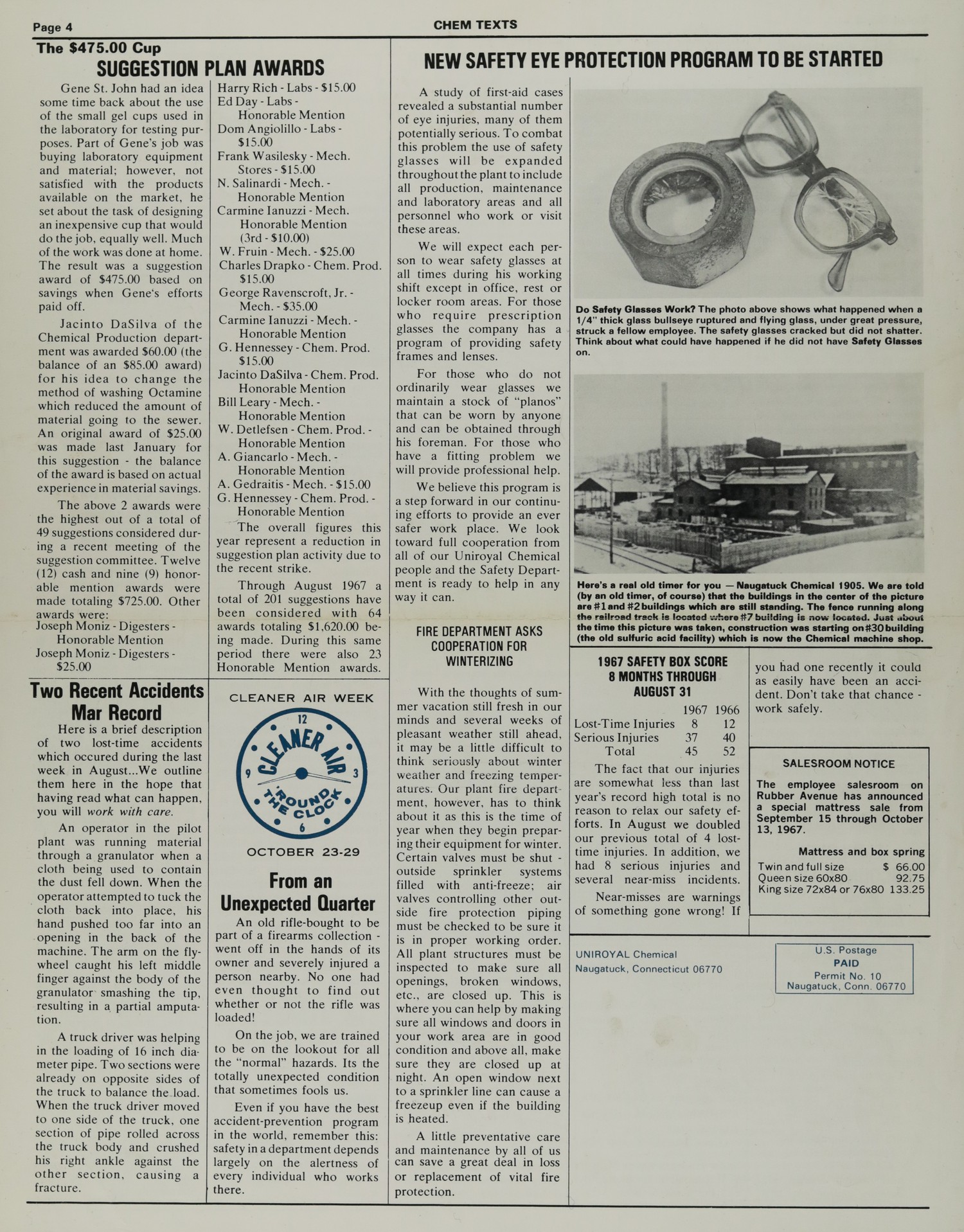
A study of first-aid cases revealed a substantial number of eye injuries, many of them potentially serious. To combat this problem the use of safety glasses will be expanded throughout the plant to include all production, maintenance and laboratory areas and all personnel who work or visit these areas.

We will expect each person to wear safety glasses at all times during his working shift except in office, rest or locker room areas. For those who require prescription glasses the company has a program of providing safety frames and lenses.

For those who do not ordinarily wear glasses we maintain a stock of “planos” that can be worn by anyone and can be obtained through his foreman. For those who have a fitting problem we will provide professional help.

We believe this program is a step forward in our continuing efforts to provide an ever safer work place. We look toward full cooperation from all of our Uniroyal Chemical people and the Safety Department is ready to help in any way it can.


Do Safety Glasses Work? The photo above shows what happened when a 1/4″ thick glass bullseye ruptured and flying glass, under great pressure, struck a fellow employee. The safety glasses cracked but did not shatter. Think about what could have happened if he did not have Safety Glasses on.


Here’s a real old timer for you — Naugatuck Chemical 1905. We are told (by an old timer, of course) that the buildings in the center of the picture are #1 and #2 buildings which are still standing. The fence running along the railroad track is located where #7 building is now located. Just about the time this picture was taken, construction was starting on #30 building (the old sulfuric acid facility) which is now the Chemical machine shop.


Two Recent Accidents Mar Record

Here is a brief description of two lost-time accidents which occured during the last week in August…We outline them here in the hope that having read what can happen, you will work with care.

An operator in the pilot plant was running material through a granulator when a cloth being used to contain the dust fell down. When the operator attempted to tuck the cloth back into place, his hand pushed too far into an opening in the back of the machine. The arm on the flywheel caught his left middle finger against the body of the granulator smashing the tip, resulting in a partial amputation.

A truck driver was helping in the loading of 16 inch diameter pipe. Two sections were already on opposite sides of the truck to balance the load. When the truck driver moved to one side of the truck, one section of pipe rolled across the truck body and crushed his right ankle against the other section, causing a fracture.


CLEANER AIR WEEK

[IMAGE: Logo showing “CLEANER” with numbers 12, 9, 3, 6 around it and text “ROUND THE CLOCK”]

OCTOBER 23-29


From an Unexpected Quarter

An old rifle-bought to be part of a firearms collection – went off in the hands of its owner and severely injured a person nearby. No one had even thought to find out whether or not the rifle was loaded!

On the job, we are trained to be on the lookout for all the “normal” hazards. Its the totally unexpected condition that sometimes fools us.

Even if you have the best accident-prevention program in the world, remember this: safety in a department depends largely on the alertness of every individual who works there.


FIRE DEPARTMENT ASKS COOPERATION FOR WINTERIZING

With the thoughts of summer vacation still fresh in our minds and several weeks of pleasant weather still ahead, it may be a little difficult to think seriously about winter weather and freezing temperatures. Our plant fire department, however, has to think about it as this is the time of year when they begin preparing their equipment for winter. Certain valves must be shut – outside sprinkler systems filled with anti-freeze; air valves controlling other outside fire protection piping must be checked to be sure it is in proper working order. All plant structures must be inspected to make sure all openings, broken windows, etc., are closed up. This is where you can help by making sure all windows and doors in your work area are in good condition and above all, make sure they are closed up at night. An open window next to a sprinkler line can cause a freezeup even if the building is heated.

A little preventative care and maintenance by all of us can save a great deal in loss or replacement of vital fire protection.


1967 SAFETY BOX SCORE 8 MONTHS THROUGH AUGUST 31

1967 1966
Lost-Time Injuries 8 12
Serious Injuries 37 40
Total 45 52

The fact that our injuries are somewhat less than last year’s record high total is no reason to relax our safety efforts. In August we doubled our previous total of 4 lost-time injuries. In addition, we had 8 serious injuries and several near-miss incidents.

Near-misses are warnings of something gone wrong! If you had one recently it could as easily have been an accident. Don’t take that chance – work safely.


SALESROOM NOTICE

The employee salesroom on Rubber Avenue has announced a special mattress sale from September 15 through October 13, 1967.

Mattress and box spring

Twin and full size — $ 66.00
Queen size 60×80 — 92.75
King size 72×84 or 76×80 — 133.25


UNIROYAL Chemical
Naugatuck, Connecticut 06770

U.S. Postage
PAID
Permit No. 10
Naugatuck, Conn. 06770

CHEM-TEXTS – Vol. 3 No. 7 – Page 4

Page 004

Page 4

CHEM-TEXTS

Vol. 3 No. 7

New Union President

Leon Raskauskas recently became President of Local 308, United Rubber Workers which represents the Synthetic plant. Leon replaces Joe Arbachauskas who resigned as president for reason of health. Before his new appointment, Leon had been Vice-President and had served

as President of the Local from 1959 to 1961.

Charlie Roland succeeds Leon as new Vice-President of Local 308.


Blancato Improving

Sam Blancato who was recently burned in a plant accident is well on the road to recovery at the Waterbury Hospital. Sam and his family express their sincere thanks to the many employees who sent him cards, letters and gifts. It’s times like this, Sam pointed out, that you measure your real wealth by the many friends you have.

Anxious to return to work soon, Sam will be in the hospital a short time more for skin grafts. Meanwhile, he looks forward to receiving letters from his many friends in the plant.


Judo Brown Belt Held by Denise Pratt

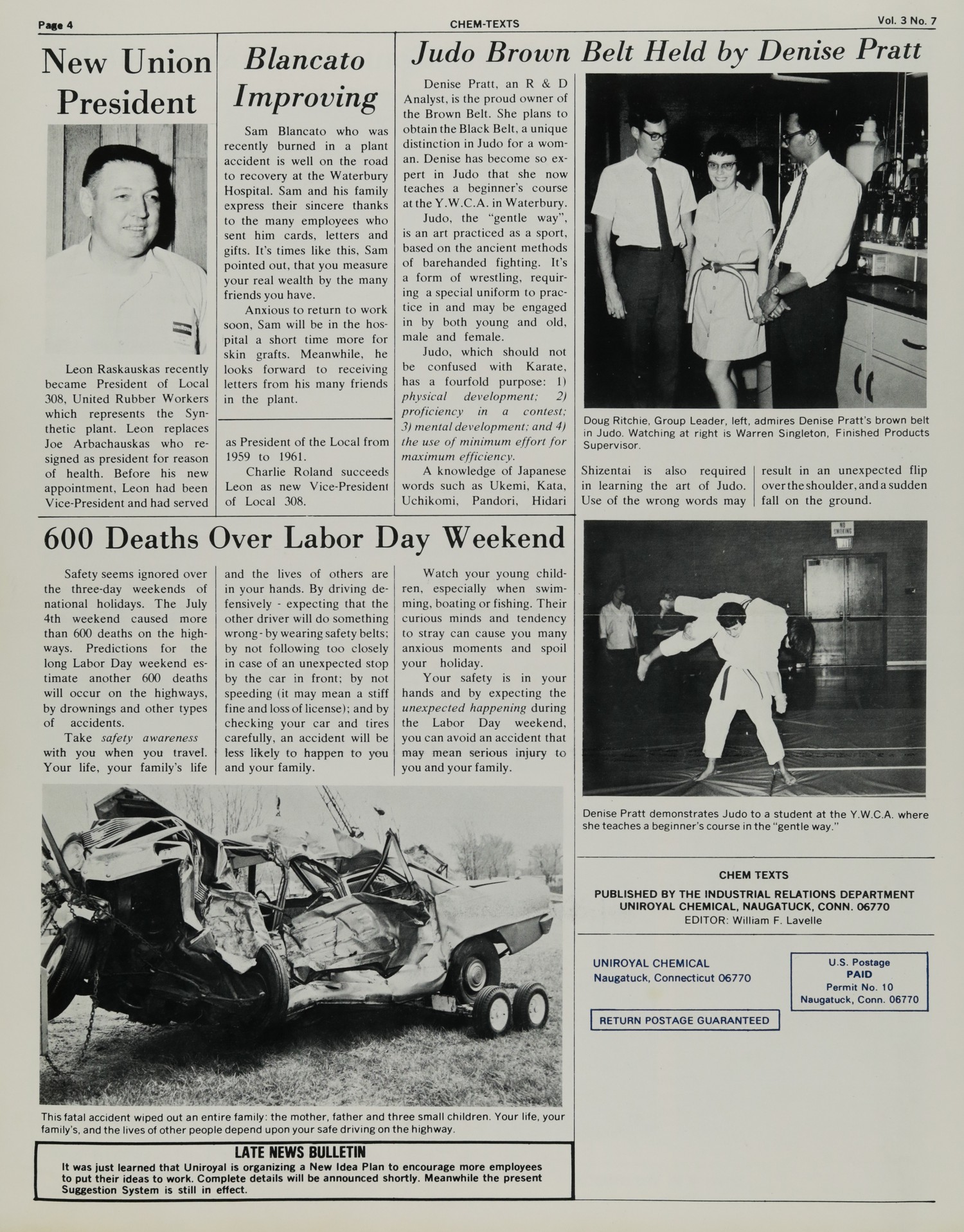
Denise Pratt, an R & D Analyst, is the proud owner of the Brown Belt. She plans to obtain the Black Belt, a unique distinction in Judo for a woman. Denise has become so expert in Judo that she now teaches a beginner’s course at the Y.W.C.A. in Waterbury.

Judo, the “gentle way”, is an art practiced as a sport, based on the ancient methods of barehanded fighting. It’s a form of wrestling, requiring a special uniform to practice in and may be engaged in by both young and old, male and female.

Judo, which should not be confused with Karate, has a fourfold purpose: 1) physical development; 2) proficiency in a contest; 3) mental development; and 4) the use of minimum effort for maximum efficiency.

A knowledge of Japanese words such as Ukemi, Kata, Uchikomi, Pandori, Hidari

Shizentai is also required in learning the art of Judo. Use of the wrong words may result in an unexpected flip over the shoulder, and a sudden fall on the ground.

Doug Ritchie, Group Leader, left, admires Denise Pratt’s brown belt in Judo. Watching at right is Warren Singleton, Finished Products Supervisor.


600 Deaths Over Labor Day Weekend

Safety seems ignored over the three-day weekends of national holidays. The July 4th weekend caused more than 600 deaths on the highways. Predictions for the long Labor Day weekend estimate another 600 deaths will occur on the highways, by drownings and other types of accidents.

Take safety awareness with you when you travel. Your life, your family’s life and the lives of others are in your hands. By driving defensively – expecting that the other driver will do something wrong – by wearing safety belts; by not following too closely in case of an unexpected stop by the car in front; by not speeding (it may mean a stiff fine and loss of license); and by checking your car and tires carefully, an accident will be less likely to happen to you and your family.

Watch your young children, especially when swimming, boating or fishing. Their curious minds and tendency to stray can cause you many anxious moments and spoil your holiday.

Your safety is in your hands and by expecting the unexpected happening during the Labor Day weekend, you can avoid an accident that may mean serious injury to you and your family.

This fatal accident wiped out an entire family: the mother, father and three small children. Your life, your family’s, and the lives of other people depend upon your safe driving on the highway.

Denise Pratt demonstrates Judo to a student at the Y.W.C.A. where she teaches a beginner’s course in the “gentle way.”


LATE NEWS BULLETIN

It was just learned that Uniroyal is organizing a New Idea Plan to encourage more employees to put their ideas to work. Complete details will be announced shortly. Meanwhile the present Suggestion System is still in effect.


CHEM TEXTS

PUBLISHED BY THE INDUSTRIAL RELATIONS DEPARTMENT
UNIROYAL CHEMICAL, NAUGATUCK, CONN. 06770
EDITOR: William F. Lavelle

UNIROYAL CHEMICAL
Naugatuck, Connecticut 06770

U.S. Postage
PAID
Permit No. 10
Naugatuck, Conn. 06770

RETURN POSTAGE GUARANTEED

CHEM-TEXTS – Vol. 2 No. 2 – Page 2

Page 002

Page 2 CHEM TEXTS Vol. 2 No. 2

FROM THE FACTORY MANAGER

Dear Fellow Employees:

Those of us involved in the “STOP” safety training program are repeatedly asked the question, “Who is responsible for safety in my area?” Each of us recognizes there is only one correct answer – “I am.” However, there will only be an effective safety program in our plant if every employee is responsible for his own activities.

Mr. Vila has clearly stated the UNIROYAL philosophy on accident prevention. I would like to quote the following portions of this statement:

. . “Managers at all levels, have, as a primary responsibility, the safety and well being of all persons who report to or are assigned to them.”

“Each employee has an important place in the accident prevention effort and he must accept the responsibility for full cooperation in the measures taken for safety.”

I have underlined RESPONSIBILITY – a key factor in the jobs of all of us. Let’s all work together in a responsible manner to prevent personal injuries.

[Signature]

John D. Evans


LOST TIME ACCIDENTS UP IN FEBRUARY, DROP IN MARCH

Lost time accidents jumped from 2 in January to 3 in February. But dropped from 3 to 2 in March. However the record for serious injuries jumped from 2 in January to a total of 6 in March.

For the first 3 months of the year there were a total of 7 lost time injuries; and for the same period a total of 12 serious injuries.

Severe bruises and sprains accounted mostly for the lost time accidents; with two fractures occurring, one of a kneecap and one wrist fracture. Oftentimes there’s only a hairline difference between these accidents and more serious ones. A “stop, look and listen” attitude toward personal safety would eliminate these incidents that not only affect the employee, but his family as well.

The rising increase of serious injuries is of major concern as these could easily have resulted in more serious accidents. Out of the 12 serious injuries 7 involved the eyes. Blindness is a heavy penalty to pay for you, your family and all of us for not wearing proper protective equipment on the job.


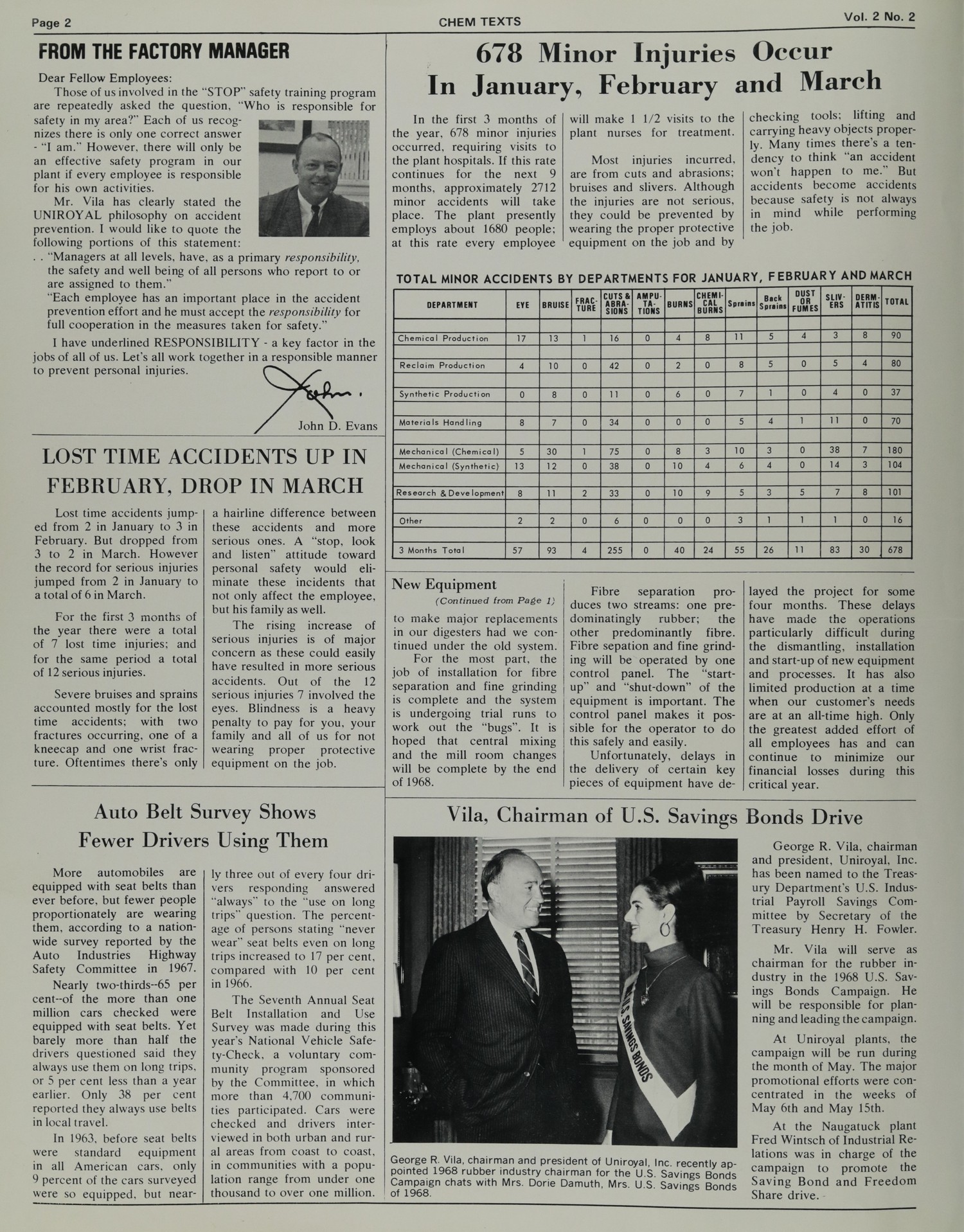
678 Minor Injuries Occur In January, February and March

In the first 3 months of the year, 678 minor injuries occurred, requiring visits to the plant hospitals. If this rate continues for the next 9 months, approximately 2712 minor accidents will take place. The plant presently employs about 1680 people; at this rate every employee will make 1 1/2 visits to the plant nurses for treatment.

Most injuries incurred, are from cuts and abrasions; bruises and slivers. Although the injuries are not serious, they could be prevented by wearing the proper protective equipment on the job and by checking tools; lifting and carrying heavy objects properly. Many times there’s a tendency to think “an accident won’t happen to me.” But accidents become accidents because safety is not always in mind while performing the job.

TOTAL MINOR ACCIDENTS BY DEPARTMENTS FOR JANUARY, FEBRUARY AND MARCH

DEPARTMENT EYE BRUISE FRAC-TURE CUTS & ABRA-SIONS AMPU-TA-TIONS BURNS CHEMI-CAL BURNS Sprains Back Sprains DUST OR FUMES SLIV-ERS DERM-ATITIS TOTAL
Chemical Production 17 13 1 16 0 4 8 11 5 4 3 8 90
Reclaim Production 4 10 0 42 0 2 0 8 5 0 5 4 80
Synthetic Production 0 8 0 11 0 6 0 7 1 0 4 0 37
Materials Handling 8 7 0 34 0 0 0 5 4 1 11 0 70
Mechanical (Chemical) 5 30 1 75 0 8 3 10 3 0 38 7 180
Mechanical (Synthetic) 13 12 0 38 0 10 4 6 4 0 14 3 104
Research & Development 8 11 2 33 0 10 9 5 3 5 7 8 101
Other 2 2 0 6 0 0 0 3 1 1 1 0 16
3 Months Total 57 93 4 255 0 40 24 55 26 11 83 30 678

New Equipment

(Continued from Page 1)

to make major replacements in our digesters had we continued under the old system.

For the most part, the job of installation for fibre separation and fine grinding is complete and the system is undergoing trial runs to work out the “bugs”. It is hoped that central mixing and the mill room changes will be complete by the end of 1968.

Fibre separation produces two streams: one predominatingly rubber; the other predominantly fibre. Fibre sepation and fine grinding will be operated by one control panel. The “start-up” and “shut-down” of the equipment is important. The control panel makes it possible for the operator to do this safely and easily.

Unfortunately, delays in the delivery of certain key pieces of equipment have delayed the project for some four months. These delays have made the operations particularly difficult during the dismantling, installation and start-up of new equipment and processes. It has also limited production at a time when our customer’s needs are at an all-time high. Only the greatest added effort of all employees has and can continue to minimize our financial losses during this critical year.


Auto Belt Survey Shows Fewer Drivers Using Them

More automobiles are equipped with seat belts than ever before, but fewer people proportionately are wearing them, according to a nationwide survey reported by the Auto Industries Highway Safety Committee in 1967.

Nearly two-thirds–65 per cent–of the more than one million cars checked were equipped with seat belts. Yet barely more than half the drivers questioned said they always use them on long trips, or 5 per cent less than a year earlier. Only 38 per cent reported they always use belts in local travel.

In 1963, before seat belts were standard equipment in all American cars, only 9 percent of the cars surveyed were so equipped, but nearly three out of every four drivers responding answered “always” to the “use on long trips” question. The percentage of persons stating “never wear” seat belts even on long trips increased to 17 per cent, compared with 10 per cent in 1966.

The Seventh Annual Seat Belt Installation and Use Survey was made during this year’s National Vehicle Safety-Check, a voluntary community program sponsored by the Committee, in which more than 4,700 communities participated. Cars were checked and drivers interviewed in both urban and rural areas from coast to coast, in communities with a population range from under one thousand to over one million.


Vila, Chairman of U.S. Savings Bonds Drive

[PHOTO: George R. Vila, chairman and president of Uniroyal, Inc. recently appointed 1968 rubber industry chairman for the U.S. Savings Bonds Campaign chats with Mrs. Dorie Damuth, Mrs. U.S. Savings Bonds of 1968.]

George R. Vila, chairman and president, Uniroyal, Inc. has been named to the Treasury Department’s U.S. Industrial Payroll Savings Committee by Secretary of the Treasury Henry H. Fowler.

Mr. Vila will serve as chairman for the rubber industry in the 1968 U.S. Savings Bonds Campaign. He will be responsible for planning and leading the campaign.

At Uniroyal plants, the campaign will be run during the month of May. The major promotional efforts were concentrated in the weeks of May 6th and May 15th.

At the Naugatuck plant Fred Wintsch of Industrial Relations was in charge of the campaign to promote the Saving Bond and Freedom Share drive.

CHEM-TEXTS – Vol. 2 No. 6 – Page 3

Page 003

CHEM-TEXTS

Vol. 2 No. 6 Page 3


Good Packaging (Continued from Page 1)

[IMAGE: Box of “New! ADVANCED all” detergent]

[IMAGE: Packages of “THNX” products stacked]

YOU BE THE CUSTOMER . . . WHICH WOULD YOU BUY?

Packages on left are dirty and in poor condition. As the customer, you would buy the clean packages.

favor when he calls – we are not doing him a favor by serving him.

  1. A Customer is part of our business – not an outsider.
  2. A Customer is not a cold statistic – he is a flesh-and-blood human being with feelings and emotions like our own.
  3. A Customer is not someone to argue or match wits with.
  4. A Customer is a person who brings us his wants – it is our job to fill those wants.
  5. A Customer is deserving of the most courteous and attentive treatment we can give him.
  6. A Customer is the life blood of this and every other business.

Since the customer is the most important person in our business, each of us has the responsibility to provide them with the best in packaging, whether its our chemicals, rubber or latex products. Undented, clean-looking, and neat-stencilled packages will help us keep our customers satisfied and even improve our business.


Jim Kennedy Retires Recently

[IMAGE: Three men in suits, one shaking hands with another]

Ed Weaving, watches as Jim Kennedy, center, is congratulated by John Evans on his retirement. Kennedy, a member of the plant protection dept., had more than 28 year’s Company service. Jim is presently a member of the Naugatuck Police Commissioners.


Plant Sponsors H.S. Junior Achievement Company

Unifirm, received its official operating charter as a new “business firm” from John Evans. Francis Szezesiul, a sophomore at Naugatuck High School, was elected president of the Company.

The purpose of Junior Achievement is to give high school students a real opportunity to learn about business by running a business. Unifirm is an actual business enterprise, for real materials and real work produce a real product which is sold to customers to make a real profit.

Members learn the meaning of Capital – because they raise the money to operate the Company. They learn the meaning of Productivity because they see how poor production practices jeopardize their sales and profit.

Junior Achievement gives students an opportunity to obtain an accurate understanding of the basic economic factors of our business system.

The key word to understanding business is profit, a word which creates considerable misunderstanding about business. Without it, a business cannot survive. Its function is vital to the Company because part of it is paid to stockholders who invested in the Company and part reinvested in the Company to improve, expand and build new facilities.

Unifirm pays regular salaries to its officers and other personnel. It also pays taxes; keeps accounting records; carries insurance; pays dividends to stockholders if profits are made; and performs just about every business practice and procedure of a large corporation. Learning by doing teaches students the facts about business operations.

[IMAGE: Group of men reviewing documents at a table]

Reviewing plans with the president of Unifirm are plant advisors l. to r. Jack McGowan; Francis Szezesiul, president; Steve Schwartz and Kevin Kelley, who replaced Don Delagrange, recently drafted into the Armed Services.


Minor Injuries Can Become Serious: Report Them Immediately To Hospital

Some of us don’t usually think much of a small cut, scratch, blister or a bruise as an injury. If we get something in our eye, we don’t think it’s very important unless it hurts or really damages the eye.

The “little injuries” usually don’t worry us because they don’t take us off the job or put us into a hospital bed. They don’t, if we take the simple step of reporting the injury promptly for competent, first-aid treatment at the plant hospitals to prevent the “little injury” from turning into something serious.

This means all injuries, including cuts, scratches, strains and bruises. None of these may be serious in themselves, but because of neglect, any one of them may start something serious through infection.

Don’t gamble with good health and safety by trying to be your own first-aidman and deciding that because you don’t feel too bad, you don’t need any other treatment. This has actually happened in a number of cases in the plant with rather painful and unpleasant results.

Remember to report all injuries at once, even the “little ones” and get proper first-aid treatment from those qualified to give it. See the plant nurses right away during the day; or at night, contact the night supervisor.


NOVEMBER 1968 — ACCIDENTS IN DEPARTMENTS

DEPARTMENT EYE BRUISE FRAC-TURE CUTS & ABRA-SIONS AMPU-TA-TIONS BURNS CHEMI-CAL BURNS Sprains Back Sprains DUST OR FUMES SLIV-ERS DERM-ATITIS TOTAL
Chemical Production 3 4 0 5 0 2 1 4 1 0 3 2 25
Reclaim Production 1 1 0 7 0 1 1 1 1 0 0 1 14
Synthetic Production 1 0 0 2 0 0 2 1 0 0 1 0 7
Materials Handling 1 2 0 7 0 0 0 0 0 0 3 0 13
Mechanical (Chemical) 6 5 0 20 0 4 3 3 2 0 8 0 51
Mechanical (Synthetic) 1 3 0 8 0 2 0 4 0 0 3 1 22
Research — Development 2 4 0 8 0 2 2 3 0 2 4 2 29
Other 1 0 0 1 0 0 0 0 0 0 1 3
NOV. TOTAL 16 19 0 58 0 11 9 16 4 2 23 6 164
11 Month Average For 1968 22 30.5 .90 78 0 18 10 17 8.5 4 27 10 226
8 Full Month Average For 1967 28 42 1 90 .12 19 14 23 9 4 27 9 267