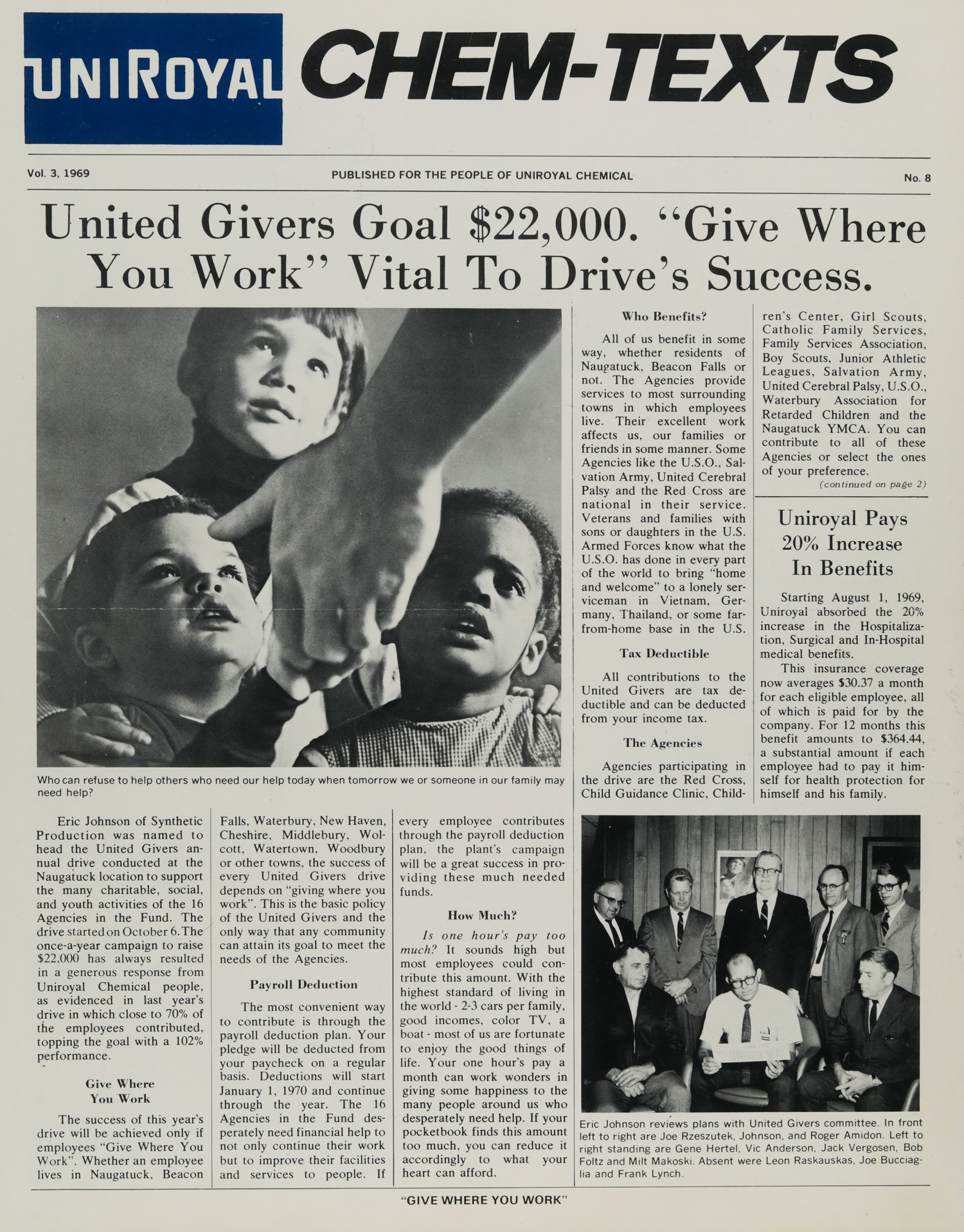
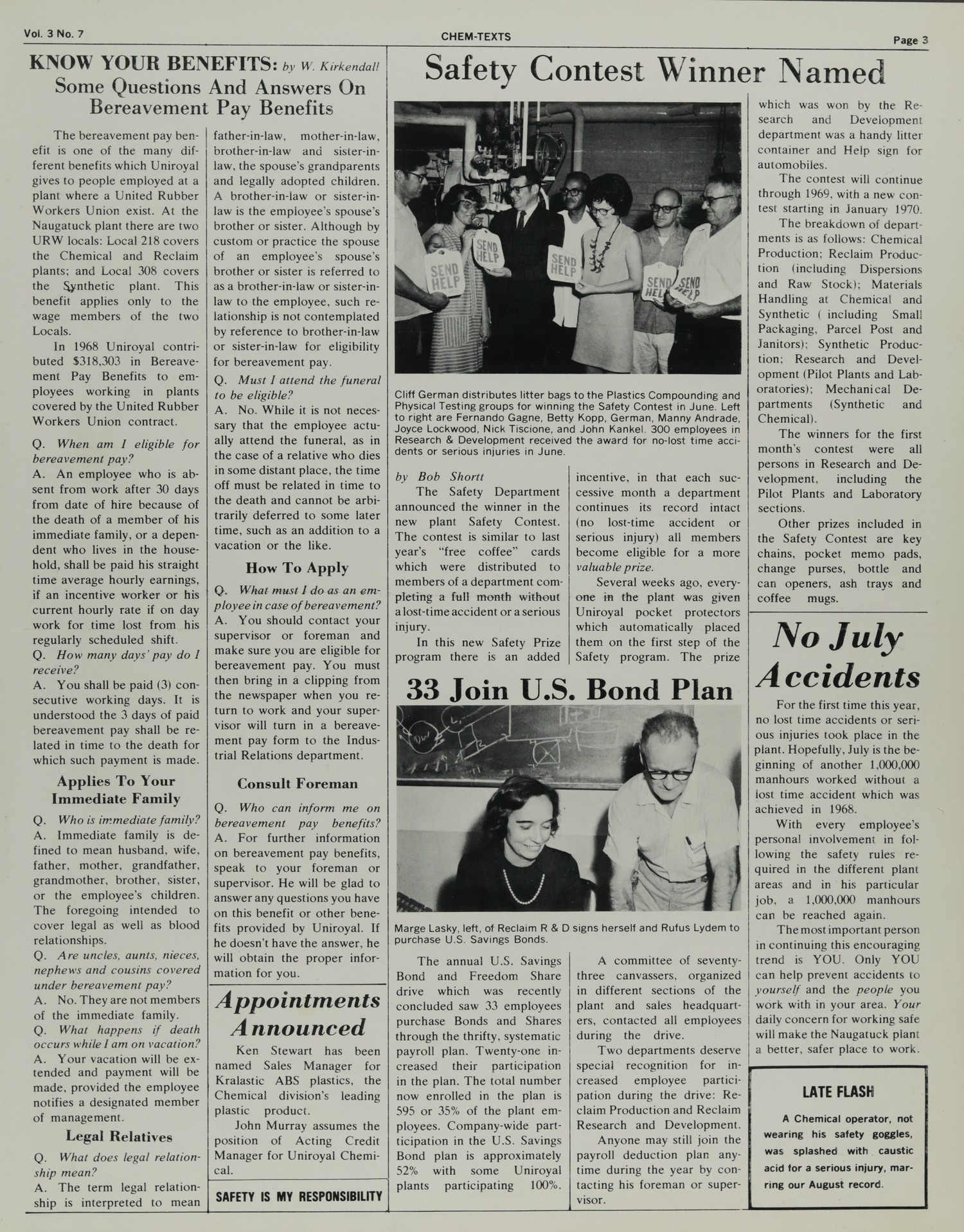
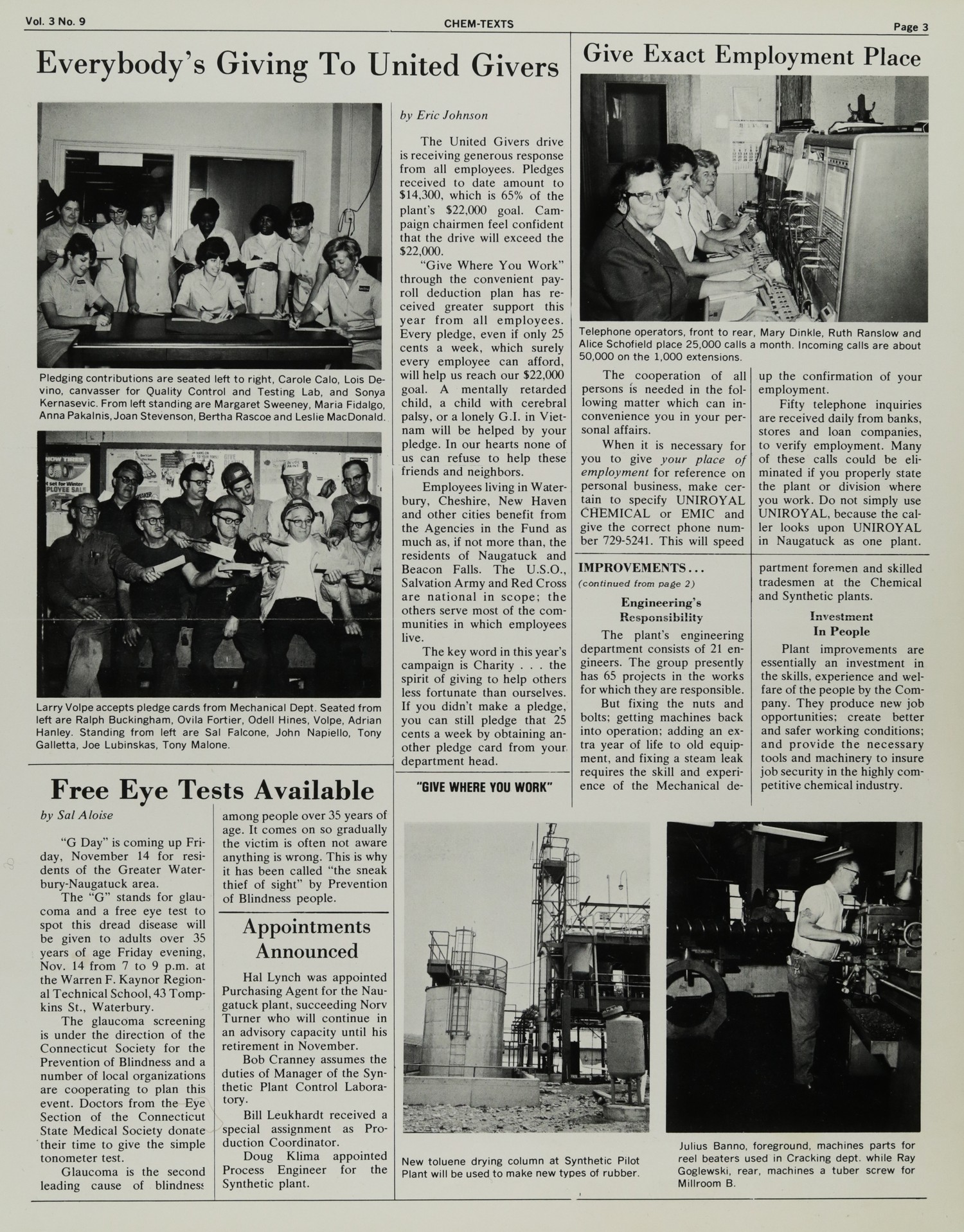
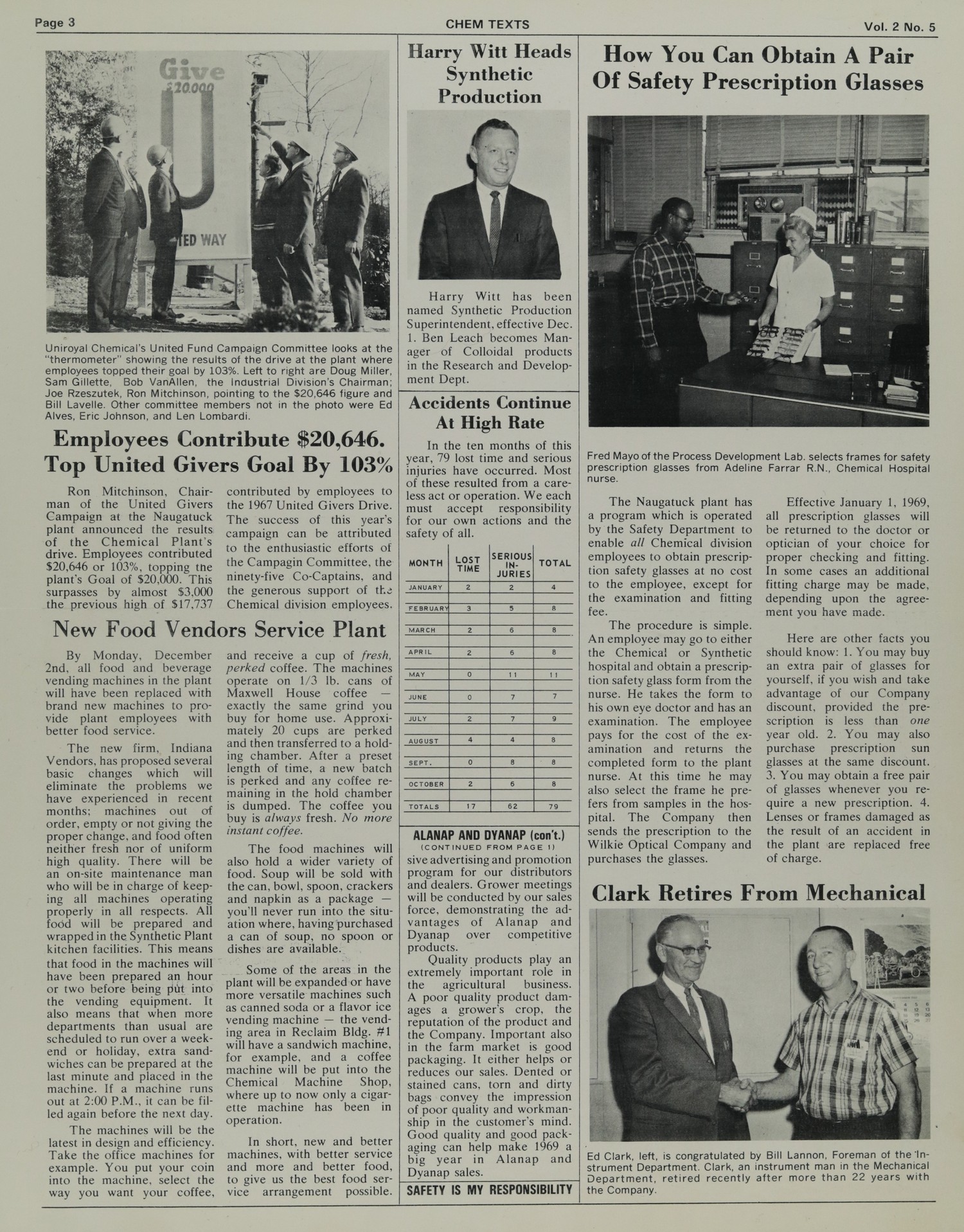
The Flagship – Page 6

Page 006

6 • The FlagshipWinter 1998


New Hire’s:

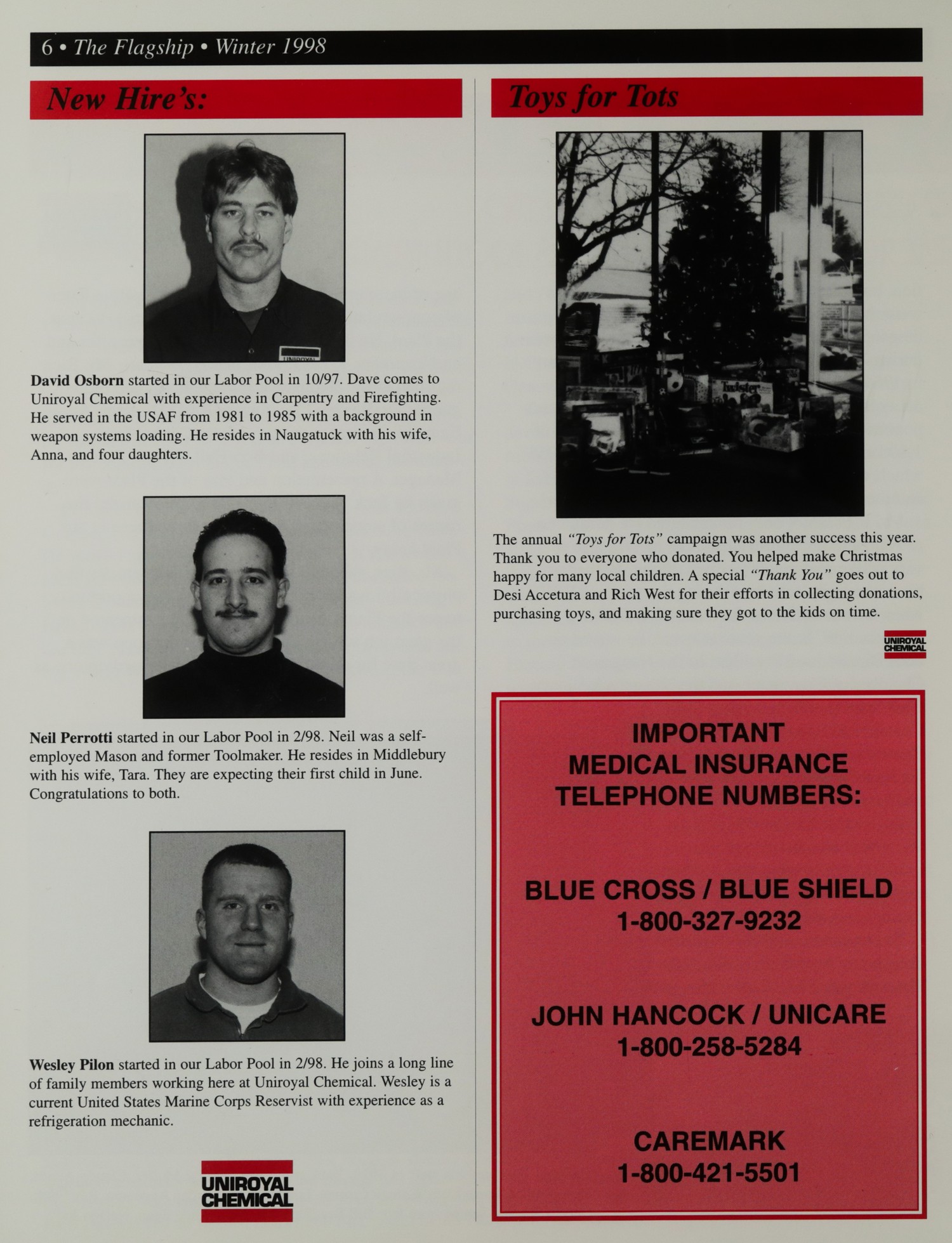
[PHOTO]

David Osborn started in our Labor Pool in 10/97. Dave comes to Uniroyal Chemical with experience in Carpentry and Firefighting. He served in the USAF from 1981 to 1985 with a background in weapon systems loading. He resides in Naugatuck with his wife, Anna, and four daughters.


[PHOTO]

Neil Perrotti started in our Labor Pool in 2/98. Neil was a self-employed Mason and former Toolmaker. He resides in Middlebury with his wife, Tara. They are expecting their first child in June. Congratulations to both.


[PHOTO]

Wesley Pilon started in our Labor Pool in 2/98. He joins a long line of family members working here at Uniroyal Chemical. Wesley is a current United States Marine Corps Reservist with experience as a refrigeration mechanic.


UNIROYAL CHEMICAL


Toys for Tots

[PHOTO]

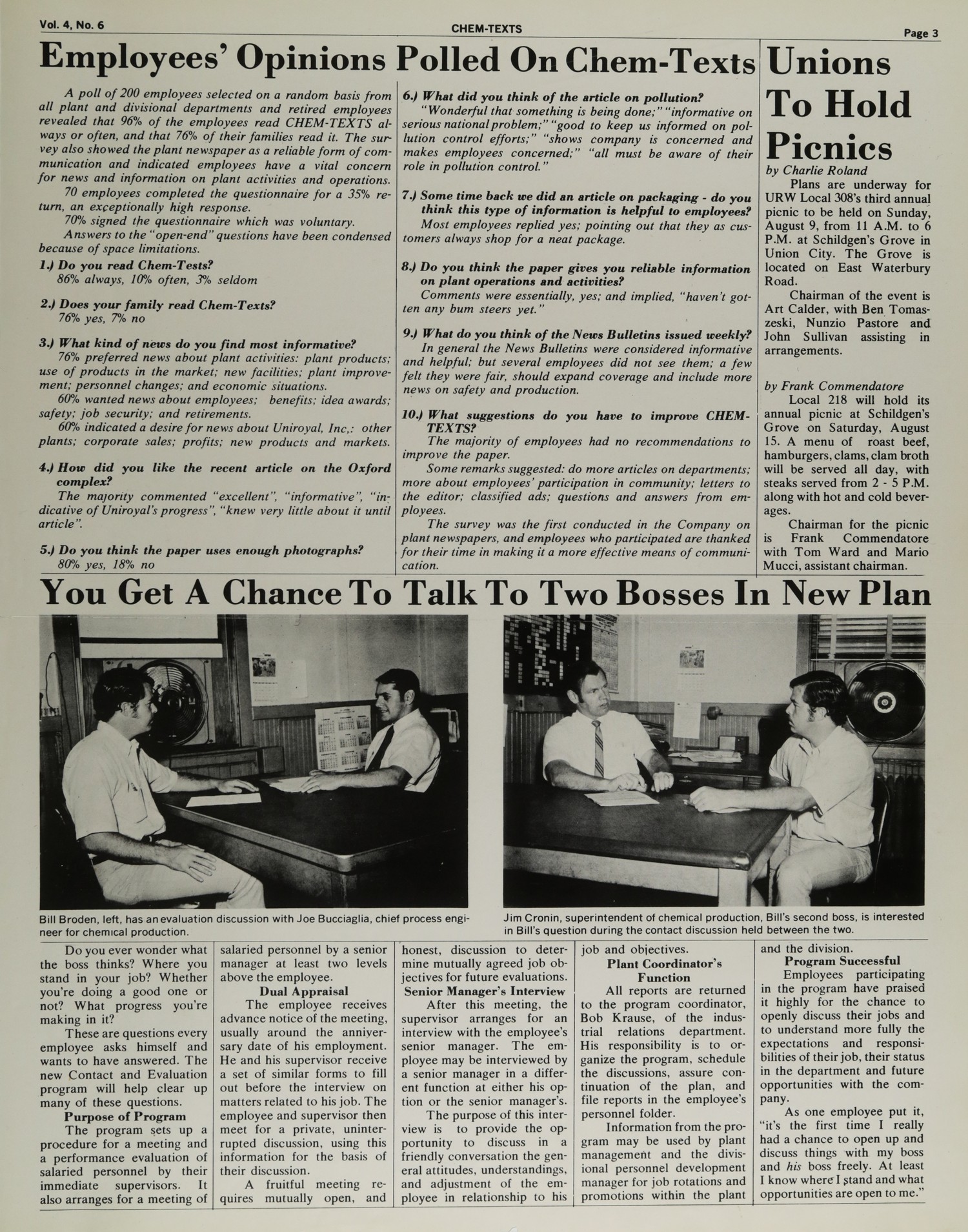
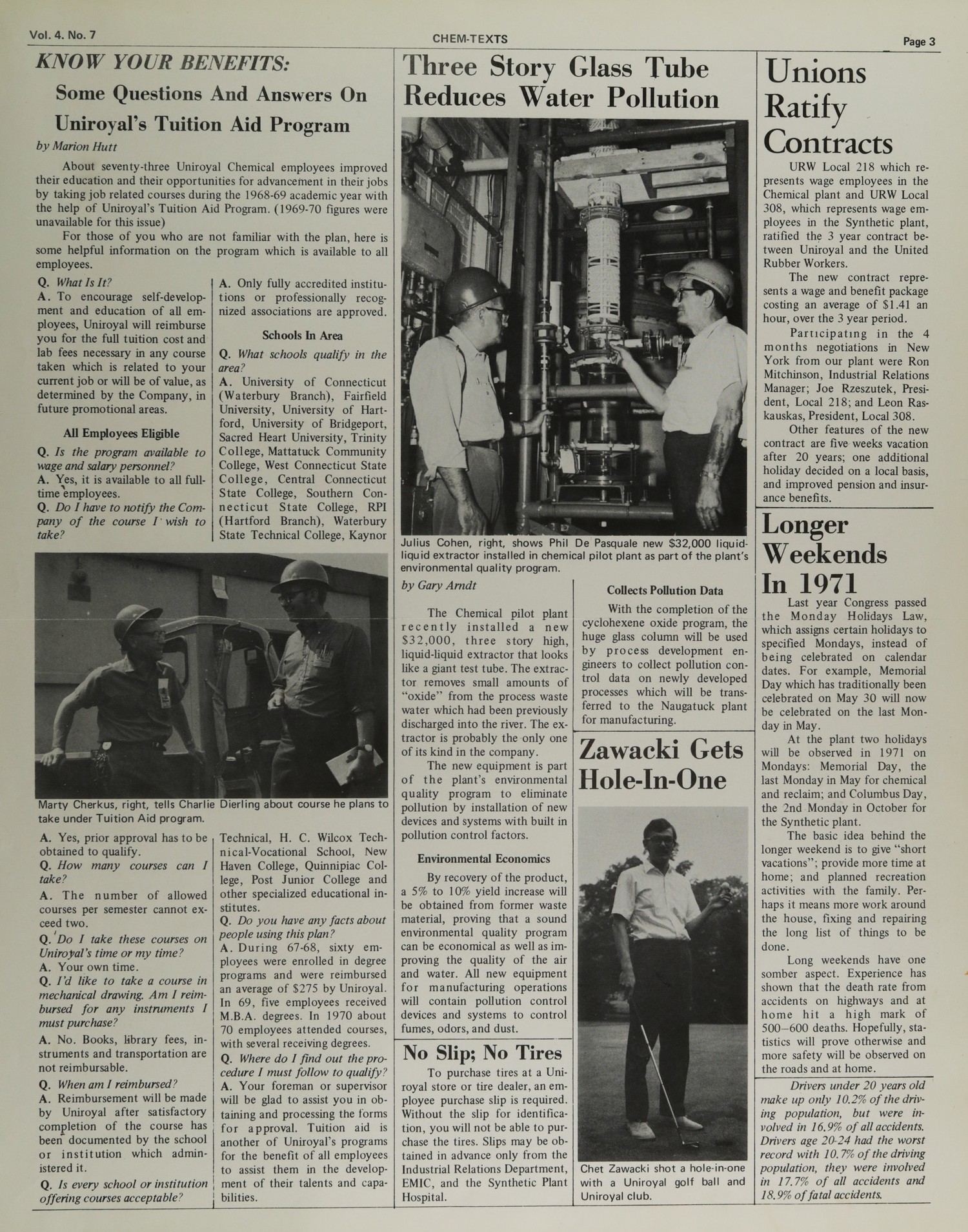
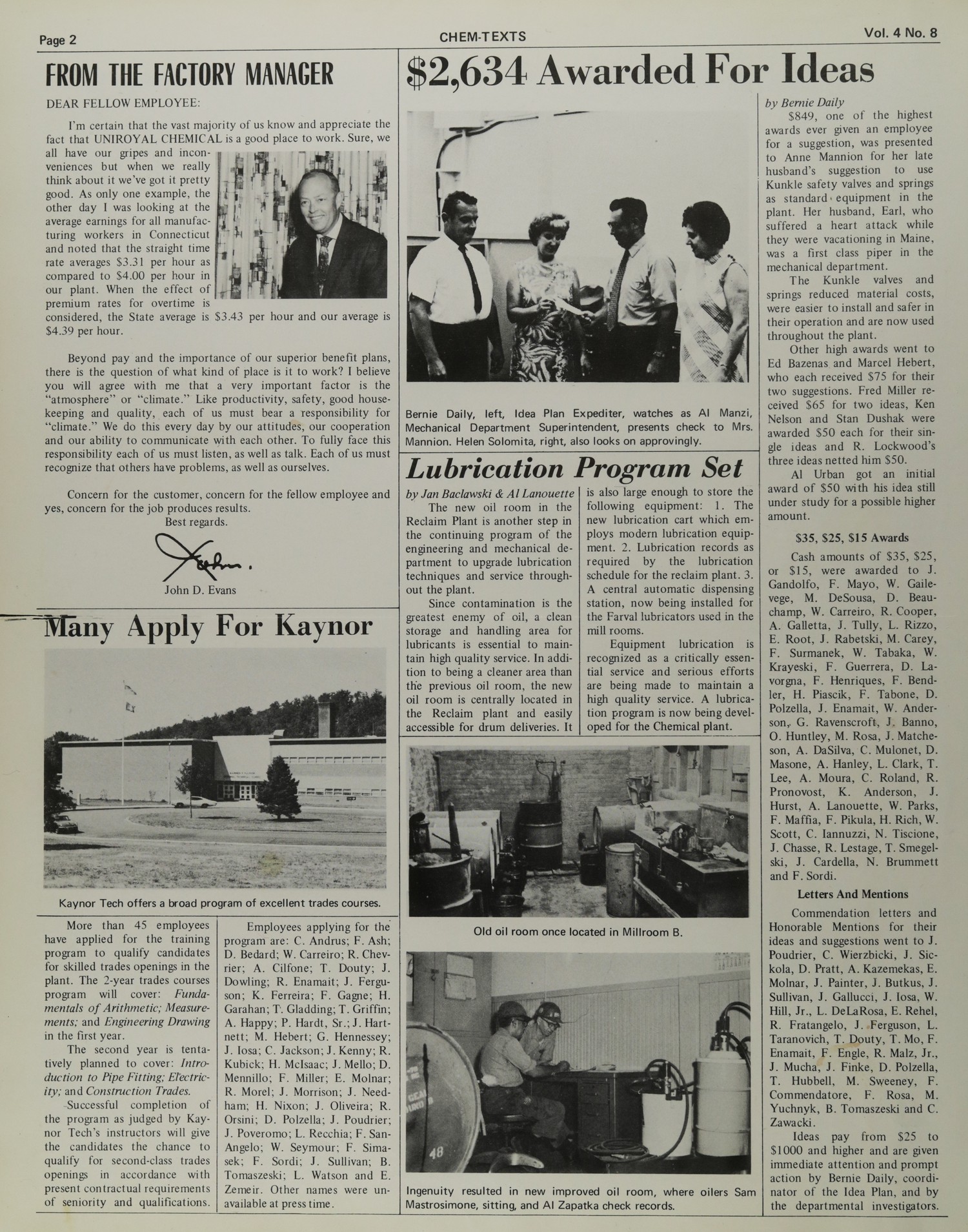
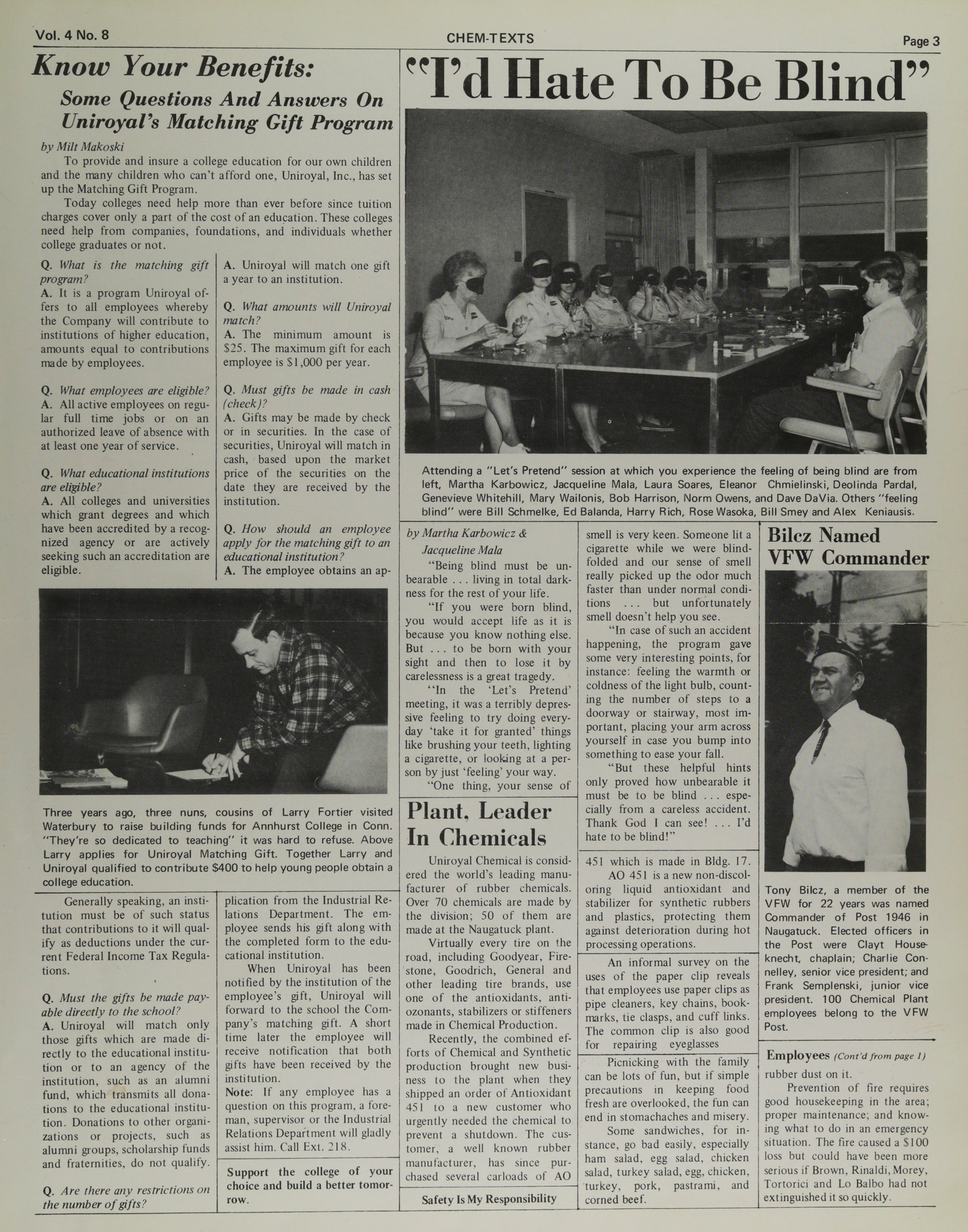
The annual “Toys for Tots” campaign was another success this year. Thank you to everyone who donated. You helped make Christmas happy for many local children. A special “Thank You” goes out to Desi Accetura and Rich West for their efforts in collecting donations, purchasing toys, and making sure they got to the kids on time.

UNIROYAL CHEMICAL


IMPORTANT MEDICAL INSURANCE TELEPHONE NUMBERS:

BLUE CROSS / BLUE SHIELD
1-800-327-9232

JOHN HANCOCK / UNICARE
1-800-258-5284

CAREMARK
1-800-421-5501

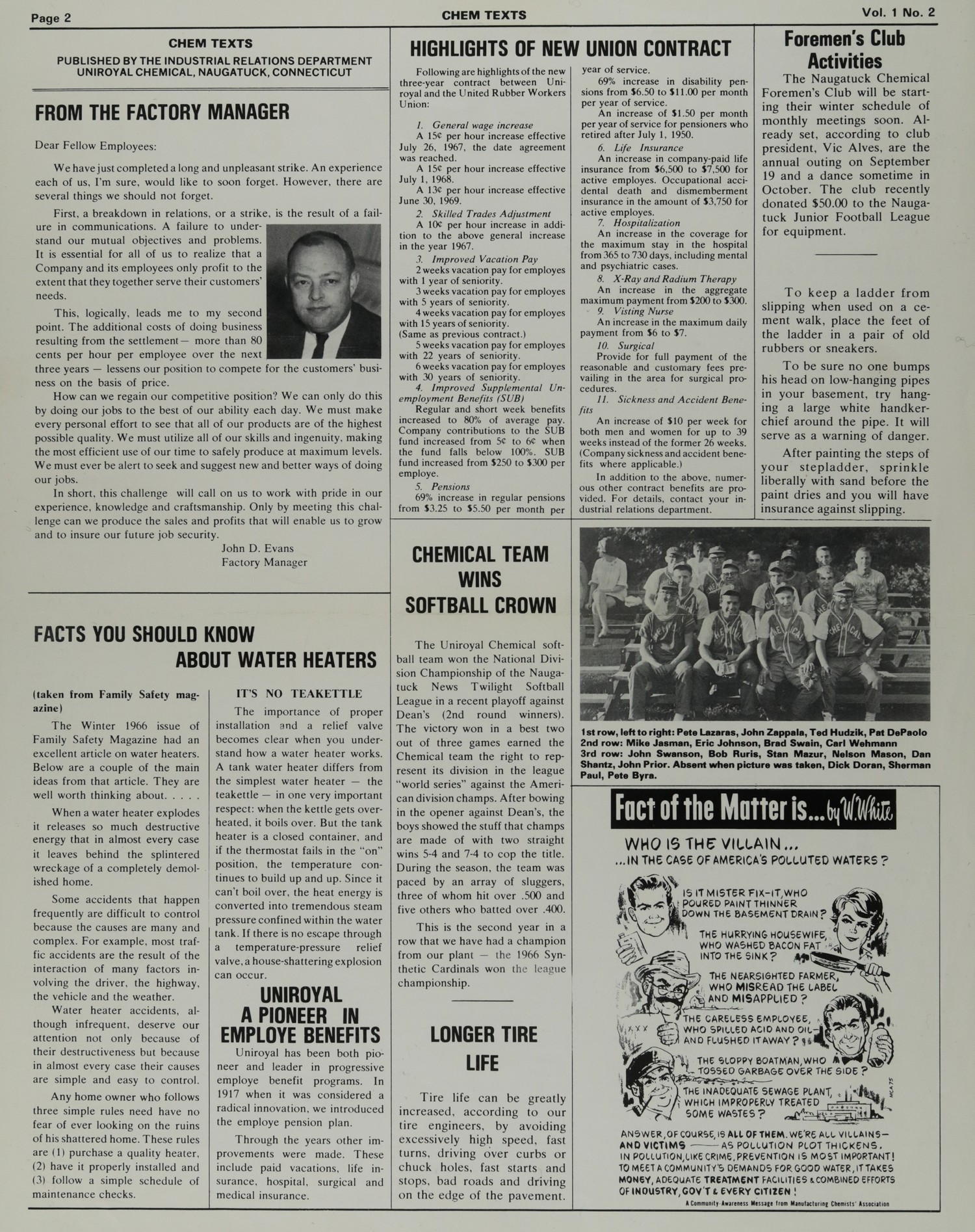
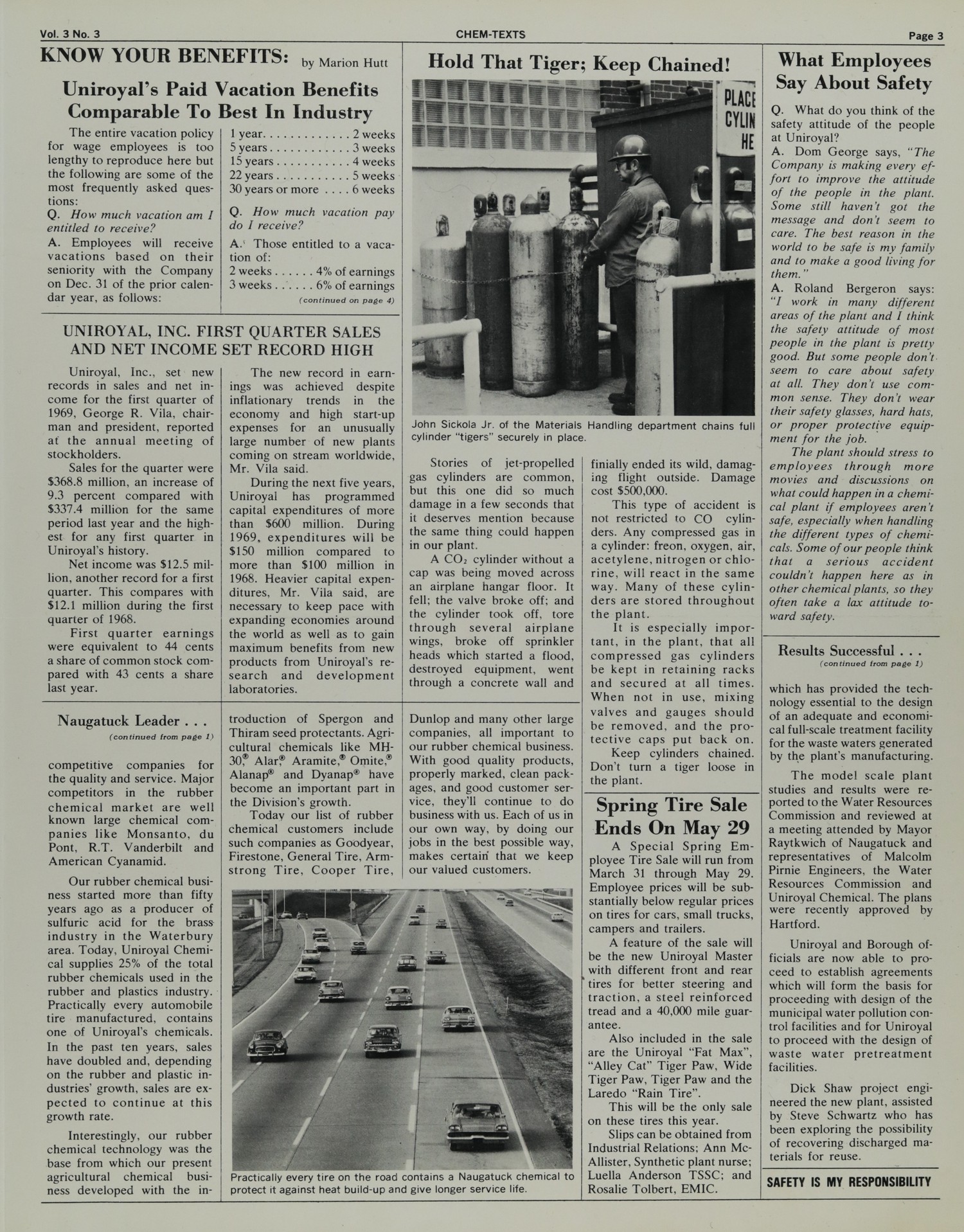
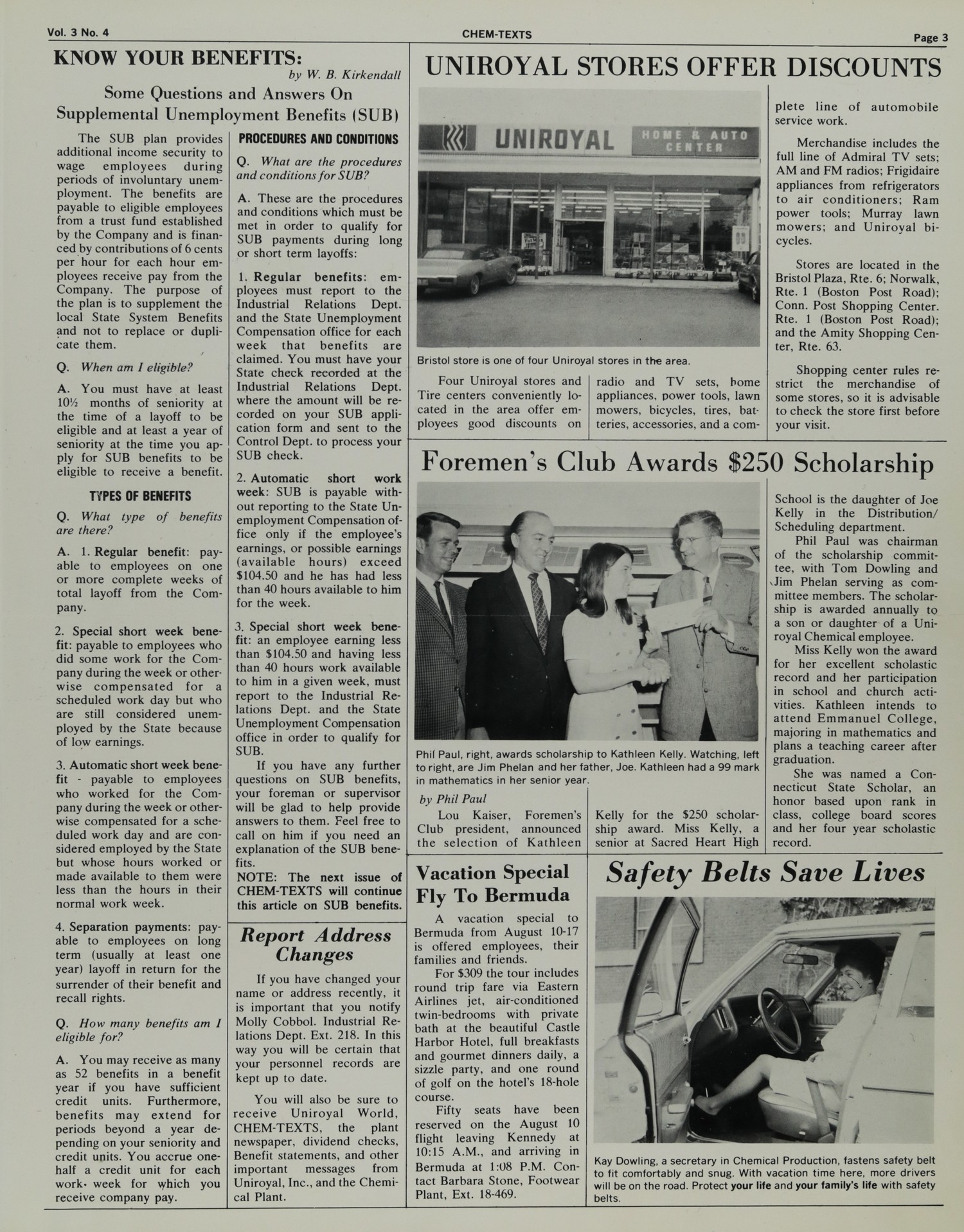
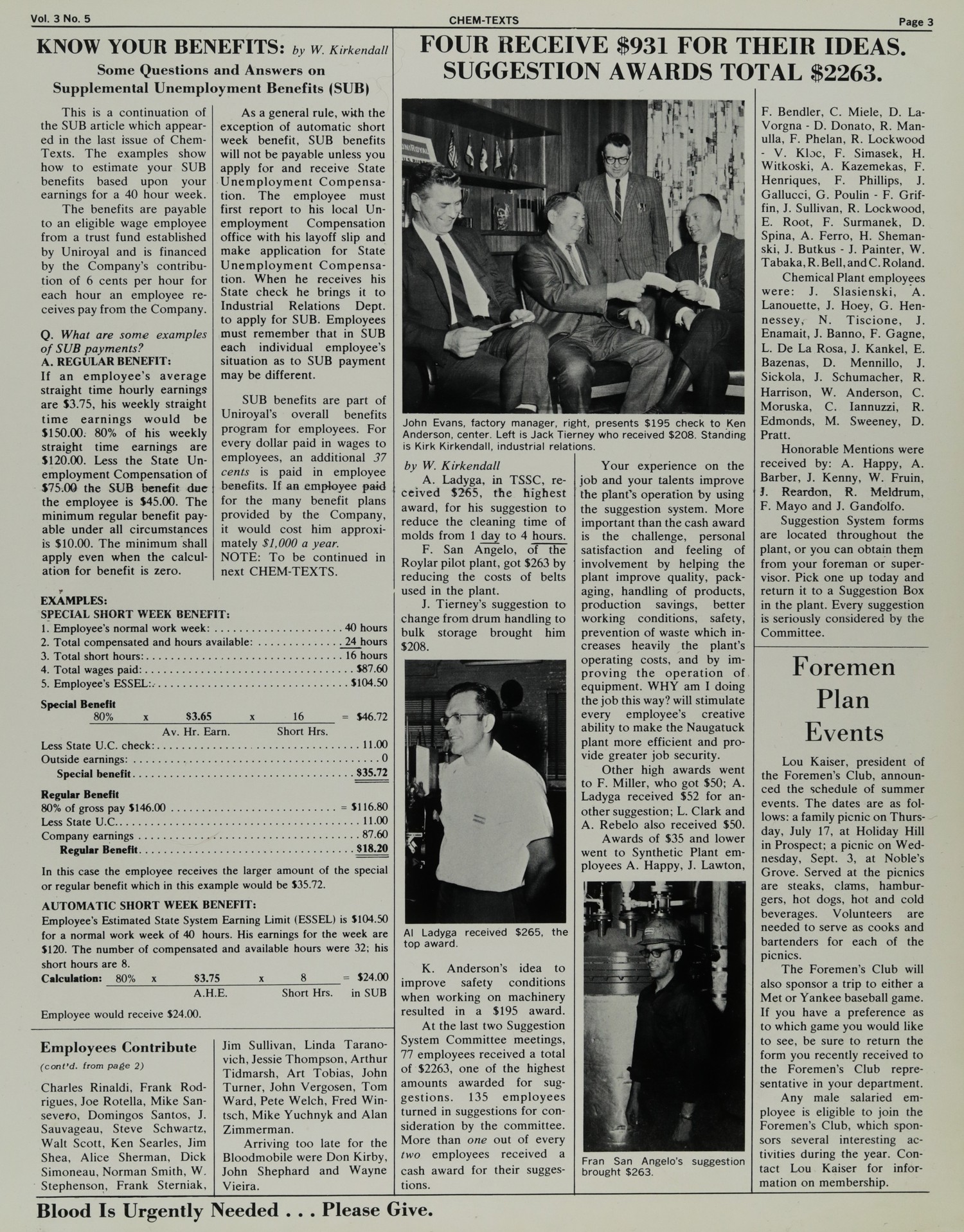
CHEM-TEXTS – 1979 – Page 4

Page 004

CHEM-TEXTS

Page 4 | Vol. 13, 1979


Recent Retirements

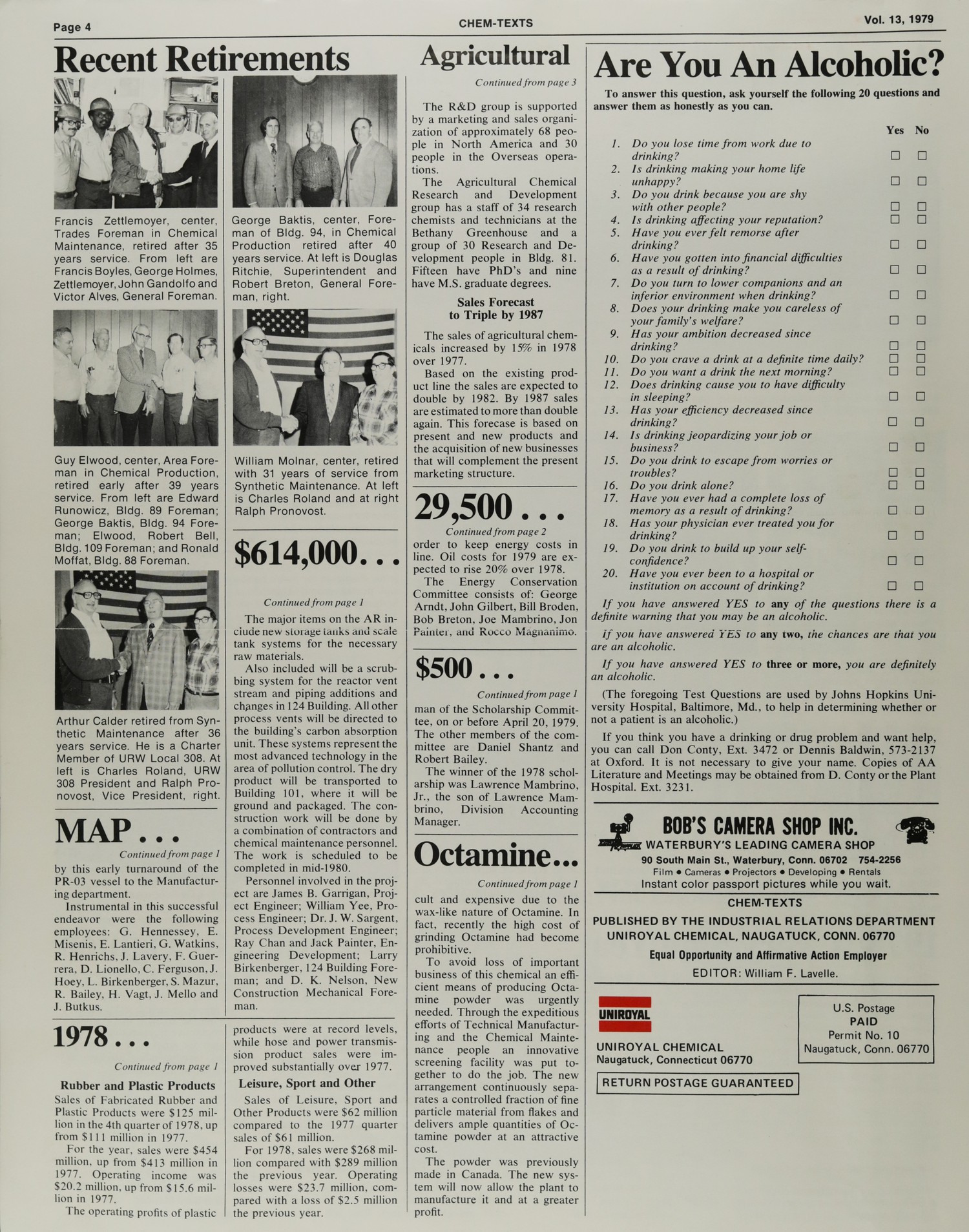
[PHOTO: Group photo of retirees]

Francis Zettlemoyer, center, Trades Foreman in Chemical Maintenance, retired after 35 years service. From left are Francis Boyles, George Holmes, Zettlemoyer, John Gandolfo and Victor Alves, General Foreman.

[PHOTO: Group photo of retirees]

Guy Elwood, center, Area Foreman in Chemical Production, retired early after 39 years service. From left are Edward Runowicz, Bldg. 89 Foreman; George Baktis, Bldg. 94 Foreman; Elwood, Robert Bell, Bldg. 109 Foreman; and Ronald Moffat, Bldg. 88 Foreman.

[PHOTO: Group photo]

Arthur Calder retired from Synthetic Maintenance after 36 years service. He is a Charter Member of URW Local 308. At left is Charles Roland, URW 308 President and Ralph Pronovost, Vice President, right.


George Baktis, center, Foreman of Bldg. 94, in Chemical Production retired after 40 years service. At left is Douglas Ritchie, Superintendent and Robert Breton, General Foreman, right.

[PHOTO: Group photo]

William Molnar, center, retired with 31 years of service from Synthetic Maintenance. At left is Charles Roland and at right Ralph Pronovost.


MAP…

Continued from page 1

by this early turnaround of the PR-03 vessel to the Manufacturing department.

Instrumental in this successful endeavor were the following employees: G. Hennessey, E. Misenis, E. Lantieri, G. Watkins, R. Henrichs, J. Lavery, F. Guerrera, D. Lionello, C. Ferguson, J. Hoey, L. Birkenberger, S. Mazur, R. Bailey, H. Vagt, J. Mello and J. Butkus.


1978…

Continued from page 1

Rubber and Plastic Products
Sales of Fabricated Rubber and Plastic Products were $125 million in the 4th quarter of 1978, up from $111 million in 1977.

For the year, sales were $454 million, up from $413 million in 1977. Operating income was $20.2 million, up from $15.6 million in 1977.

The operating profits of plastic products were at record levels, while hose and power transmission product sales were improved substantially over 1977.

Leisure, Sport and Other
Sales of Leisure, Sport and Other Products were $62 million compared to the 1977 quarter sales of $61 million.

For 1978, sales were $268 million compared with $289 million the previous year. Operating losses were $23.7 million, compared with a loss of $2.5 million the previous year.


Agricultural

Continued from page 3

The R&D group is supported by a marketing and sales organization of approximately 68 people in North America and 30 people in the Overseas operations.

The Agricultural Chemical Research and Development group has a staff of 34 research chemists and technicians at the Bethany Greenhouse and a group of 30 Research and Development people in Bldg. 81. Fifteen have PhD’s and nine have M.S. graduate degrees.

Sales Forecast to Triple by 1987

The sales of agricultural chemicals increased by 15% in 1978 over 1977.

Based on the existing product line the sales are expected to double by 1982. By 1987 sales are estimated to more than double again. This forecase is based on present and new products and the acquisition of new businesses that will complement the present marketing structure.


29,500…

Continued from page 2

$614,000…

Continued from page 1

The major items on the AR include new storage tanks and scale tank systems for the necessary raw materials.

Also included will be a scrubbing system for the reactor vent stream and piping additions and changes in 124 Building. All other process vents will be directed to the building’s carbon absorption unit. These systems represent the most advanced technology in the area of pollution control. The dry product will be transported to Building 101, where it will be ground and packaged. The construction work will be done by a combination of contractors and chemical maintenance personnel. The work is scheduled to be completed in mid-1980.

Personnel involved in the project are James B. Garrigan, Project Engineer; William Yee, Process Engineer; Dr. J. W. Sargent, Process Development Engineer; Ray Chan and Jack Painter, Engineering Development; Larry Birkenberger, 124 Building Foreman; and D. K. Nelson, New Construction Mechanical Foreman.

order to keep energy costs in line. Oil costs for 1979 are expected to rise 20% over 1978. The Energy Conservation Committee consists of: George Arndt, John Gilbert, Bill Broden, Bob Breton, Joe Mambrino, Jon Painter, and Rocco Magnanimo.


$500…

Continued from page 1

man of the Scholarship Committee, on or before April 20, 1979. The other members of the committee are Daniel Shantz and Robert Bailey.

The winner of the 1978 scholarship was Lawrence Mambrino, Jr., the son of Lawrence Mambrino, Division Accounting Manager.


Octamine…

Continued from page 1

cult and expensive due to the wax-like nature of Octamine. In fact, recently the high cost of grinding Octamine had become prohibitive.

To avoid loss of important business of this chemical an efficient means of producing Octamine powder was urgently needed. Through the expeditious efforts of Technical Manufacturing and the Chemical Maintenance people an innovative screening facility was put together to do the job. The new arrangement continuously separates a controlled fraction of fine particle material from flakes and delivers ample quantities of Octamine powder at an attractive cost.

The powder was previously made in Canada. The new system will now allow the plant to manufacture it and at a greater profit.


Are You An Alcoholic?

To answer this question, ask yourself the following 20 questions and answer them as honestly as you can.

Yes No
1. Do you lose time from work due to drinking?
2. Is drinking making your home life unhappy?
3. Do you drink because you are shy with other people?
4. Is drinking affecting your reputation?
5. Have you ever felt remorse after drinking?
6. Have you gotten into financial difficulties as a result of drinking?
7. Do you turn to lower companions and an inferior environment when drinking?
8. Does your drinking make you careless of your family’s welfare?
9. Has your ambition decreased since drinking?
10. Do you crave a drink at a definite time daily?
11. Do you want a drink the next morning?
12. Does drinking cause you to have difficulty in sleeping?
13. Has your efficiency decreased since drinking?
14. Is drinking jeopardizing your job or business?
15. Do you drink to escape from worries or troubles?
16. Do you drink alone?
17. Have you ever had a complete loss of memory as a result of drinking?
18. Has your physician ever treated you for drinking?
19. Do you drink to build up your self-confidence?
20. Have you ever been to a hospital or institution on account of drinking?

If you have answered YES to any of the questions there is a definite warning that you may be an alcoholic.

if you have answered YES to any two, the chances are that you are an alcoholic.

If you have answered YES to three or more, you are definitely an alcoholic.

(The foregoing Test Questions are used by Johns Hopkins University Hospital, Baltimore, Md., to help in determining whether or not a patient is an alcoholic.)

If you think you have a drinking or drug problem and want help, you can call Don Conty, Ext. 3472 or Dennis Baldwin, 573-2137 at Oxford. It is not necessary to give your name. Copies of AA Literature and Meetings may be obtained from D. Conty or the Plant Hospital. Ext. 3231.


BOB’S CAMERA SHOP INC.

WATERBURY’S LEADING CAMERA SHOP
90 South Main St., Waterbury, Conn. 06702 754-2256
Film • Cameras • Projectors • Developing • Rentals
Instant color passport pictures while you wait.


CHEM-TEXTS
PUBLISHED BY THE INDUSTRIAL RELATIONS DEPARTMENT
UNIROYAL CHEMICAL, NAUGATUCK, CONN. 06770
Equal Opportunity and Affirmative Action Employer
EDITOR: William F. Lavelle.


[MAILING LABEL AREA]

UNIROYAL | U.S. Postage PAID Permit No. 10 Naugatuck, Conn. 06770

UNIROYAL CHEMICAL
Naugatuck, Connecticut 06770

RETURN POSTAGE GUARANTEED

CHEM-TEXTS – 1977-v11-i03-s256

Page 256

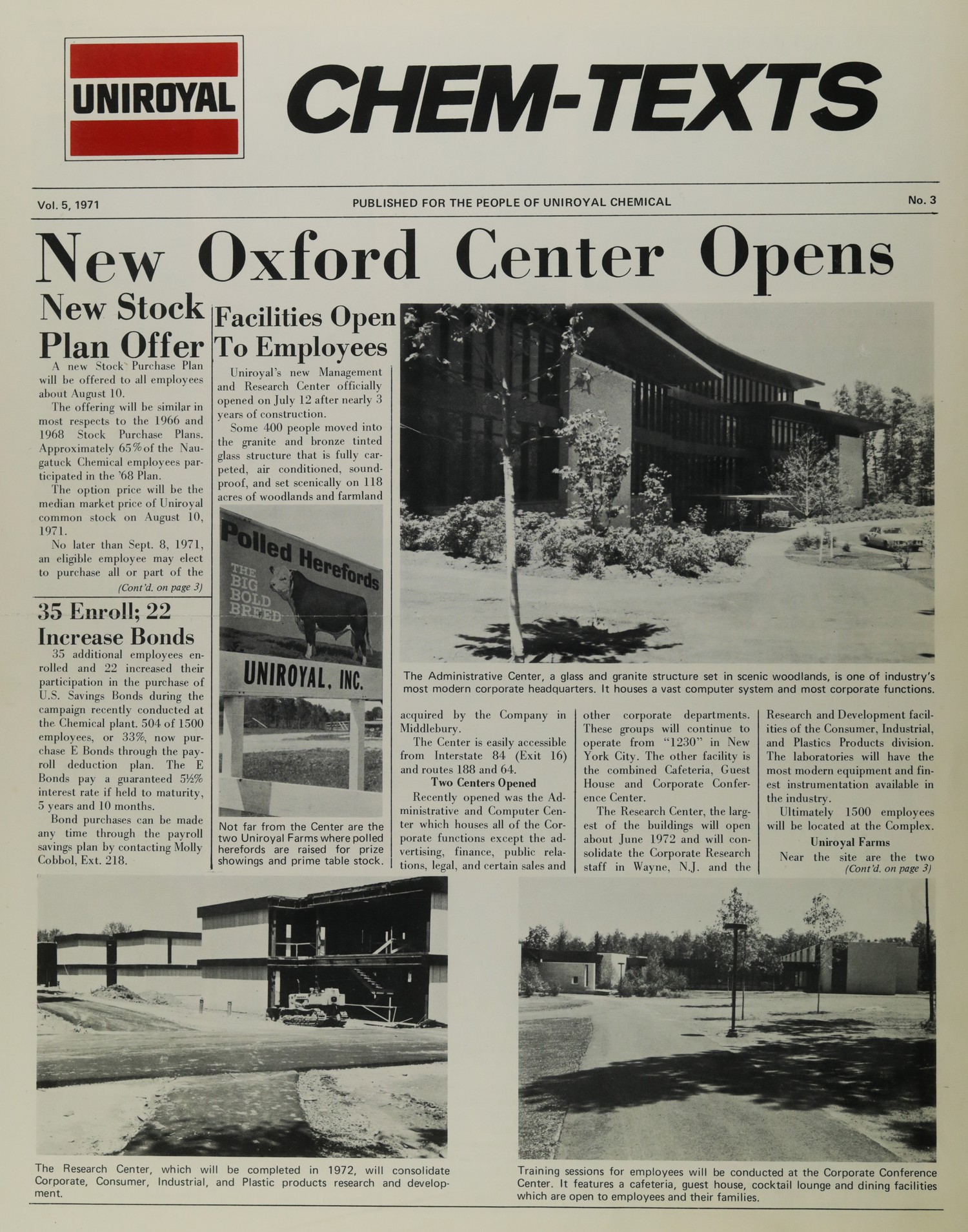
UNIROYAL CHEM-TEXTS

Vol. 11, 1977 | PUBLISHED FOR THE PEOPLE OF UNIROYAL CHEMICAL | No. 3


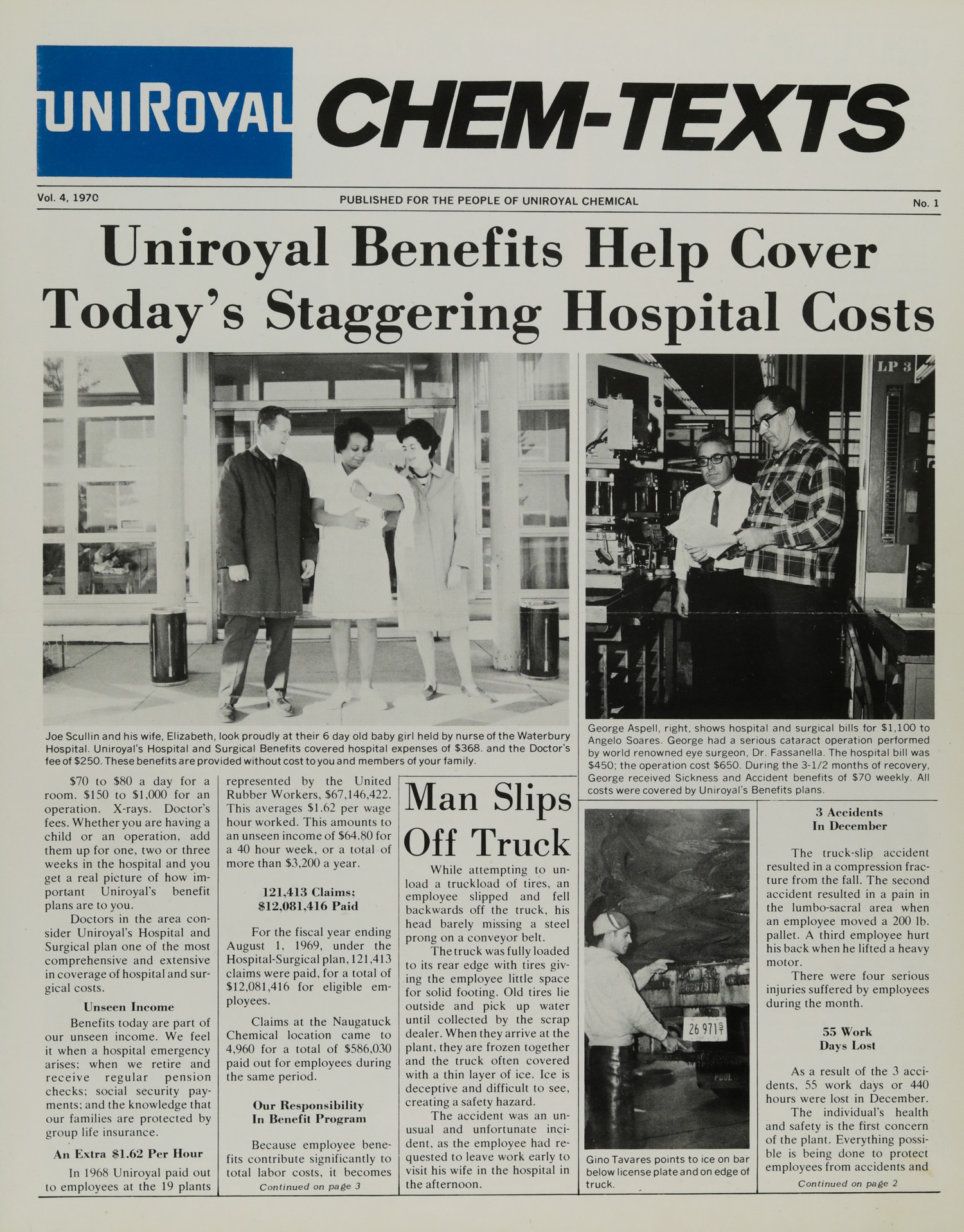
10 Uniroyal Scholarships Offered

Ten Uniroyal Merit scholarships are offered to children of employees through the nationwide scholarship program of the National Merit Scholarship Corporation.

All children of Uniroyal employees, who have more than 5 years of continuous service as of the date of the award, are eligible for the scholarships.

Application Must Be Filed for Scholarships

Applications for the 1979 scholarships must be submitted by November 30, 1977. They can be obtained from the Industrial Relations Dept. along with a folder which gives complete details on the scholarships. Call Constance Antrum, Ext. 3217.

Students who wish to apply for a scholarship must do so during their Junior year by taking the Preliminary Scholastic Aptitude and National Merit Scholarship Qualifying Tests which are usually given in October by the high school. Students should check the school office for the dates of the tests.

(continued on page 3)


Footwear Operations To Close

NAUGATUCK, CONN. — The Company has announced that a tentative decision has been made to shut down the fabric footwear operations at the Footwear Plant.

Presently, there are four assembly lines, employing approximately 750 wage and salaried people, producing fabric shoes. Imports and high labor costs are forcing the company to study the economics of manufacturing footwear in Naugatuck. Previous reductions have resulted in the layoff of over 1,000 employees.

If these tentative plans should be finalized, some footwear production operations will be moved from the Naugatuck plant to other Uniroyal footwear manufacturing facilities. However, other operations in the plant, such as warehousing, custom mixing and sponge underlay manufacturing, would not be affected by this tentative decision.

Operations May Move

Qualified employees whose jobs may be affected will be eligible for benefits under the Company’s existing benefit program. Also, federal benefits under the Trade Act of 1974 may be available to such employees.


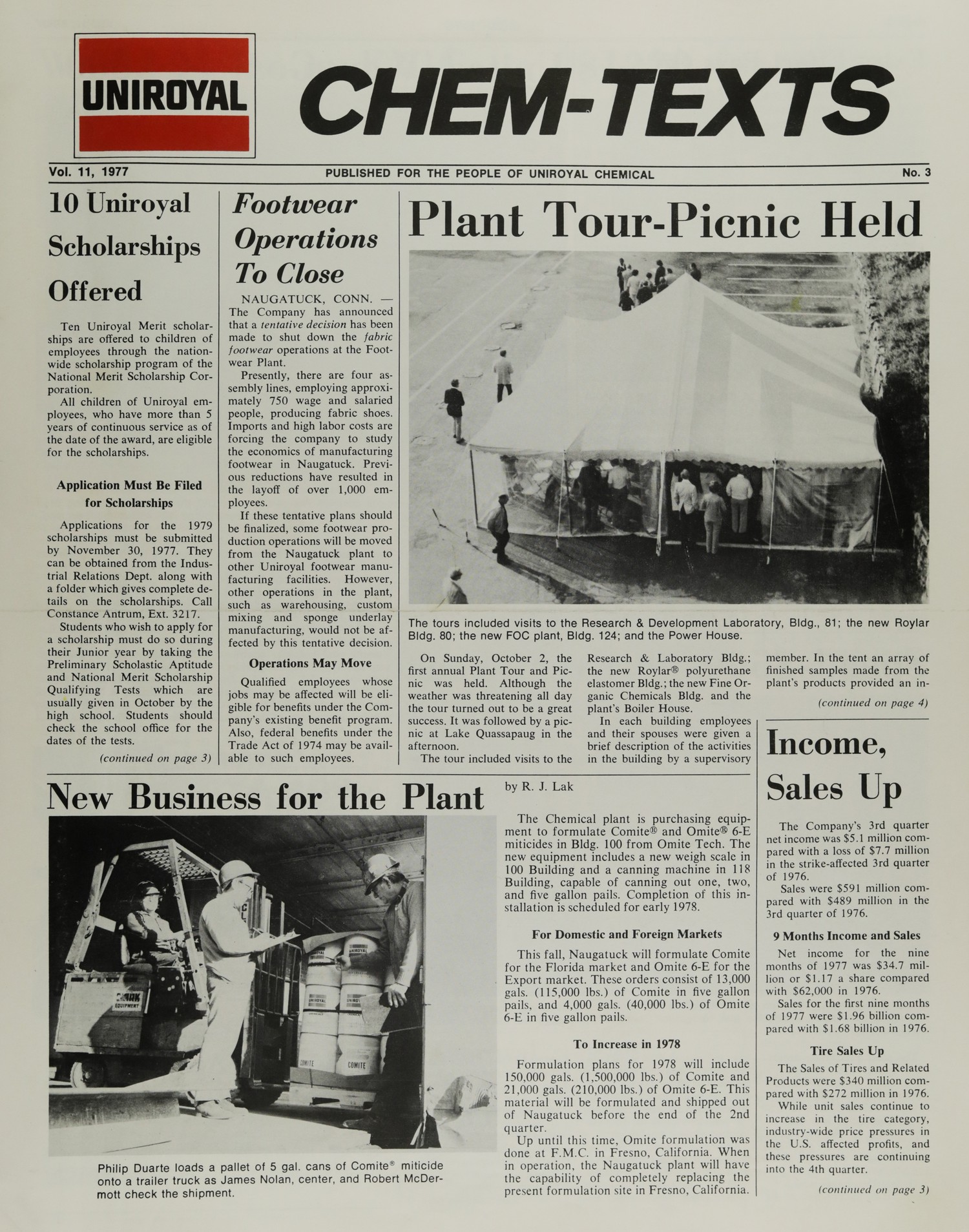
Plant Tour-Picnic Held

[IMAGE: Shows people standing near tents at an outdoor event]

The tours included visits to the Research & Development Laboratory, Bldg., 81; the new Roylar Bldg. 80; the new FOC plant, Bldg. 124; and the Power House.

On Sunday, October 2, the first annual Plant Tour and Picnic was held. Although the weather was threatening all day the tour turned out to be a great success. It was followed by a picnic at Lake Quassapaug in the afternoon.

The tour included visits to the Research & Laboratory Bldg.; the new Roylar® polyurethane elastomer Bldg.; the new Fine Organic Chemicals Bldg. and the plant’s Boiler House.

In each building employees and their spouses were given a brief description of the activities in the building by a supervisory member. In the tent an array of finished samples made from the plant’s products provided an in-

(continued on page 4)


New Business for the Plant

by R. J. Lak

[IMAGE: Shows Philip Duarte loading a pallet of Comite miticide cans onto a trailer truck with James Nolan and Robert McDermott]

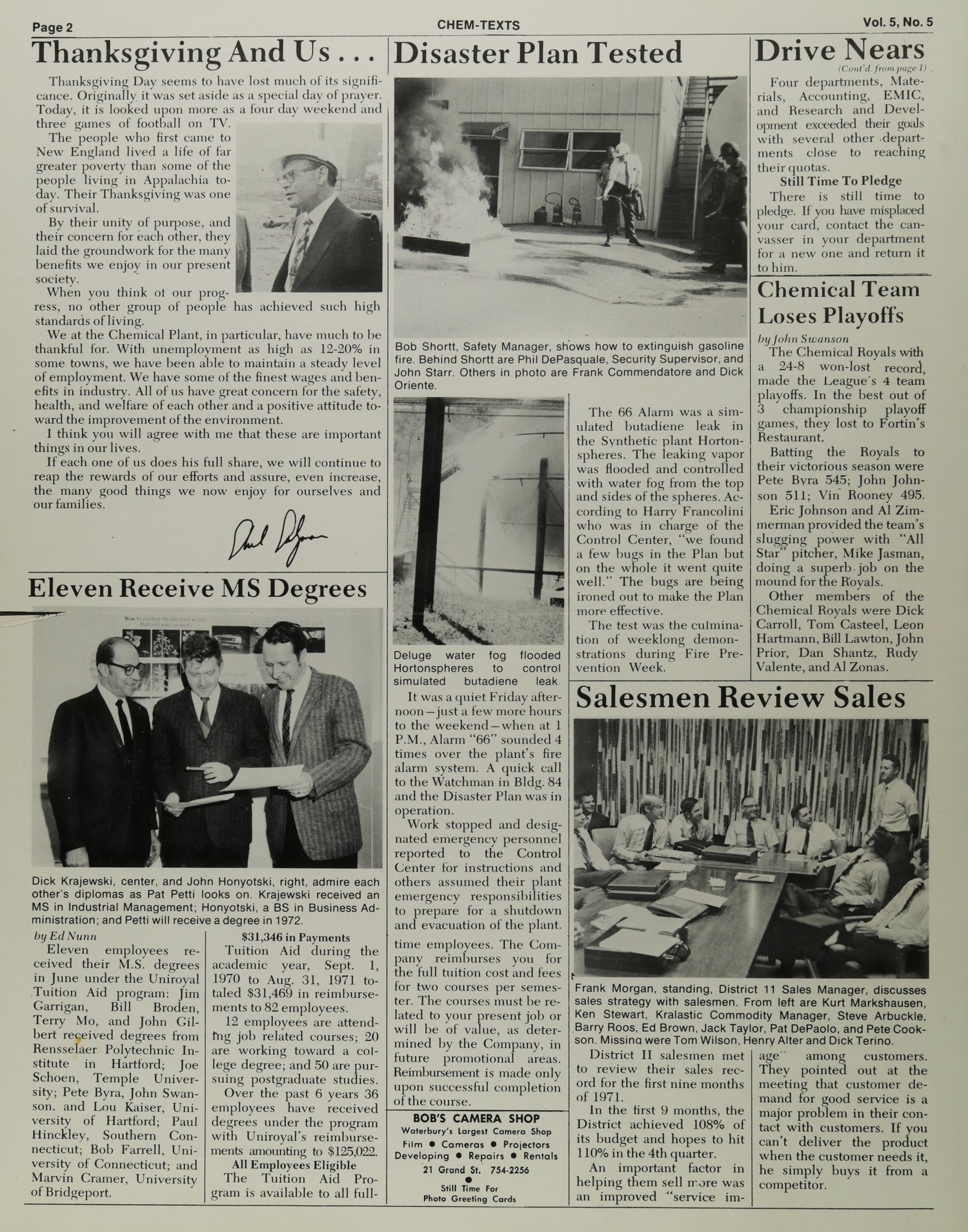
Philip Duarte loads a pallet of 5 gal. cans of Comite® miticide onto a trailer truck as James Nolan, center, and Robert McDermott check the shipment.

The Chemical plant is purchasing equipment to formulate Comite® and Omite® 6-E miticides in Bldg. 100 from Omite Tech. The new equipment includes a new weigh scale in 100 Building and a canning machine in 118 Building, capable of canning out one, two, and five gallon pails. Completion of this installation is scheduled for early 1978.

For Domestic and Foreign Markets

This fall, Naugatuck will formulate Comite for the Florida market and Omite 6-E for the Export market. These orders consist of 13,000 gals. (115,000 lbs.) of Comite in five gallon pails, and 4,000 gals. (40,000 lbs.) of Omite 6-E in five gallon pails.

To Increase in 1978

Formulation plans for 1978 will include 150,000 gals. (1,500,000 lbs.) of Comite and 21,000 gals. (210,000 lbs.) of Omite 6-E. This material will be formulated and shipped out of Naugatuck before the end of the 2nd quarter.

Up until this time, Omite formulation was done at F.M.C. in Fresno, California. When in operation, the Naugatuck plant will have the capability of completely replacing the present formulation site in Fresno, California.


Income, Sales Up

The Company’s 3rd quarter net income was $5.1 million compared with a loss of $7.7 million in the strike-affected 3rd quarter of 1976.

Sales were $591 million compared with $489 million in the 3rd quarter of 1976.

9 Months Income and Sales

Net income for the nine months of 1977 was $34.7 million or $1.17 a share compared with $62,000 in 1976.

Sales for the first nine months of 1977 were $1.96 billion compared with $1.68 billion in 1976.

Tire Sales Up

The Sales of Tires and Related Products were $340 million compared with $272 million in 1976.

While unit sales continue to increase in the tire category, industry-wide price pressures in the U.S. affected profits, and these pressures are continuing into the 4th quarter.

(continued on page 3)

CHEM-TEXTS – Vol. 10 – Page 4

Page 004

CHEM-TEXTS

Vol. 10, 1976 Page 4


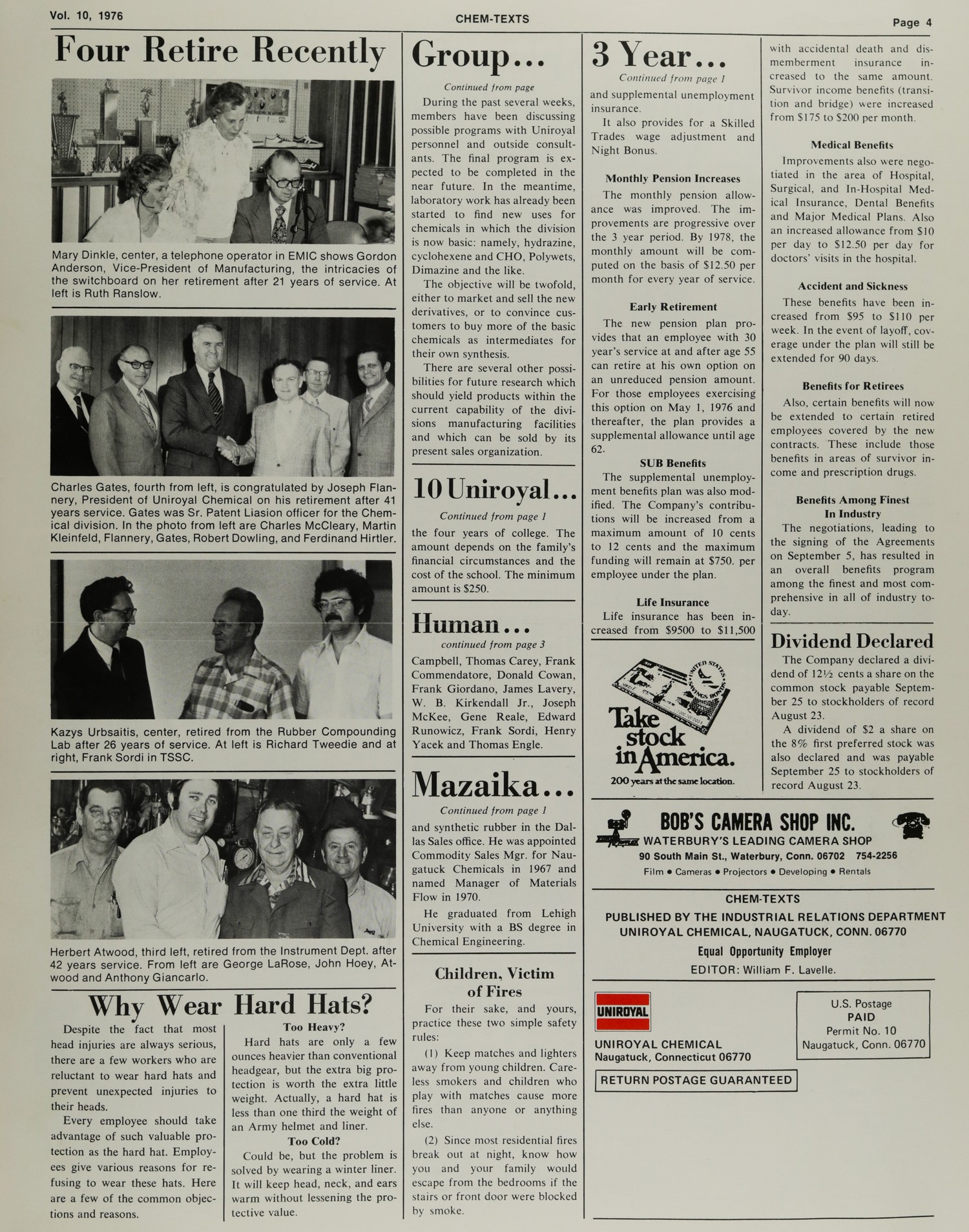
Four Retire Recently

[IMAGE: Photo of four people]

Mary Dinkle, center, a telephone operator in EMIC shows Gordon Anderson, Vice-President of Manufacturing, the intricacies of the switchboard on her retirement after 21 years of service. At left is Ruth Ranslow.


[IMAGE: Group photo of six men]

Charles Gates, fourth from left, is congratulated by Joseph Flannery, President of Uniroyal Chemical on his retirement after 41 years service. Gates was Sr. Patent Liasion officer for the Chemical division. In the photo from left are Charles McCleary, Martin Kleinfeld, Flannery, Gates, Robert Dowling, and Ferdinand Hirtler.


[IMAGE: Photo of three men]

Kazys Urbsaitis, center, retired from the Rubber Compounding Lab after 26 years of service. At left is Richard Tweedie and at right, Frank Sordi in TSSC.


[IMAGE: Photo of four men]

Herbert Atwood, third left, retired from the Instrument Dept. after 42 years service. From left are George LaRose, John Hoey, Atwood and Anthony Giancarlo.


Why Wear Hard Hats?

Despite the fact that most head injuries are always serious, there are a few workers who are reluctant to wear hard hats and prevent unexpected injuries to their heads.

Every employee should take advantage of such valuable protection as the hard hat. Employees give various reasons for refusing to wear these hats. Here are a few of the common objections and reasons.

Too Heavy?

Hard hats are only a few ounces heavier than conventional headgear, but the extra big protection is worth the extra little weight. Actually, a hard hat is less than one third the weight of an Army helmet and liner.

Too Cold?

Could be, but the problem is solved by wearing a winter liner. It will keep head, neck, and ears warm without lessening the protective value.


Group…

Continued from page

During the past several weeks, members have been discussing possible programs with Uniroyal personnel and outside consultants. The final program is expected to be completed in the near future. In the meantime, laboratory work has already been started to find new uses for chemicals in which the division is now basic: namely, hydrazine, cyclohexene and CHO, Polywets, Dimazine and the like.

The objective will be twofold, either to market and sell the new derivatives, or to convince customers to buy more of the basic chemicals as intermediates for their own synthesis.

There are several other possibilities for future research which should yield products within the current capability of the divisions manufacturing facilities and which can be sold by its present sales organization.


10 Uniroyal…

Continued from page 1

the four years of college. The amount depends on the family’s financial circumstances and the cost of the school. The minimum amount is $250.


Human…

continued from page 3

Campbell, Thomas Carey, Frank Commendatore, Donald Cowan, Frank Giordano, James Lavery, W. B. Kirkendall Jr., Joseph McKee, Gene Reale, Edward Runowicz, Frank Sordi, Henry Yacek and Thomas Engle.


Mazaika…

Continued from page 1

and synthetic rubber in the Dallas Sales office. He was appointed Commodity Sales Mgr. for Naugatuck Chemicals in 1967 and named Manager of Materials Flow in 1970.

He graduated from Lehigh University with a BS degree in Chemical Engineering.


Children, Victim of Fires

For their sake, and yours, practice these two simple safety rules:

(1) Keep matches and lighters away from young children. Careless smokers and children who play with matches cause more fires than anyone or anything else.

(2) Since most residential fires break out at night, know how you and your family would escape from the bedrooms if the stairs or front door were blocked by smoke.


3 Year…

Continued from page 1

and supplemental unemployment insurance.

It also provides for a Skilled Trades wage adjustment and Night Bonus.

Monthly Pension Increases

The monthly pension allowance was improved. The improvements are progressive over the 3 year period. By 1978, the monthly amount will be computed on the basis of $12.50 per month for every year of service.

Early Retirement

The new pension plan provides that an employee with 30 year’s service at and after age 55 can retire at his own option on an unreduced pension amount. For those employees exercising this option on May 1, 1976 and thereafter, the plan provides a supplemental allowance until age 62.

SUB Benefits

The supplemental unemployment benefits plan was also modified. The Company’s contributions will be increased from a maximum amount of 10 cents to 12 cents and the maximum funding will remain at $750. per employee under the plan.

Life Insurance

Life insurance has been increased from $9500 to $11,500


[IMAGE: “Take stock in America” advertisement with eagle logo]
200 years at the same location.


with accidental death and dismemberment insurance increased to the same amount. Survivor income benefits (transition and bridge) were increased from $175 to $200 per month.

Medical Benefits

Improvements also were negotiated in the area of Hospital, Surgical, and In-Hospital Medical Insurance, Dental Benefits and Major Medical Plans. Also an increased allowance from $10 per day to $12.50 per day for doctors’ visits in the hospital.

Accident and Sickness

These benefits have been increased from $95 to $110 per week. In the event of layoff, coverage under the plan will still be extended for 90 days.

Benefits for Retirees

Also, certain benefits will now be extended to certain retired employees covered by the new contracts. These include those benefits in areas of survivor income and prescription drugs.

Benefits Among Finest In Industry

The negotiations, leading to the signing of the Agreements on September 5, has resulted in an overall benefits program among the finest and most comprehensive in all of industry today.


Dividend Declared

The Company declared a dividend of 12½ cents a share on the common stock payable September 25 to stockholders of record August 23.

A dividend of $2 a share on the 8% first preferred stock was also declared and was payable September 25 to stockholders of record August 23.


BOB’S CAMERA SHOP INC.

WATERBURY’S LEADING CAMERA SHOP
90 South Main St., Waterbury, Conn. 06702 754-2256
Film ● Cameras ● Projectors ● Developing ● Rentals


CHEM-TEXTS

PUBLISHED BY THE INDUSTRIAL RELATIONS DEPARTMENT
UNIROYAL CHEMICAL, NAUGATUCK, CONN. 06770

Equal Opportunity Employer

EDITOR: William F. Lavelle.


[UNIROYAL LOGO]

UNIROYAL CHEMICAL
Naugatuck, Connecticut 06770

RETURN POSTAGE GUARANTEED

U.S. Postage
PAID
Permit No. 10
Naugatuck, Conn. 06770

CHEM-TEXTS – 1976-v10-s245

Page 245

Page 2 | CHEM-TEXTS | Vol. 10, 1976


Looking Back…

Looking Ahead…

The end is near for 1976 and it is a time for looking backwards and reviewing where we’ve been as well as looking ahead anticipating a brand new year—and fresh start.

For the Naugatuck plant, 1976 was a year of excitement, turmoil, sadness and progress. There was, for many, the sadness of seeing the Reclaim plant being torn down. It represented a symbol of Naugatuck Chemical and was where many people gave a better part of their lives. There was also sadness, as we saw many of our friends leave, through retirement, and although we wish them well we will miss them. Certainly the strike, the longest in the history of Uniroyal Chemical, caused more excitement and 1976 will unfortunately be remembered by most of us for this more than anything else.

But progress was evident too, the new F.O.C. building was being completed and we look toward the start-up with excitement and anticipation.

This is also a time in the year when all of us find that the pace slows a little and we find that we remember the pleasant things of our lives and draw our families and friends closer to us.

So I would like to extend to all of you at Naugatuck Chemical my personal and warmest wishes for a Merry Christmas and a Happy New Year.


Plant Doctor Named

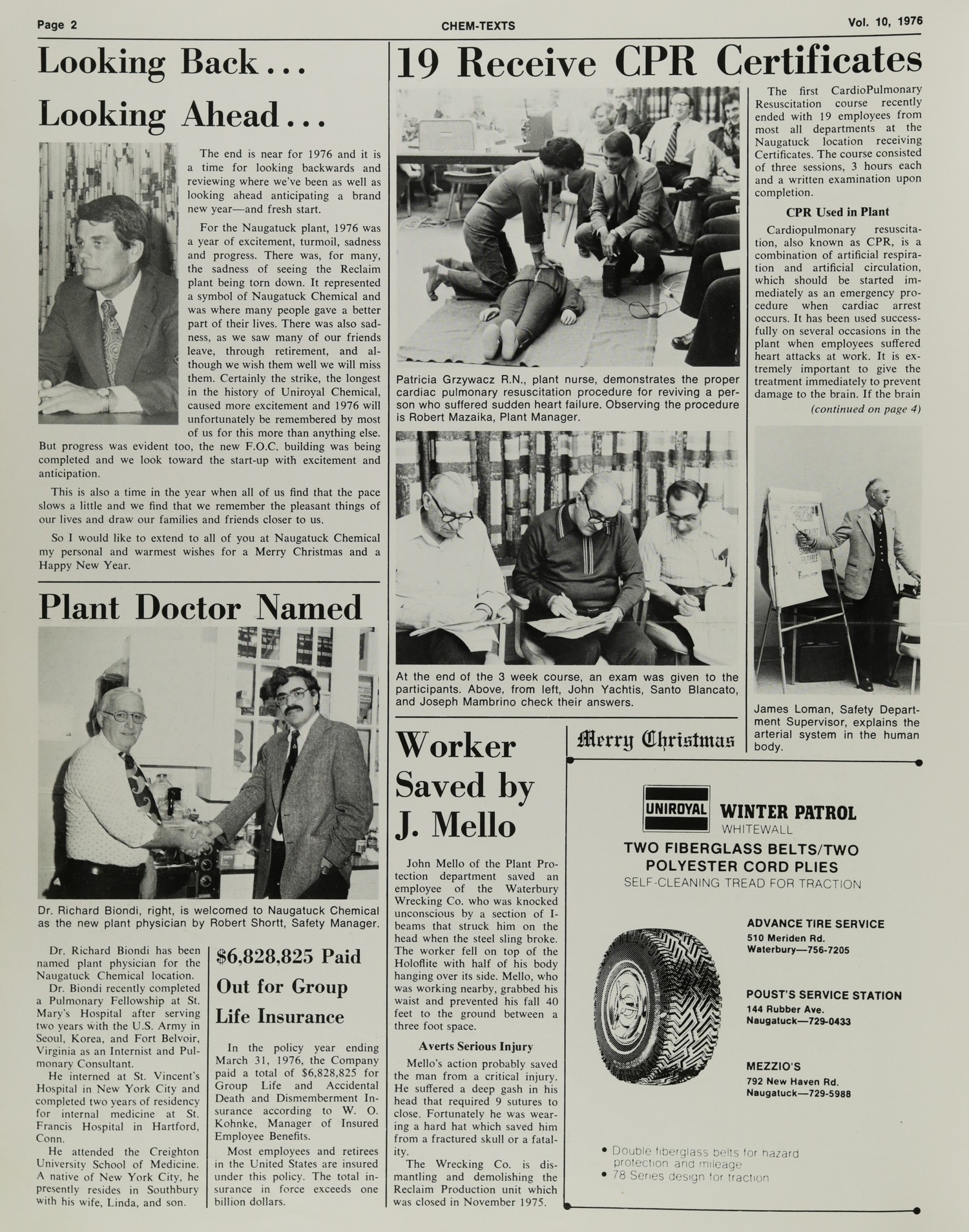
Dr. Richard Biondi, right, is welcomed to Naugatuck Chemical as the new plant physician by Robert Shortt, Safety Manager.

Dr. Richard Biondi has been named plant physician for the Naugatuck Chemical location. Dr. Biondi recently completed a Pulmonary Fellowship at St. Mary’s Hospital after serving two years with the U.S. Army in Seoul, Korea, and Fort Belvoir, Virginia as an Internist and Pulmonary Consultant.

He interned at St. Vincent’s Hospital in New York City and completed two years of residency for internal medicine at St. Francis Hospital in Hartford, Conn.

He attended the Creighton University School of Medicine. A native of New York City, he presently resides in Southbury with his wife, Linda, and son.


$6,828,825 Paid Out for Group Life Insurance

In the policy year ending March 31, 1976, the Company paid a total of $6,828,825 for Group Life and Accidental Death and Dismemberment Insurance according to W. O. Kohnke, Manager of Insured Employee Benefits.

Most employees and retirees in the United States are insured under this policy. The total insurance in force exceeds one billion dollars.


19 Receive CPR Certificates

The first CardioPulmonary Resuscitation course recently ended with 19 employees from most all departments at the Naugatuck location receiving Certificates. The course consisted of three sessions, 3 hours each and a written examination upon completion.

CPR Used in Plant

Cardiopulmonary resuscitation, also known as CPR, is a combination of artificial respiration and artificial circulation, which should be started immediately as an emergency procedure when cardiac arrest occurs. It has been used successfully on several occasions in the plant when employees suffered heart attacks at work. It is extremely important to give the treatment immediately to prevent damage to the brain. If the brain

(continued on page 4)

Patricia Grzywacz R.N., plant nurse, demonstrates the proper cardiac pulmonary resuscitation procedure for reviving a person who suffered sudden heart failure. Observing the procedure is Robert Mazaika, Plant Manager.

At the end of the 3 week course, an exam was given to the participants. Above, from left, John Yachtis, Santo Blancato, and Joseph Mambrino check their answers.

James Loman, Safety Department Supervisor, explains the arterial system in the human body.


Worker Saved by J. Mello

John Mello of the Plant Protection department saved an employee of the Waterbury Wrecking Co. who was knocked unconscious by a section of I-beams that struck him on the head when the steel sling broke. The worker fell on top of the Holoflite with half of his body hanging over its side. Mello, who was working nearby, grabbed his waist and prevented his fall 40 feet to the ground between a three foot space.

Averts Serious Injury

Mello’s action probably saved the man from a critical injury. He suffered a deep gash in his head that required 9 sutures to close. Fortunately he was wearing a hard hat which saved him from a fractured skull or a fatality.

The Wrecking Co. is dismantling and demolishing the Reclaim Production unit which was closed in November 1975.


Merry Christmas


UNIROYAL WINTER PATROL
WHITEWALL

TWO FIBERGLASS BELTS/TWO POLYESTER CORD PLIES
SELF-CLEANING TREAD FOR TRACTION

ADVANCE TIRE SERVICE
510 Meriden Rd.
Waterbury—756-7205

POUST’S SERVICE STATION
144 Rubber Ave.
Naugatuck—729-0433

MEZZIO’S
792 New Haven Rd.
Naugatuck—729-5988

• Double fiberglass belts for hazard protection and mileage
• 78 Series design for traction

CHEM-TEXTS – 1976-v10-s247

Page 247

CHEM-TEXTS

Vol. 10, 1976 | Page 4


Four Retire Recently

[PHOTO CAPTION:]
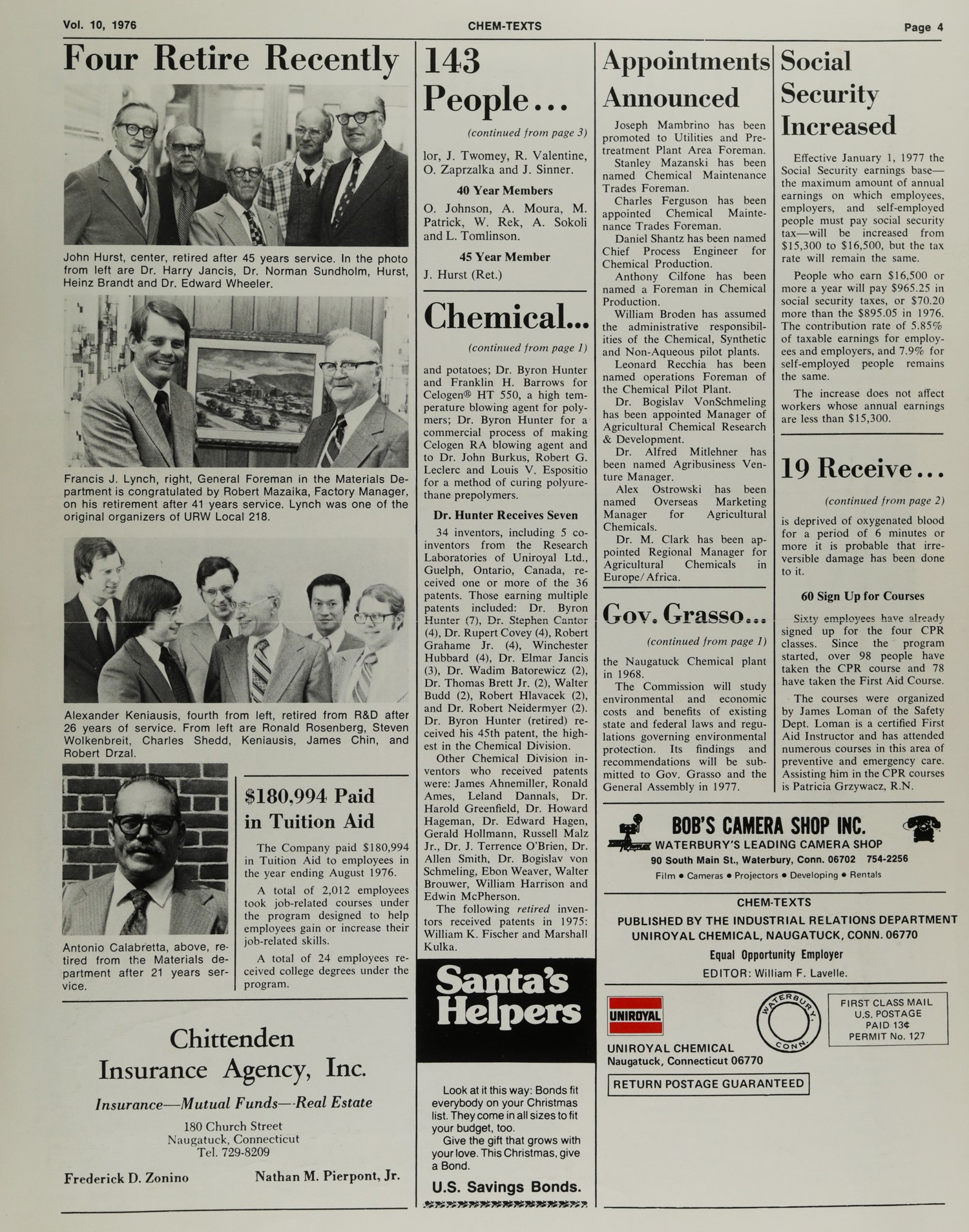
John Hurst, center, retired after 45 years service. In the photo from left are Dr. Harry Jancis, Dr. Norman Sundholm, Hurst, Heinz Brandt and Dr. Edward Wheeler.

[PHOTO CAPTION:]
Francis J. Lynch, right, General Foreman in the Materials Department is congratulated by Robert Mazaika, Factory Manager, on his retirement after 41 years service. Lynch was one of the original organizers of URW Local 218.

[PHOTO CAPTION:]
Alexander Keniausis, fourth from left, retired from R&D after 26 years of service. From left are Ronald Rosenberg, Steven Wolkenbreit, Charles Shedd, Keniausis, James Chin, and Robert Drzal.

[PHOTO CAPTION:]
Antonio Calabretta, above, retired from the Materials department after 21 years service.


$180,994 Paid in Tuition Aid

The Company paid $180,994 in Tuition Aid to employees in the year ending August 1976.

A total of 2,012 employees took job-related courses under the program designed to help employees gain or increase their job-related skills.

A total of 24 employees received college degrees under the program.


Chittenden Insurance Agency, Inc.

Insurance—Mutual Funds—Real Estate

180 Church Street
Naugatuck, Connecticut
Tel. 729-8209

Frederick D. Zonino | Nathan M. Pierpont, Jr.


143 People…

(continued from page 3)

lor, J. Twomey, R. Valentine, O. Zaprzalka and J. Sinner.

40 Year Members
O. Johnson, A. Moura, M. Patrick, W. Rek, A. Sokoli and L. Tomlinson.

45 Year Member
J. Hurst (Ret.)


Chemical…

(continued from page 1)

and potatoes; Dr. Byron Hunter and Franklin H. Barrows for Celogen® HT 550, a high temperature blowing agent for polymers; Dr. Byron Hunter for a commercial process of making Celogen RA blowing agent and to Dr. John Burkus, Robert G. Leclerc and Louis V. Espositio for a method of curing polyurethane prepolymers.

Dr. Hunter Receives Seven

34 inventors, including 5 co-inventors from the Research Laboratories of Uniroyal Ltd., Guelph, Ontario, Canada, received one or more of the 36 patents. Those earning multiple patents included: Dr. Byron Hunter (7), Dr. Stephen Cantor (4), Dr. Rupert Covey (4), Robert Grahame Jr. (4), Winchester Hubbard (4), Dr. Elmar Jancis (3), Dr. Wadim Batorewicz (2), Dr. Thomas Brett Jr. (2), Walter Budd (2), Robert Hlavacek (2), and Dr. Robert Neidermyer (2). Dr. Byron Hunter (retired) received his 45th patent, the highest in the Chemical Division.

Other Chemical Division inventors who received patents were: James Ahrenmiller, Ronald Ames, Leland Dannals, Dr. Harold Greenfield, Dr. Howard Hageman, Dr. Edward Hagen, Gerald Hollmann, Russell Malz Jr., Dr. J. Terrence O’Brien, Dr. Allen Smith, Dr. Bogislav von Schmeling, Ebon Weaver, Walter Brouwer, William Harrison and Edwin McPherson.

The following retired inventors received patents in 1975: William K. Fischer and Marshall Kulka.


Santa’s Helpers

[LOGO: UNIROYAL]

Look at it this way: Bonds fit everybody on your Christmas list. They come in all sizes to fit your budget, too.

Give the gift that grows with your love. This Christmas, give a Bond.

U.S. Savings Bonds.


Appointments Announced

Joseph Mambrino has been promoted to Utilities and Pre-treatment Plant Area Foreman.

Stanley Mazanski has been named Chemical Maintenance Trades Foreman.

Charles Ferguson has been appointed Chemical Maintenance Trades Foreman.

Daniel Shantz has been named Chief Process Engineer for Chemical Production.

Anthony Cilfone has been named a Foreman in Chemical Production.

William Broden has assumed the administrative responsibilities of the Chemical, Synthetic and Non-Aqueous pilot plants.

Leonard Recchia has been named operations Foreman of the Chemical Pilot Plant.

Dr. Bogislav VonSchmeling has been appointed Manager of Agricultural Chemical Research & Development.

Dr. Alfred Mitlehner has been named Agribusiness Venture Manager.

Alex Ostrowski has been named Overseas Marketing Manager for Agricultural Chemicals.

Dr. M. Clark has been appointed Regional Manager for Agricultural Chemicals in Europe/Africa.


Gov. Grasso…

(continued from page 1)

the Naugatuck Chemical plant in 1968.

The Commission will study environmental and economic costs and benefits of existing state and federal laws and regulations governing environmental protection. Its findings and recommendations will be submitted to Gov. Grasso and the General Assembly in 1977.


Social Security Increased

Effective January 1, 1977 the Social Security earnings base—the maximum amount of annual earnings on which employees, employers, and self-employed people must pay social security tax—will be increased from $15,300 to $16,500, but the tax rate will remain the same.

People who earn $16,500 or more a year will pay $965.25 in social security taxes, or $70.20 more than the $895.05 in 1976. The contribution rate of 5.85% of taxable earnings for employees and employers, and 7.9% for self-employed people remains the same.

The increase does not affect workers whose annual earnings are less than $15,300.


19 Receive…

(continued from page 2)

is deprived of oxygenated blood for a period of 6 minutes or more it is probable that irreversible damage has been done to it.

60 Sign Up for Courses

Sixty employees have already signed up for the four CPR classes. Since the program started, over 98 people have taken the CPR course and 78 have taken the First Aid Course.

The courses were organized by James Loman of the Safety Dept. Loman is a certified First Aid Instructor and has attended numerous courses in this area of preventive and emergency care. Assisting him in the CPR courses is Patricia Grzywacz, R.N.


BOB’S CAMERA SHOP INC.

WATERBURY’S LEADING CAMERA SHOP
90 South Main St., Waterbury, Conn. 06702 754-2256
Film • Cameras • Projectors • Developing • Rentals


CHEM-TEXTS
PUBLISHED BY THE INDUSTRIAL RELATIONS DEPARTMENT
UNIROYAL CHEMICAL, NAUGATUCK, CONN. 06770

Equal Opportunity Employer

EDITOR: William F. Lavelle.


UNIROYAL CHEMICAL
Naugatuck, Connecticut 06770

FIRST CLASS MAIL
U.S. POSTAGE
PAID 13¢
PERMIT No. 127

RETURN POSTAGE GUARANTEED

CHEM-TEXTS – 1976 – Page 2

Page 002

CHEM-TEXTS

Page 2 | Vol. 10, 1976


From the Factory Manager…

In this my first opportunity to express myself in this column, I find that several things cross my mind and so I’ll just begin and say them all rather than try to limit myself to one area.

First, since the last issue of CHEM-TEXTS Jim Cronin has left the Naugatuck Plant “family.” I’m sure that all of the friends whom he developed here are going to miss him and wish him, as I do, the best of success in his new assignment. Jim’s contributions to the plant during his years here have been significant and his presence will be felt for years to come.

The second thought that comes to mind and which I’ve expressed to most of you personally is WELCOME BACK! It is, from a personal viewpoint, very gratifying to have everyone back working together and the plant back to “normal.” To those of you whom I may have missed during my tours through the plant, I would like to take this opprtunity to welcome you back.

This leads me to my third thought—move ahead. As we can all see, the Synthetic Plant is now gone; the Reclaim Plant is rapidly disappearing; and soon the old Thiazoles complex will be torn down. With all of this, it is hard to visualize anything but the shrinking of the Naugatuck complex, but we must all apply ourselves to the task of getting the plant moving ahead. We, at Naugauck, have many things to offer the Company as a future plant site on which to expand—land, and thus room, for new process buildings—water treatment facilities large enough to accommodate more than a doubling of our present plant capacity. A facility which, if needed to be built today, would be extremely expensive. Power, we have here enough capacity to supply heat and process steam for many expansions.— Skills, all of our people have the experience and bring the skills to their jobs that are necessary to operate a complex chemical plant. When you look at all of these assets you have to wonder why people aren’t knocking down our gates to let us make products for them! That, to me is our challenge. All of us must work together to bring all of our valuable assets together to make this the best, most competitive plant site available to Uniroyal Chemical. All of us must sell our assets and make sure we use them—skill, land, buildings, equipment—at the highest level of efficiency possible. Together then we will, and can, make the Naugatuck Plant move ahead. It has been said that no one ever stands still—you either move ahead and progress or you fall behind and become a dropout. It is my belief that all of us must put all of our energies together to make sure that the Naugatuck Plant moves ahead.


Achieves 45 Years Service

[IMAGE: Photo of two men, one congratulating the other]

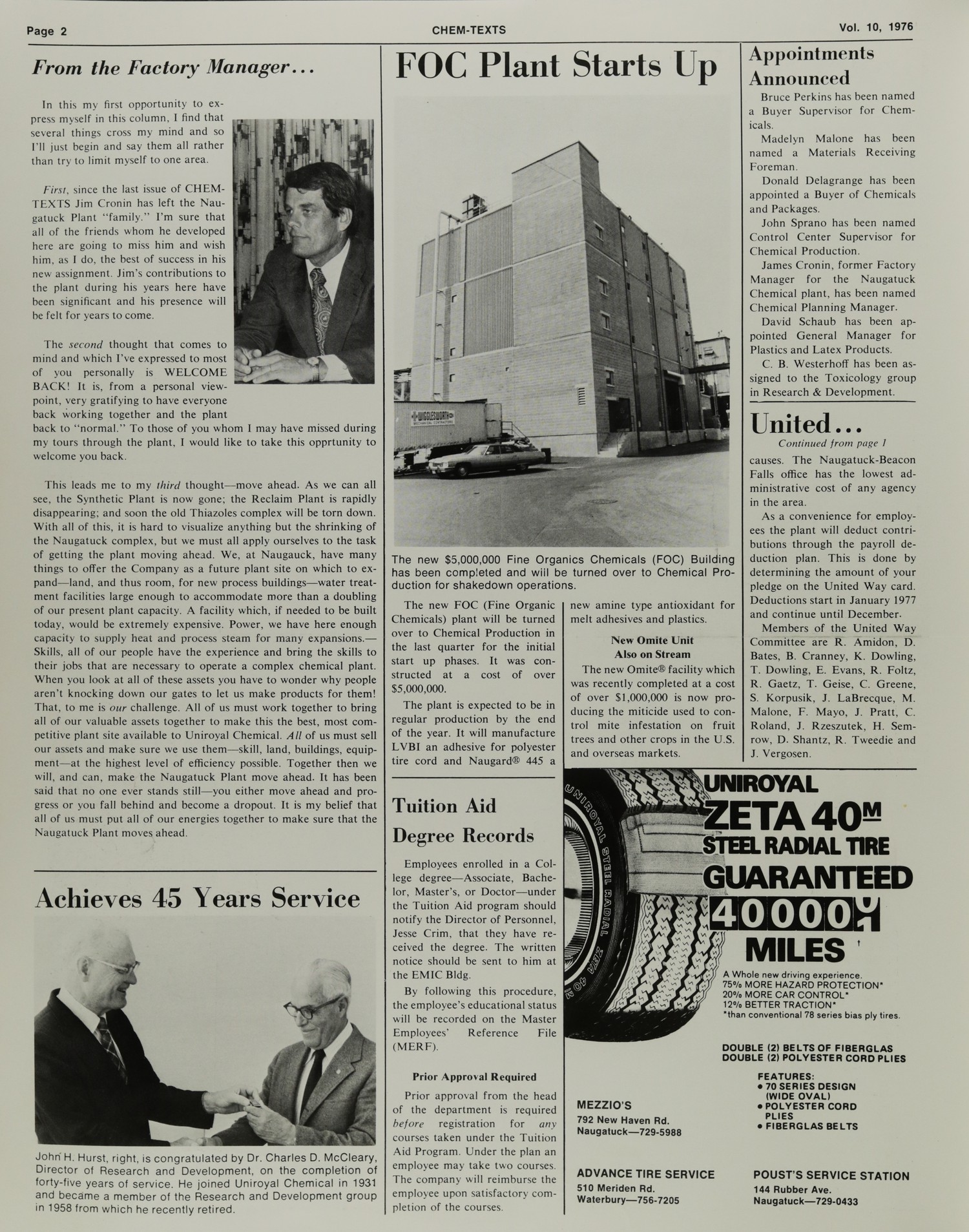
John H. Hurst, right, is congratulated by Dr. Charles D. McCleary, Director of Research and Development, on the completion of forty-five years of service. He joined Uniroyal Chemical in 1931 and became a member of the Research and Development group in 1958 from which he recently retired.


FOC Plant Starts Up

[IMAGE: Photograph of a large industrial building]

The new $5,000,000 Fine Organics Chemicals (FOC) Building has been completed and will be turned over to Chemical Production for shakedown operations.

The new FOC (Fine Organic Chemicals) plant will be turned over to Chemical Production in the last quarter for the initial start up phases. It was constructed at a cost of over $5,000,000.

The plant is expected to be in regular production by the end of the year. It will manufacture LVBI an adhesive for polyester tire cord and Naugard® 445 a new amine type antioxidant for melt adhesives and plastics.

New Omite Unit Also on Stream

The new Omite® facility which was recently completed at a cost of over $1,000,000 is now producing the miticide used to control mite infestation on fruit trees and other crops in the U.S. and overseas markets.


Tuition Aid Degree Records

Employees enrolled in a College degree—Associate, Bachelor, Master’s, or Doctor—under the Tuition Aid program should notify the Director of Personnel, Jesse Crim, that they have received the degree. The written notice should be sent to him at the EMIC Bldg.

By following this procedure, the employee’s educational status will be recorded on the Master Employees’ Reference File (MERF).

Prior Approval Required

Prior approval from the head of the department is required before registration for any courses taken under the Tuition Aid Program. Under the plan an employee may take two courses. The company will reimburse the employee upon satisfactory completion of the courses.


Appointments Announced

Bruce Perkins has been named a Buyer Supervisor for Chemicals.

Madelyn Malone has been named a Materials Receiving Foreman.

Donald Delagrange has been appointed a Buyer of Chemicals and Packages.

John Sprano has been named Control Center Supervisor for Chemical Production.

James Cronin, former Factory Manager for the Naugatuck Chemical plant, has been named Chemical Planning Manager.

David Schaub has been appointed General Manager for Plastics and Latex Products.

C. B. Westerhoff has been assigned to the Toxicology group in Research & Development.


United…

Continued from page 1

causes. The Naugatuck-Beacon Falls office has the lowest administrative cost of any agency in the area.

As a convenience for employees the plant will deduct contributions through the payroll deduction plan. This is done by determining the amount of your pledge on the United Way card. Deductions start in January 1977 and continue until December.

Members of the United Way Committee are R. Amidon, D. Bates, B. Cranney, K. Dowling, T. Dowling, E. Evans, R. Foltz, R. Gaetz, T. Geise, C. Greene, S. Korpusik, J. LaBrecque, M. Malone, F. Mayo, J. Pratt, C. Roland, J. Rzeszutek, H. Semrow, D. Shantz, R. Tweedie and J. Vergosen.


[ADVERTISEMENT]

UNIROYAL

ZETA 40M

STEEL RADIAL TIRE

GUARANTEED

40000

MILES *

A Whole new driving experience.
75% MORE HAZARD PROTECTION
20% MORE CAR CONTROL

12% BETTER TRACTION
than conventional 78 series bias ply tires.

DOUBLE (2) BELTS OF FIBERGLAS
DOUBLE (2) POLYESTER CORD PLIES

FEATURES:
– 70 SERIES DESIGN (WIDE OVAL)
– POLYESTER CORD PLIES
– FIBERGLAS BELTS


MEZZIO’S
792 New Haven Rd.
Naugatuck—729-5988

ADVANCE TIRE SERVICE
510 Meriden Rd.
Waterbury—756-7205

POUST’S SERVICE STATION
144 Rubber Ave.
Naugatuck—729-0433

CHEM-TEXTS – 1975 – Page 2

Page 002

CHEM-TEXTS

Page 2 | Vol. 9, 1975


In my last editorial I ventured into the field of politics. This area is so vital that I felt a few more ideas had to be discussed. The current confusion in Washington and the recent wild legislation session in Hartford are prime examples of the type of disturbing political action confronting us Americans today.

I read in the newspapers all the criticisms by well known columnists and editors lamenting the poor actions and leadership of our elected legislative officials. They ask our officials to change their ways and to recognize the real problems of the people, their jobs, their community problems, their financial problems, etc. etc.

I find this effort misdirected. Appealing to elected politicians hardly ever changes their minds. Their philosophy of life has been long in developing and most are strong-minded people, not easily swayed from their convictions. The way to change the political direction of a legislative body is to change the legislators. Vote out the ones that are undersirable and vote in those who reflect the feeling and mood of the electorate.

Although voting occurs only every two years, people’s thoughts should be on this subject all the time, not just one week before elections. For example, a review of how our representatives voted recently in Hartford should be done now to help form an opinion while the facts are clear.

The makeup of the last two Connecticut Legislatures is another problem that voters must avoid in the future. We now have in Hartford an overwhelming Democratic majority. Two years ago there was an overwhelming Republican majority. This is no way to run a government, for with such a onesided majority, we don’t have a democracy—which is a balance of two or more opinions— we have instead what approaches dictatorial power of the party in the majority. Such a situation can do nothing but harm. A balance is essential to stable and honest government.

No one can rectify a situation like this except we voters. This means less emotional voting and more thinking, both inside and outside the voting machine.

J. A. Cronin

Jim Cronin [signature]

[PHOTO: Headshot of a man in suit]


Steel Work Starts on FOC Bldg.

[PHOTO: Construction site showing steel framework of a building]

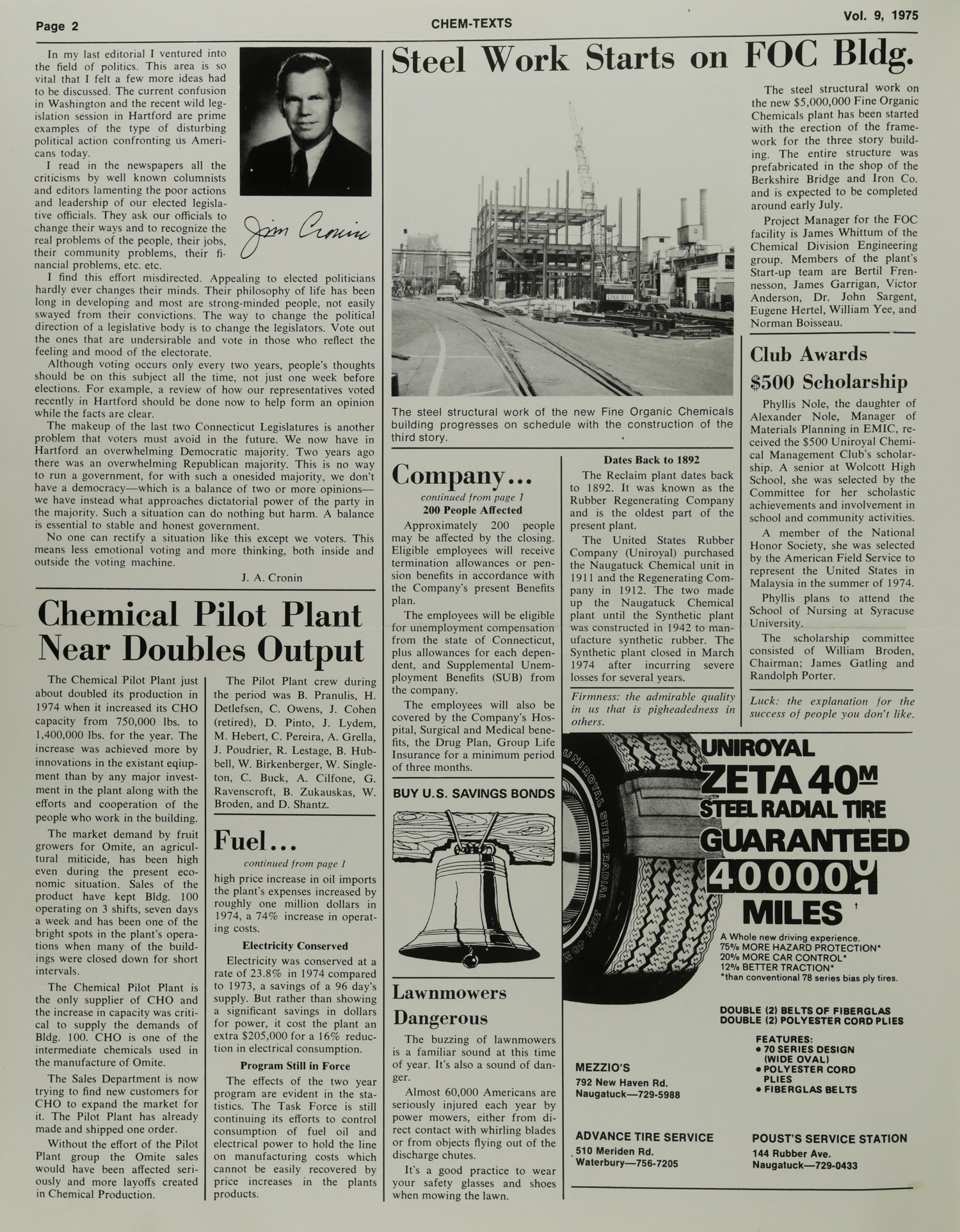
The steel structural work on the new $5,000,000 Fine Organic Chemicals plant has been started with the erection of the framework for the three story building. The entire structure was prefabricated in the shop of the Berkshire Bridge and Iron Co. and is expected to be completed around early July.

Project Manager for the FOC facility is James Whittum of the Chemical Division Engineering group. Members of the plant’s Start-up team are Bertil Frennesson, James Garrigan, Victor Anderson, Dr. John Sargent, Eugene Hertel, William Yee, and Norman Boisseau.

The steel structural work of the new Fine Organic Chemicals building progresses on schedule with the construction of the third story.


Chemical Pilot Plant Near Doubles Output

The Chemical Pilot Plant just about doubled its production in 1974 when it increased its CHO capacity from 750,000 lbs. to 1,400,000 lbs. for the year. The increase was achieved more by innovations in the existant equipment than by any major investment in the plant along with the efforts and cooperation of the people who work in the building.

The market demand by fruit growers for Omite, an agricultural miticide, has been high even during the present economic situation. Sales of the product have kept Bldg. 100 operating on 3 shifts, seven days a week and has been one of the bright spots in the plant’s operations when many of the buildings were closed down for short intervals.

The Chemical Pilot Plant is the only supplier of CHO and the increase in capacity was critical to supply the demands of Bldg. 100. CHO is one of the intermediate chemicals used in the manufacture of Omite.

The Sales Department is now trying to find new customers for CHO to expand the market for it. The Pilot Plant has already made and shipped one order.

Without the effort of the Pilot Plant group the Omite sales would have been affected seriously and more layoffs created in Chemical Production.

The Pilot Plant crew during the period was B. Pranulis, H. Detlefsen, C. Owens, J. Cohen (retired), D. Pinto, J. Lydem, M. Hebert, C. Pereira, A. Grella, J. Poudrier, R. Lestage, B. Hubbell, W. Birkenberger, W. Singleton, C. Buck, A. Cilfone, G. Ravenscroft, B. Zukauskas, W. Broden, and D. Shantz.


Company…

continued from page 1

200 People Affected

Approximately 200 people may be affected by the closing. Eligible employees will receive termination allowances or pension benefits in accordance with the Company’s present Benefits plan.

The employees will be eligible for unemployment compensation from the state of Connecticut, plus allowances for each dependent, and Supplemental Unemployment Benefits (SUB) from the company.

The employees will also be covered by the Company’s Hospital, Surgical and Medical benefits, the Drug Plan, Group Life Insurance for a minimum period of three months.

BUY U.S. SAVINGS BONDS


Dates Back to 1892

The Reclaim plant dates back to 1892. It was known as the Rubber Regenerating Company and is the oldest part of the present plant.

The United States Rubber Company (Uniroyal) purchased the Naugatuck Chemical unit in 1911 and the Regenerating Company in 1912. The two made up the Naugatuck Chemical plant until the Synthetic plant was constructed in 1942 to manufacture synthetic rubber. The Synthetic plant closed in March 1974 after incurring severe losses for several years.

Firmness: the admirable quality in us that is pigheadedness in others.


Fuel…

continued from page 1

high price increase in oil imports the plant’s expenses increased by roughly one million dollars in 1974, a 74% increase in operating costs.

Electricity Conserved

Electricity was conserved at a rate of 23.8% in 1974 compared to 1973, a savings of a 96 day’s supply. But rather than showing a significant savings in dollars for power, it cost the plant an extra $205,000 for a 16% reduction in electrical consumption.

Program Still in Force

The effects of the two year program are evident in the statistics. The Task Force is still continuing its efforts to control consumption of fuel oil and electrical power to hold the line on manufacturing costs which cannot be easily recovered by price increases in the plants products.


Club Awards $500 Scholarship

Phyllis Nole, the daughter of Alexander Nole, Manager of Materials Planning in EMIC, received the $500 Uniroyal Chemical Management Club’s scholarship. A senior at Wolcott High School, she was selected by the Committee for her scholastic achievements and involvement in school and community activities.

A member of the National Honor Society, she was selected by the American Field Service to represent the United States in Malaysia in the summer of 1974.

Phyllis plans to attend the School of Nursing at Syracuse University.

The scholarship committee consisted of William Broden, Chairman; James Gatling and Randolph Porter.

Luck: the explanation for the success of people you don’t like.


Lawnmowers Dangerous

[IMAGE: Drawing of a Liberty Bell]

The buzzing of lawnmowers is a familiar sound at this time of year. It’s also a sound of danger.

Almost 60,000 Americans are seriously injured each year by power mowers, either from direct contact with whirling blades or from objects flying out of the discharge chutes.

It’s a good practice to wear your safety glasses and shoes when mowing the lawn.


MEZZIO’S
792 New Haven Rd.
Naugatuck—729-5988

ADVANCE TIRE SERVICE
510 Meriden Rd.
Waterbury—756-7205

POUST’S SERVICE STATION
144 Rubber Ave.
Naugatuck—729-0433


[ADVERTISEMENT]

UNIROYAL

ZETA 40M

STEEL RADIAL TIRE

GUARANTEED

40000

MILES

A Whole new driving experience.
75% MORE HAZARD PROTECTION
20% MORE CAR CONTROL

12% BETTER TRACTION
than conventional 78 series bias ply tires.

DOUBLE (2) BELTS OF FIBERGLAS
DOUBLE (2) POLYESTER CORD PLIES

FEATURES:
– 70 SERIES DESIGN (WIDE OVAL)
– POLYESTER CORD PLIES
– FIBERGLAS BELTS

CHEM-TEXTS – 1975 – Page 3

Page 003

CHEM-TEXTS

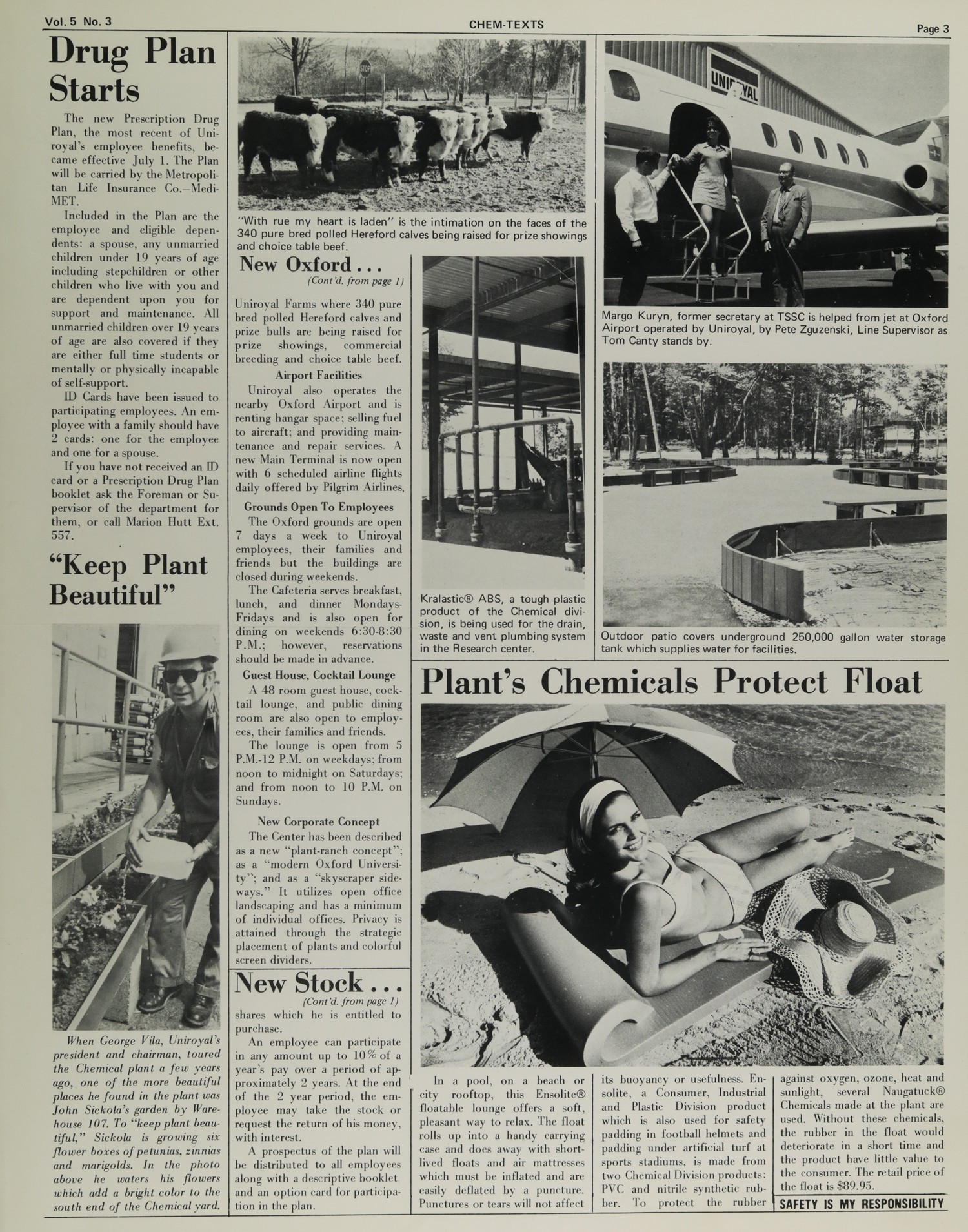
Vol. 10, 1975 | Page 3


Division Closes 3 Plants

Final plans have been made to close three Chemical Division plants: the Reclaim Rubber plant at Naugatuck; the Paracril® nitrile rubber plant in Baton Rouge, La.; and the Marvinol® polyvinyl chloride plant in Painesville, Ohio.

The Division closed the Synthetic rubber plant at the Naugatuck location in November, 1973.

500 Employees Affected

The closings will affect over 500 employees at the three plants. Eligible personnel will receive pension benefits or termination allowances based on their years of service with the company.

Reclaim Plant

The Reclaim plant dates back to 1892 and is one of the oldest units at the Naugatuck location. For the past five years it has operated under severe economic conditions and even after intensive efforts on the part of the union and management were made to operate it competitively, it became necessary to close it.

Painesville Closing

The large capital expenditures necessary to remain in the polyvinyl chloride resin business and to meet the OSHA standards on employee exposure to vinyl chloride were the principal reasons for the division to close the PVC operations at Painesville. The plans do not affect the


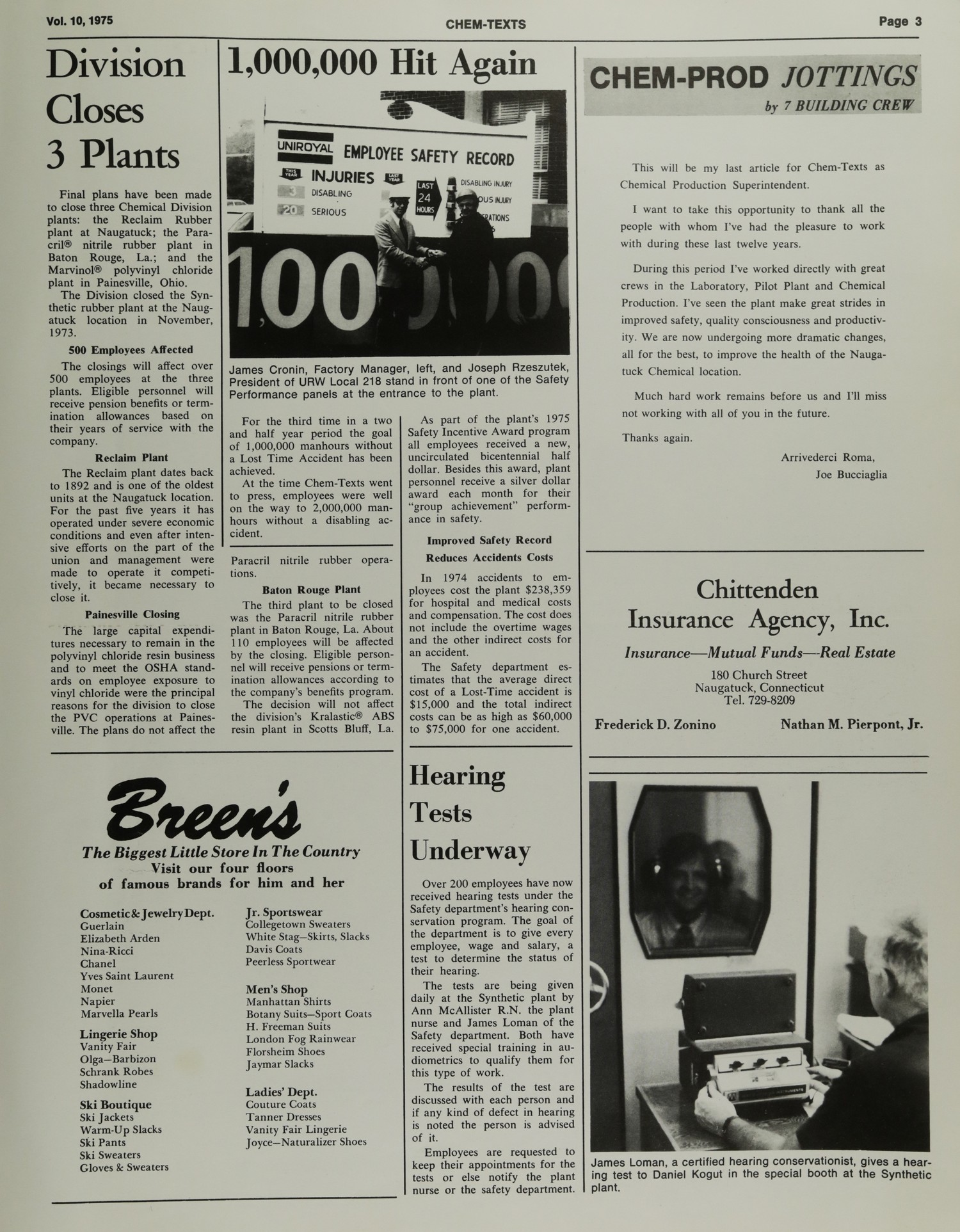
1,000,000 Hit Again

[IMAGE: UNIROYAL EMPLOYEE SAFETY RECORD sign showing INJURIES – DISABLING and SERIOUS counts, with “LAST 24” and “DISABLING INJURY” / “OUS INJURY” / “ATIONS” visible, with “100” displayed]

James Cronin, Factory Manager, left, and Joseph Rzeszutek, President of URW Local 218 stand in front of one of the Safety Performance panels at the entrance to the plant.

For the third time in a two and half year period the goal of 1,000,000 manhours without a Lost Time Accident has been achieved.

At the time Chem-Texts went to press, employees were well on the way to 2,000,000 manhours without a disabling accident.

Paracril nitrile rubber operations.

Baton Rouge Plant

The third plant to be closed was the Paracril nitrile rubber plant in Baton Rouge, La. About 110 employees will be affected by the closing. Eligible personnel will receive pensions or termination allowances according to the company’s benefits program.

The decision will not affect the division’s Kralastic® ABS resin plant in Scotts Bluff, La.

As part of the plant’s 1975 Safety Incentive Award program all employees received a new, uncirculated bicentennial half dollar. Besides this award, plant personnel receive a silver dollar award each month for their “group achievement” performance in safety.

Improved Safety Record Reduces Accidents Costs

In 1974 accidents to employees cost the plant $238,359 for hospital and medical costs and compensation. The cost does not include the overtime wages and the other indirect costs for an accident.

The Safety department estimates that the average direct cost of a Lost-Time accident is $15,000 and the total indirect costs can be as high as $60,000 to $75,000 for one accident.


CHEM-PROD JOTTINGS

by 7 BUILDING CREW

This will be my last article for Chem-Texts as Chemical Production Superintendent.

I want to take this opportunity to thank all the people with whom I’ve had the pleasure to work with during these last twelve years.

During this period I’ve worked directly with great crews in the Laboratory, Pilot Plant and Chemical Production. I’ve seen the plant make great strides in improved safety, quality consciousness and productivity. We are now undergoing more dramatic changes, all for the best, to improve the health of the Naugatuck Chemical location.

Much hard work remains before us and I’ll miss not working with all of you in the future.

Thanks again.

Arrivederci Roma,
Joe Bucciaglia


Chittenden Insurance Agency, Inc.

Insurance—Mutual Funds—Real Estate

180 Church Street
Naugatuck, Connecticut
Tel. 729-8209

Frederick D. Zonino | Nathan M. Pierpont, Jr.


Breen’s

The Biggest Little Store In The Country
Visit our four floors of famous brands for him and her

Cosmetic & Jewelry Dept.
Guerlain
Elizabeth Arden
Nina-Ricci
Chanel
Yves Saint Laurent
Monet
Napier
Marvella Pearls

Lingerie Shop
Vanity Fair
Olga—Barbizon
Schrank Robes
Shadowline

Ski Boutique
Ski Jackets
Warm-Up Slacks
Ski Pants
Ski Sweaters
Gloves & Sweaters

Jr. Sportswear
Collegetown Sweaters
White Stag—Skirts, Slacks
Davis Coats
Peerless Sportwear

Men’s Shop
Manhattan Shirts
Botany Suits—Sport Coats
H. Freeman Suits
London Fog Rainwear
Florsheim Shoes
Jaymar Slacks

Ladies’ Dept.
Couture Coats
Tanner Dresses
Vanity Fair Lingerie
Joyce—Naturalizer Shoes


Hearing Tests Underway

Over 200 employees have now received hearing tests under the Safety department’s hearing conservation program. The goal of the department is to give every employee, wage and salary, a test to determine the status of their hearing.

The tests are being given daily at the Synthetic plant by Ann McAllister R.N. the plant nurse and James Loman of the Safety department. Both have received special training in audiometrics to qualify them for this type of work.

The results of the test are discussed with each person and if any kind of defect in hearing is noted the person is advised of it.

Employees are requested to keep their appointments for the tests or else notify the plant nurse or the safety department.

[IMAGE: Photo of hearing test being administered]

James Loman, a certified hearing conservationist, gives a hearing test to Daniel Kogut in the special booth at the Synthetic plant.

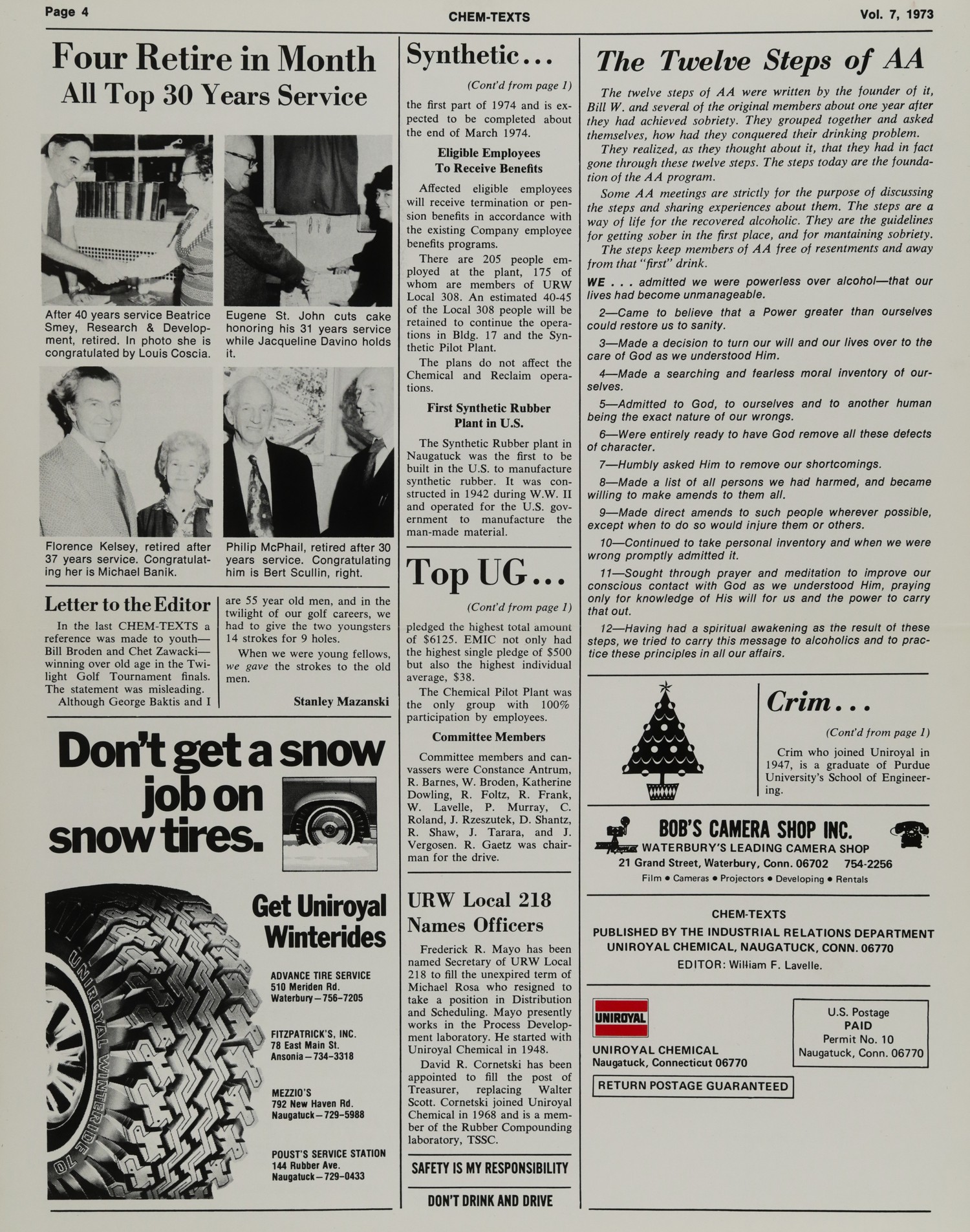
Four Retire in Month All Top 30 Years Service

Page 4 CHEM-TEXTS Vol. 7, 1973


Four Retire in Month All Top 30 Years Service

[IMAGE: Woman in photo]

After 40 years service Beatrice Smey, Research & Development, retired. In photo she is congratulated by Louis Coscia.

[IMAGE: Man cutting cake]

Eugene St. John cuts cake honoring his 31 years service while Jacqueline Davino holds it.

[IMAGE: Woman in photo]

Florence Kelsey, retired after 37 years service. Congratulating her is Michael Banik.

[IMAGE: Two men in photo]

Philip McPhail, retired after 30 years service. Congratulating him is Bert Scullin, right.


Letter to the Editor

In the last CHEM-TEXTS a reference was made to youth— Bill Broden and Chet Zawacki— winning over old age in the Twilight Golf Tournament finals. The statement was misleading.

Although George Baktis and I are 55 year old men, and in the twilight of our golf careers, we had to give the two youngsters 14 strokes for 9 holes.

When we were young fellows, we gave the strokes to the old men.

Stanley Mazanski


Don’t get a snow job on snow tires.

[IMAGE: Snow tire]

Get Uniroyal Winterides

[IMAGE: Woman with tire]

ADVANCE TIRE SERVICE
510 Meriden Rd.
Waterbury – 756–7205

FITZPATRICK’S, INC.
78 East Main St.
Ansonia – 734–3318

MEZZIO’S
792 New Haven Rd.
Naugatuck – 729–5988

POUST’S SERVICE STATION
144 Rubber Ave.
Naugatuck – 729–0433


Synthetic…

(Cont’d from page 1)

the first part of 1974 and is expected to be completed about the end of March 1974.

Eligible Employees To Receive Benefits

Affected eligible employees will receive termination or pension benefits in accordance with the existing Company employee benefits programs.

There are 205 people employed at the plant, 175 of whom are members of URW Local 308. An estimated 40-45 of the Local 308 people will be retained to continue the operations in Bldg. 17 and the Synthetic Pilot Plant.

The plans do not affect the Chemical and Reclaim operations.

First Synthetic Rubber Plant in U.S.

The Synthetic Rubber plant in Naugatuck was the first to be built in the U.S. to manufacture synthetic rubber. It was constructed in 1942 during W.W. II and operated for the U.S. government to manufacture the man-made material.


Top UG…

(Cont’d from page 1)

pledged the highest total amount of $6125. EMIC not only had the highest single pledge of $500 but also the highest individual average, $38.

The Chemical Pilot Plant was the only group with 100% participation by employees.

Committee Members

Committee members and canvassers were Constance Antrum, R. Barnes, W. Broden, Katherine Dowling, R. Foltz, R. Frank, W. Lavelle, P. Murray, C. Roland, J. Rzeszutek, D. Shantz, R. Shaw, J. Tarara, and J. Vergosen. R. Gaetz was chairman for the drive.


URW Local 218 Names Officers

Frederick R. Mayo has been named Secretary of URW Local 218 to fill the unexpired term of Michael Rosa who resigned to take a position in Distribution and Scheduling. Mayo presently works in the Process Development laboratory. He started with Uniroyal Chemical in 1948.

David R. Cornetski has been appointed to fill the post of Treasurer, replacing Walter Scott. Cornetski joined Uniroyal Chemical in 1968 and is a member of the Rubber Compounding laboratory, TSSC.


SAFETY IS MY RESPONSIBILITY

DON’T DRINK AND DRIVE


The Twelve Steps of AA

The twelve steps of AA were written by the founder of it, Bill W. and several of the original members about one year after they had achieved sobriety. They grouped together and asked themselves, how had they conquered their drinking problem.

They realized, as they thought about it, that they had in fact gone through these twelve steps. The steps today are the foundation of the AA program.

Some AA meetings are strictly for the purpose of discussing the steps and sharing experiences about them. The steps are a way of life for the recovered alcoholic. They are the guidelines for getting sober in the first place, and for mantaining sobriety. The steps keep members of AA free of resentments and away from that “first” drink.

WE . . . admitted we were powerless over alcohol—that our lives had become unmanageable.

2—Came to believe that a Power greater than ourselves could restore us to sanity.

3—Made a decision to turn our will and our lives over to the care of God as we understood Him.

4—Made a searching and fearless moral inventory of ourselves.

5—Admitted to God, to ourselves and to another human being the exact nature of our wrongs.

6—Were entirely ready to have God remove all these defects of character.

7—Humbly asked Him to remove our shortcomings.

8—Made a list of all persons we had harmed, and became willing to make amends to them all.

9—Made direct amends to such people wherever possible, except when to do so would injure them or others.

10—Continued to take personal inventory and when we were wrong promptly admitted it.

11—Sought through prayer and meditation to improve our conscious contact with God as we understood Him, praying only for knowledge of His will for us and the power to carry that out.

12—Having had a spiritual awakening as the result of these steps, we tried to carry this message to alcoholics and to practice these principles in all our affairs.


Crim…

(Cont’d from page 1)

Crim who joined Uniroyal in 1947, is a graduate of Purdue University’s School of Engineering.


BOB’S CAMERA SHOP INC.
WATERBURY’S LEADING CAMERA SHOP
21 Grand Street, Waterbury, Conn. 06702 754-2256
Film ● Cameras ● Projectors ● Developing ● Rentals


CHEM-TEXTS
PUBLISHED BY THE INDUSTRIAL RELATIONS DEPARTMENT
UNIROYAL CHEMICAL, NAUGATUCK, CONN. 06770
EDITOR: William F. Lavelle.


[UNIROYAL LOGO]

UNIROYAL CHEMICAL
Naugatuck, Connecticut 06770

U.S. Postage
PAID
Permit No. 10
Naugatuck, Conn. 06770

RETURN POSTAGE GUARANTEED

CHEM-TEXTS – 1973-v07-s219

Page 219

Page 2 CHEM-TEXTS Vol. 7, 1973


Running the plant is not much different than running your own home.

Most of us own a house; have a family; and have an awful lot of bills to pay: a mortgage every month; income taxes and property taxes; clothing; food; college; electric; fuel oil; water; car installments; gasoline; doctor and dentist bills; house repairs; appliances; insurance; contributions; recreation; and many others.

We all know that often our pay check doesn’t cover the expenses that we have incurred. For instance if our pay check is $150 and our bills are $175, we soon look for ways to reduce our expenses: 1) we can buy on credit; 2) borrow money from a bank; or 3) cut them down by doing away with the frills, buying wisely, and saving on fuel oil, water, and electricity, and other things.

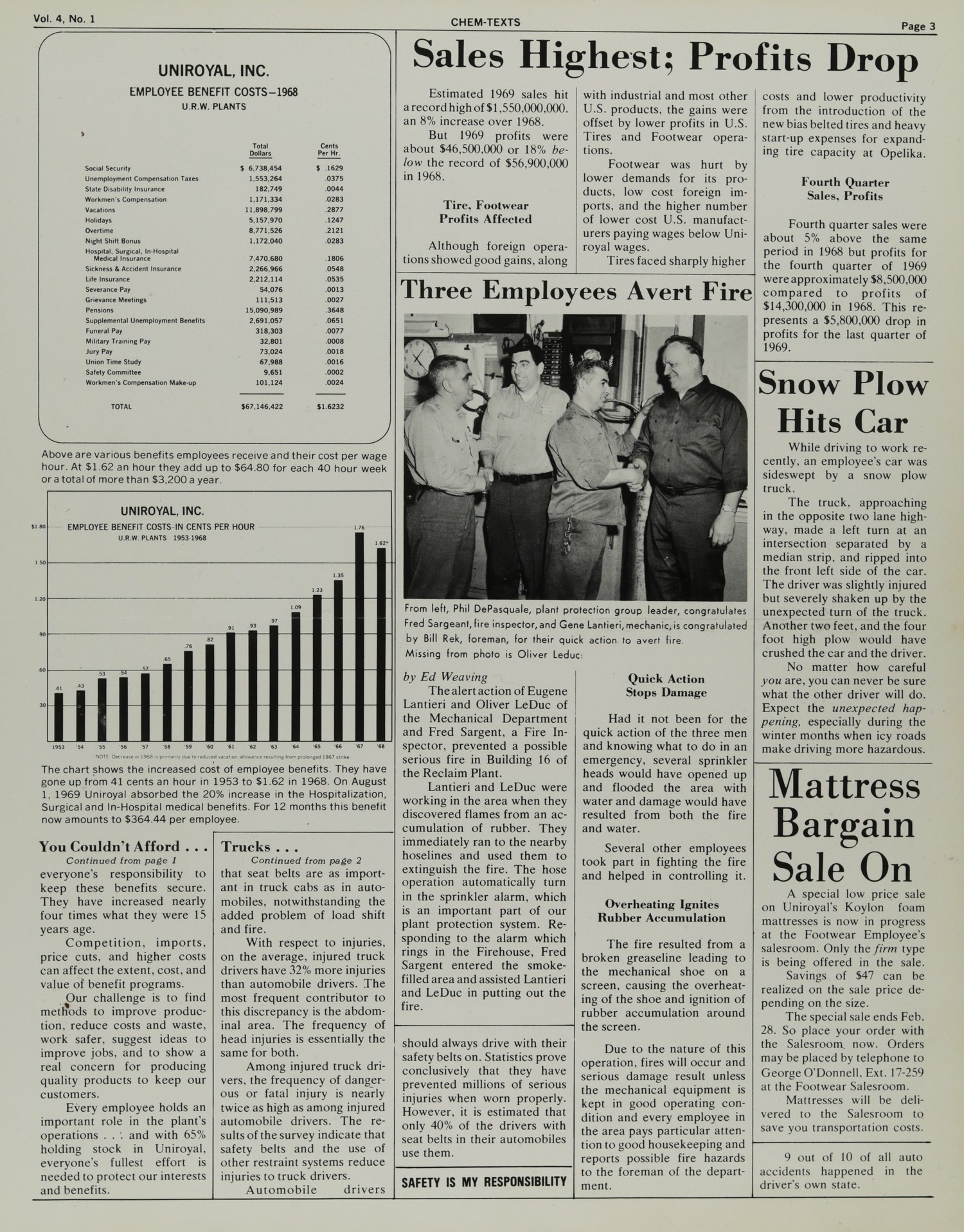
The same money problems exist in the plant. Instead of $20 or $100 costs, our bills run $500,000 or $1,000,000. For example our utility bill for one year in this plant—fuel oil, electricity, and city water—is about $3,000,000. About two years ago this combined bill was about $2,000,000.

If it costs the plant $1,000,000 to make a product and we receive $750,000 for it, something has to give. We are losing $250,000 each time we make it. It’s the same situation as running your home.

It’s obvious that you can’t continue to do business this way. The alternatives are: to 1) to increase prices; 2) eliminate major items; 3) close down the production unit; 4) or to control our expenses, reduce waste, and to improve our productivity to get our costs down.

In the chemical industry selling prices have not been going up very fast so that approach is limited. Alternative 4)—controlling expenses—is the road we want to take but our success depends on everyone’s determination to resolve the problems.

At the present time the costs of operating some of our production units are higher than the financial return for their products. As you know—just from running your own home and paying your own bills—something has to be done to improve the situation. If it continues it could put these two units so deep in the red that it would affect all production units and manufacturing services. Each one of us has a stake in this plant. It sinks or swims depending on the efforts of each one of us.

I am asking everyone to reveal the same personal interest in the plant that you would if it were your own home, so that we can help resolve the problems and improve the financial situations of all of its units.

Jan Crane [signature]


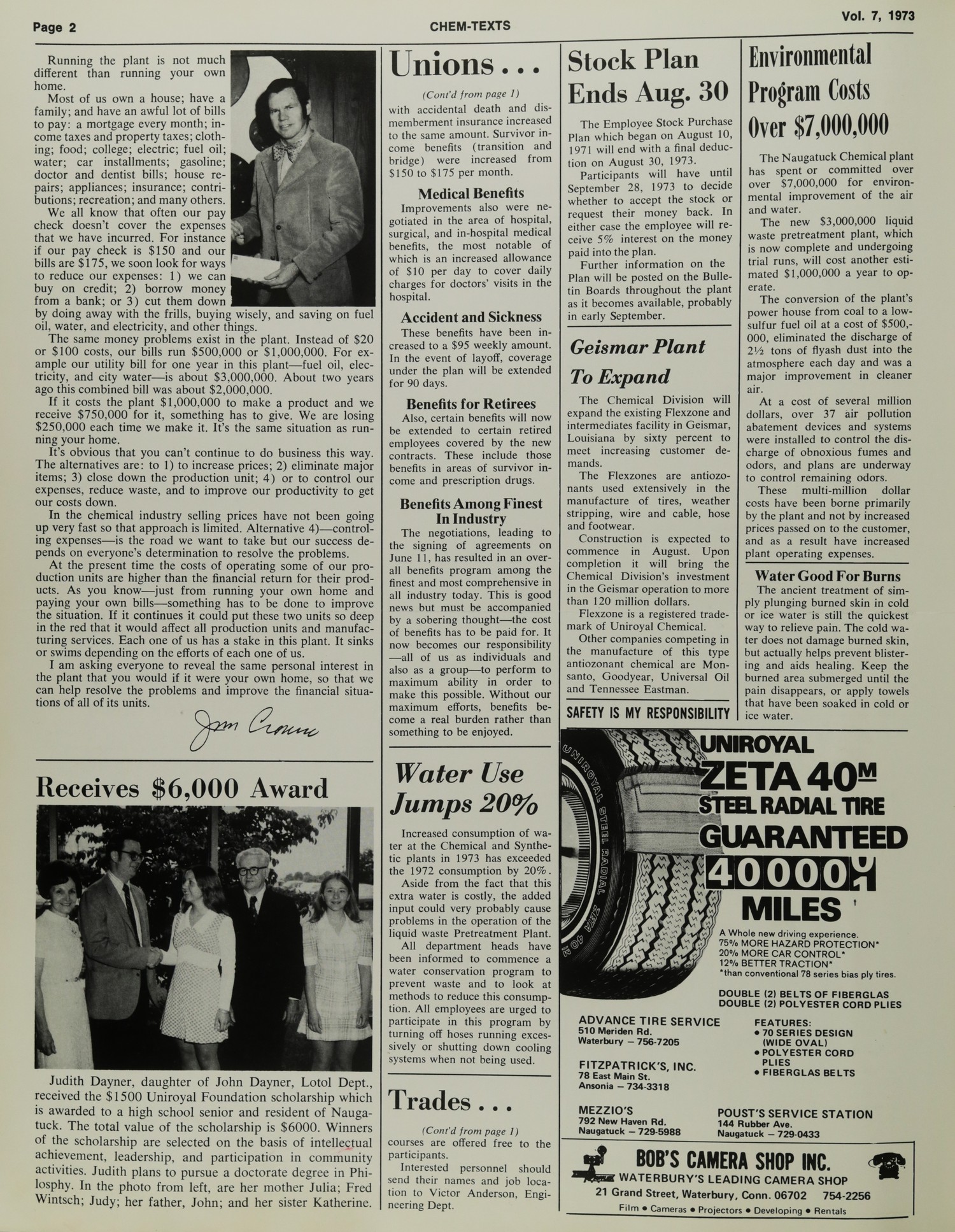
Receives $6,000 Award

[PHOTO: Group photo of four people]

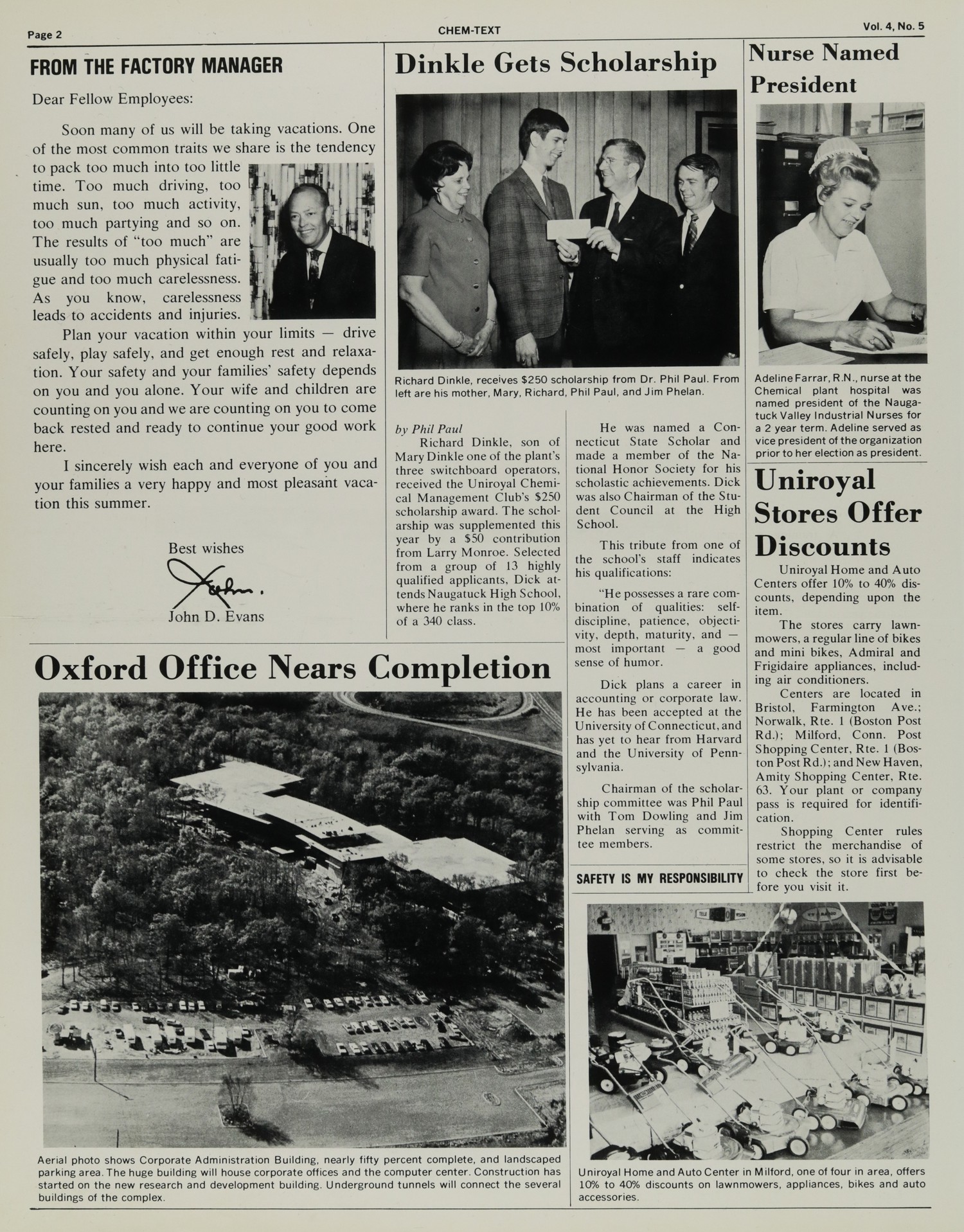
Judith Dayner, daughter of John Dayner, Lotol Dept., received the $1500 Uniroyal Foundation scholarship which is awarded to a high school senior and resident of Naugatuck. The total value of the scholarship is $6000. Winners of the scholarship are selected on the basis of intellectual achievement, leadership, and participation in community activities. Judith plans to pursue a doctorate degree in Philosophy. In the photo from left, are her mother Julia; Fred Wintsch; Judy; her father, John; and her sister Katherine.


Unions…

(Cont’d from page 1)

with accidental death and dismemberment insurance increased to the same amount. Survivor income benefits (transition and bridge) were increased from $150 to $175 per month.

Medical Benefits

Improvements also were negotiated in the area of hospital, surgical, and in-hospital medical benefits, the most notable of which is an increased allowance of $10 per day to cover daily charges for doctors’ visits in the hospital.

Accident and Sickness

These benefits have been increased to a $95 weekly amount. In the event of layoff, coverage under the plan will be extended for 90 days.

Benefits for Retirees

Also, certain benefits will now be extended to certain retired employees covered by the new contracts. These include those benefits in areas of survivor income and prescription drugs.

Benefits Among Finest In Industry

The negotiations, leading to the signing of agreements on June 11, has resulted in an overall benefits program among the finest and most comprehensive in all industry today. This is good news but must be accompanied by a sobering thought—the cost of benefits has to be paid for. It now becomes our responsibility —all of us as individuals and also as a group—to perform to maximum ability in order to make this possible. Without our maximum efforts, benefits become a real burden rather than something to be enjoyed.


Water Use Jumps 20%

Increased consumption of water at the Chemical and Synthetic plants in 1973 has exceeded the 1972 consumption by 20%.

Aside from the fact that this extra water is costly, the added input could very probably cause problems in the operation of the liquid waste Pretreatment Plant.

All department heads have been informed to commence a water conservation program to prevent waste and to look at methods to reduce this consumption. All employees are urged to participate in this program by turning off hoses running excessively or shutting down cooling systems when not being used.

[PHOTO: Person near water/equipment]


Trades…

(Cont’d from page 1)

courses are offered free to the participants.

Interested personnel should send their names and job location to Victor Anderson, Engineering Dept.


Stock Plan Ends Aug. 30

The Employee Stock Purchase Plan which began on August 10, 1971 will end with a final deduction on August 30, 1973.

Participants will have until September 28, 1973 to decide whether to accept the stock or request their money back. In either case the employee will receive 5% interest on the money paid into the plan.

Further information on the Plan will be posted on the Bulletin Boards throughout the plant as it becomes available, probably in early September.


Geismar Plant To Expand

The Chemical Division will expand the existing Flexzone and intermediates facility in Geismar, Louisiana by sixty percent to meet increasing customer demands.

The Flexzones are antiozonants used extensively in the manufacture of tires, weather stripping, wire and cable, hose and footwear.

Construction is expected to commence in August. Upon completion it will bring the Chemical Division’s investment in the Geismar operation to more than 120 million dollars.

Flexzone is a registered trademark of Uniroyal Chemical.

Other companies competing in the manufacture of this type antiozonant chemical are Monsanto, Goodyear, Universal Oil and Tennessee Eastman.


SAFETY IS MY RESPONSIBILITY


Environmental Program Costs Over $7,000,000

The Naugatuck Chemical plant has spent or committed over $7,000,000 for environmental improvement of the air and water.

The new $3,000,000 liquid waste pretreatment plant, which is now complete and undergoing trial runs, will cost another estimated $1,000,000 a year to operate.

The conversion of the plant’s power house from coal to a low-sulfur fuel oil at a cost of $500,000, eliminated the discharge of 2½ tons of flyash dust into the atmosphere each day and was a major improvement in cleaner air.

At a cost of several million dollars, over 37 air pollution abatement devices and systems were installed to control the discharge of obnoxious fumes and odors, and plans are underway to control remaining odors.

These multi-million dollar costs have been borne primarily by the plant and not by increased prices passed on to the customer, and as a result have increased plant operating expenses.

Water Good For Burns

The ancient treatment of simply plunging burned skin in cold or ice water is still the quickest way to relieve pain. The cold water does not damage burned skin, but actually helps prevent blistering and aids healing. Keep the burned area submerged until the pain disappears, or apply towels that have been soaked in cold or ice water.


[ADVERTISEMENT]

UNIROYAL

ZETA 40M

STEEL RADIAL TIRE

GUARANTEED

40000

MILES

A Whole new driving experience.
75% MORE HAZARD PROTECTION
20% MORE CAR CONTROL

12% BETTER TRACTION
than conventional 78 series bias ply tires.

DOUBLE (2) BELTS OF FIBERGLAS
DOUBLE (2) POLYESTER CORD PLIES

ADVANCE TIRE SERVICE
510 Meriden Rd.
Waterbury — 756-7205

FEATURES:
• 70 SERIES DESIGN (WIDE OVAL)
• POLYESTER CORD PLIES
• FIBERGLAS BELTS

FITZPATRICK’S, INC.
78 East Main St.
Ansonia — 734-3318

MEZZIO’S
792 New Haven Rd.
Naugatuck — 729-5988

POUST’S SERVICE STATION
144 Rubber Ave.
Naugatuck — 729-0433


BOB’S CAMERA SHOP INC.
WATERBURY’S LEADING CAMERA SHOP
21 Grand Street, Waterbury, Conn. 06702 754-2256
Film • Cameras • Projectors • Developing • Rentals

CHEM-TEXTS – 1973 – Page 2

Page 002

CHEM-TEXTS

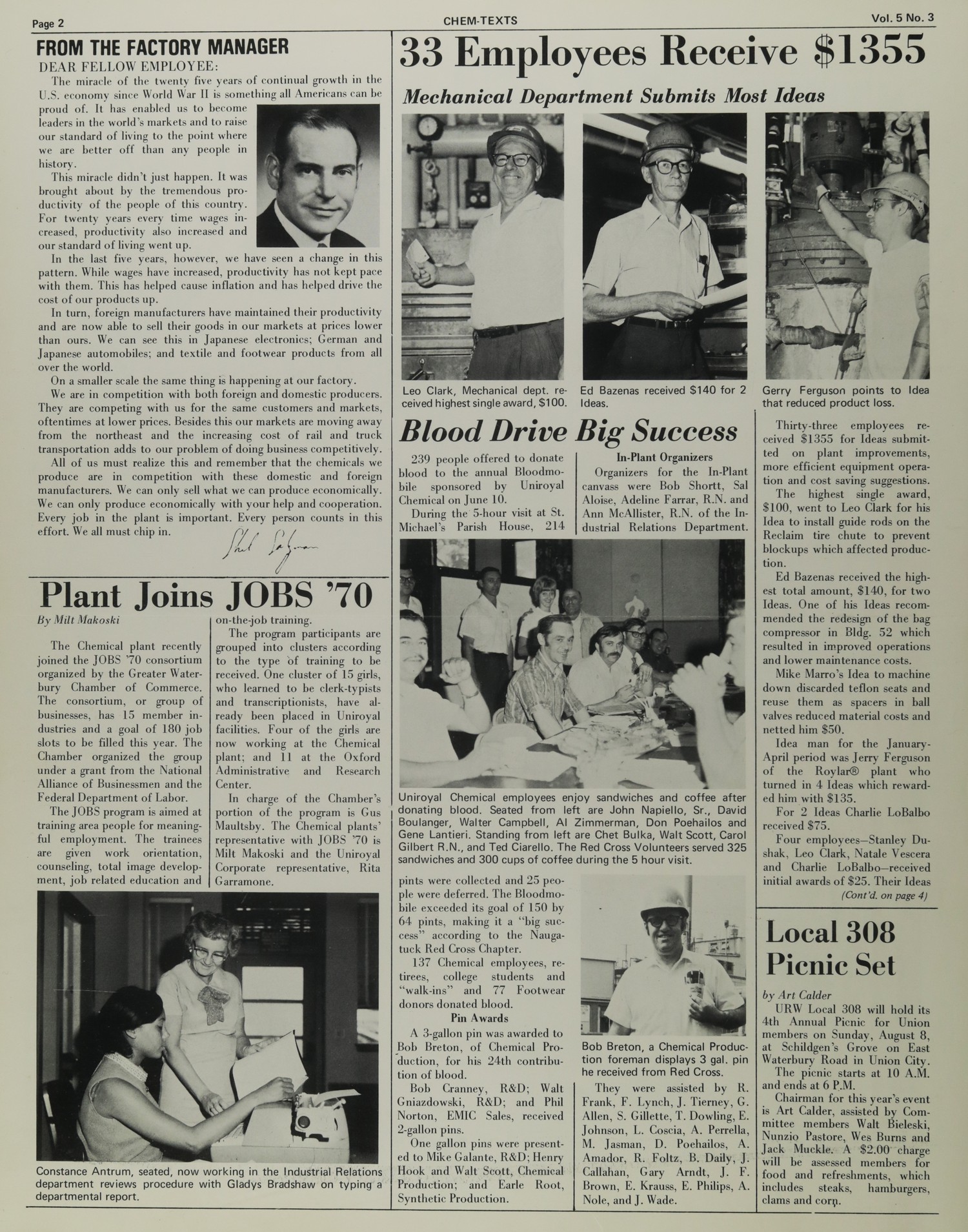
Page 2 | Vol. 7, 1973


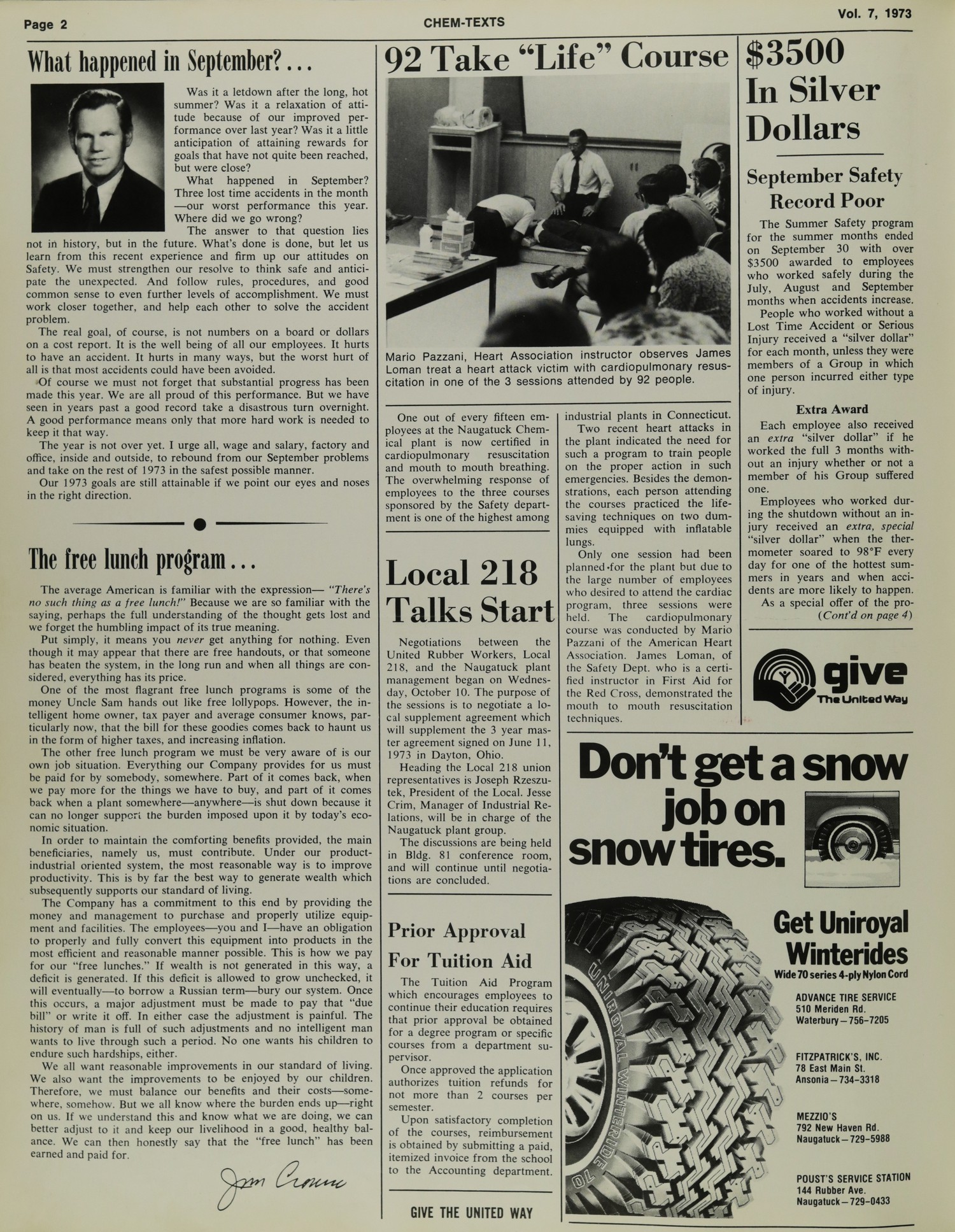
What happened in September?….

[IMAGE: Headshot photo of a man in business attire]

Was it a letdown after the long, hot summer? Was it a relaxation of attitude because of our improved performance over last year? Was it a little anticipation of attaining rewards for goals that have not quite been reached, but were close?

What happened in September? Three lost time accidents in the month —our worst performance this year. Where did we go wrong?

The answer to that question lies not in history, but in the future. What’s done is done, but let us learn from this recent experience and firm up our attitudes on Safety. We must strengthen our resolve to think safe and anticipate the unexpected. And follow rules, procedures, and good common sense to even further levels of accomplishment. We must work closer together, and help each other to solve the accident problem.

The real goal, of course, is not numbers on a board or dollars on a cost report. It is the well being of all our employees. It hurts to have an accident. It hurts in many ways, but the worst hurt of all is that most accidents could have been avoided.

Of course we must not forget that substantial progress has been made this year. We are all proud of this performance. But we have seen in years past a good record take a disastrous turn overnight. A good performance means only that more hard work is needed to keep it that way.

The year is not over yet. I urge all, wage and salary, factory and office, inside and outside, to rebound from our September problems and take on the rest of 1973 in the safest possible manner.

Our 1973 goals are still attainable if we point our eyes and noses in the right direction.


The free lunch program…

The average American is familiar with the expression— “There’s no such things as a free lunch.” Because we are so familiar with the saying, perhaps the full understanding of the thought gets lost and we forget the humbling impact of its true meaning.

Put simply, it means you never get anything for nothing. Even though it may appear that there are free handouts, or that someone has beaten the system, in the long run and when all things are considered, everything has its price.

One of the most flagrant free lunch programs is some of the money Uncle Sam hands out like free lollypops. However, the intelligent home owner, tax payer and average consumer knows, particularly now, that the bill for these goodies comes back to haunt us in the form of higher taxes, and increasing inflation.

The other free lunch program we must be very aware of is our own job situation. Everything our Company provides for us must be paid for by somebody, somewhere. Part of it comes back, when we pay more for the things we have to buy, and part of it comes back when a plant somewhere—anywhere—is shut down because it can no longer support the burden imposed upon it by today’s economic situation.

In order to maintain the comforting benefits provided, the main beneficiaries, namely us, must contribute. Under our product-industrial oriented system, the most reasonable way is to improve productivity. This is by far the best way to generate wealth which subsequently supports our standard of living.

The Company has a commitment to this end by providing the money and management to purchase and properly utilize equipment and facilities. The employees—you and I—have an obligation to properly and fully convert this equipment into products in the most efficient and reasonable manner possible. This is how we pay for our “free lunches.” If wealth is not generated in this way, a deficit is generated. If this deficit is allowed to grow unchecked, it will eventually—to borrow a Russian term—bury our system. Once this occurs, a major adjustment must be made to pay that “due bill” or write it off. In either case the adjustment is painful. The history of man is full of such adjustments and no intelligent man wants to live through such a period. No one wants his children to endure such hardships, either.

We all want reasonable improvements in our standard of living. We also want the improvements to be enjoyed by our children. Therefore, we must balance our benefits and their costs—somewhere, somehow. But we all know where the burden ends up—right on us. If we understand this and know what we are doing, we can better adjust to it and keep our livelihood in a good, healthy balance. We can then honestly say that the “free lunch” has been earned and paid for.

Jim Cronin [signature]


92 Take “Life” Course

[IMAGE: Photo showing people in what appears to be a training session with someone lying down, presumably during CPR training]

Mario Pazzani, Heart Association instructor observes James Loman treat a heart attack victim with cardiopulmonary resuscitation in one of the 3 sessions attended by 92 people.

One out of every fifteen employees at the Naugatuck Chemical plant is now certified in cardiopulmonary resuscitation and mouth to mouth breathing. The overwhelming response of employees to the three courses sponsored by the Safety department is one of the highest among industrial plants in Connecticut.

Two recent heart attacks in the plant indicated the need for such a program to train people on the proper action in such emergencies. Besides the demonstrations, each person attending the courses practiced the life-saving techniques on two dummies equipped with inflatable lungs.

Only one session had been planned for the plant but due to the large number of employees who desired to attend the cardiac program, three sessions were held. The cardiopulmonary course was conducted by Mario Pazzani of the American Heart Association. James Loman, of the Safety Dept. who is a certified instructor in First Aid for the Red Cross, demonstrated the mouth to mouth resuscitation techniques.


Local 218 Talks Start

Negotiations between the United Rubber Workers, Local 218, and the Naugatuck plant management began on Wednesday, October 10. The purpose of the sessions is to negotiate a local supplement agreement which will supplement the 3 year master agreement signed on June 11, 1973 in Dayton, Ohio.

Heading the Local 218 union representatives is Joseph Rzeszutek, President of the Local. Jesse Crim, Manager of Industrial Relations, will be in charge of the Naugatuck plant group.

The discussions are being held in Bldg. 81 conference room, and will continue until negotiations are concluded.


Prior Approval For Tuition Aid

The Tuition Aid Program which encourages employees to continue their education requires that prior approval be obtained for a degree program or specific courses from a department supervisor.

Once approved the application authorizes tuition refunds for not more than 2 courses per semester.

Upon satisfactory completion of the courses, reimbursement is obtained by submitting a paid, itemized invoice from the school to the Accounting department.


GIVE THE UNITED WAY


$3500 In Silver Dollars

September Safety Record Poor

The Summer Safety program for the summer months ended on September 30 with over $3500 awarded to employees who worked safely during the July, August and September months when accidents increase.

People who worked without a Lost Time Accident or Serious Injury received a “silver dollar” for each month, unless they were members of a Group in which one person incurred either type of injury.

Extra Award

Each employee also received an extra “silver dollar” if he worked the full 3 months without an injury whether or not a member of his Group suffered one.

Employees who worked during the shutdown without an injury received an extra, special “silver dollar” when the thermometer soared to 98°F every day for one of the hottest summers in years and when accidents are more likely to happen.

As a special offer of the pro-

(Cont’d on page 4)


[LOGO: “give The United Way” with stylized hand design]


Don’t get a snow job on snow tires.

[IMAGE: Large snow tire]

Get Uniroyal Winterides

Wide 70 series 4-ply Nylon Cord

ADVANCE TIRE SERVICE
510 Meriden Rd.
Waterbury – 756-7205

FITZPATRICK’S, INC.
78 East Main St.
Ansonia – 734-3318

MEZZIO’S
792 New Haven Rd.
Naugatuck – 729-5988

POUST’S SERVICE STATION
144 Rubber Ave.
Naugatuck – 729-0433

CHEM-TEXTS – 1973 – Page No. 3

Page unknown

UNIROYAL CHEM-TEXTS

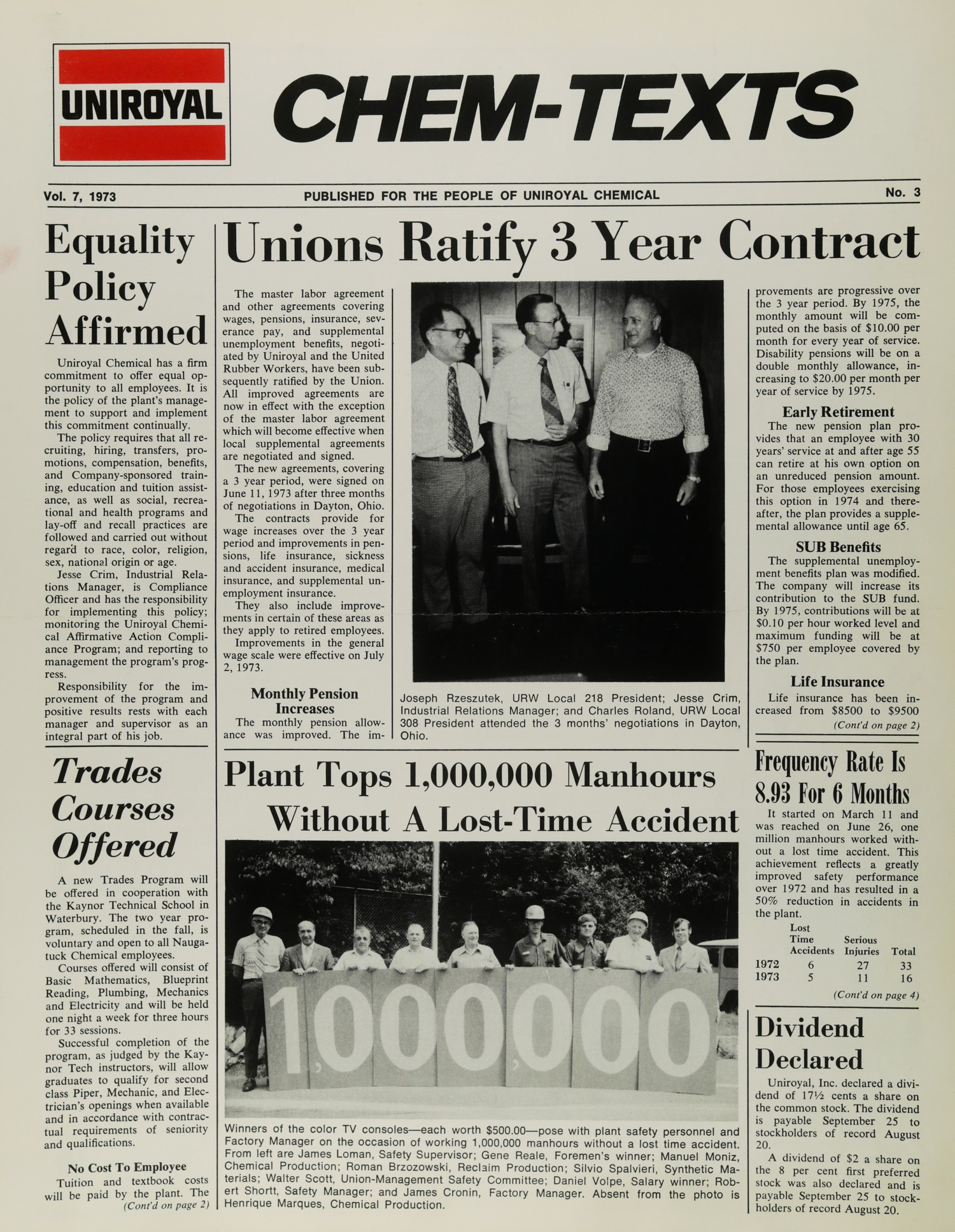
Vol. 7, 1973 | PUBLISHED FOR THE PEOPLE OF UNIROYAL CHEMICAL | No. 3


Equality Policy Affirmed

Uniroyal Chemical has a firm commitment to offer equal opportunity to all employees. It is the policy of the plant’s management to support and implement this commitment continually.

The policy requires that all recruiting, hiring, transfers, promotions, compensation, benefits, and Company-sponsored training, education and tuition assistance, as well as social, recreational and health programs and lay-off and recall practices are followed and carried out without regard to race, color, religion, sex, national origin or age.

Jesse Crim, Industrial Relations Manager, is Compliance Officer and has the responsibility for implementing this policy; monitoring the Uniroyal Chemical Affirmative Action Compliance Program; and reporting to management the program’s progress.

Responsibility for the improvement of the program and positive results rests with each manager and supervisor as an integral part of his job.


Trades Courses Offered

A new Trades Program will be offered in cooperation with the Kaynor Technical School in Waterbury. The two year program, scheduled in the fall, is voluntary and open to all Naugatuck Chemical employees.

Courses offered will consist of Basic Mathematics, Blueprint Reading, Plumbing, Mechanics and Electricity and will be held one night a week for three hours for 33 sessions.

Successful completion of the program, as judged by the Kaynor Tech instructors, will allow graduates to qualify for second class Piper, Mechanic, and Electrician’s openings when available and in accordance with contractual requirements of seniority and qualifications.

No Cost To Employee

Tuition and textbook costs will be paid by the plant. The (Cont’d on page 2)


Unions Ratify 3 Year Contract

The master labor agreement and other agreements covering wages, pensions, insurance, severance pay, and supplemental unemployment benefits, negotiated by Uniroyal and the United Rubber Workers, have been subsequently ratified by the Union. All improved agreements are now in effect with the exception of the master labor agreement which will become effective when local supplemental agreements are negotiated and signed.

The new agreements, covering a 3 year period, were signed on June 11, 1973 after three months of negotiations in Dayton, Ohio.

The contracts provide for wage increases over the 3 year period and improvements in pensions, life insurance, sickness and accident insurance, medical insurance, and supplemental unemployment insurance.

They also include improvements in certain of these areas as they apply to retired employees.

Improvements in the general wage scale were effective on July 2, 1973.

Monthly Pension Increases

The monthly pension allowance was improved. The improvements are progressive over the 3 year period. By 1975, the monthly amount will be computed on the basis of $10.00 per month for every year of service. Disability pensions will be on a double monthly allowance, increasing to $20.00 per month per year of service by 1975.

Early Retirement

The new pension plan provides that an employee with 30 years’ service at and after age 55 can retire at his own option on an unreduced pension amount. For those employees exercising this option in 1974 and thereafter, the plan provides a supplemental allowance until age 65.

SUB Benefits

The supplemental unemployment benefits plan was modified. The company will increase its contribution to the SUB fund. By 1975, contributions will be at $0.10 per hour worked level and maximum funding will be at $750 per employee covered by the plan.

Life Insurance

Life insurance has been increased from $8500 to $9500
(Cont’d on page 2)


[PHOTO CAPTION]
Joseph Rzeszutek, URW Local 218 President; Jesse Crim, Industrial Relations Manager; and Charles Roland, URW Local 308 President attended the 3 months’ negotiations in Dayton, Ohio.


Plant Tops 1,000,000 Manhours Without A Lost-Time Accident

[PHOTO CAPTION]
Winners of the color TV consoles—each worth $500.00—pose with plant safety personnel and Factory Manager on the occasion of working 1,000,000 manhours without a lost time accident. From left are James Loman, Safety Supervisor; Gene Reale, Foremen’s winner; Manuel Moniz, Chemical Production; Roman Brzozowski, Reclaim Production; Silvio Spalvieri, Synthetic Materials; Walter Scott, Union-Management Safety Committee; Daniel Volpe, Salary winner; Robert Shortt, Safety Manager; and James Cronin, Factory Manager. Absent from the photo is Henrique Marques, Chemical Production.


Frequency Rate Is 8.93 For 6 Months

It started on March 11 and was reached on June 26, one million manhours worked without a lost time accident. This achievement reflects a greatly improved safety performance over 1972 and has resulted in a 50% reduction in accidents in the plant.

Lost Time Accidents Serious Injuries Total
1972 6 27 33
1973 5 11 16

(Cont’d on page 4)


Dividend Declared

Uniroyal, Inc. declared a dividend of 17½ cents a share on the common stock. The dividend is payable September 25 to stockholders of record August 20.

A dividend of $2 a share on the 8 per cent first preferred stock was also declared and is payable September 25 to stockholders of record August 20.

CHEM-TEXTS – Vol. 5 No. 3 – Page 2

Page 002

CHEM-TEXTS

Page 2 | Vol. 5 No. 3


FROM THE FACTORY MANAGER

DEAR FELLOW EMPLOYEE:

The miracle of the twenty five years of continual growth in the U.S. economy since World War II is something all Americans can be proud of. It has enabled us to become leaders in the world’s markets and to raise our standard of living to the point where we are better off than any people in history.

This miracle didn’t just happen. It was brought about by the tremendous productivity of the people of this country. For twenty years every time wages increased, productivity also increased and our standard of living went up.

In the last five years, however, we have seen a change in this pattern. While wages have increased, productivity has not kept pace with them. This has helped cause inflation and has helped drive the cost of our products up.

In turn, foreign manufacturers have maintained their productivity and are now able to sell their goods in our markets at prices lower than ours. We can see this in Japanese electronics; German and Japanese automobiles; and textile and footwear products from all over the world.

On a smaller scale the same thing is happening at our factory. We are in competition with both foreign and domestic producers. They are competing with us for the same customers and markets, oftentimes at lower prices. Besides this our markets are moving away from the northeast and the increasing cost of rail and truck transportation adds to our problem of doing business competitively.

All of us must realize this and remember that the chemicals we produce are in competition with these domestic and foreign manufacturers. We can only sell what we can produce economically. We can only produce economically with your help and cooperation. Every job in the plant is important. Every person counts in this effort. We all must chip in.

Phil LaJoie


33 Employees Receive $1355

Mechanical Department Submits Most Ideas

Leo Clark, Mechanical dept. received highest single award, $100.

Ed Bazenas received $140 for 2 Ideas.

Gerry Ferguson points to Idea that reduced product loss.

Thirty-three employees received $1355 for Ideas submitted on plant improvements, more efficient equipment operation and cost saving suggestions.

The highest single award, $100, went to Leo Clark for his Idea to install guide rods on the Reclaim tire chute to prevent blockups which affected production.

Ed Bazenas received the highest total amount, $140, for two Ideas. One of his Ideas recommended the redesign of the bag compressor in Bldg. 52 which resulted in improved operations and lower maintenance costs.

Mike Marro’s Idea to machine down discarded teflon seats and reuse them as spacers in ball valves reduced material costs and netted him $50.

Idea man for the January-April period was Jerry Ferguson of the Roylar® plant who turned in 4 Ideas which rewarded him with $135.

For 2 Ideas Charlie LoBalbo received $75.

Four employees—Stanley Dushak, Leo Clark, Natale Vescera and Charlie LoBalbo—received initial awards of $25. Their Ideas
(Cont’d. on page 4)


Blood Drive Big Success

239 people offered to donate blood to the annual Bloodmobile sponsored by Uniroyal Chemical on June 10.

During the 5-hour visit at St. Michael’s Parish House, 214 pints were collected and 25 people were deferred. The Bloodmobile exceeded its goal of 150 by 64 pints, making it a “big success” according to the Naugatuck Red Cross Chapter.

137 Chemical employees, retirees, college students and “walk-ins” and 77 Footwear donors donated blood.

Pin Awards

A 3-gallon pin was awarded to Bob Breton, of Chemical Production, for his 24th contribution of blood.

Bob Cranney, R&D; Walt Gniazdowski, R&D; and Phil Norton, EMIC Sales, received 2-gallon pins.

One gallon pins were presented to Mike Galante, R&D; Henry Hook and Walt Scott, Chemical Production; and Earle Root, Synthetic Production.

In-Plant Organizers

Organizers for the In-Plant canvass were Bob Shortt, Sal Aloise, Adeline Farrar, R.N. and Ann McAllister, R.N. of the Industrial Relations Department.

Uniroyal Chemical employees enjoy sandwiches and coffee after donating blood. Seated from left are John Napiello, Sr., David Boulanger, Walter Campbell, Al Zimmerman, Don Poehailos and Gene Lantieri. Standing from left are Chet Bulka, Walt Scott, Carol Gilbert R.N., and Ted Ciarello. The Red Cross Volunteers served 325 sandwiches and 300 cups of coffee during the 5 hour visit.

Bob Breton, a Chemical Production foreman displays 3 gal. pin he received from Red Cross.

They were assisted by R. Frank, F. Lynch, J. Tierney, G. Allen, S. Gillette, T. Dowling, E. Johnson, L. Coscia, A. Perrella, M. Jasman, D. Poehailos, A. Amador, R. Foltz, B. Daily, J. Callahan, Gary Arndt, J. F. Brown, E. Krauss, E. Philips, A. Nole, and J. Wade.


Plant Joins JOBS ’70

By Milt Makoski

The Chemical plant recently joined the JOBS ’70 consortium organized by the Greater Waterbury Chamber of Commerce. The consortium, or group of businesses, has 15 member industries and a goal of 180 job slots to be filled this year. The Chamber organized the group under a grant from the National Alliance of Businessmen and the Federal Department of Labor.

The JOBS program is aimed at training area people for meaningful employment. The trainees are given work orientation, counseling, total image development, job related education and on-the-job training.

The program participants are grouped into clusters according to the type of training to be received. One cluster of 15 girls, who learned to be clerk-typists and transcriptionists, have already been placed in Uniroyal facilities. Four of the girls are now working at the Chemical plant; and 11 at the Oxford Administrative and Research Center.

In charge of the Chamber’s portion of the program is Gus Maultsby. The Chemical plants’ representative with JOBS ’70 is Milt Makoski and the Uniroyal Corporate representative, Rita Garramone.

Constance Antrum, seated, now working in the Industrial Relations department reviews procedure with Gladys Bradshaw on typing a departmental report.


Local 308 Picnic Set

by Art Calder

URW Local 308 will hold its 4th Annual Picnic for Union members on Sunday, August 8, at Schildgen’s Grove on East Waterbury Road in Union City. The picnic starts at 10 A.M. and ends at 6 P.M.

Chairman for this year’s event is Art Calder, assisted by Committee members Walt Bieleski, Nunzio Pastore, Wes Burns and Jack Muckle. A $2.00 charge will be assessed members for food and refreshments, which includes steaks, hamburgers, clams and corp.

CHEM-TEXTS – Vol. 5 No. 3 – Page 3

Page 003

CHEM-TEXTS

Vol. 5 No. 3 | Page 3


Drug Plan Starts

The new Prescription Drug Plan, the most recent of Uniroyal’s employee benefits, became effective July 1. The Plan will be carried by the Metropolitan Life Insurance Co.—Medi-MET.

Included in the Plan are the employee and eligible dependents: a spouse, any unmarried children under 19 years of age including stepchildren or other children who live with you and are dependent upon you for support and maintenance. All unmarried children over 19 years of age are also covered if they are either full time students or mentally or physically incapable of self-support.

ID Cards have been issued to participating employees. An employee with a family should have 2 cards: one for the employee and one for a spouse.

If you have not received an ID card or a Prescription Drug Plan booklet ask the Foreman or Supervisor of the department for them, or call Marion Hutt Ext. 557.


“Keep Plant Beautiful”

[IMAGE: Photo of a man watering flowers]

When George Vila, Uniroyal’s president and chairman, toured the Chemical plant a few years ago, one of the more beautiful places he found in the plant was John Sickola’s garden by Warehouse 107. To “keep plant beautiful,” Sickola is growing six flower boxes of petunias, zinnias and marigolds. In the photo above he waters his flowers which add a bright color to the south end of the Chemical yard.


[IMAGE: Photo of cattle in a barn]

“With rue my heart is laden” is the intimation on the faces of the 340 pure bred polled Hereford calves being raised for prize showings and choice table beef.

New Oxford…

(Cont’d. from page 1)

Uniroyal Farms where 340 pure bred polled Hereford calves and prize bulls are being raised for prize showings, commercial breeding and choice table beef.

Airport Facilities

Uniroyal also operates the nearby Oxford Airport and is renting hangar space; selling fuel to aircraft; and providing maintenance and repair services. A new Main Terminal is now open with 6 scheduled airline flights daily offered by Pilgrim Airlines.

Grounds Open To Employees

The Oxford grounds are open 7 days a week to Uniroyal employees, their families and friends but the buildings are closed during weekends.

The Cafeteria serves breakfast, lunch, and dinner Mondays-Fridays and is also open for dining on weekends 6:30-8:30 P.M.; however, reservations should be made in advance.

Guest House, Cocktail Lounge

A 48 room guest house, cocktail lounge, and public dining room are also open to employees, their families and friends.

The lounge is open from 5 P.M.-12 P.M. on weekdays; from noon to midnight on Saturdays; and from noon to 10 P.M. on Sundays.

New Corporate Concept

The Center has been described as a new “plant-ranch concept”; as a “modern Oxford University”; and as a “skyscraper sideways.” It utilizes open office landscaping and has a minimum of individual offices. Privacy is attained through the strategic placement of plants and colorful screen dividers.


New Stock…

(Cont’d. from page 1)

shares which he is entitled to purchase.

An employee can participate in any amount up to 10% of a year’s pay over a period of approximately 2 years. At the end of the 2 year period, the employee may take the stock or request the return of his money, with interest.

A prospectus of the plan will be distributed to all employees along with a descriptive booklet and an option card for participation in the plan.


[IMAGE: Photo of woman being helped from jet]

Margo Kuryn, former secretary at TSSC is helped from jet at Oxford Airport operated by Uniroyal, by Pete Zguzenski, Line Supervisor as Tom Canty stands by.


[IMAGE: Photo of outdoor patio area]

Outdoor patio covers underground 250,000 gallon water storage tank which supplies water for facilities.


[IMAGE: Photo of plumbing system]

Kralastic® ABS, a tough plastic product of the Chemical division, is being used for the drain, waste and vent plumbing system in the Research center.


Plant’s Chemicals Protect Float

[IMAGE: Photo of people on inflatable float in pool]

In a pool, on a beach or city rooftop, this Ensolite® floatable lounge offers a soft, pleasant way to relax. The float rolls up into a handy carrying case and does away with short-lived floats and air mattresses which must be inflated and are easily deflated by a puncture. Punctures or tears will not affect its buoyancy or usefulness. Ensolite, a Consumer, Industrial and Plastic Division product which is also used for safety padding in football helmets and padding under artificial turf at sports stadiums, is made from two Chemical Division products: PVC and nitrile synthetic rubber. To protect the rubber against oxygen, ozone, heat and sunlight, several Naugatuck® Chemicals made at the plant are used. Without these chemicals, the rubber in the float would deteriorate in a short time and the product have little value to the consumer. The retail price of the float is $89.95.


SAFETY IS MY RESPONSIBILITY

CHEM-TEXTS – 1971-v05-i03-s191

Page 191

UNIROYAL CHEM-TEXTS

Vol. 5, 1971 | PUBLISHED FOR THE PEOPLE OF UNIROYAL CHEMICAL | No. 3


New Oxford Center Opens

New Stock Plan Offer

A new Stock Purchase Plan will be offered to all employees about August 10.

The offering will be similar in most respects to the 1966 and 1968 Stock Purchase Plans. Approximately 65% of the Naugatuck Chemical employees participated in the ’68 Plan.

The option price will be the median market price of Uniroyal common stock on August 10, 1971.

No later than Sept. 8, 1971, an eligible employee may elect to purchase all or part of the (Cont’d. on page 3)

35 Enroll; 22 Increase Bonds

35 additional employees enrolled and 22 increased their participation in the purchase of U.S. Savings Bonds during the campaign recently conducted at the Chemical plant. 504 of 1500 employees, or 33%, now purchase E Bonds through the payroll deduction plan. The E Bonds pay a guaranteed 5½% interest rate if held to maturity, 5 years and 10 months.

Bond purchases can be made any time through the payroll savings plan by contacting Molly Cobbol, Ext. 218.


Facilities Open To Employees

Uniroyal’s new Management and Research Center officially opened on July 12 after nearly 3 years of construction.

Some 400 people moved into the granite and bronze tinted glass structure that is fully carpeted, air conditioned, soundproof, and set scenically on 118 acres of woodlands and farmland


[IMAGE: Sign reading “Polled Herefords THE BIG BOLD BREED” with UNIROYAL, INC. below]

Not far from the Center are the two Uniroyal Farms where polled herefords are raised for prize showings and prime table stock.


[IMAGE: Modern glass and granite building – Administrative Center]

The Administrative Center, a glass and granite structure set in scenic woodlands, is one of industry’s most modern corporate headquarters. It houses a vast computer system and most corporate functions.

acquired by the Company in Middlebury.

The Center is easily accessible from Interstate 84 (Exit 16) and routes 188 and 64.

Two Centers Opened

Recently opened was the Administrative and Computer Center which houses all of the Corporate functions except the advertising, finance, public relations, legal, and certain sales and other corporate departments. These groups will continue to operate from “1230” in New York City. The other facility is the combined Cafeteria, Guest House and Corporate Conference Center.

The Research Center, the largest of the buildings will open about June 1972 and will consolidate the Corporate Research staff in Wayne, N.J. and the

Research and Development facilities of the Consumer, Industrial, and Plastics Products division. The laboratories will have the most modern equipment and finest instrumentation available in the industry.

Ultimately 1500 employees will be located at the Complex.

Uniroyal Farms

Near the site are the two (Cont’d. on page 3)


[IMAGE: Construction site of Research Center]

The Research Center, which will be completed in 1972, will consolidate Corporate, Consumer, Industrial, and Plastic products research and development.

[IMAGE: Corporate Conference Center building]

Training sessions for employees will be conducted at the Corporate Conference Center. It features a cafeteria, guest house, cocktail lounge and dining facilities which are open to employees and their families.

CHEM-TEXTS – unknown-i05-s201

Page 201

CHEM-TEXTS

Page 2 | Vol. 5, No. 5


Thanksgiving And Us…

Thanksgiving Day seems to have lost much of its significance. Originally it was set aside as a special day of prayer. Today, it is looked upon more as a four day weekend and three games of football on TV.

The people who first came to New England lived a life of far greater poverty than some of the people living in Appalachia today. Their Thanksgiving was one of survival.

By their unity of purpose, and their concern for each other, they laid the groundwork for the many benefits we enjoy in our present society.

When you think ot our progress, no other group of people has achieved such high standards of living.

We at the Chemical Plant, in particular, have much to be thankful for. With unemployment as high as 12-20% in some towns, we have been able to maintain a steady level of employment. We have some of the finest wages and benefits in industry. All of us have great concern for the safety, health, and welfare of each other and a positive attitude toward the improvement of the environment.

I think you will agree with me that these are important things in our lives.

If each one of us does his full share, we will continue to reap the rewards of our efforts and assure, even increase, the many good things we now enjoy for ourselves and our families.

[Signature: Paul Lyons]


Eleven Receive MS Degrees

Dick Krajewski, center, and John Honyotski, right, admire each other’s diplomas as Pat Petti looks on. Krajewski received an MS in Industrial Management; Honyotski, a BS in Business Administration; and Petti will receive a degree in 1972.

by Ed Nunn

Eleven employees received their M.S. degrees in June under the Uniroyal Tuition Aid program: Jim Garrigan, Bill Broden, Terry Mo, and John Gilbert received degrees from Rensselaer Polytechnic Institute in Hartford; Joe Schoen, Temple University; Pete Byra, John Swanson, and Lou Kaiser, University of Hartford; Paul Hinckley, Southern Connecticut; Bob Farrell, University of Connecticut; and Marvin Cramer, University of Bridgeport.

$31,346 in Payments

Tuition Aid during the academic year, Sept. 1, 1970 to Aug. 31, 1971 totaled $31,469 in reimbursements to 82 employees.

12 employees are attending job related courses; 20 are working toward a college degree; and 50 are pursuing postgraduate studies.

Over the past 6 years 36 employees have received degrees under the program with Uniroyal’s reimbursements amounting to $125,022.

All Employees Eligible

The Tuition Aid Program is available to all full-time employees. The Company reimburses you for the full tuition cost and fees for two courses per semester. The courses must be related to your present job or will be of value, as determined by the Company, in future promotional areas. Reimbursement is made only upon successful completion of the course.


BOB’S CAMERA SHOP
Waterbury’s Largest Camera Shop
Film ● Cameras ● Projectors
Developing ● Repairs ● Rentals
21 Grand St. 754-2256

Still Time For
Photo Greeting Cards


Disaster Plan Tested

Bob Shortt, Safety Manager, shows how to extinguish gasoline fire. Behind Shortt are Phil DePasquale, Security Supervisor, and John Starr. Others in photo are Frank Commendatore and Dick Oriente.

Deluge water fog flooded Hortonspheres to control simulated butadiene leak

The 66 Alarm was a simulated butadiene leak in the Synthetic plant Hortonspheres. The leaking vapor was flooded and controlled with water fog from the top and sides of the spheres. According to Harry Francolini who was in charge of the Control Center, “we found a few bugs in the Plan but on the whole it went quite well.” The bugs are being ironed out to make the Plan more effective.

The test was the culmination of weeklong demonstrations during Fire Prevention Week.

It was a quiet Friday afternoon—just a few more hours to the weekend—when at 1 P.M., Alarm “66” sounded 4 times over the plant’s fire alarm system. A quick call to the Watchman in Bldg. 84 and the Disaster Plan was in operation.

Work stopped and designated emergency personnel reported to the Control Center for instructions and others assumed their plant emergency responsibilities to prepare for a shutdown and evacuation of the plant.


Drive Nears

(Cont’d. from page 1)

Four departments, Materials, Accounting, EMIC, and Research and Development exceeded their goals with several other departments close to reaching their quotas.

Still Time To Pledge

There is still time to pledge. If you have misplaced your card, contact the canvasser in your department or call any one and return it to him.


Chemical Team Loses Playoffs

by John Swanson

The Chemical Royals with a 24-8 won-lost record, made the League’s 4 team playoffs. In the best out of 3 championship playoff games, they lost to Fortin’s Restaurant.

Batting the Royals to their victorious season were Pete Byra 545; John Johnson 511; Vin Rooney 495.

Eric Johnson and Al Zimmerman provided the team’s slugging power with “All Star” pitcher, Mike Jasman, doing a superb job on the mound for the Royals.

Other members of the Chemical Royals were Dick Carroll, Tom Casteel, Leon Hartmann, Bill Lawton, John Prior, Dan Shantz, Rudy Valente, and Al Zonas.


Salesmen Review Sales

Frank Morgan, standing, District 11 Sales Manager, discusses sales strategy with salesmen. From left are Kurt Markshausen, Ken Stewart, Kralastic Commodity Manager, Steve Arbuckle, Barry Roos, Ed Brown, Jack Taylor, Pat DePaolo, and Pete Cookson. Missing were Tom Wilson, Henry Alter and Dick Terino.

District 11 salesmen met to review their sales record for the first nine months of 1971.

In the first 9 months, the District achieved 108% of its budget and hopes to hit 110% in the 4th quarter.

An important factor in helping them sell more was an improved “service image” among customers. They pointed out at the meeting that customer demand for good service is a major problem in their contact with customers. If you can’t deliver the product when the customer needs it, he simply buys it from a competitor.

CHEM-TEXTS – Vol. 4, 1970, No. 1 – Page 1

Page 001

UNIROYAL CHEM-TEXTS

Vol. 4, 1970 | PUBLISHED FOR THE PEOPLE OF UNIROYAL CHEMICAL | No. 1


Uniroyal Benefits Help Cover Today’s Staggering Hospital Costs

Joe Scullin and his wife, Elizabeth, look proudly at their 6 day old baby girl held by nurse of the Waterbury Hospital. Uniroyal’s Hospital and Surgical Benefits covered hospital expenses of $368. and the Doctor’s fee of $250. These benefits are provided without cost to you and members of your family.


$70 to $80 a day for a room. $150 to $1,000 for an operation. X-rays. Doctor’s fees. Whether you are having a child or an operation, add them up for one, two or three weeks in the hospital and you get a real picture of how important Uniroyal’s benefit plans are to you.

Doctors in the area consider Uniroyal’s Hospital and Surgical plan one of the most comprehensive and extensive in coverage of hospital and surgical costs.

Unseen Income

Benefits today are part of our unseen income. We feel it when a hospital emergency arises; when we retire and receive regular pension checks; social security payments; and the knowledge that our families are protected by group life insurance.

An Extra $1.62 Per Hour

In 1968 Uniroyal paid out to employees at the 19 plants represented by the United Rubber Workers, $67,146,422. This averages $1.62 per wage hour worked. This amounts to an unseen income of $64.80 for a 40 hour week, or a total of more than $3,200 a year.

121,413 Claims: $12,081,416 Paid

For the fiscal year ending August 1, 1969, under the Hospital-Surgical plan, 121,413 claims were paid, for a total of $12,081,416 for eligible employees.

Claims at the Naugatuck Chemical location came to 4,960 for a total of $586,030 paid out for employees during the same period.

Our Responsibility In Benefit Program

Because employee benefits contribute significantly to total labor costs, it becomes

Continued on page 3


Man Slips Off Truck

While attempting to unload a truckload of tires, an employee slipped and fell backwards off the truck, his head barely missing a steel prong on a conveyor belt.

The truck was fully loaded to its rear edge with tires giving the employee little space for solid footing. Old tires lie outside and pick up water until collected by the scrap dealer. When they arrive at the plant, they are frozen together and the truck often covered with a thin layer of ice. Ice is deceptive and difficult to see, creating a safety hazard.

The accident was an unusual and unfortunate incident, as the employee had requested to leave work early to visit his wife in the hospital in the afternoon.


George Aspell, right, shows hospital and surgical bills for $1,100 to Angelo Soares. George had a serious cataract operation performed by world renowned eye surgeon, Dr. Fassanella. The hospital bill was $450; the operation cost $650. During the 3-1/2 months of recovery, George received Sickness and Accident benefits of $70 weekly. All costs were covered by Uniroyal’s Benefits plans.


3 Accidents In December

The truck-slip accident resulted in a compression fracture from the fall. The second accident resulted in a pain in the lumbo-sacral area when an employee moved a 200 lb. pallet. A third employee hurt his back when he lifted a heavy motor.

There were four serious injuries suffered by employees during the month.

55 Work Days Lost

As a result of the 3 accidents, 55 work days or 440 hours were lost in December. The individual’s health and safety is the first concern of the plant. Everything possible is being done to protect employees from accidents and

Continued on page 2


Gino Tavares points to ice on bar below license plate and on edge of truck.

CHEM-TEXTS – Vol. 4 No. 1 – Page 3

Page 003

CHEM-TEXTS

Vol. 4, No. 1 | Page 3


UNIROYAL, INC.

EMPLOYEE BENEFIT COSTS—1968

U.R.W. PLANTS

Total Dollars Cents Per Hr.
Social Security $ 6,638,454 $ .1629
Unemployment Compensation Taxes 1,553,264 .0375
State Disability Insurance 182,749 .0044
Workmen’s Compensation 1,171,334 .0283
Vacations 11,898,799 .2877
Holidays 5,157,970 .1247
Overtime 8,771,526 .2121
Night Shift Bonus 1,172,040 .0283
Hospital, Surgical, In-Hospital Medical Insurance 7,470,680 .1806
Sickness & Accident Insurance 2,266,966 .0548
Life Insurance 2,222,114 .0535
Severance Pay 54,076 .0013
Grievance Meetings 111,513 .0027
Pensions 15,090,989 3648
Supplemental Unemployment Benefits 2,691,057 .0651
Funeral Pay 318,303 .0077
Military Training Pay 32,801 .0008
Jury Pay 73,024 .0018
Union Time Study 67,988 .0016
Safety Committee 9,651 .0002
Workmen’s Compensation Make-up 101,124 .0024
TOTAL $67,146,422 $1.6232

Above are various benefits employees receive and their cost per wage hour. At $1.62 an hour they add up to $64.80 for each 40 hour week or a total of more than $3,200 a year.


UNIROYAL, INC.

EMPLOYEE BENEFIT COSTS-IN CENTS PER HOUR

U.R.W. PLANTS 1953-1968

[THIS IS CHART: Bar graph showing increasing employee benefit costs from 1953 to 1968, starting at around $0.41 in 1953 and reaching $1.62 in 1968, with data points for each year showing gradual increase: .41, .42, .53, .57, .62, .76, .82, .91, .93, .97, 1.09, 1.23, 1.35, 1.62, 1.76]

The chart shows the increased cost of employee benefits. They have gone up from 41 cents an hour in 1953 to $1.62 in 1968. On August 1, 1969 Uniroyal absorbed the 20% increase in the Hospitalization, Surgical and In-Hospital medical benefits. For 12 months this benefit now amounts to $364.44 per employee.


Sales Highest; Profits Drop

Estimated 1969 sales hit a record high of $1,550,000,000, an 8% increase over 1968.

But 1969 profits were about $46,500,000 or 18% below the record of $56,900,000 in 1968.

Tire, Footwear Profits Affected

Although foreign operations showed good gains, along with industrial and most other U.S. products, the gains were offset by lower profits in U.S. Tires and Footwear operations.

Footwear was hurt by lower demands for its products, low cost foreign imports, and the higher number of lower cost U.S. manufacturers paying wages below Uniroyal wages.

Tires faced sharply higher costs and lower productivity from the introduction of the new bias belted tires and heavy start-up expenses for expanding tire capacity at Opelika.

Fourth Quarter Sales, Profits

Fourth quarter sales were about 5% above the same period in 1968 but profits for the fourth quarter of 1969 were approximately $8,500,000 compared to profits of $14,300,000 in 1968. This represents a $5,800,000 drop in profits for the last quarter of 1969.


Three Employees Avert Fire

[THIS IS PHOTO: Group photo of four men in work attire]

From left, Phil DePasquale, plant protection group leader, congratulates Fred Sargeant, fire inspector, and Gene Lantieri, mechanic, is congratulated by Bill Rek, foreman, for their quick action to avert fire. Missing from photo is Oliver Leduc.

by Ed Weaving

The alert action of Eugene Lantieri and Oliver LeDuc of the Mechanical Department and Fred Sargent, a Fire Inspector, prevented a possible serious fire in Building 16 of the Reclaim Plant.

Lantieri and LeDuc were working in the area when they discovered flames from an accumulation of rubber. They immediately ran to the nearby hoselines and used them to extinguish the fire. The hose operation automatically turn in the sprinkler alarm, which is an important part of our plant protection system. Responding to the alarm which rings in the Firehouse, Fred Sargent entered the smoke-filled area and assisted Lantieri and LeDuc in putting out the fire.

Quick Action Stops Damage

Had it not been for the quick action of the three men and knowing what to do in an emergency, several sprinkler heads would have opened up and flooded the area with water and damage would have resulted from both the fire and water.

Several other employees took part in fighting the fire and helped in controlling it.

Overheating Ignites Rubber Accumulation

The fire resulted from a broken greaseline leading to the mechanical shoe on a screen, causing the overheating of the shoe and ignition of rubber accumulation around the screen.

Due to the nature of this operation, fires will occur and serious damage result unless the mechanical equipment is kept in good operating condition and every employee in the area pays particular attention to good housekeeping and reports possible fire hazards to the foreman of the department.


Snow Plow Hits Car

While driving to work recently, an employee’s car was sideswiped by a snow plow truck.

The truck, approaching in the opposite two lane highway, made a left turn at an intersection separated by a median strip, and ripped into the front left side of the car. The driver was slightly injured but severely shaken up by the unexpected turn of the truck. Another two feet, and the four foot high plow would have crushed the car and the driver.

No matter how careful you are, you can never be sure what the other driver will do. Expect the unexpected happening, especially during the winter months when icy roads make driving more hazardous.


Mattress Bargain Sale On

A special low price sale on Uniroyal’s Koylon foam mattresses is now in progress at the Footwear Employee’s salesroom. Only the firm type is being offered in the sale.

Savings of $47 can be realized on the sale price depending on the size.

The special sale ends Feb. 28. So place your order with the Salesroom now. Orders may be placed by telephone to George O’Donnell, Ext. 17-259 at the Footwear Salesroom.

Mattresses will be delivered to the Salesroom to save you transportation costs.

9 out of 10 of all auto accidents happened in the driver’s own state.


You Couldn’t Afford . . .

Continued from page 1

everyone’s responsibility to keep these benefits secure. They have increased nearly four times what they were 15 years ago.

Competition, imports, price cuts, and higher costs can affect the extent, cost, and value of benefit programs.

Our challenge is to find methods to improve production, reduce costs and waste, work safer, suggest ideas to improve jobs, and to show a real concern for producing quality products to keep our customers.

Every employee holds an important role in the plant’s operations . . . and with 65% holding stock in Uniroyal, everyone’s fullest effort is needed to protect our interests and benefits.


Trucks . . .

Continued from page 2

that seat belts are as important in truck cabs as in automobiles, notwithstanding the added problem of load shift and fire.

With respect to injuries, on the average, injured truck drivers have 32% more injuries than automobile drivers. The most frequent contributor to this discrepancy is the abdominal area. The frequency of head injuries is essentially the same for both.

Among injured truck drivers, the frequency of dangerous or fatal injury is nearly twice as high as among injured automobile drivers. The results of the survey indicate that safety belts and the use of other restraint systems reduce injuries to truck drivers.

Automobile drivers should always drive with their safety belts on. Statistics prove conclusively that they have prevented millions of serious injuries when worn properly. However, it is estimated that only 40% of the drivers with seat belts in their automobiles use them.


SAFETY IS MY RESPONSIBILITY

CHEM-TEXTS – Vol. 4 No. 5 – Page 2

Page 002

Page 2 | CHEM-TEXT | Vol. 4, No. 5


FROM THE FACTORY MANAGER

Dear Fellow Employees:

Soon many of us will be taking vacations. One of the most common traits we share is the tendency to pack too much into too little time. Too much driving, too much sun, too much activity, too much partying and so on. The results of “too much” are usually too much physical fatigue and too much carelessness. As you know, carelessness leads to accidents and injuries.

Plan your vacation within your limits — drive safely, play safely, and get enough rest and relaxation. Your safety and your families’ safety depends on you and you alone. Your wife and children are counting on you and we are counting on you to come back rested and ready to continue your good work here.

I sincerely wish each and everyone of you and your families a very happy and most pleasant vacation this summer.

Best wishes

[Signature]

John D. Evans


Dinkle Gets Scholarship

Richard Dinkle, receives $250 scholarship from Dr. Phil Paul. From left are his mother, Mary, Richard, Phil Paul, and Jim Phelan.

by Phil Paul

Richard Dinkle, son of Mary Dinkle one of the plant’s three switchboard operators, received the Uniroyal Chemical Management Club’s $250 scholarship award. The scholarship was supplemented this year by a $50 contribution from Larry Monroe. Selected from a group of 13 highly qualified applicants, Dick attends Naugatuck High School, where he ranks in the top 10% of a 340 class.

He was named a Connecticut State Scholar and made a member of the National Honor Society for his scholastic achievements. Dick was also Chairman of the Student Council at the High School.

This tribute from one of the school’s staff indicates his qualifications:

“He possesses a rare combination of qualities: self-discipline, patience, objectivity, depth, maturity, and — most important — a good sense of humor.

Dick plans a career in accounting or corporate law. He has been accepted at the University of Connecticut, and has yet to hear from Harvard and the University of Pennsylvania.

Chairman of the scholarship committee was Phil Paul with Tom Dowling and Jim Phelan serving as committee members.

SAFETY IS MY RESPONSIBILITY


Nurse Named President

Adeline Farrar, R.N., nurse at the Chemical plant hospital was named president of the Naugatuck Valley Industrial Nurses for a 2 year term. Adeline served as vice president of the organization prior to her election as president.


Uniroyal Stores Offer Discounts

Uniroyal Home and Auto Centers offer 10% to 40% discounts, depending upon the item.

The stores carry lawnmowers, a regular line of bikes and mini bikes, Admiral and Frigidaire appliances, including air conditioners.

Centers are located in Bristol, Farmington Ave.; Norwalk, Rte. 1 (Boston Post Rd.); Milford, Conn. Post Shopping Center, Rte. 1 (Boston Post Rd.); and New Haven, Amity Shopping Center, Rte. 63. Your plant or company pass is required for identification.

Shopping Center rules restrict the merchandise of some stores, so it is advisable to check the store first before you visit it.


Oxford Office Nears Completion

Aerial photo shows Corporate Administration Building, nearly fifty percent complete, and landscaped parking area. The huge building will house corporate offices and the computer center. Construction has started on the new research and development building. Underground tunnels will connect the several buildings of the complex.


Uniroyal Home and Auto Center in Milford, one of four in area, offers 10% to 40% discounts on lawnmowers, appliances, bikes and auto accessories.

CHEM-TEXTS – Vol. 4 No. 6 – Page 3

Page 003

Vol. 4, No. 6 CHEM-TEXTS Page 3

Employees’ Opinions Polled On Chem-Texts | Unions To Hold Picnics

A poll of 200 employees selected on a random basis from all plant and divisional departments and retired employees revealed that 96% of the employees read CHEM-TEXTS always or often, and that 76% of their families read it. The survey also showed the plant newspaper as a reliable form of communication and indicated employees have a vital concern for news and information on plant activities and operations.

70 employees completed the questionnaire for a 35% return, an exceptionally high response.

70% signed the questionnaire which was voluntary.

Answers to the “open-end” questions have been condensed because of space limitations.

1.) Do you read Chem-Tests?
86% always, 10% often, 3% seldom

2.) Does your family read Chem-Texts?
76% yes, 7% no

3.) What kind of news do you find most informative?
76% preferred news about plant activities: plant products; use of products in the market; new facilities; plant improvement; personnel changes; and economic situations.

60% wanted news about employees; benefits; idea awards; safety; job security; and retirements.

60% indicated a desire for news about Uniroyal, Inc.; other plants; corporate sales; profits; new products and markets.

4.) How did you like the recent article on the Oxford complex?
The majority commented “excellent”, “informative”, “indicative of Uniroyal’s progress”, “knew very little about it until article”.

5.) Do you think the paper uses enough photographs?
80% yes, 18% no


6.) What did you think of the article on pollution?
“Wonderful that something is being done;” “informative on serious national problem;” “good to keep us informed on pollution control efforts;” “shows company is concerned and makes employees concerned;” “all must be aware of their role in pollution control.”

7.) Some time back we did an article on packaging – do you think this type of information is helpful to employees?
Most employees replied yes; pointing out that they as customers always shop for a neat package.

8.) Do you think the paper gives you reliable information on plant operations and activities?
Comments were essentially, yes; and implied, “haven’t gotten any bum steers yet.”

9.) What do you think of the News Bulletins issued weekly?
In general the News Bulletins were considered informative and helpful; but several employees did not see them; a few felt they were fair, should expand coverage and include more news on safety and production.

10.) What suggestions do you have to improve CHEM-TEXTS?
The majority of employees had no recommendations to improve the paper.

Some remarks suggested: do more articles on departments; more about employees’ participation in community; letters to the editor; classified ads; questions and answers from employees.

The survey was the first conducted in the Company on plant newspapers, and employees who participated are thanked for their time in making it a more effective means of communication.


by Charlie Roland

Plans are underway for URW Local 308’s third annual picnic to be held on Sunday, August 9, from 11 A.M. to 6 P.M. at Schildgen’s Grove in Union City. The Grove is located on East Waterbury Road.

Chairman of the event is Art Calder, with Ben Tomaszeski, Nunzio Pastore and John Sullivan assisting in arrangements.

by Frank Commendatore

Local 218 will hold its annual picnic at Schildgen’s Grove on Saturday, August 15. A menu of roast beef, hamburgers, clams, clam broth will be served all day, with steaks served from 2 – 5 P.M. along with hot and cold beverages.

Chairman for the picnic is Frank Commendatore with Tom Ward and Mario Mucci, assistant chairman.


You Get A Chance To Talk To Two Bosses In New Plan

[PHOTO: Two men in discussion at what appears to be an industrial setting]

Bill Broden, left, has an evaluation discussion with Joe Bucciaglia, chief process engineer for chemical production.

[PHOTO: Three men in discussion in an office setting]

Jim Cronin, superintendent of chemical production, Bill’s second boss, is interested in Bill’s question during the contact discussion held between the two.


Do you ever wonder what the boss thinks? Where you stand in your job? Whether you’re doing a good one or not? What progress you’re making in it?

These are questions every employee asks himself and wants to have answered. The new Contact and Evaluation program will help clear up many of these questions.

Purpose of Program

The program sets up a procedure for a meeting and a performance evaluation of salaried personnel by their immediate supervisors. It also arranges for a meeting of salaried personnel by a senior manager at least two levels above the employee.

Dual Appraisal

The employee receives advance notice of the meeting, usually around the anniversary date of his employment. He and his supervisor receive a set of similar forms to fill out before the interview on matters related to his job. The employee and supervisor then meet for a private, uninterrupted discussion, using this information for the basis of their discussion.

A fruitful meeting requires mutually open, and honest, discussion to determine mutually agreed job objectives for future evaluations.

Senior Manager’s Interview

After this meeting, the supervisor arranges for an interview with the employee’s senior manager. The employee may be interviewed by a senior manager in a different function at either his option or the senior manager’s.

The purpose of this interview is to provide the opportunity to discuss in a friendly conversation the general attitudes, understandings, and adjustment of the employee in relationship to his job and objectives.

Plant Coordinator’s Function

All reports are returned to the program coordinator, Bob Krause, of the industrial relations department. His responsibility is to organize the program, schedule the discussions, assure continuation of the plan, and file reports in the employee’s personnel folder.

Information from the program may be used by plant management and the divisional personnel development manager for job rotations and promotions within the plant and the division.

Program Successful

Employees participating in the program have praised it highly for the chance to openly discuss their jobs and to understand more fully the expectations and responsibilities of their job, their status in the department and future opportunities with the company.

As one employee put it, “it’s the first time I really had a chance to open up and discuss things with my boss and his boss freely. At least I know where I stand and what opportunities are open to me.”

CHEM-TEXTS – Vol. 4 No. 7 – Page 3

Page 003

CHEM-TEXTS

Vol. 4. No. 7 Page 3


KNOW YOUR BENEFITS:

Some Questions And Answers On Uniroyal’s Tuition Aid Program

by Marion Hutt

About seventy-three Uniroyal Chemical employees improved their education and their opportunities for advancement in their jobs by taking job related courses during the 1968-69 academic year with the help of Uniroyal’s Tuition Aid Program. (1969-70 figures were unavailable for this issue)

For those of you who are not familiar with the plan, here is some helpful information on the program which is available to all employees.

Q. What Is It?
A. To encourage self-development and education of all employees, Uniroyal will reimburse you for the full tuition cost and lab fees necessary in any course taken which is related to your current job or will be of value, as determined by the Company, in future promotional areas.

All Employees Eligible

Q. Is the program available to wage and salary personnel?
A. Yes, it is available to all full-time employees.

Q. Do I have to notify the Company of the course I wish to take?

A. Yes, prior approval has to be obtained to qualify.

Q. How many courses can I take?
A. The number of allowed courses per semester cannot exceed two.

Q. Do I take these courses on Uniroyal’s time or my time?
A. Your own time.

Q. I’d like to take a course in mechanical drawing. Am I reimbursed for any instruments I must purchase?
A. No. Books, library fees, instruments and transportation are not reimbursable.

Q. When am I reimbursed?
A. Reimbursement will be made by Uniroyal after satisfactory completion of the course has been documented by the school or institution which administered it.

Q. Is every school or institution offering courses acceptable?

A. Only fully accredited institutions or professionally recognized associations are approved.

Schools In Area

Q. What schools qualify in the area?
A. University of Connecticut (Waterbury Branch), Fairfield University, University of Hartford, University of Bridgeport, Sacred Heart University, Trinity College, Mattatuck Community College, West Connecticut State College, Central Connecticut State College, Southern Connecticut State College, RPI (Hartford Branch), Waterbury State Technical College, Kaynor

Technical, H. C. Wilcox Technical-Vocational School, New Haven College, Quinnipiac College, Post Junior College and other specialized educational institutes.

Q. Do you have any facts about people using this plan?
A. During 67-68, sixty employees were enrolled in degree programs and were reimbursed an average of $275 by Uniroyal. In 69, five employees received M.B.A. degrees. In 1970 about 70 employees attended courses, with several receiving degrees.

Q. Where do I find out the procedure I must follow to qualify?
A. Your foreman or supervisor will be glad to assist you in obtaining and processing the forms for approval. Tuition aid is another of Uniroyal’s programs for the benefit of all employees to assist them in the development of their talents and capabilities.


[IMAGE CAPTION: Marty Cherkus, right, tells Charlie Dierling about course he plans to take under Tuition Aid program.]


Three Story Glass Tube Reduces Water Pollution

[IMAGE CAPTION: Julius Cohen, right, shows Phil De Pasquale new $32,000 liquid-liquid extractor installed in chemical pilot plant as part of the plant’s environmental quality program.]

by Gary Arndt

The Chemical pilot plant recently installed a new $32,000, three story high, liquid-liquid extractor that looks like a giant test tube. The extractor removes small amounts of “oxide” from the process waste water which had been previously discharged into the river. The extractor is probably the only one of its kind in the company.

The new equipment is part of the plant’s environmental quality program to eliminate pollution by installation of new devices and systems with built in pollution control factors.

Environmental Economics

By recovery of the product, a 5% to 10% yield increase will be obtained from former waste material, proving that a sound environmental quality program can be economical as well as improving the quality of the air and water. All new equipment for manufacturing operations will contain pollution control devices and systems to control fumes, odors, and dust.

Collects Pollution Data

With the completion of the cyclohexene oxide program, the huge glass column will be used by process development engineers to collect pollution control data on newly developed processes which will be transferred to the Naugatuck plant for manufacturing.


Zawacki Gets Hole-In-One

No Slip; No Tires

To purchase tires at a Uniroyal store or tire dealer, an employee purchase slip is required. Without the slip for identification, you will not be able to purchase the tires. Slips may be obtained in advance only from the Industrial Relations Department, EMIC, and the Synthetic Plant Hospital.

[IMAGE CAPTION: Chet Zawacki shot a hole-in-one with a Uniroyal golf ball and Uniroyal club.]


Unions Ratify Contracts

URW Local 218 which represents wage employees in the Chemical plant and URW Local 308, which represents wage employees in the Synthetic plant, ratified the 3 year contract between Uniroyal and the United Rubber Workers.

The new contract represents a wage and benefit package costing an average of $1.41 an hour, over the 3 year period.

Participating in the 4 months negotiations in New York from our plant were Ron Mitchinson, Industrial Relations Manager; Joe Rzeszutek, President, Local 218; and Leon Raskauskas, President, Local 308.

Other features of the new contract are five weeks vacation after 20 years; one additional holiday decided on a local basis, and improved pension and insurance benefits.


Longer Weekends In 1971

Last year Congress passed the Monday Holidays Law, which assigns certain holidays to specified Mondays, instead of being celebrated on calendar dates. For example, Memorial Day which has traditionally been celebrated on May 30 will now be celebrated on the last Monday in May.

At the plant two holidays will be observed in 1971 on Mondays: Memorial Day, the last Monday in May for chemical and reclaim; and Columbus Day, the 2nd Monday in October for the Synthetic plant.

The basic idea behind the longer weekend is to give “short vacations”; provide more time at home; and planned recreation activities with the family. Perhaps it means more work around the house, fixing and repairing the long list of things to be done.

Long weekends have one somber aspect. Experience has shown that the death rate from accidents on highways and at home hit a high mark of 500–600 deaths. Hopefully, statistics will prove otherwise and more safety will be observed on the roads and at home.

Drivers under 20 years old make up only 10.2% of the driving population, but were involved in 16.9% of all accidents. Drivers age 20-24 had the worst record with 10.7% of the driving population, they were involved in 17.7% of all accidents and 18.9% of fatal accidents.

CHEM-TEXTS – Vol. 4 No. 8 – Page 2

Page 002

CHEM-TEXTS

Page 2 | Vol. 4 No. 8


FROM THE FACTORY MANAGER

DEAR FELLOW EMPLOYEE:

I’m certain that the vast majority of us know and appreciate the fact that UNIROYAL CHEMICAL is a good place to work. Sure, we all have our gripes and inconveniences but when we really think about it we’ve got it pretty good. As only one example, the other day I was looking at the average earnings for all manufacturing workers in Connecticut and noted that the straight time rate averages $3.31 per hour as compared to $4.00 per hour in our plant. When the effect of premium rates for overtime is considered, the State average is $3.43 per hour and our average is $4.39 per hour.

Beyond pay and the importance of our superior benefit plans, there is the question of what kind of place is it to work? I believe you will agree with me that a very important factor is the “atmosphere” or “climate.” Like productivity, safety, good housekeeping and quality, each of us must bear a responsibility for “climate.” We do this every day by our attitudes, our cooperation and our ability to communicate with each other. To fully face this responsibility each of us must listen, as well as talk. Each of us must recognize that others have problems, as well as ourselves.

Concern for the customer, concern for the fellow employee and yes, concern for the job produces results.

Best regards,

John D. Evans

John D. Evans


Many Apply For Kaynor

[IMAGE: Aerial photograph of industrial/educational facility with parking lot]

Kaynor Tech offers a broad program of excellent trades courses.

More than 45 employees have applied for the training program to qualify candidates for skilled trades openings in the plant. The 2-year trades courses program will cover: Fundamentals of Arithmetic; Measurements; and Engineering Drawing in the first year.

The second year is tentatively planned to cover: Introduction to Pipe Fitting; Electricity; and Construction Trades.

Successful completion of the program as judged by Kaynor Tech’s instructors will give the candidates the chance to qualify for second-class trades openings in accordance with present contractual requirements of seniority and qualifications.

Employees applying for the program are: C. Andrus; F. Ash; D. Bedard; W. Carreiro; R. Chevrier; A. Cifone; T. Douty; J. Dowling; R. Enamait; J. Ferguson; K. Ferreira; F. Gagne; H. Garahan; T. Gladding; T. Griffin; A. Happy; P. Hardt, Sr.; J. Hartnett; M. Hebert; G. Hennessey; J. Iosa; C. Jackson; J. Kenny; R. Kubicki; H. McIsaac; J. Mello; D. Memillo; F. Miller; E. Molnar; R. Morel; J. Morrison; J. Needham, H. Nixon; J. Oliveira; R. Orsini; D. Polzella; J. Poudrier; J. Poveromo; L. Recchia; F. San Angelo; W. Seymour; F. Simasek; F. Sordi; J. Sullivan; B. Tomaszeski; L. Watson and E. Zemeir. Other names were unavailable at press time.


$2,634 Awarded For Ideas

by Bernie Daily

$849, one of the highest awards ever given an employee for a suggestion, was presented to Anne Mannion for her late husband’s suggestion to use Kunkle safety valves and springs as standard equipment in the plant. Her husband, Earl, who suffered a heart attack while they were vacationing in Maine, was a first class piper in the mechanical department.

The Kunkle valves and springs reduced material costs, were easier to install and safer in their operation and are now used throughout the plant.

Other high awards went to Ed Bazenas and Marcel Hebert, who each received $75 for their two suggestions. Fred Miller received $65 for two ideas, Ken Nelson and Stan Dushak were awarded $50 each for their single ideas and R. Lockwood’s three ideas netted him $50.

Al Urban got an initial award of $50 with his idea still under study for a possible higher amount.

$35, $25, $15 Awards

Cash amounts of $35, $25, or $15, were awarded to J. Gandolfo, F. Mayo, W. Gailevege, M. DeSousa, D. Beauchamp, W. Carreiro, R. Cooper, A. Galletta, J. Tully, L. Rizzo, E. Root, J. Rabetski, M. Carey, F. Surmanek, W. Tabaka, W. Krayeski, F. Guerrera, D. Lavorgna, F. Henriques, F. Bendler, H. Piascik, F. Tabone, D. Polzella, J. Enamait, W. Anderson, G. Ravenscroft, J. Banno, O. Huntley, M. Rosa, J. Matcheson, A. DaSilva, C. Mulonet, D. Masone, A. Hanley, L. Clark, T. Lee, A. Moura, C. Roland, R. Pronovost, K. Anderson, J. Hurst, A. Lanouette, W. Parks, F. Maffia, F. Pikula, H. Rich, W. Scott, C. Iannuzzi, N. Tiscione, J. Chasse, R. Lestage, T. Smegelski, J. Cardella, N. Brummett and F. Sordi.

Letters And Mentions

Commendation letters and Honorable Mentions for their ideas and suggestions went to J. Poudrier, C. Wierzbicki, J. Sickola, D. Pratt, A. Kazemekas, E. Molnar, J. Painter, J. Butkus, J. Sullivan, J. Gallucci, J. Iosa, W. Hill, Jr., L. DeLaRosa, E. Rehel, R. Fratangelo, J. Ferguson, L. Taranovich, T. Douty, T. Mo, F. Enamait, F. Engle, R. Malz, Jr., J. Mucha, J. Finke, D. Polzella, T. Hubbell, M. Sweeney, F. Commendatore, F. Rosa, M. Yuchnyk, B. Tomaszeski and C. Zawacki.

Ideas pay from $25 to $1000 and higher and are given immediate attention and prompt action by Bernie Daily, coordinator of the Idea Plan, and by the departmental investigators.

[IMAGE: Three people in office setting]

Bernie Daily, left, Idea Plan Expediter, watches as Al Manzi, Mechanical Department Superintendent, presents check to Mrs. Mannion. Helen Solomita, right, also looks on approvingly.


Lubrication Program Set

by Jan Baclawski & Al Lanouette

The new oil room in the Reclaim Plant is another step in the continuing program of the engineering and mechanical department to upgrade lubrication techniques and service throughout the plant.

Since contamination is the greatest enemy of oil, a clean storage and handling area for lubricants is essential to maintain high quality service. In addition to being a cleaner area than the previous oil room, the new oil room is centrally located in the Reclaim plant and easily accessible for drum deliveries. It is also large enough to store the following equipment: 1. The new lubrication cart which employs modern lubrication equipment. 2. Lubrication records as required by the lubrication schedule for the reclaim plant. 3. A central automatic dispensing station, now being installed for the Farval lubricators used in the mill rooms.

Equipment lubrication is recognized as a critically essential service and serious efforts are being made to maintain a high quality service. A lubrication program is now being developed for the Chemical plant.

[IMAGE: Old oil room equipment]

Old oil room once located in Millroom B.

[IMAGE: Two men working in new oil room]

Ingenuity resulted in new improved oil room, where oilers Sam Mastrosimone, sitting, and Al Zapatka check records.

CHEM-TEXTS – Vol. 4 No. 8 – Page 3

Page 003

CHEM-TEXTS

Vol. 4 No. 8 | Page 3


Know Your Benefits:

Some Questions And Answers On Uniroyal’s Matching Gift Program

by Milt Makoski

To provide and insure a college education for our own children and the many children who can’t afford one, Uniroyal, Inc., has set up the Matching Gift Program.

Today colleges need help more than ever before since tuition charges cover only a part of the cost of an education. These colleges need help from companies, foundations, and individuals whether college graduates or not.

Q. What is the matching gift program?
A. It is a program Uniroyal offers to all employees whereby the Company will contribute to institutions of higher education, amounts equal to contributions made by employees.

Q. What employees are eligible?
A. All active employees on regular full time jobs or on an authorized leave of absence with at least one year of service.

Q. What educational institutions are eligible?
A. All colleges and universities which grant degrees and which have been accredited by a recognized agency or are actively seeking such an accreditation are eligible.

A. Uniroyal will match one gift a year to an institution.

Q. What amounts will Uniroyal match?
A. The minimum amount is $25. The maximum gift for each employee is $1,000 per year.

Q. Must gifts be made in cash (check)?
A. Gifts may be made by check or in securities. In the case of securities, Uniroyal will match in cash, based upon the market price of the securities on the date they are received by the institution.

Q. How should an employee apply for the matching gift to an educational institution?
A. The employee obtains an ap-


[IMAGE: Black and white photograph showing a group of people seated around a table in what appears to be a meeting or workshop setting]

Caption: Attending a “Let’s Pretend” session at which you experience the feeling of being blind are from left, Martha Karbowicz, Jacqueline Mala, Laura Soares, Eleanor Chmielinski, Deolinda Pardal, Genevieve Whitehill, Mary Wailonis, Bob Harrison, Norm Owens, and Dave DaVia. Others “feeling blind” were Bill Schmelke, Ed Balanda, Harry Rich, Rose Wasoka, Bill Smey and Alex Keniausis.


“I’d Hate To Be Blind”

by Martha Karbowicz & Jacqueline Mala

“Being blind must be unbearable . . . living in total darkness for the rest of your life.

“If you were born blind, you would accept life as it is because you know nothing else. But . . . to be born with your sight and then to lose it by carelessness is a great tragedy.

“In the ‘Let’s Pretend’ meeting, it was a terribly depressive feeling to try doing everyday ‘take it for granted’ things like brushing your teeth, lighting a cigarette, or looking at a person by just ‘feeling’ your way.

“One thing, your sense of smell is very keen. Someone lit a cigarette while we were blindfolded and our sense of smell really picked up the odor much faster than under normal conditions . . . but unfortunately smell doesn’t help you see.

“In case of such an accident happening, the program gave some very interesting points, for instance: feeling the warmth or coldness of the light bulb, counting the number of steps to a doorway or stairway, most important, placing your arm across yourself in case you bump into something to ease your fall.

“But these helpful hints only proved how unbearable it must be to be blind . . . especially from a careless accident. Thank God I can see! . . . I’d hate to be blind!”


[IMAGE: Black and white photograph showing three nuns standing with two men]

Three years ago, three nuns, cousins of Larry Fortier visited Waterbury to raise building funds for Annhurst College in Conn. “They’re so dedicated to teaching” it was hard to refuse. Above Larry applies for Uniroyal Matching Gift. Together Larry and Uniroyal qualified to contribute $400 to help young people obtain a college education.


Generally speaking, an institution must be of such status that contributions to it will qualify as deductions under the current Federal Income Tax Regulations.

Q. Must the gifts be made payable directly to the school?
A. Uniroyal will match only those gifts which are made directly to the educational institution or to an agency of the institution, such as an alumni fund, which transmits all donations to the educational institution. Donations to other organizations or projects, such as alumni groups, scholarship funds and fraternities, do not qualify.

Q. Are there any restrictions on the number of gifts?

plication from the Industrial Relations Department. The employee sends his gift along with the completed form to the educational institution.

When Uniroyal has been notified by the institution of the employee’s gift, Uniroyal will forward to the school the Company’s matching gift. A short time later the employee will receive notification that both gifts have been received by the institution.

Note: If any employee has a question on this program, a foreman, supervisor or the Industrial Relations Department will gladly assist him. Call Ext. 218.

Support the college of your choice and build a better tomorrow.


Plant Leader In Chemicals

Uniroyal Chemical is considered the world’s leading manufacturer of rubber chemicals. Over 70 chemicals are made by the division; 50 of them are made at the Naugatuck plant.

Virtually every tire on the road, including Goodyear, Firestone, Goodrich, General and other leading tire brands, use one of the antioxidants, antiozonants, stabilizers or stiffeners made in Chemical Production.

Recently, the combined efforts of Chemical and Synthetic production brought new business to the plant when they shipped an order of Antioxidant 451 to a new customer who urgently needed the chemical to prevent a shutdown. The customer, a well known rubber manufacturer, has since purchased several carloads of AO

Safety Is My Responsibility

451 which is made in Bldg. 17.

AO 451 is a new non-discoloring liquid antioxidant and stabilizer for synthetic rubbers and plastics, protecting them against deterioration during hot processing operations.

An informal survey on the uses of the paper clip reveals that employees use paper clips as pipe cleaners, key chains, bookmarks, tie clasps, and cuff links. The common clip is also good for repairing eyeglasses

Picnicking with the family can be lots of fun, but if simple precautions in keeping food fresh are overlooked, the fun can end in stomachaches and misery.

Some sandwiches, for instance, go bad easily, especially ham salad, egg salad, chicken salad, turkey salad, egg, chicken, turkey, pork, pastrami, and corned beef.


Bilez Named VFW Commander

[IMAGE: Black and white photograph of a man in VFW uniform]

Tony Bilez, a member of the VFW for 22 years was named Commander of Post 1946 in Naugatuck. Elected officers in the Post were Clayt Houseknecht, chaplain; Charlie Connelley, senior vice president; and Frank Semplenski, junior vice president. 100 Chemical Plant employees belong to the VFW Post.


Employees (Cont’d from page 1)

rubber dust on it.

Prevention of fire requires good housekeeping in the area; proper maintenance; and knowing what to do in an emergency situation. The fire caused a $100 loss but could have been more serious if Brown, Rinaldi, Morey, Tortorici and Lo Balbo had not extinguished it so quickly.

CHEM-TEXTS – Vol. 3 No. 2 – Page 1

Page 001

Page 2 | CHEM TEXTS | Vol. 1 No. 2


CHEM TEXTS
PUBLISHED BY THE INDUSTRIAL RELATIONS DEPARTMENT
UNIROYAL CHEMICAL, NAUGATUCK, CONNECTICUT


FROM THE FACTORY MANAGER

Dear Fellow Employees:

We have just completed a long and unpleasant strike. An experience each of us, I’m sure, would like to soon forget. However, there are several things we should not forget.

First, a breakdown in relations, or a strike, is the result of a failure in communications. A failure to understand our mutual objectives and problems. It is essential for all of us to realize that a Company and its employees only profit to the extent that they together serve their customers’ needs.

This, logically, leads me to my second point. The additional costs of doing business resulting from the settlement — more than 80 cents per hour per employee over the next three years — lessens our position to compete for the customers’ business on the basis of price.

How can we regain our competitive position? We can only do this by doing our jobs to the best of our ability each day. We must make every personal effort to see that all of our products are of the highest possible quality. We must utilize all of our skills and ingenuity, making the most efficient use of our time to safely produce at maximum levels. We must ever be alert to seek and suggest new and better ways of doing our jobs.

In short, this challenge will call on us to work with pride in our experience, knowledge and craftsmanship. Only by meeting this challenge can we produce the sales and profits that will enable us to grow and to insure our future job security.

John D. Evans
Factory Manager


FACTS YOU SHOULD KNOW ABOUT WATER HEATERS

(taken from Family Safety magazine)

The Winter 1966 issue of Family Safety Magazine had an excellent article on water heaters. Below are a couple of the main ideas from that article. They are well worth thinking about. . . . .

When a water heater explodes it releases so much destructive energy that in almost every case it leaves behind the splintered wreckage of a completely demolished home.

Some accidents that happen frequently are difficult to control because the causes are many and complex. For example, most traffic accidents are the result of the interaction of many factors involving the driver, the highway, the vehicle and the weather.

Water heater accidents, although infrequent, deserve our attention not only because of their destructiveness but because in almost every case their causes are simple and easy to control.

Any home owner who follows three simple rules need have no fear of ever looking on the ruins of his shattered home. These rules are (1) purchase a quality heater, (2) have it properly installed and (3) follow a simple schedule of maintenance checks.

IT’S NO TEAKETTLE

The importance of proper installation and a relief valve becomes clear when you understand how a water heater works. A tank water heater differs from the simplest water heater — the teakettle — in one very important respect: when the kettle gets overheated, it boils over. But the tank heater is a closed container, and if the thermostat fails in the “on” position, the temperature continues to build up and up. Since it can’t boil over, the heat energy is converted into tremendous steam pressure confined within the water tank. If there is no escape through a temperature-pressure relief valve, a house-shattering explosion can occur.


UNIROYAL A PIONEER IN EMPLOYE BENEFITS

Uniroyal has been both pioneer and leader in progressive employe benefit programs. In 1917 when it was considered a radical innovation, we introduced the employe pension plan.

Through the years other improvements were made. These include paid vacations, life insurance, hospital, surgical and medical insurance.


HIGHLIGHTS OF NEW UNION CONTRACT

Following are highlights of the new three-year contract between Uniroyal and the United Rubber Workers Union:

1. General wage increase
A 15¢ per hour increase effective July 26, 1967, the date agreement was reached.
A 15¢ per hour increase effective July 1, 1968.
A 13¢ per hour increase effective June 30, 1969.

2. Skilled Trades Adjustment
A 10¢ per hour increase in addition to the above general increase in the year 1967.

3. Improved Vacation Pay
2 weeks vacation pay for employes with 1 year of seniority.
3 weeks vacation pay for employes with 5 years of seniority.
4 weeks vacation pay for employes with 15 years of seniority.
(Same as previous contract.)
5 weeks vacation pay for employes with 22 years of seniority.
6 weeks vacation pay for employes with 30 years of seniority.

4. Improved Supplemental Unemployment Benefits (SUB)
Regular and short week benefits increased to 80% of average pay. Company contributions to the SUB fund increased from 5¢ to 6¢ when the fund falls below 100%. SUB fund increased from $250 to $300 per employee.

5. Pensions
69% increase in regular pensions from $3.25 to $5.50 per month per

year of service.
69% increase in disability pensions from $6.50 to $11.00 per month per year of service.
An increase of $1.50 per month per year of service for pensioners who retired after July 1, 1950.

6. Life Insurance
An increase in company-paid life insurance from $6,500 to $7,500 for active employes. Occupational accidental death and dismemberment insurance in the amount of $3,750 for active employes.

7. Hospitalization
An increase in the coverage for the maximum stay in the hospital from 365 to 730 days, including mental and psychiatric cases.

8. X-Ray and Radium Therapy
An increase in the aggregate maximum payment from $200 to $300.

9. Visiting Nurse
An increase in the maximum daily payment from $6 to $7.

10. Surgical
Provide for full payment of the reasonable and customary fees prevailing in the area for surgical procedures.

11. Sickness and Accident Benefits
An increase of $10 per week for both men and women for up to 39 weeks instead of the former 26 weeks. (Company sickness and accident benefits where applicable.)

In addition to the above, numerous other contract benefits are provided. For details, contact your industrial relations department.


CHEMICAL TEAM WINS SOFTBALL CROWN

The Uniroyal Chemical softball team won the National Division Championship of the Naugatuck News Twilight Softball League in a recent playoff against Dean’s (2nd round winners). The victory won in a best two out of three games earned the Chemical team the right to represent its division in the league “world series” against the American division champs. After bowing in the opener against Dean’s, the boys showed the stuff that champs are made of with two straight wins 5-4 and 7-4 to cop the title. During the season, the team was paced by an array of sluggers, three of whom hit over .500 and five others who batted over .400.

This is the second year in a row that we have had a champion from our plant — the 1966 Synthetic Cardinals won the league championship.

1st row, left to right: Pete Lazaras, John Zappala, Ted Hudzik, Pat DePaolo
2nd row: Mike Jasman, Eric Johnson, Brad Swain, Carl Wohmann
3rd row: John Swanson, Bob Rurin, Stan Mazur, Nelson Mason, Dan Shantz, John Prior. Absent when picture was taken, Dick Doran, Sherman Paul, Pete Byra.


LONGER TIRE LIFE

Tire life can be greatly increased, according to our tire engineers, by avoiding excessively high speed, fast turns, driving over curbs or chuck holes, fast starts and stops, bad roads and driving on the edge of the pavement.


Foremen’s Club Activities

The Naugatuck Chemical Foremen’s Club will be starting their winter schedule of monthly meetings soon. Already set, according to club president, Vic Alves, are the annual outing on September 19 and a dance sometime in October. The club recently donated $50.00 to the Naugatuck Junior Football League for equipment.


To keep a ladder from slipping when used on a cement walk, place the feet of the ladder in a pair of old rubbers or sneakers.

To be sure no one bumps his head on low-hanging pipes in your basement, try hanging a large white handkerchief around the pipe. It will serve as a warning of danger.

After painting the steps of your stepladder, sprinkle liberally with sand before the paint dries and you will have insurance against slipping.


Fact of the Matter is… by W. White

WHO IS THE VILLAIN…
…IN THE CASE OF AMERICA’S POLLUTED WATERS?

IS IT MISTER FIX-IT, WHO POURED PAINT THINNER DOWN THE BASEMENT DRAIN?

THE HURRYING HOUSEWIFE, WHO WASHED BACON FAT INTO THE SINK?

THE NEARSIGHTED FARMER, WHO MISREAD THE LABEL AND MISAPPLIED?

THE CARELESS EMPLOYEE, WHO SPILLED ACID AND OIL— AND FLUSHED IT AWAY?

THE SLOPPY BOATMAN, WHO TOSSED GARBAGE OVER THE SIDE?

THE INADEQUATE SEWAGE PLANT, WHICH IMPROPERLY TREATED SOME WASTES?

ANSWER, OF COURSE, IS ALL OF THEM. WE’RE ALL VILLAINS— AND VICTIMS ——— AS POLLUTION PLOT THICKENS. IN POLLUTION, LIKE CRIME, PREVENTION IS MOST IMPORTANT! TO MEET A COMMUNITY’S DEMANDS FOR GOOD WATER, IT TAKES MONEY, ADEQUATE TREATMENT FACILITIES & COMBINED EFFORTS OF INDUSTRY, GOV’T & EVERY CITIZEN!

A Community Awareness Message from Manufacturing Chemists Association

CHEM-TEXTS – Vol. 3 No. 3 – Page 3

Page 003

CHEM-TEXTS

Vol. 3 No. 3 | Page 3


KNOW YOUR BENEFITS: by Marion Hutt

Uniroyal’s Paid Vacation Benefits Comparable To Best In Industry

The entire vacation policy for wage employees is too lengthy to reproduce here but the following are some of the most frequently asked questions:

Q. How much vacation am I entitled to receive?

A. Employees will receive vacations based on their seniority with the Company on Dec. 31 of the prior calendar year, as follows:

1 year. . . . . . . . . . . . . 2 weeks
5 years. . . . . . . . . . . . 3 weeks
15 years . . . . . . . . . . . 4 weeks
22 years . . . . . . . . . . . 5 weeks
30 years or more . . . . 6 weeks

Q. How much vacation pay do I receive?

A. Those entitled to a vacation of:
2 weeks . . . . . . 4% of earnings
3 weeks . . . . . . 6% of earnings

(continued on page 4)


UNIROYAL, INC. FIRST QUARTER SALES AND NET INCOME SET RECORD HIGH

Uniroyal, Inc., set new records in sales and net income for the first quarter of 1969, George R. Vila, chairman and president, reported at the annual meeting of stockholders.

Sales for the quarter were $368.8 million, an increase of 9.3 percent compared with $337.4 million for the same period last year and the highest for any first quarter in Uniroyal’s history.

Net income was $12.5 million, another record for a first quarter. This compares with $12.1 million during the first quarter of 1968.

First quarter earnings were equivalent to 44 cents a share of common stock compared with 43 cents a share last year.

The new record in earnings was achieved despite inflationary trends in the economy and high start-up expenses for an unusually large number of new plants coming on stream worldwide, Mr. Vila said.

During the next five years, Uniroyal has programmed capital expenditures of more than $600 million. During 1969, expenditures will be $150 million compared to more than $100 million in 1968. Heavier capital expenditures, Mr. Vila said, are necessary to keep pace with expanding economies around the world as well as to gain maximum benefits from new products from Uniroyal’s research and development laboratories.


Naugatuck Leader . . .

(continued from page 1)

competitive companies for the quality and service. Major competitors in the rubber chemical market are well known large chemical companies like Monsanto, du Pont, R.T. Vanderbilt and American Cyanamid.

Our rubber chemical business started more than fifty years ago as a producer of sulfuric acid for the brass industry in the Waterbury area. Today, Uniroyal Chemical supplies 25% of the total rubber chemicals used in the rubber and plastics industry. Practically every automobile tire manufactured, contains one of Uniroyal’s chemicals. In the past ten years, sales have doubled and, depending on the rubber and plastic industries’ growth, sales are expected to continue at this growth rate.

Interestingly, our rubber chemical technology was the base from which our present agricultural chemical business developed with the introduction of Spergon and Thiram seed protectants. Agricultural chemicals like MH-30,® Alar,® Aramite,® Omite,® Alanap® and Dyanap® have become an important part in the Division’s growth.

Today our list of rubber chemical customers include such companies as Goodyear, Firestone, General Tire, Armstrong Tire, Cooper Tire, Dunlop and many other large companies, all important to our rubber chemical business. With good quality products, properly marked, clean packages, and good customer service, they’ll continue to do business with us. Each of us in our own way, by doing our jobs in the best possible way, makes certain that we keep our valued customers.


Hold That Tiger; Keep Chained!

PLACE CYLIN HE

[IMAGE: John Sickola Jr. of the Materials Handling department chains full cylinder “tigers” securely in place.]

Stories of jet-propelled gas cylinders are common, but this one did so much damage in a few seconds that it deserves mention because the same thing could happen in our plant.

A CO₂ cylinder without a cap was being moved across an airplane hangar floor. It fell; the valve broke off; and the cylinder took off, tore through several airplane wings, broke off sprinkler heads which started a flood, destroyed equipment, went through a concrete wall and finally ended its wild, damaging flight outside. Damage cost $500,000.

This type of accident is not restricted to CO cylinders. Any compressed gas in a cylinder: freon, oxygen, air, acetylene, nitrogen or chlorine, will react in the same way. Many of these cylinders are stored throughout the plant.

It is especially important, in the plant, that all compressed gas cylinders be kept in retaining racks and secured at all times. When not in use, mixing valves and gauges should be removed, and the protective caps put back on. Keep cylinders chained. Don’t turn a tiger loose in the plant.


Spring Tire Sale Ends On May 29

A Special Spring Employee Tire Sale will run from March 31 through May 29. Employee prices will be substantially below regular prices on tires for cars, small trucks, campers and trailers.

A feature of the sale will be the new Uniroyal Master with different front and rear tires for better steering and traction, a steel reinforced tread and a 40,000 mile guarantee.

Also included in the sale are the Uniroyal “Fat Max”, “Alley Cat” Tiger Paw, Wide Tiger Paw, Tiger Paw and the Laredo “Rain Tire”.

This will be the only sale on these tires this year.

Slips can be obtained from Industrial Relations: Ann McAllister, Synthetic plant nurse: Luella Anderson TSSC; and Rosalie Tolbert, EMIC.


[IMAGE: Practically every tire on the road contains a Naugatuck chemical to protect it against heat build-up and give longer service life.]


What Employees Say About Safety

Q. What do you think of the safety attitude of the people at Uniroyal?

A. Dom George says, “The Company is making every effort to improve the attitude of the people in the plant. Some still haven’t got the message and don’t seem to care. The best reason in the world to be safe is my family and to make a good living for them.”

A. Roland Bergeron says: “I work in many different areas of the plant and I think the safety attitude of most people in the plant is pretty good. But some people don’t seem to care about safety at all. They don’t use common sense. They don’t wear their safety glasses, hard hats, or proper protective equipment for the job.

The plant should stress to employees through more movies and discussions on what could happen in a chemical plant if employees aren’t safe, especially when handling the different types of chemicals. Some of our people think that a serious accident couldn’t happen here as in other chemical plants, so they often take a lax attitude toward safety.


Results Successful . . .

(continued from page 1)

which has provided the technology essential to the design of an adequate and economical full-scale treatment facility for the waste waters generated by the plant’s manufacturing.

The model scale plant studies and results were reported to the Water Resources Commission and reviewed at a meeting attended by Mayor Raytkwich of Naugatuck and representatives of Malcolm Pirnie Engineers, the Water Resources Commission and Uniroyal Chemical. The plans were recently approved by Hartford.

Uniroyal and Borough officials are now able to proceed to establish agreements which will form the basis for proceeding with design of the municipal water pollution control facilities and for Uniroyal to proceed with the design of waste water pretreatment facilities.

Dick Shaw project engineered the new plant, assisted by Steve Schwartz who has been exploring the possibility of recovering discharged materials for reuse.


SAFETY IS MY RESPONSIBILITY

CHEM-TEXTS – Vol. 3 No. 3 – Page 4

Page 004

Page 4 CHEM-TEXTS Vol. 3 No. 3


Valentine, Amador, Sears, Spina Retire. Total 138 Years Service.

[PHOTO]

Bert Scullin makes Val Valentine, center, and his daughter, Mrs. Joseph Wojtczak Jr. chuckle at retirement dinner honoring Val for his 36 years service. (Kirkendall photo)

[PHOTO]

Manuel Amador, left, is congratulated by Joe Rzeszutek, President URW, Local 218, on his retirement from Reclaim Production. Amador had 41 years service with Uniroyal. (Kirkendall photo)

[PHOTO]

Joe Arbachauskas, URW president, Local 308 congratulates Norm Sears, center, on his retirement after 43 years, as Tom Gambardella watches. Standing are Jack Muckle, left and Bob Curtin.


“That’s The Way We Always Did It”

Have you ever asked why something was done in a certain way, only to be told, “Because that’s the way we always did it”?

Perhaps the classic example of this kind of senseless and stubborn adherence to precedent occurred when Bismark was ambassador to the court of Alexander II. Looking out a window of the Peterhof Palace, in 1860, Bismark noticed a sentry standing watch in the middle of the lawn and idly asked the Czar why the man was there. The Czar asked an aid-decamp. He didn’t know. The general commanding the troops at the palace was summoned. He didn’t know either.

“Then find out why and report to me,” commanded the Czar.

It took three days of intensive investigation, but finally the general came back with the answer.

It seemed that in 1780, on a fine spring morning, Catherine the Great had looked out the window and had seen the first flower thrusting above the frozen grass. She had ordered a sentry posted there to prevent anyone from picking the flower or inadvertently stepping on it. And eighty years later, the sentry was still there. No one had ever asked that simple, one-word question: “Why?


DOM SPINA RETIRES

Domenic Spina retired from the Synthetic Mechanical department after 18 years service with Uniroyal Chemical.


Safety Glasses Replaced Free, But Not Your Eyesight

[PHOTO]

Kevin Kelley of the Research and Development department, while performing development work in Bldg. 61 laboratory, had a close call when the unexpected happened.

Kevin was using a regular gallon jug in a dry ice and acetone bath to make a 50 percent caustic solution. The temperature differential caused the jug to burst and the contents spilled onto the dry ice and covered the upper portion of his body and his eyes. Fortunately, he was wearing his safety glasses and prevented serious injury to his eyesight.

By being safe at work and wearing the proper protective equipment for the job, serious accidents are avoided. Your unsafe act may not hurt you, but it could seriously injure one of your fellow employees.


Purchase Of 1 Bond And 1 Share Per Employee, Bond Drive Goal

During May employees will have the opportunity to purchase U.S. Savings Bonds and Freedom Shares conveniently through payroll deductions. The goal for the 1969 drive is the purchase of one Bond and one Share by each employee. Presently 37% of our employees participate in the Payroll Savings Plans for U.S. Bonds, compared to a Uniroyal average of 52%.

The Payroll Savings Plan offers an opportunity for systematic savings to save for a secure future in one of the world’s safest, and most broadly effective, investment programs. Through systematic, easy thrift deductions you watch your savings grow automatically.

Purchase of U.S. Savings Bonds protects against inflation, keeps our economy stable and our dollar sound. Savings Bonds involve you actively in helping the Government stop inflation, a major economic problem facing all of us today.

This safe and economical investment is exempt from state and local income taxes. Payment of federal income tax on E bond interest may be deferred until the bonds are redeemed. 70% of Savings Bonds purchasers do not redeem them until age 65. In this way, the tax liability could be greatly reduced and possibly eliminated.

For only $39 you receive $50. through the purchase of a Series E Bond ($18.75 and redeemable in 7 years) and a Freedom Share ($20.25 and redeemable in 4½ years). By purchase of only one Bond and one Share, you can start a good systematic savings plan for yourself and your family.

Heading this year’s drive as Chairman will be Bill Lavelle of the Industrial Relations Department.


Know Your Benefits . . .

(con’t. from page 3)

4 weeks . . . . . . 8% of earnings
5 weeks . . . . . 10% of earnings
6 weeks . . . . . 12% of earnings

Q. Do I receive any vacation this year if I was hired 2 months ago: e.g. March 1969?
A. No, but you are eligible for vacation pay on your 1st. anniversary of your employment.

Q. If I am eligible for vacation, do I have to take the time off?
A. Yes, employees with 2 weeks vacation eligibility must take the 2 weeks.

Q. Am I allowed to receive vacation pay in lieu of time off?

A. Wage employees eligible for vacation weeks in excess of scheduled plant shutdowns or 2 weeks, whichever is greater, may at their request and with the approval of management, receive vacation pay instead of time off, up to maximum of 2 weeks. Election to receive in lieu of payment must be made no later than September 15 of the year in which taken.

If you have any questions about your vacation time, or pay, your foreman or supervisor will be glad to help you. Or you can consult your Union Contract booklet for fuller details.


SAFETY IS MY RESPONSIBILITY


CHEM TEXTS

PUBLISHED BY THE INDUSTRIAL RELATIONS DEPARTMENT
UNIROYAL CHEMICAL, NAUGATUCK, CONN. 06770

EDITOR: W.F. Lavelle.


UNIROYAL Chemical
Naugatuck, Connecticut 06770

U.S. Postage
PAID
Permit No. 10
Naugatuck, Conn. 06770

RETURN POSTAGE GUARANTEED

CHEM-TEXTS – Vol. 3 No. 4 – Page 3

Page 003

CHEM-TEXTS

Vol. 3 No. 4 Page 3


KNOW YOUR BENEFITS:

by W. B. Kirkendall

Some Questions and Answers On Supplemental Unemployment Benefits (SUB)

The SUB plan provides additional income security to wage employees during periods of involuntary unemployment. The benefits are payable to eligible employees from a trust fund established by the Company and is financed by contributions of 6 cents per hour for each hour employees receive pay from the Company. The purpose of the plan is to supplement the local State System Benefits and not to replace or duplicate them.

Q. When am I eligible?

A. You must have at least 10½ months of seniority at the time of a layoff to be eligible and at least a year of seniority at the time you apply for SUB benefits to be eligible to receive a benefit.

TYPES OF BENEFITS

Q. What type of benefits are there?

A. 1. Regular benefit: payable to employees on one or more complete weeks of total layoff from the Company.

  1. Special short week benefit: payable to employees who did some work for the Company during the week or otherwise compensated for a scheduled work day but who are still considered unemployed by the State because of low earnings.
  2. Automatic short week benefit – payable to employees who worked for the Company during the week or otherwise compensated for a scheduled work day and are considered employed by the State but whose hours worked or made available to them were less than the hours in their normal work week.
  3. Separation payments: payable to employees on long term (usually at least one year) layoff in return for the surrender of their benefit and recall rights.

Q. How many benefits am I eligible for?

A. You may receive as many as 52 benefits in a benefit year if you have sufficient credit units. Furthermore, benefits may extend for periods beyond a year depending on your seniority and credit units. You accrue one-half a credit unit for each work- week for which you receive company pay.


PROCEDURES AND CONDITIONS

Q. What are the procedures and conditions for SUB?

A. These are the procedures and conditions which must be met in order to qualify for SUB payments during long or short term layoffs:

  1. Regular benefits: employees must report to the Industrial Relations Dept. and the State Unemployment Compensation office for each week that benefits are claimed. You must have your State check recorded at the Industrial Relations Dept. where the amount will be recorded on your SUB application form and sent to the Control Dept. to process your SUB check.
  2. Automatic short work week: SUB is payable without reporting to the State Unemployment Compensation office only if the employee’s earnings, or possible earnings (available hours) exceed $104.50 and he has had less than 40 hours available to him for the week.
  3. Special short week benefit: an employee earning less than $104.50 and having less than 40 hours work available to him in a given week, must report to the Industrial Relations Dept. and the State Unemployment Compensation office in order to qualify for SUB.

If you have any further questions on SUB benefits, your foreman or supervisor will be glad to help provide answers to them. Feel free to call on him if you need an explanation of the SUB benefits.

NOTE: The next issue of CHEM-TEXTS will continue this article on SUB benefits.


Report Address Changes

If you have changed your name or address recently, it is important that you notify Molly Cobbol. Industrial Relations Dept. Ext. 218. In this way you will be certain that your personnel records are kept up to date.

You will also be sure to receive Uniroyal World, CHEM-TEXTS, the plant newspaper, dividend checks, Benefit statements, and other important messages from Uniroyal, Inc., and the Chemical Plant.


UNIROYAL STORES OFFER DISCOUNTS

[IMAGE: Storefront showing “UNIROYAL HOME & AUTO CENTER”]

Bristol store is one of four Uniroyal stores in the area.

Four Uniroyal stores and Tire centers conveniently located in the area offer employees good discounts on radio and TV sets, home appliances, power tools, lawn mowers, bicycles, tires, batteries, accessories, and a complete line of automobile service work.

Merchandise includes the full line of Admiral TV sets; AM and FM radios; Frigidaire appliances from refrigerators to air conditioners; Ram power tools; Murray lawn mowers; and Uniroyal bicycles.

Stores are located in the Bristol Plaza, Rte. 6; Norwalk, Rte. 1 (Boston Post Road); Conn. Post Shopping Center. Rte. 1 (Boston Post Road); and the Amity Shopping Center, Rte. 63.

Shopping center rules restrict the merchandise of some stores, so it is advisable to check the store first before your visit.


Foremen’s Club Awards $250 Scholarship

[IMAGE: Photo showing Phil Paul, right, awards scholarship to Kathleen Kelly. Watching, left to right, are Jim Phelan and her father, Joe. Kathleen had a 99 mark in mathematics in her senior year.]

by Phil Paul

Lou Kaiser, Foremen’s Club president, announced the selection of Kathleen Kelly for the $250 scholarship award. Miss Kelly, a senior at Sacred Heart High School is the daughter of Joe Kelly in the Distribution/Scheduling department.

Phil Paul was chairman of the scholarship committee, with Tom Dowling and Jim Phelan serving as committee members. The scholarship is awarded annually to a son or daughter of a Uniroyal Chemical employee.

Miss Kelly won the award for her excellent scholastic record and her participation in school and church activities. Kathleen intends to attend Emmanuel College, majoring in mathematics and plans a teaching career after graduation.

She was named a Connecticut State Scholar, an honor based upon rank in class, college board scores and her four year scholastic record.


Vacation Special Fly To Bermuda

A vacation special to Bermuda from August 10-17 is offered employees, their families and friends.

For $309 the tour includes round trip fare via Eastern Airlines jet, air-conditioned twin-bedrooms with private bath at the beautiful Castle Harbor Hotel, full breakfasts and gourmet dinners daily, a sizzle party, and one round of golf on the hotel’s 18-hole course.

Fifty seats have been reserved on the August 10 flight leaving Kennedy at 10:15 A.M., and arriving in Bermuda at 1:08 P.M. Contact Barbara Stone, Footwear Plant, Ext. 18-469.


Safety Belts Save Lives

[IMAGE: Photo of Kay Dowling fastening a safety belt in a car]

Kay Dowling, a secretary in Chemical Production, fastens safety belt to fit comfortably and snug. With vacation time here, more drivers will be on the road. Protect your life and your family’s life with safety belts.

CHEM-TEXTS – Vol. 3 No. 5 – Page 3

Page 003

Vol. 3 No. 5 CHEM-TEXTS Page 3


KNOW YOUR BENEFITS: by W. Kirkendall

Some Questions and Answers on Supplemental Unemployment Benefits (SUB)

This is a continuation of the SUB article which appeared in the last issue of Chem-Texts. The examples show how to estimate your SUB benefits based upon your earnings for a 40 hour week.

The benefits are payable to an eligible wage employee from a trust fund established by Uniroyal and is financed by the Company’s contribution of 6 cents per hour for each hour an employee receives pay from the Company.

Q. What are some examples of SUB payments?

A. REGULAR BENEFIT:
If an employee’s average straight time hourly earnings are $3.75, his weekly straight time earnings would be $150.00. 80% of his weekly straight time earnings are $120.00. Less the State Unemployment Compensation of $75.00 the SUB benefit due the employee is $45.00. The minimum regular benefit payable under all circumstances is $10.00. The minimum shall apply even when the calculation for benefit is zero.

EXAMPLES:
SPECIAL SHORT WEEK BENEFIT:
1. Employee’s normal work week:……………………40 hours
2. Total compensated and hours available:………….24 hours
3. Total short hours:…………………………16 hours
4. Total wages paid:………………………….$87.60
5. Employee’s ESSEL:…………………………$104.50

Special Benefit
80% x $3.65 x 16 = $46.72
Av. Hr. Earn. Short Hrs.
Less State U.C. check:…………………………11.00
Outside earnings:……………………………..0
Special benefit……………………………..$35.72

Regular Benefit
80% of gross pay $146.00……………………..= $116.80
Less State U.C………………………………11.00
Company earnings…………………………….87.60
Regular Benefit…………………………….$18.20

In this case the employee receives the larger amount of the special or regular benefit which in this example would be $35.72.

AUTOMATIC SHORT WEEK BENEFIT:
Employee’s Estimated State System Earning Limit (ESSEL) is $104.50 for a normal work week of 40 hours. His earnings for the week are $120. The number of compensated and available hours were 32; his short hours are 8.

Calculation: 80% x $3.75 x 8 = $24.00
A.H.E. Short Hrs. in SUB

Employee would receive $24.00.


As a general rule, with the exception of automatic short week benefit, SUB benefits will not be payable unless you apply for and receive State Unemployment Compensation. The employee must first report to his local Unemployment Compensation office with his layoff slip and make application for State Unemployment Compensation. When he receives his State check he brings it to Industrial Relations Dept. to apply for SUB. Employees must remember that in SUB each individual employee’s situation as to SUB payment may be different.

SUB benefits are part of Uniroyal’s overall benefits program for employees. For every dollar paid in wages to employees, an additional 37 cents is paid in employee benefits. If an employee paid for the many benefit plans provided by the Company, it would cost him approximately $1,000 a year.
NOTE: To be continued in next CHEM-TEXTS.


FOUR RECEIVE $931 FOR THEIR IDEAS. SUGGESTION AWARDS TOTAL $2263.

[PHOTO: John Evans, factory manager, right, presents $195 check to Ken Anderson, center. Left is Jack Tierney who received $208. Standing is Kirk Kirkendall, industrial relations.]

by W. Kirkendall

A. Ladyga, in TSSC, received $265, the highest award, for his suggestion to reduce the cleaning time of molds from 1 day to 4 hours.

F. San Angelo, of the Roylar pilot plant, got $263 by reducing the costs of belts used in the plant.

J. Tierney’s suggestion to change from drum handling to bulk storage brought him $208.

[PHOTO: Al Ladyga received $265, the top award.]

K. Anderson’s idea to improve safety conditions when working on machinery resulted in a $195 award.

At the last two Suggestion System Committee meetings, 77 employees received a total of $2263, one of the highest amounts awarded for suggestions. 135 employees turned in suggestions for consideration by the committee. More than one out of every two employees received a cash award for their suggestions.

[PHOTO: Fran San Angelo’s suggestion brought $263.]

Your experience on the job and your talents improve the plant’s operation by using the suggestion system. More important than the cash award is the challenge, personal satisfaction and feeling of involvement by helping the plant improve quality, packaging, handling of products, production savings, better working conditions, safety, prevention of waste which increases heavily the plant’s operating costs, and by improving the operation of equipment. WHY am I doing the job this way? will stimulate every employee’s creative ability to make the Naugatuck plant more efficient and provide greater job security.

Other high awards went to F. Miller, who got $50; A. Ladyga received $52 for another suggestion; L. Clark and A. Rebelo also received $50.

Awards of $35 and lower went to Synthetic Plant employees A. Happy, J. Lawton, F. Bendler, C. Miele, D. LaVorgna – D. Donato, R. Manulla, F. Phelan, R. Lockwood – V. Kloc, F. Simasek, H. Witkoski, A. Kazemekas, F. Henriques, F. Phillips, J. Gallucci, G. Poulin – F. Griffin, J. Sullivan, R. Lockwood, E. Root, F. Surmanek, D. Spina, A. Ferro, H. Shemanski, J. Butkus – J. Painter, W. Tabaka, R. Bell, and C. Roland.

Chemical Plant employees were: J. Slasienski, A. Lanouette, J. Hoey, G. Hennessey, N. Tiscione, J. Enamait, J. Banno, F. Gagne, L. De La Rosa, J. Kankel, E. Bazenas, D. Mennillo, J. Sickola, J. Schumacher, R. Harrison, W. Anderson, C. Moruska, C. Iannuzzi, R. Edmonds, M. Sweeney, D. Pratt.

Honorable Mentions were received by: A. Happy, A. Barber, J. Kenny, W. Fruin, J. Reardon, R. Meldrum, F. Mayo and J. Gandolfo.

Suggestion System forms are located throughout the plant, or you can obtain them from your foreman or supervisor. Pick one up today and return it to a Suggestion Box in the plant. Every suggestion is seriously considered by the Committee.


Foremen Plan Events

Lou Kaiser, president of the Foremen’s Club, announced the schedule of summer events. The dates are as follows: a family picnic on Thursday, July 17, at Holiday Hill in Prospect; a picnic on Wednesday, Sept. 3, at Noble’s Grove. Served at the picnics are steaks, clams, hamburgers, hot dogs, hot and cold beverages. Volunteers are needed to serve as cooks and bartenders for each of the picnics.

The Foremen’s Club will also sponsor a trip to either a Met or Yankee baseball game. If you have a preference as to which game you would like to see, be sure to return the form you recently received to the Foremen’s Club representative in your department.

Any male salaried employee is eligible to join the Foremen’s Club, which sponsors several interesting activities during the year. Contact Lou Kaiser for information on membership.


Employees Contribute

(cont’d. from page 2)

Charles Rinaldi, Frank Rodrigues, Joe Rotella, Mike Sansevero, Domingos Santos, J. Sauvageau, Steve Schwartz, Walt Scott, Ken Searles, Jim Shea, Alice Sherman, Dick Simoneau, Norman Smith, W. Stephenson, Frank Sterniak,

Jim Sullivan, Linda Taranovich, Jessie Thompson, Arthur Tidmarsh, Art Tobias, John Turner, John Vergosen, Tom Ward, Pete Welch, Fred Wintsch, Mike Yuchnyk and Alan Zimmerman.

Arriving too late for the Bloodmobile were Don Kirby, John Shephard and Wayne Vieira.


Blood Is Urgently Needed . . . Please Give.

CHEM-TEXTS – Vol. 3, 1969, No. 6 – Page 1

Page 001

UNIROYAL CHEM-TEXTS

Vol. 3, 1969 PUBLISHED FOR THE PEOPLE OF UNIROYAL CHEMICAL No. 8


United Givers Goal $22,000. “Give Where You Work” Vital To Drive’s Success.

[IMAGE: Black and white photograph showing faces of children and adults looking upward]

Who can refuse to help others who need our help today when tomorrow we or someone in our family may need help?


Eric Johnson of Synthetic Production was named to head the United Givers annual drive conducted at the Naugatuck location to support the many charitable, social, and youth activities of the 16 Agencies in the Fund. The drive started on October 6. The once-a-year campaign to raise $22,000 has always resulted in a generous response from Uniroyal Chemical people, as evidenced in last year’s drive in which close to 70% of the employees contributed, topping the goal with a 102% performance.

Give Where You Work

The success of this year’s drive will be achieved only if employees “Give Where You Work”. Whether an employee lives in Naugatuck, Beacon Falls, Waterbury, New Haven, Cheshire, Middlebury, Wolcott, Watertown, Woodbury or other towns, the success of every United Givers drive depends on “giving where you work”. This is the basic policy of the United Givers and the only way that any community can attain its goal to meet the needs of the Agencies.

Payroll Deduction

The most convenient way to contribute is through the payroll deduction plan. Your pledge will be deducted from your paycheck on a regular basis. Deductions will start January 1, 1970 and continue through the year. The 16 Agencies in the Fund desperately need financial help to not only continue their work but to improve their facilities and services to people. If every employee contributes through the payroll deduction plan, the plant’s campaign will be a great success in providing these much needed funds.

How Much?

Is one hour’s pay too much? It sounds high but most employees could contribute this amount. With the highest standard of living in the world – 2-3 cars per family, good incomes, color TV, a boat – most of us are fortunate to enjoy the good things of life. Your one hour’s pay a month can work wonders in giving some happiness to the many people around us who desperately need help. If your pocketbook finds this amount too much, you can reduce it accordingly to what your heart can afford.

Who Benefits?

All of us benefit in some way, whether residents of Naugatuck, Beacon Falls or not. The Agencies provide services to most surrounding towns in which employees live. Their excellent work affects us, our families or friends in some manner. Some Agencies like the U.S.O., Salvation Army, United Cerebral Palsy and the Red Cross are national in their service. Veterans and families with sons or daughters in the U.S. Armed Forces know what the U.S.O. has done in every part of the world to bring “home and welcome” to a lonely serviceman in Vietnam, Germany, Thailand, or some far-from-home base in the U.S.

Tax Deductible

All contributions to the United Givers are tax deductible and can be deducted from your income tax.

The Agencies

Agencies participating in the drive are the Red Cross, Child Guidance Clinic, Children’s Center, Girl Scouts, Catholic Family Services, Family Services Association, Boy Scouts, Junior Athletic Leagues, Salvation Army, United Cerebral Palsy, U.S.O., Waterbury Association for Retarded Children and the Naugatuck YMCA. You can contribute to all of these Agencies or select the ones of your preference.
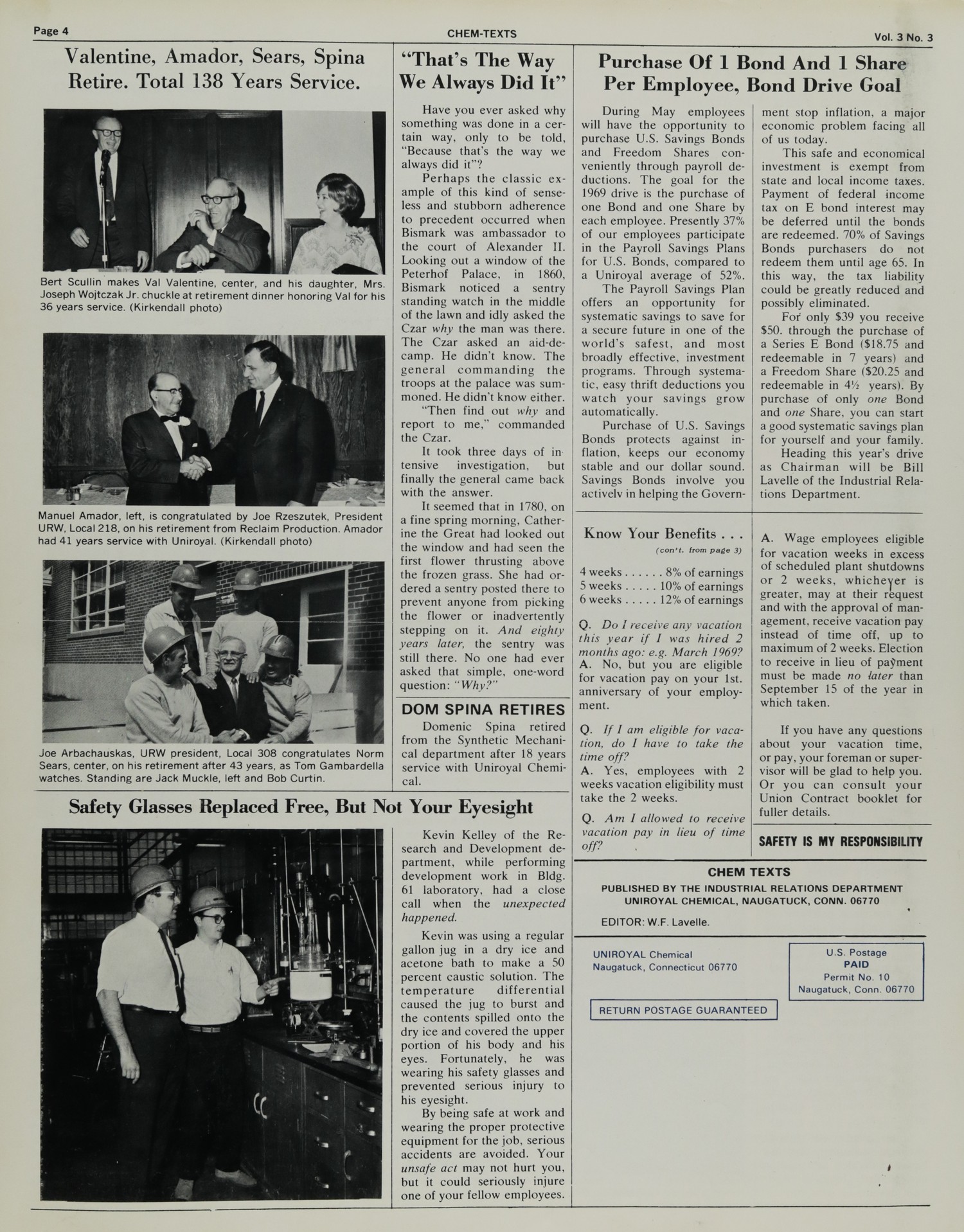
(continued on page 2)


Uniroyal Pays 20% Increase In Benefits

Starting August 1, 1969, Uniroyal absorbed the 20% increase in the Hospitalization, Surgical and In-Hospital medical benefits.

This insurance coverage now averages $30.37 a month for each eligible employee, all of which is paid for by the company. For 12 months this benefit amounts to $364.44, a substantial amount if each employee had to pay it himself for health protection for himself and his family.


[IMAGE: Group photograph of men in business attire reviewing documents]

Eric Johnson reviews plans with United Givers committee. In front left to right are Joe Rzeszutek, Johnson, and Roger Amidon. Left to right standing are Gene Hertel, Vic Anderson, Jack Vergosen, Bob Foltz and Milt Makoski. Absent were Leon Raskauskas, Joe Bucciaglia and Frank Lynch.


“GIVE WHERE YOU WORK”

CHEM-TEXTS – Vol. 3 No. 7 – Page 3

Page 003

Vol. 3 No. 7 | CHEM-TEXTS | Page 3


KNOW YOUR BENEFITS: by W. Kirkendall

Some Questions And Answers On Bereavement Pay Benefits

The bereavement pay benefit is one of the many different benefits which Uniroyal gives to people employed at a plant where a United Rubber Workers Union exist. At the Naugatuck plant there are two URW locals: Local 218 covers the Chemical and Reclaim plants; and Local 308 covers the Synthetic plant. This benefit applies only to the wage members of the two Locals.

In 1968 Uniroyal contributed $318,303 in Bereavement Pay Benefits to employees working in plants covered by the United Rubber Workers Union contract.

Q. When am I eligible for bereavement pay?
A. An employee who is absent from work after 30 days from date of hire because of the death of a member of his immediate family, or a dependent who lives in the household, shall be paid his straight time average hourly earnings, if an incentive worker or his current hourly rate if on day work for time lost from his regularly scheduled shift.

Q. How many days’ pay do I receive?
A. You shall be paid (3) consecutive working days. It is understood the 3 days of paid bereavement pay shall be related in time to the death for which such payment is made.

Applies To Your Immediate Family

Q. Who is immediate family?
A. Immediate family is defined to mean husband, wife, father, mother, grandfather, grandmother, brother, sister, or the employee’s children. The foregoing intended to cover legal as well as blood relationships.

Q. Are uncles, aunts, nieces, nephews and cousins covered under bereavement pay?
A. No. They are not members of the immediate family.

Q. What happens if death occurs while I am on vacation?
A. Your vacation will be extended and payment will be made, provided the employee notifies a designated member of management.

Legal Relatives

Q. What does legal relationship mean?
A. The term legal relationship is interpreted to mean father-in-law, mother-in-law, brother-in-law and sister-in-law, the spouse’s grandparents and legally adopted children. A brother-in-law or sister-in-law is the employee’s spouse’s brother or sister. Although by custom or practice the spouse of an employee’s spouse’s brother or sister is referred to as a brother-in-law or sister-in-law to the employee, such relationship is not contemplated by reference to brother-in-law or sister-in-law for eligibility for bereavement pay.

Q. Must I attend the funeral to be eligible?
A. No. While it is not necessary that the employee actually attend the funeral, as in the case of a relative who dies in some distant place, the time off must be related in time to the death and cannot be arbitrarily deferred to some later time, such as an addition to a vacation or the like.

How To Apply

Q. What must I do as an employee in case of bereavement?
A. You should contact your supervisor or foreman and make sure you are eligible for bereavement pay. You must then bring in a clipping from the newspaper when you return to work and your supervisor will turn in a bereavement pay form to the Industrial Relations department.

Consult Foreman

Q. Who can inform me on bereavement pay benefits?
A. For further information on bereavement pay benefits, speak to your foreman or supervisor. He will be glad to answer any questions you have on this benefit or other benefits provided by Uniroyal. If he doesn’t have the answer, he will obtain the proper information for you.


Appointments Announced

Ken Stewart has been named Sales Manager for Kralastic ABS plastics, the Chemical division’s leading plastic product.

John Murray assumes the position of Acting Credit Manager for Uniroyal Chemical.


SAFETY IS MY RESPONSIBILITY


Safety Contest Winner Named

[IMAGE: Group photo showing people with “SEND HELP” signs]

Cliff German distributes litter bags to the Plastics Compounding and Physical Testing groups for winning the Safety Contest in June. Left to right are Fernando Gagne, Betty Kopp, German, Manny Andrade, Joyce Lockwood, Nick Tiscione, and John Kankel. 300 employees in Research & Development received the award for no-lost time accidents or serious injuries in June.

by Bob Shortt

The Safety Department announced the winner in the new plant Safety Contest. The contest is similar to last year’s “free coffee” cards which were distributed to members of a department completing a full month without a lost-time accident or a serious injury.

In this new Safety Prize program there is an added incentive, in that each successive month a department continues its record intact (no lost-time accident or serious injury) all members become eligible for a more valuable prize.

Several weeks ago, everyone in the plant was given Uniroyal pocket protectors which automatically placed them on the first step of the Safety program. The prize which was won by the Research and Development department was a handy litter container and Help sign for automobiles.

The contest will continue through 1969, with a new contest starting in January 1970.

The breakdown of departments is as follows: Chemical Production; Reclaim Production (including Dispersions and Raw Stock); Materials Handling at Chemical and Synthetic (including Small Packaging, Parcel Post and Janitors); Synthetic Production; Research and Development (Pilot Plants and Laboratories); Mechanical Departments (Synthetic and Chemical).

The winners for the first month’s contest were all persons in Research and Development, including the Pilot Plants and Laboratory sections.

Other prizes included in the Safety Contest are key chains, pocket memo pads, change purses, bottle and can openers, ash trays and coffee mugs.


33 Join U.S. Bond Plan

[IMAGE: Two people at desk with bonds]

Marge Lasky, left, of Reclaim R & D signs herself and Rufus Lydem to purchase U.S. Savings Bonds.

The annual U.S. Savings Bond and Freedom Share drive which was recently concluded saw 33 employees purchase Bonds and Shares through the thrifty, systematic payroll plan. Twenty-one increased their participation in the plan. The total number now enrolled in the plan is 595 or 35% of the plant employees. Company-wide participation in the U.S. Savings Bond plan is approximately 52% with some Uniroyal plants participating 100%.

A committee of seventy-three canvassers, organized in different sections of the plant and sales headquarters, contacted all employees during the drive.

Two departments deserve special recognition for increased employee participation during the drive: Reclaim Production and Reclaim Research and Development.

Anyone may still join the payroll deduction plan anytime during the year by contacting his foreman or supervisor.


No July Accidents

For the first time this year, no lost time accidents or serious injuries took place in the plant. Hopefully, July is the beginning of another 1,000,000 manhours worked without a lost time accident which was achieved in 1968.

With every employee’s personal involvement in following the safety rules required in the different plant areas and in his particular job, a 1,000,000 manhours can be reached again.

The most important person in continuing this encouraging trend is YOU. Only YOU can help prevent accidents to yourself and the people you work with in your area. Your daily concern for working safe will make the Naugatuck plant a better, safer place to work.


LATE FLASH

A Chemical operator, not wearing his safety goggles, was splashed with caustic acid for a serious injury, marring our August record.

CHEM-TEXTS – Vol. 3 No. 8 – Page 3

Page 003

CHEM-TEXTS

Vol. 3 No. 9 Page 3


Everybody’s Giving To United Givers

by Eric Johnson

The United Givers drive is receiving generous response from all employees. Pledges received to date amount to $14,300, which is 65% of the plant’s $22,000 goal. Campaign chairmen feel confident that the drive will exceed the $22,000.

“Give Where You Work” through the convenient payroll deduction plan has received greater support this year from all employees. Every pledge, even if only 25 cents a week, which surely every employee can afford, will help us reach our $22,000 goal. A mentally retarded child, a child with cerebral palsy, or a lonely G.I. in Vietnam will be helped by your pledge. In our hearts none of us can refuse to help these friends and neighbors.

Employees living in Waterbury, Cheshire, New Haven and other cities benefit from the Agencies in the Fund as much as, if not more than, the residents of Naugatuck and Beacon Falls. The U.S.O., Salvation Army and Red Cross are national in scope; the others serve most of the communities in which employees live.

The key word in this year’s campaign is Charity . . . the spirit of giving to help others less fortunate than ourselves. If you didn’t make a pledge, you can still pledge that 25 cents a week by obtaining another pledge card from your department head.

“GIVE WHERE YOU WORK”


Pledging contributions are seated left to right, Carole Calo, Lois Devino, canvasser for Quality Control and Testing Lab, and Sonya Kernasevic. From left standing are Margaret Sweeney, Maria Fidalgo, Anna Pakalnis, Joan Stevenson, Bertha Rascoe and Leslie MacDonald.


Larry Volpe accepts pledge cards from Mechanical Dept. Seated from left are Ralph Buckingham, Ovila Fortier, Odell Hines, Volpe, Adrian Hanley. Standing from left are Sal Falcone, John Napiello, Tony Galletta, Joe Lubinskas, Tony Malone.


Give Exact Employment Place

Telephone operators, front to rear, Mary Dinkle, Ruth Ranslow and Alice Schofield place 25,000 calls a month. Incoming calls are about 50,000 on the 1,000 extensions.

The cooperation of all persons is needed in the following matter which can inconvenience you in your personal affairs.

When it is necessary for you to give your place of employment for reference on personal business, make certain to specify UNIROYAL CHEMICAL or EMIC and give the correct phone number 729-5241. This will speed up the confirmation of your employment.

Fifty telephone inquiries are received daily from banks, stores and loan companies, to verify employment. Many of these calls could be eliminated if you properly state the plant or division where you work. Do not simply use UNIROYAL, because the caller looks upon UNIROYAL in Naugatuck as one plant.


IMPROVEMENTS…

(continued from page 2)

Engineering’s Responsibility

The plant’s engineering department consists of 21 engineers. The group presently has 65 projects in the works for which they are responsible.

But fixing the nuts and bolts; getting machines back into operation; adding an extra year of life to old equipment, and fixing a steam leak requires the skill and experience of the Mechanical department foremen and skilled tradesmen at the Chemical and Synthetic plants.

Investment In People

Plant improvements are essentially an investment in the skills, experience and welfare of the people by the Company. They produce new job opportunities; create better and safer working conditions; and provide the necessary tools and machinery to insure job security in the highly competitive chemical industry.


Free Eye Tests Available

by Sal Aloise

“G Day” is coming up Friday, November 14 for residents of the Greater Waterbury-Naugatuck area.

The “G” stands for glaucoma and a free eye test to spot this dread disease will be given to adults over 35 years of age Friday evening, Nov. 14 from 7 to 9 p.m. at the Warren F. Kaynor Regional Technical School, 43 Tompkins St., Waterbury.

The glaucoma screening is under the direction of the Connecticut Society for the Prevention of Blindness and a number of local organizations are cooperating to plan this event. Doctors from the Eye Section of the Connecticut State Medical Society donate their time to give the simple tonometer test.

Glaucoma is the second leading cause of blindness among people over 35 years of age. It comes on so gradually the victim is often not aware anything is wrong. This is why it has been called “the sneak thief of sight” by Prevention of Blindness people.


Appointments Announced

Hal Lynch was appointed Purchasing Agent for the Naugatuck plant, succeeding Norv Turner who will continue in an advisory capacity until his retirement in November.

Bob Cranney assumes the duties of Manager of the Synthetic Plant Control Laboratory.

Bill Leukhardt received a special assignment as Production Coordinator.

Doug Klima appointed Process Engineer for the Synthetic plant.


New toluene drying column at Synthetic Pilot Plant will be used to make new types of rubber.


Julius Banno, foreground, machines parts for reel beaters used in Cracking dept. while Ray Goglewski, rear, machines a tuber screw for Millroom B.

CHEM-TEXTS – Vol. 3 No. 8 – Page 4

Page 004

CHEM-TEXTS

Page 4 | Vol. 3 No. 9


Chemical Royals Win Softball Title

[PHOTO: Group photo of softball team members]

Pete Lazaras holds trophies won by Chemical Softball team. In front left to right are Curt Rice, Pete Byra, A. Sardanopoli, Lazaras, Ted Hudzik, and John Zappala. In rear, left to right are Ron Stark, Al Zonas, Vin Rooney, Carl Wehmann, Dan Shantz, Al Zimmermann, John Johnson, and John Swanson, manager of the team. Absent were Brad Swain, Mike Jasman, Jerry Lambiotte and John Shiley.

by J. Swanson and J. Prior

The Chemical Royals took first place in the Naugatuck News Twilight League National Division, winning the first half championship easily but facing a tough task in the second half when they were forced to play a 3-game playoff which they won.

Fighting for the pennant with one of their key players sidelined with an ankle injury, the Royals lost two tough games and their opportunity to take the pennant.

Leading batters for the team were John Johnson, with .595 and Vin Rooney with .509. Dan Shantz led in RBI’s with 53 and Carl Wehmann had 33. Shantz was also the team’s leading slugger with 9 homers. Jerry Lambiotte with a 15-9 pitching record, backed up by the relief pitching of Pete Lazaras with a 5-2 and John Swanson’s with a 4-0 record, helped lead the team to a victorious season.

The Synthetic Cardinals finished the season with a 20-12 record taking second place. Pete LaCharity led the team in batting with .535, followed by John Stamm’s .525 and Charlie Roland with .514. Eric Johnson was the team’s slugger with 12 home-runs. Howard Slason coached the team which consisted of Jim Shea, Joe Wojtczak, Bill Broden, Bill Stinson, Keith Hughes, Fernando Henriques, Vic Kloc, Howard Nixon and John Prior.


CHEM-TEXT Article Promotes Kralon®ABS

1000 reprints of the Kralon® ABS article in CHEM-TEXTS were sent to customers by Rom Rhome, Market Manager for pipe sales. The article discussed the new market potential for Kralon® ABS as underground conduit to replace the unsightly overhead utility poles and wires which mar city streets and the country’s highways.


Joe Bielak, Howard Hogan Retire

[PHOTO: Group of men with retirement cake]

Joe Bielak, seated, D & G foreman shows cake he received on his retirement after 30 years service. Ready to cut the cake are left to right, Tom Carey, Florian Taranovich, George Allen, Joe McKee, Sam Molnar, and Gus Birch.

[PHOTO: Group of men at retirement celebration]

Charlie Roland, URW Local 308 Vice President, congratulates Howard Hogan of the Instrument Dept. after 43 years’ service. Left to right are John Geary, Charlie Roland, Howard Hogan, Fred Simasek, Norm Brummett, and Tom Palmieri.


It Hops, Skips, Jumps and Runs

The new Attex, designed by Uniroyal and the ATV Manufacturing Company does everything but fly. Used for rescue work, hunting, and fishing in almost inaccessible areas, the impact-resistant and steel-like Royalite body is made from Kralastic® ABS, a Chemical division plastic product.

Attex rides on 6 low pressure flotation tires that replace shock absorbers and eliminate the suspension system. The Uniroyal tires feature an exclusive side tread design for extra traction in deep snow and sand; and the deep reverse tread design provides increased maneuverability on water.

The upholstery for the Attex is made from Marvinol® vinyl.

The retail price for the Attex is $1,495.

[PHOTO: Attex vehicle emerging from water in Central Park]

Attex, the newest all – terrain vehicle, climbs out of pond in Central Park, New York with the greatest of ease. The tough, steel-like body is made from Kralastic ABS and contains two plant chemicals. The Research and Development work on Kralastic and Marvinol is done at our Labs and TSSC Bldg.


Employee Benefits Hit $10,826,594

In the first six months of 1969, Uniroyal paid 58,465 claims, totaling $6,218,000 for hospital-surgical bills of Uniroyal employees.

As of March 31, 1969, the Company paid out $4,608,594 in group life, accidental death and dismemberment insurance which covers most employees and retirees in the United States.

The total of these benefits amounted to the staggering sum of $10,826,594.

“GIVE WHERE YOU WORK”


CHEM TEXTS

PUBLISHED BY THE INDUSTRIAL RELATIONS DEPARTMENT
UNIROYAL CHEMICAL, NAUGATUCK, CONN. 06770

EDITOR: William F. Lavelle.


UNIROYAL Chemical
Naugatuck, Connecticut 06770

U.S. Postage
PAID
Permit No. 10
Naugatuck, Conn. 06770

RETURN POSTAGE GUARANTEED

CHEM-TEXTS – Vol. 3 No. 11 – Page 3

Page 003

CHEM-TEXTS

Vol. 3 No. 11 | Page 3


Nine Employees Retire With 336 Years’ Of Service


Volpe, Carroll Had 47 Years With Plant

JOE SMEY retired from the Purchasing department after 40 years service. Joe was a buyer-supervisor of packages used in the plant.

AL CUSSON a department shift foreman in Reclaim Production, retired after 33 years service.

CHARLES HOTCHKISS retired from Mechanical Stores after 27 years service.


$132,000 Paid To Employees For Tuition

Tuition Aid is one of the many Company benefits which Uniroyal employees enjoy. It is available to both salary and wage employees.

Uniroyal paid $132,000 in Tuition Aid for employees in the year ending August 1969. A total of 729 employees took job-related courses under the program, designed to help employees gain or increase their job-related skills. A total of 29 college degrees were awarded to Uniroyal employees under the program.

At the Naugatuck location, 73 employees have improved their education by taking graduate and post-graduate job related courses at colleges in the area. Several employees will receive their master degrees in Business, Engineering and Chemistry this year.


[Photo Caption – Top Left]
Larry Volpe, center, General Foreman in the Mechanical department, receives best wishes on his retirement after 47 years. From left are Julius Banno, George Holmes, Volpe, Ted Hubbell, and Bill Mariano.


[Photo Caption – Top Right]
Angie Mariano, seated center, is congratulated by members of the Control department on her retirement after 39 years service. Seated from left are Edna Crycheau, Angie, and Helen Southard. From left, standing are Marie Marrello, Julie Curtin, Theresa Dalton, Jack Dunn, Joyce Lucarelli, and Marcella Pape.


[Photo Caption – Middle Left]
Leo Carroll, Foreman of the Piper department is swarmed with congratulations on his retirement after 47 years. Seated from left are Joe Samoskas, Carroll, and Frank Pat. In rear from left are John Hoey, Ray Gogolowski, Jim Shea and Tony Galletta.


[Photo Caption – Middle Right]
John Geary, Instrument department Foreman with 27 years service, receives best wishes on his retirement, from at left Elmer Anderson, Joe Adamaitis, Bill Lannon, Tom Palmieri, Geary, Carl Steelfox, Norm Brummett.


[Photo Caption – Bottom Left]
Purchasing department congratulates Norv Turner, seated, on retirement after 39 years. From left are Hal Lynch, Lucy Borzencki, Ed Sands, Dick Krajewski, Jim Heagle, John Callahan, Madelyn Malone, Joe Little, Pat Petti, Edith Dalleywater, and George Louis Jr.


[Photo Caption – Bottom Right]
Paul Suba, center, of Vibrathane Research and Development is congratulated on his retirement by Al Zimmermann after 37 years service. From left is Lou Esposito, Rose Wasoka, Suba, Corrine Guerrera, and Zimmermann.

URW Suggests 3-Year Pact, Reports Claim

URW Suggests 3-Year Pact, Reports Claim

6-14-67 [handwritten date]

NAUGATUCK—A URW counter proposal being discussed by Uniroyal and four other major rubber producers calls for a three-year agreement and includes pensions and fringe benefits, it was learned Tuesday.

The United Rubber Workers submitted the counter proposal after rejecting an industry-wide offer Friday.

The three-year counter proposal represents a turnabout in the union stand in the negotiations.

During a mass meeting of the Local 45 membership, held May 29, Pres. George Froehlich reportedly told those in attendance that the union would settle for neither a three-year pact nor an agreement which included pensions and fringe benefits.

According to sources, however, the union has come to the conclusion that the three-year pact was necessary, primarily because it seemed the only way to force the companies into offering higher wage benefits.

When the companies made their original offers, the wage terms and supplemental unemployment benefits were considered inadequate by union negotiators.

Management claimed, however, that none of the items in the contract offers could be raised until they had some idea of what the union was seeking in pension and fringe benefits.

The first hint of significant progress came about two weeks ago, according to sources, when all five companies were scheduled to sit at one table and discuss a pact. The meeting failed, however, due to the union negotiators from Goodrich, the sources claimed.

Election Problems

Despite the problems with the contract itself, sources have indicated that another obstacle in the negotiations is the forthcoming union elections on the local level.

Some of the union negotiators, who are seeking reelection, have been adamant in their demands in order to satisfy the rank and file membership. Uniroyal union representatives, however, were not indicated as being among this group.

The union plan submitted Friday calls for a straight five per cent increase, sources revealed.

Among the items called for in the counter proposal are an increase in pensions to $5.50 per man per year, and supplemental unemployment benefits up to 80 per cent.

Management reportedly had last offered an increase in pensions to $5.25, and supplemental unemployment benefits up to 75 per cent.

Union negotiators claimed that their proposed five per cent general increase would cost the company 73 cents, but management has claimed that it would cost $1.40.

UAW Aid

Although the union has been promised aid from the United Auto Workers Union, sources said that the aid was in the form of a loan.

UAW negotiators have to date chosen to reduce strike benefit checks to $15 from $25 weekly, and try to raise money among URW members still working at General Tire, Goodyear and other smaller rubber firms.

One week’s collection, it was said, brought only $6,000 in donations from rubber workers not on strike.

Not only are there problems within the union, but management is suffering some within the ranks of the five companies, it was reported.

Firestone has been claimed to be the dominant figure in the negotiations, but a Goodyear victory at the Indianapolis Speedway on Memorial Day has resulted in signs of a change in management leadership, according to sources.

Uniroyal Talks Depend On Other Firms, Claim

6-15-67

Uniroyal Talks Depend On Other Firms, Claim

NAUGATUCK—Talks between Uniroyal and United Rubber Workers negotiators continue in Cincinnati today, but informed sources said progress would depend on talks between the union and some of the other rubber firms, notably B. F. Goodrich and Firestone.

It is with these two companies, said one source, that the heaviest negotiating is taking place.

A source close to the negotiations said although on the surface some of the labor-management negotiators from other companies seem to say little to each other “a lot is going on underneath.”

Union negotiators were reportedly surprised during recent talks when management challenged a claim that the union’s counter-proposal would cost only 73 cents.

In a surprise move during recent talks, management presented what is referred to as a “roll up” to challenge a claim that the union’s economic package would cost only 73 cents.

In use, sources say, the “roll up” shows that although a raise apparently amounts to, say, 16 cents, the raise may be more like 17 or 18 cents due to the overtime and machine down time.

Union negotiators were reportedly caught off guard by the term, and claimed that management was using a weighted wage figure, and accused them of inflating the cost of the economic package.

Union spokesmen contacted Wednesday night said that this item was no longer a major obstacle and hinted that the union may be reconsidering the apparent cost of the package.

Some of the larger obstacles, it was said, are non-economic.

One such obstacle is referred to as the “bogie.” A golfing term, it has been applied to the efficiency rating used in at least one company’s plants.

A person who works at a particular job, according to plant employes, is expected to turn out a certain number of articles before he is entitled to full pay.

Assuming no breakdowns on the machine, if an employe does not meet his efficiency rating, he will not receive full pay.

These ratings are reportedly established by time and motion study men.

It is the union’s contention, say sources, that older people in the plant cannot always produce what a younger employe can produce, and some of the ratings are therefore to high, causing the union to want them eliminated.

It has been learned that the union’s counter proposal includes pensions and fringe benefits, which have come under a separate contract in the past.

Although some of the union negotiators are far from happy about discussing these items in a master contract, the union has reportedly found it necessary to do so in order to obtain the goals sought in the master contract.

As yet, however, the rank and file union members have not had the opportunity to express their wishes, at least to local negotiators, concerning pensions.

While the International URW funds are running low, efforts are in progress to obtain donations from URW workers who are not on strike. The efforts have been reportedly unsuccessful. During one week of canvassing, only $6,000 in donations were obtained.

Uniroyal Resumes Talks With URW

7-21-67

Uniroyal Resumes Talks With URW

CLEVELAND (AP) — It’s three down and two to go, a United Rubber Worker spokesman said Thursday after the union and Firestone Tire & Rubber Co. agreed to a tentative three-year contract.

The Goodyear Tire & Rubber Co. and Uniroyal resume bargaining with the URW today.

Firestone, the B. F. Goodrich Co. and the General Tire & Rubber Co. all settled within one week for the same basic contract, setting a pattern that could be followed by the last two. firms.

A Firestone spokesman said it was the “largest package negotiated in 30 years.”

If ratified, the company said 17,000 production workers in 11 plants will go back to work as rapidly as facilities can be reopened and schedules established.

The hourly wage hike in the Firestone settlement is 43 cents over three years, with skilled workers getting an extra 10 cents the first year. Top hourly rate is now $3.88. The contract expires April 20, 1970. Various benefits also were increased.

CHEM-TEXTS – Vol. 2 No. 2 – Page 4

Page 004

Page 4 | CHEM TEXTS | Vol. 2 No. 2


[IMAGE: Safety glasses with visible damage/marks]

Safety Glasses Save Employee’s Eyesight

While U. Genga of the Materials Handling group was unloading cyclohexylamine drums, the bung sprung off and the “heel” splashed against his eyes. Fortunately he was wearing his safety glasses at the time. The picture shows how the glasses protected his eyes against serious chemical burns, and possibly loss of his sight. His only injury was slight burns of the eye lids.

It’s a good idea to always wear your safety glasses. You can never be sure when something unexpected will happen. You can bet U. Genga was glad he wore his.


Enter Safety Slogan Contest Win $25.

You, your sons, your daughters, your wife, the whole family can win a $25.00 gift certificate for the employee salesroom or any Uniroyal Company store. For a few minutes of time you may easily be the winner in this Slogan Contest.

The rules for the contest are simple:

  1. Each member of the family may submit as many slogans as they want.
  2. The entry must be 10 words or less.
  3. An entry can be re-submitted in new contests provided it has never won.
  4. The decision of the 3 judges is final.
  5. All employees can enter except the plant staff and members of the joint union-management safety committee.
  6. If you don’t use the form, be sure you include all of the nessary information on your entry.
  7. The contest closes June 28.

SAFETY SLOGAN

Contest #2

Date:___

Name___

Address___


Dept.___

My suggestions are:

1.___

2.___

3.___

4.___

5.___


JIM HARTNETT WINS THE SAFETY SLOGAN CONTEST

[IMAGE: Man standing next to Uniroyal U.S. Rubber truck]

Jim Hartnet, of the Materials Division, won 1st. prize, a $25. gift certificate. His winning slogan was: “Safety 1st. is 2nd. to none.” Judges were Union Safety Committeeman, Walter Scott; Hank DeVries and Sal Aloise of the Industrial Relations department.


[IMAGE: Three men at table signing documents]

170 UNION EMPLOYEES SIGN UP FOR IN-PLANT BANKING PROGRAM

Banking is easier with the new “In-Plant” banking and saving program set up by Local 218 of the United Rubber, Cork, Linoleum and Plastic Workers of America and the Naugatuck Office of the Waterbury National Bank.

According to Union President Joe Rzeszutek and Vice-President Cy Blanchard, the new program is available to all members of Local 218. 170 union employees have signed up for the plan.

The “In-Plant” banking and savings program was set up for the convenience of the union employee. Under the plan, a member authorizes weekly paycheck deductions which are deposited directly to any number of the Bank’s services such as checking, savings accounts, Christmas clubs or loan repayments.

The Bank also provides additional services including financial counselling on money management and the availability of individual lines of credit for union members.

Union members interested in the plan can call or stop in at the Waterbury National Bank in Naugatuck or at its branch offices. Before you buy your next car, improve your home, start a checking account, or need vacation expenses, investigate the lower interest rates offered in the plan.


CHEM TEXTS

PUBLISHED BY THE INDUSTRIAL RELATIONS DEPARTMENT
UNIROYAL CHEMICAL, NAUGATUCK, CONNECTICUT

UNIROYAL Chemical
Naugatuck, Connecticut 06770

U.S. Postage
PAID
Permit No. 10
Naugatuck, Conn. 06770

CHEM-TEXTS – Vol. 2 No. 5 – Page 3

Page 003

CHEM TEXTS

Page 3 | Vol. 2 No. 5


Harry Witt Heads Synthetic Production

Harry Witt has been named Synthetic Production Superintendent, effective Dec. 1. Ben Leach becomes Manager of Colloidal products in the Research and Development Dept.


How You Can Obtain A Pair Of Safety Prescription Glasses

Fred Mayo of the Process Development Lab. selects frames for safety prescription glasses from Adeline Farrar R.N., Chemical Hospital nurse.

The Naugatuck plant has a program which is operated by the Safety Department to enable all Chemical division employees to obtain prescription safety glasses at no cost to the employee, except for the examination and fitting fee.

The procedure is simple. An employee may go to either the Chemical or Synthetic hospital and obtain a prescription safety glass form from the nurse. He takes the form to his own eye doctor and has an examination. The employee pays for the cost of the examination and returns the completed form to the plant nurse. At this time he may also select the frame he prefers from samples in the hospital. The Company then sends the prescription to the Wilkie Optical Company and purchases the glasses.

Effective January 1, 1969, all prescription glasses will be returned to the doctor or optician of your choice for proper checking and fitting. In some cases an additional fitting charge may be made, depending upon the agreement you have made.

Here are other facts you should know: 1. You may buy an extra pair of glasses for yourself, if you wish and take advantage of our Company discount, provided the prescription is less than one year old. 2. You may also purchase prescription sun glasses at the same discount. 3. You may obtain a free pair of glasses whenever you require a new prescription. 4. Lenses or frames damaged as the result of an accident in the plant are replaced free of charge.


[PHOTO CAPTION:]
Uniroyal Chemical’s United Fund Campaign Committee looks at the “thermometer” showing the results of the drive at the plant where employees topped their goal by 103%. Left to right are Doug Miller, Sam Gillette, Bob VanAllen, the Industrial Division’s Chairman; Joe Kresziutek, Ron Mitchinson, pointing to the $20,646 figure and Bill Lavelle. Other committee members not in the photo were Ed Alves, Eric Johnson, and Len Lombardi.


Employees Contribute $20,646. Top United Givers Goal By 103%

Ron Mitchinson, Chairman of the United Givers Campaign at the Naugatuck plant announced the results of the Chemical Plant’s drive. Employees contributed $20,646 or 103%, topping the plant’s Goal of $20,000. This surpasses by almost $3,000 the previous high of $17,737 contributed by employees to the 1967 United Givers Drive. The success of this year’s campaign can be attributed to the enthusiastic efforts of the Campagin Committee, the ninety-five Co-Captains, and the generous support of the Chemical division employees.


Accidents Continue At High Rate

In the ten months of this year, 79 lost time and serious injuries have occurred. Most of these resulted from a careless act or operation. We each must accept responsibility for our own actions and the safety of all.

MONTH LOST TIME SERIOUS IN-JURIES TOTAL
JANUARY 2 2 4
FEBRUARY 3 5 8
MARCH 2 6 8
APRIL 2 6 8
MAY 0 11 11
JUNE 0 7 7
JULY 2 7 9
AUGUST 4 4 8
SEPT. 0 8 8
OCTOBER 2 6 8
TOTALS 17 62 79

New Food Vendors Service Plant

By Monday, December 2nd, all food and beverage vending machines in the plant will have been replaced with brand new machines to provide plant employees with better food service.

The new firm, Indiana Vendors, has proposed several basic changes which will eliminate the problems we have experienced in recent months; machines out of order, empty or not giving the proper change, and food often neither fresh nor of uniform high quality. There will be an on-site maintenance man who will be in charge of keeping all machines operating properly in all respects. All food will be prepared and wrapped in the Synthetic Plant kitchen facilities. This means that food in the machines will have been prepared an hour or two before being put into the vending equipment. It also means that when more departments than usual are scheduled to run over a weekend or holiday, extra sandwiches can be prepared at the last minute and placed in the machine. If a machine runs out at 2:00 P.M., it can be filled again before the next day.

The machines will be the latest in design and efficiency. Take the office machines for example. You put your coin into the machine, select the way you want your coffee, and receive a cup of fresh, perked coffee. The machines operate on 1/3 lb. cans of Maxwell House coffee — exactly the same grind you buy for home use. Approximately 20 cups are perked and then transferred to a holding chamber. After a preset length of time, a new batch is perked and any coffee remaining in the hold chamber is dumped. The coffee you buy is always fresh. No more instant coffee.

The food machines will also hold a wider variety of food. Soup will be sold with the can, bowl, spoon, crackers and napkin as a package — you’ll never run into the situation where, having purchased a can of soup, no spoon or dishes are available.

Some of the areas in the plant will be expanded or have more versatile machines such as canned soda or a flavor ice vending machine — the vending area in Reclaim Bldg. #1 will have a sandwich machine, for example, and a coffee machine will be put into the Chemical Machine Shop, where up to now only a cigarette machine has been in operation.

In short, new and better machines, with better service and more and better food, to give us the best food service arrangement possible.


ALANAP AND DYANAP (con’t.)

(CONTINUED FROM PAGE 1)

sive advertising and promotion program for our distributors and dealers. Grower meetings will be conducted by our sales force, demonstrating the advantages of Alanap and Dyanap over competitive products.

Quality products play an extremely important role in the agricultural business. A poor quality product damages a grower’s crop, the reputation of the product and the Company. Important also in the farm market is good packaging. It either helps or reduces our sales. Dented or stained cans, torn and dirty bags convey the impression of poor quality and workmanship in the customer’s mind. Good quality and good packaging can help make 1969 a big year in Alanap and Dyanap sales.

SAFETY IS MY RESPONSIBILITY


Clark Retires From Mechanical

Ed Clark, left, is congratulated by Bill Lannon, Foreman of the Instrument Department. Clark, an instrument man in the Mechanical Department, retired recently after more than 22 years with the Company.

CHEM-TEXTS – Vol. 1 No. 3 – Page 4

Page 004

Page 4

CHEM TEXTS


What Would Some Company-Paid Benefits Cost If You Bought Them Yourself?

Have you ever wondered what some of your company-paid employe benefits would cost if you had to buy them yourself?

If you’re anything like the average wage employe – – a 40-year old married man with two children, 10 years of service and earnings of $550 a month – – the cost would be virtually prohibitive. You would have to pay about one-sixth of your yearly earnings – – $1,128.80, to be exact – – for protection that wouldn’t be nearly as good as the benefits provided free by the company. And we’re talking about only some of the benefits. The cost would be much greater if we included all of the benefits that Uniroyal provides for employes.

Let’s suppose that as an average employe you had to purchase your own pension, life insurance, accidental death and dismemberment insurance, hospital and surgical coverage, and accident and sickness insurance. For these benefits alone, here is what you would have to pay for the best comparable protection.

Pension: $509 a year until retirement. That is the cost of an annuity that would equal your present free pension benefit of almost $200 a month under the new plan. If you had the will power, you could put the same amount into a savings account or buy stocks regularly through a broker.

Life and Accidental Death and Dismemberment Insurance: $102.04 a year. This amount will buy a $7,500 term life insurance policy, $7,500 non-occupational AD & D coverage and $3,750 occupational AD & D. In addition, you would have to submit medical evidence of insur-

ability. The company’s insurance does not require this.

Hospital and Surgical: $407 a year. This is a vital benefit. The company’s plans provide full payment of the usual and customary surgical fees in your area as well as full payment of a semi-private hospital room and other hospital charges for 730 days. The best comparable protection you could buy would provide a schedule of surgical payments – – a certain amount of money for certain kinds of medical services – – and a semi-private room with a limit on daily room and board charges. Obviously, the Uniroyal plan provides much more comprehensive protection for you and your family.

Accident and Sickness Insurance: $110.76 a year. This would provide $70 a week for 39 weeks in the event of disability or illness.

“This is only a partial list of company-paid benefits, those you can purchase yourself,” said N.H. Fletcher, director of pensions, insurance and employe benefits at ‘1230’. “Other important benefits which the company pays for or contributes to include paid vacations, nine paid holidays, supplemental unemployment benefits, Social Security taxes, unemployment compensation, bereavement pay and many others. To really match the company’s benefits program, employes would have to be so wealthy that they could afford to be self-insured.”

The answer to our original question of what some of your benefits would cost if you had to buy them yourself, should be evident by now. They would cost a great deal more than most of us realize and a lot more than most people can afford.


WANT AD SECTION

This section of Chem-Texts will be set aside in each issue as a curtesy to our employees. Ads of 15 words or less about items wanted or to sell or trade will be published on a first come-first serve basis. They will be run in one issue only and should be re-submitted if you wish them published in later issues. Send all information to R.F. Shortt, Industrial Relations department. Remember, your signature must be included on your ad application or it will not be used.

. . . . . . . . . . . . . . . . . . . . . . . . . . . . . . . . . . . . . . . . . . . . . . . . . . . . . . . .

. . . . . . . . . . . . . . . . . . . . . . . . . . . . . . . . . . . . . . . . . . . . . . . . . . . . . . . .

. . . . . . . . . . . . . . . . . . . . . . . . . . . . . . . . . . . . . . . . . . . . . . . . . . . . . . . .

. . . . . . . . . . . . . . . . . . . . . . . . . . . . . . . . . . . . . . . . . . . . . . . . . . . . . . . .

Name . . . . . . . . . . . . . . . . . . . . . . . . . . . . . . . . . . . . . . . . . . . . . . .

Address . . . . . . . . . . . . . . . . . . . . . . . . . . . . . . . . . . . . . . . . . . . . .

Phone . . . . . . . . . . . . . . . . . . . . . . . . . . . . . . . . . . . . . . . . . . . . . .

Signature . . . . . . . . . . . . . . . . . . . . . . . . . . . . . . . . . . . . . . . . . . . .


Uniroyal Plans Promotion Through Major League Baseball

Baseball will sell a lot of our products next year – – and our company will sell a lot of baseball.

Working with major league baseball and The Reader’s Digest, the company will produce a 40-page detachable section about baseball and Uniroyal products that will be published in the May 1968 issue of the Digest. Twenty of the pages will feature by-lined articles about baseball written by noted sports experts, leading feature writers and outstanding baseball personalities. The remaining 20 pages will highlight the company and its major consumer and industrial products, such as Uniroyal Master, Tiger Paw and Rain tires, Keds and Naugahyde.

The Reader’s Digest has a monthly circulation over 17 million, the largest in the world, and a total readership in excess of 50 million.

The insert will form the basis of a promotional program that will last for the entire baseball season, which is the major selling season for many of our products. Several million reprints of the insert will be distributed by the company at ball parks and dealer outlets, affording long-term promotional opportunities for Uniroyal products at the retail level.

According to J.R. McMenamin, director of advertising, the promotion will be “the most exciting program we have ever sponsored. Since baseball has universal appeal, this booklet will make fascinating reading for all members of the family. In it will be articles of great interest not only to the avid fan, but to women who may know nothing about the game, as well as tips for Little Leaguers, teenagers and the kid who never held a bat.”

Baseball Commissioner William D. Eckert noted that the tie between baseball, Uniroyal and The Reader’s Digest is appropriate. Some 70 million spectators have enjoyed major and minor league baseball during the past two years, making baseball America’s favorite sport by far. We are pleased to be associated with such outstanding companies as Uniroyal and The Reader’s Digest, which will carry the fun and excitement of baseball to families throughout the nation.”


DON’T FORGET . . . .

One Gift Works Many Wonders

UNITED

WE GIVE

Naugatuck Chemical United Givers Campaign 1968

Get those contributions or pledge cards in to your area representative or the Industrial Relations department. Let’s make sure we again give a good account of ourselves in this worthwhile cause.


TEST FIRES

Plant protection supervisor, Ed Weaving, is shown, below, extinguishing a test fire during Fire Prevention Week. Ed worked with a number of employees during the week, letting them extinguish the test fires themselves. It all adds up to another step in our preparedness program.

[PHOTO: Man extinguishing fire]


Snow Tire Sale To End Dec. 15

The special employee sale prices on Winteride and Winter Patrol tires will be in effect until Dec. 15. Tire dealers in the area are Poust’s and Mezzio’s in Naugatuck; Advance Tire in Waterbury; Fitzpatrick’s in Ansonia and of course, any of the Uniroyal stores. Tire form and credit applications may be obtained at the Synthetic plant hospital or the Industrial Relations department.


FLU SHOTS

The Safety Department has been encouraged by the number of employees that have received flu shots this year at the Plant Hospitals. The Plant Nurses have given over 700 flu shots to date. Flu Shots are given daily by the Nurse at both Plant Hospitals to any Uniroyal Chemical employee who voluntarily requests them. There is still time if you act now. Call one of the Plant Hospitals for an appointment.


CHEM TEXTS

PUBLISHED BY THE INDUSTRIAL RELATIONS DEPARTMENT
UNIROYAL CHEMICAL, NAUGATUCK, CONNECTICUT

UNIROYAL Chemical
Naugatuck, Connecticut 06770

U.S. Postage
PAID
Permit No. 10
Naugatuck, Conn. 06770

URW Rejects

6-9-67

URW Rejects

Continued From Page 1

  1. Supplemental Unemployment Benefits – Regular benefits increased from 65% of average pay (plus $2 for up to four dependents, with a maximum payment of $50) to 75% of average pay with no maximums. Short work week benefits increased in all cases to 75% of average pay. Company contributions increased from 5¢ per hour to 6¢ per hour when the sub fund falls below 100%. Sub fund increased from $250 to $350 per employee.
  2. Miscellaneous Contract Clauses – These include up to 40 hours pay, depending upon the size of the plant for union time study men, increased pay for union grievance meetings and arbitration hearings, a greatly improved safety committee clause and a number of other contract proposals and clarifying letters of commitment.
  3. Pensions – A 60% increase in regular pensions from $3.25 to $5.25 per month per year of service. A 60% increase in disability pensions from $6.50 to $10.50 per month per year of service. An increase of $1.50 per month per year of service for living pensioners who were retired after July 1, 1950.
  4. Life Insurance – An increase in Company paid insurance from $6,500 to $7,500 for active employees.
  5. Hospitalization – An increase in the coverage for the maximum stay in the hospital from 365 to 730 days.
  6. X-Ray and Radium Therapy – An increase in the aggregate maximum payment from $200 to $300.
  7. Visiting Nurse – An increase in the maximum daily payment from $6 to $7.
  8. Surgical – Provide for full payment of the reasonable and customary fees prevailing in the area for the surgical procedures.
  9. Sickness and Accident Benefits – An increase in benefits according to the employees average earnings with a minimum of $50 per week and a maximum of $80 per week. (Average coverage to be $70.) Eliminate present 7 day waiting period and provide sick benefits from first day of hospital confinement as a registered bed patient.

Negotiators To Study URW Counter-Proposal

Negotiators To Study URW Counter-Proposal

6/12-67

Negotiators To Study URW Counter-Proposal

The five major rubber companies in the U.S. will consider a URW proposal today after two contracts which were proposed by the companies last week were rejected by the union.

One source said the union counter-proposal is only slightly different from its original demand which, according to the companies, would cost the companies an additional $1.40 for each employee.

The company offered a three-year contract and tried to include pension and welfare negotiations, which has habitually come under separate contract. The current welfare-pension contract does not expire until September.

In their offer, the companies provided a $.38 wage increase for tire workers and $.31 increase to non-tire workers.

URW are demanding equal across-the board raises for all employees, while the companies claim that this would worsen their already poor competitive position in non-tire products.

URW President Peter Bommarito stated that the union is prepared to continue its strike for another month. Local UniRoyal employees are beginning to look a little grey about the pocketbook with Bommarito’s statement and the reduced strike benefit checks.

Alleged promises from the United Auto Workers union to aid the URW strikers financially has not yet materialized.

The strike goes into its 53rd day today, with 50,000 employees of Firestone, Goodrich and UniRoyal idle.

After the weekend recess, the companies, which had time to study the union offer during the respite, and the URW will resume negotiations at the bargaining table.

Local URW

Local URW 6-12-67

Continued From Page 1

President Walter D. Baldwin’s
wages were increased from
$83,025 in 1965 to $113,395 in
1966 an increase of $30,370 or
36.6% in one year.

The union is not saying that
these men do not deserve this
increase they probably deserve
more for the job that they are
doing, but if the Company wants
to talk percentages, then let’s
talk percentages from top to
bottom.

We are happy that the Com-
pany has seen fit to increase
the vacation allowance for em-
ployes that have one to five
years of seniority. What about
the employe with ten or more
years of seniority. The Com-
pany has not seen fit to do any-
thing for these employes. Why?

Miscellaneous Contract
Clauses – We admit that the
Company has improved some of
these clauses and also given the
Union some clarifying letter of
commitment. Yet can Mr. Smith
tell the Union why is it that
when the Union asked the Com-
pany to give them a letter of
commitment, which would not
cost the Company one penny,
and that they treat our mem-
bers that work for UniRoyal
Inc. with decency and respect,
the Company refused. If mem-
bers of management expect our
members to treat them with de-
cency and respect, then we ex-
pect the same from manage-
ment. A written commitment
that this would be done would
go a long way in reaching a
settlement.

I would also like Mr. Smith
to explain to his employes that
belong to our Union, why is it
that when the Union ask the
UniRoyal Company to grant our
people seven (7) paid sick days
a year, the Company said that
this was too costly, yet every
person that works for manage-
ment gets ten (10) paid sick
days a year. The only thing
our members get if they take
10 days off in one year is an
unfavorable notation on their
personal cards. This is very
hard to digest.

The Company has not seen fit
to do anything for our hourly
rated employe and also a night
shift bonus, even though we have
one of the lowest night shift
bonuses in the area.

I do not want to elaborate on
the Pension & Insurance part

Rubber-Labor Pact Is Possible This Week; General Tire Increases Its Offer to Union

6-12-67

Rubber-Labor Pact Is Possible This Week; General Tire Increases Its Offer to Union

By a WALL STREET JOURNAL Staff Reporter

AKRON—After a week of marked progress in negotiations, the United Rubber Workers union and five major rubber companies will reopen bargaining sessions at 10 a.m. today with some expectation of reaching a single-package settlement covering wages, pensions and welfare benefits before another week passes.

A settlement would end the strike against three of the major concerns—Firestone Tire & Rubber Co., Uniroyal, Inc. and B. F. Goodrich Co.—which has idled 51,000 workers for 53 days since former contracts expired April 20. It would also conclude negotiations with Goodyear Tire & Rubber Co. and General Tire & Rubber Co., where production has continued on a day-to-day basis despite similar contract expirations.

Separate bargaining sessions with the five companies began making headway last week. Management offered wage boosts totaling 38 cents an hour for tire workers and 31 cents for other production workers over three years, plus pension-and-welfare-contract improvements. The package was technically rejected by the union as inadequate, but it opened the door to several counter proposals presumably being studied by the companies.

Differentials an Obstacle

At the weekend, General Tire was said to have sweetened its offer on several points, boosting the pay proposal for tire workers to 40 cents an hour over three years and offering further pension, vacation and supplemental unemployment benefit payments. General’s contract negotiations, however, cover only 3,000 workers in two tire plants, in Akron and Waco, Texas, while those of the four other concerns cover other production workers as well. The proposed differentials between tire workers and other production employes could still be a difficult obstacle in this week’s talks.

General’s wage offer for tire workers would break down to 15 cents in 1967, 13 cents in 1968 and 12 cents in 1969. The 38-cent offer of the other concerns comprises 16 cents this year and 11 cents in each of the next two years.

Peter Bommarito, URW international president, termed the offers of the four companies, other than General, as representing a gain of less than 4.5% compared with what he said has been a 5.8% raise granted in other manufacturing industries. He also called for the naming of an independent fact-finding board to determine the “fairness” of the union’s demands.

Uniroyal, in a letter to employes, put the gain in wage and other improvements at “about 5%” and said its offer would cost the company about 70 cents an hour, the largest proposal it had ever made to the union. Firestone and Goodrich also sent letters to employes discussing the negotiations, with Goodrich also putting its offer as “in line with the 5% pattern” set in other industries.

Another improvement in General’s weekend offer, which Mr. Bommarito yesterday called “attractive” as a basis for a settlement, was an improvement in supplemental unemployment benefits payments providing for 80% of average straight-time pay for laid-off workers or for those on short workweeks; this total would include unemployment compensation. Offers of the other companies had provided for up to 75% of straight-time pay. The previous contract called for up to 65% plus $2 for each dependent up to four.

The union has demanded as a “full employment” plan, or guaranteed annual wage, payments of up to 95% of regular straight-time pay for laid-off workers, including unemployment compensation. The union has put the company cost for this at 7 cents an hour per worker, up from the present 5 cents. The companies’ offer has been about 6 cents.

General’s offer also included a provision for six weeks’ vacation after 30 years’ service and two weeks after one year’s, along with existing intermediate vacations. The other companies made no provision for six weeks’ vacation but offered three weeks after five years’ service, along with other existing vacation allowances.

The pension-payment propsosal by General also was a bit higher than the increase to $5.25 per month from $3.25 for each year of service proposed by the others. Though the General amount wasn’t specified, it was understood to be close to $5.50 per month for each year of service.

Mr. Bommarito also disputed the companies’ claims that their “total-package” offers represented employment-cost increases of 70 cents an hour. He estimated them at about 64 cents for General’s package and 60 cents for the others.

Other Benefits

All the offers also included improvements in life insurance, hospitalization, sickness and accident insurance, an additional increase of 10 cents an hour for skilled tradesmen and improvements in grievance-pay allowances.

Should a settlement be achieved on a “single-package” basis, it would be the first time in the rubber industry. Pension and welfare matters have previously been reserved to a separate contract, the existing one due to expire next Sept. 15. Previously, however, the wage contract and pension agreements have expired on at least alternate years. The proximity of the pension-contract expiration this year to the wage contract’s conclusion was held to be an obstacle to an earlier settlement on wages.

The companies acknowledged they were reluctant to “expose” themselves to a substantial wage-cost increase only to be faced in a few months with another strike threat over pension and other welfare matters. Until two weeks ago, however, the union apparently had been adamant about keeping the two contracts separate.

General Tire Offers “Attractive Package”

General Tire Offers "Attractive Package"

Rubber Strike

6-13-67

General Tire Offers “Attractive Package”

AKRON, Ohio (UPI) — Negotiators in the national rubber strike today prepared for another long session over the problems of wages, contract length, the elimination of differentials in wage hikes, employes and job security.

Three of the nation’s five largest rubber companies have been on strike for 54 days, with about 55,000 employes idled around the country.

In Connecticut, some 5,500 workers at three UniRoyal plants in Naugatuck are affected by the walkout. There are no other unionized rubber industry plants in the state.

Wage contracts expired April 20 between the United Rubber Workers (URW) and the Firestone Tire and Rubber Co., Uniroyal Inc., and B. F. Goodrich Co.

Day-to-Day

Goodyear Tire & Rubber Co., whose contract expired the same day, and General, whose contract expired May 15, continued production on a day-to-day basis.

A break seemed most likely to occur in talks with General Tire & Rubber, which has proposed a slightly higher package than the other four companies.

General boosted its pay proposal for tire workers from 38 to 40 cents per hour over three years, and offered increased fringe benefits, particularly in the crucial area of supplementary unemployment benefits.

Spokesmen for the other four companies would not say if their negotiators were following suit.

Wages Behind

URW President Peter Bommarito said the wage offers of the four companies, including General, would leave the rubber workers behind other industries. He said the rubber companies are offering 4.5 per cent increases, as opposed to the 5.8 per cent national pattern.

In letters to their employes, the three struck companies set the percentage of their offer at 5 per cent, its cost at 70 cents per hour, and its size as the largest in industry history.

The companies said the fringe benefits are substantial and an increase in supplementary unemployment benefits from 65 per cent of straight time pay to 75 per cent will cost them six cents per hour alone.

The union has demanded unemployment payments of up to 95 per cent of basic wages. Bommarito calls this request “a full-employment plant.”

“Attractive” Basis

General had raised its offer on supplementary unemployment benefits to 80 per cent. This proposal won Bommarito’s approval as an “attractive” basis for settlement. General also increased vacation and pension benefits.

The tire workers now average $3.69 per hour. Company employes in other divisions make an average of $2.68. The last two settlements have increased the differential. Bommarito insists the next settlement grant equal raises to both types of production workers.

The request does not affect General, which is negotiating for only 3,000 tire workers in Akron and Waco, Tex. But the other four companies maintain they can only offer 31 per cent wage increases to non-tire workers.

Please Turn to Page 12


Local Strike

General Tire

(Conn.) Tues., June 13, 1967

General Tire

Continued From Page 1

For the first time, the negotiators, at management’s request, were grappling with wages and all fringe benefits in one package. Traditionally, three-year welfare pension contracts and two-year wage contracts are negotiated separately. The welfare pension contracts do not expire until fall.

Another improvement in General’s weekend offer, which Bommarito called “attractive” as a basis for settlement, was an improvement in supplemental unemployment benefit payments providing for 80 per cent of average straight-time pay for laid-off workers or for those on short work-weeks.

This total would include unemployment compensation. Offers of the other companies provided for 75 per cent of straight pay.

General’s offer includes a provision for six weeks vacation after 30 year’s service and two weeks after one year’s service along with existing intermediate vacations.

It is understood that the General proposal for pensions has been upped close to $5.50 per month for each month of service.

Should a settlement be achieved on a “single package” basis, it would be the first time in the rubber industry. Pensions and welfare matters have previously been reserved to a separate contract, the existing one due to expire next Sept. 15.

Previously however, the wage contract and pension agreements have expired on at least alternate years. The proximity of the pension – contract’s conclusion was held to be an obstacle to an earlier settlement of wages.

The companies acknowledged they were reluctant to expose themselves to a substantial wage-cost increase, only to be faced in a few months with another strike over pensions and other welfare matters. Until two weeks ago, however, the union apparently had been adamant about keeping the two contracts separate.

Strike Settlement Hopes “Wilting”

Strike Settlement Hopes “Wilting”

6-15-67

Governor John Dempsey acknowledged the letter received from the borough seeking his intervention in the UniRoyal strike affecting three borough plants. He said in a letter to Mayor Joseph C. Raytkwich, that State Labor Commissioner Renato E. Ricciuti is maintaining close contact with the progress of the negotiations, and that Ricciuti will continue to keep him informed of the situation.

The Governor however, did not commit himself to positive action as had been requested by a vote of the Borough Board in a motion by Burgess Edward McGrath, (R), Third Ward.

Word from Ohio this morning simply states that negotiations are continuing with neither the union or the companies commenting on the progress.

Last week’s hopes for a settlement on the new company offer, appear to be wilting. The basic problems seem to remain the same.

According to sources, the heaviest negotiation is between Goodrich and Firestone and the Union. Progress depends on the outcome of these sessions.
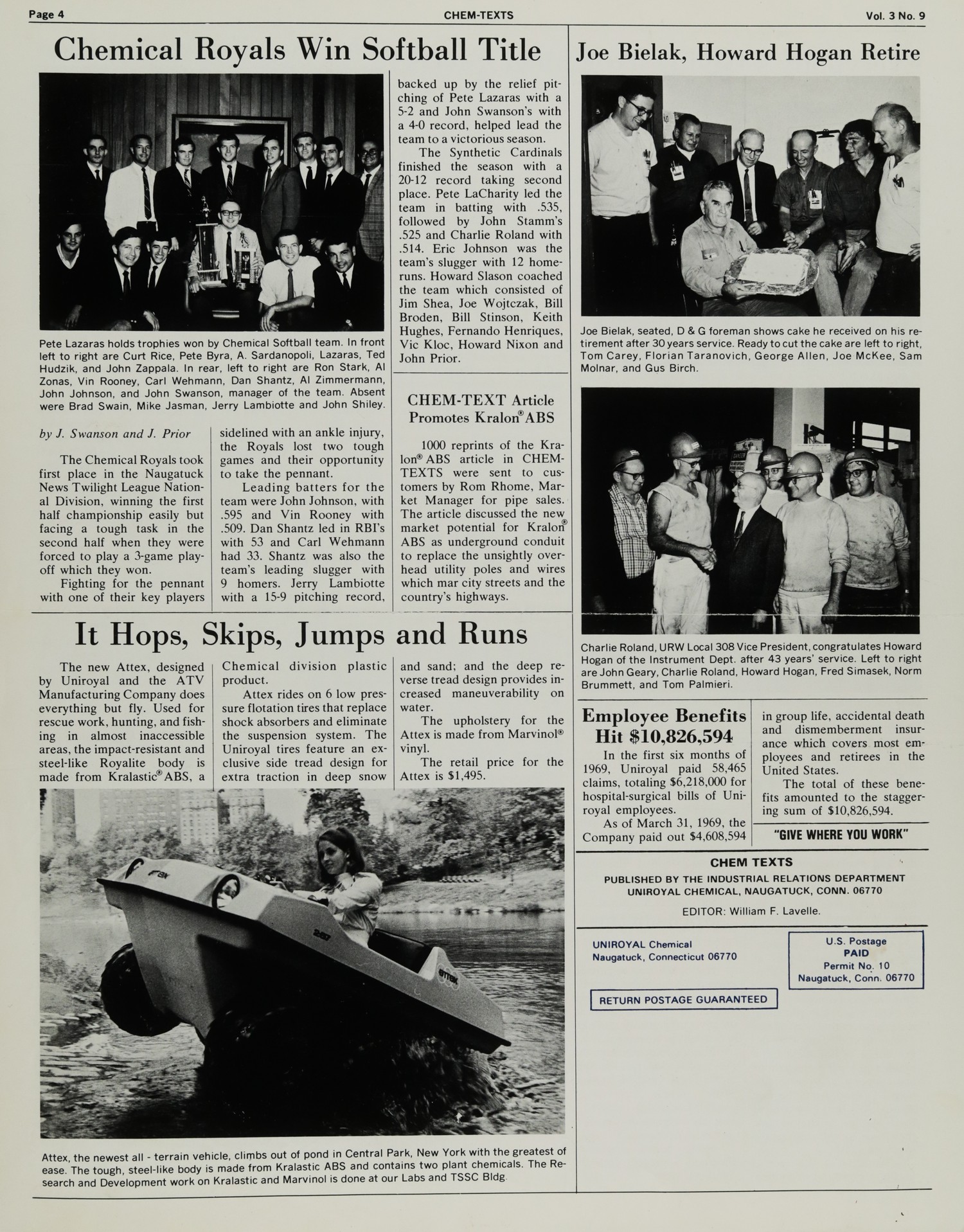
Management has challenged the claim of the Union that its proposal will cost only 73 cents. Union negotiators, taken by surprise, said that management was using weighted wage figures and accused them of inflating the cost of the economic package in the Union’s counterproposal.

Management, according to sources, is including the costs of over-time and machine downtime.

A Union spokesman said yesterday that this item was no longer a major obstacle and hinted that the Union may be reconsidering the apparent cost of its package offer.

The efficiency rating system used at one of the plants seems now to be a bone of contention. A person who works at a particular job is expected to turn out a certain number of articles before he is entitled to full pay. Assuming no breakdowns on the machine, if an employe does not meet his efficiency rating he will not receive full pay.

The Union contends that the older person cannot always produce what a younger employe can and some of the ratings are therefore too high, according to a spokesman.

Union funds are dwindling as the strike continues. Here in Naugatuck, where 5,500 workers are out on strike, benefit checks, even though they have been cut, amount to approximately $577,500.

Strikers are resorting to the purchase of food stamps to supplement their $15 weekly benefit checks as their personal funds are depleated.

The question of the Uni-Royal annual shut-down vacation period in August is a topic of conversation in the borough. Many workers were hoping to be back to work well in advance of this time. Vacation plans are being altered.
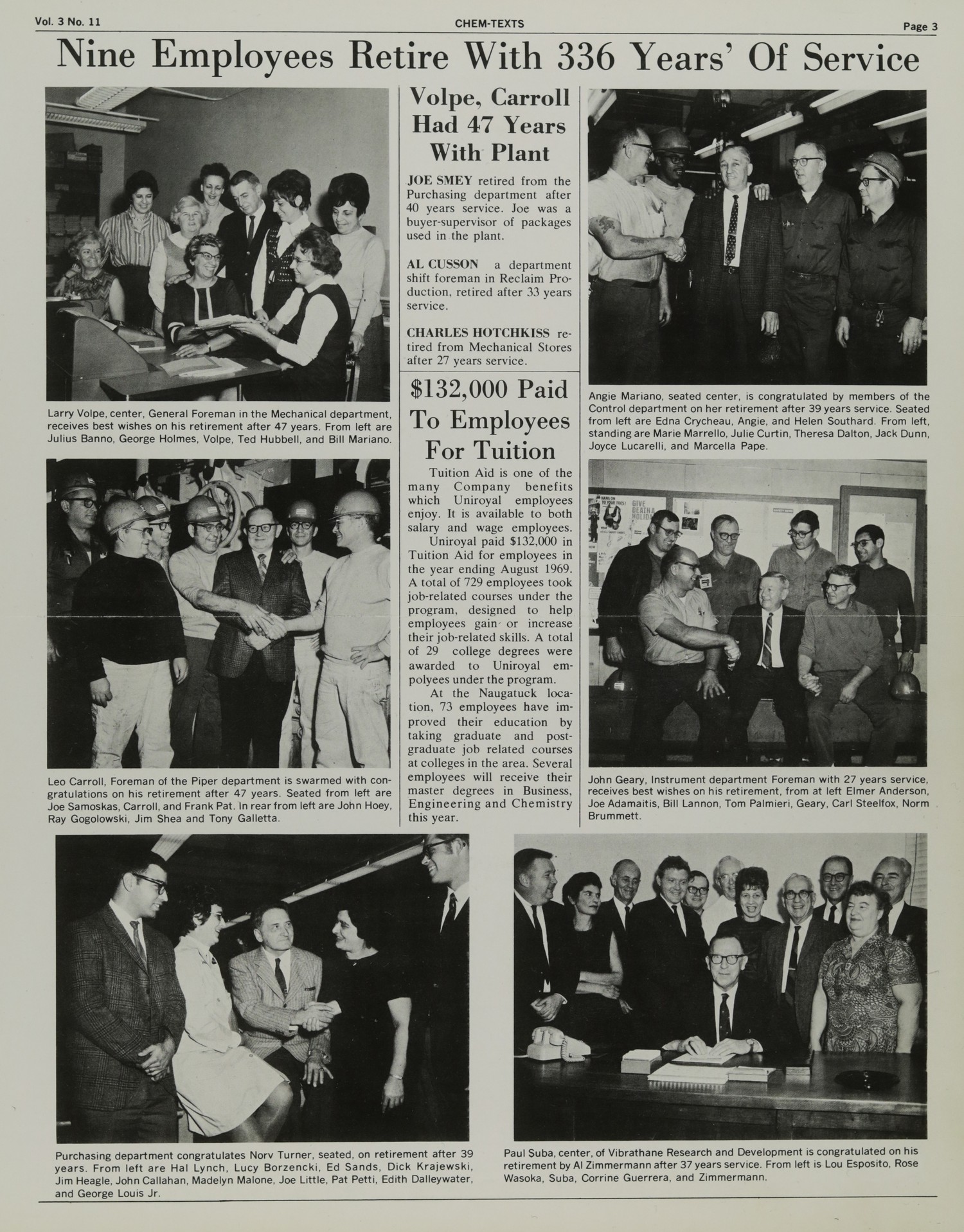
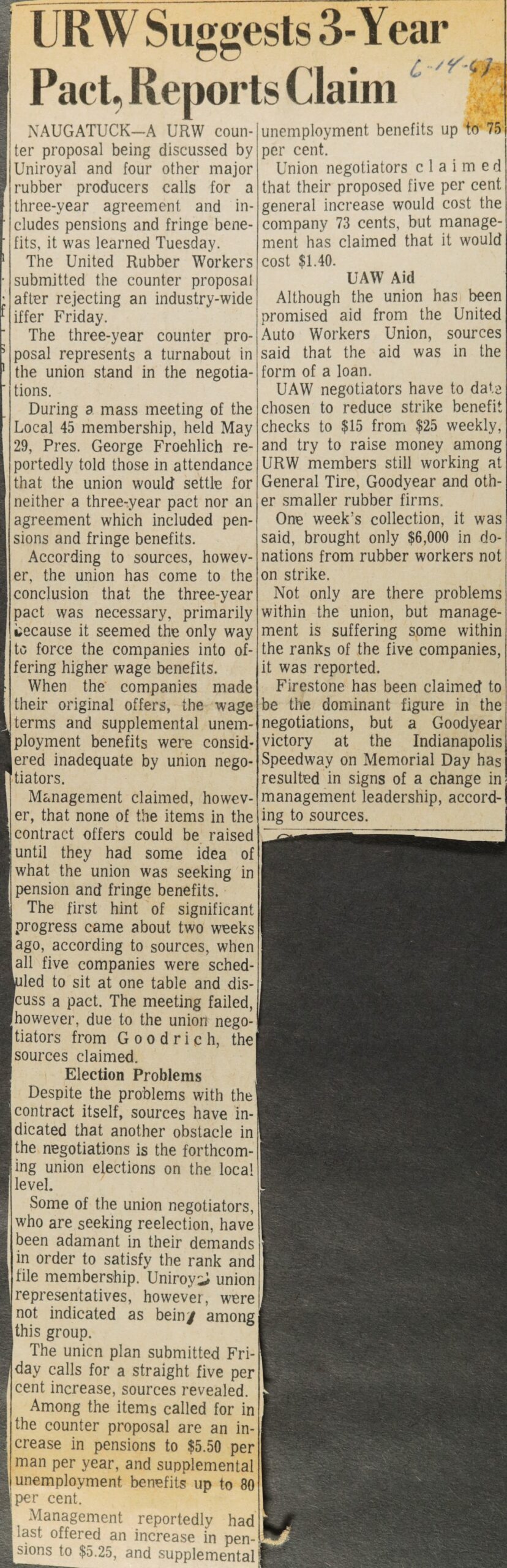
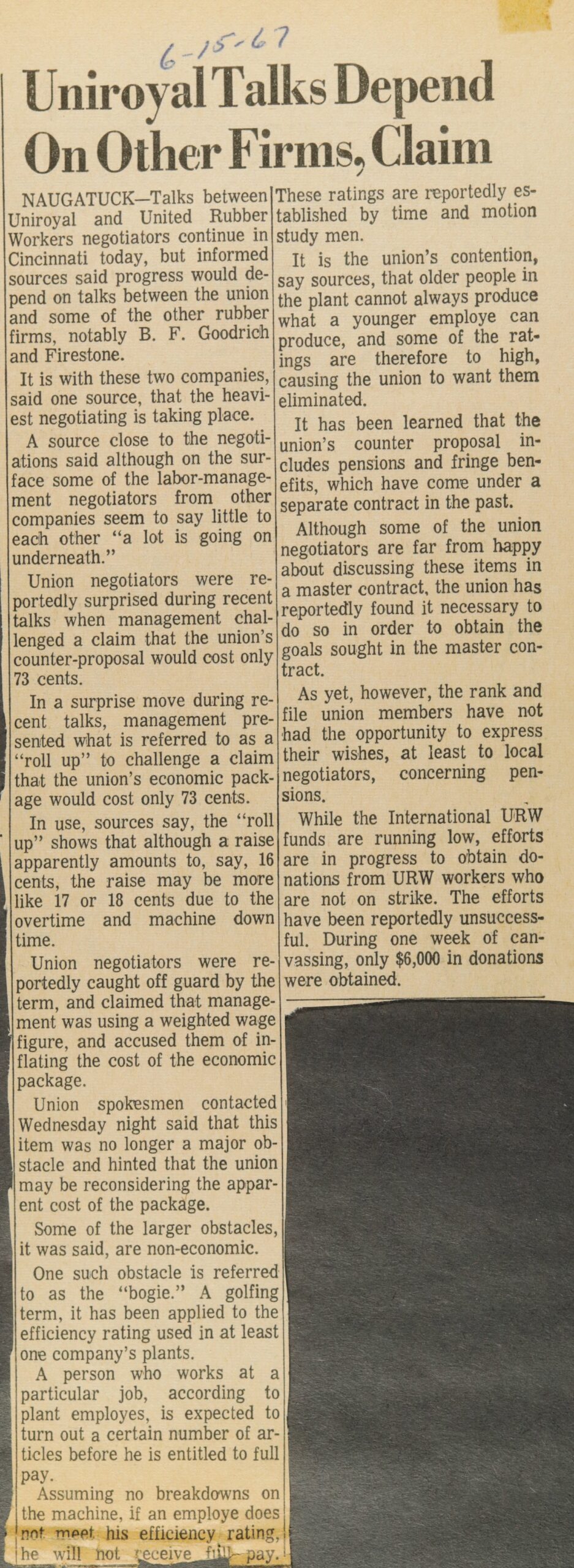
Strike Situation: No New Developments In Negotiations

Strike Situation: No New Developments In Negotiations

Strike Situation: No New Developments In Negotiations

6-14-67

AKRON, Ohio – Spokesmen said today that despite the progressive tone of talks between the United Rubber Workers and the General Tire and Rubber Co., there were no new developments in contract negotiations.

General had offered a slightly higher wage package than other members of the industry’s big five.

URW President Peter Bommarito said the offers of the companies, excluding General Tire, would leave rubber workers behind other industries.

A major block in the settlement of the strike was the union’s demand for unemployment payments of up to 95 per cent of basic wages. The rubber companies have described the demand as tantamount to “a guaranteed annual wage.”

Elimination of the pay differential between tire and non-tire workers was also a key union demand.
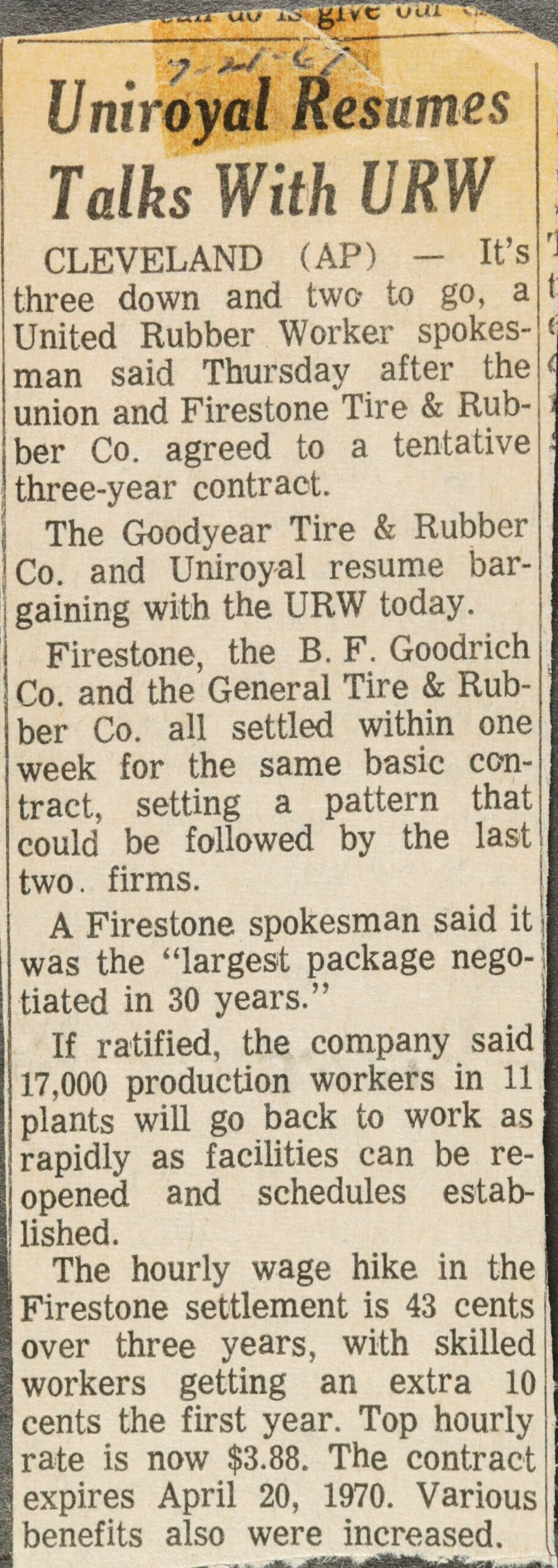
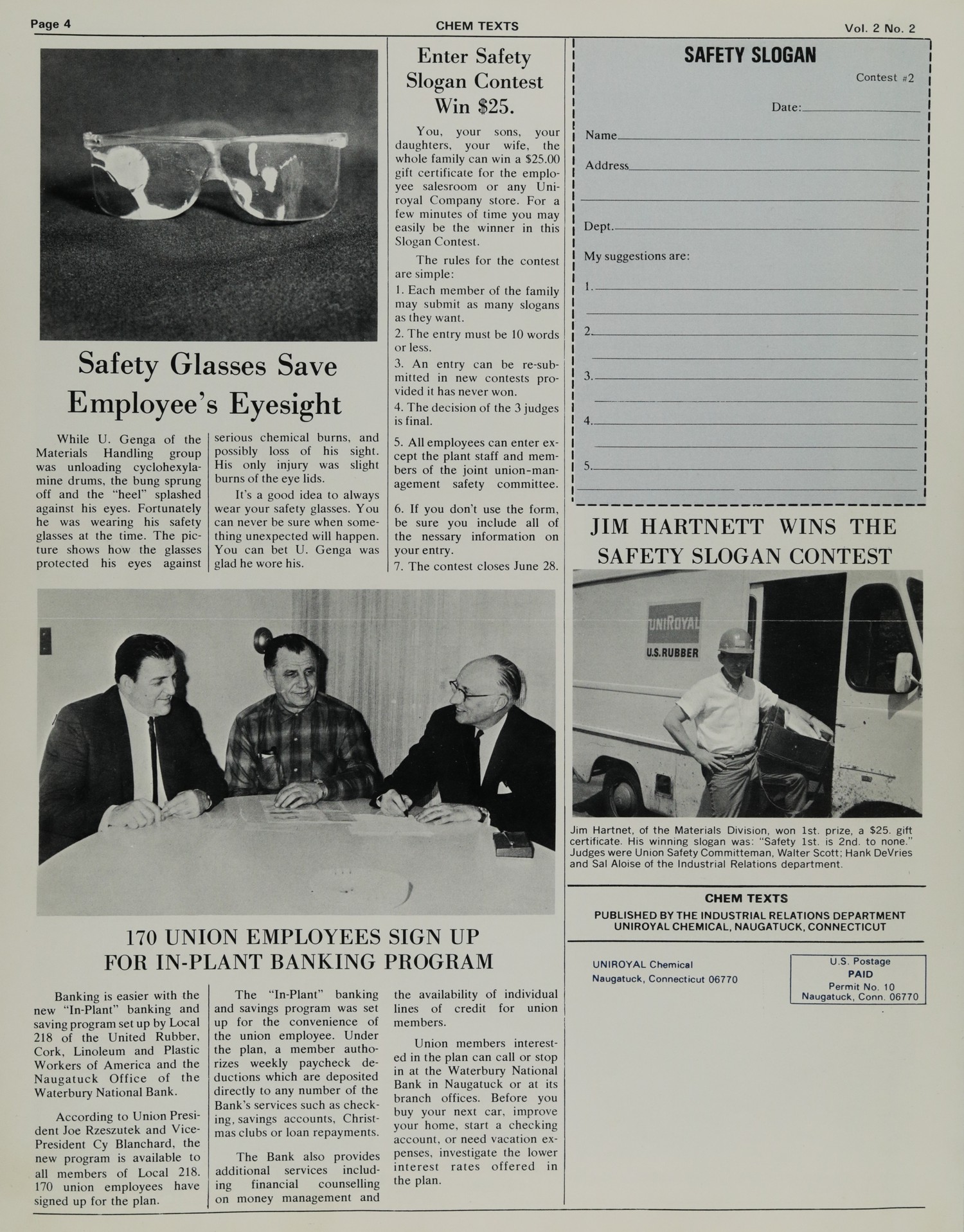
Locally

At a Local 45 membership meeting in May, President George Froehlich reportedly said that the union would not go for a three-year contract nor an agreement that would include pension or fringe benefits.

No new information on the progress of the negotiations in Cincinnati has been released today. Members of the three Locals in the borough, suffering from 54 days without work, are anxious for news of the sessions.

Local strikers, speaking as individuals, are eager for another meeting of the membership.

Union officials have explained that the promised financial help from the auto industry union was in the form of a loan which the union decided not to take, but rather to cut the amount of benefits to its members and seek to raise additional monies from the working members employed at General Tire and Goodyear.

However, one week’s collection amounted to only $6,000 in donations.

Local URW members, when questioned, are wondering if the hold-up in settlement will, in the long run, prove beneficial to the members here in the borough. Local 45 with its more than 4,000 members, is one of the largest in the URW.

URW To Expand Strike

General Tire Added

6-17-67

URW To Expand Strike

AKRON, Ohio—Another rubber company was added to the three already on strike Friday when the executive board of the United Rubber Workers Union voted to send out General Tire and Rubber Co. workers.

More than 3,000 employes in two plants, Akron and Waco, Texas, will be directly affected by the walkout.

Top sources indicated that the picketing would begin sometime during the coming week, possibly Monday or Tuesday.

This is the only major change in the picture, and Uniroyal negotiations were reported as making no progress Friday.

The fact that General Tire’s URW members will be on strike is expected to put pressure on Goodyear, the only company of the so called “big five” not on strike.

General Tire executives were informed of the executive board’s decision Friday evening.

The picketing will also porbably put pressure on the union’s strike fund, already seriously depleted. What financial action the union plans to take to alleviate pressure was not learned Friday.

Although the United Auto Workers union had promised financial aid to the striking union in the form of a loan, the URW has been hesitant to accept the loan and has tried, instead, to raise money through donations from URW members still working.

These efforts have been reportedly unsuccessful, and the original strike fund of $6.5 million has been drained at a rate of $1.25 million a week.

Unfair labor practice charges filed by International Union Pres. Peter Bommarito are presently being investigated by the National Labor Relations Board.

Bommarito charged that the strike pact agreed upon by the companies involved in the negotiations was hindering progress.

The pact reportedly states that companies affected by a strike will be given financial aid by those which are not struck.

Obstacles preventing a settlement at the present time were reported Friday as being mainly economic.

The union feels that the value of the economic offers being made by the companies is not high enough yet.

Sources also indicated that the supplemental unemployment benefits are not high enough, and may well end up as the number one obstacle to a settlement.

According to those close to the negotiations, the companies have a “philosophical objection” to paying people for not working.

In addition it is possible that the auto manufacturers are putting pressure on the rubber firms not to grant the so-called guaranteed annual wage because the car companies will be facing the same request when the United Auto Workers begin talks in July.

The union’s counter proposal, submitted over a week ago, is still being discussed. Talks recessed for the weekend Friday and are scheduled to resume Monday.

Fourth Rubber Co. Struck By URW

Fourth Rubber Co. Struck By URW

6-17-67

The Executive Board of the United Rubber Workers union has voted to call its members out from another of the “Big Five” rubber companies.

More than 3,000 employes in two plants of General Tire and Rubber Co., located in Akron, Ohio, and Waco, Texas, will be involved.

According to sources, picketing at these plants will begin either Monday or Tuesday.

With this new move, union


Local 45 URW has called a mass meeting of its membership for Monday, June 19, at 3 p.m. in the auditorium of the Naugatuck High School.

President of Local 45, home from negotiations sessions in Cincinnati, will address the members and bring them up to date on the progress of the negotiations.


workers in four of the five rubber companies will be out. The fact that General Tire’s URW members will be on strike is expected to put pressure on Goodyear, the only working company.

General Tire executives were informed of the executive board’s decision Friday evening.

The picketing will also probably put pressure on the union’s strike fund, already seriously depleted. What financial action the union plans to take to alleviate pressure was not learned Friday.

Although the United Auto Workers union had promised financial aid to the striking union in the form of a loan, the URW has been hesitant to accept the loan and has tried, instead, to raise money through donations from URW members still

working.

Obstacles preventing a settlement at the present time were reported Friday as being mainly economic.

The union feels that the value of the economic offers being made by the companies is not high enough yet.

Sources also indicated that the supplemental unemployment benefits are not high enough, and may well end up as the number one obstacle to a settlement.

According to those close to the negotiations, the companies have a “philosophical objection” to paying people for not working.

In addition it is possible that the auto manufacturers are putting pressure on the rubber firms not to grant the so-called guaranteed annual wage because the car companies will be facing the same request when the United Auto Workers begin talks in July.

The union’s counter proposal submitted over a week ago, is still being discussed. Talks recessed for the weekend Friday and are scheduled to resume Monday.

AKRON, Ohio (UPI) — The impasse over negotiations in the national rubber strike remained unbroken today with increasing signs the 52,000 striking employes and the United Rubber Workers Union were feeling the pinch.

Rubber workers here—where nearly 10,000 have been on strike for 59 days—were applying for welfare benefits in increasing numbers.

Mrs. Joyce N. Artis, Summit County welfare department representative, said 78 applications

Please turn to Page 10