Strike Benefits Contingent On Picketing

Union VP Says:

5-10-67

Strike Benefits Contingent On Picketing

Cy Blanchard, vice-president of Local 218, in an effort to straighten out some of the confusions surrounding strike benefits, issued the following explanation.

He said receipt of the $25 check depends on whether or not a member appeared for strike duty at least once every five days.

Many of the members, appearing for their checks yesterday, were told that in order to qualify for them they would have to serve on picket duty today before 3 p.m. to make up for lost picket time.

Blanchard stated that with a membership of 530 members available for picket duty, the schedule calls for each man to serve three hours, once very five days. Some members have only been on duty one three-hour period while others have done more than their share.

“We have denied no one benefits,” he said, adding “we are giving every member full opportunity to fulfill his picket obligations.”

Those who are unable to picket because of health or other reasons are put to work at other things to make everything fair, he said.

With each member doing a tour of duty once every five days, the Local is able to maintain a schedule of 110 pickets a day. Blanchard stated that he hoped every member would volunteer his services for picket duty to qualify. The duty must be continued in order to qualify.

The ruling of one three-hour period of picket duty, once every five days, has been cleared through Cincinnati, Blanchard noted.

Picket Duty Explained By Union Head

Picket Duty Explained By Union Head

NAUGATUCK — Some members of United Rubber Workers Local 218 reported evidence of confusion Tuesday over the question of receiving the weekly strike benefit of $25 .According to Vice President of Local 218, Cy Blanchard , receipt of the check depends on whether or not a member appeared for strike duty at least once every five days.

Many of the members, appearing for their benefit checks Tuesday, were told that in order to qualify for them they would have to serve today. They were told that they had until 3 p.m. today to make up lost picket time.

According to Blanchard, with only 530 members available for picket duty, it was necessary to schedule each man at least once every five days. Some men, he said, have appeared only once for a three-hour picket duty, while others have done more than their share.

He noted that although some members were surprised when they heard they had to serve again before qualifying for the checks, he thought it was each man’s duty as a union member to volunteer his services. It seems unfair, he said, that the man who has served only once gets the same benefit as the man who has served many times.

“We have not denied anyone any benefits,” said Blanchard, adding that “we are giving every member full opportunity” to fulfill his picket obligations.

There are some, he said, who are unable to picket because of health or other reasons, but these are also put to work to make everything fair.

Each member is being scheduled once every five days so that there are about 110 pickets every day, he said. He added that he hoped every member would volunteer his services for picket duty to qualify. This picket duty must be continued in order to continue to qualify, said Blanchard.

The ruling that each man picket for three hours once every five days was cleared through Cincinnati, said the Local vice president.

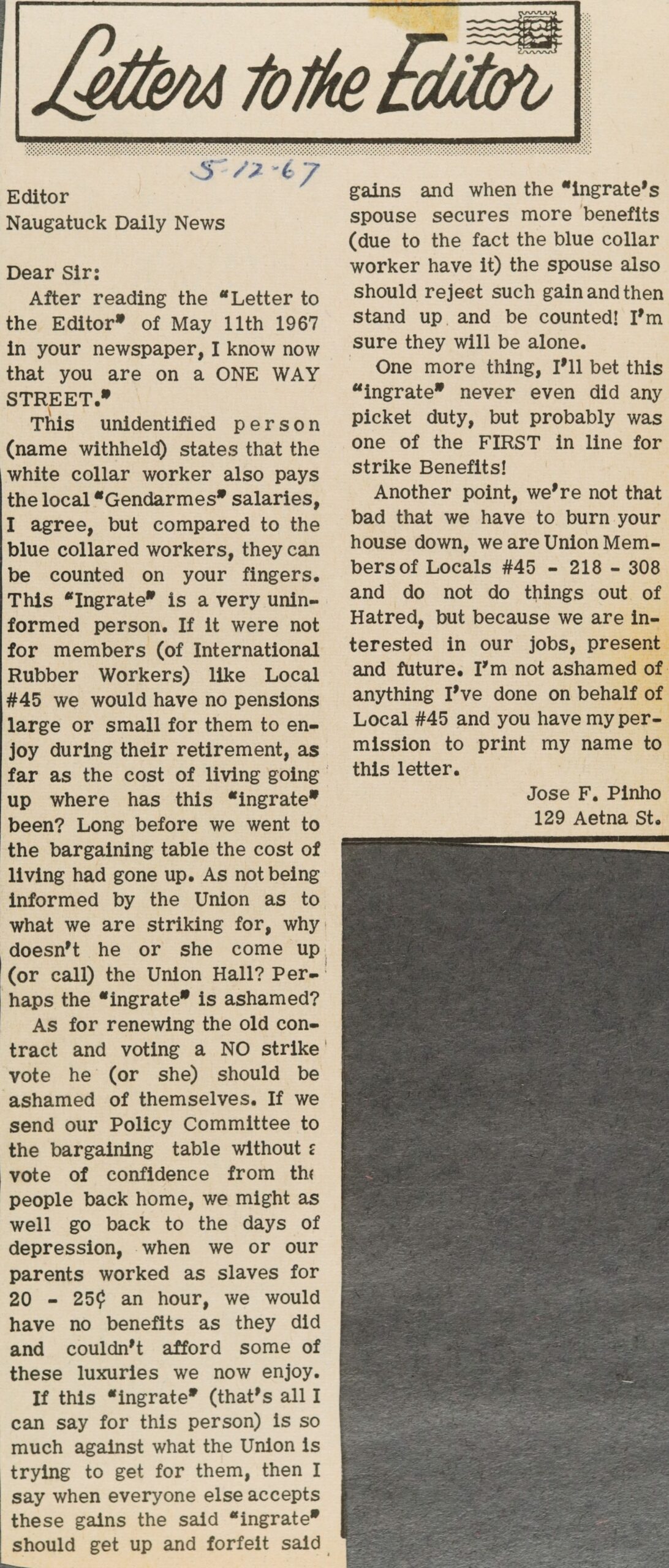
Letters to the Editor

Letters to the Editor

5-12-67

Editor
Naugatuck Daily News

Dear Sir:

After reading the “Letter to the Editor” of May 11th 1967 in your newspaper, I know now that you are on a ONE WAY STREET.”

This unidentified person (name withheld) states that the white collar worker also pays the local “Gendarmes” salaries, I agree, but compared to the blue collared workers, they can be counted on your fingers. This “Ingrate” is a very uninformed person. If it were not for members (of International Rubber Workers) like Local #45 we would have no pensions large or small for them to enjoy during their retirement, as far as the cost of living going up where has this “ingrate” been? Long before we went to the bargaining table the cost of living had gone up. As not being informed by the Union as to what we are striking for, why doesn’t he or she come up (or call) the Union Hall? Perhaps the “ingrate” is ashamed?

As for renewing the old contract and voting a NO strike vote he (or she) should be ashamed of themselves. If we send our Policy Committee to the bargaining table without a vote of confidence from the people back home, we might as well go back to the days of depression, when we or our parents worked as slaves for 20 – 25¢ an hour, we would have no benefits as they did and couldn’t afford some of these luxuries we now enjoy.

If this “ingrate” (that’s all I can say for this person) is so much against what the Union is trying to get for them, then I say when everyone else accepts these gains the said “ingrate” should get up and forfeit said gains and when the “ingrate’s spouse secures more benefits (due to the fact the blue collar worker have it) the spouse also should reject such gain and then stand up and be counted! I’m sure they will be alone.

One more thing, I’ll bet this “ingrate” never even did any picket duty, but probably was one of the FIRST in line for strike Benefits!

Another point, we’re not that bad that we have to burn your house down, we are Union Members of Locals #45 – 218 – 308 and do not do things out of Hatred, but because we are interested in our jobs, present and future. I’m not ashamed of anything I’ve done on behalf of Local #45 and you have my permission to print my name to this letter.

Jose F. Pinho
129 Aetna St.

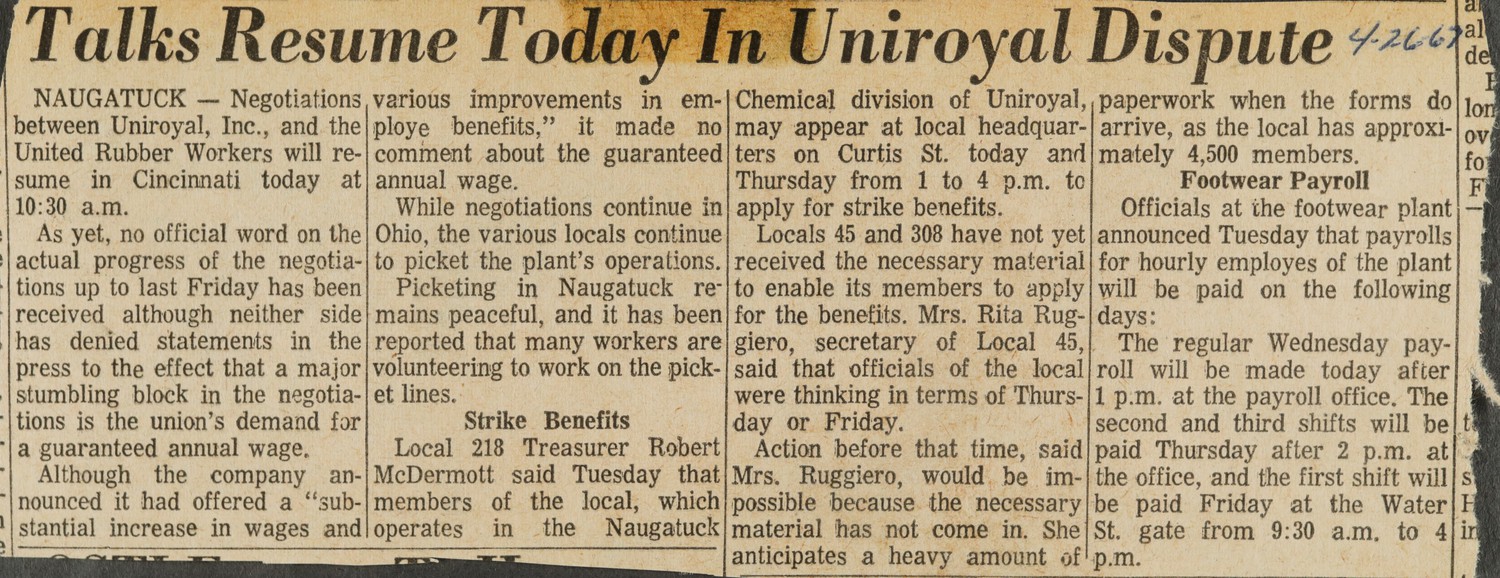
Talks Resume Today In Uniroyal Dispute

Talks Resume Today In Uniroyal Dispute

4-26-67 [handwritten]

NAUGATUCK — Negotiations between Uniroyal, Inc., and the United Rubber Workers will resume in Cincinnati today at 10:30 a.m.

As yet, no official word on the actual progress of the negotiations up to last Friday has been received although neither side has denied statements in the press to the effect that a major stumbling block in the negotiations is the union’s demand for a guaranteed annual wage.

Although the company announced it had offered a “substantial increase in wages and various improvements in employe benefits,” it made no comment about the guaranteed annual wage.

While negotiations continue in Ohio, the various locals continue to picket the plant’s operations. Picketing in Naugatuck remains peaceful, and it has been reported that many workers are volunteering to work on the picket lines.

Strike Benefits

Local 218 Treasurer Robert McDermott said Tuesday that members of the local, which operates in the Naugatuck Chemical division of Uniroyal, may appear at local headquarters on Curtis St. today and Thursday from 1 to 4 p.m. to apply for strike benefits.

Locals 45 and 308 have not yet received the necessary material to enable its members to apply for the benefits. Mrs. Rita Ruggiero, secretary of Local 45, said that officials of the local were thinking in terms of Thursday or Friday.

Action before that time, said Mrs. Ruggiero, would be impossible because the necessary material has not come in. She anticipates a heavy amount of paperwork when the forms do arrive, as the local has approximately 4,500 members.

Footwear Payroll

Officials at the footwear plant announced Tuesday that payrolls for hourly employes of the plant will be paid on the following days:

The regular Wednesday payroll will be made today after 1 p.m. at the payroll office. The second and third shifts will be paid Thursday after 2 p.m. at the office, and the first shift will be paid Friday at the Water St. gate from 9:30 a.m. to 4 p.m.

US Rubber Proxy Statement – Page 8

Page 008

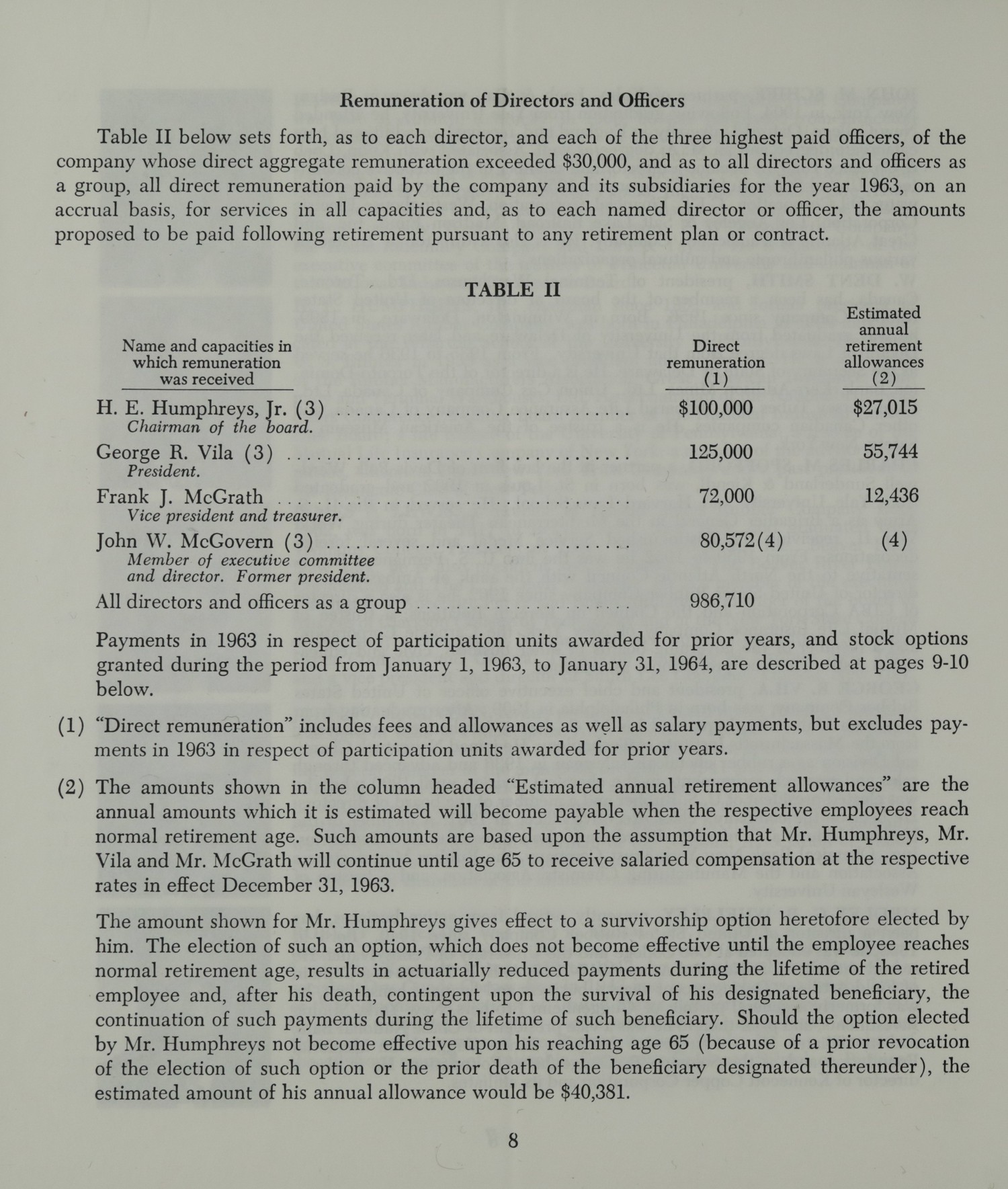
Remuneration of Directors and Officers

Table II below sets forth, as to each director, and each of the three highest paid officers, of the company whose direct aggregate remuneration exceeded $30,000, and as to all directors and officers as a group, all direct remuneration paid by the company and its subsidiaries for the year 1963, on an accrual basis, for services in all capacities and, as to each named director or officer, the amounts proposed to be paid following retirement pursuant to any retirement plan or contract.

TABLE II
Estimated
Name and capacities in Direct annual
which remuneration remuneration retirement
was received (1) allowances (2)
H. E. Humphreys, Jr. (3) $100,000 $27,015
Chairman of the board.
George R. Vila (3) 125,000 55,744
President.
Frank J. McGrath 72,000 12,436
Vice president and treasurer.
John W. McGovern (3) 80,572(4) (4)
Member of executive committee
and director. Former president.
All directors and officers as a group 986,710

Payments in 1963 in respect of participation units awarded for prior years, and stock options granted during the period from January 1, 1963, to January 31, 1964, are described at pages 9-10 below.

(1) “Direct remuneration” includes fees and allowances as well as salary payments, but excludes payments in 1963 in respect of participation units awarded for prior years.

(2) The amounts shown in the column headed “Estimated annual retirement allowances” are the annual amounts which it is estimated will become payable when the respective employees reach normal retirement age. Such amounts are based upon the assumption that Mr. Humphreys, Mr. Vila and Mr. McGrath will continue until age 65 to receive salaries compensation at the respective rates in effect December 31, 1963.

The amount shown for Mr. Humphreys gives effect to a survivorship option heretofore elected by him. The election of such an option, which does not become effective until the employee reaches normal retirement age, results in actuarially reduced payments during the lifetime of the retired employee and, after his death, contingent upon the survival of his designated beneficiary, the continuation of such payments during the lifetime of such beneficiary. Should the option elected by Mr. Humphreys not become effective upon his reaching age 65 (because of a prior revocation of the election of such option or the prior death of the beneficiary designated thereunder), the estimated amount of his annual allowance would be $40,331.

US Rubber Proxy Statement – Page 9

Page 009

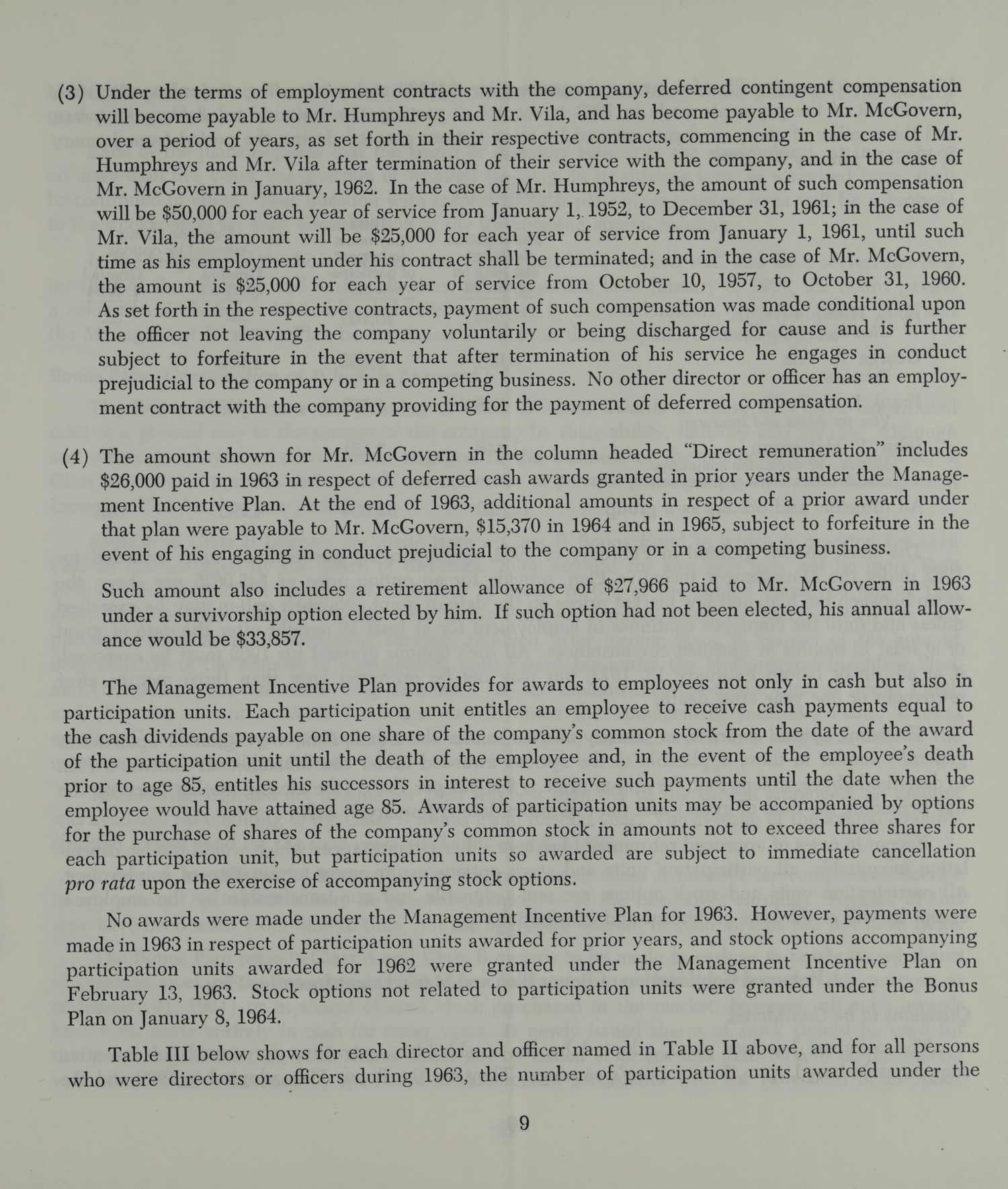
(3) Under the terms of employment contracts with the company, deferred contingent compensation will become payable to Mr. Humphreys and Mr. Vila, and has become payable to Mr. McGovern, over a period of years, as set forth in their respective contracts, commencing in the case of Mr. Humphreys and Mr. Vila after termination of their service with the company, and in the case of Mr. McGovern in January, 1962. In the case of Mr. Humphreys, the amount of such compensation will be $50,000 for each year of service from January 1, 1952, to December 31, 1961; in the case of Mr. Vila, the amount will be $25,000 for each year of service from January 1, 1961, until such time as his employment under his contract shall be terminated; and in the case of Mr. McGovern, the amount is $25,000 for each year of service from October 10, 1957, to October 31, 1960. As set forth in the respective contracts, payment of such compensation was made conditional upon the officer not leaving the company voluntarily or being discharged for cause and is further subject to forfeiture in the event that after termination of his service he engages in conduct prejudicial to the company or in a competing business. No other director or officer has an employment contract with the company providing for the payment of deferred compensation.

(4) The amount shown for Mr. McGovern in the column headed “Direct remuneration” includes $26,000 paid in 1963 in respect of deferred cash awards granted in prior years under the Management Incentive Plan. At the end of 1963, additional amounts in respect of a prior award under that plan were payable to Mr. McGovern, $15,370 in 1964 and in 1965, subject to forfeiture in the event of his engaging in conduct prejudicial to the company or in a competing business.

Such amount also includes a retirement allowance of $27,966 paid to Mr. McGovern in 1963 under a survivorship option elected by him. If such option had not been elected, his annual allowance would be $33,857.

The Management Incentive Plan provides for awards to employees not only in cash but also in participation units. Each participation unit entitles an employee to receive cash payments equal to the cash dividends payable on one share of the company’s common stock from the date of the award of the participation unit until the death of the employee and, in the event of the employee’s death prior to age 65, entitles his successors in interest to receive such payments until the date when the employee would have attained age 65. Awards of participation units may be accompanied by options for the purchase of shares of the company’s common stock in amounts not to exceed three shares for each participation unit, but participation units so awarded are subject to immediate cancellation pro rata upon the exercise of accompanying stock options.

No awards were made under the Management Incentive Plan for 1963. However, payments were made in 1963 in respect of participation units awarded for prior years, and stock options accompanying participation units awarded for 1962 were granted under the Management Incentive Plan on February 13, 1963. Stock options not related to participation units were granted under the Bonus Plan on January 8, 1964.

Table III below shows for each director and officer named in Table II above, and for all persons who were directors or officers during 1963, the number of participation units awarded under the Management Incentive Plan.

US Rubber Proxy Statement – Page 15

Page 015

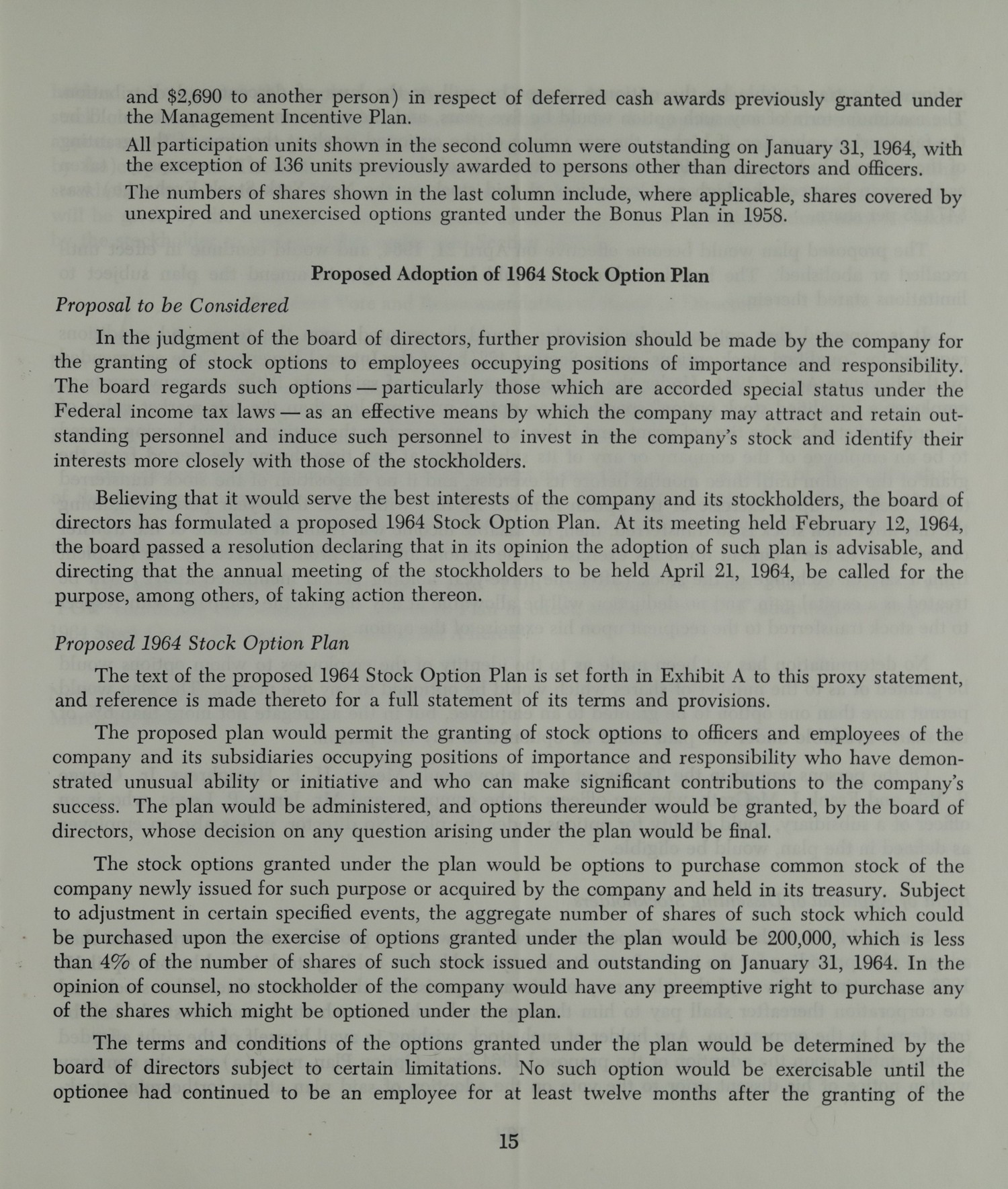
and $2,690 to another person) in respect of deferred cash awards previously granted under the Management Incentive Plan.

All participation units shown in the second column were outstanding on January 31, 1964, with the exception of 136 units previously awarded to persons other than directors and officers.

The numbers of shares shown in the last column include, where applicable, shares covered by unexpired and unexercised options granted under the Bonus Plan in 1958.

Proposed Adoption of 1964 Stock Option Plan

Proposal to be Considered

In the judgment of the board of directors, further provision should be made by the company for the granting of stock options to employees occupying positions of importance and responsibility. The board regards such options — particularly those which are accorded special status under the Federal income tax laws — as an effective means by which the company may attract and retain outstanding personnel and induce such personnel to invest in the company’s stock and identify their interests more closely with those of the stockholders.

Believing that it would serve the best interests of the company and its stockholders, the board of directors has formulated a proposed 1964 Stock Option Plan. At its meeting held February 12, 1964, the board passed a resolution declaring that in its opinion the adoption of such plan is advisable, and directing that the annual meeting of the stockholders to be held April 21, 1964, be called for the purpose, among others, of taking action thereon.

Proposed 1964 Stock Option Plan

The text of the proposed 1964 Stock Option Plan is set forth in Exhibit A to this proxy statement, and reference is made thereto for a full statement of its terms and provisions.

The proposed plan would permit the granting of stock options to officers and employees of the company and its subsidiaries occupying positions of importance and responsibility who have demonstrated unusual ability or initiative and who can make significant contributions to the company’s success. The plan would be administered, and options thereunder would be granted, by the board of directors, whose decision on any question arising under the plan would be final.

The stock options granted under the plan would be options to purchase common stock of the company newly issued for such purpose or acquired by the company and held in its treasury. Subject to adjustment in certain specified events, the aggregate number of shares of such stock which could be purchased upon the exercise of options granted under the plan would be 200,000, which is less than 4% of the number of shares of such stock issued and outstanding on January 31, 1964. In the opinion of counsel, no stockholder of the company would have any preemptive right to purchase any of the shares which might be optioned under the plan.

The terms and conditions of the options granted under the plan would be determined by the board of directors subject to certain limitations. No such option would be exercisable until the optionee had continued to be an employee for at least twelve months after the granting of the

US Rubber Proxy Statement – Page 17

Page 017

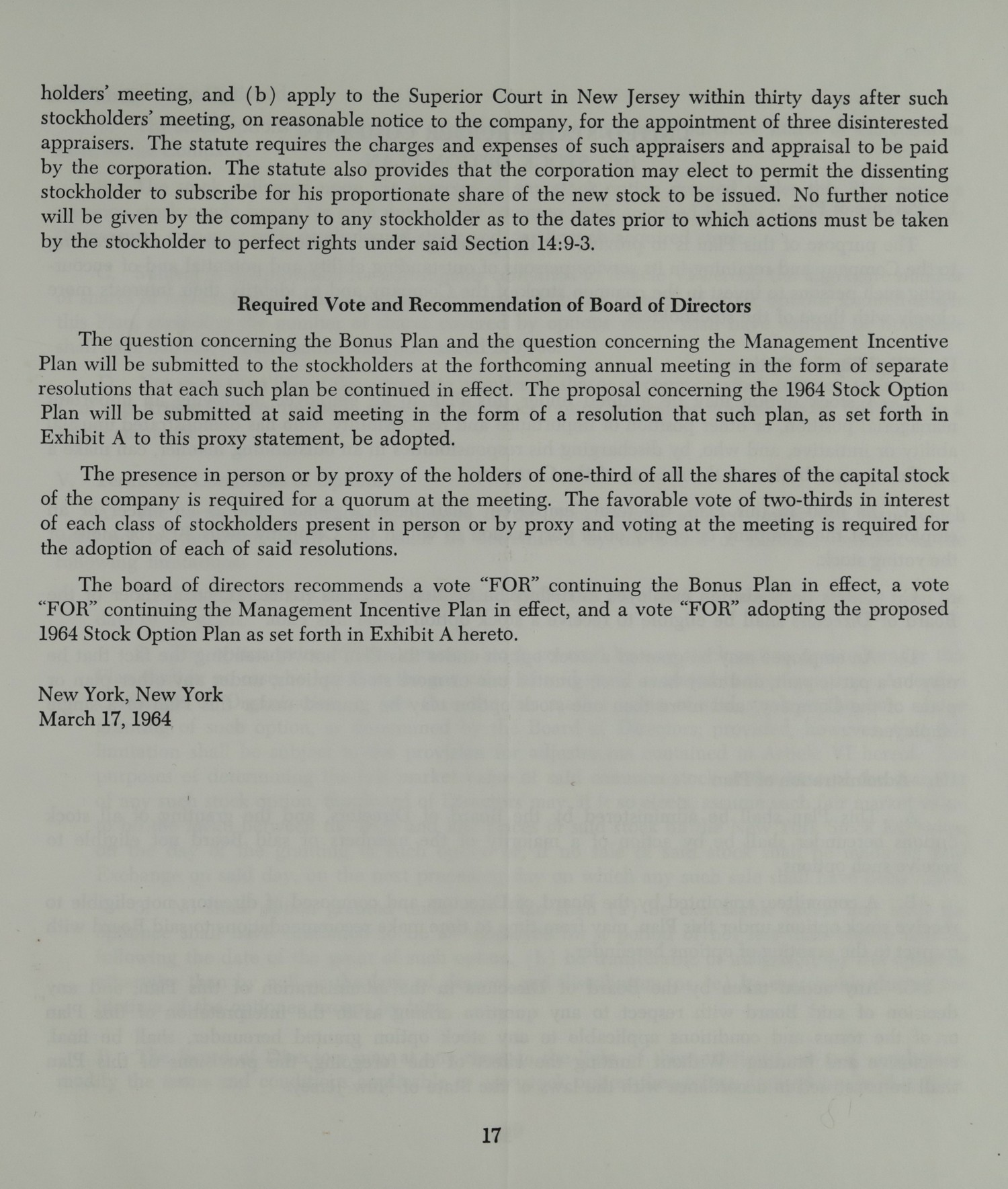
holders’ meeting, and (b) apply to the Superior Court in New Jersey within thirty days after such stockholders’ meeting, on reasonable notice to the company, for the appointment of three disinterested appraisers. The statute requires the charges and expenses of such appraisers and appraisal to be paid by the corporation. The statute also provides that the corporation may elect to permit the dissenting stockholder to subscribe for his proportionate share of the new stock to be issued. No further notice will be given by the company to any stockholder as to the dates prior to which actions must be taken by the stockholder to perfect rights under said Section 14:9-3.

Required Vote and Recommendation of Board of Directors

The question concerning the Bonus Plan and the question concerning the Management Incentive Plan will be submitted to the stockholders at the forthcoming annual meeting in the form of separate resolutions that each such plan be continued in effect. The proposal concerning the 1964 Stock Option Plan will be submitted at said meeting in the form of a resolution that such plan, as set forth in Exhibit A to this proxy statement, be adopted.

The presence in person or by proxy of the holders of one-third of all the shares of the capital stock of the company is required for a quorum at the meeting. The favorable vote of two-thirds in interest of each class of stockholders present in person or by proxy and voting at the meeting is required for the adoption of each of said resolutions.

The board of directors recommends a vote “FOR” continuing the Bonus Plan in effect, a vote “FOR” continuing the Management Incentive Plan in effect, and a vote “FOR” adopting the proposed 1964 Stock Option Plan as set forth in Exhibit A hereto.

New York, New York
March 17, 1964

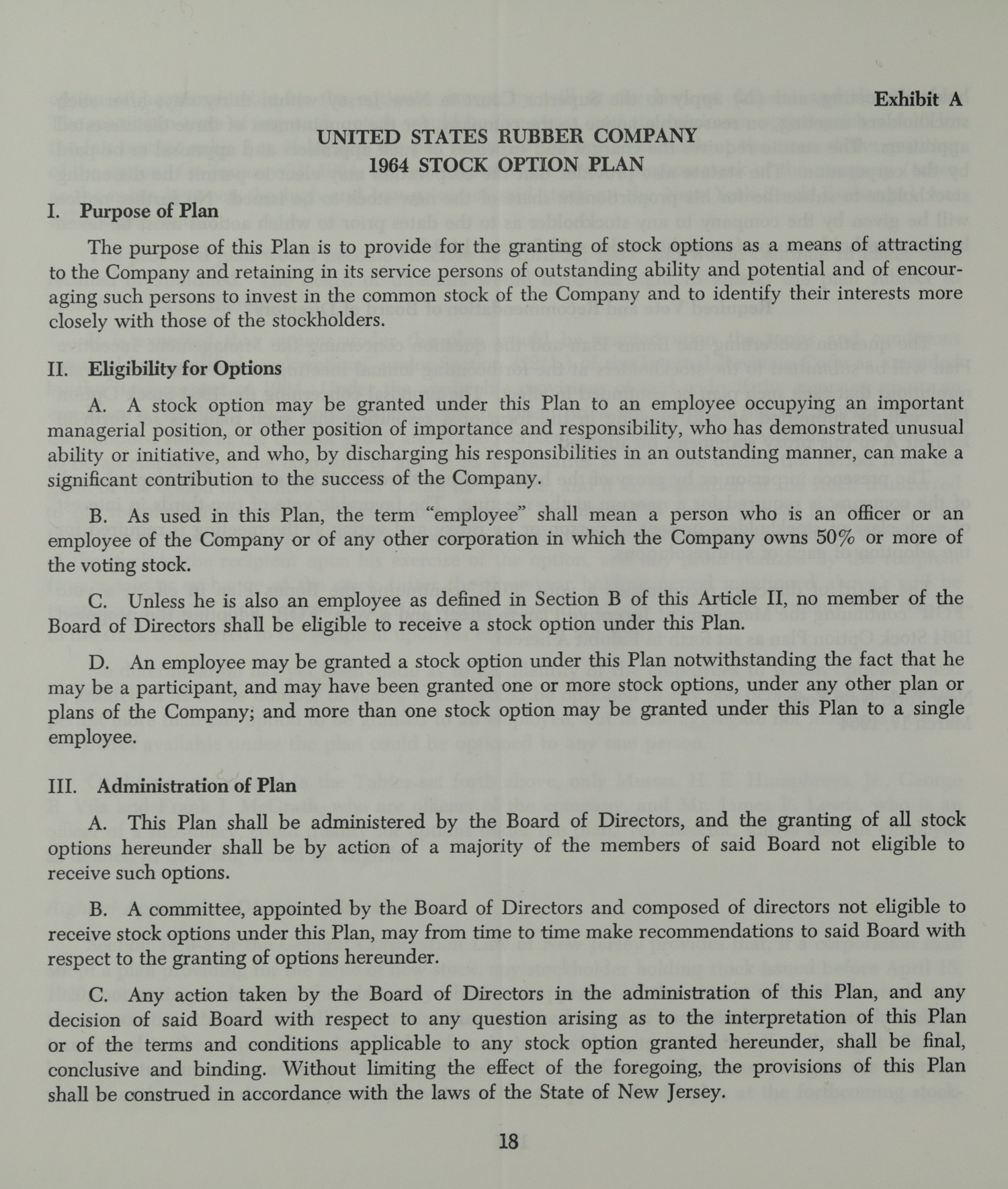
US Rubber Proxy Statement – Page Exhibit A

Page exhibit-a

UNITED STATES RUBBER COMPANY
1964 STOCK OPTION PLAN

I. Purpose of Plan
The purpose of this Plan is to provide for the granting of stock options as a means of attracting to the Company and retaining in its service persons of outstanding ability and potential and of encouraging such persons to invest in the common stock of the Company and to identify their interests more closely with those of the stockholders.

II. Eligibility for Options
A. A stock option may be granted under this Plan to an employee occupying an important managerial position, or other position of importance and responsibility, who has demonstrated unusual ability or initiative, and who, by discharging his responsibilities in an outstanding manner, can make a significant contribution to the success of the Company.
B. As used in this Plan, the term “employee” shall mean a person who is an officer or an employee of the Company or of any other corporation in which the Company owns 50% or more of the voting stock.
C. Unless he is also an employee as defined in Section B of this Article II, no member of the Board of Directors shall be eligible to receive a stock option under this Plan.
D. An employee may be granted a stock option under this Plan notwithstanding the fact that he may be a participant, and may have been granted one or more stock options, under any other plan or plans of the Company; and more than one stock option may be granted under this Plan to a single employee.

III. Administration of Plan
A. This Plan shall be administered by the Board of Directors, and the granting of all stock options hereunder shall be by action of a majority of the members of said Board not eligible to receive such options.
B. A committee, appointed by the Board of Directors and composed of directors not eligible to receive stock options under this Plan, may from time to time make recommendations to said Board with respect to the granting of options hereunder.
C. Any action taken by the Board of Directors in the administration of this Plan, and any decision of said Board with respect to any question arising as to the interpretation of this Plan or of the terms and conditions applicable to any stock option granted hereunder, shall be final, conclusive and binding. Without limiting the effect of the foregoing, the provisions of this Plan shall be construed in accordance with the laws of the State of New Jersey.

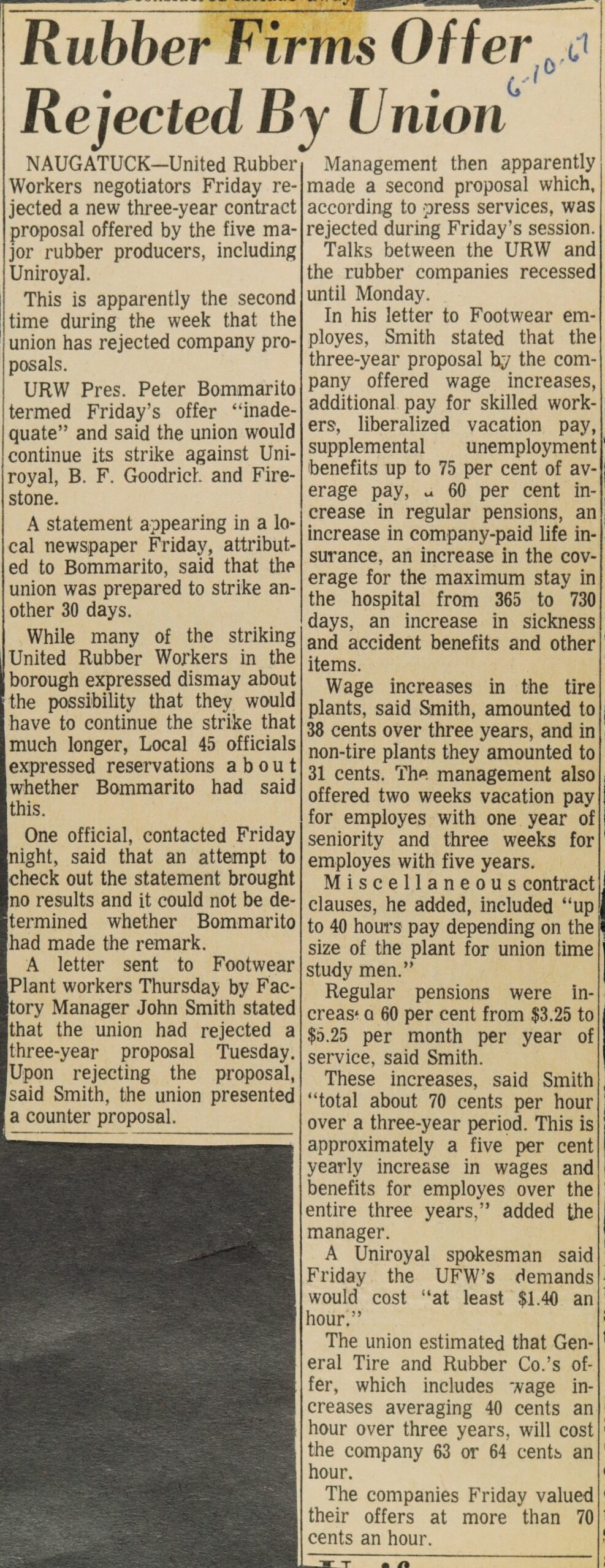
Rubber Firms Offer Rejected By Union

Rubber Firms Offer Rejected By Union

6-10-67 (handwritten)

NAUGATUCK—United Rubber Workers negotiators Friday rejected a new three-year contract proposal offered by the five major rubber producers, including Uniroyal.

This is apparently the second time during the week that the union has rejected company proposals.

URW Pres. Peter Bommarito termed Friday’s offer “inadequate” and said the union would continue its strike against Uniroyal, B. F. Goodrich and Firestone.

A statement appearing in a local newspaper Friday, attributed to Bommarito, said that the union was prepared to strike another 30 days.

While many of the striking United Rubber Workers in the borough expressed dismay about the possibility that they would have to continue the strike that much longer, Local 45 officials expressed reservations about whether Bommarito had said this.

One official, contacted Friday night, said that an attempt to check out the statement brought no results and it could not be determined whether Bommarito had made the remark.

A letter sent to Footwear Plant workers Thursday by Factory Manager John Smith stated that the union had rejected a three-year proposal Tuesday. Upon rejecting the proposal, said Smith, the union presented a counter proposal.

Management then apparently made a second proposal which, according to press services, was rejected during Friday’s session.

Talks between the URW and the rubber companies recessed until Monday.

In his letter to Footwear employes, Smith stated that the three-year proposal by the company offered wage increases, additional pay for skilled workers, liberalized vacation pay, supplemental unemployment benefits up to 75 per cent of average pay, a 60 per cent increase in regular pensions, an increase in company-paid life insurance, an increase in the coverage for the maximum stay in the hospital from 365 to 730 days, an increase in sickness and accident benefits and other items.

Wage increases in the tire plants, said Smith, amounted to 38 cents over three years, and in non-tire plants they amounted to 31 cents. The management also offered two weeks vacation pay for employes with one year of seniority and three weeks for employes with five years.

Miscellaneous contract clauses, he added, included “up to 40 hours pay depending on the size of the plant for union time study men.”

Regular pensions were increase a 60 per cent from $3.25 to $5.25 per month per year of service, said Smith.

These increases, said Smith “total about 70 cents per hour over a three-year period. This is approximately a five per cent yearly increase in wages and benefits for employes over the entire three years,” added the manager.

A Uniroyal spokesman said Friday the UFW’s demands would cost “at least $1.40 an hour.”

The union estimated that General Tire and Rubber Co.’s offer, which includes wage increases averaging 40 cents an hour over three years, will cost the company 63 or 64 cents an hour.

The companies Friday valued their offers at more than 70 cents an hour.

The above increases in wages and benefits togal about 70¢ per hour over a three year period.

The above increases in wages
and benefits togal about 70¢
per hour over a three year
period. This is approximately
a 5% yearly increase in wages
and benefits for employees over
the entire three years. It is the
equivalent of the settlement ne-
gotiated in other industries
which have been referred to
by the Union as necessary to
resolve these negotiations. It
was the most substantial and
costly offer ever made by this
Company to the Union.

This proposal was rejected
by the Union late in the after-
noon of June 6. The Union, in
rejecting the above Company of-
fer, made a counter proposal
which excluded any considera-
tion of pensions and insurances
and held to a number of costly
demands which were made be-
fore the strike started.

Sincerely,
Jack M. Smith
Factory Manager

The release of the letter,
and articles read in the paper
were the only announcements
of the proposals the union mem-
bership received. No meetings
were called to allow the general
membership to express their
pleasure or displeasure of the
company’s offer.

Local 45 has held only one
membership meeting, since the
members authorized the nego-
tiators to call a strike. Presi-
dent George Froehlich, then
complained that the company
was not bargaining and only
throwing “bits of silver” on the
table. He said that the union

was seeking decent treatment
for the employes and also com-
plained of the differential be-
tween tire workers and non-
tire workers.

Tire workers now average
about $3.69 an hour while other
rubber industry production
workers average $2.68 an hour.

The three-year contract is
also said to be a stumbling
block in settlement.

Vice-president of Local 45,
Raymond Mengacci, told the
NEWS this morning, that he was
aware of the letter, but had not
as yet had time to read and
digest its contents. He said
that he will be prepared to
comment on it after he has
had time to study it.

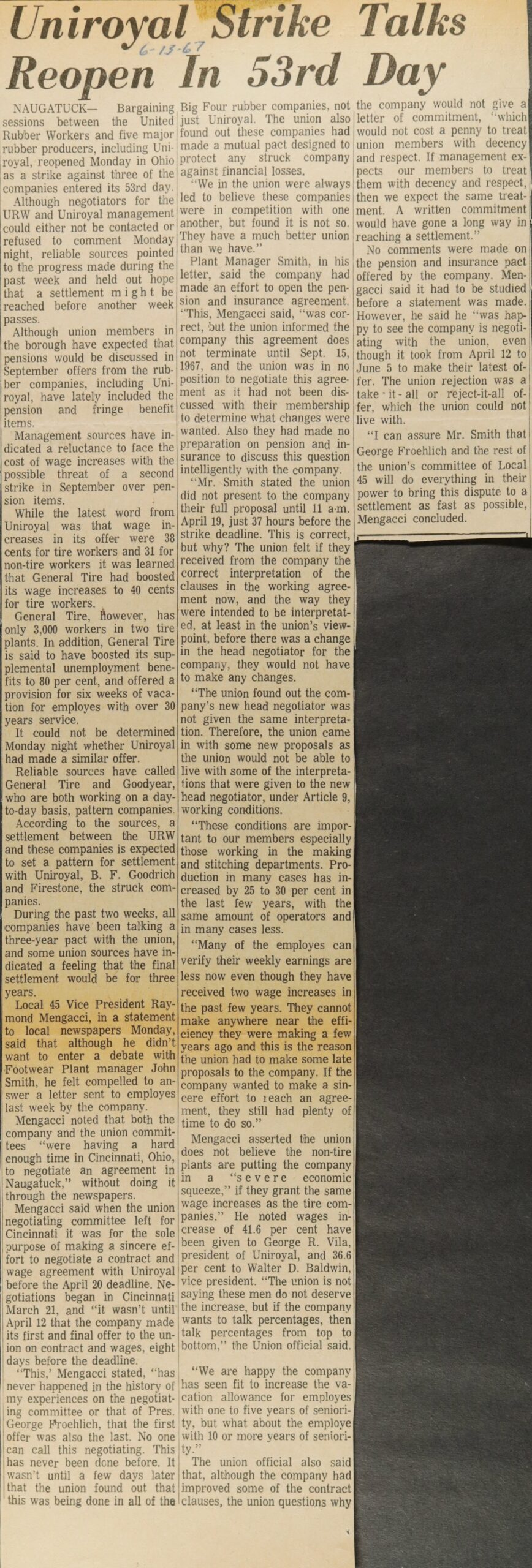
Uniroyal Strike Talks Reopen In 53rd Day

Uniroyal Strike Talks Reopen In 53rd Day

6-13-67

NAUGATUCK— Bargaining sessions between the United Rubber Workers and five major rubber producers, including Uniroyal, reopened Monday in Ohio as a strike against three of the companies entered its 53rd day.

Although negotiators for the URW and Uniroyal management could either not be contacted or refused to comment Monday night, reliable sources pointed to the progress made during the past week and held out hope that a settlement might be reached before another week passes.

Although union members in the borough have expected that pensions would be discussed in September offers from the rubber companies, including Uniroyal, have lately included the pension and fringe benefit items.

Management sources have indicated a reluctance to face the cost of wage increases with the possible threat of a second strike in September over pension items.

While the latest word from Uniroyal was that wage increases in its offer were 38 cents for tire workers and 31 for non-tire workers it was learned that General Tire had boosted its wage increases to 40 cents for tire workers.

General Tire, however, has only 3,000 workers in two tire plants. In addition, General Tire is said to have boosted its supplemental unemployment benefits to 80 per cent, and offered a provision for six weeks of vacation for employes with over 30 years service.

It could not be determined Monday night whether Uniroyal had made a similar offer.

Reliable sources have called General Tire and Goodyear, who are both working on a day-to-day basis, pattern companies.

According to the sources, a settlement between the URW and these companies is expected to set a pattern for settlement with Uniroyal, B. F. Goodrich and Firestone, the struck companies.

During the past two weeks, all companies have been talking a three-year pact with the union, and some union sources have indicated a feeling that the final settlement would be for three years.

Local 45 Vice President Raymond Mengacci, in a statement to local newspapers Monday, said that although he didn’t want to enter a debate with Footwear Plant manager John Smith, he felt compelled to answer a letter sent to employes last week by the company.

Mengacci noted that both the company and the union committees “were having a hard enough time in Cincinnati, Ohio, to negotiate an agreement in Naugatuck,” without doing it through the newspapers.

Mengacci said when the union negotiating committee left for Cincinnati it was for the sole purpose of making a sincere effort to negotiate a contract and wage agreement with Uniroyal before the April 20 deadline. Negotiations began in Cincinnati March 21, and “it wasn’t until April 12 that the company made its first and final offer to the union on contract and wages, eight days before the deadline.

“This,” Mengacci stated, “has never happened in the history of my experiences on the negotiating committee or that of Pres. George Froehlich, that the first offer was also the last. No one can call this negotiating. This has never been done before. It wasn’t until a few days later that the union found out that this was being done in all of the Big Four rubber companies, not just Uniroyal. The union also found out these companies had made a mutual pact designed to protect any struck company against financial losses.

“We in the union were always led to believe these companies were in competition with one another, but found it is not so. They have a much better union than we have.”

Plant Manager Smith, in his letter, said the company had made an effort to open the pension and insurance agreement. “This, Mengacci said, “was correct, but the union informed the company this agreement does not terminate until Sept. 15, 1967, and the union was in no position to negotiate this agreement as it had not been discussed with their membership to determine what changes were wanted. Also they had made no preparation on pension and insurance to discuss this question intelligently with the company.

“Mr. Smith stated the union did not present to the company their full proposal until 11 a.m. April 19, just 37 hours before the strike deadline. This is correct, but why? The union felt if they received from the company the correct interpretation of the clauses in the working agreement now, and the way they were intended to be interpreted, at least in the union’s viewpoint, before there was a change in the head negotiator for the company, they would not have to make any changes.

“The union found out the company’s new head negotiator was not given the same interpretation. Therefore, the union came in with some new proposals as the union would not be able to live with some of the interpretations that were given to the new head negotiator, under Article 9, working conditions.

“These conditions are important to our members especially those working in the making and stitching departments. Production in many cases has increased by 25 to 30 per cent in the last few years, with the same amount of operators and in many cases less.

“Many of the employes can verify their weekly earnings are less now even though they have received two wage increases in the past few years. They cannot make anywhere near the efficiency they were making a few years ago and this is the reason the union had to make some late proposals to the company. If the company wanted to make a sincere effort to reach an agreement, they still had plenty of time to do so.”

Mengacci asserted the union does not believe the non-tire plants are putting the company in a “severe economic squeeze,” if they grant the same wage increases as the tire companies.” He noted wages increase of 41.6 per cent have been given to George R. Vila, president of Uniroyal, and 36.6 per cent to Walter D. Baldwin, vice president. “The union is not saying these men do not deserve the increase, but if the company wants to talk percentages, then talk percentages from top to bottom,” the Union official said.

“We are happy the company has seen fit to increase the vacation allowance for employes with one to five years of seniority, but what about the employe with 10 or more years of seniority.”

The union official also said that, although the company had improved some of the contract clauses, the union questions why the company would not give a letter of commitment, “which would not cost a penny to treat union members with decency and respect. If management expects our members to treat them with decency and respect, then we expect the same treatment. A written commitment would have gone a long way in reaching a settlement.”

No comments were made on the pension and insurance pact offered by the company. Mengacci said it had to be studied before a statement was made. However, he said he “was happy to see the company is negotiating with the union, even though it took from April 12 to June 5 to make their latest offer. The union rejection was a take-it-all or reject-it-all offer, which the union could not live with.

“I can assure Mr. Smith that George Froehlich and the rest of the union’s committee of Local 45 will do everything in their power to bring this dispute to a settlement as fast as possible,” Mengacci concluded.

Federal Mediation

Federal Mediation

area.

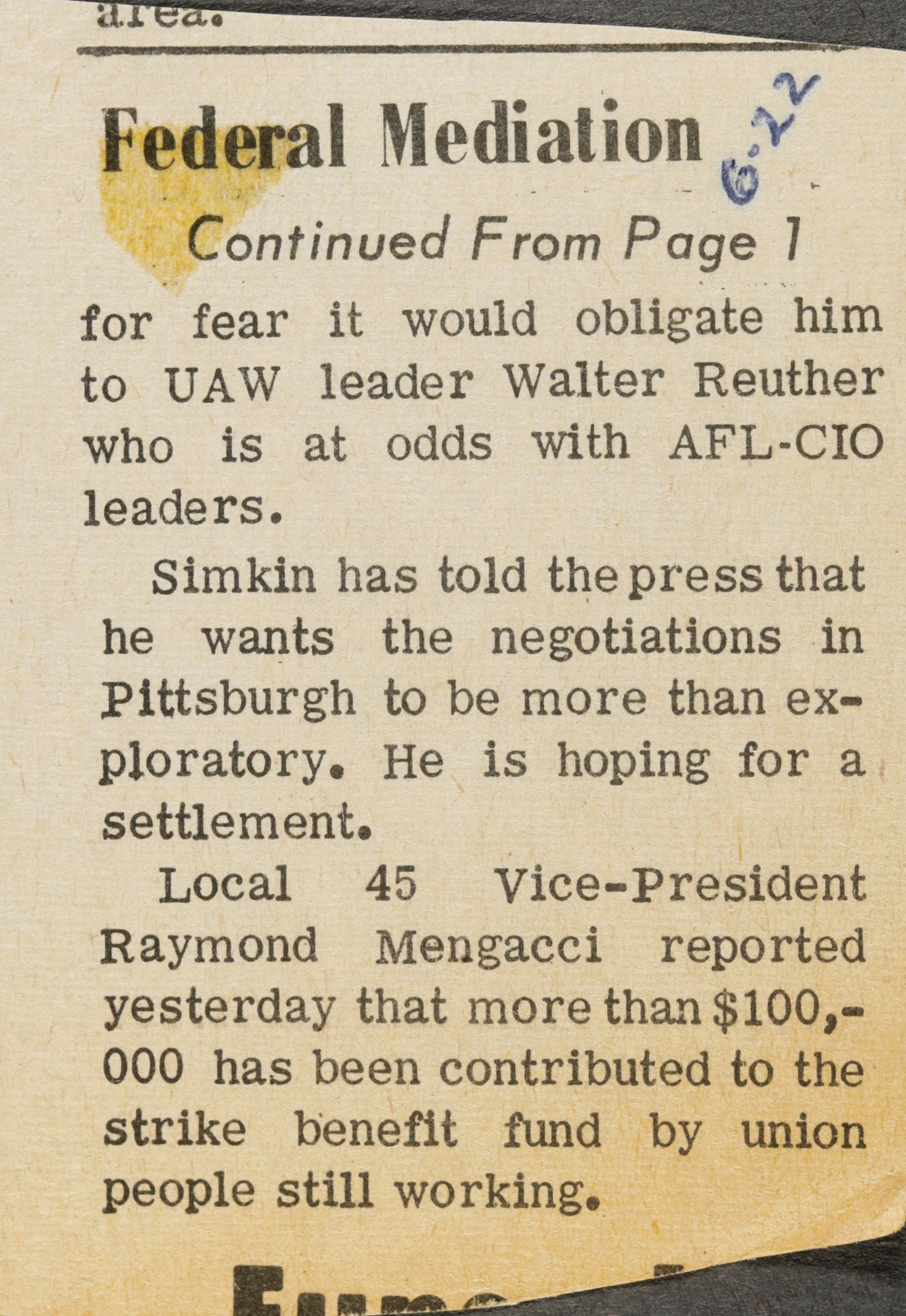
Federal Mediation 6-22

Continued From Page 1

for fear it would obligate him
to UAW leader Walter Reuther
who is at odds with AFL-CIO
leaders.

Simkin has told the press that
he wants the negotiations in
Pittsburgh to be more than ex-
ploratory. He is hoping for a
settlement.

Local 45 Vice-President
Raymond Mengacci reported
yesterday that more than $100,-
000 has been contributed to the
strike benefit fund by union
people still working.

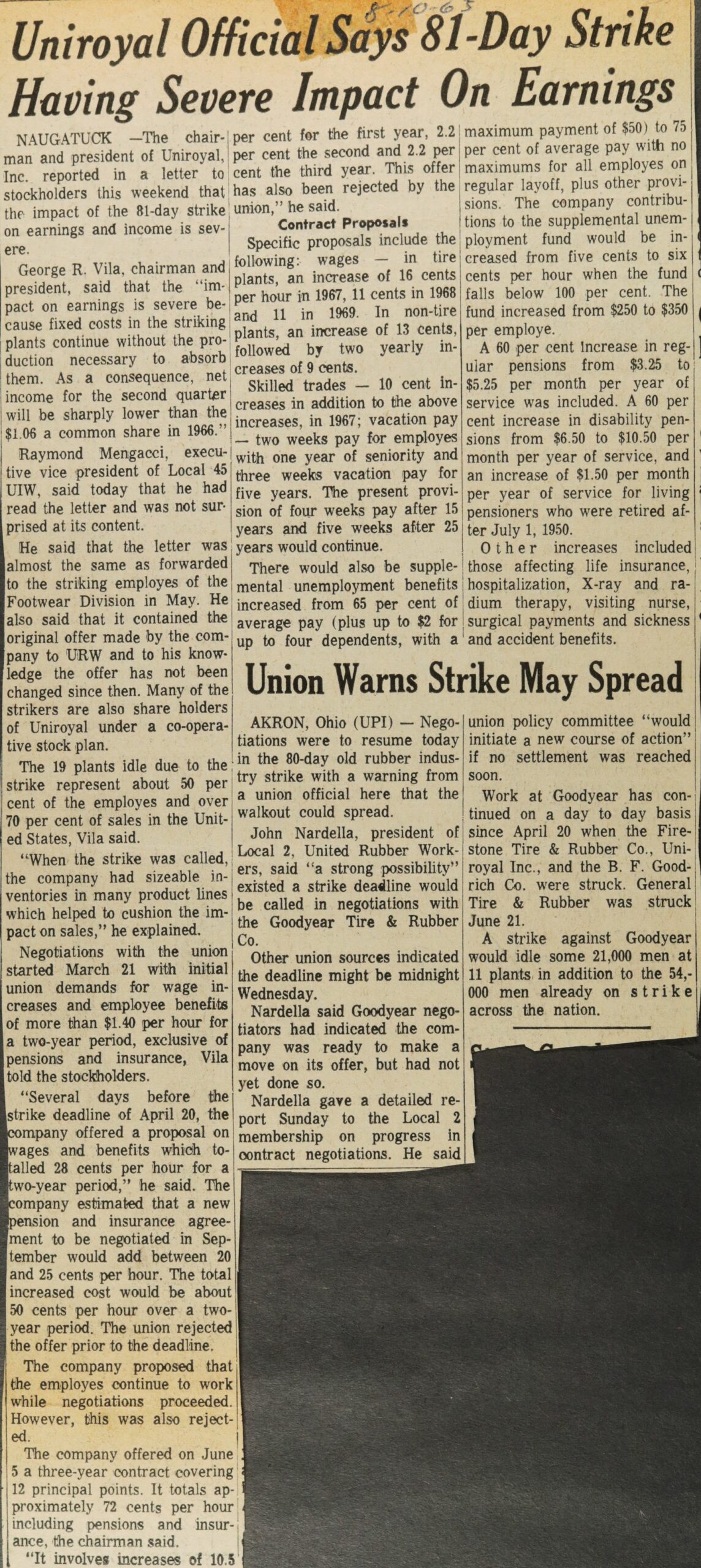
Uniroyal Official Says 81-Day Strike Having Severe Impact On Earnings

Uniroyal Official Says 81-Day Strike Having Severe Impact On Earnings

8-10-63 [handwritten]

NAUGATUCK —The chairman and president of Uniroyal, Inc. reported in a letter to stockholders this weekend that the impact of the 81-day strike on earnings and income is severe.

George R. Vila, chairman and president, said that the “impact on earnings is severe because fixed costs in the striking plants continue without the production necessary to absorb them. As a consequence, net income for the second quarter will be sharply lower than the $1.06 a common share in 1966.”

Raymond Mengacci, executive vice president of Local 45 UIW, said today that he had read the letter and was not surprised at its content.

He said that the letter was almost the same as forwarded to the striking employes of the Footwear Division in May. He also said that it contained the original offer made by the company to URW and to his knowledge the offer has not been changed since then. Many of the strikers are also share holders of Uniroyal under a co-operative stock plan.

The 19 plants idle due to the strike represent about 50 per cent of the employes and over 70 per cent of sales in the United States, Vila said.

“When the strike was called, the company had sizeable inventories in many product lines which helped to cushion the impact on sales,” he explained.

Negotiations with the union started March 21 with initial union demands for wage increases and employee benefits of more than $1.40 per hour for a two-year period, exclusive of pensions and insurance, Vila told the stockholders.

“Several days before the strike deadline of April 20, the company offered a proposal on wages and benefits which totalled 28 cents per hour for a two-year period,” he said. The company estimated that a new pension and insurance agreement to be negotiated in September would add between 20 and 25 cents per hour. The total increased cost would be about 50 cents per hour over a two-year period. The union rejected the offer prior to the deadline.

The company proposed that the employes continue to work while negotiations proceeded. However, this was also rejected.

The company offered on June 5 a three-year contract covering 12 principal points. It totals approximately 72 cents per hour including pensions and insurance, the chairman said.

“It involves increases of 10.5 per cent for the first year, 2.2 per cent the second and 2.2 per cent the third year. This offer has also been rejected by the union,” he said.

Contract Proposals

Specific proposals include the following: wages — in tire plants, an increase of 16 cents per hour in 1967, 11 cents in 1968 and 11 in 1969. In non-tire plants, an increase of 13 cents, followed by two yearly increases of 9 cents.

Skilled trades — 10 cent increases in addition to the above increases, in 1967; vacation pay — two weeks pay for employes with one year of seniority and three weeks vacation pay for five years. The present provision of four weeks pay after 15 years and five weeks after 25 years would continue.

There would also be supplemental unemployment benefits increased from 65 per cent of average pay (plus up to $2 for up to four dependents, with a maximum payment of $50) to 75 per cent of average pay with no maximums for all employes on regular layoff, plus other provisions. The company contributions to the supplemental unemployment fund would be increased from five cents to six cents per hour when the fund falls below 100 per cent. The fund increased from $250 to $350 per employe.

A 60 per cent increase in regular pensions from $3.25 to $5.25 per month per year of service was included. A 60 per cent increase in disability pensions from $6.50 to $10.50 per month per year of service, and an increase of $1.50 per month per year of service for living pensioners who were retired after July 1, 1950.

Other increases included those affecting life insurance, hospitalization, X-ray and radium therapy, visiting nurse, surgical payments and sickness and accident benefits.


Union Warns Strike May Spread

AKRON, Ohio (UPI) — Negotiations were to resume today in the 80-day old rubber industry strike with a warning from a union official here that the walkout could spread.

John Nardella, president of Local 2, United Rubber Workers, said “a strong possibility” existed a strike deadline would be called in negotiations with the Goodyear Tire & Rubber Co.

Other union sources indicated the deadline might be midnight Wednesday.

Nardella said Goodyear negotiators had indicated the company was ready to make a move on its offer, but had not yet done so.

Nardella gave a detailed report Sunday to the Local 2 membership on progress in contract negotiations. He said union policy committee “would initiate a new course of action” if no settlement was reached soon.

Work at Goodyear has continued on a day to day basis since April 20 when the Firestone Tire & Rubber Co., Uniroyal Inc., and the B. F. Goodrich Co. were struck. General Tire & Rubber was struck June 21.

A strike against Goodyear would idle some 21,000 men at 11 plants in addition to the 54,000 men already on strike across the nation.

Untitled Clipping

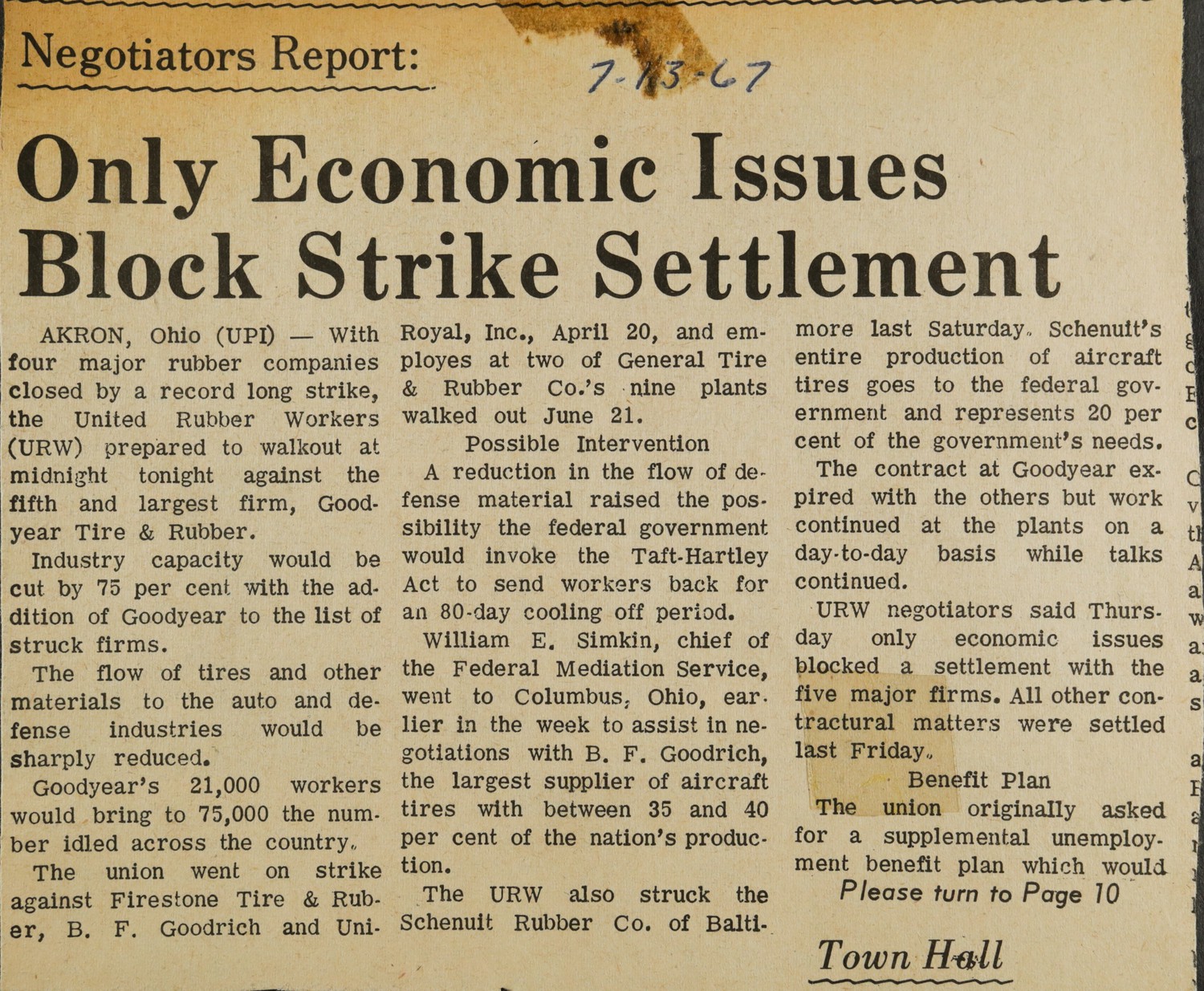
Negotiators Report:

7-13-67 [handwritten]

Only Economic Issues Block Strike Settlement

AKRON, Ohio (UPI) — With four major rubber companies closed by a record long strike, the United Rubber Workers (URW) prepared to walkout at midnight tonight against the fifth and largest firm, Goodyear Tire & Rubber.

Industry capacity would be cut by 75 per cent with the addition of Goodyear to the list of struck firms.

The flow of tires and other materials to the auto and defense industries would be sharply reduced.

Goodyear’s 21,000 workers would bring to 75,000 the number idled across the country.

The union went on strike against Firestone Tire & Rubber, B. F. Goodrich and Uni-

Royal, Inc., April 20, and employes at two of General Tire & Rubber Co.’s nine plants walked out June 21.

Possible Intervention

A reduction in the flow of defense material raised the possibility the federal government would invoke the Taft-Hartley Act to send workers back for an 80-day cooling off period.

William E. Simkin, chief of the Federal Mediation Service, went to Columbus, Ohio, earlier in the week to assist in negotiations with B. F. Goodrich, the largest supplier of aircraft tires with between 35 and 40 per cent of the nation’s production.

The URW also struck the Schenuit Rubber Co. of Balti-

more last Saturday. Schenuit’s entire production of aircraft tires goes to the federal government and represents 20 per cent of the government’s needs.

The contract at Goodyear expired with the others but work continued at the plants on a day-to-day basis while talks continued.

URW negotiators said Thursday only economic issues blocked a settlement with the five major firms. All other contractural matters were settled last Friday.

Benefit Plan

The union originally asked for a supplemental unemployment benefit plan which would

Please turn to Page 10


Town Hall

Many Footwear employes are entitled to four weeks and in some instances five weeks of vacation.

Many Footwear employes are
entitled to four weeks and in
some instances five weeks of
vacation. These workers are
permitted to take the extra
weeks at various intervals
through the year so as not to
conflict with the annual vaca-
tion shutdown.

Employes of the Chemical and
Synthetic Divisions now on
strike are allowed to stagger
their vacations. Accordingly,
the plant under normal condi-
tions do not close for any allot-
ted vacation-time as is the case
at Footwear.

Meanwhile, the negotiations

Rubber Workers, AFL-CIO and
Uniroyal have developed into a
cliff-hanging affair.

Reportedly, this past Friday,
the two teams were close to a
settlement on a new master
contract. However a hitch over
some clauses reportedly caused
a new disagreement.

The decision of Firestone to
settle this past Thursday was
the signal for considerable op-
timism here. It was expected
that Uniroyal would follow not
only Firestone, but also Gen-
eral and Goodrich, the other
companies that came to an
earlier agreement with URW.

A reliable report has indicat-
ed that some problems with
Article 9 are holding up the
agreement on the new contract.
The article refers to working
conditions, notably speed-up
of production operations.

URW workers affiliated with
Uniroyal including those of the
three divisions here, Footwear,
Chemical and Synthetic have
the dubious honor of participat-
ing in the longest strike in the
history of the rubber industry.

The strike against Uniroyal
s now in its 94th day. Back on
April 21, union workers of Uni-
oyal, Firestone and Goodrich
egan the marathon walkout.

Since Goodrich and Firestone
have now settled, Uniroyal is
he only one of the three left
utside the fold.

94-Day UniRoyal Strike Continues

94-Day UniRoyal Strike Continues

7-24-67 [handwritten]

No break has yet been reported in the 94-day United Rubber Workers-UniRoyal strike. According to sources an all-day session was held yesterday in Cincinnati with small committees meeting through the night.

URW International President Peter Bommarito moved into talks Friday between the union and the two remaining rubber companies, UniRoyal and Goodyear.

Hope ran high Friday in the borough that a settlement would be reached sometime during the day. However, another weekend has past and the mood has returned to the passive waiting of previous weeks.

Vacation pay checks are scheduled to be distributed tomorrow and Wednesday to employes of the Footwear Plant. Many workers have planned vacations for the next two weeks, settlement or not. Other employes have been waiting for these checks to give their finances a boost.

Chemical and Synthetic plant workers have been scheduling their vacations at various times during the strike. These plants do not have a general shutdown as does the footwear plant.

AKRON, Ohio (UPI)—United Rubber Worker locals in Akron and Miami, Okla., voted Sunday to accept a new contract from the B. F. Goodrich Co., bringing the 94-day strike, longest in rubber industry history, closer to an end.

The process of ratification continued at Firestone Tire & Rubber Co., and General Tire & Rubber Co. during the weekend. Negotiations with Goodyear Tire & Rubber Co. and UniRoyal Inc., did not arrive at a settlement hoped for during the weekend.

Some 4,000 URW members jammed the auditorium of Akron University to shout approval of the new Goodrich contract. Local 5 here has 4,900 members, almost half of the 11,000 employes covered in the contract.

Voice Vote Approval

In Miami, where the Goodrich employes have been back working since Friday, Local 318 approved the contract by a voice vote. Other votes from other locals around the country were expected today at URW international headquarters here. A majority of locals must ratify the contract before it is officially accepted.

General’s two tire factories, here and in Waco, Tex., were expected back in full production this week, following the vote by Local 318 in Waco to ratify the contract Saturday. All 3,000 URW members in the General Tire factories have approved the contract.

Some 17,000 Firestone employes, in 11 locals in 9 states, were to begin voting on their settlement today.

A majority of the more than 75,000 strikers, however, are still idled. About 22,000 of them have been out since April 20th when UniRoyal was struck. The 21,000 at Goodyear did not strike until July 14.

A Goodyear spokesman declined to make any comment about what was holding up negotiations.

They were taking place in Cincinnati.

Conform To Pattern

The settlements, when they are achieved, were expected to conform closely to the pattern already set.

The three settlements will all provide raises of 43 cents per hour to production workers, in steps of 15, 15 and 13 cents. The contracts will include a supplemental unemployment benefit plan giving laid off workers 80 per cent of their regular wages.

Please turn to Page 10

Quick End To Strike

Quick End To Strike

82nd Year, Number 173

Dedicated To Community Public Service


[Handwritten note: 7-25-67]


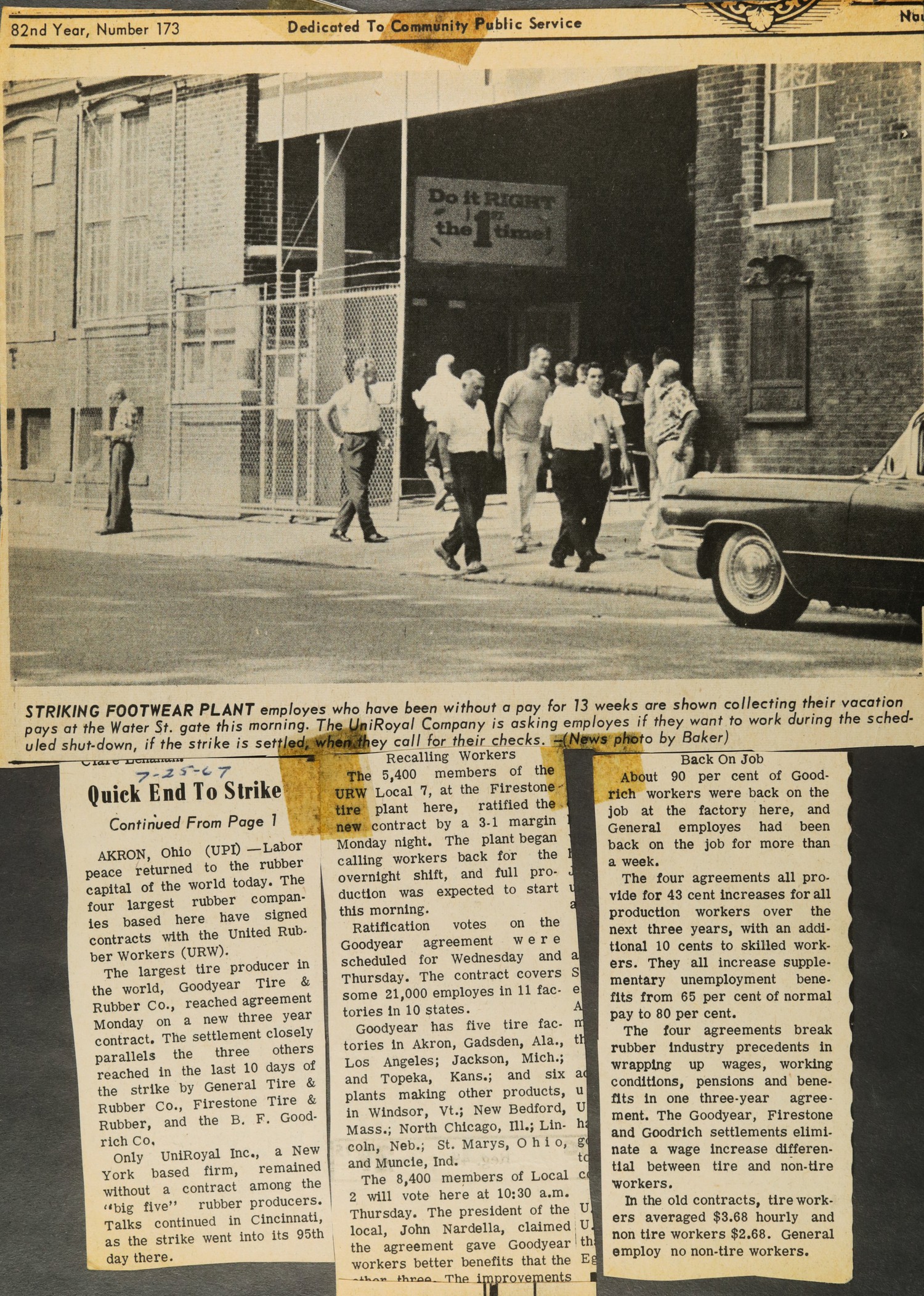
STRIKING FOOTWEAR PLANT employes who have been without a pay for 13 weeks are shown collecting their vacation pays at the Water St. gate this morning. The UniRoyal Company is asking employes if they want to work during the scheduled shut-down, if the strike is settled, when they call for their checks. —(News photo by Baker)


Quick End To Strike

Continued From Page 1

AKRON, Ohio (UPI) —Labor peace returned to the rubber capital of the world today. The four largest rubber companies based here have signed contracts with the United Rubber Workers (URW).

The largest tire producer in the world, Goodyear Tire & Rubber Co., reached agreement Monday on a new three year contract. The settlement closely parallels the three others reached in the last 10 days of the strike by General Tire & Rubber Co., Firestone Tire & Rubber, and the B. F. Goodrich Co.

Only UniRoyal Inc., a New York based firm, remained without a contract among the “big five” rubber producers. Talks continued in Cincinnati, as the strike went into its 95th day there.


Recalling Workers

The 5,400 members of the URW Local 7, at the Firestone tire plant here, ratified the new contract by a 3-1 margin Monday night. The plant began calling workers back for the overnight shift, and full production was expected to start this morning.

Ratification votes on the Goodyear agreement were scheduled for Wednesday and Thursday. The contract covers some 21,000 employes in 11 factories in 10 states.

Goodyear has five tire factories in Akron, Gadsden, Ala., Los Angeles; Jackson, Mich.; and Topeka, Kans.; and six plants making other products, in Windsor, Vt.; New Bedford, Mass.; North Chicago, Ill.; Lincoln, Neb.; St. Marys, Ohio, and Muncie, Ind.

The 8,400 members of Local 2 will vote here at 10:30 a.m. Thursday. The president of the local, John Nardella, claimed the agreement gave Goodyear workers better benefits that the other three. The improvements


Back On Job

About 90 per cent of Goodrich workers were back on the job at the factory here, and General employes had been back on the job for more than a week.

The four agreements all provide for 43 cent increases for all production workers over the next three years, with an additional 10 cents to skilled workers. They all increase supplementary unemployment benefits from 65 per cent of normal pay to 80 per cent.

The four agreements break rubber industry precedents in wrapping up wages, working conditions, pensions and benefits in one three-year agreement. The Goodyear, Firestone and Goodrich settlements eliminate a wage increase differential between tire and non-tire workers.

In the old contracts, tire workers averaged $3.68 hourly and non tire workers $2.68. General employ no non-tire workers.

Two Locals

Two Locals

Continued From Page 1

more are needed to operate
additional production lines.

Strike benefit checks will be
issued as follows: Local 45,
tomorrow and Wednesday, 9
a.m. to 3 p.m.; Local 218,
Wednesday, 7 a.m. to 5 p.m.;
Local 308, tomorrow 9 a.m.
to 6 p.m.

The longest strike in the his-
tory of the rubber industry has
ended with a new three-year
contract, providing a 43 per
cent per hour wage increase
over the three year period.

Other gains for union em-
ployees are an 80 per cent
guaranteed annual wage and a
company-paid surgical plan.

Additional specifics of the
contract will be announced when
all three locals have noted to
ratify.

Local 45 President George
Froehlich told his union mem-
bership that “A” good contract”
had been obtained and that many
gains by the union would prove
“fruitful in the future.”

UniRoyal officials reported
that their settlements with the
union were similar to settle-
ments reached by the other
major rubber industries.

When ratified, the master
contract will be effective as of
August 1. However, benefits
of the new contract will not be
realized until after mid-Sep-
tember when supplemental con-
tracts are signed by the locals.

Possible Discrimination

Possible Discrimination

Rzesutek reported that a change could occur in a contract gain in sickness and accident insurance, which offers compensation for men $10 higher than for women.

“The government may step in and say, you can’t discriminate,” Rzesutek warned. The insurance benefit was raised $10 each bring the men’s to $70 and the women’s to $60.

Another union gain was a $1,000 raise in life insurance, it was reported.

The company apparently held its ground in the negotiations by retaining a “non-duplication” clause in regards to benefits for both a husband and wife working at Uniroyal. Rzesutek told the membership that he was disappointed the clause was not erased in negotiations, when one of the- female workers complained of the non-duplication policy.

Local 308 will meet at 7 this evening at the Portuguese Hall, Rubber Ave., as the last of three divisions to vote on the three-year master contract.

If ratified, the contract is to take effect Aug. 1, but benefits would not be forthcoming until after mid-September when the supplemental agreements are to be signed by the locals.


Kentucky also is known as the Blue Grass State.

Strikers Give URW Union Vote Of Confidence Monday

Strikers Give URW Union Vote Of Confidence Monday

Strikers Give URW Union Vote Of Confidence Monday

By Cynthia Baran

UniRoyal workers, members of the United Rubber Workers Union Local 45, received word Monday from both the union and the company that indicates that both parties are miles away from a strike settlement.

From the factory manager of the local footwear plant, John M. Smith, the employees received a letter stating, “The strike need not have occurred. Prior to the expiration of the contract, the company proposed one of the largest offers ever made to our employees. It also proposed that our factories keep operating on a day-to-day basis under the contract while a new one was finalized.”

“Our company has bargained and continues to bargain in good faith. Its negotiating representatives are making every effort to establish a basis for settlement. The union has made only minor changes in its original demands which were beyond reasonable or justifiable limits for our highly competitive industry.”

Monday afternoon, President of URW Local 45, George Froehlich, conducted a meeting for union members to inform them of negotiation proceedings in Cincinnati. That was the first time the membership had been called together since the strike began.

Froehlich reported the negotiations as the “wierdest” he has ever been in since 1942.” He claimed that company officials were being “arrogant and reluctant” to settle the strike.

In rebuttal to Smith’s letter, he said that the company had not proposed working on a day-to-day basis until 15 minutes before the contract deadline. At this time, according to Froehlich, nothing had been offered or settled by or with the company.

He added that while union officials had been willing to negotiate on weekends, Sundays, and even the Memorial Day holiday, the company officials were not.

Froehlich told the union members, that union officials were not bargaining for a “few pieces of silver.” The main issues, according to the president, concern “decent treatment of employees.”

The union members were informed that during the strike they are still covered by health

Please Turn to Page 14


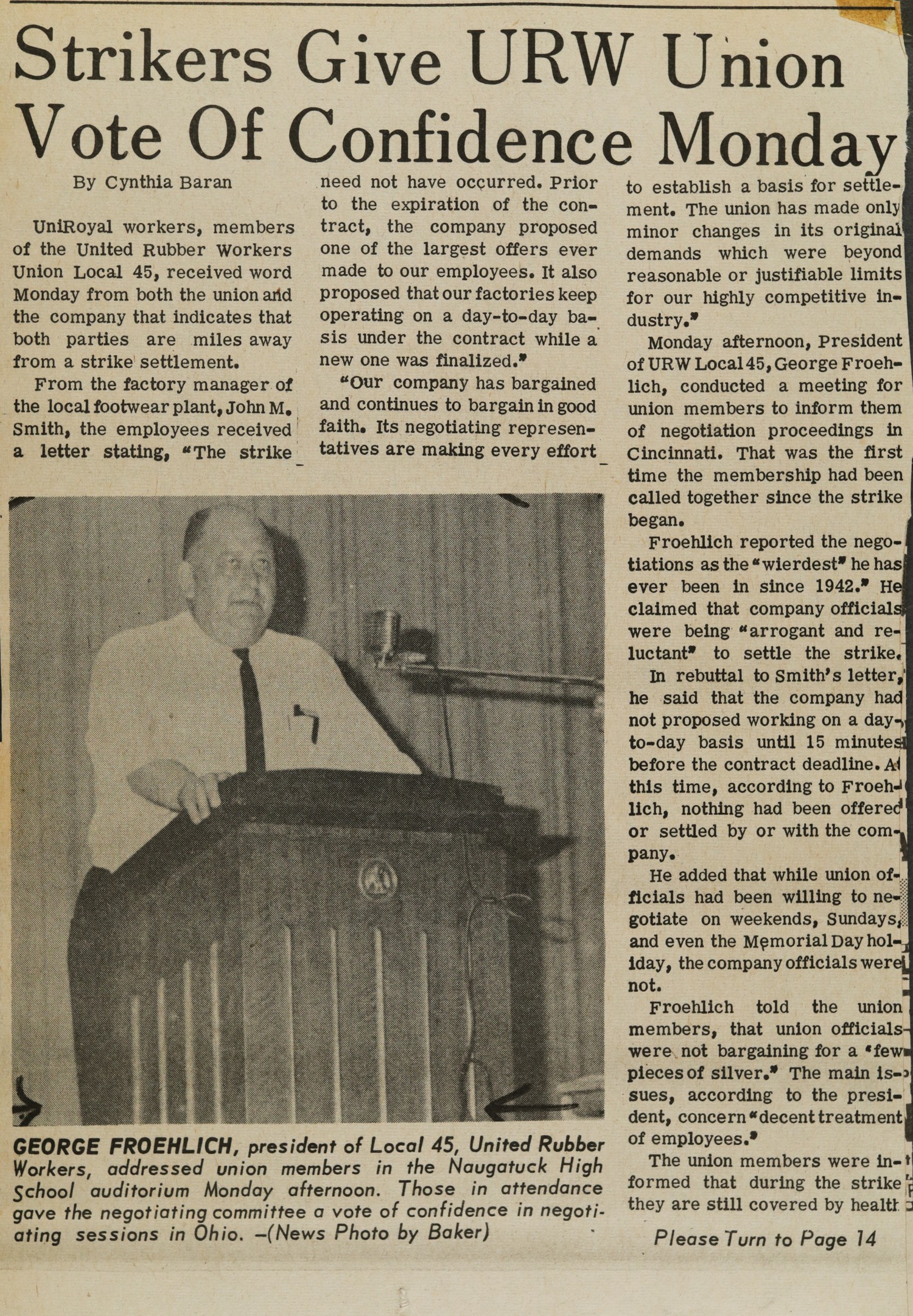
GEORGE FROEHLICH, president of Local 45, United Rubber Workers, addressed union members in the Naugatuck High School auditorium Monday afternoon. Those in attendance gave the negotiating committee a vote of confidence in negotiating sessions in Ohio. –(News Photo by Baker)

Negotiators Not

Negotiators Not c-2c

Continued From Page 1

in early April, however, that it wouldn’t prohibit any of the member companies from reaching an independent agreement with the union satisfactory to itself.

The effect of the pact, Bommarito charged, has been interference with employes’ rights to engage in concerted activities guaranteed by law because their “exertion of economic pressure is diminished or destroyed.” The result has been, he held, that Firestone has refused and is refusing to bargain collectively, in violation of the law.

He reiterated earlier charges that the five rubber companies for 20 years have negotiated wage increases and other benefits that parallel or are in tandem with those in the auto industry but that “now they have refused” to follow this policy.

Striking Rubber Workers, Five Companies May Agree on a Single Package Contract

Striking Rubber Workers, Five Companies May Agree on a Single Package Contract

Striking Rubber Workers, Five Companies May Agree on a Single Package Contract

By a WALL STREET JOURNAL Staff Reporter

CLEVELAND—Contract negotiations between the United Rubber Workers Union and five major rubber companies may take a long step toward a settlement this week as sentiment appeared to grow for linking pension and welfare improvements into a single package with wages and other benefits.

This would be a departure from previous industry policy of keeping the usual two-year master wage contracts separate from the longer term pension and welfare agreements.

Strikes by the union have closed 39 plants of Firestone Tire & Rubber Co., Uniroyal Inc. and B. F. Goodrich Co. for 45 days. Contracts at those concerns expired April 20, as did those at Goodyear Tire & Rubber Co., whose plants have continued to operate on a day-to-day basis. Plants of General Tire & Rubber Co. also continued to operate since its contract expiration May 15.

Existing three-year pension and welfare agreements with Goodyear, Firestone, Uniroyal and Goodrich also are due to expire on Sept. 15, however, and the time proximity of the two rounds of negotiations has created a hurdle in reaching a wage contract agreement. Company executives, even before wage contract talks started, cited the prospect of facing two boosts in employment costs, plus two strike threats, in a single year.

More recently, with strike benefit funds about depleted by the lengthy work stoppages of some 51,000 employes of the three struck concerns, union officials were said to be becoming less adamant about keeping pension and welfare agreements separate from wage contracts.

While Peter Bommarito, URW international president, said a month ago the union was willing to consider a joint package proposal from the companies it is understood nothing more than exploratory discussions have taken place thus far in negotiations on this score.

At the weekend, however, a URW spkesman said the union would be “wide open to any proposals” from managements for wrapping up the two contracts in a single package. Company spokesmen also reiterated the contention that such a move common in most other industries, is “the most logical and sensible thing to do.”

Whether the resumption of talks, recessed since Thursday, between the union and Firestone, Goodyear, Goodrich and Uniroyal this morning will result in any moves toward a single, overall contract remains to be seen. But the belief of sources close to the negotiations indicated prospects are better than ever before.

One possibly sticky point is whether a single, overall agreement would be for two years or for three. Earlier pension and welfare agreements have been for as much as five years. But both union and company sources noted this could be an issue for negotiation.

Mr. Bommarito earlier disclosed he has called a meeting for June 25 and 27, in Cleveland, of union pension and welfare contract officials. A union spokesman said the meeting still is scheduled, but he indicated this would not necessarily rule out a possibility of negotiating a combined contract before then.

The union’s strike benefit fund, amounting to about $6.5 million at the start of the three-company strike, presumably is exhausted as a result of the prescribed $25 weekly payments to striking members. The union has called on working members for voluntary contributions

equivalent to one hour’s pay a week, but the extent of the response has not been disclosed.

Walter Reuther, president of the United Auto Workers union, has pledged striking rubber workers financial and other assistance in their dispute. But both UAW and URW officials decline to say whether any financial aid has been asked for or given.

Whatever the prospects for gaining an early single contract settlement, the union indicated at the weekend it intends to press its unfair labor practice charge against the five companies for their mutual strike aid pact reached last April 1.

In a complaint filed with the National Labor Relations Board regional office in Cleveland last week against Firestone, the union charged the pact thwarted free collective bargaining and is prolonging the strike against the three companies.

The union spokesman said identical complaints are in the mail to the NLRB against Uniroyal and Goodrich and will be followed today with complaints against Goodyear and General Tire.


[ADVERTISEMENT]

New in New Haven

PARK PLAZA HOTEL

Free in-hotel garage, pool, fine restaurants
CHAPEL SQUARE, NEW HAVEN, CONNECTICUT
For reservations, call collect: (203) 772-1700


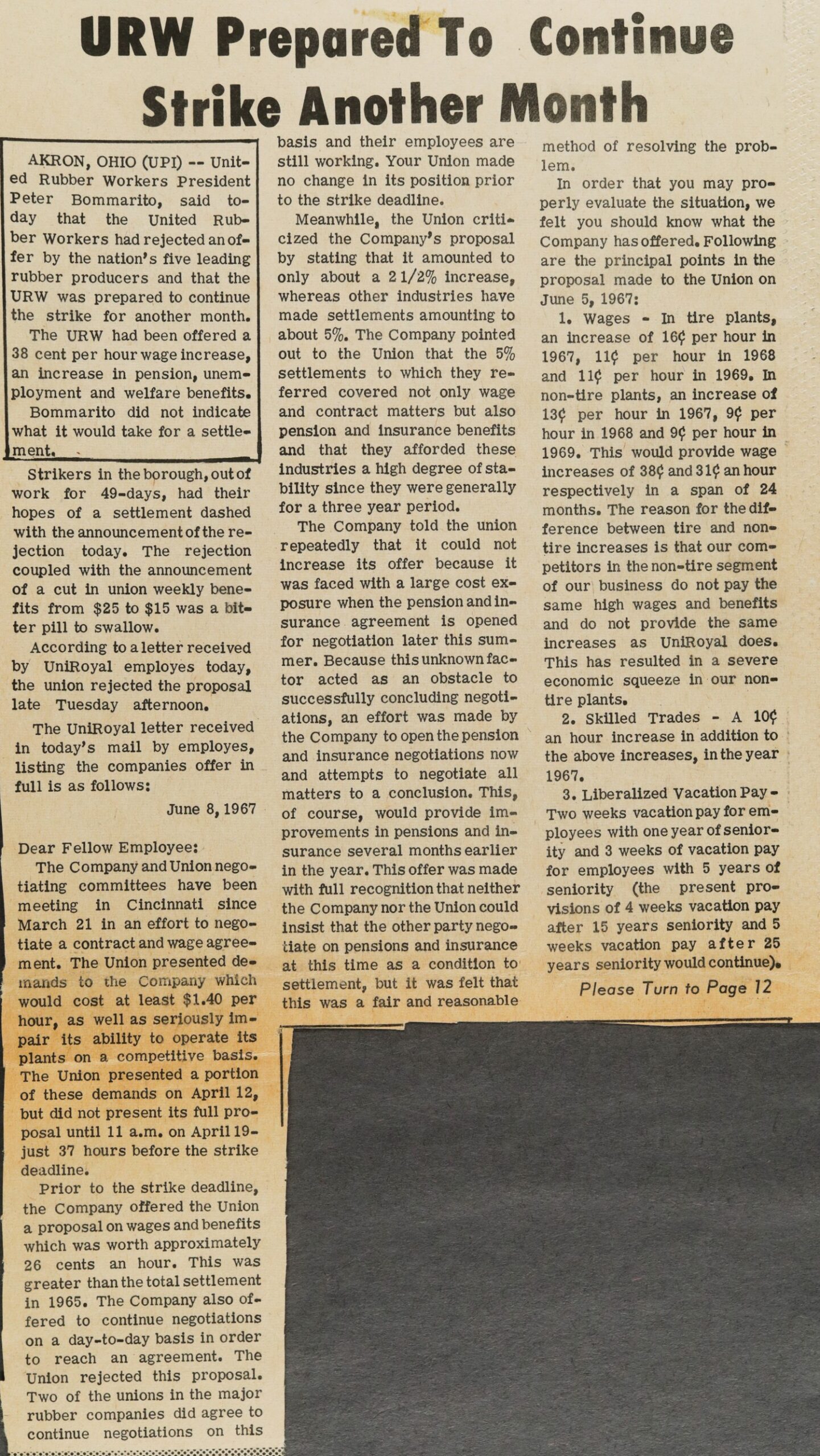
URW Prepared To Continue Strike Another Month

URW Prepared To Continue Strike Another Month

AKRON, OHIO (UPI) — United Rubber Workers President Peter Bommarito, said today that the United Rubber Workers had rejected an offer by the nation’s five leading rubber producers and that the URW was prepared to continue the strike for another month.

The URW had been offered a 38 cent per hour wage increase, an increase in pension, unemployment and welfare benefits.

Bommarito did not indicate what it would take for a settlement.

Strikers in the borough, out of work for 49-days, had their hopes of a settlement dashed with the announcement of the rejection today. The rejection coupled with the announcement of a cut in union weekly benefits from $25 to $15 was a bitter pill to swallow.

According to a letter received by UniRoyal employes today, the union rejected the proposal late Tuesday afternoon.

The UniRoyal letter received in today’s mail by employes, listing the companies offer in full is as follows:

June 8, 1967

Dear Fellow Employee:

The Company and Union negotiating committees have been meeting in Cincinnati since March 21 in an effort to negotiate a contract and wage agreement. The Union presented demands to the Company which would cost at least $1.40 per hour, as well as seriously impair its ability to operate its plants on a competitive basis. The Union presented a portion of these demands on April 12, but did not present its full proposal until 11 a.m. on April 19-just 37 hours before the strike deadline.

Prior to the strike deadline, the Company offered the Union a proposal on wages and benefits which was worth approximately 26 cents an hour. This was greater than the total settlement in 1965. The Company also offered to continue negotiations on a day-to-day basis in order to reach an agreement. The Union rejected this proposal. Two of the unions in the major rubber companies did agree to continue negotiations on this basis and their employees are still working. Your Union made no change in its position prior to the strike deadline.

Meanwhile, the Union criticized the Company’s proposal by stating that it amounted to only about a 2 1/2% increase, whereas other industries have made settlements amounting to about 5%. The Company pointed out to the Union that the 5% settlements to which they referred covered not only wage and contract matters but also pension and insurance benefits and that they afforded these industries a high degree of stability since they were generally for a three year period.

The Company told the union repeatedly that it could not increase its offer because it was faced with a large cost exposure when the pension and insurance agreement is opened for negotiation later this summer. Because this unknown factor acted as an obstacle to successfully concluding negotiations, an effort was made by the Company to open the pension and insurance negotiations now and attempts to negotiate all matters to a conclusion. This, of course, would provide improvements in pensions and insurance several months earlier in the year. This offer was made with full recognition that neither the Company nor the Union could insist that the other party negotiate on pensions and insurance at this time as a condition to settlement, but it was felt that this was a fair and reasonable method of resolving the problem.

In order that you may properly evaluate the situation, we felt you should know what the Company has offered. Following are the principal points in the proposal made to the Union on June 5, 1967:

  1. Wages – In tire plants, an increase of 16¢ per hour in 1967, 11¢ per hour in 1968 and 11¢ per hour in 1969. In non-tire plants, an increase of 13¢ per hour in 1967, 9¢ per hour in 1968 and 9¢ per hour in 1969. This would provide wage increases of 38¢ and 31¢ an hour respectively in a span of 24 months. The reason for the difference between tire and non-tire increases is that our competitors in the non-tire segment of our business do not pay the same high wages and benefits and do not provide the same increases as UniRoyal does. This has resulted in a severe economic squeeze in our non-tire plants.
  2. Skilled Trades – A 10¢ an hour increase in addition to the above increases, in the year 1967.
  3. Liberalized Vacation Pay – Two weeks vacation pay for employees with one year of seniority and 3 weeks of vacation pay for employees with 5 years of seniority (the present provisions of 4 weeks vacation pay after 15 years seniority and 5 weeks vacation pay after 25 years seniority would continue).

Please Turn to Page 12

US Rubber Annual Report – 72nd Annual Report – Page 2

Page 002

United States Rubber Company and Subsidiary Companies

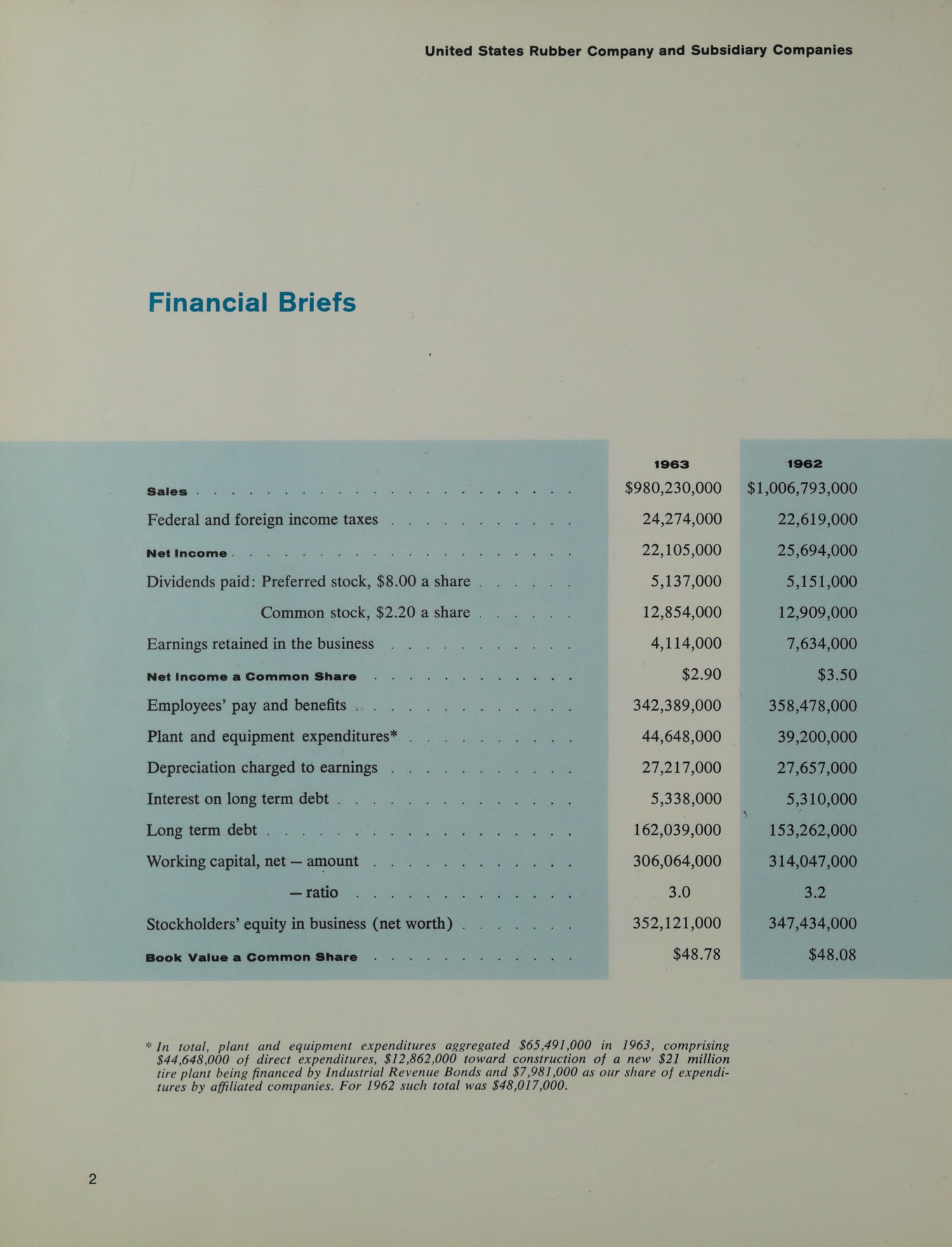
Financial Briefs

                             1963      1962

Sales . . . . . . . . . . . . . . . . . . $980,230,000 $1,006,793,000

Federal and foreign income taxes . . . . . . . 24,274,000 22,619,000

Net Income. . . . . . . . . . . . . . . . . 22,105,000 25,694,000

Dividends paid: Preferred stock, $8.00 a share . 5,137,000 5,151,000
Common stock, $2.20 a share . . 12,854,000 12,909,000

Earnings retained in the business . . . . . . . 4,114,000 7,634,000

Net Income a Common Share . . . . . . . . . . $2.90 $3.50

Employees’ pay and benefits . . . . . . . . . 342,389,000 358,478,000

Plant and equipment expenditures* . . . . . . 44,648,000 39,200,000

Depreciation charged to earnings . . . . . . . 27,217,000 27,657,000

Interest on long term debt . . . . . . . . . . 5,338,000 5,310,000

Long term debt . . . . . . . . . . . . . . . 162,039,000 153,262,000

Working capital, net — amount . . . . . . . . 306,064,000 314,047,000
— ratio . . . . . . . . . . 3.0 3.2

Stockholders’ equity in business (net worth) . . 352,121,000 347,434,000

Book Value a Common Share . . . . . . . . . . $48.78 $48.08

  • In total, plant and equipment expenditures aggregated $65,491,000 in 1963, comprising $44,648,000 of direct expenditures, $12,862,000 toward construction of a new $21 million tire plant being financed by Industrial Revenue Bonds and $7,981,000 as our share of expenditures by affiliated companies. For 1962 such total was $48,017,000.

US Rubber Annual Report – 72nd Annual Report – Page 20

Page 020

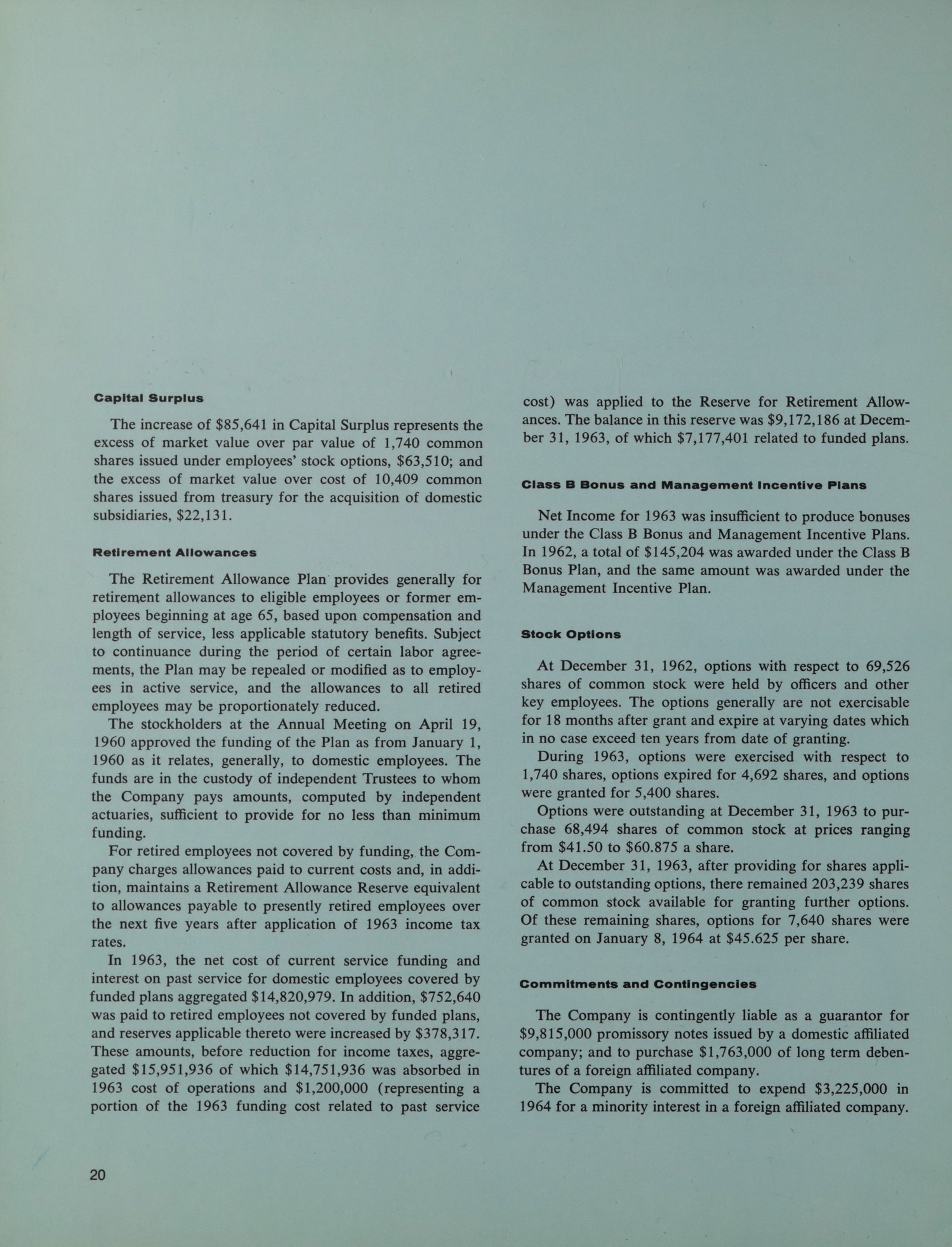
Capital Surplus
The increase of $85,641 in Capital Surplus represents the
excess of market value over par value of 1,740 common
shares issued under employees’ stock options, $63,510; and
the excess of market value over cost of 10,409 common
shares issued from treasury for the acquisition of domestic
subsidiaries, $22,131.

Retirement Allowances
The Retirement Allowance Plan provides generally for
retirement allowances to eligible employees or former em-
ployees beginning at age 65, based upon compensation and
length of service, less applicable statutory benefits. Subject
to continuance during the period of certain labor agree-
ments, the Plan may be repealed or modified as to employ-
ees in active service, and the allowances to all retired
employees may be proportionately reduced.
The stockholders at the Annual Meeting on April 19,
1960 approved the funding of the Plan as from January 1,
1960 as it relates, generally, to domestic employees. The
funds are in the custody of Independent Trustees to whom
the Company pays amounts, computed by independent
actuaries, sufficient to provide for no less than minimum
funding.
For retired employees not covered by funding, the Com-
pany charges allowances paid to current costs and, in addi-
tion, maintains a Retirement Allowance Reserve equivalent
to allowances payable to presently retired employees over
the next five years after application of 1963 income tax
rates.
In 1963, the net cost of current service funding and
interest on past service for domestic employees covered by
funded plans aggregated $14,820,979. In addition, $752,640
was paid to retired employees not covered by funded plans,
and reserves applicable thereto were increased by $378,317.
These amounts, before reduction for income taxes, aggre-
gated $15,951,936 of which $14,751,936 was absorbed in
1963 cost of operations and $1,200,000 (representing a
portion of the 1963 funding cost related to past service

cost) was applied to the Reserve for Retirement Allow-
ances. The balance in this reserve was $9,172,186 at Decem-
ber 31, 1963, of which $7,177,401 related to funded plans.

Class B Bonus and Management Incentive Plans
Net Income for 1963 was insufficient to produce bonuses
under the Class B Bonus and Management Incentive Plans.
In 1962, a total of $145,204 was awarded under the Class B
Bonus Plan, and the same amount was awarded under the
Management Incentive Plan.

Stock Options
At December 31, 1962, options with respect to 69,526
shares of common stock were held by officers and other
key employees. The options generally are not exercisable
for 18 months after grant and expire at varying dates which
in no case exceed ten years from date of granting.
During 1963, options were exercised with respect to
1,740 shares, options expired for 4,692 shares, and options
were granted for 5,400 shares.
Options were outstanding at December 31, 1963 to pur-
chase 68,494 shares of common stock at prices ranging
from $41.50 to $60.875 a share.
At December 31, 1963, after providing for shares appli-
cable to outstanding options, there remained 203,239 shares
of common stock available for granting further options.
Of these remaining shares, options for 7,640 shares were
granted on January 8, 1964 at $45.625 per share.

Commitments and Contingencies
The Company is contingently liable as a guarantor for
$9,815,000 promissory notes issued by a domestic affiliated
company; and to purchase $1,763,000 of long term deben-
tures of a foreign affiliated company.
The Company is committed to expend $3,225,000 in
1964 for a minority interest in a foreign affiliated company.

US Rubber Annual Report – 72nd Annual Report – Page 23

Page 023

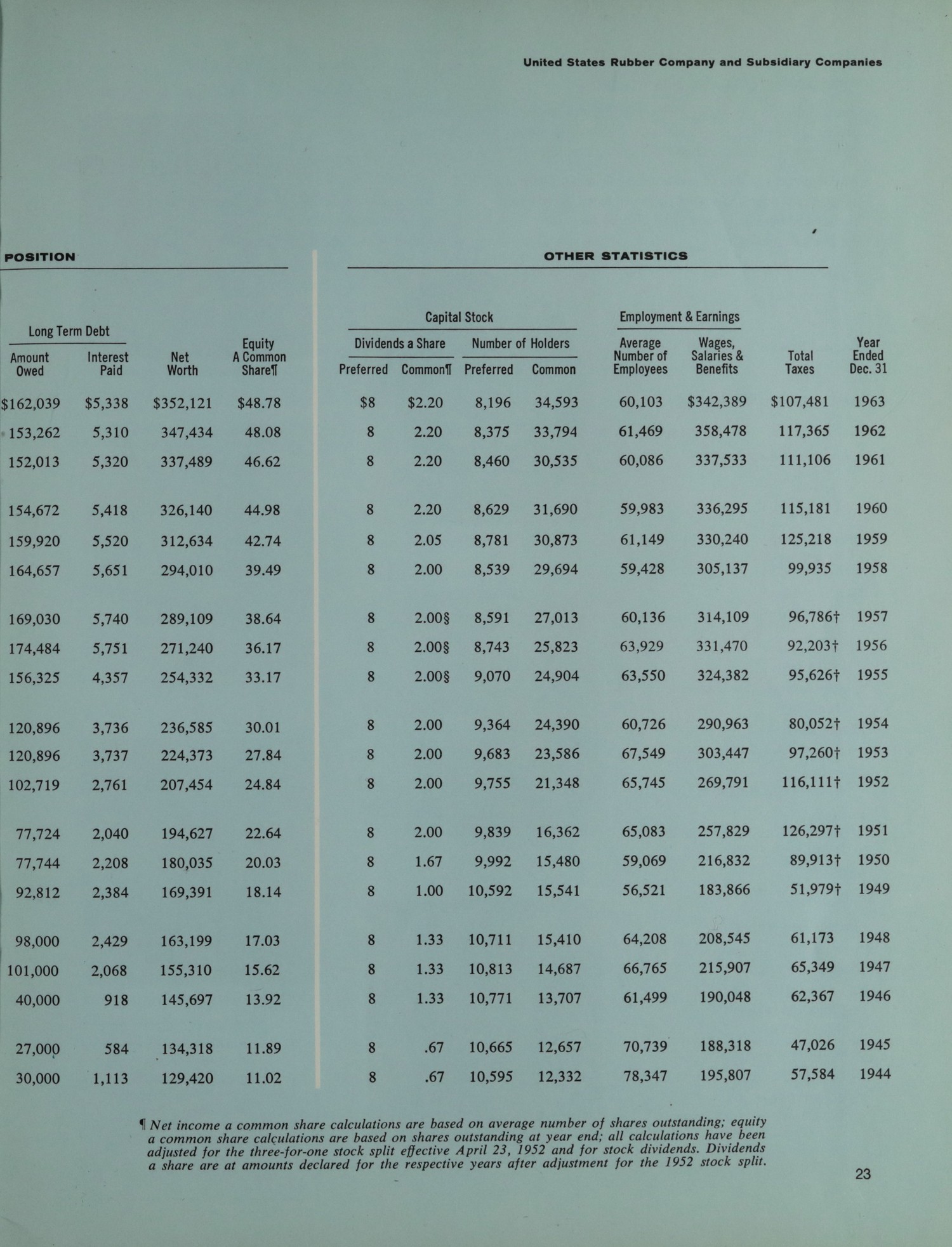
United States Rubber Company and Subsidiary Companies

POSITION OTHER STATISTICS

Long Term Debt Capital Stock Employment & Earnings
Amount Interest Net Equity Dividends a Share Number of Holders Average Wages, Total Year
Owed Paid Worth Share* Preferred Common† Preferred Common Number of Employees Benefits Taxes Ended
Employees Dec. 31
$162,039 $5,338 $352,121 $48.78 $8 $2.20 8,196 34,593 60,103 $342,389 $107,481 1963
153,262 5,310 347,434 48.08 8 2.20 8,375 33,794 61,469 358,478 117,365 1962
152,013 5,320 337,489 46.62 8 2.20 8,460 30,535 60,086 337,533 111,106 1961
154,672 5,418 326,140 44.98 8 2.20 8,629 31,690 59,983 336,295 115,181 1960
159,920 5,520 312,634 42.74 8 2.05 8,781 30,873 61,149 330,240 125,218 1959
164,657 5,651 294,010 39.49 8 2.00 8,539 29,694 59,428 305,137 99,935 1958
169,030 5,740 289,109 38.64 8 2.00$ 8,591 27,013 60,136 314,109 96,786† 1957
174,484$ 5,751 271,240 36.17 8 2.00$ 8,743 25,823 63,929 331,470 92,203† 1956
156,325 4,357 254,332 33.17 8 2.00$ 9,070 24,904 63,550 324,382 95,626† 1955
120,896 3,736 236,585 30.01 8 2.00 9,364 24,390 60,726 290,963 80,052† 1954
120,896 3,737 224,373 27.84 8 2.00 9,683 23,586 67,549 303,447 97,260† 1953
102,719 2,761 207,454 24.84 8 2.00 9,755 21,348 65,745 269,791 116,111† 1952
77,724 2,040 194,627 22.64 8 2.00 9,839 16,362 65,083 257,829 126,297† 1951
77,744 2,208 180,035 20.03 8 1.67 9,992 15,480 59,069 216,832 89,913† 1950
92,812 2,384 169,391 18.14 8 1.00 10,592 15,541 56,521 183,866 51,979† 1949
98,000 2,429 163,199 17.03 8 1.33 10,711 15,410 64,208 208,545 61,173 1948
101,000 2,068 155,310 15.62 8 1.33 10,813 14,687 66,765 215,907 65,349 1947
40,000 918 145,697 13.92 8 1.33 10,771 13,707 61,499 190,048 62,367 1946
27,000 584 134,318 11.89 8 .67 10,665 12,657 70,739 188,318 47,026 1945
30,000 1,113 129,420 11.02 8 .67 10,595 12,332 78,347 195,807 57,584 1944

  • Net income a common share calculations are based on average number of shares outstanding; equity
    a common share calculations are based on shares outstanding at year-end; all calculations have been
    adjusted for the three-for-one stock split effective April 23, 1952 and for stock dividends. Dividends
    a share are at amounts declared for the respective years after adjustment for the 1952 stock split.

US Rubber Annual Report – 72nd Annual Report – Page Letter

Page letter

United States Rubber Company
Rockefeller Center
1230 AVENUE OF THE AMERICAS • NEW YORK 20, N.Y.

OFFICE OF THE
CHAIRMAN OF THE BOARD

March 17, 1964

To the Stockholders of
UNITED STATES RUBBER COMPANY:

The annual meeting of stockholders of United States Rubber Company will be held on Tuesday, April 21, 1964, at 10:30 a.m., in the Starlight Roof of the Waldorf-Astoria Hotel, 106 Central Park South, New York, New York. At this meeting stockholders will be asked to elect a board of directors for the coming year, to decide whether the company’s Bonus Plan and its Management Incentive Plan shall each be continued in effect, to consider and act upon the adoption of a proposed 1964 Stock Option Plan, and to transact such other business as may properly come before the meeting.

Under the provisions of the company’s Bonus Plan and its Management Incentive Plan, the board of directors is required to submit to the stockholders, at intervals of no more than five years, the question of whether each of those plans shall be continued in effect. The board of directors has passed a resolution declaring it advisable, and recommending to the stockholders, that both plans be continued in effect in their respective existing forms.

A proposed 1964 Stock Option Plan, described in the accompanying proxy statement, has been formulated by the board of directors for consideration by the stockholders. The board of directors has passed a resolution declaring the adoption of such plan advisable and directing that the forthcoming annual meeting be called for the purpose, among others, of taking action thereon.

The board of directors has fixed March 4, 1964, at the close of business, as the record date for the determination of stockholders entitled to vote at the meeting.

Your vote is important. Please sign and return the accompanying proxy in the enclosed addressed envelope. If you attend the meeting and wish to vote in person, you may withdraw your proxy. If you are planning to attend the meeting, it will be greatly appreciated if you will notify Mr. G. T. Pownall, Secretary, so that we may send you an attendance card.

Sincerely yours,

H. E. HUMPHREYS, JR.
Chairman of the Board of Directors