CHEM-TEXTS – Vol. 4, 1970, No. 10 – Page 1

Page 001

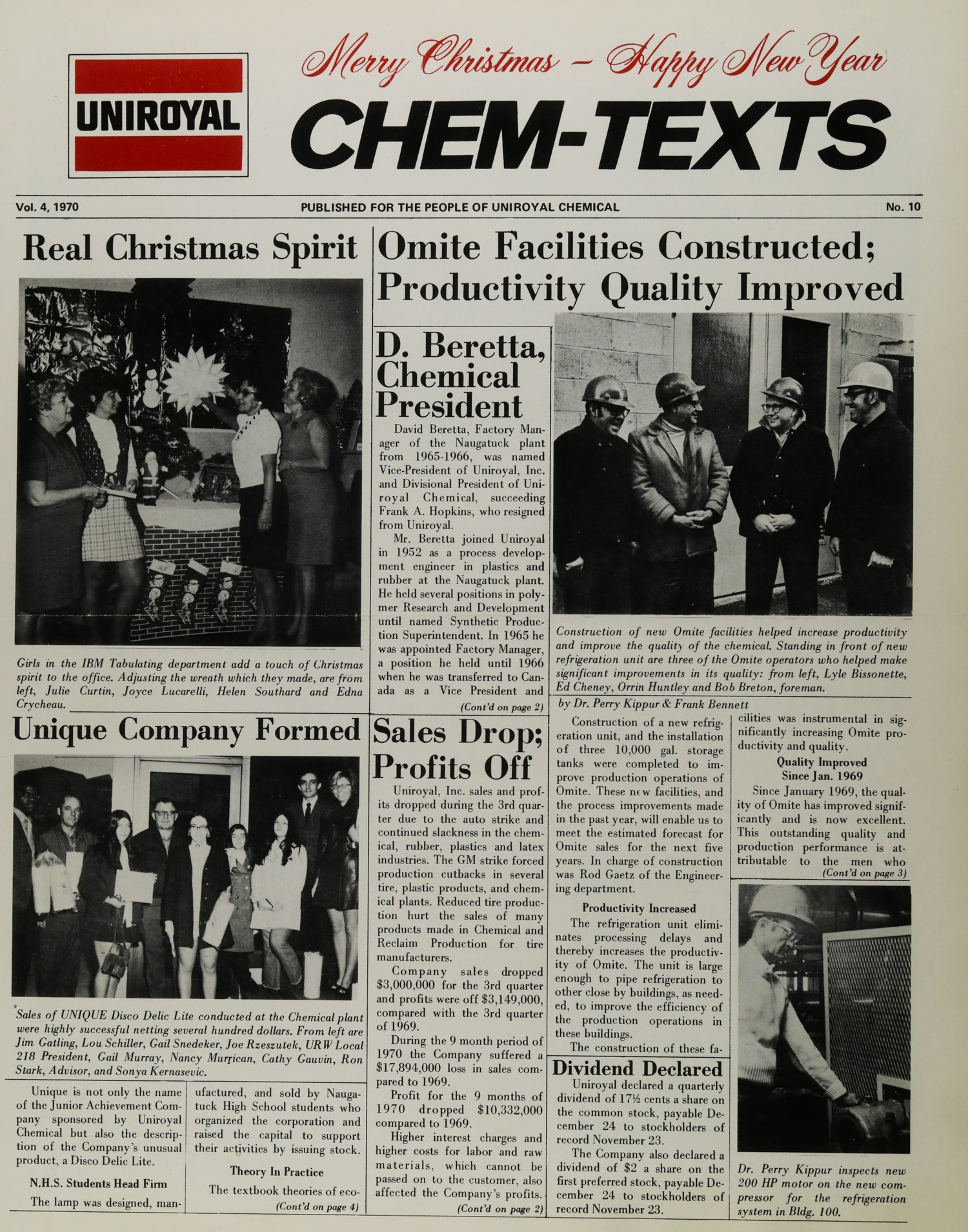
UNIROYAL

Merry Christmas – Happy New Year

CHEM-TEXTS

Vol. 4, 1970 | PUBLISHED FOR THE PEOPLE OF UNIROYAL CHEMICAL | No. 10


Real Christmas Spirit

[IMAGE: Black and white photo of women working on a wreath]

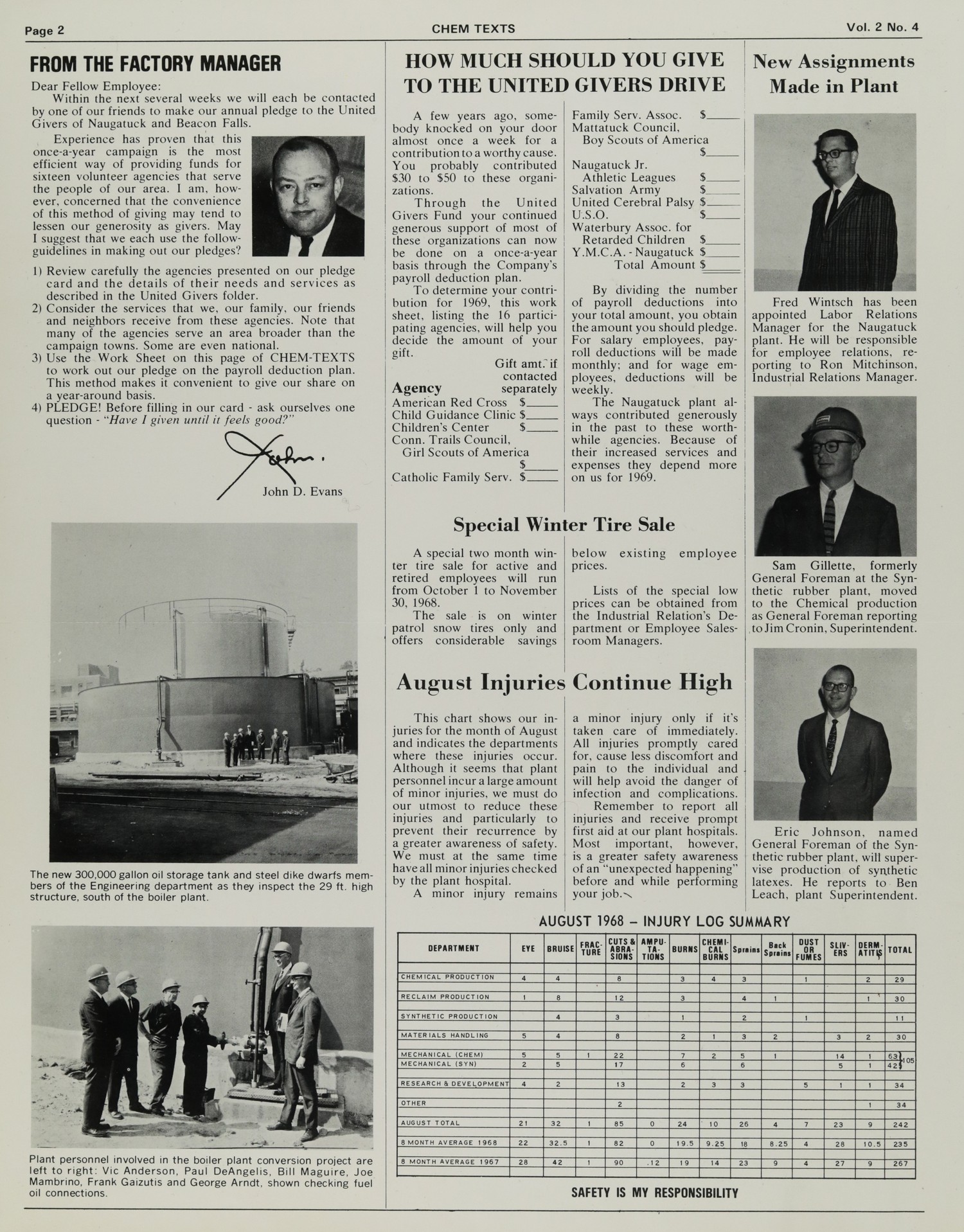
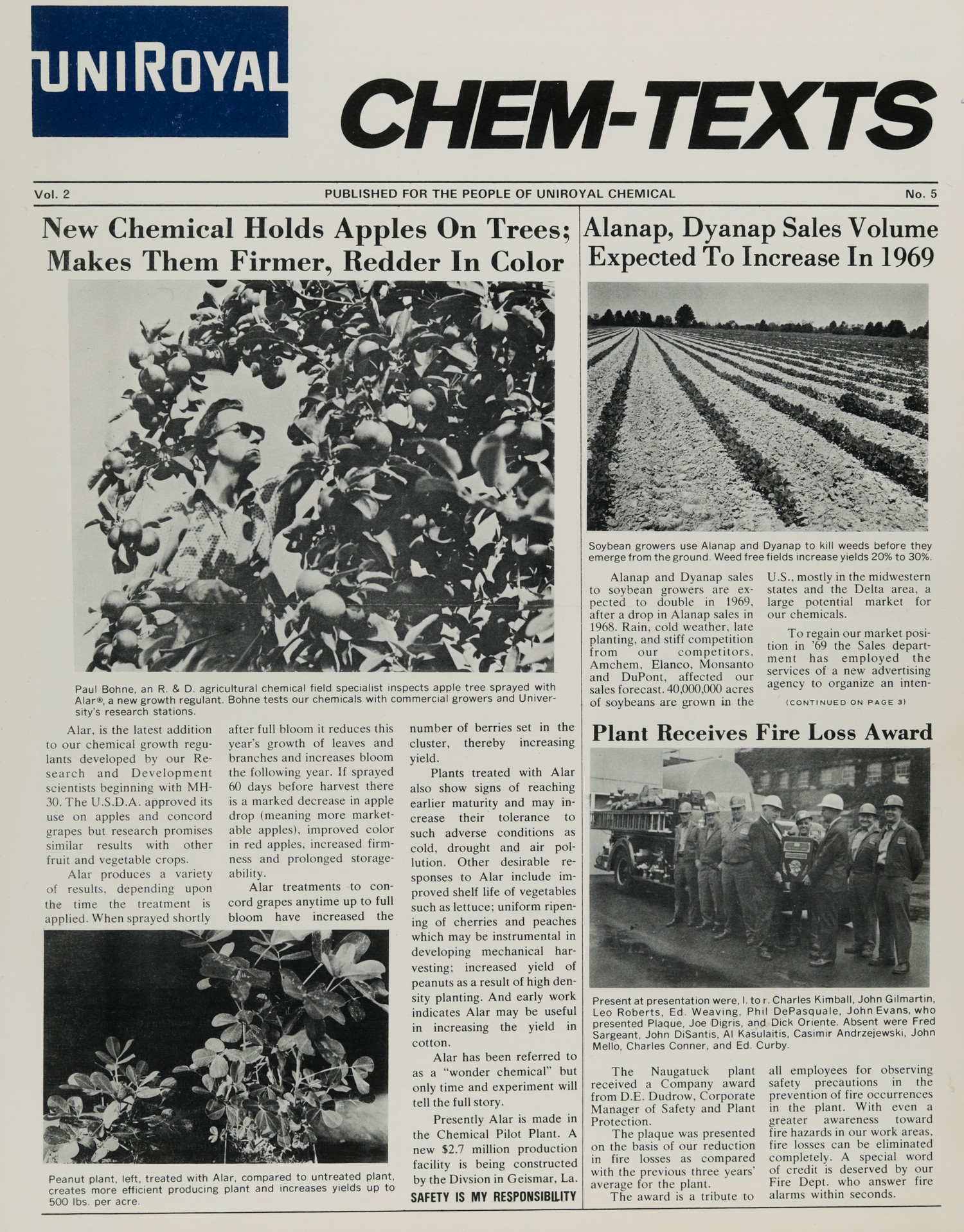
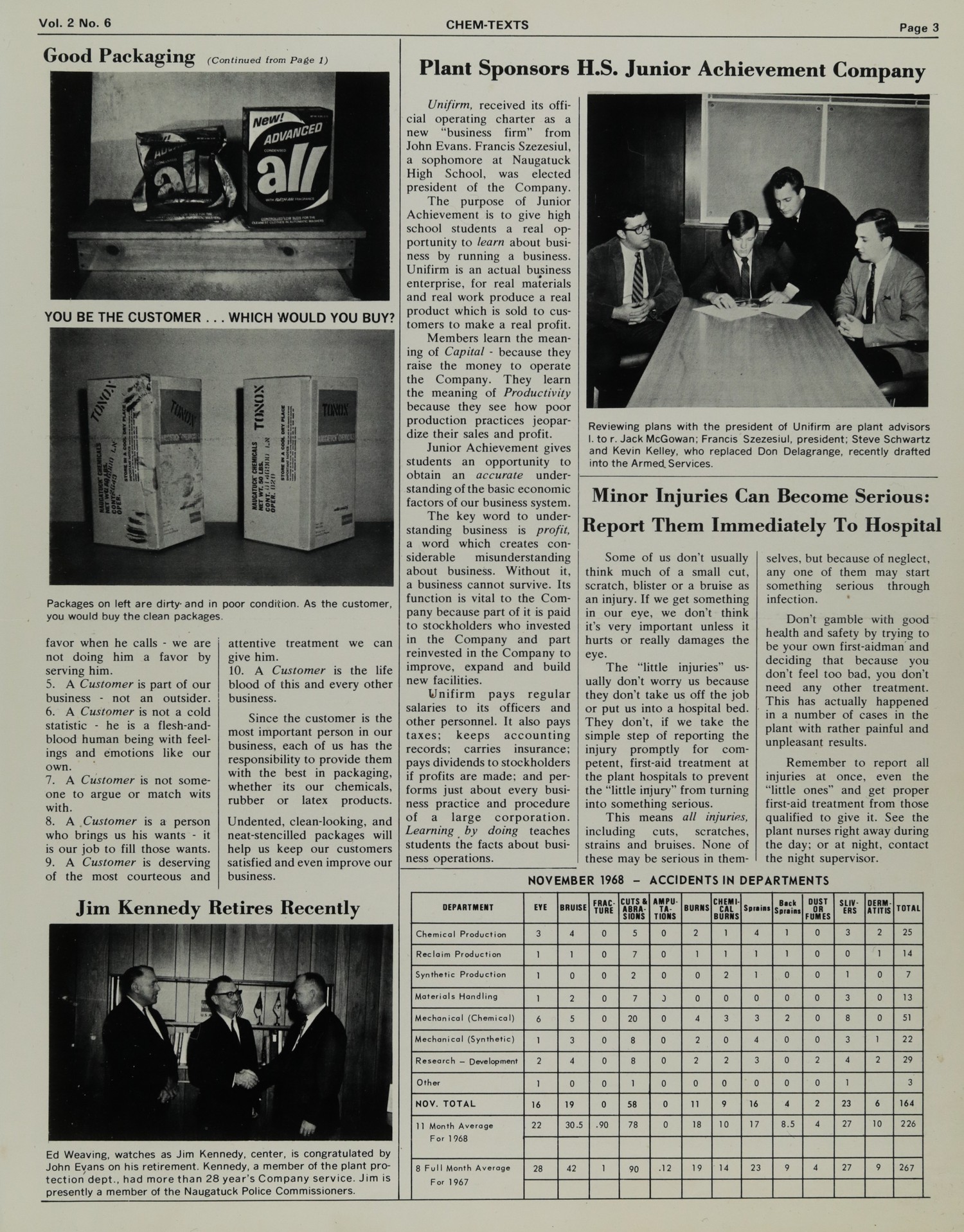
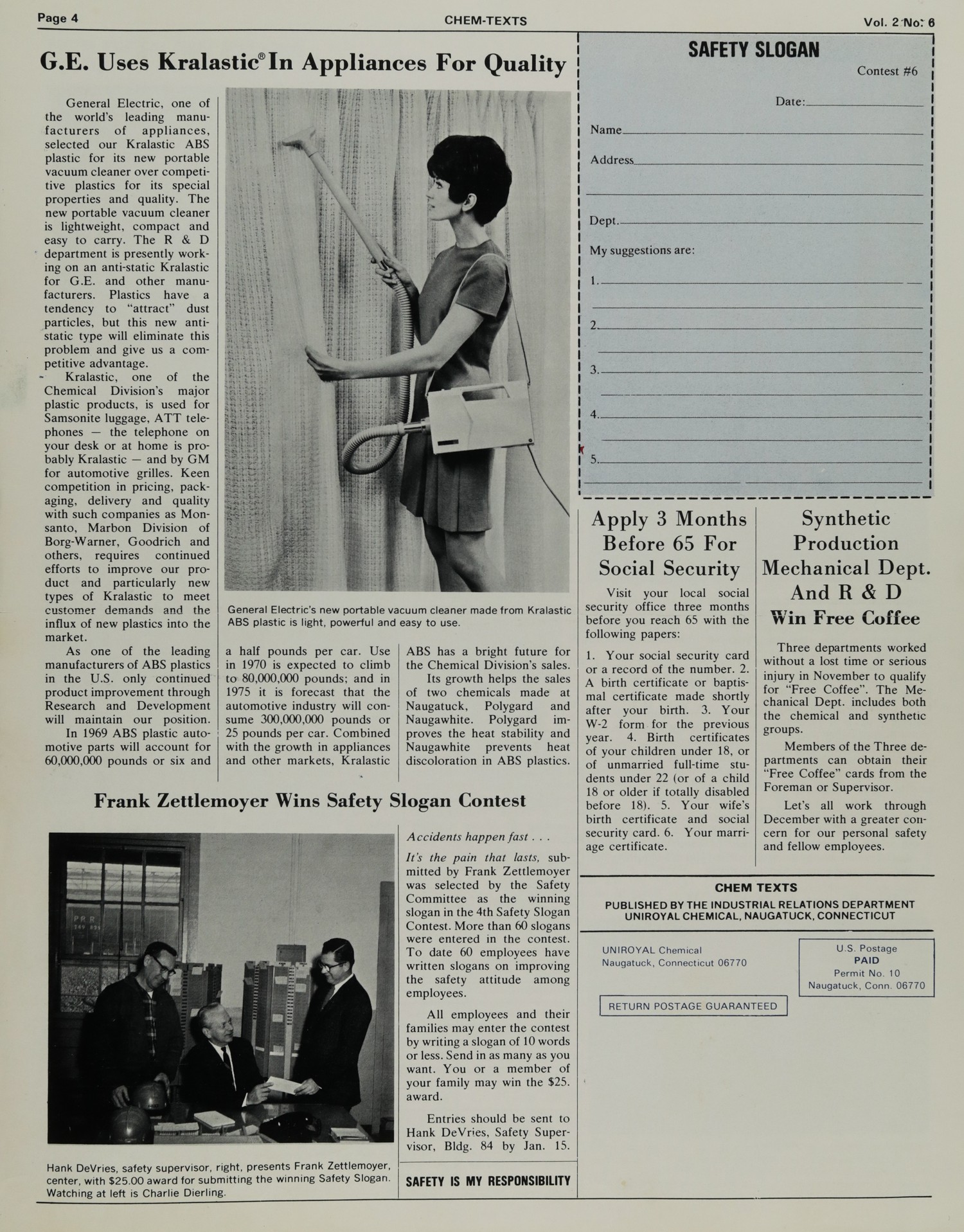
Girls in the IBM Tabulating department add a touch of Christmas spirit to the office. Adjusting the wreath which they made, are from left, Julie Curtin, Joyce Lucarelli, Helen Southard and Edna Crycheau.


Unique Company Formed

[IMAGE: Group photo of people at what appears to be a disco event]

Sales of UNIQUE Disco Delic Lite conducted at the Chemical plant were highly successful netting several hundred dollars. From left are Jim Gatling, Lou Schiller, Gail Snedeker, Joe Rzeszutek, URW Local 218 President, Gail Murray, Nancy Murrican, Cathy Gauvin, Ron Stark, Advisor, and Sonya Kernasevic.

Unique is not only the name of the Junior Achievement Company sponsored by Uniroyal Chemical but also the description of the Company’s unusual product, a Disco Delic Lite.

N.H.S. Students Head Firm

The lamp was designed, manufactured, and sold by Naugatuck High School students who organized the corporation and raised the capital to support their activities by issuing stock.

Theory In Practice

The textbook theories of eco-
(Cont’d on page 4)


Omite Facilities Constructed; Productivity Quality Improved

D. Beretta, Chemical President

David Beretta, Factory Manager of the Naugatuck plant from 1965-1966, was named Vice-President of Uniroyal, Inc. and Divisional President of Uniroyal Chemical, succeeding Frank A. Hopkins, who resigned from Uniroyal.

Mr. Beretta joined Uniroyal in 1952 as a process development engineer in plastics and rubber at the Naugatuck plant. He held several positions in polymer Research and Development until named Synthetic Production Superintendent. In 1965 he was appointed Factory Manager, a position he held until 1966 when he was transferred to Canada as a Vice President and
(Cont’d on page 2)

[IMAGE: Three workers in hard hats standing in front of industrial equipment]

Construction of new Omite facilities helped increase productivity and improve the quality of the chemical. Standing in front of new refrigeration unit are three of the Omite operators who helped make significant improvements in its quality: from left, Lyle Bissonette, Ed Cheney, Orrin Huntley and Bob Breton, foreman.

by Dr. Perry Kippur & Frank Bennett

Construction of a new refrigeration unit, and the installation of three 10,000 gal. storage tanks were completed to improve production operations of Omite. These new facilities, and the process improvements made in the past year, will enable us to meet the estimated forecast for Omite sales for the next five years. In charge of construction was Rod Gaetz of the Engineering department.

Productivity Increased

The refrigeration unit eliminates processing delays and thereby increases the productivity of Omite. The unit is large enough to pipe refrigeration to other close by buildings, as needed, to improve the efficiency of the production operations in these buildings.

The construction of these facilities was instrumental in significantly increasing Omite productivity and quality.

Quality Improved Since Jan. 1969

Since January 1969, the quality of Omite has improved significantly and is now excellent. This outstanding quality and production performance is attributable to the men who
(Cont’d on page 3)


Sales Drop; Profits Off

Uniroyal, Inc. sales and profits dropped during the 3rd quarter due to the auto strike and continued slackness in the chemical, rubber, plastics and latex industries. The GM strike forced production cutbacks in several tire, plastic products, and chemical plants. Reduced tire production hurt the sales of many products made in Chemical and Reclaim Production for tire manufacturers.

Company sales dropped $3,000,000 for the 3rd quarter and profits were off $3,149,000, compared with the 3rd quarter of 1969.

During the 9 month period of 1970 the Company suffered a $17,894,000 loss in sales compared to 1969.

Profit for the 9 months of 1970 dropped $10,332,000 compared to 1969.

Higher interest charges and higher costs for labor and raw materials, which cannot be passed on to the customer, also affected the Company’s profits.
(Cont’d on page 2)


Dividend Declared

Uniroyal declared a quarterly dividend of 17½ cents a share on the common stock, payable December 24 to stockholders of record November 23.

The Company also declared a dividend of $2 a share on the first preferred stock, payable December 24 to stockholders of record November 23.

[IMAGE: Man in hard hat inspecting equipment]

Dr. Perry Kippur inspects new 200 HP motor on the new compressor for the refrigeration system in Bldg. 100.
CHEM-TEXTS – Vol. 4 No. 10 – Page 2

Page 002

Page 2 CHEM-TEXTS Vol. 4 No. 10

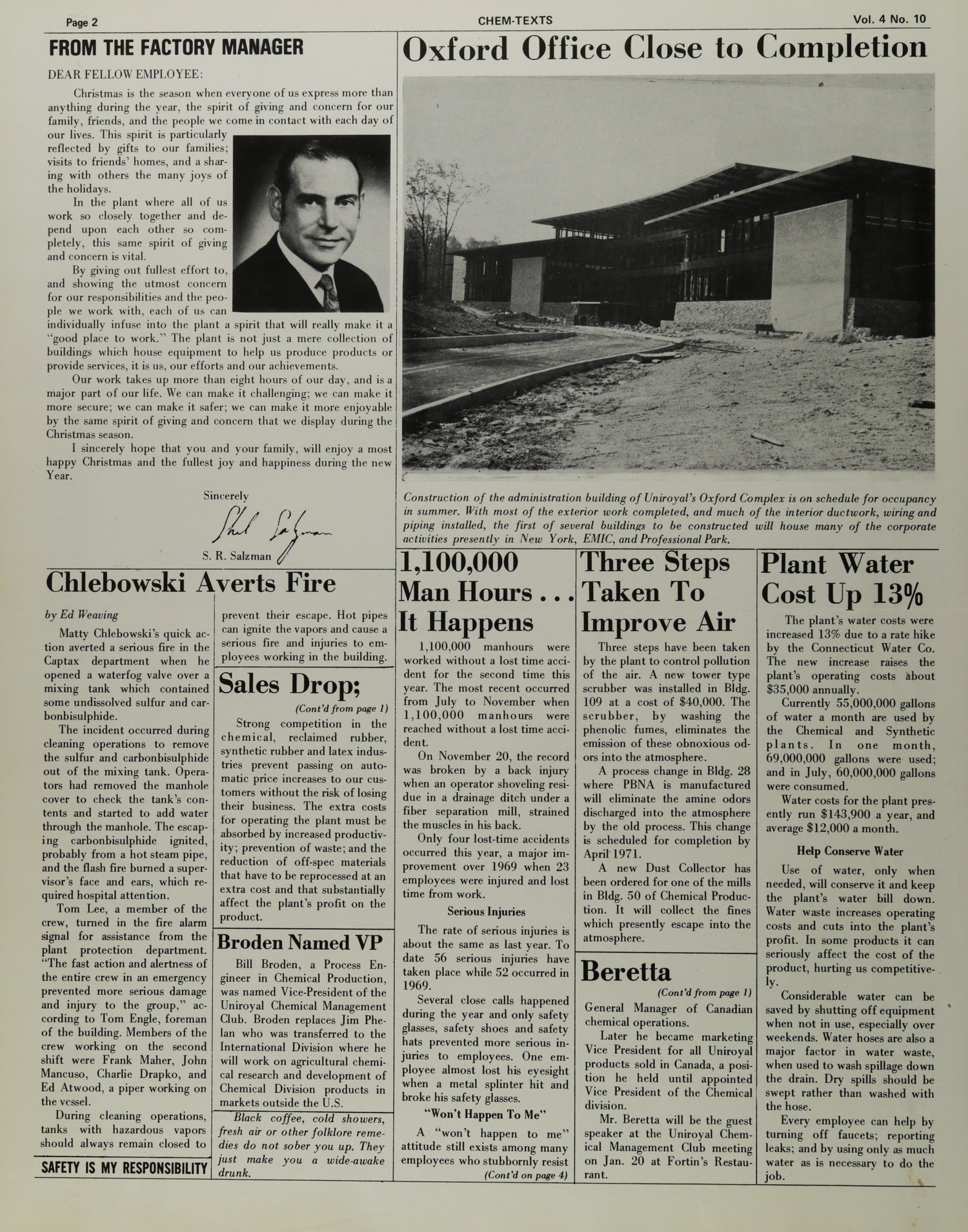
FROM THE FACTORY MANAGER | Oxford Office Close to Completion

DEAR FELLOW EMPLOYEE:

Christmas is the season when everyone of us express more than anything during the year, the spirit of giving and concern for our family, friends, and the people we come in contact with each day of our lives. This spirit is particularly reflected by gifts to our families; visits to friends’ homes, and a sharing with others the many joys of the holidays.

In the plant where all of us work so closely together and depend upon each other so completely, this same spirit of giving and concern is vital.

By giving out fullest effort to, and showing the utmost concern for our responsibilities and the people we work with, each of us can individually infuse into the plant a spirit that will really make it a “good place to work.” The plant is not just a mere collection of buildings which house equipment to help us produce products or provide services, it is us, our efforts and our achievements.

Our work takes up more than eight hours of our day, and is a major part of our life. We can make it challenging; we can make it more secure; we can make it safer; we can make it more enjoyable by the same spirit of giving and concern that we display during the Christmas season.

I sincerely hope that you and your family, will enjoy a most happy Christmas and the fullest joy and happiness during the new Year.

Sincerely

Shel Salzman

S. R. Salzman


Construction of the administration building of Uniroyal’s Oxford Complex is on schedule for occupancy in summer. With most of the exterior work completed, and much of the interior ductwork, wiring and piping installed, the first of several buildings to be constructed will house many of the corporate activities presently in New York, EMIC, and Professional Park.


Chlebowski Averts Fire

by Ed Weaving

Matty Chlebowski’s quick action averted a serious fire in the Captax department when he opened a waterfog valve over a mixing tank which contained some undissolved sulfur and carbonbisulphide.

The incident occurred during cleaning operations to remove the sulfur and carbonbisulphide out of the mixing tank. Operators had removed the manhole cover to check the tank’s contents and started to add water through the manhole. The escaping carbonbisulphide ignited, probably from a hot steam pipe, and the flash fire burned a supervisor’s face and ears, which required hospital attention.

Tom Lee, a member of the crew, turned in the fire alarm signal for assistance from the plant protection department. “The fast action and alertness of the entire crew in an emergency prevented more serious damage and injury to the group,” according to Tom Engle, foreman of the building. Members of the crew working on the second shift were Frank Maher, John Mancuso, Charlie Drapko, and Ed Atwood, a piper working on the vessel.

During cleaning operations, tanks with hazardous vapors should always remain closed to

SAFETY IS MY RESPONSIBILITY

prevent their escape. Hot pipes can ignite the vapors and cause a serious fire and injuries to employees working in the building.


Sales Drop;

(Cont’d from page 1)

Strong competition in the chemical, reclaimed rubber, synthetic rubber and latex industries prevent passing on automatic price increases to our customers without the risk of losing their business. The extra costs for operating the plant must be absorbed by increased productivity; prevention of waste; and the reduction of off-spec materials that have to be reprocessed at an extra cost and that substantially affect the plant’s profit on the product.


Broden Named VP

Bill Broden, a Process Engineer in Chemical Production, was named Vice-President of the Uniroyal Chemical Management Club. Broden replaces Jim Phelan who was transferred to the International Division where he will work on agricultural chemical research and development of Chemical Division products in markets outside the U.S.

Black coffee, cold showers, fresh air or other folklore remedies do not sober you up. They just make you a wide-awake drunk.


1,100,000 Man Hours… It Happens

1,100,000 manhours were worked without a lost time accident for the second time this year. The most recent occurred from July to November when 1,100,000 manhours were reached without a lost time accident.

On November 20, the record was broken by a back injury when an operator shoveling residue in a drainage ditch under a fiber separation mill, strained the muscles in his back.

Only four lost-time accidents occurred this year, a major improvement over 1969 when 23 employees were injured and lost time from work.

Serious Injuries

The rate of serious injuries is about the same as last year. To date 56 serious injuries have taken place while 52 occurred in 1969.

Several close calls happened during the year and only safety glasses, safety shoes and safety hats prevented more serious injuries to employees. One employee almost lost his eyesight when a metal splinter hit and broke his safety glasses.

“Won’t Happen To Me”

A “won’t happen to me” attitude still exists among many employees who stubbornly resist

(Cont’d on page 4)


Three Steps Taken To Improve Air

Three steps have been taken by the plant to control pollution of the air. A new tower type scrubber was installed in Bldg. 109 at a cost of $40,000. The scrubber, by washing the phenolic fumes, eliminates the emission of these obnoxious odors into the atmosphere.

A process change in Bldg. 28 where PBNA is manufactured will eliminate the amine odors discharged into the atmosphere by the old process. This change is scheduled for completion by April 1971.

A new Dust Collector has been ordered for one of the mills in Bldg. 50 of Chemical Production. It will collect the fines which presently escape into the atmosphere.


Beretta

(Cont’d from page 1)

General Manager of Canadian chemical operations.

Later he became marketing Vice President for all Uniroyal products sold in Canada, a position he held until appointed Vice President of the Chemical division.

Mr. Beretta will be the guest speaker at the Uniroyal Chemical Management Club meeting on Jan. 20 at Fortin’s Restaurant.


Plant Water Cost Up 13%

The plant’s water costs were increased 13% due to a rate hike by the Connecticut Water Co. The new increase raises the plant’s operating costs about $35,000 annually.

Currently 55,000,000 gallons of water a month are used by the Chemical and Synthetic plants. In one month, 69,000,000 gallons were used; and in July, 60,000,000 gallons were consumed.

Water costs for the plant presently run $143,900 a year, and average $12,000 a month.

Help Conserve Water

Use of water, only when needed, will conserve it and keep the plant’s water bill down. Water waste increases operating costs and cuts into the plant’s profit. In some products it can seriously affect the cost of the product, hurting us competitively.

Considerable water can be saved by shutting off equipment when not in use, especially over weekends. Water hoses are also a major factor in water waste, when used to wash spillage down the drain. Dry spills should be swept rather than washed with the hose.

Every employee can help by turning off faucets; reporting leaks; and by using only as much water as is necessary to do the job.

CHEM-TEXTS – Vol. 4 No. 10 – Page 4

Page 004

CHEM-TEXTS

Page 4 | Vol. 4 No. 10


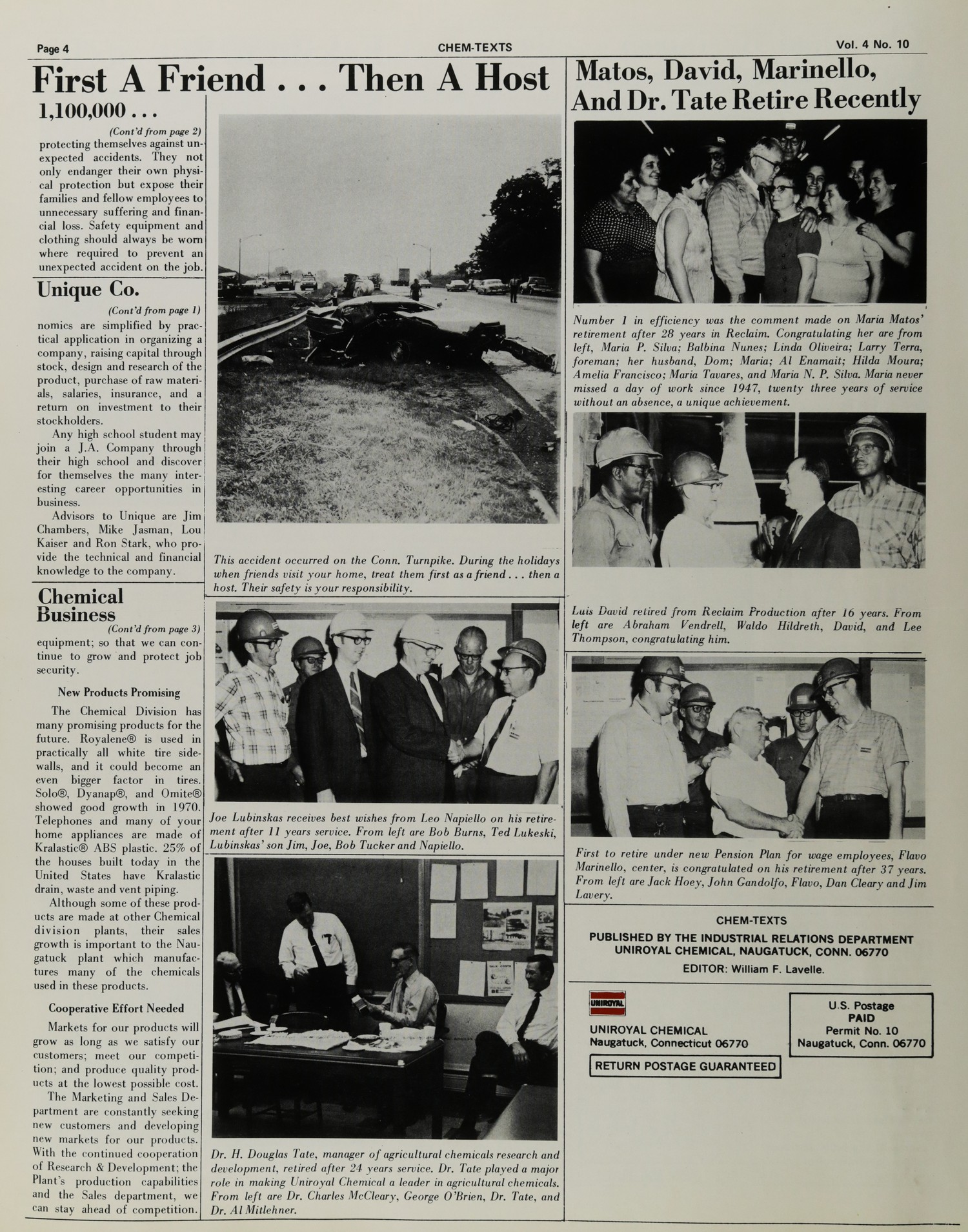
First A Friend . . . Then A Host

1,100,000 . . .

(Cont’d from page 2)

protecting themselves against unexpected accidents. They not only endanger their own physical protection but expose their families and fellow employees to unnecessary suffering and financial loss. Safety equipment and clothing should always be worn where required to prevent an unexpected accident on the job.


Unique Co.

(Cont’d from page 1)

nomics are simplified by practical application in organizing a company, raising capital through stock, design and research of the product, purchase of raw materials, salaries, insurance, and a return on investment to their stockholders.

Any high school student may join a J.A. Company through their high school and discover for themselves the many interesting career opportunities in business.

Advisors to Unique are Jim Chambers, Mike Jasman, Lou Kaiser and Ron Stark, who provide the technical and financial knowledge to the company.


Chemical Business

(Cont’d from page 3)

equipment; so that we can continue to grow and protect job security.

New Products Promising

The Chemical Division has many promising products for the future. Royalene® is used in practically all white tire sidewalls, and it could become an even bigger factor in tires. Solo®, Dyanap®, and Omite® showed good growth in 1970. Telephones and many of your home appliances are made of Kralastic® ABS plastic. 25% of the houses built today in the United States have Kralastic drain, waste and vent piping.

Although some of these products are made at other Chemical division plants, their sales growth is important to the Naugatuck plant which manufactures many of the chemicals used in these products.

Cooperative Effort Needed

Markets for our products will grow as long as we satisfy our customers; meet our competition; and produce quality products at the lowest possible cost.

The Marketing and Sales Department are constantly seeking new customers and developing new markets for our products. With the continued cooperation of Research & Development; the Plant’s production capabilities and the Sales department, we can stay ahead of competition.


This accident occurred on the Conn. Turnpike. During the holidays when friends visit your home, treat them first as a friend . . . then a host. Their safety is your responsibility.


Joe Lubinskas receives best wishes from Leo Napiello on his retirement after 11 years service. From left are Bob Burns, Ted Lukeski, Lubinskas’ son Jim, Joe, Bob Tucker and Napiello.


Dr. H. Douglas Tate, manager of agricultural chemicals research and development, retired after 24 years service. Dr. Tate played a major role in making Uniroyal Chemical a leader in agricultural chemicals. From left are Dr. Charles McCleary, George O’Brien, Dr. Tate, and Dr. Al Mitlehner.


Matos, David, Marinello, And Dr. Tate Retire Recently

Number 1 in efficiency was the comment made on Maria Matos’ retirement after 28 years in Reclaim. Congratulating her are from left, Maria P. Silva; Balbina Nunes; Linda Oliveira; Larry Terra, foreman; her husband, Dom; Maria; Al Enamait; Hilda Moura; Amelia Francisco; Maria Tavares, and Maria N. P. Silva. Maria never missed a day of work since 1947, twenty three years of service without an absence, a unique achievement.


Luis David retired from Reclaim Production after 16 years. From left are Abraham Vendrell, Waldo Hildreth, David, and Lee Thompson, congratulating him.


First to retire under new Pension Plan for wage employees, Flavo Marinello, center, is congratulated on his retirement after 37 years. From left are Jack Hoey, John Gandolfo, Flavo, Dan Cleary and Jim Lavery.


CHEM-TEXTS

PUBLISHED BY THE INDUSTRIAL RELATIONS DEPARTMENT
UNIROYAL CHEMICAL, NAUGATUCK, CONN. 06770

EDITOR: William F. Lavelle.


UNIROYAL

UNIROYAL CHEMICAL
Naugatuck, Connecticut 06770

RETURN POSTAGE GUARANTEED

U.S. Postage
PAID
Permit No. 10
Naugatuck, Conn. 06770

CHEM-TEXTS – Vol. 4 No. 10 – Page 10

Page 010

CHEM-TEXTS

Vol. 4 No. 10 Page 3


Chemical Business Competition Increases

[IMAGE: Three men in business attire reviewing documents]

Ed Geise, seated, Director of Marketing for the Chemical division reviews marketing plans with Henry Smith, left, General Sales Manager and Joe Flannery, General Products Manager.

by Joe Flannery

Business continues to be more and more competitive. In today’s tight economy, competitors want our customers just as we want theirs; and they fight pretty hard for them too. Today there is no such thing as a guaranteed market for our products.

Competitors are often willing to offer better delivery, packaging, quality, technical service and even lower prices to obtain business. And customers, on the other hand, are increasingly more demanding for these services and prices.

Cost-Price Squeeze

Most businesses today are in a cost-price squeeze in the competitive struggle. Our business is no exception. Profits have declined in the last year as a result of lower prices for our products and higher costs of doing business. And yet we must be increasingly responsive to our customers to keep our business and maintain a healthy growth. At the same time, we must be efficient and competitive to be profitable. Profits are the source of funds to expand our business; modernize plants; install new

(Cont’d on page 4)


Personnel Assignments

Earl Root was made a Foreman in Synthetic Production. Prior to his new assignment he was a Utility Operator at the Synthetic plant. Earl joined Uniroyal in 1947.

Al Hoodbhoy was assigned to Testing Services in Bldg. 81, responsible for Chemical Control.

Doug Ritche was transferred to the Synthetic plant as a process engineer.


Lab Cat Becomes A Queen

[IMAGE: Woman holding a cat and displaying trophies]

Miss Uniroyal, a pedigree Domestic Short Hair displays her trophies with Ruth Shipman.

by Ruth Shipman

Two years ago, a stray kitten walked through the main gate, and into building 81 Lab. The cat turned out to be a pedigreed Domestic Short Hair with a Tortoise shell fur, black, orange, and creamy white.

In her first show in 1969, Miss Uniroyal was judged Best Household pet and in 1970 three judges named her Best Household pet twice at the Yankee Spay and Neuter Club Show.

The two year old Miss Uniroyal is now registered with the Cat Fanciers Federation.


DON’T DRINK AND DRIVE


Omite Facilities

(Cont’d from page 1)

worked in Bldg. 100: Bob Anderson, Joe Bednarek, Lyle Bissonette, Ed Cheney, Ray Drapeau, Harry Hedrick, Orrin Huntley, Dan Marino, John Matcheson, Carl Mulonet, Dom Persutti, and Bob Breton, foreman of the building.

Reduces Pollution

By recovery of the heptane solvent, which was previously lost and discharged into the atmosphere and the Naugatuck River, the plant not only saved materials’ cost but also reduced pollution.

Prevention of waste by dumping materials into the drain is an important part of the plant’s policy to stop pollution. Its success depends on every operator carefully checking all processing operations to prevent waste, and to avoid washing chemical spillage into the river.

Safer Operation

Bulk butyl phenol will be stored in one of the new 10,000 gallon tanks and piped directly into the processing operations, making the job easier and safer. An operator previously lifted and knifed open the 50 lb. bags, and emptied them into the equipment. The bags were discarded as solid waste. The new facility now eliminates this waste problem, another improvement in pollution abatement.

The other 10,000 gallon tank holds thionyl chloride, which was previously handled in 55 gallon drums.

The two new tanks minimize exposure to lifting and handling heavy objects, as well as, the exposure to handling chemicals in drums.

Promising Product

Sales of Omite increased 10% over 1969 sales and was a bright spot in the plant’s economic


Eskiloos Set Style

[IMAGE: Woman in boots posing outdoors]

Uniroyal’s Eskiloos are better than ever for getting around town in style in rain and snow weather. Eskiloos come in all lengths from ankle bone to knee high on high, thick heels. They offer wash-and-wear easy care, water repellent protection, shape retention and salt stain resistance. Many of these special attributes are due to the Royalon vinyl upper material which is made from Marvinol vinyl, a product of the Chemical Division. Much of the Research and Development work on the vinyl plastic is done by the Marvinol group at the Technical Sales Service Center.

situation when sales of rubber chemicals, reclaimed rubber, synthetic rubber and latex dropped off.

Delays in label registration from the U.S. Dept. of Agriculture for use on orange, grapefruit, and lemon trees have affected a more optimistic sales forecast previously set for 1971. As a result, production of the chemical in the plant has been rescheduled for a shorter schedule.

Seven years of field tests and toxicology tests to determine the safe use on food crops were conducted at a cost of approximately $750,000 before a pound of the chemical was sold commercially.

Omite does not upset the ecological cycle. Harmless to humans and animals, it does not disrupt the natural, biological control of predatory insects such as bees which are beneficial to growers.


Phenol Spill Causes Burn

A freak accident took place in the Control Lab. when the bottom of a glass test tube broke while an analyst was stirring a chemical in it with a glass rod. Phenol spilled over the employee’s laboratory smock and caused a minor burn to the skin.

The accident was a perfect example of the unexpected happening. As a safety precaution against such accidents, glassware should be held over the laboratory bench to avoid accidental burns from broken glassware.

Accidents of this type are unusual and occur only one out of a thousand times. Prevention of the one time is what safety is all about.


[IMAGE: Four people in discussion around a table]

Label registration for Omite use on citrus crops is discussed by, from left, Gracie Stone, Bob Covey, Dr. John Zukel and Dr. Al Smith.

CHEM-TEXTS – Vol. 3 No. 2 – Page 2

Page 002

CHEM TEXTS

Page 4

The $475.00 Cup

SUGGESTION PLAN AWARDS

Gene St. John had an idea some time back about the use of the small gel cups used in the laboratory for testing purposes. Part of Gene’s job was buying laboratory equipment and material; however, not satisfied with the products available on the market, he set about the task of designing an inexpensive cup that would do the job, equally well. Much of the work was done at home. The result was a suggestion award of $475.00 based on savings when Gene’s efforts paid off.

Jacinto DaSilva of the Chemical Production department was awarded $60.00 (the balance of an $85.00 award) for his idea to change the method of washing Octamine which reduced the amount of material going to the sewer. An original award of $25.00 was made last January for this suggestion – the balance of the award is based on actual experience in material savings.

The above 2 awards were the highest out of a total of 49 suggestions considered during a recent meeting of the suggestion committee. Twelve (12) cash and nine (9) Honorable mention awards were made totaling $725.00. Other awards were:

Joseph Moniz – Digesters –
Honorable Mention

Joseph Moniz – Digesters –
$25.00


Harry Rich – Labs – $15.00
Ed Day – Labs –
Honorable Mention
Dom Angiolillo – Labs –
$15.00
Frank Wasilesky – Mech.
Stores – $15.00
N. Salinardi – Mech. –
Honorable Mention
Carmine Ianuzzi – Mech.
Honorable Mention
(3rd – $10.00)
W. Frum – Mech. – $25.00
Charles Drapko – Chem. Prod.
$15.00
George Ravenscroft, Jr. –
Mech. – $35.00
Carmine Ianuzzi – Mech. –
Honorable Mention
G. Hennessey – Chem. Prod.
$15.00
Jacinto DaSilva – Chem. Prod.
Honorable Mention
Bill Leary – Mech. –
Honorable Mention
W. Detlefsen – Chem. Prod. –
Honorable Mention
A. Giancarlo – Mech. –
Honorable Mention
A. Gedraitis – Mech. – $15.00
G. Hennessey – Chem. Prod. –
Honorable Mention

The overall figures this year represent a reduction in suggestion plan activity due to the recent strike.

Through August 1967 a total of 201 suggestions have been considered with 64 awards totaling $1,620.00 being made. During this same period there were also 23 Honorable Mention awards.


NEW SAFETY EYE PROTECTION PROGRAM TO BE STARTED

A study of first-aid cases revealed a substantial number of eye injuries, many of them potentially serious. To combat this problem the use of safety glasses will be expanded throughout the plant to include all production, maintenance and laboratory areas and all personnel who work or visit these areas.

We will expect each person to wear safety glasses at all times during his working shift except in office, rest or locker room areas. For those who require prescription glasses the company has a program of providing safety frames and lenses.

For those who do not ordinarily wear glasses we maintain a stock of “planos” that can be worn by anyone and can be obtained through his foreman. For those who have a fitting problem we will provide professional help.

We believe this program is a step forward in our continuing efforts to provide an ever safer work place. We look toward full cooperation from all of our Uniroyal Chemical people and the Safety Department is ready to help in any way it can.


Do Safety Glasses Work? The photo above shows what happened when a 1/4″ thick glass bullseye ruptured and flying glass, under great pressure, struck a fellow employee. The safety glasses cracked but did not shatter. Think about what could have happened if he did not have Safety Glasses on.


Here’s a real old timer for you — Naugatuck Chemical 1905. We are told (by an old timer, of course) that the buildings in the center of the picture are #1 and #2 buildings which are still standing. The fence running along the railroad track is located where #7 building is now located. Just about the time this picture was taken, construction was starting on #30 building (the old sulfuric acid facility) which is now the Chemical machine shop.


Two Recent Accidents Mar Record

Here is a brief description of two lost-time accidents which occured during the last week in August…We outline them here in the hope that having read what can happen, you will work with care.

An operator in the pilot plant was running material through a granulator when a cloth being used to contain the dust fell down. When the operator attempted to tuck the cloth back into place, his hand pushed too far into an opening in the back of the machine. The arm on the flywheel caught his left middle finger against the body of the granulator smashing the tip, resulting in a partial amputation.

A truck driver was helping in the loading of 16 inch diameter pipe. Two sections were already on opposite sides of the truck to balance the load. When the truck driver moved to one side of the truck, one section of pipe rolled across the truck body and crushed his right ankle against the other section, causing a fracture.


CLEANER AIR WEEK

[IMAGE: Logo showing “CLEANER” with numbers 12, 9, 3, 6 around it and text “ROUND THE CLOCK”]

OCTOBER 23-29


From an Unexpected Quarter

An old rifle-bought to be part of a firearms collection – went off in the hands of its owner and severely injured a person nearby. No one had even thought to find out whether or not the rifle was loaded!

On the job, we are trained to be on the lookout for all the “normal” hazards. Its the totally unexpected condition that sometimes fools us.

Even if you have the best accident-prevention program in the world, remember this: safety in a department depends largely on the alertness of every individual who works there.


FIRE DEPARTMENT ASKS COOPERATION FOR WINTERIZING

With the thoughts of summer vacation still fresh in our minds and several weeks of pleasant weather still ahead, it may be a little difficult to think seriously about winter weather and freezing temperatures. Our plant fire department, however, has to think about it as this is the time of year when they begin preparing their equipment for winter. Certain valves must be shut – outside sprinkler systems filled with anti-freeze; air valves controlling other outside fire protection piping must be checked to be sure it is in proper working order. All plant structures must be inspected to make sure all openings, broken windows, etc., are closed up. This is where you can help by making sure all windows and doors in your work area are in good condition and above all, make sure they are closed up at night. An open window next to a sprinkler line can cause a freezeup even if the building is heated.

A little preventative care and maintenance by all of us can save a great deal in loss or replacement of vital fire protection.


1967 SAFETY BOX SCORE 8 MONTHS THROUGH AUGUST 31

1967 1966
Lost-Time Injuries 8 12
Serious Injuries 37 40
Total 45 52

The fact that our injuries are somewhat less than last year’s record high total is no reason to relax our safety efforts. In August we doubled our previous total of 4 lost-time injuries. In addition, we had 8 serious injuries and several near-miss incidents.

Near-misses are warnings of something gone wrong! If you had one recently it could as easily have been an accident. Don’t take that chance – work safely.


SALESROOM NOTICE

The employee salesroom on Rubber Avenue has announced a special mattress sale from September 15 through October 13, 1967.

Mattress and box spring

Twin and full size — $ 66.00
Queen size 60×80 — 92.75
King size 72×84 or 76×80 — 133.25


UNIROYAL Chemical
Naugatuck, Connecticut 06770

U.S. Postage
PAID
Permit No. 10
Naugatuck, Conn. 06770

CHEM-TEXTS – Vol. 3, 1969, No. 3 – Page 1

Page 001

UNIROYAL CHEM-TEXTS

Vol. 3 1969 PUBLISHED FOR THE PEOPLE OF UNIROYAL CHEMICAL No. 3


NAUGATUCK, LEADER IN RUBBER CHEMICALS

New Curalon Plant Starts Up Will Increase Chemical Sales

[IMAGE: Factory/plant interior with workers and equipment]

Checking operations in the new Curalon plant are l. to r. Anthony Gambardella, Rocco Magnanimo, foreman, and Thurman Walton.

by Harold Smith

The new Curalon plant in Bldg. 17, formerly the Flexzone® and DDM plant, started production recently of Curalon® a new chemical curative used to harden and shape liquid polyurethane elastomers. The polyurethane elastomers have today become a large industry.

Uniroyal Chemical, was a leader in the research and development of the polyure-

(continued on page 2)


Results Successful In Water Pollution Abatement Program

[IMAGE: Industrial water treatment facility]

One of the three waste water treatment units along the Naugatuck river to provide design information for treatment of waste waters

by Dick Shaw

Uniroyal Chemical completed another major step in its water pollution abatement program with excellent results.

For the past 6 months, extensive engineering efforts have been concentrated on the operation of a waste water treatment model scale plant

(continued on page 3)


[IMAGE: Workers watching bagging operation with “DELAC-S PRILLS” visible on equipment]

Good packaging is essential to good customer service. Left to right, watching the bagging of Delac – S Prills are Jim Heagle and Tom Dowling. John Starr, right, operates the bagger.

by Bob Mazaika

Uniroyal Chemical is the world’s leading manufacturer of rubber chemicals, representing a high percent of the division’s sales. The Chemical division manufactures more than 70 different chemicals for the rubber, plastics and latex industries. 70 percent of these chemicals are made here at the Naugatuck plant. Many are patented, which means only Uniroyal Chemical can make them; but many are not, and sold against strong competition. Recent price cuts have hurt sales and profits and made selling a harder job for the Sales Department. To maintain this position as leader in the industry requires constant research for new chemicals; continued improvement in quality; extra effort on good packaging to improve service to our customers; who are the most important part of our business. Because of dirty, wrong-marked packages and poor quality products, we could lose two or three major customers and lose our position as leader in the industry.

Chemicals made at Naugatuck range from C-P-B, used by golf ball manufacturers to “cure” golf ball covers to Sunproof® waxes to protect tires against sidewall cracking from weather conditions.

Uniroyal offers more accelerators to the rubber industry than any other company such as Trimene,® Methazate, Delac®S, M-B-T-S, Monex,® Tuex,® GMF and Royalac.® These chemicals “cure” the rubber and help shape it into its finished form. Without these accelerators, rubber would be like putty or uncured cement. Accelerators are used to make every type of rubber product from pencil erasers to foam rubber mattresses and automobile tires. GMF® is used in the Minuteman Missile as part of the propellant system.

Naugatuck antioxidants, the best in the industry, protect rubber products from heat and oxygen which cause rubber to deteriorate, discolor, or crumble. For example, BX-A protects the nylon used in tire cord; Polygard® and Naugawhite® keep white products — such as sneakers and footwear — white and prevent the rubber from discoloring. Other well known antioxidants are Octamine, Retarder J and Polylite.

Rubber chemicals constitute the highest cost in every rubber product, and are from two to ten times more expensive on a per-pound basis than any other ingredient used in the finished product. Because of their high cost, customers demand the highest quality chemicals for these prices, otherwise they turn to

(continued on page 3)


[IMAGE: Person jogging/running in athletic wear]

Naugatuck antioxidants give Pro-Keds jogging shoes quality and longer wear life.


SAFETY IS MY RESPONSIBILITY

CHEM-TEXTS – Vol. 3 No. 3 – Page 2

Page 002

Page 2 CHEM-TEXTS Vol. 3 No. 3


FROM THE FACTORY MANAGER

DEAR FELLOW EMPLOYEE:

Are you a professional? In sports the professional is one whose proficiency and skill enables him to earn his living through his participation. The professional is characterized by his pride in his efforts. In a similar sense, we are professionals earning our living by supplying our customers with chemicals, reclaim, and polymers. But do we always demonstrate the proficiency and skill required in our jobs? Do we have the pride of workmanship characteristic of the professional?

Remember a professional always gives his best and always tries to win. He puts team goals and team effort ahead of his own personal desires. He believes the whole team wins together and he takes pride in realizing that the true recognition for his effort is in the team winning.

The same thing is true in our plant – we all win when we satisfy our customers’ needs in the most efficient manner possible. Anything less than this – we aren’t professionals!

[Signature]

John D. Evans


Chemical Control Center Reviews Quality, Productivity, and Costs

[IMAGE: Sam Gillette, left, listens as Walt Frankenberger, in charge of the Chemical Control Center, reviews the previous day’s production with Jim Cronin, right, superintendent of chemical production.]

by Walt Frankenberger

The Chemical Control Center (CCC) in Chemical Production was established 18 months ago to increase productivity, improve the quality of our products and to decrease costs. The center was set up by Walt Frankenberger who organized the procedures for operating it.

By weekly and daily review of production pounds, quality, and costs, the Center controls productivity and spots downward trends in the plant which require adjustment. The CCC also reviews on a monthly basis the performance against set standards of every chemical made by the plant during the previous month and year to date. This evaluation is based on raw material usage, yield and productivity expressed in pounds per hour. A report is then given to the responsible foreman and process engineer so that corrective action can be taken, if necessary.

For daily control, a daily batch card is used for reporting the date and number of batches made each day. The cards are turned in daily to the center, logged, and sent to EMIC for further processing.

The number of batches for the major chemical products are plotted on control boards, shown in the photo, where they are compared to a set standard and on which a rolling average is maintained. When the number of batches drop below the standard, the person in any business.


73 Employees Awarded $1455 For Suggestions.

Wojtczak Receives $70. Mayo’s Idea Brings $50.

[IMAGE: Looking at the checks awarded for their suggestions are l. to r. Elmer Anderson, Joe Wojtczak, and Bob Lockwood who received a total of $157. for their ideas.]

by Kirk Kirkendall

Suggestions for improving the plant’s overall operations can provide benefits which go beyond the money received for a suggestion award. Contributing suggestions and ideas involves a person in the successful operation of the plant and brings a personal satisfaction to his job. No matter what you may think of your suggestion, don’t hesitate to send it in. It may turn out to be an important one.

73 employees recently received $1,455. for their suggestions out of the 150 suggestions which were reviewed. The highest single award of $50 went to Fred Mayo. Joe Wojtczak received $70 for several suggestions. John Painter, a consistent winner, got $65; Ed Bazenas $55; Al Urban of Reclaim $50 and Bob Lockwood of Synthetic Production $47.50.

Receiving $40 for their suggestions were Fernando Henriques, R. Fratangelo, Ed Semaskvich and Elmer Anderson. Joe Moniz of Reclaim obtained $35 for his idea on improving the cleaning of Sweco screens; J. Gallucci $30 for a safety suggestion, and $30 to W. Anderson, Fred Engle, J. Lawton, J. Wawer and J. Gandolfo.

$25 awards were received by H. Rich, J. Wawer, J. Matcheson, J. Brown, L. foreman gives a detailed explanation of the causes for the lost production.

Since daily control was initiated, rubber chemical production has consistently improved over production prior to September 1968. The quality of rubber chemicals has also improved through the Center’s operation. By improving production and quality, the Center helps to provide better service to our customers, the most important person in any business.

[IMAGE: Fred Mayo received $50. the highest single award. (Photo by Kirkendall)]

Rinaldi, G. Brezak, L. Dumonski and J. Butkus.

$20 awards went to E. Smith and F. Pikula, and J. Butkus and J. Painter.

Thirty-three employees received or split $15 for their


New Curalon

(con’t from page 1.)

thane elastomers; developed the product, Vibrathane, the tradename for our polyurethane elastomers. Our Research and Development technology in rubber chemicals led to the development of Curalon L whose use should grow at a 20 per cent rate annually.

Polyurethane elastomers cured with Curalon possess high resistance to wear and tear and have excellent shock absorption properties. Because of these properties, they are used for grain chute linings, industrial truck tires, gears, mountings and printing rolls where they outlast rubber 3 to 4 times longer.

Project engineers of the new plant were Neil Klarfeld and Jim Garrigan. Lou Kaiser is the process engineer, responsible for the manufacturing operation.


ideas: Lois Devino, C. Iannuzzi, F. Maher, A. Hanley, Ray Gogolewski, J. Hoey, J. Mahoney, J. Lynch, K. Urbsaitis, N. Tiscione, A. Krampetz, G. Monahan, J. Banno, R. Ruginis, D. Pardal, B. Zukauskas, J. Grosso, E. Johnson, R. O’Neil, E. Root, J. Objinski, A. J. Happy, R. Bell, T. Ciarello, J. Slasienski, J. Lynch, A. Gedraitis, G. Ravenscroft, C. Parks, R. Steward, Laura Soares, V. Kloc – Bob Lockwood, and L. Haas – J. Wawer.

Honorable Mentions, which automatically bring a $15 award for the third suggestion submitted, went to J. Mahoney, F. Dingle, P. Masone, H. F. Carroll, M. Hebert, B. Pranulis, R. Lestage, E. Anderson, J. Wojtczak, F. Henriques, C. Miele, J. Lawton, F. Phelan, J. Butkus (2), J. Painter, K. D. Nelson, R. O’Neil, C. Hiser – D. Cleary, G. Brezak and L. Reeser.

Every suggestion submitted receives serious consideration by the Suggestion Awards Committee. Some suggestions require more time to study than others to evaluate them, which is oftentimes the reason for some delay. Suggestions worthy of consideration are any that increase production, improve quality, eliminate duplication or waste, improve packaging, simplify your work procedure, eliminate paper work, improve customer service, reduce costs, improve production, and better our safety conditions.

Suggestion forms are available around the plant. If unavailable, your Foreman or Supervisor will be glad to obtain them for you.


Save Your Blood For June 12

by Bob Shortt

June 12 has been reserved as Uniroyal Chemical’s day for blood donations. Because of its convenient facilities, the Bloodmobile will be held at St. Michael’s Parish House in Naugatuck. Our quota is 150 pints.

Employees have donated generously since the visits started in 1957 when 190 pints were given. Since then, we have averaged about 170 pints each visit.

Blood is in great demand today. By contributing, you can help be sure that blood is available for you or your family. Let’s try for the 190 pints again.

CHEM-TEXTS – Vol. 3 No. 3 – Page 3

Page 003

CHEM-TEXTS

Vol. 3 No. 3 | Page 3


KNOW YOUR BENEFITS: by Marion Hutt

Uniroyal’s Paid Vacation Benefits Comparable To Best In Industry

The entire vacation policy for wage employees is too lengthy to reproduce here but the following are some of the most frequently asked questions:

Q. How much vacation am I entitled to receive?

A. Employees will receive vacations based on their seniority with the Company on Dec. 31 of the prior calendar year, as follows:

1 year. . . . . . . . . . . . . 2 weeks
5 years. . . . . . . . . . . . 3 weeks
15 years . . . . . . . . . . . 4 weeks
22 years . . . . . . . . . . . 5 weeks
30 years or more . . . . 6 weeks

Q. How much vacation pay do I receive?

A. Those entitled to a vacation of:
2 weeks . . . . . . 4% of earnings
3 weeks . . . . . . 6% of earnings

(continued on page 4)


UNIROYAL, INC. FIRST QUARTER SALES AND NET INCOME SET RECORD HIGH

Uniroyal, Inc., set new records in sales and net income for the first quarter of 1969, George R. Vila, chairman and president, reported at the annual meeting of stockholders.

Sales for the quarter were $368.8 million, an increase of 9.3 percent compared with $337.4 million for the same period last year and the highest for any first quarter in Uniroyal’s history.

Net income was $12.5 million, another record for a first quarter. This compares with $12.1 million during the first quarter of 1968.

First quarter earnings were equivalent to 44 cents a share of common stock compared with 43 cents a share last year.

The new record in earnings was achieved despite inflationary trends in the economy and high start-up expenses for an unusually large number of new plants coming on stream worldwide, Mr. Vila said.

During the next five years, Uniroyal has programmed capital expenditures of more than $600 million. During 1969, expenditures will be $150 million compared to more than $100 million in 1968. Heavier capital expenditures, Mr. Vila said, are necessary to keep pace with expanding economies around the world as well as to gain maximum benefits from new products from Uniroyal’s research and development laboratories.


Naugatuck Leader . . .

(continued from page 1)

competitive companies for the quality and service. Major competitors in the rubber chemical market are well known large chemical companies like Monsanto, du Pont, R.T. Vanderbilt and American Cyanamid.

Our rubber chemical business started more than fifty years ago as a producer of sulfuric acid for the brass industry in the Waterbury area. Today, Uniroyal Chemical supplies 25% of the total rubber chemicals used in the rubber and plastics industry. Practically every automobile tire manufactured, contains one of Uniroyal’s chemicals. In the past ten years, sales have doubled and, depending on the rubber and plastic industries’ growth, sales are expected to continue at this growth rate.

Interestingly, our rubber chemical technology was the base from which our present agricultural chemical business developed with the introduction of Spergon and Thiram seed protectants. Agricultural chemicals like MH-30,® Alar,® Aramite,® Omite,® Alanap® and Dyanap® have become an important part in the Division’s growth.

Today our list of rubber chemical customers include such companies as Goodyear, Firestone, General Tire, Armstrong Tire, Cooper Tire, Dunlop and many other large companies, all important to our rubber chemical business. With good quality products, properly marked, clean packages, and good customer service, they’ll continue to do business with us. Each of us in our own way, by doing our jobs in the best possible way, makes certain that we keep our valued customers.


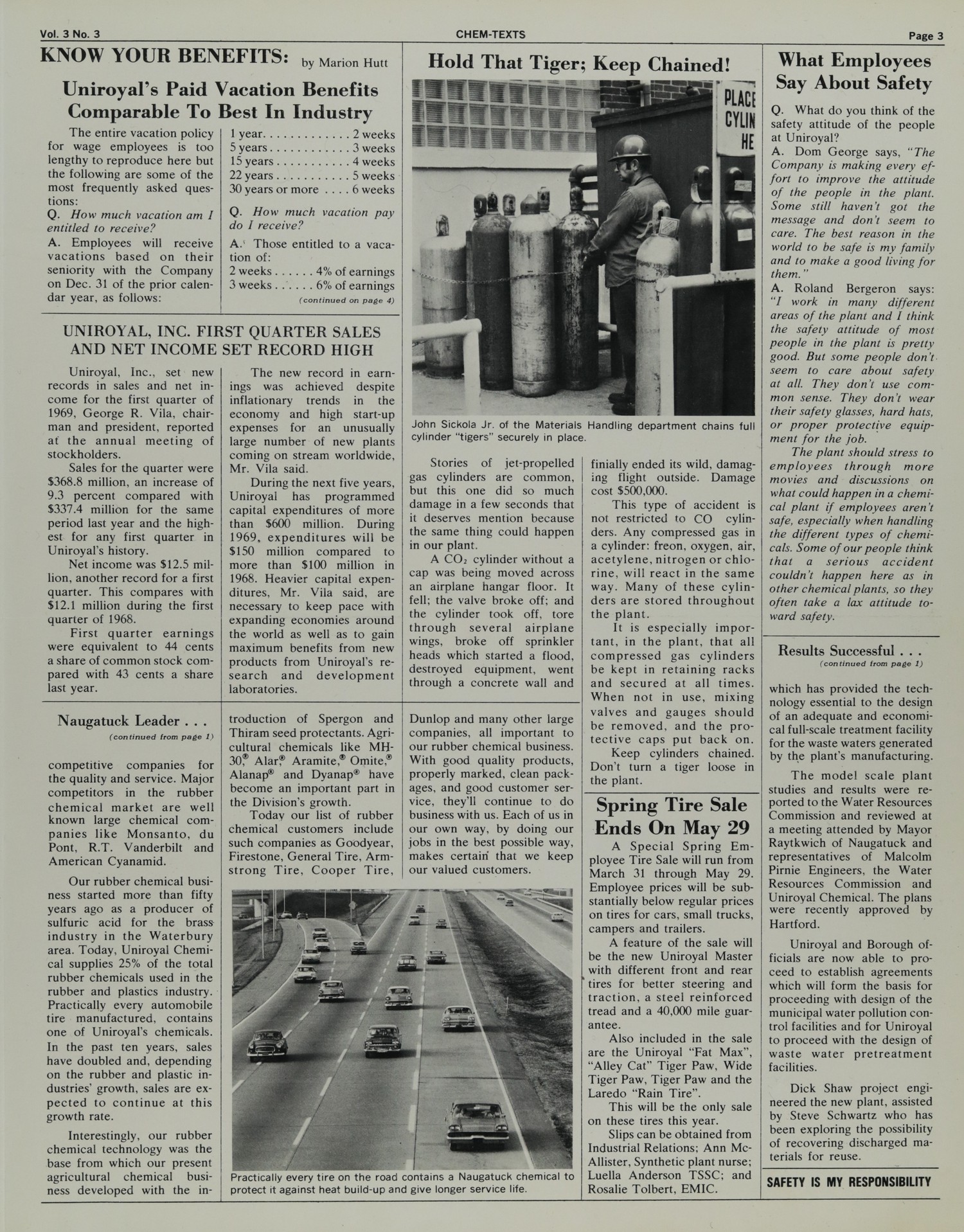
Hold That Tiger; Keep Chained!

PLACE CYLIN HE

[IMAGE: John Sickola Jr. of the Materials Handling department chains full cylinder “tigers” securely in place.]

Stories of jet-propelled gas cylinders are common, but this one did so much damage in a few seconds that it deserves mention because the same thing could happen in our plant.

A CO₂ cylinder without a cap was being moved across an airplane hangar floor. It fell; the valve broke off; and the cylinder took off, tore through several airplane wings, broke off sprinkler heads which started a flood, destroyed equipment, went through a concrete wall and finally ended its wild, damaging flight outside. Damage cost $500,000.

This type of accident is not restricted to CO cylinders. Any compressed gas in a cylinder: freon, oxygen, air, acetylene, nitrogen or chlorine, will react in the same way. Many of these cylinders are stored throughout the plant.

It is especially important, in the plant, that all compressed gas cylinders be kept in retaining racks and secured at all times. When not in use, mixing valves and gauges should be removed, and the protective caps put back on. Keep cylinders chained. Don’t turn a tiger loose in the plant.


Spring Tire Sale Ends On May 29

A Special Spring Employee Tire Sale will run from March 31 through May 29. Employee prices will be substantially below regular prices on tires for cars, small trucks, campers and trailers.

A feature of the sale will be the new Uniroyal Master with different front and rear tires for better steering and traction, a steel reinforced tread and a 40,000 mile guarantee.

Also included in the sale are the Uniroyal “Fat Max”, “Alley Cat” Tiger Paw, Wide Tiger Paw, Tiger Paw and the Laredo “Rain Tire”.

This will be the only sale on these tires this year.

Slips can be obtained from Industrial Relations: Ann McAllister, Synthetic plant nurse: Luella Anderson TSSC; and Rosalie Tolbert, EMIC.


[IMAGE: Practically every tire on the road contains a Naugatuck chemical to protect it against heat build-up and give longer service life.]


What Employees Say About Safety

Q. What do you think of the safety attitude of the people at Uniroyal?

A. Dom George says, “The Company is making every effort to improve the attitude of the people in the plant. Some still haven’t got the message and don’t seem to care. The best reason in the world to be safe is my family and to make a good living for them.”

A. Roland Bergeron says: “I work in many different areas of the plant and I think the safety attitude of most people in the plant is pretty good. But some people don’t seem to care about safety at all. They don’t use common sense. They don’t wear their safety glasses, hard hats, or proper protective equipment for the job.

The plant should stress to employees through more movies and discussions on what could happen in a chemical plant if employees aren’t safe, especially when handling the different types of chemicals. Some of our people think that a serious accident couldn’t happen here as in other chemical plants, so they often take a lax attitude toward safety.


Results Successful . . .

(continued from page 1)

which has provided the technology essential to the design of an adequate and economical full-scale treatment facility for the waste waters generated by the plant’s manufacturing.

The model scale plant studies and results were reported to the Water Resources Commission and reviewed at a meeting attended by Mayor Raytkwich of Naugatuck and representatives of Malcolm Pirnie Engineers, the Water Resources Commission and Uniroyal Chemical. The plans were recently approved by Hartford.

Uniroyal and Borough officials are now able to proceed to establish agreements which will form the basis for proceeding with design of the municipal water pollution control facilities and for Uniroyal to proceed with the design of waste water pretreatment facilities.

Dick Shaw project engineered the new plant, assisted by Steve Schwartz who has been exploring the possibility of recovering discharged materials for reuse.


SAFETY IS MY RESPONSIBILITY

CHEM-TEXTS – Vol. 3 No. 4 – Page 2

Page 002

CHEM-TEXTS

Page 2 | Vol. 3 No. 4


FROM THE FACTORY MANAGER

DEAR FELLOW EMPLOYEE:

All of us are aware of the importance of producing quality products in an efficient and safe manner. We are also aware of the importance of providing service to our customers, for only through the sale of the results of our effort can we be paid for this effort. I am convinced that each of us tries to do his job in the best way.

But how do we see our jobs? Is our particular job over, when we feel that somebody other than ourselves can be blamed for poor performance?

For example, is it justifiable to blame our injury on someone else if, indeed, it was an unsafe act on our part? Or, is it reasonable to blame lost production on the shortage of raw materials if we didn’t do something about it? Maybe we are all too quick to place the blame on someone else, before we accept all of our own responsibilities.

Together, we operate a very complex operation where each employee bears a great deal of responsibility for his personal efforts, and if we are fully successful a great deal of responsibility for the efforts of others.

Sincerely,

[Signature]

John D. Evans


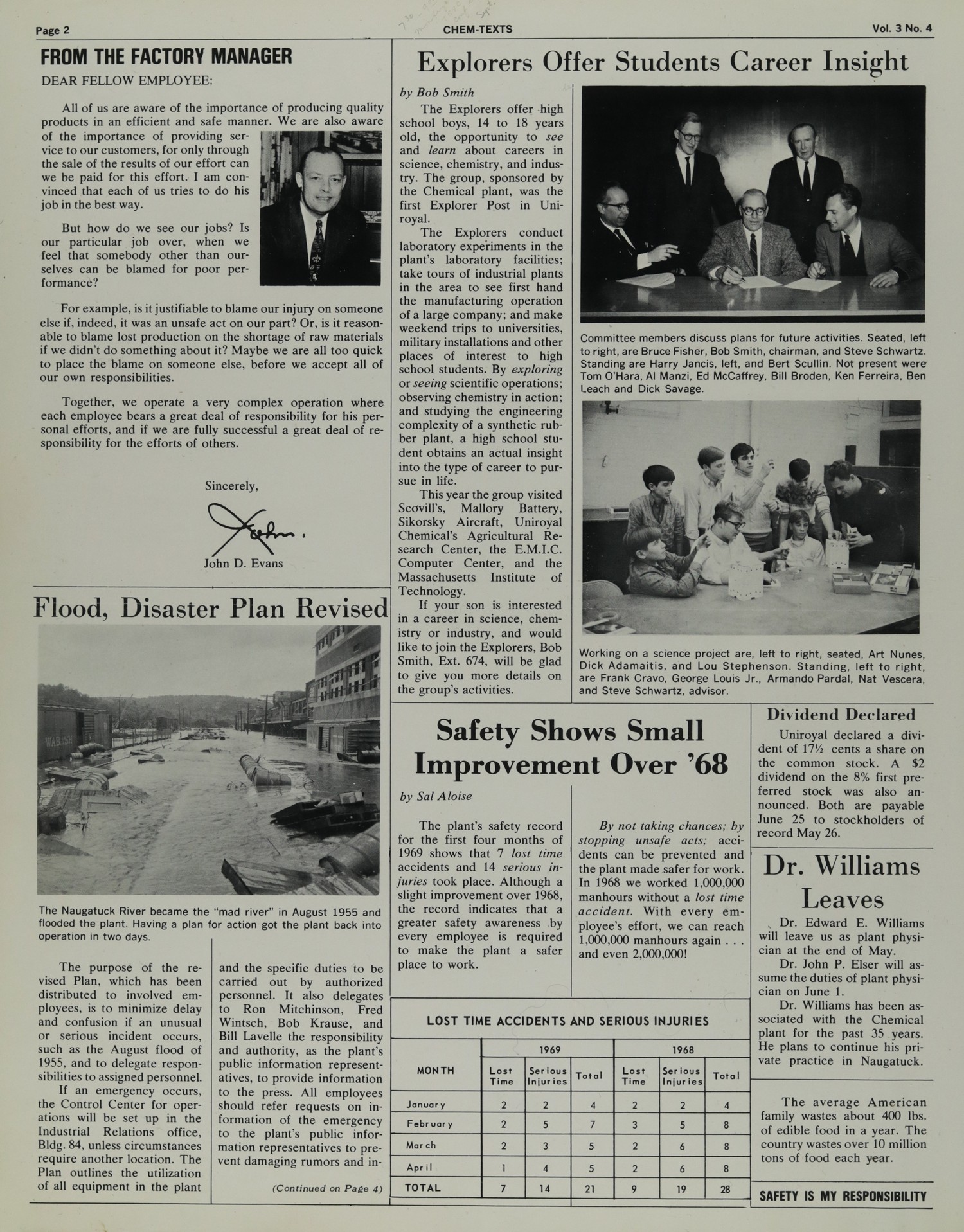
Flood, Disaster Plan Revised

[IMAGE: Black and white photograph showing flooded area with building]

The Naugatuck River became the “mad river” in August 1955 and flooded the plant. Having a plan for action got the plant back into operation in two days.

The purpose of the revised Plan, which has been distributed to involved employees, is to minimize delay and confusion if an unusual or serious incident occurs, such as the August flood of 1955, and to delegate responsibilities to assigned personnel.

If an emergency occurs, the Control Center for operations will be set up in the Industrial Relations office, Bldg. 84, unless circumstances require another location. The Plan outlines the utilization of all equipment in the plant and the specific duties to be carried out by authorized personnel. It also delegates to Ron Mitchinson, Fred Wintsch, Bob Krause, and Bill Lavelle the responsibility and authority, as the plant’s public information representatives, to provide information to the press. All employees should refer requests on information of the emergency to the plant’s public information representatives to prevent damaging rumors and in-

(Continued on Page 4)


Explorers Offer Students Career Insight

by Bob Smith

The Explorers offer high school boys, 14 to 18 years old, the opportunity to see and learn about careers in science, chemistry, and industry. The group, sponsored by the Chemical plant, was the first Explorer Post in Uniroyal.

The Explorers conduct laboratory experiments in the plant’s laboratory facilities; take tours of industrial plants in the area to see first hand the manufacturing operation of a large company; and make weekend trips to universities, military installations and other places of interest to high school students. By exploring or seeing scientific operations; observing chemistry in action; and studying the engineering complexity of a synthetic rubber plant, a high school student obtains an actual insight into the type of career to pursue in life.

This year the group visited Scovill’s, Mallory Battery, Sikorsky Aircraft, Uniroyal Chemical’s Agricultural Research Center, the E.M.I.C. Computer Center, and the Massachusetts Institute of Technology.

If your son is interested in a career in science, chemistry or industry, and would like to join the Explorers, Bob Smith, Ext. 674, will be glad to give you more details on the group’s activities.

[IMAGE: Group photograph of committee members]

Committee members discuss plans for future activities. Seated, left to right, are Bruce Fisher, Bob Smith, chairman, and Steve Schwartz. Standing are Harry Jancis, left, and Bert Scullin. Not present were Tom O’Hara, Al Manzi, Ed McCaffrey, Bill Broden, Ken Ferreira, Ben Leach and Dick Savage.

[IMAGE: Group working on science project]

Working on a science project are, left to right, seated, Art Nunes, Dick Adamaitis, and Lou Stephenson. Standing, left to right, are Frank Cravo, George Louis Jr., Armando Pardal, Nat Vescera, and Steve Schwartz, advisor.


Safety Shows Small Improvement Over ’68

by Sal Aloise

The plant’s safety record for the first four months of 1969 shows that 7 lost time accidents and 14 serious injuries took place. Although a slight improvement over 1968, the record indicates that a greater safety awareness by every employee is required to make the plant a safer place to work.

By not taking chances; by stopping unsafe acts; accidents can be prevented and the plant made safer for work. In 1968 we worked 1,000,000 manhours without a lost time accident. With every employee’s effort, we can reach 1,000,000 manhours again . . . and even 2,000,000!

LOST TIME ACCIDENTS AND SERIOUS INJURIES

MONTH 1969 Lost Time Serious Injuries Total 1968 Lost Time Serious Injuries Total
January 2 2 4 2 2 4
February 2 5 7 3 5 8
March 2 3 5 2 6 8
April 1 4 5 2 6 8
TOTAL 7 14 21 9 19 28

Dividend Declared

Uniroyal declared a dividend of 17½ cents a share on the common stock. A $2 dividend on the 8% first preferred stock was also announced. Both are payable June 25 to stockholders of record May 26.


Dr. Williams Leaves

Dr. Edward E. Williams will leave us as plant physician at the end of May.

Dr. John P. Elser will assume the duties of plant physician on June 1.

Dr. Williams has been associated with the Chemical plant for the past 35 years. He plans to continue his private practice in Naugatuck.


The average American family wastes about 400 lbs. of edible food in a year. The country wastes over 10 million tons of food each year.


SAFETY IS MY RESPONSIBILITY

CHEM-TEXTS – Vol. 3 No. 4 – Page 4

Page 004

CHEM-TEXTS

Page 4 | Vol. 3 No. 4


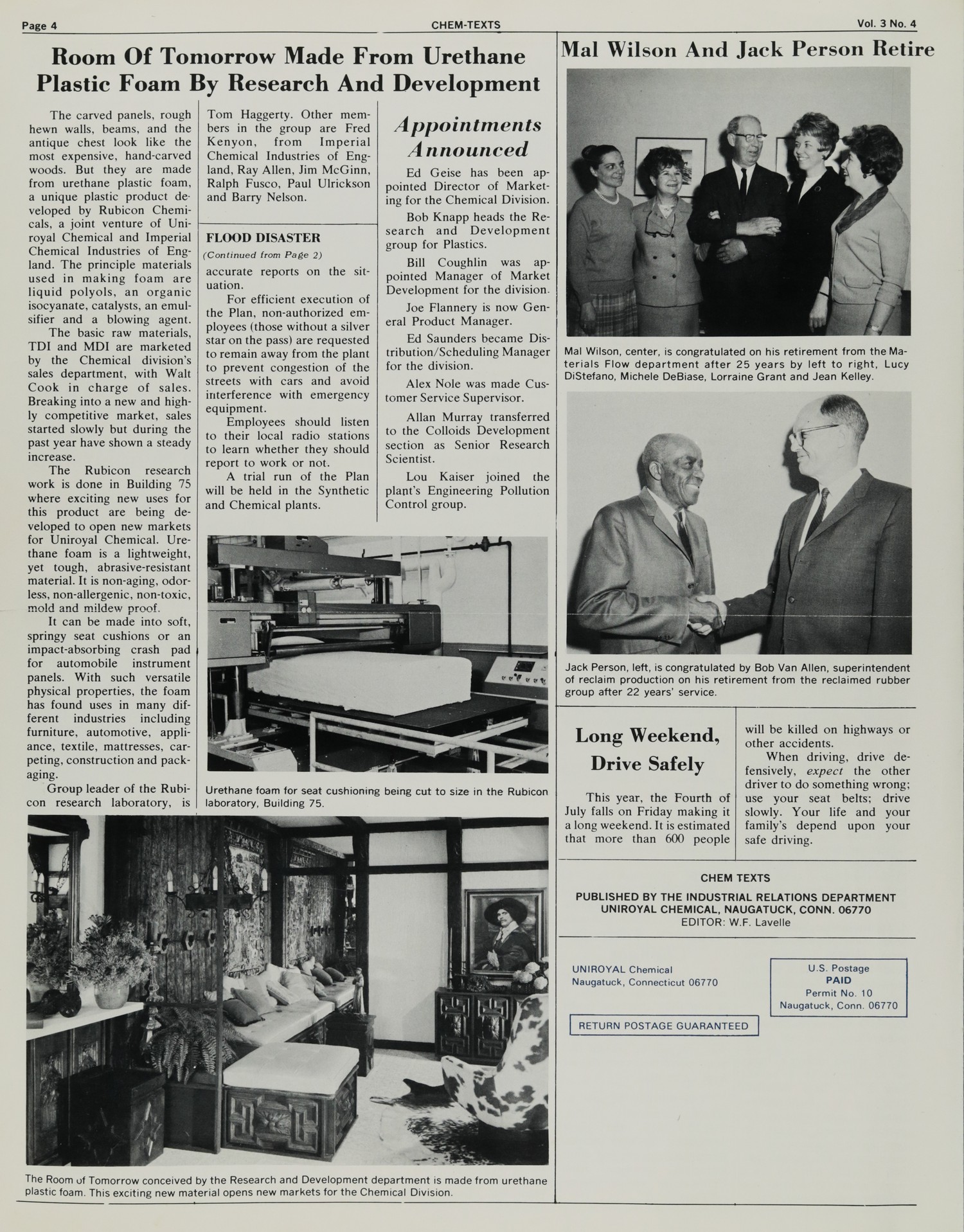
Room Of Tomorrow Made From Urethane Plastic Foam By Research And Development

The carved panels, rough hewn walls, beams, and the antique chest look like the most expensive, hand-carved woods. But they are made from urethane plastic foam, a unique plastic product developed by Rubicon Chemicals, a joint venture of Uniroyal Chemical and Imperial Chemical Industries of England. The principle materials used in making foam are liquid polyols, an organic isocyanate, catalysts, an emulsifier and a blowing agent.

The basic raw materials, TDI and MDI are marketed by the Chemical division’s sales department, with Walt Cook in charge of sales. Breaking into a new and highly competitive market, sales started slowly but during the past year have shown a steady increase.

The Rubicon research work is done in Building 75 where exciting new uses for this product are being developed to open new markets for Uniroyal Chemical. Urethane foam is a lightweight, yet tough, abrasive-resistant material. It is non-aging, odorless, non-allergenic, non-toxic, mold and mildew proof.

It can be made into soft, springy seat cushions or an impact-absorbing crash pad for automobile instrument panels. With such versatile physical properties, the foam has found uses in many different industries including furniture, automotive, appliance, textile, mattresses, carpeting, construction and packaging.

Group leader of the Rubicon research laboratory, is Tom Haggerty. Other members in the group are Fred Kenyon, from Imperial Chemical Industries of England, Ray Allen, Jim McGinn, Ralph Fusco, Paul Ulrickson and Barry Nelson.


FLOOD DISASTER

(Continued from Page 2)

accurate reports on the situation.

For efficient execution of the Plan, non-authorized employees (those without a silver star on the pass) are requested to remain away from the plant to prevent congestion of the streets with cars and avoid interference with emergency equipment.

Employees should listen to their local radio stations to learn whether they should report to work or not.

A trial run of the Plan will be held in the Synthetic and Chemical plants.


Appointments Announced

Ed Geise has been appointed Director of Marketing for the Chemical Division.

Bob Knapp heads the Research and Development group for Plastics.

Bill Coughlin was appointed Manager of Market Development for the division.

Joe Flannery is now General Product Manager.

Ed Saunders became Distribution/Scheduling Manager for the division.

Alex Nole was made Customer Service Supervisor.

Allan Murray transferred to the Colloids Development section as Senior Research Scientist.

Lou Kaiser joined the plant’s Engineering Pollution Control group.


[IMAGE CAPTION]: Urethane foam for seat cushioning being cut to size in the Rubicon laboratory, Building 75.


[IMAGE CAPTION]: The Room of Tomorrow conceived by the Research and Development department is made from urethane plastic foam. This exciting new material opens new markets for the Chemical Division.


Mal Wilson And Jack Person Retire

[IMAGE CAPTION]: Mal Wilson, center, is congratulated on his retirement from the Materials Flow department after 25 years by left to right, Lucy DiStefano, Michele DeBiase, Lorraine Grant and Jean Kelley.

[IMAGE CAPTION]: Jack Person, left, is congratulated by Bob Van Allen, superintendent of reclaim production on his retirement from the reclaimed rubber group after 22 years’ service.


Long Weekend, Drive Safely

This year, the Fourth of July falls on Friday making it a long weekend. It is estimated that more than 600 people will be killed on highways or other accidents.

When driving, drive defensively, expect the other driver to do something wrong; use your seat belts; drive slowly. Your life and your family’s depend upon your safe driving.


CHEM TEXTS

PUBLISHED BY THE INDUSTRIAL RELATIONS DEPARTMENT
UNIROYAL CHEMICAL, NAUGATUCK, CONN. 06770
EDITOR: W.F. Lavelle


UNIROYAL Chemical
Naugatuck, Connecticut 06770

U.S. Postage
PAID
Permit No. 10
Naugatuck, Conn. 06770

RETURN POSTAGE GUARANTEED

CHEM-TEXTS – Vol. 3 No. 5 – Page 2

Page 002

CHEM-TEXTS

Page 2 | Vol. 3 No. 5


FROM THE FACTORY MANAGER

Dear Fellow Employee:

During our nation’s space program RELIABILITY has become a common everyday word. Individual parts, in-fact entire systems human as well as mechanical, are tested and retested to make certain that there are no failures at critical times. This, then, is the essence of RELIABILITY — no failures at critical times.

While each of us appreciates the importance of RELIABILITY in space, we often lose sight of its equal importance right here in our plant. Each and everyone of us is a key man or woman. Everyone must function, with complete RELIABILITY to get the job done properly.

Let’s check our own RELIABILITY right now. Each of us should ask ourself what is my RELIABILITY on:

  1. Job Performance
  2. Safety Performance
  3. Housekeeping Performance
  4. Attendance Performance

What’s your RELIABILITY? Each of us can improve. Each of us must improve.

Sincerely,

John D. Evans


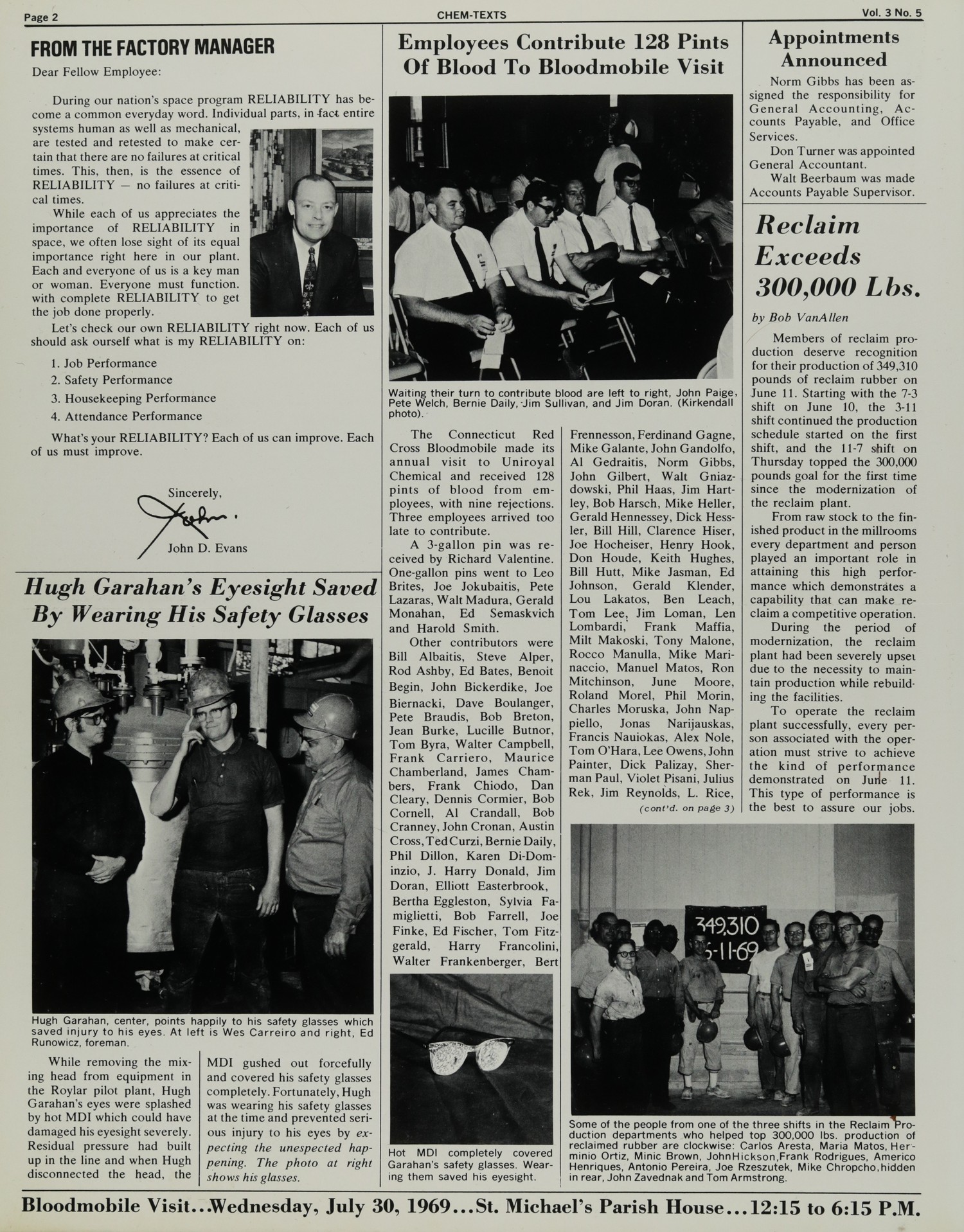
Hugh Garahan’s Eyesight Saved By Wearing His Safety Glasses

Hugh Garahan, center, points happily to his safety glasses which saved injury to his eyes. At left is Wes Carreiro and right, Ed Runowicz, foreman.

While removing the mixing head from equipment in the Roylar pilot plant, Hugh Garahan’s eyes were splashed by hot MDI which could have damaged his eyesight severely. Residual pressure had built up in the line and when Hugh disconnected the head, the MDI gushed out forcefully and covered his safety glasses completely. Fortunately, Hugh was wearing his safety glasses at the time and prevented serious injury to his eyes by expecting the unexpected happening. The photo at right shows his glasses.

Hot MDI completely covered Garahan’s safety glasses. Wearing them saved his eyesight.


Employees Contribute 128 Pints Of Blood To Bloodmobile Visit

Waiting their turn to contribute blood are left to right, John Paige, Pete Welch, Bernie Daily, Jim Sullivan, and Jim Doran. (Kirkendall photo).

The Connecticut Red Cross Bloodmobile made its annual visit to Uniroyal Chemical and received 128 pints of blood from employees, with nine rejections. Three employees arrived too late to contribute.

A 3-gallon pin was received by Richard Valentine. One-gallon pins went to Leo Brites, Joe Jokubaitis, Pete Lazaras, Walt Madura, Gerald Monahan, Ed Semaskwich and Harold Smith.

Other contributors were Bill Albaitis, Steve Alper, Rod Ashby, Ed Bates, Benoit Begin, John Bickerdike, Joe Biernacki, Dave Boulanger, Pete Braudis, Bob Breton, Jean Burke, Lucille Butnor, Tom Byra, Walter Campbell, Frank Carriero, Maurice Chamberland, James Chambers, Frank Chiodo, Dan Cleary, Dennis Cormier, Bob Cornell, Al Crandall, Bob Cranney, John Cronan, Austin Cross, Ted Curzi, Bernie Daily, Phil Dillon, Karen Di-Dominzio, J. Harry Donald, Jim Doran, Elliott Easterbrook, Bertha Eggleston, Sylvia Famiglietti, Bob Farrell, Joe Finke, Ed Fischer, Tom Fitzgerald, Harry Francolini, Walter Frankenberger, Bert Frennesson, Ferdinand Gagne, Mike Galante, John Gandolfo, Al Gedraitis, Norm Gibbs, John Gilbert, Walt Gnizdowski, Phil Haas, Jim Hartley, Bob Harsch, Mike Heller, Gerald Hennessey, Dick Hessler, Bill Hill, Clarence Hiser, Joe Hocheiser, Henry Hook, Don Houde, Keith Hughes, Bill Hutt, Mike Jasman, Ed Johnson, Gerald Klender, Lou Lakatos, Ben Leach, Tom Lee, Jim Loman, Len Lombardi, Frank Maffia, Milt Makoski, Tony Malone, Rocco Manulla, Mike Marinaccio, Manuel Matos, Ron Mitchinson, June Moore, Roland Morel, Phil Morin, Charles Moruska, John Nappiello, Jonas Narijauskas, Francis Nauiokas, Alex Nole, Tom O’Hara, Lee Owens, John Painter, Dick Palizay, Sherman Paul, Violet Pisani, Julius Rek, Jim Reynolds, L. Rice,

(cont’d. on page 3)


Appointments Announced

Norm Gibbs has been assigned the responsibility for General Accounting, Accounts Payable, and Office Services.

Don Turner was appointed General Accountant.

Walt Beerbaum was made Accounts Payable Supervisor.


Reclaim Exceeds 300,000 Lbs.

by Bob VanAllen

Members of reclaim production deserve recognition for their production of 349,310 pounds of reclaim rubber on June 11. Starting with the 7-3 shift on June 10, the 3-11 shift continued the production schedule started on the first shift, and the 11-7 shift on Thursday topped the 300,000 pounds goal for the first time since the modernization of the reclaim plant.

From raw stock to the finished product in the millrooms every department and person played an important role in attaining this high performance which demonstrates a capability that can make reclaim a competitive operation.

During the period of modernization, the reclaim plant had been severely upset due to the necessity to maintain production while rebuilding the facilities.

To operate the reclaim plant successfully, every person associated with the operation must strive to achieve the kind of performance demonstrated on June 11. This type of performance is the best to assure our jobs.

349,310
6-11-69

Some of the people of the three shifts in the Reclaim Production departments who helped top 300,000 lbs. production of reclaimed rubber are clockwise: Carlos Aresta, Maria Matos, Herminio Ortiz, Minic Brown, JohnHickson,Frank Rodrigues, Americo Henriques, Antonio Pereira, Joe Rzeszutek, Mike Chropcho,hidden in rear, John Zavednak and Tom Armstrong.


Bloodmobile Visit…Wednesday, July 30, 1969…St. Michael’s Parish House…12:15 to 6:15 P.M.

CHEM-TEXTS – Vol. 3 No. 7 – Page 3

Page 003

Vol. 3 No. 7 | CHEM-TEXTS | Page 3


KNOW YOUR BENEFITS: by W. Kirkendall

Some Questions And Answers On Bereavement Pay Benefits

The bereavement pay benefit is one of the many different benefits which Uniroyal gives to people employed at a plant where a United Rubber Workers Union exist. At the Naugatuck plant there are two URW locals: Local 218 covers the Chemical and Reclaim plants; and Local 308 covers the Synthetic plant. This benefit applies only to the wage members of the two Locals.

In 1968 Uniroyal contributed $318,303 in Bereavement Pay Benefits to employees working in plants covered by the United Rubber Workers Union contract.

Q. When am I eligible for bereavement pay?
A. An employee who is absent from work after 30 days from date of hire because of the death of a member of his immediate family, or a dependent who lives in the household, shall be paid his straight time average hourly earnings, if an incentive worker or his current hourly rate if on day work for time lost from his regularly scheduled shift.

Q. How many days’ pay do I receive?
A. You shall be paid (3) consecutive working days. It is understood the 3 days of paid bereavement pay shall be related in time to the death for which such payment is made.

Applies To Your Immediate Family

Q. Who is immediate family?
A. Immediate family is defined to mean husband, wife, father, mother, grandfather, grandmother, brother, sister, or the employee’s children. The foregoing intended to cover legal as well as blood relationships.

Q. Are uncles, aunts, nieces, nephews and cousins covered under bereavement pay?
A. No. They are not members of the immediate family.

Q. What happens if death occurs while I am on vacation?
A. Your vacation will be extended and payment will be made, provided the employee notifies a designated member of management.

Legal Relatives

Q. What does legal relationship mean?
A. The term legal relationship is interpreted to mean father-in-law, mother-in-law, brother-in-law and sister-in-law, the spouse’s grandparents and legally adopted children. A brother-in-law or sister-in-law is the employee’s spouse’s brother or sister. Although by custom or practice the spouse of an employee’s spouse’s brother or sister is referred to as a brother-in-law or sister-in-law to the employee, such relationship is not contemplated by reference to brother-in-law or sister-in-law for eligibility for bereavement pay.

Q. Must I attend the funeral to be eligible?
A. No. While it is not necessary that the employee actually attend the funeral, as in the case of a relative who dies in some distant place, the time off must be related in time to the death and cannot be arbitrarily deferred to some later time, such as an addition to a vacation or the like.

How To Apply

Q. What must I do as an employee in case of bereavement?
A. You should contact your supervisor or foreman and make sure you are eligible for bereavement pay. You must then bring in a clipping from the newspaper when you return to work and your supervisor will turn in a bereavement pay form to the Industrial Relations department.

Consult Foreman

Q. Who can inform me on bereavement pay benefits?
A. For further information on bereavement pay benefits, speak to your foreman or supervisor. He will be glad to answer any questions you have on this benefit or other benefits provided by Uniroyal. If he doesn’t have the answer, he will obtain the proper information for you.


Appointments Announced

Ken Stewart has been named Sales Manager for Kralastic ABS plastics, the Chemical division’s leading plastic product.

John Murray assumes the position of Acting Credit Manager for Uniroyal Chemical.


SAFETY IS MY RESPONSIBILITY


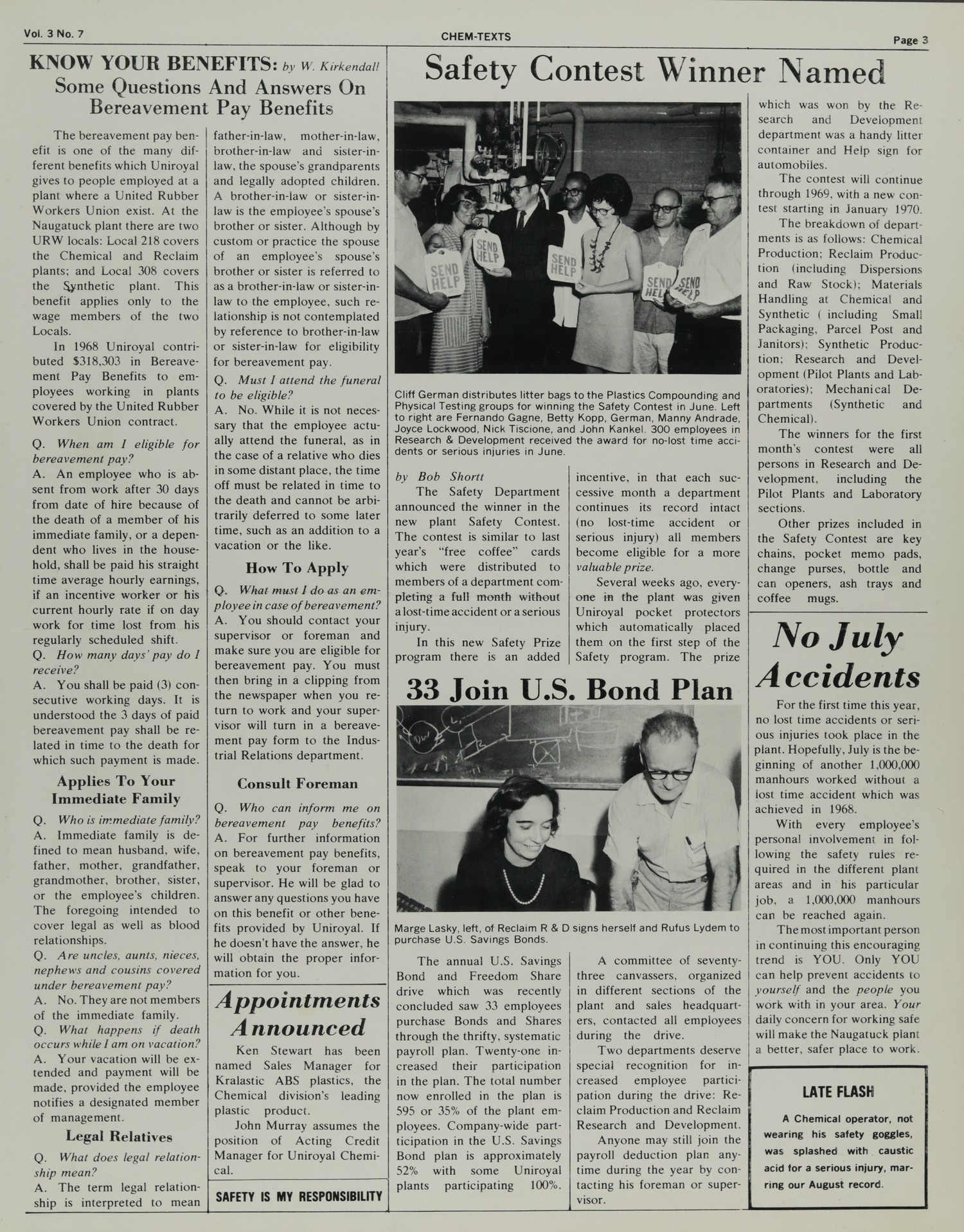
Safety Contest Winner Named

[IMAGE: Group photo showing people with “SEND HELP” signs]

Cliff German distributes litter bags to the Plastics Compounding and Physical Testing groups for winning the Safety Contest in June. Left to right are Fernando Gagne, Betty Kopp, German, Manny Andrade, Joyce Lockwood, Nick Tiscione, and John Kankel. 300 employees in Research & Development received the award for no-lost time accidents or serious injuries in June.

by Bob Shortt

The Safety Department announced the winner in the new plant Safety Contest. The contest is similar to last year’s “free coffee” cards which were distributed to members of a department completing a full month without a lost-time accident or a serious injury.

In this new Safety Prize program there is an added incentive, in that each successive month a department continues its record intact (no lost-time accident or serious injury) all members become eligible for a more valuable prize.

Several weeks ago, everyone in the plant was given Uniroyal pocket protectors which automatically placed them on the first step of the Safety program. The prize which was won by the Research and Development department was a handy litter container and Help sign for automobiles.

The contest will continue through 1969, with a new contest starting in January 1970.

The breakdown of departments is as follows: Chemical Production; Reclaim Production (including Dispersions and Raw Stock); Materials Handling at Chemical and Synthetic (including Small Packaging, Parcel Post and Janitors); Synthetic Production; Research and Development (Pilot Plants and Laboratories); Mechanical Departments (Synthetic and Chemical).

The winners for the first month’s contest were all persons in Research and Development, including the Pilot Plants and Laboratory sections.

Other prizes included in the Safety Contest are key chains, pocket memo pads, change purses, bottle and can openers, ash trays and coffee mugs.


33 Join U.S. Bond Plan

[IMAGE: Two people at desk with bonds]

Marge Lasky, left, of Reclaim R & D signs herself and Rufus Lydem to purchase U.S. Savings Bonds.

The annual U.S. Savings Bond and Freedom Share drive which was recently concluded saw 33 employees purchase Bonds and Shares through the thrifty, systematic payroll plan. Twenty-one increased their participation in the plan. The total number now enrolled in the plan is 595 or 35% of the plant employees. Company-wide participation in the U.S. Savings Bond plan is approximately 52% with some Uniroyal plants participating 100%.

A committee of seventy-three canvassers, organized in different sections of the plant and sales headquarters, contacted all employees during the drive.

Two departments deserve special recognition for increased employee participation during the drive: Reclaim Production and Reclaim Research and Development.

Anyone may still join the payroll deduction plan anytime during the year by contacting his foreman or supervisor.


No July Accidents

For the first time this year, no lost time accidents or serious injuries took place in the plant. Hopefully, July is the beginning of another 1,000,000 manhours worked without a lost time accident which was achieved in 1968.

With every employee’s personal involvement in following the safety rules required in the different plant areas and in his particular job, a 1,000,000 manhours can be reached again.

The most important person in continuing this encouraging trend is YOU. Only YOU can help prevent accidents to yourself and the people you work with in your area. Your daily concern for working safe will make the Naugatuck plant a better, safer place to work.


LATE FLASH

A Chemical operator, not wearing his safety goggles, was splashed with caustic acid for a serious injury, marring our August record.

CHEM-TEXTS – Vol. 3, No. 8 – Page 1

Page 001

UNIROYAL CHEM-TEXTS

Vol. 3 PUBLISHED FOR THE PEOPLE OF UNIROYAL CHEMICAL No. 9


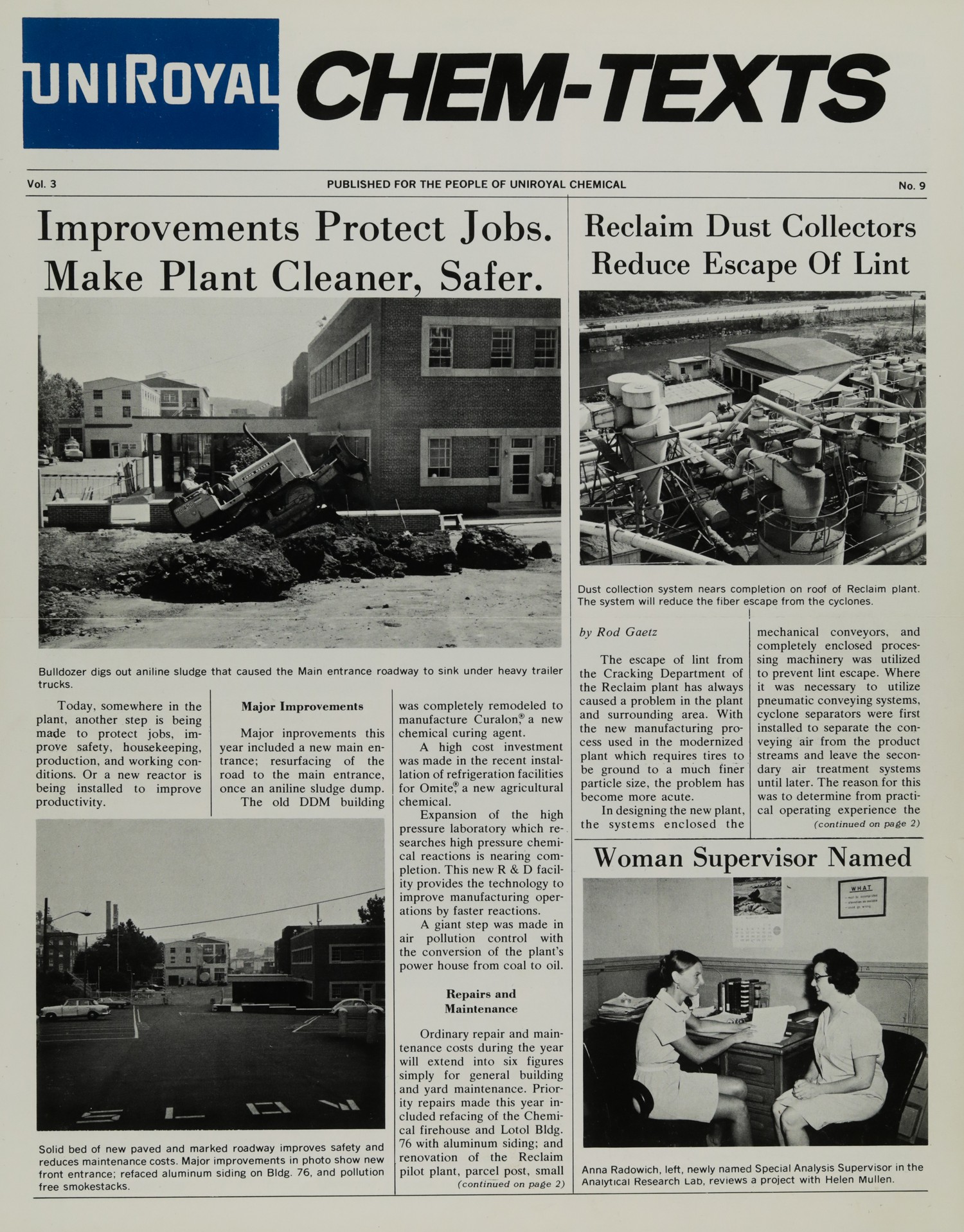
Improvements Protect Jobs. Make Plant Cleaner, Safer.

[IMAGE: Black and white photo of industrial building with bulldozer in foreground]

Bulldozer digs out aniline sludge that caused the Main entrance roadway to sink under heavy trailer trucks.

Today, somewhere in the plant, another step is being made to protect jobs, improve safety, housekeeping, production, and working conditions. Or a new reactor is being installed to improve productivity.

Major Improvements

Major improvements this year included a new main entrance; resurfacing of the road to the main entrance, once an aniline sludge dump. The old DDM building was completely remodeled to manufacture Curalon® a new chemical curing agent.

A high cost investment was made in the recent installation of refrigeration facilities for Omite® a new agricultural chemical.

Expansion of the high pressure laboratory which researches high pressure chemical reactions is nearing completion. This new R & D facility provides the technology to improve manufacturing operations by faster reactions.

A giant step was made in air pollution control with the conversion of the plant’s power house from coal to oil.

Repairs and Maintenance

Ordinary repair and maintenance costs during the year will extend into six figures simply for general building and yard maintenance. Priority repairs made this year included refacing of the Chemical firehouse and Lotol Bldg. 76 with aluminum siding; and renovation of the Reclaim pilot plant, parcel post, small (continued on page 2)

[IMAGE: Black and white photo of paved roadway with buildings]

Solid bed of new paved and marked roadway improves safety and reduces maintenance costs. Major improvements in photo show new front entrance; refaced aluminum siding on Bldg. 76, and pollution free smokestacks.


Reclaim Dust Collectors Reduce Escape Of Lint

[IMAGE: Black and white photo of industrial dust collection system on roof]

Dust collection system nears completion on roof of Reclaim plant. The system will reduce the fiber escape from the cyclones.

by Rod Gaetz

The escape of lint from the Cracking Department of the Reclaim plant has always caused a problem in the plant and surrounding area. With the new manufacturing process used in the modernized plant which requires tires to be ground to a much finer particle size, the problem has become more acute.

In designing the new plant, the systems enclosed the mechanical conveyors, and completely enclosed processing machinery was utilized to prevent lint escape. Where it was necessary to utilize pneumatic conveying systems, cyclone separators were first installed to separate the conveying air from the product streams and leave the secondary air treatment systems until later. The reason for this was to determine from practical operating experience the (continued on page 2)


Woman Supervisor Named

[IMAGE: Black and white photo of two women at desk reviewing documents]

Anna Radowich, left, newly named Special Analysis Supervisor in the Analytical Research Lab, reviews a project with Helen Mullen.

CHEM-TEXTS – Vol. 3 No. 8 – Page 2

Page 002

CHEM-TEXTS

Page 2 | Vol. 3 No. 9


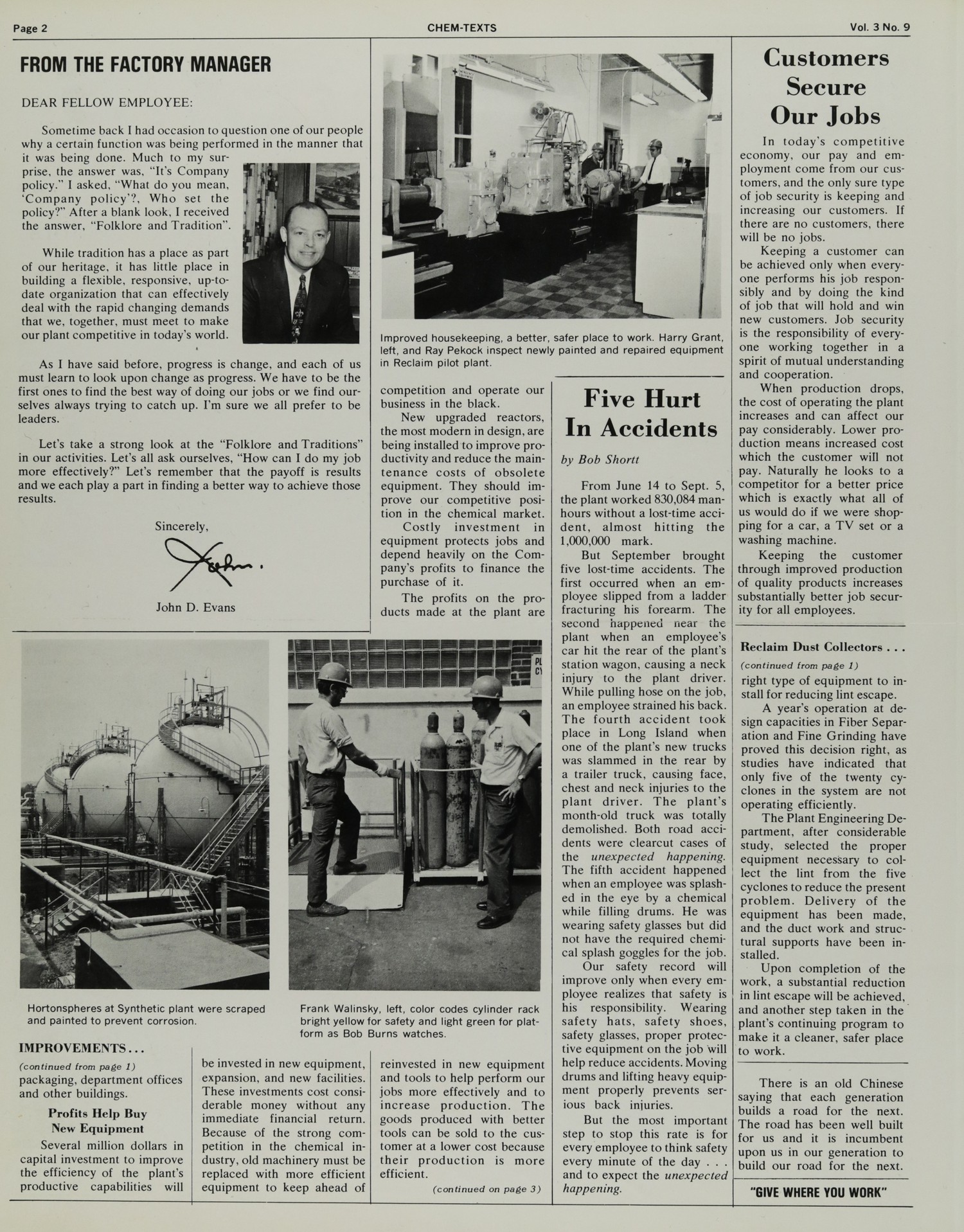
FROM THE FACTORY MANAGER

DEAR FELLOW EMPLOYEE:

Sometime back I had occasion to question one of our people why a certain function was being performed in the manner that it was being done. Much to my surprise, the answer was, “It’s Company policy.” I asked, “What do you mean, ‘Company policy’?, Who set the policy?” After a blank look, I received the answer, “Folklore and Tradition”.

While tradition has a place as part of our heritage, it has little place in building a flexible, responsive, up-to-date organization that can effectively deal with the rapid changing demands that we, together, must meet to make our plant competitive in today’s world.

As I have said before, progress is change, and each of us must learn to look upon change as progress. We have to be the first ones to find the best way of doing our jobs or we find ourselves always trying to catch up. I’m sure we all prefer to be leaders.

Let’s take a strong look at the “Folklore and Traditions” in our activities. Let’s all ask ourselves, “How can I do my job more effectively?” Let’s remember that the payoff is results and we each play a part in finding a better way to achieve those results.

Sincerely,

John

John D. Evans


Improved housekeeping, a better, safer place to work. Harry Grant, left, and Ray Pekoek inspect newly painted and repaired equipment in Reclaim pilot plant.


competition and operate our business in the black.

New upgraded reactors, the most modern in design, are being installed to improve productivity and reduce the maintenance costs of obsolete equipment. They should improve our competitive position in the chemical market.

Costly investment in equipment protects jobs and depend heavily on the Company’s profits to finance the purchase of it.

The profits on the products made at the plant are


Five Hurt In Accidents

by Bob Shortt

From June 14 to Sept. 5, the plant worked 830,084 man-hours without a lost-time accident, almost hitting the 1,000,000 mark.

But September brought five lost-time accidents. The first occurred when an employee slipped from a ladder fracturing his forearm. The second happened near the plant when an employee’s car hit the rear of the plant’s station wagon, causing a neck injury to the plant driver. While pulling hose on the job, an employee strained his back. The fourth accident took place in Long Island when one of the plant’s new trucks was slammed in the rear by a trailer truck, causing face, chest and neck injuries to the plant driver. The plant’s month-old truck was totally demolished. Both road accidents were clearcut cases of the unexpected happening. The fifth accident happened when an employee was splashed in the eye by a chemical while filling drums. He was wearing safety glasses but did not have the required chemical splash goggles for the job.

Our safety record will improve only when every employee realizes that safety is his responsibility. Wearing safety hats, safety shoes, safety glasses, proper protective equipment on the job will help reduce accidents. Moving drums and lifting heavy equipment properly prevents serious back injuries.

But the most important step to stop this rate is for every employee to think safety every minute of the day . . . and to expect the unexpected happening.

(continued on page 3)


Customers Secure Our Jobs

In today’s competitive economy, our pay and employment come from our customers, and the only sure type of job security is keeping and increasing our customers. If there are no customers, there will be no jobs.

Keeping a customer can be achieved only when everyone performs his job responsibly and by doing the kind of job that will hold and win new customers. Job security is the responsibility of everyone working together in a spirit of mutual understanding and cooperation.

When production drops, the cost of operating the plant increases and can affect our pay considerably. Lower production means increased cost which the customer will not pay. Naturally he looks to a competitor for a better price which is exactly what all of us would do if we were shopping for a car, a TV set or a washing machine.

Keeping the customer through improved production of quality products increases substantially better job security for all employees.


Reclaim Dust Collectors . . .

(continued from page 1)

right type of equipment to install for reducing lint escape.

A year’s operation at design capacities in Fiber Separation and Fine Grinding have proved this decision right, as studies have indicated that only five of the twenty cyclones in the system are not operating efficiently.

The Plant Engineering Department, after considerable study, selected the proper equipment necessary to collect the lint from the five cyclones to reduce the present problem. Delivery of the equipment has been made, and the duct work and structural supports have been installed.

Upon completion of the work, a substantial reduction in lint escape will be achieved, and another step taken in the plant’s continuing program to make it a cleaner, safer place to work.


There is an old Chinese saying that each generation builds a road for the next. The road has been well built for us and it is incumbent upon us in our generation to build our road for the next.

“GIVE WHERE YOU WORK”


Hortonspheres at Synthetic plant were scraped and painted to prevent corrosion.

Frank Walinsky, left, color codes cylinder rack bright yellow for safety and light green for platform as Bob Burns watches.


IMPROVEMENTS…

(continued from page 1)

packaging, department offices and other buildings.

Profits Help Buy New Equipment

Several million dollars in capital investment to improve the efficiency of the plant’s productive capabilities will be invested in new equipment, expansion, and new facilities. These investments cost considerable money without any immediate financial return. Because of the strong competition in the chemical industry, old machinery must be replaced with more efficient equipment to keep ahead of reinvested in new equipment and tools to help perform our jobs more effectively and to increase production. The goods produced with better tools can be sold to the customer at a lower cost because their production is more efficient.

CHEM-TEXTS – Vol. 3, 1969, No. 10 – Page 1

Page 001

UNIROYAL CHEM-TEXTS

Vol. 3, 1969 PUBLISHED FOR THE PEOPLE OF UNIROYAL CHEMICAL No. 10


The Small Plant In A Big Plant


Exterior of Chemical Pilot Plant is deceptive in appearance. Inside it’s a maze of piping, reactors, and equipment to make new products.


by Gary Arndt

The Chemical Pilot plant, a one story brick building in the Chemical yard, is almost lost among the 142 plant buildings that comprise the Naugatuck plant. Not very impressive from the outside, the pilot plant contains some of the most modern equipment in the chemical industry. Inside is a maze of complex piping, sophisticated reactors, and control systems.

Makes Chemicals For Plant

The pilot plant, operated by the Research and Development department, serves as a small scale plant to evaluate new processes as well as to manufacture new products, preparatory to their production in large volume in the main plant. It also produces low volume chemicals where it would not be economical to build a plant and manufactures several intermediate chemicals which cannot be purchased commercially but are required for the plant’s overall operations. New experimental chemicals are also made by the pilot plant for evaluation by our customers, universities, and the agricultural industry to help develop new markets for us.


Alar® Made In Plant

A large production run of Alar Tech was recently completed. This new growth regulant prevents apples from dropping off the trees and in-


Tony Cilfone, left and Jerry Ferguson discuss the new 100 gallon reactor fitted with mechanical seal agitation and automatic temperature control.


Ben Pranulis, left, and Fran San Angelo operate basket centrifuge used to separate solids from liquids.


creases their storage life. Another chemical produced by the pilot plant is Cyclohexene Oxide, which is an intermediate chemical used in the manufacture of Omite® a new agricultural chemical, used by fruit growers to control mites from chewing up the leaves on their fruit trees.

Improves Safety And Production

The pilot plant contains some of the most modern, expensive equipment in the chemical industry to help us produce better quality products. A year ago a newly purchased Centrifuge-Dryer system, the only one of its kind here in Naugatuck, was put into use. Its purpose was not only to increase the production of Alar, but also to handle the solvent drying step in the process safely. A new 100-gallon reactor fitted with mechanical seal agitation and automatic temperature control was recently installed to improve product quality and make the operator’s job easier.

SAFETY IS MY RESPONSIBILITY


Good Morale, Housekeeping

Good morale is hard to define but it’s clearly evident among the people working in the pilot plant. A cheerful, cooperative atmosphere exists and the work-together attitude helps take the humdrum out of the daily routine of the job that everyone experiences. Also noticeable when you enter the pilot plant is the good housekeeping condition of the area. Materials and drums are properly arranged and the area is free of trash and rubbish.

Working in the plant which operates three shifts around the clock are Joe Poudrier, Bob Enamait, Harris Detlefsen, Fran Pikula, Dan Pinto, John Lydem, Julius Cohen, Marcel Hebert, Chris Owens, Al Grella, Tony Cilfone, Fran SanAngelo, Jerry Ferguson, Ben Pranulis, and Casimiro Pereira. Other members of the group are Don Bates and Julius Rek, foremen; and Bronis Zukauskas, materials supervisor. Group Leader for the Chemical Pilot Plant is Colin Walker.

CHEM-TEXTS – Vol. 3 No. 10 – Page 3

Page 003

CHEM-TEXTS

Vol. 3 No. 10 | Page 3


Production Goal Topped By Synthetic Plant’s “C” Crew

The Synthetic Processing C crew averaged 9.2 charged batches of latex daily for one full week, surpassing the 9 batches processed by the A crew recently. This production rate is a significant step in improving our competitive position by manufacturing a lower cost product.

The latex business today is a highly competitive business with large chemical companies as Dow, Goodrich, General Tire, Firestone, Shell and Goodyear competing with us for the same markets and customers. Efficient production of a quality latex, and prompt customer service are essential factors in keeping and improving our present business and ultimately better job security. Like ourselves, our customers are “shoppers”; they shop for the best products at the best price.

Although the C crew went over the goal, it required the combined effort of the A and B crews to achieve it. Continued production of 27 batches a day requires the fullest effort of every person in the Synthetic plant, as every employee in every department plays an important role in its success.


[PHOTO CAPTION:]
In rear left to right are Ralph Pilbro, Howard Slason, Rocco Magnamo, Foreman, and Joe Morrison. Left to right in front, Jerry McCabe, John Kennedy, and Bill Wasilus.


[PHOTO CAPTION:]
Other “C” crew members are rear left to right, Leonard Dumonski, Fred Miller, Fernando Henriques, Al Happy. Left to right front are Frank Dowling and Frank Giordano, Ass’t. Dept. Foreman.


Answer First Ring

Ever feel like throwing the telephone out the window? Or wonder why you go home from work with a splitting headache, tense and tired.

With almost 1,000 phones including extensions, and 50,000 incoming calls a month, plus the thousands of intra office calls each day, the telephone has become a serious detriment to the quiet needed to concentrate on our work, and a tension builder.

By answering the phone on the first ring, you can help reduce the noise in your area. If someone is away from their desk be courteous, and answer their phone. And if you’re the caller and no one answers, after a few rings hang up and call later.

Until the telephone company invents a soft, sweet, musical ring, try answering your phone on the first ring. You’ll go home feeling better . . . and customers will consider us an efficient, interested company.

And always answer the phone in a courteous manner.


No Lost Time Accidents In October

by Sal Aloise

During the month of October we had no lost time accidents, but we did not get away free completely. Injuries did occur during the month, however, which were of a serious nature.

8 Serious Injuries

During October we had eight serious injuries, all of which could have been prevented: one eye injury; 4 sutures; and 3 work changes.

With more effort and more concern, we can and will prevent careless accidents. If everyone helps, we will have an injury-free plant in which to work.

There is an old saying that “repetition is the essence of learning”. Only by constantly repeating to ourselves that “safety is my responsibility” will each employee have a greater concern for his own safety and the safety of his fellow employees. No matter what is done in the plant to improve safety conditions, accidents will happen unless every employee continually reminds himself that he is responsible for his own and his fellow employees’ safety.


Rubber Causes Minor Fire

An accumulation of rubber in the housing of a digestor caused a fire recently through spontaneous ignition. The rubber had worked out of the gasket around the agitator drive shaft and accumulated in the housing between the drive motor and the digestor.

Alert Employee Prevents Damage

An alert employee used a dry powder fire extinguisher to put out the fire and completely covered the rubber accumulation, preventing a reflash before the housing was cleaned out.

Good Housekeeping Prevents Fires

The fast removal of such rubber accumulation is extremely important in the prevention of fire. Good housekeeping around the digesters and Holo-Flite dryer is the only way to prevent spontaneous ignition of rubber, oil and grease from coming in contact with the extremely hot operating equipment.


SAFETY IS MY RESPONSIBILITY


PLANT URW LOCALS ELECT OFFICERS

[PHOTO CAPTION:]
New URW Local 218 officers are from left, Don Boyles, secretary; Dom Persutti, vice-president; Joe Rzeszutek, president; and John Hoey, treasurer.


[PHOTO CAPTION:]
Officers of Local 308 will hold office for next two years. From left are Charlie Roland, Vice President; Leon Raskauskas, President; and Rocco Manulla, Treasurer. Standing is Archie Civitello, Secretary.


by Joe Rzeszutek, and Leon Raskauskas

Local 218 of the United Rubber Workers which represents wage employees in the Chemical plant elected Joe Rzeszutek, President; Dom Persutti, Vice-President; Don Boyles, Secretary; and John Hoey, Treasurer in recent held elections for a two-year term.

Elected to the Executive Board were Henry Hook, Edith Evans, Bill Fruin, Frank Maffia, Frank Commendatore, Julius Cohen and Harry Arendholz.

Lost Production Costs Money

Although the fire wasn’t serious, and no damage incurred, it stopped operations and caused lost production time.

Every employee has an individual responsibility to maintain good housekeeping and safety standards in his area. Our safety and jobs depend upon it.

Named Trustees for the Local were Frank Wasilesky and Harry Grant.

Leon Raskauskas was elected President of the United Rubber Workers Local 308 representing the Synthetic plant wage employees. Charlie Roland was elected Vice-President, Archie Civitello, Secretary; and Rocco Manulla, Treasurer.

Executive Board members elected were Walter Bieleski, Art Calder, Ernie Molnar, Wes Burns, John Sullivan and Joe Adamaitis.


Uniroyal Gets $1,478,000 Contract

Uniroyal received an Air Force contract of $540,000 for tubeless aircraft tires as a supplement to a previous contract of $938,000 for a total award of $1,478,000.

Big tire orders depend strongly on the quality of the chemicals made at the Naugatuck plant, and help keep us in business.

CHEM-TEXTS – Vol. 3 No. 10 – Page 4

Page 004

Page 4 | CHEM-TEXTS | Vol. 3 No. 10


Sales Set Record; Profits Drop 10.5%

Sales of Uniroyal, Inc. set new records for the thirty-nine weeks ending September 28, 1969, but profits failed to keep pace with sales, and took a 10.5% drop.

Sales for the nine month period totaled $1,165,502,000, an increase of 9.9% compared with $1,060,659,000 reported for 1968. Profits, however, were $38,184,000, equivalent to $1.33 a share of common stock, 10.5% lower than the $42,650,000 or $1.55 a share for 1968.

The third quarter sales for 1969 were $368,869,000 compared to $341,874,000 for 1968 and net income was $8,292,000 equivalent to 27 cents a common share compared with $12,769,000 or 45 cents a share last year. Third quarter earnings in 1969 were based on a greater number of shares outstanding.

Profits were hurt by increasing inflationary factors, including rising costs for wages and raw materials, as well as higher interest rates on borrowed capital.

The Company also encountered abnormally high production costs for new tire constructions and greater start-up expenses for new and expanded production facilities.


Contact Lenses Are Unsafe

by Bob Shortt

Many employees are not fully aware of the dangers in wearing contact lenses in the plant.

Chemicals and dusts which enter the eye and work their way behind the lens cannot be washed out until the lens is removed. Very often permanent damage to the eye can result before this can be done.

There is a rule which is included in the Laboratory Safety Manual stating, Contact Lenses are not to be worn in the plant. For your own safety and to prevent injury to eyesight, it is extremely important to observe this rule.


Dividend Declared

Uniroyal declared a dividend of 17½ cents a share on its common stock. It will be payable December 24 to stockholders of record on November 24.

This payment will bring total dividends paid on the stock in 1969 to 70 cents a share.

Approximately 65% of the Naugatuck plant employees are stockholders or participants in the Stock Purchase Plan.


Clergy Visit Parishioners

During a recent plant tour, local clergy had a chance to see their parishioners at work. Taking a coffee break during the tour they chat with Neil Melore, Industrial Relations Supervisor. From left are John Letts YMCA Director, Rev. Clark Kuntz, Rev. Robert Hankins, Rev. James Dahlgren and Melore. With back to camera is Rev. Robert Baker.


Sabia, Buckingham Retire

Frank Sabia center, is congratulated by Kirk Kirkendall upon retirement after 27 years. Left to right are Ed Plocha, Kirkendall, Sabia, Don Fuller, and Mike Santone.

Ralph Buckingham is congratulated on his retirement by Sal Falcone. From left are Gene Reale, foreman, Tony Malone, Buckingham, Falcone, Tony Galletta and Ovila Fortier.


Luggage Ideal Xmas Gift

Smart looking luggage, ideal for Christmas gifts, is made from Kralastic® ABS, a tough impact resistant plastic, a product of the Chemical Division. Manufactured by several quality baggage companies, the cases can withstand the toughest abuse a traveller can give them.

Royalite® which is the Consumer and Industrial Division’s trademark for ABS sheet is only 40% the weight of aluminum and just one-seventh the weight of steel.

The attache case at top is a perfect gift for the businessman. On the wicker stool is a lightweight ladies overnight case. For travellers, the two suiter makes an excellent gift. The gun case on which the pretty model is standing demonstrates how tough this steel-like plastic is.

The Employees’ Salesroom at the Footwear plant carries most of the luggage which is available in a wide range of colors.


[Photo caption]: Model demonstrates the steel-like strength of Kralastic ABS, a plastic made by Uniroyal Chemical.


Latest News Bulletins Issued

To keep employees informed on the latest news in the Plant, in the Division and in Uniroyal, News Bulletins are now being issued weekly or semi-weekly. Watch for them on the Bulletin Boards at the three plant entrances, in the Plant, and in your department.


SAFETY IS MY RESPONSIBILITY


CHEM TEXTS

PUBLISHED BY THE INDUSTRIAL RELATIONS DEPARTMENT
UNIROYAL CHEMICAL, NAUGATUCK, CONN. 06770

EDITOR: William F. Lavelle.


UNIROYAL Chemical
Naugatuck, Connecticut 06770

U.S. Postage
PAID
Permit No. 10
Naugatuck, Conn. 06770

RETURN POSTAGE GUARANTEED

CHEM-TEXTS – Vol. 3, 1969, No. 11 – Page 1

Page 001

UNIROYAL

Merry Christmas – Happy New Year

CHEM-TEXTS

Vol. 3, 1969 PUBLISHED FOR THE PEOPLE OF UNIROYAL CHEMICAL No. 11


[IMAGE: Two people decorating a Christmas tree]

Getting ready for the Christmas season, Madelyn Malone, left; and Molly Cobbol decorate tree in lobby of Main Entrance.


Frank Hopkins To Address The Foremen’s Club

by Lou Kaiser

Frank Hopkins, Vice President and General Manager of the Chemical division will address the Foremen’s Club January 15, 1970, at the Elks Club in Naugatuck.

Mr. Hopkins will discuss the present and future busi-

[IMAGE: Portrait photo of Frank A. Hopkins]

FRANK A. HOPKINS

ness outlook for the Chemical division, and the effects of the present economic trends on the divisions and the plant’s operations.


Man Falls, Breaks Leg

by Sal Aloise

A fall from a railroad tank car resulted in a broken leg and a bruised shoulder when an employee slipped and fell backwards. The accident occurred while he was placing a recirculating hose in the dome of the tank car. As a result of the injury he will be incapacitated 8 weeks.

The second lost time accident happened when an employee caught the heel of his foot in an elevator door while he was taking a product from the 1st to the 3rd floor of the building.

Besides the two lost time accidents in November, five serious injuries were reported for the month. This rate of accidents shows little improvement over last year.

With every effort being made by the plant to improve safety, no progress will be made in the prevention of injuries unless every employee continually thinks safety and avoids taking chances.

Now that winter is here, ice and snow conditions require a greater concern for

(Continued on page 4)


Pollution Of Naugatuck River To Be Controlled

by Dick Shaw

The construction of a new liquid waste pretreatment facility at the Naugatuck plant at a cost of almost $3,000,000 has been approved by the Uniroyal Board of Directors. The new facility will control the plants pollution of the Naugatuck river.

The facilities will provide the necessary pretreatment of the plant’s waste waters and will prepare the complex mixture of chemical and water wastes for acceptance into the Borough of Naugatuck’s water pollution control facility.

Lower Cost To Taxpayer

The cooperative venture which provides for treatment of Uniroyal’s wastes in the Borough’s plant will result in lower costs to the taxpayers of Naugatuck and to the Company and will comply with the State’s Pollution Abatement laws.

Lower costs to the taxpayer will be realized since Uniroyal will pay a substantial portion of the operating costs due to the large volume of Company waste flow into the municipal plant.


[DIAGRAM: Schematic showing waste water treatment process flow, including:
– SYNTHETIC PLANT WASTE
– CHEMICAL PLANT WASTE
– NEUTRALIZATION AND PUMPING STATIONS
– WASTE EQUALIZATION TANKS
– OPERATIONS BUILDING
– WASTE WATER COAGULATION AND SETTLING TANKS
– PRETREATED WASTE MIXING TANK
– PRETREATED WASTE TO MUNICIPAL FACILITIES]

R.Smith-69

Schematic drawing shows the new waste water pretreatment facility scheduled for 1972 completion.

Location At South End

The pretreatment facilities will be constructed along the

(Continued on page 4)


[IMAGE: Industrial equipment/construction site]

At right is outflow of waste water into river. New waste water pretreatment unit will control pollution. At left is one of units used to pump waste water to model scale waste treatment unit.


Plant Loses Reclaim Sales

Tentative plans to halt production of bicycle tires and tubes, and reduce production of passenger car, heavy service, and farm tire tubes at the Indianapolis plant would affect our Naugatuck business.

Competition from foreign bicycle tires; the decline in passenger tire tubes, and competitive pressure from low cost tubes were cited as the reasons.

The proposed cutback would affect our butyl Reclaim business which is used for inner tubes.

It will also affect our sales of Aminox®, MBT, MBTS, 710 Stiffener, and Tuex chemical business. These chemicals are used in the manufacture of tires and tubes.

CHEM-TEXTS – Vol. 3 – Page 1

Page 001

UNIROYAL CHEM-TEXTS

Vol. 3 PUBLISHED FOR THE PEOPLE OF UNIROYAL CHEMICAL No. 4


New Plant Entrance Nears Completion Plant’s Security Is Tightened Up.

The all glass enclosed, new front to Building 84 gives an impressive approach to the plant’s main entrance. Construction of the new building is practically complete except for a few minor details.

The building contains a new reception room for visitors to the plant where plant personnel can meet with them in more congenial surroundings to conduct business, or if necessary, escort them into the plant.

Plant security has been tightened considerably by moving the guard station from Building 75 to the new control center. Guards will be on duty at the Main gate on a 24 hour, daily basis to monitor all vehicles and visitors entering the plant. The glass enclosure provides maximum visibility for the guard to prevent unauthorized persons from entering the plant.

Two turnstiles are located at the main gate. To enter, an employee must insert a magnetized pass to operate the turnstile. Both turnstiles operate without passes in the exit direction to reduce congestion during shift changes.

If an employee forgets his pass, the guard will request identification before allowing entry into the plant. Other turnstiles are situated at the Tire and Synthetic plant entrances.

Besides tighter security control, the new building is another step in the plant’s continuing modernization and improvement program. In recent months several plant buildings have been painted and improved, providing a cleaner and better work atmosphere.

Karl Pittner of the plant engineering department supervised the project. In charge of the electrical system was Jim Carroll.


Doug Miller, engineering superintendent for the plant, and Karl Pittner, project engineer, inspect the new front entrance to the plant.


Paula Auclair, right, uses magnetic pass to “open” turnstile. John Titley shows how gate operates without pass on exit.


Jim Carroll, left, of the engineering department checks the console as Jim Walsh, control station watchman, observes the light indicators.


New Product Made Here

by Bob Mazaika

A new chemical, Antioxidant 439, a nonstaining antioxidant, started production recently in Building 28. The chemical is used in latex for foamed underlay cushioning under carpets. It is also used as a stabilizer in synthetic rubber to protect the rubber in storage and shipping.

The new antioxidant, which prevents the staining or discoloration of latex and rubber products, should help improve the division’s position in the rubber industry. Sales of the new product are expected to double in the next five years.

Frank O’Shea, of the Research and Development Department, was awarded a patent for the new chemical.


Scrubbers Reduce Air Odors

by Ernst Krauss

As part of the plant’s continuing pollution control program a new scrubber was installed in Bldg. 100 to reduce hydrogen sulfide and other odors from discharge into the air.

The scrubber washes the fumes with a caustic water solution, and hence eliminates the emission of foul odors into the air.

A second scrubber was installed in Bldg. 109 where Polygard® is manufactured. The scrubber eliminates the phenolic odors previously discharged into the air. It also provides better ventilation in the building, improving working conditions for the operators.

Rod Ashby of the plant’s engineering department was project engineer.


SAFETY IS MY RESPONSIBILITY

Mass Picketing At Synthetic Plant Leads To Arrest Of Four Persons

Mass Picketing At Synthetic Plant Leads To Arrest Of Four Persons

Mass Picketing At Synthetic Plant Leads To Arrest Of Four Persons

5-31-67 [handwritten notation]

NAUGATUCK—Mass picketing by members of Local 308 at Uniroyal’s Synthetic Plant, this morning, led to the arrest of four pickets, after an attempt was made to prevent management personnel from entering the plant.

Two of the pickets had to be forcibly ejected by police, following the reading of the riot act from the state statutes by Capt. Joseph Summa, when they refused to step aside for the plant’s personnel. All personnel entered the plant, after a wedge had been formed by about a dozen police breaking the picket line.

The four arrested were brought to police headquarters, for booking in the patrol cars. However, about 30 of the pickets also arrived at the station asking to be arrested in sympathy with those already arrested.

Arrested on charges of breach of peace were John A. Painter, 38, Morris Rd., Prospect; Paul Laurenzi, 41, 30 Serry Rd., Wolcott; Jesse J. Silva, 23, 143 Cherry St. and Anthony Gambardella, 54, 53 Brichwood Rd., Seymour. Court appearances were set for June 8.

Edward Alves, president of the local, said this morning that management had informed the union that production would begin at the plant today, which had resulted in the mass picketing.

Questioned Decision

Alves questioned the decision of the management, criticizing its actions in attempting production with “unskilled personnel.” The union president further asserted that because of the “danger of work involved at the plant, a disaster could occur, not only endangering the lives and property of those in close proximity to the plant, but to also those in the neighborhood.”

Alves said the union has contacted the insurance company on whether they had been informed of the production work by the unskilled personnel and reported the insurance company had not been notified to date. He said periodic inspections are conducted at the plant due to the nature of work involved.

Third Plant Involved

The mass picketing at the Synthetic Plant, makes the third plan of the Uniroyal company to be involved since the three plants were struck 41 days ago.

Both Locals 218 of the Chemical and 308 of Synthetic Plants have maintained around-the-clock picketing since the beginning of the strike.

It could not be determined today if management will seek an injunction against the Synthetic Local.

CHEM-TEXTS – Vol. 2 No. 2 – Page 2

Page 002

Page 2 CHEM TEXTS Vol. 2 No. 2

FROM THE FACTORY MANAGER

Dear Fellow Employees:

Those of us involved in the “STOP” safety training program are repeatedly asked the question, “Who is responsible for safety in my area?” Each of us recognizes there is only one correct answer – “I am.” However, there will only be an effective safety program in our plant if every employee is responsible for his own activities.

Mr. Vila has clearly stated the UNIROYAL philosophy on accident prevention. I would like to quote the following portions of this statement:

. . “Managers at all levels, have, as a primary responsibility, the safety and well being of all persons who report to or are assigned to them.”

“Each employee has an important place in the accident prevention effort and he must accept the responsibility for full cooperation in the measures taken for safety.”

I have underlined RESPONSIBILITY – a key factor in the jobs of all of us. Let’s all work together in a responsible manner to prevent personal injuries.

[Signature]

John D. Evans


LOST TIME ACCIDENTS UP IN FEBRUARY, DROP IN MARCH

Lost time accidents jumped from 2 in January to 3 in February. But dropped from 3 to 2 in March. However the record for serious injuries jumped from 2 in January to a total of 6 in March.

For the first 3 months of the year there were a total of 7 lost time injuries; and for the same period a total of 12 serious injuries.

Severe bruises and sprains accounted mostly for the lost time accidents; with two fractures occurring, one of a kneecap and one wrist fracture. Oftentimes there’s only a hairline difference between these accidents and more serious ones. A “stop, look and listen” attitude toward personal safety would eliminate these incidents that not only affect the employee, but his family as well.

The rising increase of serious injuries is of major concern as these could easily have resulted in more serious accidents. Out of the 12 serious injuries 7 involved the eyes. Blindness is a heavy penalty to pay for you, your family and all of us for not wearing proper protective equipment on the job.


678 Minor Injuries Occur In January, February and March

In the first 3 months of the year, 678 minor injuries occurred, requiring visits to the plant hospitals. If this rate continues for the next 9 months, approximately 2712 minor accidents will take place. The plant presently employs about 1680 people; at this rate every employee will make 1 1/2 visits to the plant nurses for treatment.

Most injuries incurred, are from cuts and abrasions; bruises and slivers. Although the injuries are not serious, they could be prevented by wearing the proper protective equipment on the job and by checking tools; lifting and carrying heavy objects properly. Many times there’s a tendency to think “an accident won’t happen to me.” But accidents become accidents because safety is not always in mind while performing the job.

TOTAL MINOR ACCIDENTS BY DEPARTMENTS FOR JANUARY, FEBRUARY AND MARCH

DEPARTMENT EYE BRUISE FRAC-TURE CUTS & ABRA-SIONS AMPU-TA-TIONS BURNS CHEMI-CAL BURNS Sprains Back Sprains DUST OR FUMES SLIV-ERS DERM-ATITIS TOTAL
Chemical Production 17 13 1 16 0 4 8 11 5 4 3 8 90
Reclaim Production 4 10 0 42 0 2 0 8 5 0 5 4 80
Synthetic Production 0 8 0 11 0 6 0 7 1 0 4 0 37
Materials Handling 8 7 0 34 0 0 0 5 4 1 11 0 70
Mechanical (Chemical) 5 30 1 75 0 8 3 10 3 0 38 7 180
Mechanical (Synthetic) 13 12 0 38 0 10 4 6 4 0 14 3 104
Research & Development 8 11 2 33 0 10 9 5 3 5 7 8 101
Other 2 2 0 6 0 0 0 3 1 1 1 0 16
3 Months Total 57 93 4 255 0 40 24 55 26 11 83 30 678

New Equipment

(Continued from Page 1)

to make major replacements in our digesters had we continued under the old system.

For the most part, the job of installation for fibre separation and fine grinding is complete and the system is undergoing trial runs to work out the “bugs”. It is hoped that central mixing and the mill room changes will be complete by the end of 1968.

Fibre separation produces two streams: one predominatingly rubber; the other predominantly fibre. Fibre sepation and fine grinding will be operated by one control panel. The “start-up” and “shut-down” of the equipment is important. The control panel makes it possible for the operator to do this safely and easily.

Unfortunately, delays in the delivery of certain key pieces of equipment have delayed the project for some four months. These delays have made the operations particularly difficult during the dismantling, installation and start-up of new equipment and processes. It has also limited production at a time when our customer’s needs are at an all-time high. Only the greatest added effort of all employees has and can continue to minimize our financial losses during this critical year.


Auto Belt Survey Shows Fewer Drivers Using Them

More automobiles are equipped with seat belts than ever before, but fewer people proportionately are wearing them, according to a nationwide survey reported by the Auto Industries Highway Safety Committee in 1967.

Nearly two-thirds–65 per cent–of the more than one million cars checked were equipped with seat belts. Yet barely more than half the drivers questioned said they always use them on long trips, or 5 per cent less than a year earlier. Only 38 per cent reported they always use belts in local travel.

In 1963, before seat belts were standard equipment in all American cars, only 9 percent of the cars surveyed were so equipped, but nearly three out of every four drivers responding answered “always” to the “use on long trips” question. The percentage of persons stating “never wear” seat belts even on long trips increased to 17 per cent, compared with 10 per cent in 1966.

The Seventh Annual Seat Belt Installation and Use Survey was made during this year’s National Vehicle Safety-Check, a voluntary community program sponsored by the Committee, in which more than 4,700 communities participated. Cars were checked and drivers interviewed in both urban and rural areas from coast to coast, in communities with a population range from under one thousand to over one million.


Vila, Chairman of U.S. Savings Bonds Drive

[PHOTO: George R. Vila, chairman and president of Uniroyal, Inc. recently appointed 1968 rubber industry chairman for the U.S. Savings Bonds Campaign chats with Mrs. Dorie Damuth, Mrs. U.S. Savings Bonds of 1968.]

George R. Vila, chairman and president, Uniroyal, Inc. has been named to the Treasury Department’s U.S. Industrial Payroll Savings Committee by Secretary of the Treasury Henry H. Fowler.

Mr. Vila will serve as chairman for the rubber industry in the 1968 U.S. Savings Bonds Campaign. He will be responsible for planning and leading the campaign.

At Uniroyal plants, the campaign will be run during the month of May. The major promotional efforts were concentrated in the weeks of May 6th and May 15th.

At the Naugatuck plant Fred Wintsch of Industrial Relations was in charge of the campaign to promote the Saving Bond and Freedom Share drive.

CHEM-TEXTS – Vol. 2 No. 2 – Page 3

Page 003

CHEM TEXTS

Vol. 2 No. 2 Page 3


Reclaim Quality To Improve With New Modern Equipment

Water Pollution Will Be Reduced

The following pictures show some of the latest manufacturing equipment the Company has recently purchased to keep us in business against strong competition. Improved quality of our reclaimed rubber will result from the finer grinder and fibre separation machines.

Some equipment has been already installed and is undergoing shakedowns to work out the “bugs”. The miracle of the modernization of the plant is that full scale production is continuing without interruption.

Previously it was difficult to control the lint escape after the fibre was separated from the rubber. The new equipment now makes it possible to catch the fibre lint and bale it like hay. This new piece of equipment will now control the amount of lint that was formerly discharged into the Naugatuck River, and causing a pollution problem. After the modernization program is completed, further studies will be made and evaluated to reduce the air pollution caused by the reclaim manufacturing process. This fits in with the Division’s policy of air and water pollution abatement in the area.


[IMAGE: Industrial building exterior with equipment]


[IMAGE: Control panel with lights and switches]

New control panel will aid operators in controlling the operation of fibre separation and fine grinding.


[IMAGE: Industrial baler equipment]

New baler equipment collects and bales lint previously discharged into Naugatuck river.


PURDUE U. INSTALLS OUR ALL-WEATHER “RUBBER” TRACK

“The installation of the first and new outdoor all-weather “rubber” track at Purdue has any number of advantages, not the least of which is that we are now able to get a boy ready for the track, instead of getting the track ready for the boy”, says the University highly respected track coach for 20 years, Dave Rankin.

Sold under the tradename “U.S. Royal Track”, the surface is a mixture of specially selected natural and synthetic rubber made at Naugatuck. The rubber must be of the highest quality to produce a smooth uniform texture and mixed with asphalt cement and fine aggregates at a contractor’s hot mix plant.

Unlike cinders, which are high-priced and difficult to buy, the “rubber” track can be used 12 months a year under almost any weather conditions. This new all-weather track practically makes postponements and cancellations a thing of the past.

The “rubber” track doesn’t create dust and can be painted with long-lasting markings that stay clean and sharp under constant usage.

The track is tough but pliable enough to give under pressure without cracking. Unlike cinder or clay tracks, the spikes do not dig up the track permanently, because the rubber surface quickly restores itself.

Maintenance of cinder and clay tracks has always been a major and costly expense. Inclement weather meant cancellation of a scheduled meet or poor performance. A crew was oftentimes required to rake, roll, groove and reline it.

Frost works havoc with a track, causing potholes, surface bumps, a lot of time and effort to restore it to fast condition.

With Uniroyal Chemical’s “rubber” track, none of these problems occur. It would take a hurricane to cancel a meet and besides, it virtually guarantees a consistent performance because the footing is always sure and constant. Practice sessions now mean more to the athlete and the University, for the runner’s time on Monday or Tuesday will be the same time as the day of the meet.

The “rubber” track can be installed in practically one day and ready for use on the next with regular highway paving equipment. Usually two Chemical R & D personnel are on the spot to provide technical assistance to the contractor.

The contractor, prior to submitting his bid to Purdue, made it a point to witness similar applications of competitive products. He found other materials difficult to pave, difficult to handle, control and roll. The U.S. Royal track won out for its reputation of a quality product.


[IMAGE: Construction equipment on track]

[IMAGE: Workers installing track surface]

CHEM-TEXTS – Vol. 2 No. 3 – Page 2

Page 002

Page 2 | CHEM-TEXT | Vol. 2 No. 3


FROM THE FACTORY MANAGER

Dear Fellow Employee:

I’m sure you will be interested to know that after the recent sign up for the 1968 UNIROYAL Employee Stock Option Plan over 62% of us, in our plant, are participating in the new plan. This increase over the 56.2% participation in 1966, no doubt, reflects our interest in recent increases in the selling price of UNIROYAL stock.

In this connection, I am often asked what has caused our stock to go up. Very frankly, beyond general economic considerations, there is only one factor that causes stock to go up or down, and that is the value the buyer – the public – places on the profitability of the Company. Profitability is the measure of how good a job a Company does in meeting the needs of it customers. Very simply, it indicates how well each of us and the thousands of other UNIROYAL employees are doing our jobs.

As owners of the Company’s stock, it is in our best interests to see that we, as employees, do our jobs in the most effective and efficient manner. This has been, and will continue to be the spirit of the Naugatuck Plant.

[Signature]

John D. Evans


Louis Triano Heads Elks

Louis Triano, a 35 year member of the Naugatuck Elks Lodge, was elected president of the Connecticut Elks Association at their 39th. annual convention. This is the highest state office attainable by an Elks Club member.

Triano served the local lodge as Exalted Ruler in 1942-43 and again in 1950-51. He is a certified National Ritualistic Judge, judging contests throughout New England.

Lou has been in Marvinol® vinyl R & D as a laboratory technician for the past 18 years, working on Marvinol plastisol and organosol formulations. Our vinyl resins are used in the manufacture of Naugahyde® upholstery fabric, footwear and rainwear.


Semaskvich Compares Uniroyal With Other Companies

Ed Semaskvich of the Mechanical Dept. worked around the world in the U.S. Navy, as a construction and iron worker, and for automotive and brass companies. He joined Uniroyal 18 years ago.

When asked his views by the editor of Uniroyal World on how Uniroyal compared with other companies that he worked for, Semaskvich expressed these opini “I

particularly like the improved safety program, the excellent fringe benefits, and the good management and employee relationship that is constantly improving, at the Naugatuck Plant.”

“The Company seemed a little on the conservative side when I first came, but in the past few years a new, progressive outlook has taken place. For instance, I can suggest

new ideas to my superintendent, foreman or even the factory manager, and if they think they’re good, they take action.” According to Ed, “no company is pertect, but Naugatuck beats the rest, otherwise I would’nt have stayed around for 18 years.

Ed has taken an active interest in the Naugatuck Swim Club for young children for many years and is a member of the V.F.W.


SUGGESTION PLAN WINNERS RECEIVE $630 FOR IDEAS

At the last Suggestion Award Committee meeting held recently, a total of $630 was awarded to employees for suggestions on safety, improved working conditions, and changes in equipment.

Any employee may submit a suggestion and win an award by using a little imagination. Your idea may win you as much as $500 for just a few moments of your time. Look around your department, there are hundreds of opportunities staring right at you.

The award winners were:
L. Fortier, Chem, Prod. – $15; J. Schumacher, Mech. Dept. $15; L. Respass, Reclaim – $15; M. Janetty, Mech. Dept. – $15; E. Clark, Mech. Dept. – $15; H. Vogt, Engineering – $35; E. Clark, Mech. Dept. – $35 E. Clark, Mech. Dept. – Hon. Men. R. Ruginis, Mech. Stores – $15; T. Turner, Chem. Prod. – $15; L. Fortier, Chem. Prod. – $15; J. Slasienski, Chem. Prod. – $15; J. Sickola,

Chem. Rec. – $15; J. Slasienski, Chem. Prod. – $15; K. Ferreira, Lab. – Hon. Men.; E. Smith, Pilot Plant – $30; C. Hiser, Mech. Dept. – $15; F. Rosa, Mech. Dept. – $15; J. Enamait, Mech. Dept. – $15; A. Brodeur, Mech. Dept. – $15; A. Picoli, Mech. Dept. – $15.

Also R. Tucker, Mech. Dept. – $15; R. Tucker, Mech Dept. – $15; E. Koslowski, Chem. Prod. – $15; J. Lynch, Chem. Prod. – $15; D. Persutti, Chem. Prod. – $15; C. Ferguson, Mech. Dept. – $15; P. Hardt, Chem. Prod. – Hon. Men.; S. Molnar, Chem. Prod. – $25; S. Molnar, Chem. Prod. – Hon. Men.; J. Gandolf, Mech. Dept. – $15; J. Gandolf, Mech. Dept. – $15; J. Lynch, Chem. Prod. – $15; C. Iannuzzi, Mech. Dept. – $15; F. Gagne, Lab. – $15; R. Pakalnis, Lab. – $25; G. Mitchell, Chem. Prod. – $15; W. Breton, Chem. Prod. – $15; J. Kerski, Materials – Hon. Men.; J. DiSantis, Dispersions – $25; G. Reale, Mech. – $50.


Pollution Program Progresses To Clean Naugatuck River

Dick Shaw, project engineer responsible for the Naugatuck plant’s water pollution abatement program, explains the function of new equipment installed along the Naugatuck river bank to Mayor Raytkwich, Thomas Scanlon, chairman of the Naugatuck Sewer Authority and John Evans to study the problems of water pollution.

Three scale model liquid waste treatment plants are located on the west bank of the river at each outfall where pollutants presently enter the river. The units have been in operation since the end of May and so far have shown considerable success in helping us determine what pretreatment methods are necessary to adequately prepare the complex waste waters for

secondary biological treatment. The operation also provides representative samples of the sludge resulting from actual manufacturing conditions to provide data for the design of efficient sludge disposal facilities.

At the present time the plant’s water pollution control program is on the schedule set by the Connecticut Water Resources Commission to stop pollution of the river by 1971.

In the past few years the Naugatuck plant has taken considerable steps to reduce both water and air pollution in the area. The progress to date has made the Naugatuck plant one of the leading industrial companies in the air and water pollution control program.

CHEM-TEXTS – Vol. 2 No. 4 – Page 2

Page 002

CHEM TEXTS

Page 2 | Vol. 2 No. 4


FROM THE FACTORY MANAGER

Dear Fellow Employee:

Within the next several weeks we will each be contacted by one of our friends to make our annual pledge to the United Givers of Naugatuck and Beacon Falls.

Experience has proven that this once-a-year campaign is the most efficient way of providing funds for sixteen volunteer agencies that serve the people of our area. I am, however, concerned that the convenience of this method of giving may tend to lessen our generosity as givers. May I suggest that we each use the following guidelines in making out our pledges?

1) Review carefully the agencies presented on our pledge card and the details of their needs and services as described in the United Givers folder.

2) Consider the services that we, our family, our friends and neighbors receive from these agencies. Note that many of the agencies serve an area broader than the campaign towns. Some are even national.

3) Use the Work Sheet on this page of CHEM-TEXTS to work out our pledge on the payroll deduction plan. This method makes it convenient to give our share on a year-around basis.

4) PLEDGE! Before filling in our card – ask ourselves one question – “Have I given until it feels good?

[Signature]

John D. Evans


HOW MUCH SHOULD YOU GIVE TO THE UNITED GIVERS DRIVE

A few years ago, somebody knocked on your door almost once a week for a contribution to a worthy cause. You probably contributed $30 to $50 to these organizations.

Through the United Givers Fund your continued generous support of most of these organizations can now be done on a once-a-year basis through the Company’s payroll deduction plan.

To determine your contribution for 1969, this work sheet, listing the 16 participating agencies, will help you decide the amount of your gift.

Agency Gift amt. if contacted separately
American Red Cross $_____
Child Guidance Clinic $_____
Children’s Center $_____
Conn. Trails Council,
Girl Scouts of America $_____
Catholic Family Serv. $_____

Family Serv. Assoc. $__
Mattatuck Council,
Boy Scouts of America $
____

Naugatuck Jr.
Athletic Leagues $__
Salvation Army $
_
United Cerebral Palsy $

U.S.O. $

Waterbury Assoc. for
Retarded Children $

Y.M.C.A. – Naugatuck $

Total Amount $
___

By dividing the number of payroll deductions into your total amount, you obtain the amount you should pledge. For salary employees, payroll deductions will be made monthly; and for wage employees, deductions will be weekly.

The Naugatuck plant always contributed generously in the past to these worthwhile agencies. Because of their increased services and expenses they depend more on us for 1969.


New Assignments Made in Plant

Fred Wintsch has been appointed Labor Relations Manager for the Naugatuck plant. He will be responsible for employee relations, reporting to Ron Mitchinson, Industrial Relations Manager.

[PHOTO]

Sam Gillette, formerly General Foreman at the Synthetic rubber plant, moved to the Chemical production as General Foreman reporting to Jim Cronin, Superintendent.

[PHOTO]

Eric Johnson, named General Foreman of the Synthetic rubber plant, will supervise production of synthetic latexes. He reports to Ben Leach, plant Superintendent.


[PHOTO]

The new 300,000 gallon oil storage tank and steel dike dwarfs members of the Engineering department as they inspect the 29 ft. high structure, south of the boiler plant.


[PHOTO]

Plant personnel involved in the boiler plant conversion project are left to right: Vic Anderson, Paul DeAngelis, Bill Maguire, Joe Mambrino, Frank Gaizutis and George Arndt, shown checking fuel oil connections.


Special Winter Tire Sale

A special two month winter tire sale for active and retired employees will run from October 1 to November 30, 1968.

The sale is on winter patrol snow tires only and offers considerable savings below existing employee prices.

Lists of the special low prices can be obtained from the Industrial Relation’s Department or Employee Salesroom Managers.


August Injuries Continue High

This chart shows our injuries for the month of August and indicates the departments where these injuries occur. Although it seems that plant personnel incur a large amount of minor injuries, we must do our utmost to reduce these injuries and particularly to prevent their recurrence by a greater awareness of safety. We must at the same time have all minor injuries checked by the plant hospital.

A minor injury remains a minor injury only if it’s taken care of immediately. All injuries promptly cared for, cause less discomfort and pain to the individual and will help avoid the danger of infection and complications.

Remember to report all injuries and receive prompt first aid at our plant hospitals. Most important, however, is a greater safety awareness of an “unexpected happening” before and while performing your job.


AUGUST 1968 – INJURY LOG SUMMARY

DEPARTMENT EYE BRUISE FRACTURE CUTS & ABRASIONS AMPUTATIONS BURNS CHEMICAL BURNS Sprains Back Sprains DUST OR FUMES SLIVERS DERMATITIS TOTAL
CHEMICAL PRODUCTION 4 4 8 3 4 3 1 2 29
RECLAIM PRODUCTION 1 8 12 3 4 1 1 30
SYNTHETIC PRODUCTION 4 3 1 2 1 11
MATERIALS HANDLING 5 4 8 2 1 3 2 3 2 30
MECHANICAL (CHEM) 5 5 1 22 7 2 5 1 14 1 63
MECHANICAL (SYN) 2 5 17 6 6 5 1 42
RESEARCH & DEVELOPMENT 4 2 13 2 3 3 5 1 1 34
OTHER 2 1 34
AUGUST TOTAL 21 32 1 85 0 24 10 26 4 7 23 9 242
8 MONTH AVERAGE 1968 22 32.5 1 82 0 19.5 9.25 18 8.25 4 28 10.5 235
8 MONTH AVERAGE 1967 28 42 1 90 12 19 14 23 9 4 27 9 267

SAFETY IS MY RESPONSIBILITY

CHEM-TEXTS – Vol. 2, No. 5 – Page 1

Page 001

UNIROYAL

CHEM-TEXTS

Vol. 2 PUBLISHED FOR THE PEOPLE OF UNIROYAL CHEMICAL No. 5


New Chemical Holds Apples On Trees; Makes Them Firmer, Redder In Color

[IMAGE: Paul Bohne, an R. & D. agricultural chemical field specialist inspects apple tree sprayed with Alar®, a new growth regulant. Bohne tests our chemicals with commercial growers and University’s research stations.]

Alar, is the latest addition to our chemical growth regulants developed by our Research and Development scientists beginning with MH-30. The U.S.D.A. approved its use on apples and concord grapes but research promises similar results with other fruit and vegetable crops.

Alar produces a variety of results, depending upon the time the treatment is applied. When sprayed shortly after full bloom it reduces this year’s growth of leaves and branches and increases bloom the following year. If sprayed 60 days before harvest there is a marked decrease in apple drop (meaning more marketable apples), improved color in red apples, increased firmness and prolonged storageability.

Alar treatments to concord grapes anytime up to full bloom have increased the number of berries set in the cluster, thereby increasing yield.

Plants treated with Alar also show signs of reaching earlier maturity and may increase their tolerance to such adverse conditions as cold, drought and air pollution. Other desirable responses to Alar include improved shelf life of vegetables such as lettuce; uniform ripening of cherries and peaches which may be instrumental in developing mechanical harvesting; increased yield of peanuts as a result of high density planting. And early work indicates Alar may be useful in increasing the yield in cotton.

Alar has been referred to as a “wonder chemical” but only time and experiment will tell the full story.

Presently Alar is made in the Chemical Pilot Plant. A new $2.7 million production facility is being constructed by the Divsion in Geismar, La.

SAFETY IS MY RESPONSIBILITY

[IMAGE: Peanut plant, left, treated with Alar, compared to untreated plant, creates more efficient producing plant and increases yields up to 500 lbs. per acre.]


Alanap, Dyanap Sales Volume Expected To Increase In 1969

[IMAGE: Soybean growers use Alanap and Dyanap to kill weeds before they emerge from the ground. Weed free fields increase yields 20% to 30%.]

Alanap and Dyanap sales to soybean growers are expected to double in 1969, after a drop in Alanap sales in 1968. Rain, cold weather, late planting, and stiff competition from our competitors, Amchem, Elanco, Monsanto and DuPont, affected our sales forecast. 40,000,000 acres of soybeans are grown in the U.S., mostly in the midwestern states and the Delta area, a large potential market for our chemicals.

To regain our market position in ’69 the Sales department has employed the services of a new advertising agency to organize an inten-

(CONTINUED ON PAGE 3)


Plant Receives Fire Loss Award

[IMAGE: Present at presentation were, l. to r. Charles Kimball, John Gilmartin, Leo Roberts, Ed. Weaving, Phil DePasquale, John Evans, who presented Plaque, Joe Digris, and Dick Oriente. Absent were Fred Sargeant, John DiSantis, Al Kaslutas, Casimir Andrzejewski, John Mello, Charles Conner, and Ed. Curby.]

The Naugatuck plant received a Company award from D.E. Dudrow, Corporate Manager of Safety and Plant Protection.

The plaque was presented on the basis of our reduction in fire losses as compared with the previous three years’ average for the plant.

The award is a tribute to all employees for observing safety precautions in the prevention of fire occurrences in the plant. With even a greater awareness toward fire hazards in our work areas, fire losses can be eliminated completely. A special word of credit is deserved by our Fire Dept. who answer fire alarms within seconds.

CHEM-TEXTS – Vol. 2 No. 6 – Page 3

Page 003

CHEM-TEXTS

Vol. 2 No. 6 Page 3


Good Packaging (Continued from Page 1)

[IMAGE: Box of “New! ADVANCED all” detergent]

[IMAGE: Packages of “THNX” products stacked]

YOU BE THE CUSTOMER . . . WHICH WOULD YOU BUY?

Packages on left are dirty and in poor condition. As the customer, you would buy the clean packages.

favor when he calls – we are not doing him a favor by serving him.

  1. A Customer is part of our business – not an outsider.
  2. A Customer is not a cold statistic – he is a flesh-and-blood human being with feelings and emotions like our own.
  3. A Customer is not someone to argue or match wits with.
  4. A Customer is a person who brings us his wants – it is our job to fill those wants.
  5. A Customer is deserving of the most courteous and attentive treatment we can give him.
  6. A Customer is the life blood of this and every other business.

Since the customer is the most important person in our business, each of us has the responsibility to provide them with the best in packaging, whether its our chemicals, rubber or latex products. Undented, clean-looking, and neat-stencilled packages will help us keep our customers satisfied and even improve our business.


Jim Kennedy Retires Recently

[IMAGE: Three men in suits, one shaking hands with another]

Ed Weaving, watches as Jim Kennedy, center, is congratulated by John Evans on his retirement. Kennedy, a member of the plant protection dept., had more than 28 year’s Company service. Jim is presently a member of the Naugatuck Police Commissioners.


Plant Sponsors H.S. Junior Achievement Company

Unifirm, received its official operating charter as a new “business firm” from John Evans. Francis Szezesiul, a sophomore at Naugatuck High School, was elected president of the Company.

The purpose of Junior Achievement is to give high school students a real opportunity to learn about business by running a business. Unifirm is an actual business enterprise, for real materials and real work produce a real product which is sold to customers to make a real profit.

Members learn the meaning of Capital – because they raise the money to operate the Company. They learn the meaning of Productivity because they see how poor production practices jeopardize their sales and profit.

Junior Achievement gives students an opportunity to obtain an accurate understanding of the basic economic factors of our business system.

The key word to understanding business is profit, a word which creates considerable misunderstanding about business. Without it, a business cannot survive. Its function is vital to the Company because part of it is paid to stockholders who invested in the Company and part reinvested in the Company to improve, expand and build new facilities.

Unifirm pays regular salaries to its officers and other personnel. It also pays taxes; keeps accounting records; carries insurance; pays dividends to stockholders if profits are made; and performs just about every business practice and procedure of a large corporation. Learning by doing teaches students the facts about business operations.

[IMAGE: Group of men reviewing documents at a table]

Reviewing plans with the president of Unifirm are plant advisors l. to r. Jack McGowan; Francis Szezesiul, president; Steve Schwartz and Kevin Kelley, who replaced Don Delagrange, recently drafted into the Armed Services.


Minor Injuries Can Become Serious: Report Them Immediately To Hospital

Some of us don’t usually think much of a small cut, scratch, blister or a bruise as an injury. If we get something in our eye, we don’t think it’s very important unless it hurts or really damages the eye.

The “little injuries” usually don’t worry us because they don’t take us off the job or put us into a hospital bed. They don’t, if we take the simple step of reporting the injury promptly for competent, first-aid treatment at the plant hospitals to prevent the “little injury” from turning into something serious.

This means all injuries, including cuts, scratches, strains and bruises. None of these may be serious in themselves, but because of neglect, any one of them may start something serious through infection.

Don’t gamble with good health and safety by trying to be your own first-aidman and deciding that because you don’t feel too bad, you don’t need any other treatment. This has actually happened in a number of cases in the plant with rather painful and unpleasant results.

Remember to report all injuries at once, even the “little ones” and get proper first-aid treatment from those qualified to give it. See the plant nurses right away during the day; or at night, contact the night supervisor.


NOVEMBER 1968 — ACCIDENTS IN DEPARTMENTS

DEPARTMENT EYE BRUISE FRAC-TURE CUTS & ABRA-SIONS AMPU-TA-TIONS BURNS CHEMI-CAL BURNS Sprains Back Sprains DUST OR FUMES SLIV-ERS DERM-ATITIS TOTAL
Chemical Production 3 4 0 5 0 2 1 4 1 0 3 2 25
Reclaim Production 1 1 0 7 0 1 1 1 1 0 0 1 14
Synthetic Production 1 0 0 2 0 0 2 1 0 0 1 0 7
Materials Handling 1 2 0 7 0 0 0 0 0 0 3 0 13
Mechanical (Chemical) 6 5 0 20 0 4 3 3 2 0 8 0 51
Mechanical (Synthetic) 1 3 0 8 0 2 0 4 0 0 3 1 22
Research — Development 2 4 0 8 0 2 2 3 0 2 4 2 29
Other 1 0 0 1 0 0 0 0 0 0 1 3
NOV. TOTAL 16 19 0 58 0 11 9 16 4 2 23 6 164
11 Month Average For 1968 22 30.5 .90 78 0 18 10 17 8.5 4 27 10 226
8 Full Month Average For 1967 28 42 1 90 .12 19 14 23 9 4 27 9 267

CHEM-TEXTS – Vol. 2 No. 6 – Page 4

Page 004

Page 4 | CHEM-TEXTS | Vol. 2 No. 6


G.E. Uses Kralastic® In Appliances For Quality

General Electric, one of the world’s leading manufacturers of appliances, selected our Kralastic ABS plastic for its new portable vacuum cleaner over competitive plastics for its special properties and quality. The new portable vacuum cleaner is lightweight, compact and easy to carry. The R & D department is presently working on an anti-static Kralastic for G.E. and other manufacturers. Plastics have a tendency to “attract” dust particles, but this new anti-static type will eliminate this problem and give us a competitive advantage.

Kralastic, one of the Chemical Division’s major plastic products, is used for Samsonite luggage, ATT telephones — the telephone on your desk or at home is probably Kralastic — and by GM for automotive grilles. Keen competition in pricing, packaging, delivery and quality with such companies as Monsanto, Marbon Division of Borg-Warner, Goodrich and others, requires continued efforts to improve our product and particularly new types of Kralastic to meet customer demands and the influx of new plastics into the market.

As one of the leading manufacturers of ABS plastics in the U.S. only continued product improvement through Research and Development will maintain our position.

In 1969 ABS plastic automotive parts will account for 60,000,000 pounds or six and a half pounds per car. Use in 1970 is expected to climb to 80,000,000 pounds; and in 1975 it is forecast that the automotive industry will consume 300,000,000 pounds or 25 pounds per car. Combined with the growth in appliances and other markets, Kralastic ABS has a bright future for the Chemical Division’s sales.

Its growth helps the sales of two chemicals made at Naugatuck, Polygard and Naugawhite. Polygard improves the heat stability and Naugawhite prevents heat discoloration in ABS plastics.

[IMAGE CAPTION: General Electric’s new portable vacuum cleaner made from Kralastic ABS plastic is light, powerful and easy to use.]


SAFETY SLOGAN

Contest #6

Date:______

Name______

Address______


Dept.______

My suggestions are:

1.______

2.______

3.______

4.______

5.______


Apply 3 Months Before 65 For Social Security

Visit your local social security office three months before you reach 65 with the following papers:

  1. Your social security card or a record of the number. 2. A birth certificate or baptismal certificate made shortly after your birth. 3. Your W-2 form for the previous year. 4. Birth certificates of your children under 18, or of unmarried full-time students under 22 (or of a child 18 or older if totally disabled before 18). 5. Your wife’s birth certificate and social security card. 6. Your marriage certificate.

Synthetic Production Mechanical Dept. And R & D Win Free Coffee

Three departments worked without a lost time or serious injury in November to qualify for “Free Coffee”. The Mechanical Dept. includes both the chemical and synthetic groups.

Members of the Three departments can obtain their “Free Coffee” cards from the Foreman or Supervisor.

Let’s all work through December with a greater concern for our personal safety and fellow employees.


Frank Zettlemoyer Wins Safety Slogan Contest

[IMAGE CAPTION: Hank DeVries, safety supervisor, right, presents Frank Zettlemoyer, center, with $25.00 award for submitting the winning Safety Slogan. Watching at left is Charlie Dierling.]

Accidents happen fast . . .

It’s the pain that lasts, submitted by Frank Zettlemoyer was selected by the Safety Committee as the winning slogan in the 4th Safety Slogan Contest. More than 60 slogans were entered in the contest. To date 60 employees have written slogans on improving the safety attitude among employees.

All employees and their families may enter the contest by writing a slogan of 10 words or less. Send in as many as you want. You or a member of your family may win the $25. award.

Entries should be sent to Hank DeVries, Safety Supervisor, Bldg. 84 by Jan. 15.

SAFETY IS MY RESPONSIBILITY


CHEM TEXTS

PUBLISHED BY THE INDUSTRIAL RELATIONS DEPARTMENT
UNIROYAL CHEMICAL, NAUGATUCK, CONNECTICUT

UNIROYAL Chemical
Naugatuck, Connecticut 06770

U.S. Postage
PAID
Permit No. 10
Naugatuck, Conn. 06770

RETURN POSTAGE GUARANTEED

CHEM-TEXTS – Vol. 1 No. 2 – Page 2

Page 002

CHEM TEXTS

Page 2 | Vol. 1 No. 3


FROM THE FACTORY MANAGER

Dear fellow employee:

When we were children it seemed like an eternity waiting for Christmas to arrive with its many joys. Now, too often, we find Christmas upon us too soon to appreciate its many meanings to all of us. We complain when Christmas decorations start to appear before Thanksgiving that Christmas is becoming too commercial. But possibly in our complex and “perpetually busy” society we need the extra lead time, yes the advertising, to set our minds for the approach of Christmas.

Who, but the most bitter “Scrooge” will for one moment deny the warm glow of fellowship with family and friends that descends upon all of us as the spirit of Christmas comes into our lives. Yet, the very hope and promise of Christmas too frequently comes as a false spring day in February only to be followed by a return to the dreariness of winter. Perhaps we aren’t yet too old not to continue to wish that Christmas could last the year around?

This, then, is my Christmas Wish for you and your family; a wish for all the good things of life and a hope for a New Year with its full measure of health and happiness.

[Signature: John Harwood]


John Lawton Wins Top Suggestion Award

John Lawton of the Synthetic Processing department was awarded $100 during a recent meeting of the award committee at the Synthetic Plant. John’s idea to install additional riser valves on the front lines of certain reactors resulted in productivity savings and elimination of some contamination. During the meeting, a total of 16 awards were made – 9 cash awards totaling $250 and 7 honorable mention. Other winners were: Fred Surmanek and Robert Lockwood, Processing, Honorable Mention; Joe Wojtczak, Processing, Honorable Mention; Charles Harris, Laboratory,

$15.00; Joe Gallucci, Mechanical, $25.00; Fred Surmanek, Processing, $15.00; Charles Harris, Laboratory, Honorable Mention; Frank Phillips, Chem. Mix, Honorable Mention; Leon Raskauskas, Processing, Honorable Mention; Dan Donato, Mechanical, $15.00; Earle Root, Processing, $30.00; Earle Root, Processing, $15.00; Alan Happy, Processing, Honorable Mention; Alan Happy, Processing, Honorable Mention and Frank Phillips, Chem. Mix, $20.00. Note: This does not include Chemical and Reclaim plants. Meetings incomplete at press time.

[Photo caption:] John Lawton, Processing Department, Synthetic Plant, above right is shown receiving a Suggestion Award check for $100 from B.R. Leach, Synthetic Production superintendent, for his recent suggestion. Over the past years, John has received five cash awards for a total of $145 and three Honorable Mentions. Put your imagination to work. In our highly competitive industry, UNIROYAL CHEMICAL needs your ideas. A cash award may be waiting for you.


Did You Know?

… That our society hurls more than 130 million tons of pollutants skyward each year and approximately 2/3 of this waste comes from motor vehicles. The major causes of pollution that make up this total are:

Motor vehicles
85 million tons
Manufacturing
22 million tons
Electric Power Generation
15 million tons
Heating of buildings and homes
8 million tons
Total
130 million tons

… Research has shown that pollution caused by exhaust gases and crank case emission from automobiles may be controlled by what is called Positive Crankcase ventilation. Postive crankcase ventilation draws unburned pollutants out before they enter the exhaust system of the car and reroutes them back into the carbureted fuel intake where they are burned off. As a result of this there is an estimated 30% reduction in pollutants. The entire system was made possible through the use of a hose connection made of Paracril Nitrile rubber which has a high resistance to heat and oil. Positive crackcase ventilation is now standard on all cars being manufactured in the United States. Thus UNIROYAL CHEMICAL through its production of Nitrile rubber at our Painesville, Baton Rouge plants is making a major contribution in the battle against air pollution.

… That we have received our order from the state to install the water abatement facilities in the plant by February 1971. The first step in the timetable for this equipment has been complied with when we submitted our initial engineering report prior to November 30, 1967.


First Aid . . Think Ice

One of the most effective and safe medicinal aids is an ice cube. Ice is safe because it refrigerates, rather than freezes, tissue.

So to relieve pain, think about ice:
1. Before removing a splinter with a sterilized needle, put your finger on an ice cube until it feels numb.
2. If you should burn your fingers, put your hand under a faucet of cold water, then into a bucket of ice and water until the pain is gone. This will prevent blisters. Later, you can use an ointment.
3. To prevent being overcome with heat, hold an ice cube in your fist. A heat stroke victim can be restored to consciousness if ice is rubbed over his arms, legs, and back.
4. To reduce and eliminate bleeding, place ice atop the cut, for it will constrict the blood vessels.
5. To get rid of headache or backache pains, try ice for almost instant relief.


[Photo of E.M.I.C. building with caption:]
The original oil painting of the above picture of the E.M.I.C. building was done by Luella Anderson of our Research and Development Department. Luella has been painting as a hobby for about 10 years. She says she started with five lessons but confesses she probably should have had additional lessons in basics. From what we can see she does pretty well without them.

Luella has had one exhibition in Vermont this past summer and an earlier exhibit in G. Fox and Company in Hartford. She states that the E.M.I.C. painting took about 12 hours to complete. She worked on it over several week-ends.

Luella recommends art as an interesting (and sometimes profitable) hobby – it is also very relaxing on the nervous system she says.


Safety Hats In Greater Use

The Safety Department has continued to expand the safety hat program throughout the plant. Since it was started last August, a total of 962 hats have been ordered. When the program is complete everyone will be assigned a safety hat. Various departments have been given individual colors as follows:

Fire Department – Red
Production – Blue
Mechanical and Engineering – Orange
Materials – Green
Pilot Plants – Grey
Offices and Visitors – White


Curalon Production To Start Soon

Approval of funds for CURALON production facilities was granted in October. These facilities will be installed in Bldg. 17 at the Synthetic plant. This building, formerly used for Flexzone production, will be completely reconditioned and rehabilitated to provide a suitable area for production of quality chemicals. CURALON is a curing agent for polyurethane elastomers.

Expanding markets for these urethanes indicate a promising future for this curative.


THE LAND AROUND US… by ThOMEron

[Comic strip panel 1:]
THE LARGEST APPETITE IN THE U.S., ACCORDING TO GOVERNMENT ESTIMATES, BELONGS TO A 17-TO 19-YEAR-OLD BOY! TO CHECK ON THE AMOUNT OF PESTICIDE CHEMICAL RESIDUES IN THE FOOD YOU EAT, THE FOOD AND DRUG ADMINISTRATION MAKES A “MARKET BASKET” STUDY BASED ON THIS FACT.

[Comic strip panel 2:]
THE FDA PURCHASES IN RETAIL FOOD STORES, AS WOULD ANY CONSUMER, A DIET LIST OF 82 FOODS IN A QUANTITY SUFFICIENT TO SATISFY THE NATION’S LARGEST APPETITE FOR TWO WEEKS. THESE FOODS ARE ANALYZED TO DETERMINE THE INCIDENCE AND LEVELS OF PESTICIDE RESIDUES.

[Image shows produce]

[Comic strip panel 3:]
WHAT DID THE GOVERNMENT FIND?
AMERICAN CONSUMERS OF ALL AGES MAY BE CONFIDENT THAT THEIR FOODS ARE FREE FROM HARMFUL AMOUNTS OF PESTICIDE RESIDUES, DUE TO EPA’S TOLERANCE-SETTING AND ENFORCEMENT PROCEDURES. ANALYSES OF RAW AGRICULTURAL PRODUCTS AS WELL AS TOTAL DIET SURVEYS SHOW THAT PESTICIDE RESIDUES ARE MUCH LOWER THAN THE AMOUNTS JUDGED TO BE SAFE BY EPA AND THE WORLD HEALTH ORGANIZATION.

Continuance Granted In UniRoyal Case

Continuance Granted In UniRoyal Case

Wed. MAY 24, 1967

A two-week postponement was granted yesterday in a hearing on a UniRoyal Inc. petition seeking an injunction against the United Rubber Workers Union.

Neither parties appeared in Waterbury Superior Court for the hearing. Judge Leo V. Gaffney granted the continuance on the basis of a letter received from the UniRoyal attorneys to the effect that picketing at the local plants was orderly.

This is the second continuance granted. The first hearing was held May 9 and the hearing is now scheduled for June 6.

Small teams of pickets are stationed from 6 a.m. to 6 p.m. at the Footwear plant gates and a minimum number of pickets keep an around the clock vigil at the Chemical Co. gates.

Freight trains containing UniRoyal boxcars and tank cars are moved in and out of the Chemical plant, manned by management of the New Haven Railroad, almost daily now, without incident.

Trucking continues at the Warehouse on Elm St. and management employes continue to report for work every day, pausing at the picket lines to exchange friendly conversation with the strikers.

Factor of Safety In Production Move Sparks Dispute At Uniroyal

Factor Of Safety In Production Move Sparks Dispute At Uniroyal

Friday MAY 26, 1967

NAUGATUCK — Efforts by management personnel to produce what were termed defense sub-contract items at the Uniroyal Chemical Plant Thursday touched off a controversy with URW Local 218 over the question of safety.

An announcement by management Wednesday that it planned to produce the items also resulted in an effort by about 30 members of the local to bar management personnel from entering the plant Thursday morning.

After the management personnel entered the plant to begin production, members of the striking local circulated handbills around the borough questioning the decision to produce.

The handbills claimed that the personnel were “unfamiliar with the operating procedures and safety hazards involved” in the machines.

It was further added that “serious accidents have occurred with experienced operators in control of the equipment, and a full compliment of people who were fortunate enough to contain these hazards.”

John D. Evans, manager of the chemical plant, answered the safety charges with a statement that “at present, operations are limited in scope and are being achieved by crews completely familiar with all operating procedures and safety practices.

“In fact,” added Evans, “these (management) personnel are normally responsible for the training and direction of the regular operators.”

Local 218 hinged its complaint on the claim that “the operating of process equipment with inexperienced personnel and only a skeleton crew present a definite hazard to the townspeople . . . It exposes the citizens to the possibility of explosion or deadly gases being released to the atmosphere.”

Evans answered the charge that the safety of the borough was being jeapordized with the statement that “We consider the safety of all personnel in the plant as well as that of the residents—to be the first consideration of management in all decisions regarding operations regardless of circumstance.”

The early morning efforts to block the personnel from entering the plant resulted in the arrest of eight members of the local, although there was no shoving or pushing in the incident and no injuries were reported.

According to Evans, the purpose of the move to produce was to fulfill a sub-contract for a material which protects the plexiglass windshields of planes during shipment. The material, he added, would be used on planes destined for Vietnam.

While management personnel waited to enter the plant at about 7 a.m. Thursday, Police Capt. Joseph Summa read the riot act to the assembled pickets. The arrest of the eight union members followed, and they were taken to the police station in patrol cars.

All arrested were charged with breach of peace and released under the no cash bail program, except for Henry Hook, 167 West Church St., Seymour, who posted a $20 cash bond due to being arrested for the second time within six months. Hook had been arrested on the same charge during the scuffle with police and Local 45 pickets at the Maple St. Footwear Plant.

Others arrested were Rzeszutek, 45, 236 Riggs St., Oxford; Joseph P. Paplauskas, 46, 99 Gorman St.; Marcel H. Herbert, 39, 179 Tudor St., Waterbury; Robert Anderson, 37, 84 Svea Ave.; Dominic A. George, 55, 33 Railroad Ave., Beacon Falls; Tano Sanangelo, 53, 82 Pinehurst Ave., Waterbury and Albert R. Lestage, 37, 85 Vernon St., Waterbury.

Rzeszutek also said that he is considering asking the membership at their next meeting to no longer honor withdrawal cards of personnel who have salaried positions. Rzeszutek said the union considers these people “undesirable for readmittance to the local in the event they are removed from salary.”

In response to Rzeszutek’s statement, Plant Mgr. John Evans said that the union had been given ample notice that there would be some production on key items necessary to the defense effort in Vietnam. However, he declined to comment on the rest of the union local president’s statement.

Pickets and Police Milled Around at the Gate to the Chemical Plant at Uniroyal in Naugatuck

5-26-67


[IMAGE: Photograph showing pickets and police at a factory gate]

temical
ivision

UNIROYAL
U.S. RUBBER

MAIN
ENTRANCE

SALES INDUSTRIAL
CHEMICALS COATINGS
ORDNANCE TEXTILES

MANAGEMENT INFORMATION CENTER


PICKETS AND POLICE milled around at the gate to the Chemical Plant at Uniroyal in Naugatuck this morning after police got word of rumored trouble and sent a large group of officers to the area. Nothing happened, and non-union employes entered the plant. The company, meanwhile, was proceeding with plans to seek an injunction of mass picketing at the Chemical Plant by Local 218, United Rubber Workers, similar to the one at the Footwear Plant regarding Local 45. A meeting was held this morning in Waterbury Superior Court with Judge Leo V. Gaffney. —King Photo


Picketing

(Continued from Page One)

from airplanes and smother the Viet Cong?” he asked.

The union president said he resented the implication that he and his union were unpatriotic rising from the company claim that the production was needed for the war effort.

Rzeszutek said he was a veteran of combat and “had been shot up a few times” himself.

“I certainly don’t want our men to do without anything they need,” he said.

He said he could guarantee that not one thing had been shipped from the Chemical Plant to Vietnam.

Judge Gaffney on May 6 issued an order for a show cause hearing against Local 45 of the United Rubber Workers in connection with picketing at the Footwear Division, also in Naugatuck, but a hearing has never been held.

It has been continued twice and more continuances will be entered as long as the picketing remains peaceful, Judge Gaffney said.

Seeks Same Effect

He said he hopes the issuance of a show cause order against Local 218 will have the same pacifying effect on picketing activities at the Chemical Plant.

The United Rubber Workers has been on strike for five weeks.

Naugatuck Police Chief Frank J. Mariano and Capt. Joseph Summa were in the courtroom for today’s session but were not called on to testify.

A company official was quoted in Thursday’s paper as saying the operation of the plant by management personnel was for the production of some key items necessary to the Vietnam defense effort.

Management lawyer, Atty. J. Kenneth Bradley, Bridgeport, said today in court, however, that the production was “partially” for the defense effort and partially of items “for use in other parts of the country.”

He did not go into detail on the use of the items except to say the items “are not for use by ourselves.”

Judge Gaffney, in asking for an end to the picket line difficulties, said it was easy for him to understand them when it appears to union members that “someone is destroying . . . the right to work and live.”

“I trust we will never have a hearing” on the matter the judge said. He added he hoped he would not be forced to issue an injunction against the union.

Asks For Statement

Lawyer for the union, Atty. Daniel Baker, Stamford, advised Rzeszutek after the hearing to issue a statement on the company’s claims of production for the Vietnam effort.


Judge Gaffney commended the Naugatuck police for their handling of the picket line situation. He said the police were forced to make the arrests and were to be commended for doing their duty.

He said he hoped the order for a show cause hearing would act as a “restraining measure” and help to restore the good will between management and Local 218 that existed before Thursday’s incident.

Before this morning’s hearing, the scene at the strikebound Chemical Plant remained quiet as about 40 pickets circulated in front of the Elm St. gate in 40-degree weather. There were only two minor incidents, in contrast to the eight arrests there Thursday morning.

However, extra police were on duty as a precaution in the face of rumors to the effect that management personnel would not be allowed to enter the plant.

Although management personnel were greeted by name as they entered the plant, one man was challenged by pickets as he approached the line with a large briefcase under his arm.

Upon approaching the gate, he was instantly surrounded by pickets. After a few quick questions were asked, the man answered that the briefcase contained his lunch. The line broke and he was admitted to the plant.

Shortly after this challenge, one of the strikers spotted a car approaching the Elm St. gate. The driver was stopped while Rzeszutek criticized him for his actions Thursday when, according to Rzeszutek, the man drove the car through the line without slowing down.


PAPER MONEY

WASHINGTON — Paper bills cost the U. S. treasury about one cent each to produce.

Only about one woman in 250 is color blind.


Football Star

SEYMOUR—Nick DeFelice, a graduate of Derby High School who is now a lineman for the New York Jets team in the American Football League, will be the guest speaker at the second annual sports banquet of the Seymour Fathers Club Saturday.

Uniroyal Injunction Hearing Continued

SATURDAY MAY 27, 1967

Uniroyal Injunction Hearing Continued

NAUGATUCK An injunction sought by Uniroyal Chemical Friday against the United Rubber Workers was continued by Superior Court Judge Leo V. Gaffney.

The continuance was ordered following an early morning session of peaceful picketing by Local 218 at the Elm St. entrance to the plant. All personnel seeking entry into the plant passed through without incident.

In its court appearance Thursday, the local must show cause why an injunction should not be issued against “illegal picketing activities.”

Although the scene at the gate was quiet Friday morning, eight pickets were arrested Thursday at the same gate.

At that time pickets were attempting to stop management personnel from entering the plant to produce items management said wene needed for the Vietnam war effort.

Judge Gaffney said he knew “there was a spark of patriotism” in everyone and added he hoped this would lead to a lessening of tensions at the Chemical Plant.

Union Pres. Joseph Rzeszutek, one of those arrested Thursday, hotly denied that any of the items produced Thursday were going to Vietnam.

No witnesses were called in the case. Judge Gaffney met with union and management lawyers in chambers and then issued the order in open court.

Reclaim Slabs

Rzeszutek’s comments came after the court proceedings. He claimed only items shipped were “slabs of reclaim,” or slabs of rubber made by a reclaiming process starting with old tires and other rubber items.

“What are they going to do with slabs of reclaim, drop them from airplanes and smother the Viet Cong?” he asked.

The union president said he resented the implication that he and his union were unpatriotic rising from the company claim that the production was needed for the war effort.

Rzeszutek said he was a veteran of combat and “had been shot up a few times” himself.

“I certainly don’t want our men to do without anything they need,” he said.

He said he could guarantee that not one thing had been shipped from the Chemical Plant to Vietnam.

A company official was quoted Thursday as saying the operation of the plant by management personnel was for the production of some key items necessary for the Vietnam defense effort.

Arrest 4 At Synthetic Plant

Arrest 4 At Synthetic Plant

5-31-67 UniRoyal Strike

Arrest 4 At Synthetic Plant

By RUTH NICHOLS

Four members of Local 308, URW, were booked on breach of peace charges this morning as a result on the part of the Local to try to keep management personnel from entering the Naugatuck Synthetic Plant of UniRoyal.

Approximately 150 pickets were massed at the gate of the Synthetic plant at 7:30 this morning. Local 308 officials had been notified by management that they intended to start production in the plant today. The Local has a membership of approximately 200.

President Edward Alves of Local 308 stayed in town today to be with the Local and attempt to talk with management. He said that he talked with Benton Leach, production superintendent of the plant, but was unable to talk with John Evans, plant manager.

Alves stated that the Local took action out of concern when it learned unskilled operators would operate the production. He said “This would be a disaster if the right people were not operating the production lines. The chance of explosion is great and could affect the entire Naugatuck Valley.”

Alves also revealed that the Local had checked with the insurance company to see if UniRoyal had notified them that they were going to produce at the plant. Periodical inspections are made by the insurance company while the plant is in operation. The insurance company said they had not been contacted by the company as of that time, Alves said.

Alves said that one of the gases used at the plant is explosive when contacted by air. This was his main concern, safety-wise.

A team of 12 police officers, under the supervision of Capt. Joseph Summa, was dispatched to the Synthetic when Police Chief Frank Mariano was notified that management was being barred from the plant.

Capt. Summa read the riot act, according to the state statute, to the group of pickets assembled. The pickets continued to march in a circle around in front of the gate, in an orderly fashion.

A wedge of policemen were sent into the picket line to open it up as the cars driven by the supervisory personnel lined up to enter the grounds.

The majority of pickets immediately moved aside; however, two pickets were forced out of the way by policemen and two others booked when they objected to the line breaking up. As soon as the line was opened the line of assembled cars drove through the gate without being hampered by the pickets.

The rest of the pickets started to march to police headquarters, thought better of it and about 30 men arrived at the station by cars.

Police started booking men

Please Turn to Page 14

Letters to the Editor

Letters to the Editor

Letters to the Editor

29 George St.,
Naugatuck, Conn.

Editor
Naugatuck Daily News.
Dear Sir

After reading the article concerning the beginning of operations at the Naugatuck Chemical by inexperienced personnel, I could not remain silent and would like to ask only one question of the management’s decision.

Have you such a poor memory that you already forgot, not only the many explosions, but in a few of those the deaths of some individuals, right there at the Naugatuck Chemical, And they were men experienced at their jobs. Although I am a member of Local 45 URW, I am speaking also as former resident, of almost 20 years on Ward Street, still am a resident of Naugatuck and last a very wor-


wrestle rou~~
total gross receipts of the car-
nival at Fireman’s Field.

6-7-67

ried citizen.

If anything happens at the Naugatuck Chemical, God have mercy on us.

Thank you,
Mrs. Caroline Pereira


PRESIDENT JOHNSON plans to get out and “meet the people” before the November elections. He met a big majority in ’64, but somebody told him times change.

! ! !

LBJ wants to get around a bit to support Democratic candidates. Mending offenses, you might call it.

! ! !

It’s an off-year election, so the Republicans figure to gain. If they’ll just stop hanging separately.

! ! !

When the President schedules a speech, it’s a major address. At least till after election.

UniRoyal Net Profits Down 2.1 Per Cent

UniRoyal Net Profits Down 2.1 Per Cent

4-20-67 [handwritten]

Net profit of UniRoyal, Inc. declined 2.1 per cent on 1.0 per cent lower sales in the first quarter of 1967, George R. Vila, chairman and president, reported at the company’s annual meeting.

Net profit for the first three months came to $9,549,000, equivalent to 67 cents a share of common stock, compared with $9,752,000, or 69 cents a share in the same period in 1966.

Sales totaled $315,587,000 for the three-month period, compared with $318,886,000 a year ago.

Vila attributed the decline, which started in the latter part of 1966, to higher labor costs, lower automobile assemblies, lower housing starts, higher interest rates and a general leveling off of the economy, particularly in the U.S.A., Canada, Germany and the United Kingdom.

Nearly a quarter of UniRoyal’s output finds its way into new automotive production and about 10 per cent is involved in such home furnishings as carpet yarns, latex carpet backings, Naugahyde upholstery material, foam rubber and plastic compounds for appliances and structural parts, he pointed out.

He indicated that the company’s outlook for the remainder of 1967 was uncertain and depended on trends in automotive and housing industries and economic condition generally at home and abroad.

Referring to the expiration of UniRoyal’s labor contract with the United Rubber Workers Union at midnight tonight, Vila said, “We have high hopes of concluding a mutually satisfac-

Please Turn to Page 12


quarter-mile.

UniRoyal Net

Continued from page 1

tory agreement.”

“Looking toward the longer range future,” he said, “We believe there is ample reason to be optimistic. Among the 12 top growth industries for the period up to 1980, industrial chemicals are listed in the number one position and rubber and plastic products in the number two position. These are areas where we are well placed with excellent products.

“In addition, we have a battery of new products now coming on the market which should enhance our growth in sales and profitability as the years unfold.

“By 1970 or sooner, sales should have passed the $1.5-billion-mark and by 1975 we should be beyond the $2-billion-barrier, with profitability well in advance of our current ratios,” he said.

CHEM-TEXTS – unknown-s238

Page 238

CHEM-TEXTS

Page 3


Synthetic Plant Dismantled

The Synthetic Rubber plant is nearing the final stages of dismantlement. In the reactor area above many of the tanks and salvageable equipment have been removed.

The Federal Equipment Co., of Cleveland, Ohio, who purchased the plant for resale, has been shipping the tanks and useable equipment to all parts of the country and overseas.

The Hortonspheres, which were navigational landmarks for airplane pilots, have been carefully cut, piece by piece, prior to shipment to Canada for re-erection.

Thomas Ennis of the Plant Engineering department is in charge of the operation which has been going on for several months.


Pallets Avert Mishap

Thomas Carey points to the broken support under a tank trailer, loaded with a caustic byproduct.

The Materials Department has found a new use for old pallets as safety supports under tank and trailer trucks.

The pallets have already saved thousands of dollars when the support of a tank trailer filled with a caustic byproduct collapsed between Bldg. 118 & Bldg. 18. Besides the loss of the material, the spill would have interrupted the operation of the pretreatment plant.

To prevent recurrences of such mishaps it has been made a standard safety practice to place the old pallets under the trailers.


2,000,000 Manhours . . .

continued from page 1

Safety Record & Costs — 1966 to 1975

in 1975 they had dropped to $100,000.

Since the plant is self-insured, its insurance costs per 100 hours were high because of the frequency and severity of the accident. These costs adversely affected the profits of the plant.

Lost Time Serious Injuries Total Total Costs
1966 21 84 105
1967 22 56 78
1968 20 68 88
1969 23 56 79
1970 6 66 72
1971 20 63 83 $231,567
1972 11 62 73 $275,641
1973 9 24 33 $199,682
1974 4 23 27 $238,359
1975 3 26 29 $ 95,307

New Sewer System Reduces Pollution

by Richard Shaw

When the new $3,000,000 liquid waste water pretreatment plant went into full operation it became necessary to start work on the next major item of water pollution control, the separation of the storm and process sewers. The entire project will cost about $1,500,000.

The Chemical plant was built with only one sewer system which carried all the process waste, sanitary waste and storm water to the Naugatuck River. The sewer system is now connected to the pretreatment plant

$1,116….

continued from page 2

Pasquale Tortorici, Reclaim, was presented $168. Eleanor Chmielinski, Research and Development received $156. An award of $100. was given to Lawrence Fortier, Chemical Production.
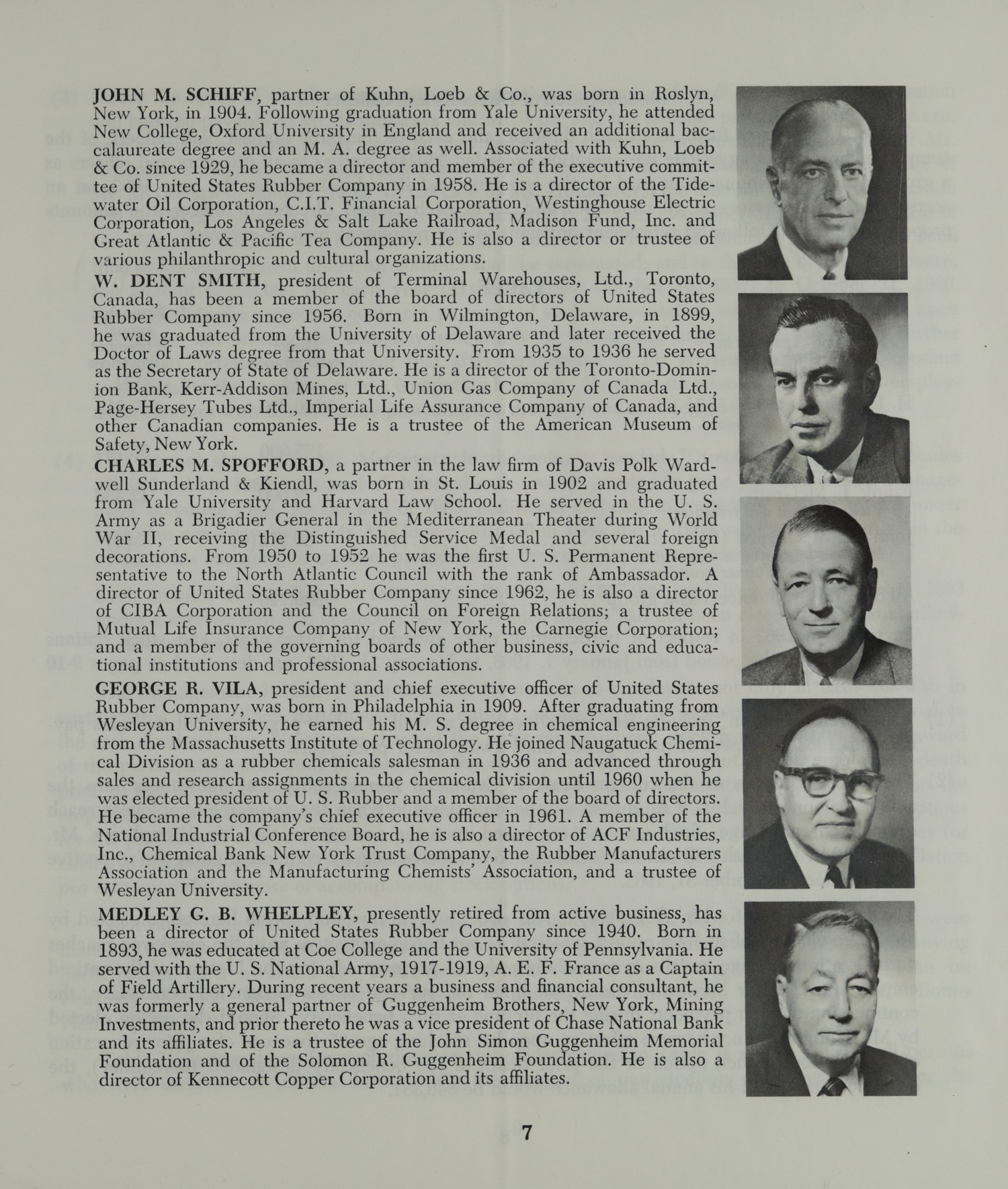
All Employees Eligible to Submit Ideas

Any employee may participate in the Idea Plan. It’s a simple way to earn extra money by recommending improvements in the way things are done.

Awards are made for suggestions on production improvement, equipment changes, materials handling, waste reduction and other areas.

The minimum award for an Idea is $25.00. There is no limit on the maximum award.
The new sewer separates the rain and process waters. It will carry the rain water to the river and prevent an overflow at the Pretreatment plant.

and during periods of heavy rain or snow melt there is too much water for it to handle. Some of the water must overflow to the river carrying some process waste with it.

To prevent the overflow the plant is installing a separate sewer system for storm water which will collect water from the building roofs and the yard areas and carry it directly to the river.

Storm sewers will be installed continued on page 4


Breen’s

The Biggest Little Store In The Country
Visit our four floors
of famous brands for him and her.

Cosmetic & Jewelry Dept.
Guerlain
Elizabeth Arden
Nina-Ricci
Chanel
Yves Saint Laurent
Monet
Napier
Marvella Pearls

Lingerie Shop
Vanity Fair
Olga—Barbizon
Schrank Robes
Shadowline

Ski Boutique
Ski Jackets
Warm-Up Slacks
Ski Pants
Ski Sweaters
Gloves & Sweaters

Jr. Sportswear
Collegetown Sweaters
White Stag—Skirts, Slacks
Davis Coats
Peerless Sportwear

Men’s Shop
Manhattan Shirts
Botany Suits—Sport Coats
H. Freeman Suits
London Fog Rainwear
Florsheim Shoes
Jaymar Slacks

Ladies’ Dept.
Couture Coats
Tanner Dresses
Vanity Fair Lingerie
Joyce—Naturalizer Shoes


Chittenden Insurance Agency, Inc.

Insurance—Mutual Funds—Real Estate

180 Church Street
Naugatuck, Connecticut
Tel. 729-8209

Frederick D. Zonino Nathan M. Pierpont, Jr.

US Rubber Proxy Statement – Page 7

Page 007

JOHN M. SCHIFF, partner of Kuhn, Loeb & Co., was born in Roslyn, New York, in 1904. Following graduation from Yale University, he attended New College, Oxford University in England and received an additional bac-
calaurcatc degree and an M.A. degree as well. Associated with Kuhn, Loeb
& Co. since 1929, he became a director and member of the executive commit-
tee of United States Rubber Company in 1958. He is a director of the Tide-
water Oil Corporation, C.I.T. Financial Corporation, Westinghouse Electric
Corporation, Los Angeles & Salt Lake Railroad, Madison Fund, Inc. and
Great Atlantic & Pacific Tea Company. He is also a director or trustee of
various philanthropic and cultural organizations.
W. DENT SMITH, president of Terminal Warehouses, Ltd., Toronto,
Canada, has been a member of the board of directors of United States
Rubber Company since 1956. Born in Wilmington, Delaware, in 1899,
he was graduated from the University of Delaware and later received the
Doctor of Laws degree from that University. From 1935 to 1936 he served
as the Secretary of State of Delaware. He is a director of the Toronto-Domin-
ion Bank, Kerr-Addison Mines, Ltd., Union Gas Company of Canada Ltd.,
Page-Hersey Tubes Ltd., Imperial Life Assurance Company of Canada, and
other Canadian companies. He is a trustee of the American Museum of
Safety, New York.
CHARLES M. SPOFFORD, a partner in the law firm of Davis Polk Ward-
well Sunderland & Kiendl, was born in St. Louis in 1902 and graduated
from Yale University and Harvard Law School. He served in the U. S.
Army as a Brigadier General in the Mediterranean Theater during World
War II, receiving the Distinguished Service Medal and several foreign
decorations. From 1950 to 1952 he was the first U. S Permanent Repre-
sentative to the North Atlantic Council with the rank of Ambassador. A
director of United States Rubber Company since 1962, he is also a director
of CIBÄ Corporation and the Council on Foreign Relations; a trustee of
Mutual Life Insurance Company of New York, the Carnegie Corporation;
and a member of the governing boards of other business, civic and educa-
tional institutions and professional associations.
GEORGE R. VILA, president and chief executive officer of United States
Rubber Company, was born in Philadelphia in 1909. After graduating from
Wesleyan University, he earned his M. S. degree in chemical engineering
from the Massachusetts Institute of Technology. He joined Naugatuck Chemi-
cal Division as a rubber chemicals salesman in 1936 and advanced through
sales and research assignments in the chemical division until 1960 when he
was elected president of U. S. Rubber and a member of the board of directors.
He became the company’s chief executive officer in 1961. A member of the
National Industrial Conference Board, he is also a director of ACF Industries,
Inc., Chemical Bank New York Trust Company, the Rubber Manufacturers
Association and the Manufacturing Chemists Association, and a trustee of
Wesleyan University.
MEDLEY G. B. WHELPLEY, presently retired from active business, has
been a director of United States Rubber Company since 1940. Born in

1893, he was educated at Coe College and the University of Pennsylvania. He
served with the U. S. National Army, 1917-1919, A. E. F. France as a Captain
of Field Artillery. During recent years a business and financial consultant, he
was formerly a general partner of Guggenheim Brothers, New York, Mining
Investments, and prior thereto he was a vice president of Chase National Bank
and its affiliates. He is a trustee of the John Simon Guggenheim Memorial
Foundation and of the Solomon R. Guggenheim Foundation. He is also a
director of Kennecott Copper Corporation and its affiliates.

Untitled Clipping

7-11-67

Page 10 – NAUGATUCK NEWS (Conn.) Tues., July 11, 1967


Views Of UniRoyal

Continued From Page 1

Mont said his bank “is not pressing anybody to the wall. We go along with the circumstance. I expect some withdrawals — it’s property tax time now.”

Neil Stanley of the Naugatuck Savings and Loan Association says his bank is “endeavoring to accept partial payments on loans. There’s nothing much more we can do except sort of sympathize. People are making a very strenuous effort to stay current.” He said the bank has had “numerous small withdrawals from a large number of people.”

At one time, Naugatuck was among the three highest cities in the United States noted for its savings deposits in the city’s banks.

Frank J. Hayes, manager of the Household Finance Co. in Waterbury, says “People are hurting for money. A hell of a lot of creditors aren’t getting paid. It’s a little bit of a crisis. The strikers on picket duty get $15 weekly and there’s not much that can be done with that. It’s a tough situation. We’re not pressing anybody. You can’t get blood out of a turnip, that would be utter folly.”

James N. Greene, executive vice president of the Naugatuck Chamber of Commerce says, “business has dropped off, but there is no way of telling how much at this point. We know that it has dropped, strictly by word of mouth. The town is still in a healthy situation, because there are other major plants in and around Naugatuck, but we wish the strike was over. UniRoyal is a vital element in the economy’s health.”

Jean Gagnon, of Gagnon’s General Store, says 65 per cent of his customers are UniRoyal workers. “Business has dropped at least 25 per cent. We can’t take it too much longer. Last week, I had to cut credit to food items only. If the strike goes on another month, I’ll have to cut off credit completely, if I’m going to survive.

“We became participants in the Food Stamp program June 1 by necessity. I found that some of my customers who never qualified for stamp relief, now qualify. The program has, since the strike, been of some help to them and to us,” he said.

Holding Own

A hardware store manager, who did not want his store identified, says his firm “hasn’t been hurt too much. We supply all the maintenance stuff for the rubber company and, now, we’re not delivering anything — although the orders still come in. We’re holding our own,” he said.

Jack Smith, factory manager for UniRoyal’s Footwear Division, said “The strike has had an adverse effect on the local economy.” He said also, “We have customers who want to be serviced and they complain if they don’t get it.”

John Evans, factory manager, or UniRoyal’s Chemical Division says “The strike has been a hardship on a town with 5,500 employes striking out of a population of 20,000. But there’s been no local pressure either. We’re just sitting tight here and hoping Ohio settles it.”

September Impact

Ira Mackler, of M. Freedman & Co., a department store, thinks “the full impact of the strike will be reflected in the fall. I’m planning for a decrease. Actually, we’re playing it by ear. Payments are lagging. I’m surprised that the collections have not been as bad as they might be in view of the situation. We are extending extra credit to our people and working with them.”

In an editorial June 23, Frederick E. Hennick of the Naugatuck Daily News, said “It must be equally obvious to both sides in this dispute that there is a crying need to bring this strike to an end for humanitarian reasons, if for no others.

“Too many people are being badly hurt in this struggle which has now gone down in history as the longest rubber industry strike in the nation’s history — something of which neither side should be especially proud.”

One thing some residents with a historical bent seem to point to with pride is the city’s reputation as the birthplace of the rubber industry while Akron is known as its cradle.

It was here in 1840, beside the Naugatuck River which was to become the most polluted river in the United States, that Charles Goodyear developed the process he named for the Roman god of fire — vulcanization — giving birth to the rubber industry.

Most strikers seem to wish Vulcan would breath fire into the smoke stacks that stud the city’s skyline sending the reek of ammonia through the valley — an oppressive smell that would be welcomed because it would mean a return to normal.

SATURDAY
MAY 27, 1967

UniRoyal

Continued From Page 1

According to Rzeszutek, the
only items shipped from the
Chemical were “slabs of re-
claim”, slabs of rubber re-
claimed from old tires and
other rubber items.

“What are they going to do
with slabs of reclaim, drop them
from airplanes and smother the
Viet Cong?” he asked.

Rzeszutek, a veteran of com-
bat who “had been shot up a few
times” himself, resented the
implication that he and his union
were unpatriotic. He said he
could guarantee that not one
thing had been shipped from the
Chemical plant to Vietnam.

Management lawyer, Atty. J.
Kenneth Bradley, said Friday
that the production was “par-
tially” for the defense effort,
and partially “for use in other
parts of the country.” The only
additional information he would
give was that the items “are not
for use by ourselves.”

A company official was quot-
ed Thursday as saying the oper-
ation of plant by management
personnel was for the produc-
tion of some key items neces-
sary for the Vietnam defense
effort.

In asking for an end to picket
line difficulties, Gaffney sym-
pathized with the union mem-
bers who felt that “someone is
destroying. . .the right to live
and work.” “I trust we will
never have a hearing”, the judge
said, adding that he hoped he
would not be forced to issue
an injunction against the union.

Judge Gaffney on May 6 issued
a show cause order against
Local 45 of the United Rubber
Workers in connection with
picketing at the Footwear Divi-
sion, but a hearing has never
been held. There have been two
continuances and more are ex-
pected as long as the picketing
remains peaceful.

The judge said he hoped the
issuance of a show cause order
will have the same effect at the
Chemical plant.

The United Rubber Workers
have been on strike for five-
weeks. Negotiations on the mas-
ter contract, being held in Cin-
cinnati, Ohio, recessed Friday
until Wednesday.

Questioned Decision

Questioned Decision

Alves questioned the decision of the management, criticizing its actions in attempting production with “unskilled personnel.” The union president further asserted that because of the “danger of work involved at the plant, a disaster could occur, not only endangering the lives and property of those in close proximity to the plant, but to also those in the neighborhood.”

Alves said the union has contacted the insurance company on whether they had been informed of the production work by the unskilled personnel and reported the insurance company had not been notified to date. He said periodic inspections are conducted at the plant due to the nature of work involved.

Third Plant Involved

The mass picketing at the Synthetic Plant, makes the third plant of the Uniroyal company to be involved since the three plants were struck 41 days ago.

Both Locals 218 of the Chemical and 308 of Synthetic Plants have maintained around-the-clock picketing since the beginning of the strike.

US Rubber Annual Report – 72nd Annual Report – Page 4

Page 004

One of the largest and most dramatic expansions has been at Geismar, La. This is a complete chemical complex for the manufacture of vinyl monomers, agricultural and Rydene synthetic rubber.

A. Agricultural chemicals are made in Geismar plant.
B. Rubber chemical plant at Geismar is now operating.

US Rubber Annual Report – 72nd Annual Report – Page 5

Page 005

$300,000,000 Expansion and Modernization Program

U. S. Rubber has undertaken a world-wide expansion and modernization program which will involve a total investment of more than 300 million dollars. We are well along in this program and expect it to be completed in three to four years. Approximately 200 million of this program is for the modernization and expansion of our tire production and distribution facilities, both in the United States and abroad and for chemical, textile and synthetic rubber plants which supply raw materials and components to our tire manufacturing operations. The remainder of the program will provide the other manufacturing divisions of the company with new facilities in the United States, Europe, Latin America, Australia, the Far East and Canada devoted to products other than tires and tire components. The program will open new markets for us at home and abroad, and will strengthen our competitive position in the more profitable areas of our business.

New Chemical Complex

At Geismar, La. we have invested more than 30 million dollars in a modern chemical complex, and our investments there will continue to increase in the future. Three plants are now in operation. One is producing vinyl monomers for use in plastics. Another is producing agricultural chemicals, and a third is turning out improved rubber and agricultural chemicals. This spring a fourth plant will start making Royalene, the new ethylene-propylene synthetic rubber.

U.S. Rubber Sales by Product Groups as Percent of Total Show Increasing Diversification

Areas of the company’s most rapid growth during the last quarter century are indicated in this chart. Chemicals, textiles and fibers, as well as our business outside the United States, enjoyed the greatest growth. In the meantime, tires, footwear, general and industrial products continue to be an important source of company business.

US Rubber Annual Report – 72nd Annual Report – Page 6

Page 006

Geismar is also the site selected for Rubicon Chemicals, Inc., a company jointly owned with Imperial Chemical Industries, Ltd. of Great Britain. It will produce aniline and tolylene diisocyanates for polyurethane synthetics, used in foams, rubbers and surface coatings.

In Scotts Bluff, La. we are doubling our capacity for Kralastic ABS plastics. These tough plastics are widely used in automobile dashboards, body parts and panels, and also in travel trailers. They also find wide applications in appliances, pipe, telephone hand sets and a host of other uses.

Most Modern Tire Plant in U.S.A.
The most modern and efficient tire plant in the industry recently started production in Opelika, Ala. to satisfy the rapidly growing tire market of the southeastern states. An intensive modernization program is also in progress in our other tire plants. We have also opened new tread rubber plants in Conyers, Georgia and Wilkes-Barre, Pennsylvania, and others are now in the planning stage.

Argentine Project
Production is expected to get underway by midyear at San Lorenzo in Argentina by PASA, an industrial complex in which we have a 24 per cent interest. It will produce synthetic rubbers, chemicals, carbon black and other hydrocarbon materials. The principal market for these products will be the thriving Argentine tire industry, but this market can be extended throughout Latin America.

Model is of Geismar Royalene synthetic rubber plant.

Turkish Tire Plant
At Adapazari in Turkey, U. S. Rubber in 1963 started manufacture of tires in a new plant. It will fill the needs of a rapidly growing market for tires in Turkey, a nation with an adequate road system, a growing automobile industry and an expanding transportation network.

English Chemical and Plastics Plants
At Bromsgrove, England the Company has established a subsidiary, Sto-Chem Limited, a company which manufactures synthetic latices that are marketed in England and on the continent. Also in England, we started to construct a plant to make the ABS plastic, Kralastic.

US Rubber Annual Report – 72nd Annual Report – Page 8

Page 008

A. Argentine complex will make chemicals, synthetics for Argentine tire industry.
B. Turkish plant fills needs of growing Near East tire market.
C. New Scotts Bluff, La. plant will double ABS plastic capacity.
D. New Winnsboro, S. C. plant makes improved nylon tire cord.
E. Sto-Chem in Bromsgrove, England, manufactures synthetic latices that are marketed in England and on the continent.
Right: New Laredo, Texas, tire proving facility is now in operation. At top, test driver rounds curve on high speed track. Center, tires are tested for durability on cobblestone roadway. At bottom, part of 80 vehicle test fleet lines up on track. Laredo facility is on 6,900-acre site, employs more than 100 persons, logs more than 25,000,000 tire test miles annually.
U.S. ROYAL LASTIK TURK A.S.

US Rubber Annual Report – 72nd Annual Report – Page 9

Page 009

Tire Testing Facility
At Laredo, Texas, we are now operating the most modern tire proving ground in the industry. On its four-lane, five-mile circular track, tires can be tested at speeds up to 140 miles an hour, and eventually at 200 miles an hour. Other courses and tracks at Laredo are designed for testing and evaluating farm and off-the-road tires, tire cords and carcasses, and skid resistance characteristics. A two-mile course constructed of gravel has been built for determining how well tires can withstand chipping and cutting, and how treads can be designed that will not pick up stones in the grooves. There is an additional two-mile unpaved road for off-highway testing.

Improved Textiles
At Winnsboro, S. C. a new unit is now in operation that produces an improved nylon cord for tires by a hot-stretch process, and construction is now underway on a new plant to produce our newly-developed piece-dyeable polypropylene fiber for use in carpets, upholstery and other consumer products. In Gastonia, N.C., we are now operating a new plant producing Yvrone, our new stretchable spandex fiber. In Winnsboro, we are also building a new research and sales headquarters for our Textile and fibers division.

Chemicals and Tires in Japan
U.S. Rubber has formed a joint company with Sumitomo Chemical Company, Ltd. to turn out synthetic plastic and rubber polymers. Also in Japan, we have made a substantial investment in a tire plant to provide a production base for our tires in the Far East.

Three Canadian Projects
In western Canada we have completed a new plant to produce a variety of chemicals. In Montreal, we are erecting a reclaimed rubber plant which will have an annual capacity of 25 million pounds, enough to meet the needs of the Canadian market for this product. In Ontario, we will build a plant to supply nylon and rayon tire cord for our Canadian tire plant. In Canada, where we are the leading manufacturer of tires, we continue to expand and modernize our facilities.

US Rubber Annual Report – 72nd Annual Report – Page 11

Page 011

tory control, traffic and accounting, and is expected to
provide important savings in costs.

New Technical Center
A technical sales service center is now operating at
Naugatuck, Conn. There, in a new and modern building
more than 100 scientists, engineers and technicians provide technical services to customers who use our chemical, rubber and plastic products.

Tire Plant in Common Market
In Liége, Belgium we are constructing a new plant which
will be the most efficient tire producing unit in Europe
and will replace an obsolete tire plant we now have in
Liége. It will place us in a favorable position to compete
in the Common Market. We also operate tire plants in
Aachen, West Germany; Clairôix, France; and in Edinburgh, Scotland.

A. New Canadian plant in Edmonton,
Alberta, produces chemicals.
B. Italian plastics plant now manufactures coated fabric line.
C. Italian plant makes rubber chemicals
for the Common Market.
D. U. S. Rubber has made investment in
Japanese tire factory.
E. Information center at Naugatuck is
first of several such centers to be built
in United States. Electronic equipment
quickly processes information here to
increase efficiency and reduce costs.
F. New technical service center is in full
operation at Naugatuck, Conn. Here
100 scientists, engineers and technicians serve Naugatuck’s customers.

US Rubber Annual Report – 72nd Annual Report – Page 25

Page 025

Board of Directors
H. E. Humphreys, Jr. Chairman of the Board
George R. Vila President and Chief Executive Officer
Eugene N. Beesley President, Eli Lilly and Company
J. Simpson Dean President, Nemours Corporation
George P. Edmonds Chairman, Wilmington Trust Company
Malcolm P. Ferguson President, Bendix Corporation
G. Arnold Hart President, Bank of Montreal
Harold H. Helm Chairman, Chemical Bank New York Trust Company
James P. Lewis President, Latex Fiber Industries, Inc.
John W. McGovern Retired as President, 1960
Robert J. McKim Chairman, Associated Dry Goods Corporation
John M. Schiff Partner of Kuhn, Loeb & Co.
W. Dent Smith President, Terminal Warehouses, Ltd.
Charles M. Spofford Partner, Davis Polk Wardwell Sunderland and Kiendl
Medley G. B. Whelpley Retired Corporate Executive

ADVISORY DIRECTORS
Herbert E. Smith, former Chairman and President
Thomas J. Needham, former Vice President

Officers of the Company
its divisions, departments and principal subsidiaries

H. E. Humphreys, Jr. Chairman, Board of Directors
George R. Vila President and Chief Executive Officer
Walter D. Baldwin Vice President, Corporate Sales
E. M. Cushing Vice President, Industrial Relations Department
Earle S. Ebers Vice President and Group Executive, polymers, fibers and chemicals
Frank J. McGrath Financial Vice President and Treasurer
C. William Pennington Vice President and Group Executive, tires, consumer and industrial products
Perce C. Rowe Vice President, Market Development
Leland M. White Vice President, Research and Engineering
G. T. Pownall Secretary
Claude H. Allard Vice President and General Manager, Textile Division
M. F. Anderson President, Dominion Rubber Company, Ltd.
Harold N. Barrett President, U. S. Rubber Tire Co.
F. Dudley Chittenden Vice President and General Manager, Naugatuck Chemical Division
Louis J. Healey President, Consumer and Industrial Products Division
Edward J. Higgins President, U. S. Rubber International Company
James P. Lewis President, Latex Fiber Industries, Inc.

Executive Committee:
Mr. Humphreys, Chairman;
Messrs. Vila, Edmonds,
McGovern, Schiff and Whelpley.

Salary and Bonus Committee:
Mr. McGovern, Chairman;
Messrs. Edmonds,
Schiff and Whelpley.

Audit Committee:
Mr. Edmonds, Chairman;
Messrs. Helm and Spofford.

US Rubber Annual Report – 1963-72nd-annual-report-s033

Page 033

United States
General Offices: 1230 Avenue of the Americas, New York, N. Y. 10020 Research Center: Wayne, New Jersey

EXISTING PLANTS
ALABAMA: Opelika
CALIFORNIA: Los Angeles
Santa Ana
CONNECTICUT: Bethany
Naugatuck
Sandy Hook
Waterbury
GEORGIA: Conyers
Dalton
Hogansville
Thomson
ILLINOIS: Chicago
INDIANA: Indianapolis
Mishawaka
Warsaw
Washington
LOUISIANA: Baton Rouge
Geismar
Scotts Bluff
MARYLAND: Baltimore
MASSACHUSETTS: Chicopee Falls
Medford

MICHIGAN: Detroit
NEW JERSEY: Passaic
Wayne
NEW YORK: Beaver Falls
NORTH CAROLINA: Gastonia
Raeford
Waxhaw
OHIO: Painesville
PENNSYLVANIA: Philadelphia
Wykes-Barre
RHODE ISLAND: Providence
Woonsocket
SOUTH CAROLINA: Winnsboro
TENNESSEE: Shelbyville
TEXAS: Laredo
Port Neches
VIRGINIA: Scottsville
WISCONSIN: Eau Claire
Stoughton

MAJOR EXPANSIONS
PAINESVILLE, OHIO
Synthetic rubber chloride
GEISMAR, LA.
Acetylene & vinyl monomers
Agricultural chemicals
Rubber chemicals
Royalene synthetic rubber
Aniline and
tolylene diisocyanates
THOMSON, GA.
Footwear
OPELIKA, ALA.
Tires
SCOTT’S BLUFF, LA.
Kratolitic resins
WARSAW, IND.
Expanded Royalite plastic parts
WINNSBORO, S.C.
Nylon tire cord
Polypropylene fiber
Textile sales and development
headquarters
NAUGATUCK, CONN.
Management information and
data processing center
LAREDO, TEX.
Tire test track
WILKES-BARRE, PA.
Tread rubber
Aircraft tire recapping
CONYERS, GA.
Tread rubber
Aircraft tire recapping
GASTONIA, N.C.
Vyrene fiber plant

Come To The Fair!
ON OUR COVER is an artist’s sketch of the giant tire which
United States Rubber Company will operate at the New York
World’s Fair, opening in April. The tire is 80 feet high and
will have a capacity of 96 passengers in 24 barrel-shaped
gondolas. The gondolas will move around the circumference
of the tire, affording a high and clear view of the Fair grounds
for sightseers and camera enthusiasts.

Outside U.S.A.
EXISTING PLANTS
The Company owns or is affiliated or
associated with manufacturing units in
these locations abroad:
ARGENTINA INDIA
AUSTRALIA INDONESIA
BELGIUM ITALY
BRAZIL JAPAN
COLOMBIA MALAYSIA
ENGLAND MEXICO
FRANCE PUERTO RICO

SCOTLAND
SOUTH AFRICA
SPAIN
SWEDEN
TURKEY
VENEZUELA
WALES
WEST GERMANY

Canada
ALBERTA: Edmonton
ONTARIO: Elmira
Guelph
Kitchener
QUEBEC: Montreal
St. Jerome

MAJOR EXPANSIONS
ARGENTINA
Chemicals
Synthetics
Carbon black
Other hydrocarbon materials
TURKEY
Tires
ENGLAND
Synthetic latices
Plastics
Royalite plastics
Golf balls
CANADA
Chemicals
Reclaimed rubber
Tire cord

ITALY
Coated fabrics
Chemicals
SPAIN
Footwear
BELGIUM
Tires
JAPAN
Synthetic rubber and plastics
Tires
AUSTRALIA
Tires
Consumer & industrial products

CHEM-TEXTS – Page 2

Page 237

CHEM-TEXTS

Page 2


The thought of Christmas brings several things to mind. One is snow—and that speaks for itself; another is “that ole Christmas spirit” which unfortunately seems to come to many people only once a year; and another is safety.

We’ve all heard the expression before—have a safe Christmas. Well, here at the plant, I hope we all have a safe Christmas this year and next, and come to think of it, why not all the days in between. You all know that at Naugatuck we have just passed the milestone of working two million, that’s 2,000,000, manhours without a Lost Time Accident. We haven’t done that since 1961. That’s a tremendous and significant accomplishment and we should all be proud, and pleased, about it. After attaining this performance, I strangely found myself asking—”why has it taken us so long?” I ask myself, “why can’t we just keep on going?”

Jim Cronin [signature]

Wouldn’t that be a great Christmas present next year, working through all of 1976 without a Lost Time Accident. Strange as it may seem, this is one goal that is essentially under our full control. We can’t blame this on the Legislature in Hartford or the Congress in Washington—not even on the Governor or President. This is something that we, as employees of Uniroyal Chemical at Naugatuck, Conn., can claim full responsibility. It is, in a nut shell, strictly up to us.

Somehow, a happy Christmas helps to strengthen us. If we could minimize our exposure to accidents—at work, at home, on the road—we would, I’m sure, enjoy the spiritual and material joys of Christmastime even more. To attain this, we must not only be more aware of our own safety, but we must make others, particularly our family, more aware of their exposure to accidents. We have already seen how working together has reduced accidents and improved safety in the plant. We should instill this same positive attitude within our own family. Then we’ve really accomplished something.

With all this in mind, I would like to wish you and your families a very Merry, and Safe Christmas, and for next year, the return of reasonable prosperity.


Christmas in the Plant

[IMAGE: Photo of trees/spruces near a building]

In 1971, ninety five Colorado spruces were planted along the bank of the Naugatuck river; another 75 were planted in 1973. Besides improving the appearance of the plant, the trees add a touch of Christmas at this time of year. Naugatuck Chemical is probably the only industrial factory in the area with such a touch of green on its property. Over 100 hemlocks surround the scrap tire yard and 60 spreading yews were recently planted by the Main Entrance.


Diploma Awarded

[IMAGE: Photo of woman and man looking at documents]

Theresa Martin, an Order Clerk, in the D/S department plans to continue her education at the Mattatuck Community College in a Business related course. She is one of several Naugatuck Chemical people who have fulfilled the requirements for a high school equivalency diploma, which she is showing to Alex Nole.

The Industrial Relations department has a set of preparation books for the tests and may be borrowed at any time.


Survey Team Studies Noise

A survey was recently made of the noise factors in over 129 buildings throughout the plant by Thomas Ennis, Engineering, and James Loman of the Safety Dept. in compliance with the Occupational Safety and Health Act (OSHA).

The purpose of the study was to determine the range of noise problems that may exist in each section or floor of a building in the plant. Basing their measurements on engineering procedures, they recorded over 875 noise soundings which are kept on file in the Safety department.

The results have been given to the department heads of the buildings who in turn consult the plant Engineering department for recommendations to diminish or eliminate the noise level in compliance with OSHA.

In areas where the level is higher than desirable, people working in the area are urged to wear the proper protective equipment until the condition is remedied.


Accidents Cost Over $100,000

Accidents in 1975 cost over $100,000. During the year there were 3 Lost Time Injuries and 26 Serious Injuries for a total of 29. Although this is a major improvement over the hospital, surgical, and medical costs of $238,359 in 1974 and prior years when injuries cost over $200,000 annually, it still represents a severe drain on the plant’s financial condition.

The average direct cost of a Lost Time accident is $15,000. Overtime and other indirect costs increase it 5 times more, according to estimates of the National Safety Council and the Safety department.

Accidents Can Be Avoided

Eighty-five percent of the injuries in the plant are person-caused. Not that the accidents are deliberate, but they could have been avoided by a greater safety awareness. Many of them are caused by “taking chances” or “short cuts” or by not using the proper safety equipment or procedures.

Fingers were the most common injuries, accounting for half of the 29 accidents that occurred during the year. All of them required sutures.

But incomparable to the medical and hospital costs is the unnecessary suffering to the employee, his family, and the people in the department of which the employee is a member.


$1,116 Paid for Ideas

[IMAGE: Photo of three men, one receiving a check]

Russell Volz, center, Chemical Production, receives a $286.00 check from James Cronin, Factory Manager, for his Idea that saved $2750.00 a year in valves. At right is Frank Commendatore.


$9,449 Savings

Twenty people received $1116.00 for Ideas submitted during the year recommending different ways to save money in the operation of the plant.

The Ideas resulted in savings of $9449.00 at the Naugatuck location.

The highest award for the year $286.00 went to Russell Volz, Chemical Production, for reducing the number of valves used in the manufacture of J-Z-F. His idea resulted in a savings of $2750.

Another high award of $186.00 was made to Emil Rehel and Raymond Kubick, Chemical Maintenance, plus an additional $100. in small awards.

continued on page 3


Eric Johnson Named Chemical Superintendent

Eric Johnson has been named Superintendent of Chemical Production.

He joined the Naugatuck Chemical plant in 1961 upon graduation from Clarkson College with a B.Ch.E. degree. He held several Engineering positions until 1968 when he was appointed General Foreman of Synthetic Production. In 1971 he was named Chief Process Engineer for Chemical Production and in 1973 was assigned to the Naugatuck Treatment Co. a subsidiary of Uniroyal, Inc.


[ADVERTISEMENT]

UNIROYAL WINTER PATROL
WHITEWALL

TWO FIBERGLASS BELTS/TWO POLYESTER CORD PLIES
SELF-CLEANING TREAD FOR TRACTION

[IMAGE: Tire illustration]

ADVANCE TIRE SERVICE
510 Meriden Rd.
Waterbury—756-7205

POUST’S SERVICE STATION
144 Rubber Ave.
Naugatuck—729-0433

MEZZIO’S
792 New Haven Rd.
Naugatuck—729-5988

• Double fiberglass belts for hazard protection and mileage
• 78 Series design for traction