CHEMWORLD
WINTER/SPRING 1995
BRIEFS
Rights to Biological Insecticide Acquired
Uniroyal Chemical has acquired exclusive marketing rights for BIOCOT™ insecticide on cotton, soybeans and peanuts.
BIOCOT is a highly


WINTER/SPRING 1995
Uniroyal Chemical has acquired exclusive marketing rights for BIOCOT™ insecticide on cotton, soybeans and peanuts.
BIOCOT is a highly
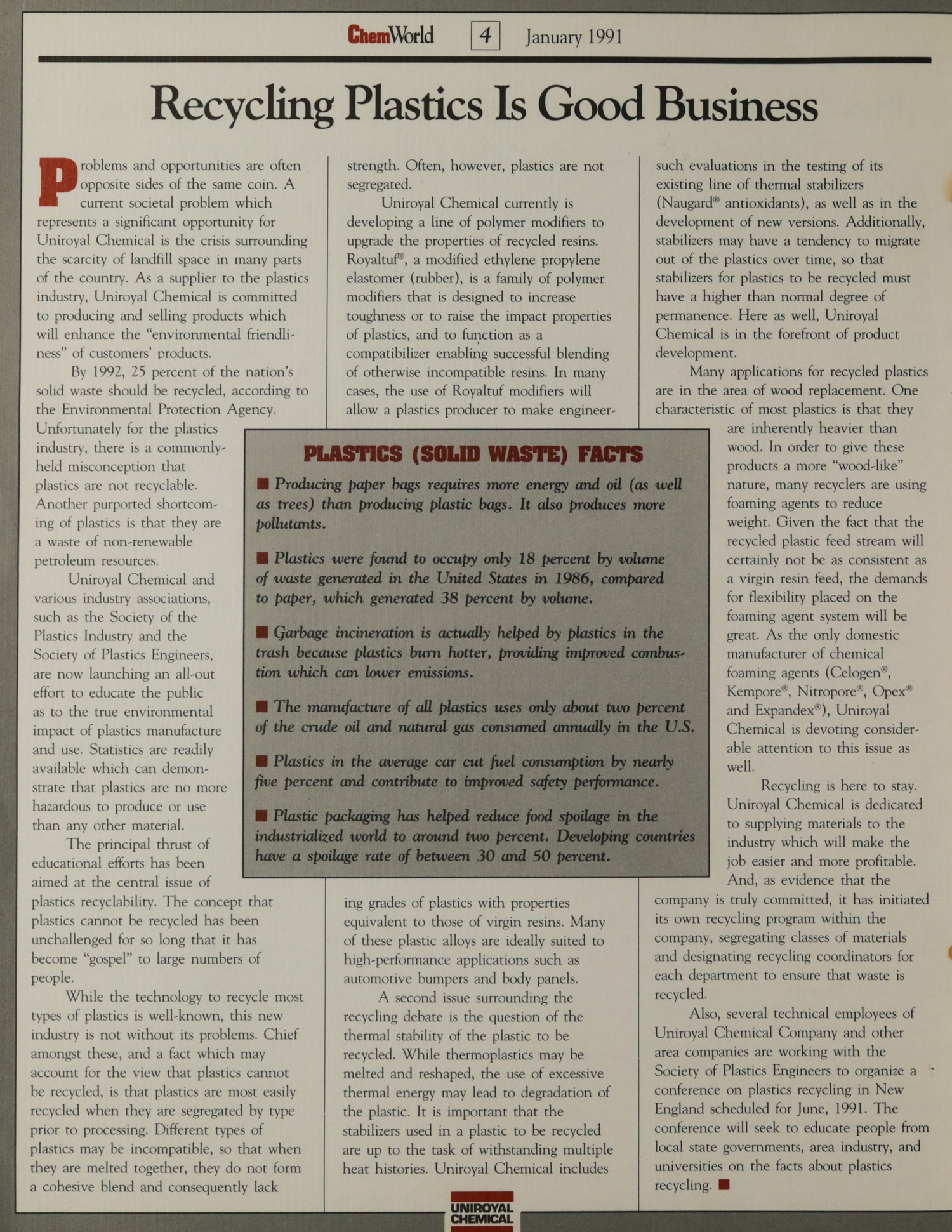
Problems and opportunities are often opposite sides of the same coin. A current societal problem which represents a significant opportunity for Uniroyal Chemical is the crisis surrounding the scarcity of landfill space in many parts of the country. As a supplier to the plastics industry, Uniroyal Chemical is committed to producing and selling products which will enhance the “environmental friendliness” of customers’ products.
By 1992, 25 percent of the nation’s solid waste should be recycled, according to the Environmental Protection Agency. Unfortunately for the plastics industry, there is a commonly-held misconception that plastics are not recyclable. Another purported shortcoming of plastics is that they are a waste of non-renewable petroleum resources.
Uniroyal Chemical and various industry associations, such as the Society of the Plastics Industry and the Society of Plastics Engineers, are now launching an all-out effort to educate the public as to the true environmental impact of plastics manufacture and use. Statistics are readily available which can demonstrate that plastics are no more hazardous to produce or use than any other material.
The principal thrust of educational efforts has been aimed at the central issue of plastics recyclability. The concept that plastics cannot be recycled has been unchallenged for so long that it has become “gospel” to large numbers of people.
While the technology to recycle most types of plastics is well-known, this new industry is not without its problems. Chief amongst these, and a fact which may account for the view that plastics cannot be recycled, is that plastics are most easily recycled when they are segregated by type prior to processing. Different types of plastics may be incompatible, so that when they are melted together, they do not form a cohesive blend and consequently lack
strength. Often, however, plastics are not segregated.
Uniroyal Chemical currently is developing a line of polymer modifiers to upgrade the properties of recycled resins. Royaltuf®, a modified ethylene propylene elastomer (rubber), is a family of polymer modifiers that is designed to increase toughness or to raise the impact properties of plastics, and to function as a compatibilizer enabling successful blending of otherwise incompatible resins. In many cases, the use of Royaltuf modifiers will allow a plastics producer to make engineer-
■ Producing paper bags requires more energy and oil (as well as trees) than producing plastic bags. It also produces more pollutants.
■ Plastics were found to occupy only 18 percent by volume of waste generated in the United States in 1986, compared to paper, which generated 38 percent by volume.
■ Garbage incineration is actually helped by plastics in the trash because plastics burn hotter, providing improved combustion which can lower emissions.
■ The manufacture of all plastics uses only about two percent of the crude oil and natural gas consumed annually in the U.S.
■ Plastics in the average car cut fuel consumption by nearly five percent and contribute to improved safety performance.
■ Plastic packaging has helped reduce food spoilage in the industrialized world to around two percent. Developing countries have a spoilage rate of between 30 and 50 percent.
ing grades of plastics with properties equivalent to those of virgin resins. Many of these plastic alloys are ideally suited to high-performance applications such as automotive bumpers and body panels.
A second issue surrounding the recycling debate is the question of the thermal stability of the plastic to be recycled. While thermoplastics may be melted and reshaped, the use of excessive thermal energy may lead to degradation of the plastic. It is important that the stabilizers used in a plastic to be recycled are up to the task of withstanding multiple heat histories. Uniroyal Chemical includes
such evaluations in the testing of its existing line of thermal stabilizers (Naugard® antioxidants), as well as in the development of new versions. Additionally, stabilizers may have a tendency to migrate out of the plastics over time, so that stabilizers for plastics to be recycled must have a higher than normal degree of permanence. Here as well, Uniroyal Chemical is in the forefront of product development.
Many applications for recycled plastics are in the area of wood replacement. One characteristic of most plastics is that they are inherently heavier than wood. In order to give these products a more “wood-like” nature, many recyclers are using foaming agents to reduce weight. Given the fact that the recycled plastic feed stream will certainly not be as consistent as a virgin resin feed, the demands for flexibility placed on the foaming agent system will be great. As the only domestic manufacturer of chemical foaming agents (Celogen®, Kempore®, Nitropore®, Opex® and Expandex®), Uniroyal Chemical is devoting considerable attention to this issue as well.
Recycling is here to stay. Uniroyal Chemical is dedicated to supplying materials to the industry which will make the job easier and more profitable. And, as evidence that the company is truly committed, it has initiated its own recycling program within the company, segregating classes of materials and designating recycling coordinators for each department to ensure that waste is recycled.
Also, several technical employees of Uniroyal Chemical Company and other area companies are working with the Society of Plastics Engineers to organize a conference on plastics recycling in New England scheduled for June, 1991. The conference will seek to educate people from local state governments, area industry, and universities on the facts about plastics recycling. ■
UNIROYAL CHEMICAL
Uniroyal Chemical Company is preparing for continued competition in the European market by seeking “International” recognition of its Quality System.
The company is seeking accreditation based upon a Quality System Standard prepared by the International Standards Organization (ISO); specifically, ISO 9000.
In order to receive the accreditation, Uniroyal Chemical will undergo a detailed
The company’s capability to perform against the ISO’s quality standards will determine whether it will receive accreditation. This, in turn, will facilitate Uniroyal Chemical’s continued business growth in the European markets.
examination of each department’s Quality System. Sales order entry, customer service procedures, operation and control of the manufacturing processes, laboratory testing, product packaging and shipping are among the many areas which will be evaluated against the International Standards. The company’s capability to perform against these quality standards will determine whether it will receive accreditation. This, in turn, will facilitate Uniroyal Chemical’s continued business growth in the European markets.
Several of Uniroyal Chemical’s manufacturing sites are presently involved in assessing their quality systems against the ISO 9000 standards, with Geismar, LA and Latina, Italy seeking accreditation in 1990. ■
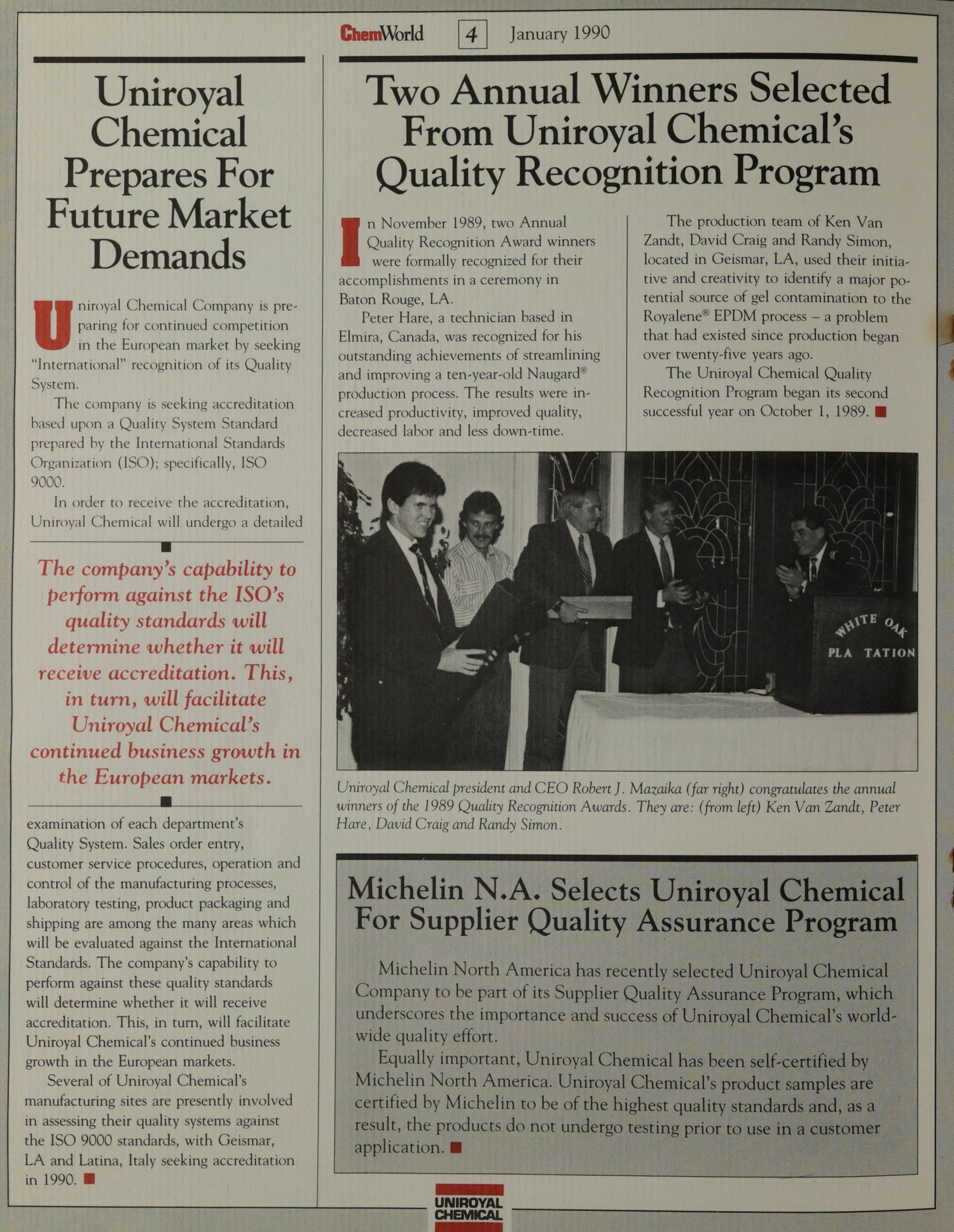
In November 1989, two Annual Quality Recognition Award winners were formally recognized for their accomplishments in a ceremony in Baton Rouge, LA.
Peter Hare, a technician based in Elmira, Canada, was recognized for his outstanding achievements of streamlining and improving a ten-year-old Naugard® production process. The results were increased productivity, improved quality, decreased labor and less down-time.
The production team of Ken Van Zandt, David Craig and Randy Simon, located in Geismar, LA, used their initiative and creativity to identify a major potential source of gel contamination to the Royalene® EPDM process – a problem that had existed since production began over twenty-five years ago.
The Uniroyal Chemical Quality Recognition Program began its second successful year on October 1, 1989. ■
Uniroyal Chemical president and CEO Robert J. Mazaika (far right) congratulates the annual winners of the 1989 Quality Recognition Awards. They are: (from left) Ken Van Zandt, Peter Hare, David Craig and Randy Simon.
Michelin North America has recently selected Uniroyal Chemical Company to be part of its Supplier Quality Assurance Program, which underscores the importance and success of Uniroyal Chemical’s worldwide quality effort.
Equally important, Uniroyal Chemical has been self-certified by Michelin North America. Uniroyal Chemical’s product samples are certified by Michelin to be of the highest quality standards and, as a result, the products do not undergo testing prior to use in a customer application. ■
UNIROYAL CHEMICAL
Vol. 14, 1980 | PUBLISHED FOR THE PEOPLE OF UNIROYAL CHEMICAL | NO. 1
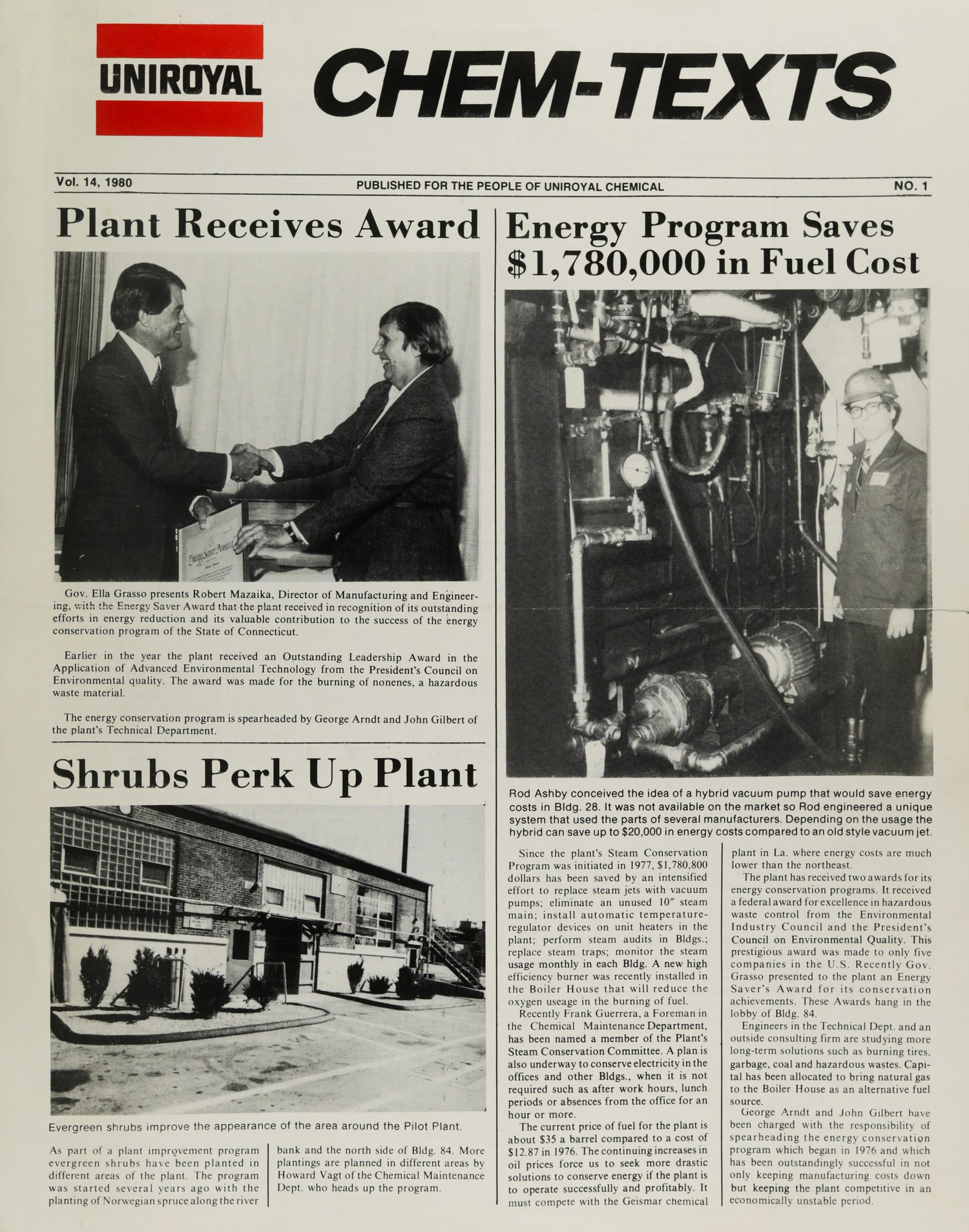
[IMAGE: Photo of two people shaking hands during award presentation]
Gov. Ella Grasso presents Robert Mazaika, Director of Manufacturing and Engineering, with the Energy Saver Award that the plant received in recognition of its outstanding efforts in energy reduction and its valuable contribution to the success of the energy conservation program of the State of Connecticut.
Earlier in the year the plant received an Outstanding Leadership Award in the Application of Advanced Environmental Technology from the President’s Council on Environmental quality. The award was made for the burning of nonenes, a hazardous waste material.
The energy conservation program is spearheaded by George Arndt and John Gilbert of the plant’s Technical Department.
[IMAGE: Photo of building exterior with evergreen shrubs]
Evergreen shrubs improve the appearance of the area around the Pilot Plant.
As part of a plant improvement program evergreen shrubs have been planted in different areas of the plant. The program was started several years ago with the planting of Norwegian spruce along the river bank and the north side of Bldg. 84. More plantings are planned in different areas by Howard Vagt of the Chemical Maintenance Dept. who heads up the program.
[IMAGE: Photo of man next to industrial equipment/machinery]
Rod Ashby conceived the idea of a hybrid vacuum pump that would save energy costs in Bldg. 28. It was not available on the market so Rod engineered a unique system that used the parts of several manufacturers. Depending on the usage the hybrid can save up to $20,000 in energy costs compared to an old style vacuum jet.
Since the plant’s Steam Conservation Program was initiated in 1977, $1,780,800 dollars has been saved by an intensified effort to replace steam jets with vacuum pumps; eliminate an unused 10″ steam main; install automatic temperature-regulator devices on unit heaters in the plant; perform steam audits in Bldgs.; replace steam traps; monitor the steam usage monthly in each Bldg. A new high efficiency burner was recently installed in the Boiler House that will reduce the oxygen useage in the burning of fuel.
Recently Frank Guerrera, a Foreman in the Chemical Maintenance Department, has been named a member of the Plant’s Steam Conservation Committee. A plan is also underway to conserve electricity in the offices and other Bldgs., when it is not required such as after work hours, lunch periods or absences from the office for an hour or more.
The current price of fuel for the plant is about $35 a barrel compared to a cost of $12.87 in 1976. The continuing increases in oil prices force us to seek more drastic solutions to conserve energy if the plant is to operate successfully and profitably. It must compete with the Geismar chemical plant in La. where energy costs are much lower than the northeast.
The plant has received two awards for its energy conservation programs. It received a federal award for excellence in hazardous waste control from the Environmental Industry Council and the President’s Council on Environmental Quality. This prestigious award was made to only five companies in the U.S. Recently Gov. Grasso presented to the plant an Energy Saver’s Award for its conservation achievements. These Awards hang in the lobby of Bldg. 84.
Engineers in the Technical Dept. and an outside consulting firm are studying more long-term solutions such as burning tires, garbage, coal and hazardous wastes. Capital has been allocated to bring natural gas to the Boiler House as an alternative fuel source.
George Arndt and John Gilbert have been charged with the responsibility of spearheading the energy conservation program which began in 1976 and which has been outstandingly successful in not only keeping manufacturing costs down but keeping the plant competitive in an economically unstable period.
Vol. 9, 1975 | PUBLISHED FOR THE PEOPLE OF UNIROYAL CHEMICAL | No. 3
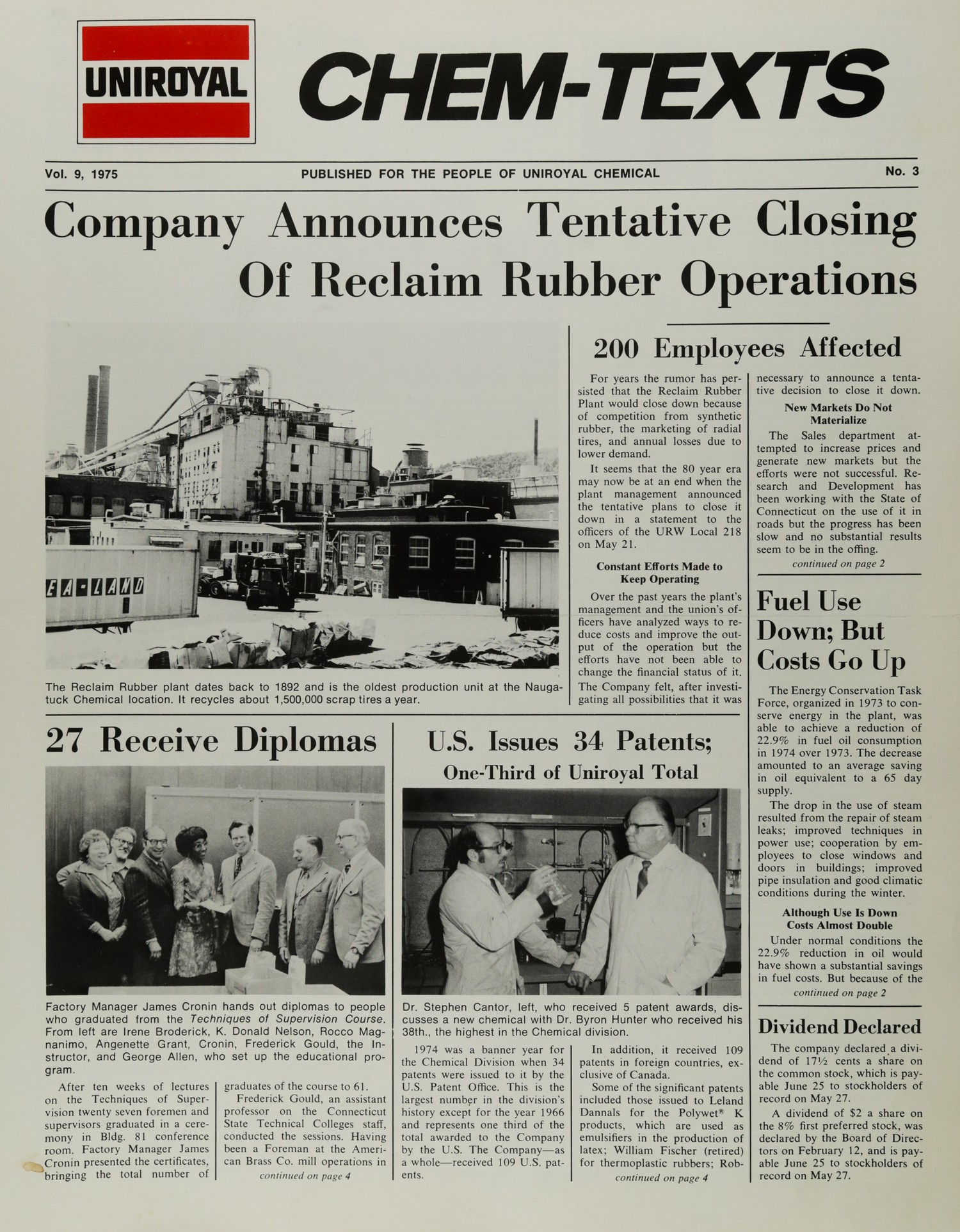
For years the rumor has persisted that the Reclaim Rubber Plant would close down because of competition from synthetic rubber, the marketing of radial tires, and annual losses due to lower demand.
It seems that the 80 year era may now be at an end when the plant management announced the tentative plans to close it down in a statement to the officers of the URW Local 218 on May 21.
Constant Efforts Made to Keep Operating
Over the past years the plant’s management and the union’s officers have analyzed ways to reduce costs and improve the output of the operation but the efforts have not been able to change the financial status of it. The Company felt, after investigating all possibilities that it was necessary to announce a tentative decision to close it down.
New Markets Do Not Materialize
The Sales department attempted to increase prices and generate new markets but the efforts were not successful. Research and Development has been working with the State of Connecticut on the use of it in roads but the progress has been slow and no substantial results seem to be in the offing.
continued on page 2
[IMAGE CAPTION:]
The Reclaim Rubber plant dates back to 1892 and is the oldest production unit at the Naugatuck Chemical location. It recycles about 1,500,000 scrap tires a year.
[IMAGE CAPTION:]
Factory Manager James Cronin hands out diplomas to people who graduated from the Techniques of Supervision Course. From left are Irene Broderick, K. Donald Nelson, Rocco Magnanimo, Angenette Grant, Cronin, Frederick Gould, the Instructor, and George Allen, who set up the educational program.
After ten weeks of lectures on the Techniques of Supervision twenty seven foremen and supervisors graduated in a ceremony in Bldg. 81 conference room. Factory Manager James Cronin presented the certificates, bringing the total number of graduates of the course to 61.
Frederick Gould, an assistant professor on the Connecticut State Technical Colleges staff, conducted the sessions. Having been a Foreman at the American Brass Co. mill operations in
continued on page 4
[IMAGE CAPTION:]
Dr. Stephen Cantor, left, who received 5 patent awards, discusses a new chemical with Dr. Byron Hunter who received his 38th., the highest in the Chemical division.
1974 was a banner year for the Chemical Division when 34 patents were issued to it by the U.S. Patent Office. This is the largest number in the division’s history except for the year 1966 and represents one third of the total awarded to the Company by the U.S. The Company—as a whole—received 109 U.S. patents.
In addition, it received 109 patents in foreign countries, exclusive of Canada.
Some of the significant patents included those issued to Leland Dannals for the Polywet® K products, which are used as emulsifiers in the production of latex; William Fischer (retired) for thermoplastic rubbers; Rob-
continued on page 4
The Energy Conservation Task Force, organized in 1973 to conserve energy in the plant, was able to achieve a reduction of 22.9% in fuel oil consumption in 1974 over 1973. The decrease amounted to an average saving in oil equivalent to a 65 day supply.
The drop in the use of steam resulted from the repair of steam leaks; improved techniques in power use; cooperation by employees to close windows and doors in buildings; improved pipe insulation and good climatic conditions during the winter.
Although Use Is Down Costs Almost Double
Under normal conditions the 22.9% reduction in oil would have shown a substantial savings in fuel costs. But because of the
continued on page 2
The company declared a dividend of 17½ cents a share on the common stock, which is payable June 25 to stockholders of record on May 27.
A dividend of $2 a share on the 8% first preferred stock, was declared by the Board of Directors on February 12, and is payable June 25 to stockholders of record on May 27.
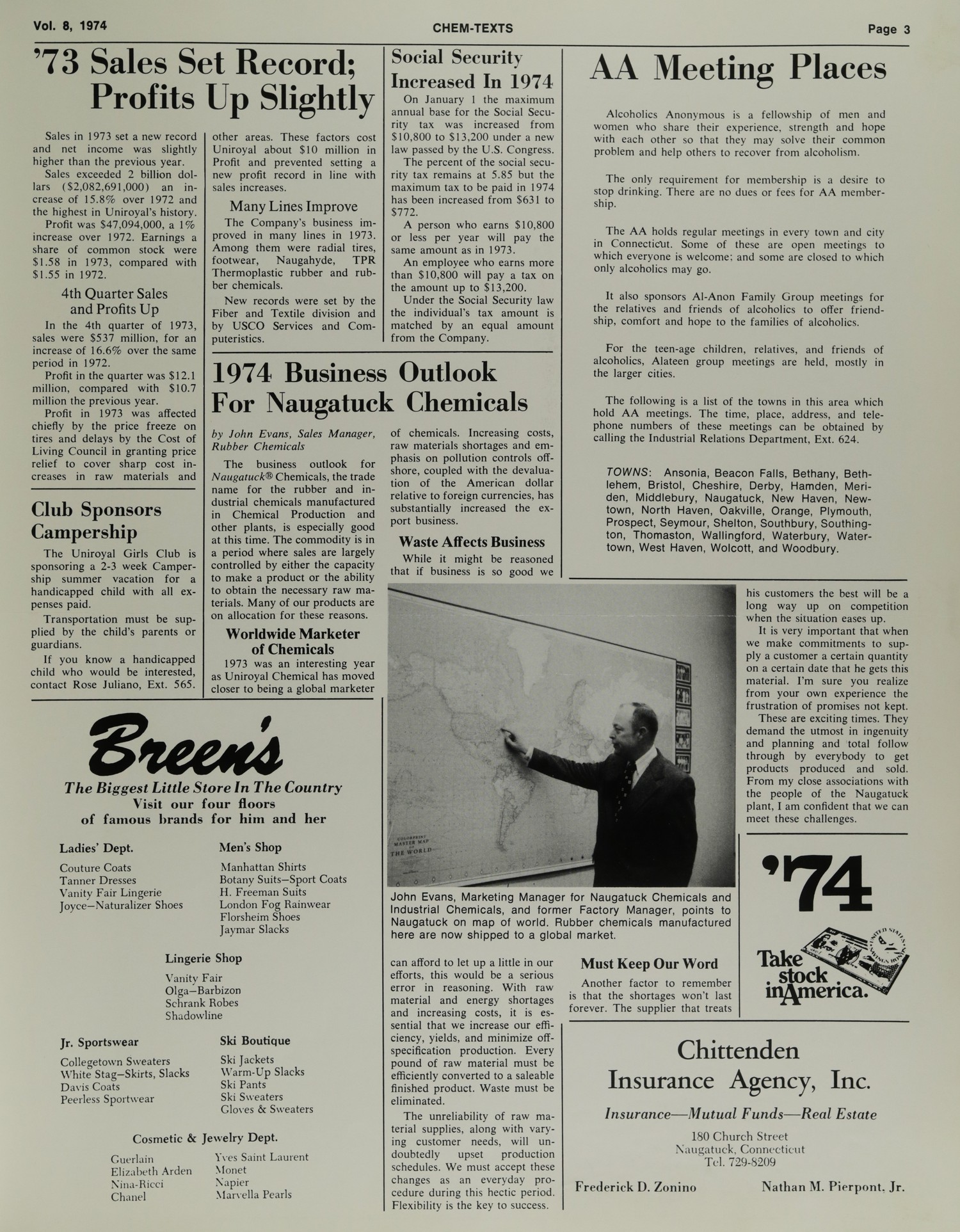
Vol. 8, 1974 | Page 3
Sales in 1973 set a new record and net income was slightly higher than the previous year.
Sales exceeded 2 billion dollars ($2,082,691,000) an increase of 15.8% over 1972 and the highest in Uniroyal’s history. Profit was $47,094,000, a 1% increase over 1972. Earnings a share of common stock were $1.58 in 1973, compared with $1.55 in 1972.
In the 4th quarter of 1973, sales were $537 million, for an increase of 16.6% over the same period in 1972.
Profit in the quarter was $12.1 million, compared with $10.7 million the previous year.
Profit in 1973 was affected chiefly by the price freeze on tires and delays by the Cost of Living Council in granting price relief to cover sharp cost increases in raw materials and
other areas. These factors cost Uniroyal about $10 million in Profit and prevented setting a new profit record in line with sales increases.
The Company’s business improved in many lines in 1973. Among them were radial tires, footwear, Naugahyde, TPR Thermoplastic rubber and rubber chemicals.
New records were set by the Fiber and Textile division and by USCO Services and Computeristics.
The Uniroyal Girls Club is sponsoring a 2-3 week Campership summer vacation for a handicapped child with all expenses paid.
Transportation must be supplied by the child’s parents or guardians.
If you know a handicapped child who would be interested, contact Rose Juliano, Ext. 565.
by John Evans, Sales Manager, Rubber Chemicals
The business outlook for Naugatuck® Chemicals, the trade name for the rubber and industrial chemicals manufactured in Chemical Production and other plants, is especially good at this time. The commodity is in a period where sales are largely controlled by either the capacity to make a product or the ability to obtain the necessary raw materials. Many of our products are on allocation for these reasons.
1973 was an interesting year as Uniroyal Chemical has moved closer to being a global marketer
of chemicals. Increasing costs, raw materials shortages and emphasis on pollution controls offshore, coupled with the devaluation of the American dollar relative to foreign currencies, has substantially increased the export business.
While it might be reasoned that if business is so good we
On January 1 the maximum annual base for the Social Security tax was increased from $10,800 to $13,200 under a new law passed by the U.S. Congress.
The percent of the social security tax remains at 5.85 but the maximum tax to be paid in 1974 has been increased from $631 to $772.
A person who earns $10,800 or less per year will pay the same amount as in 1973.
An employee who earns more than $10,800 will pay a tax on the amount up to $13,200.
Under the Social Security law the individual’s tax amount is matched by an equal amount from the Company.
Alcoholics Anonymous is a fellowship of men and women who share their experience, strength and hope with each other so that they may solve their common problem and help others to recover from alcoholism.
The only requirement for membership is a desire to stop drinking. There are no dues or fees for AA membership.
The AA holds regular meetings in every town and city in Connecticut. Some of these are open meetings to which everyone is welcome; and some are closed to which only alcoholics may go.
It also sponsors Al-Anon Family Group meetings for the relatives and friends of alcoholics to offer friendship, comfort and hope to the families of alcoholics.
For the teen-age children, relatives, and friends of alcoholics, Alateen group meetings are held, mostly in the larger cities.
The following is a list of the towns in this area which hold AA meetings. The time, place, address, and telephone numbers of these meetings can be obtained by calling the Industrial Relations Department, Ext. 624.
TOWNS: Ansonia, Beacon Falls, Bethany, Bethlehem, Bristol, Cheshire, Derby, Hamden, Meriden, Middlebury, Naugatuck, New Haven, Newtown, North Haven, Oakville, Orange, Plymouth, Prospect, Seymour, Shelton, Southbury, Southington, Thomaston, Wallingford, Waterbury, Watertown, West Haven, Wolcott, and Woodbury.
The Biggest Little Store In The Country
Visit our four floors of famous brands for him and her
Ladies’ Dept.
Couture Coats
Tanner Dresses
Vanity Fair Lingerie
Joyce—Naturalizer Shoes
Men’s Shop
Manhattan Shirts
Botany Suits—Sport Coats
H. Freeman Suits
London Fog Rainwear
Florsheim Shoes
Jaymar Slacks
Lingerie Shop
Vanity Fair
Olga—Barbizon
Schrank Robes
Shadowline
Jr. Sportswear
Collegetown Sweaters
White Stag—Skirts, Slacks
Davis Coats
Peerless Sportwear
Ski Boutique
Ski Jackets
Warm-Up Slacks
Ski Pants
Ski Sweaters
Gloves & Sweaters
Cosmetic & Jewelry Dept.
Guerlain — Yves Saint Laurent
Elizabeth Arden — Monet
Nina-Ricci — Napier
Chanel — Marvella Pearls
[PHOTO CAPTION:]
John Evans, Marketing Manager for Naugatuck Chemicals and Industrial Chemicals, and former Factory Manager, points to Naugatuck on map of world. Rubber chemicals manufactured here are now shipped to a global market.
can afford to let up a little in our efforts, this would be a serious error in reasoning. With raw material and energy shortages and increasing costs, it is essential that we increase our efficiency, yields, and minimize off-specification production. Every pound of raw material must be efficiently converted to a saleable finished product. Waste must be eliminated.
The unreliability of raw material supplies, along with varying customer needs, will undoubtedly upset production schedules. We must accept these changes as an everyday procedure during this hectic period. Flexibility is the key to success.
his customers the best will be a long way up on competition when the situation eases up.
It is very important that when we make commitments to supply a customer a certain quantity on a certain date that he gets this material. I’m sure you realize from your own experience the frustration of promises not kept.
These are exciting times. They demand the utmost in ingenuity and planning and total follow through by everybody to get products produced and sold. From my close associations with the people of the Naugatuck plant, I am confident that we can meet these challenges.
Another factor to remember is that the shortages won’t last forever. The supplier that treats
Take stock in America.
Insurance—Mutual Funds—Real Estate
180 Church Street
Naugatuck, Connecticut
Tel. 729-8209
Frederick D. Zonino | Nathan M. Pierpont, Jr.
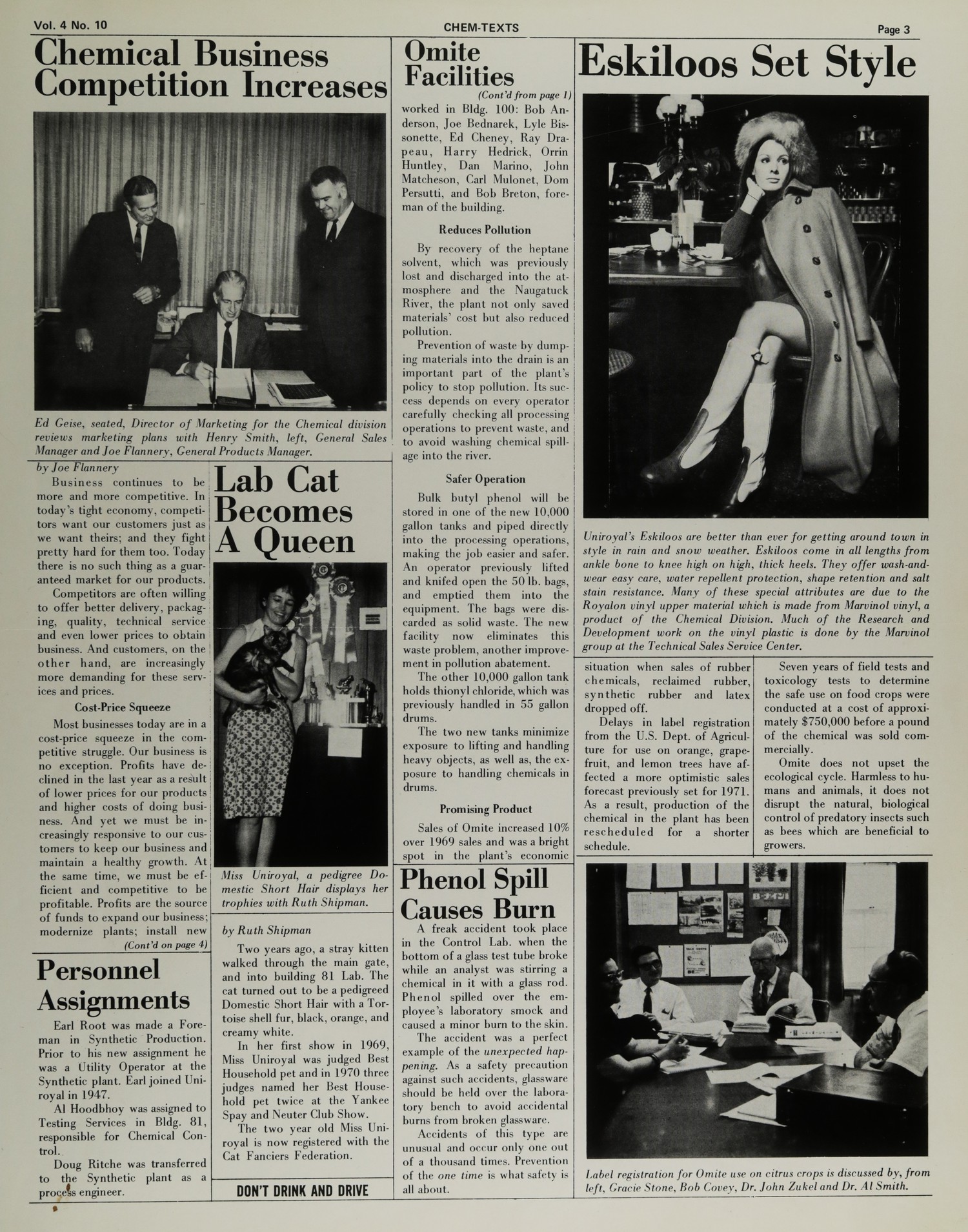
Vol. 4 No. 10 Page 3
[IMAGE: Three men in business attire reviewing documents]
Ed Geise, seated, Director of Marketing for the Chemical division reviews marketing plans with Henry Smith, left, General Sales Manager and Joe Flannery, General Products Manager.
by Joe Flannery
Business continues to be more and more competitive. In today’s tight economy, competitors want our customers just as we want theirs; and they fight pretty hard for them too. Today there is no such thing as a guaranteed market for our products.
Competitors are often willing to offer better delivery, packaging, quality, technical service and even lower prices to obtain business. And customers, on the other hand, are increasingly more demanding for these services and prices.
Cost-Price Squeeze
Most businesses today are in a cost-price squeeze in the competitive struggle. Our business is no exception. Profits have declined in the last year as a result of lower prices for our products and higher costs of doing business. And yet we must be increasingly responsive to our customers to keep our business and maintain a healthy growth. At the same time, we must be efficient and competitive to be profitable. Profits are the source of funds to expand our business; modernize plants; install new
(Cont’d on page 4)
Earl Root was made a Foreman in Synthetic Production. Prior to his new assignment he was a Utility Operator at the Synthetic plant. Earl joined Uniroyal in 1947.
Al Hoodbhoy was assigned to Testing Services in Bldg. 81, responsible for Chemical Control.
Doug Ritche was transferred to the Synthetic plant as a process engineer.
[IMAGE: Woman holding a cat and displaying trophies]
Miss Uniroyal, a pedigree Domestic Short Hair displays her trophies with Ruth Shipman.
by Ruth Shipman
Two years ago, a stray kitten walked through the main gate, and into building 81 Lab. The cat turned out to be a pedigreed Domestic Short Hair with a Tortoise shell fur, black, orange, and creamy white.
In her first show in 1969, Miss Uniroyal was judged Best Household pet and in 1970 three judges named her Best Household pet twice at the Yankee Spay and Neuter Club Show.
The two year old Miss Uniroyal is now registered with the Cat Fanciers Federation.
DON’T DRINK AND DRIVE
(Cont’d from page 1)
worked in Bldg. 100: Bob Anderson, Joe Bednarek, Lyle Bissonette, Ed Cheney, Ray Drapeau, Harry Hedrick, Orrin Huntley, Dan Marino, John Matcheson, Carl Mulonet, Dom Persutti, and Bob Breton, foreman of the building.
Reduces Pollution
By recovery of the heptane solvent, which was previously lost and discharged into the atmosphere and the Naugatuck River, the plant not only saved materials’ cost but also reduced pollution.
Prevention of waste by dumping materials into the drain is an important part of the plant’s policy to stop pollution. Its success depends on every operator carefully checking all processing operations to prevent waste, and to avoid washing chemical spillage into the river.
Safer Operation
Bulk butyl phenol will be stored in one of the new 10,000 gallon tanks and piped directly into the processing operations, making the job easier and safer. An operator previously lifted and knifed open the 50 lb. bags, and emptied them into the equipment. The bags were discarded as solid waste. The new facility now eliminates this waste problem, another improvement in pollution abatement.
The other 10,000 gallon tank holds thionyl chloride, which was previously handled in 55 gallon drums.
The two new tanks minimize exposure to lifting and handling heavy objects, as well as, the exposure to handling chemicals in drums.
Promising Product
Sales of Omite increased 10% over 1969 sales and was a bright spot in the plant’s economic
[IMAGE: Woman in boots posing outdoors]
Uniroyal’s Eskiloos are better than ever for getting around town in style in rain and snow weather. Eskiloos come in all lengths from ankle bone to knee high on high, thick heels. They offer wash-and-wear easy care, water repellent protection, shape retention and salt stain resistance. Many of these special attributes are due to the Royalon vinyl upper material which is made from Marvinol vinyl, a product of the Chemical Division. Much of the Research and Development work on the vinyl plastic is done by the Marvinol group at the Technical Sales Service Center.
situation when sales of rubber chemicals, reclaimed rubber, synthetic rubber and latex dropped off.
Delays in label registration from the U.S. Dept. of Agriculture for use on orange, grapefruit, and lemon trees have affected a more optimistic sales forecast previously set for 1971. As a result, production of the chemical in the plant has been rescheduled for a shorter schedule.
Seven years of field tests and toxicology tests to determine the safe use on food crops were conducted at a cost of approximately $750,000 before a pound of the chemical was sold commercially.
Omite does not upset the ecological cycle. Harmless to humans and animals, it does not disrupt the natural, biological control of predatory insects such as bees which are beneficial to growers.
A freak accident took place in the Control Lab. when the bottom of a glass test tube broke while an analyst was stirring a chemical in it with a glass rod. Phenol spilled over the employee’s laboratory smock and caused a minor burn to the skin.
The accident was a perfect example of the unexpected happening. As a safety precaution against such accidents, glassware should be held over the laboratory bench to avoid accidental burns from broken glassware.
Accidents of this type are unusual and occur only one out of a thousand times. Prevention of the one time is what safety is all about.
[IMAGE: Four people in discussion around a table]
Label registration for Omite use on citrus crops is discussed by, from left, Gracie Stone, Bob Covey, Dr. John Zukel and Dr. Al Smith.
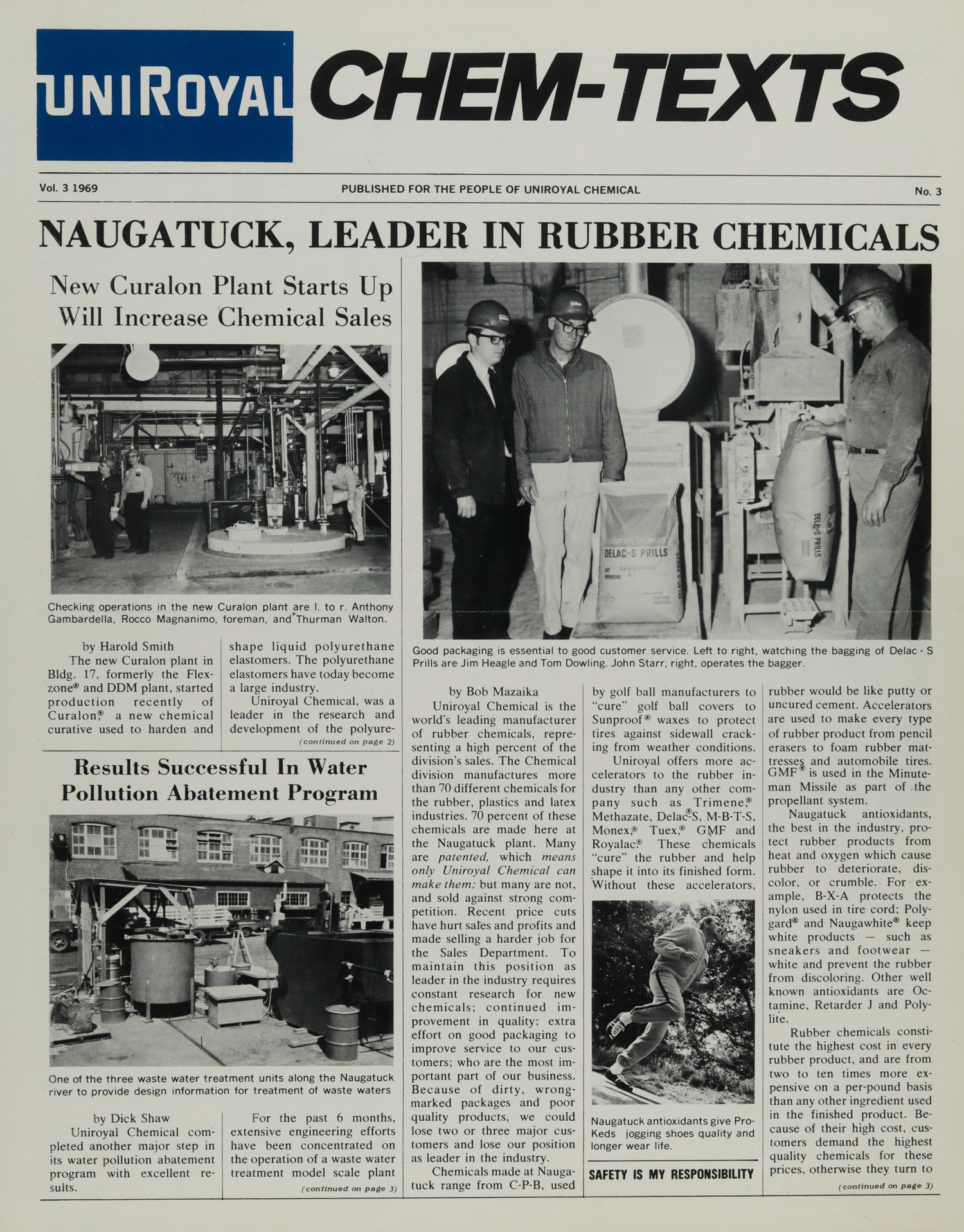
Vol. 3 1969 PUBLISHED FOR THE PEOPLE OF UNIROYAL CHEMICAL No. 3
[IMAGE: Factory/plant interior with workers and equipment]
Checking operations in the new Curalon plant are l. to r. Anthony Gambardella, Rocco Magnanimo, foreman, and Thurman Walton.
by Harold Smith
The new Curalon plant in Bldg. 17, formerly the Flexzone® and DDM plant, started production recently of Curalon® a new chemical curative used to harden and shape liquid polyurethane elastomers. The polyurethane elastomers have today become a large industry.
Uniroyal Chemical, was a leader in the research and development of the polyure-
(continued on page 2)
[IMAGE: Industrial water treatment facility]
One of the three waste water treatment units along the Naugatuck river to provide design information for treatment of waste waters
by Dick Shaw
Uniroyal Chemical completed another major step in its water pollution abatement program with excellent results.
For the past 6 months, extensive engineering efforts have been concentrated on the operation of a waste water treatment model scale plant
(continued on page 3)
[IMAGE: Workers watching bagging operation with “DELAC-S PRILLS” visible on equipment]
Good packaging is essential to good customer service. Left to right, watching the bagging of Delac – S Prills are Jim Heagle and Tom Dowling. John Starr, right, operates the bagger.
by Bob Mazaika
Uniroyal Chemical is the world’s leading manufacturer of rubber chemicals, representing a high percent of the division’s sales. The Chemical division manufactures more than 70 different chemicals for the rubber, plastics and latex industries. 70 percent of these chemicals are made here at the Naugatuck plant. Many are patented, which means only Uniroyal Chemical can make them; but many are not, and sold against strong competition. Recent price cuts have hurt sales and profits and made selling a harder job for the Sales Department. To maintain this position as leader in the industry requires constant research for new chemicals; continued improvement in quality; extra effort on good packaging to improve service to our customers; who are the most important part of our business. Because of dirty, wrong-marked packages and poor quality products, we could lose two or three major customers and lose our position as leader in the industry.
Chemicals made at Naugatuck range from C-P-B, used by golf ball manufacturers to “cure” golf ball covers to Sunproof® waxes to protect tires against sidewall cracking from weather conditions.
Uniroyal offers more accelerators to the rubber industry than any other company such as Trimene,® Methazate, Delac®S, M-B-T-S, Monex,® Tuex,® GMF and Royalac.® These chemicals “cure” the rubber and help shape it into its finished form. Without these accelerators, rubber would be like putty or uncured cement. Accelerators are used to make every type of rubber product from pencil erasers to foam rubber mattresses and automobile tires. GMF® is used in the Minuteman Missile as part of the propellant system.
Naugatuck antioxidants, the best in the industry, protect rubber products from heat and oxygen which cause rubber to deteriorate, discolor, or crumble. For example, BX-A protects the nylon used in tire cord; Polygard® and Naugawhite® keep white products — such as sneakers and footwear — white and prevent the rubber from discoloring. Other well known antioxidants are Octamine, Retarder J and Polylite.
Rubber chemicals constitute the highest cost in every rubber product, and are from two to ten times more expensive on a per-pound basis than any other ingredient used in the finished product. Because of their high cost, customers demand the highest quality chemicals for these prices, otherwise they turn to
(continued on page 3)
[IMAGE: Person jogging/running in athletic wear]
Naugatuck antioxidants give Pro-Keds jogging shoes quality and longer wear life.
SAFETY IS MY RESPONSIBILITY
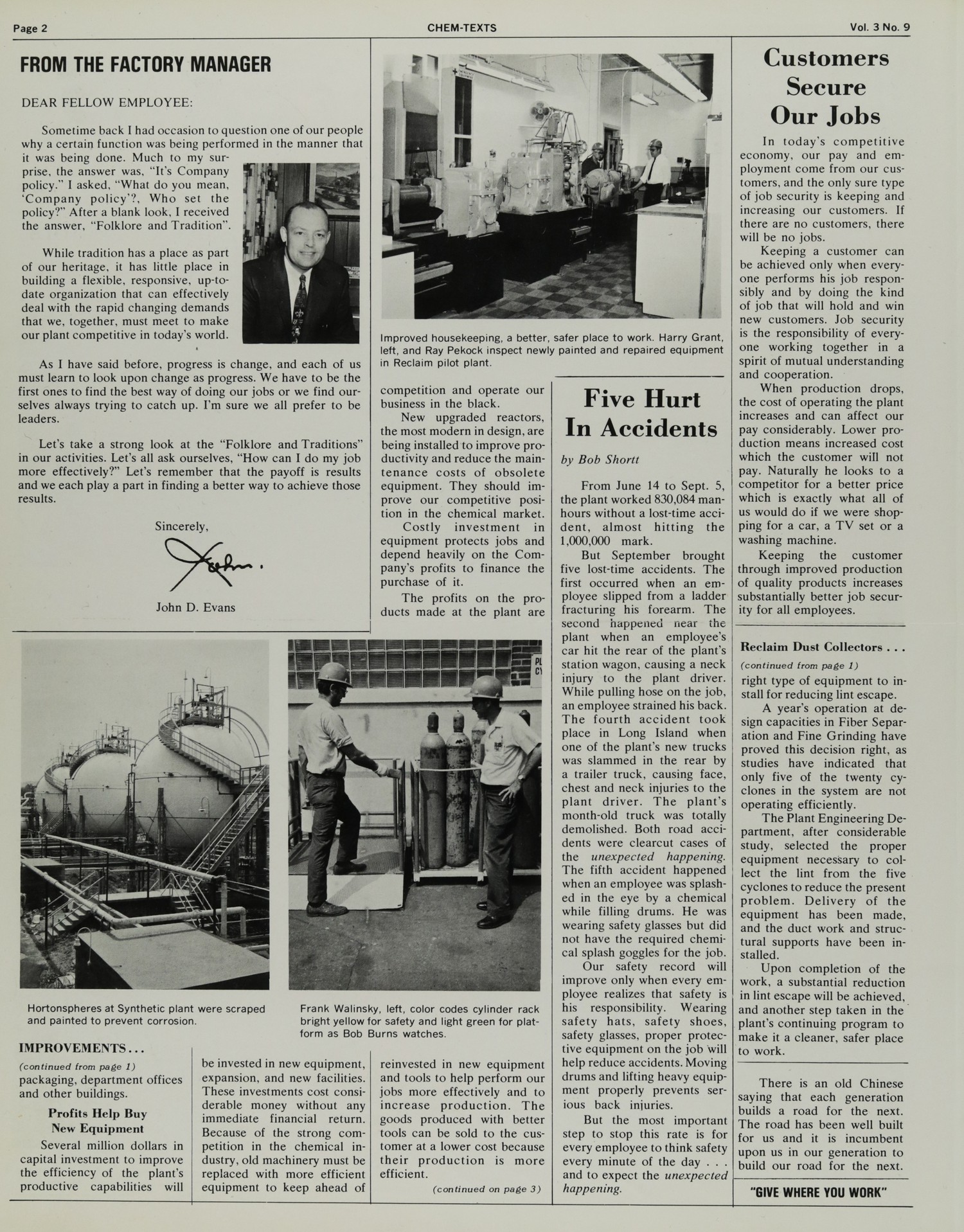
Page 2 | Vol. 3 No. 9
DEAR FELLOW EMPLOYEE:
Sometime back I had occasion to question one of our people why a certain function was being performed in the manner that it was being done. Much to my surprise, the answer was, “It’s Company policy.” I asked, “What do you mean, ‘Company policy’?, Who set the policy?” After a blank look, I received the answer, “Folklore and Tradition”.
While tradition has a place as part of our heritage, it has little place in building a flexible, responsive, up-to-date organization that can effectively deal with the rapid changing demands that we, together, must meet to make our plant competitive in today’s world.
As I have said before, progress is change, and each of us must learn to look upon change as progress. We have to be the first ones to find the best way of doing our jobs or we find ourselves always trying to catch up. I’m sure we all prefer to be leaders.
Let’s take a strong look at the “Folklore and Traditions” in our activities. Let’s all ask ourselves, “How can I do my job more effectively?” Let’s remember that the payoff is results and we each play a part in finding a better way to achieve those results.
Sincerely,
John
Improved housekeeping, a better, safer place to work. Harry Grant, left, and Ray Pekoek inspect newly painted and repaired equipment in Reclaim pilot plant.
competition and operate our business in the black.
New upgraded reactors, the most modern in design, are being installed to improve productivity and reduce the maintenance costs of obsolete equipment. They should improve our competitive position in the chemical market.
Costly investment in equipment protects jobs and depend heavily on the Company’s profits to finance the purchase of it.
The profits on the products made at the plant are
by Bob Shortt
From June 14 to Sept. 5, the plant worked 830,084 man-hours without a lost-time accident, almost hitting the 1,000,000 mark.
But September brought five lost-time accidents. The first occurred when an employee slipped from a ladder fracturing his forearm. The second happened near the plant when an employee’s car hit the rear of the plant’s station wagon, causing a neck injury to the plant driver. While pulling hose on the job, an employee strained his back. The fourth accident took place in Long Island when one of the plant’s new trucks was slammed in the rear by a trailer truck, causing face, chest and neck injuries to the plant driver. The plant’s month-old truck was totally demolished. Both road accidents were clearcut cases of the unexpected happening. The fifth accident happened when an employee was splashed in the eye by a chemical while filling drums. He was wearing safety glasses but did not have the required chemical splash goggles for the job.
Our safety record will improve only when every employee realizes that safety is his responsibility. Wearing safety hats, safety shoes, safety glasses, proper protective equipment on the job will help reduce accidents. Moving drums and lifting heavy equipment properly prevents serious back injuries.
But the most important step to stop this rate is for every employee to think safety every minute of the day . . . and to expect the unexpected happening.
(continued on page 3)
In today’s competitive economy, our pay and employment come from our customers, and the only sure type of job security is keeping and increasing our customers. If there are no customers, there will be no jobs.
Keeping a customer can be achieved only when everyone performs his job responsibly and by doing the kind of job that will hold and win new customers. Job security is the responsibility of everyone working together in a spirit of mutual understanding and cooperation.
When production drops, the cost of operating the plant increases and can affect our pay considerably. Lower production means increased cost which the customer will not pay. Naturally he looks to a competitor for a better price which is exactly what all of us would do if we were shopping for a car, a TV set or a washing machine.
Keeping the customer through improved production of quality products increases substantially better job security for all employees.
Reclaim Dust Collectors . . .
(continued from page 1)
right type of equipment to install for reducing lint escape.
A year’s operation at design capacities in Fiber Separation and Fine Grinding have proved this decision right, as studies have indicated that only five of the twenty cyclones in the system are not operating efficiently.
The Plant Engineering Department, after considerable study, selected the proper equipment necessary to collect the lint from the five cyclones to reduce the present problem. Delivery of the equipment has been made, and the duct work and structural supports have been installed.
Upon completion of the work, a substantial reduction in lint escape will be achieved, and another step taken in the plant’s continuing program to make it a cleaner, safer place to work.
There is an old Chinese saying that each generation builds a road for the next. The road has been well built for us and it is incumbent upon us in our generation to build our road for the next.
“GIVE WHERE YOU WORK”
Hortonspheres at Synthetic plant were scraped and painted to prevent corrosion.
Frank Walinsky, left, color codes cylinder rack bright yellow for safety and light green for platform as Bob Burns watches.
(continued from page 1)
packaging, department offices and other buildings.
Profits Help Buy New Equipment
Several million dollars in capital investment to improve the efficiency of the plant’s productive capabilities will be invested in new equipment, expansion, and new facilities. These investments cost considerable money without any immediate financial return. Because of the strong competition in the chemical industry, old machinery must be replaced with more efficient equipment to keep ahead of reinvested in new equipment and tools to help perform our jobs more effectively and to increase production. The goods produced with better tools can be sold to the customer at a lower cost because their production is more efficient.
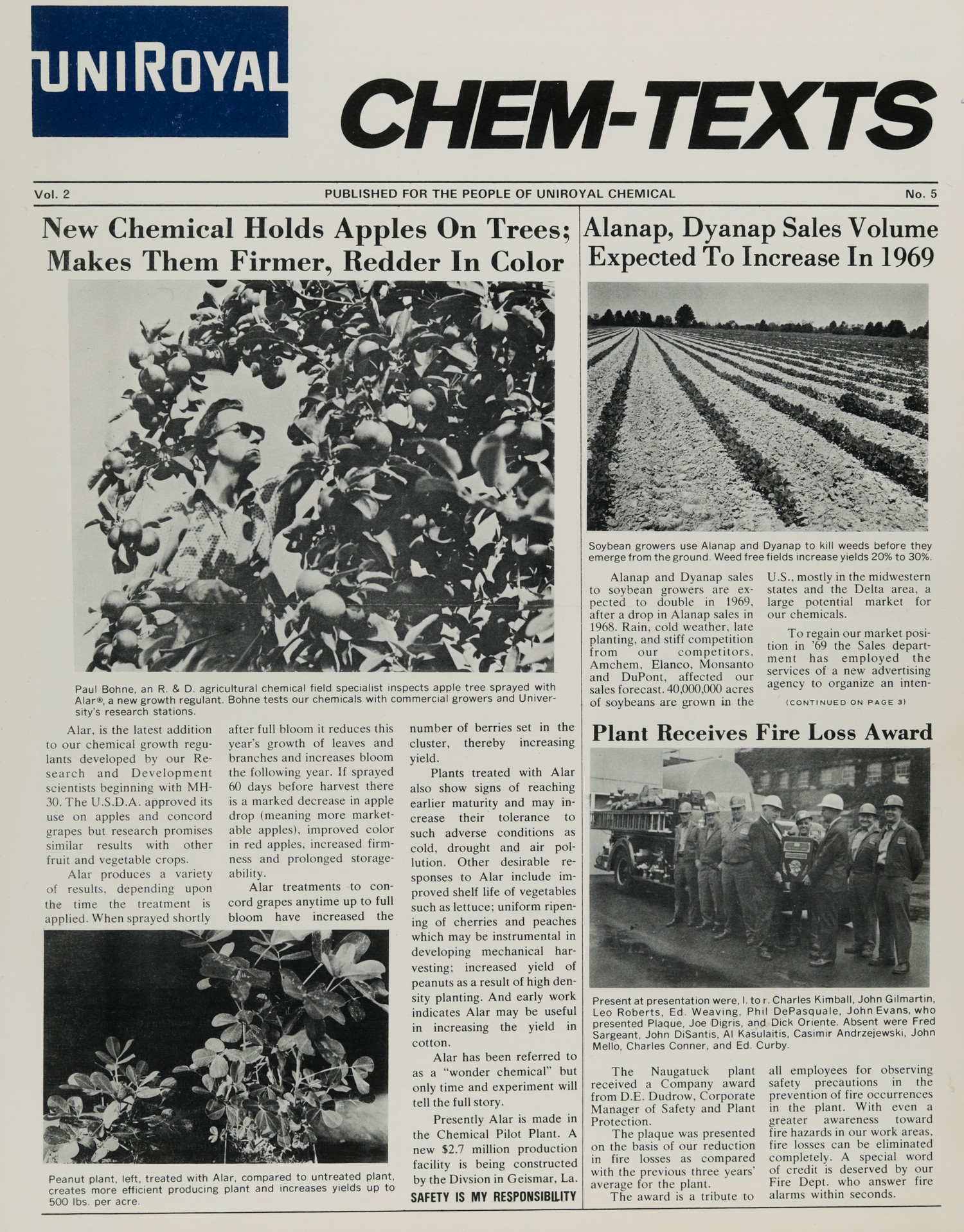
Vol. 2 PUBLISHED FOR THE PEOPLE OF UNIROYAL CHEMICAL No. 5
[IMAGE: Paul Bohne, an R. & D. agricultural chemical field specialist inspects apple tree sprayed with Alar®, a new growth regulant. Bohne tests our chemicals with commercial growers and University’s research stations.]
Alar, is the latest addition to our chemical growth regulants developed by our Research and Development scientists beginning with MH-30. The U.S.D.A. approved its use on apples and concord grapes but research promises similar results with other fruit and vegetable crops.
Alar produces a variety of results, depending upon the time the treatment is applied. When sprayed shortly after full bloom it reduces this year’s growth of leaves and branches and increases bloom the following year. If sprayed 60 days before harvest there is a marked decrease in apple drop (meaning more marketable apples), improved color in red apples, increased firmness and prolonged storageability.
Alar treatments to concord grapes anytime up to full bloom have increased the number of berries set in the cluster, thereby increasing yield.
Plants treated with Alar also show signs of reaching earlier maturity and may increase their tolerance to such adverse conditions as cold, drought and air pollution. Other desirable responses to Alar include improved shelf life of vegetables such as lettuce; uniform ripening of cherries and peaches which may be instrumental in developing mechanical harvesting; increased yield of peanuts as a result of high density planting. And early work indicates Alar may be useful in increasing the yield in cotton.
Alar has been referred to as a “wonder chemical” but only time and experiment will tell the full story.
Presently Alar is made in the Chemical Pilot Plant. A new $2.7 million production facility is being constructed by the Divsion in Geismar, La.
SAFETY IS MY RESPONSIBILITY
[IMAGE: Peanut plant, left, treated with Alar, compared to untreated plant, creates more efficient producing plant and increases yields up to 500 lbs. per acre.]
[IMAGE: Soybean growers use Alanap and Dyanap to kill weeds before they emerge from the ground. Weed free fields increase yields 20% to 30%.]
Alanap and Dyanap sales to soybean growers are expected to double in 1969, after a drop in Alanap sales in 1968. Rain, cold weather, late planting, and stiff competition from our competitors, Amchem, Elanco, Monsanto and DuPont, affected our sales forecast. 40,000,000 acres of soybeans are grown in the U.S., mostly in the midwestern states and the Delta area, a large potential market for our chemicals.
To regain our market position in ’69 the Sales department has employed the services of a new advertising agency to organize an inten-
(CONTINUED ON PAGE 3)
[IMAGE: Present at presentation were, l. to r. Charles Kimball, John Gilmartin, Leo Roberts, Ed. Weaving, Phil DePasquale, John Evans, who presented Plaque, Joe Digris, and Dick Oriente. Absent were Fred Sargeant, John DiSantis, Al Kaslutas, Casimir Andrzejewski, John Mello, Charles Conner, and Ed. Curby.]
The Naugatuck plant received a Company award from D.E. Dudrow, Corporate Manager of Safety and Plant Protection.
The plaque was presented on the basis of our reduction in fire losses as compared with the previous three years’ average for the plant.
The award is a tribute to all employees for observing safety precautions in the prevention of fire occurrences in the plant. With even a greater awareness toward fire hazards in our work areas, fire losses can be eliminated completely. A special word of credit is deserved by our Fire Dept. who answer fire alarms within seconds.
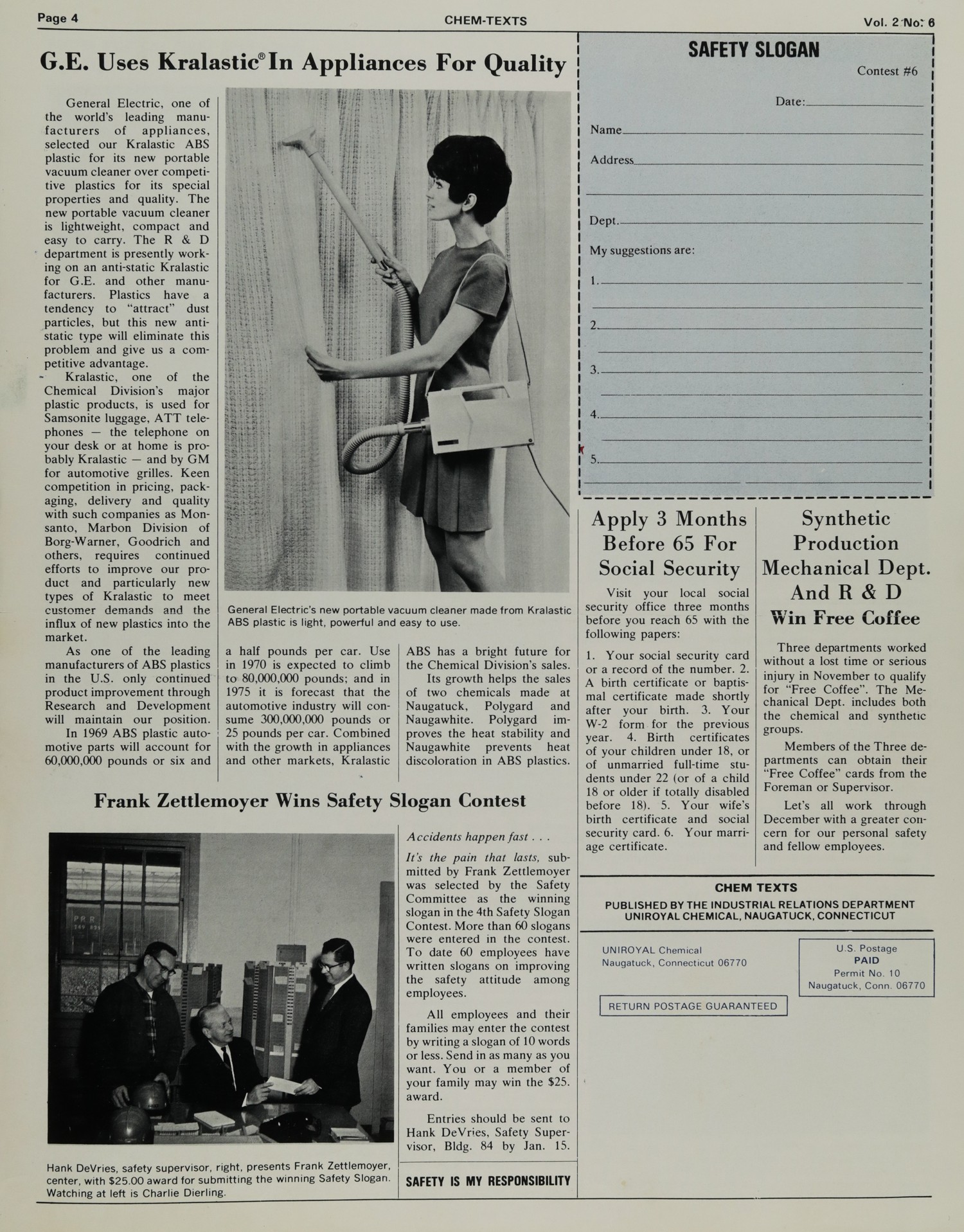
General Electric, one of the world’s leading manufacturers of appliances, selected our Kralastic ABS plastic for its new portable vacuum cleaner over competitive plastics for its special properties and quality. The new portable vacuum cleaner is lightweight, compact and easy to carry. The R & D department is presently working on an anti-static Kralastic for G.E. and other manufacturers. Plastics have a tendency to “attract” dust particles, but this new anti-static type will eliminate this problem and give us a competitive advantage.
Kralastic, one of the Chemical Division’s major plastic products, is used for Samsonite luggage, ATT telephones — the telephone on your desk or at home is probably Kralastic — and by GM for automotive grilles. Keen competition in pricing, packaging, delivery and quality with such companies as Monsanto, Marbon Division of Borg-Warner, Goodrich and others, requires continued efforts to improve our product and particularly new types of Kralastic to meet customer demands and the influx of new plastics into the market.
As one of the leading manufacturers of ABS plastics in the U.S. only continued product improvement through Research and Development will maintain our position.
In 1969 ABS plastic automotive parts will account for 60,000,000 pounds or six and a half pounds per car. Use in 1970 is expected to climb to 80,000,000 pounds; and in 1975 it is forecast that the automotive industry will consume 300,000,000 pounds or 25 pounds per car. Combined with the growth in appliances and other markets, Kralastic ABS has a bright future for the Chemical Division’s sales.
Its growth helps the sales of two chemicals made at Naugatuck, Polygard and Naugawhite. Polygard improves the heat stability and Naugawhite prevents heat discoloration in ABS plastics.
[IMAGE CAPTION: General Electric’s new portable vacuum cleaner made from Kralastic ABS plastic is light, powerful and easy to use.]
Contest #6
Date:______
Name______
Address______
Dept.______
My suggestions are:
1.______
2.______
3.______
4.______
5.______
Visit your local social security office three months before you reach 65 with the following papers:
Three departments worked without a lost time or serious injury in November to qualify for “Free Coffee”. The Mechanical Dept. includes both the chemical and synthetic groups.
Members of the Three departments can obtain their “Free Coffee” cards from the Foreman or Supervisor.
Let’s all work through December with a greater concern for our personal safety and fellow employees.
[IMAGE CAPTION: Hank DeVries, safety supervisor, right, presents Frank Zettlemoyer, center, with $25.00 award for submitting the winning Safety Slogan. Watching at left is Charlie Dierling.]
Accidents happen fast . . .
It’s the pain that lasts, submitted by Frank Zettlemoyer was selected by the Safety Committee as the winning slogan in the 4th Safety Slogan Contest. More than 60 slogans were entered in the contest. To date 60 employees have written slogans on improving the safety attitude among employees.
All employees and their families may enter the contest by writing a slogan of 10 words or less. Send in as many as you want. You or a member of your family may win the $25. award.
Entries should be sent to Hank DeVries, Safety Supervisor, Bldg. 84 by Jan. 15.
SAFETY IS MY RESPONSIBILITY
PUBLISHED BY THE INDUSTRIAL RELATIONS DEPARTMENT
UNIROYAL CHEMICAL, NAUGATUCK, CONNECTICUT
UNIROYAL Chemical
Naugatuck, Connecticut 06770
U.S. Postage
PAID
Permit No. 10
Naugatuck, Conn. 06770
RETURN POSTAGE GUARANTEED
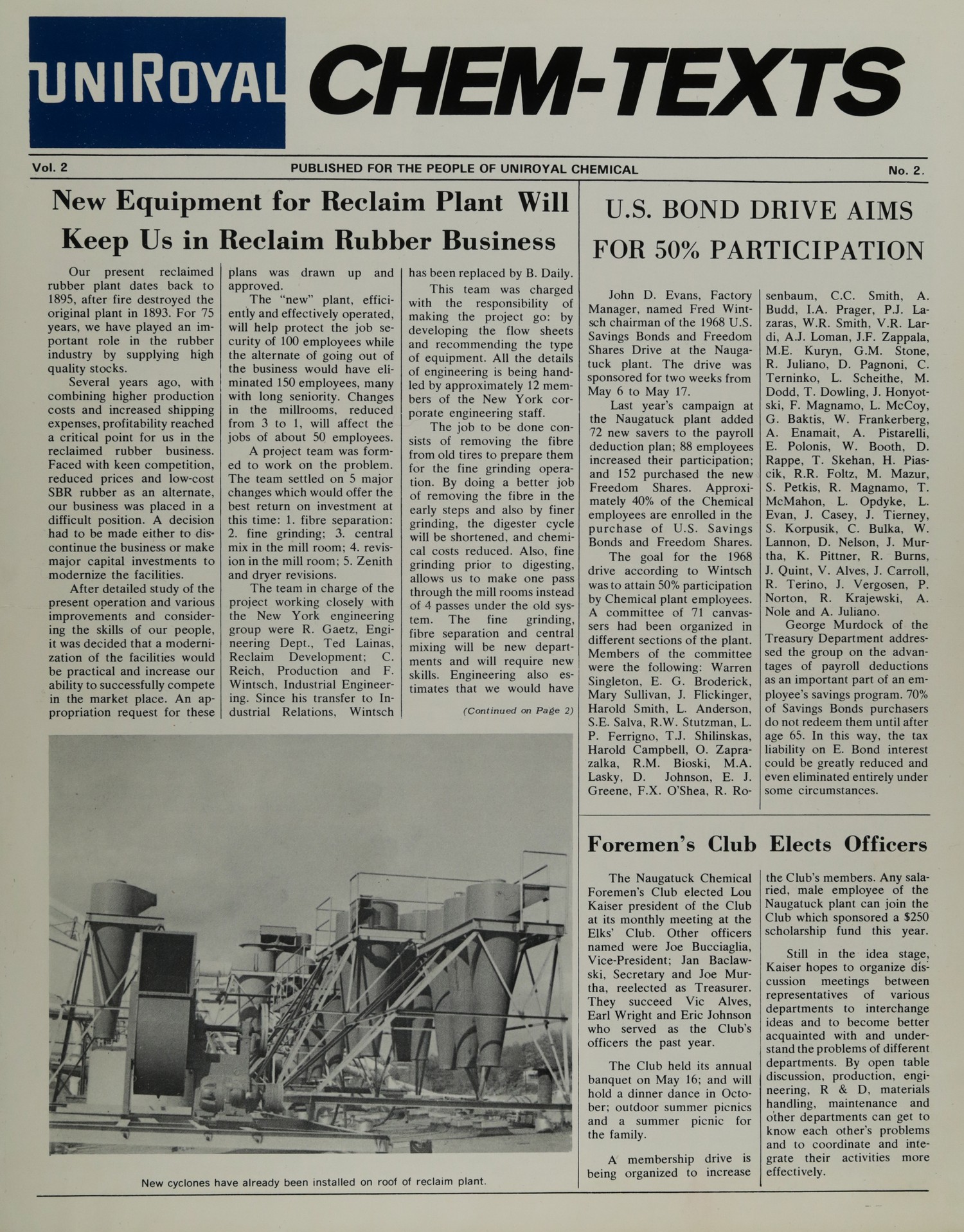
Vol. 2 PUBLISHED FOR THE PEOPLE OF UNIROYAL CHEMICAL No. 2.
Our present reclaimed rubber plant dates back to 1895, after fire destroyed the original plant in 1893. For 75 years, we have played an important role in the rubber industry by supplying high quality stocks.
Several years ago, with combining higher production costs and increased shipping expenses, profitability reached a critical point for us in the reclaimed rubber business. Faced with keen competition, reduced prices and low-cost SBR rubber as an alternate, our business was placed in a difficult position. A decision had to be made either to discontinue the business or make major capital investments to modernize the facilities.
After detailed study of the present operation and various improvements and considering the skills of our people, it was decided that a modernization of the facilities would be practical and increase our ability to successfully compete in the market place. An appropriation request for these plans was drawn up and approved.
The “new” plant, efficiently and effectively operated, will help protect the job security of 100 employees while the alternate of going out of the business would have eliminated 150 employees, many with long seniority. Changes in the millrooms, reduced from 3 to 1, will affect the jobs of about 50 employees.
A project team was formed to work on the problem. The team settled on 5 major changes which would offer the best return on investment at this time: 1. fibre separation; 2. fine grinding; 3. central mix in the mill room; 4. revision in the mill room; 5. Zenith and dryer revisions.
The team in charge of the project working closely with the New York engineering group were R. Gaetz, Engineering Dept., Ted Lainas, Reclaim Development; C. Reich, Production and F. Wintsch, Industrial Engineering. Since his transfer to Industrial Relations, Wintsch has been replaced by B. Daily.
This team was charged with the responsibility of making the project go; by developing the flow sheets and recommending the type of equipment. All the details of engineering is being handled by approximately 12 members of the New York corporate engineering staff.
The job to be done consists of removing the fibre from old tires to prepare them for the fine grinding operation. By doing a better job of removing the fibre in the early steps and also by finer grinding, the digester cycle will be shortened, and chemical costs reduced. Also, fine grinding prior to digesting, allows us to make one pass through the mill rooms instead of 4 passes under the old system. The fine grinding, fibre separation and central mixing will be new departments and will require new skills. Engineering also estimates that we would have
(Continued on Page 2)
John D. Evans, Factory Manager, named Fred Wintsch chairman of the 1968 U.S. Savings Bonds and Freedom Shares Drive at the Naugatuck plant. The drive was sponsored for two weeks from May 6 to May 17.
Last year’s campaign at the Naugatuck plant added 72 new savers to the payroll deduction plan; 88 employees increased their participation; and 152 purchased the new Freedom Shares. Approximately 40% of the Chemical employees are enrolled in the purchase of U.S. Savings Bonds and Freedom Shares.
The goal for the 1968 drive according to Wintsch was to attain 50% participation by Chemical plant employees. A committee of 71 canvassers had been organized in different sections of the plant. Members of the committee were the following: Warren Singleton, E. G. Broderick, Mary Sullivan, J. Flickinger, Harold Smith, L. Anderson, S.E. Salva, R.W. Stutzman, L. P. Ferrigno, T.J. Shilinskas, Harold Campbell, O. Zaprazalka, R.M. Bioski, M.A. Lasky, D. Johnson, E. J. Greene, F.X. O’Shea, R. Rosenbaum, C.C. Smith, A. Budd, I.A. Prager, P.J. Lazaras, W.R. Smith, V.R. Lardi, A.J. Loman, J.F. Zappala, M.E. Kuryn, G.M. Stone, R. Juliano, D. Pagnoni, C. Terniko, L. Scheithe, M. Dodd, T. Dowling, J. Homyetski, F. Magnamo, L. McCoy, G. Baktis, W. Frankerberg, A. Enamait, A. Pistarelli, E. Polonis, W. Booth, D. Rappe, T. Skehan, H. Piascik, R.R. Foltz, M. Mazur, S. Petkis, R. Magnamo, T. McMahon, L. Opdyke, L. Evan, J. Casey, J. Tierney, S. Korpusik, C. Bulka, W. Lannon, D. Nelson, J. Murtha, K. Pittner, R. Burns, J. Quint, V. Alves, J. Carroll, R. Terino, J. Vergosen, P. Norton, R. Krajewski, A. Nole and A. Juliano.
George Murdock of the Treasury Department addressed the group on the advantages of payroll deductions as an important part of an employee’s savings program. 70% of Savings Bonds purchasers do not redeem them until after age 65. In this way, the tax liability on E. Bond interest could be greatly reduced and even eliminated entirely under some circumstances.
[IMAGE: Black and white photograph showing industrial equipment on a rooftop]
New cyclones have already been installed on roof of reclaim plant.
The Naugatuck Chemical Foremen’s Club elected Lou Kaiser president of the Club at its monthly meeting at the Elks’ Club. Other officers named were Joe Bucciaglia, Vice-President; Jan Baclawski, Secretary and Joe Murtha, reelected as Treasurer. They succeed Vic Alves, Earl Wright and Eric Johnson who served as the Club’s officers the past year.
The Club held its annual banquet on May 16; and will hold a dinner dance in October; outdoor summer picnics and a summer picnic for the family.
A membership drive is being organized to increase the Club’s members. Any salaried, male employee of the Naugatuck plant can join the Club which sponsored a $250 scholarship fund this year.
Still in the idea stage, Kaiser hopes to organize discussion meetings between representatives of various departments to interchange ideas and to become better acquainted with and understand the problems of different departments. By open table discussion, production, engineering, R & D, materials handling, maintenance and other departments can get to know each other’s problems and to coordinate and integrate their activities more effectively.
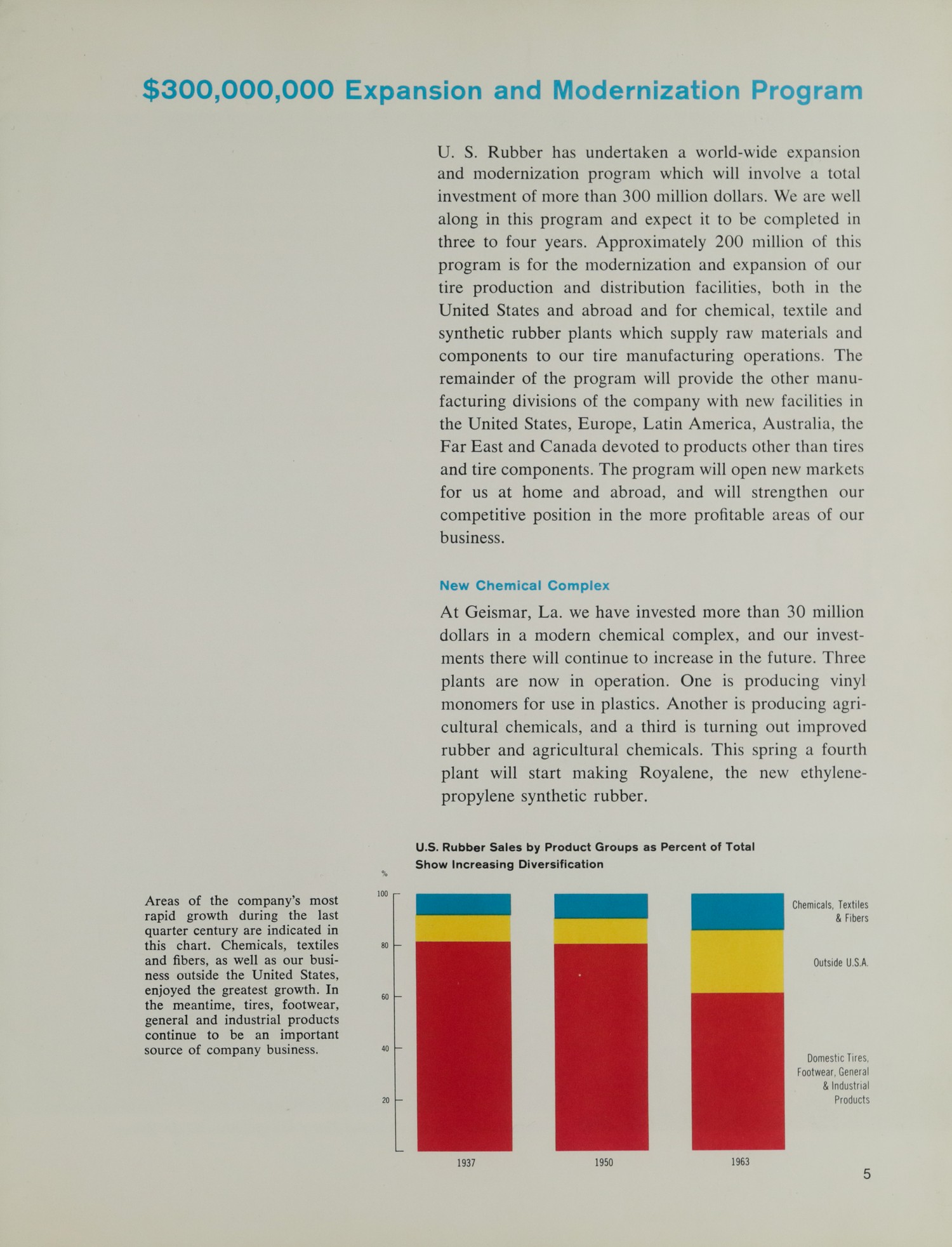
$300,000,000 Expansion and Modernization Program
U. S. Rubber has undertaken a world-wide expansion and modernization program which will involve a total investment of more than 300 million dollars. We are well along in this program and expect it to be completed in three to four years. Approximately 200 million of this program is for the modernization and expansion of our tire production and distribution facilities, both in the United States and abroad and for chemical, textile and synthetic rubber plants which supply raw materials and components to our tire manufacturing operations. The remainder of the program will provide the other manufacturing divisions of the company with new facilities in the United States, Europe, Latin America, Australia, the Far East and Canada devoted to products other than tires and tire components. The program will open new markets for us at home and abroad, and will strengthen our competitive position in the more profitable areas of our business.
New Chemical Complex
At Geismar, La. we have invested more than 30 million dollars in a modern chemical complex, and our investments there will continue to increase in the future. Three plants are now in operation. One is producing vinyl monomers for use in plastics. Another is producing agricultural chemicals, and a third is turning out improved rubber and agricultural chemicals. This spring a fourth plant will start making Royalene, the new ethylene-propylene synthetic rubber.
U.S. Rubber Sales by Product Groups as Percent of Total Show Increasing Diversification
Areas of the company’s most rapid growth during the last quarter century are indicated in this chart. Chemicals, textiles and fibers, as well as our business outside the United States, enjoyed the greatest growth. In the meantime, tires, footwear, general and industrial products continue to be an important source of company business.
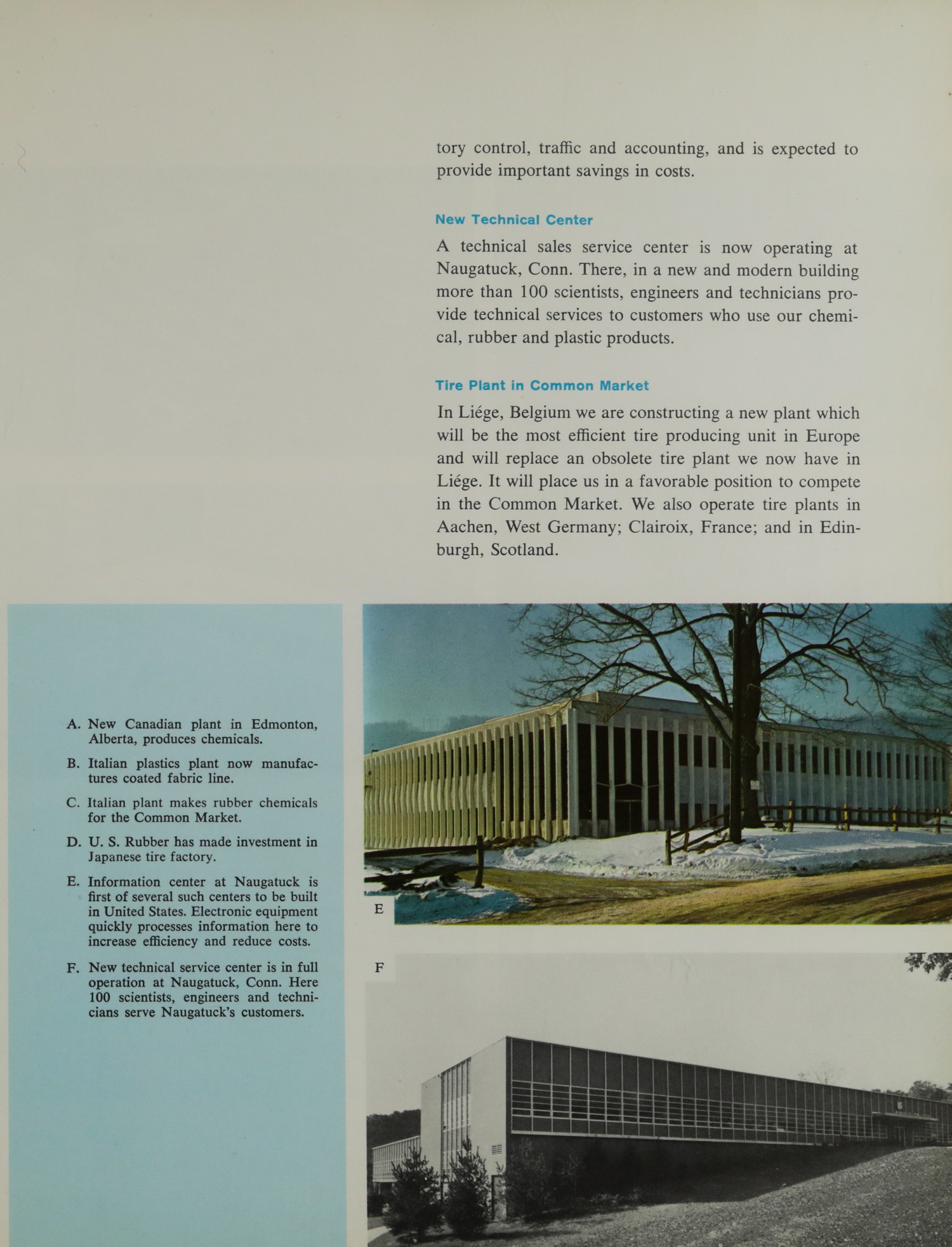
tory control, traffic and accounting, and is expected to
provide important savings in costs.
New Technical Center
A technical sales service center is now operating at
Naugatuck, Conn. There, in a new and modern building
more than 100 scientists, engineers and technicians provide technical services to customers who use our chemical, rubber and plastic products.
Tire Plant in Common Market
In Liége, Belgium we are constructing a new plant which
will be the most efficient tire producing unit in Europe
and will replace an obsolete tire plant we now have in
Liége. It will place us in a favorable position to compete
in the Common Market. We also operate tire plants in
Aachen, West Germany; Clairôix, France; and in Edinburgh, Scotland.
A. New Canadian plant in Edmonton,
Alberta, produces chemicals.
B. Italian plastics plant now manufactures coated fabric line.
C. Italian plant makes rubber chemicals
for the Common Market.
D. U. S. Rubber has made investment in
Japanese tire factory.
E. Information center at Naugatuck is
first of several such centers to be built
in United States. Electronic equipment
quickly processes information here to
increase efficiency and reduce costs.
F. New technical service center is in full
operation at Naugatuck, Conn. Here
100 scientists, engineers and technicians serve Naugatuck’s customers.
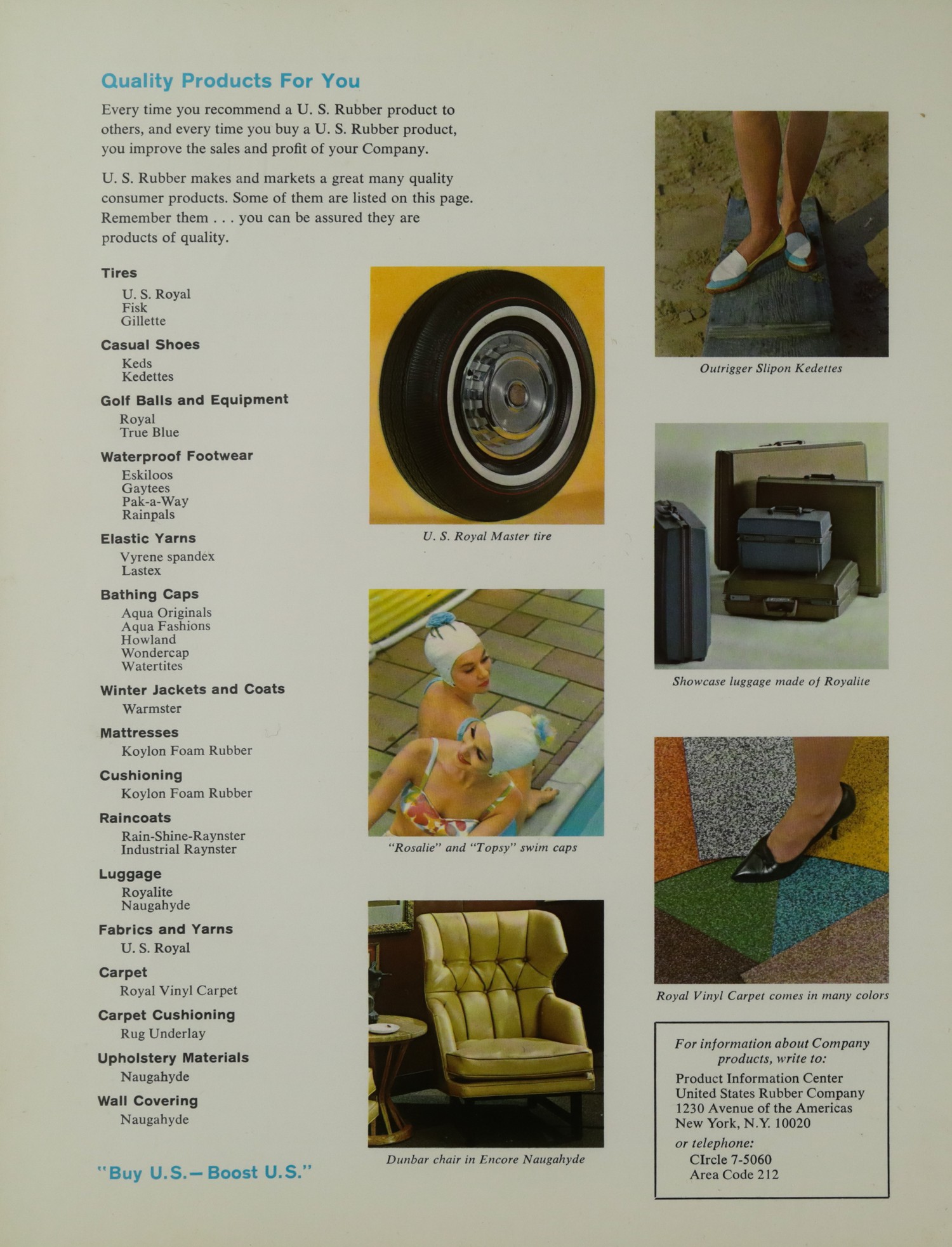
Quality Products For You
Every time you recommend a U. S. Rubber product to others, and every time you buy a U. S. Rubber product, you improve the sales and profit of your Company.
U. S. Rubber makes and markets a great many quality consumer products. Some of them are listed on this page. Remember them . . . you can be assured they are products of quality.
Tires
U. S. Royal
Fisk
Gillette
Casual Shoes
Keds
Kedettes
Golf Balls and Equipment
Royal
True Blue
Waterproof Footwear
Eskilos
Gaytes
Pak-a-Way
Rainpals
Elastic Yarns
Vyrtene spandex
Lastex
Bathing Caps
Aqua Originals
Aqua Fashions
Aerland
Wondercap
Watertites
Winter Jackets and Coats
Warmster
Mattresses
Koylon Foam Rubber
Cushioning
Koylon Foam Rubber
Raincoats
Rain-Shine-Raynster
Industrial Raynster
Luggage
Royalite
Naugahyde
Fabrics and Yarns
U. S. Royal
Carpet
Royal Vinyl Carpet
Carpet Cushioning
Rug Underlay
Upholstery Materials
Naugahyde
Wall Covering
Naugahyde
“Buy U.S.—Boost U.S.”
Outriger Slipon Kedettes
U. S. Royal Master tire
“Rosalie” and “Topsy” swim caps
Dunbar chair in Encore Naugahyde
Showcase luggage made of Royalite
Royal Vinyl Carpet comes in many colors
For information about Company products, write to:
Product Information Center
United States Rubber Company
1230 Avenue of the Americas
New York, N.Y. 10020
or telephone:
Circle 7-5060
Area Code 212