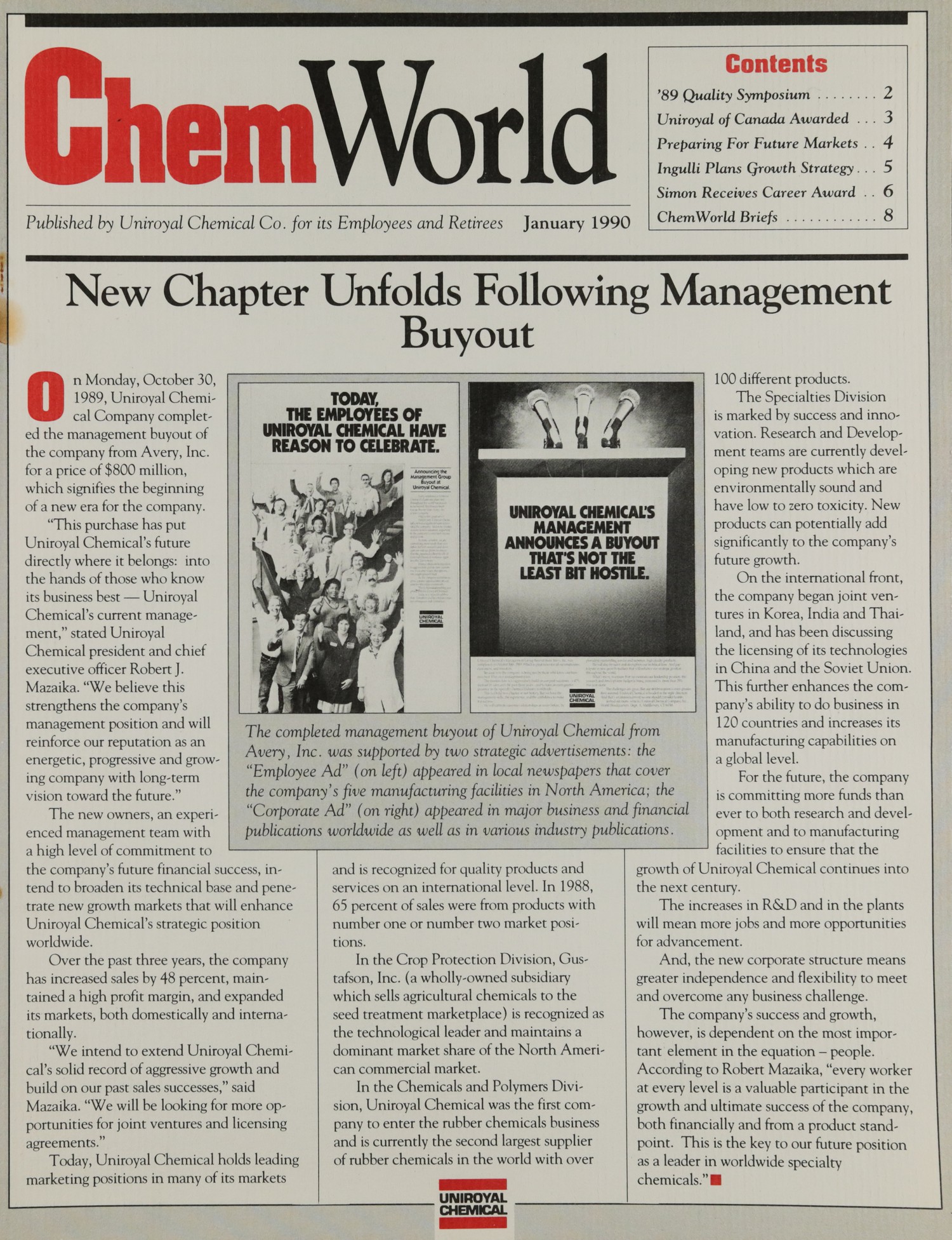
ChemWorld – Page 5

Page 005

CHEMWORLD

WINTER/SPRING 1995


Worldwide Growth Strategy Dictates New Organization

(continued from page 1)

William A. Stephenson, formerly vice president/general manager of the Specialties Division, has been appointed executive vice president of the Asia/Pacific region with responsibility for the worldwide Specialties businesses (Adiprene®/Vibrathane® urethane prepolymers and Specialty Chemicals), Gustafson (a wholly-owned subsidiary for seed treatment chemicals) and Asia/Pacific (including all businesses in that region).

Dr. Edward L. Hagen has been appointed regional vice president for Asia/ Pacific and will report to Mr. Stephenson. The headquarters location will be announced shortly.

“This new global organization structure will help support a firm foundation for shared leadership, constructive interdependence between divisions and regions, and matrixed teamwork at all management levels,” commented Robert J. Mazaika, Uniroyal Chemical’s chairman, president and CEO. “We are looking forward to an even more successful future as we become a stronger player in the global chemical industry.”


PROFESSIONAL PROFILES

Dr. JOSEPH B. EISENBERG

Dr. Joseph B. Eisenberg has been with Uniroyal Chemical for over 30 years, serving as senior group leader, production superintendent for polymers, production superintendent for chemicals, technical superintendent, engineering manager, and general manager of international operations for Chemicals and Polymers. Most recently, he was vice president and general manager of the Chemicals and Polymers Division, responsible for Rubber Chemicals, Royalene® EPDM and Paracril® nitrile rubber.

Dr. Eisenberg received a B.S., M.S. and Ph.D in chemical engineering from Clarkson University in New York, USA.


WALTER K. RUCK

Walter K. Ruck joined Uniroyal Inc. in 1979 as manager of construction in the Chemical Division Engineering Department. He progressed through a number of managerial positions since that time and was transferred to Uniroyal Ltd. in Elmira, Ontario, Canada in 1985, where he served as manager of manufacturing.

Since 1988, he has held the position of managing director/general manager of Uniroyal Chemical Ltd. in Elmira.

Mr. Ruck has a B.S. in engineering from Christian Brothers College in Memphis, Tennessee, USA and attended St. Louis University in St. Louis, Missouri, USA. He has also pursued graduate studies in business management at Xavier University in Cincinnati, Ohio, USA.


ALFRED F. INGULLI

Mr. Ingulli has been with Uniroyal Chemical for 31 years, and has worked in research and development where he was awarded two patents for high temperature themoplastic alloys. He also worked in market development where he was instrumental in establishing two new businesses — Polywet® dispersants and Synton® synthetic lubricants. He has also served as business manager for many of the company’s businesses in the Chemicals and Polymers Division and Specialties Division.

Most recently, he was vice president and general manager of the Crop Protection Division, responsible for fungicides, insecticides, plant growth regulators, herbicides, foliar nutrients, seed treatment and other crop protection specialty products worldwide.

Mr. Ingulli received a B.S. in chemical engineering from Polytechnic Institute and an M.S. in management from Rensselaer Polytechnic Institute, both located in New York, USA. He also completed the Harvard Business School Program of Management Development.


MICHEL J. DUCHESNE

With a background in international and general management, having worked for regional, national and international sales divisions for both Uniroyal Chemical and other Fortune 500 companies, Mr. Duchesne has been general sales manager of the Crop Protection International Division and general sales manager and director of sales of the Crop Protection Division worldwide.

Most recently, he served as managing director of European operations based in Langley, United Kingdom.

A native of France, Mr. Duchesne holds a dual French-American citizenship. He received a B.A. and an M.S. in agronomy from the National Institute of Agronomy at the University of Paris, France.


WILLIAM A. STEPHENSON

A 26-year veteran of Uniroyal Chemical, William Stephenson has worked as a development engineer in research and development, technical sales service representative, manager for Paracril nitrile rubber, and marketing manager and business manager for Royalene EPDM.

Most recently, he was vice president and general manager of the Specialties Division, overseeing two key business units: Adiprene/Vibrathane urethane prepolymers and Specialty Chemicals – a major supplier of plastics additives including antioxidants, foaming agents, epoxy curatives and polymerization inhibitors, as well as lubricant additives and intermediates.

Mr. Stephenson received a B.S. in plastics technology from Lowell Technological Institute in Lowell, Massachusetts, USA, and an M.B.A. in marketing from the University of Hartford, Connecticut, USA.


Dr. EDWARD L. HAGEN

Dr. Edward L. Hagen started his career in 1969 as a research chemist in corporate R&D for Uniroyal Inc., and then joined Uniroyal Chemical in 1974 as a technical sales service group leader for Vibrathane castable urethanes and Roylar® thermoplastic urethanes. He continued his career in the urethanes area as R&D and technical sales service manager, marketing specialist and worldwide business manager through 1991.

Most recently, he held the position of vice president of Corporate Business Development. Dr. Hagen received a B.S. in chemistry from the University of Notre Dame in South Bend, Indiana, USA and a Ph.D in organic chemistry from Yale University in New Haven, Connecticut, USA. ■


BRIEFS

Seed Treatment Operation in United Kingdom Acquired

Uniroyal Chemical has purchased the seed treatment operation of DowElanco in the United Kingdom and Ireland. The transaction was completed on November 3, 1994.

“Uniroyal Chemical already is the global leader in seed treatment products and technology, and this acquisition enables us to bolster a key market,” said Alfred F. Ingulli, executive vice president responsible for the company’s Crop Protection product lines. “DowElanco customers in the United Kingdom can expect a continued strong commitment to seed treatment products, equipment and service.”

The transaction includes the existing DowElanco seed treatment team, development equipment, machinery and spare parts inventory. DowElanco announced last spring that the divestiture would enable it to focus on its core business.

“Uniroyal Chemical’s Crop Protection business continued to grow in 1994, especially in the area of seed treatment,” Ingulli said. “Our personnel, products and expertise make us the dominant leader in seed treatment, both in North America and worldwide.” ■


UNIROYAL CHEMICAL
ChemWorld – Page 1

Page 001

CHEMWORLD

WINTER/SPRING 1995

Published by
Uniroyal Chemical Co.
for its Associates
and Retirees


CONTENTS

2
Logistics Strives for
Continuous Customer
Satisfaction

3
Responsible Care®
Implementation
On Track

4
Annual Total Quality
Recognition Awards
Celebrated

6
International
Advertising Targets
Latin American Markets

7
Novaquim Strengthens
Expansion Efforts

8
Initial Public Offering
Announced


Worldwide Growth Strategy Dictates New Organization at Uniroyal Chemical

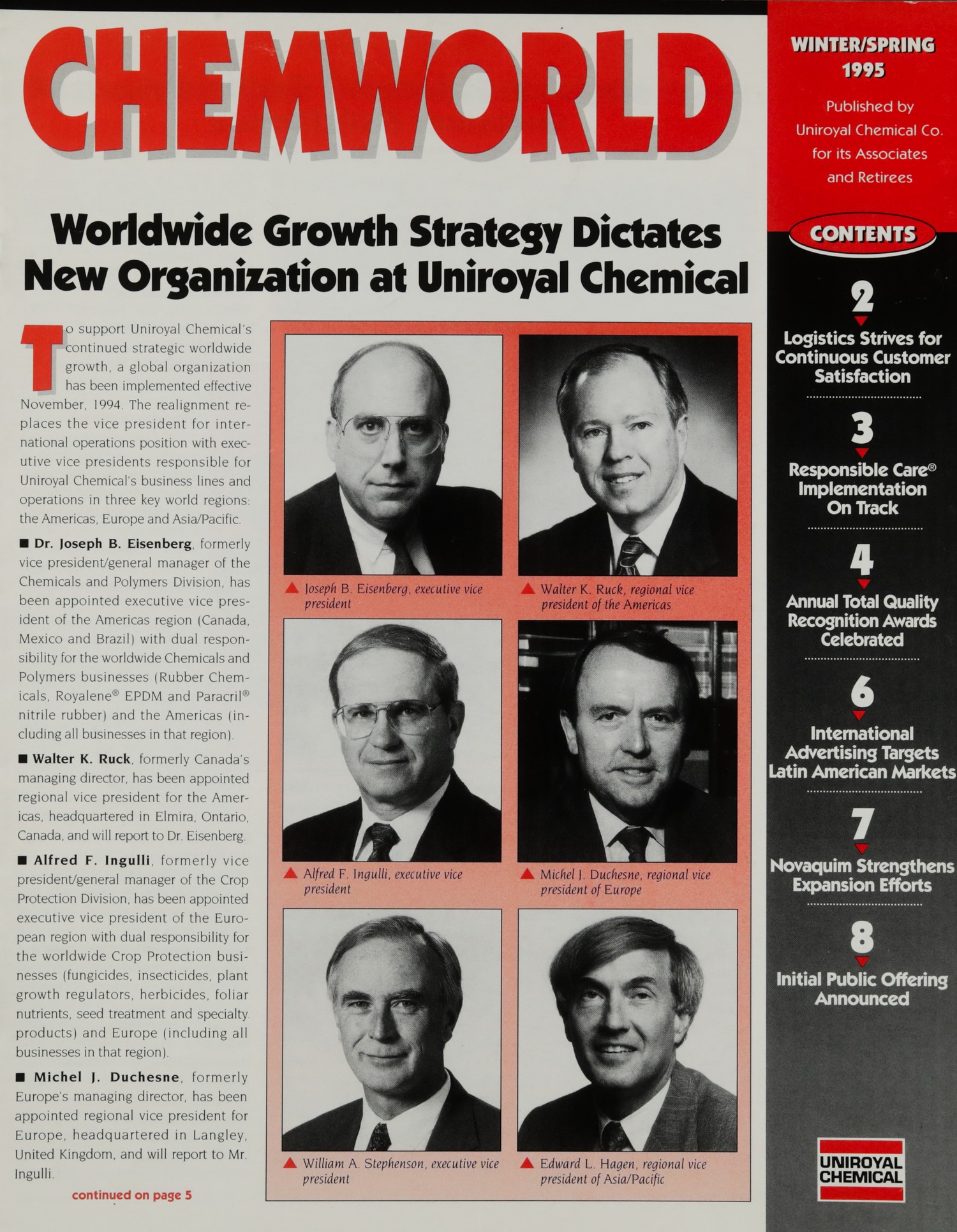
To support Uniroyal Chemical’s continued strategic worldwide growth, a global organization has been implemented effective November, 1994. The realignment replaces the vice president for international operations position with executive vice presidents responsible for Uniroyal Chemical’s business lines and operations in three key world regions: the Americas, Europe and Asia/Pacific.

Dr. Joseph B. Eisenberg, formerly vice president/general manager of the Chemicals and Polymers Division, has been appointed executive vice president of the Americas region (Canada, Mexico and Brazil) with dual responsibility for the worldwide Chemicals and Polymers businesses (Rubber Chemicals, Royalene® EPDM and Paracril® nitrile rubber) and the Americas (including all businesses in that region).

Walter K. Ruck, formerly Canada’s managing director, has been appointed regional vice president for the Americas, headquartered in Elmira, Ontario, Canada, and will report to Dr. Eisenberg.

Alfred F. Ingulli, formerly vice president/general manager of the Crop Protection Division, has been appointed executive vice president of the European region with dual responsibility for the worldwide Crop Protection businesses (fungicides, insecticides, plant growth regulators, herbicides, foliar nutrients, seed treatment and specialty products) and Europe (including all businesses in that region).

Michel J. Duchesne, formerly Europe’s managing director, has been appointed regional vice president for Europe, headquartered in Langley, United Kingdom, and will report to Mr. Ingulli.

continued on page 5


Photo Captions:

▲ Joseph B. Eisenberg, executive vice president

▲ Walter K. Ruck, regional vice president of the Americas

▲ Alfred F. Ingulli, executive vice president

▲ Michel J. Duchesne, regional vice president of Europe

▲ William A. Stephenson, executive vice president

▲ Edward L. Hagen, regional vice president of Asia/Pacific


UNIROYAL CHEMICAL

ChemWorld – Page 1

Page 001

ChemWorld

Published by Uniroyal Chemical Co. for its Employees and Retirees January 1990


Contents

’89 Quality Symposium . . . . . . . . 2
Uniroyal of Canada Awarded . . . 3
Preparing For Future Markets . . 4
Ingulli Plans Growth Strategy . . . 5
Simon Receives Career Award . . 6
ChemWorld Briefs . . . . . . . . . . . 8


New Chapter Unfolds Following Management Buyout

On Monday, October 30, 1989, Uniroyal Chemical Company completed the management buyout of the company from Avery, Inc. for a price of $800 million, which signifies the beginning of a new era for the company.

“This purchase has put Uniroyal Chemical’s future directly where it belongs: into the hands of those who know its business best — Uniroyal Chemical’s current management,” stated Uniroyal Chemical president and chief executive officer Robert J. Mazaika. “We believe this strengthens the company’s management position and will reinforce our reputation as an energetic, progressive and growing company with long-term vision toward the future.”

The new owners, an experienced management team with a high level of commitment to the company’s future financial success, intend to broaden its technical base and penetrate new growth markets that will enhance Uniroyal Chemical’s strategic position worldwide.

Over the past three years, the company has increased sales by 48 percent, maintained a high profit margin, and expanded its markets, both domestically and internationally.

“We intend to extend Uniroyal Chemical’s solid record of aggressive growth and build on our past sales successes,” said Mazaika. “We will be looking for more opportunities for joint ventures and licensing agreements.”

Today, Uniroyal Chemical holds leading marketing positions in many of its markets


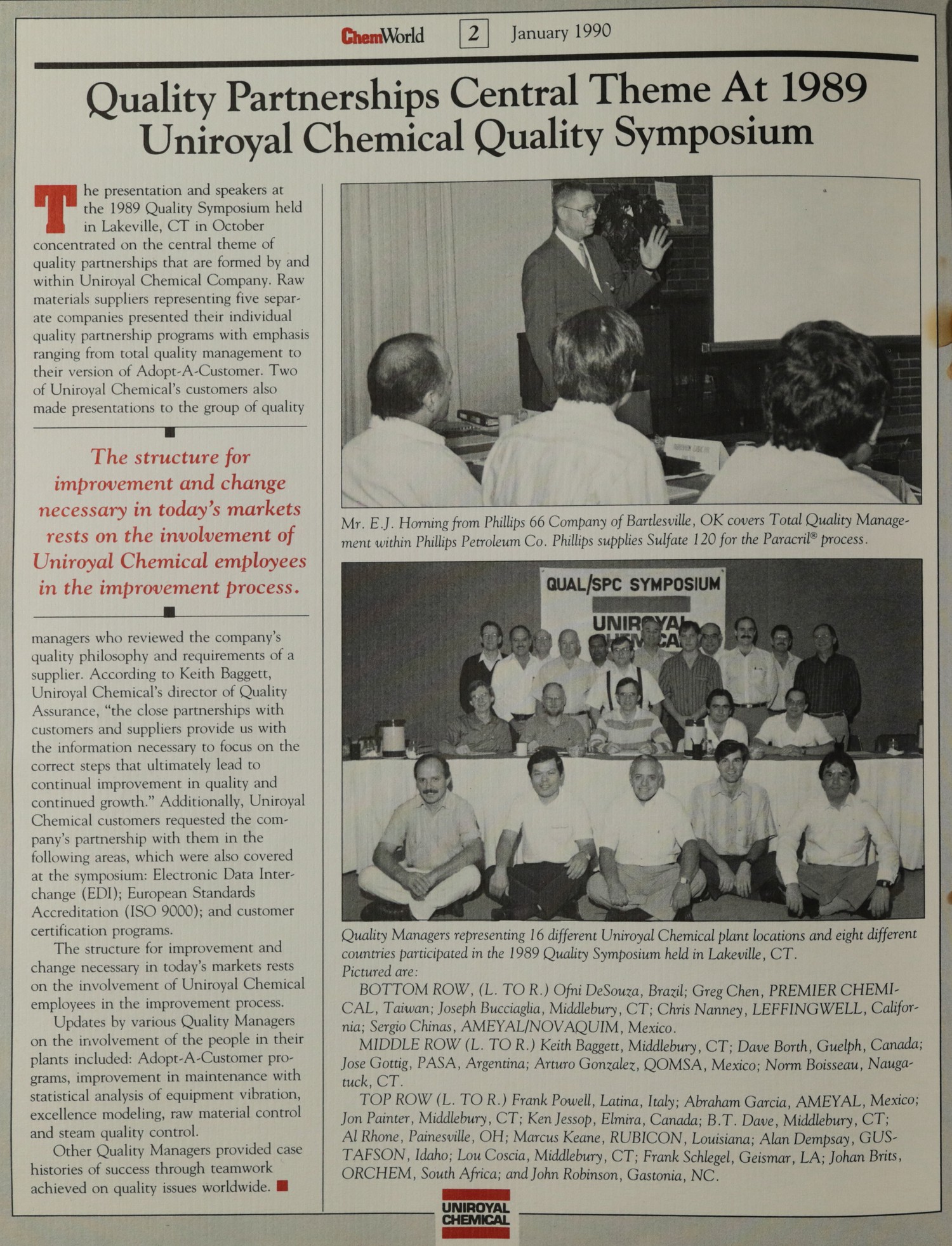
TODAY, THE EMPLOYEES OF UNIROYAL CHEMICAL HAVE REASON TO CELEBRATE.

[IMAGE: Group photo of employees]

Announcing the Management Buyout of Uniroyal Chemical

UNIROYAL CHEMICAL’S MANAGEMENT ANNOUNCES A BUYOUT THAT’S NOT THE LEAST BIT HOSTILE.

[IMAGE: Corporate advertisement with Uniroyal Chemical logo]

The completed management buyout of Uniroyal Chemical from Avery, Inc. was supported by two strategic advertisements: the “Employee Ad” (on left) appeared in local newspapers that cover the company’s five manufacturing facilities in North America; the “Corporate Ad” (on right) appeared in major business and financial publications worldwide as well as in various industry publications.


and is recognized for quality products and services on an international level. In 1988, 65 percent of sales were from products with number one or number two market positions.

In the Crop Protection Division, Gustafson, Inc. (a wholly-owned subsidiary which sells agricultural chemicals to the seed treatment marketplace) is recognized as the technological leader and maintains a dominant market share of the North American commercial market.

In the Chemicals and Polymers Division, Uniroyal Chemical was the first company to enter the rubber chemicals business and is currently the second largest supplier of rubber chemicals in the world with over

100 different products.

The Specialties Division is marked by success and innovation. Research and Development teams are currently developing new products which are environmentally sound and have low to zero toxicity. New products can potentially add significantly to the company’s future growth.

On the international front, the company began joint ventures in Korea, India and Thailand, and has been discussing the licensing of its technologies in China and the Soviet Union. This further enhances the company’s ability to do business in 120 countries and increases its manufacturing capabilities on a global level.

For the future, the company is committing more funds than ever to both research and development and to manufacturing facilities to ensure that the growth of Uniroyal Chemical continues into the next century.

The increases in R&D and in the plants will mean more jobs and more opportunities for advancement.

And, the new corporate structure means greater independence and flexibility to meet and overcome any business challenge.

The company’s success and growth, however, is dependent on the most important element in the equation – people. According to Robert Mazaika, “every worker at every level is a valuable participant in the growth and ultimate success of the company, both financially and from a product standpoint. This is the key to our future position as a leader in worldwide specialty chemicals.” ■


UNIROYAL CHEMICAL
ChemWorld – Page 2

Page 002

ChemWorld | 2 | January 1990


Quality Partnerships Central Theme At 1989 Uniroyal Chemical Quality Symposium

The presentation and speakers at the 1989 Quality Symposium held in Lakeville, CT in October concentrated on the central theme of quality partnerships that are formed by and within Uniroyal Chemical Company. Raw materials suppliers representing five separate companies presented their individual quality partnership programs with emphasis ranging from total quality management to their version of Adopt-A-Customer. Two of Uniroyal Chemical’s customers also made presentations to the group of quality


The structure for improvement and change necessary in today’s markets rests on the involvement of Uniroyal Chemical employees in the improvement process.


managers who reviewed the company’s quality philosophy and requirements of a supplier. According to Keith Baggett, Uniroyal Chemical’s director of Quality Assurance, “the close partnerships with customers and suppliers provide us with the information necessary to focus on the correct steps that ultimately lead to continual improvement in quality and continued growth.” Additionally, Uniroyal Chemical customers requested the company’s partnership with them in the following areas, which were also covered at the symposium: Electronic Data Interchange (EDI); European Standards Accreditation (ISO 9000); and customer certification programs.

The structure for improvement and change necessary in today’s markets rests on the involvement of Uniroyal Chemical employees in the improvement process.

Updates by various Quality Managers on the involvement of the people in their plants included: Adopt-A-Customer programs, improvement in maintenance with statistical analysis of equipment vibration, excellence modeling, raw material control and steam quality control.

Other Quality Managers provided case histories of success through teamwork achieved on quality issues worldwide. ■


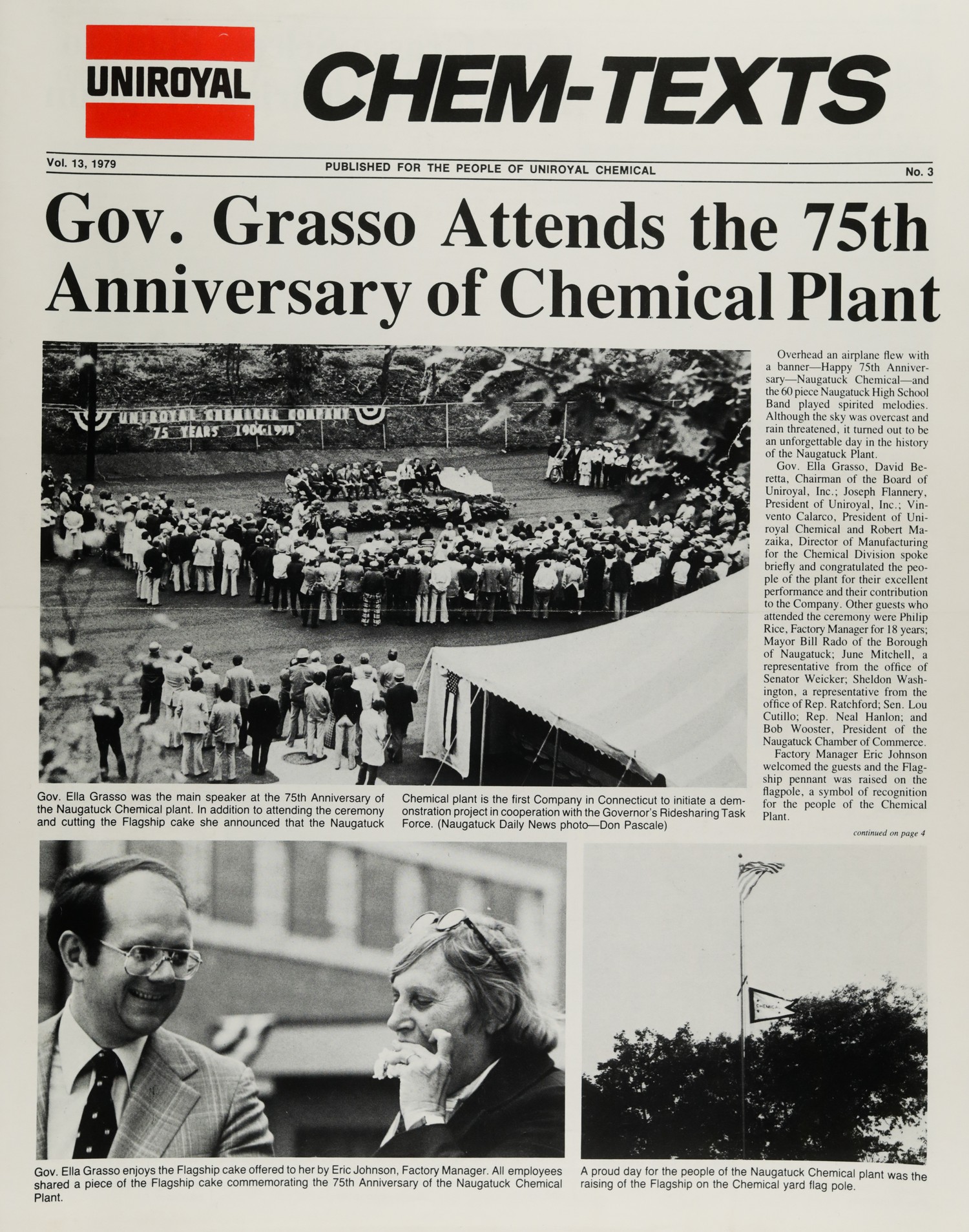
Mr. E.J. Horning from Phillips 66 Company of Bartlesville, OK covers Total Quality Management within Phillips Petroleum Co. Phillips supplies Sulfate 120 for the Paracril® process.


QUAL/SPC SYMPOSIUM

UNIROYAL

Quality Managers representing 16 different Uniroyal Chemical plant locations and eight different countries participated in the 1989 Quality Symposium held in Lakeville, CT.

Pictured are:

BOTTOM ROW, (L. TO R.) Ofni DeSouza, Brazil; Greg Chen, PREMIER CHEMICAL, Taiwan; Joseph Bucciaglia, Middlebury, CT; Chris Nanney, LEFFINGWELL, California; Sergio Chinas, AMEYAL/NOVAQUIM, Mexico.

MIDDLE ROW (L. TO R.) Keith Baggett, Middlebury, CT; Dave Borth, Guelph, Canada; Jose Gottig, PASA, Argentina; Arturo Gonzalez, QOMSA, Mexico; Norm Boisseau, Naugatuck, CT.

TOP ROW (L. TO R.) Frank Powell, Latina, Italy; Abraham Garcia, AMEYAL, Mexico; Jon Painter, Middlebury, CT; Ken Jessop, Elmira, Canada; B.T. Dave, Middlebury, CT; Al Rhone, Painesville, OH; Marcus Keane, RUBICON, Louisiana; Alan Dempsay, GUSTAFSON, Idaho; Lou Coscia, Middlebury, CT; Frank Schlegel, Geismar, LA; Johan Brits, ORCHEM, South Africa; and John Robinson, Gastonia, NC.


UNIROYAL CHEMICAL
CHEM-TEXTS – 1979-v13-i03-s272

Page 272

UNIROYAL CHEM-TEXTS

Vol. 13, 1979 | PUBLISHED FOR THE PEOPLE OF UNIROYAL CHEMICAL | No. 3

Gov. Grasso Attends the 75th Anniversary of Chemical Plant

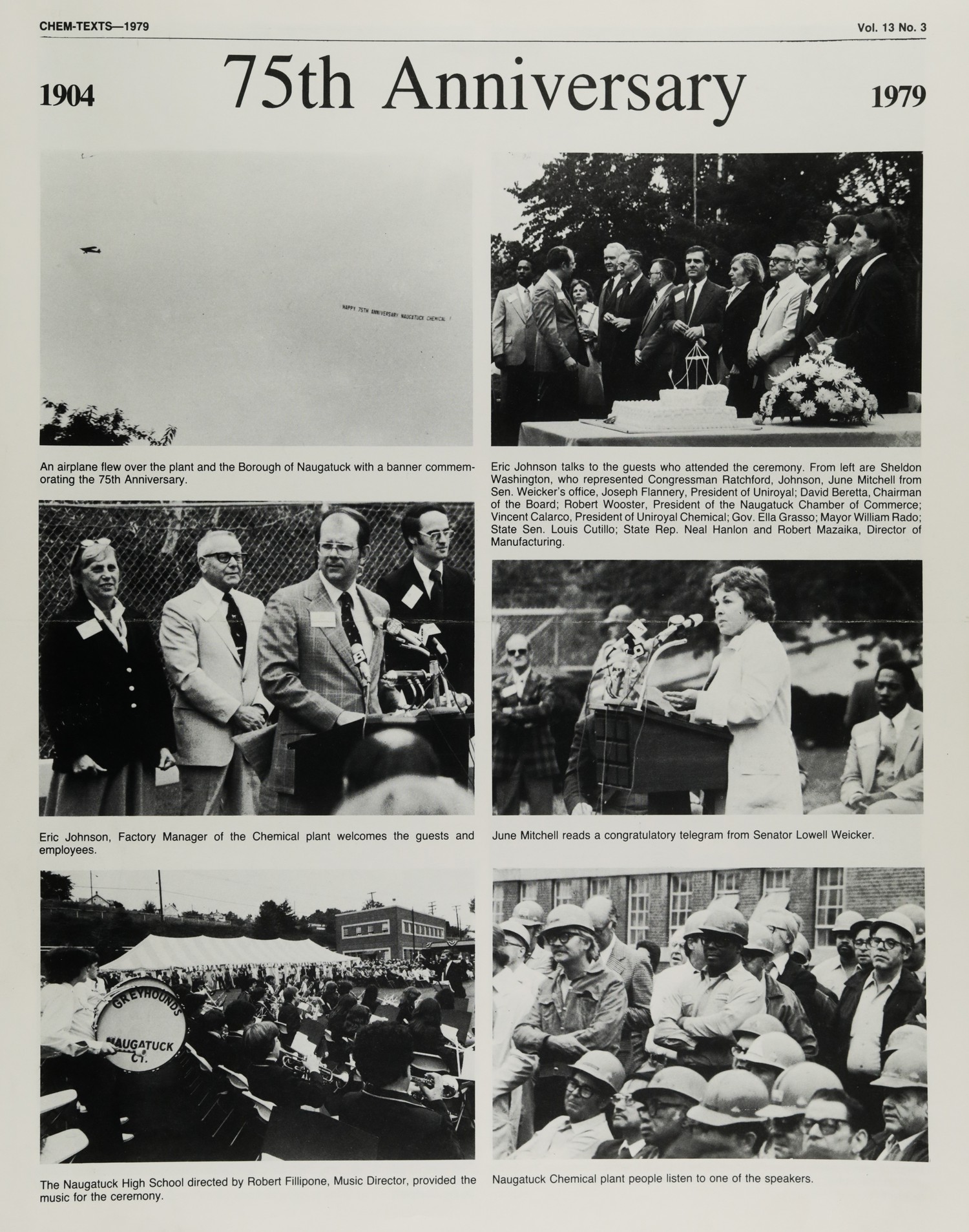
Overhead an airplane flew with a banner—Happy 75th Anniversary—Naugatuck Chemical—and the 60 piece Naugatuck High School Band played spirited melodies. Although the sky was overcast and rain threatened, it turned out to be an unforgettable day in the history of the Naugatuck Plant.

Gov. Ella Grasso, David Beretta, Chairman of the Board of Uniroyal, Inc.; Joseph Flannery, President of Uniroyal, Inc.; Vincento Calarco, President of Uniroyal Chemical and Robert Mazaika, Director of Manufacturing for the Chemical Division spoke briefly and congratulated the people of the plant for their excellent performance and their contribution to the Company. Other guests who attended the ceremony were Philip Rice, Factory Manager for 18 years; Mayor Bill Rado of the Borough of Naugatuck; June Mitchell, a representative from the office of Senator Weicker; Sheldon Washington, a representative from the office of Rep. Ratchford; Sen. Lou Cutillo; Rep. Neal Hanlon; and Bob Wooster, President of the Naugatuck Chamber of Commerce.

Factory Manager Eric Johnson welcomed the guests and the Flagship pennant was raised on the flagpole, a symbol of recognition for the people of the Chemical Plant.

continued on page 4


[MAIN PHOTO CAPTION]
Gov. Ella Grasso was the main speaker at the 75th Anniversary of the Naugatuck Chemical plant. In addition to attending the ceremony and cutting the Flagship cake she announced that the Naugatuck Chemical plant is the first Company in Connecticut to initiate a demonstration project in cooperation with the Governor’s Ridesharing Task Force. (Naugatuck Daily News photo—Don Pascale)


[BOTTOM LEFT PHOTO CAPTION]
Gov. Ella Grasso enjoys the Flagship cake offered to her by Eric Johnson, Factory Manager. All employees shared a piece of the Flagship cake commemorating the 75th Anniversary of the Naugatuck Chemical Plant.


[BOTTOM RIGHT PHOTO CAPTION]
A proud day for the people of the Naugatuck Chemical plant was the raising of the Flagship on the Chemical yard flag pole.

CHEM-TEXTS – 1979-v13-i03-s274

Page 274

CHEM-TEXTS—1979

Vol. 13 No. 3

1904 75th Anniversary 1979


An airplane flew over the plant and the Borough of Naugatuck with a banner commemorating the 75th Anniversary.

Eric Johnson talks to the guests who attended the ceremony. From left are Sheldon Washington, who represented Congressman Ratchford, Johnson, June Mitchell from Sen. Weicker’s office, Joseph Flannery, President of Uniroyal; David Beretta, Chairman of the Board; Robert Wooster, President of the Naugatuck Chamber of Commerce; Vincent Calarco, President of Uniroyal Chemical; Gov. Ella Grasso; Mayor William Rado; State Sen. Louis Cutillo; State Rep. Neal Hanlon and Robert Mazaika, Director of Manufacturing.


Eric Johnson, Factory Manager of the Chemical plant welcomes the guests and employees.

June Mitchell reads a congratulatory telegram from Senator Lowell Weicker.


The Naugatuck High School directed by Robert Fillipone, Music Director, provided the music for the ceremony.

Naugatuck Chemical plant people listen to one of the speakers.

CHEM-TEXTS – 1979-v13-s278

Page 278

Page 3 | CHEM-TEXTS | Vol. 13, 1979

75 Years of Excellence in Manufacturing Chemicals

[AERIAL PHOTOGRAPH OF INDUSTRIAL PLANT]

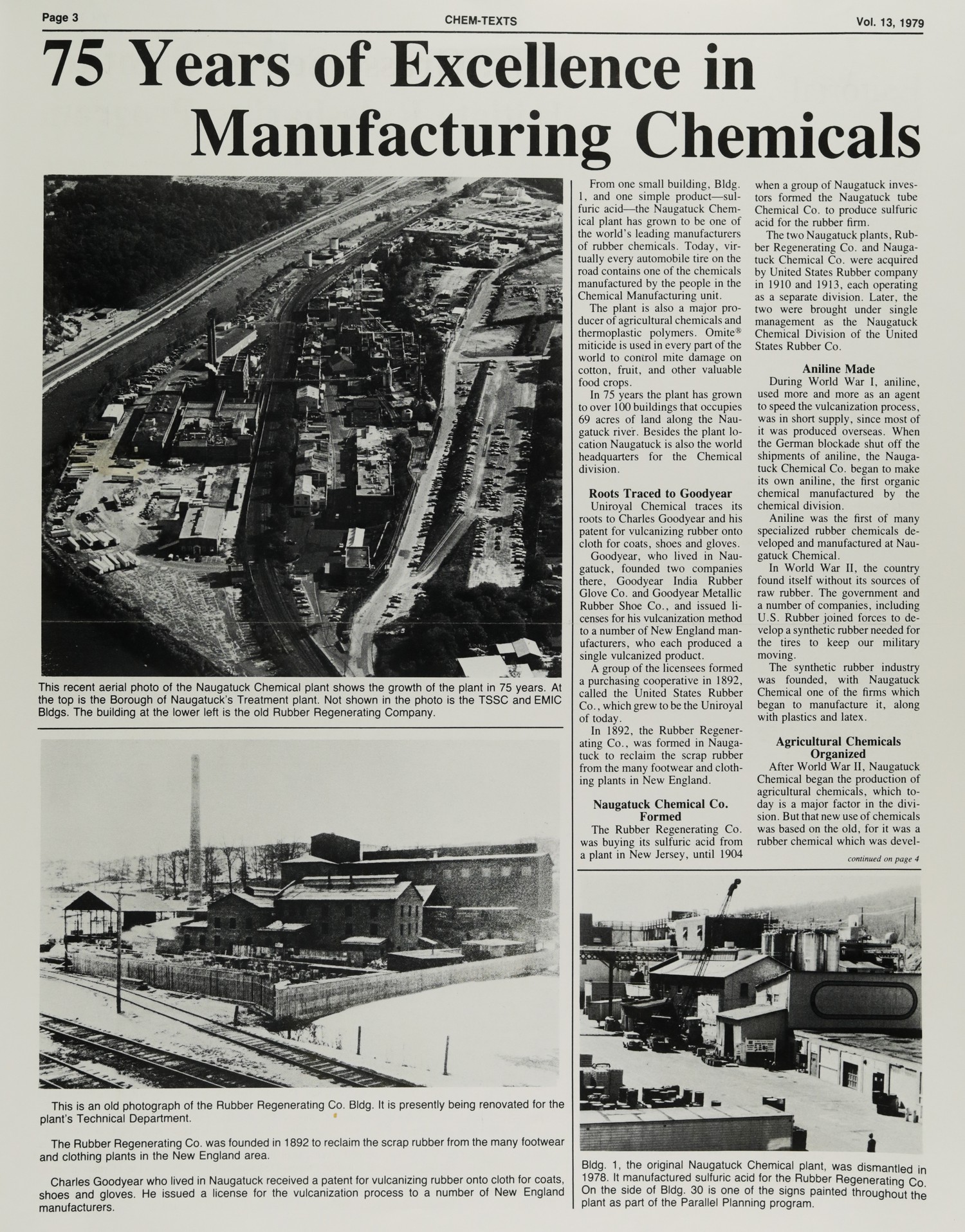
This recent aerial photo of the Naugatuck Chemical plant shows the growth of the plant in 75 years. At the top is the Borough of Naugatuck’s Treatment plant. Not shown in the photo is the TSSC and EMIC Bldgs. The building at the lower left is the old Rubber Regenerating Company.


From one small building, Bldg. 1, and one simple product—sulfuric acid—the Naugatuck Chemical plant has grown to be one of the world’s leading manufacturers of rubber chemicals. Today, virtually every automobile tire on the road contains one of the chemicals manufactured by the people in the Chemical Manufacturing unit.

The plant is also a major producer of agricultural chemicals and thermoplastic polymers. Omite® miticide is used in every part of the world to control mite damage on cotton, fruit, and other valuable food crops.

In 75 years the plant has grown to over 100 buildings that occupies 69 acres of land along the Naugatuck river. Besides the plant location Naugatuck is also the world headquarters for the Chemical division.

Roots Traced to Goodyear

Uniroyal Chemical traces its roots to Charles Goodyear and his patent for vulcanizing rubber onto cloth for coats, shoes and gloves.

Goodyear, who lived in Naugatuck, founded two companies there, Goodyear India Rubber Glove Co. and Goodyear Metallic Rubber Shoe Co., and issued licenses for his vulcanization method to a number of New England manufacturers, who each produced a single vulcanized product.

A group of the licensees formed a purchasing cooperative in 1892, called the United States Rubber Co., which grew to be the Uniroyal of today.

In 1892, the Rubber Regenerating Co., was formed in Naugatuck to reclaim the scrap rubber from the many footwear and clothing plants in New England.

Naugatuck Chemical Co. Formed

The Rubber Regenerating Co. was buying its sulfuric acid from a plant in New Jersey, until 1904

when a group of Naugatuck investors formed the Naugatuck tube Chemical Co. to produce sulfuric acid for the rubber firm.

The two Naugatuck plants, Rubber Regenerating Co. and Naugatuck Chemical Co. were acquired by United States Rubber company in 1910 and 1913, each operating as a separate division. Later, the two were brought under single management as the Naugatuck Chemical Division of the United States Rubber Co.

Aniline Made

During World War I, aniline, used more and more as an agent to speed the vulcanization process, was in short supply, since most of it was produced overseas. When the German blockade shut off the shipments of aniline, the Naugatuck Chemical Co. began to make its own aniline, the first organic chemical manufactured by the chemical division.

Aniline was the first of many specialized rubber chemicals developed and manufactured at Naugatuck Chemical.

In World War II, the country found itself without its sources of raw rubber. The government and a number of companies, including U.S. Rubber joined forces to develop a synthetic rubber needed for the tires to keep our military moving.

The synthetic rubber industry was founded, with Naugatuck Chemical one of the firms which began to manufacture it, along with plastics and latex.

Agricultural Chemicals Organized

After World War II, Naugatuck Chemical began the production of agricultural chemicals, which today is a major factor in the division. But that new use of chemicals was based on the old, for it was a rubber chemical which was devel-

continued on page 4


[PHOTOGRAPH OF OLD BUILDING]

This is an old photograph of the Rubber Regenerating Co. Bldg. It is presently being renovated for the plant’s Technical Department.

The Rubber Regenerating Co. was founded in 1892 to reclaim the scrap rubber from the many footwear and clothing plants in the New England area.

Charles Goodyear who lived in Naugatuck received a patent for vulcanizing rubber onto cloth for coats, shoes and gloves. He issued a license for the vulcanization process to a number of New England manufacturers.


[PHOTOGRAPH OF INDUSTRIAL BUILDING]

Bldg. 1, the original Naugatuck Chemical plant, was dismantled in 1978. It manufactured sulfuric acid for the Rubber Regenerating Co. On the side of Bldg. 30 is one of the signs painted throughout the plant as part of the Parallel Planning program.

CHEM-TEXTS – Vol. 5 No. 3 – Page 3

Page 003

CHEM-TEXTS

Vol. 5 No. 3 | Page 3


Drug Plan Starts

The new Prescription Drug Plan, the most recent of Uniroyal’s employee benefits, became effective July 1. The Plan will be carried by the Metropolitan Life Insurance Co.—Medi-MET.

Included in the Plan are the employee and eligible dependents: a spouse, any unmarried children under 19 years of age including stepchildren or other children who live with you and are dependent upon you for support and maintenance. All unmarried children over 19 years of age are also covered if they are either full time students or mentally or physically incapable of self-support.

ID Cards have been issued to participating employees. An employee with a family should have 2 cards: one for the employee and one for a spouse.

If you have not received an ID card or a Prescription Drug Plan booklet ask the Foreman or Supervisor of the department for them, or call Marion Hutt Ext. 557.


“Keep Plant Beautiful”

[IMAGE: Photo of a man watering flowers]

When George Vila, Uniroyal’s president and chairman, toured the Chemical plant a few years ago, one of the more beautiful places he found in the plant was John Sickola’s garden by Warehouse 107. To “keep plant beautiful,” Sickola is growing six flower boxes of petunias, zinnias and marigolds. In the photo above he waters his flowers which add a bright color to the south end of the Chemical yard.


[IMAGE: Photo of cattle in a barn]

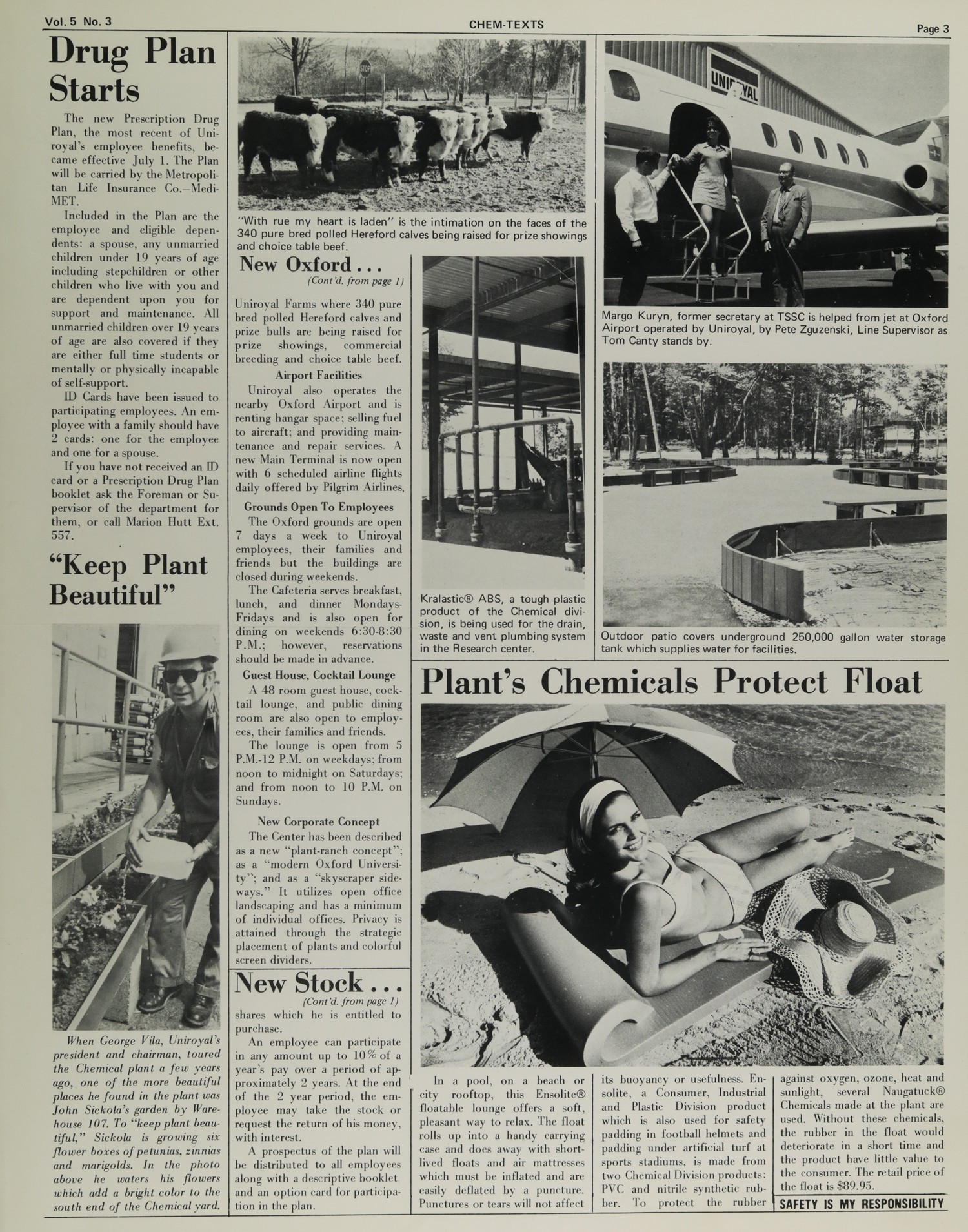
“With rue my heart is laden” is the intimation on the faces of the 340 pure bred polled Hereford calves being raised for prize showings and choice table beef.

New Oxford…

(Cont’d. from page 1)

Uniroyal Farms where 340 pure bred polled Hereford calves and prize bulls are being raised for prize showings, commercial breeding and choice table beef.

Airport Facilities

Uniroyal also operates the nearby Oxford Airport and is renting hangar space; selling fuel to aircraft; and providing maintenance and repair services. A new Main Terminal is now open with 6 scheduled airline flights daily offered by Pilgrim Airlines.

Grounds Open To Employees

The Oxford grounds are open 7 days a week to Uniroyal employees, their families and friends but the buildings are closed during weekends.

The Cafeteria serves breakfast, lunch, and dinner Mondays-Fridays and is also open for dining on weekends 6:30-8:30 P.M.; however, reservations should be made in advance.

Guest House, Cocktail Lounge

A 48 room guest house, cocktail lounge, and public dining room are also open to employees, their families and friends.

The lounge is open from 5 P.M.-12 P.M. on weekdays; from noon to midnight on Saturdays; and from noon to 10 P.M. on Sundays.

New Corporate Concept

The Center has been described as a new “plant-ranch concept”; as a “modern Oxford University”; and as a “skyscraper sideways.” It utilizes open office landscaping and has a minimum of individual offices. Privacy is attained through the strategic placement of plants and colorful screen dividers.


New Stock…

(Cont’d. from page 1)

shares which he is entitled to purchase.

An employee can participate in any amount up to 10% of a year’s pay over a period of approximately 2 years. At the end of the 2 year period, the employee may take the stock or request the return of his money, with interest.

A prospectus of the plan will be distributed to all employees along with a descriptive booklet and an option card for participation in the plan.


[IMAGE: Photo of woman being helped from jet]

Margo Kuryn, former secretary at TSSC is helped from jet at Oxford Airport operated by Uniroyal, by Pete Zguzenski, Line Supervisor as Tom Canty stands by.


[IMAGE: Photo of outdoor patio area]

Outdoor patio covers underground 250,000 gallon water storage tank which supplies water for facilities.


[IMAGE: Photo of plumbing system]

Kralastic® ABS, a tough plastic product of the Chemical division, is being used for the drain, waste and vent plumbing system in the Research center.


Plant’s Chemicals Protect Float

[IMAGE: Photo of people on inflatable float in pool]

In a pool, on a beach or city rooftop, this Ensolite® floatable lounge offers a soft, pleasant way to relax. The float rolls up into a handy carrying case and does away with short-lived floats and air mattresses which must be inflated and are easily deflated by a puncture. Punctures or tears will not affect its buoyancy or usefulness. Ensolite, a Consumer, Industrial and Plastic Division product which is also used for safety padding in football helmets and padding under artificial turf at sports stadiums, is made from two Chemical Division products: PVC and nitrile synthetic rubber. To protect the rubber against oxygen, ozone, heat and sunlight, several Naugatuck® Chemicals made at the plant are used. Without these chemicals, the rubber in the float would deteriorate in a short time and the product have little value to the consumer. The retail price of the float is $89.95.


SAFETY IS MY RESPONSIBILITY

CHEM-TEXTS – 1971-v05-i03-s191

Page 191

UNIROYAL CHEM-TEXTS

Vol. 5, 1971 | PUBLISHED FOR THE PEOPLE OF UNIROYAL CHEMICAL | No. 3

New Oxford Center Opens

New Stock Plan Offer

A new Stock Purchase Plan will be offered to all employees about August 10.

The offering will be similar in most respects to the 1966 and 1968 Stock Purchase Plans. Approximately 65% of the Naugatuck Chemical employees participated in the ’68 Plan.

The option price will be the median market price of Uniroyal common stock on August 10, 1971.

No later than Sept. 8, 1971, an eligible employee may elect to purchase all or part of the (Cont’d. on page 3)

35 Enroll; 22 Increase Bonds

35 additional employees enrolled and 22 increased their participation in the purchase of U.S. Savings Bonds during the campaign recently conducted at the Chemical plant. 504 of 1500 employees, or 33%, now purchase E Bonds through the payroll deduction plan. The E Bonds pay a guaranteed 5½% interest rate if held to maturity, 5 years and 10 months.

Bond purchases can be made any time through the payroll savings plan by contacting Molly Cobbol, Ext. 218.


Facilities Open To Employees

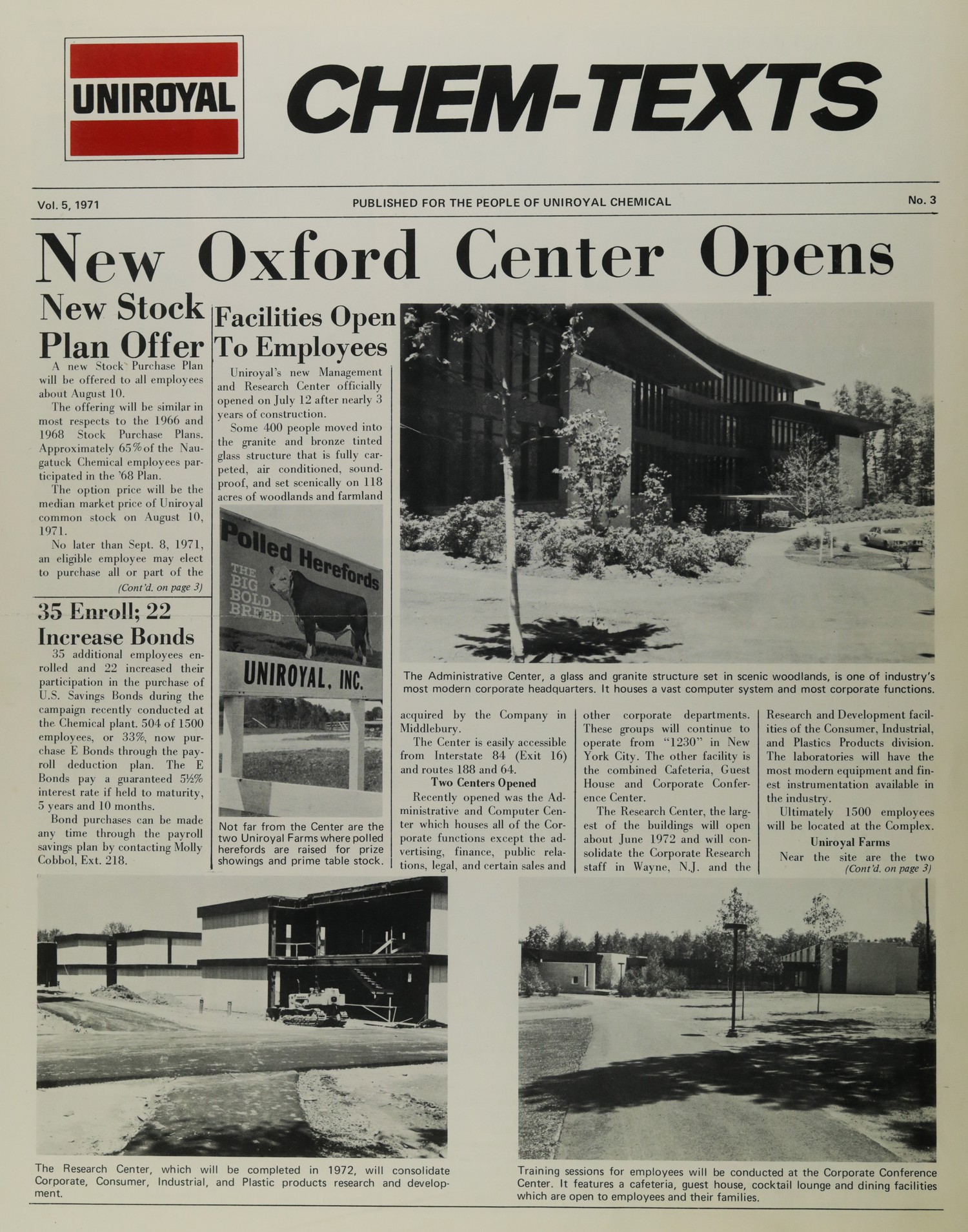
Uniroyal’s new Management and Research Center officially opened on July 12 after nearly 3 years of construction.

Some 400 people moved into the granite and bronze tinted glass structure that is fully carpeted, air conditioned, soundproof, and set scenically on 118 acres of woodlands and farmland


[IMAGE: Sign reading “Polled Herefords THE BIG BOLD BREED” with UNIROYAL, INC. below]

Not far from the Center are the two Uniroyal Farms where polled herefords are raised for prize showings and prime table stock.


[IMAGE: Modern glass and granite building – Administrative Center]

The Administrative Center, a glass and granite structure set in scenic woodlands, is one of industry’s most modern corporate headquarters. It houses a vast computer system and most corporate functions.

acquired by the Company in Middlebury.

The Center is easily accessible from Interstate 84 (Exit 16) and routes 188 and 64.

Two Centers Opened

Recently opened was the Administrative and Computer Center which houses all of the Corporate functions except the advertising, finance, public relations, legal, and certain sales and other corporate departments. These groups will continue to operate from “1230” in New York City. The other facility is the combined Cafeteria, Guest House and Corporate Conference Center.

The Research Center, the largest of the buildings will open about June 1972 and will consolidate the Corporate Research staff in Wayne, N.J. and the

Research and Development facilities of the Consumer, Industrial, and Plastics Products division. The laboratories will have the most modern equipment and finest instrumentation available in the industry.

Ultimately 1500 employees will be located at the Complex.

Uniroyal Farms

Near the site are the two (Cont’d. on page 3)


[IMAGE: Construction site of Research Center]

The Research Center, which will be completed in 1972, will consolidate Corporate, Consumer, Industrial, and Plastic products research and development.

[IMAGE: Corporate Conference Center building]

Training sessions for employees will be conducted at the Corporate Conference Center. It features a cafeteria, guest house, cocktail lounge and dining facilities which are open to employees and their families.

CHEM-TEXTS – Vol. 2 No. 5 – Page 2

Page 002

Page 2 CHEM TEXTS Vol. 2 No. 5


FROM THE FACTORY MANAGER

Dear Fellow Employee:

Technological advances, especially those over the past twenty to thirty years, have rapidly outpaced our ability to understand each other. While new communication devices, such as television and the computer have expanded our ability to send messages faster, little has been done to make sure that these messages are received, for a message is communicated only when it is understood and the intended purpose of the message is accomplished. Man’s inability to complete this communication cycle is largely responsible for the many problems that face society today.

The recent company-wide survey conducted by Opinion Research, in which many of our people took part, has confirmed that we in UNIROYAL are no different in this respect. To accomplish our purposes of growth and job security for all we must — send, receive and thereby reach understanding of our common objectives. While our efforts may be aided by CHEM-TEXTS, letters and other tools, success can only be achieved if we each, as individuals, regardless of our jobs, learn to talk to each other. We must-always remember that communication is a three-way street — UP, DOWN and SIDE-WAYS. While we each may momentarily have different points of view, fair interchange of these points of view will always clarify the larger purpose.

Sincerely,

John D. Evans


Moniz’s Hard Hat Prevents Injury

[IMAGE: Photo of Joe Moniz showing hard hat to Sal Aloise]

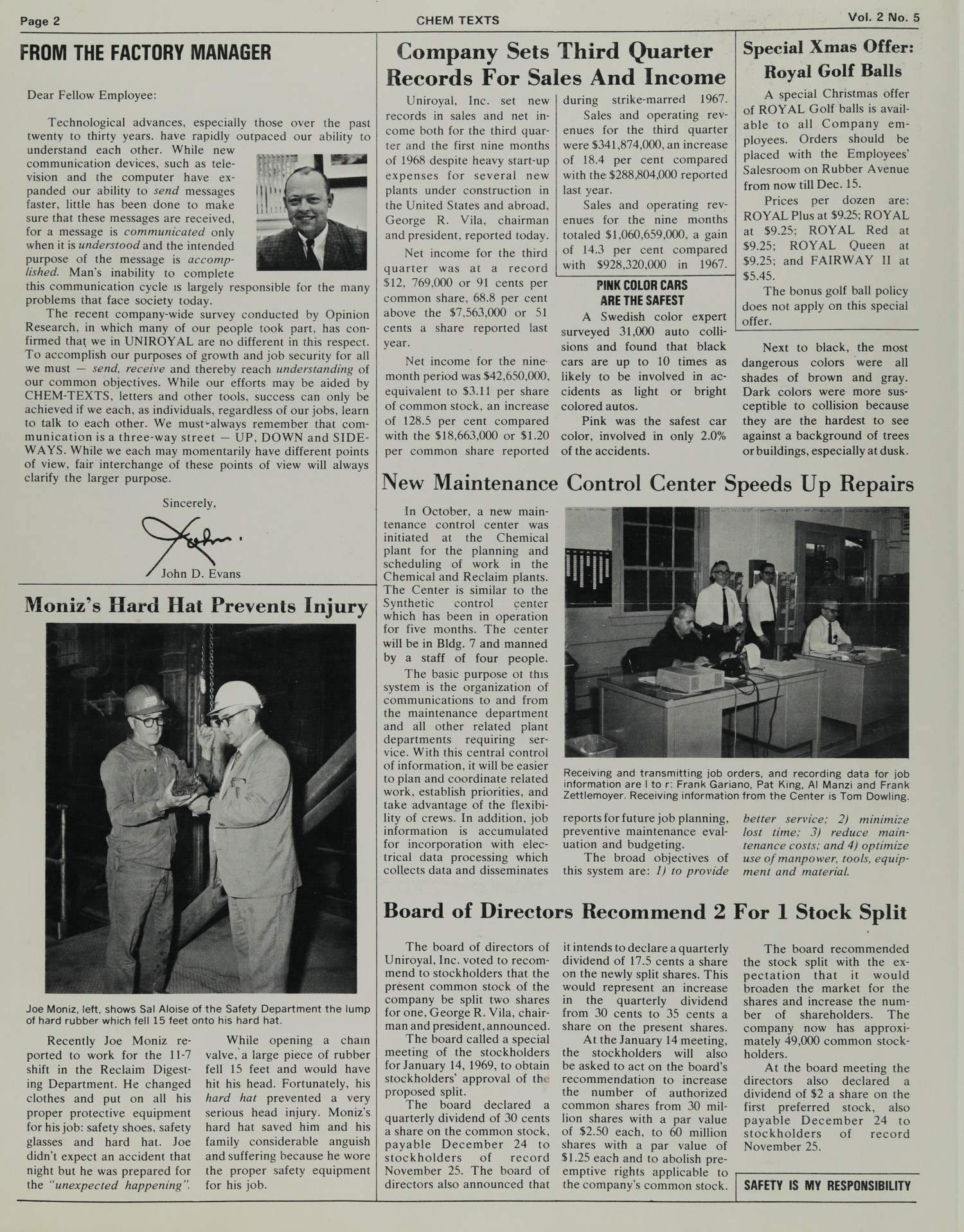
Joe Moniz, left, shows Sal Aloise of the Safety Department the lump of hard rubber which fell 15 feet onto his hard hat.

Recently Joe Moniz reported to work for the 11-7 shift in the Reclaim Digesting Department. He changed clothes and put on all his proper protective equipment for his job: safety shoes, safety glasses and hard hat. Joe didn’t expect an accident that night but he was prepared for the “unexpected happening”.

While opening a chain valve, a large piece of rubber fell 15 feet and would have hit his head. Fortunately, his hard hat prevented a very serious head injury. Moniz’s hard hat saved him and his family considerable anguish and suffering because he wore the proper safety equipment for his job.


Company Sets Third Quarter Records For Sales And Income

Uniroyal, Inc. set new records in sales and net income both for the third quarter and the first nine months of 1968 despite heavy start-up expenses for several new plants under construction in the United States and abroad, George R. Vila, chairman and president, reported today.

Net income for the third quarter was at a record $12, 769,000 or 91 cents per common share, 68.8 per cent above the $7,563,000 or 51 cents a share reported last year.

Net income for the nine-month period was $42,650,000, equivalent to $3.11 per share of common stock, an increase of 128.5 per cent compared with the $18,663,000 or $1.20 per common share reported during strike-marred 1967.

Sales and operating revenues for the third quarter were $341,874,000, an increase of 18.4 per cent compared with the $288,804,000 reported last year.

Sales and operating revenues for the nine months totaled $1,060,659,000, a gain of 14.3 per cent compared with $928,320,000 in 1967.


PINK COLOR CARS ARE THE SAFEST

A Swedish color expert surveyed 31,000 auto collisions and found that black cars are up to 10 times as likely to be involved in accidents as light or bright colored autos.

Pink was the safest car color, involved in only 2.0% of the accidents.


Special Xmas Offer: Royal Golf Balls

A special Christmas offer of ROYAL Golf balls is available to all Company employees. Orders should be placed with the Employees’ Salesroom on Rubber Avenue from now till Dec. 15.

Prices per dozen are: ROYAL Plus at $9.25; ROYAL at $9.25; ROYAL Red at $9.25; ROYAL Queen at $9.25; and FAIRWAY II at $5.45.

The bonus golf ball policy does not apply on this special offer.

Next to black, the most dangerous colors were all shades of brown and gray. Dark colors were more susceptible to collision because they are the hardest to see against a background of trees or buildings, especially at dusk.


New Maintenance Control Center Speeds Up Repairs

In October, a new maintenance control center was initiated at the Chemical plant for the planning and scheduling of work in the Chemical and Reclaim plants. The Center is similar to the Synthetic control center which has been in operation for five months. The center will be in Bldg. 7 and manned by a staff of four people.

The basic purpose of this system is the organization of communications to and from the maintenance department and all other related plant departments requiring service. With this central control of information, it will be easier to plan and coordinate related work, establish priorities, and take advantage of the flexibility of crews. In addition, job information is accumulated for incorporation with electrical data processing which collects data and disseminates

[IMAGE: Photo of four men at control center]

Receiving and transmitting job orders, and recording data for job information are l to r: Frank Gariano, Pat King, Al Manzi and Frank Zettlemoyer. Receiving information from the Center is Tom Dowling.

reports for future job planning, preventive maintenance evaluation and budgeting.

The broad objectives of this system are: 1) to provide

better service; 2) minimize lost time; 3) reduce maintenance costs; and 4) optimize use of manpower, tools, equipment and material.


Board of Directors Recommend 2 For 1 Stock Split

The board of directors of Uniroyal, Inc. voted to recommend to stockholders that the present common stock of the company be split two shares for one, George R. Vila, chairman and president, announced.

The board called a special meeting of the stockholders for January 14, 1969, to obtain stockholders’ approval of the proposed split.

The board declared a quarterly dividend of 30 cents a share on the common stock, payable December 24 to stockholders of record November 25. The board of directors also announced that

it intends to declare a quarterly dividend of 17.5 cents a share on the newly split shares. This would represent an increase in the quarterly dividend from 30 cents to 35 cents a share on the present shares.

At the January 14 meeting, the stockholders will also be asked to act on the board’s recommendation to increase the number of authorized common shares from 30 million shares with a par value of $2.50 each, to 60 million shares with a par value of $1.25 each and to abolish preemptive rights applicable to the company’s common stock.

The board recommended the stock split with the expectation that it would broaden the market for the shares and increase the number of shareholders. The company now has approximately 49,000 common stockholders.

At the board meeting the directors also declared a dividend of $2 a share on the first preferred stock, also payable December 24 to stockholders of record November 25.


SAFETY IS MY RESPONSIBILITY

US Rubber Proxy Statement – Page 6

Page 006

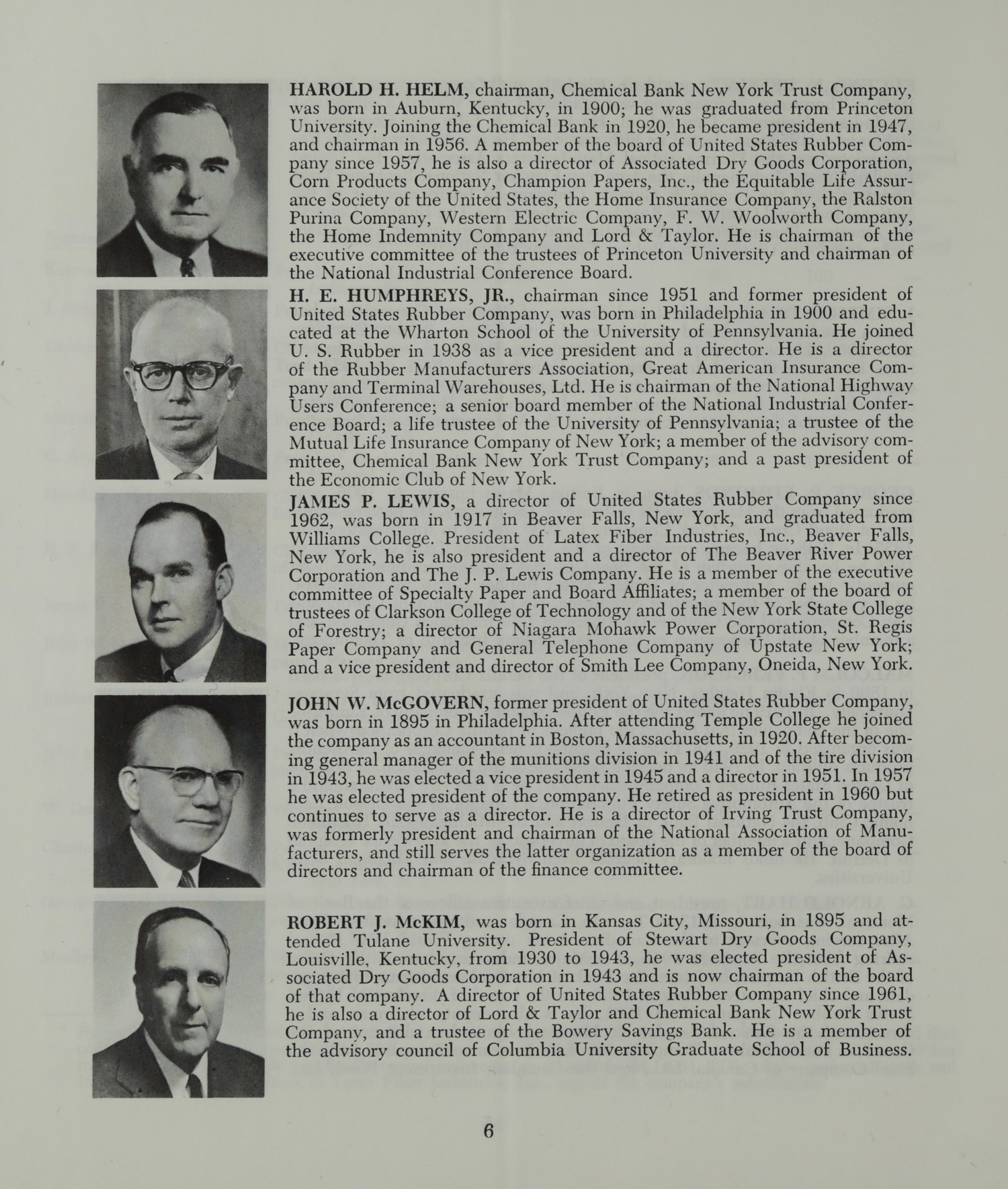
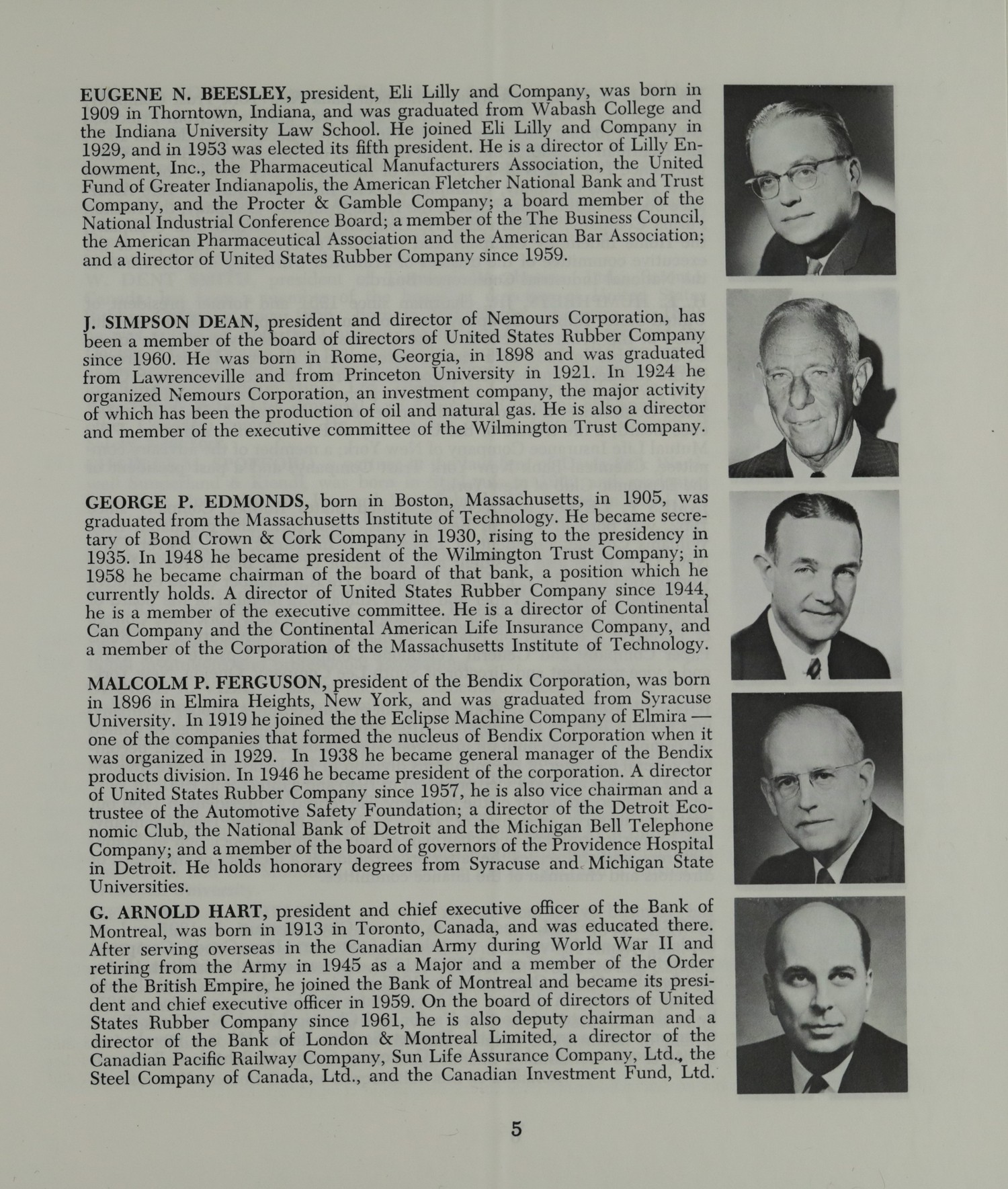
HAROLD H. HELM, chairman, Chemical Bank New York Trust Company, was born in Auburn, Kentucky, in 1900; he was graduated from Princeton University. Joining the Chemical Bank in 1920, he became president in 1947, and chairman in 1956. A member of the board of United States Rubber Company since 1957, he is also a director of Associated Dry Goods Corporation, Champion Papers, Inc., the Equitable Life Assurance Society of the United States, the Home Insurance Company, the Ralston Purina Company, Western Electric Company, F. W. Woolworth Company, the Home Indemnity Company and Lord & Taylor. He is chairman of the executive committee of the trustees of Princeton University and chairman of the National Industrial Conference Board.

H. E. HUMPHREYS, JR., chairman since 1951 and former president of United States Rubber Company, was born in Philadelphia in 1900 and educated at the Wharton School of the University of Pennsylvania. He joined U. S. Rubber in 1935 as a vice president and a director. He is a director of the Rubber Manufacturers Association, Great American Insurance Company and Terminal Warehouses, Ltd. He is chairman of the National Highway Users Conference; a senior board member of the National Industrial Conference Board; a life trustee of the University of Pennsylvania; a trustee of the Mutual Life Insurance Company of New York; a member of the advisory committee, Chemical Bank New York Trust Company; and a past president of the Economic Club of New York.

JAMES P. LEWIS, a director of United States Rubber Company since 1962, was born in 1917 in Beaver Falls, New York, and graduated from Williams College. President of Latex Fiber Industries, Inc., Beaver Falls, New York, he is also president and a director of The Beaver River Power Corporation and The J. P. Lewis Company. He is a member of the executive committee of Specialty Paper and Board Affiliates; a member of the board of trustees of Clarkson College of Technology and of Forestry; a director of Niagara Mohawk Power Corporation, St. Regis Paper Company and General Telephone Company of Upstate New York; and a vice president and director of Smith Lee Company, Oneida, New York.

JOHN W. McGOVERN, former president of United States Rubber Company, was born in 1895 in Philadelphia. After attending Temple College he joined the company as an accountant in Boston, Massachusetts, in 1920. After becoming general manager of the munitions division in 1941 and of the tire division in 1943, he was elected a vice president in 1945 and a director in 1951. In 1957 he was elected president of the company. He retired as president in 1960 but continues to serve as a director. He is a director of Irving Trust Company, was formerly president and chairman of the National Association of Manufacturers, and still serves the latter organization as a member of the board of directors and chairman of the finance committee.

ROBERT J. McKIM, was born in Kansas City, Missouri, in 1895 and attended Tulane University. President of Stewart Dry Goods Company, Louisville, Kentucky, from 1930 to 1943, he was elected president of Associated Dry Goods Corporation in 1943 and is now chairman of the board of that company. A director of United States Rubber Company since 1961, he is also a director of Lord & Taylor and Chemical Bank New York Trust Company, and a trustee of the Savings Bank. He is a member of the advisory council of the Columbia University Graduate School of Business.

US Rubber Proxy Statement – Page Exhibit A

Page exhibit-a

UNITED STATES RUBBER COMPANY
1964 STOCK OPTION PLAN

I. Purpose of Plan
The purpose of this Plan is to provide for the granting of stock options as a means of attracting to the Company and retaining in its service persons of outstanding ability and potential and of encouraging such persons to invest in the common stock of the Company and to identify their interests more closely with those of the stockholders.

II. Eligibility for Options
A. A stock option may be granted under this Plan to an employee occupying an important managerial position, or other position of importance and responsibility, who has demonstrated unusual ability or initiative, and who, by discharging his responsibilities in an outstanding manner, can make a significant contribution to the success of the Company.
B. As used in this Plan, the term “employee” shall mean a person who is an officer or an employee of the Company or of any other corporation in which the Company owns 50% or more of the voting stock.
C. Unless he is also an employee as defined in Section B of this Article II, no member of the Board of Directors shall be eligible to receive a stock option under this Plan.
D. An employee may be granted a stock option under this Plan notwithstanding the fact that he may be a participant, and may have been granted one or more stock options, under any other plan or plans of the Company; and more than one stock option may be granted under this Plan to a single employee.

III. Administration of Plan
A. This Plan shall be administered by the Board of Directors, and the granting of all stock options hereunder shall be by action of a majority of the members of said Board not eligible to receive such options.
B. A committee, appointed by the Board of Directors and composed of directors not eligible to receive stock options under this Plan, may from time to time make recommendations to said Board with respect to the granting of options hereunder.
C. Any action taken by the Board of Directors in the administration of this Plan, and any decision of said Board with respect to any question arising as to the interpretation of this Plan or of the terms and conditions applicable to any stock option granted hereunder, shall be final, conclusive and binding. Without limiting the effect of the foregoing, the provisions of this Plan shall be construed in accordance with the laws of the State of New Jersey.

US Rubber Proxy Statement – Page 7

Page 007

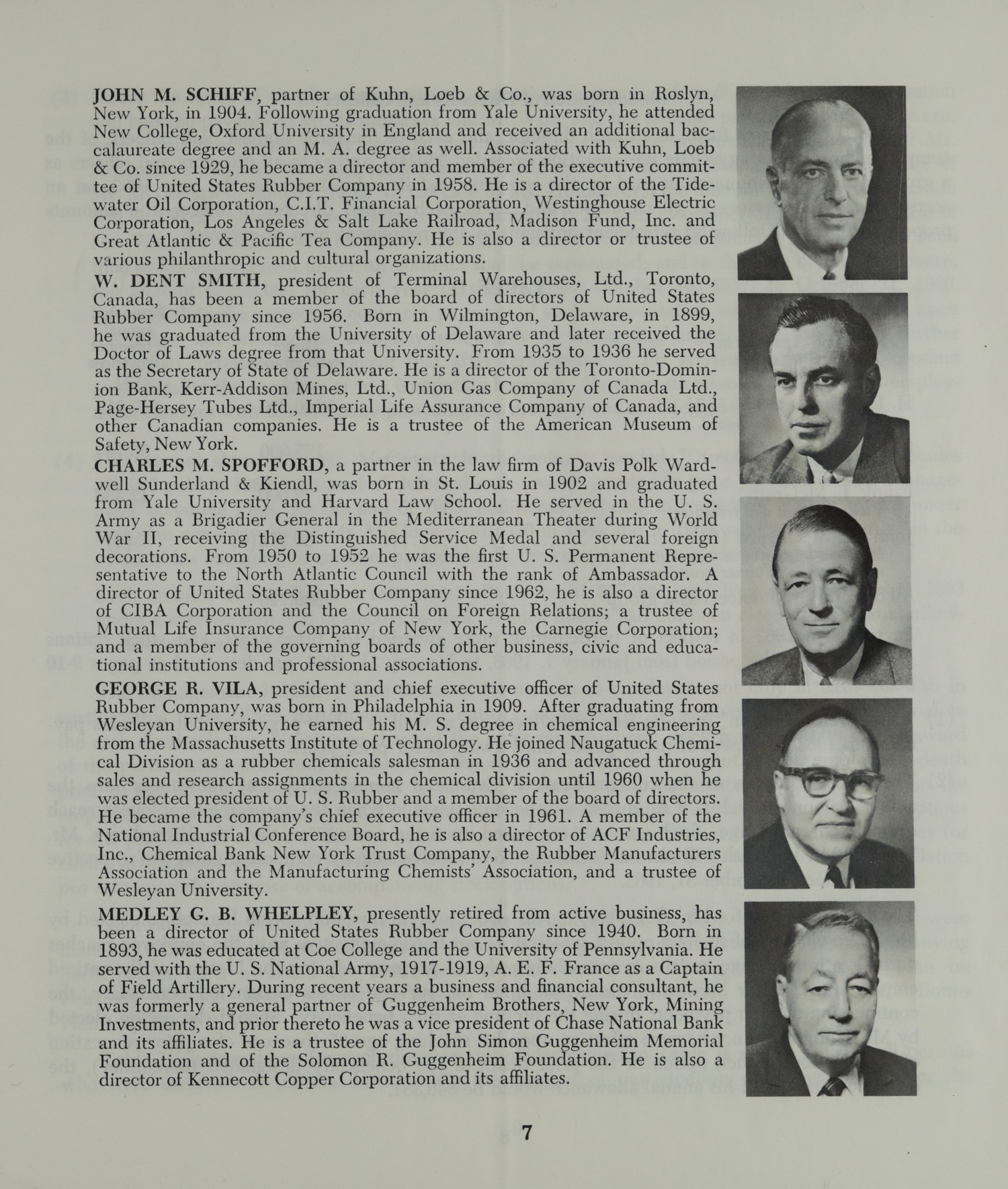
JOHN M. SCHIFF, partner of Kuhn, Loeb & Co., was born in Roslyn, New York, in 1904. Following graduation from Yale University, he attended New College, Oxford University in England and received an additional bac-
calaurcatc degree and an M.A. degree as well. Associated with Kuhn, Loeb
& Co. since 1929, he became a director and member of the executive commit-
tee of United States Rubber Company in 1958. He is a director of the Tide-
water Oil Corporation, C.I.T. Financial Corporation, Westinghouse Electric
Corporation, Los Angeles & Salt Lake Railroad, Madison Fund, Inc. and
Great Atlantic & Pacific Tea Company. He is also a director or trustee of
various philanthropic and cultural organizations.
W. DENT SMITH, president of Terminal Warehouses, Ltd., Toronto,
Canada, has been a member of the board of directors of United States
Rubber Company since 1956. Born in Wilmington, Delaware, in 1899,
he was graduated from the University of Delaware and later received the
Doctor of Laws degree from that University. From 1935 to 1936 he served
as the Secretary of State of Delaware. He is a director of the Toronto-Domin-
ion Bank, Kerr-Addison Mines, Ltd., Union Gas Company of Canada Ltd.,
Page-Hersey Tubes Ltd., Imperial Life Assurance Company of Canada, and
other Canadian companies. He is a trustee of the American Museum of
Safety, New York.
CHARLES M. SPOFFORD, a partner in the law firm of Davis Polk Ward-
well Sunderland & Kiendl, was born in St. Louis in 1902 and graduated
from Yale University and Harvard Law School. He served in the U. S.
Army as a Brigadier General in the Mediterranean Theater during World
War II, receiving the Distinguished Service Medal and several foreign
decorations. From 1950 to 1952 he was the first U. S Permanent Repre-
sentative to the North Atlantic Council with the rank of Ambassador. A
director of United States Rubber Company since 1962, he is also a director
of CIBÄ Corporation and the Council on Foreign Relations; a trustee of
Mutual Life Insurance Company of New York, the Carnegie Corporation;
and a member of the governing boards of other business, civic and educa-
tional institutions and professional associations.
GEORGE R. VILA, president and chief executive officer of United States
Rubber Company, was born in Philadelphia in 1909. After graduating from
Wesleyan University, he earned his M. S. degree in chemical engineering
from the Massachusetts Institute of Technology. He joined Naugatuck Chemi-
cal Division as a rubber chemicals salesman in 1936 and advanced through
sales and research assignments in the chemical division until 1960 when he
was elected president of U. S. Rubber and a member of the board of directors.
He became the company’s chief executive officer in 1961. A member of the
National Industrial Conference Board, he is also a director of ACF Industries,
Inc., Chemical Bank New York Trust Company, the Rubber Manufacturers
Association and the Manufacturing Chemists Association, and a trustee of
Wesleyan University.
MEDLEY G. B. WHELPLEY, presently retired from active business, has
been a director of United States Rubber Company since 1940. Born in
1893, he was educated at Coe College and the University of Pennsylvania. He
served with the U. S. National Army, 1917-1919, A. E. F. France as a Captain
of Field Artillery. During recent years a business and financial consultant, he
was formerly a general partner of Guggenheim Brothers, New York, Mining
Investments, and prior thereto he was a vice president of Chase National Bank
and its affiliates. He is a trustee of the John Simon Guggenheim Memorial
Foundation and of the Solomon R. Guggenheim Foundation. He is also a
director of Kennecott Copper Corporation and its affiliates.

US Rubber Proxy Statement – Page 8

Page 008

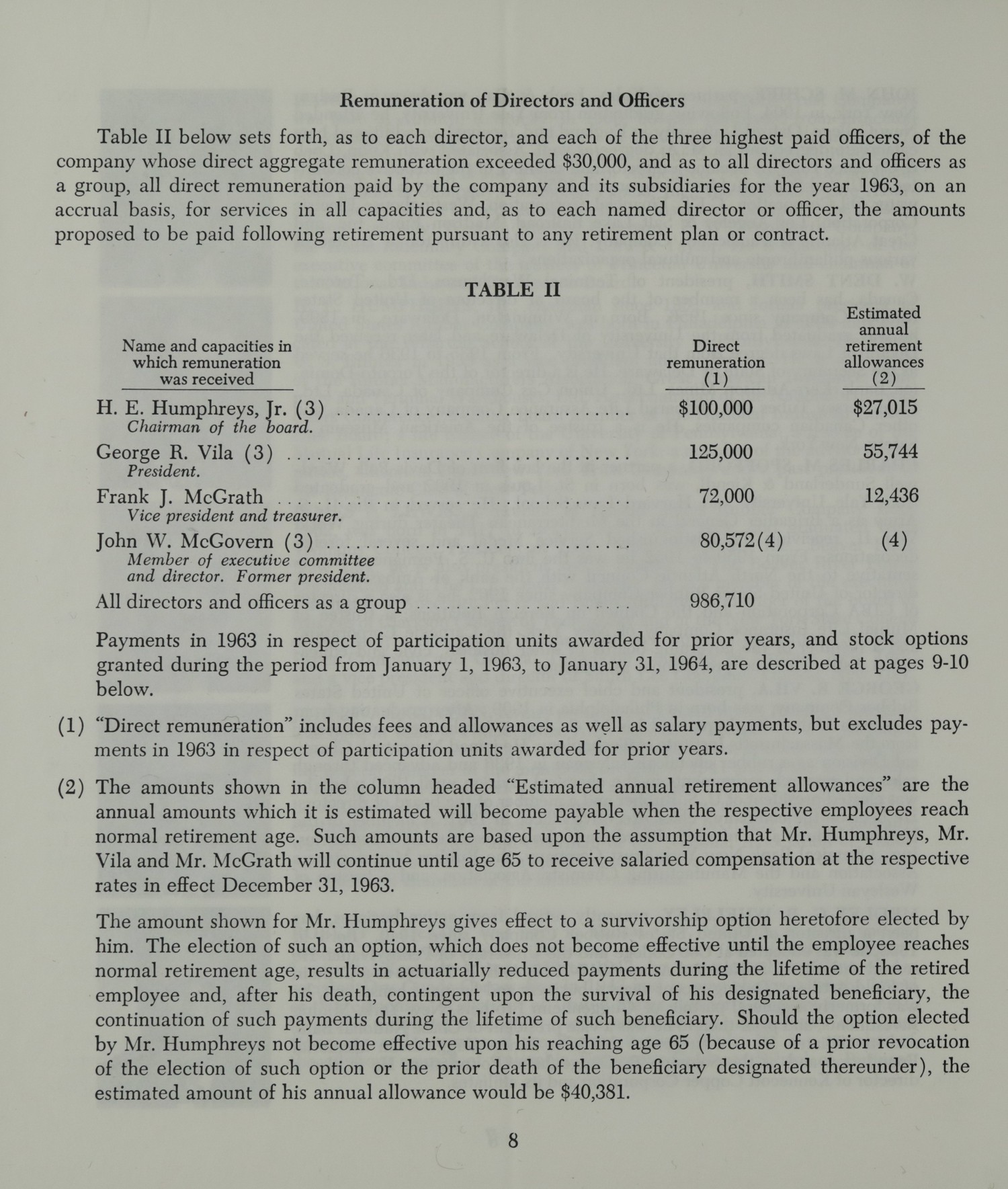
Remuneration of Directors and Officers

Table II below sets forth, as to each director, and each of the three highest paid officers, of the company whose direct aggregate remuneration exceeded $30,000, and as to all directors and officers as a group, all direct remuneration paid by the company and its subsidiaries for the year 1963, on an accrual basis, for services in all capacities and, as to each named director or officer, the amounts proposed to be paid following retirement pursuant to any retirement plan or contract.

TABLE II
Estimated
Name and capacities in Direct annual
which remuneration remuneration retirement
was received (1) allowances (2)
H. E. Humphreys, Jr. (3) $100,000 $27,015
Chairman of the board.
George R. Vila (3) 125,000 55,744
President.
Frank J. McGrath 72,000 12,436
Vice president and treasurer.
John W. McGovern (3) 80,572(4) (4)
Member of executive committee
and director. Former president.
All directors and officers as a group 986,710

Payments in 1963 in respect of participation units awarded for prior years, and stock options granted during the period from January 1, 1963, to January 31, 1964, are described at pages 9-10 below.

(1) “Direct remuneration” includes fees and allowances as well as salary payments, but excludes payments in 1963 in respect of participation units awarded for prior years.

(2) The amounts shown in the column headed “Estimated annual retirement allowances” are the annual amounts which it is estimated will become payable when the respective employees reach normal retirement age. Such amounts are based upon the assumption that Mr. Humphreys, Mr. Vila and Mr. McGrath will continue until age 65 to receive salaries compensation at the respective rates in effect December 31, 1963.

The amount shown for Mr. Humphreys gives effect to a survivorship option heretofore elected by him. The election of such an option, which does not become effective until the employee reaches normal retirement age, results in actuarially reduced payments during the lifetime of the retired employee and, after his death, contingent upon the survival of his designated beneficiary, the continuation of such payments during the lifetime of such beneficiary. Should the option elected by Mr. Humphreys not become effective upon his reaching age 65 (because of a prior revocation of the election of such option or the prior death of the beneficiary designated thereunder), the estimated amount of his annual allowance would be $40,331.

US Rubber Proxy Statement – Page 9

Page 009

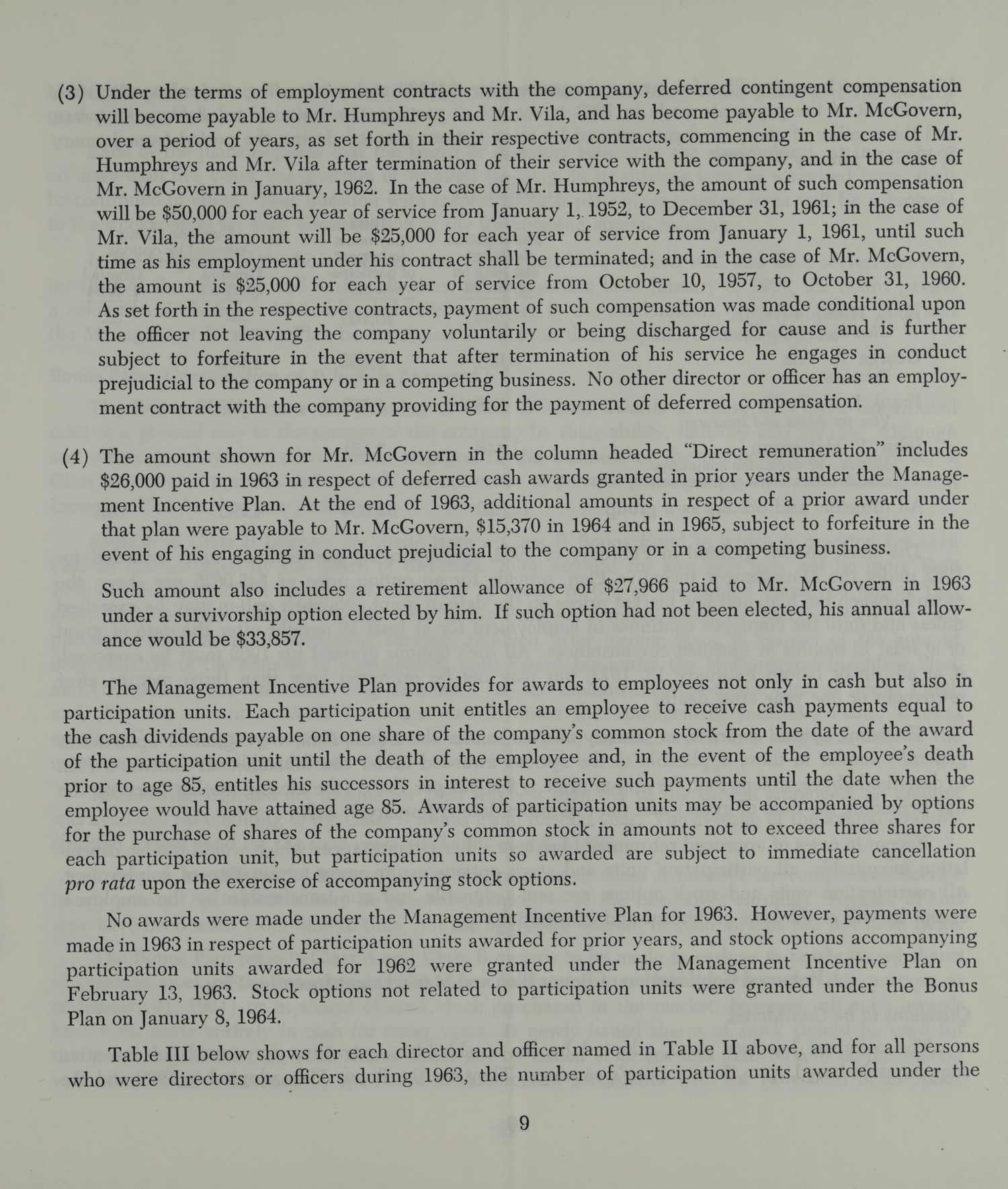
(3) Under the terms of employment contracts with the company, deferred contingent compensation will become payable to Mr. Humphreys and Mr. Vila, and has become payable to Mr. McGovern, over a period of years, as set forth in their respective contracts, commencing in the case of Mr. Humphreys and Mr. Vila after termination of their service with the company, and in the case of Mr. McGovern in January, 1962. In the case of Mr. Humphreys, the amount of such compensation will be $50,000 for each year of service from January 1, 1952, to December 31, 1961; in the case of Mr. Vila, the amount will be $25,000 for each year of service from January 1, 1961, until such time as his employment under his contract shall be terminated; and in the case of Mr. McGovern, the amount is $25,000 for each year of service from October 10, 1957, to October 31, 1960. As set forth in the respective contracts, payment of such compensation was made conditional upon the officer not leaving the company voluntarily or being discharged for cause and is further subject to forfeiture in the event that after termination of his service he engages in conduct prejudicial to the company or in a competing business. No other director or officer has an employment contract with the company providing for the payment of deferred compensation.

(4) The amount shown for Mr. McGovern in the column headed “Direct remuneration” includes $26,000 paid in 1963 in respect of deferred cash awards granted in prior years under the Management Incentive Plan. At the end of 1963, additional amounts in respect of a prior award under that plan were payable to Mr. McGovern, $15,370 in 1964 and in 1965, subject to forfeiture in the event of his engaging in conduct prejudicial to the company or in a competing business.

Such amount also includes a retirement allowance of $27,966 paid to Mr. McGovern in 1963 under a survivorship option elected by him. If such option had not been elected, his annual allowance would be $33,857.

The Management Incentive Plan provides for awards to employees not only in cash but also in participation units. Each participation unit entitles an employee to receive cash payments equal to the cash dividends payable on one share of the company’s common stock from the date of the award of the participation unit until the death of the employee and, in the event of the employee’s death prior to age 65, entitles his successors in interest to receive such payments until the date when the employee would have attained age 65. Awards of participation units may be accompanied by options for the purchase of shares of the company’s common stock in amounts not to exceed three shares for each participation unit, but participation units so awarded are subject to immediate cancellation pro rata upon the exercise of accompanying stock options.

No awards were made under the Management Incentive Plan for 1963. However, payments were made in 1963 in respect of participation units awarded for prior years, and stock options accompanying participation units awarded for 1962 were granted under the Management Incentive Plan on February 13, 1963. Stock options not related to participation units were granted under the Bonus Plan on January 8, 1964.

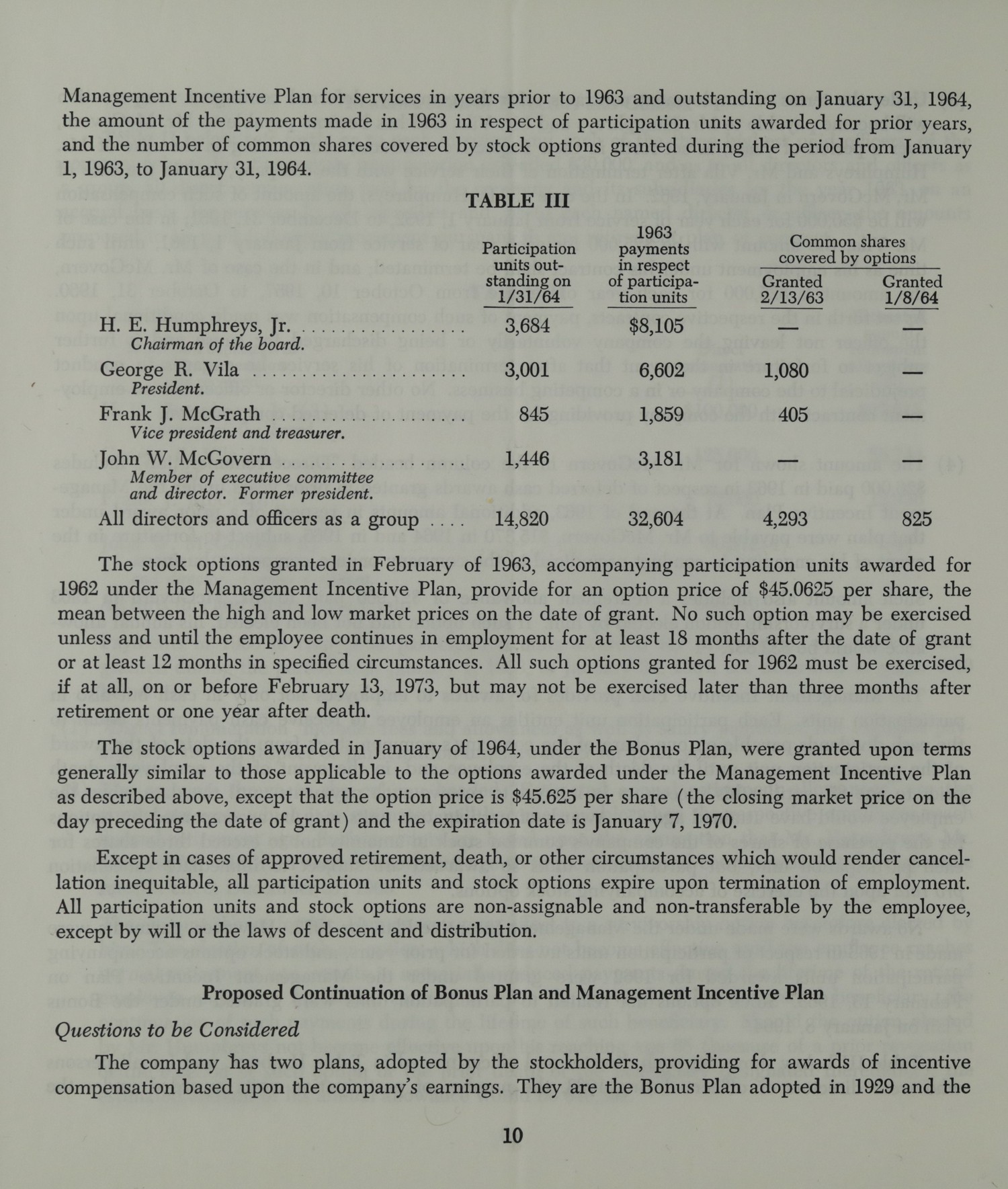
Table III below shows for each director and officer named in Table II above, and for all persons who were directors or officers during 1963, the number of participation units awarded under the Management Incentive Plan.

US Rubber Proxy Statement – Page 10

Page 010

Management Incentive Plan for services in years prior to 1963 and outstanding on January 31, 1964, the amount of the payments made in 1963 in respect of participation units awarded for prior years, and the number of common shares covered by stock options granted during the period from January 1, 1963, to January 31, 1964.

TABLE III

Participation 1963 Common shares
units out- payments covered by options
standing on in respect Granted Granted
1/31/64 of participa- 2/13/63 1/8/64
tion units

H. E. Humphreys, Jr. . . . . . . . . . . . . . . . 3,684 $8,105 – –
Chairman of the board.
George R. Vila . . . . . . . . . . . . . . . . . . . . 3,001 6,602 1,080 –
President.
Frank J. McGrath . . . . . . . . . . . . . . . . . 845 1,859 405 –
Vice president and treasurer.
John W. McGovern . . . . . . . . . . . . . . . . 1,446 3,181 – –
Member of executive committee
and director. Former president.
All directors and officers as a group . . . 14,820 32,604 4,293 825

The stock options granted in February of 1963, accompanying participation units awarded for 1962 under the Management Incentive Plan, provide for an option price of $45.0625 per share, the mean between the high and low market prices on the date of grant. No such option may be exercised unless and until the employee continues in employment for at least 18 months after the date of grant or at least 12 months in specified circumstances. All such options granted for 1962 must be exercised, if at all, on or before February 13, 1973, but may not be exercised later than three months after retirement or one year after death.

The stock options awarded in January of 1964, under the Bonus Plan, were granted upon terms generally similar to those applicable to the options awarded under the Management Incentive Plan as described above, except that the option price is $45.625 per share (the closing market price on the day preceding the date of grant) and the expiration date is January 7, 1970.

Except in cases of approved retirement, death, or other circumstances which would render cancellation inequitable, all participation units and stock options expire upon termination of employment. All participation units and stock options are non-assignable and non-transferable by the employee, except by will or the laws of descent and distribution.

Proposed Continuation of Bonus Plan and Management Incentive Plan

Questions to be Considered

The company has two plans, adopted by the stockholders, providing for awards of incentive compensation based upon the company’s earnings. They are the Bonus Plan adopted in 1929 and the 10

US Rubber Proxy Statement – Page 11

Page 011

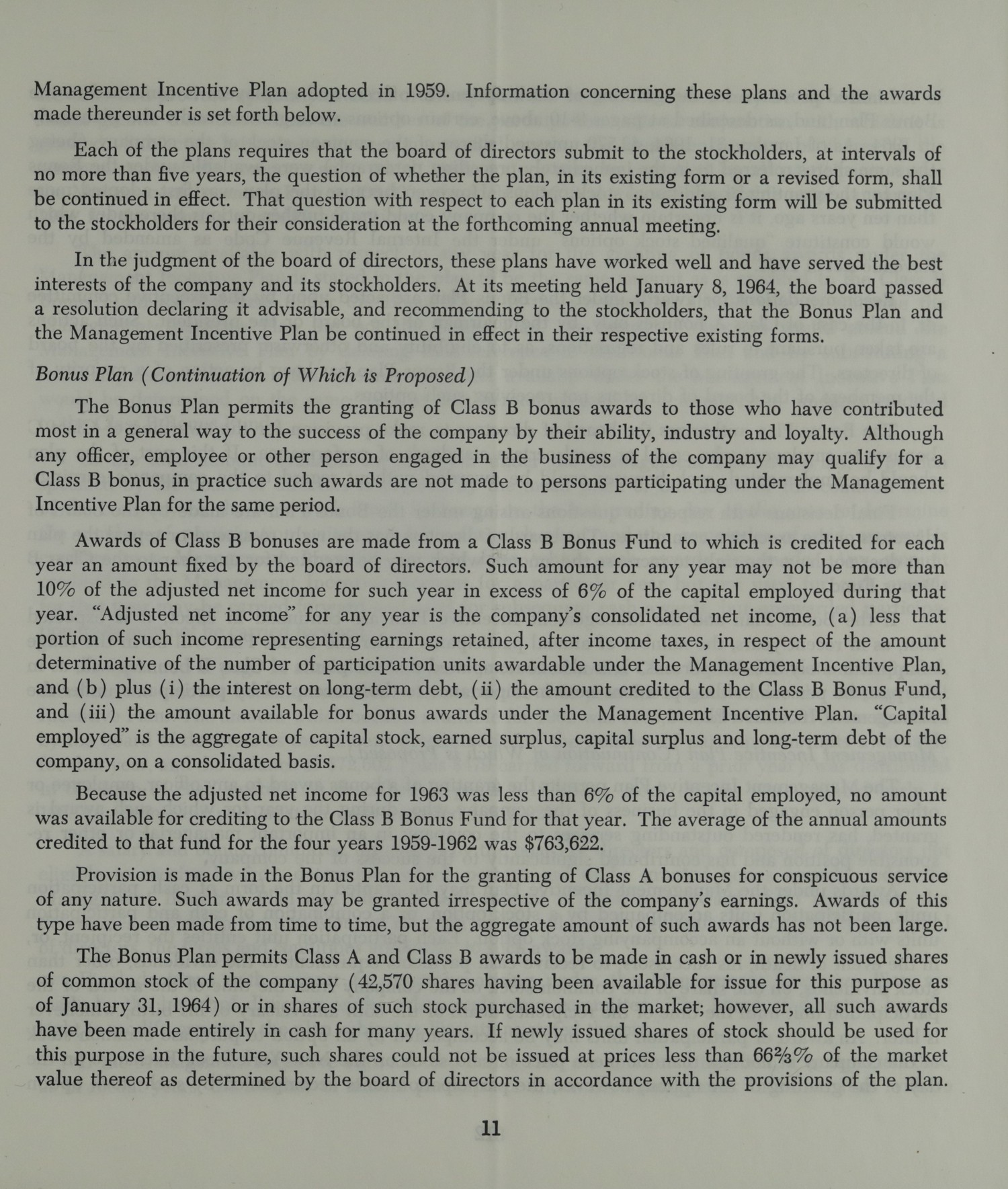
Management Incentive Plan adopted in 1959. Information concerning these plans and the awards made thereunder is set forth below.

Each of the plans requires that the board of directors submit to the stockholders, at intervals of no more than five years, the question of whether the plan, in its existing form or a revised form, shall be continued in effect. That question with respect to each plan in its existing form will be submitted to the stockholders for their consideration at the forthcoming annual meeting.

In the judgment of the board of directors, these plans have worked well and have served the best interests of the company and its stockholders. At its meeting held January 8, 1964, the board passed a resolution declaring it advisable, and recommending to the stockholders, that the Bonus Plan and the Management Incentive Plan be continued in effect in their respective existing forms.

Bonus Plan (Continuation of Which is Proposed)
The Bonus Plan permits the granting of Class B bonus awards to those who have contributed most in a general way to the success of the company by their ability, industry and loyalty. Although any officer, employee or other person engaged in the business of the company may qualify for a Class B bonus, in practice such awards are not made to persons participating under the Management Incentive Plan for the same period.

Awards of Class B bonuses are made from a Class B Bonus Fund to which is credited for each year an amount fixed by the board of directors. Such amount for any year may not be more than 10% of the adjusted net income for such year in excess of 6% of the capital employed during that year. “Adjusted net income” for any year is the company’s consolidated net income, (a) less that portion of such income representing earnings retained, after income taxes, in respect of the amount determinative of the number of participation units awardable under the Management Incentive Plan, and (b) plus (i) the interest on long-term debt, (ii) the amount credited to the Class B Bonus Fund, and (iii) the amount available for bonus awards under the Management Incentive Plan. “Capital employed” is the aggregate of capital stock, earned surplus, capital surplus and long-term debt of the company, on a consolidated basis.

Because the adjusted net income for 1963 was less than 6% of the capital employed, no amount was available for crediting to the Class B Bonus Fund for that year. The average of the annual amounts credited to that fund for the four years 1959-1962 was $763,622.

Provision is made in the Bonus Plan for the granting of Class A bonuses for conspicuous service of any nature. Such awards may be granted irrespective of the company’s earnings. Awards of this type have been made from time to time, but the aggregate amount of such awards has not been large.

The Bonus Plan permits Class A and Class B awards to be made in cash or in newly issued shares of common stock of the company (42,570 shares having been available for issue for this purpose as of January 31, 1964) or in shares of such stock purchased in the market; however, all such awards have been made entirely in cash for many years. If newly issued shares of stock should be used for this purpose in the future, such shares could not be issued at prices less than 66-2/3% of the market value thereof as determined by the board of directors in accordance with the provisions of the plan.

US Rubber Proxy Statement – Page 12

Page 012

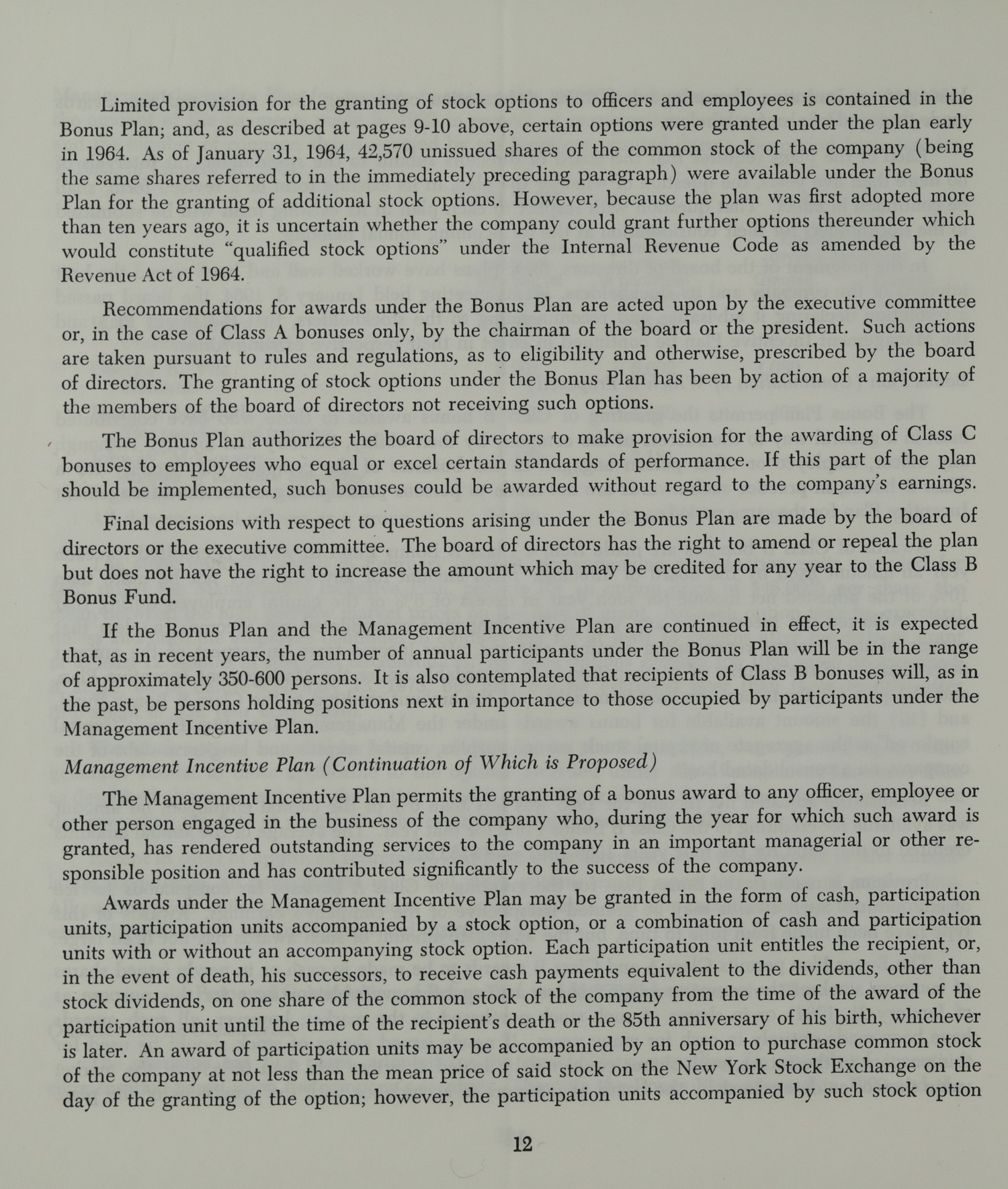
Limited provision for the granting of stock options to officers and employees is contained in the Bonus Plan; and, as described at pages 9-10 above, certain options were granted under the plan early in 1964. As of January 31, 1964, 42,570 unissued shares of the common stock of the company (being the same shares referred to in the immediately preceding paragraph) were available under the Bonus Plan for the granting of additional stock options. However, because the plan was first adopted more than ten years ago, it is uncertain whether the company could grant further options thereunder which would constitute “qualified stock options” under the Internal Revenue Code as amended by the Revenue Act of 1964.

Recommendations for awards under the Bonus Plan are acted upon by the executive committee or, in the case of Class A bonuses only, by the chairman of the board or the president. Such actions are taken pursuant to rules and regulations, as to eligibility and otherwise, prescribed by the board of directors. The granting of stock options under the Bonus Plan has been by action of a majority of the members of the board of directors not receiving such options.

The Bonus Plan authorizes the board of directors to make provision for the awarding of Class C bonuses to employees who equal or excel certain standards of performance. If this part of the plan should be implemented, such bonuses could be awarded without regard to the company’s earnings.

Final decisions with respect to questions arising under the Bonus Plan are made by the board of directors or the executive committee. The board of directors has the right to amend or repeal the plan but does not have the right to increase the amount which may be credited for any year to the Class B Bonus Fund.

If the Bonus Plan and the Management Incentive Plan are continued in effect, it is expected that, as in recent years, the number of annual participants under the Bonus Plan will be in the range of approximately 350-600 persons. It is also contemplated that recipients of Class B bonuses will, as in the past, be persons holding positions next in importance to those occupied by participants under the Management Incentive Plan.

Management Incentive Plan (Continuation of Which is Proposed)
The Management Incentive Plan permits the granting of a bonus award to any officer, employee or other person engaged in the business of the company who, during the year for which such award is granted, has rendered outstanding services to the company in an important managerial or other responsible position and has contributed significantly to the success of the company.

Awards under the Management Incentive Plan may be granted in the form of cash, participation units, participation units accompanied by a stock option, or a combination of cash and participation units with or without an accompanying stock option. Each participation unit entitles the recipient, or, in the event of death, his successors, to receive cash payments equivalent to the dividends, other than stock dividends, on one share of the common stock of the company from the time of the award of the participation unit until the time of the recipient’s death or the 85th anniversary of his birth, whichever is later. An award of participation units may be accompanied by an option to purchase common stock of the company at not less than the mean price of said stock on the New York Stock Exchange on the day of the granting of the option; however, the participation units accompanied by such stock option

US Rubber Proxy Statement – Page 13

Page 013

are cancelled pro rata upon any exercise of the option. No such stock option may be for a number of shares greater than three times the number of the participation units in conjunction with which it is granted. Subject to adjustment in certain specified events, the maximum number of shares of the common stock of the company as to which stock options may be exercised by all participants under the Management Incentive Plan is 200,000, of which 153,029 shares were available as of January 31, 1964, for the granting of additional options.

The amount available with respect to any year for the granting of bonus awards under the Management Incentive Plan is stated in the plan to be the same amount as is credited to the Class B Bonus Fund for that year under the Bonus Plan. If the stockholders should vote to continue the Management Incentive Plan but not the Bonus Plan, the board of directors would amend the Management Incentive Plan by deleting that reference to the Bonus Plan and by substituting a formula pursuant to which the amounts thereafter available under the Management Incentive Plan would be determined on the same basis as that heretofore used to determine the amounts credited to the Class B Bonus Fund.

Of the total amount available for any year under the Management Incentive Plan, a portion specified by the board of directors is divided by the mean price of one share of the common stock of the company on the New York Stock Exchange on the last trading day of the year to determine the number of participation units awardable for such year, and the remainder of said amount is credited to a Management Incentive Account from which cash awards are made. Any amount credited to the Management Incentive Account for a particular year but not used for cash awards for that year may be carried forward and used for subsequent cash awards, but unawarded participation units may not be carried forward.

As explained at page 11 above, no amount was credited to the Class B Bonus Fund for 1963, and, therefore, no amount became available with respect to that year for awards under the Management Incentive Plan. The amount which became available for 1962 was $145,204, of which 50% was specified by the board of directors as the amount determinative of the number of participation units awardable for that year, and the balance of $72,602 (plus $479 carried forward from a prior year) was distributed in the form of cash awards. As described at pages 9-10 above, stock options were granted early in 1963 to accompany participation units awarded for 1962.

A salary and bonus committee, appointed by the board of directors and composed of directors not eligible to receive awards, determines which persons are to be granted bonus awards under the Management Incentive Plan and the type and amount of each such award. Said committee also determines, subject to the provisions of the plan and of rules and regulations prescribed by the board of directors, the terms and conditions applicable to such awards.

Final decisions with respect to questions arising under the Management Incentive Plan are made by the board of directors or the salary and bonus committee. The board of directors has the right to modify or repeal the plan subject to limitations stated therein.

If the Management Incentive Plan and the Bonus Plan are continued in effect, it is expected that, as in recent years, the number of annual participants under the Management Incentive Plan will be substantially the same as the number of annual participants under the Bonus Plan.

US Rubber Proxy Statement – Page 14

Page 014

in the range of approximately 35-70 persons. It is also contemplated that such participants will, as in the past, be persons holding key positions. Such persons, it is anticipated, will include Mr. George R. Vila, president, and Mr. Frank J. McGrath, vice president and treasurer, and about ten other officers of the company.

Amounts Distributed Under the Plans January 1, 1959, to January 31, 1964
No Class B bonuses were awarded under the Bonus Plan for 1963. Class A bonuses, which are granted for conspicuous service without regard to the company’s earnings, were awarded in 1963 to several employees, none of whom was a director or officer, in the aggregate amount of $108,522. No stock options were granted under the Bonus Plan during 1963.

The only amounts distributed under the Management Incentive Plan for 1963 (except for install-ments paid on account of deferred cash awards previously granted) were the payments, aggregating $55,169, made in respect of participation units awarded for prior years. Information with respect to such payments made in 1963 to directors and officers is set forth in Table III above.

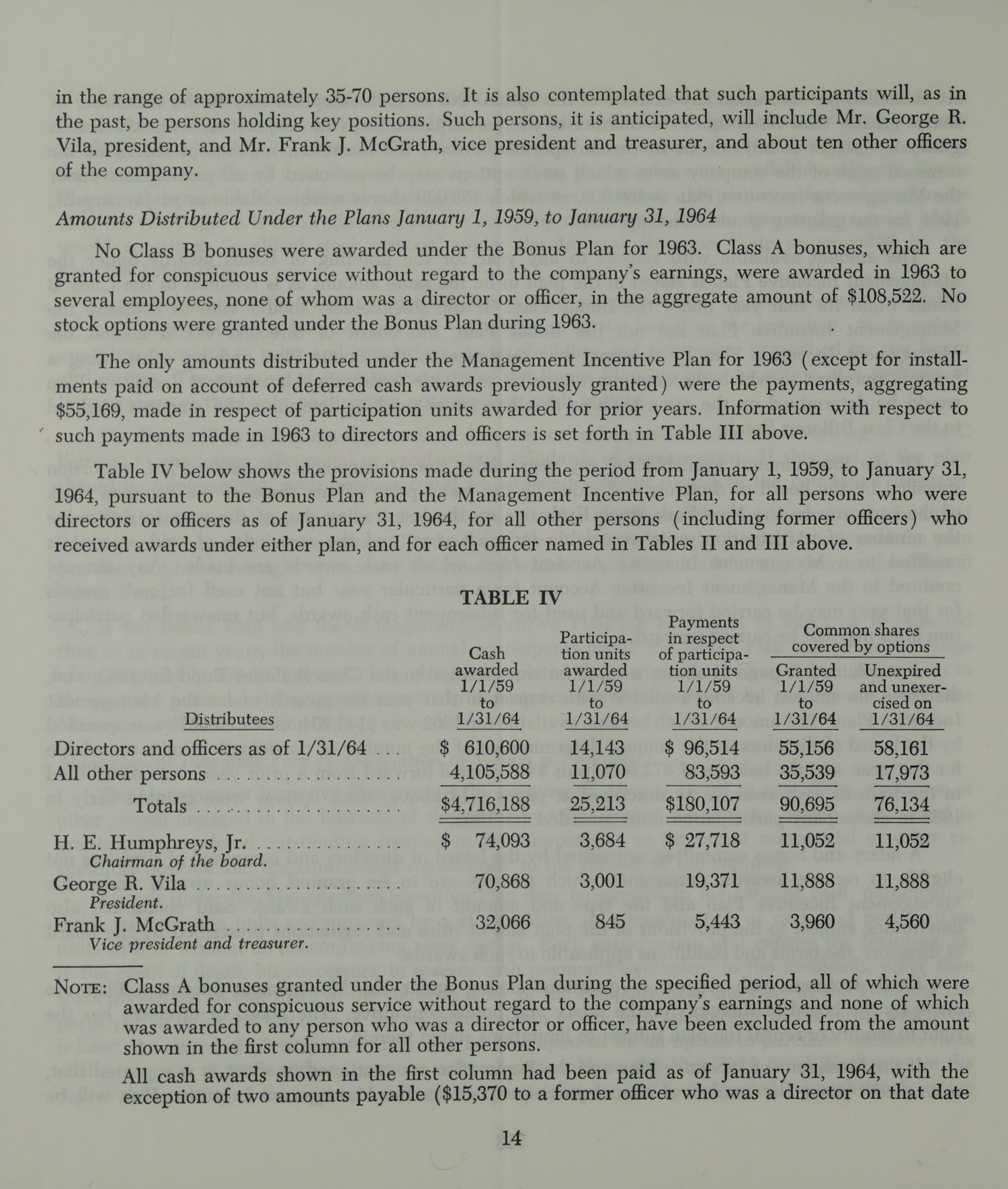
Table IV below shows the provisions made during the period from January 1, 1959, to January 31, 1964, pursuant to the Bonus Plan and the Management Incentive Plan, for all persons who were directors or officers as of January 31, 1964, for all other persons (including former officers) who received awards under either plan, and for each officer named in Tables II and III above.

TABLE IV
Cash Participa- Payments Common shares
awarded tion units in respect covered by options
Distributees 1/1/59 awarded of participa- Granted Unexpired
to 1/1/59 to tion units 1/1/59 and unexer-
1/31/64 1/31/64 1/1/59 to cised on
1/31/64 1/31/64
Directors and officers as of 1/31/64 … $ 610,600 14,143 $ 96,514 55,156 58,161
All other persons ………………….. 4,105,588 11,070 83,593 35,539 17,973
$4,716,188 25,213 $180,107 90,695 76,134

H. E. Humphreys, Jr. ………………. $ 74,093 3,684 $ 27,718 11,052 11,052
Chairman of the Board.
George R. Vila ……………………. 70,868 3,001 19,371 11,888 11,888
President.
Frank J. McGrath ………………….. 32,066 845 5,443 3,960 4,560
Vice president and treasurer.

NOTE: Class A bonuses granted under the Bonus Plan during the specified period, all of which were awarded for conspicuous service without regard to the company’s earnings and none of which was awarded to any person who was a director or officer, have been excluded from the amount shown in the first column for all other persons.

All cash awards shown in the first column had been paid as of January 31, 1964, with the exception of two amounts payable ($15,370 to a former officer who was a director on that date.

US Rubber Proxy Statement – Page 15

Page 015

and $2,690 to another person) in respect of deferred cash awards previously granted under the Management Incentive Plan.

All participation units shown in the second column were outstanding on January 31, 1964, with the exception of 136 units previously awarded to persons other than directors and officers.

The numbers of shares shown in the last column include, where applicable, shares covered by unexpired and unexercised options granted under the Bonus Plan in 1958.

Proposed Adoption of 1964 Stock Option Plan

Proposal to be Considered

In the judgment of the board of directors, further provision should be made by the company for the granting of stock options to employees occupying positions of importance and responsibility. The board regards such options — particularly those which are accorded special status under the Federal income tax laws — as an effective means by which the company may attract and retain outstanding personnel and induce such personnel to invest in the company’s stock and identify their interests more closely with those of the stockholders.

Believing that it would serve the best interests of the company and its stockholders, the board of directors has formulated a proposed 1964 Stock Option Plan. At its meeting held February 12, 1964, the board passed a resolution declaring that in its opinion the adoption of such plan is advisable, and directing that the annual meeting of the stockholders to be held April 21, 1964, be called for the purpose, among others, of taking action thereon.

Proposed 1964 Stock Option Plan

The text of the proposed 1964 Stock Option Plan is set forth in Exhibit A to this proxy statement, and reference is made thereto for a full statement of its terms and provisions.

The proposed plan would permit the granting of stock options to officers and employees of the company and its subsidiaries occupying positions of importance and responsibility who have demonstrated unusual ability or initiative and who can make significant contributions to the company’s success. The plan would be administered, and options thereunder would be granted, by the board of directors, whose decision on any question arising under the plan would be final.

The stock options granted under the plan would be options to purchase common stock of the company newly issued for such purpose or acquired by the company and held in its treasury. Subject to adjustment in certain specified events, the aggregate number of shares of such stock which could be purchased upon the exercise of options granted under the plan would be 200,000, which is less than 4% of the number of shares of such stock issued and outstanding on January 31, 1964. In the opinion of counsel, no stockholder of the company would have any preemptive right to purchase any of the shares which might be optioned under the plan.

The terms and conditions of the options granted under the plan would be determined by the board of directors subject to certain limitations. No such option would be exercisable until the optionee had continued to be an employee for at least twelve months after the granting of the

US Rubber Proxy Statement – Page 16

Page 016

option or be transferable by the optionee except by will or the laws of descent and distribution.
The maximum term of any such option would be five years, and the minimum option price would be the fair market value (or, if higher, the par value) of the optioned stock at the time of the granting of the option. On January 31, 1964, the fair market value of the common stock of the company (taken as the mean between the high and low prices of said stock on the New York Stock Exchange) was $47.125 per share.

The proposed plan would become effective on April 21, 1964, and would continue in effect until recalled or abolished. The board of directors would have the right to amend the plan subject to limitations stated therein.

It is expected that options under the plan would be granted upon the terms and conditions required for “qualified stock options” under Section 422(b) of the Internal Revenue Code as amended by the Revenue Act of 1964. Under the applicable provisions of said code, if the company grants an employee a “qualified stock option” specifying an option price not less than the fair market value of the optioned stock at the time of grant, and if the recipient exercises the option without having ceased to be an employee of the company or any of its subsidiaries at any time during the period from the grant of the option until three months before its exercise, and if no disposition of the stock transferred to the recipient upon exercise of the option is made by him within the three-year period beginning the day after such stock is so transferred, then, no taxable income will result at the time of the transfer of the stock to the recipient upon his exercise of the option, and any profit realized by the recipient from a sale or exchange of the stock (after the three-year holding period mentioned above) will be treated as a capital gain, and no deduction will be allowable at any time to the company with respect to the stock transferred to the recipient upon his exercise of the option.

No determination has yet been made as to the identity of the employees to whom options would be granted or as to the number of shares which would be optioned to any one person. The plan would permit more than one option to be granted to an employee, but in the aggregate not more than 6% of the shares available under the plan could be optioned to any one person.

Of the persons named in the Tables set forth above, only Messrs. H. E. Humphreys, Jr., George R. Vila and Frank J. McGrath, who are officers of the company, and Mr. James E. Lewis, who is an officer of a subsidiary, could qualify for options under the plan. No director, unless also an employee as defined in the plan, would be eligible.

Right of Appraisal of Dissenting Stockholders
Section 14:9-3 of the General Corporation Law of New Jersey provides that, if a corporation shall adopt a plan providing for the issue of new stock, any stockholder holding stock issued before April 15, 1920, not voting in favor of the plan, may obtain an appraisal of the market value of his stock, and the corporation thereafter shall pay to him the appraised value of such stock and the stock shall be transferred to the corporation. Any holder of such stock, wishing to avail himself of the right afforded by this statute upon the adoption of the proposed 1964 Stock Option Plan, must (a) give the company written notice of his dissent prior to the vote on the adoption of said plan at the forthcoming stock-

US Rubber Proxy Statement – Page 17

Page 017

holders’ meeting, and (b) apply to the Superior Court in New Jersey within thirty days after such stockholders’ meeting, on reasonable notice to the company, for the appointment of three disinterested appraisers. The statute requires the charges and expenses of such appraisers and appraisal to be paid by the corporation. The statute also provides that the corporation may elect to permit the dissenting stockholder to subscribe for his proportionate share of the new stock to be issued. No further notice will be given by the company to any stockholder as to the dates prior to which actions must be taken by the stockholder to perfect rights under said Section 14:9-3.

Required Vote and Recommendation of Board of Directors

The question concerning the Bonus Plan and the question concerning the Management Incentive Plan will be submitted to the stockholders at the forthcoming annual meeting in the form of separate resolutions that each such plan be continued in effect. The proposal concerning the 1964 Stock Option Plan will be submitted at said meeting in the form of a resolution that such plan, as set forth in Exhibit A to this proxy statement, be adopted.

The presence in person or by proxy of the holders of one-third of all the shares of the capital stock of the company is required for a quorum at the meeting. The favorable vote of two-thirds in interest of each class of stockholders present in person or by proxy and voting at the meeting is required for the adoption of each of said resolutions.

The board of directors recommends a vote “FOR” continuing the Bonus Plan in effect, a vote “FOR” continuing the Management Incentive Plan in effect, and a vote “FOR” adopting the proposed 1964 Stock Option Plan as set forth in Exhibit A hereto.

New York, New York
March 17, 1964

US Rubber Proxy Statement – Page 19

Page 019

IV. Stock to be Optioned
A. The stock options granted under this Plan shall be options to purchase shares of the common stock of the Company.
B. The stock delivered upon the exercise of any stock option granted under this Plan may be common stock newly issued for such purpose, or common stock acquired by the Company and held in its treasury, or partly such newly issued stock and partly such acquired stock.
C. Subject to the provision for adjustments contained in Article VI hereof, the aggregate number of shares of common stock which may be purchased upon the exercise of stock options granted under this Plan, excluding the number of shares covered by options which shall have expired or otherwise shall have become unexercisable, shall not exceed 200,000.
D. Not more than 6% of the aggregate number of shares of common stock referred to in Section C of this Article IV may be made subject to the stock option or options granted under this Plan to a single employee.

V. Terms and Conditions of Options
A. The terms and conditions applicable to the stock options granted under this Plan, which need not be the same in all cases, shall be determined by the Board of Directors subject to the following limitations:
1. The term of any stock option granted under this Plan shall not exceed five years from the date of its grant.
2. The option price for the common stock covered by any stock option granted under this Plan shall in no case be less than the par value of said stock, as stated in the Company’s Amended Certificate of Organization, or less than the fair market value of said stock at the time of the granting of such option, as determined by the Board of Directors; provided, however, that this limitation shall be subject to the provision for adjustments contained in Article VI hereof. For purposes of determining the fair market value of said common stock at the time of the granting of any such stock option, the Board of Directors may, if it so elects, assume such fair market value to be the mean between the high and low prices of said stock on the New York Stock Exchange on the day of the granting of such option or, if no sale of said stock shall be made on said Exchange on said day, on the next preceding day on which any such sale shall have been made.
3. No stock option granted under this Plan shall (a) be exercisable unless and until the optionee shall have continued to be an employee for a period of not less than twelve months following the date of the grant of such option, (b) be transferable or assignable by the optionee otherwise than by will or the laws of descent and distribution, or (c) be exercisable during the lifetime of the optionee except by him.

B. The Board of Directors may at any time, in the light of then existing laws and regulations, modify the terms and conditions applicable to any stock option theretofore granted under this Plan.

US Rubber Proxy Statement – Page 5

Page 005

EUGENE N. BEESLEY, president, Eli Lilly and Company, was born in 1909 in Thorntown, Indiana, and was graduated from Wabash College and the Indiana University Law School. He joined Eli Lilly and Company in 1929, and in 1953 was elected its fifth president. He is a director of Lilly Endowment, Inc., the Pharmaceutical Manufacturers Association, the United Fund of Greater Indianapolis, the American Fletcher National Bank and Trust Company, and the Procter & Gamble Company; a board member of the National Industrial Conference Board; a member of the Business Council, the American Pharmaceutical Association; and a director of United States Rubber Company since 1959.

J. SIMPSON DEAN, president and director of Nemours Corporation, has been a member of the board of directors of United States Rubber Company since 1960. He was born in Rome, Georgia, in 1898 and was graduated from Lawrenceville and from Princeton University in 1921. In 1924 he organized Nemours Corporation, an investment company, the major activity of which has been the production of oil and natural gas. He is also a director and member of the executive committee of the Wilmington Trust Company.

GEORGE P. EDMONDS, born in Boston, Massachusetts, in 1905, was graduated from the Massachusetts Institute of Technology. He became secretary of Bond Crow & Cork Company in 1930, rising to the presidency in 1935. In 1948 he became president of the Wilmington Trust Company; in 1953 he became chairman of the board of that bank, a position which he currently holds. A director of United States Rubber Company since 1944, he is a member of the executive committee. He is a director of Continental Can Company and the Continental American Life Insurance Company, and a member of the Corporation of the Massachusetts Institute of Technology.

MALCOLM P. FERGUSON, president of the Bendix Corporation, was born in 1896 in Elmira Heights, New York, and was graduated from Syracuse University. In 1919 he joined the Eclipse Machine Company of Elmira — one of the companies that formed the nucleus of Bendix Corporation when it was organized in 1929. In 1938 he became general manager of the Bendix products division. In 1946 he became president of the corporation. A director of United States Rubber Company since 1957, he is also vice chairman and a trustee of the Automotive Safety Foundation; a director of the National Bank of Detroit and the Michigan Bell Telephone Company; and a member of the board of governors of the Providence Hospital in Detroit. He holds honorary degrees from Syracuse and Michigan State Universities.

G. ARNOLD HART, president and chief executive officer of the Bank of Montreal, was born in 1913 in Toronto, Canada, and was educated there. After serving overseas in the Canadian Army during World War II and retiring from the Army in 1945 as a Major and a member of the Order of the British Empire, he joined the Bank of Montreal and became its president and chief executive officer in 1959. On the board of directors of United States Rubber Company since 1961, he is also deputy chairman and a director of the Bank of London & Montreal Limited, a director of the Canadian Pacific Railway Company, Sun Life Assurance Company, Ltd., the Steel Company of Canada, Ltd., and the Canadian Investment Fund, Ltd.

US Rubber Proxy Statement – Page 4

Page 004

TABLE I — INFORMATION CONCERNING NOMINEES FOR DIRECTOR

Approximate amount of
each class of stock of the
company beneficially owned
directly or indirectly
January 24, 1964

Nominee for director Principal occupation or employment Year first Common First
became Preferred
director
Eugene N. Beesley President, Eli Lilly and Company, 1959 100 —
Indianapolis, Ind.
J. Simpson Dean President, Nemours Corporation. 1960 1,600 —
Wilmington, Del.
George P. Edmonds Chairman of the board of directors, Wilmington 1944 2,000 —
Trust Company. Member of the executive com-
mittee of the company.
Wilmington, Del.
Malcolm P. Ferguson President, Bendix Corporation. 1957 200 —
Detroit, Mich.
G. Arnold Hart President, Bank of Montreal. 1961 100 —
Montreal, Canada
Harold H. Helm Chairman of the board of directors, Chemical 1957 802 —
Bank New York Trust Company.
New York, N. Y.
H. E. Humphreys, Jr. Chairman of the board of directors and chairman 1938 10,000 —
of the executive committee of the company.
New York, N. Y.
James P. Lewis* President, The J. P. Lewis Company, 1962 200 —
Beaver Falls, N. Y.
John W. McGovern Member of the executive committee of the com- 1951 8,097 —
pany. Former president.
New York, N. Y.
Robert J. McKim Chairman of the board of directors, Associated Dry 1961 200 —
Goods Corporation.
New York, N. Y.
John M. Schiff Partner of Kuhn, Loeb & Co., investment bankers. 1958 10,000 —
Member of the executive committee of the company.
New York, N. Y.
W. Dent Smith President, Terminal Warehouses, Ltd. 1956 508 —
Toronto, Canada
Charles M. Spofford Partner of Davis Polk Wardwell Sunderland & 1962 200 —
Kiendl, attorneys.
New York, N. Y.
George R. Vila President and vice chairman of the executive 1960 2,894 —
committee of the company.
New York, N. Y.
Medley G. B. Whelpley Member of the executive committee of the com- 1940 1,000 —
pany. Retired corporate executive.
New York, N. Y.

  • By reason of his direct and indirect beneficial ownership of stock of The Beaver River Power Corporation and that corporation’s beneficial ownership of 50% of the preferred stock and 49% of the common stock of Latex Fiber Industries, Inc., Mr. Lewis beneficially owned indirectly, as of January 24, 1964, 17% of the preferred stock and 16.66% of the common stock of Latex Fiber Industries, Inc., one of the company’s subsidiaries.

US Rubber Proxy Statement – Page 3

Page 003

United States Rubber Company
PROXY STATEMENT
Solicitation of Proxies
Execution and return of the enclosed proxy, which may be revoked by written request to the secretary at any time before it is voted, is being solicited on behalf of the management of the company for use at the annual meeting of stockholders to be held April 21, 1964, for the purposes set forth in the accompanying notice of meeting. The cost of solicitation of proxies, including the cost of reimbursing banks and brokers for forwarding proxies and proxy statements to their principals, will be borne by the company. Proxies will be solicited without extra compensation by certain officers and regular employees of the company by mail, telephone, telegraph or personally. All shares represented by valid proxies will be voted; and, where a stockholder has specified a choice by marking any of the ballots in the form of proxy, his shares will be voted as so specified. As stated in the form of proxy, if a stockholder does not otherwise specify, his shares will be voted in favor of continuing the company’s Bonus Plan in effect (as referred to in item “2” in the accompanying notice of meeting and as described below), in favor of continuing the company’s Management Incentive Plan in effect (as referred to in item “3” in said notice and as described below), and in favor of adopting the proposed 1964 Stock Option Plan (as referred to in item “4” in said notice and as described below).

Voting Securities and Record Date
On January 31, 1964, the total number of shares of first preferred stock outstanding was 642,091, and the total number of shares of common stock outstanding was 5,549,014. Each stockholder is entitled to one vote for each share of preferred and one vote for each share of common stock registered in his name on the company’s books on March 4, 1964, at the close of business, the record date for the determination of stockholders entitled to vote at the annual meeting.

Matters to be Considered
The management does not know of any matters to be considered at the annual meeting other than those referred to in items “1”, “2”, “3” and “4” in the accompanying notice. If any other business should come before the meeting, the proxy will be voted in respect therein, and discretionary authority to do so is included in the proxy.

Nominees for Election as Directors
The persons named as proxies intend to cast all votes pursuant to the enclosed form of proxy for fixing the number of directors at 15 and for the election as directors of the 15 persons listed on the following page, hereinafter called “nominees,” upon their nomination for such office at the annual meeting. Directors so elected will hold office for one year and until others are chosen and qualified in their stead. In the event of the decease or incapacity of any of the nominees prior to the election, or the refusal or inability of any of the nominees to accept nomination or election (none of which eventualities is now expected), the persons named as proxies intend to cast all such votes for the election, as director or directors, upon nomination at the annual meeting, of such other person or persons as may be recommended or designated for such nomination and election by a majority of the then members of the board of directors of the company. Certain information as to the nominees is set forth in Table I below and on pages 5-7.

US Rubber Annual Report – 72nd Annual Report – Page Letter

Page letter

United States Rubber Company
Rockefeller Center
1230 AVENUE OF THE AMERICAS • NEW YORK 20, N.Y.

OFFICE OF THE
CHAIRMAN OF THE BOARD

March 17, 1964

To the Stockholders of
UNITED STATES RUBBER COMPANY:

The annual meeting of stockholders of United States Rubber Company will be held on Tuesday, April 21, 1964, at 10:30 a.m., in the Starlight Roof of the Waldorf-Astoria Hotel, 106 Central Park South, New York, New York. At this meeting stockholders will be asked to elect a board of directors for the coming year, to decide whether the company’s Bonus Plan and its Management Incentive Plan shall each be continued in effect, to consider and act upon the adoption of a proposed 1964 Stock Option Plan, and to transact such other business as may properly come before the meeting.

Under the provisions of the company’s Bonus Plan and its Management Incentive Plan, the board of directors is required to submit to the stockholders, at intervals of no more than five years, the question of whether each of those plans shall be continued in effect. The board of directors has passed a resolution declaring it advisable, and recommending to the stockholders, that both plans be continued in effect in their respective existing forms.

A proposed 1964 Stock Option Plan, described in the accompanying proxy statement, has been formulated by the board of directors for consideration by the stockholders. The board of directors has passed a resolution declaring the adoption of such plan advisable and directing that the forthcoming annual meeting be called for the purpose, among others, of taking action thereon.

The board of directors has fixed March 4, 1964, at the close of business, as the record date for the determination of stockholders entitled to vote at the meeting.

Your vote is important. Please sign and return the accompanying proxy in the enclosed addressed envelope. If you attend the meeting and wish to vote in person, you may withdraw your proxy. If you are planning to attend the meeting, it will be greatly appreciated if you will notify Mr. G. T. Pownall, Secretary, so that we may send you an attendance card.

Sincerely yours,

H. E. HUMPHREYS, JR.
Chairman of the Board of Directors

US Rubber Annual Report – 72nd Annual Report – Page Contents

Page contents

Contents
page 2 Financial Briefs
3 Letter to Stockholders
5 Expansion Program
14 Financial Review
16 Balance Sheet
18 Income and Retained Earnings
19 Financial Notes
21 Accountants’ Opinion
22 Twenty-year Summary
24 Products
25 Directors and Officers

72nd Annual Report . . . Year Ended December 31, 1963

United States Rubber Company
1230 AVENUE OF THE AMERICAS, NEW YORK, N.Y. 10020

General Attorneys . . . . . ARTHUR, DRY, KALISH,
TAYLOR & WOOD
General Counsel . . . . . . MYRON KALISH
Associate General Counsel . . NELSON P. TAYLOR
Auditors . . . . . . . . . . HASKINS & SELLS

Trustee-Registrar
(25% Debentures – Both Issues)
MANUFACTURERS HANOVER TRUST COMPANY
40 WALL STREET, NEW YORK, N.Y. 10015

Transfer and Dividend Paying Agent
(Common and Preferred Stocks)
BANKERS TRUST COMPANY
16 WALL STREET, NEW YORK, N.Y. 10015

Registrar (Common and Preferred Stocks)
Paying Agent (25% Debentures – Both Issues)
CHEMICAL BANK NEW YORK TRUST COMPANY
20 PINE STREET, NEW YORK, N.Y. 10015

Annual Meeting of Stockholders
10:30 A.M., Tuesday, April 21, 1964
Theater of the Barbizon-Plaza Hotel
106 Central Park South
New York City

US Rubber Annual Report – 72nd Annual Report – Page 25

Page 025

Board of Directors
H. E. Humphreys, Jr. Chairman of the Board
George R. Vila President and Chief Executive Officer
Eugene N. Beesley President, Eli Lilly and Company
J. Simpson Dean President, Nemours Corporation
George P. Edmonds Chairman, Wilmington Trust Company
Malcolm P. Ferguson President, Bendix Corporation
G. Arnold Hart President, Bank of Montreal
Harold H. Helm Chairman, Chemical Bank New York Trust Company
James P. Lewis President, Latex Fiber Industries, Inc.
John W. McGovern Retired as President, 1960
Robert J. McKim Chairman, Associated Dry Goods Corporation
John M. Schiff Partner of Kuhn, Loeb & Co.
W. Dent Smith President, Terminal Warehouses, Ltd.
Charles M. Spofford Partner, Davis Polk Wardwell Sunderland and Kiendl
Medley G. B. Whelpley Retired Corporate Executive

ADVISORY DIRECTORS
Herbert E. Smith, former Chairman and President
Thomas J. Needham, former Vice President

Officers of the Company
its divisions, departments and principal subsidiaries

H. E. Humphreys, Jr. Chairman, Board of Directors
George R. Vila President and Chief Executive Officer
Walter D. Baldwin Vice President, Corporate Sales
E. M. Cushing Vice President, Industrial Relations Department
Earle S. Ebers Vice President and Group Executive, polymers, fibers and chemicals
Frank J. McGrath Financial Vice President and Treasurer
C. William Pennington Vice President and Group Executive, tires, consumer and industrial products
Perce C. Rowe Vice President, Market Development
Leland M. White Vice President, Research and Engineering
G. T. Pownall Secretary
Claude H. Allard Vice President and General Manager, Textile Division
M. F. Anderson President, Dominion Rubber Company, Ltd.
Harold N. Barrett President, U. S. Rubber Tire Co.
F. Dudley Chittenden Vice President and General Manager, Naugatuck Chemical Division
Louis J. Healey President, Consumer and Industrial Products Division
Edward J. Higgins President, U. S. Rubber International Company
James P. Lewis President, Latex Fiber Industries, Inc.

Executive Committee:
Mr. Humphreys, Chairman;
Messrs. Vila, Edmonds,
McGovern, Schiff and Whelpley.

Salary and Bonus Committee:
Mr. McGovern, Chairman;
Messrs. Edmonds,
Schiff and Whelpley.

Audit Committee:
Mr. Edmonds, Chairman;
Messrs. Helm and Spofford.

US Rubber Annual Report – 72nd Annual Report – Page 23

Page 023

United States Rubber Company and Subsidiary Companies

POSITION OTHER STATISTICS

Long Term Debt Capital Stock Employment & Earnings
Amount Interest Net Equity Dividends a Share Number of Holders Average Wages, Total Year
Owed Paid Worth Share* Preferred Common† Preferred Common Number of Employees Benefits Taxes Ended
Employees Dec. 31
$162,039 $5,338 $352,121 $48.78 $8 $2.20 8,196 34,593 60,103 $342,389 $107,481 1963
153,262 5,310 347,434 48.08 8 2.20 8,375 33,794 61,469 358,478 117,365 1962
152,013 5,320 337,489 46.62 8 2.20 8,460 30,535 60,086 337,533 111,106 1961
154,672 5,418 326,140 44.98 8 2.20 8,629 31,690 59,983 336,295 115,181 1960
159,920 5,520 312,634 42.74 8 2.05 8,781 30,873 61,149 330,240 125,218 1959
164,657 5,651 294,010 39.49 8 2.00 8,539 29,694 59,428 305,137 99,935 1958
169,030 5,740 289,109 38.64 8 2.00$ 8,591 27,013 60,136 314,109 96,786† 1957
174,484$ 5,751 271,240 36.17 8 2.00$ 8,743 25,823 63,929 331,470 92,203† 1956
156,325 4,357 254,332 33.17 8 2.00$ 9,070 24,904 63,550 324,382 95,626† 1955
120,896 3,736 236,585 30.01 8 2.00 9,364 24,390 60,726 290,963 80,052† 1954
120,896 3,737 224,373 27.84 8 2.00 9,683 23,586 67,549 303,447 97,260† 1953
102,719 2,761 207,454 24.84 8 2.00 9,755 21,348 65,745 269,791 116,111† 1952
77,724 2,040 194,627 22.64 8 2.00 9,839 16,362 65,083 257,829 126,297† 1951
77,744 2,208 180,035 20.03 8 1.67 9,992 15,480 59,069 216,832 89,913† 1950
92,812 2,384 169,391 18.14 8 1.00 10,592 15,541 56,521 183,866 51,979† 1949
98,000 2,429 163,199 17.03 8 1.33 10,711 15,410 64,208 208,545 61,173 1948
101,000 2,068 155,310 15.62 8 1.33 10,813 14,687 66,765 215,907 65,349 1947
40,000 918 145,697 13.92 8 1.33 10,771 13,707 61,499 190,048 62,367 1946
27,000 584 134,318 11.89 8 .67 10,665 12,657 70,739 188,318 47,026 1945
30,000 1,113 129,420 11.02 8 .67 10,595 12,332 78,347 195,807 57,584 1944

  • Net income a common share calculations are based on average number of shares outstanding; equity
    a common share calculations are based on shares outstanding at year-end; all calculations have been
    adjusted for the three-for-one stock split effective April 23, 1952 and for stock dividends. Dividends
    a share are at amounts declared for the respective years after adjustment for the 1952 stock split.

US Rubber Annual Report – 72nd Annual Report – Page 21

Page 021

United States Rubber Company and Subsidiary Companies

Accountants’ Opinion

HASKINS & SELLS
CERTIFIED PUBLIC ACCOUNTANTS
TWO BROADWAY
NEW YORK 4

February 12, 1964

United States Rubber Company:

We have examined the consolidated balance sheet of United States Rubber Company and its subsidiary companies as of December 31, 1963 and the related statement of consolidated income and retained earnings for the year then ended. Our examination was made in accordance with generally accepted auditing standards, and accordingly included such tests of the accounting records and such other auditing procedures as we considered necessary in the circumstances.

In our opinion, the accompanying consolidated balance sheet and statement of consolidated income and retained earnings present fairly the financial position of the companies at December 31, 1963 and the results of their operations for the year then ended, in conformity with generally accepted accounting principles applied on a basis consistent with that of the preceding year.

Haskins & Sells.

US Rubber Annual Report – 72nd Annual Report – Page 19

Page 019

United States Rubber Company and Subsidiary Companies

Financial Notes

Principles of Consolidation – Foreign Activities
All subsidiary companies which are more than 50 per cent owned are included in the consolidated statements. Restricted earnings of foreign operations are excluded from net income and credited to the Reserve for Foreign Activities.
Fixed assets and long term liabilities of foreign subsidiaries are stated in United States dollars on the basis of rates of exchange prevailing at December 31, 1957 or at dates of acquisition for subsequent additions. All other foreign assets and liabilities are stated on the basis of rates of exchange prevailing at the close of the year. Cumulative gains resulting from the conversion of net current assets are carried in the Reserve for Foreign Activities; current losses are charged to such reserve, or, if no reserve is available, to consolidated income. Sales and earnings are stated at monthly average rates of exchange.
Net assets located outside the United States were $96,533,807 at the end of 1963.
The Reserve for Foreign Activities at December 31, 1963 consisted of $6,721,174 restricted earnings of foreign operations and $8,887,013 representing principally the excess of certain foreign subsidiaries’ net assets over cost thereof at dates of acquisition.
Deferred charges include $2,125,399 representing the excess of cost over net assets at dates of acquisition for certain subsidiaries.

Liberalized Depreciation and Investment Credit
For financial accounting purposes, depreciation of property, plant and equipment is provided on a straight line basis at rates presently considered adequate to amortize the total cost over the life of the assets.
For Federal income tax purposes, the Company uses the accelerated depreciation method and the liberalized depreciation “guideline” rates. The resultant reduction in current taxes payable, $5,248,000 in 1963 and $3,052,000 at the close of 1962, is included in Deferred Federal Income Taxes and Investment Credit on the balance sheet.
Similar to 1962, the Investment Credit made available under the Revenue Act of 1962, representing about 7 per cent of the cost of new machinery and equipment purchased for domestic operations, will reduce our 1963 Federal income tax payments by $1,062,000. The reduction in 1962 was $1,123,000. These credits will benefit income in future years through amortization over the expected useful life of the machinery and equipment. The unamortized balance of the Investment Credit is included in the amount of $10,207,482 in Deferred Federal Income Taxes and Investment Credit.

Warranties
Expenses and adjustments resulting from warranties on products manufactured and sold are charged to income as incurred.

Long Term Debt
The indentures relating to the 2⅝% debentures provide for redemption of $2,500,000 annually through 1966 and $3,000,000 annually for the issue due April 1, 1967, and for redemption of $2,000,000 each year until maturity for the issue due March 1, 1976.
The loan agreements relating to the 3⅜% promissory notes due January 1, 1982 require payments annually beginning July 1, 1968 equal to 5 per cent of the notes outstanding at that date; effective July 1, 1977, the rate is increased to 9 per cent. The 3⅜% notes due July 15, 1995 require payments annually beginning July 15, 1983 equal to 7⅞ per cent of the notes outstanding at that date.
The indentures and the loan agreements contain certain provisions prohibiting dividends (except stock dividends) and other distributions to stockholders unless stipulated requirements are met. Under the most restrictive covenants, the amount of consolidated retained earnings not restricted at December 31, 1963 was $102,952,358.
Long term debt of foreign subsidiaries includes $9,248,000 borrowed by U.S. Rubber Overseas, S.A., Geneva, Switzerland, providing for interest at 4½ per cent from October 31, 1963, and with annual maturities of $1,850,000 on October 31, 1974 to 1978; and $5,055,050 borrowed by U.S. Royal Lastik Turk, A.S. (Turkey), with interest at 7 per cent and repayment in 19 semi-annual installments in varying amounts beginning December 1, 1963.

US Rubber Annual Report – 72nd Annual Report – Page 18

Page 018

United States Rubber Company and Subsidiary Companies

Consolidated Income and Retained Earnings

                                            1963                1962

Net sales $980,229,858 $1,006,792,650
Other income, net 3,104,402 3,678,822
Total Revenue 983,334,260 1,010,471,472

Cost of goods sold 771,803,722 803,532,053
Selling, administrative and general expenses 157,215,827 149,069,079
Total costs and expenses (including depreciation
of $27,216,802 in 1963 and $27,657,250 in 1962)
929,019,549 952,601,132
54,314,711 57,870,340

Interest on long term debt 5,337,805 5,310,465

Profit Before Income Taxes and Other Charges 48,976,906 52,559,875

Federal and foreign income taxes, less $2,395,000 in 1962
representing taxes paid on depreciation charged to prior years’
operations but not deducted for tax purposes in those years
(see note on page 19) 24,274,394 22,618,743
Restricted foreign earnings and minority interests
1,425,979 1,955,018
Foreign exchange losses 1,171,947 2,291,714
26,872,320 26,865,475

Net Income 22,104,586 25,694,400

Retained Earnings at beginning of year 226,816,682 219,182,691
248,921,268 244,877,091

Cash dividends – Preferred stock $8.00 a share 5,136,728 5,150,728
– Common stock $2.20 a share 12,853,870 12,909,681
17,990,598 18,060,409

Retained Earnings at end of year $230,930,670 $ 226,816,682

See Financial Notes on pages 19 and 20.
18

US Rubber Annual Report – 72nd Annual Report – Page 17

Page 017

United States Rubber Company and Subsidiary Companies

Liabilities
December 31
1963 1962
Current Liabilities
Accounts payable . . . . . . . . . . . . . . . . $ 66,997,403 $ 55,670,807
Foreign bank loans . . . . . . . . . . . . . . . 19,674,268 17,992,000
Current maturities of long term debt . . . . . . . 4,762,753 2,332,000
Accrued Federal income taxes . . . . . . . . . . . 11,920,634 12,536,580
Other accrued taxes, including foreign income taxes . 17,882,045 18,439,779
Other accrued liabilities . . . . . . . . . . . . . . 34,534,979 34,620,781
TOTAL CURRENT LIABILITIES . . . . . . . . . . 155,772,082 141,591,947

Long Term Debt
2½ % debentures due April 1, 1967 . . . . . . . . 8,000,000 10,500,000
2½ % debentures due May 1, 1976 . . . . . . . . . 21,436,000 24,215,000
3¾ % promissory notes due January 1, 1982 . . . . 50,000,000 50,000,000
3¾ % promissory notes due July 15, 1995 . . . . . 60,000,000 60,000,000
Foreign and domestic subsidiaries . . . . . . . . . 17,839,953 6,215,199
TOTAL LONG TERM DEBT . . . . . . . . . . . 157,275,953 150,930,199

Deferred Federal Income Taxes and Investment Credit . . . 10,207,482 4,174,528

Reserves
Foreign activities . . . . . . . . . . . . . . . . . 15,608,187 17,838,255
Retirement allowances . . . . . . . . . . . . . . 9,172,186 9,908,175
Insurance . . . . . . . . . . . . . . . . . . . . . 3,723,858 3,800,199
TOTAL RESERVES . . . . . . . . . . . . . . . 28,504,231 31,546,629

Minority Interests in Subsidiaries . . . . . . . . . . . . 11,718,766 11,506,355

Stockholders’ Equity
8% non-cumulative preferred stock, $100 par value:
Authorized and issued — 651,091 shares . . . . 65,109,100 65,109,100
Common stock, $5 par value:
Authorized — 10,000,000 shares
Issued — 5,900,844 shares 1963; 5,899,104 shares 1962 . 29,504,220 29,495,520
Capital surplus . . . . . . . . . . . . . . . . . . 30,358,441 30,272,800
Retained earnings . . . . . . . . . . . . . . . . . 230,930,670 226,816,682
355,902,431 351,694,102

Less: Treasury stock at cost
Preferred stock held for retirement — 9,000 shares 1,413,071 1,413,071
Common stock — 51,591 shares 1963;
62,000 shares 1962 . . . . . . . . . . . . . . . 2,368,705 2,846,614
3,781,776 4,259,685

TOTAL STOCKHOLDERS’ EQUITY . . . . . . . . 352,120,655 347,434,417

TOTAL . . . . . . . . . . . . . . . . . . . . . $715,599,169 $687,184,075

See Financial Notes on pages 19 and 20.

US Rubber Annual Report – 72nd Annual Report – Page 16

Page 016

Consolidated Balance Sheet

Assets
December 31
1963 1962

Current Assets
Cash $ 30,527,920 $ 35,085,343
Short term securities 12,159,809 6,585,225
TOTAL CASH AND SHORT TERM SECURITIES 42,687,729 41,670,568

Accounts and notes receivable, less allowance for doubtful
accounts: $4,503,733 for 1963, $3,930,605 for 1962 175,970,335 170,229,672

Inventories, at lower of average cost or market:
Finished goods 151,825,613 159,531,717
Goods in process of manufacture 23,492,269 23,441,831
Raw materials and supplies 67,860,055 60,765,627
TOTAL INVENTORIES 243,177,937 243,739,175
TOTAL CURRENT ASSETS 461,836,001 455,639,415

Investments In Affiliated Companies, etc. 21,781,729 16,934,821

Property, Plant and Equipment
Land and improvements 9,958,770 9,091,628
Plant and equipment 606,499,551 576,718,982
616,458,321 585,810,610
Less accumulated depreciation 397,597,154 381,770,749
NET PROPERTY, PLANT AND EQUIPMENT 218,861,167 204,039,861

Deferred Charges 13,120,272 10,569,978

TOTAL $715,599,169 $687,184,075

See Financial Notes on pages 19 and 20.
16

US Rubber Annual Report – 72nd Annual Report – Page 13

Page 013

Synthetic and Marvinol Expansion

In Painesville, Ohio, construction has started on a new facility for the manufacture of synthetic rubber. Initially, the plant will produce Paracril, our oil resistant synthetic, but eventually we expect to make other types of synthetic rubber there. At Painesville, we are also expanding our facilities to manufacture Marvinol polyvinyl chloride resins.

First Investment in Australia

U. S. Royal tires will be manufactured in Australia. The Company has purchased an interest in S. A. Rubber Holdings Limited, and to supplement these facilities a new tire plant will soon be built on a 100-acre site in Adelaide. This investment will also give us a potential base in Australia for the manufacture of an entire line of consumer and industrial rubber and plastic products.

Footwear in Spain

For the first time, we have made an investment in Spain. We have acquired a controlling interest in Samper, S.A., a well known Spanish shoe manufacturing company located in Elche. It produces rubber, leather and fabric footwear both for the Spanish domestic markets and for export.

Footwear Plant in Southeast

In Thomson, Ga. production of Keds footwear will soon start in a new plant. This new footwear plant permits us to serve the rapidly expanding footwear market in the southeastern states.

Expanded Royalite Plant

We are equipping a plant in Warsaw, Ind. to meet the rapidly growing demand for Expanded Royalite, our thermoplastic laminate that has been successfully used in the fabrication of travel trailers, engine covers, automotive hoods and fenders.

US Rubber Annual Report – 72nd Annual Report – Page 10

Page 010

largest and most diversified rubber company, our tire,
footwear and chemical business continues to expand.

Two Plants in Italy
At Turin in Italy we have a 50 per cent interest in Naugatuck-Rumianica, a producer of rubber and agricultural
chemicals, and other products that are sold throughout
the Common Market. In Milan, U. S. Rubber has acquired a majority interest in Rub-Co-Plast, a company
that will produce our line of coated fabrics and Royalite
products.

Information Center to Cut Costs
First of a series of management information and data
processing centers is nearing completion at Naugatuck,
Conn. The center’s modern electronic data processing
equipment will help speed such management functions as
purchasing, sales forecasting, production planning, inven-

A
B
C
D