CHEM-TEXTS – 1980 – Page NO. 1

Page unknown

UNIROYAL CHEM-TEXTS

Vol. 14, 1980 | PUBLISHED FOR THE PEOPLE OF UNIROYAL CHEMICAL | NO. 1


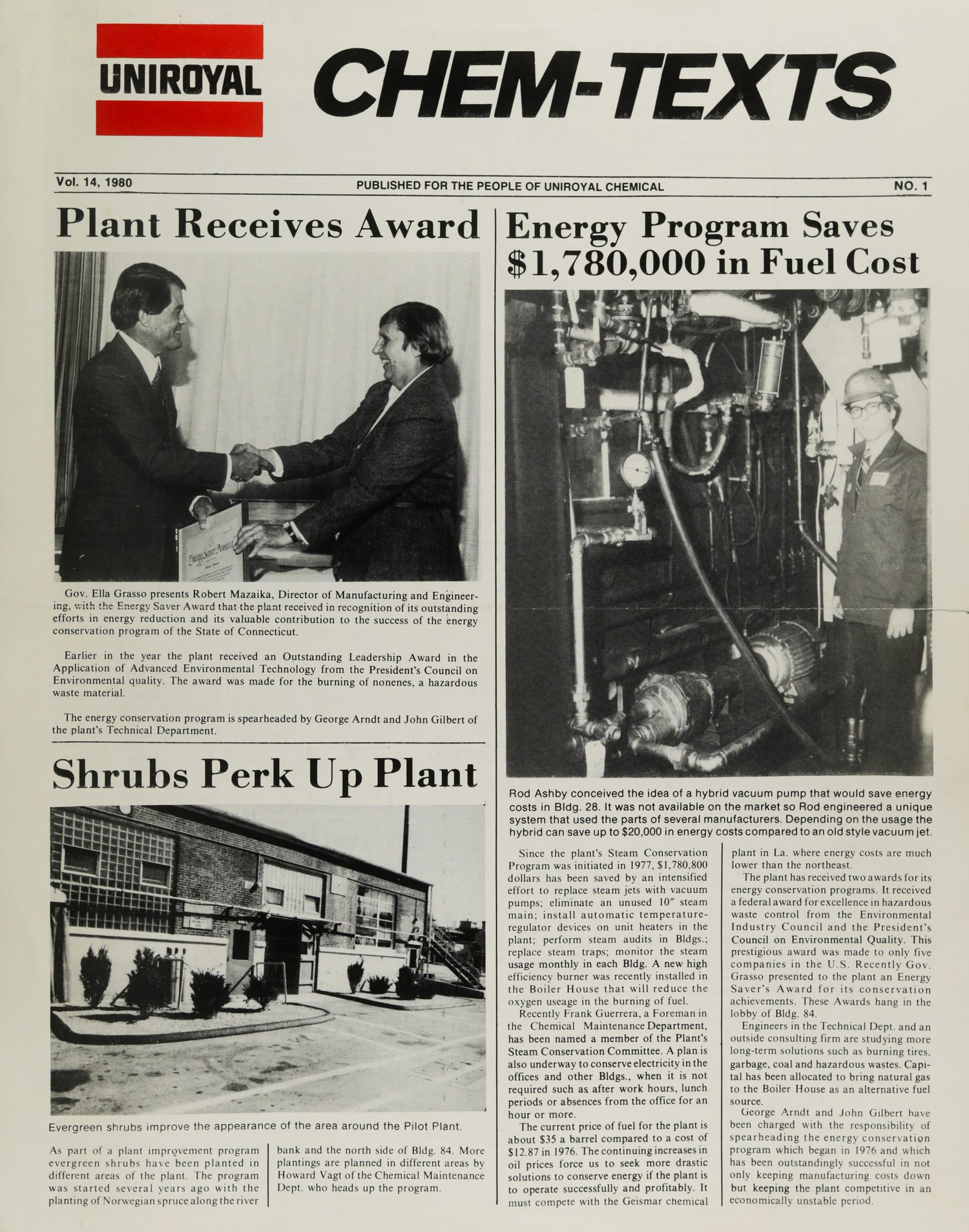
Plant Receives Award

[IMAGE: Photo of two people shaking hands during award presentation]

Gov. Ella Grasso presents Robert Mazaika, Director of Manufacturing and Engineering, with the Energy Saver Award that the plant received in recognition of its outstanding efforts in energy reduction and its valuable contribution to the success of the energy conservation program of the State of Connecticut.

Earlier in the year the plant received an Outstanding Leadership Award in the Application of Advanced Environmental Technology from the President’s Council on Environmental quality. The award was made for the burning of nonenes, a hazardous waste material.

The energy conservation program is spearheaded by George Arndt and John Gilbert of the plant’s Technical Department.


Shrubs Perk Up Plant

[IMAGE: Photo of building exterior with evergreen shrubs]

Evergreen shrubs improve the appearance of the area around the Pilot Plant.

As part of a plant improvement program evergreen shrubs have been planted in different areas of the plant. The program was started several years ago with the planting of Norwegian spruce along the river bank and the north side of Bldg. 84. More plantings are planned in different areas by Howard Vagt of the Chemical Maintenance Dept. who heads up the program.


Energy Program Saves $1,780,000 in Fuel Cost

[IMAGE: Photo of man next to industrial equipment/machinery]

Rod Ashby conceived the idea of a hybrid vacuum pump that would save energy costs in Bldg. 28. It was not available on the market so Rod engineered a unique system that used the parts of several manufacturers. Depending on the usage the hybrid can save up to $20,000 in energy costs compared to an old style vacuum jet.

Since the plant’s Steam Conservation Program was initiated in 1977, $1,780,800 dollars has been saved by an intensified effort to replace steam jets with vacuum pumps; eliminate an unused 10″ steam main; install automatic temperature-regulator devices on unit heaters in the plant; perform steam audits in Bldgs.; replace steam traps; monitor the steam usage monthly in each Bldg. A new high efficiency burner was recently installed in the Boiler House that will reduce the oxygen useage in the burning of fuel.

Recently Frank Guerrera, a Foreman in the Chemical Maintenance Department, has been named a member of the Plant’s Steam Conservation Committee. A plan is also underway to conserve electricity in the offices and other Bldgs., when it is not required such as after work hours, lunch periods or absences from the office for an hour or more.

The current price of fuel for the plant is about $35 a barrel compared to a cost of $12.87 in 1976. The continuing increases in oil prices force us to seek more drastic solutions to conserve energy if the plant is to operate successfully and profitably. It must compete with the Geismar chemical plant in La. where energy costs are much lower than the northeast.

The plant has received two awards for its energy conservation programs. It received a federal award for excellence in hazardous waste control from the Environmental Industry Council and the President’s Council on Environmental Quality. This prestigious award was made to only five companies in the U.S. Recently Gov. Grasso presented to the plant an Energy Saver’s Award for its conservation achievements. These Awards hang in the lobby of Bldg. 84.

Engineers in the Technical Dept. and an outside consulting firm are studying more long-term solutions such as burning tires, garbage, coal and hazardous wastes. Capital has been allocated to bring natural gas to the Boiler House as an alternative fuel source.

George Arndt and John Gilbert have been charged with the responsibility of spearheading the energy conservation program which began in 1976 and which has been outstandingly successful in not only keeping manufacturing costs down but keeping the plant competitive in an economically unstable period.
CHEM-TEXTS – 1979-v13-s273

Page 273

CHEM-TEXTS

Page 2 | Vol. 13, 1979


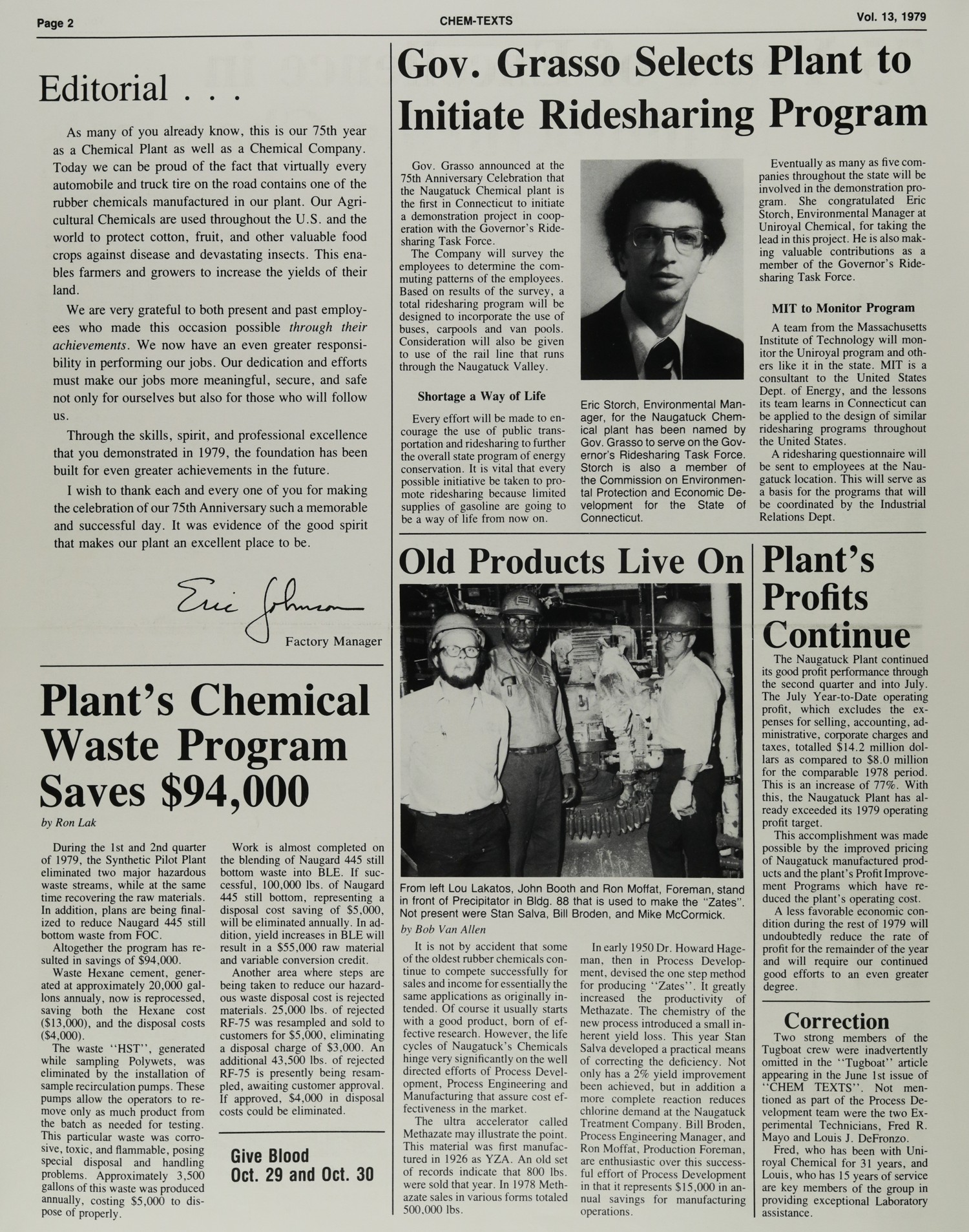
Editorial . . .

As many of you already know, this is our 75th year as a Chemical Plant as well as a Chemical Company. Today we can be proud of the fact that virtually every automobile and truck tire on the road contains one of the rubber chemicals manufactured in our plant. Our Agricultural Chemicals are used throughout the U.S. and the world to protect cotton, fruit, and other valuable food crops against disease and devastating insects. This enables farmers and growers to increase the yields of their land.

We are very grateful to both present and past employees who made this occasion possible through their achievements. We now have an even greater responsibility in performing our jobs. Our dedication and efforts must make our jobs more meaningful, secure, and safe not only for ourselves but also for those who will follow us.

Through the skills, spirit, and professional excellence that you demonstrated in 1979, the foundation has been built for even greater achievements in the future.

I wish to thank each and every one of you for making the celebration of our 75th Anniversary such a memorable and successful day. It was evidence of the good spirit that makes our plant an excellent place to be.

Eric Johnson
Factory Manager


Plant’s Chemical Waste Program Saves $94,000

by Ron Lak

During the 1st and 2nd quarter of 1979, the Synthetic Pilot Plant eliminated two major hazardous waste streams, while at the same time recovering the raw materials. In addition, plans are being finalized to reduce Naugard 445 still bottom waste from FOC.

Altogether the program has resulted in savings of $94,000.

Waste Hexane cement, generated at approximately 20,000 gallons annually, now is reprocessed, saving both the Hexane cost ($13,000), and the disposal costs ($4,000).

The waste “HST”, generated while sampling Polywets, was eliminated by the installation of sample recirculation pumps. These pumps allow the operators to remove only as much product from the batch as needed for testing. This particular waste was corrosive, toxic, and flammable, posing special disposal and handling problems. Approximately 3,500 gallons of this waste was produced annually, costing $5,000 to dispose of properly.

Work is almost completed on the blending of Naugard 445 still bottom waste into BLE. If successful, 100,000 lbs. of Naugard 445 still bottom, representing a disposal cost saving of $5,000, will be eliminated annually. In addition, yield increases in BLE will result in a $55,000 raw material and variable conversion credit.

Another area where steps are being taken to reduce our hazardous waste disposal cost is rejected materials. 25,000 lbs. of rejected RF-75 was resampled and sold to customers for $5,000, eliminating a disposal charge of $3,000. An additional 43,500 lbs. of rejected RF-75 is presently being resampled, awaiting customer approval. If approved, $4,000 in disposal costs could be eliminated.


Give Blood
Oct. 29 and Oct. 30


Gov. Grasso Selects Plant to Initiate Ridesharing Program

Gov. Grasso announced at the 75th Anniversary Celebration that the Naugatuck Chemical plant is the first in Connecticut to initiate a demonstration project in cooperation with the Governor’s Ridesharing Task Force.

The Company will survey the employees to determine the commuting patterns of the employees. Based on results of the survey, a total ridesharing program will be designed to incorporate the use of buses, carpools and van pools. Consideration will also be given to use of the rail line that runs through the Naugatuck Valley.

Shortage a Way of Life

Every effort will be made to encourage the use of public transportation and ridesharing to further the overall state program of energy conservation. It is vital that every possible initiative be taken to promote ridesharing because limited supplies of gasoline are going to be a way of life from now on.

[PHOTO CAPTION:]
Eric Storch, Environmental Manager, for the Naugatuck Chemical plant has been named by Gov. Grasso to serve on the Governor’s Ridesharing Task Force. Storch is also a member of the Commission on Environmental Protection and Economic Development for the State of Connecticut.

Eventually as many as five companies throughout the state will be involved in the demonstration program. She congratulated Eric Storch, Environmental Manager at Uniroyal Chemical, for taking the lead in this project. He is also making valuable contributions as a member of the Governor’s Ridesharing Task Force.

MIT to Monitor Program

A team from the Massachusetts Institute of Technology will monitor the Uniroyal program and others like it in the state. MIT is a consultant to the United States Dept. of Energy, and the lessons its team learns in Connecticut can be applied to the design of similar ridesharing programs throughout the United States.

A ridesharing questionnaire will be sent to employees at the Naugatuck location. This will serve as a basis for the programs that will be coordinated by the Industrial Relations Dept.


Old Products Live On

[PHOTO CAPTION:]
From left Lou Lakatos, John Booth and Ron Moffat, Foreman, stand in front of Precipitator in Bldg. 88 that is used to make the “Zates”. Not present were Stan Salva, Bill Broden, and Mike McCormick.

by Bob Van Allen

It is not by accident that some of the oldest rubber chemicals continue to compete successfully for sales and income for essentially the same applications as originally intended. Of course it usually starts with a good product, born of effective research. However, the life cycles of Naugatuck’s Chemicals hinge very significantly on the well directed efforts of Process Development, Process Engineering and Manufacturing that assure cost effectiveness in the market.

The ultra accelerator called Methazate may illustrate the point. This material was first manufactured in 1926 as YZA. An old set of records indicate that 800 lbs. were sold that year. In 1978 Methazate sales in various forms totaled 500,000 lbs.

In early 1950 Dr. Howard Hageman, then in Process Development, devised the one step method for producing “Zates”. It greatly increased the productivity of Methazate. The chemistry of the new process introduced a small inherent yield loss. This year Stan Salva developed a practical means of correcting the deficiency. Not only has a 2% yield improvement been achieved, but in addition a more complete reaction reduces chlorine demand at the Naugatuck Treatment Company. Bill Broden, Process Engineering Manager, and Ron Moffat, Production Foreman, are enthusiastic over this successful effort of Process Development in that it represents $15,000 in annual savings for manufacturing operations.


Plant’s Profits Continue

The Naugatuck Plant continued its good profit performance through the second quarter and into July. The July Year-to-Date operating profit, which excludes the expenses for selling, accounting, administrative, corporate charges and taxes, totalled $14.2 million dollars as compared to $8.0 million for the comparable 1978 period. This is an increase of 77%. With this, the Naugatuck Plant has already exceeded its 1979 operating profit target.

This accomplishment was made possible by the improved pricing of Naugatuck manufactured products and the plant’s Profit Improvement Programs which have reduced the plant’s operating cost.

A less favorable economic condition during the rest of 1979 will undoubtedly reduce the rate of profit for the remainder of the year and will require our continued good efforts to an even greater degree.


Correction

Two strong members of the Tugboat crew were inadvertently omitted in the “Tugboat” article appearing in the June 1st issue of “CHEM TEXTS”. Not mentioned as part of the Process Development team were the two Experimental Technicians, Fred R. Mayo and Louis J. DeFronzo.

Fred, who has been with Uniroyal Chemical for 31 years, and Louis, who has 15 years of service are key members of the group in providing exceptional Laboratory assistance.

CHEM-TEXTS – 1979-v13-s282

Page 282

CHEM-TEXTS

Vol. 13, 1979 | Page 3


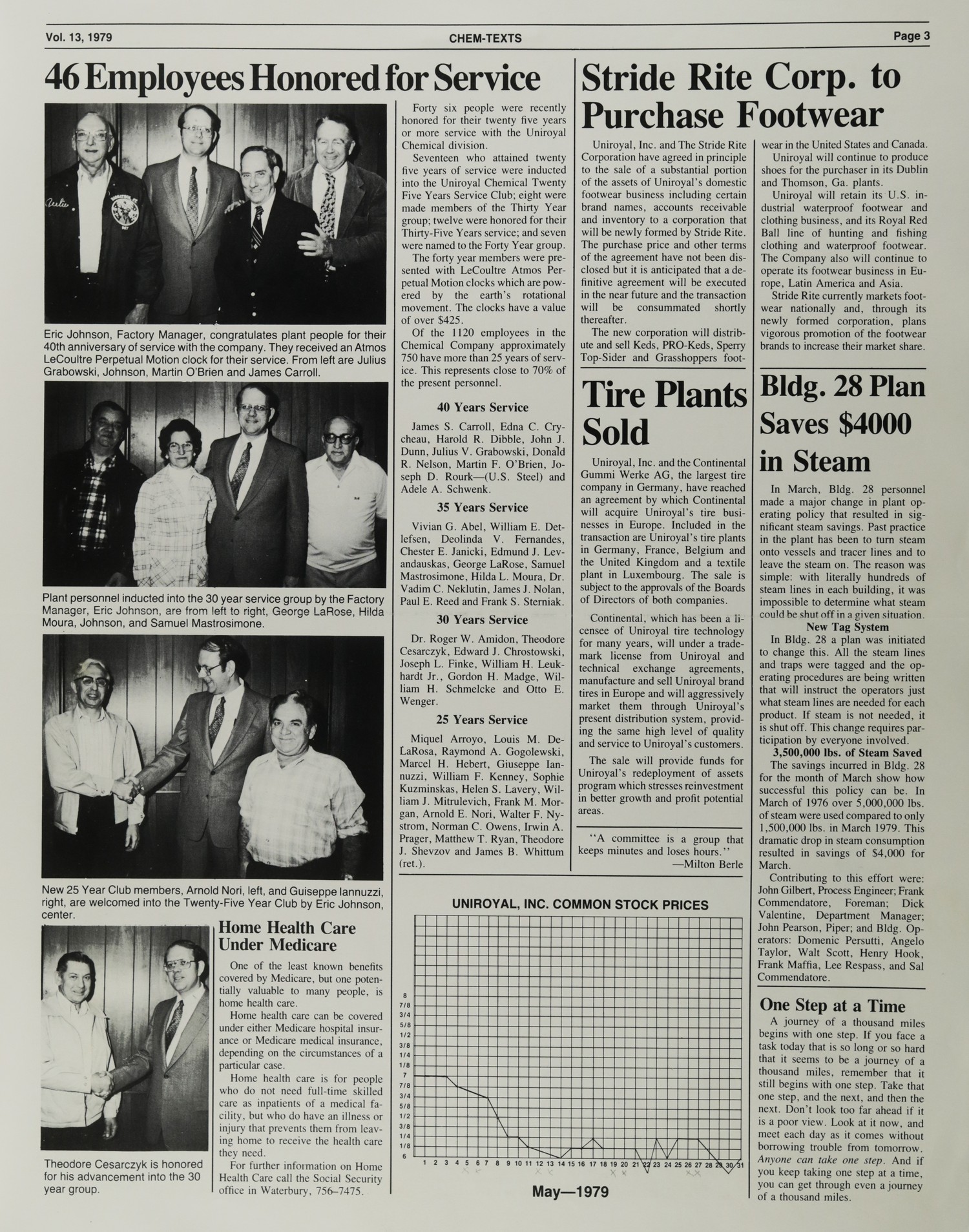
46 Employees Honored for Service

[IMAGE: Group photo]

Eric Johnson, Factory Manager, congratulates plant people for their 40th anniversary of service with the company. They received an Atmos LeCoultre Perpetual Motion clock for their service. From left are Julius Grabowski, Johnson, Martin O’Brien and James Carroll.

[IMAGE: Group photo]

Plant personnel inducted into the 30 year service group by the Factory Manager, Eric Johnson, are from left to right, George LaRose, Hilda Moura, Johnson, and Samuel Mastrosimone.

[IMAGE: Group photo]

New 25 Year Club members, Arnold Nori, left, and Guiseppe Iannuzzi, right, are welcomed into the Twenty-Five Year Club by Eric Johnson, center.

[IMAGE: Individual portrait]

Theodore Cesarczyk is honored for his advancement into the 30 year group.


Forty six people were recently honored for their twenty five years or more service with the Uniroyal Chemical division.

Seventeen who attained twenty five years of service were inducted into the Uniroyal Chemical Twenty Five Year Service Club; eight were made members of the Thirty Year group; twelve were honored for their Thirty-Five Years service; and seven were named to the Forty Year group.

The forty year members were presented with LeCoultre Atmos Perpetual Motion clocks which are powered by the earth’s rotational movement. The clocks have a value of over $425.

Of the 1120 employees in the Chemical Company approximately 750 have more than 25 years of service. This represents close to 70% of the present personnel.

40 Years Service

James S. Carroll, Edna C. Crycheau, Harold R. Dibble, John J. Dunn, Julius V. Grabowski, Donald R. Nelson, Martin F. O’Brien, Joseph D. Rourk—(U.S. Steel) and Adele A. Schwenk.

35 Years Service

Vivian G. Abel, William E. Detlefsen, Deolinda V. Fernandes, Chester E. Janicki, Edmund J. Levandauskas, George LaRose, Samuel Mastrosimone, Hilda L. Moura, Dr. Vadim C. Neklutin, James J. Nolan, Paul E. Reed and Frank S. Sterniak.

30 Years Service

Dr. Roger W. Amidon, Theodore Cesarczyk, Edward J. Chrostowski, Joseph L. Finke, William H. Leukhardt Jr., Gordon H. Madge, William H. Schmelcke and Otto E. Wenger.

25 Years Service

Miquel Arroyo, Louis M. DeLaRosa, Raymond A. Gogolewski, Marcel H. Hebert, Giuseppe Iannuzzi, William F. Kenney, Sophie Kuzminskas, Helen S. Lavery, William J. Mitrulevich, Frank M. Morgan, Arnold E. Nori, Walter F. Nystrom, Norman C. Owens, Irwin A. Prager, Matthew T. Ryan, Theodore J. Shevzov and James B. Whittum (ret.).


Home Health Care Under Medicare

One of the least known benefits covered by Medicare, but one potentially valuable to many people, is home health care.

Home health care can be covered under either Medicare hospital insurance or Medicare medical insurance, depending on the circumstances of a particular case.

Home health care is for people who do not need full-time skilled care as inpatients of a medical facility, but who do have an illness or injury that prevents them from leaving home to receive the health care they need.

For further information on Home Health Care call the Social Security office in Waterbury, 756-7475.


Stride Rite Corp. to Purchase Footwear

Uniroyal, Inc. and The Stride Rite Corporation have agreed in principle to the sale of a substantial portion of the assets of Uniroyal’s domestic footwear business including certain brand names, accounts receivable and inventory to a corporation that will be newly formed by Stride Rite. The purchase price and other terms of the agreement have not been disclosed but it is anticipated that a definitive agreement will be executed in the near future and the transaction will be consummated shortly thereafter.

The new corporation will distribute and sell Keds, PRO-Keds, Sperry Top-Sider and Grasshoppers footwear in the United States and Canada.

Uniroyal will continue to produce shoes for the purchaser in its Dublin and Thomson, Ga. plants.

Uniroyal will retain its U.S. industrial waterproof footwear and clothing business, and its Royal Red Ball line of hunting and fishing clothing and waterproof footwear. The Company also will continue to operate its footwear business in Europe, Latin America and Asia.

Stride Rite currently markets footwear nationally and, through its newly formed corporation, plans vigorous promotion of the footwear brands to increase their market share.


Tire Plants Sold

Uniroyal, Inc. and the Continental Gummi Werke AG, the largest tire company in Germany, have reached an agreement by which Continental will acquire Uniroyal’s tire businesses in Europe. Included in the transaction are Uniroyal’s tire plants in Germany, France, Belgium and the United Kingdom and a textile plant in Luxembourg. The sale is subject to the approvals of the Boards of Directors of both companies.

Continental, which has been a licensee of Uniroyal tire technology for many years, will under a trademark license from Uniroyal and technical exchange agreements, manufacture and sell Uniroyal brand tires in Europe and will aggressively market them through Uniroyal’s present distribution system, providing the same high level of quality and service to Uniroyal’s customers.

The sale will provide funds for Uniroyal’s redeployment of assets program which stresses reinvestment in better growth and profit potential areas.


“A committee is a group that keeps minutes and loses hours.”
—Milton Berle


Bldg. 28 Plan Saves $4000 in Steam

In March, Bldg. 28 personnel made a major change in plant operating policy that resulted in significant steam savings. Past practice in the plant has been to turn steam onto vessels and tracer lines and to leave the steam on. The reason was simple: with literally hundreds of steam lines in each building, it was impossible to determine what steam could be shut off in a given situation.

New Tag System

In Bldg. 28 a plan was initiated to change this. All the steam lines and traps were tagged and the operating procedures are being written that will instruct the operators just what steam lines are needed for each product. If steam is not needed, it is shut off. This change requires participation by everyone involved.

3,500,000 lbs. of Steam Saved

The savings incurred in Bldg. 28 for the month of March show how successful this policy can be. In March of 1976 over 5,000,000 lbs. of steam were used compared to only 1,500,000 lbs. in March 1979. This dramatic drop in steam consumption resulted in savings of $4,000 for March.

Contributing to this effort were: John Gilbert, Process Engineer; Frank Commendatore, Foreman; Dick Valentine, Department Manager; John Pearson, Piper; and Bldg. Operators: Domenic Persutti, Angelo Taylor, Walt Scott, Henry Hook, Frank Maffia, Lee Respass, and Sal Commendatore.


One Step at a Time

A journey of a thousand miles begins with one step. If you face a task today that is so long or so hard that it seems to be a journey of a thousand miles, remember that it still begins with one step. Take that one step, and the next, and then the next. Don’t look too far ahead if it is a poor view. Look at it now, and meet each day as it comes without borrowing trouble from tomorrow. Anyone can take one step. And if you keep taking one step at a time, you can get through even a journey of a thousand miles.


UNIROYAL, INC. COMMON STOCK PRICES

[CHART: Stock price graph showing prices from months 1-31, with price scale showing values from 0 to 8, with markers at 7/8, 3/4, 5/8, 1/2, 3/8, 1/4, 1/8 intervals]

May—1979

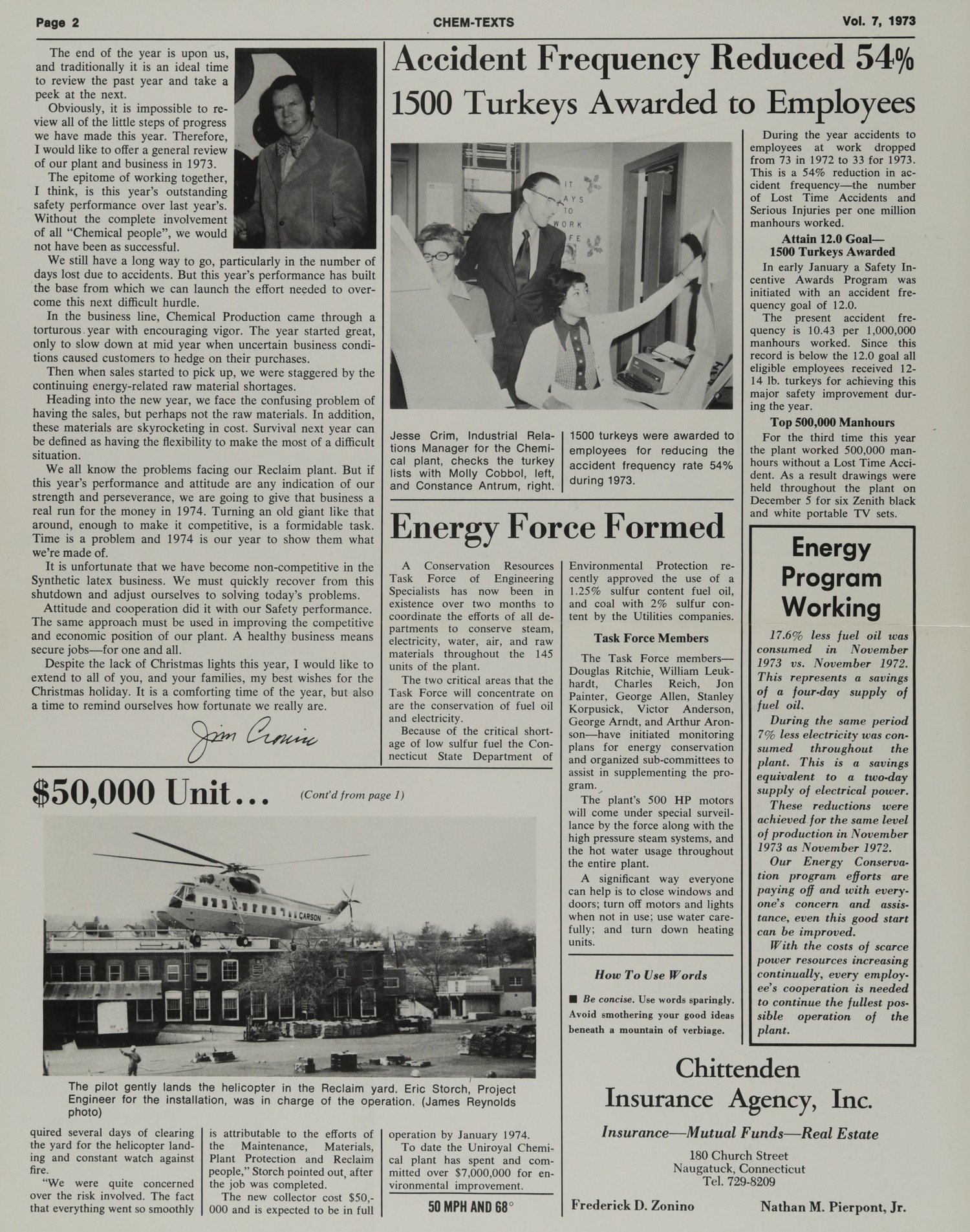
Accident Frequency Reduced 54% 1500 Turkevs Awarded to Employees

Page 2 | CHEM-TEXTS | Vol. 7, 1973


The end of the year is upon us, and traditionally it is an ideal time to review the past year and take a peek at the next.

Obviously, it is impossible to review all of the little steps of progress we have made this year. Therefore, I would like to offer a general review of our plant and business in 1973.

The epitome of working together, I think, is this year’s outstanding safety performance over last year’s. Without the complete involvement of all “Chemical people”, we would not have been as successful.

We still have a long way to go, particularly in the number of days lost due to accidents. But this year’s performance has built the base from which we can launch the effort needed to overcome this next difficult hurdle.

In the business line, Chemical Production came through a torturous year with encouraging vigor. The year started great, only to slow down at mid year when uncertain business conditions caused customers to hedge on their purchases.

Then when sales started to pick up, we were staggered by the continuing energy-related raw material shortages.

Heading into the new year, we face the confusing problem of having the sales, but perhaps not the raw materials. In addition, these materials are skyrocketing in cost. Survival next year can be defined as having the flexibility to make the most of a difficult situation.

We all know the problems facing our Reclaim plant. But if this year’s performance and attitude are any indication of our strength and perseverance, we are going to give that business a real run for the money in 1974. Turning an old giant like that around, enough to make it competitive, is a formidable task. Time is a problem and 1974 is our year to show them what we’re made of.

It is unfortunate that we have become non-competitive in the Synthetic latex business. We must quickly recover from this shutdown and adjust ourselves to solving today’s problems.

Attitude and cooperation did it with our Safety performance. The same approach must be used in improving the competitive and economic position of our plant. A healthy business means secure jobs—for one and all.

Despite the lack of Christmas lights this year, I would like to extend to all of you, and your families, my best wishes for the Christmas holiday. It is a comforting time of the year, but also a time to remind ourselves how fortunate we really are.

Jim Crim


Accident Frequency Reduced 54%

1500 Turkeys Awarded to Employees

[IMAGE: Photo showing three people examining documents]

Jesse Crim, Industrial Relations Manager for the Chemical plant, checks the turkey lists with Molly Cobbol, left, and Constance Antrum, right.

1500 turkeys were awarded to employees for reducing the accident frequency rate 54% during 1973.

During the year accidents to employees at work dropped from 73 in 1972 to 33 for 1973. This is a 54% reduction in accident frequency—the number of Lost Time Accidents and Serious Injuries per one million manhours worked.

Attain 12.0 Goal—1500 Turkeys Awarded

In early January a Safety Incentive Awards Program was initiated with an accident frequency goal of 12.0.

The present accident frequency is 10.43 per 1,000,000 manhours worked. Since this record is below the 12.0 goal all eligible employees received 12-14 lb. turkeys for achieving this major safety improvement during the year.

Top 500,000 Manhours

For the third time this year the plant worked 500,000 manhours without a Lost Time Accident. As a result drawings were held throughout the plant on December 5 for six Zenith black and white portable TV sets.


Energy Force Formed

A Conservation Resources Task Force of Engineering Specialists has now been in existence over two months to coordinate the efforts of all departments to conserve steam, electricity, water, air, and raw materials throughout the 145 units of the plant.

The two critical areas that the Task Force will concentrate on are the conservation of fuel oil and electricity.

Because of the critical shortage of low sulfur fuel the Connecticut State Department of Environmental Protection recently approved the use of a 1.25% sulfur content fuel oil, and coal with 2% sulfur content by the Utilities companies.

Task Force Members

The Task Force members—Douglas Ritchie, William Leukhardt, Charles Reich, Jon Painter, George Allen, Stanley Korpusick, Victor Anderson, George Arndt, and Arthur Aronson—have initiated monitoring plans for energy conservation and organized sub-committees to assist in supplementing the program.

The plant’s 500 HP motors will come under special surveillance by the force along with the high pressure steam systems, and the hot water usage throughout the entire plant.

A significant way everyone can help is to close windows and doors; turn off motors and lights when not in use; use water carefully; and turn down heating units.


How To Use Words

Be concise. Use words sparingly. Avoid smothering your good ideas beneath a mountain of verbiage.


Energy Program Working

17.6% less fuel oil was consumed in November 1973 vs. November 1972. This represents a savings of a four-day supply of fuel oil.

During the same period 7% less electricity was consumed throughout the plant. This is a savings equivalent to a two-day supply of electrical power.

These reductions were achieved for the same level of production in November 1973 as November 1972.

Our Energy Conservation program efforts are paying off and with everyone’s concern and assistance, even this good start can be improved.

With the costs of scarce power resources increasing continually, every employee’s cooperation is needed to continue the fullest possible operation of the plant.


$50,000 Unit… (Cont’d from page 1)

[IMAGE: Photo of helicopter landing in yard with buildings in background, marked “CARSON”]

The pilot gently lands the helicopter in the Reclaim yard. Eric Storch, Project Engineer for the installation, was in charge of the operation. (James Reynolds photo)

quired several days of clearing the yard for the helicopter landing and constant watch against fire.

“We were quite concerned over the risk involved. The fact that everything went so smoothly is attributable to the efforts of the Maintenance, Materials, Plant Protection and Reclaim people,” Storch pointed out after the job was completed.

The new collector cost $50,000 and is expected to be in operation by January 1974.

To date the Uniroyal Chemical plant has spent and committed over $7,000,000 for environmental improvement.

50 MPH AND 68°


Chittenden Insurance Agency, Inc.

Insurance—Mutual Funds—Real Estate

180 Church Street
Naugatuck, Connecticut
Tel. 729-8209

Frederick D. Zonino | Nathan M. Pierpont, Jr.

CHEM-TEXTS – 1971-v05-i01-s183

Page 183

UNIROYAL CHEM-TEXTS

Vol. 5, 1971 | PUBLISHED FOR THE PEOPLE OF UNIROYAL CHEMICAL | No. 1


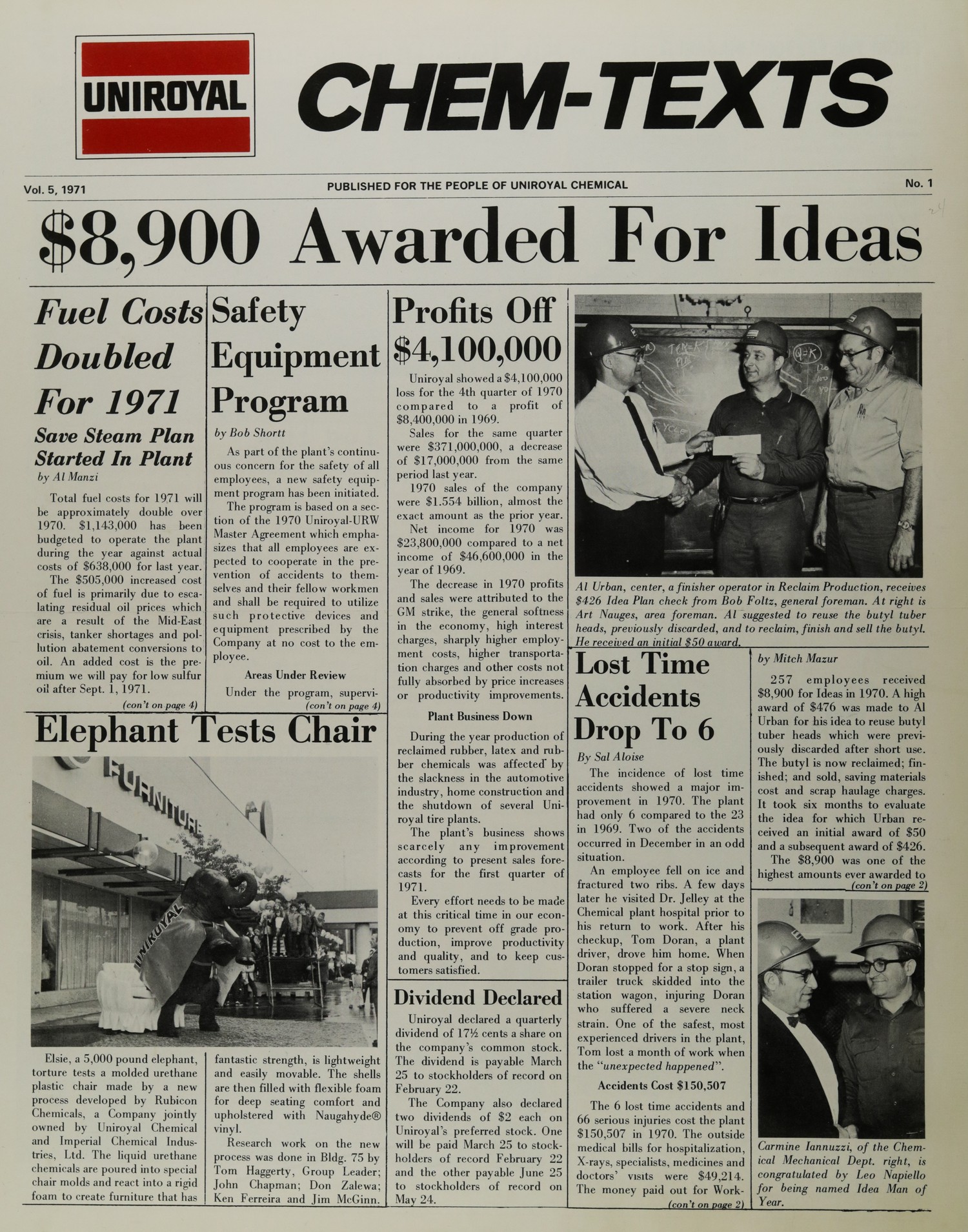
$8,900 Awarded For Ideas


Fuel Costs Doubled For 1971

Save Steam Plan Started In Plant

by Al Manzi

Total fuel costs for 1971 will be approximately double over 1970. $1,143,000 has been budgeted to operate the plant during the year against actual costs of $638,000 for last year.

The $505,000 increased cost of fuel is primarily due to escalating residual oil prices which are a result of the Mid-East crisis, tanker shortages and pollution abatement conversions to oil. An added cost is the premium we will pay for low sulfur oil after Sept. 1, 1971.

(con’t on page 4)


Safety Equipment Program

by Bob Shortt

As part of the plant’s continuous concern for the safety of all employees, a new safety equipment program has been initiated.

The program is based on a section of the 1970 Uniroyal-URW Master Agreement which emphasizes that all employees are expected to cooperate in the prevention of accidents to themselves and their fellow workmen and shall be required to utilize such protective devices and equipment prescribed by the Company at no cost to the employee.

Areas Under Review

Under the program, supervi-

(con’t on page 4)


Profits Off $4,100,000

Uniroyal showed a $4,100,000 loss for the 4th quarter of 1970 compared to a profit of $8,400,000 in 1969.

Sales for the same quarter were $371,000,000, a decrease of $17,000,000 from the same period last year.

1970 sales of the company were $1.554 billion, almost the exact amount as the prior year. Net income for 1970 was $23,800,000 compared to a net income of $46,600,000 in the year of 1969.

The decrease in 1970 profits and sales were attributed to the GM strike, the general softness in the economy, high interest charges, sharply higher employment costs, higher transportation charges and other costs not fully absorbed by price increases or productivity improvements.

Plant Business Down

During the year production of reclaimed rubber, latex and rubber chemicals was affected by the slackness in the automotive industry, home construction and the shutdown of several Uniroyal tire plants.

The plant’s business shows scarcely any improvement according to present sales forecasts for the first quarter of 1971.

Every effort needs to be made at this critical time in our economy to prevent off grade production, improve productivity and quality, and to keep customers satisfied.


Dividend Declared

Uniroyal declared a quarterly dividend of 17½ cents a share on the company’s common stock. The dividend is payable March 25 to stockholders of record on February 22.

The Company also declared two dividends of $2 each on Uniroyal’s preferred stock. One will be paid March 25 to stockholders of record February 22 and the other payable June 25 to stockholders of record on May 24.


Elephant Tests Chair

[IMAGE: Photo of an elephant named Elsie testing a plastic chair]

Elsie, a 5,000 pound elephant, torture tests a molded urethane plastic chair made by a new process developed by Rubicon Chemicals, a Company jointly owned by Uniroyal Chemical and Imperial Chemical Industries, Ltd. The liquid urethane chemicals are poured into special chair molds and react into a rigid foam to create furniture that has fantastic strength, is lightweight and easily movable. The shells are then filled with flexible foam for deep seating comfort and upholstered with Naugahyde® vinyl.

Research work on the new process was done in Bldg. 75 by Tom Haggerty, Group Leader; John Chapman; Don Zalewa; Ken Ferreira and Jim McGinn.


[IMAGE: Photo of Al Urban receiving award from Bob Foltz with Art Nauges]

Al Urban, center, a finisher operator in Reclaim Production, receives $426 Idea Plan check from Bob Foltz, general foreman. At right is Art Nauges, area foreman. Al suggested to reuse the butyl tuber heads, previously discarded, and to reclaim, finish and sell the butyl. He received an initial $50 award.


Lost Time Accidents Drop To 6

By Sal Aloise

The incidence of lost time accidents showed a major improvement in 1970. The plant had only 6 compared to the 23 in 1969. Two of the accidents occurred in December in an odd situation.

An employee fell on ice and fractured two ribs. A few days later he visited Dr. Jelley at the Chemical plant hospital prior to his return to work. After his checkup, Tom Doran, a plant driver, drove him home. When Doran stopped for a stop sign, a trailer truck skidded into the station wagon, injuring Doran who suffered a severe neck strain. One of the safest, most experienced drivers in the plant, Tom lost a month of work when the “unexpected happened“.

Accidents Cost $150,507

The 6 lost time accidents and 66 serious injuries cost the plant $150,507 in 1970. The outside medical bills for hospitalization, X-rays, specialists, medicines and doctors’ visits were $49,214. The money paid out for Work-

(con’t on page 2)


by Mitch Mazur

257 employees received $8,900 for Ideas in 1970. A high award of $476 was made to Al Urban for his idea to reuse butyl tuber heads which were previously discarded after short use. The butyl is now reclaimed; finished; and sold, saving materials cost and scrap haulage charges. It took six months to evaluate the idea for which Urban received an initial award of $50 and a subsequent award of $426.

The $8,900 was one of the highest amounts ever awarded to

(con’t on page 2)


[IMAGE: Photo of Carmine Iannuzzi being congratulated]

Carmine Iannuzzi, of the Chemical Mechanical Dept. right, is congratulated by Leo Napiello for being named Idea Man of Year.

US Rubber Annual Report – 72nd Annual Report – Page 18

Page 018

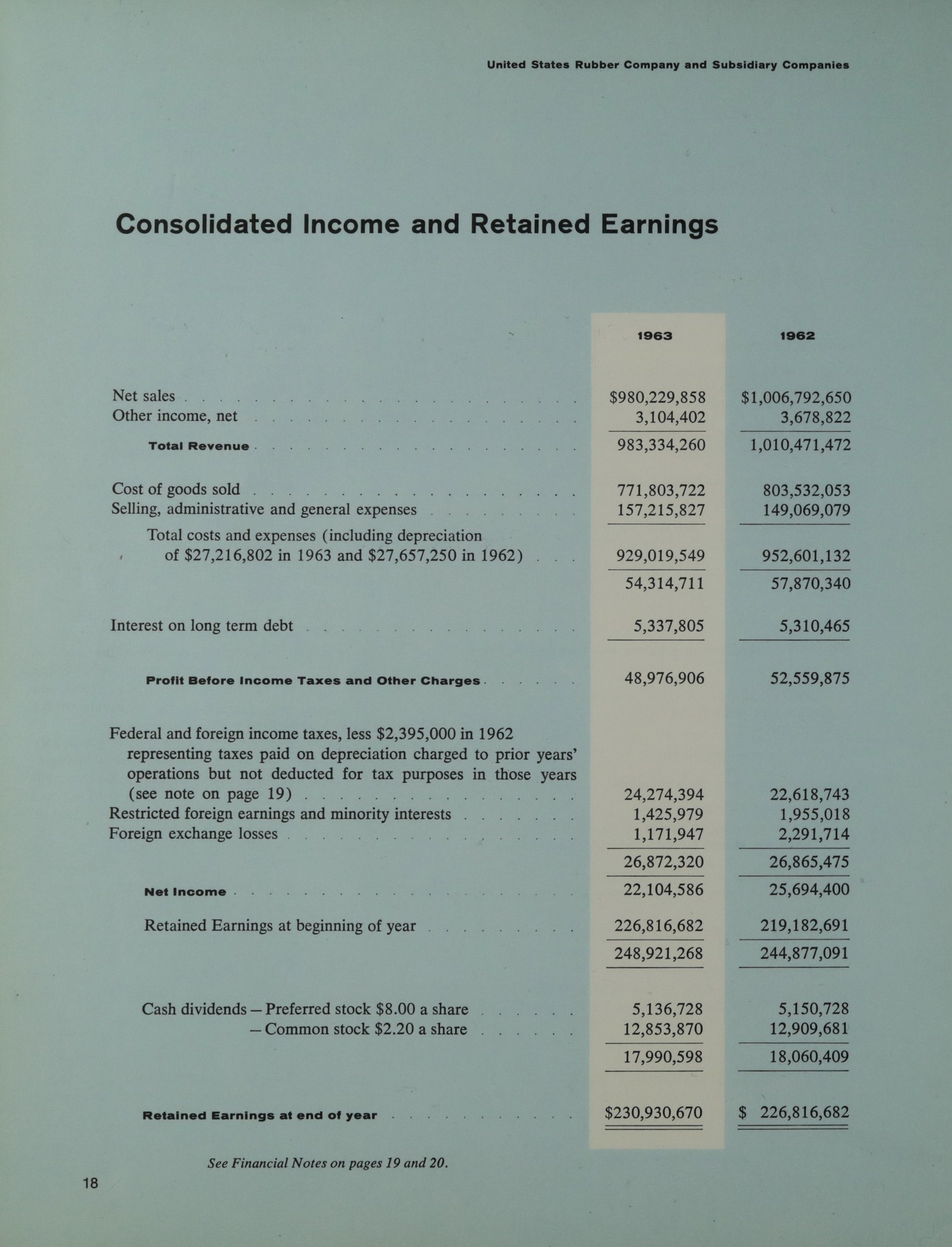
United States Rubber Company and Subsidiary Companies

Consolidated Income and Retained Earnings

                                            1963                1962

Net sales $980,229,858 $1,006,792,650
Other income, net 3,104,402 3,678,822
Total Revenue 983,334,260 1,010,471,472

Cost of goods sold 771,803,722 803,532,053
Selling, administrative and general expenses 157,215,827 149,069,079
Total costs and expenses (including depreciation
of $27,216,802 in 1963 and $27,657,250 in 1962)
929,019,549 952,601,132
54,314,711 57,870,340

Interest on long term debt 5,337,805 5,310,465

Profit Before Income Taxes and Other Charges 48,976,906 52,559,875

Federal and foreign income taxes, less $2,395,000 in 1962
representing taxes paid on depreciation charged to prior years’
operations but not deducted for tax purposes in those years
(see note on page 19) 24,274,394 22,618,743
Restricted foreign earnings and minority interests
1,425,979 1,955,018
Foreign exchange losses 1,171,947 2,291,714
26,872,320 26,865,475

Net Income 22,104,586 25,694,400

Retained Earnings at beginning of year 226,816,682 219,182,691
248,921,268 244,877,091

Cash dividends – Preferred stock $8.00 a share 5,136,728 5,150,728
– Common stock $2.20 a share 12,853,870 12,909,681
17,990,598 18,060,409

Retained Earnings at end of year $230,930,670 $ 226,816,682

See Financial Notes on pages 19 and 20.
18