CHEM-TEXTS – Vol. 14 – Page 4

Page 004

CHEM-TEXTS

Page 4 | Vol. 14, 1980


Equality

continued from page 2

The execution of the equal opportunity policy demands the involvement of all management personnel in identifying and attracting minority, female, disabled veteran and Vietnam Era Veteran, and handicapped applicants qualified for consideration in all job classifications, as job openings in such classifications occur. The plant will make monthly audits of its recruiting efforts, hiring, promotional, and termination activities, and the minority, female, disabled veteran and Vietnam Era Veteran, and handicapped situation on the payroll. Additionally, our Affirmative Action Plans are audited on a regular basis by Federal Government and Corporate office Personnel.

J.R. Douglas, Industrial Relations Manager, has appointed C.D. Hilton, Personnel Manager, as the EEO Administrator for the Naugatuck Plant. Feel free to contact them regarding any facet of the EEO policy.


Williams Heads Toastmasters Club

Bob Williams, International Marketing Specialist for Vibrathane and Speciality Chemicals, has been elected President of the Preston Hill Toastmasters Club for 1980.

The club meets every other Friday at Uniroyal’s Preston Hill Inn in Oxford is dedicated to help people improve their communication and leadership skills.

For more information call Bob at 723-3791. Other club members from EMIC and the plant are Joe Calaghan, George Lapp and Jim Marshall.


“On the Road”

By Joe Bucciaglia

The Chemicals and Polymers Sales Force

An important member of the team, but often a “distant” one, is the field sales representative who is “On-the-Road”. I hope to run a series of articles about our Chemicals and Polymers sales group and tell you a little about the people and what they do.

To start with, this sales force is led by a General Sales Manager, Joe Callaghan. Reporting to Joe is a Specialty Chemicals National Sales Manager, governing Specialty Chemicals and three Regional managers covering the Rubber Chemicals and Polymers. Also reporting to Joe are two Operations Managers, Pete Cookson for Polymers, and myself for Chemicals.

The Central Office for the Midwest Region (better known as District 4) is located in Akron, Ohio, “The Rubber Capital of the World”. Out of this office, the Chemicals and Polymers field Sales Force are responsible for selling Rubber and Heavy Chemicals, ROYALENE®, PARACRIL®, Natural Latex and VIBRATHANE® Gums.

The Sales Force in the Midwest is:

Vin Russo Regional Manager
Bill Galwardy Sr. Sales Associate with sales responsibilities in parts of Ohio Plus all the major Akron based Rubber Companies.
Wes Curtis Technical Representative with sales responsibilities in Ohio, West Virginia, and parts of New York and Pennsylvania.
Bill Stephenson Technical Representative with sales responsibilities in Indiana and half of Michigan.
Wayne Churchill Technical Representative with sales responsibilities in Illinois and half of Michigan.
Leo Pranitis Technical Representative with sales responsibilities in Wisconsin, Minnesota, Iowa, Nebraska, North Dakota and South Dakota.

The Akron Office is staffed by Leo Foley and Ruth Hoak.

Next issue, more on the other District Offices and the people staffing them. In the meanwhile, if your interested in anything else about Sales, drop me a line.


Become Hearing Experts

In the photo from left are Eric Johnson, Factory Manager, who presented the certificates; Ann McAllister RN; Patricia Grzywacz RN; and James Loman, Safety Supervisor.

Three members of the Safety and Medical Department have been awarded Certificates of Accreditation by the Council for Accreditation Occupational Hearing Conservation. The accreditation qualifies them to give industrial audiometric tests. As part of its continuing medical program the group wil give hearing tests to all employees to insure proper care of their hearing. Ann and Patricia received their certification from the University of Bridgeport and Jim from Kutztown State University, Pa. Loman is also a Certified First Aid and CPR Instructor while Pat recently received certification as a CPR Instructor.


55 MPH

Give it a chance to work. To save gasoline. To save lives, too.


Local 218…

continued from page 3

growth.”

Joe Rzeszutek recognized the need to make certain changes in the Contract in order to make the plant competitive with other chemical companies and to help improve its productivity in order to maintain job security in a highly competitive market area.

As a result of this mutual interest, Douglas reported that the parties were able to negotiate contractual changes that will provide potential improvements in productivity, reduced down-time, and cost reductions that can amount to substantial savings per year to the Naugatuck Plant. Both Douglas and Rzeszutek stated that this was the type of joint Company-Union effort that the parties are striving for in order to improve our operations, help secure jobs, and provide growth for the Naugatuck Chemical plant’s future.


Old Timers Corner

A group of “old timers” enjoy a barbecue at the home of Paul Benson in the warm Florida sun. The photo was sent in by George Allen, front row, left, who recently retired from the Industrial Relations Dept. Next to him is Ed Weaving who headed up the Plant Protection Dept. for many years. another picnic is scheduled at the home of Paul Benson on Feb. 17th, 1981.

George Allen who retired from Industrial Relations in 1979 sent this photo of retirees who gathered at the home of Paul Benson for a picnic. Since George retired he and his wife, Kay, have travelled the forty-eight states and now spend the winters in Florida. Seated from left are George Allen, Ed Weaving, Ann (Smey) Rockwood, Anthony Marrello, Andrew Smey, Al Lanouette and John Quint.

Standing from left are Kazys Urbsaitis, Guy Elwood, Vic Stasonis, Dave Rappe, Larry Terra, Ed Bazenas and Paul Benson.


BOB’S CAMERA SHOP INC.

WATERBURY’S LEADING CAMERA SHOP

90 South Main St., Waterbury, Conn. 06702 754-2256

Film • Cameras • Projectors • Developing • Rentals

Instant color passport pictures while you wait.


CHEM-TEXTS

PUBLISHED BY THE INDUSTRIAL RELATIONS DEPARTMENT
UNIROYAL CHEMICAL, NAUGATUCK, CONN. 06770

Equal Opportunity Employer

EDITOR: William F. Lavelle.


UNIROYAL

UNIROYAL CHEMICAL
Naugatuck, Connecticut 06770

U.S. Postage
PAID
Permit No. 10
Naugatuck, Conn. 06770

RETURN POSTAGE GUARANTEED
CHEM-TEXTS – Vol. 4 No. 1 – Page 3

Page 003

CHEM-TEXTS

Vol. 4, No. 1 | Page 3


UNIROYAL, INC.

EMPLOYEE BENEFIT COSTS—1968

U.R.W. PLANTS

Total Dollars Cents Per Hr.
Social Security $ 6,638,454 $ .1629
Unemployment Compensation Taxes 1,553,264 .0375
State Disability Insurance 182,749 .0044
Workmen’s Compensation 1,171,334 .0283
Vacations 11,898,799 .2877
Holidays 5,157,970 .1247
Overtime 8,771,526 .2121
Night Shift Bonus 1,172,040 .0283
Hospital, Surgical, In-Hospital Medical Insurance 7,470,680 .1806
Sickness & Accident Insurance 2,266,966 .0548
Life Insurance 2,222,114 .0535
Severance Pay 54,076 .0013
Grievance Meetings 111,513 .0027
Pensions 15,090,989 3648
Supplemental Unemployment Benefits 2,691,057 .0651
Funeral Pay 318,303 .0077
Military Training Pay 32,801 .0008
Jury Pay 73,024 .0018
Union Time Study 67,988 .0016
Safety Committee 9,651 .0002
Workmen’s Compensation Make-up 101,124 .0024
TOTAL $67,146,422 $1.6232

Above are various benefits employees receive and their cost per wage hour. At $1.62 an hour they add up to $64.80 for each 40 hour week or a total of more than $3,200 a year.


UNIROYAL, INC.

EMPLOYEE BENEFIT COSTS-IN CENTS PER HOUR

U.R.W. PLANTS 1953-1968

[THIS IS CHART: Bar graph showing increasing employee benefit costs from 1953 to 1968, starting at around $0.41 in 1953 and reaching $1.62 in 1968, with data points for each year showing gradual increase: .41, .42, .53, .57, .62, .76, .82, .91, .93, .97, 1.09, 1.23, 1.35, 1.62, 1.76]

The chart shows the increased cost of employee benefits. They have gone up from 41 cents an hour in 1953 to $1.62 in 1968. On August 1, 1969 Uniroyal absorbed the 20% increase in the Hospitalization, Surgical and In-Hospital medical benefits. For 12 months this benefit now amounts to $364.44 per employee.


Sales Highest; Profits Drop

Estimated 1969 sales hit a record high of $1,550,000,000, an 8% increase over 1968.

But 1969 profits were about $46,500,000 or 18% below the record of $56,900,000 in 1968.

Tire, Footwear Profits Affected

Although foreign operations showed good gains, along with industrial and most other U.S. products, the gains were offset by lower profits in U.S. Tires and Footwear operations.

Footwear was hurt by lower demands for its products, low cost foreign imports, and the higher number of lower cost U.S. manufacturers paying wages below Uniroyal wages.

Tires faced sharply higher costs and lower productivity from the introduction of the new bias belted tires and heavy start-up expenses for expanding tire capacity at Opelika.

Fourth Quarter Sales, Profits

Fourth quarter sales were about 5% above the same period in 1968 but profits for the fourth quarter of 1969 were approximately $8,500,000 compared to profits of $14,300,000 in 1968. This represents a $5,800,000 drop in profits for the last quarter of 1969.


Three Employees Avert Fire

[THIS IS PHOTO: Group photo of four men in work attire]

From left, Phil DePasquale, plant protection group leader, congratulates Fred Sargeant, fire inspector, and Gene Lantieri, mechanic, is congratulated by Bill Rek, foreman, for their quick action to avert fire. Missing from photo is Oliver Leduc.

by Ed Weaving

The alert action of Eugene Lantieri and Oliver LeDuc of the Mechanical Department and Fred Sargent, a Fire Inspector, prevented a possible serious fire in Building 16 of the Reclaim Plant.

Lantieri and LeDuc were working in the area when they discovered flames from an accumulation of rubber. They immediately ran to the nearby hoselines and used them to extinguish the fire. The hose operation automatically turn in the sprinkler alarm, which is an important part of our plant protection system. Responding to the alarm which rings in the Firehouse, Fred Sargent entered the smoke-filled area and assisted Lantieri and LeDuc in putting out the fire.

Quick Action Stops Damage

Had it not been for the quick action of the three men and knowing what to do in an emergency, several sprinkler heads would have opened up and flooded the area with water and damage would have resulted from both the fire and water.

Several other employees took part in fighting the fire and helped in controlling it.

Overheating Ignites Rubber Accumulation

The fire resulted from a broken greaseline leading to the mechanical shoe on a screen, causing the overheating of the shoe and ignition of rubber accumulation around the screen.

Due to the nature of this operation, fires will occur and serious damage result unless the mechanical equipment is kept in good operating condition and every employee in the area pays particular attention to good housekeeping and reports possible fire hazards to the foreman of the department.


Snow Plow Hits Car

While driving to work recently, an employee’s car was sideswiped by a snow plow truck.

The truck, approaching in the opposite two lane highway, made a left turn at an intersection separated by a median strip, and ripped into the front left side of the car. The driver was slightly injured but severely shaken up by the unexpected turn of the truck. Another two feet, and the four foot high plow would have crushed the car and the driver.

No matter how careful you are, you can never be sure what the other driver will do. Expect the unexpected happening, especially during the winter months when icy roads make driving more hazardous.


Mattress Bargain Sale On

A special low price sale on Uniroyal’s Koylon foam mattresses is now in progress at the Footwear Employee’s salesroom. Only the firm type is being offered in the sale.

Savings of $47 can be realized on the sale price depending on the size.

The special sale ends Feb. 28. So place your order with the Salesroom now. Orders may be placed by telephone to George O’Donnell, Ext. 17-259 at the Footwear Salesroom.

Mattresses will be delivered to the Salesroom to save you transportation costs.

9 out of 10 of all auto accidents happened in the driver’s own state.


You Couldn’t Afford . . .

Continued from page 1

everyone’s responsibility to keep these benefits secure. They have increased nearly four times what they were 15 years ago.

Competition, imports, price cuts, and higher costs can affect the extent, cost, and value of benefit programs.

Our challenge is to find methods to improve production, reduce costs and waste, work safer, suggest ideas to improve jobs, and to show a real concern for producing quality products to keep our customers.

Every employee holds an important role in the plant’s operations . . . and with 65% holding stock in Uniroyal, everyone’s fullest effort is needed to protect our interests and benefits.


Trucks . . .

Continued from page 2

that seat belts are as important in truck cabs as in automobiles, notwithstanding the added problem of load shift and fire.

With respect to injuries, on the average, injured truck drivers have 32% more injuries than automobile drivers. The most frequent contributor to this discrepancy is the abdominal area. The frequency of head injuries is essentially the same for both.

Among injured truck drivers, the frequency of dangerous or fatal injury is nearly twice as high as among injured automobile drivers. The results of the survey indicate that safety belts and the use of other restraint systems reduce injuries to truck drivers.

Automobile drivers should always drive with their safety belts on. Statistics prove conclusively that they have prevented millions of serious injuries when worn properly. However, it is estimated that only 40% of the drivers with seat belts in their automobiles use them.


SAFETY IS MY RESPONSIBILITY

CHEM-TEXTS – Vol. 4, 1970, No. 4 – Page 1

Page 001

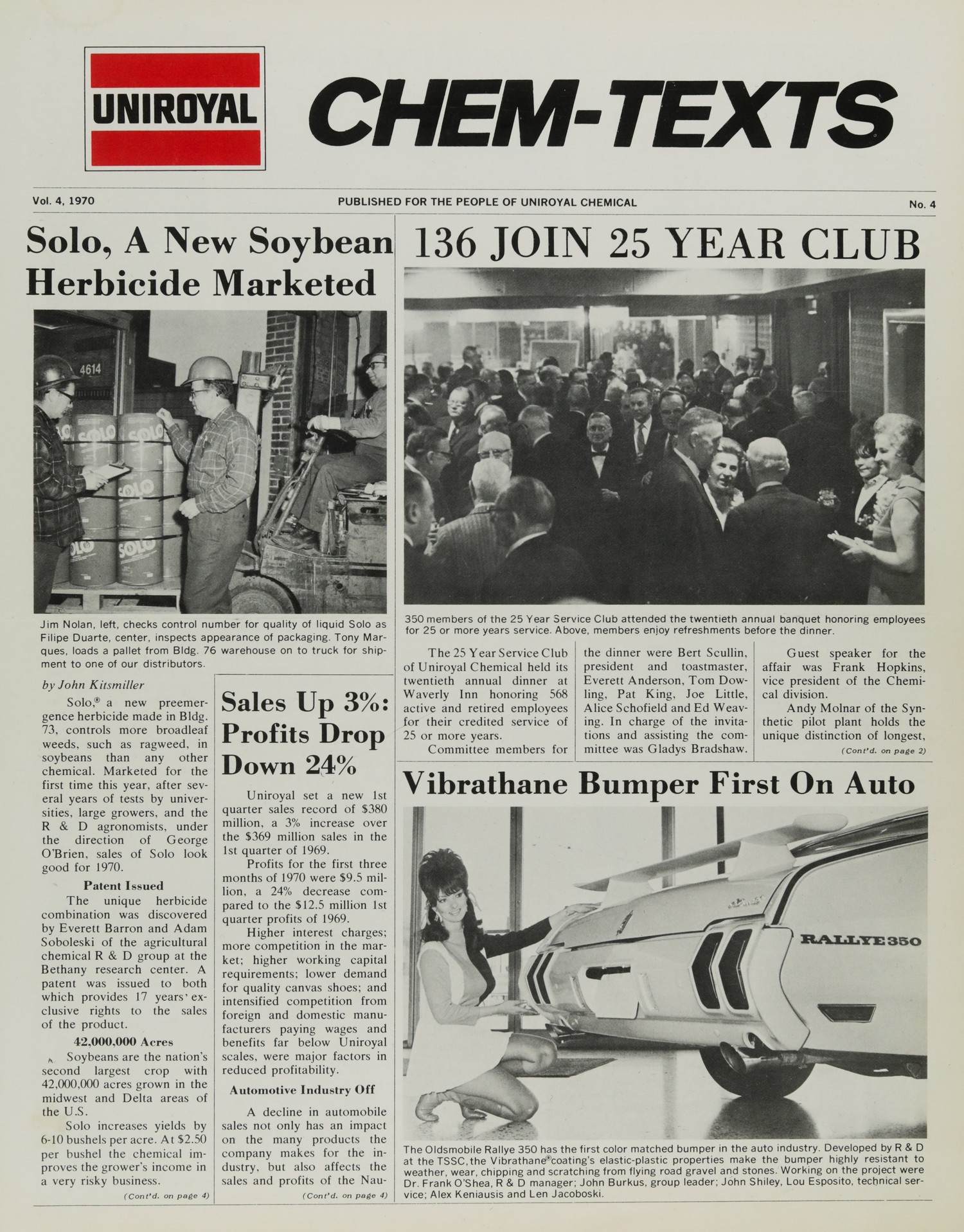
UNIROYAL CHEM-TEXTS

Vol. 4, 1970 | PUBLISHED FOR THE PEOPLE OF UNIROYAL CHEMICAL | No. 4


Solo, A New Soybean Herbicide Marketed

[IMAGE: Photo showing workers with pallets marked “4614” and “SOLO”]

Jim Nolan, left, checks control number for quality of liquid Solo as Filipe Duarte, center, inspects appearance of packaging. Tony Marques, loads a pallet from Bldg. 76 warehouse on to truck for shipment to one of our distributors.

by John Kitsmiller

Solo,® a new preemergence herbicide made in Bldg. 73, controls more broadleaf weeds, such as ragweed, in soybeans than any other chemical. Marketed for the first time this year, after several years of tests by universities, large growers, and the R & D agronomists, under the direction of George O’Brien, sales of Solo look good for 1970.

Patent Issued

The unique herbicide combination was discovered by Everett Barron and Adam Soboleski of the agricultural chemical R & D group at the Bethany research center. A patent was issued to both which provides 17 years’ exclusive rights to the sales of the product.

42,000,000 Acres

Soybeans are the nation’s second largest crop with 42,000,000 acres grown in the midwest and Delta areas of the U.S.

Solo increases yields by 6-10 bushels per acre. At $2.50 per bushel the chemical improves the grower’s income in a very risky business.

(Cont’d. on page 4)


Sales Up 3%: Profits Drop Down 24%

Uniroyal set a new 1st quarter sales record of $380 million, a 3% increase over the $369 million sales in the 1st quarter of 1969.

Profits for the first three months of 1970 were $9.5 million, a 24% decrease compared to the $12.5 million 1st quarter profits of 1969.

Higher interest charges; more competition in the market; higher working capital requirements; lower demand for quality canvas shoes; and intensified competition from foreign and domestic manufacturers paying wages and benefits far below Uniroyal scales, were major factors in reduced profitability.

Automotive Industry Off

A decline in automobile sales not only has an impact on the many products the company makes for the industry, but also affects the sales and profits of the Nau-

(Cont’d. on page 4)


136 JOIN 25 YEAR CLUB

[IMAGE: Photo of crowd at banquet/dinner event]

350 members of the 25 Year Service Club attended the twentieth annual banquet honoring employees for 25 or more years service. Above, members enjoy refreshments before the dinner.

The 25 Year Service Club of Uniroyal Chemical held its twentieth annual dinner at Waverly Inn honoring 568 active and retired employees for their credited service of 25 or more years.

Committee members for the dinner were Bert Scullin, president and toastmaster, Everett Anderson, Tom Dowling, Pat King, Joe Little, Alice Schofield and Ed Weaving. In charge of the invitations and assisting the committee was Gladys Bradshaw.

Guest speaker for the affair was Frank Hopkins, vice president of the Chemical division.

Andy Molnar of the Synthetic pilot plant holds the unique distinction of longest,

(Cont’d. on page 2)


Vibrathane Bumper First On Auto

[IMAGE: Photo of woman in short dress posing next to Oldsmobile Rallye 350 car with visible “RALLYE 350” text]

The Oldsmobile Rallye 350 has the first color matched bumper in the auto industry. Developed by R & D at the TSSC, the Vibrathane®coating’s elastic-plastic properties make the bumper highly resistant to weather, wear, chipping and scratching from flying road gravel and stones. Working on the project were Dr. Frank O’Shea, R & D manager; John Burkus, group leader; John Shiley, Lou Esposito, technical service; Alex Keniausis and Len Jacoboski.

CHEM-TEXTS – Vol. 4, 1970, No. 8 – Page 1

Page 001

UNIROYAL CHEM-TEXTS

Vol. 4, 1970 | PUBLISHED FOR THE PEOPLE OF UNIROYAL CHEMICAL | No. 8


Polygard Facilities To Expand

by Rod Gaetz

Design drawings are near completion for the expansion of Polygard ® facilities in Bldg. 109. The major equipment has been ordered and 75% of the necessary piping materials are on order for the project which will increase the production rates of the chemical. The project is part of the plant’s continuing program to stay competitive in a tight chemical market, keep business at the plant and keep chemical production employment at a full level.

Used In Rubber

Polygard is one of the most effective nondiscoloring and nonstaining stabilizers for synthetic rubber in commercial use today. Without Polygard protection, degradation occurs during the finishing, processing and vulcanization, resulting in a shorter service life of the final rubber product.

As a chemical, Polygard is safe to use, having the approval of the Food and Drug Administration (FDA) for use in products used for packaging or handling food.

New Stainless Steel Lines

The major work done during the summer shutdown of the building was the relocation and repiping of 2 Hold tanks from the second to the third floor. The piping from the bottom of the four vessels which will eventually become strippers was replaced with much larger stainless steel lines. The transfer pump was relocated and the discharge lines relocated and replaced with 3″ and 4″ stainless steel piping.

Fume Control Devices

When completed in early 1972, the expanded facilities will have environmental control devices to control fume pollution as part of the plant’s policy in the installation of new equipment and facilities.

Engineers working on the expansion are Terry Mo and Rod Gaetz; Vic Anderson, instrumentation and electricity; and Lou Kaiser, environmental control.


MIP Plan To Start

Instead of the 1970 stock purchase plan slated to start August 1, Uniroyal will expand the Monthly Investment Plan (MIP) to all employees interested in purchasing Uniroyal stock, at the market price, on a regular payroll deduction basis.

Under the plan, which is operated by Merrill Lynch, Pierce, Fenner and Smith, Inc., employees can sign up for regular payroll deductions. There are minimum and maximum deductions which will be indicated with other information, in plan brochures available shortly.

Merrill Lynch will purchase Uniroyal stock at the market price and keep individual accounts for each employee. Employees will receive regular statements from Merrill Lynch showing how much stock has been

(Cont’d on page 4)


H.S. Diploma Obtainable

It’s still possible for a person who left high school for one reason or another to obtain a high school diploma without going back to school.

To qualify for a diploma,

(Cont’d on page 4)


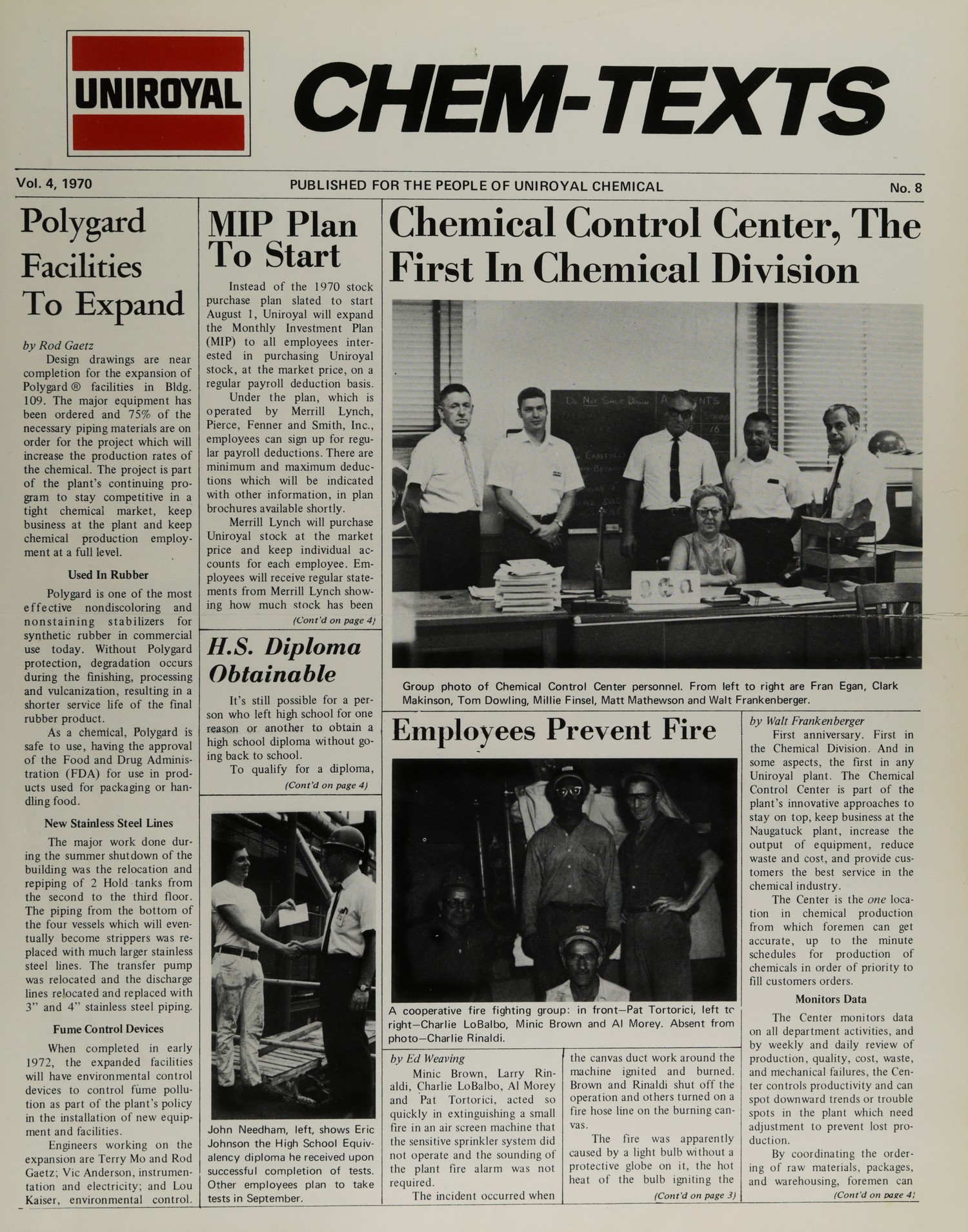
Chemical Control Center, The First In Chemical Division

Group photo of Chemical Control Center personnel. From left to right are Fran Egan, Clark Makinson, Tom Dowling, Millie Finsel, Matt Mathewson and Walt Frankenberger.


Employees Prevent Fire

by Walt Frankenberger

First anniversary. First in the Chemical Division. And in some aspects, the first in any Uniroyal plant. The Chemical Control Center is part of the plant’s innovative approaches to stay on top, keep business at the Naugatuck plant, increase the output of equipment, reduce waste and cost, and provide customers the best service in the chemical industry.

The Center is the one location in chemical production from which foremen can get accurate, up to the minute schedules for production of chemicals in order of priority to fill customers orders.

Monitors Data

The Center monitors data on all department activities, and by weekly and daily review of production, quality, cost, waste, and mechanical failures, the Center controls productivity and can spot downward trends or trouble spots in the plant which need adjustment to prevent lost production.

By coordinating the ordering of raw materials, packages, and warehousing, foremen can

(Cont’d on page 4)


A cooperative fire fighting group: in front—Pat Tortorici, left to right—Charlie LoBalbo, Minic Brown and Al Morey. Absent from photo—Charlie Rinaldi.


John Needham, left, shows Eric Johnson the High School Equivalency diploma he received upon successful completion of tests. Other employees plan to take tests in September.


by Ed Weaving

Minic Brown, Larry Rinaldi, Charlie LoBalbo, Al Morey and Pat Tortorici, acted so quickly in extinguishing a small fire in an air screen machine that the sensitive sprinkler system did not operate and the sounding of the plant fire alarm was not required.

The incident occurred when the canvas duct work around the machine ignited and burned. Brown and Rinaldi shut off the operation and others turned on a fire hose line on the burning canvas.

The fire was apparently caused by a light bulb without a protective globe on it, the hot heat of the bulb igniting the

(Cont’d on page 3)

CHEM-TEXTS – Vol. 4 No. 10 – Page 2

Page 002

Page 2 CHEM-TEXTS Vol. 4 No. 10

FROM THE FACTORY MANAGER | Oxford Office Close to Completion

DEAR FELLOW EMPLOYEE:

Christmas is the season when everyone of us express more than anything during the year, the spirit of giving and concern for our family, friends, and the people we come in contact with each day of our lives. This spirit is particularly reflected by gifts to our families; visits to friends’ homes, and a sharing with others the many joys of the holidays.

In the plant where all of us work so closely together and depend upon each other so completely, this same spirit of giving and concern is vital.

By giving out fullest effort to, and showing the utmost concern for our responsibilities and the people we work with, each of us can individually infuse into the plant a spirit that will really make it a “good place to work.” The plant is not just a mere collection of buildings which house equipment to help us produce products or provide services, it is us, our efforts and our achievements.

Our work takes up more than eight hours of our day, and is a major part of our life. We can make it challenging; we can make it more secure; we can make it safer; we can make it more enjoyable by the same spirit of giving and concern that we display during the Christmas season.

I sincerely hope that you and your family, will enjoy a most happy Christmas and the fullest joy and happiness during the new Year.

Sincerely

Shel Salzman

S. R. Salzman


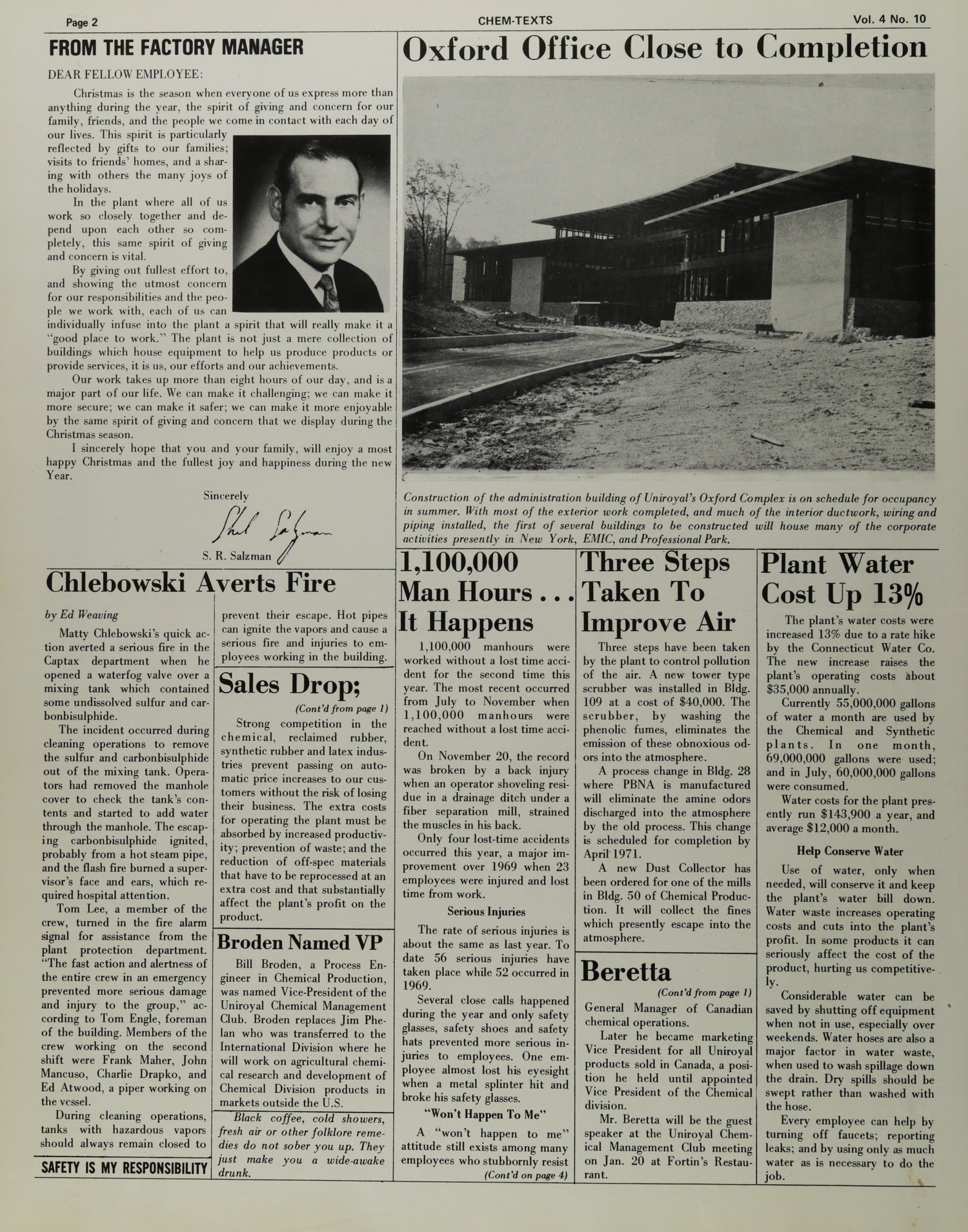
Construction of the administration building of Uniroyal’s Oxford Complex is on schedule for occupancy in summer. With most of the exterior work completed, and much of the interior ductwork, wiring and piping installed, the first of several buildings to be constructed will house many of the corporate activities presently in New York, EMIC, and Professional Park.


Chlebowski Averts Fire

by Ed Weaving

Matty Chlebowski’s quick action averted a serious fire in the Captax department when he opened a waterfog valve over a mixing tank which contained some undissolved sulfur and carbonbisulphide.

The incident occurred during cleaning operations to remove the sulfur and carbonbisulphide out of the mixing tank. Operators had removed the manhole cover to check the tank’s contents and started to add water through the manhole. The escaping carbonbisulphide ignited, probably from a hot steam pipe, and the flash fire burned a supervisor’s face and ears, which required hospital attention.

Tom Lee, a member of the crew, turned in the fire alarm signal for assistance from the plant protection department. “The fast action and alertness of the entire crew in an emergency prevented more serious damage and injury to the group,” according to Tom Engle, foreman of the building. Members of the crew working on the second shift were Frank Maher, John Mancuso, Charlie Drapko, and Ed Atwood, a piper working on the vessel.

During cleaning operations, tanks with hazardous vapors should always remain closed to

SAFETY IS MY RESPONSIBILITY

prevent their escape. Hot pipes can ignite the vapors and cause a serious fire and injuries to employees working in the building.


Sales Drop;

(Cont’d from page 1)

Strong competition in the chemical, reclaimed rubber, synthetic rubber and latex industries prevent passing on automatic price increases to our customers without the risk of losing their business. The extra costs for operating the plant must be absorbed by increased productivity; prevention of waste; and the reduction of off-spec materials that have to be reprocessed at an extra cost and that substantially affect the plant’s profit on the product.


Broden Named VP

Bill Broden, a Process Engineer in Chemical Production, was named Vice-President of the Uniroyal Chemical Management Club. Broden replaces Jim Phelan who was transferred to the International Division where he will work on agricultural chemical research and development of Chemical Division products in markets outside the U.S.

Black coffee, cold showers, fresh air or other folklore remedies do not sober you up. They just make you a wide-awake drunk.


1,100,000 Man Hours… It Happens

1,100,000 manhours were worked without a lost time accident for the second time this year. The most recent occurred from July to November when 1,100,000 manhours were reached without a lost time accident.

On November 20, the record was broken by a back injury when an operator shoveling residue in a drainage ditch under a fiber separation mill, strained the muscles in his back.

Only four lost-time accidents occurred this year, a major improvement over 1969 when 23 employees were injured and lost time from work.

Serious Injuries

The rate of serious injuries is about the same as last year. To date 56 serious injuries have taken place while 52 occurred in 1969.

Several close calls happened during the year and only safety glasses, safety shoes and safety hats prevented more serious injuries to employees. One employee almost lost his eyesight when a metal splinter hit and broke his safety glasses.

“Won’t Happen To Me”

A “won’t happen to me” attitude still exists among many employees who stubbornly resist

(Cont’d on page 4)


Three Steps Taken To Improve Air

Three steps have been taken by the plant to control pollution of the air. A new tower type scrubber was installed in Bldg. 109 at a cost of $40,000. The scrubber, by washing the phenolic fumes, eliminates the emission of these obnoxious odors into the atmosphere.

A process change in Bldg. 28 where PBNA is manufactured will eliminate the amine odors discharged into the atmosphere by the old process. This change is scheduled for completion by April 1971.

A new Dust Collector has been ordered for one of the mills in Bldg. 50 of Chemical Production. It will collect the fines which presently escape into the atmosphere.


Beretta

(Cont’d from page 1)

General Manager of Canadian chemical operations.

Later he became marketing Vice President for all Uniroyal products sold in Canada, a position he held until appointed Vice President of the Chemical division.

Mr. Beretta will be the guest speaker at the Uniroyal Chemical Management Club meeting on Jan. 20 at Fortin’s Restaurant.


Plant Water Cost Up 13%

The plant’s water costs were increased 13% due to a rate hike by the Connecticut Water Co. The new increase raises the plant’s operating costs about $35,000 annually.

Currently 55,000,000 gallons of water a month are used by the Chemical and Synthetic plants. In one month, 69,000,000 gallons were used; and in July, 60,000,000 gallons were consumed.

Water costs for the plant presently run $143,900 a year, and average $12,000 a month.

Help Conserve Water

Use of water, only when needed, will conserve it and keep the plant’s water bill down. Water waste increases operating costs and cuts into the plant’s profit. In some products it can seriously affect the cost of the product, hurting us competitively.

Considerable water can be saved by shutting off equipment when not in use, especially over weekends. Water hoses are also a major factor in water waste, when used to wash spillage down the drain. Dry spills should be swept rather than washed with the hose.

Every employee can help by turning off faucets; reporting leaks; and by using only as much water as is necessary to do the job.

CHEM-TEXTS – Vol. 3, 1969, No. 5 – Page 1

Page 001

UNIROYAL CHEM-TEXTS

Vol. 3, 1969 | PUBLISHED FOR THE PEOPLE OF UNIROYAL CHEMICAL | No. 5


Good Housekeeping Prevents Plant Fires; Improves Safety, Morale, Product Quality

by Ed Weaving

What does good housekeeping mean? The words lead to thoughts first about your home or apartment. Every person prefers a clean, orderly, attractive and safe

the plant is the result of persons working together and having a care and pride in their work area, equipment and operations. As stockholders in Uniroyal – 63% of the Chemical employees

care and pride in something owned by us.

In the plant, good housekeeping means materials are neatly packaged and palleted; the work area and equipment is kept clean; and the aisles

and care for the quality of products made in the plant; leads to waste; and endangers the safety of other persons in the plant.

If a person acted as if he owned the business, his care

energies, efforts and creative talents have helped to make the plant successful in producing quality products to meet our customers’ needs.

Fire prevention and safety go hand in hand with good housekeeping. In well-kept areas, the possibility of fire is minimized; safety is improved; and work more enjoyable. In the event of a fire or an emergency the fire department can handle the situation more efficiently if the area is not obstructed by drums and pallets in the aisles. Every second is vital to the fire department’s effectiveness, but if an area is blocked, their efforts are hampered and a small incident may become a major one.

The Naugatuck plant, in a sense, belongs to every employee, whether he’s a stockholder or not. Sales, profits and job security depend upon the ability to produce quality products against major competitive companies. Good housekeeping helps do this. It prevents fires; improves safety conditions; and makes the plant a better place to work. The plant’s progress and goals for the year depends greatly on how well employees care for good housekeeping — it’s a vital factor in every operation of the plant.


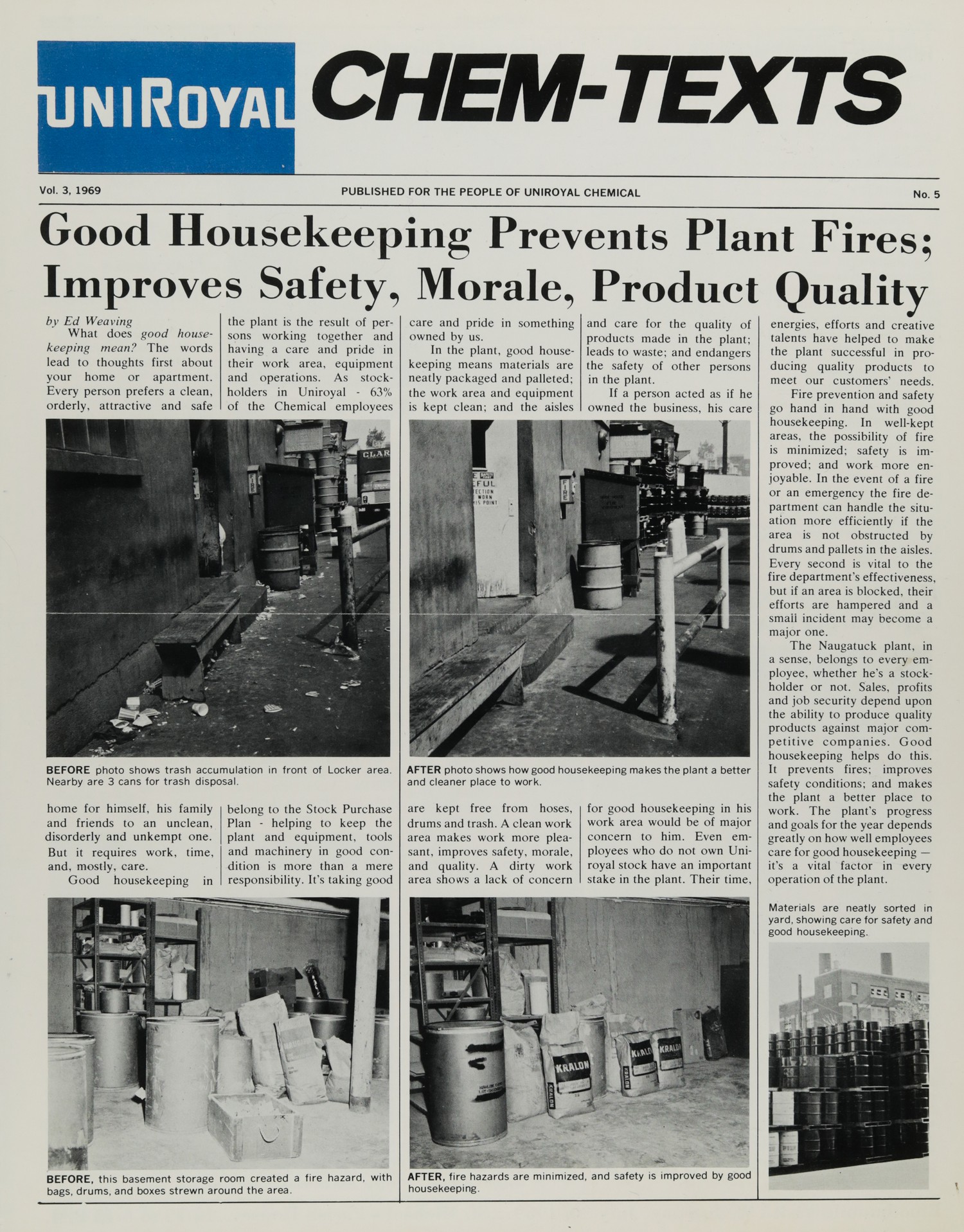
BEFORE photo shows trash accumulation in front of Locker area. Nearby are 3 cans for trash disposal.

AFTER photo shows how good housekeeping makes the plant a better and cleaner place to work.


home for himself, his family and friends to an unclean, disorderly and unkempt one. But it requires work, time, and, mostly, care.

Good housekeeping in

belong to the Stock Purchase Plan – helping to keep the plant and equipment, tools and machinery in good condition is more than a mere responsibility. It’s taking good

are kept free from hoses, drums and trash. A clean work area makes work more pleasant, improves safety, morale, and quality. A dirty work area shows a lack of concern

for good housekeeping in his work area would be of major concern to him. Even employees who do not own Uniroyal stock have an important stake in the plant. Their time,


BEFORE, this basement storage room created a fire hazard, with bags, drums, and boxes strewn around the area.

AFTER, fire hazards are minimized, and safety is improved by good housekeeping.


Materials are neatly sorted in yard, showing care for safety and good housekeeping.

CHEM-TEXTS – Vol. 3 No. 6 – Page 4

Page 004

Page 4 CHEM-TEXTS

New “Idea Plan” Offers $1000 Cash Awards

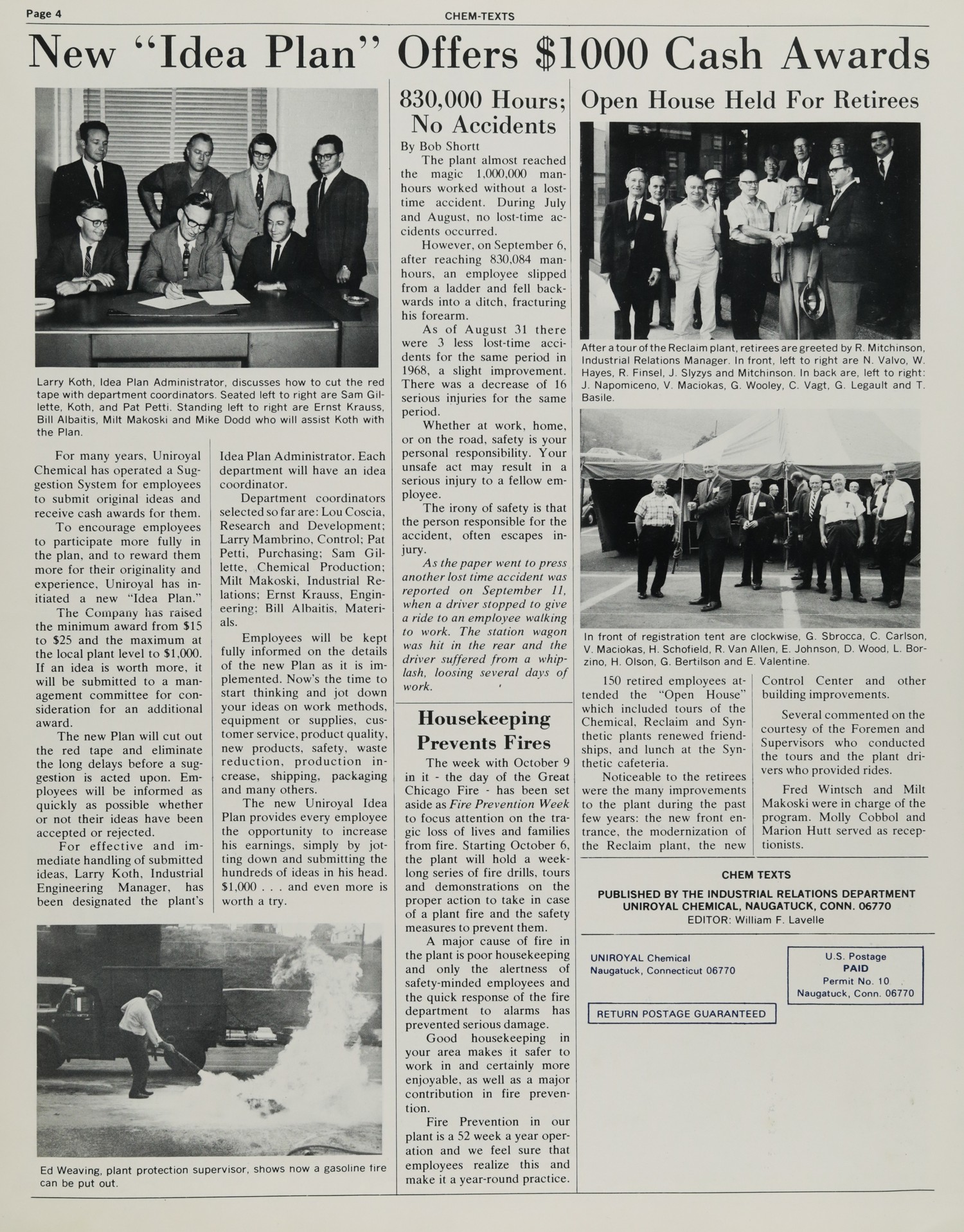
Larry Koth, Idea Plan Administrator, discusses how to cut the red tape with department coordinators. Seated left to right are Sam Gillette, Koth, and Pat Petti. Standing left to right are Ernst Krauss, Bill Albaitis, Milt Makoski and Mike Dodd who will assist Koth with the Plan.

For many years, Uniroyal Chemical has operated a Suggestion System for employees to submit original ideas and receive cash awards for them.

To encourage employees to participate more fully in the plan, and to reward them more for their originality and experience, Uniroyal has initiated a new “Idea Plan.”

The Company has raised the minimum award from $15 to $25 and the maximum at the local plant level to $1,000. If an idea is worth more, it will be submitted to a management committee for consideration for an additional award.

The new Plan will cut out the red tape and eliminate the long delays before a suggestion is acted upon. Employees will be informed as quickly as possible whether or not their ideas have been accepted or rejected.

For effective and immediate handling of submitted ideas, Larry Koth, Industrial Engineering Manager, has been designated the plant’s Idea Plan Administrator. Each department will have an idea coordinator.

Department coordinators selected so far are: Lou Coscia, Research and Development; Larry Mambrino, Control; Pat Petti, Purchasing; Sam Gillette, Chemical Production; Milt Makoski, Industrial Relations; Ernst Krauss, Engineering; Bill Albaitis, Materials.

Employees will be kept fully informed on the details of the new Plan as it is implemented. Now’s the time to start thinking and jot down your ideas on work methods, equipment or supplies, customer service, product quality, new products, safety, waste reduction, production increase, shipping, packaging and many others.

The new Uniroyal Idea Plan provides every employee the opportunity to increase his earnings, simply by jotting down and submitting the hundreds of ideas in his head. $1,000 . . . and even more is worth a try.


Ed Weaving, plant protection supervisor, shows now a gasoline fire can be put out.


830,000 Hours; No Accidents

By Bob Shortt

The plant almost reached the magic 1,000,000 manhours worked without a losttime accident. During July and August, no lost-time accidents occurred.

However, on September 6, after reaching 830,084 manhours, an employee slipped from a ladder and fell backwards into a ditch, fracturing his forearm.

As of August 31 there were 3 less lost-time accidents for the same period in 1968, a slight improvement. There was a decrease of 16 serious injuries for the same period.

Whether at work, home, or on the road, safety is your personal responsibility. Your unsafe act may result in a serious injury to a fellow employee.

The irony of safety is that the person responsible for the accident, often escapes injury.

As the paper went to press another lost time accident was reported on September 11, when a driver stopped to give a ride to an employee walking to work. The station wagon was hit in the rear and the driver suffered from a whiplash, loosing several days of work.


Housekeeping Prevents Fires

The week with October 9 in it – the day of the Great Chicago Fire – has been set aside as Fire Prevention Week to focus attention on the tragic loss of lives and families from fire. Starting October 6, the plant will hold a weeklong series of fire drills, tours and demonstrations on the proper action to take in case of a plant fire and the safety measures to prevent them.

A major cause of fire in the plant is poor housekeeping and only the alertness of safety-minded employees and the quick response of the fire department to alarms has prevented serious damage.

Good housekeeping in your area makes it safer to work in and certainly more enjoyable, as well as a major contribution in fire prevention.

Fire Prevention in our plant is a 52 week a year operation and we feel sure that employees realize this and make it a year-round practice.


Open House Held For Retirees

After a tour of the Reclaim plant, retirees are greeted by R. Mitchinson, Industrial Relations Manager. In front, left to right are N. Valvo, W. Hayes, R. Finsel, J. Slyzys and Mitchinson. In back are, left to right: J. Napomiceno, V. Maciokas, G. Wooley, C. Vagt, G. Legault and T. Basile.

In front of registration tent are clockwise, G. Sbrocca, C. Carlson, V. Maciokas, H. Schofield, R. Van Allen, E. Johnson, D. Wood, L. Borzino, H. Olson, G. Bertilson and E. Valentine.

150 retired employees attended the “Open House” which included tours of the Chemical, Reclaim and Synthetic plants renewed friendships, and lunch at the Synthetic cafeteria.

Noticeable to the retirees were the many improvements to the plant during the past few years: the new front entrance, the modernization of the Reclaim plant, the new Control Center and other building improvements.

Several commented on the courtesy of the Foremen and Supervisors who conducted the tours and the plant drivers who provided rides.

Fred Wintsch and Milt Makoski were in charge of the program. Molly Cobbol and Marion Hutt served as receptionists.


CHEM TEXTS

PUBLISHED BY THE INDUSTRIAL RELATIONS DEPARTMENT
UNIROYAL CHEMICAL, NAUGATUCK, CONN. 06770
EDITOR: William F. Lavelle

UNIROYAL Chemical
Naugatuck, Connecticut 06770

U.S. Postage
PAID
Permit No. 10
Naugatuck, Conn. 06770

RETURN POSTAGE GUARANTEED
CHEM-TEXTS – Vol. 3 No. 11 – Page 4

Page 004

Page 4 | CHEM-TEXT | Vol. 3 No. 11

$21,000 Contributed to United Givers

[PHOTO: Image showing people near a vehicle, including children on crutches and adults]

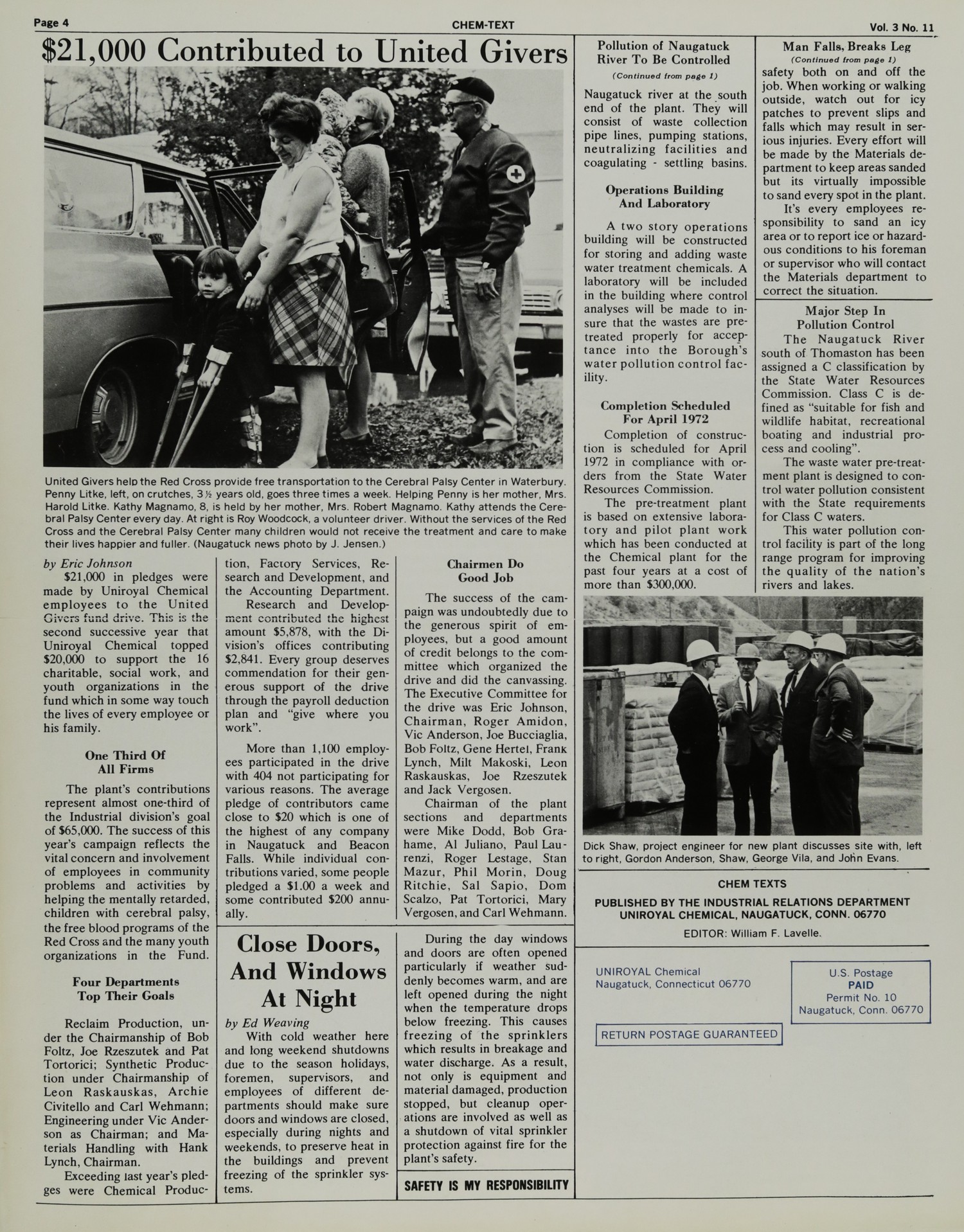
United Givers help the Red Cross provide free transportation to the Cerebral Palsy Center in Waterbury. Penny Litke, left, on crutches, 3 ½ years old, goes three times a week. Helping Penny is her mother, Mrs. Harold Litke. Kathy Magnamo, 8, is held by her mother, Mrs. Robert Magnamo. Kathy attends the Cerebral Palsy Center every day. At right is Roy Woodcock, a volunteer driver. Without the services of the Red Cross and the Cerebral Palsy Center many children would not receive the treatment and care to make their lives happier and fuller. (Naugatuck news photo by J. Jensen.)


by Eric Johnson

$21,000 in pledges were made by Uniroyal Chemical employees to the United Givers fund drive. This is the second successive year that Uniroyal Chemical topped $20,000 to support the 16 charitable, social work, and youth organizations in the fund which in some way touch the lives of every employee or his family.

One Third Of All Firms

The plant’s contributions represent almost one-third of the Industrial division’s goal of $65,000. The success of this year’s campaign reflects the vital concern and involvement of employees in community problems and activities by helping the mentally retarded, children with cerebral palsy, the free blood programs of the Red Cross and the many youth organizations in the Fund.

Four Departments Top Their Goals

Reclaim Production, under the Chairmanship of Bob Foltz, Joe Rzeszutek and Pat Tortorici; Synthetic Production under Chairmanship of Leon Raskauskas, Archie Civitello and Carl Wehmann; Engineering under Vic Anderson as Chairman; and Materials Handling with Hank Lynch, Chairman.

Exceeding last year’s pledges were Chemical Production, Factory Services, Research and Development, and the Accounting Department.

Research and Development contributed the highest amount $5,878, with the Division’s offices contributing $2,841. Every group deserves commendation for their generous support of the drive through the payroll deduction plan and “give where you work”.

More than 1,100 employees participated in the drive with 404 not participating for various reasons. The average pledge of contributors came close to $20 which is one of the highest of any company in Naugatuck and Beacon Falls. While individual contributions varied, some people pledged a $1.00 a week and some contributed $200 annually.


Close Doors, And Windows At Night

by Ed Weaving

With cold weather here and long weekend shutdowns due to the season holidays, foremen, supervisors, and employees of different departments should make sure doors and windows are closed, especially during nights and weekends, to preserve heat in the buildings and prevent freezing of the sprinkler systems.


Chairmen Do Good Job

The success of the campaign was undoubtedly due to the generous spirit of employees, but a good amount of credit belongs to the committee which organized the drive and did the canvassing. The Executive Committee for the drive was Eric Johnson, Chairman, Roger Amidon, Vic Anderson, Joe Bucciaglia, Bob Foltz, Gene Hertel, Frank Lynch, Milt Makoski, Leon Raskauskas, Joe Rzeszutek and Jack Vergosen.

Chairman of the plant sections and departments were Mike Dodd, Bob Grahame, Al Juliano, Paul Laurenzi, Roger Lestage, Stan Mazur, Phil Morin, Doug Ritchie, Sal Sapio, Dom Scalzo, Pat Tortorici, Mary Vergosen, and Carl Wehmann.

During the day windows and doors are often opened particularly if weather suddenly becomes warm, and are left opened during the night when the temperature drops below freezing. This causes freezing of the sprinklers which results in breakage and water discharge. As a result, not only is equipment and material damaged, production stopped, but cleanup operations are involved as well as a shutdown of vital sprinkler protection against fire for the plant’s safety.

SAFETY IS MY RESPONSIBILITY


Pollution of Naugatuck River To Be Controlled

(Continued from page 1)

Naugatuck river at the south end of the plant. They will consist of waste collection pipe lines, pumping stations, neutralizing facilities and coagulating – settling basins.

Operations Building And Laboratory

A two story operations building will be constructed for storing and adding waste water treatment chemicals. A laboratory will be included in the building where control analyses will be made to insure that the wastes are pretreated properly for acceptance into the Borough’s water pollution control facility.

Completion Scheduled For April 1972

Completion of construction is scheduled for April 1972 in compliance with orders from the State Water Resources Commission.

The pre-treatment plant is based on extensive laboratory and pilot plant work which has been conducted at the Chemical plant for the past four years at a cost of more than $300,000.


Man Falls, Breaks Leg

(Continued from page 1)

safety both on and off the job. When working or walking outside, watch out for icy patches to prevent slips and falls which may result in serious injuries. Every effort will be made by the Materials department to keep areas sanded but its virtually impossible to sand every spot in the plant.

It’s every employees responsibility to sand an icy area or to report ice or hazardous conditions to his foreman or supervisor who will contact the Materials department to correct the situation.

Major Step In Pollution Control

The Naugatuck River south of Thomaston has been assigned a C classification by the State Water Resources Commission. Class C is defined as “suitable for fish and wildlife habitat, recreational boating and industrial process and cooling”.

The waste water pre-treatment plant is designed to control water pollution consistent with the State requirements for Class C waters.

This water pollution control facility is part of the long range program for improving the quality of the nation’s rivers and lakes.


[PHOTO: Four men in hard hats examining documents outdoors]

Dick Shaw, project engineer for new plant discusses site with, left to right, Gordon Anderson, Shaw, George Vila, and John Evans.


CHEM TEXTS

PUBLISHED BY THE INDUSTRIAL RELATIONS DEPARTMENT
UNIROYAL CHEMICAL, NAUGATUCK, CONN. 06770

EDITOR: William F. Lavelle.


UNIROYAL Chemical
Naugatuck, Connecticut 06770

U.S. Postage
PAID
Permit No. 10
Naugatuck, Conn. 06770

RETURN POSTAGE GUARANTEED
CHEM-TEXTS – Vol. 2 No. 6 – Page 3

Page 003

CHEM-TEXTS

Vol. 2 No. 6 Page 3


Good Packaging (Continued from Page 1)

[IMAGE: Box of “New! ADVANCED all” detergent]

[IMAGE: Packages of “THNX” products stacked]

YOU BE THE CUSTOMER . . . WHICH WOULD YOU BUY?

Packages on left are dirty and in poor condition. As the customer, you would buy the clean packages.

favor when he calls – we are not doing him a favor by serving him.

  1. A Customer is part of our business – not an outsider.
  2. A Customer is not a cold statistic – he is a flesh-and-blood human being with feelings and emotions like our own.
  3. A Customer is not someone to argue or match wits with.
  4. A Customer is a person who brings us his wants – it is our job to fill those wants.
  5. A Customer is deserving of the most courteous and attentive treatment we can give him.
  6. A Customer is the life blood of this and every other business.

Since the customer is the most important person in our business, each of us has the responsibility to provide them with the best in packaging, whether its our chemicals, rubber or latex products. Undented, clean-looking, and neat-stencilled packages will help us keep our customers satisfied and even improve our business.


Jim Kennedy Retires Recently

[IMAGE: Three men in suits, one shaking hands with another]

Ed Weaving, watches as Jim Kennedy, center, is congratulated by John Evans on his retirement. Kennedy, a member of the plant protection dept., had more than 28 year’s Company service. Jim is presently a member of the Naugatuck Police Commissioners.


Plant Sponsors H.S. Junior Achievement Company

Unifirm, received its official operating charter as a new “business firm” from John Evans. Francis Szezesiul, a sophomore at Naugatuck High School, was elected president of the Company.

The purpose of Junior Achievement is to give high school students a real opportunity to learn about business by running a business. Unifirm is an actual business enterprise, for real materials and real work produce a real product which is sold to customers to make a real profit.

Members learn the meaning of Capital – because they raise the money to operate the Company. They learn the meaning of Productivity because they see how poor production practices jeopardize their sales and profit.

Junior Achievement gives students an opportunity to obtain an accurate understanding of the basic economic factors of our business system.

The key word to understanding business is profit, a word which creates considerable misunderstanding about business. Without it, a business cannot survive. Its function is vital to the Company because part of it is paid to stockholders who invested in the Company and part reinvested in the Company to improve, expand and build new facilities.

Unifirm pays regular salaries to its officers and other personnel. It also pays taxes; keeps accounting records; carries insurance; pays dividends to stockholders if profits are made; and performs just about every business practice and procedure of a large corporation. Learning by doing teaches students the facts about business operations.

[IMAGE: Group of men reviewing documents at a table]

Reviewing plans with the president of Unifirm are plant advisors l. to r. Jack McGowan; Francis Szezesiul, president; Steve Schwartz and Kevin Kelley, who replaced Don Delagrange, recently drafted into the Armed Services.


Minor Injuries Can Become Serious: Report Them Immediately To Hospital

Some of us don’t usually think much of a small cut, scratch, blister or a bruise as an injury. If we get something in our eye, we don’t think it’s very important unless it hurts or really damages the eye.

The “little injuries” usually don’t worry us because they don’t take us off the job or put us into a hospital bed. They don’t, if we take the simple step of reporting the injury promptly for competent, first-aid treatment at the plant hospitals to prevent the “little injury” from turning into something serious.

This means all injuries, including cuts, scratches, strains and bruises. None of these may be serious in themselves, but because of neglect, any one of them may start something serious through infection.

Don’t gamble with good health and safety by trying to be your own first-aidman and deciding that because you don’t feel too bad, you don’t need any other treatment. This has actually happened in a number of cases in the plant with rather painful and unpleasant results.

Remember to report all injuries at once, even the “little ones” and get proper first-aid treatment from those qualified to give it. See the plant nurses right away during the day; or at night, contact the night supervisor.


NOVEMBER 1968 — ACCIDENTS IN DEPARTMENTS

DEPARTMENT EYE BRUISE FRAC-TURE CUTS & ABRA-SIONS AMPU-TA-TIONS BURNS CHEMI-CAL BURNS Sprains Back Sprains DUST OR FUMES SLIV-ERS DERM-ATITIS TOTAL
Chemical Production 3 4 0 5 0 2 1 4 1 0 3 2 25
Reclaim Production 1 1 0 7 0 1 1 1 1 0 0 1 14
Synthetic Production 1 0 0 2 0 0 2 1 0 0 1 0 7
Materials Handling 1 2 0 7 0 0 0 0 0 0 3 0 13
Mechanical (Chemical) 6 5 0 20 0 4 3 3 2 0 8 0 51
Mechanical (Synthetic) 1 3 0 8 0 2 0 4 0 0 3 1 22
Research — Development 2 4 0 8 0 2 2 3 0 2 4 2 29
Other 1 0 0 1 0 0 0 0 0 0 1 3
NOV. TOTAL 16 19 0 58 0 11 9 16 4 2 23 6 164
11 Month Average For 1968 22 30.5 .90 78 0 18 10 17 8.5 4 27 10 226
8 Full Month Average For 1967 28 42 1 90 .12 19 14 23 9 4 27 9 267

CHEM-TEXTS – Vol. 1 No. 3 – Page 4

Page 004

Page 4

CHEM TEXTS


What Would Some Company-Paid Benefits Cost If You Bought Them Yourself?

Have you ever wondered what some of your company-paid employe benefits would cost if you had to buy them yourself?

If you’re anything like the average wage employe – – a 40-year old married man with two children, 10 years of service and earnings of $550 a month – – the cost would be virtually prohibitive. You would have to pay about one-sixth of your yearly earnings – – $1,128.80, to be exact – – for protection that wouldn’t be nearly as good as the benefits provided free by the company. And we’re talking about only some of the benefits. The cost would be much greater if we included all of the benefits that Uniroyal provides for employes.

Let’s suppose that as an average employe you had to purchase your own pension, life insurance, accidental death and dismemberment insurance, hospital and surgical coverage, and accident and sickness insurance. For these benefits alone, here is what you would have to pay for the best comparable protection.

Pension: $509 a year until retirement. That is the cost of an annuity that would equal your present free pension benefit of almost $200 a month under the new plan. If you had the will power, you could put the same amount into a savings account or buy stocks regularly through a broker.

Life and Accidental Death and Dismemberment Insurance: $102.04 a year. This amount will buy a $7,500 term life insurance policy, $7,500 non-occupational AD & D coverage and $3,750 occupational AD & D. In addition, you would have to submit medical evidence of insur-

ability. The company’s insurance does not require this.

Hospital and Surgical: $407 a year. This is a vital benefit. The company’s plans provide full payment of the usual and customary surgical fees in your area as well as full payment of a semi-private hospital room and other hospital charges for 730 days. The best comparable protection you could buy would provide a schedule of surgical payments – – a certain amount of money for certain kinds of medical services – – and a semi-private room with a limit on daily room and board charges. Obviously, the Uniroyal plan provides much more comprehensive protection for you and your family.

Accident and Sickness Insurance: $110.76 a year. This would provide $70 a week for 39 weeks in the event of disability or illness.

“This is only a partial list of company-paid benefits, those you can purchase yourself,” said N.H. Fletcher, director of pensions, insurance and employe benefits at ‘1230’. “Other important benefits which the company pays for or contributes to include paid vacations, nine paid holidays, supplemental unemployment benefits, Social Security taxes, unemployment compensation, bereavement pay and many others. To really match the company’s benefits program, employes would have to be so wealthy that they could afford to be self-insured.”

The answer to our original question of what some of your benefits would cost if you had to buy them yourself, should be evident by now. They would cost a great deal more than most of us realize and a lot more than most people can afford.


WANT AD SECTION

This section of Chem-Texts will be set aside in each issue as a curtesy to our employees. Ads of 15 words or less about items wanted or to sell or trade will be published on a first come-first serve basis. They will be run in one issue only and should be re-submitted if you wish them published in later issues. Send all information to R.F. Shortt, Industrial Relations department. Remember, your signature must be included on your ad application or it will not be used.

. . . . . . . . . . . . . . . . . . . . . . . . . . . . . . . . . . . . . . . . . . . . . . . . . . . . . . . .

. . . . . . . . . . . . . . . . . . . . . . . . . . . . . . . . . . . . . . . . . . . . . . . . . . . . . . . .

. . . . . . . . . . . . . . . . . . . . . . . . . . . . . . . . . . . . . . . . . . . . . . . . . . . . . . . .

. . . . . . . . . . . . . . . . . . . . . . . . . . . . . . . . . . . . . . . . . . . . . . . . . . . . . . . .

Name . . . . . . . . . . . . . . . . . . . . . . . . . . . . . . . . . . . . . . . . . . . . . . .

Address . . . . . . . . . . . . . . . . . . . . . . . . . . . . . . . . . . . . . . . . . . . . .

Phone . . . . . . . . . . . . . . . . . . . . . . . . . . . . . . . . . . . . . . . . . . . . . .

Signature . . . . . . . . . . . . . . . . . . . . . . . . . . . . . . . . . . . . . . . . . . . .


Uniroyal Plans Promotion Through Major League Baseball

Baseball will sell a lot of our products next year – – and our company will sell a lot of baseball.

Working with major league baseball and The Reader’s Digest, the company will produce a 40-page detachable section about baseball and Uniroyal products that will be published in the May 1968 issue of the Digest. Twenty of the pages will feature by-lined articles about baseball written by noted sports experts, leading feature writers and outstanding baseball personalities. The remaining 20 pages will highlight the company and its major consumer and industrial products, such as Uniroyal Master, Tiger Paw and Rain tires, Keds and Naugahyde.

The Reader’s Digest has a monthly circulation over 17 million, the largest in the world, and a total readership in excess of 50 million.

The insert will form the basis of a promotional program that will last for the entire baseball season, which is the major selling season for many of our products. Several million reprints of the insert will be distributed by the company at ball parks and dealer outlets, affording long-term promotional opportunities for Uniroyal products at the retail level.

According to J.R. McMenamin, director of advertising, the promotion will be “the most exciting program we have ever sponsored. Since baseball has universal appeal, this booklet will make fascinating reading for all members of the family. In it will be articles of great interest not only to the avid fan, but to women who may know nothing about the game, as well as tips for Little Leaguers, teenagers and the kid who never held a bat.”

Baseball Commissioner William D. Eckert noted that the tie between baseball, Uniroyal and The Reader’s Digest is appropriate. Some 70 million spectators have enjoyed major and minor league baseball during the past two years, making baseball America’s favorite sport by far. We are pleased to be associated with such outstanding companies as Uniroyal and The Reader’s Digest, which will carry the fun and excitement of baseball to families throughout the nation.”


DON’T FORGET . . . .

One Gift Works Many Wonders

UNITED

WE GIVE

Naugatuck Chemical United Givers Campaign 1968

Get those contributions or pledge cards in to your area representative or the Industrial Relations department. Let’s make sure we again give a good account of ourselves in this worthwhile cause.


TEST FIRES

Plant protection supervisor, Ed Weaving, is shown, below, extinguishing a test fire during Fire Prevention Week. Ed worked with a number of employees during the week, letting them extinguish the test fires themselves. It all adds up to another step in our preparedness program.

[PHOTO: Man extinguishing fire]


Snow Tire Sale To End Dec. 15

The special employee sale prices on Winteride and Winter Patrol tires will be in effect until Dec. 15. Tire dealers in the area are Poust’s and Mezzio’s in Naugatuck; Advance Tire in Waterbury; Fitzpatrick’s in Ansonia and of course, any of the Uniroyal stores. Tire form and credit applications may be obtained at the Synthetic plant hospital or the Industrial Relations department.


FLU SHOTS

The Safety Department has been encouraged by the number of employees that have received flu shots this year at the Plant Hospitals. The Plant Nurses have given over 700 flu shots to date. Flu Shots are given daily by the Nurse at both Plant Hospitals to any Uniroyal Chemical employee who voluntarily requests them. There is still time if you act now. Call one of the Plant Hospitals for an appointment.


CHEM TEXTS

PUBLISHED BY THE INDUSTRIAL RELATIONS DEPARTMENT
UNIROYAL CHEMICAL, NAUGATUCK, CONNECTICUT

UNIROYAL Chemical
Naugatuck, Connecticut 06770

U.S. Postage
PAID
Permit No. 10
Naugatuck, Conn. 06770