
CHEM-TEXTS – Vol. 2, No. 1 – Page 1

Page 001

UNIROYAL CHEM-TEXTS

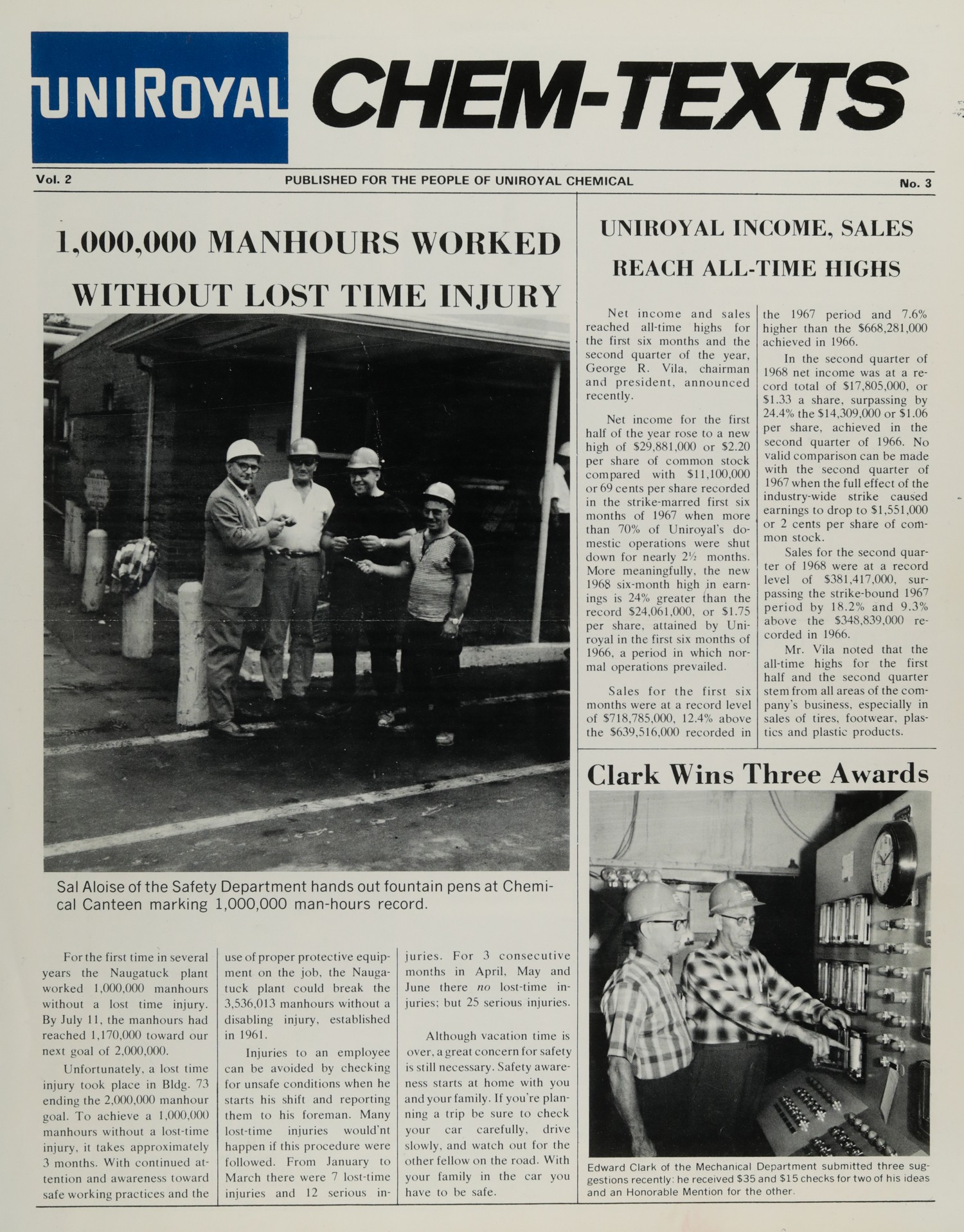
Vol. 2 PUBLISHED FOR THE PEOPLE OF UNIROYAL CHEMICAL No. 3


1,000,000 MANHOURS WORKED WITHOUT LOST TIME INJURY

[IMAGE: Black and white photograph showing workers at Chemical Canteen]

Sal Aloise of the Safety Department hands out fountain pens at Chemical Canteen marking 1,000,000 man-hours record.

For the first time in several years the Naugatuck plant worked 1,000,000 manhours without a lost time injury. By July 11, the manhours had reached 1,170,000 toward our next goal of 2,000,000.

Unfortunately, a lost time injury took place in Bldg. 73 ending the 2,000,000 manhour goal. To achieve a 1,000,000 manhours without a lost-time injury, it takes approximately 3 months. With continued attention and awareness toward safe working practices and the use of proper protective equipment on the job, the Naugatuck plant could break the 3,536,013 manhours without a disabling injury, established in 1961.

Injuries to an employee can be avoided by checking for unsafe conditions when he starts his shift and reporting them to his foreman. Many lost-time injuries would’nt happen if this procedure were followed. From January to March there were 7 lost-time injuries and 12 serious injuries. For 3 consecutive months in April, May and June there were no lost-time injuries; but 25 serious injuries.

Although vacation time is over, a great concern for safety is still necessary. Safety awareness starts at home with you and your family. If you’re planning a trip be sure to check your car carefully, drive slowly, and watch out for the other fellow on the road. With your family in the car you have to be safe.


UNIROYAL INCOME, SALES REACH ALL-TIME HIGHS

Net income and sales reached all-time highs for the first six months and the second quarter of the year, George R. Vila, chairman and president, announced recently.

Net income for the first half of the year rose to a new high of $29,881,000 or $2.20 per share of common stock compared with $11,100,000 or 69 cents per share recorded in the strike-marred first six months of 1967 when more than 70% of Uniroyal’s domestic operations were shut down for nearly 2½ months. More meaningfully, the new 1968 six-month high in earnings is 24% greater than the record $24,061,000, or $1.75 per share, attained by Uniroyal in the first six months of 1966, a period in which normal operations prevailed.

Sales for the first six months were at a record level of $718,785,000, 12.4% above the $639,516,000 recorded in the 1967 period and 7.6% higher than the $668,281,000 achieved in 1966.

In the second quarter of 1968 net income was at a record total of $17,805,000, or $1.33 a share, surpassing by 24.4% the $14,309,000 or $1.06 per share, achieved in the second quarter of 1966. No valid comparison can be made with the second quarter of 1967 when the full effect of the industry-wide strike caused earnings to drop to $1,551,000 or 2 cents per share of common stock.

Sales for the second quarter of 1968 were at a record level of $381,417,000, surpassing the strike-bound 1967 period by 18.2% and 9.3% above the $348,839,000 recorded in 1966.

Mr. Vila noted that the all-time highs for the first half and the second quarter stem from all areas of the company’s business, especially in sales of tires, footwear, plastics and plastic products.


Clark Wins Three Awards

[IMAGE: Black and white photograph showing Edward Clark at mechanical equipment]

Edward Clark of the Mechanical Department submitted three suggestions recently: he received $35 and $15 checks for two of his ideas and an Honorable Mention for the other.
CHEM-TEXTS – Vol. 2 No. 5 – Page 3

Page 003

CHEM TEXTS

Page 3 | Vol. 2 No. 5


Harry Witt Heads Synthetic Production

Harry Witt has been named Synthetic Production Superintendent, effective Dec. 1. Ben Leach becomes Manager of Colloidal products in the Research and Development Dept.


How You Can Obtain A Pair Of Safety Prescription Glasses

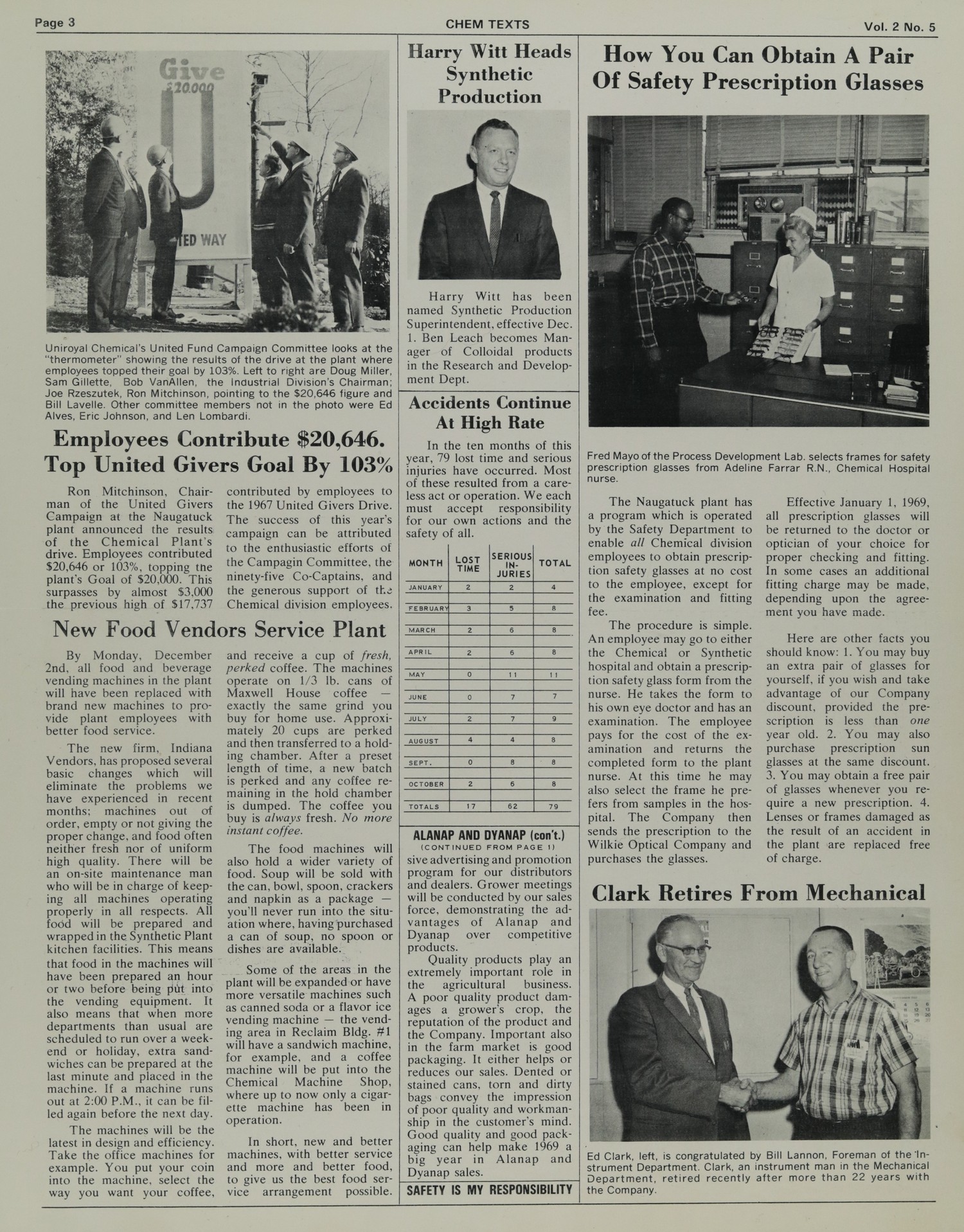
Fred Mayo of the Process Development Lab. selects frames for safety prescription glasses from Adeline Farrar R.N., Chemical Hospital nurse.

The Naugatuck plant has a program which is operated by the Safety Department to enable all Chemical division employees to obtain prescription safety glasses at no cost to the employee, except for the examination and fitting fee.

The procedure is simple. An employee may go to either the Chemical or Synthetic hospital and obtain a prescription safety glass form from the nurse. He takes the form to his own eye doctor and has an examination. The employee pays for the cost of the examination and returns the completed form to the plant nurse. At this time he may also select the frame he prefers from samples in the hospital. The Company then sends the prescription to the Wilkie Optical Company and purchases the glasses.

Effective January 1, 1969, all prescription glasses will be returned to the doctor or optician of your choice for proper checking and fitting. In some cases an additional fitting charge may be made, depending upon the agreement you have made.

Here are other facts you should know: 1. You may buy an extra pair of glasses for yourself, if you wish and take advantage of our Company discount, provided the prescription is less than one year old. 2. You may also purchase prescription sun glasses at the same discount. 3. You may obtain a free pair of glasses whenever you require a new prescription. 4. Lenses or frames damaged as the result of an accident in the plant are replaced free of charge.


[PHOTO CAPTION:]
Uniroyal Chemical’s United Fund Campaign Committee looks at the “thermometer” showing the results of the drive at the plant where employees topped their goal by 103%. Left to right are Doug Miller, Sam Gillette, Bob VanAllen, the Industrial Division’s Chairman; Joe Kresziutek, Ron Mitchinson, pointing to the $20,646 figure and Bill Lavelle. Other committee members not in the photo were Ed Alves, Eric Johnson, and Len Lombardi.


Employees Contribute $20,646. Top United Givers Goal By 103%

Ron Mitchinson, Chairman of the United Givers Campaign at the Naugatuck plant announced the results of the Chemical Plant’s drive. Employees contributed $20,646 or 103%, topping the plant’s Goal of $20,000. This surpasses by almost $3,000 the previous high of $17,737 contributed by employees to the 1967 United Givers Drive. The success of this year’s campaign can be attributed to the enthusiastic efforts of the Campagin Committee, the ninety-five Co-Captains, and the generous support of the Chemical division employees.


Accidents Continue At High Rate

In the ten months of this year, 79 lost time and serious injuries have occurred. Most of these resulted from a careless act or operation. We each must accept responsibility for our own actions and the safety of all.

MONTH LOST TIME SERIOUS IN-JURIES TOTAL
JANUARY 2 2 4
FEBRUARY 3 5 8
MARCH 2 6 8
APRIL 2 6 8
MAY 0 11 11
JUNE 0 7 7
JULY 2 7 9
AUGUST 4 4 8
SEPT. 0 8 8
OCTOBER 2 6 8
TOTALS 17 62 79

New Food Vendors Service Plant

By Monday, December 2nd, all food and beverage vending machines in the plant will have been replaced with brand new machines to provide plant employees with better food service.

The new firm, Indiana Vendors, has proposed several basic changes which will eliminate the problems we have experienced in recent months; machines out of order, empty or not giving the proper change, and food often neither fresh nor of uniform high quality. There will be an on-site maintenance man who will be in charge of keeping all machines operating properly in all respects. All food will be prepared and wrapped in the Synthetic Plant kitchen facilities. This means that food in the machines will have been prepared an hour or two before being put into the vending equipment. It also means that when more departments than usual are scheduled to run over a weekend or holiday, extra sandwiches can be prepared at the last minute and placed in the machine. If a machine runs out at 2:00 P.M., it can be filled again before the next day.

The machines will be the latest in design and efficiency. Take the office machines for example. You put your coin into the machine, select the way you want your coffee, and receive a cup of fresh, perked coffee. The machines operate on 1/3 lb. cans of Maxwell House coffee — exactly the same grind you buy for home use. Approximately 20 cups are perked and then transferred to a holding chamber. After a preset length of time, a new batch is perked and any coffee remaining in the hold chamber is dumped. The coffee you buy is always fresh. No more instant coffee.

The food machines will also hold a wider variety of food. Soup will be sold with the can, bowl, spoon, crackers and napkin as a package — you’ll never run into the situation where, having purchased a can of soup, no spoon or dishes are available.

Some of the areas in the plant will be expanded or have more versatile machines such as canned soda or a flavor ice vending machine — the vending area in Reclaim Bldg. #1 will have a sandwich machine, for example, and a coffee machine will be put into the Chemical Machine Shop, where up to now only a cigarette machine has been in operation.

In short, new and better machines, with better service and more and better food, to give us the best food service arrangement possible.


ALANAP AND DYANAP (con’t.)

(CONTINUED FROM PAGE 1)

sive advertising and promotion program for our distributors and dealers. Grower meetings will be conducted by our sales force, demonstrating the advantages of Alanap and Dyanap over competitive products.

Quality products play an extremely important role in the agricultural business. A poor quality product damages a grower’s crop, the reputation of the product and the Company. Important also in the farm market is good packaging. It either helps or reduces our sales. Dented or stained cans, torn and dirty bags convey the impression of poor quality and workmanship in the customer’s mind. Good quality and good packaging can help make 1969 a big year in Alanap and Dyanap sales.

SAFETY IS MY RESPONSIBILITY


Clark Retires From Mechanical

Ed Clark, left, is congratulated by Bill Lannon, Foreman of the Instrument Department. Clark, an instrument man in the Mechanical Department, retired recently after more than 22 years with the Company.