CHEM-TEXTS – Vol. 2, No. 4 – Page 1

Page 001

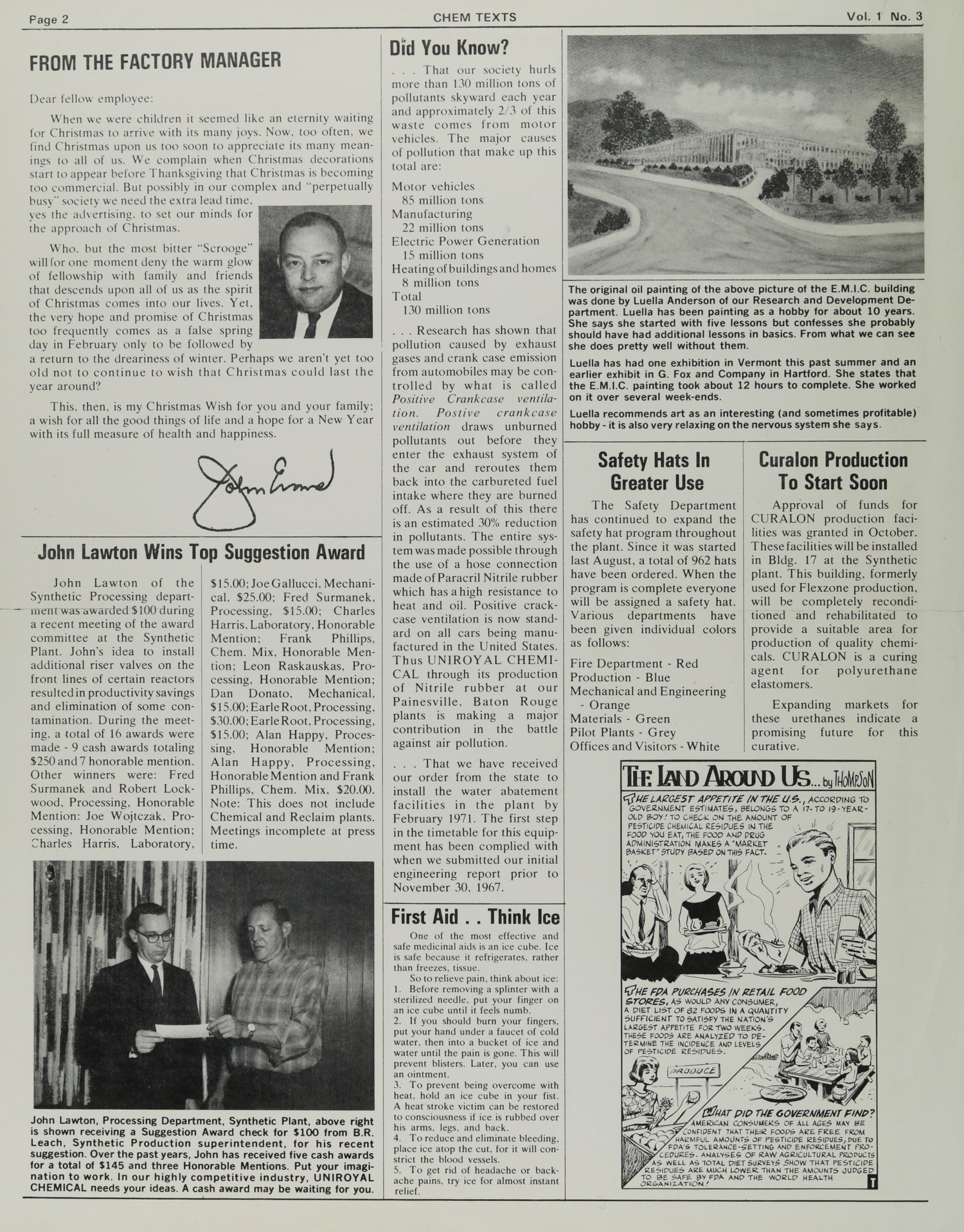
UNIROYAL CHEM-TEXTS

Vol. 2 PUBLISHED FOR THE PEOPLE OF UNIROYAL CHEMICAL No. 4


United Givers Goal, $20,000 “Give Where You Work” Urged

Ron Mitchinson, Chairman of the United Givers Campaign to be conducted in the plant during October, urges 100% employee participation and “Give Where You Work” to support the 16 worthwhile Agencies in the Fund. Many of these Agencies serve not only Naugatuck and Beacon Falls, but most of the surrounding towns in the area. Some like the U.S.O., Salvation Army, United Cerebral Palsy and Red Cross are national in their service.

Most plant employees and their families have been served by one or more of these organizations. Their need for money this year is greater than ever to continue their good work. By giving “where you work” and contributing through the payroll deduction plan at least one hour’s pay monthly for wage employees or 1% of annual income for salary employees, the plant goal of $20,000 can be easily reached.

In the 1967 Campaign 67% of Chemical employees contributed $17,775. About 560 employees did not contribute. On the Pledge card every employee will find at least one Agency which he or his family wants to help support.

The Campaign Committee is E. Alves, S. Gillette, E. Johnson, W. Tavelle, L. Lombardi, D. Miller, J. Rzeszutek, and R. Van Allen. Close to 100 Co-Captains will contact every employee during the Campaign.

Co-Captains are B. Sullivan, E. Evans, L. Taranowich, L. Soares, M. Rosa, H. Steele, N. Krenitsky, J. Valinho, P. Tortorici, M. Chmielewski, J. McKee, G. Browning, E. Jancis, B. Perkins, C. Fernandes, P. Braudis, A. Ferro, W. Jones, T. Brett, R. Mastromatteo, R. Cote, C. Buckley, R. Harsch, P. Hinckley, D. Malloy, W. Parks, J. McGinn, I. Prager, R. Farrell, W. Smith, J. Phelan, W. Singleton, R. Amidon, W. Budd, G. Arndt, P. Murray, L. Flynn, F. Adams, E. Cheney, R. Lestage, G. Birch, H. Hook, F. Rodrigues, W. Campbell, H. Francolini, D. Poehailos, H. Lynch, R. Ames, C. Reich, L. Terra, A. Pistarelli, M. Paiva, D. Rappe, A. Nauges, T. Skehan, R. Foltz, B. Dunn, J. Rice, J. Bucciaglia, K. Dowling, R. Magnamino, F. Magnamo, E. Ruella, R. Breton, J. Bielak, J. Honyotski, D. Cowan, R. Valentine, D. Gabriel, R. Kaiser, J. Charkow, C. Roland, R. Manulla, J. Wojtczak, W. Bieleski, R. Magnamo, F. Enamait, S. Perkus, J. Sullivan, T. McMahon, W. Leukhardt, J. Quint, L. Nappiello, D. George, Geo. Arndt, H. Scullin, F. Lynch, J. Murtha, A. Juliano, J. Vergosen, R. Terino, E. Weaving, S. Aloise, F. Sabia, and J. Tierney.


One gift works many wonders

[IMAGE: Young child’s face]

GIVE THE UNITED WAY


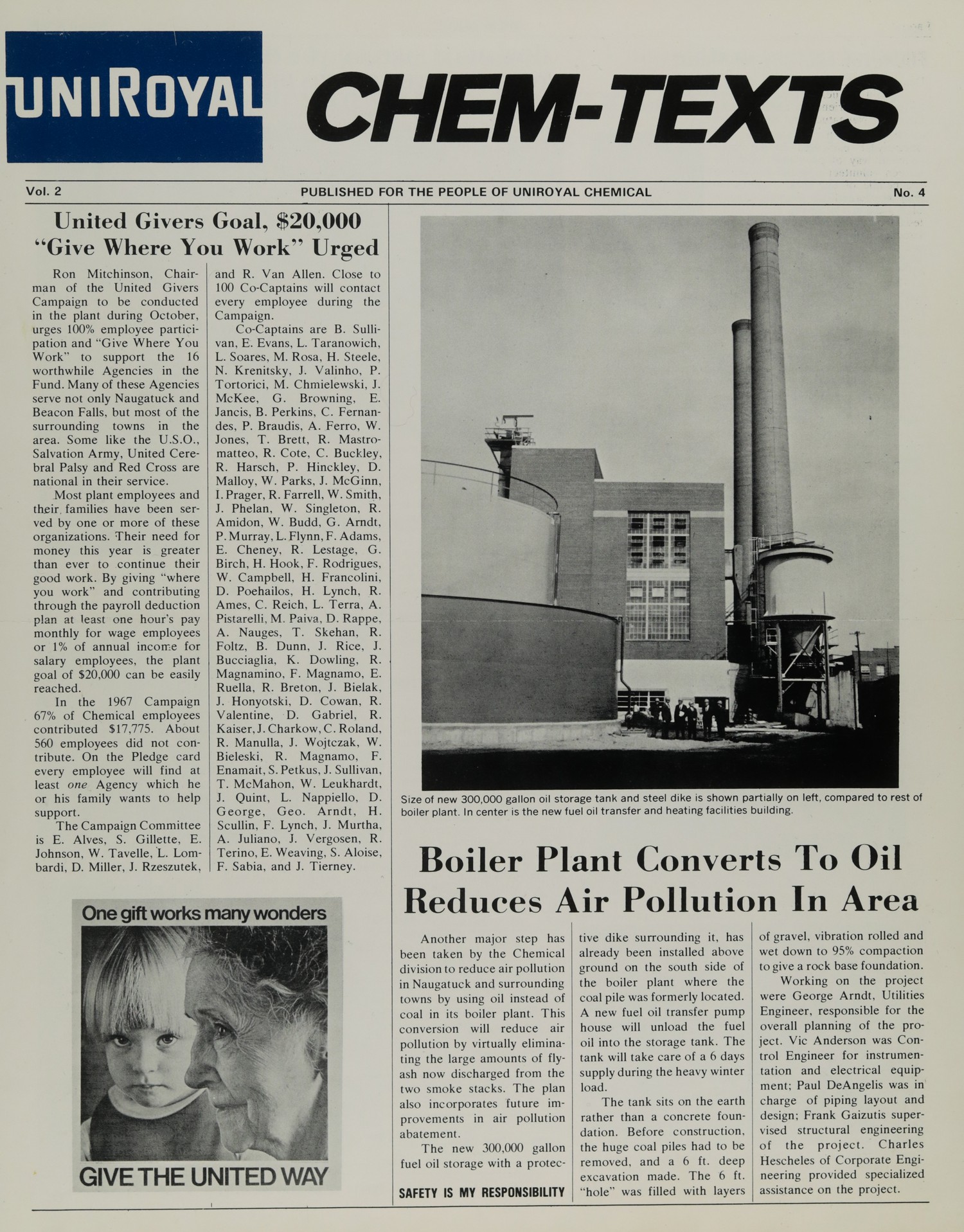
[IMAGE: Industrial facility with storage tank and buildings]

Size of new 300,000 gallon oil storage tank and steel dike is shown partially on left, compared to rest of boiler plant. In center is the new fuel oil transfer and heating facilities building.


Boiler Plant Converts To Oil Reduces Air Pollution In Area

Another major step has been taken by the Chemical division to reduce air pollution in Naugatuck and surrounding towns by using oil instead of coal in its boiler plant. This conversion will reduce air pollution by virtually eliminating the large amounts of fly-ash now discharged from the two smoke stacks. The plan also incorporates future improvements in air pollution abatement.

The new 300,000 gallon fuel oil storage with a protective dike surrounding it, has already been installed above ground on the south side of the boiler plant where the coal pile was formerly located. A new fuel oil transfer pump house will unload the fuel oil into the storage tank. The tank will take care of a 6 days supply during the heavy winter load.

The tank sits on the earth rather than a concrete foundation. Before construction, the huge coal piles had to be removed, and a 6 ft. deep excavation made. The 6 ft. “hole” was filled with layers of gravel, vibration rolled and wet down to 95% compaction to give a rock base foundation.

Working on the project were George Arndt, Utilities Engineer, responsible for the overall planning of the project. Vic Anderson was Control Engineer for instrumentation and electrical equipment; Paul DeAngelis was in charge of piping layout and design; Frank Gaizutis supervised structural engineering of the project. Charles Hescheles of Corporate Engineering provided specialized assistance on the project.


SAFETY IS MY RESPONSIBILITY
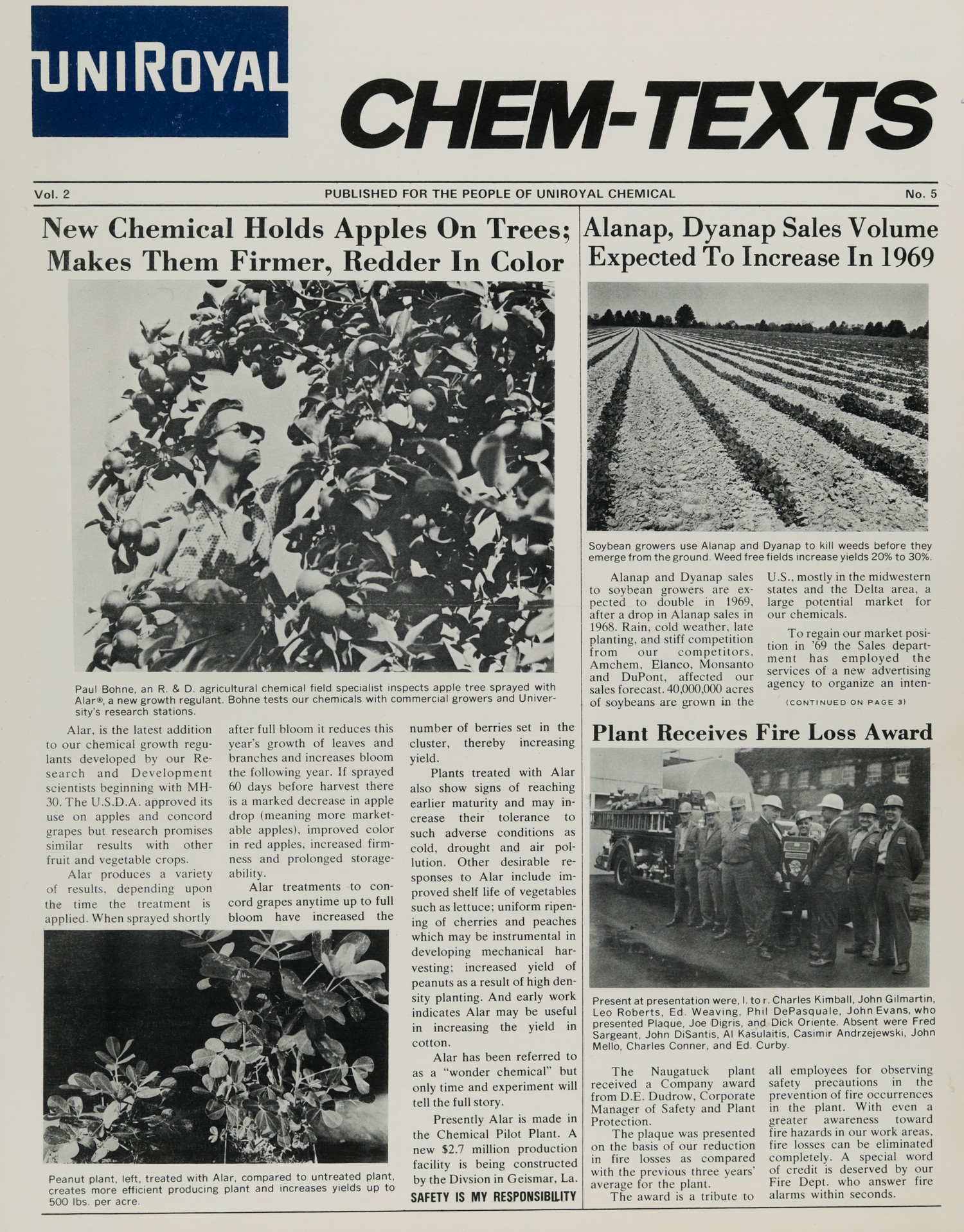
CHEM-TEXTS – Vol. 2, No. 5 – Page 1

Page 001

UNIROYAL

CHEM-TEXTS

Vol. 2 PUBLISHED FOR THE PEOPLE OF UNIROYAL CHEMICAL No. 5


New Chemical Holds Apples On Trees; Makes Them Firmer, Redder In Color

[IMAGE: Paul Bohne, an R. & D. agricultural chemical field specialist inspects apple tree sprayed with Alar®, a new growth regulant. Bohne tests our chemicals with commercial growers and University’s research stations.]

Alar, is the latest addition to our chemical growth regulants developed by our Research and Development scientists beginning with MH-30. The U.S.D.A. approved its use on apples and concord grapes but research promises similar results with other fruit and vegetable crops.

Alar produces a variety of results, depending upon the time the treatment is applied. When sprayed shortly after full bloom it reduces this year’s growth of leaves and branches and increases bloom the following year. If sprayed 60 days before harvest there is a marked decrease in apple drop (meaning more marketable apples), improved color in red apples, increased firmness and prolonged storageability.

Alar treatments to concord grapes anytime up to full bloom have increased the number of berries set in the cluster, thereby increasing yield.

Plants treated with Alar also show signs of reaching earlier maturity and may increase their tolerance to such adverse conditions as cold, drought and air pollution. Other desirable responses to Alar include improved shelf life of vegetables such as lettuce; uniform ripening of cherries and peaches which may be instrumental in developing mechanical harvesting; increased yield of peanuts as a result of high density planting. And early work indicates Alar may be useful in increasing the yield in cotton.

Alar has been referred to as a “wonder chemical” but only time and experiment will tell the full story.

Presently Alar is made in the Chemical Pilot Plant. A new $2.7 million production facility is being constructed by the Divsion in Geismar, La.

SAFETY IS MY RESPONSIBILITY

[IMAGE: Peanut plant, left, treated with Alar, compared to untreated plant, creates more efficient producing plant and increases yields up to 500 lbs. per acre.]


Alanap, Dyanap Sales Volume Expected To Increase In 1969

[IMAGE: Soybean growers use Alanap and Dyanap to kill weeds before they emerge from the ground. Weed free fields increase yields 20% to 30%.]

Alanap and Dyanap sales to soybean growers are expected to double in 1969, after a drop in Alanap sales in 1968. Rain, cold weather, late planting, and stiff competition from our competitors, Amchem, Elanco, Monsanto and DuPont, affected our sales forecast. 40,000,000 acres of soybeans are grown in the U.S., mostly in the midwestern states and the Delta area, a large potential market for our chemicals.

To regain our market position in ’69 the Sales department has employed the services of a new advertising agency to organize an inten-

(CONTINUED ON PAGE 3)


Plant Receives Fire Loss Award

[IMAGE: Present at presentation were, l. to r. Charles Kimball, John Gilmartin, Leo Roberts, Ed. Weaving, Phil DePasquale, John Evans, who presented Plaque, Joe Digris, and Dick Oriente. Absent were Fred Sargeant, John DiSantis, Al Kaslutas, Casimir Andrzejewski, John Mello, Charles Conner, and Ed. Curby.]

The Naugatuck plant received a Company award from D.E. Dudrow, Corporate Manager of Safety and Plant Protection.

The plaque was presented on the basis of our reduction in fire losses as compared with the previous three years’ average for the plant.

The award is a tribute to all employees for observing safety precautions in the prevention of fire occurrences in the plant. With even a greater awareness toward fire hazards in our work areas, fire losses can be eliminated completely. A special word of credit is deserved by our Fire Dept. who answer fire alarms within seconds.

CHEM-TEXTS – Vol. 1 No. 2 – Page 2

Page 002

CHEM TEXTS

Page 2 | Vol. 1 No. 3


FROM THE FACTORY MANAGER

Dear fellow employee:

When we were children it seemed like an eternity waiting for Christmas to arrive with its many joys. Now, too often, we find Christmas upon us too soon to appreciate its many meanings to all of us. We complain when Christmas decorations start to appear before Thanksgiving that Christmas is becoming too commercial. But possibly in our complex and “perpetually busy” society we need the extra lead time, yes the advertising, to set our minds for the approach of Christmas.

Who, but the most bitter “Scrooge” will for one moment deny the warm glow of fellowship with family and friends that descends upon all of us as the spirit of Christmas comes into our lives. Yet, the very hope and promise of Christmas too frequently comes as a false spring day in February only to be followed by a return to the dreariness of winter. Perhaps we aren’t yet too old not to continue to wish that Christmas could last the year around?

This, then, is my Christmas Wish for you and your family; a wish for all the good things of life and a hope for a New Year with its full measure of health and happiness.

[Signature: John Harwood]


John Lawton Wins Top Suggestion Award

John Lawton of the Synthetic Processing department was awarded $100 during a recent meeting of the award committee at the Synthetic Plant. John’s idea to install additional riser valves on the front lines of certain reactors resulted in productivity savings and elimination of some contamination. During the meeting, a total of 16 awards were made – 9 cash awards totaling $250 and 7 honorable mention. Other winners were: Fred Surmanek and Robert Lockwood, Processing, Honorable Mention; Joe Wojtczak, Processing, Honorable Mention; Charles Harris, Laboratory,

$15.00; Joe Gallucci, Mechanical, $25.00; Fred Surmanek, Processing, $15.00; Charles Harris, Laboratory, Honorable Mention; Frank Phillips, Chem. Mix, Honorable Mention; Leon Raskauskas, Processing, Honorable Mention; Dan Donato, Mechanical, $15.00; Earle Root, Processing, $30.00; Earle Root, Processing, $15.00; Alan Happy, Processing, Honorable Mention; Alan Happy, Processing, Honorable Mention and Frank Phillips, Chem. Mix, $20.00. Note: This does not include Chemical and Reclaim plants. Meetings incomplete at press time.

[Photo caption:] John Lawton, Processing Department, Synthetic Plant, above right is shown receiving a Suggestion Award check for $100 from B.R. Leach, Synthetic Production superintendent, for his recent suggestion. Over the past years, John has received five cash awards for a total of $145 and three Honorable Mentions. Put your imagination to work. In our highly competitive industry, UNIROYAL CHEMICAL needs your ideas. A cash award may be waiting for you.


Did You Know?

… That our society hurls more than 130 million tons of pollutants skyward each year and approximately 2/3 of this waste comes from motor vehicles. The major causes of pollution that make up this total are:

Motor vehicles
85 million tons
Manufacturing
22 million tons
Electric Power Generation
15 million tons
Heating of buildings and homes
8 million tons
Total
130 million tons

… Research has shown that pollution caused by exhaust gases and crank case emission from automobiles may be controlled by what is called Positive Crankcase ventilation. Postive crankcase ventilation draws unburned pollutants out before they enter the exhaust system of the car and reroutes them back into the carbureted fuel intake where they are burned off. As a result of this there is an estimated 30% reduction in pollutants. The entire system was made possible through the use of a hose connection made of Paracril Nitrile rubber which has a high resistance to heat and oil. Positive crackcase ventilation is now standard on all cars being manufactured in the United States. Thus UNIROYAL CHEMICAL through its production of Nitrile rubber at our Painesville, Baton Rouge plants is making a major contribution in the battle against air pollution.

… That we have received our order from the state to install the water abatement facilities in the plant by February 1971. The first step in the timetable for this equipment has been complied with when we submitted our initial engineering report prior to November 30, 1967.


First Aid . . Think Ice

One of the most effective and safe medicinal aids is an ice cube. Ice is safe because it refrigerates, rather than freezes, tissue.

So to relieve pain, think about ice:
1. Before removing a splinter with a sterilized needle, put your finger on an ice cube until it feels numb.
2. If you should burn your fingers, put your hand under a faucet of cold water, then into a bucket of ice and water until the pain is gone. This will prevent blisters. Later, you can use an ointment.
3. To prevent being overcome with heat, hold an ice cube in your fist. A heat stroke victim can be restored to consciousness if ice is rubbed over his arms, legs, and back.
4. To reduce and eliminate bleeding, place ice atop the cut, for it will constrict the blood vessels.
5. To get rid of headache or backache pains, try ice for almost instant relief.


[Photo of E.M.I.C. building with caption:]
The original oil painting of the above picture of the E.M.I.C. building was done by Luella Anderson of our Research and Development Department. Luella has been painting as a hobby for about 10 years. She says she started with five lessons but confesses she probably should have had additional lessons in basics. From what we can see she does pretty well without them.

Luella has had one exhibition in Vermont this past summer and an earlier exhibit in G. Fox and Company in Hartford. She states that the E.M.I.C. painting took about 12 hours to complete. She worked on it over several week-ends.

Luella recommends art as an interesting (and sometimes profitable) hobby – it is also very relaxing on the nervous system she says.


Safety Hats In Greater Use

The Safety Department has continued to expand the safety hat program throughout the plant. Since it was started last August, a total of 962 hats have been ordered. When the program is complete everyone will be assigned a safety hat. Various departments have been given individual colors as follows:

Fire Department – Red
Production – Blue
Mechanical and Engineering – Orange
Materials – Green
Pilot Plants – Grey
Offices and Visitors – White


Curalon Production To Start Soon

Approval of funds for CURALON production facilities was granted in October. These facilities will be installed in Bldg. 17 at the Synthetic plant. This building, formerly used for Flexzone production, will be completely reconditioned and rehabilitated to provide a suitable area for production of quality chemicals. CURALON is a curing agent for polyurethane elastomers.

Expanding markets for these urethanes indicate a promising future for this curative.


THE LAND AROUND US… by ThOMEron

[Comic strip panel 1:]
THE LARGEST APPETITE IN THE U.S., ACCORDING TO GOVERNMENT ESTIMATES, BELONGS TO A 17-TO 19-YEAR-OLD BOY! TO CHECK ON THE AMOUNT OF PESTICIDE CHEMICAL RESIDUES IN THE FOOD YOU EAT, THE FOOD AND DRUG ADMINISTRATION MAKES A “MARKET BASKET” STUDY BASED ON THIS FACT.

[Comic strip panel 2:]
THE FDA PURCHASES IN RETAIL FOOD STORES, AS WOULD ANY CONSUMER, A DIET LIST OF 82 FOODS IN A QUANTITY SUFFICIENT TO SATISFY THE NATION’S LARGEST APPETITE FOR TWO WEEKS. THESE FOODS ARE ANALYZED TO DETERMINE THE INCIDENCE AND LEVELS OF PESTICIDE RESIDUES.

[Image shows produce]

[Comic strip panel 3:]
WHAT DID THE GOVERNMENT FIND?
AMERICAN CONSUMERS OF ALL AGES MAY BE CONFIDENT THAT THEIR FOODS ARE FREE FROM HARMFUL AMOUNTS OF PESTICIDE RESIDUES, DUE TO EPA’S TOLERANCE-SETTING AND ENFORCEMENT PROCEDURES. ANALYSES OF RAW AGRICULTURAL PRODUCTS AS WELL AS TOTAL DIET SURVEYS SHOW THAT PESTICIDE RESIDUES ARE MUCH LOWER THAN THE AMOUNTS JUDGED TO BE SAFE BY EPA AND THE WORLD HEALTH ORGANIZATION.

CHEM-TEXTS – unknown-s238

Page 238

CHEM-TEXTS

Page 3


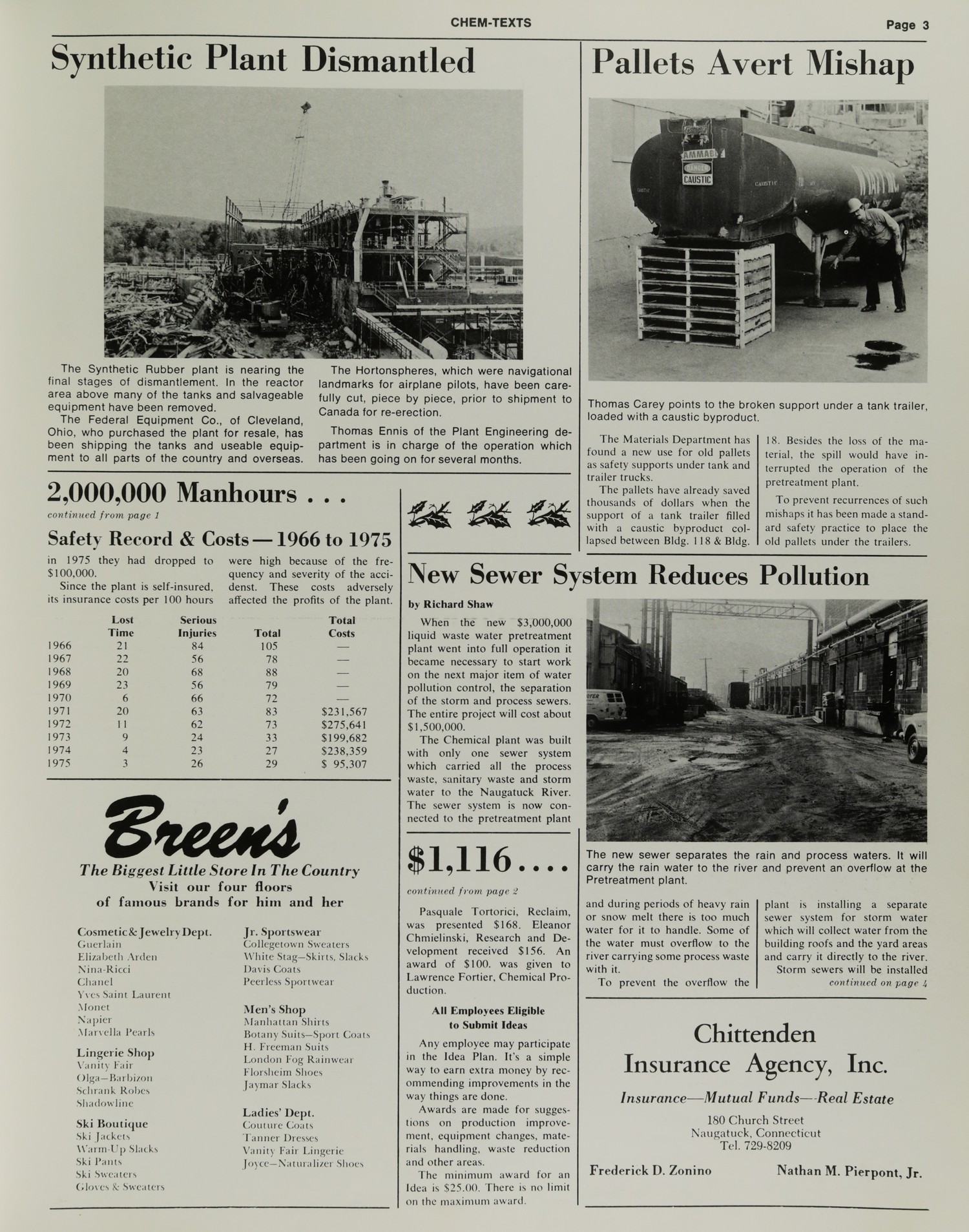
Synthetic Plant Dismantled

The Synthetic Rubber plant is nearing the final stages of dismantlement. In the reactor area above many of the tanks and salvageable equipment have been removed.

The Federal Equipment Co., of Cleveland, Ohio, who purchased the plant for resale, has been shipping the tanks and useable equipment to all parts of the country and overseas.

The Hortonspheres, which were navigational landmarks for airplane pilots, have been carefully cut, piece by piece, prior to shipment to Canada for re-erection.

Thomas Ennis of the Plant Engineering department is in charge of the operation which has been going on for several months.


Pallets Avert Mishap

Thomas Carey points to the broken support under a tank trailer, loaded with a caustic byproduct.

The Materials Department has found a new use for old pallets as safety supports under tank and trailer trucks.

The pallets have already saved thousands of dollars when the support of a tank trailer filled with a caustic byproduct collapsed between Bldg. 118 & Bldg. 18. Besides the loss of the material, the spill would have interrupted the operation of the pretreatment plant.

To prevent recurrences of such mishaps it has been made a standard safety practice to place the old pallets under the trailers.


2,000,000 Manhours . . .

continued from page 1

Safety Record & Costs — 1966 to 1975

in 1975 they had dropped to $100,000.

Since the plant is self-insured, its insurance costs per 100 hours were high because of the frequency and severity of the accident. These costs adversely affected the profits of the plant.

Lost Time Serious Injuries Total Total Costs
1966 21 84 105
1967 22 56 78
1968 20 68 88
1969 23 56 79
1970 6 66 72
1971 20 63 83 $231,567
1972 11 62 73 $275,641
1973 9 24 33 $199,682
1974 4 23 27 $238,359
1975 3 26 29 $ 95,307

New Sewer System Reduces Pollution

by Richard Shaw

When the new $3,000,000 liquid waste water pretreatment plant went into full operation it became necessary to start work on the next major item of water pollution control, the separation of the storm and process sewers. The entire project will cost about $1,500,000.

The Chemical plant was built with only one sewer system which carried all the process waste, sanitary waste and storm water to the Naugatuck River. The sewer system is now connected to the pretreatment plant

$1,116….

continued from page 2

Pasquale Tortorici, Reclaim, was presented $168. Eleanor Chmielinski, Research and Development received $156. An award of $100. was given to Lawrence Fortier, Chemical Production.

All Employees Eligible to Submit Ideas

Any employee may participate in the Idea Plan. It’s a simple way to earn extra money by recommending improvements in the way things are done.

Awards are made for suggestions on production improvement, equipment changes, materials handling, waste reduction and other areas.

The minimum award for an Idea is $25.00. There is no limit on the maximum award.

The new sewer separates the rain and process waters. It will carry the rain water to the river and prevent an overflow at the Pretreatment plant.

and during periods of heavy rain or snow melt there is too much water for it to handle. Some of the water must overflow to the river carrying some process waste with it.

To prevent the overflow the plant is installing a separate sewer system for storm water which will collect water from the building roofs and the yard areas and carry it directly to the river.

Storm sewers will be installed continued on page 4


Breen’s

The Biggest Little Store In The Country
Visit our four floors
of famous brands for him and her.

Cosmetic & Jewelry Dept.
Guerlain
Elizabeth Arden
Nina-Ricci
Chanel
Yves Saint Laurent
Monet
Napier
Marvella Pearls

Lingerie Shop
Vanity Fair
Olga—Barbizon
Schrank Robes
Shadowline

Ski Boutique
Ski Jackets
Warm-Up Slacks
Ski Pants
Ski Sweaters
Gloves & Sweaters

Jr. Sportswear
Collegetown Sweaters
White Stag—Skirts, Slacks
Davis Coats
Peerless Sportwear

Men’s Shop
Manhattan Shirts
Botany Suits—Sport Coats
H. Freeman Suits
London Fog Rainwear
Florsheim Shoes
Jaymar Slacks

Ladies’ Dept.
Couture Coats
Tanner Dresses
Vanity Fair Lingerie
Joyce—Naturalizer Shoes


Chittenden Insurance Agency, Inc.

Insurance—Mutual Funds—Real Estate

180 Church Street
Naugatuck, Connecticut
Tel. 729-8209

Frederick D. Zonino Nathan M. Pierpont, Jr.

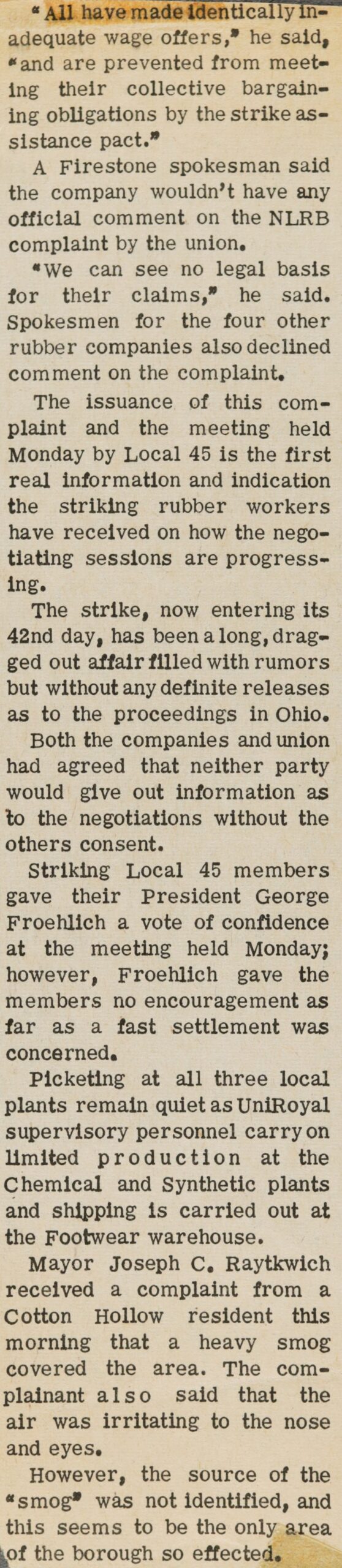
All have made identically inadequate wage offers, he said, and are prevented from meeting their collective bargaining obligations by the strike assistance pact

“All have made identically in-
adequate wage offers,” he said,
“and are prevented from meet-
ing their collective bargain-
ing obligations by the strike as-
sistance pact.”

A Firestone spokesman said
the company wouldn’t have any
official comment on the NLRB
complaint by the union.

“We can see no legal basis
for their claims,” he said.
Spokesmen for the four other
rubber companies also declined
comment on the complaint.

The issuance of this com-
plaint and the meeting held
Monday by Local 45 is the first
real information and indication
the striking rubber workers
have received on how the nego-
tiating sessions are progress-
ing.

The strike, now entering its
42nd day, has been a long, drag-
ged out affair filled with rumors
but without any definite releases
as to the proceedings in Ohio.

Both the companies and union
had agreed that neither party
would give out information as
to the negotiations without the
others consent.

Striking Local 45 members
gave their President George
Froehlich a vote of confidence
at the meeting held Monday;
however, Froehlich gave the
members no encouragement as
far as a fast settlement was
concerned.

Picketing at all three local
plants remain quiet as UniRoyal
supervisory personnel carry on
limited production at the
Chemical and Synthetic plants
and shipping is carried out at
the Footwear warehouse.

Mayor Joseph C. Raytkwich
received a complaint from a
Cotton Hollow resident this
morning that a heavy smog
covered the area. The com-
plainant also said that the
air was irritating to the nose
and eyes.

However, the source of the
“smog” was not identified, and
this seems to be the only area
of the borough so effected.