ChemWorld – Page 4

Page 004

ChemWorld | 4 | January 1991

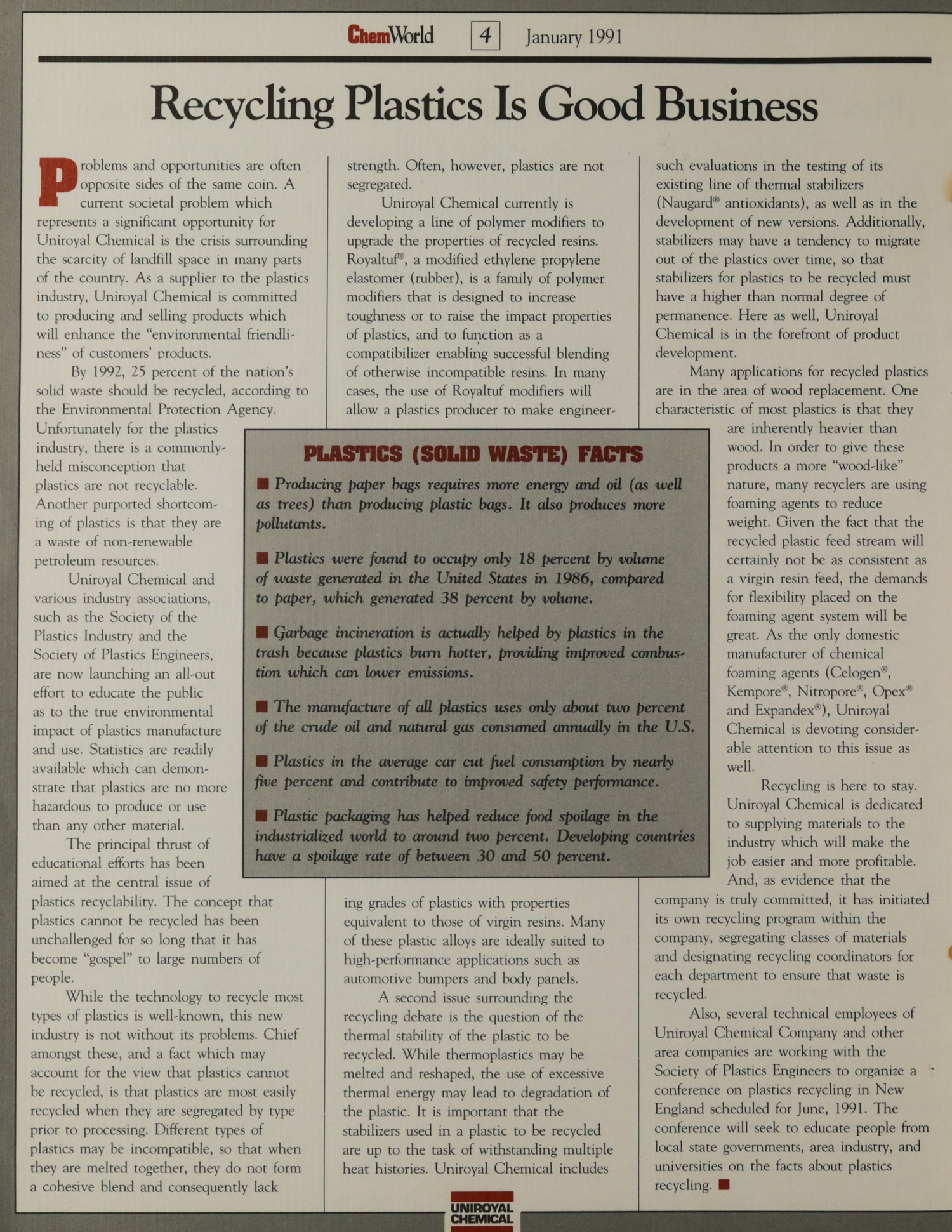
Recycling Plastics Is Good Business

Problems and opportunities are often opposite sides of the same coin. A current societal problem which represents a significant opportunity for Uniroyal Chemical is the crisis surrounding the scarcity of landfill space in many parts of the country. As a supplier to the plastics industry, Uniroyal Chemical is committed to producing and selling products which will enhance the “environmental friendliness” of customers’ products.

By 1992, 25 percent of the nation’s solid waste should be recycled, according to the Environmental Protection Agency. Unfortunately for the plastics industry, there is a commonly-held misconception that plastics are not recyclable. Another purported shortcoming of plastics is that they are a waste of non-renewable petroleum resources.

Uniroyal Chemical and various industry associations, such as the Society of the Plastics Industry and the Society of Plastics Engineers, are now launching an all-out effort to educate the public as to the true environmental impact of plastics manufacture and use. Statistics are readily available which can demonstrate that plastics are no more hazardous to produce or use than any other material.

The principal thrust of educational efforts has been aimed at the central issue of plastics recyclability. The concept that plastics cannot be recycled has been unchallenged for so long that it has become “gospel” to large numbers of people.

While the technology to recycle most types of plastics is well-known, this new industry is not without its problems. Chief amongst these, and a fact which may account for the view that plastics cannot be recycled, is that plastics are most easily recycled when they are segregated by type prior to processing. Different types of plastics may be incompatible, so that when they are melted together, they do not form a cohesive blend and consequently lack

strength. Often, however, plastics are not segregated.

Uniroyal Chemical currently is developing a line of polymer modifiers to upgrade the properties of recycled resins. Royaltuf®, a modified ethylene propylene elastomer (rubber), is a family of polymer modifiers that is designed to increase toughness or to raise the impact properties of plastics, and to function as a compatibilizer enabling successful blending of otherwise incompatible resins. In many cases, the use of Royaltuf modifiers will allow a plastics producer to make engineer-


PLASTICS (SOLID WASTE) FACTS

Producing paper bags requires more energy and oil (as well as trees) than producing plastic bags. It also produces more pollutants.

Plastics were found to occupy only 18 percent by volume of waste generated in the United States in 1986, compared to paper, which generated 38 percent by volume.

Garbage incineration is actually helped by plastics in the trash because plastics burn hotter, providing improved combustion which can lower emissions.

The manufacture of all plastics uses only about two percent of the crude oil and natural gas consumed annually in the U.S.

Plastics in the average car cut fuel consumption by nearly five percent and contribute to improved safety performance.

Plastic packaging has helped reduce food spoilage in the industrialized world to around two percent. Developing countries have a spoilage rate of between 30 and 50 percent.


ing grades of plastics with properties equivalent to those of virgin resins. Many of these plastic alloys are ideally suited to high-performance applications such as automotive bumpers and body panels.

A second issue surrounding the recycling debate is the question of the thermal stability of the plastic to be recycled. While thermoplastics may be melted and reshaped, the use of excessive thermal energy may lead to degradation of the plastic. It is important that the stabilizers used in a plastic to be recycled are up to the task of withstanding multiple heat histories. Uniroyal Chemical includes

such evaluations in the testing of its existing line of thermal stabilizers (Naugard® antioxidants), as well as in the development of new versions. Additionally, stabilizers may have a tendency to migrate out of the plastics over time, so that stabilizers for plastics to be recycled must have a higher than normal degree of permanence. Here as well, Uniroyal Chemical is in the forefront of product development.

Many applications for recycled plastics are in the area of wood replacement. One characteristic of most plastics is that they are inherently heavier than wood. In order to give these products a more “wood-like” nature, many recyclers are using foaming agents to reduce weight. Given the fact that the recycled plastic feed stream will certainly not be as consistent as a virgin resin feed, the demands for flexibility placed on the foaming agent system will be great. As the only domestic manufacturer of chemical foaming agents (Celogen®, Kempore®, Nitropore®, Opex® and Expandex®), Uniroyal Chemical is devoting considerable attention to this issue as well.

Recycling is here to stay. Uniroyal Chemical is dedicated to supplying materials to the industry which will make the job easier and more profitable. And, as evidence that the company is truly committed, it has initiated its own recycling program within the company, segregating classes of materials and designating recycling coordinators for each department to ensure that waste is recycled.

Also, several technical employees of Uniroyal Chemical Company and other area companies are working with the Society of Plastics Engineers to organize a conference on plastics recycling in New England scheduled for June, 1991. The conference will seek to educate people from local state governments, area industry, and universities on the facts about plastics recycling. ■


UNIROYAL CHEMICAL
ChemWorld – Page 5

Page 005

ChemWorld | 5 | January 1990


Crop Division’s New Vice President Plans Growth Strategy For Business

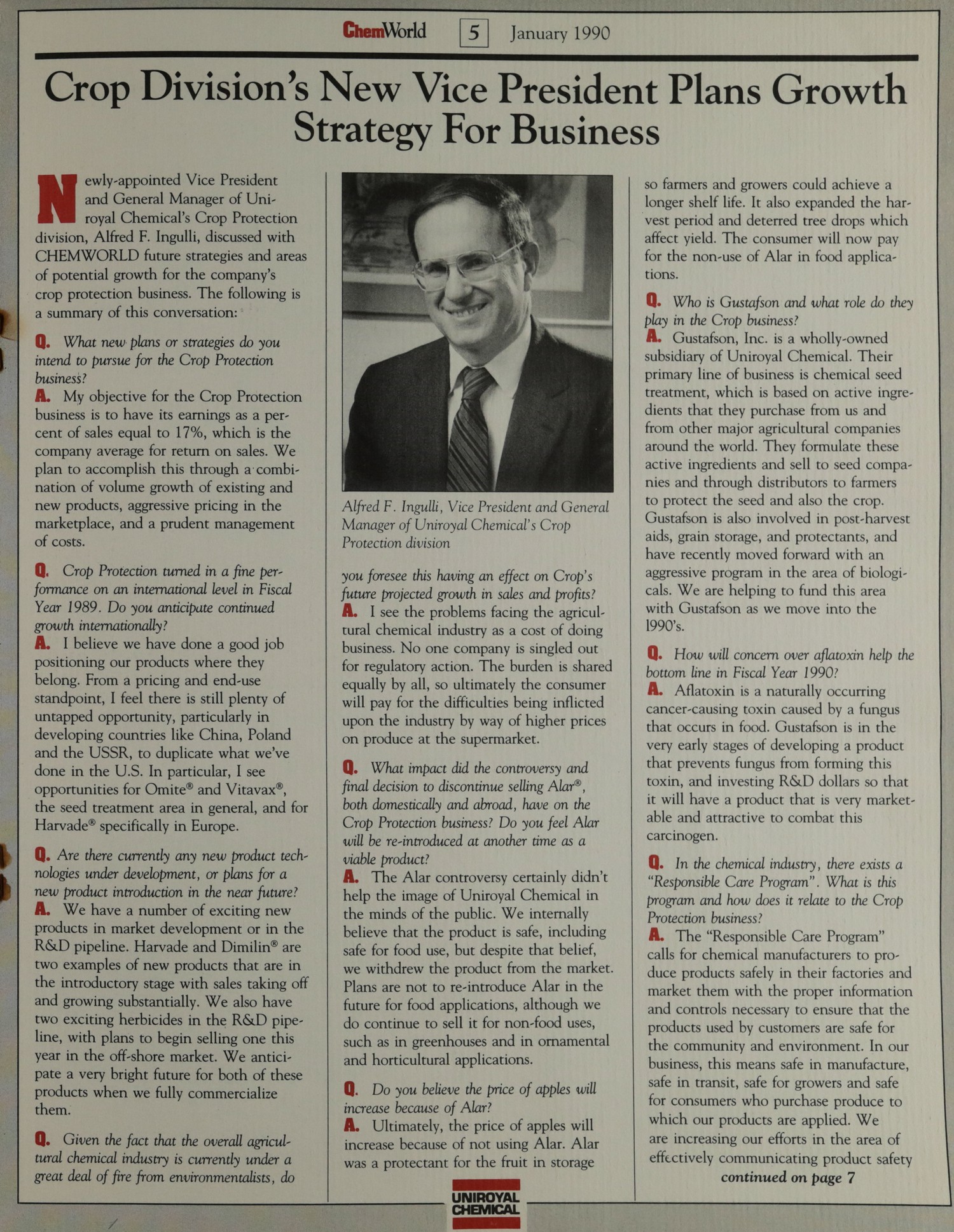
Newly-appointed Vice President and General Manager of Uniroyal Chemical’s Crop Protection division, Alfred F. Ingulli, discussed with CHEMWORLD future strategies and areas of potential growth for the company’s crop protection business. The following is a summary of this conversation:

Q. What new plans or strategies do you intend to pursue for the Crop Protection business?

A. My objective for the Crop Protection business is to have its earnings as a percent of sales equal to 17%, which is the company average for return on sales. We plan to accomplish this through a combination of volume growth of existing and new products, aggressive pricing in the marketplace, and a prudent management of costs.

Q. Crop Protection turned in a fine performance on an international level in Fiscal Year 1989. Do you anticipate continued growth internationally?

A. I believe we have done a good job positioning our products where they belong. From a pricing and end-use standpoint, I feel there is still plenty of untapped opportunity, particularly in developing countries like China, Poland and the USSR, to duplicate what we’ve done in the U.S. In particular, I see opportunities for Omite® and Vitavax®, the seed treatment area in general, and for Harvade® specifically in Europe.

Q. Are there currently any new product technologies under development, or plans for a new product introduction in the near future?

A. We have a number of exciting new products in market development or in the R&D pipeline. Harvade and Dimilin® are two examples of new products that are in the introductory stage with sales taking off and growing substantially. We also have two exciting herbicides in the R&D pipeline, with plans to begin selling one this year in the off-shore market. We anticipate a very bright future for both of these products when we fully commercialize them.

Q. Given the fact that the overall agricultural chemical industry is currently under a great deal of fire from environmentalists, do


[PHOTO: Black and white portrait photograph of a man in glasses wearing a suit]

Alfred F. Ingulli, Vice President and General Manager of Uniroyal Chemical’s Crop Protection division


you foresee this having an effect on Crop’s future projected growth in sales and profits?

A. I see the problems facing the agricultural chemical industry as a cost of doing business. No one company is singled out for regulatory action. The burden is shared equally by all, so ultimately the consumer will pay for the difficulties being inflicted upon the industry by way of higher prices on produce at the supermarket.

Q. What impact did the controversy and final decision to discontinue selling Alar®, both domestically and abroad, have on the Crop Protection business? Do you feel Alar will be re-introduced at another time as a viable product?

A. The Alar controversy certainly didn’t help the image of Uniroyal Chemical in the minds of the public. We internally believe that the product is safe, including safe for food use, but despite that belief, we withdrew the product from the market. Plans are not to re-introduce Alar in the future for food applications, although we do continue to sell it for non-food uses, such as in greenhouses and in ornamental and horticultural applications.

Q. Do you believe the price of apples will increase because of Alar?

A. Ultimately, the price of apples will increase because of not using Alar. Alar was a protectant for the fruit in storage

so farmers and growers could achieve a longer shelf life. It also expanded the harvest period and deterred tree drops which affect yield. The consumer will now pay for the non-use of Alar in food applications.

Q. Who is Gustafson and what role do they play in the Crop business?

A. Gustafson, Inc. is a wholly-owned subsidiary of Uniroyal Chemical. Their primary line of business is chemical seed treatment, which is based on active ingredients that they purchase from us and from other major agricultural companies around the world. They formulate these active ingredients and sell to seed companies and through distributors to farmers to protect the seed and also the crop. Gustafson is also involved in post-harvest aids, grain storage, and protectants, and have recently moved forward with an aggressive program in the area of biologicals. We are helping to fund this area with Gustafson as we move into the 1990’s.

Q. How will concern over aflatoxin help the bottom line in Fiscal Year 1990?

A. Aflatoxin is a naturally occurring cancer-causing toxin caused by a fungus that occurs in food. Gustafson is in the very early stages of developing a product that prevents fungus from forming this toxin, and investing R&D dollars so that it will have a product that is very marketable and attractive to combat this carcinogen.

Q. In the chemical industry, there exists a “Responsible Care Program”. What is this program and how does it relate to the Crop Protection business?

A. The “Responsible Care Program” calls for chemical manufacturers to produce products safely in their factories and market them with the proper information and controls necessary to ensure that the products used by customers are safe for the community and environment. In our business, this means safe in manufacture, safe in transit, safe for growers and safe for consumers who purchase produce to which our products are applied. We are increasing our efforts in the area of effectively communicating product safety

continued on page 7


UNIROYAL CHEMICAL

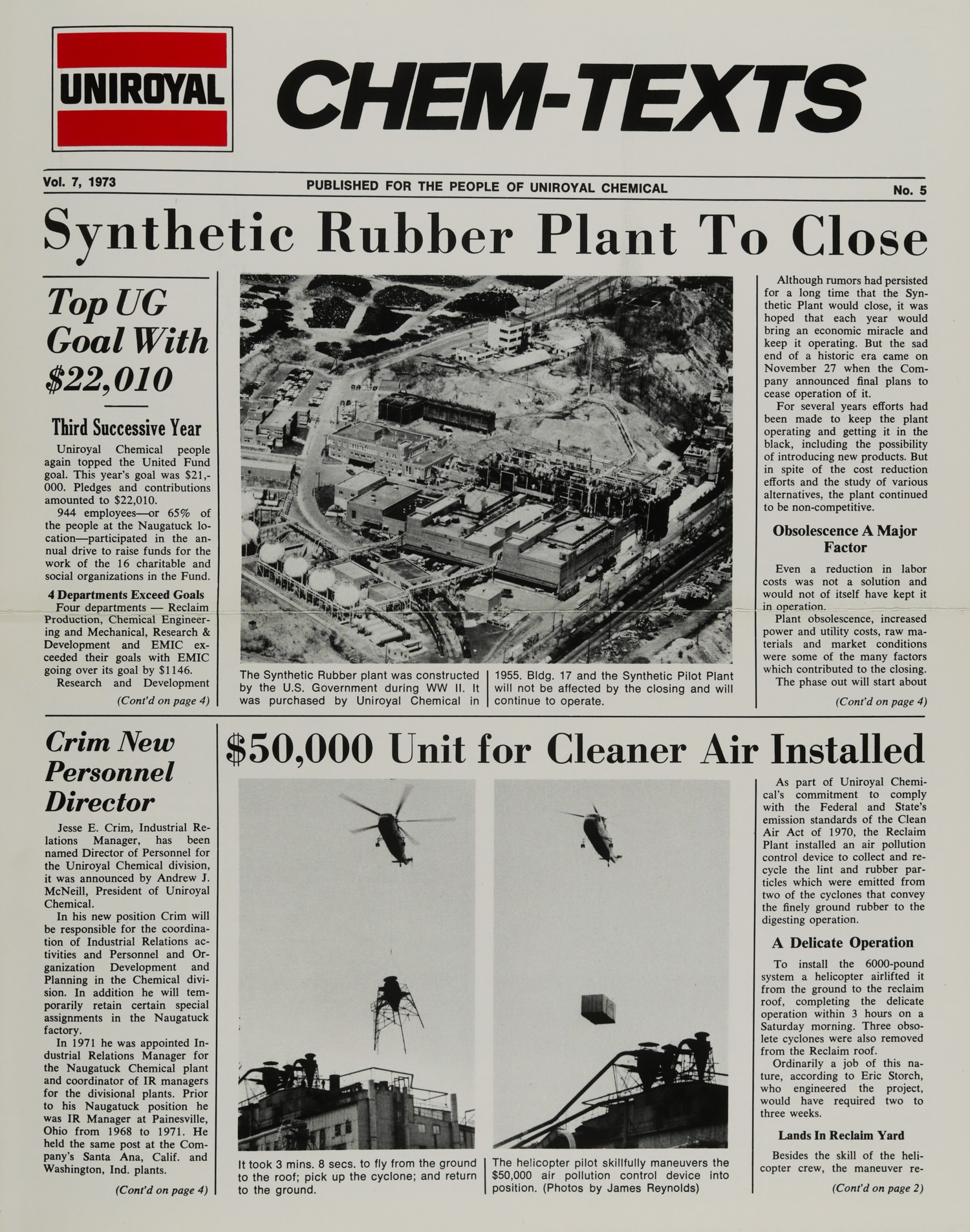
Synthetic Rubber Plant To Close

UNIROYAL CHEM-TEXTS

Vol. 7, 1973 | PUBLISHED FOR THE PEOPLE OF UNIROYAL CHEMICAL | No. 5


Synthetic Rubber Plant To Close


Top UG Goal With $22,010

Third Successive Year

Uniroyal Chemical people again topped the United Fund goal. This year’s goal was $21,000. Pledges and contributions amounted to $22,010.

944 employees—or 65% of the people at the Naugatuck location—participated in the annual drive to raise funds for the work of the 16 charitable and social organizations in the Fund.

4 Departments Exceed Goals

Four departments — Reclaim Production, Chemical Engineering and Mechanical, Research & Development and EMIC exceeded their goals with EMIC going over its goal by $1146.

Research and Development

(Cont’d on page 4)


[CENTER IMAGE CAPTION:]
The Synthetic Rubber plant was constructed by the U.S. Government during WW II. It was purchased by Uniroyal Chemical in 1955. Bldg. 17 and the Synthetic Pilot Plant will not be affected by the closing and will continue to operate.


Although rumors had persisted for a long time that the Synthetic Plant would close, it was hoped that each year would bring an economic miracle and keep it operating. But the sad end of a historic era came on November 27 when the Company announced final plans to cease operation of it.

For several years efforts had been made to keep the plant operating and getting it in the black, including the possibility of introducing new products. But in spite of the cost reduction efforts and the study of various alternatives, the plant continued to be non-competitive.

Obsolescence A Major Factor

Even a reduction in labor costs was not a solution and would not of itself have kept it in operation.

Plant obsolescence, increased power and utility costs, raw materials and market conditions were some of the many factors which contributed to the closing.

The phase out will start about

(Cont’d on page 4)


Crim New Personnel Director

Jesse E. Crim, Industrial Relations Manager, has been named Director of Personnel for the Uniroyal Chemical division, it was announced by Andrew J. McNeill, President of Uniroyal Chemical.

In his new position Crim will be responsible for the coordination of Industrial Relations activities and Personnel and Organization Development and Planning in the Chemical division. In addition he will temporarily retain certain special assignments in the Naugatuck factory.

In 1971 he was appointed Industrial Relations Manager for the Naugatuck Chemical plant and coordinator of IR managers for the divisional plants. Prior to his Naugatuck position he was IR Manager at Painesville, Ohio from 1968 to 1971. He held the same post at the Company’s Santa Ana, Calif. and Washington, Ind. plants.

(Cont’d on page 4)


$50,000 Unit for Cleaner Air Installed

[LEFT IMAGE CAPTION:]
It took 3 mins. 8 secs. to fly from the ground to the roof; pick up the cyclone; and return to the ground.

[RIGHT IMAGE CAPTION:]
The helicopter pilot skillfully maneuvers the $50,000 air pollution control device into position. (Photos by James Reynolds)


As part of Uniroyal Chemical’s commitment to comply with the Federal and State’s emission standards of the Clean Air Act of 1970, the Reclaim Plant installed an air pollution control device to collect and recycle the lint and rubber particles which were emitted from two of the cyclones that convey the finely ground rubber to the digesting operation.

A Delicate Operation

To install the 6000-pound system a helicopter airlifted it from the ground to the reclaim roof, completing the delicate operation within 3 hours on a Saturday morning. Three obsolete cyclones were also removed from the Reclaim roof.

Ordinarily a job of this nature, according to Eric Storch, who engineered the project, would have required two to three weeks.

Lands In Reclaim Yard

Besides the skill of the helicopter crew, the maneuver re-

(Cont’d on page 2)