CHEM-TEXTS – Vol. 7 – Page 2

Page 002

CHEM-TEXTS

Page 2 | Vol. 7, 1973


For all of us over 40, we can recall the days when people would save every piece of string and tin foil they could find. You might say that those were the days of true conservation.

I am not suggesting that we go back to the good old days — life is too good today for that — but there may be some things that we did then which bear reconsideration.

In the midst of affluence and plenty, it seems as if we are losing our sense of conservation where resources and energy are concerned. Today, all indications show that unless we face up to the problem of diminishing resources and energy, through a program of recycling and conservation, we will be confronted with serious shortages in the very near future.

Jim Crane [Signature]

Here at the Naugatuck plant, we are facing our own resources crisis. Just citing one example of many, let us look at the cost of fuel oil for our steam generating boiler plant.

In January alone, the price of fuel rose three different times. There is every expectation that these price increases will continue because of already existing shortages. Over the past two years, the cost of fuel has more than doubled, adding over a half million dollars to our expense-expenditures that do not increase production or productivity, and which cannot be offset with price increases of our products. The marketplace just will not bear that kind of traffic.

What do we do?

One thing we all can do here in the plant, is to take the old-fashioned string and tin foil approach, and try to conserve as much of our resources and energy as we possibly can.

There’s a very simple reason why we must succeed in solving this problem. The very security of our jobs, in the long run, hangs in the balance. That balance is the conservation of our resources and energy, the protection of the environment, and the security of our jobs. Unfortunately, the first two must be satisfied first, for only then can we consider the possibility of enjoying job security.


Hydraulic Staging Purchased For Plant

[IMAGE: Jack McCarthy demonstrates the ease of operating the new hydraulic staging as he inspects equipment in a chemical production building.]

by Jan Baclawski

The scissor type platform, seen in buildings of the plant recently, belongs to the Chemical Mechanical department.

With the push of a button, the new, automatic, hydraulic staging will lift a thousand pounds of men and equipment to a height of 17 feet in a few minutes.

It replaces the old pipe staging that took over six manhours to assemble and disassemble and oftentimes wobbled when installed at a job site.

The portable staging can be used practically anywhere in the plant and set up in a few minutes. It is safer, more efficient and versatile than pipe staging for high places and is part of a continuing program by the Mechanical department to improve work methods and the safety of people exposed to hazardous situations.


Scholarship Offered

by Kevin Kelley

The Uniroyal Chemical Management Club will again offer a $300 scholarship ($250 from the Management Club and $50 from the Larry Monroe fund) to a graduating high school student who plans a college education. To qualify one of the student’s parents must have worked for Uniroyal Chemical at Naugatuck or Bethany for two years or more. The scholarship fund is supported by the dues of members.

Applications can be obtained from the Industrial Relations department, Bldg. 84 or by a telephone call to Connie Antrum, Ext. 517.

The completed applications must be returned to Irwin Prager, Chairman of the Scholarship Committee, on or before April 1.

The winner of last year’s scholarship was Maria Galante, daughter of Mike Galante, a research chemist in Reclaim Production.


Appointments Announced

Garrett Sullivan has been named Marketing Manager of chemicals and synthetic rubber.

Henry Smith has been appointed District Sales Manager for the Northeast area.

Robert Swallow has been assigned to the position of Materials Flow Manager.

Robert Mazaika has been named Marketing Manager for Colloids.


Computer Easy To Use

[IMAGE: Dan O’Donnell and Alan Mitchell, rear, check the output as Vin Ricci and Sandra Bond prepare the input for a agricultural chemicals research project.]

by Vin Ricci

Although it is not generally known, the Research and Development department maintains a Math and Computer Services group and a small IBM “1130” computer both located in Bldg. 11 adjoining the Synthetic Plant Fire House.

The group provides mathematical and computer services in the areas of production, sales, research and development, accounting, or relevant areas where statistical computations are involved. The services can be broadly divided into two basic categories: commercial and scientific.

Eight commodity groups are now using the IBM 1130 for sales forecasting, predicting polymer processability, development of management information systems, and statistical analysis.

Develops Programs

An information reporting program was recently completed by the group for the Synthetic Plant. The report monitors month-to-date and year-to-date production of the Synthetic on a monthly basis. The computer-generated report also compares actual production runs and the

(Cont’d on page 3)


$5096…

(Cont’d from page 1)

Idea Team of John Butkus and John Painter of the Synthetic Mechanical department, for the several improvements they suggested during the year.

Not far behind in the total amount awards was Carmine Iannuzzi, who received $445 for the suggestions he proposed.

$225, the highest single amount awarded to one individual, went to Archie Civitello of the Synthetic Quality Control Lab.

Mechanical Department, Most Prolific

Most ideas come from the Mechanical departments, both Chemical and Synthetic, where imagination and creativity seem to run high. Over the year they received not only the highest single cash awards but more than $2000 or half of the total for the year.

The Plan is completely dominated by the wage personnel with only about five salary people participating in it.

Anyone can submit an Idea which will pay a minimum of $25, with no limit on the amount of the award.

Some radicals seek needed changes or voice legitimate grievances. Others, with no clear goal, are bent on disruption and destruction, using tactics that infringe on the legitimate rights of their neighbors.

The decision to support or oppose a radical position requires careful examination of the ends intended and the means chosen.


[ADVERTISEMENT]

TIRES UNIROYAL | TIRES UNIROYAL | TIRES UNIROYAL

UNIROYAL ZETA 40M STEEL RADIAL TIRE GUARANTEED 40000 MILES

A Whole new driving experience.
75% MORE HAZARD PROTECTION
20% MORE CAR CONTROL

12% BETTER TRACTION
than conventional 78 series bias ply tires.

DOUBLE (2) BELTS OF FIBERGLAS
DOUBLE (2) POLYESTER CORD PLIES

FEATURES:
– 70 SERIES DESIGN (WIDE OVAL)
– POLYESTER CORD PLIES
– FIBERGLAS BELTS

ADVANCE TIRE SERVICE
510 Meriden Rd.
Waterbury — 756-7205

FITZPATRICK’S, INC.
78 East Main St.
Ansonia — 734-3318

MEZZIO’S
792 New Haven Rd.
Naugatuck — 729-5988

POUST’S SERVICE STATION
144 Rubber Ave.
Naugatuck — 729-0433
CHEM-TEXTS – Vol. 5, No. 2 – Page 3

Page 003

CHEM-TEXTS

Vol. 5. No. 2 Page 3


Safety Glasses Save Eyesight of Five Employees

Set Goals; Show Results

The Management By Objective program at the Chemical plant uses results as the major measurement criterion. The purpose of the program is to provide the challenge of individual responsibility; a sense of accomplishment; and personal involvement in the successful operation of the plant during the year.

In the program supervisory personnel and members of their departments mutually define specific goals, individual areas of responsibility, and the results that can be expected on the job. The objectives for each department must fit into the overall objectives of the plant so that each group in the plant works as a unity toward the plant’s and Company’s objectives.

Emphasizes Results

Results, rather than activity, is the measurement by which each person is appraised. Since the individual helps set his own goals, he is accountable for his own achievements.

To be measurable, the objectives are set up as specific as possible in dollars, amounts, times, percentage, quality and other categories.

Four standards are used in the measurement guide which are reviewed quarterly and revised, or new standards and targets set as necessary: 1) Result Areas; 2) Measurements; 3) Commitments; and 4) Supportive Action.

When properly carried out the program provides the individual the incentive to achieve results which he helped set for himself by organizing his time and activities in a logical, systematic method.


Savings Bond Drive Starts

On May 25 a U.S. Savings Bond drive was initiated in the plant to offer all employees an opportunity to purchase Savings Bonds.

In view of the new higher interest rate of 5 1/2%, more people are taking a new look at Savings Bonds as a safe, systematic investment.

For convenience, the Bonds can be purchased by regular payroll deductions.

Presently 35% of the plant’s employees are buying U.S. Savings Bonds through the Payroll Savings Plan.

Application forms for enrollment can be obtained from the Bond Drive Committee members, Foremen, Supervisors or from Gladys Bradshaw, Industrial Relations Department, ext. 517.

Completed forms should be returned to W. Lavelle, Industrial Relations Department.


Don’t drive after taking certain pills, such as tranquilizers or antihistamines. They may have side effects that affect judgment, cause dizziness, sleepiness, and confusion.


SAFETY IS MY RESPONSIBILITY


Safety Award Received

An Award of Merit was presented to the Naugatuck Chemical plant for its “noteworthy safety performance” in 1970. The plant’s lost time accidents dropped from 24 to 6 accidents in 1970. Pictured in the Award presentation are from left, Sheldon Salzman, Factory Manager; Leon Raskauskas, Local 308 President; Joe Rzeszutek, Local 218 President; Bob Shortt, Safety Manager; and Sal Aloise, Safety Supervisor.


Tony Galletta shows Gene Reate how chisel punctured aerosol paint can which exploded in his face.

Without warning, the reaction vessel exploded, and covered the entire area with glass.


During April, safety glasses saved the eyesight of five employees when accidents occurred in different areas of the plant. In each case it was almost certain that the eyesight would have been damaged permanently if safety glasses had not been worn at the time of the accident.

By Tony Galletta

“While I was chiselling slag off an iron flange, the chisel slipped and punctured a hole in an aerosol paint can on the work bench. The can exploded and the tiny particles of aluminum paint covered my face and safety glasses. For a minute I thought I had been blinded.”

“The inside pressure in the can shot the paint 20 feet across the floor and covered the ceiling lights.”

“John Gandolfo said, ‘It’s one of those things that happens once in a million years.’

“With your eyes, that’s all you need . . . just one time. Thank God I was wearing my safety glasses, otherwise I would possibly have been blinded for life.”


by Joe Longo

“I had set up the equipment to run a reaction in the safety cabinet in the Synthetic rubber research lab.”

“The reaction seemed somewhat peculiar, and I asked Dr. Steve Cantor to come over and observe the experiment.

“Without warning, the reaction vessel exploded and a flying object shattered the right lens of my safety glasses. Two overhead fluorescent light fixtures were broken and the entire laboratory area was covered with glass particles.

“It is almost certain that both of us would have suffered severe eye damage or possible loss of sight without our safety glasses.”

A few days prior to the accident, Dr. Tom Brett had held a


Glasses were covered with metallic particles from punctured can.

A glass stopper shattered the right lens of safety glasses.

safety meeting with his group emphasizing the new plant regulations on wearing safety glasses.

Tom Lee of Chemical Production experienced a close call when he was cleaning a 55-gallon baffle drum of sodium MBT. A small amount of the chemical in the bottom of the drum splashed

(Con’t. on page 4)


Fashions In The Plant

Paris, Rome, or London may be the fashion centers of the world but the Naugatuck plant has some style setting fashions of its own. Modelling the styles from left are Ann McAllister R.N., Marge Maye, Steve Arbuckle, Doug Klima, Cynthia Marinaro, and Sandy Bond.

CHEM-TEXTS – Vol. 5, No. 1 – Page 3

Page 003

CHEM-TEXTS

Vol. 5, No. 1 | Page 3


New Duster Cleans Air

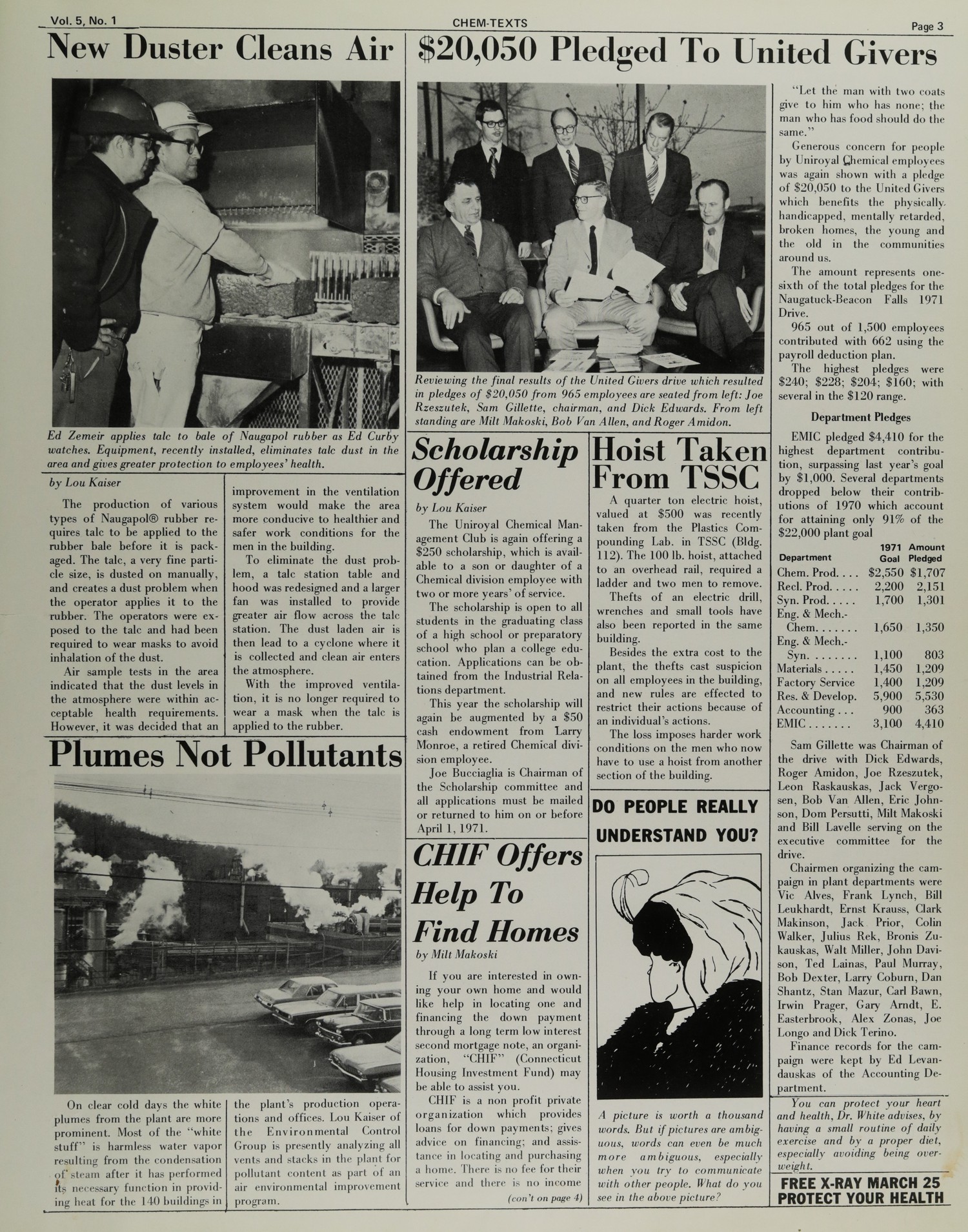
Ed Zemeir applies talc to bale of Naugapol rubber as Ed Curby watches. Equipment, recently installed, eliminates talc dust in the area and gives greater protection to employees’ health.

by Lou Kaiser

The production of various types of Naugapol® rubber requires talc to be applied to the rubber bale before it is packaged. The talc, a very fine particle size, is dusted on manually, and creates a dust problem when the operator applies it to the rubber. The operators were exposed to the talc and had been required to wear masks to avoid inhalation of the dust.

Air sample tests in the area indicated that the dust levels in the atmosphere were within acceptable health requirements. However, it was decided that an improvement in the ventilation system would make the area more conducive to healthier and safer work conditions for the men in the building.

To eliminate the dust problem, a talc station table and hood was redesigned and a larger fan was installed to provide greater air flow across the talc station. The dust laden air is then lead to a cyclone where it is collected and clean air enters the atmosphere.

With the improved ventilation, it is no longer required to wear a mask when the talc is applied to the rubber.


Plumes Not Pollutants

On clear cold days the white plumes from the plant are more prominent. Most of the “white stuff” is harmless water vapor resulting from the condensation of steam after it has performed its necessary function in providing heat for the 140 buildings in the plant’s production operations and offices. Lou Kaiser of the Environmental Control Group is presently analyzing all vents and stacks in the plant for pollutant content as part of an air environmental improvement program.


$20,050 Pledged To United Givers

Reviewing the final results of the United Givers drive which resulted in pledges of $20,050 from 965 employees are seated from left: Joe Rzeszutek, Sam Gillette, chairman, and Dick Edwards. From left standing are Milt Makoski, Bob Van Allen, and Roger Amidon.

“Let the man with two coats give to him who has none; the man who has food should do the same.”

Generous concern for people by Uniroyal Chemical employees was again shown with a pledge of $20,050 to the United Givers which benefits the physically handicapped, mentally retarded, broken homes, the young and the old in the communities around us.

The amount represents one-sixth of the total pledges for the Naugatuck-Beacon Falls 1971 Drive.

965 out of 1,500 employees contributed with 662 using the payroll deduction plan.

The highest pledges were $240; $228; $204; $160; with several in the $120 range.

Department Pledges

EMIC pledged $4,410 for the highest department contribution, surpassing last year’s goal by $1,000. Several departments dropped below their contributions of 1970 which account for attaining only 91% of the $22,000 plant goal

Department 1971 Goal Amount Pledged
Chem. Prod…. $2,550 $1,707
Recl. Prod….. 2,200 2,151
Syn. Prod…… 1,700 1,301
Eng. & Mech.- Chem……. 1,650 1,350
Eng. & Mech.- Syn……. 1,100 803
Materials….. 1,450 1,209
Factory Service 1,400 1,209
Res. & Develop. 5,900 5,530
Accounting… 900 363
EMIC…….. 3,100 4,410

Sam Gillette was Chairman of the drive with Dick Edwards, Roger Amidon, Joe Rzeszutek, Leon Raskauskas, Jack Vergosen, Bob Van Allen, Eric Johnson, Dom Persutti, Milt Makoski and Bill Lavelle serving on the executive committee for the drive.

Chairmen organizing the campaign in plant departments were Vic Alves, Frank Lynch, Bill Leukhardt, Ernst Krauss, Clark Makinson, Jack Prior, Colin Walker, Julius Rek, Bronis Zukauskas, Walt Miller, John Davison, Ted Lainas, Paul Murray, Bob Dexter, Larry Coburn, Dan Shantz, Stan Mazur, Carl Bawn, Irwin Prager, Gary Arndt, E. Easterbrook, Alex Zonas, Joe Longo and Dick Terino.

Finance records for the campaign were kept by Ed Levandauskas of the Accounting Department.


Scholarship Offered

by Lou Kaiser

The Uniroyal Chemical Management Club is again offering a $250 scholarship, which is available to a son or daughter of a Chemical division employee with two or more years’ of service.

The scholarship is open to all students in the graduating class of a high school or preparatory school who plan a college education. Applications can be obtained from the Industrial Relations department.

This year the scholarship will again be augmented by a $50 cash endowment from Larry Monroe, a retired Chemical division employee.

Joe Bucciaglia is Chairman of the Scholarship committee and all applications must be mailed or returned to him on or before April 1, 1971.


Hoist Taken From TSSC

A quarter ton electric hoist, valued at $500 was recently taken from the Plastics Compounding Lab. in TSSC (Bldg. 112). The 100 lb. hoist, attached to an overhead rail, required a ladder and two men to remove.

Thefts of an electric drill, wrenches and small tools have also been reported in the same building.

Besides the extra cost to the plant, the thefts cast suspicion on all employees in the building, and new rules are effected to restrict their actions because of an individual’s actions.

The loss imposes harder work conditions on the men who now have to use a hoist from another section of the building.


CHIF Offers Help To Find Homes

by Milt Makoski

If you are interested in owning your own home and would like help in locating one and financing the down payment through a long term low interest second mortgage note, an organization, “CHIF” (Connecticut Housing Investment Fund) may be able to assist you.

CHIF is a non profit private organization which provides loans for down payments; gives advice on financing; and assistance in locating and purchasing a home. There is no fee for their service and there is no income

(con’t on page 4)


DO PEOPLE REALLY UNDERSTAND YOU?

A picture is worth a thousand words. But if pictures are ambiguous, words can even be much more ambiguous, especially when you try to communicate with other people. What do you see in the above picture?


You can protect your heart and health, Dr. White advises, by having a small routine of daily exercise and by a proper diet, especially avoiding being overweight.

FREE X-RAY MARCH 25
PROTECT YOUR HEALTH

CHEM-TEXTS – Vol. 4 No. 1 – Page 2

Page 002

CHEM-TEXTS

Page 2 | Vol. 4, No. 1


FROM THE FACTORY MANAGER

DEAR FELLOW EMPLOYEE:

During most of the 1960’s, in fact until about mid-1969, our plant has operated in what Jim Cronin has called an “oversold” position. In other words, we were operating all out to produce every pound we could, to meet our customers’ requirements.

In 1969 the situation changed to what can be called an “undersold” position, which means we can produce more than the customer needs. This fairly abrupt change from what had become an established way of operating has affected the way all of us do our jobs. Basically, under these conditions all of us have to make better decisions faster in order to be responsive to the customers’ needs at the moment.

Considering the general decline in business activity in the markets we serve, the high cost of money, the “undersold” capacity of domestic competition and increasing foreign competition, I expect that these conditions will continue well into 1970. Therefore, it becomes even more important that we be as flexible to change as possible. Under these circumstances what we did yesterday isn’t important. What is important, is what we do right now to meet a new opportunity.

All of us have expressed individual pride in the flexibility of our plant – men and machinery alike – to do the job, whatever the requirements. Now if we really have this flexibility, and I believe we do, it seems to me that the economic climate of 1970 plays right into our hands.

I’m confident we can and will meet these demands regardless of how difficult they may be.

Sincerely,

John

John D. Evans


Jaroy Inc. Enjoys Brisk Sales

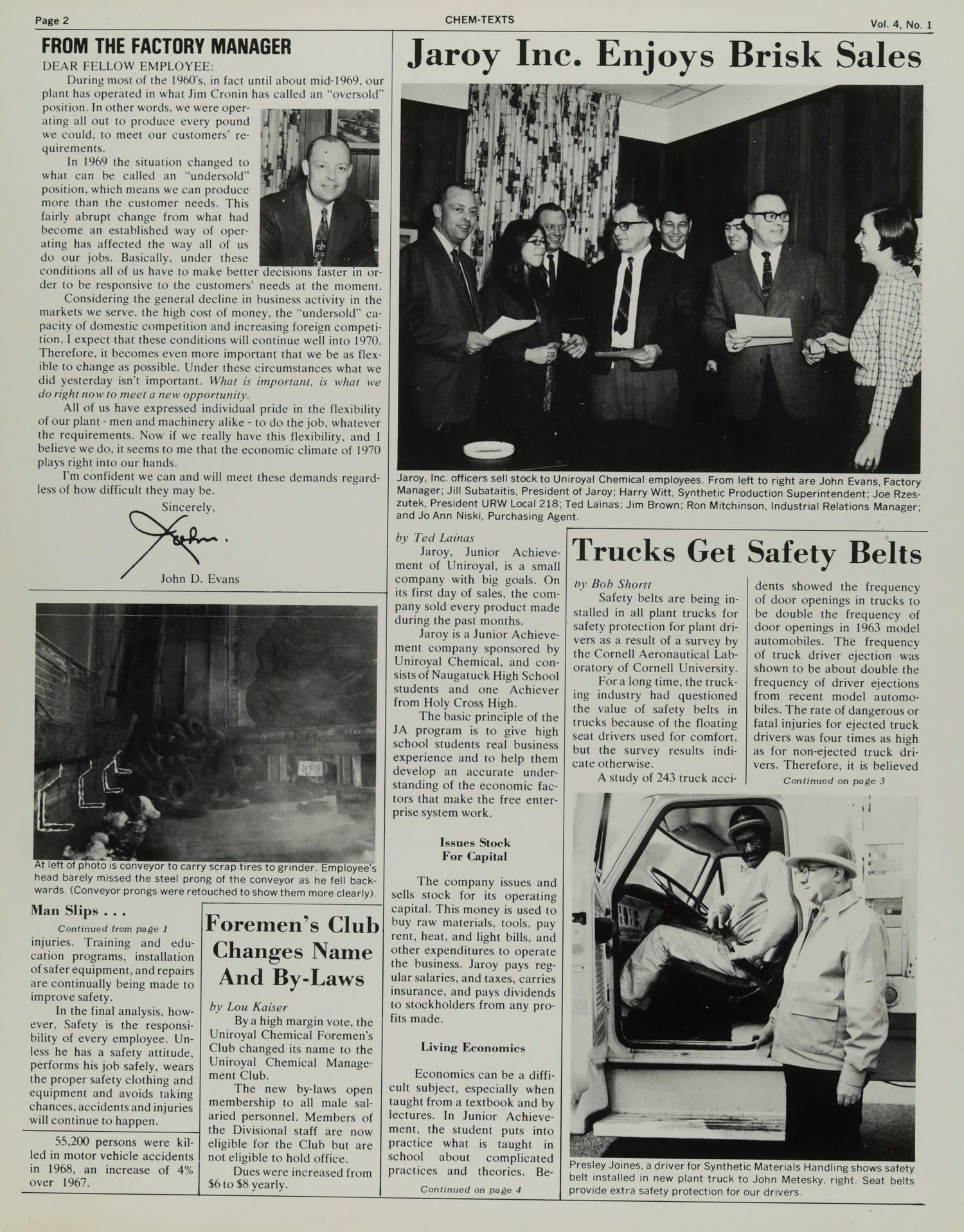
Jaroy, Inc. officers sell stock to Uniroyal Chemical employees. From left to right are John Evans, Factory Manager; Jill Subataitis, President of Jaroy; Harry Witt, Synthetic Production Superintendent; Joe Rzeszutek, President URW Local 218; Ted Lainas; Jim Brown; Ron Mitchinson, Industrial Relations Manager; and Jo Ann Niski, Purchasing Agent.

by Ted Lainas

Jaroy, Junior Achievement of Uniroyal, is a small company with big goals. On its first day of sales, the company sold every product made during the past months.

Jaroy is a Junior Achievement company sponsored by Uniroyal Chemical, and consists of Naugatuck High School students and one Achiever from Holy Cross High.

The basic principle of the JA program is to give high school students real business experience and to help them develop an accurate understanding of the economic factors that make the free enterprise system work.

Issues Stock For Capital

The company issues and sells stock for its operating capital. This money is used to buy raw materials, tools, pay rent, heat, and light bills, and other expenditures to operate the business. Jaroy pays regular salaries, and taxes, carries insurance, and pays dividends to stockholders from any profits made.

Living Economics

Economics can be a difficult subject, especially when taught from a textbook and by lectures. In Junior Achievement, the student puts into practice what is taught in school about complicated practices and theories. Be-

Continued on page 4


Trucks Get Safety Belts

by Bob Shortt

Safety belts are being installed in all plant trucks for safety protection for plant drivers as a result of a survey by the Cornell Aeronautical Laboratory of Cornell University.

For a long time, the trucking industry had questioned the value of safety belts in trucks because of the floating seat drivers used for comfort, but the survey results indicate otherwise.

A study of 243 truck accidents showed the frequency of door openings in trucks to be double the frequency of door openings in 1963 model automobiles. The frequency of truck driver ejection was shown to be about double the frequency of driver ejections from recent model automobiles. The rate of dangerous or fatal injuries for ejected truck drivers was four times as high as for non-ejected truck drivers. Therefore, it is believed

Continued on page 3

Presley Joines, a driver for Synthetic Materials Handling shows safety belt installed in new plant truck to John Metesky, right. Seat belts provide extra safety protection for our drivers.


At left of photo is conveyor to carry scrap tires to grinder. Employee’s head barely missed the steel prong of the conveyor as he fell backwards. (Conveyor prongs were retouched to show them more clearly).


Man Slips . . .

Continued from page 1

injuries. Training and education programs, installation of safer equipment, and repairs are continually being made to improve safety.

In the final analysis, however, Safety is the responsibility of every employee. Unless he has a safety attitude, performs his job safely, wears the proper safety clothing and equipment and avoids taking chances, accidents and injuries will continue to happen.

55,200 persons were killed in motor vehicle accidents in 1968, an increase of 4% over 1967.


Foremen’s Club Changes Name And By-Laws

by Lou Kaiser

By a high margin vote, the Uniroyal Chemical Foremen’s Club changed its name to the Uniroyal Chemical Management Club.

The new by-laws open membership to all male salaried personnel. Members of the Divisional staff are now eligible for the Club but are not eligible to hold office.

Dues were increased from $6 to $8 yearly.

CHEM-TEXTS – Vol. 4 No. 1 – Page 3

Page 003

CHEM-TEXTS

Vol. 4, No. 1 | Page 3


UNIROYAL, INC.

EMPLOYEE BENEFIT COSTS—1968

U.R.W. PLANTS

Total Dollars Cents Per Hr.
Social Security $ 6,638,454 $ .1629
Unemployment Compensation Taxes 1,553,264 .0375
State Disability Insurance 182,749 .0044
Workmen’s Compensation 1,171,334 .0283
Vacations 11,898,799 .2877
Holidays 5,157,970 .1247
Overtime 8,771,526 .2121
Night Shift Bonus 1,172,040 .0283
Hospital, Surgical, In-Hospital Medical Insurance 7,470,680 .1806
Sickness & Accident Insurance 2,266,966 .0548
Life Insurance 2,222,114 .0535
Severance Pay 54,076 .0013
Grievance Meetings 111,513 .0027
Pensions 15,090,989 3648
Supplemental Unemployment Benefits 2,691,057 .0651
Funeral Pay 318,303 .0077
Military Training Pay 32,801 .0008
Jury Pay 73,024 .0018
Union Time Study 67,988 .0016
Safety Committee 9,651 .0002
Workmen’s Compensation Make-up 101,124 .0024
TOTAL $67,146,422 $1.6232

Above are various benefits employees receive and their cost per wage hour. At $1.62 an hour they add up to $64.80 for each 40 hour week or a total of more than $3,200 a year.


UNIROYAL, INC.

EMPLOYEE BENEFIT COSTS-IN CENTS PER HOUR

U.R.W. PLANTS 1953-1968

[THIS IS CHART: Bar graph showing increasing employee benefit costs from 1953 to 1968, starting at around $0.41 in 1953 and reaching $1.62 in 1968, with data points for each year showing gradual increase: .41, .42, .53, .57, .62, .76, .82, .91, .93, .97, 1.09, 1.23, 1.35, 1.62, 1.76]

The chart shows the increased cost of employee benefits. They have gone up from 41 cents an hour in 1953 to $1.62 in 1968. On August 1, 1969 Uniroyal absorbed the 20% increase in the Hospitalization, Surgical and In-Hospital medical benefits. For 12 months this benefit now amounts to $364.44 per employee.


Sales Highest; Profits Drop

Estimated 1969 sales hit a record high of $1,550,000,000, an 8% increase over 1968.

But 1969 profits were about $46,500,000 or 18% below the record of $56,900,000 in 1968.

Tire, Footwear Profits Affected

Although foreign operations showed good gains, along with industrial and most other U.S. products, the gains were offset by lower profits in U.S. Tires and Footwear operations.

Footwear was hurt by lower demands for its products, low cost foreign imports, and the higher number of lower cost U.S. manufacturers paying wages below Uniroyal wages.

Tires faced sharply higher costs and lower productivity from the introduction of the new bias belted tires and heavy start-up expenses for expanding tire capacity at Opelika.

Fourth Quarter Sales, Profits

Fourth quarter sales were about 5% above the same period in 1968 but profits for the fourth quarter of 1969 were approximately $8,500,000 compared to profits of $14,300,000 in 1968. This represents a $5,800,000 drop in profits for the last quarter of 1969.


Three Employees Avert Fire

[THIS IS PHOTO: Group photo of four men in work attire]

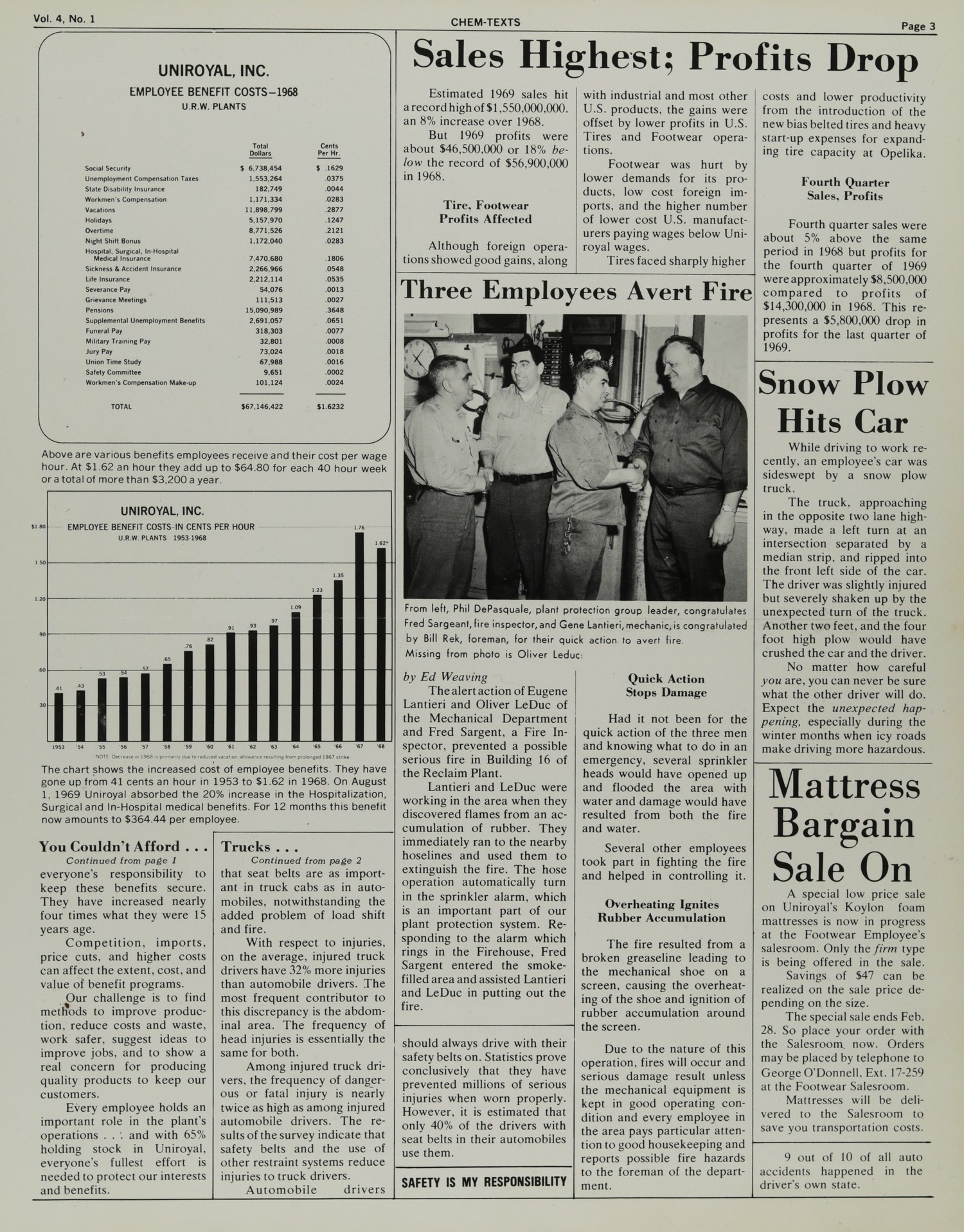
From left, Phil DePasquale, plant protection group leader, congratulates Fred Sargeant, fire inspector, and Gene Lantieri, mechanic, is congratulated by Bill Rek, foreman, for their quick action to avert fire. Missing from photo is Oliver Leduc.

by Ed Weaving

The alert action of Eugene Lantieri and Oliver LeDuc of the Mechanical Department and Fred Sargent, a Fire Inspector, prevented a possible serious fire in Building 16 of the Reclaim Plant.

Lantieri and LeDuc were working in the area when they discovered flames from an accumulation of rubber. They immediately ran to the nearby hoselines and used them to extinguish the fire. The hose operation automatically turn in the sprinkler alarm, which is an important part of our plant protection system. Responding to the alarm which rings in the Firehouse, Fred Sargent entered the smoke-filled area and assisted Lantieri and LeDuc in putting out the fire.

Quick Action Stops Damage

Had it not been for the quick action of the three men and knowing what to do in an emergency, several sprinkler heads would have opened up and flooded the area with water and damage would have resulted from both the fire and water.

Several other employees took part in fighting the fire and helped in controlling it.

Overheating Ignites Rubber Accumulation

The fire resulted from a broken greaseline leading to the mechanical shoe on a screen, causing the overheating of the shoe and ignition of rubber accumulation around the screen.

Due to the nature of this operation, fires will occur and serious damage result unless the mechanical equipment is kept in good operating condition and every employee in the area pays particular attention to good housekeeping and reports possible fire hazards to the foreman of the department.


Snow Plow Hits Car

While driving to work recently, an employee’s car was sideswiped by a snow plow truck.

The truck, approaching in the opposite two lane highway, made a left turn at an intersection separated by a median strip, and ripped into the front left side of the car. The driver was slightly injured but severely shaken up by the unexpected turn of the truck. Another two feet, and the four foot high plow would have crushed the car and the driver.

No matter how careful you are, you can never be sure what the other driver will do. Expect the unexpected happening, especially during the winter months when icy roads make driving more hazardous.


Mattress Bargain Sale On

A special low price sale on Uniroyal’s Koylon foam mattresses is now in progress at the Footwear Employee’s salesroom. Only the firm type is being offered in the sale.

Savings of $47 can be realized on the sale price depending on the size.

The special sale ends Feb. 28. So place your order with the Salesroom now. Orders may be placed by telephone to George O’Donnell, Ext. 17-259 at the Footwear Salesroom.

Mattresses will be delivered to the Salesroom to save you transportation costs.

9 out of 10 of all auto accidents happened in the driver’s own state.


You Couldn’t Afford . . .

Continued from page 1

everyone’s responsibility to keep these benefits secure. They have increased nearly four times what they were 15 years ago.

Competition, imports, price cuts, and higher costs can affect the extent, cost, and value of benefit programs.

Our challenge is to find methods to improve production, reduce costs and waste, work safer, suggest ideas to improve jobs, and to show a real concern for producing quality products to keep our customers.

Every employee holds an important role in the plant’s operations . . . and with 65% holding stock in Uniroyal, everyone’s fullest effort is needed to protect our interests and benefits.


Trucks . . .

Continued from page 2

that seat belts are as important in truck cabs as in automobiles, notwithstanding the added problem of load shift and fire.

With respect to injuries, on the average, injured truck drivers have 32% more injuries than automobile drivers. The most frequent contributor to this discrepancy is the abdominal area. The frequency of head injuries is essentially the same for both.

Among injured truck drivers, the frequency of dangerous or fatal injury is nearly twice as high as among injured automobile drivers. The results of the survey indicate that safety belts and the use of other restraint systems reduce injuries to truck drivers.

Automobile drivers should always drive with their safety belts on. Statistics prove conclusively that they have prevented millions of serious injuries when worn properly. However, it is estimated that only 40% of the drivers with seat belts in their automobiles use them.


SAFETY IS MY RESPONSIBILITY

CHEM-TEXTS – Vol. 4 No. 2 – Page 3

Page 003

CHEM-TEXTS

Vol. 4 No. 2 | Page 3


HOPKINS PREDICTS A TOUGH, CHALLENGING 1970

[IMAGE: Black and white photograph of two men in suits having a discussion]

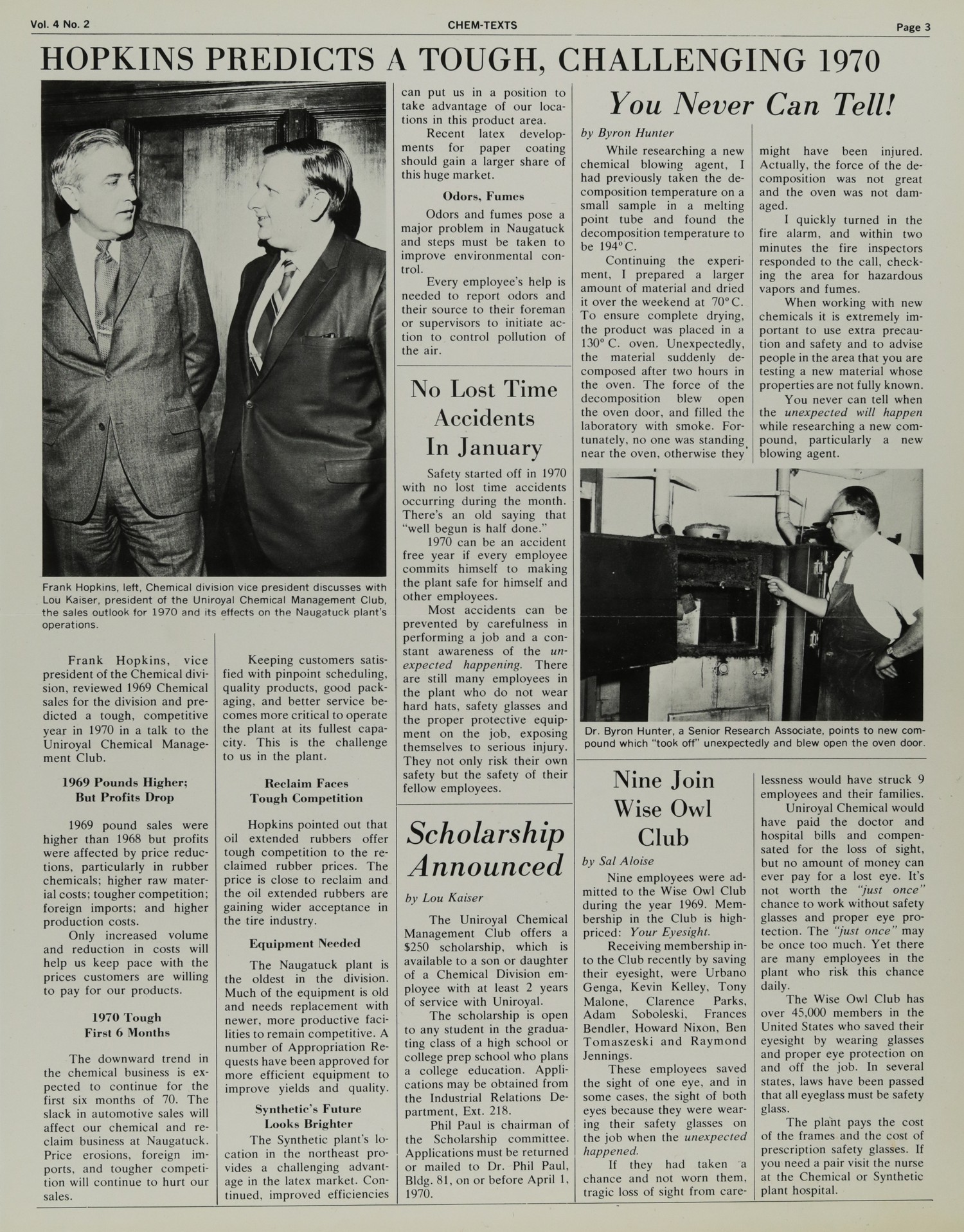
Frank Hopkins, left, Chemical division vice president discusses with Lou Kaiser, president of the Uniroyal Chemical Management Club, the sales outlook for 1970 and its effects on the Naugatuck plant’s operations.


Frank Hopkins, vice president of the Chemical division, reviewed 1969 Chemical sales for the division and predicted a tough, competitive year in 1970 in a talk to the Uniroyal Chemical Management Club.

1969 Pounds Higher;
But Profits Drop

1969 pound sales were higher than 1968 but profits were affected by price reductions, particularly in rubber chemicals; higher raw material costs; tougher competition; foreign imports; and higher production costs.

Only increased volume and reduction in costs will help us keep pace with the prices customers are willing to pay for our products.

1970 Tough
First 6 Months

The downward trend in the chemical business is expected to continue for the first six months of 70. The slack in automotive sales will affect our chemical and reclaim business at Naugatuck. Price erosions, foreign imports, and tougher competition will continue to hurt our sales.


Keeping customers satisfied with pinpoint scheduling, quality products, good packaging, and better service becomes more critical to operate the plant at its fullest capacity. This is the challenge to us in the plant.

Reclaim Faces
Tough Competition

Hopkins pointed out that oil extended rubbers offer tough competition to the reclaimed rubber prices. The price is close to reclaim and the oil extended rubbers are gaining wider acceptance in the tire industry.

Equipment Needed

The Naugatuck plant is the oldest in the division. Much of the equipment is old and needs replacement with newer, more productive facilities to remain competitive. A number of Appropriation Requests have been approved for more efficient equipment to improve yields and quality.

Synthetic’s Future
Looks Brighter

The Synthetic plant’s location in the northeast provides a challenging advantage in the latex market. Continued, improved efficiencies


can put us in a position to take advantage of our locations in this product area.

Recent latex developments for paper coating should gain a larger share of this huge market.

Odors, Fumes

Odors and fumes pose a major problem in Naugatuck and steps must be taken to improve environmental control.

Every employee’s help is needed to report odors and their source to their foreman or supervisors to initiate action to control pollution of the air.


No Lost Time Accidents In January

Safety started off in 1970 with no lost time accidents occurring during the month. There’s an old saying that “well begun is half done.”

1970 can be an accident free year if every employee commits himself to making the plant safe for himself and other employees.

Most accidents can be prevented by carefulness in performing a job and a constant awareness of the unexpected happening. There are still many employees in the plant who do not wear hard hats, safety glasses and the proper protective equipment on the job, exposing themselves to serious injury. They not only risk their own safety but the safety of their fellow employees.


Scholarship Announced

by Lou Kaiser

The Uniroyal Chemical Management Club offers a $250 scholarship, which is available to a son or daughter of a Chemical Division employee with at least 2 years of service with Uniroyal.

The scholarship is open to any student in the graduating class of a high school or college prep school who plans a college education. Applications may be obtained from the Industrial Relations Department, Ext. 218.

Phil Paul is chairman of the Scholarship committee. Applications must be returned or mailed to Dr. Phil Paul, Bldg. 81, on or before April 1, 1970.


You Never Can Tell!

by Byron Hunter

While researching a new chemical blowing agent, I had previously taken the decomposition temperature on a small sample in a melting point tube and found the decomposition temperature to be 194° C.

Continuing the experiment, I prepared a larger amount of material and dried it over the weekend at 70° C. To ensure complete drying, the product was placed in a 130° C. oven. Unexpectedly, the material suddenly decomposed after two hours in the oven. The force of the decomposition blew open the oven door, and filled the laboratory with smoke. Fortunately, no one was standing near the oven, otherwise they

might have been injured. Actually, the force of the decomposition was not great and the oven was not damaged.

I quickly turned in the fire alarm, and within two minutes the fire inspectors responded to the call, checking the area for hazardous vapors and fumes.

When working with new chemicals it is extremely important to use extra precaution and safety and to advise people in the area that you are testing a new material whose properties are not fully known.

You never can tell when the unexpected will happen while researching a new compound, particularly a new blowing agent.


[IMAGE: Black and white photograph of a man in a lab coat pointing at laboratory equipment]

Dr. Byron Hunter, a Senior Research Associate, points to new compound which “took off” unexpectedly and blew open the oven door.


Nine Join Wise Owl Club

by Sal Aloise

Nine employees were admitted to the Wise Owl Club during the year 1969. Membership in the Club is highpriced: Your Eyesight.

Receiving membership into the Club recently by saving their eyesight, were Urbano Genga, Kevin Kelley, Tony Malone, Clarence Parks, Adam Soboleski, Frances Bendler, Howard Nixon, Ben Tomaszeski and Raymond Jennings.

These employees saved the sight of one eye, and in some cases, the sight of both eyes because they were wearing their safety glasses on the job when the unexpected happened.

If they had taken a chance and not worn them, tragic loss of sight from care-

lessness would have struck 9 employees and their families.

Uniroyal Chemical would have paid the doctor and hospital bills and compensated for the loss of sight, but no amount of money can ever pay for a lost eye. It’s not worth the “just once” chance to work without safety glasses and proper eye protection. The “just once” may be once too much. Yet there are many employees in the plant who risk this chance daily.

The Wise Owl Club has over 45,000 members in the United States who saved their eyesight by wearing glasses and proper eye protection on and off the job. In several states, laws have been passed that all eyeglass must be safety glass.

The plant pays the cost of the frames and the cost of prescription safety glasses. If you need a pair visit the nurse at the Chemical or Synthetic plant hospital.

CHEM-TEXTS – Vol. 4, 1970, No. 3 – Page 1

Page 001

UNIROYAL CHEM-TEXTS

Vol. 4, 1970 PUBLISHED FOR THE PEOPLE OF UNIROYAL CHEMICAL No. 3


Safety Is Everyone’s Responsibility

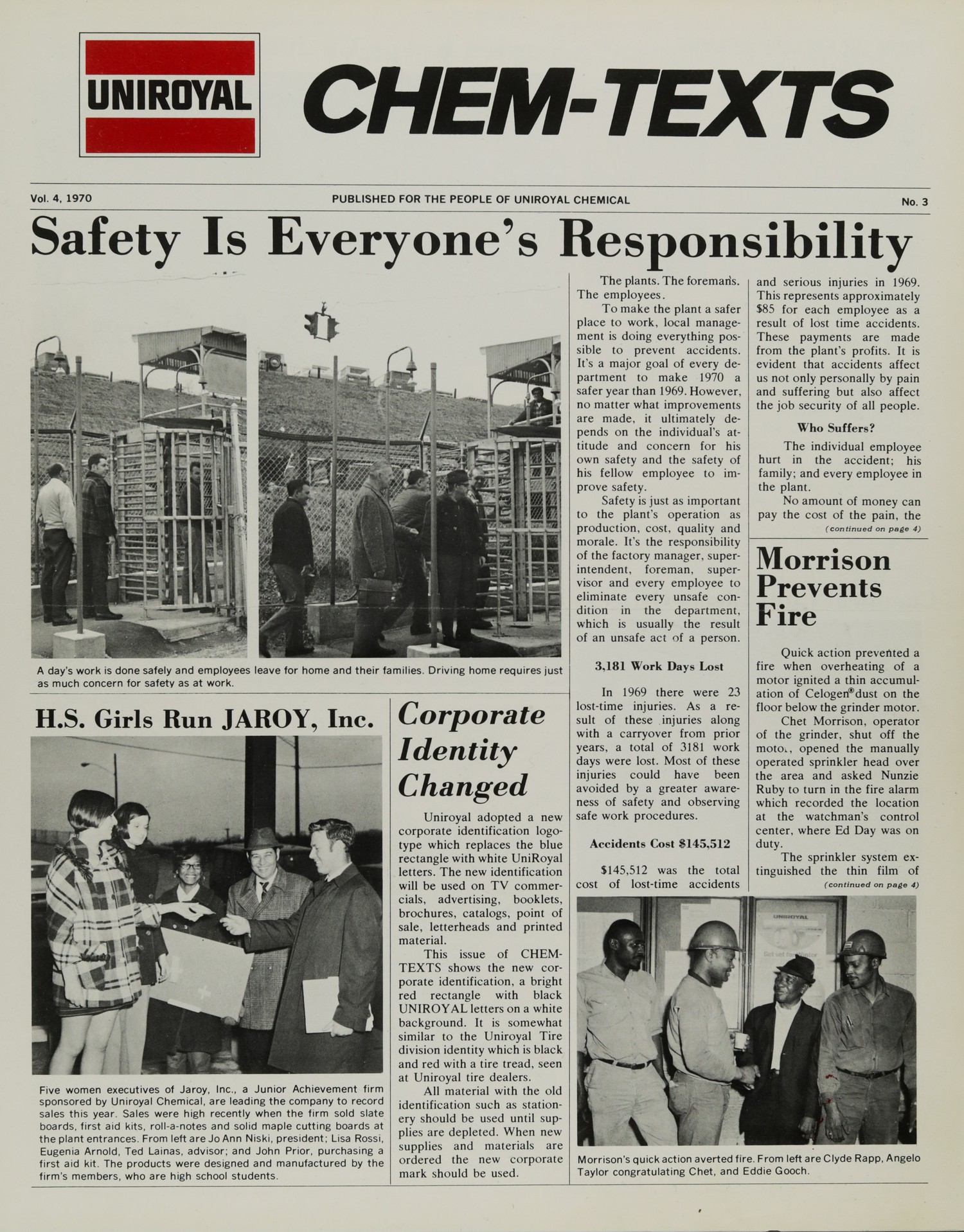
[IMAGE: Black and white photograph showing employees leaving work at a plant with cars visible]

A day’s work is done safely and employees leave for home and their families. Driving home requires just as much concern for safety as at work.


The plants. The foremans. The employees.

To make the plant a safer place to work, local management is doing everything possible to prevent accidents. It’s a major goal of every department to make 1970 a safer year than 1969. However, no matter what improvements are made, it ultimately depends on the individual’s attitude and concern for his own safety and the safety of his fellow employee to improve safety.

Safety is just as important to the plant’s operation as production, cost, quality and morale. It’s the responsibility of the factory manager, superintendent, foreman, supervisor and every employee to eliminate every unsafe condition in the department, which is usually the result of an unsafe act of a person.

3,181 Work Days Lost

In 1969 there were 23 lost-time injuries. As a result of these injuries along with a carryover from prior years, a total of 3181 work days were lost. Most of these injuries could have been avoided by a greater awareness of safety and observing safe work procedures.

Accidents Cost $145,512

$145,512 was the total cost of lost-time accidents and serious injuries in 1969. This represents approximately $85 for each employee as a result of lost time accidents. These payments are made from the plant’s profits. It is evident that accidents affect us not only personally by pain and suffering but also affect the job security of all people.

Who Suffers?

The individual employee hurt in the accident; his family; and every employee in the plant.

No amount of money can pay the cost of the pain, the

(continued on page 4)


H.S. Girls Run JAROY, Inc.

[IMAGE: Black and white photograph showing five people standing together]

Five women executives of Jaroy, Inc., a Junior Achievement firm sponsored by Uniroyal Chemical, are leading the company to record sales this year. Sales were high recently when the firm sold slate boards, first aid kits, roll-a-notes and solid maple cutting boards at the plant entrances. From left are Jo Ann Niski, president; Lisa Rossi, Eugenia Arnold, Ted Lainas, advisor; and John Prior, purchasing a first aid kit. The products were designed and manufactured by the firm’s members, who are high school students.


Corporate Identity Changed

Uniroyal adopted a new corporate identification logotype which replaces the blue rectangle with white UniRoyal letters. The new identification will be used on TV commercials, advertising, booklets, brochures, catalogs, point of sale, letterheads and printed material.

This issue of CHEM-TEXTS shows the new corporate identification, a bright red rectangle with black UNIROYAL letters on a white background. It is somewhat similar to the Uniroyal Tire division identity which is black and red with a tire tread, seen at Uniroyal tire dealers.

All material with the old identification such as stationery should be used until supplies are depleted. When new supplies and materials are ordered the new corporate mark should be used.


Morrison Prevents Fire

Quick action prevented a fire when overheating of a motor ignited a thin accumulation of Celogen® dust on the floor below the grinder motor.

Chet Morrison, operator of the grinder, shut off the moto., opened the manually operated sprinkler head over the area and asked Nunzie Ruby to turn in the fire alarm which recorded the location at the watchman’s control center, where Ed Day was on duty.

The sprinkler system extinguished the thin film of

(continued on page 4)

[IMAGE: Black and white photograph showing three men, one wearing a hard hat]

Morrison’s quick action averted fire. From left are Clyde Rapp, Angelo Taylor congratulating Chet, and Eddie Gooch.

CHEM-TEXTS – Vol. 4, 1970, No. 8 – Page 1

Page 001

UNIROYAL CHEM-TEXTS

Vol. 4, 1970 | PUBLISHED FOR THE PEOPLE OF UNIROYAL CHEMICAL | No. 8


Polygard Facilities To Expand

by Rod Gaetz

Design drawings are near completion for the expansion of Polygard ® facilities in Bldg. 109. The major equipment has been ordered and 75% of the necessary piping materials are on order for the project which will increase the production rates of the chemical. The project is part of the plant’s continuing program to stay competitive in a tight chemical market, keep business at the plant and keep chemical production employment at a full level.

Used In Rubber

Polygard is one of the most effective nondiscoloring and nonstaining stabilizers for synthetic rubber in commercial use today. Without Polygard protection, degradation occurs during the finishing, processing and vulcanization, resulting in a shorter service life of the final rubber product.

As a chemical, Polygard is safe to use, having the approval of the Food and Drug Administration (FDA) for use in products used for packaging or handling food.

New Stainless Steel Lines

The major work done during the summer shutdown of the building was the relocation and repiping of 2 Hold tanks from the second to the third floor. The piping from the bottom of the four vessels which will eventually become strippers was replaced with much larger stainless steel lines. The transfer pump was relocated and the discharge lines relocated and replaced with 3″ and 4″ stainless steel piping.

Fume Control Devices

When completed in early 1972, the expanded facilities will have environmental control devices to control fume pollution as part of the plant’s policy in the installation of new equipment and facilities.

Engineers working on the expansion are Terry Mo and Rod Gaetz; Vic Anderson, instrumentation and electricity; and Lou Kaiser, environmental control.


MIP Plan To Start

Instead of the 1970 stock purchase plan slated to start August 1, Uniroyal will expand the Monthly Investment Plan (MIP) to all employees interested in purchasing Uniroyal stock, at the market price, on a regular payroll deduction basis.

Under the plan, which is operated by Merrill Lynch, Pierce, Fenner and Smith, Inc., employees can sign up for regular payroll deductions. There are minimum and maximum deductions which will be indicated with other information, in plan brochures available shortly.

Merrill Lynch will purchase Uniroyal stock at the market price and keep individual accounts for each employee. Employees will receive regular statements from Merrill Lynch showing how much stock has been

(Cont’d on page 4)


H.S. Diploma Obtainable

It’s still possible for a person who left high school for one reason or another to obtain a high school diploma without going back to school.

To qualify for a diploma,

(Cont’d on page 4)


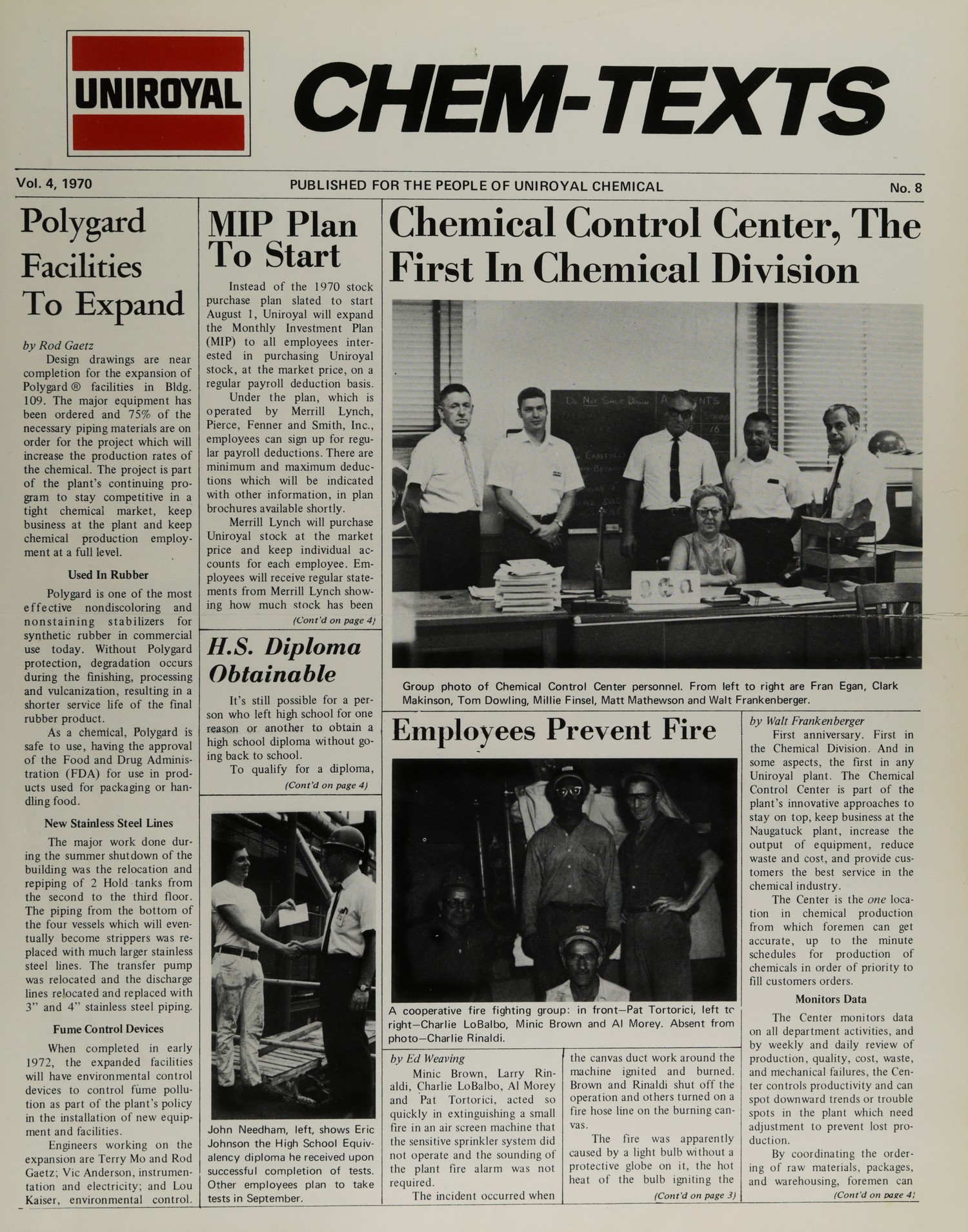
Chemical Control Center, The First In Chemical Division

Group photo of Chemical Control Center personnel. From left to right are Fran Egan, Clark Makinson, Tom Dowling, Millie Finsel, Matt Mathewson and Walt Frankenberger.


Employees Prevent Fire

by Walt Frankenberger

First anniversary. First in the Chemical Division. And in some aspects, the first in any Uniroyal plant. The Chemical Control Center is part of the plant’s innovative approaches to stay on top, keep business at the Naugatuck plant, increase the output of equipment, reduce waste and cost, and provide customers the best service in the chemical industry.

The Center is the one location in chemical production from which foremen can get accurate, up to the minute schedules for production of chemicals in order of priority to fill customers orders.

Monitors Data

The Center monitors data on all department activities, and by weekly and daily review of production, quality, cost, waste, and mechanical failures, the Center controls productivity and can spot downward trends or trouble spots in the plant which need adjustment to prevent lost production.

By coordinating the ordering of raw materials, packages, and warehousing, foremen can

(Cont’d on page 4)


A cooperative fire fighting group: in front—Pat Tortorici, left to right—Charlie LoBalbo, Minic Brown and Al Morey. Absent from photo—Charlie Rinaldi.


John Needham, left, shows Eric Johnson the High School Equivalency diploma he received upon successful completion of tests. Other employees plan to take tests in September.


by Ed Weaving

Minic Brown, Larry Rinaldi, Charlie LoBalbo, Al Morey and Pat Tortorici, acted so quickly in extinguishing a small fire in an air screen machine that the sensitive sprinkler system did not operate and the sounding of the plant fire alarm was not required.

The incident occurred when the canvas duct work around the machine ignited and burned. Brown and Rinaldi shut off the operation and others turned on a fire hose line on the burning canvas.

The fire was apparently caused by a light bulb without a protective globe on it, the hot heat of the bulb igniting the

(Cont’d on page 3)

CHEM-TEXTS – Vol. 4 No. 8 – Page 4

Page 004

CHEM-TEXTS

Page 4 | Vol. 4 No. 8


Electrical Power Improved

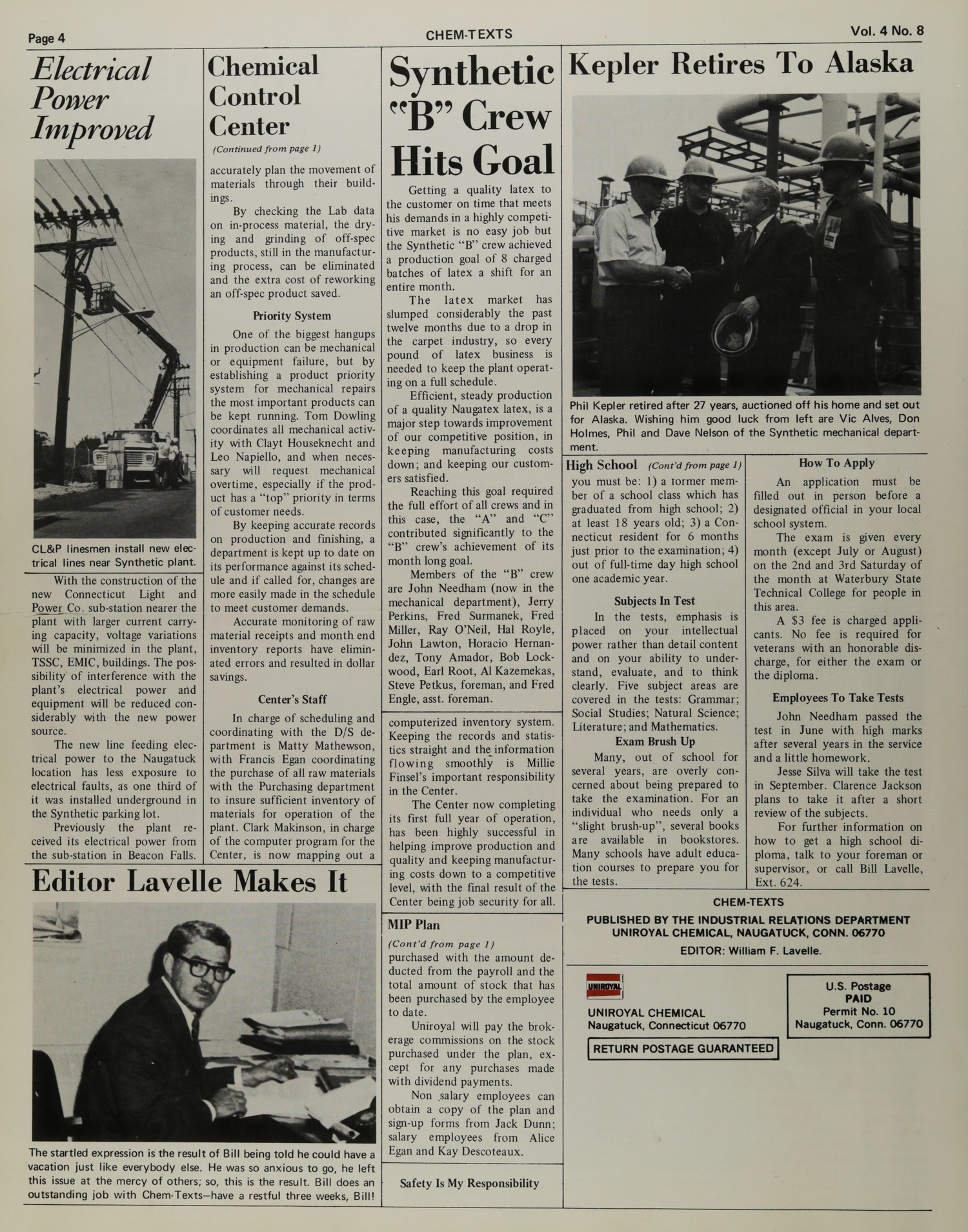
[IMAGE: CL&P linesmen install new electrical lines near Synthetic plant.]

With the construction of the new Connecticut Light and Power Co. sub-station nearer the plant with larger current carrying capacity, voltage variations will be minimized in the plant, TSSC, EMIC, buildings. The possibility of interference with the plant’s electrical power and equipment will be reduced considerably with the new power source.

The new line feeding electrical power to the Naugatuck location has less exposure to electrical faults, as one third of it was installed underground in the Synthetic parking lot.

Previously the plant received its electrical power from the sub-station in Beacon Falls.


Chemical Control Center

(Continued from page 1)

accurately plan the movement of materials through their buildings.

By checking the Lab data on in-process material, the drying and grinding of off-spec products, still in the manufacturing process, can be eliminated and the extra cost of reworking an off-spec product saved.

Priority System

One of the biggest hangups in production can be mechanical or equipment failure, but by establishing a product priority system for mechanical repairs the most important products can be kept running. Tom Dowling coordinates all mechanical activity with Clayt Houseknecht and Leo Napiello, and when necessary will request mechanical overtime, especially if the product has a “top” priority in terms of customer needs.

By keeping accurate records on production and finishing, a department is kept up to date on its performance against its schedule and if called for, changes are more easily made in the schedule to meet customer demands.

Accurate monitoring of raw material receipts and month end inventory reports have eliminated errors and resulted in dollar savings.

Center’s Staff

In charge of scheduling and coordinating with the D/S department is Matty Mathewson, with Francis Egan coordinating the purchase of all raw materials with the Purchasing department to insure sufficient inventory of materials for operation of the plant. Clark Makinson, in charge of the computer program for the Center, is now mapping out a


Synthetic “B” Crew Hits Goal

Getting a quality latex to the customer on time that meets his demands in a highly competitive market is no easy job but the Synthetic “B” crew achieved a production goal of 8 charged batches of latex a shift for an entire month.

The latex market has slumped considerably the past twelve months due to a drop in the carpet industry, so every pound of latex business is needed to keep the plant operating on a full schedule.

Efficient, steady production of a quality Naugatex latex, is a major step towards improvement of our competitive position, in keeping manufacturing costs down; and keeping our customers satisfied.

Reaching this goal required the full effort of all crews and in this case, the “A” and “C” contributed significantly to the “B” crew’s achievement of its month long goal.

Members of the “B” crew are John Needham (now in the mechanical department), Jerry Perkins, Fred Surmanek, Fred Miller, Ray O’Neil, Hal Royle, John Lawton, Horacio Hernandez, Tony Amador, Bob Lockwood, Earl Root, Al Kazemekas, Steve Petkus, foreman, and Fred Engle, asst. foreman.

computerized inventory system. Keeping the records and statistics straight and the information flowing smoothly is Millie Finsel’s important responsibility in the Center.

The Center now completing its first full year of operation, has been highly successful in helping improve production and quality and keeping manufacturing costs down to a competitive level, with the final result of the Center being job security for all.


Kepler Retires To Alaska

[IMAGE: Phil Kepler retired after 27 years, auctioned off his home and set out for Alaska. Wishing him good luck from left are Vic Alves, Don Holmes, Phil and Dave Nelson of the Synthetic mechanical department.]


High School (Cont’d from page 1)

you must be: 1) a former member of a school class which has graduated from high school; 2) at least 18 years old; 3) a Connecticut resident for 6 months just prior to the examination; 4) out of full-time day high school one academic year.

Subjects In Test

In the tests, emphasis is placed on your intellectual power rather than detail content and on your ability to understand, evaluate, and to think clearly. Five subject areas are covered in the tests: Grammar; Social Studies; Natural Science; Literature; and Mathematics.

Exam Brush Up

Many, out of school for several years, are overly concerned about being prepared to take the examination. For an individual who needs only a “slight brush-up”, several books are available in bookstores. Many schools have adult education courses to prepare you for the tests.

How To Apply

An application must be filled out in person before a designated official in your local school system.

The exam is given every month (except July or August) on the 2nd and 3rd Saturday of the month at Waterbury State Technical College for people in this area.

A $3 fee is charged applicants. No fee is required for veterans with an honorable discharge, for either the exam or the diploma.

Employees To Take Tests

John Needham passed the test in June with high marks after several years in the service and a little homework.

Jesse Silva will take the test in September. Clarence Jackson plans to take it after a short review of the subjects.

For further information on how to get a high school diploma, talk to your foreman or supervisor, or call Bill Lavelle, Ext. 624.


Editor Lavelle Makes It

[IMAGE: Man at desk with telephone]

The startled expression is the result of Bill being told he could have a vacation just like everybody else. He was so anxious to go, he left this issue at the mercy of others; so, this is the result. Bill does an outstanding job with Chem-Texts—have a restful three weeks, Bill!


MIP Plan

(Cont’d from page 1)

purchased with the amount deducted from the payroll and the total amount of stock that has been purchased by the employee to date.

Uniroyal will pay the brokerage commissions on the stock purchased under the plan, except for any purchases made with dividend payments.

Non salary employees can obtain a copy of the plan and sign-up forms from Jack Dunn; salary employees from Alice Egan and Kay Descoteaux.


Safety Is My Responsibility


CHEM-TEXTS

PUBLISHED BY THE INDUSTRIAL RELATIONS DEPARTMENT
UNIROYAL CHEMICAL, NAUGATUCK, CONN. 06770

EDITOR: William F. Lavelle.


[UNIROYAL LOGO]

UNIROYAL CHEMICAL
Naugatuck, Connecticut 06770

RETURN POSTAGE GUARANTEED

U.S. Postage
PAID
Permit No. 10
Naugatuck, Conn. 06770

CHEM-TEXTS – Vol. 4, 1970, No. 10 – Page 1

Page 001

UNIROYAL

Merry Christmas – Happy New Year

CHEM-TEXTS

Vol. 4, 1970 | PUBLISHED FOR THE PEOPLE OF UNIROYAL CHEMICAL | No. 10


Real Christmas Spirit

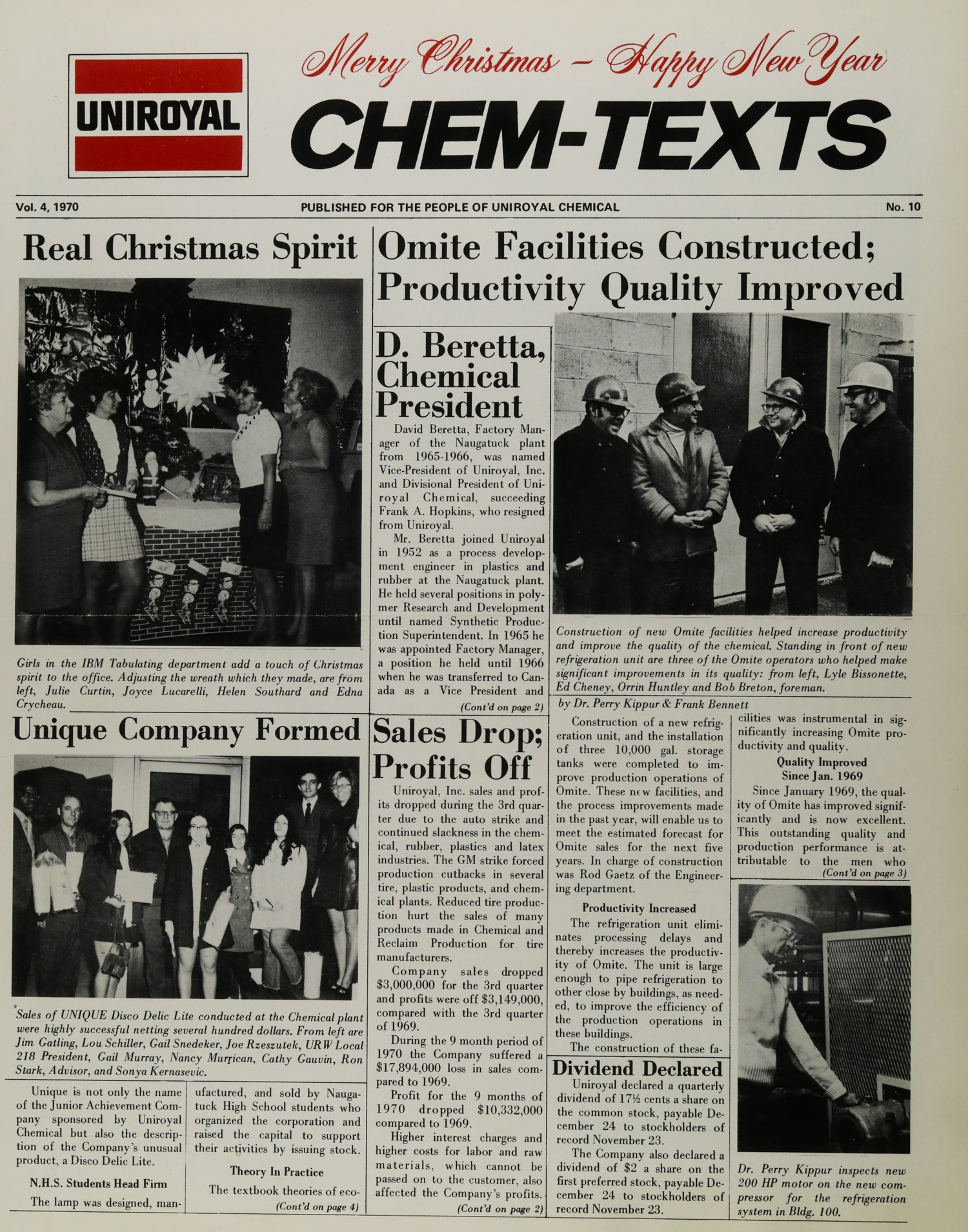
[IMAGE: Black and white photo of women working on a wreath]

Girls in the IBM Tabulating department add a touch of Christmas spirit to the office. Adjusting the wreath which they made, are from left, Julie Curtin, Joyce Lucarelli, Helen Southard and Edna Crycheau.


Unique Company Formed

[IMAGE: Group photo of people at what appears to be a disco event]

Sales of UNIQUE Disco Delic Lite conducted at the Chemical plant were highly successful netting several hundred dollars. From left are Jim Gatling, Lou Schiller, Gail Snedeker, Joe Rzeszutek, URW Local 218 President, Gail Murray, Nancy Murrican, Cathy Gauvin, Ron Stark, Advisor, and Sonya Kernasevic.

Unique is not only the name of the Junior Achievement Company sponsored by Uniroyal Chemical but also the description of the Company’s unusual product, a Disco Delic Lite.

N.H.S. Students Head Firm

The lamp was designed, manufactured, and sold by Naugatuck High School students who organized the corporation and raised the capital to support their activities by issuing stock.

Theory In Practice

The textbook theories of eco-
(Cont’d on page 4)


Omite Facilities Constructed; Productivity Quality Improved

D. Beretta, Chemical President

David Beretta, Factory Manager of the Naugatuck plant from 1965-1966, was named Vice-President of Uniroyal, Inc. and Divisional President of Uniroyal Chemical, succeeding Frank A. Hopkins, who resigned from Uniroyal.

Mr. Beretta joined Uniroyal in 1952 as a process development engineer in plastics and rubber at the Naugatuck plant. He held several positions in polymer Research and Development until named Synthetic Production Superintendent. In 1965 he was appointed Factory Manager, a position he held until 1966 when he was transferred to Canada as a Vice President and
(Cont’d on page 2)

[IMAGE: Three workers in hard hats standing in front of industrial equipment]

Construction of new Omite facilities helped increase productivity and improve the quality of the chemical. Standing in front of new refrigeration unit are three of the Omite operators who helped make significant improvements in its quality: from left, Lyle Bissonette, Ed Cheney, Orrin Huntley and Bob Breton, foreman.

by Dr. Perry Kippur & Frank Bennett

Construction of a new refrigeration unit, and the installation of three 10,000 gal. storage tanks were completed to improve production operations of Omite. These new facilities, and the process improvements made in the past year, will enable us to meet the estimated forecast for Omite sales for the next five years. In charge of construction was Rod Gaetz of the Engineering department.

Productivity Increased

The refrigeration unit eliminates processing delays and thereby increases the productivity of Omite. The unit is large enough to pipe refrigeration to other close by buildings, as needed, to improve the efficiency of the production operations in these buildings.

The construction of these facilities was instrumental in significantly increasing Omite productivity and quality.

Quality Improved Since Jan. 1969

Since January 1969, the quality of Omite has improved significantly and is now excellent. This outstanding quality and production performance is attributable to the men who
(Cont’d on page 3)


Sales Drop; Profits Off

Uniroyal, Inc. sales and profits dropped during the 3rd quarter due to the auto strike and continued slackness in the chemical, rubber, plastics and latex industries. The GM strike forced production cutbacks in several tire, plastic products, and chemical plants. Reduced tire production hurt the sales of many products made in Chemical and Reclaim Production for tire manufacturers.

Company sales dropped $3,000,000 for the 3rd quarter and profits were off $3,149,000, compared with the 3rd quarter of 1969.

During the 9 month period of 1970 the Company suffered a $17,894,000 loss in sales compared to 1969.

Profit for the 9 months of 1970 dropped $10,332,000 compared to 1969.

Higher interest charges and higher costs for labor and raw materials, which cannot be passed on to the customer, also affected the Company’s profits.
(Cont’d on page 2)


Dividend Declared

Uniroyal declared a quarterly dividend of 17½ cents a share on the common stock, payable December 24 to stockholders of record November 23.

The Company also declared a dividend of $2 a share on the first preferred stock, payable December 24 to stockholders of record November 23.

[IMAGE: Man in hard hat inspecting equipment]

Dr. Perry Kippur inspects new 200 HP motor on the new compressor for the refrigeration system in Bldg. 100.

CHEM-TEXTS – Vol. 3, 1969, No. 5 – Page 1

Page 001

UNIROYAL CHEM-TEXTS

Vol. 3, 1969 | PUBLISHED FOR THE PEOPLE OF UNIROYAL CHEMICAL | No. 5


Good Housekeeping Prevents Plant Fires; Improves Safety, Morale, Product Quality

by Ed Weaving

What does good housekeeping mean? The words lead to thoughts first about your home or apartment. Every person prefers a clean, orderly, attractive and safe

the plant is the result of persons working together and having a care and pride in their work area, equipment and operations. As stockholders in Uniroyal – 63% of the Chemical employees

care and pride in something owned by us.

In the plant, good housekeeping means materials are neatly packaged and palleted; the work area and equipment is kept clean; and the aisles

and care for the quality of products made in the plant; leads to waste; and endangers the safety of other persons in the plant.

If a person acted as if he owned the business, his care

energies, efforts and creative talents have helped to make the plant successful in producing quality products to meet our customers’ needs.

Fire prevention and safety go hand in hand with good housekeeping. In well-kept areas, the possibility of fire is minimized; safety is improved; and work more enjoyable. In the event of a fire or an emergency the fire department can handle the situation more efficiently if the area is not obstructed by drums and pallets in the aisles. Every second is vital to the fire department’s effectiveness, but if an area is blocked, their efforts are hampered and a small incident may become a major one.

The Naugatuck plant, in a sense, belongs to every employee, whether he’s a stockholder or not. Sales, profits and job security depend upon the ability to produce quality products against major competitive companies. Good housekeeping helps do this. It prevents fires; improves safety conditions; and makes the plant a better place to work. The plant’s progress and goals for the year depends greatly on how well employees care for good housekeeping — it’s a vital factor in every operation of the plant.


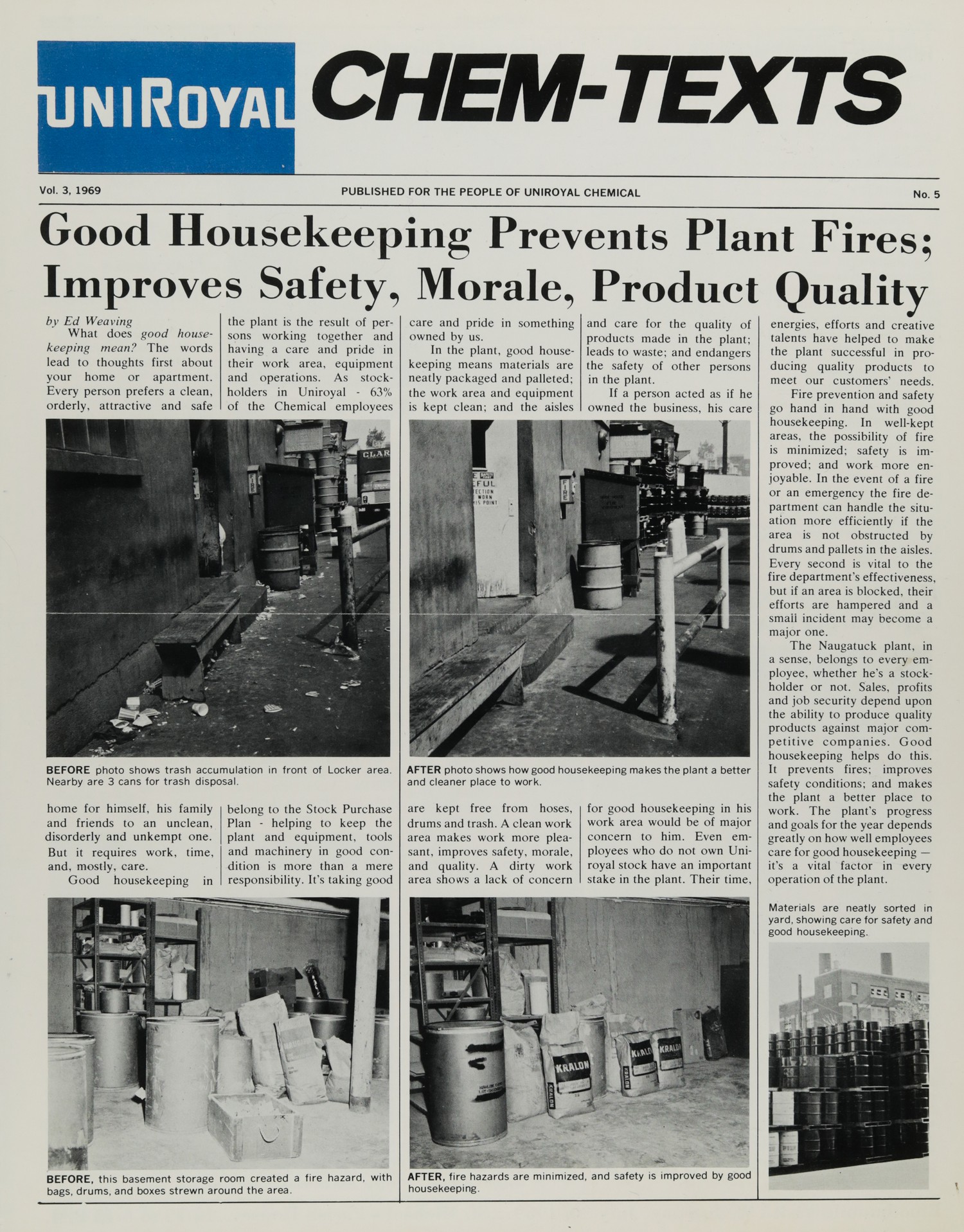
BEFORE photo shows trash accumulation in front of Locker area. Nearby are 3 cans for trash disposal.

AFTER photo shows how good housekeeping makes the plant a better and cleaner place to work.


home for himself, his family and friends to an unclean, disorderly and unkempt one. But it requires work, time, and, mostly, care.

Good housekeeping in

belong to the Stock Purchase Plan – helping to keep the plant and equipment, tools and machinery in good condition is more than a mere responsibility. It’s taking good

are kept free from hoses, drums and trash. A clean work area makes work more pleasant, improves safety, morale, and quality. A dirty work area shows a lack of concern

for good housekeeping in his work area would be of major concern to him. Even employees who do not own Uniroyal stock have an important stake in the plant. Their time,


BEFORE, this basement storage room created a fire hazard, with bags, drums, and boxes strewn around the area.

AFTER, fire hazards are minimized, and safety is improved by good housekeeping.


Materials are neatly sorted in yard, showing care for safety and good housekeeping.

CHEM-TEXTS – Vol. 3, No. 8 – Page 1

Page 001

UNIROYAL CHEM-TEXTS

Vol. 3 PUBLISHED FOR THE PEOPLE OF UNIROYAL CHEMICAL No. 9


Improvements Protect Jobs. Make Plant Cleaner, Safer.

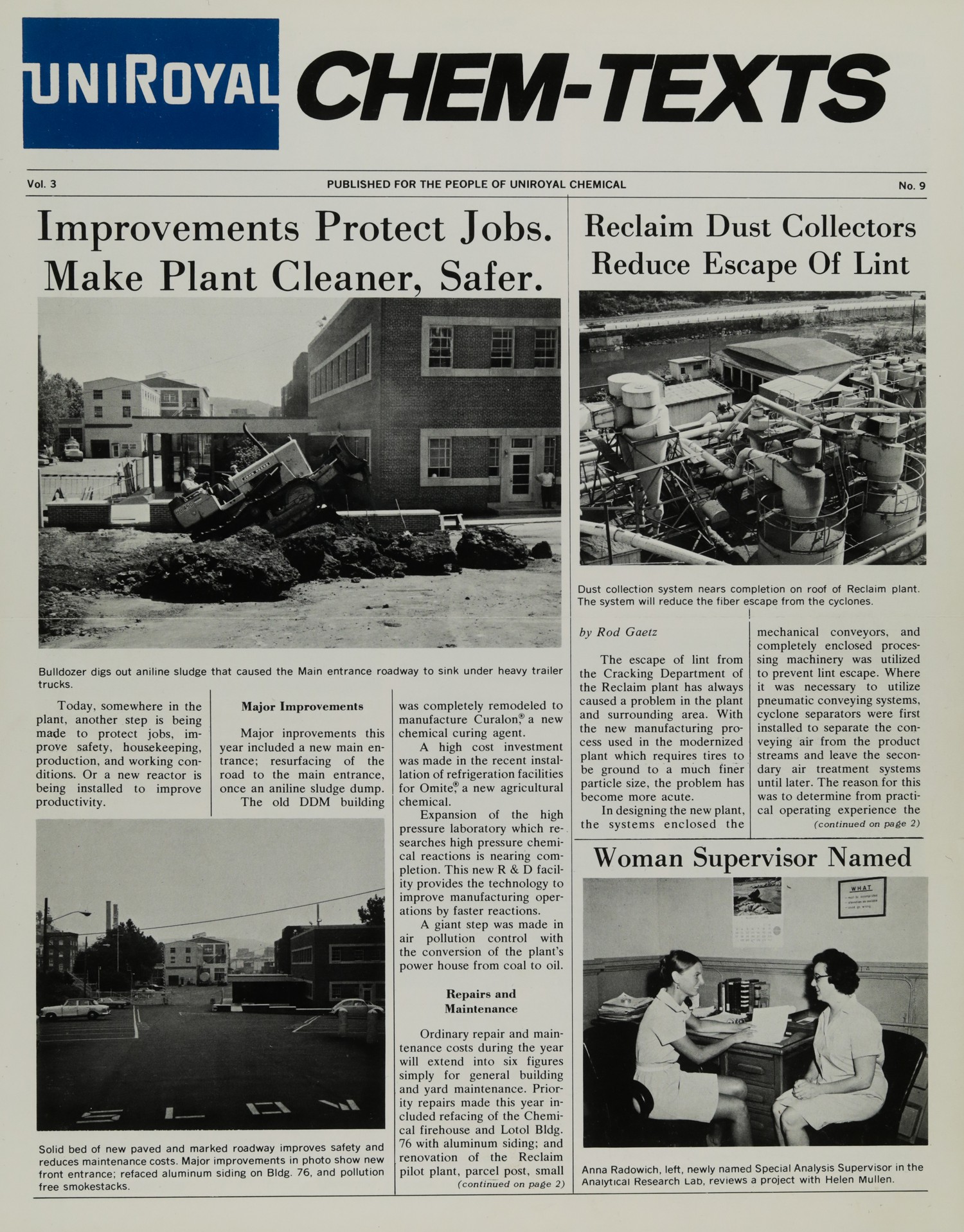
[IMAGE: Black and white photo of industrial building with bulldozer in foreground]

Bulldozer digs out aniline sludge that caused the Main entrance roadway to sink under heavy trailer trucks.

Today, somewhere in the plant, another step is being made to protect jobs, improve safety, housekeeping, production, and working conditions. Or a new reactor is being installed to improve productivity.

Major Improvements

Major improvements this year included a new main entrance; resurfacing of the road to the main entrance, once an aniline sludge dump. The old DDM building was completely remodeled to manufacture Curalon® a new chemical curing agent.

A high cost investment was made in the recent installation of refrigeration facilities for Omite® a new agricultural chemical.

Expansion of the high pressure laboratory which researches high pressure chemical reactions is nearing completion. This new R & D facility provides the technology to improve manufacturing operations by faster reactions.

A giant step was made in air pollution control with the conversion of the plant’s power house from coal to oil.

Repairs and Maintenance

Ordinary repair and maintenance costs during the year will extend into six figures simply for general building and yard maintenance. Priority repairs made this year included refacing of the Chemical firehouse and Lotol Bldg. 76 with aluminum siding; and renovation of the Reclaim pilot plant, parcel post, small (continued on page 2)

[IMAGE: Black and white photo of paved roadway with buildings]

Solid bed of new paved and marked roadway improves safety and reduces maintenance costs. Major improvements in photo show new front entrance; refaced aluminum siding on Bldg. 76, and pollution free smokestacks.


Reclaim Dust Collectors Reduce Escape Of Lint

[IMAGE: Black and white photo of industrial dust collection system on roof]

Dust collection system nears completion on roof of Reclaim plant. The system will reduce the fiber escape from the cyclones.

by Rod Gaetz

The escape of lint from the Cracking Department of the Reclaim plant has always caused a problem in the plant and surrounding area. With the new manufacturing process used in the modernized plant which requires tires to be ground to a much finer particle size, the problem has become more acute.

In designing the new plant, the systems enclosed the mechanical conveyors, and completely enclosed processing machinery was utilized to prevent lint escape. Where it was necessary to utilize pneumatic conveying systems, cyclone separators were first installed to separate the conveying air from the product streams and leave the secondary air treatment systems until later. The reason for this was to determine from practical operating experience the (continued on page 2)


Woman Supervisor Named

[IMAGE: Black and white photo of two women at desk reviewing documents]

Anna Radowich, left, newly named Special Analysis Supervisor in the Analytical Research Lab, reviews a project with Helen Mullen.

CHEM-TEXTS – Vol. 3 No. 8 – Page 2

Page 002

CHEM-TEXTS

Page 2 | Vol. 3 No. 9


FROM THE FACTORY MANAGER

DEAR FELLOW EMPLOYEE:

Sometime back I had occasion to question one of our people why a certain function was being performed in the manner that it was being done. Much to my surprise, the answer was, “It’s Company policy.” I asked, “What do you mean, ‘Company policy’?, Who set the policy?” After a blank look, I received the answer, “Folklore and Tradition”.

While tradition has a place as part of our heritage, it has little place in building a flexible, responsive, up-to-date organization that can effectively deal with the rapid changing demands that we, together, must meet to make our plant competitive in today’s world.

As I have said before, progress is change, and each of us must learn to look upon change as progress. We have to be the first ones to find the best way of doing our jobs or we find ourselves always trying to catch up. I’m sure we all prefer to be leaders.

Let’s take a strong look at the “Folklore and Traditions” in our activities. Let’s all ask ourselves, “How can I do my job more effectively?” Let’s remember that the payoff is results and we each play a part in finding a better way to achieve those results.

Sincerely,

John

John D. Evans


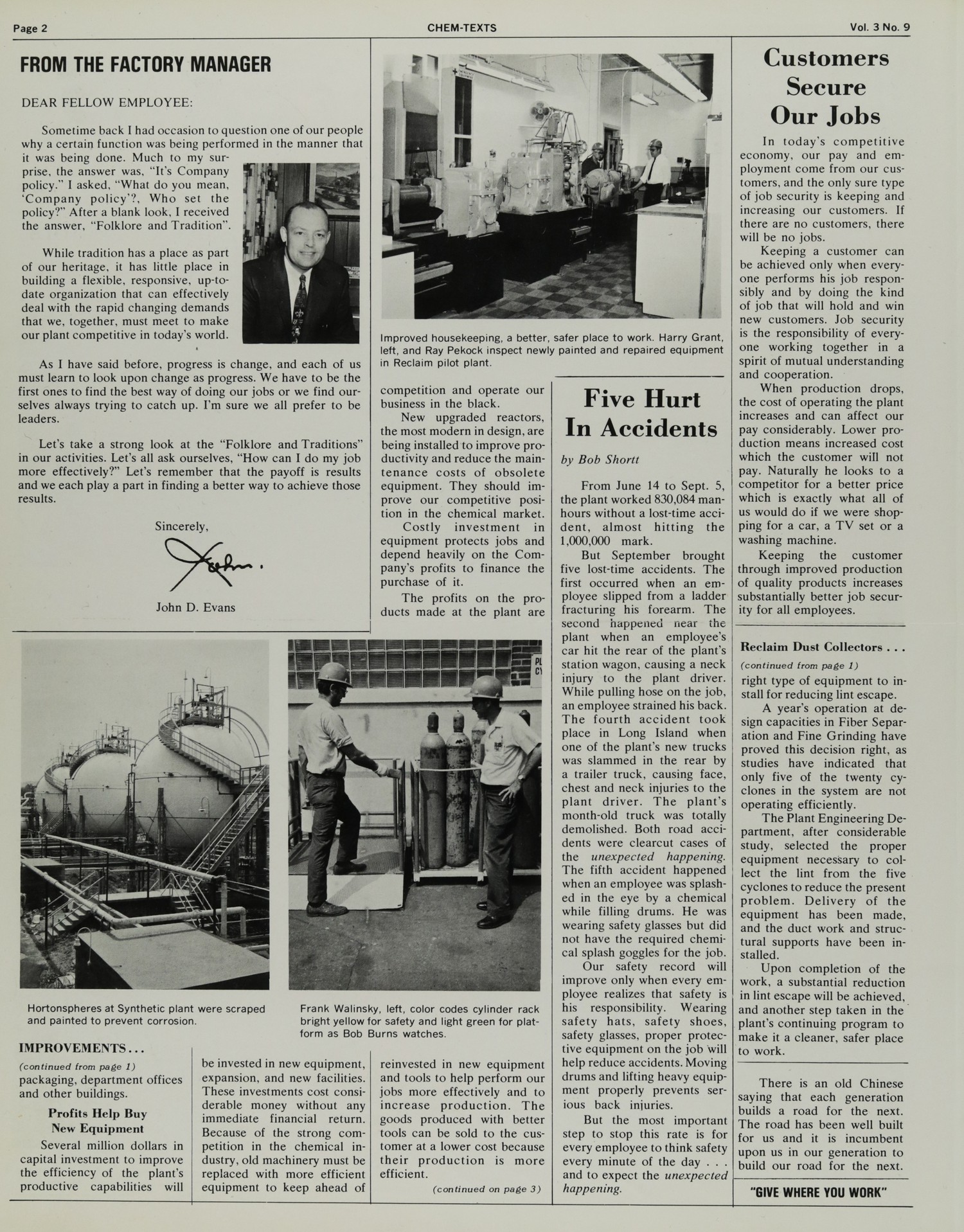
Improved housekeeping, a better, safer place to work. Harry Grant, left, and Ray Pekoek inspect newly painted and repaired equipment in Reclaim pilot plant.


competition and operate our business in the black.

New upgraded reactors, the most modern in design, are being installed to improve productivity and reduce the maintenance costs of obsolete equipment. They should improve our competitive position in the chemical market.

Costly investment in equipment protects jobs and depend heavily on the Company’s profits to finance the purchase of it.

The profits on the products made at the plant are


Five Hurt In Accidents

by Bob Shortt

From June 14 to Sept. 5, the plant worked 830,084 man-hours without a lost-time accident, almost hitting the 1,000,000 mark.

But September brought five lost-time accidents. The first occurred when an employee slipped from a ladder fracturing his forearm. The second happened near the plant when an employee’s car hit the rear of the plant’s station wagon, causing a neck injury to the plant driver. While pulling hose on the job, an employee strained his back. The fourth accident took place in Long Island when one of the plant’s new trucks was slammed in the rear by a trailer truck, causing face, chest and neck injuries to the plant driver. The plant’s month-old truck was totally demolished. Both road accidents were clearcut cases of the unexpected happening. The fifth accident happened when an employee was splashed in the eye by a chemical while filling drums. He was wearing safety glasses but did not have the required chemical splash goggles for the job.

Our safety record will improve only when every employee realizes that safety is his responsibility. Wearing safety hats, safety shoes, safety glasses, proper protective equipment on the job will help reduce accidents. Moving drums and lifting heavy equipment properly prevents serious back injuries.

But the most important step to stop this rate is for every employee to think safety every minute of the day . . . and to expect the unexpected happening.

(continued on page 3)


Customers Secure Our Jobs

In today’s competitive economy, our pay and employment come from our customers, and the only sure type of job security is keeping and increasing our customers. If there are no customers, there will be no jobs.

Keeping a customer can be achieved only when everyone performs his job responsibly and by doing the kind of job that will hold and win new customers. Job security is the responsibility of everyone working together in a spirit of mutual understanding and cooperation.

When production drops, the cost of operating the plant increases and can affect our pay considerably. Lower production means increased cost which the customer will not pay. Naturally he looks to a competitor for a better price which is exactly what all of us would do if we were shopping for a car, a TV set or a washing machine.

Keeping the customer through improved production of quality products increases substantially better job security for all employees.


Reclaim Dust Collectors . . .

(continued from page 1)

right type of equipment to install for reducing lint escape.

A year’s operation at design capacities in Fiber Separation and Fine Grinding have proved this decision right, as studies have indicated that only five of the twenty cyclones in the system are not operating efficiently.

The Plant Engineering Department, after considerable study, selected the proper equipment necessary to collect the lint from the five cyclones to reduce the present problem. Delivery of the equipment has been made, and the duct work and structural supports have been installed.

Upon completion of the work, a substantial reduction in lint escape will be achieved, and another step taken in the plant’s continuing program to make it a cleaner, safer place to work.


There is an old Chinese saying that each generation builds a road for the next. The road has been well built for us and it is incumbent upon us in our generation to build our road for the next.

“GIVE WHERE YOU WORK”


Hortonspheres at Synthetic plant were scraped and painted to prevent corrosion.

Frank Walinsky, left, color codes cylinder rack bright yellow for safety and light green for platform as Bob Burns watches.


IMPROVEMENTS…

(continued from page 1)

packaging, department offices and other buildings.

Profits Help Buy New Equipment

Several million dollars in capital investment to improve the efficiency of the plant’s productive capabilities will be invested in new equipment, expansion, and new facilities. These investments cost considerable money without any immediate financial return. Because of the strong competition in the chemical industry, old machinery must be replaced with more efficient equipment to keep ahead of reinvested in new equipment and tools to help perform our jobs more effectively and to increase production. The goods produced with better tools can be sold to the customer at a lower cost because their production is more efficient.

CHEM-TEXTS – Vol. 3, 1969, No. 10 – Page 1

Page 001

UNIROYAL CHEM-TEXTS

Vol. 3, 1969 PUBLISHED FOR THE PEOPLE OF UNIROYAL CHEMICAL No. 10


The Small Plant In A Big Plant


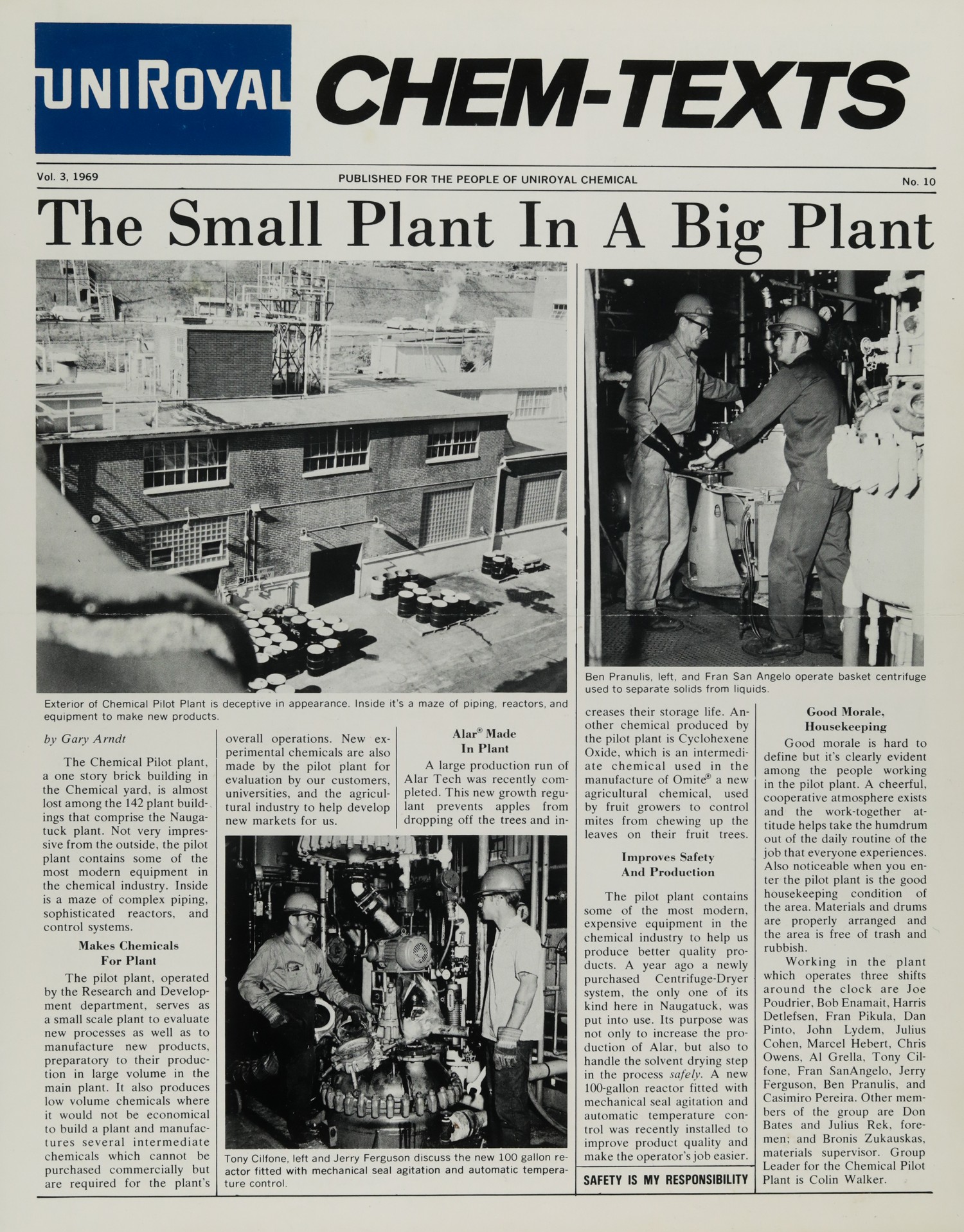
Exterior of Chemical Pilot Plant is deceptive in appearance. Inside it’s a maze of piping, reactors, and equipment to make new products.


by Gary Arndt

The Chemical Pilot plant, a one story brick building in the Chemical yard, is almost lost among the 142 plant buildings that comprise the Naugatuck plant. Not very impressive from the outside, the pilot plant contains some of the most modern equipment in the chemical industry. Inside is a maze of complex piping, sophisticated reactors, and control systems.

Makes Chemicals For Plant

The pilot plant, operated by the Research and Development department, serves as a small scale plant to evaluate new processes as well as to manufacture new products, preparatory to their production in large volume in the main plant. It also produces low volume chemicals where it would not be economical to build a plant and manufactures several intermediate chemicals which cannot be purchased commercially but are required for the plant’s overall operations. New experimental chemicals are also made by the pilot plant for evaluation by our customers, universities, and the agricultural industry to help develop new markets for us.


Alar® Made In Plant

A large production run of Alar Tech was recently completed. This new growth regulant prevents apples from dropping off the trees and in-


Tony Cilfone, left and Jerry Ferguson discuss the new 100 gallon reactor fitted with mechanical seal agitation and automatic temperature control.


Ben Pranulis, left, and Fran San Angelo operate basket centrifuge used to separate solids from liquids.


creases their storage life. Another chemical produced by the pilot plant is Cyclohexene Oxide, which is an intermediate chemical used in the manufacture of Omite® a new agricultural chemical, used by fruit growers to control mites from chewing up the leaves on their fruit trees.

Improves Safety And Production

The pilot plant contains some of the most modern, expensive equipment in the chemical industry to help us produce better quality products. A year ago a newly purchased Centrifuge-Dryer system, the only one of its kind here in Naugatuck, was put into use. Its purpose was not only to increase the production of Alar, but also to handle the solvent drying step in the process safely. A new 100-gallon reactor fitted with mechanical seal agitation and automatic temperature control was recently installed to improve product quality and make the operator’s job easier.

SAFETY IS MY RESPONSIBILITY


Good Morale, Housekeeping

Good morale is hard to define but it’s clearly evident among the people working in the pilot plant. A cheerful, cooperative atmosphere exists and the work-together attitude helps take the humdrum out of the daily routine of the job that everyone experiences. Also noticeable when you enter the pilot plant is the good housekeeping condition of the area. Materials and drums are properly arranged and the area is free of trash and rubbish.

Working in the plant which operates three shifts around the clock are Joe Poudrier, Bob Enamait, Harris Detlefsen, Fran Pikula, Dan Pinto, John Lydem, Julius Cohen, Marcel Hebert, Chris Owens, Al Grella, Tony Cilfone, Fran SanAngelo, Jerry Ferguson, Ben Pranulis, and Casimiro Pereira. Other members of the group are Don Bates and Julius Rek, foremen; and Bronis Zukauskas, materials supervisor. Group Leader for the Chemical Pilot Plant is Colin Walker.

CHEM-TEXTS – Vol. 2 No. 2 – Page 2

Page 002

Page 2 CHEM TEXTS Vol. 2 No. 2

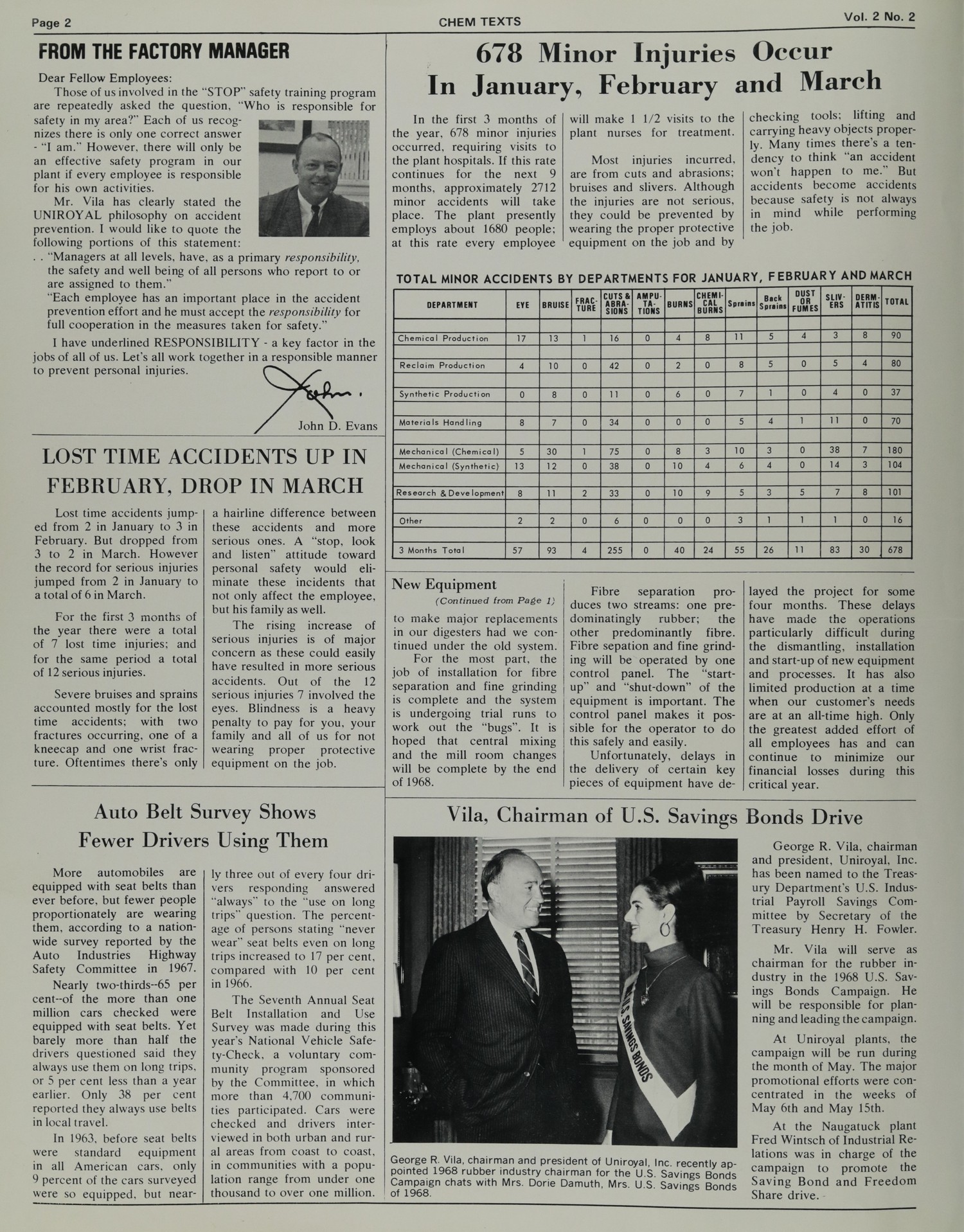
FROM THE FACTORY MANAGER

Dear Fellow Employees:

Those of us involved in the “STOP” safety training program are repeatedly asked the question, “Who is responsible for safety in my area?” Each of us recognizes there is only one correct answer – “I am.” However, there will only be an effective safety program in our plant if every employee is responsible for his own activities.

Mr. Vila has clearly stated the UNIROYAL philosophy on accident prevention. I would like to quote the following portions of this statement:

. . “Managers at all levels, have, as a primary responsibility, the safety and well being of all persons who report to or are assigned to them.”

“Each employee has an important place in the accident prevention effort and he must accept the responsibility for full cooperation in the measures taken for safety.”

I have underlined RESPONSIBILITY – a key factor in the jobs of all of us. Let’s all work together in a responsible manner to prevent personal injuries.

[Signature]

John D. Evans


LOST TIME ACCIDENTS UP IN FEBRUARY, DROP IN MARCH

Lost time accidents jumped from 2 in January to 3 in February. But dropped from 3 to 2 in March. However the record for serious injuries jumped from 2 in January to a total of 6 in March.

For the first 3 months of the year there were a total of 7 lost time injuries; and for the same period a total of 12 serious injuries.

Severe bruises and sprains accounted mostly for the lost time accidents; with two fractures occurring, one of a kneecap and one wrist fracture. Oftentimes there’s only a hairline difference between these accidents and more serious ones. A “stop, look and listen” attitude toward personal safety would eliminate these incidents that not only affect the employee, but his family as well.

The rising increase of serious injuries is of major concern as these could easily have resulted in more serious accidents. Out of the 12 serious injuries 7 involved the eyes. Blindness is a heavy penalty to pay for you, your family and all of us for not wearing proper protective equipment on the job.


678 Minor Injuries Occur In January, February and March

In the first 3 months of the year, 678 minor injuries occurred, requiring visits to the plant hospitals. If this rate continues for the next 9 months, approximately 2712 minor accidents will take place. The plant presently employs about 1680 people; at this rate every employee will make 1 1/2 visits to the plant nurses for treatment.

Most injuries incurred, are from cuts and abrasions; bruises and slivers. Although the injuries are not serious, they could be prevented by wearing the proper protective equipment on the job and by checking tools; lifting and carrying heavy objects properly. Many times there’s a tendency to think “an accident won’t happen to me.” But accidents become accidents because safety is not always in mind while performing the job.

TOTAL MINOR ACCIDENTS BY DEPARTMENTS FOR JANUARY, FEBRUARY AND MARCH

DEPARTMENT EYE BRUISE FRAC-TURE CUTS & ABRA-SIONS AMPU-TA-TIONS BURNS CHEMI-CAL BURNS Sprains Back Sprains DUST OR FUMES SLIV-ERS DERM-ATITIS TOTAL
Chemical Production 17 13 1 16 0 4 8 11 5 4 3 8 90
Reclaim Production 4 10 0 42 0 2 0 8 5 0 5 4 80
Synthetic Production 0 8 0 11 0 6 0 7 1 0 4 0 37
Materials Handling 8 7 0 34 0 0 0 5 4 1 11 0 70
Mechanical (Chemical) 5 30 1 75 0 8 3 10 3 0 38 7 180
Mechanical (Synthetic) 13 12 0 38 0 10 4 6 4 0 14 3 104
Research & Development 8 11 2 33 0 10 9 5 3 5 7 8 101
Other 2 2 0 6 0 0 0 3 1 1 1 0 16
3 Months Total 57 93 4 255 0 40 24 55 26 11 83 30 678

New Equipment

(Continued from Page 1)

to make major replacements in our digesters had we continued under the old system.

For the most part, the job of installation for fibre separation and fine grinding is complete and the system is undergoing trial runs to work out the “bugs”. It is hoped that central mixing and the mill room changes will be complete by the end of 1968.

Fibre separation produces two streams: one predominatingly rubber; the other predominantly fibre. Fibre sepation and fine grinding will be operated by one control panel. The “start-up” and “shut-down” of the equipment is important. The control panel makes it possible for the operator to do this safely and easily.

Unfortunately, delays in the delivery of certain key pieces of equipment have delayed the project for some four months. These delays have made the operations particularly difficult during the dismantling, installation and start-up of new equipment and processes. It has also limited production at a time when our customer’s needs are at an all-time high. Only the greatest added effort of all employees has and can continue to minimize our financial losses during this critical year.


Auto Belt Survey Shows Fewer Drivers Using Them

More automobiles are equipped with seat belts than ever before, but fewer people proportionately are wearing them, according to a nationwide survey reported by the Auto Industries Highway Safety Committee in 1967.

Nearly two-thirds–65 per cent–of the more than one million cars checked were equipped with seat belts. Yet barely more than half the drivers questioned said they always use them on long trips, or 5 per cent less than a year earlier. Only 38 per cent reported they always use belts in local travel.

In 1963, before seat belts were standard equipment in all American cars, only 9 percent of the cars surveyed were so equipped, but nearly three out of every four drivers responding answered “always” to the “use on long trips” question. The percentage of persons stating “never wear” seat belts even on long trips increased to 17 per cent, compared with 10 per cent in 1966.

The Seventh Annual Seat Belt Installation and Use Survey was made during this year’s National Vehicle Safety-Check, a voluntary community program sponsored by the Committee, in which more than 4,700 communities participated. Cars were checked and drivers interviewed in both urban and rural areas from coast to coast, in communities with a population range from under one thousand to over one million.


Vila, Chairman of U.S. Savings Bonds Drive

[PHOTO: George R. Vila, chairman and president of Uniroyal, Inc. recently appointed 1968 rubber industry chairman for the U.S. Savings Bonds Campaign chats with Mrs. Dorie Damuth, Mrs. U.S. Savings Bonds of 1968.]

George R. Vila, chairman and president, Uniroyal, Inc. has been named to the Treasury Department’s U.S. Industrial Payroll Savings Committee by Secretary of the Treasury Henry H. Fowler.

Mr. Vila will serve as chairman for the rubber industry in the 1968 U.S. Savings Bonds Campaign. He will be responsible for planning and leading the campaign.

At Uniroyal plants, the campaign will be run during the month of May. The major promotional efforts were concentrated in the weeks of May 6th and May 15th.

At the Naugatuck plant Fred Wintsch of Industrial Relations was in charge of the campaign to promote the Saving Bond and Freedom Share drive.

CHEM-TEXTS – Vol. 2 No. 5 – Page 3

Page 003

CHEM TEXTS

Page 3 | Vol. 2 No. 5


Harry Witt Heads Synthetic Production

Harry Witt has been named Synthetic Production Superintendent, effective Dec. 1. Ben Leach becomes Manager of Colloidal products in the Research and Development Dept.


How You Can Obtain A Pair Of Safety Prescription Glasses

Fred Mayo of the Process Development Lab. selects frames for safety prescription glasses from Adeline Farrar R.N., Chemical Hospital nurse.

The Naugatuck plant has a program which is operated by the Safety Department to enable all Chemical division employees to obtain prescription safety glasses at no cost to the employee, except for the examination and fitting fee.

The procedure is simple. An employee may go to either the Chemical or Synthetic hospital and obtain a prescription safety glass form from the nurse. He takes the form to his own eye doctor and has an examination. The employee pays for the cost of the examination and returns the completed form to the plant nurse. At this time he may also select the frame he prefers from samples in the hospital. The Company then sends the prescription to the Wilkie Optical Company and purchases the glasses.

Effective January 1, 1969, all prescription glasses will be returned to the doctor or optician of your choice for proper checking and fitting. In some cases an additional fitting charge may be made, depending upon the agreement you have made.

Here are other facts you should know: 1. You may buy an extra pair of glasses for yourself, if you wish and take advantage of our Company discount, provided the prescription is less than one year old. 2. You may also purchase prescription sun glasses at the same discount. 3. You may obtain a free pair of glasses whenever you require a new prescription. 4. Lenses or frames damaged as the result of an accident in the plant are replaced free of charge.


[PHOTO CAPTION:]
Uniroyal Chemical’s United Fund Campaign Committee looks at the “thermometer” showing the results of the drive at the plant where employees topped their goal by 103%. Left to right are Doug Miller, Sam Gillette, Bob VanAllen, the Industrial Division’s Chairman; Joe Kresziutek, Ron Mitchinson, pointing to the $20,646 figure and Bill Lavelle. Other committee members not in the photo were Ed Alves, Eric Johnson, and Len Lombardi.


Employees Contribute $20,646. Top United Givers Goal By 103%

Ron Mitchinson, Chairman of the United Givers Campaign at the Naugatuck plant announced the results of the Chemical Plant’s drive. Employees contributed $20,646 or 103%, topping the plant’s Goal of $20,000. This surpasses by almost $3,000 the previous high of $17,737 contributed by employees to the 1967 United Givers Drive. The success of this year’s campaign can be attributed to the enthusiastic efforts of the Campagin Committee, the ninety-five Co-Captains, and the generous support of the Chemical division employees.


Accidents Continue At High Rate

In the ten months of this year, 79 lost time and serious injuries have occurred. Most of these resulted from a careless act or operation. We each must accept responsibility for our own actions and the safety of all.

MONTH LOST TIME SERIOUS IN-JURIES TOTAL
JANUARY 2 2 4
FEBRUARY 3 5 8
MARCH 2 6 8
APRIL 2 6 8
MAY 0 11 11
JUNE 0 7 7
JULY 2 7 9
AUGUST 4 4 8
SEPT. 0 8 8
OCTOBER 2 6 8
TOTALS 17 62 79

New Food Vendors Service Plant

By Monday, December 2nd, all food and beverage vending machines in the plant will have been replaced with brand new machines to provide plant employees with better food service.

The new firm, Indiana Vendors, has proposed several basic changes which will eliminate the problems we have experienced in recent months; machines out of order, empty or not giving the proper change, and food often neither fresh nor of uniform high quality. There will be an on-site maintenance man who will be in charge of keeping all machines operating properly in all respects. All food will be prepared and wrapped in the Synthetic Plant kitchen facilities. This means that food in the machines will have been prepared an hour or two before being put into the vending equipment. It also means that when more departments than usual are scheduled to run over a weekend or holiday, extra sandwiches can be prepared at the last minute and placed in the machine. If a machine runs out at 2:00 P.M., it can be filled again before the next day.

The machines will be the latest in design and efficiency. Take the office machines for example. You put your coin into the machine, select the way you want your coffee, and receive a cup of fresh, perked coffee. The machines operate on 1/3 lb. cans of Maxwell House coffee — exactly the same grind you buy for home use. Approximately 20 cups are perked and then transferred to a holding chamber. After a preset length of time, a new batch is perked and any coffee remaining in the hold chamber is dumped. The coffee you buy is always fresh. No more instant coffee.

The food machines will also hold a wider variety of food. Soup will be sold with the can, bowl, spoon, crackers and napkin as a package — you’ll never run into the situation where, having purchased a can of soup, no spoon or dishes are available.

Some of the areas in the plant will be expanded or have more versatile machines such as canned soda or a flavor ice vending machine — the vending area in Reclaim Bldg. #1 will have a sandwich machine, for example, and a coffee machine will be put into the Chemical Machine Shop, where up to now only a cigarette machine has been in operation.

In short, new and better machines, with better service and more and better food, to give us the best food service arrangement possible.


ALANAP AND DYANAP (con’t.)

(CONTINUED FROM PAGE 1)

sive advertising and promotion program for our distributors and dealers. Grower meetings will be conducted by our sales force, demonstrating the advantages of Alanap and Dyanap over competitive products.

Quality products play an extremely important role in the agricultural business. A poor quality product damages a grower’s crop, the reputation of the product and the Company. Important also in the farm market is good packaging. It either helps or reduces our sales. Dented or stained cans, torn and dirty bags convey the impression of poor quality and workmanship in the customer’s mind. Good quality and good packaging can help make 1969 a big year in Alanap and Dyanap sales.

SAFETY IS MY RESPONSIBILITY


Clark Retires From Mechanical

Ed Clark, left, is congratulated by Bill Lannon, Foreman of the Instrument Department. Clark, an instrument man in the Mechanical Department, retired recently after more than 22 years with the Company.

CHEM-TEXTS – Vol. 2 No. 2 – Page 3

Page 003

CHEM TEXTS

Vol. 2 No. 2 Page 3


Reclaim Quality To Improve With New Modern Equipment

Water Pollution Will Be Reduced

The following pictures show some of the latest manufacturing equipment the Company has recently purchased to keep us in business against strong competition. Improved quality of our reclaimed rubber will result from the finer grinder and fibre separation machines.

Some equipment has been already installed and is undergoing shakedowns to work out the “bugs”. The miracle of the modernization of the plant is that full scale production is continuing without interruption.

Previously it was difficult to control the lint escape after the fibre was separated from the rubber. The new equipment now makes it possible to catch the fibre lint and bale it like hay. This new piece of equipment will now control the amount of lint that was formerly discharged into the Naugatuck River, and causing a pollution problem. After the modernization program is completed, further studies will be made and evaluated to reduce the air pollution caused by the reclaim manufacturing process. This fits in with the Division’s policy of air and water pollution abatement in the area.


[IMAGE: Industrial building exterior with equipment]


[IMAGE: Control panel with lights and switches]

New control panel will aid operators in controlling the operation of fibre separation and fine grinding.


[IMAGE: Industrial baler equipment]

New baler equipment collects and bales lint previously discharged into Naugatuck river.


PURDUE U. INSTALLS OUR ALL-WEATHER “RUBBER” TRACK

“The installation of the first and new outdoor all-weather “rubber” track at Purdue has any number of advantages, not the least of which is that we are now able to get a boy ready for the track, instead of getting the track ready for the boy”, says the University highly respected track coach for 20 years, Dave Rankin.

Sold under the tradename “U.S. Royal Track”, the surface is a mixture of specially selected natural and synthetic rubber made at Naugatuck. The rubber must be of the highest quality to produce a smooth uniform texture and mixed with asphalt cement and fine aggregates at a contractor’s hot mix plant.

Unlike cinders, which are high-priced and difficult to buy, the “rubber” track can be used 12 months a year under almost any weather conditions. This new all-weather track practically makes postponements and cancellations a thing of the past.

The “rubber” track doesn’t create dust and can be painted with long-lasting markings that stay clean and sharp under constant usage.

The track is tough but pliable enough to give under pressure without cracking. Unlike cinder or clay tracks, the spikes do not dig up the track permanently, because the rubber surface quickly restores itself.

Maintenance of cinder and clay tracks has always been a major and costly expense. Inclement weather meant cancellation of a scheduled meet or poor performance. A crew was oftentimes required to rake, roll, groove and reline it.

Frost works havoc with a track, causing potholes, surface bumps, a lot of time and effort to restore it to fast condition.

With Uniroyal Chemical’s “rubber” track, none of these problems occur. It would take a hurricane to cancel a meet and besides, it virtually guarantees a consistent performance because the footing is always sure and constant. Practice sessions now mean more to the athlete and the University, for the runner’s time on Monday or Tuesday will be the same time as the day of the meet.

The “rubber” track can be installed in practically one day and ready for use on the next with regular highway paving equipment. Usually two Chemical R & D personnel are on the spot to provide technical assistance to the contractor.

The contractor, prior to submitting his bid to Purdue, made it a point to witness similar applications of competitive products. He found other materials difficult to pave, difficult to handle, control and roll. The U.S. Royal track won out for its reputation of a quality product.


[IMAGE: Construction equipment on track]

[IMAGE: Workers installing track surface]

CHEM-TEXTS – Vol. 1, No. 2 – Page 1

Page 001

UNIROYAL CHEM-TEXTS

Vol. 2 PUBLISHED FOR THE PEOPLE OF UNIROYAL CHEMICAL No. 2.


New Equipment for Reclaim Plant Will Keep Us in Reclaim Rubber Business

Our present reclaimed rubber plant dates back to 1895, after fire destroyed the original plant in 1893. For 75 years, we have played an important role in the rubber industry by supplying high quality stocks.

Several years ago, with combining higher production costs and increased shipping expenses, profitability reached a critical point for us in the reclaimed rubber business. Faced with keen competition, reduced prices and low-cost SBR rubber as an alternate, our business was placed in a difficult position. A decision had to be made either to discontinue the business or make major capital investments to modernize the facilities.

After detailed study of the present operation and various improvements and considering the skills of our people, it was decided that a modernization of the facilities would be practical and increase our ability to successfully compete in the market place. An appropriation request for these plans was drawn up and approved.

The “new” plant, efficiently and effectively operated, will help protect the job security of 100 employees while the alternate of going out of the business would have eliminated 150 employees, many with long seniority. Changes in the millrooms, reduced from 3 to 1, will affect the jobs of about 50 employees.

A project team was formed to work on the problem. The team settled on 5 major changes which would offer the best return on investment at this time: 1. fibre separation; 2. fine grinding; 3. central mix in the mill room; 4. revision in the mill room; 5. Zenith and dryer revisions.

The team in charge of the project working closely with the New York engineering group were R. Gaetz, Engineering Dept., Ted Lainas, Reclaim Development; C. Reich, Production and F. Wintsch, Industrial Engineering. Since his transfer to Industrial Relations, Wintsch has been replaced by B. Daily.

This team was charged with the responsibility of making the project go; by developing the flow sheets and recommending the type of equipment. All the details of engineering is being handled by approximately 12 members of the New York corporate engineering staff.

The job to be done consists of removing the fibre from old tires to prepare them for the fine grinding operation. By doing a better job of removing the fibre in the early steps and also by finer grinding, the digester cycle will be shortened, and chemical costs reduced. Also, fine grinding prior to digesting, allows us to make one pass through the mill rooms instead of 4 passes under the old system. The fine grinding, fibre separation and central mixing will be new departments and will require new skills. Engineering also estimates that we would have

(Continued on Page 2)


U.S. BOND DRIVE AIMS FOR 50% PARTICIPATION

John D. Evans, Factory Manager, named Fred Wintsch chairman of the 1968 U.S. Savings Bonds and Freedom Shares Drive at the Naugatuck plant. The drive was sponsored for two weeks from May 6 to May 17.

Last year’s campaign at the Naugatuck plant added 72 new savers to the payroll deduction plan; 88 employees increased their participation; and 152 purchased the new Freedom Shares. Approximately 40% of the Chemical employees are enrolled in the purchase of U.S. Savings Bonds and Freedom Shares.

The goal for the 1968 drive according to Wintsch was to attain 50% participation by Chemical plant employees. A committee of 71 canvassers had been organized in different sections of the plant. Members of the committee were the following: Warren Singleton, E. G. Broderick, Mary Sullivan, J. Flickinger, Harold Smith, L. Anderson, S.E. Salva, R.W. Stutzman, L. P. Ferrigno, T.J. Shilinskas, Harold Campbell, O. Zaprazalka, R.M. Bioski, M.A. Lasky, D. Johnson, E. J. Greene, F.X. O’Shea, R. Rosenbaum, C.C. Smith, A. Budd, I.A. Prager, P.J. Lazaras, W.R. Smith, V.R. Lardi, A.J. Loman, J.F. Zappala, M.E. Kuryn, G.M. Stone, R. Juliano, D. Pagnoni, C. Terniko, L. Scheithe, M. Dodd, T. Dowling, J. Homyetski, F. Magnamo, L. McCoy, G. Baktis, W. Frankerberg, A. Enamait, A. Pistarelli, E. Polonis, W. Booth, D. Rappe, T. Skehan, H. Piascik, R.R. Foltz, M. Mazur, S. Petkis, R. Magnamo, T. McMahon, L. Opdyke, L. Evan, J. Casey, J. Tierney, S. Korpusik, C. Bulka, W. Lannon, D. Nelson, J. Murtha, K. Pittner, R. Burns, J. Quint, V. Alves, J. Carroll, R. Terino, J. Vergosen, P. Norton, R. Krajewski, A. Nole and A. Juliano.

George Murdock of the Treasury Department addressed the group on the advantages of payroll deductions as an important part of an employee’s savings program. 70% of Savings Bonds purchasers do not redeem them until after age 65. In this way, the tax liability on E. Bond interest could be greatly reduced and even eliminated entirely under some circumstances.


[IMAGE: Black and white photograph showing industrial equipment on a rooftop]

New cyclones have already been installed on roof of reclaim plant.


Foremen’s Club Elects Officers

The Naugatuck Chemical Foremen’s Club elected Lou Kaiser president of the Club at its monthly meeting at the Elks’ Club. Other officers named were Joe Bucciaglia, Vice-President; Jan Baclawski, Secretary and Joe Murtha, reelected as Treasurer. They succeed Vic Alves, Earl Wright and Eric Johnson who served as the Club’s officers the past year.

The Club held its annual banquet on May 16; and will hold a dinner dance in October; outdoor summer picnics and a summer picnic for the family.

A membership drive is being organized to increase the Club’s members. Any salaried, male employee of the Naugatuck plant can join the Club which sponsored a $250 scholarship fund this year.

Still in the idea stage, Kaiser hopes to organize discussion meetings between representatives of various departments to interchange ideas and to become better acquainted with and understand the problems of different departments. By open table discussion, production, engineering, R & D, materials handling, maintenance and other departments can get to know each other’s problems and to coordinate and integrate their activities more effectively.

CHEM-TEXTS – unknown-s238

Page 238

CHEM-TEXTS

Page 3


Synthetic Plant Dismantled

The Synthetic Rubber plant is nearing the final stages of dismantlement. In the reactor area above many of the tanks and salvageable equipment have been removed.

The Federal Equipment Co., of Cleveland, Ohio, who purchased the plant for resale, has been shipping the tanks and useable equipment to all parts of the country and overseas.

The Hortonspheres, which were navigational landmarks for airplane pilots, have been carefully cut, piece by piece, prior to shipment to Canada for re-erection.

Thomas Ennis of the Plant Engineering department is in charge of the operation which has been going on for several months.


Pallets Avert Mishap

Thomas Carey points to the broken support under a tank trailer, loaded with a caustic byproduct.

The Materials Department has found a new use for old pallets as safety supports under tank and trailer trucks.

The pallets have already saved thousands of dollars when the support of a tank trailer filled with a caustic byproduct collapsed between Bldg. 118 & Bldg. 18. Besides the loss of the material, the spill would have interrupted the operation of the pretreatment plant.

To prevent recurrences of such mishaps it has been made a standard safety practice to place the old pallets under the trailers.


2,000,000 Manhours . . .

continued from page 1

Safety Record & Costs — 1966 to 1975

in 1975 they had dropped to $100,000.

Since the plant is self-insured, its insurance costs per 100 hours were high because of the frequency and severity of the accident. These costs adversely affected the profits of the plant.

Lost Time Serious Injuries Total Total Costs
1966 21 84 105
1967 22 56 78
1968 20 68 88
1969 23 56 79
1970 6 66 72
1971 20 63 83 $231,567
1972 11 62 73 $275,641
1973 9 24 33 $199,682
1974 4 23 27 $238,359
1975 3 26 29 $ 95,307

New Sewer System Reduces Pollution

by Richard Shaw

When the new $3,000,000 liquid waste water pretreatment plant went into full operation it became necessary to start work on the next major item of water pollution control, the separation of the storm and process sewers. The entire project will cost about $1,500,000.

The Chemical plant was built with only one sewer system which carried all the process waste, sanitary waste and storm water to the Naugatuck River. The sewer system is now connected to the pretreatment plant

$1,116….

continued from page 2

Pasquale Tortorici, Reclaim, was presented $168. Eleanor Chmielinski, Research and Development received $156. An award of $100. was given to Lawrence Fortier, Chemical Production.

All Employees Eligible to Submit Ideas

Any employee may participate in the Idea Plan. It’s a simple way to earn extra money by recommending improvements in the way things are done.

Awards are made for suggestions on production improvement, equipment changes, materials handling, waste reduction and other areas.

The minimum award for an Idea is $25.00. There is no limit on the maximum award.

The new sewer separates the rain and process waters. It will carry the rain water to the river and prevent an overflow at the Pretreatment plant.

and during periods of heavy rain or snow melt there is too much water for it to handle. Some of the water must overflow to the river carrying some process waste with it.

To prevent the overflow the plant is installing a separate sewer system for storm water which will collect water from the building roofs and the yard areas and carry it directly to the river.

Storm sewers will be installed continued on page 4


Breen’s

The Biggest Little Store In The Country
Visit our four floors
of famous brands for him and her.

Cosmetic & Jewelry Dept.
Guerlain
Elizabeth Arden
Nina-Ricci
Chanel
Yves Saint Laurent
Monet
Napier
Marvella Pearls

Lingerie Shop
Vanity Fair
Olga—Barbizon
Schrank Robes
Shadowline

Ski Boutique
Ski Jackets
Warm-Up Slacks
Ski Pants
Ski Sweaters
Gloves & Sweaters

Jr. Sportswear
Collegetown Sweaters
White Stag—Skirts, Slacks
Davis Coats
Peerless Sportwear

Men’s Shop
Manhattan Shirts
Botany Suits—Sport Coats
H. Freeman Suits
London Fog Rainwear
Florsheim Shoes
Jaymar Slacks

Ladies’ Dept.
Couture Coats
Tanner Dresses
Vanity Fair Lingerie
Joyce—Naturalizer Shoes


Chittenden Insurance Agency, Inc.

Insurance—Mutual Funds—Real Estate

180 Church Street
Naugatuck, Connecticut
Tel. 729-8209

Frederick D. Zonino Nathan M. Pierpont, Jr.

US Rubber Annual Report – 72nd Annual Report – Page 15

Page 015

United States Rubber Company and Subsidiary Companies

During 1963, the book value of the net assets of our Indonesian plantations was restated to reflect the lower foreign exchange value of the Indonesian rupiah. Such restatement had no effect on 1963 consolidated net income, since the decrease in net assets of $4,077,000 was charged to the Reserve for Foreign Activities, created from prior years’ earnings of the Indonesian plantations.

Net Income and Dividends
Net income of United States Rubber Company and subsidiaries was $22,105,000 for the year 1963, equivalent to $2.90 a common share. This compares with 1962 earnings of $25,694,000, or $3.50 a common share.
As previously indicated, earnings for the year 1963 were adversely affected by the loss of sales and abnormal absorption of maintenance and other costs during the periods certain of our manufacturing facilities were shut down because of strikes.
Preferred stockholders received regular quarterly dividends of $2.00 a share, for a total of $8.00 for the year.
Quarterly dividends of 55 cents a share, or a total of $2.20 for the year, were paid on the common shares in 1963. The same amount was paid in 1962.

Investments
Investments at December 31, 1963 amounted to $21,782,000, comprising $16,677,000 in affiliated companies, in which we own 50 per cent or less of outstanding shares, and $5,105,000 of miscellaneous investments, principally notes receivable from customers due after one year.
During 1963, we made additional investments of $4,400,000 in foreign affiliated companies for the manufacture of tires, plastics and chemicals for the Japanese, Australian and South American markets. Our equity in the net assets of affiliated companies (owned 50 per cent or less) was $25,550,000 at December 31, 1963, compared to $21,620,000 at the close of the preceding year.

Long Term Debt
Long term debt at December 31, 1963 was $157,276,000, comprising $139,436,000 for the parent company and $17,840,000 for foreign and domestic subsidiaries.
Long term debt increased by $6,346,000 during the year, comprising additional foreign borrowings of $11,625,000, less a decrease of $5,279,000 in parent company debt.
During 1963, we purchased and delivered to the Trustee for retirement $2,779,000 face value of our 25% debentures due in 1976. These purchases, together with $3,785,000 debentures held by the Trustees at January 1, 1963, satisfy 1963, 1964 and 1965 sinking fund requirements in full and leave $564,000 as an advance payment against the $2,000,000 due May 1, 1966.
At December 31, 1962, the Trustee held $168,000 of our 25% debentures due in 1967; and we purchased $2,334,000 in 1963. $2,500,000 was required to satisfy our April 1, 1963 sinking fund requirement, leaving $2,000 held by the Trustee.

Property, Plant and Equipment
At December 31, 1963, gross property was $616,458,000 of which $462,087,000 was in the United States; $65,869,000 in Canada, Central and South America; and $88,502,000 in other offshore locations.
The net book value at the close of the year was $218,861,000.
In 1963, a total of $65,491,000 was expended on property, plant and equipment. This total comprised direct expenditures of $44,648,000 for additions and improvements to properties owned by United States Rubber Company and subsidiaries; $12,862,000 towards construction of a new $21 million tire plant being financed with Industrial Revenue Bonds issued by the City of Opelika, Alabama and $7,981,000 expended as our share of capital requirements to increase the manufacturing facilities of domestic and foreign affiliated companies.
The total of all these expenditures is encompassed in the Capital Expansion Program of $300 million commented on pages 5 through 13 of this report.
For 1963, depreciation and obsolescence charged to parent and subsidiary companies’ operations aggregated $27,217,000, compared with $27,657,000 in 1962.

(Additional financial comments are offered on pages 19 and 20 of this report.)

US Rubber Annual Report – 72nd Annual Report – Page 16

Page 016

Consolidated Balance Sheet

Assets
December 31
1963 1962

Current Assets
Cash $ 30,527,920 $ 35,085,343
Short term securities 12,159,809 6,585,225
TOTAL CASH AND SHORT TERM SECURITIES 42,687,729 41,670,568

Accounts and notes receivable, less allowance for doubtful
accounts: $4,503,733 for 1963, $3,930,605 for 1962 175,970,335 170,229,672

Inventories, at lower of average cost or market:
Finished goods 151,825,613 159,531,717
Goods in process of manufacture 23,492,269 23,441,831
Raw materials and supplies 67,860,055 60,765,627
TOTAL INVENTORIES 243,177,937 243,739,175
TOTAL CURRENT ASSETS 461,836,001 455,639,415

Investments In Affiliated Companies, etc. 21,781,729 16,934,821

Property, Plant and Equipment
Land and improvements 9,958,770 9,091,628
Plant and equipment 606,499,551 576,718,982
616,458,321 585,810,610
Less accumulated depreciation 397,597,154 381,770,749
NET PROPERTY, PLANT AND EQUIPMENT 218,861,167 204,039,861

Deferred Charges 13,120,272 10,569,978

TOTAL $715,599,169 $687,184,075

See Financial Notes on pages 19 and 20.
16

US Rubber Annual Report – 72nd Annual Report – Page 19

Page 019

United States Rubber Company and Subsidiary Companies

Financial Notes

Principles of Consolidation – Foreign Activities
All subsidiary companies which are more than 50 per cent owned are included in the consolidated statements. Restricted earnings of foreign operations are excluded from net income and credited to the Reserve for Foreign Activities.
Fixed assets and long term liabilities of foreign subsidiaries are stated in United States dollars on the basis of rates of exchange prevailing at December 31, 1957 or at dates of acquisition for subsequent additions. All other foreign assets and liabilities are stated on the basis of rates of exchange prevailing at the close of the year. Cumulative gains resulting from the conversion of net current assets are carried in the Reserve for Foreign Activities; current losses are charged to such reserve, or, if no reserve is available, to consolidated income. Sales and earnings are stated at monthly average rates of exchange.
Net assets located outside the United States were $96,533,807 at the end of 1963.
The Reserve for Foreign Activities at December 31, 1963 consisted of $6,721,174 restricted earnings of foreign operations and $8,887,013 representing principally the excess of certain foreign subsidiaries’ net assets over cost thereof at dates of acquisition.
Deferred charges include $2,125,399 representing the excess of cost over net assets at dates of acquisition for certain subsidiaries.

Liberalized Depreciation and Investment Credit
For financial accounting purposes, depreciation of property, plant and equipment is provided on a straight line basis at rates presently considered adequate to amortize the total cost over the life of the assets.
For Federal income tax purposes, the Company uses the accelerated depreciation method and the liberalized depreciation “guideline” rates. The resultant reduction in current taxes payable, $5,248,000 in 1963 and $3,052,000 at the close of 1962, is included in Deferred Federal Income Taxes and Investment Credit on the balance sheet.
Similar to 1962, the Investment Credit made available under the Revenue Act of 1962, representing about 7 per cent of the cost of new machinery and equipment purchased for domestic operations, will reduce our 1963 Federal income tax payments by $1,062,000. The reduction in 1962 was $1,123,000. These credits will benefit income in future years through amortization over the expected useful life of the machinery and equipment. The unamortized balance of the Investment Credit is included in the amount of $10,207,482 in Deferred Federal Income Taxes and Investment Credit.

Warranties
Expenses and adjustments resulting from warranties on products manufactured and sold are charged to income as incurred.

Long Term Debt
The indentures relating to the 2⅝% debentures provide for redemption of $2,500,000 annually through 1966 and $3,000,000 annually for the issue due April 1, 1967, and for redemption of $2,000,000 each year until maturity for the issue due March 1, 1976.
The loan agreements relating to the 3⅜% promissory notes due January 1, 1982 require payments annually beginning July 1, 1968 equal to 5 per cent of the notes outstanding at that date; effective July 1, 1977, the rate is increased to 9 per cent. The 3⅜% notes due July 15, 1995 require payments annually beginning July 15, 1983 equal to 7⅞ per cent of the notes outstanding at that date.
The indentures and the loan agreements contain certain provisions prohibiting dividends (except stock dividends) and other distributions to stockholders unless stipulated requirements are met. Under the most restrictive covenants, the amount of consolidated retained earnings not restricted at December 31, 1963 was $102,952,358.
Long term debt of foreign subsidiaries includes $9,248,000 borrowed by U.S. Rubber Overseas, S.A., Geneva, Switzerland, providing for interest at 4½ per cent from October 31, 1963, and with annual maturities of $1,850,000 on October 31, 1974 to 1978; and $5,055,050 borrowed by U.S. Royal Lastik Turk, A.S. (Turkey), with interest at 7 per cent and repayment in 19 semi-annual installments in varying amounts beginning December 1, 1963.