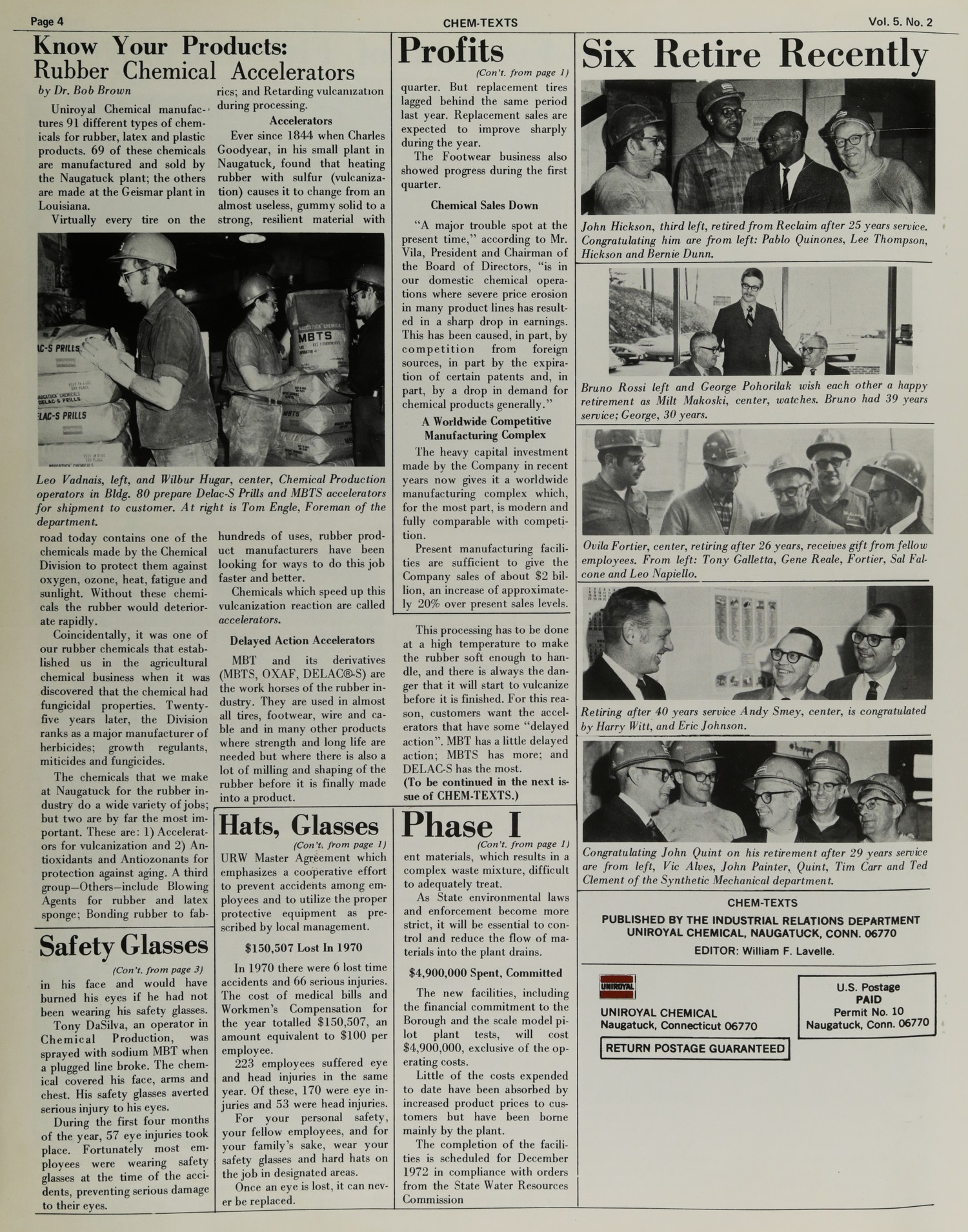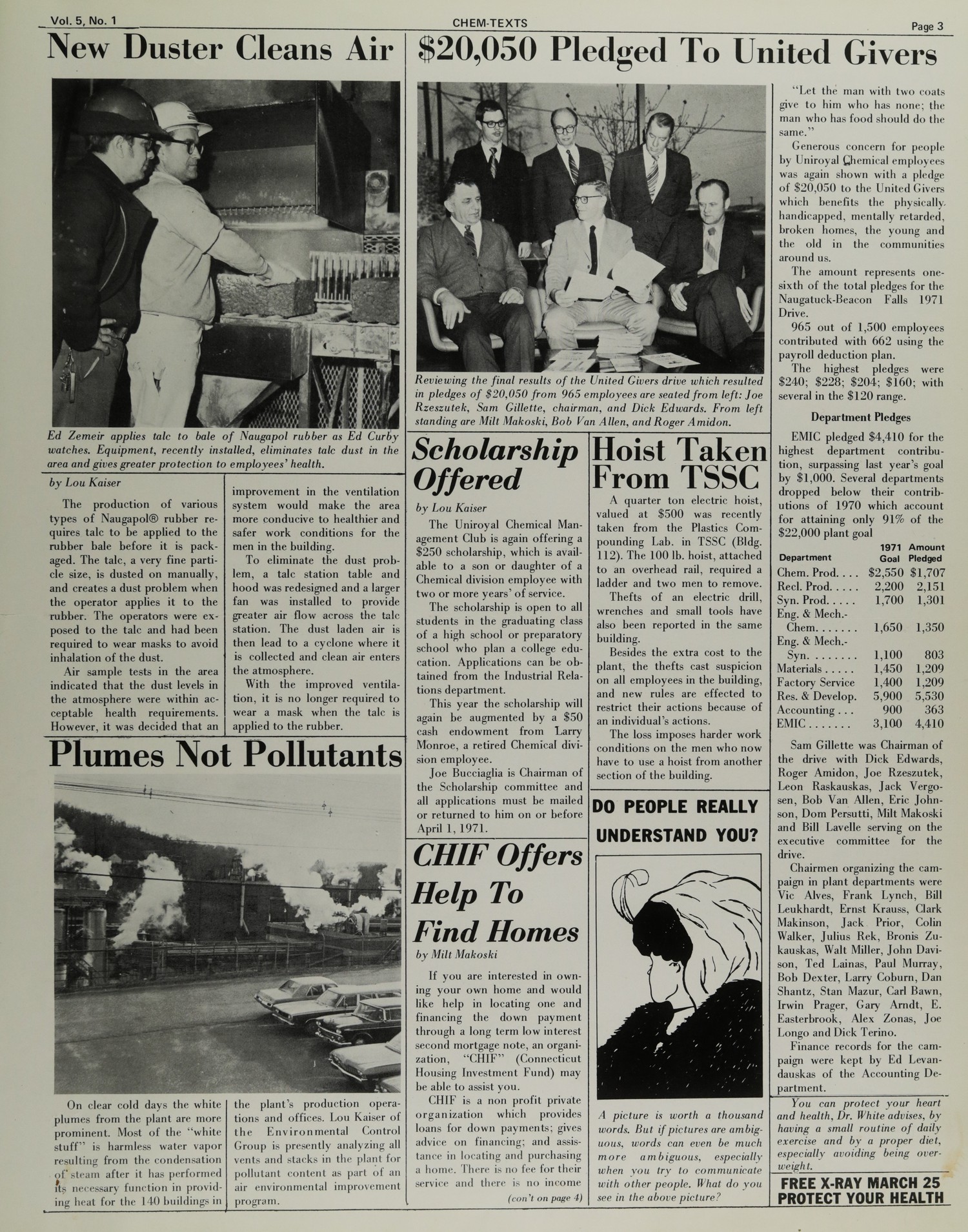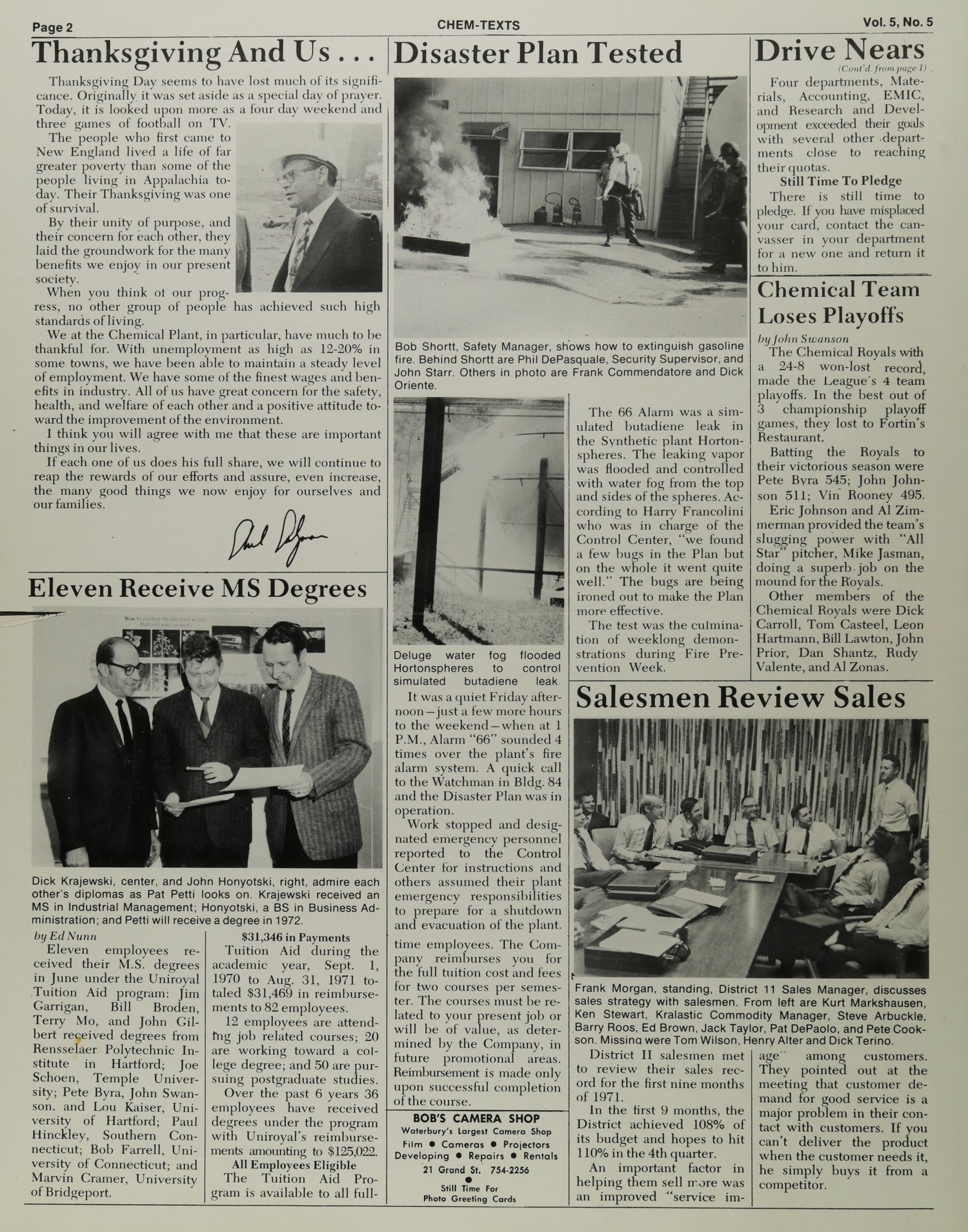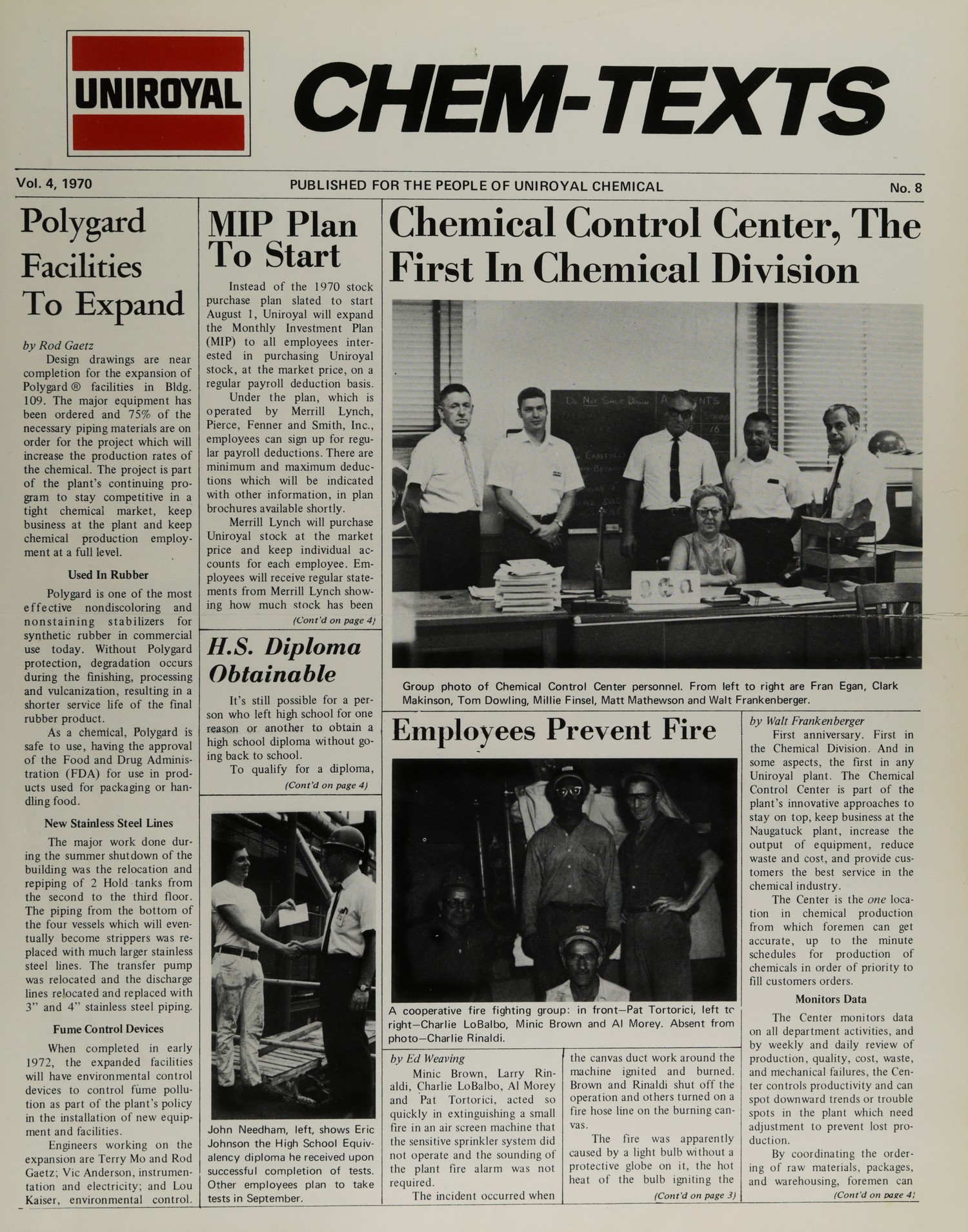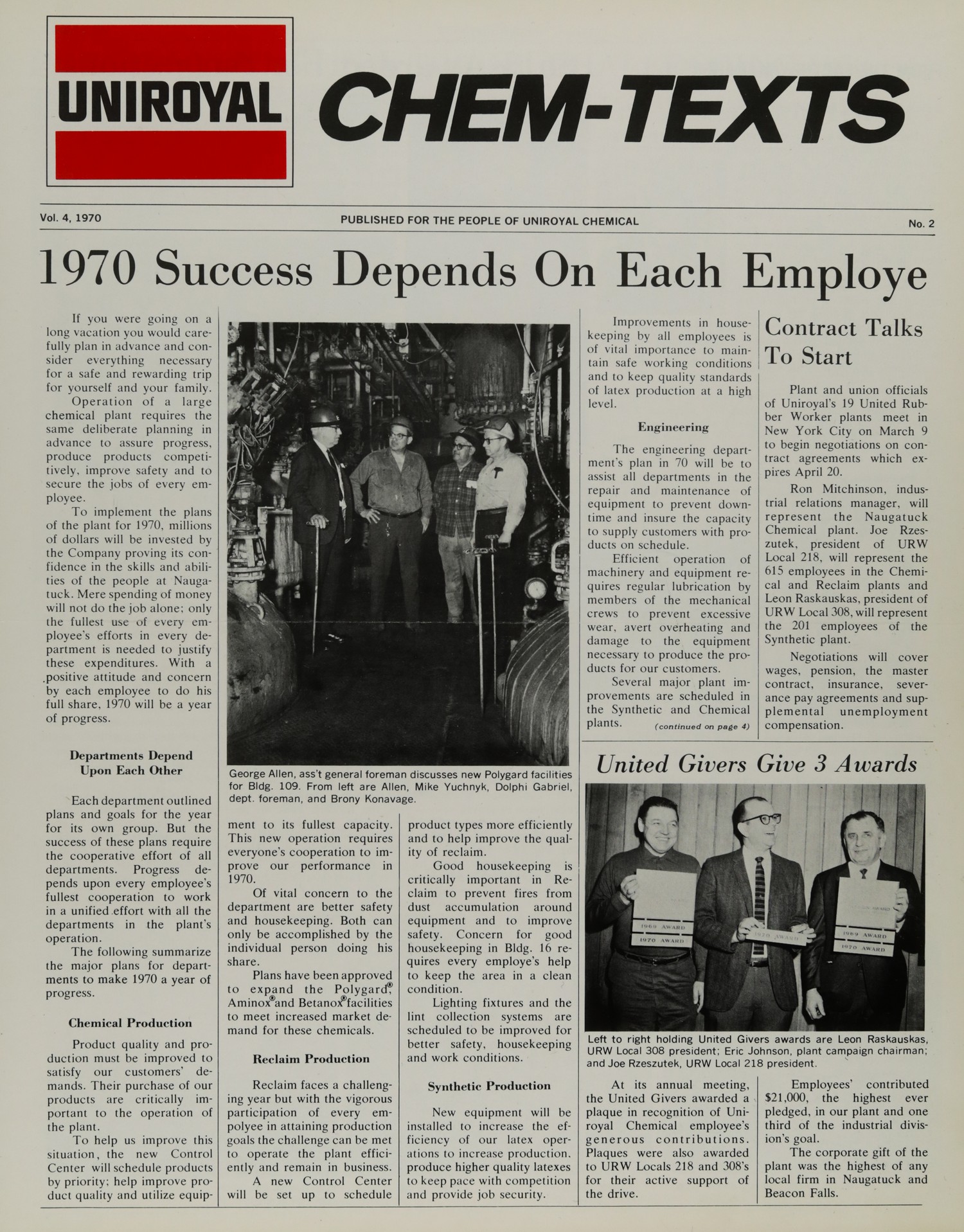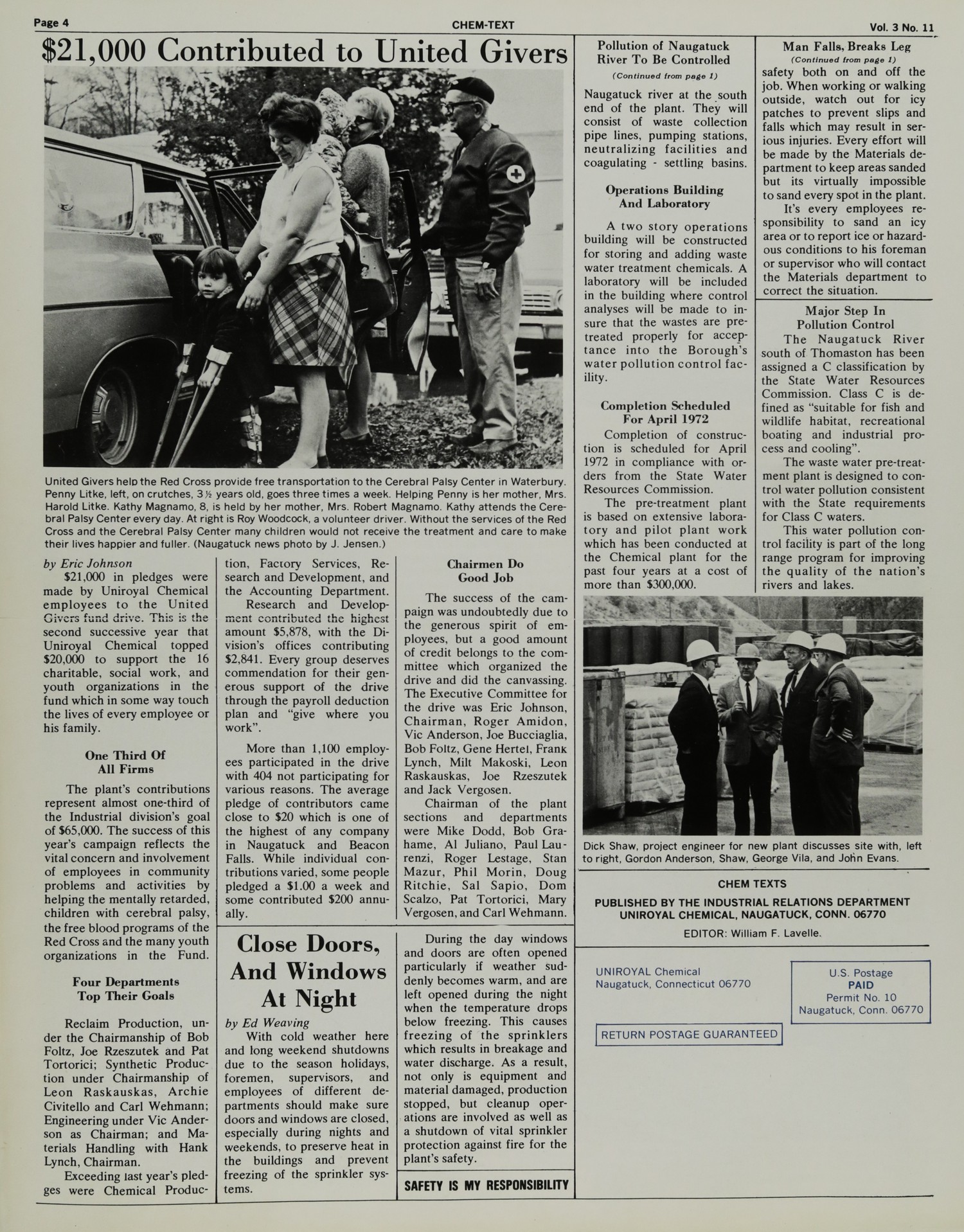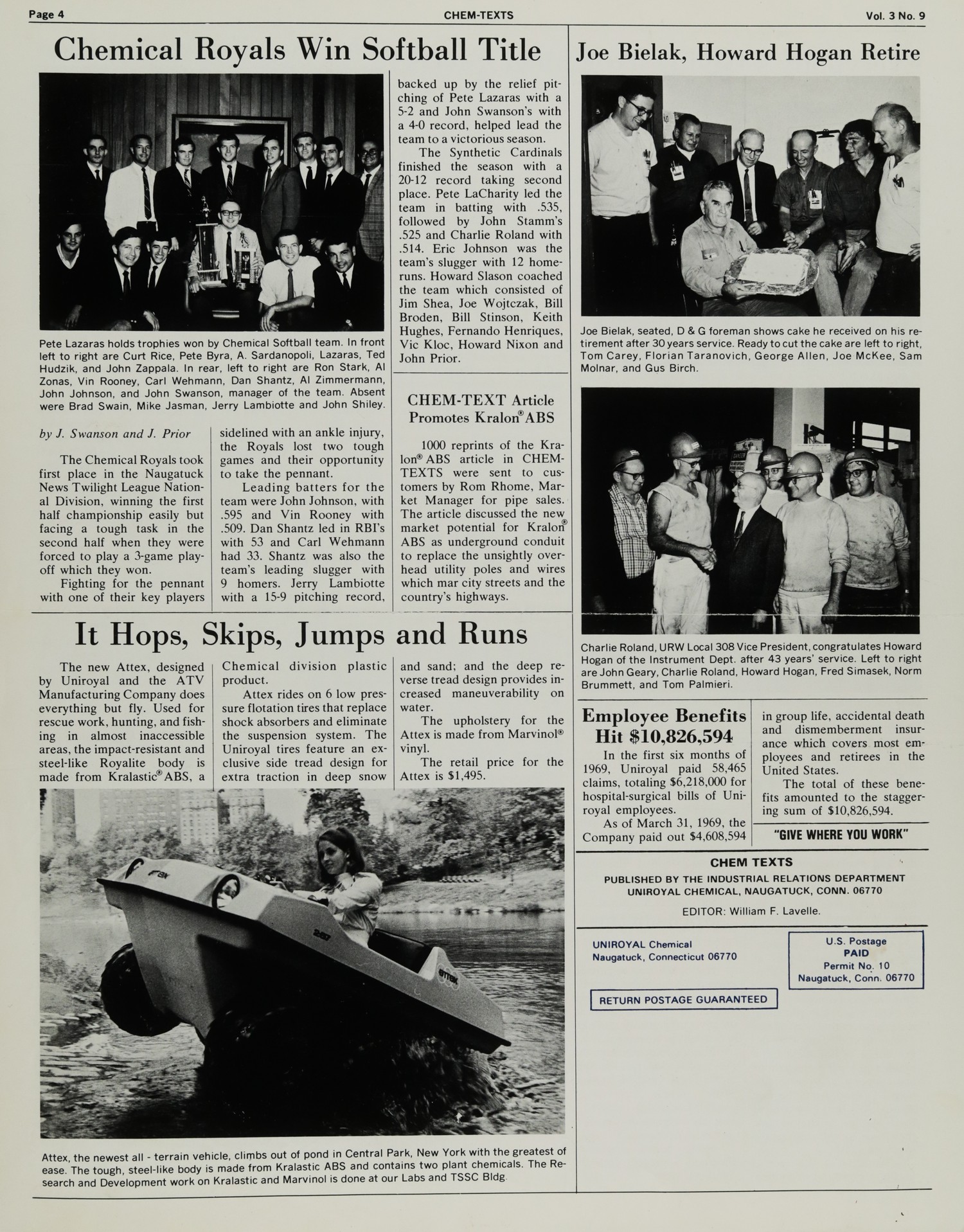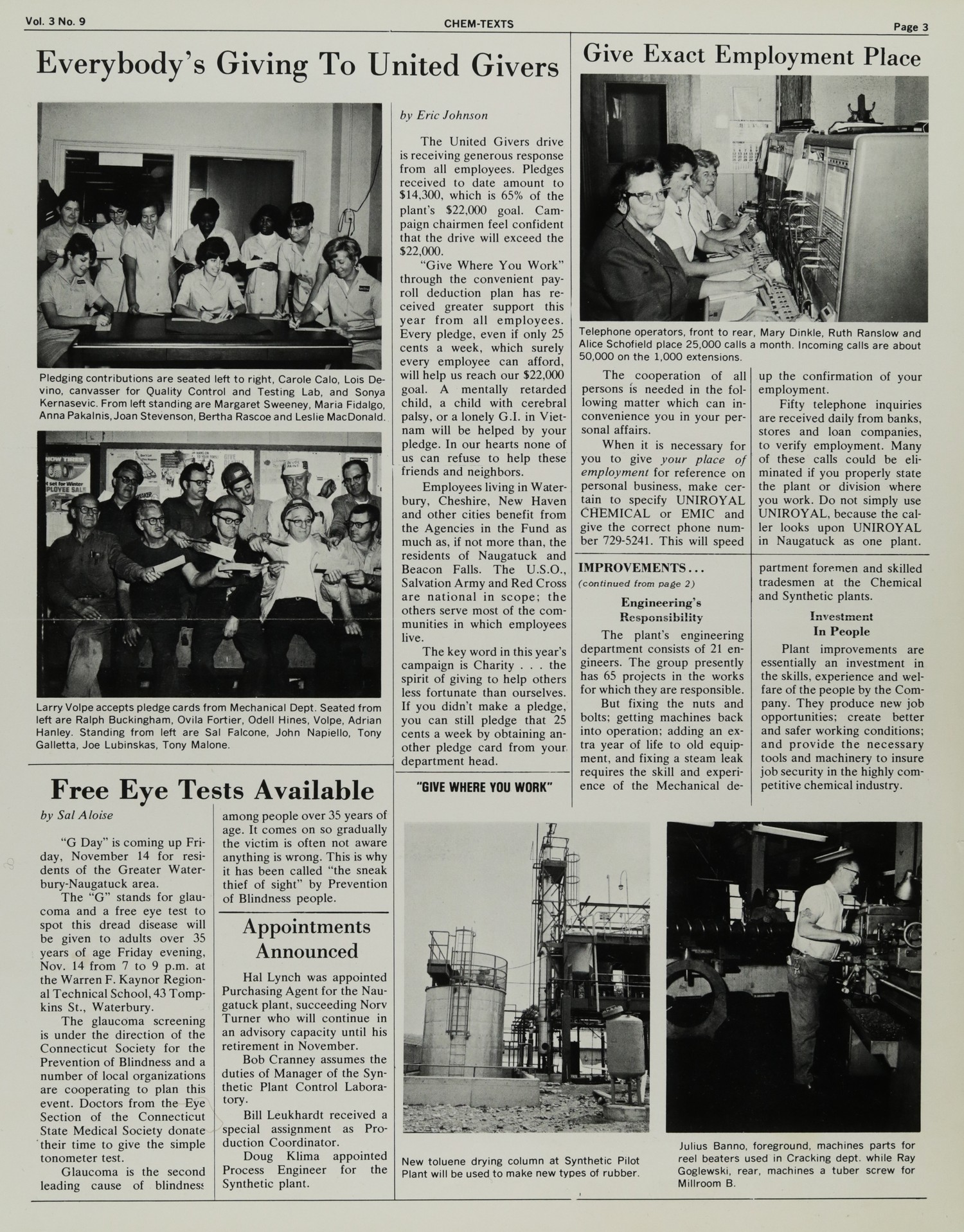
CHEM-TEXTS – 1980-v14-s289

Page 289

Page 2 CHEM-TEXTS Vol. 14, 1980


Goals For 1980

1979 was a very good year for the Uniroyal Chemical Company and the Naugatuck Plant. The company had record sales and profit and the Plant’s operating profit increased 59% over 1978. In order to continue this improvement, severl major 1980 Objectives for the following products and areas must be accomplished:

NAUGACEL SD-1

Successfully start up Naugacel SD-1, an accelerator that will be new business for the plant. It will be manufactured in the FOC Plant Bldg. 124. Most of the equipment has been installed and startup is expected in the 2nd Quarter of 1980. Naugacel is used in the manufacture of tires and mechanical goods.

OMITE

Our goal is to increase Omite production 20% through productivity improvements over 1979, which was a record year. This is necessary if we want to meet the needs of fruit and cotton growers in the U.S. and to avoid the additional expense of importing Omite from our Latina Plant in Italy. Omite is the highest profit chemical made in the plant.

This year, we also will finalize our plant to increase the Omite capacity to meet future sales.

TPR

Increase the production of TPR by 30%, again, through productivity improvements, so that outside manufacturing can be eliminated. This will reduce TPR manufacturing cost and therefore improve TPR’s profitability.

DEVELOP A STRATEGY FOR THE PLANT

We will review the existing resources of the plant, analyze our strengths and weaknesses, and develop a plan that will increase the profit of our facilities. We have many resources that are not fully utilized and increasing their utilization will have a dramatic improvement on the company’s profitability.

For example, the Boiler Plant, Land and Wastewater treatment facilities are only 50-60% utilized. Some of our manufacturing equipment is operating at less than half of capacity. We certainly have the capacity and ability to manfacture more chemical products at Naugatuck and must develop a plan to take advantage of this opportunity.

ENERGY STRATEGY

This year, we will develop an energy strategy that reduces the cost of energy per pound of product so that we can be more competitive with chemical companies closer to lower cost energy sources.

OPERATING PROFIT

The profit goal for 1980 is to improve the operating profit of the Naugatuck Plant by 20%. The operating profit in 1979 was $18.9 million dollars and we plan to raise it to $22.7 million dollars in 1980. Achieving the objectives of the 1980 PIP Program, “Mainstream”, and meeting our 1980 Operating Budget, are important factors in meeting the 1980 Plant Operating Profit Goal.

HEALTH & SAFETY

2000 air monitoring tests will be taken in the Plant to insure that conditions in which employees are working are safe and corrective action initiated to improve the working environment. Also our safety goal this year is an Incidence Rate of 2.6, which is the number of injuries per 1,000,000 manhours worked. The Chemical Industry’s average is “6”, so we hope to operate significantly safer than the average plant.

RIDESHARING

We plan to finalize our ridesharing program in support of Gov. Grasso’s objective to reduce dependence on foreign oil by decreasing gasoline consumption. This program will also provide a system for our employees that will enable them to travel to work during gas shortages that will most likely occur in the future.

Eric Johnson, Factory Manager


Equality Policy Affirmed

The providing of equal employment opportunity for all employees or applicants for employment regardless of race, religion, color, sex, age, national origin, handicap or disabled and Vietnam Era Veteran status is one of the basic policies of UNIROYAL, Inc. The Naugatuck Chemical plant endorses this policy and expects all decisions regarding personnel to conform to these equal employment rules and regulations.

The Naugatuck Chemical Plant has a specific plan of action designed to aid in providing equal opportunity for all. It is committed to recruit, hire, and promote in all job classifications and to ensure that items such as compensation, benefits, transfers, layoffs, return from layoff, training, educational and tuition assistance, and social and recreational activities are administered without regard to race, color, religion, sex, age, national origin, handicap or disabled and Vietnam Era Veteran status except where sex, and/or age is a bonafied occupational qualification. It is also committed to make employment or promotional decisions based solely upon the individual’s qualifications as they relate to the valid qualification requirements of the position for which the individual is being considered.

continued on page 4


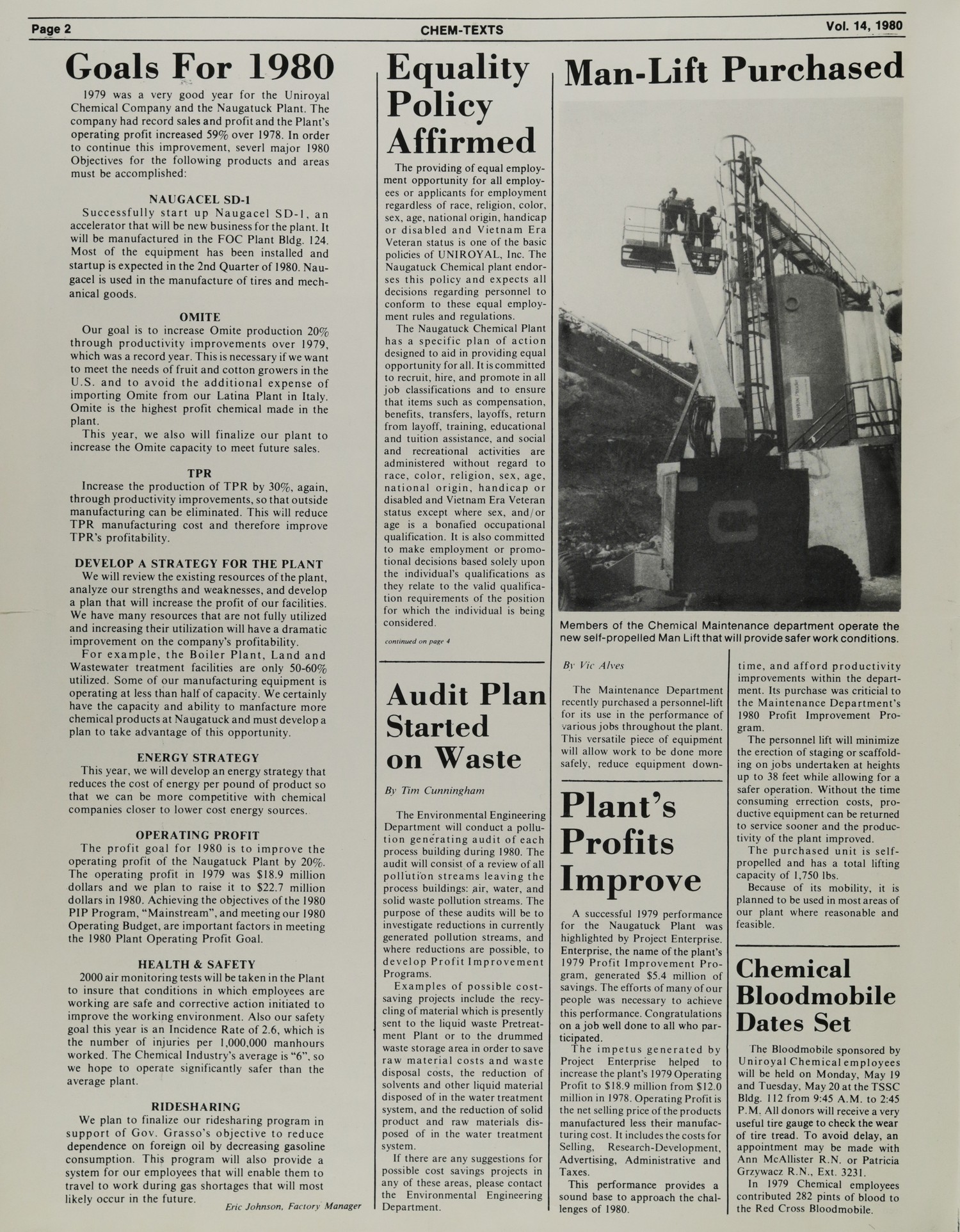
Man-Lift Purchased

[IMAGE: Black and white photograph showing members of the Chemical Maintenance department operating a self-propelled Man Lift]

Members of the Chemical Maintenance department operate the new self-propelled Man Lift that will provide safer work conditions.

By Vic Alves

The Maintenance Department recently purchased a personnel-lift for its use in the performance of various jobs throughout the plant. This versatile piece of equipment will allow work to be done more safely, reduce equipment down-

time, and afford productivity improvements within the department. Its purchase was criticial to the Maintenance Department’s 1980 Profit Improvement Program.

The personnel lift will minimize the erection of staging or scaffolding on jobs undertaken at heights up to 38 feet while allowing for a safer operation. Without the time consuming errection costs, productive equipment can be returned to service sooner and the productivity of the plant improved.

The purchased unit is self-propelled and has a total lifting capacity of 1,750 lbs.

Because of its mobility, it is planned to be used in most areas of our plant where reasonable and feasible.


Audit Plan Started on Waste

By Tim Cunningham

The Environmental Engineering Department will conduct a pollution generating audit of each process building during 1980. The audit will consist of a review of all pollution streams leaving the process buildings: air, water, and solid waste pollution streams. The purpose of these audits will be to investigate reductions in currently generated pollution streams, and where reductions are possible, to develop Profit Improvement Programs.

Examples of possible cost-saving projects include the recycling of material which is presently sent to the liquid waste Pretreatment Plant or to the drummed waste storage area in order to save raw material costs and waste disposal costs, the reduction of solvents and other liquid material disposed of in the water treatment system, and the reduction of solid product and raw materials disposed of in the water treatment system.

If there are any suggestions for possible cost savings projects in any of these areas, please contact the Environmental Engineering Department.


Plant’s Profits Improve

A successful 1979 performance for the Naugatuck Plant was highlighted by Project Enterprise. Enterprise, the name of the plant’s 1979 Profit Improvement Program, generated $5.4 million of savings. The efforts of many of our people was necessary to achieve this performance. Congratulations on a job well done to all who participated.

The impetus generated by Project Enterprise helped to increase the plant’s 1979 Operating Profit to $18.9 million from $12.0 million in 1978. Operating Profit is the net selling price of the products manufactured less their manufacturing cost. It includes the costs for Selling, Research-Development, Advertising, Administrative and Taxes.

This performance provides a sound base to approach the challenges of 1980.


Chemical Bloodmobile Dates Set

The Bloodmobile sponsored by Uniroyal Chemical employees will be held on Monday, May 19 and Tuesday, May 20 at the TSSC Bldg. 112 from 9:45 A.M. to 2:45 P.M. All donors will receive a very useful tire gauge to check the wear of tire tread. To avoid delay, an appointment may be made with Ann McAllister R.N. or Patricia Grzywacz R.N., Ext. 3231.

In 1979 Chemical employees contributed 282 pints of blood to the Red Cross Bloodmobile.
CHEM-TEXTS – Vol. 14 – Page 4

Page 004

CHEM-TEXTS

Page 4 | Vol. 14, 1980


Equality

continued from page 2

The execution of the equal opportunity policy demands the involvement of all management personnel in identifying and attracting minority, female, disabled veteran and Vietnam Era Veteran, and handicapped applicants qualified for consideration in all job classifications, as job openings in such classifications occur. The plant will make monthly audits of its recruiting efforts, hiring, promotional, and termination activities, and the minority, female, disabled veteran and Vietnam Era Veteran, and handicapped situation on the payroll. Additionally, our Affirmative Action Plans are audited on a regular basis by Federal Government and Corporate office Personnel.

J.R. Douglas, Industrial Relations Manager, has appointed C.D. Hilton, Personnel Manager, as the EEO Administrator for the Naugatuck Plant. Feel free to contact them regarding any facet of the EEO policy.


Williams Heads Toastmasters Club

Bob Williams, International Marketing Specialist for Vibrathane and Speciality Chemicals, has been elected President of the Preston Hill Toastmasters Club for 1980.

The club meets every other Friday at Uniroyal’s Preston Hill Inn in Oxford is dedicated to help people improve their communication and leadership skills.

For more information call Bob at 723-3791. Other club members from EMIC and the plant are Joe Calaghan, George Lapp and Jim Marshall.


“On the Road”

By Joe Bucciaglia

The Chemicals and Polymers Sales Force

An important member of the team, but often a “distant” one, is the field sales representative who is “On-the-Road”. I hope to run a series of articles about our Chemicals and Polymers sales group and tell you a little about the people and what they do.

To start with, this sales force is led by a General Sales Manager, Joe Callaghan. Reporting to Joe is a Specialty Chemicals National Sales Manager, governing Specialty Chemicals and three Regional managers covering the Rubber Chemicals and Polymers. Also reporting to Joe are two Operations Managers, Pete Cookson for Polymers, and myself for Chemicals.

The Central Office for the Midwest Region (better known as District 4) is located in Akron, Ohio, “The Rubber Capital of the World”. Out of this office, the Chemicals and Polymers field Sales Force are responsible for selling Rubber and Heavy Chemicals, ROYALENE®, PARACRIL®, Natural Latex and VIBRATHANE® Gums.

The Sales Force in the Midwest is:

Vin Russo Regional Manager
Bill Galwardy Sr. Sales Associate with sales responsibilities in parts of Ohio Plus all the major Akron based Rubber Companies.
Wes Curtis Technical Representative with sales responsibilities in Ohio, West Virginia, and parts of New York and Pennsylvania.
Bill Stephenson Technical Representative with sales responsibilities in Indiana and half of Michigan.
Wayne Churchill Technical Representative with sales responsibilities in Illinois and half of Michigan.
Leo Pranitis Technical Representative with sales responsibilities in Wisconsin, Minnesota, Iowa, Nebraska, North Dakota and South Dakota.

The Akron Office is staffed by Leo Foley and Ruth Hoak.

Next issue, more on the other District Offices and the people staffing them. In the meanwhile, if your interested in anything else about Sales, drop me a line.


Become Hearing Experts

In the photo from left are Eric Johnson, Factory Manager, who presented the certificates; Ann McAllister RN; Patricia Grzywacz RN; and James Loman, Safety Supervisor.

Three members of the Safety and Medical Department have been awarded Certificates of Accreditation by the Council for Accreditation Occupational Hearing Conservation. The accreditation qualifies them to give industrial audiometric tests. As part of its continuing medical program the group wil give hearing tests to all employees to insure proper care of their hearing. Ann and Patricia received their certification from the University of Bridgeport and Jim from Kutztown State University, Pa. Loman is also a Certified First Aid and CPR Instructor while Pat recently received certification as a CPR Instructor.


55 MPH

Give it a chance to work. To save gasoline. To save lives, too.


Local 218…

continued from page 3

growth.”

Joe Rzeszutek recognized the need to make certain changes in the Contract in order to make the plant competitive with other chemical companies and to help improve its productivity in order to maintain job security in a highly competitive market area.

As a result of this mutual interest, Douglas reported that the parties were able to negotiate contractual changes that will provide potential improvements in productivity, reduced down-time, and cost reductions that can amount to substantial savings per year to the Naugatuck Plant. Both Douglas and Rzeszutek stated that this was the type of joint Company-Union effort that the parties are striving for in order to improve our operations, help secure jobs, and provide growth for the Naugatuck Chemical plant’s future.


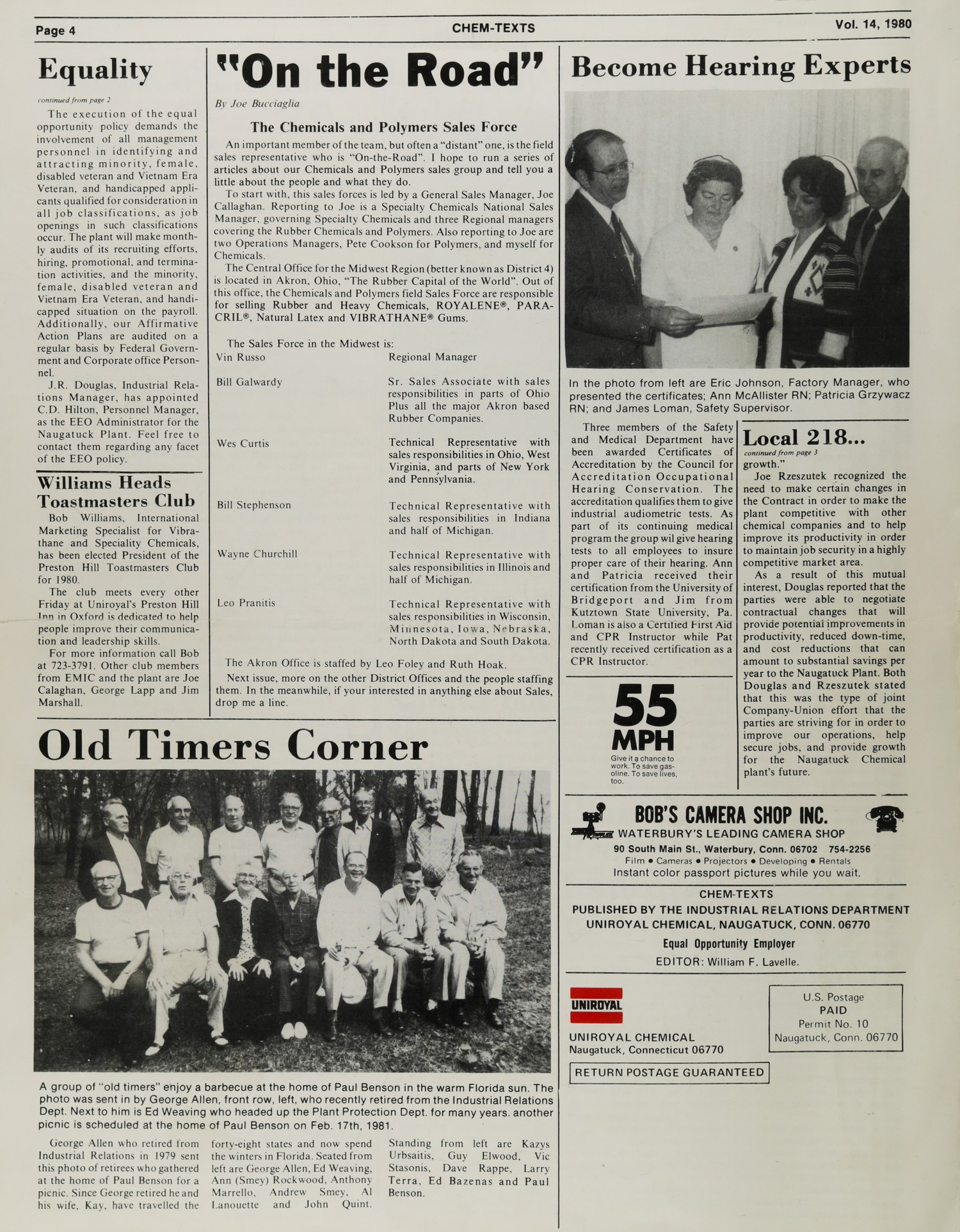
Old Timers Corner

A group of “old timers” enjoy a barbecue at the home of Paul Benson in the warm Florida sun. The photo was sent in by George Allen, front row, left, who recently retired from the Industrial Relations Dept. Next to him is Ed Weaving who headed up the Plant Protection Dept. for many years. another picnic is scheduled at the home of Paul Benson on Feb. 17th, 1981.

George Allen who retired from Industrial Relations in 1979 sent this photo of retirees who gathered at the home of Paul Benson for a picnic. Since George retired he and his wife, Kay, have travelled the forty-eight states and now spend the winters in Florida. Seated from left are George Allen, Ed Weaving, Ann (Smey) Rockwood, Anthony Marrello, Andrew Smey, Al Lanouette and John Quint.

Standing from left are Kazys Urbsaitis, Guy Elwood, Vic Stasonis, Dave Rappe, Larry Terra, Ed Bazenas and Paul Benson.


BOB’S CAMERA SHOP INC.

WATERBURY’S LEADING CAMERA SHOP

90 South Main St., Waterbury, Conn. 06702 754-2256

Film • Cameras • Projectors • Developing • Rentals

Instant color passport pictures while you wait.


CHEM-TEXTS

PUBLISHED BY THE INDUSTRIAL RELATIONS DEPARTMENT
UNIROYAL CHEMICAL, NAUGATUCK, CONN. 06770

Equal Opportunity Employer

EDITOR: William F. Lavelle.


UNIROYAL

UNIROYAL CHEMICAL
Naugatuck, Connecticut 06770

U.S. Postage
PAID
Permit No. 10
Naugatuck, Conn. 06770

RETURN POSTAGE GUARANTEED

CHEM-TEXTS – Vol. 13 – Page 2

Page 002

Page 2 | CHEM-TEXTS | Vol. 13 1979


Professional Excellence

The Parcel Post Department is an example of a group of individuals who have demonstrated Professional Excellence in the performance of their jobs. Jesse DaSilva, Jim Hartnett, Fran Pikula (Group Leader), and Joe Wojtczak (Foreman) have a reputation of expertly preparing and shipping samples of our products to all parts of the U.S. and the world. This function is extremely important in obtaining new business since it is the first impression that our customers receive of our ability to service their needs.

The Group exercises personal responsibility and initiative and demonstrates a positive attitude in “helping others.”

They have a professional expertise in packaging techniques so that the samples arrive safely in all parts of the world.

They display a professional knowledge of Federal regulations regarding the shipping of hazardous materials and the regulations concerning the air shipment of hazardous materials.

Some of the innovations that the members of the Dept. introduced are: Jesse DaSilva instituted the use of cellular styrofoam pellets to be used as a cushion material in packaging samples for rough handling. The pellets, which are salvaged by Mechanical Stores and the Lab, replace the use of a polyethylene bubble film which was purchased to protect the samples in transit. Not only did this suggestion improve our package, but it eliminated the cost of the bubble film.

James Hartnett instituted an inventory system of all materials handled by the Parcel Post Department. This system promptly enables Jim to know if he has approved material needed for the sample shipment.

Jim has also devised with the group a warehousing system for the storage of larger quantities of material that have to be repackaged into smaller units for samples. Both of these systems display the progressiveness of the group by enabling the Parcel Post group to ship material on time and feed back information to the Customer Service group when needed.

Jim also originated a tagging system to enable material to be sent from all points in the plant, including Bethany, to the Parcel Post Department with the necessary information attached to the package to expedite shipment of that package.

Francis Pikula set up a sample book of all necessary Parcel Post paperwork that is needed to go along with any shipment. This has become a learning tool for trainees, and also a guide in the handling of shipments by experienced employees.

Robert Clark, a former Department member, and Francis Pikula, set up a filing system on all orders shipped from the Parcel Post Department. It is arranged alphabetically by customer’s name for expediting and tracking samples.

It is this kind of professionalism and excellence in the performance of our responsibilities that has helped improve our plant’s performance and made it the flagship of the chemical division.

We all appreciate the professional expertise in the Parcel Post Department and offer our thanks.

Eric Johnson
Factory Manager


Tugboat Crew Tows the Fleet

By Russell F. Sant’Angelo

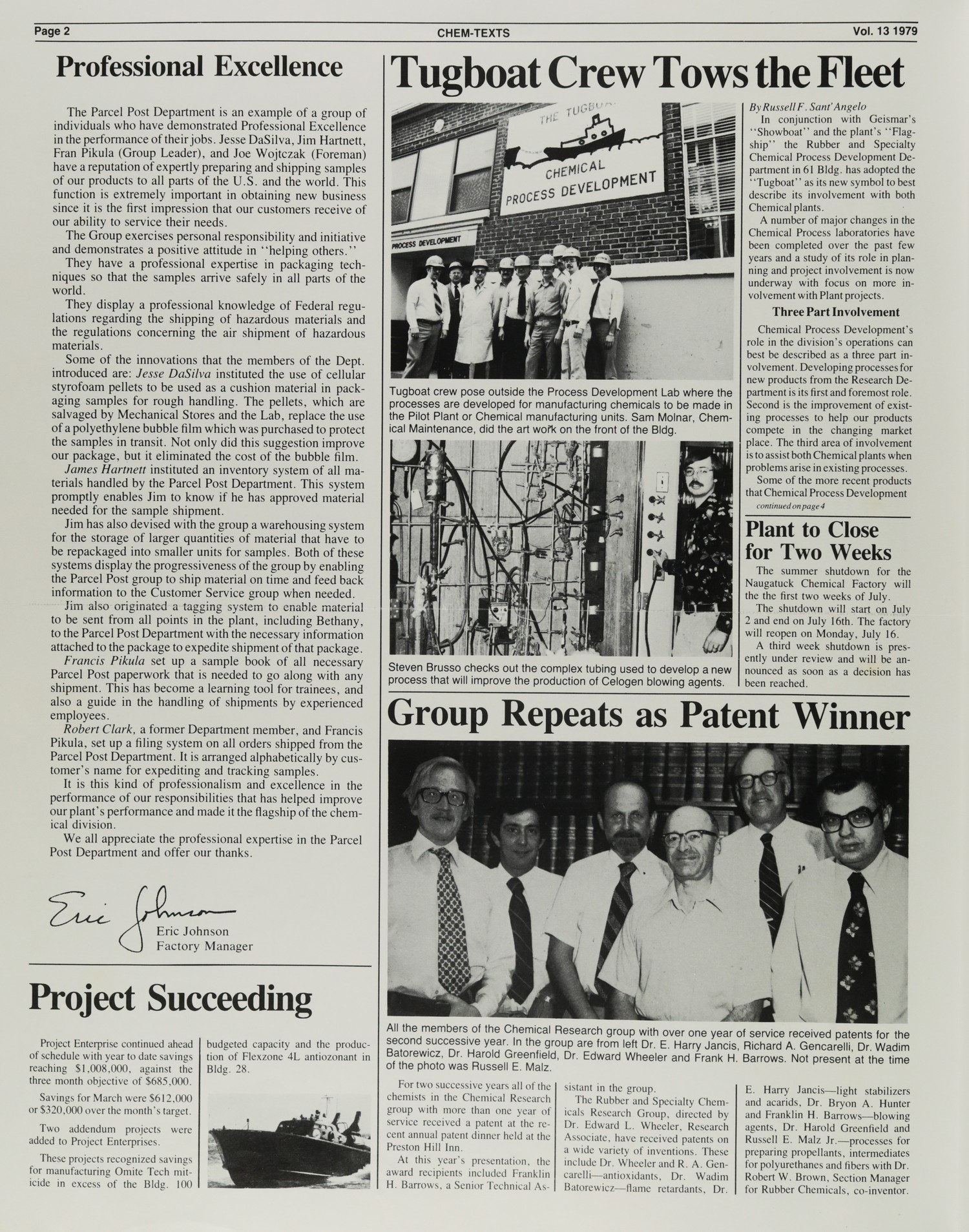
In conjunction with Geismar’s “Showboat” and the plant’s “Flagship” the Rubber and Specialty Chemical Process Development Department in 61 Bldg. has adopted the “Tugboat” as its new symbol to best describe its involvement with both Chemical plants.

A number of major changes in the Chemical Process laboratories have been completed over the past few years and a study of its role in planning and project involvement is now underway with focus on more involvement with Plant projects.

Three Part Involvement

Chemical Process Development’s role in the division’s operations can best be described as a three part involvement. Developing processes for new products from the Research Department is its first and foremost role. Second is the improvement of existing processes to help our products compete in the changing market place. The third area of involvement is to assist both Chemical plants when problems arise in existing processes.

Some of the more recent products that Chemical Process Development
continued on page 4


Tugboat crew pose outside the Process Development Lab where the processes are developed for manufacturing chemicals to be made in the Pilot Plant or Chemical manufacturing units. Sam Molnar, Chemical Maintenance, did the art work on the front of the Bldg.


Steven Brusso checks out the complex tubing used to develop a new process that will improve the production of Celogen blowing agents.


Plant to Close for Two Weeks

The summer shutdown for the Naugatuck Chemical Factory will the the first two weeks of July.

The shutdown will start on July 2 and end on July 16th. The factory will reopen on Monday, July 16.

A third week shutdown is presently under review and will be announced as soon as a decision has been reached.


Project Succeeding

Project Enterprise continued ahead of schedule with year to date savings reaching $1,008,000, against the three month objective of $685,000.

Savings for March were $612,000 or $320,000 over the month’s target.

Two addendum projects were added to Project Enterprises.

These projects recognized savings for manufacturing Omite Tech miticide in excess of the Bldg. 100 budgeted capacity and the production of Flexzone 4L antiozonant in Bldg. 28.


Group Repeats as Patent Winner

All the members of the Chemical Research group with over one year of service received patents for the second successive year. In the group are from left Dr. E. Harry Jancis, Richard A. Gencarelli, Dr. Wadim Batorewicz, Dr. Harold Greenfield, Dr. Edward Wheeler and Frank H. Barrows. Not present at the time of the photo was Russell E. Malz.

For two successive years all of the chemists in the Chemical Research group with more than one year of service received a patent at the recent annual patent dinner held at the Preston Hill Inn.

At this year’s presentation, the award recipients included Franklin H. Barrows, a Senior Technical Assistant in the group.

The Rubber and Specialty Chemicals Research Group, directed by Dr. Edward L. Wheeler, Research Associate, have received patents on a wide variety of inventions. These include Dr. Wheeler and R. A. Gencarelli—antioxidants, Dr. Wadim Batorewicz—flame retardants, Dr. E. Harry Jancis—light stabilizers and acarids, Dr. Bryon A. Hunter and Franklin H. Barrows—blowing agents, Dr. Harold Greenfield and Russell E. Malz Jr.—processes for preparing propellants, intermediates for polyurethanes and fibers with Dr. Robert W. Brown, Section Manager for Rubber Chemicals, co-inventor.

CHEM-TEXTS – 1979-v13-i03-s272

Page 272

UNIROYAL CHEM-TEXTS

Vol. 13, 1979 | PUBLISHED FOR THE PEOPLE OF UNIROYAL CHEMICAL | No. 3


Gov. Grasso Attends the 75th Anniversary of Chemical Plant

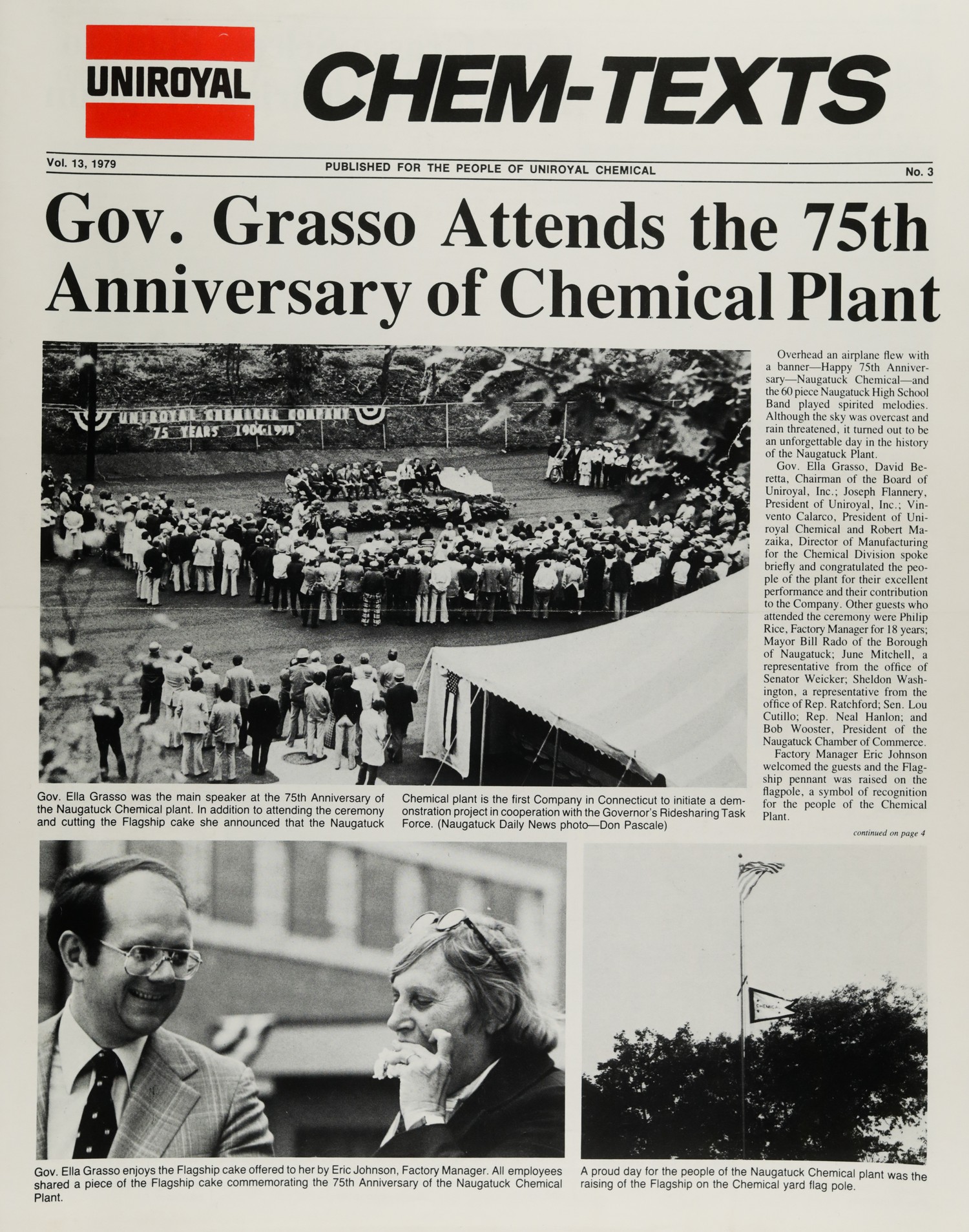
Overhead an airplane flew with a banner—Happy 75th Anniversary—Naugatuck Chemical—and the 60 piece Naugatuck High School Band played spirited melodies. Although the sky was overcast and rain threatened, it turned out to be an unforgettable day in the history of the Naugatuck Plant.

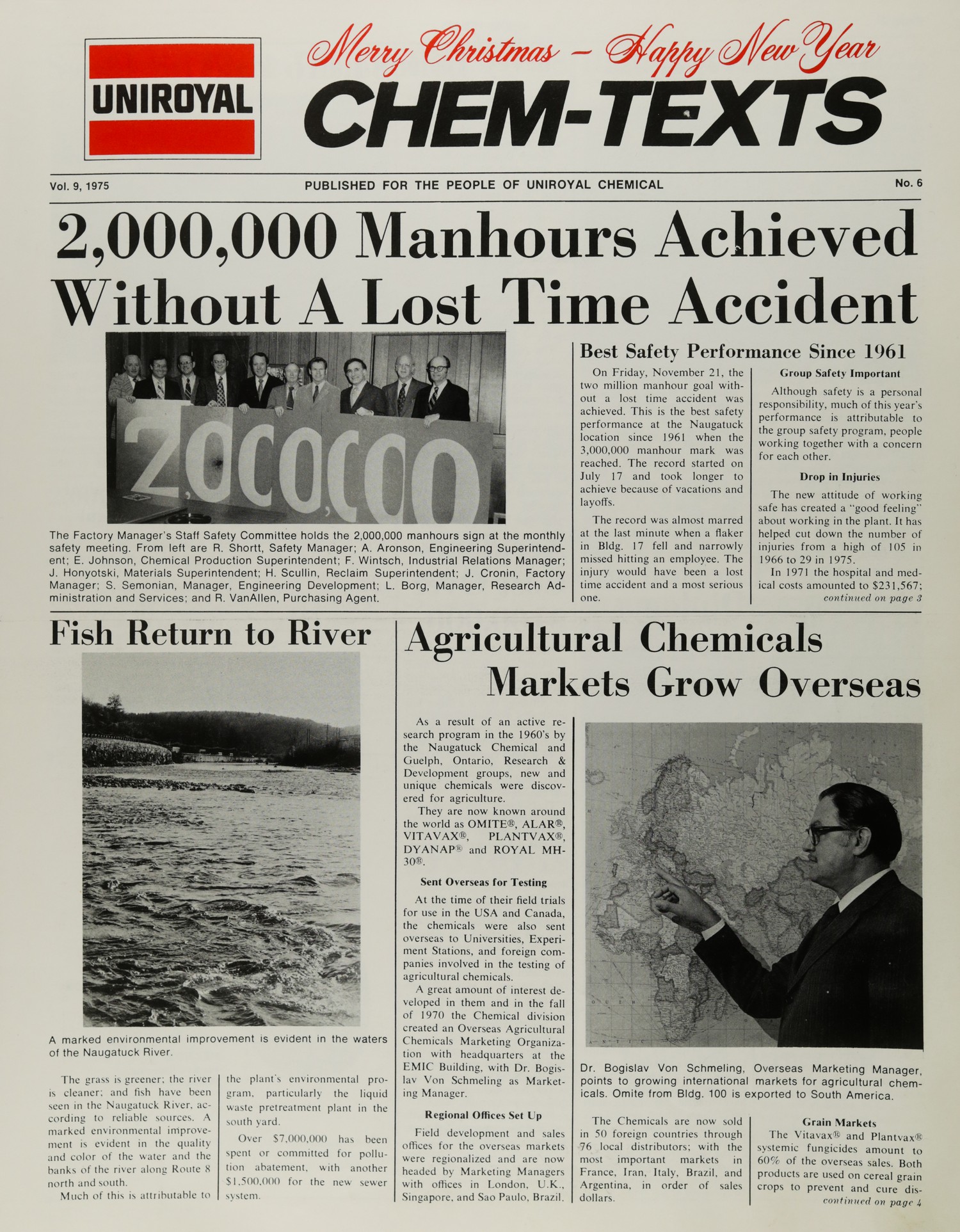
Gov. Ella Grasso, David Beretta, Chairman of the Board of Uniroyal, Inc.; Joseph Flannery, President of Uniroyal, Inc.; Vincento Calarco, President of Uniroyal Chemical and Robert Mazaika, Director of Manufacturing for the Chemical Division spoke briefly and congratulated the people of the plant for their excellent performance and their contribution to the Company. Other guests who attended the ceremony were Philip Rice, Factory Manager for 18 years; Mayor Bill Rado of the Borough of Naugatuck; June Mitchell, a representative from the office of Senator Weicker; Sheldon Washington, a representative from the office of Rep. Ratchford; Sen. Lou Cutillo; Rep. Neal Hanlon; and Bob Wooster, President of the Naugatuck Chamber of Commerce.

Factory Manager Eric Johnson welcomed the guests and the Flagship pennant was raised on the flagpole, a symbol of recognition for the people of the Chemical Plant.

continued on page 4


[MAIN PHOTO CAPTION]
Gov. Ella Grasso was the main speaker at the 75th Anniversary of the Naugatuck Chemical plant. In addition to attending the ceremony and cutting the Flagship cake she announced that the Naugatuck Chemical plant is the first Company in Connecticut to initiate a demonstration project in cooperation with the Governor’s Ridesharing Task Force. (Naugatuck Daily News photo—Don Pascale)


[BOTTOM LEFT PHOTO CAPTION]
Gov. Ella Grasso enjoys the Flagship cake offered to her by Eric Johnson, Factory Manager. All employees shared a piece of the Flagship cake commemorating the 75th Anniversary of the Naugatuck Chemical Plant.


[BOTTOM RIGHT PHOTO CAPTION]
A proud day for the people of the Naugatuck Chemical plant was the raising of the Flagship on the Chemical yard flag pole.

CHEM-TEXTS – 1979-v13-i03-s274

Page 274

CHEM-TEXTS—1979

Vol. 13 No. 3

1904 75th Anniversary 1979


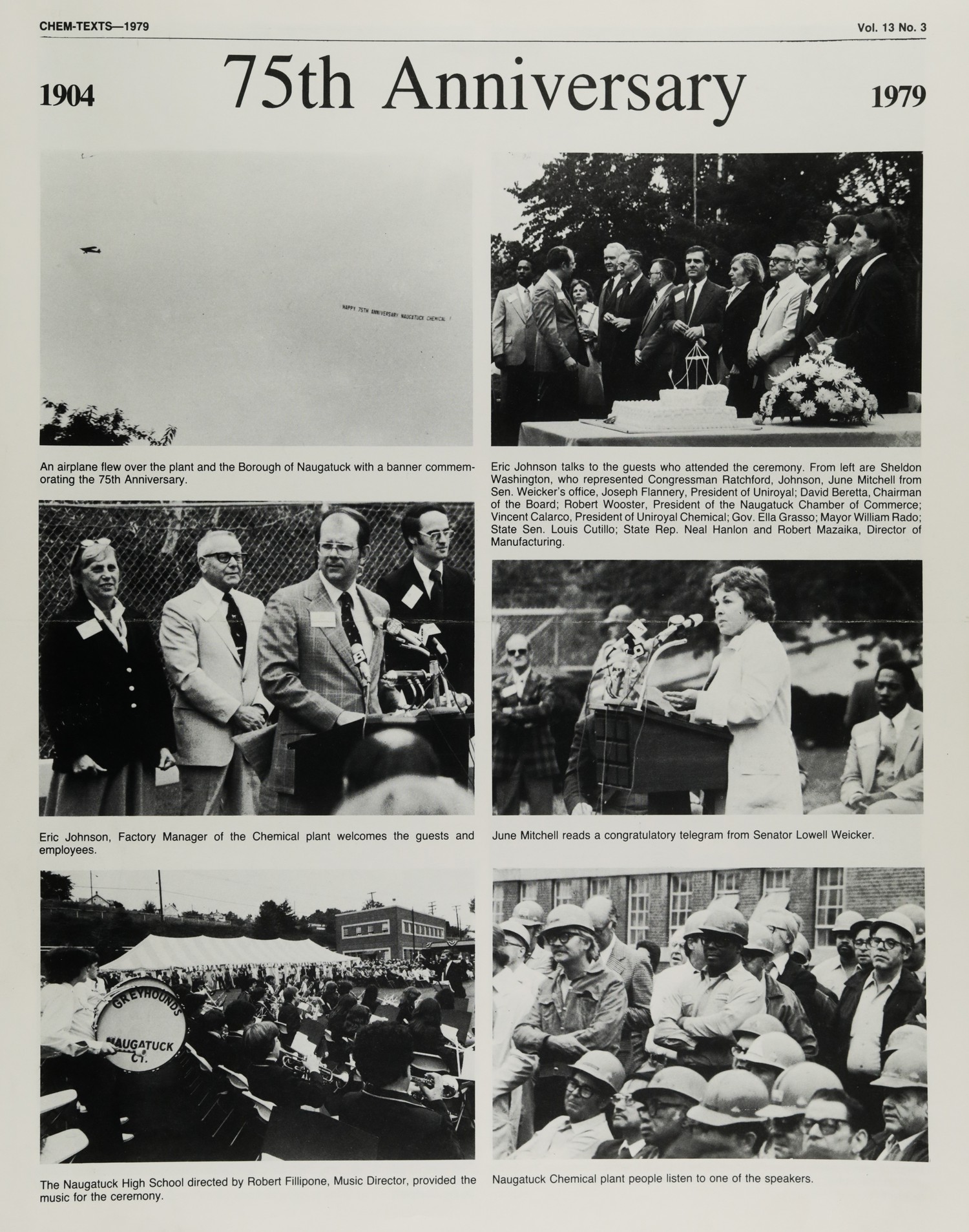
An airplane flew over the plant and the Borough of Naugatuck with a banner commemorating the 75th Anniversary.

Eric Johnson talks to the guests who attended the ceremony. From left are Sheldon Washington, who represented Congressman Ratchford, Johnson, June Mitchell from Sen. Weicker’s office, Joseph Flannery, President of Uniroyal; David Beretta, Chairman of the Board; Robert Wooster, President of the Naugatuck Chamber of Commerce; Vincent Calarco, President of Uniroyal Chemical; Gov. Ella Grasso; Mayor William Rado; State Sen. Louis Cutillo; State Rep. Neal Hanlon and Robert Mazaika, Director of Manufacturing.


Eric Johnson, Factory Manager of the Chemical plant welcomes the guests and employees.

June Mitchell reads a congratulatory telegram from Senator Lowell Weicker.


The Naugatuck High School directed by Robert Fillipone, Music Director, provided the music for the ceremony.

Naugatuck Chemical plant people listen to one of the speakers.

CHEM-TEXTS – Vol. 13 – Page 4

Page 004

Page 4 | CHEM-TEXTS | Vol. 13 1979


Tugboat . .

continued from page 2

help set up in the Naugatuck plant include LVBI wet cake and Naugard 445, which are produced in the FOC plant. The Manufacture of A.O. 495 in 73 Bldg. as well as the improvement of MONEX naugatizing in 88 Bldg., involved the Chemical Process Development. ZHMA, produced in 73 Bldg. was also developed in the Chemical Process Development laboratory.

Developed Process for New Plant Products

Chemical Process Development’s involvement however does not stop there. Some products which will enter the plant in the near future include Naugacel SD-1, with an already approved AR of $614,000, and Naugard MT-ZMT. With its development nearly complete it is now awaiting capital estimates. Processes for both of these products were developed in

the Chemical Process Development Laboratory and Chemical Pilot Plant. Of course along with these existing products is Chemical Process Development’s continuous involvement in developing processes for more efficient Blowing Agent production as well as process development of other rubber chemicals, petroleum antioxidants, and plastics additives.

Group With Experience

Involvement in Geismar products is also a concern for Chemical Process Development with its contributions in the area of Thiazoles, Flexzone and Blowing Agents.

The Chemical Process Development group consists of chemists and engineers with degrees from PH.Ds to Bachelors and experience ranging from 2 years to 26 years. The members include Gary L. Arndt, Steven R. Brusso, J. Harry Donald, James D. Ferency, Robert J. Franko, James L. Pratt, Stanley E. Salva, Russell F. Sant’Angelo, and Dr. John W. Sargent.


Professionalism

continued from page 1


[IMAGE: Building with ductwork and scaffolding]

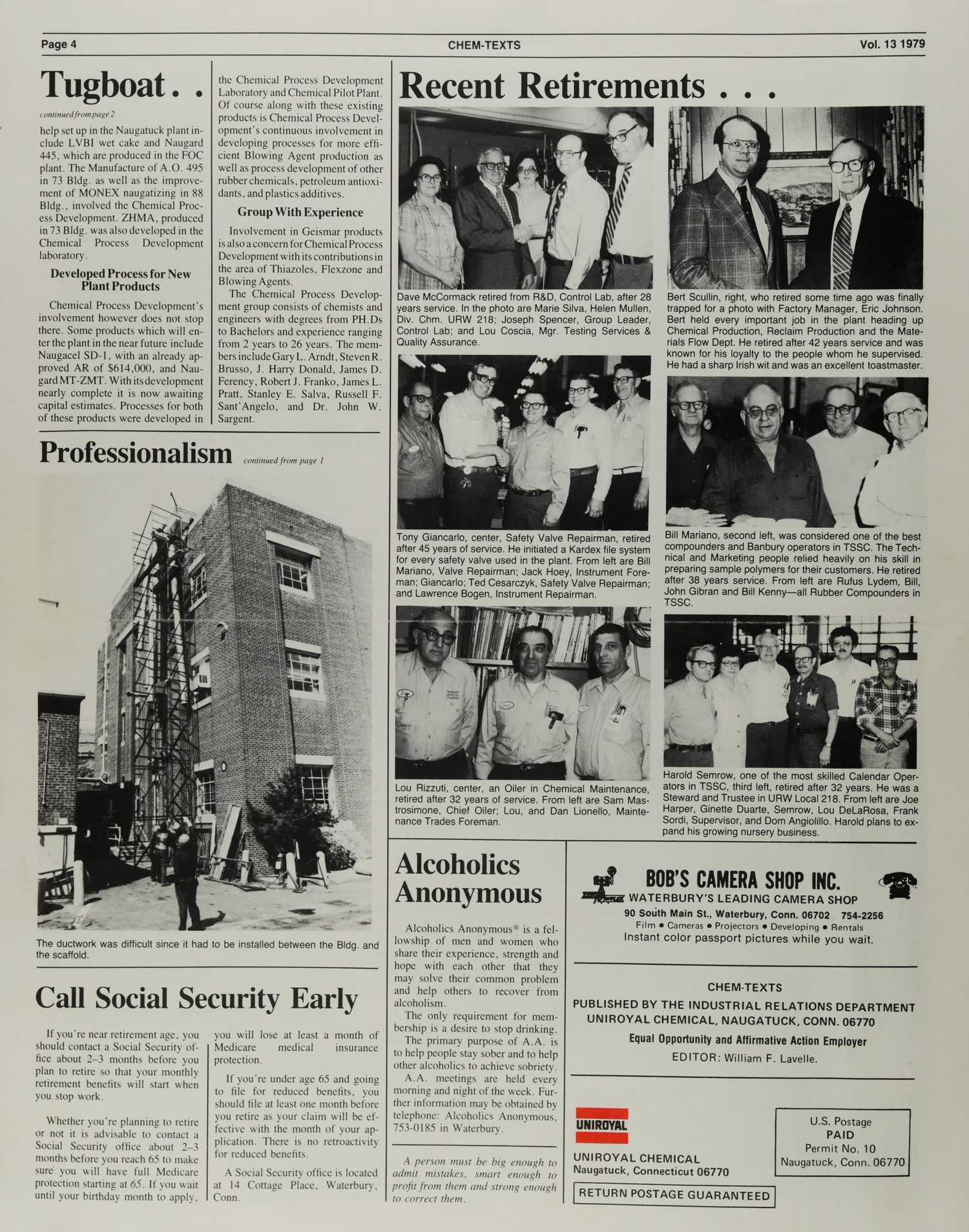
The ductwork was difficult since it had to be installed between the Bldg. and the scaffold.


Call Social Security Early

If you’re near retirement age, you should contact a Social Security office about 2-3 months before you plan to retire so that your monthly retirement benefits will start when you stop work.

Whether you’re planning to retire or not it is advisable to contact a Social Security office about 2-3 months before you reach 65 to make sure you will have full Medicare protection starting at 65. If you wait until your birthday month to apply, you will lose at least a month of Medicare medical insurance protection.

If you’re under age 65 and going to file for reduced benefits, you should file at least one month before you retire as your claim will be effective with the month of your application. There is no retroactivity for reduced benefits.

A Social Security office is located at 14 Cottage Place, Waterbury, Conn.


Recent Retirements . . .

[IMAGE: Group photo]

Dave McCormack retired from R&D, Control Lab, after 28 years service. In the photo are Marie Silva, Helen Mullen, Div. Chrn. URW 218; Joseph Spencer, Group Leader, Control Lab; and Lou Coscia, Mgr. Testing Services & Quality Assurance.

[IMAGE: Group photo]

Bert Scullin, right, who retired some time ago was finally trapped for a photo with Factory Manager, Eric Johnson. Bert held every important job in the plant heading up Chemical Production, Reclaim Production and the Materials Flow Dept. He retired after 42 years service and was known for his loyalty to the people whom he supervised. He had a sharp Irish wit and was an excellent toastmaster.

[IMAGE: Group photo]

Tony Giancarlo, center, Safety Valve Repairman, retired after 45 years of service. He initiated a Kardex file system for every safety valve used in the plant. From left are Bill Mariano, Valve Repairman; Jack Hoey, Instrument Foreman; Giancarlo; Ted Cesarczyk, Safety Valve Repairman; and Lawrence Bogen, Instrument Repairman.

[IMAGE: Group photo]

Bill Mariano, second left, was considered one of the best compounders and Banbury operators in TSSC. The Technical and Marketing people relied heavily on his skill in preparing sample polymers for their customers. He retired after 38 years service. From left are Rufus Lydem, Bill, John Gibran and Bill Kenny—all Rubber Compounders in TSSC.

[IMAGE: Group photo]

Lou Rizzuti, center, an Oiler in Chemical Maintenance, retired after 32 years of service. From left are Sam Mastrosimone, Chief Oiler; Lou; and Dan Lionello, Maintenance Trades Foreman.

[IMAGE: Group photo]

Harold Semrow, one of the most skilled Calendar Operators in TSSC, third left, retired after 32 years. He was a Steward and Trustee in URW Local 218. From left are Joe Harper, Ginette Duarte, Semrow, Lou DeLaRosa, Frank Sordi, Supervisor, and Dom Angiolillo. Harold plans to expand his growing nursery business.


Alcoholics Anonymous

Alcoholics Anonymous® is a fellowship of men and women who share their experience, strength and hope with each other that they may solve their common problem and help others to recover from alcoholism.

The only requirement for membership is a desire to stop drinking.

The primary purpose of A.A. is to help people stay sober and to help other alcoholics to achieve sobriety.

A.A. meetings are held every morning and night of the week. Further information may be obtained by telephone: Alcoholics Anonymous, 753-0185 in Waterbury.

A person must be big enough to admit mistakes, smart enough to profit from them and strong enough to correct them.


BOB’S CAMERA SHOP INC.

WATERBURY’S LEADING CAMERA SHOP

90 South Main St., Waterbury, Conn. 06702 754-2256

Film • Cameras • Projectors • Developing • Rentals

Instant color passport pictures while you wait.


CHEM-TEXTS

PUBLISHED BY THE INDUSTRIAL RELATIONS DEPARTMENT
UNIROYAL CHEMICAL, NAUGATUCK, CONN. 06770

Equal Opportunity and Affirmative Action Employer

EDITOR: William F. Lavelle.


UNIROYAL

U.S. Postage
PAID
Permit No. 10
Naugatuck, Conn. 06770

UNIROYAL CHEMICAL
Naugatuck, Connecticut 06770

RETURN POSTAGE GUARANTEED

CHEM-TEXTS – 1979-v13-s273

Page 273

CHEM-TEXTS

Page 2 | Vol. 13, 1979


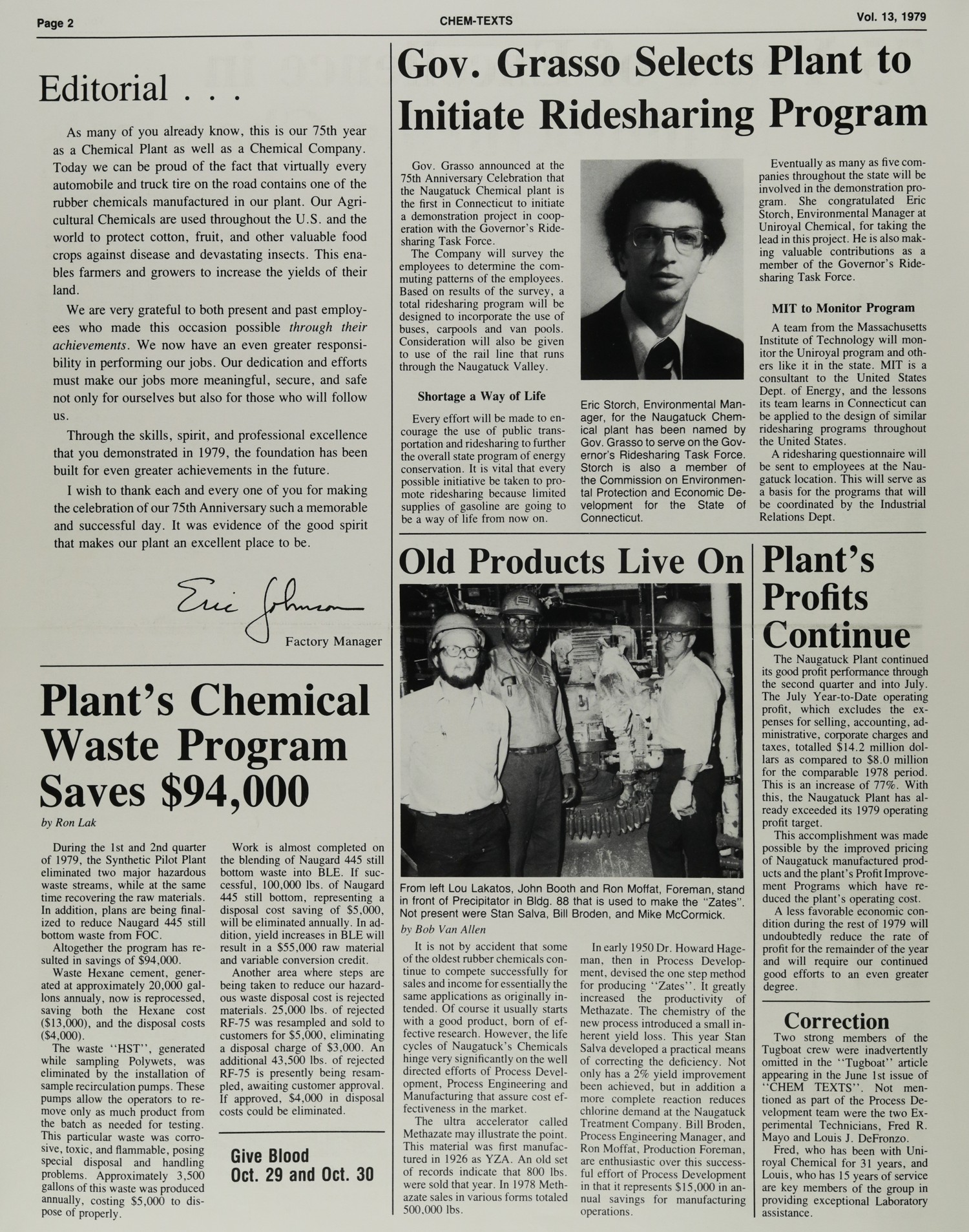
Editorial . . .

As many of you already know, this is our 75th year as a Chemical Plant as well as a Chemical Company. Today we can be proud of the fact that virtually every automobile and truck tire on the road contains one of the rubber chemicals manufactured in our plant. Our Agricultural Chemicals are used throughout the U.S. and the world to protect cotton, fruit, and other valuable food crops against disease and devastating insects. This enables farmers and growers to increase the yields of their land.

We are very grateful to both present and past employees who made this occasion possible through their achievements. We now have an even greater responsibility in performing our jobs. Our dedication and efforts must make our jobs more meaningful, secure, and safe not only for ourselves but also for those who will follow us.

Through the skills, spirit, and professional excellence that you demonstrated in 1979, the foundation has been built for even greater achievements in the future.

I wish to thank each and every one of you for making the celebration of our 75th Anniversary such a memorable and successful day. It was evidence of the good spirit that makes our plant an excellent place to be.

Eric Johnson
Factory Manager


Plant’s Chemical Waste Program Saves $94,000

by Ron Lak

During the 1st and 2nd quarter of 1979, the Synthetic Pilot Plant eliminated two major hazardous waste streams, while at the same time recovering the raw materials. In addition, plans are being finalized to reduce Naugard 445 still bottom waste from FOC.

Altogether the program has resulted in savings of $94,000.

Waste Hexane cement, generated at approximately 20,000 gallons annually, now is reprocessed, saving both the Hexane cost ($13,000), and the disposal costs ($4,000).

The waste “HST”, generated while sampling Polywets, was eliminated by the installation of sample recirculation pumps. These pumps allow the operators to remove only as much product from the batch as needed for testing. This particular waste was corrosive, toxic, and flammable, posing special disposal and handling problems. Approximately 3,500 gallons of this waste was produced annually, costing $5,000 to dispose of properly.

Work is almost completed on the blending of Naugard 445 still bottom waste into BLE. If successful, 100,000 lbs. of Naugard 445 still bottom, representing a disposal cost saving of $5,000, will be eliminated annually. In addition, yield increases in BLE will result in a $55,000 raw material and variable conversion credit.

Another area where steps are being taken to reduce our hazardous waste disposal cost is rejected materials. 25,000 lbs. of rejected RF-75 was resampled and sold to customers for $5,000, eliminating a disposal charge of $3,000. An additional 43,500 lbs. of rejected RF-75 is presently being resampled, awaiting customer approval. If approved, $4,000 in disposal costs could be eliminated.


Give Blood
Oct. 29 and Oct. 30


Gov. Grasso Selects Plant to Initiate Ridesharing Program

Gov. Grasso announced at the 75th Anniversary Celebration that the Naugatuck Chemical plant is the first in Connecticut to initiate a demonstration project in cooperation with the Governor’s Ridesharing Task Force.

The Company will survey the employees to determine the commuting patterns of the employees. Based on results of the survey, a total ridesharing program will be designed to incorporate the use of buses, carpools and van pools. Consideration will also be given to use of the rail line that runs through the Naugatuck Valley.

Shortage a Way of Life

Every effort will be made to encourage the use of public transportation and ridesharing to further the overall state program of energy conservation. It is vital that every possible initiative be taken to promote ridesharing because limited supplies of gasoline are going to be a way of life from now on.

[PHOTO CAPTION:]
Eric Storch, Environmental Manager, for the Naugatuck Chemical plant has been named by Gov. Grasso to serve on the Governor’s Ridesharing Task Force. Storch is also a member of the Commission on Environmental Protection and Economic Development for the State of Connecticut.

Eventually as many as five companies throughout the state will be involved in the demonstration program. She congratulated Eric Storch, Environmental Manager at Uniroyal Chemical, for taking the lead in this project. He is also making valuable contributions as a member of the Governor’s Ridesharing Task Force.

MIT to Monitor Program

A team from the Massachusetts Institute of Technology will monitor the Uniroyal program and others like it in the state. MIT is a consultant to the United States Dept. of Energy, and the lessons its team learns in Connecticut can be applied to the design of similar ridesharing programs throughout the United States.

A ridesharing questionnaire will be sent to employees at the Naugatuck location. This will serve as a basis for the programs that will be coordinated by the Industrial Relations Dept.


Old Products Live On

[PHOTO CAPTION:]
From left Lou Lakatos, John Booth and Ron Moffat, Foreman, stand in front of Precipitator in Bldg. 88 that is used to make the “Zates”. Not present were Stan Salva, Bill Broden, and Mike McCormick.

by Bob Van Allen

It is not by accident that some of the oldest rubber chemicals continue to compete successfully for sales and income for essentially the same applications as originally intended. Of course it usually starts with a good product, born of effective research. However, the life cycles of Naugatuck’s Chemicals hinge very significantly on the well directed efforts of Process Development, Process Engineering and Manufacturing that assure cost effectiveness in the market.

The ultra accelerator called Methazate may illustrate the point. This material was first manufactured in 1926 as YZA. An old set of records indicate that 800 lbs. were sold that year. In 1978 Methazate sales in various forms totaled 500,000 lbs.

In early 1950 Dr. Howard Hageman, then in Process Development, devised the one step method for producing “Zates”. It greatly increased the productivity of Methazate. The chemistry of the new process introduced a small inherent yield loss. This year Stan Salva developed a practical means of correcting the deficiency. Not only has a 2% yield improvement been achieved, but in addition a more complete reaction reduces chlorine demand at the Naugatuck Treatment Company. Bill Broden, Process Engineering Manager, and Ron Moffat, Production Foreman, are enthusiastic over this successful effort of Process Development in that it represents $15,000 in annual savings for manufacturing operations.


Plant’s Profits Continue

The Naugatuck Plant continued its good profit performance through the second quarter and into July. The July Year-to-Date operating profit, which excludes the expenses for selling, accounting, administrative, corporate charges and taxes, totalled $14.2 million dollars as compared to $8.0 million for the comparable 1978 period. This is an increase of 77%. With this, the Naugatuck Plant has already exceeded its 1979 operating profit target.

This accomplishment was made possible by the improved pricing of Naugatuck manufactured products and the plant’s Profit Improvement Programs which have reduced the plant’s operating cost.

A less favorable economic condition during the rest of 1979 will undoubtedly reduce the rate of profit for the remainder of the year and will require our continued good efforts to an even greater degree.


Correction

Two strong members of the Tugboat crew were inadvertently omitted in the “Tugboat” article appearing in the June 1st issue of “CHEM TEXTS”. Not mentioned as part of the Process Development team were the two Experimental Technicians, Fred R. Mayo and Louis J. DeFronzo.

Fred, who has been with Uniroyal Chemical for 31 years, and Louis, who has 15 years of service are key members of the group in providing exceptional Laboratory assistance.

CHEM-TEXTS – 1979-v13-s282

Page 282

CHEM-TEXTS

Vol. 13, 1979 | Page 3


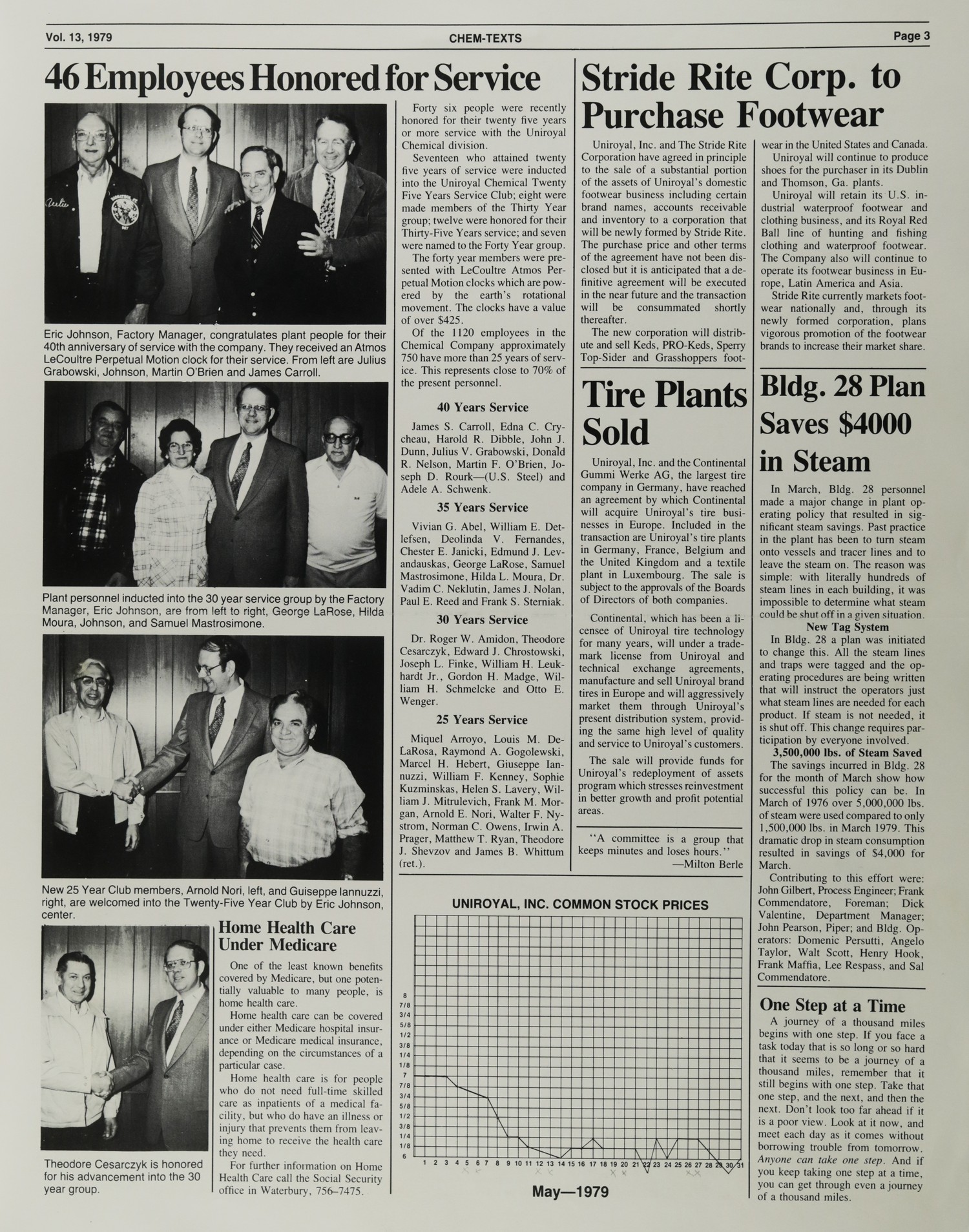
46 Employees Honored for Service

[IMAGE: Group photo]

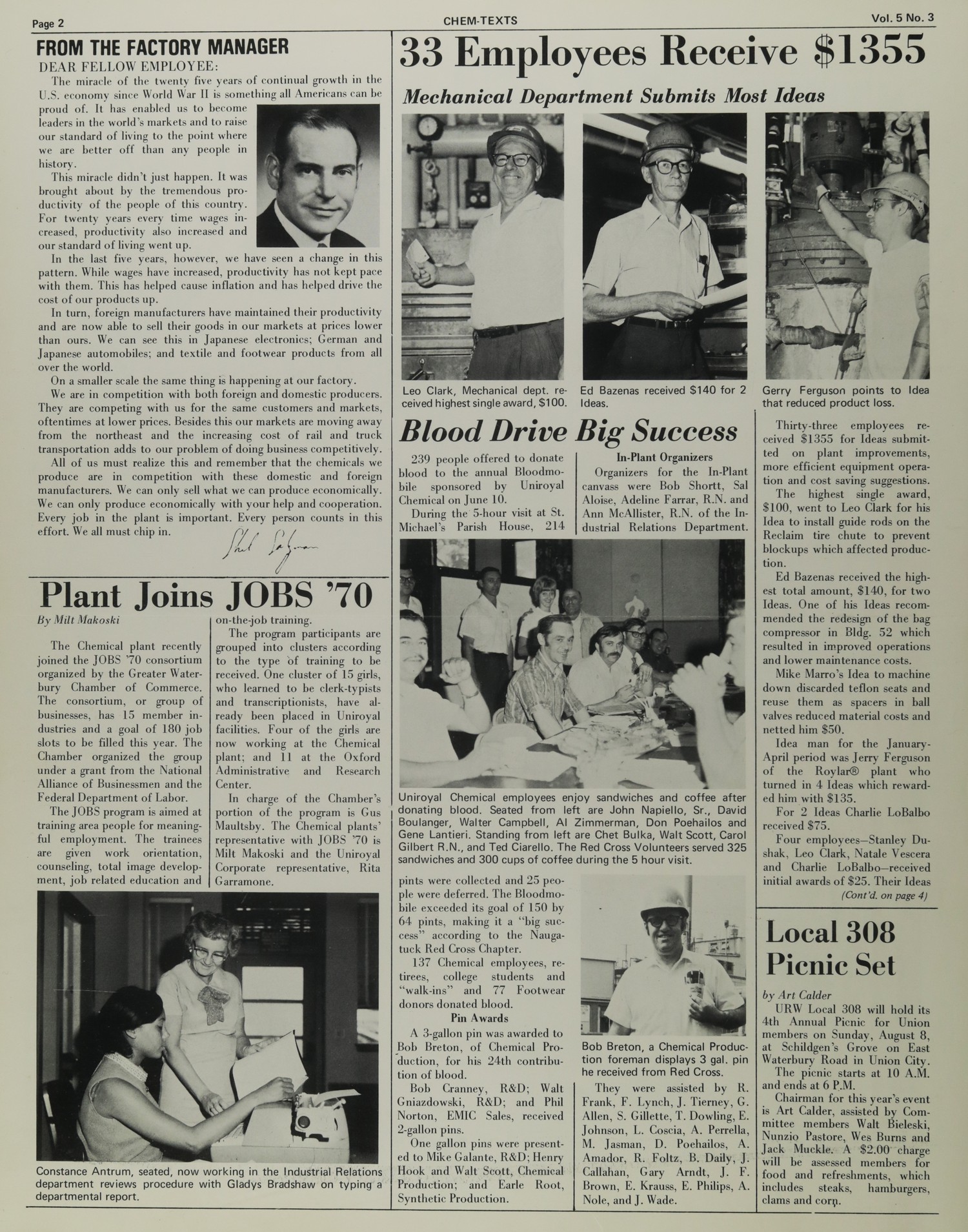
Eric Johnson, Factory Manager, congratulates plant people for their 40th anniversary of service with the company. They received an Atmos LeCoultre Perpetual Motion clock for their service. From left are Julius Grabowski, Johnson, Martin O’Brien and James Carroll.

[IMAGE: Group photo]

Plant personnel inducted into the 30 year service group by the Factory Manager, Eric Johnson, are from left to right, George LaRose, Hilda Moura, Johnson, and Samuel Mastrosimone.

[IMAGE: Group photo]

New 25 Year Club members, Arnold Nori, left, and Guiseppe Iannuzzi, right, are welcomed into the Twenty-Five Year Club by Eric Johnson, center.

[IMAGE: Individual portrait]

Theodore Cesarczyk is honored for his advancement into the 30 year group.


Forty six people were recently honored for their twenty five years or more service with the Uniroyal Chemical division.

Seventeen who attained twenty five years of service were inducted into the Uniroyal Chemical Twenty Five Year Service Club; eight were made members of the Thirty Year group; twelve were honored for their Thirty-Five Years service; and seven were named to the Forty Year group.

The forty year members were presented with LeCoultre Atmos Perpetual Motion clocks which are powered by the earth’s rotational movement. The clocks have a value of over $425.

Of the 1120 employees in the Chemical Company approximately 750 have more than 25 years of service. This represents close to 70% of the present personnel.

40 Years Service

James S. Carroll, Edna C. Crycheau, Harold R. Dibble, John J. Dunn, Julius V. Grabowski, Donald R. Nelson, Martin F. O’Brien, Joseph D. Rourk—(U.S. Steel) and Adele A. Schwenk.

35 Years Service

Vivian G. Abel, William E. Detlefsen, Deolinda V. Fernandes, Chester E. Janicki, Edmund J. Levandauskas, George LaRose, Samuel Mastrosimone, Hilda L. Moura, Dr. Vadim C. Neklutin, James J. Nolan, Paul E. Reed and Frank S. Sterniak.

30 Years Service

Dr. Roger W. Amidon, Theodore Cesarczyk, Edward J. Chrostowski, Joseph L. Finke, William H. Leukhardt Jr., Gordon H. Madge, William H. Schmelcke and Otto E. Wenger.

25 Years Service

Miquel Arroyo, Louis M. DeLaRosa, Raymond A. Gogolewski, Marcel H. Hebert, Giuseppe Iannuzzi, William F. Kenney, Sophie Kuzminskas, Helen S. Lavery, William J. Mitrulevich, Frank M. Morgan, Arnold E. Nori, Walter F. Nystrom, Norman C. Owens, Irwin A. Prager, Matthew T. Ryan, Theodore J. Shevzov and James B. Whittum (ret.).


Home Health Care Under Medicare

One of the least known benefits covered by Medicare, but one potentially valuable to many people, is home health care.

Home health care can be covered under either Medicare hospital insurance or Medicare medical insurance, depending on the circumstances of a particular case.

Home health care is for people who do not need full-time skilled care as inpatients of a medical facility, but who do have an illness or injury that prevents them from leaving home to receive the health care they need.

For further information on Home Health Care call the Social Security office in Waterbury, 756-7475.


Stride Rite Corp. to Purchase Footwear

Uniroyal, Inc. and The Stride Rite Corporation have agreed in principle to the sale of a substantial portion of the assets of Uniroyal’s domestic footwear business including certain brand names, accounts receivable and inventory to a corporation that will be newly formed by Stride Rite. The purchase price and other terms of the agreement have not been disclosed but it is anticipated that a definitive agreement will be executed in the near future and the transaction will be consummated shortly thereafter.

The new corporation will distribute and sell Keds, PRO-Keds, Sperry Top-Sider and Grasshoppers footwear in the United States and Canada.

Uniroyal will continue to produce shoes for the purchaser in its Dublin and Thomson, Ga. plants.

Uniroyal will retain its U.S. industrial waterproof footwear and clothing business, and its Royal Red Ball line of hunting and fishing clothing and waterproof footwear. The Company also will continue to operate its footwear business in Europe, Latin America and Asia.

Stride Rite currently markets footwear nationally and, through its newly formed corporation, plans vigorous promotion of the footwear brands to increase their market share.


Tire Plants Sold

Uniroyal, Inc. and the Continental Gummi Werke AG, the largest tire company in Germany, have reached an agreement by which Continental will acquire Uniroyal’s tire businesses in Europe. Included in the transaction are Uniroyal’s tire plants in Germany, France, Belgium and the United Kingdom and a textile plant in Luxembourg. The sale is subject to the approvals of the Boards of Directors of both companies.

Continental, which has been a licensee of Uniroyal tire technology for many years, will under a trademark license from Uniroyal and technical exchange agreements, manufacture and sell Uniroyal brand tires in Europe and will aggressively market them through Uniroyal’s present distribution system, providing the same high level of quality and service to Uniroyal’s customers.

The sale will provide funds for Uniroyal’s redeployment of assets program which stresses reinvestment in better growth and profit potential areas.


“A committee is a group that keeps minutes and loses hours.”
—Milton Berle


Bldg. 28 Plan Saves $4000 in Steam

In March, Bldg. 28 personnel made a major change in plant operating policy that resulted in significant steam savings. Past practice in the plant has been to turn steam onto vessels and tracer lines and to leave the steam on. The reason was simple: with literally hundreds of steam lines in each building, it was impossible to determine what steam could be shut off in a given situation.

New Tag System

In Bldg. 28 a plan was initiated to change this. All the steam lines and traps were tagged and the operating procedures are being written that will instruct the operators just what steam lines are needed for each product. If steam is not needed, it is shut off. This change requires participation by everyone involved.

3,500,000 lbs. of Steam Saved

The savings incurred in Bldg. 28 for the month of March show how successful this policy can be. In March of 1976 over 5,000,000 lbs. of steam were used compared to only 1,500,000 lbs. in March 1979. This dramatic drop in steam consumption resulted in savings of $4,000 for March.

Contributing to this effort were: John Gilbert, Process Engineer; Frank Commendatore, Foreman; Dick Valentine, Department Manager; John Pearson, Piper; and Bldg. Operators: Domenic Persutti, Angelo Taylor, Walt Scott, Henry Hook, Frank Maffia, Lee Respass, and Sal Commendatore.


One Step at a Time

A journey of a thousand miles begins with one step. If you face a task today that is so long or so hard that it seems to be a journey of a thousand miles, remember that it still begins with one step. Take that one step, and the next, and then the next. Don’t look too far ahead if it is a poor view. Look at it now, and meet each day as it comes without borrowing trouble from tomorrow. Anyone can take one step. And if you keep taking one step at a time, you can get through even a journey of a thousand miles.


UNIROYAL, INC. COMMON STOCK PRICES

[CHART: Stock price graph showing prices from months 1-31, with price scale showing values from 0 to 8, with markers at 7/8, 3/4, 5/8, 1/2, 3/8, 1/4, 1/8 intervals]

May—1979

CHEM-TEXTS – 1979-v13-s285

Page 285

CHEM-TEXTS

Page 2 | Vol. 13, 1979


1978 was a Good Year . . .

You and I know our Company is starting to generate an upward momentum as illustrated by the outstanding performance of the Naugatuck Plant and the Chemical Company in 1978. The Chemical Company profits exceeded all expectations last year and our Plant’s gross operating profit increased 58%.

This outstanding achievement is the result of your efforts whether you are in Manufacturing, Research and Development, Accounting, D&S, the Service Departments, or Marketing.

Our plant’s goal is to have a 30% plant operating profit that would result in a 9% return on sales. This year our objective is to increase the return on sales from 3 to 4.5%.

How do we expect to achieve our profitability objective? The answer to this question is reflected in the achievements of last year.

In the Maintenance Department an outstanding job was performed in reducing equipment downtime from 8.9 to 7.5%. Their 1979 goal is 6% and January was an excellent start with downtime averaging 4.5%.

Manufacturing set productivity records in the production of Rubber Chemicals, Agricultural Chemicals, and Thermoplastics. Omite, LVBI, Tonox, and TPR productivities increased between 20 and 30% while PANA and Naugard 445 improved by 66%. Also a reduction in Roylar changeovers was achieved through better coordination and communications. In addition, Comite, Octamine P, Celogen RA, and Polygard I were successfully produced in the Plant. All these achievements resulted in increasing our plant’s profit by 1.6 million dollars.

Our Industrial Relations Department was reorganized and is more effective in serving our needs. Safety Goals were far exceeded with 1.2 incidence rate and Workmen’s Compensation costs were reduced by $165,000. A new performance appraisal system was initiated and a training session held to help managers conduct performance appraisals with their people.

A Controllers Department was established to perform financial reporting, budgeting, forecasting, and economic analysis; to expedite approvals of Appropriation Requests; and to identify areas of profit improvement.

The Technical Department now includes all engineering functions: process, project, environmental, and industrial engineering. 2.3 million dollars of profit improvement was realized through developing a team effort with the plant, R & D, and marketing. This year a similar amount is expected through Project Enterprise, the name of our 1979 Profit Improvement Program. Over $300,000 was saved through the work of the Plant’s Energy Committee. Other contributions by the Technical Department included the productivity records set in Rubber Chemicals and Omite as well as the successful production of Comite, Octamine P, Celogen RA, and Polygard I.

In the Material Flow Department transportation credits exceeded budget by $13,000. An additional $532,000 was saved through improved transportation of our finished goods. Shipping and receiving increased productivity by 7% and improved the services on export shipments. The Purchasing Department and Control Center reduced our inventory levels thereby increasing our return on assets. Purchasing savings and cost avoidance programs exceeded expectations by $400,000 dollars.

A major objective is to improve the utilization of our plant by introducing new products in our existing facilities or attracting new manufacturing facilities because our resources are underutilized. For example, we are using only 50% of our steam generation and waste water treatment capacities while Rubber Chemicals is budgeted to operate only between 60-65% of capacity this year. If Rubber Chemical production operated at 90% of capacity, our plant’s operating profit would increase to approximately 27%. On some recent data it appears that a 10% selling price increase would have the same impact as a 30% cost reduction.

1978 was a year of change and accomplishment. We have the reputation of managing our business. Naugatuck seeks change. We are determined to overcome our geographical raw material disadvantage through PROFESSIONAL EXCELLENCE in every assignment and job that is performed.

In 1979 Naugatuck will be a Better Place To Be and soon the Best Place To Be.

Eric Johnson

Eric Johnson
Factory Manager


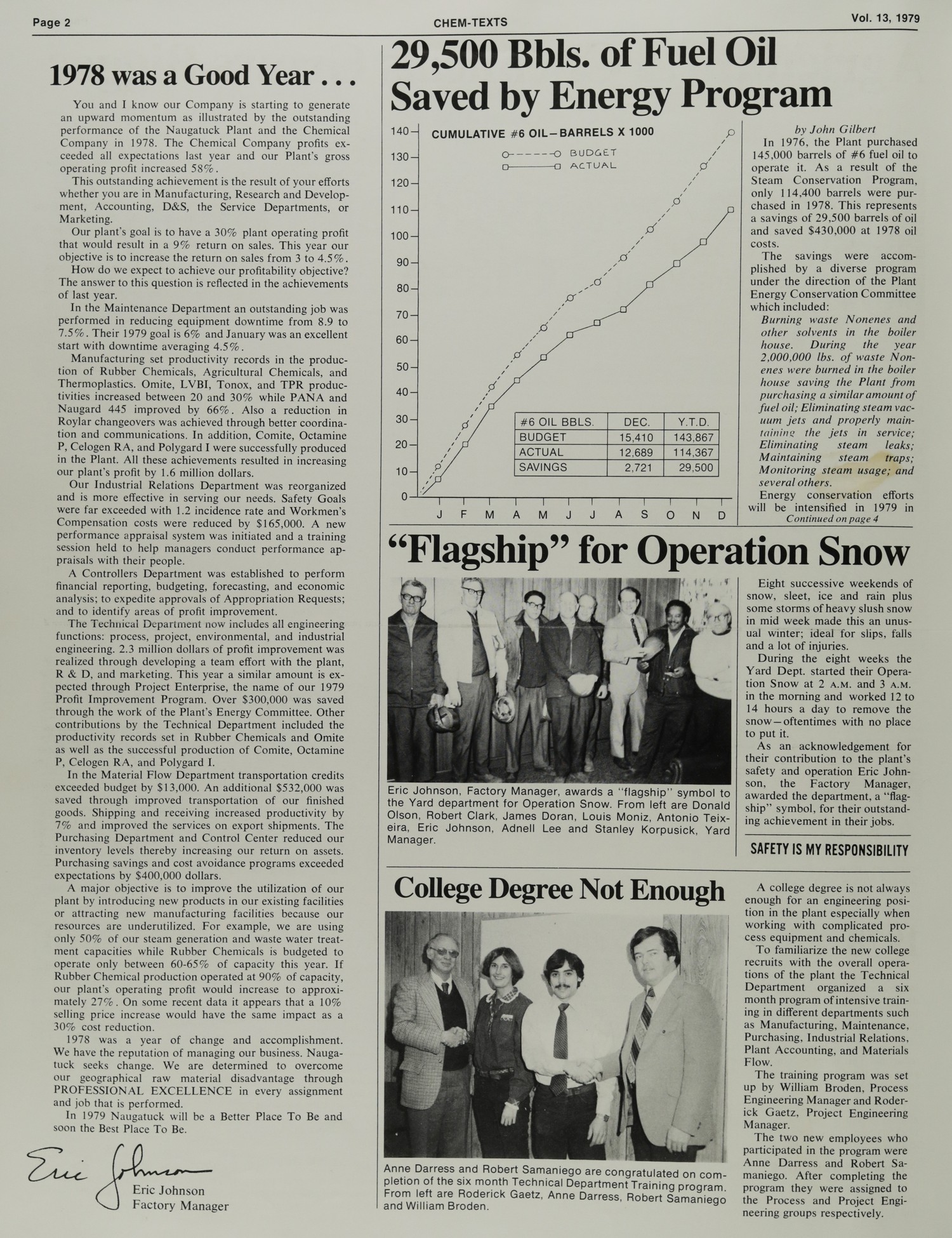
29,500 Bbls. of Fuel Oil Saved by Energy Program

CUMULATIVE #6 OIL—BARRELS X 1000

[CHART showing declining oil usage from January through December, with lines for BUDGET and ACTUAL usage, ranging from approximately 140 to 0]

#6 OIL BBLS. DEC. Y.T.D.
BUDGET 15,410 143,867
ACTUAL 12,689 114,367
SAVINGS 2,721 29,500

by John Gilbert

In 1976, the Plant purchased 145,000 barrels of #6 fuel oil to operate it. As a result of the Steam Conservation Program, only 114,400 barrels were purchased in 1978. This represents a savings of 29,500 barrels of oil and saved $430,000 at 1978 oil costs.

The savings were accomplished by a diverse program under the direction of the Plant Energy Conservation Committee which included:

Burning waste Nonenes and other solvents in the boiler house. During the year 2,000,000 lbs. of waste Nonenes were burned in the boiler house saving the Plant from purchasing a similar amount of fuel oil; Eliminating steam vacuum jets and properly maintaining the jets in service; Eliminating steam leaks; Maintaining steam traps; Monitoring steam usage; and several others.

Energy conservation efforts will be intensified in 1979 in Continued on page 4


“Flagship” for Operation Snow

[PHOTOGRAPH of seven men in business attire standing together]

Eric Johnson, Factory Manager, awards a “flagship” symbol to the Yard department for Operation Snow. From left are Donald Olson, Robert Clark, James Doran, Louis Moniz, Antonio Teixeira, Eric Johnson, Adnell Lee and Stanley Korpusick, Yard Manager.

Eight successive weekends of snow, sleet, ice and rain plus some storms of heavy slush snow in mid week made this an unusual winter; ideal for slips, falls and a lot of injuries.

During the eight weeks the Yard Dept. started their Operation Snow at 2 A.M. and 3 A.M. in the morning and worked 12 to 14 hours a day to remove the snow—oftentimes with no place to put it.

As an acknowledgement for their contribution to the plant’s safety and operation Eric Johnson, the Factory Manager, awarded the department, a “flagship” symbol, for their outstanding achievement in their jobs.


SAFETY IS MY RESPONSIBILITY


College Degree Not Enough

[PHOTOGRAPH of four people, three men and one woman, standing together]

Anne Darress and Robert Samaniego are congratulated on completion of the six month Technical Department Training program. From left are Roderick Gaetz, Anne Darress, Robert Samaniego and William Broden.

A college degree is not always enough for an engineering position in the plant especially when working with complicated process equipment and chemicals.

To familiarize the new college recruits with the overall operations of the plant the Technical Department organized a six month program of intensive training in different departments such as Manufacturing, Maintenance, Purchasing, Industrial Relations, Plant Accounting, and Materials Flow.

The training program was set up by William Broden, Process Engineering Manager and Roderick Gaetz, Project Engineering Manager.

The two new employees who participated in the program were Anne Darress and Robert Samaniego. After completing the program they were assigned to the Process and Project Engineering groups respectively.

CHEM-TEXTS – 1978 – Page 4

Page 004

Page 4 CHEM-TEXTS Volume 12, 1978

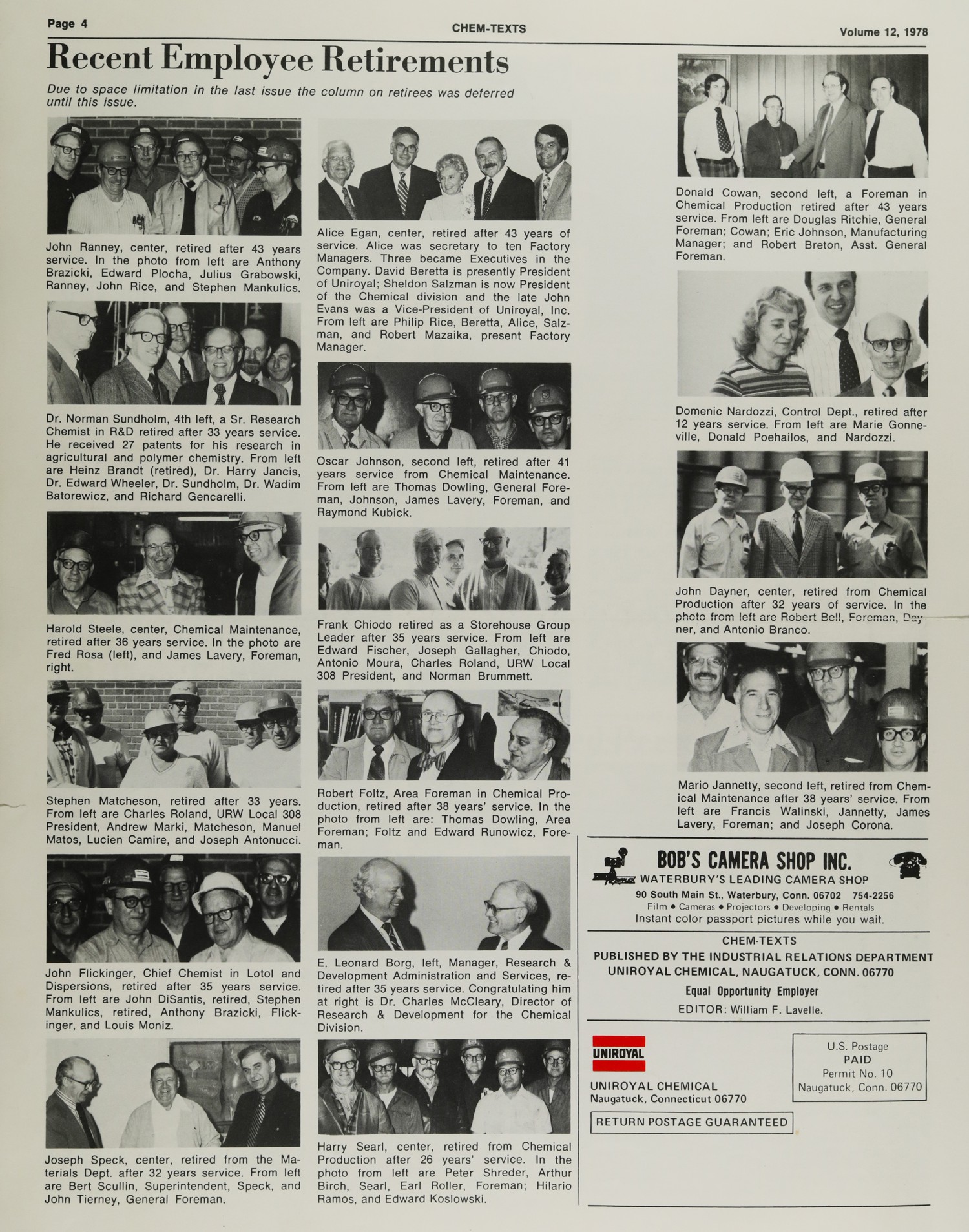
Recent Employee Retirements

Due to space limitation in the last issue the column on retirees was deferred until this issue.


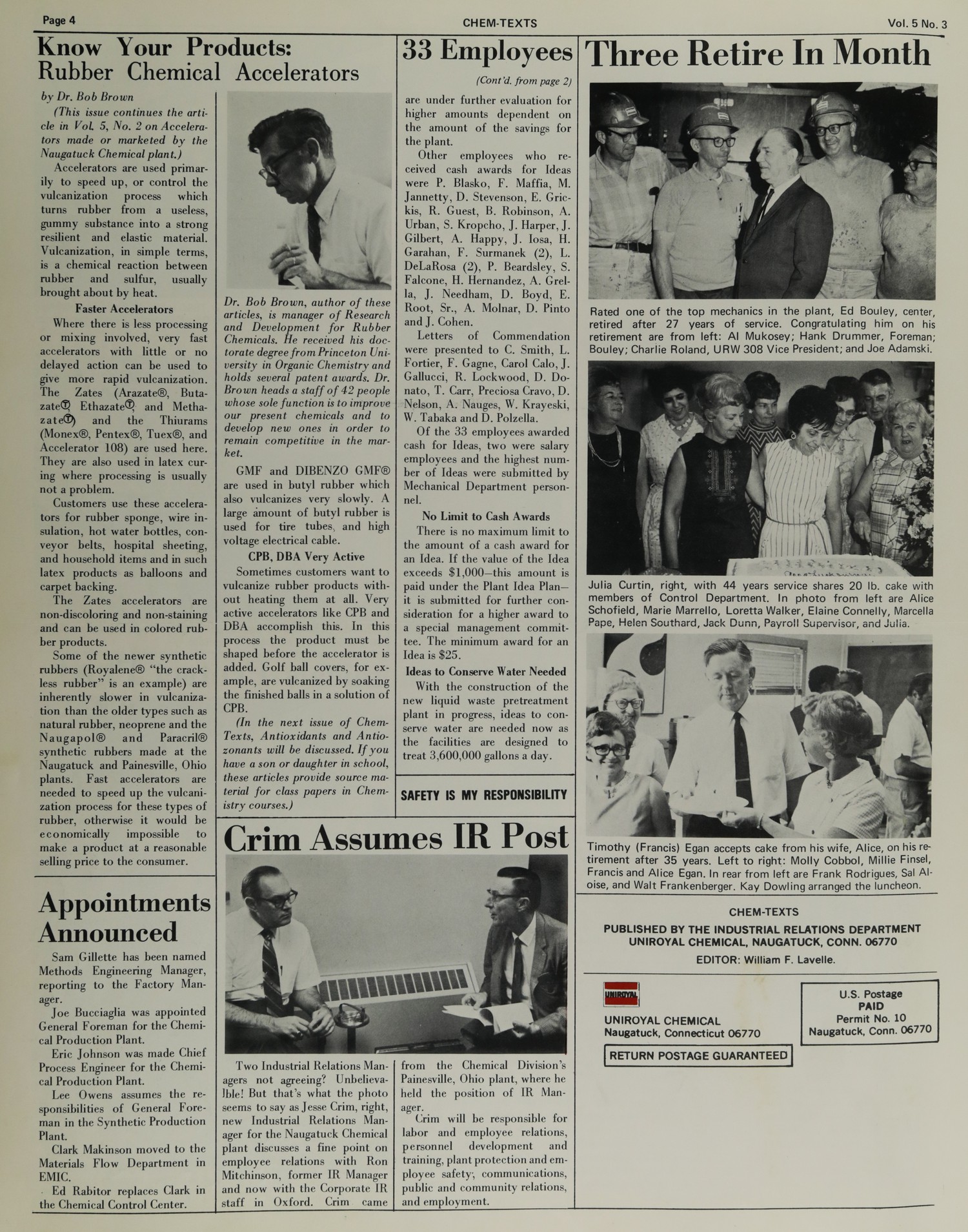
John Ranney, center, retired after 43 years service. In the photo from left are Anthony Brazicki, Edward Plocha, Julius Grabowski, Ranney, John Rice, and Stephen Mankulics.


Alice Egan, center, retired after 43 years of service. Alice was secretary to ten Factory Managers. Three became Executives in the Company. David Beretta is presently President of Uniroyal; Sheldon Salzman is now President of the Chemical division and the late John Evans was a Vice-President of Uniroyal, Inc. From left are Philip Rice, Beretta, Alice, Salzman, and Robert Mazaika, present Factory Manager.


Donald Cowan, second left, a Foreman in Chemical Production retired after 43 years service. From left are Douglas Ritchie, General Foreman; Cowan; Eric Johnson, Manufacturing Manager; and Robert Breton, Asst. General Foreman.


Dr. Norman Sundholm, 4th left, a Sr. Research Chemist in R&D retired after 33 years service. He received 27 patents for his research in agricultural and polymer chemistry. From left are Heinz Brandt (retired), Dr. Harry Jancis, Dr. Edward Wheeler, Dr. Sundholm, Dr. Wadim Batorewicz, and Richard Gencarelli.


Oscar Johnson, second left, retired after 41 years service from Chemical Maintenance. From left are Thomas Dowling, General Foreman, Johnson, James Lavery, Foreman, and Raymond Kubick.


Domenic Nardozzi, Control Dept., retired after 12 years service. From left are Marie Gonneville, Donald Poehailos, and Nardozzi.


Harold Steele, center, Chemical Maintenance, retired after 36 years service. In the photo are Fred Rosa (left), and James Lavery, Foreman, right.


Frank Chiodo retired as a Storehouse Group Leader after 35 years service. From left are Edward Fischer, Joseph Gallagher, Chiodo, Antonio Moura, Charles Roland, URW Local 308 President, and Norman Brummett.


John Dayner, center, retired from Chemical Production after 32 years of service. In the photo from left are Robert Bell, Foreman, Dayner, and Antonio Branco.


Stephen Matcheson, retired after 33 years. From left are Charles Roland, URW Local 308 President, Andrew Marki, Matcheson, Manuel Matos, Lucien Camire, and Joseph Antonucci.


Robert Foltz, Area Foreman in Chemical Production, retired after 38 years’ service. In the photo from left are: Thomas Dowling, Area Foreman; Foltz and Edward Runowicz, Foreman.


Mario Jannetty, second left, retired from Chemical Maintenance after 38 years’ service. From left are Francis Walinski, Jannetty, James Lavery, Foreman; and Joseph Corona.


John Flickinger, Chief Chemist in Lotol and Dispersions, retired after 35 years service. From left are John DiSantis, retired, Stephen Mankulics, retired, Anthony Brazicki, Flickinger, and Louis Moniz.


E. Leonard Borg, left, Manager, Research & Development Administration and Services, retired after 35 years service. Congratulating him at right is Dr. Charles McCleary, Director of Research & Development for the Chemical Division.


BOB’S CAMERA SHOP INC.
WATERBURY’S LEADING CAMERA SHOP
90 South Main St., Waterbury, Conn. 06702 754-2256
Film ● Cameras ● Projectors ● Developing ● Rentals
Instant color passport pictures while you wait.


Joseph Speck, center, retired from the Materials Dept. after 32 years service. From left are Bert Scullin, Superintendent, Speck, and John Tierney, General Foreman.


Harry Searl, center, retired from Chemical Production after 26 years’ service. In the photo from left are Peter Shreder, Arthur Birch, Searl, Earl Roller, Foreman; Hilario Ramos, and Edward Koslowski.


CHEM-TEXTS
PUBLISHED BY THE INDUSTRIAL RELATIONS DEPARTMENT
UNIROYAL CHEMICAL, NAUGATUCK, CONN. 06770
Equal Opportunity Employer
EDITOR: William F. Lavelle.


UNIROYAL

UNIROYAL CHEMICAL
Naugatuck, Connecticut 06770

RETURN POSTAGE GUARANTEED

U.S. Postage
PAID
Permit No. 10
Naugatuck, Conn. 06770

CHEM-TEXTS – 1978-v12-s269

Page 269

CHEM-TEXTS

Page 2 | Volume 12, 1978


Direction ’79 . . .

We all wish Bob Mazaika the best of success with his new promotion. His accomplishments have made us the “Flagship” of the Uniroyal Chemical Company and the Naugatuck Plant a “Better Place To Be”. Through his leadership, our plant is cleaner, safer and more profitable. Our future is therefore more promising. We would like to congratulate Bob for a job well done.

During 1978, our business operation improved as a result of our “Better Place To Be” theme and the utilization of Management Action Plans to remove impediments and accomplish major objectives and projects. Our credibility increased and so did our profit. This results in better job security.

We have the reputation of managing our business and being helpful to others in managing their businesses. We are determined to continue this improved performance in 1979. This is the only way we can overcome our geographical raw material and energy costs disadvantages. Our competitive strengths as a Chemical Plant located in the Northeast must come from PROFESSIONAL EXCELLENCE in every assignment and job that is performed. We should remove double standards, inefficient work practices, develop mutual respect and improve communications in all aspects of our operations.

In 1979, we will continue to make our Plant a “Better Place To Be”, improve our credibility, increase our operating profit and provide job security. We will use increments of 120 day objectives coordinated by Action Plans to achieve our 1-3 Goals and implement our product and operating strategies.

As a concluding comment, I would like to mention that future editorial columns may have comments from various guest writers dedicated to employee information and concerns. We invite you to contact us if you have an appropriate subject to write about.

Eric Johnson

Eric Johnson
Factory Manager


Ritchie Heads Chemical

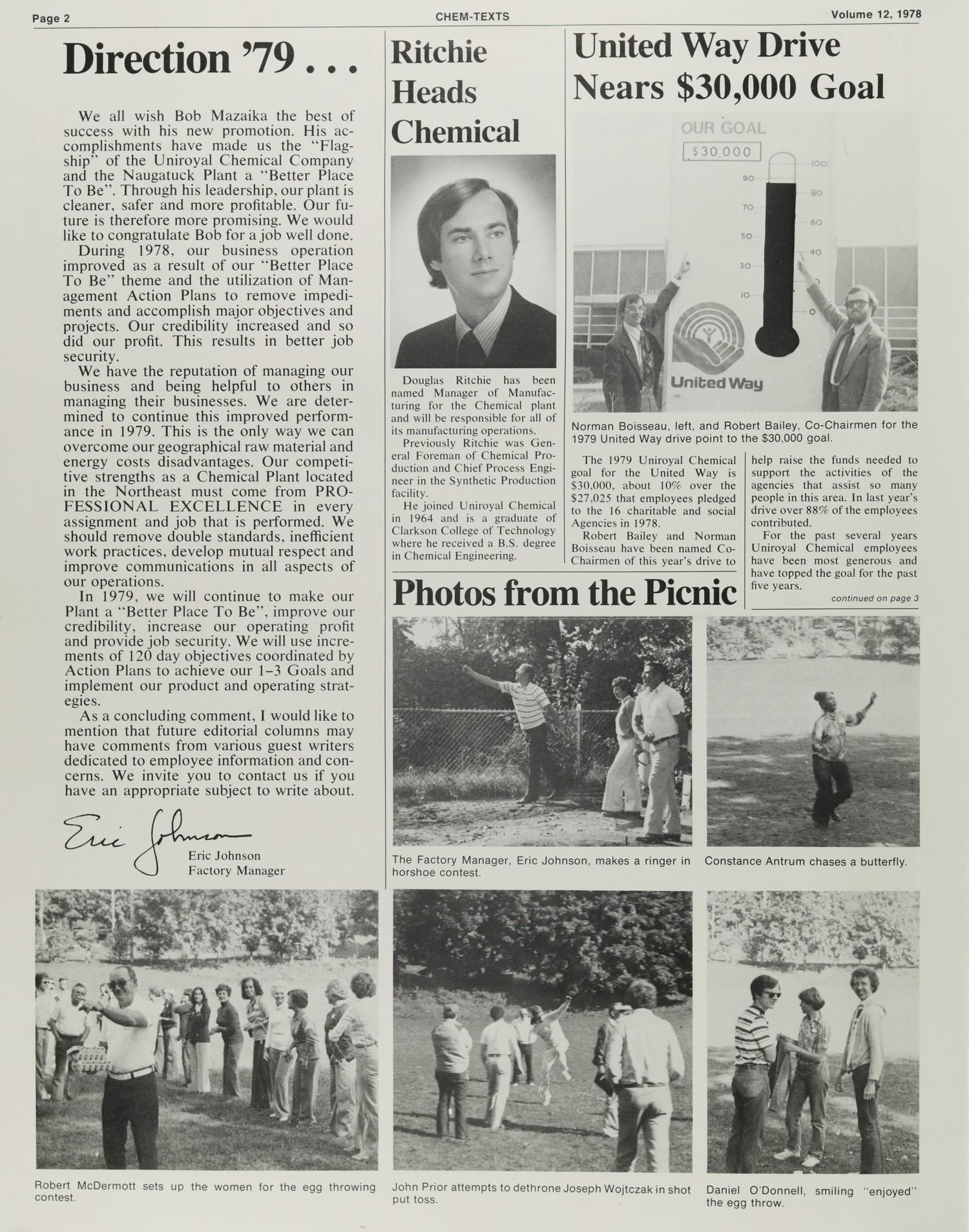
Douglas Ritchie has been named Manager of Manufacturing for the Chemical plant and will be responsible for all of its manufacturing operations.

Previously Ritchie was General Foreman of Chemical Production and Chief Process Engineer in the Synthetic Production facility.

He joined Uniroyal Chemical in 1964 and is a graduate of Clarkson College of Technology where he received a B.S. degree in Chemical Engineering.


United Way Drive Nears $30,000 Goal

OUR GOAL
$30,000

[Thermometer chart showing progress toward goal with markers at 10, 20, 30, 40, 50, 60, 70, 80, 90, 100]

United Way

Norman Boisseau, left, and Robert Bailey, Co-Chairmen for the 1979 United Way drive point to the $30,000 goal.

The 1979 Uniroyal Chemical goal for the United Way is $30,000, about 10% over the $27,025 that employees pledged to the 16 charitable and social Agencies in 1978.

Robert Bailey and Norman Boisseau have been named Co-Chairmen of this year’s drive to help raise the funds needed to support the activities of the agencies that assist so many people in this area. In last year’s drive over 88% of the employees contributed.

For the past several years Uniroyal Chemical employees have been most generous and have topped the goal for the past five years.

continued on page 3


Photos from the Picnic

The Factory Manager, Eric Johnson, makes a ringer in horshoe contest.

Constance Antrum chases a butterfly.

Robert McDermott sets up the women for the egg throwing contest.

John Prior attempts to dethrone Joseph Wojtczak in shot put toss.

Daniel O’Donnell, smiling “enjoyed” the egg throw.

CHEM-TEXTS – 1978-v12-s265

Page 265

Page 2 | CHEM-TEXTS | Volume 12, 1978


The First Six Months…

Another summer vacation is upon us and most of us are looking forward to some well-deserved rest and relaxation.

This time of year also means, however, that the year 1978 is half over, and we will soon be approaching 1979. The first half of 1978 has been a good one for the Naugatuck Plant. Although our rubber chemical sales are not what was expected, all of our other products are running ahead of our forecasts. Many changes have occurred during the first six months of 1978’s campaign to make Naugatuck a “better place to be” and we’re looking forward to continuing the program during the second half of the year. All of the suggestions that have been made by anyone are being looked at and will be implemented, if at all possible. I think that we have indeed achieved a good start in making Naugatuck a better place to be.

The first six months has also seen our safety record improve dramatically over last year and all we need to do now is to keep it going! Please be careful on your vacation and come back to work determined to keep our safety record improving during the second half of the year also.

Our energy committee has been hard at work during the first part of the year and has been very successful in reducing our use of energy throughout the plant, but with the anticipated increase in oil next year, all of us will have to help in the conservation of energy. Every light that is turned off when not needed, or steam leak that is repaired quickly, helps us keep our energy costs down.

I’m looking forward to the rest of 1978 and am sure that we are well on our way to becoming the “Flagship” of UNIROYAL Chemical.


TB Tine Test Given

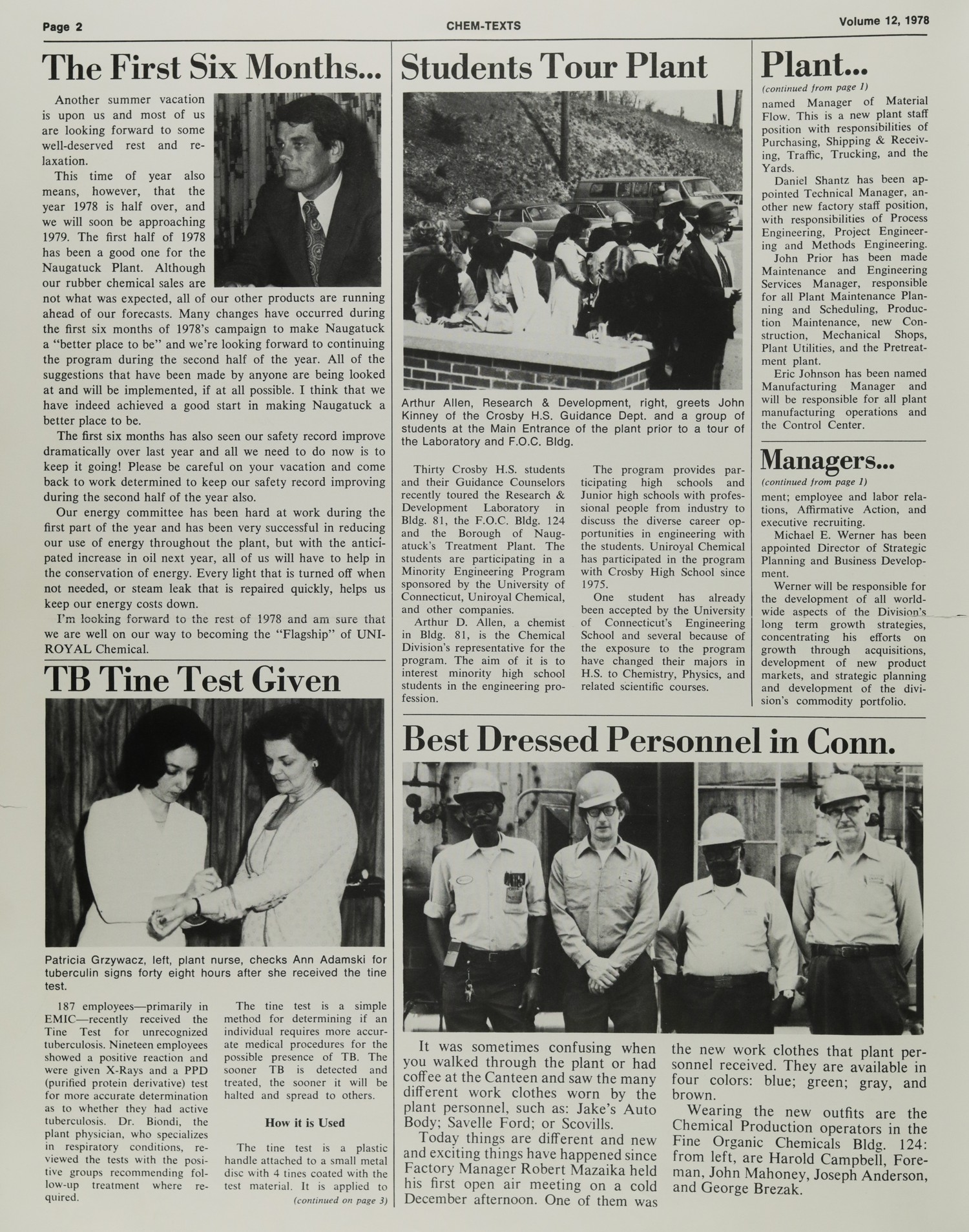
[IMAGE: Patricia Grzywacz, left, plant nurse, checks Ann Adamski for tuberculin signs forty eight hours after she received the tine test.]

187 employees—primarily in EMIC—recently received the Tine Test for unrecognized tuberculosis. Nineteen employees showed a positive reaction and were given X-Rays and a PPD (purified protein derivative) test for more accurate determination as to whether they had active tuberculosis. Dr. Biondi, the plant physician, who specializes in respiratory conditions, reviewed the tests with the positive groups recommending follow-up treatment where required.

The tine test is a simple method for determining if an individual requires more accurate medical procedures for the possible presence of TB. The sooner TB is detected and treated, the sooner it will be halted and spread to others.

How it is Used

The tine test is a plastic handle attached to a small metal disc with 4 tines coated with the test material. It is applied to

(continued on page 3)


Students Tour Plant

[IMAGE: Arthur Allen, Research & Development, right, greets John Kinney of the Crosby H.S. Guidance Dept. and a group of students at the Main Entrance of the plant prior to a tour of the Laboratory and F.O.C. Bldg.]

Thirty Crosby H.S. students and their Guidance Counselors recently toured the Research & Development Laboratory in Bldg. 81, the F.O.C. Bldg. 124 and the Borough of Naugatuck’s Treatment Plant. The students are participating in a Minority Engineering Program sponsored by the University of Connecticut, Uniroyal Chemical, and other companies.

Arthur D. Allen, a chemist in Bldg. 81, is the Chemical Division’s representative for the program. The aim of it is to interest minority high school students in the engineering profession.

The program provides participating high schools and Junior high schools with professional people from industry to discuss the diverse career opportunities in engineering with the students. Uniroyal Chemical has participated in the program with Crosby High School since 1975.

One student has already been accepted by the University of Connecticut’s Engineering School and several because of the exposure to the program have changed their majors in H.S. to Chemistry, Physics, and related scientific courses.


Plant…

(continued from page 1)

named Manager of Material Flow. This is a new plant staff position with responsibilities of Purchasing, Shipping & Receiving, Traffic, Trucking, and the Yards.

Daniel Shantz has been appointed Technical Manager, another new factory staff position, with responsibilities of Process Engineering, Project Engineering and Methods Engineering.

John Prior has been made Maintenance and Engineering Services Manager, responsible for all Plant Maintenance Planning and Scheduling, Production Maintenance, new Construction, Mechanical Shops, Plant Utilities, and the Pretreatment plant.

Eric Johnson has been named Manufacturing Manager and will be responsible for all plant manufacturing operations and the Control Center.


Managers…

(continued from page 1)

ment; employee and labor relations, Affirmative Action, and executive recruiting.

Michael E. Werner has been appointed Director of Strategic Planning and Business Development.

Werner will be responsible for the development of all worldwide aspects of the Division’s long term growth strategies, concentrating his efforts on growth through acquisitions, development of new product markets, and strategic planning and development of the division’s commodity portfolio.


Best Dressed Personnel in Conn.

[IMAGE: Four workers wearing new work clothes/uniforms]

It was sometimes confusing when you walked through the plant or had coffee at the Canteen and saw the many different work clothes worn by the plant personnel, such as: Jake’s Auto Body; Savelle Ford; or Scovills.

Today things are different and new and exciting things have happened since Factory Manager Robert Mazaika held his first open air meeting on a cold December afternoon. One of them was the new work clothes that plant personnel received. They are available in four colors: blue; green; gray, and brown.

Wearing the new outfits are the Chemical Production operators in the Fine Organic Chemicals Bldg. 124: from left, are Harold Campbell, Foreman, John Mahoney, Joseph Anderson, and George Brezak.

CHEM-TEXTS – 1978-v12-i03-s268

Page 268

Merry Christmas – Happy New Year

UNIROYAL CHEM-TEXTS

Vol. 12, 1978 | PUBLISHED FOR THE PEOPLE OF UNIROYAL CHEMICAL | No. 3


Johnson, Factory Manager

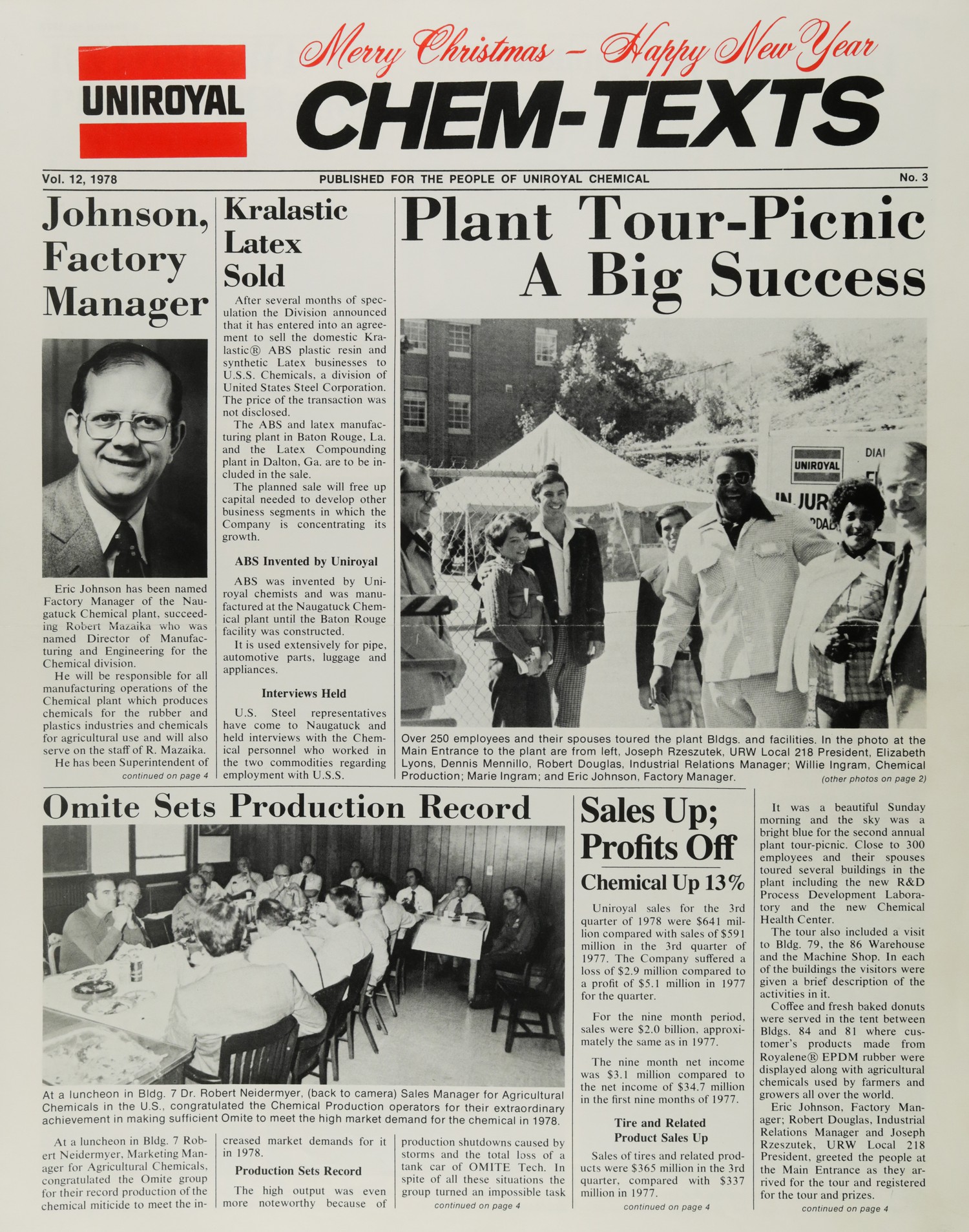
Eric Johnson has been named Factory Manager of the Naugatuck Chemical plant, succeeding Robert Mazaika who was named Director of Manufacturing and Engineering for the Chemical division.

He will be responsible for all manufacturing operations of the Chemical plant which produces chemicals for the rubber and plastics industries and chemicals for agricultural use and will also serve on the staff of R. Mazaika. He has been Superintendent of
continued on page 4


Kralastic Latex Sold

After several months of speculation the Division announced that it has entered into an agreement to sell the domestic Kralastic® ABS plastic resin and synthetic Latex businesses to U.S.S. Chemicals, a division of United States Steel Corporation. The price of the transaction was not disclosed.

The ABS and latex manufacturing plant in Baton Rouge, La. and the Latex Compounding plant in Dalton, Ga. are to be included in the sale.

The planned sale will free up capital needed to develop other business segments in which the Company is concentrating its growth.

ABS Invented by Uniroyal

ABS was invented by Uniroyal chemists and was manufactured at the Naugatuck Chemical plant until the Baton Rouge facility was constructed.

It is used extensively for pipe, automotive parts, luggage and appliances.

Interviews Held

U.S. Steel representatives have come to Naugatuck and held interviews with the Chemical personnel who worked in the two commodities regarding employment with U.S.S.


Plant Tour-Picnic A Big Success

Over 250 employees and their spouses toured the plant Bldgs. and facilities. In the photo at the Main Entrance to the plant are from left, Joseph Rzeszutek, URW Local 218 President, Elizabeth Lyons, Dennis Mennillo, Robert Douglas, Industrial Relations Manager; Willie Ingram, Chemical Production; Marie Ingram; and Eric Johnson, Factory Manager. (other photos on page 2)

It was a beautiful Sunday morning and the sky was a bright blue for the second annual plant tour-picnic. Close to 300 employees and their spouses toured several buildings in the plant including the new R&D Process Development Laboratory and the new Chemical Health Center.

The tour also included a visit to Bldg. 79, the 86 Warehouse and the Machine Shop. In each of the buildings the visitors were given a brief description of the activities in it.

Coffee and fresh baked donuts were served in the tent between Bldgs. 84 and 81 where customer’s products made from Royalene® EPDM rubber were displayed along with agricultural chemicals used by farmers and growers all over the world.

Eric Johnson, Factory Manager; Robert Douglas, Industrial Relations Manager and Joseph Rzeszutek, URW Local 218 President, greeted the people at the Main Entrance as they arrived for the tour and registered for the tour and prizes.
continued on page 4


Omite Sets Production Record

At a luncheon in Bldg. 7 Dr. Robert Neidermyer, (back to camera) Sales Manager for Agricultural Chemicals in the U.S., congratulated the Chemical Production operators for their extraordinary achievement in making sufficient Omite to meet the high market demand for the chemical in 1978.

At a luncheon in Bldg. 7 Robert Neidermyer, Marketing Manager for Agricultural Chemicals, congratulated the Omite group for their record production of the chemical miticide to meet the increased market demands for it in 1978.

Production Sets Record

The high output was even more noteworthy because of production shutdowns caused by storms and the total loss of a tank car of OMITE Tech. In spite of all these situations the group turned an impossible task
continued on page 4


Sales Up; Profits Off

Chemical Up 13%

Uniroyal sales for the 3rd quarter of 1978 were $641 million compared with sales of $591 million in the 3rd quarter of 1977. The Company suffered a loss of $2.9 million compared to a profit of $5.1 million in 1977 for the quarter.

For the nine month period, sales were $2.0 billion, approximately the same as in 1977.

The nine month net income was $3.1 million compared to the net income of $34.7 million in the first nine months of 1977.

Tire and Related Product Sales Up

Sales of tires and related products were $365 million in the 3rd quarter, compared with $337 million in 1977.
continued on page 4

CHEM-TEXTS – 1977-v11-s259

Page 259

CHEM-TEXTS

Page 4 Vol. 11, 1977


Seven Retire

[PHOTO]

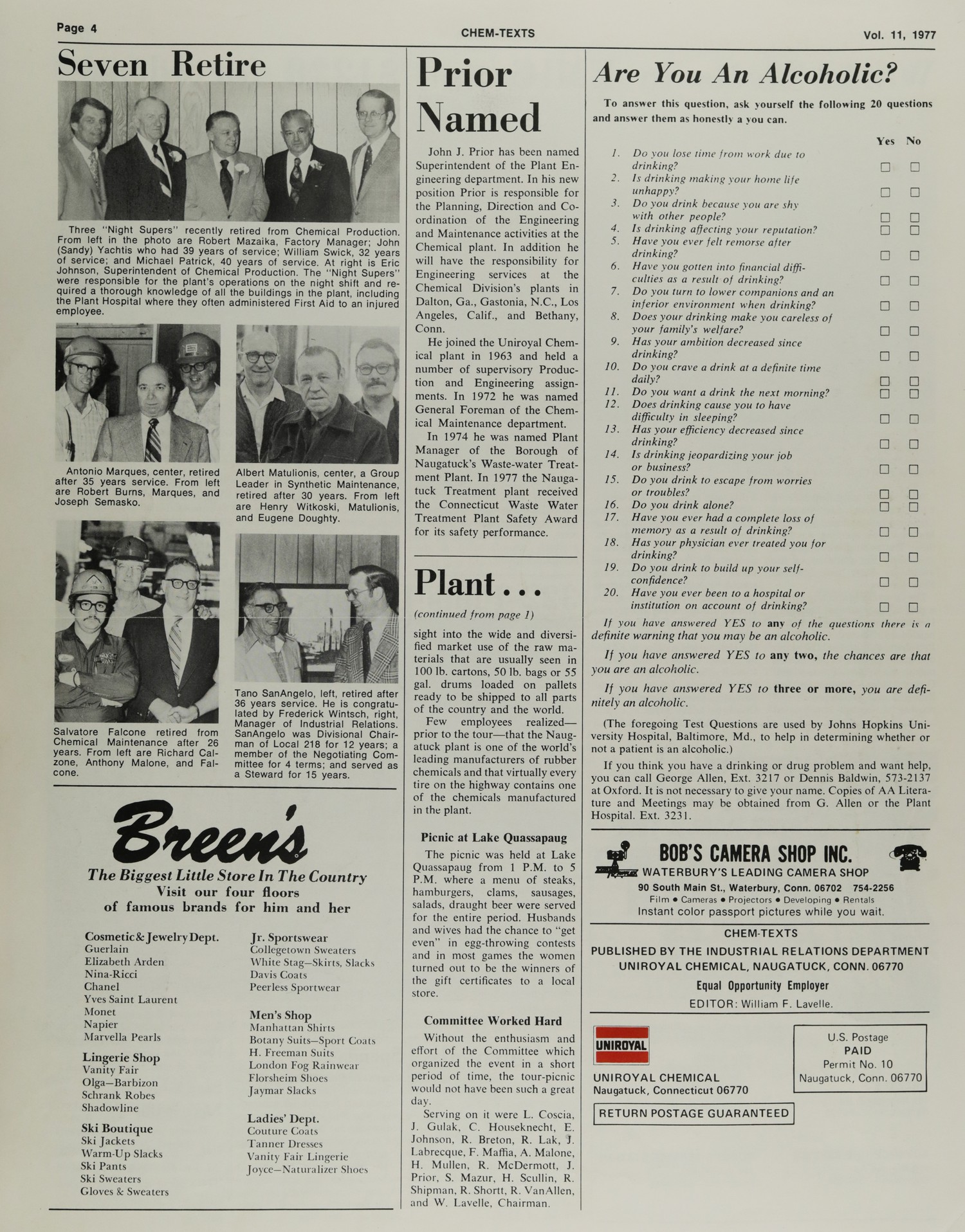
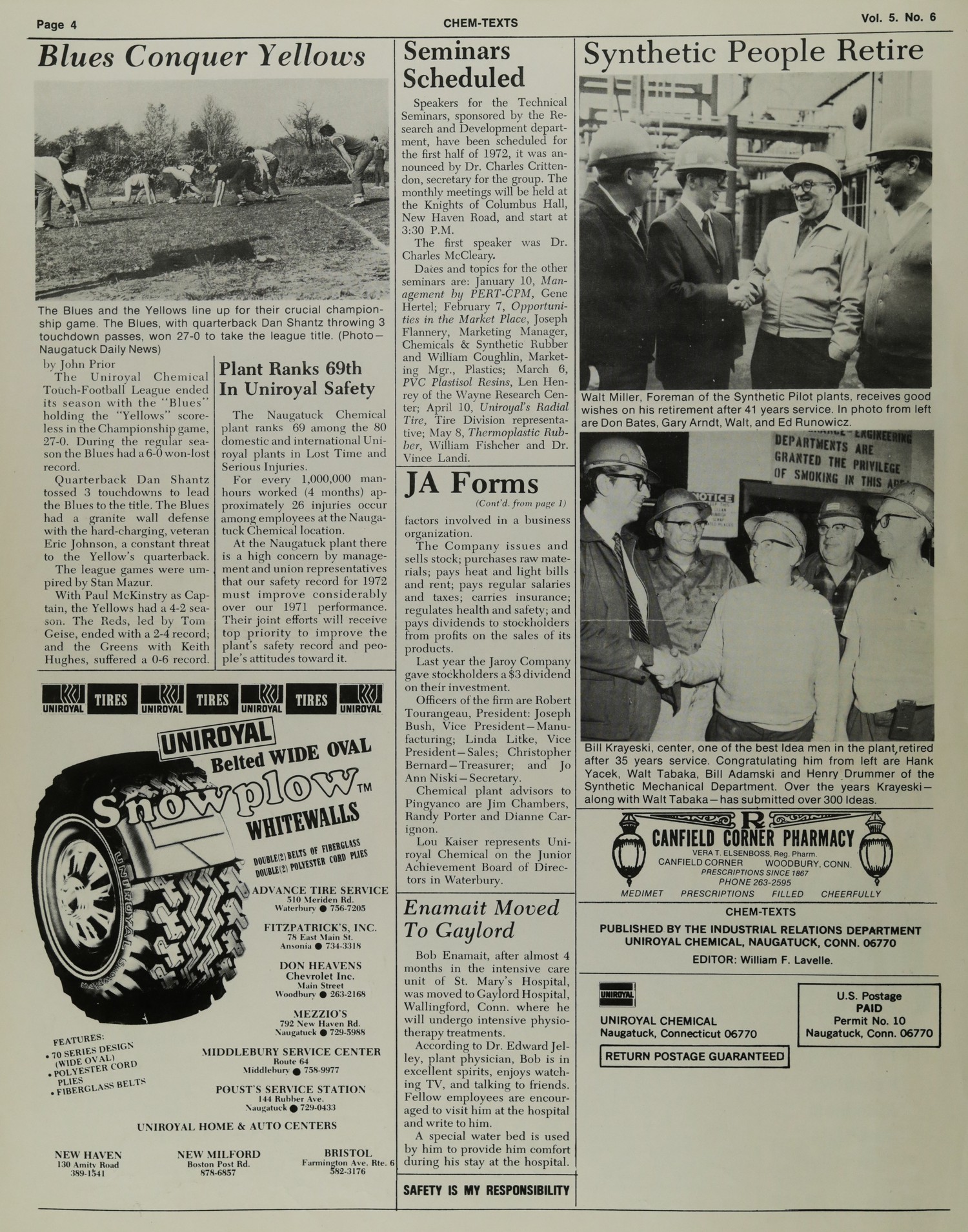
Three “Night Supers” recently retired from Chemical Production. From left in the photo are Robert Mazaika, Factory Manager; John (Sandy) Yachtis who had 39 years of service; William Swick, 32 years of service; and Michael Patrick, 40 years of service. At right is Eric Johnson, Superintendent of Chemical Production. The “Night Supers” were responsible for the plant’s operations on the night shift and required a thorough knowledge of all the buildings in the plant, including the Plant Hospital where they often administered First Aid to an injured employee.

[PHOTO]

Antonio Marques, center, retired after 35 years service. From left are Robert Burns, Marques, and Joseph Semasko.

[PHOTO]

Albert Matulionis, center, a Group Leader in Synthetic Maintenance, retired after 30 years. From left are Henry Witkoski, Matulionis, and Eugene Doughty.

[PHOTO]

Salvatore Falcone retired from Chemical Maintenance after 26 years. From left are Richard Calzone, Anthony Malone, and Falcone.

[PHOTO]

Tano SanAngelo, left, retired after 36 years service. He is congratulated by Frederick Wintsch, right, Manager of Industrial Relations. SanAngelo was Divisional Chairman of Local 218 for 12 years; a member of the Negotiating Committee for 4 terms; and served as a Steward for 15 years.


Prior Named

John J. Prior has been named Superintendent of the Plant Engineering department. In his new position Prior is responsible for the Planning, Direction and Coordination of the Engineering and Maintenance activities at the Chemical plant. In addition he will have the responsibility for Engineering services at the Chemical Division’s plants in Dalton, Ga., Gastonia, N.C., Los Angeles, Calif., and Bethany, Conn.

He joined the Uniroyal Chemical plant in 1963 and held a number of supervisory Production and Engineering assignments. In 1972 he was named General Foreman of the Chemical Maintenance department.

In 1974 he was named Plant Manager of the Borough of Naugatuck’s Waste-water Treatment Plant. In 1977 the Naugatuck Treatment plant received the Connecticut Waste Water Treatment Plant Safety Award for its safety performance.


Plant…

(continued from page 1)

sight into the wide and diversified market use of the raw materials that are usually seen in 100 lb. cartons, 50 lb. bags or 55 gal. drums loaded on pallets ready to be shipped to all parts of the country and the world.

Few employees realized— prior to the tour—that the Naugatuck plant is one of the world’s leading manufacturers of rubber chemicals and that virtually every tire on the highway contains one of the chemicals manufactured in the plant.

Picnic at Lake Quassapaug

The picnic was held at Lake Quassapaug from 1 P.M. to 5 P.M. where a menu of steaks, hamburgers, clams, sausages, salads, draught beer were served for the entire period. Husbands and wives had the chance to “get even” in egg-throwing contests and in most games the women turned out to be the winners of the gift certificates to a local store.

Committee Worked Hard

Without the enthusiasm and effort of the Committee which organized the event in a short period of time, the tour-picnic would not have been such a great day.

Serving on it were L. Coscia, J. Gulak, C. Houseknecht, E. Johnson, R. Breton, R. Lak, J. Labrecque, F. Maffia, A. Malone, H. Mullen, R. McDermott, J. Prior, S. Mazur, H. Scullin, R. Shipman, R. Shortt, R. VanAllen, and W. Lavelle, Chairman.


Are You An Alcoholic?

To answer this question, ask yourself the following 20 questions and answer them as honestly a you can.

Yes No
1. Do you lose time from work due to drinking?
2. Is drinking making your home life unhappy?
3. Do you drink because you are shy with other people?
4. Is drinking affecting your reputation?
5. Have you ever felt remorse after drinking?
6. Have you gotten into financial difficulties as a result of drinking?
7. Do you turn to lower companions and an inferior environment when drinking?
8. Does your drinking make you careless of your family’s welfare?
9. Has your ambition decreased since drinking?
10. Do you crave a drink at a definite time daily?
11. Do you want a drink the next morning?
12. Does drinking cause you to have difficulty in sleeping?
13. Has your efficiency decreased since drinking?
14. Is drinking jeopardizing your job or business?
15. Do you drink to escape from worries or troubles?
16. Do you drink alone?
17. Have you ever had a complete loss of memory as a result of drinking?
18. Has your physician ever treated you for drinking?
19. Do you drink to build up your self-confidence?
20. Have you ever been to a hospital or institution on account of drinking?

If you have answered YES to any of the questions there is a definite warning that you may be an alcoholic.

If you have answered YES to any two, the chances are that you are an alcoholic.

If you have answered YES to three or more, you are definitely an alcoholic.

(The foregoing Test Questions are used by Johns Hopkins University Hospital, Baltimore, Md., to help in determining whether or not a patient is an alcoholic.)

If you think you have a drinking or drug problem and want help, you can call George Allen, Ext. 3217 or Dennis Baldwin, 573-2137 at Oxford. It is not necessary to give your name. Copies of AA Literature and Meetings may be obtained from G. Allen or the Plant Hospital. Ext. 3231.


Breen’s

The Biggest Little Store In The Country

Visit our four floors of famous brands for him and her

Cosmetic & Jewelry Dept.
Guerlain
Elizabeth Arden
Nina-Ricci
Chanel
Yves Saint Laurent
Monet
Napier
Marvella Pearls

Jr. Sportswear
Collegetown Sweaters
White Stag—Skirts, Slacks
Davis Coats
Peerless Sportwear

Lingerie Shop
Vanity Fair
Olga—Barbizon
Schrank Robes
Shadowline

Men’s Shop
Manhattan Shirts
Botany Suits—Sport Coats
H. Freeman Suits
London Fog Rainwear
Florsheim Shoes
Jaymar Slacks

Ski Boutique
Ski Jackets
Warm-Up Slacks
Ski Pants
Ski Sweaters
Gloves & Sweaters

Ladies’ Dept.
Couture Coats
Tanner Dresses
Vanity Fair Lingerie
Joyce—Naturalizer Shoes


BOB’S CAMERA SHOP INC. ☆

WATERBURY’S LEADING CAMERA SHOP

90 South Main St., Waterbury, Conn. 06702 754-2256
Film • Cameras • Projectors • Developing • Rentals
Instant color passport pictures while you wait.


CHEM-TEXTS

PUBLISHED BY THE INDUSTRIAL RELATIONS DEPARTMENT
UNIROYAL CHEMICAL, NAUGATUCK, CONN. 06770

Equal Opportunity Employer

EDITOR: William F. Lavelle.


UNIROYAL

U.S. Postage
PAID
Permit No. 10
Naugatuck, Conn. 06770

UNIROYAL CHEMICAL
Naugatuck, Connecticut 06770

RETURN POSTAGE GUARANTEED

CHEM-TEXTS – 1975-v09-i06-s236

Page 236

UNIROYAL

Merry Christmas – Happy New Year

CHEM-TEXTS

Vol. 9, 1975 | PUBLISHED FOR THE PEOPLE OF UNIROYAL CHEMICAL | No. 6


2,000,000 Manhours Achieved Without A Lost Time Accident

[IMAGE: Group photo of men holding a sign displaying “2000000”]

The Factory Manager’s Staff Safety Committee holds the 2,000,000 manhours sign at the monthly safety meeting. From left are R. Shortt, Safety Manager; A. Aronson, Engineering Superintendent; E. Johnson, Chemical Production Superintendent; F. Wintsch, Industrial Relations Manager; J. Honytski, Materials Superintendent; H. Scullin, Reclaim Superintendent; J. Cronin, Factory Manager; S. Semonian, Manager, Engineering Development; L. Borg, Manager, Research Administration and Services; and R. VanAllen, Purchasing Agent.

Best Safety Performance Since 1961

On Friday, November 21, the two million manhour goal without a lost time accident was achieved. This is the best safety performance at the Naugatuck location since 1961 when the 3,000,000 manhour mark was reached. The record started on July 17 and took longer to achieve because of vacations and layoffs.

The record was almost marred at the last minute when a flaker in Bldg. 17 fell and narrowly missed hitting an employee. The injury would have been a lost time accident and a most serious one.

Group Safety Important

Although safety is a personal responsibility, much of this year’s performance is attributable to the group safety program, people working together with a concern for each other.

Drop in Injuries

The new attitude of working safe has created a “good feeling” about working in the plant. It has helped cut down the number of injuries from a high of 105 in 1966 to 29 in 1975.

In 1971 the hospital and medical costs amounted to $231,567;

continued on page 3


Fish Return to River

[IMAGE: River scene showing water and shoreline]

A marked environmental improvement is evident in the waters of the Naugatuck River.

The grass is greener; the river is cleaner; and fish have been seen in the Naugatuck River, according to reliable sources. A marked environmental improvement is evident in the quality and color of the water and the banks of the river along Route 8 north and south.

Much of this is attributable to the plant’s environmental program, particularly the liquid waste pretreatment plant in the south yard.

Over $7,000,000 has been spent or committed for pollution abatement, with another $1,500,000 for the new sewer system.


Agricultural Chemicals Markets Grow Overseas

As a result of an active research program in the 1960’s by the Naugatuck Chemical and Guelph, Ontario, Research & Development groups, new and unique chemicals were discovered for agriculture.

They are now known around the world as OMITE®, ALAR®, VITAVAX®, PLANTVAX®, DYANAP® and ROYAL MH-30®.

Sent Overseas for Testing

At the time of their field trials for use in the USA and Canada, the chemicals were also sent overseas to Universities, Experiment Stations, and foreign companies involved in the testing of agricultural chemicals.

A great amount of interest developed in them and in the fall of 1970 the Chemical division created an Overseas Agricultural Chemicals Marketing Organization with headquarters at the EMIC Building, with Dr. Bogislav Von Schmeling as Marketing Manager.

Regional Offices Set Up

Field development and sales offices for the overseas markets were regionalized and are now headed by Marketing Managers with offices in London, U.K., Singapore, and Sao Paulo, Brazil.

[IMAGE: Man pointing at world map]

Dr. Bogislav Von Schmeling, Overseas Marketing Manager, points to growing international markets for agricultural chemicals. Omite from Bldg. 100 is exported to South America.

The Chemicals are now sold in 50 foreign countries through 76 local distributors; with the most important markets in France, Iran, Italy, Brazil, and Argentina, in order of sales dollars.

Grain Markets

The Vitavax® and Plantvax® systemic fungicides amount to 60% of the overseas sales. Both products are used on cereal grain crops to prevent and cure dis-

continued on page 4

CHEM-TEXTS – Vol. 5 No. 3 – Page 4

Page 004

Page 4 CHEM-TEXTS Vol. 5 No. 3


Know Your Products: Rubber Chemical Accelerators

by Dr. Bob Brown

(This issue continues the article in Vol. 5, No. 2 on Accelerators made or marketed by the Naugatuck Chemical plant.)

Accelerators are used primarily to speed up, or control the vulcanization process which turns rubber from a useless, gummy substance into a strong resilient and elastic material. Vulcanization, in simple terms, is a chemical reaction between rubber and sulfur, usually brought about by heat.

Faster Accelerators

Where there is less processing or mixing involved, very fast accelerators with little or no delayed action can be used to give more rapid vulcanization. The Zates (Arazate®, Butazate®, Ethazate® and Methazate®) and the Thiurams (Monex®, Pentex®, Tuex®, and Accelerator 108) are used here. They are also used in latex curing where processing is usually not a problem.

Customers use these accelerators for rubber sponge, wire insulation, hot water bottles, conveyor belts, hospital sheeting, and household items and in such latex products as balloons and carpet backing.

The Zates accelerators are non-discoloring and non-staining and can be used in colored rubber products.

Some of the newer synthetic rubbers (Royalene® “the crackless rubber” is an example) are inherently slower in vulcanization than the older types such as natural rubber, neoprene and the Naugapol® and Paracril® synthetic rubbers made at the Naugatuck and Painesville, Ohio plants. Fast accelerators are needed to speed up the vulcanization process for these types of rubber, otherwise it would be economically impossible to make a product at a reasonable selling price to the consumer.

Dr. Bob Brown, author of these articles, is manager of Research and Development for Rubber Chemicals. He received his doctorate degree from Princeton University in Organic Chemistry and holds several patent awards. Dr. Brown heads a staff of 42 people whose sole function is to improve our present chemicals and to develop new ones in order to remain competitive in the market.

GMF and DIBENZO GMF® are used in butyl rubber which also vulcanizes very slowly. A large amount of butyl rubber is used for tire tubes, and high voltage electrical cable.

CPB, DBA Very Active

Sometimes customers want to vulcanize rubber products without heating them at all. Very active accelerators like CPB and DBA accomplish this. In this process the product must be shaped before the accelerator is added. Golf ball covers, for example, are vulcanized by soaking the finished balls in a solution of CPB.

(In the next issue of Chem-Texts, Antioxidants and Antiozonants will be discussed. If you have a son or daughter in school, these articles provide source material for class papers in Chemistry courses.)


33 Employees

(Cont’d. from page 2)

are under further evaluation for higher amounts dependent on the amount of the savings for the plant.

Other employees who received cash awards for Ideas were P. Blasko, F. Maffia, M. Jannetty, D. Stevenson, E. Grickis, R. Guest, B. Robinson, A. Urban, S. Kropcho, J. Harper, J. Gilbert, A. Happy, J. Iosa, H. Garahan, F. Surmanek (2), L. DeLaRosa (2), P. Beardsley, S. Falcone, H. Hernandez, A. Grella, J. Needham, D. Boyd, E. Root, Sr., A. Molnar, D. Pinto and J. Cohen.

Letters of Commendation were presented to C. Smith, L. Fortier, F. Gagne, Carol Calo, J. Gallucci, R. Lockwood, D. Donato, T. Carr, Preciosa Cravo, D. Nelson, A. Nauges, W. Krayeski, W. Tabaka and D. Polzella.

Of the 33 employees awarded cash for Ideas, two were salary employees and the highest number of Ideas were submitted by Mechanical Department personnel.

No Limit to Cash Awards

There is no maximum limit to the amount of a cash award for an Idea. If the value of the Idea exceeds $1,000—this amount is paid under the Plant Idea Plan—it is submitted for further consideration for a higher award to a special management committee. The minimum award for an Idea is $25.

Ideas to Conserve Water Needed

With the construction of the new liquid waste pretreatment plant in progress, ideas to conserve water are needed now as the facilities are designed to treat 3,600,000 gallons a day.


SAFETY IS MY RESPONSIBILITY


Crim Assumes IR Post

Two Industrial Relations Managers not agreeing? Unbelievable! But that’s what the photo seems to say as Jesse Crim, right, new Industrial Relations Manager for the Naugatuck Chemical plant discusses a fine point on employee relations with Ron Mitchinson, former IR Manager and now with the Corporate IR staff in Oxford. Crim came from the Chemical Division’s Painesville, Ohio plant, where he held the position of IR Manager.

Crim will be responsible for labor and employee relations, personnel development and training, plant protection and employee safety, communications, public and community relations, and employment.


Appointments Announced

Sam Gillette has been named Methods Engineering Manager, reporting to the Factory Manager.

Joe Bucciaglia was appointed General Foreman for the Chemical Production Plant.

Eric Johnson was made Chief Process Engineer for the Chemical Production Plant.

Lee Owens assumes the responsibilities of General Foreman in the Synthetic Production Plant.

Clark Makinson moved to the Materials Flow Department in EMIC.

Ed Rabitor replaces Clark in the Chemical Control Center.


Three Retire In Month

Rated one of the top mechanics in the plant, Ed Bouley, center, retired after 27 years of service. Congratulating him on his retirement are from left: Al Mukosey; Hank Drummer, Foreman; Bouley; Charlie Roland, URW 308 Vice President; and Joe Adamski.


Julia Curtin, right, with 44 years service shares 20 lb. cake with members of Control Department. In photo from left are Alice Schofield, Marie Marrello, Loretta Walker, Elaine Connelly, Marcella Pape, Helen Southard, Jack Dunn, Payroll Supervisor, and Julia.


Timothy (Francis) Egan accepts cake from his wife, Alice, on his retirement after 35 years. Left to right: Molly Cobbol, Millie Finsel, Francis and Alice Egan. In rear from left are Frank Rodrigues, Sal Aloise, and Walt Frankenberger. Kay Dowling arranged the luncheon.


CHEM-TEXTS

PUBLISHED BY THE INDUSTRIAL RELATIONS DEPARTMENT
UNIROYAL CHEMICAL, NAUGATUCK, CONN. 06770

EDITOR: William F. Lavelle.


UNIROYAL CHEMICAL
Naugatuck, Connecticut 06770

RETURN POSTAGE GUARANTEED

U.S. Postage
PAID
Permit No. 10
Naugatuck, Conn. 06770

CHEM-TEXTS – Vol. 5. No. 6 – Page 4

Page 004

CHEM-TEXTS

Page 4 | Vol. 5. No. 6


Blues Conquer Yellows

[IMAGE: Football team lined up on field]

The Blues and the Yellows line up for their crucial championship game. The Blues, with quarterback Dan Shantz throwing 3 touchdown passes, won 27-0 to take the league title. (Photo— Naugatuck Daily News)

by John Prior

The Uniroyal Chemical Touch-Football League ended its season with the “Blues” holding the “Yellows” scoreless in the Championship game, 27-0. During the regular season the Blues had a 6-0 won-lost record.

Quarterback Dan Shantz tossed 3 touchdowns to lead the Blues to the title. The Blues had a granite wall defense with the hard-charging, veteran Eric Johnson, a constant threat to the Yellow’s quarterback. The league games were umpired by Stan Mazur.

With Paul McKinstry as Captain, the Yellows had a 4-2 season. The Reds, led by Tom Geise, ended with a 2-4 record; and the Greens with Keith Hughes, suffered a 0-6 record.


Plant Ranks 69th In Uniroyal Safety

The Naugatuck Chemical plant ranks 69 among the 80 domestic and international Uniroyal plants in Lost Time and Serious Injuries.

For every 1,000,000 manhours worked (4 months) approximately 26 injuries occur among employees at the Naugatuck Chemical location.

At the Naugatuck plant there is a high concern by management and union representatives that our safety record for 1972 must improve considerably over our 1971 performance. Their joint efforts will receive top priority to improve the plant’s safety record and people’s attitudes toward it.


Seminars Scheduled

Speakers for the Technical Seminars, sponsored by the Research and Development department, have been scheduled for the first half of 1972, it was announced by Dr. Charles Crittendon, secretary for the group. The monthly meetings will be held at the Knights of Columbus Hall, New Haven Road, and start at 3:30 P.M.

The first speaker was Dr. Charles McCleary.

Dates and topics for the other seminars are: January 10, Management by PERT-CPM, Gene Hertel; February 7, Opportunities in the Market Place, Joseph Flannery, Marketing Manager, Chemicals & Synthetic Rubber and William Coughlin, Marketing Mgr., Plastics; March 6, PVC Plastisol Resins, Len Henrey of the Wayne Research Center; April 10, Uniroyal’s Radial Tire, Tire Division representative; May 8, Thermoplastic Rubber, William Fishcher and Dr. Vince Landi.


JA Forms

(Cont’d. from page 1)

factors involved in a business organization.

The Company issues and sells stock; purchases raw materials; pays heat and light bills and rent; pays regular salaries and taxes; carries insurance; regulates health and safety; and pays dividends to stockholders from profits on the sales of its products.

Last year the Jaroy Company gave stockholders a $3 dividend on their investment.

Officers of the firm are Robert Tourrangeau, President: Joseph Bush, Vice President—Manufacturing; Linda Litke, Vice President—Sales; Christopher Bernard—Treasurer; and Jo Ann Niski—Secretary.

Chemical plant advisors to Pingyanco are Jim Chambers, Randy Porter and Dianne Carignon.

Lou Kaiser represents Uniroyal Chemical on the Junior Achievement Board of Directors in Waterbury.


Enamait Moved To Gaylord

Bob Enamait, after almost 4 months in the intensive care unit of St. Mary’s Hospital, was moved to Gaylord Hospital, Wallingford, Conn. where he will undergo intensive physiotherapy treatments.

According to Dr. Edward Jelley, plant physician, Bob is in excellent spirits, enjoys watching TV, and talking to friends. Fellow employees are encouraged to visit him at the hospital and write to him.

A special water bed is used by him to provide him comfort during his stay at the hospital.


Synthetic People Retire

[IMAGE: Group of men, one receiving good wishes]

Walt Miller, Foreman of the Synthetic Pilot plants, receives good wishes on his retirement after 41 years service. In photo from left are Don Bates, Gary Arndt, Walt, and Ed Runowicz.

[IMAGE: Sign reading “DEPARTMENTS ARE GRANTED THE PRIVILEGE OF SMOKING IN THIS AREA” with “ENGINEERING” visible]

[IMAGE: Group of men congratulating someone]

Bill Krayeski, center, one of the best Idea men in the plant, retired after 35 years service. Congratulating him from left are Hank Yacek, Walt Tabaka, Bill Adamski and Henry Drummer of the Synthetic Mechanical Department. Over the years Krayeski— along with Walt Tabaka—has submitted over 300 Ideas.


[ADVERTISEMENT: UNIROYAL TIRES]

UNIROYAL
Belted WIDE OVAL

Snowplow
WHITEWALLS

DOUBLE BELTS OF FIBERGLASS
DOUBLE POLYESTER CORD PLIES

ADVANCE TIRE SERVICE
510 Meriden Rd.
Waterbury ● 756-7205

FITZPATRICK’S. INC.
78 East Main St.
Ansonia ● 734-3318

DON HEAVENS
Chevrolet Inc.
Main Street
Woodbury ● 263-2168

MEZZIO’S
792 New Haven Rd.
Naugatuck ● 729-5988

MIDDLEBURY SERVICE CENTER
Route 64
Middlebury ● 758-9977

POUST’S SERVICE STATION
144 Rubber Ave.
Naugatuck ● 729-0433

UNIROYAL HOME & AUTO CENTERS

NEW HAVEN NEW MILFORD BRISTOL
130 Amity Road Boston Post Rd. Farmington Ave. Rte. 6
389-1541 878-0857 582-3176

FEATURES:
– 78 SERIES DESIGN (WIDE OVAL)
– POLYESTER CORD PLIES
– FIBERGLASS BELTS


[ADVERTISEMENT: CANFIELD CORNER PHARMACY]

CANFIELD CORNER PHARMACY
VERA T. ELSENBOSS, Reg. Pharm.
CANFIELD CORNER WOODBURY, CONN.
PHONE 263-2595
PRESCRIPTIONS SINCE 1867

MEDIMET | PRESCRIPTIONS FILLED | CHEERFULLY


CHEM-TEXTS
PUBLISHED BY THE INDUSTRIAL RELATIONS DEPARTMENT
UNIROYAL CHEMICAL, NAUGATUCK, CONN. 06770
EDITOR: William F. Lavelle.

[UNIROYAL LOGO]

UNIROYAL CHEMICAL
Naugatuck, Connecticut 06770

U.S. Postage
PAID
Permit No. 10
Naugatuck, Conn. 06770

RETURN POSTAGE GUARANTEED


SAFETY IS MY RESPONSIBILITY

CHEM-TEXTS – Vol. 5 No. 3 – Page 2

Page 002

CHEM-TEXTS

Page 2 | Vol. 5 No. 3


FROM THE FACTORY MANAGER

DEAR FELLOW EMPLOYEE:

The miracle of the twenty five years of continual growth in the U.S. economy since World War II is something all Americans can be proud of. It has enabled us to become leaders in the world’s markets and to raise our standard of living to the point where we are better off than any people in history.

This miracle didn’t just happen. It was brought about by the tremendous productivity of the people of this country. For twenty years every time wages increased, productivity also increased and our standard of living went up.

In the last five years, however, we have seen a change in this pattern. While wages have increased, productivity has not kept pace with them. This has helped cause inflation and has helped drive the cost of our products up.

In turn, foreign manufacturers have maintained their productivity and are now able to sell their goods in our markets at prices lower than ours. We can see this in Japanese electronics; German and Japanese automobiles; and textile and footwear products from all over the world.

On a smaller scale the same thing is happening at our factory. We are in competition with both foreign and domestic producers. They are competing with us for the same customers and markets, oftentimes at lower prices. Besides this our markets are moving away from the northeast and the increasing cost of rail and truck transportation adds to our problem of doing business competitively.

All of us must realize this and remember that the chemicals we produce are in competition with these domestic and foreign manufacturers. We can only sell what we can produce economically. We can only produce economically with your help and cooperation. Every job in the plant is important. Every person counts in this effort. We all must chip in.

Phil LaJoie


33 Employees Receive $1355

Mechanical Department Submits Most Ideas

Leo Clark, Mechanical dept. received highest single award, $100.

Ed Bazenas received $140 for 2 Ideas.

Gerry Ferguson points to Idea that reduced product loss.

Thirty-three employees received $1355 for Ideas submitted on plant improvements, more efficient equipment operation and cost saving suggestions.

The highest single award, $100, went to Leo Clark for his Idea to install guide rods on the Reclaim tire chute to prevent blockups which affected production.

Ed Bazenas received the highest total amount, $140, for two Ideas. One of his Ideas recommended the redesign of the bag compressor in Bldg. 52 which resulted in improved operations and lower maintenance costs.

Mike Marro’s Idea to machine down discarded teflon seats and reuse them as spacers in ball valves reduced material costs and netted him $50.

Idea man for the January-April period was Jerry Ferguson of the Roylar® plant who turned in 4 Ideas which rewarded him with $135.

For 2 Ideas Charlie LoBalbo received $75.

Four employees—Stanley Dushak, Leo Clark, Natale Vescera and Charlie LoBalbo—received initial awards of $25. Their Ideas
(Cont’d. on page 4)


Blood Drive Big Success

239 people offered to donate blood to the annual Bloodmobile sponsored by Uniroyal Chemical on June 10.

During the 5-hour visit at St. Michael’s Parish House, 214 pints were collected and 25 people were deferred. The Bloodmobile exceeded its goal of 150 by 64 pints, making it a “big success” according to the Naugatuck Red Cross Chapter.

137 Chemical employees, retirees, college students and “walk-ins” and 77 Footwear donors donated blood.

Pin Awards

A 3-gallon pin was awarded to Bob Breton, of Chemical Production, for his 24th contribution of blood.

Bob Cranney, R&D; Walt Gniazdowski, R&D; and Phil Norton, EMIC Sales, received 2-gallon pins.

One gallon pins were presented to Mike Galante, R&D; Henry Hook and Walt Scott, Chemical Production; and Earle Root, Synthetic Production.

In-Plant Organizers

Organizers for the In-Plant canvass were Bob Shortt, Sal Aloise, Adeline Farrar, R.N. and Ann McAllister, R.N. of the Industrial Relations Department.

Uniroyal Chemical employees enjoy sandwiches and coffee after donating blood. Seated from left are John Napiello, Sr., David Boulanger, Walter Campbell, Al Zimmerman, Don Poehailos and Gene Lantieri. Standing from left are Chet Bulka, Walt Scott, Carol Gilbert R.N., and Ted Ciarello. The Red Cross Volunteers served 325 sandwiches and 300 cups of coffee during the 5 hour visit.

Bob Breton, a Chemical Production foreman displays 3 gal. pin he received from Red Cross.

They were assisted by R. Frank, F. Lynch, J. Tierney, G. Allen, S. Gillette, T. Dowling, E. Johnson, L. Coscia, A. Perrella, M. Jasman, D. Poehailos, A. Amador, R. Foltz, B. Daily, J. Callahan, Gary Arndt, J. F. Brown, E. Krauss, E. Philips, A. Nole, and J. Wade.


Plant Joins JOBS ’70

By Milt Makoski

The Chemical plant recently joined the JOBS ’70 consortium organized by the Greater Waterbury Chamber of Commerce. The consortium, or group of businesses, has 15 member industries and a goal of 180 job slots to be filled this year. The Chamber organized the group under a grant from the National Alliance of Businessmen and the Federal Department of Labor.

The JOBS program is aimed at training area people for meaningful employment. The trainees are given work orientation, counseling, total image development, job related education and on-the-job training.

The program participants are grouped into clusters according to the type of training to be received. One cluster of 15 girls, who learned to be clerk-typists and transcriptionists, have already been placed in Uniroyal facilities. Four of the girls are now working at the Chemical plant; and 11 at the Oxford Administrative and Research Center.

In charge of the Chamber’s portion of the program is Gus Maultsby. The Chemical plants’ representative with JOBS ’70 is Milt Makoski and the Uniroyal Corporate representative, Rita Garramone.

Constance Antrum, seated, now working in the Industrial Relations department reviews procedure with Gladys Bradshaw on typing a departmental report.


Local 308 Picnic Set

by Art Calder

URW Local 308 will hold its 4th Annual Picnic for Union members on Sunday, August 8, at Schildgen’s Grove on East Waterbury Road in Union City. The picnic starts at 10 A.M. and ends at 6 P.M.

Chairman for this year’s event is Art Calder, assisted by Committee members Walt Bieleski, Nunzio Pastore, Wes Burns and Jack Muckle. A $2.00 charge will be assessed members for food and refreshments, which includes steaks, hamburgers, clams and corp.

CHEM-TEXTS – Vol. 5, No. 2 – Page 4

Page 004

Page 4 | CHEM-TEXTS | Vol. 5. No. 2


Know Your Products: Rubber Chemical Accelerators

by Dr. Bob Brown

Uniroyal Chemical manufactures 91 different types of chemicals for rubber, latex and plastic products. 69 of these chemicals are manufactured and sold by the Naugatuck plant; the others are made at the Geismar plant in Louisiana.

Virtually every tire on the road today contains one of the chemicals made by the Chemical Division to protect them against oxygen, ozone, heat, fatigue and sunlight. Without these chemicals the rubber would deteriorate rapidly.

Coincidentally, it was one of our rubber chemicals that established us in the agricultural chemical business when it was discovered that the chemical had fungicidal properties. Twenty-five years later, the Division ranks as a major manufacturer of herbicides; growth regulants, miticides and fungicides.

The chemicals that we make at Naugatuck for the rubber industry do a wide variety of jobs; but two are by far the most important. These are: 1) Accelerators for vulcanization and 2) Antioxidants and Antiozonants for protection against aging. A third group—Others—include Blowing Agents for rubber and latex sponge; Bonding rubber to fabric; and Retarding vulcanization during processing.

Accelerators

Ever since 1844 when Charles Goodyear, in his small plant in Naugatuck, found that heating rubber with sulfur (vulcanization) causes it to change from an almost useless, gummy solid to a strong, resilient material with hundreds of uses, rubber product manufacturers have been looking for ways to do this job faster and better.

Chemicals which speed up this vulcanization reaction are called accelerators.

Delayed Action Accelerators

MBT and its derivatives (MBTS, OXAF, DELAC®-S) are the work horses of the rubber industry. They are used in almost all tires, footwear, wire and cable and in many other products where strength and long life are needed but where there is also a lot of milling and shaping of the rubber before it is finally made into a product.


[IMAGE: Black and white photograph showing workers]

AC-5 PRILLS

LAC-5 PRILLS

Leo Vadnais, left, and Wilbur Hugar, center, Chemical Production operators in Bldg. 80 prepare Delac-S Prills and MBTS accelerators for shipment to customer. At right is Tom Engle, Foreman of the department.


Safety Glasses

(Con’t. from page 3)

in his face and would have burned his eyes if he had not been wearing his safety glasses.

Tony DaSilva, an operator in Chemical Production, was sprayed with sodium MBT when a plugged line broke. The chemical covered his face, arms and chest. His safety glasses averted serious injury to his eyes.

During the first four months of the year, 57 eye injuries took place. Fortunately most employees were wearing safety glasses at the time of the accidents, preventing serious damage to their eyes.


Hats, Glasses

(Con’t. from page 1)

URW Master Agreement which emphasizes a cooperative effort to prevent accidents among employees and to utilize the proper protective equipment as prescribed by local management.

$150,507 Lost In 1970

In 1970 there were 6 lost time accidents and 66 serious injuries. The cost of medical bills and Workmen’s Compensation for the year totalled $150,507, an amount equivalent to $100 per employee.

223 employees suffered eye and head injuries in the same year. Of these, 170 were eye injuries and 53 were head injuries.

For your personal safety, your fellow employees, and for your family’s sake, wear your safety glasses and hard hats on the job in designated areas.

Once an eye is lost, it can never be replaced.


Profits

(Con’t. from page 1)

quarter. But replacement tires lagged behind the same period last year. Replacement sales are expected to improve sharply during the year.

The Footwear business also showed progress during the first quarter.

Chemical Sales Down

“A major trouble spot at the present time,” according to Mr. Vila, President and Chairman of the Board of Directors, “is in our domestic chemical operations where severe price erosion in many product lines has resulted in a sharp drop in earnings. This has been caused, in part, by competition from foreign sources, in part by the expiration of certain patents and, in part, by a drop in demand for chemical products generally.”

A Worldwide Competitive Manufacturing Complex

The heavy capital investment made by the Company in recent years now gives it a worldwide manufacturing complex which, for the most part, is modern and fully comparable with competition.

Present manufacturing facilities are sufficient to give the Company sales of about $2 billion, an increase of approximately 20% over present sales levels.

This processing has to be done at a high temperature to make the rubber soft enough to handle, and there is always the danger that it will start to vulcanize before it is finished. For this reason, customers want the accelerators that have some “delayed action”. MBT has a little delayed action; MBTS has more; and DELAC-S has the most.

(To be continued in the next issue of CHEM-TEXTS.)


Phase I

(Con’t. from page 1)

ent materials, which results in a complex waste mixture, difficult to adequately treat.

As State environmental laws and enforcement become more strict, it will be essential to control and reduce the flow of materials into the plant drains.

$4,900,000 Spent, Committed

The new facilities, including the financial commitment to the Borough and the scale model pilot plant tests, will cost $4,900,000, exclusive of the operating costs.

Little of the costs expended to date have been absorbed by increased product prices to customers but have been borne mainly by the plant.

The completion of the facilities is scheduled for December 1972 in compliance with orders from the State Water Resources Commission


Six Retire Recently

[IMAGE: Photograph of three men]

John Hickson, third left, retired from Reclaim after 25 years service. Congratulating him are from left: Pablo Quinones, Lee Thompson, Hickson and Bernie Dunn.


[IMAGE: Photograph of two men]

Bruno Rossi left and George Pohorilak wish each other a happy retirement as Milt Makoski, center, watches. Bruno had 39 years service; George, 30 years.


[IMAGE: Photograph of group of men]

Ovila Fortier, center, retiring after 26 years, receives gift from fellow employees. From left: Tony Galletta, Gene Reale, Fortier, Sal Falcone and Leo Napiello.


[IMAGE: Photograph of three men]

Retiring after 40 years service Andy Smey, center, is congratulated by Harry Witt, and Eric Johnson.


[IMAGE: Photograph of group of men]

Congratulating John Quint on his retirement after 29 years service are from left, Vic Alves, John Painter, Quint, Tim Carr and Ted Clement of the Synthetic Mechanical department.


CHEM-TEXTS

PUBLISHED BY THE INDUSTRIAL RELATIONS DEPARTMENT

UNIROYAL CHEMICAL, NAUGATUCK, CONN. 06770

EDITOR: William F. Lavelle.


[LOGO: UNIROYAL]

UNIROYAL CHEMICAL
Naugatuck, Connecticut 06770

RETURN POSTAGE GUARANTEED

U.S. Postage
PAID
Permit No. 10
Naugatuck, Conn. 06770

CHEM-TEXTS – Vol. 5, No. 1 – Page 3

Page 003

CHEM-TEXTS

Vol. 5, No. 1 | Page 3


New Duster Cleans Air

Ed Zemeir applies talc to bale of Naugapol rubber as Ed Curby watches. Equipment, recently installed, eliminates talc dust in the area and gives greater protection to employees’ health.

by Lou Kaiser

The production of various types of Naugapol® rubber requires talc to be applied to the rubber bale before it is packaged. The talc, a very fine particle size, is dusted on manually, and creates a dust problem when the operator applies it to the rubber. The operators were exposed to the talc and had been required to wear masks to avoid inhalation of the dust.

Air sample tests in the area indicated that the dust levels in the atmosphere were within acceptable health requirements. However, it was decided that an improvement in the ventilation system would make the area more conducive to healthier and safer work conditions for the men in the building.

To eliminate the dust problem, a talc station table and hood was redesigned and a larger fan was installed to provide greater air flow across the talc station. The dust laden air is then lead to a cyclone where it is collected and clean air enters the atmosphere.

With the improved ventilation, it is no longer required to wear a mask when the talc is applied to the rubber.


Plumes Not Pollutants

On clear cold days the white plumes from the plant are more prominent. Most of the “white stuff” is harmless water vapor resulting from the condensation of steam after it has performed its necessary function in providing heat for the 140 buildings in the plant’s production operations and offices. Lou Kaiser of the Environmental Control Group is presently analyzing all vents and stacks in the plant for pollutant content as part of an air environmental improvement program.


$20,050 Pledged To United Givers

Reviewing the final results of the United Givers drive which resulted in pledges of $20,050 from 965 employees are seated from left: Joe Rzeszutek, Sam Gillette, chairman, and Dick Edwards. From left standing are Milt Makoski, Bob Van Allen, and Roger Amidon.

“Let the man with two coats give to him who has none; the man who has food should do the same.”

Generous concern for people by Uniroyal Chemical employees was again shown with a pledge of $20,050 to the United Givers which benefits the physically handicapped, mentally retarded, broken homes, the young and the old in the communities around us.

The amount represents one-sixth of the total pledges for the Naugatuck-Beacon Falls 1971 Drive.

965 out of 1,500 employees contributed with 662 using the payroll deduction plan.

The highest pledges were $240; $228; $204; $160; with several in the $120 range.

Department Pledges

EMIC pledged $4,410 for the highest department contribution, surpassing last year’s goal by $1,000. Several departments dropped below their contributions of 1970 which account for attaining only 91% of the $22,000 plant goal

Department 1971 Goal Amount Pledged
Chem. Prod…. $2,550 $1,707
Recl. Prod….. 2,200 2,151
Syn. Prod…… 1,700 1,301
Eng. & Mech.- Chem……. 1,650 1,350
Eng. & Mech.- Syn……. 1,100 803
Materials….. 1,450 1,209
Factory Service 1,400 1,209
Res. & Develop. 5,900 5,530
Accounting… 900 363
EMIC…….. 3,100 4,410

Sam Gillette was Chairman of the drive with Dick Edwards, Roger Amidon, Joe Rzeszutek, Leon Raskauskas, Jack Vergosen, Bob Van Allen, Eric Johnson, Dom Persutti, Milt Makoski and Bill Lavelle serving on the executive committee for the drive.

Chairmen organizing the campaign in plant departments were Vic Alves, Frank Lynch, Bill Leukhardt, Ernst Krauss, Clark Makinson, Jack Prior, Colin Walker, Julius Rek, Bronis Zukauskas, Walt Miller, John Davison, Ted Lainas, Paul Murray, Bob Dexter, Larry Coburn, Dan Shantz, Stan Mazur, Carl Bawn, Irwin Prager, Gary Arndt, E. Easterbrook, Alex Zonas, Joe Longo and Dick Terino.

Finance records for the campaign were kept by Ed Levandauskas of the Accounting Department.


Scholarship Offered

by Lou Kaiser

The Uniroyal Chemical Management Club is again offering a $250 scholarship, which is available to a son or daughter of a Chemical division employee with two or more years’ of service.

The scholarship is open to all students in the graduating class of a high school or preparatory school who plan a college education. Applications can be obtained from the Industrial Relations department.

This year the scholarship will again be augmented by a $50 cash endowment from Larry Monroe, a retired Chemical division employee.

Joe Bucciaglia is Chairman of the Scholarship committee and all applications must be mailed or returned to him on or before April 1, 1971.


Hoist Taken From TSSC

A quarter ton electric hoist, valued at $500 was recently taken from the Plastics Compounding Lab. in TSSC (Bldg. 112). The 100 lb. hoist, attached to an overhead rail, required a ladder and two men to remove.

Thefts of an electric drill, wrenches and small tools have also been reported in the same building.

Besides the extra cost to the plant, the thefts cast suspicion on all employees in the building, and new rules are effected to restrict their actions because of an individual’s actions.

The loss imposes harder work conditions on the men who now have to use a hoist from another section of the building.


CHIF Offers Help To Find Homes

by Milt Makoski

If you are interested in owning your own home and would like help in locating one and financing the down payment through a long term low interest second mortgage note, an organization, “CHIF” (Connecticut Housing Investment Fund) may be able to assist you.

CHIF is a non profit private organization which provides loans for down payments; gives advice on financing; and assistance in locating and purchasing a home. There is no fee for their service and there is no income

(con’t on page 4)


DO PEOPLE REALLY UNDERSTAND YOU?

A picture is worth a thousand words. But if pictures are ambiguous, words can even be much more ambiguous, especially when you try to communicate with other people. What do you see in the above picture?


You can protect your heart and health, Dr. White advises, by having a small routine of daily exercise and by a proper diet, especially avoiding being overweight.

FREE X-RAY MARCH 25
PROTECT YOUR HEALTH

CHEM-TEXTS – unknown-i05-s201

Page 201

CHEM-TEXTS

Page 2 | Vol. 5, No. 5


Thanksgiving And Us…

Thanksgiving Day seems to have lost much of its significance. Originally it was set aside as a special day of prayer. Today, it is looked upon more as a four day weekend and three games of football on TV.

The people who first came to New England lived a life of far greater poverty than some of the people living in Appalachia today. Their Thanksgiving was one of survival.

By their unity of purpose, and their concern for each other, they laid the groundwork for the many benefits we enjoy in our present society.

When you think ot our progress, no other group of people has achieved such high standards of living.

We at the Chemical Plant, in particular, have much to be thankful for. With unemployment as high as 12-20% in some towns, we have been able to maintain a steady level of employment. We have some of the finest wages and benefits in industry. All of us have great concern for the safety, health, and welfare of each other and a positive attitude toward the improvement of the environment.

I think you will agree with me that these are important things in our lives.

If each one of us does his full share, we will continue to reap the rewards of our efforts and assure, even increase, the many good things we now enjoy for ourselves and our families.

[Signature: Paul Lyons]


Eleven Receive MS Degrees

Dick Krajewski, center, and John Honyotski, right, admire each other’s diplomas as Pat Petti looks on. Krajewski received an MS in Industrial Management; Honyotski, a BS in Business Administration; and Petti will receive a degree in 1972.

by Ed Nunn

Eleven employees received their M.S. degrees in June under the Uniroyal Tuition Aid program: Jim Garrigan, Bill Broden, Terry Mo, and John Gilbert received degrees from Rensselaer Polytechnic Institute in Hartford; Joe Schoen, Temple University; Pete Byra, John Swanson, and Lou Kaiser, University of Hartford; Paul Hinckley, Southern Connecticut; Bob Farrell, University of Connecticut; and Marvin Cramer, University of Bridgeport.

$31,346 in Payments

Tuition Aid during the academic year, Sept. 1, 1970 to Aug. 31, 1971 totaled $31,469 in reimbursements to 82 employees.

12 employees are attending job related courses; 20 are working toward a college degree; and 50 are pursuing postgraduate studies.

Over the past 6 years 36 employees have received degrees under the program with Uniroyal’s reimbursements amounting to $125,022.

All Employees Eligible

The Tuition Aid Program is available to all full-time employees. The Company reimburses you for the full tuition cost and fees for two courses per semester. The courses must be related to your present job or will be of value, as determined by the Company, in future promotional areas. Reimbursement is made only upon successful completion of the course.


BOB’S CAMERA SHOP
Waterbury’s Largest Camera Shop
Film ● Cameras ● Projectors
Developing ● Repairs ● Rentals
21 Grand St. 754-2256

Still Time For
Photo Greeting Cards


Disaster Plan Tested

Bob Shortt, Safety Manager, shows how to extinguish gasoline fire. Behind Shortt are Phil DePasquale, Security Supervisor, and John Starr. Others in photo are Frank Commendatore and Dick Oriente.

Deluge water fog flooded Hortonspheres to control simulated butadiene leak

The 66 Alarm was a simulated butadiene leak in the Synthetic plant Hortonspheres. The leaking vapor was flooded and controlled with water fog from the top and sides of the spheres. According to Harry Francolini who was in charge of the Control Center, “we found a few bugs in the Plan but on the whole it went quite well.” The bugs are being ironed out to make the Plan more effective.

The test was the culmination of weeklong demonstrations during Fire Prevention Week.

It was a quiet Friday afternoon—just a few more hours to the weekend—when at 1 P.M., Alarm “66” sounded 4 times over the plant’s fire alarm system. A quick call to the Watchman in Bldg. 84 and the Disaster Plan was in operation.

Work stopped and designated emergency personnel reported to the Control Center for instructions and others assumed their plant emergency responsibilities to prepare for a shutdown and evacuation of the plant.


Drive Nears

(Cont’d. from page 1)

Four departments, Materials, Accounting, EMIC, and Research and Development exceeded their goals with several other departments close to reaching their quotas.

Still Time To Pledge

There is still time to pledge. If you have misplaced your card, contact the canvasser in your department or call any one and return it to him.


Chemical Team Loses Playoffs

by John Swanson

The Chemical Royals with a 24-8 won-lost record, made the League’s 4 team playoffs. In the best out of 3 championship playoff games, they lost to Fortin’s Restaurant.

Batting the Royals to their victorious season were Pete Byra 545; John Johnson 511; Vin Rooney 495.

Eric Johnson and Al Zimmerman provided the team’s slugging power with “All Star” pitcher, Mike Jasman, doing a superb job on the mound for the Royals.

Other members of the Chemical Royals were Dick Carroll, Tom Casteel, Leon Hartmann, Bill Lawton, John Prior, Dan Shantz, Rudy Valente, and Al Zonas.


Salesmen Review Sales

Frank Morgan, standing, District 11 Sales Manager, discusses sales strategy with salesmen. From left are Kurt Markshausen, Ken Stewart, Kralastic Commodity Manager, Steve Arbuckle, Barry Roos, Ed Brown, Jack Taylor, Pat DePaolo, and Pete Cookson. Missing were Tom Wilson, Henry Alter and Dick Terino.

District 11 salesmen met to review their sales record for the first nine months of 1971.

In the first 9 months, the District achieved 108% of its budget and hopes to hit 110% in the 4th quarter.

An important factor in helping them sell more was an improved “service image” among customers. They pointed out at the meeting that customer demand for good service is a major problem in their contact with customers. If you can’t deliver the product when the customer needs it, he simply buys it from a competitor.

CHEM-TEXTS – Vol. 4, 1970, No. 8 – Page 1

Page 001

UNIROYAL CHEM-TEXTS

Vol. 4, 1970 | PUBLISHED FOR THE PEOPLE OF UNIROYAL CHEMICAL | No. 8


Polygard Facilities To Expand

by Rod Gaetz

Design drawings are near completion for the expansion of Polygard ® facilities in Bldg. 109. The major equipment has been ordered and 75% of the necessary piping materials are on order for the project which will increase the production rates of the chemical. The project is part of the plant’s continuing program to stay competitive in a tight chemical market, keep business at the plant and keep chemical production employment at a full level.

Used In Rubber

Polygard is one of the most effective nondiscoloring and nonstaining stabilizers for synthetic rubber in commercial use today. Without Polygard protection, degradation occurs during the finishing, processing and vulcanization, resulting in a shorter service life of the final rubber product.

As a chemical, Polygard is safe to use, having the approval of the Food and Drug Administration (FDA) for use in products used for packaging or handling food.

New Stainless Steel Lines

The major work done during the summer shutdown of the building was the relocation and repiping of 2 Hold tanks from the second to the third floor. The piping from the bottom of the four vessels which will eventually become strippers was replaced with much larger stainless steel lines. The transfer pump was relocated and the discharge lines relocated and replaced with 3″ and 4″ stainless steel piping.

Fume Control Devices

When completed in early 1972, the expanded facilities will have environmental control devices to control fume pollution as part of the plant’s policy in the installation of new equipment and facilities.

Engineers working on the expansion are Terry Mo and Rod Gaetz; Vic Anderson, instrumentation and electricity; and Lou Kaiser, environmental control.


MIP Plan To Start

Instead of the 1970 stock purchase plan slated to start August 1, Uniroyal will expand the Monthly Investment Plan (MIP) to all employees interested in purchasing Uniroyal stock, at the market price, on a regular payroll deduction basis.

Under the plan, which is operated by Merrill Lynch, Pierce, Fenner and Smith, Inc., employees can sign up for regular payroll deductions. There are minimum and maximum deductions which will be indicated with other information, in plan brochures available shortly.

Merrill Lynch will purchase Uniroyal stock at the market price and keep individual accounts for each employee. Employees will receive regular statements from Merrill Lynch showing how much stock has been

(Cont’d on page 4)


H.S. Diploma Obtainable

It’s still possible for a person who left high school for one reason or another to obtain a high school diploma without going back to school.

To qualify for a diploma,

(Cont’d on page 4)


Chemical Control Center, The First In Chemical Division

Group photo of Chemical Control Center personnel. From left to right are Fran Egan, Clark Makinson, Tom Dowling, Millie Finsel, Matt Mathewson and Walt Frankenberger.


Employees Prevent Fire

by Walt Frankenberger

First anniversary. First in the Chemical Division. And in some aspects, the first in any Uniroyal plant. The Chemical Control Center is part of the plant’s innovative approaches to stay on top, keep business at the Naugatuck plant, increase the output of equipment, reduce waste and cost, and provide customers the best service in the chemical industry.

The Center is the one location in chemical production from which foremen can get accurate, up to the minute schedules for production of chemicals in order of priority to fill customers orders.

Monitors Data

The Center monitors data on all department activities, and by weekly and daily review of production, quality, cost, waste, and mechanical failures, the Center controls productivity and can spot downward trends or trouble spots in the plant which need adjustment to prevent lost production.

By coordinating the ordering of raw materials, packages, and warehousing, foremen can

(Cont’d on page 4)


A cooperative fire fighting group: in front—Pat Tortorici, left to right—Charlie LoBalbo, Minic Brown and Al Morey. Absent from photo—Charlie Rinaldi.


John Needham, left, shows Eric Johnson the High School Equivalency diploma he received upon successful completion of tests. Other employees plan to take tests in September.


by Ed Weaving

Minic Brown, Larry Rinaldi, Charlie LoBalbo, Al Morey and Pat Tortorici, acted so quickly in extinguishing a small fire in an air screen machine that the sensitive sprinkler system did not operate and the sounding of the plant fire alarm was not required.

The incident occurred when the canvas duct work around the machine ignited and burned. Brown and Rinaldi shut off the operation and others turned on a fire hose line on the burning canvas.

The fire was apparently caused by a light bulb without a protective globe on it, the hot heat of the bulb igniting the

(Cont’d on page 3)

CHEM-TEXTS – Vol. 4, 1970, No. 2 – Page 1

Page 001

UNIROYAL CHEM-TEXTS

Vol. 4, 1970 | PUBLISHED FOR THE PEOPLE OF UNIROYAL CHEMICAL | No. 2


1970 Success Depends On Each Employe

If you were going on a long vacation you would carefully plan in advance and consider everything necessary for a safe and rewarding trip for yourself and your family.

Operation of a large chemical plant requires the same deliberate planning in advance to assure progress, produce products competitively, improve safety and to secure the jobs of every employee.

To implement the plans of the plant for 1970, millions of dollars will be invested by the Company proving its confidence in the skills and abilities of the people at Naugatuck. Mere spending of money will not do the job alone; only the fullest use of every employee’s efforts in every department is needed to justify these expenditures. With a positive attitude and concern by each employee to do his full share, 1970 will be a year of progress.

Departments Depend Upon Each Other

Each department outlined plans and goals for the year for its own group. But the success of these plans require the cooperative effort of all departments. Progress depends upon every employee’s fullest cooperation to work in a unified effort with all the departments in the plant’s operation.

The following summarize the major plans for departments to make 1970 a year of progress.

Chemical Production

Product quality and production must be improved to satisfy our customers’ demands. Their purchase of our products are critically important to the operation of the plant.

To help us improve this situation, the new Control Center will schedule products by priority; help improve product quality and utilize equip-


[PHOTO CAPTION]
George Allen, ass’t general foreman discusses new Polygard facilities for Bldg. 109. From left are Allen, Mike Yuchnyk, Dolphi Gabriel, dept. foreman, and Brony Konavage.


ment to its fullest capacity. This new operation requires everyone’s cooperation to improve our performance in 1970.

Of vital concern to the department are better safety and housekeeping. Both can only be accomplished by the individual person doing his share.

Plans have been approved to expand the Polygard, Aminox and Betanox facilities to meet increased market demand for these chemicals.

Reclaim Production

Reclaim faces a challenging year but with the vigorous participation of every employee in attaining production goals the challenge can be met to operate the plant efficiently and remain in business.

A new Control Center will be set up to schedule product types more efficiently and to help improve the quality of reclaim.

Good housekeeping is critically important in Reclaim to prevent fires from dust accumulation around equipment and to improve safety. Concern for good housekeeping in Bldg. 16 requires every employe’s help to keep the area in a clean condition.

Lighting fixtures and the lint collection systems are scheduled to be improved for better safety, housekeeping and work conditions.

Synthetic Production

New equipment will be installed to increase the efficiency of our latex operations to increase production, produce higher quality latexes to keep pace with competition and provide job security.


Improvements in housekeeping by all employees is of vital importance to maintain safe working conditions and to keep quality standards of latex production at a high level.

Engineering

The engineering department’s plan in 70 will be to assist all departments in the repair and maintenance of equipment to prevent downtime and insure the capacity to supply customers with products on schedule.

Efficient operation of machinery and equipment requires regular lubrication by members of the mechanical crews to prevent excessive wear, avert overheating and damage to the equipment necessary to produce the products for our customers.

Several major plant improvements are scheduled in the Synthetic and Chemical plants. (continued on page 4)


Contract Talks To Start

Plant and union officials of Uniroyal’s 19 United Rubber Worker plants meet in New York City on March 9 to begin negotiations on contract agreements which expires April 20.

Ron Mitchinson, industrial relations manager, will represent the Naugatuck Chemical plant. Joe Rzeszutek, president of URW Local 218, will represent the 615 employees in the Chemical and Reclaim plants and Leon Raskauskas, president of URW Local 308, will represent the 201 employees of the Synthetic plant.

Negotiations will cover wages, pension, the master contract, insurance, severance pay agreements and supplemental unemployment compensation.


United Givers Give 3 Awards

[PHOTO CAPTION]
Left to right holding United Givers awards are Leon Raskauskas, URW Local 308 president; Eric Johnson, plant campaign chairman, and Joe Rzeszutek, URW Local 218 president.

At its annual meeting, the United Givers awarded a plaque in recognition of Uniroyal Chemical employee’s generous contributions. Plaques were also awarded to URW Locals 218 and 308’s for their active support of the drive.

Employees’ contributed $21,000, the highest ever pledged, in our plant and one third of the industrial division’s goal.

The corporate gift of the plant was the highest of any local firm in Naugatuck and Beacon Falls.

CHEM-TEXTS – Vol. 3 No. 11 – Page 4

Page 004

Page 4 | CHEM-TEXT | Vol. 3 No. 11

$21,000 Contributed to United Givers

[PHOTO: Image showing people near a vehicle, including children on crutches and adults]

United Givers help the Red Cross provide free transportation to the Cerebral Palsy Center in Waterbury. Penny Litke, left, on crutches, 3 ½ years old, goes three times a week. Helping Penny is her mother, Mrs. Harold Litke. Kathy Magnamo, 8, is held by her mother, Mrs. Robert Magnamo. Kathy attends the Cerebral Palsy Center every day. At right is Roy Woodcock, a volunteer driver. Without the services of the Red Cross and the Cerebral Palsy Center many children would not receive the treatment and care to make their lives happier and fuller. (Naugatuck news photo by J. Jensen.)


by Eric Johnson

$21,000 in pledges were made by Uniroyal Chemical employees to the United Givers fund drive. This is the second successive year that Uniroyal Chemical topped $20,000 to support the 16 charitable, social work, and youth organizations in the fund which in some way touch the lives of every employee or his family.

One Third Of All Firms

The plant’s contributions represent almost one-third of the Industrial division’s goal of $65,000. The success of this year’s campaign reflects the vital concern and involvement of employees in community problems and activities by helping the mentally retarded, children with cerebral palsy, the free blood programs of the Red Cross and the many youth organizations in the Fund.

Four Departments Top Their Goals

Reclaim Production, under the Chairmanship of Bob Foltz, Joe Rzeszutek and Pat Tortorici; Synthetic Production under Chairmanship of Leon Raskauskas, Archie Civitello and Carl Wehmann; Engineering under Vic Anderson as Chairman; and Materials Handling with Hank Lynch, Chairman.

Exceeding last year’s pledges were Chemical Production, Factory Services, Research and Development, and the Accounting Department.

Research and Development contributed the highest amount $5,878, with the Division’s offices contributing $2,841. Every group deserves commendation for their generous support of the drive through the payroll deduction plan and “give where you work”.

More than 1,100 employees participated in the drive with 404 not participating for various reasons. The average pledge of contributors came close to $20 which is one of the highest of any company in Naugatuck and Beacon Falls. While individual contributions varied, some people pledged a $1.00 a week and some contributed $200 annually.


Close Doors, And Windows At Night

by Ed Weaving

With cold weather here and long weekend shutdowns due to the season holidays, foremen, supervisors, and employees of different departments should make sure doors and windows are closed, especially during nights and weekends, to preserve heat in the buildings and prevent freezing of the sprinkler systems.


Chairmen Do Good Job

The success of the campaign was undoubtedly due to the generous spirit of employees, but a good amount of credit belongs to the committee which organized the drive and did the canvassing. The Executive Committee for the drive was Eric Johnson, Chairman, Roger Amidon, Vic Anderson, Joe Bucciaglia, Bob Foltz, Gene Hertel, Frank Lynch, Milt Makoski, Leon Raskauskas, Joe Rzeszutek and Jack Vergosen.

Chairman of the plant sections and departments were Mike Dodd, Bob Grahame, Al Juliano, Paul Laurenzi, Roger Lestage, Stan Mazur, Phil Morin, Doug Ritchie, Sal Sapio, Dom Scalzo, Pat Tortorici, Mary Vergosen, and Carl Wehmann.

During the day windows and doors are often opened particularly if weather suddenly becomes warm, and are left opened during the night when the temperature drops below freezing. This causes freezing of the sprinklers which results in breakage and water discharge. As a result, not only is equipment and material damaged, production stopped, but cleanup operations are involved as well as a shutdown of vital sprinkler protection against fire for the plant’s safety.

SAFETY IS MY RESPONSIBILITY


Pollution of Naugatuck River To Be Controlled

(Continued from page 1)

Naugatuck river at the south end of the plant. They will consist of waste collection pipe lines, pumping stations, neutralizing facilities and coagulating – settling basins.

Operations Building And Laboratory

A two story operations building will be constructed for storing and adding waste water treatment chemicals. A laboratory will be included in the building where control analyses will be made to insure that the wastes are pretreated properly for acceptance into the Borough’s water pollution control facility.

Completion Scheduled For April 1972

Completion of construction is scheduled for April 1972 in compliance with orders from the State Water Resources Commission.

The pre-treatment plant is based on extensive laboratory and pilot plant work which has been conducted at the Chemical plant for the past four years at a cost of more than $300,000.


Man Falls, Breaks Leg

(Continued from page 1)

safety both on and off the job. When working or walking outside, watch out for icy patches to prevent slips and falls which may result in serious injuries. Every effort will be made by the Materials department to keep areas sanded but its virtually impossible to sand every spot in the plant.

It’s every employees responsibility to sand an icy area or to report ice or hazardous conditions to his foreman or supervisor who will contact the Materials department to correct the situation.

Major Step In Pollution Control

The Naugatuck River south of Thomaston has been assigned a C classification by the State Water Resources Commission. Class C is defined as “suitable for fish and wildlife habitat, recreational boating and industrial process and cooling”.

The waste water pre-treatment plant is designed to control water pollution consistent with the State requirements for Class C waters.

This water pollution control facility is part of the long range program for improving the quality of the nation’s rivers and lakes.


[PHOTO: Four men in hard hats examining documents outdoors]

Dick Shaw, project engineer for new plant discusses site with, left to right, Gordon Anderson, Shaw, George Vila, and John Evans.


CHEM TEXTS

PUBLISHED BY THE INDUSTRIAL RELATIONS DEPARTMENT
UNIROYAL CHEMICAL, NAUGATUCK, CONN. 06770

EDITOR: William F. Lavelle.


UNIROYAL Chemical
Naugatuck, Connecticut 06770

U.S. Postage
PAID
Permit No. 10
Naugatuck, Conn. 06770

RETURN POSTAGE GUARANTEED

CHEM-TEXTS – Vol. 3 No. 8 – Page 4

Page 004

CHEM-TEXTS

Page 4 | Vol. 3 No. 9


Chemical Royals Win Softball Title

[PHOTO: Group photo of softball team members]

Pete Lazaras holds trophies won by Chemical Softball team. In front left to right are Curt Rice, Pete Byra, A. Sardanopoli, Lazaras, Ted Hudzik, and John Zappala. In rear, left to right are Ron Stark, Al Zonas, Vin Rooney, Carl Wehmann, Dan Shantz, Al Zimmermann, John Johnson, and John Swanson, manager of the team. Absent were Brad Swain, Mike Jasman, Jerry Lambiotte and John Shiley.

by J. Swanson and J. Prior

The Chemical Royals took first place in the Naugatuck News Twilight League National Division, winning the first half championship easily but facing a tough task in the second half when they were forced to play a 3-game playoff which they won.

Fighting for the pennant with one of their key players sidelined with an ankle injury, the Royals lost two tough games and their opportunity to take the pennant.

Leading batters for the team were John Johnson, with .595 and Vin Rooney with .509. Dan Shantz led in RBI’s with 53 and Carl Wehmann had 33. Shantz was also the team’s leading slugger with 9 homers. Jerry Lambiotte with a 15-9 pitching record, backed up by the relief pitching of Pete Lazaras with a 5-2 and John Swanson’s with a 4-0 record, helped lead the team to a victorious season.

The Synthetic Cardinals finished the season with a 20-12 record taking second place. Pete LaCharity led the team in batting with .535, followed by John Stamm’s .525 and Charlie Roland with .514. Eric Johnson was the team’s slugger with 12 home-runs. Howard Slason coached the team which consisted of Jim Shea, Joe Wojtczak, Bill Broden, Bill Stinson, Keith Hughes, Fernando Henriques, Vic Kloc, Howard Nixon and John Prior.


CHEM-TEXT Article Promotes Kralon®ABS

1000 reprints of the Kralon® ABS article in CHEM-TEXTS were sent to customers by Rom Rhome, Market Manager for pipe sales. The article discussed the new market potential for Kralon® ABS as underground conduit to replace the unsightly overhead utility poles and wires which mar city streets and the country’s highways.


Joe Bielak, Howard Hogan Retire

[PHOTO: Group of men with retirement cake]

Joe Bielak, seated, D & G foreman shows cake he received on his retirement after 30 years service. Ready to cut the cake are left to right, Tom Carey, Florian Taranovich, George Allen, Joe McKee, Sam Molnar, and Gus Birch.

[PHOTO: Group of men at retirement celebration]

Charlie Roland, URW Local 308 Vice President, congratulates Howard Hogan of the Instrument Dept. after 43 years’ service. Left to right are John Geary, Charlie Roland, Howard Hogan, Fred Simasek, Norm Brummett, and Tom Palmieri.


It Hops, Skips, Jumps and Runs

The new Attex, designed by Uniroyal and the ATV Manufacturing Company does everything but fly. Used for rescue work, hunting, and fishing in almost inaccessible areas, the impact-resistant and steel-like Royalite body is made from Kralastic® ABS, a Chemical division plastic product.

Attex rides on 6 low pressure flotation tires that replace shock absorbers and eliminate the suspension system. The Uniroyal tires feature an exclusive side tread design for extra traction in deep snow and sand; and the deep reverse tread design provides increased maneuverability on water.

The upholstery for the Attex is made from Marvinol® vinyl.

The retail price for the Attex is $1,495.

[PHOTO: Attex vehicle emerging from water in Central Park]

Attex, the newest all – terrain vehicle, climbs out of pond in Central Park, New York with the greatest of ease. The tough, steel-like body is made from Kralastic ABS and contains two plant chemicals. The Research and Development work on Kralastic and Marvinol is done at our Labs and TSSC Bldg.


Employee Benefits Hit $10,826,594

In the first six months of 1969, Uniroyal paid 58,465 claims, totaling $6,218,000 for hospital-surgical bills of Uniroyal employees.

As of March 31, 1969, the Company paid out $4,608,594 in group life, accidental death and dismemberment insurance which covers most employees and retirees in the United States.

The total of these benefits amounted to the staggering sum of $10,826,594.

“GIVE WHERE YOU WORK”


CHEM TEXTS

PUBLISHED BY THE INDUSTRIAL RELATIONS DEPARTMENT
UNIROYAL CHEMICAL, NAUGATUCK, CONN. 06770

EDITOR: William F. Lavelle.


UNIROYAL Chemical
Naugatuck, Connecticut 06770

U.S. Postage
PAID
Permit No. 10
Naugatuck, Conn. 06770

RETURN POSTAGE GUARANTEED

CHEM-TEXTS – Vol. 3 No. 8 – Page 3

Page 003

CHEM-TEXTS

Vol. 3 No. 9 Page 3


Everybody’s Giving To United Givers

by Eric Johnson

The United Givers drive is receiving generous response from all employees. Pledges received to date amount to $14,300, which is 65% of the plant’s $22,000 goal. Campaign chairmen feel confident that the drive will exceed the $22,000.

“Give Where You Work” through the convenient payroll deduction plan has received greater support this year from all employees. Every pledge, even if only 25 cents a week, which surely every employee can afford, will help us reach our $22,000 goal. A mentally retarded child, a child with cerebral palsy, or a lonely G.I. in Vietnam will be helped by your pledge. In our hearts none of us can refuse to help these friends and neighbors.

Employees living in Waterbury, Cheshire, New Haven and other cities benefit from the Agencies in the Fund as much as, if not more than, the residents of Naugatuck and Beacon Falls. The U.S.O., Salvation Army and Red Cross are national in scope; the others serve most of the communities in which employees live.

The key word in this year’s campaign is Charity . . . the spirit of giving to help others less fortunate than ourselves. If you didn’t make a pledge, you can still pledge that 25 cents a week by obtaining another pledge card from your department head.

“GIVE WHERE YOU WORK”


Pledging contributions are seated left to right, Carole Calo, Lois Devino, canvasser for Quality Control and Testing Lab, and Sonya Kernasevic. From left standing are Margaret Sweeney, Maria Fidalgo, Anna Pakalnis, Joan Stevenson, Bertha Rascoe and Leslie MacDonald.


Larry Volpe accepts pledge cards from Mechanical Dept. Seated from left are Ralph Buckingham, Ovila Fortier, Odell Hines, Volpe, Adrian Hanley. Standing from left are Sal Falcone, John Napiello, Tony Galletta, Joe Lubinskas, Tony Malone.


Give Exact Employment Place

Telephone operators, front to rear, Mary Dinkle, Ruth Ranslow and Alice Schofield place 25,000 calls a month. Incoming calls are about 50,000 on the 1,000 extensions.

The cooperation of all persons is needed in the following matter which can inconvenience you in your personal affairs.

When it is necessary for you to give your place of employment for reference on personal business, make certain to specify UNIROYAL CHEMICAL or EMIC and give the correct phone number 729-5241. This will speed up the confirmation of your employment.

Fifty telephone inquiries are received daily from banks, stores and loan companies, to verify employment. Many of these calls could be eliminated if you properly state the plant or division where you work. Do not simply use UNIROYAL, because the caller looks upon UNIROYAL in Naugatuck as one plant.


IMPROVEMENTS…

(continued from page 2)

Engineering’s Responsibility

The plant’s engineering department consists of 21 engineers. The group presently has 65 projects in the works for which they are responsible.

But fixing the nuts and bolts; getting machines back into operation; adding an extra year of life to old equipment, and fixing a steam leak requires the skill and experience of the Mechanical department foremen and skilled tradesmen at the Chemical and Synthetic plants.

Investment In People

Plant improvements are essentially an investment in the skills, experience and welfare of the people by the Company. They produce new job opportunities; create better and safer working conditions; and provide the necessary tools and machinery to insure job security in the highly competitive chemical industry.


Free Eye Tests Available

by Sal Aloise

“G Day” is coming up Friday, November 14 for residents of the Greater Waterbury-Naugatuck area.

The “G” stands for glaucoma and a free eye test to spot this dread disease will be given to adults over 35 years of age Friday evening, Nov. 14 from 7 to 9 p.m. at the Warren F. Kaynor Regional Technical School, 43 Tompkins St., Waterbury.

The glaucoma screening is under the direction of the Connecticut Society for the Prevention of Blindness and a number of local organizations are cooperating to plan this event. Doctors from the Eye Section of the Connecticut State Medical Society donate their time to give the simple tonometer test.

Glaucoma is the second leading cause of blindness among people over 35 years of age. It comes on so gradually the victim is often not aware anything is wrong. This is why it has been called “the sneak thief of sight” by Prevention of Blindness people.


Appointments Announced

Hal Lynch was appointed Purchasing Agent for the Naugatuck plant, succeeding Norv Turner who will continue in an advisory capacity until his retirement in November.

Bob Cranney assumes the duties of Manager of the Synthetic Plant Control Laboratory.

Bill Leukhardt received a special assignment as Production Coordinator.

Doug Klima appointed Process Engineer for the Synthetic plant.


New toluene drying column at Synthetic Pilot Plant will be used to make new types of rubber.


Julius Banno, foreground, machines parts for reel beaters used in Cracking dept. while Ray Goglewski, rear, machines a tuber screw for Millroom B.

CHEM-TEXTS – Vol. 3 No. 6 – Page 4

Page 004

Page 4 CHEM-TEXTS

New “Idea Plan” Offers $1000 Cash Awards

Larry Koth, Idea Plan Administrator, discusses how to cut the red tape with department coordinators. Seated left to right are Sam Gillette, Koth, and Pat Petti. Standing left to right are Ernst Krauss, Bill Albaitis, Milt Makoski and Mike Dodd who will assist Koth with the Plan.

For many years, Uniroyal Chemical has operated a Suggestion System for employees to submit original ideas and receive cash awards for them.

To encourage employees to participate more fully in the plan, and to reward them more for their originality and experience, Uniroyal has initiated a new “Idea Plan.”

The Company has raised the minimum award from $15 to $25 and the maximum at the local plant level to $1,000. If an idea is worth more, it will be submitted to a management committee for consideration for an additional award.

The new Plan will cut out the red tape and eliminate the long delays before a suggestion is acted upon. Employees will be informed as quickly as possible whether or not their ideas have been accepted or rejected.

For effective and immediate handling of submitted ideas, Larry Koth, Industrial Engineering Manager, has been designated the plant’s Idea Plan Administrator. Each department will have an idea coordinator.

Department coordinators selected so far are: Lou Coscia, Research and Development; Larry Mambrino, Control; Pat Petti, Purchasing; Sam Gillette, Chemical Production; Milt Makoski, Industrial Relations; Ernst Krauss, Engineering; Bill Albaitis, Materials.

Employees will be kept fully informed on the details of the new Plan as it is implemented. Now’s the time to start thinking and jot down your ideas on work methods, equipment or supplies, customer service, product quality, new products, safety, waste reduction, production increase, shipping, packaging and many others.

The new Uniroyal Idea Plan provides every employee the opportunity to increase his earnings, simply by jotting down and submitting the hundreds of ideas in his head. $1,000 . . . and even more is worth a try.


Ed Weaving, plant protection supervisor, shows now a gasoline fire can be put out.


830,000 Hours; No Accidents

By Bob Shortt

The plant almost reached the magic 1,000,000 manhours worked without a losttime accident. During July and August, no lost-time accidents occurred.

However, on September 6, after reaching 830,084 manhours, an employee slipped from a ladder and fell backwards into a ditch, fracturing his forearm.

As of August 31 there were 3 less lost-time accidents for the same period in 1968, a slight improvement. There was a decrease of 16 serious injuries for the same period.

Whether at work, home, or on the road, safety is your personal responsibility. Your unsafe act may result in a serious injury to a fellow employee.

The irony of safety is that the person responsible for the accident, often escapes injury.

As the paper went to press another lost time accident was reported on September 11, when a driver stopped to give a ride to an employee walking to work. The station wagon was hit in the rear and the driver suffered from a whiplash, loosing several days of work.


Housekeeping Prevents Fires

The week with October 9 in it – the day of the Great Chicago Fire – has been set aside as Fire Prevention Week to focus attention on the tragic loss of lives and families from fire. Starting October 6, the plant will hold a weeklong series of fire drills, tours and demonstrations on the proper action to take in case of a plant fire and the safety measures to prevent them.

A major cause of fire in the plant is poor housekeeping and only the alertness of safety-minded employees and the quick response of the fire department to alarms has prevented serious damage.

Good housekeeping in your area makes it safer to work in and certainly more enjoyable, as well as a major contribution in fire prevention.

Fire Prevention in our plant is a 52 week a year operation and we feel sure that employees realize this and make it a year-round practice.


Open House Held For Retirees

After a tour of the Reclaim plant, retirees are greeted by R. Mitchinson, Industrial Relations Manager. In front, left to right are N. Valvo, W. Hayes, R. Finsel, J. Slyzys and Mitchinson. In back are, left to right: J. Napomiceno, V. Maciokas, G. Wooley, C. Vagt, G. Legault and T. Basile.

In front of registration tent are clockwise, G. Sbrocca, C. Carlson, V. Maciokas, H. Schofield, R. Van Allen, E. Johnson, D. Wood, L. Borzino, H. Olson, G. Bertilson and E. Valentine.

150 retired employees attended the “Open House” which included tours of the Chemical, Reclaim and Synthetic plants renewed friendships, and lunch at the Synthetic cafeteria.

Noticeable to the retirees were the many improvements to the plant during the past few years: the new front entrance, the modernization of the Reclaim plant, the new Control Center and other building improvements.

Several commented on the courtesy of the Foremen and Supervisors who conducted the tours and the plant drivers who provided rides.

Fred Wintsch and Milt Makoski were in charge of the program. Molly Cobbol and Marion Hutt served as receptionists.


CHEM TEXTS

PUBLISHED BY THE INDUSTRIAL RELATIONS DEPARTMENT
UNIROYAL CHEMICAL, NAUGATUCK, CONN. 06770
EDITOR: William F. Lavelle

UNIROYAL Chemical
Naugatuck, Connecticut 06770

U.S. Postage
PAID
Permit No. 10
Naugatuck, Conn. 06770

RETURN POSTAGE GUARANTEED

CHEM-TEXTS – Vol. 3 No. 6 – Page 2

Page 002

Page 2 | CHEM-TEXTS | Vol. 3, No. 8


FROM THE FACTORY MANAGER

DEAR FELLOW EMPLOYEES:

October again brings us each the opportunity to invest in the sixteen agencies supported by the United Givers of Naugatuck and Beacon Falls. Each of these agencies, working in essential health, welfare and educational activities, makes our community a better place to live for our families and our friends. Beyond this, many of the agencies have an outreach of service beyond our borders to neighboring towns and to the nation.

We at Uniroyal Chemical have, in each year’s campaign, shown a greater willingness to give to these causes. Yet, our average gift per employee last year was something less than $13.00 per year for all of these needs. Our average is this low because some one-third of us did not give last year and some half of us gave a cash donation rather than spreading our giving by utilizing the payroll deduction plan.

When the canvasser calls on us this year, let’s all give something and let’s all pledge on payroll deductions. I think we all will be pleasantly surprised when the results are in.

Sincerely,

[Signature]

John D. Evans


Three Named Chairmen For Borough’s United Givers Drive

[IMAGE: Photo of three men in business attire having a discussion]

Ron Mitchinson, right, Industrial Relations Manager, and this year’s United Givers Campaign Chairman for Naugatuck and Beacon Falls discusses plans with Doug Miller, Engineering Superintendent, Corporate Division Chairman. Absent was Fred Wintsch, Chairman of the Commercial Division.

Over the years, the Naugatuck plant has participated in community activities by sponsoring the Junior Achievement, Naugatuck High School Career Observation Program, the Explorers, the United Givers, and other community and civic programs.

For its campaign drive this year, the United Givers of Naugatuck and Beacon Falls named Ron Mitchinson Industrial Relations Manager, Campaign Chairman for the overall drive; Doug Miller, Superintendent of Engineering, as Chairman of the Corporate division and Fred Wintsch, Labor Relations Manager, as Chairman of the Commercial group.

The annual United Givers drive is one of the major events in the community to support the charitable, social and youth work of the 16 Agencies in the campaign. This year’s goal for the campaign is $145,000 to help continue and improve the worthwhile activities of the participating groups.


Dr. Jelley New Plant Doctor

[IMAGE: Photo of Dr. Jelley reviewing medical records with Ann McAllister]

Dr. Jelley reviews medical records with Ann McAllister, R.N., Synthetic Hospital nurse.

by Bob Shortt

Dr. Edward Jelley accepted the position of plant physician replacing Dr. Elser. Dr. Jelley, a prominent physician with offices in Naugatuck, will be available at the Chemical Plant hospital from 8:30 A.M. to 10:00 A.M. and at the Synthetic Plant hospital from 10:00 A.M. to 11:00 A.M., Monday through Friday, except holidays.

The Chemical and Synthetic plant nurses, Adeline Farrar, R.N. and Ann McAllister, R.N., are on duty from 8:00 A.M. to 4:30 P.M., Monday through Friday. The Chemical nurse is also on duty Saturday morning, 8:00 A.M. to 12 Noon.

To prevent cuts, bruises or dust in the eye from becoming serious injuries, employees should see the plant nurse immediately and have the problem taken care of as a preventive measure against further complications.

In case of an accident or injury during the second or third shift, the night general foreman should be contacted by calling the night watchman on EXT. 670 who will contact the general foreman by radio for immediate attention.


Employee Snow Tire Sale On

The special employee snow tire sale runs for two months until Nov. 28. On sale are the Glas-Belt Snowplow, Glas-Belt Winter Patrol, Snowplow, and the Winter Patrol.

Purchases may be made at Uniroyal Home and Auto Centers and Uniroyal Tire Dealers.

Slips can be obtained from Industrial Relations; Ann McAllister, Synthetic plant nurse; Luella Anderson TSSC; and Diana Strollo, EMIC.


United Givers: (cont’d. from pg. 1)

The Executive Committee for the plant is Eric Johnson, Leon Raskauskas, Joe Rzeszutek, Milt Makoski, Gene Hertel, Roger Amidon, Jack Vergosen, Joe Bucciaglia, Bob Foltz, Frank Lynch and Vic Anderson.

Chairmen of the various plant sections and departments are Roger Lestage, Pat Tortorici, Carl Wehmann, Paul Laurenzi, Sal Sapio, Mike Dodd, Phil Morin, Stan Mazur, Doug Ritchie, Bob Grahame, Dom Scalzo, Al Juliano and Mary Vergosen.


Dividend Declared

Uniroyal declared a dividend of 17½ cents a share on its common stock. The dividend was payable September 25 to stockholders of record on August 25.

A dividend of $2 a share on the 8 percent first preferred stock was also declared and payable September 25 to stockholders of record on August 25.

“GIVE WHERE YOU WORK”


New Staff For Chemical Control Center

New assignments were made to the Chemical Production Control Center which was recently established. Heading the new system is Walt Frankenberger, and working as Technical Assistant is Clark Makinson.

Tom Dowling will coordinate mechanical work in the chemical plant.

Francis Egan and Matty Mathewson will work on scheduling, raw materials and quality control. Also assigned to the Center, Mildred Finsel will handle the clerical responsibilities.

As a result of the new staff assignments, several changes were made in the plant.

John Honyotski assumes responsibility for all thiazoles operations. Tom Engle takes over as Foreman in thiazole operations. Lloyd McCoy assumes charge of Bldg. 100. Earl Roller becomes Foreman of the Central Finishing Dept. Bob Cronin was made Foreman of Bldg. 88 and Tom Carey assumes the position of Production Clerk.


Fathers-Sons See Amazing Mets Play

The photo below shows some of the eighty-three who attended the Mets-Dodgers baseball game at Shea Stadium on Saturday, August 23. The Father-Son baseball trip sponsored by the Foremen’s Club was a big success and, according to Lou Kaiser, the Club’s president, the inspiration that started the Mets on their phenomenal drive to first place in the National League pennant race.

[IMAGE: Photo showing crowd at baseball stadium]

CHEM-TEXTS – Vol. 3, 1969, No. 6 – Page 1

Page 001

UNIROYAL CHEM-TEXTS

Vol. 3, 1969 PUBLISHED FOR THE PEOPLE OF UNIROYAL CHEMICAL No. 8


United Givers Goal $22,000. “Give Where You Work” Vital To Drive’s Success.

[IMAGE: Black and white photograph showing faces of children and adults looking upward]

Who can refuse to help others who need our help today when tomorrow we or someone in our family may need help?


Eric Johnson of Synthetic Production was named to head the United Givers annual drive conducted at the Naugatuck location to support the many charitable, social, and youth activities of the 16 Agencies in the Fund. The drive started on October 6. The once-a-year campaign to raise $22,000 has always resulted in a generous response from Uniroyal Chemical people, as evidenced in last year’s drive in which close to 70% of the employees contributed, topping the goal with a 102% performance.

Give Where You Work

The success of this year’s drive will be achieved only if employees “Give Where You Work”. Whether an employee lives in Naugatuck, Beacon Falls, Waterbury, New Haven, Cheshire, Middlebury, Wolcott, Watertown, Woodbury or other towns, the success of every United Givers drive depends on “giving where you work”. This is the basic policy of the United Givers and the only way that any community can attain its goal to meet the needs of the Agencies.

Payroll Deduction

The most convenient way to contribute is through the payroll deduction plan. Your pledge will be deducted from your paycheck on a regular basis. Deductions will start January 1, 1970 and continue through the year. The 16 Agencies in the Fund desperately need financial help to not only continue their work but to improve their facilities and services to people. If every employee contributes through the payroll deduction plan, the plant’s campaign will be a great success in providing these much needed funds.

How Much?

Is one hour’s pay too much? It sounds high but most employees could contribute this amount. With the highest standard of living in the world – 2-3 cars per family, good incomes, color TV, a boat – most of us are fortunate to enjoy the good things of life. Your one hour’s pay a month can work wonders in giving some happiness to the many people around us who desperately need help. If your pocketbook finds this amount too much, you can reduce it accordingly to what your heart can afford.

Who Benefits?

All of us benefit in some way, whether residents of Naugatuck, Beacon Falls or not. The Agencies provide services to most surrounding towns in which employees live. Their excellent work affects us, our families or friends in some manner. Some Agencies like the U.S.O., Salvation Army, United Cerebral Palsy and the Red Cross are national in their service. Veterans and families with sons or daughters in the U.S. Armed Forces know what the U.S.O. has done in every part of the world to bring “home and welcome” to a lonely serviceman in Vietnam, Germany, Thailand, or some far-from-home base in the U.S.

Tax Deductible

All contributions to the United Givers are tax deductible and can be deducted from your income tax.

The Agencies

Agencies participating in the drive are the Red Cross, Child Guidance Clinic, Children’s Center, Girl Scouts, Catholic Family Services, Family Services Association, Boy Scouts, Junior Athletic Leagues, Salvation Army, United Cerebral Palsy, U.S.O., Waterbury Association for Retarded Children and the Naugatuck YMCA. You can contribute to all of these Agencies or select the ones of your preference.

(continued on page 2)


Uniroyal Pays 20% Increase In Benefits

Starting August 1, 1969, Uniroyal absorbed the 20% increase in the Hospitalization, Surgical and In-Hospital medical benefits.

This insurance coverage now averages $30.37 a month for each eligible employee, all of which is paid for by the company. For 12 months this benefit amounts to $364.44, a substantial amount if each employee had to pay it himself for health protection for himself and his family.


[IMAGE: Group photograph of men in business attire reviewing documents]

Eric Johnson reviews plans with United Givers committee. In front left to right are Joe Rzeszutek, Johnson, and Roger Amidon. Left to right standing are Gene Hertel, Vic Anderson, Jack Vergosen, Bob Foltz and Milt Makoski. Absent were Leon Raskauskas, Joe Bucciaglia and Frank Lynch.


“GIVE WHERE YOU WORK”

CHEM-TEXTS – Vol. 3 No. 3 – Page 2

Page 002

Page 2 CHEM-TEXTS Vol. 3 No. 3


FROM THE FACTORY MANAGER

DEAR FELLOW EMPLOYEE:

Are you a professional? In sports the professional is one whose proficiency and skill enables him to earn his living through his participation. The professional is characterized by his pride in his efforts. In a similar sense, we are professionals earning our living by supplying our customers with chemicals, reclaim, and polymers. But do we always demonstrate the proficiency and skill required in our jobs? Do we have the pride of workmanship characteristic of the professional?

Remember a professional always gives his best and always tries to win. He puts team goals and team effort ahead of his own personal desires. He believes the whole team wins together and he takes pride in realizing that the true recognition for his effort is in the team winning.

The same thing is true in our plant – we all win when we satisfy our customers’ needs in the most efficient manner possible. Anything less than this – we aren’t professionals!

[Signature]

John D. Evans


Chemical Control Center Reviews Quality, Productivity, and Costs

[IMAGE: Sam Gillette, left, listens as Walt Frankenberger, in charge of the Chemical Control Center, reviews the previous day’s production with Jim Cronin, right, superintendent of chemical production.]

by Walt Frankenberger

The Chemical Control Center (CCC) in Chemical Production was established 18 months ago to increase productivity, improve the quality of our products and to decrease costs. The center was set up by Walt Frankenberger who organized the procedures for operating it.

By weekly and daily review of production pounds, quality, and costs, the Center controls productivity and spots downward trends in the plant which require adjustment. The CCC also reviews on a monthly basis the performance against set standards of every chemical made by the plant during the previous month and year to date. This evaluation is based on raw material usage, yield and productivity expressed in pounds per hour. A report is then given to the responsible foreman and process engineer so that corrective action can be taken, if necessary.

For daily control, a daily batch card is used for reporting the date and number of batches made each day. The cards are turned in daily to the center, logged, and sent to EMIC for further processing.

The number of batches for the major chemical products are plotted on control boards, shown in the photo, where they are compared to a set standard and on which a rolling average is maintained. When the number of batches drop below the standard, the person in any business.


73 Employees Awarded $1455 For Suggestions.

Wojtczak Receives $70. Mayo’s Idea Brings $50.

[IMAGE: Looking at the checks awarded for their suggestions are l. to r. Elmer Anderson, Joe Wojtczak, and Bob Lockwood who received a total of $157. for their ideas.]

by Kirk Kirkendall

Suggestions for improving the plant’s overall operations can provide benefits which go beyond the money received for a suggestion award. Contributing suggestions and ideas involves a person in the successful operation of the plant and brings a personal satisfaction to his job. No matter what you may think of your suggestion, don’t hesitate to send it in. It may turn out to be an important one.

73 employees recently received $1,455. for their suggestions out of the 150 suggestions which were reviewed. The highest single award of $50 went to Fred Mayo. Joe Wojtczak received $70 for several suggestions. John Painter, a consistent winner, got $65; Ed Bazenas $55; Al Urban of Reclaim $50 and Bob Lockwood of Synthetic Production $47.50.

Receiving $40 for their suggestions were Fernando Henriques, R. Fratangelo, Ed Semaskvich and Elmer Anderson. Joe Moniz of Reclaim obtained $35 for his idea on improving the cleaning of Sweco screens; J. Gallucci $30 for a safety suggestion, and $30 to W. Anderson, Fred Engle, J. Lawton, J. Wawer and J. Gandolfo.

$25 awards were received by H. Rich, J. Wawer, J. Matcheson, J. Brown, L. foreman gives a detailed explanation of the causes for the lost production.

Since daily control was initiated, rubber chemical production has consistently improved over production prior to September 1968. The quality of rubber chemicals has also improved through the Center’s operation. By improving production and quality, the Center helps to provide better service to our customers, the most important person in any business.

[IMAGE: Fred Mayo received $50. the highest single award. (Photo by Kirkendall)]

Rinaldi, G. Brezak, L. Dumonski and J. Butkus.

$20 awards went to E. Smith and F. Pikula, and J. Butkus and J. Painter.

Thirty-three employees received or split $15 for their


New Curalon

(con’t from page 1.)

thane elastomers; developed the product, Vibrathane, the tradename for our polyurethane elastomers. Our Research and Development technology in rubber chemicals led to the development of Curalon L whose use should grow at a 20 per cent rate annually.

Polyurethane elastomers cured with Curalon possess high resistance to wear and tear and have excellent shock absorption properties. Because of these properties, they are used for grain chute linings, industrial truck tires, gears, mountings and printing rolls where they outlast rubber 3 to 4 times longer.

Project engineers of the new plant were Neil Klarfeld and Jim Garrigan. Lou Kaiser is the process engineer, responsible for the manufacturing operation.


ideas: Lois Devino, C. Iannuzzi, F. Maher, A. Hanley, Ray Gogolewski, J. Hoey, J. Mahoney, J. Lynch, K. Urbsaitis, N. Tiscione, A. Krampetz, G. Monahan, J. Banno, R. Ruginis, D. Pardal, B. Zukauskas, J. Grosso, E. Johnson, R. O’Neil, E. Root, J. Objinski, A. J. Happy, R. Bell, T. Ciarello, J. Slasienski, J. Lynch, A. Gedraitis, G. Ravenscroft, C. Parks, R. Steward, Laura Soares, V. Kloc – Bob Lockwood, and L. Haas – J. Wawer.

Honorable Mentions, which automatically bring a $15 award for the third suggestion submitted, went to J. Mahoney, F. Dingle, P. Masone, H. F. Carroll, M. Hebert, B. Pranulis, R. Lestage, E. Anderson, J. Wojtczak, F. Henriques, C. Miele, J. Lawton, F. Phelan, J. Butkus (2), J. Painter, K. D. Nelson, R. O’Neil, C. Hiser – D. Cleary, G. Brezak and L. Reeser.

Every suggestion submitted receives serious consideration by the Suggestion Awards Committee. Some suggestions require more time to study than others to evaluate them, which is oftentimes the reason for some delay. Suggestions worthy of consideration are any that increase production, improve quality, eliminate duplication or waste, improve packaging, simplify your work procedure, eliminate paper work, improve customer service, reduce costs, improve production, and better our safety conditions.

Suggestion forms are available around the plant. If unavailable, your Foreman or Supervisor will be glad to obtain them for you.


Save Your Blood For June 12

by Bob Shortt

June 12 has been reserved as Uniroyal Chemical’s day for blood donations. Because of its convenient facilities, the Bloodmobile will be held at St. Michael’s Parish House in Naugatuck. Our quota is 150 pints.

Employees have donated generously since the visits started in 1957 when 190 pints were given. Since then, we have averaged about 170 pints each visit.

Blood is in great demand today. By contributing, you can help be sure that blood is available for you or your family. Let’s try for the 190 pints again.

CHEM-TEXTS – Vol. 3 No. 2 – Page 1

Page 001

Page 2 | CHEM TEXTS | Vol. 1 No. 2


CHEM TEXTS
PUBLISHED BY THE INDUSTRIAL RELATIONS DEPARTMENT
UNIROYAL CHEMICAL, NAUGATUCK, CONNECTICUT


FROM THE FACTORY MANAGER

Dear Fellow Employees:

We have just completed a long and unpleasant strike. An experience each of us, I’m sure, would like to soon forget. However, there are several things we should not forget.

First, a breakdown in relations, or a strike, is the result of a failure in communications. A failure to understand our mutual objectives and problems. It is essential for all of us to realize that a Company and its employees only profit to the extent that they together serve their customers’ needs.

This, logically, leads me to my second point. The additional costs of doing business resulting from the settlement — more than 80 cents per hour per employee over the next three years — lessens our position to compete for the customers’ business on the basis of price.

How can we regain our competitive position? We can only do this by doing our jobs to the best of our ability each day. We must make every personal effort to see that all of our products are of the highest possible quality. We must utilize all of our skills and ingenuity, making the most efficient use of our time to safely produce at maximum levels. We must ever be alert to seek and suggest new and better ways of doing our jobs.

In short, this challenge will call on us to work with pride in our experience, knowledge and craftsmanship. Only by meeting this challenge can we produce the sales and profits that will enable us to grow and to insure our future job security.

John D. Evans
Factory Manager


FACTS YOU SHOULD KNOW ABOUT WATER HEATERS

(taken from Family Safety magazine)

The Winter 1966 issue of Family Safety Magazine had an excellent article on water heaters. Below are a couple of the main ideas from that article. They are well worth thinking about. . . . .

When a water heater explodes it releases so much destructive energy that in almost every case it leaves behind the splintered wreckage of a completely demolished home.

Some accidents that happen frequently are difficult to control because the causes are many and complex. For example, most traffic accidents are the result of the interaction of many factors involving the driver, the highway, the vehicle and the weather.

Water heater accidents, although infrequent, deserve our attention not only because of their destructiveness but because in almost every case their causes are simple and easy to control.

Any home owner who follows three simple rules need have no fear of ever looking on the ruins of his shattered home. These rules are (1) purchase a quality heater, (2) have it properly installed and (3) follow a simple schedule of maintenance checks.

IT’S NO TEAKETTLE

The importance of proper installation and a relief valve becomes clear when you understand how a water heater works. A tank water heater differs from the simplest water heater — the teakettle — in one very important respect: when the kettle gets overheated, it boils over. But the tank heater is a closed container, and if the thermostat fails in the “on” position, the temperature continues to build up and up. Since it can’t boil over, the heat energy is converted into tremendous steam pressure confined within the water tank. If there is no escape through a temperature-pressure relief valve, a house-shattering explosion can occur.


UNIROYAL A PIONEER IN EMPLOYE BENEFITS

Uniroyal has been both pioneer and leader in progressive employe benefit programs. In 1917 when it was considered a radical innovation, we introduced the employe pension plan.

Through the years other improvements were made. These include paid vacations, life insurance, hospital, surgical and medical insurance.


HIGHLIGHTS OF NEW UNION CONTRACT

Following are highlights of the new three-year contract between Uniroyal and the United Rubber Workers Union:

1. General wage increase
A 15¢ per hour increase effective July 26, 1967, the date agreement was reached.
A 15¢ per hour increase effective July 1, 1968.
A 13¢ per hour increase effective June 30, 1969.

2. Skilled Trades Adjustment
A 10¢ per hour increase in addition to the above general increase in the year 1967.

3. Improved Vacation Pay
2 weeks vacation pay for employes with 1 year of seniority.
3 weeks vacation pay for employes with 5 years of seniority.
4 weeks vacation pay for employes with 15 years of seniority.
(Same as previous contract.)
5 weeks vacation pay for employes with 22 years of seniority.
6 weeks vacation pay for employes with 30 years of seniority.

4. Improved Supplemental Unemployment Benefits (SUB)
Regular and short week benefits increased to 80% of average pay. Company contributions to the SUB fund increased from 5¢ to 6¢ when the fund falls below 100%. SUB fund increased from $250 to $300 per employee.

5. Pensions
69% increase in regular pensions from $3.25 to $5.50 per month per

year of service.
69% increase in disability pensions from $6.50 to $11.00 per month per year of service.
An increase of $1.50 per month per year of service for pensioners who retired after July 1, 1950.

6. Life Insurance
An increase in company-paid life insurance from $6,500 to $7,500 for active employes. Occupational accidental death and dismemberment insurance in the amount of $3,750 for active employes.

7. Hospitalization
An increase in the coverage for the maximum stay in the hospital from 365 to 730 days, including mental and psychiatric cases.

8. X-Ray and Radium Therapy
An increase in the aggregate maximum payment from $200 to $300.

9. Visiting Nurse
An increase in the maximum daily payment from $6 to $7.

10. Surgical
Provide for full payment of the reasonable and customary fees prevailing in the area for surgical procedures.

11. Sickness and Accident Benefits
An increase of $10 per week for both men and women for up to 39 weeks instead of the former 26 weeks. (Company sickness and accident benefits where applicable.)

In addition to the above, numerous other contract benefits are provided. For details, contact your industrial relations department.


CHEMICAL TEAM WINS SOFTBALL CROWN

The Uniroyal Chemical softball team won the National Division Championship of the Naugatuck News Twilight Softball League in a recent playoff against Dean’s (2nd round winners). The victory won in a best two out of three games earned the Chemical team the right to represent its division in the league “world series” against the American division champs. After bowing in the opener against Dean’s, the boys showed the stuff that champs are made of with two straight wins 5-4 and 7-4 to cop the title. During the season, the team was paced by an array of sluggers, three of whom hit over .500 and five others who batted over .400.

This is the second year in a row that we have had a champion from our plant — the 1966 Synthetic Cardinals won the league championship.

1st row, left to right: Pete Lazaras, John Zappala, Ted Hudzik, Pat DePaolo
2nd row: Mike Jasman, Eric Johnson, Brad Swain, Carl Wohmann
3rd row: John Swanson, Bob Rurin, Stan Mazur, Nelson Mason, Dan Shantz, John Prior. Absent when picture was taken, Dick Doran, Sherman Paul, Pete Byra.


LONGER TIRE LIFE

Tire life can be greatly increased, according to our tire engineers, by avoiding excessively high speed, fast turns, driving over curbs or chuck holes, fast starts and stops, bad roads and driving on the edge of the pavement.


Foremen’s Club Activities

The Naugatuck Chemical Foremen’s Club will be starting their winter schedule of monthly meetings soon. Already set, according to club president, Vic Alves, are the annual outing on September 19 and a dance sometime in October. The club recently donated $50.00 to the Naugatuck Junior Football League for equipment.


To keep a ladder from slipping when used on a cement walk, place the feet of the ladder in a pair of old rubbers or sneakers.

To be sure no one bumps his head on low-hanging pipes in your basement, try hanging a large white handkerchief around the pipe. It will serve as a warning of danger.

After painting the steps of your stepladder, sprinkle liberally with sand before the paint dries and you will have insurance against slipping.


Fact of the Matter is… by W. White

WHO IS THE VILLAIN…
…IN THE CASE OF AMERICA’S POLLUTED WATERS?

IS IT MISTER FIX-IT, WHO POURED PAINT THINNER DOWN THE BASEMENT DRAIN?

THE HURRYING HOUSEWIFE, WHO WASHED BACON FAT INTO THE SINK?

THE NEARSIGHTED FARMER, WHO MISREAD THE LABEL AND MISAPPLIED?

THE CARELESS EMPLOYEE, WHO SPILLED ACID AND OIL— AND FLUSHED IT AWAY?

THE SLOPPY BOATMAN, WHO TOSSED GARBAGE OVER THE SIDE?

THE INADEQUATE SEWAGE PLANT, WHICH IMPROPERLY TREATED SOME WASTES?

ANSWER, OF COURSE, IS ALL OF THEM. WE’RE ALL VILLAINS— AND VICTIMS ——— AS POLLUTION PLOT THICKENS. IN POLLUTION, LIKE CRIME, PREVENTION IS MOST IMPORTANT! TO MEET A COMMUNITY’S DEMANDS FOR GOOD WATER, IT TAKES MONEY, ADEQUATE TREATMENT FACILITIES & COMBINED EFFORTS OF INDUSTRY, GOV’T & EVERY CITIZEN!

A Community Awareness Message from Manufacturing Chemists Association

CHEM-TEXTS – Vol. 2 No. 5 – Page 3

Page 003

CHEM TEXTS

Page 3 | Vol. 2 No. 5


Harry Witt Heads Synthetic Production

Harry Witt has been named Synthetic Production Superintendent, effective Dec. 1. Ben Leach becomes Manager of Colloidal products in the Research and Development Dept.


How You Can Obtain A Pair Of Safety Prescription Glasses

Fred Mayo of the Process Development Lab. selects frames for safety prescription glasses from Adeline Farrar R.N., Chemical Hospital nurse.

The Naugatuck plant has a program which is operated by the Safety Department to enable all Chemical division employees to obtain prescription safety glasses at no cost to the employee, except for the examination and fitting fee.

The procedure is simple. An employee may go to either the Chemical or Synthetic hospital and obtain a prescription safety glass form from the nurse. He takes the form to his own eye doctor and has an examination. The employee pays for the cost of the examination and returns the completed form to the plant nurse. At this time he may also select the frame he prefers from samples in the hospital. The Company then sends the prescription to the Wilkie Optical Company and purchases the glasses.

Effective January 1, 1969, all prescription glasses will be returned to the doctor or optician of your choice for proper checking and fitting. In some cases an additional fitting charge may be made, depending upon the agreement you have made.

Here are other facts you should know: 1. You may buy an extra pair of glasses for yourself, if you wish and take advantage of our Company discount, provided the prescription is less than one year old. 2. You may also purchase prescription sun glasses at the same discount. 3. You may obtain a free pair of glasses whenever you require a new prescription. 4. Lenses or frames damaged as the result of an accident in the plant are replaced free of charge.


[PHOTO CAPTION:]
Uniroyal Chemical’s United Fund Campaign Committee looks at the “thermometer” showing the results of the drive at the plant where employees topped their goal by 103%. Left to right are Doug Miller, Sam Gillette, Bob VanAllen, the Industrial Division’s Chairman; Joe Kresziutek, Ron Mitchinson, pointing to the $20,646 figure and Bill Lavelle. Other committee members not in the photo were Ed Alves, Eric Johnson, and Len Lombardi.


Employees Contribute $20,646. Top United Givers Goal By 103%

Ron Mitchinson, Chairman of the United Givers Campaign at the Naugatuck plant announced the results of the Chemical Plant’s drive. Employees contributed $20,646 or 103%, topping the plant’s Goal of $20,000. This surpasses by almost $3,000 the previous high of $17,737 contributed by employees to the 1967 United Givers Drive. The success of this year’s campaign can be attributed to the enthusiastic efforts of the Campagin Committee, the ninety-five Co-Captains, and the generous support of the Chemical division employees.


Accidents Continue At High Rate

In the ten months of this year, 79 lost time and serious injuries have occurred. Most of these resulted from a careless act or operation. We each must accept responsibility for our own actions and the safety of all.

MONTH LOST TIME SERIOUS IN-JURIES TOTAL
JANUARY 2 2 4
FEBRUARY 3 5 8
MARCH 2 6 8
APRIL 2 6 8
MAY 0 11 11
JUNE 0 7 7
JULY 2 7 9
AUGUST 4 4 8
SEPT. 0 8 8
OCTOBER 2 6 8
TOTALS 17 62 79

New Food Vendors Service Plant

By Monday, December 2nd, all food and beverage vending machines in the plant will have been replaced with brand new machines to provide plant employees with better food service.

The new firm, Indiana Vendors, has proposed several basic changes which will eliminate the problems we have experienced in recent months; machines out of order, empty or not giving the proper change, and food often neither fresh nor of uniform high quality. There will be an on-site maintenance man who will be in charge of keeping all machines operating properly in all respects. All food will be prepared and wrapped in the Synthetic Plant kitchen facilities. This means that food in the machines will have been prepared an hour or two before being put into the vending equipment. It also means that when more departments than usual are scheduled to run over a weekend or holiday, extra sandwiches can be prepared at the last minute and placed in the machine. If a machine runs out at 2:00 P.M., it can be filled again before the next day.

The machines will be the latest in design and efficiency. Take the office machines for example. You put your coin into the machine, select the way you want your coffee, and receive a cup of fresh, perked coffee. The machines operate on 1/3 lb. cans of Maxwell House coffee — exactly the same grind you buy for home use. Approximately 20 cups are perked and then transferred to a holding chamber. After a preset length of time, a new batch is perked and any coffee remaining in the hold chamber is dumped. The coffee you buy is always fresh. No more instant coffee.

The food machines will also hold a wider variety of food. Soup will be sold with the can, bowl, spoon, crackers and napkin as a package — you’ll never run into the situation where, having purchased a can of soup, no spoon or dishes are available.

Some of the areas in the plant will be expanded or have more versatile machines such as canned soda or a flavor ice vending machine — the vending area in Reclaim Bldg. #1 will have a sandwich machine, for example, and a coffee machine will be put into the Chemical Machine Shop, where up to now only a cigarette machine has been in operation.

In short, new and better machines, with better service and more and better food, to give us the best food service arrangement possible.


ALANAP AND DYANAP (con’t.)

(CONTINUED FROM PAGE 1)

sive advertising and promotion program for our distributors and dealers. Grower meetings will be conducted by our sales force, demonstrating the advantages of Alanap and Dyanap over competitive products.

Quality products play an extremely important role in the agricultural business. A poor quality product damages a grower’s crop, the reputation of the product and the Company. Important also in the farm market is good packaging. It either helps or reduces our sales. Dented or stained cans, torn and dirty bags convey the impression of poor quality and workmanship in the customer’s mind. Good quality and good packaging can help make 1969 a big year in Alanap and Dyanap sales.

SAFETY IS MY RESPONSIBILITY


Clark Retires From Mechanical

Ed Clark, left, is congratulated by Bill Lannon, Foreman of the Instrument Department. Clark, an instrument man in the Mechanical Department, retired recently after more than 22 years with the Company.

CHEM-TEXTS – Vol. 2 No. 5 – Page 4

Page 004

Page 4 | CHEM TEXTS | Vol. 2 No. 5


Employees Receive $1,453. In Awards For Recent Suggestions

Dom Persutti Submits Nine Suggestion Winners

Eighty-two suggestions received cash awards or honorable mentions in the last three months, amounting to a total of $1,453.00.

The highest award of $170.00 went to L. Schiller; with F. Raymond receiving $100.00; and K. Anderson and K. Nelson splitting another $100.00 award for their suggestion.

D. Persutti was the top idea man submitting 9 suggestions, receiving $75.00 in awards and 4 honorable mentions. J. Sullivan and W. Campbell each submitted 4 suggestions and were awarded $45.00 and 1 honorable mention for their ideas.

Other employees who received high awards for their suggestions were J. DiSantis, $53.00; W. Adamski, $50.00 and Mary Marques, $30.00.

$25.00 awards went to W. Breton, F. Henriques, D. Bedard, F. Chiodo, A. Calder, E. Root, E. Bazenas, and A. Patskan.

$15.00 awards were given to R. Shipman, F. Carriero, G. Ravenscroft (3 awards), R. Harrison, C. Iannuzzi (3 awards), W. Fruin, S. Molnar, J. Grosso, T. Lee, T. Turner, A. Gedraitis, F. Commendatore, D. Pratt (2 awards), B. Torrey, J. Dayner, L. Fortier, W. Stenson, A. Civitello, L. Raskauskas, A. Kazemekas, F. Sordi, E. Root, C. Miele, F. Surmanck, F. Bendler (2 awards), R. Ruginis, J. Mahoney, E. Bazenas, E. Johnson, G. Monahan, B. Pranulis, R. Harrison, J. Hoey, and A. Silva.


[PHOTO CAPTION]
Lou Schiller of R. & D. received $170.00 for his suggestion that Teflon bearings be used on Mooney machines to reduce costs.


[PHOTO CAPTION]
Ken Anderson, left, and Ken Nelson of the Synthetic Mechanical Dept. received $50. each for suggesting that the hydraulic jet pump’s speed be reduced by one-third to reduce maintenance costs.


[PHOTO CAPTION]
George Ravenscroft who works in the Instrument Dept. was awarded $30.00 for a safety and maintenance suggestion.


[PHOTO CAPTION]
Ed Bazenas of the Mechanical Dept. received two awards for suggestions on equipment improvement in Bldgs. 80 and 109.


Honorable Mentions were received by L. Bissonnette, J. Grosso (2), J. Ferguson, C. Iannuzzi, J. Rek, D. Donato, E. Rott (2), L. Anderson, E. Bazenas, P. Masone, W. Fruin and G. Monahan.

Any employee can participate in the Company — wide Suggestion System plan. The suggestion should be original and represent thinking beyond that expected on the job.

Your ideas can cover such areas as new or better products, improved quality, better packaging, savings of production time, better working conditions, safety conditions, scrap reductions, material savings, simplified working procedures, and many other possibilities.

Suggestion System forms are located conveniently throughout the plant.

SAFETY IS MY RESPONSIBILITY


SAFETY SLOGAN

Contest #5

Date:___

Name ___________

Address _________


Dept.____________

My suggestions are:

1._________


2._________


3._________


4._________


5._________


Ray Pekock Wins $25. For Safety Slogan: Contest Open To All Members Of Family

“Safety First, Make It Last” was the winning safety slogan submitted by Ray Pekock. Other employees entering the contest with interesting slogans were Lynda Harris, Marjorie Lasky, James Hartnett, who won the contest previously, Lynda Nappiello, Cynthia Haggerty, Bill Schmelke, another contest winner, Richard Fratangelo, Tom Basile, and Barbara Gabriel.

More and more interest has grown in the contest with more than a 100 safety slogans submitted. Many of the slogans have come from members of employees’ families. Any member of an employee’s family is eligible to win the $25. award.

The rules for the contest are simple. All slogans should be sent to the Safety Dept., Bldg. 84 where they will be judged by three members of the plant’s Safety Committee.

  1. Each member of the family may submit as many slogans as they want.
  2. The entry must be 10 words or less.
  3. An entry can be re-submitted in new contests provided it has never won.
  4. The decision of the 3 judges is final.
  5. All employees can enter except the plant staff and members of the joint union-management safety committee.
  6. If you don’t use the form, be sure you include all of the necessary information on your entry.
  7. The contest closes Dec. 20.

CHEM TEXTS

PUBLISHED BY THE INDUSTRIAL RELATIONS DEPARTMENT
UNIROYAL CHEMICAL, NAUGATUCK, CONNECTICUT

UNIROYAL Chemical
Naugatuck, Connecticut 06770

RETURN POSTAGE GUARANTEED

U.S. Postage
PAID
Permit No. 10
Naugatuck, Conn. 06770

CHEM-TEXTS – Vol. 2 No. 4 – Page 2

Page 002

CHEM TEXTS

Page 2 | Vol. 2 No. 4


FROM THE FACTORY MANAGER

Dear Fellow Employee:

Within the next several weeks we will each be contacted by one of our friends to make our annual pledge to the United Givers of Naugatuck and Beacon Falls.

Experience has proven that this once-a-year campaign is the most efficient way of providing funds for sixteen volunteer agencies that serve the people of our area. I am, however, concerned that the convenience of this method of giving may tend to lessen our generosity as givers. May I suggest that we each use the following guidelines in making out our pledges?

1) Review carefully the agencies presented on our pledge card and the details of their needs and services as described in the United Givers folder.

2) Consider the services that we, our family, our friends and neighbors receive from these agencies. Note that many of the agencies serve an area broader than the campaign towns. Some are even national.

3) Use the Work Sheet on this page of CHEM-TEXTS to work out our pledge on the payroll deduction plan. This method makes it convenient to give our share on a year-around basis.

4) PLEDGE! Before filling in our card – ask ourselves one question – “Have I given until it feels good?

[Signature]

John D. Evans


HOW MUCH SHOULD YOU GIVE TO THE UNITED GIVERS DRIVE

A few years ago, somebody knocked on your door almost once a week for a contribution to a worthy cause. You probably contributed $30 to $50 to these organizations.

Through the United Givers Fund your continued generous support of most of these organizations can now be done on a once-a-year basis through the Company’s payroll deduction plan.

To determine your contribution for 1969, this work sheet, listing the 16 participating agencies, will help you decide the amount of your gift.

Agency Gift amt. if contacted separately
American Red Cross $_____
Child Guidance Clinic $_____
Children’s Center $_____
Conn. Trails Council,
Girl Scouts of America $_____
Catholic Family Serv. $_____

Family Serv. Assoc. $__
Mattatuck Council,
Boy Scouts of America $
____

Naugatuck Jr.
Athletic Leagues $__
Salvation Army $
_
United Cerebral Palsy $

U.S.O. $

Waterbury Assoc. for
Retarded Children $

Y.M.C.A. – Naugatuck $

Total Amount $
___

By dividing the number of payroll deductions into your total amount, you obtain the amount you should pledge. For salary employees, payroll deductions will be made monthly; and for wage employees, deductions will be weekly.

The Naugatuck plant always contributed generously in the past to these worthwhile agencies. Because of their increased services and expenses they depend more on us for 1969.


New Assignments Made in Plant

Fred Wintsch has been appointed Labor Relations Manager for the Naugatuck plant. He will be responsible for employee relations, reporting to Ron Mitchinson, Industrial Relations Manager.

[PHOTO]

Sam Gillette, formerly General Foreman at the Synthetic rubber plant, moved to the Chemical production as General Foreman reporting to Jim Cronin, Superintendent.

[PHOTO]

Eric Johnson, named General Foreman of the Synthetic rubber plant, will supervise production of synthetic latexes. He reports to Ben Leach, plant Superintendent.


[PHOTO]

The new 300,000 gallon oil storage tank and steel dike dwarfs members of the Engineering department as they inspect the 29 ft. high structure, south of the boiler plant.


[PHOTO]

Plant personnel involved in the boiler plant conversion project are left to right: Vic Anderson, Paul DeAngelis, Bill Maguire, Joe Mambrino, Frank Gaizutis and George Arndt, shown checking fuel oil connections.


Special Winter Tire Sale

A special two month winter tire sale for active and retired employees will run from October 1 to November 30, 1968.

The sale is on winter patrol snow tires only and offers considerable savings below existing employee prices.

Lists of the special low prices can be obtained from the Industrial Relation’s Department or Employee Salesroom Managers.


August Injuries Continue High

This chart shows our injuries for the month of August and indicates the departments where these injuries occur. Although it seems that plant personnel incur a large amount of minor injuries, we must do our utmost to reduce these injuries and particularly to prevent their recurrence by a greater awareness of safety. We must at the same time have all minor injuries checked by the plant hospital.

A minor injury remains a minor injury only if it’s taken care of immediately. All injuries promptly cared for, cause less discomfort and pain to the individual and will help avoid the danger of infection and complications.

Remember to report all injuries and receive prompt first aid at our plant hospitals. Most important, however, is a greater safety awareness of an “unexpected happening” before and while performing your job.


AUGUST 1968 – INJURY LOG SUMMARY

DEPARTMENT EYE BRUISE FRACTURE CUTS & ABRASIONS AMPUTATIONS BURNS CHEMICAL BURNS Sprains Back Sprains DUST OR FUMES SLIVERS DERMATITIS TOTAL
CHEMICAL PRODUCTION 4 4 8 3 4 3 1 2 29
RECLAIM PRODUCTION 1 8 12 3 4 1 1 30
SYNTHETIC PRODUCTION 4 3 1 2 1 11
MATERIALS HANDLING 5 4 8 2 1 3 2 3 2 30
MECHANICAL (CHEM) 5 5 1 22 7 2 5 1 14 1 63
MECHANICAL (SYN) 2 5 17 6 6 5 1 42
RESEARCH & DEVELOPMENT 4 2 13 2 3 3 5 1 1 34
OTHER 2 1 34
AUGUST TOTAL 21 32 1 85 0 24 10 26 4 7 23 9 242
8 MONTH AVERAGE 1968 22 32.5 1 82 0 19.5 9.25 18 8.25 4 28 10.5 235
8 MONTH AVERAGE 1967 28 42 1 90 12 19 14 23 9 4 27 9 267

SAFETY IS MY RESPONSIBILITY

CHEM-TEXTS – Page 2

Page 237

CHEM-TEXTS

Page 2


The thought of Christmas brings several things to mind. One is snow—and that speaks for itself; another is “that ole Christmas spirit” which unfortunately seems to come to many people only once a year; and another is safety.

We’ve all heard the expression before—have a safe Christmas. Well, here at the plant, I hope we all have a safe Christmas this year and next, and come to think of it, why not all the days in between. You all know that at Naugatuck we have just passed the milestone of working two million, that’s 2,000,000, manhours without a Lost Time Accident. We haven’t done that since 1961. That’s a tremendous and significant accomplishment and we should all be proud, and pleased, about it. After attaining this performance, I strangely found myself asking—”why has it taken us so long?” I ask myself, “why can’t we just keep on going?”

Jim Cronin [signature]

Wouldn’t that be a great Christmas present next year, working through all of 1976 without a Lost Time Accident. Strange as it may seem, this is one goal that is essentially under our full control. We can’t blame this on the Legislature in Hartford or the Congress in Washington—not even on the Governor or President. This is something that we, as employees of Uniroyal Chemical at Naugatuck, Conn., can claim full responsibility. It is, in a nut shell, strictly up to us.

Somehow, a happy Christmas helps to strengthen us. If we could minimize our exposure to accidents—at work, at home, on the road—we would, I’m sure, enjoy the spiritual and material joys of Christmastime even more. To attain this, we must not only be more aware of our own safety, but we must make others, particularly our family, more aware of their exposure to accidents. We have already seen how working together has reduced accidents and improved safety in the plant. We should instill this same positive attitude within our own family. Then we’ve really accomplished something.

With all this in mind, I would like to wish you and your families a very Merry, and Safe Christmas, and for next year, the return of reasonable prosperity.


Christmas in the Plant

[IMAGE: Photo of trees/spruces near a building]

In 1971, ninety five Colorado spruces were planted along the bank of the Naugatuck river; another 75 were planted in 1973. Besides improving the appearance of the plant, the trees add a touch of Christmas at this time of year. Naugatuck Chemical is probably the only industrial factory in the area with such a touch of green on its property. Over 100 hemlocks surround the scrap tire yard and 60 spreading yews were recently planted by the Main Entrance.


Diploma Awarded

[IMAGE: Photo of woman and man looking at documents]

Theresa Martin, an Order Clerk, in the D/S department plans to continue her education at the Mattatuck Community College in a Business related course. She is one of several Naugatuck Chemical people who have fulfilled the requirements for a high school equivalency diploma, which she is showing to Alex Nole.

The Industrial Relations department has a set of preparation books for the tests and may be borrowed at any time.


Survey Team Studies Noise

A survey was recently made of the noise factors in over 129 buildings throughout the plant by Thomas Ennis, Engineering, and James Loman of the Safety Dept. in compliance with the Occupational Safety and Health Act (OSHA).

The purpose of the study was to determine the range of noise problems that may exist in each section or floor of a building in the plant. Basing their measurements on engineering procedures, they recorded over 875 noise soundings which are kept on file in the Safety department.

The results have been given to the department heads of the buildings who in turn consult the plant Engineering department for recommendations to diminish or eliminate the noise level in compliance with OSHA.

In areas where the level is higher than desirable, people working in the area are urged to wear the proper protective equipment until the condition is remedied.


Accidents Cost Over $100,000

Accidents in 1975 cost over $100,000. During the year there were 3 Lost Time Injuries and 26 Serious Injuries for a total of 29. Although this is a major improvement over the hospital, surgical, and medical costs of $238,359 in 1974 and prior years when injuries cost over $200,000 annually, it still represents a severe drain on the plant’s financial condition.

The average direct cost of a Lost Time accident is $15,000. Overtime and other indirect costs increase it 5 times more, according to estimates of the National Safety Council and the Safety department.

Accidents Can Be Avoided

Eighty-five percent of the injuries in the plant are person-caused. Not that the accidents are deliberate, but they could have been avoided by a greater safety awareness. Many of them are caused by “taking chances” or “short cuts” or by not using the proper safety equipment or procedures.

Fingers were the most common injuries, accounting for half of the 29 accidents that occurred during the year. All of them required sutures.

But incomparable to the medical and hospital costs is the unnecessary suffering to the employee, his family, and the people in the department of which the employee is a member.


$1,116 Paid for Ideas

[IMAGE: Photo of three men, one receiving a check]

Russell Volz, center, Chemical Production, receives a $286.00 check from James Cronin, Factory Manager, for his Idea that saved $2750.00 a year in valves. At right is Frank Commendatore.


$9,449 Savings

Twenty people received $1116.00 for Ideas submitted during the year recommending different ways to save money in the operation of the plant.

The Ideas resulted in savings of $9449.00 at the Naugatuck location.

The highest award for the year $286.00 went to Russell Volz, Chemical Production, for reducing the number of valves used in the manufacture of J-Z-F. His idea resulted in a savings of $2750.

Another high award of $186.00 was made to Emil Rehel and Raymond Kubick, Chemical Maintenance, plus an additional $100. in small awards.

continued on page 3


Eric Johnson Named Chemical Superintendent

Eric Johnson has been named Superintendent of Chemical Production.

He joined the Naugatuck Chemical plant in 1961 upon graduation from Clarkson College with a B.Ch.E. degree. He held several Engineering positions until 1968 when he was appointed General Foreman of Synthetic Production. In 1971 he was named Chief Process Engineer for Chemical Production and in 1973 was assigned to the Naugatuck Treatment Co. a subsidiary of Uniroyal, Inc.


[ADVERTISEMENT]

UNIROYAL WINTER PATROL
WHITEWALL

TWO FIBERGLASS BELTS/TWO POLYESTER CORD PLIES
SELF-CLEANING TREAD FOR TRACTION

[IMAGE: Tire illustration]

ADVANCE TIRE SERVICE
510 Meriden Rd.
Waterbury—756-7205

POUST’S SERVICE STATION
144 Rubber Ave.
Naugatuck—729-0433

MEZZIO’S
792 New Haven Rd.
Naugatuck—729-5988

• Double fiberglass belts for hazard protection and mileage
• 78 Series design for traction