CHEM-TEXTS
Vol. 13, 1979 | Page 3
Agricultural Chemicals Grows Bigger
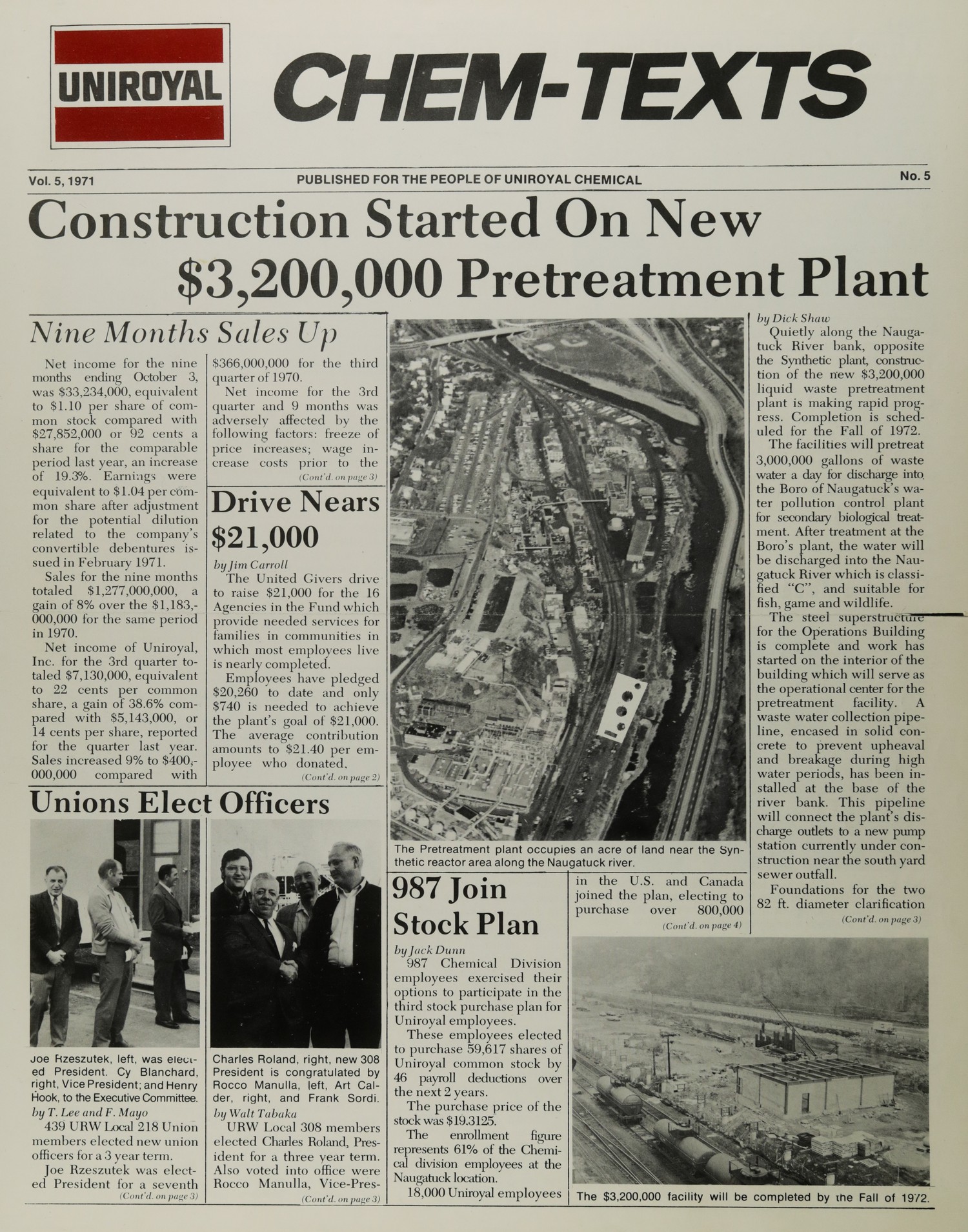
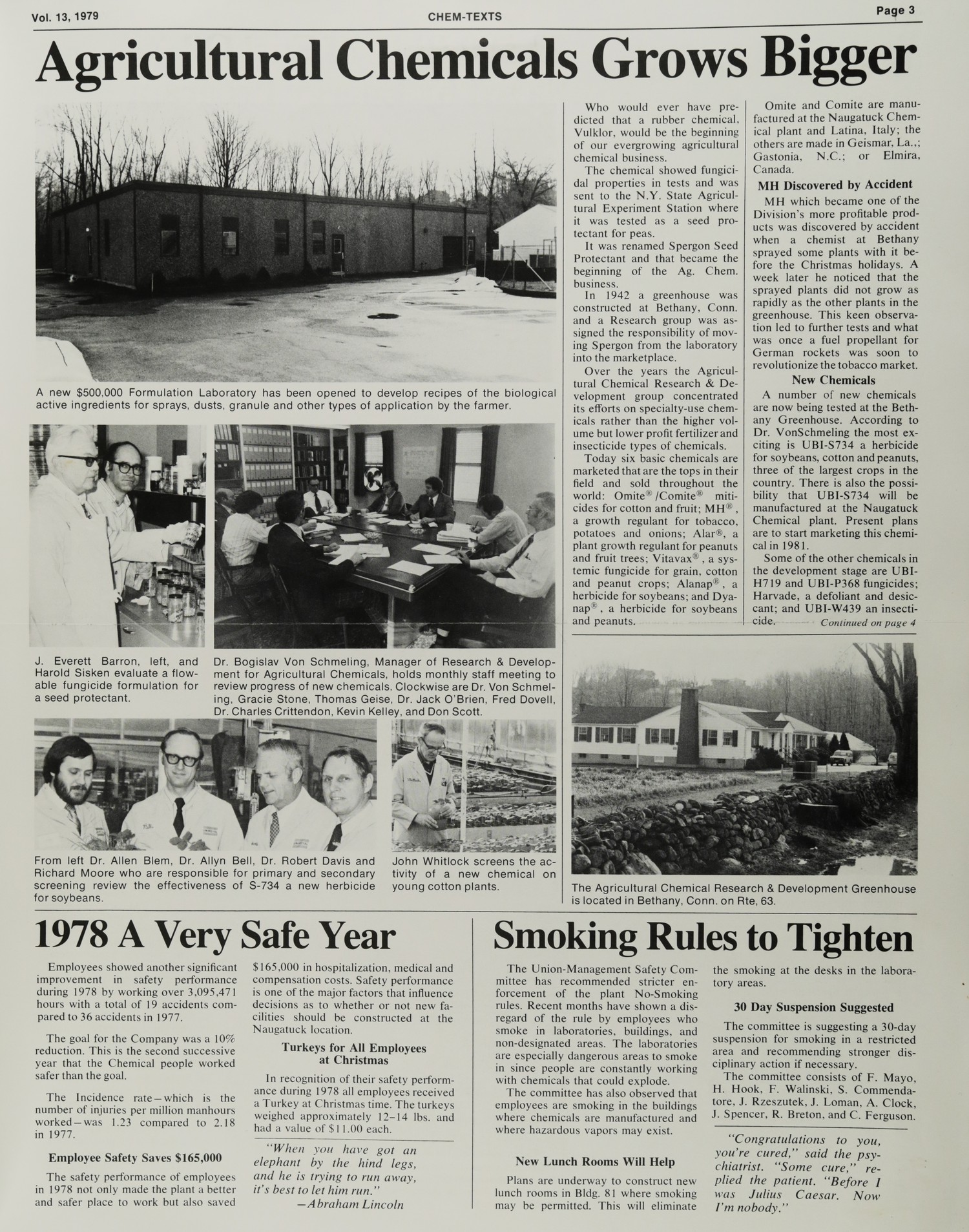
A new $500,000 Formulation Laboratory has been opened to develop recipes of the biological active ingredients for sprays, dusts, granule and other types of application by the farmer.
J. Everett Barron, left, and Harold Sisken evaluate a flowable fungicide formulation for a seed protectant.
Dr. Bogislav Von Schmeling, Manager of Research & Development for Agricultural Chemicals, holds monthly staff meeting to review progress of new chemicals. Clockwise are Dr. Von Schmeling, Gracie Stone, Thomas Geise, Dr. Jack O’Brien, Fred Dovell, Dr. Charles Crittendon, Kevin Kelley, and Don Scott.
From left Dr. Allen Blem, Dr. Allyn Bell, Dr. Robert Davis and Richard Moore who are responsible for primary and secondary screening review the effectiveness of S-734 a new herbicide for soybeans.
John Whitlock screens the activity of a new chemical on young cotton plants.
The Agricultural Chemical Research & Development Greenhouse is located in Bethany, Conn. on Rte. 63.
Who would ever have predicted that a rubber chemical, Vulklor, would be the beginning of our evergrowing agricultural chemical business.
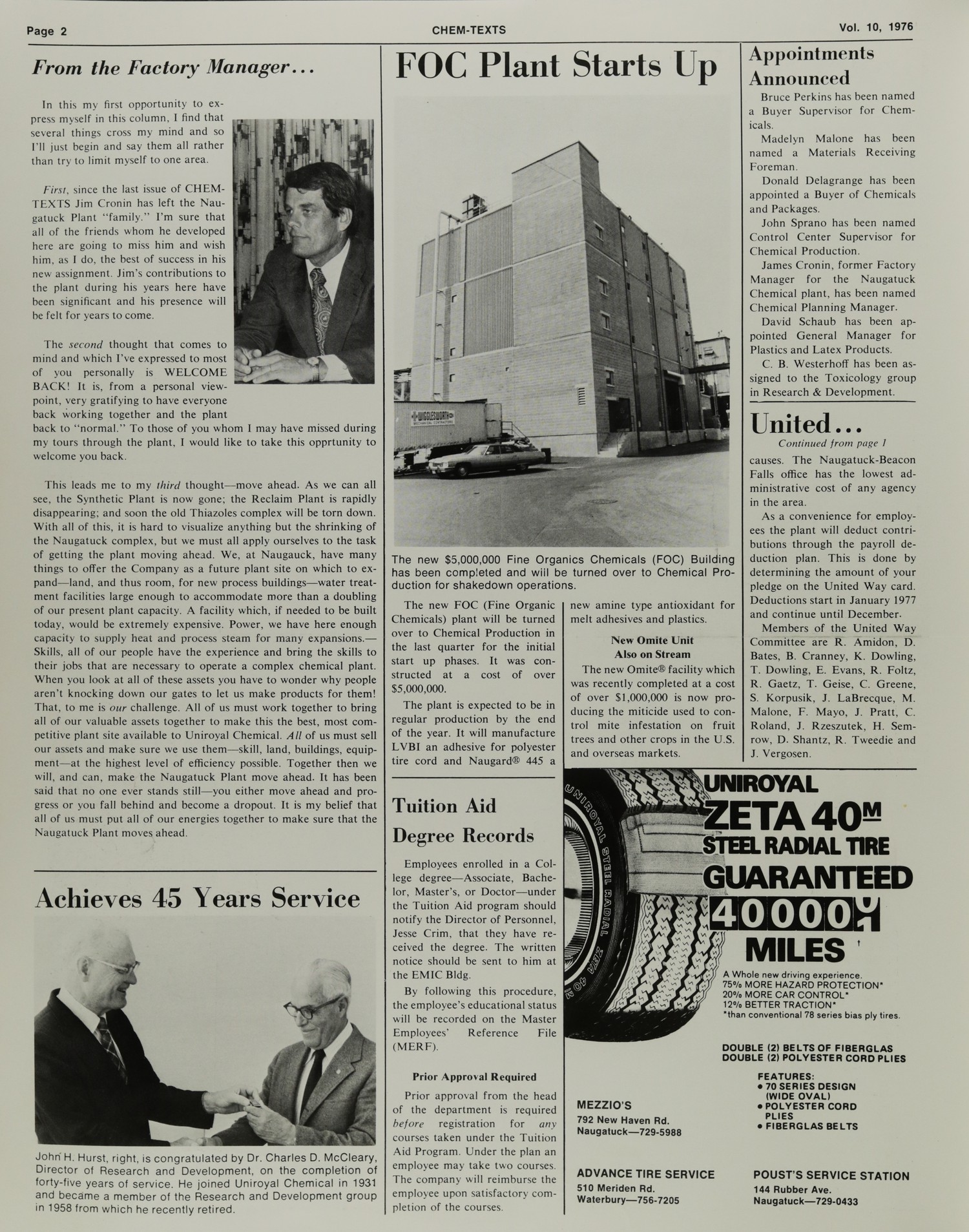
The chemical showed fungicidal properties in tests and was sent to the N.Y. State Agricultural Experiment Station where it was tested as a seed protectant for peas.
It was renamed Spergon Seed Protectant and that became the beginning of the Ag. Chem. business.
In 1942 a greenhouse was constructed at Bethany, Conn. and a Research group was assigned the responsibility of moving Spergon from the laboratory into the marketplace.
Over the years the Agricultural Chemical Research & Development group concentrated its efforts on specialty-use chemicals rather than the higher volume but lower profit fertilizer and insecticide types of chemicals.
Today six basic chemicals are marketed that are the tops in their field and sold throughout the world: Omite® /Comite® miticides for cotton and fruit; MH®, a growth regulant for tobacco, potatoes and onions; Alar®, a plant growth regulant for peanuts and fruit trees; Vitavax®, a systemic fungicide for grain, cotton and peanut crops; Alanap®, a herbicide for soybeans; and Dyanap®, a herbicide for soybeans and peanuts.
Omite and Comite are manufactured at the Naugatuck Chemical plant and Latina, Italy; the others are made in Geismar, La.,; Gastonia, N.C.; or Elmira, Canada.
MH Discovered by Accident
MH which became one of the Division’s more profitable products was discovered by accident when a chemist at Bethany sprayed some plants with it before the Christmas holidays. A week later he noticed that the sprayed plants did not grow as rapidly as the other plants in the greenhouse. This keen observation led to further tests and what was once a fuel propellant for German rockets was soon to revolutionize the tobacco market.
New Chemicals
A number of new chemicals are now being tested at the Bethany Greenhouse. According to Dr. VonSchmeling the most exciting is UBI-S734 a herbicide for soybeans, cotton and peanuts, three of the largest crops in the country. There is also the possibility that UBI-S734 will be manufactured at the Naugatuck Chemical plant. Present plans are to start marketing this chemical in 1981.
Some of the other chemicals in the development stage are UBI-H719 and UBI-P368 fungicides; Harvade, a defoliant and desiccant; and UBI-W439 an insecticide.
Continued on page 4
1978 A Very Safe Year
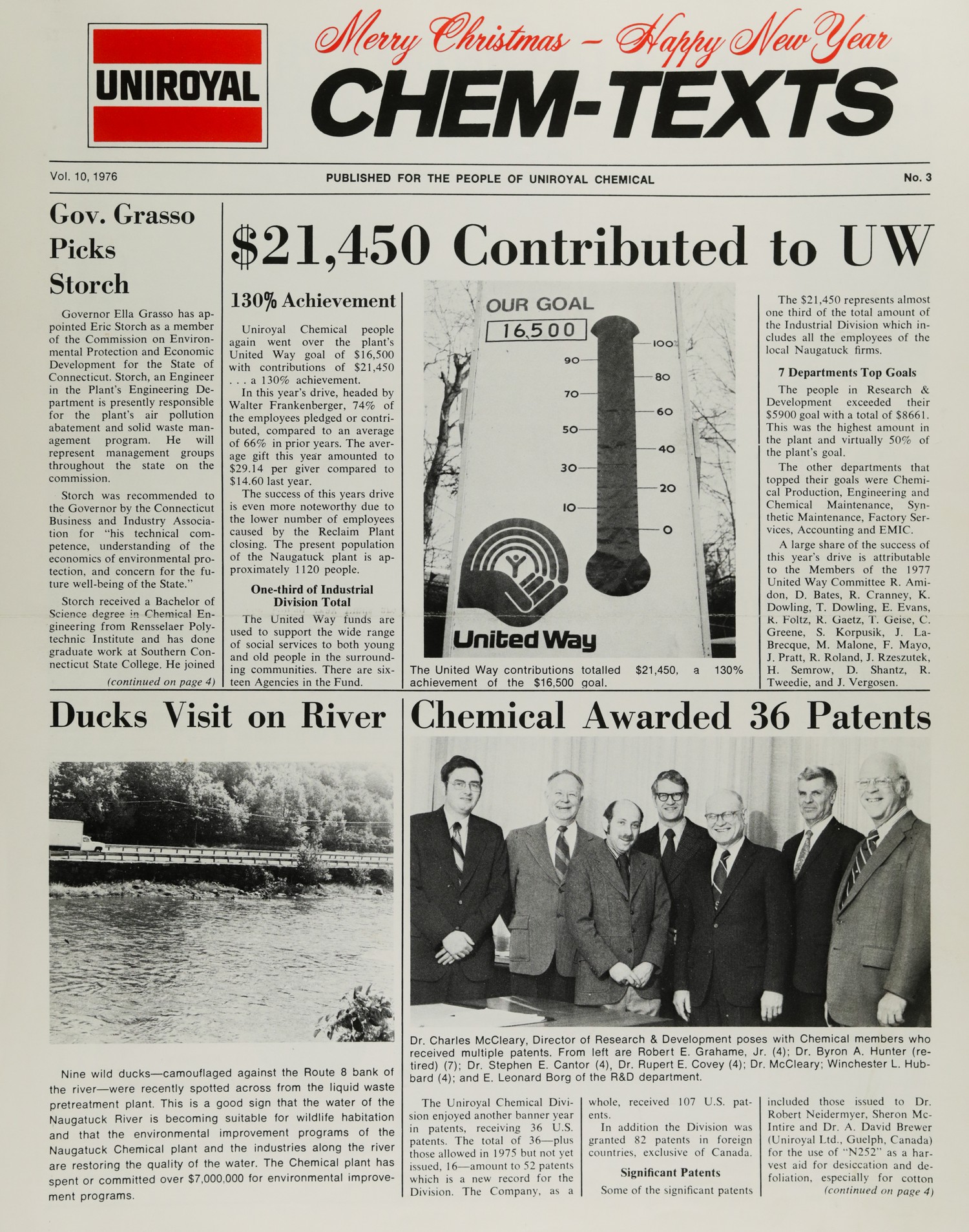
Employees showed another significant improvement in safety performance during 1978 by working over 3,095,471 hours with a total of 19 accidents compared to 36 accidents in 1977.
The goal for the Company was a 10% reduction. This is the second successive year that the Chemical people worked safer than the goal.
The Incidence rate—which is the number of injuries per million manhours worked—was 1.23 compared to 2.18 in 1977.
Employee Safety Saves $165,000
The safety performance of employees in 1978 not only made the plant a better and safer place to work but also saved $165,000 in hospitalization, medical and compensation costs. Safety performance is one of the major factors that influence decisions as to whether or not new facilities should be constructed at the Naugatuck location.
Turkeys for All Employees at Christmas
In recognition of their safety performance during 1978 all employees received a Turkey at Christmas time. The turkeys weighed approximately 12-14 lbs. and had a value of $11.00 each.
“When you have got an elephant by the hind legs, and he is trying to run away, it’s best to let him run.”
—Abraham Lincoln
Smoking Rules to Tighten
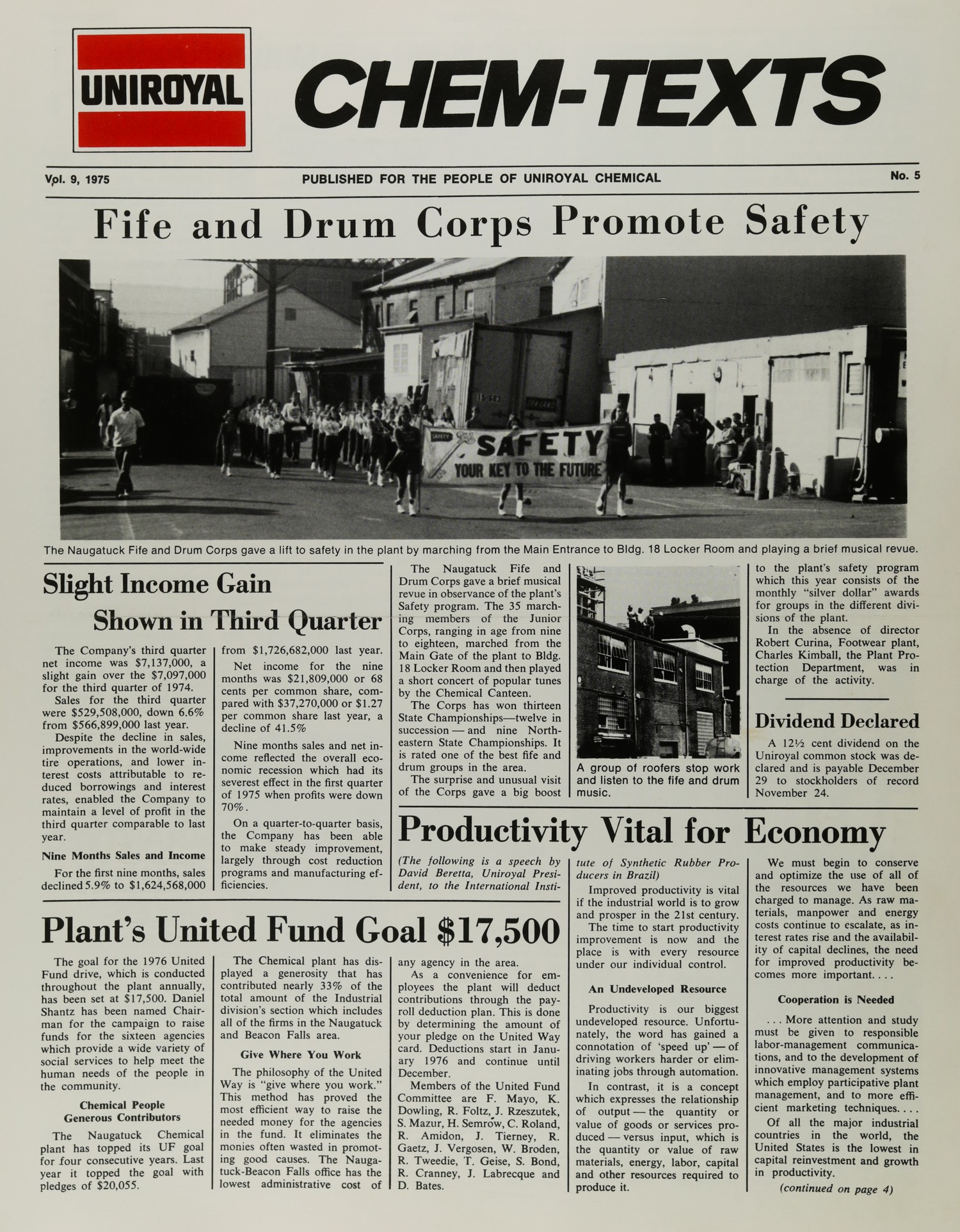
The Union-Management Safety Committee has recommended stricter enforcement of the plant No-Smoking rules. Recent months have shown a disregard of the rule by employees who smoke in laboratories, buildings, and non-designated areas. The laboratories are especially dangerous areas to smoke in since people are constantly working with chemicals that could explode.
The committee has also observed that employees are smoking in the buildings where chemicals are manufactured and where hazardous vapors may exist.
New Lunch Rooms Will Help
Plans are underway to construct new lunch rooms in Bldg. 81 where smoking may be permitted. This will eliminate the smoking at the desks in the laboratory areas.
30 Day Suspension Suggested
The committee is suggesting a 30-day suspension for smoking in a restricted area and recommending stronger disciplinary action if necessary.
The committee consists of F. Mayo, H. Hook, F. Walinski, S. Commendatore, J. Rzeszutek, J. Loman, A. Clock, J. Spencer, R. Breton, and C. Ferguson.
“Congratulations to you, you’re cured,” said the psychiatrist. “Some cure,” replied the patient. “Before I was Julius Caesar. Now I’m nobody.”