CHEM-TEXTS – Vol. 5, No. 2 – Page 2

Page 002

CHEM-TEXTS

Page 2 | Vol. 5, No. 2


FROM THE FACTORY MANAGER

DEAR FELLOW EMPLOYEE:

The National Safety Council recently presented an Award of Merit to the Naugatuck Chemical plant in recognition of its notable safety achievement in 1970. The Award was based on the significant drop in our lost-time accidents during the year: only 6 compared to 24 for each of the three previous years.

In helping to attain this performance, everyone in the plant deserves to be congratulated. Such an achievement is the result only of individual effort and cooperation. With everyone’s increasing concern for safety, we should continue to improve on our experience.

During April, this safety awareness really paid off. Five employees were involved in near-serious eye accidents that would certainly have resulted in damage to their sight. Fortunately, all were wearing their safety glasses at the time of the accidents.

Although our on-the-job safety performance has improved, let’s not overlook safety when away from the job.

Off-the-job safety becomes especially important as the warm weather and vacation time approaches.

At this time there’s a tendency to take extra risks in working around the house—using lawnmowers, climbing ladders, or lifting heavy objects.

Or on vacation, there’s the urge to do everything fast—driving carelessly, exercising too vigorously in sports.

Whether at work, at home, or on vacation—let’s continue to place a great deal of emphasis on good safety habits. Not only you, but your family and fellow employees will benefit from it.

[Signature]


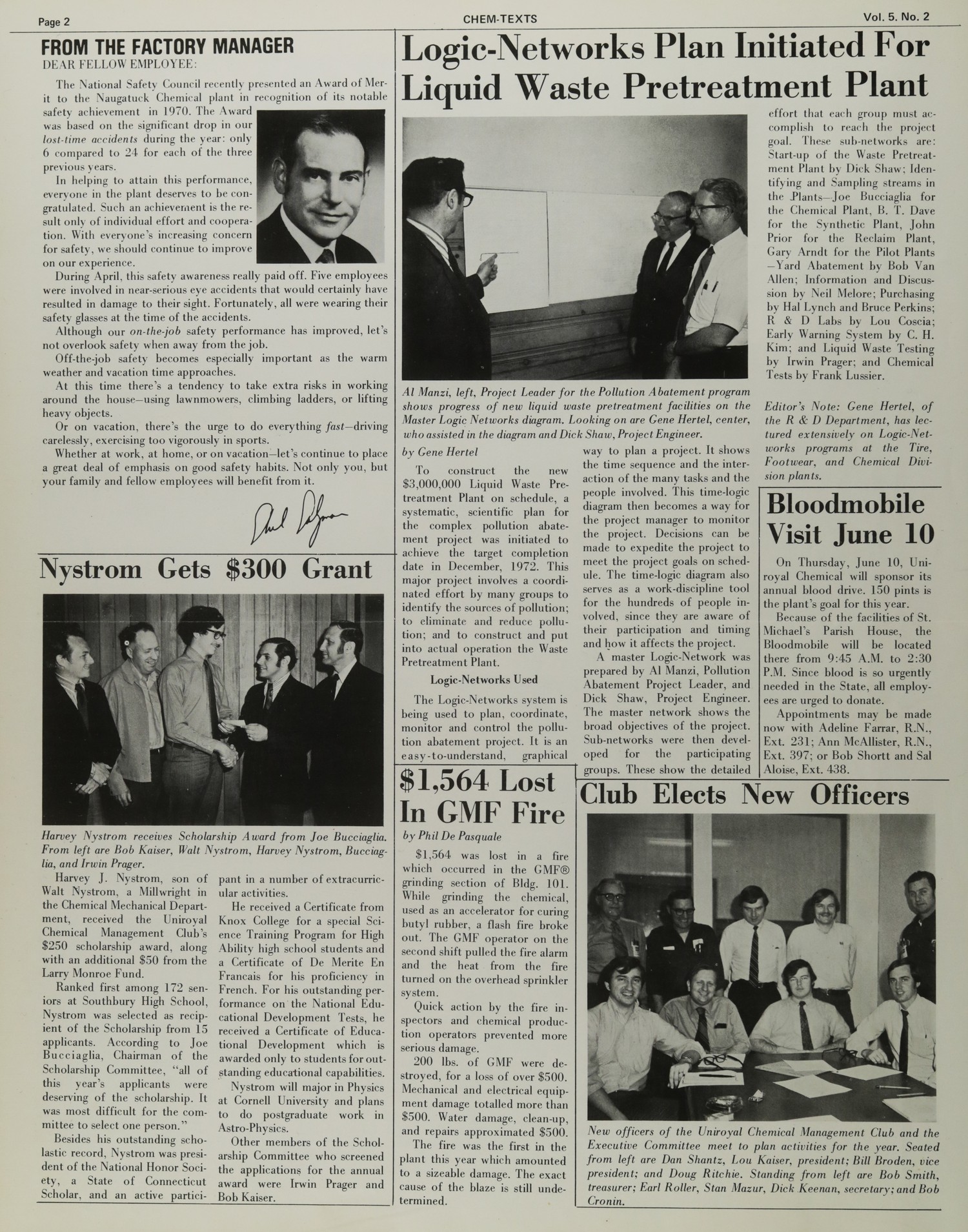
Nystrom Gets $300 Grant

Harvey Nystrom receives Scholarship Award from Joe Bucciaglia. From left are Bob Kaiser, Walt Nystrom, Harvey Nystrom, Bucciaglia, and Irwin Prager.

Harvey J. Nystrom, son of Walt Nystrom, a Millwright in the Chemical Mechanical Department, received the Uniroyal Chemical Management Club’s $250 scholarship award, along with an additional $50 from the Larry Monroe Fund.

Ranked first among 172 seniors at Southbury High School, Nystrom was selected as recipient of the Scholarship from 15 applicants. According to Joe Bucciaglia, Chairman of the Scholarship Committee, “all of this year’s applicants were deserving of the scholarship. It was most difficult for the committee to select one person.”

Besides his outstanding scholastic record, Nystrom was president of the National Honor Society, a State of Connecticut Scholar, and an active participant in a number of extracurricular activities.

He received a Certificate from Knox College for a special Science Training Program for High Ability high school students and a Certificate of De Merite En Francais for his proficiency in French. For his outstanding performance on the National Educational Development Tests, he received a Certificate of Educational Development which is awarded only to students for outstanding educational capabilities.

Nystrom will major in Physics at Cornell University and plans to do postgraduate work in Astro-Physics.

Other members of the Scholarship Committee who screened the applications for the annual award were Irwin Prager and Bob Kaiser.


Logic-Networks Plan Initiated For Liquid Waste Pretreatment Plant

Al Manzi, left, Project Leader for the Pollution Abatement program shows progress of new liquid waste pretreatment facilities on the Master Logic Networks diagram. Looking on are Gene Hertel, center, who assisted in the diagram and Dick Shaw, Project Engineer.

by Gene Hertel

To construct the new $3,000,000 Liquid Waste Pretreatment Plant on schedule, a systematic, scientific plan for the complex pollution abatement project was initiated to achieve the target completion date in December, 1972. This major project involves a coordinated effort by many groups to identify the sources of pollution; to eliminate and reduce pollution; and to construct and put into actual operation the Waste Pretreatment Plant.

Logic-Networks Used

The Logic-Networks system is being used to plan, coordinate, monitor and control the pollution abatement project. It is an easy-to-understand, graphical way to plan a project. It shows the time sequence and the interaction of the many tasks and the people involved. This time-logic diagram then becomes a way for the project manager to monitor the project. Decisions can be made to expedite the project to meet the project goals on schedule. The time-logic diagram also serves as a work-discipline tool for the hundreds of people involved, since they are aware of their participation and timing and how it affects the project.

A master Logic-Network was prepared by Al Manzi, Pollution Abatement Project Leader, and Dick Shaw, Project Engineer. The master network shows the broad objectives of the project. Sub-networks were then developed for the participating groups. These show the detailed effort that each group must accomplish to reach the project goal. These sub-networks are: Start-up of the Waste Pretreatment Plant by Dick Shaw; Identifying and Sampling streams in the Plants—Joe Bucciaglia for the Chemical Plant, B. T. Dave for the Synthetic Plant, John Prior for the Reclaim Plant, Gary Arndt for the Pilot Plants – Yard Abatement by Bob Van Allen; Information and Discussion by Neil Melore; Purchasing by Hal Lynch and Bruce Perkins; R & D Labs by Lou Coscia; Early Warning System by C. H. Kim; and Liquid Waste Testing by Irwin Prager; and Chemical Tests by Frank Lussier.

Editor’s Note: Gene Hertel, of the R & D Department, has lectured extensively on Logic-Networks programs at the Tire, Footwear, and Chemical Division plants.


Bloodmobile Visit June 10

On Thursday, June 10, Uniroyal Chemical will sponsor its annual blood drive. 150 pints is the plant’s goal for this year.

Because of the facilities of St. Michael’s Parish House, the Bloodmobile will be located there from 9:45 A.M. to 2:30 P.M. Since blood is so urgently needed in the State, all employees are urged to donate.

Appointments may be made now with Adeline Farrar, R.N., Ext. 231; Ann McAllister, R.N., Ext. 397; or Bob Shortt and Sal Aloise, Ext. 438.


$1,564 Lost In GMF Fire

by Phil De Pasquale

$1,564 was lost in a fire which occurred in the GMF® grinding section of Bldg. 101. While grinding the chemical, used as an accelerator for curing butyl rubber, a flash fire broke out. The GMF operator on the second shift pulled the fire alarm and the heat from the fire turned on the overhead sprinkler system.

Quick action by the fire inspectors and chemical production operators prevented more serious damage.

200 lbs. of GMF were destroyed, for a loss of over $500. Mechanical and electrical equipment damage totalled more than $500. Water damage, clean-up, and repairs approximated $500.

The fire was the first in the plant this year which amounted to a sizeable damage. The exact cause of the blaze is still undetermined.


Club Elects New Officers

New officers of the Uniroyal Chemical Management Club and the Executive Committee meet to plan activities for the year. Seated from left are Dan Shantz, Lou Kaiser, president; Bill Broden, vice president; and Doug Ritchie. Standing from left are Bob Smith, treasurer; Earl Roller, Stan Mazur, Dick Keenan, secretary; and Bob Cronin.
CHEM-TEXTS – 1971-v05-i06-s205

Page 205

Page 2 | CHEM-TEXTS | Vol. 5, No. 6


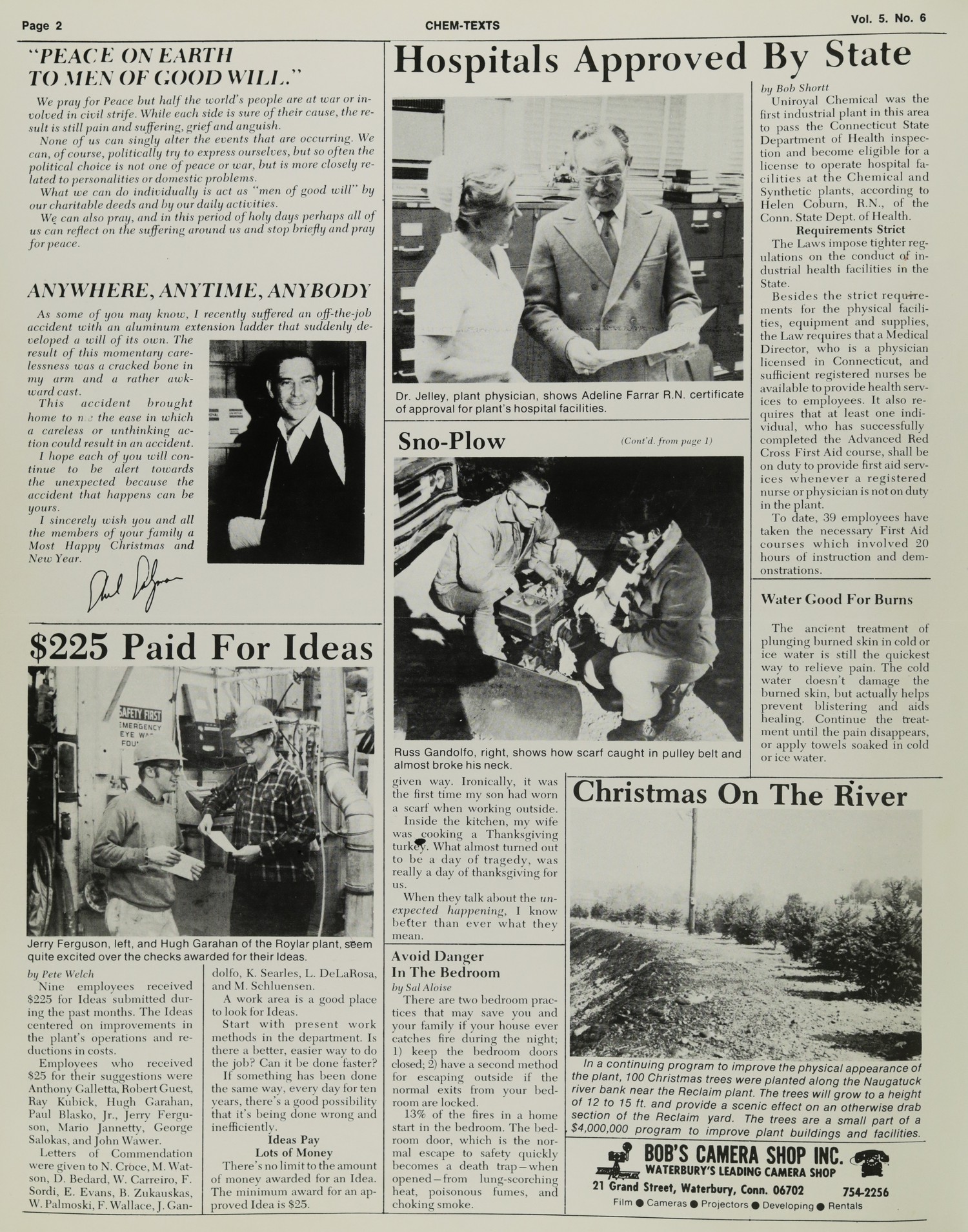
“PEACE ON EARTH TO MEN OF GOOD WILL..”

We pray for Peace but half the world’s people are at war or involved in civil strife. While each side is sure of their cause, the result is still pain and suffering, grief and anguish.

None of us can singly alter the events that are occurring. We can, of course, politically try to express ourselves, but so often the political choice is not one of peace or war, but is more closely related to personalities or domestic problems.

What we can do individually is act as “men of good will” by our charitable deeds and by our daily activities.

We can also pray, and in this period of holy days perhaps all of us can reflect on the suffering around us and stop briefly and pray for peace.


ANYWHERE, ANYTIME, ANYBODY

As some of you may know, I recently suffered an off-the-job accident with an aluminum extension ladder that suddenly developed a will of its own. The result of this momentary carelessness was a cracked bone in my arm and a rather awkward cast.

This accident brought home to me the ease in which a careless or unthinking action could result in an accident.

I hope each of you will continue to be alert towards the unexpected because the accident that happens can be yours.

I sincerely wish you and all the members of your family a Most Happy Christmas and New Year.

[Signature]


$225 Paid For Ideas

[IMAGE: Photo showing two men, with “SAFETY FIRST EMERGENCY EYE WASH FOU…” sign visible]

Jerry Ferguson, left, and Hugh Garahan of the Roylar plant, seem quite excited over the checks awarded for their Ideas.

by Pete Welch

Nine employees received $225 for Ideas submitted during the past months. The Ideas centered on improvements in the plant’s operations and reductions in costs.

Employees who received $25 for their suggestions were Anthony Galletta, Robert Guest, Ray Kubick, Hugh Garahan, Paul Blasko, Jr., Jerry Ferguson, Mario Jannetty, George Salokas, and John Wawer.

Letters of Commendation were given to N. Croce, M. Watson, D. Bedard, W. Carreiro, F. Sordi, E. Evans, B. Zukauskas, W. Palmoski, F. Wallace, J. Gandolfo, K. Searles, L. DeLaRosa, and M. Schluensen.

A work area is a good place to look for Ideas.

Start with present work methods in the department. Is there a better, easier way to do the job? Can it be done faster?

If something has been done the same way, every day for ten years, there’s a good possibility that it’s being done wrong and inefficiently.

Ideas Pay Lots of Money

There’s no limit to the amount of money awarded for an Idea. The minimum award for an approved Idea is $25.


Hospitals Approved By State

[IMAGE: Photo showing Dr. Jelley and Adeline Farrar]

Dr. Jelley, plant physician, shows Adeline Farrar R.N. certificate of approval for plant’s hospital facilities.

by Bob Shortt

Uniroyal Chemical was the first industrial plant in this area to pass the Connecticut State Department of Health inspection and become eligible for a license to operate hospital facilities at the Chemical and Synthetic plants, according to Helen Coburn, R.N., of the Conn. State Dept. of Health.

Requirements Strict

The Laws impose tighter regulations upon the conduct of industrial health facilities in the State.

Besides the strict requirements for the physical facilities, equipment and supplies, the Law requires that a Medical Director, who is a physician licensed in Connecticut, and sufficient registered nurses be available to provide health services to employees. It also requires that at least one individual, who has successfully completed the Advanced Red Cross First Aid course, shall be on duty to provide first aid services whenever a registered nurse or physician is not on duty in the plant.

To date, 39 employees have taken the necessary First Aid courses which involved 20 hours of instruction and demonstrations.


Water Good For Burns

The ancient treatment of plunging burned skin in cold or ice water is still the quickest way to relieve pain. The cold water doesn’t damage the burned skin, but actually helps prevent blistering and aids healing. Continue the treatment until the pain disappears, or apply towels soaked in cold or ice water.


Sno-Plow

(Cont’d. from page 1)

[IMAGE: Photo showing Russ Gandolfo demonstrating scarf caught in pulley belt]

Russ Gandolfo, right, shows how scarf caught in pulley belt and almost broke his neck.

given way. Ironically, it was the first time my son had worn a scarf when working outside.

Inside the kitchen, my wife was cooking a Thanksgiving turkey. What almost turned out to be a day of tragedy, was really a day of thanksgiving for us.

When they talk about the unexpected happening, I know better than ever what they mean.


Avoid Danger In The Bedroom

by Sal Aloise

There are two bedroom practices that may save you and your family if your house ever catches fire during the night; 1) keep the bedroom doors closed, 2) have a second method for escaping outside if the normal exits from your bedroom are locked.

13% of the fires in a home start in the bedroom. The bedroom door, which is the normal escape to safety quickly becomes a death trap—when opened—from lung-scorching heat, poisonous fumes, and choking smoke.


Christmas On The River

In a continuing program to improve the physical appearance of the plant, 100 Christmas trees were planted along the Naugatuck river bank near the Reclaim plant. The trees will grow to a height of 12 to 15 ft. and provide a scenic effect on an otherwise drab section of the Reclaim yard. The trees are a small part of a $4,000,000 program to improve plant buildings and facilities.


BOB’S CAMERA SHOP INC. [Logo]
WATERBURY’S LEADING CAMERA SHOP
21 Grand Street, Waterbury, Conn. 06702 | 754-2256
Film ● Cameras ● Projectors ● Developing ● Rentals

CHEM-TEXTS – Vol. 4, 1970, No. 3 – Page 1

Page 001

UNIROYAL CHEM-TEXTS

Vol. 4, 1970 PUBLISHED FOR THE PEOPLE OF UNIROYAL CHEMICAL No. 3


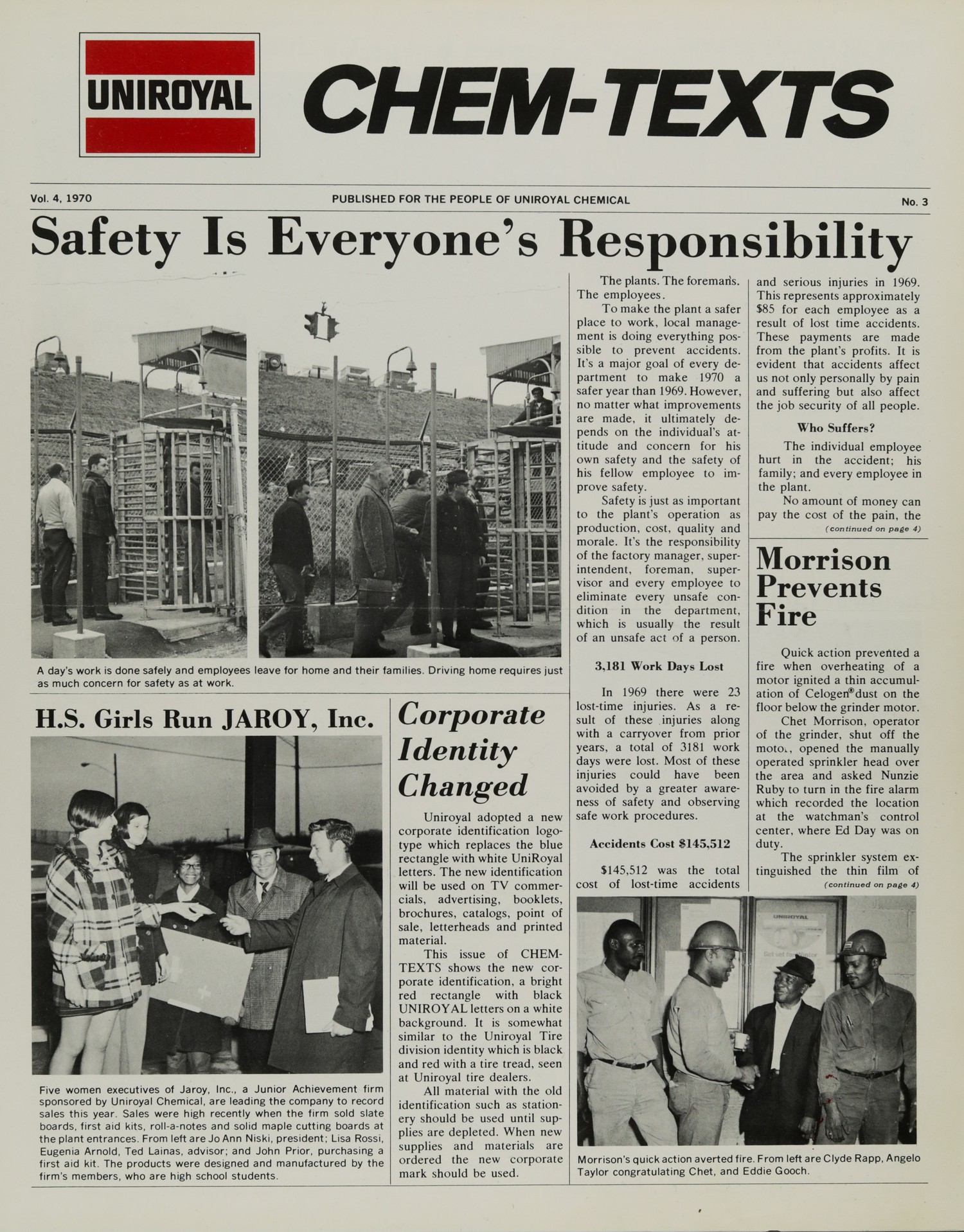
Safety Is Everyone’s Responsibility

[IMAGE: Black and white photograph showing employees leaving work at a plant with cars visible]

A day’s work is done safely and employees leave for home and their families. Driving home requires just as much concern for safety as at work.


The plants. The foremans. The employees.

To make the plant a safer place to work, local management is doing everything possible to prevent accidents. It’s a major goal of every department to make 1970 a safer year than 1969. However, no matter what improvements are made, it ultimately depends on the individual’s attitude and concern for his own safety and the safety of his fellow employee to improve safety.

Safety is just as important to the plant’s operation as production, cost, quality and morale. It’s the responsibility of the factory manager, superintendent, foreman, supervisor and every employee to eliminate every unsafe condition in the department, which is usually the result of an unsafe act of a person.

3,181 Work Days Lost

In 1969 there were 23 lost-time injuries. As a result of these injuries along with a carryover from prior years, a total of 3181 work days were lost. Most of these injuries could have been avoided by a greater awareness of safety and observing safe work procedures.

Accidents Cost $145,512

$145,512 was the total cost of lost-time accidents and serious injuries in 1969. This represents approximately $85 for each employee as a result of lost time accidents. These payments are made from the plant’s profits. It is evident that accidents affect us not only personally by pain and suffering but also affect the job security of all people.

Who Suffers?

The individual employee hurt in the accident; his family; and every employee in the plant.

No amount of money can pay the cost of the pain, the

(continued on page 4)


H.S. Girls Run JAROY, Inc.

[IMAGE: Black and white photograph showing five people standing together]

Five women executives of Jaroy, Inc., a Junior Achievement firm sponsored by Uniroyal Chemical, are leading the company to record sales this year. Sales were high recently when the firm sold slate boards, first aid kits, roll-a-notes and solid maple cutting boards at the plant entrances. From left are Jo Ann Niski, president; Lisa Rossi, Eugenia Arnold, Ted Lainas, advisor; and John Prior, purchasing a first aid kit. The products were designed and manufactured by the firm’s members, who are high school students.


Corporate Identity Changed

Uniroyal adopted a new corporate identification logotype which replaces the blue rectangle with white UniRoyal letters. The new identification will be used on TV commercials, advertising, booklets, brochures, catalogs, point of sale, letterheads and printed material.

This issue of CHEM-TEXTS shows the new corporate identification, a bright red rectangle with black UNIROYAL letters on a white background. It is somewhat similar to the Uniroyal Tire division identity which is black and red with a tire tread, seen at Uniroyal tire dealers.

All material with the old identification such as stationery should be used until supplies are depleted. When new supplies and materials are ordered the new corporate mark should be used.


Morrison Prevents Fire

Quick action prevented a fire when overheating of a motor ignited a thin accumulation of Celogen® dust on the floor below the grinder motor.

Chet Morrison, operator of the grinder, shut off the moto., opened the manually operated sprinkler head over the area and asked Nunzie Ruby to turn in the fire alarm which recorded the location at the watchman’s control center, where Ed Day was on duty.

The sprinkler system extinguished the thin film of

(continued on page 4)

[IMAGE: Black and white photograph showing three men, one wearing a hard hat]

Morrison’s quick action averted fire. From left are Clyde Rapp, Angelo Taylor congratulating Chet, and Eddie Gooch.

CHEM-TEXTS – Vol. 4 No. 6 – Page 2

Page 002

CHEM-TEXTS

Page 2 | Vol. 4, No. 6


FROM THE FACTORY MANAGER

DEAR FELLOW EMPLOYEE:

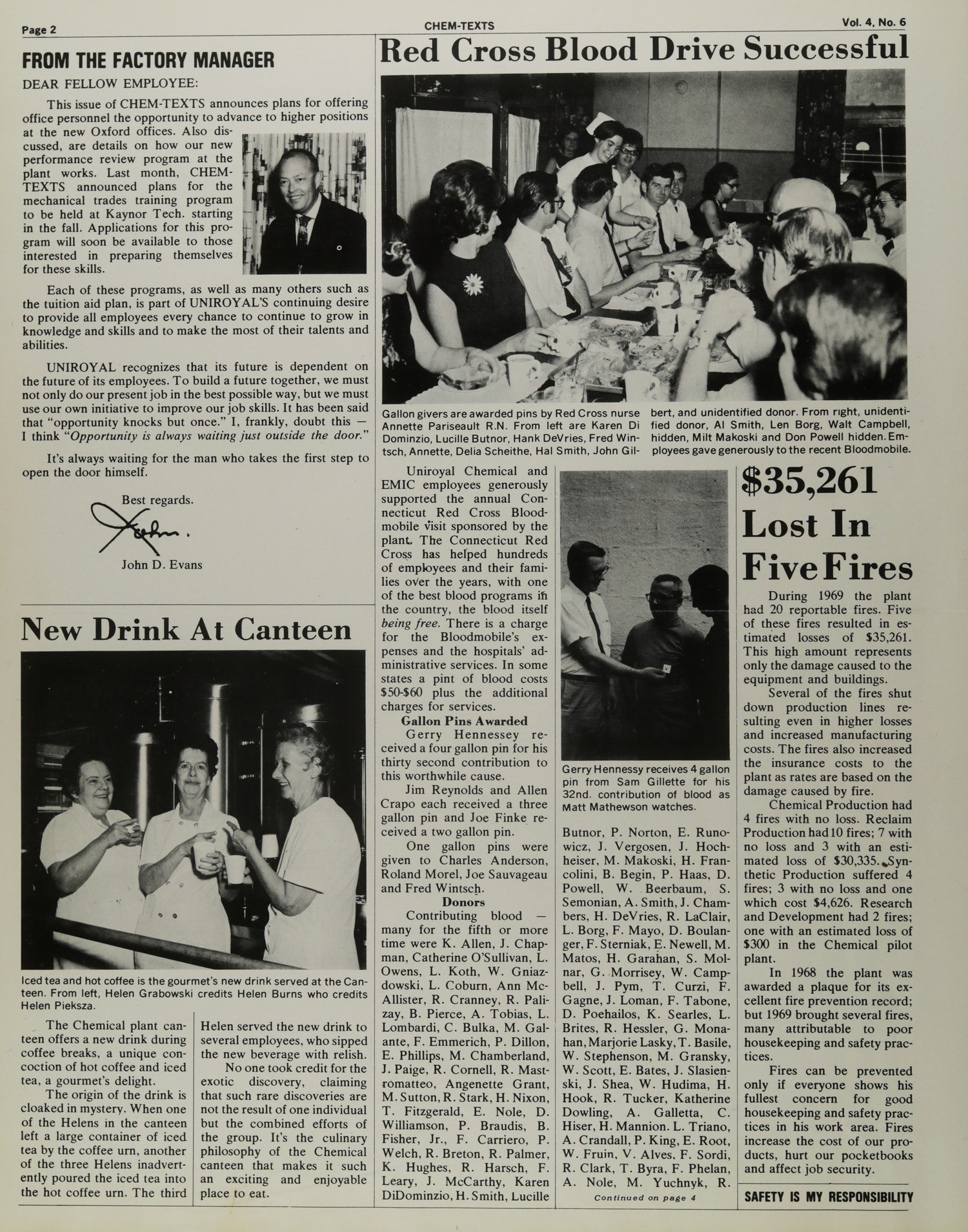
This issue of CHEM-TEXTS announces plans for offering office personnel the opportunity to advance to higher positions at the new Oxford offices. Also discussed, are details on how our new performance review program at the plant works. Last month, CHEM-TEXTS announced plans for the mechanical trades training program to be held at Kaynor Tech. starting in the fall. Applications for this program will soon be available to those interested in preparing themselves for these skills.

Each of these programs, as well as many others such as the tuition aid plan, is part of UNIROYAL’S continuing desire to provide all employees every chance to continue to grow in knowledge and skills and to make the most of their talents and abilities.

UNIROYAL recognizes that its future is dependent on the future of its employees. To build a future together, we must not only do our present job in the best possible way, but we must use our own initiative to improve our job skills. It has been said that “opportunity knocks but once.” I, frankly, doubt this — I think “Opportunity is always waiting just outside the door.

It’s always waiting for the man who takes the first step to open the door himself.

Best regards,

John D. Evans

John D. Evans


New Drink At Canteen

[IMAGE CAPTION:]
Iced tea and hot coffee is the gourmet’s new drink served at the Canteen. From left, Helen Grabowski credits Helen Burns who credits Helen Pieksza.

The Chemical plant canteen offers a new drink during coffee breaks, a unique concoction of hot coffee and iced tea, a gourmet’s delight.

The origin of the drink is cloaked in mystery. When one of the Helens in the canteen left a large container of iced tea by the coffee urn, another of the three Helens inadvertently poured the iced tea into the hot coffee urn. The third Helen served the new drink to several employees, who sipped the new beverage with relish.

No one took credit for the exotic discovery, claiming that such rare discoveries are not the result of one individual but the combined efforts of the group. It’s the culinary philosophy of the Chemical canteen that makes it such an exciting and enjoyable place to eat.


Red Cross Blood Drive Successful

[IMAGE CAPTION:]
Gallon givers are awarded pins by Red Cross nurse Annette Pariseault R.N. From left are Karen Di Dominzio, Lucille Butnor, Hank DeVries, Fred Wintsch, Annette, Delia Scheithe, Hal Smith, John Gilbert, and unidentified donor. From right, unidentified donor, Al Smith, Len Borg, Walt Campbell, hidden, Milt Makoski and Don Powell hidden. Employees gave generously to the recent Bloodmobile.

Uniroyal Chemical and EMIC employees generously supported the annual Connecticut Red Cross Bloodmobile visit sponsored by the plant. The Connecticut Red Cross has helped hundreds of employees and their families over the years, with one of the best blood programs in the country, the blood itself being free. There is a charge for the Bloodmobile’s expenses and the hospitals’ administrative services. In some states a pint of blood costs $50-$60 plus the additional charges for services.

Gallon Pins Awarded

Gerry Hennessey received a four gallon pin for his thirty second contribution to this worthwhile cause.

Jim Reynolds and Allen Crapo each received a three gallon pin and Joe Finke received a two gallon pin.

One gallon pins were given to Charles Anderson, Roland Morel, Joe Sauvageau and Fred Wintsch.

Donors

Contributing blood — many for the fifth or more time were K. Allen, J. Chapman, Catherine O’Sullivan, L. Owens, L. Koth, W. Gniazdowski, L. Coburn, Ann McAllister, R. Cranney, R. Palizay, B. Pierce, A. Tobias, L. Lombardi, C. Bulka, M. Galante, F. Emmerich, P. Dillon, E. Phillips, M. Chamberland, J. Paige, R. Cornell, R. Mastromatteo, Angenette Grant, M. Sutton, R. Stark, H. Nixon, T. Fitzgerald, E. Nole, D. Williamson, P. Braudis, B. Fisher, Jr., F. Carriero, P. Welch, R. Breton, R. Palmer, K. Hughes, R. Harsch, F. Leary, J. McCarthy, Karen DiDominzio, H. Smith, Lucille Butnor, P. Norton, E. Runowicz, J. Vergosen, J. Hochheiser, M. Makoski, H. Francolini, B. Begin, P. Haas, D. Powell, W. Beerbaum, S. Semonian, A. Smith, J. Chambers, H. DeVries, R. LaClair, L. Borg, F. Mayo, D. Boulanger, F. Sterniak, E. Newell, M. Matos, H. Garahan, S. Molnar, G. Morrisey, W. Campbell, J. Pym, T. Curzi, F. Gagne, J. Loman, F. Tabone, D. Poehailos, K. Searles, L. Brites, R. Hessler, G. Monahan, Marjorie Lasky, T. Basile, W. Stephenson, M. Gransky, W. Scott, E. Bates, J. Slasienski, J. Shea, W. Hudima, H. Hook, R. Tucker, Katherine Dowling, A. Galletta, C. Hiser, H. Mannion. L. Triano, A. Crandall, P. King, E. Root, W. Fruin, V. Alves. F. Sordi, R. Clark, T. Byra, F. Phelan, A. Nole, M. Yuchnyk, R.

Continued on page 4

[IMAGE CAPTION:]
Gerry Hennessy receives 4 gallon pin from Sam Gillette for his 32nd. contribution of blood as Matt Mathewson watches.


$35,261 Lost In Five Fires

During 1969 the plant had 20 reportable fires. Five of these fires resulted in estimated losses of $35,261. This high amount represents only the damage caused to the equipment and buildings.

Several of the fires shut down production lines resulting even in higher losses and increased manufacturing costs. The fires also increased the insurance costs to the plant as rates are based on the damage caused by fire.

Chemical Production had 4 fires with no loss. Reclaim Production had 10 fires; 7 with no loss and 3 with an estimated loss of $30,335. Synthetic Production suffered 4 fires; 3 with no loss and one which cost $4,626. Research and Development had 2 fires; one with an estimated loss of $300 in the Chemical pilot plant.

In 1968 the plant was awarded a plaque for its excellent fire prevention record; but 1969 brought several fires, many attributable to poor housekeeping and safety practices.

Fires can be prevented only if everyone shows his fullest concern for good housekeeping and safety practices in his work area. Fires increase the cost of our products, hurt our pocketbooks and affect job security.

SAFETY IS MY RESPONSIBILITY

CHEM-TEXTS – Vol. 3, 1969, No. 5 – Page 1

Page 001

UNIROYAL CHEM-TEXTS

Vol. 3, 1969 | PUBLISHED FOR THE PEOPLE OF UNIROYAL CHEMICAL | No. 5


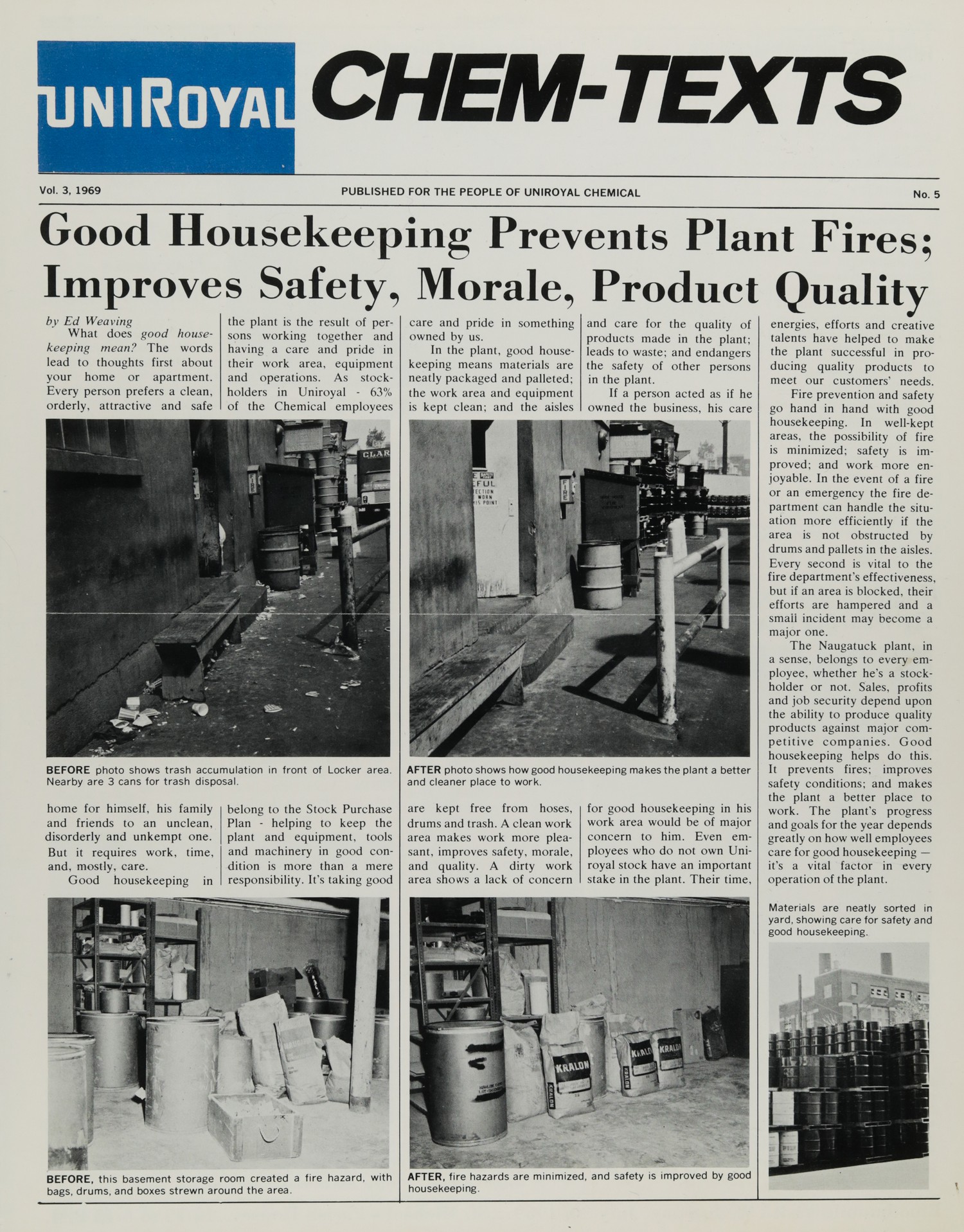
Good Housekeeping Prevents Plant Fires; Improves Safety, Morale, Product Quality

by Ed Weaving

What does good housekeeping mean? The words lead to thoughts first about your home or apartment. Every person prefers a clean, orderly, attractive and safe

the plant is the result of persons working together and having a care and pride in their work area, equipment and operations. As stockholders in Uniroyal – 63% of the Chemical employees

care and pride in something owned by us.

In the plant, good housekeeping means materials are neatly packaged and palleted; the work area and equipment is kept clean; and the aisles

and care for the quality of products made in the plant; leads to waste; and endangers the safety of other persons in the plant.

If a person acted as if he owned the business, his care

energies, efforts and creative talents have helped to make the plant successful in producing quality products to meet our customers’ needs.

Fire prevention and safety go hand in hand with good housekeeping. In well-kept areas, the possibility of fire is minimized; safety is improved; and work more enjoyable. In the event of a fire or an emergency the fire department can handle the situation more efficiently if the area is not obstructed by drums and pallets in the aisles. Every second is vital to the fire department’s effectiveness, but if an area is blocked, their efforts are hampered and a small incident may become a major one.

The Naugatuck plant, in a sense, belongs to every employee, whether he’s a stockholder or not. Sales, profits and job security depend upon the ability to produce quality products against major competitive companies. Good housekeeping helps do this. It prevents fires; improves safety conditions; and makes the plant a better place to work. The plant’s progress and goals for the year depends greatly on how well employees care for good housekeeping — it’s a vital factor in every operation of the plant.


BEFORE photo shows trash accumulation in front of Locker area. Nearby are 3 cans for trash disposal.

AFTER photo shows how good housekeeping makes the plant a better and cleaner place to work.


home for himself, his family and friends to an unclean, disorderly and unkempt one. But it requires work, time, and, mostly, care.

Good housekeeping in

belong to the Stock Purchase Plan – helping to keep the plant and equipment, tools and machinery in good condition is more than a mere responsibility. It’s taking good

are kept free from hoses, drums and trash. A clean work area makes work more pleasant, improves safety, morale, and quality. A dirty work area shows a lack of concern

for good housekeeping in his work area would be of major concern to him. Even employees who do not own Uniroyal stock have an important stake in the plant. Their time,


BEFORE, this basement storage room created a fire hazard, with bags, drums, and boxes strewn around the area.

AFTER, fire hazards are minimized, and safety is improved by good housekeeping.


Materials are neatly sorted in yard, showing care for safety and good housekeeping.

CHEM-TEXTS – Vol. 3 No. 10 – Page 3

Page 003

CHEM-TEXTS

Vol. 3 No. 10 | Page 3


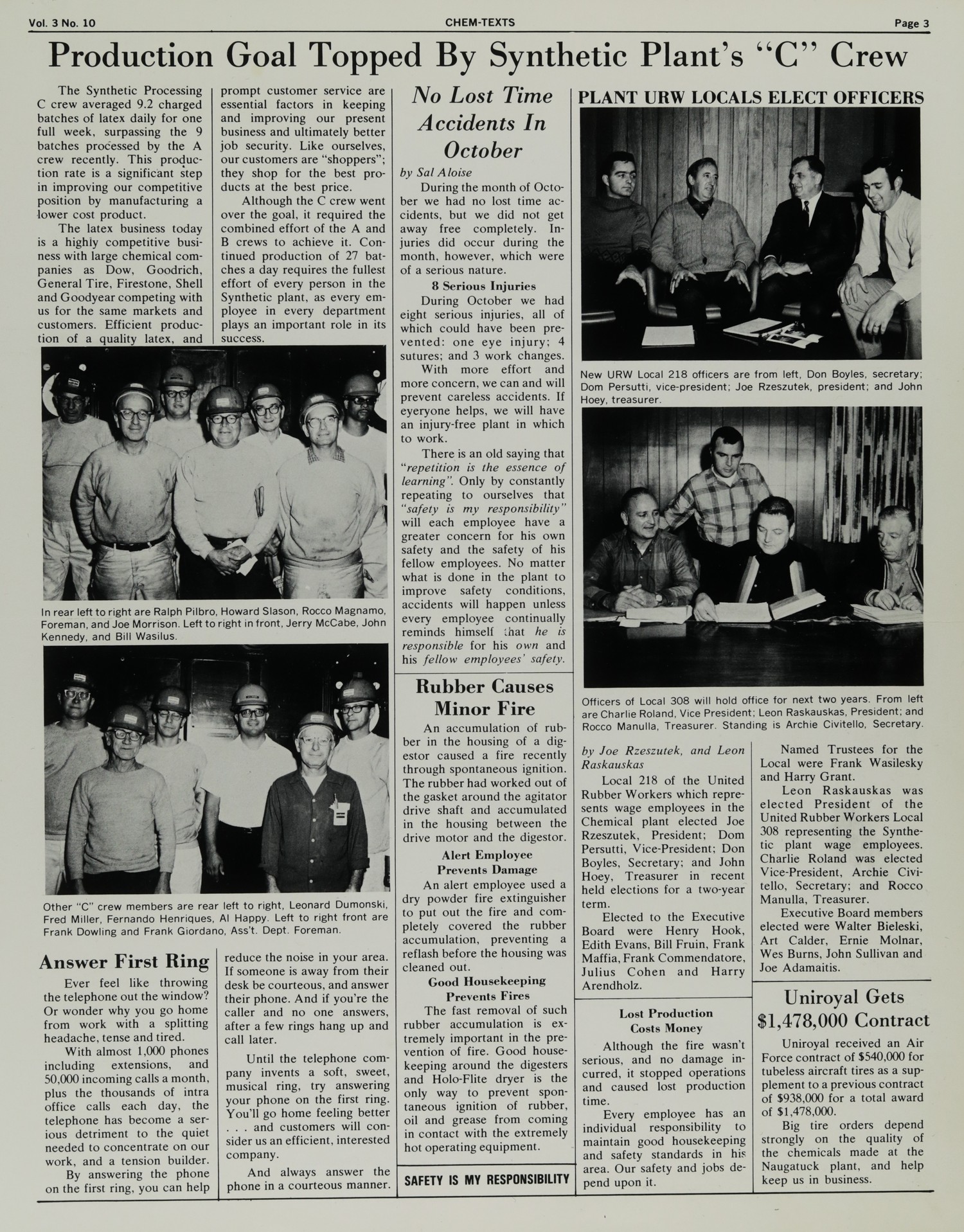
Production Goal Topped By Synthetic Plant’s “C” Crew

The Synthetic Processing C crew averaged 9.2 charged batches of latex daily for one full week, surpassing the 9 batches processed by the A crew recently. This production rate is a significant step in improving our competitive position by manufacturing a lower cost product.

The latex business today is a highly competitive business with large chemical companies as Dow, Goodrich, General Tire, Firestone, Shell and Goodyear competing with us for the same markets and customers. Efficient production of a quality latex, and prompt customer service are essential factors in keeping and improving our present business and ultimately better job security. Like ourselves, our customers are “shoppers”; they shop for the best products at the best price.

Although the C crew went over the goal, it required the combined effort of the A and B crews to achieve it. Continued production of 27 batches a day requires the fullest effort of every person in the Synthetic plant, as every employee in every department plays an important role in its success.


[PHOTO CAPTION:]
In rear left to right are Ralph Pilbro, Howard Slason, Rocco Magnamo, Foreman, and Joe Morrison. Left to right in front, Jerry McCabe, John Kennedy, and Bill Wasilus.


[PHOTO CAPTION:]
Other “C” crew members are rear left to right, Leonard Dumonski, Fred Miller, Fernando Henriques, Al Happy. Left to right front are Frank Dowling and Frank Giordano, Ass’t. Dept. Foreman.


Answer First Ring

Ever feel like throwing the telephone out the window? Or wonder why you go home from work with a splitting headache, tense and tired.

With almost 1,000 phones including extensions, and 50,000 incoming calls a month, plus the thousands of intra office calls each day, the telephone has become a serious detriment to the quiet needed to concentrate on our work, and a tension builder.

By answering the phone on the first ring, you can help reduce the noise in your area. If someone is away from their desk be courteous, and answer their phone. And if you’re the caller and no one answers, after a few rings hang up and call later.

Until the telephone company invents a soft, sweet, musical ring, try answering your phone on the first ring. You’ll go home feeling better . . . and customers will consider us an efficient, interested company.

And always answer the phone in a courteous manner.


No Lost Time Accidents In October

by Sal Aloise

During the month of October we had no lost time accidents, but we did not get away free completely. Injuries did occur during the month, however, which were of a serious nature.

8 Serious Injuries

During October we had eight serious injuries, all of which could have been prevented: one eye injury; 4 sutures; and 3 work changes.

With more effort and more concern, we can and will prevent careless accidents. If everyone helps, we will have an injury-free plant in which to work.

There is an old saying that “repetition is the essence of learning”. Only by constantly repeating to ourselves that “safety is my responsibility” will each employee have a greater concern for his own safety and the safety of his fellow employees. No matter what is done in the plant to improve safety conditions, accidents will happen unless every employee continually reminds himself that he is responsible for his own and his fellow employees’ safety.


Rubber Causes Minor Fire

An accumulation of rubber in the housing of a digestor caused a fire recently through spontaneous ignition. The rubber had worked out of the gasket around the agitator drive shaft and accumulated in the housing between the drive motor and the digestor.

Alert Employee Prevents Damage

An alert employee used a dry powder fire extinguisher to put out the fire and completely covered the rubber accumulation, preventing a reflash before the housing was cleaned out.

Good Housekeeping Prevents Fires

The fast removal of such rubber accumulation is extremely important in the prevention of fire. Good housekeeping around the digesters and Holo-Flite dryer is the only way to prevent spontaneous ignition of rubber, oil and grease from coming in contact with the extremely hot operating equipment.


SAFETY IS MY RESPONSIBILITY


PLANT URW LOCALS ELECT OFFICERS

[PHOTO CAPTION:]
New URW Local 218 officers are from left, Don Boyles, secretary; Dom Persutti, vice-president; Joe Rzeszutek, president; and John Hoey, treasurer.


[PHOTO CAPTION:]
Officers of Local 308 will hold office for next two years. From left are Charlie Roland, Vice President; Leon Raskauskas, President; and Rocco Manulla, Treasurer. Standing is Archie Civitello, Secretary.


by Joe Rzeszutek, and Leon Raskauskas

Local 218 of the United Rubber Workers which represents wage employees in the Chemical plant elected Joe Rzeszutek, President; Dom Persutti, Vice-President; Don Boyles, Secretary; and John Hoey, Treasurer in recent held elections for a two-year term.

Elected to the Executive Board were Henry Hook, Edith Evans, Bill Fruin, Frank Maffia, Frank Commendatore, Julius Cohen and Harry Arendholz.

Lost Production Costs Money

Although the fire wasn’t serious, and no damage incurred, it stopped operations and caused lost production time.

Every employee has an individual responsibility to maintain good housekeeping and safety standards in his area. Our safety and jobs depend upon it.

Named Trustees for the Local were Frank Wasilesky and Harry Grant.

Leon Raskauskas was elected President of the United Rubber Workers Local 308 representing the Synthetic plant wage employees. Charlie Roland was elected Vice-President, Archie Civitello, Secretary; and Rocco Manulla, Treasurer.

Executive Board members elected were Walter Bieleski, Art Calder, Ernie Molnar, Wes Burns, John Sullivan and Joe Adamaitis.


Uniroyal Gets $1,478,000 Contract

Uniroyal received an Air Force contract of $540,000 for tubeless aircraft tires as a supplement to a previous contract of $938,000 for a total award of $1,478,000.

Big tire orders depend strongly on the quality of the chemicals made at the Naugatuck plant, and help keep us in business.